Blog

  • Even before the shutdown imperiled SNAP benefits, the federal budget bill did. But we can take action.

    Even before the shutdown imperiled SNAP benefits, the federal budget bill did. But we can take action.

    Nearly two million Pennsylvanians may wake up on the first of the month and discover they don’t have any money for groceries.

    As a result of the federal government shutdown, the Pennsylvania Department of Human Services (DHS) has announced that Supplemental Nutrition Assistance Program (SNAP) benefits will not be paid until the shutdown ends and funds are released to Pennsylvania.

    But SNAP was already in jeopardy before the shutdown.

    Even as families scramble to find a way to keep food on the table right now, many must also take immediate action to protect their SNAP in the long run. The federal budget bill enacted in July threatens to take food away from millions of people with disabilities, caregivers, and older adults who cannot afford food. In fact, tens of thousands of Philadelphians are in danger of losing their SNAP this winter.

    But it’s not too late to ensure families can avoid hunger when SNAP resumes.

    For the first time ever, Philadelphians must satisfy harsh and ineffective work requirements that impose a time limit on SNAP benefits for many adults. People who do not meet an exemption or cannot prove they work at least 20 hours per week will be able to get only three months of SNAP every three years.

    This time limit began on Sept. 1 for adults ages 18-54 who do not receive a disability benefit and who do not live in a SNAP household with a child under 18. On Nov. 1, the clock starts for older adults ages 55-64 and parents of children ages 14 and older.

    Very soon, DHS will issue its first cutoff notices, alerting people ages 18-54 who have not been found exempt or compliant with work requirements that they will lose their SNAP effective Dec. 1.

    Moreover, many humanitarian immigrants who came to the United States seeking safety and prosperity will no longer be able to get SNAP at all. Under the new law, the only groups eligible for SNAP will be United States citizens, some green-card holders, certain Cuban or Haitian entrants, and a very few others. These devastating restrictions also take effect for new applicants on Nov. 1.

    Refugees, people granted asylum, and victims of trafficking and abuse who don’t yet have green cards will be left to worry about where their next meal is coming from, and there are no exceptions to these rules.

    As paralegals at Community Legal Services of Philadelphia (CLS), we have advocated for hundreds of clients who have been wrongfully denied SNAP because of red tape and paperwork errors. Without a citywide effort to protect access to SNAP, work requirements will leave Philadelphians without food on the table.

    DHS has estimated that as many as 65% of Pennsylvanians subject to work requirements will lose SNAP. We cannot accept this fate.

    The best way to protect SNAP is to help eligible people claim an exemption from work requirements. Many adults meet at least one exemption, which will allow them to keep their SNAP until their next annual renewal. Importantly, workers who earn at least $217.50 per week before taxes are exempt as long as the County Assistance Office (CAO) knows about their work. Many others must claim an exemption.

    Our client J.P. (we are using client initials to protect their privacy) was immediately distressed when told about work requirements. J.P. would love to be able to work, but he can’t. A 56-year-old, he gets dialysis three to four times a week to treat chronic kidney disease. He and his 76-year-old mom, V.P., survive on SNAP and her meager retirement benefit.

    Even with food assistance, V.P. has just $49 to her name each month after paying the bills.

    To preserve his SNAP and V.P.’s razor-thin budget, J.P. must ask his doctor to complete Pennsylvania’s SNAP medical exemption form (PA 1921) to prove he has a medical condition that limits his ability to work. Many people, including workers pushing through conditions like pain, fatigue, and depression on the job, will qualify for this exemption. Healthcare providers should readily complete the PA 1921 so that their patients can make healthy decisions without fear of losing access to adequate nutrition.

    DHS has estimated that as many as 65% of Pennsylvanians subject to work requirements will lose SNAP. We cannot accept this fate, write Daryn Forgeron and Anaga Srinivas.

    The medical exemption form is one of many exemptions available to SNAP recipients who cannot satisfy work requirements. Adults are also exempt if they are taking care of a sick family member, pregnant, unable to work because of domestic violence, participating in a drug or alcohol treatment program, receiving unemployment compensation, or are experiencing homelessness.

    CLS has trained thousands of service providers on how to help people claim exemptions and how to ensure eligible green-card holders do not lose their SNAP. We hope many others will join this collective effort.

    Accessing SNAP has never been easy for families like J.P.’s, and for other hardworking Philadelphians we all depend on — restaurant workers with irregular hours, school bus drivers, and dedicated caregivers. Work requirements and the paperwork burden that comes with them punish workers for their lack of stability. If their hours fall below 20 hours per week, they will be required to report this change to their caseworker within 10 days, and the three-month time limitation will begin.

    Most SNAP recipients who can work already do work. But job seekers who have applied for hundreds of jobs to no avail, perhaps because of their age, a suffering job market, or a criminal record, get no credit for their efforts, and are considered not to be complying with work requirements at all. They must meet an exemption to keep their SNAP.

    Without SNAP, families are likely to fall behind on bills, causing collateral consequences like utility shutoff or eviction. Our communities will bear the cost of SNAP cuts through higher healthcare costs and loss of income for local businesses.

    Philadelphia can’t afford to leave anyone behind. From legal advocates and community organizations to city government, medical care teams, and neighbors next door, our city must come together to ensure fellow Philadelphians do not lose SNAP.

    Daryn Forgeron and Anaga Srinivas are paralegals in the Health and Independence Unit at Community Legal Services of Philadelphia.

  • Parker’s Land Bank shakeup may lead to more affordable housing | Shackamaxon

    Parker’s Land Bank shakeup may lead to more affordable housing | Shackamaxon

    Continued budget delays in Harrisburg are, unfortunately, again part of this week’s Shackamaxon. But first, all you ever wanted to know about the Land Bank (but were afraid to ask), including the mayor’s recent board shake-up.

    Running on empty

    Ever since Philadelphia lost more than a quarter million residents between 1970 and 1980, blight and vacancy have been a problem. Abandoned, deteriorating homes, schools, and factories provide a convenient staging ground for criminal activity, cost the city millions in annual maintenance, and don’t contribute property taxes to city coffers.

    For years, the city struggled to find a way to repurpose this land. While some residents admirably turned lots into community assets like gardens, most of the space sat unused. Some properties languished because potential buyers considered them unprofitable, with expected rents or sale prices that were too low to justify the cost of construction. But other lots were in high demand, drawing interest from developers, nonprofits, and community groups.

    Like a deer caught in the headlights, City Council members often opted against selling to anyone.

    To shake that inertia, City Council created the Land Bank in 2013. Yet, despite a push from then-Councilmember Maria Quiñones Sánchez, Council did not cede control of land sales. This meant the analysis paralysis continued. So did side arrangements, like when then-Council President Darrell L. Clarke steered city land to a developer through a no-bid process.

    Some parcels that were allocated to the Land Bank became the subject of fierce debate. Municipal policy wonks urged Council to sell the most valuable plots as a way to underwrite the city’s subsidized housing efforts. Meanwhile, advocates for affordable housing called for the creation of homes for people at the lowest income levels.

    City Council seemingly found common ground in 2022, nearly a decade after the Land Bank was first authorized, with a compromise called “Turn the Key.”

    Under the terms of that program, land would go to what’s often called “workforce housing,” available to residents of modest means who earn up to 100% of our area’s median income ($119,400 for a family of four).

    This would still come at a cost, mostly the millions of dollars in potential revenue from auctioning off the land, but it did ensure plots would return to productive use, rather than attracting trash and crime.

    It also offered a quicker timeline for reuse than federal affordable housing programs like the Low Income Housing Tax Credit, which can take four to seven years to get to construction.

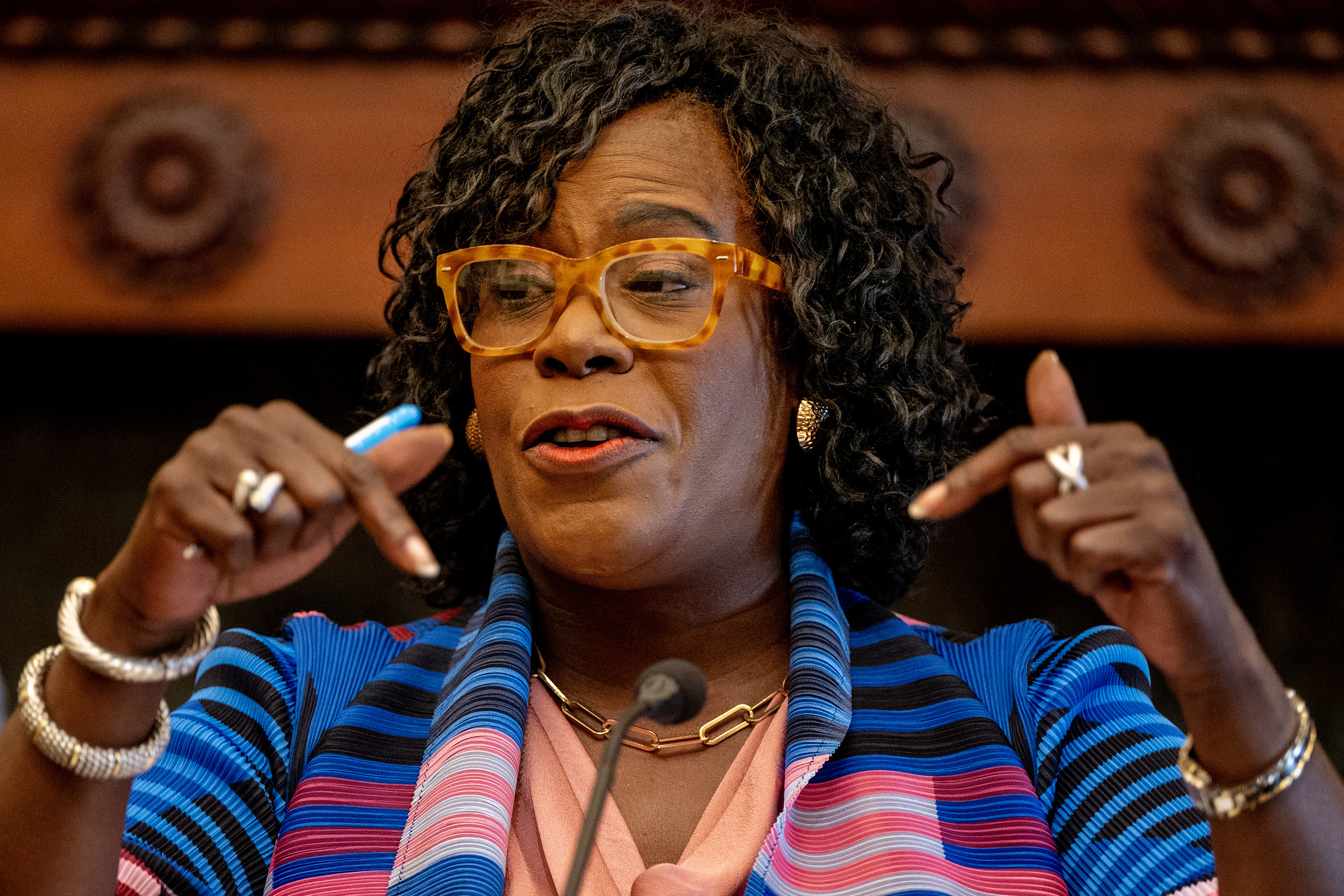
    Mayor Cherelle L. Parker holds a news conference at City Hall in August. Parker replaced her two appointees on the Philadelphia Land Bank board recently.

    Poor results

    Despite the new program, the same old problems remain. Namely, that most Council members have been reluctant to disburse land.

    The program, which was intended to yield 1,000 homes, has only managed to produce 202, per the Philly360 dashboard. Even though Turn the Key is a Council-designed program, only about half of the city’s 10 districts have participated. In the 5th District, which accounts for most of the homes, all 120 sales were approved in the last Council term.

    In addition to Council, the Land Bank board has also served as an obstacle to selling land, because of a faction of board members who would prefer an approach that prioritizes deeply affordable housing (for people at or below 30% of our area’s median income) and are concerned the program could cause gentrification.

    Mayor Cherelle L. Parker, who has doubled down on Turn the Key as a key component of her own housing plan, seems to have decided that it is time for a change, replacing two of her own appointees, both of whom tended to balance their own support for workforce housing with a preference for avoiding conflict.

    The two new board members, Chief Housing and Urban Development Officer Angela Brooks and community development expert Alex Balloon, are likely to have a “full steam ahead” approach to the program. Parker has also pressed Council to supply a list of “preapproved” parcels, where development can proceed without an ordinance. For those of us who want to see city-owned vacant land returned to productive use, these appointments are a win.

    Philadelphia needs quality housing options at all income levels, and the extreme appreciation in home prices over the last five years has made it harder for the working-class families who are the focus of Turn the Key to afford a home. While few households in the city have a white picket fence, achieving the Philadelphia dream of a move-in-ready rowhouse should not be out of reach for the sanitation workers, teachers, and others eligible for the program.

    The idea that workforce housing will foment gentrification is also hard to accept. The income levels for Turn the Key are designed for first-time home buyers with below median incomes. According to a Riverwards Group analysis of their Clifford Street project in North Philadelphia, all their buyers identified as African American, and most came from either the same zip code or a neighboring one. How can working-class people buying homes close to where they already live drive gentrification?

    Furthermore, the Land Bank’s remit is to implement city policy, not to make it. If advocates want to prioritize nonprofit developers, community gardens, or deeply affordable housing, the right venue is City Council, not the Land Bank board.

    With the mayor now putting her stamp on both the Philadelphia Historical Commission and the Land Bank, the Zoning Board of Adjustment, which has seen monthslong delays since the pandemic, should be next.

    Pennsylvania Senate Majority Leader Joe Pittman (R., Indiana) speaks during a 2024 news conference in Harrisburg.

    Budget doublespeak

    Pennsylvania continues to suffer the consequences of the nearly four-month delay in the state’s budget. Counties, school districts, and nonprofit organizations across the commonwealth are struggling to pay their bills. Beleaguered residents might have seen a recent state Senate vote approving a nearly $48 billion spending plan as a step in the right direction. Unfortunately, it represents the opposite of progress.

    That’s because the Senate still refuses to consider any proposals that might stand a chance of passing the House or garnering Gov. Josh Shapiro’s signature. While Democrats have shrunk their initial $52.5 billion proposal to just over $50 billion, Republicans have yet to make a serious offer. In fact, the budget they approved is nearly identical to last year’s.

    Their insistence on sticking to this number is curious, especially given that Senate Majority Leader Joe Pittman, who was selected as their negotiator, publicly stated a willingness weeks ago to pass a budget in the $49 billion range. I asked Kate Flessner, Pittman’s spokesperson, for an answer to this disparity more than a month ago.

    Just like the many Pennsylvanians, counties, school districts, and nonprofit organizations who rely on state support, I have yet to receive anything from Pittman.

  • Philadelphia’s ‘great masterpieces’ find a new home in Woodmere Museum’s Frances M. Maguire Hall

    Philadelphia’s ‘great masterpieces’ find a new home in Woodmere Museum’s Frances M. Maguire Hall

    Woodmere Art Museum director and CEO William R. Valerio never thought he’d be standing in a former second-floor bedroom turned into a cozy, copper-hued art gallery, admiring Violet Oakley’s famous series of paintings: Building the House of Wisdom.

    Yet, there he was.

    Two weeks before the new Frances M. Maguire Hall for Art and Education opens on Nov. 1, Valerio was brimming with excitement.

    The Victorian mansion and former convent is the new home to the 112-year-old Chestnut Hill museum’s permanent collection, the most definitive group of paintings, sculptures, and prints by Philadelphia artists in the region — if not the world.

    William R. Valerio surrounded by Violet Oakley’s seminal work “Building the House of Wisdom” in the Frances M. Maguire’s second floor Violet Oakley Gallery. Valerio recreated this gallery as a replica of Charlton Yarnall’s early 20th century Rittenhouse Square home where the 12-piece series was commissioned for the mansion’s music room.

    “I’ve been at the museum for 15 years and I’ve always wanted to build a space to show House of Wisdom the way Oakley intended it to be shown,” Valerio said. “But I never could have imagined this.”

    This is a four-story, 17,000-square-foot, gleaming house museum.

    The Violet Oakley Gallery is particularly noteworthy. The 375-square-foot space is a recreation of early 20th-century banker Charlton Yarnall’s music room, where Oakley’s vibrant murals were nestled in the Rittenhouse Square mansion’s vaulted ceilings.

    At Maguire Hall, Oakley’s allegorical interpretations of wisdom in the arts and sciences are fixed in lunettes positioned at eye level, allowing museumgoers to sit in a meditative gaze under a glowing replica of Italian designer Nicola d’Ascenzo’s stained glass dome.

    Oakley’s House of Wisdom has been on and off view at Woodmere since 1962, when the museum’s then director — and Oakley’s life partner — Edith Emerson brought the 12-piece series to the museum. Yarnall’s mansion was being converted to an office building, and Emerson feared her late partner’s seminal work would be carelessly discarded.

    The House of Wisdom is among the roughly 11,000 pieces of art we’ve acquired over the decades that now have a place to shine like never before,“ Valerio said.

    View of hallway between six second-floor galleries at Woodmere’s soon-to-be-opened Frances M. Maguire Hall.

    ‘Philadelphia’s great masterpieces’

    Charles Knox Smith opened the Woodmere Museum — what is now the museum’s Charles Knox Smith Hall — in 1913. It holds Woodmere’s vast 18th- and 19th-century collections, including Smith’s beloved Philadelphia landscapes, and is open Wednesday to Sunday.

    A few houses down and across the street, Maguire Hall’s 14 galleries hold paintings, sculptures, illustrations, photographs, and mixed media murals centering 20th-century Philadelphia artists.

    William R. Valerio, director and CEO of Woodmere Museum, chatting in front of George Biddle’s 1966 oil on canvas “Evocation of the Past.”

    “The idea is to show off Philadelphia’s great masterpieces,” Valerio said.

    He and his four-person curatorial team spent months mounting golden frames on the monochromatic walls, so closely together they nearly touched. It gives Maguire Hall the intimate vibe of a 19th-century home.

    Every major 20th-century art movement is represented, but the curation is a nod to 21st-century diversity.

    African American realist Ellen Powell Tiberino’s striking nude Repose shares gallery space with Martha Mayer Erlebacher’s stunning life-size portrait The Path. Both are only a few feet away from a work by George Biddle — of the illustrious Philadelphia family that traces its roots to the 17th century — the thoughtful Evocation of the Past.

    Black Pennsylvania Academy of the Fine Arts scholar Charles Jay’s meticulous floral still life paintings from the early 1980s line Maguire Hall’s grand staircase. It leads to the second-floor galleries, where lauded 1920s impressionist Walter Elmer Schofield’s bucolic renderings of snowy Wissahickon trails coolly hang.

    William R. Valerio, director and CEO of Woodmere Art Museum in conversation with Syd Carpenter’s arresting “Frank as the Sun King,” paying homage to Carpenter’s brother who served in the Army during the 90s during Desert Storm and returned to Philadelphia as a quadriplegic.

    An entire gallery is dedicated to female artists, featuring portraits by Oakley and Emerson. They are in conversation with an arresting sculpture by Syd Carpenter, Frank as the Sun King, an homage to Carpenter’s brother, who served in Desert Storm and came home to Philadelphia as a quadriplegic. Carpenter curated the Colored Girls Museum’s Livingroom Garden in 2024.

    “These diverse backgrounds and social experiences reshape and expand the canon of 20th-century art through a Philadelphia lens,” Valerio said.

    A major gift

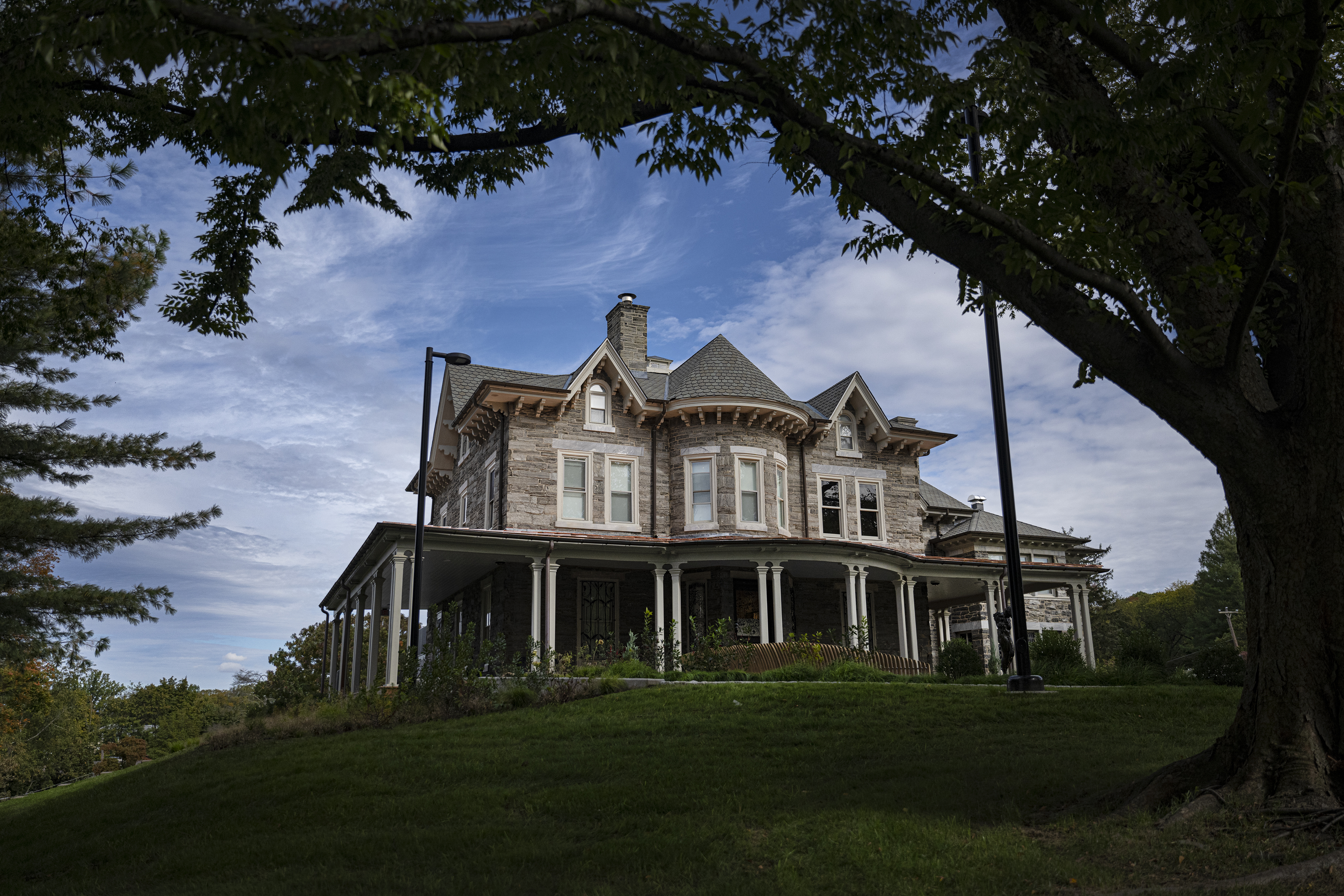
    Maguire Hall was built in 1854 as a country estate for the family of William Henry Trotter, an importer of steel, copper, and tin. In the 1890s, the house was renovated by sugar merchant Alfred C. Harrison.

    The Sisters of St. Joseph bought the stately home from developers in the 1920s to serve as the Norwood-Fontbonne Academy dorm. The nuns lived there until 2021, when Woodmere purchased it for $2.5 million.

    “It gave us the opportunity to take items out of storage and show the beauty of Woodmere to the world,” Valerio said.

    Overview of the former Sisters of St. Joseph Convent that’s been transformed to Woodmere’s Frances M. Maguire Hall for Art and Education in Chestnut Hill.

    James J. Maguire Sr. built a string of small insurance companies into a national conglomerate in the mid- to late 20th century. In 2008, he completed a $5 billion merger with a Japanese firm and, with his wife, Frances, became one of the region’s largest philanthropic donors.

    An artist and patron of the arts, Frances Maguire died in 2020. Three years later, the Frances M. Maguire Art Museum was opened at the former home of the Barnes by St. Joseph’s University, which had received a $50 million donation from the Maguire Foundation in 2017.

    Frances Maguire also spent a lot of time at Woodmere, taking classes and serving on the board of trustees. In her honor, the Maguire Foundation gave the museum $10 million. Valerio raised an additional $18 million from donors, state, and federal funding. The $28 million was used to renovate the mansion and start an endowment.

    Entrance way of the Frances M. Maguire hall. To the left is a portrait of Maguire by Kassem Amoudi. The chandelier Chestnut Street’s Boyd Theater open from 1928 to 2002.

    A portrait of Frances Maguire by Kassem Amoudi hangs in the foyer.

    “In creating the Frances M. Maguire Hall and supporting Woodmere, we are assuring that her legacy is shared with current and future generations,” said Megan Maguire Nicoletti, one of the Maguires’ nine children and CEO of the Maguire Foundation.

    All the details

    Krieger Architects worked with New York-based Baird Architects to turn the ramshackle convent into a modern museum, complete with wheelchair-accessible ramps and a shiny glass elevator overlooking the art trail connecting Maguire Hall to Charles Knox Smith Hall.

    Mammoth sculptures by 1959 Penn graduate Robinson Fredenthal are visible from the elevator as well as chokeberry, bayberry, and pawpaw trees, planted in Woodmere’s perennial Outdoor Wonder garden in honor of the Lenape Indians. Maguire Hall boasts a brand-new porch dotted with bright Adirondack chairs that once belonged to the University of the Arts.

    Detail of Belgium carver Edward Maene’s work in The Frances M. Maguire Hall breakfast nook. During the renovation, the carvings original red, green, and golden hues were discovered.

    In the mansion’s dining room, breakfast room, and central staircase are exquisite woodcarvings from 20th-century master and Belgium immigrant Edward Maene.

    “He went all out and carved fantastical medallions with images of fish that turned into birds and humans that turned into lions,” Valerio said of Maene’s work.

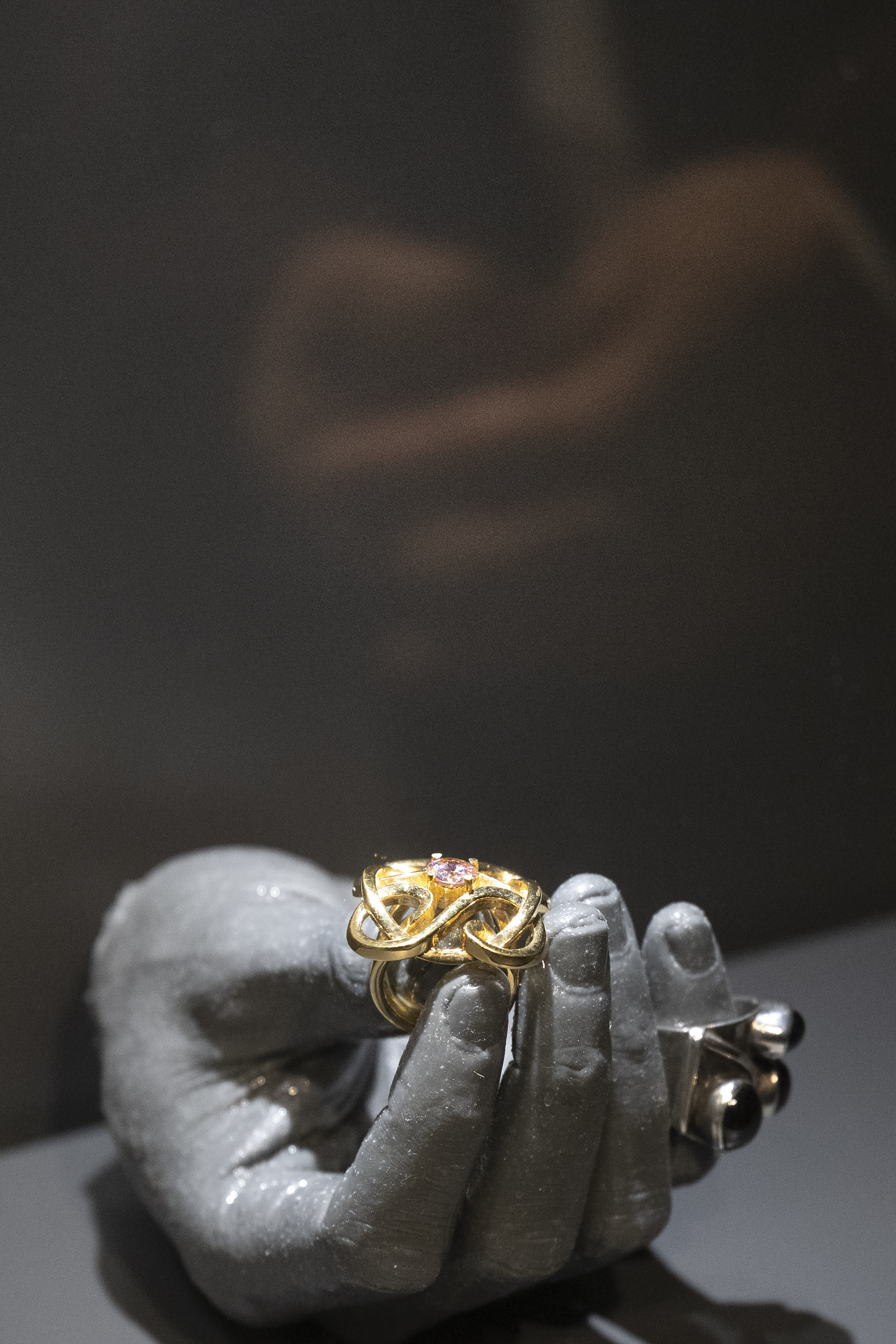
    There is the MacDonald Family Children’s Art Studio, where little ones can try their hands at finger painting, watercolors, and perhaps a bit of jewelry making. Right across from it is a jewelry vault, where an ankle-length Henri David coat sparkles with jewels from local Victorian-era jewelry houses: Bailey, Banks & Biddle and Caldwell.

    Tyler School of Art and Architecture graduate Theophilus Annor fashioned hand mannequins for the baubles. (Annor also carved Adinkra symbols into John Rais’ decorative wrought iron)

    Jewels shown on a hand mannequin fashioned by Ghanian artist Theophilus Annor in the Frances M. Maguire jewelry vault. (L) Theophilus Annor, Holding On, 2024, Gold & faceted gemstone. (R) Richard Reinhardt, Ring, date unknown.

    Housing history

    The second-floor illustrative arts rooms feature wartime drawings from 1940s issues of the Saturday Evening Post and framed TV Guide images of Kojak’s Telly Savalas and Columbo’s Peter Falk. (TV Guide was owned by former Inquirer and Daily News publisher Walter Annenberg.)

    “This part of our history is often forgotten,” Valerio said. “But it was important to artists who lived here and made a living in what was then a big media city.”

    The first floor gallery of the Frances M. Maguire Hall featuring (left) Ashley Flynn’s stark mural of drug culture in Kensington and “Madre del Nene” a1990, oil on linen from Bo Bartlett

    But the bottom floor is the star. Housed here are Maguire’s most evocative pieces, like an abstract collage by Danny Simmons — brother of hip-hop luminaries Russell and Joseph “Run” Simmons — titled Hocus Pocus, which interrogates magic in the Black community. Ashley Flynn’s gripping mural depicting drug abuse in Kensington and gay artist and collage maker Stuart Netsky’s Have Your Cake and Eat it Too, which puts a naughty twist on Victorian-era prudishness, radiate under the Boyd Theatre’s chandelier.

    With this work, Valerio hopes Maguire Hall plays a role in shaping a more inclusive future in Philadelphia — and around the world — through the arts.

    “We do what no other museum does in exploring the art and culture of this city in depth,” Valerio said. “And we welcome everyone to take part in the conversation.”

    Woodmere’s Frances M. Maguire Hall for Art and Education, 9001 Germantown Ave., opens to the public on Nov. 1 and 2. Charles Knox Smith Hall is located at 9201 Germantown Ave. Both are open Wednesday to Sunday, 10 a.m. to 5 p.m. Tickets are $10. Free on Sundays. woodmere.museum.org

    The article was updated to reflect the new name of the children’s art studio at Woodmere Museum, and the last name of Maguire Foundation’s CEO.

  • One year of inspections at Phoenixville Hospital: August 2024 – July 2025

    One year of inspections at Phoenixville Hospital: August 2024 – July 2025

    Phoenixville Hospital was not cited by the Pennsylvania Department of Health for any safety violations between August 2024 and July of this year.

    The hospital, located in Phoenixville, is owned by Tower Health.

    Here’s a look at the publicly available details:

    • Sept. 12, 2024: Inspectors followed up on two citations from May and June, and found the hospital was in compliance. In May, the hospital had been cited for discharging a patient to another facility without proper transfer orders. In June, the hospital was cited for using physical restraints on two patients without documenting that staff had first tried less restrictive ways to subdue them.
    • Feb. 18, 2025: Inspectors came to investigate two complaints but found the hospital was in compliance. Complaint details are not made public when inspectors determine it was unfounded.
    • April 17: The Joint Commission, a nonprofit hospital accreditation agency, renewed the hospital’s accreditation, effective February 2025, for 36 months.
  • A Blue Jays scout died in Philly before the World Series. His friends have a new favorite team.

    A Blue Jays scout died in Philly before the World Series. His friends have a new favorite team.

    Brent Urcheck was in his early 20s with a nice apartment in Washington and a well-paying job. But that’s not what he wanted. Mr. Urcheck wanted to chase a dream, not sit in a cubicle.

    He flew to New Orleans in December 2003 for the winter meetings — an annual gathering of nearly everyone who works in professional baseball — to find a way to work in the game. He didn’t have many connections, but Mr. Urcheck was determined to get in.

    He handed out his resumé, landed an internship with the Cleveland Indians, and quit his finance job to chase his dream in a tiny office in the basement of the ballpark.

    Mr. Urcheck spent 20 years in the game and helped build the Toronto Blue Jays into pennant winners this season as a player personnel manager. His dream became his job. His rise was no surprise to anyone who knew Mr. Urcheck, who died Oct. 8 in his South Philadelphia apartment just 12 days before the Blue Jays reached the World Series. Mr. Urcheck died of natural causes, his family said. He was 49.

    “He knew. He just knew that’s not what he wanted to do” said Jon Watts, Mr. Urcheck’s childhood friend and roommate in Washington. “He did a lot of self-examination and realized that ‘My passion is baseball, so that’s what I’m going to do.’ It was so admirable that he went after it like that and knew what he wanted. As soon as you met him, you knew he would be special.”

    Mr. Urcheck grew up outside Cleveland, studied finance at the University of Richmond, and moved to Philadelphia in 2006 while working as a scout for Cleveland. The city provided a centralized location for his travel-heavy job. It quickly became home. He frequented concerts at venues like the Highmark Mann Center and Union Transfer, played the jukebox at Doobies Bar, and was a card-carrying member of the Palizzi Social Club.

    “The jukebox still played CDs, and it was a dollar for four plays,” said Frankie Garland, a friend of Mr. Urcheck. “We would spend a lot of nights there, just taking turns on the jukebox and having great conversations. He was just such a calming presence. If you invited him to a show with another group of friends, he would fit in seamlessly like he knew them forever.”

    Urcheck wasn’t from Philadelphia, but Garland said the guy from Shaker Heights, Ohio, epitomized everything Philly was about. He was loyal, dependable, and honest. Mr. Urcheck, said another friend, Frank Spina, simply was “solid.” He didn’t care for the Philly teams — he somehow never wavered in loving the Cleveland Browns — but he loved Philly.

    “He just showed up for people,” said a friend, Julie Spragg. “Like the people at Palizzi became his family. One of the bartenders is in a band, and he would go far away to go see them play. He was all in.”

    Julie Spragg said Brent Urcheck was “all in” with everyone he knew.

    Mr. Urcheck graduated from Richmond in 1998 and was a seldom-used backup catcher on the baseball team. A three-sport athlete in high school, Mr. Urcheck could have switched colleges to play more. That was never a thought.

    “He showed up with a level of humility that you don’t often see in Division I sports,” Spina said. “A nonscholarship player who had tons of high school accolades. He knew he had to earn it and he approached his collegiate career the same way I would characterize his rise through the scouting world. He started at the bottom and worked without an ego and learned.”

    Mr. Urcheck’s internship with Cleveland (now known as the Cleveland Guardians) came with no guarantees. His career in professional baseball could have lasted just a few months. But he didn’t need any promises. Mr. Urcheck knew that’s where he belonged.

    “Brent was real subtle,” childhood friend Jason Lowe said. “He would just do things. He was like, ‘Yeah, I got a job as a scout with the Indians.’ We’re like, ‘What?’ He just did it. It was never about him.”

    Brent Urcheck (left) with his friends at the Mann to see Phish.

    Mr. Urcheck paired his playing career with his finance background to become a good fit in Cleveland’s forward-thinking front office. But it was his personality — the same qualities that made him the linchpin of his many friend groups — that helped him climb the major league ladder.

    “He had this uncommon ability to get along with everyone he meets,” Watts said. “By showing respect, he immediately commanded respect. He was just the person you wanted to be around and respect. He was as true and genuine as they come. He wasn’t selling anything. Plus, the guy was smart, too. That didn’t hurt.”

    Mr. Urcheck spent 14 years with Cleveland before leaving for the Toronto Blue Jays in 2018. The Jays are run by two people — president Mark Shapiro and general manager Ross Atkins — for whom Mr. Urcheck worked in Cleveland. Toronto won the American League East this season after finishing 2024 in last place. A guy who lived at 13th and Reed Streets had a hand in a magical season.

    The Blue Jays held a moment of silence for Mr. Urcheck before a playoff game earlier this month and tweeted that Mr. Urcheck “left a lasting impact on the organization” and “has been crucial in helping build a successful Major League roster this season.”

    “Brent was just really smart,” said Jason Morris, a college teammate. “He was a smart kid. You combine that catcher’s mentality with being a really sharp dude plus being so enjoyable to be around, I don’t think anyone was really surprised by what he did.”

    Mr. Urcheck had friends from every stop: Shaker Heights, Richmond, Washington, Cleveland, Philly, and Toronto. He found a way to be everyone’s friend. He was always there, Lowe said.

    Spragg was nervous two years ago to teach a fitness class, and there was Mr. Urcheck sitting in the back of each class waiting to support her. Garland wasn’t sure how he’d fit into Philly after moving here from California. One night with Mr. Urcheck was enough to know he had someone to lean on. When Watts went to West Virginia last fall to spread his brother’s ashes in the fast-moving Gauley River, Mr. Urcheck was in the boat with him.

    “That’s just how he was,” Watts said. “He showed up for everything. And I know he did that for everyone. I don’t know how he did it. He just did it. He was that kind of dude.”

    Mr. Urcheck’s friends will watch the World Series begin Friday and think of the guy who was planning a yacht-rock themed 50th birthday party. They’ll wear Blue Jays hats and root for the team that their buddy — the guy who helped them score a membership to Palizzi — helped build. Mr. Urcheck talked so little about his success that his childhood friends had to be the ones who mentioned in their group chat how the Blue Jays went from worst to first. His friends rooted for the Guardians, Yankees, and Phillies. They’re now rooting for a new team.

    “We’ve all bought Blue Jays gear,” Spragg said. “We’re all so pumped for them. It’s bittersweet because he’s not seeing this. But it’s amazing that we can all rally around it.”

    A South Philly man helped the Blue Jays reach the World Series. And it started because he was determined to make a dream come true.

    “We were living in a nice apartment in D.C. in our early 20s,” Watts said. “It was an easy, comfortable situation to stay in. So it wasn’t an easy decision. He did the work to figure out what it was that he needed to do.”

    Mr. Urcheck is survived by his mother, Sara Jane Sargent, and her husband, Jack; his father, Gary Urcheck, and his partner, Patty Arendt; his sister, Stephanie Urcheck, and many aunts, uncles, and cousins.

    A memorial reception will be held from 2-4 p.m. Sunday at Debonné Vineyards in Madison, Ohio. A Philadelphia gathering is planned for Nov. 15 at a location to be determined. In lieu of flowers, donations can be made in Mr. Urcheck’s honor to the Philadelphia Animal Welfare Society.

  • 🦅 Birds on the hunt| Sports Daily Newsletter

    🦅 Birds on the hunt| Sports Daily Newsletter

    Lincoln Financial Field is one of the toughest stadiums for a road team to play at in the NFL.

    While the Giants came up with a 34-17 win over the Eagles in Week 6, New York has yet to win a road game this season, and it might stay that way heading to Philadelphia in a rematch on Sunday afternoon.

    Rookie quarterback Jaxson Dart will experience what it’s like to play at the Linc for the first time, and his teammates have been trying to prepare him for the hostile crowd.

    Since their trip to MetLife Stadium, where they suffered maybe their worst loss of the season, the Birds snapped a two-game losing streak, thanks largely to DeVonta Smith.

    The 26-year-old led the team with a career-high 183 yards and a touchdown on nine receptions last week in a win over the Vikings. No matter how hard Smith gets hit with his 6-foot, 170-pound frame, “he pops back up like he’s the biggest guy,” teammate Jahan Dotson says.

    As an undersized receiver, Smith has been proving people wrong his entire football career. And the grittiness he once exhibited as a kid is evident in his game today.

    On defense, Vic Fangio is still searching for a counterpart to Quinyon Mitchell. Jakorian Bennett likely will be activated ahead of Sunday’s game. Given the team’s struggles at the position, he sees an opportunity.

    Before we part for the weekend, make sure to check out The Inquirer’s soccer coverage as the Union face Chicago on Sunday (5:30 p.m., FS1) in the first round of the MLS Cup playoffs.

    — Isabella DiAmore, @phillysport, sports.daily@inquirer.com.

    If someone forwarded you this email, sign up for free here.

    ❓What are your Eagles-Giants predictions? Email us back for a chance to be featured in the newsletter.

    ‘He’s one of a kind’

    Blue Jays rookie pitcher Trey Yesavage speaks to the media on Thursday ahead of his Game 1 start against the Dodgers in the World Series on Friday in Toronto.

    Pottstown’s Trey Yesavage will start Game 1 of the World Series against the Dodgers. What the 22-year-old has done this year has never been done before. Just over 15 months ago, the right-hander, who graduated from Boyertown Area High School, was drafted 20th overall out of East Carolina University. He opened his first professional season in March with Toronto’s low-A affiliate, the Dunedin Blue Jays. And on Friday, he will be the youngest player to start a World Series game since 2010.

    What we’re …

    🏀 Remembering: VJ Edgecombe making history on Wednesday, when he dropped 34 points in his NBA debut.

    🤔 Wondering: What the Giants are saying about the Eagles ahead of their rematch at the Linc.

    🏒Following: Owen Tippett’s hot start to open the Flyers’ season and setting the tone.

    📖 Reading: A mourning Roman Catholic coach and his family find solace in their football community.

    Historic debut

    Sixers guard VJ Edgecombe received praised for his calm approach to his first NBA game.

    There were no jitters, butterflies, or even a restless night for VJ Edgecombe in his NBA debut against the Boston Celtics Wednesday night at TD Garden. The 6-foot-4 combo guard poured in 34 points, marking the third-highest scoring debut in league history, to help the Sixers beat the Celtics, 117-116. Here’s what he said postgame: “From a team standpoint, we got the win, which matters the most.”

    After the game, players were amazed to learn that the last time the Sixers started 1-0 was during the 2021-22 season. The Sixers opened last season with two straight losses and dropped 12 of their first 14 games. They never recovered and finished with the league’s fifth-worst record at 24-58. Now, they’re focused on opening with consecutive victories for the first time since 2020-21.

    The Sixers will entertain the Charlotte Hornets in Saturday’s home opener before hosting the Orlando Magic on Monday.

    Familiar faces

    Sean Couturier (left) and Claude Giroux played 11 seasons together with the Flyers.

    The Senators have several familiar faces who skated on Thursday night. Of course, there is Claude Giroux, the former Flyers captain, Nick Cousins, and Olle Lycksell, who was in Philly last season. The head coaches, Rick Tocchet and Travis Green, also are friends and former teammates. “It’s always going to be special playing against Philly.”

    The Flyers got off to a fast start, thanks to Tyson Foerster’s goal, but Ottawa scored goals in each of the first two periods to snap the Orange and Black’s two-game winning streak.

    Up next, the Flyers host the Islanders on Saturday (12:30 p.m., NBCSP).

    Sports snapshot

    Baptiste Masotti (left) watches Aly Abou El Einen return the ball during the 2025 Comcast Business U.S. Open Squash Championships on Tuesday at the Arlen Specter US Squash Center in Philadelphia.
    • Center stage: The biggest squash event in America is this week at the Specter Center in University City.
    • Better together: Syracuse coach Fran Brown and defensive coordinator Elijah Robinson shared a dream of being on the same sideline.
    • College football: In this week’s roundup, we’re giving Temple its praise. Penn and Villanova also have been on a roll.
    • Sports betting bust: Here’s everything you need to know about Terry Rozier, Chauncey Billups, and cash handoffs in Philly.
    Gameday Central: Eagles at Vikings

    Tune in Sunday at 11:30 a.m. as The Inquirer’s Olivia Reiner and Jeff McLane preview the Eagles’ rematch with the New York Giants.

    David Murphy’s take

    Terry Rozier and Chauncey Billups were both arrested Thursday in separate gambling investigations.

    The most important indictment announced Thursday wasn’t the one that laid out the charges against NBA guard Terry Rozier for his alleged role in a prop-bet-fixing scheme or the one that detailed NBA head coach Chauncey Billups’ alleged involvement in rigging illegal poker games. The important indictment was the metaphorical one handed down against the NBA itself. For embracing legalized sports gambling. For partnering with online sportsbooks like DraftKings. For prioritizing profit over the integrity of the game, writes columnist David Murphy.

    We compiled today’s newsletter using reporting from Jeff Neiburg, Olivia Reiner, David Murphy, Devin Jackson, Lochlahn March, Kerith Gabriel, Ethan Kopelman, Alex Coffey, Keith Pompey, Jackie Spiegel, Rob Tornoe, Gabriela Carroll, Max Marin, Ryan W. Briggs, and Sean McKeown.

    By submitting your written, visual, and/or audio contributions, you agree to The Inquirer’s Terms of Use, including the grant of rights in Section 10.

    Thanks for reading and have a great weekend. Jim will be back in your inbox on Monday. — Bella

  • Letters to the Editor | Oct. 24, 2025

    Letters to the Editor | Oct. 24, 2025

    A $230M shakedown

    Donald Trump first extorted pro bono money from law firms, then extorted the return of grant money to universities, then extorted tariffs from foreign countries, and will now use a compromised U.S. Department of Justice to extort recovery of personal legal expenses. Legal expenses that were questionably covered by campaign contributions and used for legal maneuvering to prevent indictments from being heard in courts. Trump claimed to be innocent of the indictment charges, but went to great expense to prevent the cases from being heard by the courts, where he would have ample opportunity to disprove the charges. As far as funds recovered by the Justice Department going to a charity, please recall the Trump concept for a charity was the defunct Donald J. Trump Foundation, which was determined to have laundered money for improper personal, business, and political use. Trump has a history of using the courts for suspect personal profit. Trump will continue to playact the part of the Mafia don that he could never achieve in real life, and to flaunt illegal behavior until members of Congress grow spines and adhere to the intent of the Constitution.

    Craig McBride, Coatesville

    Seize closed properties

    Watching Delaware County wrangle with a for-profit health company about how to resolve overdue taxes is like watching Godzilla vs. Kong in a wrestling match in which both creatures die.

    The governor and Orphans Court need to take decisive action to relieve these assets in the public interest from private ownership in order to preserve whatever equity may be left.

    The investor game play needs to simply forfeit whatever potential gain was sought, just as the public has lost a significant asset through this gamble for private gain.

    Action for the public benefit now is needed. Let investors see how much it will cost to fund their attorney to continue this dispute. It’s the proper equipoise now that services for the community are depreciated to zero.

    D. Druckman, Baltimore, ddruck@gmail.com

    Where are they going to go?

    The study that was the basis of a recent Inquirer article, identifying racial disparities in the quality of sports facilities across our neighborhoods, confirmed what nonprofits and youth leaders have long known about access to opportunities for young people in our city.

    The Greater Philadelphia YMCA is one of many organizations working to fill those gaps. Our branches and outreach sites meet kids where they are by providing programming designed to reach as many young people as possible. From soccer clinics, swim lessons, and gymnastics instruction to summer camps, technology training, and college readiness courses, we offer safe spaces, mentors, and chances to grow. No child is ever turned away. We also employ more than 1,400 teenagers and young adults annually, providing a variety of jobs and leadership opportunities.

    Every day, I’m inspired by our branches and partners who are making a difference in our communities. However, this study demonstrates that in order to reach more kids, we must invest not only in our neighborhoods, but in the organizations doing this work.

    If we believe what the research is telling us — that youth sports have the power to build stronger, safer communities — then doesn’t every child in every community deserve a place to play?

    Shaun Elliott, president and CEO, Greater Philadelphia YMCA

    Sloppy signage

    Recently, I watched eight city workers using handheld roller brushes to repaint some crosswalks on Germantown Avenue with four big Streets Department trucks standing by; probably never seen such inefficiency nor such inept painting. A private contractor would be fired, stricken from the bid list, and not paid.

    Their idea of safe traffic control, too, was chaotic. No traffic control hand paddles, nor caution lights, nor warning signs were used. Two confused men barked and waved their bare hands at each other to hold traffic, or to let the cars pass in the visual confusion of the gang of painters at the intersections, making a mess of the painting as cars drove through the crosswalks.

    Instead of using the reflective highway tapes with straight edges that one worker could lay down, the Streets Department used eight workers for what a middle school art teacher would award an “F” for sloppy painting. Nothing squared, lines messy, corners not aligned, no pride in the work, and the painted guide markers were left visible where the painters did not cover them.

    OK, yes, I agree completely that this is clearly very small potatoes in the grand scheme of our lives, when we have illiterate high school “graduates,” rampant crime, smash and grabs, gang racing on our roadways, all tolerated by our mayors and city councils, and we have a very dangerous law passed by this Council that prevents police from stopping drivers for many traffic offenses. However, the unacceptable workman’s standards to merely repaint a crosswalk are a cultural and departmental indication that no one is setting an example, and no one is demanding that we citizens/taxpayers receive what we pay high taxes for, in our own city, for heaven’s sake.

    We should do much better; we are all able to do so much better … if our mayor, City Council, and department heads would raise the bar higher, instead of gleefully raising salaries and taxes higher each year for no benefit to taxpayers.

    Gardner A. Cadwalader, Philadelphia

    Model student

    I thank Aiden Wilkins, the 8-year-old who is the youngest ever student at Ursinus College, for coming to my rescue. People think I am crazy when I say that we can have a quality education system, where students are self-directed — and not dependent on schools.

    Then came Aiden, who entered Ursinus College this semester, studying to be a pediatric neurosurgeon. A reporter asked him who his teacher was prior to college. Aiden replied, “I taught myself.” The reporter then asked Aiden if he was worried. Aiden replied that he is only worried that he may not fit in the seat.

    As we search around the world for models that may deliver a better educational experience, isn’t it about time we listened to the children? And when we come up with all kinds of excuses why our current education models don’t fit children in our classrooms, isn’t it ironic that the one worry of little Aiden is his fitting in the seat?

    Leon Williams, Philadelphia

    One of a kind

    So often when someone passes, we almost automatically blurt out, “He will be missed!” The pioneering journalist Michael Days, who led the Daily News and served as a senior editor at The Inquirer, will really be missed because of his ability to handle the superdifficult job of being positioned between the legitimate concerns of the Black community regarding The Inquirer’s coverage and answering to the folks who paid his salary. Although he always would put a positive spin on whatever the crisis of the day was, I’m sure it took a toll on him.

    I always felt very close to Michael over the decades of knowing him, no matter how our professional responsibilities changed. He was always accessible, warm, and supportive. He was genuinely a friend, and more importantly, he was a friend to his community as well as the broader community. We thank his family for sharing him with us.

    Karen Warrington, Philadelphia

    Join the conversation: Send letters to letters@inquirer.com. Limit length to 150 words and include home address and day and evening phone number. Letters run in The Inquirer six days a week on the editorial pages and online.

  • Dear Abby | Sister halts contact with mom’s side of the family

    DEAR ABBY: A few years ago, my uncle made a controversial comment about a social issue in my mom’s family group text. The issue was important enough to my sister that she requested discussion about it cease because she didn’t agree with what they were saying. When the discussion continued, she decided to cut Mom’s family out of her life, taking a cue from my brother-in-law, who had made a similar decision about his own family.

    My wife and I bought a house and decided to throw our first party there, inviting both sides of my family. My sister still refuses to be anywhere near Mom’s family. She said she wouldn’t be coming, even though I also invited Dad’s family, with whom she gets along well.

    Although my political and social views align with my sister’s, I am also family-oriented, so this has been tough on me and my parents. I’m sad that Mom’s family may never see my sister again because one or two bad apples spoiled the barrel for her. I wish this could be resolved before it’s too late. Do you think that’s possible?

    — FAMILY-ORIENTED IN ILLINOIS

    DEAR FAMILY-ORIENTED: I don’t know why the offensive conversation didn’t stop when your sister asked. Clearly, the comments your uncle made were so deeply offensive to her that she no longer wishes to have any contact with him. Is this “fixable”? Only if one of them is willing to give, and from what you have written, that doesn’t seem likely. From now on, if you want a family gathering, be prepared to host one without Sis.

    ** ** **

    DEAR ABBY: I’m a man who has worked for a large company for many years. I recently became acquainted with a newly hired woman who is beautiful, smart, funny and compassionate. We talk almost daily, and I’m becoming romantically interested in her. From her behavior, she may feel similarly. I’d like to take things to the next level by inviting her to lunch.

    There is one major issue: I’m in my mid-50s; she’s in her early 20s. I’m not sure if she’s aware of the large age difference, but I’m sure she realizes I’m considerably older. If we do decide to pursue a relationship, I know there will be comments and jokes from our co-workers, which I can deal with, but is a relationship wise considering our age difference? I have never been interested in a woman this young before. She is special to me. People say age is just a number. Is it?

    — OLD ROMANTIC FOOL

    DEAR OLD ROMANTIC: I am less concerned about the difference in your ages as I am the number of years you have been at your job and whether there may be an “imbalance of power” between yourself and the new hire. If there is a policy against fraternization in your workplace, your job or hers could be at risk. If there isn’t, then it wouldn’t be out of line to invite the young woman to lunch. If anything bothers her about the age difference (IF the relationship progresses), I’m sure it will come to light.

  • Horoscopes: Friday, Oct. 24, 2025

    ARIES (March 21-April 19). Just because the door is stuck doesn’t mean it’s locked. Jiggle it. The first pushback you get is just the price of entry. What’s uncomfortable at first is necessary and will build the character you need to take on more of the journey.

    TAURUS (April 20-May 20). Whatever you feel, it enables you to recognize it in others. That recognition builds empathy and softens the walls between people. However you feel today, it will enrich you, teach you, help you bond and clear the scene for new creation.

    GEMINI (May 21-June 21). What isn’t said, the pauses, the spaces between details — that’s where imagination lives. The magic lies in the gaps. It applies to well-told stories, steeped in mystery. Also, in relationships that leave room for wonder and spontaneity.

    CANCER (June 22-July 22). Sometimes it’s tricky to teach people how to treat you. You don’t have to be perfect at it. If all you do is move away from what drains you and toward what delights you, that will make a difference in your life and relationships.

    LEO (July 23-Aug. 22). Today’s success secret: treat your energy like data. Track what’s paid work, what’s chosen generosity, what’s play. Knowing which is which lets you balance fairly, instead of unconsciously giving away too much.

    VIRGO (Aug. 23-Sept. 22). You’re drawn to the edges today — the ideas that challenge, people who surprise, places that feel outside the ordinary. It’s here you’ll find the spark that invigorates you, reminding you that wonder thrives where comfort ends.

    LIBRA (Sept. 23-Oct. 23). It’s not wrong to want. Desire gives you a direction. It pulls you forward like a magnet. You may not know how to get what you want, but naming the wanting is the first brave act of creation.

    SCORPIO (Oct. 24-Nov. 21). Most breakthroughs start as bad ideas. Don’t censor yourself too quickly. The messy drafts are the ones with great originality. The silly questions bond you to the others. The far-fetched notions inspire. These are the stepping stones to greatness.

    SAGITTARIUS (Nov. 22-Dec. 21). Your mind is hungry for novelty. Not all novelty nourishes. But you’re pretty amazing at distinguishing between distraction and discovery, which you’ll have to basically all day long today. Just remember: One fills time, the other expands you.

    CAPRICORN (Dec. 22-Jan. 19). You may not think of someone as a competitor, but they may think of you this way. Do they give you the chance to shine? Or do they focus in on lesser attributes or even flaws? Do they seem afraid of what will happen when the attention shifts from them to you?

    AQUARIUS (Jan. 20-Feb. 18). It’s been a while since you experienced serenity and tranquility for a significant stretch. You deserve this, and yet such moments will not come unless you plan for it. Carve out this time for future-you and protect it.

    PISCES (Feb. 19-March 20). Leadership may put you in first in the line, but not always, and anyway it’s not about leading the charge; it’s about leading the way. The first to laugh, the first to forgive, the first to try… these are the moves people will take their cues from today.

    TODAY’S BIRTHDAY (Oct. 24). Welcome to your Year of Bold Brilliance. It’s not that you’re loud or do any PR or marketing; it’s that your work is so outstanding it has unmistakable impact, bringing the results that mean most to you. Bursts of brilliance come through your routines; a morning walk, a kitchen experiment, a late-night brainstorm. More highlights: Small rebellions add up to freedom. You’re handed a leadership role without asking for it. A new friend feels like a soulmate. Virgo and Aries adore you. Your lucky numbers are: 3, 11, 28, 36 and 45.

  • NBA head coach and player charged in sprawling sports betting and Mafia-backed poker schemes

    NBA head coach and player charged in sprawling sports betting and Mafia-backed poker schemes

    NEW YORK — The head coach of the Portland Trail Blazers and a player for the Miami Heat were arrested Thursday along with more than 30 other people in a takedown of two sprawling gambling operations that authorities said leaked inside information about NBA athletes and rigged poker games backed by Mafia families.

    Portland coach Chauncey Billups was charged with participating in a conspiracy to fix high-stakes card games tied to La Cosa Nostra organized crime families that cheated unsuspecting gamblers out of at least $7 million. Heat guard Terry Rozier was accused in a separate scheme of exploiting private information about players to win bets on NBA games.

    The two indictments unsealed in New York create a massive cloud for the NBA — which opened its season this week — and show how certain types of wagers are vulnerable to massive fraud in the growing, multibillion-dollar legal sports-betting industry. Joseph Nocella, the top federal prosecutor for the Eastern District of New York, called it “one of the most brazen sports corruption schemes since online sports betting became widely legalized in the United States.”

    “My message to the defendants who’ve been rounded up today is this: Your winning streak has ended,” Nocella said. “Your luck has run out.”

    Both men face money laundering and wire fraud conspiracy charges. Also charged was former NBA assistant coach and player Damon Jones, who stands accused of participating in both schemes.

    “The fraud is mind boggling,” FBI Director Kash Patel told reporters. “We’re talking about tens of millions of dollars in fraud and theft and robbery across a multiyear investigation.”

    The alleged fraud, however, paled in comparison to the riches the athletes earned on the court. Billups, who was inducted into the Basketball Hall of Fame last year, had about $106 million in earnings over his 17-year career. Rozier made about $160 million in his stops in Boston, Miami and Charlotte.

    Billups and Rozier have been placed on leave from their teams, according to the NBA, which said it is cooperating with authorities.

    “We take these allegations with the utmost seriousness, and the integrity of our game remains our top priority,” the NBA said in a statement.

    Hours after his arrest, Rozier appeared in a federal court in Orlando, Florida, wearing a Charlotte Hornets sweatshirt, handcuffs and shackles. Billups appeared before a judge in Portland, Oregon. Both men were ordered released from custody on certain conditions.

    Billups’ attorney, Chris Heywood, issued a statement Thursday evening denying the allegations, calling his client a “man of integrity.” “To believe that Chauncey Billups did what the federal government is accusing him of is to believe that he would risk his Hall-of-Fame legacy, his reputation and his freedom. He would not jeopardize those things for anything, let alone a card game,” Heywood said.

    Rozier’s lawyer, Jim Trusty, said in a statement that his client is “not a gambler” and “looks forward to winning this fight.” Trusty criticized authorities for not allowing his client to surrender on his own and accused officials of wanting “the misplaced glory of embarrassing a professional athlete with a perp walk.”

    Messages were left Thursday at a phone number and email address listed in public records for Jones.

    Roughly 20 other defendants appeared in federal court in Brooklyn, where most of them pleaded not guilty. Many of those charged with violent crimes or with lengthy criminal records and ties to organized crime were detained.

    Mafia families profited off gambling scheme, officials say

    The poker scheme lured unwitting players into rigged games with the chance to compete against former professional basketball players like Billups and Jones. The games were fixed using sophisticated cheating technology, such as altered card-shuffling machines, hidden cameras in poker chip trays, special sunglasses and even X-ray equipment built into the table to read cards, authorities allege.

    The scheme often made use of illegal poker games run by New York crime families that required them to share a portion of their proceeds with the Gambino, Genovese and Bonnano crime families, according to court papers. Members of those families, in turn, also helped commit violent acts, including assault, extortion and robbery, to ensure repayment of debts and the continued success of the operation, officials said in court documents.

    Athletes accused of leaving games early

    In the sports betting scheme, Rozier and other defendants are accused of accessing private information from NBA players or coaches that could affect a player’s performance and giving that information to others so they could place wagers. Players sometimes altered their performance or took themselves out of games early to rig prop bets — a type of wager that allows gamblers to bet on whether a player will exceed a certain statistic, such as a total number of points, rebounds or assists, according to the indictment.

    In one instance, Rozier, while playing for the Charlotte Hornets in 2023, told people he was planning to leave the game early with a supposed injury, allowing gamblers to place wagers earning them tens of thousands of dollars, authorities said. That game against the New Orleans Pelicans raised eyebrows at the time. Rozier played the first 9 minutes and 36 seconds of the game before leaving, citing a foot issue. He did not play again that season.

    Posts still online from March 23, 2023, show that some bettors were furious with sportsbooks that evening when it became evident that Rozier was not going to return to the game after the first quarter, with many turning to social media to say that something “shady” had happened regarding the prop bets involving his stats for that night.

    The indictments contain the descriptions of several unnamed NBA players whose injury status and availability for certain games were the source of betting activity. Those players are not accused of any wrongdoing, and there is no indication that they would have even known what was being said about their status for those games.

    Those players include LeBron James, Anthony Davis and Damian Lillard. Their identities are clear based on a review of corresponding injury reports surrounding games mentioned in the indictment. The indictments show that certain defendants shared information about the availability of those players in a game on March 24, 2023, involving the Portland Trail Blazers, and two games in 2023 and 2024 involving the Los Angeles Lakers.

    The NBA had investigated Rozier previously. He was in uniform as the Heat played the Magic on Wednesday in Orlando, Florida, in the season opener for both teams, though he did not play in the game.