Blog

  • Temple women hope tough early schedule has prepared them to be American Conference contenders

    Temple women hope tough early schedule has prepared them to be American Conference contenders

    Temple coach Diane Richardson knew she wanted her team to be battle-tested for American Conference play and crafted the Owls’ nonconference schedule to reflect that.

    Richardson lined up five teams coming off NCAA Tournament appearances. The Owls went 1-4 in those games, with their lone win coming at home against George Mason in the season opener on Nov. 3.

    The difficult schedule leaves Temple with a 6-6 record that does not scream conference title contender. However, with a similarly difficult slate at this time last year, the Owls were 6-5 but went on to win 13 conference games and finished fourth in the American.

    Now Richardson is hoping to see similar results. Temple has displayed more offensive firepower and improved rebounding numbers, but the key to success for the coach will be defense and starting games strong. The Owls’ quest for an American championship starts Saturday at home against the reigning regular-season champion, UTSA (2:30 p.m., ESPN+).

    “I’m feeling pretty good,” Richardson said. “I know our last outing with Princeton kind of showed us that we have the resiliency that we’ll need. I just wish that we would start out like that. But I’m feeling pretty good. We’ve gotten the tough part behind us, and now we enter into the second season, which is the most important.”
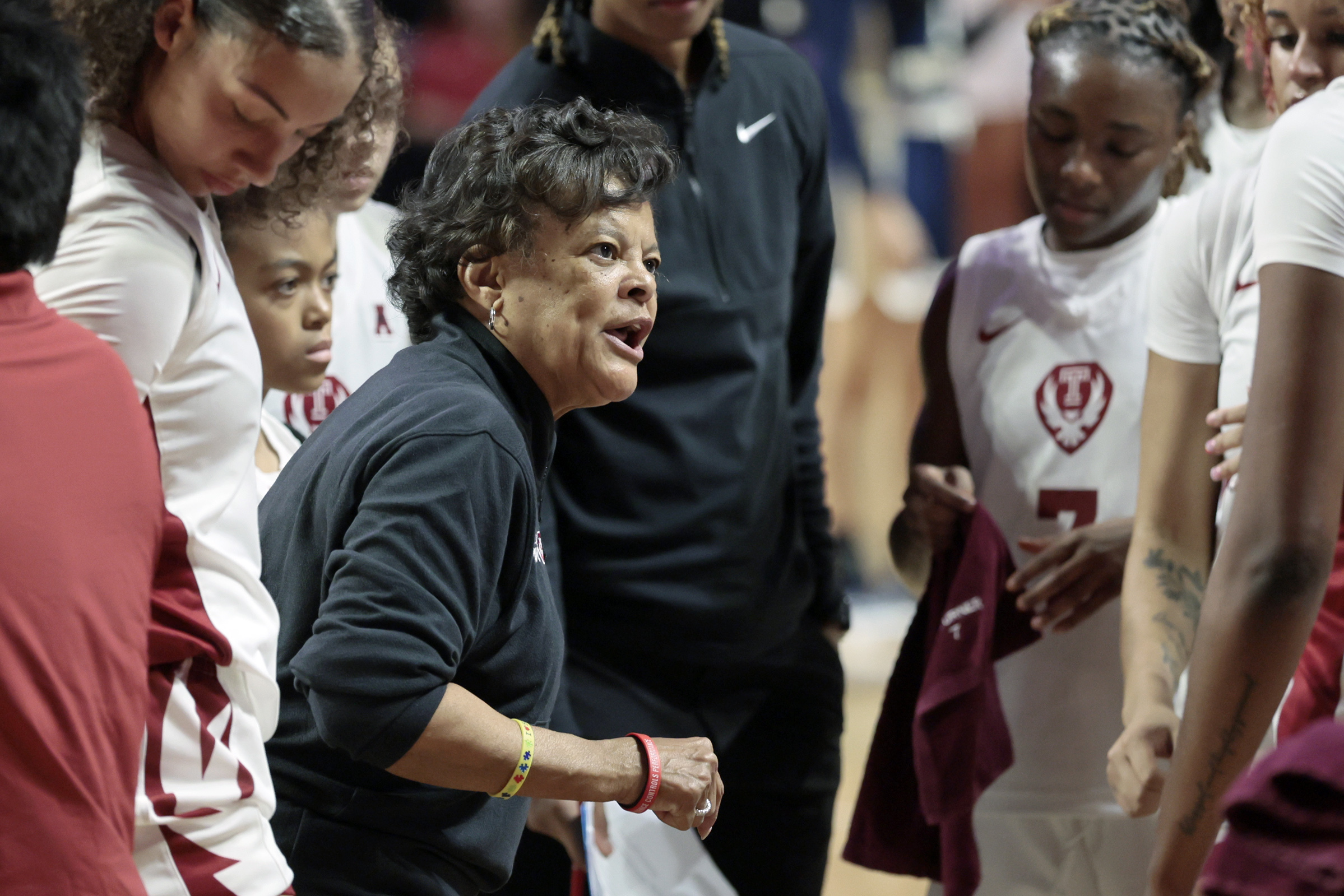
    Coach Diane Richardson’s Temple squad opens American Conference play on Saturday against the reigning regular-season champion, UTSA.

    Showing resilience

    Temple’s four losses against 2025 NCAA Tournament teams came by double digits, with its closest result an 87-77 loss at Princeton on Dec. 22. The Owls also showed flashes of fight and the ability to remain competitive in those games.

    In their 72-57 loss to Atlantic 10 favorite Richmond on Nov. 18, the Owls were down double digits early in the second quarter but battled back and were within striking distance until the final five minutes. Temple trailed by as many as 26 points in the fourth quarter against Princeton but cut the deficit to nine in the final minute.

    “Early on, we weren’t responding really well,” Richardson said. “… But I think as we got into the season, we started understanding that this is tough, and we have to be tougher. Coming toward the end of the nonconference season, I thought we played better, which is a plus for us going into conference play.”

    Before the season, Richardson wanted her team to play faster, but during nonconference play, she felt the Owls were not assertive on offense to begin games or played out of control, which led to an increase in turnovers.

    Temple also had to play its final four nonconference games without starting point guard Tristen Taylor, who suffered an ankle injury on the road trip to the Bahamas at the end of November. The Owls were 2-2 without her.

    Taylor was the Owls’ second-leading scorer at the time of her injury, averaging 10.1 points and leading them in assists (4.6). She also was second in the American in assist-to-turnover ratio at 2.1. Without its main ballhandler, Temple looked out of sync at times, especially in its 59-52 loss to Drexel in the Big 5 Classic on Dec. 7.

    The Owls leaned on guard Kaylah Turner, who ascended to one of the best players in the conference in Taylor’s absence.

    She averaged 23 points in the four games Taylor missed, including a career-high 36 points against Princeton. Turner, who is averaging 17.8 points this season, took on point guard duties and struggled with turnovers, but she still offered a steady presence at the top of the offense. Richardson expects Taylor back within the first two games of conference play. She believes Taylor and Turner can form the best backcourt in the conference.

    “In the scoring aspect, I do think I did well, but I feel like I could have done way better,” Turner said. “With playmaking and passing, that’s something I’m still working on. So I feel like I definitely could have improved that.”
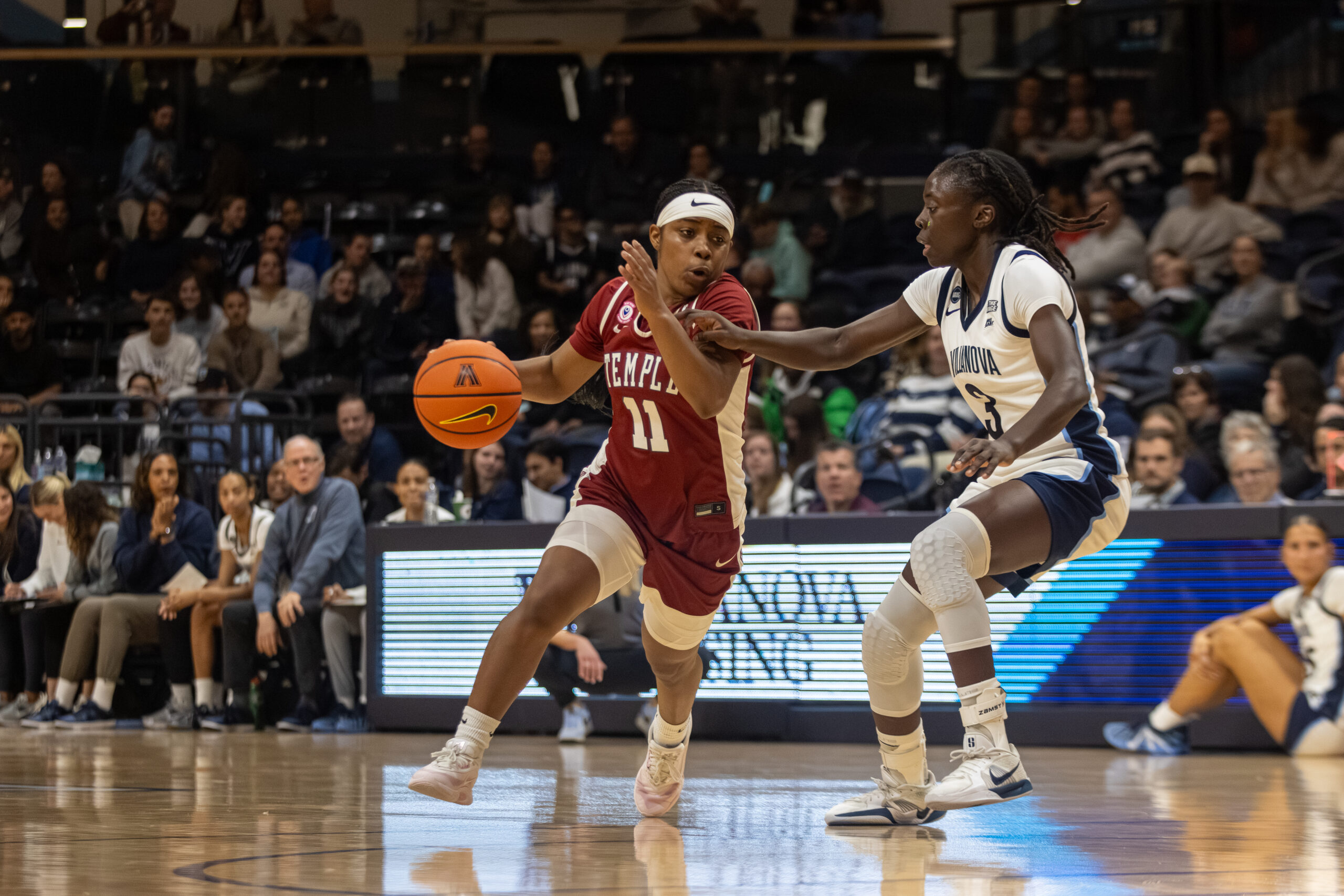
    Tristen Taylor was averaging 10.1 points and 4.6 assists at the time of her injury.

    By the numbers

    Richardson was keen on her team playing faster on offense and improving its rebounding in the offseason. Nonconference play has shown offensive improvement and major strides on the glass for the Owls.

    Temple is averaging 70.1 points, a 3.4-point increase from its mark last year. Three players — Turner, Taylor and forward Jaleesa Molina — are averaging at least 10 points. Turner leads the American in scoring (17.8) and three-point percentage (.460) and is second in field-goal percentage (.450).

    The most notable improvement for the Owls has been their rebounding. Last season, Temple averaged 38.8 rebounds and had a rebounding margin of 0.8. This season, the Owls are averaging 39.8 rebounds but holding opponents to 33.9. The Owls give up the second-fewest rebounds in the conference and are fourth in rebounding margin.

    Molina and transfer forward Saniyah Craig have spearheaded the Owls’ efforts on the glass. Craig, who was the ninth-leading rebounder in the country last season while at Jacksonville, is averaging 8.9 rebounds, and Molina averages 8.4.

    “We’ve got to be hungry, and we’ve got to get every rebound,” Richardson said. “We’ve concentrated on that this week as well. So that’s going to be something that hopefully we’re good at.”

    Temple has struggled taking care of the ball. The Owls are averaging 19.6 turnovers, four more than last season, and have turned the ball over at least 20 times in five games, including their last three.

    Richardson knows the turnover numbers have to come down, but she believes that the key to a conference banner being raised in the Liacouras Center will come on defense.

    “You can miss shots, but you can always play defense,” Richardson said. “I think that oomph, that extra adrenaline turning people over defensively helps us offensively because it gives them more confidence. We want to compound our defense and make that our No. 1 thing.”

  • I’m a couples therapist. Here’s how to have a better relationship.| Expert Opinion

    I’m a couples therapist. Here’s how to have a better relationship.| Expert Opinion

    Relationship advice is everywhere — much of it simplistic, contradictory, or disconnected from how partners actually function. After more than four decades as a couples therapist, I’ve found that lasting improvement rarely comes from grand gestures or clever techniques. It comes from a small set of habits that change how partners talk, listen, and take responsibility when things get hard.

    Here are some of the best ways to communicate with your partner — based on my own experience and the scientific research — to help you improve your relationship over time:

    Start with a positive comment.

    Conversations tend to end the way they begin. Starting with something positive about the other person increases the likelihood of a constructive outcome and signals that your goal is to improve the relationship — not to shame or criticize.

    Pick the right time to talk.

    Just because you’ve worked up the nerve to raise an issue doesn’t mean now is the best moment. Let your partner know you would like to work on something together and ask if this is a good time. If they say no, ask when that would be — within the next week. Unless there’s a genuine crisis, don’t accept indefinite postponement.

    Calibrate the intensity of your complaint.

    Rating your concern on a scale from 1 to 10 can help your partner hear you. A “1” says, “This isn’t a big deal, but I’d like us to address it.” A “10” communicates, “If this doesn’t change, I’m not sure I can stay in the relationship.” Giving your partner some context may help reduce their fear and ultimately defensiveness. It can also alert them that they may need to pay much closer attention than they have been in the past.

    Talk about their behavior, not character.

    Instead of saying, “You’re lazy, selfish, mean,” talk about how their behavior affects you. Say: “When you say you’ll be home by 7 and don’t show up till 8:30, and you don’t call to let me know, I feel hurt, resentful, taken for granted,” instead of, “You’re so self-centered and cruel that you didn’t even have the decency to let me know you’d be late!” The former is more effective because it centers the behavior on your reaction and not the other’s character traits.

    Be direct about what you want or need.

    If your partner asks what you would like for a birthday or holiday, don’t turn it into a test of their love. If you want roses instead of tulips, or a tool chest instead of a massage, say so. When they follow through, treat it as evidence of care — not a failure of their paying attention.

    Become more assertive and set limits around hurtful behavior.

    Healthy relationships require the ability to stand up for yourself without becoming aggressive. If assertiveness doesn’t come naturally, therapy, skills training, or targeted reading can help.

    Learn to take timeouts when emotions run high.

    Once conversations become flooded with emotion, productive communication shuts down. Taking a short break — with a clear agreement to return to the issue — can prevent arguments from becoming destructive. Whoever calls the timeout has to reinitiate the conversation within 24 hours. Use the timeout to calm down and figure out what the other person was trying to communicate, not to consider how you’ll prove them wrong when you reengage.

    Practice active listening.

    Feeling understood often matters more than being agreed with. Take turns talking about your perspective for no more than two minutes each. When you’re speaking, be careful in your language, and when it’s their turn, don’t interrupt or talk over them. When you’re listening, try to focus on understanding your partner, not defending yourself. Take a minute to repeat back what you heard to make sure you understood them correctly before giving your perspective.

    Don’t avoid conflict so completely that resentment builds.

    Keeping the peace by staying silent may feel safer in the moment, but over time it creates emotional distance and bitterness. Separations and divorces occur more commonly as a result of deaths by a thousand cuts rather than a huge, one-time blow-up.

    Don’t expect one person to meet all of your needs.

    Strong relationships are supported by friendships, interests, and sources of meaning outside the partnership. Overreliance on a romantic partner for all of your emotional or social needs creates pressure no one can sustain.

    Talk to your partner the way you did when you were dating.

    Many couples stop investing the time, attention, and affection that once came naturally. Courtesy, curiosity, and warmth shouldn’t disappear with familiarity.

    Catch your partner doing something right.

    People are far more motivated by appreciation than criticism. Rather than comment on when they mess up, compliment them when they get it right. Marital researcher John Gottman discovered that in successful couple relationships, there are five positive interactions for every negative one.

    Take more responsibility for the dynamics you help create.

    Conflict persists through feedback loops. Before insisting that you’re not being heard, consider how well you’re listening. Ask yourself how you may unintentionally bring out the worst in your partner. Responsibility isn’t self-blame — it’s seeing how you react in ways that increase the distance rather than the closeness.

    Don’t wait for your partner to change before you show up differently.

    Many people put their own maturity on hold, waiting for the other to become more communicative, less defensive, or more self-aware. But how you show up should reflect your values, not your partner’s limitations. Even if they struggle to communicate well, you don’t have to mirror their avoidance, silence, or reactivity.

    Don’t wait too long to get help.

    Many relationships that feel hopeless can improve with the right couples therapist. Waiting until resentment hardens makes repair harder.

    Most relationships don’t fail for lack of love; they fail from small, repeated moments of misunderstanding, defensiveness, and a failure to appreciate what the other is doing right. Paying attention to how you handle those moments — especially when things are hard — is often the difference between growing apart and finding your way back to each other.

    You can’t force your partner to grow, but you can decide how you speak, listen and take responsibility. Those choices shape not only the relationship’s future, but your own happiness and resilience.

    Joshua Coleman, PhD, is a clinical psychologist in the Bay Area, keynote speaker, author, and senior fellow with the Council on Contemporary Families. His newest book is “Rules of Estrangement: Why Adult Children Cut Ties and How to Heal the Conflict.” His Substack is Family Troubles.

  • The city’s crime rate has fallen dramatically. It didn’t happen by chance.

    The city’s crime rate has fallen dramatically. It didn’t happen by chance.

    For years, Philadelphia, like many American cities, grappled with historic levels of violence brought on by the upheaval of the pandemic. Today, a very different story is unfolding.

    Violent crime in Philadelphia has declined sharply and sustainably, and much of that progress is owed to the extraordinary work and unwavering commitment of the men and women of the Philadelphia Police Department.

    Homicides are down again this year, by roughly 15% to 18% compared with last year, putting the city on pace for its lowest total since the 1960s. Shootings, both fatal and nonfatal, have fallen to levels not seen in more than a decade.

    At the same time, homicide clearance rates have reached historic highs, bringing accountability, answers, and a measure of justice to families who have suffered unimaginable loss.

    These results did not happen by chance. They are the product of relentless professionalism, data-driven policing, and deep engagement with the communities officers serve.

    Behind every statistic is a patrol officer, detective, analyst, supervisor, or civilian professional who showed up day after day, determined to protect this city. Lives have been saved, neighborhoods strengthened, and trust rebuilt because of their work.

    Philadelphia is safer today than it has been in a generation, and that progress deserves recognition.

    Changing threats

    But public safety is not defined solely by addressing violent crime. Some of the most damaging threats we face today are quieter, more personal, and increasingly digital.

    Across Philadelphia and the surrounding region, criminals continue to target the most vulnerable among us. Elderly residents are being deceived out of their life savings through increasingly sophisticated fraud schemes. Young people are being exploited through sextortion, often by offenders operating overseas who use fear, manipulation, and anonymity to cause devastating harm. Businesses of every size are facing ransomware attacks that can cripple operations, disrupt critical services, and threaten livelihoods.

    At the same time, our business community and world-class academic institutions face persistent threats from nation-state actors seeking to steal intellectual property, sensitive data, and cutting-edge research. These efforts target innovation, economic competitiveness, and national security itself, and they often unfold silently over months or years before being discovered.

    Such crimes leave deep scars. They are often underreported, emotionally devastating, and constantly evolving. Addressing them requires persistence, adaptability, and a willingness to confront threats that do not always fit traditional definitions of crime.

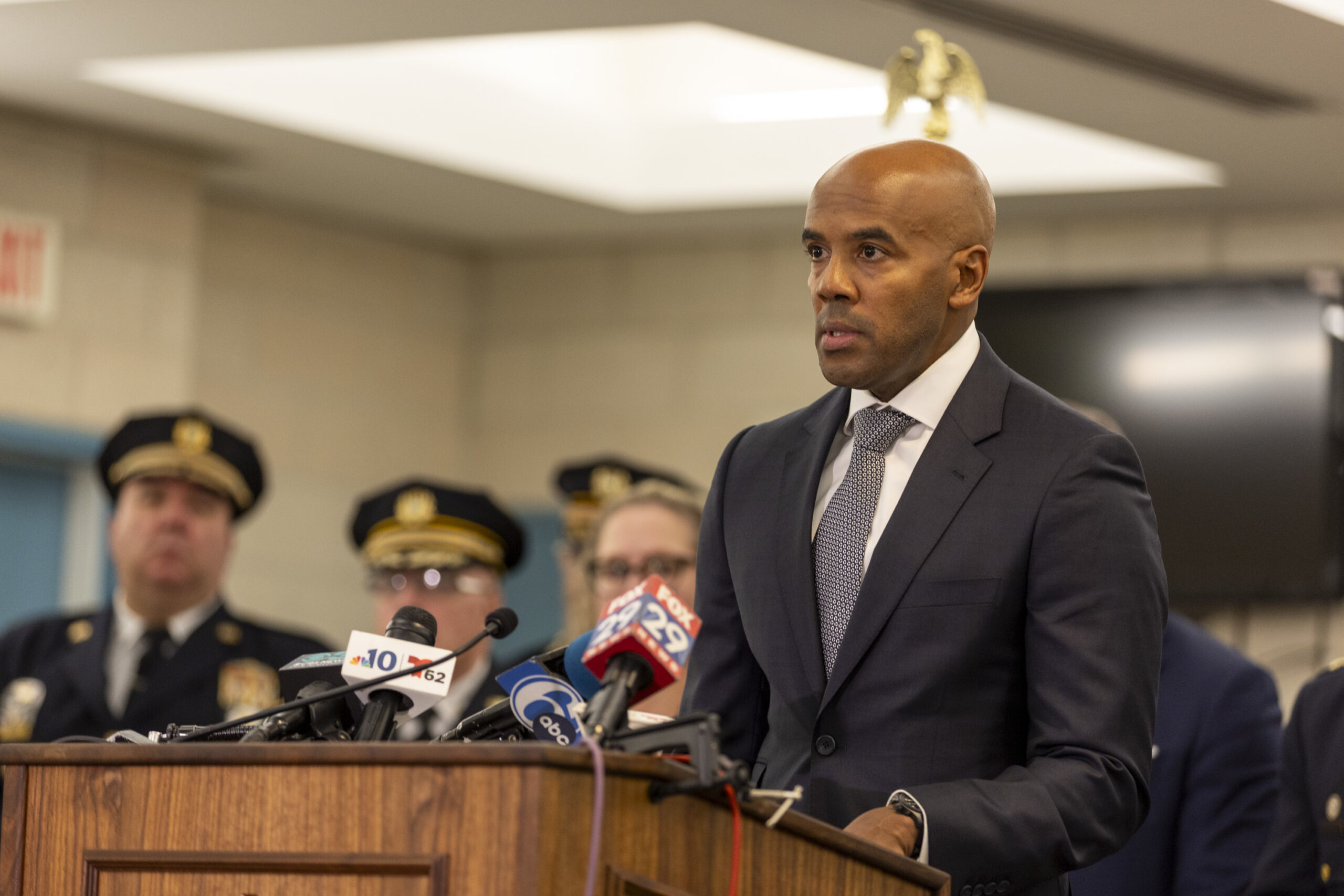
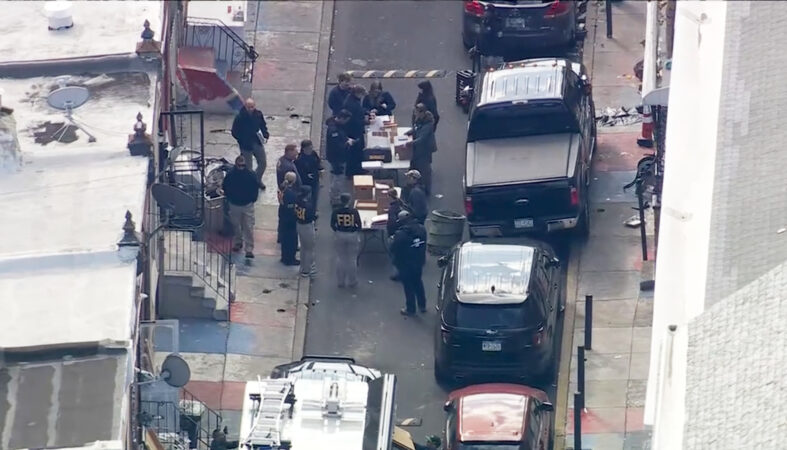
    Special Agent in Charge Wayne A. Jacobs at a news conference at the 24th Police District Headquarters in Philadelphia in October

    Every day, the men and women of the FBI show up with a clear purpose: to protect people and hold perpetrators accountable. Our agents, intelligence analysts, and professional staff work tirelessly to identify offenders, dismantle criminal networks, prevent acts of terrorism, disrupt foreign intelligence threats, and bring those responsible to justice, whether they operate across the street or across the world.

    But enforcement alone is not enough. Preventing harm before it occurs is one of the most powerful tools we have.

    That is why outreach and education are central to our mission.

    Building partnerships

    Through partnerships with schools, senior centers, businesses, universities, and community organizations, we work to raise awareness, share intelligence, and empower people to recognize threats early. Helping a senior avoid a scam, a teenager seek help before harm escalates, or an institution protect sensitive research can be just as impactful as an arrest.

    None of this work happens in isolation. The progress Philadelphia has made, both in reducing violent crime and in confronting complex threats like fraud, sextortion, ransomware, and foreign intellectual property theft, is rooted in strong partnerships. Federal, state, and local law enforcement, prosecutors, private-sector leaders, and academic institutions are aligned around a shared responsibility to keep this city safe.

    Those partnerships will be more important than ever as Philadelphia prepares for a historic year in 2026. With global events, national celebrations, and millions of visitors expected, success will depend on seamless coordination, shared intelligence, and a unified approach to prevention and preparedness.

    We are ready because we have built this foundation together.

    Philadelphia’s progress is real. The challenges ahead are serious. And by continuing to work side by side, guided by intelligence, driven by prevention, and grounded in partnership, we will keep this city safe in 2026 and beyond.

    Wayne A. Jacobs is the special agent in charge of the FBI’s Philadelphia Field Office, a position he’s held since November 2023.

  • Philadelphia juries awarded $3 billion less in verdicts in 2025 compared to 2024

    Philadelphia juries awarded $3 billion less in verdicts in 2025 compared to 2024

    Philadelphia juries issued only three verdicts of $10 million or more in 2025, less than a third of the so-called nuclear verdicts awarded in 2024. The decline was so pronounced, it knocked the city’s Court of Common Pleas from the top spot on an annual “judicial hellhole” list.

    The overall amount doled out by Philadelphia Court of Common Pleas jurors declined by more than $3 billion this year compared to 2024, according to court data up to Dec. 19. The nearly $120 million awarded in 74 plaintiff verdicts represents largely a return to pre-pandemic norm.

    Two 2024 verdicts explain the majority of the gap: $2.25 billion against Monsanto in a Roundup weed killer case and $725.5 million against Exxon Mobil in a trial over toxic exposure to benzene-containing products.

    Compare those figures to the largest verdicts this year, a $35 million medical malpractice verdict against the University of Pennsylvania and Main Line Health and $15.3 million against a skill game designer and manufacturer for a dispute that led to the death of a Scranton man.

    Even the American Tort Reform Foundation, a group tied to an association that advocates for reform of civil litigation and represents business interests, took notice. Last year, the foundation blasted Philadelphia Common Pleas Court, along with the Pennsylvania Supreme Court, as the nation’s top “judicial hellhole.”

    In the 2025-26 report, the Philadelphia court was dethroned and ranked fifth. (The Pennsylvania Supreme Court had its own entry this year, making the group’s “watch list.”)

    “2025 did not bring the same level of activity, but this decline is not the result of positive reforms or improved legal activity, but rather a reduction of trials,” the report says on the fewer number of large verdicts in the Philadelphia Common Pleas Court.

    <iframe title="Philly Juries Issued Fewer, Lower  Verdicts in 2025" aria-label="Column Chart" id="datawrapper-chart-CF2on" src="https://datawrapper.dwcdn.net/CF2on/1/" scrolling="no" frameborder="0" style="width: 0; min-width: 100% !important; border: none;" height="427" data-external="1"></iframe><script type="text/javascript">window.addEventListener("message",function(a){if(void 0!==a.data["datawrapper-height"]){var e=document.querySelectorAll("iframe");for(var t in a.data["datawrapper-height"])for(var r,i=0;r=e[i];i++)if(r.contentWindow===a.source){var d=a.data["datawrapper-height"][t]+"px";r.style.height=d}}});</script>
    <iframe title="" aria-label="Column Chart" id="datawrapper-chart-txfq8" src="https://datawrapper.dwcdn.net/txfq8/1/" scrolling="no" frameborder="0" style="width: 0; min-width: 100% !important; border: none;" height="455" data-external="1"></iframe><script type="text/javascript">window.addEventListener("message",function(a){if(void 0!==a.data["datawrapper-height"]){var e=document.querySelectorAll("iframe");for(var t in a.data["datawrapper-height"])for(var r,i=0;r=e[i];i++)if(r.contentWindow===a.source){var d=a.data["datawrapper-height"][t]+"px";r.style.height=d}}});</script>

    This year had roughly 70 fewer trials that went to verdict, and no mass tort trials at all.

    Mass tort is the umbrella name for how courts handle a large volume of cases that all allege similar injuries. For example, the dozens of lawsuits in Philadelphia accusing Roundup weedkiller of causing blood cancer. The cases are consolidated under one judge, and “bellwether trials” are held to get a sense of what the cost of a global settlement might be, if an agreement is ever reached.

    Verdicts in mass tort cases are often large, as plaintiff attorneys encourage jurors to award a figure that the company’s boardroom would notice. Two of Philadelphia’s largest five verdicts in 2024 came from mass tort cases.

    Mass tort trials are scheduled for 2026, starting in January, and with them large verdicts could trend up again.

    Attorneys say there is more to the story than counting trials, as the large verdicts of 2024 and 2023 shaped how cases are handled behind the scenes. And fewer large verdicts don’t necessarily mean that defendants in Philadelphia are paying less.

    Robert J. Mongeluzzi, the founder of Saltz Mongeluzzi Bendesky, said defendants and insurers are agreeing to large settlements before any verdicts are delivered.

    “Defendants and their insurance carriers have resolved catastrophic cases by offering tens of millions of dollars to resolve these cases in advance of trial,” Mongeluzzi said via email.

    John Hare, a defense attorney with Marshall Dennehey, said that the large verdicts of recent years are prompting defendants to pay more, and more often, than they otherwise would.

    “There is a correlation between a rise in nuclear verdicts and a rise in nuclear settlements,” Hare said.

    The attorney also credits the court’s effort to mediate settlements in medical malpractice cases as one driver of the decline. But the key context is the historically high verdicts in 2023 and 2024, Hare said.

    “I don’t think the era of nuclear verdicts is over,” he said.

  • Idaho company recalls nearly 3,000 pounds of ground beef for E. coli risk

    Idaho company recalls nearly 3,000 pounds of ground beef for E. coli risk

    An Idaho-based company is recalling nearly 3,000 pounds of raw ground beef that may have been contaminated with E. coli bacteria.

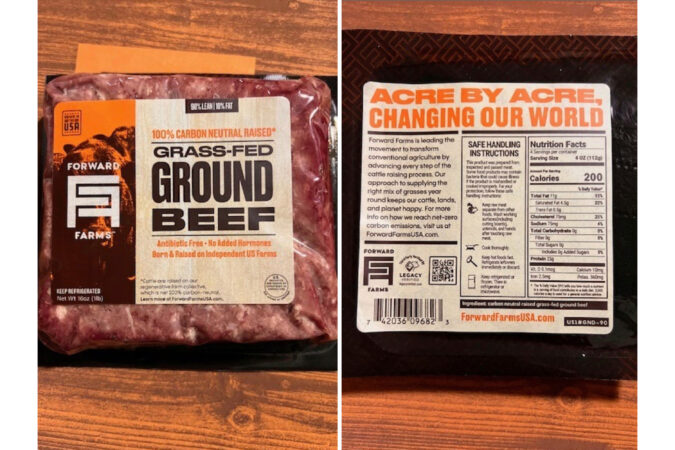
    The recall involves 16-ounce vacuum-sealed packages labeled “Forward Farms Grass-Fed Ground Beef.” Affected packages were produced Dec. 16 and have a label telling customers to use or freeze the meat by Jan. 13. The affected beef also bears the establishment number “EST 2083” on the side of its packaging.

    The meat was produced by Heyburn, Idaho-based Mountain West Food Group and was shipped to distributors in Pennsylvania, California, Colorado, Idaho, Montana, and Washington.

    The U.S. Department of Agriculture’s Food Safety and Inspection Service, which announced the recall Saturday, didn’t say which retailers may have sold the meat. The USDA and Mountain West Food Group didn’t respond to messages left Tuesday by the Associated Press.

    The USDA said there have been no confirmed reports of illness due to consumption of the meat. The issue was discovered in a sample of beef during routine testing.

    The USDA said the type of E. coli found can cause illness within 28 days of exposure. Most infected people develop diarrhea, which is often bloody, and vomiting. Infection is usually diagnosed with a stool sample.

    The USDA said customers who have purchased the affected products should either throw them away or return them to the place they were bought. The agency also advises all customers to consume ground beef only if it has been cooked to a temperature of 160 degrees Fahrenheit.

  • The thrill of victory and the exasperation of trying to feel good about it define the 2025 Eagles

    The thrill of victory and the exasperation of trying to feel good about it define the 2025 Eagles

    Quinyon Mitchell isn’t one of those cornerbacks who speaks as if he is paid by the word. That’s a good thing. Brevity is often a sign of a man with more important things on his mind. It also suffices, more often than not.

    For anybody who walked away from the Eagles’ 13-12 victory over the Bills on Sunday with an even greater sense of trepidation regarding the postseason, it might be helpful to consider the three short declarative sentences that Mitchell offered up as his interpretation of the proceedings.

    “We’re battle-tested,” the Eagles’ second-year cornerback said as he stood in the postgame swirl of a cramped visitor’s locker room at Highmark Stadium. “Just look at our schedule. Look at our opponents.”

    The sentiment is equal parts encouraging and maddening. Which is fitting, because the Eagles themselves are both of those things. It is their yin and their yang, their two mystical tadpoles, one of them midnight green, the other kelly green, chasing each other in a circle. The thrill of victory and the exasperation of trying to feel good about it.

    On the one hand, the scoreboard is the ultimate judge. On the other hand, why does the scoreboard have to say 13-12? And why does it have to feel so fitting?

    To anybody who possesses both a functioning brain and a reasonable amount of prior exposure to playoff football, the Eagles look like a team whose luck is destined to run out well before Super Bowl Sunday. The quarterback has not been good enough. Not even close. The play-calling has not been good enough to make up for the quarterback’s deficiencies. The defense has been good enough to make up for both of those things. But only barely.

    On Sunday, the result was the second time this season that the Eagles failed to complete a pass in the second half. Yet it was also the second time this season where they failed to complete a pass in the second half and still won the game.

    Yin and yang.

    Sunday was also the third time this season when the Eagles won a game in which they scored fewer than 17 points. They are just the fifth team to accomplish that feat over the last 15 seasons. Of the four teams that did it previously, three went on to lose in the wild card round. Yet the one exception was the 2012 Ravens, who went on to win the Super Bowl.

    Yin and yang.

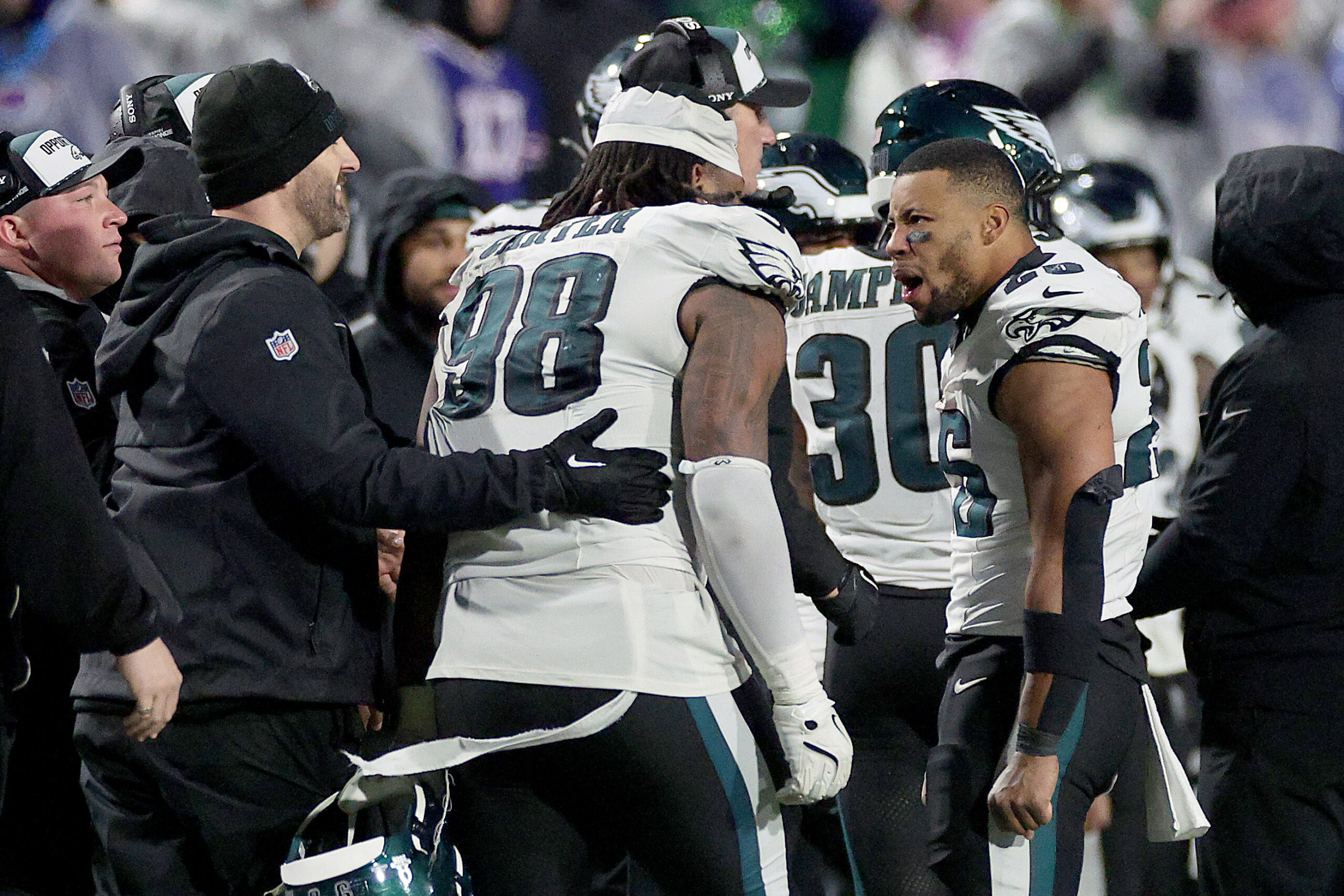
    Defensive tackle Jalen Carter (98) and running back Saquon Barkley celebrate after the Eagles stopped the Buffalo Bills on a two-point conversion attempt late in the fourth quarter Sunday.

    “I’ve never really been on a playoff team, but I can tell the difference just in the sense of these crunch time moments, being able to bend but don’t break,” said defensive end Jaelan Phillips, who had one of the Eagles’ five sacks against the Bills. “Obviously they had a little bit of a surge toward the end, but we were able to do what we needed to do offensively, defensively, and special teams wise to come out with the win. Gritty games like that are things you need to have to prepare yourself for the long haul.”

    The Eagles may not be the most dynamic team heading into the postseason, but they will be the most prepared.

    They have faced 10 of the top 13 quarterbacks in the NFL in terms of passing yards with a 3-1 record against the top three. They are 4-1 against the top seven QBR leaders. They have won games against five of the six quarterbacks who, along with Jalen Hurts, lead the NFL in wins over the last four seasons.

    Sunday was the 10th time in 16 games that the Eagles faced a team that ranked in the top 10 in the NFL in either offensive or defensive yards per play (as of Sunday).

    They have faced four of the NFL’s five highest-scoring offenses. They’ve faced five of the six quarterbacks who entered Sunday with the most passing yards, and three of the four who entered with the highest passer ratings. They have faced five of the seven defenses that entered Sunday with the highest rating, according to Pro Football Reference’s rating system.

    These have been the Eagles’ hallmarks throughout Hurts’ tenure at quarterback and Nick Sirianni’s at head coach. Sunday’s win over the Bills only added to a road record that is the best in the NFL since Sirianni’s arrival.

    “I think that’s a product of really good players and good coaches, and so it’s everything that goes into that, but good mental toughness,” Sirianni said Monday. “I think that really signifies your mental toughness, too.

    “We experienced some highs and some lows [on Sunday], and we were able to continue to be relentless in our approach handling ups and downs. They ended up making a critical mistake in the game and we didn’t, which ended up being the difference in that game. So again, coming down to fundamentals. Just great resilience by the guys in there, and we prepare for that as coaches and players.”

    Resilience is great. But even better is playing well enough to avoid the situations that test your resilience. That tension of opposites will determine the Eagles’ ultimate fate in the playoffs.

  • What I learned eating all over Philly in 2025

    What I learned eating all over Philly in 2025

    This year was a big one for eating at restaurants. I had the largest beat in scouting for The 76 this year, my first year doing so. For that list alone, I dined at 74 restaurants. For the other features, guides, and reviews I wrote, I dined at several dozen more.

    It was fascinating to look at Philadelphia’s dining scene according to the cross sections provided by eating many of the same dishes, served in different establishments. I ordered gon chao ngau ho or beef chow fun all across the city, comparing the differences between many restaurants’ versions. Some of them were drastic, some more nuanced. This past year, I spent cumulatively two whole days at omakase counters. I tracked the culinary trends and trendy ingredients that pervaded dining rooms and kitchens: Caesar salad everything, fermentation going strong, late-night menus finally emerging from their post-pandemic slumber, and the continuing rise and diversification of little treat culture.

    It was even more fascinating to look at the Mid-Atlantic as a whole (I spent the earlier part of the year splitting my time as a resident of both Washington and Philadelphia) and seeing what trends or tendencies were shared in restaurants up and down the Northeast Corridor. Most of what I noticed took place on the plate, though our dining scene was also marked by other trends: the surge of coffeehouses, the uptick in awards, and the proliferation of oyster bars.

    Trendy techniques and ingredients do not exist in isolation. Philly’s dining scene is part of a larger ecosystem of American dining and as our restaurants attract more and more out-of-town visitors and our kitchens attract out-of-town talent (the presence of Michelin in Philly ensures both), the borders of what makes dining in Philadelphia will expand and open. Social media buffets these trends around the globe, like the shades in Dante’s Inferno.

    What I learned eating all over Philly in 2025

    All green everything

    Matcha prices rose and quality fell, as farmers in Japan struggled to keep up with the global obsession with matcha that Philadelphia was not immune to. A similar trajectory happened with pistachios, as the Dubai chocolate bar maintained a chokehold on establishments from ice cream shops to smoothie shops and everywhere in between.

    After 9 p.m. is back

    Late-night menus are very much back, despite data supporting early dining as trending.

    Big treats and little treats

    Steakhouses and bakeries dominated openings (in Philly, the latter was more the case). They also developed distinct personalities, informed by the cultural backgrounds of third culture kids. We got Baby’s Kusina, Seaforest Bakeshop, a wave of Indonesian cafes with fluffy pastries, and a host of other “little treat”-forward bakeries. New York and London reported similar little treat trends.

    Nostalgia, or signs of a shifting economy?

    Recession indicator foods like burgers and baked potatoes are dominating the discourse when it comes to restaurants’ marketing. I’ve also heard my friends hotly debate which restaurants in Philly serve the best cabbage dishes. Cabbage is the epitome of recession indicator foods.

    Cocktails, both complicated and delicious

    So much in-house fermentation and liqueur-concocting continues to fuel the creativity of Philly’s bars, especially with Almanac, La Jefa, and Honeysuckle leading the way in preserving foraged ingredients and brewing amazake, traditionally made with koji applied to rice but in Philly, bartenders are making it with everything from corn to sweet potatoes.

    Hail, Caesar

    I started my tenure at The Inquirer by covering the viral kale caesar cutlet at Liberty Kitchen. Now, just over a year later, there is nothing that cannot be a Caesar, whether it’s a martini or Scampi’s take on bruschetta. The word “salad” has now been elided from the dish.

    Superb sauces, not enough rice

    There simply isn’t enough rice on the menu to sop up the incredible sauce work happening in many of our newer restaurants. Ordering a side of white rice whenever I get a crudo at Sao or Mawn has become regular practice for me. I also longed for sides of rice when dipping into Uchi’s many, very saucy crudos.

    I can’t see my food when I’m with you

    The dining rooms are getting dark. I can’t see my food. And yet, we’re in the golden age of food photography.

    Hokkaido scallops on crispy rice with vadouvan curry at Bardea, served on shells inside a box.

    No plates, no problem

    Restaurants continue to love serving food on plates that are not plates, from the jewelry boxes that bear delicate squares of crispy rice topped with raw scallops, weighed down by rocks at Bardea, to just rocks at Honeysuckle, to cleaned out parts of animals like the tuna spinal jelly served in a cleaned-out piece of tuna spine at Nakama and the scallop sashimi in shells at Ogawa. When Elwood served its venison scrapple stabbed onto deer antlers in 2019, it broke the Philadelphian internet. Nowadays, you wouldn’t bat an eye. This phenomenon is worldwide. When I get my initial “snacks” course — they’re always called “snacks” at a fine dining establishment — it would be weird if they weren’t served on ceramic orbs like at Miro in Honolulu or ceramic test tube holders at Washington’s Jont or custom pieces made by Felt and Fat that resemble the surface of the moon at Provenance.

    Break out the vinyl

    Speakeasy cocktail bars are out. Inclusive listening lounges are in.

    Every restaurant needs a hamachi crudo

    The Aged Hamachi Crudo at Sao on Wednesday, Nov. 26, 2025 in Philadelphia.

    Pickle martinis, chicken karaage, koji-aged proteins and vegetables, and hamachi crudo are on so many menus, regardless of cuisine or concept.

    Let’s call it ‘American Fusion’

    The term “New American” is so yesteryear, but the conglomeration of many different influences and dizzying collections of seemingly disparate global flavors on single menus pervade at ambitious restaurants like Wilmington’s Bardea, where muhammara and calamansi are on the same menu, to great effect, and Grad Hospital’s Banshee where, of course, there is a hamachi crudo but also patatas bravas on one menu.

    Get off the list

    Finally, we often keep going to the same places. The 76 was a great exercise in not doing that and I encourage you to dine out widely. To eat beyond the places that have endless notify lists on Resy. To only be blinded by the dark depths of current dining rooms, and not the hype that blankets hot new restaurants.

  • This was the year of the limited edition burger

    This was the year of the limited edition burger

    The gourmet burger is a familiar trope that has been reinvented for years. Burgers lure you in, they comfort you when you need something familiar, splashed with a little sparkle of indulgence, whether that’s foie gras, a rainfall of truffles, or an extra special patty made of wagyu or dry-aged beef.

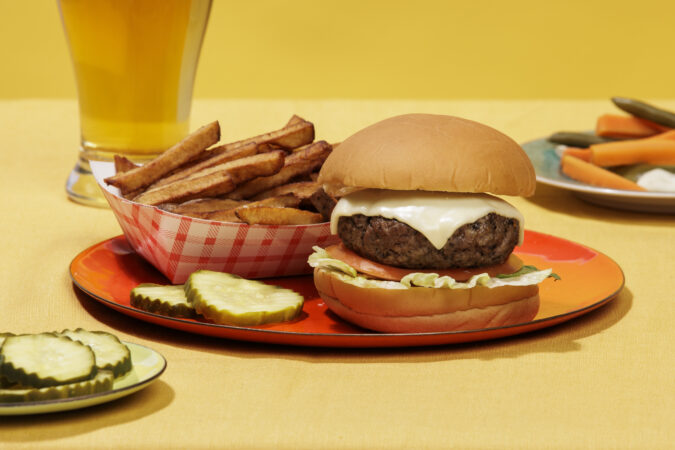
    But never has there been such an avalanche of simple, carefully-made burgers served by fine dining establishments in curiously tiny quantities. In terms of construction, they’re more aligned with being a recession indicator food, even if their prices are not recession-friendly. This is no longer the era of PYT’s crazy burgers of yesteryear. And sometimes, they are served in spite of a chef’s chagrin.

    Meetinghouse’s simple, straightforward burger with its little pickle “hat,” is served only on Thursdays.

    River Twice’s double-pattied Mother Rucker burger was once bestowed upon diners in the middle of their tasting menus. They’re now available only on Monday nights.

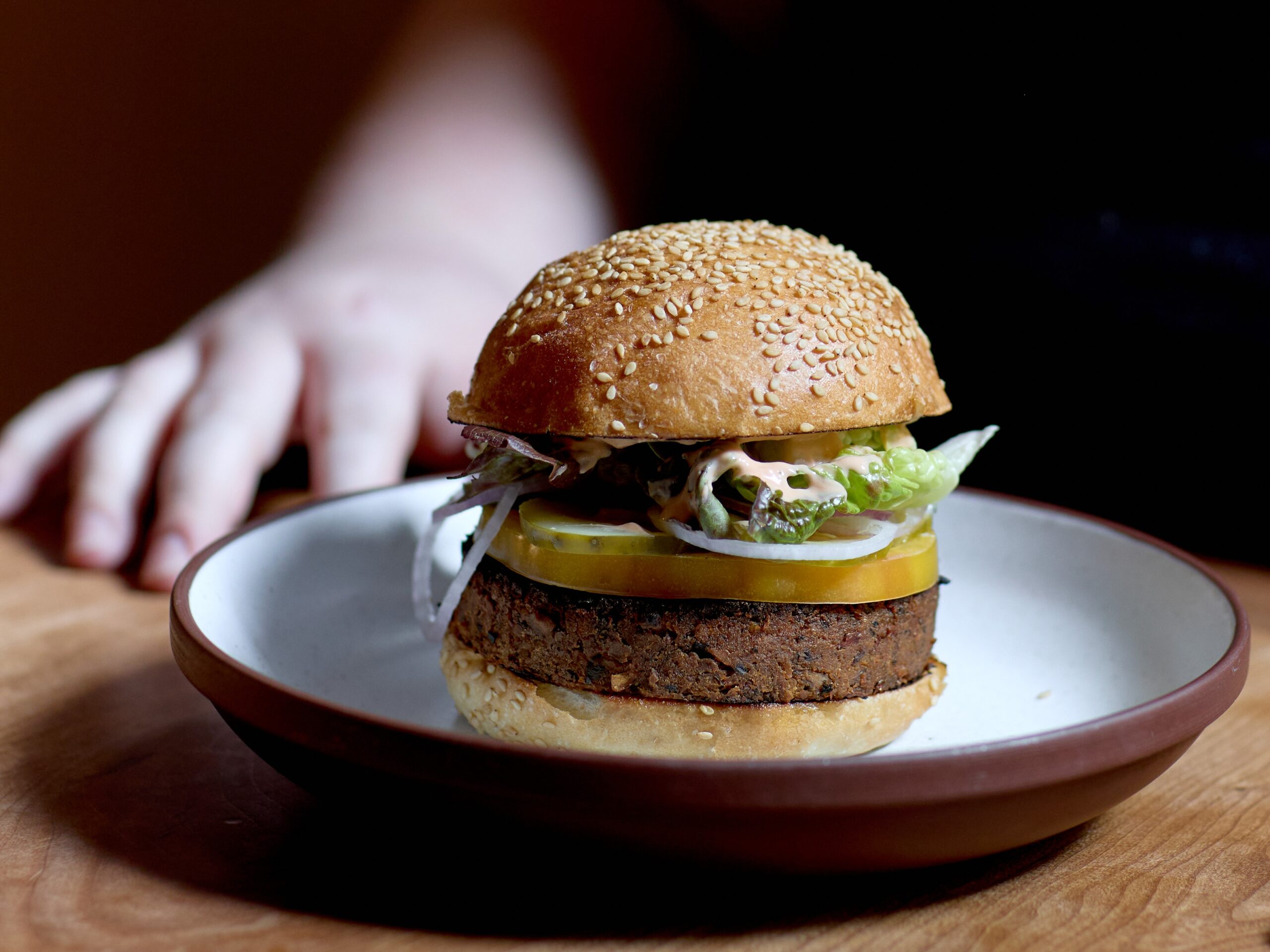
    Pietramala’s vegan burger, made from vegetables, Mycopolitan mushrooms, and repurposed ingredients left over from their other menu items, and which takes three days of preparation, instigates lines around their block when they’re served one Sunday every month.

    The vegan bean and smoked mushroom burger at Pietramala in Northern Liberties.

    The limited edition burger thrives in our post-pandemic search for comfort and the notion that everything is a steakhouse now (a nationwide trend that hasn’t quite reached Philly, but it’s coming for us. It’s only a matter of time).

    A harbinger of the dominance of the steakhouse can be seen in a single space in nearby Washington, a city with which we share a similar progression in our dining scene: Johnny Spero’s Reverie, a tasting menu-based, fine dining approach to seafood has closed. A steakhouse, Ox and Olive, will be opening in its Georgetown space.

    The restaurants and cocktail bars beckon you with proclamations: Come in for our burger! Only 12 per night! Come in for our burger! But line up around the block!

    The limited edition burger is a trend that crops up periodically in New York, like it did in 2014, to the reluctance of chefs who noted that burgers are simply not profit drivers, and that they would bring the potential of a $45 check down to $25. Today’s limited edition burgers are unlikely to do the same in terms of numbers. Even Pine Street Grill’s almost no-frills burger costs $26.

    The phenomenon of the limited edition burger marks a uniquely 2025-era blend of a comforting, recession-indicator food (at the end of the day, it’s ground meat in a hunk of bread) with the scarcity principle frequently wielded by marketers and businesses. Limited editions trigger FOMO. Get one of these burgers and it’s like getting an Hermes Birkin bag, or the latest Supreme drop. They’re rare, you have to go through some sort of gauntlet to attain one, you feel lucky when you do.

  • To kick-start a generation of city kids playing soccer, it will take more than just a place to play

    To kick-start a generation of city kids playing soccer, it will take more than just a place to play

    In the backdrop of the excitement surrounding the FIFA World Cup coming to Philadelphia is the question of what impact the tournament will have on soccer in the region.

    World Cups have long had the potential to be transformative for the hosting nations. The last men’s edition in the United States, in 1994, helped spur Major League Soccer. The women’s editions in 1999 and 2003 also spawned leagues, but more importantly, they fueled the grassroots growth of the game, benefiting both girls and boys.

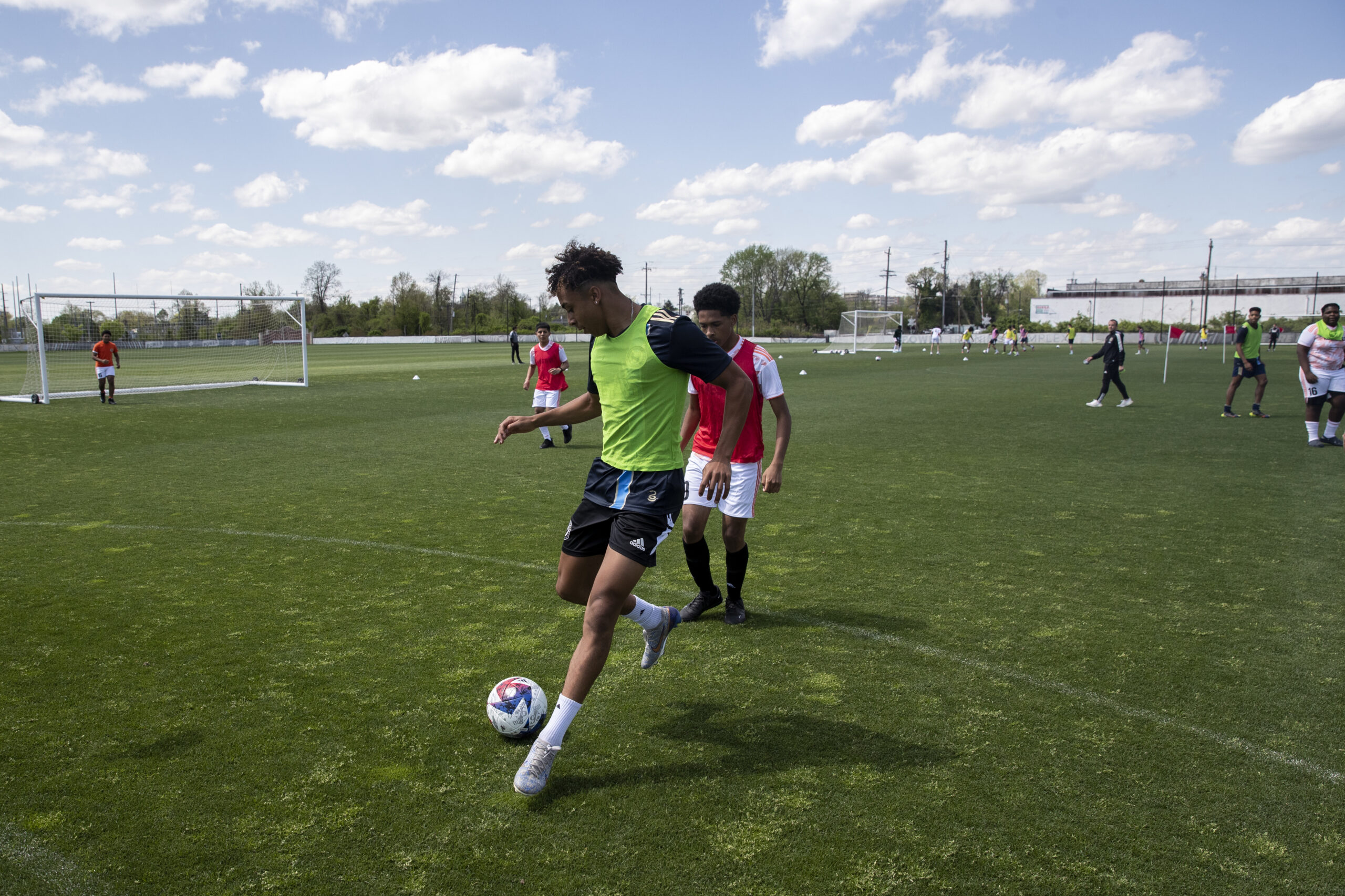
    Over the course of those years, the youth game has morphed into a pay-for-play structure in which the best clubs are generally the ones that come at a high price, giving youth athletes whose parents have expendable cash — many times in the thousands — the opportunity to play consistently and thus reap the benefits of year-round exposure through tournaments and showcases.

    U.S. Youth Soccer is a network that oversees more than 10,000 such clubs, with local branches such as the Eastern Pennsylvania Youth Soccer Association, which govern clubs and leagues across regions under the umbrella of USYS. The thing is, many of those clubs and leagues don’t come from inner-city areas like Philadelphia, where the next great American star could be waiting to be discovered.

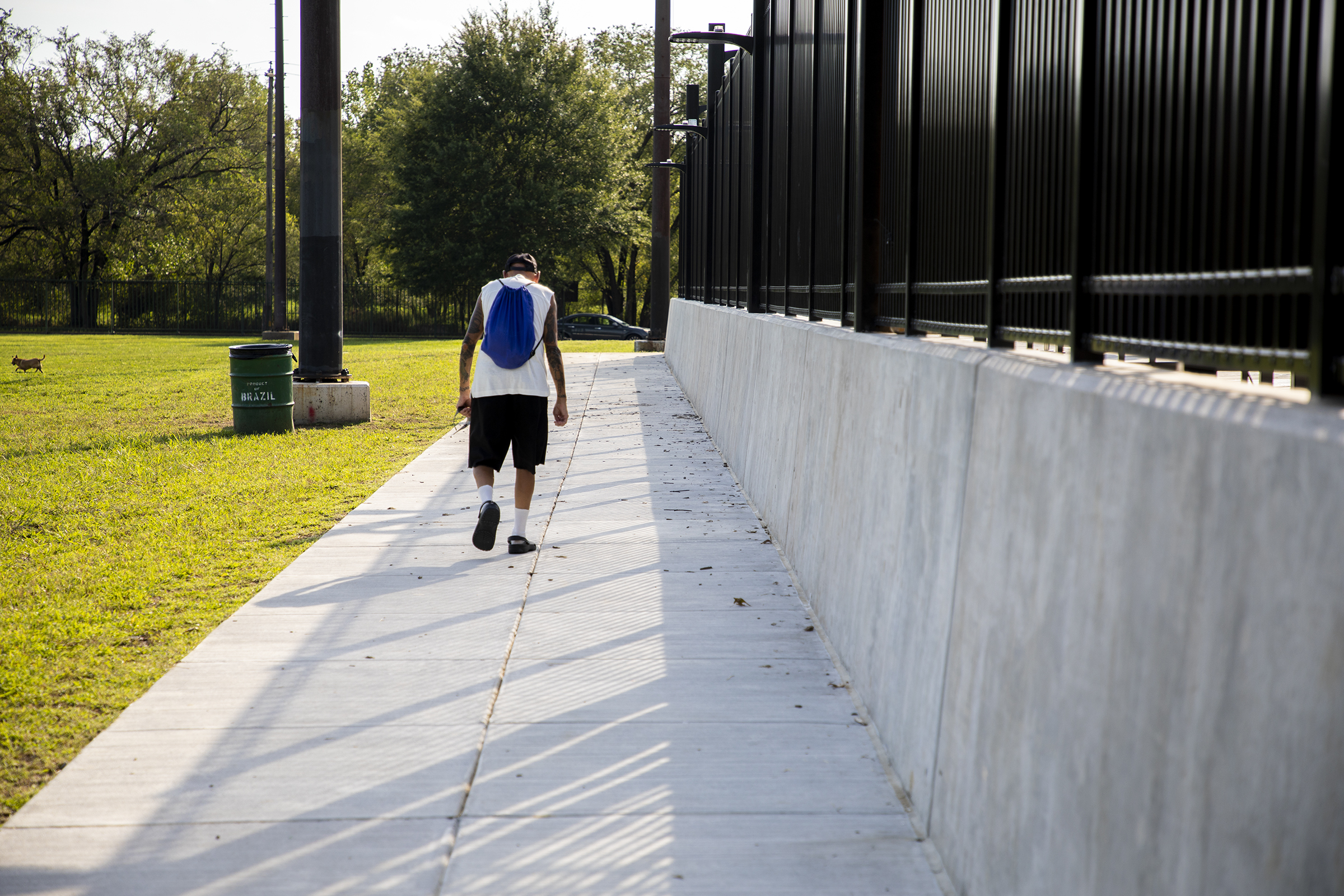
    But to find that kid, they need a place to play, and in Philadelphia, finding a spot to play organized soccer at times can be equally as tricky.

    It is a need that the city, alongside several foundations and organizations, is working to address, recognizing that the World Cup’s visit to Philadelphia may lead more kids to give futból a try.

    If you build it …

    Ahead of the World Cup, Philadelphia Soccer 2026 committed $2 million to the U.S. Soccer Foundation to support youth soccer initiatives, including the development mini pitches across the state.

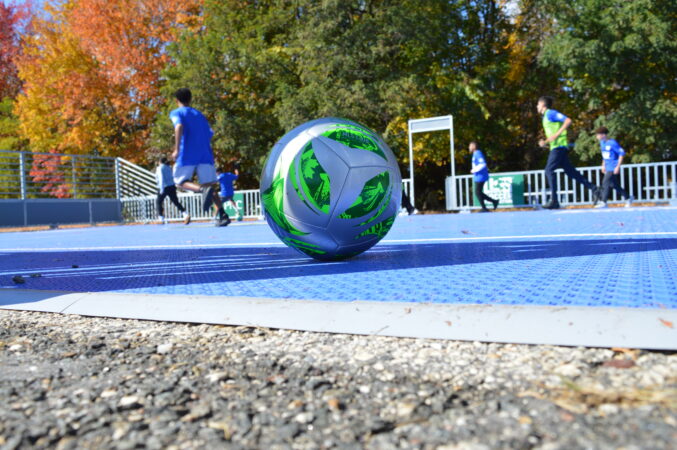
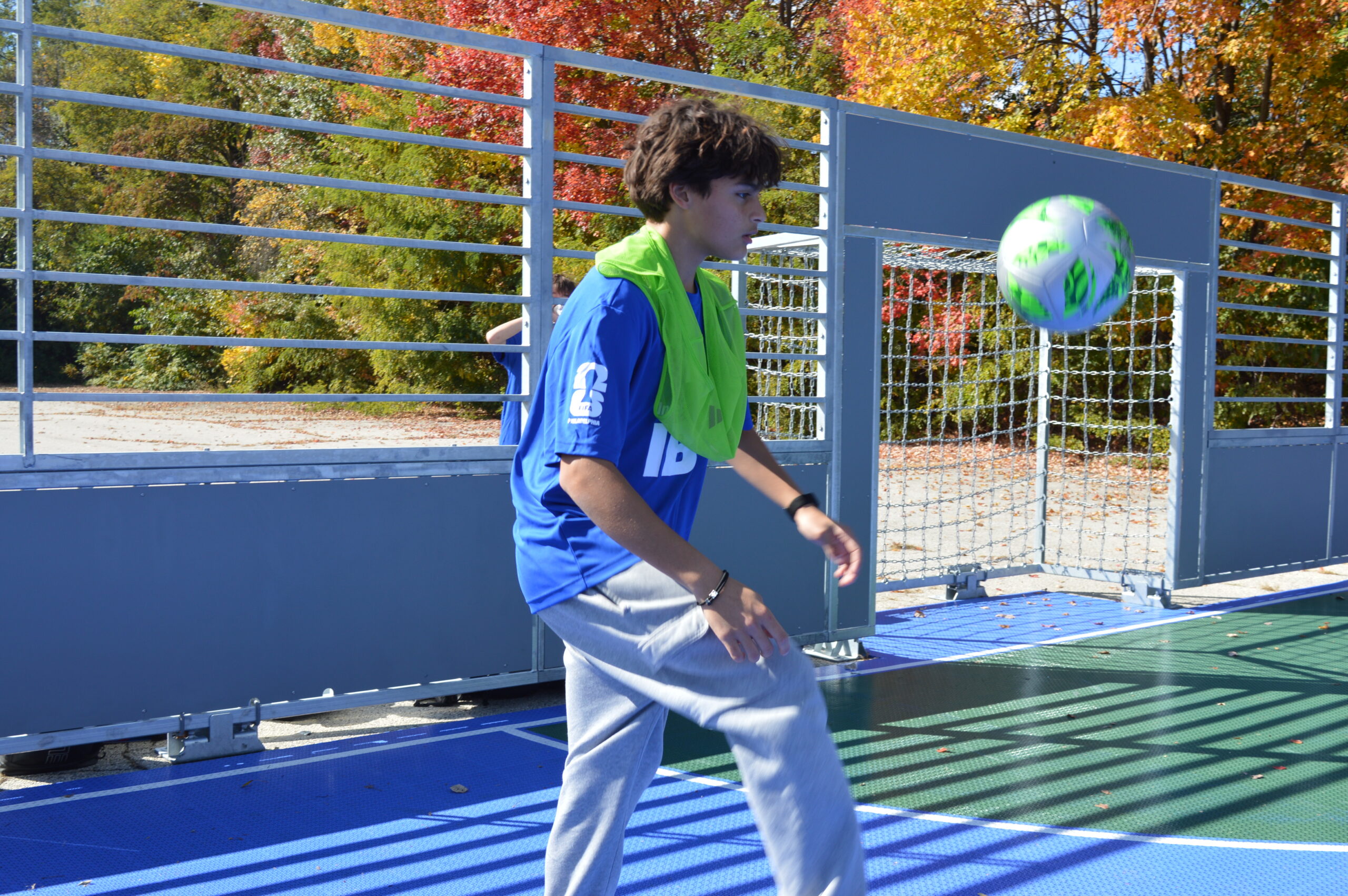
    In late fall, U.S. Soccer Foundation installed a pair of those mini-pitches in Philadelphia. The foundation, which was also created after the 1994 World Cup, has a goal to leave a lasting legacy in inner cities. It believes these mini-pitches offer not just a place to play but a place for local organizations to host programs.

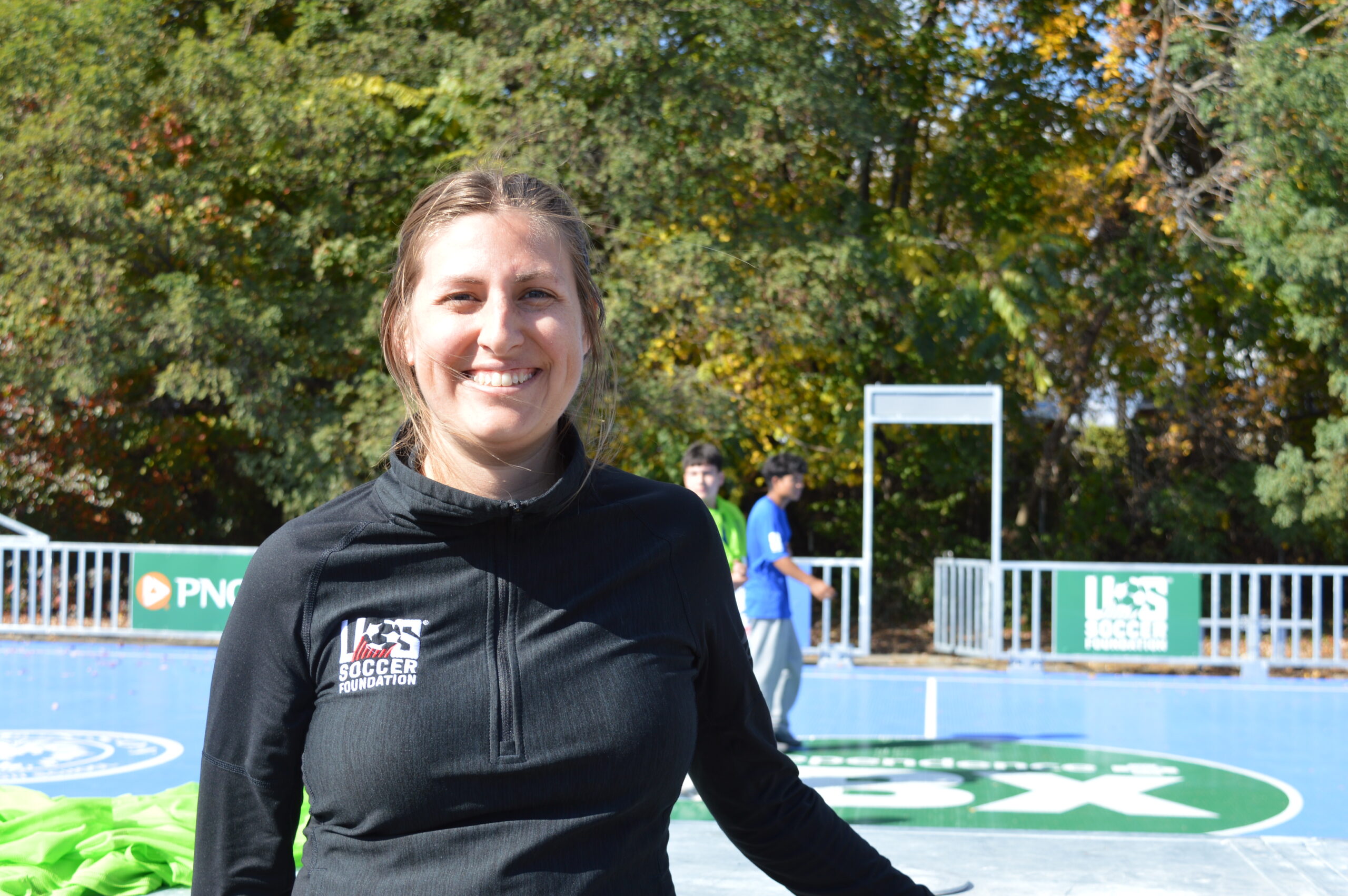
    Jen Arnold, vice president of communications and marketing at the U.S. Soccer Foundation, says that the foundation has a commitment to introducing the sport to more children in underserved areas.

    “When our current president and CEO [Ed Foster-Simeon] came into the role in 2008, he did a landscape analysis and showed it had grown … but in the suburbs and more affluent communities,” said Jen Arnold, vice president of communications and marketing for the U.S. Soccer Foundation.

    “So from the foundation standpoint, we want to make sure it’s growing equally across the ground. We’re here for the under-resourced communities, communities that might not have been part of that boom after 1994. We’re here to make sure that everyone can access the game.”

    Arnold spoke after the installation of one of the latest mini-pitches added to Philly’s soccer landscape, behind Swenson Arts and Technology High School in the Far Northeast. The installation was in collaboration with Independence Blue Cross, the School District of Philadelphia, and FIFA Philly 26, the local collective tasked with organizing Philly’s place in this summer’s World Cup.

    The fields, which cost $150,000 apiece to install, according to Arnold, are the latest additions to Philly’s sports landscape. They could be considered an addition to the city’s massive Rebuild program, a reported $500 million restoration project for area parks and playgrounds, of which $3.5 million was allocated to create 15 mini-pitches and two signature soccer fields across the city.

    Many recreation centers across the city are fenced off, only to be used under permit, which restricts the idea of open play, a key component of soccer.

    The idea is that these mini-pitches offer an opportunity for more children to be introduced to the game. They also offer a welcoming environment, unlike the scores of fields around the city that are fenced and kept under lock and key. Or recreation centers in which both indoor and outdoor surfaces get gobbled up often by other sports, or even pay-to-play youth and adult league soccer organizations, which serve to add to city coffers in exchange for monopolizing much-needed field time.

    But soccer organizers across the region believe that it’s not simply “If you build it, they will come.” It’s more like: “Build it and add programs and they might come.”

    That’s where the big challenge lies when it comes to introducing more city kids to soccer.

    … Will they come?

    For the better part of a decade, Dom Landry has made it a mission to bring soccer to North Philadelphia. A Philly native who played at St. Joseph’s University, Landry has dedicated time, intuition, and even his own dollars to introduce the sport to as many children in the city’s Fairhill section as possible.

    Landry founded AC Fairhill, the neighborhood club created in 2015 with just “three kids and an old bag of balls,” according to Landry. It has since become a recognized club that competes in tournaments across the region. His is one of a few clubs directly from the inner city that have funneled children from North Philly streets to top clubs and academies.

    His desire mirrors what the U.S. Soccer Foundation says it’s looking to do in developing the infrastructure, but Landry notes that it goes way beyond plopping a shiny new field in the middle of an underserved neighborhood.

    Students at Swenson Arts and Technology School were the first to test out the new soccer mini-pitch that was installed at the rear of the school earlier this fall.

    “Putting infrastructure in for play is critically important, but it’s not the United States Soccer Federation or its foundation’s job to provide programming,” Landry said. “I know it’s part of their mission [at the U.S. Soccer Foundation], too, but it’s really the job of local organizations to bring the programming to those fields.

    “We don’t have the soccer culture here in America where kids are just going to grab a soccer ball and go to a soccer pitch because it was made; there has to be enough people to bring in that level of interest to them. It’s very much a multiprong approach, and these mini-fields are great, but they’re only scratching the surface.”

    Unlike other countries where soccer reigns supreme, in America it’s viewed as a sport for children, residing in the backdrop of football, baseball, and basketball. In other parts of the world, all that’s needed is a ball to get a game going, but here, it’s rare to see the sport being played without an organization tied to it.

    Having safe places to play is one thing, but experts say developing a love for the game in area children is up to organizers.

    ‘We need to do more’

    For Landry, it’s a simple thing that has been made to feel quite complex.

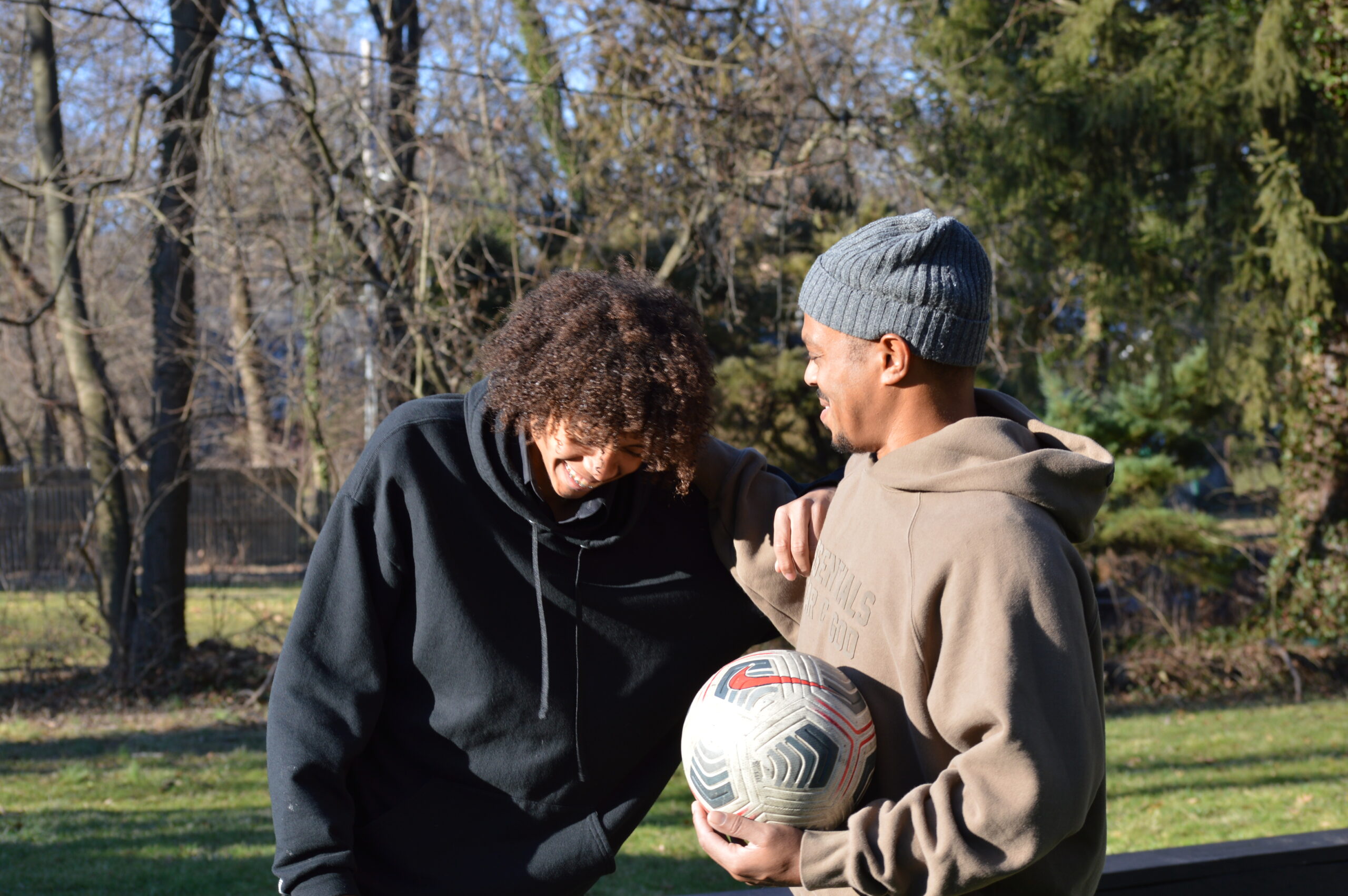
    “We have to teach kids how to love the sport,” Landry said. “Not necessarily just, like, go get cones and train, but have fun with the sport. Who’s going to be that coach, that parent who’s going to show a kid how to have fun with the sport, so they can go out with their friends and play it? To me, if anything, that’s the next step in the legacy and evolution of soccer here. But that ideology also tends to upset these clubs who spend a great deal of time in generating a living from it.”

    A host of organizations, both in the city and out, have taken soccer programming into schools, taking over gym classes or creating after-school outlets.

    To introduce the sport directly to more Black and brown youth, the annual Odunde Festival created a soccer pitch in the middle of South Street at this past summer’s event to get children and their families playing soccer, coupled with education on where they could find programs close to home.

    Jeremiah White III, a former professional soccer player turned entrepreneur, says he presented the idea to Odunde leadership and already has plans to grow Odunde Sports to align with this summer’s World Cup.

    Jeremiah White Jr. (right), with his son, Jeremiah III, kick-started Odunde Sports this past summer, a deriative of the larger Odunde Festival, designed to foster connection between community and sports, like soccer.

    “A big thing missing from soccer programming here is the importance of connection,” White said. “[When it comes to soccer in America], we tend to overvalue structural training, and in some cases disconnect training from culture entirely. It makes the game robotic and sucks out all of the passion. What kid is going to want to pick up a soccer ball over a basketball or a football, when that’s what they’re walking into?”

    It’s a well-known challenge, even one recognized by top youth organizations as a change agent.

    “The fields are great, but yeah, we need to do more,” said Chris Branscome, president and CEO of EPYSA, the organization that oversees club programming in the area. “Once they are built, you’ve got to get the kids there, you’ve got to program them. That’s perhaps the bigger piece of the puzzle: ensuring we have the opportunity to train more coaches and to deliver regular, consistent programming at these locations.

    “To me, that’s the big challenge we have over the next year.”

    It’s one that feels pretty integral once the noise the World Cup brings finally fades.

  • The College Football Playoff’s top four seeds are in action this week. Here are some potential future Eagles to watch.

    The College Football Playoff’s top four seeds are in action this week. Here are some potential future Eagles to watch.

    The College Football Playoff continues with four more games this week, beginning with a New Year’s Eve matchup between Ohio State and Miami at the Cotton Bowl. The Buckeyes-Hurricanes showdown is the game in this round that will likely yield the most combined NFL draft prospects.

    On New Year’s Day, Alabama plays Indiana in the Rose Bowl, Ole Miss takes on Georgia in the Sugar Bowl, and Oregon and Texas Tech face off in the Orange Bowl.

    With plenty of draft hopefuls playing on big stages, here are the prospects the Eagles should be keeping an eye on from the top four seeds — Indiana, Ohio State, Georgia, and Texas Tech — who are set to make their 2025 CFP debuts.

    Monroe Freeling, tackle, Georgia

    The Georgia-to-Eagles pipeline could get another addition with the Bulldogs’ left tackle Freeling, who is an outstanding athlete at 6-foot-7, 315 pounds. The tackle, who is only a junior, is light on his feet in pass protection, moves well in space to block smaller and faster players, and is hard to get around in pass protection. According to Pro Football Focus, Freeling has allowed just nine pressures and two sacks in 423 pass blocking snaps this season.

    Freeling was banged up midway through the season and his play balance isn’t consistent from down to down, but the left tackle has a desirable skill set to contend with some of the best athletes at the NFL level, especially in pass protection. Should he declare, he will be in high demand for teams that need an offensive tackle — whether it’s next season or a few years from now.

    Kenyatta Jackson, edge rusher, Ohio State

    Part of a fearsome Ohio State defense, Jackson is having a breakout season in his fourth year in the program. At 6-6, 265 pounds, Jackson has a noticeable arm length advantage and uses it to challenge opponents. He plays multiple roles along the defensive line, lining up primarily at 4i (inside shoulder of tackles) and can wreak havoc as both a pass rusher and run defender.

    Jackson is at his best, though, from a standing alignment as a pass rusher, allowing him to get a running start and to create physical separation from offensive tackles. He projects as a Day 2 pick if he declares this year and would be a welcome addition to a talented Eagles edge rusher room.

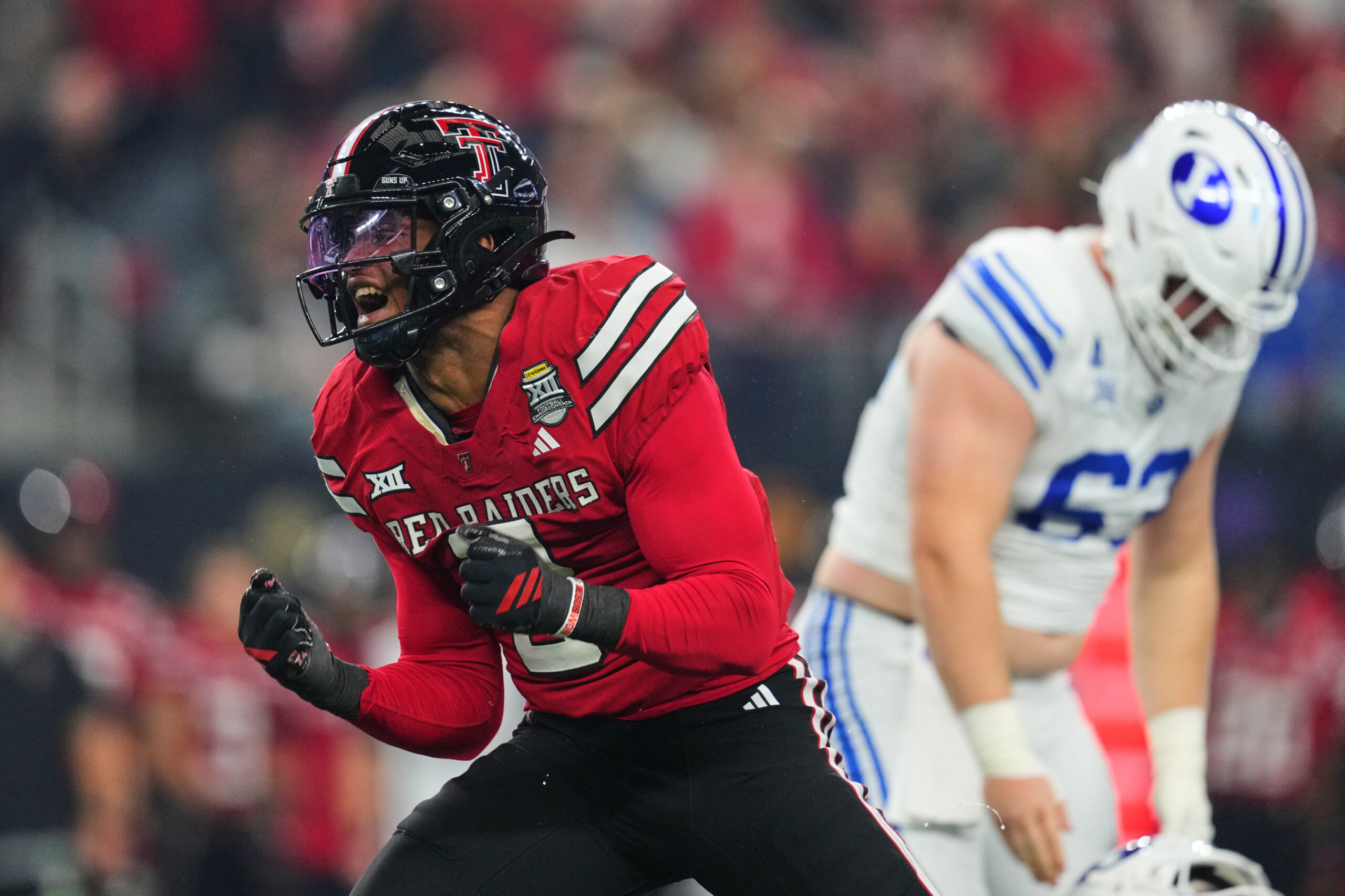
    Texas Tech defensive end Romello Height celebrates a defensive stop against BYU in the Big 12 Championship.

    Romello Height, edge rusher, Texas Tech

    At his fourth school in six years (Auburn, USC, Georgia Tech), Height is having the best season of his career with nine sacks and 10½ tackles for losses in 13 games. A high-effort, high-motor pass rusher, Height uses his length and ankle flexion to win on the outside shoulder of offensive tackles, and has a nice toolbox of pass-rush moves that includes a spin, an inside swim move, and a cross-chop.

    Height has a 23% pass-rush win rate, according to PFF, but struggles as a run defender holding his gap against offensive linemen. He’ll likely command a designated pass rushing role early in his NFL career. Despite being an older prospect, there’s a chance Height can go within the first two rounds, and he would be a nice addition to an Eagles pass rush that is already much stronger since trading for Jaelan Phillips.

    Jermaine Mathews, DB, Ohio State

    Mathews, who plays both outside corner and nickel for Ohio State, is just a junior who could return to school, but his versatility and ball skills make him an early-round candidate should he enter the draft. At 5-11, 190 pounds, Mathews excels in off man coverage and zone coverage looks, closing on the football with quickness while playing through the hands of receivers.

    According to PFF, Matthews has 398 snaps at outside corner vs. 159 at nickel. He struggled with penalties down the stretch and is susceptible to getting beaten deep without safety help, but he projects as a nickel who can eliminate timing routes over the middle of the field and into the boundary. His physicality in the running game could improve, too.

    Omar Cooper, WR, Indiana

    Quarterback Fernando Mendoza is the potential top pick in the 2026 draft and one of his weapons is Cooper, who has the speed to run by a secondary and is hard to bring down in the open field. Primarily operating from the slot, Cooper has strong hands at the catch point and terrific body control, evidenced by his clutch game-winning touchdown against Penn State in November.

    His ability to win in contested catch situations — he has made 6 of 12 catches while tightly defended, according to PFF — and vertical speed make him an ideal second or third receiver option in the NFL. For the Eagles, he could be a much-needed field stretcher who has the ability to create big gains with the ball in his hands and win in one-on-one situations.

    Terrance Carter Jr. TE, Texas Tech

    Tight end will eventually become a need for the Eagles, perhaps as soon as this offseason with Dallas Goedert set to become a free agent in the spring. Outside of Round 1, there will be a few players who interest the Eagles, and among them is Carter, the Louisiana-Lafayette transfer who is dynamic after the catch.

    Of his 552 receiving yards this season, 334 have come after the catch, according to PFF, and Carter is a matchup nightmare for linebackers and safeties. Though he’s not quite the same caliber of athlete as Georgia’s tight end duo of Lawson Luckie and Oscar Delp, or Oregon’s Kenyon Sadiq, Carter can still separate from secondary and second-level players.

    The tight end prospect, who could return to school, must clean up his drops — he has five in 2025 — and doesn’t add much as a blocker, but is a big-time receiving threat.

    Davison Igbinosun, DB, Ohio State

    There may not be a more improved player in Ohio State’s secondary this season than Igbinosun, the physical outside corner who makes life difficult for opposing receivers. Igbinosun, listed at 6-2, 193 pounds, likes to disrupt the timing of wide receivers in man coverage, and has the length and speed to defend vertical passes downfield.

    According to PFF, Igbinosun hasn’t allowed a touchdown across 331 coverage snaps and just 42.9% of his targets in coverage have been caught. He is feisty, competes at the catch point, and has excellent ball production this season (six pass breakups, two interceptions). Penalties continue to be a negative for him (21 over the last two years), but they have become far less of an issue in 2025.

    Though Adoree’ Jackson has held up much better down the stretch of this season manning the cornerback spot alongside Quinyon Mitchell for the Eagles, Igbinosun would be an upgrade from a ball production standpoint, though the team would have to be comfortable with his tendency to get too physical in man coverage situations.