Blog

  • Vance criticizes Israel’s parliament vote on West Bank annexation, says the move was an ‘insult’

    Vance criticizes Israel’s parliament vote on West Bank annexation, says the move was an ‘insult’

    JERUSALEM — U.S. Vice President JD Vance criticized on Thursday a symbolic vote in Israel’s parliament the previous day about annexing the occupied West Bank, saying it amounted to an “insult” and went against the Trump administration policies.

    Hard-liners in the Israeli parliament had narrowly passed a preliminary vote in support of annexing parts of the West Bank — an apparent attempt to embarrass Prime Minister Benjamin Netanyahu while Vance was still in the country.

    The bill, which required only a simple majority of lawmakers present in the house on Wednesday, passed with a 25-24 vote. But it was unlikely to pass multiple rounds of voting to become law or win a majority in the 120-seat parliament. Netanyahu, who is opposed to it, also has tools to delay or defeat it.

    Before departing Israel, Vance also unveiled new details about U.S. plans for Gaza, saying he expected reconstruction to begin soon in some “Hamas-free” areas of the territory. But he warned that rebuilding the territory after a devastating two-year war could take years.

    “The hope is to rebuild Rafah over the next two to three years and theoretically you could have half a million people live (there),” he said, speaking of the strip’s southernmost city.

    That would account for about a quarter of Gaza’s population of roughly 2 million, 90% of whom were displaced from their homes during the war. Out of every 10 buildings that stood in Gaza prewar, eight are either damaged or flattened. An estimated cost of rebuilding Gaza is about $53 billion, according to the World Bank, the U.N. and the European Union.

    Vance says the vote was an ‘insult’

    The Israeli parliament’s vote has stirred widespread condemnation, with over a dozen countries — including Egypt, Qatar and Saudi Arabia — rebuking it in a joint statement that called all Israeli settlements in the West Bank a violation of international law.

    Netanyahu’s office said in a statement that the “vote on annexation was a deliberate political provocation by the opposition to sow discord.”

    Netanyahu is struggling to stave off early elections as cracks grow more apparent between factions in Israel’s right-wing parties, some of whom were upset over the ceasefire and the security sacrifices it required of Israel.

    Vance said that if the Knesset’s vote was a “political stunt, then it is a very stupid political stunt.”

    “I personally take some insult to it,” Vance said. “The policy of the Trump administration is that the West Bank will not be annexed by Israel.”

    The deputy Palestinian ambassador to the United Nations, Majed Bamya, told the U.N. Security Council on Thursday that Palestinians “appreciate the clear message” the Trump administration has sent in opposition to annexation.

    While many members of Netanyahu’s coalition, including his Likud Party, support annexation, they have backed off those calls since U.S. President Donald Trump said last month that he opposes such a move.

    The Palestinians seek the West Bank and the Gaza Strip, captured by Israel in the 1967 Mideast war, for a future independent state. Israeli annexation of the West Bank would all but bury hopes for a two-state solution between Israel and the Palestinians — the outcome supported by most of the world.

    Analysts like Amichai Cohen, a senior fellow at the Israel Democracy Institute, say that a “de-facto annexation of very large parts” of the West Bank is already underway, referring to the growing number of Israelis living in settlements in the Palestinian territory — even without any law supporting annexation.

    Intense U.S. push toward peace

    Earlier this week, Vance announced the opening of a civilian military coordination center in southern Israel where some 200 U.S. troops are working alongside the Israeli military and delegations from other countries planning the stabilization and reconstruction of Gaza.

    The United States is seeking support from other allies, especially Gulf Arab nations, to create an international stabilization force to be deployed to Gaza and train a Palestinian force.

    “We’d like to see Palestinian police forces in Gaza that are not Hamas and that are going to do a good job, but those still have to be trained and equipped,” U.S. Secretary of State Marco Rubio said ahead of his trip to Israel.

    Rubio, who was meeting with Netanyahu on Thursday evening, has also criticized Israeli far-right lawmakers’ effort to push for the annexation of the West Bank.

    Israeli media referred to the nonstop parade of American officials visiting to ensure Israel holds up its side of the fragile ceasefire as “Bibi-sitting.” The term, utilizing Netanyahu’s nickname of Bibi, refers to an old campaign ad when Netanyahu positioned himself as the “Bibi-sitter” whom voters could trust with their kids.

    Gaza’s dire need for medical care and aid

    In the first medical evacuation since the ceasefire began on Oct. 10, the head of the World Health Organization said Thursday the group has evacuated 41 critical patients and 145 companions out of the Gaza Strip.

    In a statement posted to X, Tedros Adhanom Ghebreyesus called on nations to show solidarity and help some 15,000 patients who are still waiting for approval to receive medical care outside Gaza.

    His calls were echoed by an official with the U.N. Population Fund who on Wednesday described the “sheer devastation” that he witnessed on his most recent travel to Gaza, saying that there is no such thing as a “normal birth in Gaza now.”

    Andrew Saberton, an executive director at UNFPA, told reporters how difficult the agency’s work has become due to the lack of functioning or even standing health care facilities.

    Another major challenge since the ceasefire began has been getting enough aid into Gaza — and distributed — to the meet the huge demand.

    “We expected Gaza to be flooded with aid the moment the ceasefire began. But that’s not what we’re seeing,” said Bushra Khalidi, who oversees the Palestinian territories division at Oxfam, a nonprofit focused on global poverty.

    More crossings into Gaza need to be opened in order to allow in more trucks, said Antoine Renard, head of the World Food Program in the Palestinian territories.

    “With only two crossings that are open, you are facing clearly congestion,” he said.

    The WFP has 36 distribution centers operating in Gaza, and aims to increase that to 145. Since Oct 11, the U.N. tracking system has recorded 949 aid trucks that were offloaded in Gaza.

  • Trump backs off planned surge of federal agents into San Francisco after talking to the mayor

    Trump backs off planned surge of federal agents into San Francisco after talking to the mayor

    ALAMEDA, Calif. — President Donald Trump said Thursday that he’s backing off a planned surge of federal agents into San Francisco to quell crime after speaking to the mayor and several prominent business leaders who said they’re working hard to clean up the city.

    Trump had been threatening to send the National Guard to San Francisco, a move Mayor Daniel Lurie and Gov. Gavin Newsom said was unnecessary because crime is on the decline. Separately, U.S. Customs and Border Protection agents began arriving at a Coast Guard base in the region earlier Thursday for a possible ramp up of immigration enforcement, a move that drew several hundred protesters.

    It was not clear if the president was canceling a National Guard deployment or calling off immigration enforcement by CBP agents. At his news conference, Lurie said he could not clarify and could only repeat what the president had told him. Lurie said Homeland Security Secretary Kristi Noem “reaffirmed” Trump’s commitment on Thursday morning. DHS oversees CBP agents as well as U.S. Immigration and Customs Enforcement.

    “The Federal Government was preparing to ‘surge’ San Francisco, California, on Saturday, but friends of mine who live in the area called last night to ask me not to go forward with the surge,” Trump posted on social media. “I spoke to Mayor Lurie last night and he asked, very nicely, that I give him a chance to see if he can turn it around.”

    Specifically, Trump said he heard from Salesforce CEO Mark Benioff and Nvidia CEO Jensen Huang. He said the federal government could handle crime better than city leaders, and he indicated he could still send agents in the future.

    At an afternoon news conference, Lurie said he welcomes the city’s “continued partnership” with the Drug Enforcement Agency and other federal authorities to get illegal narcotics off the streets and contribute to San Francisco’s falling crime rates.

    “But having the military and militarized immigration enforcement in our city will hinder our recovery,” the mayor said. Trump’s assertions of out-of-control crime in the city of roughly 830,000 have baffled local and state leaders, who point to statistics showing that many crimes are at record lows.

    Newsom’s office said on X: “Trump has finally, for once, listened to reason — and heard what we have been saying from the beginning. The Bay Area is a shining example of what makes California so special, and any attempt to erode our progress would damage the work we’ve done.”

    Protesters assembled just after dawn at Coast Guard Island in Alameda, California, where CBP agents were arriving before Trump made his remarks. Several hundred people stood outside the facility, with many singing hymns and carrying signs saying, “Protect our neighbors” and “No ICE or troops in the Bay.”

    Police used at least one flash-bang grenade to clear a handful of demonstrators from the entrance as CBP vehicles drove onto the base. Organizers urged protesters to remain peaceful, as a line of Coast Guard officers in helmets watched from just outside the entrance.

    Protester Gala King participated in an interfaith vigil against the federal crackdown and in support of immigrants.

    “The Bay Area is a beautiful place full of diversity, and we are here to protect that,” King said. “Our faith traditions, our interfaith traditions, call on us to stand on the side of justice, to stand on the side of those that are most marginalized, that are most targeted right now.”

    Coast Guard Island is an artificial island formed in 1913, and the Coast Guard first established a base there in 1926. The island is owned by the federal government and is not open to the general public, so escorts or specific government ID cards are required for visitors. The Coast Guard is part of the Department of Homeland Security.

    Trump has deployed the Guard to Washington, D.C., and Memphis, Tennessee, to help fight what he says is rampant crime. Los Angeles was the first city where Trump deployed the Guard, arguing it was necessary to protect federal buildings and agents as protesters fought back against immigration arrests.

    He has also said they are needed in Chicago and Portland, Oregon. Lawsuits from Democratic officials in both cities have so far blocked troops from going onto city streets.

  • Trump pardons Binance founder Changpeng Zhao, high-profile cryptocurrency figure

    Trump pardons Binance founder Changpeng Zhao, high-profile cryptocurrency figure

    WASHINGTON — President Donald Trump has pardoned Binance founder Changpeng Zhao, who created the world’s largest cryptocurrency exchange and served prison time for failing to stop criminals from using the platform to move money connected to child sex abuse, drug trafficking and terrorism.

    The pardon caps a monthslong effort by Zhao, a billionaire commonly known as CZ in the crypto world and one of the biggest names in the industry. He and Binance have been key supporters of some of the Trump family’s crypto enterprises.

    “Deeply grateful for today’s pardon and to President Trump for upholding America’s commitment to fairness, innovation, and justice,” Zhao said on social media Thursday.

    Zhao served four months in prison after reaching a deal with the Justice Department to plead guilty to charges of enabling money laundering at Binance. But, in explaining the pardon, Trump said of Zhao, “He was recommended by a lot of people.”

    “A lot of people say that he wasn’t guilty of anything,” Trump said. “He served four months in jail and they say that he was not guilty of anything.”

    The president added that he didn’t believe he’d ever met Zhao personally, but had “been told” he “had a lot of support, and they said that what he did is not even a crime.” He said Zhao had been “persecuted by the Biden administration.”

    “I gave him a pardon at the request of a lot of very good people,” Trump said.

    It’s the latest move by a president who has flexed his executive power to bestow clemency on political allies, prominent public figures and others convicted of crimes.

    White House press secretary Karoline Leavitt announced the pardon in a statement and later told reporters in a briefing that the White House counsel’s office “thoroughly reviewed” the request. She said the administration of Democratic President Joe Biden pursued “an egregious oversentencing” in the case, was “very hostile to the cryptocurrency industry” and Trump “wants to correct this overreach.”

    The crypto industry has also long complained it was subject to a “regulation by enforcement” ethos under the Biden administration.

    Trump’s pardon of Zhao fits into a broad pattern of his taking a hands-off approach to an industry that spent heavily to help him win the election in 2024. His administration has dropped several enforcement actions against crypto companies that began during Biden’s term and disbanded the crypto-related enforcement team at the Justice Department.

    Former federal prosecutor Mark Bini said Zhao went to prison for what “sounds like a regulatory offense, or at worst its kissing cousin.”

    “So this pardon, while it involves the biggest name in crypto, is not very surprising,” said Bini, a white collar defense lawyer who handles crypto issues at Reed Smith.

    Zhao was released from prison last year after being sentenced for violating the Bank Secrecy Act. He was the first person ever sentenced to prison time for such violations of that law, which requires U.S. financial institutions to know who their customers are, to monitor transactions and to file reports of suspicious activity. Prosecutors said no one had ever violated the regulations to the extent Zhao did.

    The judge in the case said he was troubled by Zhao’s decision to ignore U.S. banking requirements that would have slowed the company’s explosive growth.

    “Better to ask for forgiveness than permission,” was what Zhao told his employees about the company’s approach to U.S. law, prosecutors said. Binance allowed more than 1.5 million virtual currency trades, totaling nearly $900 million, that violated U.S. sanctions, including ones involving Hamas’ al-Qassam Brigades, al-Qaida and Iran, prosecutors said.

    “I failed here,” Zhao told the court last year during sentencing. “I deeply regret my failure, and I am sorry.”

    Zhao had a remarkable path to becoming a crypto billionaire. He grew up in rural China and his family immigrated to Canada after the 1989 Tiananmen Square massacre. As a teenager, he worked at a McDonald’s and became enamored with the tech industry in college. He founded Binance in 2017.

    In addition to taking pro-crypto enforcement and regulatory positions, the president and his family have plunged headfirst into making money in crypto.

    A stablecoin launched by World Liberty Financial, a crypto project founded by Trump and sons Donald Jr. and Eric, received early support and credibility thanks to an investment fund in the United Arab Emirates using $2 billion worth of World Liberty’s stablecoin to purchase a stake in Binance. Stablecoins are a type of cryptocurrency that are typically tied to the value of the U.S. dollar.

    A separate World Liberty Finance token saw a huge spike in price on Thursday shortly after news of the pardon was made public, with gains that far outpaced any other major cryptocurrency, according to data from CoinMarketCap.

    Zhao said earlier this year that his lawyers had requested a pardon.

    It is not immediately clear what impact Trump’s pardon of Zhao may have on operations at Binance and Binance.US, a separate arm of the main exchange offering more limited trading options to U.S. residents.

  • Man arrested in June at ‘No Kings’ protest and later allegedly found to have pipe bombs at home now in federal custody

    Man arrested in June at ‘No Kings’ protest and later allegedly found to have pipe bombs at home now in federal custody

    A Malvern man who was arrested for bringing a gun and other weapons to a “No Kings” protest in West Chester over the summer was taken into federal custody Thursday morning.

    Kevin Krebs, 31, will be prosecuted by the U.S. Attorney’s Office on charges that include making and possessing explosives, according to a law enforcement source.

    State charges had been filed against Krebs after investigators serving a search warrant at his home found multiple homemade pipe bombs and other explosive devices.

    The case was taken over by federal authorities after months of investigation. Krebs was arrested by federal agents during his arraignment on the gun charges at the Chester County Justice Center.

    Thomas G. Bellwoar Jr. and Christian J. Hoey, the attorneys representing Krebs, said in an emailed statement Thursday night: “Kevin was adopted at a very young age from a desperate environment in an orphanage in Lithuania. He has been diagnosed with significant mental health issues, including autism and Asperger syndrome. We believe his condition will be a central focus of his defense in Federal Court.”

    On June 14, Krebs was arrested after other participants in a “No Kings” protest in West Chester reported to police that he was carrying a gun.

    Officers confronted Krebs, who allegedly was carrying a loaded Sig Sauer handgun without a permit to carry a concealed firearm, a bayonet, pepper spray, and other weapons, police said.

    Krebs was also carrying several magazines of ammunition for an assault-style rifle that was in his car nearby, police said.

    When authorities searched his home on Conestoga Road, they found 13 handmade pipe bombs, along with components used to make detonators, and tactical vests and bullet-resistant armor, according to court filings.

    Krebs had 21 guns total, according to authorities.

    He had been released initially after posting bail, but that was later revoked and he has been in custody since.

    Chester County District Attorney Chris de Barrena-Sarobe said previously that investigators were still trying to determine whether Krebs’ arrest was a “thwarted act of domestic terrorism.” The prosecutor said the case does not necessarily fit neatly into existing political narratives.

    Krebs is a licensed electrician and former Home Depot employee who is registered as a Democrat but had been registered as a Republican. In recent months, he had been posting violent rhetoric against President Donald Trump and police.

  • Flyers get off to a fast start but drop road matchup against Ottawa Senators, 2-1

    Flyers get off to a fast start but drop road matchup against Ottawa Senators, 2-1

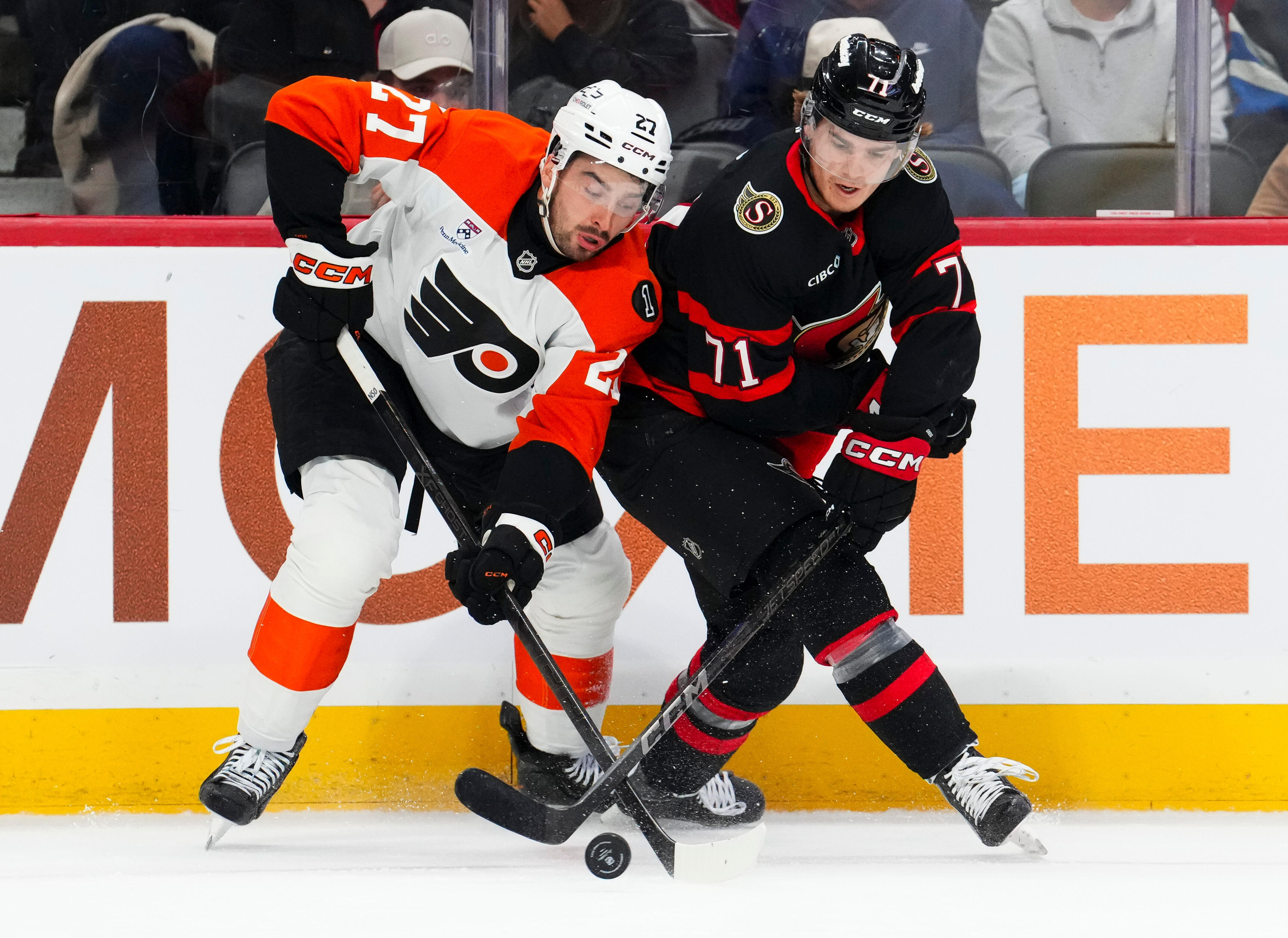
    OTTAWA, Ontario — The Flyers traveled to Canada’s capital for a showdown with the Ottawa Senators.

    Facing a hungry team with just one win in its past six games, the visitors got off to a good start but ultimately fell to the Senators, 2-1. It snapped Philly’s two-game winning streak and moved its record to 3-3-1.

    ‘There’s no quitting you’

    Entering the game, Dan Vladař had the fourth-best goals-against average (1.75) and the seventh-best save percentage (.929) among NHL goalies who had at least two starts.

    It’s a big reason why he was getting his third straight start. But you also cannot ignore how well he reads plays.

    “We wasted a good night from Vladdy,” coach Rick Tocchet said. “I thought he did a nice job in net for us.”

    In the first period, as the Flyers struggled to get the puck out, the 6-foot-5 Czech netminder saved a point shot by Ottawa defenseman Nikolas Matinpalo before stopping Tim Stützle at the right post. Less than 45 seconds later, Vladař made a save on Thomas Chabot’s shot through traffic.

    The Flyers took two penalties in the opening frame, and Vladař stood tall. He squared up to stop a shot by Stützle, robbed Shane Pinto from the slot, and then stoned Stützle again, taking the shot off the shoulder.

    Vladař allowed a pair of goals on the 23 shots he faced in the first two periods. Ottawa’s Michael Amadio tied the game, 1-1, in the first.

    Travis Sanheim stepped toward Pinto in the neutral zone, but the Long Island native chipped the puck to teammate Claude Giroux. The former Flyers captain drew Cam York and Owen Tippett in, giving Amadio time and space to accept the saucer pass and score.

    Another former Flyers forward gave the Senators a 2-1 lead. The point shot by Senators’ Nick Jensen hit Rodrigo Ābols — who centered the fourth line in place of Jett Luchanko — in the slot, slowing the puck down. It allowed Lars Eller to make a nifty no-look between-the-legs pass to Olle Lycksell, a 2017 draft pick by Philly, at the right post for the slam dunk. It is his first goal for Ottawa in four games, and the second of his career.

    One positive for the Flyers on Thursday was how well they kept the Senators out of the middle of the ice — and the slot — at five-on-five.

    But then Vladař shut the door, including stopping the Senators’ three shots on goal on a power play that began 34 seconds later when Sean Couturier was called for hooking in the neutral zone.

    “I thought he played great again,” Sanheim said. “He’s been a rock back there for us. Not ideal when you have that many penalty kills and you’re giving up looks, and he’s coming up big for us and keeping us in the game. So credit to him on another solid start.”

    Vladař faced 33 shots, one fewer than in the Flyers’ opening night loss to the Florida Panthers when he stopped 32 of 34, and elevated his save percentage this season to .932. He has not allowed more than two goals in his five starts.

    “That’s our job here, me and Sam [Ersson’s], just to give our team a chance every single night,” he said. “And I said it a lot of times, doesn’t matter if it’s 10 shots or 15, we just got to do our best to give our team a chance, and, unfortunately, it wasn’t enough today.”

    Flyers’ Tyson Foerster celebrates his first-period goal against the Ottawa Senators.

    ‘Only For A Moment’

    The Flyers’ early 1-0 lead was courtesy of Tyson Foerster scoring 29 seconds into the game.

    Coming off the bench for Tippett, who had a 21-second shift — “Wasn’t really expecting it that quick,” Foerster said — the winger received a pass on his tape from Travis Konecny and fired the wrister past Ottawa goalie Linus Ullmark. Konecny pulled up on the boards after getting the puck from Sean Couturier, who tracked down the dump-in.

    At the end of last season, the 23-year-old winger said he wanted to have a quicker start to his season. He has done that, notching his third goal in seven games on Thursday.

    When asked if he is hitting his stride, Foerster responded postgame that, “I think offensively. I think I got to win some more battles down low and on the wall, but I just got to be a little better in those battle areas.”

    ‘Round and Round’

    Despite the score, the Flyers certainly had their chances and put 23 shots on goal. The only issue? Too much was on the perimeter.

    “We’ve worked on concepts of, we call it piston offense, and we’ve got too many guys who are playing on the outside, and that’s why guys are struggling to score goals,” Tocchet said. “The good goal scorers, they go to the interior, and you’ve got to do it. We have to do it consistently.”

    It took some time for players to get going as they handed the Senators five power-play chances, including two in the first period. The Flyers also got a man advantage in the opening frame and had three opportunities across games. As Tocchet has said repeatedly, it’s hard to get guys who don’t kill penalties going.

    “They’re stick penalties. When you have stick penalties, that means you’re not skating,” Tocchet said. Of their five penalties — Nick Seeler got a coincidental minor, too — the Flyers were called twice for hooking and twice for tripping.

    Matvei Michkov had some of the best looks and led the way with seven shot attempts, including four shots on goal.

    Late in the first period, while coming out of the penalty box, Michkov got the puck for a breakaway. Noah Cates sent the stretch pass after Jake Sanderson flubbed a shot at the point, and while Michkov skated in and pump faked, he missed on the backhand.

    Less than three minutes into the second period, Michkov got the puck in the slot but had the shot blocked by Dylan Cozens.

    “He’s shooting the puck,” Tocchet said. “Keep shooting, hopefully things will go for him.”

    Not long after Michkov’s breakaway chance, the Flyers broke out of their end, and Tippett flew around Chabot for a shot on goal with the backhand. Trevor Zegras crashed the net and jammed at the puck, but was unable to get it across the goal line.

    In the third period, the Flyers tried to get going again. Sanheim had a shot from atop the circles, snared by Ullmark, and York was stopped after getting a pass at the left point. But they were chances where the Swedish netminder — who played with Ersson at the 4 Nations Face-Off — got to see the puck well.

    As the seconds counted down in the game, Couturier had a chance at the side of the net to even things up.

    “Yeah, obviously got off to a good start, the first five minutes, and then took our foot off a little bit,” Sanheim said. “We let them get some momentum and get some chances. And then obviously, toward the end, we started to get some looks again, but just couldn’t capitalize.”

    Flyers’ Noah Cates (left) and Ottawa Senators’ Ridly Greig battle for the puck during Thursday’s game.

    Breakaways

    For every save Vladař and Sam Ersson make in the month of October, they are donating to the October Saves Goalie Challenge, which supports cancer research and patient care. Flyers Charities will match their donations.

    Up next

    The Flyers return home for a matchup with 2025 No. 1 pick Matthew Schaefer and the New York Islanders on Saturday (12:30 p.m., NBCSP).

  • The USWNT strike first, but Portugal has their number again in 2-1 loss at Subaru Park

    The USWNT strike first, but Portugal has their number again in 2-1 loss at Subaru Park

    Before Thursday night, the last time the U.S. women played Portugal was the scoreless tie at the 2023 World Cup that started their downfall.

    For the first 33 seconds this time, it looked like things had changed. But by the end of the night, Portugal had the Americans’ number again — this time a 2-1 win as the visitors at Subaru Park.

    It was the U.S.’s first loss in a visit to the Philadelphia area since 2004 and the current team’s first loss in seven games dating back to February.

    Those 33 seconds were how long it took for the U.S. to open the scoring through Rose Lavelle. Catarina Macario set the play up with a dazzling move, running and dancing amid Portugal’s defense before feeding the assist.

    It was the seventh-fastest goal in U.S. women’s team history, and it will not be recorded that Lavelle clearly was offside. But with no video review in this friendly, the goal stood, and the crowd of 17,297 — including U.S. legend Alex Morgan and many ex-teammates honoring her retirement ceremony — cheered.

    Lavelle nearly scored again on a breakaway in the ninth, sprung beautifully by Alyssa Thompson. But Portugal goalkeeper Inês Pereira denied her with a charge off her line and a tip of the ball to just the right side of the post.

    From there, Portugal turned the tide. In the 37th minute, Kika Nazareth spun around Lavelle, passed wide to Andreia Jacinto, and she tried a chip attempt that landed on top of the crossbar. Two minutes later, a misplay by Tara McKeown let Tatiana Pinto get free on goal, and U.S. goalkeeper Phallon Tullis-Joyce had to come off her line for a sprawling stop.

    Portugal scored on the ensuing corner kick, as Diana Gomes beat Emily Sonnett on the jump.

    The U.S. looked livelier early in the second half, but Thompson flubbed a chance, and Macario got caught up to on a breakaway just in time to have the ball poked from behind.

    Nor could the Americans capitalize on a close-in free kick from the right wing, served well by Sam Coffey but not finished by anyone in the crowded 18-yard box.

    U.S. manager Emma Hayes took her time to make substitutions, but when she did, it was a quadruple move in the 69th minute. In came midfielders Claire Hutton and Lily Yohannes and forwards Yazmeen Ryan and Emma Sears; out went Coffey, Lindsey Heaps, Michelle Cooper, and Macario.

    Three minutes later, Portugal took the lead off another corner kick when Fátima Pinto trapping the service wonderfully and shooting low past Tullis-Joyce. There was a bit of a deflection, but Tullis-Joyce looked a little too frozen, and Hayes did not hide her frustration.

    Jaedyn Shaw was next to enter for the U.S. in the 78th, replacing Lavelle.

    The U.S. did not lack for scoring chances, but it couldn’t finish them. Outside back Avery Patterson forced a sharp save from Pereira in the 81st, and Yohannes headed right at Pereira a few seconds later.

    As the U.S. searched for an equalizer, Sears sent a well-placed pass through the 18-yard box in the 93rd that no teammate caught up to. And in the last seconds, Thompson shot when she could have passed — one of a few less-than-ideal decisions she made on the ball — and Yohannes lofted a cross that Pereira caught.

    That felt like the night in a nutshell, right as the final whistle blew to end it.

  • The arrests in the NBA gambling scandal are proof that the new world is better than the old

    The arrests in the NBA gambling scandal are proof that the new world is better than the old

    One thing nobody will dispute is that Thursday was a victory for the scolds. All at once, they logged on, and logged in, and limbered up their Twitter fingers and sent them dancing across the keyboard like Herbie Hancock on the ivories.

    A good old-fashioned gambling scandal was erupting, and they weren’t going to let it pass without imparting some grave moral lessons.

    Look here, they said. The most important indictment announced by the U.S. Attorney’s Eastern District of New York office on Thursday wasn’t the one that laid out the charges against NBA guard Terry Rozier for his alleged role in a prop-bet-fixing scheme, or the one that detailed NBA head coach Chauncey Billups’ alleged involvement in rigging illegal poker games.

    No, the important indictment was the metaphorical one handed down against the NBA itself. For embracing legalized sports gambling. For partnering with online sportsbooks like DraftKings. For prioritizing profit over the integrity of the game.

    This wasn’t just criminals allegedly doing as criminals allegedly do. It was the inevitable end result of the NBA’s embrace of an industry that should not exist.

    Again, according to the scolds.

    But the scolds are wrong. In fact, their interpretation of Thursday’s events, and of last year’s Jontay Porter guilty plea in a separate investigation, is the exact opposite of the real lesson to draw. A world where people can gamble openly with reputable companies that operate within the jurisdiction of federal law enforcement and in cooperation with sports leagues is a world where any bad actors are likely to be caught. That is not the world as it used to be.

    We all remember the old world, right? Pete Rose, Paul Hornung and Alex Karras, the Black Sox, Boston College and CCNY. These were some of the biggest individual or institutional names of their eras, all of them involving serious wagers on the outcomes of games over an extended period of time, most of them in concert with the criminal underworld.

    Pete Rose, who was banned from baseball for 35 years for betting on the sport, was reinstated last May.

    The responsibility of protecting the integrity of games fell primarily on sports executives. Karras and Hornung, two of the NFL’s biggest stars in the 1960s, were suspended for a season as a result of commissioner Pete Rozelle’s investigation into players’ ties with bettors.

    Nobody knows the old world as well as the NBA. Two decades ago, the league found itself mired in the biggest scandal of them all when it learned that referee Tim Donaghy had spent four years wagering on games that he officiated. Donaghy, a Delco native who attended Cardinal O’Hara, later claimed that 80% of his bets ended up cashing.

    His gambling was eventually uncovered by an FBI investigation that resulted in prison time, but only after he’d inflicted four years’ worth of reputational damage on the league.

    Compare the Donaghy scandal to what the feds laid out in their indictments on Thursday. Rozier is alleged to have provided nonpublic information to gamblers who bet on at least seven games between March 2023 and March 2024.

    The indictment involving Rozier also includes mention of a “Co-Conspirator 8″ who provided gamblers with information about Portland Trailblazers personnel decisions, although Billups was not explicitly named. (Billups’ charges stem from a separate case involving the rigging of illegal poker games.)

    The Rozier case stems from an earlier investigation into Porter, a then-Toronto Raptors player who later admitted in court that he manipulated his performance in two games. (Porter was banned from the NBA in the spring of 2024 and is currently awaiting sentencing in his case).

    I don’t mean to minimize the seriousness of the cases involving Rozier, Billups, and Porter. Rozier and Billups deserve to join Porter with lifetime bans, and Billups should be removed from the Hall of Fame.

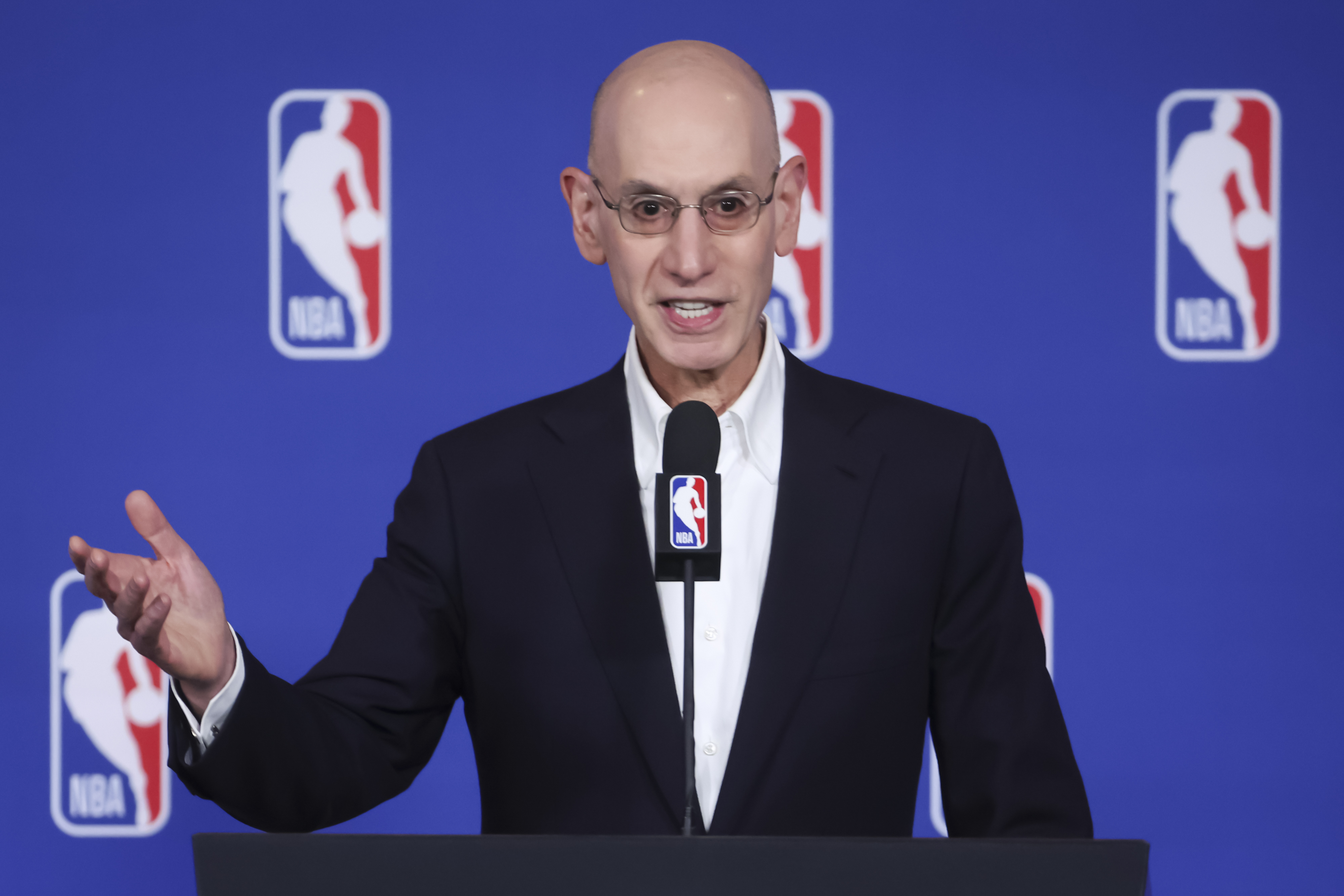
    NBA commissioner Adam Silver and the league need to do some serious self-scouting to figure out if there is anything they can do beyond wielding heavy-handed punishment as a deterrent.

    The scolds are correct in at least one regard. The NBA and its fellow sports leagues should seriously reconsider the extent to which they have encouraged the integration of betting with their telecasts and live events. The rise in popularity of betting on individual player props and so-called same-game parlay promotions has created a huge new front of incentives and avenues for malfeasance, packaged and promoted in a way that can feel more like fantasy sports than gambling.

    It is more than fair to suggest that commissioners should create more distance between themselves and the sportsbooks, particularly when it comes to marketing.

    The NBA’s increasingly close relationship with sportsbooks has brought in significant revenue but also led to additional problems.

    Let’s not lose sight of the real issue. The leagues had no choice but to accept the reality of legal sports gambling. In the years before its adoption in the United States, overseas sportsbooks were exploding in popularity. Daily Fantasy cash games were already legal. Sports gambling was going to achieve critical mass at some point in the United States.

    The decision that the leagues had to make was whether they wanted to help create a world where it could be regulated and policed most effectively.

    We saw that world play out in Porter’s case. The gambling syndicate that attempted to profit from his prop bets was flagged due to the irregular nature of the wagers. The ability to detect abnormal betting patterns is the single biggest weapon in the fight against sports-fixing, and it should be the single biggest deterrent to anybody who attempts to engage in it.

    The legalization of sports gambling is shifting all of the money that used to be wagered in the underworld onto audited books overseen by billion-dollar companies with sophisticated detection methods in place. It would be silly for a league like the NBA not to encourage that sort of framework in favor of one where forensic accounting is nearly impossible.

    The cases of Rozier, Billups, and Porter are an indication that the world still isn’t perfect. But it is silly to suggest that stuff like this was less prevalent in the old world. We were just less likely to find out about it.

  • Ursinus College suddenly removes president, citing ‘best interests of the college’s long-term success’

    Ursinus College suddenly removes president, citing ‘best interests of the college’s long-term success’

    Ursinus College president Robyn E. Hannigan, who was in her fourth year at the small liberal arts school in Collegeville, was abruptly removed from the job Thursday and her Ursinus webpage was removed.

    ”I met with the board this morning,” said Hannigan, 60, who was reached by phone. “I was let go. It’s the board’s decision. It’s not for cause. The board wanted to go in a different direction.”

    She declined to disclose what the board told her at the meeting.

    In a statement, the college said it was a board decision “made in the best interests of the college’s long-term success.”

    Joseph DeSimone, chair of the college’s board of trustees and a 1986 Ursinus grad, declined in an interview to say why the board chose to part ways with Hannigan, saying it was a personnel decision. The leadership change is happening just as the college is about to celebrate homecoming weekend.

    The move comes after the college experienced a 10% decline in first-year enrollment this fall and a 6.4% decline in overall enrollment, which stands at 1,406.

    The college also was coping with financial challenges, in part because of the enrollment decline, but also because the retention rate last year for returning freshmen was 77%, six percentage points lower than the school’s average, Hannigan told the student newspaper, the Grizzly, in an interview published Oct. 2.

    “We have a structural deficit, which means that we’re not living within our means and our revenues are not enough to cover our expenses,” she told the Grizzly. “So we have to fix that.”

    She told the student newspaper that Ursinus took steps last year to “right the ship” financially and launched APEX, a program designed to better align academics with experiential learning and career prep. That is expected to bring enrollment back up, she said.

    The college is offering students up to $2,000 for internships, team-based career coaching and advising, and a week for first-year students devoted to real world problem-solving.

    The college plans to hold a town hall for faculty and staff at noon Friday.

    “This decision should not reflect in any way on the strength of the college and its direction,” Hannigan told The Inquirer. “It is the nature of the business that we are in.”

    The news stunned the campus community.

    “I was just baffled,” said senior Renee Washart, editor in chief of the Grizzly. “I did not see this coming at all.”

    She said she met with Hannigan on Monday, as she does once every month in her role as editor, and there was no indication of the change.

    “She was talking about future plans for Ursinus,” said Washart, a chemistry and English major from Frederick, Md.

    Washart said she was in class when an email came to campus about the change in leadership and her phone “started blowing up.” Her professor, she said, was hearing it for the first time, too.

    Hannigan, an academic in the sciences who holds several patents, said that she was under a contract that goes for “another couple years” and that she would be on leave for a few weeks while a separation agreement is worked out.

    DeSimone, a professor of Translational Medicine and chemical engineering at Stanford University, said in an announcement to the campus shortly before 11:30 a.m. that Gundolf Graml, the provost, will serve as interim president.

    “The board has full confidence in Dr. Graml to ensure continuity of operations and to advance the college’s strategic priorities,” the college said in a statement. “The college’s mission, values, and commitment to our students remain unchanged.”

    In an interview, DeSimone said there were no current plans to launch a search for a new president and that Graml and the executive team were well positioned to lead the college forward. Applications and donations are up, he said.

    Hannigan came to Ursinus in July 2022 from Clarkson University in Potsdam, N.Y., where she was the provost. She was the first permanent female leader of Ursinus and the first of Native American descent.

    In a 2022 interview with The Inquirer, she said she was a first-generation college student whose parents scraped to save enough to pay for her first year of college and whose older brother chose to forgo college so that she could go.

    She grew up in New Jersey and received a bachelor’s degree in biology from the College of New Jersey, a master’s in geology from SUNY Buffalo, and a doctoral degree in earth and environmental science from the University of Rochester.

    Hannigan described her departure from Ursinus as “a friendly separation.”

    “The college has been doing great work in trying to turn around and do what it needs to do to thrive in the future,” she said.

  • The next stop on the rapid rise of Pottstown’s Trey Yesavage? World Series Game 1 starter at 22: ‘He’s one of a kind’

    The next stop on the rapid rise of Pottstown’s Trey Yesavage? World Series Game 1 starter at 22: ‘He’s one of a kind’

    TORONTO — Trey Yesavage took a deep breath.

    The noise around him was deafening. But he looked up at the top of the dugout, and focused there for a beat. Then he put his hat on, and he walked out to the mound to do his job.

    “It was funny,” said Boyertown Area head baseball coach Todd Moyer, “because I’ve seen him do that lots of times.”

    This time, though, instead of facing off against rivals in the Pioneer Athletic Conference, Yesavage was striking out Cal Raleigh and Josh Naylor.

    On Sunday, his job was keeping the Blue Jays’ season alive in the American League Championship Series against the Mariners. Toronto gave the ball to the 22-year-old from Pottstown to start Game 6, and he held Seattle to two runs over 5⅔ innings. Yesavage helped force a Game 7, where the Blue Jays punched their ticket to the World Series.

    Now, the 22-year-old from Pottstown will start Game 1 of the Fall Classic against the Dodgers.

    “It’s something I never even would have dreamed of,” Yesavage said Thursday.

    What Yesavage has done this year has never been done before. Just over 15 months ago, the right-hander was drafted, 20th overall, out of East Carolina University. He opened his first professional season in March with Toronto’s single-A affiliate, the Dunedin Blue Jays.

    And on Friday, he will be the youngest player to start a World Series game since 2010, when Madison Bumgarner started Game 4 for San Francisco at 21.

    Trey Yesavage made just three starts in the regular season with the Blue Jays.

    ‘Fearless’

    The key difference, though, is that Bumgarner had been a professional baseball player for two years before that first World Series start. He was drafted out of high school in 2007, and spent 2008 and most of 2009 in the minors before making his major league debut that September.

    Yesavage ascended through the minor leagues at a breakneck pace. When he was called up to high-A in May, it was the first of four promotions in four months. He reached the majors on Sept. 15, and struck out nine in his debut to set a franchise record.

    “I’ve been able to go through this and handle it as diligently as possible,” Yesavage said. “With this being my rookie season and having these high-pressure games, I try to treat it as if it’s not as high pressure as it is, mentally.”

    Yesavage set another franchise record in his postseason debut in Game 2 of the division series. Yesavage’s 11 strikeouts against the Yankees were the most in Blue Jays postseason history, as he held New York without a hit for 5⅔ innings.

    “I was standing with a group of people when he got Aaron Judge, and the first time he didn’t get him, but the second time he did,” Moyer said. “And we were like, ‘There it is, right there. He just struck out Aaron Judge.’ One of the best hitters in the game, biggest stars. It was a weird feeling. It was a really good feeling to watch him be successful.

    “But at that level, against that guy. I can’t tell you what it was. It was just unbelievable to watch.”

    Trey Yesavage had a 2.58 ERA in 65 games with East Carolina before becoming a first-round pick of the Blue Jays in 2024.

    Moyer has known Yesavage even before he starred for the Boyertown Area baseball team. He also coached him at age 7 in youth basketball, as Yesavage is a year older than Moyer’s son.

    “He was a big, strong kid. He was kind of fearless,” said Moyer. “He didn’t have a whole lot of doubt that he was going to be able to handle what he was getting himself into. And you see that now. He looks at his situation, and what he needs to do, and he gets it done. He’s been getting it done really well.”

    Fundamentals

    On Sunday, Moyer was watching on television from home as Yesavage waded into some trouble in the third inning of Game 6. With Toronto hanging on to a two-run lead, a pair of walks and a single loaded the bases for Raleigh, the regular-season home run king.

    Yesavage went to his signature pitch — his splitter — and got Raleigh to hit a sharp grounder to first base. Vladimir Guerrero Jr. snagged it and threw to second for the force out. By the time the ball was in shortstop Andrés Giménez’s glove, Yesavage was already covering first base to complete the inning-ending double play. He had not hesitated coming off the mound for even a second.

    At that moment, texts started rolling into Moyer’s phone: You think he heard your voice in the back of his head?

    As a coach, Moyer has always emphasized fundamentals. Whenever one of his pitchers finds themselves in a similar predicament, it’s a sure bet Moyer will be shouting from the dugout, “Get over there!”

    But an elimination game in the ALCS is different. Moyer isn’t taking any credit. This is how Yesavage has always been.

    “His composure and his maturity,” Moyer said. “He’s just shown that all the time. It’s fun to watch because I know how hard the game is, and I know if he doesn’t catch that ball and they get momentum, it’s a completely different game and a completely different story.”

    Blue Jays pitcher Trey Yesavage and teammate Vladimir Guerrero Jr. celebrate after defeating the Yankees in Game 2 of the ALDS on Oct. 5.

    Yesavage induced two more double play balls in Game 6 to keep the Mariners at bay. Fellow East Carolina Pirate and former Phillie Jeff Hoffman pitched the eighth and ninth to close it out.

    “I heard so much about him, from past coaches and trainers and all these things about how, ‘You’re going to love this kid,’” Hoffman said. “And ‘He’s a great kid; great head on his shoulders.’ And I think all those reports are absolutely true. He’s one of a kind. He’s extremely mature for his age. He has all the things that you look for a young kid like that to come up with, and I think it puts him in a really good spot to have a long career.”

    Roots

    During Yesavage’s meteoric ascension, he’s become a hot topic back home. Moyer’s family owns a catering business. One night, while he was making a delivery, Moyer drove by two different houses where people were starting to gather to watch one of Yesavage’s starts.

    Yesavage has not forgotten where he came from, either. He texted Moyer after a Boyertown playoff game in the spring to let him know he was keeping track of the team.

    That’s also part of his DNA. Yesavage remembers the stops he made along the way this year, and takes pride in representing every level of the minor leagues on this stage.

    “It’s really special,” he said. “I’ve got guys from Dunedin to Vancouver, New Hampshire, Buffalo that are texting me, congratulating me.”

    The whirlwind few months haven’t been simple, though. Yesavage is living out of a hotel in Toronto, and his Toyota Tundra truck is piled with so much stuff he joked that it looks like a mobile home.

    Trey Yesavage reacts after an inning-ending double play during Game 6 of the ALCS against the Mariners on Sunday.

    Through it all, he doesn’t exactly carry himself like a typical 22-year-old. He sat in front of the World Series backdrop at the Rogers Centre on Thursday and fielded dozens of questions like a seasoned veteran. Yesavage doesn’t have an explanation for it.

    “This is just who I am,” he said. “I don’t know, my parents raised me this way.”

    Yesavage’s parents and two brothers are driving up from Pennsylvania on Friday for Game 1. Moyer will be one of the many people tuning in from Yesavage’s hometown.

    The first player to step into the batter’s box on Friday will be Shohei Ohtani. Yesavage will take just one moment, the length of time it takes him to jog out to the mound, to soak it all in. The lights, the stage, the sold-out crowd. Where he started; where he is now.

    “Then,” Yesavage said, “it’s time for work.”

  • Gambling scandal will shake public confidence in NBA, experts say

    Gambling scandal will shake public confidence in NBA, experts say

    Attorney Bill Pascrell III was made aware of the incoming NBA gambling scandal involving Portland Trail Blazers coach Chauncey Billups, Miami Heat guard Terry Rozier, and former player and coach Damon Jones late Wednesday night, but said the magnitude of the findings “was much greater than I had expected.”

    The news of the investigation broke early Thursday morning, with the FBI arresting Billups, Rozier, and Jones, who were among 34 people across 11 states charged in connection to two schemes: defrauding sports gamblers and a rigged poker game run in connection with New York City mafia families.

    Pascrell, a gambling expert and Princeton Public Affairs Group partner, said the incident is “a black eye on the NBA.”

    “I think [the NBA] has done a very good job of getting ahead of it now,” Pascrell told The Inquirer by telephone, “and I’m sure there’s going to be a multitude of actions and punishments, and I think there needs to be an assessment by the NBA of additional internal controls.”

    “When it comes to the NBA,” Pascrell added, “they have a responsibility to the players in the league, the coaches, the referees, the families, the fans, and it’s going to take a lot of work to bring about confidence back into the system.”

    Particularly, the involvement of Jones, who allegedly provided bettors injury information regarding two of the Los Angeles Lakers’ best players while he was volunteering with the team during the 2022-23 season, was “very troubling,” Pascrell said.

    “Those are things that are very disturbing that the league has to be vigilant about doing a better job policing,” Pascrell said. “I think the NBA is a great brand. I think they have done a great job, and, unfortunately, this mishap is going to be a tough challenge for them to re-instill confidence in the integrity of the game.”

    Dangers of prop bets

    Rozier’s involvement in the gambling scheme by leaving games or altering his performance to make hundreds of thousands of dollars on prop bets was especially concerning to George Diemer, an associate professor in Temple’s School of Sport, Tourism and Hospitality Management.

    Diemer, whose research focuses on gambling, particularly in college basketball, supports sports betting being legalized but has strong opposition to prop bets and the issues the practice brings to gambling.

    “Although I do like the gambling market — I am in favor of legalizing sports gambling — I’ve always said to myself and anybody that asks, I’m really worried about these prop bets, and they probably should not be legal,” Diemer said by phone. “A lot of my research is in trying to figure out how point spreads are impacting the game outcome. … Generally speaking, the data suggests that, for instance, like point shaving — maybe there’s too many games where the favorite team is winning the game but failing to cover the point spread, things like that. And I suspect that if I ran a similar investigation for these prop bets, I would probably find something there as well.”

    But Diemer added that, “I think these things were identified by and because sports wagering has been legalized. If we lived in a world where sports wagering was illegal, they very well could have still been doing this, but nobody would have known about it because it would have been a complete underground economy.”

    Rozier’s alleged involvement comes on the heels of former Toronto Raptors player Jontay Porter leaking “confidential information to sports bettors” about his planned poor performances and pleading guilty to a charge of conspiracy to commit wire fraud for allegedly faking illness or injury to leave games early.

    While Pascrell does not agree that prop bets should be banned in the wake of the scandal, saying that “prop bets aren’t the problem, criminal activity is the problem,” he agrees with Diemer that the monitoring systems in place to detect and notify unusual gambling activity “are going to learn a lot from this, and it’s only going to improve the integrity of the game.”

    “I’m not saying monitoring integrity isn’t an evolutionary process. There’s nothing that’s bulletproof,” Pascrell said, “and by passing laws to bet prop bets, you’re only going to move people to the dark side, which is only going to make it more challenging to discover.”