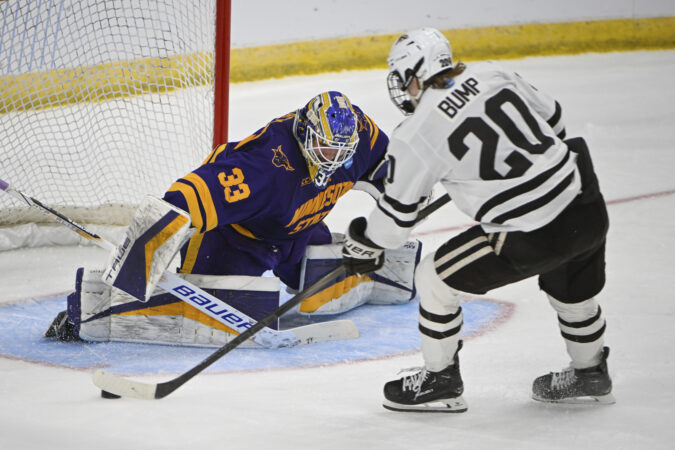
ST. LOUIS — Skating around the Enterprise Center with his blond hair flowing out of his helmet, Flyers prospect Alex Bump potted a quick wrister from the slot as his linemate Matteo Costantini let out a big yelp.
Were they celebrating a goal like the double-overtime winner that sent Western Michigan to the NCAA regional finals? No. Was it one of his team-leading 23 tallies this season? Nope. It was instead at Western Michigan’s final practice before the university’s first-ever appearance in the Frozen Four.
While the goal came as he skated around in a white practice jersey with a black Bronco on it, it encompassed what Bump, 21, does best now, and what he will look to replicate when he suits up for the Flyers in the no-longer-distant future.
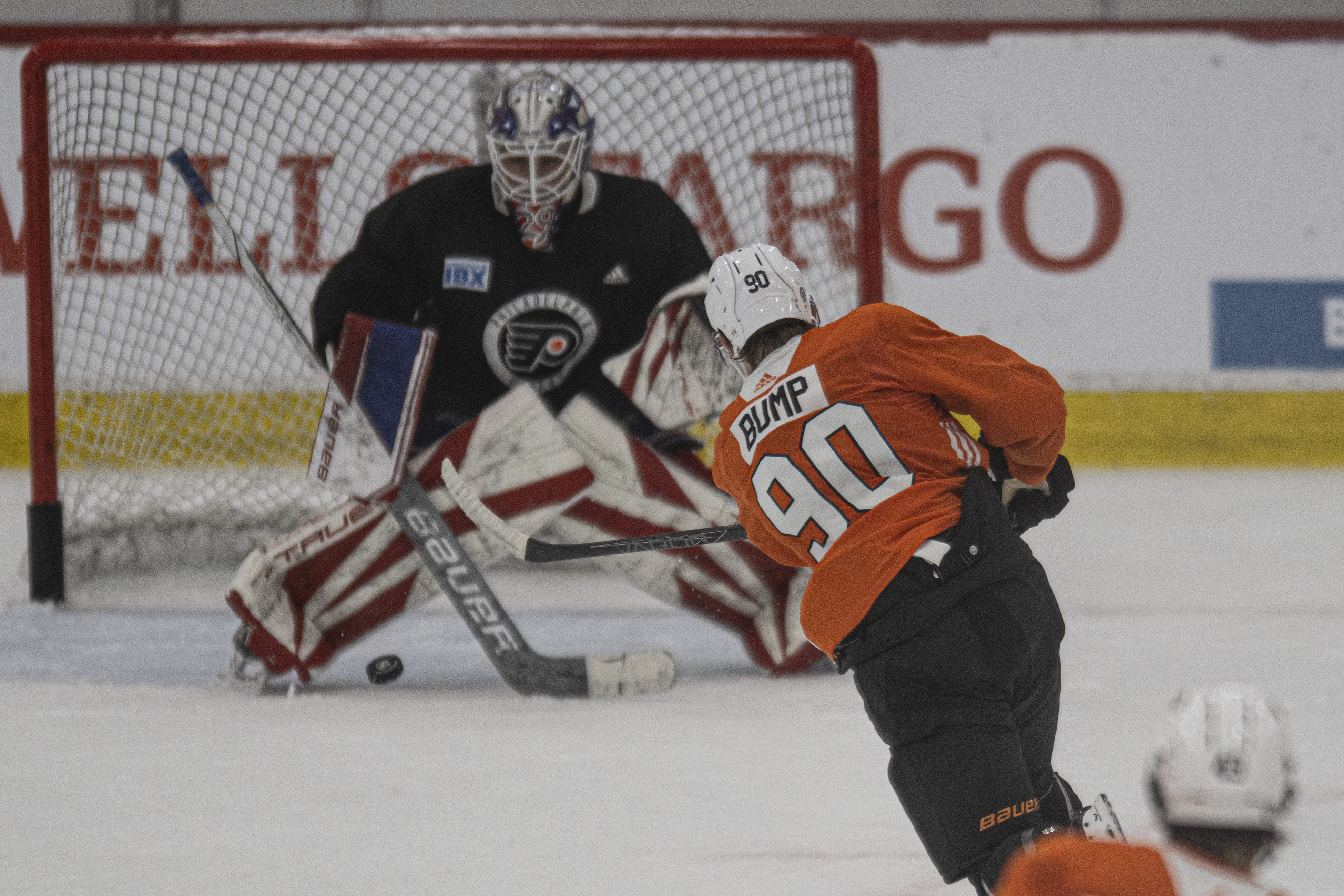
“A lot of guys are not confident in their shooting,” Flyers director of player development Riley Armstrong said. “A lot of guys don’t think they can beat a goalie, or they have to get to a certain area on the ice to be able to beat the goalie. I think Alex is a very confident shooter, he knows where to shoot the puck. He’s always known how to find the net.”
Flyers prospect Alex Bump is tied for eighth in the nation with 23 goals this season.
Hometown hero
Joe Pankratz remembers Bump being at the rink, even before he starred for him at Prior Lake High School. Bump’s two older brothers played hockey for the school’s longtime coach, and a young Bump — who at the age of 8 and 9, “was a good squirt”— developed a reputation as a rink rat.
“The biggest thing is, he absolutely loves hockey,” Pankratz told The Inquirer. “You can’t get him off the ice.”
It was in his hometown of Prior Lake, Minn., where Bump developed that lethal shot of his. He scored 48 goals during his senior season as the Lakers’ captain, including 12 in the section and state tournament playoffs; five came in one playoff game.
“It’s a lot of snapshots, and he protects it and hides it really well. He changes the angle on his shot. … A lot of that is he’s got amazing hands, but he has a lot of poise with the puck, so he isn’t in a rush,” Pankratz said. “He doesn’t panic with it.”
And he is a volume shooter. This season, the left-shot winger has fired 236 shots on goal with 23 goals, a 9.7% shooting percentage.
But it’s not just his shot that’s impressed the Flyers.
“He’s very elusive of checks. He’s slippery, as you would call it in hockey,” Armstrong said. “He always finds a way to get around guys, get through guys, and then when he doesn’t have the puck, he always finds a way to get open. He has a really good stick. He’s physical. He engages with and without the puck into contact, which is something that you need to play at the NHL level.”
Alex Bump’s skill has popped at multiple Flyers development camps. Next year, he hopes to crack the NHL out of main training camp.
The NHL could come as soon as the Broncos’ season ends, either Thursday against the University of Denver (5 p.m., ESPN2) or after Saturday’s national championship game (7:30 p.m., ESPN2). And it sounds like Bump will be coming with an ax to grind.
“Our guys, Brent [Flahr, assistant general manager] and [amateur scout] Shane Fukushima in Minnesota, had seen him play a lot [in high school], and they were very comfortable with him. They couldn’t believe that he had fallen this far,” Flyers general manager Danny Brière said this week.
At the time, Brière was an adviser to then-GM Chuck Fletcher. He jokes that his nephew Zaac, the team’s runner at the Montreal draft, “still claims he made the pick for us” after seeing Bump’s name high on the team’s draft board and saying they should take the Minnesotan.
Bump was eventually selected by the Flyers in the fifth round with pick No. 133 — and it lit a fire.
“He came up to the suite after. He had his brothers there, his family, and he came in and he was [ticked] off that he went so late. He felt he should have went earlier in the draft,” added Armstrong, then an assistant coach with Lehigh Valley.
“I think he’s proven a lot of people wrong, or for our sake, right.”
Why Bump, the 2022 USA Today High School Hockey Player of the Year, fell is irrelevant now. Just like the round he was drafted. As Flahr always says, it’s all about what you do after that matters. And what Bump, 21, has done has been impressive.
But first, Bump had to face some adversity. He played USHL hockey wrapped around his senior year but didn’t put up the biggest numbers the year after he graduated. A University of Vermont commit, he had to make a last-minute pivot when the Catamounts’ coach was fired, and found a home at Western Michigan in Kalamazoo, Mich.
Alex Bump, pictured at Western Michigan’s Frozen Four practice on Wednesday, was the NCHC’s top forward this year.
“I think that we’ve seen over the last two years is that his development has seemingly gone into hyperdrive. I think he’s ahead of schedule where we thought he would be this time two years ago,” FloHockey’s prospect analyst Chris Peters told The Inquirer. “So that’s a pretty positive development, because he was good in the USHL, but he wasn’t dominant. And now this year, you could say he was one of the best players in college hockey.”
Broncos coach Pat Ferschweiler, who was a linemate at Western Michigan with Flyers president Keith Jones, and the Flyers organization work in lockstep. Armstrong speaks with the coaching staff and Bump consistently, and goes over videos with the player to make sure they are all on the same page as far as his development and making sure he is NHL-ready.
How it will translate at the NHL level is to be determined. Ferschweiler says the Flyers got “an absolute steal.” He notes Bump’s “incredible hockey sense and incredible vision,” but feels what will really separate him and “what the Flyers fans are going to love, is, he’s got incredible compete.”
“Alex does not lack for confidence,” he said. “He’s got inner belief, because he works really hard, and that’s how belief is earned. He does that every day. So he’s not a cocky kid, but he does have self-belief, which I think there’s a fine line there and he walks on the right side of it.”
A pure goal scorer, Bump does need to continue to work on his skating. But those who know him best have seen improvement. This past winter break, Bump skated with his old high school team and Pankratz noted “how much stronger, more powerful of a skater he is.”
And they all know he will put in the work because he wants to succeed.
“I don’t think he’s ever really been a passenger.” Peters said. “He’s a driver, and especially at his age, and that program, and based on what they have surrounding him, like they needed him to be that, and he’s delivered. So he’s risen to the occasion.”
The Flyers and their fans will love to hear that because maybe, just maybe, he becomes another game-changer for a team that needs more of them to take that next step.
“I really do,” Armstrong said, when asked if Bump could be that type of guy. “I think, with Matvei [Michkov] as well. … You just have to have a little bit of patience to kind of see the rebuild through and wait for these kids to get there.
“Once they do, you’re going to have a couple of game-changers sitting right in front of you.”
Alex Bump’s shot is his No. 1 attribute but the Flyers see more than just that in the 21-year-old.
The 42-year-old man in addiction who died inside a Philadelphia jail days after his arrest in Kensington had been flagged as an “emergency” case by an intake worker at the jail, and should have received one-on-one supervision in the hours before he collapsed, according to records from the Department of Prisons.
But that didn’t happen, and instead, Andrew Drury died alone inside the holding cell, without having received a formal behavioral health evaluation by the prison staff, according to the records obtained by The Inquirer. His cause of death remains under investigation, though when he was jailed in the fall, he had been hospitalized multiple times from withdrawal-related health complications.
A spokesperson for the Philadelphia Department of Prisons declined to comment Friday.
Drury had been picked up by Philadelphia police on the night of March 6, after officers encountered him at Kensington Avenue and Somerset Street, and learned he had outstanding bench warrants related to a drug case in Maryland and a 2022 violation of a protection-from-abuse order filed in Philadelphia.
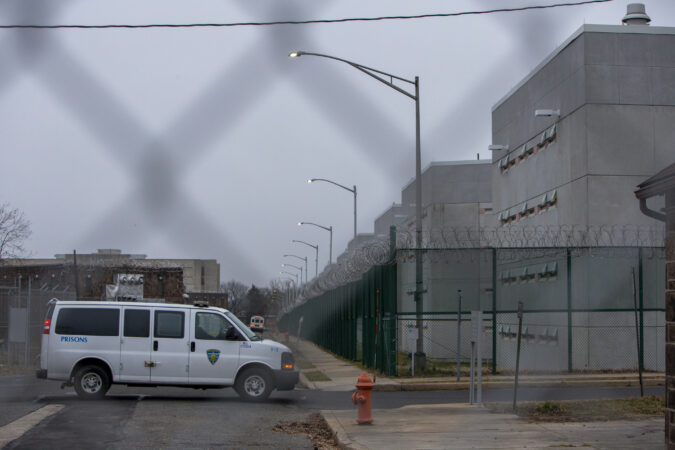
Police said Drury received off-site medical treatment over the next day before he was transferred to Curran-Fromhold Correctional Facility around 2:15 a.m. on March 8. Police declined to say what kind of treatment he received, where he was treated, or how he was cleared for transfer to the jail.
Drury remained in an intake room at the jail until the next afternoon, waiting to be medically evaluated and assigned to a cell block. On March 9, around 9:30 a.m., an intake worker for the prisons assessed Drury and wrote that he was experiencing a range of physical and behavioral health issues and described him as extremely agitated and confused, according to the records.
Andrew Drury, left, and Jennifer Barnes had been homeless and struggling with addiction in Kensington for about two years. Drury died on March 9 inside a Philadelphia jail.
The employee labeled Drury as an emergency case, which, according to the records, should have required that he receive one-on-one supervision until he could be evaluated by a behavioral health worker.
Instead, Drury remained in his intake cell for another six hours. A jail guard walking through the area found him unresponsive at 1:45 p.m., and despite administering two doses of Narcan and other lifesaving measures, he was pronounced dead at 2 p.m., according to a spokesperson for the prison.
The Philadelphia Medical Examiner’s Office said Wednesday that doctors are awaiting toxicology results to determine his cause of death.
Drury had long struggled with an opioid addiction, and had been experiencing homelessness in Kensington for about two years, said his longtime girlfriend, Jennifer Barnes.
In an interview this week, Barnes, 44, said she believes he died from health complications related to withdrawal — something that he has been hospitalized for in the past.
When Drury was arrested in October on bench warrants related to the same cases, he was hospitalized multiple times, including for more than a week, after suffering a mild heart attack and other issues while going through withdrawal in jail, according to Barnes and a source familiar with Drury’s care at the time.
After Drury was released in November, Barnes said he was in and out of the hospital because of ongoing chest pains and shortness of breath.
Barnes said she worried about his health as she watched police arrest him that night.
“The withdrawal, it’s not good for him,” she said she told the officers. “He needs medical attention.”
Jennifer Barnes, whose fiancee Andrew Drury died while in jail, shown here in Philadelphia on Tuesday.
Drury’s death comes as the city ramps up enforcement efforts in Kensington, a section of the city that has long experienced concentrated violence, homelessness, and drug use in and around its massive open-air drug market. Mayor Cherelle L. Parker has said her administration would shut down the drug activity in the area and return a quality of life to the neighborhood’s residents.
But some advocates have warned city and law enforcement officials that the withdrawal effects for people who use opioids can be life-threatening, and that the understaffed jails might struggle to respond to people’s health needs in those circumstances.
Barnes said she and Drury were both from South Philadelphia, and had been dating since 2012 after meeting in a luncheonette in the neighborhood. They were not married, she said, but wore rings as if they were.
Andrew Drury and Jennifer Barnes in a photo before they became homeless in Kensington.
Barnes said she has struggled with addiction since about 2008. Drury also used drugs by the time they had met, she said, his troubles beginning after he underwent a weight loss surgery and got hooked on pain killers. For many years, they were both able to hold jobs and hide their addiction.
They bounced between friends’ and families’ homes, she said, until they were kicked out of Drury’s mother’s house in 2021 and she got a Protection From Abuse order against him. They’ve been on the streets of Kensington since about the summer of 2023, she said.
Drury was funny and loving, she said, and helped protect her from the dangers of living on the streets. They had both recently talked about wanting to go to rehab and getting their lives back on track.
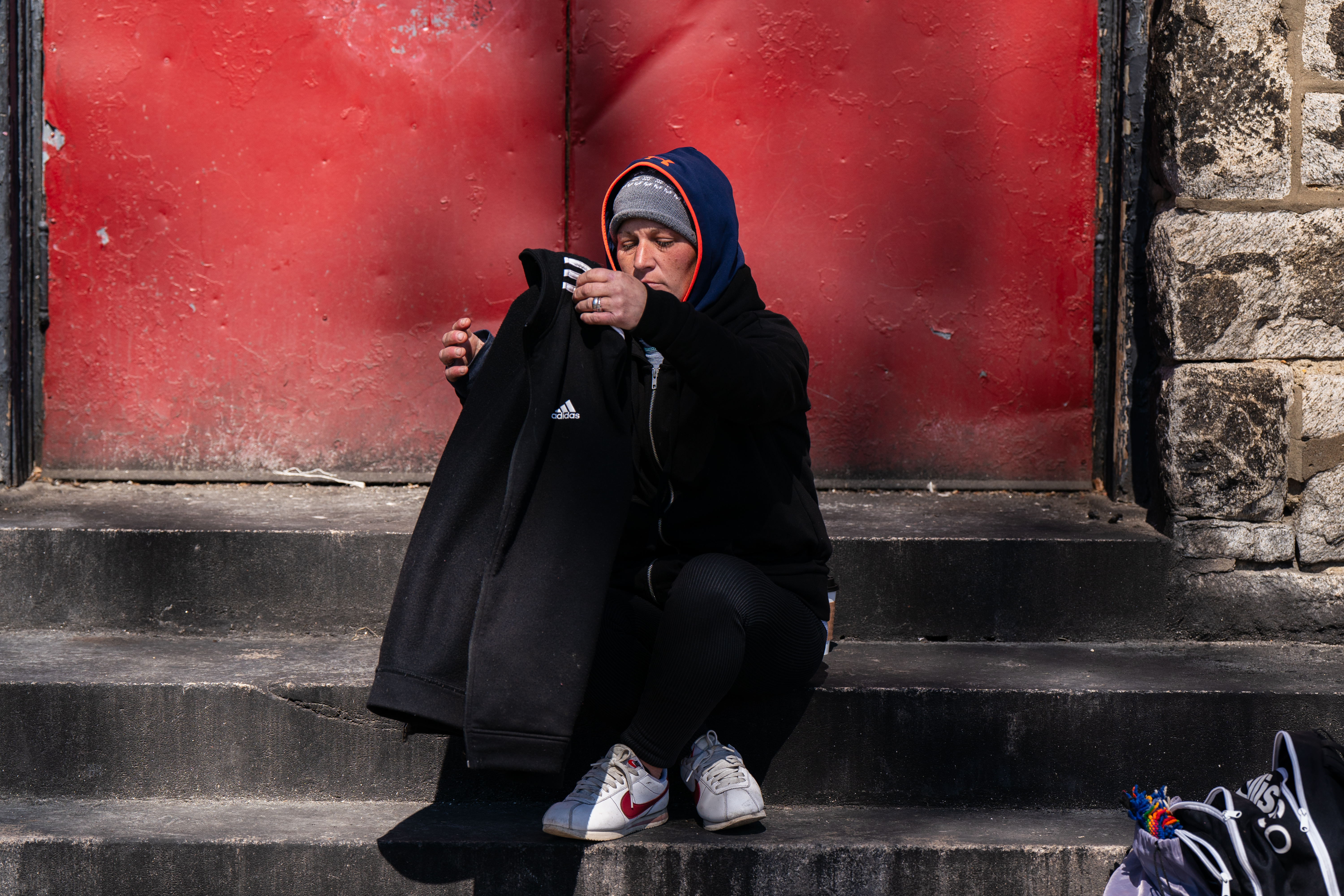
Jennifer Barnes holds the sweatshirt of her longtime boyfriend, Andrew Drury, who died in jail on March 9.
Since his death, she said, she feels in a fog. She has connected with a friend who found a bed for her at a recovery house in South Jersey, and she hopes to go next week.
“For myself, and for him, it’s the best thing to do,” she said. “This way he won’t have to worry anymore.”
A 42-year-old man with a history of addiction died inside a Philadelphia jail over the weekend just days after he was arrested in Kensington, officials said.
Andrew Drury was picked up on a bench warrant by Philadelphia police near Kensington and Lehigh Avenues on Thursday night and was found collapsed inside the intake room at Curran-Fromhold Correctional Facility on Sunday afternoon, according to police and prison officials. Officers who found Drury administered two doses of Narcan, among other lifesaving measures, but he did not regain consciousness, officials said.
Drury, whose cause of death remains under investigation, was addicted to opioids and had been hospitalized multiple times for withdrawal-related complications when he was jailed in the fall on similar warrant issues, according to a source familiar with his care who was not authorized to speak publicly.
Philadelphia police arrested Drury in Kensington around 10:30 p.m. Thursday on outstanding bench warrants related to a drug case in Maryland and a 2022 violation of a protection-from-abuse order filed in Philadelphia.
Sgt. Eric Gripp, a spokesperson for Philadelphia police, said Drury was evaluated and “received off-site medical treatment” before he was transferred to the jail on State Road around 2:15 a.m. Saturday.
People who use drugs are often gathered near Kensington and Somerset Avenues, an intersection at the heart of Philadelphia’s opioid crisis.
Drury had been in an intake room at the facility for nearly 36 hours, waiting to be assigned to a cell block, when a jail guard found him unresponsive around 1:45 p.m. Sunday, according to John Mitchell, a spokesperson for the Philadelphia prisons. He was pronounced dead at 2 p.m., Mitchell said.
The cause of Drury’s death was under investigation, he said, but no foul play was suspected. Gripp declined to say where and under what circumstances Drury was treated medically while in police custody, citing an ongoing investigation. It is not clear whether Drury was medically evaluated once he arrived at the jail.
Drury is the first person to die in the custody of the Philadelphia Department of Prisons this year, and his death comes as the city ramps up drug enforcement in Kensington and arrests more people in addiction. Advocates have warned city and law enforcement officials that the withdrawal effects for people who use opioids can be life-threatening, and that the understaffed jails might struggle to respond to people’s health needs in those circumstances.
His death follows that of Amanda Cahill, 31,who died inside a cell at the Philadelphia Industrial Correctional Center in September, days after she was arrested in Kensington on charges related to drugs and open warrants. The Philadelphia Medical Examiner’s Office said Tuesday that an autopsy showed Cahill died from drug intoxication.
At least 29 people in addiction have died in Philadelphia jail or police custody since 2018 for reasons that appear connected to drug intoxication or withdrawal, according to medical examiner records reviewed by The Inquirer.
Amanda Cahill, 31, is seen here in a photo provided by her family. She died in Philadelphia Industrial Correctional Center in September.
Drury’s legal troubles go back to at least July 2021, when he was arrested for possession with intent to distribute drugs in Maryland, according to court records. Then, in July 2022, he was arrested in Philadelphia for violating a protection-from-abuse order that his mother had filed against him. He was later released on bail.
After Drury failed to appear in court in Maryland and Philadelphia, warrants were issued for his arrest. He was picked up by police on Oct. 1, 2024, in connection with those pending cases.
While in custody, Drury was hospitalized at least twice, including for more than a week, after experiencing health issues related to withdrawal, said the person familiar with his care, who had reviewed the records related to Drury’s earlier cases.
He was released from jail in November after authorities in Maryland declined to extradite him, the source said. Because he did not return to Maryland to resolve his case, there was still an outstanding warrant for his arrest. And when Drury did not appear for a December hearing in his Philadelphia case, a second warrant was issued.
The warrants landed him back in police custody on Thursday.
Two of Drury’s relatives, who asked not to be identified for privacy reasons, said they did not know he was struggling with addiction. They described him as a warm and generous person, a good listener, and a helping hand.
“I feel that something is not right,” one relative said. “I don’t know, and I won’t know, I guess, until I can get the coroner’s report. I’m in the dark right now.”
Andrew Pappas, pretrial managing director of the Defender Association of Philadelphia, said Drury’s death underscores the dangerous conditions inside Philadelphia’s jails, which face an ongoing staffing shortage.
“We continue to see the effects of that with yet another death in custody,” he said.
It was a tough two-and-a-half-week period: Students accused of impersonating ICE agents. One student accused of shooting and killing another. A student stabbing a former student 13 times. And a student falling from a light pole during a post-Eagles celebration and dying from his injuries.
These high-profile incidents involved Temple University students and three of the four occurred on or near campus, posing another test for new president John A. Fry.
Some say they are gratified that the administration communicated swiftly and thoroughly about the incidents, which wasn’t always the case in the past.
“That’s been really great to have such a quick turnaround time,” said Ray Epstein, president of student government. “Even if it is the middle of the night, we are getting an email immediately.”
After Chase Myles, a 20-year-old student from Maryland was shot and killed atabout 11 p.m. Feb. 6, Fry notified the campus in an email at 3:46 a.m., and just hours later was on a plane back to campus from an alumni event in Florida so he could be on the ground to talk to the victim’s parents and help coordinate the response.
By contrast, it took nearly twice as long for the university to get out an email about the shooting death of Samuel Collington outside his off-campus residence in November 2021 even though that happened in the daytime. The email did not come from then-president Jason Wingard, but rather from then-safety chief Charles Leone. The attack put the campus on edge and stirred fear in the Temple community among students, parents, and staff — and social media posts circulatedwith the hashtag “Where’s Wingard,” who laterresigned after less than two years on the job.
Donna Gray, Temple’s campus safety services manager for risk reduction and advocacy services, greets Temple president John A. Fry during his first day of work Nov. 1.
That incident ― which happened as part of an attempted robbery and carjacking ― was different in that it involved random violence by a stranger in the neighborhood.
But even the Temple police officers’ union, which has been critical of university leadership in past years, has noted Fry’s efforts in dealing with the recent multiple incidents.
“He seems to be handling it well,” said Sean Quinn, president of the Temple University Police Association. “Without a doubt, as soon as these things happen, he’s right on top of it.”
“It is up to us to tell the bad news first, personally to all of our community,” he said. “Number two is just to keep a steady stream of communications following that even when there is not a whole lot to say. It’s worth checking in.”
Parents on the university’s family council said they are confident in the university leadership’s handling of the incidents, too.
“It seems like there are the right people in place,” said Allison Borenstein, a Temple alumna whose son, a sophomore, attends the university. “They handled it well, and I think they are on it.”
Borenstein, an event planner at a synagogue who lives in Cherry Hill, noted such incidents could happen near any college campus and said she feels that Temple sometimes gets an unfair rap.
“There’s nothing that the school could have done in advance,” she said.
Emma Legge, an alumna and parent of a senior who lives in New York, said she feels she is kept informed, and she checks in with her son after receiving a communication.
“I do feel as a parent that Temple is doing what it can within the city of Philadelphia to manage what happens,” said Legge, who got both her bachelor’s and master’s degrees at Temple and met her husband, also a twice Temple alumnus, there. “I have a lot of confidence in the university and the people who are on board.”
Philadelphia Police Commissioner Kevin J. Bethel and Jennifer Griffin, Temple University vice president for public safety, after graduation ceremonies for the Police Academy Class #402, new officers of the Philadelphia Police Department and Temple University Police Department, at Temple’s Performing Arts Center in June.
That includes Jennifer Griffin, vice president for public safety, she said.
“I feel very reassured by the measures police are undertaking to be involved in the neighborhood and be involved with students,” said Legge, who works in student affairs administration at a New York college.
Griffin said after the recentincidents, she met with the student safety advisory committee and its members saidthey appreciated the accurate and timely information, which she said she has always aimed to provide since starting at Temple about two and a half years ago.
“We hope it decreased anxiety,” she said.
Of Fry, she said, “I thought he handled all the incidents with thoughtfulness and decisiveness and direction that I would expect from somebody with his level of experience.”
The police union has been critical of Griffin, even calling for her to resign or be fired over staffing issues. University leadership has backed Griffin.
Quinn said the union now is trying to work things out, noting that the university is amid a police staffing study conducted by an external company.
“I just don’t want to come to work every day feeling like I’m butting heads,” he said. “I actually would like to work with whoever I have to work with to see if we can accomplish things.”
Fry said he expects to have the results of the staffing study in a couple months. He said he’s pleased with the work campus police do, noting he had gone on ride alongs with them and wants to make sure they have enough help.
Ray Epstein, Temple student government president.
While Epstein, the student government president, endorsed the university’s handling of communication about the recent shooting, she said it also should have issued an alert after a report about a student placing hidden cameras in a fraternity bathroom in late November and recording people without their knowledge. Instead the campus learned of it through social media earlier this month, she said. The student has been arrested and charged in that case.
“I was not sure when or if the fraternity/university would ever disclose this incident, but I wanted to inform everyone in case this was never announced,” someone posted on a Temple Reddit page, with court documents about the case.
“Maybe it’s perceived by campus safety as not being an ongoing threat,” Epstein said. “I’d argue that it is because when these things happen in a house, you can’t possibly know until an investigation is concluded who all was involved.”
Griffin countered that the investigation was handled swiftly, the individual was identified and arrested, and there was no ongoing threat to the community. A Temple alert is sent when there is an immediate threat to the community, she said.
In this case, people who lived in the house notified law enforcement after the equipment was found, the equipment was taken and the individual who put it there was identified, she said.
“The people who called in the cameras were cooperative,” she said. “It was an isolated incident at an off-campus residence … and student affairs reached out to those who were impacted.”
Inquirer photographers and videographers captured tens of thousands of images in 2024. Here are some of our favorites.
By
Inquirer Staff Photographers
Published Dec 12, 2024
By the time the votes were counted, Donald Trump and rival Kamala Harris had shown up at more than 100 events in the Philly region and across the state in a year when Pennsylvania became the center of the political universe in the 2024 presidential election.
The sports year began with the retirement (and subsequent ubiquity) of Eagles legend Jason Kelce, photographed as he left the field in a final deflating defeat. It didn’t get much better for Philly’s other pro sports teams, failures perhaps best encapsulated by the image of a 76er who ended up in the stands, upside down, his red sneakers pointing to the ceiling.
Along the way, the people behind the cameras provided our readers with magical images — a 1-year-old in bunny costume on Easter Sunday on a South Jersey farm among 400,000 daffodils, a white-robed bishop being lowered into the Atlantic Ocean to bless the waters, skywatchers admiring the eclipse, an overweight Bull mastiff – eating a carrot.
Words have their place, but it is true that some things must be seen to be believed — like an apron-clad Donald Trump at a McDonald’s drive-through window.
Eagles center Jason Kelce walks off the field after the game. Eagles lose 32-9 to the Buccaneers in the wild-card round of the NFL playoffs at Raymond James Stadium in Tampa, Fl. on Monday, Jan. 15, 2024.David Maialetti / Staff PhotographerSixers forward Danuel House Jr. falls into the fans during the second quarter against the Brooklyn Nets on Feb. 3 at the Wells Fargo Center.Yong Kim / Staff PhotographerSiddeeq Shabazz, a leading Philly Black cyclist who took up cycling during the pandemic and helped grow a local biking movement to increase diversity within the sport was shot and paralyzed last year. His 12-year-old daughter, Suri Shabbaz, his only child, is a student teacher dancer at a local studio. Every year for the last eight or so years, they have attended the father/daughter dance at the studio. This was the first year they didn't attend because of his injuries. They strike a dancing pose together on Feb. 27 at B’ella Ballerina Performing Arts Center.Charles Fox / Staff Photographer
Advertisement
Eagles quarterback Jalen Hurts pauses in prayer before the start of the game against the New Orleans Saints at the Superdome in New Orleans on Sept. 22.David Maialetti / Staff PhotographerPhillies catcher J.T. Realmuto leaps past Pittsburgh Pirates baserunner Jared Triolo in the second inning during a split squad spring training game at BayCare Ballpark in Clearwater, Fla., on March 18.. Triolo was safe on the play.Yong Kim / Staff Photographer
Eagles running back Saquon Barkley leaps over Jacksonville Jaguars cornerback Jarrian Jones during the second quarter at Lincoln Financial Field on Nov. 3.Yong Kim / Staff Photographer
Making of a Photo: Witnessing Saquon Barkley's backward jump
Philadelphia Inquirer photographer, Yong Kim, was at the Linc when Eagles’ running back, Saquon Barkley, made an eye-catching play against the Jacksonville Jaguars.
A video deep dive of Yong Kim’s iconic photo.Gabe Coffey
Advertisement
Marchers carry a 400-foot-long rainbow flag — the largest in Philadelphia history — moving it up Walnut Street on June 2 as Pride March and Festival kicks off with a march from Washington Square with the theme “Be You.”Tom Gralish / Staff Photographer
Allie Katch in the ring during Effy's Big Gay Brunch presented by Game Changer Wrestling at Penn's Landing Caterers in Philadelphia on April 6. The event was one of several that took place during Wrestlemania week. The event is a safe and inclusive space for LGBTQ+ wrestlers that seeks to promote their talent. “I’m glad they are starting to pay attention,” Taylor Gibson, better known by the ring name Effy, said to the sold-out crowd. “We have some of the best talent in the world.”Heather Khalifa / Staff PhotographerDrag queen Martha Graham Cracker (Dito van Reigersberg) performs at B. West in Philadelphia on March 15.Elizabeth Robertson / Staff Photographer
Advertisement
One-year-old Olivia Clavijo of Elizabeth, N.J., tightly hugs her tulips while spending the day with her family at the 2024 Dalton Farms Festival of Tulips! in Swedesboro, N.J. on Easter Sunday. The farm has 400,000 daffodils and 150 varieties of tulips and planted one million bulbs.Elizabeth Robertson / Staff PhotographerStudents at the Antonia Pantoja Charter School watch the eclipse in Philadelphia on April 8.Jessica Griffin / Staff PhotographerThe khachapuri Adjaruli and Lobio at Gamarjoba in Philadelphia. Food styling by Emilie FosnochtMonica Herndon / Staff PhotographerDennis Sullivan, bishop of the Diocese of Camden, is helped into an Atlantic City Beach Patrol boat on Aug. 15. Bishop Sullivan blessed the water by tossing a wreath into the surf. The tradition is called Wedding of the Sea. According to organizers the tradition began in Venice around the year 1000 AD. The tradition came to Atlantic City through St. Michael’s Church, a historically Italian parish.David Maialetti / Staff PhotographerThe Avalon Beach Patrol team celebrates the Lifeguard Championship in Brigantine on Aug. 12.Steven M. Falk / Staff Photographer
Ron Wolffe of Iowa watches Ariell Flight, of West Chester, on the Wall of Death. Acrobatic riders performed at the Race of Gentlemen in Wildwood on Oct. 4.Alejandro A. Alvarez / Staff PhotographerAs the fog moves in, Caleesi Cohen (left), 10, and her sister Senaia-Imani Cohen, 17, move out after spending the day on the beach with their family in Wildwood on Memorial Day weekend. The girls’ father, Michael Cohen, (not in photo) said he pulled the cart across the expansive Wildwood beach when they arrived and now it was the girls’ turn. The family is from Sicklerville.Elizabeth Robertson / Staff Photographer
Pro-Palestinian demonstrators march on Market Street as they head to Independence Mall prior to the Sept. 10 presidential debate at the National Constitution Center.Elizabeth Robertson / Staff PhotographerPeople get set up to camp out for the night to support Palestine on College Green in the heart of the University of Pennsylvania campus on April 25.Elizabeth Robertson / Staff Photographer
Making of a Photo: Covering the Pro-Palestinian encampment at Penn
Philadelphia Inquirer photographer, Elizabeth Robertson, describes how she spent time overnight at the encampment where Penn students protested the war in Gaza.
A video deep dive of Elizabeth Robertson’s coverage of the Pro-Palestinian encampment at Penn.Gabe Coffey
A protester with the Penn Gaza Solidarity Encampment is arrested at South 34th St. near the Penn campus on May 17.Steven M. Falk / Staff PhotographerInside, after waiting in line outside in the heat for hours on July 31, a supporter takes a drink of water in the restroom at the Pennsylvania Farm Show Complex in Harrisburg, before an appearance by former President Donald Trump.Tom Gralish / Staff PhotographerPhiladelphia Mayor Cherelle L. Parker (center) arrives in City Council chambers to deliver her first budget address on March 14.Heather Khalifa / Staff PhotographerMel Lee, of Lansdale, with the Woori Center, marches along 11th Street during a Sept. 7 rally to protest the Sixers’ plans to build a new arena near Chinatown.Tyger Williams / Staff PhotographerVice President Kamala Harris greets children in the crowd of supporters after speaking at a Republicans for Harris event in Washington Crossing on Oct. 16.Tom Gralish / Staff PhotographerAn excited Elon Musk is about to greet former President Donald Trump at his Oct. 5 rally in Butler, Pa.Steven M. Falk / Staff Photographer
Jim Worthington gets a hug from Linda Mitchell as they learn Donald Trump has won Pennsylvania during an election night party in Newtown, Bucks County.Steven M. Falk / Staff PhotographerFormer President Donald Trump works the drive-through window at the McDonald’s in Feasterville, Bucks County, on Oct. 20 after saying on “Fox & Friends” he will “do everything” at the Golden Arches.Tom Gralish / Staff Photographer
Making of a Photo: Documenting an election year in Pennsylvania, according to a Philadelphia Inquirer photographer
Philadelphia Inquirer photographer, Tom Gralish, has covered presidential elections for decades over his 40-year career as a photojournalist. This year’s election was unlike any other.
A video deep dive of Tom Gralish’s coverage of the 2024 election year in Pennsylvania.Gabe Coffey
Firefighters work the scene where two police officers were injured while responding to reported standoff in East Lansdowne on Feb. 7.Charles Fox / Staff PhotographerA person, who did not want to be named, struggles to pull a shopping cart past a mural on Somerset Street off Kensington Avenue on March 18. The mural is on a wall outside of Cantina La Martina.David Maialetti / Staff Photographer
A man kneels in prayer near the crime scene after multiple people were shot at an Eid al-Fitr gathering at Clara Muhammad Square in Philadelphia on April 10.Monica Herndon / Staff PhotographerRetired Army Maj. Andre McCoy, a member of American Legion Post 405 and the Philadelphia Veterans Advisory Commission, salutes the grave of Navy Cmdr. John Montgomery Dale after an abbreviated Memorial Day ceremony at the Christ Church Burial Ground in Old City. The Christ Church Preservation Trust program honored Dale (1797-1852).Yong Kim / Staff Photographer
Nyshyia Thomas (right) is shown at home with her family, during an interview during which she talked about her son Da'Juan Brown, who was killed in a random shooting.Jessica Griffin / Staff PhotographerHigh School student, Ivan Bailey-Green is photographed with his paintings on May 7 during art class at St. Joseph's Preparatory School. Ivan was a member of the St. Joe's Prep football team and recently committed to East Stroudsburg. He is also considered by many to be the best artist in the school, something he came to lately but fell in love with. He plans to major in nursing but also explore art in college as a minor or possibly a career.Jose F. Moreno / Staff PhotographerRising sophomore Kylie Price, of Wilmington, stands in front of the University of the Arts Dorrance Hamilton Hall on South Broad Street in Philadelphia on June 9. Just over one week earlier, university officials announced that the school would be closing permanently.Elizabeth Robertson / Staff PhotographerPeople riding dirt bikes and four wheelers ride down the Art Museum steps on Feb. 3.Elizabeth Robertson / Staff Photographer
People watch the Italian Air Force Frecce Tricolori during a flyover at the Philadelphia Museum of Art on Aug 12.Jose F. Moreno / Staff PhotographerSpectators watch as a group from Pace Roofing try to climb the greased pole during the Italian Market Festival on May 19.David Maialetti / Staff Photographer
Tugboats taking the Battleship New Jersey to the Paulsboro Marine Terminal pass near the flight plan for Philadelphia International Airport on March 21. After a stop in Paulsboro, the World War II-era battleship turned museum headed to the Navy Yard for repainting and repairs.Tom Gralish / Staff PhotographerAlmond Street resident Ryan Annau checks the depth of a large sinkhole on the 3100 block of Almond Street in Port Richmond on Jan. 28.Elizabeth Robertson / Staff Photographer
Birders gather along South 51st Street at Botanic on Jan. 23 to look at a colorful male Painted Bunting, a bird that normally breeds in southern climates.Alejandro A. Alvarez / Staff PhotographerRalphie, a bullmastiff who reached about 30% overweight. He's lost about 10 pounds but he has a good bit left to go. Healthy treats like carrots are now used to reward him.Charles Fox / Staff Photographer
Pennsylvania State Police and Philadelphia police keep an eye on a horse reported to have been running wild on I-95 on Feb. 20.Alejandro A. Alvarez / Staff Photographer
Advertisement
Staff Contributors
Introduction: Tony Wood
Art Direction: Julia Duarte
Editing: Brian Leighton
Photography: Alejandro A. Alvarez, Steven M. Falk, Charles Fox, Tom Gralish, Jessica Griffin, Monica Herndon, Heather Khalifa, Yong Kim, David Maialetti, Jose F. Moreno, Elizabeth Robertson, Tyger Williams
Videography: Gabe Coffey, Astrid Rodrigues
Photo Editing: Jasmine Goldband, Danese Kenon, Frank Wiese
Subscribe to The Philadelphia Inquirer
Our reporting is directly supported by reader subscriptions. If you want more journalism like this story, please subscribe today
Picture it: The Birds game is on, you’re snacking on the couch, and suddenly, you hear it: “This holiday season, my good friend gave to me: seven Powerball tickets — .” With the start of Pennsylvania’s annual showing of its prized lottery Christmas commercial, the holiday season is truly here.
Dating to 1992, the ad, which is titled “Snowfall,” features a group of carolers singing an abridged and heavily modified version of “The Twelve Days of Christmas,” swapping the usual swans a-swimming and geese a-laying for an array of lottery games.
On social media, the return of the ad — which typically begins airing in early November — is celebrated. “It’s practically a holiday tradition,” one Reddit user wrote 13 years ago about the ad (from a Reddit thread in 2011 discussing its return that holiday season). A new Reddit thread posted this week also embraced the holiday ad.
“The moment they hear the carolers sing, many Pennsylvanians reflexively smile, sing along, and mentally count the weeks until they can put up the tree,” Drew Svitko, the Pennsylvania Lottery’s executive director, said in 2016 ahead of the ad’s 25th anniversary. “We are proud that our popular commercial brings back so many warm memories for viewers and has become a Keystone State holiday tradition.”
But the ad we see today is not the exact ad that was shown over three decades ago.
The original version was filmed in Pittsburgh ahead of its 1992 debut. It features an older man, Joe, leaving his place on a snowy night to dole out lottery ticket gifts throughout his neighborhood, including tocoffee- and newsstand owners. Carolers sing. That version was shown from 1992 through 2011.
In 2011, the Pennsylvania Lottery reproduced the holiday commercial in high-definition video and to accommodate modern TV specs. This time, the shoot took place in Philadelphia. But the shot-for-shot remake was so carefully executed, many viewers didn’t notice the difference when it was shown in 2012 until it was pointed out.
“The lottery took great care in recreating the beloved ad,” Pennsylvania Lottery spokesperson Ewa Swope said Tuesday. “By retaining the original audio track and voice-over, along with the shot-for-shot remake, we stayed true to the look and feel of the original spot.”
Local Philly blog Crossing Broad posted a side-by-side comparison of the 1992 and 2012 ads to highlight the matching.
Of course, the 2012 ad has been tweaked slightly over the years to account for changes to the lottery’s game offerings. Swope said a visual card within the ad is also updated annually to spotlight a featured holiday scratch-off game — this year’s is the Jingle Jangle Jackpot.
“Because the original spot is so beloved, we didn’t want to upset anyone by going in a vastly different creative direction,” Connie Bloss, a marketing pro who worked on both the 1992 and 2012 “Snowfall” ads, told the Associated Press at the time of the new spot’s debut. “We meticulously examined each frame to match the outfits, props, location, and other small details. We really wanted to get it right.”
Swope said the ad’s aim has always been the same: to remind consumers that lottery products can be given as gifts. Becoming a holiday classic was just a bonus.
“We could not have imagined in 1992 that this spot would become such a holiday classic,” Swope said. “We routinely hear from players that when they see the commercial, they know the holiday season is starting. We are happy that so many players enjoy and look forward to this spot as a part of their holiday tradition.”
You can watch the latest version of “Snowfall” below:
By the afternoon of Sept. 11, 1968, the hostility had faded.
Neither the Rev. Dr. Martin Luther King Jr. nor Cecil B. Moore was making rousing speechesoutside Girard College’s wrought-iron front gates.
No human barricade of police officers blocked the entrance, and no civil rights groups marched through North Philadelphia.
After a brutal fight to desegregate the private boarding school, which started with an intense seven-month demonstration and then spent years tied up in the court system, the color barrier was pierced without protest.
Four little boys, dressed in suits and ties and carrying their favorite board games, walked to the front door of marble-faced Founder’s Hall at 21st Street and College Avenue, and reported for their first day of second grade.
Mothers and grandmothers and siblings accompanied each child, and a gaggle of photographers and reporters attempting to capture the otherwise-calm moment circled each family.
“Nice place,” 11-year-old William Lenzy Dade told The Inquirer, “I didn’t expect it.”
The school was the brainchild of French merchant Stephen Girard, a childless entrepreneur who amassed an immense wealth in Philadelphia in the aftermath of the American Revolution. Upon his death in 1831, he set aside a then-fortune of $2 million to start a boarding school for “poor, white, male orphans.” The school opened in 1848, and offered a premium education at no cost to select students whose families had a single guardian.
By the 1960s, the campus’ imposing stone walls became a metaphorical obstacle to the enclosed white-columned buildings. Moore, then the Philadelphia NAACP president, led the charge and a lawsuit to force Girard to desegregate. In 1965, the animosity escalated into sometimes-violent confrontations with police. But demonstrators continued undaunted, singing and chanting and marching so those four boys could be the first Black students admitted to the private school.
Owen Gowans III was 7 when he walked through those gates in his bright, green-and-brown plaid jacket, the last of the four to arrive.
“Are you nervous?” a reporter asked.
He just shook his head.
In 2015, as part of an anniversary celebration of the school’s integration, Gowans found the words.
“I’m just humbled by what transpired,” he told The Inquirer. “I’m appreciative to the people who put up with beatings and bad words so people like me could go to school here.”
DENVER — Amarilis Marte and Mariangy Delgado Gutiérrez didn’t leave their native Venezuela and spend three months traveling about 5,000 miles to the United States because they were pursuing a “dream.” They yearned for something both more practical and more basic.
The practical? “I didn’t come here for an American dream,” Mariangy told me in an interview last week. “I came to this country for calmness, stability — to live peacefully without the fear that someone would kill you.”
It was not an abstract concern. In Venezuela, a nation mostly defined over the last decade by economic and social unrest under the autocratic regime of President Nicolás Maduro, Amarilis, 24, and Mariangy, 31, said they lived with a persistent worry that they would be harmed — not just because of the country’s overall instability, but also because they are a lesbian couple. In Venezuela, as in much of Latin America, there is a widespread intolerance of the LGBTQ community.
“There was a lot of aggression toward us both,” Mariangy said, adding that the couple had received at least one death threat.
Then, there was the basic: The two wanted to be wed. With same-sex marriages banned in their home country, and the price of even the simplest ceremony out of reach in their new home in Colorado, it seemed they had few options.
That’s when Denver’s LGBTQ community rallied around them. A Pennsylvania native organized the wedding, complete with donated photography, a wedding cake, cookies, rainbow flags, and a wedding arch in honor of Pride Month.
“We are waiting for a favor from God,” Mariangy said.
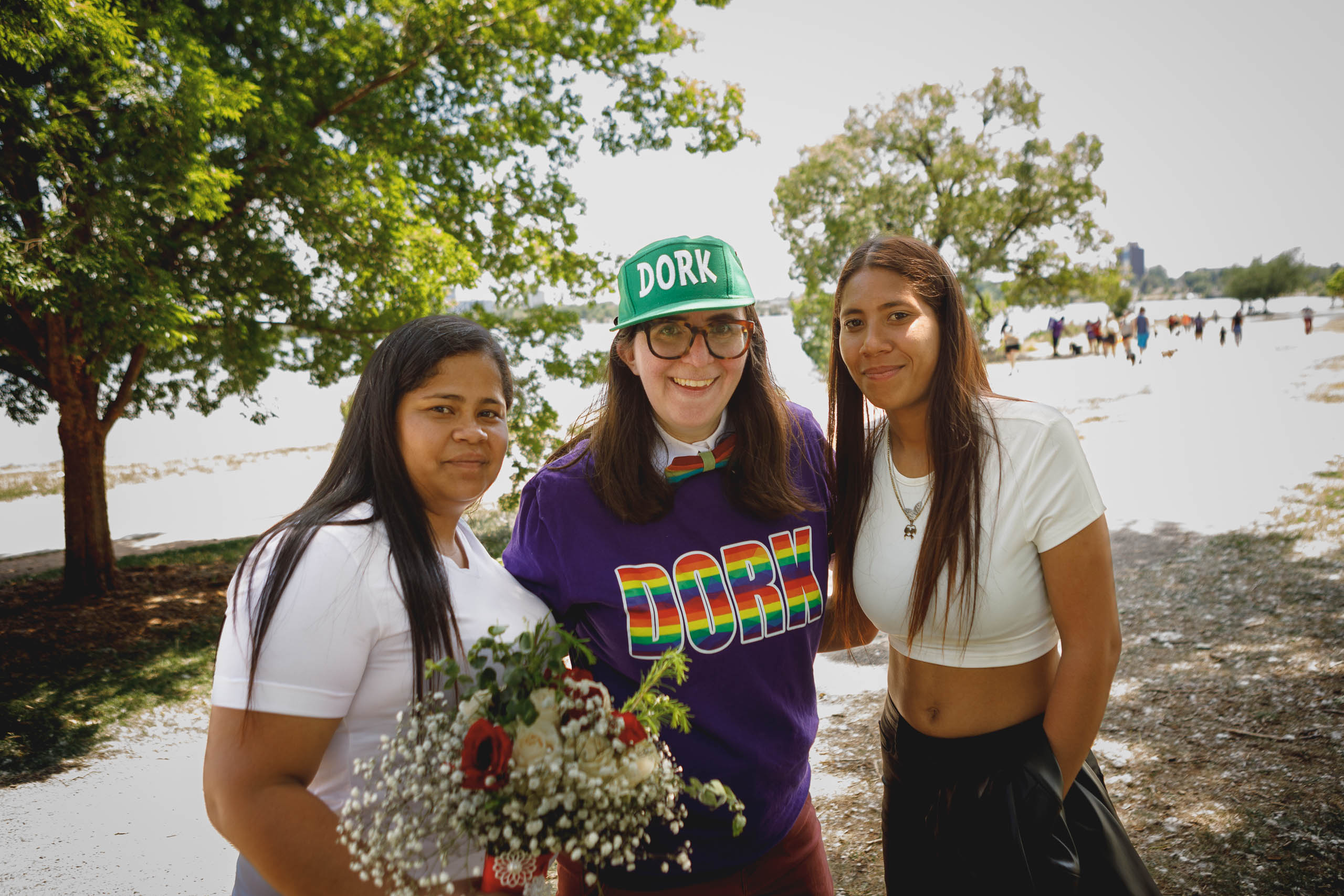
Susan Law (center) grew up in Murrysville, Pa., and organized a wedding in Denver for Venezuelan asylum-seekers Mariangy Delgado Gutiérrez (left) and Amarilis Marte.
That favor came in the form of their new neighbors in their new home, including Susan Law, the Pennsylvania woman who put together the weekend’s events.
In a migrant support group on Facebook, she saw a news clip about the couple and reached out to ask if they were interested in attending the Denver Pride parade with Dork Dancing.
“I wanted to set aside a certain number of spots for the unhoused and migrant LGBTQ community members,” said Law, who grew up in Murrysville, Pa., a 20-minute drive from Pittsburgh. “They told me what they had been through. They were in serious hardship and needed my help.”
When she heard the couple couldn’t afford a $30 marriage license, she vowed to throw them a wedding during Pride Month.
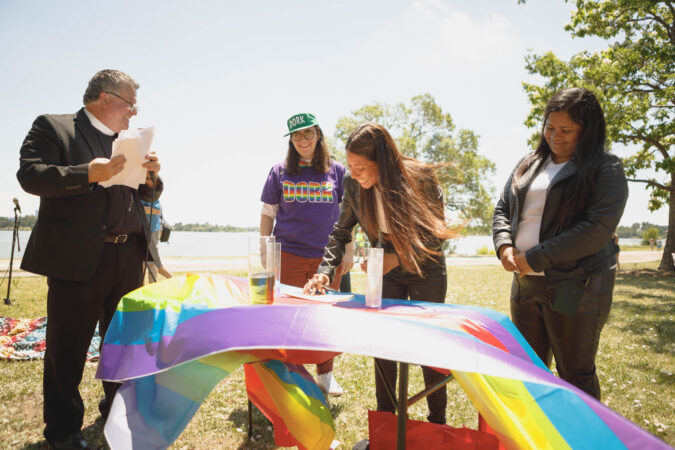
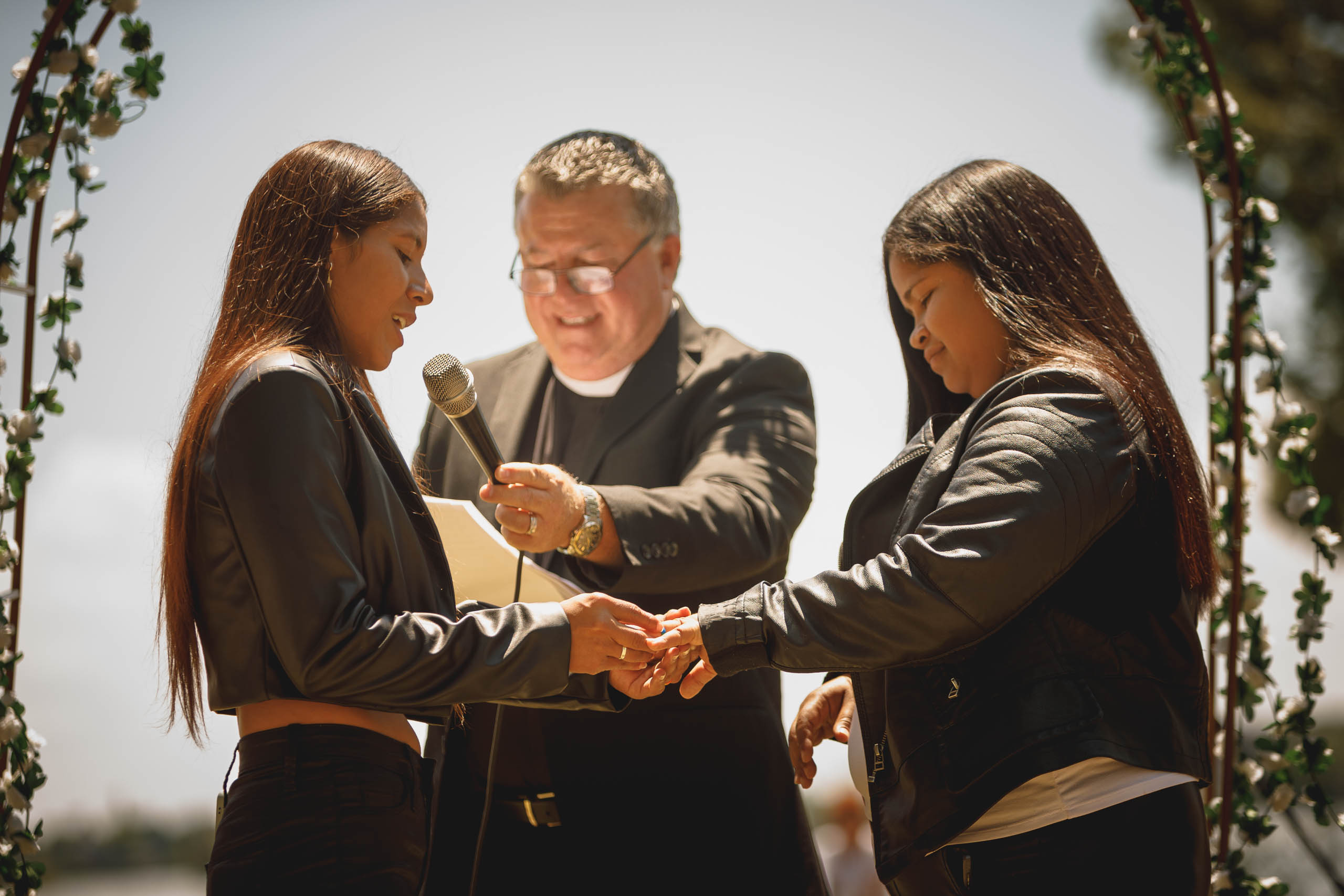
The Rev. Quirino Cornejo officiated. The couple walked down the aisle lined with Pride flags to the sounds of “The Story” by Brandi Carlile. Many guests brought their children. Others contributed lemon crinkle cookies to the Pittsburgh-style cookie table. And unlike at many weddings, most of the attendees were meeting each other for the first time.
Before the ceremony started, I spoke with David Hosanna and Jaime Rodriguez, who met a year ago this month at a gay bar. “For anyone who has negative things to say about Pride, I would say you’re missing the big picture,” Rodriguez said. “Who is to say that someone you’ve come to love — a friend, niece, grandchild, nephew — won’t need this in the future? Wouldn’t you feel better and happier knowing that they are entering a more accepting world?”
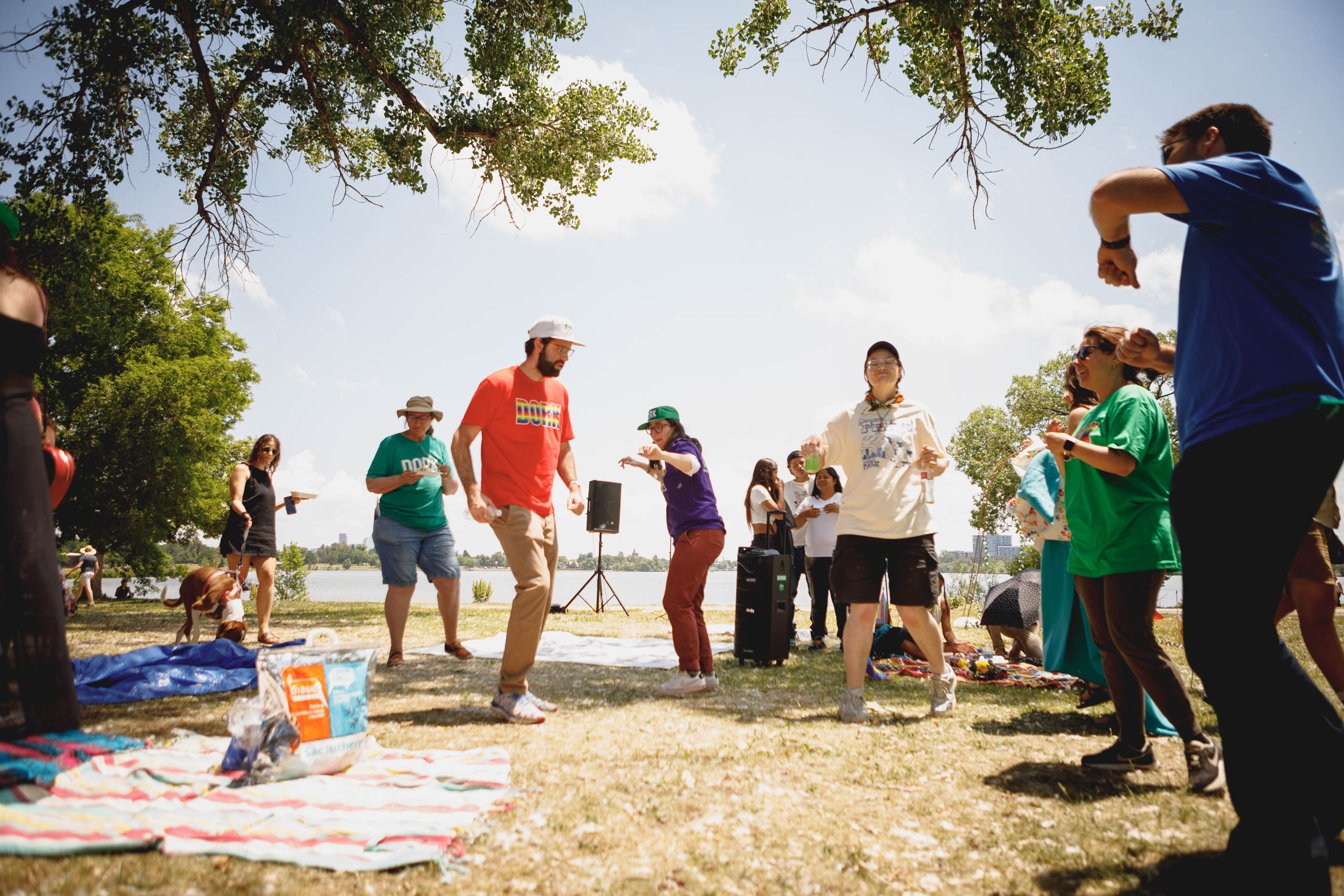
After the wedding, the Dork Dancers danced. The founder of Dork Dancing, Ethan Levy, is at center.
At one point during the ceremony, an orange Jeep sped by, the driver shouting expletives about Pride from a lowered window. Minutes later, a minivan passed in the opposite direction, honking exuberantly and waving a rainbow umbrella out of the passenger-side window.
The brides poured black-and-white sand into a shared vessel to symbolize their union. They had wanted to be married for years since they were in Venezuela, but it wasn’t safe to do so. Under Venezuelan law, same-sex couples do not have protections or rights. And while same-sex relationships are not explicitly illegal, as they are in 67 countries, frequently, LGBTQ Venezuelans face violence.
“We feel more free here,” Mariangy said.
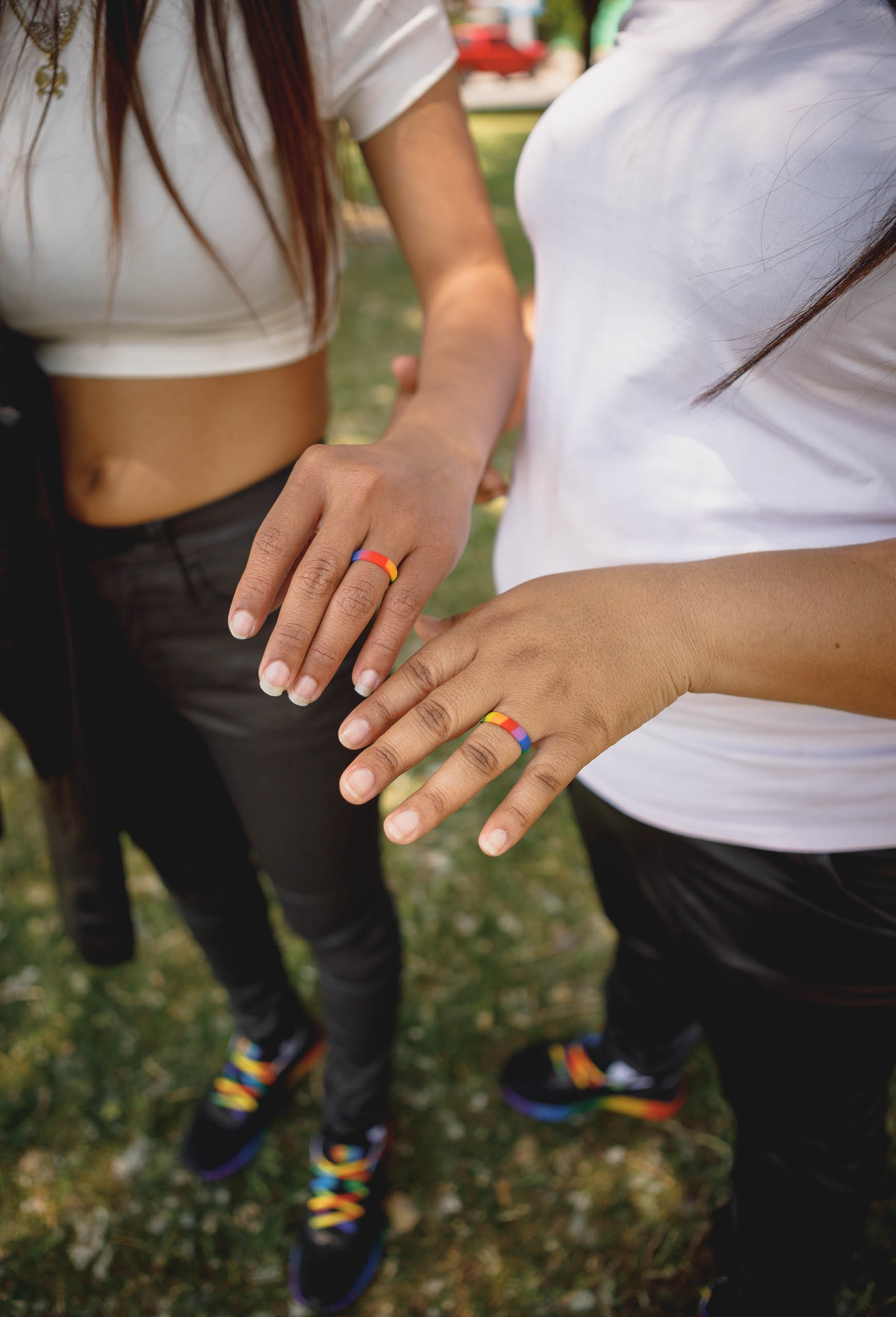
The couple shows off their wedding rings.
A perilous journey
Amarilis and Mariangy’s journey to Sloan’s Lake Park began five years ago when they first started dating. In 2020, fearing for their safety, the couple and their two daughters, ages 9 and 13, left their home in Valencia, Venezuela, and fled to Colombia.
They left Bogotá on July 14 for Medellín, Colombia, and spent almost four months traveling overland to the United States. They crossed the Darién Gap, a 60-mile stretch of dense jungle between Colombia and Panama, over three days without eating; the little food they found in the trash was saved for their children.
In addition to being perilous, crossing Central America is expensive. In Panama, the family was kidnapped and told to pay $280 per head to continue. When the kidnappers realized Amarilis and Mariangy didn’t have money, nor did their friends and family back home, they let them go.
The threats continued: In Mexico, on a packed train, a cartel stopped the railcar and took money from the passengers. Mariangy told me she and Amarilis had to protect the kids from assault. They jumped from the top of the train and ran barefoot over mountains until they reached a faraway town.
After three arduous months, the family of four arrived legally as asylum-seekers at the border in Texas on Oct. 28, where Amarilis was detained by migration. Mariangy and her daughters were given the option of taking a bus to New York, Washington, D.C., or Denver. She chose Denver because she heard that there would be shelters. On Dec. 1, Amarilis rejoined them.
“We are here,” Mariangy told me. “That’s the most important thing.” They survived.
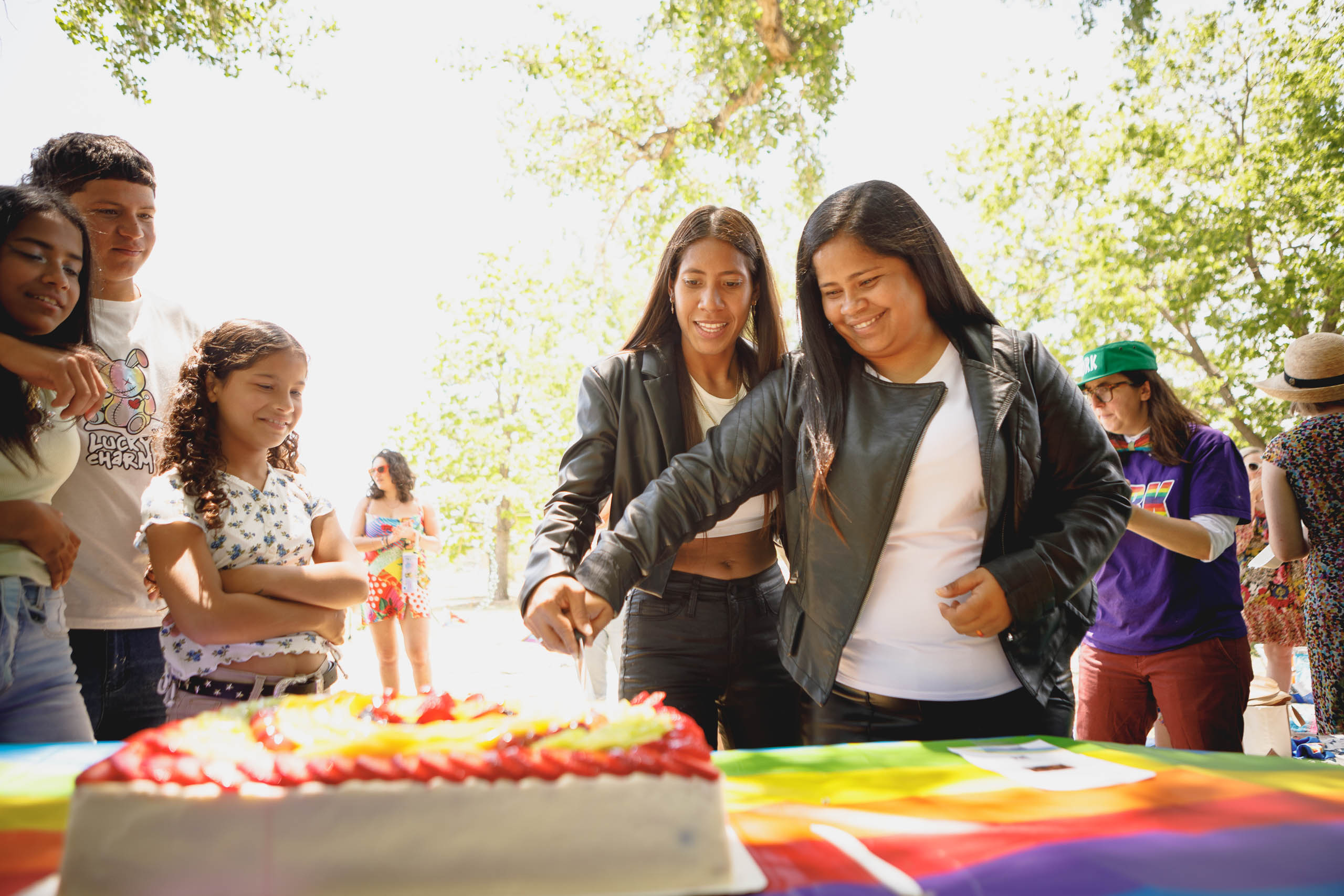
Amarilis Marte and Mariangy Delgado Gutiérrez cut into their wedding cake from Eternal Flavors Bakery while their daughters look on. After the couple told Susan Law they couldn’t afford a $30 marriage license, a community of LGBTQ people and allies came together to throw them a wedding.
A call to action
When they reached Colorado, Amarilis and Mariagny wanted to marry, but they couldn’t afford the simplest items for a ceremony. The family lives in the 16th most expensive metro area in the country, where they spend $800 a month to sleep on the floor of an apartment with five people they don’t know, all men. The family sleeps in a closet.
Their dreams are so prosaic as to be beautiful. They want a house for their kids to thrive in, good work to support their family, and to have another child together. They want to get a dog, though they differ in preferences: Mariangy wants a mini schnauzer. Amarilis would prefer a German shepherd.
The wedding on the shore of Sloan’s Lake was a celebration, but also a call to action. Without Law’s help, they would likely be on the streets. The family is still food insecure. Paying rent is a struggle; Law helped them with a missing $450 a few days before the wedding. Once they get work permits, her hope is to help Amarilis and Mariangy identify a source of income beyond cleaning patios or backyards.
Mariangy Delgado Gutiérrez and Amarilis Marte exchanged vows at Sloan’s Lake Park in Denver on June 9.
In my life, I have ridden a bicycle in Toronto behind the Dykes on Bikes and learned the hard way not to wear glitter on my eyes in the rain. I’ve marched at Pride in New Hampshire, New Zealand, and watched from the sidelines in New York City.
None of that was as meaningful as watching Mariangy and Amarilis get married. It was a privilege to witness the true power of the LGBTQ community. Celebrating Pride means uplifting the most vulnerable among us.
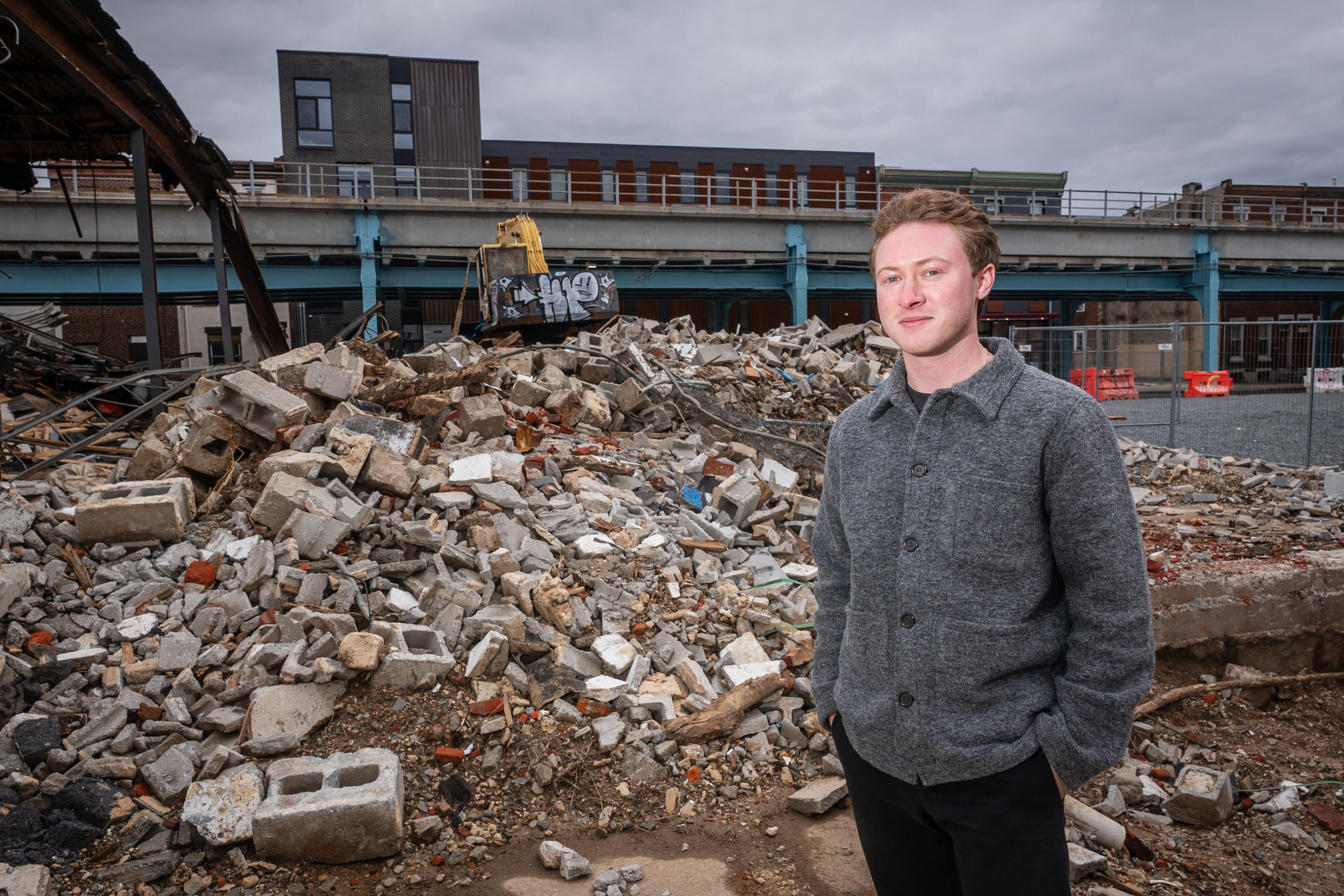
A building boom is unfolding on Front Street in Fishtown along the Market-Frankford elevated train line.
Walking north beneath this towering transit edifice, pedestrians are forced to zig-zag across the street to avoid construction sites spilling onto the sidewalks. The total number of apartments on Front Street between Girard and the York-Dauphin stations is set to almost double in the next year.
“It’s pretty surreal to see it all happening at the same time,” said Henry Siebert, cofounder of Archive Development, which plans to build at 1440 N. Front St. “The amount of construction that’s ongoing, I don’t see that anywhere else in Fishtown.”
According to the CoStar Group, a commercial real estate analytics firm, there are 441 apartment units actively under construction along this 1.1-mile stretch of the Market-Frankford Line, another 174 are proposed, and 231 have been completed since 2019. (There were 215 apartment units along the stretch prior to that year.) And that’s probably a slight undercount because it only includes projects with five units or more.
There are new apartments popping up in the storefronts of renovated older buildings along the train line, such as the building that housed Mighty Mick’s boxing gym in the Rocky movies. When construction there is complete, it will include a commercial space of 2,600 square feet along with four apartments in the revitalized historic brick building.
All this is happening as SEPTA ridership is dramatically lower than it was before the pandemic. In November, ridership on the Market-Frankford Line was only at 58% of February 2020 levels. Ridership at the stops in this part of Fishtown is even lower, according to data provided by SEPTA, with the York-Dauphin station only seeing 46% of 2019 ridership levels in 2023, the Berks station 52%, and the Girard station 48%.
(function() {
var l2 = function() {
new pym.Parent(‘fishtown_el’,
‘https://media.inquirer.com/storage/inquirer/projects/innovation/arcgis_iframe/fishtown_el.html’);
};
if (typeof(pym) === ‘undefined’) {
var h = document.getElementsByTagName(‘head’)[0],
s = document.createElement(‘script’);
s.type = ‘text/javascript’;
s.src = ‘https://pym.nprapps.org/pym.v1.min.js’;
s.onload = l2;
h.appendChild(s);
} else {
l2();
}
})();
And yet, the transit infrastructure is attracting a level of investment unprecedented in modern memory.
“SEPTA is experiencing a rough patch,” said Yonah Freemark, a senior researcher at the Washington-based Urban Institute, a policy think tank. “But for all the problems with drug abuse and lack of investment from the public sector, the fact that private investors want to spend huge amounts of money bringing hundreds of apartments to the neighborhood seems incredibly bullish for the future.”
Henry Siebert, cofounder of Archive Development, at the company’s apartment project on 1440 N. Front St.
A ‘critical mass’ of demand
Few neighborhoods in Philadelphia have been as transformed as Fishtown since the Great Recession.
In 2012, political scientist Charles Murray used the neighborhood as the embodiment of all that had gone wrong for a downwardly mobile, white, working-class America. The commercial corridors on Frankford Avenue and Front Street were run-down, with many shuttered storefronts. The headquarters of the Warlocks Motorcycle Club could be found, but not a wine bar.
Now, Fishtown is the neighborhood in Philadelphia outsiders are most likely to be able to name, partly due to a spate of national media attention. The Warlocks vacated in 2011, and Frankford Avenue is now a thriving commercial corridor home to many of the city’s finest restaurants (including a James Beard Award winner), cocktail bars, and a La Colombe that looks largeenough to house a harrier jet. According to Census data, the Northern Liberties and Fishtown area now has the highest median income in the city.
“As Northern Liberties got all the hype [in the 2000s] prices went up and people started moving into Fishtown because it was more affordable,” said Brenda Nguyen, associate director at CoStar’s Philadelphia office. Now “the Fishtown area has enough dense housing, retail, restaurants, and neighborhood amenities that there’s a critical mass of demand.”
Throughout Fishtown’s redevelopment, many of the large vacant lots on Frankford Avenue, and elsewhere east of the Market-Frankford Line, filled in. Within a 10-minute walk of the heavy rail line there are 4,585 existing apartment rentals and 1,646 under construction. (A further 922 are proposed, although their status is unclear given the development industry’s current deep freeze.)
“When we originally started developing in the city in 2018, I told [my partner]that we would likely never develop a property along the El,” said Siebert. But “as large-scale development opportunities became more and more scarce, developers eventually turned their attention to Front [Street].”
Many developers had avoided the thoroughfare, partly because the looming edifice creates challenges with noise from passing trains and limits natural light. But the area became more appealing as other developable land vanished.
It helps that the land along this stretch of the Market-Frankford Line is zoned to allow taller and denser buildings than much of the rest of Fishtown. Archive Development addressed the challenges of building next to the train line by designing a first floor with 17-foot ceilings, ensuring the residential units on the second floor were elevated above transit. They plan to install windows with special glazing to reduce noise from passing trains.
Developers who have seen how Frankford Avenue has thrived to the east hope that they can build enough housing to create the demand for a second strong retail corridor. But they also hope to help establish attractive retail businesses that will, in turn attract more tenants. It’s the virtuous cycle that helped early developers in Fishtown such as Roland Kassis — who is also building next to the El — successfully launch businesses such as Frankford Hall and the La Colombe flagship.
“I was talking to a broker the other day and he said that what people want is an activated street front,” said Rafi Licht, a developer with Norris Square Development, the company behind the renovated Mighty Mick’s gym building.
“That’s what we’re aiming for here,” said Licht. “Putting in coffee shops, bars, restaurants, whatever is going to activate the street that makes it easier for people to imagine living upstairs.”
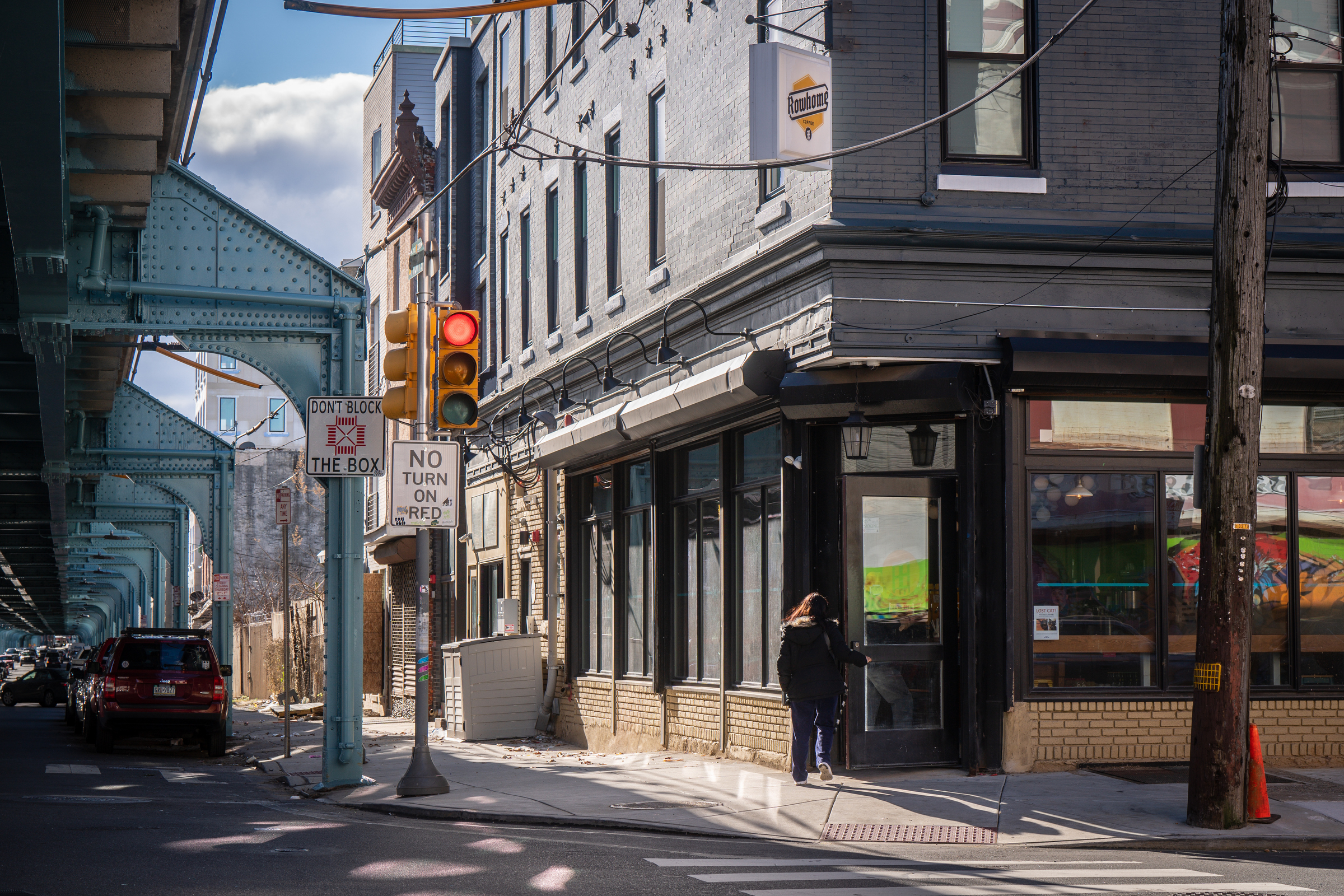
Rowhome Coffee at 2152 N. Front St., in a recently renovated historic building.
Norris Square Development is also working on other properties around the York-Dauphin stop. In 2022, Rowhome Coffee opened in its building at 2152 N. Front St. It drew a crowd then, and it still does.
“When Rowhome Coffee opened during the pandemic, people were queued up for the takeout window,” said Jonathan Auerbach, a partner in Norris Square Development. “I saw young women with prams lined up and realized, wow, people have been waiting for this.”
Will the redevelopment of Front Street aid mass transit?
Few of the developments along the El are subsidized, meaning rents will be relatively high in comparison with housing costs in nearby working-class and lower-income neighborhoods. (The rents in the Mighty Mick’s building will be close to $2,000 for a two-bedroom or $1,600 for a one-bedroom.) Many workers who have jobs that require in-person attendance — such as retail, hospitality, or restaurant work — are less likely to be able to afford newly constructed, transit-oriented apartments.
Even before the pandemic, most studies showed that lower-income and working-class people are far more likely to use transit, partly due to the high cost of car ownership and partly because they were more likely to live in cities with extensive transit systems.
A 2016 Pew study and a Census study of 2019 commuter behavior also revealed that higher-income Americans were more likely to use transit than their middle-income peers, perhaps because wealthier people had started moving back to the transit-rich big cities of the Northeast.
But post-pandemic, transit may be less of an important amenity than it once was.
“[These] renters might not see public transit as a primary factor when they’re choosing where they want to live,” said Nguyen of CoStar. “It’s more of an added bonus.”
Still, developers in Fishtown argue that even if white-collar workers are less likely to be going into the office five days a week, the Market-Frankford Line still offers unparalleled access to Center City and University City.
“If you’re going to the office [at all], you still need a way to get to Center City,” said Ryan Kalili, cofounder of Archive Development. “Two days or three days a week is still enough that you’re not going to Uber. “I think [ridership] hopefully will change as the northern part of Front Street [attracts more residents].”
When it gets colder, it’s not only important to be mindful of your pets and your plants but also your home’s pipes and water heater.
Yes, those inanimate objects need extra care, too.
As temperatures drop across the region, the risk of your home’s pipes freezing increases. There are steps, however, that homeowners can take to help stop that from happening and help you avoid a hefty plumbing bill this winter.
Here’s a list of plumber-approved tips on how to keep a pipe from freezing, spotting a frozen one, and what to do if it bursts.
How to prevent your pipes from freezing
“It comes down to three main things: draining outside faucets, keeping pipes warm, and checking for leaks,” said Vincent Thompson, owner of Thompson Plumbing and Heating. Thompson is a master plumber of more than 50 years and for two decades taught plumbing at Dobbins Vocational School in North Philadelphia.
💧 Draining outside faucets
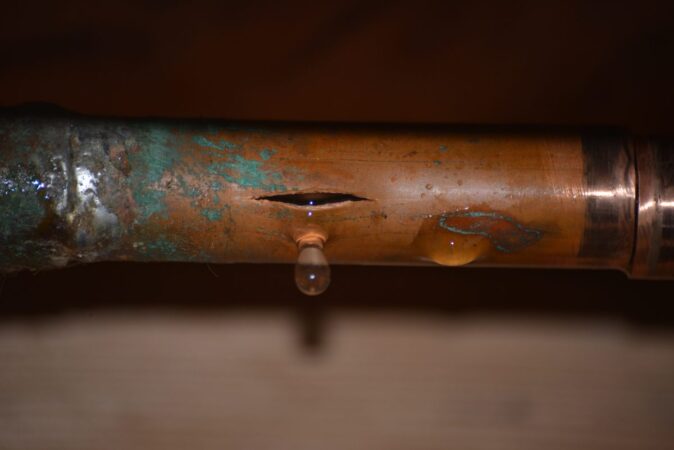
Over the summer, we use outside faucets and hoses to water the plants, rinse of sidewalks, or simply cool down. When the temperature dips, water can freeze and build pressure, ultimately causing a burst pipe, a situation far too common, according to Thompson.
He recommends disconnecting your hose (and storing it for the winter), shutting off the valve that feeds the faucet or spigot (usually found near the hot water heater), and letting the remaining water in the pipe drain out. You can leave the faucet or spigot slightly open, according to Thompson. Letting the faucet drip is also a good suggestion for inside fixtures.
“If it’s empty, it’ll never freeze,” Thompson said. “But if there’s water, it can expand and explode. Then you’ll come out in the spring to use your hose and the water will be shooting out of the wall.”
🌡️ Keep your pipes warm
When the freezing weather descends upon us, we bundle up to stay warm. Pipes need that treatment too. Ideally, the lowest you want to keep your thermostat set at is 50 degrees, but heating is expensive. According to Thompson, the absolute lowest you can go is 40 degrees, because your pipes will start freezing at 39 degrees.
Opening the cabinets underneath your bathroom sink can be a good way to keep pipes from getting too cold. And for the ones in extra-cold spots, using electrical heating tape or fitting them with foam and rubber sleeves is a good idea. Be sure to check for any leaks beforehand, because if water is accumulating, they won’t prevent a pipe from bursting and it will become an added step.
🚽 Check for leaks
“Every drop that goes down the drain will turn into an icicle and eventually can clog up the entire soil stack,” explained Thompson. Not addressing it can result in frozen pipes, flooding, and even water backing up through your toilet.
After 50 years of handling these cases, he advises looking at your water meter because sometimes the leak might not be obvious. Make sure no water sources are open, and look at the blue or red triangle (depending on your meter). If it’s turning that can be a sign of a leak.
If you suspect the culprit is your toilet, he recommends adding a couple of food dye drops into the tank. If the water in the bowl changes color, your suspicions are correct.
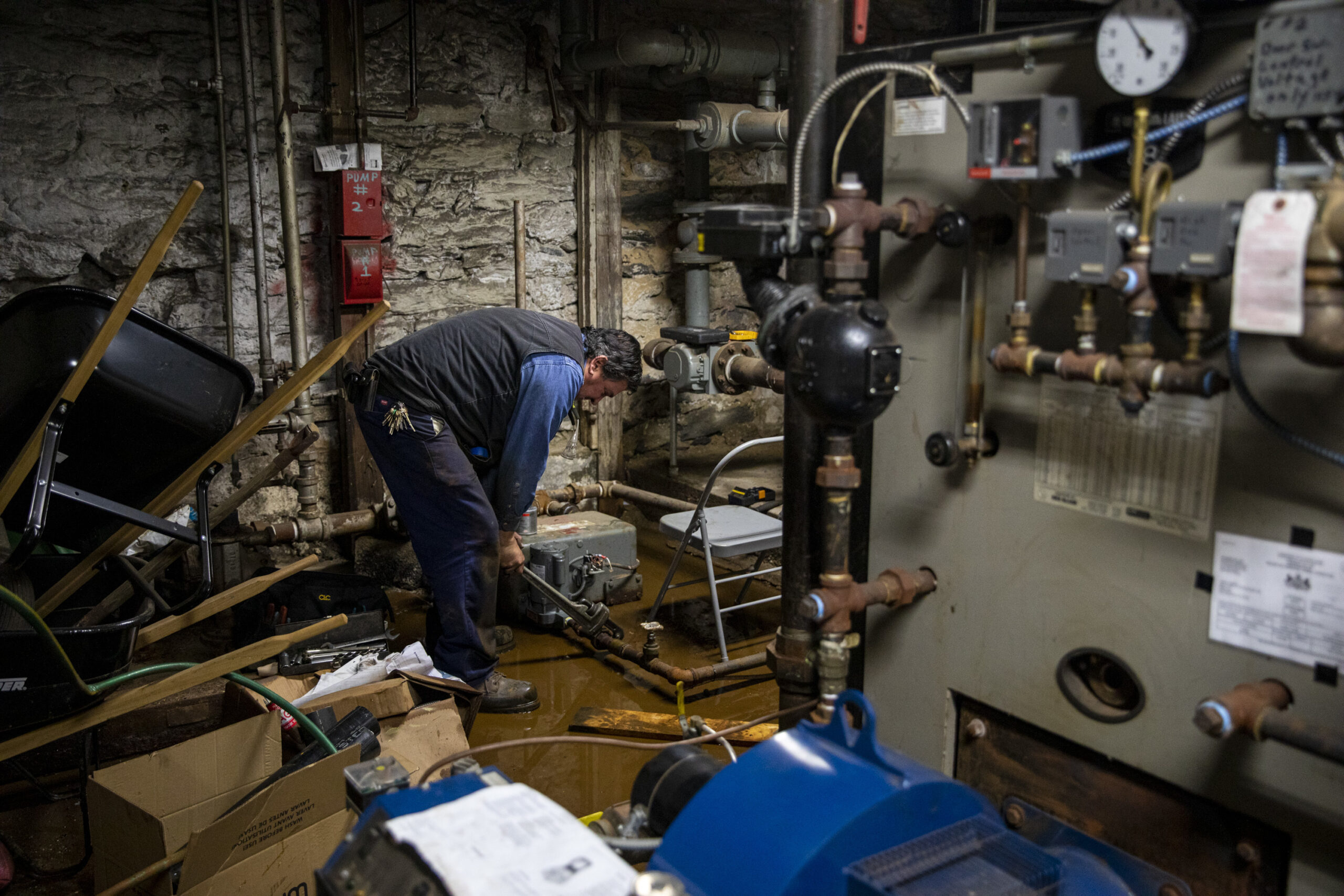
Andrew Gadaleta, contractor, works on getting the heat fixed at Visitation BVM School in Philadelphia in December 2021 so that students could return to school. Thieves broke into the school Tuesday morning, ripping copper pipes from the walls that caused flooding. The water rendered the school unusable for a week.
How to spot a frozen pipe
Your house is filled with water pipes, and while it’s not hard to figure out when you’re dealing with a frozen pipe, it can be tricky to figure out where the frozen section is. If you turn on a faucet and nothing comes out, you’re going to have to do a little detective work.
The first step should be to try all the other faucets in your house. If all the faucets in a room aren’t working, the freeze is likely in a split from the main pipe. If all the faucets on a floor aren’t working, the freeze is likely between where the first- and second-floor pipes separate. If all the faucets in your house aren’t working, then the freeze is probably near where the main pipe enters the house.
The frozen section of the pipe, if exposed, will sometimes have condensation over it. You’ll also be able to tell that it’s colder just by touching it.
How to thaw a frozen pipe
Before thawing a frozen section of pipe, you should open the faucet to relieve the water pressure and allow the water to escape once it thaws. You should also begin the thawing process close to the faucet and work your way to the blockage. If melted water and ice get caught behind the blockage, the chance that the pipe will burst increases.
One of the easiest ways to thaw a frozen pipe is with a hair dryer. You can also use hot towels or a heat lamp to warm up the pipe. Never use an open flame.
What to do if a pipe bursts
Don’t panic. The first thing you should do is shut off the main water line into your property. This will prevent your house from flooding. The main water valve is usually near your water meter. After you’ve done that, call your plumber. Locating and tagging the valve to your main water line ahead of time can help make the moment less stressful.