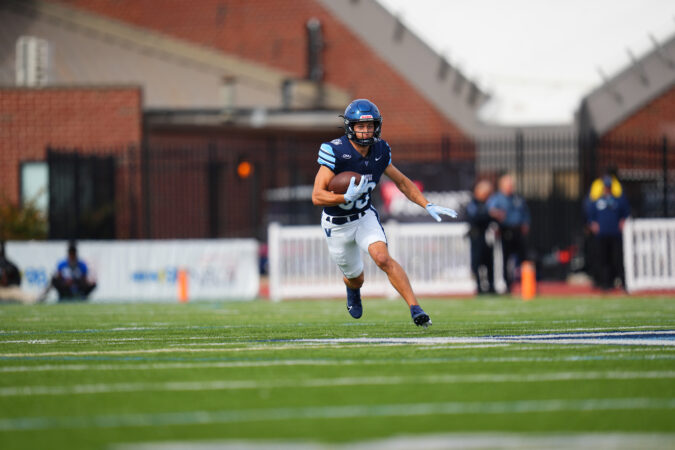
Villanova receiver Braden Reed motioned to the backfield and awaited the snap against Tarleton State last Saturday in the FCS quarterfinals. He took a handoff and ran in the opposite direction, but instead of heading downfield, he threw a 27-yard pass toward the end zone.
The pass landed directly over the shoulder and into the hands of Villanova receiver Lucas Kopecky for a touchdown in the Wildcats’ 26-21 victory. Reed became the first Villanova receiver to throw a touchdown pass since Jaaron Hayek in 2019.
“It was cool,” Reed said. “I was appreciative that the coaches had so much trust in me as a freshman to throw a ball in the quarterfinals of the playoffs. I think that’s something really special that they were able to trust me with that.”
Reed has been a standout on Villanova’s special teams and recently on offense. For a majority of the season, he led the FCS in average punt return yards. In the last two games, he has caught game-winning touchdowns against Lehigh and Tarleton State.
Now, Reed and Villanova are gearing up to host an FCS semifinal game on Saturday for the first time since 2009 (7:30 p.m., ESPN2). No. 12 Villanova will face unseeded Illinois State with a trip to the FCS championship on the line.
“He’s not a freshman anymore,” Villanova coach Mark Ferrante said after the Tarleton State game. “I don’t even know what our overall record is, to be honest, but he’s got that many games under his belt now. So he’s pretty much moved up to be a sophomore, as far as playing time. He’s been able to come in and pick the system up really well. So you’re seeing the fruits of his labor. He works really hard, and the results are now showing up on the field.”
The freshman is one of the first guys on the field for practice and the last one to leave. After morning practice, Reed will return in the afternoon to catch passes from one of the quarterbacks or the JUGS machine.
Recently, Reed was named to the Stats Perform FCS Freshman All-America team and the 2025 FCS Football Central Freshman All-America team. He has tallied 31 receptions for 462 receiving yards and three touchdowns. On special teams, he has returned 20 punts for 298 yards, which currently ranks No. 6 in the FCS.
In high school, the Pope John Paul II graduate was first-team all-state, was a three-time first-team all-conference honoree, and Pioneer Athletic Conference Player of the Year.
Reed grew up around football. His father, Scott Reed, played the sport at West Chester and was his son’s head coach for three years at Pope John Paul II.
“It’s been huge for me,” Reed said of having his father as a coach. “I wouldn’t be where I am without him. He’s one of my biggest fans and biggest haters. He’ll be the first one to humble me. He calls it the honest report. He tells me how it is. He’s very good at just keeping me grounded, keeping me humble and hungry, and just always wanting to strive for more.”
In his senior year at Pope John Paul II, Reed helped his team reach the PIAA Class 4A quarterfinals. While he has experience playing games late into the season, Reed says he is not thinking too much about what’s at stake.
As of now, he still gets to do what he loves for another week.
“I’ve always kind of subscribed to the idea that every game is kind of the same,” Reed said. “At the end of the day, we’re playing a kid’s game, and we just happen to take it really serious. I try to not look at any of the outside stuff and just enjoy the fact that I get to play a game in December. I think that’s one of the coolest things ever. Really, the reward of the playoffs is getting to play more football. As much as championships are cool, getting to do what you love longer is something that drives me.”
Reed describes himself as “a big family guy,” and when making his college decision, he wanted to stay close to home. After every home game, he goes home to spend time with his family.
Braden Reed runs with the ball against Albany.
Reed’s family will be in the stands this weekend as usual, but this time, a larger crowd will be supporting him. His former high school teammates will be home from college for winter break, and some will be there in support. Reed’s uncle Tom, who has not missed a game since his freshman year of high school, also will be in the stands.
While the game this Saturday isn’t average, Reed and the team are treating it like it is any other week of the season.
“I think [we] keep everything the same as any other week,” Reed said. “Go 1-0. It’s about the guys in our locker room, and one of the big things that we’ve harped on all year is to protect the brand, protect the ‘V.’”
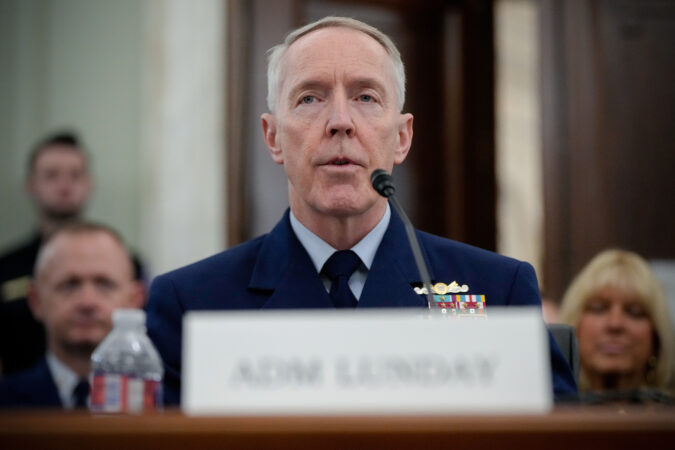
At least two U.S. senators have put holds on the nomination of Adm. Kevin Lunday to lead the U.S. Coast Guard, citing concerns with a new workplace harassment policy that downgrades the definition of swastikas and nooses from hate symbols to “potentially divisive.”
The move upends Lunday’s confirmation, which the Senate was due to vote on this week, and raises new questions about the decision to implement the policy revisions after Lunday in November had forcefully denounced such symbols and declared a wholesale prohibition on them.
The holds on Lunday’s promotion were exercised by Sens. Tammy Duckworth (D., Ill.) and Jacky Rosen (D., Nev.). They follow a series of Washington Post reports detailing plans to include the incendiary language within the Coast Guard’s new workplace harassment manual — and the policy’s quiet implementation this week despite the admiral’s explicit directive last month. The manual is posted online and specifies that the document’s previous version “is cancelled.”
In a statement, Duckworth expressed incredulity at the situation and questioned why Lunday would not update the policy manual “to delete the absurd characterization that clearly states a noose and swastika are merely potentially divisive symbols.” She said that the admiral had affirmed “directly to me” that both “are symbols of hate.”
“This shouldn’t be difficult,” Duckworth said.
Rosen, in a social media post announcing her decision to place a hold on Lunday’s nomination, said it appears he “may have backtracked in his commitment to me to combat antisemitism and hate crimes and protect all members of the Coast Guard.” She said her hold will remain in place “until the Coast Guard provides answers.”
It was not immediately clear why Lunday, who was named the Coast Guard’s acting commandant after the Trump administration ousted his predecessor, did not incorporate his November order into the manual before it took effect Monday, or to what extent the Department of Homeland Security leadership, which has authority over the service, was involved in the revision process.
Two people familiar with policy manual’s overhaul, speaking on the condition of anonymity for fear of reprisal, sought to distance Coast Guard leadership from the controversy. “The policy rewrite was bad staff work,” one person, a Coast Guard employee, said. “But the Coast Guard’s hands were tied in how we were able to address the mistake.”
A spokesperson for Lunday did not respond to a request for comment, and the Coast Guard did not address whether Lunday, as acting commandant, had the authority to change the workplace harassment manual or if he required approval from Homeland Security Secretary Kristi L. Noem.
A spokeswoman for DHS, Tricia McLaughlin, said that by placing a hold on Lunday’s nomination, Duckworth and Rosen were attempting to “extort” the Coast Guard to score “cheap political points.”
Homeland Security Secretary Kristi L. Noem on Capitol Hill earlier this month.
“At a time when the threat of antisemitic violence is as widespread as it is right now, using this to politicize one of President Trump’s military nominations is simply disgusting,” McLaughlin said.
The issue has drawn concern from some Republicans, too. Sen. Dan Sullivan (R., Alaska) “has been clear with acting commandant Adm. Lunday since the story broke that the Coast Guard must clarify, in the strongest terms possible, that the Coast Guard does not tolerate symbols of hate, like swastikas and nooses,” his office said in a statement Wednesday.
Sen. James Lankford (R., Okla.) also registered disapproval. In a statement, his office said the senator was “provided assurances” the policy had been corrected. “There is no reason,” it says, “why there should be conflicting policies in place.”
Unless the holds are lifted, Lunday’s nomination will be sent back to the White House at the end of December, forcing President Donald Trump to renominate him or choose someone else for the job, according to a Senate Republican aide.
The Coast Guard’s hazing and harassment policy was an early focus of Lunday’s after the Trump administration, upon entering office in January, fired his predecessor, Adm. Linda Fagan — the first woman to lead a branch of the U.S. military. In announcing Fagan’s removal, officials cited among other things her “excessive focus” on diversity initiatives.
Within days Lunday ordered the suspension of the policy manual that, among its other guidance, said explicitly that the swastika was among a “list of symbols whose display, presentation, creation, or depiction would constitute a potential hate incident.” Nooses and the Confederate flag also matched that description under the previous policy. Lunday was later nominated by Trump to lead the service as its commandant.
The policy manual changes reflect an administration-wide campaign to purge the federal of government of its focus on diversity, equity and inclusion (DEI). At the Pentagon, for instance, Defense Secretary Pete Hegseth has fired multiple minority or female military officers in his ongoing effort to eliminate DEI initiatives. He has said, without offering evidence, that the prior administration’s focus on DEI harmed military recruiting.
At the same time, antisemitism is on the rise globally. At least 15 people were killed over the weekend at a Hanukkah celebration in Australia.
The Coast Guard’s new workplace harassment manual, beyond softening the definition of swastikas and nooses, also allows for supervisors to review how such symbols are used or displayed in the workplace instead of immediately prohibiting them.
After the Post in November revealed the Coast Guard’s plan to adopt the new language, Lunday reacted swiftly — stating in a memo to all Coast Guard personnel that his directive barring swastikas and nooses would supersede any other policy language.
Vincent W. Patton, who served as master chief petty officer of the Coast Guard — the highest enlisted position — from 1998 to 2002, on Wednesday cited Lunday’s memo in offering a defense of the admiral and the policy revision. The new manual’s wording gives the Coast Guard more latitude to make judgment calls case by case, he said, adding that Lunday’s letter to all personnel was “very, very clear that hate symbols are prohibited.”
The process and penalties remain the same — regardless of whether the word is “hate” or “potentially divisive,” Patton said in an interview.
Asked if he meant that there could be situations in which someone with a noose or a swastika flag or tattoo was not in violation of the harassment policy, he said “that’s possible.”
“I mean if it was a swastika, they should be out within a second,” Patton said, “but Confederate flags? There should be an open dialogue to determine or define if this person has the potential and willingness to do something hateful.”
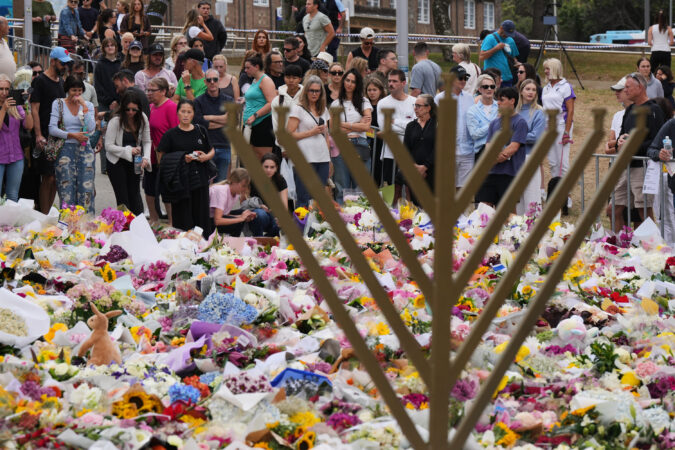
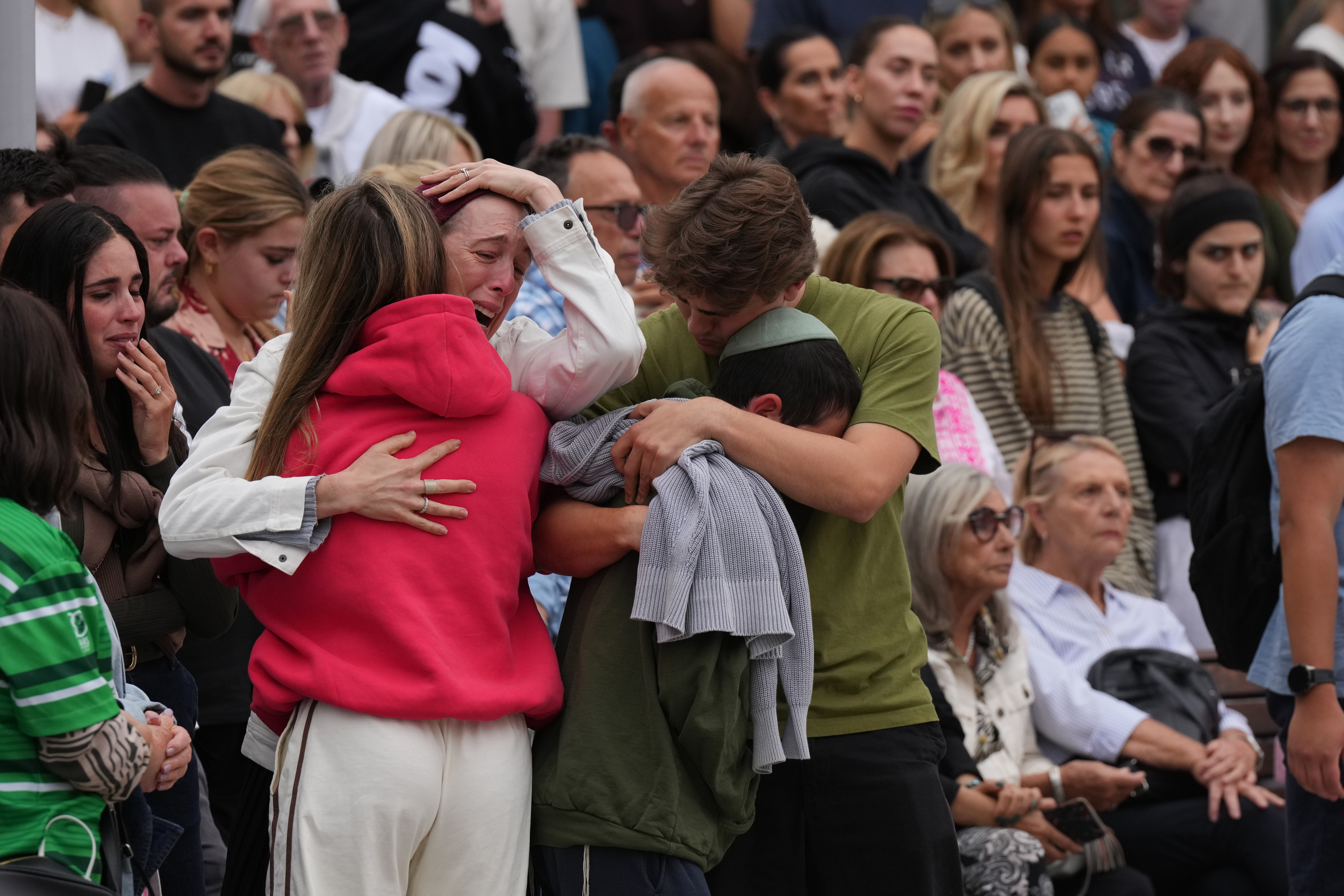
This Hanukkah season, as Jewish families gathered at Sydney’s Bondi Beach to celebrate the Festival of Lights, terrorists opened fire. At least 15 people were killed and dozens more injured in an attack that has sent shockwaves through Jewish communities worldwide.
For many Jewish families, this attack feels horrifyingly familiar. I know that fear personally. As I wrote in these pages last year, I had to hire armed security for my son’s bar mitzvah — a celebration that should have been filled with only joy, but instead required armed guards and threat assessments. That shouldn’t be our reality. But it is.
Since that bar mitzvah, the situation has only intensified. The Anti-Defamation League documented more than 460 antisemitic incidents in Pennsylvania in 2024. Nationally, the numbers are equally alarming. Jewish families are making calculations our grandparents hoped we’d never have to make: Is it safe to go to synagogue? Should we display our menorah in the window? Will our children be targeted for wearing a Star of David?
Family members of a victim from Sunday’s shooting mourn at a flower memorial made after the shooting at the Bondi Pavilion at Bondi Beach on Dec. 16 in Sydney, Australia.
But amid the horror of Bondi Beach, there emerged an image we cannot ignore: Ahmed al-Ahmad, a civilian, tackling one of the gunmen to the ground and saving countless lives.
When hatred showed its ugliest face, Ahmed didn’t calculate the risk. He didn’t hesitate. He ran toward danger to protect people he didn’t know, celebrating a holiday he didn’t observe, from terrorists who claimed to share his faith.
This matters — not as a feel-good footnote to a tragedy, but as a fundamental truth we must hold onto in these dark times.
The alleged attackers reportedly followed ISIS ideology. But Ahmed al-Ahmad, a Muslim man, risked his life to stop them. This is precisely why we cannot — we must not — paint entire communities with the brush of their worst actors.
When individuals commit acts of hatred, we should hold specific perpetrators accountable — not entire identity groups. Yet, these days: Often Jews are blamed collectively for events in the Middle East and Muslims are blamed for the actions of terrorists, like what occurred at Bondi Beach.
Resisting communal blame is essential to defeating hate. Because here’s the truth: Neither courage nor hatred belongs to any one group. There are heroes and villains in every community. The sooner we recognize this; the sooner we can build the coalitions necessary to fight antisemitism, hate, and extremism in all its forms.
Creating moments of solidarity matter as much as the hate incidents themselves, perhaps more. I am personally grateful for the phone calls and emails that I did receive from allies following the attack at Bondi Beach. They show that the voices against antisemitism and hate are greater in number and in moral force than those who traffic in it.
But solidarity requires more than social media posts and attendance at rallies. It demands courage. Ahmed al-Ahmad showed us what that looks like.
Here’s what each of us can do:
Become an active bystander. When you witness hatred or harassment, you have the power to intervene safely — to distract, delegate, document, or directly address the situation.
Reject collective blame. When acts of terror occur, resist the urge to blame entire communities. Hold perpetrators accountable while standing with those who share a background but not the hatred.
Show up. Share in Hanukkah and Christmas celebrations, attend a Ramadan iftar, join in a Juneteenth event. Our presence in each other’s celebrations builds the relationships that sustain us through dark times.
Report hate incidents. Whether it’s antisemitism, Islamophobia, racism, or any other form of bias, report it to law enforcement and organizations like ADL that track incidents. Silence allows hate to fester.
As we light the menorah this Hanukkah, we commemorate the ancient victory of light over darkness. That light endures not because it was never threatened, but because in every generation, people chose to protect it — people from all backgrounds, all faiths, all walks of life.
Ahmed al-Ahmad chose to be one of those people. The question for the rest of us is: Will we?
Andrew Goretsky is the senior regional director of the Anti-Defamation League’s Philadelphia office, serving Eastern Pennsylvania, Southern New Jersey, and Delaware.
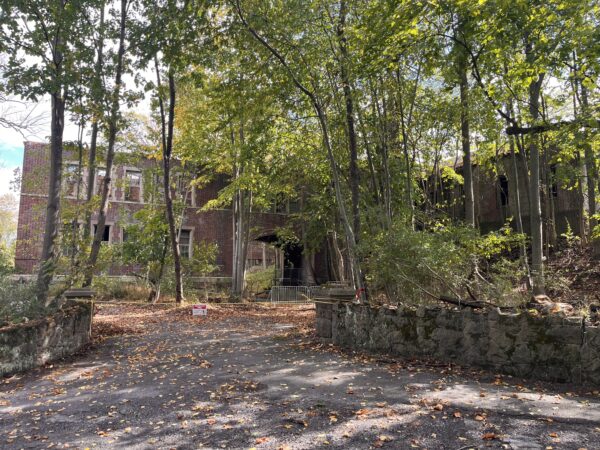
At a crowded meeting Wednesday night — which at one point had residents yelling and prompted officials to call for a break — the board declined to move forward with the draft ordinance it had been penning for months that would govern data center development in the township. The draft ordinance came after the owner of the 125-acre historic Pennhurst site, which currently serves as a popular Halloween attraction, submitted a sketch to develop the land as a data center complex.
The application will now move forward, coming before the township’s planning commission over the next several months, before it eventually returns to the board of supervisors for a conditional-use hearing, which is slated for March.
“I understand it’s a very emotional issue,” the board’s chairman, Craig Damon, told residents. “I have to keep an open mind through all of this, so I don’t stand on one side or another, because I have to keep an open mind to this.”
Data centers are buildings or campuses that handle cloud-storage and computing needs of massive corporations, like Amazon, Google, Microsoft, or Meta. They require large-scale ways of cooling computing equipment and are often dependent on water to do that.
The potential data center in East Vincent would add to the more than 150 in Pennsylvania and New Jersey. Pennsylvania Gov. Josh Shapiro’s administration has encouraged data centers to locate in the state and has developed a “fast track” program for permitting. Recently, the governor’s office announced Amazon would spend $20 billion to develop data centers and other artificial intelligence campuses across the state.
East Vincent officials had sought to impose restrictions on data centers by limiting building heights, mandating buffers, requiring lighting, and limiting the number of trees that could be cut down, among other rules. No one representing landowner Pennhurst Holdings LLC spoke Wednesday, but at a Dec. 3 meeting, an attorney for Pennhurst Holdings told officials the proposed ordinance had conditions that “appear reasonable and necessary on their face, but the struggle we have is when you put all of those together, they ultimately act as prohibitive to the development of the Pennhurst property as currently drafted.”
On Wednesday, the officials declined to move forward with the ordinance, after the township’s solicitor warned it could lead to a challenge.
Even with the ordinance shelved, residents in East Vincent and neighboring municipalities decried the prospective data center.
The sketch plan totals more than 1.3 million square feet, with five two-story data center buildings, a sixth building, an electrical substation, and a solar field. Pennhurst State School and Hospital — known as Pennhurst Asylum in its Halloween capacity — opened in 1908 for individuals with intellectual and developmental disabilities. It closed in 1987, after legal challenges to its abusive and neglectful treatment of those who lived there, and was turned into a Halloween attraction in 2008.
The property is situated near the Schuylkill and borders Spring City, which sits to the south. It is close to the Southeastern Veterans Center.
window.addEventListener(“message”,function(a){if(void 0!==a.data[“datawrapper-height”]){var e=document.querySelectorAll(“iframe”);for(var t in a.data[“datawrapper-height”])for(var r,i=0;r=e[i];i++)if(r.contentWindow===a.source){var d=a.data[“datawrapper-height”][t]+”px”;r.style.height=d}}});
“These centers, as they’ve been built, have been nothing but trouble for the neighborhood,” said Tim Thorton, a Spring City resident who was handing out “No Pennhurst Data Center” yard signs to attendees. “They make noise, they use water. This thing would have to have its own generator.”
Residents pressed their concerns about noise, pollution, and exhausting resources like electricity and water. Veterans worried what the data center would do to their health and their quality of life in what is supposed to be a quiet, peaceful center.
“Would you want a data center in your neighborhood? Would you want a data center 500 feet from where you live?” one veteran, John J. Coyle, pressed the board.
Jason Cary, a union representative for local electricians, said members were scared to speak publicly in support of the center.
“While I think your township is beautiful, to stop a project like this stops high-paying construction jobs coming to the area,” he said, drawing an immediate negative response from the crowd, with people yelling at him to “go away” and “get out.”
The township’s planning commission will now weigh the application and will make its recommendation to the board of supervisors. Conditional-use hearings will be slated for early next year, an attorney for the township said.
In nearby East Coventry, the planning commission last week rejected a bid to amend the zoning code to build a data center on Route 724, sending it to the township’s board of supervisors for review, the Mercury reported last week. The planning commission said it could tee up a legal challenge.
This suburban content is produced with support from the Leslie Miller and Richard Worley Foundation and The Lenfest Institute for Journalism. Editorial content is created independently of the project donors. Gifts to support The Inquirer’s high-impact journalism can be made at inquirer.com/donate. A list of Lenfest Institute donors can be found at lenfestinstitute.org/supporters.
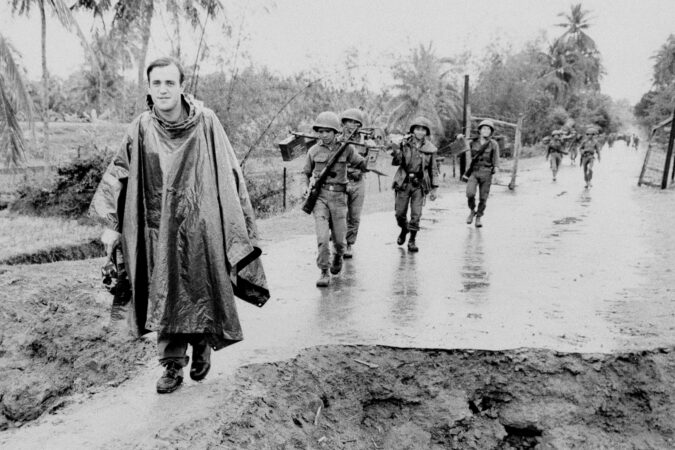
Peter Arnett was already an accomplished combat correspondent in 1966 when he embedded with an American infantry battalion tasked with routing out enemy snipers from a tunnel system near Saigon. Mr. Arnett was standing next to the unit commander when bullets tore through the map the officer was holding, hitting the colonel in the chest.
Medics ran up to bandage Lt. Col. George Eyster, a West Pointer who died the next day at a field hospital. Mr. Arnett wrote his obituary, which was among the scores of stories he filed from the humid jungle battlefields of Vietnam for more than a decade. He won the Pulitzer Prize for international reporting that year.
Mr. Arnett stayed in Vietnam beyond the very end. When Viet Cong guerrillas entered the Associated Press bureau during the 1975 fall of Saigon, his boss Nate Polowetzky told him to get out of there. Mr. Arnett refused. “He told me, in effect, to go screw myself,” Polowetzky said.
The New Zealand native would go on to cover more wars (15 to 20, he said), including the Gulf War. He was one of the few Western reporters in Baghdad in January 1991 when allied missiles started raining down, reporting live from the city for CNN. He interviewed Saddam Hussein in the second week of the war, and in 1997, Osama bin Laden.
When Mr. Arnett asked bin Laden about his plans, the 9/11 mastermind replied: “You’ll see them and hear about them in the media. God willing.”
Mr. Arnett died Wednesday at 91, in Newport Beach, Calif. The cause was prostate cancer, said his daughter, Elsa Arnett.
After arriving in Vietnam, Mr. Arnett was given lifesaving advice from one of his AP colleagues, Malcolm Browne: Lie prone under fire; look for cover and move toward it; do not get close to a radioman or medic because they are prime targets; and if you hear a shot, don’t get up to see where it came from because the second shot might get you.
Mr. Arnett, one of the most famous journalists of his era, wrote gripping battlefield stories that transported readers sitting in their living rooms to the scene of the news.
The stories that won him the Pulitzer included a dispatch about an Army captain who watched helplessly as a Viet Cong machine gunner kept pummeling the body of one of his men, rolling it over and over. In a story titled “Everyone Knew the Americans Were Coming,” Arnett wrote on a failed U.S. mission aimed at hunting down Viet Cong fighters who easily got away.
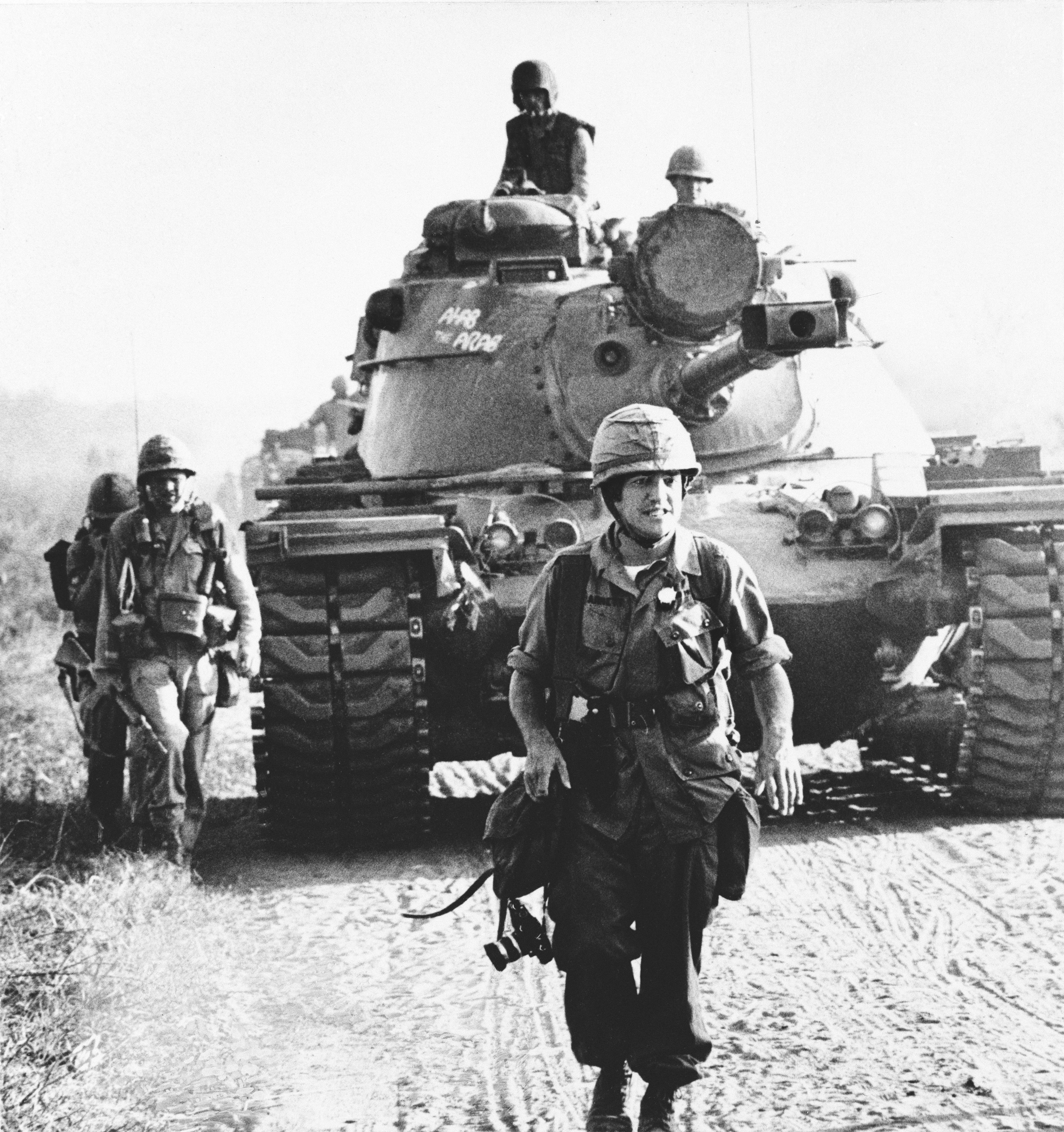
Peter Arnett walks in front of a U.S. tank in Vietnam in 1967.
Reporting on the Vietnam War forced Mr. Arnett to repress his human instincts. On one hot day at the Saigon market, Mr. Arnett watched a Buddhist monk squat on the pavement and douse himself in gasoline before flicking a lighter.
“I could have prevented that immolation by rushing at him and kicking the gasoline away,’” Mr. Arnett recalled. “As a human being I wanted to. As a reporter I couldn’t. … If I had stopped him, the [South Vietnamese] secret police who were watching from a distance would have immediately arrested him and carried him off to God knows where. If I had attempted to prevent them doing this, I would have propelled myself directly into Vietnamese politics. My role as a reporter would have been destroyed.”
Instead, Mr. Arnett photographed the burning monk and dashed back to his office to write his story.
But Mr. Arnett’s eagerness to report entangled him in controversy. In the Gulf War, as one of the few Western journalists reporting from behind enemy lines in Iraq, he was granted access by Hussein’s regime to what officials said was an industrial plant that produced milk powder and was the only source of infant formula in Baghdad. It had been hit by U.S. bombs.
Mr. Arnett reported on CNN what he saw and heard, and went to bed. The next day, he learned that he had reported on “one of the most controversial stories of my career.” U.S. officials disputed the claim that the factory made baby milk powder and instead alleged it was used for the production of biological weapons protected by the Iraqi military. White House officials called him a “conduit for Iraqi disinformation,” while Rep. Laurence Coughlin (R., Pa.) called him the “Joseph Goebbels of Saddam Hussein’s Hitler-like regime.”
Sen. Al Simpson (R., Wyo.) went so far as to accuse the brother of Mr. Arnett’s Vietnamese-born wife of being a Viet Cong operative. (Simpson later apologized, saying there was no evidence to prove that claim.)
Mr. Arnett kept reporting, showing the damaged buildings in the town of Al-Dour that Iraqi officials said had been hit by U.S. and allied bombs and had resulted in 24 civilian deaths.
“There was nothing in his tone that was judgmental, nothing that indicated sympathy for the Iraqis,” wrote Howard Rosenberg, the Los Angeles Times’s TV critic. “Without interpretation, he reported only what he said he saw, accompanied by the appropriate disclaimers regarding censorship.”
In 1999, Mr. Arnett left CNN after being involved in a story that alleged that the U.S. military had used deadly sarin nerve gas on deserting American soldiers during the Vietnam War. When a subsequent Pentagon investigation said there was no evidence of sarin gas ever having been shipped to Southeast Asia and disputed other key portions of the story, CNN retracted it.
Mr. Arnett faced further criticism in 2003, when he gave an interview to Iraqi state television.
“It is clear that within the United States there is growing challenge to President Bush about the conduct of the war and also opposition to the war. So our reports about civilian casualties here, about the resistance of the Iraqi forces … help those who oppose the war,” he said.
The remarks sparked backlash from the administration of President George W. Bush and lawmakers from both parties. His employer, NBC, initially defended him, saying the remarks were “analytical in nature,” but eventually fired him, saying it had been wrong for Mr. Arnett to “grant an interview to state-controlled Iraqi TV — especially at a time of war — and it was wrong for him to discuss his personal observations and opinions in that interview.”
Peter Gregg Arnett was born in Riverton, New Zealand, on Nov. 13, 1934.
He began his journalism career in his country of birth, writing for the Southland Times newspaper. Restless and bored, he left his home country seeking adventure. When he arrived in Southeast Asia, he decided to stay, enchanted by the “opium smugglers, revolutionaries and obscure little wars in obscure little kingdoms.”
He ended up reporting from Thailand and Indonesia before he arrived in Vietnam.
In Vietnam, he worked and competed with the other big-name journalists including David Halberstam and Marguerite Higgins.
He became a naturalized U.S. citizen in the mid-1980s while CNN’s Moscow bureau chief. Mr. Arnett thought it was important that he should be an American citizen because he was representing an American news organization, according to his family. Mr. Arnett said in a 2015 interview that his U.S. citizenship “solidified my credentials to challenge American policy.”
“I was perfectly happy to be a New Zealander, and it wasn’t an issue in my work. The Associated Press and CNN were more interested in the journalism than the nationality,” Mr. Arnett said. He added, however, that there were “a lot of comments during the Gulf War” about his foreign origins.
“But the point was, I was an American. If I hadn’t been, it would have been a way to further discredit my journalism.”
He met Nina Nguyen Thu-Nga, a South Vietnamese woman, while covering the war. He married her and they had two children, Andrew and Elsa, before divorcing in 1983. His frequent and extended travels abroad were to blame, according to Mr. Arnett’s family. They remarried in 2006 and stayed together until his death.
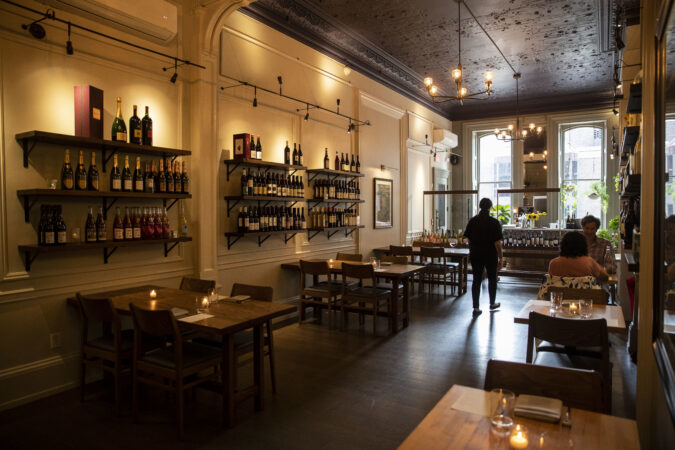
Do you love having someone else make wine decisions for you? We’ve got great news: Local wine clubs have been popping up all over Philly. These mostly monthly subscriptions let you avoid decision paralysis and stock your wine rack with fun, thoughtfully selected bottles. Membership in many bottle shop-hosted clubs scores you further discounts (and in one case, cheap pizza), while winery-run subscriptions often give you access to special events.
Curated wine clubs have only recently taken off in Philly. This historically came down to logistics: Independent wine-sellers can only offer packages for pickup; they cannot ship or deliver wine to your doorstep, per the Pennsylvania Liquor Control Board (whose state stores can ship). This is a nonissue for some consumers but can feel like yet another errand to others. Building out club packs can also be a storage nightmare for small shops that already struggle with lack of space.
Practical hurdles aside, wine-centric businesses are figuring out how to make clubs work. The customer demand is there; clubs offer a storytelling moment and reason to try wines you may never have tasted otherwise. There’s a new wealth of local options, and you can set up memberships — or snag a last-minute Christmas gift for your favorite wine lover — without having to leave your house.
Neighborhood shops
Le Virtù
This club is so well thought-out that even pickup is a fun adventure: It doubles as tasting social. Members can hang out while enjoying complimentary snacks and tastes of that month’s wines, plus a few additional bottles. Bring a friend if you’d like (non-members may join the tasting for $20). It’s one of the most fun spins on happy hour around. Le Virtu offers two-, four-, and five-bottle packages, focusing on small producers from Southern Italy. Pickup and the tasting social are the first Wednesday of every month.
The Leb Nat gold ruby (left) and the Matic pinot gris rose at Jet Wine Bar on Aug 11, 2020.
Jet Wine Bar
Owner Jill Weber has been serving wines from lesser-known regions around the globe since opening Jet 15-plus years ago. What else would you expect from an archaeologist who pulls double duty running a wine bar? The monthly club selections (two bottles for $55, or three with varying cheese pairings for $89) have the same quirky-cool range as Jet’s by-the-glass offerings. One month the wines may be from Georgia and the next, maybe Mexico or a mix from mountainous regions. Each set has a different narrative, and a blog page written by Weber gives the how, what, and why behind them. If you love trying new, often-obscure things, this is the club for you. Pickups start the first of each month.
This shop is already the go-to for many West Philly-based wine lovers, and their club offering — which rotates themes monthly — is also great. A subscription is $99 for four bottles per month, and membership also gets you a tote, wine key, and a 10% discount on any cheese and charcuterie to-go. Sign up in advance. Pickup begins on the first day of each month.
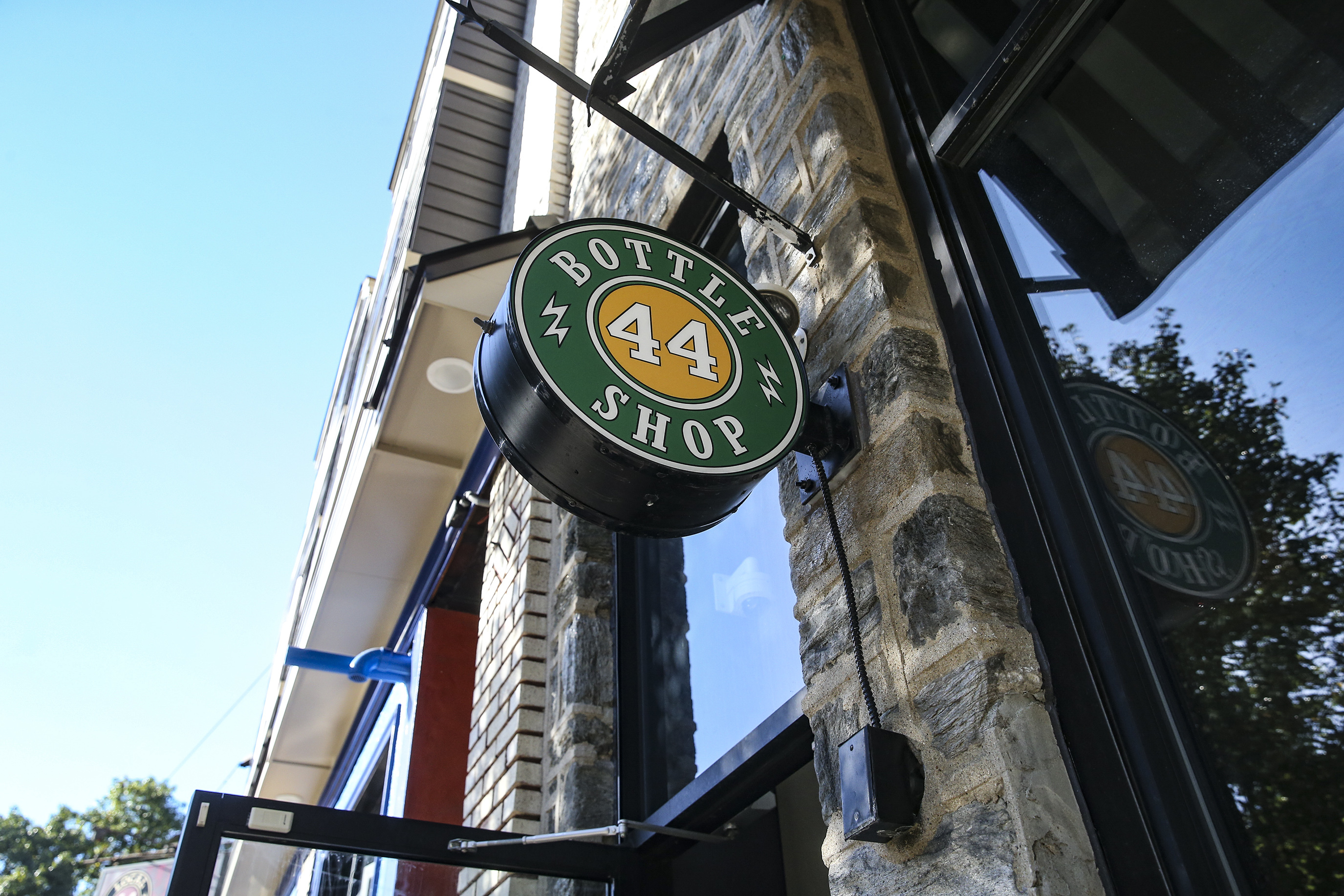
Local 44 is West Philly’s go-to bottle shop. Its wine club is worth investigating.
Fishtown Social
This Fishtown wine bar keeps its club format as simple and friendly as possible. A no-commitment $55 membership gets you two monthly bottles and a 10% discount at the shop on pickup day. An e-newsletter gives the rundown on the featured natural wines, producers, and regions, as well as tasting notes and pairing suggestions. Pickup takes place the first Monday of every month.
Sign up for the wine club at this forward-thinking coffee/wine shop and choose to get two or four bottles monthly ($75 and $125, respectively). Each month features a partnership with a different small wine importer, aka the folks who do the behind-the-scenes legwork to get small-production wines into Pennsylvania. If you prefer to curate your own, Herman’s just released a listing of specialty bottles that you can ask staff to order on your behalf.
Supérette’s wine club is French-y (but not exclusively so).
Supérette
Supérette wine director and Superfolie GM Kait Caruke and owner Chloé Grigri have been best pals in wine since 2017, a relationship that naturally evolved into collaborating on the wine programs for Superfolie and Supérette. Coucou wine club is their first venture into curating a monthly subscription, a celebration of the natural-minded producers — often French, but not always — they scoop up and pop open together on the regular. There are two offerings: a party pack ($75) to drink immediately or a collector’s club ($125) for bottles that you can enjoy now or age for later. Both clubs come with pairing suggestions, discounts in the wine shop, and early access to special events. Sign-ups close at the end of month for the following month’s pickup, which takes place the first Wednesday of each month.
This friendly wine club is so popular, there’s a waitlist to get in. For $50 per month, the Sally team picks two natural wines — chosen for their seasonality, stories, and mood — for you to take home. A cheese pizza can be added for an additional $10, which feels like a dream date night in the making. Pickup days are communicated at the beginning of each month. Membership also scores you 15% off regular wine shop purchases. Win, win, wine.
The Tibouren Rose at Vernick Wine, which runs a monthly wine club.
Vernick
This tried-and-true club has been around since 2020, continually refining and keeping the offerings classic, thoughtful, and interesting — the same ethos as the restaurant. Members receive four bottles each month for $100, as well as tasting notes and pairing ideas. Membership can be as flexible as month-to-month, but those that sign up for a full year get one month free. Pickup is the 15th of each month.
This urban winery has done a lot in a year since relocating from Oregon to Philly: classes, events, collaborations, dinners, being featured on the menus of nearly all the Michelin- recognized restaurants in Philly. Partners Tom Caruso and Sydney Adams are clearly working their tails off to share their wines all around the city, so it’s no surprise that they have an excellent wine club, to boot. This is one of the few quarterly offerings, with plans ranging $100 to $125 based on which three bottles are featured. Members also receive discounts on flights at the winery, branded glasses, and merchandise, plus first access to events. If you don’t want to trek to East Kensington, shipping is available to 38 states, including Pennsylvania and New Jersey.
A WAYVINE vineyard in the foreground and the WAYVINE winery in the background in Nottingham, Chester County, on Aug. 20, 2022.
Wayvine
Make your wine club double as a real-life experience. This Chester County winery’s club members can choose an annual 12- or 24-bottle subscription, split into twice-yearly shipments or pickups. Additional perks include tastings for the member and (depending on membership level) five to 10 guests, plus complimentary T-shirts and wine glasses, 5% off merchandise and artwork, and invitations to members-only experiences, including two annual pickup parties where you’ll mingle with the Wayvine family. Set in Nottingham’s rolling hills, the winery has its own Airbnb if you want to make it an overnight; members get a discount on that, too, pending availability.
This is the least traditional club offering on this list, which is also why it’s so compelling. This tiny but mighty minimal-intervention winery out in Christiana, Pa., provides memberships only to those who buy one to two cases of their wines, which you can do online. Perks include visits to their Lancaster County vineyard (members only, by appointment)as well as invitations to guest-chef events, private barrel tastings with owner/winegrower Ed Lazzerini, and complimentary samples during tasting room hours.
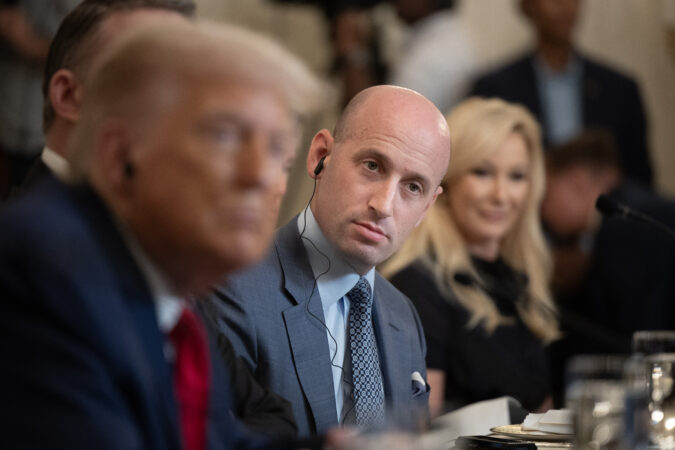
President Donald Trump’s homeland security adviser, Stephen Miller, and other senior officials were looking for a fight.
In the first months of the administration, Miller, the architect of Trump’s anti-immigration and border policies, and his team discussed starting a new war on drugs by striking cartels and alleged traffickers in Mexico, according to one current and two former U.S. officials.
Reducing the power of cartels, an idea that dated back to the first Trump administration, would ease the flow of migrants and narcotics, creating early political wins. But as the administration surged thousands of U.S. troops to the southern border, increased U.S. surveillance flights and boosted intelligence sharing with its neighbor, Mexican military operations across the border curbed cartel action, the people said. That left Miller and his team looking for another target.
“When you hope and wait for something to develop that doesn’t, you start looking at countries south of Mexico,” said the current official, who, like nine others interviewed for this story, spoke on the condition of anonymity because of the matter’s sensitivity.
The campaign that emerged in the Caribbean Sea and eastern Pacific Ocean is unprecedented in its use of lethal force by the U.S. military against alleged drug smuggling groups. These operations, which began Sept. 2, have evolved to embrace the Trump team’s long-running ambition to oust Venezuelan President Nicolás Maduro, whom the president has accused of overseeing “narco-terrorists” assaulting the United States.
A U.S. soldier is deployed along the U.S.-Mexico border as part of the Joint Task Force Southern Border mission, in Sunland Park, N.M., on April 4.
Miller has been a driving force behind the administration’s counternarcotics campaign, pressing for results and fresh military options that could be turned into future operations, the current and former officials said.
“President Trump’s counternarcotics policies come from President Trump himself,” White House spokeswoman Anna Kelly said. “All senior administration officials work closely together to carry out the agenda President Trump was elected to implement, including eliminating the scourge of narco-terrorism that takes tens of thousands of American lives every year.”
Miller could not be reached for comment.
Miller steered the drafting of a July 25 classified directive signed by the president that authorized the military to undertake lethal force against two dozen foreign criminal groups, said a former U.S. official familiar with the campaign and its evolution. The administration has labeled these groups “designated terrorist organizations,” accusing them of using drugs as a weapon to kill Americans, using a moniker that many experts say has no basis in law.
“The president’s memo is the original sin of the whole operation,” the former official said.
That presidential directive provided the foundational authority for an “execute order” that Defense Secretary Pete Hegseth issued on Aug. 5 and that subsequently has been modified. The order, details of which were previously unreported, contains permissive targeting guidelines for lethal operations, current and former officials said. The presidential directive’s existence was first reported by the New York Times.
Together, these two documents guided a military campaign of lethal strikes against criminal organizations, grafting a wartime frame to what has been traditionally treated as a law enforcement problem. The execute order also contains targeting criteria lifted from the language of the counterterrorism campaign against al-Qaeda and the Islamic State, which some current and former officials say give the Pentagon an overly permissive license to kill.
The department will treat suspected drug smugglers “EXACTLY how we treated Al-Qaeda. We will continue to track them, map them, hunt them, and kill them,” Hegseth said on social media last month.
Pursuant to these orders, the Trump administration has launched strikes on at least 26 boats, killing at least 99 people in the Caribbean Sea and eastern Pacific Ocean. The Pentagon has not publicly identified those killed, and it is unclear whether it has collected the intelligence to do so.
“The administration appears to have authorized a campaign against civilians and alleged criminals that is now stretching the limits of international law so that it’s now totally unrecognizable,” said Todd Huntley, a former military lawyer who advised Special Operations forces for seven years at the height of the U.S. counterterrorism campaign and is director of the national security law program at Georgetown Law.
The White House’s early deliberations about the use of lethal force against cartels contemplated using covert action by theCIA. But as resistance emerged from lawyers and others over the ensuing months, Miller and his team turned increasingly toward the idea of using the military to pursue alleged traffickers.
Miller’s larger vision was to reduce the flow of drugs — and migrants — into the United States. He figured that attacking cartels would diminish their power and help stabilize Latin American countries, resulting in fewer people risking the trek to the United States, according to one of the former U.S. officials familiar with Miller’s deliberations.
As the summer progressed, the White House’s campaigns against narcotics and migration coalesced with a long-held desire of Secretary of State Marco Rubio to force Maduro from power. Rubio and the Justice Department in August doubled to $50 million the reward for information leading to the Venezuelan leader’s arrest, citing an indictment for corruption and drug trafficking during the first Trump administration.
Meanwhile, the White House found a willing partner in Hegseth, who had been knockedoff stride by several missteps and was eager to show he could deliver on a high-priority mission.
“Pete very much wanted to keep Stephen in his good graces and also the president,” said the former official familiar with Miller’s thinking. “And that was a motivation for him — getting behind this campaign in an aggressive way.”
The Defense Department declined to address questions about its operations to strike alleged traffickers and how the mission took shape. Elements of Miller’s leading role were reported earlier by the Guardian.
“This reporting is inaccurate and is built on a false premise that ignores reality,” Pentagon chief spokesman Sean Parnell said in a statement. The department’s focus, he said, “is, and will continue to be, protecting the Homeland from any threat.”
Widening the scope
The Aug. 5 execute order,or EXORD in Pentagon parlance, stated that the campaign’s goal is to stop the flow of drugs by sea to the United States, two people said.
Initially, the order contained a geographic boundary that designated target areas in international waters off the coast of Venezuela, but it was modified about two months later to include the eastern Pacific area, one current and one former U.S. official said.It specified that at least for the initial strikes, Joint Special Operations Command would be in charge of operations, the two people said.
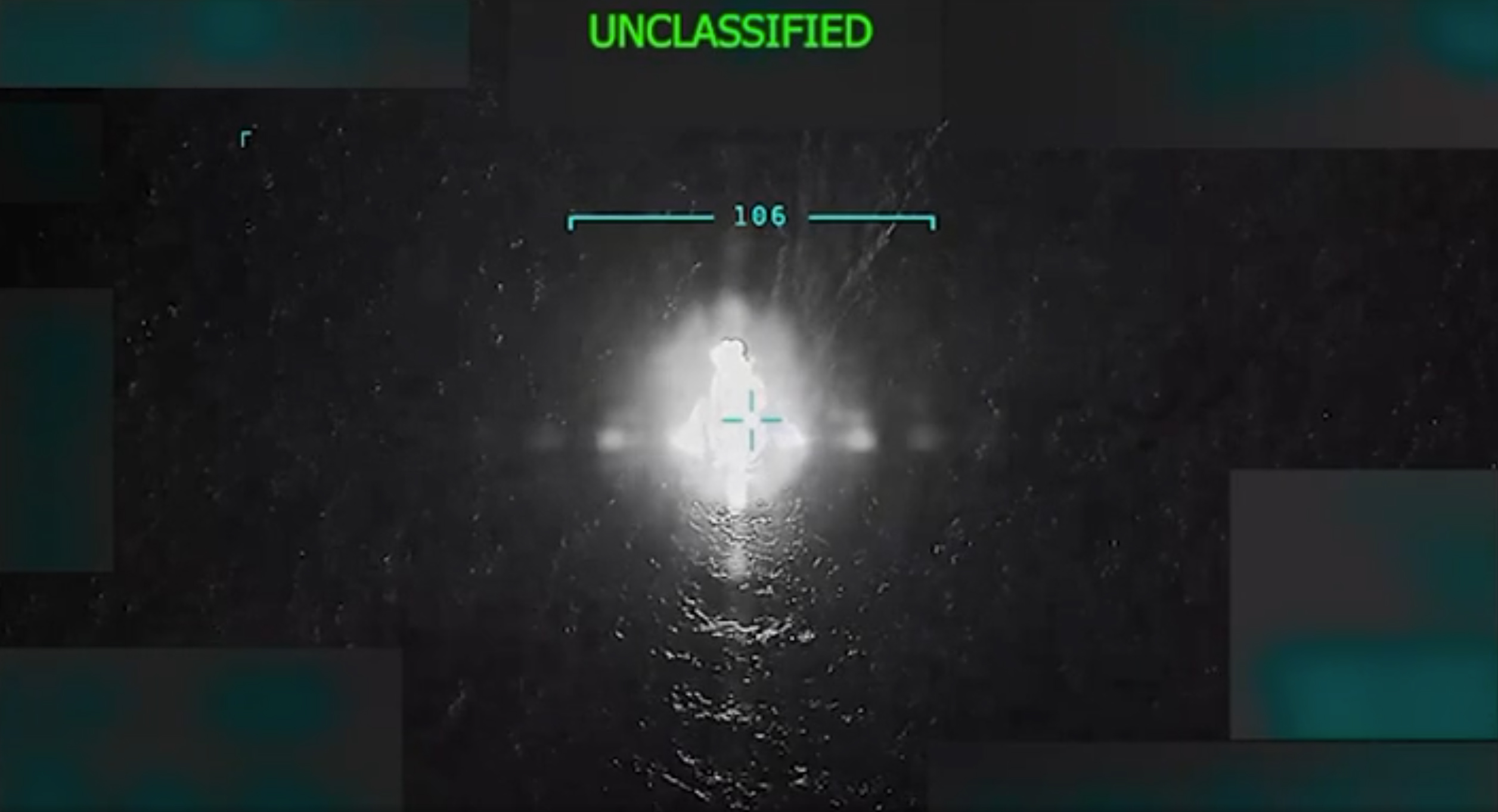
A still frame from a video posted on social media by President Donald Trump shows a boat allegedly transporting illegal narcotics after a lethal strike on Sept. 2, through U.S. military imagery.
Over the late summer and into the fall, lawyers and policy personnel raised concerns about the legality of the lethal force campaign that was taking shape. Administration officials sought to reassure them by saying that a Justice Department Office of Legal Counsel memo was being drafted that determined that the lethal targeting of suspected drug runners was lawful under the president’s power to ascertain that the U.S. is in a formal state of war — in this case with alleged drug traffickers.
But the opinion was not signed until Sept. 5 — three days after the first boat strike — and some career lawyers were not permitted to read the draft OLC memo before the execute order was issued, said the former official familiar with the campaign’s evolution.
The OLC memo, signed by Assistant Attorney General T. Elliot Gaiser, asserts that alleged drug trafficking groups are a threat to the United States akin to a foreign nation attempting to invade, Sen. Mark Kelly (D., Ariz.), who was allowed to read it in his capacity as a member of the Senate Armed Services Committee, told the Post in an interview.
The execute order contains targeting instructions that do not require positive identification of any individual but rather “reasonable certainty” that adult males are members of, or affiliated with, a “designated terrorist organization,” or DTO, according to five current and former U.S. officials familiar with the criteria. To mitigate civilian harm, the order requires “near certainty” that no women, children or civilians are present, they said.
The administration is using the phrase “designated terrorist organizations” to refer to 24 alleged drug trafficking groups whose activities it contends are killing millions of Americans.
The term, said Rebecca Ingber, a professor at the Cardozo School of Law and a former State Department law-of-war expert, “is entirely manufactured as a source of targeting authority with no basis in law.”
The list of 24 such groups appears in an annex to Trump’s July directive and also in the EXORD, according to one current and one former official.
The assessment of “affiliation” is based on a number of factors, including the presence of drugs on board the vessel and its route, as well as intercepts of communications, the current and former officials said.
As a result, the campaign may be killing individuals who in some cases have a tenuous link to any organized drug-running operation, said one of the former U.S. officials, who has read the execute order.
“When you define DTO and affiliate so loosely and you’re attacking boats, [the guidelines are] basically meaningless,” the former official said.
If the United States were actually at war, the reasonable certainty standard would be “perfectly reasonable,” said Ryan Goodman, a former Pentagon special counsel who worked on counterterrorism targeting issues in the Obama administration.
“Not being in an armed conflict changes everything,” he said. “The idea that a government would kill people on the basis of ‘reasonable certainty’ that they’re a member of a drug cartel is beyond the pale. Any U.N. body would find that to be a gross violation of human rights.”
Identification and delegation
The targeting requirements, four former officials say, resemble the “signature strikes” of past global counterterrorism campaigns, in which the CIA and the military launched drone attacks in Afghanistan, Pakistan and Yemen on individuals or groups whose identities were unknown but who were targeted based on a pattern of behavior or other characteristics associated with terrorist activity.
The execute order, which sets the rules of engagement for the military, designates Hegseth as the “target engagement authority” — the official who can approve strike targets. It also stipulates that he can delegate that authority to others in individual missions.
“Now, the first couple of strikes … as any leader would want, you want to own that responsibility,” Hegseth said at a cabinet meeting this monthin response to questions about the first boat strike, details of which — including a subsequent missile strike to kill survivors — were first published bythe Post. “So I said I’m going to be the one to make the call after getting all the information and make sure it’s the right strike.”
Pentagon general counsel Earl Matthews — who had just been confirmed by the Senate on July 29 with a 50-47 vote — signed off on the Aug. 5 order, said a person familiar with the matter. Lawmakers have for weeks requested a copy of the order and related documents but have not received them. Matthews did not respond to a request for comment.
President Donald Trump signed a classified directive that authorized the military to undertake lethal force against two dozen foreign criminal groups.
Trump has asserted, without offering proof, that the U.S. troops know who they are targeting in every case. “We know everything about them. We know where they live. We know where the bad ones live,” he told reporters this month.
The military knew the identities of all 11 people killed in the first attack of the campaign on Sept. 2, Pentagon officials have said. But “they don’t know all of the individuals on many of the other boats” in subsequent strikes, Sen. Mark R. Warner (D., Va.), vice chairman of the Senate Intelligence Committee, told ABC News on Sunday.
Trump posted on Truth Social the day of the first strike that the U.S. military had killed 11 “positively identified” members of the Venezuelan organization Tren de Aragua. He called them “narco-terrorists” operating “under the control of” Maduro, who has been condemned by both the Trump and Biden administrations for illegally retaining power after losing last year’s presidential election.
This week, the commander overseeing that operation, Adm. Frank M. Bradley, told lawmakers that the military knew one of the 11 was a member of Tren de Aragua and the other 10 were affiliates, according to three U.S. officials.
The U.S. intelligence community this year assessed that Tren de Aragua, a transnational crime syndicate, was not directed by Venezuela’s government.
Two family members of men killed on Sept. 2 did not deny that the boat was smuggling marijuana and cocaine. But they said Trump’s allegation the men had worked for Tren de Aragua was inaccurate.
“I knew them all,” one of the family members told the Post in October, speaking on the condition of anonymity for fear of retribution. “None of them had anything to do with Tren de Aragua. They were fishermen who were looking for a better life” by smuggling contraband.
In some of the strikes, the targets who have been identified are not high-level operators or cartel bosses, lawmakers said. “It’s one thing to be a narco-terrorist and another thing to be a fisherman that’s getting paid a hundred bucks a couple times a year … to supplement his income” to ferry drugs, Warner told reporters at the Defense Writers Group last week.
Lifting language from the ‘war on terror’
The Aug. 5 execute order adopts the language of previous administrations in successive global counterterrorism campaigns after 2001, but the context is vastly different, current and former officials say.
The fight against ISIS in Iraq from 2014 on generally involved clearing terrain of fighters who often barricaded themselves in buildings in cities teeming with civilians, and U.S. troops were often firing in self-defense at militants shooting at them, former Special Operations personnel said.
In the drug boat campaign, the U.S. military is launching munitions from afar, more like the counterterrorism operations in Yemen and Somalia during the Obama and first Trump administrations.
Under President Barack Obama, outside areas of active hostility, the targeting guidelines required that lethal force be used only when capture was not feasible and only to prevent attacks against U.S. citizens or when targets posed a continuing imminent threat. They required “near certainty” that a target was a member of a terrorist organization.
“Generally you had people swearing allegiance” to a group like al-Qaeda as an indicator of membership, said the former U.S. official, who is familiar with the counterterrorism targeting criteria. “So you had the presence of weapons and good intelligence on planning you could point to, to link people to the group and say this person is a planner of attacks, this is the money guy, this is a recruiter, etc.”
The standard was changed to “reasonable certainty” under the first Trump administration. But for all practical purposes, said a former senior military officer involved in special operations and battle in the Middle East, the military was applying the “near certainty” standard in these areas. The standard was returned to near certainty under Biden.
“In places like Yemen, whether it was under Obama or Trump,” the retired officer said,“we knew who we were going after. We knew what their place in the network was. We knew what the effects of removing them would be on the network. I don’t see that in some of what [the U.S. is] doing right now.”
One major contextual difference in the current operations against seaborne narcotics is the lack of congressional authority. In the battles against al-Qaeda and associated forces, Congress explicitly authorized the campaigns, giving the president permission to use “all necessary and appropriate force” against those who attacked the United States on Sept. 11, 2001.
The execute order and subsequent targeting guidelines were grounded in the 2001 congressional authorization to use military force.
In 2013, during the Obama administration, the “near certainty” standard typically required confirmation via two sources of intelligence, said Huntley, the former military lawyer for Special Operations forces.
A combination of intelligence tools — signals intelligence, eavesdropping, human spies, and drone surveillance — would contribute to a “positive identification of the individual,” Huntley said. To get to “near certainty” that civilians were not present, the attack location was usually a remote area or a place known to be frequented by only members of the terrorist organization that Congress had specifically authorized as a viable target.
If U.S. officials know the identities of who they are striking, as Trump and Hegseth maintain, then they should release them, the former senior military officer said. “It would help build the case,” he said, that the military is acting to protect civilians according to the law of war.
‘Anybody … is subject to attack’
Though the administration’s charges against Maduro have merit, its claims that Venezuela is sending massive amounts of drugs to America do not, analysts and officials have said.The main domestic drug scourge is fentanyl, a synthetic opioid produced in Mexico, not Venezuela.
Many strikes taken have been in the Pacific, the main sea lane used by traffickers from Colombia and Ecuador. Drug running in the Caribbean focuses mainly on non-U.S. markets, such as Europe. The lethal strike on Sept. 2, for instance, targeted a boat carrying cocaine ultimately bound for Suriname, officials have said.
That absence of information has prompted speculation that the larger buildup of U.S. forces in the region is a preparation for an attack on Venezuela. Miller has indicated to colleagues that a strong reaction from Caracas could provide the reasoning to invoke the Alien Enemies Act to quickly deport hundreds of thousands of Venezuelan immigrants from the United States, the former official noted.
This month, Trump suggested that he wanted to go after Colombian targets. “I hear the country of Colombia is making cocaine,” he said. “They have cocaine manufacturing plants. And then they sell us their cocaine. … Anybody that’s doing that and selling it into our country is subject to attack.”
He also has stepped up the pressure on Venezuela, seizing an oil tanker last week off that country’s coast.
“He wants to keep on blowing boats up until Maduro cries uncle,” Trump’s chief of staff, Susan Wiles, told Vanity Fair in an article published this week. “And people way smarter than me on that say that he will.”
On Tuesday, Trump announced in a social media post a “total and complete blockade” of all sanctioned oil tankers entering or leaving Venezuela, further ratcheting up the pressure.
On Wednesday, Miller amplified Trump’s post, commenting: “American sweat, ingenuity and toil created the oil industry in Venezuela. Its tyrannical expropriation was the largest recorded theft of American wealth and property. These pillaged assets were then used to fund terrorism and flood our streets with killers, mercenaries and drugs.”
Trump, meanwhile, has been signaling that the campaign is widening.
“We knocked out 96 percent of the drugs coming in by water,” he told reporters Friday in the Oval Office. “And now we’re starting by land, and by land is a lot easier, and that’s going to start happening.”
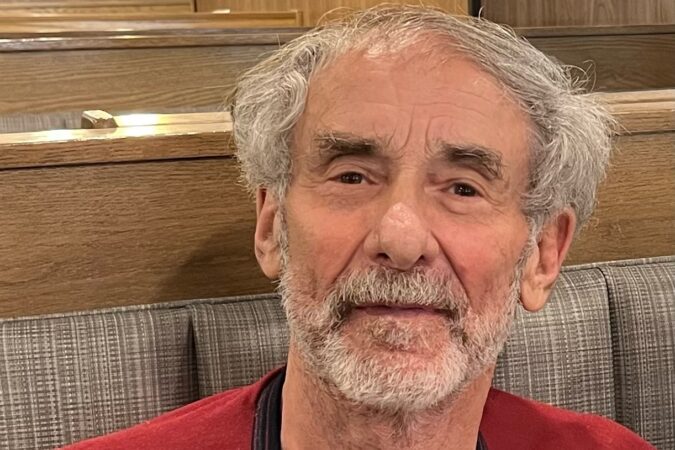
Craig Kellem, 82, of Philadelphia, former talent agent, celebrated TV producer, show developer, writer, longtime script consultant, author, and “comedic genius,” died Monday, Nov. 24, of complications from dementia at Saunders House assisted living in Wynnewood.
Born in Philadelphia, Mr. Kellem moved to New York as a teenager and, at 22, burst onto the entertainment scene in 1965 as a talent scout and agent for what was then called Creative Management Associates. He rose to vice president of the company’s TV Department and, over the next 30 years, served as director of development for late night, syndication, and daytime TV at 20th Century Fox Television, vice president of comedy development at Universal Television, and executive vice president of the Arthur Co. at Universal Studios.
He worked with fellow TV producer Lorne Michaels at Above Average Productions in the 1970s and was a popular associate producer for the first season of Saturday Night Live in 1975 and ’76. He was quoted in several books about that chaotic first season, and his death was noted in the show’s closing credits on Dec. 6.
At Universal Studios, he created and produced FBI: The Untold Stories in 1991.At Universal Television in the 1980s, he developed nearly a dozen shows that aired, including Charles in Charge andDomestic Lifein 1984. In 1980, he developed Roadshow for 20th Century Fox Television.
Mr. Kellem worked for years in New York and Los Angeles.
“He had a lot of energy and ideas,” said his wife, Vivienne. “He had a creative spirit.”
His producing, creating, developing, and writing credits on IMDb.com also include The Munsters Today, The New Adam-12, Dragnet, and What a Dummy. He produced TV films and specials, and worked on productions with Eric Idle, Gladys Knight, Sammy Davis Jr., and the Beach Boys.
“He loved working with writers,” his daughter said. “He was super creative. It was part of his essence.”
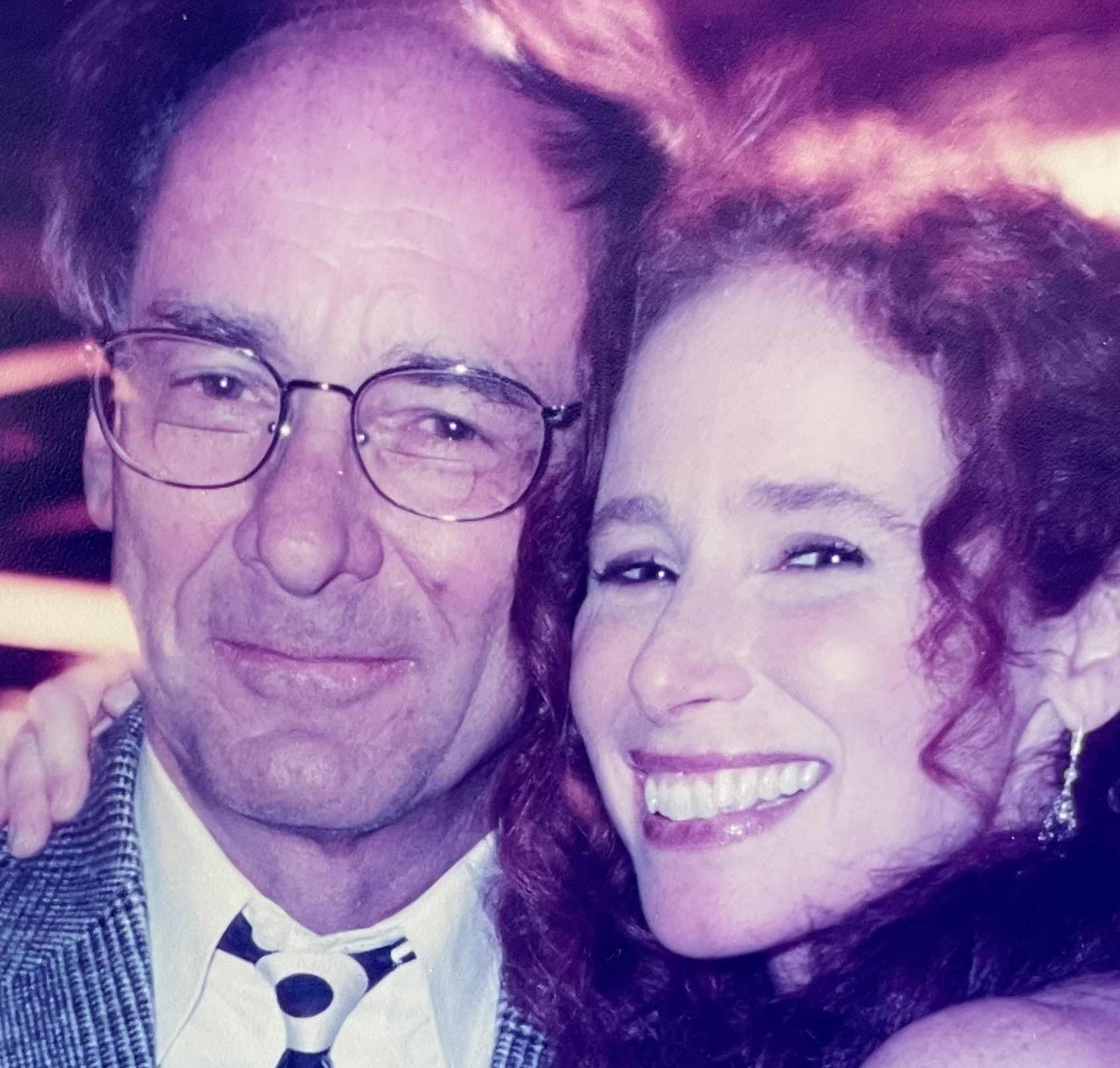
Mr. Kellem enjoyed time with his daughter Joelle (left) and his wife Vivienne.
As an agent in the 1960s and ’70s, Mr. Kellem represented George Carlin, Lily Tomlin, and other entertainers. His eye for talent, dramatic timing, and sense of humor were legendary.
“My dad’s humor opened hearts, tore down walls, and allowed people to connect with each other’s humanity, vulnerability, and spirit,” said his daughter Joelle. His daughter Judy said: “He was a comedic genius.”
His wife said: “He was a fascinating, funny, loving, and sensitive man.”
Craig Charles Kellem was born Jan. 24, 1943. He grew up with a brother and two sisters in West Mount Airy, played with pals in nearby Carpenter’s Woods, and bought candy in the corner store at Carpenter Lane and Greene Street.
Mr. Kellem and his son, Sean.
“Craig was like a father to me,” said his brother, Jim. “He helped guide my children and was always there for the whole family.”
He graduated from high school in New York and moved up to senior positions at Creative Management Associates after starting in the mailroom. He married in his 20s and had a daughter, Judy.
After a divorce, he met Vivienne Cohen in London in 1977, and they married in 1980, and had a son, Sean, and a daughter, Joelle. He and his wife lived in California, Washington, New Hampshire, and New Jersey before moving to Fairmount in 2017.
Mr. Kellem enjoyed movies, walking, and daily workouts at the gym. He volunteered at shelters, helped underserved teens, and routinely carried dog treats in his car in case he encountered a stray in need. “That’s the kind of man Craig was,“ his wife said.
Mr. Kellem and his daughter Judy operated their own writing consultation business together for years.
His son, Sean, said: “My dad’s personality was big, and he was deeply compassionate toward other human beings.” His daughter Joelle said: “He was an open, sensitive, warm, and passionate human being who believed deeply in the work of bettering oneself and taking care of others.”
His daughter Judy said: “They don’t make people like my dad.”
In addition to his wife, children, and brother, Mr. Kellem is survived by four grandchildren and other relatives. Two sisters died earlier.
A Malvern man who brought a gun and other weapons to a “No Kings” protest in West Chester over the summer — and who was rearrested days later after police found homemade bombs at his house — pleaded guilty in federal court Thursday morning.
Kevin Krebs, 32, said little while pleading guilty to a charge of possessing an unregistered firearm or explosive device. Krebs had been taken into federal custody this fall, and the U.S. Attorney’s Office charged him earlier this month by information, a process that typically indicates a defendant plans to plead guilty.
The charges against him relate to his conduct in West Chester six months ago. On June 14, Krebs was arrested by local police after other attendees at a “No Kings” protest in the borough told authorities they thought they had seen Krebs carrying a gun.
When police stopped Krebs and searched him, they found a loaded Sig Sauer handgun along with extra rounds of ammunition, a knife, a bayonet, pepper spray, and other weapons, prosecutors said. He also had an AR-15 rifle in his car nearby.
Krebs did not have a concealed carry permit for his handgun, and he was charged with illegal gun possession.
Two days later, police searched his home on Conestoga Road and found 13 homemade pipe bombs, prosecutors said, as well as components used to make detonators, tactical vests, and bullet-resistant armor. Some of the bombs had nails and screws inside, which are often added to improvised explosive devices to increase the amount of shrapnel they can generate.
Krebs was initially charged by Chester County prosecutors, who said his political beliefs or potential motives were not straightforward.
Krebs was a registered Democrat but had previously been registered as a Republican and said online that he voted for President Donald Trump. In online postings, he later said he came to regret that vote, and in the weeks preceding the “No Kings” protest he had been posting violent rhetoric aimed at Trump and police officers.
Before his arrest, Krebs was a licensed electrician and onetime Home Depot employee. His attorneys and relatives previously said he had been diagnosed with autism and Asperger’s syndrome.
Krebs is scheduled to be sentenced in March by U.S. District Judge Mary Kay Costello. He faces a maximum penalty of 10 years in prison.
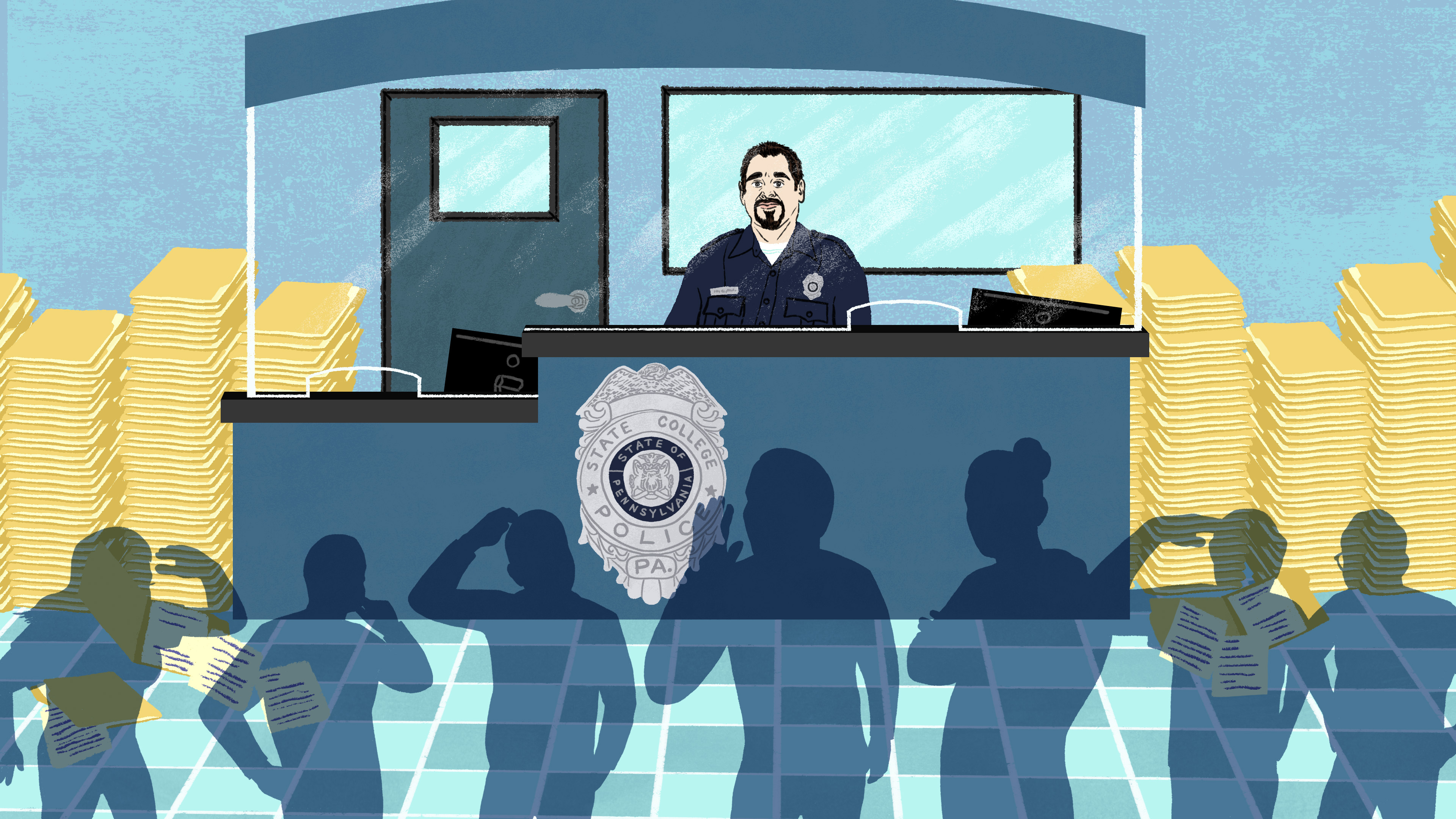
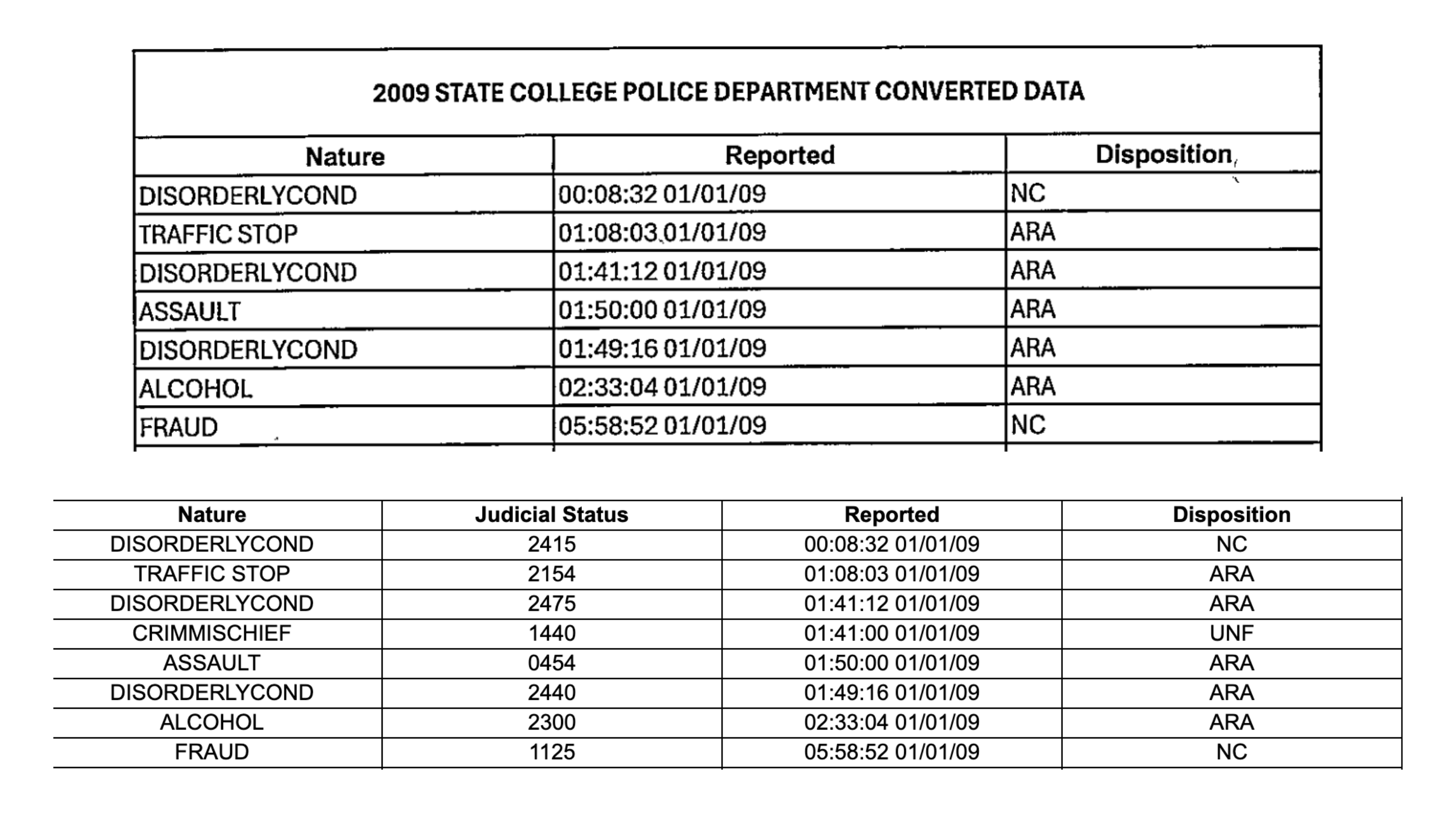
Over the span of nearly a decade, the State College Police Department underreported hundreds of rapes in the central Pennsylvania community, leading to highly inaccurate publicly reported crime statistics, Spotlight PA has learned.
From 2013 to 2021, State College police reported a total of 67 rapes in crime submissions to Pennsylvania State Police, when in fact there had been 321 — a 254-case difference — according to a 10-month Spotlight PA investigation.
Those missing cases were instead classified as sex offenses, a category with lower penalties and one that is treated with less urgency by law enforcement. In response to Spotlight PA, the department conceded it had been using an outdated definition of rape until late 2022 — despite the federal government announcing a change to it in 2012, and that update being subsequently implemented by thousands of police agencies across the U.S. in 2013.
Under the old definition, “a vast array of violent, degrading, abusive sexual assaults were excluded from the data that are used to inform the public about the prevalence of rape,” said Lila Slovak, director of the Women’s Law Project’s Philadelphia office.
Crime statistics in a place like State College, nicknamed “Happy Valley,” are particularly important because it is a college town. Most Pennsylvania State University students live off campus, and federal law requires the school to report only crimes that occur on its premises, on its property, and in public places right next to it.
State College Police Chief John Gardner told Spotlight PA that he was not aware until 2022 that the FBI had updated its definition of rape. He learned when a department records supervisor that year completed a training and implemented the change. Gardner’s predecessor, Tom King, who retired from the department in 2016, said he learned about the incorrect reporting only when contacted by Spotlight PA this summer.
But the department had never acknowledged the longstanding error or disclosed it to the public until approached by Spotlight PA about potential data discrepancies. The department calculated the number of affected cases after Spotlight PA requested a review.
“The inaccurate reporting was not done intentionally,” said Gardner, who is retiring at the end of this year. “The minute we found out about it, we made the correction, and we’re open to sitting down and talking to you about it. We owned it.”
“We want to make this community safe and want people who live here to feel safe,” he said.
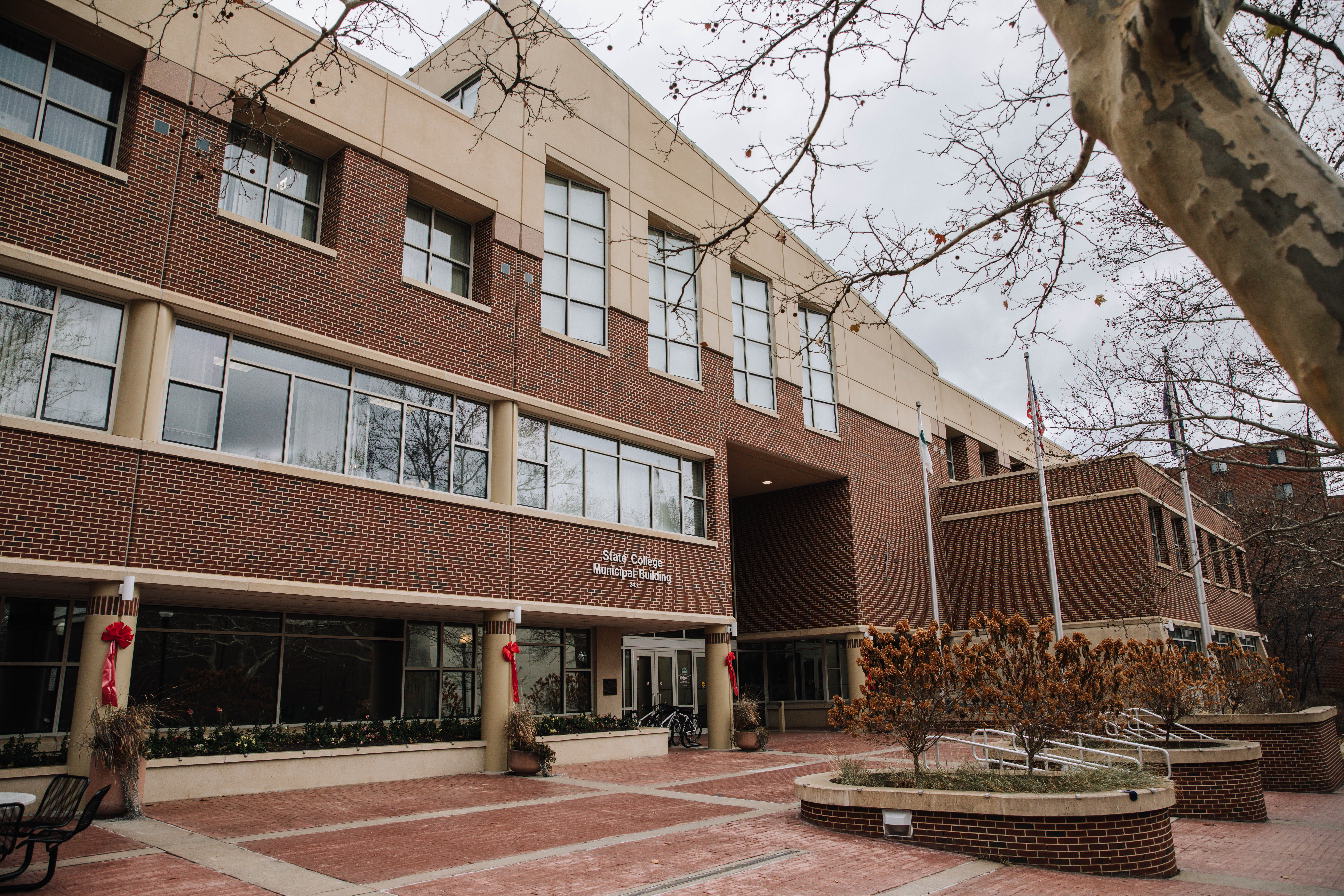
The police department is located on the first floor of the borough building in downtown State College.
Pennsylvania State Police share crime statistics from local departments, including State College, with the FBI’s Uniform Crime Reporting Program, known as UCR. Those figures influence numerous aspects of life in a community and help governments decide where to deploy resources and direct public funds.
Criminologist Eli B. Silverman, professor emeritus at John Jay College of Criminal Justice, said accurate data are also key to good policing and maintaining trust with the community.
“When crime statistics lose their credibility, the public loses confidence in the police and is less inclined to report crime,” Silverman said. “This, in turn, further diminishes the effectiveness of [a] police organization.”
Over the course of Spotlight PA’s investigation, the newsroom found other potential issues with the department’s handling of reported rapes.
For years, rape cases were habitually described as “assaults” in internal police records, Spotlight PA found. The newsroom also questioned whether factors other than the new definition made previous rape numbers appear low, especially as top officials in the department did not seem clear on how crime reporting works, and at times offered confusing or incorrect information.
Additionally, Spotlight PA identified a case in which two victims reported rapes and the police recorded only one. One police official told reporters that rapes are counted by incident, not by victim — going against well-established FBI rules and indicating a violation separate from underreporting.
Police appear to be “trying to minimize the extent of sexual assault in State College,” Cassia Spohn, a criminologist and professor at Arizona State University, told Spotlight PA. “Doing so can produce a false sense of security among potential victims, leading eventually to an increase in victimization and a decline in public safety.”
Before this investigation was published, Spotlight PA sent a detailed list of findings to police officials and State College borough.
In response, the department offered a joint statement from Gardner, King, longtime State College Borough Manager Tom Fountaine, and State College assistant police chief Matthew Wilson, expressing “a great level of dissatisfaction.”
“The information presented appears to be more representative of an op-ed article than an objective reporting piece. The information you provided for our review is largely misleading and omits perspectives from community stakeholders,” the statement said in part. Read the full response here.
‘I don’t recall’
For more than 80 years, the FBI defined rape as “the carnal knowledge of a female, forcibly and against her will.” That meant only forced attacks involving penetration of the vagina by a penis were considered rape.
This left out things like forced oral or anal sex, and sex acts that were committed against someone’s will but without force. Attacks on men or boys were also not counted.
That longstanding definition was “narrow, outmoded and steeped in gender-based stereotypes,” the Women’s Law Project wrote in a 2001 letter to then-FBI Director Robert Mueller.
In 2012, the FBI announced it would broaden its definition of rape to “ensure justice for those whose lives have been devastated by sexual violence,” then-U.S. Attorney General Eric Holder said at the time.
“This new, more inclusive definition will provide us with a more accurate understanding of the scope and volume of these crimes,” Holder added.
Leading national organizations for police and sheriffs backed the change, as did women’s organizations and anti-rape groups.
Under the new definition, rape is: “Penetration, no matter how slight, of the vagina or anus with any body part or object, or oral penetration by a sex organ of another person, without the consent of the victim.”
John Derbas, a former deputy assistant director of the FBI, told Spotlight PA that by 2015, 15,000 law enforcement agencies across the nation had adopted the reform.
David Hendler, who oversees records at the Abington Township Police Department in Montgomery County, said both he and his predecessor knew about the change when he started working in the department in 2013. Officers talked about it among themselves, he told Spotlight PA.
“Every cop I knew knew about it,” Hendler said.
Yet King, who led State College police from 1993 to 2016, said word never reached him. He was not aware that State College police were incorrectly reporting rapes until Spotlight PA contacted him this summer, he said.
“I don’t recall it. In 2025, as we sit here talking about it today, I don’t recall,” King said in an August interview. He questioned who within the department might have been contacted by Pennsylvania State Police, which ensures that law enforcement agencies across the state submit crime data that go to the FBI.
“Whoever they addressed it to, I don’t recall ever seeing any direction from the State Police to make a change, or being aware that it was changed,” said King, who became the interim police chief in neighboring Ferguson Township in October. “That doesn’t mean they didn’t. We’re talking about 12 years ago.”
A spokesperson for Pennsylvania State Police told Spotlight PA the agency alerted local police departments about the change. A December 2012 notification “outlined the new definition and instructed agencies to report offenses accordingly, starting in January 2013,” Myles Snyder wrote in an email. After that, “the responsibility for ensuring correct and timely reporting lies solely with contributing agencies,” he added.
A five-paragraph notice was sent via the Commonwealth Law Enforcement Assistance Network, or CLEAN, a platform police departments use to communicate with other agencies, on Dec. 27, 2012 — less than a week before the new requirement took effect, according to a document obtained through a public records request.
State police have “the highest level of confidence in this communication system,” Snyder said when asked if the notice reliably reached all of the roughly 2,000 local law enforcement agencies in Pennsylvania.
Agencies like the State College Police Department have to acknowledge receipt of every message sent over CLEAN, he said. It is not optional, and “lives depend on it.” The messages are kept for 10 years, Snyder told Spotlight PA, so Pennsylvania State Police cannot verify who, if anyone, confirmed receipt of the notice.
In 2014, statewide data showed a 12% increase in rapes for the 2013 annual report, Snyder said. That indicated that submitting agencies were recognizing and using the new offense classification rule.
No one from Pennsylvania State Police or the FBI told the department it had missed the memo and was reporting erroneously, Gardner said in a joint interview with King and Fountaine.
State police are legally bound to collect data from local departments, and those agencies must use the FBI’s definitions for crimes. The agency checks on two things for UCR compliance: that a police department submits data, and that the numbers add up, Snyder said.
Between 2016 and 2023, Pennsylvania State Police logged 65 instances of local departments being out of compliance. The agency did not provide information on why, but two chiefs told Spotlight PA it was because their departments did not submit any numbers. The violations, which came with the threat of losing some state grant funding, were deemed fixed by state police as long as the departments began filing monthly.
“Submitting agencies are solely responsible for the accuracy of their information,” Snyder told Spotlight PA.
Both State College police chiefs told Spotlight PA that they did not intentionally disregard the FBI mandate to report rapes accurately. “I know with absolute confidence that had I received that notification … we would have made the change,” King said.
“When crime statistics lose their credibility, the public loses confidence in the police and is less inclined to report crime,” Criminologist Eli B. Silverman told Spotlight PA. “This, in turn, further diminishes the effectiveness of police organization.”
A late revelation
The department, with 53 sworn officers today, serves over 57,000 residents in State College and neighboring College and Harris Townships. Its jurisdiction borders Penn State’s University Park campus, which has its own police force. However, many of the university’s nearly 49,000 undergraduate students live, work, and recreate off campus — so State College police regularly interact with students.
During a typical academic year, 75% of rape victims are Penn State students, Lt. Chad Hamilton, State College police detective supervisor, said.
For years, rape numbers reported by State College police were consistently low, hovering in single digits for the most part. When the department reported its 2021 crime statistics to UCR, police claimed that there was not a single rape that year.
It turns out that there were at least 30.
But instead of rapes, those cases were submitted to the Uniform Crime Reporting system as sex offenses. These are considered a “part two” crime, a category that the FBI collects less information about and rarely mentions in its regular announcements about crime in America.
In police speak, part one crimes are the most severe offenses: homicide, rape, robbery, aggravated assault, human trafficking. They are high priorities for law enforcement, often bringing with them pressure to make arrests and clear cases. These are considered indicators of the level of crime occurring in the country, according to the FBI Uniform Crime Reporting Handbook.
Rape cases should never go into part two crime counts, Spohn, the criminologist, told Spotlight PA. Sex crimes under the part two category include acts like fondling or indecent exposure, she said. The category does not include sex crimes involving penetration. “The UCR handbook is pretty specific,” she said.
But by its own admission, the State College Police Department did exactly that — incorrectly reporting at least 254 part one crimes as part two ones.
“It’s not like we weren’t reporting,” Wilson told Spotlight PA in a February interview. He said the police department was not calling these incidents rapes, but it was calling them sexual offenses. “I don’t see it as a huge deal,” he said.
Three years ago, a longtime staffer, Alecia Schaeffer, took over as records supervisor. That is the position ultimately responsible for reviewing each incident, ensuring the coding follows the rules, and submitting monthly reports to the state.
Schaeffer — who was trained and certified on Uniform Crime Reporting in 2002 — got a refresher course in December 2022, bringing back with her an urgency to update the police department’s practice.
Spotlight PA repeatedly requested to interview Schaeffer. The borough and department refused, saying they generally do not make staff available to the media.
Gardner said he was in the conversation following Schaeffer’s training but remembered “very, very little” about it — “other than the fact that she learned through training that … all these offenses were to be coded as rapes,” he said.
Fountaine, who oversees State College police in his role as borough manager, said he became aware of this change when the department was first contacted by Spotlight PA.
Experts told Spotlight PA that the way rapes are labeled matters for victims and communities.
“It’s not just about how it shows up in statistics, it’s about how people think about what’s happened to them, how other people think about what’s happened to them, how the community thinks about what’s happened to them,” said Anne Ard, former executive director of Centre Safe, a State College-based organization that supports survivors of sexual violence.
Department officials say the way the cases were coded had no impact on how police handled them.
However, between 2013 and 2023, State College police’s rate of arrests for rape was double that for sex offenses, according to a Spotlight PA analysis of data submitted to UCR.
State College police said that driving any investigation is the strength of evidence, the victim’s wishes, and input from the district attorney’s office.
“It doesn’t matter to us what is coded. It’s going to be thoroughly investigated to the best of our abilities,” Wilson told Spotlight PA.
Other potential issues
King, the department’s former police chief, told Spotlight PA that incidents of sexual violence were “very, very, very high priorities for the department.”
King said that the department applied for grant funding to address sexual violence, and that it created specialized investigative units and response teams as far back as 2006. Officials communicated with the public “over and over again” on the significance placed on these crimes, King said.
The department, with 53 sworn officers today, serves over 57,000 residents in State College and neighboring College and Harris Townships.
But throughout its investigation, Spotlight PA identified other potential issues with the way State College police handled rape cases.
One issue is the accuracy of State College’s rape numbers unrelated to the definition change.
Because the new rape definition was broader, the FBI anticipated a rise in reported rape figures nationwide — as much as 41.7% in 2013, it said. In State College, however, it saw a 222% increase for 2013. Between the years 2013 and 2020, the revised definition produced an average annual increase of 384%.
Spotlight PA asked the department about the discrepancy, whether factors other than the new definition affected the low 2013 rape count, and if the inconsistency raised concerns about previous UCR reporting.
Both chiefs emphatically defended those figures.
Spotlight PA asked the department to review cases between 2005 and 2012 to ensure compliance with the FBI’s legacy rape definition; to allow the newsroom to do so; or to make the records supervisor available for either an interview or written responses to questions. Officials declined.
Without an independent review of investigative files and records, questions about the department’s crime reporting accuracy could not be fully answered.
But one case sheds light on the long-term consequences of the department’s errors.
‘I was raped’
Standing in a parking lot by her dorm building on a summer night in 2019, Lexi Tingley, barely a freshman at Penn State, texted her mother. It was 2:44 a.m., and the worst had happened.
“Mommy.”
“I think I need to go to the ER.”
“I was raped.”
“I’m scared.”
Tingley’s mother knew the lot; she had dropped her daughter off there recently for summer sessions. Frantically, she drove Tingley and her friend, who had also been raped that night, to Mount Nittany Medical Center. Tingley was examined, was tested for sexually transmitted diseases, and met with a State College police officer at the hospital.
Tingley’s statements became the experiences of “victim 1” in the police report. Her friend, Hanna Friedenberger, was victim 3 in the report. Another friend, victim 2, witnessed the crimes and had a panic attack, but was not assaulted. (Both Tingley and Friedenberger spoke to Spotlight PA and agreed to be named.)
Both Tingley and Friedenberger said they were raped at the Legend, a student rental complex three blocks from campus. Police took both their statements.
But State College police records show that one of the rapes was not accounted for.
Lexi Tingley, left, and Hanna Friedenberger, right
The department keeps an internal crime log, a set of records detailing every call it responded to in the last 20 years. It’s the first draft of crime statistics that would be reviewed, cataloged, and corrected if needed before submitting to the Uniform Crime Reporting system. The log contained one rape for the day that Tingley and Friedenberger were attacked.
Wilson, the assistant police chief, said in an August email that rape cases are counted per incident, not per victim — although FBI rules say cases should be counted by the number of victims. Wilson, whose responsibilities include overseeing the department’s records operations, did not respond when Spotlight PA sought additional clarity. Wilson will become the police chief for State College’s neighboring Ferguson Township in 2026.
UCR data for that month, August 2019, show three rapes reported by State College police.
However, Gardner said in an email that there were two other rapes that month that were not related to Tingley and Friedenberger. That means the department should have reported four rapes to UCR.
In an interview, Gardner told Spotlight PA that the UCR data for August 2019 included both Tingley and Friedenberger. “You report victims to UCR, OK, we don’t do it by incident. Do you understand?”
Gardner insisted the department handled the case properly, and said he did not know the source of the discrepancy.
There is another notable problem.
The internal crime log reviewed by Spotlight PA contained four pieces of information for this incident. The time the call was received was 3:49:44 a.m. on Aug. 1, 2019. The outcome of the incident, called disposition, was “ECA” or exceptional clearance of an adult — commonly used for when prosecutors declined to file charges, as happened in the women’s case.
Additionally, there was a description and a code.
When State College police officers file incident reports, they describe the calls they respond to — for example, “burglary” or “traffic stop.” The actual criminal violation that resulted would be recorded as a four-digit code. In State College’s system, for example, 0210 is code for forcible rape. Coders in the records department — not officers — are responsible for doing that.
In Tingley and Friedenberger’s case, the report was coded 0210, referring to rape. But the description — crucial for any layperson not familiar with State College police coding to understand the nature of a case — said “assault earlier.”
For at least a quarter-century, State College police have held daily media briefings where reporters were handed daily law incident summaries, or what the department calls a press log. These documents include the description, but not the case code, of each incident.
Between 2005 and 2021, State College police in these logs described 110 cases that were ultimately classified as rapes as “assault” or “assault earlier.” That is four out of every five rapes recorded by the department during that period.
window.addEventListener(“message”,function(a){if(void 0!==a.data[“datawrapper-height”]){var e=document.querySelectorAll(“iframe”);for(var t in a.data[“datawrapper-height”])for(var r,i=0;r=e[i];i++)if(r.contentWindow===a.source){var d=a.data[“datawrapper-height”][t]+”px”;r.style.height=d}}});
Asked how residents or reporters who attended these briefings would be able to distinguish rape cases from physical fights because they were lumped together under the title of “assault,” Gardner said the officers in charge would note if any case was sexual in nature.
“It’s serious,” he said an officer in that situation would say, arguing the vagueness protected victims’ privacy.
That approach leaves the quality of State College crime data to chance.
This happened when the department provided its 2009 crime log to an open-records requester this February, which was later posted online. The requester asked for the type of crime for each incident and received the crime log with the incident description listed but not the numeric case code.
No rapes were listed in the 161 pages that State College turned over. If incident codes had been included, the log would show two cases of rape that year.
Gardner serves as the police department’s Right-to-Know officer. He told Spotlight PA that the code was not given to the requester because the person did not specifically ask for it.
Spotlight PA submitted a Right-to-Know request asking for the same information as the original requester, and did not ask for the 4-digit code. But police provided both the data and the code to the newsroom.
An open records request for 2009 State College police data posted online (top), and an open records request made by Spotlight PA for the same information (bottom).
It is impossible to determine if Tingley and Friedenberger’s case was unique. The newsroom cannot determine if undercounting rape victims by using the incident count was an isolated incident or a more prevalent problem. State law does not allow public access to police investigative files, and State College police refused Spotlight PA’s request to review them.
Tingley and Friedenberger, already heartbroken over the outcome of their case, would not find out until contacted by Spotlight PA that State College police had undercounted their rapes in public crime data.
Tingley, now 24, said it is hard to separate the rape and what followed. The treatment she received from law enforcement — a “false promising,” as she called it — was “equally painful” as the worst thing that has happened to her.
SUPPORT THIS JOURNALISM and help us reinvigorate local news in north-central Pennsylvania at spotlightpa.org/donate. Spotlight PA is funded by foundations and readers like you who are committed to accountability and public-service journalism that gets results.