Blog

  • MyPillow founder and Trump supporter Mike Lindell says he’s running for Minnesota governor in 2026

    MyPillow founder and Trump supporter Mike Lindell says he’s running for Minnesota governor in 2026

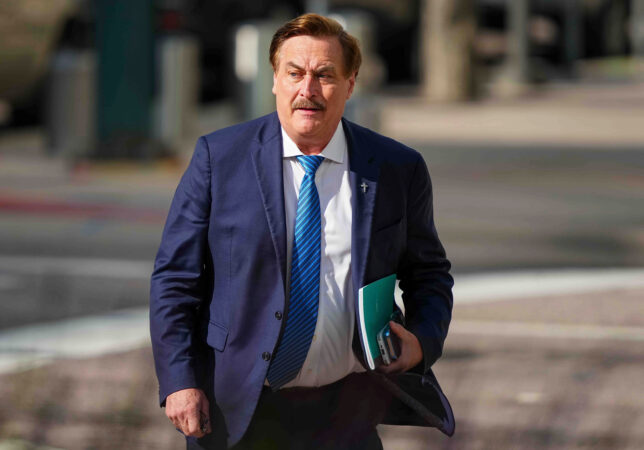
    SHAKOPEE, Minn. — Mike Lindell, the fervent supporter of President Donald Trump known to TV viewers as the “MyPillow Guy,” officially entered the race for Minnesota governor Thursday in hopes of winning the Republican nomination to challenge Democratic Gov. Tim Walz.

    “I’ll leave no town unturned in Minnesota,” Lindell told The Associated Press in an interview ahead of a news conference set for Thursday.

    He said he has a record of solving problems and personal experiences that will help businesses and fight addiction and homelessness as well as fraud in government programs. The fraud issue has particularly dogged Walz, who announced in September that he’s seeking a third term in the 2026 election.

    A TV pitchman and election denier

    Lindell, 64, founded his pillow company in Minnesota in 2009 and became its public face through infomercials that became ubiquitous on late-night television. But he and his company faced a string of legal and financial setbacks after he became a leading amplifier of Trump’s false claims that the 2020 election was stolen. He said he has overcome them.

    “Not only have I built businesses, you look at problem solution,” Lindell said in his trademark rapid-fire style. “I was able to make it through the biggest attack on a company, and a person, probably other than Donald Trump, in the history of our media … lawfare and everything.”

    While no Republican has won statewide office in Minnesota since 2006, the state’s voters have a history of making unconventional choices. They shocked the world by electing former professional wrestler Jesse Ventura as governor in 1998. And they picked a veteran TV pitchman in 1978 when they elected home improvement company owner Rudy Boschwitz as a U.S. senator.

    Lindell has frequently talked about how he overcame a crack cocaine addiction with a religious conversion in 2009 as MyPillow was getting going. His life took another turn in 2016 when he met the future president during Trump’s first campaign. He served as a warm-up speaker at dozens of Trump rallies and co-chaired Trump’s campaign in Minnesota.

    Trump’s endorsement could be the key to which of several candidates wins the GOP nomination to challenge Walz. But Lindell said he doesn’t know what Trump will do, even though they’re friends, and said his campaign isn’t contingent on the president’s support.

    His Lindell TV streaming platform was in the news in November when it became one of several conservative news outlets that became credentialed to cover the Pentagon after agreeing to a restrictive new press policy rejected by virtually all legacy media organizations.

    Lindell has weathered a series of storms

    Lindell’s outspoken support for Trump’s false claims that the 2020 election was stolen triggered a backlash as major retailers discontinued MyPillow products. By his own admission, revenue slumped and lines of credit dried up, costing him millions. Several vendors sued MyPillow over billing disputes. Fox News stopped running his commercials. Lawyers quit on him.

    Lindell has been sued twice for defamation over his claims that voting machines were manipulated to deprive Trump of a victory.

    A federal judge in Minnesota ruled in September that Lindell defamed Smartmatic with 51 false statements. But the judge deferred the question of whether Lindell acted with the “actual malice” that Smartmatic must prove to collect. Smartmatic says it’s seeking “nine-figure damages.”

    A Colorado jury in June found that Lindell defamed a former Dominion Voting Systems executive by calling him a traitor, and awarded $2.3 million in damages.

    But Lindell won a victory in July when a federal appeals court overturned a judge’s decision that affirmed a $5 million arbitration award to a software engineer who disputed data that Lindell claimed proved Chinese interference in the 2020 election. The engineer had accepted Lindell’s “Prove Mike Wrong Challenge,” which he launched as part of his 2021 “Cyber Symposium” in South Dakota, where he promised to expose election fraud.

    The campaign ahead

    Lindell said his crusade against electronic voting machines will just be part of his platform. While Minnesota uses paper ballots, it also uses electronic tabulators to count them. Lindell wants them hand-counted, even though many election officials say machine counting is more accurate.

    Some Republicans in the race include Minnesota House Speaker Lisa Demuth, of Cold Spring; Dr. Scott Jensen, a former state senator from Chaska who was the party’s 2022 candidate; State Rep. Kristin Robbins, of Maple Grove; defense lawyer and former federal prosecutor Chris Madel; and former executive Kendall Qualls.

    “These guys haven’t lived what I live,” Lindell said.

    Lindell wouldn’t commit to abiding by the Minnesota GOP endorsement and forgoing the primary if he loses it, expressing confidence that he’ll win. He also said he’ll rely on his supporters to finance his campaign because his own finances are drained. “I don’t have the money,” he acknowledged.

    But he added that ever since word got out last week that he had filed the paperwork to run, “I’ve had thousands upon thousands of people text and call, saying from all around the country … ‘Hey, I’ll donate.’”

  • Bancroft, a South Jersey provider of IDD services, hired Gregory Passanante as its next CEO

    Bancroft, a South Jersey provider of IDD services, hired Gregory Passanante as its next CEO

    Bancroft, a South Jersey nonprofit provider of services for people with intellectual and developmental disabilities, has hired Gregory Passanante to succeed Toni Pergolin as president and CEO.

    Passanante, who will be the 10th president in the organization’s 143-year history, is scheduled to start Jan. 7.

    Since 2023, Passanante has been northeast market administrator for Shriners Children’s Hospital Philadelphia. Before that, he was chief nursing officer at Wills Eye Hospital.

    Passanante will take over a Cherry-Hill-based organization that is in solid financial condition, especially compared to 2004 when Pergolin arrived as chief financial officer and had to worry about making payroll because the organization was so weak financially.

    In the 12 months that ended June 30, the nonprofit had operating income of $13 million on $284 million in revenue, according to its audited financial statement. Bancroft had 1,642 clients and employed 2,853 people on a full-time basis at the end of the fiscal year.

  • A Philly restaurant came clean about its Health Department shutdown. Was that the right call?

    A Philly restaurant came clean about its Health Department shutdown. Was that the right call?

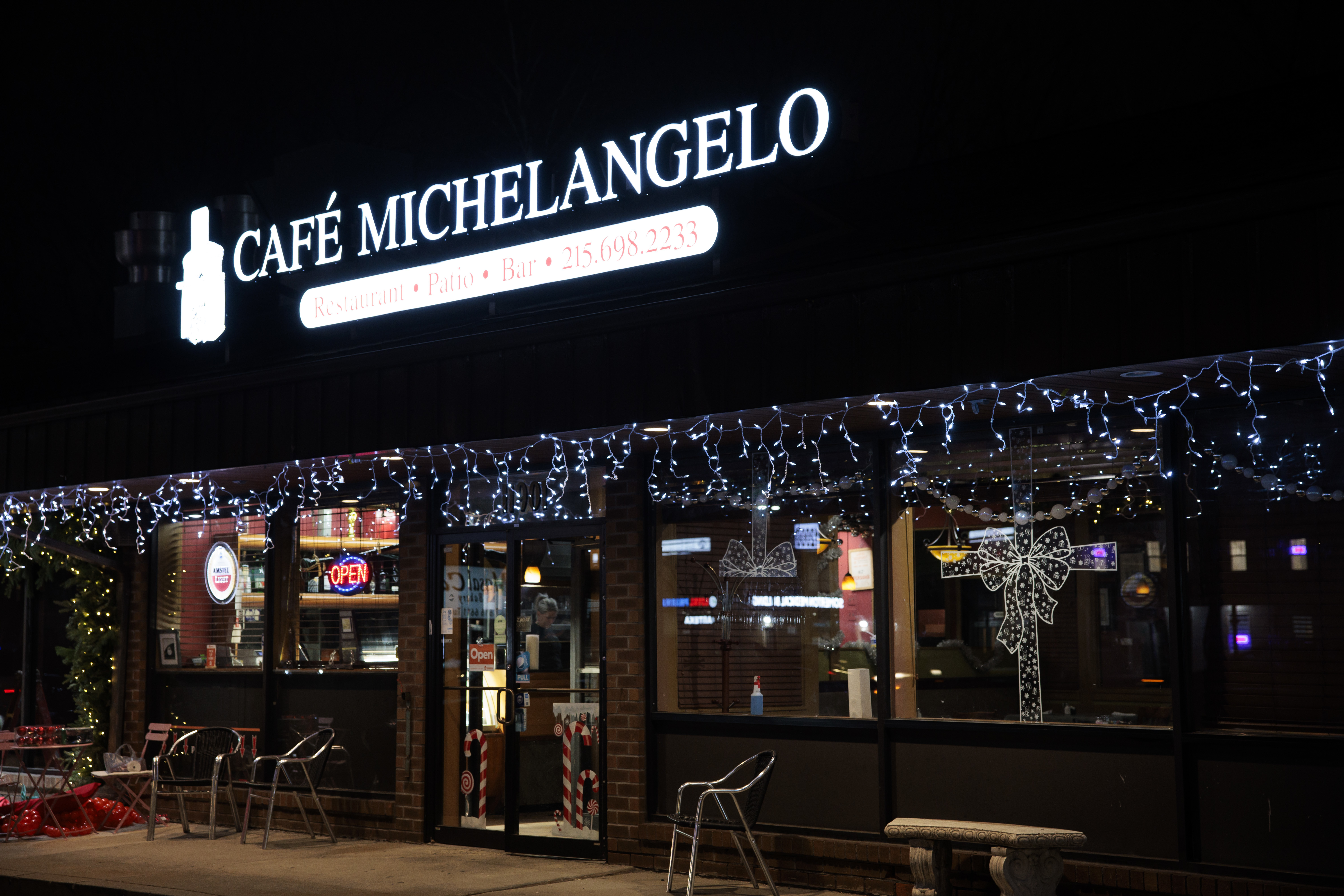
    As the health inspector left Cafe Michelangelo in the Far Northeast last week, she affixed a “cease operations” sticker to the front door, ordering the restaurant to close for at least 48 hours.

    Co-owner Giuliano Verrecchia got an idea.

    He would come clean.

    Chastened by the report’s findings and mindful of his restaurant’s previous dodgy health inspections this year, Verrecchia decided to go public and explain all 16 violations, one by one.

    Co-owner Giuliano Verrecchia and manager Danielle Runner at Cafe Michelangelo on Dec. 9, 2025.

    This would be a bold, uncommon strategy. Typically, as word of a shutdown spreads through social media, restaurateurs play defense while users pillory the establishment.

    “I wanted to put my side out there and be transparent,” Verrecchia said, adding that he considered some of the cited issues “a bit misleading.” He and his manager, Danielle Runner, printed out the inspection report, added commentary, and posted it to Michelangelo’s Facebook page on Dec. 4, the day after the shutdown.

    Addressed to “all of our amazing customers,” the post on Michelangelo’s profile paired the exact wording of the health report’s violations with Verrecchia’s own explanation (and redress or occasional rebuttal). He detailed 16 violations, including “peeling paint observed on walls in one of the women’s restroom areas” (“Bathrooms and storage areas were repainted yesterday,” he explained) and “ice build-up observed in the first-floor walk-in cooler unit” (“removed ice build-up,” he wrote).

    Reaction to the post was mostly positive. Customers replied with words of support. Some commenters — several of whom identified as food-service industry workers — downplayed the inspector’s finding, describing them as minor.

    (In a Facebook post earlier that day, the restaurant described the violations as “non-hazardous,” which was not entirely accurate.)

    On Friday, Dec. 5, Michelangelo passed its reinspection, paid a $315 fee, and prepared to reopen. Verrecchia held his breath. Would the public respect his attempt at transparency?

    A Northeast Philly staple

    In 1992, brothers Michael and Angelo DiSandro combined their names to open a family-friendly Italian restaurant, complete with bocce courts and room for 250 guests, in a Somerton strip center. By Northeast Philadelphia standards, Cafe Michelangelo was years ahead of its time, serving espresso and brick-oven pizza. Angelo DiSandro died in 2012, and Michael has stepped aside from the day-to-day operation.

    Cafe Michelangelo, 11901 Bustleton Ave., on Dec. 9.

    Verrecchia, 56, a nephew, oversees the restaurant, which has a bar in a rear dining room as well as a newer second bar on a covered, heated patio. There’s live music at least three days a week. Michelangelo’s business, like that at many older restaurants, hasn’t been the same since the pandemic. Rising food prices and labor costs have cut margins, and competition has become keener. Customers can get a world of cuisine delivered via apps.

    To boost traffic, Verrecchia offers a $15 lunch buffet Tuesday to Friday with two pastas, two proteins, salads, and pizza. Over dinner, the calamari, the parm dishes, and pizzas still move, but he said his customers are cautious about spending. He still sells bigger-ticket items — steak, rack of lamb, whole fish — “but I’m not charging you $45,” Verrecchia said. “I’m charging you $37 and I’m not making money on it, but if you want a steak and the kid wants pizza? You got a home run.”

    The aftermath

    Michelangelo reopened the same day it passed its reinspection. The phone rang over the weekend. It was a group of teachers canceling their large annual party. Then another big order fell through.

    Neither cited a reason. Business was down about 25% on Friday, the restaurant’s first day back, and remained soft Saturday. There was a slight improvement Sunday. The restaurant is closed Mondays. Tuesday was slow again, which Verrecchia partly attributed to cold weather. He said it was too soon to tell what was driving this.

    Timeline of inspections

    In interviews, Verrecchia said he acknowledged that some of the inspector’s findings required attention, but added: “I don’t think those issues put customers in jeopardy.”

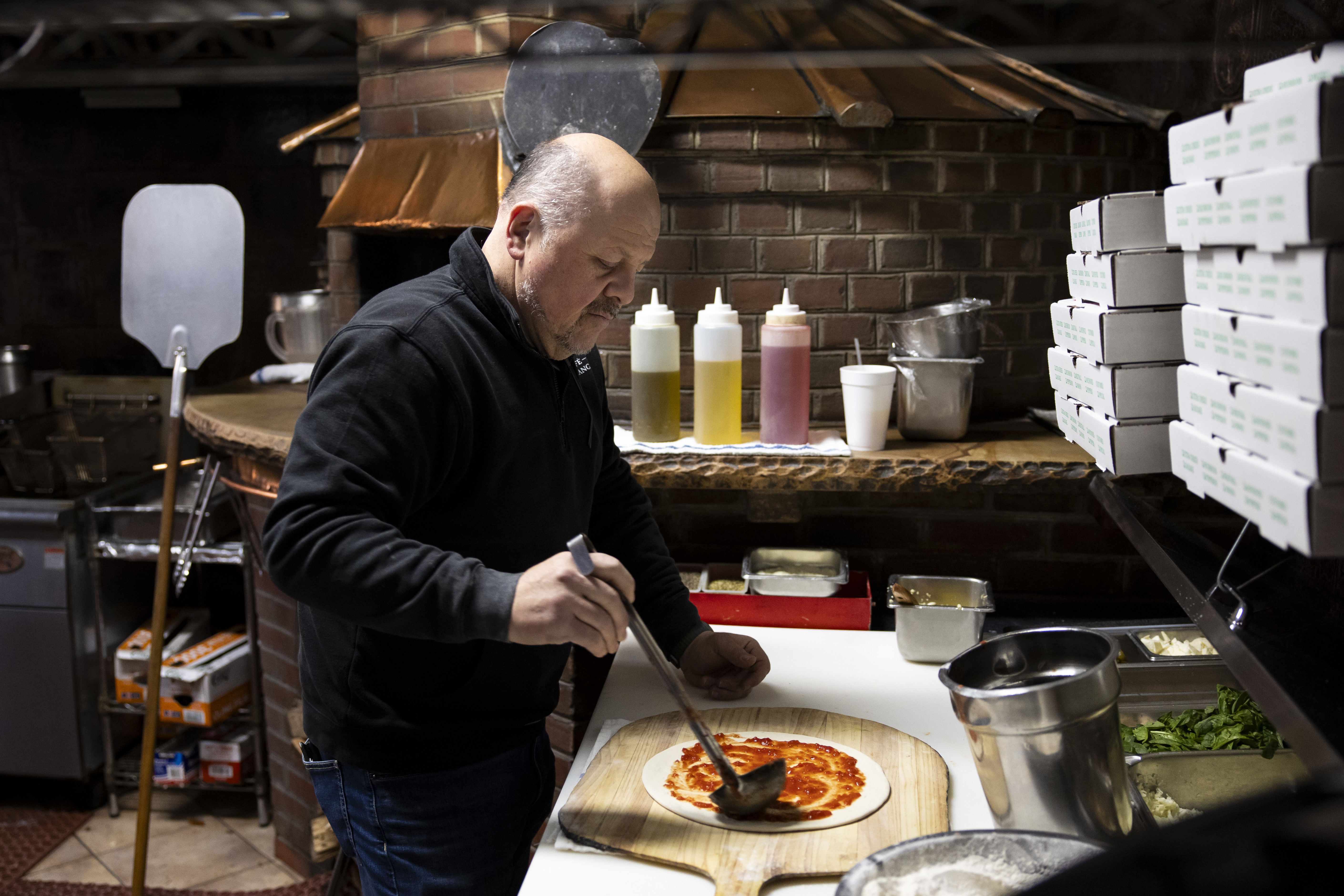
    Giuliano Verrecchia sauces a Margherita pizza at Cafe Michelangelo.

    “You as a layman read what they wrote and you get scared,” he said. “I wanted to explain what’s really meant.”

    He cited rules about labeling containers as an example. “If [the inspector comes in] at 11:30 [a.m.] and my guys are prepping, some things won’t have labels because they have to open them up,” he said.

    Verrecchia said he was cited for some issues that had been addressed previously, including cracked floors observed in the kitchen preparation area. “I had already fixed it and showed her,” he said. The report called out a chest freezer that was not commercial-grade. “I fixed that, too, but it still showed up again as if nothing had been done.”

    “She made some valid observations,” he said. “I’m not denying that. But the wording in those reports can sound scarier than it really is if people don’t understand the terminology.”

    But given its inspections in 2025, Cafe Michelangelo’s record showed mounting problems.

    This also was not the restaurant’s first involuntary closure. In February 2023, an inspector cited repeated violations, including improper food labeling, missing temperature controls, rodent activity, improper food storage, and sanitation problems such as grease on walls near the hood, food debris and mouse droppings in the basement, damaged flooring, and missing wall tiles. The restaurant also was cited for using plastic crates to elevate beverages in the takeout area.

    Cafe Michelangelo was allowed to reopen four days after that 2023 reinspection, and a follow-up two months later found no serious violations.

    At the next inspection, Feb. 27, 2025, four risk-factor violations were noted: missing handwashing supplies, a dirty ice machine, missing date-marking, and unlabeled chemicals. All were corrected on site.

    By Sept. 11, the violation count had risen to six and included flies throughout the facility, shellfish storage and record-keeping problems, and significant structural and equipment issues. The Health Department ordered a reinspection.

    On Oct. 29, many of the same issues appeared again as repeat violations, and a certified food-safety manager was not on-site at the start of the inspection.

    On Dec. 3, the inspector pointed out unsafe cooling of salads and onions, along with unresolved pest, handwashing, and facility problems — all what are deemed “imminent health hazards.” She also logged six risk-factor violations, which include any violation that increases the likelihood of foodborne illness; three of them were repeats. Two and a half hours after the inspector walked in, Michelangelo was shut down.

    Corrections and changes

    Verrecchia said the inspection issues were a wake-up call. He said he has tightened oversight throughout the restaurant, which employs about 30 people.

    “I’m on it every single night now,” he said. “I’m re-educating my team. I’ve got to be more diligent. If I [mess] up, I admit it. I [messed] up. I’m human.”

    He is now conducting mock inspections at the end of the day. “I walk through everything, write up what’s wrong, and then go over it with the staff in the morning,” he said.

    He also has begun purchasing new equipment, including wall-mounted metal shelving and fruit-fly traps where required.

    Verrecchia said he is standing by his decision to go public.

    “If I didn’t think it was right, I wouldn’t have done it,” he said. “I can’t afford to shut down again — and I’m not going to.”

  • ‘Tis the season for laser treatments

    ‘Tis the season for laser treatments

    After a summer under the sun, my patients’ skin is telling me the story of their beach days and backyard gatherings, especially for those who spend weekends at the Jersey Shore. What started as cute freckles in June now appear as stubborn brown spots; fine lines deepen; redness and rough texture emerge; and that “sun-kissed glow” begins to look more like early aging.

    In my dermatology clinic, I call the fall months our laser season.

    I tell patients that fall is the perfect time to reduce the harmful effects of summer sun and prepare their skin to look its best for the holidays and the year ahead. The cooler weather, shorter days, and slower pace create the perfect conditions for skin renewal, allowing us to repair damage and restore radiance.

    Why fall is the sweet spot for laser treatments

    Lasers and energy-based treatments are among the most effective tools for improving skin tone, pigmentation, texture, and fine lines — but timing is everything. After any laser or energy-based procedure, the skin becomes temporarily more sensitive to UV rays. That’s why fall is a sweet spot: the UV index drops, we spend more time indoors, and therefore recovery is easier and more comfortable.

    Cooler weather also makes it easier to protect healing skin with hats, scarves, and cozy layers which help shield it from the sun. The conditions will stay good all winter, but many of my patients prefer to start treatments now, giving their skin time to fully recover by the holidays.

    What can we address with lasers?

    Lasers and energy-based treatments can treat a variety of skin concerns:

    • Resurfacing lasers stimulate collagen production and improve fine lines, brown spots, acne scars, and uneven tone. They can also treat precancerous skin changes and help prevent the development of skin cancer.
    • Vascular lasers target redness, rosacea, and broken capillaries for a clearer complexion.
    • Pigment-specific lasers address brown spots, post-inflammatory hyperpigmentation, and unwanted tattoos.
    • Radiofrequency devices provide subtle skin tightening and enhance collagen production.

    Downtime can range from none at all to about a week, depending on the treatment. Most patients need a series of sessions to achieve their desired results.

    One of my patients, a 42-year-old marketing executive from the Philadelphia suburbs, came to see me after a summer filled with travel. “My freckles have gotten so dark, and my rosacea is flaring,” she said. “What can I do to make my skin look better?”

    We created a combination plan to target pigmentation, fine lines, and redness using both a fractional resurfacing laser and a vascular laser. The procedure took less than an hour, and after a week of mild downtime, her skin looked brighter, smoother, and more even.

    After a month, the collagen stimulation was starting to become noticeable and her skin appeared plumper, firmer, and healthier. She told me, “I feel like all that sun damage was aging me 10 years. Now I finally look like myself again.”

    Not just cosmetic

    Beyond cosmetic procedures, certain lasers can remove or treat precancerous lesions called actinic keratoses, which are rough, sun-damaged patches that sometimes progress to skin cancer if untreated.

    1. By gently removing these damaged cells and stimulating healthy new growth, laser resurfacing not only improves the skin’s appearance but also reduces future skin cancer risk.

    As a cosmetic dermatologist and Mohs surgeon, I approach each patient not only from the perspective of how they can look better, but also how we can enhance skin quality and skin health.

    Finding that intersection, where beauty meets prevention, is one of my favorite parts of practicing dermatology. Ultimately, healthy skin simply looks better: free of pigmentation, redness, fine lines, and rough texture.

    We’re now in the peak of what I call laser season, and my advice to patients is to seize the pause between the intensity of summer and the rush of the holidays to help their skin recover from UV exposure.

    Alternatives to lasers

    Of course, laser treatment isn’t for everyone. Lasers offer a safe, medical approach to address damage before it worsens, but some people can’t tolerate downtime associated with some lasers. Others are looking for a more affordable option, as lasers can range in cost from $450-1200 per session, depending on the laser and location, with multiple sessions typically recommended.

    Another powerful option is a regimen known as the “ABC’s plus sunscreen.” This means using products with vitamin A (a retinoid) to boost cell turnover and promote collagen production, vitamin B (niacinamide) to calm inflammation and support the skin barrier (and for some patients, an oral form may be appropriate after discussing with their dermatologist), and vitamin C to brighten and protect against environmental stress.

    Protection is always the best prevention. I consider daily sunscreen a nonnegotiable, even on cloudy days. I recommend a broad-spectrum sunscreen with SPF 30 or higher, and UPF clothing adds another reliable layer of protection. A consistent skincare routine can meaningfully prevent and even reverse signs of sun damage and skin aging, no lasers required.

    May Elgash is a board-certified dermatologist and Mohs surgeon practicing at the Jefferson Laser Surgery and Cosmetic Dermatology Center.

  • Judge orders Kilmar Abrego Garcia to be immediately released from immigration detention

    Judge orders Kilmar Abrego Garcia to be immediately released from immigration detention

    GREENBELT, Md. — A federal judge in Maryland ordered Kilmar Abrego Garcia freed from immigration detention on Thursday while his legal challenge against his deportation moves forward.

    U.S. District Judge Paula Xinis ruled that Immigration and Customs Enforcement must release Abrego Garcia from custody immediately.

    “Since Abrego Garcia’s return from wrongful detention in El Salvador, he has been re-detained, again without lawful authority,” the judge wrote. “For this reason, the Court will GRANT Abrego Garcia’s Petition for immediate release from ICE custody.”

    Justice Department and Homeland Security spokespeople didn’t immediately respond to messages seeking comment on the judge’s order. Messages seeking comment were left with Abrego Garcia’s attorney Simon Sandoval-Moshenberg.

    Abrego Garcia, a Salvadoran national, has an American wife and child and has lived in Maryland for years, but he originally immigrated to the U.S. illegally as a teenager. An immigration judge in 2019 ruled Abrego Garcia could not be deported to El Salvador because he faced danger from a gang that targeted his family. When Abrego Garcia was mistakenly deported there in March, his case became a rallying point for those who oppose President Donald Trump’s immigration crackdown.

    Abrego Garcia was returned to the U.S. under a court order. Since he cannot be deported to El Salvador, ICE has been seeking to deport him to a series of African countries. His lawsuit in federal court claims Trump’s Republican administration is illegally using the deportation process to punish Abrego Garcia over the embarrassment of his mistaken deportation to El Salvador.

    Meanwhile, in a separate action in immigration court, Abrego Garcia is petitioning to reopen his immigration case to seek asylum in the United States.

    Additionally, Abrego Garcia is facing criminal charges in federal court in Tennessee, where he has pleaded not guilty to human smuggling. He has filed a motion to dismiss the charges, claiming the prosecution is vindictive.

    A judge has ordered an evidentiary hearing to be held on the motion after previously finding some evidence that the prosecution against Abrego Garcia “may be vindictive.” The judge said many statements by Trump administration officials “raise cause for concern.”

    The judge specifically cited a statement by Deputy Attorney General Todd Blanche that seemed to suggest the Justice Department charged Abrego Garcia because he won his wrongful deportation case.

  • College Football Playoff controversy, Villanova’s tough task in FCS quarterfinals, and more

    College Football Playoff controversy, Villanova’s tough task in FCS quarterfinals, and more

    What has happened since Sunday’s College Football Playoff selection show could begin to shape the future of the sport this year and beyond.

    Miami and Notre Dame, both 10-2 and ranked 12th and 10th, respectively, ahead of conference championship weekend, were essentially vying for one spot in a 12-team playoff that was mostly set with the top eight teams seeing little movement.

    After No. 9 Alabama lost to third-ranked Georgia by three touchdowns and No. 11 Brigham Young lost by 27 to No. 4 Texas Tech and No. 17 Virginia dropped the ACC title game to Duke, the debate then shifted to whether the Crimson Tide deserved to be in the field.

    In the end, though, BYU dropped out of the top 12, Alabama remained at No. 9, and Miami jumped two spots to knock Notre Dame out of the playoff field, creating a firestorm in the process with Tulane and James Madison getting the final two spots.

    The committee pointed to Miami’s head-to-head victory over Notre Dame in Week 1 of the season as the ultimate deciding factor.

    In response to getting left out of the playoff field, the Irish decided to turn down a potential bowl game matchup against BYU in the Pop-Tarts Bowl in Orlando, ending the season.

    The outrage is all too familiar. An undefeated Florida State team in 2023, ranked No. 4 in a four-team playoff format at the time, was dropped because of an injury to star quarterback Jordan Travis in favor of No. 8 Alabama, which had defeated Georgia in the SEC title game that year.

    That 2023 decision to leave the ACC champion out of the playoff has continued a negative trend for the selection committee: distrust. Distrust in the committee’s criteria. Distrust in what it values in playoff-caliber teams vs. what it does not. Distrust in how the panel measures the resumés of each team. Distrust in measuring programs by a different set of standards.

    Notre Dame coach Marcus Freeman reacts on the sideline against Stanford on Nov. 29.

    To be clear, every conference should have a fair shot at winning the national championship.

    Tulane, which beat three Power Four schools, plays in the toughest Group of Six conference in the American, and its coach, Jon Sumrall, was hired to be Florida’s next head coach.

    James Madison, although it lost its lone game against a Power Four opponent, had Bob Chesney poached to be UCLA’s next head coach. Both Sumrall and Chesney are sticking with their teams through the playoffs.

    Notre Dame’s decision to sit out a bowl game could set a precedent. With Name, Image, and Likeness reshaping college sports, more programs built specifically with playoff aspirations may do the same if their seasons don’t go as planned.

    Keeping Notre Dame out of the playoff is fine, but don’t have the school ranked ahead of Miami for five weeks only to flip it on Selection Sunday. What about keeping Alabama at No. 9 after losing by three touchdowns, but moving down BYU and Ohio State after their losses?

    After this, the CFP committee ought to figure out a better way to determine the best 25 teams every week — because this current format is not working and could have long-term ramifications for the sport.

    Villanova’s tall task

    The star of Villanova’s two wins to open the Football Championship Subdivision playoffs has been its defense, which allowed just seven points in each win, the lowest among the remaining eight teams.

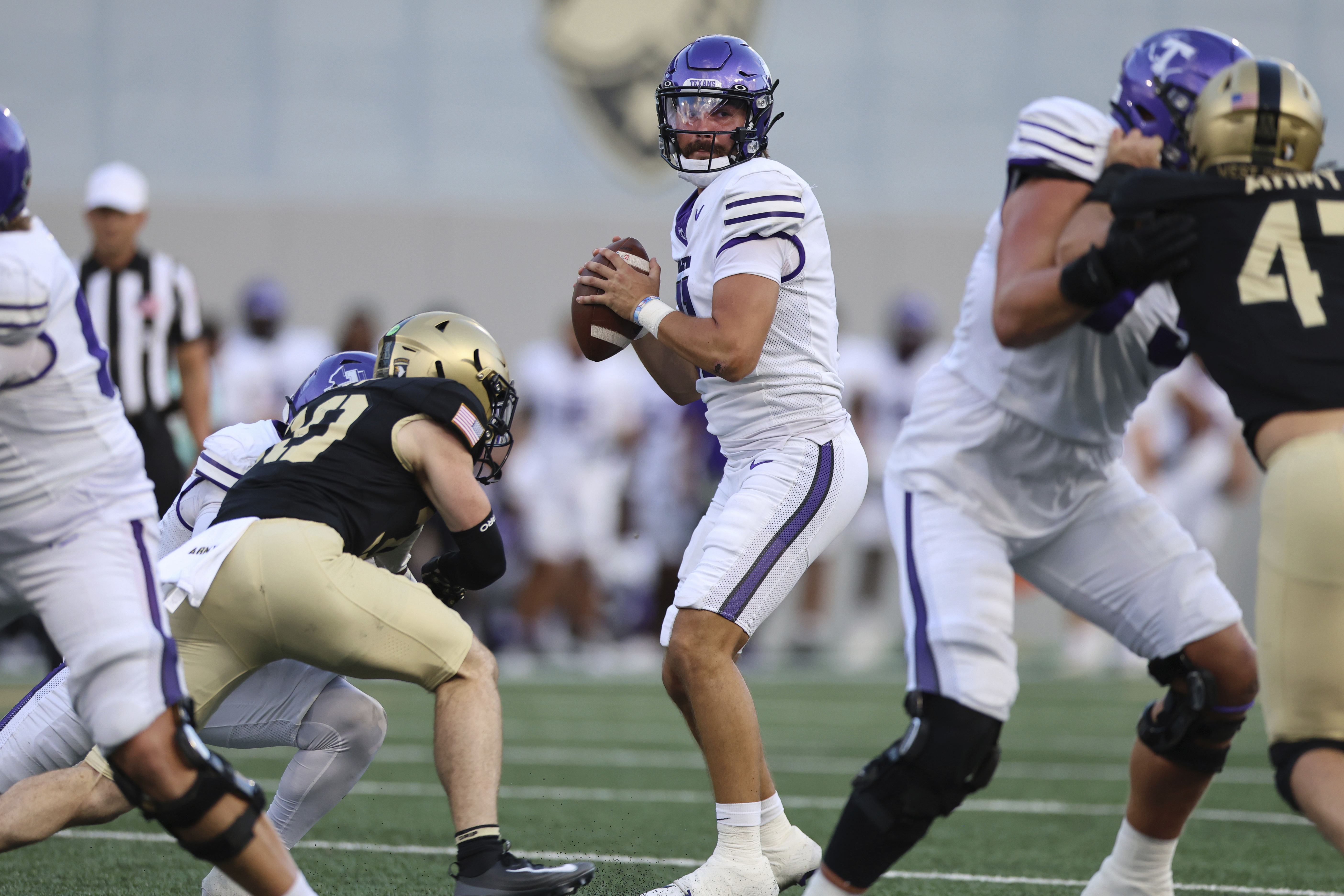
    That defense will be put to the test Saturday against fourth-ranked Tarleton State (12-1) of Texas, which has one of the best scoring offenses in the FCS (44.1 points per game) and the No. 3 total offense (472.3 yards), led by Walter Payton Award finalist Victor Gabalis, the team’s quarterback.

    The Texans also have wins over an FBS school, Army, and are a perfect 7-0 at their Memorial Stadium in Stephenville, Texas, while averaging 41.8 points.

    Tarleton State, about 80 miles southwest of Fort Worth, also ranks in the top 10 in scoring defense (18 points) and passing yards allowed (160.5 yards) but has one glaring weakness: defending the run. On the season, Tarleton ranks 69th in rushing defense, giving up 163.6 yards per game, which should offer the Wildcats an opportunity to control the game in that aspect.

    Tarleton State’s Victor Gabalis in action against Army on Aug. 29.

    Saturday’s quarterfinal game (noon, ESPN) will ultimately come down to Villanova’s defense holding Tarleton State’s offense in check. Harvard and Lehigh each ranked inside the top 25 in total offense, but the Wildcats shut both teams down.

    The only game Tarleton State lost this season came against Abilene Christian, the only time the Texans scored less than 30 points.

    Villanova (11-2) will need big games from running backs Ja’briel Mace and Isaiah Ragland and the offensive line to clinch the program’s first semifinal appearance since 2010. The winner of this matchup will face the winner of UC Davis and Illinois State next Saturday.

    Jackson earns an honor

    Although Delaware State’s season came to an end with a loss to South Carolina State two weeks ago that determined the Mid-Eastern Atlantic Conference’s representative in the Celebration Bowl, coach DeSean Jackson, the former Eagles wideout, earned some recognition after his debut season.

    On Monday, Jackson, after an 8-4 season was named the 2025 Boxtorow HBCU Coach of the Year for his efforts at Delaware State this season. The Hornets led the FCS in rushing yards per game (291.2 yards), and Jackson led his team to a win over Michael Vick’s Norfolk State on Oct. 30 at Lincoln Financial Field.

    Game of the week

    Army vs. Navy (Saturday at 3 p.m., CBS3)

    For the 126th time, Army and Navy will meet, this year at Baltimore’s M&T Bank Stadium, with the Commander-in-Chief’s Trophy on the line. Navy won last year’s matchup with a resounding 31-13 victory at Northwest Stadium in Landover, Md.

    Navy leads the series, 63-55-7, but Army has won six of the last nine matchups. The Midshipmen, though, have the best player in quarterback Blake Horvath and the nation’s top rushing offense (298.4).

    Navy quarterback Blake Horvath in last season’s game against Army.
  • Trump’s handling of the economy is at its lowest point, according to new AP-NORC polling

    Trump’s handling of the economy is at its lowest point, according to new AP-NORC polling

    WASHINGTON — President Donald Trump’s approval on the economy and immigration have fallen substantially since March, according to a new AP-NORC poll, the latest indication that two signature issues that got him elected barely a year ago could be turning into liabilities as his party begins to gear up for the 2026 midterms.

    Only 31% of U.S. adults now approve of how Trump is handling the economy, the poll from The Associated Press-NORC Center for Public Affairs Research finds. That is down from 40% in March and marks the lowest economic approval he’s registered in an AP-NORC poll in his first or second term. The Republican president also has struggled to recover from public blowback on other issues, such as his management of the federal government, and has not seen an approval bump even after congressional Democrats effectively capitulated to end a record-long government shutdown last month.

    Perhaps most worryingly for Trump, who’s become increasingly synonymous with his party, he’s slipped on issues that were major strengths. Just a few months ago, 53% of Americans approved of Trump’s handling of crime, but that’s fallen to 43% in the new poll. There’s been a similar decline on immigration, from 49% approval in March to 38% now.

    The new poll starkly illustrates how Trump has struggled to hold onto political wins since his return to office. Even border security — an issue on which his approval remains relatively high — has declined slightly in recent months.

    The good news for Trump is that his overall approval hasn’t fallen as steeply. The new poll found that 36% of Americans approve of the way he’s handling his job as president, which is down slightly from 42% in March. That signals that even if some people aren’t happy with elements of his approach, they might not be ready to say he’s doing a bad job as president. And while discontent is increasing among Republicans on certain issues, they’re largely still behind him.

    Declining approval on the economy, even among Republicans

    Republicans are more unhappy with Trump’s performance on the economy than they were in the first few months of his term. About 7 in 10 Republicans, 69%, approve of how Trump is handling the economy in the December poll, a decline from 78% in March.

    Larry Reynolds, a 74-year-old retiree and Republican voter from Wadsworth, Ohio, said he believes in Trump’s plan to impose import duties on U.S. trading partners but thinks rates have spiraled too high, creating a “vicious circle now where they aren’t really justifying the tariffs.”

    Reynolds said he also believes that inflation became a problem during the coronavirus pandemic and that the economy won’t quickly recover, regardless of what Trump does. “I don’t think it’ll be anything really soon. I think it’s just going to take time,” he said.

    Trump’s base is still largely behind him, which was not always the case for his predecessor, President Joe Biden, a Democrat. In the summer of 2022, only about half of Democrats approved of how Biden was handling the economy. Shortly before he withdrew from the 2024 presidential race two years later, that had risen to about two-thirds of Democrats.

    More broadly, though, there’s no sign that Americans think the economy has improved since Trump took over. About two-thirds of U.S. adults, 68%, continue to say the country’s economy is “poor.” That’s unchanged from the last time the question was asked in October, and it’s broadly in line with views throughout Biden’s last year in office.

    Why Trump gets higher approval on border security than immigration

    Trump’s approval ratings on immigration have declined since March, but border security remains a relatively strong issue for him. Half of U.S. adults, 50%, approve of how Trump is handling border security, which is just slightly lower than the 55% who approved in September.

    Trump’s relative strength on border security is partially driven by Democrats and independents. About one-third of independents, 36%, approve of Trump on the border, while 26% approve on immigration.

    Jim Rollins, an 82-year-old independent in Macon, Georgia, said he believes that when it comes to closing the border, Trump has done “a good job,” but he hopes the administration will rethink its mass deportation efforts.

    “Taking people out of kindergarten, and people going home for Thanksgiving, taking them off a plane. If they are criminals, sure,” said Rollins, who said he supported Trump in his first election but not since then. “But the percentages — based on the government’s own statistics — say that they’re not criminals. They just didn’t register, and maybe they sneaked across the border, and they’ve been here for 15 years.”

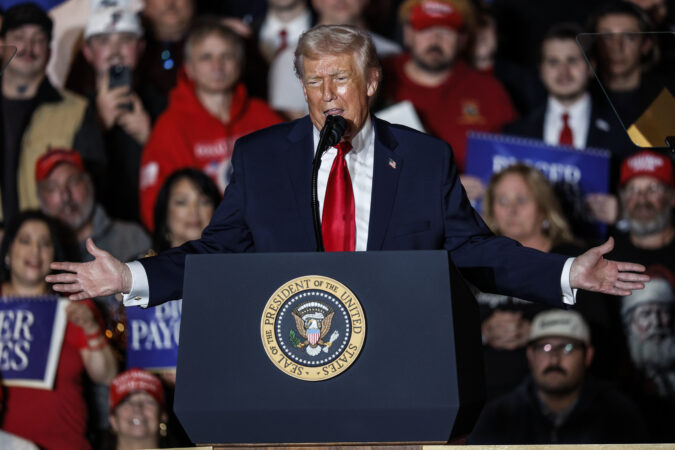
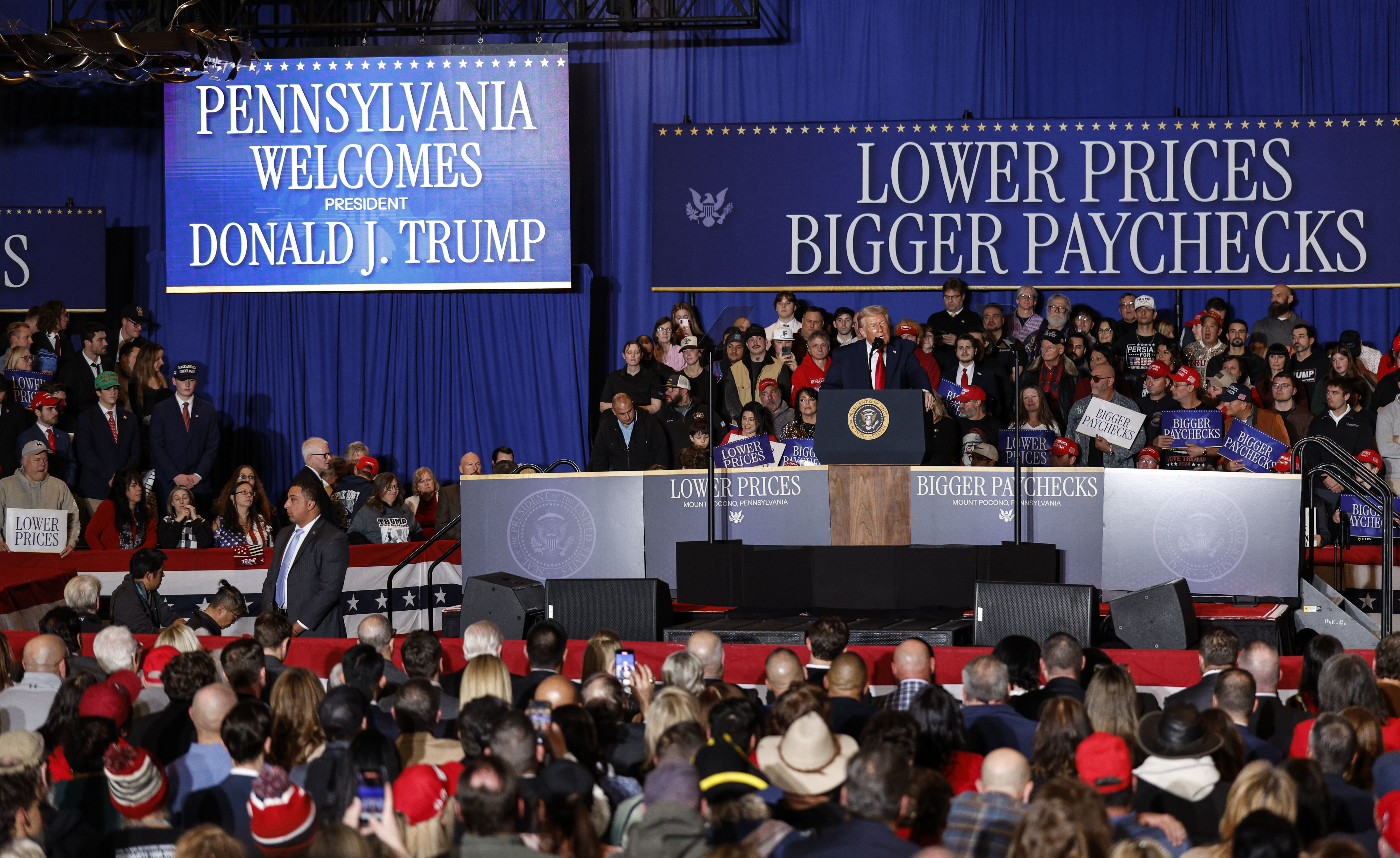
    President Donald Trump made his first stop on an “economic tour” in Mt. Pocono, Pa., on Tuesday, Dec. 9.

    Other polls have shown it’s more popular to increase border security than to deport immigrants, even those who are living in the country illegally. Nearly half of Americans said increasing security at the U.S.-Mexico border should be “a high priority” for the government in AP-NORC polling from September. Only about 3 in 10 said the same about deporting immigrants in the U.S. illegally.

    Shaniqwa Copeland, a 30-year-old independent and home health aide in St. Augustine, Florida, said she approves of Trump’s overall handling of the presidency but believes his immigration actions have gone too far, especially when it comes to masked federal agents leading large raids.

    “Now they’re just picking up anybody,” Copeland said. “They just like, pick up people, grabbing anybody. It’s crazy.”

    Health care and government management remain thorns for Trump

    About 3 in 10 U.S. adults approve of how Trump is handling health care, down slightly from November. The new poll was conducted in early December, as Trump and Congress struggled to find a bipartisan deal for extending the Affordable Care Act subsidies that will expire at the end of this month.

    That health care fight was also the source of the recent government shutdown. About one-third of U.S. adults, 35%, approve of how Trump is managing the federal government, down from 43% in March.

    But some Americans may see others at fault for the country’s problems, in addition to Trump. Copeland is unhappy with the country’s health care system and thinks things are getting worse but is not sure of whether to blame Trump or Biden.

    “A couple years ago, I could find a dentist and it would be easy. Now, I have a different health care provider, and it’s like so hard to find a dental (plan) with them,” she said. “And the people that do take that insurance, they have so many scheduled out far, far appointments because it’s so many people on it.”

    The AP-NORC poll of 1,146 adults was conducted Dec. 4-8 using a sample drawn from NORC’s probability-based AmeriSpeak Panel, which is designed to be representative of the U.S. population. The margin of sampling error for adults overall is plus or minus 4 percentage points.

  • Time magazine names ‘Architects of AI’ as its person of the year for 2025

    Time magazine names ‘Architects of AI’ as its person of the year for 2025

    The “Architects of AI” were named Time’s person of the year for 2025 on Thursday, with the magazine citing this year as when the potential of artificial intelligence “roared into view” with no turning back.

    “For delivering the age of thinking machines, for wowing and worrying humanity, for transforming the present and transcending the possible, the Architects of AI are TIME’s 2025 Person of the Year,” Time said in a social media post.

    The magazine was deliberate in selecting people — the “individuals who imagined, designed, and built AI” — rather than the technology itself, though there would have been some precedent for that.

    “We’ve named not just individuals but also groups, more women than our founders could have imagined (though still not enough), and, on rare occasions, a concept: the endangered Earth, in 1988, or the personal computer, in 1982,” wrote Sam Jacobs, the editor-in-chief, in an explanation of the choice. “The drama surrounding the selection of the PC over Apple’s Steve Jobs later became the stuff of books and a movie.”

    One of the cover images resembling the “Lunch Atop a Skyscraper” photograph from the 1930s shows eight tech leaders sitting on the beam: Meta CEO Mark Zuckerberg, AMD CEO Lisa Su, Tesla CEO Elon Musk, Nvidia CEO Jensen Huang, OpenAI CEO Sam Altman, the CEO of Google’s DeepMind division Demis Hassabis, Anthropic CEO Dario Amodei and AI pioneer Fei-Fei Li, who launched her own startup World Labs last year.

    Another cover image shows scaffolding surrounding the giant letters “AI” made to look like computer componentry.

    It made sense for Time to anoint AI because 2025 was the year that it shifted from “a novel technology explored by early adopters to one where a critical mass of consumers see it as part of their mainstream lives,” Thomas Husson, principal analyst at research firm Forrester, said by email.

    The magazine noted AI company CEOs’ attendance at President Donald Trump’s inauguration this year at the Capitol as a herald for the prominence of the sector.

    “This was the year when artificial intelligence’s full potential roared into view, and when it became clear that there will be no turning back or opting out,” Jacobs wrote.

    AI was a leading contender for the top slot, according to prediction markets, along with Huang and Altman. Pope Leo XIV, the first American pope whose election this year followed the death of Pope Francis, was also considered a contender, with Trump, Israeli Prime Minister Benjamin Netanyahu and New York Mayor-elect Zohran Mamdani topping lists as well.

    Trump was named the 2024 person of the year by the magazine after his winning his second bid for the White House, succeeding Taylor Swift, who was the 2023 person of the year.

    The magazine’s selection dates from 1927, when its editors have picked the person they say most shaped headlines over the previous 12 months.

  • Temple’s former enrollment head gets job at Rutgers

    Temple’s former enrollment head gets job at Rutgers

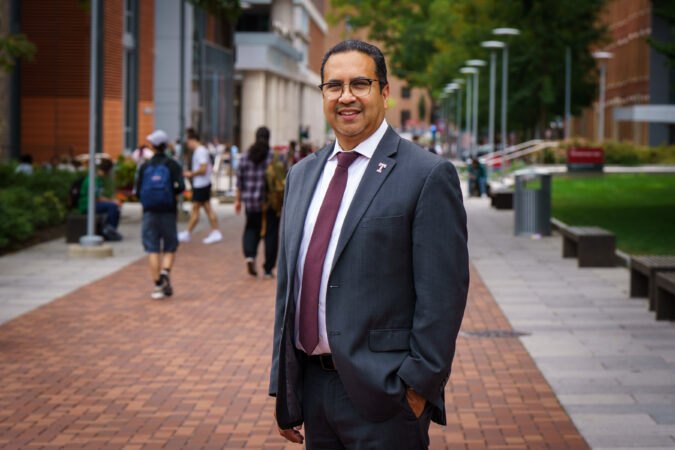
    Jose A. Aviles, who abruptly resigned last month as Temple University’s head of enrollment, has taken a leadership role at Rutgers University.

    Aviles has been named senior vice president for enrollment management and student success at New Jersey’s flagship university.

    “Dr. Aviles’ commitment to data-informed, student-centered leadership will be pivotal to strengthening student recruitment, expanding access and enhancing student success metrics,” Rutgers said in its announcement.

    At Rutgers, the overall enrollment neared 71,500 this year, up 3.2%.

    When Aviles announced his exit from Temple, he told The Inquirer he was leaving for “a life-changing opportunity.”

    Aviles, who served as Temple’s vice president for enrollment and student success for 2½ years, joined the North Philadelphia school in 2023, after about six years at Louisiana State University.

    In that experience at LSU, he has a tie to Rutgers’ new president, William F. Tate IV, who led the Baton Rouge university from 2021 to this July, when he took the helm at Rutgers.

    Aviles left Temple with recent successes under his belt; he had recently been promoted from a vice provost to a vice president.

    “Jose has reimagined enrollment management at the university over the last couple of years, helping move us to a modern, technology- and data-driven approach that has delivered results,” Temple president John Fry and interim provost David Boardman said to the campus community last month.

    They noted the university achieved growth in first-year enrollment the last two years, with this year’s group reaching a record high of 5,379.

    The university also under Aviles’ tenure started the Temple Promise program, which makes tuition and fees free for first-time, full-time college students from low-income families who live in Philadelphia, and the Temple Future Scholars program, a mentoring and college-readiness initiative.

    While Temple’s first-year class was strong, the school fell short of its initial overall enrollment projection by about 700 students, which translates to about $10 million in lost revenue.

    The university had been estimating it would enroll a total of 30,100 to 30,300 students, which would have been its first enrollment increase since 2017.

    Instead, enrollment came in at 29,503, down about 500 from last year and further declining from its high of more than 40,000 eight years ago. (That does not include enrollment on its Japan and Rome campuses, which increased. Including those campuses, Temple’s overall enrollment was over 33,000, a slight increase from last year.)

    There have also been concerns about sophomore retention and a higher percentage of third- and fourth-year students not returning.

  • The NBA’s $525 million injury epidemic

    The NBA’s $525 million injury epidemic

    LOS ANGELES – Golden State Warriors Coach Steve Kerr sparked a moment of introspection for the NBA last month when he said his team’s medical staff believed modern basketball’s fast pace and heavy mileage were contributing to a rash of injuries. After bemoaning the lack of practice and recovery time, Kerr demurred when asked whether he thought the league would consider shortening its 82-game schedule in an attempt to protect player health.

    “The tricky part is all the constituents would have to agree to take less revenue,” Kerr said. “In 2025, in America, good luck in any industry. … That’s not happening.”

    Kerr’s doubt was well founded, because the NBA’s business is booming: Commissioner Adam Silver recently struck new media rights deals worth $76 billion over 11 years, the league’s 30 teams combined to generate a record $12.25 billion in revenue last season, and a record 16 players will earn at least $50 million in salary this season.

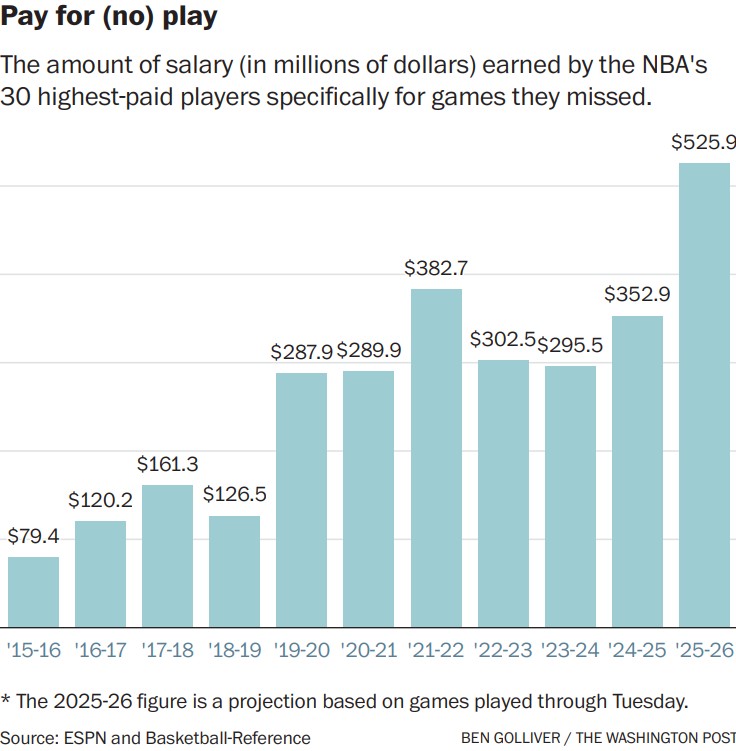
    But as the NBA’s top-line financial metrics continue to increase, so, too, do the skyrocketing costs associated with lost productivity for injured stars. Remarkably, if early trends hold, the NBA’s 30 highest-paid players, according to salary data compiled by ESPN, could combine to cost their teams more than $525 million in empty salary associated with games they do not play this season.

    Stephen Curry (who will earn $59.6 million) is sidelined with a quadriceps injury. Joel Embiid ($55.2 million) has missed more games than he has played because of recurring knee problems, Kawhi Leonard ($50 million) has already missed 10 games because of a foot injury, and Bradley Beal ($53.7 million including a contract buyout) played only six games before suffering a season-ending hip injury. LeBron James ($52.6 million) and Anthony Davis ($54.1 million) missed the first four weeks of the season because of injury, and Giannis Antetokounmpo ($54.1 million) and Ja Morant ($39.4 million) are out with muscle strains.

    Jayson Tatum, Damian Lillard, Tyrese Haliburton and Kyrie Irving are on the books for $204.4 million combined but have yet to play because of major injuries suffered last season. During one recent loss, the New Orleans Pelicans took the court without their five highest-paid players, who will combine to earn more than $140 million.

    Stephen Curry is currently sidelined with a quadriceps injury.

    Many of those absences have directly led to trouble in the standings. Haliburton’s Indiana Pacers, who reached the NBA Finals in June, have dropped to 14th in the Eastern Conference. Antetokounmpo’s Milwaukee Bucks are at risk of missing the playoffs for the first time since 2015-16 and must pay Lillard $113 million over the next five seasons after waiving him using the league’s stretch provision. And the Los Angeles Clippers, wobbly with Leonard and Beal missing time, are on track for their first losing season since 2010-11.

    “When you lose your best player and a top-10 player when he’s on the floor, it’s hard to make up for that,” Clippers Coach Tyronn Lue said last week. “I know a lot of people say ‘next man up,’ but if [Leonard] is making [$50] million and your next man up is making $400,000, it’s not really the same.”

    In two notable cases, star injuries have already contributed to major personnel changes. Without Davis and Irving, the Dallas Mavericks struggled out of the gate and fired general manager Nico Harrison less than a month into the season. And well before Zion Williamson’s latest injury, a hip strain that will keep him out for weeks, the Pelicans had crashed into the Western Conference’s basement and fired Willie Green after he coached just 12 games.

    “We have a lot of guys that are in street clothes,” Mavericks Coach Jason Kidd said shortly after Harrison’s firing. “We’ve got over, I think, $100 million sitting on the sideline.”

    More injuries, more problems

    The rise in star injuries goes well beyond this season’s most extreme examples of the Pacers, Clippers, Mavericks and Pelicans.

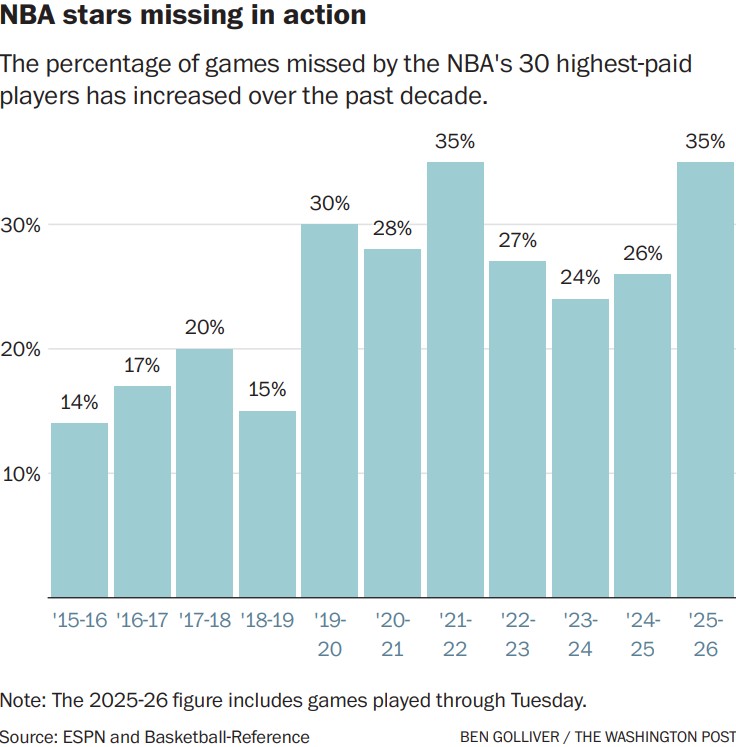
    Flash back one decade: During the 2015-16 season, NBA teams averaged 102.7 points, 24.1 three-point attempts and 95.8 possessions per game. That year, the league’s 30 highest-paid players combined to miss just 14 percent of their teams’ games.

    This season, teams entered Wednesday averaging 116.6 points, 36.9 three-point attempts and 100 possessions per game. The league’s highest-paid players have combined to miss 35 percent of their teams’ games. A faster, higher-scoring and more rigorous sport appears to be taxing players like never before.

    John DiFiori, the NBA’s director of sports medicine, said the league views the 2019-20 season as an “inflection point” for star injuries. During the four seasons before that campaign, which was interrupted by the coronavirus pandemic, the NBA’s 30 highest-paid players missed between 14 and 20 percent of their teams’ games. Since 2019-20, that number has jumped, ranging from 24 percent to 35 percent. The missed games rate has remained elevated in the years after the NBA stopped requiring players to sit out if they tested positive for the coronavirus.

    “Injury rates are going up,” DiFiori said. “When we look back at what we’ve been doing the last 10 or 12 years, it’s a moving target. The game doesn’t stay the same. We’re trying to reduce injuries, and the game is also changing. All these other factors, the pace of play and what players are doing in training, those are all moving targets. To wrap our arms around that is a challenge. It’s something we’re quite focused on. … [Teams are] spending a lot of time and money and bringing in a lot of expertise. Despite all of that, we’re seeing an increase in injuries. It’s not for teams’ lack of focus on it.”

    The percentage of games missed by the NBA's 30 highest-paid players has increased over the past decade.
    The percentage of games missed by the NBA’s 30 highest-paid players has increased over the past decade.

    The NBA instituted the Player Participation Policy (PPP) before the 2023-24 season to address what it calls “a statistically significant increase” in star absences and to curb “load management,” a strategy used by some teams to rest players throughout the season. With the NBA negotiating new media rights deals and debuting the NBA Cup in-season tournament to spark interest, then-league executive Joe Dumars met with all 30 teams to remind them that the NBA is an “82-game league.” To reinforce that message, the PPP mandated that players appear in at least 65 games to be eligible for end-of-season awards, and the league began fining teams if they rested healthy players for nationally televised games.

    The PPP enjoyed some initial success: The 30 highest-paid players missed just 24 percent of games in 2023-24, the league’s best mark since the pandemic. That progress proved short-lived, however; the availability of the NBA’s highest-paid players has regressed noticeably over the past three seasons. During the 2025 playoffs, Tatum, Lillard and Haliburton all suffered season-ending Achilles tendon injuries during a span of less than two months.

    Muscle strains have been another point of immediate concern. The Mavericks shocked the basketball world by trading franchise player Luka Doncic last season while he was recovering from a calf strain; Antetokounmpo, Davis, Morant and Victor Wembanyama are among the stars who have been sidelined by the same injury this season. Haliburton was still recovering from a calf strain when he tore his Achilles during Game 7 of the NBA Finals, but the NBA’s medical staff has yet to identify clear evidence that suggests a prior calf injury increases the risk of an Achilles tear.

    “When you have a small prevalence of injury, it’s hard to scientifically study that,” DiFiori said. “Typically over the last 15 years, we average about two Achilles tendon injuries per year. Last year, we had seven. That’s a lot. One year prior, also with a high pace of play, we had zero. We’re taking it very seriously. We’re concerned about it, but I don’t think we have our finger on what’s the driver here or what factors may have led to last season’s unusually high number.”

    More injuries, more money

    Kerr is hardly the only voice in the basketball and medical communities raising the alarm about the increase in injuries. A range of theories abound.

    The NBA cut its preseason to three weeks in 2017, reducing the amount of time players have to ramp up for game action to spread out the regular season more evenly and eliminate instances of four games in five nights. The league changed its shot clock reset to 14 seconds and emphasized greater freedom of movement for players to encourage faster and less restrictive play in 2018. The pandemic created calendar disruptions and shortened schedules in 2020-21 and 2021-22, and the NBA has tweaked its regular season schedule in each of the past three seasons to accommodate the NBA Cup in November and December.

    Aside from those legislative moves and the possibility of unintended consequences, the use of analytics has swept through the league and transformed the sport into a perimeter-dominated endeavor. Playing at a fast pace and shooting a high volume of three-pointers are now generally viewed as optimal strategies for underdogs hoping to increase variance against more talented opponents.

    The Pacers’ unexpected Finals run, driven by a breakneck offense and high-pressure defense, has spawned copycats. The results haven’t always been positive: The Portland Trail Blazers made waves by regularly deploying a full-court press to start the season, only to endure injuries to their guards in recent weeks.

    It’s also worth noting that a cohort of superstars such as Curry and James has remained highly productive late into their lengthy careers. While these older players have remained among the league’s biggest earners, their durability has tended to decrease as they proceed through their late 30s.

    On the flip side, a younger generation of high draft picks – such as Williamson, Morant, LaMelo Ball and Ben Simmons – has encountered recurring injuries before they reach their late 20s, which have typically been viewed as the prime years for basketball players. NBA executives have long expressed serious concerns that the modern generation of players is arriving to the NBA with preexisting injuries or risks that result from playing too many games at the youth level and specializing in only one sport.

    The amount of salary (in millions of dollars) earned by the NBA's 30 highest-paid players specifically for games they missed.
    The amount of salary (in millions of dollars) earned by the NBA’s 30 highest-paid players specifically for games they missed.

    As the NBA and its fans continue to debate possible solutions, the injury epidemic has reached staggering heights when it comes to lost productivity. Back in 2015-16, the 30 highest-paid players combined to earn roughly $560 million. Because those players only combined to miss 14 percent of their teams’ games, their teams combined to pay roughly $79 million in empty salary.

    Last year, the empty salary mark reached more than $352 million. This season, with the 30 highest-paid players combining to earn more than $1.49 billion and missing 35 percent of their teams’ games entering Wednesday, the number is on pace to exceed $525 million.

    That would easily set a record for lost productivity. As Lue and Kidd might say, NBA teams could soon have a half-billion dollars sitting on the sideline.