Syrah is the name of the most intense member of a group of spicy red grapes native to the Rhône Valley region of France. However, many American wine drinkers are more familiar with it as shiraz, the name the grape goes by in Australia. While this week’s wine is not the kind of lightly sweet, cheap, and cheerful “fruit bomb” made famous Down Under, it does deliver explosive flavor worthy of its cheeky label.
Syrah grapes make delicious wines in both California and Washington State, but there’s little incentive for growers to plant it when cabernet sauvignon commands higher returns. With small berries and skins as thick as those of cabernet sauvignon, syrah grapes yield nearly as much solids as juice.
Since color and flavor are found in the skin of grapes, not in their flesh or juice, this is an important style factor that determines how intense red wines can be. Syrah’s big flavor and deep color make it a natural choice for making bold and robust red wines, and its knack for resisting oxidation preserves a youthful, violet-tinged color longer than most before succumbing to the browning of age.
Flavor-wise, syrah wines have a distinctive spicy scent and flavor, reminiscent of wild berries and black pepper. In cooler climates, like its native France, syrah makes paler, more acidic wines that smell of salty foods like green peppercorns and cured meats. In warmer, sunnier regions like Washington’s Columbia Valley, though, syrah lends itself to making fuller-bodied powerhouse wines — like this one — that are dense with dark, jammy flavors that are decadent, dessertlike, and meant for immediate gratification. This premium bottling is a perfect example, with its concentrated flavors of blueberry pie and raspberry jam, accented with meaty aromatics that evoke barbecue ribs or beef jerky.
“Boom Boom” Syrah
Charles Smith “Boom Boom!” Syrah
Washington State, 14.5% ABV
PLCB Item #1501, on sale for $15.69 through Jan. 4 (regularly $18.69)
The science: Everyone loves a good cold remedy — vitamins, homemade concoctions, nasal irrigation systems. And zinc, a mineral, is a popular one, sold over the counter as lozenges, quick-dissolve tablets, and nasal sprays.
While there’s no conclusive evidence that zinc can prevent a cold, there is research suggesting it might help shave a little time off the duration of a cold, which usually runs for seven to 10 days.
“If you’re trying to get better, say, before you go see your brand-new grandchild or because you have a big presentation coming up at work, it may cut a day or two off your cold but you might still have persistent symptoms,” said Rebecca Andrews, a professor at the University of Connecticut School of Medicine and chair of the Board of Regents for the American College of Physicians.
Scientists have hypothesized that zinc may prevent rhinoviruses — which are common viruses thatcauseabout 50% of colds — from infecting ourcells, said Roy Gulick, the chief of the Division of Infectious Diseases at Weill Cornell Medicine and attending physician at New York Presbyterian Hospital in New York City.
The mineral also enhances immune function and responses to infection, among other things, he said.
In a 2024 Cochrane review, researchers analyzed 34 trials using zinc to prevent and treat colds. The authors found little to no evidence that zinc, when taken proactively, can prevent a cold or reduce the number of colds a person gets.
For people who already have a cold, the reviewers found some evidence that zinc might shorten the duration of symptoms by about two days compared with a placebo. However, they also found that zinc was associated with mild side effects such as nasal and oral irritation, problems with taste, stomach pain, constipation, diarrhea, and vomiting, among others.
Outside those trials, some people who use certain zinc nasal products have reported a loss of smell. It prompted the Food and Drug Administration to issue a public health advisory in 2009, warning people about the link between some zinc nasal products and long-lasting or permanent loss of smell.
Our bodies don’t produce zinc, which we need for proper immune system and metabolism functioning and wound healing. Adult women should get 8 milligrams of zinc from their diets each day and men 11 mg, according to federal health authorities. Zinc-rich foods include meat, fish, and seafood such as oysters.
The optimal zinc dose for the treatment of colds is uncertain because researchers conduct studies in different ways, and test different forms of zinc and different doses. However, a number of studies on zinc as cold treatments use doses of 80 mg or more per day. Many over-the-counter zinc lozenges are supposed to be taken every few hours, which amounts to about 80 mg.
But Andrews said that if you exceed 50 mg of zinc per day, you increase your likelihood of side effects. And don’t use it to prevent a cold — only to treat an ongoing one, she said.
“When you supplement, you’re going to get a lot more than what you need in your diet, which is more likely to cause stomach upset and send you either into my office or an urgent care, where you might get treated for something that you don’t have because the symptom could be from the zinc,” she said.
What else you should know
Before taking zinc, speak with your healthcare provider, as the mineral can interact with some medications. For instance, high zinc intake may make certain chemotherapy drugs less effective, Andrews said.
If you want to try zinc to treat a cold, consider these suggestions:
Don’t use zinc supplements as a preventive, only a treatment. Because there’s little to no evidence that zinc can prevent a cold and it’s associated with a number of side effects, use it only when you have symptoms of a cold.
Try lozenges, but in moderation. Most studies have evaluated the effectiveness of zinc lozenges over other formulations, probably because they are easy to take and may help ease sore throats, a common symptom of a cold, Andrews said. But don’t overdo it. If you exceed 50 mg daily, you increase your risk of stomach upset and other side effects, she said.
Don’t take zinc with certain foods. High-fiber foods, legumes, and grains, foods rich in calcium and iron, and excessive alcohol, among other things, can reduce zinc absorption.
Zinc aside, build up your immune system. Eating a healthy, well-balanced diet, drinking plenty of water, and getting enough sleep are key for ensuring your immune system “is top-notch from a cold-fighting perspective,” Andrews said.
The bottom line: While zinc is unlikely to prevent a cold, it may help reduce the duration of a cold by a day or two. But potential benefits of zinc, particularly at higher levels, may be offset by adverse reactions, including irritation in the nose and mouth, an upset stomach, and other side effects.
Hundreds of Philadelphians live next to dangerous abandoned buildings.
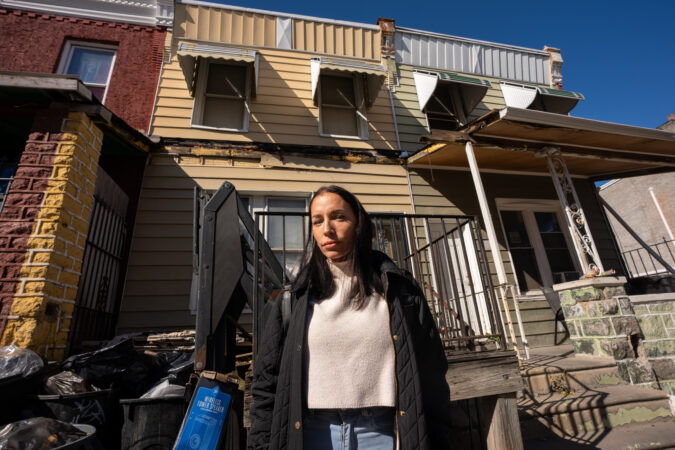
That includes Emily Phillips and her family, whose North Philly rowhouse is attached to a home they didn’t know was vacant when they moved in. The empty house now has a gaping hole in the back of it, and a tree is growing inside.
The city labeled the rowhouse “imminently dangerous” and at risk of collapse.
That was four months ago.
Phillips told me her family is afraid that something as simple as a slammed door could send the rowhouse next door crashing down.
My colleague Joe Yerardi and I investigated how the city tracks and handles vacant properties. We found problems.
Keep scrolling for that story and more in this week’s edition:
Residents rely on the city to keep an eye on vacant properties that are or could become dangerous.
My colleague and I started looking into the link between unsafe buildings and vacancy in April as I was writing about a Sharswood family who lived next to a rowhouse that collapsed.
We had a lot of questions for the city’s Department of Licenses and Inspections. During months of reporting, we found out that L&I stopped using a tool that it once said would make the department more proactive in protecting the public from deteriorating vacant buildings.
We also found that:
predominately Black areas of the city are more likely to have vacant and dangerous rowhouses
nearly eight in 10 vacant and dangerous rowhouses are in the poorest 25% of the city’s zip codes
When people who live next to vacant properties complain to the city, they’re often left in the dark as they worry about their families’ safety.
Keep reading to hear neighbors’ stories, learn about issues with the city’s handling of vacant properties, and see what the city has to say.
And if you’re living next to a vacant property and you’re worried about what could happen, I have some tips on what you should do.
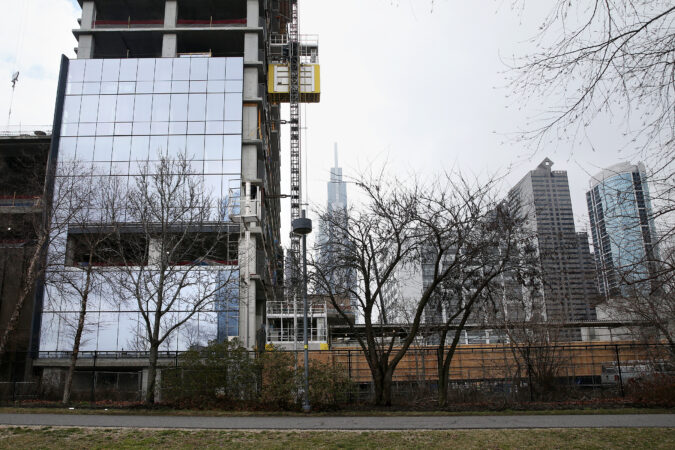
Here’s an eye-popping stat: 3,500 new apartments have opened just in the area between Pine and Vine Streets and between the Schuylkill and the Delaware River since 2023.
You may have asked yourself who’s living in all the pricey pads popping up over the last few years. Philadelphians I’ve talked to have wondered the same.
They’ve suggested that these renters are New York transplants. And some of them are. More New Yorkers and other out-of-towners are looking for apartments in Philly.
Center City’s business improvement district surveyed renters at more than two dozen apartment buildings that have been constructed downtown in the last decade.
Of the people who responded to the survey:
most are between the ages of 25 and 34
they’re paying more in rent than the typical Philadelphia renter
almost a third of them work in one industry in particular
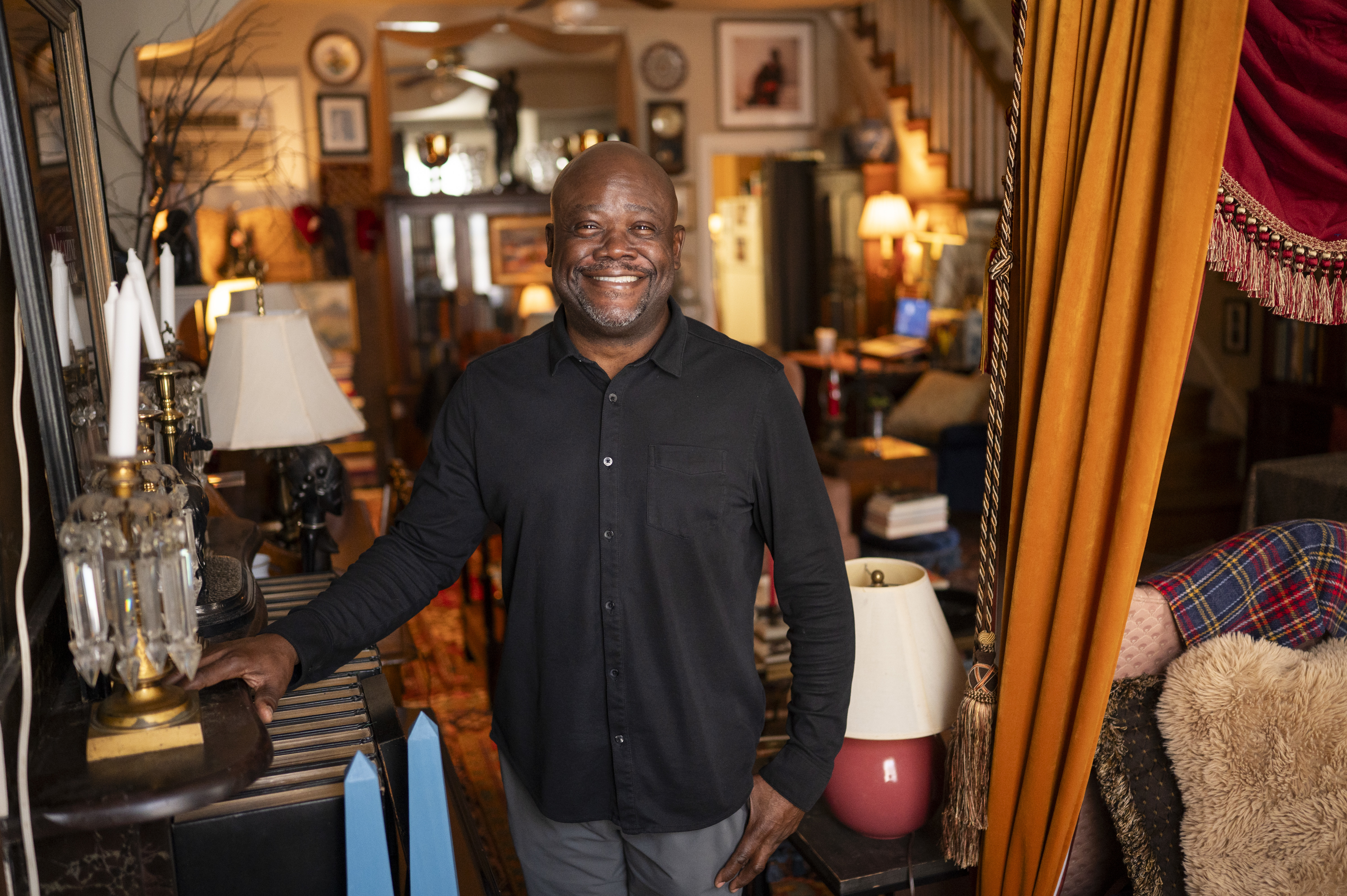
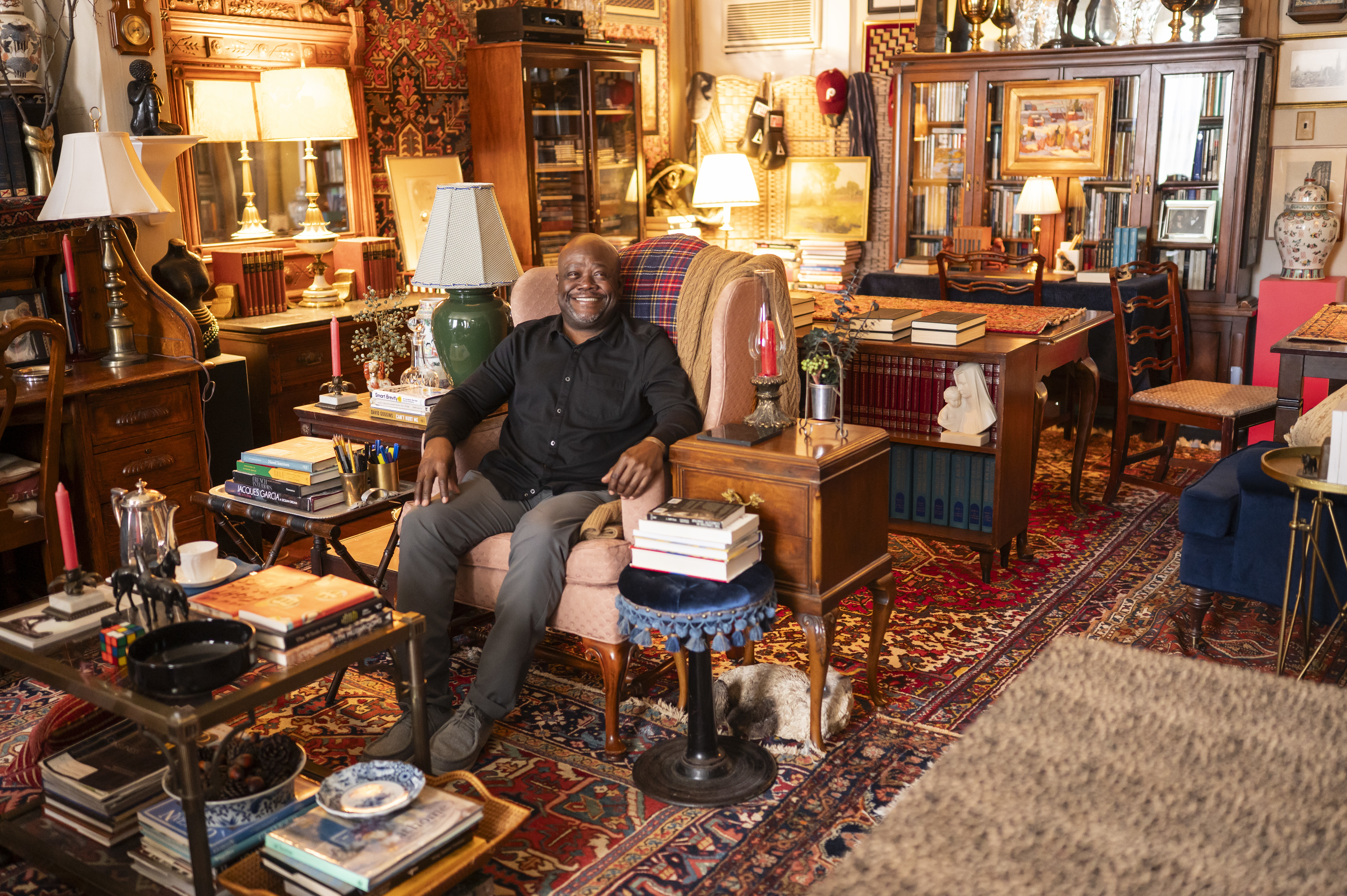
Abel Tootle Jr. calls himself “a maximalist at heart.” And his North Philly rowhouse reflects the title.
Patterned rugs cover floors, tables, and walls. A canopy bed in the double parlor is framed by velvet and tasseled curtains. Throughout the house, books are displayed on shelves but also thoughtfully arranged on tables and stacked on floors.
Tootle estimates he owns about 3,000 of them — “the culmination of 40-plus years of book collecting, trading, and selling,” he said.
He had rented small apartments before he bought his house. So he took the purchase as the opportunity he’s always wanted to do his thing as an amateur interior designer. He experiments with lighting, colors, and textures.
Across the Mid-Atlantic region and the Philly area, the housing market was kinda meh in November.
In our area, the number of closed home sales was down compared to the same time last year. And properties were taking longer to sell, so home listings piled up.
Lisa Sturtevant, chief economist at the multiple listing service Bright MLS, explained what’s going on.
“Even with somewhat lower mortgage rates, homebuyers and sellers are still very cautious,” she said in a statement. “Economic uncertainty and ongoing affordability challenges remain the biggest constraints on the Mid-Atlantic housing market as we head into the final stretch of 2025.”
In the Philadelphia metro area last month:
🔻There were 4,754 closed sales, down about 4% from the same time last year.
🔺The number of homes actively listed for sale — 11,685 — was up almost 8% from last year.
🔺The median sale price was $390,000, up more than 3% from last year.
📷 Photo quiz
Do you know the location this photo shows?
📮 If you think you do, email me back. You and your memories of visiting this spot might be featured in the newsletter.
I learned that a lot of my readers are fans of the tavern. Shoutout to Ilya S., Evan N., and Don L. — my most enthusiastic respondents.
―
The words “cute” and “construction site” don’t usually go together in our stories.
But my colleague Kristen A. Graham wrote about some adorable second-graders who had a lot of questions for the workers building an addition on a house next to their school. And they got answers when folks from the construction company came to visit.
Story sneak peek: The students guessed that the project used “four thousand million” bricks.
Enjoy the rest of your week.
By submitting your written, visual, and/or audio contributions, you agree to The Inquirer’s Terms of Use, including the grant of rights in Section 10.
Between Pine and Vine Streets, river to river, 3,500 new apartments have opened since 2023. If you’ve lived in Philly for a while, you might have looked up at all those high-rise towers and wondered: Who’s up there?
The answer is, more than likely, a bunch of carless, 30-something transplants who work at Jefferson.
🏢 Most of these renters are young — under 45 — and probably don’t own a car, a Center City District survey found. Nearly half moved from beyond the region, but they want to stay for at least the next few years. Many work in Center City or very close by, and they’re in healthcare more than any other sector.
🏢 They say they’re attracted by the downtown area’s density and walkability. They’re also likely to pay nearly double the median Philadelphia rent, for an average of $2,645.
🏢 Case in point: “I love that Philadelphia has so much energy,” said a Logan Square data analyst who moved to the city with his wife, a Cooper University Hospital employee, from Baltimore last year. Next, they hope to buy a condo nearby.
In other housing news: Airbnb expects to host 17,000 guests at its short-term rentals across the region when the FIFA World Cup comes here next summer.
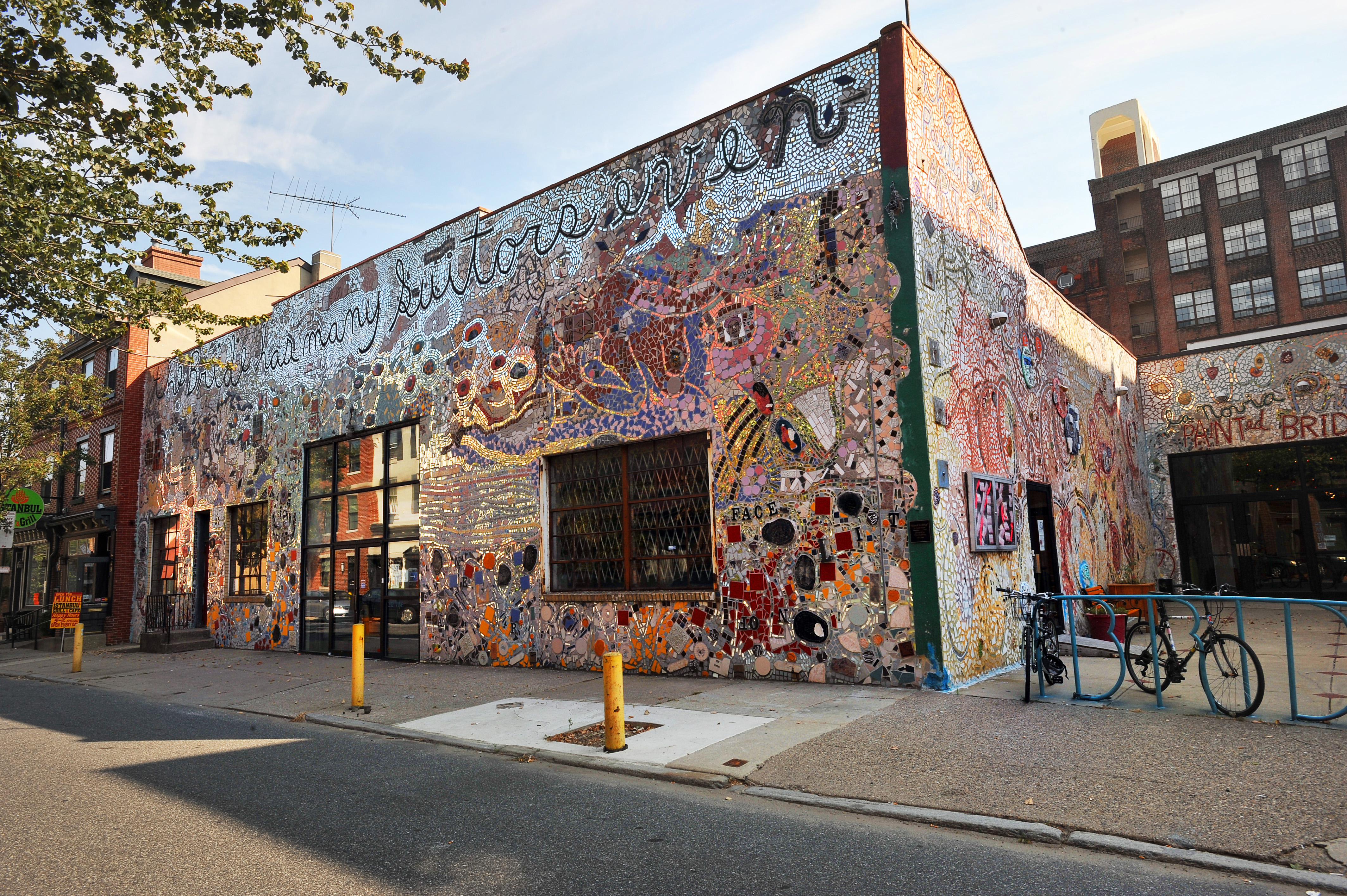
This unceremonious ending follows a nearly six-year legal battle that pitted artists and preservationists against neighbors, who opposed developer Shimi Zakin’s plans to save the arts space. Zakin said he now hopes to incorporate pieces of the exterior’s 7,000-square-foot mirror-and-tile mosaic by Isaiah Zagar into his new building.
But the celebrated structure had faced tumult before.
King of Prussia-based Recovery Centers of America will pay $2 million to settle federal claims of illegally dispensing controlled substances and falsely billing Medicaid.
The Trump administration changed the name on a portrait of former Health Secretary Rachel Levine, formerly Pennsylvania’s physician general. She called it a “petty action.”
A former Philly teacher-turned-Democratic official wants to unseat a Republican state senator in the suburbs, part of a larger effort to flip the state Senate for the first time in 31 years.
Philadelphia City Council voted Wednesday against Mayor Cherelle L. Parker’s vision for her signature housing plan, signaling a win for progressives.
A Philly judge’s ruling in a charter case has called into question Joyce Wilkerson’s seat on the school board.
Richardson is now making “bus-driver rap” in a different way: He has become a go-to artist for Philly-set TV show Abbott Elementary, plus Albie’s Elevator and other local productions .
🧠Trivia time
Beginning Jan. 5, twice-weekly trash pickup is coming to which area of the city?
Cheers to Fatima Lee, who solved Wednesday’s anagram: Wissinoming. Jeff Brown, whose family operates a dozen local ShopRites, recently purchased the Shoppes at Wissinoming shopping center in Northeast Philadelphia for $30.8 million.
Photo of the day
Abel Tootle sits for a portrait in his double parlor room at his home in North Philadelphia.
📚 One last homey thing: When Abel Tootle Jr. bought his home 13 years ago, it gave him full freedom to design a space reflecting his interests — most importantly his many, many books. Check out his “maximalist” North Philly rowhouse.
Sounds like a dream home to me. I’ll be OOO through next week, so Paola and Sam will bring you the weekday news. ‘Til we meet again in your inbox, be well.
By submitting your written, visual, and/or audio contributions, you agree to The Inquirer’s Terms of Use, including the grant of rights in Section 10.
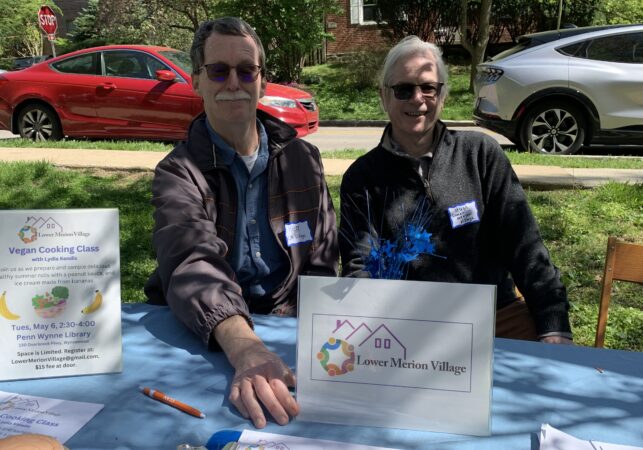
The Lower Merion Village offers social activities and volunteer opportunities for older adults and people with disabilities in the Main Line community.
A group of Lower Merion residents has come together to help one another age in place. More and more older adults prefer to remain in their homes, a choice that comes with some logistical concerns.
Lower Merion Village, part of the national Village to Village Network, is setting out to ease some of those burdens by connecting residents to social events, as well as transportation, household help, and other services.
While Lower Merion Village isn’t accepting members yet, its organizers have their sights set on being a resource to help longtime residents thrive in the community they love.
SEPTA missed Friday’s federally imposed deadline to finish repairs to the heat-detection system on its Regional Rail cars. The agency said the lapse was due to a shortage of the thermal wire required to make the repairs. Installation of the backordered wire for 30 of SEPTA’s remaining trains is expected to be completed next week.
Narberth residential parking permits for 2026 are now available. Fees range from $10 for a single car to $100 for a fourth vehicle.
Bryn Mawr College last week announced Airea “Dee” Matthews, professor and co-chair of the creative writing department, as its next provost. Matthews will assume the role on Jan. 1.
Looking for a crafty holiday gift for those on your list? Several Lower Merion shops, including Past Present Future in Ardmore, and Something Different by Eric in Bryn Mawr, have goods like funky snow globes, cat-themed pillows, and other unique housewares.
For those shopping in Ardmore, township metered parking spaces and the township garage on Cricket Avenue are free on Saturdays this month.
On Sunday and Monday, Santa will be visiting parts of Lower Merion aboard a Merion Fire Company of Ardmore fire truck. The big man will visit Wynnewood, Ardmore north of the railroad tracks, and Haverford on Sunday, and then the Ardmore section south of the railroad tracks on Monday.
Brook J. Lenfest sold his 14,000-square-foot Haverford home, which was the most expensive recorded residential sale in the Philadelphia area among public records last week. The CEO of telecommunications company NetCarrier’s Avonwood Road home went for $5.9 million. (Philadelphia Business Journal)
Narberth’s GET Café is the subject of a new documentary that will debut at the Bryn Mawr Film Institute tonight at 7 p.m. David Block’s Brewing Possibilities focuses on the cafe’s mission to support neurodivergent individuals through employment and community building. Tickets to the premiere are $30. (Patch)
Black Rocks’ book fair runs through tomorrow and winter concerts continue throughout this week and next. See the district’s full calendar here.
Lower Merion tackle/defensive tackle Kechan Miller has signed on to play college football at Temple University next year.
🍽️ On our Plate
Hanukkah begins Sunday night. Looking for takeout or catering options? Main Line Today has rounded up 10 local spots offering everything from sides to main dishes.
🎳 Things to Do
🎄 Home for the Holidays: Take a look inside the main house at Stoneleigh, all decked out for the holidays. There will also be seasonal treats and musical performances. ⏰ Saturday, Dec. 13-Sunday, Dec. 14, times vary 💵 $15 for Natural Lands members and $20 for non-members 📍Stoneleigh
🛍️ Ardmore Holiday Market: Over 20 vendors will be selling handcrafted goods at this inaugural event. ⏰ Saturday, Dec. 13, 11 a.m.-3 p.m. 💵 Pay as you go 📍Schauffele Plaza
🎵 Funky Brunch: Holiday Edition: Shop local vendors while sipping beer and enjoying brunch at this family-friendly event. ⏰ Sunday, Dec. 14, 11 a.m.- 3 p.m. 💵 Pay as you go 📍 Ardmore Music Hall
✡️ Menorah Lighting: Celebrate the first night of Hanukkah with a lighting of the giant menorah at Suburban Square. There will also be food, drinks, and activities like donut decorating. ⏰ Sunday, Dec. 14, 5 p.m. 💵 Free 📍Suburban Square
🖌️ Kwanzaa Crafternoon: Kids can make a colorful Kwanzaa craft out of paper, stickers, and markers during this drop-in event. ⏰ Wednesday, Dec. 17, 3-5 p.m. 💵 Free 📍 Gladwyne Library
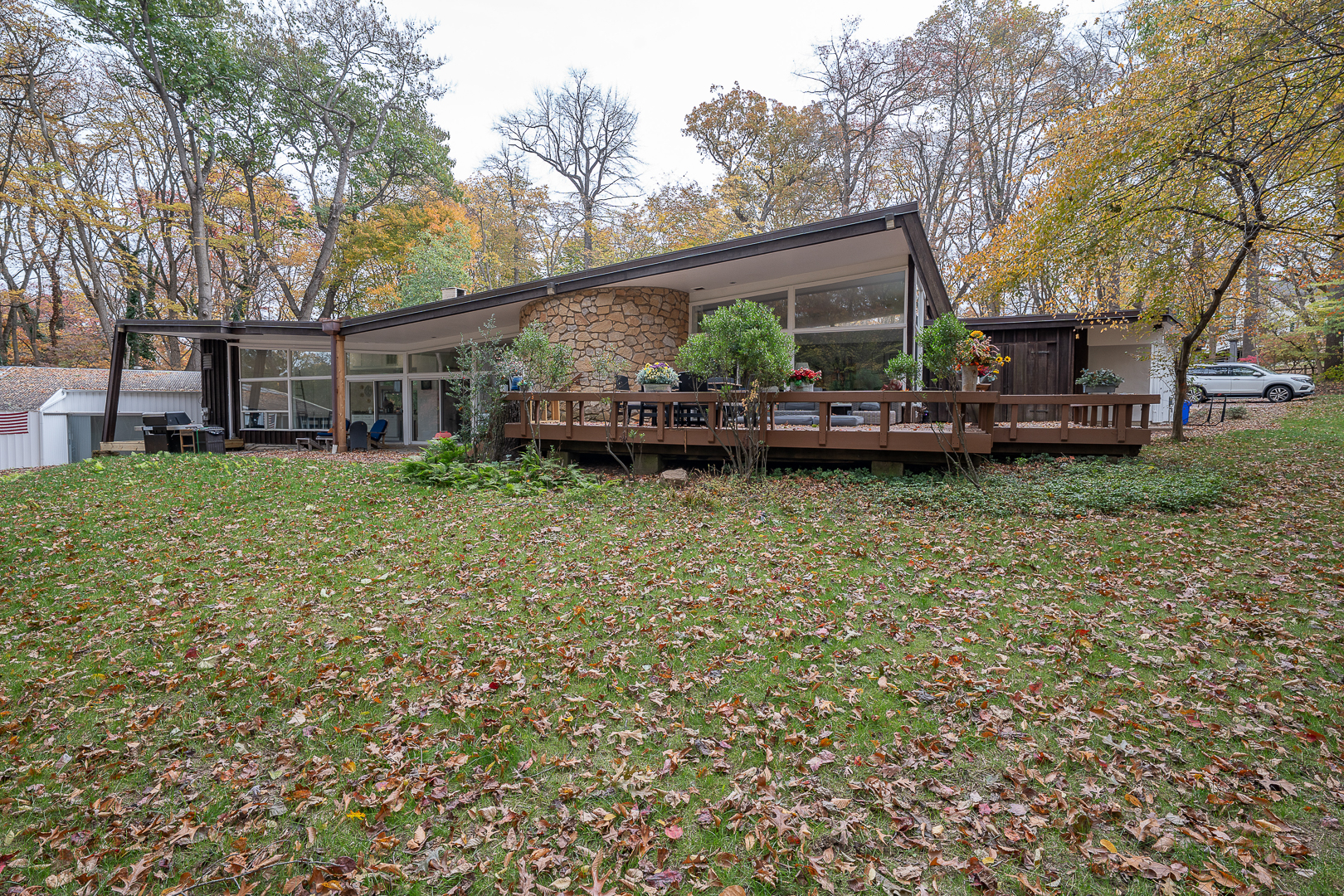
This Penn Valley home has a distinctive look thanks to its midcentury modern design. The majority of the home’s living space is on the first floor, which has an updated eat-in kitchen and six of the home’s seven bedrooms. The primary suite has three walk-in closets and sliding glass doors that lead to an atrium and an office. There’s another suite on the lower level, but perhaps most unique is the glass-encased indoor pool. The home also has a large deck and patio.
By submitting your written, visual, and/or audio contributions, you agree to The Inquirer’s Terms of Use, including the grant of rights in Section 10.
This suburban content is produced with support from the Leslie Miller and Richard Worley Foundation and The Lenfest Institute for Journalism. Editorial content is created independently of the project donors. Gifts to support The Inquirer’s high-impact journalism can be made at inquirer.com/donate. A list of Lenfest Institute donors can be found at lenfestinstitute.org/supporters.
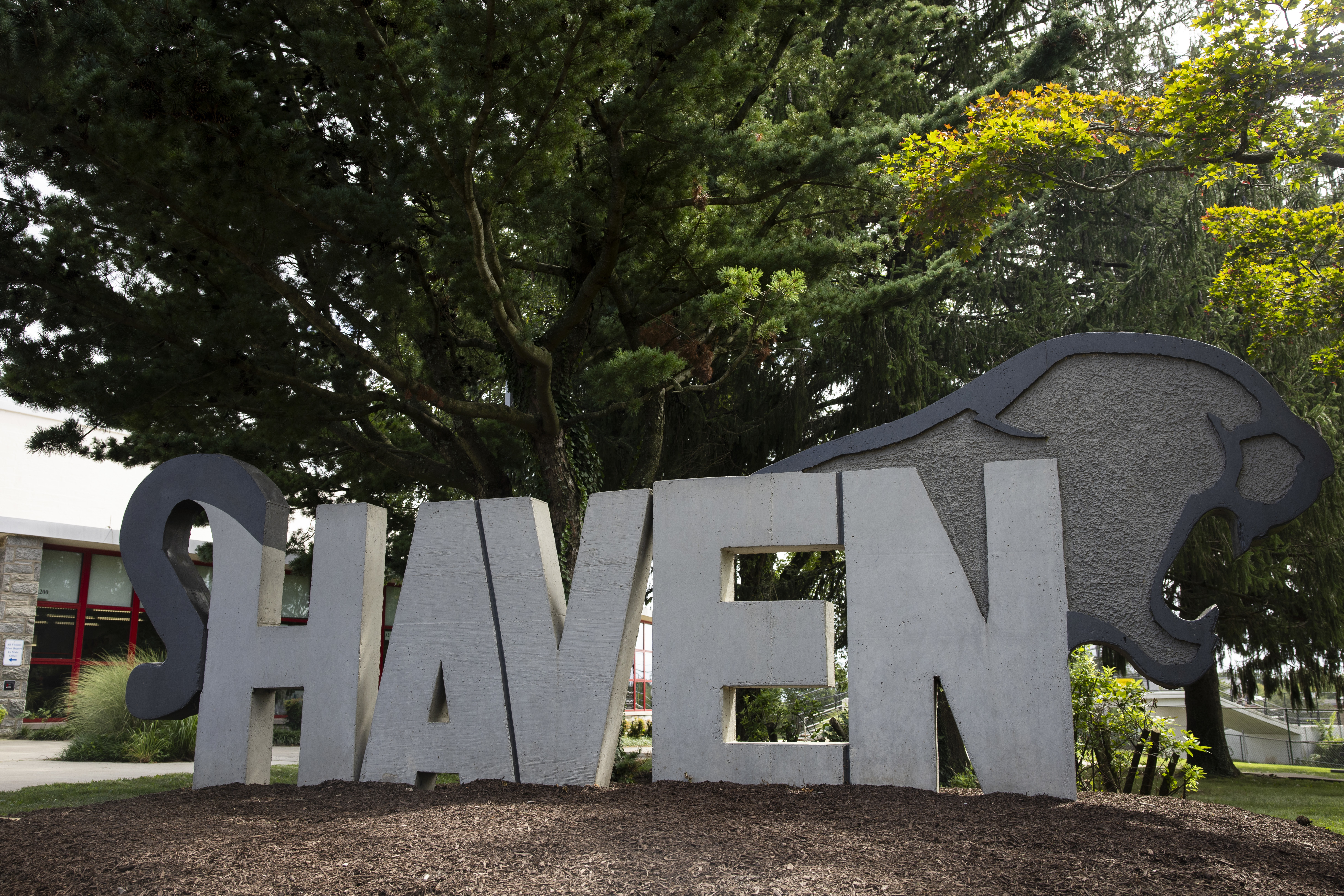
Wallingford-Swarthmore School District held listening sessions about its budget at Strath Haven Middle School on Monday.
Facing a $2.6 million budget deficit for the 2027-28 school year, Wallingford-Swarthmore School District is considering any idea to trim that figure.
That was the takeaway from a Monday listening session, where Superintendent Russell Johnston said the district is “turning over every stone” in its quest and took suggestions from the public.
Unlike neighboring districts, WSSD is predominately supported by homeowners’ tax dollars, many of whom already feel stretched thin, The Inquirer’s Denali Sagner reports.
While some attendees left the meeting feeling better about the school’s objectives, others still wonder how it got in this hole in the first place.
Remediation work to clean up a September oil spill that contaminated Ridley Creek is nearing completion.
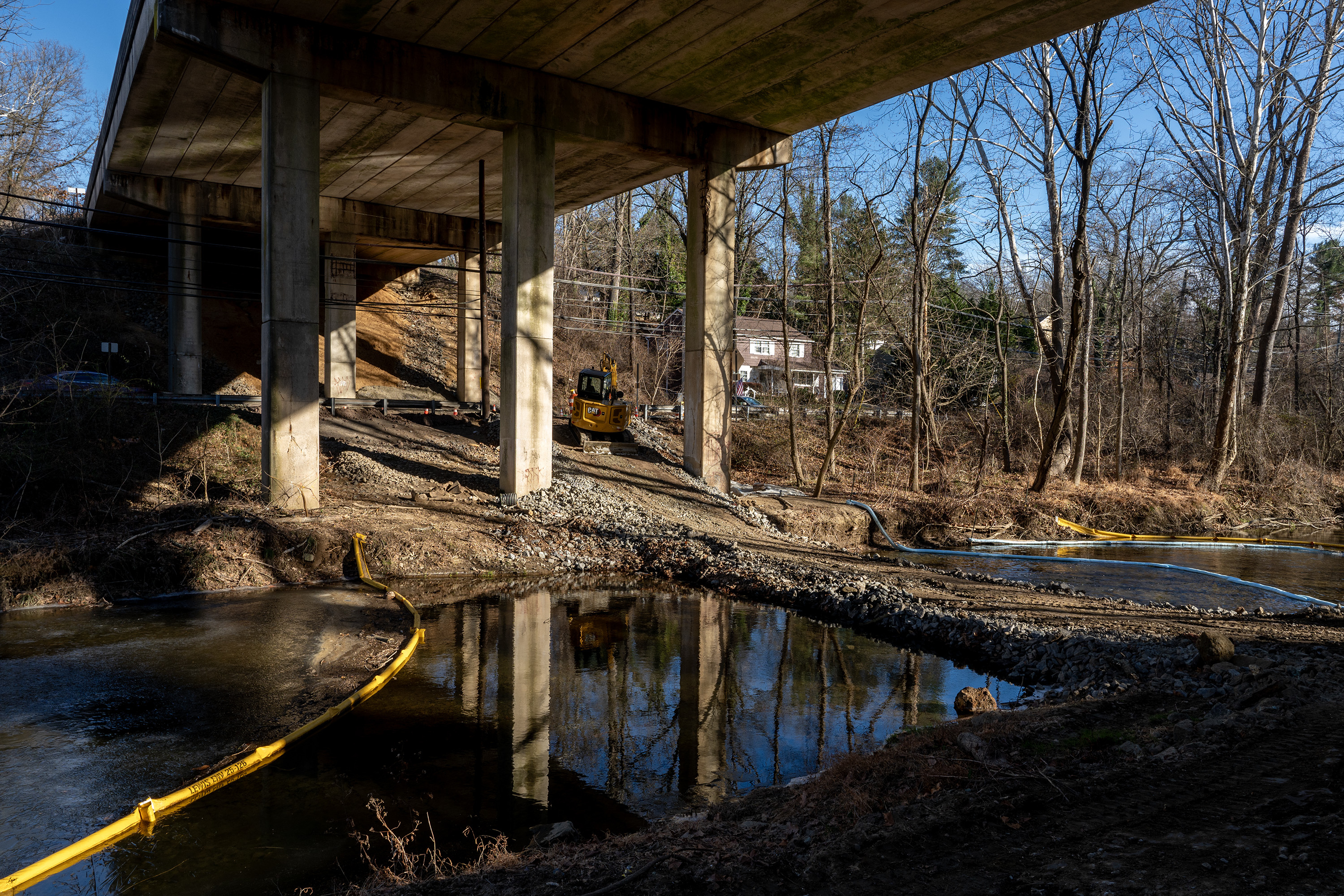
Work to clean up oil that spilled into Ridley Creek when a tanker crashed on the Route 1 Bypass in September is nearly finished. Officials expect to wrap up next week, with road closures on Ridley Creek Road continuing until then.
Crews have been remediating the area, where an estimated 1,000 to 2,000 gallons of oil spilled, including removing contaminated soil and refilling the site, The Inquirer’s Torin Sweeney reports.
SEPTA missed Friday’s federally imposed deadline to finish repairs to the heat-detection system on its Regional Rail cars. The agency said the lapse was due to a shortage of the thermal wire required to make the repairs. Installation of the backordered wire for 30 of SEPTA’s remaining trains is expected to be completed next week.
Now in its 50th year, the Festival of Lights officially got underway last week at Rose Tree County Park in Media, and will be lit nightly through Jan. 3. We take a look back at highlights from the opening night.
Residential parking permits for 2026 are now available for Media borough residents. Fees are $5 each for a household’s first two cars and $15 each thereafter. New for 2026, the borough will not distribute a physical sticker, but will instead track registration through the Passport Parking app.
Newlin Grist Mill has named a new executive director to lead the historic Concord Township site. Amy Ricci, who most recently held that same role at former Philadelphia paper mill Historic Rittenhouse Town, will assume the position in January, becoming the organization’s fourth executive director.
Wawa is opening its 1,000th fuel store today at 675 Baltimore Pike in Springfield. The first 250 guests will get a free T-shirt and coffee. (Daily Times)
🏫 Schools Briefing
Notre Dame de Lourdes School in Swarthmore took home first place in the kindergarten through eighth grade category of B101’s annual Christmas Choir Competition for its rendition of Like It’s Christmas. The school will receive $5,000 for its music program and will perform the winning song at the Philly Pops’ A Philly Holiday Spectacular on Sunday.
There’s a school board meeting tonight at Penncrest High School. On Monday and Tuesday, Rose Tree Elementary will host its fifth grade band concert. Penncrest High School’s winter choral concert is on Wednesday. See RTMSD’s full calendar here.
Tonight is Swarthmore-Rutledge School’s winter concert, Strath Haven High’s orchestra concert is Monday, and its choral concert is Tuesday. Wallingford Elementary is hosting winter concerts on Wednesday and Thursday. See WSSD’s full calendar here.
WSSD is also hosting a community artificial intelligence forum tonight from 6 to 7:30 p.m. at Strath Haven Middle School’s library, where attendees can provide feedback about policies.
The Towne House in Media has been transformed for the five-week run of “Holly Jolly.” The holiday décor will be on display through Jan. 4, during which time festive drinks can also be ordered. Options include the Mistletoe Kiss, made with vodka, rosemary simple syrup, lemon, and club soda, or Holly’s Hot Chocolate, which gives hot cocoa a kick thanks to vanilla vodka and Irish cream.
Santa will be making a stop in Glen Mills this weekend alongside Mrs. Claus when the duo visit Harvest Seasonal Grill Saturday from 9 a.m. to 11 a.m. Kids can also decorate cookies during the holiday brunch buffet. Tickets are $25 for children and $35 for adults. Reservations are required.
🎳 Things to Do
🌃 Night Market: Swarthmore merchants will stay open later on Friday, and there will also be pop-up vendors, food, drinks, and an ugly sweater competition. ⏰ Friday, Dec. 12, 5-8 p.m. 💵 Pay as you go 📍 Swarthmore town center
🎙️ The Newspaper Taxis: Hear tunes from this Beatles tribute band. ⏰ Friday, Dec. 12, 8 p.m. 💵 Free 📍 Shere-E-Punjab, Media
🍪 Cookie Walk: Love holiday cookies but don’t love baking? Or just want to get a larger array? This annual event lets attendees pick and pay for the homemade sweets they want. ⏰ Saturday, Dec. 13, 9 a.m. 💵 Pay as you go 📍 Middletown Church, Media
☕ Cocoa and Photos with the Clauses and Friends: Write a letter to Santa, decorate cookies, and pose for festive photos with Olaf, Jolly Bear, and the big man himself. ⏰ Saturday, Dec. 13, 10 a.m.-noon 💵 Free 📍 Media Community Center
🕎 Chanukah Village: A number of stores throughout Media will host crafts and other activities in celebration of the first night of the holiday. A 4:30 p.m. menorah lighting will be held at the Delaware County Courthouse. ⏰ Sunday, Dec. 14, 3-5 p.m. 💵 Free 📍 Various locations
The townhome spans over 3,600 square feet and backs up to woods.
Built in 2022, this spacious townhouse’s first floor features an open-concept kitchen, dining, and living area, which has access to a deck overlooking the woods. There are four bedrooms upstairs, including a primary suite with double vanities and a walk-in closet. It also has a finished walk-out basement with a full bathroom, and access to the community clubhouse and a tot lot. There’s an open house this Saturday from noon to 3 p.m.
By submitting your written, visual, and/or audio contributions, you agree to The Inquirer’s Terms of Use, including the grant of rights in Section 10.
This suburban content is produced with support from the Leslie Miller and Richard Worley Foundation and The Lenfest Institute for Journalism. Editorial content is created independently of the project donors. Gifts to support The Inquirer’s high-impact journalism can be made at inquirer.com/donate. A list of Lenfest Institute donors can be found at lenfestinstitute.org/supporters.
Crews are in the final stages of cleaning up the site where oil leaked into Ridley Creek after a tanker truck crashed near Media in September, according to municipal and county officials.
Ridley Creek Road will continue to have road closures from 9 a.m. to 2 p.m. until the work is finished.
Work should be completed next week, said Larry Bak, the county’s hazmat crew chief. Crews from Lewis Environmental have removed the contaminated soil and are refilling the site. Environmental consulting firm Aquaterra is overseeing the remediation work and testing.
A Cardinal USA truck carrying home heating oil crashed on Sept. 22 while traveling north on the Route 1 Bypass at the border of Upper Providence and Middletown Townships. The truck swerved across the highway and rolled an undetermined number of times, according to Upper Providence Fire Marshal Alan Mancill.
The truck came to rest with the cab hanging off the east side of an overpass and a gash in its side that spilled 1,000 to 2,000 gallons of oil onto the roadway and into Ridley Creek below, Mancill said.
The cause of the crash is unclear and Upper Providence police could not be reached for comment.
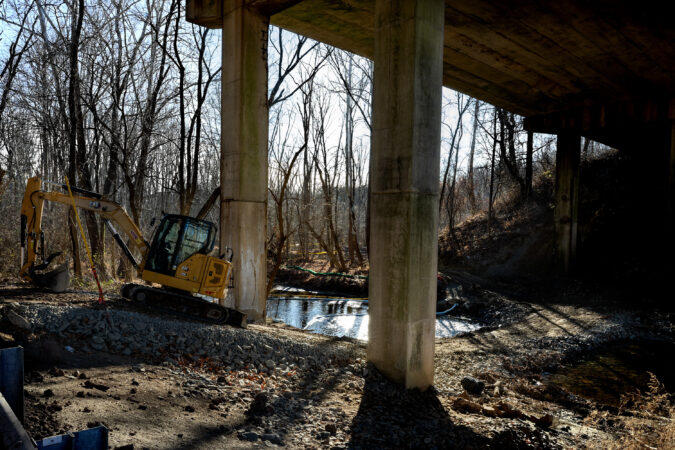
Remediation work continues on Ridley Creek Tuesday, Dec. 9, 2025, under the Route 1 overpass in Media, Delaware County where a tanker overturned spilling thousands of gallons of home heating oil in September.
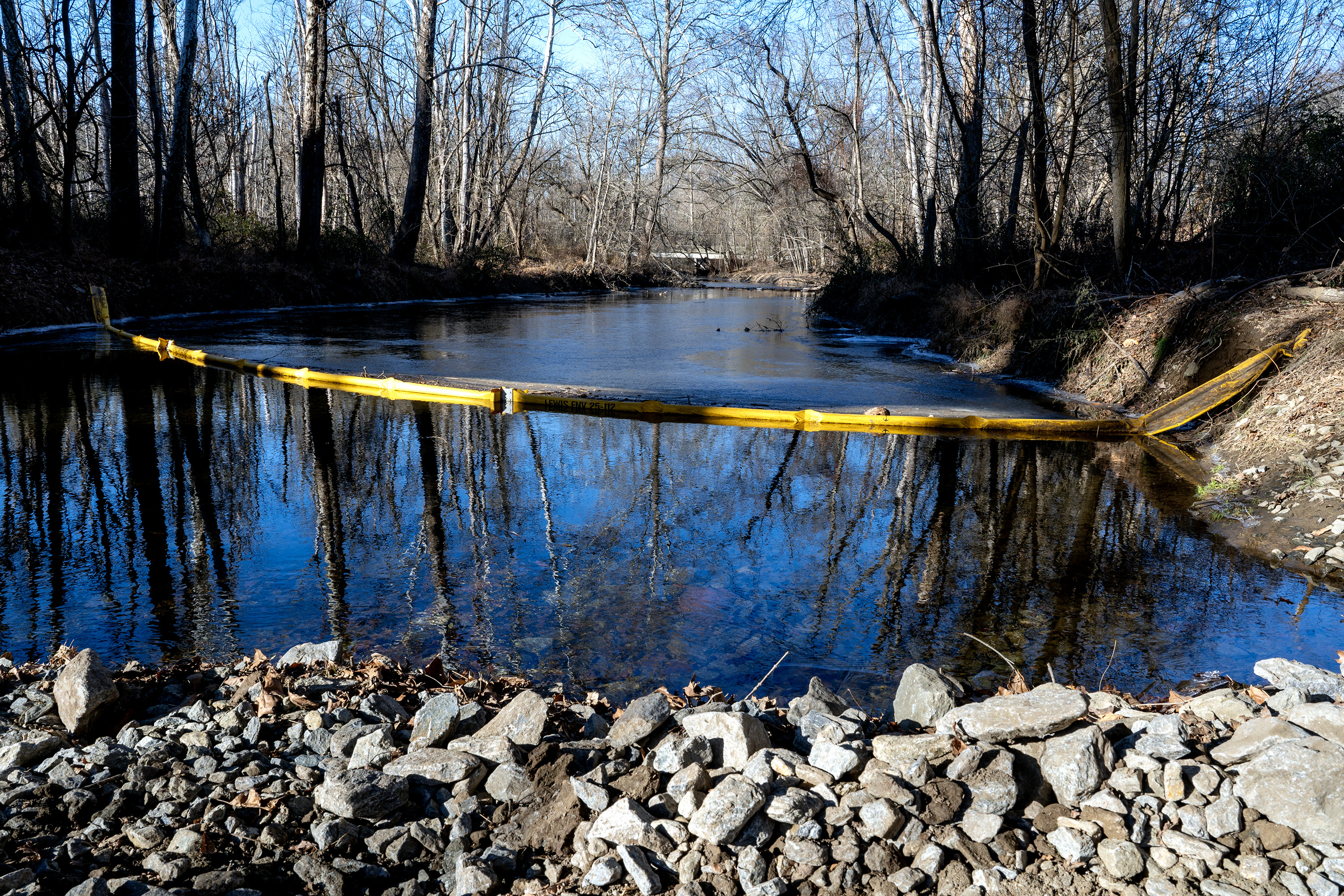
“I sent half of my team up onto the bridge to work with the tank truck, and I sent the other half of my initial response down to the creek to get in front of it as it was going downstream,” Bak said. The crew put containment booms across the creek to halt the spread of oil.
Aqua’s Ridley Creek water treatment facility is about a mile and a half downstream from the site. Bak said the facility was quickly alerted to shut off its intake after the spill. It was reopened after the water was deemed safe, but the booms remain in place just in case.
“I believe the expression is ‘an overabundance of caution,’” Bak said.
The site of the crash posed a challenge to the cleanup crew, with oil contaminating a hillside as well as the creek and marshy area below the bridge. Crews used a special excavator with 35-foot arms.
“It had to reach out and down because it’s a fairly steep hill,” Bak said. “It’s not an insignificant height.”
To reach the contaminated areas, the crew also built a dam from the Ridley Creek Road side with pipes underneath to let the creek flow underneath. The dam will be removed after work is complete, Bak said.
Once the work is done, soil will continue to be monitored for two years.
This suburban content is produced with support from the Leslie Miller and Richard Worley Foundation and The Lenfest Institute for Journalism. Editorial content is created independently of the project donors. Gifts to support The Inquirer’s high-impact journalism can be made at inquirer.com/donate. A list of Lenfest Institute donors can be found at lenfestinstitute.org/supporters.
When Adam Sawyer and his wife, Marissa Tan, moved to Philadelphia in 2024 from Baltimore, they were attracted to Center City by its proximity towork and mass transit.
The couple figured if they sold their car, they could even afford to rent in one of the thousands of new, high-rise apartments that have been built across Center City over the last 10 years.
Tan had just gotten a new job with the Cooper University Hospital in Camden, and Adam needed access to 30th Street Station for work. They eventually settled on the PMC Property Group’s Riverwalk North at 23rd and Arch Streets and have been impressed by the city, its transit system, and life without a car.
Adam Sawyer and his wife, Marissa Tan, moved to Philadelphia in 2024 from Baltimore.
“One of the things I love about living in a city is that you’ll be walking down the street and there are five different events you didn’t even know about,” Sawyer said. “Festivals, farmers markets, just activity, people doing things. I love that Philadelphia has so much energy.”
In many ways Sawyer and Tan — who are both 35 — are representative of the people who have taken up residence in the new apartment buildings across Center City. Between Pine and Vine Streets, river to river, 3,500 new apartments have opened since 2023.
Center City District (CCD) set out to learn more about who is calling these apartments home, with a survey of more than two dozen buildings constructed since 2015.
Like Sawyer and Tan, the vast majority of respondents to CCD’s survey are under 45 (83%), more than half don’t own a car (55%), and close to half moved from outside the Philadelphia area (44%). Sawyer works remotely like 21% of respondents, and Tan works in healthcare like 32% of them.
window.addEventListener(“message”,function(a){if(void 0!==a.data[“datawrapper-height”]){var e=document.querySelectorAll(“iframe”);for(var t in a.data[“datawrapper-height”])for(var r,i=0;r=e[i];i++)if(r.contentWindow===a.source){var d=a.data[“datawrapper-height”][t]+”px”;r.style.height=d}}});
In a city where a fifth of all residents live in poverty, the respondents aren’t representative of the average Philadelphian in many ways. The buildings surveyed have an average rent of $2,645, well above the median of $1,387.
But the results show that there is a market for the kind of new buildings that are still being proposed. They alsohighlight that many people are attracted to the most central parts of Philadelphia because it offersmore density, walkability, and other urban characteristics that few other American cities can boast.
“People actively choose Philadelphia over other cities and metropolitan areas because we outperform them in some ways,” said Clint Randall, vice president of Economic Development with CCD, which is funded by downtown property owners and provides advocacy and services like additional security and cleaning downtown.
“The city spent so many decades shrinking,” Randall said. “When you see this entire skyline of high-rise apartment buildings emerge, it contradicts what longtime Philadelphians think they know about this place, which is that it does not grow or attract residents.”
Reversing reverse commuting
Center City District’s survey confirmed a longtime finding of the organization’s other research reports: People who live downtown are likely to work there or very close by.
In Philadelphia, reverse commuting is common, a testament to the fact that many private-sector employers have remained outside the city to avoid wage and business taxes. But among survey respondents, only 12% commuted to the suburbs for work compared to almost 40% citywide.
Over half of respondents work in either Center City or University City, and a similar proportion work in either healthcare (32%) or in the jobs more typically associated with office towers: “business, professional, or financial services” (27%). Twenty-one percent work from home.
“A lot of people are in medicine, in healthcare. I see a lot of scrubs,” said Kaz Rivera-Gorski, about her building One Cathedral Squareat 17th and Race Streets.
window.addEventListener(“message”,function(a){if(void 0!==a.data[“datawrapper-height”]){var e=document.querySelectorAll(“iframe”);for(var t in a.data[“datawrapper-height”])for(var r,i=0;r=e[i];i++)if(r.contentWindow===a.source){var d=a.data[“datawrapper-height”][t]+”px”;r.style.height=d}}});
“I would imagine there’s a good amount of people that work remotely, too,” said Rivera-Gorski, who is a management consultant who works from home. “I see people on their laptops in the shared spaces during the day.”
Seventy percentof respondents said their jobs are within walking, biking, or transit distance from their homes, while 80% of them said that owning a car was not necessary to enjoy daily life in Philadelphia.
That’s part of what attracted Sawyer and Tan, even though another part of Philadelphia’s allure was that it was closer to family in central and eastern Pennsylvania (the couple have a Zipcar membership).
“While I do drive, I really, really dislike driving,” Sawyer said. “I’ve lost people. Everybody has, to either accidents or crashes or DUIs. So we were open to selling our car and became more and more convinced it was a good idea.”
window.addEventListener(“message”,function(a){if(void 0!==a.data[“datawrapper-height”]){var e=document.querySelectorAll(“iframe”);for(var t in a.data[“datawrapper-height”])for(var r,i=0;r=e[i];i++)if(r.contentWindow===a.source){var d=a.data[“datawrapper-height”][t]+”px”;r.style.height=d}}});
Retaining out-of-towners
Randall said that he was surprised by the proportion of CCD’s respondents who reported having moved to Philadelphia from outside the region. (A recent Realtor.com report showed that Philadelphia switched from having mostly local interest in rental listings before the pandemic to mostly out-of-towners today.)
The survey also found that the majority of Center City dwellers planned to be living in Philadelphia inthree to five years, with 45% planning to continue renting and 16% hoping to buy.
“You hear about the transience of other places like D.C. or Boston, and it seems like people are here [in Philadelphia] and they intend to stay,” Randall said.
That is certainly the goal of Annika Verma, a student at Temple University who lives in the Logan Lofts in Callowhill.
“I am already calculating: Can I get an entry-level job? What salary would work for the rent in this area?” Verma said. “I would love to stay. The area seems ideal for me in terms of commuting or walking. Anything, everything is a 15-20 minute walk or bus ride away.”
Sawyer and Tan are hoping to stay in Philadelphia, too. They are currently searching Center City for a condo to buy. They may try to stay in their current Logan Square neighborhood for its proximity to the Schuylkill River Trail and 30th Street Station.
“We love it,” said Sawyer, who notes that they’ve lived in three cities in Texas, Cooperstown in New York, and Baltimore before this. “But our favorite place we’ve ever lived is here in Philadelphia.”
Lil’ Filmmakers, a Roxborough-based nonprofit, was supposed to have $170,000 in the bank.
The mission of helping young people become storytellers through film and media had caught the attention of major donors in 2025. The city awarded it a $28,000 anti-violence grant, and one of Michael Jordan’s charitable organizations issued a separate $35,000 grant. Funding should not have been a problem, according to CEO Janine Spruill, who started the program in 1999.
But on Aug. 27, neither she nor her fourstaffers, nor her summer program participants, had gotten paid by the Federation of Neighborhood Centers, the Philadelphia nonprofit that managed their money.
She remembers FNC staff telling her they had decided not to processpayroll because they were trying to “figure some things out.” Without specifics, Spruill walked away suspecting the worst.
“I went into a bit of a panic mode,” Spruill said, upset that she hadn’t even been given a heads-up. “I ended up crying my eyes out because I said, ‘Oh, my God, I raised all this money, and they’re telling me they don’t have it.’”
Other organizations that had contracts with FNC soon realized that they, too, were having issues accessing their funds. They reported overdue invoices, payroll issues, and spotty communication with FNC.
As the weeks turned into months, Spruill said, FNC would not let her access the money she had raised. She had to launch emergency fundraisers.
The announcement many of the groups dreaded arrived in November. FNC’s grant management services — known as a fiscal sponsorship program in the nonprofit world — would shut down Dec. 31.
“This choice does not come lightly,” said FNC’s announcement on its website. “It comes after years of carrying work that we believed in wholeheartedly — often beyond our capacity — because we care deeply about every project, every leader, and every community member who trusted us with their mission.”
FNC’s collapse, by its own admission, is a story of an organization that grew too quickly and let basic accounting principles go by the wayside. Demir Moore, the nonprofit’s new CEO as of Aug. 26 and a former Lil’ Filmmakers intern, insisted FNC’s collapse was due to a “lapse of management” and “absolutely not attributable to malfeasance or embezzlement.”
FNC spent itself into a deficit over the course of years, continuously using money belonging to one group to pay for another, according to Thaddeus Squire of Social Impact Commons, an organization aiding FNC as it winds down.
“That deficit started to become unrecoverable,” he said. “Money that was borrowed was not put back.”
Moore declined to say how much money FNC has or how many groups are affected by the end of the fiscal sponsorship program. FNC has about 50 groups on its rolls, he said, but some have not been active or have no funds with the nonprofit.
Still, it is unclear how the nonprofit was able to operate the way it did for years. Sorting out just how FNC’s fiscal sponsorship program unraveled is going to take time, Moore said, declining to comment on leadership turnover in the last year.
Attempts to reach past FNC leadership for insight on what transpired were unsuccessful.
And while Moore described a round-the-clock effort to sort out how much every group should have in its account, he would not say for certain whether groups would get all their funds back by the time FNC shuts down.
When the ‘safe approach’ loses control
When run right, a fiscal sponsor can be a boon to newer community groups that do not have a tax-exempt status. By contracting with fiscal sponsors, which are registered as 501c3s, these smaller groups can apply for grants.
Donors are left assured that a more established nonprofit is guiding the smaller or newer group, said Brian Mittendorf, the H.P. Wolfe Chair in Accounting at Ohio State University, who specializes in nonprofit accounting.
“Financial difficulties at fiscal sponsors are much less frequent just because their position … is typically an indicator that they have strong financial controls and other infrastructure in place,” he said, adding that signing with a fiscal sponsor is “often viewed as the safe approach.”
Fiscal sponsors can also be of much help to registered nonprofits that would rather focus on providing services than on managing administrative tasks.
In exchange for a fee, the sponsor signs on to manage and distribute grants, offer reports, and take on a range of tasks, such as payroll or legal questions, giving community groups peace of mind.
For Lil’ Filmmakers, the promise of back-office support led it to contract with FNC nearly a decade ago. Spruill said the monthly accounting report FNC sent her would sometimes require adjustments, but she cited no major issues until this year.
The first red flag came in March. Spruill said FNC did not pay the rent for Lil’ Filmmakers’ studio in Roxborough. FNC ultimately took care of the late fees and cut the rent check, so Spruill said she chalked it up as a one-time occurrence.
Teens at the Lil’ Filmmakers nonprofit learn the ins and outs of filmmaking.
What Spruill and other community group leaders could not see was an organization Moore said could not keep up with its own expansion. The nonprofit recorded a revenue of $774,000 in 2019 taxfilings, which peaked at $4.76 million in 2023.
A years-old message from then-CEO Jerry Tapley remained on the FNC website until this summer, touting more than 50 projects ranging from urban farming and the arts to animal rescue work. The organization’s work affected 250,000 people annually in “Philadelphia and beyond,” he wrote.
Moore said that as the nonprofit grew, FNC was not always collecting key documentation, such as receipts. Community groups were allowed to draw checks for funds they did not have, and balance statements given to groups were out of date or inaccurate.
When Moore stepped down as FNC board president and took over as CEO, the first thing he did, in an attempt to take stock of finances and accounts, was freeze outgoing payments.
While Moore described the move as a necessary first step, community groups struggled to pay for basic overhead, and some sought outside help. Soon, Philanthropy Network Greater Philadelphia and Social Impact Commons, an organization that supports fiscal sponsors, were working with FNC — but it was too late.
There did not appear to be any nefarious intent behind the mismanagement, Social Impact Commons’ Squire said, but FNC’s system allowed some projects to spend into the negative and for debt to snowball.
Social Impact Commons recommended FNC shut down its fiscal sponsorship program and “stop trying to catch up,” according to Squire.
Clarity may not come for at least several more weeks
Sharon Wilson, Lil’ Filmmakers’ attorney, said one of her biggest frustrations is what she finds to be a general lack of transparency as FNC winds down operations, despite her repeated requests for updates in writing.
“All of the information that was learned about FNC’s internal problems, and the fact they were failing other nonprofits other than Lil’ Filmmakers, was all gleaned outside of them,” she said.
The way Moore explains it, the reason FNC has not outright said all community groups would be made whole is that figuring out who is owed what will take at least several more weeks. He said FNC does have funds available, but until the reconciliation process is complete, “no final conclusions can be made about individual project balances or what each project’s final financial position will be.”
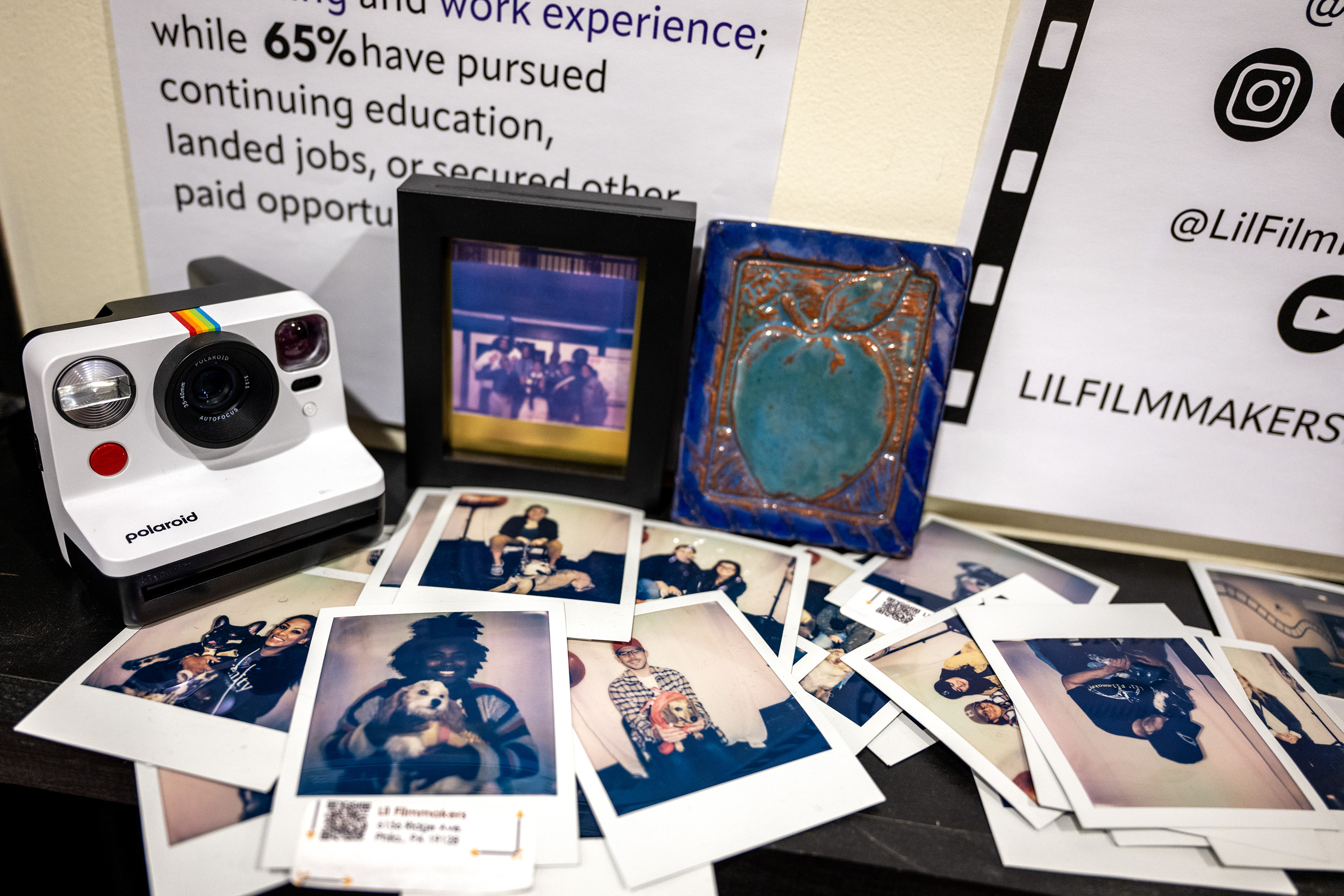
Polaroids from a community pet day at Lil’ Filmmakers Thursday, Dec. 4, 2025. The Roxborough based nonprofit and other community groups claim they have been unable to access their funds managed by FNC, which insists it’s not a case of embezzlement or financial malfeasance
For now, multiple third parties, including the city, are working to move the process along.
The Philadelphia Office of Public Safety, for example, said Lil’ Filmmakers and three other anti-violence grant recipients with awards managed by FNC are in different parts of the process. Together, the groups had roughly $380,000 in city-issued funds awarded, which the city said are largely accounted for.
Though the final spending report for Lil’ Filmmakers remains in dispute, it might be resolved by the end of the month, according to the city.
In the meantime, a public safety office spokesperson said staffers were working with organizations to help close their accounts with FNC and offering technical assistance to its grant recipients, including bookkeeping and fiscal sponsor matchmaking.
Still, the office said, there is not much it can do for other grants awarded by other donors.
Complicating moneymatters further, some organizations used a California-based fundraising platform called Flipcause to collect donations. Last month, California’s attorney general sent a cease-and-desist order to the company, ordering it to halt operations after more than a dozen nonprofits in the state accused Flipcause of withholding funds. The platform also faces a class-action lawsuit in federal court.
In all, Moore said, FNC organizations have about $100,000 being withheld by Flipcause; Lil’ Filmmakers is not one of them.
Moore did not rule out that some groups might have less in their accounts than they were initially told in their FNC financial statements because of accounting discrepancies.
Squire went a step further, adding that philanthropic fundraising would be necessary.
“We’re cautiously optimistic that despite a lot of genuine harm that’s been done, that we can at least get people sorted out and back on their feet in the next few months,” Squire said.
The goal, he said, is that each of the groups needing to be placed with a new fiscal sponsor to access their money will have a new one by the end of the first quarter of 2026.
The results of the internal audits will likely determine any legal recourse or investigations. For example, the Pennsylvania Bureau of Corporations and Charitable Organizations, part of the Department of State, can impose fines against charities and revoke their registrations if they are found to be violating the state laws that govern them.
But Spruill, her staff, and her teaching artists cannot afford to keep waiting.
Lil’ Filmmakers has launched another fundraising campaign, this time for $50,000, so programming can continue uninterrupted.
When speaking about the financial setback, Spruill remains defiant.
“We refuse to let this stop the stories that need to be told,” reads her plea to donors.
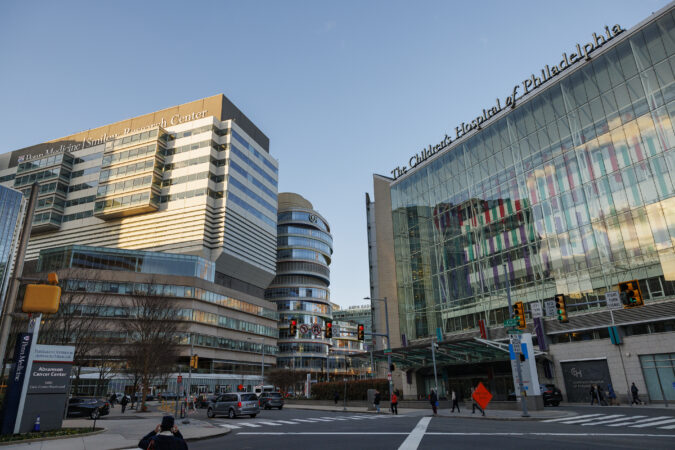
Children’s Hospital of Philadelphia was the most profitable nonprofit health system in Southeastern Pennsylvania during the three months that ended Sept. 30, according to an Inquirer review of financial filings.
CHOP reported $70 million in operating income in the first quarter of fiscal 2026, up from $67 million the same period a year ago. The nonprofit’s revenue climbed nearly 9% to $1.3 billion.
The biggest loss in percentage terms was at Redeemer Health, the region’s smallest health system and the only remaining operator with a single hospital. Redeemer had an $11.7 million operating loss on $103.4 million in quarterly revenue. That was an improvement over an $18.9 million loss last year.
Jefferson Health had the most patient revenue following its acquisition last year of Lehigh Valley Health Network. The 32-hospital system had $2.9 billion in patient revenue, $100 million more than the $2.8 billion at the University of Pennsylvania Health System, which has seven hospitals.
window.addEventListener(“message”,function(a){if(void 0!==a.data[“datawrapper-height”]){var e=document.querySelectorAll(“iframe”);for(var t in a.data[“datawrapper-height”])for(var r,i=0;r=e[i];i++)if(r.contentWindow===a.source){var d=a.data[“datawrapper-height”][t]+”px”;r.style.height=d}}});
Here’s a recap of selected systems’ results for September quarter:
Jefferson Health
Jefferson Health reported a $104 million operating loss, as its insurance business continued to drag down results. The loss included $19.4 million in restructuring charges for employee severance related to earlier job cuts and moves designed to make the system more efficient.
University of Pennsylvania Health System
University of Pennsylvania Health System had an operating gain of $109.3 million, up from $49.3 million in the same period a year ago. This year’s results include Doylestown Health, which Penn acquired April 1. Total revenue was $3.3 billion, up from $2.8 billion a year ago.
Temple University Health System
Temple University Health System’s loss in the quarter was $15 million, an improvement over a $17 million loss last year. Total revenue was $800 million, up 13% from $712.5 million a year ago. Outpatient revenue increased by nearly $62 million, much of it from the health system’s specialty and retail pharmacy business.