Blog

  • More than 65,000 immigrants are being held in federal detention, a big increase from when Trump took office

    More than 65,000 immigrants are being held in federal detention, a big increase from when Trump took office

    The number of immigrants confined in federal detention facilities has surged past 65,000, perhaps the highest figure ever and a two-thirds increase since President Donald Trump took office in January.

    The 65,135 in custody across the nation represents a shattering of the 60,000 threshold, which was last passed briefly in August before dropping back down. The new figure is up from 39,238 when Trump was inaugurated, as his administration quickly undertook an unprecedented campaign to arrest, detain, and deport immigrants.

    “It’s quite stunning,” said Jonah Eaton, a Philadelphia immigration attorney who teaches about detention at Temple University’s Beasley School of Law. “They are dead serious about moving as many people out of the country as possible, and keeping them detained while they do it.”

    The data, current as of Nov. 16, come from the Transactional Records Access Clearinghouse, an information-and-research organization that obtains information from ICE and other federal agencies.

    An ICE spokesperson said the agency could not comment on statistics compiled by third parties.

    window.addEventListener(“message”,function(a){if(void 0!==a.data[“datawrapper-height”]){var e=document.querySelectorAll(“iframe”);for(var t in a.data[“datawrapper-height”])for(var r,i=0;r=e[i];i++)if(r.contentWindow===a.source){var d=a.data[“datawrapper-height”][t]+”px”;r.style.height=d}}});

    The Trump administration says it is arresting the “worst of the worst,” criminal immigrants who have committed serious and sometimes violent offenses. But the new data show ― as they consistently have ― that 74% of those in detention have no criminal convictions.

    “The question is ‘What’s going to be the ceiling for this?’ as the administration has designs to expand the capacity to detain individuals as arrests increase,” said Cris Ramon, an independent immigration consultant in Washington. “If the goal is to remove as many people as possible, they’re going to be leaning on the detention centers to be, first and foremost, a staging ground.”

    Ramon said he was not surprised by the high detention numbers, given the Trump administration’s determination to carry out large-scale operations in cities like Charlotte, N.C., and Chicago.

    The Moshannon Valley Processing Center outside Philipsburg, a U.S. Immigration and Customs Enforcement facility in Clearfield County, Pennsylvania that is privately operated by the GEO Group under contract with ICE. It is the largest ICE detention center in the Northeast United States.

    The new figures show that more of those in custody are being arrested by ICE, rather than by U.S. Customs and Border Protection, the agency that conducts inspections at airports and other ports of entry and includes the Border Patrol.

    Today 81% of people in detention were arrested by ICE, up from 38% when Trump took office. The president has demanded that Immigration and Customs Enforcement make more arrests more quickly, and won new funding to encourage that.

    The agency generally operates in the interior United States.

    Many of those arrested in Pennsylvania are sent to the largest detention center in the Northeast, the Moshannon Valley Processing Center near Philipsburg, Pa. Moshannon, as it is known, is a private, 1,876-bed immigration prison operated by the Florida-based GEO Group Inc.

    ICE also holds detainees at the Clinton County Correctional Facility and the Pike County Correctional Facility. And this year the agency began confining people at the Philadelphia Federal Detention Center in Center City.

    New Jersey has two detention facilities, in Newark and Elizabeth, and might be getting a third, in South Jersey. The administration plans to hold detainees at Joint Base McGuire-Dix-Lakehurst, one of two military sites that have been designated for that purpose. The other is Camp Atterbury in Indiana.

    Many of those in custody are subject to “mandatory detention,” meaning they are not allowed to seek release on bond. In the summer, the administration announced a policy change that prevented immigration judges from granting bond to anyone in detention who had entered the United States without documentation.

    The result, according to the National Immigration Law Center, is that the Trump administration has ensured that migrants have almost no way out of detention “other than death or deportation.”

    ICE is arresting, detaining, and refusing to release far more people than before, the law center said, including many who rarely would have been held in the past.

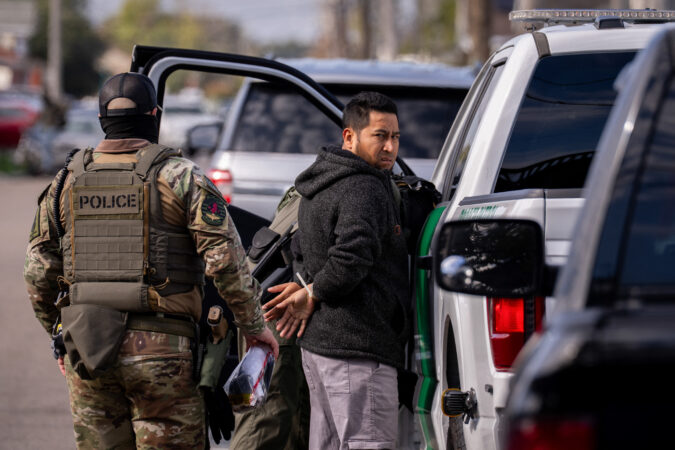
    In Philadelphia and elsewhere, some immigrants have showed up for routine in-person appointments or check-ins, only to be handcuffed and taken into detention. Green-card applicants, asylum-seekers, and others who have ongoing legal or visa cases have been unexpectedly detained.

    Immigration detention is civil in nature, to hold people as they progress through their court cases or await deportation. It is not supposed to be a punishment.

    When Joe Biden assumed the presidency in 2021, there were 14,195 people in immigration detention. That figure more than doubled during his term and eventually topped 39,000.

    “Trump’s cruel mass detention and deportation agenda has reached a previously unimaginable scope and scale,” Carly Pérez Fernández, communications director at Detention Watch Network in Washington, said in a statement.

    She called the new detention figure “a grim reminder” of a larger plan that is “targeting people based on where they work and what they look like, destabilizing communities, separating families, and putting people’s lives at risk.”

    ICE holds detainees across the country, in ICE facilities, in federal prisons, in privately owned lockups, and in state and local jails. As detentions have surged, so has the need for places to house people.

    As of this summer, ICE detained people in all 50 states as well as in Guantánamo Bay, Cuba, Puerto Rico, Guam, the Northern Mariana Islands, and the U.S. Virgin Islands, according to the Vera Institute of Justice in New York.

    Texas had the most facilities with 69, and Florida was second with 40, the institute said.

  • Marcus Epps’ return, Jalen Carter’s injury could be factors for Vic Fangio’s defense vs. Chargers

    Marcus Epps’ return, Jalen Carter’s injury could be factors for Vic Fangio’s defense vs. Chargers

    Vic Fangio’s defense could feature a different starting safety on Monday night against the Los Angeles Chargers.

    On Tuesday, the Eagles opened the 21-day practice window for Marcus Epps, who has been on injured reserve with an undisclosed ailment for the last month. Fangio answered affirmatively on Wednesday when asked if Epps would be ready to play on Monday and if he was in contention to start.

    “He’s an experienced safety,” Fangio said. “He’s got good instincts. Got [a] good feel for the game. We’ll have to get a feel and a barometer about where he’s at missing the last four, five weeks, whatever it was where he couldn’t practice, anyway.”

    Epps, 29, returned for a second stint with the Eagles when he signed to the practice squad in late August. Epps appeared in 59 games as an Eagle, including playoffs, from 2019-22. He had been elevated from the practice squad to the game day roster for the first three weeks of the 2025 season before he signed to the active roster in late September.

    Before going on injured reserve, Epps was the third safety behind Reed Blankenship and Drew Mukuba, who went on injured reserve with an ankle injury last week. When Blankenship was injured in the Week 6 loss to the New York Giants, Epps entered the game in the third quarter ahead of Sydney Brown, the Eagles’ 2023 third-rounder out of Illinois.

    With Epps out for the last four weeks, Brown earned his first full-time start of the season in place of Mukuba in Friday’s loss to the Chicago Bears. According to Pro Football Focus, Brown finished with six tackles and one missed tackle. He also conceded two receptions on five targets for 13 yards. Fangio equated Brown’s individual performance to the rest of the defense’s.

    “It was a lot like the rest of us,” Fangio said. “Some good, some bad.”

    Fangio could prioritize Epps’ experience if he decides to make a change at safety. Epps was a starter on the 2022 Eagles team that fell to the Kansas City Chiefs in Super Bowl LVII. He first joined the Eagles in November 2019 after he was waived by the Minnesota Vikings, the team that drafted him that year in the sixth round out of Wyoming.

    Epps spent 3½ seasons (one as a full-time starter) in his first stint in Philadelphia before moving on to the Las Vegas Raiders from 2023-24. He played just three games last season before he suffered a torn ACL.

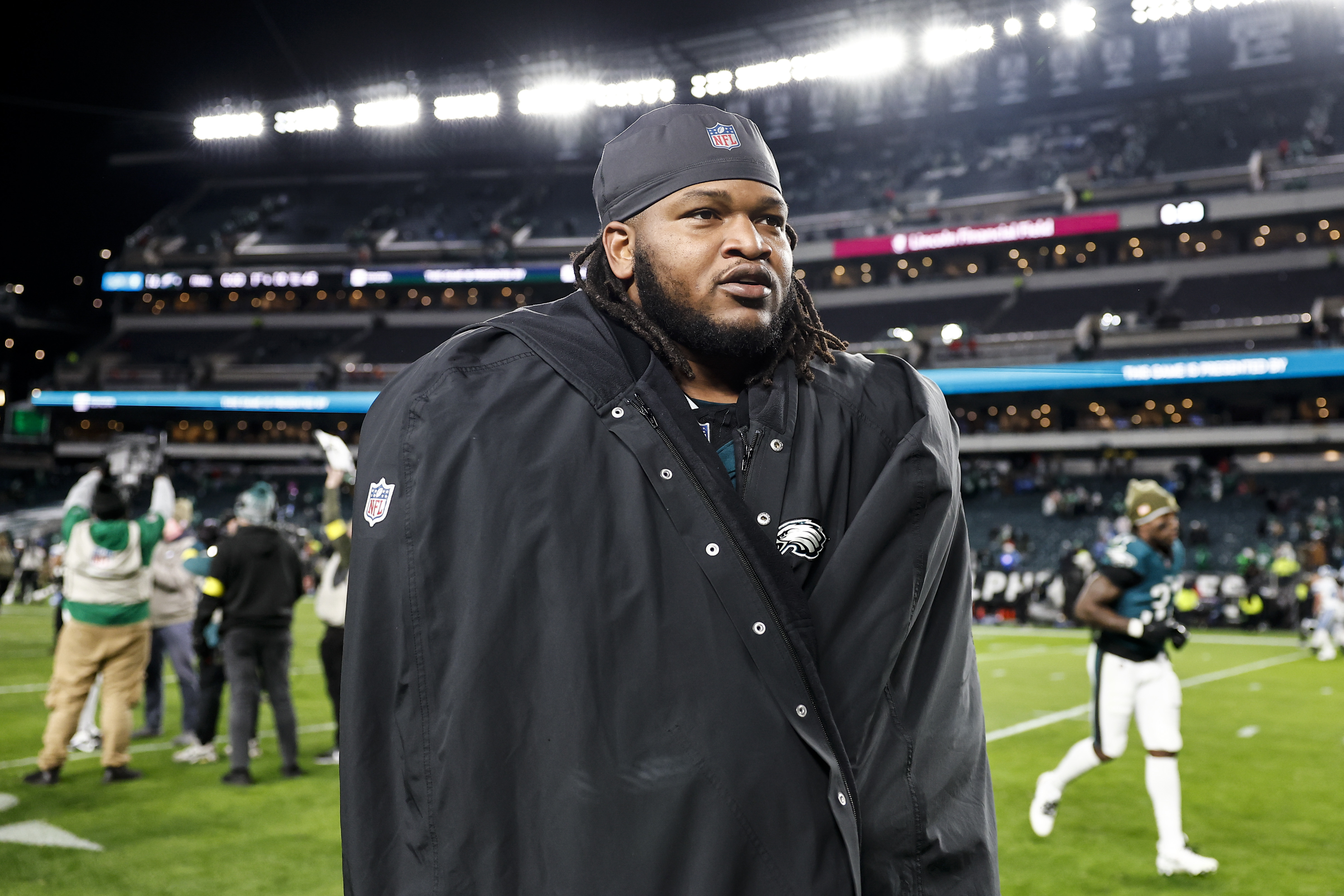
    Eagles defensive tackle Jalen Carter has been dealing with a shoulder injury, which coordinator Vic Fangio acknowledged Wednesday.

    Carter still nursing shoulder injury

    Speaking of players who had some good and some bad moments against the Bears, Fangio discussed Jalen Carter.

    Carter played just 70.1% of the defensive snaps, his second-lowest share of the season. But Carter’s issues run deeper than one off game. In the locker room afterward, the 24-year-old defensive tackle said he didn’t want to get into what he has been “going through,” seeming to allude to a shoulder injury that he had been playing through earlier in the season.

    Fangio confirmed Wednesday that the ailment is still plaguing Carter.

    “He does have a shoulder issue,” Fangio said. “He’s been playing with it. Late in the game, he had a great play with it. But, yeah, it’s definitely something there.”

    The injury limited Carter’s playing time and his effectiveness on the field, especially while the Eagles conceded a season-worst 281 rushing yards. He still managed to sack Caleb Williams in the second quarter and finish the game with four tackles (including two for losses) and two batted passes.

    Before Friday’s game, Carter had played a single-season career-high 87.5% of the defensive snaps. When asked whether Carter can continue to play the high volume of snaps that he had previously been accustomed to this season, Fangio said, “We’ll see.”

  • Pentagon watchdog finds Hegseth’s use of Signal posed risk to U.S. personnel, AP sources say

    Pentagon watchdog finds Hegseth’s use of Signal posed risk to U.S. personnel, AP sources say

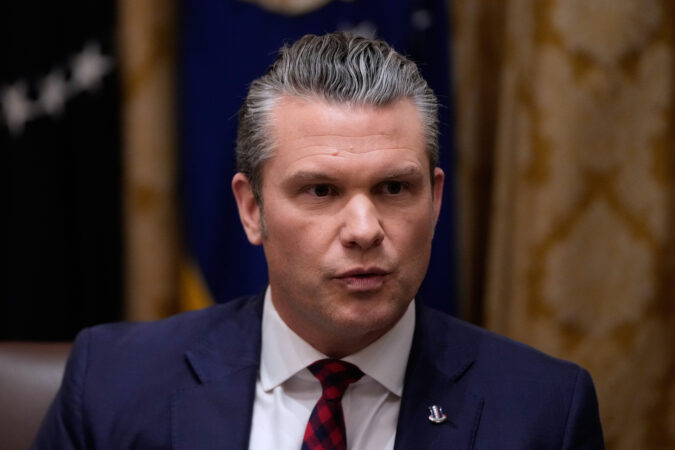
    The Pentagon’s watchdog found that Defense Secretary Pete Hegseth put U.S. personnel and their mission at risk when he used the Signal messaging app to convey sensitive information about a military strike against Yemen’s Houthi militants, two people familiar with the findings said Wednesday.

    Hegseth, however, has the ability to declassify material and the report did not find he did so improperly, according to one of the people familiar with the findings who spoke on condition of anonymity to discuss the information. That person also said the report concluded that Hegseth violated Pentagon policy by using his personal device for official business and it recommended better training for all Pentagon officials.

    Hegseth declined to sit for an interview with the Pentagon’s inspector general but provided a written statement, that person said. The defense secretary asserted that he was permitted to declassify information as he saw fit and only communicated details he thought would not endanger the mission.

    The findings ramp up the pressure on the former Fox News Channel host after lawmakers had called for the independent inquiry into his use of the commercially available app. Lawmakers also just opened investigations into a news report that a follow-up strike on an alleged drug-smuggling boat in the Caribbean Sea in September killed survivors after Hegseth issued a verbal order to “kill everybody.”

    Hegseth defended the strike as emerging in the “fog of war‚” saying he didn’t see any survivors but also “didn’t stick around” for the rest of the mission and that the admiral in charge “made the right call” in ordering the second strike. He also did not admit fault following the revelations that he discussed sensitive military plans on Signal, asserting that the information was unclassified.

    “The Inspector General review is a TOTAL exoneration of Secretary Hegseth and proves what we knew all along — no classified information was shared,” Sean Parnell, the Pentagon’s chief spokesman said in a statement. “This matter is resolved, and the case is closed.”

    Meanwhile, the Pentagon knew there were survivors after a September attack on an alleged drug boat in the Caribbean Sea and the U.S. military still carried out a follow-up strike, according to two people familiar with the matter.

    The rationale for the second strike was that it was needed to sink the vessel, according to the people familiar with the matter who spoke on the condition of anonymity because they weren’t authorized to discuss it publicly. The Trump administration says all 11 people aboard were killed.

    What remains unclear was who ordered the strikes and whether Hegseth was involved, one source said. That will be part of a classified congressional briefing Thursday with the commander that the Trump administration says ordered the second strike, Adm. Frank “Mitch” Bradley.

    The information about the follow-on strike was not presented to lawmakers during a classified briefing in September, in the days after the incident. It was disclosed later, one source said, and the explanation provided by the department has been broadly unsatisfactory to various members of the national security committees in Congress.

    In a rare flex of bipartisan oversight, the Armed Services committees in both the House and Senate swiftly announced investigations into the strikes as lawmakers of both parties raise questions.

    Hegseth is under growing scrutiny over the military strikes on alleged drug traffickers in the Caribbean and eastern Pacific. Legal experts and some lawmakers say a strike that killed survivors would have violated the laws of armed conflict. The Trump administration has said the U.S. is in “armed conflict” with drug cartels, even though Congress has not approved any authorization for the use of military force in the region.

    Journalist was added to a chat where sensitive plans were shared

    In at least two separate Signal chats, Hegseth provided the exact timings of warplane launches and when bombs would drop — before the men and women carrying out those attacks on behalf of the United States were airborne.

    Hegseth’s use of the app came to light when a journalist, Jeffrey Goldberg of The Atlantic, was inadvertently added to a Signal text chain by then-national security adviser Mike Waltz. It included Vice President JD Vance, Secretary of State Marco Rubio, Director of National Intelligence Tulsi Gabbard, and others, brought together to discuss March 15 military operations against the Iran-backed Houthis.

    Hegseth had created another Signal chat with 13 people that included his wife and brother where he shared similar details of the same strike, The Associated Press reported.

    Signal is encrypted but is not authorized for carrying classified information and is not part of the Pentagon’s secure communications network.

    Hegseth previously has said none of the information shared in the chats was classified. Multiple current and former military officials have told the AP there was no way details with that specificity, especially before a strike took place, would have been OK to share on an unsecured device.

    The review was delivered to lawmakers, who were able to review the report in a classified facility at the Capitol. A partially redacted version of the report was expected to be released publicly later this week.

    Hegseth said he viewed the investigation as a partisan exercise and did not trust the inspector general, according to one of the people familiar with the report’s findings. The review had to rely on screenshots of the Signal chat published by the Atlantic because Hegseth could not provide more than a small handful of his Signal messages, the person said.

    When asked about the investigation in August, Pentagon press secretary Kingsley Wilson told reporters that “we believe that this is a witch hunt and a total sham and being conducted in bad faith.”

    The Pentagon did not immediately respond Wednesday to a request for comment.

    Lawmakers had called for inspector general to investigate

    The revelations sparked intense scrutiny, with Democratic lawmakers and a small number of Republicans saying Hegseth posting the information to the Signal chats before the military jets had reached their targets potentially put those pilots’ lives at risk. They said lower-ranking members of the military would have been fired for such a lapse.

    The inspector general opened its investigation into Hegseth at the request of the Republican chairman of the Senate Armed Services Committee, Sen. Roger Wicker of Mississippi, and the committee’s top Democrat, Sen. Jack Reed of Rhode Island.

    Some veterans and military families also raised concerns, citing the strict security protocols they must follow to protect sensitive information.

    It all ties back to the campaign against Yemen’s Houthis

    The Houthi rebels had started launching missile and drone attacks against commercial and military ships in late 2023 in what their leadership had described as an effort to end Israel’s offensive against Hamas in the Gaza Strip. Their campaign greatly reduced the flow of trade through the Red Sea corridor, which typically sees $1 trillion of goods move through it annually.

    The U.S.-led campaign against the Houthis in 2024 turned into the most intense running sea battle the Navy had faced since World War II.

    A ceasefire in the Israel-Hamas war had begun in January before falling apart in March. The U.S. then launched a broad assault against the Houthis that ended weeks later when Trump said they pledged to stop attacking ships. The latest Gaza ceasefire began in October.

    Following the disclosure of Hegseth’s Signal chat that included the Atlantic’s editor, the magazine released the entire thread in late March. Hegseth had posted multiple details about an impending strike, using military language and laying out when a “strike window” starts, where a “target terrorist” was located, the time elements around the attack and when various weapons and aircraft would be used in the strike. He mentioned that the U.S. was “currently clean” on operational security.

    Hegseth told Fox News Channel in April that what he shared over Signal was “informal, unclassified coordinations, for media coordinations and other things.”

    During a congressional hearing in June, Hegseth was pressed multiple times by lawmakers over whether he shared classified information and if he should face accountability if he did.

    Rep. Seth Moulton, a Massachusetts Democrat and Marine veteran, asked Hegseth whether he would hold himself accountable if the inspector general found that he placed classified information on Signal.

    Hegseth would not directly say, only noting that he serves “at the pleasure of the president.”

  • Man and woman shot dead in Kensington murder-suicide, authorities say

    Man and woman shot dead in Kensington murder-suicide, authorities say

    A man and woman were shot and killed Wednesday afternoon in Kensington in what police believe was a murder-suicide, according to a law enforcement source who asked not to be identified to discuss an ongoing investigation.

    The two, whom police did not identify, were shot on the 3400 block of Hartville Street around 1:15 p.m., according to the department. They were pronounced dead just after 2 p.m.

    Investigators believe the man shot the woman with a shotgun, according to the police source.

    Police continue to investigate.

  • National signing day: Local high school football stars join Notre Dame, Missouri, Syracuse and more

    National signing day: Local high school football stars join Notre Dame, Missouri, Syracuse and more

    The NCAA’s early signing period began Wednesday, which means high school seniors across the nation can sign letters of intent and make their commitments to college football programs official.

    In the Philadelphia area, a number of talented recruits in the class of 2026 are heading to FBS programs.

    Eight players from the Philly area plan to join coach Fran Brown in Syracuse, while Temple coach K.C. Keeler landed nine local signees in his first full recruiting year. Amid uncertainty at Penn State, which has yet to name its next head coach, it had just two signees — and lost a four-star commitment from Coatesville linebacker Terry Wiggins.

    Here’s more about where the area’s prospects are heading:

    Top prospects

    La Salle College High School’s Joey O’Brien, a two-way star at wide receiver and cornerback, is the No. 1 player in Pennsylvania, according to 247Sports. He signed his letter of intent to Notre Dame after his commitment in June.

    The five-star pledge plans to play both positions for the Fighting Irish, and he’ll have a familiar face joining him next year in South Bend, Ind. His teammate, Grayson McKeogh, a 6-foot-8 left tackle, also made his commitment official after announcing his pledge on the same day as O’Brien.

    McKeogh, who began playing offensive tackle just last season, is considered among the best in the nation at his position in the class of 2026.

    Explorers quarterback Gavin Sidwar signed with Missouri, a school he’s been committed to since April, and tight end/linebacker John-Patrick Oates decided Wednesday to flip his pledge from James Madison to James Franklin’s Virginia Tech.

    St. Joseph’s Prep’s Alex Haskell, a 6-4 defensive tackle, initially planned to play for the Nittany Lions, but the coaching change — and “uncertainty surrounding the program,” he wrote on X — led Haskell to withdraw his pledge.

    On Oct. 22, a day after reopening his recruitment, Haskell, who’s ranked No. 10 among all players in the state, announced his commitment to Syracuse. The four-star recruit is one of the top signees in the Orange’s 2026 class.

    On Wednesday, Malvern Prep edge rusher Jackson Ford, who’s ranked No. 8 in the state, became the one of the two signees for the Nittany Lions during the early period.

    The biggest twist came when Wiggins, ranked No. 4 in the state, flipped his commitment from Penn State to sign with Virginia Tech.

    The 6-3, 210-pound linebacker made his pledge to Penn State in May, but told 247Sports on Wednesday that “me and Coach Franklin built a very strong relationship.” He added that when he visited the Hokies, “it felt like Penn State 2.0.”

    Other FBS signees

    • Imhotep Charter offensive tackle Jesse Moody to Maryland
    • Neumann Goretti tight end/defensive end Carter Bashir to Syracuse
    • Kennett Square kicker Shay Barker to Syracuse
    • Burlington Township linebacker Gemaus Sackie to Syracuse
    • Camden offensive lineman Jojo White to Syracuse
    • Camden safety Ibn Muhammad to Syracuse
    • Chester offensive tackle Shemaj Henry to Syracuse
    • Haverford School defensive tackle Walt Frazier to Syracuse
    • Chester safety Daron Harris to Temple
    • Roman Catholic receiver/defensive back Eyan Stead Jr. to Temple
    • Roman Catholic receiver Ash Roberts to Temple
    • Roman Catholic quarterback Semaj Beals to Akron
    • Lower Merion tackle/defensive tackle Kechan Miller to Temple
    • Salem defensive end/tight end Antwuan Rogers to Temple
    • Bonner-Prendergast receiver/defensive back Dylan Abram to Temple
    • Bonner-Prendie defensive lineman Chibuzo Amobi to UMass
    • Pennsauken running back Randall Blount Jr. to Temple
    • Upper Moreland punter Luke Sword to Temple
    • Penn Charter tight end Tom McGlinchey to Northwestern
    • Malvern Prep linebacker Max Mohring to Northwestern
    • Malvern Prep running back Ezekiel Bates to Minnesota
    • Winslow Township receiver Quayd Hendryx to Minnesota
    • Winslow running back Nakeem Powell to Delaware
    • Winslow receiver Nyqir Helton to North Carolina
    • Winslow cornerback Julian Peterson to North Carolina
    • Timber Creek offensive tackle Roseby Lubintus to Virginia Tech
    • Glassboro defensive lineman Brandon Simmons Jr. to Eastern Michigan
    • Springside Chestnut Hill receiver Aaron Clark to Buffalo
    • St. Joe’s Prep cornerback Simaj Hill to West Virginia
    • West Chester East offensive tackle Tyler Duell to Rutgers
    • Germantown Academy quarterback Xavier Stearn to Rutgers

  • Northeast Philly’s Franklin Mills mall is for sale

    Northeast Philly’s Franklin Mills mall is for sale

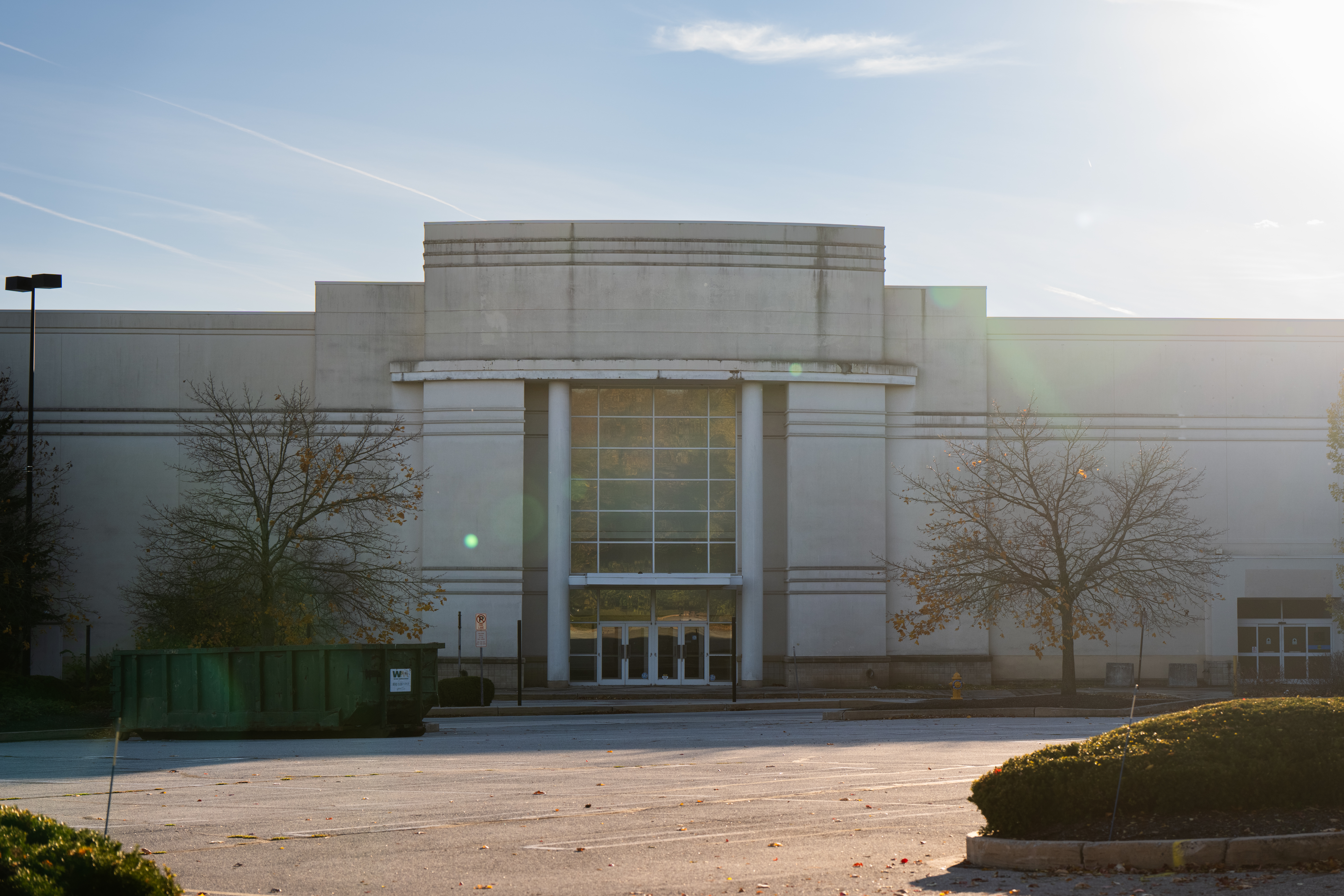
    Northeast Philadelphia’s Franklin Mall — better known by its original name, Franklin Mills — is for sale after years of plummeting valuation, occupancy, and visitor numbers.

    A listing on the website of real estate brokerage Jones Lang LaSalle (JLL) includes possible uses a new owner can consider, including industrial and office development. The parcels including Sam’s Club and Walmart are not included in the sale.

    “Franklin Mall presents the opportunity to acquire meaningful control of more than 137 acres … in a densely populated location that may support additional densification and redevelopment,” the listing reads.

    The move comes amid a wave of mall sales and redevelopments in the region, with demolition and residential construction a common fate for many struggling shopping centers.

    Over 68% of Franklin Mall is occupied, which could be an incentive for continued retail operations. But sales and visitor numbers have been falling for years, and JLL reports the average existing lease lasts for only another 1.7 years.

    If a new use is sought, the mile-long, one-story structure would be difficult to repurpose.

    “I think it’s unlikely to be a shopping mall” again, said Jerry Roller, founder of the design firm JKRP and a longtime architect in Philadelphia. “What could it be? Obviously, residential. It might be a warehouse. It’s essentially a large vacant piece of land. It was fairly inexpensive when it was built, so it’s not hard to demolish.”

    The hundred acres of land that Franklin Mills sits on at the edge of Far Northeast Philadelphia is zoned for auto-oriented commercial use.

    JLL’s listing advertises the site’s suitability for industrial redevelopment.

    “The property’s infill location and highway access make it a strong candidate for redevelopment into a modern industrial facility,” the listing reads. The zoning “could provide a basis for an investor to pursue the development of up to 1.4 million square feet of new warehouse space.”

    The residential redevelopment opportunities for the site could be aided by a promised 20-year property tax abatement for the conversion or demolition of outmoded commercial buildings into housing, which Mayor Cherelle L. Parker’s administration promises next year following enabling legislation from Harrisburg.

    But the existing zoning would not allow that, so a residential project would need to win the permission of the city’s Zoning Board of Adjustment or have the land-use rules changed legislatively by Councilmember Brian O’Neill.

    The mile-long Franklin Mills mall drew Christmas-size crowds at its opening in May of 1989.

    Tribulations of a Northeast Philly icon

    The 36-year-old, 1.8-million-square-foot facility at Knights and Woodhaven Roads is the second largest mall in the Philadelphia area after King of Prussia. But while its larger cousin remains a dominant retail force, Franklin Mall has been struggling for years.

    The mall opened in 1989 to great fanfare as the largest outlet mall ever, with an iconic zigzag-shaped concourse that stretched for 1.2 miles.

    In its 1990s heyday, it attracted 20 million visitors annually. The latest numbers, provided by JLL, are 5.6 million visitors a year.

    In 2007, in retrospect near the end of Franklin Mills’ golden era, the property and the rest of the Mills Corp. was taken over by Simon Property Group, the largest mall owner in the country. The new ownership group rehabbed the property in 2014, although there were already signs Simon was distancing itself by moving Franklin Mills (renamed Philadelphia Mills) into a different balance sheet category than its core properties.

    Simon’s loan on the property had been intermittently distressed since 2012. An April 2024 report from real estate analytics firm Morningstar Credit was headlined “Legacy Philly Mall Back to Special Servicing for the Umpteenth Time.”

    Shoppers stroll through the Franklin Mills mall in 2014.

    The 2007 loan still had an outstanding balance of almost $250 million when it came to maturity in July 2024. Simon stepped away from the day-to-day operations at that time, with Philadelphia-based OPEX CRE Management appointed as receiver of the distressed property. The name was changed to Franklin Mall because Mills was trademarked by Simon.

    Last year Franklin Mall’s appraised value was $76 million, a precipitous decline from its $201 million valuation in 2012 and $370 million in 2007. According to Morningstar Credit, a new appraisal is likely in the next month.

    Full financials haven’t been publicly updated since last year, but at that time, the cash flow for the property was $9.5 million, the lowest since Simon took over in 2007. That’s down from 2019, when cash flow was $17.5 million, according to Morningstar, and from $11 million in 2022.

    According to Morningstar, the latest reports from the special servicer for the property, Greystone Servicing Co., say cash flow is even lower this year and occupancy has fallen to 65.4%.

    Possible reuses for Franklin Mills

    Franklin Mall’s for-sale status comes as some old-school regional shopping destinations are declining.

    While some of its counterparts like King of Prussia and the Cherry Hill Mall are still thriving, there has been a wave of sales and redevelopments of area malls as the nature of retail evolves.

    Some ailing malls have been purchased on the cheap, allowing their new owners to reinvest and refurbish the property in its previous mold.

    “In terms of using the buildings that are there, it’s a challenge because they are generally big box retail, and they’ve got a center mall, which is completely out of fashion,” Roller said. “Could somebody, if they had the right tenants, recreate the mall? Turn it inside out, open the thing up?”

    “Maybe it’s possible,” Roller said. But “I don’t see a lot of uses for the buildings that are there right now.”

    The redevelopment of Exton Square Mall is in legal limbo.

    When regional malls are redeveloped, more commonly, the retail options are reduced with much of the old structure demolished. Diverse new uses often take a faded shopping center’s place.

    Two weeks ago, the sale of Plymouth Meeting Mall was announced with the new owner planning residential development. The contentious redevelopment of the Exton Square Mall would also see a burst of residential development and expanded healthcare options — if the owner can win a lawsuit against the township.

    In New Jersey, the Echelon, Moorestown, and Burlington Center malls have or are going through a variety of demolition and redevelopment options. The commonality is that residential building is a part of all three plans.

    At Franklin Mall, redevelopment would likely require demolition of the existing building.

    “Ultimately, it may just be a piece of land” for sale, said Roller.

    JLL’s listing, however, pitches the property as either redevelopment or continued mall use.

    “This offering presents prospective purchasers with the opportunity to acquire a strategically positioned super regional shopping center with significant upside potential and/or redevelopment opportunity,” it reads.

    JLL’s managing directors on the sale are John Plower, David Monahan, and Jim Galbally.

  • D-Day veteran Charles Shay, who saved lives on Omaha Beach, dies at 101 in France

    D-Day veteran Charles Shay, who saved lives on Omaha Beach, dies at 101 in France

    PARIS — Charles Shay, a decorated Native American veteran who was a 19-year-old U.S. Army medic when he landed on Omaha Beach on D-Day and helped save lives, died on Wednesday. He was 101.

    Shay died at his home in Bretteville-L’Orgueilleuse in France’s Normandy region, his longtime friend and carer Marie-Pascale Legrand said.

    Shay, of the Penobscot tribe and from Indian Island in the U.S. state of Maine, was awarded the Silver Star for repeatedly plunging into the sea and carrying critically wounded soldiers to relative safety, saving them from drowning. He also received France’s highest award, the Legion of Honor, in 2007.

    Shay had been living in France since 2018, not far from the shores of Normandy where nearly 160,000 troops from Britain, the U.S., Canada and other nations landed on D-Day on June 6, 1944. The Battle of Normandy hastened Germany’s defeat, which came less than a year later.

    “He passed away peacefully surrounded by his loved ones,” Legrand told The Associated Press.

    The Charles Shay Memorial group, which honors the memory of about 500 Native Americans who landed on the Normandy beaches, said in a statement posted on Facebook that “our hearts are deeply saddened as we share that our beloved Charles Norman Shay … has returned home to the Creator and the Spirit World.”

    “He was an incredibly loving father, grandfather, father-in-law, and uncle, a hero to many, and an overall amazing human being,” the statement said. “Charles leaves a legacy of love, service, courage, spirit, duty and family that continues to shine brightly.”

    Ready to give his life

    On D-Day, 4,414 Allied troops lost their lives, 2,501 of them Americans. More than 5,000 were wounded. On the German side, several thousand were killed or wounded.

    Shay survived.

    “I guess I was prepared to give my life if I had to. Fortunately, I did not have to,” Shay said in a 2024 interview with The Associated Press.

    “I had been given a job, and the way I looked at it, it was up to me to complete my job,” he recalled. “I did not have time to worry about my situation of being there and perhaps losing my life. There was no time for this.”

    On that night, exhausted, he eventually fell asleep in a grove above the beach.

    “When I woke up in the morning. It was like I was sleeping in a graveyard because there were dead Americans and Germans surrounding me,” he recalled. “I stayed there for not very long and I continued on my way.”

    Shay then pursued his mission in Normandy for several weeks, rescuing those wounded, before heading with American troops to eastern France and Germany, where he was taken prisoner in March 1945 and liberated a few weeks later.

    Spreading a message of peace

    After World War II, Shay reenlisted in the military because the situation of Native Americans in his home state of Maine was too precarious due to poverty and discrimination.

    Maine would not allow individuals living on Native American reservations to vote until 1954.

    Shay continued to witness history — returning to combat as a medic during the Korean War, participating in U.S. nuclear testing in the Marshall Islands and later working at the International Atomic Energy Agency in Vienna, Austria.

    For over 60 years, he did not talk about his WWII experience.

    But he began attending D-Day commemorations in 2007 and in recent years, he has seized many occasions to give his powerful testimony and spread a message of peace.

    During the COVID-19 pandemic in 2020-2021, Shay’s lone presence marked commemoration ceremonies as travel restrictions prevented other veterans or families of fallen soldiers from the U.S., Britain and other allied countries from making the trip to France

    Sadness at seeing war back in Europe

    For years, Shay used to perform a sage-burning ceremony, in homage to those who died, on a bluff overlooking Omaha Beach, where the monument bearing his name now stands.

    On June 6, 2022, he handed over the remembrance task to another Native American, Julia Kelly, a Gulf War veteran from the Crow tribe. That was just over three months after Russia’s full-scale invasion of Ukraine in what was to become the worst war on the continent since 1945

    Shay then expressed his sadness at seeing war back on the continent.

    “Ukraine is a very sad situation. I feel sorry for the people there and I don’t know why this war had to come,” he said. “In 1944, I landed on these beaches and we thought we’d bring peace to the world. But it’s not possible.”

  • Kevin Patullo on egging incident: ‘When it involves your family, it obviously crosses the line’

    Kevin Patullo on egging incident: ‘When it involves your family, it obviously crosses the line’

    Kevin Patullo said Wednesday that he’s ready to “move on” after becoming the victim of a vandalism incident in the aftermath of the Eagles’ loss to the Chicago Bears.

    According to the Moorestown Police Department, Patullo’s home was vandalized with multiple eggs early Saturday morning, just hours after the Eagles dropped their second consecutive game and fell to 8-4. A video of the act had spread online on Monday morning.

    Speaking for the first time since the incident, Patullo acknowledged that the vandals crossed a boundary. Still, the first-year offensive coordinator expressed a desire to move forward and direct his attention to the Eagles’ next opponent, the Los Angeles Chargers.

    “At this point, we’re ready to focus [on] winning the game,” Patullo said. “Unfortunately, it happened. I’ve been here for five years now, and it’s been awesome. This is such a unique place to coach and play. It’s very special. We’ve been to two NFC championship games. We’ve won at Lincoln Financial. The Super Bowl, the parade. It’s an amazing atmosphere to be a coach and a player.

    “As coaches and players, we all know that part of our job is to handle criticism. So it’s perfectly acceptable to sit up here and talk about what’s going on, how to fix it, what we’re going to do going forward, and we know that. But when it involves your family, it obviously crosses the line.”

    Patullo continued: ”And so that happened. And at this point, we’ve just got to move on. We’re trying to win. That’s all we want to do is focus. Whether it’s my family, whether it’s the team, all we’re trying to do together is focus on this week. We’ve got a long week, which has been good to have an extra day of preparation and go out to LA and beat the Chargers.”

    The 44-year-old Patullo is in his first year as Eagles offensive coordinator but has been with the team since 2021. Before his promotion, Patullo was the team’s passing game coordinator. He previously served as the wide receivers coach (2018-19) and passing game specialist (2020) with the Indianapolis Colts while Nick Sirianni was the offensive coordinator.

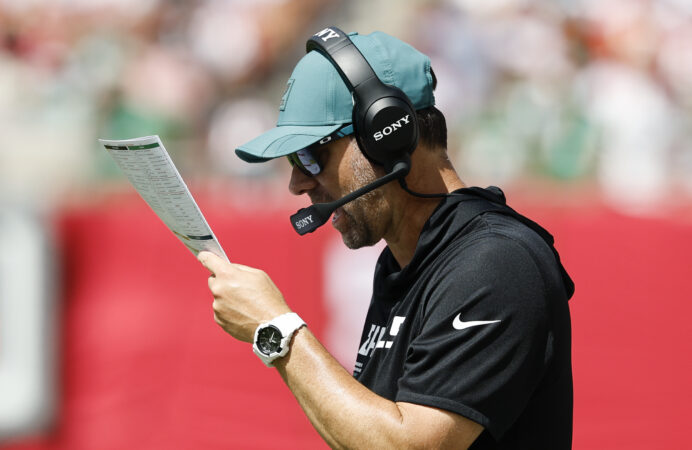
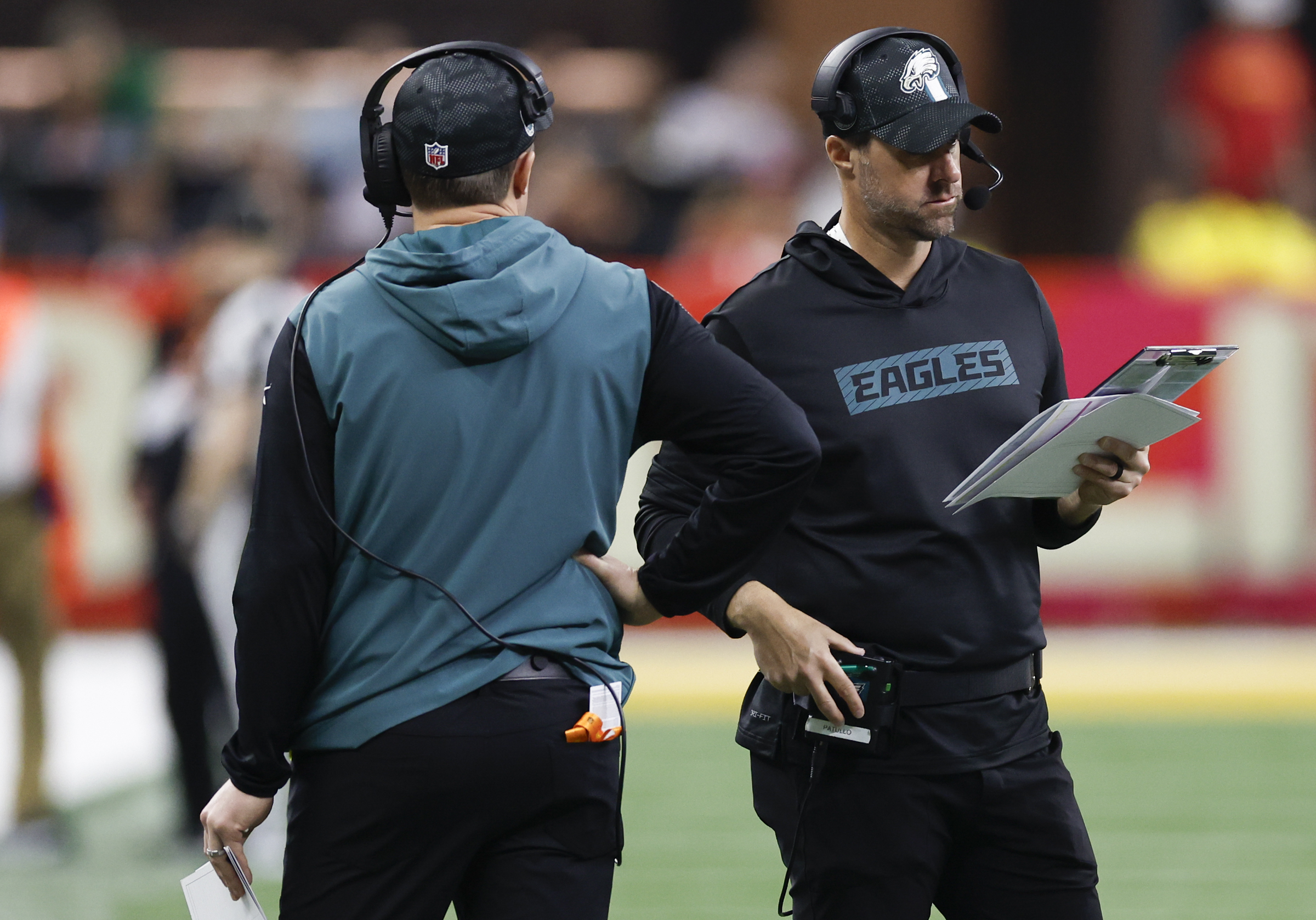
    Kevin Patullo (right) served as passing game coordinator under OC Kellen Moore (left) last season, including in the team’s Super Bowl LIX victory.

    Despite the incident, Patullo emphasized that he and his family have “had a great experience here” throughout his tenure in Philadelphia.

    “Us as a family, we know we’ve got to stick together, and to be honest, there’s a lot of great people in the community,” Patullo said. “I have great neighbors. So many people have reached out to my wife and I and our family. So it’s not anything at one specific person. It happened, and we’ve just got to move on from it at this point.”

    Patullo will move on by continuing to serve as the Eagles’ offensive play caller. Sirianni reiterated Monday that Patullo will retain play-calling duties, and Patullo confirmed as much on Wednesday.

    Sirianni said the Eagles would be “evaluating everything” before the mini-bye to improve the team’s overall performance. The offensive numbers are particularly glaring, as the group ranks 19th in the league in scoring and 24th in yards.

    But don’t expect one of those changes to include Patullo moving from the sideline to the booth to call plays. Nick Foles, the Super Bowl LII-winning quarterback, has been one of the more outspoken advocates of Patullo making that transition.

    However, Patullo unequivocally shot down that suggestion on Wednesday.

    “I think the communication with the players is important,” Patullo said. “ … since I’ve been here, in ’21, I’ve been on the field every time. I think there’s a lot of communication with players, coaches on the field. Making sure adjustments are done correctly. Conversations I have with Jalen [Hurts], with the O-line, with the receivers, that are very important.

    “I’ve been on the field for a long, long time. I don’t think I’ve been in the box since maybe 2011 as a coach. So it’s been a while. I think just the relationship I have with the guys and the communication has been good and we’ve just got to continue to improve in other areas, and we’ll be all right.”

  • Israel receives remains of possible hostage; plans to reopen Gaza crossing into Egypt

    JERUSALEM — Israel received remains of what could be one of the last hostages in Gaza on Wednesday and said it will begin allowing Palestinians to leave the war-torn territory through a border crossing with Egypt.

    Israeli Prime Minister Benjamin Netanyahu said an attack by militants earlier in the day that wounded four Israeli soldiers in southern Gaza was a violation of the ceasefire and that Israel “will respond accordingly.”

    The remains found by militants in northern Gaza were returned to Israel, where they will be examined by forensics experts. Remains militants handed over on Tuesday did not match either of the last two hostages in Gaza.

    The return of all the hostages taken on the Oct. 7, 2023, attack that started the war is a key element of the first phase of the ceasefire that began in October. In exchange, Israel has been releasing Palestinian prisoners.

    Under the terms of the ceasefire, the long-closed Rafah crossing is to be opened for medical evacuations and travel to and from Gaza. The World Health Organization says there are more than 16,500 sick and wounded people who need to leave Gaza for medical care.

    It was not immediately clear when the border crossing would be opened, however.

    Egypt wants Palestinians to be able to return to Gaza through the crossing and says it would only be opened if movement is allowed both ways. Israel says Palestinians will not be able to return to Gaza through the crossing until the last hostages’ remains are returned from Gaza.

    Once the last hostages’ remains are returned and Israel releases more Palestinian prisoners in exchange, the U.S.-backed ceasefire plan is supposed to advance to the next phases, which call for creating an international stabilization force, forming a technocratic Palestinian government and disarming Hamas.

    Last hostages in Gaza are an Israeli and Thai national

    Earlier on Wednesday, Prime Minister Benjamin Netanyahu said forensic testing showed that partial remains returned by militants on Tuesday did not match either of the hostages still in Gaza. Palestinian militants later said they had found more remains in northern Gaza and turned them over to the Red Cross, which is acting as an intermediary.

    The two hostage bodies still in Gaza are Israeli Ran Gvili and Thai national Sudthisak Rinthalak. Gvili was an Israeli police officer who helped people escape from the Nova music festival during the Oct. 7 attack and was killed fighting at another location. Sudthisak Rinthalak was an agricultural worker from Thailand who had been employed at Kibbutz Be’eri, one of the hardest-hit communities in the attack.

    A total of 31 workers from Thailand were abducted, the largest group of foreigners to be held in captivity. Most of them were released in the first and second ceasefires. The Thai Foreign Ministry has said in addition to the hostages, 46 Thais have been killed during the war.

    Opening of Rafah crossing complicated by dispute

    The Israeli military body charged with facilitating aid to Gaza, COGAT, said Israel would coordinate with Egypt on the exit of Palestinians, under the supervision of a mission from the European Union.

    Those wishing to leave Gaza will require “Israeli security approval,” COGAT said.

    The U.S. State Department’s Bureau of Near-Eastern Affairs, writing on X, cast the opening of the crossing as a measure that would afford “the most vulnerable Gazans” access to better medical care.

    Palestinians who want to leave Gaza will be able to move through Rafah if Egypt agrees to receive them, Israeli government spokesperson Shosh Bedrosian said. But the crossing won’t be open for Palestinians seeking to return to Gaza until all of the hostages in the territory are returned to Israel, she said.

    Citing an unnamed Egyptian official, Egypt’s State Information Service said, if an agreement is reached, the crossing will be opened for travel in both directions in accordance with the ceasefire plan advanced by U.S. President Donald Trump.

    Egypt fears that Palestinians allowed to leave Gaza might not be able to return.

    Egyptian President Abdel-Fattah el-Sissi has warned that Israel might prompt an exodus from Gaza as a way to permanently expel people and “eliminate the Palestinian cause” for statehood. More than 100,000 Palestinians that left Gaza after the war started, including those wounded in the conflict, have been living in Egypt, according to Egyptian authorities.

    The Rafah crossing was sealed off in May 2024 when Israel’s military invaded the area. It was briefly opened in February this year as part of a previous ceasefire for the evacuation of sick and wounded Palestinians.

    Fighting in Gaza leads to 1 Palestinian death, several injured Israelis

    In the southern city of Rafah, four Israeli soldiers were injured, one seriously, after being attacked by militants who emerged from an underground tunnel, the Israeli military said. The military called the attack in an area under its control a violation of the ceasefire, and said it responded by returning fire.

    In Gaza City, a Palestinian man was killed by Israeli fire, a hospital said, marking the latest reported Palestinian fatality in the territory.

    Israeli forces shot the 46-year-old man in the Zeitoun neighborhood, according to the Al-Ahli hospital, which received the body. Israel’s military did not immediately respond to a request for comment.

    The hospital said the man was shot while in the “safe zone,” which, under the terms of the ceasefire, is not controlled by the Israeli military. The Gaza Health Ministry says more than 360 Palestinians have been killed across Gaza since the ceasefire took effect on Oct. 11.

    Return of Palestinian bodies in flux

    Twenty living hostages and the remains of 26 others have been returned to Israel since the ceasefire began in early October.

    Israel has been releasing 15 Palestinian bodies for the remains of each hostage as part of the ceasefire agreement. The Gaza Health Ministry said the total number of remains received so far is 330. Health officials in Gaza have said they have only been able to identify a fraction of the bodies handed over by Israel, and the process is complicated by a lack of DNA testing kits.

    The exchanges have gone ahead even as Israel and Hamas have accused each other of violating other terms of the deal. Israeli officials have accused Hamas of handing over partial remains in some instances and staging the discovery of bodies in others.

    Hamas has accused Israel of opening fire on civilians and restricting the flow of humanitarian aid into the territory.

    The ceasefire aims to wind down the war that was triggered by the Hamas-led attack on southern Israel, which killed about 1,200 people and saw 251 taken hostage.

    The Gaza Health ministry says the total Palestinian death toll from the war is over 70,100. The ministry does not distinguish between militants and civilians, though it says roughly half of those killed have been women and children. The ministry operates under the Hamas-run government. It is staffed by medical professionals and maintains detailed records viewed as generally reliable by the international community.

  • Republicans brace for tough midterms after Tennessee special election

    Republicans brace for tough midterms after Tennessee special election

    Republicans held onto a reliably conservative U.S. House district in Tennessee’s special election, but only after a late burst of national spending and high-profile campaigning helped them secure a margin less than half of last year’s race.

    Even with that victory, the outcome contributed to a gloomy outlook for the party going into the 2026 midterms that will determine control of Congress. Republicans will need to defend much more vulnerable seats if they have any hope of keeping their House majority, while Democrats are capitalizing on President Donald Trump’s unpopularity and the public’s persistent frustration with the economy.

    “The danger signs are there, and we shouldn’t have had to spend that kind of money to hold that kind of seat,” said Jason Roe, a national Republican strategist working on battleground races next year.

    He said that “Democratic enthusiasm is dramatically higher than Republican enthusiasm.”

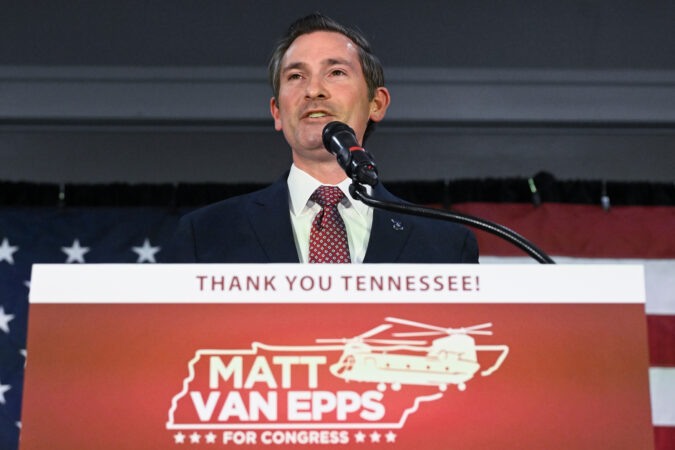
    Republican Matt Van Epps, a military veteran and former state general services commissioner, defeated Democratic state Rep. Aftyn Behn by 9 percentage points on Tuesday for the seat vacated by Republican Mark Green, who retired over the summer. Green had won reelection in 2024 by 21 percentage points.

    Special elections provide a limited window into the mood of voters and take place under far different conditions than regular campaign cycles. But some Republicans are acknowledging the warning signs, especially after Democrats had convincing victories in New Jersey, Virginia and elsewhere last month.

    Tennessee was the fifth House special election this year, and Democratic candidates have outperformed Kamala Harris’ showing in the 2024 presidential race by an average of 16 percentage points in the same districts.

    “We could have lost this district,” Sen. Ted Cruz (R., Texas) told Fox News after The Associated Press called the race for Van Epps. Cruz said his party must “set out the alarm bells” because next year is “going to be a turnout election and the left will show up.”

    Trump dismisses affordability concerns

    Although inflation has dropped since Democratic President Joe Biden was in office, Behn focused her campaign on the lingering concerns about prices.

    Trump has played down the affordability issue, saying during a Cabinet meeting Tuesday that it was “a con job” by his political opponents.

    “There’s this fake narrative that the Democrats talk about, affordability,” he said. ”They just say the word. It doesn’t mean anything to anybody, they just say it.”

    Roe viewed things differently. He said the Tennessee race had “better be a wake-up call that we’ve got to address the affordability problem, and the president denying that affordability is a political issue is not helpful.”

    Maintaining House control is crucial for Trump, who fears a repeat of his first term, when Democrats flipped the House and launched an impeachment inquiry. The Republican president has been leaning on GOP-led states to redraw congressional maps to improve the party’s chances.

    Trump campaigned for Van Epps, boosting him during the primary with an endorsement and participating in two tele-rallies during the general election.

    The Republican National Committee also deployed staffers and partnered with state officials to get voters to the polls. MAGA Inc., the super political action committee that had gone dark since supporting Trump in 2024, reemerged to back Van Epps with about $1.7 million.

    House Speaker Mike Johnson (R., La.) visited the Nashville-area district on Monday.

    “When you’re in a deep red district, sometimes people assume that the Republican, the conservative will win,” he said Tuesday. “And you cannot assume that, because anything can happen.”

    Chip Saltsman, a political strategist and former Tennessee Republican Party chair, said his party had brought in its heaviest hitters simply because there were not other competing contests, not because Republicans feared a loss.

    “It’s the only election going on. Why wouldn’t the speaker come?” he asked. “There was one race, and you would expect everybody to do everything they could.”

    Democrats see promise despite loss

    The House Majority PAC put $1 million behind Behn. After she lost, Democratic national party chair said Behn’s performance was “a flashing warning sign for Republicans heading into the midterms” in 2026.

    Behn said her campaign had “inspired an entire country.”

    “Let’s keep going,” she urged voters after her loss. “We’re not done. Not now, not ever.”

    Although Democrats were optimistic, the result contributed to some murmuring within the party about the best path forward as it grasps for a path back to power in Washington.

    Among special elections this year, the shift in Behn’s direction was the second smallest, providing an opening for some factions that believe more moderate candidates would fare better.

    “Each time we nominate a far-left candidate in a swing district who declares themselves to be radical and alienates the voters in the middle who deliver majorities, we set back that cause,” said a statement from Lanae Erickson, a senior vice president at Third Way, a centrist Democrat think tank.

    Republicans tried to turn Behn’s own words against her in television ads, such as when she described herself as a “radical” or claimed to be “bullying” immigration agents and state police officers. Also cited were comments Behn made about Nashville years ago, when she said, “I hate this city,” and complained about bachelorette parties.

    Several high-profile progressive leaders, including U.S. Rep. Alexandria Ocasio-Cortez (D., N.Y.) had rallied for Behn in the campaign’s final days.