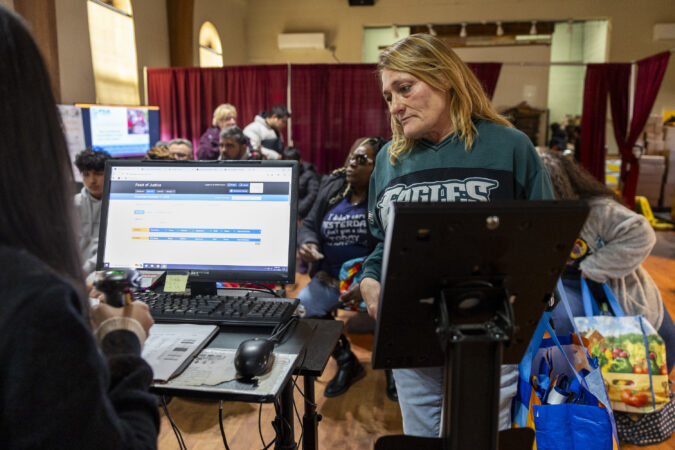
The Trump administration’s threat to withhold money that Democratic-run states use to administer the SNAP food aid program unless officials release personal information about individual recipients puts 2 million people in Pennsylvania and more than 800,000 in New Jersey at risk of food insecurity.
On Wednesday, New Jersey Attorney General Matthew Platkin called the administration’s stance “deeply immoral.”
“The past few weeks have shown that the Trump administration is willing to sacrifice millions of Americans’ most basic needs in service of a political agenda,” he added.
In a cabinet meeting Tuesday, Agriculture Secretary Brooke Rollins said that data describing Supplemental Nutrition Assistance Program recipients’ names, addresses, Social Security numbers, and immigration status are necessary to ferret out fraud, the Associated Press reported. The Department of Agriculture runs the SNAP program.
Twenty-two states, including New Jersey, have sued the administration over its demand for personal information, which states have never shared with the federal government. Representing Pennsylvania, Gov. Josh Shapiro joined the lawsuit. A California federal court issued a preliminary injunction on Oct. 15, allowing all parties until next Monday to respond.
The federal government splits the cost of running SNAP with states, and the Trump administration said it is not planning to take SNAP benefits from individuals, but rather to pull funds it sends to the states to run the program..
Individuals could nonetheless see their payments disrupted, said Joel Berg, CEO of Hunger Free America, in an interview. The agency is a national nonprofit that fights hunger.
“People in the Philadelphia region could go hungry,” he said. “Even people in rural Pennsylvania and South Jersey in counties that supported Trump who are highly dependent on these programs could be hurt.
“This is an authoritarian intrusion of big government. It’s a way to bully Democratic states.”
Around 500,000 of the 2 million people in Pennsylvania who receive the federal food aid are in Philadelphia.
Neither Shapiro nor New Jersey Gov. Phil Murphy offered comments. The White House referred requests for comment to the USDA, which released a statement Wednesday evening complaining that blue states “choose to protect illegals, criminals, and bad actors over the American taxpayer.”
The statement added that the USDA recently sent an additional request to Democratic-run states for data. However, the statement warned, “if they fail to comply, they will be provided with formal warning that USDA will pull their administrative funds.”
Lately, the SNAP program has played a significant role in aspects of how the Trump administration governs, advocates say.
During the shutdown, the Trump administration paused SNAP benefits in early November, and then went to the Supreme Court to fight orders by federal judges to release the funding.
The way SNAP has been thrust into the White House’s partisan battles irks George Matysik, executive director of the Share Food Program, which provides food to hundreds of Philadelphia-area pantries. “We have a serious food affordability crisis developing and it requires a focused response, not continuous political sideshows,” he said Wednesday.
Temple University sociologist Judith Levine agreed. “It’s extremely disturbing that because of political games, people may lose this very basic benefit needed for survival,” she said. “Being food insecure has nothing to do with infighting between political parties.”
Loss of SNAP places an inordinate strain on the charitable food system, primarily food pantries, which in turn hurts families, said Eliza Kinsey, a professor in the department of family medicine and community health at the University of Pennsylvania’s Perelman School of Medicine.
“There’s tons of evidence that stoppages of SNAP can disproportionately affect households with children,” she said. “Cutting SNAP could be disastrous.”
WASHINGTON — The Pentagon knew there were survivors after a September attack on an alleged drug boat in the Caribbean Sea and the U.S. military still carried out a follow-up strike, according to two people familiar with the matter.
The rationale for the second strike was that it was needed to sink the vessel, according to the people familiar with the matter who spoke on the condition of anonymity because they weren’t authorized to discuss it publicly. The Trump administration says all 11 people aboard were killed.
What remains unclear was who ordered the strikes and whether Defense Secretary Pete Hegseth was involved, one of the people said. That will be part of a classified congressional briefing Thursday with the commander that the Trump administration says ordered the second strike, Adm. Frank “Mitch” Bradley.
Hegseth has defended the second strike as emerging in the “fog of war,” saying he didn’t see any survivors but also “didn’t stick around” for the rest of the mission.
Hegseth is under growing scrutiny over the military strikes on alleged drug traffickers in the Caribbean and eastern Pacific. Legal experts and some lawmakers say a strike that killed survivors would have violated the laws of armed conflict.
Villanova announced the signing of 13 players during college football’s early signing day on Wednesday.
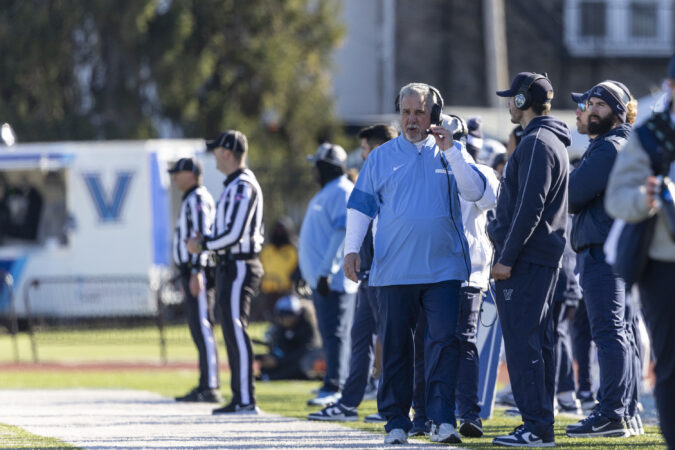
Five offensive players and eight defensive players in the 2026 recruiting class signed their national letters of intent to join the Wildcats next season under coach Mark Ferrante. The incoming class features five players from Pennsylvania, five from New Jersey, two from Maryland, and one from Connecticut.
The Wildcats signed wide receivers Jasiah Brown of Morristown (N.J.) High School and Andrew Esposito of New Canaan (Conn.) High School; offensive lineman Patrick Degnan of Seneca High School; quarterback Nolan DiLucia of Peters Township (Pa.) High School; and running back Brandon Way of Lancaster Catholic.
Brown will play wide receiver on the Main Line after a decorated high school career as a two-way starter at Morristown, where he earned first-team all-conference honors. Esposito, a 6-foot-3 receiver, was among the top recruits out of Connecticut and was named the state’s MaxPreps Player of the Year in 2024. He had nine touchdowns and also recorded two interceptions.
DiLucia will add depth at quarterback. He was named first-team all-conference three times and twice earned all-state recognition.
Way is the only new signee to join Villanova’s talented running back corps. In his high school career at Lancaster Catholic, he totaled 1,500 yards and 21 touchdowns and earned all-state recognition.
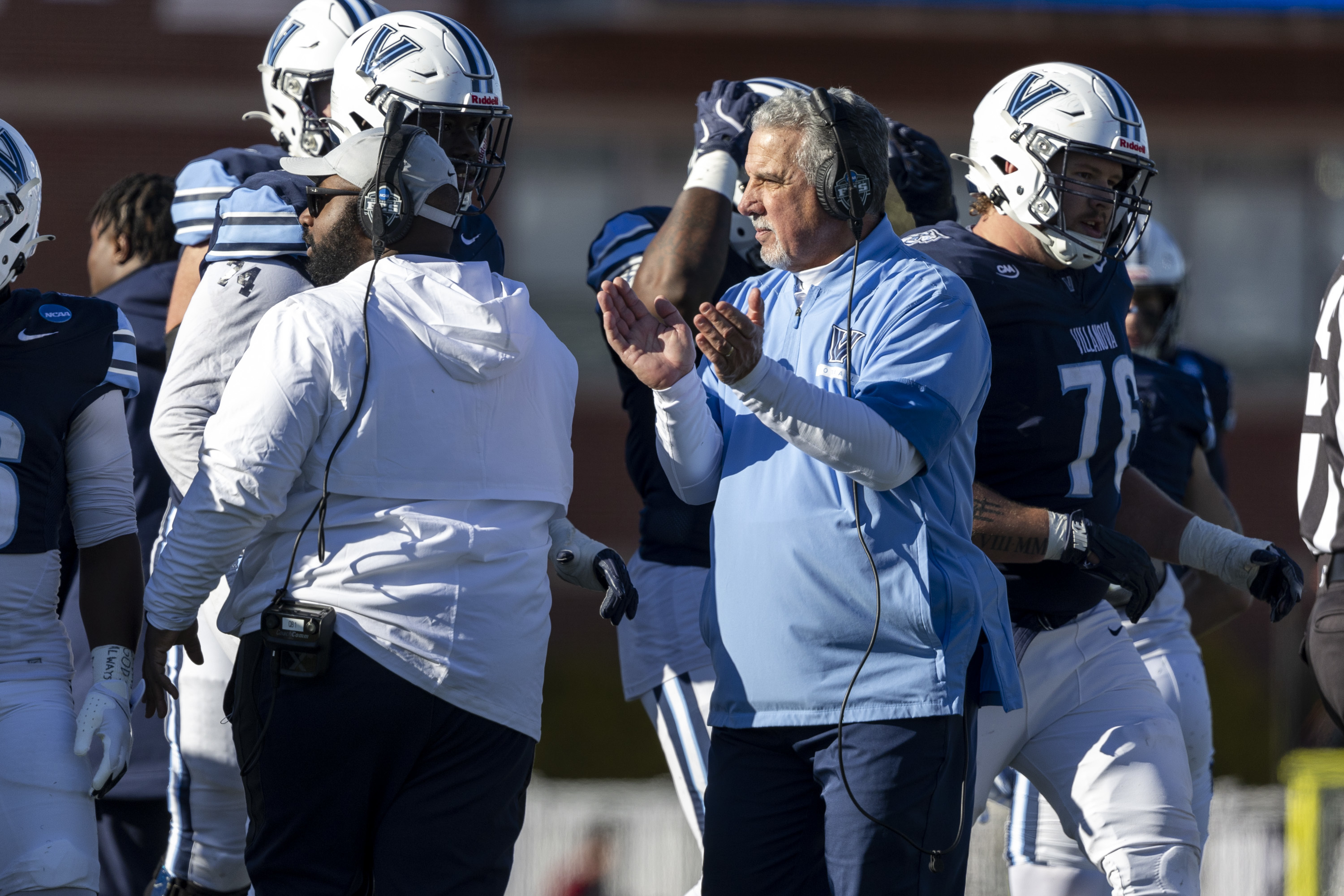
Villanova’s Mark Ferrante during the program’s FCS playoff matchup against Harvard on Nov. 29.
Signees on defense
Villanova’s defensive recruits include linemen Thomas Coates of Urbana High School in Ijamsville, Md., and Jackson Kraemer of Mount Lebanon High School in Pittsburgh; defensive backs Abu Fofana of Conwell-Egan, Luis Martinez of Allentown Central Catholic, Isaiah Selby of Paramus (N.J.) Catholic, and Jordan Taylor of North Point High School in Waldorf, Md.; and linebackers Colin Gurley of Central York High School and Donovan Linthicum of Oakcrest High School.
Gurley, a two-time all-state honoree, registered 100 tackles (26 for loss) and 17½ sacks at Central York. Linthicum earned all-state honors in New Jersey while recording 380 tackles.
Selby helped lead Paramus Catholic to the New Jersey state playoffs as a two-way starter. At defensive back, he totaled 40 tackles and forced two fumbles.
The newly signed players will be part of Villanova’s inaugural campaign in the Patriot League of the FCS as the program changes conferences for the 2026 season.
Villanova will visit Lehigh in the second round of the FCS playoffs on Saturday (noon, ESPN+).
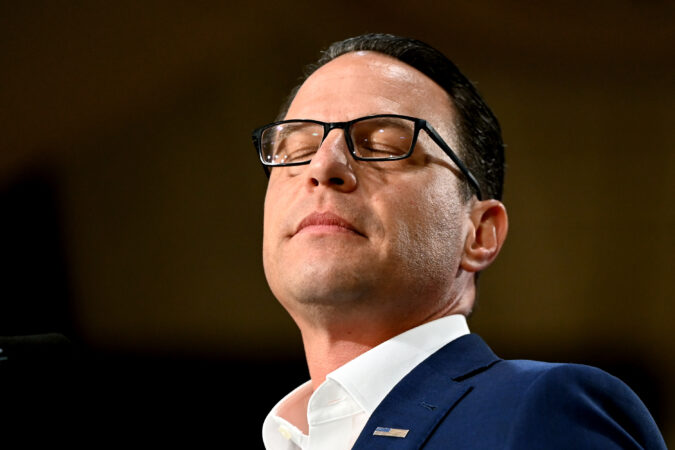
Gov. Josh Shapiro lashed out over former Vice President Kamala Harris’ portrayal of his interview to become her 2024 running mate, calling Harris’ retellings “complete and utter bulls—” intended to sell books and “cover her a—,” according to the Atlantic.
Shapiro, Pennsylvania’s first-term Democratic governor now seen as a likely presidential contender in 2028, departed from his usual composed demeanor and rehearsed comments in a lengthy Atlantic profile, published Wednesday, when journalist Tim Alberta asked the governor about Harris’ depiction of him in her new book.
In her book, titled 107 Days, Harris described Shapiro as “poised, polished, and personable” when he traveled to Washington to interview with Harris for a shot at becoming the Democraticvice presidential candidate during her historic campaign against Donald Trump.
However, Harris said, she suspected Shapiro would be unhappy as second-in-command. He “peppered” her with questions, she wrote, and said he asked questions about the vice president’s residence, “from the number of bedrooms to how he might arrange to get Pennsylvania artists’ work on loan from the Smithsonian.” The account aligns with reporting from The Inquirer when Harris ultimately picked Minnesota Gov. Tim Walz over Shapiro, in part, because Shapiro was too ambitious to serve in a supporting role if chosen as her running mate.
But Shapiro, the Atlantic reported, was taken aback by the portrayal.
“She wrote that in her book? That’s complete and utter bull—,” Shapiro reportedly told the Atlantic when asked about Harris’ account that he had been imagining the potential art for the vice presidential residence. He added: “I can tell you that her accounts are just blatant lies.”
The governor’s sharp-tongued frustration depicted in the Atlantic marked a rare departure for the image-conscious Shapiro, whose oratory skills have been compared to those of former President Barack Obama, and who has been known to give smiling, folksy interviews laced with oft-repeated and carefully told anecdotes.
The wide-ranging, nearly 8,000-word profile in the Atlantic also detailed Shapiro’s loss of “some respect” for Harris during the 2024 election, including for her failure to take action regarding former President Joe Biden’s visible decline.
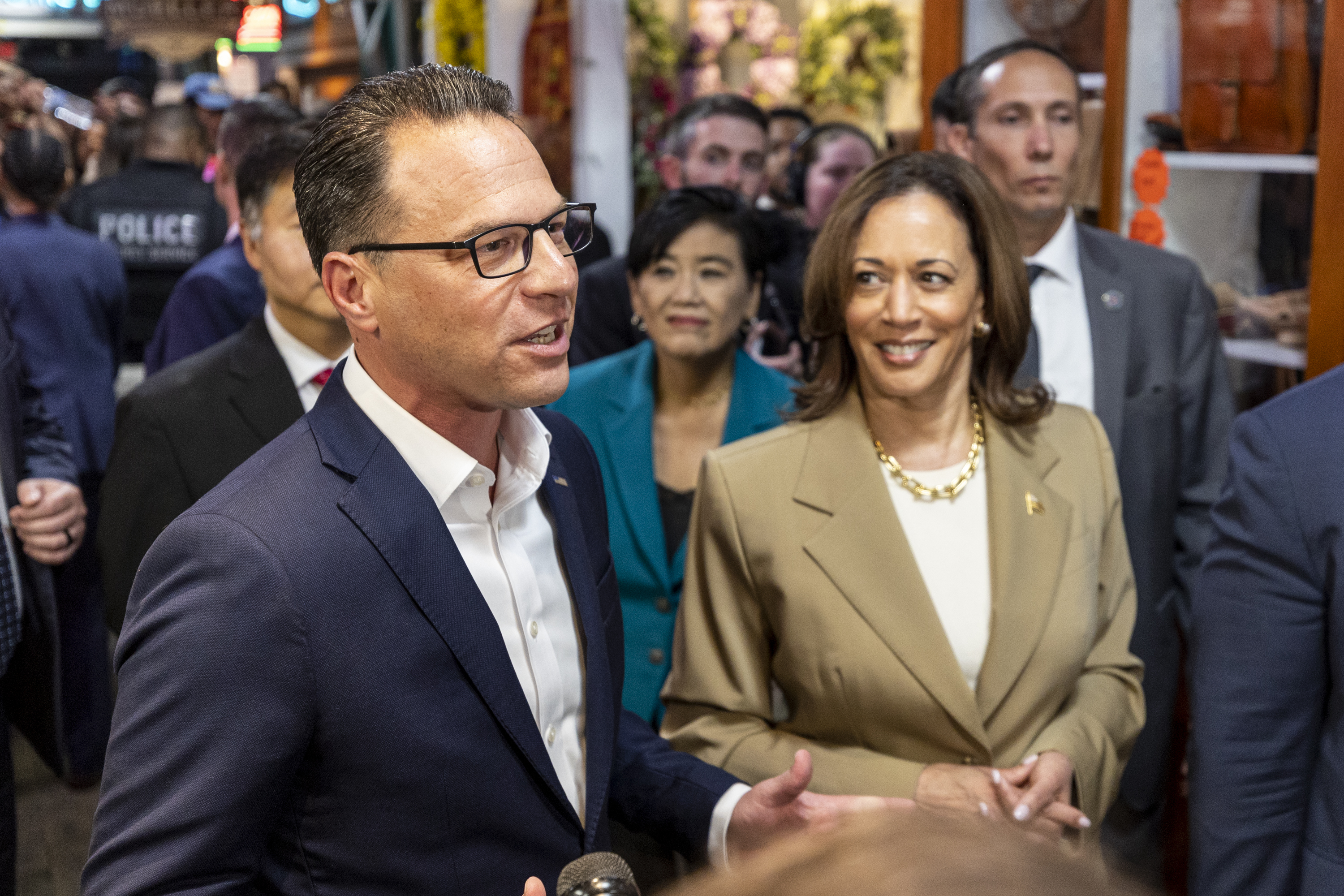
Governor Josh Shapiro speaks with press along with Vice President Kamala Harris during their short visit to Little Thai Market at Reading Terminal Market after she spoke at the APIA Vote Presidential Town Hall at the Pennsylvania Convention Center in Philadelphia, Pa., on Saturday, July 13, 2024.
When Shapiro was asked by the Atlantic whether he felt betrayed by Harris’ comments in her book about him, given that the two have known each other for 20 years, he said: “I mean, she’s trying to sell books and cover her a—.”
He quickly reframed his response: “I shouldn’t say ‘cover her a—,’ I think that’s not appropriate,” he added. “She’s trying to sell books, period.”
The Atlantic piece also outlined common criticisms of Shapiro throughout his two decades in Pennsylvania politics, including those from within the Democratic Party: He is too ambitious with his sights set on the presidency, and his pragmatic approach often leaves him frustrating all sides, as evidenced in his 2023 deal-then-veto with state Senate Republicans over school vouchers. It highlighted some of the top issues Shapiro will face if he chooses to run for president in 2028, including a need to take clearer stances on policy issues — a complaint often cited by Republicans and his critics. If he rises to the presidential field, Shapiro will also have to face his past handling of a sexual harassment complaint against a former top aide that Shapiro claimed he knew very little about despite the aide’s long-held reputation.
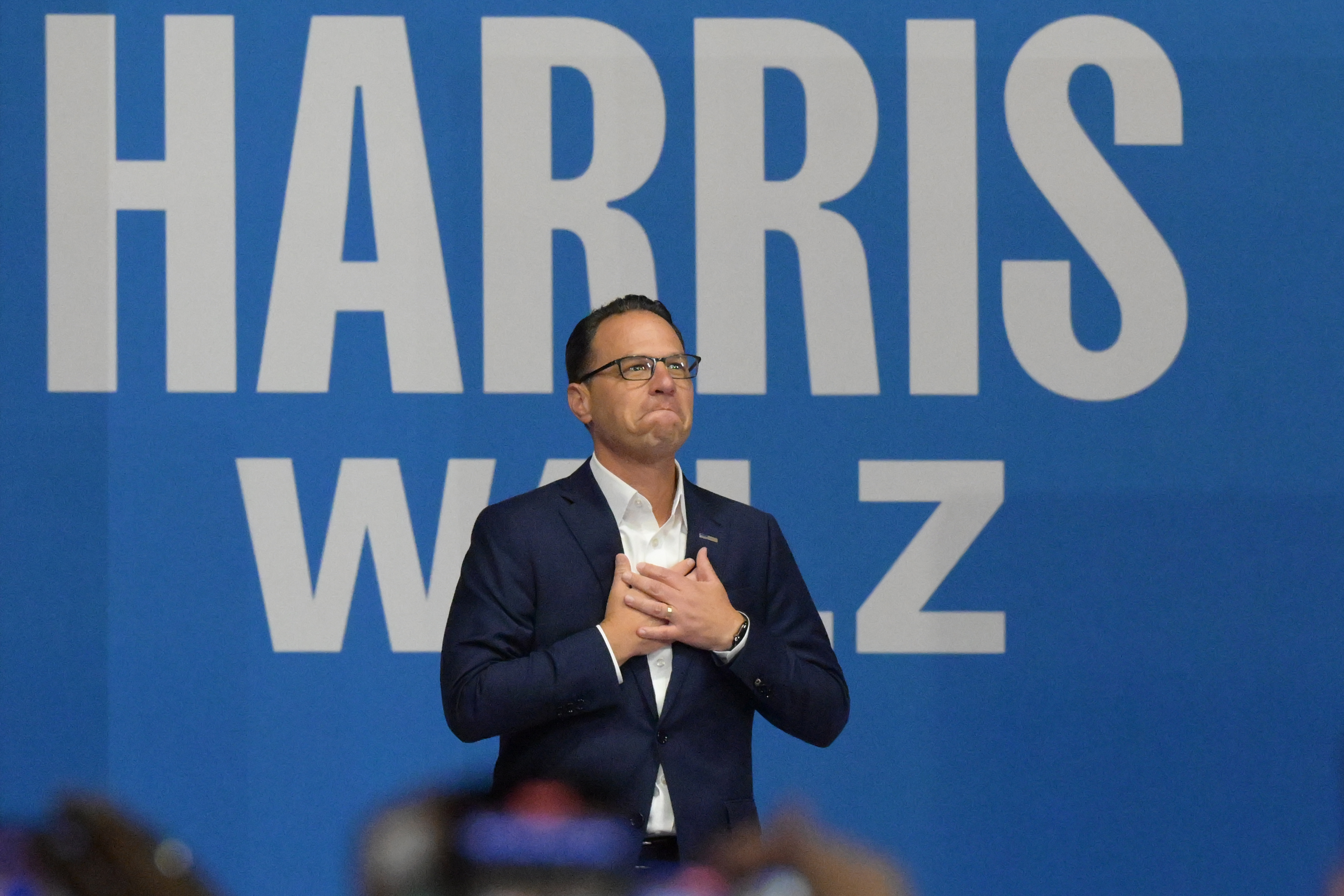
Gov. Josh Shapiro takes the stage ahead of U.S. Vice President Kamala Harris and Gov. Tim Walz at a rally in Philadelphia’s Liacouras Center on August 6, 2024.
“The worst-kept secret in Pennsylvania politics is that the governor is disliked — in certain cases, loathed — by some of his fellow Democrats,” the Atlantic reported. Further, Alberta noted that when an unnamed Pennsylvania lawmaker received a call from a member of Harris’ vetting operation, the member said they had never seen “so many Democrats turning on one of their own.”
Shapiro has been featured in several other prominent national media outlets in recent weeks, including in the New Yorker, which ran a profile about his experience with political violence. He has become vocal on that issue in the months since a Harrisburg man who told police he wanted to kill Shapiro broke into the governor’s residence in April and set several fires while Shapiro and his family slept upstairs. As one of the most prominent Jewish elected officials in the nation, Shapiro has frequently said that leaders must “bring down the temperature” in their rhetoric, and has tried to refocus his own messaging on the good that state governments can do to make people’s lives easier, such as permitting reforms and infrastructure improvements.
“The fact that people view institutions as incapable or unwilling to solve their problems is leading to hyper-frustration, which then creates anger,” Shapiro told the Atlantic. “And that anger forces people oftentimes into dark corners of the internet, where they find others who want to take advantage of their anger and try and convert that anger into acts of violence.”
Americans gave $4 billion to nonprofits on Giving Tuesday in 2025, an increase from the $3.6 billion they gave in 2024, according to estimates from the nonprofit Giving Tuesday.
More people also volunteered their time on the Tuesday after Thanksgiving this year, which fell on Dec. 2 and has become a major fundraising day for nonprofits. This year, 11.1 million people in the U.S. volunteered, up from, 9.2 million last year.
Giving Tuesday started in 2012 as a hashtag and a project of the 92nd St Y in New York and has since become an independent nonprofit. The organization estimates how much was given and how many people volunteer using data from a wide variety of sources, including giving platforms, payment processors and software applications that nonprofits use.
Woodrow Rosenbaum, the chief data officer for Giving Tuesday, said both the number of people giving and the overall donation amount may have increased this year as people seek a sense of belonging and connection.
“Generosity is a really powerful way to get that,” Rosenbaum said in an interview with The Associated Press. ”But I think mostly it’s just that when people see need, they want to do something about it and Giving Tuesday is an opportunity to do that in a moment of celebration as opposed to crisis.”
Overall donations increased 8.1% from last year when adjusted for inflation. Giving Tuesday has also seen the average donation increase in size over time and Rosenbaum said people may be seeking additional ways to give as well.
“Volunteering is a way that you can add to your impact without it costing you money,” he said.
Not everyone who volunteers their time does so through a nonprofit. They may volunteer with mutual aid groups or by helping out family members or neighbors, he said.
Giving Tuesday does not include donations from corporations or foundations in their estimate, Rosenbaum said, as they are focused on the everyday generosity of individuals. That means they did not include the gift from billionaires Michael and Susan Dell of $6.25 billion to encourage families to claim new investment accounts created by the Trump administration.
President Donald Trump hosted the Dells at the White House Tuesday, calling their commitment “one of the most generous acts in the history of our country.” The Dells will offer $250 to 25 million children 10 years old and younger to invest in accounts that the U.S. Department of Treasury will create next year. The ” Trump accounts ” were part of the administration’s tax and spending legislation passed in the summer.
A significant portion of charitable giving to nonprofits happens at the end of the calendar year and Giving Tuesday is an informal kick off to what nonprofits think of as the giving season. A combination of economic and political uncertainty has meant it is hard to predict how generous donors will be this year. Rosenbaum said that the generosity demonstrated on GivingTuesday is an extremely encouraging bellwether for how the rest of the giving season will go.
“What we really hope is that nonprofits and community groups see this as an opportunity that we are in a moment of abundance and that people are ready and willing to help,” Rosenbaum said.
The National Labor Relations Board is pursuing charges against Philadelphia-based restaurateur Stephen Starr and his company, Starr Restaurants, over union-busting allegations at his D.C. steakhouse St. Anselm, according to documents reviewed by The Inquirer.
The NLRB’s case revolves around anti-union activity that Local 25 alleges occurred in February at St. Anselm, one of three D.C.-based Starr restaurants that sought a union at the start of 2025 and the only one where workers voted to unionize.
The complaint consolidates a set of unfair labor practice (ULP) allegations Local 25 initially filed to the NLRB on behalf of St. Anselm workers, who said that Stephen Starr and a St. Anselm supervisor directly coerced employees with false information, made promises of improved benefits if they voted against unionizing, and threatened loss of revenue if they voted for it.
In one instance, the complaint alleges, Starr “interrogated” a St. Anselm staffer about their union involvement during a one-on-one conversation.
A delegation of workers pose in front Stephen Starr’s D.C. steakhouse St. Anselm before delivering their union petition in Feb. 2025.
The ULP filings were submitted to the NLRB in June. After investigating, the board’s general counsel found merit in the accusations that Starr Restaurants, Starr, and the supervisor violated the National Labor Relations Act. It is now set to bring the charges before an administrative judge on Feb. 24, 2026.
“We are aware of the complaint and strongly disagree with the allegations made therein,” a Starr Restaurants spokesperson for St. Anselm said in a statement. “We look forward to vigorously defending this case through the litigation process.”
The spokesperson declined to address whether Starr spoke directly with St. Anselm employees about union efforts, citing pending litigation.
“It speaks volumes about what happened at this restaurant that, given the challenges that the NLRB is facing, that [general counsel] have chosen to act on this issue,” said Benjy Cannon, Local 25’s communication director, referring to the staffing shortages the agency has faced.
A spokesperson for the NLRB declined to comment.
A contentious dynamic from the start
In January, workers at three of Starr’s sevenD.C restaurants announced plans to unionize with Local 25: French bistro Pastis, Parc-inspired brasserie Le Diplomate, and St. Anselm, an outpost of the upscale Brooklyn steakhouse. The Starr workers, along with employees at two high-profile restaurants affiliated with Knightsbridge Restaurant Group, would’ve ultimately added 500 members to Local 25, if the drives proved successful.
Nearly a year later, both union campaigns remain caught up in litigation.
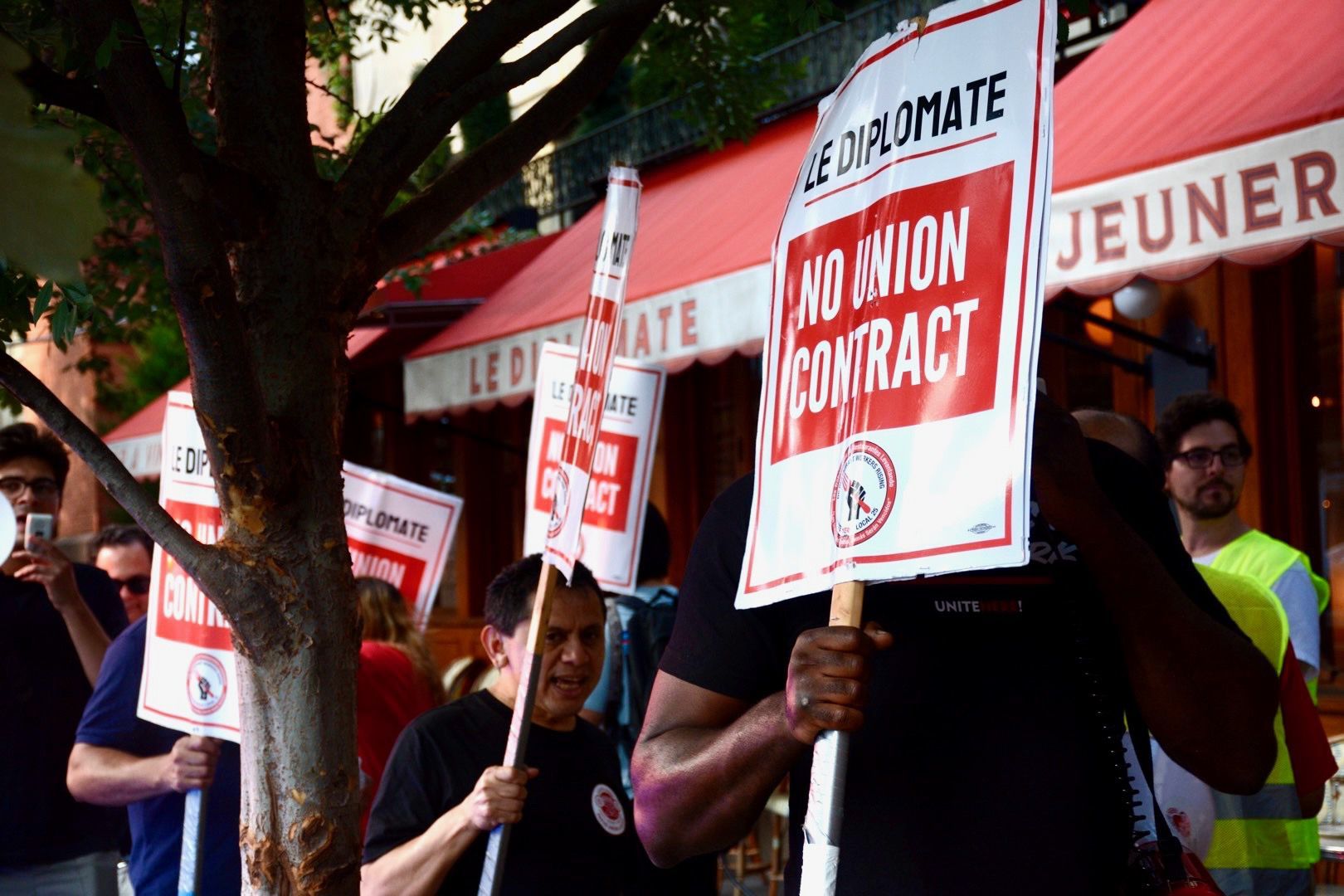
A picket line outside of Stephen Starr’s D.C. restaurant Le Diplomate is led by Unite Here Local 25 after Starr Restaurants challenged a unionization vote at St. Anselm.
Relations between Starr Restaurants and organizers there turned acrimonious almost immediately. The Washingtonian magazine reported that Starr Restaurants hired anti-union consultants from the American Labor Group to meet with St. Anselm staff. Other employees there told online publication Eater that Local 25 organizers had ambushed them at their homes and pressured them to sign cards that indicate they want to vote for union representation.
Only workers at St. Anselm voted to unionize in February. Local 25 lost the union election at Pastis by a margin of 20 votes, and Le Diplomate’s election has been suspended indefinitely as of March.
Starr Restaurants has yet to recognize the St. Anselm union and filed an objection to the results with the NLRB in February, alleging that Local 25 organizers unfairly influenced the outcome through a campaign of bullying and intimidation. The case remains open.
What workers say
Working conditions at St. Anselm have been a mixed bag, according to Ana Reyes, who has been a line cook at the steakhouse since 2022. The fast-paced workplace allowed her to make enough money to help put her youngest daughter through her freshman year of college, Reyes said in Spanish through an interpreter. But, she said, management often ridiculed employees who didn’t speak English, telling them to learn the language if they wanted to get questions answered about pay or scheduling.
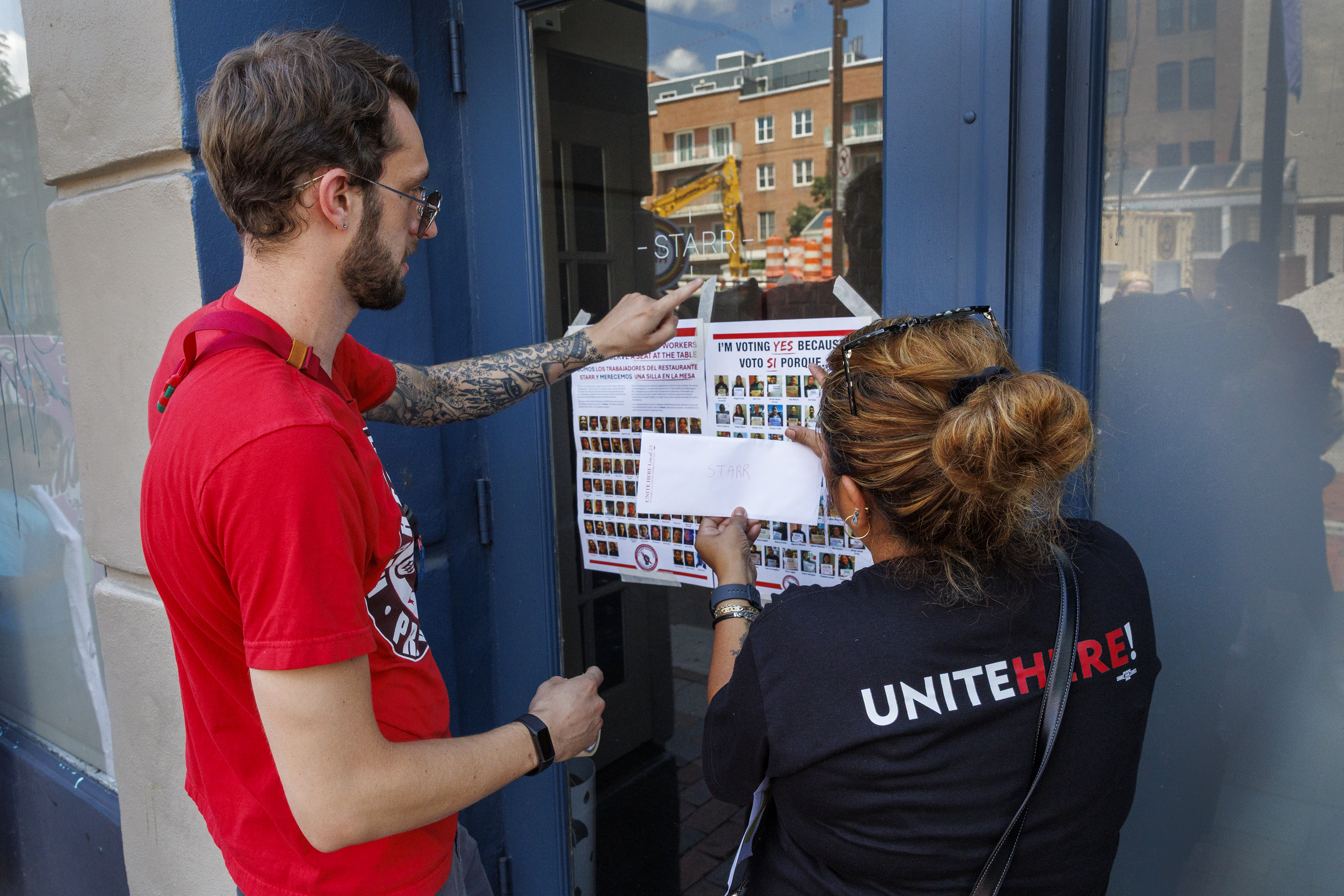
Greg Varney (left) and Ana Reyes, both with Unite Here Local 25, outside Starr headquarters at 134 Market St. as they work to unionize.
Reyes, 43, told The Inquirer that she wanted to join Local 25 for respect: “Whether we speak English or not, we deserve to be respected because we’re doing the work they don’t want to do.”
About two weeks into the union drive in February, Reyes recalled, Starr personally asked to meet with all morning-shift staffers. During the meeting, she said, Starr was “surprised to learn that we didn’t get raises each year … and promised to look into it.”
“He made a lot of promises about sick pay, about vacation pay,” Reyes said. She added that nothing has changed to date.
One host at St. Anselm spoke to The Inquirer on the condition of anonymity for fear of retaliation. About four months into working there, she said, Starr asked to chat with her alone, pulling her aside in a near-empty restaurant to ask questions about any problems she had and her involvement in the union.
“I certainly felt cornered and uncomfortable,” she said. Starr “ultimately told me that supporting the union was [quote-unquote] delusional, and that if I voted no, it would be in my own best interest.” The host departed St. Anselm a month later for a full-time customer service job.
Dennis Asaka, a St. Anselm bartender, doesn’t recall Starr making any promises about improved wages or benefits when he sat in on a voluntary informational meeting led by the restaurateur.
In late 2024, however, Asaka recalled a new server at St. Anselm, asking to join him for Bible study at his Baptist church in Arlington. After attending a second meeting, Asaka said, the server invited him to her house to discuss their faith. There, Asaka said he was instead met by several coworkers who pressured him into signing a union card. Asaka declined.
“I felt like I was kind of blindsided and just kind of used a little bit,” Asaka said.
Cannon denies the union ever engaged in such conduct: “We don’t believe that there were any labor laws broken.”
Stephen Starr (right) talks with Erik Battes, Starr Restaurants’ executive vice president of food and beverage, during at a menu-tasting for the Italian restaurant Borromini, in Philadelphia, July 1, 2025.
What happens next?
Unfair labor practice charges are common, said Rutgers University labor and employment law professor James M. Cooney, and cover a variety of tactics that employers or unions can use to interfere with union elections, from retaliation and coercion to promising incentives. Once a ULP is filed, a regional NLRB will launch an investigation. If the board believes there’s merit, they will issue a complaint.
After the hearing, both parties can appeal the administrative law judge’s decision with the NLRB at the federal level, which can decide to uphold and or reject the decision. There’s no punitive damages on the table in most ULP complaints, Cooney said, only an admittance of wrongdoing.
The five-member federal NLRB has been in a bureaucratic standstill since January, when President Donald Trump fired board member Gwynne Wilcox. The move left the independent agency without a quorum, forcing the NLRB to leave hundreds of cases in limbo.
So, why then did the NLRB decide to wade into union drama at one D.C steakhouse?
Because the charges are “old school, really in-your-face-type labor violations,” said Cooney.
“These violations appear to be really egregious that the board just couldn’t overlook them. It’s true that the board isn’t moving on a lot cases, but this one may be easier for them to prove,” Cooney said. “Everybody knows you can’t threaten workers for supporting a union, and you can’t make promises. This is labor law 101.”
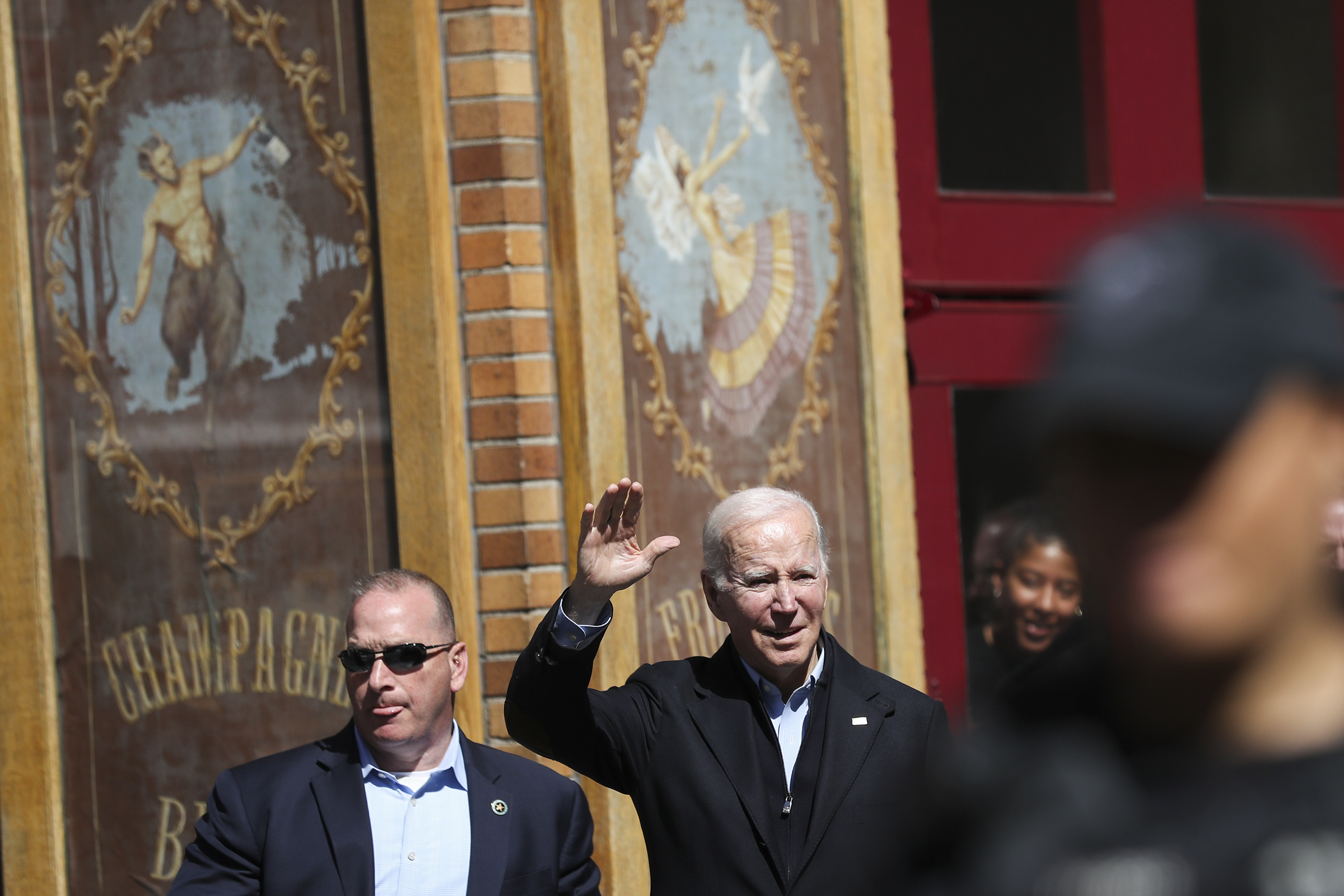
Former President Joe Biden waves to the crowd gathered outside Stephen Starr’s Rittenhouse Square restaurant Parc, where he dined for lunch with his family in April 2023.
Starr is a registered Democrat who has donated thousands of dollars to campaigns for politicians including Tom Wolfe, Barack Obama, Sen. John Fetterman, and Hillary Clinton, according to OpenSecrets.org. His restaurants are common stomping grounds for D.C’s political elite, including former President Joe Biden.
In June, Local 25 called for a boycott of Starr’s three buzziest D.C. restaurants (all currently uninvolved in union efforts). To date, 88 members of Congress signed on, including Sen. Bernie Sanders, Rep. Alexandria Ocasio-Cortes, and Sen. Chuck Schumer.
Cooney does not think the NLRB’s complaint has partisan motivations. “The board has been historically apolitical” at the regional level, he said.
Regardless, the stakes of the proceedings are high for all parties, including employees.
If St. Anselm is forced to recognize the union, Asaka said he’d quit. “I have [health] insurance that includes dental and medical. I have a 401(k) plan. I have commuter reimbursement … I have paid vacation. Those are things that don’t really happen in restaurants,” he said. “I have everything I need.”
NEW YORK — One of Jeffrey Epstein and Ghislaine Maxwell‘s most vocal accusers urged judges on Wednesday to grant the Justice Department’s request to unseal records from their federal sex trafficking cases, saying “only transparency is likely to lead to justice.”
Annie Farmer weighed in through her lawyer, Sigrid S. McCawley, after the judges asked for input from victims before ruling on whether the records should be made public under a new law requiring the government to open its files on the late financier and his longtime confidante, who sexually abused young women and girls for decades.
Farmer and other victims fought for the passage of the law, known as the Epstein Files Transparency Act. Signed last month by President Donald Trump, it compels the Justice Department, FBI and federal prosecutors to release by Dec. 19 the vast troves of material they’ve amassed during investigations into Epstein.
The Justice Department last week asked Manhattan federal Judges Richard Berman and Paul Engelmayer to lift secrecy orders on grand jury transcripts and other material from Epstein’s 2019 sex-trafficking case and a wide range of records from Maxwell’s 2021 case, including search warrants, financial records, and notes from interviews with victims.
“Nothing in these proceedings should stand in the way of their victory or provide a backdoor avenue to continue to cover up history’s most notorious sex-trafficking operation,” McCawley wrote in a letter to the judges.
The attorney was critical of the government for failing to prosecute anyone else in Epstein and Maxwell’s orbit. She asked the judges to ensure that any orders they issue do not preclude the Justice Department from releasing other Epstein-related materials.
Farmer “is wary of the possibility that any denial of the motions may be used by others as a pretext or excuse for continuing to withhold crucial information concerning Epstein’s crimes,” McCawley wrote.
Epstein, a millionaire money manager known for socializing with celebrities, politicians, billionaires, and the academic elite, killed himself in jail a month after his 2019 arrest.
Maxwell was convicted in 2021 by a federal jury of sex trafficking for helping recruit some of Epstein’s underage victims and participating in some of the abuse. She is serving a 20-year prison sentence.
In a court filing Wednesday, Maxwell’s lawyer again said that she is preparing a habeas petition in a bid to overturn her conviction. The lawyer, David Markus, first mentioned the habeas petition in court papers in August as she fought the Justice Department’s initial bid to have her case records unsealed. The Supreme Court in October declined to hear Maxwell’s appeal.
Markus said in Wednesday’s filing that while Maxwell now “does not take a position” in the wake of the transparency act’s passage, doing so “would create undue prejudice so severe that it would foreclose the possibility of a fair retrial” if her habeas petition succeeds.
The records, Markus said, “contain untested and unproven allegations.”
Engelmayer, who’s weighing whether to release records from Maxwell’s case, gave her and victims until Wednesday to respond to the Justice Department’s unsealing request. The government must respond to their filings by Dec. 10. The judge said he will rule “promptly thereafter.”
Berman, who presided over the Epstein case, ordered victims and Epstein’s estate to respond by Wednesday and gave the government until Dec. 8 to reply to those submissions. Berman said he would make his “best efforts to resolve this motion promptly.”
Lawyers for Epstein’s estate said in a letter to Berman on Wednesday that the estate takes no position on the Justice Department’s unsealing request. The lawyers noted that the government had committed to making appropriate redactions of personal identifying information for victims.
Last week, a lawyer for some victims complained that the House Oversight Committee had failed to redact, or black out, some of their names from tens of thousands pages of Epstein-related documents it has released in recent months.
Transparency “CANNOT come at the expense of the privacy, safety, and protection of sexual abuse and sex trafficking victims, especially these survivors who have already suffered repeatedly,” lawyer Brad Edwards wrote.
STATE COLLEGE, Pa. — It has been 52 days since Penn State fired coach James Franklin. What has followed has been a tumultuous coaching search filled with reported hiring whiffs and former recruits withdrawing their commitments.
The program’s once-impressive 2026 football recruiting class, which ranked inside the top 20 of 247Sports’ composite rankings before Franklin’s departure, has fallen to No. 150.
That’s because Franklin didn’t just take his belongings and his “1-0” motto with him to Blacksburg, Va. He also brought his recruits, flipping 11 Penn State Class of 2026 pledges to Virginia Tech.
Those defections have depleted the Nittany Lions’ 2026 class, which has just two players as of Wednesday’s early national signing day.
Penn State’s signees
Jackson Ford, a four-star edge rusher in 247Sports’ composite rankings, signed with the Nittany Lions on Wednesday. The 6-foot-4, 240-pound defensive end out of Malvern Prep had been committed to Penn State since June 27.
Ford is the ninth-ranked defensive end in Pennsylvania and the No. 256 player nationally, according to 247Sports. Despite Franklin’s departure and uncertainty about the program’s national coaching search, Ford kept his pledge to the Nittany Lions.
“The people in the building are great people,” Ford told 247Sports on Wednesday. “The program itself is just built on greatness. It’s built on family — a tight connection I have.”
In a surprising move, Peyton Falzone, a four-star quarterback, also signed with Penn State. He is the No. 10 player in Pennsylvania and No. 22 quarterback in the nation, according to 247 Sports.
The Nazareth High School senior committed to the Nittany Lions in April before he flipped his commitment to Auburn in June. But after the Tigers fired coach Hugh Freeze, Falzone withdrew his commitment from Auburn on Dec. 1 and later signed with Penn State.
“Staying home in Happy Valley,” Falzone wrote in an X post on Wednesday.
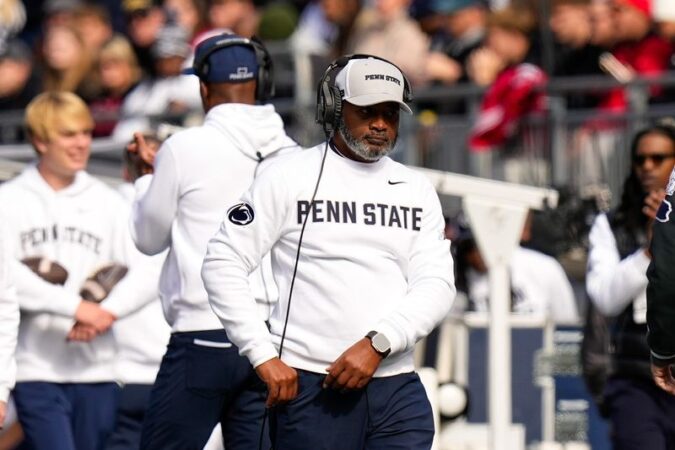
Penn State interim head coach Terry Smith reportedly “played a big role” in Falzone’s decision to sign with the Nittany Lions, according to On3.com.
From PSU to VT
Penn State’s firing of Franklin on Oct. 12 signaled a drastic shift within the program, but it also meant that its future recruiting classes likely would be affected.
The list of players Franklin has flipped from Penn State to Virginia Tech includes seven four-star and four three-star recruits.
Marlen Bright, a four-star offensive tackle from DePaul Catholic High School in Wayne, N.J., flipped on Nov. 27. He is ranked as the No. 7 recruit in New Jersey and No. 40 offensive tackle nationally.
Messiah Mickens, a four-star running back from Harrisburg, withdrew his commitment from Penn State on Nov. 19 and signed with the Hokies on Wednesday.
Other recruits who followed Franklin to Virginia Tech include: Pierce Petersohn (four-star tight end), Troy Huhn (four-star quarterback), Davion Brown (four-star wide receiver), Tyson Harley (four-star defensive end), Terry Wiggins (four-star linebacker), Roseby Lubintus (three-star offensive tackle), Mathieu Lamah (three-star linebacker), Benjamin Eziuka (three-star offensive tackle), and Amauri Polydor (three-star cornerback).
A struggle-filled coaching search
While Franklin’s departure was key in flipping several recruits, Penn State’s shaky coaching search has not helped.
Early reports indicated Penn State’s interest in Indiana’s Curt Cignetti, Texas A&M’s Mike Elko, Nebraska’s Matt Rhule, Georgia Tech’s Brent Key, and Missouri’s Eliah Drinkwitz. All five coaches later signed contract extensions at their respective universities.
Penn State reportedly made BYU coach Kalani Sitake a lucrative offer to become the school’s next head coach, according to ESPN. But once Sitake accepted an extension at his alma mater, Penn State athletic director Patrick Kraft had to pivot.
After the program’s pursuit of several hires fell through, top Penn State donors reportedly are pushing for Kraft to hire Smith, according to On3.com.
It was a step toward ending a two-year civic struggle to find a site for long-distance buses and their passengers. The renovated station could be ready for a series of big national and international events expected to draw millions of visitors next year.
“A lot of people are going to be coming here for the first time, and when they’re in that station, they’re going to get their first taste of Philadelphia — and we want to make sure it’s a good one,” said Councilmember Mike Driscoll, who sponsored the bill on behalf of the Parker administration.
The city will host events in 2026 for the 250th anniversary of the Declaration of Independence, as well as FIFA World Cup soccer matches and the Major League Baseball All-Star Game, among others.
Greyhound ran the terminal at 10th and Filbert Streets for more than three decades but ended its lease in June 2023 when the business model of its parent company, Flixbus, called for divesting from real estate and moving toward cheaper curbside service in many U.S. cities.
Since November 2023, customers of Greyhound, Peter Pan, and other interstate bus carriers wait, board, and arrive at curbside along Spring Garden Street in Northern Liberties — with no shelter from the weather and few amenities. It also has proved a nuisance to nearby businesses.
Before that, the buses operated at curbside on Market Street between Sixth and Seventh Streets.
The city senses that over the long term the owner anticipates selling the property, said Michael Carroll, assistant managing director for the Philadelphia Office of Transportation and Infrastructure Systems.
“That’s the sweet spot, long enough that there’s a meaningful basis to invest in improvements and solve the problems,” Carroll told the committee.
“At the 10-year mark, decisions will have to be made about whether this is a site that forever works best in Philadelphia, or whether there’s a better site,” he said.
The unanimous Finance Committee vote came after it amended the measure to adjust the fees bus companies would be charged to stop in Philadelphia.
Each stop in the city would cost $40 until the bus terminal is open, when it would move to a $65 fee. A smaller number of buses subsidized by the Pennsylvania Department of Transportation under a program to provide rural service would pay $16 a stop.
Committee members also asked for suspension of a procedural rule so that all 17 lawmakers could consider the bill Thursday and clear the way for final passage before the holidays.
In the agreement with the city that is part of the bill, PPA would run the terminal; assess the fees on bus carriers for the use of the facility and any street loading zones, such as those in University City; and handle enforcement.
The Filbert Street proposal includes specific requirements designed to address concerns particularto Chinatown.
For instance, the streets department would change traffic patterns so buses are routed to the station via Market Street instead of driving through the heart of the neighborhood as they did in the past.
John Mondlak, first deputy and chief of staff of the city planning department, said that the through traffic had long been a chief complaint of residents and business owners in Chinatown.
This story has been updated to include the name of the firm that owns the former Greyhound station.
LOS ANGELES — A doctor who pleaded guilty to selling ketamine to Matthew Perry in the weeks before the Friends star’s overdose death was sentenced to 2 1/2 years in prison on Wednesday.
Judge Sherilyn Peace Garnett handed down the sentence plus two years of probation to 44-year-old Dr. Salvador Plasencia in a federal courtroom in Los Angeles.
The judge emphasized that Plasencia didn’t provide the ketamine that killed Perry, but told him, “You and others helped Mr. Perry on the road to such an ending by continuing to feed his ketamine addiction.”
“You exploited Mr. Perry’s addiction for your own profit,” she said.
Plasencia was led from the courtroom in handcuffs as his mother cried loudly in the audience. He might have arranged a date to surrender, but his lawyers said he was prepared to do it today.
Perry’s mother and two half sisters gave tearful victim impact statements before the sentencing.
“The world mourns my brother,” Madeleine Morrison said. “He was everyone’s favorite friend.”
“My brother’s death turned my world upside down,” Morrison said, crying. “It punched a crater in my life. His absence is everywhere.”
Plasencia was the first to be sentenced of the five defendants who have pleaded guilty in connection with Perry’s death at age 54 in 2023.
The doctor admitted to taking advantage of Perry, knowing he was a struggling addict. Plasencia texted another doctor that Perry was a “moron” who could be exploited for money, according to court filings.
Prosecutors had asked for three years in prison, while the defense sought just a day in prison plus probation.
Perry’s mother talked about the things he overcame in life and the strength he showed.
“I used to think he couldn’t die,” Suzanne Perry said as her husband, Dateline journalist Keith Morrison, stood at the podium with her.
“You called him a ‘moron,’” she said. “There is nothing moronic about that man. He was even a successful drug addict.”
She spoke eloquently and apologized for rambling before getting tearful at the end, saying, “this was a bad thing you did!” as she cried.
Plasencia also spoke before the sentencing, breaking into tears as he imagined the day he would have to tell his now 2-year-old son “about the time I didn’t protect another mother’s son. It hurts me so much. I can’t believe I’m here.”
He apologized directly to Perry’s family. “I should have protected him,” he said.
Perry had been taking the surgical anesthetic ketamine legally as a treatment for depression. But when his regular doctor wouldn’t provide it in the amounts he wanted, he turned to Plasencia, who admitted to illegally selling to Perry and knowing he was a struggling addict.
Plasencia’s lawyers tried to give a sympathetic portrait of him as a man who rose out of poverty to become a doctor beloved by his patients, some of whom provided testimonials about him for the court.
The attorneys called his selling to Perry “reckless” and “the biggest mistake of his life.”
Plasencia pleaded guilty in July to four counts of distribution of ketamine. Prosecutors agreed to drop five different counts. The agreement came with no sentencing guarantees, and legally Garnett can give him up to 40 years.
The other four defendants who reached deals to plead guilty will be sentenced at their own hearings in the coming months.
Perry died at age 54 in 2023 after struggling with addiction for years, dating back to his time on Friends, when he became one of the biggest stars of his generation as Chandler Bing. He starred alongside Jennifer Aniston, Courteney Cox, Lisa Kudrow, Matt LeBlanc and David Schwimmer for 10 seasons from 1994 to 2004 on NBC’s megahit.