
Blog

  • LOVE Park’s saucer could soon get a reboot. For real this time, the city says.

    LOVE Park’s saucer could soon get a reboot. For real this time, the city says.

    The saucer in LOVE Park finally has a timeline for its revival.

    After years of seeking ideas from business owners and other Philadelphians, city officials expect work on the historic building to begin in May, the city’s Parks & Recreation Department says.

    But officials are still working to select a partner for the project.

    In May, the city issued a “request for expressions of interest” (RFEI) from “visionary businesses, particularly those in food, beverage, retail, or hospitality,” who wanted to partner on the saucer.

    City officials said the interest exceeded expectations, with more than 50 applicants submitting ideas. They included “coffee and cafe concepts, casual food offerings, beer garden hybrids, and informal meeting spaces,” according to Parks & Recreation spokesperson Ra’Chelle Rogers.

    Among applicants, there was a focus on “flexible, welcoming concepts that function as a true public amenity, encouraging people to meet, linger, and connect in the park,” Rogers said.

    The saucer building in LOVE Park is pictured in March 2019, amid early renovations for a bar-restaurant concept that never panned out.

    In light of the demand, the city is moving into its next stage, requiring prospective partners to visit the saucer at 3 p.m. on Feb. 18 and submit a proposal online by March 18.

    Prospective partners do not need to have submitted an idea in the spring, Rogers said. Any experienced food, beverage, hospitality, or community operator with the capacity to “generate sustainable revenue to support the park” is encouraged to apply, Rogers said.

    “The saucer has always been envisioned as a people-first space — one that complements the park, supports programming, and welcomes both residents and visitors,” said Susan Slawson, the city’s parks & recreation commissioner. The RFEI process has given officials “confidence to move forward with a flexible, inclusive model designed for the way people actually use LOVE Park.”

    The saucer, also referred to as the UFO, was added to the Philadelphia Register of Historic Places last year. Built in 1960, the building predates LOVE Park, and first served as the city hospitality center. It later housed offices for park staff.
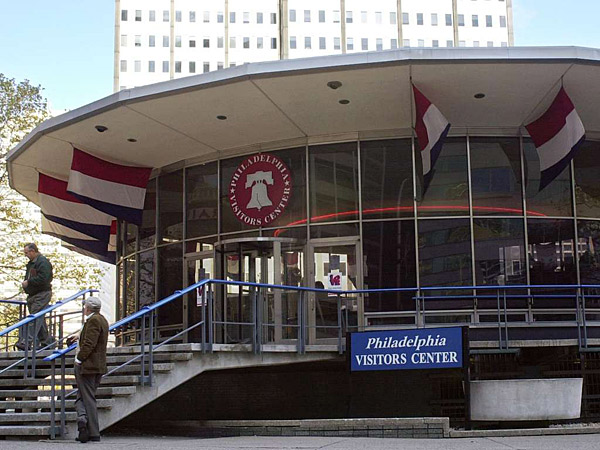
    An undated file photo of LOVE Park’s saucer building when it served as the Philadelphia Visitors Center.

    For more than a decade, however, the circular structure near 16th Street and JFK Boulevard has largely sat dormant (the building has opened to the public for the Festival of Trees, a Children’s Hospital of Philadelphia fundraiser, during recent holiday seasons).

    As part of LOVE Park’s rehabilitation in the late 2010s, the saucer got a $5.6 million facelift, making it “structurally brand new,” as Rogers described it in May.

    The city solicited proposals for a restaurant to fill the space, and selected Safran Turney Hospitality, the group behind a slew of popular restaurants on 13th Street. They planned to open a bar-restaurant called Loveluck that would seat about 50 people indoors and another 150 outside.

    In March 2019, city officials applauded the early construction of a bar-restaurant that was set to fill LOVE Park’s saucer building. The pandemic later caused the restaurateurs to bow out of the project.

    Then the pandemic happened, and the group bowed out of the project in 2022. A few months later, the city issued another request for proposals from experienced restaurateurs interested in signing a 10-year lease. That request did not result in any bids, Rogers said in May.

    As for this latest request process, city officials said they plan to select a partner by April, and begin work a month later. The timing could coincide with Philly’s celebration of America’s 250th birthday, as well as the city’s hosting of World Cup matches and the MLB All-Star game.

    The office of Councilmember Jeffery Young, whose district includes LOVE Park, is set to fund “key utility and infrastructure improvements” at the saucer, according to the city statement, and public grants are being sought to offset other upfront costs.

    “Bringing an active, public-facing partner into the saucer is a milestone for LOVE Park and for Philadelphia,” Young said. “I’m proud to support improvements that make the saucer a welcoming hub for years to come.”
  • Jared McCain shares emotional reaction to Thunder trade: ‘Everybody is getting on the plane and I’m just crying’

    Jared McCain shares emotional reaction to Thunder trade: ‘Everybody is getting on the plane and I’m just crying’

    Chat, they traded me, dog.

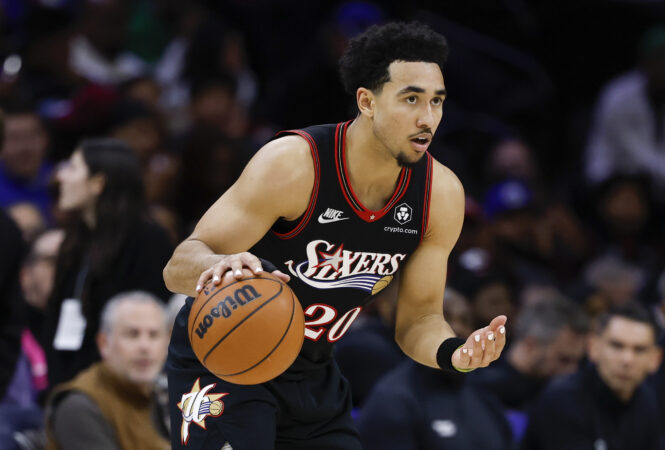
    Those were the first words from 21-year-old former Sixers guard Jared McCain in his latest vlog after getting traded to the Oklahoma City Thunder on Feb. 4 in exchange for a 2026 first-round pick and three second-round picks.

    The former Rookie of the Year front-runner was surprised when he received the news on the team bus, which was headed to the San Francisco airport ahead of the Sixers’ road game against the Los Angeles Lakers.

    “We were just on the bus,” McCain said in his latest YouTube video. “I get a call saying it might happen. And then like five minutes later [Daryl Morey] calls and says, ‘You’re cooked, Jared McCain.’ He said, ‘Bye, man. Never speak to me again.’ No, they were nice about it but, you know, it’s part of the NBA.”

    When McCain initially broke the news to his teammates, they didn’t believe him.

    “Right when I found out, I went to the back of the bus and I told Tyrese [Maxey] and nobody, they didn’t believe me,” McCain said. “And then I think management called them and then we were all getting on the plane and then I’m crying at this point. And we get off the buses and everybody is giving me hugs and I’m just crying. It was like a movie scene. Everybody is getting on the plane and I’m just crying. Lot of tears today. Happy, sad, I don’t know.”

    Maxey thought it was a joke when McCain shared the news. Afterward, the All-Star point guard publicly discussed McCain’s departure, calling him his “little brother.”

    “It was just like, ‘All right, whatever. He’s just joking,’” Maxey said. “Calls start coming in, and then you realize it’s real.”

    McCain had a breakout rookie season, averaging 15.3 points, 2.4 rebounds, and 2.6 assists before his season was cut short by a torn meniscus in his left knee. McCain struggled in his second season after being sidelined for surgeries on his knee and thumb. In 37 games, the young guard averaged 6.6 points, 2.0 rebounds, and 1.7 assists.

    On a private jet to Oklahoma City, McCain tried to keep a positive mindset on the trade — even if that meant drawing inspiration from his favorite music artist, Drake.

    “I’m in shock still,” McCain said. “I’m an OKC Thunder. What did Drake say? ‘It’s raining money, Oklahoma City Thunder. The most successful rapper 35 and under.’ Drake did say that. So, maybe it was destined for me. And it was in Weston Road Flows too. But, shout-out OKC, man. OKC, here we come. I’m excited, blessed, thankful. Let’s go have some fun.”

    Throughout the rest of the video, McCain shared his first few days with his new team — whether he was practicing how to say hi to Shai Gilgeous-Alexander, visiting the Paycom Center, getting locked out of the Thunder’s training facility, meeting OKC fans, or playing in his first game with the team, when he finished with five points, two rebounds, and one assist — and received a standing ovation.

    But the former Sixers first-round pick had one more message to Philly fans and it came in song form. McCain dedicated Olivia Dean’s “A Couple Minutes” to the organization and its fan base.

  • Matt Campbell and Co. are using Penn State’s past success to create a new culture

    Matt Campbell and Co. are using Penn State’s past success to create a new culture

    STATE COLLEGE, Pa. — Penn State faced a delayed start to the year’s first transfer window.

    While most football programs were plotting next year’s rosters, coach Matt Campbell, who was named the Nittany Lions’ head coach on Dec. 5 after 10 seasons at the helm for Iowa State, was busy hiring his staff.

    First he retained interim head coach Terry Smith. Then he brought several of his Iowa State assistants with him to Happy Valley. And a few weeks later, his staff was finalized. But he was behind, playing catch-up in building next season’s roster.

    Campbell didn’t care, though. And neither did his staff. Because they weren’t interested in a race for the best talent or for the recruits with the most stars.

    They were focused on finding the right players for their program. They recruited individuals who embody the grit and passion that have molded Penn State football into a perennial contender. And in their eyes, they accomplished that.

    “We went with a mentality of not wavering from who we want this football team to be — value systems of young men that love the sport of football, young men that love Penn State, and most importantly, young men who also understand the value of an education from this institution,” Campbell said. “Those core values were really critical for us to build this football team.”

    Building through the portal

    Penn State fired coach James Franklin in October, which resulted in 46 players transferring this winter. But transfer season wasn’t all bad for the Nittany Lions, who added 40 players via the portal — 24 of whom came from Iowa State.

    Penn State’s transfer class, which ranks No. 6 in ESPN’s 2026 transfer portal rankings, is headlined by Rocco Becht, 22. A three-year starter with a 24-12 record at Iowa State, Becht completed 60.6% of his passes for 9,274 yards and 64 touchdowns.

    In 2024, Becht was an All-Big 12 honorable mention selection after quarterbacking the Cyclones to their winningest season in program history.

    Campbell said he believes the quarterback and head coach must be “tied at the hip.” And he thinks his relationship with Becht, who last season played through a torn labrum in his non-throwing shoulder, exemplifies the connectivity essential to creating a successful program.

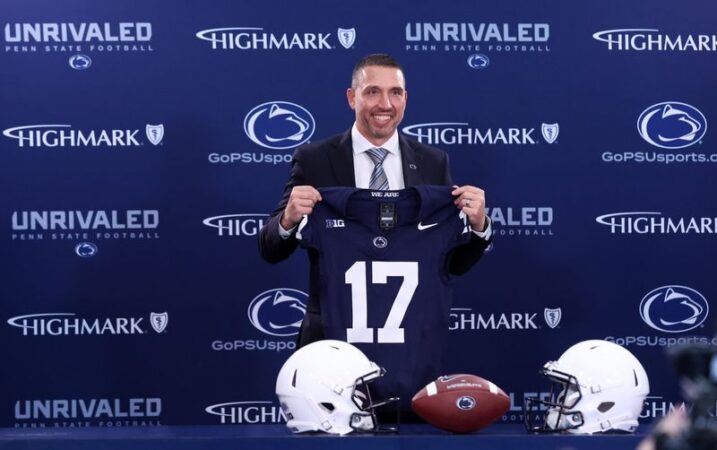
    Matt Campbell said quarterback Rocco Becht is as “competitive as any football player I’ve been around.”

    “I believe Penn State football is [about] integrity, character, class, excellence, and grit. [Becht] embodies every one of those traits,” Campbell said. “He’s as tough and as competitive as any football player I’ve been around … I’m really excited for him to continue to lead and grow within our football program.”

    Taylor Mouser, Penn State’s offensive coordinator who spent the last two seasons in the same role at Iowa State, brings continued camaraderie with his experienced quarterback. But he wants more from the position.

    His philosophy with his offensive players resembles Campbell’s roster-building philosophy. He wants a unified offense filled with “unselfish guys” who are connected to their teammates, coaches, and community.

    “I want guys who can provide connection for their teammates. I want guys who can provide energy to the people on the field,” Mouser said. “Your defense is going to play better when they believe in the quarterback. So if you’re going to be a quarterback for us [at Penn State], you’d better have relationships with everybody on the team.”

    Creating a culture

    Every coach wants to establish a winning culture — one built on hard work, accountability, and trust. But Campbell understands that building a culture isn’t easy, and it takes years to build trust.

    “Culture is not words. It’s how you live, it’s how you act, it’s how you carry yourself,” Campbell said. “… It’s all about the people. It’s about aligning the team and the people together. That’s one of the things that I at least know I can look myself in the mirror and [say], ‘We brought the right leaders of young men into our football program.’”

    One of those culture builders is Ryan Clanton, Penn State’s offensive line coach who spent the last three seasons in the same role at Iowa State. The former Oregon offensive lineman said Campbell’s success stems from his character, which resembles a “normal dude.”

    Clanton called Campbell the easiest coach to work for in college football. It’s why, when Campbell asked Clanton to follow him to Happy Valley, the line coach’s answer was simple: “What time does the plane leave?”

    “[Campbell] is the best head coach in the nation. Wherever he went, I was going to go at any level,” Clanton said. “What people don’t see is that he’s very caring. He’ll talk to the janitor for all hours of the night. He can connect with anybody. And he likes to have fun … It’s a blessing to be with him.”

  • Teachers at this Philadelphia charter just voted to unionize

    Teachers at this Philadelphia charter just voted to unionize

    Esperanza Academy Charter High School teachers and staff have unionized.

    The brand-new Esperanza High School Collective, a chapter of the American Federation of Teachers, now represents nearly 80 staff at the school.

    The move comes during a period of turmoil at the school, after some employees were laid off abruptly in December. Current and former staff say there have been sudden and arbitrary changes at the school, including larger class sizes and fewer staff working directly with children.

    Union recognition was hard fought — a majority of the staff signed union cards in the fall, but the Esperanza administration declined to voluntarily recognize the collective.

    Instead, the AFT had to go through the National Labor Relations Board, which held an election in late January. In all, 87% of the Esperanza Academy Charter High School staff voted to unionize. (Staff at Esperanza’s elementary and middle schools have not unionized.)

    Wendy G. Coleman, president of AFT Pennsylvania, said the organization was “thrilled” to welcome Esperanza Academy high school staff.

    “These dedicated educators and staff work tirelessly to ensure that their students receive the best possible education, and AFTPA is ready to work just as diligently to help them secure better class sizes, higher wages, and adequate resources for every member in their first contract,” Coleman said in a statement. “As we know, our members’ working conditions are our students’ learning conditions, and we’re excited to see what the future holds for the Esperanza High School Collective in their first contract.”

    Esperanza is the sixth of Philadelphia’s 81 charter schools to form a union; the vast majority of Pennsylvania charters are not unionized.

  • Union add another attacking option with signing of forward Agustín Anello

    Union add another attacking option with signing of forward Agustín Anello

    The Union have added another major signing to what has already been a busy winter transfer window for the club.

    The team announced Tuesday that it had acquired Agustín Anello, a 23-year old forward who spent last season with Uruguayan team Boston River.

    The Union paid a transfer fee of around $2 million to acquire Anello, a source with knowledge of the deal told The Inquirer. He has been with the team at its preseason camp in Clearwater, Fla., for a few days, and could debut in Tuesday’s final preseason game against CF Montréal (6 p.m., livestreaming on the Union’s website and YouTube).

    “Agustín is a versatile, dynamic attacker,” Union manager Bradley Carnell said in the team’s release. “His development in Europe, combined with his recent breakout in Uruguay, reflects a clear upward trajectory. As a domestic player with U.S. youth national team experience, he fits our profile well.”

    Anello is the second attacking option the Union have acquired from abroad this offseason. Ezekiel Alladoh, who spent last season with Swedish club IF Brommapojkarna, joined the team for a club record $4.5 million in December.

    The Athletic reported that the Union were in talks to sign Anello in January and reported that a deal was being finalized on Feb. 2. Anello let a poorly kept secret further out when he posted a picture from Clearwater on his Instagram story on Monday afternoon. The Union’s logo was visible on Anello’s shorts in the post.

    Anello grew up in south Florida and moved with his family to Spain at age 10. He hasn’t lived in the United States since. At 17, he turned pro in Belgium, and played for a range of clubs there, in Croatia, and the Netherlands before moving to Uruguay in the summer of 2024.

    Although it has been a long time since he last formally called America home, Anello is not a total stranger to the Union. In November 2023, he was teammates with Nathan Harriel and Jack McGlynn on a U.S. under-23 national team squad that surveyed candidates for the 2024 Olympics.

    Anello scored 10 goals across all competitions for Boston River in 2025.

    After their preseason finale, the Union’s next match will be a Concacaf Champions Cup game in Trinidad against Defence Force F.C. on Feb. 18.

    The Union will open their MLS schedule with a trip to D.C. United on Feb. 21.

  • AMA joins effort to launch vaccine science review amid CDC turmoil

    AMA joins effort to launch vaccine science review amid CDC turmoil

    The American Medical Association and a leading public health research group focused on vaccines are teaming up to create a system to review vaccine safety and effectiveness, mirroring a role long played by the Centers for Disease Control and Prevention.

    The groups, which will operate independently from the federal government, say their work is needed because the CDC’s vaccine review process has “effectively collapsed.” The parallel effort will initially focus on reviewing immunizations for influenza, COVID-19 and respiratory syncytial virus, or RSV, ahead of the coming fall respiratory season.

    The groups will not be making vaccine recommendations but will provide the evidence reviews to state health officials, clinicians, and others making vaccine decisions.

    The nation’s largest physician organization and the Vaccine Integrity Project at the University of Minnesota will convene leading medical professional societies, public health groups, and healthcare organizations to “ensure a deliberative, evidence-driven approach to produce the data necessary to understand the risks and benefits of vaccine policy decisions for all populations — the approach traditionally used by the federal government,” according to a joint statement announcing the effort Tuesday.

    The involvement of the AMA is significant because the doctors group has traditionally focused on issues such as physician reimbursement, billing practices and the economics of medical practice — not on broad public health evidence reviews. Its decision to help stand up a parallel vaccine review process reflects how seriously medical leaders view the breakdown of confidence in the federal government’s vaccine system under Health Secretary Robert F. Kennedy Jr.

    “This signals a really important foray for them to come into this space,” said Jeanne Marrazzo, chief executive of the Infectious Diseases Society of America and the former director of the National Institute of Allergy and Infectious Diseases. “It shows the considerable concern around where we are going with evidence-based recommendations.”

    For decades, the CDC’s outside panel of vaccine experts — the Advisory Committee on Immunization Practices — set the standards for which vaccines the agency should recommend and who should get them. Even though the recommendations were guidance, not law, physicians, school systems, health insurers and others broadly adopted them. The vaccine panel, in coordination with CDC staff, conducted extensive data reviews of benefits and risks, and held exhaustive discussions during its public meetings before voting to make new vaccine recommendations or change existing ones.

    But Kennedy fired all 17 members of the vaccine panel in June and replaced them with a handpicked group that included several vaccine skeptics. The Department of Health and Human Services has also disallowed several doctors groups that had long provided input from participating in the panel’s work groups, the teams that do the detailed analysis for the full committee.

    Since then, the panel has made recommendations that have been strongly criticized by public health and medical experts, including voting in December to drop the long-standing recommendation that all newborns be given the hepatitis B vaccine.

    Andrew Nixon, an HHS spokesman, said the “claim that ACIP’s evidence-based process has collapsed is categorically false. ACIP continues to remain the nation’s advisory body for vaccine recommendations driven by gold standard science.” He added, “While outside organizations continue to conduct their own analyses and confuse the American people, those efforts do not replace or supersede the federal process that guides vaccine policy in the United States.”

    The new effort comes after the acting CDC director, a top deputy to Kennedy, took the unprecedented step of reducing the number of vaccines that the United States routinely recommends for every child. Leading public health experts and medical organizations raised alarms, saying the shift, which bypassed vaccine experts at CDC and its vaccine advisory panel, could weaken protections against preventable deadly disease.

    “Everything that has been done since the new ACIP has all been about ideology and not based on science,” said Michael Osterholm, director of the University of Minnesota’s Center for d Research and Policy, which established the Vaccine Integrity Project last year.

    Osterholm said the new initiative is an attempt to fill “a huge black hole in public health and medical practice.”

    “It is our duty as healthcare professionals to work across medicine, science, and public health to make sure the U.S. has a transparent, evidence-based process by which vaccine recommendations are made,” said Sandra Adamson Fryhofer, an AMA trustee and the organization’s liaison to the CDC vaccine panel. “Together, we are committed to ensuring the American public has clear, evidence-based guidance that inspires confidence when making important vaccination decisions.”

    The Vaccine Integrity Project published an evidence review and convened panels that looked at scientific studies on COVID-19, influenza, and RSV vaccines in 2025, and is conducting a review of the HPV vaccine.

  • Lovat Square debuts in Chestnut Hill as a wine shop, and there’s a restaurant on the way, too

    Lovat Square debuts in Chestnut Hill as a wine shop, and there’s a restaurant on the way, too

    Since moving to Glenside in 2016, Brooklyn transplants Damien Graef and Robyn Semien have frequented the Evergreen Cheese Shop in Chestnut Hill, located in a charming courtyard that fringes a parking lot off East Evergreen Avenue, steps from Germantown Avenue. As time went on, the couple took note of two empty buildings next door to the cheese shop, the former homes of Top of the Hill Market, which closed in 2019, and Mimi’s Cafe, which closed in 2022.

    As entrepreneurs— the couple own a Williamsburg wine shop together, and Semien runs the podcast company Placement Theory — their gears started turning. “We’d always had this loose idea that maybe someday we’d open [another] wine store, but the logistics are hard,” Semien said.

    Part of the bottle selection at Lovat Square.

    In 2023, they chatted up John Ingersoll, the Evergreen Cheese owner, who referred them to the landlord for the space at 184 E. Evergreen Ave.

    Graef and Semien were not entirely sure what they wanted to create. “We said, ‘Let’s put one foot in front of the other and see how far we get,’” said Graef. “Turns out, pretty far.”

    After sitting dark for four-plus years, the Evergreen Avenue courtyard will light up again this week with the opening of Lovat Square, which the couple plan to unfold in stages: first as a bottle shop, then as a garden restaurant, and eventually as a full bar and dining room.

    Lovat Square’s bottle shop and tasting room opens Thursday, with about 30 seats, wines by the glass, and a small menu of snacks. The wine selection — just under 400 labels, with about 200 more on the way — doubles as both retail inventory and will become the backbone of the restaurant’s wine list.

    Thursday’s opening is a hopeful sign for Chestnut Hill, stung from the recent closings of Iron Hill Brewery and Campbell’s Place. Other coming attractions in the near future will be the Blue Warbler, a day-into-evening restaurant at Germantown and Willow Grove Avenue, and a reopening of Fiesta Pizza on Germantown Avenue near Gravers Lane.

    Before relocating from New York with their two children, Semien and Graef opened the Brooklyn wine shop Bibber & Bell in 2013. Since 2022, Graef has been lead sommelier at Jean-Georges at the Four Seasons Hotel. Semien spent 16 years at This American Life and now executive-produces Question Everything, a show focused on journalism in America.

    A table at Lovat Square houses a collection of Champagnes and other bubbly wines.

    Lovat Square — pronounced “love it,” named after a shade of green often used in tweed — will start with a by-the-glass program of about 15 wines, though Graef expects that number to fluctuate as additional bottles are opened for tastings, events, and informal pours. Snacks — house-made pickles, focaccia, sour cream soubise with potato chips (with optional trout or ossetra caviar), and a cheese plate created by Evergreen’s Ingersoll — will accompany the wine during the initial phase. More substantial food will come later as the outdoor and indoor dining spaces open.

    “I think of the wine-shop phase as a cocktail party: small bites while we build toward the main course,” he said.

    Co-owner Damien Graef pours Chartogne-Taillet Champagne Sainte Anne for sampling at Lovat Square.

    Graef is focusing on independent winemakers. “You’re not going to find Josh or Caymus [wines] here,” Graef said. “But we’ll have something for the person who likes that style. The through-line is small producers who are serious about their land and what they’re making.”

    The shelves skew European, with a particular emphasis on Italy and France, but also include wines from the United States, South America, and Eastern Europe. There’s a long table devoted just to Champagne and other bubbles.

    The spring opening of the courtyard garden will expand the menu into full dinner service, with seating for about 70. Just under half of those seats are expected to be under a canopy by late summer, extending usability into the shoulder seasons.

    Lovat Square’s final phase, targeted for late fall, will bring a full-service restaurant and cocktail bar, including an 18-seat bar and counter seating along the front windows of the former Mimi’s, a separate building in the courtyard.

    Lovat Square opens Thursday at 184 E. Evergreen Ave.

    Graef, born in the Bay Area but raised in New Jersey, has spent his career in restaurants, beginning as a dishwasher at 13 before moving through kitchens and into front-of-house roles. In the early 2000s he worked at Il Buco in New York, where he met Semien (also a Bay Area native) and Lovat Square manager Patricia Jo Peacock. “I thought I knew something about wine [then], but that was very short-lived,” Semien said.

    At the time, Graef was a beer-only drinker — and “not like great beer or anything: Negra Modelo and Yuengling.”

    While Graef was at Il Buco, wine director Roberto Paris demystified wine for him. “Getting to meet winemakers for the first time and having them eat family meal with us and get to taste their wine and talk about these little corners of Italy that they were coming from made it more accessible for me,” he said. “That really turned me onto all of this, and then I just fell deep down that hole and have not gotten out since. And it’s only got worse.”

    Graef later worked at Chanterelle in TriBeCa before running Aurora in Brooklyn, known for its Italian wine list. As Lovat Square ramps up, he is transitioning to a part-time role at the Four Seasons.

    The Chestnut Hill project, the couple said, reflects both their professional histories and their lives in the neighborhood.

    “We’re trying to build our favorite place,” Graef said.

    Lovat Square, 184 E. Evergreen Ave., lovatsquare.com. Initial hours: noon to 10 p.m. Thursday to Sunday.

  • Wasserman fallout, explained: Musicians speak out after talent agency’s CEO named in Epstein files

    Wasserman fallout, explained: Musicians speak out after talent agency’s CEO named in Epstein files

    A growing number of musicians — including most recently Chappell Roan — are leaving their management company after its founder’s emails were uncovered in the latest release of the Epstein files.

    Wasserman, a major talent management company based out of Los Angeles, represents stars ranging from Billie Eilish and Kendrick Lamar to Phish, Bon Iver, Turnstile, and Kacey Musgraves.

    The company has been in hot water since the Department of Justice dropped over 3 million pages of documents related to Jeffrey Epstein, the disgraced financier and sex offender, and his associate, convicted sex offender Ghislaine Maxwell.

    Those released files included emails between the agency’s founder, Casey Wasserman, and Maxwell. Now, musicians signed to Wasserman Group are speaking out and cutting ties.

    Here’s what you need to know.

    Who is Casey Wasserman?

    Wasserman is a successful entertainment agent and the founder and CEO of the Wasserman Group, which represents sports talent, musicians, artists, and content creators.

    He is the grandson of media mogul and talent agent Lew Wasserman. He is also the chairperson of the organizing committee for the Los Angeles 2028 Olympic and Paralympic Games.

    What did Casey Wasserman’s emails to Ghislaine Maxwell say?

    Wasserman’s emails, which were released by the Justice Department in January, reveal an exchange between him and Maxwell from 2003.

    In the emails, Maxwell offers to give Wasserman a massage that would “drive a man wild.” Later, Wasserman tells Maxwell that he thinks about her “all the time” and asks what he has to do to see her in “a tight leather outfit.”

    The Justice Department has not accused Wasserman of wrongdoing.

    What kind of talent does the Wasserman Group represent?

    Wasserman is regarded as one of the top talent agencies. The company represents hundreds of the world’s biggest touring acts and oversees artists who perform across a range of musical genres.

    The company’s artist roster includes Coldplay; Ed Sheeran; Joni Mitchell; Tyler, the Creator; Kendrick Lamar; Lorde; and many more.

    Wasserman’s artist roster is no longer available on its website.

    How are artists signed to Wasserman reacting?

    Many have spoken out against the Wasserman CEO, calling for him to leave the agency. Some artists have gone as far as leaving the agency.

    Bethany Cosentino, the front woman of Best Coast, was among the first to speak out, posting an open letter on Instagram last week calling for the founder to step down.

    “As an artist represented by Wasserman, I did not consent to having my name or my career tied to someone with this kind of association to exploitation,” Cosentino said. “Staying quiet isn’t something I can do in good conscience — especially in a moment when men in power are so often protected, excused, or allowed to move on without consequence. Pretending this isn’t a big deal is not an option for me.”

    Irish punk band the Dropkick Murphys announced over the weekend that they were also leaving Wasserman.

    “It saddens us to part ways with [our agents], but the namesake of the agency is in the Epstein files so … we GONE,” the band wrote on Instagram.

    Other bands, including Wednesday, Water From Your Eyes, and Beach Bunny, have made statements on social media about their concerns or their intentions to start the process of leaving the agency.

    On Monday, Chappell Roan announced her exit.

    “As of today, I am no longer represented by Wasserman, the talent agency led by Casey Wasserman,” Roan posted on Instagram. “I hold my teams to the highest standards and have a duty to protect them as well. No artist, agent or employee should ever be expected to defend or overlook actions that conflict so deeply with our own moral values. I have deep respect and appreciation for the agents and staff who work tirelessly for their artists and I refuse to passively stand by.”

    In addition to artist pressure, Los Angeles politicians are calling for Wasserman to give up his role on the Olympics committee. The Hollywood Reporter also reported that agents who work at Wasserman are considering spinning off a new firm.

    Still, not all artists believe they can make a clean break like Chappell Roan or the Dropkick Murphys.

    Why can’t every artist leave the agency?

    Wasserman client Alexis Krauss, of the group Sleigh Bells, released a lengthy statement condemning the CEO and detailing why she could not leave the company entirely, citing the financial impact it would cause.

    “Do I wish I could burn it all down, boycott and divest? Sure I do. But to be totally honest, I can’t afford to,” Krauss said.

    Krauss continued, “Would I love to just leave Wasserman Music? Yes I would. Can we? No, because I love and respect our agent and I trust him to make the decision that is best for himself, his family and his artists. The agents at Wasserman are not the villains.”

    Several artists, including Krauss, emphasized that they do not work directly with — and in most cases have never met — Casey Wasserman.

    Krauss added that her income allows her to pay her and her child’s health insurance, saying, “let’s remember that there’s no such thing as healthcare for working musicians. Call me spineless, but this is my truth. This is the hypocrisy of our realities as we try to do the least harm in an unscrupulous system.”

    Are any Philadelphia-area artists managed by Wasserman?

    Yes. Some include: Aaron West and the Roaring Twenties, the A’s, the Bacon Brothers, Diplo, the Disco Biscuits, Dr. Dog, G. Love & Special Sauce, the Menzingers, the Wonder Years, and Spaga.

    As of publication time, none of these artists have made statements about Wasserman. This story will be updated if they do.

    Has Casey Wasserman made a statement?

    Yes. In a statement sent to the New York Times, Wasserman said he “deeply regrets” his correspondence with Maxwell, “which took place over two decades ago, long before her horrific crimes came to light.”

    Wasserman added that he never had a “personal or business relationship” with Epstein.

  • Number of Americans who expect ‘high quality lives’ drops to two-decade low

    Number of Americans who expect ‘high quality lives’ drops to two-decade low

    The number of Americans who anticipate they will have “high-quality lives” in five years’ time has dropped to a nearly two-decade low, according to a poll released Tuesday.

    Around 6 in 10 people surveyed said they expected their lives would be significantly better in the future than today. That is about nine percentage points lower than during the height of the COVID-19 pandemic, according to Gallup, which began measuring Americans’ sense of optimism in 2008.

    “I think that’s disconcerting, and says a lot about the mood of the American public today,” said Dan Witters, the research director for Gallup’s National Health and Well-Being Index.

    American optimism is down across the board by 3.5 percentage points since 2024, and Hispanic adults have had the greatest drop in optimism in the past year, from about 69% to roughly 63%, according to Gallup. (The new figures are based on four quarterly surveys conducted throughout 2025 involving 22,125 respondents, and the poll’s margin of error is plus or minus half a percentage point. The margin is higher — plus or minus two percentage points — for divisions of race and political party.)

    Gallup has used two questions to gauge the national mood as part of its National Health and Well-Being Index. Its poll asked around 22,000 adult respondents to rank their current life — and where they imagine their lives will be in five years’ time — on a scale of 1 to 10.

    Both ratings have slumped over the past five years across a pandemic, affordability issues, turbulent national politics, and global conflicts. The steep drop in optimism in 2025 suggests some Americans think their lives will worsen still, Witters said.

    In the past year, around 62% of American adults ranked their current life at a 7 or higher, and around 59 percent anticipated their life in five years’ time would rank at an 8 or higher, according to Gallup.

    The Gallup poll did not ask respondents to give reasons for their answers, but Witters said the recent slump in optimism began as high inflation rates staggered American consumers in 2021 and 2022, during the Biden administration.

    “Even as the pandemic was kind of receding, those affordability issues, which of course linger on in not insignificant ways to this day, I think, had a lot to do with it,” Witters said.

    The downturn has persisted after the reelection of Donald Trump. Democrats feel a lot worse about their future, reporting a 7.6 percentage-point drop in ratings of their future lives from 2024, while independents’ future ratings dipped by 1.5 percentage points. Republicans’ future life ratings increased by 0.9 percentage points.

    It is common for optimism among partisans to swing after a new party wins the White House, but changes among Democrats and Republicans largely offset each other in 2021, after when Joe Biden was elected president, Witters said. That was not the case in 2025.

    Black and Hispanic adults reported some of the largest declines in optimism in recent years. Witters said the trend suggests that minority groups have been hit hardest by affordability issues.

    That Hispanic adults reported the steepest drop in optimism in 2025 — coupled with the partisan divide in optimism — could suggest Trump’s policies are partly to blame, Witters said. Latino voters swung against the Republican Party in November’s special elections, a break Democrats claim is a repudiation of the Trump administration’s aggressive immigration enforcement campaign.

    Can American morale recover? Witters said Gallup’s polling is “highly sensitive to changes that are going on in the world” and has seen the country emerge from other periods of pessimism.

    “There’s no reason to think that that can’t happen again,” Witters said. “It’s just a bit of a trough right now.”

  • Republicans are pushing to drastically change the way you cast ballots

    Republicans are pushing to drastically change the way you cast ballots

    As President Donald Trump calls for sweeping changes to election law — including saying that Republicans should “take over the voting” — Republicans in Congress are planning to vote this week on the SAVE America Act, which would make massive changes to how Americans vote ahead of November’s midterms.

    They want to require all Americans to prove they are citizens when registering to vote, and to show an ID when voting in person or by mail, as well as make mail voting more difficult.

    Trump and Republicans say this would make voters feel more confident there’s no fraud in federal elections. “We need elections where people aren’t able to cheat,” Trump told NBC News. “And we’re gonna do that. I’m gonna do that. I’m gonna get it done.”

    But there’s no evidence of widespread election fraud. There is evidence, say some nonpartisan elections experts, that this bill could disenfranchise millions of eligible voters by requiring new voters to provide documents that tens of millions of U.S. citizens lack immediate access to.

    The nonpartisan Campaign Legal Center asserts the bill “is harmful to our democracy and a threat to the freedom to vote for all Americans. … Its extreme documentation requirements would actually amount to one of the harshest voter suppression laws nationwide.”

    Here’s how the SAVE Act could dramatically change elections and its chance of becoming law.

    3 major changes

    1. You’d have to provide a proof of citizenship to register to vote: Millions of Americans register to vote every year, and they are already required to verify they are citizens when they do. Under this bill, they’d have to prove it.

    For example, those who change states, or are newly eligible to vote would have to provide proof of their citizenship, like a passport, a military ID submitted with proof of place of birth, or — when submitted alongside other documents — a birth certificate. Newly married voters who change their last name would have to reregister to vote with all of these documents — plus provide proof as to why their current name doesn’t match their birth certificate.

    But about half of Americans don’t have passports, and not all Americans have a copy of their birth certificate.

    “Our research shows that more than 21 million Americans lack ready access to those documents,” writes the nonpartisan Brennan Center for Justice.

    Even some Republican election experts have questioned whether all this documentation is necessary.

    “The premise of the SAVE Act is we need to ensure there are processes that confirm citizenship,” says Matt Germer, director of the governance program at the R Street Institute, a conservative think tank. “But I think much of the burden of citizenship verification should be on the government, which holds much of this data in the first place.”

    2. It requires IDs to vote nationwide: Strong majorities of Americans, including Democrats, support voters presenting a photo ID to cast ballots.

    Only government (state, tribal, or federal) IDs would be accepted.

    3. It would probably make voting by mail more difficult: Mail-in voting is popular and safe, say election experts. Almost all states offer some form of it. Trump has voted by mail, and Republicans certainly use it too.

    But this bill would put strict restrictions on who can vote by mail without providing valid identification. Some disabled voters and active duty troops would be exempt from the new rules.

    Some Republican election officials have expressed concern this takes away from states’ constitutional right to run their own elections how they best see fit. Mail-in voting first became popular among rural conservatives in Western states.

    “When I was in office,” former Kentucky secretary of state Trey Grayson said in a recent interview, “the number one principle of election administration was that the states run elections and Congress should be minimally involved. On the Republican side, we really believed that. It was really, really important.”

    Democrats adamantly oppose

    The bill could pass the Republican-controlled House this week, but in the Senate, Democrats plan to block the legislation by filibustering it.

    “It’s Jim Crow 2.0,” Senate Minority Leader Charles E. Schumer (D., N.Y.) told MS NOW recently. “What they’re trying to do here is the same thing that was done in the South for decades to prevent people of color from voting.”

    This isn’t the first time Republicans have tried to pass some version of the bill, and Trump has been increasingly vocal about election reform. Some of his ideas appear blatantly unconstitutional. But that hasn’t stopped the president from arguing for them.