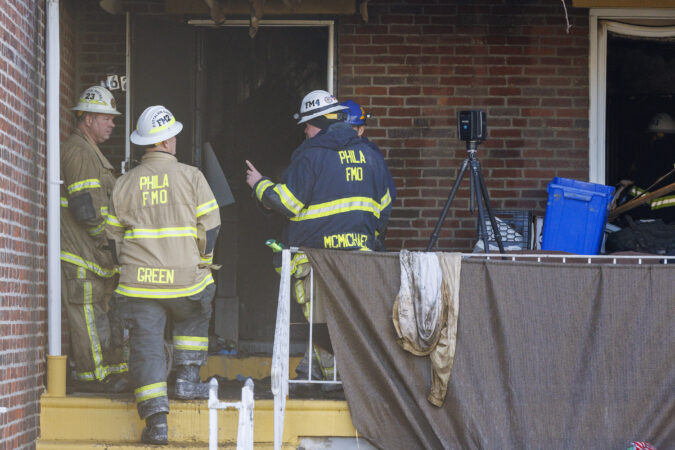
Philadelphia firefighters pulled a 60-year-old woman away from a burning building where she was trapped early Thursday morning, but she later died at a hospital.
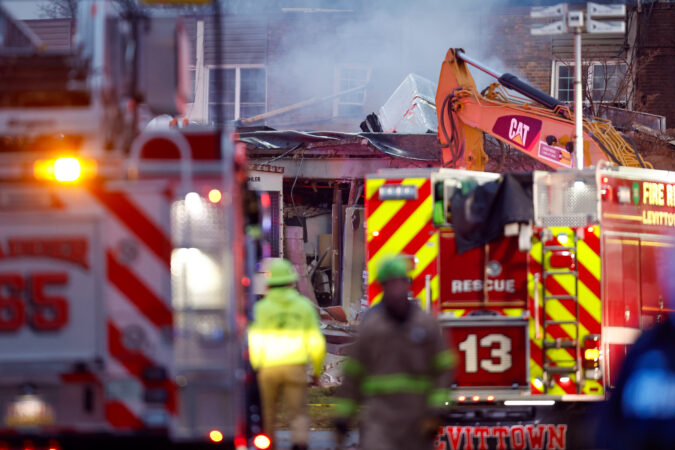
The fire department responded to the blaze around 4:45 a.m. on the 6200 block of Ogontz Avenue in North Philadelphia. Firefighters arrived to find a heavy fire scorching throughout the two-story rowhouse.
About 60 firefighters, medics, and support staff were at the scene, officials said. Upon searching the house, firefighters found an unresponsive woman, who did not survive. The Medical Examiner’s Office will soon determine the cause of death, with the Fire Marshal’s Office investigating the cause of the fire.
There have been at least two deadly fires in the area over the last month, in addition to Thursday. Additionally, two people were rescued and survived a fire in South Philadelphia Wednesday, according to CBS.
Earlier this week, Bucks County officials confirmed the death of a third person related to the Bristol Health & Rehab Center fire, which claimed the lives of two other people and injured 20 others. Days before the Bristol fire, a deadly fire in Upper Darby killed one person, critically injured another, and left a firefighter and a handful of others with less-severe injuries.
Anna Stone was doing the first rounds of her nursing shift at St. Luke’s Upper Bucks Campus when she noticed a patient’s heart rate was elevated, a sign that they could be at risk of a cardiac emergency.
Before she could look into the patient’s chart and decide whether to call for help, a critical care doctor came rushing to the patient’s bedside.
A drop in the patient’s oxygen levels had been detected by a monitor that uses artificial intelligence to continuously evaluate vital signs. This triggered an automatic alert for the hospital’s critical care team to send help.
The AI tool is intended to help doctors and nurses more quickly identify patients whose condition is deteriorating — often before signs of distress are visible to medical staff — and intervene sooner.
The approach contributed to a 34% decline in cardiac arrests, and a 12% drop in patients crashing so hard and fast that they required rapid response transfers to the ICU between 2022 and 2024, according to St. Luke’s.
Survival rates among cardiac arrest patients rose from 24% to 36%.
St. Luke’s experiment with a program called the Deterioration Index, created by healthcare software giant Epic, is among the latest ways hospitals are bringing artificial intelligence into their patients’ rooms.
In other Philadelphia-area initiatives, Jefferson Health and Penn Medicine recently debuted an ambient listening tool that records conversations between doctors and patients, distilling the critical details into a well-organized visit note.
St. Luke’s has been using its AI monitoring system across all 16 of its campuses, including Quakertown, Upper Bucks, and Grand View, which the health system acquired in July.
The health system’s initiative was recognized by The Hospital and Healthsystem Association of Pennsylvania, the region’s largest industry group for hospitals, with an award honoring safety and quality initiatives that improved patient care while reducing hospital costs.
Using AI to predict emergencies
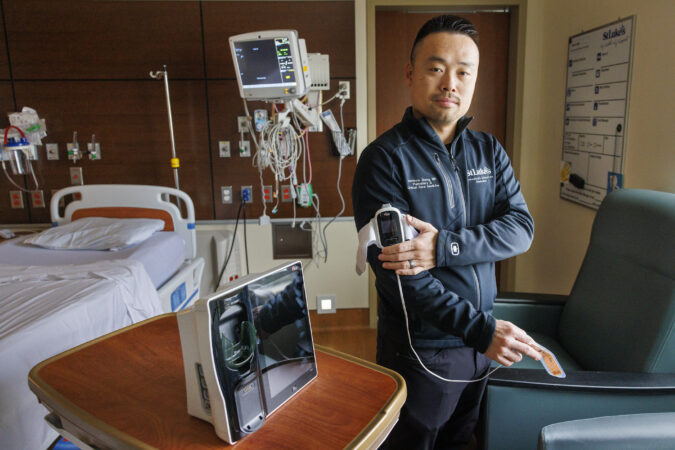
The monitoring device, which attaches to a patient’s finger, records and continuously updates patients’ electronic medical records with vital metrics such as heart rate, blood pressure, and lab work results.
Using this matrix of data points, it assigns each patient a “deterioration index” — a score between 0 and 100 indicating their overall stability — and automatically alerts critical care when the score rises too high.
Matthew Zheng, a doctor at St. Luke’s Upper Bucks, holds the monitoring device used to continuously track patients’ vital signs.
It is not intended to replace in-person monitoring, but serves as an extra set of eyes when nurses are away from their bedside.
What’s more, the sophisticated technology is capable of picking up on nuanced changes in a patient’s status before they show physical signs of distress.
“We would ideally like to intervene on these patients before they reach a point where the intervention isn’t that helpful,” said Matthew Zheng, a critical care doctor at St. Luke’s Hospital — Upper Bucks. “Our nurses work very hard, but they can’t be in the same room all the time.”
When a patient’s “deterioration index” rises above 60, the device sends an alert to the hospital’s virtual response center — a remote hub where a nurse monitors three screens showing the status of all patients.
Alerts may also be sent directly to a patient’s care team or the rapid response unit, if the AI monitoring detects that a patient is quickly deteriorating and needs emergency care.
“What that’s allowed is for us to have a proactive response instead of being reactive to patients,” said Charles Sonday, an associate chief medical information officer at St. Luke’s who leads AI initiatives.
Stone, the Quakertown nurse, said having the tool to constantly watch over patients while she’s out of their room is reassuring.
Doctors like that it enables them to quickly get up to speed on the status of a patient they transferred out of the ICU, and respond more immediately to their new medical needs, said Zheng, the critical care doctor.
St. Luke’s plans to continue fine-tuning the technology, and customize it to meet the unique patient profiles of each of its campuses, which span 11 counties and two states, from the Lehigh Valley to New Jersey.
The social and economic factors that affect patient health, such as pollution, and illness rates, vary significantly across the health system’s sprawling network, Sonday said.
The system will also explore customizing the tool for specialty services, such as pediatrics and behavioral health.
Bristol Township identified resident Patricia Mero, 66, as the latest death following the fire that destroyed parts of the Bristol Health & Rehab Center in Bristol Township on Dec. 23. Mero died Monday morning, according to the Bucks County Coroner’s Office. The cause of death was listed as a chest trauma; the manner of death an accident.
Nurse Muthoni Nduthu and a woman whom Bristol Township Police identified as Ann Reddy, another resident, were also killed in the fire.
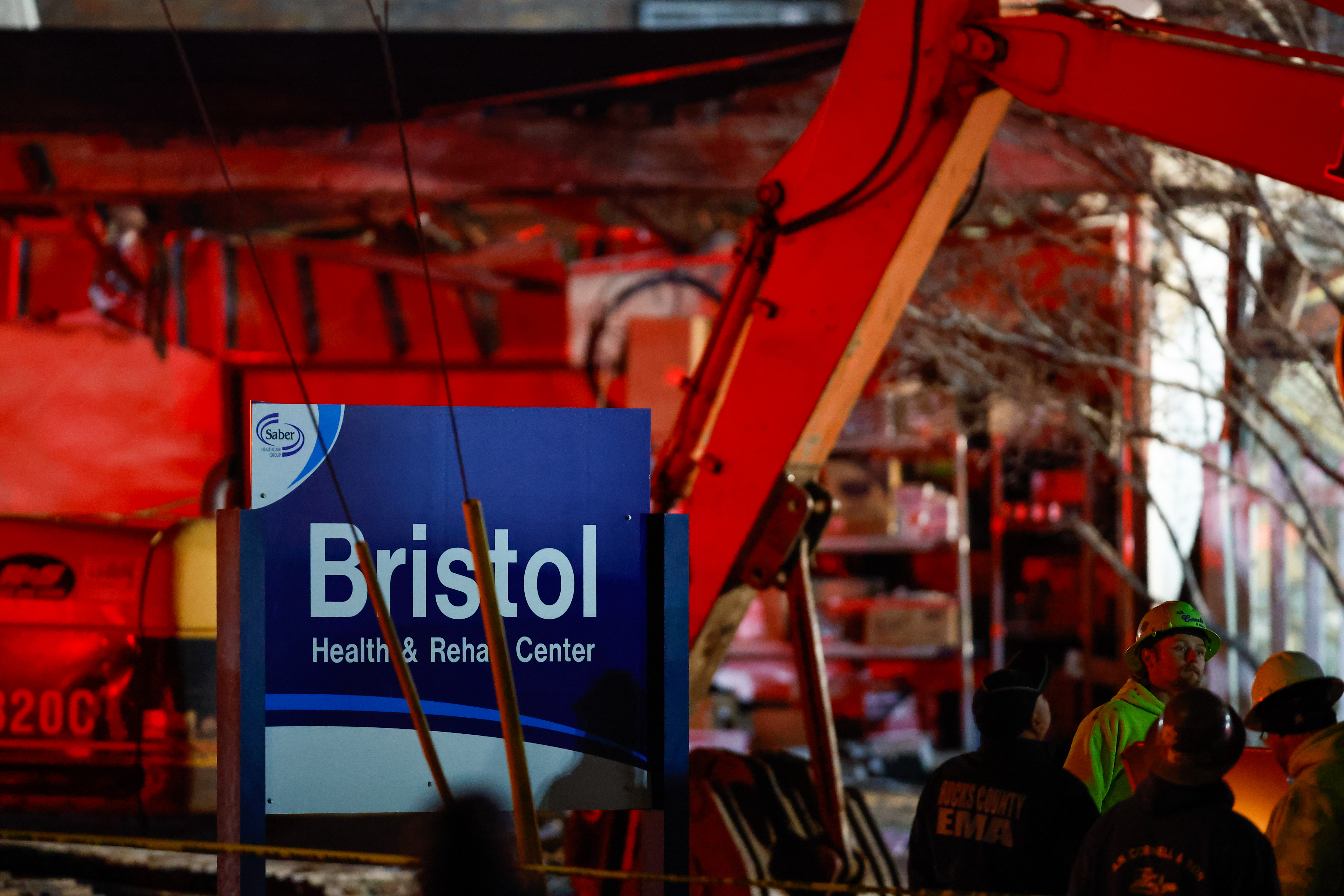
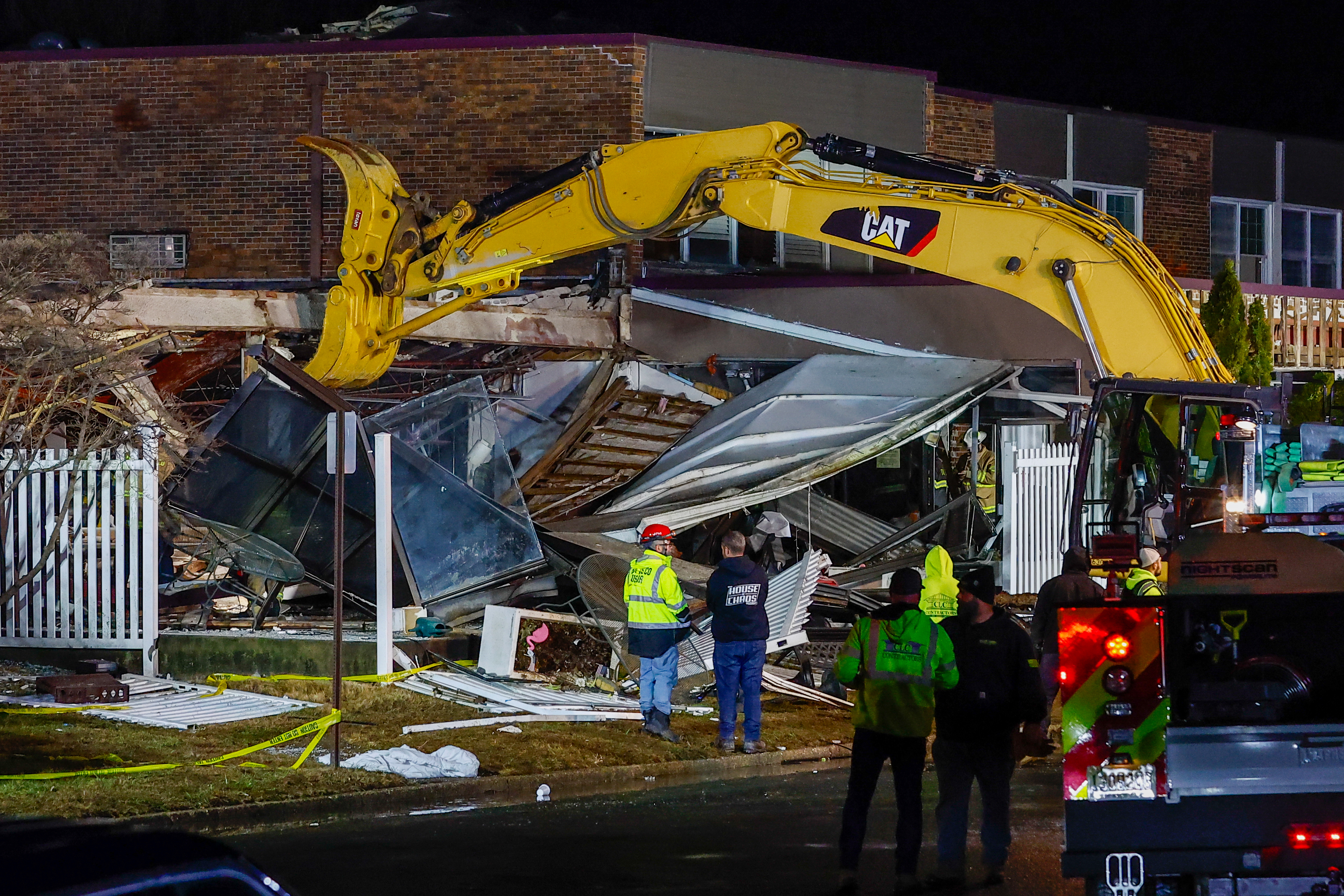
First responders work the scene of an explosion and fire on Dec. 23, 2025, at Bristol Health & Rehab Center.
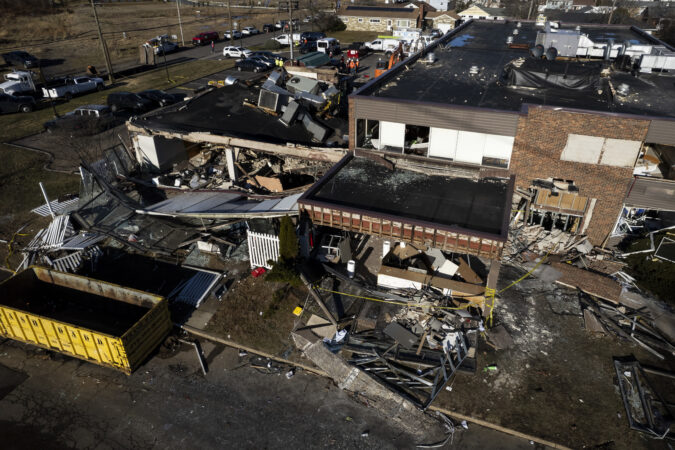
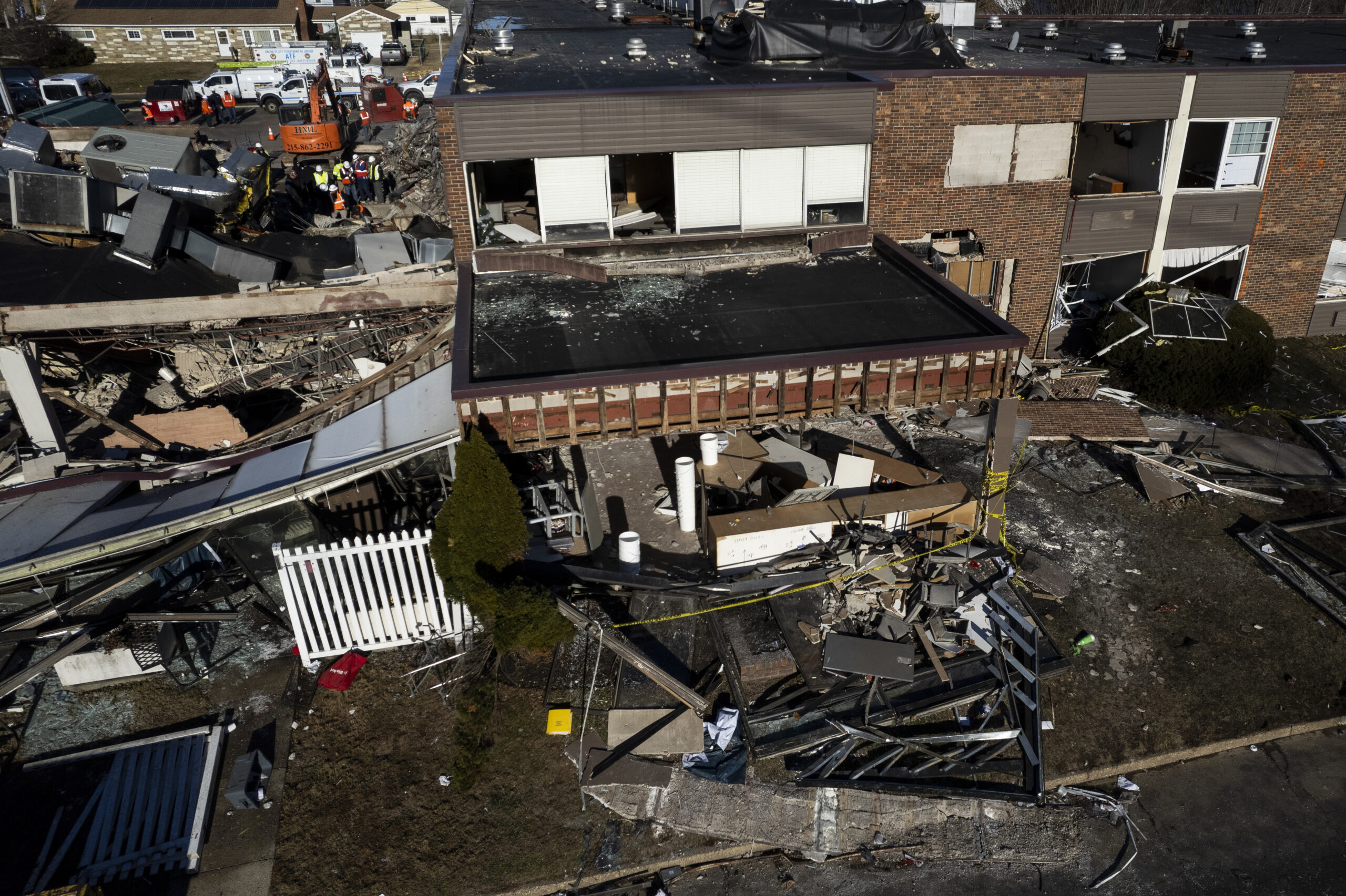
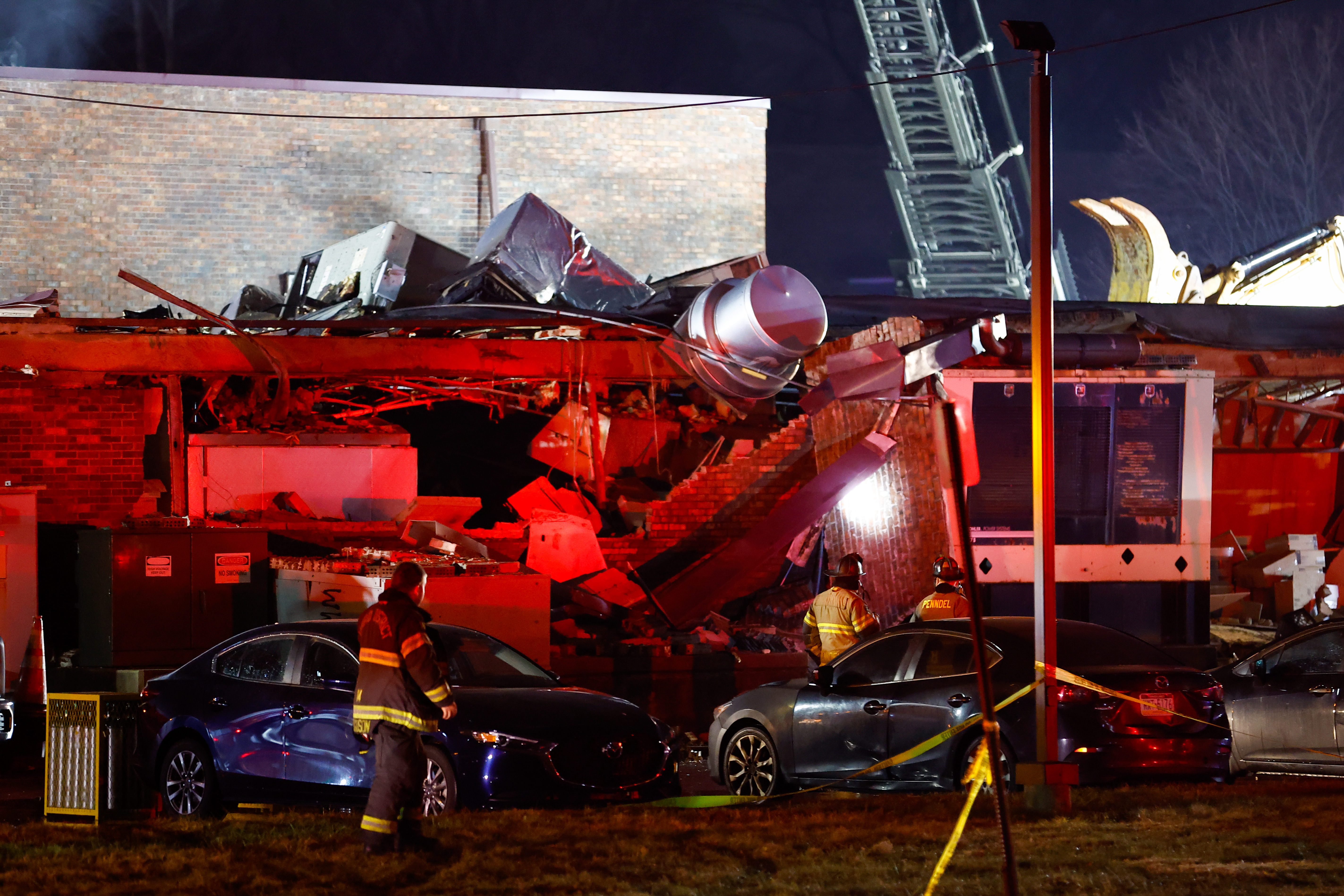
An explosion occurred at the nursing home in the early afternoon on Dec. 23, flattening a section of the building that collapsed the first floor and sent people and debris tumbling into the basement. Bristol Fire Chief Kevin Dippolito said that at one point, a heavy odor of gas forced firefighters out of the building, only for another explosion to go off 30 seconds later.
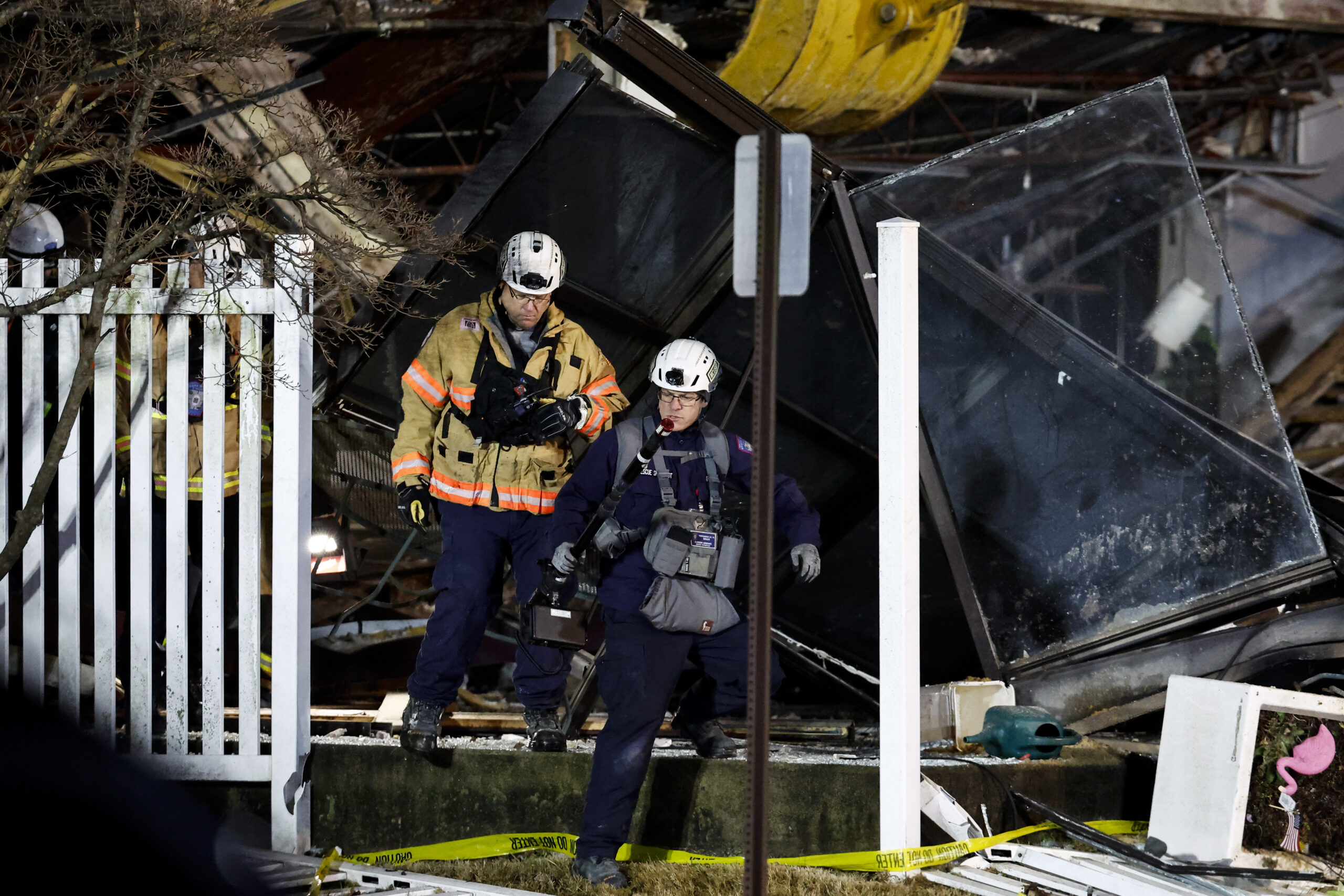
Investigators work the scene at Bristol Health & Rehab Center on Dec. 24, 2025 in Bristol Township.
The National Transportation Safety Board is leading an investigation into the cause of the fire, while the owners of the nursing home, Saber Healthcare Group, Peco, and others are being sued for their alleged negligence in the fiery explosion.
On Monday, the NTSB said it had completed on-scene work in Bristol and would release a preliminary report on its findings by early February.
The investigation into the fire will likely take months, with experts telling The Inquirer that federal investigators would focus on Peco and the nursing home operator’s actions leading up to the explosion.
One Trump supporter’s journey from a mall kiosk to a Bucks County strip mall is coming to an end this month.
The “Trump Store,” a Bensalem spot for merchandise and knickknacks celebrating President Donald Trump, is closing its doors after six years in business. The store’s final day is Jan. 31.
Mike Domanico, who co-owns the store with his wife, Monica, remains an ardent supporter of the president. But business is business, and Domanico said sales have declined since Trump returned to the White House, forcing the “tough decision” to shut down.
“Business has slowed down some because there’s not really much action going on with Trump,” Domanico said. “It’s time.”
There were other factors. The store’s lease is up in February, and Domanico wants to devote more of his time to a booming side business selling gun show merchandise.
Domanico said Trump’s tariffs on imported goods haven’t impacted his business at all.
“Any of the stuff I buy is priced the same as it was before all the tariffs took effect,” Domanico said.
Michael Domanico and his wife, Monica, seen here in 2020 during the grand opening of their Trump Store in Benaslem.
The store began its closeout sale on Tuesday, Jan. 6, exactly five years to the day when Trump supporters stormed the U.S. Capitol in an unsuccessful attempt to overturn the 2020 election results. Everything’s on sale, from shirts featuring the president as an Eagles player to hats promoting a fictitious 2028 reelection campaign barred by the U.S. Constitution.
Domanico opened a sister Trump Store in Chalfont in July 2022, but closed it last year due to issues with the landlord and some vandalism. He has two full-time employees helping him run the store.
In his six years selling Trump merchandise, Domanico said the only tough year was after the 2020 election. Following his second impeachment, Trump appeared to lose support from most Republicans, and sales at the store slowed.
“I stuck with it because I knew he was going to run again, and it worked out very well,” Domanico said.
Trump Store manager Lisa von Deylen, seen here replenishing the store’s inventory in May 2024.
Sales grew during the final years of Joe Biden’s tenure, fueled by Trump becoming the first former president indicted for a crime. “Free Trump” shirts became a particularly hot seller, and the store saw a spike in sales when the president’s Mar-a-Lago estate in Palm Beach, Fla., was raided by FBI agents.
While many Bucks County residents appear to have soured on the president and his policies, Domanico isn’t among them.
“I think his second term has been great,” Domanico said. “I know the liberal media turns everything around, making it look bad, but he’s doing some great stuff. I love it.”
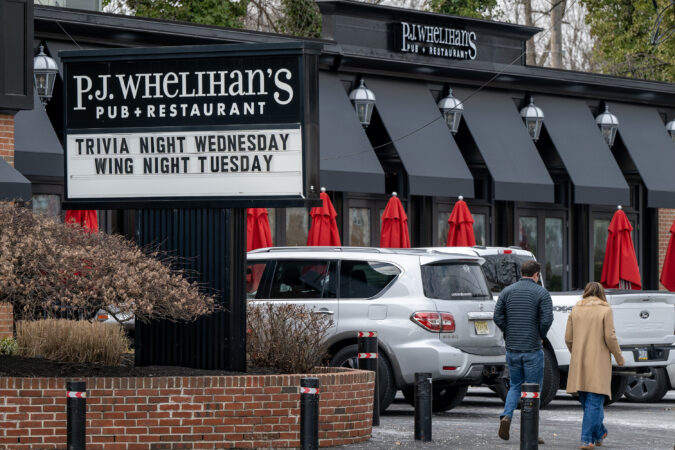
The company that owns P.J. Whelihan’s may be moving into a former Iron Hill Brewery in Bucks County.
PJW Opco LLC, which is registered at the headquarters of PJW Restaurant Group, was approved to take over a lease for the shuttered Iron Hill in Newtown, effective Dec. 31, according to documents filed in U.S. Bankruptcy Court in New Jersey.
PJW marketing director Kristen Foord declined to comment.
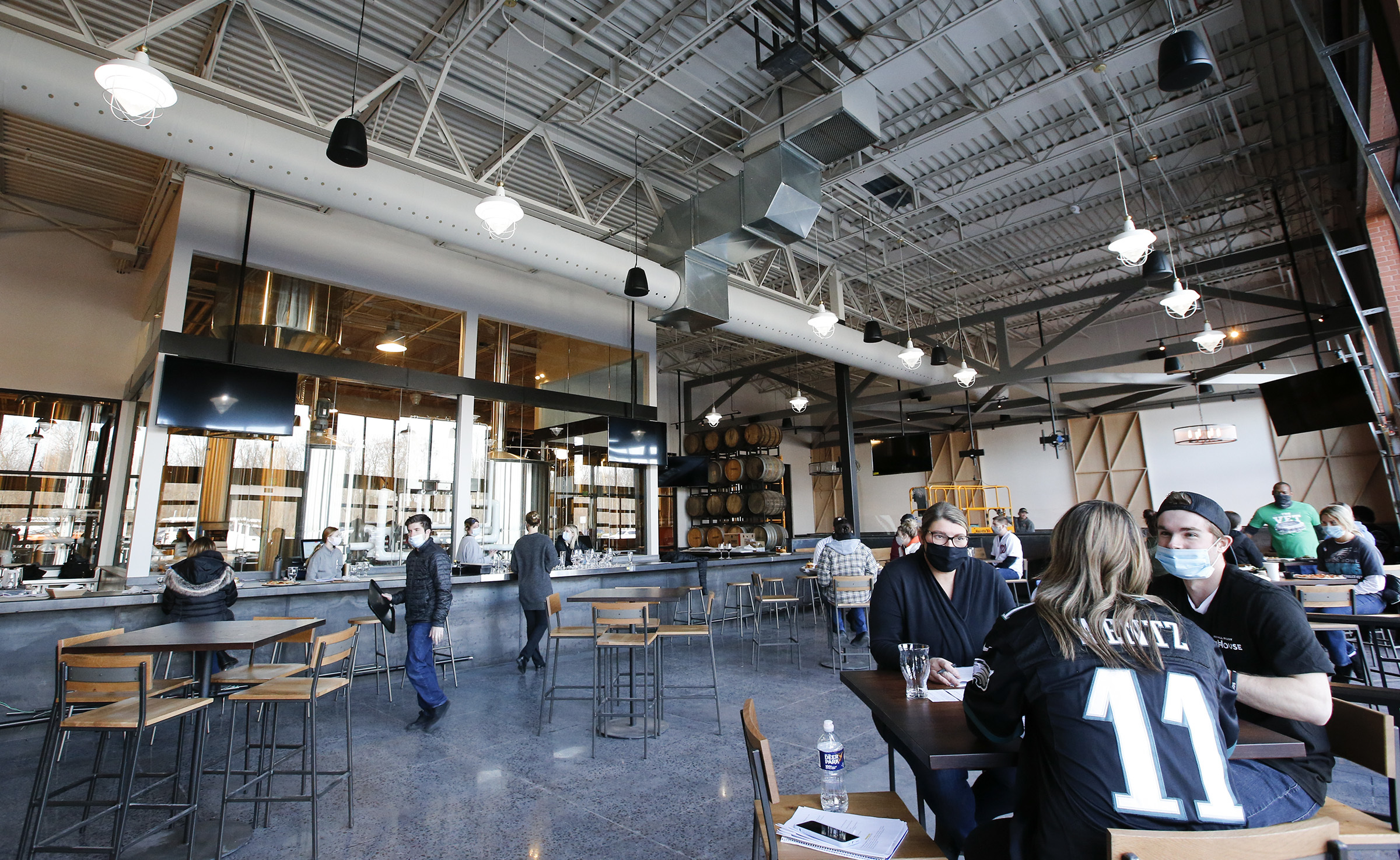
The nearly 8,000-square-foot brewpub in the Village at Newtown shopping center has sat empty since September, when Iron Hill abruptly closed all its locations and filed for liquidation bankruptcy. The Newtown Iron Hill had been among the chain’s newest locations, having opened in 2020.
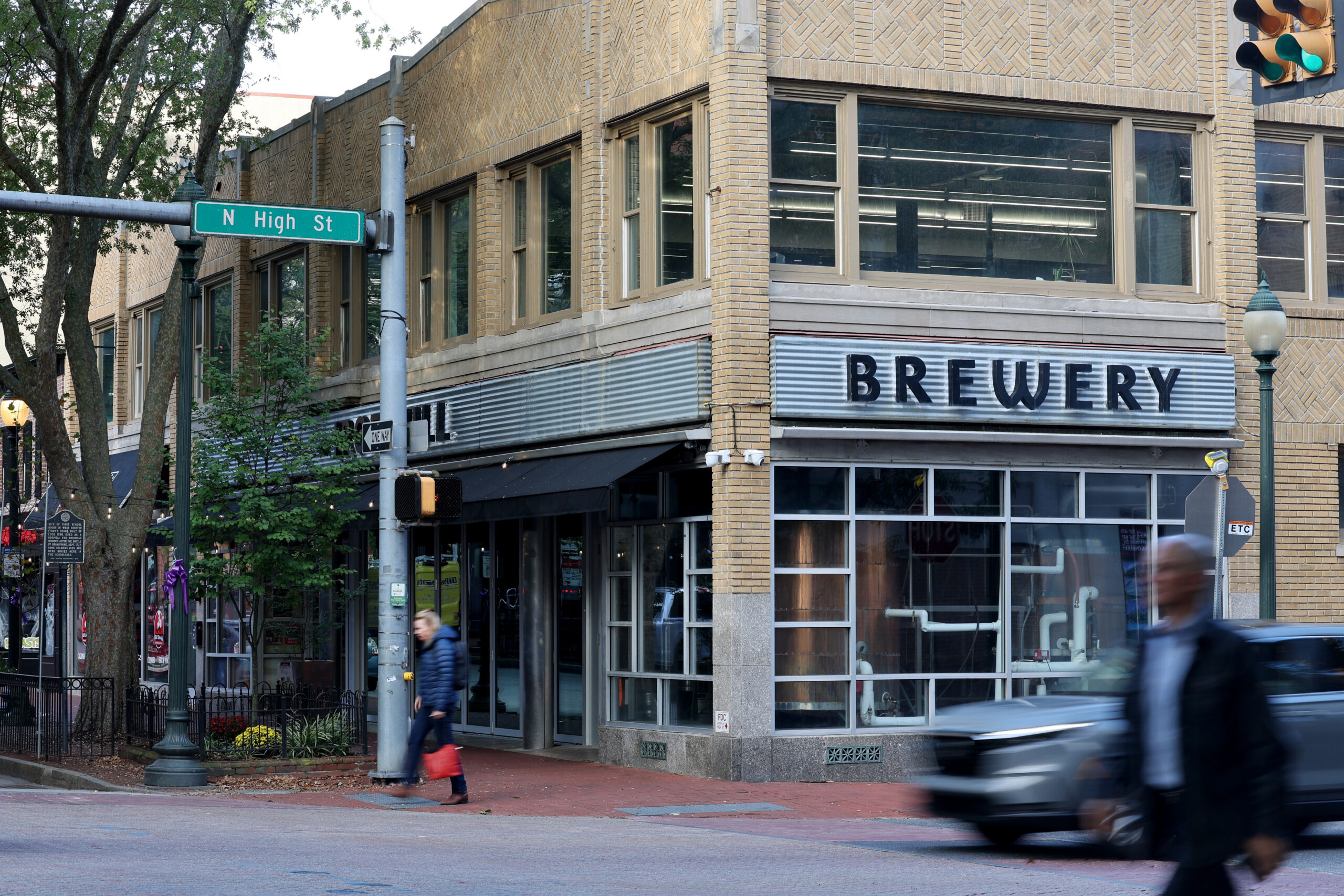
A view from the outside looking in on the closed Iron Hill Brewery in West Chester in October.
Brixmor Property Group, which owns the Village at Newtown, is “excited about what’s in the works” for the former Iron Hill space, spokesperson Maria Pace said in a statement, but she declined to share details.
The court documents did not indicate PJW’s plans for the Newtown site.
PJW’s most well-known franchise is P.J. Whelihan’s, the regional bar-restaurant chain that started in the Poconos in 1983. There are now 25 P.J. Whelihan’s locations from Harrisburg to Washington Township, with the vast majority in the Philadelphia area.
Haddon Township-based PJW also owns the Pour House, which has locations in Exton, North Wales, and Westmont, Haddon Township; the ChopHouse in Gibbsboro; the ChopHouse Grille in Exton; Central Taco & Tequila in Westmont; and Treno, also in Westmont.
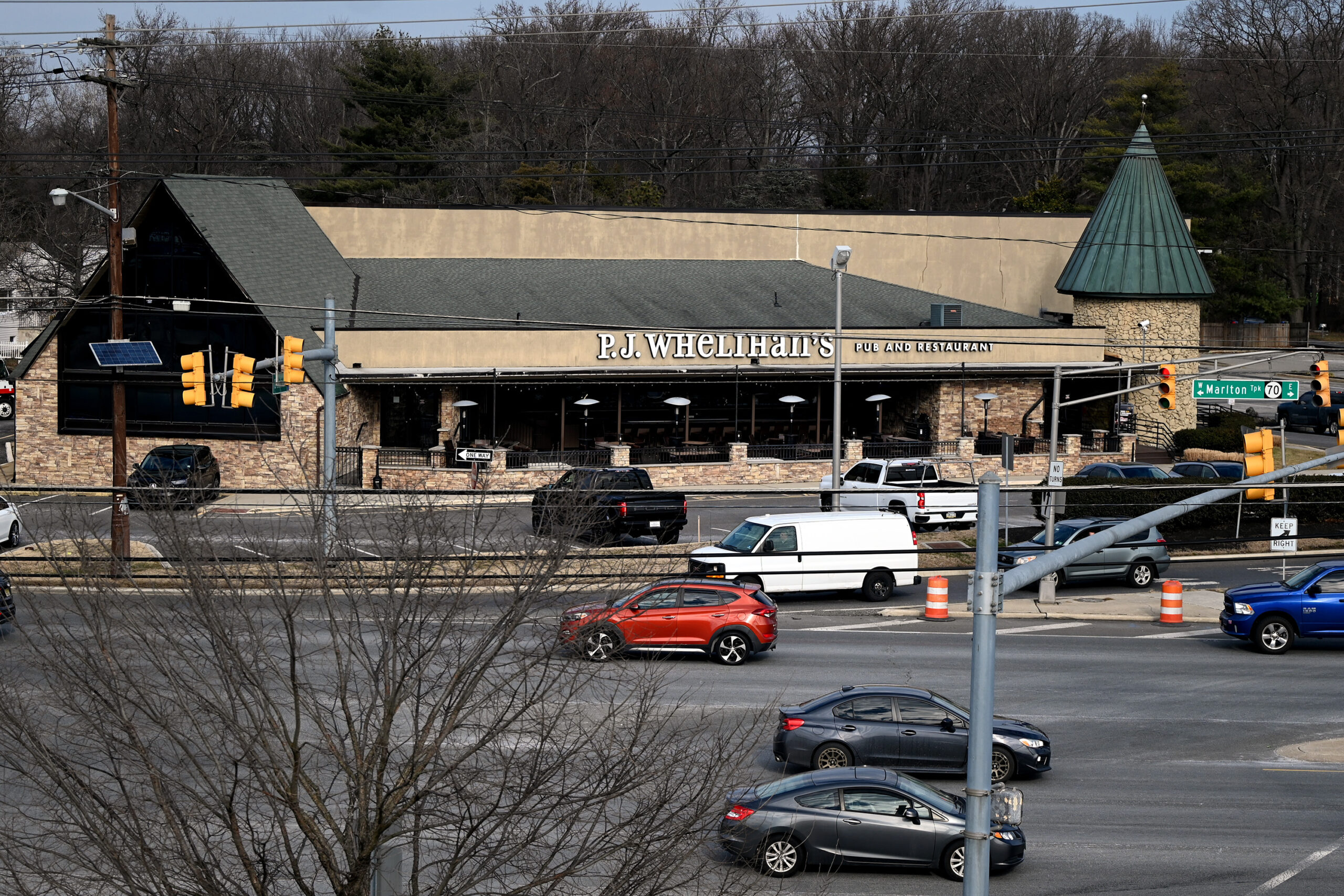
The P.J. Whelihan’s on Route 70 in Cherry Hill.
As 2026 gets underway, Iron Hill’s bankruptcy case continues to make its way through the courts. In recent weeks, Iron Hill’s leases in Exton, Maple Shade, and North Wales were formally rejected, according to court documents. That means these empty breweries are getting closer to finding new tenants.
“Any out-of-town brewery with plans to leverage existing brewery infrastructure and scale its operations in the region would be a good fit, as it would save significant tenant improvement costs,” Kagithapu said in a statement. “I also believe a grocery store would serve the community very well.”
The Iron Hill Brewery TapHouse in Exton is pictured in 2020. After Iron Hill’s bankruptcy, the Exton landlord is seeking a new tenant for the massive space.
On Christmas Eve, Barry, a Massachusetts-based real estate investor, inked a deal to buy the liquor license and all interior assets of the location at the borough’s central corner of High and Gay Streets.
“It will not be reopening as Iron Hill Brewery,” Barry said in a recent interview. “My goal would be to find something similar,” though not necessarily a brewery.
Barry purchased the assets from Jeff Crivello, the former CEO of Famous Dave’s BBQ, who in November was approved by a bankruptcy judge to revive 10 Iron Hills under the same name or as a new concept. Barry and Crivello declined to disclose the financial details of the West Chester deal.
Pedestrians walk by the closed Iron Hill Brewery in West Chester in October.
The Newtown location was originally among the locations of which Crivello was approved to buy the assets, pending negotiations with landlords. Court documents indicate the asset sale was put on hold amid a landlord objection.
Founded in Newark, Del., Iron Hill Brewery operated for nearly 30 years, earning a reputation as a local craft-brewing pioneer and a family-friendly mainstay in the Philadelphia suburbs. In recent years, the chain had expanded into South Carolina and Georgia and had announced plans to open a Temple University location that never materialized.
When brewery executives filed for bankruptcy, they reported that they owed $20 million to creditors and had about $125,000 in the bank.
In 2025, Philadelphians said goodbye to a beloved group of broadcasters, radio personalities, sports heroes, and public servants who left their mark on a city they all loved.
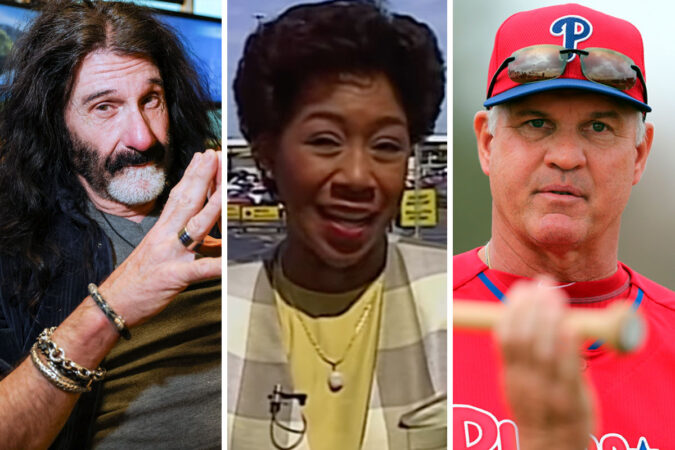
Some were Philly natives, including former Eagles general manager Jim Murray. Others, including beloved WMMR host Pierre Robert, were transplants who made Philly their adopted home. But all left their mark on the city and across the region.
Pierre Robert
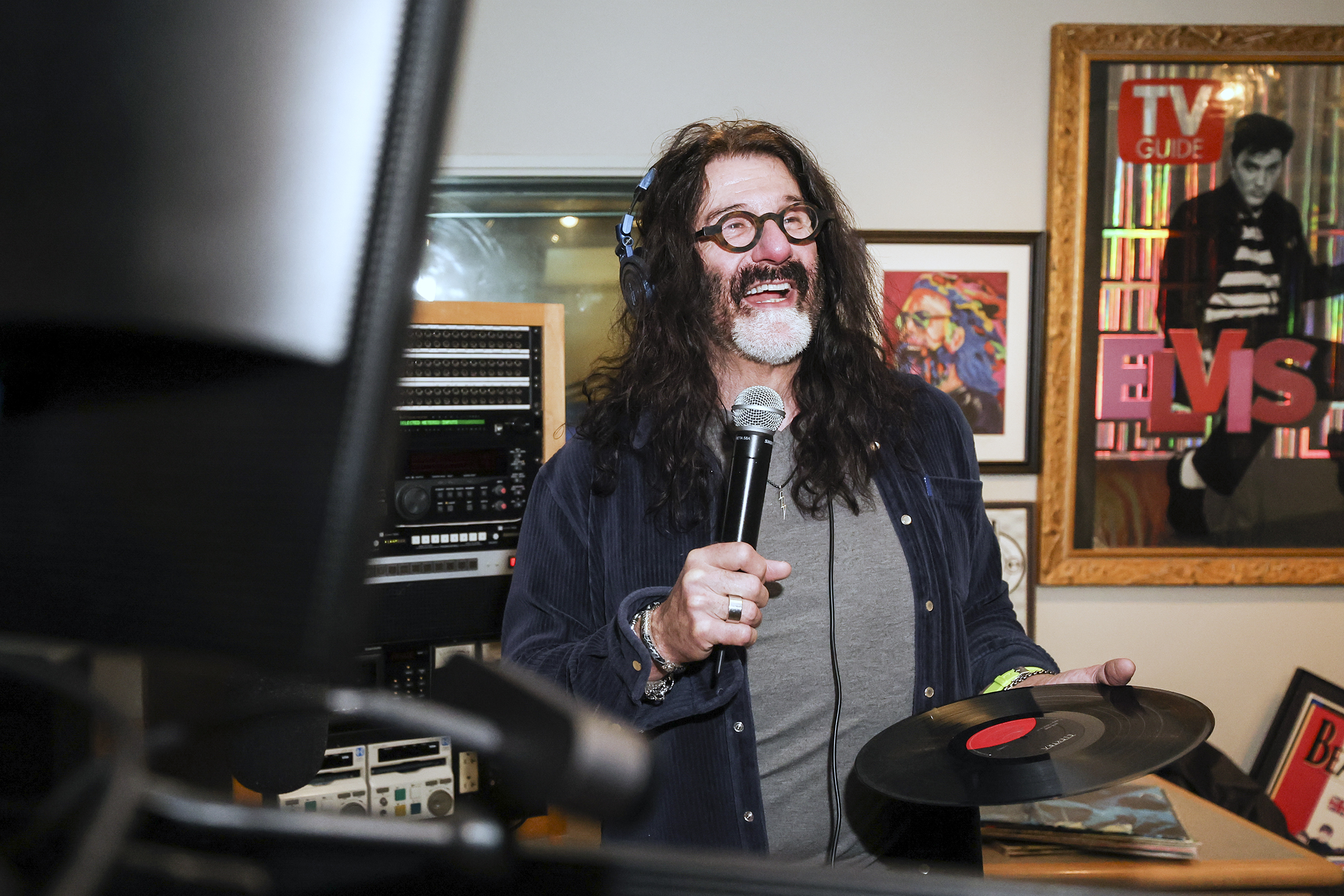
Former WMMR host Pierre Robert, seen in his studio in 2024.
A native of Northern California, Mr. Robert joined WMMR as an on-air host in 1981. He arrived in the city after his previous station, San Francisco’s KSAN, switched to an “urban cowboy” format, prompting him to make the cross-country drive to Philadelphia in a Volkswagen van.
At WMMR, Mr. Robert initially hosted on the weekends, but quickly moved to the midday slot — a position he held for more than four decades up until his death.
— Nick Vadala, Dan DeLuca
Bernie Parent
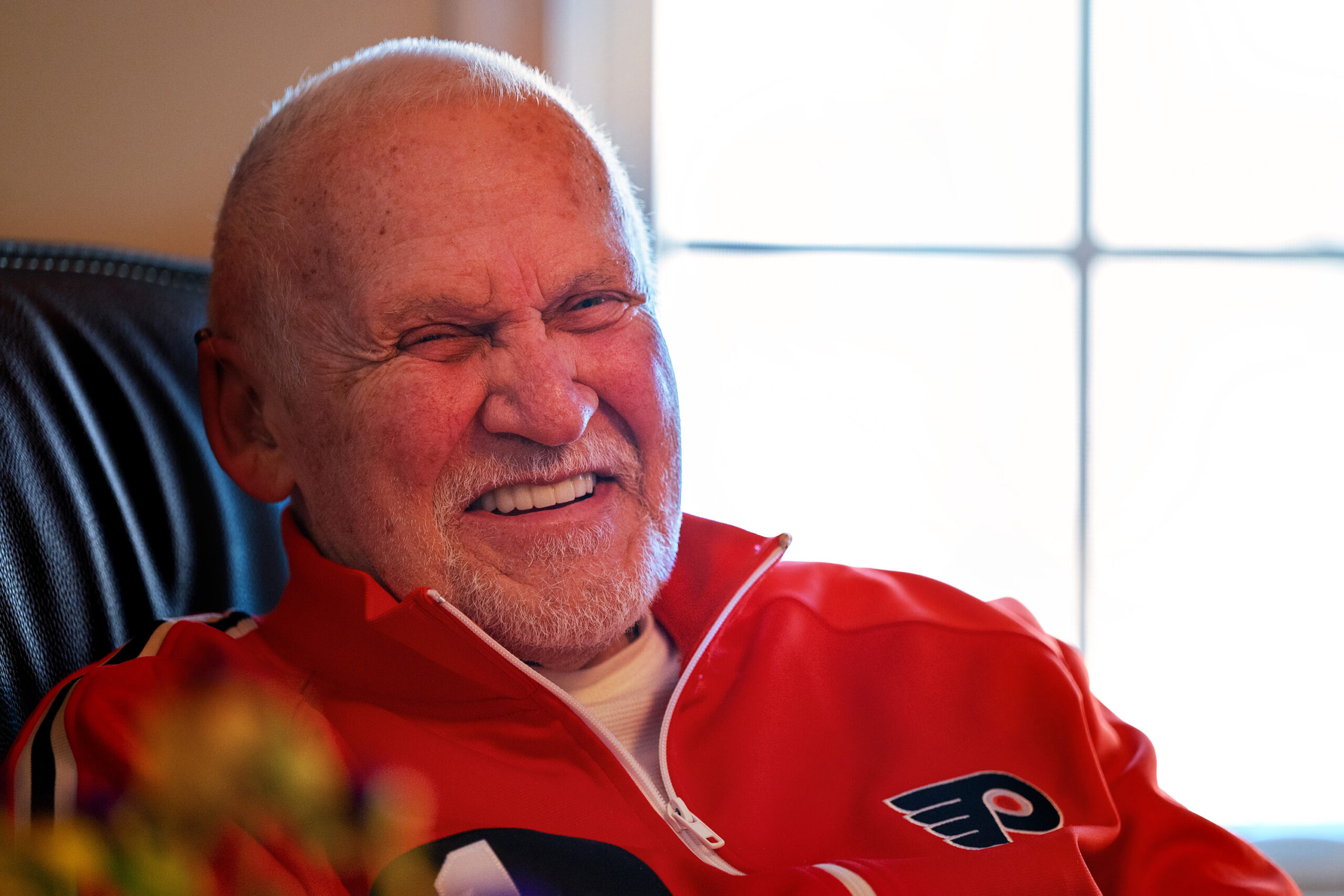
Former Flyers goaltender Bernie Parent, seen at his home in 2024.
Bernie Parent, the stone-wall Flyers goalie for the consecutive Stanley Cup championship teams for the Broad Street Bullies in the 1970s, died in September. He was 80.
A Hall of Famer, Mr. Parent clinched both championships with shutouts in the final game as he blanked the Boston Bruins, 1-0, in 1974 and the Buffalo Sabres, 2-0, in 1975. Mr. Parent played 10 of his 13 NHL seasons with the Flyers and also spent a season in the World Hockey League with the Philadelphia Blazers. He retired in 1979 at 34 years old after suffering an eye injury during a game against the New York Rangers.
He grew up in Montreal and spoke French as his first language before becoming a cultlike figure at the Spectrum as cars throughout the region had “Only the Lord Saves More Than Bernie Parent” bumper stickers.
— Matt Breen
David Lynch
David Lynch, seen here at the Governors Awards in Los Angeles in 2019.
David Lynch, the visionary director behind such movies as Blue Velvet and The Elephant Man and the twisted TV show Twin Peaks, died in January of complications from emphysema. He was 78.
Mr. Lynch was born in Missoula, Mont., but ended up in Philadelphia to enroll at the Pennsylvania Academy of the Fine Arts in 1965 at age 19. It was here he developed an interest in filmmaking as a way to see his paintings move.
He created his first short films in Philadelphia, which he described both as “a filthy city” and “his greatest influence” as an artist. Ultimately, he moved to Los Angeles to make his first feature film, Eraserhead, though he called the film “my Philadelphia Story.”
— Rob Tornoe
Ryne Sandberg
Former Phillies manager Ryne Sandberg, seen here at spring training in 2018.
Ryne Sandberg, the Hall of Fame second baseman who started his career with the Phillies but was traded shortly after to the Chicago Cubs in one of the city’s most regrettable trades, died in July of complications from cancer. He was 65.
Mr. Sandberg played 15 seasons in Chicago and became an icon for the Cubs, simply known as “Ryno,” after being traded there in January 1982.
He was a 10-time All-Star, won nine Gold Glove awards, and was the National League’s MVP in 1984. Mr. Sandberg was inducted into the Baseball Hall of Fame in 2005 and returned to the Phillies in 2011 as a minor-league manager and, later, the big-league manager.
— Matt Breen
Bob Uecker
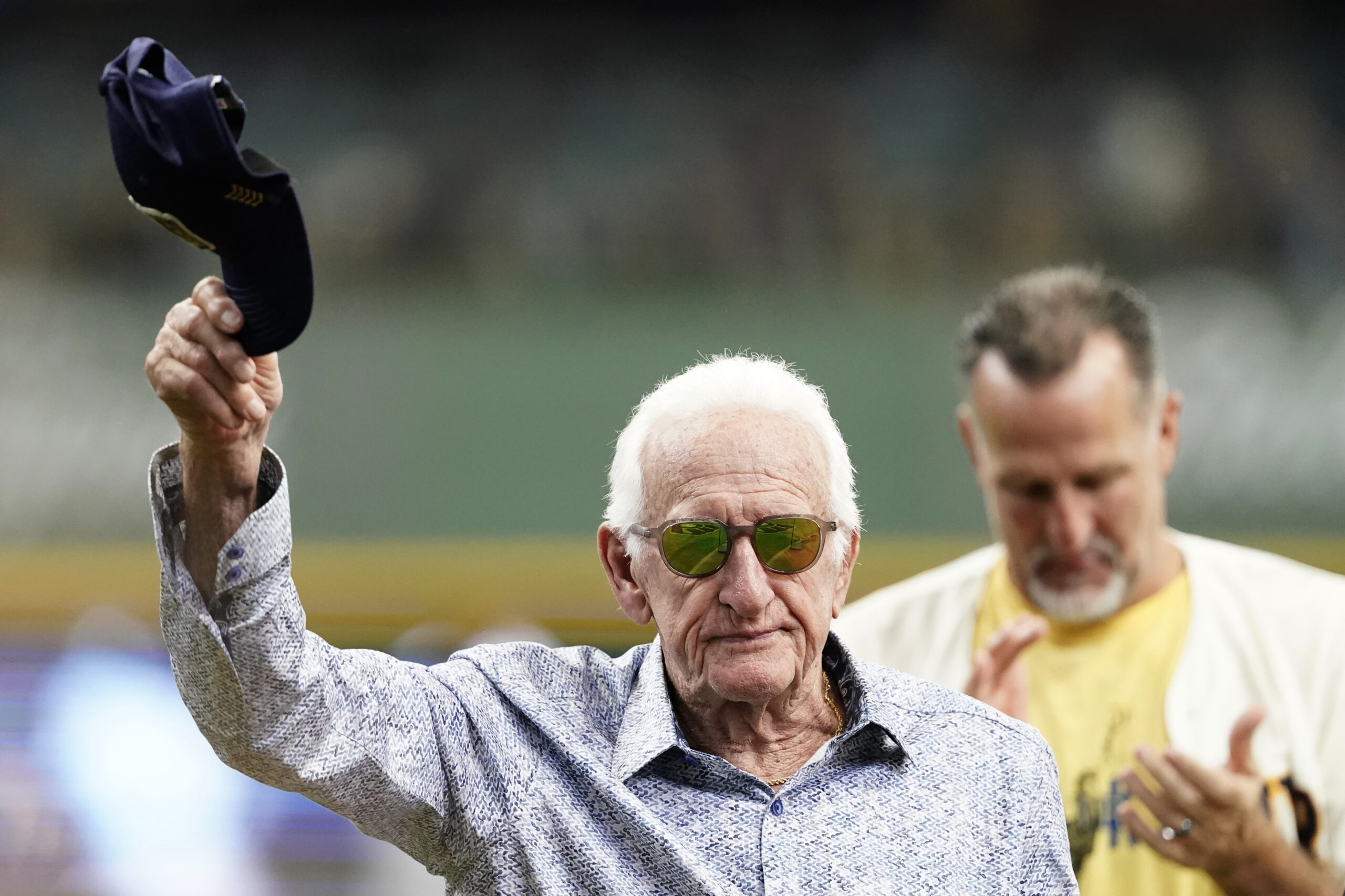
Bob Uecker, seen here before a Brewers game in 2024.
Bob Uecker, a former Phillies catcher who later became a Hall of Fame broadcaster for the Milwaukee Brewers and was dubbed “Mr. Baseball” by Johnny Carson for his acting roles in several movies and TV shows, died in January. He was 90.
Mr. Uecker spent just six seasons in the major league, two with the Phillies, but the talent that would make him a Hall of Fame broadcaster — wit, self-deprecation, and the timing of a stand-up comic — were evident.
His first broadcasting gig was in Atlanta, and he started calling Milwaukee Brewers games in 1971. Before that, he called Phillies games: Mr. Uecker used to sit in the bullpen at Connie Mack Stadium and deliver play-by-play commentary into a beer cup.
— Matt Breen and Rob Tornoe
Harry Donahue
Harry Donahue, seen here at Temple University in 2020.
Harry Donahue, 77, a longtime KYW Newsradio anchor and the play-by-play voice of Temple University men’s basketball and football for decades, died in October after a fight with cancer.
His was a voice that generations of people in Philadelphia and beyond grew up with in the mornings as they listened for announcements about snow days and, later, for a wide array of sports.
— Robert Moran
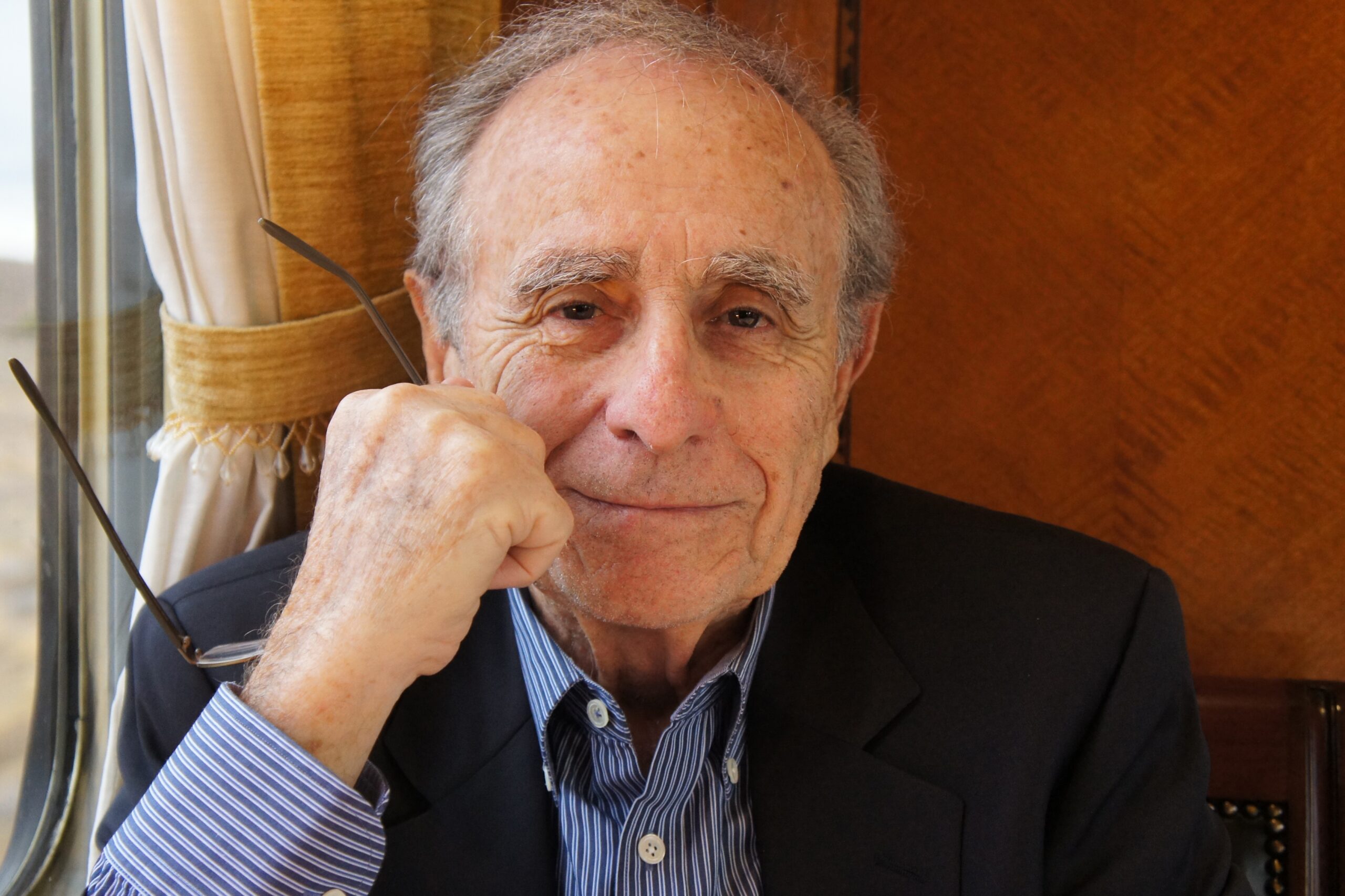
Alan Rubenstein
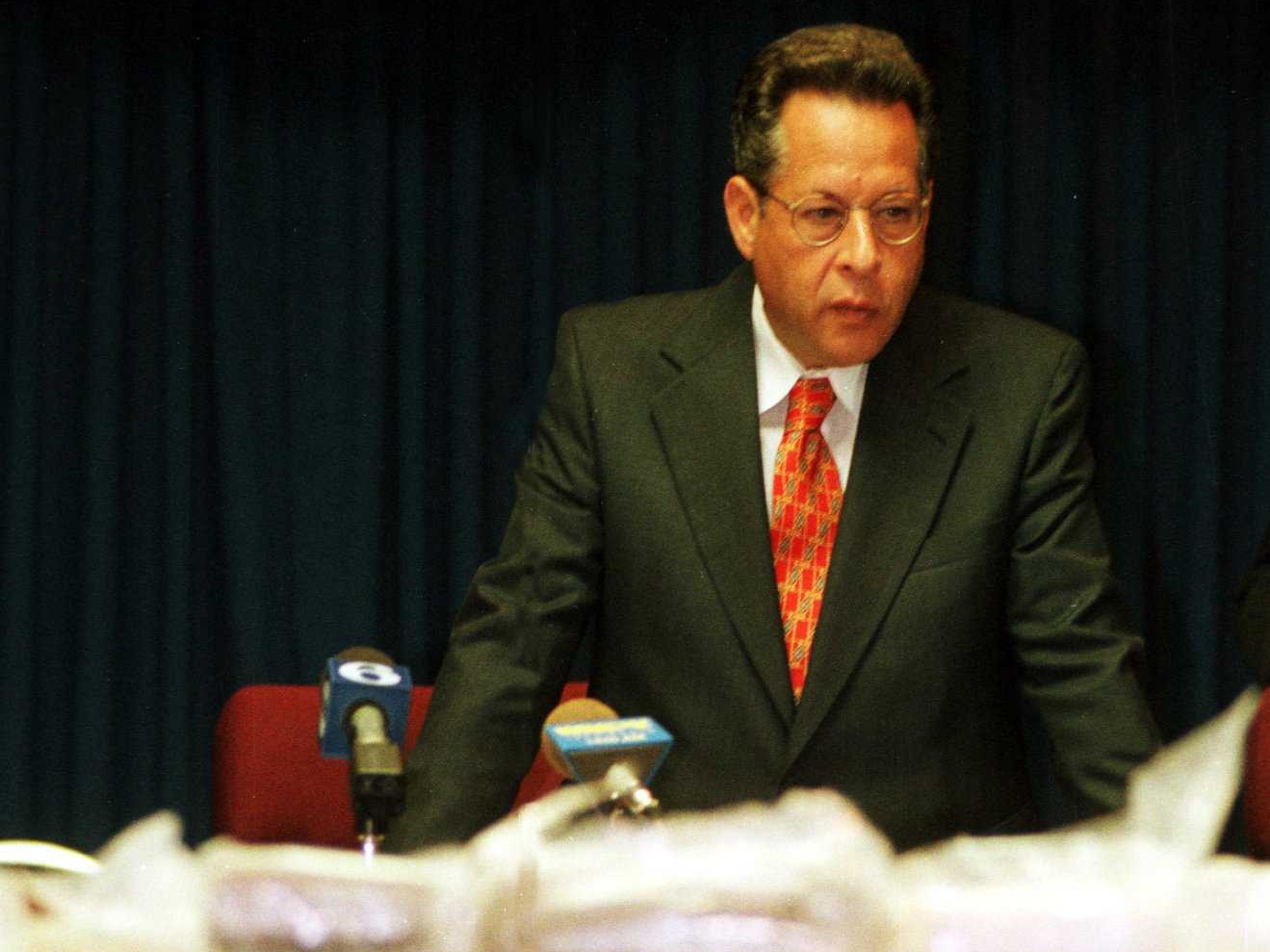
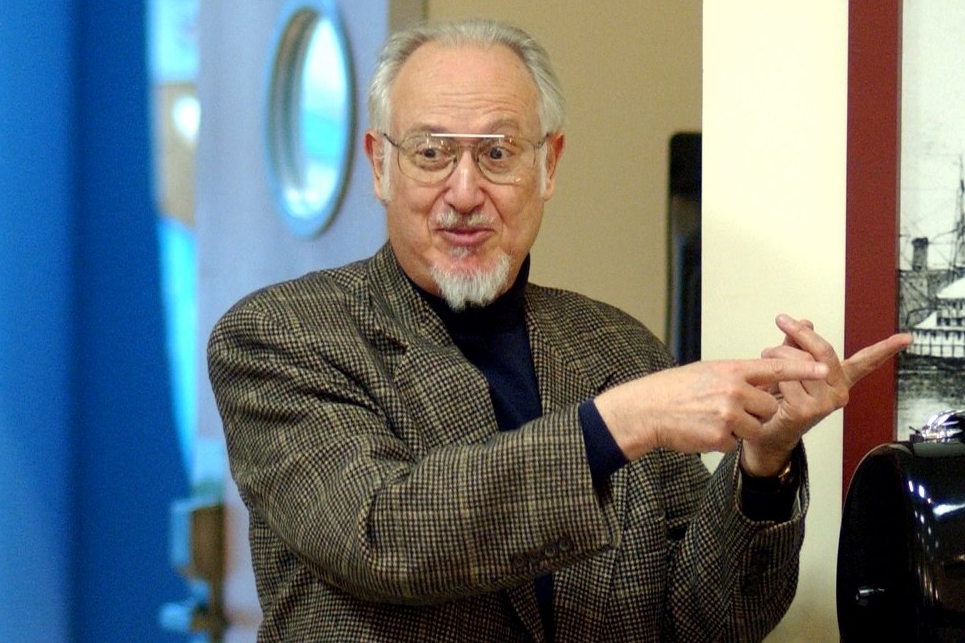
Judge Rubenstein, then Bucks County district attorney, talks to the media about a drug case in 1998.
Alan M. Rubenstein, a retired senior judge on Bucks County Common Pleas Court and the longest-serving district attorney in Bucks County history, died in August of complications from several ailments at his home in Holland, Bucks County. He was 79.
For 50 years, from his hiring as an assistant district attorney in 1972 to his retirement as senior judge a few years ago, Judge Rubenstein represented Bucks County residents at countless crime scenes and news conferences, in courtrooms, and on committees. He served 14 years, from 1986 to 1999, as district attorney in Bucks County, longer than any DA before him, and then 23 years as a judge and senior judge on Bucks County Court.
“His impact on Bucks County will be felt for generations,” outgoing Bucks County District Attorney Jennifer Schorn said in a tribute. U.S. Rep. Brian Fitzpatrick (R., Pa.) said on Facebook: “Alan Rubenstein has never been just a name. It has stood as a symbol of justice, strength, and integrity.”
— Gary Miles
Orien Reid Nix
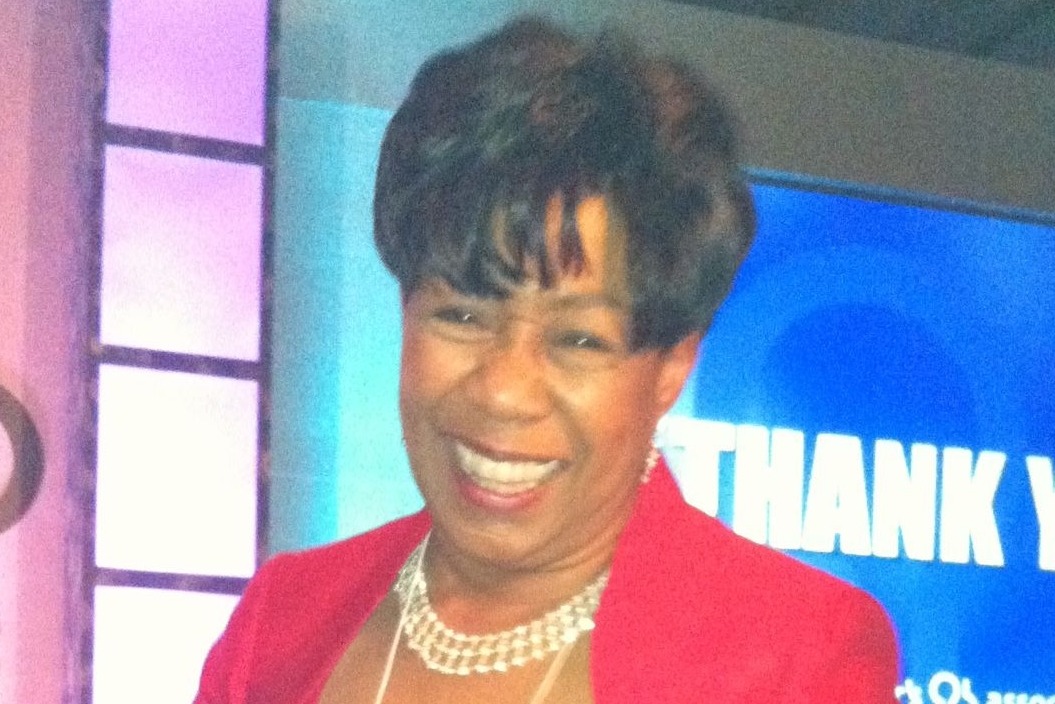
Orien Reid Nix, seen here being inducted into the Broadcast Pioneers of Philadelphia Hall of Fame in 2018
Orien Reid Nix, 79, of King of Prussia, retired Hall of Fame reporter for KYW-TV and WCAU-TV in Philadelphia, owner of Consumer Connection media consulting company, the first Black and female chair of the international board of the Alzheimer’s Association, former social worker, mentor, and volunteer, died in June of complications from Alzheimer’s disease.
Charismatic, telegenic, empathetic, and driven by a lifelong desire to serve, Mrs. Reid Nix worked as a consumer service and investigative TV reporter for Channels 3 and 10 in Philadelphia for 26 years, from 1973 to her retirement in 1998. She anchored consumer service segments, including the popular Market Basket Report, that affected viewers’ lives and aired investigations on healthcare issues, price gouging, fraud, and food safety concerns.
— Gary Miles
Dave Frankel
Dave Frankel in an undated publicity photo.
Dave Frankel, 67, a popular TV weatherman on WPVI (now 6abc) who later became a lawyer, died in February after a long battle with a neurodegenerative disease.
Mr. Frankel grew up in Monmouth County, N.J., graduated in 1979 from Dartmouth College, and was planning to attend Dickinson School of Law to become a lawyer like his father. But an internship at a local TV station in Vermont turned into a news anchor job and a broadcast career that lasted until the early 2000s.
— Robert Moran
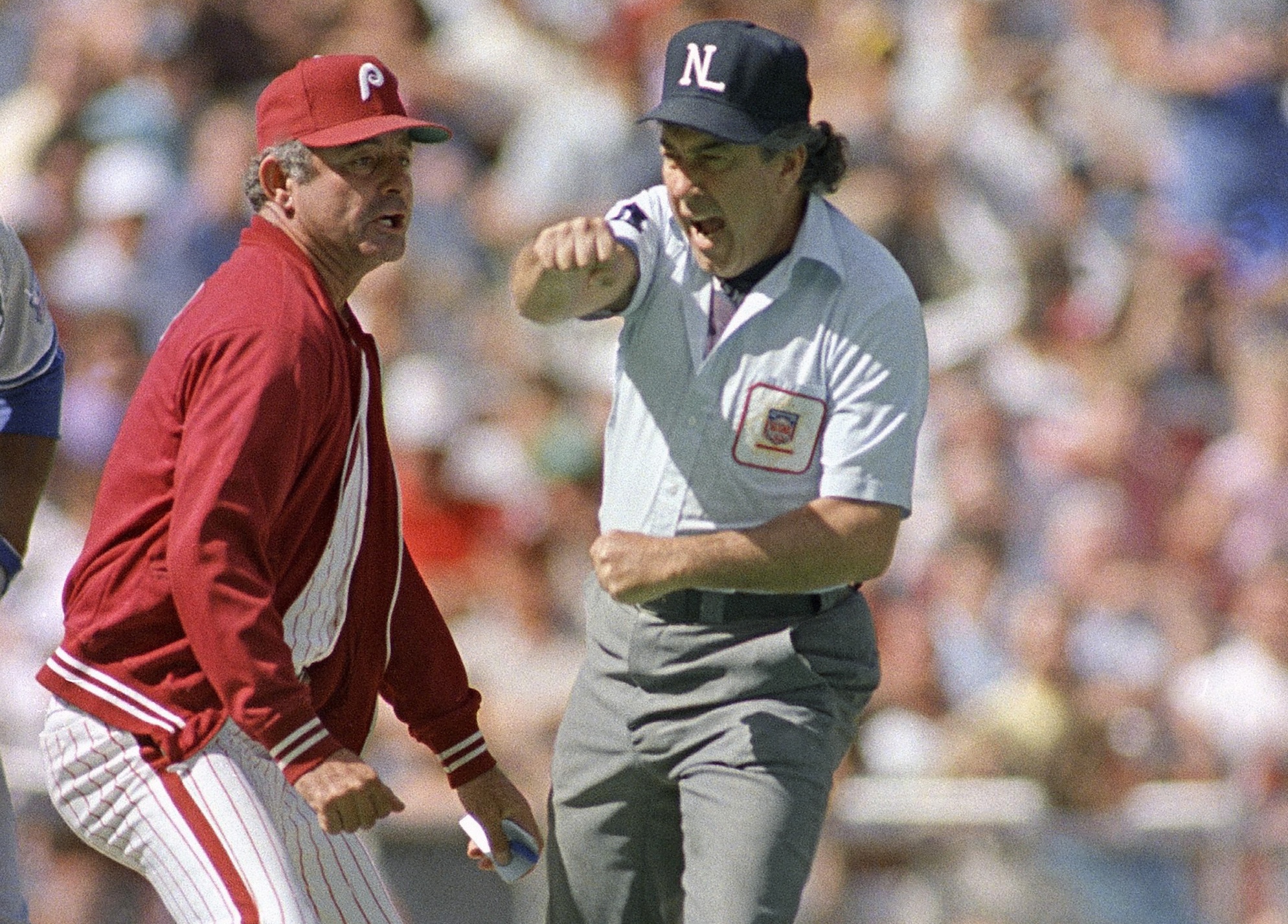
Lee Elia
Former Phillies manager Lee Elia, seen here being ejected from a game in 1987.
Lee Elia, the Philadelphia native who managed the Phillies after coaching third base for the 1980 World Series champions and once famously ranted against the fans who sat in the bleachers of Wrigley Field, died in July. He was 87.
Mr. Elia’s baseball career spanned more than 50 seasons. He managed his hometown Phillies in 1987 and 1988 after managing the Chicago Cubs in 1982 and 1983.
After his playing career was cut shot by a knee injury, Mr. Elia joined Dallas Green’s Phillies staff before the 1980 season and was coaching third base when Manny Trillo delivered a crucial triple in the clinching game of the National League Championship Series. Mr. Elia was so excited that he bit Trillo’s arm after he slid.
— Matt Breen
Gary Graffman
Gary Graffman, seen here playing at the Curtis Institute of Music Orchestra Concert at Verizon Hall in 2006.
Gary Graffman, a celebrated concert pianist and the former president of the Curtis Institute of Music, died in December in New York. He was 97.
The New York City-born pianist arrived at Curtis at age 7. He graduated at age 17 and played roughly 100 concerts a year between the ages of 20 and 50 before retiring from touring due to a compromised right hand. Diagnosed with focal dystonia (a neurological disorder), he went on to premiere works for the left hand by Jennifer Higdon and William Bolcom.
Mr. Graffman returned to Curtis as a teacher in 1980, became director in 1986, and was named the president of the conservatory in 1995, with a teaching studio encompassing nearly 50 students, including Yuja Wang and Lang Lang among others. He performed on numerous occasions with the Philadelphia Orchestra from 1947 to 2003.
— David Patrick Stearns
Len Stevens
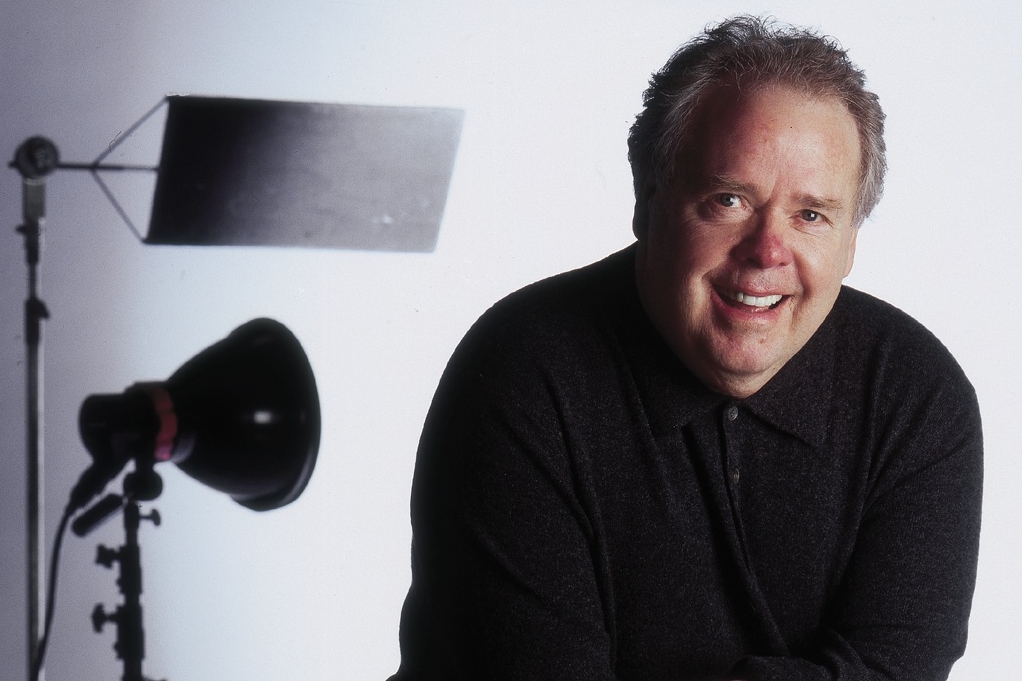
Len Stevens was the co-founder of WPHL-TV Channel 17.
Len Stevens, the cofounder of WPHL-TV (Channel 17) and a member of the Broadcast Pioneers of Philadelphia Hall of Fame, died in September of kidney failure. He was 94.
Born in Philadelphia, Mr. Stevens was a natural entrepreneur. He won an audition to be a TV announcer with Dick Clark on WFIL-TV in the 1950s, persuaded The Tonight Show and NBC to air Alpo dog food ads in the 1960s, co-owned and managed the popular Library singles club on City Avenue in the 1970s and ’80s, and later turned the nascent sale of “vertical real estate” on towers and rooftops into big business.
He and partner Aaron Katz established the Philadelphia Broadcasting Co. in 1964 and launched WPHL-TV on Sept. 17, 1965. At first, their ultrahigh frequency station, known now as PHL17, challenged the dominant very high frequency networks on a shoestring budget. But, thanks largely to Mr. Stevens’ advertising contacts and programming ideas, Channel 17 went on to air Phillies, 76ers, and Big Five college basketball games, the popular Wee Willie Webber Colorful Cartoon Club, Ultraman, and other memorable shows in the late 1960s and early ’70s.
— Gary Miles
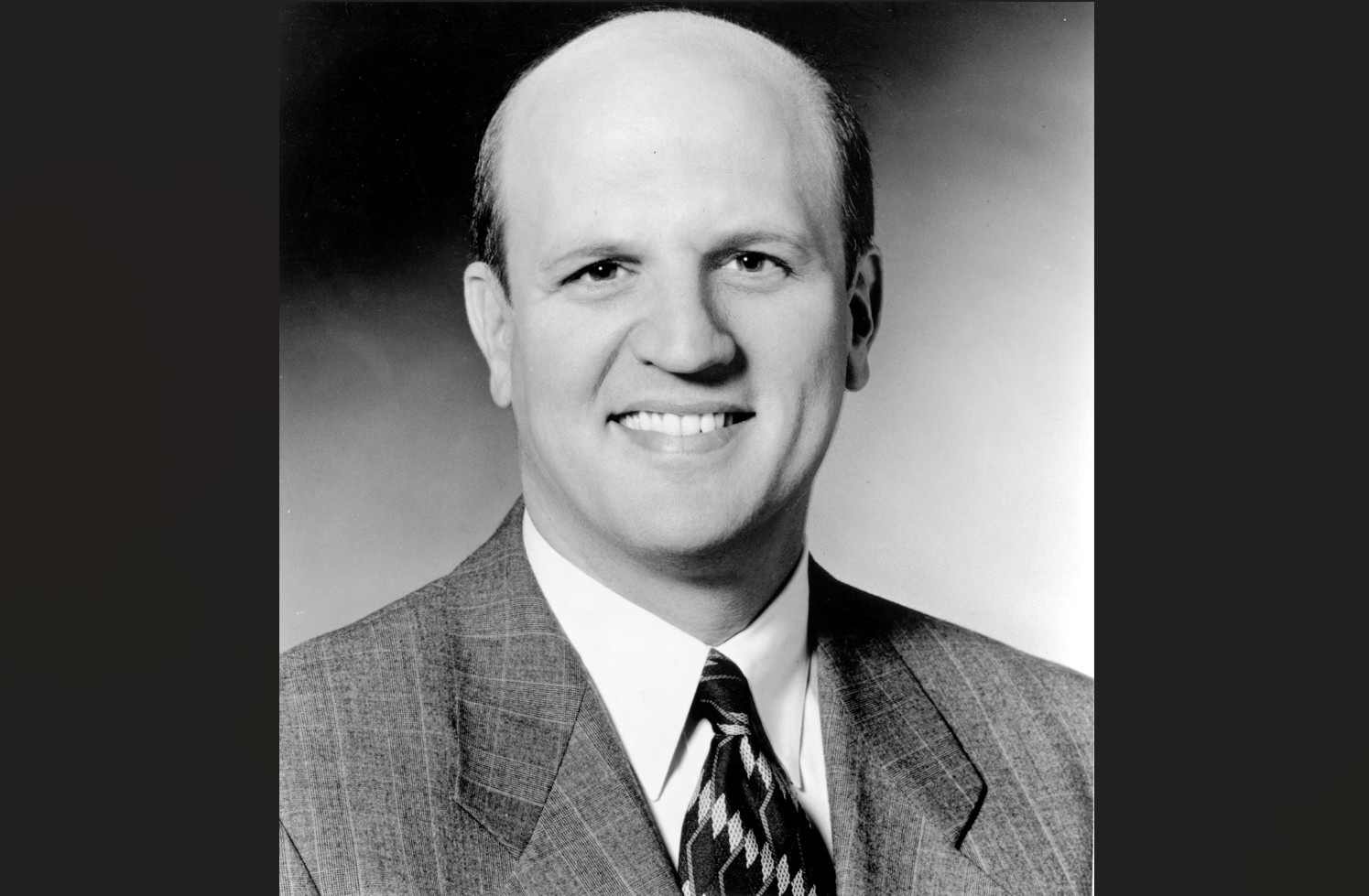
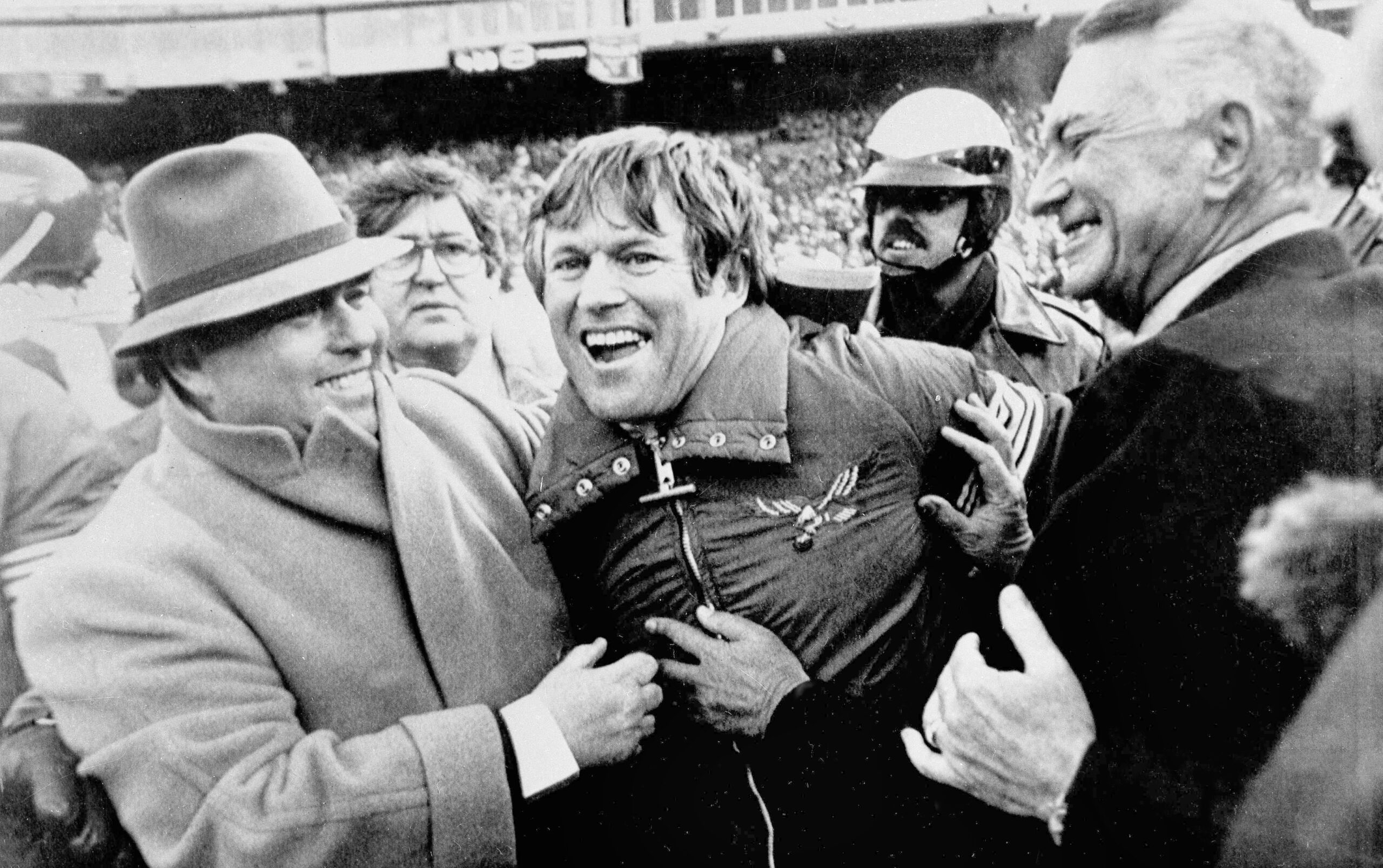
Jim Murray
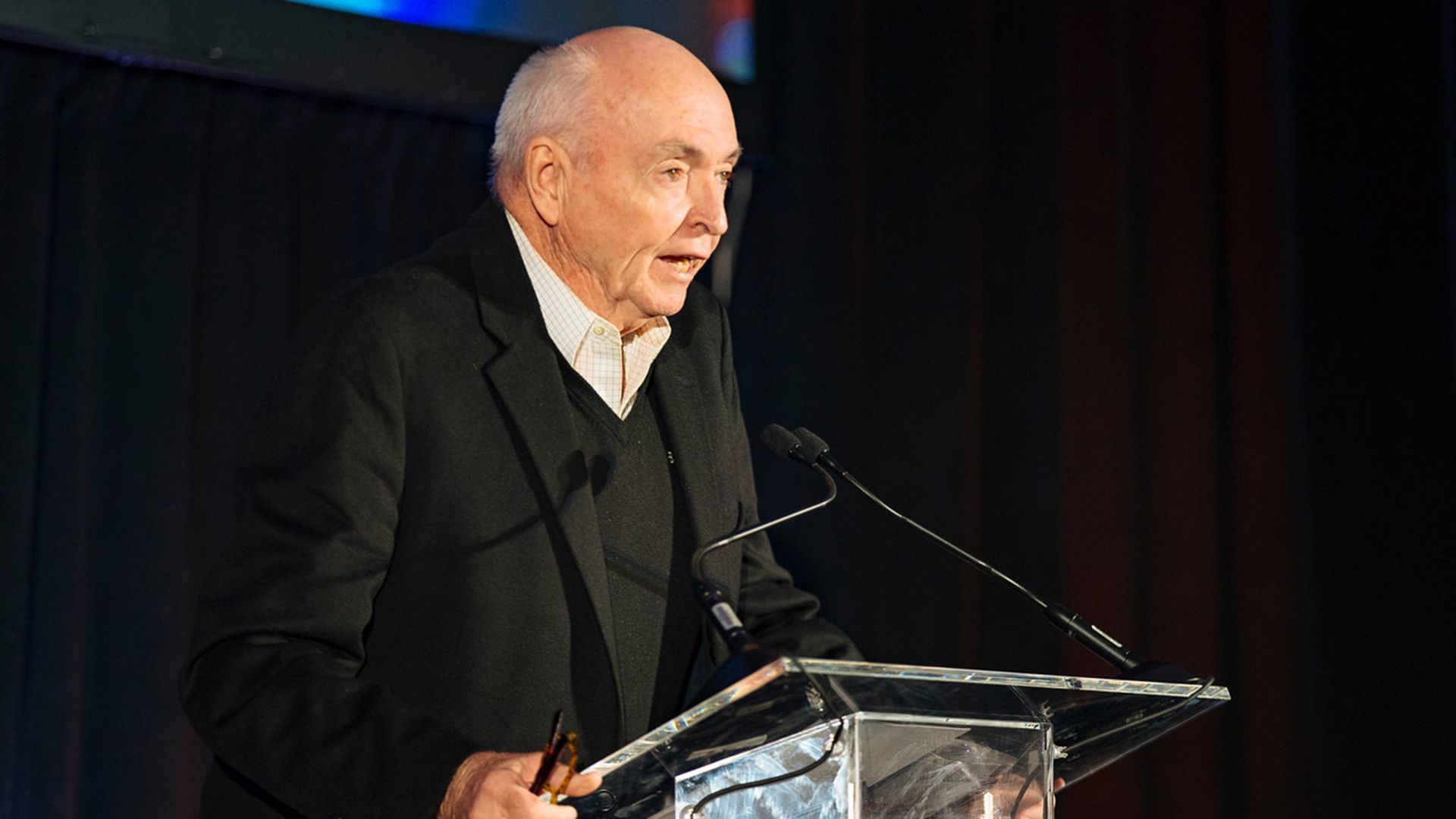
Former Eagles general manager Jim Murray (left), seen here with Dick Vermeil and owner Leonard Tose following the 1980 NFC championship game in January 1981.
Jim Murray, the former Eagles general manager who hired Dick Vermeil and helped the franchise return to prominence while also opening the first Ronald McDonald House, died in August at home in Bryn Mawr surrounded by his family. He was 87.
Mr. Murray grew up in a rowhouse on Brooklyn Street in West Philadelphia and watched the Eagles at Franklin Field. The Eagles hired him in 1969 as a publicist, and Leonard Tose, then the Eagles’ owner, named him the general manager in 1974. Mr. Murray was just 36 years old and the decision was ridiculed.
But Mr. Murray — who was known for his wit and generosity — made a series of moves to bring the Eagles back to relevance, including hiring Vermeil and acquiring players like Bill Bergey and Ron Jaworski. The Eagles made the playoffs in 1978 and reached their first Super Bowl in January 1981. The Eagles, with Murray as the GM, were finally back.
— Matt Breen
Michael Days
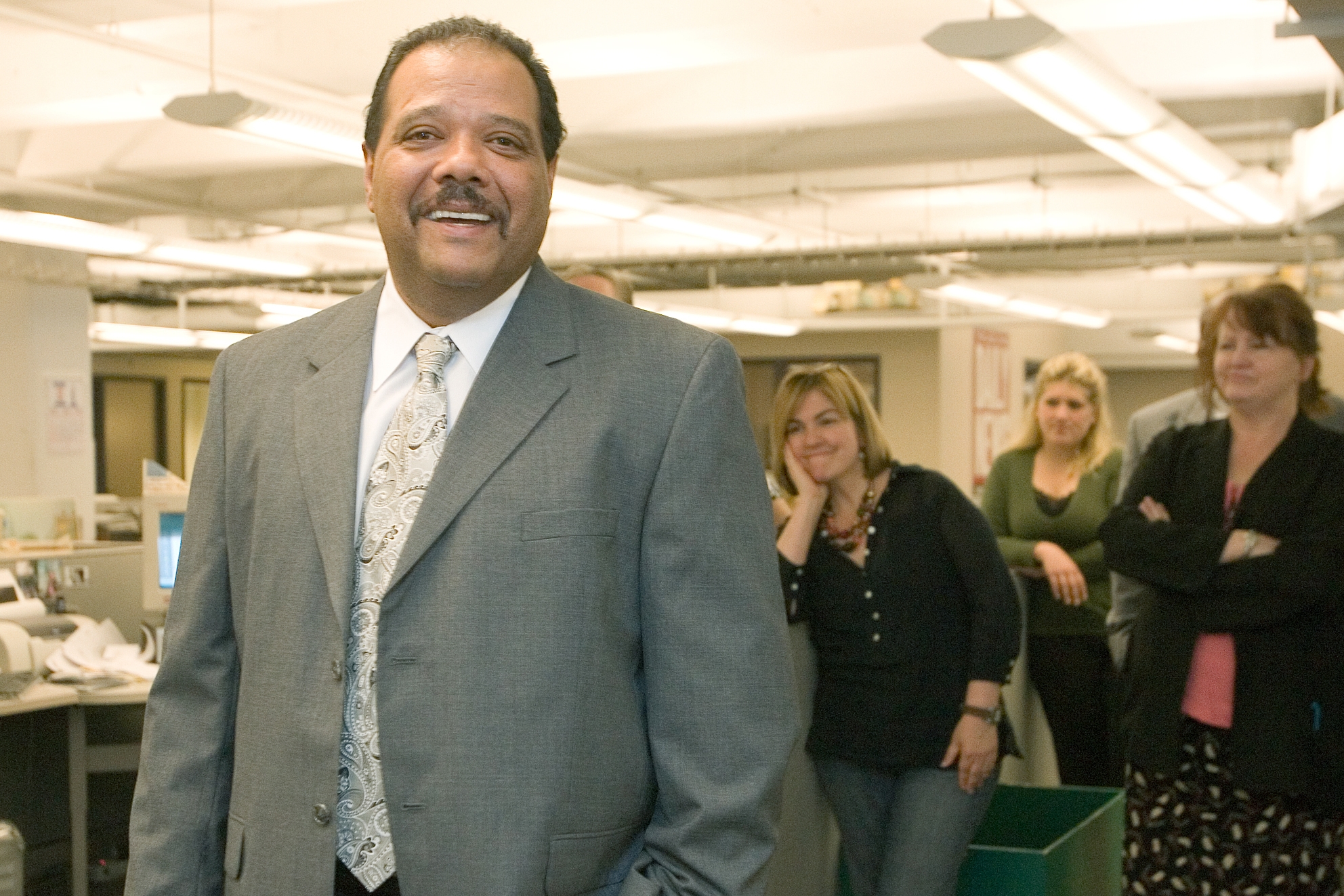
Philadelphia Daily News Editor Michael Days celebrates with the newsroom after word of the Pulitzer win.
Michael Days, a pillar of Philadelphia journalism who championed young Black journalists and led the Daily News during its 2010 Pulitzer Prize win for investigative reporting, died in October after falling ill. He was 72.
A graduate of Roman Catholic High School in Philadelphia, Mr. Days worked at the Wall Street Journal and other newspapers before joining the Daily News as a reporter in 1986, where he ultimately became editor in 2005, the first Black person to lead the paper in its 90-year history. In 2011, Mr. Days was named managing editor of The Inquirer, where he held several management roles until he retired in October 2020.
As editor of the Daily News, Mr. Days played an essential role in the decisions that would lead to its 2010 Pulitzer Prize, including whether to move forward with a story about a Philadelphia Police Department narcotics officer that a company lawyer said stood a good chance of getting them sued.
“He said, ‘I trust my reporters, I believe in my reporters, and we’re running with it,’” recounted Inquirer senior health reporter Wendy Ruderman, who reported the piece with colleague Barbara Laker. That story revealed a deep dysfunction within the police department, Ruderman said, and led to the newspaper’s 2010 Pulitzer Prize win.
— Brett Sholtis
Tom McCarthy
Tom McCarthy, seen here in 2002.
Tom McCarthy, an award-winning theater, film, and TV actor, longtime president of the local chapter of the Screen Actors Guild, former theater company board member, mentor, and veteran, died in May of complications from Parkinson’s disease at his home in Sea Isle City. He was 88.
The Overbrook native quit his job as a bartender in 1965, sharpened his acting skills for a decade at Hedgerow Theatre Company in Rose Valley and other local venues, and, at 42, went on to earn memorable roles in major movies and TV shows.
In the 1980s, he played a police officer with John Travolta in the movie Blow Out and a gardener with Andrew McCarthy in Mannequin. In 1998, he was a witness with Denzel Washington in Fallen. In 2011, he was a small-town mayor with Lea Thompson in Mayor Cupcake. Over the course of his career, Mr. McCarthy acted with Zsa Zsa Gabor, Harrison Ford, Kristin Scott Thomas, Cloris Leachman, Robert Redford, Donald Sutherland, John Goodman, and other big stars.
— Gary Miles
Carol Saline
Carol Saline, seen here at her Philadelphia home in 2021.
Carol Saline, a longtime senior writer at Philadelphia Magazine, the best-selling author of Sisters, Mothers & Daughters, and Best Friends, and a prolific broadcaster, died in August of acute myeloid leukemia. She was 86.
On TV, she hosted a cooking show and a talk show, was a panelist on a local public affairs program, and guested on the Oprah Winfrey Show, Inside Edition, Good Morning America, and other national shows. On radio, she hosted the Carol Saline Show on WDVT-AM.
In June, she wrote to The Inquirer, saying: “I am contacting you because I am entering hospice care and will likely die in the next few weeks. … I wanted you to know me, not only my accomplishments but who I am as a person.
“I want to go out,” she ended her email, “with a glass of Champagne in one hand, a balloon in the other, singing (off key) ‘Whoopee! It’s been a great ride!’”
— Gary Miles
Richard Wernick
Richard Wernick, seen here before a concert at the 2002 Festival of Philadelphia Composers.
Richard Wernick, a Pulitzer Prize-winning composer, acclaimed conductor, and retired Irving Fine Professor of Music at the University of Pennsylvania, died in April 25 of age-associated decline at his Haverford home. He was 91.
Professor Wernick was prolific and celebrated as a composer. He wrote hundreds of scores over six decades and appeared on more than a dozen records, and his Visions of Terror and Wonder for a mezzo-soprano and orchestra won the 1977 Pulitzer Prize for music. In 1991, his String Quartet No. 4 made him the first two-time winner of the Kennedy Center’s Friedheim Award for new American music.
“Wernick’s orchestral music has power and brilliance, an emphasis on register, space, and scale,” Lesley Valdes, former Inquirer classical music critic, said in 1990.
— Gary Miles
Dorie Lenz
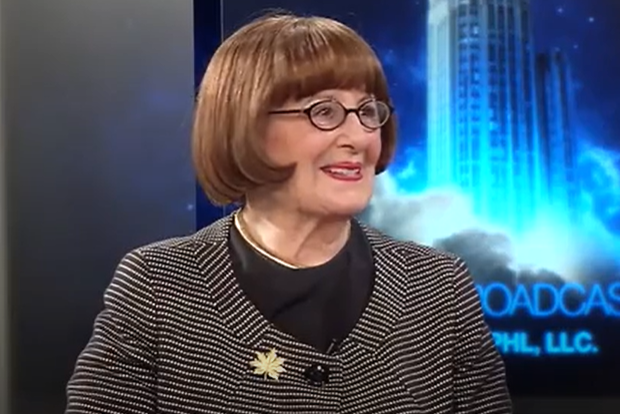
Dorie Lenz, seen here on Channel 17 in 2015.
Dorie Lenz, a pioneering TV broadcaster and the longtime director of public affairs for WPHL-TV (Channel 17), died in January of age-associated ailments at her home in New York. She was 101.
A Philadelphia native, Ms. Lenz broke into TV as a 10-year-old in a local children’s show and spent 30 years, from 1970 to 2000, as director of public affairs and a program host at Channel 17, now PHL17. She specialized in detailed public service campaigns on hot-button social issues and earned two Emmys in 1988 for her program Caring for the Frail Elderly.
Ms. Lenz interviewed newsmakers of all kinds on the public affairs programs Delaware Valley Forum, New Jersey Forum, and Community Close Up. Viewers and TV insiders hailed her as a champion and watchdog for the community. She also talked to Phillies players before games in the 1970s on her 10-minute Dorie Lenz Show.
— Gary Miles
Jay Sigel
Jay Sigel, seen here after winning the Georgia-Pacific Grand Champions title in 2006.
Jay Sigel, one of the winningest amateur golfers of all time and an eight-time PGA senior tour champion, died in April of complications from pancreatic cancer. He was 81.
For more than 40 years, from 1961, when he won the International Jaycee Junior Golf Tournament as an 18-year-old, to 2003, when he captured the Bayer Advantage Celebrity Pro-Am title at 60, the Berwyn native was one of the winningest amateur and senior golfers in the world. Mr. Sigel won consecutive U.S. Amateur titles in 1982 and ’83 and three U.S. Mid-Amateur championships between 1983 and ’87, and remains the only golfer to win the amateur and mid-amateur titles in the same year.
He won the Pennsylvania Amateur Championship 11 times, five straight from 1972 to ’76, and the Pennsylvania Open Championship for pros and amateurs four times. He also won the 1979 British Amateur Championship and, between 1975 and 1999, played for the U.S. team in a record nine Walker Cup tournaments against Britain and Ireland.
— Gary Miles
Mark Frisby
Mark Frisby, seen here in the former newsroom of the Daily News in 2007.
Mark Frisby, the former publisher of the Daily News and associate publisher of The Inquirer, died in September of takayasu arteritis, an inflammatory disease, at his home in Gloucester County. He was 64.
Mr. Frisby joined The Inquirer and Daily News in November 2006 as executive vice president of production, labor, and purchasing. He was recruited from the Courier-Post by then-publisher Brian Tierney, and he went on to serve as publisher of the Daily News from 2007 to 2016 and associate publisher for operations of The Inquirer and Daily News from 2014 to his retirement in 2016.
Mr. Frisby was one of the highest-ranking Black executives in the company’s history, and he told the Daily News in 2006 that “local ownership over here was the big attraction for me.” Michael Days, then the Daily News editor, said in 2007: “This cat is really the real deal.”
— Gary Miles
Leon Bates
Leon Bates, seen here at the Settlement Music School in Germantown in 2018.
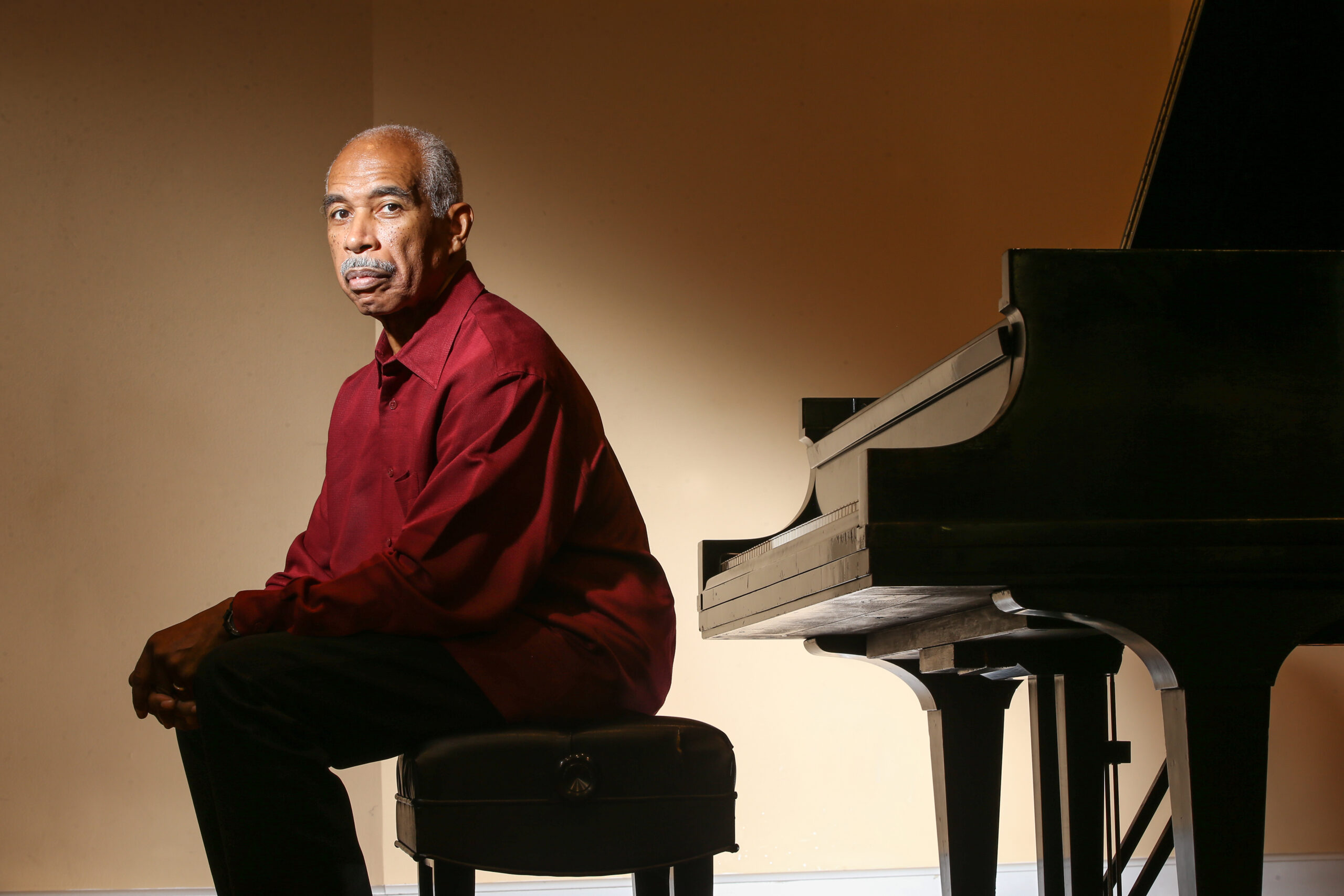
Leon Bates, a concert pianist whose musical authority and far-reaching versatility took him to the world’s greatest concert halls, died in November after a seven-year decline from Parkinson’s disease. He was 76.
The career of Mr. Bates, a leading figure in the generation of Black pianists who followed the early-1960s breakthrough of Andre Watts, encompassed Ravel, Gershwin, and Bartok over 10 concerts with the Philadelphia Orchestra between 1970 and 2002. He played three recitals with Philadelphia Chamber Music Society and taught master classes at Temple University, where he also gave recitals at the Temple Performing Arts Center.
In his WRTI-FM radio show, titled Notes on Philadelphia, during the 1990s, Mr. Bates was what Charles Abramovic, chair of keyboard studies at Temple University, described as “beautifully articulate and a wonderful interviewer. The warmth of personality came out. He was such a natural with that.”
— David Patrick Stearns
Lacy McCrary
Lacy McCrary in an undated photo.
Lacy McCrary, a former Inquirer reporter who won a Pulitzer Prize at the Akron Beacon Journal, died in March of Alzheimer’s disease at his home in Colorado Springs, Colo. He was 91.
Mr. McCrary, a Morrisville, Bucks County native, won the 1971 Pulitzer Prize in local general or spot news reporting as part of the Beacon Journal’s coverage of the May 4, 1970, student protest killings at Kent State University.
He joined The Inquirer in 1973 and covered the courts, politics, and news of all sorts until his retirement in 2000. He notably wrote about unhealthy conditions and fire hazards in Pennsylvania and New Jersey boardinghouses in the late 1970s and early ’80s, and those reports earned public acclaim and resulted in new regulations to correct deadly oversights.
— Gary Miles
Roberta Fallon
Roberta Fallon, seen here in an undated photo.
Roberta Fallon, 76, cofounder, editor, and longtime executive director of the online Artblog and adjunct professor at St. Joseph’s University, died in December at Thomas Jefferson University Hospital of injuries she suffered after being hit by a car. She was 76.
Described by family and friends as empathetic, energetic, and creative, Ms. Fallon and fellow artist Libby Rosof cofounded Artblog in 2003. For nearly 22 years, until the blog became inactive in June, Ms. Fallon posted commentary, stories, interviews, reviews, videos, podcasts, and other content that chronicled the eclectic art world in Philadelphia.
— Gary Miles
Benita Valente
BENI26P Gerald S. Williams 10/18/00 2011 Pine st. Philadelphia-based soprano Benita Valente has sung all over the world. At age 65, she is making her Oct. 29 performance with the Mendelssohn Club at the Academy of Music her last. 1 of 3: Benita goes over some music at the piano in her upstairs music room.
Benita Valente, a revered lyric soprano whose voice thrilled listeners with its purity and seeming effortlessness, died in October at home in Philadelphia. She was 91.
In a remarkable four-decade career, Ms. Valente appeared on the opera stage, in chamber music, and with orchestras. In the intimate genre of lieder — especially songs by Schubert and Brahms — she was considered one of America’s great recitalists.
With the election behind him and the top law enforcement job in Bucks County ahead, Joe Khan says he’s ready for his next challenge.
In January, Khan, a former federal prosecutor and onetime Bucks County solicitor, will become the first Democrat to serve as district attorney in the county since the end of the Civil War. (That’s not counting Ward Clark, a Republican who switched parties to run as a Democrat in 1965 and immediately switched back to his GOP roots after he won.)
Khan, 50, is also the first candidate from outside the district attorney’s office to win the top post after several decades in which voters routinely replaced outgoing district attorneys with successors from among inside the ranks of the office.
To claim that mantle, Khan decisively beat Jen Schorn, the Republican incumbent and a career prosecutor in the district attorney’s office, winning 54% of the vote in the November election, which broke a 20-year record for voter turnout.
County political leaders say Khan’s victory signals voters’ desire for regime change in the once GOP-dominated suburb.
“Democrats came out because they felt like it was necessary to push back on what Trump was doing,” said State Sen. Steve Santarsiero, the chair of the Bucks County Democratic Party. “And in the case of Joe, they recognized him as someone who is going to stand up to an administration that has shown it’s willing to flout the law.”
Khan, for his part, says politics is in the rearview mirror as he prepares for his new job.
“I don’t care what political party you’re from, I don’t care who you voted for president or for district attorney,” he said in a recent interview. “What I care about is that you’re here to support the mission of keeping Bucks County safe and seeking justice every day.”
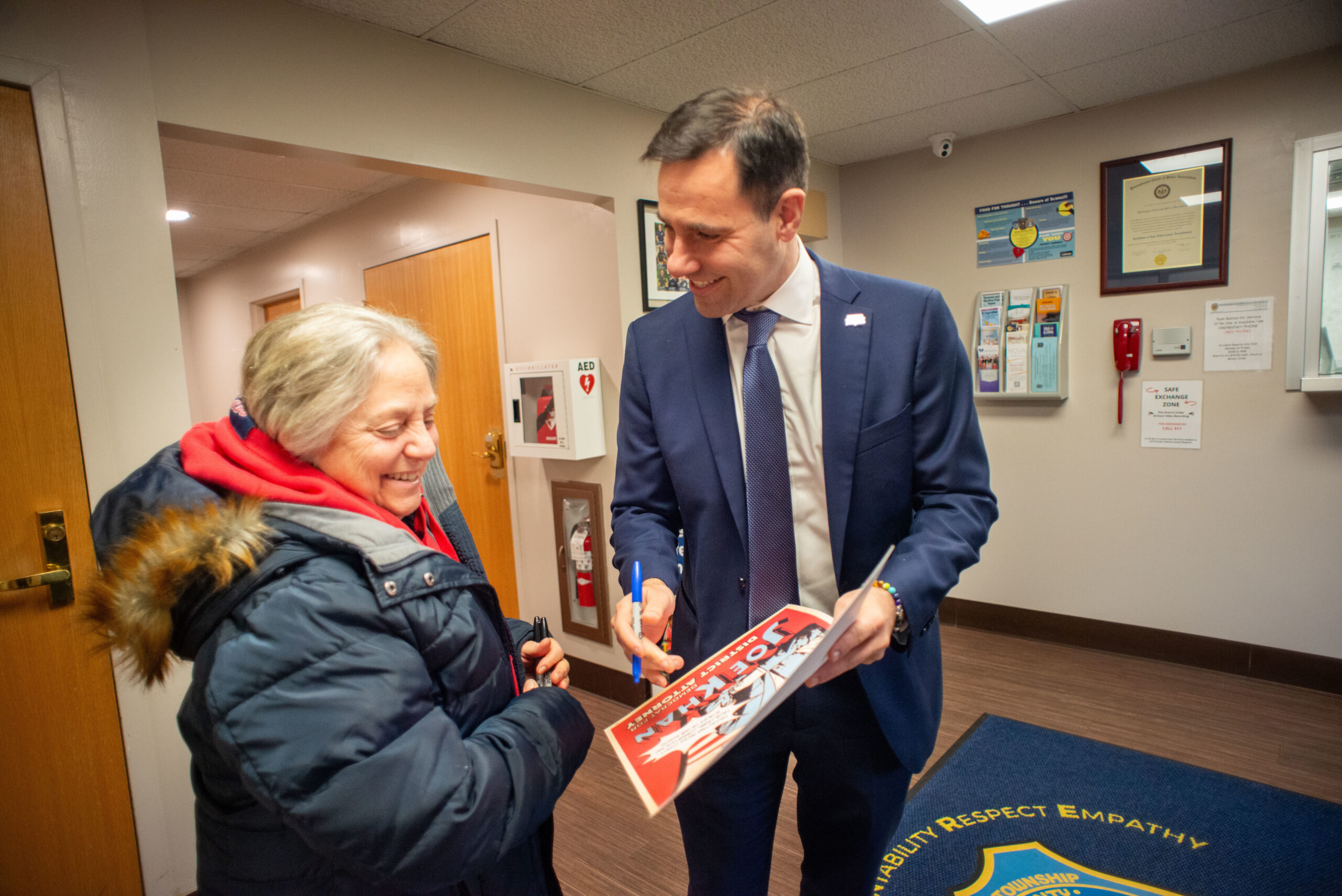
Joe Khan greets and signs a poster for supporter Phyllis Rubin-Arnold as he waits for a meeting with the Buckingham Township Police chief. Khan says that politics has no role in his plans for the district attorney’s office.
And he said he would expand that work — Khan tapped Kristin McElroy, one of Schorn’s top deputies, to serve as his first assistant.
Drawing on his experience in the U.S. Attorney’s Office in Philadelphia, Khan said he would pursue environmental crimes and prosecute cases involving violations of workers’ rights.
“We have seen all kinds of advances in terms of the powers that DAs have in Pennsylvania, so I think it’s great to have an opportunity to look at things with fresh eyes,” he said.
Khan grew up in Northeast Philadelphia, where his father settled after emigrating from Pakistan. Like his brother, State Rep. Tarik Khan (D, Philadelphia), he took an early interest in public service. He followed those aspirations to Swarthmore College and, later, the University of Chicago Law School.
Khan said he was drawn to Bucks County later in his career, and has made it his home in the 14 years he has lived with his sons, Sam, 14 and Nathan, 11, in Doylestown Township. He and the boys’ mother are divorced but co-parent amicably, he said, and live a few doors down from each other.
After stints in the Philadelphia District Attorney’s Office and the U.S. Attorney’s Office — where he specialized in prosecuting gun crimes and locking up child predators — Khan ran for the top prosecutor’s job in Philadelphia in 2017, losing the race to Larry Krasner.
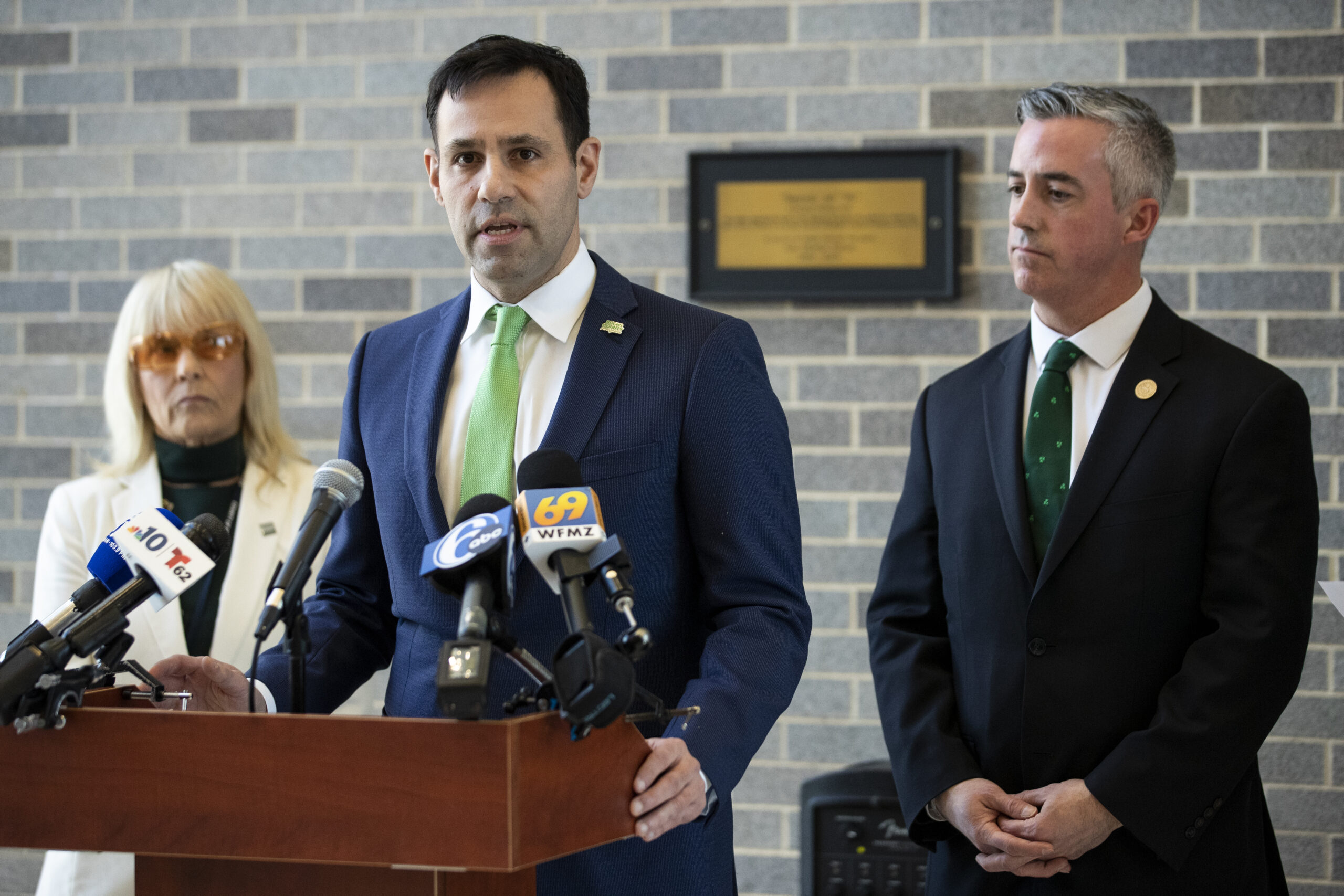
Joe Khan (center) is seen here in March 2023 alongside County Commissioners Diane M. Ellis-Marseglia and Robert J. Harvie Jr. as they announced a lawsuit filed against multiple social media companies for “fueling a mental health crisis among young people.”
Three years later, Khan took over as Bucks County solicitor. He developed an interest in local politics, he said, after watching the culture-war debates over library books and allegations of abuse that embroiled the Central Bucks School District, where his kids are enrolled.
“It’s really central to my view of what parents need from their government,” he said. “They need people in roles like this that are going to make life easier, not harder, and that are going to help them with the challenges that they’re facing.”
Not long after taking over the office, Khan challenged Trump’s efforts to dismiss mail-in ballots during the 2020 election. He also waged legal battles, taking on companies including 3M, DuPont, and Tyco by filing lawsuits over the “forever chemicals” that had leached their way into residents’ water supplies.
And he made headlines for joining a national lawsuit against social media giants like TikTok, bidding them to address the mental health of their young users.
When now-Gov. Josh Shapiro left the state attorney general’s office, Khan stepped down to join a crowded primary to replace him, running in 2023 on a platform to “continue what has been a lifelong fight to keep people safe.”
After losing that race, Khan set his sights on the top law enforcement job in his new home, challenging the long-standing Republican machine that had controlled it for decades.
“I think that if you do a good job and you let people know why you’re doing the things that you’re doing, whether or not they agree with you on every political position, if they know that you’re honest, you got a pretty good shot at earning their vote,” he said.
“And I think that’s a big part of how we won this election.”
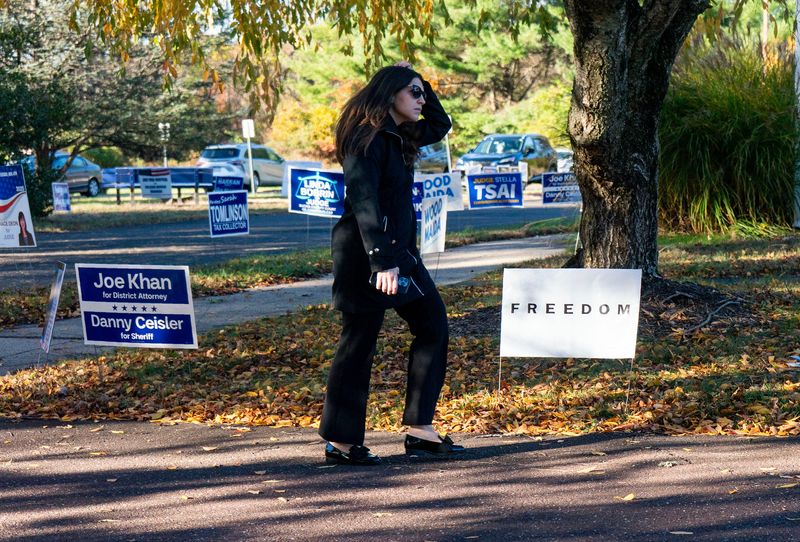
A voter walks past the election lawn signs, including one for Joe Khan and his running mate, Danny Ceisler, outside the Bucks County Senior Citizens polling location in Doylestown on Nov. 4.
Santarsiero, the county Democratic Party chair, said he was confident that Khan would make a fine district attorney.
Winning the post required political prowess, of course, but he said that is a dichotomy unique to the office: Politics are required every four years to secure a position that is apolitical.
Party affiliation aside, he said, Khan would work for the good of the county.
Khan, for his part, says he is ready to give it his all.
“We are here to keep people safe, and we’re going to do that in new and exciting ways,” he said. “I have my values, I wear them on my sleeve, and I’m very clear about the direction that we’re going to go to make sure that people who deserve a healthy environment for their families are getting a higher level of service than they’re used to.”
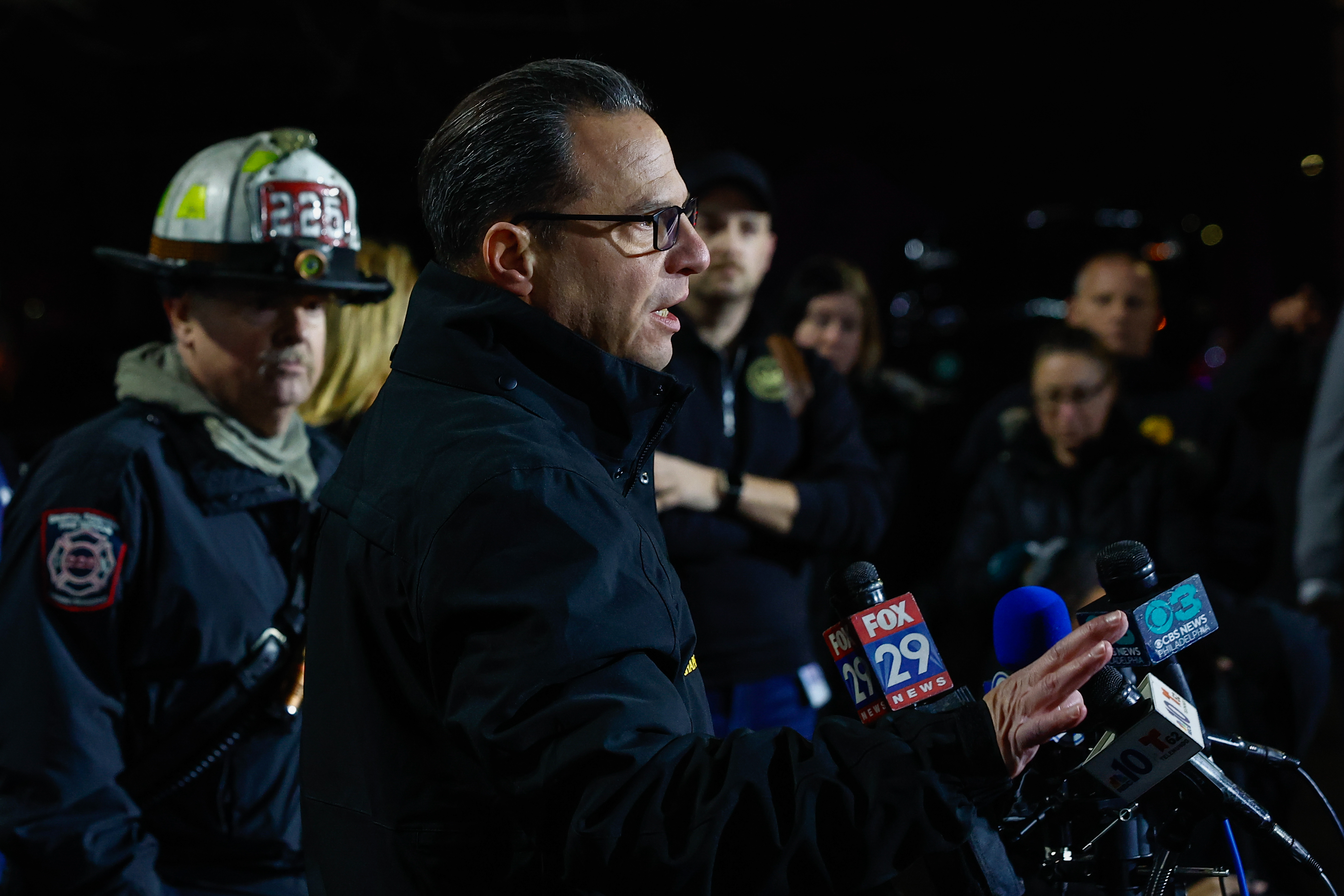
Two people were killed and more than a dozen were injured after a possible gas explosion rocked a Bucks County nursing home Tuesday, triggering a widespread emergency response and dramatic rescues and causing destruction that Gov. Josh Shapiro described as “quite catastrophic.”
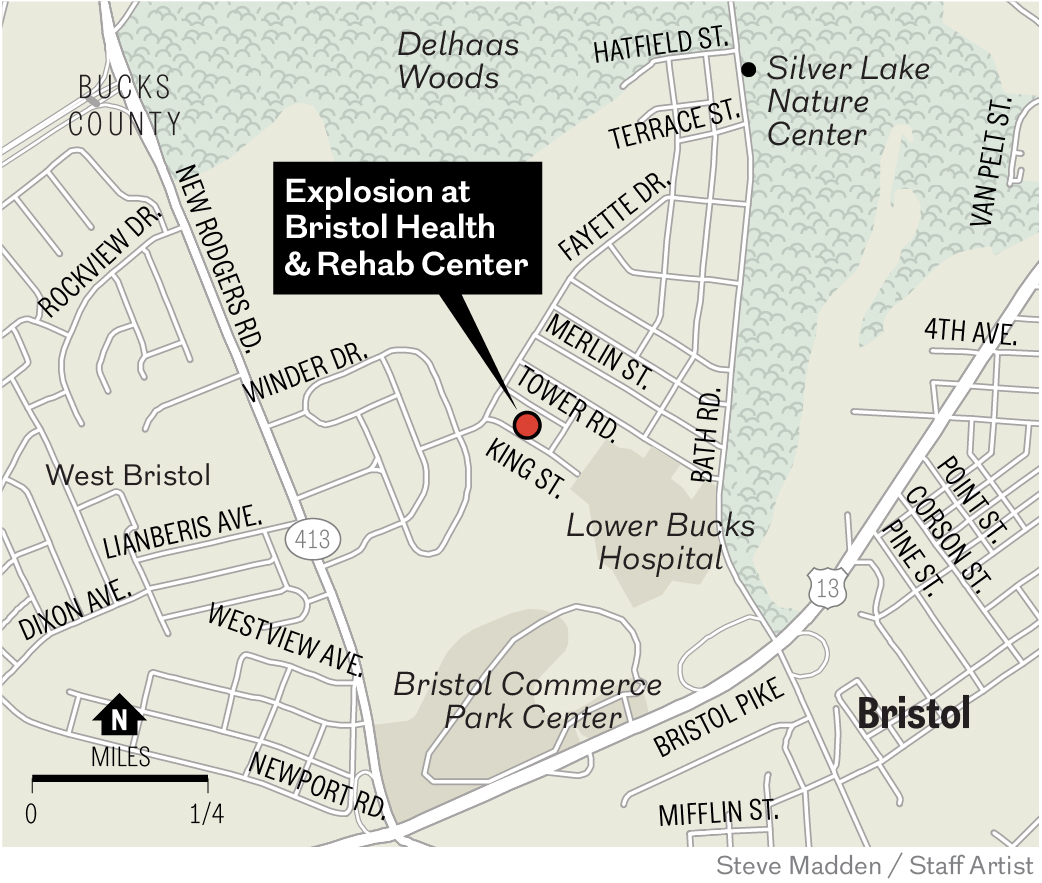
Just before 2:20 p.m., an explosion and fire were reported at the Bristol Health & Rehab Center — formerly known as Silver Lake Healthcare Center and Silver Lake Nursing Home — at 905 Tower Rd. in Bristol Township, Bristol Fire Chief Kevin Dippolito said at a news conference with Shapiro and other officials Tuesday night.
Bristol Police Chief CJ Winik said during an update Wednesday morning that two women — one resident and one employee — had died. Nineteen people remained hospitalized, he said, including one person in critical condition.
As of Wednesday, he said, all residents and employees of the facility had been accounted for.
Emergency responders who rushed to the scene Tuesday found a major structural collapse, with parts of the first floor falling into the basement and people trapped, Dippolito said. Firefighters immediately went into rescue mode.
“They pulled many residents out of the building via windows, doors, stuck in stairwells, stuck in elevator shafts,” Dippolito said.
The people rescued from the building were handed off to police officers who “came from every direction, and I believe every municipality around here,” Dippolito said.
“There was one police officer who literally threw two people over his shoulders and ran with people to help,” the fire chief said.
Gov. Josh Shapiro comments on the explosion at Bristol Health & Rehab Center, at Lower Bucks Hospital on Tuesday, Dec. 23, 2025, in Bristol, Pa.
Many people were injured, but the number was unknown early Tuesday night, Dippolito said. Two people were rescued from the collapsed area in the basement.
At one point, Dippolito said, there was a heavy odor of gas and the firefighters evacuated the building. Within 15 to 30 seconds, there was another explosion and fire, he said.
“There’s still a lot of unanswered questions,” Shapiro said.
Peco crews responded shortly after 2 p.m. to reports of a gas odor, a spokesperson for the utility said.
“While crews were on site, an explosion occurred at the facility,” Peco spokesperson Greg Smore said.
“Peco crews shut off natural gas and electric service to the facility to ensure the safety of first responders and local residents,” Smore said.
After the blast, a patient bleeding from his head was wandering the campus saying to himself how he had repeatedly told staff of a gas smell that lingered throughout the day, said a passerby who did not wish to be identified. The man was eventually treated and transported from the site, the passerby said.
First responders work the scene of an explosion and fire at Bristol Health & Rehab Center, Tuesday, Dec. 23, 2025, in Bristol, Pa.
The nursing home said in a Facebook post: “Emergency crews are responding to the incident here at Bristol Health & Rehab. We are currently working with local emergency authorities.”
As of 2024, the facility housed 162 residents — more than 75% of whom were 60 years or older — and had 129 full- and part-time staff members, records show.
The facility was recently acquired by Saber Healthcare Group and rebranded as Bristol Health & Rehab Center, which announced the new ownership and name in a Facebook post this month.
At the news conference, Shapiro noted the change of ownership.
“The Department of Health at the state level conducted a visit here on Dec. 10, and there was a plan put in place in order for these new facility owners to upgrade the standards at this facility. That work will obviously continue with the new owners to ensure that they do what is necessary to keep residents safe,” Shapiro said.
In an emailed statement Tuesday night, Saber Healthcare Group confirmed that workers at the nursing home “reported a gas smell to PECO. PECO personnel were on site investigating the matter prior to the explosion.”
Saber Healthcare Group thanked the first responders: “We are forever grateful for their bravery and support in protecting our staff and residents.”
The statement added: “Just 23 days ago, Saber Healthcare Group became affiliated with Bristol Health and Rehab Center — formerly Silver Lake Nursing Home. We have worked to improve and fix prior issues, and we will continue that work in the wake of this tragedy.”
The former owner, CommuniCare Health Services, a privately run for-profit nursing home operator based in Cincinnati, took over operations at the nursing home in 2021. The company manages more than 80 healthcare centers across five states.
The nursing home had been cited for unsafe living conditions, including the absence of a fire safety plan and adequate extinguishers, according to state inspection records.
First responders work the scene of an explosion and fire at Bristol Health & Rehab Center, Tuesday, Dec. 23, 2025, in Bristol, Pa.
During an Oct. 29 site visit, Pennsylvania Department of Health inspectors flagged the facility for failing to provide a floor map showing fire exits, fire barriers, and smoke barriers.
Officials also found the facility “failed to maintain portable fire extinguishers” on all floors. The state ordered corrections by Nov. 30.
It remained unclear whether those fixes were made before the blast, or whether the deficiencies affected residents’ ability to escape on Tuesday.
Other fire safety deficiencies have been documented. A 2024 inspection report found the nursing home hallways were not equipped to handle heavy smoke.
“The facility failed to ensure corridor doors were maintained to resist the passage of smoke, affecting two of four smoke compartments,” inspectors wrote.
Federal inspectors have cited the facility for deficient healthcare and management, issuing dozens of violations for substandard care. The most recent inspection, in March, indicated the center had failed to maintain proper infection prevention among residents and inadequately maintained medical records, among other problems.
The U.S. Department of Health and Human Services awarded the facility a one-star rating — far below the national average — based on recent inspections. The nursing home’s operators were fined more than $418,000 in penalties in 2024, records show.
First responders work the scene of an explosion and fire at Bristol Health & Rehab Center, Tuesday, Dec. 23, 2025, in Bristol, Pa.
In a statement, a spokesperson for CommuniCare Health Services, the former owner, said: “Our hearts go out to all those affected by the incident at the Bristol nursing home facility, formerly known as Silver Lake Nursing Home. We want to extend our deepest sympathies to the residents, families, and staff impacted, and are keeping all of them in our thoughts during this difficult time.”
The statement continued: “While we are not affiliated in any way or operate the facility, and it is no longer part of our organization, we recognize the severity of this incident and the profound impact it is having on the community. We are monitoring the situation closely and our thoughts remain with everyone impacted by this tragedy.”
Federal records indicate the building had an automatic sprinkler system.
The facility, composed of low-slung brick buildings, sits on a two-acre campus in Lower Bucks County. As of 2024, the facility housed 162 residents, more than 75% of whom were 60 years or older, according to the most recent inspection records.
The facility had 129 full- and part-time staff members as of 2024, records show.
On Tuesday evening, the smell of smoke and the sound of sirens from ambulances and fire trucks pierced the blocks surrounding the facility hours after the explosion led to a mass evacuation of nursing home patients.
Kim Wilford, 60, was visiting family for the holidays roughly two blocks from the facility when she felt the house shake, as though something had fallen on the roof.
Bristol Health & Rehab Center
When Wilford and relatives realized the explosion came from the nursing home, where her 87-year-old mother lives, they rushed to the campus and were met with chaos.
“It was something out of a Die Hard movie,” said Deanna Rice-Bass, 59, one of Wilford’s relatives, who recognized local nurses, not affiliated with the nursing home, evacuating people.
Patients were being wheeled out of the facility, but in some cases they were simply placed on mats outside, Wilford said.
First responders were instructing the able-bodied to take those with non-life-threatening injuries to nearby Lower Bucks Hospital.
Wilford panicked as she saw the outside of her mother’s room.
“Her window was blown out,” she said. “Naturally I freaked out.”
Wilford would later find her mother among the crowd of evacuees cleared to go to Lower Bucks Hospital.
“She said she and her roommate were lifted from their beds and back down,” said Wilford, adding she had never had issues with the nursing home before.
A reunification center was established at Truman High School, officials said.
Langhorne Police Chief Kevin Burns said about 35 families came in and filled out forms with their loved ones identifying information along with details such as their room number.
Greg Wolnomiejski, 59, spent Tuesday night trying to find out what happened to his 86-year-old father, who has been a resident at the nursing home since 2021.
Wolnomiejski, who lives in Florida, finally got a call from a police officer that his father was transported to Lower Bucks Hospital, but the officer had no other information.
“I know he’s alive,” Wolnomiejski said in a phone interview. “That’s all the information I have so far.”
Wolnomiejski said he had no complaints or concerns about the nursing home, which he visited on Saturday with his wife as part of a holiday trip to see his father.
“There was nothing that led me to suspect it was going to blow up in a couple days,” he said.
Staff writer William Bender contributed to this article.
Philadelphia is suing a host of drug manufacturers and pharmacy benefit managers in federal court, alleging that they conspired to increase insulin prices to drive sky-high profits as patients struggled to afford life-saving medications.
City officials said rising diabetes medication prices have caused the city to “significantly overpay” for diabetes medication for city employees and their families, noting in a news release that insulin prices have increased from $20 per vial in the 1990s to $300 to $700 per vial today.
About 14% of adults in Philadelphia have diabetes, the city said.
“Philadelphia suffers from one of the highest rates of diabetes in the United States, especially in our Black and brown communities,” Health Commissioner Palak Raval-Nelson said in a statement.
“When people cannot afford their insulin, they frequently go without or cut back, leading to disastrous consequences both for themselves and Philadelphia as a whole. Their lives are degraded, and we all pay the associated health costs.”
The suit, filed Tuesday, follows similar litigation filed by District Attorney Larry Krasner in 2024. Hundreds of companies, unions, and other local and state governments, including Bucks County, have also filed suit alongside Philadelphia as part of a wide-ranging lawsuit in federal court in New Jersey, the city said.
In the suit, the city accuses drugmakers and pharmacy benefit managers, or PBMs, of colluding to drive up profits on diabetes drugs. PBMs work with drug manufacturers, insurers, and pharmacies, negotiating prices and developing formularies — lists of prescription drugs that are available on a given insurance plan.
To ensure their drugs were included on formularies, drug manufacturers increased prices on diabetes drugs and then paid “a significant, yet undisclosed” portion of the resulting profits back to the PBMs, the city’s lawsuit said.
That meant lower-priced or generic diabetes medications received “less favorable placement” on formularies, passing higher costs onto consumers, according to the lawsuit.
The suit names nearly two dozen prominent drugmakers and PBMs, including Eli Lilly & Co., Optum RX, Sanofi, Novo Nordisk, and CVS Caremark. Optum officials did not immediately return a request for comment.
In a statement, a Lilly spokesperson said the company has worked for years to lower costs for people with diabetes by capping prices at $35 per month. The average out-of-pocket Lilly insulin cost was $14.86 a month for patients in 2024, the spokesperson said.
“These copycat lawsuits are baseless,” the spokesperson wrote.
Sanofi officials declined to comment on the allegations but said in a statement their “pricing practices have always complied with the law.” The company said it works to lower costs for patients, but that in the U.S. healthcare system, “savings negotiated by health insurance companies and PBMs” aren’t often reflected in patients’ co-pays.
CVS officials said in an email that “pharmaceutical companies alone” are responsible for setting insulin prices and that they would welcome efforts from drug manufacturers to lower prices.
“Allegations that we play any role in determining the prices charged by manufacturers for their products are false, and we intend to vigorously defend against this baseless suit,“ officials said.
Novo Nordisk officials similarly called the allegations in the suit “meritless” and said the company has a number of initiatives to make insulin more affordable for patients.
Staff writer Sarah Gantz contributed to this article.
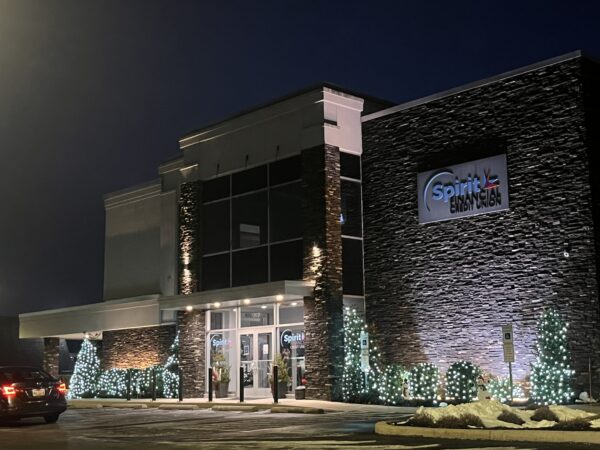
Members of the 71-year-old Spirit Financial Credit Union in Levittown, Bucks County, voted decisively against their leaders’ plan to merge the $70 million-asset, member-owned lender with $2 billion-asset Credit Union 1 of suburban Chicago.
“We respect the decision our members made through this vote,” David Obarowski, the 3,800-member credit union’s chief executive, said in a statement. He thanked members for voting and commenting on the plan. “There are no plans for another vote on this specific matter. Spirit Financial will continue operating independently.”
Todd Gunderson, Credit Union 1’s CEO, in a statement offered “utmost respect” for “the democratic member voter outcome.”
He said most members voted in advance by mail, adding that a smaller group showed up Monday, engaging with him and Obarowski. He called members “constructive, thoughtful and respectful” and rightly focused on adding younger members since Spirit Financial’s member count has barely risen since the 1990s.
Obarowski declined to provide vote totals. Member Richard Kilian, a building-materials company owner who opposed the merger, said more than 500 of the credit union’s 3,800 members voted, with more than 400 voting no, according to a count he said was made public at the meeting.
Gunderson said last week that Credit Union 1 had won 12 of 13 merger votes since he took the top job in 2020.
Pages listing benefits from the proposed merger, such as more loan and deposit products and lower travel ATM fees, no longer appear on either credit unions’ website.
Kilian attributed the vote to members’ preference for local control, though he agreed its aging membership needs new energy.
Spirit Financial was started by workers at the former U.S. Steel Fairless Works but is now open to people who live or work in Bucks or are members of Bucks-based churches and other institutions.
Kilian said he hoped Spirit Financial would recruit younger customers and leaders, boost its presence by using more social media and other community engagement, and add staff licensed to write more loans.