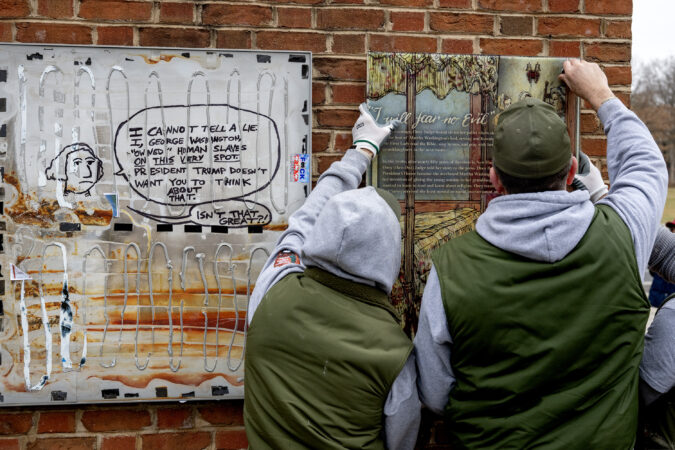
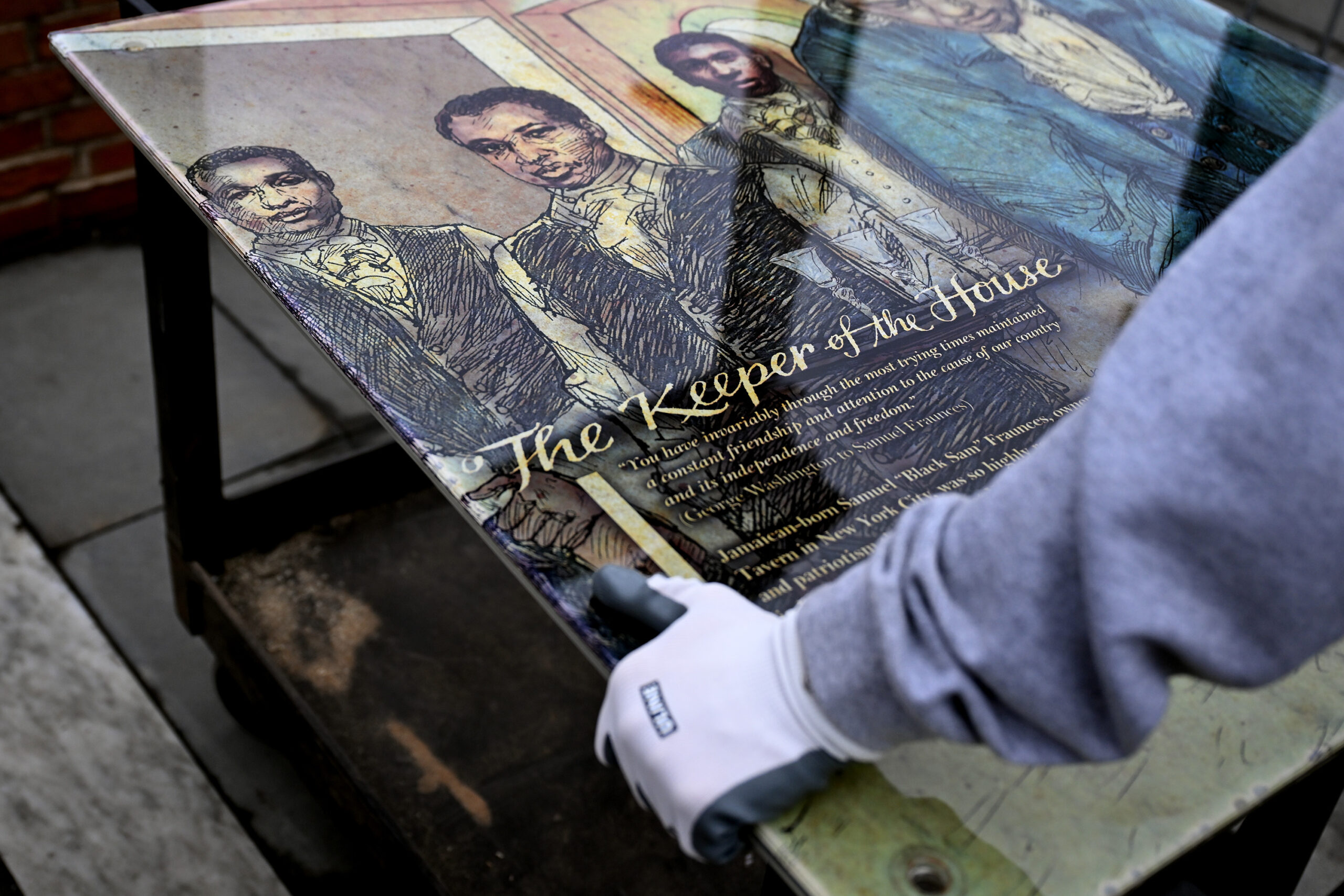
A worker carries one of the slavery-related exhibits, “The Keeper of the House,” before rehanging it at the President’s House in Independence National Historical Park on Thursday.
So yes, the federal government complied with the judge’s order, but only for the moment.
Like so many in Philadelphia, I have watched the fight for the President’s House unite people of all stripes. I’ve experienced the emotional victories and defeats.
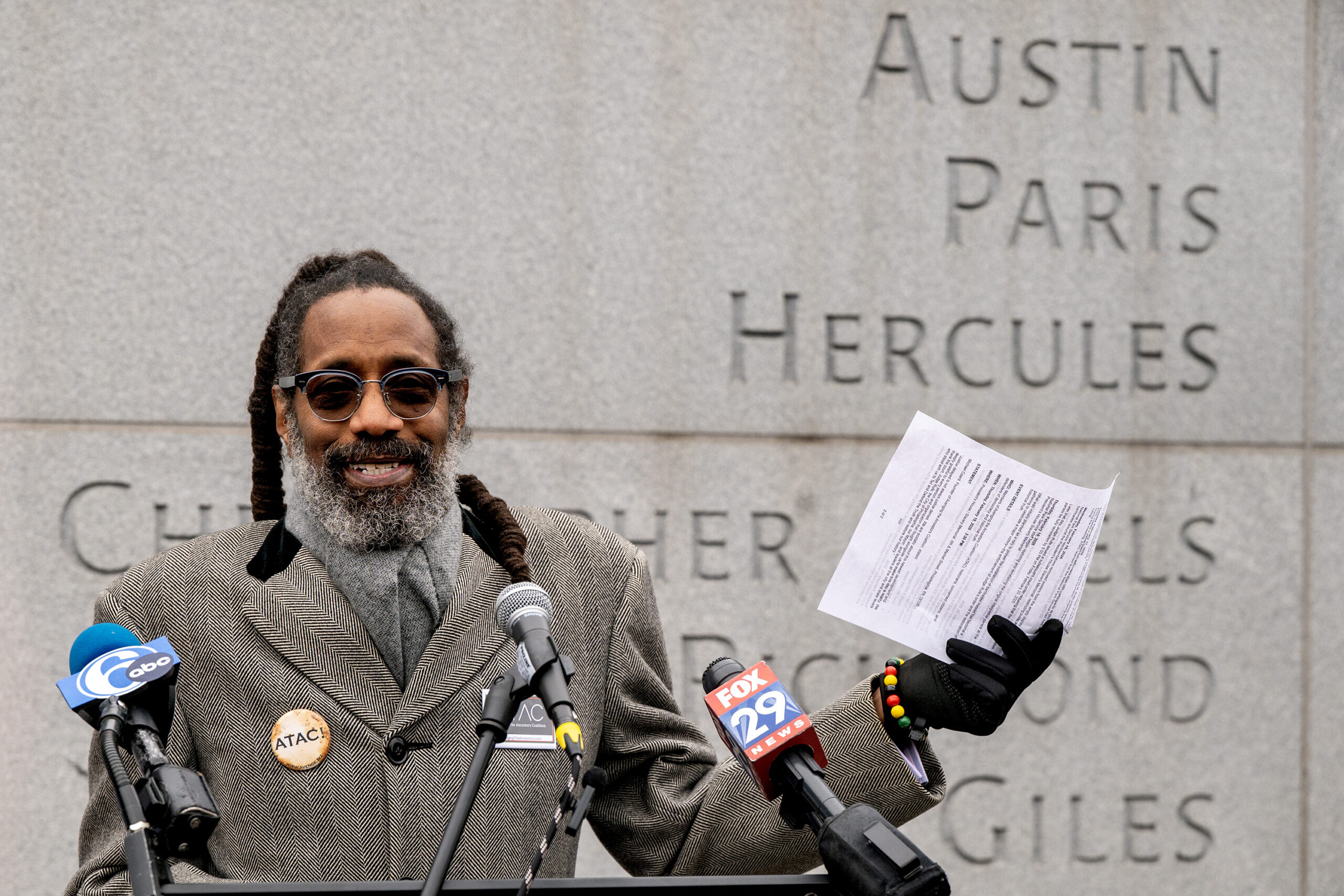
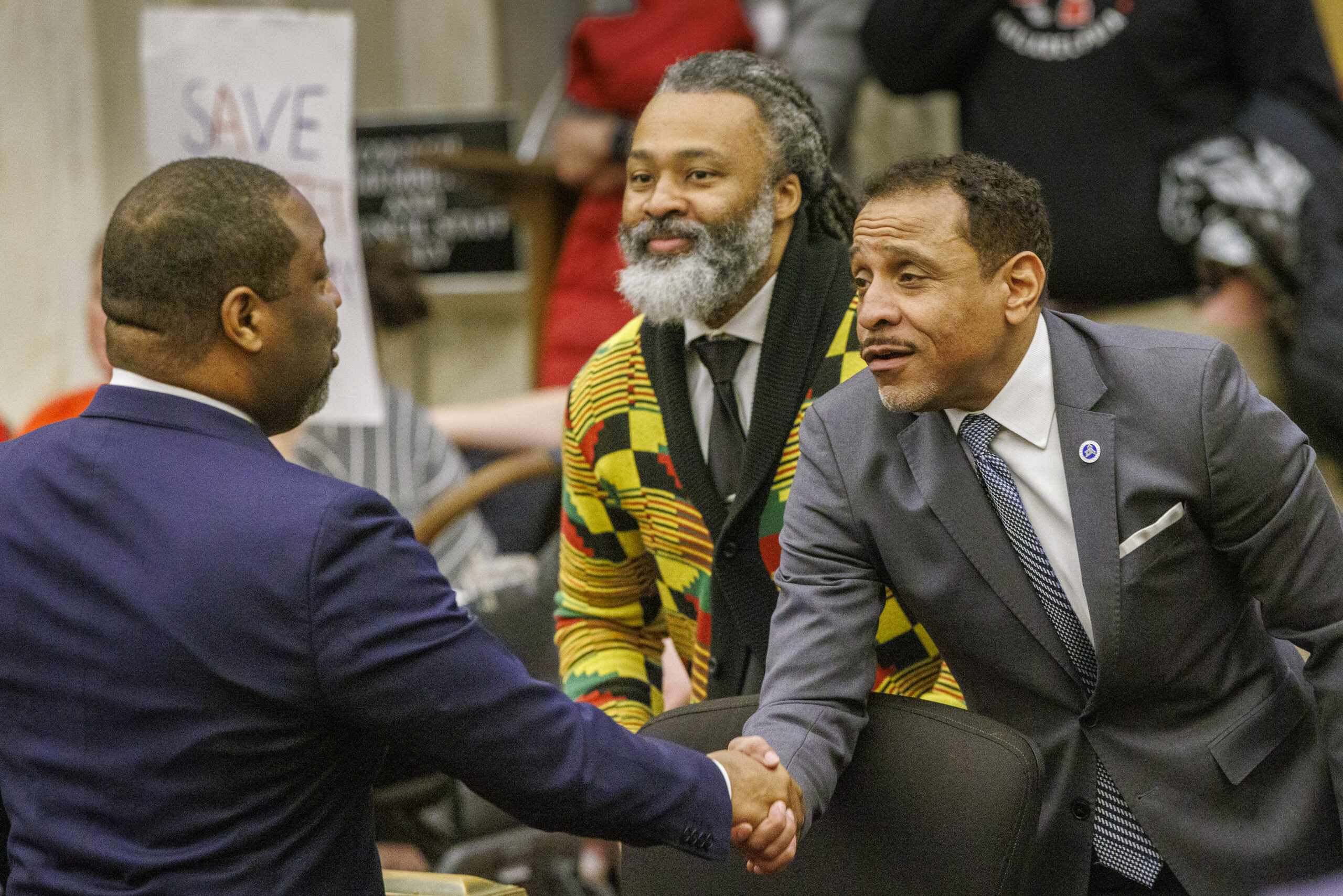
Attorney Michael Coard, leader of the Avenging the Ancestors Coalition, speaks during a rally at the President’s House in Independence National Historical Park on Thursday, after the return of some of the slavery exhibits the National Park Service removed last month. The names of nine enslaved people who lived and worked in the household of George Washington, engraved in stone behind him, were not among those removed by the NPS.
But even with the restoration of the panels, we are all left teetering on the razor-thin edge that separates celebration from grief, and elation from rage. We cannot stay there. We must continue to fight for the truth.
Here, in the place where the story of enslavement lived side by side with the struggle for freedom, we fight.
Here, in a place where a new generation of combatants joins a centuries-old battle for the truth, we fight.
More rallies will come, and in the shadow of Independence Hall, where wealthy white men declared their own freedom while withholding liberty from my ancestors, a new American Revolution will take shape from the same war of ideas Jackson fought. It will be based on the rhetoric of America’s founders.
If indeed all men are created equal, our history should be equally told. That idea cannot be contained by metal barriers. We’ll see if it can be enforced in the courts.
Still, truth is not about legalities or displays.
The truth of slavery in Philadelphia exists in the names of our neighborhoods, our streets, and even our schools. It exists in the very fabric of who we are.
The neighborhood of Logan is named for James Logan, who served as secretary to William Penn. He also enslaved people.
Chew Avenue is named for the Chew family, who lived in an estate called Cliveden, which is also the name of a street. The Chews enslaved people at Cliveden.
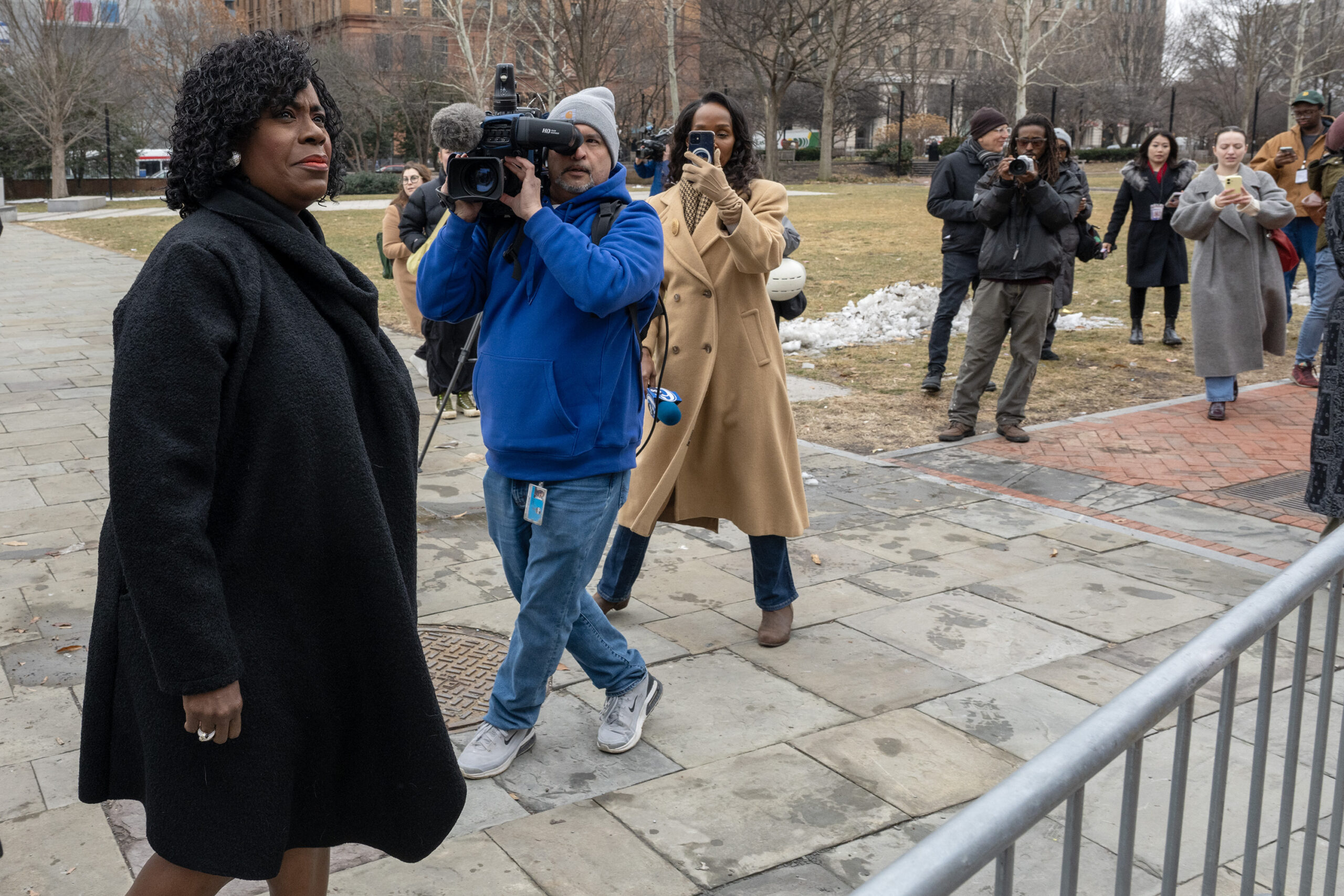
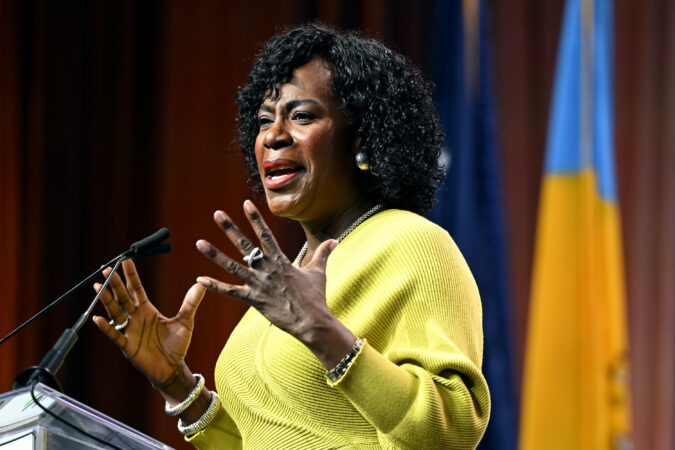
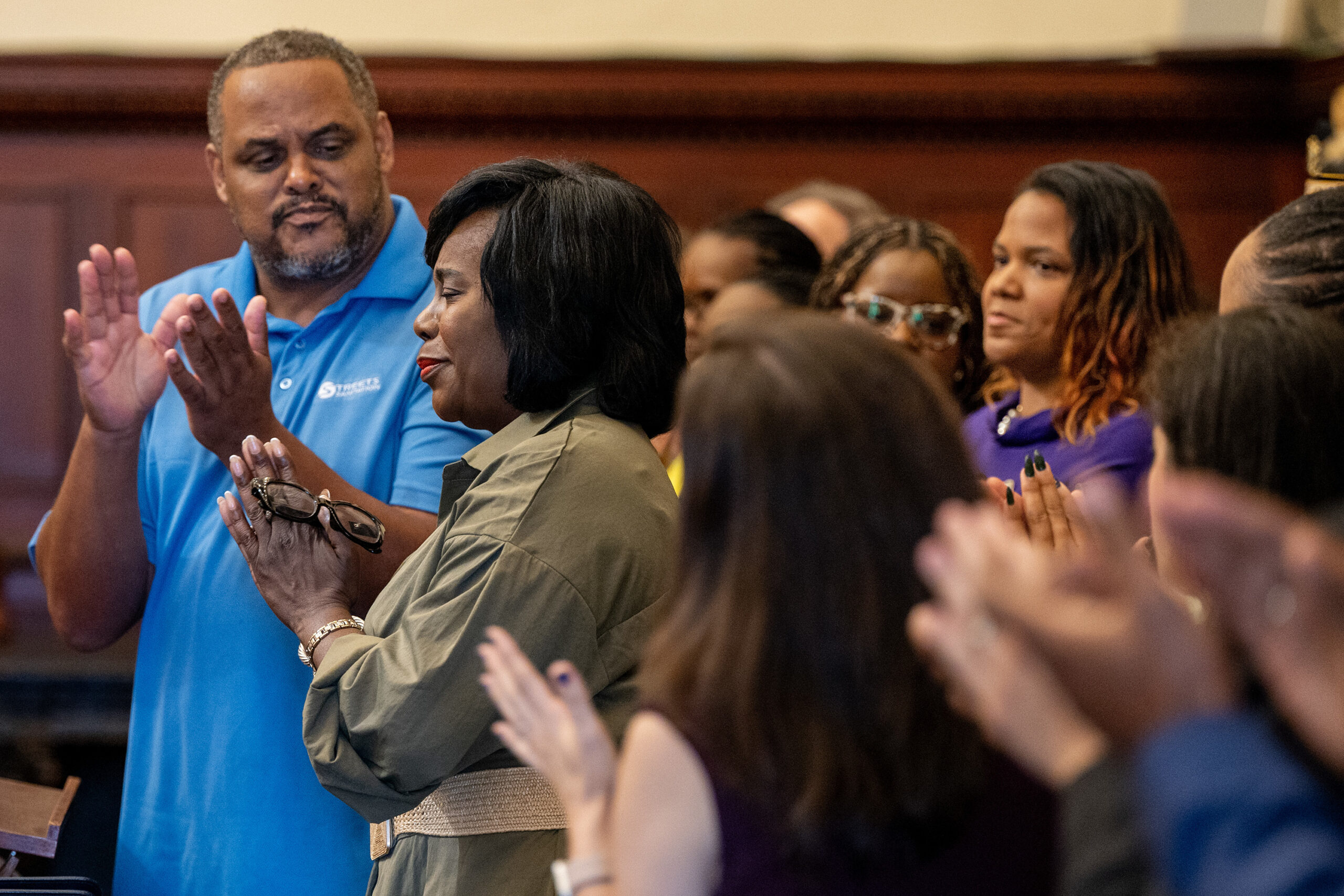
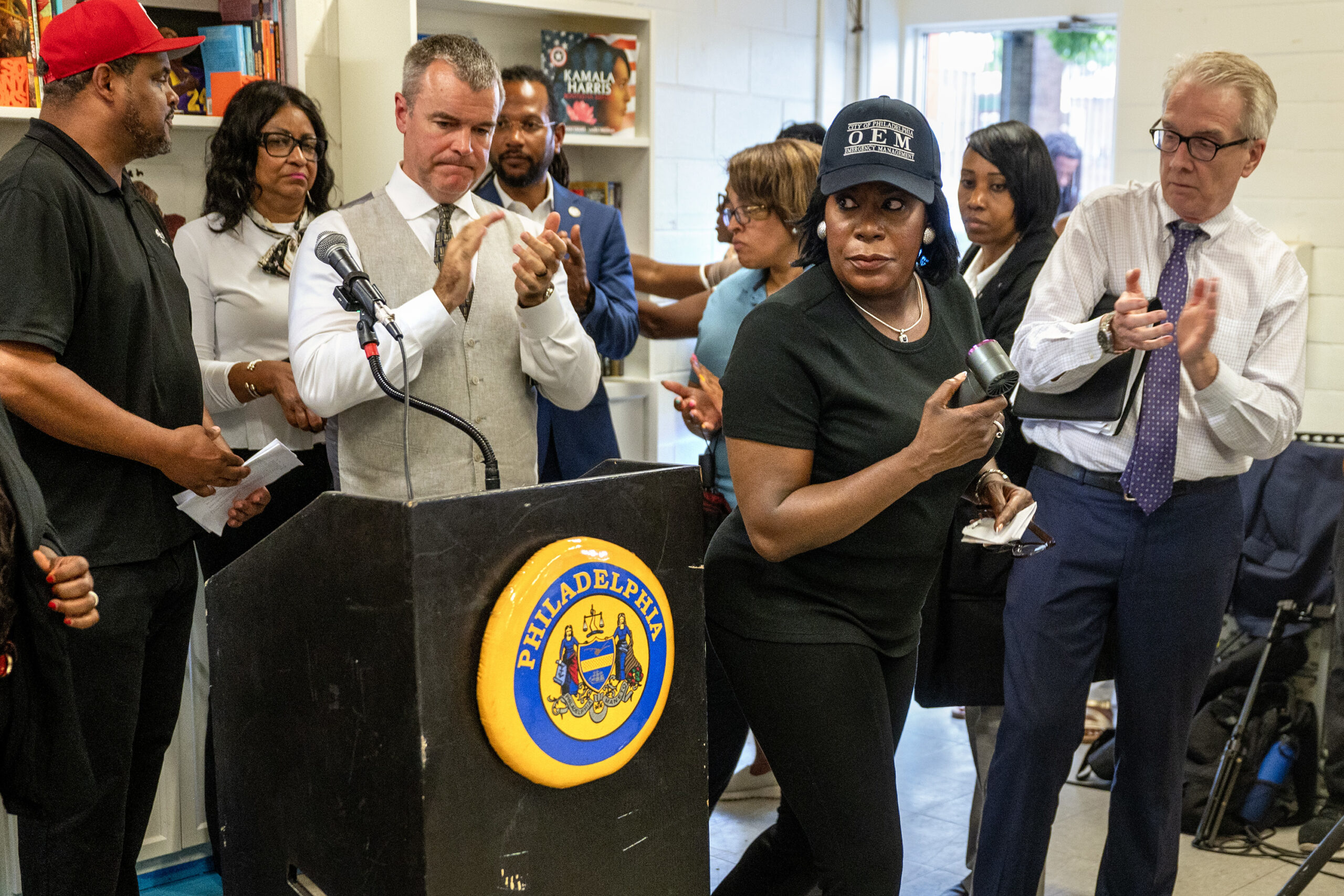
Mayor Cherelle L. Parker visits the President’s House as workers return the slavery exhibits at the site on Thursday. Parker thanked them, and one replied, “It’s our honor.”
Front and Market, home to the London Coffee House, once hosted a market of a different kind. People were sold there. It was a key element of the business of slavery.
Girard Avenue is named for Stephen Girard. He was a very rich man with a very complicated legacy, and yes, he was also an enslaver.
Perhaps that’s why I was so angry when I went to the President’s House in the days after the Trump administration pried truth from the walls.
It was almost like someone had taken something that belonged to me, and in truth, they did. They took my history, but as I stood in that barren space on a cold afternoon, it was as if my ancestors were all around me — like the great cloud of witnesses from Scripture — telling me all they had endured.
Perhaps the Trump administration will ultimately achieve its goal and remove the panels from the site. Or maybe the truth will prevail.
But our fight is about more than the nine people Washington enslaved. This is about all of us, and it will take all of us to win.
Mayor Cherelle L. Parker’s administration last August told the U.S. Department of Justice that Philadelphia remains a “welcoming city” for immigrants and that it had no plans to change the policies the Trump administration has said make it a “sanctuary city,” according to a letter obtained by The Inquirer through an open-records request.
“To be clear, the City of Philadelphia is firmly committed to supporting our immigrant communities and remaining a welcoming city,” City Solicitor Renee Garcia wrote in the Aug. 25, 2025, letter. “At the same time, the City does not maintain any policies or practices that violate federal immigration laws or obstruct federal immigration enforcement.”
Garcia sent the letter last summer in response to a demand from U.S. Attorney General Pam Bondi that Philadelphia end its so-called sanctuary city policies, which prohibit the city from assisting some federal immigration tactics. Bondi sent similar requests to other jurisdictions that President Donald Trump’s administration contends illegally obstruct immigration enforcement, threatening to withhold federal funds and potentially charge local officials with crimes.
Although some other cities quickly publicized their responses to Bondi, Parker’s administration fought to keep Garcia’s letter secret for months and initially denied a records request submitted by The Inquirer under Pennsylvania’s Right-To-Know Law.
The city released the letter this week after The Inquirer appealed to the Pennsylvania Office of Open Records, which ruled that the Parker administration’s grounds for withholding it were invalid.
The letter largely mirrors Parker’s public talking points about immigration policy, raising questions about why her administration sought to keep it confidential.
But the administration’s opaque handling of the letter keeps with the approach Parker has taken to immigration issues since Trump returned to office 13 months ago. Parker has vowed not to change immigrant-friendly policies enacted by past mayors, while avoiding confrontation with the federal government in a strategy aimed at keeping Philadelphia out of the president’s crosshairs as he pursues a nationwide deportation campaign.
Although U.S. Immigration and Customs Enforcement officers operate in the city, Philadelphia has not seen a surge in federal agents like the ones Trump sent to Minneapolis and other jurisdictions.
A spokesperson for the Justice Department did not respond to a request for comment.
Immigrant advocates have called on Parker to take a more aggressive stand against Trump, and City Council may soon force the conversation. Councilmembers Rue Landau and Kendra Brooks have proposed a package of bills aimed at further constricting ICE operations in the city, including a proposal to ban law enforcement officers from wearing masks. The bills will likely advance this spring.
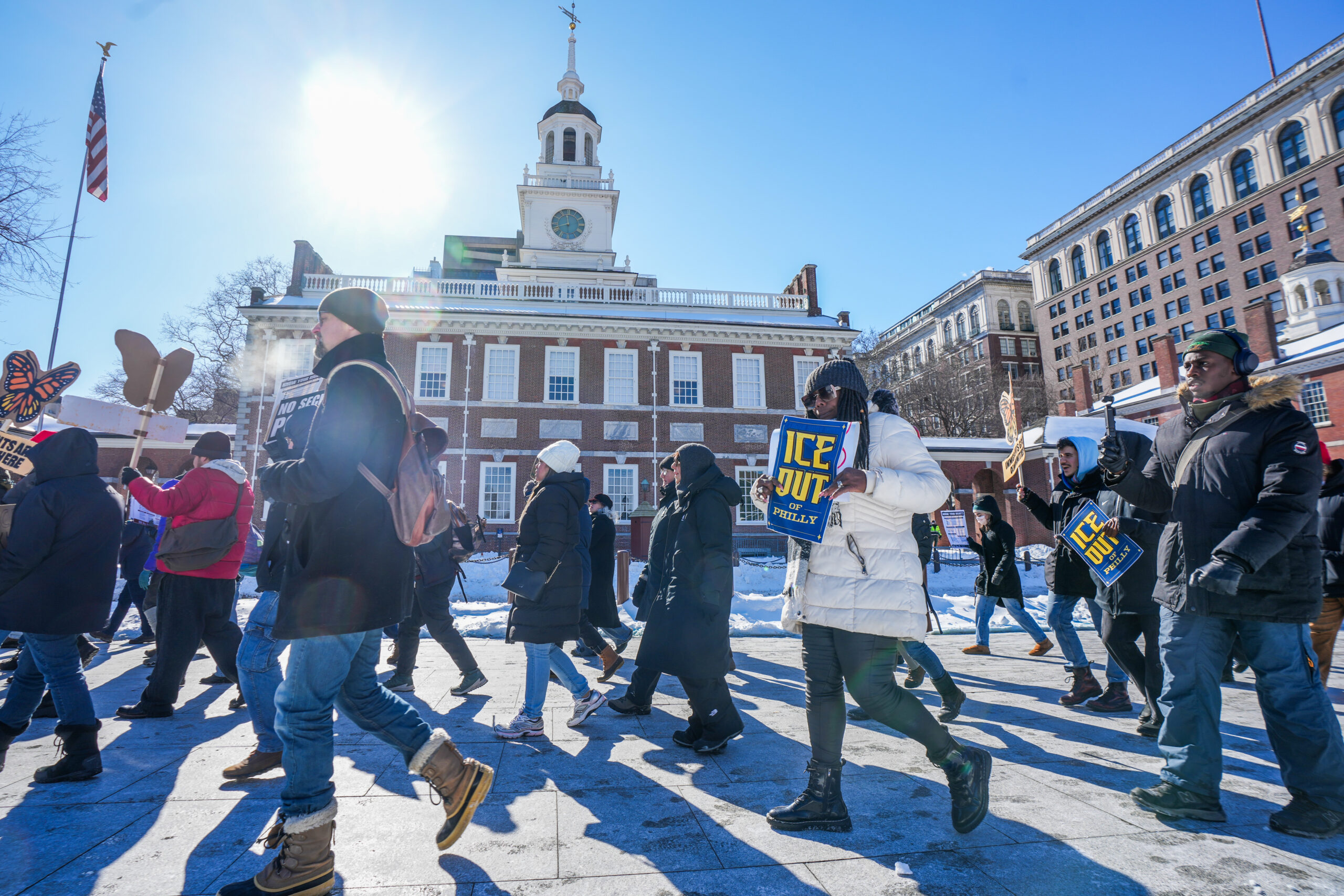
Advocates and protesters call for ICE to get out of Philadelphia in Center City on January 27, 2026.
Parker’s delicate handling of immigration issues stands in contrast to her aggressive response to the Trump administration’s removal last month of exhibits related to slavery at the President’s House Site on Independence Mall.
The city sued to have the panels restored almost immediately after they were taken down. After a federal judge sided with the Parker administration, National Park Service employees on Thursday restored the panels to the exhibit in a notable win for the mayor.
Bondi’s letter, which was addressed to Parker, demanded the city produce a plan to eliminate its “sanctuary” policies or face consequences, including the potential loss of federal funds.
“Individuals operating under the color of law, using their official position to obstruct federal immigration enforcement efforts and facilitating or inducing illegal immigration may be subject to criminal charges,” Bondi wrote in the letter, which is dated Aug. 13. “You are hereby notified that your jurisdiction has been identified as one that engages in sanctuary policies and practices that thwart federal immigration enforcement to the detriment of the interests of the United States. This ends now.”
“Sanctuary city” is not a legal term, but Philadelphia’s policies are in line with how the phrase is typically usedto describe jurisdictions that decline to assist ICE.
Immigrant advocates have in recent years shifted to using the label “welcoming city,” in part because calling any place a “sanctuary” is misleading when ICE can still operate throughout the country. The newer term is also useful for local officials hoping to evade Trump’s wrath, as it allows them to avoid the politically hazardous “sanctuary city” label.
Philly’s most notable immigration policy is a 2016 executive order signed by then-Mayor Jim Kenney that prohibits city jails from honoring ICE detainer requests, in which ICE agents ask local prisons to extend inmates’ time behind bars to facilitate their transfer into federal custody. The city also prohibits its police officers from inquiring about immigration status when it is not necessary to enforce local law.
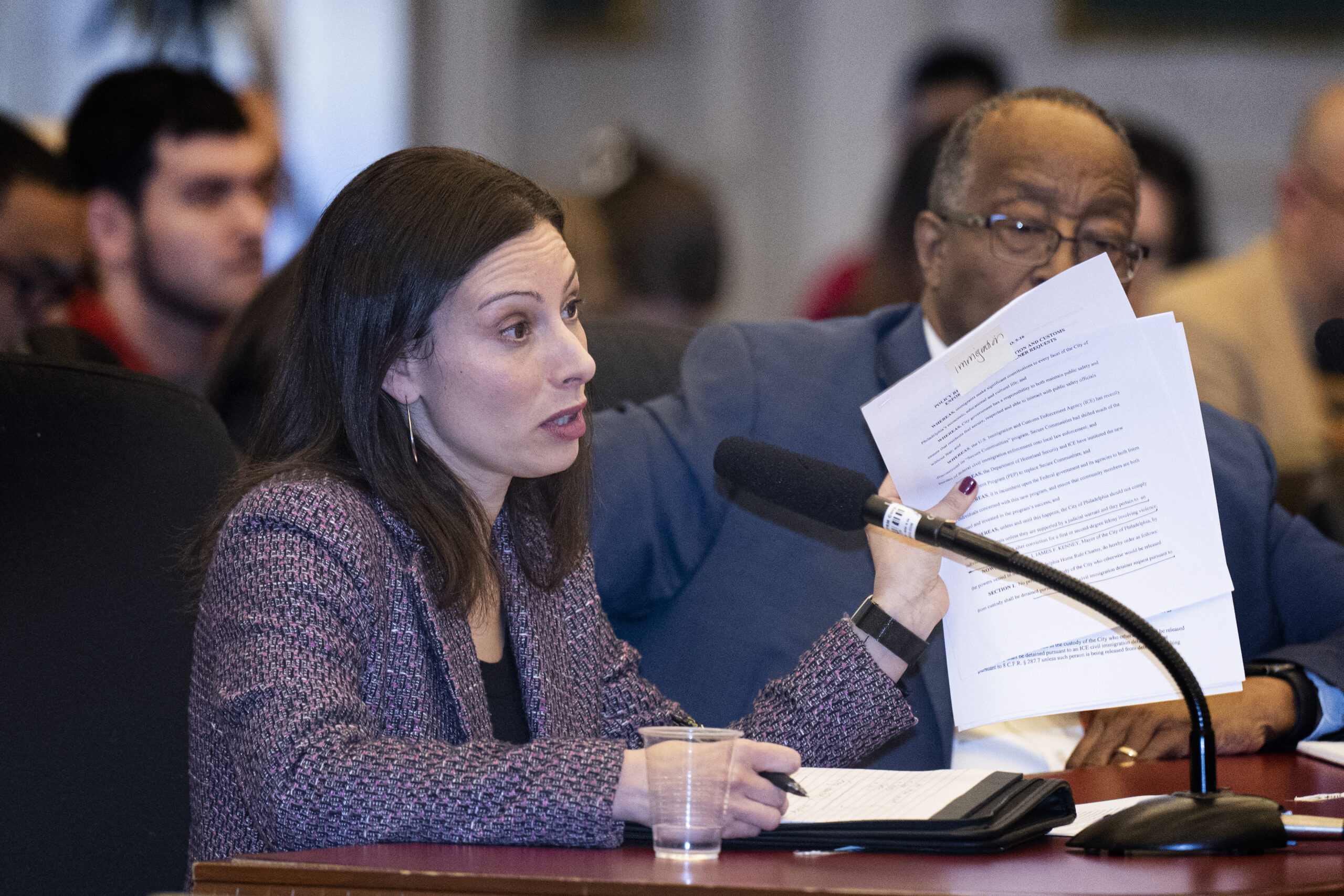
Renee Garcia, Philadelphia City Solicitor speaks before City Council on Jan 22, 2025.
Garcia wrote in the August letter that Kenney’s order “was not designed to obstruct federal immigration laws, but rather to clarify the respective roles of the Police Department and the Department of Prisons in their interactions with the Department of Homeland Security when immigrants are in City custody.” The city, she wrote, honors ICE requests when they are accompanied by judicial warrants.
Immigration enforcement is a federal responsibility, and — in a case centered on Kenney’s order — the Philadelphia-based U.S. Court of Appeals for the Third Circuit ruled in 2019 that cities do not have to assist ICE.
The court, Garcia wrote, “held that the federal government could not coerce Philadelphia into performing immigration tasks under threat of federal repercussions, including the loss of federal funds.”
City loses fight over records
In Pennsylvania, all government records are considered public unless they are specifically exempted from disclosure under the Right-To-Know Law. In justifying its attempt to prevent the city’s response to the Trump administration from becoming public, the Parker administration cited two exemptions that had little to do with the circumstances surrounding Garcia’s letter.
First, the administration argued that the letter was protected by the work product doctrine, which prevents attorneys’ legal work and conclusions from being shared with opposing parties. Given that the letter had already been sent to the federal government — the city’s opponent in any potential litigation — the doctrine “has been effectively waived,” Magdalene C. Zeppos-Brown, deputy chief counsel in the Pennsylvania Office of Open Records, wrote in her decision in favor of The Inquirer.
“Despite the [city’s] argument, the Bondi Letter clearly establishes that the Department of Justice is a potential adversary in anticipated litigation,” Zeppos-Brown wrote.
Second, the city argued that the records were exempted from disclosure under the Right-To-Know Law because they were related to a noncriminal investigation. The law, however, prevents disclosure of records related to Pennsylvania government agencies’ own investigations — not of records related to a federal investigation that happen to be in the possession of a local agency.
“Notably, the [city] acknowledges that the investigation at issue was conducted by the DOJ, a federal agency, rather than the [city] itself,” Zeppos-Brown wrote. “Since the DOJ is a federal agency, the noncriminal investigation exemption would not apply.”
Garcia’s office declined to appeal the decision, which would have required the city to file a petition in Common Pleas Court.
“As we stated, the City of Philadelphia is firmly committed to supporting our immigrant communities as a Welcoming City,” Garcia said in a statement Wednesday after the court instructed the city to release the letter. “At the same time, we have a long-standing collaborative relationship with federal, state, and local partners to protect the health and safety of Philadelphia, and we remain [in] compliance with federal immigration laws.”
Staff writers Anna Orso and Jeff Gammage contributed to this article.
A three-year ban on puppy breeding in Philadelphia is likely to become law after City Council members on Thursday passed a bill to relieve overcrowded animal shelters.
Tightening the leash on backyard breeders: The bill was authored by Councilmember Cindy Bass, a Democrat who represents parts of North and Northwest Philadelphia.
Bass was sick and absent from Council on Thursday, but she has previously said that her bill is aimed at limiting people from breeding more puppies than they can sell.
“Every litter means more dogs in our shelter, more cost for taxpayers, and more suffering that we can prevent,” Bass said last year. “This isn’t about punishment; it’s about compassion and responsibility.”
Under the bill, it would be illegal to sell puppies or post ads to sell them within city limits. Breeders who violate the moratorium could face a $1,000 fine, with the proceeds going to the city’s Animal Care and Control Team, also known as ACCT Philly. The animal control agency would also enforce the ban.
Sammi Craven, a local animal welfare advocate, testified Thursday about overcrowding at ACCT Philly’s North Philadelphia shelter. She named the dogs that were recently euthanized or are scheduled to be put down: Stella, Cheese Burrito, Luna, and Muffin, among others.
“Philadelphia’s current animal welfare policy is ineffective,” Craven said, “and infrastructure and prevention have not kept pace with intake.”
In this 2022 file photo, Brian Martin, 31, and Vanessa Green, 29, look at their new dog they plan to adopt while Green holds Autumn, 1, at ACCT Philly, which was hosting a pet adoption event.
Critics of the moratorium say it will be challenging to enforce and could harm smaller, responsible breeders as opposed to those already operating illegally.
Charley Hall, a government relations official with the American Kennel Club, called on Council to hold the bill and establish a working group to draft new regulations.
“Working together, we can stop the flow of irresponsible breeders and improve animal welfare and fewer dogs ending up in Philadelphia’s shelters,” Hall said. “The question is how to achieve that goal in a way that is effective, fair, and legally sound.”
What else happened today?
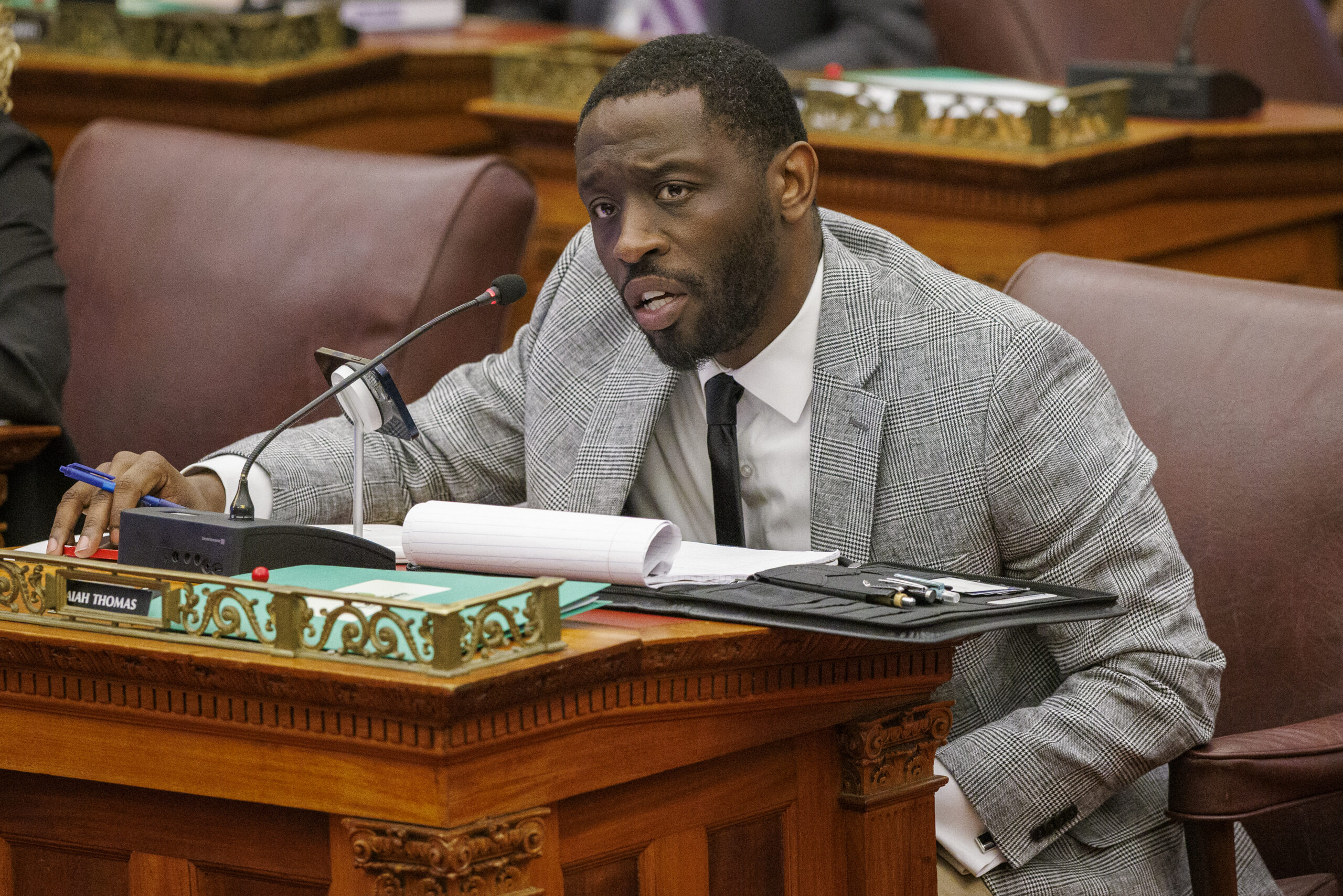
Resign to run gets amended: City Councilmember Isaiah Thomas has been trying for more than a year to pass legislation amending a rule that requires city employees quit their jobs to run for higher office.
He’s attempting to amend the rule so that city officeholders can keep their jobs only if they are running for a state or federal office. That means Council members running for mayor would still have to give up their seats.
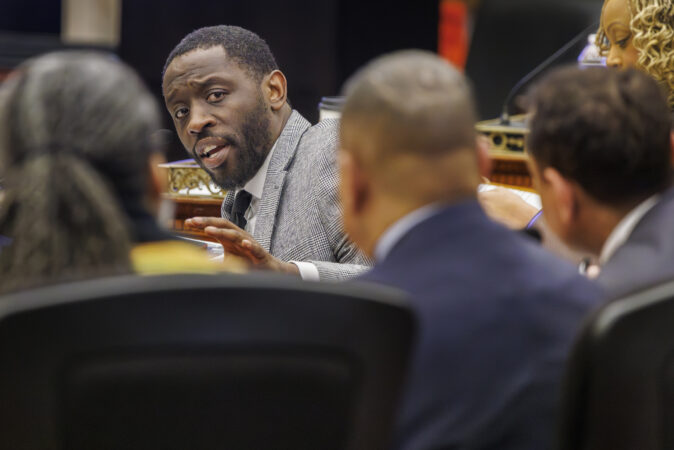
Councilmember Isaiah Thomas makes a statement at the start of a hearing last week.
But Thomas has run into roadblocks, including opposition from the city’s Board of Ethics, which asked him to make changes to the legislation in December, just before it appeared poised to pass.
On Thursday, he introduced an amendment that made a series of tweaks, including clarifying that sitting city officeholders may only run for one public office in any election.
Jordana Greenwald, general counsel for the city’s Board of Ethics, testified that the board still has concerns and requested more amendments, including prohibiting certain forms of politicking in the workplace.
She also said the legislation should clarify that the mayor can’t run for another office while serving as the city’s chief executive, a rule that is already enumerated elsewhere in the city charter.
However, making additional amendments could require Thomas re the legislation entirely. He said he would prefer for the bill to be called up for a final vote next week.
Amending the resign-to-run rule requires changing the city’s Home Rule Charter, meaning voters would have to approve it through a ballot question. Voters have rejected earlier attempts to repeal resign-to-run.
Codifying the youth watchdog: Council members also approved legislation to make the city’s Office of the Youth Ombudsperson permanent.
The office was created through an executive order signed by former Mayor Jim Kenney and is responsible for monitoring child welfare, juvenile justice, and behavioral health residential placement facilities in the city.
Making the office permanent also requires an amending the charter. A ballot question is likely to appear in the May primary election.
Quote of the week
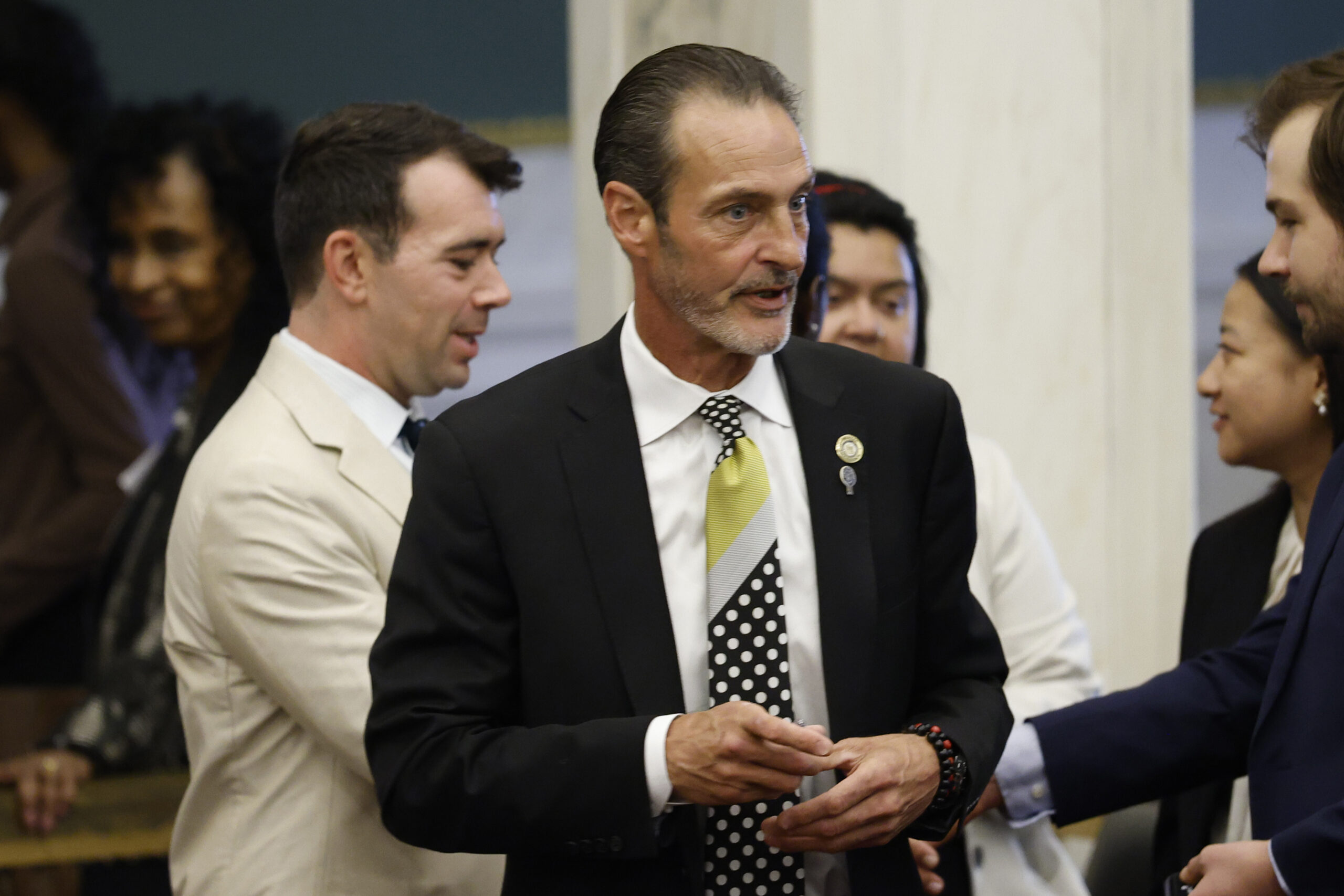
Councilmember Jim Harrity in Council Chambers in September 2025.
That was Councilmember Jim Harrity, an Irish Catholic who in a speech Thursday honored the sacrifices made during the Muslim holy month of Ramadan.
State Rep. Chris Rabb announced Thursday he will not seek reelection to Harrisburg this year while he runs for a seat in Congress.
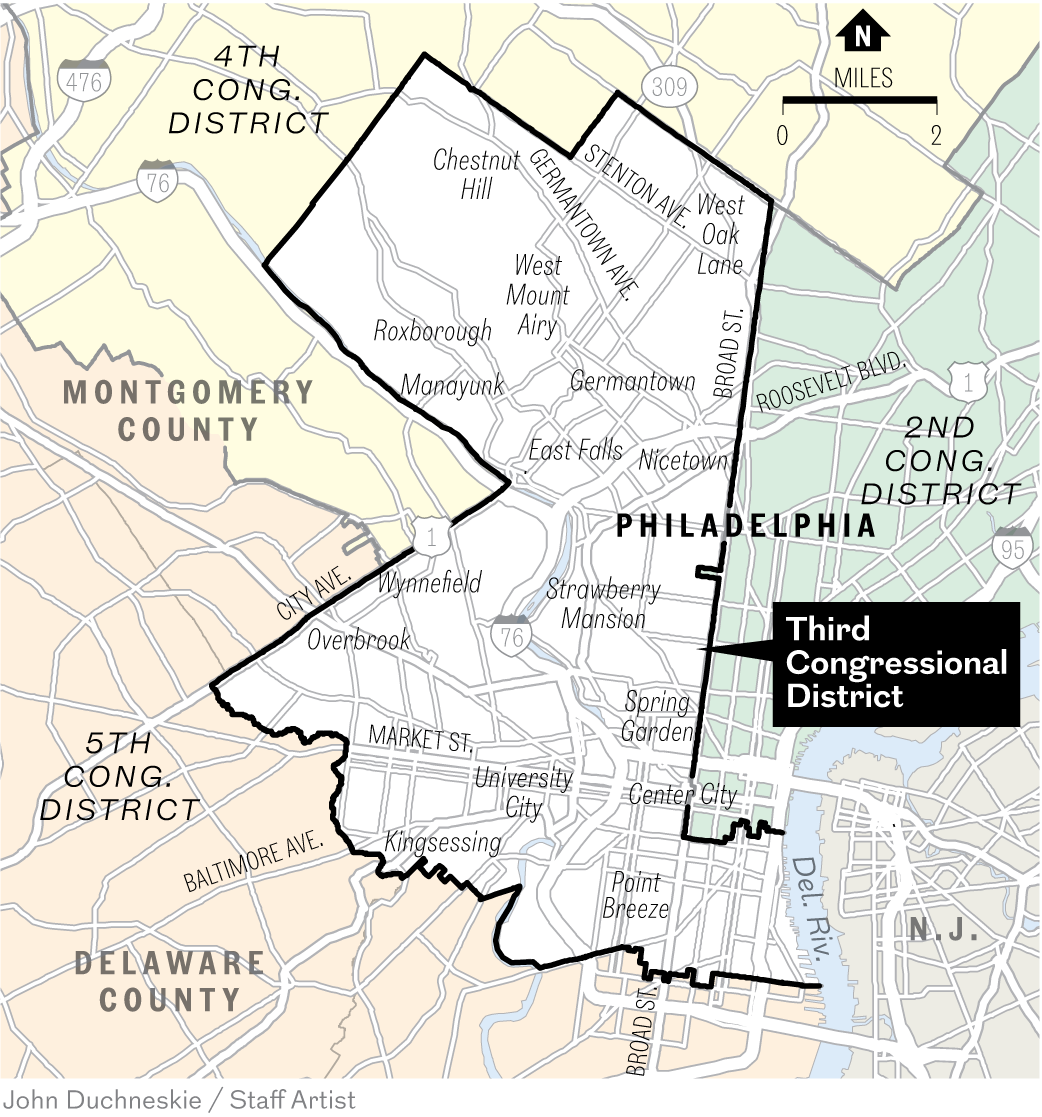
State lawmakers are allowed to simultaneously run for two offices. But Rabb, a Democrat, said he is fully committed to his campaign for Pennsylvania’s 3rd Congressional District, which covers roughly half of Philadelphia and is, by some measures, the most Democratic district in the nation.
“I’m so inspired and overwhelmed by the tremendous outpouring of support we are seeing all across the city, and today I want to send a message loud and clear: I am all in on this race for Congress,” Rabb said in a statement.
Rabb served five terms in the Pennsylvania House’s 200th District in Northwest Philadelphia, a seat once held by Mayor Cherelle L. Parker. A progressive who often operates as a political lone wolf, Rabb has frequently clashed with the city’s Democratic establishment, especially Parker and her allies in the Northwest Coalition political organization.
In his first election, Rabb in 2016 defeated Tonyelle Cook-Artis, Parker’s close friend who now serves as an aide in the mayor’s office. Two years later, he bested Melissa Scott, who is now the Parker administration’s chief information officer. In 2022, redistricting forced Rabb to run against fellow incumbent State Rep. Isabella Fitzgerald, and he won again.
Map of Pennsylvania’s Third Congressional District.
State Sen. Sharif Street, of North Philadelphia, is not up for reelection this year, meaning he will keep his seat in Harrisburg if he loses the congressional race without having to run two campaigns. Street last year resigned as chair of the Pennsylvania Democratic Party after facing questions about whether his congressional campaign would conflict with his party leadership role.
State Rep. Morgan Cephas, who chairs the Philadelphia delegation in the state House and represents a West Philadelphia district, is up for reelection this year. Her campaign on Thursdaysaid she intends to simultaneously run for another term while vying for the congressional seat.
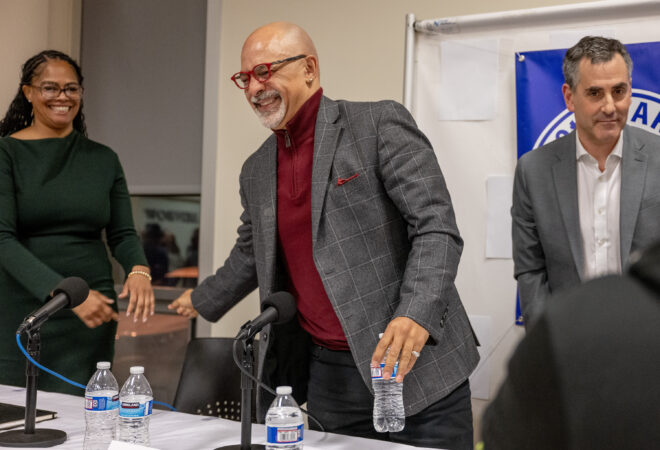
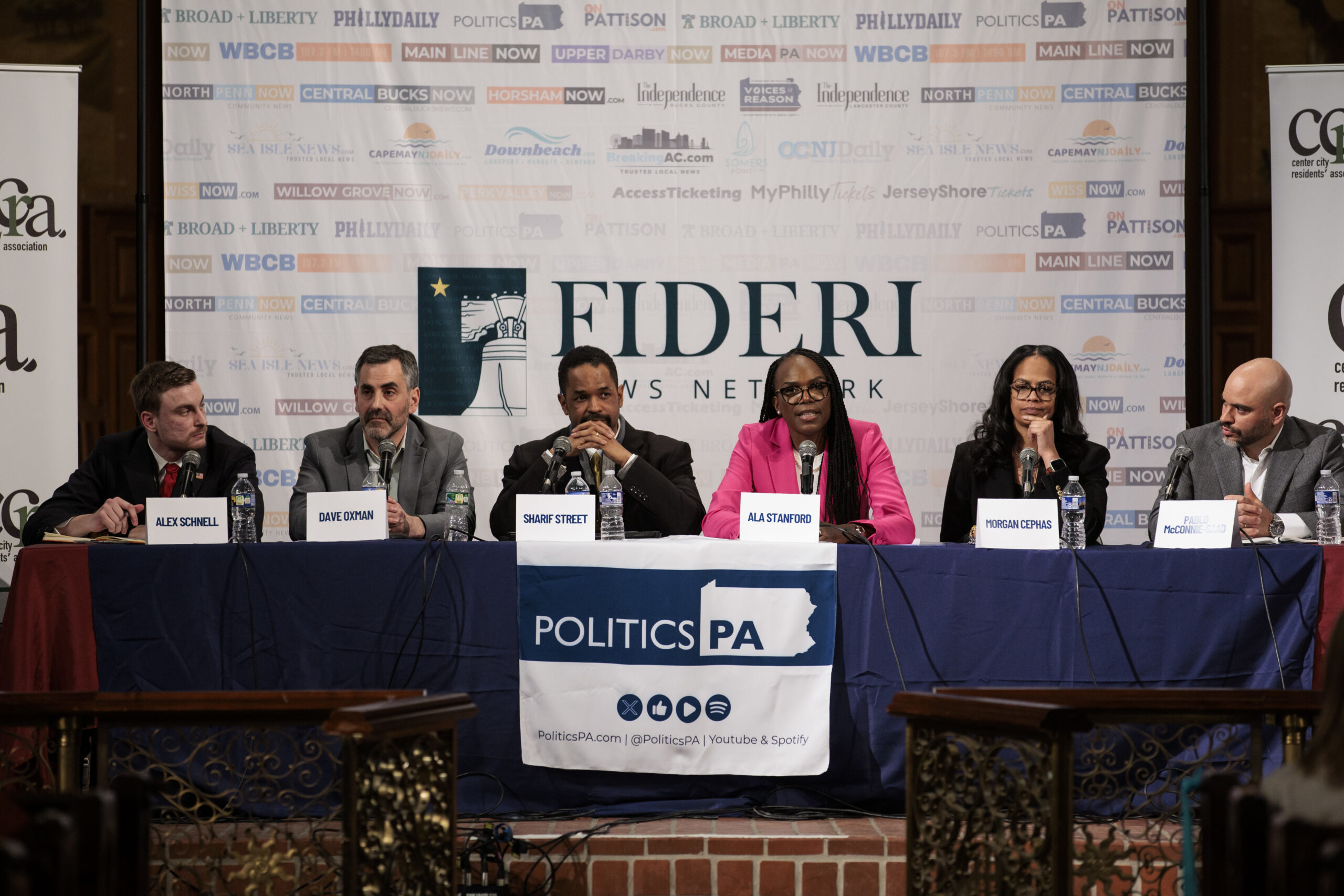
(left to right) Alex Schnell, physician Dave Oxman, State Sen. Sharif Street, physician Ala Stanford, State Rep. Morgan Cephas, and Pablo McConnie-Saad appear during a candidate forum for the 3rd Congressional District seat at Church of the Holy Trinity on Monday, Feb. 9, 2026 in Philadelphia. The seat vacancy comes from Rep. Dwight Evans’ retirement.
It is common for state legislators to run two simultaneous campaigns while seeking federal office. Their reelection bids often require little effort, as incumbents rarely face serious challenges. (Rabb’s career as an anti-establishment legislator in the backyard of one of Philadelphia’s most powerful political factions, however, has made him an outlier in that regard.)
He declined to say how much money went missing. In his most recent campaign finance report, Rabb reported raising $127,000 in the last three months of 2025 and entering the year with $99,000 in cash on hand, which at the time represented the fifth-largest reserve among the 3rd District hopefuls.
Rabb’s decision not to run for reelection means the Northwest Coalition now has its best opportunity in a decade to recapture the 200th District state House seat. Northwest Philadelphia’s liberal voter base, however, also opens the door for another progressive to follow in Rabb’s footsteps.
“It has been the honor of a lifetime to serve Philadelphia families across the 200th House District for the past 10 years and I look forward to seeing the great candidates who will run,” Rabb said. “In the coming weeks, I’m committed to working with my fellow progressive leaders and advocates across this district to ensure that this seat continues to be held by a true champion for Philadelphia’s working families.”
Anyone hoping to succeed Rabb in Harrisburg will have to act quickly. Candidates must submit petitions to appear on the ballot. The window to gather signatures opened this week and closes March 10.
Rabb said Wednesday that his congressional campaign collected the required 1,000 signatures in just 12 hours, which he said makes him the first candidate in Pennsylvania to submit qualifying petitions and shows that his campaign “continues to build strong grassroots support across Philadelphia.”
Philadelphia residents can now consult a new online dashboard to gauge outdoor air quality before heading outto a park, going for a run, or cycling through the city.
The city unveiled a real-time air quality network that collects data from solar-powered sensors at 76 strategic locations, blanketing every neighborhood. The systemcan warn residents whenpollution spikes — for instance, if a junkyard fire sends particulate levels surging.
“Starting now, every resident in Philadelphia will be able to see, almost in real time, the air quality in their own neighborhood,” said Philadelphia Mayor Cherelle L. Parker.
What does the system measure?
The weatherproof sensors, bolted to utility poles at 1.5-mile intervals,track two primary pollutants:
Fine particulate matter (PM2.5), tiny particles that can penetrate deep into the lungs and cause respiratory issues.
Nitrogen dioxide (NO2), a component of ozone.
Parker, along with City Council members and officials from the Philadelphia Department of Public Health’s Air Management Services (AMS), introduced the Breathe Philly initiative Wednesday at Stinger Square Park in Grays Ferry.
The monitoring system, manufactured by Clarity Movement Co., will cost the city $90,000 annually. It is currently funded through the nonprofit Philadelphia City Fund.
The new network operates independently from the city’s existing 10‑sensor system that supplies data to the U.S. Environmental Protection Agency.
Parker said it represents a significant step toward environmental justice, especially in neighborhoods that previously lacked adequate monitoring. Some of the sensors will begin monitoring for ground-level ozone as soon as spring.
Ozone is a potent pollutant formed from chemical reactions between vehicle, power plant, and industrial emissions in the presence of sunlight.
“You can check it on your phone, your tablet, your computer,” she said. “You can access up-to-date information about the air that you and your family are breathing right where you live.”
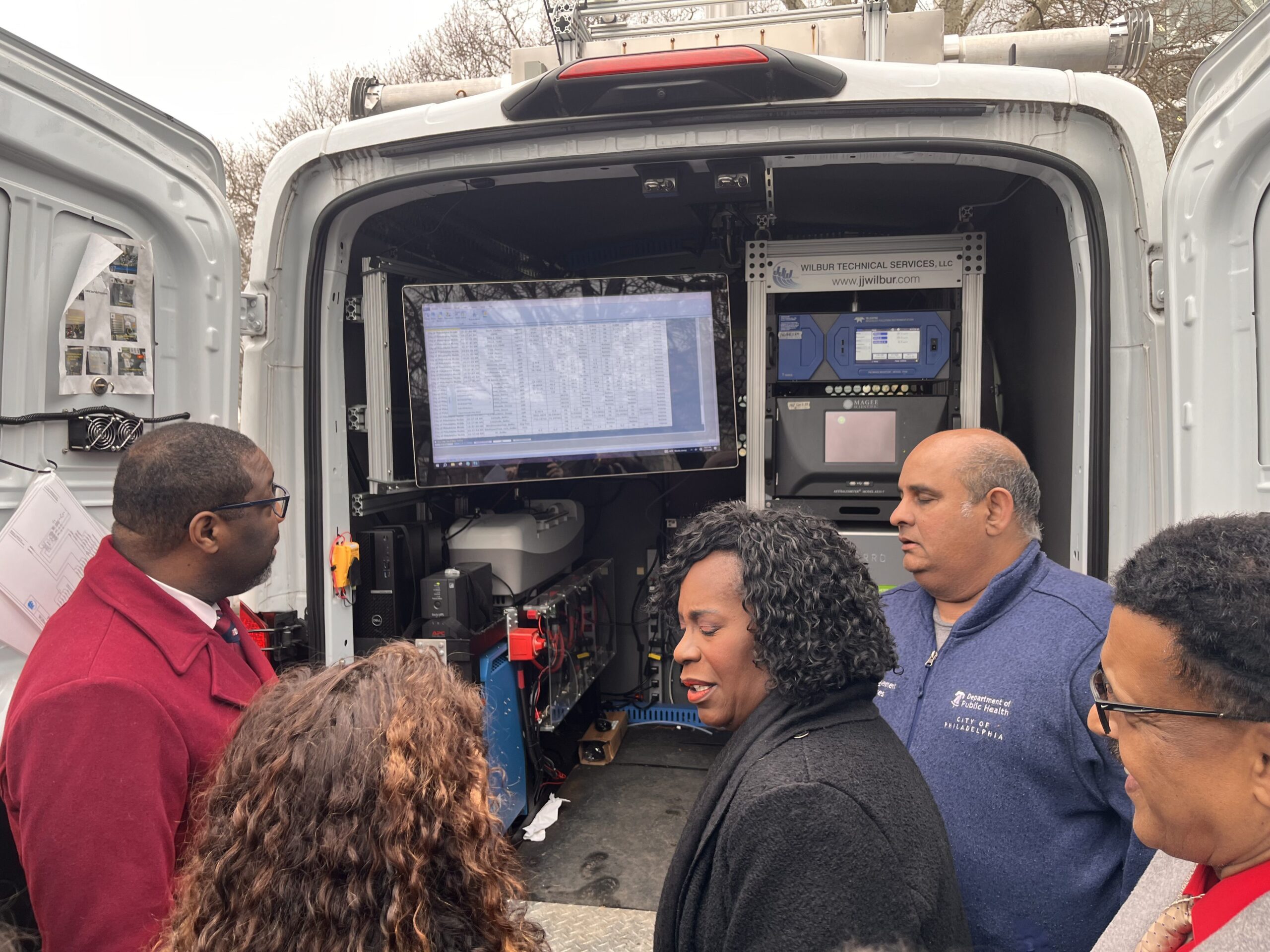
Paresh Mehta (right), an engineer with Philadelphia’s Air Management Services, explains to City Council President Kenyatta Johnson (left) and Mayor Cherelle L. Parker how air quality data is collected.
‘We knew right away’
Palak Raval-Nelson, the city’s health commissioner, said the new air monitoring network has been in the works for years. The project is overseen by the health department’s AMS.
“It’s amazing to finally see that it’s here,” she said.
The system detected the air quality as poor during a fire last week, Raval-Nelson said.
“The monitor went off, and we knew right away that we needed to communicate information,” Raval-Nelson said.
The monitor displays colored circles and squares indicating the air quality at each monitor. Colors range from green, the best, to purple and mauve, the worst.
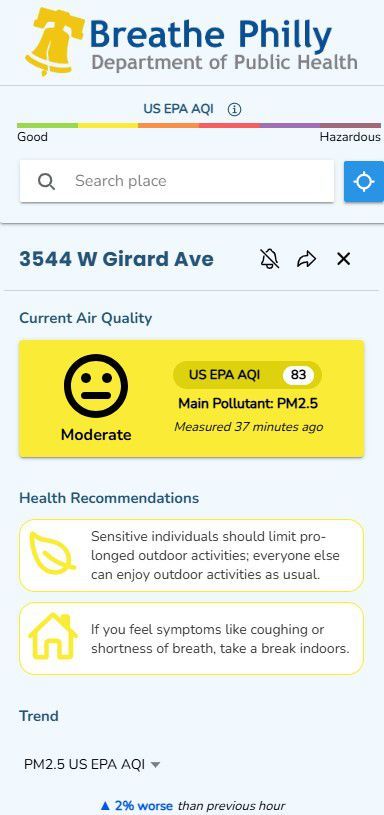
A sample of the Breathe Philly online dashboard that gives residents real-time data on air pollution from 76 sensors placed around the city.
The sensors detect levels of particulate matter, which are tiny particles in the air that can cause health risks. PM2.5 is the result of the burning of fossil fuels, such as by vehicles or power plants. They sensors also measure NO2, a gas also emitted by burning fossil fuels.
Both chemicals can cause respiratory issues.
“It is a concrete step to help keep all of us and our loved ones safe,” Raval-Nelson said of the new sensor system.
Council President Kenyatta Johnson, who grew up in Point Breeze, said the system will help provide real-time information in the event of a disaster, such as the PES Refinery explosion and firein 2019.
And it will help those with breathing issues like asthma decide whether it is safe to go outside for extended periods.
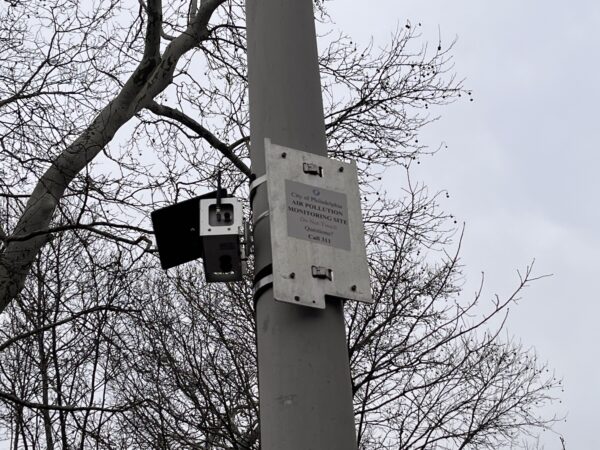
One of 76 solar-powered sensors made by Clarity Movement Co. for a new network of real time air quality data available for Philadelphia residents.
A new layer of safety
Alex Bomstein, executive director of the nonprofit advocacy group Clean Air Council, said the network adds a new layer of safety for city residents.
“You can’t go very far in the city without encountering a monitor, which is wonderful, because that means that everybody in the city is being protected,”Bomstein said.
He fears pollution will worsen in the future as the administration of President Donald Trump continues to roll back environmental rules and regulations, such as those governing vehicle tailpipe emissions.
Sean Wihera, a vice president with Clarity Movement Co., said the company was founded in 2014 as a start-up at the University of California, Berkley. Similar systems have been installed in Los Angeles and Chicago, he said.
The company owns the sensors and is responsible for them if they break or are stolen. The sensors are upgraded after three years for the latest technology. Wihera said it is possible that Philly’s system could monitor for benzene in the future.
“We’ve been working now in 85 different countries, hundreds of cities,” Wihera said. “But this is one of the most successful integrations that we’ve seen.”
When Mayor Cherelle L. Parker stood in the city’s emergency management center last month and announced that her administration was preparing for the worst winter storm Philadelphia had seen in years, she was flanked by the police commissioner, the head of public schools, and a dozen other deputies.
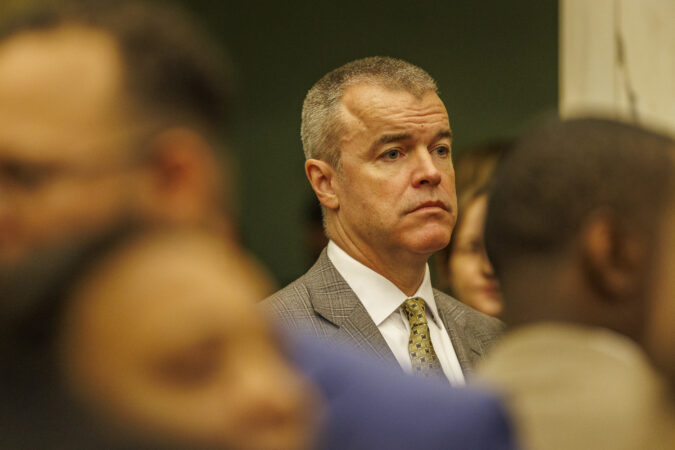
Missing from the news conference of Philadelphia’s top officials was Managing Director Adam K. Thiel, whose job it is to oversee the delivery of city services.
It wasn’t the only time over the last year that Thiel, Philadelphia’s No. 2 public official, was noticeably absent.
Thiel, who is effectively the city’s chief operating officer, was out of office last year for a total of nearly five months, much of which he spent on military leave, according to 2025 payroll register records obtained by The Inquirer. His increasingly low profile in Philadelphia City Hall has generated frustration and fueled questions about his job performance among some lawmakers, especially as the city faced criticism over the recent snow cleanup.
Almost half of Thiel’s $316,200 city salary last year was for paid time off, according to payroll records. He is one of the highest-paid officials in the government and made more than Parker, who last year earned $280,000.
In addition to his top city role, Thiel is a major in the U.S. Army Reserves. He joined the reserves in August 2024, eight months after beginning his job as managing director.
Thiel also holds other positions outside government. In 2024, while he was managing director, he made more than $300,000 working as a consultant, according to financial disclosures. He is an adjunct faculty member at two universities and sits on several nonprofit boards.
Five City Council members told The Inquirer that it has been months since they interacted directly with Thiel.
“The managing director of the city is an extremely important job,” said Councilmember Jamie Gauthier, a Democrat from West Philadelphia. “I do not understand how someone who is absent as much as Thiel is able to carry out this job effectively.”
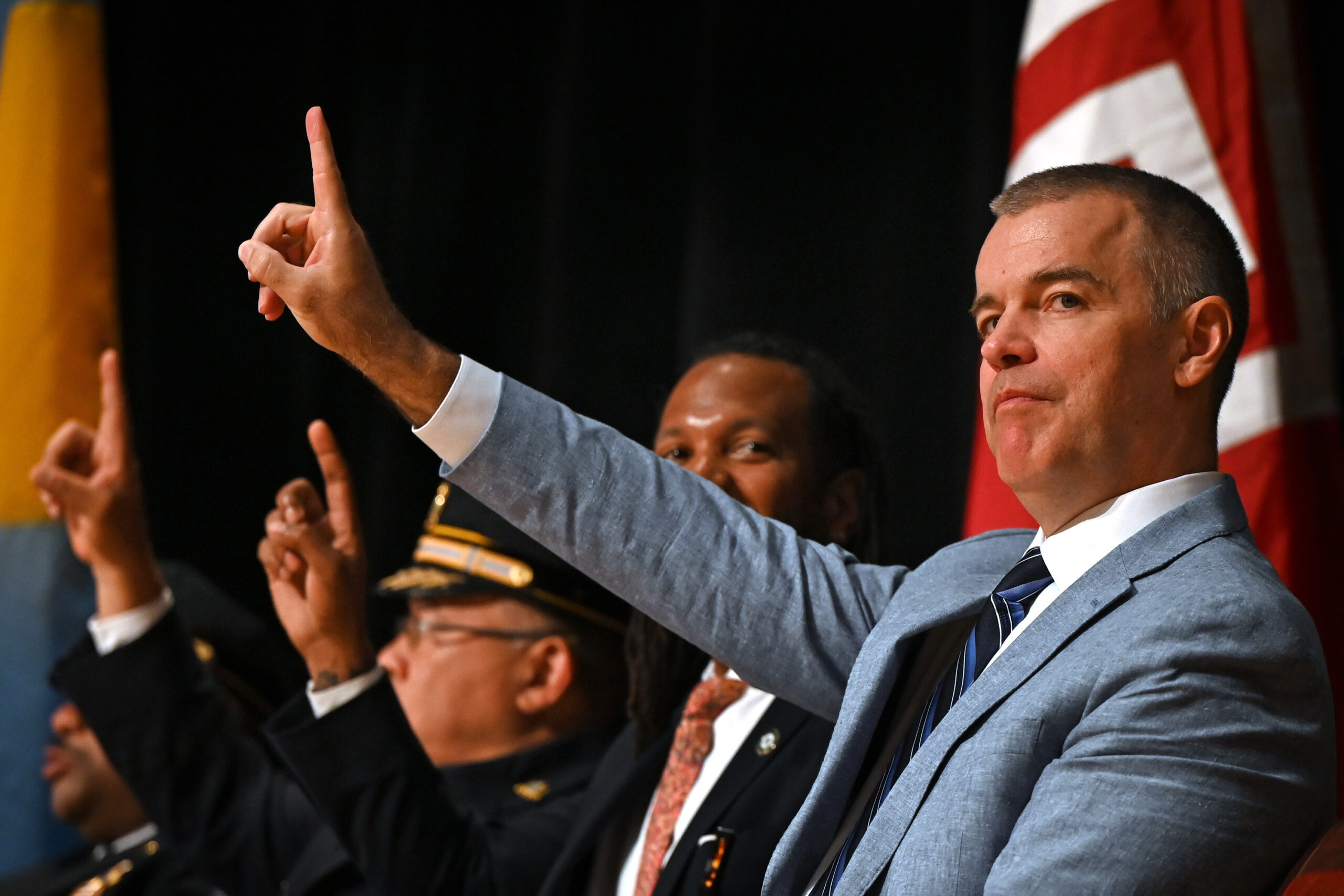
Managing Director Adam Thiel during graduation ceremonies for the police academy Class #402 of the Philadelphia Police Department and Temple University Police Department at Temple University Performing Arts Center June 17, 2024.
The administration declined requests to interview Thiel and Parker for this article. In a statement, Thiel thanked Parker for her “continued support of our city of Philadelphia employees who also serve the United States of America.”
Sharon Gallagher, a spokesperson for the managing director’s office, said in a statement that Thiel has been employed by the city for nearly 10 years and “earns leave offered by the city the same way as other city employees accrue vacation, sick days, family, medical, military and other leave categories.”
Payroll records show that Thiel logged six weeks of military leave time last year — the maximum amount the city offers employees. Gallagher said he also used 11 weeks of accrued vacation time to cover additional military assignments.
The administration declined to answer questions about Thiel’s military service, including details about his location and unit. His LinkedIn page says he “helps provide emergency management subject matter expertise to combatant commands and partner nations.”
Thiel is also founding partner of one consulting firm and the president of a second, though the specific nature of that work is not known and he has declined to disclose his clients publicly.
In 2024, Thiel said his consulting work took fewer than 10 hours per week. Gallagher said Tuesday that “nothing has changed” since then.
The Parker administration did not publicly announce when Thiel was on leave last year, but officials acknowledged it once asked by reporters last summer. At the time, Deputy Managing Director Michael Carroll filled in on an interim basis.
Thiel, 53, is a nationally recognized expert in emergency management. He held a variety of firefighting, public safety, and disaster preparedness roles across the country before coming to Philadelphia in 2016 to serve as fire commissioner and deputy managing director under former Mayor Jim Kenney.
Thiel said in a statement Tuesday that Williams was “the best choice to lead our city’s unified response to the recent snowstorm operation and is the right leader for future snow and ice events.”
Gauthier said the city’s handling of the storm “needed a higher-level emergency response.” She said while she respects Thiel’s military service, she raised his consulting work as a concern.
“A decision needs to be made what he wants to do. Does he want to serve locally, or does he want to do other things?” Gauthier said. “We need a managing director who will serve full time.”
The administration did not answer questions about whether Thiel was in town through the duration of the city’s 26-day winter emergency response.
Parker’s chief of staff, Tiffany W. Thurman, said in a statement that the city is proud to offer benefits such as military and administrative leave that support employee well-being and professional development.
Thurman said Thiel “is always reachable and fulfills the responsibilities of his position as needed based on the situation.”
“His leadership — as is the case with the leadership team of any large city — is not limited by time designated as leave,” she said.
The purpose of the Philadelphia managing director
The authors of the 1950s-era Philadelphia Home Rule Charter created the position of managing director to serve as a barrier between the mayor’s political appointees and the city’s operational departments.
The idea was that having a bureaucrat at the helm would ensure city service delivery would be apolitical, and the mayor cannot fire the managing director without cause.
In reality, different mayors have granted their managing directors varying levels of power.
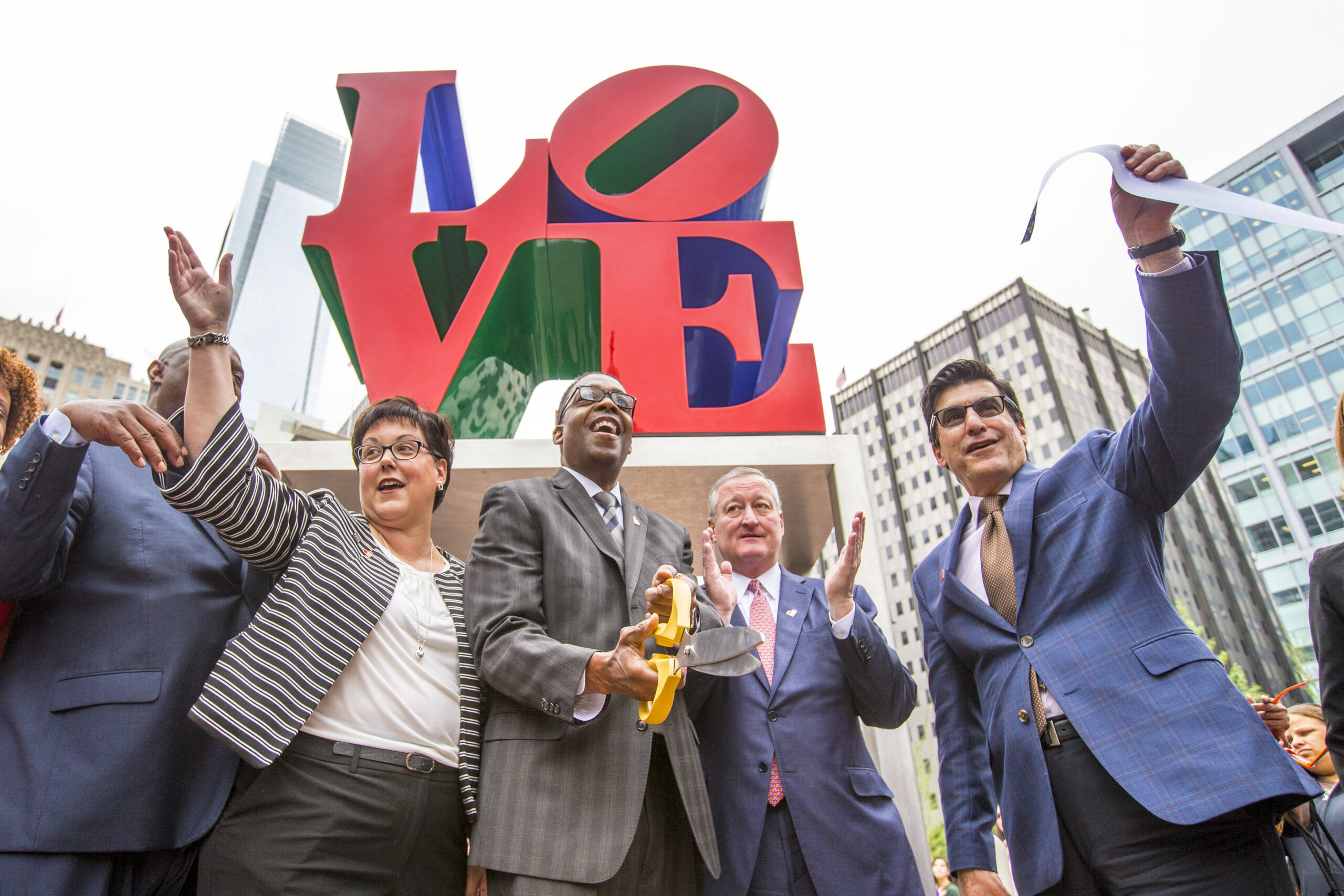
In this 2018 file photo, LOVE Park is by (left to right) then-Philadelphia Parks and Recreation Commissioner Kathryn Ott Lovell, former City Council President Darrell Clarke, former Philadelphia Mayor Jim Kenney and then-Managing Director Michael DiBerardinis.
For example, former Mayor Michael Nutter dispensed with decades of tradition and assigned robust portfolios to several deputy mayors. While his managing directors were important figures in his administration, they oversaw fewer operating departments than their predecessors.
Kenney, Parker’s immediate predecessor, sought to re-empower the city’s managing director position, while his deputy mayors took on advisory roles. He reassigned almost all departmental oversight to the managing director’s office.
“We’re going to have a managing director that’s actually a managing director,” Kenney said before he took office.
Council members who were in office before Parker’s 2024 swearing-in became used to the managing director being accessible. Several lawmakers said that under Kenney’s administration, they routinely communicated about constituent services matters with ex-Managing Director Tumar Alexander and his predecessor, Brian Abernathy.
That hasn’t been the case with Thiel in the role.
“Since the beginning of this administration, I have gone to Carlton Williams,” said Councilmember Jeffery “Jay” Young Jr., a freshman Democrat who represents parts of North Philadelphia.
Mayor Cherelle L. Parker is applauded by members of her administration at City Hall Wednesday, Jul. 9, 2025, hours after reaching a tentative contract agreement with District Council 33 leaders overnight, ending the workers’ strike. At left is Carlton Williams, director of the Office of Clean and Green Initiatives and Chief Deputy Mayor Sinceré Harris is behind the mayor at right.
Several other members said that instead of going to the managing director’s office, they take administrative needs to legislative affairs staff, agency heads, or Thurman.
“Almost everything goes through Tiffany, and she’s able to get things done,” said one Council member who spoke on the condition of anonymity to preserve relationships with the administration.
Parker doesn’t deny that little happens at the top rungs of city government without Thurman’s involvement. The mayor has come to see her chief of staff as the central figure in her administration and calls her the city’s “chief air traffic controller.”
Phil Goldsmith, who served as managing director for two years under former Mayor John F. Street, said Thiel’s minimized public role may be because Parker appears to favor “a very strong mayor’s office.”
“It seems to me that the managing director may have to go through more hoops to get things done than, for example, I had to do,” Goldsmith said. “That’s just a function of what a mayor wants and feels comfortable with.”
Fading out of public view
Thiel’s lack of public appearances over the last year has been unusual for a managing director.
It has been 10 months since he testified before City Council, despite the managing director in previous administrations being a mainstay in hearings to answer lawmakers’ questions about city services ranging from street repaving to emergency preparation.
And in December, when a half-dozen top Parker administration officials spoke during the mayor’s State of the City event, Thiel was not on the roster.
The decrease in visibility marks a departure from his first year in office, when Thiel had a more consistent public presence and was often seen beside the mayor.
Ahead of a snowstorm in January 2024, Thiel stood with Parker during a news conference about preparations. He donned a suit while snowflakes fell, and he reassured the city that the administration was ready for the service disruptions that bad weather can bring.
Mayor Cherelle L. Parker (center) with Managing Director, Adam Thiel (right) and at left Carlton Williams, Director of Clean & Green Initiatives, at a news conference with city officials in Northeast Philadelphia on Friday, Jan. 19, 2024 to share the city’s response to the snowstorm.
Through his first year in the position, Thiel also faced scrutiny as the face of some of the mayor’s most controversial initiatives.
He took a leading role in Parker’s efforts to end the open-air drug market in the city’s Kensington neighborhood, and he oversaw the development of the Riverview Wellness Center, a new city-owned recovery house for people with substance use disorder.
Today, much of Kensington initiative is overseen by the public safety director, who reports directly to Parker. A new head of community wellness is leading development at Riverview, and Williams was the face of the storm response.
Mayor Cherelle L. Parker finishes a news media briefing with her leadership team at the Tustin Playground at 60th St. and W Columbia Ave. Tuesday, Jul, 1, 2025, on the first day of the strike by District Council 33. At left are Carlton Williams (Phillies cap), Director of Clean and Green Initiative with the Dept. of Streets Sanitation Division; and Managing Director Adam Thiel (at lectern).
But by the time the strike was resolved, Thiel had faded from public view, departing from his city job for one of his stints on military leave. After Parker reached an agreement with the union, she held a news conference with 20 top deputies and thanked each of them by name.
Thiel, absent from the City Hall news conference, was not one of them.
Staff writers Ryan W. Briggs and Sean Collins Walsh contributed to this article.
Philadelphia City Council may not have a vote on Superintendent Tony B. Watlington Sr.’s sweeping facilities plan, but it indicated Tuesday that it will have a say in school closings.
As a packed hearing began in Council’s chambers Tuesday morning, both Council President Kenyatta Johnson and Isaiah Thomas, chair of the Education Committee, said Council refused to be a “rubber stamp” to Watlington’s proposal to close 20 schools, colocate six, and modernize 159.
“I’m infuriated that we don’t get a say,” Councilmember Jimmy Harrity said, warning the district officials who appeared before him. “But, Council president, you and I both know we do get a say, because budget’s coming. And we will be looking. Mindful is the word I would use for today — be mindful.”
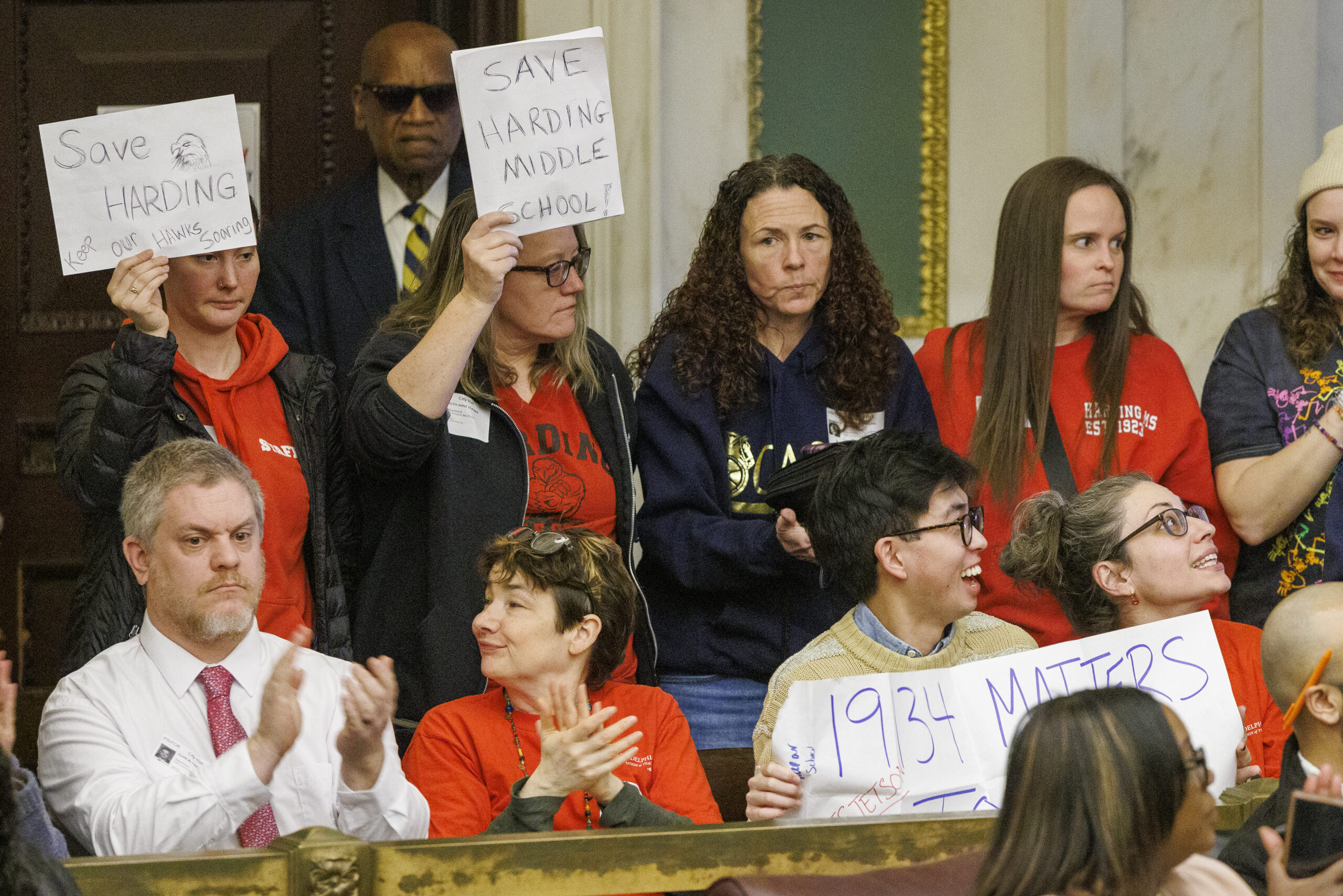
Concerned citizens stand with signs in support of Harding Middle School before the start of a Philadelphia City Council hearing Tuesday at City Hall on the school district’s plan to close 20 schools.
About 40% of the district’s nearly $5 billion budget comes from local revenue and city funding, which City Council and Mayor Cherelle L. Parker must approve in the annual city budget by the end of June.
Harrity, an at-large Council member, said he was “tired that every time cuts come, they come from a certain neighborhood. You know, I live in Kensington, in the 7th District. I talk to these kids. They’re good kids. They deserve everything that other kids in other neighborhoods are getting. … You can see that this isn’t what our people want.” Watlington has proposed closing four schools in the 7th District.
More than 100 community members holding babies and waving signs opposing the facilities plan filled Council chambers on the fourth floor of City Hall on Tuesday as Council members spent hours grilling Watlington and other district officials.
Watlington, meanwhile, stood by his plan in testimony to Council on Tuesday, sayingthat 20 closings was a much smaller number than he could have settled on.
“We could have come here and presented a plan that closed twice as many schools and been able to defend it,” Watlington said.
A once-in-a-lifetime opportunity?
District officials have said thefacilities process is not about saving money, but about optimizing education and equity for the city’s 115,000 students.
But it was clear Tuesday that finances played a part: The district has lost 15,000 students in the last 10 years, and over 80,000 since 1997, when charter schools were first authorized in Pennsylvania. It has 300 buildings, many of them 75 years and older and in poor repair, and some schools with more than 1,000 empty seats, while others are overcrowded.
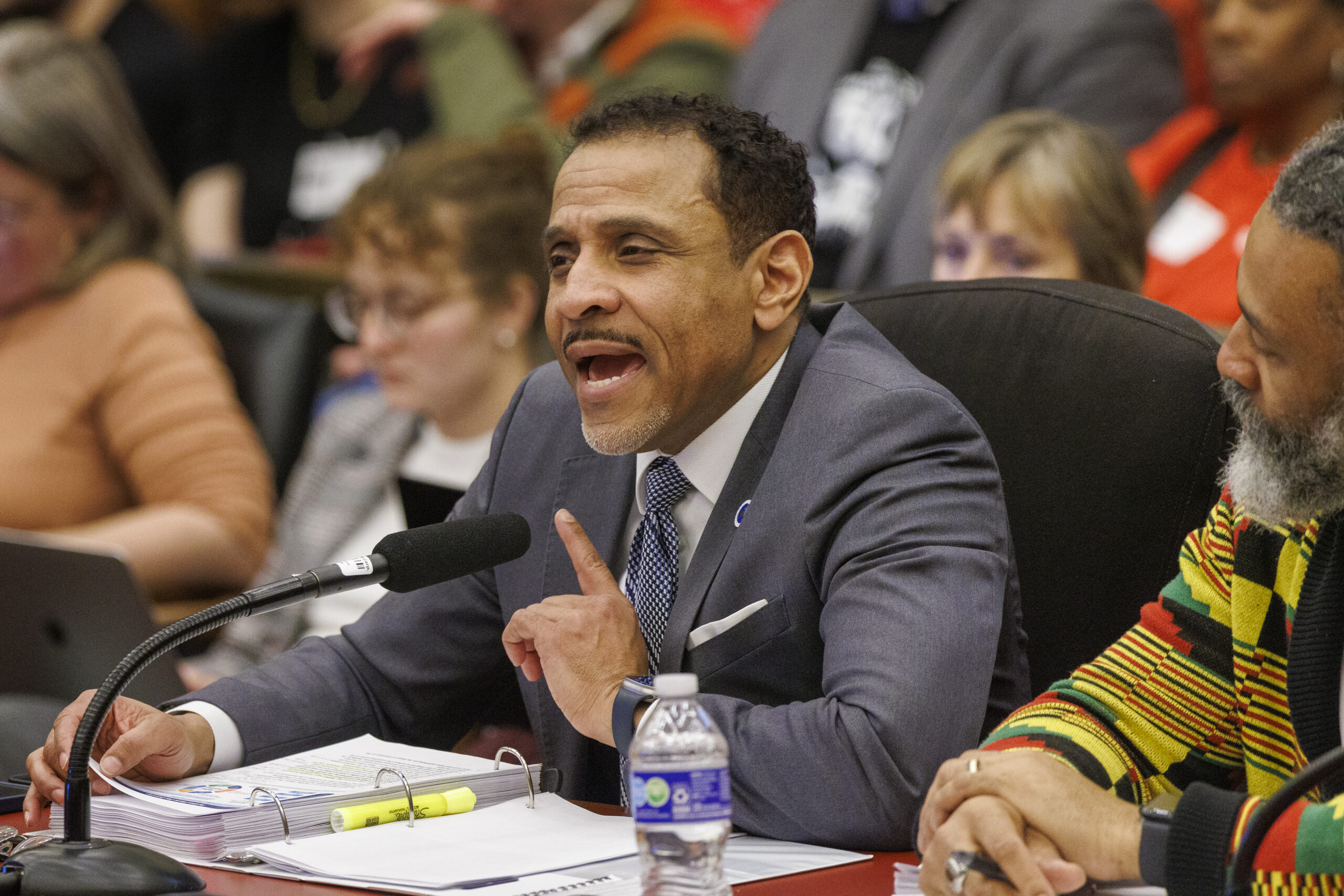
Tony B. Watlington Sr., superintendent of School District of Philadelphia, speaks at a City Council hearing Tuesday on his proposal to close 20 schools.
“We’ve got to be very careful with our limited resources in a historically underfunded district,” Watlington told Council.
Watlington and board president Reginald Streater, who also testified, pitched the plan as a way to add things the district cannot now offer — Advanced Placement courses in every high school, the opportunity for all eighth graders to take algebra, more prekindergarten, and career and technical education programs.
“I do not believe we’ll get this opportunity again in our lifetime,” Watlington said.
The superintendent dropped a few previously undisclosed facts about the facilities road map, indicating that his recommendations could shift slightly before he presents the plan to the school board on Feb. 26. No date has been set for the board’s final vote, which is expected later this winter.
“It’s premature to say how the final recommendations will land,” Watlington said.
But, the superintendent said, “if there are schools that Council wants me to take off the list, and add others on that list, we are open to you telling me what those are, but we cannot get to a place where we address our 35% non-utilization rate in buildings if no changes are made.”
Philadelphia City Council President Kenyatta Johnson (left) greets Dr. Tony Watlington, Superintendent of School District of Philadelphia Philadelphia City Council holds hearing with board members of School District of Philadelphia, Tuesday, Feb. 17, 2026. Reginald L. Streater, Esq., President Board of Education. (center)
Debora Carrera, the city’s chief education officer, who spent three decades as a district teacher and administrator, told Council that Parker believes “the current district footprint is unsustainable.”
Carrera said her own experience as principal of Kensington High School for Creative and Performing Arts shows that it is right for the district to focus resources on neighborhood high schools.
“My high school was a small high school,” Carrera said. “I could only offer my children two AP courses, when other schools like Central — where my son went — could offer them over 20-plus AP courses.“
‘Breaking down of public education’
The hearing got tense at times.
“I feel like this is the breaking down of public education in Philadelphia,” said Councilmember Cindy Bass, who said some of the district’s own decisions had led to closures.
Several members of Council raised questions about the plan’s price tag. Prior district and city estimates put the cost just under $8 billion, but members of Watlington’s team said they could they could actually do the work for $2.8 billion — $1 billion from district capital funds, and $1.8 from yet-unpromised state and philanthropic sources.
In the past, the district had made public detailed facilities condition assessments for every school in the district, Councilmember Rue Landau noted.
Residents could look up their school and see exactly what the condition of every system in the building was, and how much money would be required to fix those that needed repair.
“We don’t have any of those details,” said Landau, who went so far as to say she believed the district should be spending more than $2.8 billion on the plan. “What is the increased investment, and why don’t we have any of those details? They are not out there in the public for us, so none of us have any understanding as to why this is happening, This should all be public so all of the public can see.”
“You need much more money than that,” Roseman told Council. “We need more money than this plan comes close to.”
Some Council members pushed the district and the board on the plan’s timing.
The city has been asking for a long-range facilities plan for years, Councilmember Quetcy Lozada pointed out.
“It’s taken us all this time,” Lozada said. “Now, you guys have come up with a plan, and now we want to rush through it. Now all of a sudden there’s this urgency to get through this plan, which I don’t understand.”
Streater said the board is moving forward with hearing Watlington’s plan on Feb. 26, but won’t vote until it hears more feedback.
But ultimately, he said, the board will vote on “a plan that is dynamic, that can evolve over time. … I think that we all understand that things change, facts change, funding changes, enrollment trends change.”
And, Streater said, there will also likely be policy changes based on redrawing some catchment areas, or boundaries that determine which neighborhood schools children attend.
Streater, who introduced himself at the beginning of the hearing as “Reggie from Germantown,” underscoring his history as a graduate of two district schools that closed — Germantown High and Leeds Middle School — said that changes must be made.
“I think if we continue doing the same thing, expecting a different result — which I would argue is chronic underachievement — we are doomed.”
The city’s teachers union has significant concerns with the Philadelphia School District’s sweeping facilities plan, and it has taken them to a City Council committee.
Superintendent Tony B. Watlington Sr.’s $2.8 billion proposal “does not provide sufficient detail or data to inform binding decisions about school closures, co-location, re-purposing, or widespread impact and disruption that will be incurred,” Philadelphia Federation of Teachers president Arthur Steinberg wrote in a letter to Council’s education committee obtained by The Inquirer.
The appeal, sent late last week, comes as the district prepares for a Tuesday Council hearing on the school blueprint, which currently calls for 20 school closings, six colocations, and 159 modernization projects.
Council members are not the decision-makers — Philadelphia’s school board will ultimately vote on the plan sometime this winter — but as one of the district’s main funders, “you hold powerful levers that may be used to encourage the district to craft a more equitable [plan] that achieves our shared goals of improving student learning conditions and educators’ working conditions,” Steinberg wrote.
About 40% of the district’s nearly $2 billion budget comes from local revenue and city funding, which City Council and Mayor Cherelle L. Parker must approve in the annual city budget by the end of June.
What does the PFT letter say?
Before any decisions are made about what to do with the district’s buildings, the PFT wants system officials to do better by “showing their work and providing all data used to reach their determinations and recommendations for school improvement,” Steinberg wrote.
The teachers union also flagged compliance inconsistencies with the district’s own standards, implementation questions, and “substantial problems with data interpretation and application.”
The conclusions came after Jerry Roseman, the PFT’s longtime director of environmental science, scrutinized the plan. Roseman has decades of experience working with district officials on environmental issues.
The PFT and Roseman want access to all data. The district has released some details officials used to make their calls, but some remain opaque.
“How is the district ensuring that decisions regarding closing and receiving schools are based on comprehensive, up-to-date, and easily verifiable facility data (e.g., lead, asbestos, ventilation, overall condition)?” Steinberg wrote.
The PFT also wants to “definitively show that the facility condition of receiving schools is not, in fact, worse than the facilities thatare slated to close. If students are moving to a facility with worse current conditions, what will happen at the facility to improve it prior to students being moved there?”
District officials outlined some modernization and renovation plans ahead of Tuesday’s Council hearing, but some remain a mystery to the public. Watlington has promised all projects will be detailed before Feb. 26, when he’s scheduled to formally present the plan to the school board.
Don’t close schools or displace students based on incomplete data, PFT says
The school system’s own data contains some inconsistencies, Steinberg said — including some schools judged to be in “good” or “fair” building condition by the district’s metrics that have “severely inadequate” critical systems, such as roofing, windows, or electrical and plumbing systems.
And though the district said it could modernize all 85 school buildings currently in poor or unsatisfactory condition for $2.8 billion, the PFT questioned that price tag as overly optimistic. (City and district officials had previously put the system’s total deferred maintenance cost at $7 billion or more.)
“The cost to fully repair poor-inadequate buildings and systems could actually exceed $3.5 billion,” the PFT said.
The teachers union also highlighted the inequitable distribution of adverse conditions, noting that “Black and brown children and children from economically disadvantaged families are more vulnerable — to health risks, learning disruptions, and the long-term effects of instability and displacement.”
While the information the district has made public is “useful and has value as a ‘baseline,’ it is insufficient for its use in supporting the proposed conclusions, recommendations and other plan details released,” Steinberg said.
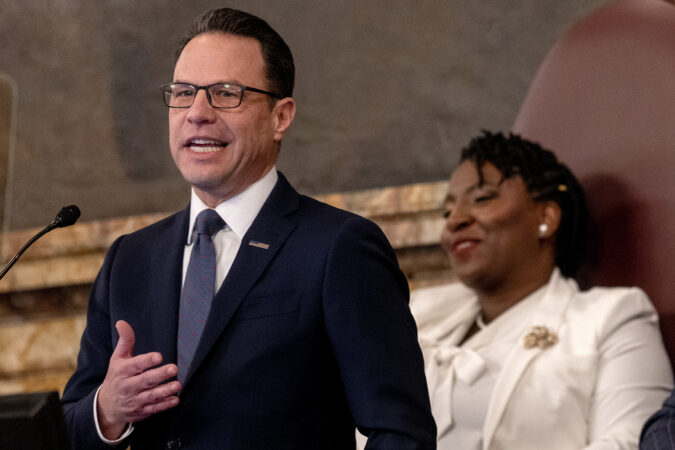
Gov. Josh Shapiro unveiled a broad plan Thursday meant to grow and preserve Pennsylvania’s housing supply as the state faces a shortage of homes residents can afford.
The plan aims to expand residents’ access to homes, connect Pennsylvanians to resources to keep them housed, make homebuilding faster and less costly, and improve coordination of housing efforts across agencies and levels of government.
Recommendations and reforms in the state’s Housing Action Plan, which is meant to guide Pennsylvania into 2035, are embedded in the governor’s proposed budget, Shapiro said.
“And now, the ball is in the court of the legislature to carry this forward and to get it done,” he said at a news conference in Philadelphia.
The plan is the culmination of a process that started in September 2024, when Shapiro signed an executive order directing state officials to create it.
Inthe plan, Shapiro highlights that more than a million Pennsylvania households are spending more than 30% of their income on housing. These households are “cost burdened,” according to the U.S. Department of Housing and Urban Development’s definition. Building more can lower housing costs.
Shapiro called the plan a long-term housing strategy that “brings together all different groups who are doing this work, builds on their expertise, and tackles housing access and affordability from every single angle.”
Here are key takeaways from Shapiro’s proposed housing action plan, the first of its kind in Pennsylvania.
Enacting the plan
Much of the plan relies on action from lawmakers in the state’s split legislature and other stakeholders rather than Shapiro’s administration exclusively. It does not assign dollar amounts to proposals, but calls on local governments to allow more housing and housing types, on builders to build more, and on both to work together to remove barriers to housing construction.
Democrats (left) stand to applaud a tax cut proposal while Republicans (right) remain seated as Gov. Josh Shapiro delivers his third budget address to a joint session in the House chambers at the State Capitol Tuesday, Feb. 4, 2025.
When Shapiro was asked how he intends to make sure the housing plan is implemented, he said he can take some actions through executive orders but “a lot does require the legislature to act and to work in concert with local government.”
“I hear in rural, urban, suburban communities, districts led by Democrats and Republicans, the need for more housing,” Shapiro said. “… And I would say to any lawmaker that doesn’t like my idea, ‘What’s yours?’ Because we can no longer wait. We have got to get this done. We’ve got to build more housing.”
$1 billion fund
In his budget address last week, Shapiro previewed his housing priorities, calling for a $1 billion fund, supported by the issuing of bonds, to pay for infrastructure projects that include housing.
Shapiro’s budget proposal includes no requirements on the proportion of funding that goes to each infrastructure need, leaving the possibility that the majority of funds could be spent on projects other than housing.
While Shapiro said Thursday that divvying up the $1 billion will be subject to negotiation with lawmakers, he said he hoped “the lion’s share of it would go to housing.”
Pennsylvania needs more housing
If Pennsylvania takes no action to build and preserve more housing, it will be short about 185,000 homes by 2035, according to the plan. To keep up with anticipated demand, the state needs to add 450,000 homes to its supply by then.
The housing plan has a stated goal of turning Pennsylvania into a leader in home construction.
Construction work on a home at Bancroft and Reed Streets in South Philadelphia, Pa. on Friday, May 1, 2020.
As it stands now, Pennsylvania is one of the states that have allowed the least new housing. It ranked 44th for the share of homes approved to be built from 2017 to 2023, the Pew Charitable Trusts said in a report released last year. Pew said Pennsylvania’s lack of housing supply is hiking prices for homeowners and renters.
Shapiro’s housing plan recommends that Pennsylvania:
Expand programs to repair and preserve existing homes.
Create a tax credit to incentivize home building in underinvested areas.
Invest in small residential developers who can help boost housing production.
Eliminate outdated or unnecessarystate development regulations.
Direct funding to help homebuilders pay land development costs, developers convert former commercial buildings into homes, and property owners create mixed-use developments that include housing.
Appoint a deputy secretary of housing and create a “housing one-stop shop” to help residents and builders access the state’s existing housing resources.
Protection for renters
The housing plan calls for Pennsylvania to bolster protections for households that either rent their homes or rent the land their homes sit on, including protections Shapiro called for in his budget address.
Suggestions include:
More eviction protections.
Restrictions on how much landlords can collect as a security deposit.
Explicitly banning landlords from denying housing to people because they use public assistance or any other lawful source of income. (New Jersey enacted a law last month that does this.)
Security for manufactured-home owners
Manufactured homes are single-family dwellings often built off-site and placed on a lot. These households own their homes, but many of them rent the land.
Manufactured homes represent one of the most affordable forms of homeownership. But homeowners are often left vulnerable because they have no other option than to pay increased rent costs if they want to keep the homes they own. Manufactured-home communities are increasingly being bought by private equity companies and other institutional investors, and rent hikes tend to follow.
The housing plan says Pennsylvania should:
Limit the rent increases that landowners can charge.
Make financing easier for buyers of manufactured homes.
Giveresidents of manufactured-home communities the right of first refusal when a landowner decides to sell.
Recent laws in New Jersey limit annual rent increases for manufactured-home lots and make it easier for residents to buy their communities.
Across Pennsylvania, 56,000 households live in manufactured-home communities, Shapiro said in his budget address last week.
Homebuyer help
The plan calls for Pennsylvania to pursue new ways to help residents become homeowners, including creating programs to reduce home-buying costs and allowing local governments to exempt first-time homebuyers from local realty transfer taxes.
It also calls for the state to impose a transfer tax when corporate investors buy single-family and certain other types of homes to help households compete for properties.
Untangling titles
To protect Pennsylvanians’ generational wealth, the plan calls for the state to allow transfer-on-death deeds to provide a streamlined process for passing down homes. This would help prevent cases of tangled title — or unclear legal ownership of property. This mostly occurs when a homeowner dies and the deed is not transferred to a new owner.
Tangled titles keep people from qualifying for help to repair their homes and can prevent them from being able to sell properties.
The plan also calls for funding for legal services to help low-income Pennsylvanians resolve tangled titles. In 2022, Philadelphia officials pledged to give $7.6 million over four years to legal-aid groups that are tackling this problem.
Rachel Gallegos, a divisional supervising attorney for the homeownership and consumer rights unit at Community Legal Services of Philadelphia, called Shapiro’s plan “ambitious.”
“And I like that,” she said. “I think it has to be in order to keep progress moving forward.”
The legal-aid nonprofit routinely helps low-income clients with tangled titles, and Gallegos said she was glad to see the plan call for additional support for the work.
“We want to preserve homeownership for our clients,” she said.
Foundation separation. Cracked masonry. Failing floor joists. A building so compromised that city officials said it posed “immediate danger” to human life.
That violation is just the tip of the iceberg. I know this because I have lived it. On Aug. 23, my wife noticed a large crack forming in our living room ceiling. We alerted management through their portal, and I went to their on-site office to report it. Less than 24 hours later, at 12:06 a.m., the entire ceiling collapsed.
Residents speak during a demonstration organized to protest against the living conditions at Brith Sholom House apartments in Philadelphia in April 2024.
Fortunately, we had renters’ insurance. While management took their time deciding what to do, we stayed in the apartment under the exposed ceiling until our insurance finally booked us a hotel. After two days of waiting, we were moved temporarily so repairs could be made. But that displacement came with costs: For eight days, we paid out of pocket for meals and essentials while living in the hotel.
Nevertheless, when we returned home, a notice was taped to our door: “Overdue rent.”
Management knew we were displaced because of conditions they failed to address. And still, they badgered us for late rent — as though the collapse was an inconvenience tothem, rather than a danger to us.
A citywide crisis
Unfortunately, my story isn’t unusual. My neighbors have filed a class-action lawsuit against the owners and managers of the property due to the complex-wide dangerous conditions described in an “unsafe structure” L&I violation. This lawsuit reflects a mounting rental safety crisis across Philadelphia.
Philadelphians deserve safe and healthy homes, tenants deserve roofs and ceilings that are secure, floors that don’t buckle, and air that doesn’t make their children sick. We have laws on the books intended to address these issues.
But a combination of loopholes, insufficient funding, and lack of enforcement leaves renters without a clear means to enforce those laws, placing many renters between a rock and a hard place: pay for unsafe housing, risk retaliation for withholding rent, or absorb the costs of displacement.
Renters aren’t completely powerless, though. This year, we’ve seen that when renters come together, they win. This spring, City Council took the first steps toward addressing the city’s rental safety crisis by creating a fund for tenants displaced because of unsafe conditions. But that fund sat empty for months, until a coalition of housing justice advocates successfully lobbied for Mayor Cherelle L. Parker’s H.O.M.E. Plan to fund it.
The Safe Healthy Homes (SHH) campaign, led by OnePA, Renters United Philadelphia, Philly Thrive, and the office of Councilmember Nicolas O’Rourke, provides commonsense answers to these issues: protecting renters who speak up about unsafe conditions from landlord retaliation, authorizing proactive L&I inspections, and requiring proof of code compliance to evict or collect rent. These are all things we would assume are happening already, but this package adds the critical enforcement provisions that have been missing.
Safe housing is not a perk — it is the bare minimum, and City Council’s Housing Committee had a long-overdue hearing for the SHH package tentatively scheduled for Tuesday.
I encourage you to let the members of the committee know how you feel about having safe and healthy homes for tenants across our city.
B. Cincere Wilson is the chief operations officer of Myra’s Kids Inc., a nonprofit serving justice-impacted and high-risk youth. He lives in Philadelphia and works in New York City.