As America prepares to celebrate its 250th anniversary, the state of the union is in turmoil.
In little more than a year in office, President Donald Trump has assailed the country’s institutions, upset the constitutional system of checks and balances, flouted the law, undermined democracy at home and abroad, and ignored the rising cost of living for ordinary people while lining his family’s pockets.
Under Trump — at the whims of his unelected billionaire buddy, Elon Musk — senseless funding cuts have gutted U.S. medical research, led to thousands of federal employees losing their jobs, and more than 800,000 lives lost due to discontinued foreign aid.
The president’s chaotic mass deportation efforts have a body count — including two citizens — as the nation’s streets are overrun by heavily armed, masked federal agents who routinely use excessive force with little accountability. Meanwhile, the government continues to protect the rich and powerful listed in the Jeffrey Epstein files, perhaps hoping to redact away their sins.
When the president addresses Congress on Tuesday at the annual State of the Union address, he will do so with a 60% disapproval rating, according to a Washington Post-ABC News-Ipsos poll. Those abysmal numbers echo those seen after the Jan. 6, 2021, assault on the U.S. Capitol by Trump followers.
The reproach has been hard-earned by the president, who has squandered away the goodwill of voters after his undeniable 2024 election victory.
Rather than focusing on the kitchen-table issues that won him a return trip to the White House, Trump has ramped up the cruelty of his anti-immigrant policies and ignored the economic pressures many people face.
Instead of presiding over cooling inflation, the president’s obsession with tariffs cost American families an extra $1,000 last year. In place of policies that would make owning a home more affordable and bring down the cost of rent, Trump said he wants to keep housing prices high. Contrary to what the administration wants people to believe, mass deportations don’t create jobs; they stunt economic growth.
The tax cuts promised in Trump’s signature piece of legislation, the One Big Beautiful Bill Act, mostly benefited the very wealthy. The law allots billions to hire U.S. Immigration and Customs Enforcement agents and build vast detention facilities on the back of steep cuts to Medicaid and food assistance.
That people are roundly pushing back against the president’s upside-down priorities and abuses of power seems to have restored some conservative leaders’ resolve.
In Congress, a handful of Republicans have also rejected Trump’s wishes, denouncing his administration’s refusal to release the Epstein files and the president’s ill-conceived tariffs on Canada. GOP lawmakers have so successfully abandoned their authority to Trump that even these limited developments are heartening.
When it comes to the president, perhaps the legislative branch should pay heed to the judicial.
In the same court decision that denied Trump his tariff authority, Justice Neil Gorsuch, who is part of the conservative majority, laid it out clearly.
“Yes, legislating can be hard and take time. And, yes, it can be tempting to bypass Congress when some pressing problem arises,” the Trump appointee wrote in his concurrence. “But the deliberative nature of the legislative process was the whole point of its design. Through that process, the Nation can tap the combined wisdom of the people’s elected representatives, not just that of one faction or man.”
The American people and the courts are speaking. If the state of the union is to ever recover, Congress must listen.
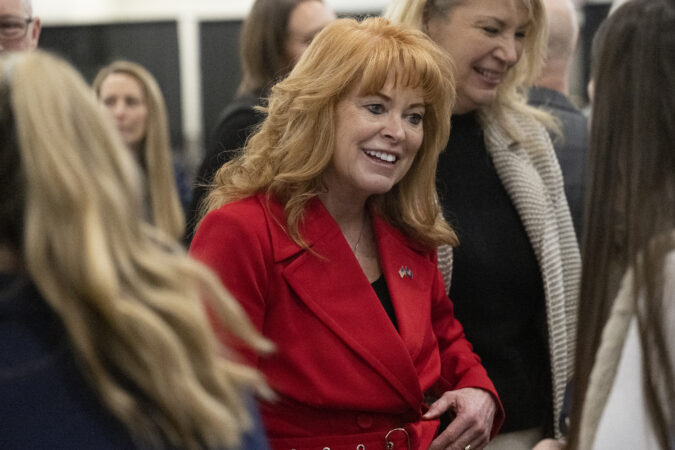
Pennsylvania Republican gubernatorial candidate and state Treasurer Stacy Garrity is to be among the guests filling the U.S. House’s gallery Tuesday night when President Donald Trump delivers the first State of the Union address of his second term.
Her presence at the primetime speech underlines her alignmentwith Trump on the national stage as she pursues her challenge against popular Democratic incumbent Gov. Josh Shapiro, widely seen as a potential contender for the White House in 2028.
A campaign spokesperson said Garrity will attend the address in her official capacity as state treasurer rather than as a candidate, but the Republican lawmaker bringing herto the event specifically cited her campaign for governor when he announced her as his guest.
“I am pleased to announce that the next governor of Pennsylvania Stacy Garrity will be my guest at the coming State of the Union,” U.S. Rep. Glenn ‘GT’ Thompson, who represents the 15th District, said earlier this month at a gathering of Pennsylvania Republicans in Harrisburg.
Steven Chizmar, a spokesperson for the Pennsylvania Treasury Department, said that Garrity was in Washington for the National Association of State Treasurers through Tuesday and that her attendance at the speech will come as part of this previously scheduled trip.
“This opportunity will allow her to gain valuable insights into national issues that could impact Pennsylvanians and the services provided by the Pennsylvania Treasury Department,” Chizmar said. “Attending the State of the Union is an honor rooted in more than two centuries of American tradition and Stacy Garrity is proud to be able to attend the president’s address.”
Garrity’s trip to Washington comes just days after Shapiro was among the Democratic governors to meet with Trump at the White House for the National Governors Association’s annual conference — though he skipped the black-tie dinner after Trump’s attacks on colleagues.
But now a little over a year into his second term, Trump’s approval rating is sinking. According to a new Washington Post-ABC-Ipsos poll, 60% of Americans said they disapprove of how Trump is handling the presidency. This is a potential liability for Garrityand other Pennsylvania Republicans on the ballot this year.
The Pennsylvania Democratic Partyseized on Garrity’s planned appearance at the State of the Union. Party chair Eugene DePasquale said during a news briefing Monday that Garrity will be “cheerleading” Trump’s “damaging” policies and specifically tied Garrity to rising healthcare costs.
Democrats boycott or bring guests to send a message
Healthcare costs willlikely be a key point of Democratic messagingagainst Trump on Tuesday night, following a national spike in insurance premiumswhen enhanced tax credits for the Affordable Care Act expired at the start of the year.
U.S. Rep. Madeleine Dean, who represents the 4th District, which is primarily Montgomery County, is to bring Lisa Boone Bogacki, a physical therapist and affordable healthcare advocate from Berks County.
Bogacki‘s husband, Gary, died from a sudden cardiac event in 2009 and Bogacki’s family came to rely on the Affordable Care Act and Social Security survivor benefits.
“Prior to the ACA, I paid over $20,000 annually for insurance coverage, and this was where the majority of the kids’ survivor’s benefits was spent,” Bogacki said in a news release from Dean’s office. “The ACA finally made insurance premiums affordable for us. This year, my premiums have drastically increased, following the new cuts made to the program.”
U.S. Rep. Chris Deluzio, who represents the 17h District in Western Pennsylania, also focused on health care messaging with his announced guest, Jonathan Akanowicz, an independent pharmacist from Hampton Township.
Addressing anothercontentious issue, Trump’s immigration agenda, U.S. Sen. Lisa Blunt Rochester of Delaware plans to bring Maria Mesias-Tatnall, director of outreach and immigration assistance at theDelaware Department of Justice.
Some Democrats are choosing to express their disapproval in other ways.
U.S. Rep. Mary Gay Scanlon of the 5th District mostly in Delaware County, is also scheduled to attend the “People’s State of the Union” event, organized by progressive groups MeidasTouch and MoveOn, her office confirmed.
After he boycotted Trump’s joint address to Congress last year, U.S. Rep. Dwight Evans of the 3rd District in Philadelphia will not attend Trump’s address Tuesday night. In his place, Evans — who is retiring — has designated Carolyn Hill, a Philadelphia grandmother who is impacted by Trump’s cuts to SNAP, an honorary guest.
Republican lawmakersfrom the region
U.S. Sen. Dave McCormick of Pennsylvania will be hosting hosted Jason Zugai, vice president of United Steelworkers Local 2227, as his guest after Japanese company Nippon Steel finalized a buyout of U.S. Steel in June. McCormick played a key role in persuading Trump to back the deal after his initial public opposition.
U.S. Rep. Ryan Mackenzie of the 7th District, which is north of Philadelphia will to bring Sarah Arndt, the lead teacher at PathStone Carbon County Head Start, where she has worked for the past 13 years. Funding for her program was in jeopardy last fall amid the lengthy government shutdown and state budget impasse.
And Sheryl Klein, a senior at Council Rock High School South in Bucks County, will to bethe guest of U.S. Rep. Brian Fitzpatrick of the 1st District. Klein founded and leads the high school’s Women’s Empowerment Club.
“That is the kind of civic engagement we should be encouraging across this country at every level: unifying, positive, and rooted in service to something greater than ourselves,” Fitzpatrick said.
Fitzpatrick and Mackenzie represent key swing districts, which both parties are targeting in the fall.
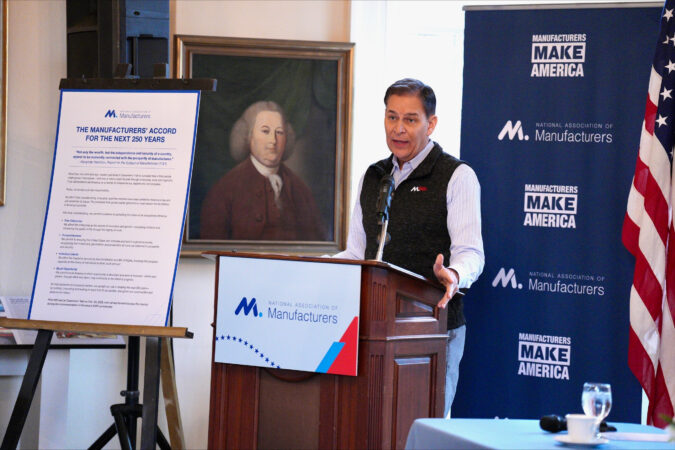
Jay Timmons, president of the National Association of Manufacturers, says the factory revival Trump and his recent predecessors have championed has been aided by Trump’s business tax cuts and pro-fossil fuel agenda. But, he said, mass worker deportations or rapidly-changing import taxes are not helping.
Timmons appealed to leaders of Philadelphia’s port, shipbuilders, regional Chamber of Commerce, and other industry group leaders to embrace his group’s pro-factory agenda at Carpenters Hall. He made a similar appeal at Cleveland’s Rock & Roll Hall of Fame earlier in the week, and heads to the Carolinas next week.
Jay Timmons, president of the National Association of Manufacturers, was at Carpenters’ Hall in Philadelphia with area business leaders on the day the U.S. Supreme Court announced its tariffs decision.
After the Supreme Court ruled against Trump, Timmons said in a statement that industry shares Trump’s goal of strengthening U.S. manufacturing, and wants to work with Congress and Trump on more “durable” ways to do that. While Trump had boosted tariffs on U.S. neighbors and longtime allies, Timmons said, NAM’s position is that “if tariffs are utilized as a tool, they should be targeted to countries engaged in specific unfair trading practices,” especially countries where government controls production, which would include China and Russia.
He agreed to take questions from The Inquirer.
The conversation has been edited for clarity and length.
U.S. Sen. Joe Grundy, the Bristol mill owner who founded the Pennsylvania Manufacturers’ Association, led the pro-tariff movement long before President Trump. Has your group always backed high tariffs?
No, ours was founded as a free-trade organization. Thomas Dolan, our first president, was a woolen manufacturer from Philadelphia. We wanted to open markets and sell our stuff in other countries.
The president is obviously a fan of tariffs; that is a tool he has chosen to use.
We’re on the launch pad, we are ready to go. We’re seeing success in terms of lowering the costs of doing business, in our tax code, in regulatory modernization, in energy development.
This year we are focused on other issues we would like to see addressed, hopefully in a bipartisan way. We want to see legal reform of the permitting process, so we are not constantly in court trying to reach a final decision on whether an industrial project can move forward.
Do you want the federal government to override state and local building limits on industry?
State and local need to have a say, but the process needs to be streamlined.
I served in Gov. George Allen’s administration in Virginia. His focus was on working together to attract jobs, communicating in a simultaneous manner. We attracted record investment and job creation [without damaging] air and water quality.
We need to [fix] the regulatory morass in Washington. Right now, several agencies have a say on a project. An agency reviews it, that takes months. Then another agency, and another.
Won’t you need more federal workers to do reviews all at once?
Whatever it takes. We aren’t saying we want a compromise on health and safety. We’re saying do it in an expeditious manner.
I don’t share this [concern], but there are folks concerned about the rising costs of electricity and putting that blame on AI data centers.
Demand will increase. You’ll have issues of local concern. But we have to supply more power, which means states have to step up and work with the utilities to improve transmission, the power grid; and the federal government should have a role.
What recent U.S. energy developments are you applauding?
Pennsylvania has led the way, with natural gas clearly helping the U.S., in terms of energy dominance and exports. Oil, also. Even nuclear is getting a kick start.
Southern Co. led the way with that, restarting a [uranium power] plant in Georgia. That is hard, it takes a long time. Also the small reactors, we don’t have a clue yet [if those will be deployed in large numbers] but it could be helpful.
What are your priorities to make manufacturing grow more rapidly?
First, to help us expedite investing in the U.S., which tax [cuts] have done.
Second is hiring and workforce development. We have 433,000 open jobs in the sector. Our goal is obviously to train more potential manufacturing workers. Apprenticeship programs — we have our own — need to expand dramatically.
And third, we want to see a reliable and consistent immigration policy that focuses on the needs of our country. We’ve endorsed the Dignity Act.
The Dignity Act, from Reps. Maria Elvira Salazar (R., Fla.) and Veronica Escobar (D., Texas), would let immigrant workers, who pay a fine and taxes, buy work permits; and mandate employers E-Verify job applicants. Is that like the Reagan reforms?
Reagan, directionally, was correct on immigration.
We are a nation of immigrants. We are a melting pot and that is what has made us successful.
Things are different today with public opinion. You have to focus on very narrow objectives that are directly related to the economic life of this country, because that’s what the president and Congress want to do.
What’s your goal for trade and tariffs?
To see certainty and predictability. The administration has been very focused on finding access to markets overseas, which is also one of NAM’s founding principles.
The U.S.-Mexico-Canada Agreement is up for renewal. [Negotiators] are dealing with transshipments from China through Canada and Mexico, which obviously was not our intent for the agreement. Getting another agreement is going to be really important for manufacturers who have used provisions to move manufacturing from China into the U.S.
When do you expect signs of increased factory investment and hiring in this second Trump term?
Rewind to 2017, we got tax cuts, regulatory modernization, and [faster] energy production. You saw three or four years later the highest employment growth in 21 years, the highest wage growth in 15 years. If you get the policies right it gives you an advantage. That’s our goal.
We have the rocket, but it needs fuel, and a clear sky. We need [to resolve] immigration, workforce development, and trade certainty.
Wrangling a big transportation project takes deft timing: scheduling the planning and construction stages in proper order, obtaining environmental approvals, and lining up financing from local, state, and federal sources.
Now officials are trying to figure out how best to keep the project moving while replacing the lost $159 million federal grant.
“This is a pretty unprecedented situation,” said Jesse Buerk, associate director of capital programs and project development for the Delaware ValleyRegional Planning Commission (DVRPC).
“I’ve never seen it before, where a project is funded and it’s moving along through the process, and then the funds are completely rescinded,” he said, speaking at the recent committee meeting.
It wasn’t just Philadelphiaor the Chinatown Stitch project that got nixed. That legislation rescinded $3.2 billion that had been awarded but not yet spent through the Biden-era program, 55 projects across the nation aimed at mitigating the impact of highway projects on marginalized communities.
President Donald Trump’s administration targeted equity and access transportation projects as wasteful “DEI”-style spending.
But at a meeting earlier this month, the DVRPC’s Regional Technical Committee voted to table the city’s request to study it further.
Several suburban residents on the technical committee, composed of experts from the eight counties in the region and the state governments of Pennsylvania and New Jersey, had raised concerns about spending up to $12.5 million on the design work without having construction money locked up.
“This request is a significant gamble if you’re not able to recoup those reconnecting communities [funds],” said Brian E. Styche, a transportation planner for Chester County. “We would just like more time to discuss what the plan B is.”
DVRPC’s board of directors is scheduled to discuss the city proposal on Thursday.
Christopher Puchalsky, policy director for the city’s Office of Transportation and Infrastructure Systems, said he understood the concerns: “I don’t think there’s any arguing with the fact there’s some amount of risk.”
Alternative construction funding
The city was able to complete planning and engineering work with $8.4 million of the grant. It needs to secure final design funding before federal environmental review and approval, Puchalsky said.
Not being able to move forward would add additional delay to the project, he said.
The city is exploring alternatives for construction money, including the possibility of tax-increment financing for at least some of the funds, Puchalsky said.
That form of financing uses property tax revenue for development in a specific local district.
“There’s just enormous community support and political support for this project that a lot of the folks have been waiting 40 years for,” he said.
What is the Stitch?
The Chinatown Stitch project involves building a cap over I-676 from just east of 10th Street to 13th Street, allowing for a park as well as more developable land. It would reconnect the north and south sides of the neighborhood, which are split by the interstate.
The implication is clear. The United States economy is doing well, so nothing else matters. However, although an elevated Dow helps those with retirement accounts, what does it mean for the 40% of Americans who do not have a 401(k) or any other retirement savings account? How does that translate into affordability for basic items like food, clothing, shelter, and, perhaps most importantly, healthcare?
The latter is a huge problem, especially with the Medicaid and Medicare cuts in July, and the expiration of the Affordable Care Act (ACA) subsidies last month. The combination is expected to affect 15 million Americans by 2034. Consider also that 3.14 million Pennsylvanians, which translates to 24.1% of everyone in the commonwealth, were covered by Medicaid in 2024.
The facts are that health insurance has become increasingly unaffordable for most Americans, and that has a downstream effect. When health insurance premiums are prohibitive, people are more likely to go without insurance or opt for a plan that offers a lower premium but a much higher deductible. Those people are more likely to skip important preventive care, placing them at increased risk for adverse health consequences. This also applies to those whose Medicaid benefits were cut.
Under Health and Human Services Secretary Robert F. Kennedy Jr., the number of measles cases in the U.S. has skyrocketed.
President Donald Trump has promised to decrease the price of prescription drugs through the Trump Rx program, but in actuality, the differences will be much smaller than promised.
To his credit, his administration has tried to address the price of drugs by reining in pharmacy benefit managers, the middlemen whose practices serve to increase the cost of drugs. However, the success in that area pales in comparison with the overall detrimental effects of this administration on healthcare.
The most recent problem is the expiration of the federal subsidies under the ACA. Consider the case of Pennsylvania residents Tom and Carol Shaw, who saw their health insurance premiums jump from $1,090 a month to $3,505 a month, largely due to the loss of the ACA subsidies. That’s a 221% increase!
To put that in perspective, the average monthly mortgage payment in York County, where they live, is about $1,300, according to the U.S. Census. The Shaws can afford the increase, but what about those who can’t? The result is that about 85,000 Pennsylvanians have dropped their health insurance in 2026. That amounts to one in five enrollees terminating coverage, which is truly a stunning statistic.
On top of the financial effects, the dismantling of our vaccine infrastructure poses a significant risk to the health of the nation. The science of vaccines has not changed, but the politics have, such that Health and Human Services Secretary Robert F. Kennedy Jr. has been able to spew misinformation and take numerous actions designed to destroy trust in science and physicians without any accountability, no matter how much he mangles the facts and the science. As a result, in 2025, we saw 1,277 measles cases — the highest number since 1992.
Meanwhile, Kennedy continues to insult physicians by stating that the only reason physicians recommend vaccines is to make money. It is difficult enough to take proper care of patients in the limited time allotted without having to dispel the numerous lies coming from this administration.
It is not clear exactly what President Trump will say in his upcoming State of the Union address. We suspect he will address the affordability of healthcare. If he does, we are quite confident he will dismiss it as a nonissue, given his comments in December that the affordability crisis is a hoax.
We are convinced he will cite the Dow while ignoring the fact that 59% of Americans disapprove of his handling of their cost of living. We fully expect a speech that will be tone deaf to the financial plight of many Americans, including his own supporters.
There must be accountability for this administration. The midterm elections are approaching, and healthcare, yours and that of your neighbors, will be guided by your vote.
If we do not address this issue appropriately, we will pay the price, as will our children and loved ones. In fact, we already have.
Mark Lopatin is a physician and the author of “Rheum for Improvement,” a member of Ask Nurses and Doctors, and a coeditor for Doctors for America, a nonprofit that focuses on putting patients over politics. Jeffrey Lerner holds a doctorate in health policy and is the Pennsylvania coordinator of Ask Nurses and Doctors, a bipartisan organization whose mission is to help elect government officials who prioritize U.S. healthcare problems.
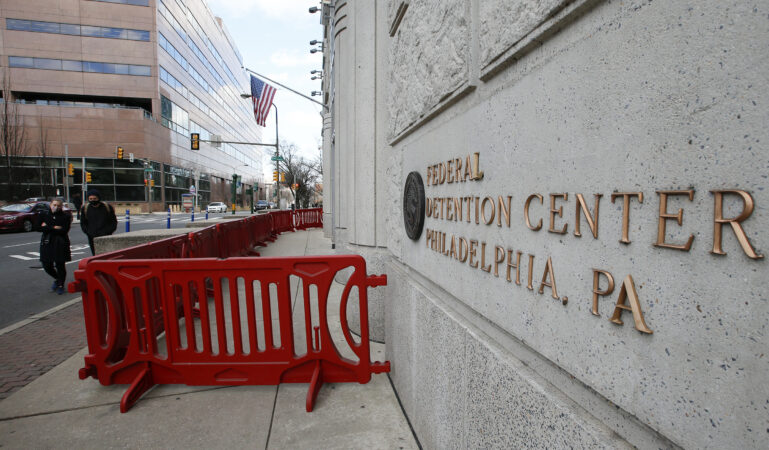
Philadelphia’s federal courthouse has become awash in lawsuits filed by undocumented immigrants challenging the government’s attempts to detain them, an Inquirer review has found, the latest example of how the mass deportation push by President Donald Trump’s administration has been affecting the nation’s legal landscape.
Through six weeks this year, court figures show, 168 such lawsuits have been filed in Pennsylvania’s Eastern District Court, up from 115 in all of 2025.
By contrast, only 11 such suits were filed between 2020 and 2024, meaning a new practice of litigation dominating the region’s federal court practically sprung up overnight.
<iframe title="An Unprecedented Rise In Release Petitions" aria-label="Column Chart" id="datawrapper-chart-Ze5f9" src="https://datawrapper.dwcdn.net/Ze5f9/1/" scrolling="no" frameborder="0" style="width: 0; min-width: 100% !important; border: none;" height="499" data-external="1"></iframe><script type="text/javascript">window.addEventListener("message",function(a){if(void 0!==a.data["datawrapper-height"]){var e=document.querySelectorAll("iframe");for(var t in a.data["datawrapper-height"])for(var r,i=0;r=e[i];i++)if(r.contentWindow===a.source){var d=a.data["datawrapper-height"][t]+"px";r.style.height=d}}});</script>
In other jurisdictions, the surge has become so pronounced that judges and attorneys say they’re struggling to keep up. In New Jersey, the region’s chief judge last week issued new procedures for filing and litigating the petitions, writing: “The volume and timing of these filings is creating a substantial burden on the Court’s ability to expeditiously docket, assign, and address” them.
In Philadelphia, nearly all of the increase in habeas petitions appears tied to the Trump administration’s decision last summer to mandate detention for virtually every undocumented immigrant encountered by authorities. ICE and other agencies are now confining people who would have previously been eligible to remain in the community while their cases wound through the immigration system, such as people who have been in the country for years, or those who have not complied with ICE’s instructions while living here.
“It was not a big part of our work up until about six months ago,” said Chris Setz-Kelly, a managing attorney with HIAS Pennsylvania, a nonprofit that provides legal assistance to immigrants.
For decades, Setz-Kelly said, there had been a clear understanding about who was or was not eligible to be released on bond once they were picked up by ICE. But he said that changed under mandatory detention, which also says anyone who is newly detained should be denied a bond hearing.
And the petitions represent just the tip of the iceberg, the attorney said, as many detained immigrants don’t have representation or leave the country during the process.
“It had really dire consequences to the community,” Setz-Kelly said.
The number of people in immigration detention has since grown from about 50,000 people in June, to nearly 70,000 people at the start of this year, federal data show.
‘The border is everywhere’
Trump’s administration has been clear about its desire to increase deportations. And it has scored one legal victory in a higher court so far while defending its mandatory detention policy in court.
Earlier this month, a three-judge panel in the Fifth Circuit Court of Appeals ruled the policy was legal and could be applied in Louisiana, Mississippi, and Texas.
The government’s main argument in that case was that every undocumented immigrant is, in legal terms, “seeking admission” to the United States, despite a longstanding interpretation that the phrase only applied to people who had recently crossed the border without proper paperwork.
“The everyday meaning of the statute’s terms confirms that being an ‘applicant for admission’ is not a condition independent from ‘seeking admission,’” the majority opinion said.
Two Fifth Circuit judges agreed with the government’s position.
The one who dissented, U.S. Circuit Judge Dana M. Douglas, wrote that the government’s interpretation contradicted the basics of immigration law and, in effect, would create a situation in which “the border is now everywhere.”
A ‘trap’
The ruling in the Fifth Circuit — based in New Orleans, and widely considered one of the most conservative courts in the country — has done little to change the views of judges in Pennsylvania’s Eastern District Court.
This region’s federal judges have consistently criticized the government’s mandatory detention policy over the last eight months, ruling in favor of nearly every immigrant seeking to be released from confinement.
Some judges have quoted Greek mythology to describe what they’ve cast as an unending attempt by the Trump administration to continue defending a policy that has been resoundingly rejected in court. The region’s chief judge even wrote that “the law is piled sky high against the government’s position.”
Diamond, in an opinion this month, wrote that he’d reviewed 201 recent decisions in the district involving habeas petitions, and found that judges in every case had rejected the government’s view that mandatory detention — with no opportunity for bond — was both warranted and legal.
U.S. District Judge Karen Spencer Marston, a Trump appointee, wrote in a recent decision that she was “unpersuaded” by the Fifth Circuit’s ruling as she agreed to free an undocumented immigrant from custody.
Still, government attorneys have appealed dozens of those losses to the region’s Third Circuit Court of Appeals. Experts believe the effort is part of a Justice Department attempt to create opposing appellate rulings and propel the question of the policy’s legality to the U.S. Supreme Court, which has a conservative majority.
“I think they’re just trying to tee up the right cases,” said Chris Casazza, a Philadelphia-based immigration attorney who has filed more than 60 habeas petitions in recent months. “They’re hoping the Supreme Court is going to rubber stamp this.”
In the meantime, judges in Philadelphia are continuing to confront and rule on dozens of petitions in an emerging area of law.
This week, in a blistering opinion, U.S. District Judge Gail A. Weilheimer wrote that ICE had set up a “trap” for “thousands of non-citizens,” who are required to file forms, attend check-ins, or apply for asylum to receive permission to stay in the country.
But under mandatory detention, Weilheimer wrote, those applicants will now get arrested and taken to a detention facility for the duration of their removal proceedings, which could take months or years.
The judge compared the situation to the government handing immigrants a bow and instructing them to shoot an arrow at a tree.
If anyone hits it, Weilheimer said, “the Government will look at the mark, paint a target to the left of it, and accuse them of missing.”
Correction: This story has been updated to correct the spelling of Chris Setz-Kelly.
Following several years of major worker organizing efforts and high-profile strikes, 2025 brought a change in momentum for the labor movement. President Donald Trump’s administration sought to end federal workers’ union contracts and, through a firing, left the National Labor Relations Board without a quorum and unable to make decisions.
But the percentage of workers who are union members nationwide has stayed pretty steady in the last year, new data shows. And in Pennsylvania and New Jersey, union membership rates fell.
In 2025, 10% of the country’s total workforce was part of a union, compared to 9.9% in 2024, according to new data from the U.S. Bureau of Labor Statistics. It’s the first time since 2020 that the rate has inched up — albeit slightly — instead of down.
However, BLS noted, this year’s estimates are not fully comparable to past years because they are based on a BLS survey that is missing October figures due to the government being shut down in October and part of November.
In the past year, there have been “a lot of kind of anti-labor efforts coming out of the White House,” said Todd Vachon, assistant professor of labor studies and employment relations at Rutgers University.
Despite those efforts Vachon said, “labor has pretty much maintained the same at the national level. … The Trump attacks haven’t really had any effect yet, at least in the first year.”
window.addEventListener(“message”,function(a){if(void 0!==a.data[“datawrapper-height”]){var e=document.querySelectorAll(“iframe”);for(var t in a.data[“datawrapper-height”])for(var r,i=0;r=e[i];i++)if(r.contentWindow===a.source){var d=a.data[“datawrapper-height”][t]+”px”;r.style.height=d}}});
Union membership rates dropped to an all-time low nationwide in 2023 and remained pretty similar in 2024. During those years, roughly one in 10 U.S. workers was part of a union.
When BLS first started recording this data in 1983, about two in 10 U.S. workers were unionized. There were 17.7 million unionized workers in 1983 and 14.7 million last year.
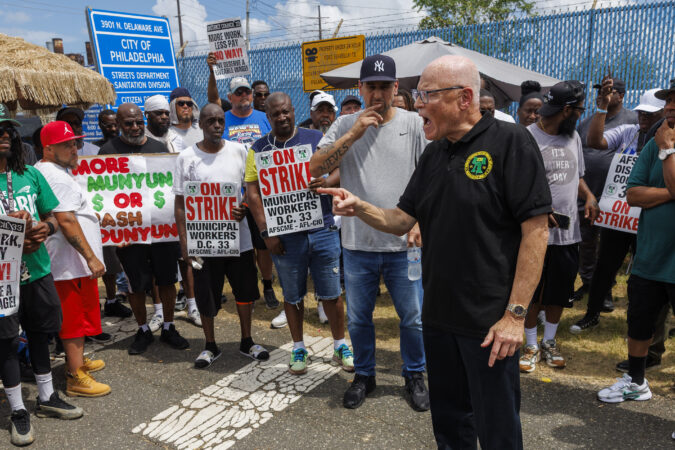
Danny Bauder, president of the Philadelphia Council AFL-CIO, speaks at an event supporting federal workers in October.
Unionizing in N.J. and Pa.
In New Jersey, 14.7% of workers were unionized last year, and in Pennsylvania, it was 10.9%.
In both states, that was a decline of around one percentage point from 2024, but BLS noted that state-level data “should be interpreted with caution,” due to the shutdown-related incomplete data.
window.addEventListener(“message”,function(a){if(void 0!==a.data[“datawrapper-height”]){var e=document.querySelectorAll(“iframe”);for(var t in a.data[“datawrapper-height”])for(var r,i=0;r=e[i];i++)if(r.contentWindow===a.source){var d=a.data[“datawrapper-height”][t]+”px”;r.style.height=d}}});
Some local labor action highlights from this past year include:
Whole Foods unionization: Workers at the Spring Garden location voted to form a union in January, becoming the first unionized Whole Foods staff. Whole Foods challenged the election, and the NLRB was without a quorum to decide the case last year.
Graduate student workers at the University of Pennsylvania reached a tentative agreement on a first contract this month after threatening to strike, nearly two years after unionizing.
Employees of several hotels went on strike in Octoberand November as their union, Unite Here Local 274, sought new contracts for roughly 1,000 members at eight Philadelphia hotels.
National Starbucks strike: Philadelphia Starbucks workers joined a nationwide strike in November amid contract negotiations. Some have returned to their jobs, but over 1,000 continued to strike as of early February.
New teacher contract: The Philadelphia Federation of Teachers got a new contract for 14,000 teachers, nurses, counselors, secretaries, and paraprofessionals, averting a strike.
Some 271,000 federal jobs were cut between January and November. Meanwhile, the union membership rate in the public sector increased by 0.7% nationally in the last year according to the new BLS data.
Vachon notes that the vast majority of public sector workers are at the municipal level, not federal.
“The hiring of police, and teachers, and sanitation workers across the thousands of cities around the U.S. more than compensated for [cuts at the federal level], because we see an increase in the public sector,” he said.
Trump also fired a member of the National Labor Relations Board (NLRB) early last year, which left it without a quorum to issue rulings. In some cases that can slow down the formation of a new union — at the Amazon-owned Whole Foods in Philadelphia, for example.
The number of union elections overseen by the NLRB declined last year and the overall number of workers involved in those elections dropped too, according to the nonpartisan Center for American Progress.
“A huge percentage of new union organizing is required every year just to maintain the same level of unionization, because of the churning and the growth of the overall labor force,” said Vachon. “If the labor force is not growing, then you can actually see increases in union density.”
And unions are being cautious of reaching out to the NLRB under the Trump administration, he notes.
“There’s a fear [that] if something gets sent up to the NLRB that the ruling is going to set a precedent that makes it even more difficult to organize,” said Vachon. “It’s kind of had a dampening effect in that way.”
MUNICH — When Russia invaded Ukraine on Feb. 24, 2022, no one imagined Moscow would be enmeshed in a quagmire four years later, having lost nearly 1.2 million killed, wounded, or missing soldiers to an army a fraction of its size.
The price Ukraine has paid for its defiance was written on Volodymyr Zelensky’s face — weary, puffy, aged dramatically beyond his 48 years — as he took the stage at the Munich Security Conference last weekend.
“I want you to understand the real scale of these attacks on Ukraine,” he told an attentive audience, bluntly detailing the 6,000 attack drones, 150-plus missiles, and more than 5,000 multiton glide bombs Russia had dropped on civilian targets in January alone.
“Imagine this over your own city,” Zelensky demanded. “Shattered streets, destroyed homes, schools built underground, not a single power plant in the country that has not been damaged by Russian attacks.”
Yes, imagine those bombs dropping on Temple University and Jefferson Hospital, on apartment towers on Broad Street, and on William Penn atop City Hall. Imagine living under mounds of quilts in your home because power infrastructure had been deliberately destroyed.
And yet, as Zelensky made clear, Ukraine won’t surrender to Vladimir Putin — nor to Donald Trump.
Kyiv will not bow to shameful White House demands that it cede critical, fortified territory in the Donbas region to Russia, with no solid U.S. security guarantees to stop Putin from swallowing this gift and attacking again.
Based on Zelensky’s words, and what I heard from other European leaders, tech executives, Ukrainian military officers, poets, and tech innovators in Munich, here are my takeaways on what to expect in Ukraine as the fifth year of war begins.
Yuliia Dolotova, 37, uses foam rubber to insulate her children’s bed in her apartment during a power outage caused by Russia’s repeated air strikes on the country’s power grid, in Kyiv, Ukraine, Feb. 2.
No end in sight
The war will not end in 2026. Putin isn’t winning, and Ukraine is holding on. Kyiv’s current strategy — as its army eliminates more Russian troops each month than the number of fresh recruits Moscow can send to the battlefield — is to increase that kill ratio, and to batter Russia’s military and economy until the Kremlin is finally forced to negotiate seriously.
But U.S.-brokered peace talks, whose second round in Geneva broke up abruptly on Wednesday, are headed nowhere so long as Trump only pressures Ukraine.
Russia hasn’t changed its hard-line demands one iota, still demanding Ukraine slash the size of its army, get rid of Zelensky, and forgo Western security guarantees. In other words, commit suicide.
Equally absurd, as Zelensky pointedly noted, is that Putin has rejected any European participation in peace talks, with Trump’s acquiescence. Never mind that the European Union and member countries now pay 98% of the cost of military and economic aid to Kyiv, including payments to Washington for limited amounts of U.S. weapons. Meantime, Trump cut off 99% of U.S. aid to Kyiv in 2025.
“We don’t hear any compromises from Russia,” Zelensky said, citing Moscow’s “strange” demand that Kyiv hold elections amid Russian bombing — a demand that received buy-in from U.S. negotiators.
“Give us a two-month ceasefire before elections,” Zelensky proposed. “Or we can also give Russia a ceasefire if they will have [free] elections in Russia.”
The Munich audience cheered.
In this photo provided by the Ukrainian Emergency Service, firefighters put out the fire in private houses following a Russian air attack in Sumy region, Ukraine, Tuesday.
“Peace can only be built on real security guarantees,” Zelensky rightly insisted on stage, given that Putin has broken every previous accord Russia has made with independent Ukraine over the past three decades.
Since NATO membership is not on the table, Ukraine requires a legal commitment, not just verbal “assurances” that it will continue to receive European weapons and support for a strong army — along with expedited admission to the European Union. Kyiv also needs a firm U.S. commitment to back up European support before Ukraine makes any compromises on territory.
When I asked Ukrainian Foreign Minister Andrii Sybiha whether such security guarantees should include the presence of allied troops in Ukraine, he said sharply, “Boots on the ground are essential” in order to encourage investors in a postwar nation.
Yet, it is still unclear whether any European countries will agree to base military forces on Ukrainian soil, rather than just send “peace monitors.” Moreover, Russia rejects any security guarantees at all, and the White House still won’t spell out what kind of security backstop it will provide for the Europeans, and when.
Ukrainian President Volodymyr Zelensky (right) and German Defense Minister Boris Pistorius visit a drone-producing company, Quantum Frontline Industries, near Munich, on Feb. 13.
High-tech weapons
Ukraine will press forward with its efforts to promote joint weapons production with European — and American — firms to advance its amazing innovations in unmanned drone warfare. This tech savvy has enabled Kyiv to push back against Russia’s superior number of troops and increasing number of drones. But Kyiv badly needs more long range missiles (way past time for Germany’s Taurus and U.S. Tomahawks) and more air defenses to take out Russian missiles.
Representatives of Ukrainian and European military production companies swarmed the sidelines of the conference. Ukrainian officers from specialized drone units displayed their products’ prowess on video screens at side conferences organized by Ukrainian companies and think tanks.
The annual Munich Ukraine lunch sponsored by the Victor Pinchuk Foundation included attendees such as former Google CEO Eric Schmidt, whose Swift Beat company is working with Ukrainian partners to produce hundreds of thousands of AI-enabled long-range drones and drone interceptors that are the new weapons of modern war.
Schmidt expressed the opinion heard throughout the conference: When it comes to these weapons, Ukraine “will be the primary producer for all Europe.”
Workers clean up damage at Darnytsia Thermal Power Plant after a Russian attack in Kyiv, Ukraine, Wednesday, Feb. 4, 2026.
The will to go on
The Ukrainian public is demonstrating amazing fortitude, despite the Russian onslaught, and despite Trump’s refusal to support a tough new secondary sanctions package on Russia that a bipartisan Senate majority has had ready for months.
Zelensky paid tribute to the thousands of energy workers, repair crews, and rescue teams who have been working around the clock to restore heat and electricity each time Russia hits another power plant.
“Ukraine still has power because of our people,” he said with emotion. “Many politicians could learn how to act immediately … from ordinary electricians.”
The conference recognized ordinary Ukrainians’ heroism by awarding its annual Ewald von Kleist Award to the people of Ukraine for their “unwavering determination to defend their freedom and all of Europe.” The award is named after the Munich conference’s founder — who participated in the failed 1944 German plot to assassinate Adolf Hitler — and honors outstanding contributions to international peace and conflict resolution.
What sticks in my mind are the words of Ukraine’s premier poet, songwriter, and novelist Serhiy Zhadan, whose Kharkiv home I visited early in the war, and who spoke to a rapt audience at a Munich cultural center about his beloved city. Kharkiv’s citizens, he said, “reject the Russian goal to make them despair of life.”
“There is still a huge cultural life in Kharkiv,” he said, “and people refuse to let themselves be scared. At every cultural event, money is collected for kids and soldiers. But the whole society is tired. We want to go back to a normalcy where kids can return to school.”
The world’s double standards are painful, he continued, citing the ban by the International Olympic Committee on participation by a Ukrainian athlete because he wanted to memorialize his fellow athletes killed by Russia by putting their pictures on his helmet. “This is not a local war,” Zhadan insisted, “this war is about us all.”
Serhiy Zhadan sits inside his home in Kharkiv, Ukraine, in 2022.
“We try to cling to the moments we live in, and not to think of the future,” he explained, in speaking of survival strategies. “If you think of the future, you become vulnerable. If you focus on the need to survive, you might get through.” Yet, he added, “We will enter the future from [this] darkness. This is part of our Ukrainian history. We will marvel at how beautiful the world will be if we only manage to endure this little bit of darkness.”
Zelensky translated Zhadan’s poetry into hard reality when he reminded a main stage audience that “Putin hopes to repeat 1938, when a previous Putin [Hitler] began dividing Europe.”
As Zelensky reminds us, it was a historic tragedy for Britain’s Neville Chamberlain to acquiesce to Hitler’s demand to seize part of Czechoslovakia. Far from bringing “peace in our time” Chamberlain’s blindness brought on World War II.
It is an error of far greater magnitude for Trump to press Zelensky to cave to Putin’s demand that he be handed key Ukrainian territory Russia hasn’t been able to conquer. Unlike Hitler in 1938, Putin has already begun his wider military attack on Europe.
Such signs of Trumpian weakness only encourage further Putin aggression as well as Xi Jinping’s plans to subdue Taiwan.
The ultimate message of Munich this year was that Europe needs to step up, and the White House needs to wake up and stop denying the importance of Ukraine. The Russia-China-North Korea axis is already feeding off of Trump’s misunderstanding of Putin in order to undermine U.S. power.
“Our world of drones is your world of drones,” Zelensky offered. “Our ability to stop [Russian] sabotage is yours. Please pay attention to Ukraine. If this [attention] had happened before this war started, the war would never have begun.”
The first sign of an American awakening will emerge if GOP members of the large bipartisan congressional delegation at Munich finally blast past Trump’s objections and bring a tough new package of secondary sanctions on Russian energy exports to a floor vote — soon.
WASHINGTON — The Supreme Court struck down President Donald Trump’s far-reaching global tariffs on Friday, handing him a stinging loss that sparked a furious attack on the court he helped shape.
Trump said he was “absolutely ashamed” of some justices who ruled 6-3 against him, calling them “disloyal to our Constitution” and “lapdogs.” At one point he even raised the specter of foreign influence without citing any evidence.
The decision could have ripple effects on economies around the globe after Trump’s moves to remake post-World War II trading alliances by wielding tariffs as a weapon.
But an unbowed Trump pledged to impose a new global 10% tariff under a law that’s restricted to 150 days and has never been used to apply tariffs before.
“Their decision is incorrect,” he said. “But it doesn’t matter because we have very powerful alternatives.”
The court’s ruling found tariffs that Trump imposed under an emergency powers law were unconstitutional, including the sweeping “reciprocal” tariffs he levied on nearly every other country.
Trump appointed three of the justices on the nation’s highest court during his first term, and has scored a series of short-term wins that have allowed him to move ahead with key policies.
Tariffs, though, were the first major piece of Trump’s broad agenda to come squarely before the Supreme Court for a final ruling, after lower courts had also sided against the president.
The majority found that it is unconstitutional for the president to unilaterally set and change tariffs because taxation power clearly belongs to Congress. “The Framers did not vest any part of the taxing power in the Executive Branch,” Chief Justice John Roberts wrote.
Justices Brett Kavanaugh, Samuel Alito, and Clarence Thomas dissented.
“The tariffs at issue here may or may not be wise policy. But as a matter of text, history, and precedent, they are clearly lawful,” Kavanaugh wrote. Trump praised his 63-page dissent as “genius.”
The court majority did not address whether businesses could get refunded for the billions they have collectively paid in tariffs. Many companies, including the big-box warehouse chain Costco, have already lined up in lower courts to demand refunds. Kavanaugh noted the process could be complicated.
“The Court says nothing today about whether, and if so how, the Government should go about returning the billions of dollars that it has collected from importers. But that process is likely to be a ‘mess,’ as was acknowledged at oral argument,” he wrote.
The Treasury had collected more than $133 billion from the import taxes the president has imposed under the emergency powers law as of December, federal data show. The impact over the next decade has been estimated at some $3 trillion.
The tariffs decision doesn’t stop Trump from imposing duties under other laws. Those have more limitations on the speed and severity of Trump’s actions, but the president said they would still allow him to “charge much more” than he had before.
Vice President JD Vance called the high court decision “lawlessness” in a post on X.
Questions about what Trump can do next
Still, the ruling is a “complete and total victory” for the challengers, said Neal Katyal, who argued the case on behalf of a group of small businesses.
“It’s a reaffirmation of our deepest constitutional values and the idea that Congress, not any one man, controls the power to tax the American people,” he said.
It wasn’t immediately clear how the decision restricting Trump’s power to unilaterally set and change tariffs might affect trade deals with other countries.
“We remain in close contact with the U.S. Administration as we seek clarity on the steps they intend to take in response to this ruling,” European Commission spokesman Olof Gill said, adding that the body would keep pushing for lower tariffs.
The Supreme Court ruling comes after victories on the court’s emergency docket have allowed Trump to push ahead with extraordinary flexes of executive power on issues ranging from immigration enforcement to major federal funding cuts.
The Republican president had long been vocal about the tariffs case, calling it one of the most important in U.S. history and saying a ruling against him would be an economic body blow to the country. But legal opposition crossed the political spectrum, including libertarian and pro-business groups that are typically aligned with the GOP. Polling has found tariffs aren’t broadly popular with the public, amid wider voter concern about affordability.
While the Constitution gives Congress the power to levy tariffs, the Trump administration argued that a 1977 law allowing the president to regulate importation during emergencies also allows him to set import duties. Other presidents have used the law dozens of times, often to impose sanctions, but Trump was the first president to invoke it for tariffs.
“And the fact that no President has ever found such power in IEEPA is strong evidence that it does not exist,” Roberts wrote, using an acronym for the International Emergency Economic Powers Act.
Trump set what he called “reciprocal” tariffs on most countries in April 2025 to address trade deficits that he declared a national emergency. Those came after he imposed duties on Canada, China, and Mexico, ostensibly to address a drug trafficking emergency.
A series of lawsuits followed, including a case from a dozen largely Democratic-leaning states and others from small businesses selling everything from plumbing supplies to women’s cycling apparel.
The challengers argued the emergency powers law doesn’t even mention tariffs and Trump’s use of it fails several legal tests, including one that doomed then-President Joe Biden’s $500 billion student loan forgiveness program.
Justices reject use of emergency powers for tariffs
The three conservative justices in the majority pointed to that principle, which is called the major questions doctrine. It holds that Congress must clearly authorize actions of major economic and political significance.
“There is no exception to the major questions doctrine for emergency statutes,” Roberts wrote. The three liberal justices formed the rest of the majority, but didn’t join that part of the opinion.
The Trump administration had argued that tariffs are different because they’re a major part of Trump’s approach to foreign affairs, an area where the courts should not be second-guessing the president.
But Roberts, joined by Justices Neil Gorsuch and Amy Coney Barrett, brushed that aside, writing that the implications for international relations don’t change the legal principle.
Small businesses celebrated the ruling, with the National Retail Federation saying it provides “much needed certainty.”
Illinois toy company Learning Resources was among the businesses challenging the tariffs in court. CEO Rick Woldenberg said he expected Trump’s new tariffs but hoped there might be more constraint in the future, both legal and political. “Somebody’s got to pay this bill. Those people that pay the bill are voters,” he said.
Ann Robinson, who owns Scottish Gourmet in Greensboro, N.C., said she was “doing a happy dance” when she heard the news.
The 10% baseline tariff on U.K. goods put pressure on Robinson’s business, costing about $30,000 in the fall season. She’s unsure about the Trump administration’s next steps, but said she’s overjoyed for now. “Time to schedule my ‘Say Goodbye to Tariffs’ Sale!”
Pennsylvania Gov. Josh Shapiro joined President Donald Trump at the White House for a breakfast on Friday, following weeks of uncertainty and strife over whether any Democrats would attend the traditionally bipartisan annual event after Trump reversed course on a decision to disinvite two other blue-state governors from the meeting.
A spokesperson forShapiro said he decided to attend the meeting at the White House once Maryland Gov. Wes Moore and Colorado Gov. Jared Polis were invited, despite Trump previously declaring the pair of Democratic leaders were not welcome.
“Gov. Shapiro chose to join his colleagues and go to the White House to raise real issues and harm the Trump administration is doing to Pennsylvania,” Rosie Lapowsky, Shapiro’s press secretary, said in a statement.
Trump initially planned to invite only Republican governors to the annual event that coincides with the National Governors Association winter meeting in Washington, D.C., but faced pushback by the group’s GOP chair. Trump then invited Democrats, as well, but rescinded the invitations for Moore and Polis. In a post on his Truth Social platform earlier this month, Trump wrote that the two Democratic governors were “not worthy of being there.”
The weekslong back-and-forth threatened the nonpartisan nature of the National Governors Association that represents 55 governors, including those from all 50 states and five U.S. territories. Ultimately, the NGA declined to facilitate the annual breakfast event, and Trump later re-invited Polis and Moore.
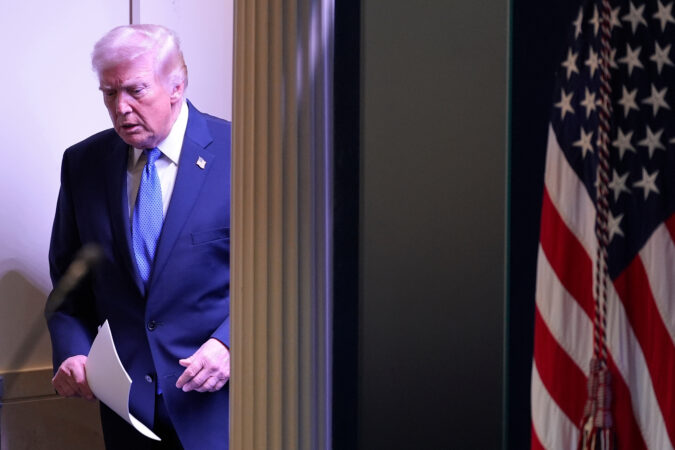
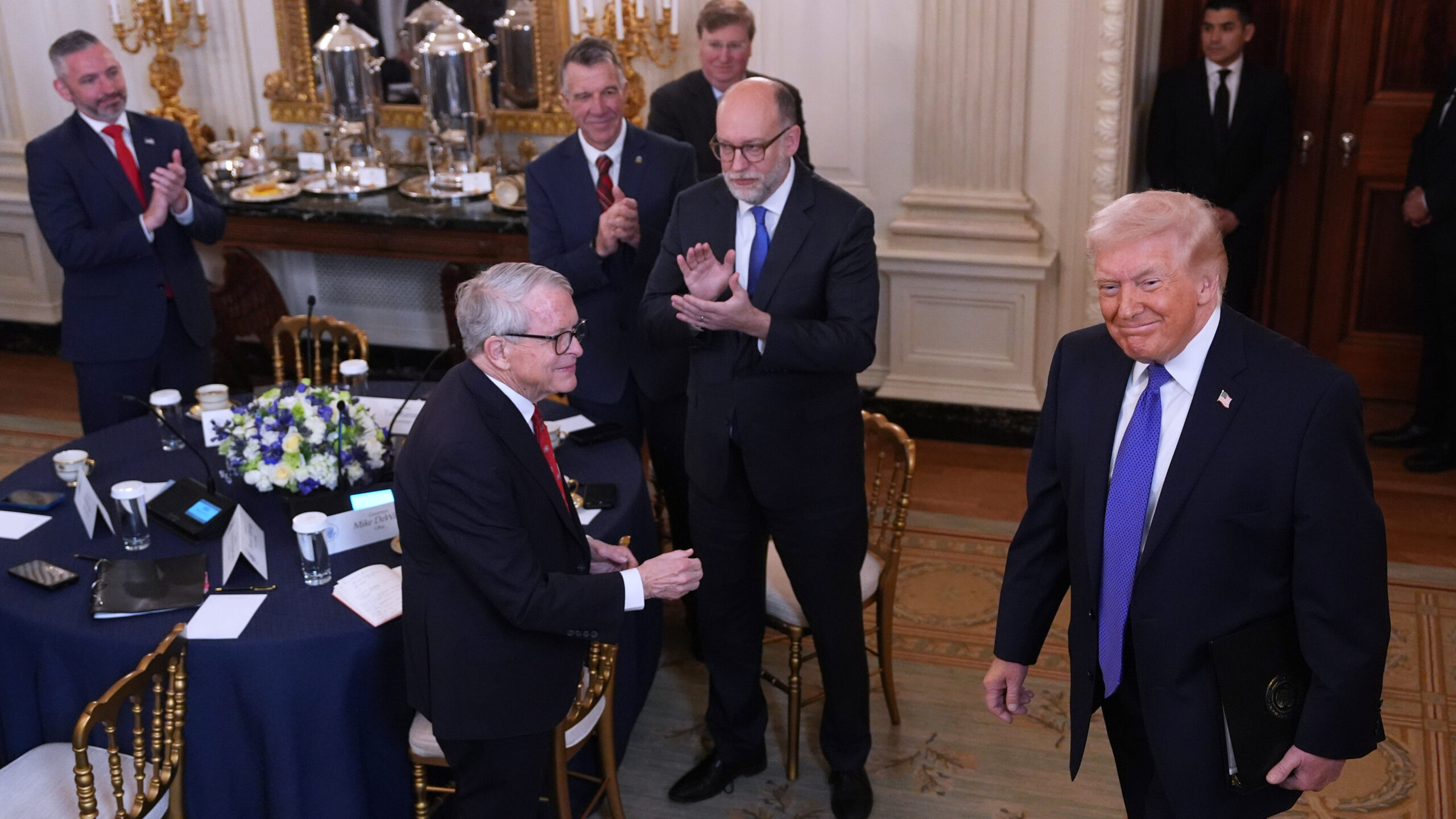
President Donald Trump arrives to speak during a breakfast with the National Governors Association in the State Dining Room of the White House, Friday, Feb. 20, 2026, in Washington. (AP Photo/Evan Vucci)
Moore, Polis, and Shapiro were among the more than two dozen governors who attended the White House breakfast Friday, where Trump delivered brief remarks. Other Democrats, including New Jersey Gov. Mikie Sherill, decided against going.
Sherrill, a former member of Congress who just began her term last month, said in a statement that she opted to skip the White House breakfast to “focus on other NGA meetings.”
“The president’s chaotic back-and-forth about the NGA was counterproductive and Gov. Sherrill decided not to attend,” said Sean Higgins, a spokesperson for Sherrill.
What Shapiro talked about
Shapiro described the closed-door meeting between Trump, the governors, and all of Trump’s cabinet as productive for him to advocate for specific issues directly with federal leaders.
“Folks were respectful to me,” Shapiro told reporters following the meeting. “I went there with a mission to talk about things that were important to Pennsylvania.”
Shapiro, who is currently running for reelection and touts his ability to work across partisan lines, has expressed an openness to working with Trump on issues specific to Pennsylvania, though he has challenged the president more than a dozen times in court since Trump took office last year.
Shapiro said he was able to discuss his top issues directly with federal officials. He said he spoke with U.S. Department of Agriculture Secretary Brooke Rollins about the reemergence of the avian flu in Pennsylvania; discussed releasing withheld broadband funding with Treasury Secretary Howard Lutnick about releasing withheld broadband funding; and talked with U.S. Secretary of Health and Human Services Robert F. Kennedy Jr. and Director of the Office of Management and Budget Russ Vought about the ways “their policies are hurting rural Pennsylvanians.”
New York Gov. Kathy Hochul, another Democrat who attended the meeting, said afterward in a news conference that she was glad to hear what lessons Trump said he learned from his administration’s immigration enforcement mission in Minneapolis that led to mass protests and the fatal shootings of two U.S. citizens by federal agents.
Hochul said Trump told the group that “we’ll only go where we’re wanted,” alleviating concerns among some Democratic governors that their states may be the next to see a full-scale federal presence upending daily life.
Weeks of back-and-forth ahead of the White House breakfast
“Democratic governors have a long record of working across the aisle to deliver results and we remain committed to this effort,” they said in a joint statement on Feb. 10 through the Democratic Governors Association. “But it’s disappointing this administration doesn’t seem to share the same goal. At every turn, President Trump is creating chaos and division, and it is the American people who are hurting as a result.”
They added: “Democratic governors remain united and will never stop fighting to protect and make life better for people in our states.”
In comments to CNN last week, Sherrill said that “worse decisions” would be made without all the governors there.
“For the president to pick and choose who he is going to have to sort of undermine the very focus of this, of coming together to get stuff done for the country just seeds more … chaos,” the New Jersey Democrat said.
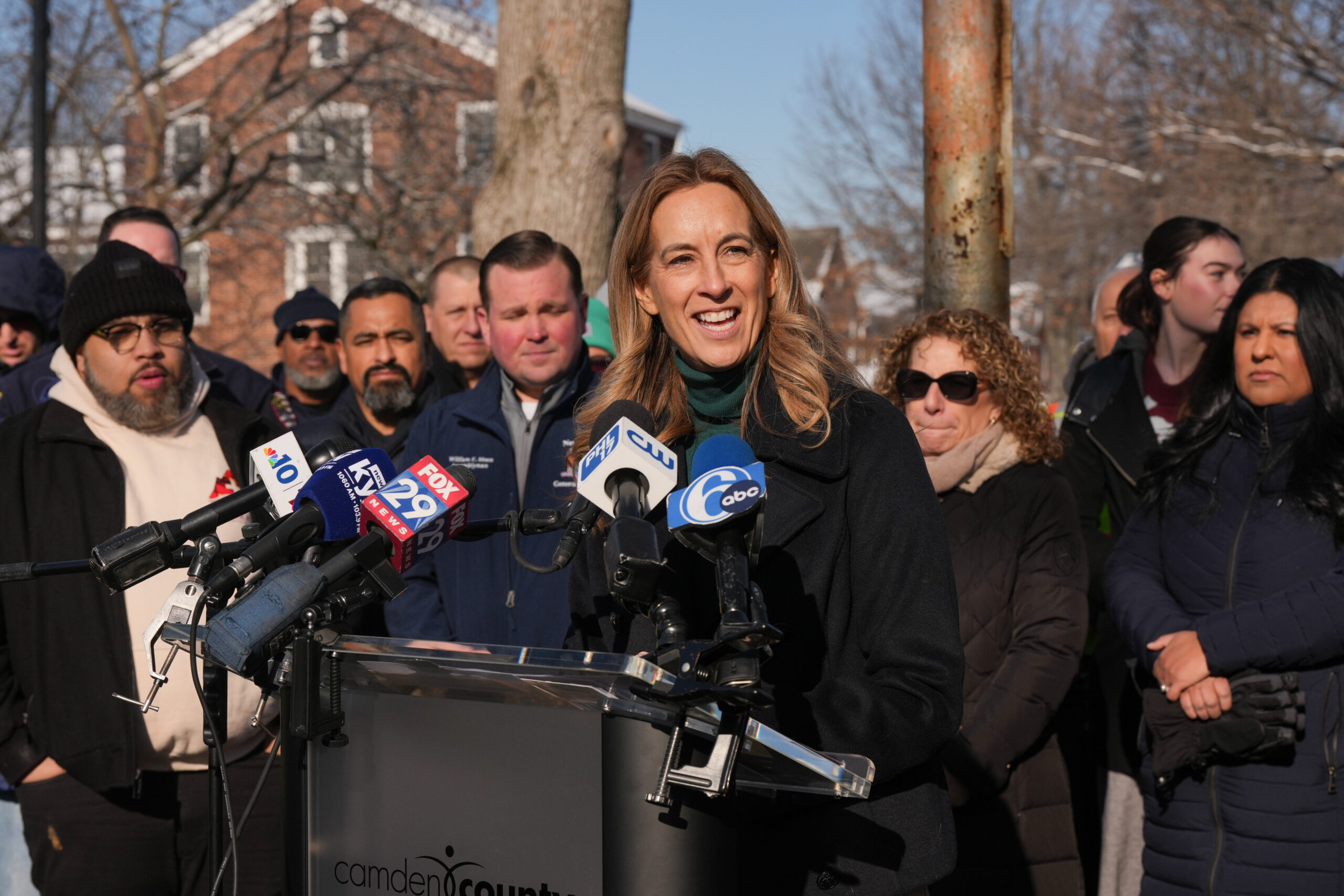
Gov. Mikie Sherrill, shown here at a news conference as volunteers gather prior to shoveling snow at Fairview Village on Martin Luther King Day during a day of service, in Camden, New Jersey, January 19, 2026.
Moore, the nation’s only Black governor, and Polis, the first openly gay man elected to U.S. governor, were the only two leaders Trump singled out, raising concerns by civil rights groups.
Trump, however, cited different reasons for his objections to Moore and Polis’ attendance. He said he wanted to exclude Polis because his state continues to incarcerate a former county clerk over her conviction related to allowing election-denier activists access to election data following the 2020 election. Trump also expressed a number of grievances toward Moore, including his handling of the rebuilding of the Francis Scott Key Bridge and Baltimore’s crime rates.
Following the meeting Friday, governors from both parties reaffirmed that they were still committed to working with Trump despite the turmoil.
“It’s really important imagery that we stand together as governors of our states and represent all of America, and just remind people that there’s really more that brings us together and unites us than divides us,” said Oklahoma Gov. Kevin Stitt, a Republican who chairs the NGA.
Shapiro separately told reporters that he has worked with directly Trump to “save steelworker jobs” but remains ready to challenge them in court if they threaten Pennsylvanians’ rights.
Asked whether he has a good relationship with Trump, Shapiro said: “We have a relationship where we can work for the people of Pennsylvania, that’s my job.”