Philadelphia is the birthplace of American democracy. It is also a city that understands democracy is strongest when rooted in truth.
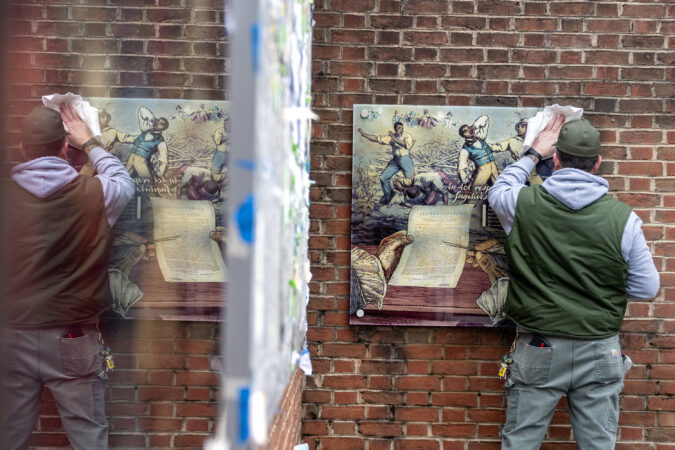
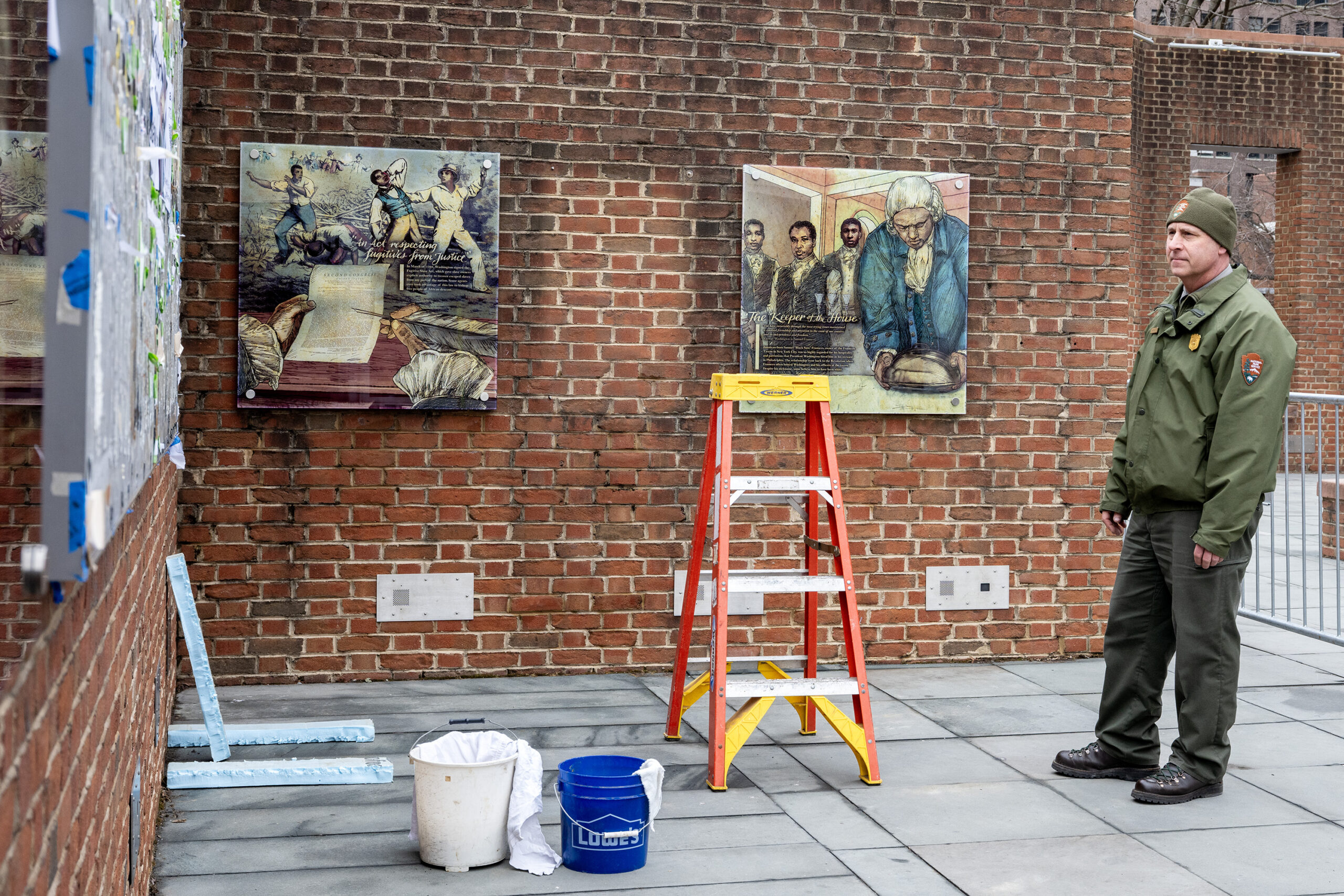
That is why the January removal of slavery exhibits from the President’s House site in Center City was so deeply concerning. I am happy National Park Service workers restored the exhibits on Feb. 19, but they are only back up in their rightful place because of U.S. District Judge Cynthia M. Rufe’s order directing the NPS to restore them.
Rufe made it clear in her Feb. 16 ruling that historical truth cannot be dismantled or rewritten, and that the federal government and President Donald Trump’s administration do not have the authority to erase or alter facts simply because they control a national site.
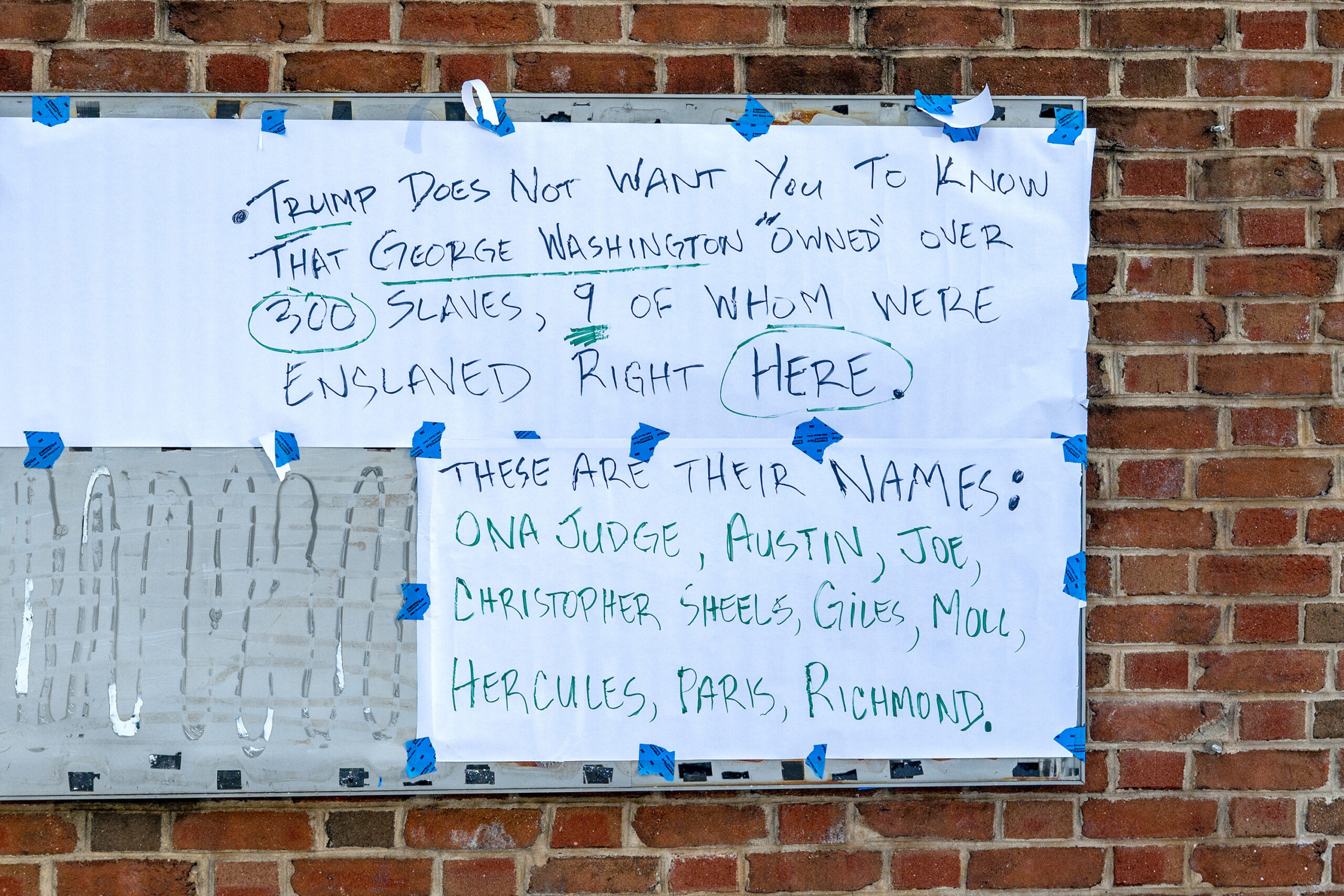
At the President’s House — located within Independence National Historical Park — visitors learn about George Washington’s early presidency. But equally important, they learn about the nine enslaved Africans who were forced to live and work in Washington’s Philadelphia household. Their lives unfolded in the literal shadow of a building where liberty was debated and declared.
That story is not just an aside in our nation’s founding — it is essential for understanding both America’s ideals and its contradictions. Removing those interpretive panels is more than just an administrative decision; it’s an effort to alter the narrative of our shared history.
Signs and notes placed by visitors at the President’s House in Independence National Historical Park on Feb. 2 replace the panels about slavery that were removed in January by the National Park Service.
The City of Philadelphia sought an injunction in federal court on Jan. 22 to preserve the integrity of this significant site. This battle goes beyond signage; it’s about whether we are prepared to face the full truth of who we are as a nation.
There is no harmful ideology in recognizing that slavery existed at the highest levels of early American government. There is no political agenda in naming the enslaved men and women who lived at the President’s House. There is only a duty to tell the truth.
The President’s House memorial opened in 2010 after years of research, advocacy, and public engagement, led by the Avenging the Ancestors Coalition and supported for decades by the city of Philadelphia and the NPS.
It reflects Philadelphia’s long-standing commitment to the honest telling of history. We acknowledge that our nation’s founding documents proclaimed liberty while millions remained enslaved. We understand that progress arises not from denial, but from reckoning.
A worker pauses while rehanging panels at the President’s House in Independence National Historical Park on Feb, 19.
Philadelphia will always remain dedicated to sharing the full history of our nation, not just the easy parts, but the whole truth.
Our children deserve to learn that America’s greatness is not in pretending we are perfect, but in working to become a more perfect union every day.
Restoring these exhibits at the President’s House is not about politics. It’s about principles. It’s about making sure that a site visited by people from all over the world, especially on the 250th anniversary of the United States, reflects the full scope of our history, including both triumphs and injustices.
As the fight over the President’s House continues through the federal court system, I will continue to support our efforts to ensure the exhibits remain at the site permanently.
We must not let Trump whitewash African American history. Black history is an integral part of American history.
Kenyatta Johnson is City Council president and represents the 2nd Council District in Philadelphia, which includes parts of Center City, South Philadelphia, and Southwest Philadelphia.
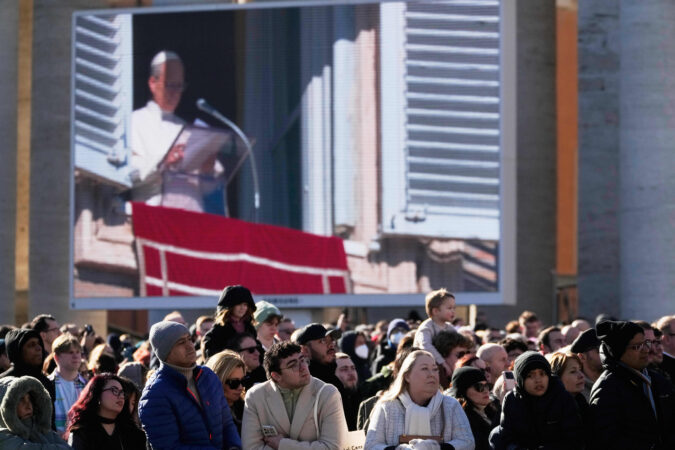
“Faced with the possibility of a tragedy of enormous proportions, I am making a heartfelt appeal to the parties involved to assume their moral responsibility to stop the spiral of violence before it becomes an irreparable abyss,” Pope Leo XIV said in his weeklyAngelus address Sunday morning.
The American-born pope wasn’t speaking only to the thousands gathered in St. Peter’s Square, but to the more than 1.4 billion Roman Catholics in the world, including those in the Trump administration who self-identify as Catholics, such as Vice President JD Vance or Secretary of State Marco Rubio.
“Stability and peace are not built with reciprocal threats or with weapons that sow destruction, pain, and death,” the pontiff said, “but only through reasonable, authentic, and responsible dialogue.”
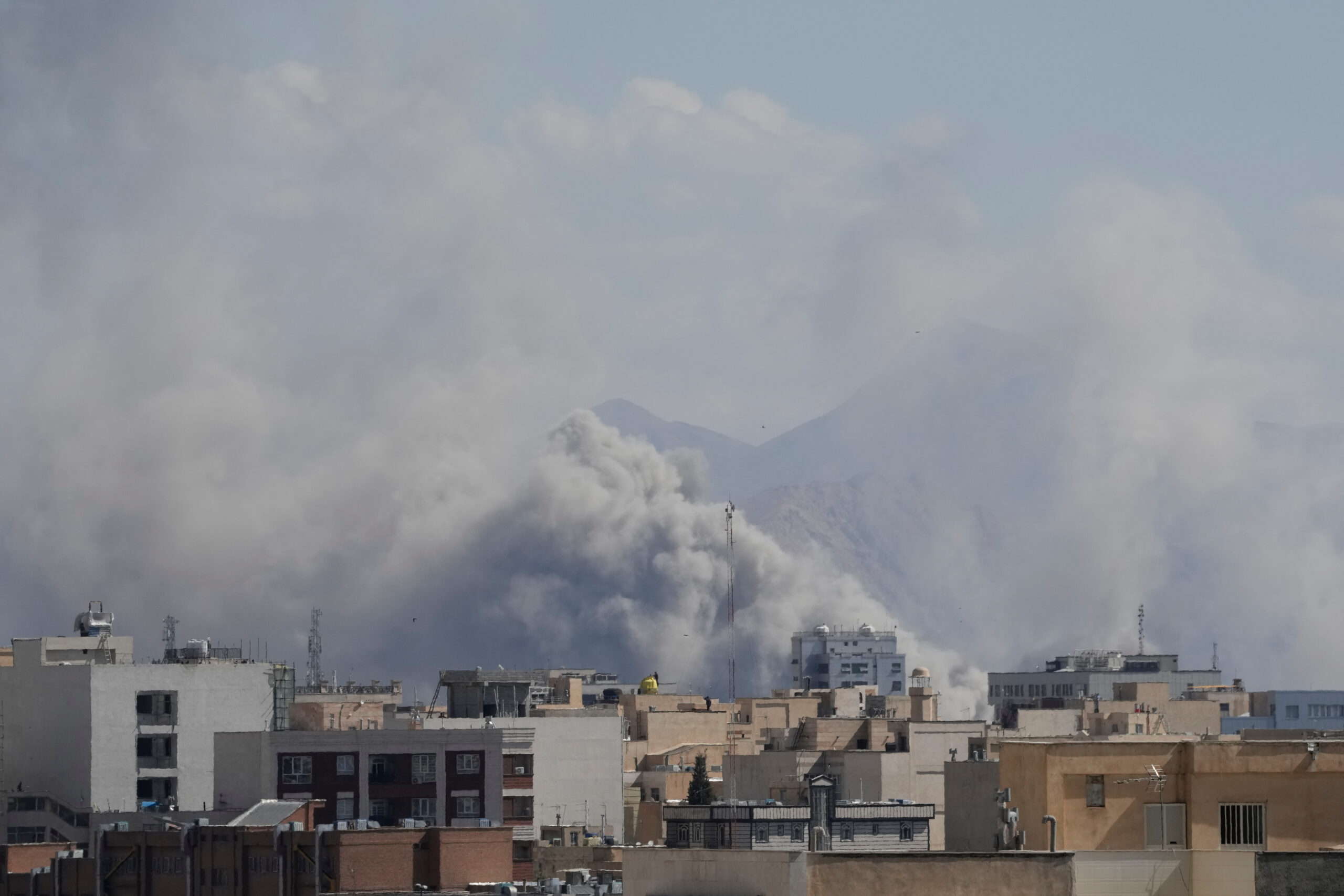
Smoke rises up after a strike in Tehran, Iran, on Sunday.
While the pope doesn’t wield the sort of temporal power that presidents and prime ministers do, his words carry moral weight for those within his religious tradition, and cannot be easily dismissed by politicians, nor the 52% of U.S. Catholics who still have a favorable view of Trump, according to a recent poll by the conservative EWTN News and RealClearPolitics.
It is not the first time Pope Leo has called out the Trump administration’s efforts to force regime change in sovereign nations with leaders who have been accused ofhuman rights abuses.
“The good of the beloved Venezuelan people must prevail over every other consideration and lead us to overcome violence and to undertake paths of justice and peace, safeguarding the country’s sovereignty, ensuring the rule of law enshrined in the Constitution, respecting the human and civil rights of each person,” the pope said during the Angelus address Jan. 4.
I often write about how religion impacts the lives of Latinas like me, who are trying to navigate a world that often seems to have eschewed moral clarity for political dissolution. As a Roman Catholic, I pay particular attention to the guidance offered not only by Pope Leo but also by the bishops who are tasked with providing moral counsel to their flock.
No one who has remained a Catholic as the church has been wracked by an ongoing, self-made crisis of clerical abuse can ignore the fact that some bishops are as opportunistic and power-hungry as our politicians. But under the leadership of Pope Leo, more U.S. bishops than ever have chosen to speak out from a place of genuine moral authority, untainted by the gross partisan and ideological bias that had previously infected the U.S. Conference of Catholic Bishops.
In January, three U.S. cardinals — whom some consider progressives — called on the administration to adopt a “genuinely moral” foreign policy with respect to Venezuela, Ukraine, and Greenland. Meanwhile, the archbishop for the U.S. military — widely considered a staunch conservative — reminded Catholic military personnel that it is “morally acceptable” for them to disobey an order that violates their conscience.
At the same time, 18 bishops asked for the government to cut U.S. military spending to invest in eradicating poverty instead, and across the world, bishops have disavowed the appetite for war and domination by military force that the Trump administration has modeled.
For example, the pope has declined to participate in a Trump-led “Board of Peace” that seems to be about anything other than peace. “A diplomacy that promotes dialogue and seeks consensus among all parties is being replaced by diplomacy based on force by either individuals or groups of allies,” Pope Leo said on Feb. 17.
“War is back in vogue, and the zeal for war is spreading.”
Cardinal Pierbattista Pizzaballa, Latin patriarch of Jerusalem, was more direct in his criticism of the board: “What do I think of the Board of Peace? I think it is a colonialist operation: others deciding for the Palestinians,” he told the Italian newspaper Il Sole 24 Ore.
While the Vatican releases Pope Leo’s Angelus addresses without much fanfare, it is important for Catholics seeking moral guidance on world events like the U.S. war on Iran to listen to the address directly rather than rely on the interpretation of those who might alter the pope’s words for political convenience.
In the instance of the pope’s Angelus address on Venezuela, for example, the Trump administration’s U.S. ambassador to the Holy See reportedly omitted the pope’s reference to safeguarding that nation’s sovereignty because it could not be aligned with the administration’s actions.
And Vance last year offered a justification of Trump’s mass deportation policies based on his misunderstanding of a Catholic theological concept. The vice president’s error was corrected and addressed by Pope Francis shortly before his death in April.
During Lent, we as Catholics are called to examine our habitual excuses, our profane tendencies, and our susceptibility to the spin of those with a stake in worldly power, to instead focus deeply on our spiritual life and its obligations.
For Catholics, in particular, Pope Leo’s words Sunday cannot be explained away. We must demand that our nation’s leaders stop the spiral of violence and acknowledge that peace cannot be built with weapons.
Swords into plowshares, mi gente, swords into plowshares. And we shall study war no more.
As a matter of journalistic duty, I forced myself to watch the endless State of the Union reality show.
Punting on all serious issues, President Donald Trump stoked the applause meter by delivering awards to a 100-year-old vet and a brave U.S. pilot, and inviting the entire U.S. men’s Olympic hockey team to celebrate their gold medal win.
Trump was relentlessly racist (with disgusting slurs against all Somali Americans in Minnesota). His lies were dangerously predictive about the 2026 elections, never tiring of the Big Whopper about winning in 2020 and claiming Democrats must be stopped because they “only win if they cheat.”
In short, the union is in a dangerous state under an amoral, unprincipled, delusional commander in chief.
What disturbed me most as I watched Trump rant on is how a president could be so wholly indifferent to the liberal democratic values that underlie the existence of our nation. Although often honored in the breach, they are what have made this country unique. Yet, the sycophants in his administration, along with most GOP legislators, have chosen to abandon those values, or never believed in them from the start.
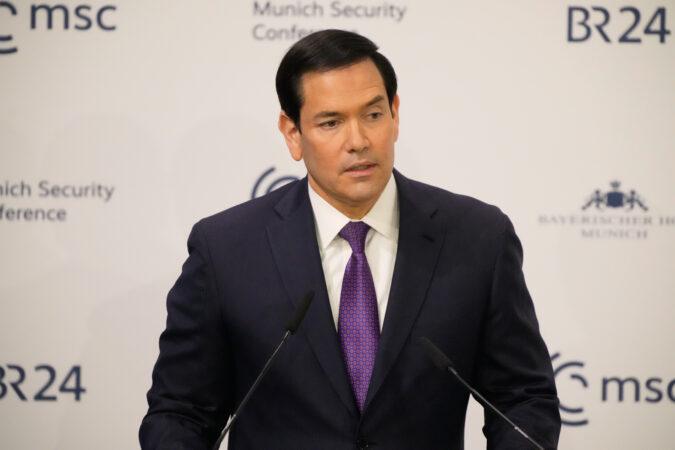
For that reason, I’d rank Secretary of State Marco Rubio’s speech at the recent Munich Security Conference as far more important than Trump’s sad State of the Union guff.
That’s because Rubio laid out an alternative set of U.S. values promoted abroad and at home by the political theologians of the Trump regime. Precepts that would make the Founding Fathers revolt anew.
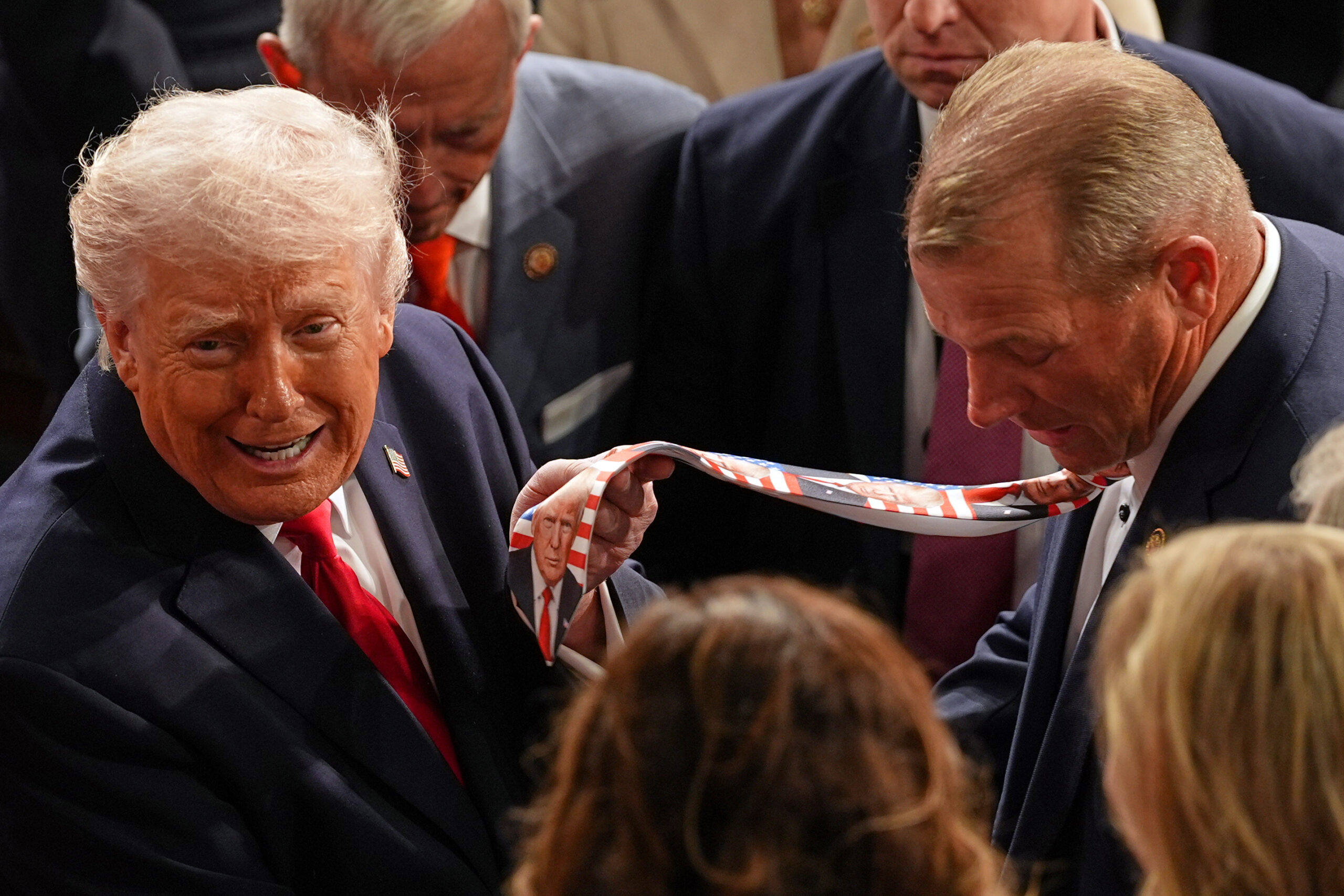
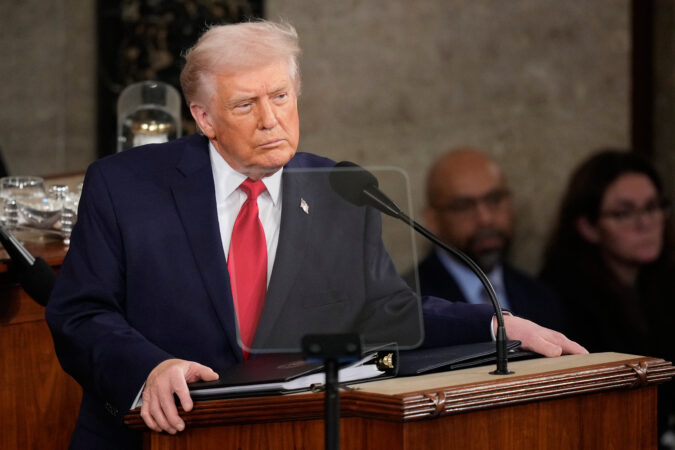
President Donald Trump holds up U.S. Rep. Troy Nehls’ (R., Texas) tie with his face on it as he departs after delivering the State of the Union address to a joint session of Congress in the House chamber at the U.S. Capitol in Washington, Tuesday.
The new theology revolves around the theme of saving “thousands of years of Western civilization” from the depredations of “woke” liberal democracy. It is an extension of language long used by white nationalists, and which came back to prominence during the rise of Islamist terrorism in the Mideast, which led to an influx of Syrian and Afghan immigrants into Europe fleeing civil wars at home. It became even more useful to Trumper populists when fanning fears of immigrants at home.
Former Trump adviser Steve Bannon and current Deputy White House Chief of Staff Stephen Miller latched onto the “saving Western civilization trope” a decade ago, and have embraced its transition into saving Western “Christian civilization.” Somehow, the term, which had been commonly used to describe shared Western religious and cultural identity for decades — Judeo-Christian civilization — has conveniently been shortened.
Never mind the historical inaccuracy of a term that tries to combine thousands of years of shifting, melding populations, ideas, and religions into one neat sum.
Yes, there are obvious philosophical threads from Athens to Rome to the Magna Carta, and ultimately to the values of the Enlightenment. But there are centuries of religious, ethnic, and philosophical wars, as well.
When Vice President JD Vance tried to promote the concept at the Munich Security Conference last year — and to promote white Christian populist parties in Europe as the saviors of “Western civilization” — the audience of European leaders, officials, and think tankers reacted with shock. More so when he berated German leaders for not inviting the neofascist Alternative für Deutschland (AfD) party into the government, even though its leaders have downplayed Adolf Hitler’s crimes. To add insult to injury, he pointedly paid a visit to the AfD’s political leader.
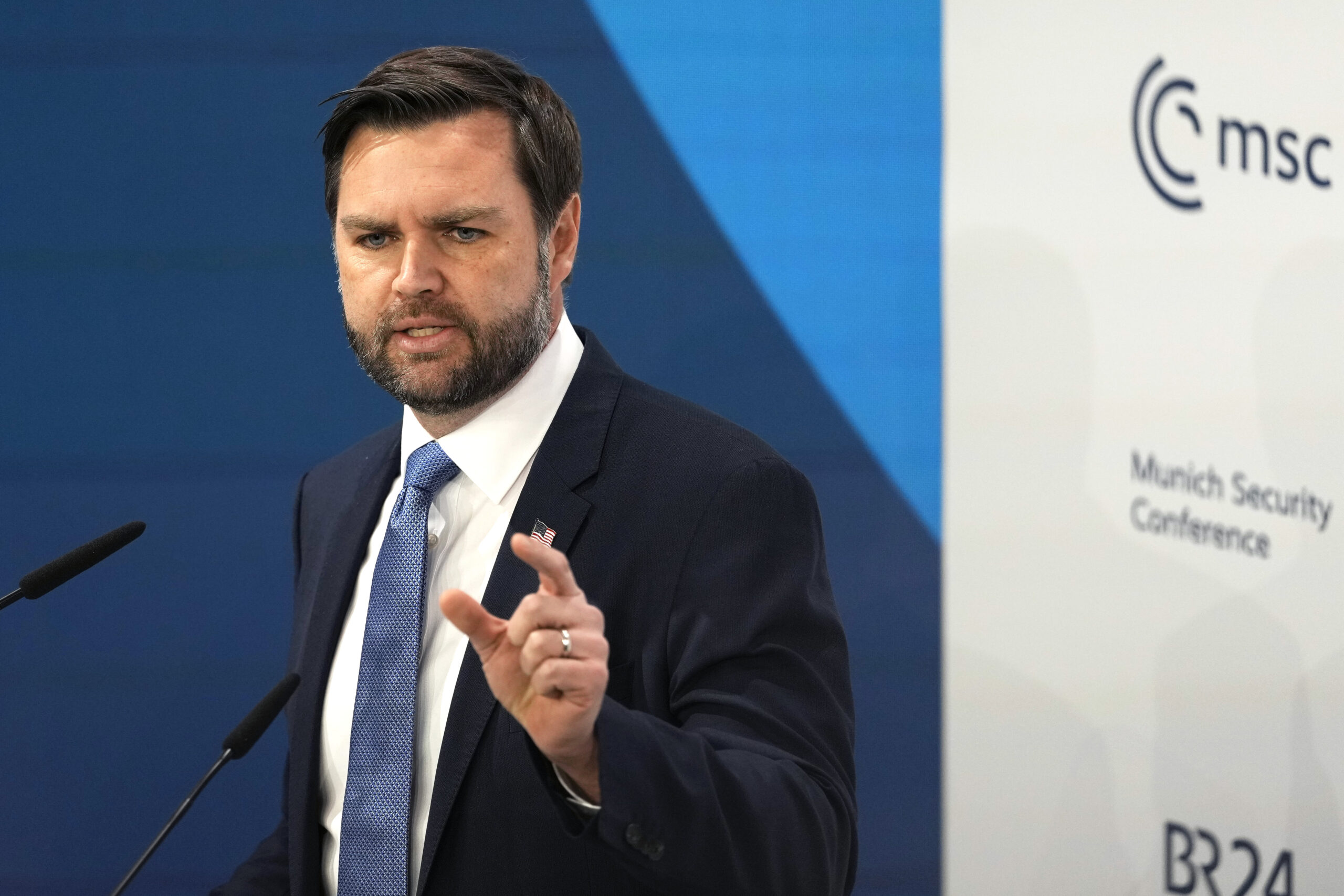
Vice President JD Vance addresses the audience during the 2025 Munich Security Conference at the Bayerischer Hof Hotel in Munich.
But Rubio was supposed to be different: the realistic, savvy foreign policy adviser who tried to save Trump from his worst instincts. When the secretary of state delivered remarks that praised U.S.-European ties, the eager audience was at first won over — until reality sank in, and many participants read the text of his speech.
Indeed, Rubio was warmed-over Vance, blaming liberal democracy (which, in the Enlightenment sense, means individual freedoms, human rights and rule of law, and observance of science) for all the West’s ills, and urging Europeans to junk “the global rules-based order.”
It got tiresome hearing Rubio tout the dangers of Western “civilizational erasure.” As Hillary Clinton noted — on a panel titled “The West-West Divide” — “When Rubio talks about Western ‘civilization,’ I never knew he was so supportive of Native Americans.” Then she added, “He is wrong historically.”
Indeed. “Western civilization” has become the MAGA dog whistle that stands for bashing all immigration and playing to racial fears.
No surprise, Rubio had not a word of criticism for the Russian invasion of Ukraine as an attack on “Western civilization,” although Vladimir Putin’s war crimes have upended the relatively peaceful, post-World War II order. And not a word of apology for Trump’s threat to seize Greenland from a NATO ally, which also threatened that order.
Nor any word of recognition that a dog-eat-dog world of unrestrained big power dominance resulting from an end to global “rules” will lead back to the violent era preceding World War II.
Instead, Rubio urged the Europeans not to be “shackled by guilt and shame,” which is a key buzz phrase for the AfD, which urges its members to stop apologizing for Nazi crimes.
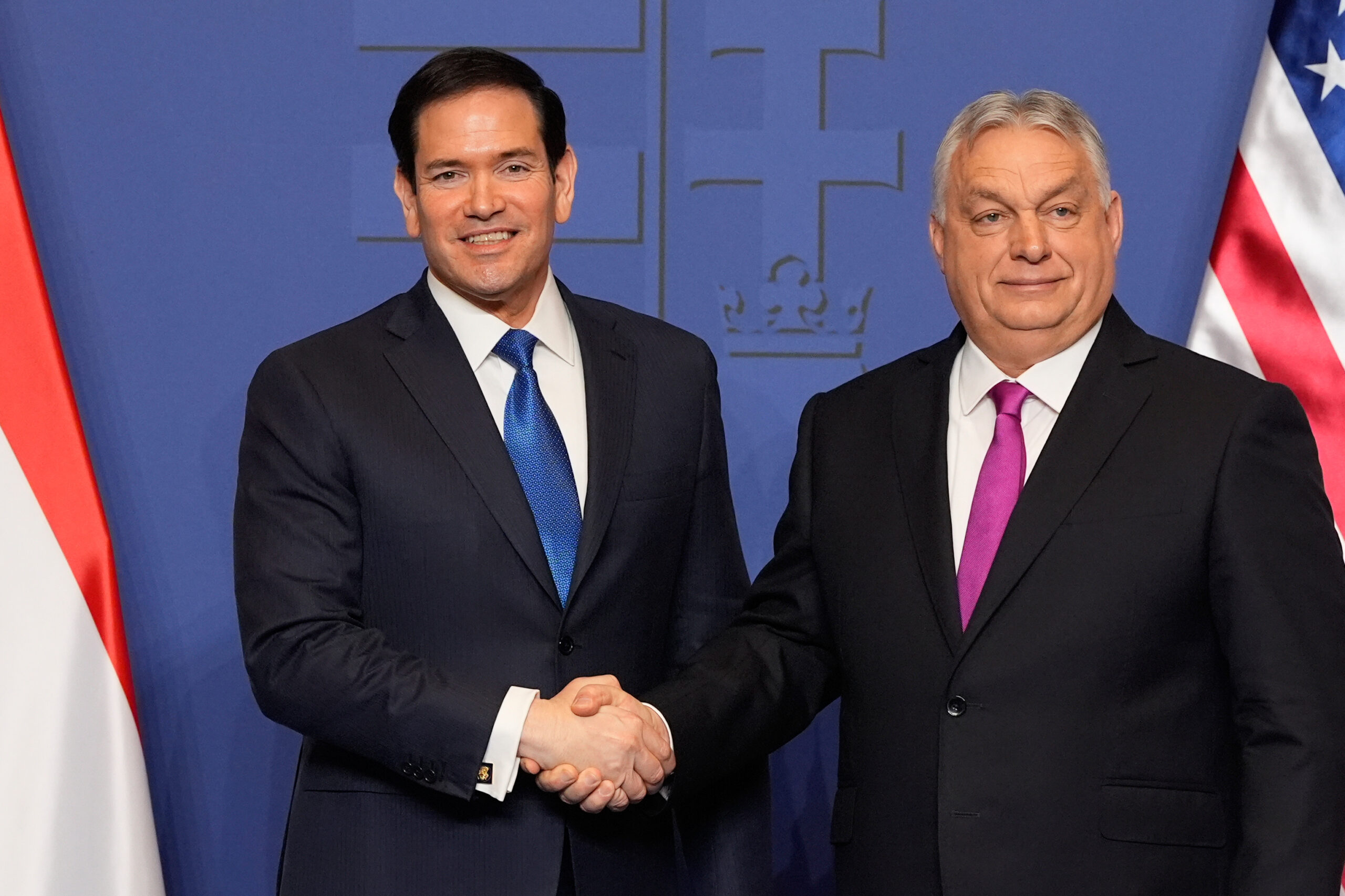
Secretary of State Marco Rubio (left) and Hungarian Prime Minister Viktor Orbán shake hands after a news conference in Budapest, Hungary, on Feb. 16.
And right after his speech, the secretary rushed off to Hungary to praise the pro-Putin Prime Minister Viktor Orbán, a Trump ally who has done his best to destroy Hungarian democracy, including press and judicial freedom — and is trying to block European Union aid to Ukraine.
Yet, Orbán’s corruption and Hungary’s economic decline have become so overwhelming that he may be defeated in an April election. But Trump sent Rubio to bolster this antisemitic autocrat who repeats the “saving white Christian civilization” line.
It is no wonder the Munich scene erupted into debate about the West-West division over democratic values. As Germany’s Green Party coleader and Bundestag member, Franziska Brantner, stated: “Our values are rooted in the Enlightenment, in reason, science, freedom of religion, equal rights. The Enlightenment is a project, not a period in history. It is about very concrete individual freedoms, about free elections dependent on the will of the people, not run by oligarchs.”
“I don’t want to go back in history,” Brantner said flatly.
Norwegian Finance Minister Jens Stoltenberg added, in a restrained poke at Trump, “For all those who believe in liberal values and protection of the truth, it is difficult when we see that not all of our allies agree on these values.”
In Europe, at least, there is an active debate about the consequences of the junking of rules and history by the world’s most powerful democracy. The dangers to democracy are more immediately apparent to those who live closer to Russia and Ukraine.
Watching Trump’s performance and Rubio’s subservience, those dangers may seem obvious to many Americans. But they must find a way to get that message across more clearly to those who still doubt the danger here.
New Jersey Gov. Mikie Sherrill said Friday that “all options are on the table” when asked by The Inquirer whether she would support adding a new tax on ICE detention centers in the state.
A bill introduced in both the state Assembly and Senate last week would implement a 50% tax on the gross receipts of private detention centers in the state and send that money to a fund for immigration services in the state. It has not yet been put up for a vote in either chamber.
Sherrill expressed opposition to new U.S. Customs and Immigration Enforcement detention facilities in the Garden State and said the state can ensure the federal government is following proper legal processes as it buys up warehouses and seeks to expand confinement capacity.
The legislativeeffort is led in part by progressives who were just elected to the legislature in November — Assembly members Ravi Bhalla and Katie Brennan, both North Jersey Democrats.
On a national level, Sens. Andy Kim and Cory Booker, both Democrats, introduced legislation on Thursday that would ban President Donald Trump’s administration from purchasing or converting warehouses for immigration detention or processing.
Sherrill wrote a letter to Homeland Security Secretary Kristi Noem on Friday expressing her opposition to the plan, which the governor said involves housing up to 1,500 beds in a 470,000-square-foot facility that currently has just two bathrooms.
“They really just have not gone through a thoughtful process,” she said during her Gloucester County stop. “It’s going to put some pressure on the town as well, and these types of facilities have a history of not being built in a way that is safe for prisoners.”
New Jersey has existing ICE detention centers at Delaney Hall in Newark and in Elizabeth. The agency has also floated the idea of confining people at Joint Base McGuire-Dix-Lakehurst.
“This is not a warehouse that’s fit for human habitation, and they say they’re putting 1,500 people in there,” she said of the Roxbury plan. “So there is a lot we can do as a state to prevent this.”
In her Friday letter to Noem, Sherrill denounced the Department of Homeland Security’s lack of transparency around their Roxbury plans — a criticism that Pennsylvania Gov. Josh Shapiro, who opposes ICE warehouse facilities in Pennsylvania, has also lodged against the agency.
Protests erupted in Roxbury after the Washington Post included it as a site that ICE was considering. Confusion later ensued after DHS, which oversees ICE, put out contradictory statements to the media over whether they were purchasing a warehouse for a detention center there.
Sherrill also told Noem in her letter that the state will “assess all options to protect the community’s infrastructure, public safety, health, and long-term economic stability,” using “every tool at our disposal.” She said the ICE detention centers in the state and elsewhere are known for “deplorable conditions,” such as overcrowding, undrinkable water, rotten food, and insufficient healthcare.
“In short, DHS’s treatment of human beings — citizen and noncitizen alike — reflects a chilling disregard for both human life and the rule of law,” she said in the letter. “New Jersey will not be complicit in this.”
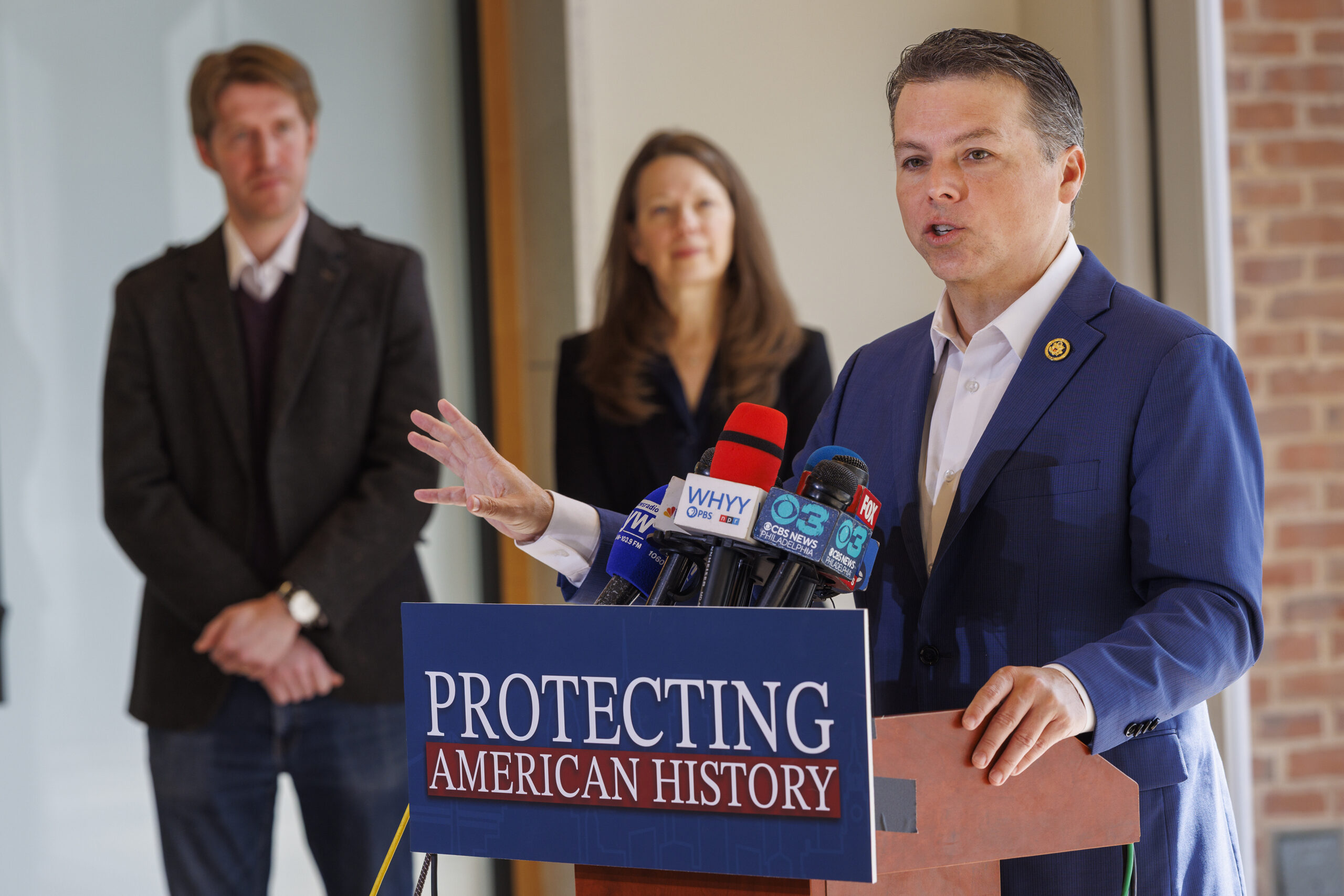
The proposed Protecting American History Act comes as the future of the President’s House, which memorializes the nine people George Washington enslaved in Philadelphia, remains in limbo as a legal battle between the City of Philadelphia and the federal government continues to play out.
“It is only dictatorships and communist countries that whitewash their history and give an official version, rather than the accurate version,” Boyle said during a news conference Friday. “Frankly, the most American thing in the world is to discuss and debate our nation’s history. It improves who we are as a people and where we’re going.”
The National Park Service last month removed educational panels from the site under President Donald Trump’s executive order forbidding displays at national parks that “inappropriately disparage Americans past or living.”
Some of that material was restored last week after a judge ruled in favor of the city, but those efforts were paused by a federal appeals judge while considering the Trump administration’s motion for a stay. The appeal of the lower federal court’s injunction that ordered them to restore the displays is also underway.
“Court decisions alone are not enough… History should not depend on the whims of one federal judge. This issue is bigger than just one exhibit, as important as it is. This is about the history of our entire nation and our people,” Boyle told reporters Friday at the Independence Visitor Center.
With Independence Hall towering behind him, Boyle said the bill calls for restoring all historical exhibits at the park, including the President’s House, to its status on Jan. 21, the day before the displays were taken down. It will also shield all historical displays at Independence National Historical Park, which Boyle’s district includes, from any future government censorship.
The President’s House opened in 2010 after years of advocacy by local Black leaders. It juxtaposes the cruelty of slavery against the nation’s founding ideals.
Michael Coard, an attorney and leader of Avenging the Ancestors Coalition, which helped shape the President’s House, said in a statement that his group is looking forward to working with Boyle on the legislation and will reach out to both Democratic and Republican lawmakers.
“From day one, we have said this is not a partisan issue,” Coard said in a statement. “This is an American issue. The full history of our nation deserves to be told without censorship or political interference.”
U.S. Rep. Brendan Boyle announces legislation called the Protecting American History Act at the Independence Visitor Center, Friday, Feb. 27, 2026.
U.S. Reps. Dwight Evans and Mary Gay Scanlon, who also represent parts of Philadelphia, are the lead cosponsors on the legislation.
The Democrats also joined Boyle last month in writing to Interior Secretary Doug Burgum and Acting National Park Service Director Jessica Bowron seeking answers about the President’s House by Jan. 30. As of Friday, the Trump administration officials had yet to respond, Boyle said.
Boyle said that he has discussed this bill with Republican colleagues in the House, and they have expressed support, but it’s uncertain whether those lawmakers will publicly support his billor whether it’ll receive a vote in the GOP-controlled chamber.
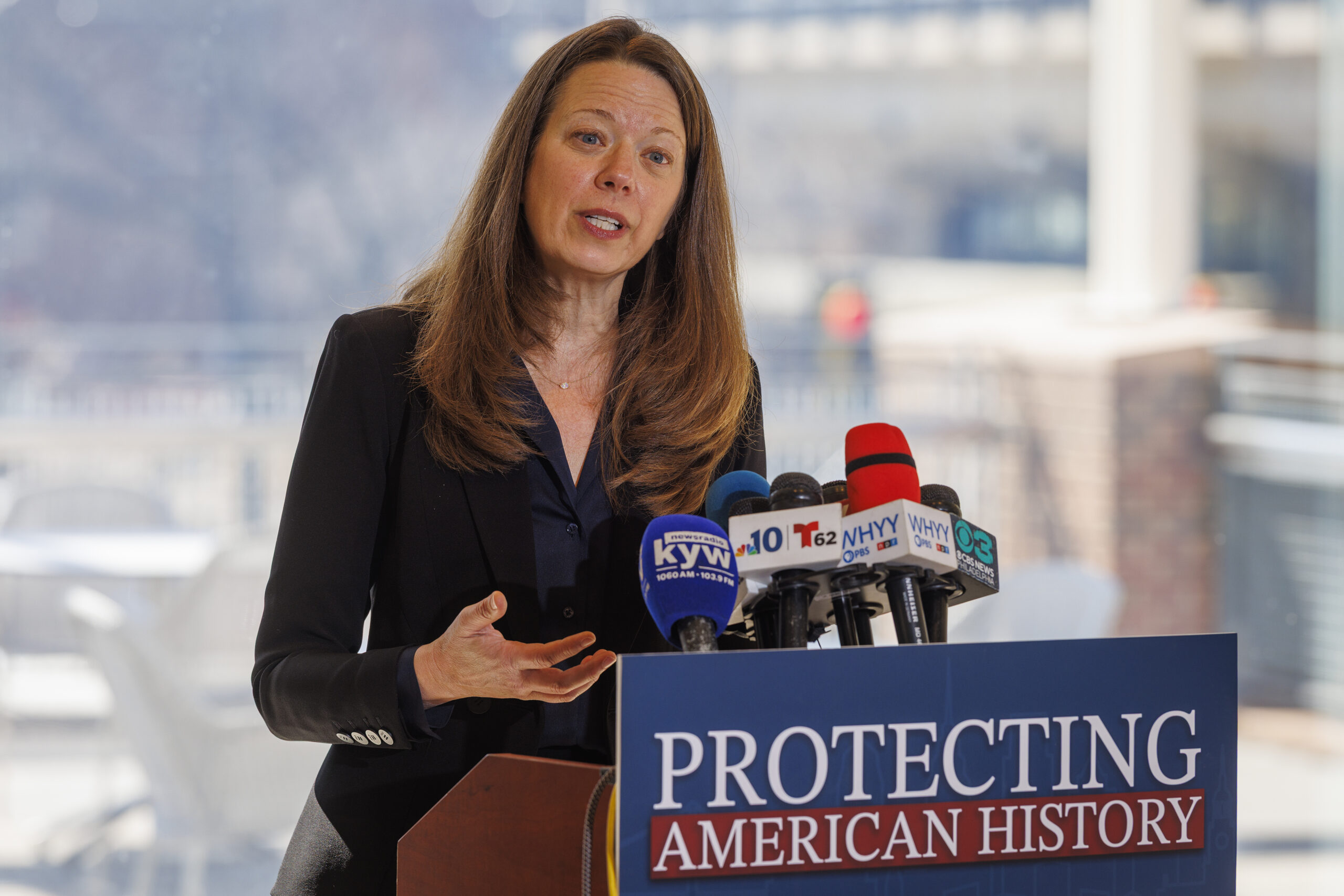
In addition to lawmakers, Boyle’s bill is supported by the Rev. Beth Hessel, executive director of the Athenaeum of Philadelphia, a historic membership library, and Sean Connolly, executive director of Arch Street Meeting House, a Quaker historical site.
Rev. Dr. Beth Hessel, executive director of the Athenaeum of Philadelphia, speaks in support of legislation from U.S. Rep. Brendan Boyle that would restore exhibits at the President’s House.
The legislation focuses solely on Philadelphia, but the hope is, Boyle said, that it can serve as a model for other lawmakers throughout the country as the Trump administration attempts to rewrite history ahead of the nation’s 250th anniversary.
Other historic sites and national parks have also had educational material removed in recent weeks, including the Grand Canyon, where the National Park Service took down signage about the mistreatment of Native Americans.
Boyle said the present day is almost a full-circle moment from the country’s founding, comparing Trump to King George III.
“Almost exactly 250 years ago, our founders were dealing with an out-of-control, dictatorial ‘Mad King.’ They opted on the side of honesty and truth and idealism… it is toward that more perfect union you still strive today.”
The State of the Union is supposed to be a ritual of reassurance. The president enters the chamber of the United States Congress, lawmakers rise and applaud, and for one choreographed evening, we tell ourselves a story about who we are. We are strong. We are resilient. We are advancing.
However, on Tuesday night, President Donald Trump delivered a sprawling, raucous narrative about economic revival, border tightening, partisan battles, and a vision of America in a “golden age.”
As I watched the speech’s cadence — the applause lines, the assaults on political opponents, the relentless assertion of national triumph — a question kept rising in me, a question that is rarely spoken but always present: What does this mean for our children? As I listened, I found myself thinking less about gross domestic product and more about their interior lives.
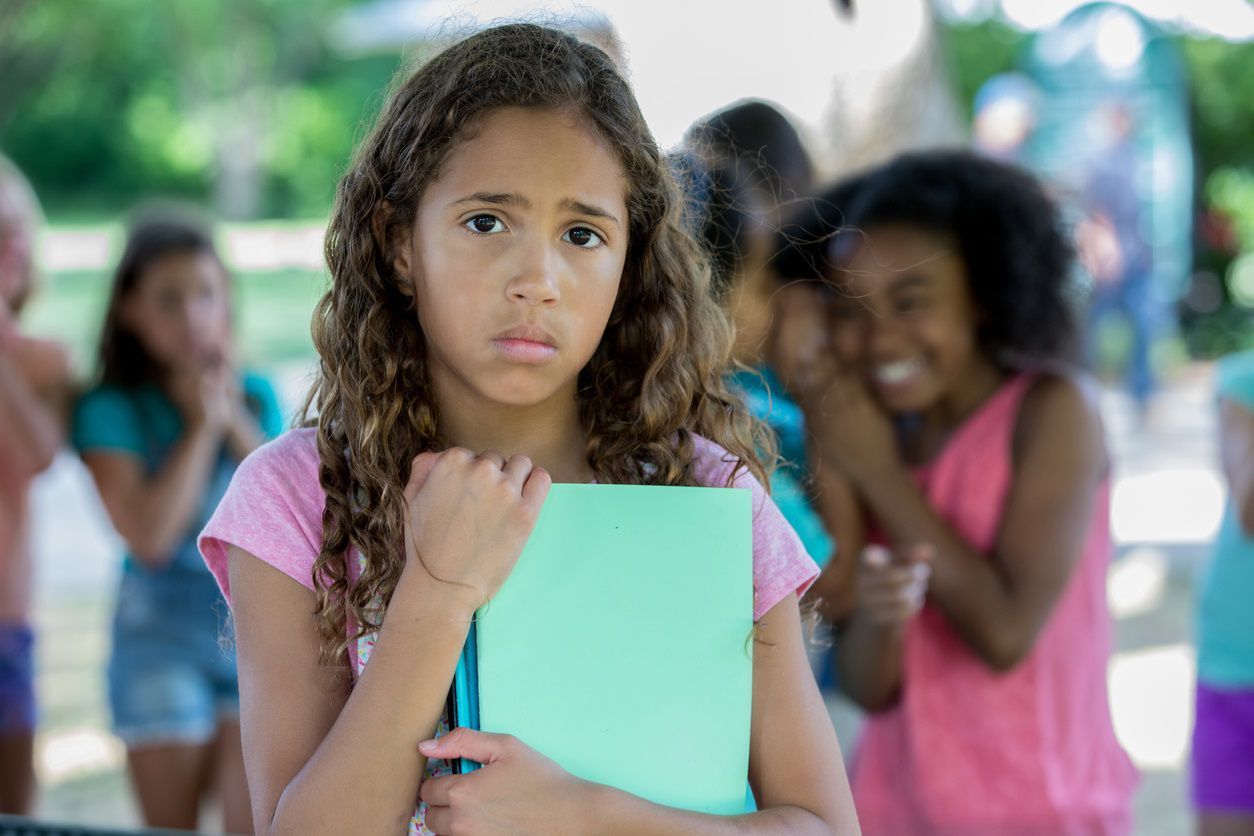
For adults accustomed to political combat, this is familiar terrain. But for children — particularly those in immigrant families, children of color, or children whose identities have been politicized — the message can register differently.
When leaders describe certain groups as dangerous or burdensome, children who see themselves reflected in those groups internalize subtle but corrosive questions: Am I safe here? Do I belong?
Research on childhood trauma and adverse childhood experiences tells us that chronic exposure to fear — even secondhand fear — can activate the body’s stress systems. Elevated cortisol, persistent hypervigilance, difficulty concentrating: These are not ideological reactions. They are biological responses.
A child who hears repeated warnings of danger in their community, or who worries that a parent could be detained or deported, does not experience politics as theater.
Five-year-old Liam Conejo Ramos is taken into custody by federal immigration officers as he returns home from preschool in Columbia Heights, Minn.
In her landmark book Trauma and Recovery, psychiatrist Judith Lewis Herman writes that trauma is “an affliction of the powerless.” It arises when people are subjected to overwhelming forces and deprived of control. Trauma is not merely a bad experience; it is an experience that shatters the basic assumptions of safety, trust, and meaning. It reorganizes the brain around vigilance and fear.
Herman was writing about survivors of war, domestic violence, and political terror. But the framework she provides is disturbingly relevant to our civic culture. Trauma flourishes in conditions of sustained unpredictability, humiliation, and threat. And for many children in America over the past several years, unpredictability and threat have not been abstractions. They have been ambient conditions.
Two immigrant children play in a safe house in Minneapolis in January, after volunteers relocated them from their home to protect them from federal agents.
Consider the moments in the speech when the president highlighted crimes committed by undocumented immigrants to justify harsher enforcement. Or the policy of family separation at the southern border — a decision that, whatever one’s views on immigration enforcement, resulted in children being forcibly separated from their parents. Developmental psychologists have been unequivocal: abrupt separation from primary caregivers activates the body’s stress response at extreme levels. Prolonged activation can alter brain architecture. The child does not interpret the experience as a policy dispute.
The child experiences terror.
Or consider the speech’s emphasis on rooting out ideological enemies within institutions — universities, federal agencies, the press. When authority figures repeatedly signal that institutions are corrupt or hostile, children can lose faith in the very structures meant to protect them.
Herman writes that trauma often involves a “betrayal of trust” by systems that are supposed to provide safety. When public discourse paints schools, courts, or civic bodies as fundamentally illegitimate, children absorb that distrust.
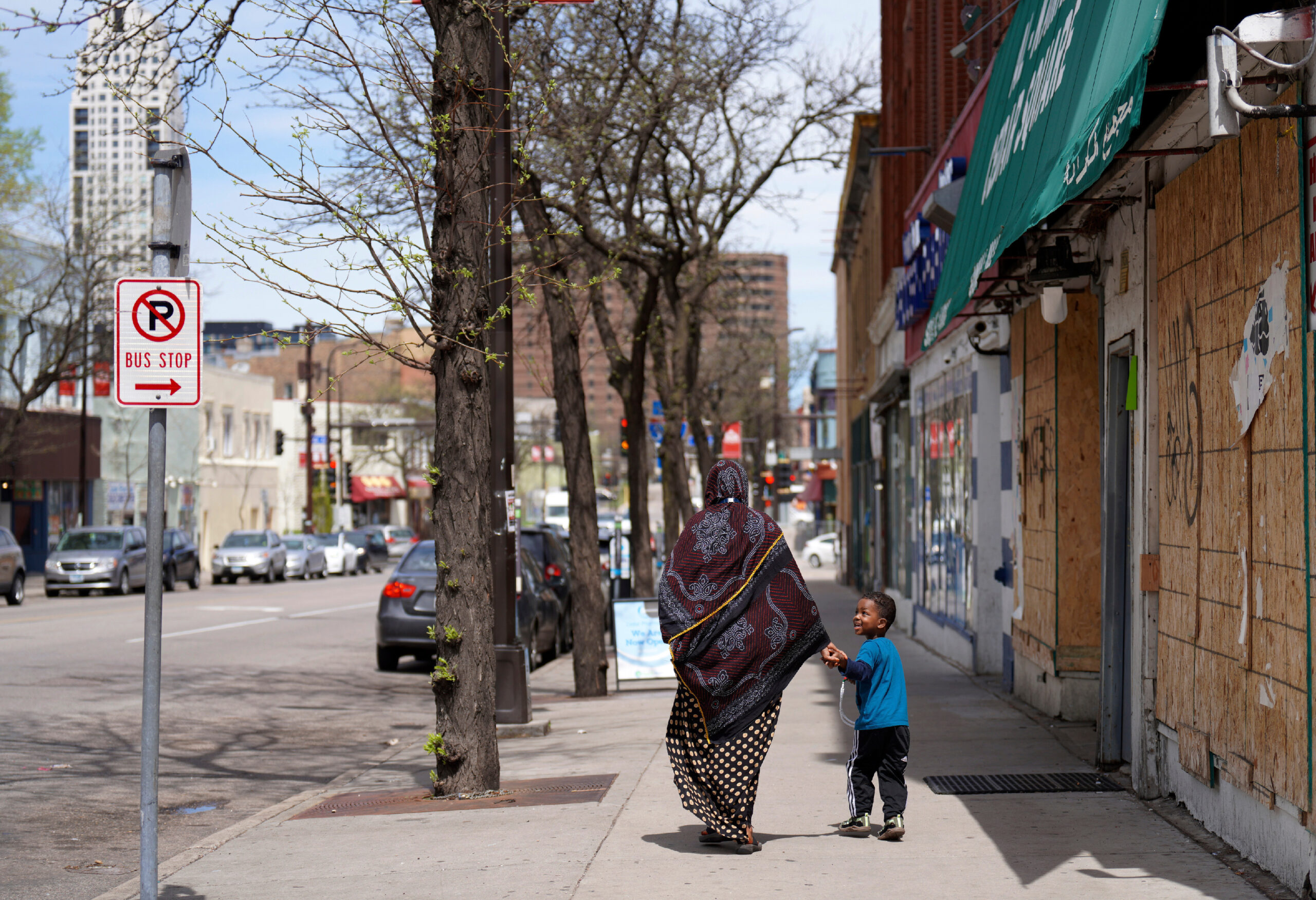
A woman and a child hold hands as they walk down a street in the predominantly Somali neighborhood of Cedar-Riverside in Minneapolis in 2022.
When leaders speak in ways that categorize certain groups as threats or burdens, children who identify with those groups absorb the message. Even children who do not belong to those groups learn something about how power operates: that dignity is conditional.
For some viewers, Trump’s anecdotes reinforced the case for stronger borders. For others — including children in mixed-status families — they reinforced a sense of collective suspicion. Trauma researchers note that when individuals feel stigmatized or collectively blamed, it can produce what psychologists call “identity-based stress,” a chronic strain associated with anxiety and depression.
None of this is to deny the president’s right to advocate his policies. Nor is it to suggest that only one party’s rhetoric carries emotional consequences. But the tone and themes of this particular address — siege, dominance, humiliation reversed through force — echo dynamics that trauma science has long identified as destabilizing when internalized by the powerless.
A child who hears repeated warnings of danger in their community, or who worries that a parent could be detained or deported, does not experience politics as theater, writes Jack Hill.
Children are, by definition, powerless in the civic sphere. They do not vote. They do not shape policy. They rely on adults and institutions for stability. When those adults present the world as perpetually on the brink, the child’s sense of baseline safety erodes.
There is also the matter of modeling. Children learn not only from what leaders say but how they say it. When applause lines are built on mockery or derision of opponents, when strength is defined primarily as crushing adversaries, children receive lessons about conflict resolution. If politics is portrayed as a zero-sum battle between good and evil, compromise looks like betrayal. Empathy looks like weakness.
Herman’s framework suggests that healing from trauma requires three stages: safety, remembrance and mourning, and reconnection. Safety comes first. And safety, at its core, is relational. It is built through consistent, attuned caregiving and through trustworthy institutions. This is where parents face an immense challenge.
How do you cultivate a child’s sense of security in a culture that often amplifies alarm? The first task is to build a counter climate at home. When children hear rhetoric about invasions or enemies, parents can contextualize without dismissing. “The president believes these policies will make the country safer,” one might say. “There are different views. What matters here is that you are safe, and we are together.” Research on co-regulation shows that children borrow calm from steady adults. The parent’s tone becomes a neurological anchor.
Second, parents can help children develop narrative competence. Trauma fragments experience; it turns events into isolated flashes of fear. By inviting children to talk about what they heard in the speech — what confused them, what worried them — parents help integrate those fragments into a coherent story. “What did you notice?” “How did that make you feel?” Such questions restore a sense of agency.
It is vital that children experience inclusive communities. Faith groups, sports teams, neighborhood networks — these are not luxuries. They are buffers, writes Jack Hill.
Third, parents can double down on belonging. In a speech that emphasized insiders vs. outsiders, strength vs. weakness, it is vital that children experience inclusive communities. Faith groups, sports teams, neighborhood networks — these are not luxuries. They are buffers. Studies consistently show that a single stable, supportive relationship can dramatically reduce the long-term impact of stress.
Fourth, parents can model moral steadiness. If adults respond to polarizing rhetoric with rage and contempt, children learn that the world truly is at war. If adults respond with firm but measured disagreement, children learn that conflict can be navigated without annihilation. Moral clarity does not require hysteria.
The deeper issue, however, extends beyond individual households. When a president frames national life primarily through threat and triumph, he shapes the emotional climate of the country. Emotional climates matter. They influence how children perceive their future, their neighbors, and themselves.
The State of the Union is often measured by applause, polling bumps, or market reactions. But there is another metric — harder to capture, yet profoundly consequential: the degree to which our public discourse expands or contracts a child’s sense of safety.
A nation can declare itself strong. But if its children are chronically anxious, if they feel stigmatized or uncertain of belonging, that strength is brittle.
Herman reminds us that trauma is not destiny. Recovery is possible. Human beings are resilient, especially when supported by love and connection. The same is true for societies. We can choose rhetoric that rallies without terrorizing, that fortifies without dehumanizing, that inspires without humiliating.
The real state of our union is written not only in economic reports but in the bedtime questions children ask. “Will we be OK?” “Do we belong?” “Is this place safe?”
If our politics cannot answer those questions with a steady yes, then all the declarations of greatness ring hollow.
The task before us is not simply to win arguments, but to cultivate a civic culture in which children can grow without chronic fear. That is not a partisan project. It is a moral one.
Jack Hill is a diversity consultant, child advocate, journalist, and writer.
The nonpartisan Economy League of Greater Philadelphia issued an immigration analysis this week that on the surface might look like a boatload of numbers, but in fact offers fresh insight and a warning about the future.
The organization looked at immigration not just as the coming and going of people but also as a key part of the city’s economic infrastructure.
Immigrants comprise nearly one in five workers and contribute $7.4 billion in consumer spending, filling critical roles in everything from research labs to restaurant kitchens.
Still, the analysis said, without ever mentioning President Donald Trump by name, “the federal policy pressures continue to mount,” and that puts some local gains at risk.
How crucial are immigrants to the city’s population growth?
“It is the only reason we’ve grown,” said league executive director Jeff Hornstein. “It’s the only reason we don’t have population decline.”
The analysis said that without foreign-born residents, Philadelphia would be shrinking.
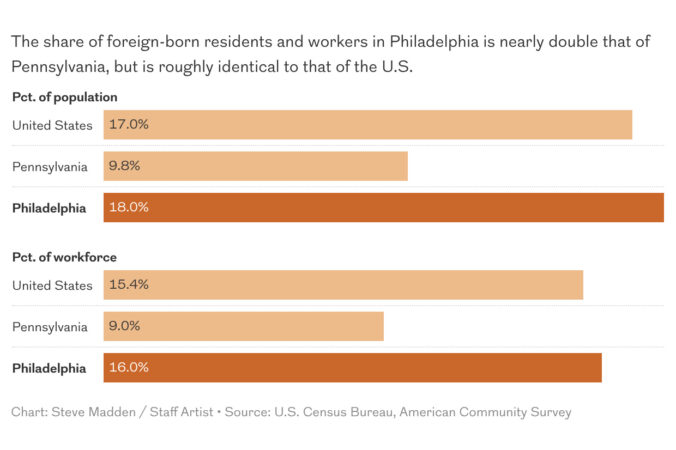
As of 2024, immigrants comprised 16% of the city population, about 251,000 residents, the primary engine of net population growth since 2000. The arrival of newcomers has been enough to offset the loss in native-born residents, which dropped by about 59,700 between 2010 and 2020.
“Philadelphia’s 21st-century demographic stabilization,” the analysis said, “is an immigration story.”
window.addEventListener(“message”,function(a){if(void 0!==a.data[“datawrapper-height”]){var e=document.querySelectorAll(“iframe”);for(var t in a.data[“datawrapper-height”])for(var r,i=0;r=e[i];i++)if(r.contentWindow===a.source){var d=a.data[“datawrapper-height”][t]+”px”;r.style.height=d}}});
How much do immigrants contribute?
A lot. In Philadelphia, immigrants comprised nearly 20% of the workforce in 2024. That’s double the rate of Pennsylvania as a whole, where immigrants were 9% of the workforce. The city’s institutional anchors — its universities and hospitals — as well as established ethnic communities, serve as draws.
That year the city’s foreign-born residents, both documented and undocumented, spent an estimated $7.4 billion on goods and services and paid $2.3 billion in taxes ― including federal income taxes, payroll taxes, state income taxes, sales taxes, and property taxes.
Do some industries depend on immigrants more than others?
Yes. Local healthcare services rely not just on doctors, the analysis showed, but also on immigrants across different jobs and skill levels. About 26% of all Pennsylvania physicians are foreign-born, and nationally the same is true for nearly 40% of nursing aides and home health aides.
In the Philadelphia region, foreign students earn 40% of doctoral degrees, the report said, and research institutions depend heavily on that talent. Traditionally these students transition from F-1 visas, to Optional Practical Training, then compete for H-1B visas that enable long-term employment.
That’s where things have gotten rough for immigrants, as in December the Trump administration halted processing for several groups of people and categories of applications, including those for anyone from any of the 19 countries covered in the spring travel ban.
The administration has also raised the possibility of reopening cases that were already approved by the government.
The city’s hospitality and restaurant trades also depend on foreign-born workers. Immigrants make up 25% to 30% of restaurant workers and 30% to 35% of hotel staff. At some restaurants the foreign-born staff can exceed 40%.
Don’t many immigrants opt to work for themselves, starting their own businesses?
In Philadelphia, foreign-born entrepreneurs own roughly 30% of small businesses ― nearly twice their representation in the population. Those 47,800 businesses include everything from corner stores to tech startups.
So what’s the bad news?
It’s more like a warning. At 16%, Philadelphia’s foreign-born population exceeds the national average, which hovers around 13%. But traditional gateway cities like New York, Houston, Miami, and San Francisco maintain foreign-born populations as high as 35%.
Philadelphia, the analysis said, is “no longer an immigration laggard,” but it’s not yet competing with top-tier global cities for international talent.
Moreover, without sustained immigration, Philadelphia faces the prospect of renewed population decline. Native-born residents are aging, fertility remains below replacement levels, and U.S. domestic migration favors metro areas in the Sunbelt.
“Immigration provides the only plausible mechanism for population stability,” the study said, but federal policies that reduce legal immigration, slow visa processing, and intensify enforcement risk causing the opposite.
The question isn’t whether Philadelphia needs immigration ― the demographic math makes that undeniable, the study said. The question is whether policymakers will embrace supportive policies and investments.
“Given the stakes,” it said, “getting immigration policy right isn’t optional ― it’s existential.”
Fifty-six years ago, President Richard Nixon sent a letter to Congress proposing the formation of a new federal regulator: the Environmental Protection Agency. Back then, big city skylines were shrouded in smog, chemicals and waste had spoiled the nation’s waterways, and Americans across the political spectrum recognized the need to safeguard the planet.
The government’s efforts worked. While disagreements over the details and near-constant pushback from industry over regulations persisted over the decades, the EPA was long considered a genuine bipartisan American success story — at least until President Donald Trump and EPA Administrator Lee Zeldin arrived.
So far, the pair have taken a flamethrower to environmental policy.
The two most egregious moves are the rollback of mercury emission limits at coal plants and the repeal of the legal basis for regulating greenhouse gases. Americans — and the world at large — will be paying for the administration’s shortsightedness for years to come.
A contaminant that is present in coal and released when it is burned, mercury can have devastating effects on human health. Just ask Health and Human Services Secretary Robert F. Kennedy Jr., who blamed mercury exposure for contributing to his memory loss and brain fog while running for president. He’s campaigned to remove mercury from fish and vaccines, while his colleagues in the administration plan to release more mercury into the atmosphere.
The emissions rollback also affects restrictions on arsenic, nickel, and lead — all of which are released when coal is burned. A Harvard analysis suggested that repealing the mercury restriction could lead to $200 million in additional annual health costs for Americans, including heart and lung issues.
It’s bad enough that Trump wants to promote continued coal use; his administration is also standing in the way of renewable energy sources, putting up regulatory roadblocks for the development of wind and solar power. While America needs more energy generation to tamp down rising electricity costs, a diversified approach makes a lot more sense than using a 19th-century answer to a 21st-century problem.
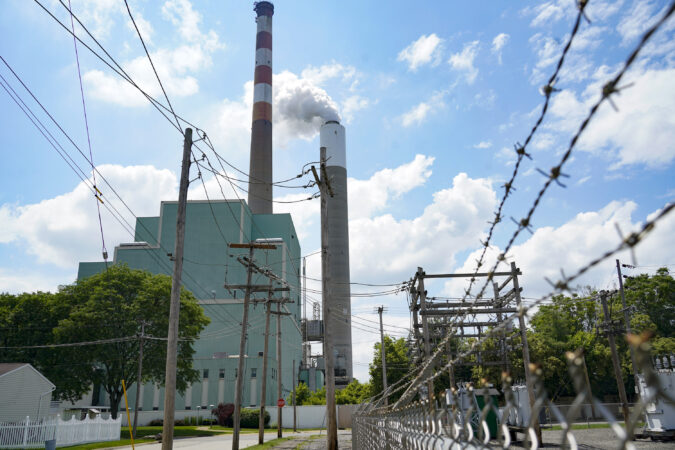
The former coal-fired Peco power plant next to Penn Treaty Park.
By turning its back on the EPA’s “endangerment finding,” the Trump administration has eliminated the government’s power to limit greenhouse gas emissions. The 2009 finding, which recognized that carbon dioxide and other greenhouse gases produced by fossil fuels endanger public health, has been the cornerstone of U.S. climate policy.
Beyond the damage to the environment and long-term impact on an already dangerously warming planet, lifting restrictions will also result in higher costs for American motorists and bigger profits for oil barons at home and abroad.
In Pennsylvania alone, the toll would be significant. According to an analysis by the nonprofit Environmental Defense Fund, repealing the endangerment finding would result in $57 billion worth of additional fuel costs and over $12 billion in additional health costs by 2055 for Keystone State residents. Other costs include tens of thousands of additional premature births, millions of asthma attacks, and billions of metric tons worth of pollution.
The EDF, alongside a coalition of environmental groups, is currently suing the EPA to preserve emissions standards. The Trump administration’s backsliding puts America out of step with most of the world, where governments are embracing clean energy and electrification not only for health benefits but economic ones, as well.
In France, clean energy production has been so successful that supply temporarily eclipsed demand briefly last year. While American ratepayers are dealing with rising electricity costs, France is seeing prices drop to their lowest level in years.
China has established itself as a hub for electric vehicles. While the Trump administration has gutted incentives meant to help the American auto industry compete, Chinese firms have recorded a 1,016% increase in electric vehicle exports, with the total value rising from $295 million in 2018 to $36.7 billion in 2023. Thanks to the president, American automakers are likely to miss out on this bonanza.
Instead, America’s energy policy seems aimed at recreating the economy of the 1960s, the very same conditions that led to the environmental movement in the first place. Trump has talked about “clean, beautiful coal,” said wind power is for “stupid people,” and defunded tax programs that help homeowners reduce their energy usage through heat pumps and weatherization.
Americans deserve better than higher bills and dirtier air. Unfortunately, under Trump’s policies, that’s all we’ll get.
New Jersey joined the growing list of states sued by the Department of Justice after refusing to share personal information of voters with President Donald Trump’s administration because of privacy concerns.
The Justice Department sued New Jersey on Thursday alongside Utah, Oklahoma, Kentucky, and West Virginia as it escalates its effort to obtain voter data. It previously sued Washington, D.C., and 24 other states, including Pennsylvania.
The suits follow Trump’s rhetoric in recent weeks about the need to “nationalize elections.” During his State of the Union address to a joint session of Congress this week, the president repeated the unsubstantiated allegation that “cheating is rampant in our elections.”
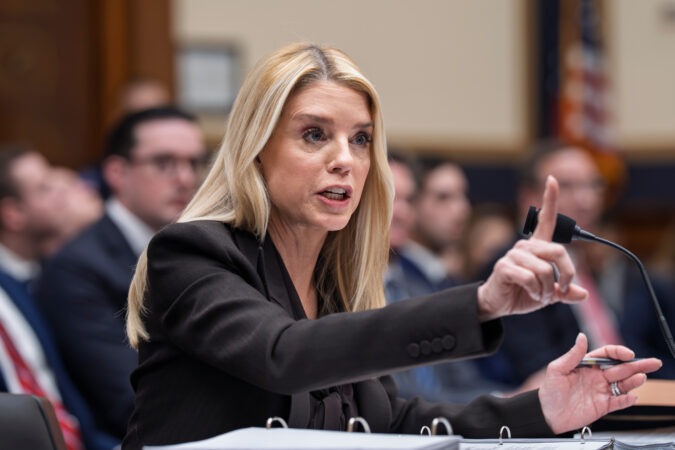
The lawsuit in the New Jersey District Court accuses Dale Caldwell, who is serving as the Garden State’s lieutenant governor and secretary of state, of violating Title III of the Civil Rights Act of 1960 by refusing to hand over the list of the state’s registered voters to U.S. Attorney General Pam Bondi.
“Accurate, well-maintained voter rolls are a requisite for the election integrity that the American people deserve,” Bondi said in a statement. “This latest series of litigation underscores that This Department of Justice is fulfilling its duty to ensure transparency, voter roll maintenance, and secure elections across the country.”
Caldwell’s office did not immediately respond to a request for comment.
Acting New Jersey Attorney General Jennifer Davenport said the state would defend against the lawsuit in court.
“As several courts have already held, the Department of Justice’s request for voters’ personal information, including driver’s license numbers and Social Security numbers, is baseless,” Davenport’s statement said. “We are committed to protecting the privacy of ours state’s residents.”
Bondi sent a letter to Caldwell on July 15 asking for the statewide voter registration list, the suit says. The letter cited alleged discrepancies in New Jersey’s voting registration statistics compared to national averages. For example, it says the state removes fewer duplicates from its voter rolls.
A month later, the suit says, Bondi sent another letter asking for the full list including each voter’s full name, date of birth, address, and driver’s license or last four digits of their Social Security number.
In the months following the August letter, former state Attorney General Matthew Platkin declined to share the information because of privacy concerns — a reason Pennsylvania officials have also cited.
After the administration of Gov. Mikie Sherrill took office in January, DOJ sent a “courtesy email” to check if the state’s position on sharing the records has changed. But it didn’t.
The suit is asking a federal judge to find that Caldwell violated federal law by refusing to share the records and order the state to pass over the information.
Schmidt called the department’s request “unprecedented and unlawful” and promised to “vigorously fight the federal government’s overreach in court.”
“I have an obligation to protect the personal information that Pennsylvania voters entrust us with, and I take that obligation extremely seriously,” Schmidt said in a September statement.
The voter roll lawsuit is the second filed by the Justice Department against New Jersey this week. Bondi sued Sherrill on Tuesday over a Feb. 11 executive order that prohibits state agencies to allow federal immigration agents from entering state property for enforcement actions without a warrant.
The lawsuit said the executive order would disrupt the ability of U.S. Immigration and Customs Enforcement to capture “dangerous criminals” who are in prisons or courthouses controlled by the state.
Davenport said in a Tuesday statement that the state would continue to ensure the safety of the immigrant communities.
“Instead of working with us to promote public safety and protect our state’s residents, the Trump administration is wasting our resources on a pointless legal challenge,” Davenport’s statement said.
Gov. Josh Shapiro met with leaders in Berks and Schuylkill Counties on Thursday as the communities confront the planned federal conversion of two warehouses into ICE detention centers, and the governor pledged to do everything possible to block the Trump administration’s plans in Pennsylvania.
Shapiro, a Democrat who first publicly announced his opposition to the potential detention centers earlier this month, cited concerns over the impact on local economies, water resources, and residents’ quality of life.
Government warehouse purchases around the country, undertaken as part of a massive ICE expansion of detention capability, have sparked anger, lawsuits — and, in one instance, a suspected arson, when someone attempted to burn down a property in Arizona.
“I’m even more determined to do everything in my power to stop these facilities,” Shapiro said Thursday at a news conference in Berks County.
He spoke on the same day that New Jersey’s two Democratic U.S. senators, Andy Kim and Cory Booker, introduced legislation to ban the federal government from buying or converting warehouses for immigrant detention or processing.
“People across the country are standing up against this inhumanity, and Congress needs to stand with them,” Kim said in a statement.
Shapiro offered few details on how the state government could block the facilities, citing possible legal or regulatory action.
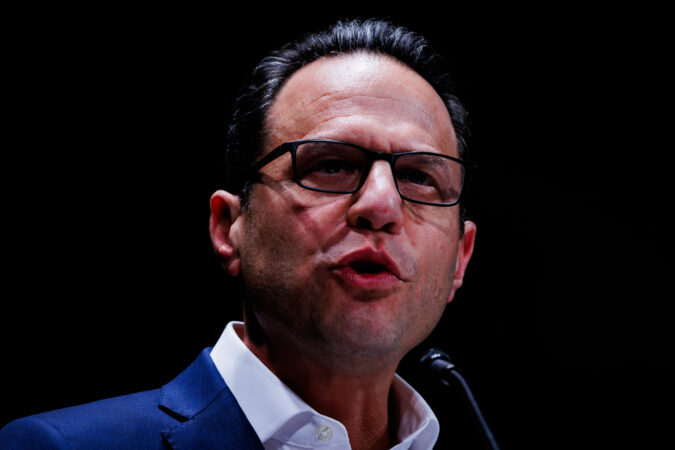
The governor, who is running for reelection, has been increasingly vocal in his opposition to ICE tactics even as his administration retains some cooperation with the agency. Earlier this month, Shapiro wrote a letter to Homeland Security Secretary Kristi Noem promising to “aggressively pursue every option” to block the detention centers from opening in Pennsylvania.
Expanding warehouses
The ICE effort to buy and repurpose warehouses as detention centers has quickly become one of the most contentious issues in immigration enforcement.
The ability to confine and process huge numbers of immigrants is essential to President Donald Trump’s promise to carry out an unprecedented deportation campaign. The number of people currently held has already reached historic highs, topping 70,000 this year, and the administration says it needs more space.
But as Trump’s plan has become public, opposition has been both immediate and fierce. Immigrant advocates call the warehouses “concentration camps” and question how buildings that were built to store consumer and industrial goods can safely and humanely hold thousands of people.
ICE expects to spend $38.3 billion to buy and retrofit warehouses around the nation.
Sixteen buildings would be converted into regional processing centers, each holding 1,000 to 1,500 immigrants. An additional eight detention centers would hold 7,000 to 10,000 detainees and serve as primary sites for deportations.
Shapiro on Thursday sought to send a clear signal to federal officials that he would fight any facilities in Pennsylvania. Following his news conference, Shapiro posted a video to Twitter declaring that Noem “will hear us in Pennsylvania.”
Standing outside the proposed facility location in Berks County, Shapiro outlined the impact detention facilities would have on local communities ― including increased pollution in Berks County and draining of water resources in Schuylkill County.
“I’m pissed,” Shapiro said. “And I’m not going to allow this to happen.”
“If you continue to go forward here, you will face legal and regulatory consequences,” he warned federal officials.
In Bucks County earlier this month, commissioners said that the federal government recently approached warehouse owners in Bensalem Township and Middletown Township about converting the buildings to ICE facilities. Neither owner is going forward with a sale, they said.
In Maryland, Democratic Attorney General Anthony Brown has sued the Trump administration to try to stop plans to hold 1,500 immigrants in a warehouse near Williamsport, about eight miles south of the Pennsylvania border.
Brown and Maryland Democratic Gov. Wes Moore say the project is unlawful, going forward without an environmental review or public input.
ICE purchased the warehouse for $102.4 million in January, the property built as a commercial facility with 825,620 square feet of warehouse space, minimal office facilities, four toilets, and two water fountains, according to the attorney general.
The 1,500 immigrants held there would nearly equal the population of Williamsport, home to about 2,000 people.
Farther south, in Wilson County, Tenn., ICE is examining a two-building complex that would hold a combined 14,000 to 16,000 immigrants, by far the largest immigration detention center in the country, according to Project Salt Box, a Baltimore-based group that tracks ICE warehouse activity.
This month in Surprise, Ariz., someone tried to burn down a warehouse that ICE bought to turn into a 1,500-bed detention center, but the fire was quickly extinguished by the interior sprinkler system, the Arizona Mirror reported, quoting federal officials.
The plan to create a fixed, large-scale network of converted warehouses represents a radical new approach to immigration detention.
Historically, the American Immigration Council noted, ICE’s detention funding has gone almost entirely to contract providers, the private prison companies and state and local governments that lease facilities to the agency. As of February 2025, ICE owned only 10 of the 220 facilities being used to detain immigrants, the council said.
Now, ICE seeks to reengineer a detention system that was not centrally planned, but emerged over decades as Congress gradually increased agency funding, the council said.
ICE currently operates five detention facilities in Pennsylvania, including the 1,876-bed Moshannon Valley Processing Center, the largest detention center in the Northeast. Two more are located in New Jersey, in Elizabeth and Newark, and the Trump administration has been exploring adding a third at Joint Base McGuire-Dix-Lakehurst.