Five police officers say in a new federal lawsuit they were skipped over for promotions because of a Philadelphia policy change to promote diversity, equity, and inclusion in the municipal workforce.
The officers — Christopher Bloom, Kollin Berg, Joseph Musumeci, Marc Monachello, and Leroy Ziegler — claim they were victims of an “illegal and discriminatory” policy change adopted by City Council and Philadelphia voters in the aftermath of Black Lives Matter protests that swept the nation.
The lawsuit is a proposed class action on behalf of “all white male employees” of the Philadelphia Police Department who were passed over for promotions since 2021 in favor of a candidate with lower exam scores. The complaint was filed by a team of attorneys affiliated with President Donald Trump who have sued the city previously over diversity initiatives.
The change at the heart of the latest lawsuit is related to the so-called rule of two that required city managers to choose between the two candidates with the highest Civil Service exam scores. The rule was an often-cited reason for the limited diversity in the city workforce.
Voters got rid of the requirement through a ballot question in 2021, giving the city more discretion to tailor the number of finalists for a position.
The five officers sought promotions in November, three from lieutenant to captain and two from sergeant to lieutenant. All were “passed over for one of these promotions on account of their race and sex,” the suit says.
The complaint, filed Wednesday in the Eastern District of Pennsylvania, quotes from legislative documents and statements from politicians to argue that the rule change was racially motivated.
A 2022 resolution calling on then-Mayor Jim Kenney to study the impact of the rule change “repeatedly bemoans the fact that white men were obtaining too many promotions under the city’s merit-based promotion system,” the suit says, calling it “one of the many examples of the city of Philadelphia’s determination to impose illegal DEI practices that consciously and intentionally discriminate against white men.”
Another example cited in the lawsuit is a statement by Mayor Cherelle L. Parker, a Council member at the time, who championed the change. She is quoted as saying that “for too long, the Rule of Two has held back Black and Brown employees.”
The suit is the latest filed by a team of conservative lawyers against Philadelphia over efforts to address racial inequity. The attorneys include Pennsylvania’s self-described “go-to” lawyer for Republicans, Wally Zimolong; Jonathan Mitchell, the former Texas solicitor general who is credited as the legal mind behind that state’s abortion ban; and attorneys from American First Legal, an organization formed by Trump adviser Stephen Miller.
In October, the group settled a lawsuit that claimed the city violated the Constitution by forcing bidders to sign agreements that included diverse workforce goals. The city agreed to pay $417,000 in attorneys’ fees and clarify that diversity benchmarks in project agreements were aspirational goals, not mandatory quotas.
Parker’s administration ended a Philadelphia policy prioritizing businesses owned by women or people of color in city contracting shortly after the settlement.
Delaware County-based attorney, Wally Zimolong, has been filing lawsuits challenging Philadelphia’s programs to increase diversity, equity, and inclusion in hiring and schools.
The attorneys are not targeting Philadelphia, according to Zimolong.
“Philadelphia just so happens to habitually enact policies that violate the United States Constitution,” he said.
Zimolong declined to comment on the current lawsuit, as did the city’s law department.
The complaint names as defendants the city, the police department, Police Commissioner Kevin Bethel, Deputy Commissioner Krista Dahl-Campbell, and Philadelphia Chief Human Resources Officer Candi Jones. It asks a judge to order the promotion of the officers and declare that the city’s current hiring policies are unlawful because they consider race and gender.
Passed over
Police lieutenants Bloom, Berg, and Musumeci sought promotions in fall 2025. There were 10 available positions, and the trio ranked eighth, 11th, and 13th, respectively, on the “captain eligibility” list based on exam scores.
After interviews, six candidates were passed over in favor of those with lower scores, according to the complaint. Five of those six were white males.
The lawsuit alleges a similar pattern when the department decided not to promote sergeants Monachello and Ziegler.
“Monachello and Ziegler were passed over for promotion in favor of lower-ranked female or minority candidates with lower scores on the civil-service examination,” the suit says.
The Fraternal Order of Police Lodge 5 blasted the police department in a statement following the November promotions, saying the union filed grievances and was considering other actions against “unfair DEI practices in law enforcement.” The FOP also sent a letter asking the U.S. Department of Justice asking to review the promotion criteria, the suit says.
The police department workforce is 50% white, 34% Black, 12% Hispanic, and 3% Asian, according to data from the city. Nearly 40% of new hires this fiscal year have been Black, compared with 33% white.
In comparison, the city’s population is 44% white, 42% Black, 16% Hispanic, and 9% Asian, according to the Census Bureau.
The department has faced racial discrimination lawsuits from employees, including regarding promotions. But usually the candidates allege they were passed over for a white candidate.
For example, in October, an Asian officer sued after not getting promoted to captain, noting in the complaint that “no person of Asian descent has been promoted to the rank of Captain since 1976.”
Like most of his Rohingya people — stripped of citizenship by Myanmar’s ruling junta and targeted by a brutal 2017 genocide — Nurul Amin Shah Alam and his family spent the last decade yearning to breathe free.
A nomadic quest for liberty took Shah Alam, his wife, and the two youngest of his six children through the crowded camps of Bangladesh, on a boat escape to Malaysia, and finally to apparent refuge in the United States on Christmas Eve 2024.
But the 56-year-old immigrant was almost never free on American soil.
In February 2025, just 53 days after his family arrived in the refugee hub of Buffalo, Shah Alam — nearly blind, apparently lost, and using a curtain rod as a walking stick — found himself in an encounter with Buffalo police. He was tased during a scuffle that ended with the refugee charged with felony assault.
After one year behind bars and a plea deal, relatives paid his bail on Feb. 19, and then waited for hours at the Erie County, N.Y., lockup, only to learn he’d instead been handed over to U.S. Customs and Border Protection (CBP) on an immigration detainer.
During a frantic, five-day search on the streets of one of America’s coldest big cities, Shah Alam’s family and supporters were stunned to learn that Border Patrol agents — apparently after learning the stateless refugee could not be legally deported — drove this disabled and nearly sightless man with no phone to a Tim Horton’s doughnut shop and dumped him there, five miles from his family’s home.
As reactions and questions continue to surface over the death of Nurul Amin Shah Alam, a visually impaired man who spent time in Border Patrol custody and was found dead Tuesday night, directions from the reported drop-off spot and where he was found place the two locations more…
“He never had freedom in his life,” Imran Fazal, a leader of the Rohingya diaspora in Buffalo who knows his family, told me by phone Wednesday night. “He came to this country because he wanted to experience freedom. He didn’t have that chance … He came to this nation that was supposed to save his life — and that nation destroyed his life.”
And now, abandoned on the subfreezing February streets of the snow capital of America. Because there is really only one point to the ethnic cleansing crusade that began with rabid Trump partisans waving their “Mass Deportation Now!” placards in a Milwaukee arena and ended with a cold, lonely corpse on Perry Street.
Somehow, in this downward spiral that has seen Americans grow accustomed to masked, heavily armed goons in tactical gear snatching day laborers or Uber drivers off once-placid urban streets, the abandonment and death of Shah Alam still hits like a gut punch to the soul of a once-welcoming nation. Yet, it somehow feels even more inhumane when viewed through the tortured prism of the Rohingya people, among the most persecuted ethnic minorities on earth.
Rohingya refugee children carry banners during a visit by U.N. Secretary-General António Guterres at the Ukhiya camp in Cox’s Bazar, in Bangladesh, in March 2025.
The roughly 1.4 million, mostly Muslim, Rohingya people in Myanmar, formerly Burma, have been targeted for repression by that nation’s Buddhist majority for decades, culminating in the stripping of their citizenship in 1982 and its military rulers driving hundreds of thousands across the border into Bangladesh during 2017’s brutal campaign.
In March 2022, during the Joe Biden administration, which was a brief window between the anti-refugee xenophobia of the two Trump presidencies, the U.S. government recognized the Rohingya as victims of genocide and, among other moves, expanded their resettlement opportunities in America. It’s estimated that at least 12,000 came to the United States during that short opening, and as many as 2,000 of them — perhaps lured by lower housing costs — have moved to Buffalo in the last couple of years.
It has not been an easy journey. Denied schooling in their native Myanmar and lacking a formal written script for their language, the majority of Rohingya who arrive in the United States are illiterate and unable to speak English.
The short, tragic American experience of Shah Alam reads like an allegory for the Rohingya plight on U.S. soil.
The version of what happened to him on the night of Feb. 15, 2025, as told to me by Fazal and also recounted by his family and lawyers in the media, is that Shah Alam, walking in his new neighborhood with the aid of that curtain rod and likely getting lost, took shelter under a porch perhaps without realizing he was on private property.
The woman who owned the property called the Buffalo police, who viewed the rod as a weapon and — when the non-English speaking Shah Alam failed to follow their commands — tased him and aggressively tried to arrest him. In a fight with the nearly blind immigrant whose awareness of the situation is in question, police said two officers suffered minor injuries. The ensuing criminal charges against Shah Alam — assault, trespassing, and possession of a weapon — were just the start of his Kafkaesque journey through American injustice.
Trump had just become the 47th president, and family members didn’t post bail at first, mainly because of fears the new regime would seek to deport him. Fazal said the already ailing Shah Alam lost considerable weight in his year behind bars, as much of the food didn’t meet his Muslim dietary restrictions.
Supported by the Rohingya diaspora community — Fazal said about 50 people attended one of his hearings — Shah Alam’s legal-aid attorneys eventually struck a misdemeanor plea deal. Then, on Feb. 19, family members arrived at the Erie County detention center expecting to take him home for a warm meal.
Breaking: A blind Burmese refugee named Nurul Shah Alam has been missing since Thurs. after Border Patrol agents dropped him off at a Tim Hortons, leaving him to walk home.
After a number of hours, Fazal said, the family called the police and said, “‘He was supposed to come here. He’s not coming.’ And they said, ‘You know, he was taken by the [U.S.] Customs and Border [Protection].’ And they said, ‘What?!’”
A CBP spokesperson told People magazine that Shah Alam was offered a “courtesy ride” from Border Patrol agents, “which he chose to accept to a coffee shop, determined to be a warm, safe location near his last known address, rather than be released directly from the Border Patrol station. … He showed no signs of distress, mobility issues, or disabilities requiring special assistance.”
In fact, Shah Alam — completely blind in one eye and with limited sight in the other, according to family members, who didn’t have a cell phone and had never used one — was five miles from his family’s current home. When his relatives and attorneys learned belatedly of the Tim Horton’s drop-off and could not find him, they filed a missing persons report that — in one final injustice — was, for a time, accidentally listed as resolved by an officer who mistakenly thought he was at an immigration detention site.
Instead, his body was found Tuesday night. The preliminary finding after an autopsy by the Erie County medical examiner is that Shah Alam died from medical causes and not from either exposure to the cold or intentional homicide. Nonetheless, his death is under investigation — yes, by the same Buffalo police who initiated this nightmare — and has sparked justifiable outrage from local officials like Buffalo Mayor Sean M. Ryan, who called the CBP actions “unprofessional and inhumane.”
That’s a gross understatement. It’s not just that Shah Alam’s abandonment and death is a new twist on the roughly 40 immigrants who’ve died in federal detention since the start of 2025 from a mix of medical neglect, suicidal despair, and at least one homicide, along with the eight people fatally shot by CBP or U.S. Immigration and Customs Enforcement (ICE). All of it is proof that Trump’s immigration policy is written with the blood of innocents.
We also need to ask ourselves how and why a nation that so blithely uses the Statue of Liberty for everything from car insurance ads to a morally empty 250th birthday party is now repressing some of the most mistreated humans on earth — people who honestly believed America would offer the freedom they were denied in their nation of birth.
It’s a moral abomination to see the Hmong people who risked everything to side with the United States in Southeast Asia now dragged from their homes in Minnesota, or the Venezuelans who fled a strongman dictator only to be branded as criminal gang members, or the Haitians who escaped relentless violence only to now huddle in fear in heartland Ohio.
And now the Rohingya, who were able to survive a genocide and inhumane refugee camps some 8,000 miles away, only to now find themselves in a country that is building concentration camps and forging a 21st-century Trail of Tears.
Fazal — a 30-year-old recent Buffalo State grad whose seven-year stateless flight to freedom passed through Bangladesh, Malaysia, Indonesia (where he was detained for 17 months in an immigration prison), Australia, and Papua New Guinea — told me he feels anger over Shah Alam’s death, but also guilt, because he has gained U.S. citizenship while Shah Alam did not.
“The system and the police should be accountable,” he said. “We need justice to be served.”
When this newest stain on human existence is finally over, there won’t be enough courtrooms to try every masked idiot who shot an unarmed protester, or beat up an immigrant and swore he “ran into a wall,” or slammed a brain-injured woman to the asphalt.
But years in prison would be too good for the soulless monsters who went on a doughnut run and left a good man to die. If there is any justice under God’s universe, they will be consigned for all ofeternity to a snowdrift as large as Lake Erie in an unending and fruitless quest for the warmth and liberty they deprived Nurul Amin Shah Alam.
Pennsylvania voters appear to be all in on Gov. Josh Shapiro’s reelection bid, while some are still warming up to the thought of him being president one day.
Among registered voters, the Democratic incumbent leads his Republicanchallenger, state Treasurer Stacy Garrity, 55-37%, according to a Quinnipiac University poll released Wednesday.
But 43% of the state’s voters do not think he would make a good president and 16% did not offer an opinion, despite his high overall approval.
A strong majority of Democrats and a plurality of independent voters both said he would be a good president, but a strong majority of Republicans disagreed.
The survey, conducted among 836 registered voters in Pennsylvania from Feb. 19 to 23, offers a glimpse of what voters in one of the most politically consequential states think of top elected officials a little more than eight months ahead of the high-stakes 2026 midterms.
Pennsylvania voters also shared their perceptions of U.S. Sen John Fetterman (D., Pa.), who has significant support among Republicans but a low rating with his own party, and President Donald Trump, whose job approval rating is sitting below 50% in a state he won two years ago.
Here’s what else to know from the Quinnipiac poll:
Sen. John Fetterman, D-Pa., left, and Sen. Dave McCormick, R-Pa., right, greet before participating in a debate moderated by Fox News anchor Shannon Bream, not shown, Monday, June 2, 2025, at the Edward M. Kennedy Institute for the United States Senate, Monday, June 2, 2025, in Boston, as livestreamed on Fox Nation. (AP Photo/Steven Senne)
Republicans support John Fetterman. Democrats don’t.
Fetterman has been known to cross the political aisle, and his willingness to embrace Trump and take key votes with Republicans appears to be costing him with voters in his own party.
Sixty-two percent of Democratic Pennsylvania voters disapprove of how Fetterman is handling his job, while only 22% approve.
Those dismal numbers with his own party are worse than Fetterman’s Republican colleague, Sen. Dave McCormick, who has a 54% disapproval rate with Democrats.
After three years in office, Fetterman does much better with Republicans than his own party. Among GOP voters, 73% approve of the Democratic senator, compared with just 18% who disapprove, according to the poll. Among independents in the swing state, 48% approve and 37% disapprove.
The progressive Working Families Party has said it will support and, if needed, recruit a challenger. Fetterman has repeatedly sparred with progressives on a range of issues from unconditional support for Israel’s military actions in Gaza to his stance on immigration enforcement.
He also drew ire from fellow Pennsylvania Democrats for crossing the aisle to support a Republican plan to end last year’s government shutdown without a deal to address expiring healthcare subsidies.
U.S. Rep. Brendan Boyle (D., Philadelphia), a potential primary challenger, has repeatedly called Fetterman “Trump’s favorite Democrat,” including on Tuesday night, when the senator shook the president’s hand at the State of the Union address.
Other names floated as potential contenders include U.S. Rep. Chris Deluzio (D., Beaver) and former U.S. Rep. Conor Lamb, who lost the 2022 primary to Fetterman.
Which party do Pa. voters want to win the midterms?
Forty-nine percentof Pennsylvania registered voters want to see Democrats win control of the U.S. House in November, while 43% want Republicans to maintain their advantage.
November’s midterms are consequential for both parties, especially in the House, where Republicans currently have a slim majority.
But voters in Pennsylvania have soured on Trump, who receives just 40% approval in the poll, compared with 55% disapproval. And he is losing ground on two key issues that propelled him to office: the economy and immigration.
According to the poll, only 28% of Pennsylvania voters think the economy is getting better, while 47% think it is getting worse and 23% think it is staying the same.
Additionally, 56% believe the Trump administration’s immigration enforcement is too harsh in how it treats undocumented immigrants. Meanwhile, 36% think the president is handling immigration correctly and 6% think the administration is being too lenient.
Democrats believe they can capitalize on these issues and defeatincumbents in key swing districts: Republican U.S. Reps. Brian Fitzpatrick in Bucks County, Ryan Mackenzie in Lehigh County, Rob Bresnahan in Lackawanna County, and Scott Perry in York County.
Trump has endorsed every member of the Republican U.S. House delegation in Pennsylvania except Fitzpatrick.
New Jersey Attorney General Jennifer Davenportmarked her first official day in the office Tuesday exchanging lawsuits with President Donald Trump’s administration.
Davenport, appointed by Gov. Mikie Sherrill, had already been waging legal battles against Trump as acting attorney general before her unanimous confirmation by the New Jersey Senate.
Thestate’s new top lawyer announced a lawsuit the same day against Trump’s Department of Health and Human Servicesover what she called its “rogue vaccine schedule that gambles with children’s health and lives.”
Trump’s administration also announced a lawsuit against New Jersey over a new immigration policy Davenport helped roll out that restricts ICE operations on state property.
She called the federal government’s suit a “pointless” waste of resources.
The two cases are a sign of more battles to come as Sherrill promises to fight Trump. Davenport will betasked with making sure the governor’s policies withstand a potential barrage of court battles in the months and years ahead.
DOJ sues Sherrill over her executive order limiting ICE
The Department of Justice announced Tuesday that it filed a lawsuit against Sherrill and the state over the Democratic governor’s recent executive order prohibiting ICE from conducting civil immigration enforcement without a judicial warrant in non-public areas of state-owned property, which she announced alongside Davenport.
The DOJ’s legal complaint repeatedly misspells Sherrill’s last name.
“Federal agents are risking their lives to keep New Jersey citizens safe, and yet New Jersey’s leaders are enacting policies designed to obstruct and endanger law enforcement,” U.S. Attorney General Pam Bondi said in a statement. “States may not deliberately interfere with our efforts to remove illegal aliens and arrest criminals — New Jersey’s sanctuary policies will not stand.”
Davenport said Tuesday that the DOJ lawsuit is a waste and that her team looks “forward to defending this executive order in court.”
“New Jersey will continue to ensure the safety of our state’s immigrant communities,” she said.
Davenport joins lawsuit against RFK Jr.
In a lawsuit going in the other direction, Davenport announced on Tuesday that New Jerseyis joining a multi-state lawsuit against HHS, the Centers for Disease Control and Prevention, and their leaders.
The suit challenges a January CDC memo that upended childhood vaccination recommendations. Vaccines for rotavirus, meningitis, hepatitis A, hepatitis B, influenza, COVID-19, and respiratory syncytial virus (RSV) were previously universally recommended, but are now only recommended for children under high risk of serious illness. (Parents of otherwise healthy children can still decide with their doctors to give their kids these vaccines.)
The lawsuit also focuses on HHS Secretary Robert F. Kennedy Jr.’s decision to replace members of the Advisory Committee on Immunization Practices.
“This radical and unlawful overhaul of the nation’s childhood vaccine schedule rests on fringe theories and ignores decades of science,” Davenport said.
Prior to her confirmation, Davenport as acting attorney general joined another multi-state lawsuit last week against the Trump administrationfor rescinding clean energy funding that had previously been appropriated by Congress.
In New Jersey, the federal Department of Energy ended two agreements with Rutgers University, according to Davenport’s office. One, a $3.2 million award, was for energy-efficiency upgrades that would result in potential energy savings between $3.8 billion and $15.4 billion over the course of five years. The other award of $1.7 million was for research for farmers to use their land for energy production and agricultural production at the same time.
Lowering energy costs and fighting Trump were hallmarks of Sherrill’s campaign for governor and are part of her continued messaging as the state’s executive.
Davenport also sued the Trump administration with New York earlier this monthover his halting of funding for the Gateway infrastructure project between New York and New Jersey. A federal judge ordered the Trump administration to release funding for the project, and construction is moving forward as the appeal process plays out.
She has also joined multi-state coalitions condemning the Trump administration over the DOJ asking Minnesota to hand over resident data in exchange for ending the violent ICE operations there, as well as Trump’s attempt to halt funding for natural disaster response.
Sherrill and Davenport have also worked together to create a portal for people to submit videos of ICE agents in New Jersey and share information for residents to know their rights when interacting with federal immigration agents.
Who is Jennifer Davenport?
Davenport has more than 15 years of state and federal law enforcement experience, with experience at the New Jersey Attorney General’s Office, United States Drug Enforcement Administration, and the U.S. Attorney’s Office in New Jersey, where she was colleagues with Sherrill for part of her time there.
She most recently worked as deputy general counsel and chief litigation counsel for the energy company PSEG.
Davenport worked in a top role at the New Jersey Attorney General’s office in 2018 when the state first implemented the Immigrant Trust Directive, the state’s sanctuary policy that limits law enforcement cooperation with ICE and has been upheld by federal judges.
The litigator, who grew up in Wildwoodand now lives in Monmouth County, has two daughters ages 11 and 14. She graduated from DeSales University in Pennsylvania and the Seton Hall University School of Law in New Jersey.
“I am grateful to Governor Sherrill and the Legislature for the trust placed in me,” she said in a statement Tuesday. “I will serve with fairness, independence, and integrity — the same values that have guided every step of my public service.”
When a messy land dispute between Gov. Josh Shapiro and his backyard neighbor poured into public view via federal court filings earlier this month, it jolted his sleepy Montgomery County neighborhood.
The picturesque suburban community tucked behind Penn State Abington is usually quiet and boring, current and former neighbors said, just the way they like it. It’s a great place to raise their kids, and where Shapiro’s four children have grown up. Among the biggest points of contention is when one neighbor fails to say hello to another. Many houses in the neighborhood sit a quarter-mile away from the main road, behind winding, tree-lined driveways. Some of the homes have been purchased in recent years for upward of $1 million. In many ways, the neighbors said, it’s the perfect picture of the suburban American dream.
But this month, the neighborhood also became the battleground for dueling lawsuits between Shapiro and his neighbors, Jeremy and SimoneMock, bringing tension to atranquil community.
What’s more: Shapiro’s office alleges the lawsuit against him is a political hit job to hurt him as he runs for reelection, citing the Mock family’s communications with the top Republican in the state Senate and his frequent sparring partner, President Pro Tempore Kim Ward. The family’s attorney in the lawsuit is also a local lawyer known to represent Republican causes, and whose former clients include the political campaigns of President Donald Trump and U.S. Sen. Dave McCormick.
The Mocks, meanwhile, argue in their lawsuit — filed in the U.S. District Court for the Eastern District of Pennsylvania — that Shapiro has used his powerful position as governor to infringe on their constitutional rights and take their land.
The disputed land — a 2,900-square-foot strip between Shapiro and his neighbor’s lawn — had not been an issue between them until security updates were proposed to Shapiro’s home after a Harrisburg man firebombed the state-owned governor’s residence last April while Shapiro and his family slept inside, both the Shapiros and Mocks said in court filings. The man, Cody Balmer, later pleaded guilty to attempted murder and related crimes for the attack, and was sentenced to 25 to 50 years in prison.
Afterward, state police proposed security upgrades to Shapiro’s personal residence and the state-owned governor’s mansion in Harrisburg, suggesting the installation of an eight-foot fence along the perimeter of Shapiro’s personal property, along with tree trimming, a new security system, and other landscaping efforts expected to cost more than $1 million, Spotlight PA reported. The proposed taxpayer-funded improvements to the Montgomery County home — criticized by the Republican-controlled state Senate — came in addition to the more than $32 million in repairs and security upgrades made to the governor’s mansion in Harrisburg, which included the replacement of an existing security fence there.
(function() { var l = function() { new pym.Parent( ‘shapiroyard__graphic’, ‘https://media.inquirer.com/storage/inquirer/ai2html/shapiroyard/index.html’); }; if(typeof(pym) === ‘undefined’) { var h = document.getElementsByTagName(‘head’)[0], s = document.createElement(‘script’); s.type = ‘text/javascript’; s.src = ‘https://pym.nprapps.org/pym.v1.min.js’; s.onload = l; h.appendChild(s); } else { l(); } })();
The Shapiros allege in a countersuit that they believed the disputed piece of lawn was theirs, and that they had maintained it for 22 years. When a land surveyor hired by the state to help with the security upgrade projects found that the Shapiros did not own the disputed part of the land, the Shapiros approached the Mocks in July to purchase or lease it.
Ultimately, the talks fell apart, as the neighbors blamed one another for being unwilling to make a deal.
Any resolution is now likely to be decided in court.
The Mocks in their lawsuit — represented by Delaware County attorney Wally Zimolong, who describes himself on his website as the “‘go-to’ lawyer in Pennsylvania for conservative causes and candidates” — accused Shapiro in his official capacity as governor of an “outrageous abuse of power” by illegally occupying a part of their yard that they pay taxes on. The Shapiro family quickly filed a countersuit in the Montgomery County Court of Common Pleas, arguing they have control of the land through adverse possession, a legal mechanism through which a person can gain ownership of a property they’ve actively used for at least 21 years.
The Mocks have asked a federal judge to find that Shapiro, as governor, violated their constitutional rights; as well as prohibit state officials from trespassing on their property moving forward; and to award them damages. Private attorneys representing Shapiro have asked the Common Pleas Court to find they are the owners of the disputed part of the yard and refund attorney fees.
‘Everybody got along’
Shapiro and his wife, Lori, have lived in the same home in the neighborhood for 22 years, purchasing the four bed, three-and-a-half bath property in June 2003 for $465,000 as the young couple wanted to move back to the Philadelphia suburbs after spending several years working as staffers on Capitol Hill. Shapiro ran for state House the following year and represented the area until 2011, in what was the beginning of his decades-long political career that has helped flip Montgomery County, the state’s third-most populous county, from red to blue.
Several current and former neighbors in the Philadelphia suburb raced to defend the Shapiros as great neighbors, adding they don’t mind the additional state police presence as his star rises as a top Democrat and after the governor and his family were victims of political violence. Others said they’ve had a good relationship with the Mocks so far.
“We had nothing but pleasant experiences with Josh. I have nothing that I can say negative in any way, shape, or form,” said Eileen Simon, who used to live next door to Shapiro until 2020. Simon lived in the neighborhood for 48 years. She hasn’t spoken to the Shapiro family in a few years, but recalled that her grandchildren would often play on the Shapiro’s backyard swing set.
“We were all neighbors together, and everybody got along,” Simon added. “I’m devastated that this has happened.”
Cathy Keim, who moved out of the neighborhood seven years ago and shared a boundary line with the Shapiros for some of the nearly 40 years she lived there, also recalled a neighborhood where everyone got along. Keim said she believes the current dispute is petty, and added thatwhen Shapiro first built his swing set behind her pool fence, he mistakenly put it on her property. When the Keims alerted him to it, Shapiro quickly moved it back onto his own backyard, she said.
“That area, it looked like it should be theirs because of the pool fence,” she said. “I had to tell them, ‘that’s our property,’ and they very quickly moved it.”
Stephanie Berrong, whose backyard also abuts the Shapiro’s property, said in a text message that after the arson attack, the Shapiros asked if they could remove a tree on her property to build the security fence. Berrong and her husband agreed, and said the Shapiros were “respectful of our time and our property” throughout the tree-removal process. She did not comment on the Mocks.
“We just felt it was the right thing to do, considering someone tried to burn down the governor’s mansion with them, and their kids, inside,” Berrong added.
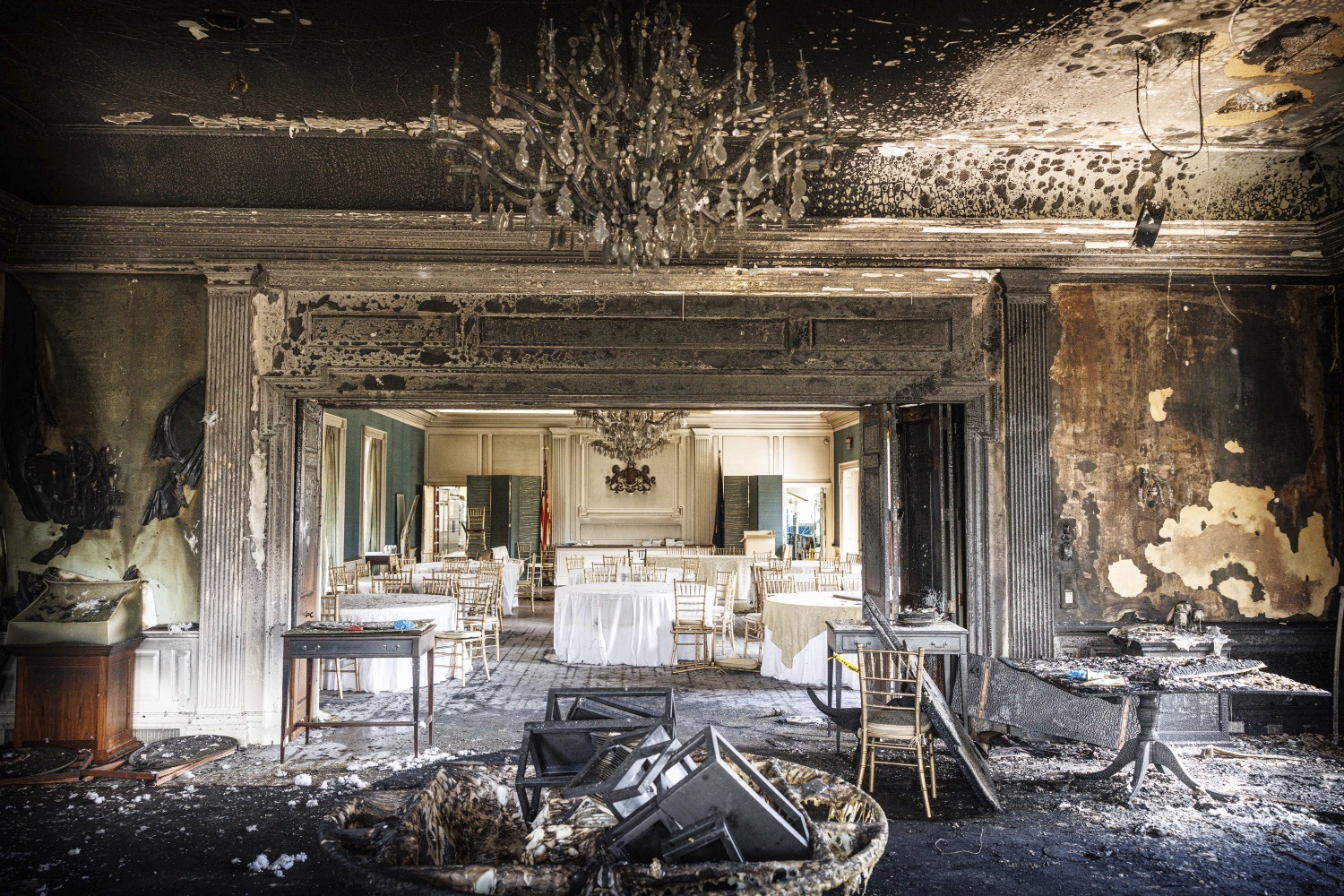
This image provided by Commonwealth Media Services shows damage after a fire at the Pennsylvania governor’s mansion while Democratic Gov. Josh Shapiro and his family slept inside on April 13, 2025, in Harrisburg.
State police never built the security fence that started the land feud, instead opting to surround Shapiro’s home with updated landscaping. That escalated the conflict with the Mocks. In their lawsuit, the Mocks allege that despite ongoing negotiations over the strip of land, the Shapiros began planting arborvitae-type trees and other plants on the Mocks’ property, flying drones over it, and threatening to remove healthy trees. The lawsuit also accuses state police of “chasing away” contractors who came to work in the Mocks’ yard.
The Shapiros, meanwhile, argue in court filings that the Mocks’ alleged harassment is causing them irreparable harm and further threatening their safety. According to a source briefed on the conflict, the Mocks at one point posted a series of signs on the land and a tree that read “Hippity hoppity, stay off my property,” and “This is my property,” among other efforts to antagonize the Shapiros.
John Ginsberg grew up in the home now owned by the Mocks during the 1970s and ‘80s, and said he never thought of their property as stretching into the land now owned by the Shapiro family.
“It just wasn’t an area that was used,” said Ginsberg, who now works as an attorney in Washington. “It wasn’t maintained, and it was brambly.”
Another man, who requested anonymity to speak freely about his neighbors, said he lived next to the Shapiros for more than 21 years, and has for decades shared the upkeep on a portion of the property highlighted in the lawsuit with Shapiro, taking turns clearing and replanting the area.
“I don’t think either of us thought twice about that little strip of land,” he said.
The Shapiros have been great neighbors, he said, and the Mocks have been “good neighbors to us,” describing them as a “nice young family.”
Political allegations
Shapiro has faced ongoing scrutiny from the state Senate for implementing the $1 million in security upgrades to his personal home, in addition to $32 million in repairs and security upgrades to the governor’s mansion following the arson attack. All of the upgrades were implemented without legislative approval due to their urgent nature.
A Senate committee in December took the unprecedented step to subpoena Shapiro over the security upgrades to his personal home, arguing that his administration had not been transparent in previous inquiries about how state taxpayer dollars were being used to upgrade security at Shapiro’s personal home.
Ward, the top official in the state Senate, has been critical of the state spending on security upgrades, saying that taxpayer dollars should not be funding security upgrades to Shapiro’s private residence.
Shapiro’s office is quick to note that Ward has been in contact with the neighbors taking the governor to court — saying that helps show the land dispute lawsuit is politically motivated.
Ward, of Westmoreland County, told ABC27 earlier this month that she had had contact with the Mock family on two occasions. A person close to Ward said that the senator is an acquaintance of the Mocks, but that the family had already obtained legal counsel by the time Ward reached out to them, and that the lawmaker did not encourage Shapiro’s neighbors to take any legal action against him.
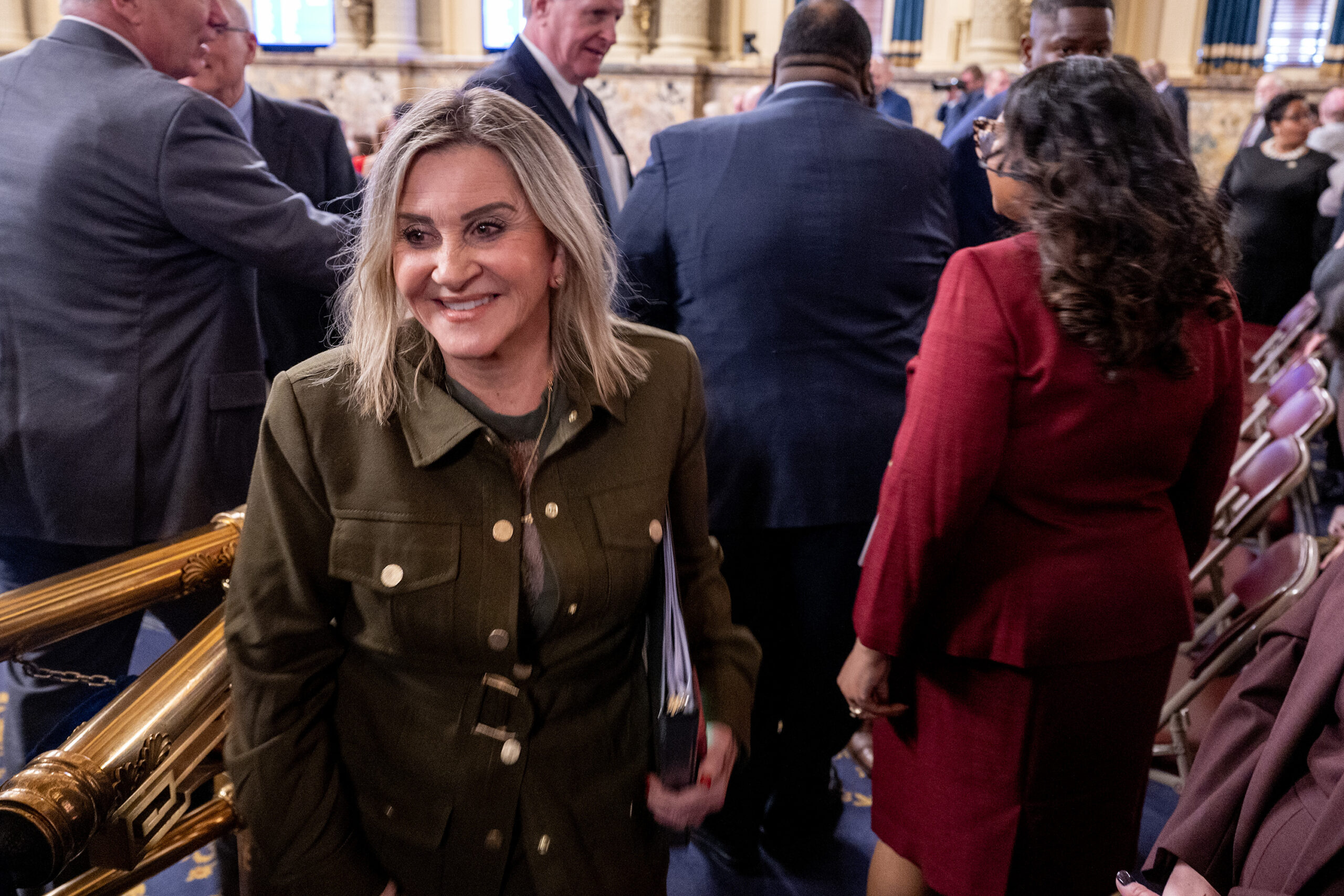
Senate President Pro Tempore Kim Ward leaves the House chamber Feb. 3 following Gov. Josh Shapiro annual budget proposal in Harrisburg.
Jeremy Mock has owned a small coffee business in Ward’s legislative district in western Pennsylvania since 2022, according to public business filings. He and his wife moved to the Abington Township neighborhood in 2017, and have had no issues with the Shapiros until the fence feud, according to both parties’ lawsuits.
“This dispute over a small piece of the Shapiros’ backyard has been turned into a shameless political stunt by their neighbors and members of the Republican State Senate, who are now harassing and exploiting the Shapiros,” said Rosie Lapowsky, a spokesperson for Shapiro, without directly naming Ward.
Zimolong, the Mocks’ attorney, said the fact that the couple was willing to work with the Shapiros to find a solution dispels any claim that their suit is politically motivated. The Mocks could have said “no” from the outset when the Shapiros approached them, he argued, but instead participated in negotiations.
“At base, this is a straightforward defense of the property rights of two innocent owners, who were living peacefully next to the Shapiros for over nine years,” Zimolong added in a statement.
“Even today, the Mocks remain open to resolving the dispute,” Zimolong said.
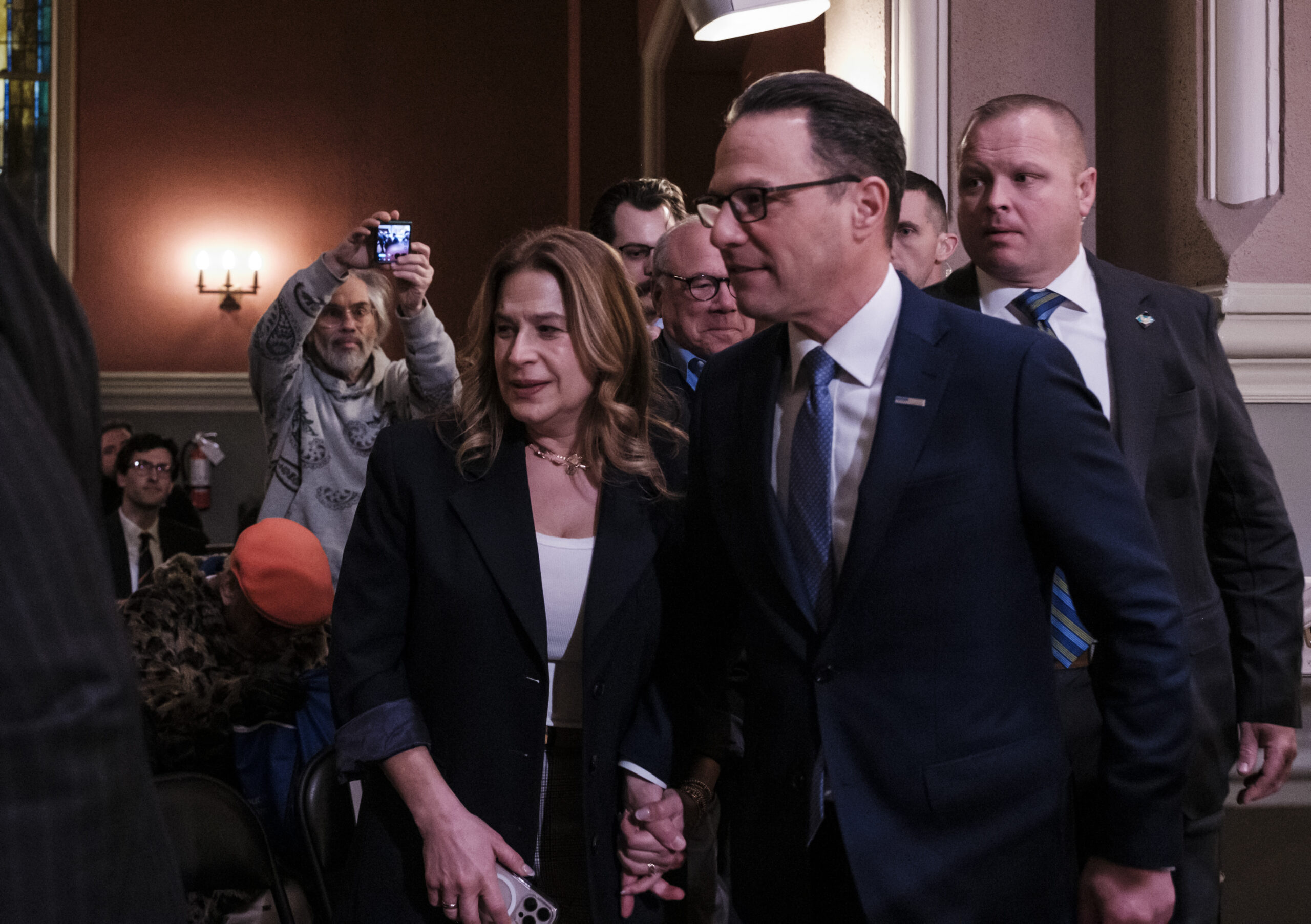
Gov. Josh Shapiro and his wife, Lori Shapiro, depart a talk for his new memoir “Where We Keep the Light” on Jan. 29 in Washington, D.C
Zimolong says he has never discussed the lawsuit with Ward or coordinated with her staff over the issue, “and I have no intention of doing so.”
He saidhe is one of few attorneys in southeastern Pennsylvania who is “not afraid to hold a powerful governor accountable” and does not have work before the state that would present an ethical conflict.
Erica Clayton Wright, a spokesperson for Ward, noted that taxpayer funds have now been used to pay for security upgrades to Shapiro’s personal residence and the property of his neighbors, and argued that it’s “not the first time Gov. Shapiro’s team has been put in the awkward position of pointing fingers to distract from Gov. Shapiro’s questionable methods of operation.”
“It is important not to lose sight of the need to ensure the governor and his family are safe while also safeguarding the processes in place to manage taxpayer funds,” Clayton Wright said.
“Absolutely no one but Gov. Shapiro himself is responsible for trying to take his neighbor’s property via squatter rights, which has resulted in federal and state lawsuits,” she said.
Staff writer Abraham Gutman contributed to this article.
He mentioned the “historic streets of Philadelphia,” Thomas Jefferson’s final breath, and the FIFA World Cup games, some of which will take place in the city this summer.
But his talk of the 250th celebrations served as bookends to what was otherwise a speech in which he railed against immigrants, spread falsehoods and lashed out at political opponents.
The president chastised Supreme Court justices for their recent ruling against his tariffs. And he frequently lambasted Democrats, bristling when they would not stand to applaud.
Pennsylvania popped up throughout the evening as Trump leaned on the 250th as a framing device for his speech and pointed to a woman from the Poconos to promote his economic agenda.
Trump talks of ‘epic milestone’ 250th celebrations
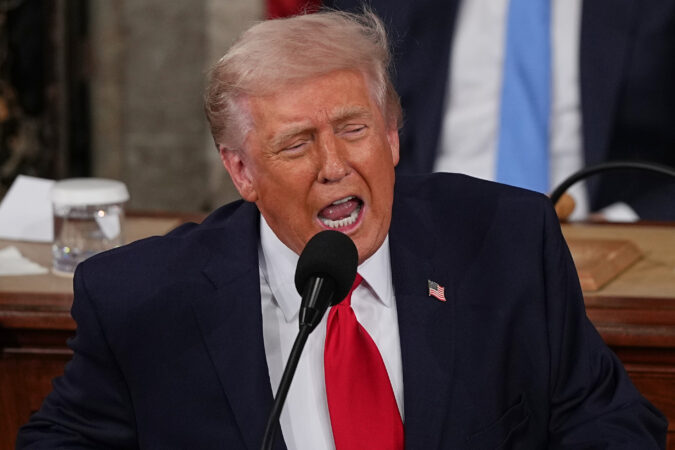
Trump mentioned the “epic milestone” of the United States’ upcoming 250th anniversary in July just moments in his remarks.
“This July 4, we will mark two and a half centuries of liberty and triumph, progress and freedom, in the most incredible and exceptional nation ever to exist on the face of the earth and you’ve seen nothing yet, we’re going to do better and better and better,” Trump said.
Philadelphia will beat the center of 250th anniversary celebrations this year, especially during the warmer months when the city is expected to see an influx of tourism which by one estimate could bring in as much as $2.5 billion to the city and region.
But when visitors stop by Philly’s iconic sites, it’s unclear whether they’ll be seeing the full picture of U.S. history.
The incident has sparked outrage from Philadelphians who have rallied to protect the site and spurred Mayor Cherelle L. Parker’s first major confrontation with Trump.
Trump did not address the controversy in his speech even as he touted the city’s history and the founding fathers in his speech.
The Philadelphia case is the most high-profile battle over the Trump administration’s broader effort to sanitize U.S. history ahead of the 250th. The National Park Service has removed content from parks throughout the country, including the Grand Canyon, underan order from Trump forbidding displays that “inappropriately disparage Americans past or living.”
Trump gives a shoutout to working mom from Pa.
The president brought Megan Hemhauser, a waitress and mom of two from Cresco, Pa., a town in the Poconos, as one of his guests to his address Tuesday night, saying in his speech that because of his “No Tax on Tips” and “No Tax on Overtime” policies she is “so, so much richer.”
Both tax breaks are available from 2025 through 2028 and decreases in size when earnings exceed $150,000 for single filers or $300,000 for married couples filing jointly.
Democrats have pointed out the same legislation also included cuts to SNAP and Medicaid, two programs heavily relied by low-income Americans. They’ve blamed other Trump policies, including his signature tariffs and his opposition to extending health care policies, for exacerbating the cost of living for Pennsylvanians.
“Trump promised to lower costs for Pennsylvania families on Day One, but he’s done the exact opposite,” said DNC chair Ken Martin in a statement ahead of the speech.
Protesting with a pin
U.S. Rep. Madeleine Dean (D., Montgomery) attended Trump’s State of the Union, but ended up leaving the event once Trump announced that Vice President JD Vance would be leading a “war on fraud.”
“I just had had enough of the lies,” Dean said in an interview after the address.
The Pennsylvania lawmaker joined other members of the House Democratic Women’s Caucus in wearing white as an homage to the suffragettes. She also wore a pin and scarf showing her support for Ukraine, as Tuesday marks four years since Russia waged its attack on the country.
“How I would have wished the president would have said ‘I am dismayed that I have not been able to bring an end to that brutal war and that is going to be my singular focus,’” said Dean, a member of the Ukraine caucus. “But, of course, he doesn’t say that.”
Other Democrats showed their opposition to Trump by boycotting his speech, including several from the region.
U.S. Rep. Mary Gay Scanlon (D., Delaware) and U.S. Rep. Summer Lee (D., Allegheny) both attended “People’s State of the Union,” an alternative event hosted by progressive groups instead of the president’s address.
Other Democrats who skipped Trump’s speech include retiring U.S. Reps. Dwight Evans of Pennsylvania and U.S. Sen Cory Booker of New Jersey.
John Fetterman wears a suit and shakes hands with Trump
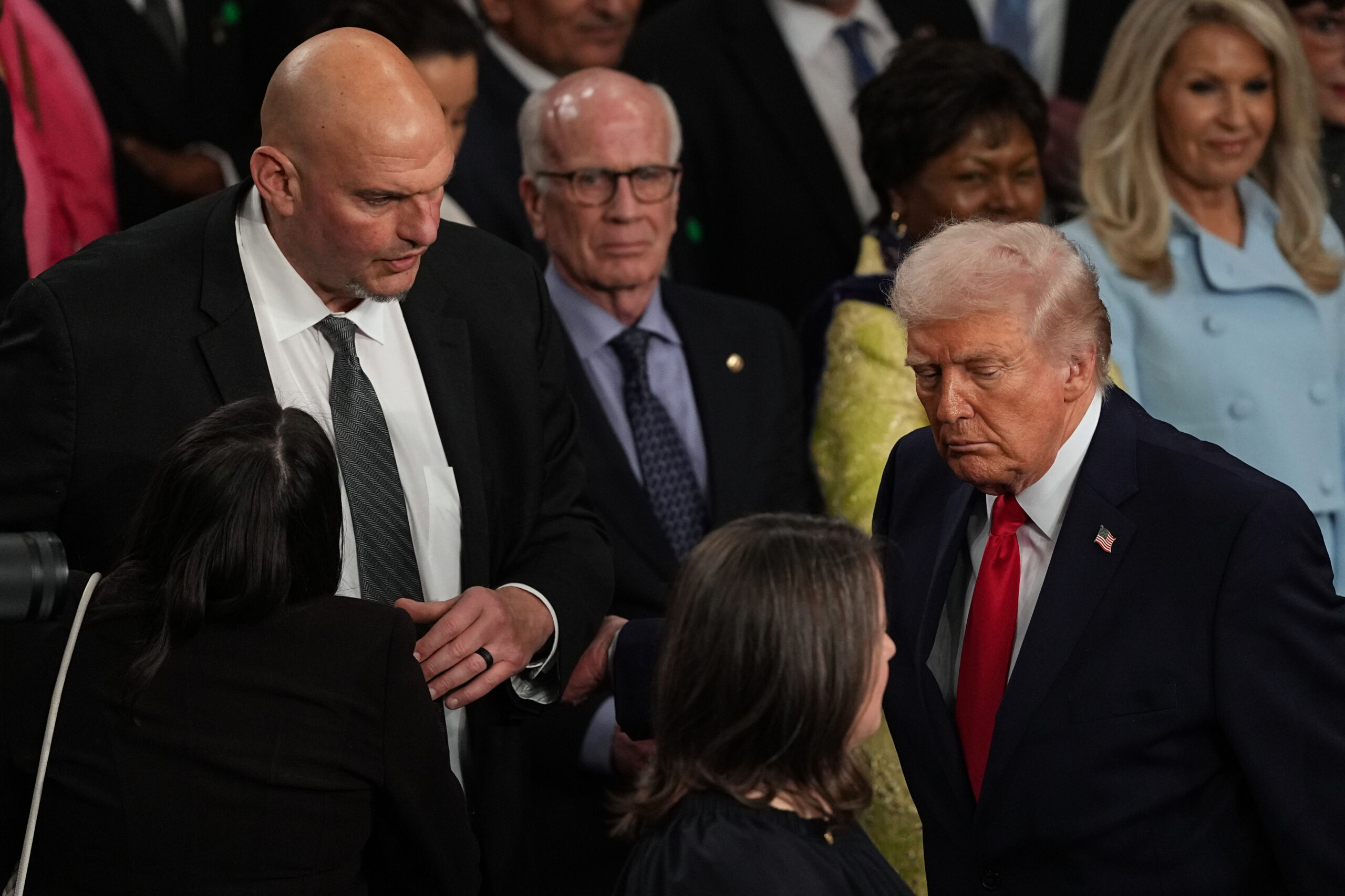
Known to seldom wear dress clothes, U.S. Sen. John Fettermantraded his usual hoodie for a suit Tuesday evening when he shook hands with Trump during the president’s entrance to the House chamber.
Fetterman’s greeting of Trump comes in contrast to many of his Democratic colleagues and underscores the senator’s willingness to embrace the other side of the political aisle, often earning him ire from his own party.
“I’m not surprised PA Senator John Fetterman finally got dressed up for once and so warmly greeted Donald Trump tonight,” wrote Boyle, who has been floated as a potential primary challenger to Fetterman in 2028. “After all, as the White House has previously stated, John Fetterman is Trump’s favorite Democrat.”
During a Wednesday morning interview with Fox News, Fetterman criticized fellow Democrats for not standing and applauding during several moments in Trump’s speech that he felt should have garnered bipartisan support, including when Trump recognized Erika Kirk, whose husband Charlie Kirk was shot and killed last year during a speech in Utah.
Fetterman also defended his handshake with the president and believes he was only Democrat to make such a gesture.
“Yes, I shook his hand. Of course. He walked in, and I’m always going to do that, for sure,” Fetterman said.
President Donald Trump passes Sen. John Fetterman, D-Pa., as he departs after delivering the State of the Union address to a joint session of Congress in the House chamber at the U.S. Capitol in Washington, Tuesday, Feb. 24, 2026.
Summer Lee’s Working Families Party response
Lee, a Pittsburgh progressive in her second term, delivered a response to Trump’s address on behalf of the Working Families Party, a grassroots progressive party that often endorses Democratic candidate.
The Pennsylvania lawmaker criticized Trump’s tariffs, Medicaid cuts, escalation of federal immigration agents, and mass layoffs of federal employees.
“The state of the union is dire,” Lee said. “We can’t afford to believe Trump’s lies, and we have to pay attention to his actions. This is not a normal time, and our response to it can’t be politics as usual.”
WASHINGTON — President Donald Trump declared during a marathon State of the Union on Tuesday that “we’re winning so much” — insisting he’d sparked an economic boom at home and imposed a new world order abroad in hopes it can counter his sliding approval ratings.
Trump’s main objective was convincing increasingly wary Americans that the economy is stronger than many believe, and that they should vote for more of the same by backing Republicans during November’s midterm elections. In all, Trump spoke for a record 108 minutes, breaking — by eight minutes — the previous time mark from his address before a joint session of Congress last year.
The president largely avoided his usual bombast, only occasionally veering off-script — mostly to slam Democrats. As he did during such addresses in his first term, Trump relied on a series of surprise special guests to dramatically punctuate his message. They included U.S. military heroes and a former political prisoner released after U.S. forces toppled Venezuelan President Nicolás Maduro.
Trump drew some of the loudest applause of the night when he invited the Olympic gold medal-winning U.S. men’s hockey team into the House chamber.
“Our country is winning again. In fact, we’re winning so much that we really don’t know what to do about it. People are asking me, ‘Please, please, please, Mister President, we’re winning too much. We can’t take it anymore,’” Trump said before introducing the team.
The hockey players, wearing their medals and “USA” sweaters, drew a bipartisan standing ovation. Trump pointed to the Democratic side of the chamber and quipped, “That’s the first time I ever I’ve ever seen them get up.”
In a made-for-TV moment, the president announced he would be awarding the Presidential Medal of Freedom, America’s highest civilian honor, to the hockey team’s goaltender, Connor Hellebuyck. He also bestowed the Purple Heart on Andrew Wolfe — a National Guard member who was shot while deployed on the streets of the nation’s capital. Wolfe made his first public appearance since then during the speech.
That scene recalled a similar surprise announcement in 2020, when Trump gave the Medal of Freedom to conservative radio host Rush Limbaugh during his State of the Union speech.
Trump vowed to plow ahead, using “alternative” laws to impose the taxes on imports and telling lawmakers, “Congressional action will not be necessary.” Trump argued that the tariffs are paid by foreign countries, despite evidence that the costs are borne by American consumers and businesses. “It’s saving our country,” he said.
The only Supreme Court justices attending were Chief Justice John Roberts, as well as Justices Brett Kavanaugh, Amy Coney Barrett and Elena Kagan. Trump greeted them personally before the speech, despite last week slamming Coney Barrett — who he appointed to the high court in his first term — for siding with the majority against his tariffs.
Democrats also stood for Trump vowing to halt insider trading by members of Congress. But Rep. Mark Takano, a California Democrat, yelled, “How about you first!” Rep. Rashida Tlaib, a Michigan Democrat, called out, “You’re the most corrupt president!”
When some heckling continued, Trump proclaimed, “You should be ashamed of yourselves.” Later, he pointed at Democrats and proclaimed, “These people are crazy.”
Democratic Rep. Al Green was escorted from the chamber early in the speech, after he unfurled a sign of protest that read “Black People Aren’t Apes!” That was an apparent reference to a racist video the president posted that depicted former President Barack Obama and First Lady Michelle Obama as primates in a jungle. Green was also removed during Trump’s address last year.
The president, meanwhile, was mostly optimistic and patriotic, but Trump struck a darker tone in large swaths of his speech to warn about the dangers posed by immigrants. He invited lawmakers from both parties to “protect American citizens, not illegal aliens” and championed proposals to limit mail-in ballots and tighten voter identification rules.
There also are persistent fears that tariffs stoking higher prices could eventually hurt the economy and job creation. Economic growth slowed in the last three months of last year.
It is potentially politically perilous ahead of November elections that could deliver congressional wins to Democrats, just as 2018’s blue wave created a strong check to his administration during his first term.
On Tuesday, Trump blamed his predecessor, former President Joe Biden, along with Democratic lawmakers in the chamber, saying they were responsible for rising prices and health care costs, two issues his political opponents have repeatedly raised against him.
“You caused that problem,” Trump said of affordability concerns. He added a moment later, “They knew their statements were a dirty, rotten lie.”
Trump also said he’d press tech companies involved in artificial intelligence to pay higher electricity rates in areas where their data centers are located. Such data centers tend to use large volumes of electricity, potentially increasing the cost of power to other consumers in the area.
Another notable off-script moment came as Trump was referencing prescription drug prices, saying, “So in my first year of the second term — should be my third term — but strange things happen,” prompting at least one chant in the chamber of “Four more years!”
Virginia Gov. Abigail Spanberger, who delivered the Democratic response to Trump’s speech, slammed the president’s aggressive immigration policies, his widespread cuts to the federal government and his tariffs.
“Even though the Supreme Court struck these tariffs down four days ago, the damage to us, the American people, has already been done. Meanwhile, the president is planning for new tariffs,” she said. “Another massive tax hike on you and your family.”
A warning to Iran
Trump’s address came as two U.S. aircraft carriers have been dispatched to the Middle East amid tensions with Iran. Trump said, “My preference is to solve this problem through diplomacy.”
“But one thing is certain, I will never allow the world’s number one sponsor of terror — which they are, by far — to have a nuclear weapon,” he added.
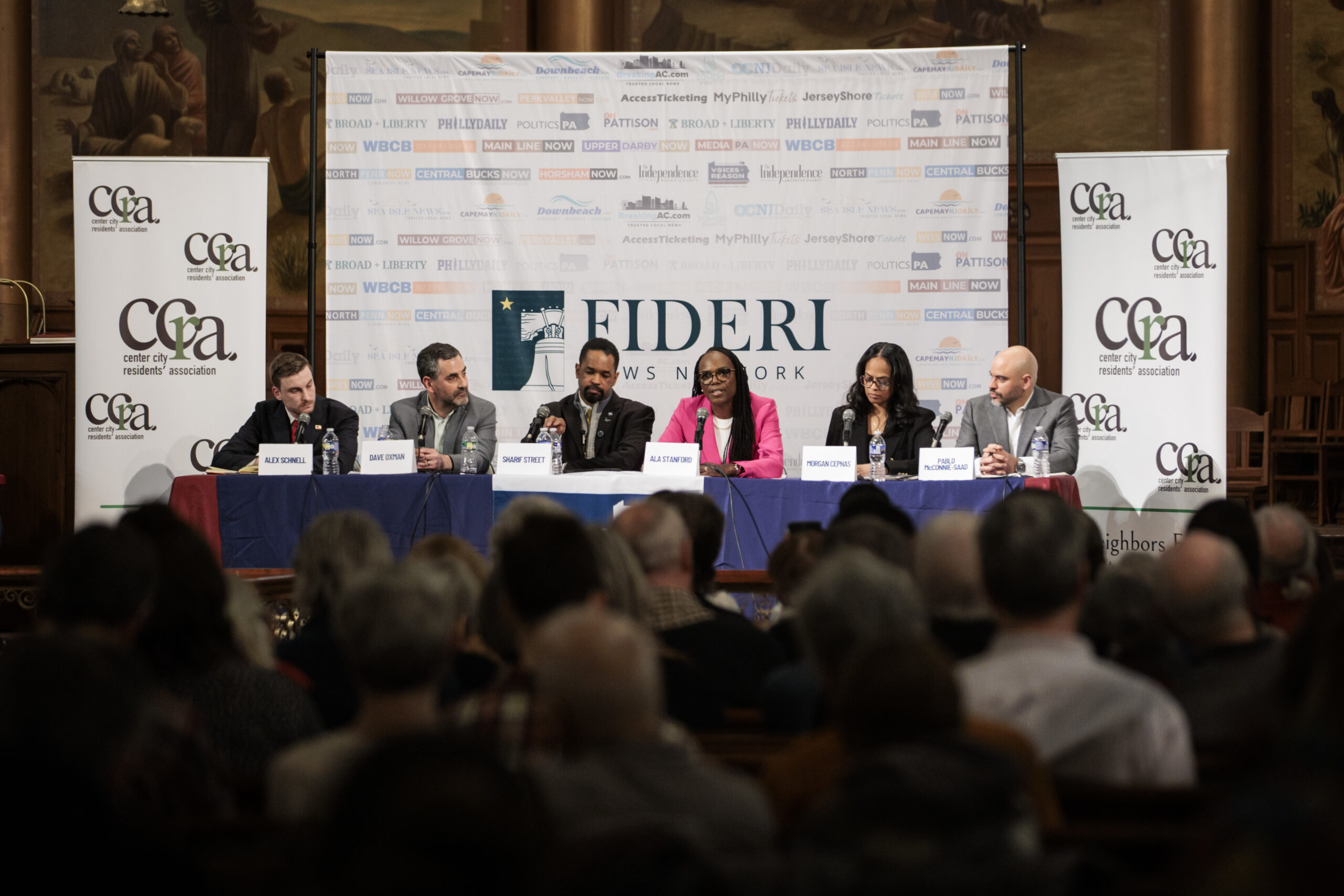
At the end of the event, the moderator, 21st Ward Leader Lou Agre, allowed the candidates to ask one another questions. Their choices offered hints as to which of their rivals the candidates view as most threatening.
Dr. Ala Stanford, who appears to be the strongest candidate among the non-elected officials in the race, questioned the accomplishments of State Sen. Sharif Street, who is seen by many as a frontrunner after being endorsed by the Democratic City Committee and building trades unions.
The 3rd District covers about half of Philadelphia and is, by some measures, the bluest seat in Congress. The Democratic primary is May 19.
The forum was initially scheduled to be held in-person at the Polish Legion of American Veterans’ Adam Kowalski post in Roxborough, but it was moved to Zoom due to the blizzard on Sunday and Monday.
Here are the issues the candidates debated Monday night.
She began the candidate-on-candidate questioning on Monday by asking Street for instances in which his work has helped constituents in tangible ways, setting up a juxtaposition with her record.
“In a time when the people are asking for new leadership, they’re asking for innovation, they’re asking for not the same politics as usual … can you tell the people a time when the seas were rough and you stepped up and delivered for them that they felt it?” Stanford asked, adding: “Can you share what you can do during the chaos that people can feel — and where was it during COVID?”
Physician Ala Stanford (left) and State Sen. Sharif Street at a December forum hosted by the 9th Ward Democratic Committee.
Street began by saying that, as the top Democrat on the Senate Banking & Insurance Committee in Harrisburg, he boosted Stanford’s work during the pandemic by pressuring insurance companies to reimburse her fledgling organization, which provided testing and vaccinations for thousands of Philadelphians in disadvantaged neighborhoods.
“Independence Blue Cross was not moving forward with the reimbursement rates for the Black COVID Doctors Consortium,” Street said. “I spoke with you, and I helped, and I reached out to them to make sure that [the Medicaid plan] Keystone First would begin to pay the reimbursement in an immediate way.”
He also said his office distributed food to constituents and helped process rent rebates during the pandemic.
In the run-up to the 2020 election, Street, as chair of the Pennsylvania Democratic Party at the time, repeatedly fought in court against President Donald Trump’s campaign over election administration issues. In her question, Stanford asked Street to focus on what he delivered for his constituents — “not that you sued Donald Trump 20 times and won every time, because how do the people feel that?”
“Donald Trump wanted to challenge people’s ability to vote in some of the most vulnerable communities,” he said. “I went to court, I stopped him, and I made sure that they had the right to vote, and that was why we were able to pass the vote to remove him from office.”
Street and Rabb clash over hate-crime legislation
When it was his turn to pose a question, Street pressed Rabb on why the progressive was opposed to hate-crime legislation, an issue the two had sparred over at a forum last week.
“You and I have worked to fight for regular folks, for disadvantaged people, for a long time. I was shocked that you … want to prevent hate-crimes legislation,” Street, a centrist Democrat, said to Rabb. “I’ve heard from so many trans women of color, who are most likely to be victims of hate crimes, and they don’t understand.”
Rabb responded by saying that Street’s line of attack was “shameful and unnecessary.”
“I know you want to win. I just thought you would do it with honor,” Rabb said. “I am an active member of the LGBTQ Equality Caucus. I am the father of a queer son. I represent an active queer community. … To use this as a political punching bag is just — man, it’s beneath you.”
At the end of the forum, Street clarified that he has no doubts about Rabb’s commitment to the LGBTQ community.
At a December candidates forum in Mount Airy, (from left) State Reps. Morgan Cephas and Chris Rabb and physician David Oxman.
“I had a policy dispute about hate crimes,” Street said. “I did not mean to question your commitment to the trans community or to your kid.”
The dust-up got in the way of a meaningful debate over hate-crime laws, which increase sentences for people convicted of crimes that prosecutors prove were motivated by prejudice against particular groups.
Such laws are common across the country, but they have long faced criticism from the libertarian right, which fears that such regulations could be used to target citizens for political views. The laws have also faced pushback from some on the progressive left, who contend that they contribute to mass incarceration.
“Politicians tout hate-crime laws as proof they care about the marginalized,” Rabb wrote in an op-ed for PennLive last fall. “In reality, the main outcome is more policing, more prosecution, and more incarceration.”
Street said last week that people who oppose hate-crime laws on the “far left … don’t want to address the antisemitism on the left or the right.”
The Pennsylvania House in 2023 approved a bill to expand the state’s law that criminalizes ethnic intimidation to include sexual orientation and disability status. Rabb voted for the bill, which ultimately died in the Senate amid GOP opposition, but said he had “considerable reservations.”
“We should collectively focus on structural violence and hatred that has been cultivated by the very institutions that have been asked to address this legislation,” Rabb said at the time.
Cephas presses Stanford about her government contracts
Cephas, who represents a West Philadelphia district and chairs the Philadelphia delegation to the state House, questioned how much money Stanford’s nonprofit organization has made from government contracting since the onset of the pandemic.
“You oftentimes quote that you, as a private citizen, came in and saved Philadelphia from COVID, and, you know, there are a number of people on this [Zoom] call that stepped up during COVID,” Cephas said, noting that she worked with Stanford to set up clinics in her district during the pandemic.
“We all did it in our own individual capacity, and we didn’t receive government contracts for it. … How much in government contracts did you receive during the COVID-19 period?”
Stanford noted that she initially launched the Black Doctors Consortium with her own financial resources to serve neighborhoods that were not being reached by existing healthcare and government institutions. She said her first $1 million city grant for testing came months after she began her work.
In 2020 and 2021, Stanford’s groups received $2.5 million in grants and contracts from the city, state, and federal governments, according to Stanford campaign manager Janée Taft-Mack. That money covered costs including supplies, staff, mobile medical units, personal protective equipment, and facility rentals, Taft-Mack said.
Since then, Stanford hascontinued partnering with government agencies to address healthcare inequality. She has opened the Dr. Ala Stanford Center for Health Equity in Swampoodle and secured a $5.38 millioncontract for the Black Doctors Consortium to work at Riverview Wellness Village, the city-owned drug recovery home.
The total amount Stanford and her organizations have received for work since 2021 was not immediately clear.
Philly’s most famous culinary offering has proven politically hazardous over the years, such as when John Kerry catastrophically asked for Swiss cheese while visiting Pat’s King of Steaks during the 2004 presidential election.
This year’s congressional hopefuls were better prepared than the Massachusetts senator.
Agre, the moderator whose ward includes much of Roxborough, interjected to insist that Dalessandro’s served up the best steak sandwiches in the city.
At a candidate’s forum on Feb. 9 at the Church of the Holy Trinity, (left to right) Alex Schnell, physician Dave Oxman, State Sen. Sharif Street, physician Ala Stanford, State Rep. Morgan Cephas, and Pablo McConnie-Saad.
Cephas said she orders Cooper Sharp at Angelo’s Pizzeria. Stanford’s go-to is American from Dalessandro’s. Street, a vegetarian, said he gets non-meat cheesesteaks from Hip City Veg and enjoys the cheese they use. (Mozzarella, per Hip City’s website.)
And Rabb shouted out the cheesesteak egg rolls from Black Dragon, a West Philadelphia establishment offering a “unique fusion of Black American cuisine presented with the familiar aesthetics of classic Chinese American takeout,” according to its website.
Still tense from the previous questions and perhaps a bit peckish, the candidates declined Agre’s offer to deliver closing remarks.
Staff writers Max Marin and Ryan W. Briggs contributed to this article.
Does Donald Trump have to ruin everything? The answer is obviously yes, but this one was heartbreaking. Sunday’s overtime thriller over Canada, which gave U.S. men’s hockey its first gold medal since this senior citizen was a college junior, was a howl of joy in what’s been a dire year for America. But then (taxpayer-)Ka$h Patel showed up to party, and soon Trump was on the phone, egging on the boys with misogynistic trash talk about their gold medal compatriots, the women’s hockey team. Now the men are invited to Trump’s State of the Union address, the women “had other plans,” and I almost wish our Canadian friends had won the game.
How Indiana University won a football crown and lost the plot
Indiana University’s victory flag flies over Memorial Stadium in January in Bloomington, Ind.
Even in a state where the sports miracles, from Rudy and The Knute Rockne Story to Hoosiers, are so big they tend to make it to Hollywood, there’s never been a feel-good script quite like Indiana University — with the most losses in college football history until this season, when it went 16-0 and won the national championship.
“The energy is just absolutely insane,” Katie Shin, a recent Indiana alumna, told the Athletic as thousands of fans went wild on the Bloomington campus that night, saluting Heisman Trophy quarterback Fernando Mendoza and their unsmiling genius head coach Curt Cignetti. “The whole state is just rallying around IU.”
But there’s a huge irony for anyone who’s a big fan of America’s colleges for more than just what happens on the gridiron. In the same season Indiana was slowly climbing to the top of the football polls, the flagship public university was also ranked dead last in the nation.
For something arguably more important: free speech.
The Foundation for Individual Rights and Expression (FIRE), the national campus speech group based here in Philadelphia, last fall ranked IU 255th on its 2026 ranking of universities over freedom of expression — the lowest-rated public institution in America, and only higher than the controversy-wracked private sister schools, Columbia University and Barnard College.
Interestingly, the FIRE low-ranking came after a slew of campus controversies in which the silenced speakers or protesters were all over the map ideologically — a canceled Jewish speaker and a shout down of right-wing speakers, but also draconian moves against pro-Palestinian protesters, including harsh penalties for a 2024 encampment. Last month, a federal court ruled that IU’s punishments of the Gaza campers and its anti-protest policies were unconstitutional.
FIRE’s lambasting of IU’s free speech transgressions was reported upon last Sept. 9 in the student paper, the Indiana Daily Student. The following month, school administrators ousted the faculty adviser to the IDS and told the student journalists they could no longer print the paper, and that news could only be published online. The university’s insistence that this was purely an economic move was a surprise to the ex-adviser, who sued and said he was fired “after he refused to censor the students’ work.”
It ought to go without saying that curbing the free exchange of ideas is antithetical to the most sacred values of American higher education. But the free speech mess at IU is but one controversy at an iconic heartland university that has become a poster child for the moral crisis of U.S. universities, even as it celebrates football glory.
Clearly, the leadership at IU — and this includes its board of trustees, with three new conservative, pro-MAGA members that GOP Gov. Mike Braun named in June under a law that also allowed him to boot three trustees elected by IU’s alumni — is eager to keep its pigskin prowess as the main thing America knows about the university.
The school just signed its field general, Cignetti, to a contract extension that will pay him $13.2 million a year through 2033, making him one of the three highest-paid coaches in the nation. But his new deal flabbergasted a growing number of critics, who note the big raise came as IU — just days after the new conservative trustees were named — either eliminated or made deep cuts in nearly 250 academic programs such as French, art history, geography, and East Asian studies.
Meanwhile, Cignetti isn’t the only high-profile figure at IU to see a big raise. Also this weekend, the trustees gave Whitten a $100,000 pay hike, to an even $1 million a year — citing her willingness to work with industry.
At least 250 IU alums, joined by current faculty and students, have signed on so far to an open letter and donation freeze demanding that, instead, Whitten step down. They also want the university to restore both its diversity programs and robust free speech protections, as well as the reinstatement of the three alumni trustee positions. But they are swimming against a red tide of conservatism that’s polluted the public college universe in Indiana.
Cross-state public rival Purdue University is reeling from a recent report in its hometown newspaper that the school, under pressure from conservative lawmakers, has informally banned the admission of international students from China and a slew of other countries. Students and faculty have complained of an unwritten “soft ban” on many overseas applicants, although Purdue has denied that such a policy exists.
Meanwhile, the regional campus of IU Indianapolis caused a stir and triggered a protest when it abruptly canceled the 57-year tradition of an annual Rev. Dr. Martin Luther King Jr. dinner — a move that was undertaken not long after the school removed campus signs that read “Black Lives Matter” and “Discrimination has no place here.”
Indiana is hardly alone. The 2025-26 academic year has been marked by similar outrages against unfettered speech and racial inclusion, especially in the most pro-Trump red states. To cite just one of many examples, the University of Texas System just adopted a new policy aimed at limiting discussion of “controversial topics” in the classroom. Isn’t that the whole point of the college experience?
The erosion of freedom at the American university has happened gradually and then suddenly, and it needs to be getting a lot more attention. That’s hard when the president is sending aircraft carriers to threaten Iran, imposing steep taxes for no reason, and generally acting and talking like the mad king he is.
Yet, nothing is more important for MAGA’s authoritarian project than what is happening at Indiana University and other college campuses right now. As I wrote in my 2022 book, After the Ivory Tower Falls, higher ed is the fulcrum of America’s political divide, now more than ever.
Every tactic — murdering the humanities and the social sciences, making campuses more white, ensuring our future elites aren’t exposed to “controversial topics” while entertaining them with the beer and circuses (a phrase, ironically, coined by an IU English professor) of big-time football — is another step toward MAGA’s strategic goal of an American electorate that cannot think critically.
The fight for the soul of Indiana University is the fight for the soul of the United States, and it’s not what’s happening inside Memorial Stadium against Ohio State or Michigan.
“We know that IU alums are smart enough to celebrate the success of the Football Hoosiers and condemn what Pamela Whitten is doing to degrade the prestige of our degrees,” the university dissidents write in their open letter. “Please help us take a stand against the debasement of our university and restore the glory of old IU.”
Yo, do this!
You might have noticed that the late Jeffrey Epstein and his randy U.K. royal pal, the artist formerly known as Prince Andrew, have been in the news a lot lately. But did you know there’s an excellent 2024 Netflix movie called Scoop about the drama behind the disastrous 2019 BBC interview that started the long downfall of Andrew Mountbatten-Windsor, now arrested and under a British police investigation? I watched Scoop over the weekend, and it’s both an entertaining and highly relevant journalism thriller.
Since this space is devoted to my weird entertainment choices, and not what normal people are doing, I have to share that I’ve been escaping today’s banality of evil with a deep dive into the musical world of … mass murderer Charles Manson. My all-time favorite podcast, Andrew Hickey’s A History of Rock Music in 500 Songs, did a remarkable four-parter a couple of years ago about Manson and his shockingly close ties to the Beach Boys (and others like, sigh, Neil Young) that resulted in the murder mastermind’s uncredited cowriting of their 1968 song, “Never Learn Not to Love.” There’s also a compelling detour into the life of Black music pioneer Huddie “Lead Belly” Ledbetter, and a book recommendation that sounds equally incredible: Bring Judgment Day: Reclaiming Lead Belly’s Truth from Jim Crow’s Lies by Sheila Curran Bernard.
Ask me anything
Question: Update us on what is and what should be happening in Quakertown [please]. — @marco2751.bsky.social via Bluesky
Answer: Thanks for this, Marco, because if readers aren’t up to speed on what’s been happening in Quakertown, an exurb nearly an hour’s drive north of Philadelphia, then they need to learn. Quick version: A peaceful Friday walkout by Quakertown High School students protesting U.S. Immigration and Customs Enforcement raids turned shockingly violent, highlighted by a grown man placing a teen girl in what appeared on video to be a dangerous choke hold. It turned out this man was the Quakertown police chief and interim borough manager, Scott McElree. Adding insult to injury, five students were arrested and spent the entire weekend in jail before they could see a judge. What should be done? Quakertown can’t fire McElree quickly enough. The right to peacefully assemble and protest the government is the heart of the First Amendment, and what makes America a democracy. A police chief who can’t honor the U.S. Constitution should not have a job.
What you’re saying about …
Last week’s take-a-step-back-from-the-madness question about who is the greatest living American (inspired by the passing of the Rev. Jesse Jackson) didn’t get a large response, but brought some compelling arguments. Two men were named twice: Pope Leo XIV, the Villanova alum who has shone as an advocate for immigrants and for peace on the world’s stage since last summer, and Sen. Bernie Sanders, who has never wavered in fighting for progressive values. Other suggestions included Bob Dylan, Edward Snowden, Barack Obama, and — in a show of respect for science under siege — the health experts Anthony Fauci and Peter Hotez, who, wrote Pat Eisenberg, “is trying to improve the health of Americans despite all the things the Trump administration is doing to ruin our health.”
📮 This week’s question: I’m hopefully going to be writing soon about the scourge of prediction markets like Kalshi, and more broadly, the problem of sports betting. Should these forms of gambling be banned, or at least more strictly regulated? Please email me your answer and put the exact phrase “Betting bans” in the subject line.
Backstory on what pundits don’t get about ‘28
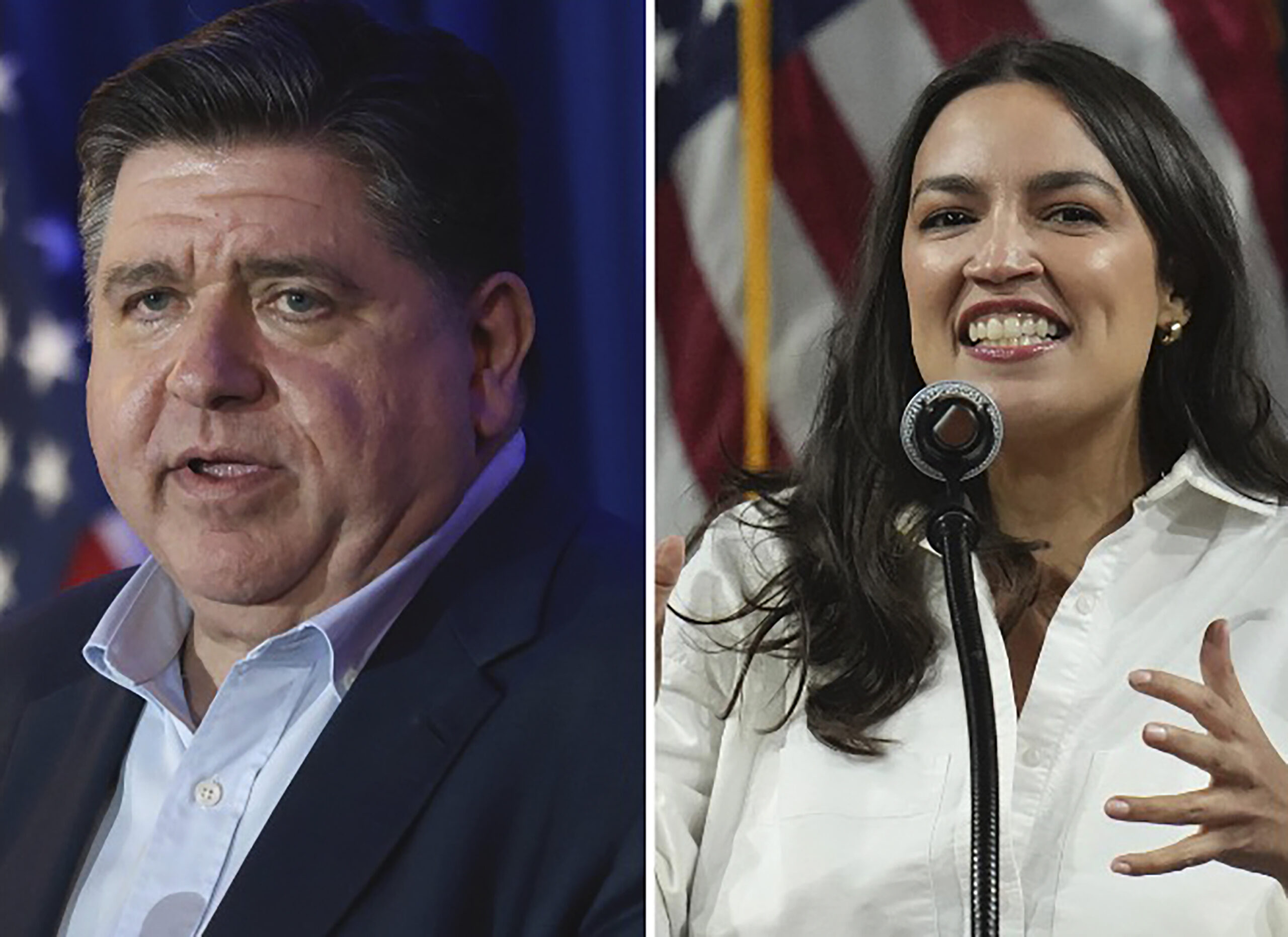
This photo combo shows Illinois Gov. JB Pritzker, left, speaking during the McIntyre-Shaheen 100 Club Dinner, April 27, 2025, in Manchester, N.H., and U.S. Rep. Alexandria Ocasio-Cortez (D., N.Y.) speaking during a “Fighting Oligarchy” tour event at Arizona State University, March 20, 2025, in Tempe, Ariz.
Get 13 Democratic and left-leaning independent voters together in the same chat — as the New York Times did with a recent focus group, the latest in its running series — and you’d surely hear some harsh words about Donald Trump and the GOP. But ask them what they think about the Democratic Party, and you might want to cover your ears.
“Spineless.” “More complacent than I thought they would be.” “Paralyzed.” “Afraid.” “Incompetent.” “I guess suffocated, or given up …” “Sold out.” I’m not leaving out the positive responses, because there weren’t any. You also won’t be surprised that these 13 Democratic or aligned voters — very diverse across racial, class, and age lines — want more radical leaders who will take the party, and hopefully the nation, in a bold new direction. There was positive buzz for the likes of new New York Mayor Zohran Mamdani and Texas Rep. Jasmine Crockett — anyone with fresh ideas and a willingness to mix it up with Trump. Said a 36-year-old independent woman from Washington state: “I still don’t agree with everything she’s doing, but Alexandria Ocasio-Cortez is a well-known name and seems to be fighting against Trump.”
I thought a lot about the Times’ focus group last week as I heard or read two veteran pundits try, at this relatively early date, to handicap the 2028 presidential race. Mark Halperin (who’s somehow still around despite this) went on POTUS radio with Michael Smerconish to defend his picks: He included ex-Chicago mayor Rahm Emanuel, a center-right figure who is passionately hated by any real Democrat I’ve ever spoken with, and also overrated Kamala Harris (floating on the fumes of her name ID), as well as his No. 1 pick, California Gov. Gavin Newsom, with Pennsylvania Gov. Josh Shapiro at No. 2. He said he included AOC and upgraded Illinois Gov. JB Pritzker only because his “sources” told him to — because his sources understand the Democrats while the clueless Halperin does not.
Ditto Nate Silver, who has magically reappeared in the Times, which first made him a star in 2012. Although Silver did place AOC in second, behind Newsom, he also — much like Halperin — uprated tired conventional wisdom candidates like Shapiro (No. 6) and Michigan Gov. Gretchen Whitmer (No. 4, despite being invisible recently), and grossly downrated progressive favorites like Pritzker (14) and Connecticut Sen. Chris Murphy (18), as well as more interesting and unorthodox names like Arizona Sen. Mark Kelly (12) and Kentucky Gov. Andy Beshear (15). He sees Newsom as the darling of “Resistance Libs,” the Trump-hating MS Now watchers who controversially get tagged as heavily “wine moms.” Said Silver of Newsom: “They want a fighter. And Newsom plays expertly into that.”
True, but I expect Newsom’s standing among Democratic primary voters will crumble once voters learn more about his ties to Silicon Valley billionaires, or his verbal sellouts of the transgender community, or his “meh” popularity among the Californians who know him best. Readers of this newsletter were unanimous earlier this month in not wanting Shapiro to run. I’m not going to do a numerical ranking, but I would place Pritzker, who’s made all the right moves against Trump without Newsom’s train car of baggage, and AOC, who’s making all the right enemies, including the worst Beltway journalists, as my top two. I’ve covered presidential races since 1984, and I’ve learned the only thing that matters two years out is to listen to the people. The pundits know nothing right now.
What I wrote on this date in 2019
It’s impossible to top this anniversary: The day I appeared in the Epstein files. In February 2019, with the walls closing in, Epstein’s close adviser and quasi-journalist friend, Michael Wolff, wanted to make sure he saw my Feb. 24, 2019, column about elite male impunity that mentioned him and two billionaires in his orbit: Donald Trump and New England Patriots owner Robert Kraft. What did Epstein read, assuming he clicked on it? I wrote that “this isn’t really ‘a sex scandal.’ The real scandal here is the gross imbalance of power involving women who were held in a form of human bondage to serve as objects of gratification for powerful men intoxicated by their belief they can get away with anything.”
I took a short break from the relentless anti-Trump, anti-ICE beat last week to write about the other threat to the American way of life: artificial intelligence. Rapid advances in AI technology make it clear that robots and chatbots and the like are going to upend the economy — most importantly, the job market — sooner rather than later. Can wary voters find politicians who are willing to regulate AI and its threats to employment, education, and the environment, or will pols continue to prefer Silicon Valley’s campaign donations? Over the weekend, I highlighted the recently leaked ICE blueprint for an American concentration camp in Georgia, and what that document tells us about the moral depravity of mass deportation.
In a city as large and as history-bound as Philadelphia, all big stories are inevitably local. That was never truer than at the Winter Olympics in northern Italy, especially for the most-watched event on these shores: the U.S. men’s hockey’s thrilling overtime victory over Canada. The on-ice celebration blended with copious tears as Team USA teammates went into the stands and skated back with Johnny Jr. and Noa Gaudreau, the young children of late South Jersey NHL hockey icon Johnny Gaudreau. Their dad and their uncle Matty were killed by an alleged drunk driver while cycling on a South Jersey road in August 2024, as Gaudreau was training to hopefully make this Olympic squad. The players centered the Gaudreau family and his No. 13 jersey during the gold-medal celebration, and The Inquirer’s Alex Coffey captured the whole emotional story — one you won’t read anywhere else. “This is a history book [moment] that there will be a movie about,“ sister Katie Gaudreau told Coffey. ”And in that movie, Noa and Johnny will be on the ice.” You get the big, moving stories like this, and allow us to keep covering them, when you subscribe to The Inquirer.
By submitting your written, visual, and/or audio contributions, you agree to The Inquirer’s Terms of Use, including the grant of rights in Section 10.
WASHINGTON — The Supreme Court’s stunning rebuke of President Donald Trump’s most sweeping tariffs means he can’t conjure up new import taxes on a whim anymore.
But the justices’ ruling on Friday is nonetheless unlikely to ease the uncertainty over Trump’s trade policy that has paralyzed businesses over the past year. “It’s only gotten more complicated for everybody,” said trade lawyer Ryan Majerus, partner at King & Spalding and a former U.S. trade official.
Vexing questions remain: How will the president use other laws to reconstruct the tariffs the Supreme Court knocked down, and will those attempts withstand legal challenges? What does the decision mean for the trade deals Trump strong-armed other countries into accepting, using his now-defunct tariffs as leverage? Can importers collect refunds for the tariffs they paid last year, and if so, how?
Then there’s Trump’s own unpredictability. Even though he had weeks to prepare for an unfavorable Supreme Court ruling, his response was still chaotic: On Friday, he said he’d use other legal authority to impose 10% levies on imports from other countries. Saturday, he ratcheted it up to 15%.
Normally, lower tariffs arising from the Supreme Court’s decision might be expected to give the economy a little lift. But “any benefit you would get from that is more than offset to a modest negative from the uncertainty front,” said Mike Skordeles, head of U.S. economics at Truist, a bank.
Gone for good are the sweeping tariffs Trump justified under the 1977 International Emergency Economic Powers Act (IEEPA), mainly to combat America’s persistent trade deficits. But that doesn’t mean the president can’t invoke other laws to rebuild much of his tariff wall around the U.S. economy.
“Tariff revenues will be unchanged this year and will be unchanged in the future,” Treasury Secretary Scott Bessent said in a Fox News interview Sunday.
Trump reached for a stop-gap option immediately after his defeat Friday at the Supreme Court: Section 122 of the Trade Act of 1974 allows the president to impose tariffs of up to 15% for up to 150 days. But any extension beyond 150 days must be approved by a Congress likely to balk at passing a tax increase as November’s midterm elections loom.
Section 122 has never been invoked before, and some critics say the president can’t use it as a stand-in for the IEEPA tariffs to combat the trade deficit.
Bryan Riley of National Taxpayers Union, for example, argues that Section 122 is meant to give the president a tool to fight what it calls “fundamental international payments problems,’’ not the trade deficit.
The provision arose from the financial crises that emerged in the 1960s and 1970s when the U.S. dollar was tied to gold. Other countries were dumping dollars in exchange for gold at a set rate, putting alarming downward pressure on the dollar. But the U.S. currency is no longer linked to gold, so Section 122 has been “effectively rendered obsolete,’’ Riley wrote in a commentary.
“Given the amount of money at issue for U.S. businesses, it is not hard to imagine a new wave of litigation attacking Section 122, and again seeking refunds of Section 122 duties collected,” said trade lawyer Dave Townsend, a partner at Dorsey & Whitney.
A sturdier alternative is Section 301 of the same 1974 trade act, which gives the United States a handy cudgel with which to smack countries it accuses of engaging in “unjustifiable,” “unreasonable” or “discriminatory” trade practices. In a statement Friday, in fact, U.S. Trade Representative Jamieson Greer said the administration was launching a series of 301 investigations after the loss at the Supreme Court.
Trump invoked Section 301 in his first term to impose sweeping tariffs on Chinese imports in a dispute over the sharp-elbowed tactics that Beijing was using to challenge America’s technological dominance. Those tariffs were upheld in court and kept by the Biden administration.
“We’re eight years in, and those China tariffs are still here,” King & Spalding’s Majerus said. “They’re sticky tariffs.’’
Confusion surrounds Trump’s trade deals
The Supreme Court’s decision also raises questions about the lopsided trade agreements Trump negotiated last year, using the threat of potentially unlimited IEEPA tariffs to squeeze concessions out of U.S. trading partners from the European Union to Japan.
Will countries try to back out of their commitments, now that the IEEPA tariff threat is gone?
The European Union’s trade deal with Trump is already on hold amid confusion following the Supreme Court’s ruling — and Trump’s decision to respond to it with the 15% Section 122 global tariff.
European lawmakers on Monday delayed a vote on ratifying the pact to seek clarification. They are worried that Trump’s new import tax will stack on top of the “most favored nation’’ tariffs the United States charges under pre-existing World Trade Organization rules — and lift U.S. tariffs on EU imports above the 15% the Europeans had agreed to last year.
“A deal is a deal,” said commission spokesman Olof Gill. “So now we are simply saying to the US, it is up to you to clearly show to us what path you are taking to honor the agreement.”
Then there’s the United Kingdom, which had reached a deal with Trump last year for 10% tariffs on its exports to the United States. Will they really go to 15%?
Still, trade analysts largely expect U.S. trade partners to stick by the deals they reached with Trump last year. For one thing, the United States could wallop them with hefty Section 301 tariffs, which are potentially unlimited, for violating trade agreements.
“They’re going to pretty leery of rocking the boat on their deals,” Majerus said. “Violations of trade agreements can be a basis for taking 301 action. So you could see Section 301 become an enforcement mechanism’’ for the United States.
“We are confident that all trade agreements negotiated by President Trump will remain in effect,’’ U.S. Trade Representative Greer said in his statement.
A messy refund process
In its ruling, the Supreme Court didn’t bother to say what would happen to all the money collected from the IEEPA tariffs, $133 billion as of mid-December. It left the messy issue of refunds to importers — but likely not to consumers — to lower courts and the Customs and Border Protection agency, which collects import taxes. But they’re likely to be overwhelmed — hundreds of companies are already lined up to get their money back — and the refunds could take months or years to be paid.
“The whole thing’s going to be a mess,’’ Majerus said.
It’s possible that Congress will order Customs to take an “easy ‘one-click’ approach to refunds,’’ wrote strategists Thierry Wizman and Gareth Berry at the investment bank Macquarie. Otherwise, they warned, the Trump administration could “make the refund process as burdensome as possible, requiring every importer to file stacks of paperwork, if not file a lawsuit, to get its money back. That would be costly for businesses.”