NEW YORK — Deposed Venezuelan leader Nicolas Maduro declared himself “innocent” and a “decent man” as he pleaded not guilty to federal drug trafficking charges in a U.S. courtroom on Monday.
“I’m innocent. I am not guilty. I am a decent man, the president of my country,” Maduro told a judge.
Maduro was making his first appearance in an American courtroom Monday on the narco-terrorism charges the Trump administration used to justify capturing him and bringing him to New York.
Maduro, wearing a blue jail uniform, and his wife were led into court around noon for a brief, but required, legal proceeding that will likely kick off a prolonged legal fight over whether he can be put on trial in the U.S. Both put on headsets to hear the English-language proceeding as it was translated into Spanish.
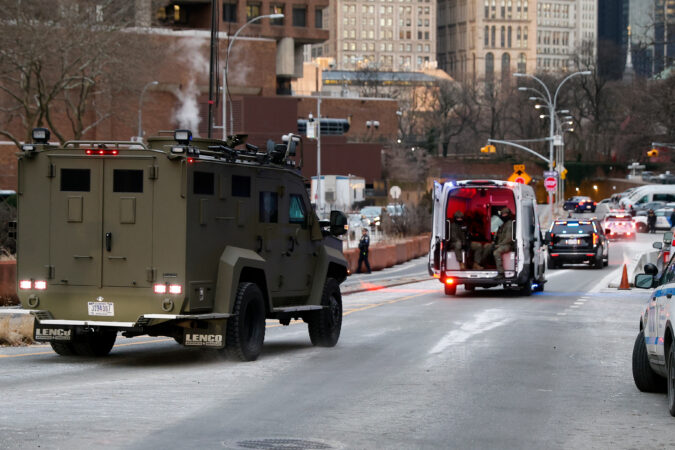
The couple were transported under armed guard early Monday from the Brooklyn jail where they’ve been detained to a Manhattan courthouse.
The trip was swift. A motorcade carrying Maduro left the jail around 7:15 a.m. and made its way to a nearby athletic field, where Maduro slowly made his way to a waiting helicopter. The chopper flew across New York harbor and landed at a Manhattan heliport, where Maduro, limping, was loaded into an armored vehicle.
A few minutes later, the law enforcement caravan was inside a garage at the courthouse complex, just around the corner from the one where Donald Trump was convicted in 2024 of falsifying business records. Across the street from the courthouse, the police separated a small but growing group of protesters from about a dozen pro-intervention demonstrators, including one man who pulled a Venezuelan flag away from those protesting the U.S. action.
As a criminal defendant in the U.S. legal system, Maduro will have the same rights as any other person accused of a crime — including the right to a trial by a jury of regular New Yorkers. But he’ll also be nearly — but not quite — unique.
Maduro’s lawyers are expected to contest the legality of his arrest, arguing that he is immune from prosecution as a sovereign head of state.
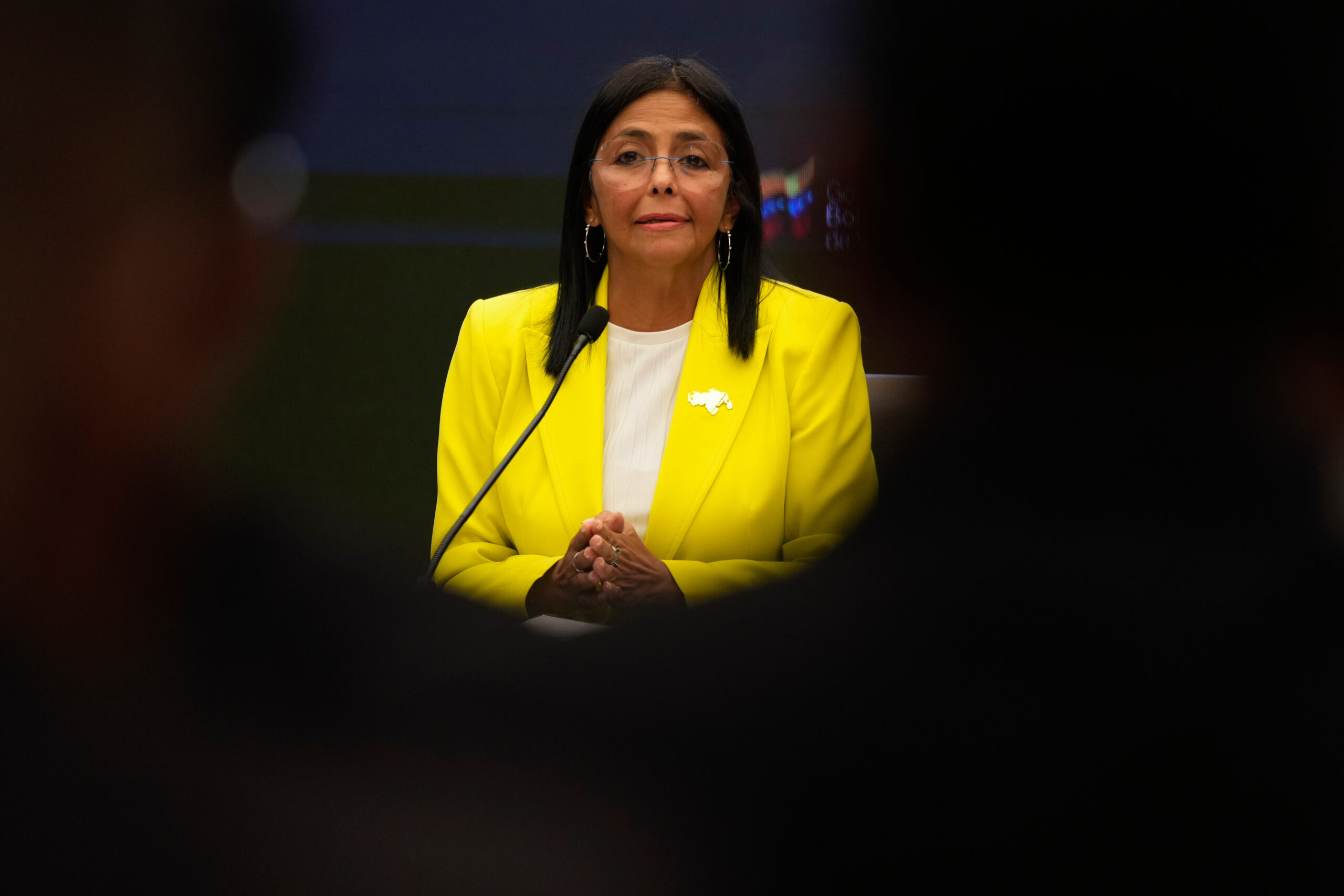
Venezuela’s new interim president, Delcy Rodríguez, has demanded that the U.S. return Maduro, who long denied any involvement in drug trafficking — although late Sunday she also struck a more conciliatory tone in a social media post, inviting collaboration with President Trump and “respectful relations” with the U.S.
Before his capture, Maduro and his allies claimed U.S. hostility was motivated by lust for Venezuela’s rich oil and mineral resources.
The U.S. seized Maduro and his wife in a military operation Saturday, capturing them in their home on a military base. Trump said the U.S. would “run” Venezuela temporarily, but Secretary of State Marco Rubio said Sunday that it would not govern the country day to day other than enforcing an existing ” oil quarantine.”
Speaking aboard Air Force One, he called Colombia’s president, Gustavo Petro, “a sick man who likes making cocaine and selling it to the United States. And he’s not going to be doing it very long.”
He called on Venezuela’s Rodriguez to provide “total access” to her country, or else face consequences.
Trump has suggested that removing Maduro would enable more oil to flow out of Venezuela, but oil prices rose a bit more than 1% in Monday morning trading to roughly $58 a barrel. There are uncertainties about how fast oil production can be ramped up in Venezuela after years of neglect and needed investments, as well as questions about governance and oversight of the sector.
A 25-page indictment made public Saturday accuses Maduro and others of working with drug cartels to facilitate the shipment of thousands of tons of cocaine into the U.S. They could face life in prison if convicted.
Maduro has retained Barry J. Pollack, a Washington, D.C.-based lawyer known for securing WikiLeaks founder Julian Assange’s release from prison and winning an acquittal for former Enron accountant Michael Krautz.
Pollack, a partner at the law firm Harris, St. Laurent & Wechsler, negotiated Assange’s 2024 plea agreement — allowing him to go free immediately after he pleaded guilty to an Espionage Act charge for obtaining and publishing U.S. military secrets.
Krautz, acquitted of federal fraud charges in 2006 after a hung jury the year before, was one of the only Enron executives whose case ended in a not-guilty verdict. Nearly two dozen other executives were convicted of wrongdoing in connection with the energy trading giant’s collapse.
Maduro and his wife, Cilia Flores, have been under U.S. sanctions for years, making it illegal for any American to take money from them without first securing a license from the Treasury Department.
While the indictment against Maduro says Venezuelan officials worked directly with the Tren de Aragua gang, a U.S. intelligence assessment published in April, drawing on input from the intelligence community’s 18 agencies, found no coordination between Tren de Aragua and the Venezuelan government.
Maduro, his wife, and his son — who remains free — are charged along with Venezuela’s interior and justice minister, a former interior and justice minister, and Hector Rusthenford Guerrero Flores, an alleged Tren de Aragua leader who has been criminally charged in another case and remains at large.
Among other things, the indictment accuses Maduro and his wife of ordering kidnappings, beatings, and murders of those who owed them drug money or undermined their drug trafficking operation. That included a local drug boss’ killing in Caracas, the indictment said.
Maduro’s wife is also accused of accepting hundreds of thousands of dollars in bribes in 2007 to arrange a meeting between “a large-scale drug trafficker” and the director of Venezuela’s National Anti-Drug Office, resulting in additional monthly bribes, with some of the money going to Maduro’s wife, according to the indictment.
Technically, the United States won’t turn 250 until July 4. But Donald Trump dictated this weekend that before the dawn’s early light of only the third day of America’s Semiquincentennial was soon enough for the bombs to begin bursting in air.
At 1 a.m. Saturday, guided by a luminous full moon, a U.S. air armada of more than 150 planes roared over the Venezuelan capital of Caracas and far-flung military bases across the South American nation, waking up a metropolis of three million people with massive explosions.
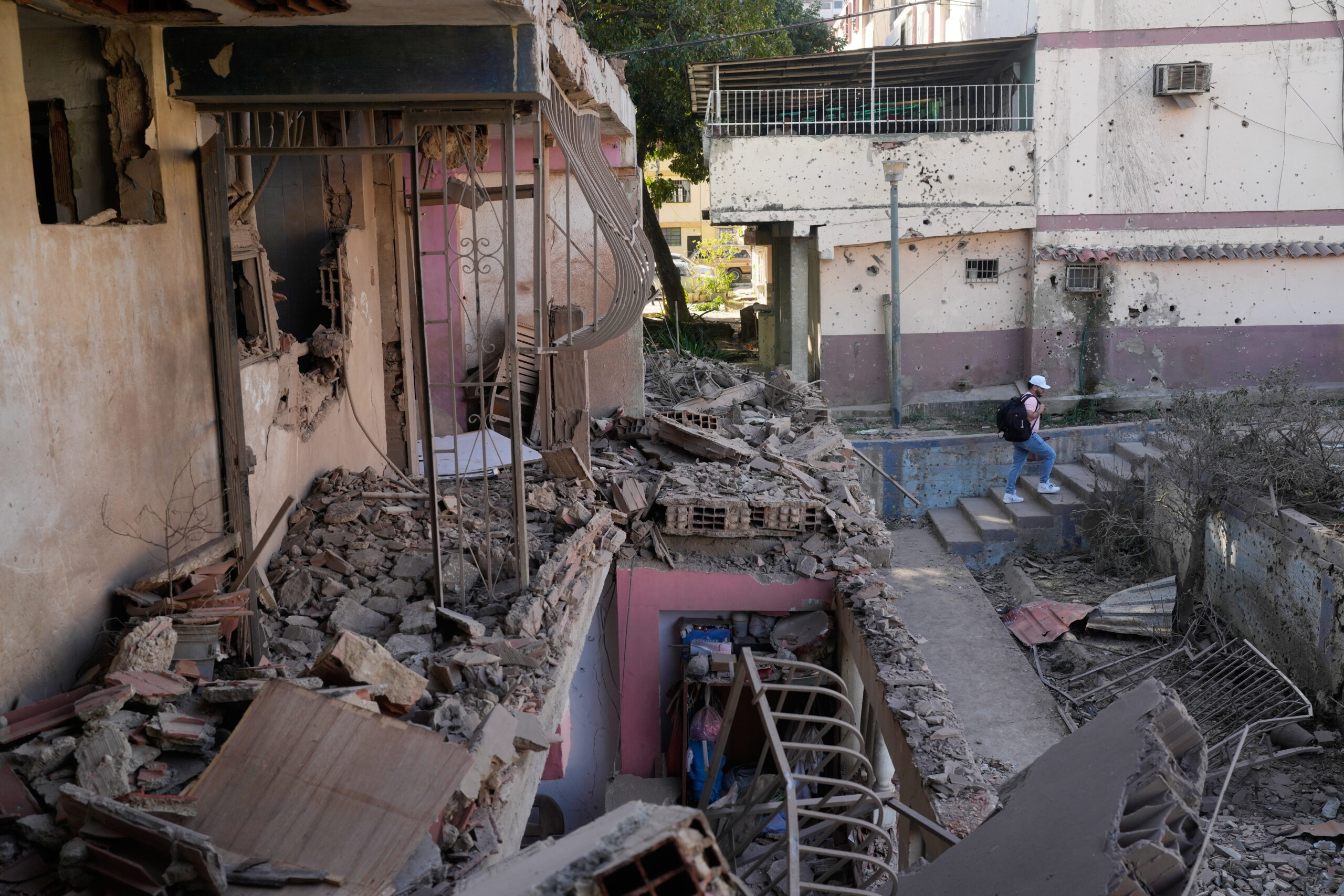
An 80-year-old woman, Rosa González, was killed when a U.S. bomb slammed into her three-story apartment complex in a coastal neighborhood near the Caracas airport, according to the New York Times. The dead-of-night strike wounded several of her neighbors, tore a massive hole in the side of the apartment building, and even riddled with shrapnel a family’s portrait of Simón Bolívar, the leader who liberated Venezuela from colonialism — for a time, anyway — in 1820.
González was one of about 80 people, both security forces and civilians, killed Saturday in the first U.S. land strike in what by Trump’s own admission is “a war” — America’s latest and maybe its strangest yet. With more than 100 civilian sailors blown up in a running series of U.S. drone attacks on boats off South America, which the Trump regime claims, without offering proof, are smuggling drugs, American imperialism is growing more deadly by the day.
It’s hard here not to echo a notorious quote from Philadelphia sports history: For who? For what?
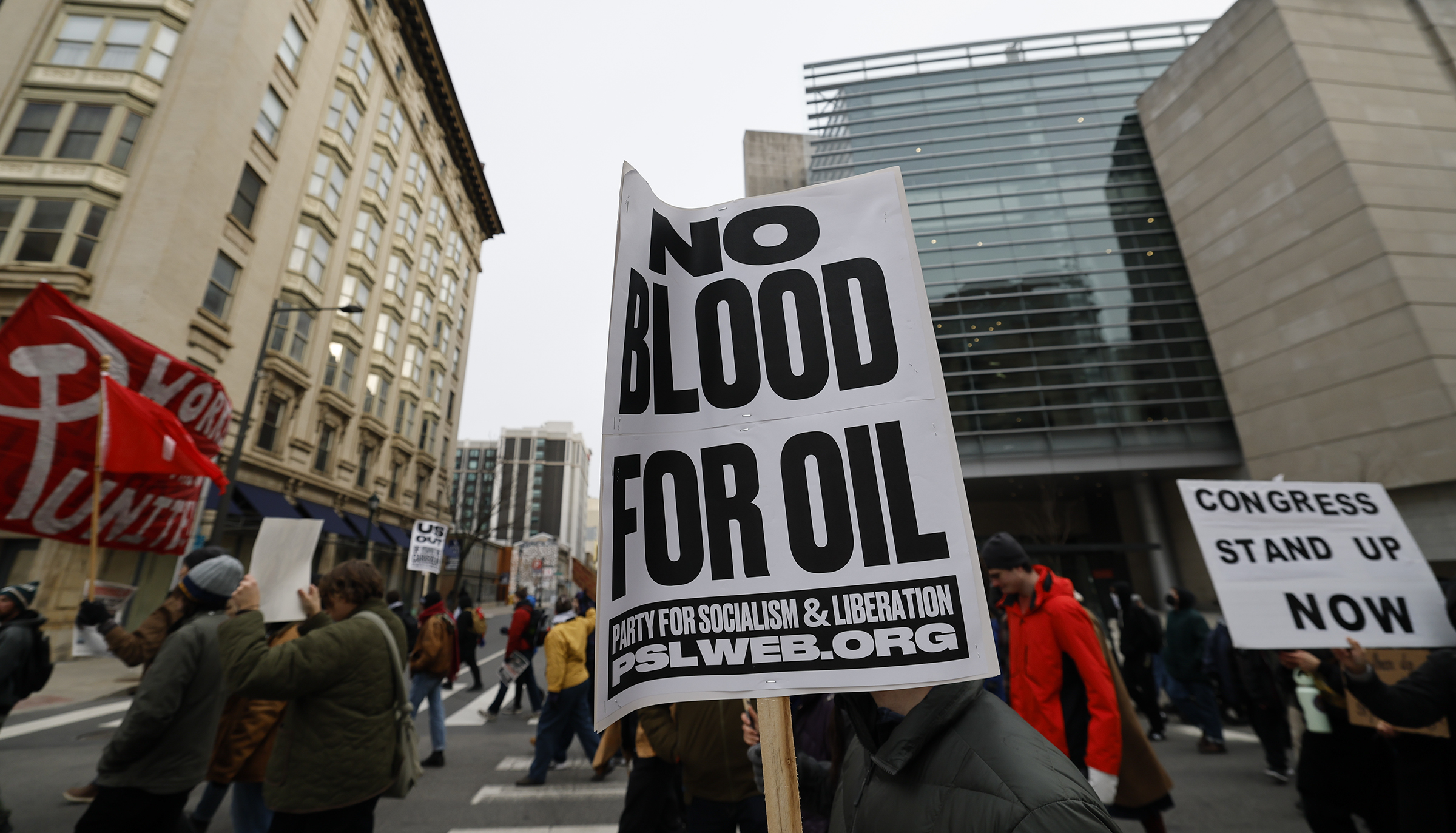
Demonstrators march along North Broad Street reacting to U.S. strikes on Venezuela on Saturday.
Trump’s splendid little war in Venezuela comes drenched in so many lies, buried under layers of justifications that change almost hourly, and so far outside the boundaries of both U.S. and international law that it makes George W. Bush’s dishonest and disastrous misadventure in Iraq feel like Gettysburg by comparison.
That Venezuela’s former ruthless strongman leader, Nicolás Maduro, and his wife are currently sitting in Brooklyn’s federal lockup, captured by Delta Force soldiers amid the bombing and facing a U.S. indictment that asserts they were also drug lords, is pretty much the only certainty in a military crusade with a future rife with unknown unknowns.
In a stunning news conference at Trump’s Mar-a-Lago mansion in Florida — where just 59 hours earlier, guests dined from a caviar bar as the president auctioned off a painting for $2.75 million — Trump told the world that the United States now “runs” Venezuela, despite no American personnel being posted inside the country, twice the size of California. And he made it clear that the blood of González and the others was spilled for oil, as POTUS 47 talked at length about U.S. hegemony over 17% of the world’s known oil reserves, but made no mention of restoring democracy in Venezuela.
None of this stopped a parade of retired generals from flooding cable TV news networks — even the alleged liberal one, MS Now — to talk about the tactical success in seizing Maduro and pummeling Venezuela’s defenses with no U.S. deaths, even as the bigger strategy remains a black hole. That level of commentary, backdropped by images of cheering Maduro-hating refugees in Miami and elsewhere, belied the fact that invading Venezuela was wildly unpopular with the American people.
"We're in the oil business."
Donald Trump adds "we'll be selling large amounts of oil to other countries" after announcing that the US will run Venezuela until a proper transition can take place.
Just last month, a Quinnipiac University poll found that 63% of U.S. voters opposed “U.S. military action inside Venezuela,” while just 25% supported such a move. Polling questions explicitly about removing Maduro have seen similar results. This matters a lot, but then other U.S. wars that history remembers as pretty terrible polled well at first. The much bigger problem with invading Venezuela is that it’s illegal. Incredibly illegal.
To be sure, the imperial U.S. presidency has been simmering since 1945, but Trump has utterly abandoned one of the most cherished principles of America’s founders — that the power to declare war rests with Congress. Not only did the Trump regime not seek approval on Capitol Hill — where its beyond-flimsy casus bellicould have been debated in front of the American people — but the president didn’t even deem it necessary to inform key congressional leaders.
The attack was also a blatant international law violation of the charter of the United Nations — the organization that the U.S. spearheaded in 1945 to prevent future wars and unwind colonialism — which aimed to end unprovoked aggression. Geoffrey Robertson, who once led a U.N. war-crimes tribunal in Sierra Leone, told the Guardian that the Trump regime “has committed the crime of aggression, which the court at Nuremberg described as the supreme crime — it’s the worst crime of all.”
To repeat: For who? For what? Is Trump eager for a bombastic military op to distract voters’ attention from the ongoing cover-up of the Jeffrey Epstein files, the explosive testimony of prosecutor Jack Smith about the president’s complicity in an attempted coup on Jan. 6, 2021, and skyrocketing prices for healthcare and at the grocery store? Is this the big payback to Big Oil CEOs who responded to Trump’s demand for $1 billion in campaign cash? Is he satisfying the vain psychoses of Silicon Valley billionaires who want a warm tropical paradise for high-tech “networked cities” outside any laws? Is this all just a narcissistic power trip?
Yes.
A neighbor walks through an apartment building that residents say was damaged during U.S. military operations to capture Venezuelan President Nicolás Maduro, in Catia La Mar, Venezuela, Sunday, Jan. 4, 2026.
Yes, this lethal disaster is a perfect storm of all of those things. But we can’t allow the blather of talking-head ex-generals or the cowardly passivity of the supposed opposition Democrats to blind us to the harsh reality of what just happened here. I didn’t think it could get worse than the utterly unwarranted 2003 Iraq War that inspired me to become an opinion journalist, but this is arguably worse, more akin to Vladimir Putin’s Russia invading Ukraine. On the 250th anniversary of America’s founding as a grand experiment in democracy, we are now a rogue state, a global pariah.
“We Are The Bad Guys,” the brilliant independent journalist Hamilton Nolan headlined his essay on Saturday, writing with painful accuracy that “the United States government under Donald Trump is the most dangerous force on earth, and a serious potential threat to every other nation, and the leading cause of geopolitical instability.”
I noted above that this Venezuelan operation is largely shrouded in uncertainty and ambiguity, yet we need to acknowledge two bitter truths that can no longer be denied in the rocket’s red glare over Caracas.
First, Donald Trump is a dictator now. To be sure, this has seemed an aspiration from the moment he stepped onto the Trump Tower escalator over a decade ago, with very mixed results, but now it’s a reality. The strike on Venezuela was a dictate, nothing more. There was zero effort to rally the American people behind him, zero effort to seek congressional input, and zero concern over the illegality of this operation, let alone its rank immorality. And if there is no meaningful opposition to his murders in Latin America, he will only consolidate his tyrannical power.
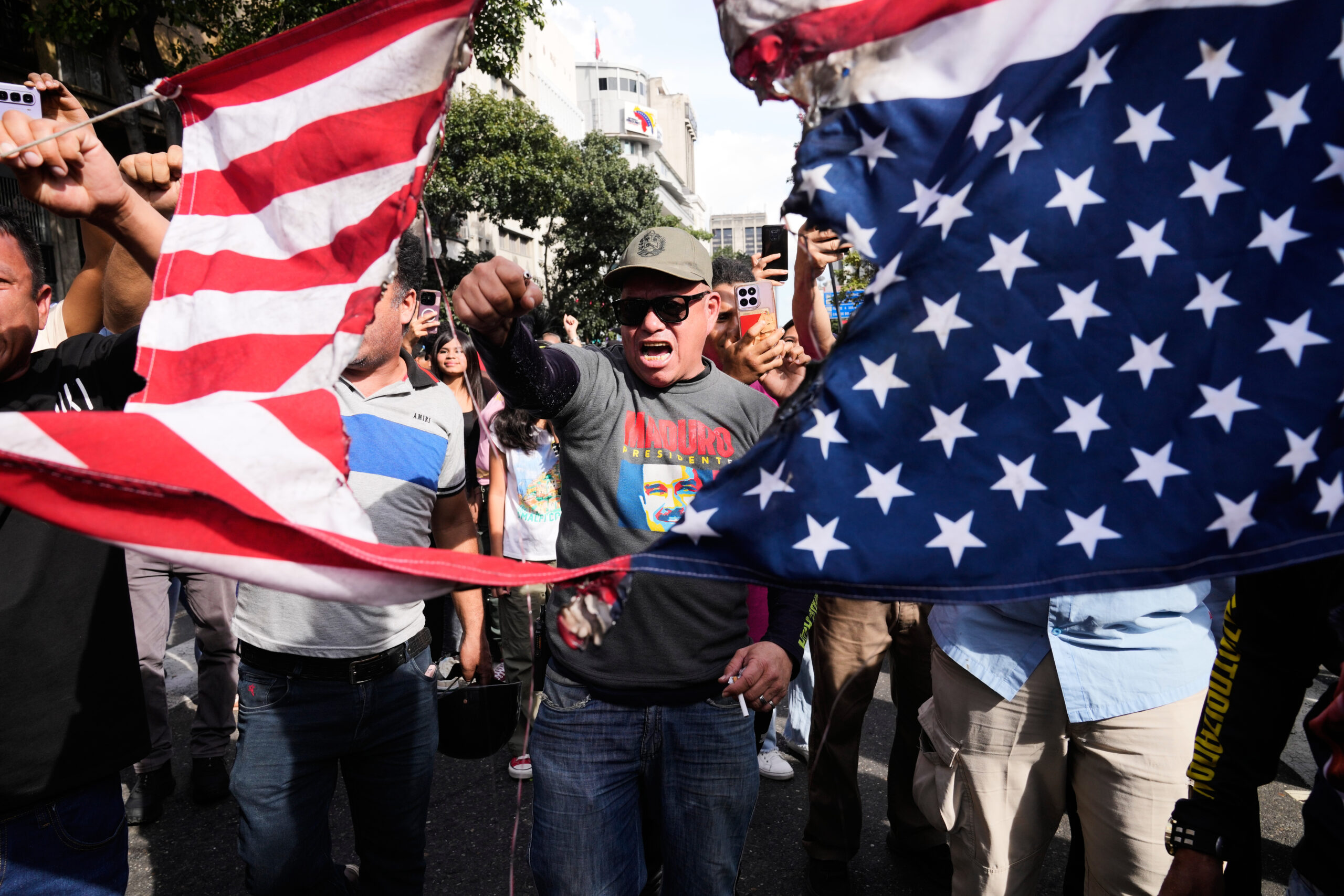
Government supporters rip an American flag in half during a protest in Caracas, Venezuela, on Saturday, after U.S. President Donald Trump announced that U.S. forces had captured President Nicolás Maduro and first lady Cilia Flores.
Second, the world is a much more dangerous place right now than we want to admit. As a boomer born in the aftermath of World War II, I’ve always worried that I’d live to see World War III — and I still do. But now I’m equally worried that there won’t be a global conflagration, but just a silent abandonment of the dream of a planet governed by the rule of law, with peace as its No. 1 priority.
The real significance of what just happened in Latin America is that the world — and the disappearing liberty of its denizens — is getting carved up by amoral strongmen into “spheres of influence,” just as in Trump’s beloved Gilded Age of the 19th century. After Saturday, what is to stop China from seizing control of Taiwan, or Russia from looking beyond Ukraine to wider territorial ambition in Europe, or the Trump regime from seizing Greenland and the Panama Canal?
Absolutely nothing. Except us.
A dictatorial United States isn’t preordained, nor is a world where smaller nations are swallowed up by a real axis of evil. After all, 2025 ended on a surprisingly hopeful note of resistance, led by everyday folks from Minneapolis to New Orleans with their whistles and their gumption to get in the face of masked, armed goon squads.
Let’s turn those flares of hope into a raging fire of opposition. If you’re mad today, show it in the streets, then call your member of Congress and let them know that a sternly worded letter won’t cut it. Trump’s illegal war demands nothing less than his impeachment, if not now, then after November, after the righteous flood.
Let’s send a 250th birthday card to the diminished but still-beating heart of the true America and sign it with two words: No kings.
BOGOTÁ, Colombia — Even after a headlong U.S. military assault on Venezuela to topple strongman President Nicolás Maduro, President Donald Trump, in his news conference Saturday morning, offered few details about how U.S. leaders would stop drugs coming from Venezuela.
The invasion of Venezuela this weekend is the largest U.S. military operation in Latin America since the 1989 invasion of Panama, when the U.S. seized that nation’s leader, Manuel Noriega. Noriega was convicted in U.S. courts of drug trafficking in 1992 and, after facing additional charges in France and Panama, died in 2017.
As with Noriega, the justification now is the war on drugs, which, since the 1980s, has cost over a trillion dollars with virtually no effect on stopping the flow of illicit drugs.
The “narco-terrorist” charge against Maduro has been a shaky pretext for his ouster, measured by the naked assertion that drugs from Venezuela pose a threat to the U.S. and its citizens. Venezuela isn’t mentioned as a source of cocaine in reports by the United Nations Office on Drugs and Crime. And deadly fentanyl isn’t produced in Venezuela.
It’s noteworthy that protecting democracy has hardly been mentioned as an issue.
Front and center, President Trump’s focus, post-Maduro, is on the U.S. winning the easy-to-describe prize: U.S. control of Venezuela’s oil reserves, the largest in the world. And that is why Trump’s imperial declaration was straightforward: “We are going to run the country until such time as we can do a safe, proper, and judicious transition.”
No matter who the next president of Venezuela is, it’s already clear that Trump will choose someone willing to hand over petroleum to U.S. oil companies.
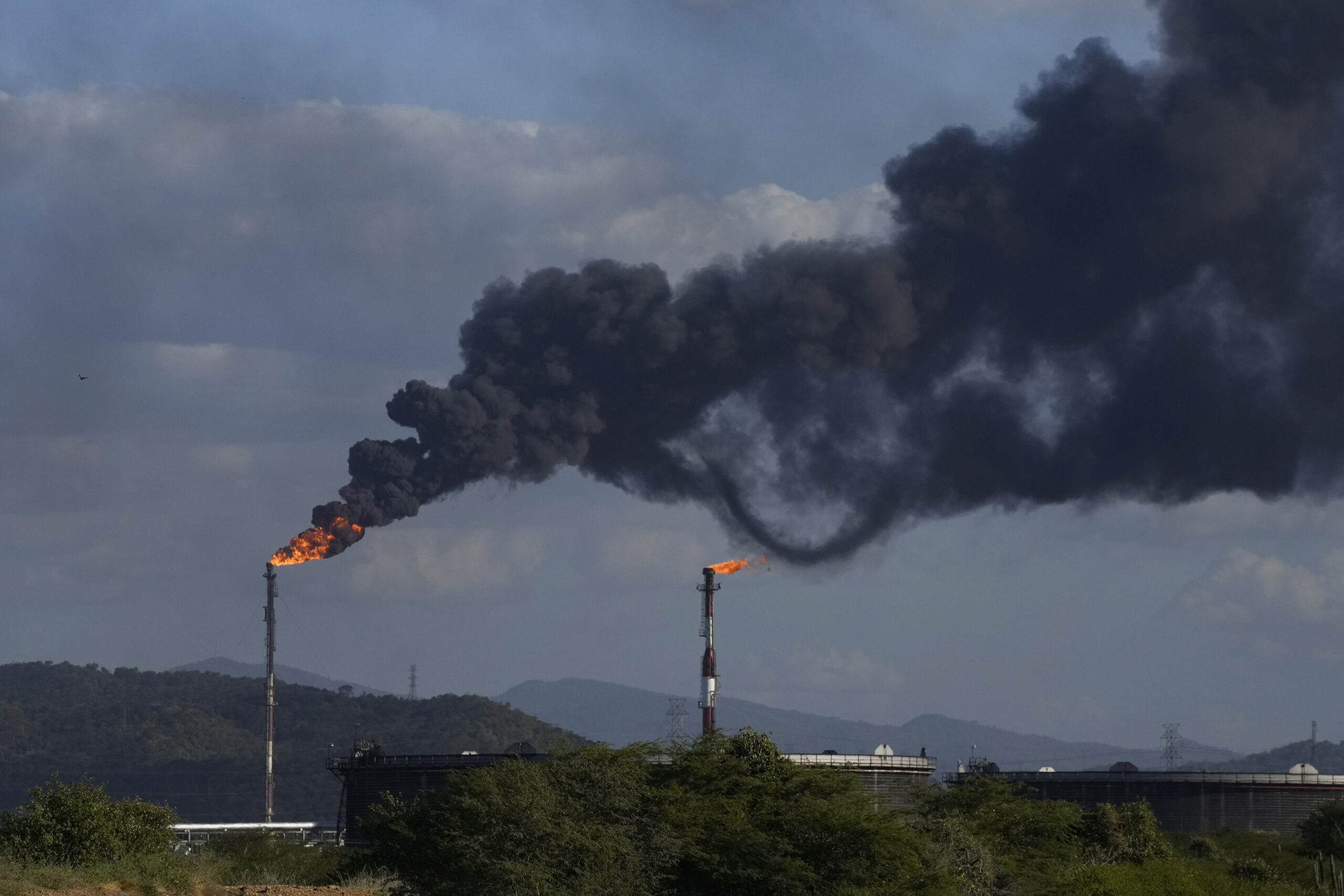
Flare stacks release gases at the Jose Antonio Anzoategui oil complex in Barcelona, Venezuela, in January 2024.
Current estimates are that Venezuela has around 300 billion barrels of oil in reserves. By comparison, the U.S. has the equivalent of about 55 billion barrels in reserve. Most U.S. refineries, especially Gulf Coast refineries built years ago, are designed to process Venezuela’s heavy, high-sulfur sour-quality feedstock, which makes them more efficient, with better profit margins than when running lighter, domestic crude.
And Venezuela, in fact, is not an underdeveloped commodities country, but sits on a wellspring for both today’s energy markets and tomorrow’s green-tech supply chains — with plenty of bauxite, aluminum, gold, copper, nickel, coltan, and cassiterite — all of it too valuable in Trump’s transactional view to be locked out by growing Russian and Chinese influence.
All of Latin America is now watching to see how the invasion and ongoing transition strategy will play out. Early condemnations have come from Brazil, Mexico, Chile, and especially neighboring Colombia, whose president, Gustavo Petro, has often been critical of President Trump.
On Saturday, President Trump was asked about U.S. relations with Colombia. And the president — who charged in early December that, after Maduro, Petro “might be next” — stated that Petro “has cocaine mills. He has factories where he makes cocaine. So he does have to watch his ass.”
Facts about Latin America, in this case Colombia, don’t interest Trump. While the country contends with coca harvesting and with a decades-long internal conflict, pitting government forces against a variety of criminal networks, there is no evidence of Petro’s involvement in the cocaine trade.
There are arguments among analysts about hectares of coca under harvest and cocaine production potential from various species, and even total hectares under cultivation, but interdictions disrupting cocaine production and trafficking are at record levels. And Petro has said he can offer evidence that as many as 18,000 narcotics laboratories have been dismantled during his time in office.
In early December, Petro invited Trump to come witness the destruction of cocaine laboratories “to prevent cocaine from reaching the U.S.”
Trump should also come here to witness, as I have, Colombia’s innovative efforts with modern chemistry detection of illicit drugs at seaports, which is beyond easy description.
T. Nelson Thompson was a Woodrow Wilson Fellow in international relations at Johns Hopkins University. Before recently retiring, he was a senior adviser in the Office of International Activities at the U.S. Maritime Administration (MARAD) in Washington.
As events continue to unfold in my native Venezuela, many members of the expat community are experiencing a complex mix of emotions: relief, hope, concern, and caution.
For many Venezuelans, the removal of Nicolás Maduro represents a long-awaited moment of accountability. His rule, following that of Hugo Chávez, was marked by repression, corruption, and the systematic destruction of a once-prosperous nation.
Millions were forced into exile, a quarter of the population fled the country, families were separated, and basic human rights were violated. The end of that chapter brings real relief.
But relief alone does not guarantee confidence in what comes next.
The announcement during President Donald Trump’s news conference that Venezuelan Vice President Delcy Rodríguez has assumed control is deeply troubling to most Venezuelans.
Venezuelan Vice President and Oil Minister Delcy Rodríguez gives a news conference at the Miraflores presidential palace in Caracas, Venezuela, in March.
Rodríguez has been one of the architects of the system that caused Venezuela’s humanitarian, economic, and institutional collapse. She is not a neutral caretaker, but part of the inner circle that enabled abuses and dismantled democratic institutions. Replacing one figure while leaving the rest of the structure intact is not meaningful change.
It is also important to be clear about Venezuela’s resources. Venezuela’s oil belongs to the Venezuelan people.
While it is legitimate for the United States to seek restitution for assets unlawfully expropriated during Chávez’s presidency, including those taken from companies such as ExxonMobil and ConocoPhillips, any resolution must respect Venezuelan sovereignty and ensure future revenues benefit the population, not another authoritarian elite.
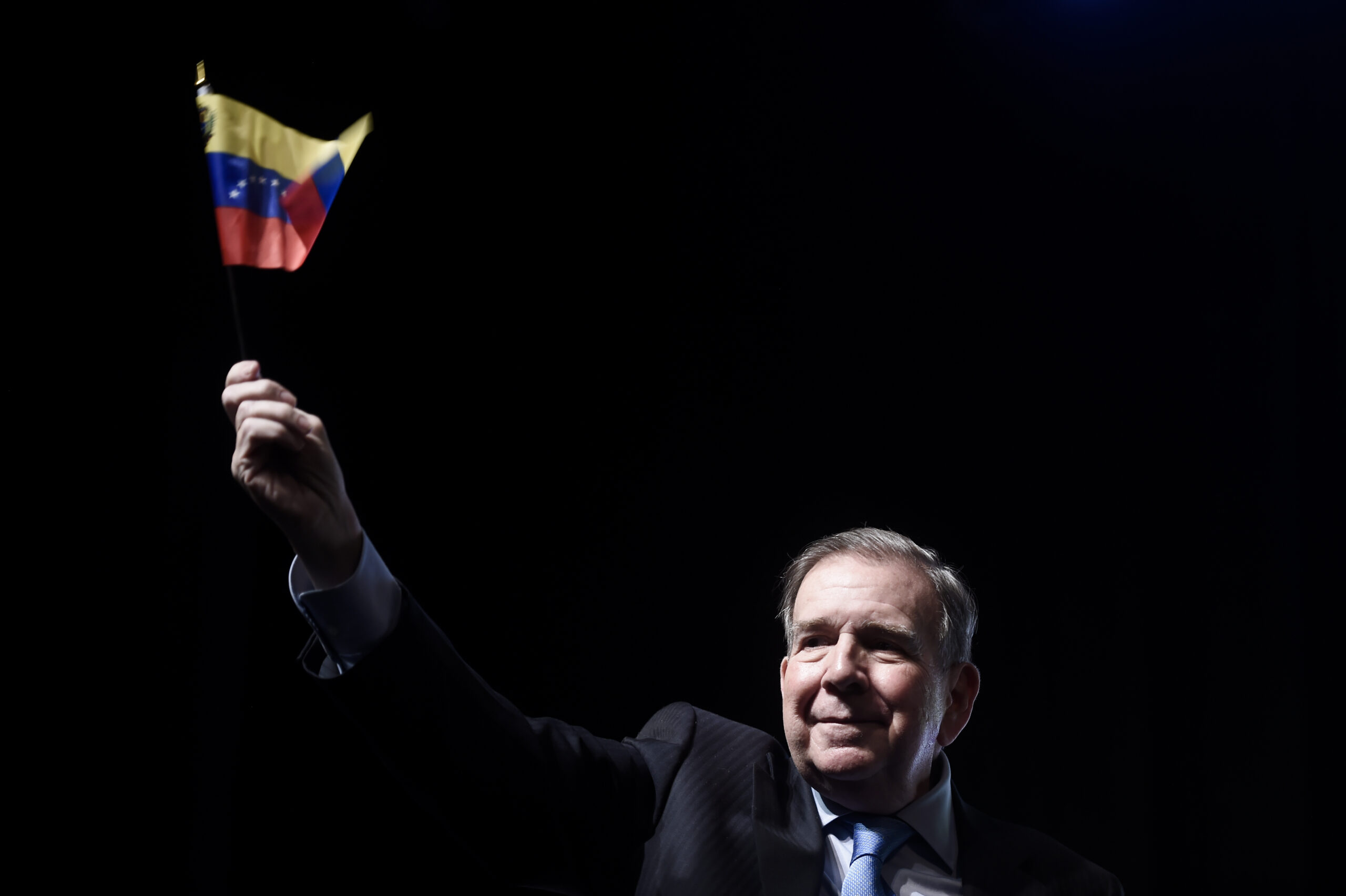
Venezuela’s opposition leader Edmundo González, who has been recognized by several governments, including the U.S., as Venezuela’s president-elect, waves a Venezuelan flag during a meeting with supporters in Panama City in January 2025.
Most importantly, Venezuela has already chosen change. In July 2024, voters chose to send Edmundo González to the Miraflores Palace — Venezuela’s White House — in a historic election. Despite efforts by the democratic opposition to expose and counter electoral manipulation, the regime-controlled National Electoral Council ignored the will of the people. That denial of a democratic mandate lies at the heart of today’s crisis.
What Venezuelans at home and abroad are asking for is not chaos or vengeance, but a protected and legitimate transition — one that respects the 2024 election results and seats González as president. Without safeguards, accountability, and international oversight, Venezuela risks repeating a painful cycle or sliding into further instability.
Many Venezuelans are also concerned by statements suggesting the United States would “run Venezuela” during a transition. International pressure and support matter, but prolonged foreign administration raises serious questions about sovereignty and accountability.
Venezuela’s recovery must be led by Venezuelans chosen by their people.
We welcome the possibility of change, but remain vigilant. Venezuela has suffered too much to endure another false transition. Our hope is for peace, unity, and a democratic future that finally honors the will and dignity of its people.
Emilio Buitrago is the cofounder and former president of Casa de Venezuela Philadelphia, where he continues to serve as an advisory board member. An engineer and project manager, he also serves as an advisory board member of the Venezuelan American Caucus.
CARACAS, Venezuela — The United States captured Venezuelan President Nicolás Maduro and flew him out of the country in an extraordinary military operation early Saturday that plucked a sitting leader from office. President Donald Trump insisted the U.S. government would run the country at least temporarily and would tap Venezuelan’s vast oil reserves to sell “large amounts” to other countries.
The action marked the culmination of an escalating Trump administration pressure campaign on the South American country that consisted of months of strikes on boats officials said were smuggling drugs to the U.S. Behind the scenes, U.S. officials tracked Maduro’s behavioral habits, including what he ate and where he slept, in preparing to execute an operation that resulted in one of the more stunning regime changes in modern history.
Maduro and his wife, seized overnight from their home on a military base, were aboard a U.S. warship on their way to New York, where they were to face criminal charges in connection with a Justice Department indictment accusing them of a role in narco-terrorism conspiracy.
Trump said the U.S. planned to run Venezuela until a transition of power can take place. He claimed the American presence was already in place, though there were no immediate signs the U.S. was running the country. Venezuelan state TV continued to air pro-Maduro propaganda, broadcasting live images of supporters taking to the streets in Caracas in protest.
Trump claimed that Venezuelan vice president Delcy Rodríguez had been sworn in as president shortly before he spoke to reporters and added she had spoken with Secretary of State Marco Rubio.
“She is essentially willing to do what we think is necessary to make Venezuela great again. Very simple,” Trump said.
Earlier, opposition leader María Corina Machado said that the opposition candidate Edmundo González should assume power, saying that he rightfully won the 2024 presidential election.
“We’re going to run the country until such time as we can do a safe, proper and judicious transition,” Trump said at a Mar-a-Lago news conference where he boasted that this “extremely successful operation should serve as warning to anyone who would threaten American sovereignty or endanger American lives.”
The legal authority for the attack, which echoed the 1990 U.S. invasion of Panama that led to the surrender and seizure of leader Manuel Antonio Noriega, was not immediately clear. The U.S. government does not recognize Maduro, who last appeared on state television Friday while meeting with a delegation of Chinese officials in Caracas.
Maduro and other Venezuelan officials were indicted in 2020 on “narco-terrorism” conspiracy charges, but the Justice Department released a new indictment Saturday of Maduro and his wife, Cilia Flores, that described the regime as a “corrupt, illegitimate government” fueled by a drug trafficking operation that flooded the U.S with cocaine.
Trump posted on his Truth Social account a photo that he said showed Maduro in custody, blindfolded and wearing a sweatsuit.
Early morning attack
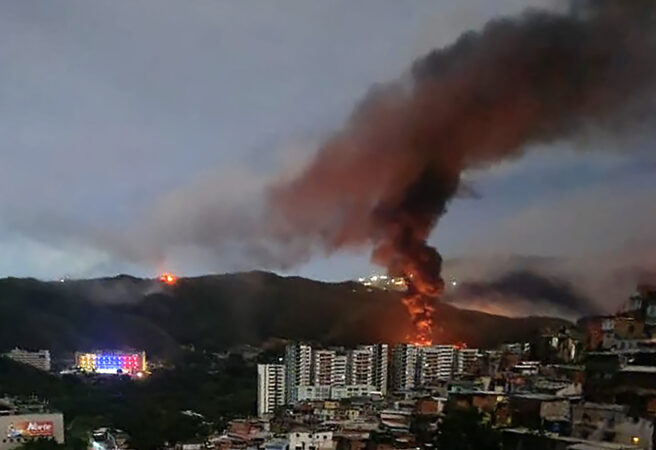
Early Saturday, multiple explosions rang out and low-flying aircraft swept through the Venezuelan capital. Maduro’s government accused the United States of attacking civilian and military installations, calling it an “imperialist attack” and urging citizens to take to the streets.
The attack lasted less than 30 minutes and the explosions — at least seven blasts — sent people rushing into the streets, while others took to social media to report what they’d seen and heard. Some Venezuelan civilians and members of the military were killed, said Vice President Delcy Rodríguez, without giving a number. Trump said some U.S. forces were injured in Venezuela but none were killed.
“We think, we develop, we train, we rehearse, we debrief, we rehearse again, and again. not to get it right, but to ensure we cannot get it wrong,” said Dan Caine, the chairman of the Joint Chiefs of Staff.
Video obtained from Caracas and an unidentified coastal city showed tracers and smoke clouding the landscape as repeated muted explosions illuminated the night sky. Other footage showed cars passing on a highway as blasts illuminated the hills behind them. The videos were verified by the Associated Press.
Smoke was seen rising from the hangar of a military base in Caracas, while another military installation in the capital was without power.
Venezuelan ruling party leader Nahum Fernández told the Associated Press that Maduro and Flores were at their home within the Fort Tiuna military installation when they were captured.
“That’s where they bombed,” he said. “And, there, they carried out what we could call a kidnapping of the president and the first lady of the country.”
The strike followed a monthslong Trump administration pressure campaign on the Venezuelan leader, including a major buildup of American forces in the waters off South America and attacks on boats in the eastern Pacific and Caribbean accused of carrying drugs. Last week, the CIA was behind a drone strike at a docking area believed to have been used by Venezuelan drug cartels — the first known direct operation on Venezuelan soil since the U.S. began strikes in September.
As of Friday, the number of known boat strikes was 35 and the number of people killed at least 115, according to the Trump administration. Trump said that the U.S. is engaged in an “armed conflict” with drug cartels and has justified the boat strikes as a necessary to stem the flow of drugs into the U.S.
Venezuela’s ruling party has held power since 1999, when Maduro’s predecessor Hugo Chávez took office, promising to uplift poor people and later to implement a self-described socialist revolution.
Maduro took over when Chávez died in 2013. His 2018 reelection was widely considered a sham because the main opposition parties were banned from participating. During the 2024 election, ruling party-loyal electoral authorities declared him the winner hours after polls closed, but the opposition gathered overwhelming evidence that he lost by a more than 2-to-1 margin.
In a demonstration of how polarizing a figure Maduro is, people variously took to the streets to deplore his capture and celebrate it.
At a protest in the Venezuelan capital, Caracas Mayor Carmen Meléndez joined a crowd demanding Maduro’s return.
“Maduro, hold on, the people are rising up!” the crowd chanted. “We are here, Nicolás Maduro. If you can hear us, we are here!”
Earlier, armed people and uniformed members of a civilian militia took to the streets of a Caracas neighborhood long considered a stronghold of the ruling party.
In other parts of the city, the streets remained empty hours after the attack, as residents absorbed events. Some areas remained without power, but vehicles moved freely.
“How do I feel? Scared, like everyone,” said Caracas resident Noris Prada, who sat on an empty avenue looking down at his phone. “Venezuelans woke up scared, many families couldn’t sleep.”
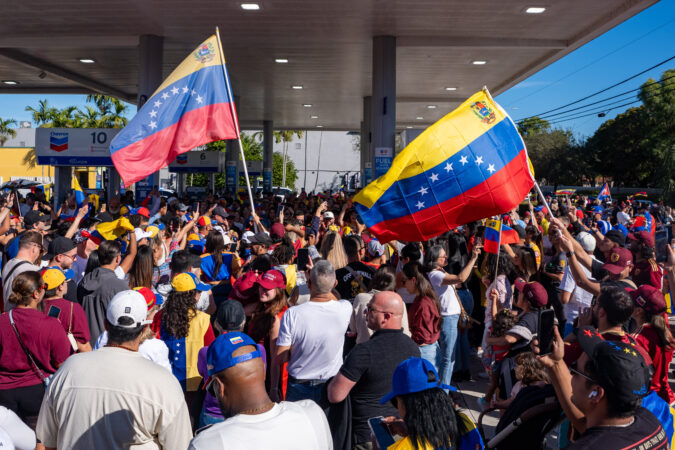
In the Chilean capital of Santiago, people waved Venezuelan flags and banged pots and pans as vehicles passed by honking at them.
Questions of legality
The Armed Services committees in both houses of Congress, which have jurisdiction over military matters, had not been notified by the administration of any actions, according to a person familiar with the matter and granted anonymity to discuss it.
Lawmakers from both political parties in Congress have raised deep reservations and flat-out objections to the U.S. attacks on boats suspected of drug smuggling near the Venezuelan coast, and Congress has not specifically approved an authorization for the use of military force for such operations in the region.
Connecticut Rep. Jim Himes, the top Democrat on the House Intelligence Committee, said he had seen no evidence that would justify Trump striking Venezuela without approval from Congress and demanded an immediate briefing by the administration on “its plan to ensure stability in the region and its legal justification for this decision.”
Deputy Secretary of State Christopher Landau said the military action and seizure of Maduro marks “a new dawn for Venezuela,” saying that “the tyrant is gone.” He posted on X hours after the strike. His boss, Rubio, reposted a post from July that said Maduro “is NOT the President of Venezuela and his regime is NOT the legitimate government.”
Cuba, a supporter of the Maduro government and a longtime adversary of the United States, called for the international community to respond to what President Miguel Díaz-Canel Bermúdez called “the criminal attack.”
“Our zone of peace is being brutally assaulted,” he said on X. Iran’s Foreign Ministry also condemned the strikes.
By the end of thisyear, Montgomery County will have three emergency short-term shelters with beds for 190 people in Pottstown, Lansdale, and Norristown.
In late 2024, it had zero full-time shelters, even as homelessness soared to new heightsin the county — Pennsylvania’ssecond wealthiest.
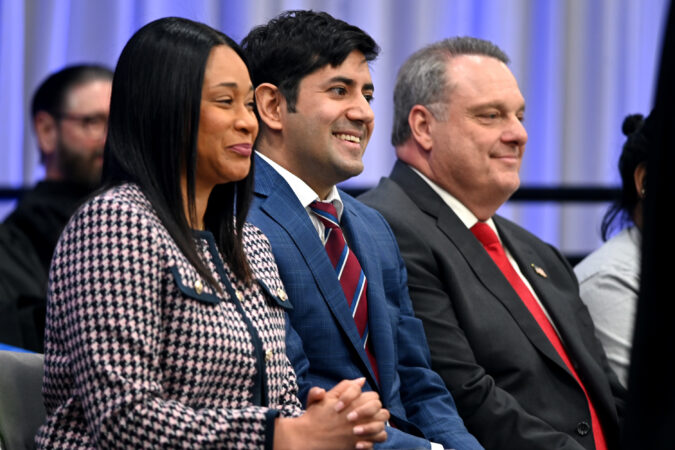
The three-member board of commissioners is currently composed of two Democrats and one Republican, but in the past year they have operated with an unusual degree of cohesion on both the challenge of homelessness and on a county budget that included a small property tax increase.
“We came in with similar goals around addressing the homeless problem throughout the county,” said Tom DiBello, the Republican commissioner. “We all heard it when we were campaigning [in 2023] and when we got elected, we felt that we needed to do something. We can’t continue doing it the way it’s always been done in the past, where people just kept talking about it.”
Although the Montgomery County commissioners have formed a united front on many issues last year, housing policy issues are more likely to divide them in 2026.
But the Democrat commissioners, Neil Makhija and Jamila Winder, have ideas about how to get around those limitations to directly fund more affordable housing and encourage local governments to allow more building.
DiBello is not excited about many of the proposals being considered by the two Democrats. He opposes creating new county-level taxes and says zoning powers should be left to localities.
Still, DiBello has further housing policy goals he would like to pursue — such asdeveloping more affordable homes for senior citizens.
As the county releases its 2026 housing blueprint, expected early this year, the first round of these debates will begin in earnest. This planning document, created by county government staff with commissioner feedback, lays out goals for the county based on a comprehensive housing policy — the first its seen in recent memory, Makhija says.
“It’s going to be the first time that the entire board has had a voice and a view on what our role is to address a crisis in the cost of housing,” said Makhija. “There are things we can do to help people.”
How the shelters got built
Making policy to address homelessness is difficult because many municipalities and community groups fight against having shelters placed in their neighborhoods.
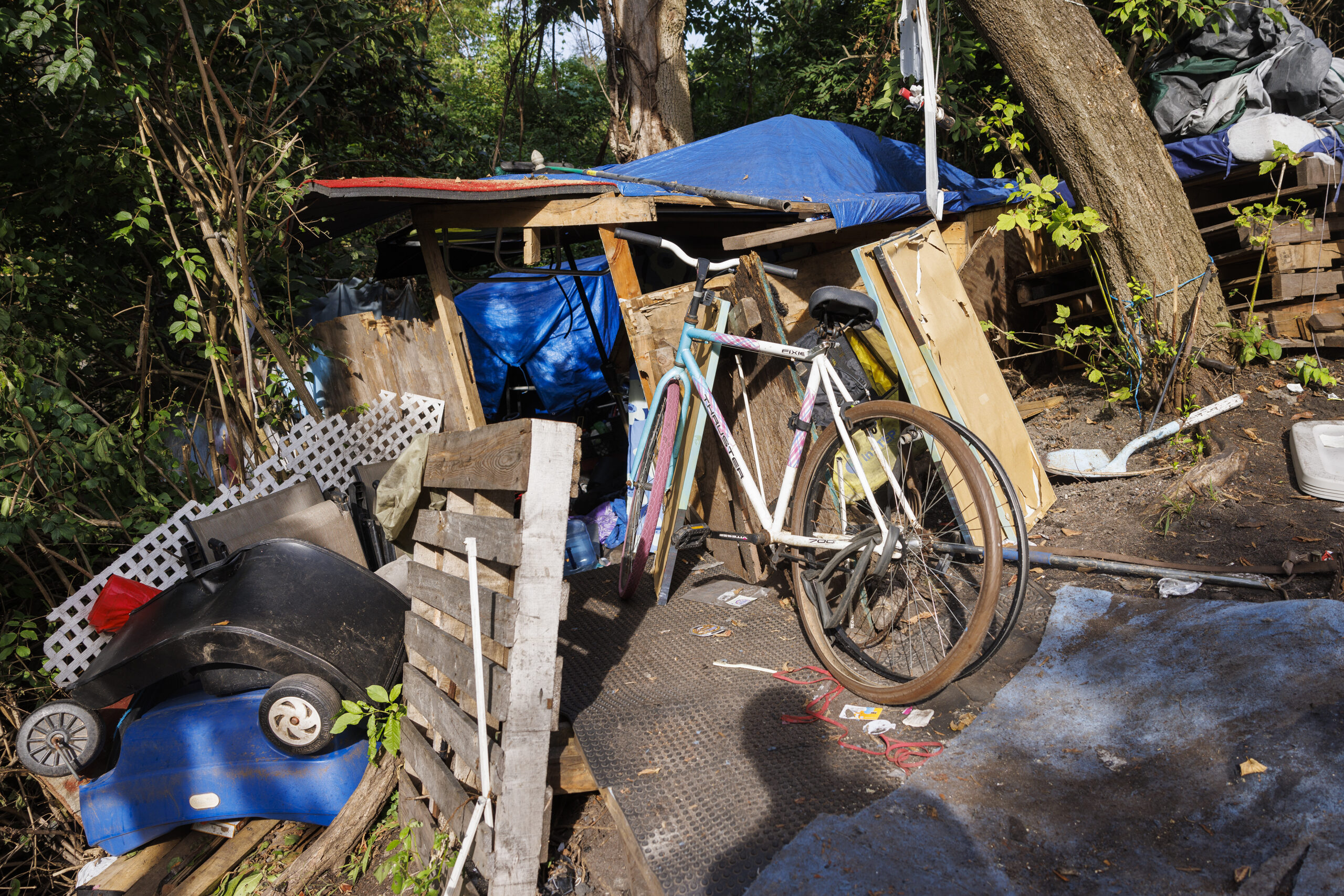
The number of people in Montgomery County experiencing homelessnesshas grown with the cost of housing. In 2024, there were 435 people living without a roof over their heads. In 2025, the number grew to 534.
Meanwhile, Montgomery County’s last full-service homeless shelter closed in 2022.
Opposition to new shelters or affordable housing bloomed in Norristown, where officials said the rowhouse-dominated municipality was already asked to shoulder too many social services, and in Lower Providence where the local government denied a shelter application (the legal fallout is ongoing).
The county commissioners decided to get involved by courting local governments and personally attending zoning hearings about potential placements. DiBello attended meetings in Pottstown, near where he lives. Winder went to hearings in Norristown, including one that stretched past midnight, then stuck around to discuss neighbors’ concerns.
A homeless encampment near the Schuylkill River Trail and Norristown in Montgomery County.
In some parts of the county, efforts to address the issue overcame opposition.
Communities like East Norriton have established more code blue shelters, which only operate during freezing weather, and inwealthy Lower Merion, a new affordable housing complex for seniors and people with disabilities, called Ardmore House II, is under construction.
“It takes political courage in these moments,” Winder said,referring to local officials who have embraced shelters and affordable housing. “Sometimes you have loud voices in the room and just have to say, well, this is the right thing to do.”
The commissioners provided $5.3 million in county funding for the shelters. The county also provided a quarter of Ardmore House II’s $20 million budget. And as federal funding cuts loom under President Donald Trump’s administration, the commissioners have also been engaging with philanthropists and foundations.
Earlier this month, Nand Todi, president of Montgomery County-based Penn Manufacturing Industries, announced a $1 million donation to the Lansdale shelter.
Nand Todi, president of Montgomery County-based Penn Manufacturing Industries, and County Commissioner Neil Makhija at a walk-through of the completed Lansdale shelter.
Winder hopes this example of generosity is just the beginning.
“I come from the private sector, so I believe in public-private partnerships,” said Winder. “We’re home to some of the largest corporations in the southeast area. We know that companies have social responsibility goals. So how do we partner with corporations?”
What can a county government do?
Thisyear, the commissioners want to continue to tackle housing issues.
But county-level politicians do not have large budgets at their command, and unlike their municipal-level counterparts, they do not set zoning policy.
Makhija and Winder wantto push those limits.
For example, the county dispenses infrastructure grants, and Makhija says the rules around that funding could be rewritten to incentivize municipalities to reform their zoning codes, perhaps using model ordinances established by the county.
Such ordinances could, for example, allow more transit-oriented development. Or they could legalize accessory dwelling units — small living spaces such as a garage apartment or in-law suite that can be rented out.
“If you have a grant program and it says these are the requirements, then people are going to prioritize getting those things done,” said Makhija, though, he said, he still has to make the case to his colleagues.
He also noted that county planning staff can help implement new municipality policies.
DiBello is skeptical of the county getting involved in local zoning policy.
“The governing structure in Pennsylvania is that municipalities are autonomous to county and state when it comes to zoning,” said DiBello. “It’s up to the communities.”
The Democrats would also like to find revenue sources to pay for more housing projects without increasing the property tax, which would cut against their goal of affordability.
“There are opportunities for us to advocate to the state legislature, to give counties like ours other means to generate revenue,” said Winder. “It’s not sustainable to continue to burden taxpayers by increasing property taxes, and we can’t fund these programs unless we have the money to do so.”
DiBello is also opposed to creating new taxes (if Harrisburg allows it), and doesn’t want to see more property tax increases either. But he still wants to see proactive housing investments by county government.
These debates will unfold next year as the housing blueprint dominates the commissioners’ agenda.
“We’re the second wealthiest county in Pennsylvania, and people struggling to find housing can be quite invisible in these communities,” said Winder. “We’ve got an embarrassment of riches, but there are people that are struggling and so we’re trying to be on the ground helping to solve these issues.”
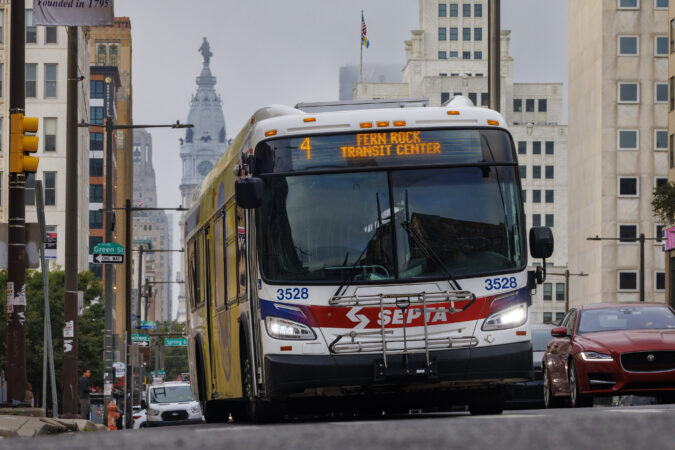
Scott Sauer would like nothing better than to make SEPTA an afterthought.
He doesn’t mean that the Philadelphia region’s mass transit agency should be neglected, but rather that it will come to do its job so seamlessly that its nearly 800,000 daily customers can rely on the service without worrying about breakdowns, delays and disruptions.
Given the cascading crises that hit SEPTA in 2025, many people wondered if the place was hexed.
“I hope not, because I don’t know how to get the curse off me,” Sauer said in a recent interview. “But listen, truth be told, there were days when I scratched my head and thought, ‘Oh, my goodness, what is going on?’”
“We just couldn’t seem to get more than a day or two of relief before something else was causing a headache,” said Sauer.
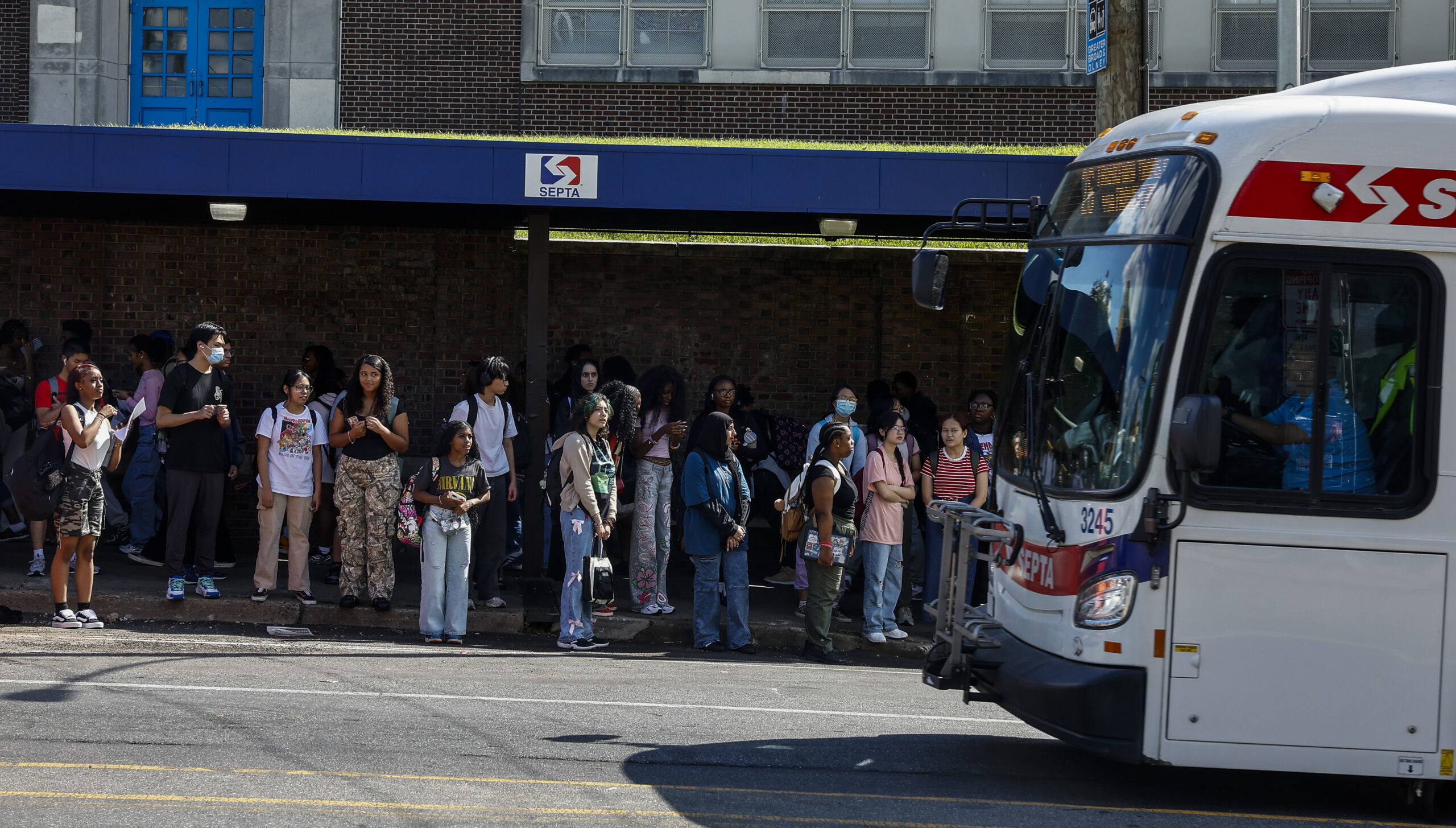
A bus passes the stop near Girls High at Broad and Olney Streets on Monday, Aug. 25, 2025. Thirty two SEPTA bus routes were cut and 16 were shortened, forced by massive budget deficits.
Back to basics in 2026
In the end, help from above and a new labor contract bought SEPTA at least two years to recover from its annus horribilis and stabilize operations.
When the Pennsylvania legislature couldn’t get a transit funding deal done, Gov. Josh Shapiro shifted $394 million in state-allocated funds for infrastructure projects to use for operations — the third temporary solution in as many years. The administration also later sent $220 million in emergency money in November for the Regional Rail fleet and the trolley tunnel.
And, early in December, SEPTA reached agreement on a new, two-year contract with its largest bargaining unit, Transport Workers Union Local 234.
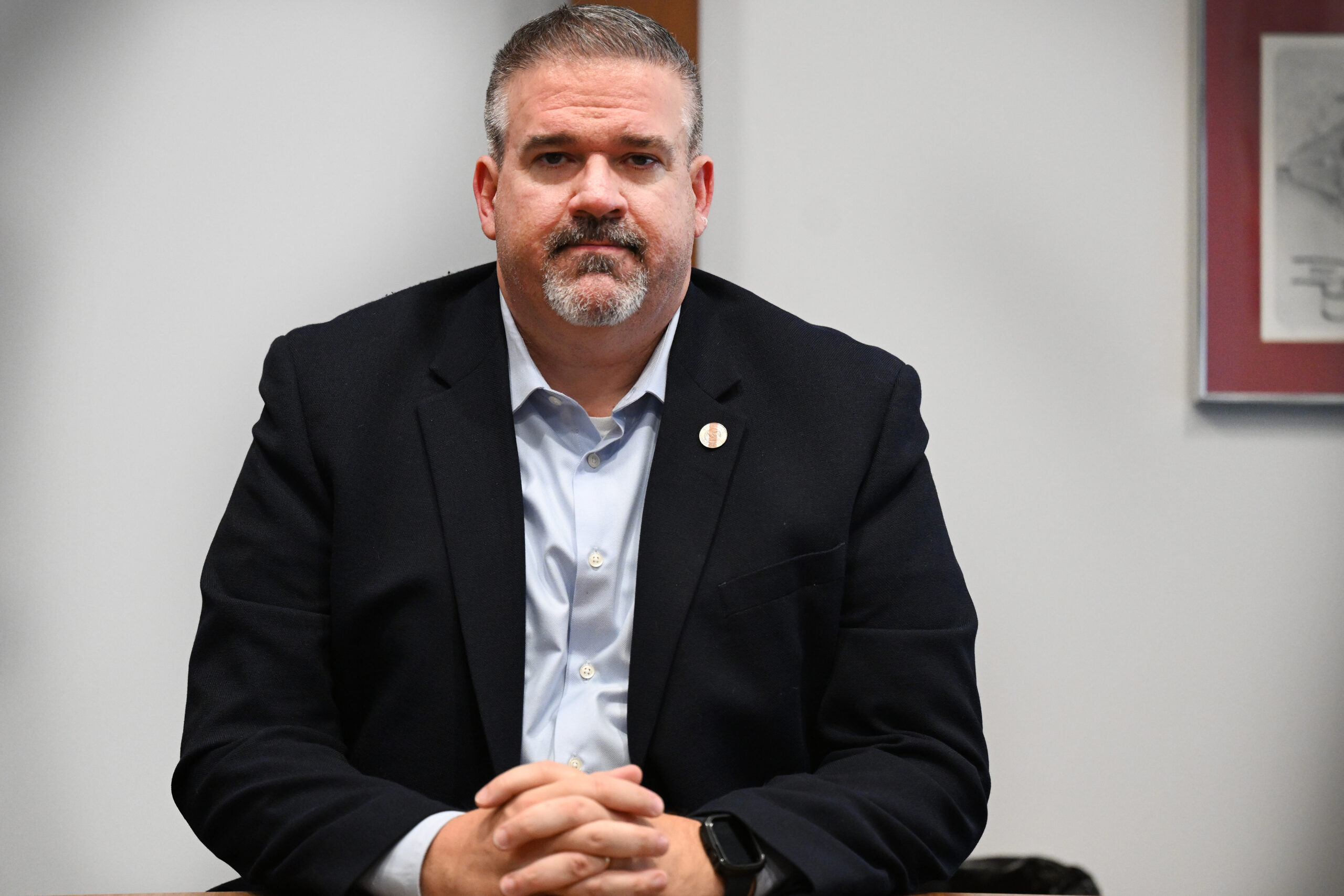
Scott Sauer, general manager of SEPTA, admits that 2025 was an extremely challenging year.
Sauer compared SEPTA’s position to football refs. When they are doing their jobs right, fans don’t have to think about them when watching the game. And when things are going well on the transit system, it becomes part of the background.
“Let’s make sure we do the basics, and we do them really well, because at the end of the day, people want SEPTA to move them from one place to the other, right?” he said.
The test of the focus on fundamentals comes soon, with millions of visitors expected in the region for the 250th anniversary of the Declaration of Independence, World Cup soccer, and other big events.
Sauer, 54, began his career as a trolley operator more than 30 years ago. He had no political experience, though, and would quickly be thrown headfirst into those murky waters to swim with sharks.
Storm clouds were already rolling in. Weeks before Sauer took the reins, Shapiro had flexed $153 million in state highway funds for SEPTA operations after a broader deal failed amid Senate GOP opposition.
It’s a legal move, but often controversial, and Shapiro’s opponents were furious.
Richards and her leadership team had been warning of a looming fiscal “doomsday scenario” for months. Officials were drafting a budget with service cuts and fare increases.
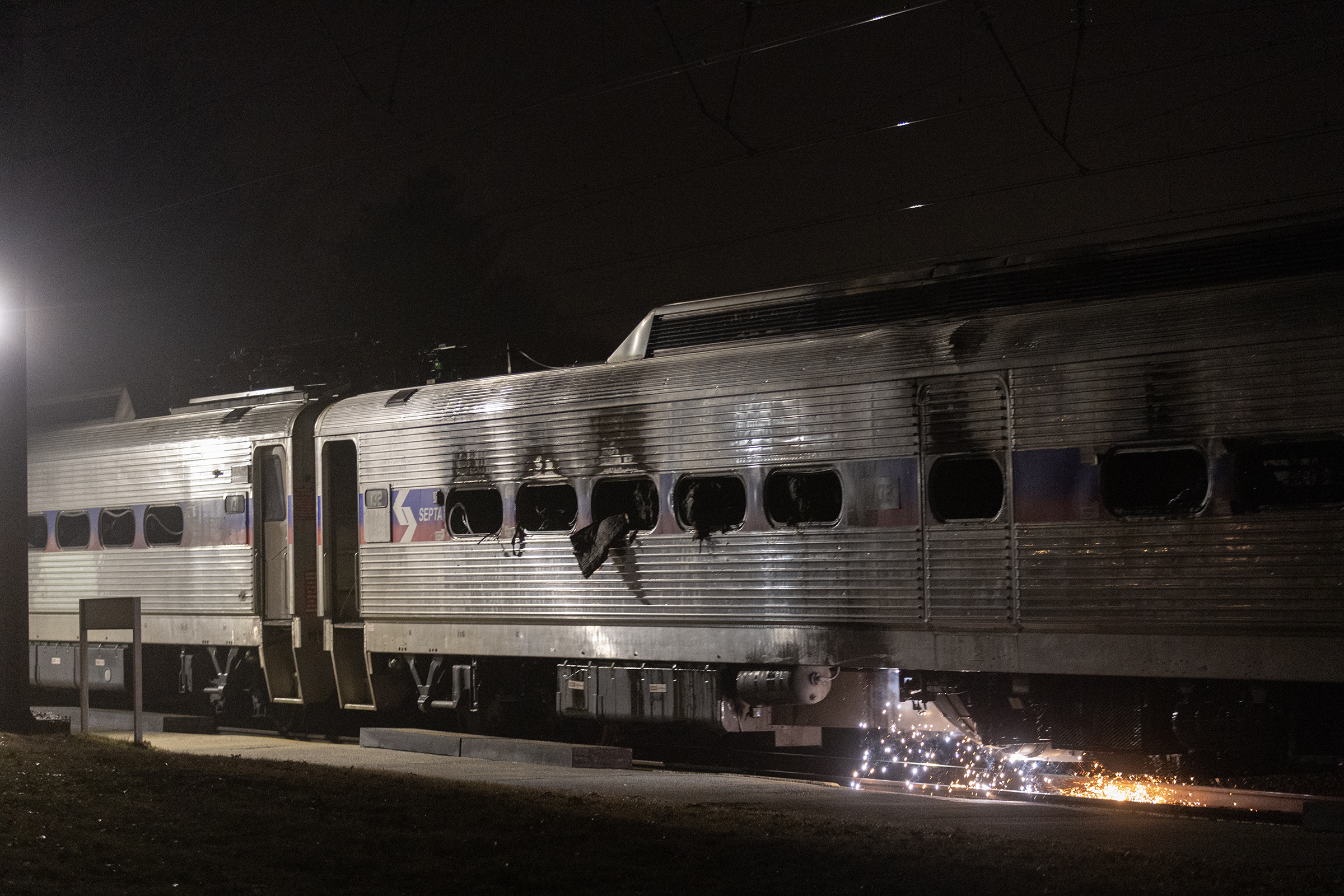
On Feb. 6, a Wilmington-bound Regional Rail train caught fire as it was leaving Crum Lynne Station in Delaware County. It was worrisome, but at the time, nobody knew it would get worse.
More than 300 passengers were safely evacuated after a SEPTA Regional Rail train caught fire near Crum Lynne Station in February.
Familiar battle lines were drawn. Senate Republicans, in the majority in the chamber, opposed Shapiro’s proposal to generate $1.5 billion for transit operations over five years by increasing its share of state sales tax income.
They preferred a new source of income for the state’s transit aid and said SEPTA was mismanaged, citing high-profile crimes, rampant fare evasion, and lax enforcement.
On a mid-August night, the Senate GOP came up with a proposal that would take money from the Public Transportation Trust Fund, a source for transit capital projects, and split it evenly between transit operations subsidies and rural state highway repairs.
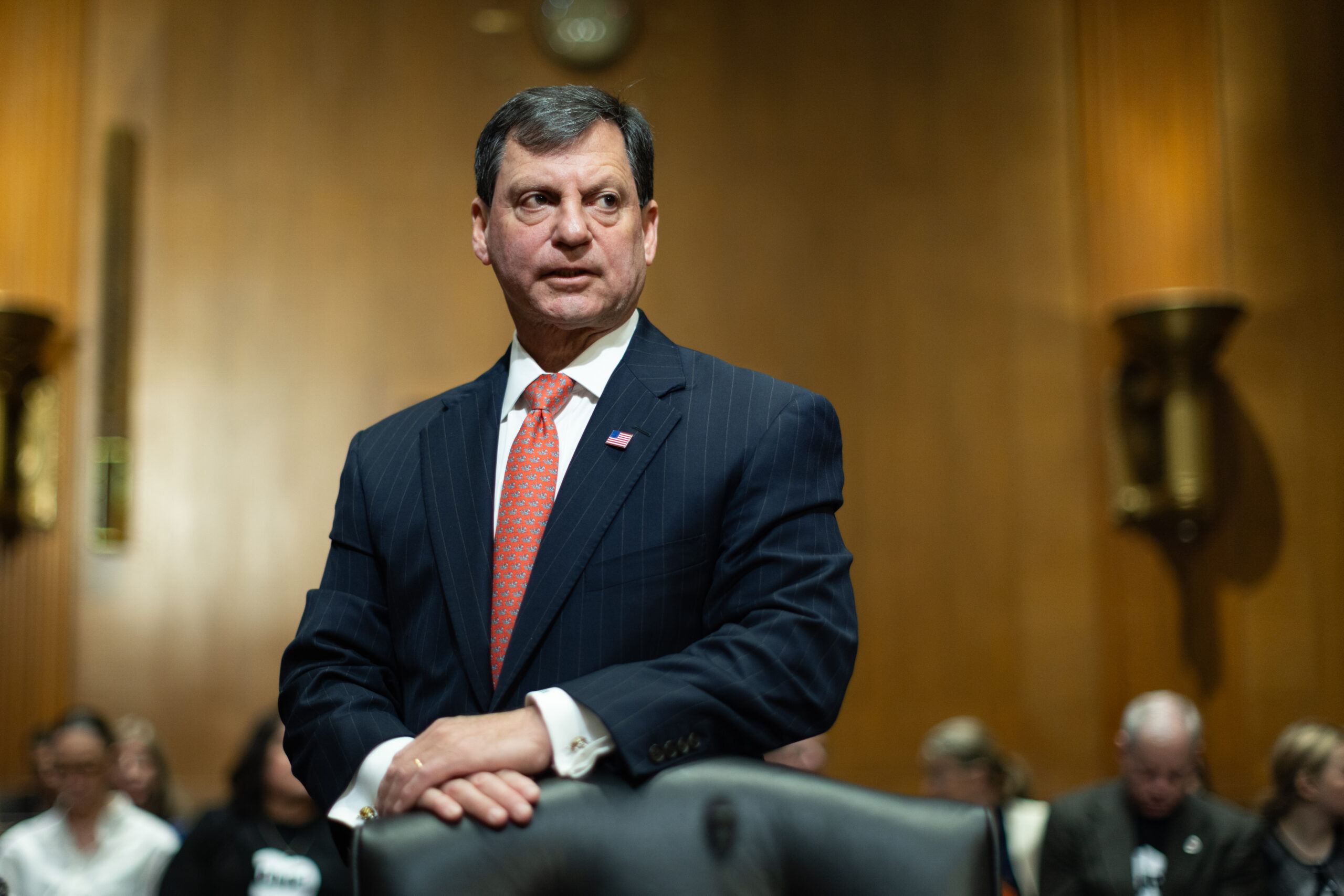
Senate Majority Leader Joe Pittman, a Republican from Indiana County, was a key player in budget negotiations, which ultimately did not yield additional funding for mass transit.
“It was kind of quiet … and then we got alerted that a proposal was coming within minutes. And so everybody was scrambling to try to read through it,” Sauer said.
In a quick news conference with Shapiro, Sauer opposed the idea of taking capital dollars for transit operations, as did the governor. Then he spoke with Senate Republicans and told reporters it could be worth considering, but he had questions. And by the end of the night, he walked that back and opposed the measure.
“I guess if there was a lesson to be learned for me in August, it was I should have taken some [more] time reading through that proposal,” he said.
There was not much time to reflect on what happened, though, because the hits kept on comingas the federal government ordered SEPTA to inspect all 223 Regional Rail cars.
SEPTA’s Regional Rail fleet is the oldest operating commuter fleet in the country, and the fires highlighted the difficulty of keeping them maintained while needing to stretch limited capital funds to address multiple problems.
The Market-Frankford El cars, though younger than the Silverliner IVs, have been beat up and unreliable. SEPTA is moving forward with replacing them, as well as the Kawasaki trolleys that are more than 40 years old.
SEPTA had ordered new Regional Rail coaches from a Chinese-government-related manufacturer, but canceled the contract after the first few models, built during the pandemic, showed flaws. Now the agency is advertising for bids on a new fleet of Regional Rail workhorses — but it has to make them sturdier to last for at least seven more years before new cars would be on the way.
Officials plan to use $220 million received from the state on that effort.
Some of the money, about $48 million, is slated to help fix the trolley-tunnel issue. SEPTA is contending with glitches in the connection between the overhead catenary wires and the pole that conducts electricity to the vehicle.
What SEPTA got done
SEPTA has made some progress on some of its persistent issues, officials say, though the accomplishments understandably have been largely overlooked amid the urgent, existential crises of 2025.
For instance, serious crimes on the SEPTA system dropped 10% through Sept. 30 compared to the same period in 2024, according to Transit Police metrics.
And there had already been a sharp improvement. Serious crimes in 2024 dropped 33% compared to 2023 — from 1,063 to 711, year over year.
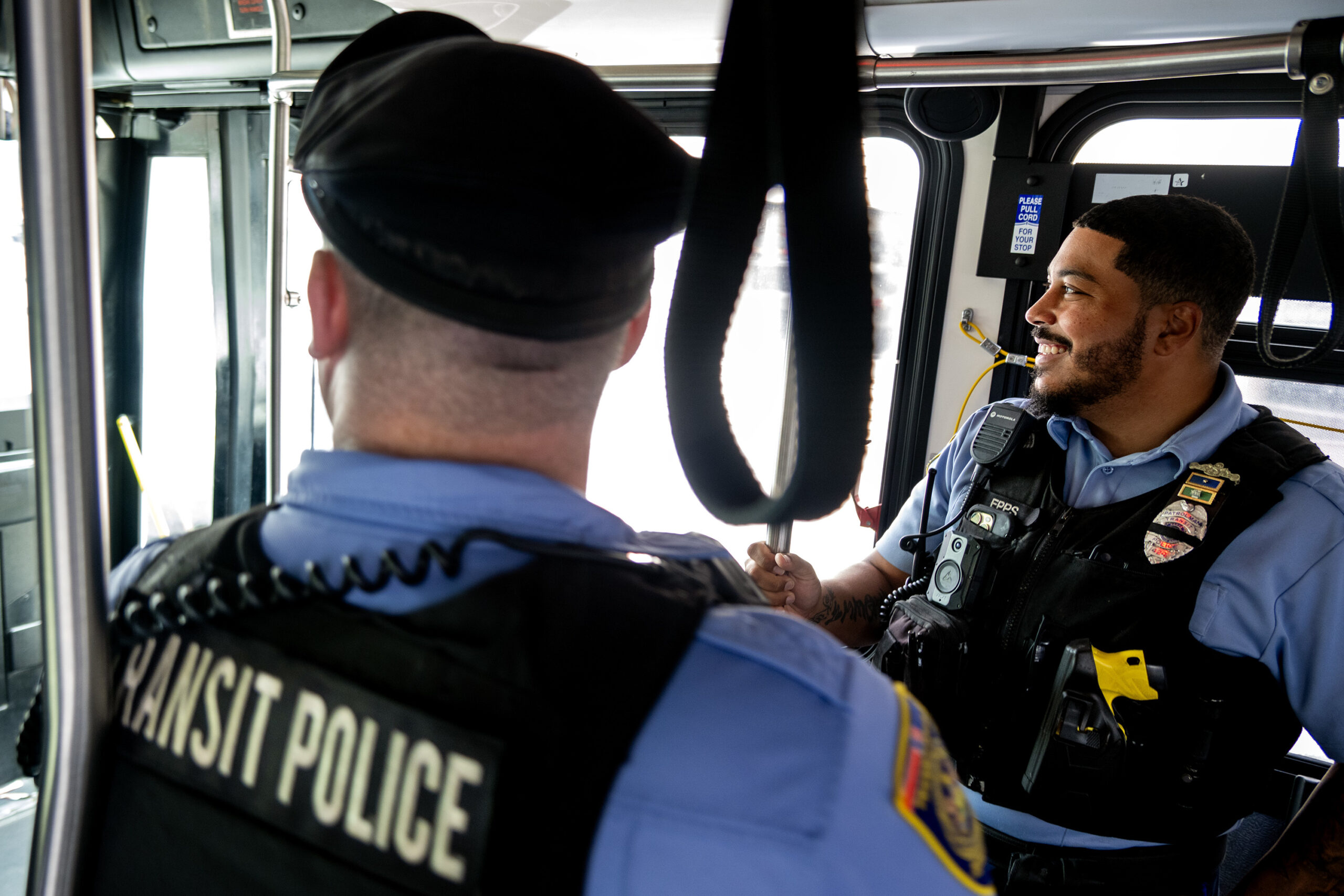
SEPTA transit police police patrol officers Brendan Dougherty (left) and Nicholas Epps (right) with the Fare Evasion Unit ride the 21 bus.
“If you think back to where we were in 2021 and 2022, the perception was bad things were happening on SEPTA, and you should steer clear of them,” Sauer said.
The Transit Police have been hiring new officers, including a recently graduated academy class of nine, and has about 250 officers.
SEPTA also installed 42 full-length gates designed to thwart fare evasion on seven platforms in five stations during 2025, spokesperson Andrew Busch said.Another 48 gates are coming in the first quarter of the year.
Police are also issuing citations with an enhanced penalty of up to $300 for fare evasion.
Prepare for déjà vu
Andyet, in 2027, it will be time to start the old SEPTA-funding dance once again, as transit agency advocates and supportive lawmakers work at getting a stable state funding stream for transit operations.
State Democrats have said the transit issue could help them take control of the Senate from Republicans — a longtime goal but one that is difficult to achieve. One wild card is whether President Donald Trump’s slumping popularity will cause GOP congressional candidates to get swamped in the 2026 midterms, and whether that will translate into voters’ local senators.
It likely would have to be a huge wave, and it’s a closely divided state.
By 2027, Shapiro is expected to be running for president (if he is reelected next year), and it’s anyone’s guess how that could affect budget politics.
“Not everybody wants to see us. I didn’t make a lot of friends,” Sauer joked after the TWU settlement.
The Social Security Administration — the sprawling federal agency that delivers retirement, disability, and survivor benefits to 74 million Americans — began the second Trump administration with a hostile takeover.
It ended the year in turmoil. A diminished workforce has struggled to respond to up to six million pending cases in its processing centers and 12 million transactions in its field offices — record backlogs that have delayed basic services to millions of customers, according to internal agency documents and dozens of interviews.
Long-strained customer services at Social Security have become worse by many key measures since President Donald Trump began his second term, agency data and interviews show, as thousands of employees were fired or quit and hasty policy changes and reassignments leftinexperienced staff to handle the aftermath.
Exaggerated claims of fraud, for example, have led to new roadblocks for elderly beneficiaries, disabled people, and legal immigrants, who are now required to complete sometransactions in person or online rather than by phone. Even so, the number of calls to the agency for the year hit93 million as of late September — a six-year high, data show.
The troubled disability benefits system is also deteriorating after some improvement, with 66% of disability appointments scheduled within 28 days as of December — down from nearly 90% earlier in the year, data show.
One notable exception is phone service, which improved in the second half of the yearbut is still subpar. Average hold times peaked at about 2½ hours in March, but dropped starting in July as employees were diverted from field office duties to fix what had become a public relations crisis. Average wait times for callbacks remain an hour or longer, however, while new delays have emerged elsewhere in the system, internal data show.
“It was not good before, don’t get me wrong, but the cracks are more than beginning to show,” said John Pfannenstein, a claims specialist outside Seattle and president of Local 3937 of the American Federationof Government Employees, which represents most Social Security employees. “It is a great amount of stress on our employees that remain on the job, who haven’t jumped ship.”
Commissioner Frank Bisignano has authorized millions of dollars in overtime pay to employees in a race to clear the bottlenecks, which worsened dramatically after nearly 7,000 employees — 12% of the workforce — were squeezed out early in the year. The agency said it has made improvements: It reduced the processing center backlog by one million cases this fall, cut pending disability claims by a third and kept the website live 24-7 after a series of outages earlier this year.
The current crisis follows years of disinvestment by Congress and acting leadership, despite a surge in baby boomer retirements. Bisignano promised faster service and a leaner workforce with a digital identity that he says willautomate simple retirement claims and other operations.
Frank Bisignano, President Donald Trump’s nominee for commissioner of the Social Security Administration, arrives for his confirmation hearing in March.
“In the coming year, we will continue our digital-first approach to further enhance customer service by introducing new service features and functionality across each of our service channels to better meet the needs of the more than 330 million Americans with Social Security numbers,” the commissioner said in a statement to the Washington Post.
But responsiveness and trust in the agency have suffered, according to current and former officials and public polling.
This account of the crisis at Social Security is based on internal documents and interviews with41 current and former employees, advocates and customers, many of whom spoke on the condition of anonymity to speak candidly about their concerns.
Social Security officials declined to make Bisignano available for an interview, though he did respond to written questions.
Three days before Christmas, Brian Morrissey, 65, arrived at the field office in Silver Spring, Md., for an appointment to apply for Medicare. He had tried the “MySSA” website, “but navigating it was just really hard,” he said. Morrissey owns a home improvement business, he said.
“If they can make the process easier online, great, but right now it is not well designed,” he said. So his wife waited 30 minutes on hold to schedule a face-to-face appointment for him.
Aime Ledoux Tchameni, an immigrant from Cameroon, waited in line at the Silver Spring office to get an appointment time to fix his last name from being listed as his first name — a mistake that occurred when he came to the U.S. two years ago. He has a provisional driver’s license from Maryland and needs to clear up his name with Social Security by mid-January, he said. But his appointment is not until Feb. 9.
“This is really going to cause me problems, because I need my driver’s license to get to work,” Tchameni said in French. “I don’t understand why I have to wait so long.”
‘I flipped the switch’
The table was set in February by Elon Musk and his Department of Government Efficiency, or DOGE, which installed a loyal, mid-level data analyst with no management experience to lead the $15.4 billion agency.
That former analyst, Leland Dudek, insists that he saved Social Security from a worse fate under Musk’s cost-cutting team. “I flipped the switch,” he said in a recent interview, referring to his disruptive four-month tenure as acting commissioner. “The casualty of that is a smaller SSA, an SSA that is being, for the first time, subject to the whims of being a political organization, which it was never intended to be.”
Regional offices abruptly disappeared in a rushed reorganization. New policies to fight fraud were rolled out only to be canceled or changed, prompting confused customers to jam the phones and the website, which crashed repeatedly. Daily operations in some respects became an endless game of whack-a-mole as employees were pulled from one department to another.
Along the way, Social Security also became ground zero in the administration’s quest to gather Americans’ personal data — largely in service of its mass deportation campaign.
The chaos quickly became a political cudgel, as Democrats saw an opening to defend one of the country’s most popular entitlement programs. Senate Democrats, led by Sen. Elizabeth Warren of Massachusetts, set up a “war room,” holding rallies with former commissioners in both parties and issuing demands for more resources to keep the Trump administration on the defensive.
“We’ve kept up the pressure and held Donald Trump, Elon Musk and Frank Bisignano accountable for the chaos they’ve caused,” Warren said in an interview.
Many critics note that Bisignano, a Wall Street veteran who became commissioner in May, now wears a second hat as CEO of the Internal Revenue Service —another massive portfolio with a multibillion-dollar budget.
In a statement, Bisignano said his shared leadership of Social Security and the IRS “will drive a better outcome for the American public.” He saidhe envisions “a Social Security Administration that is easier to access, faster to respond, and better prepared to meet the challenges facing Americans.”
Bisignano also said he is working to improve morale and “have the right level of staffing to operate at peak efficiency and deliver best-in-class customer service to the American people.”
‘Work piles up’
By the time Bisignano was confirmed by the Senate, Social Security had been led by three acting commissioners in six months. He pledged to stabilize the upheaval.
But he confronted immediate challenges. Dudek had reassigned 2,000 employees in administrative, analytical and technical roles to jobs dealing with the public. Many accepted the switch under threat of firing if they refused. Some began working the phones. But the national toll-free number was still in crisis, so another 1,000 staffers were assigned to the phones in July. The employees were thrown in with minimal training, multiple employees said — and found themselves unable to answer much beyond basic questions. The phone staff was told to keep calls under seven minutes in what became a push for volume over quality, employees said.
Although officials have publicly claimed that wait times have improved to single digits in some cases, those numbers do not account for the time it takes for customers to be called back, according to internal metrics obtained by the Post.
An audit published by the Social Security Inspector General’s Office on Dec. 22 confirmed that millions of callers requesting callbacks were counted as zero-minute waits by the agency. The review concluded that the metrics themselves were accurate, however, and showed that customer service overall has improved.
Jenn Jones, AARP’s vice president of financial security, said the improved phone service numbers were “encouraging” but that “more work needs to be done.”
“Wait times for callbacks remain over an hour, and more than a quarter of callers are not being served — by getting disconnected or never receiving a callback, for instance,” Jones said in a statement.
Public outcry and pushback from congressional Democrats derailed the planned closure of dozens of field offices that DOGEhad said were no longer needed.
Leland Dudek, former acting commissioner of the Social Security Administration, in November.
Meanwhile, Dudek’s workforce cuts led field offices to shed 9% of their employees by spring due to early retirement and deferred resignation offers. Overtime was restricted and hiring was frozen,even as customer visits continued to climb.
Shortly after taking office, Bisignano’s field operations chief, Andy Sriubas, wrote in an email to the staff that field offices “are, and will always remain, our front line — our face in the community and the primary point of in-person contact.”
In the near term, though, the front line staff were overwhelmed. Attrition was geographically uneven, with some offices losing a quarter of their employees to early retirement offers just as foot traffic grew, according to a staffing analysis by the AFGE’s research partner, the Strategic Organizing Center. The groupcalculated that there were about 4,000 beneficiaries for every field office employee in August of this year.
In several states that ratio is worse, the group found. Wyoming’s field offices, for example, have just 18 employees — or one for every 7,429 beneficiaries.
The shortages have created temporary office closures in many rural areas, some for days or months at a time. The office in Havre, Mont., has been closed for months, with the nearest one almost two hours away in Butte.
Today a majority of Social Security staffers who accepted reassignmentshave not been fully or properly trained, according to several employees with direct knowledge of the initiative. Instruction is often truncated so the staff can respond to customers. Officials said they provide training based on the employee’s level of experience and review the reassigned employees’ work.
“They offered minimal training and basically threw them in to sink or swim,” one veteran employee said of their transferred colleagues.
Training on the phone system and complicated claims and benefit programs lasted four hours for some reassigned workers when it should have taken six months, another employee said. As a result, some customers still can’t get basic questions answered or are given inaccurate information,according to a half-dozen staffers who answer the phones or work closely with employees who do.
The increased workload, hiring freeze and departures have made it harder for the staff to complete their daily tasks, said Jordan Harwell, a Butte, Mont., field office employee who is president of AFGE Local 4012. The staff used to find time between calls to process pay stubs, take in new disability applications and schedule appointments, but now “that work piles up,” he said.
DOGE officials, citing fraud concerns, also required direct deposit changes to be done in person or online — but getting online now calls for new identity verification measures that do not come easily to many elderly or disabled customers. Immigrants approved for green cards to work in the U.S. are now required to get Social Security cards in person under a Trump anti-fraud policy, producing a flood of new field office visits.
In one Indiana field office, one employee said she drags herself to work every day, dreading what will come next. Although she was hired as a claims specialist, she and her colleagues are being told to prioritize answering the phones, which never stop ringing now that her office is taking calls for both Indiana and parts of Illinois due to reorganizations and reductions.
That means she is forced to let other work pile up: calls from people asking about decisions in their cases, claims filed online and anyone who tries to submit forms to Social Security — like proof of marriage — through snail mail.
As the backlogs keep building, she is taking calls from 25 or so people every day, already knowing that she won’t be able to help five or six of them. These are elderly people, often poor or bedridden, who have no way to comply with the change requiring that direct deposit actions take place in person or online. Usually they’re calling because something has happened to their bank accounts and they need to alter their financial information. But they can’t access a computer, the employee said, and driving is out of the question.
She received a call this month from a 75-year-old man who suffered a massive stroke that left him unable to drive. He’d also had to switch banks and, as a result, hadn’t received Social Security checks for the last two or three months.
“I had to sit there on the phone and tell this guy, ‘You have to find someone to come in … or, do you have a relative with a computer who can help you or something like that?’” she recalled. “He was just like, ‘No, no, no.’”
She ended that call by telling the man to call his bank, hoping they might be able to help when her agency, hampered by administration policies, no longer could.
‘Everybody started laughing’
As the staff races to answer the phones, other tasks are backing up, including Medicare applications, disability claims that require initial vetting by field offices and other transactions that cannot be solved in one conversation. Any case falling in that category is redirected to a processing center, where the backlogs have been building all year.
These back-office operations, located across the country, often handle labor-intensive, highly complex cases that do not call for automated resolution. Among the tasks are issuing checks, including for back pay, to disabled people whose denial of benefits was reversed by an administrative law judge.
As Congress kept funding flat for Social Security over many years, the processing operations fell way behind, requiring headquarters employees to help handle the volume. But it was never as bad as it got this fall.
Many disability payments now takethree to six months to process when they used to take weeks, advocates and employees said.
At the start of September, one benefits authorizer in a processing center was called into an all-staff meeting with her colleagues, she said. There, management explained that the backlog at the time — six million cases — was unacceptable and that everyone would have to work overtime in an attempt to drive it down to two million by Christmas.
“When they told us that, everybody started laughing,” she said. “Because there is just absolutely no way to get it down in that short period of time.”
Still, she and her colleagues have been hustling, she said, processing cases as fast as they can, even as they can see their haste sometimes causes errors. No time to fix them, she has decided: Best to just keep moving.
The Social Security Administration has said it expects to pay $367 million less on payroll this fiscal year than the year before.
Meanwhile, another staffer, who answers phones at a national call center, said she has changed what she says to customers when she realizes their claim can’t be finished in one conversation and must be referred to a payment center.
“I’m supposed to reassure people it’s being worked on,” she said. “But now I avoid giving people a firm date they can expect it to be done by.”
Just before Thanksgiving, Bisignano said that starting next year, he hopes to slash field office visits by half. More than 31 millionpeople visited field offices in the last fiscal year — or tried to. Critics say the change will dismantle the fail-safe for those who cannot use computers, no matter how imperfect.
At the same time, in recent weeks, hundreds of employees who transferred to customer service operations have been recalled to the roles they were originally hired to fill. Others have been reassigned to a new “digital engagement” office.
Social Security has told Congress it plans to put more resources toward IT, with an expected increase of $591 million this fiscal year compared to fiscal 2025, according to the agency’s budget justification. The agency also expects to pay $367 million less on payroll than it did the year before.
Social Security also plans to roll out a new program that will allow customers to book phone appointments with field offices throughout the country, no matter where they live, according to two people familiar with the plans.
The goal is to reduce the number of field office visits, though one field office employee said the change will probably lead to a greater workload for staff keeping up with queries from customers outside their area.
“They’ve created problems and now they are trying to fix problems they created,” the worker said.
During Christmas week, the grind continued for most front line staff. After Trump signed an executive order last week closing most federal offices on Christmas Eve and Friday, Bisignano told his staff that field offices, teleservice centers, processing centers and more operations would remain open.
“In order to balance the needs of the public and our workforce, we will solicit interest from employees who would like to work on Wednesday and Friday,” he wrote.
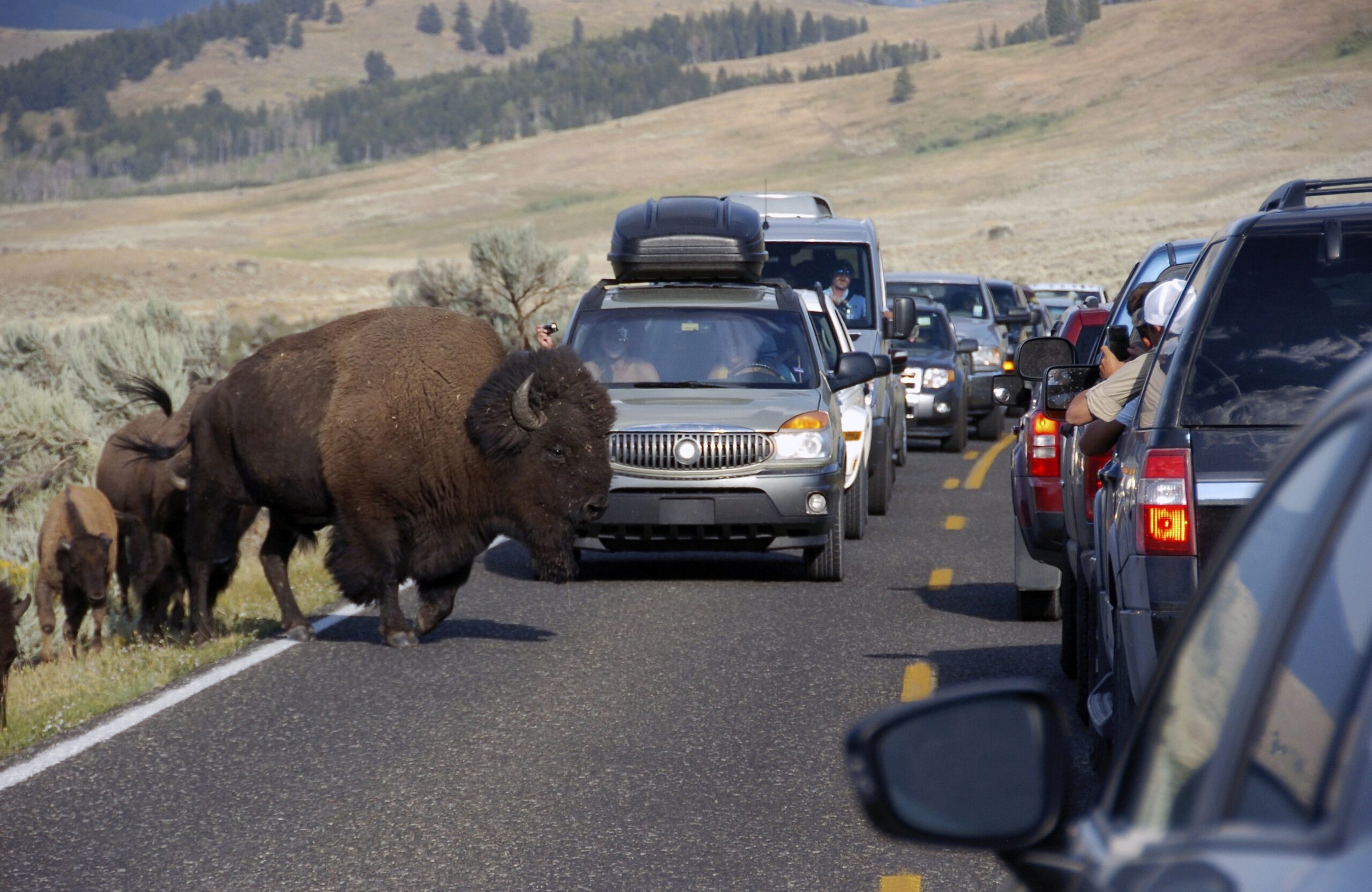
President Ulysses S. Grant established Yellowstone as the first national park on March 1, 1872. Ever since, 27 American presidents have supported, nurtured, and developed national parks — that is, until now, with this president, Donald Trump.
National park budget cuts, which were first proposed by the Heritage Foundation’s Project 2025, have totaled roughly 35%.
Implemented by Elon Musk and his so-called Department of Government Efficiency, the cuts have led to thousands of public servants being fired and day-to-day operations being vastly curtailed.
Taking it to the next step, Trump’s secretary of the interior, Doug Burgum, who oversees national parks, is considering a plan for the elimination of up to 350 park sites across the country. Burgum is apt to diminish or shutter sites that fall vulnerable to Trump’s executive order, cynically titled, “Restoring Truth and Sanity to American History.”
A vintage photograph is displayed at Manzanar War Relocation Center at Manzanar National Historic Site, near Independence, Calif.
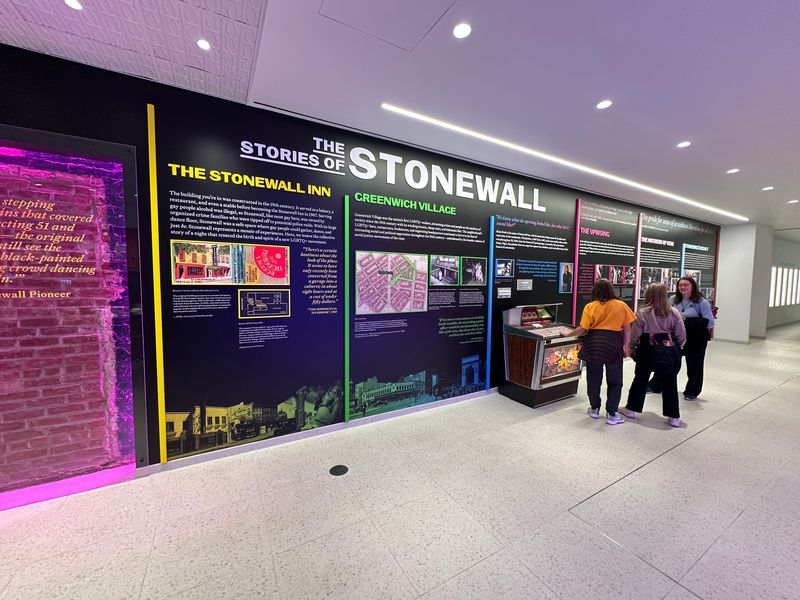
Park sites seen as not conforming to the order might include the Manzanar National Historic Site in California, which describes the government’s forced race-based relocation to detention camps of Japanese Americans at the start of World War II, or the Stonewall National Monument in New York City, where the advancement of civil rights for LGBTQ+ Americans is celebrated.
An exhibit at the Stonewall National Monument Visitor Center.
National parks across the country are also burdened with huge backlogs of deferred maintenance to infrastructure.
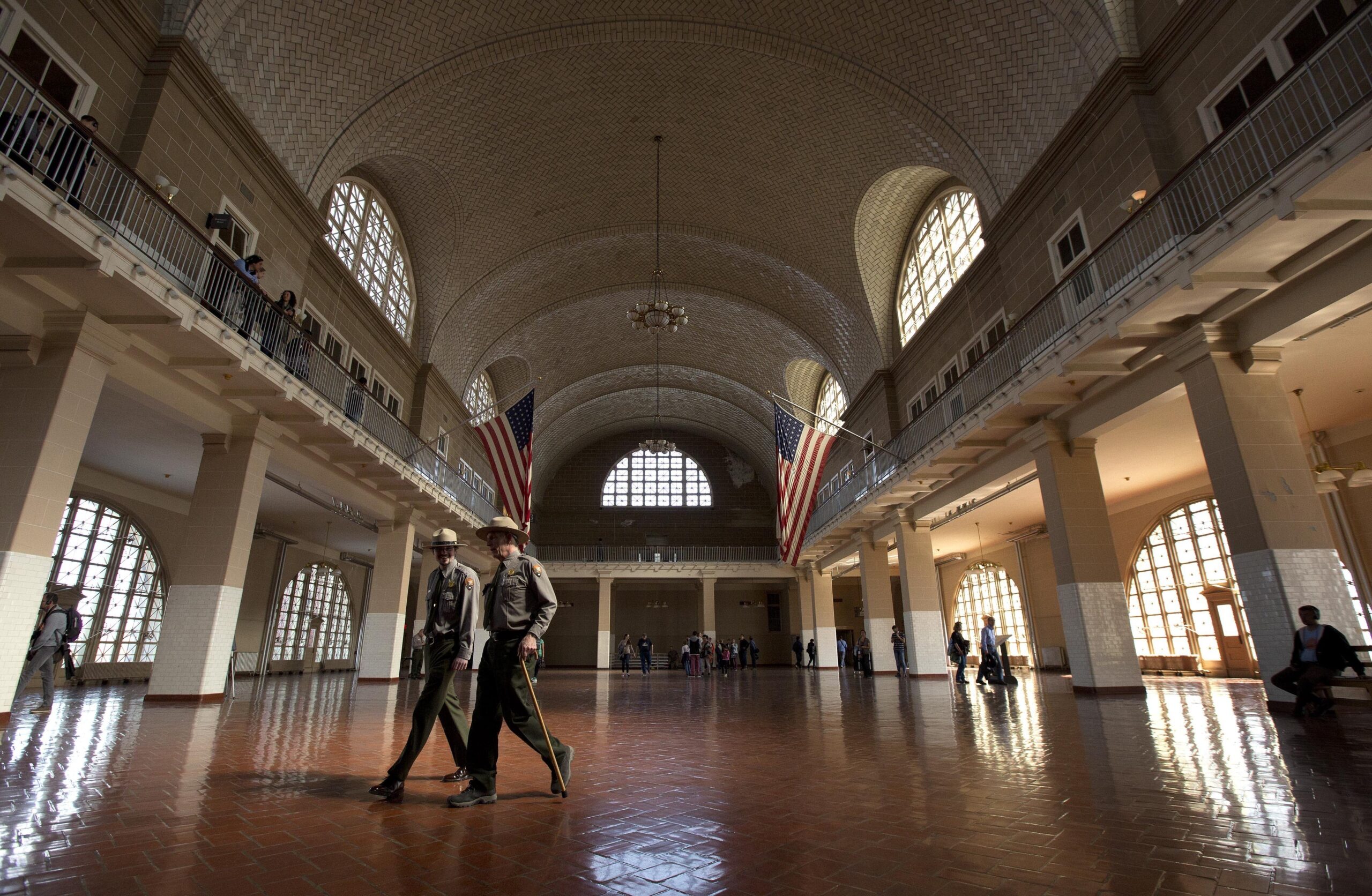
Statue of Liberty National Monument and Ellis Island in New York Harbor stand proudly as memorials to those who migrated to the United States to escape poverty, repression, and tyranny. Many of the nearly four million who visit every year pay honor to ancestors who made new homes, raised families, and helped build the American dream.
National Park Service rangers walk through the Great Hall at Ellis Island.
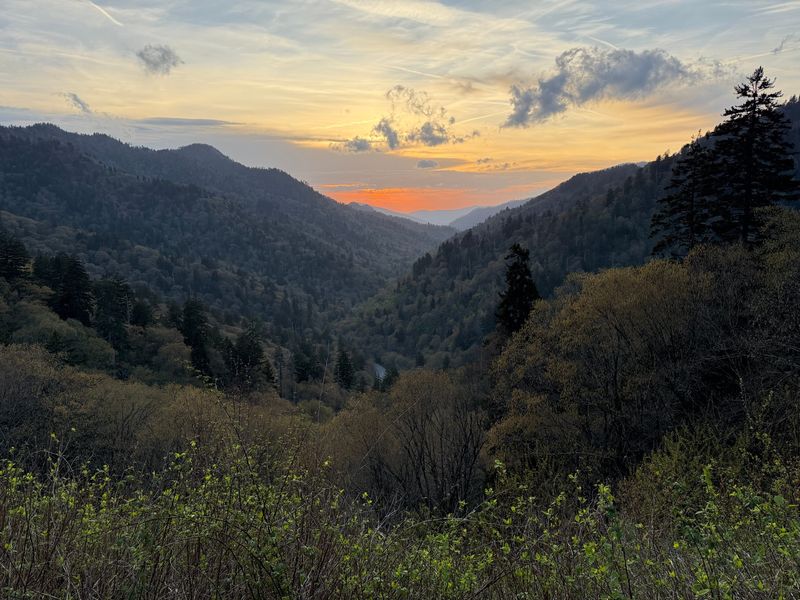
The Great Smoky Mountains National Park in Tennessee and North Carolina is a natural gem that attracts over 12 million visitors a year. People come to camp, hike, fish, or enjoy the awesome scenery.
The sun sets on America’s most visited national park, Great Smoky Mountains.
Guests also spend an estimated $2.1 billion annually boosting area lodgings, restaurants, and convenience stores. This economic dynamic supports over 20,000 jobs in the region.
President Trump apparently does not grasp that if parks nationwide are degraded through deep budget cuts, thousands of small businesses located in or near national park gateway communities will suffer, and tens of thousands of employees, mostly in the private sector, will be out of work.
The President’s House in Independence National Historical Park, in September.
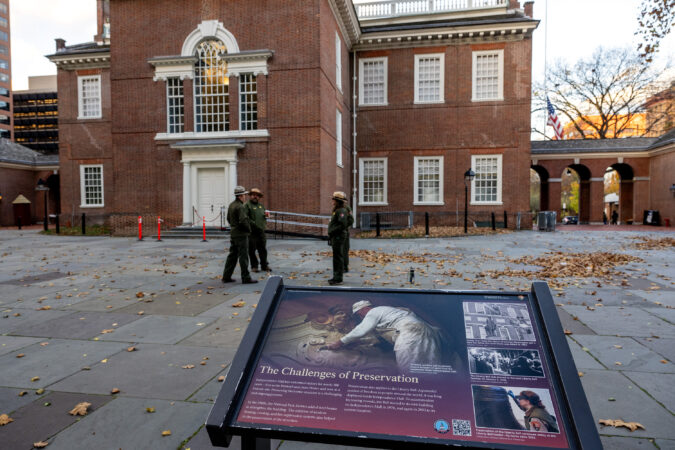
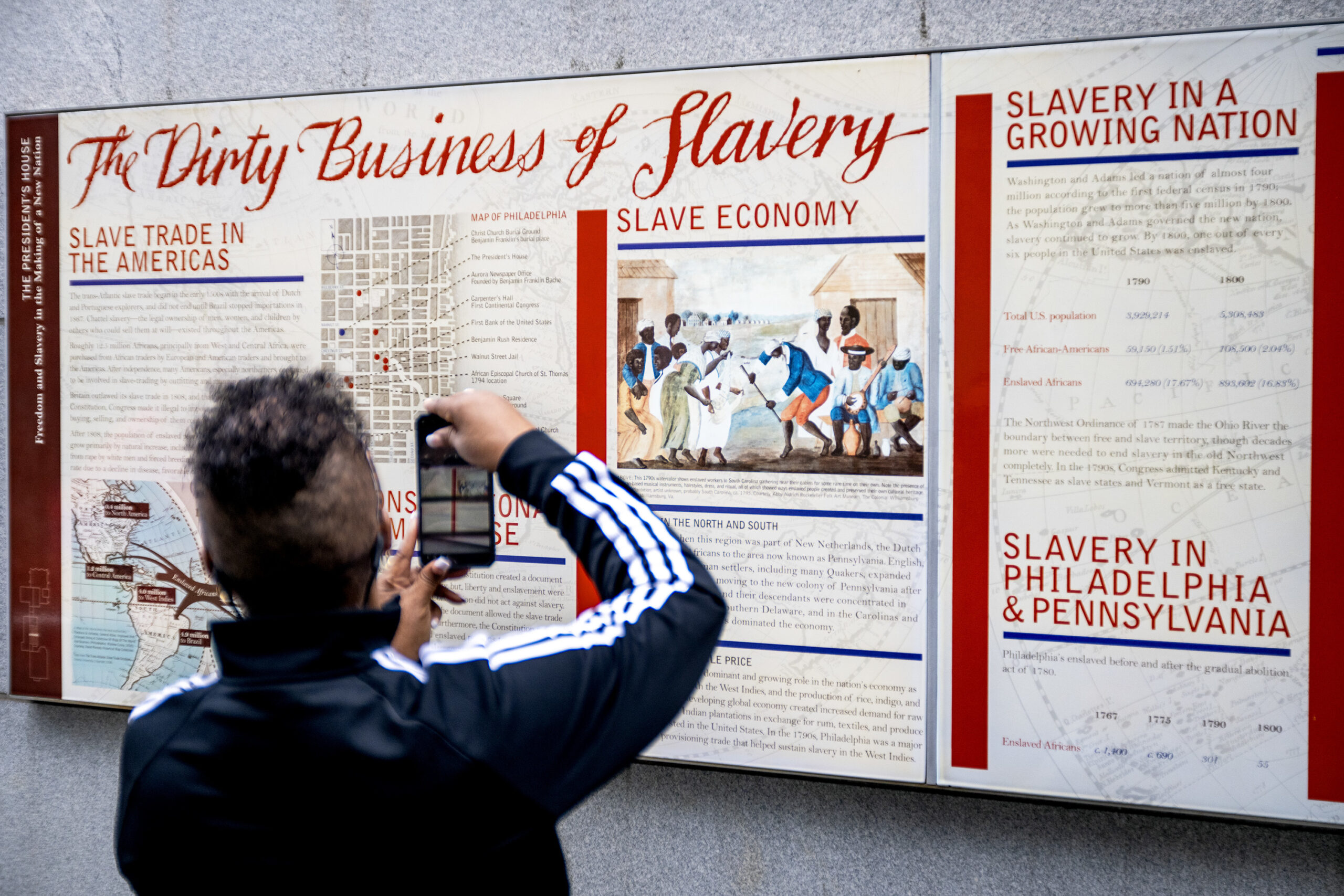
The President’s House Site at Independence National Historical Park in Philadelphia memorializes nine people who were enslaved there while George Washington was president in the earliest years of the republic. Their names are Austin, Christopher Sheels, Giles, Hercules, Joe, Moll, Oney Judge, Paris, and Richmond. The house site reflects this important detail and describes it truthfully. Yet, this president has ordered that the story be altered to be compatible with a sanitized — and dishonest — description of history.
Gina Blakemore from Sacramento, Calif., photographs signage describing enslavement at the President’s House in Independence National Historical Park, in September.
By erasing this factual presentation at Independence Park, a venerated place that represents the founding ideals of the nation, President Trump is revealing a vivid disrespect not only for African Americans but for all of us.
Slashed funding, fired employees, endangered properties, lost revenue, environmental rollbacks, whitewashed history: this will be the public lands legacy of President Donald Trump.
The damage to national parks that Trump and his loyalists have already inflicted is so profound that it will take years for these sites to recover.
We citizens, though, can do something now to help save them. We can write, call, or text members of Congress to demand they step up and repel this president’s egregious assault on parks.
Meanwhile, we should also make sure to visit a nearby national park site, seek out a ranger or guide, and assure them that we will do our part to defend and protect America’s magnificent national parks.
John Plonski was a finalist for the 2023 Theodore Roosevelt Genius Prize for the Promotion of Conservation and served as executive secretary of the Pennsylvania State Park and Forest Systems from 1995-2004.
After a year of major shifts in the federal government’s policy toward vaccines, Americans are now more likely to trust the American Medical Association than the Centers for Disease Control and Prevention when the two conflict on vaccine guidance, a new survey shows.
Trump’s secretary of health and human services, Robert F. Kennedy Jr., is a longtime anti-vaccine activist. Earlier in 2025, he fired a committee of outside experts who advise the CDC on vaccine policy, replacing the committee with a handpicked group that includes other vaccine critics.
The reconstituted panel subsequently changed recommendations on who should receive COVID-19 vaccines, prompting states like Pennsylvania to change their own policies around vaccine distribution to ensure continued access. The panel also recommended delaying hepatitis B shots for newborns, prompting outrage from medical experts who said the move will increase cases of the serious liver disease.
And in November, the CDC website, which for years had noted that decades of research showed no link between receiving vaccines and developing autism, was updated to state the opposite. The site now reads: “The claim ‘vaccines do not cause autism’ is not an evidence-based claim because studies have not ruled out the possibility that infant vaccines cause autism.”
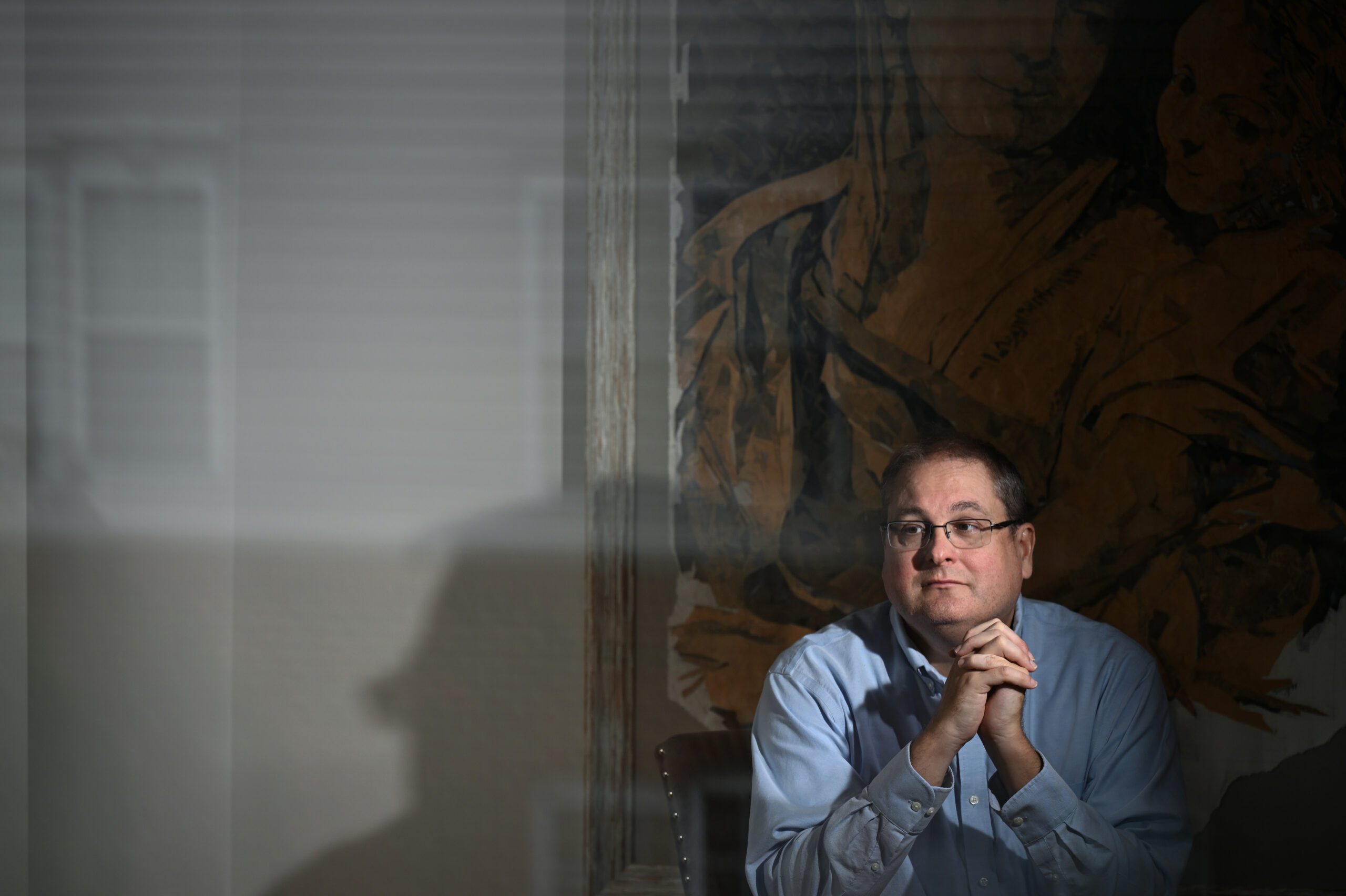
In the wake of those decisions, it is crucial for medical providers and health communicators to understand how the public views vaccination, said Kathleen Hall Jamieson, Annenberg’s director.
Kennedy’s guidance often encourages patients to make their own decisions with doctors about vaccines, she said. But that often puts the burden on Americans to process scientific research on their own — and makes them vulnerable to misinformation, she said.
“The public doesn’t have time to do research on its own, on average, and in the process, they can get lost in a mire of misinformation and confusion very easily. It requires a skill set to navigate scholarly literature. And it’s easy to think one is doing one’s research when one is way down the rabbit hole,” Jamieson said.
Autism, vaccines, and trust in the CDC
Annenberg researchers wanted to understand where the public is turning for information on vaccines as trust in the CDC has fallen.
Shortly after the CDC changed its website on vaccines and autism, Annenberg researchers asked 1,006 adults about what they would do if the CDC’s advice conflicted with that of a major medical professional organization like the AMA, which strongly condemned the website changes.
While about half of the respondents said they believe the CDC provides trustworthy information on vaccine safety, the survey found that 35% of respondents said they would be more likely to accept recommendations from the AMA if they conflicted with the CDC. Just 16% of respondents said they would side with the CDC in that case.
That preference held true across political parties and was particularly pronounced among older Americans. The only age group more likely to accept the CDC over the AMA was 18- to 29-year-olds: 24% said they would accept the CDC’s recommendations, and 19% said they would accept the AMA’s.
“The fact that, as the CDC began to change statements, the public shifted its trust to other organizations on consequential issues — that’s a statement that says the public intelligence is real,” Jamieson said.
“The public is paying enough attention to say, ‘I can’t necessarily go to the CDC on that topic.’ That’s a statement that says we’re in better shape than you might have guessed that we were.”
Gauging public knowledge on vaccines
In another series of surveys, Annenberg researchers gauged what Americans already know about common vaccines in order to help public health officials communicate with the public more effectively.
“One of the goals of our surveying is to find what kinds of knowledge the public finds helpful and increase the likelihood that people make science-consistent decisions,” Jamieson said.
A survey on whooping cough, also known as pertussis, was conducted in the fall in response to a national rise in cases. The disease is caused by a bacterial infection and can result in a severe cough that lasts for months. It is particularly dangerous for infants, especially those too young to be vaccinated against the disease.
About 30% of 1,637 respondents said they were not sure whether pertussis was the same as whooping cough and 35% said they were not sure whether a vaccine exists for it. Annenberg had reported similar findings a year before — an alarming conclusion, researchers said, because health officials have blamed a rise in cases in part on decreasing vaccination rates.
“Maybe we’re not doing the best possible job in communicating what we know about relative risks of the disease, the relative risks of vaccine, and the ways in which whooping cough is transmitted,” Jamieson said. “These are all questions designed to figure out the equation people are working through.”
Support for measles, mumps, and rubella vaccine
Likewise, a late-fall survey on attitudes toward the measles, mumps, and rubella vaccine (MMR) found that 86% of respondents said they would be likely to recommend that eligible people in their household get the MMR vaccine.
That is a “small but significant” decline from last year, when 90% said they would recommend the vaccine, researchers said.
Respondents are now also less likely to recommend vaccines for HPV and polio.
That may be because the MMR vaccine has been so effective that the public can no longer remember what it was like to contract measles, Jamieson said.
“I am elderly. I have gone through whole periods of my life in which these vaccines did not exist. I know what measles looks like — extraordinarily uncomfortable — with risks that are real and demonstrable,” Jamieson said. “And the vaccine has worked for people I care about in the subsequent generations.”
Support for MMR vaccines is still overwhelmingly high, Jamieson said. But the threshold to maintain herd immunity for measles is also high — about 95% of people must be vaccinated in order to prevent the spread of the disease and protect people who cannot be vaccinated.
And, if people live in communities where vaccines are less accepted, they could be at higher risk than the general population.
“The state of Pennsylvania can be at 95%, but if my church isn’t at 95%, I can get measles if I’ve not been fully immunized or if I can’t be vaccinated,” Jamieson said.