When Sen. Dave McCormick stood on the Senate floor to call for nationwide rules mandating proof of citizenship and photo identification for voters, he invoked a drama that had played out three months earlier in Chester County.
The county had mistakenly left all third-party and unaffiliated voters off the Election Day voter rolls, creating a chaotic scene in which more than 12,000 voters were forced to cast provisional ballots, which take more time to count as officials must verify the eligibility of each voter. A subsequent investigation by a law firm hired by the county attributed the issue to human error and insufficient oversight.
“Every time Americans hear about election problems like Chester County’s, they rightly question the integrity of our electoral process,” McCormick said.
But in his recounting of events, the Pennsylvania Republican gave incomplete and inaccurate information about Chester County’s election error.
What did McCormick say about Chester County?
Americans, he said, overwhelmingly believe there are problems with U.S. elections, and he argued that has been demonstrated for them on multiple occasions, including in November when Chester County omitted more than 70,000 third-party and unaffiliated voters from its Election Day pollbooks.
“Registered voters were turned away at the polls. And an unknown number of unverified voters cast regular ballots,” McCormick claimed.
But there is no evidence that voters were turned away or that ineligible voters cast ballots. McCormick’s office did not respond to questions.
Were voters turned away?
According to county officials, no voter who wanted to vote was turned away.
Instead, for most of the day voters were offered the opportunity to vote by provisional ballot while county and state officials worked to get supplemental pollbooks distributedto polling places across the county.
Some voters did testify at county election board meetings that they voluntarily left their polling place when their name was not in the pollbook but that they returned later in the day when they could vote on machines.
Did unverified voters cast ballots?
There is no evidence that ineligible voters cast ballots. The identity and eligibility of all voters who cast ballots were verified, county officials said.
When the pollbook issue was discovered on Election Day, Chester County officials initially recommended that poll workers ask voters not included in the pollbook to sign the pollbook manually and vote as normal, according to the independent investigation of the incident.
To ensure those voters were eligible to vote, county officials said, poll workers were instructed to follow a detailed process that included verifying voters’ eligibility in the full voter list and verifying their identity with photo identification.
The Chester County Republican Committee has disputed the county’s version of events, contending that photo ID was not checked for all voters who wrote their names into pollbooks and that poll workers were unable to verify voters’ identities using signature matching.
Around 7:40 a.m., less than an hour after polls opened, Pennsylvania Department of State officials recommended the county shift to asking voters to cast provisional ballots to eliminate the risk of an ineligible voter casting a ballot, thereby invalidating the election.
A county spokesperson said there is no evidence that ineligible voters cast ballots during November’s election.
Whether voters wrote their names into a pollbook or cast a provisional ballot, “the identity and eligibility of each individual was verified by the poll workers,” said Chester County spokesperson Andrew Kreider.
Would the SAVE Act have changed anything?
The SAVE Act is a collection of election policies proposed by congressional Republicans that would require proof of citizenship to register to vote and mandate all voters show photo ID at the polls.
Such requirements would not have prevented Chester County’s error, which investigators determined was a clerical error resulting from inexperienced staff with insufficient training and oversight.
“Sen. McCormick was ignoring the facts and feeding into this larger narrative that our elections can’t be trusted and just feeding into the president’s narrative that there’s something wrong with Pennsylvania elections,” said Lauren Cristella, the CEO of the Committee of Seventy, a Philadelphia-based civic engagement and good-government organization.
In addition to Chester County, McCormick pointed to his own experience in close elections — both his 2022 primary loss and his 2024 general election win — as a reason he supports the bill’s proof of citizenship and voter ID requirements.
The policy, which passed the Republican-led U.S. House, still faces an uphill battle in the U.S. Senate, where it would need 60 votes to advance. It has faced significant opposition from Democrats who say it would needlessly make it harder for people to vote.
The proof of citizenship requirement, critics say, would place a higher burden on married people whose last names no longer match their birth certificates.
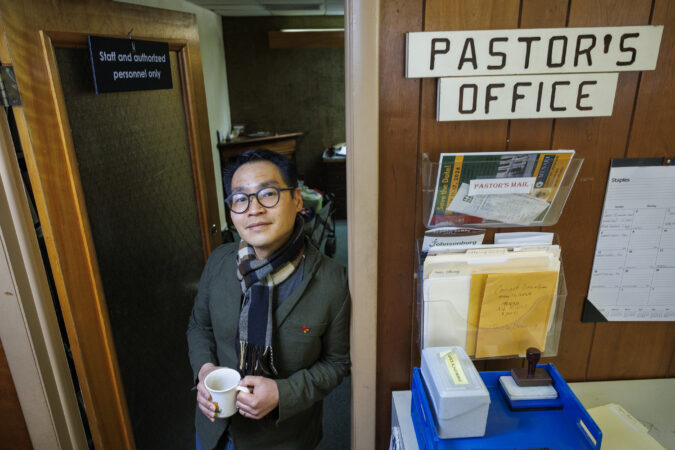
Within the serpentine halls and stairways of Olivet Covenant Presbyterian Church, congregants have established several private, off-limits rooms ― each a potential last-stand space where members would try to shield immigrants from ICE, should agents breach the sanctuary.
Church leaders call them Fourth Amendment areas, named for the constitutional protection against unreasonable search and seizure. The plan would be to stop ICE officers at the thresholds and demand proof that they carry legal authority to make an arrest, such as a signed judicial warrant.
“It’s a protective space,” said the Rev. Peter Ahn, pastor of the Spring Garden church. “While you’re here, you’re safe, is what we want to assert.”
Could it come to that? A pastor confronting armed Immigration and Customs Enforcement agents in the hallway of a church?
It’s impossible to know. But across Philadelphia, churches, community groups, immigration advocates, and block leaders are actively preparing for the time ― maybe soon, maybe later, maybe never ― that the Trump administration deploys thousands of federal agents. People say they must be ready if the president tries to turn Philadelphia into Minneapolis ― or Los Angeles, Chicago, or Washington, D.C.
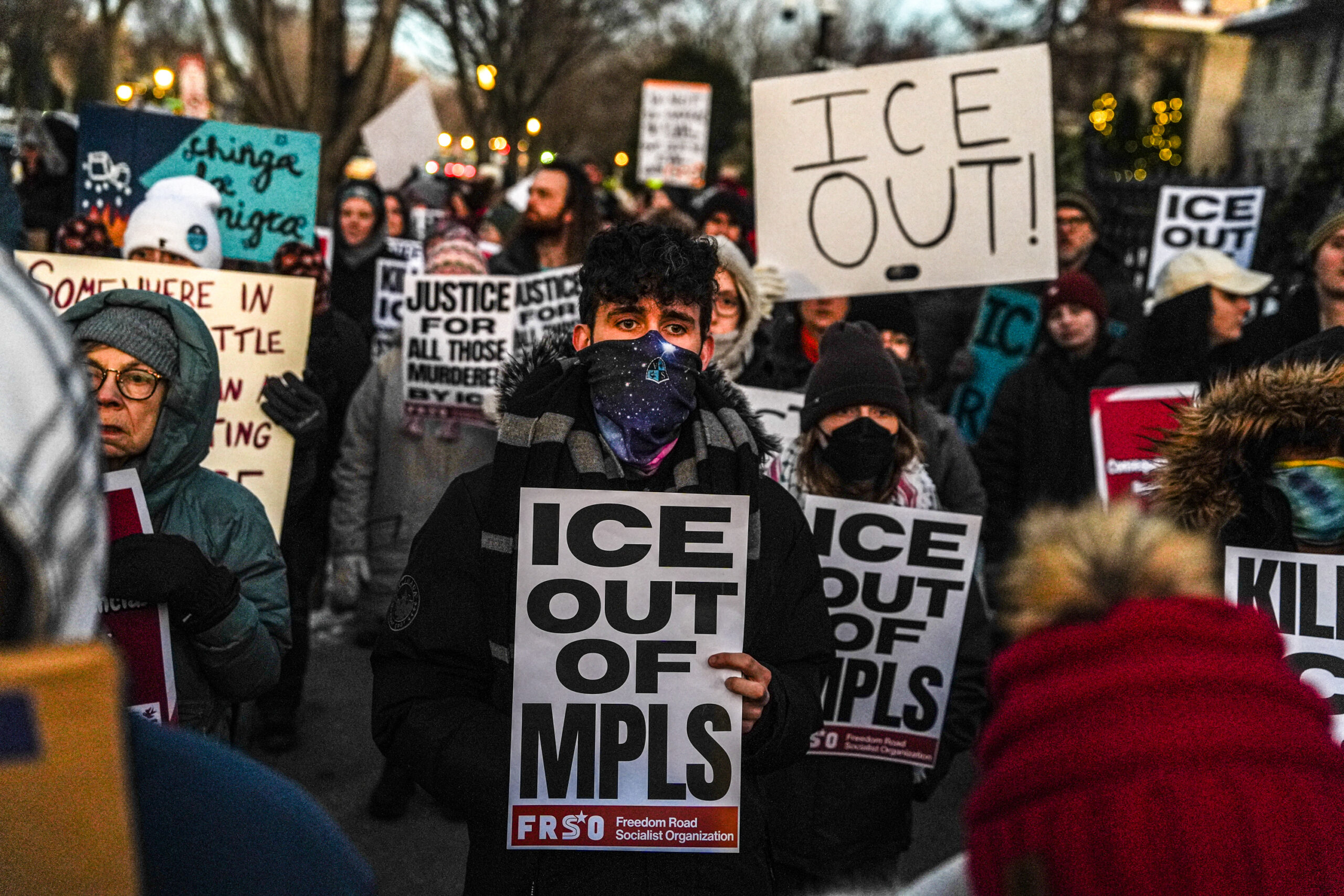
People participate in an anti-ICE protest outside of the Governors Residence on Feb. 6, in St. Paul, Minn.
Know-your-rights trainings are popping up everywhere, often to standing-room-only attendance, and ICE-watch groups are abuzz on social media.
The First United Methodist Church of Germantown held a seminar last week to learn about nonviolent resistance, “so that we will be ready for whatever comes,” said senior pastor Alisa Lasater Wailoo.
“That may mean putting our bodies in the path to protect other vulnerable bodies,” she said. “We’re seeing that in Minnesota.”
In Center City, Temple Beth Zion-Beth Israel has ordered 300 whistles ― portable and efficient tools to immediately alert neighbors to ICE presence and warn immigrants to seek safety.
“There was a sense of needing to support our neighbors if it comes down to it,” said Rabbi Abi Weber. “God forbid, should there start to be ICE raids in our neighborhood, people will be prepared.”
In other places around the country, immigrant allies have similarly readied themselves for ICE’s arrival, and organized to react in concert when agents show up.
In Washington state, the group WA Whistles has distributed more than 100,000 free whistles to create what it calls “an immediate first line of community defense.” Chicago residents set up volunteer street patrols to warn immigrants of ICE and to contact family members of those detained. In Los Angeles, people raised money to support food-cart vendors, and organized an “adopt a corner” program to protect day laborers who seek work outside Home Depot stores.
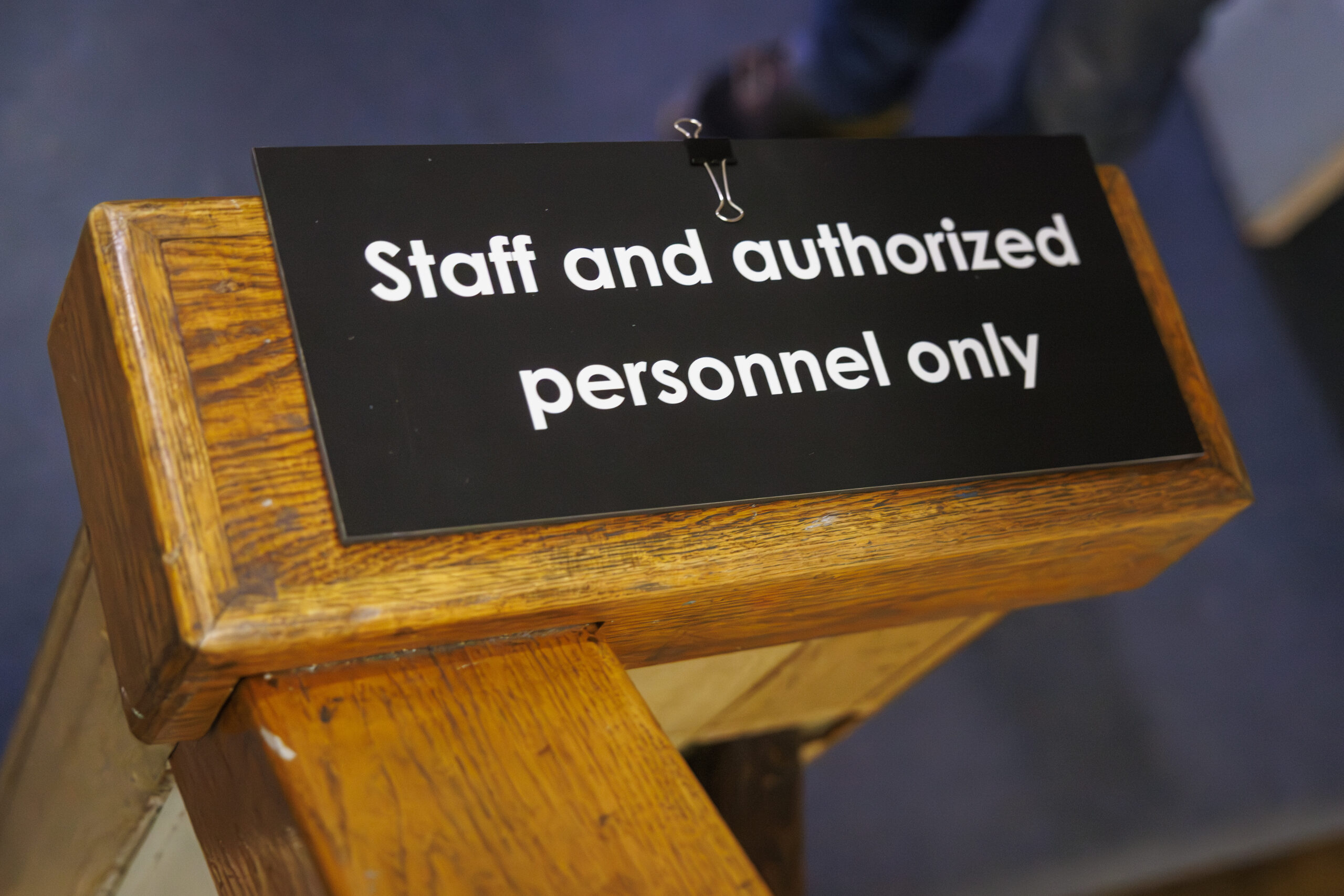
A small sign at the Olivet Covenant Presbyterian Church, where the Rev. Peter Ahn is creating space to shield immigrants if necessary.
The agency’s Philadelphia office serves as headquarters not just for the city but for all of Pennsylvania and for Delaware and West Virginia as well. Arrests take place every day in the Philadelphia region.
“You all seem to be ‘preparing’ for something that’s already happened,” veteran activist Miguel Andrade wrote on Facebook.
What has changed, however, is the dramatic escalation in ICE enforcement, particularly visible in Democratic-run cities like Minneapolis, where agents fatally shot two U.S. citizens in January.
ICE detained 307,713 people across the country in 2025, a 230% increase over the 93,342 in 2024. What federal immigration agencies record as detentions closely mirror arrests.
For immigrants who have no legal permission to be in the U.S. ― an estimated 14 million people ― the rising ICE presence steals sleep and peace of mind. They know not just that they could be arrested and deported at any moment, which has always been true, but also that the U.S. government is expending vast resources to try to make that happen.
A woman who came to Philadelphia from Jamaica last year, and who asked not to be identified because she is undocumented, said she rarely leaves her home. She said she steps outside only to go to the grocery store, a doctor, or an attorney.
She recently asked her daughter to check something on the computer, and the girl balked ― afraid to even touch the machine, worried that ICE could track her keystrokes and identify their location, the woman said.
“How can I tell her it’s going to be OK when I don’t know it’s going to be OK?”asked the woman, who came to the U.S. to escape potential violence in Jamaica. “You come here expecting freedom, but here it’s like you’re in jail except for the [physical] barriers of the four walls.”
Some say President Donald Trump doesn’t want to ruin the summer celebration of the nation’s 250th birthday, or spoil the grandeur of the World Cup or Major League Baseball’s All-Star Game. Others suggest that he might be timing an ICE deployment to do exactly that.
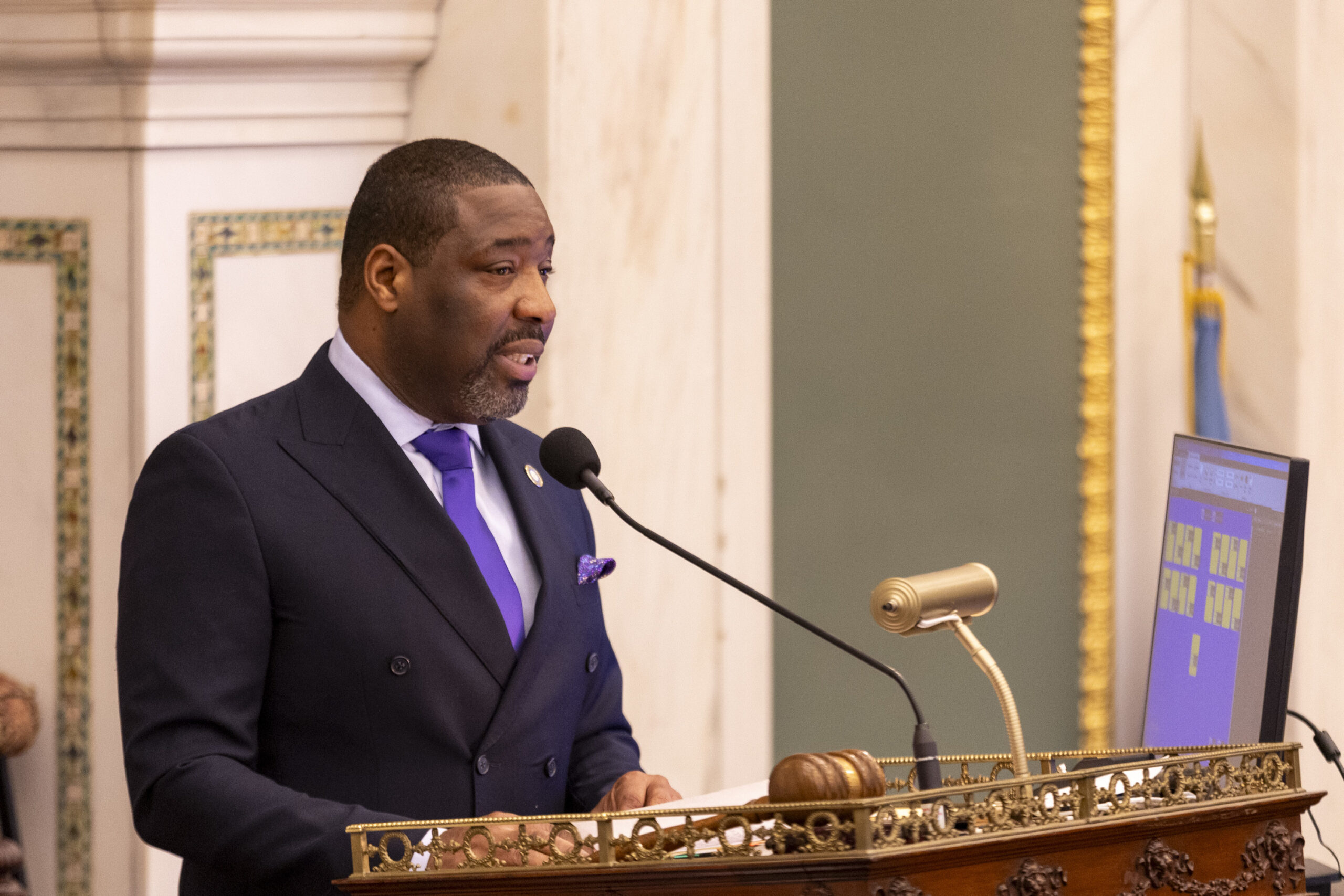
City Council President Kenyatta Johnson speaking at the City Council’s first session of the year Jan. 22. He said this month that it’s time to stand up for immigrants in Philadelphia. “It’s my responsibility to step up in this space and be more vocal,” he said.
Trump told NBC News this month that he is “very strongly” looking at five new cities.
Some people are not waiting to see if Philadelphia is on the list.
The monthly Zoom meeting of the Cresheim VillageNeighbors usually draws about 20 people. But a hundred logged on in January to hear a presentation: What to do if/when ICE comes to our neighborhood.
The short advice: If it happens, get out your phone and hit “record.”
“If I see ICE agents, I will film,” said neighbors group coordinator Steve Stroiman, a retired teacher and rabbi. “I have a constitutional right to do that.”
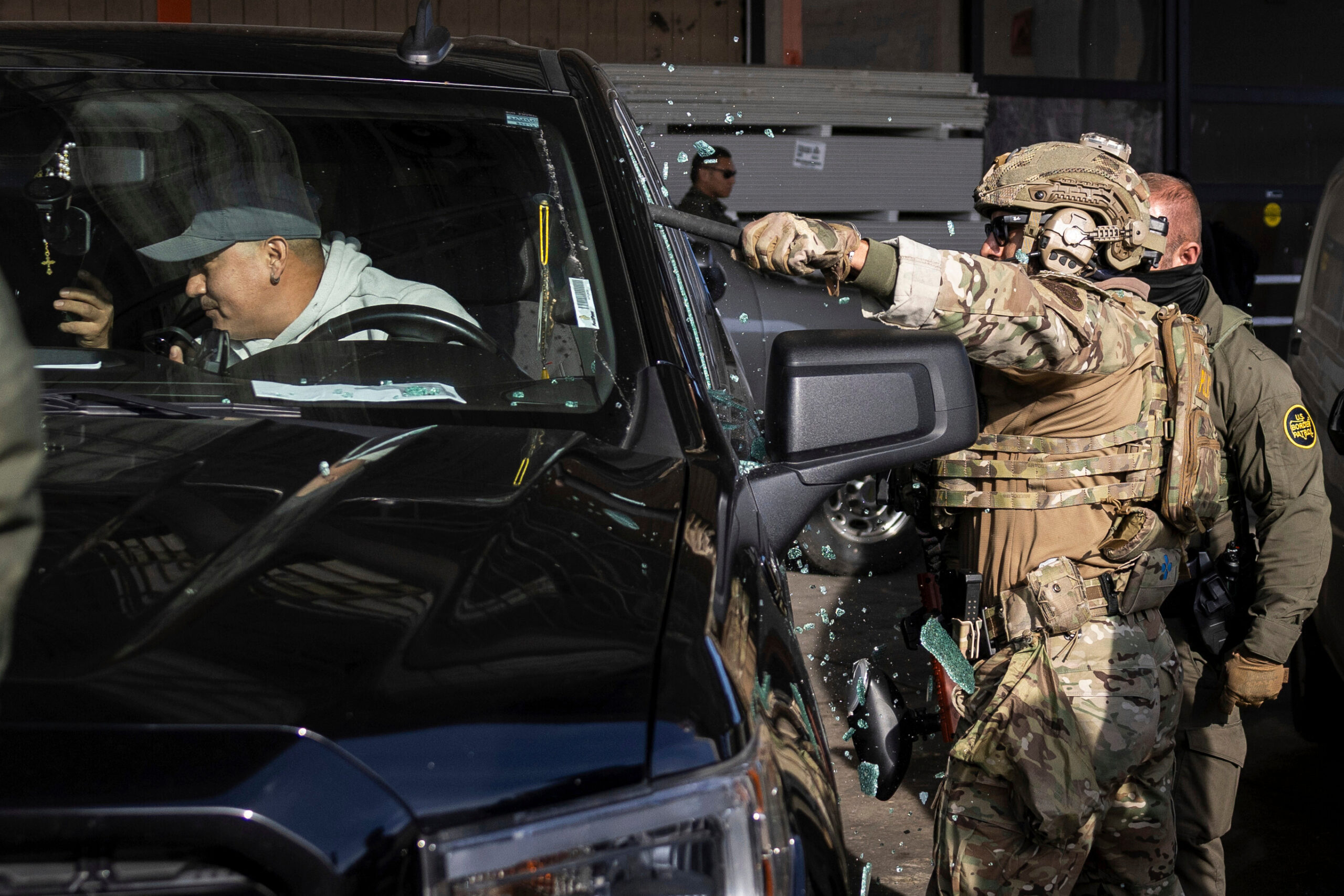
Federal immigration enforcement agents shatter a truck window and detain two men outside a Home Depot in Evanston, Ill., on Dec. 17, 2025.
In a sliver of University City, Miriam Oppenheimer has helped lead three block meetings where neighbors gathered to discuss how they would respond.
They set up a Signal channel so people can communicate. And they formulated a loose plan of action: People will come outside their homes and take video recordings ― and try to get the names and birth dates of anyone taken into custody, so they can be located later.
“Courage is contagious,” Oppenheimer said. “Everybody is waiting for somebody else to do something, but we have to be the ones.”
Inside Olivet Covenant Presbyterian Church, doorways to some rooms now bear black-and-white signs that say, “Staff and authorized personnel only.”
Issues around ICE access to churches have become more urgent since Trump rescinded the agency policy on “sensitive locations,” which had generally barred enforcement at schools, hospitals, and houses of worship.
Legal advocates such as the ACLU say ICE agents can lawfully enter the public areas of churches, including the sanctuaries where people gather to worship. But to go into private spaces they must present a warrant signed by a judge.
“There are many front lines right now,” said Ahn, the Olivet pastor. “We’re not trying to be simply anti-ICE, or anti-anybody. We’re just trying to be for the rights of the Fourth Amendment.”
Staff writer Joe Yerardi contributed to this article.
A defiant Stephen Colbert blasted CBS on Monday for killing an interview with a Texas Democrat, blaming arcane rules being enforced by the Trump administration.
“He was supposed to be here, but we were told in no uncertain terms by our network’s lawyers, who called us directly, that we could not have him on the broadcast,” Colbert said of State Rep. James Talarico, who is running in the Democratic primary for a U.S. Senate seat in Texas.
CBS issued a statement claiming they didn’t prohibit him from running an interview.
“The Late Show was not prohibited by CBS from broadcasting the interview with Rep. James Talarico,” the statement read. “The show was provided legal guidance that the broadcast could trigger the FCC equal-time rule for two other candidates, including Rep. Jasmine Crockett, and presented options for how the equal time for other candidates could be fulfilled. The Late Show decided to present the interview through its YouTube channel with on-air promotion on the broadcast rather than potentially providing the equal-time options.”
The decisioncomes down to something known as the equal-time rule, a federal requirement put into law in 1934 that requires broadcast stations like CBS to provide comparable airtime to political opponents during an election. Cable networks like Fox News and Comedy Central, home to The Daily Show, are not bound to those rules, allowing them to be as partisan as they choose.
News programs on broadcast TV (such as Meet the Press and Face the Nation) are exempt from the rule, and the Federal Communications Commission has not enforced it on late-night shows since 2006, when it ruled then-California gubernatorial candidate Arnold Schwarzenegger’s appearance on The Tonight Show with Jay Leno qualified as a “bona fide news interview.”
The move was criticized by FCC commissioner Anna Gomez, a Democrat appointed by former President Joe Biden, who called it “an escalation in this FCC’s ongoing campaign to censor and control speech.”
Colbert said CBS prohibited the interview with Talarico from airing Monday night. Instead, it was posted in its entirety on Colbert’s YouTube channel.
“At this point, [Carr has] just released a letter that says he’s thinking about doing away with the exemption for broadcast for late night. He hasn’t done away with it yet,” Colbert said. “But my network is unilaterally enforcing it as if he had.”
Talarico told Colbert that Trump and Republicans ran against cancel culture during the last election, but now the current administration is “trying to control what we watch, what we say, what we read.”
“And this is the most dangerous kind of cancel culture, the kind that comes from the top,” Talarico said. “Corporate media executives are selling out the First Amendment to curry favor with corrupt politicians.”
Bill Carter, who covered late-night television for decades at the New York Times and currently writes for the website LateNighter, called CBS’s capitulation “shameful,” especially since the FCC has not moved yet to enforce the rule.
“Trump’s intention is to mute free speech of his critics, and he’s found the rule in the FCC and decided he can do this,” Carter said. “And he’s got the broadcasters cowed a bit.”
“Let’s just call this what it is: Donald Trump’s administration wants to silence anyone who says anything bad about Trump on TV, because all Trump does is watch TV,” Colbert added.
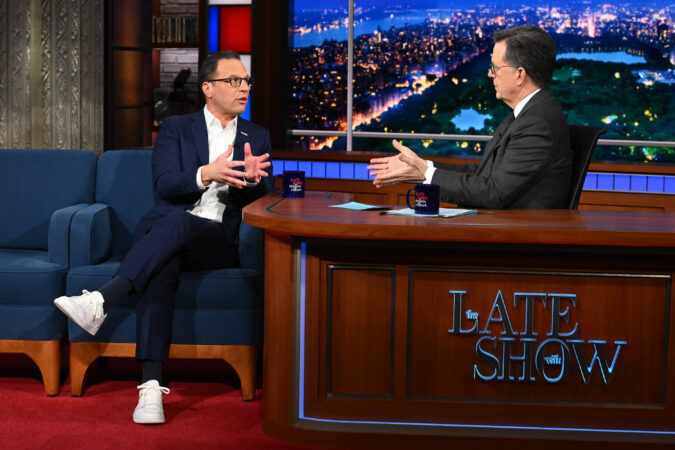
How was Josh Shapiro able to appear on Colbert’s show?
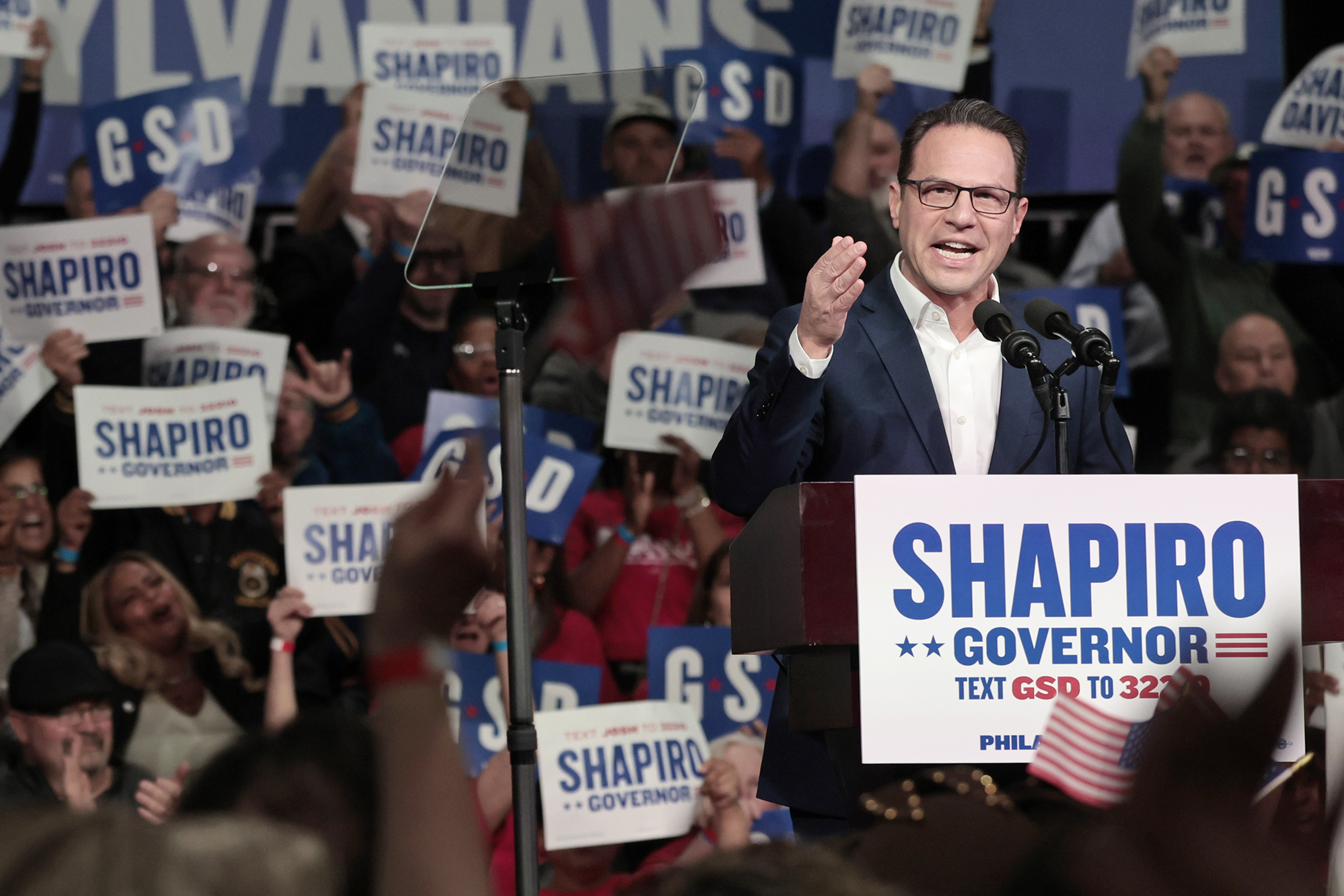
Governor Josh Shapiro announced his re-election campaign weeks before appearing on Colbert’s show last month.
Shapiro was able to appear not only on Colbert’s show, but also on ABC’s daytime talk show The View, which has also found itself a target of the FCC under Carr.
“I think it’s worthwhile to have the FCC look into whether The View, and some of these other programs that you have, still qualify as bona fide news programs and therefore are exempt from the equal opportunity regime that Congress has put in place,” Carr said in a September interview with conservative CNN commentator Scott Jennings.
It’s also why U.S. Sen. Jon Ossoff’s forthcoming interview with Colbert is still slated to air on the network Wednesday. While Ossoff (D., Ga.) has announced he is running for reelection in Georgia, the window for candidates to officially file paperwork for their primaries does not open until March 2.
Neither CBS nor Ossoff’s campaign has commented on the interview.
The equal-time rule also applies to radio broadcasts, where conservative talk shows are among the most dominant formats and regularly feature Republican candidates for office during election years. Then-candidate Trump did multiple interviews on 1210 WPHT in Philadelphia during the 2024 election.
Carr has said he does not plan to enforce a stricter equal-time rule on radio stations the way he has for television networks, claiming in a news conference last month there wasn’t a similar bona fide news exemption “being misconstrued on the radio side.”
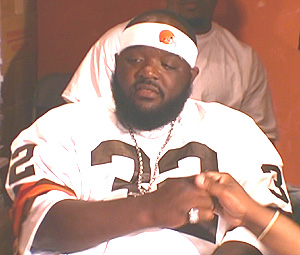
In 2009, after a federal judge effectively ordered Philadelphia drug kingpin Alton “Ace Capone” Coles to die in prison — imposing a life sentence plus 55 years for convictions on a host of drug and weapons charges — Coles momentarily dropped the swaggering persona he had displayed while building his vast cocaine empire.
“I never thought it would come to this,” Coles said at the time, his voice cracking as he spoke in court. “I don’t think life is deserved for selling drugs.”
On Tuesday, another federal judge offered something close to an endorsement of that view as she ordered Coles’ sentence be reduced to 25 years in prison — meaning Coles, now 52, could be released within a few years.
Coles’ twist of fate is the result of a complicated appellate process, one that has its roots in how federal laws have changed in recent years for some drug crimes, particularly those involving crack cocaine. The penalties for crack offenses were once significantly harsher than those tied to other narcotics, leading to widespread racial disparities because most defendants in crack cases were Black.
Coles’ lawyers say his case is also a demonstration of the “remarkable” turnaround Coles has made behind bars. While Coles once oversaw a drug operation that was estimated to have poured $25 million worth of cocaine and crack into Philadelphia — all as he served as the brash face of a local hip-hop record label — in prison, his lawyers said, he has become a barber, facilitated anti-violence programs for other inmates, and served as a counselor for prisoners with thoughts of self-harm.
“Knowing that he was facing the rest of his life in prison, Mr. Coles engaged in this extraordinary effort toward rehabilitation for the sole purpose of improving his life and of those around him,” his lawyer, Paul Hetznecker, wrote in court documents.
Federal prosecutors took a starkly different view, saying that Coles was “one of the major drug kingpins in Philadelphia during the last several decades” and that his eligibility to be resentenced was the result of a “pure technicality.” Even if Coles had committed his crimes today, prosecutors said — after Congress changed criminal sentencing guidelines — his actions would still warrant a life sentence.
“Coles led an armed and violent cocaine and crack distribution gang, which distributed quantities of deadly narcotics that [the trial judge] at sentencing aptly described as ‘staggering,’” prosecutors wrote in court documents.
U.S. District Judge Kai Scott said she believed that Coles had transformed his life in prison, and that 25 years of incarceration — even if much shorter than a life sentence — was still a substantial amount of time to serve behind bars.
Discussing Coles’ growth since being convicted, Scott said: “I’ve never seen this type of post-sentence rehabilitation.”
Coles, meanwhile, apologized for his crimes, telling Scott he is determined to try to make amends for his past.
“I am not the man I once was,” he said.
Building an empire
When Coles was federally indicted in 2005, prosecutors said he had run one of the largest drug organizations in modern city history. Coles and his coconspirators, they said, helped push a ton of cocaine and a half-ton of crack into the streets over the course of more than six years.
Coles was not charged with any crimes of violence, but federal authorities said they believed his group and its members were tied to nearly two dozen shootings and seven homicides.
As he was growing his drug empire, Coles was also building his reputation in the local rap scene. He helped found the hip-hop label Take Down Records, and staged popular parties and concerts around the city.
And he and a friend, Timothy “Tim Gotti” Baukman, produced and starred in a 31-minute music video called New Jack City, The Next Generation, in which they portrayed Philadelphia drug dealers who used violence and intimidation to cement their standing in the underworld.
Authorities used that video as part of a two-year investigation into Coles and his gang, and said Take Down Records amounted to a front for Coles to wash his money. They also wiretapped hundreds of conversations between drug associates, and went on to seize dozens of weapons and hundreds of thousands of dollars in raids on members’ homes.
Coles was charged in 2005, as were nearly two dozen associates, some of whom pleaded guilty or went on to cooperate with authorities.
Coles took his case to trial and testified in his own defense, saying he was not the kingpin prosecutors made him out to be.
But in 2008, a jury found Coles guilty of crimes including conspiracy to distribute cocaine and heading a continuing criminal enterprise. U.S. District Judge R. Barclay Surrick later sentenced Coles to life behind bars plus 55 years, saying: “The amount of drugs was staggering and the money involved was even more staggering … this crime was just horrendous.”
Ongoing legal saga
The imposition of that penalty, however, was hardly the end of the legal drama connected to Coles.
After Coles was sentenced, a Philadelphia police officer was convicted and imprisoned for tipping Coles off about his impending arrest.
A federal appeals court also later overturned a conviction tied to Coles’ girlfriend, who had been accused of helping him launder drug money to buy a house.
And Coles continued to file appeals challenging his case.
In 2014, he successfully argued to have one of his two prison sentences — the 55-year term — reduced to five years because of technicalities in how evidence was used to prove certain charges. His life sentence, however, remained intact.
But in 2020, Hetznecker, Coles’ appellate lawyer, filed a new motion challenging that penalty, saying a law passed by Congress in 2018 made Coles eligible to have his life sentence reduced.
The law, known as the First Step Act, was a sweeping attempt to undo some of the tough-on-crime laws from the 1990s that caused the federal prison population to swell. The bill received bipartisan support, and was signed into law by President Donald Trump.
One of the law’s provisions allowed some people who were sentenced for crack-related offenses to have their penalties reevaluated — part of an effort to unwind the racial disparities caused by disproportionately harsh sentences being imposed on Black defendants in crack cases.
Hetznecker, in seeking to have a judge reconsider Coles’ penalty, wrote that a life sentence “for a non-violent drug offense is a draconian sentence and, given the current paradigm of criminal justice reform, counter the movement toward a more just system.”
“The underlying principles of justice and fairness require that those subjected to punishment for crimes against society, especially those convicted of non-violent offenses, be provided the opportunity for re-integration back into society as rehabilitated individuals,” Hetznecker wrote.
Scott, the judge, agreed last month that Coles was eligible for a new sentence under the First Step Act. And in imposing the new penalty Tuesday, she said she believed Coles was unlikely to commit similar crimes in the future.
“It’s clear to me that you have been deterred — you have made changes,” she said.
Coles said he recognizes that he had once been “a negative influence on society,” but said he has now committed to bettering himself and trying to help others.
Hetznecker said Coles deserves the opportunity to demonstrate that he has moved beyond the persona he once inhabited on the streets.
“‘Ace Capone’ is dead, he’s gone,” Hetznecker said. “Alton Coles has emerged.”
A new lawsuit filed by a group of conservation and history organizations is challenging President Donald Trump’s executive order to remove historic information from national parks.
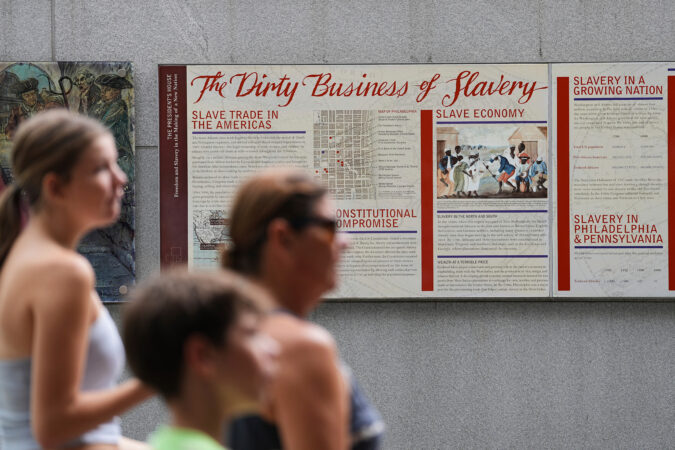
It comes a day after a federal judge ordered restoration of the slavery exhibits at the President’s House in Philadelphia and marks the latest chapter in a showdown between historical transparency versus censorship.
On Tuesday, the National Parks Conservation Association filed a lawsuit in Massachusetts federal court against the Department of Interior, challenging Trump’s 2025 executive order that forced national parks to change or strip displays tied to topics ranging from slavery and racism to LGBTQ+ rights and climate change.
“Plaintiffs are organizations committed to protecting the national parks, preserving history, promoting access to high quality scientific information, and providing high quality interpretive materials — including exhibits, signs, brochures, and other educational materials — that bridge the gap between physical objects and human understanding for park visitors,” the lawsuit says.
“They and their members — including avid users of national parks and historians whose research is being erased — have been injured by these actions and seek to ensure that the administration does not wash away history and science from what the National Park Service has recognized is ‘America’s largest classroom.’ ”
The coalition, which includes the American Association for State and Local History, the Association of National Park Rangers, the Coalition to Protect America’s National Parks, the Society for Experiential Graphic Design, and the Union of Concerned Scientists, is asking the court to declare Trump’s executive order unlawful and to order removed materials to be restored.
“In filing this litigation together, we are taking a stand for the soul of our national parks,” Alan Spears, senior director of cultural resources at the National Parks Conservation Association, said. “Censoring science and erasing America’s history at national parks are direct threats to everything these amazing places, and our country, stand for.”
In Philadelphia, U.S. District Judge Cynthia M. Rufe issued a ruling Monday requiring the federal government to restore the President’s House site to its original state. The removed exhibits paid tribute to the enslaved people who lived in George Washington’s home during his presidency.
The plaintiff’s group for the Massachusetts suit is being represented by Democracy Forward, a progressive nonprofit that challenges government actions it views as harmful.
“You cannot tell the story of America without recognizing both the beauty and the tragedy of our history,” Skye Perryman, Democracy Forward’s president and CEO said in a statement. “The president’s effort to erase history and science in our national parks violates federal law, and is a disgrace that neither honors our country’s legacy nor its future.”
Beyond Philadelphia, the lawsuit also mentions other examples of Trump’s executive order in action, including the removal of an interactive display mentioning climate change at Fort Sumter in South Carolina, short films on labor history being scrapped at Lowell’s National Historical Park in Massachusetts, and the removal of displays discussing negative impacts tourists, settlers, and cattle ranchers have on the Grand Canyon National Park.
The lawsuit goes on to point out the irony of Trump’s executive order aiming to avoid “disparaging Americans,” despite the president’s own new signage at the White House, which takes jabs at former President Joe Biden and others along his West Wing “Walk of Fame.”
The parties are asking a judge to order that national parks must be allowed to present the full historical and scientific picture without censorship and for their court costs to be paid for.
I was cranking out the newsletter in Tuesday’s predawn darkness when we learned that the Rev. Jesse Jackson Sr., who’d been our greatest living bridge to the civil rights heroics of the 1960s and ‘70s, had died at age 84. Covering his groundbreaking 1984 campaign as a cub reporter at the Birmingham News is still a career highlight four-decades-plus later — a memory that was reinforced recently listening to Abby Phillip’s excellent new book on Jackson. He leaves us right when his victories for African Americans in arenas such as corporate hiring and college admissions are under attack, and it challenges us to fight to preserve them. RIP to an American original.
How ICE protest by ‘an average Joe’ from Haddon Heights went viral
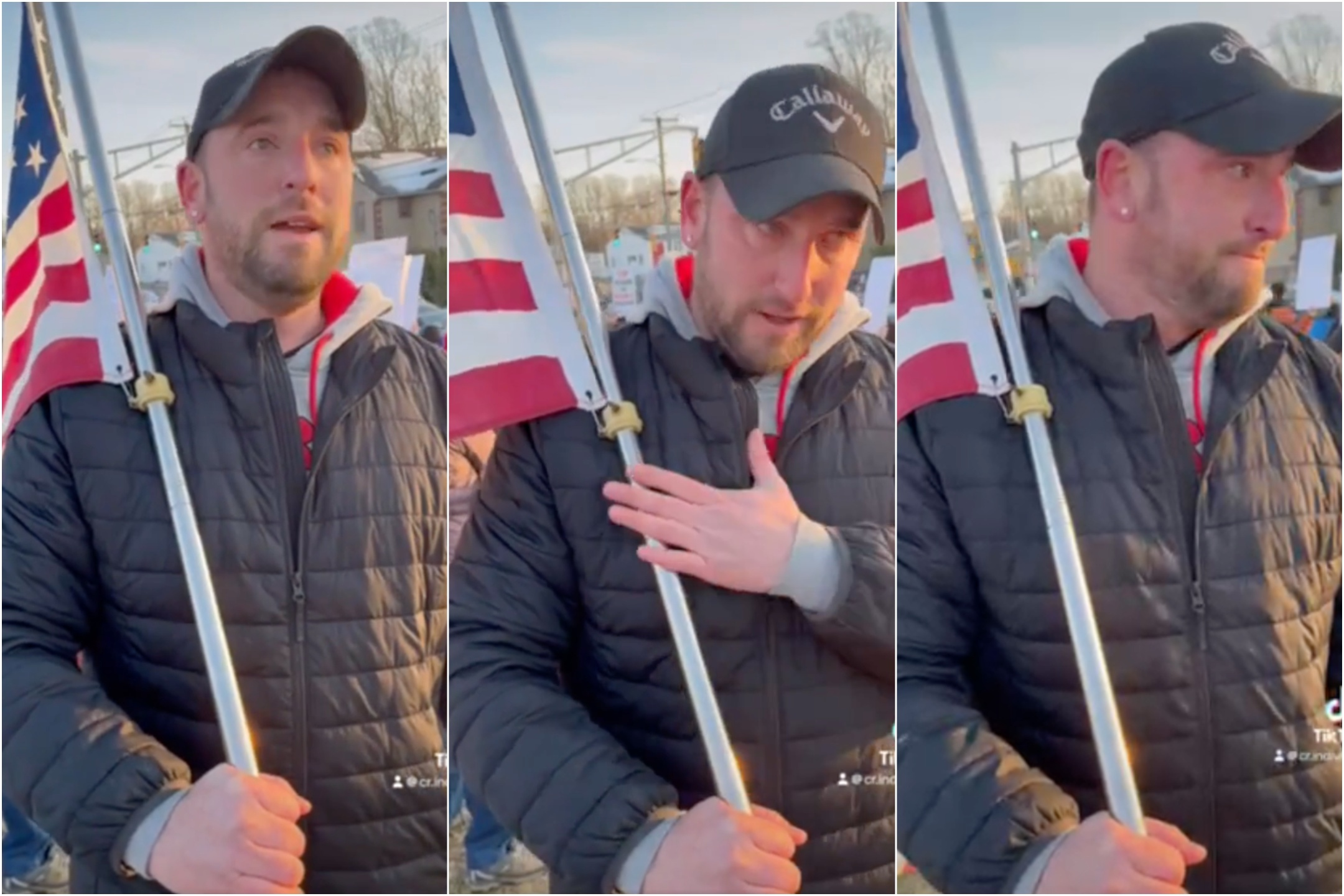
“I never want to see a child run away from our own government again,” said this self-described first-time protester, Joseph Zobel from Haddon Heights, at a rally in Lindenwold, N.J., the day after children ran from a school bus stop after ICE appeared to conduct an operation in the area.
Last Friday, “an average Joe who grew up in Haddon Heights” named Joseph Zobel was at work when he saw a viral video from the nearby South Jersey town of Lindenwold that shocked the nation, and shocked him.
The clip from a Ring doorbell camera showed a gaggle of fourth and fifth graders running in a panic, screaming, “ICE! ICE!” as masked federal immigration agents had approached their morning bus stop the day before.
“I just thought, ‘How can that be happening here in the United States?’” Zobel told me Monday in his first media interview, conducted by email. When he got home from work, he saw online that the group Cooper River Indivisible was holding an “ICE Out” protest at the Lindenwold municipal building at 4 p.m.
He looked at the clock. It was 3:58.
“Something inside of me said, ‘Go up there and stand with these people,’” said Zobel, a 36-year-old school coach who said he’s never been to a protest before in his life. “I wanted to stand for what is right.” As he dashed out, Zobel also grabbed one thing — the American flag he flies in front of his house most of the time (except during football season, when an Eagles flag replaces it).
As many as 300 people were at the protest, as Indivisible organizer Amber Clemments asked the flag-bearing Zobel if he’d be willing to film a video. Zobel’s raw emotion, choking back tears as he said, “I watched fourth- and fifth-grade kids run away from our own government,” soon ignited across social media over the long Presidents Day weekend.
By Tuesday morning, the 47-second clip of Zobel had been watched an astronomical 2.9 million times on TikTok — and liked by some 709,000 viewers — even as it also went viral on Bluesky, X, Threads, and other social media platforms.
It’s not hard to understand why. Zobel, who described himself as a patriotic regular voter but never very political, instantly became the bearded, baseball hat-wearing, anguished face of a new American majority — an Everyman shocked into action by the horror of immigration raids, wondering how best to protect his neighbors.
The two South Jersey viral videos — the one depicting the raid itself and Zobel’s raw reaction — revealed how both the terrorizing tactics of masked immigration cops and the powerful reaction from often nonpolitical Americans, dubbed “neighborism,” are spreading far beyond the Minnesota tundra where this battle was initially met.
Indeed, local activists say Lindenwold — last stop on the heavily traveled PATCO line, just over 15 miles southeast of Philadelphia — has been under a relentless siege from U.S. Immigration and Customs Enforcement (ICE) and other federal agents since last spring, not long after Donald Trump became president. The transit hub has become a magnet for immigrants in recent years, with a local school population that is just under 60% Latino.
Craig Strimel, a leader of Cooper River Indivisible, a local chapter of the group that organized the large “No Kings” protests, said activists first learned of the ICE activity when a Lindenwold immigrant couple escaped agents last year by taking refuge in the local high school, where the principal blocked the feds at the doorway. Since then, Strimel said, ICE watchers have seen frequent activity in and around a cluster of five apartment complexes with large immigrant populations, but few known arrests.
“It was becoming apparent early on that this was all about creating terror,” said Strimel of the frequent ICE sightings. Some local residents stopped leaving their apartments, he said, and a once-popular restaurant in Lindenwold just closed its doors amid rumors that the couple that owned it has returned to Mexico.
All of this set the stage for last Thursday, when masked federal agents wearing tactical gear arrived early in the morning at Lindenwold’s Woodland Village Apartments just as 44 elementary school kids were waiting for their school bus. The sighting triggered a panic that saw some kids running away and others frantically hustling onto the bus as the driver arrived. No one was apprehended or reported hurt.
On Monday, U.S. Department of Homeland Security officials said the agents went to the complex hoping to arrest a Honduran immigrant who’d once been convicted of aggravated assault. The man was not taken on Thursday and remains free.
Although some outlets reported the large protest was in response to the high-profile raid — which has been covered by the CBS Evening News, MS Now’sMorning Joe, and elsewhere — that took place just a day and a half earlier, the rally actually had been in the works for several weeks.
It had been organized by a young woman from Lindenwold named Tatiana — a 20-year-old business major at Camden County Community College who spoke with me Monday on the condition that I not use her full name — who’d been seeing the ICE activity in her hometown and felt it was time local people spoke out.
Tatiana told me that the idea behind the Lindenwold protest was “to give the community a voice — to be able to say, ‘No, we don’t stand for this.’ That’s the most important thing for me. It’s just bringing community together and deciding we’re not OK with this at all.” But she agreed the bus stop raid had given the event a boost from residents believing “that children should not be scared of federal law enforcement.”
Zobel was one of those neighbors. In the email interview, he described himself as “just your average Joe who grew up in Haddon Heights.” He did volunteer that he’s voted in every election since he turned 18, and that his first ballot was cast for Barack Obama, “and I felt proud walking out of the booth that day.”
Fittingly, Zobel sounded somewhat Obama-esque when he described his dismay over America’s bitter partisan divide. “We as a nation are so angry with one another, and that makes me so sad,” he said. Not surprisingly, he’s as stunned as anyone at the millions of views for Friday’s video, and somewhat concerned about the impact, saying, “I just hope this video does not divide people.”
But Zobel’s words and teary-eyed emotion went viral because it was such a shot of hope — that in a moment when hate is on public display in the streets of the United States, “your average Joe” who’d once stood on the sidelines is now grabbing the American flag and taking the field to fight for their neighbors. An authoritarian movement dependent on rage simply never counted on the brotherly love that sent this nonpolitical Eagles fan to his first protest.
It might not be his last. “I am always happy,” he said, “to help support humanity.”
Yo, do this!
With several inches of snow still on the ground, it might shock you to hear this, but American soccer is back! The Philadelphia Union — despite winning the 2025 Supporters Shield and boasting Major League Soccer’s best winning percentage in the 2020s — radically shook things up during the offseason. With new strikers Ezekiel Alladoh and Agustín Anello looking to amp up their attack, the Union’s quest for the CONCACAF Champions Cup begins Wednesday in Trinidad against Defence Force FC at 6 p.m. on FS2. Saturday night at 7:30 p.m., it’s back to the chillier climes of Washington for the MLS opener against DC United on Apple TV (with no need in 2026 for an additional Season Pass subscription, as in past years).
In the quest for what’s new in American popular culture, sometimes we take for granted the established jewels in our midst. I’ve long felt that MS Now’s 9 p.m. (now just on Monday nights) host Rachel Maddow is our best TV commentator because of the way she weaves the historical past into the headlines of America’s tortured present. But since last summer, she has upped her game. Maddow’s coverage of two stories underreported in most of the mainstream media — grassroots resistance to the Trump regime, and now the push for a nationwide network of warehouse concentration camps — has created appointment television every Monday.
Ask me anything
Question: What is your take on the latest CBS censoring of [Stephen] Colbert? — @bcooper82.bsky.social via Bluesky
Answer: Another Tuesday morning breaking story on deadline: The CBS overseers of Late Night with Stephen Colbert — the top-rated talk show that’s nevertheless ending this year in what critics see as genuflecting to the Trump regime that the program frequently mocks — would not air a recorded interview with Texas state lawmaker and Democratic Senate primary candidate James Talarico. The backstory here is that the Federal Communications Commission has long exempted late-night talk shows from its equal time rule about political candidates on licensed broadcast outlets, but last month, FCC chair Brendan Carr — a pro-Trump MAGA pit bull — said this is changing. That apparently was enough for CBS’s new Trump-friendly management, which would not broadcast the interview (available on YouTube, now certain to get more views than if it hadn’t been censored). This new flap just highlights what a perilous moment this is for the First Amendment and American democracy writ large. Government limits on what viewpoints you can see or hear are a sign of dictatorship, full stop.
What you’re saying about …
Last week’s question about a winning Democratic strategy for the 2026 midterms drew a robust response, and almost all of the replies were thoughtful and nuanced. If there was a consensus, it was that Democrats should tailor their candidates to the divergent views of the congressional districts they hope to win. As Naomi Miller stated, “I think progressive candidates should run in progressive districts, and mainstream democrats in mainstream, purple, and red districts.” Still, a number of you think America’s bad experience with MAGA extremism means a sharp left turn is warranted in response. “I’d like for the Democrats to become more progressive and combative toward Trump than they already are,” wrote Benjamin Spohn, voicing an opinion many share these days.
📮 This week’s question: Tuesday’s passing of the Rev. Jesse Jackson is one more reminder that many icons of America’s tumultuous 20th century are disappearing. So who do you think is the current greatest living American, and why? Please email me your answer and put the exact phrase “greatest living American” in the subject line.
Backstory on the main reason the media is not trusted
Exterior images of CNN headquarters in Atlanta and the New York Times Building in Manhattan.
It’s rare these days to write something that everyone can agree on, but here goes: Public trust in the media has never been lower than it is today. How low? A Gallup poll last fall found that public trust in the ability of newspapers, TV, and radio to fairly and accurately report the news had plunged to 28%, the lowest ever recorded. Why? It’s complicated. The people’s faith in every major institution has declined in the 21st century, after all. And it’s clear that in a deeply divided America, rage against the media machine looks different from the left than it does from the right.
This weekend, in a New York Times piece largely about the broken promises of one media-mogul billionaire — Washington Post owner and Amazon founder Jeff Bezos — columnist Lydia Polgreen put forth an explanation for sinking media trust that jibes with a lot of what I’ve witnessed since graduating into full-time journalism back in 1981. I believe it’s not the only reason — but the biggest, and maybe the most misunderstood.
Polgreen noted that the common theory for the public turning against Big Media — that journalists grew more partisan and biased after the tumult of the 1960s and ‘70s — doesn’t comport with the bigger reality. The era that peaked with the publication of the Pentagon Papers and the Watergate scandal launched a decades-long golden era of profitable news organizations spending big on investigative and accountability journalism — exactly what viewers and readers claimed they wanted.
Yet, trust declined as that happened. Polgreen cited a study in the late 1990s that compared then-contemporary media to 1960s newspapers and found the earlier times were “naïvely trusting of government, shamelessly boosterish, unembarrassedly hokey and obliging.” Polgreen wrote that moving “away from deferential stenography and toward fearless investigation … led to declining trust in the news media. Aggressive, probing and accountability-oriented journalism held up a mirror to American society — and many Americans didn’t like what they saw.”
I think this explanation is spot on, but before readers jump all over me, let me quickly add a couple of caveats. Starting way back in Ronald Reagan’s 1980s, there was also a response to the growing backlash — especially in elite, Beltway journalism — that resulted in too much groveling to authority, and thus stenography around government lies like the 2003 Iraq War. This has only gotten worse with the current wave of billionaire owners like the Post’s Bezos. This means many liberals now also distrust the media, but not for the same reasons as conservatives, who’ve long loathed journalism for probing America’s inequities around race or gender.
The explanation offered by Polgreen jumped out at me because it fit with what I explored in my 2022 book, After the Ivory Tower Falls, which looked at Americans losing trust in another large institution: colleges and universities. The liberal ideas that were nurtured on campuses in the postwar college enrollment boom — including the civil rights movement — triggered the same grievance-filled, largely white working-class backlash as did journalism about social injustice. Today, the only road back for the media is to hold the powerful to account — and understand that not everyone is going to like it.
What I wrote on this date in 2022
People can’t say they didn’t see America’s current crisis coming. On this date four years ago, I expressed my shock and amazement that little more than one year beyond Donald Trump’s attempted coup to stay in power, the right-wing’s creation of a political fantasy world was spiraling out of control, with lies about Hillary Clinton spying on Trump’s 2016 campaign and Joe Biden giving out free crack pipes (?!!). I wrote, “[Historian Ruth] Ben-Ghiat told me that the failure of the Jan. 6 insurrection only forced the GOP to double-down on embracing alternate realities, because ‘they have to reckon with the fact that [Trump] lost, that he’s no longer the leader.’”
There’s been no rest on themass deportation beat. In my Sunday column, I looked at the out-of-control lying from the Trump regime, with unbelievable fictions about everything from shootings and rampant brutality by masked immigration officers to Commerce Secretary Howard Lutnick’s whoppers about his friendship with Jeffrey Epstein. I argued that government lying is fundamentally unconstitutional and that the perpetrators need to be punished, including prison time. Over the weekend, I wrote about how, while Minneapolis was a victory for the forces resisting American authoritarianism, that won’t stop Homeland Security from putting thousands of new officers on the street and expanding its concentration camps. The fight for the soul of the nation has only just begun.
What was I saying higher up in this newsletter about accountability journalism? Ever since Lyndon B. Johnson’s Great Society push in the mid-1960s, community nonprofits have been a valuable source of urban renewal, yet aresometimes dragged down by waste, fraud, and abuse. It’s a problem that sadly persists, as shown last week by a major Inquirer investigation into Philadelphia’s NOMO Foundation, one of the best-funded nonprofits attacking youth violence and crime. Ace reporters Ryan W. Briggs and Samantha Melamed found that the foundation has received more than $6 million in public funds in recent years, but faced an IRS lien and eviction lawsuits while it was forced to close its housing program. This is why we have a First Amendment, so that a free press can report on the problems a corrupt or inept government refuses to deal with. Subscribing to The Inquirer gives you access to this type of essential journalism, and you’ll also feel good about supporting this vital work.
By submitting your written, visual, and/or audio contributions, you agree to The Inquirer’s Terms of Use, including the grant of rights in Section 10.
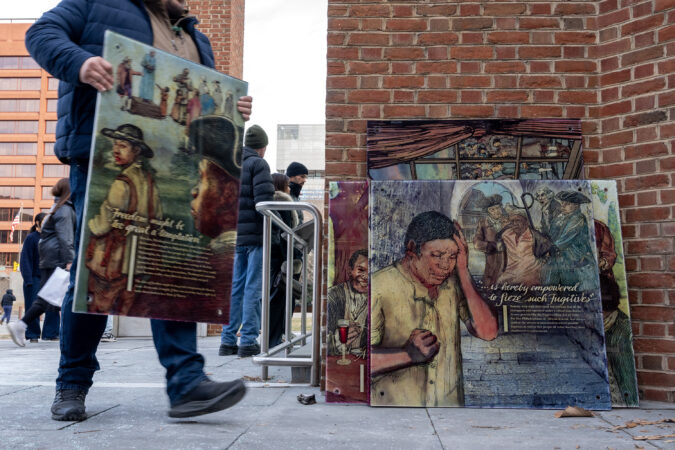
U.S. District Judge Cynthia M. Rufe issued a ruling Monday requiring the federal government to “restore the President’s House Site to its physical status as of January 21, 2026,” which is the day before the exhibits were removed.
The order does not give the government a deadline for the restoration of the site. It does require that the National Park Service take steps to maintain the site and ensure the safety of the exhibits, which memorialize the enslaved people who lived in George Washington’s Philadelphia home during his presidency. The exhibits were abruptly removed in January following months of scrutiny by the Trump administration.
Rufe, a George W. Bush appointee, compares the federal government’s argument that it can unilaterally control the exhibits in national parks to the Ministry of Truth in George Orwell’s 1984, a novel about a dystopian totalitarian regime.
“As if the Ministry of Truth in George Orwell’s 1984 now existed … this Court is now asked to determine whether the federal government has the power it claims — to dissemble and disassemble historical truths when it has some domain over historical facts,” Rufe wrote. “It does not.”
Mayor Cherelle L. Parker’s administration filed a federal lawsuit against Interior Secretary Doug Burgum and acting National Park Service Director Jessica Bowron, and their respective agencies, the day the exhibits were dismantled. The complaint argued dismantling the exhibits was an “arbitrary and capricious” act that violated a 2006 cooperative agreement between the city and the federal government.
The federal government has the option to appeal the judge’s order. The Interior Department and National Park Service did not immediately comment on the ruling, which fell on Presidents’ Day, a federal holiday. The U.S. Attorney’s Office for the Eastern District of Pennsylvania declined to comment.
During a hearing last month, Rufe called the federal government’s argument that a president could unilaterally change the exhibits displayed in national parks “horrifying” and “dangerous.” She ordered the federal government to ensure the panels’ safekeeping after an inspection and a visit to the President’s House earlier this month.
Monday’s ruling follows an updated injunction request from the city that asked for the full restoration of the site — not merely that the exhibits be maintained safely — and a brief from the federal government arguing the National Park Service has discretion over the exhibits and that the city’s lawsuit should be dismissed on procedural grounds.
The federal government’s brief also argued there could be no irreparable harm from the removal of the exhibits because they are documented online and replacement panels would cost $20,000.
But the judge found the city is likely to prove its case that the removal was unlawful, and the panels should be restored while the litigation continues.
“If the President’s House is left dismembered throughout this dispute, so too is the history it recounts, and the City’s relationship to that history,” Rufe wrote.
The judge also found that the cooperative agreement between Philadelphia and the National Park Service remains in “full force,” even though the contract is technically expired.
Rufe’s memo named the nine enslaved Africans owned by Washington, and noted that two — Oney Judge and Hercules Posey — escaped. The removed displays recognize their struggles and the nation’s “progress away from the horrors of slavery,” the judge wrote.
“Each person who visits the President’s House and does not learn of the realities of founding-era slavery receives a false account of this country’s history,” the judge wrote.
The injunction does not resolve the underlying lawsuit, and is in effect for the duration of the litigation. In a January hearing, Rufe said she wouldn’t let the case drag into the summer, recognizing the 250th anniversary celebration being planned for Independence Mall.
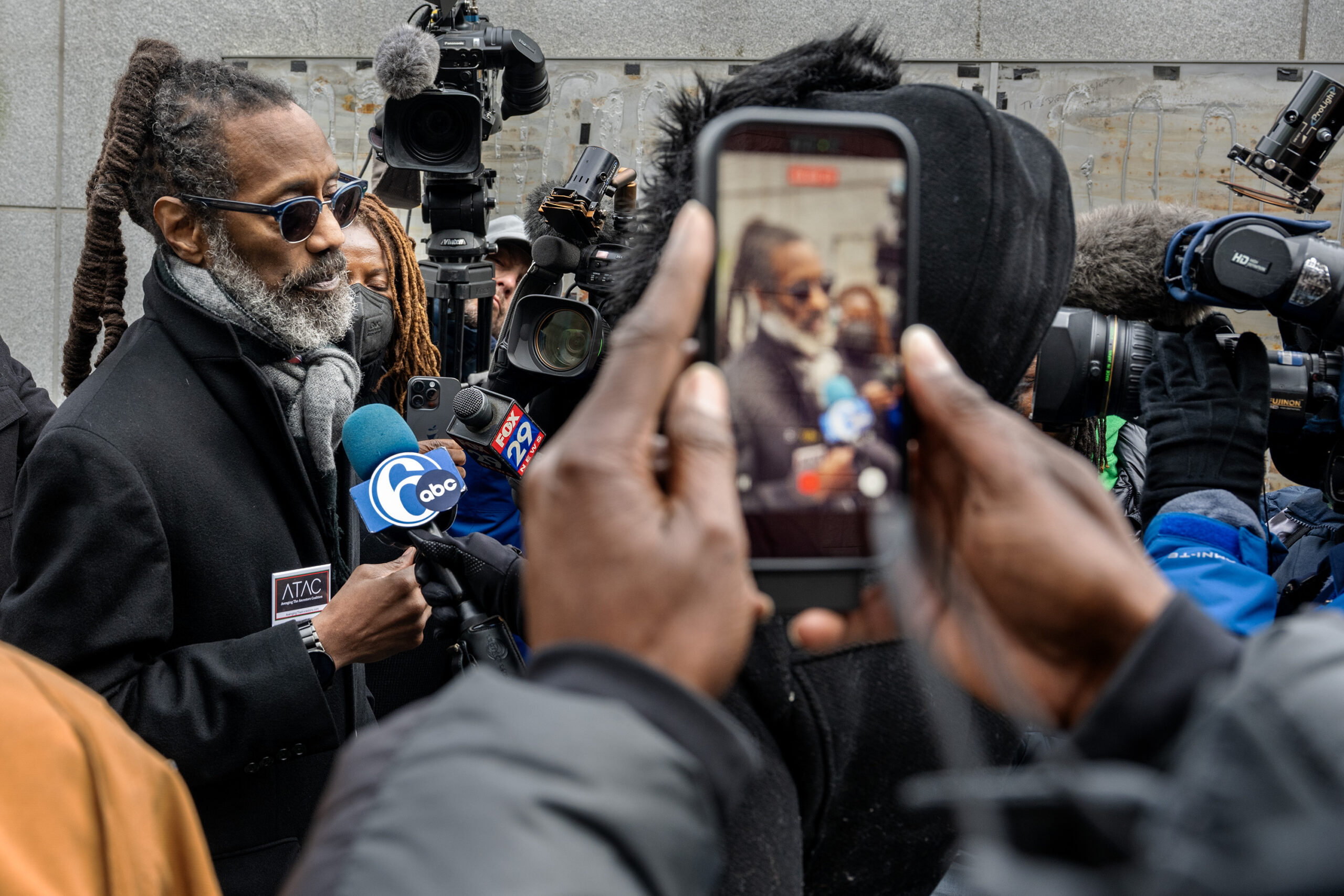
Attorney Michael Coard, leader of the Avenging the Ancestors Coalition, speaks with the news media Monday after a federal judge ordered the Trump administration to restore the slavery exhibits that the National Park Service removed from the President’s House last month. The group was on the site for an annual gathering for a Presidents’ Day observance when they learned of the order.
Avenging the Ancestors Coalition, the main advocacy organization leading the fight to protect the President’s House, was less than an hour into its Presidents’ Day event at the site when leaders got wind of their victory.
The group’s leaders, excited and completely in shock, congregated behind the site’s Memorial Wall to soak in the news before announcing it.
Moments later, Michael Coard, an attorney and the coalition’s leader, emerged before the crowd of about 100 people and told them: “Thanks to you all, your presence and your activism, I have great news: We just won in federal court.”
The crowd erupted in cheers and chants of “When we fight, we win!” and “We have won!”
Coard told reporters there was “no other blessing that we could have gotten today.”
The coalition has led dozens of rallies and town halls meant to energize the public in opposing the Trump administration’s ongoing scrutiny of the President’s House. The Black-led advocacy group helped develop the site in the early 2000s before it opened in 2010.
Dana Carter, the group’s head organizer, said she was in disbelief when she heard about the ruling.
“After we figured out that it really was the truth, I am just moved. My heart is overflowing with love for the judge who made the ruling, as well as the people who have been with us since the beginning … and also the people who have joined us in this fight to restore the President’s House,” Carter said.
But the fight is not over, advocates said, with Coard expecting the Trump administration to appeal or ignore rulings.
“This is a lawless administration. The people are going to have to take over to force them to do the right thing,” Coard said.
The Trump administration’s attempt to alter the President’s House was part of a wider initiative to remove content from national parks that “inappropriately disparage Americans past or living,” following an executive order from Trump. For instance, Park Service employees removed signage about the mistreatment of Native Americans from the Grand Canyon.
The fate of the President’s House exhibits was in limbo for months until they were removed by Park Service employees with wrenches and crowbars on Jan. 22. Meanwhile, advocacy groups and creatives behind the President’s House cultivated support for their cause to protect the site. Philadelphia City Council issued a resolution condemning the censorship of the exhibit.
“Judge Cynthia Rufe made it clear that historical truth cannot be dismantled or rewritten, and that the federal government does not have the authority to erase or alter facts simply because it has control over a national site. … We can not let President Donald Trump whitewash African-American history. Black history is American history,” City Council President Kenyatta Johnson said in a statement Monday.
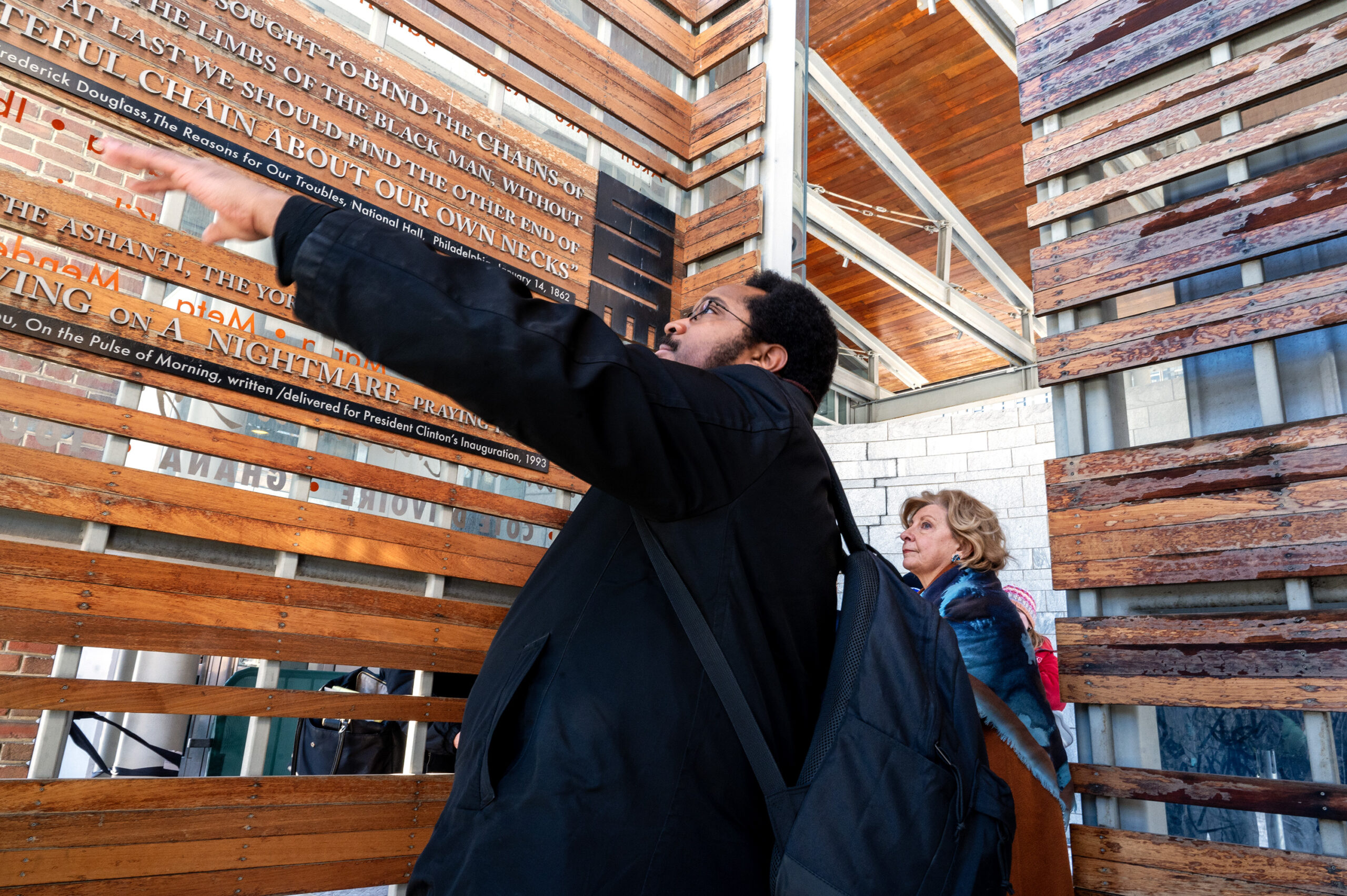
Mijuel Johnson (left), a tour guide with The Black Journey: African-American Walking Tour of Philadelphia, leads Judge Cynthia Rufe (right) as she visits the President’s House in Independence National Historical Park on Feb. 2.
Attendees at Monday’s event were invigorated by the ruling.
Mijuel Johnson, a tour guide leader with the Black Journey who led Rufe through the site earlier this month, said he was “enjoying the moment for now” but then he would be back to work.
“This is a great win for this movement,” Johnson said.
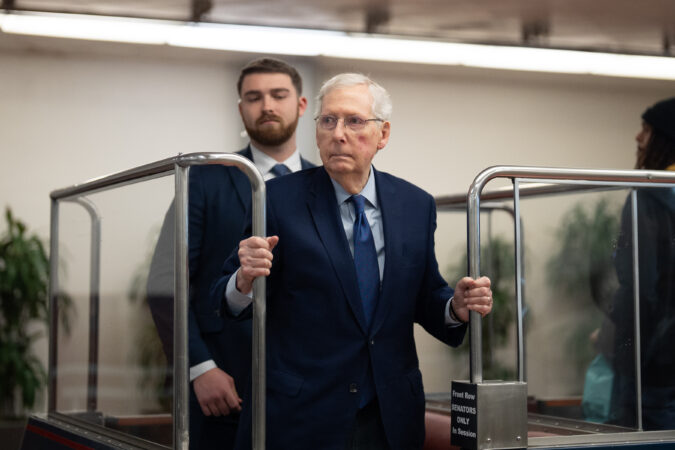
One Republican candidate to succeed Sen. Mitch McConnell introduced himself with an ad that shows a cardboard cutout of the longtime Senate majority leader in the trash.
Allies for a rival hit back with ads that noted the first candidate gave McConnell money.
And Daniel Cameron, the former Kentucky attorney general once considered a McConnell protégé, is now keeping his distance.
“I’m my own man,” Cameron said in an interview, later suggesting McConnell donors prefer one of his opponents.
The Senate primary to replace 83-year-old McConnell shows how profoundly the GOP base in his home state has soured on one of the most powerful and significant political figures in Kentucky history. McConnell drew low approval ratings for years but fended off challengers by flexing his raw clout and ability to deliver for his state.
While he at times expressed frustration or anger with President Donald Trump, McConnell used his political muscle to cement much of the president’s first-term legacy, including a 6-3 conservativemajority on the Supreme Court that has helped pave the way for an even more disruptive second term.
But many in the MAGA movement still view him as the embodiment of the GOP establishment that sought to holdTrump back.Three former interns for McConnell have distanced themselves while running to succeed him, pitching themselves as “America First” Republicans in Trump’s mold.
Cameron says voters don’t want a candidate who is “just bashing an old man” — a rebuke of his opponent Nate Morris, a businessman backed by national MAGA stars whose vociferous attacks on McConnell have alienated some Republicans in the state. Many operatives argued his initial assault went too far.
Still, it’s clear that ambitious Republicans have diverged from the towering conservative figure, who is set to retire next year after four decades in Congress.
“This is a fight for the future of the Republican Party … Donald Trump’s Republican Party,” said Morris, a friend of Vice President JD Vance, in an interview. “And certainly, if you’re with Mitch McConnell, you’re not part of that future.”
Terry Carmack, McConnell’s chief of staff, said the senator has secured more than $65 billion in extra federal funding for Kentucky over his career — for military bases, hospitals, law enforcement and more — and added that the state “deserves a Senator who will fill those shoes.”
“As Kentucky’s longest-serving Senator and the nation’s longest-serving Senate leader, Senator McConnell’s job stayed the same: ensuring Kentucky always punched above its weight,” Carmack said in a statement.
The primary is effectively a three-way race between Morris, Cameron and Rep. Andy Barr, who touts that he was the Kentucky chairman of Trump’s 2024 campaign. Whoever wins the May 19 GOP contest is likely to represent the solidly red state.
The fact that all three have ties to McConnell reflects how much in Kentucky GOP politics traces back to the senator. The state Republican Party headquarters bears his name, and he has helped many other GOP officeholders over the years.
“I challenge anybody who takes this seat to do what he’s done,” said Frank Amaro, the GOP vice chair for Kentucky’s 1st Congressional District.
The campaign jabs at McConnell have been frustrating to many who have worked with him over the years and say he deserves respect, pointing to his hardball tactics that pushed the courts nationwide to the right and the money he has steered toward Kentucky. The state got nearly $2.6 billion in extra federal funding this fiscal year, according to McConnell’s office.
“You don’t have to like someone for them to be your go-to to deliver results,” said Iris Wilbur Glick, a former political director for McConnell who called candidates’ positioning on the senator “very disappointing.”
But many Republicans are critical — especially of his relationship with Trump. Trump has repeatedly attacked him. McConnell held Trump “practically and morally responsible” for themob that stormed the U.S. Capitol on Jan. 6, 2021, though his vote against impeachment helped enable Trump’s comeback.
After Trump won in 2024 and McConnell stepped down as majority leader, he opposed some of Trump’s most controversial Cabinet picks — casting the only GOP vote against Robert F. Kennedy Jr. for secretary of health and human services.
A December Economist-YouGov poll found that 21 percent of Republicans nationally had a favorable view of McConnell, while 55 percent had an unfavorable view. In interviews, Kentucky voters often knew little about the Senate race or the candidates — but knew they didn’t like McConnell.
“I want him out of there,” said Julie Jackson, a 56-year-old Republican.
Cameron, who once worked as McConnell’s legal counsel and rose in politics with his mentorship, launched his Senate campaign last year with an attempt to separate himself. Days after announcing, he put out a video rebuking McConnell for opposing Trump’s Cabinet picks.
“What we saw from Mitch McConnell in voting against Pete Hegseth, Tulsi Gabbard and RFK was just flat-out wrong,” Cameron said in the video. “You should expect a senator from Kentucky to vote for those nominees to advance the America First agenda.”
A year later, one of Cameron’s biggest challenges is raising money — a struggle some Republicans in the state attribute in part to his break with McConnell.
“Daniel Cameron relied heavily on his connections to McConnell-world in his previous races for fundraising, and that’s simply not an avenue that’s available to him for this race, and it shows in his fundraising reports,” said Tres Watson, a Republican strategist in Kentucky.
Cameron notes that some McConnell donors have backed Barr — who leads the pack on fundraising. Attack ads on Barr from a group affiliated with the conservative Club for Growth featured old footage of Barr calling McConnell a “mentor.”
Barr has kept his distance from McConnell, too, however, tying himself to Trump.
“Thank you for giving me a chance to work with this president to make America great again,” he said to close his speech at recent GOP dinner. His team declined an interview request.
Trump has stayed out of the Senate race and often avoids weighing in on primaries absent a personal grudge or clear polling leader. But prominent Trump allies have lined up behind Morris, the businessman and friend of Vance. Morris said the vice president called him last year encouraging him to jump into the Senate race, saying that “we’re going to need somebody in that seat that’s not going to stab our president in the back.”Vance allies work on Morris’s campaign and a supportive super PAC.
Charlie Kirk, the late conservative activist, endorsed Morris before he was killed in September. Morris “is not going to be beholden to the McConnell machine,” said Andrew Kolvet, a spokesman for Kirk’s group Turning Point, who called McConnell a “relic.”
Elon Musk, the billionaire tech CEO who has become a major force in GOP politics, rocked the primary by putting $10 million behind Morris this year after a meeting where he came away impressed in part by Morris’s anti-McConnell message, according to a person familiar with the matter who spoke on the condition of anonymity to discuss private conversations.
“[McConnell] has had a stranglehold on Kentucky for 40 years, and it is not the easiest thing to challenge the McConnell mafia right here in the Bluegrass State,” Morris said last month on the podcast of Trump’s eldest son, Donald Trump Jr. — where he also launched his campaign. “But we’ve done it and we’ve gone straight for the jugular of Mitch and his cronies.”
The message hasn’t always gone over well. Morris was roundly booed last year at an annual Kentucky political picnic where the former garbage company CEO declared he would “trash Mitch McConnell’s legacy.”
“A lot has changed in politics, but you still have to introduce yourself, and he started out just attacking people,” said Adam Koenig, a former GOP state lawmaker.
Morris dialed back his attacks at a recent event in northern Kentucky, mentioning McConnell only in passing. But he made his antipathy clear.
“We cannot go back to what we’ve had the last 40 years,” he said.
The federal official in charge of the U.S. Army Corps of Engineers visited Ocean City and other Jersey Shore communities Friday, along with U.S. Rep. Jeff Van Drew, pledging that beach replenishment help is on its way.
Adam Telle, assistant secretary of the Army for civil works, came to New Jersey for a tour hosted by Van Drew. The Army Corps manages beach projects and puts up the majority of money. States and municipalities contribute the rest.
“There’s emergency funding that’s available,” Telle said from Fifth Street on Ocean City’s boardwalk, adding that some beaches would see repairs by summer.
Telle said the money does not hinge on legislation and has President Donald Trump’s support.
The Army Corps will evaluate which beaches are in the most severe condition, he said, including Ocean City, which is among the top of the list. Telle and Van Drew did not cite a specific amount of money but indicated millions could be available.
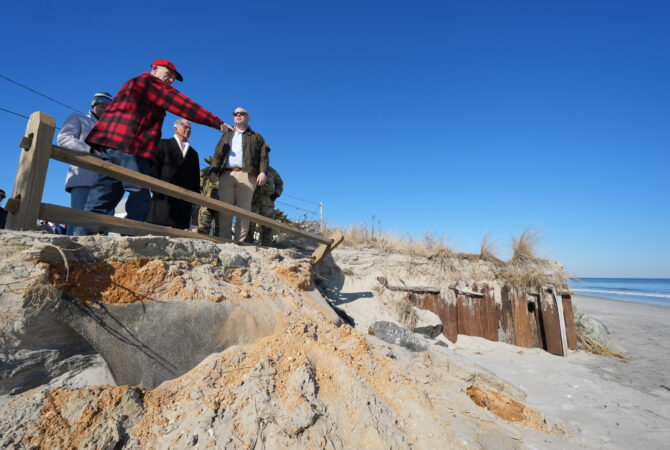
Telle, Van Drew, and other officials visited Strathmere, Avalon, and North Wildwood, which have all been heavily impacted by storm erosion over the last year. The short-term goal this year would be to take spoils from Army Corps projects and spread that on beaches.
They said they plan to draw on a mix of funding, including money still remaining from Hurricane Sandy in 2012, other supplemental funds, and earmarks — language in appropriations bills to direct federal funds to state and local projects.
Van Drew, a Republican, represents multiple Shore towns on the southern tip of New Jersey.
Friday’s tour came on the heels of zero dollars earmarked for beach replenishment in 2025 — the first time that had happened since 1996. Up to $200 million annually has typically been awarded for beach erosion control projects.
Van Drew also introduced a bill last week to establish a new source of continuous beach replenishment money through the Coastal Trust Fund Act.
The bill would pay for ongoing coastal storm risk management by the Army Corps. U.S. Rep. Laura Gillen, a Democrat from New York, is a cosponsor.
According to Van Drew, the legislation would use revenue from offshore energy leases to fund $1 billion a year into Army Corps of Engineers coastal storm management projects.
He said his bill, if approved, would create a permanent source of funding so that it would not depend on yearly appropriations from Congress.
“We need to get a permanent system in place so we aren’t riding this roller coaster,” Van Drew said.
However, he acknowledged that getting any bill approved in Congress right now is difficult.
“It’s going to be a labor of love,” Van Drew said, adding that he is gathering “support from all around the country.”
There is no date for a vote on the bill.
U.S. Rep. Jeff Van Drew (center), Assistant Secretary of the Army for Civil Works Adam Telle (right) and Upper Township Mayor Curtis Corson Jr. discuss shore erosion and beach replenishment in Strathmere.
A measure has been introduced by U.S. Rep. Chuck Fleischmann, a Republican from Tennessee, for $23 million to fund coastal replenishment projects this year. That would be supplemented by a Senate bill introduced by U.S. Sen. John Kennedy, a Republican from Louisiana, that would allocate $62.2 million. However, neither bill is scheduled for a vote.
In 2025, multiple New Jersey Shore towns found themselves in a crisis over erosion as Congress and Trump pushed for a huge reduction in the federal budget.
No money was made available for crucial beach nourishment projects. The lack of funding became a political issue in New Jersey, which depends heavily on its beaches for tourism revenue.
For decades, beach projects have been a staple of coastal management in the United States. In 2025, projects were paused in New Jersey, Maryland, and Delaware.
Projects set for Cape May, Stone Harbor, Avalon, Sea Isle, Strathmere, Ocean City, and Long Beach Islandwerestalled because of the lack of funding. Georgia and Florida also were affected.
In October, Ocean City declared a local emergency over the severe erosion exacerbated by storms like Hurricane Erin and a potent nor’easter in October. The city was left grappling with sand cliffs upward of five feet high after the storms scoured its beaches.
Mayor Jay Gillian and others pushed for urgent state and federal intervention, citing the difficulty of managing large-scale beach replenishments and dune restoration with city resources alone.
Gillian said Friday at the tour stop in Ocean City that he welcomed any help from the Army Corps and Van Drew.
“They’re working for a solution,” Gillian said of Telle and Van Drew. “The permanent funding, that’s huge because it stops the games, and it stops the politics.”
Van Drew represents the largely conservative 2nd District, which spans mostly rural and Shore communities in South Jersey, including all of Atlantic, Cape May, Cumberland, and Salem Counties, plus parts of Gloucester and Ocean Counties. He remains optimistic for funding.
Amid President Donald Trump’s crackdown on immigration and deployment of federal officers to cities across the country, students at Philadelphia-area colleges are protesting against the appearance of U.S. Customs and Border Protection at campus career fairs.
At least four local universities — Thomas Jefferson, Villanova, Temple, and Rowan — have faced opposition to allowing recruitment in recent months.
A petition circulated at Jefferson last week sought to keep CBP from appearing at a campus career event. CBP and ICE — both agencies that enforce immigration laws under the Department of Homeland Security — have been at the center of a national debate after two Minneapolis residents were killed by federal immigration enforcement agents in shootings now under investigation.
“Due to the harm CBP has caused to communities across the nation, it is abhorrent for TJU to accept CBP at their institution,” said anoccupational therapy student who signed the petition and asked that her name be withheld, fearing retribution. “I don’t think any institution should be encouraging students to get involved in these kinds of agencies, given the current climate.”
But the petition has since come down, the student said, and CBP is not on the list of employers due to appear at the event, called the 2026 Career Day and Design Expo, on Thursday at the East Falls campus. Jefferson has not acknowledged that CBP was on the list initially or responded to questions on whether it was removed.
CBP, which has offices in Philadelphia, has appeared at campus career events in the area in the past.
An email seeking comment from CBP’s media office was not returned.
At Rowan University in New Jersey earlier this month, the participation of CBP’s Trade Regulatory Audit Philadelphia Field Office in a career fair drew some student protest. Members of a student activist group distributed fliers speaking out against CBP during the fair, according to Rowan’s student newspaper, the Whit, and campus police and administration officials came to the scene.
The agency also reserved a table and came to afall event at Rowan to share information about accounting-related auditing internships, said Rowan spokesperson Joe Cardona,and has done so at the public university for the last decade.
Rowan’s Rohrer College of Business Center for Professional Development hosts more than 200 employers each year, including local, state, and federal agencies as well as private-sector groups, he said.
“The presence of any employer on campus does not constitute institutional endorsement of that organization’s policies or actions,” Cardona said. “Rather, it reflects our commitment to supporting student career exploration while upholding principles of open access and free expression.”
At Villanova, CBP pulled out of a career fair it had planned to attend earlier this month, according to the Villanovan, the student newspaper. The withdrawal followed criticism on social media about the organization’s planned appearance.
The organizer of an Instagram account that opposed the agency’s participation said they wished that Villanova had made the decision to disallow the group rather than the group withdrawing, according to the student newspaper.
“I think a lot of students will feel a lot safer and more comfortable attending this Career Fair,” the organizer said. “But it doesn’t take away the anger that this was ever something that was gonna happen.”
Villanova said in a statement that CBP‘sOffice of Trade had participated in prior career events and that employers with prior participation were contacted “through standard outreach” about this year’s event.
Temple’s law school last semester had planned to host a “Coffee and Careers” networking event with a DHS and Immigration and Customs Enforcement lawyer but later canceled it, according to the Temple News, the student newspaper. The event was replaced with a talk on public interest law by Philadelphia City Councilmember Rue Landau.
DHS “chose to engage directly with students interested in DHS opportunities rather than participate in a scheduled career event,” Temple spokesperson Steve Orbanek said.
He also noted that “career fairs are university-sponsored events, and actions that disrupt these events may violate university policy and established on-campus demonstration guidelines.”