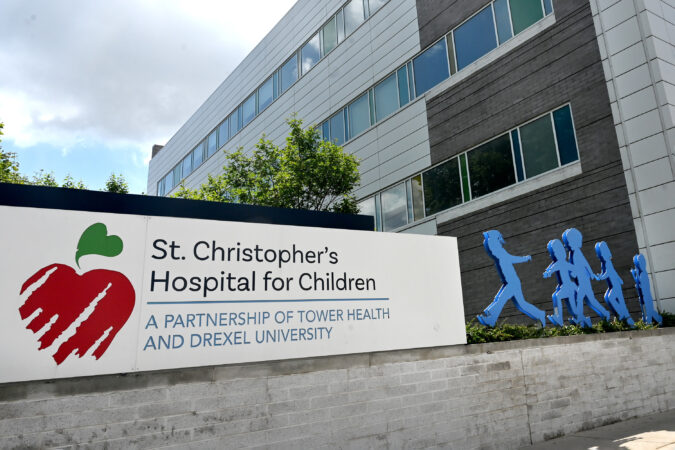
St. Christopher’s Hospital for Children, a key safety-net provider in North Philadelphia, on Wednesday announced its third leadership change in less than two years.
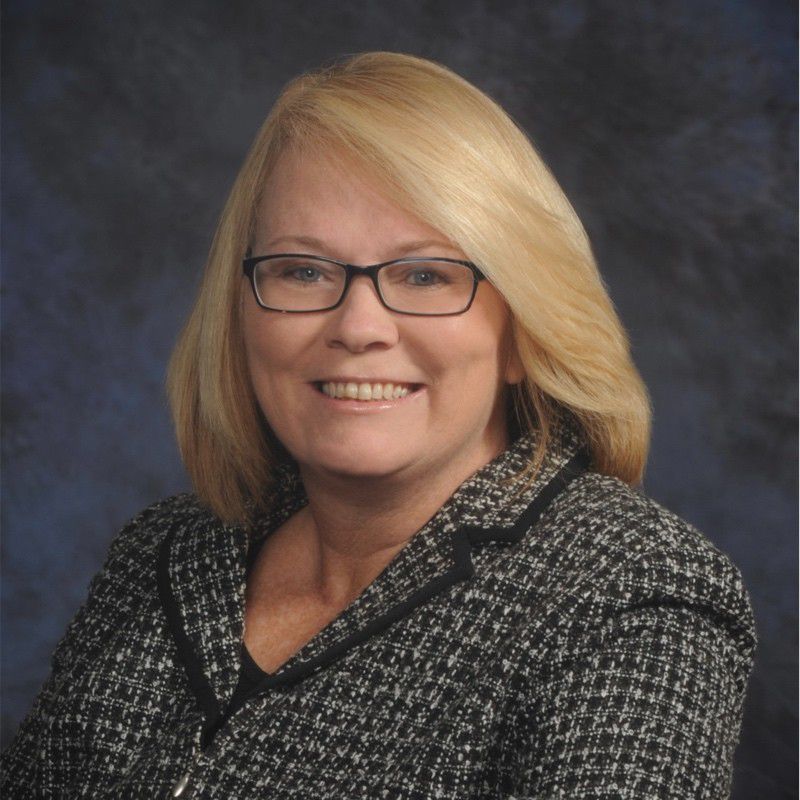
Claire Alminde, the hospital’s chief nursing officer and a 37-year veteran of the institution, is St. Chris’ new acting president.
She is the third interim or acting executive appointed to the top management position at the nonprofit hospital since February 2024 and its fourth leader since 2020. Drexel University and Tower Health have owned St. Chris in a 50-50 joint venture since 2019.
“Claire is firmly committed to St. Christopher’s mission and exemplifies the compassion, expertise and steadfast commitment that define this hospital and the care we provide to children and families across our region,” St. Chris said in an e-mailed statement.
St. Chris’ chief nursing officer Claire Alminde has been named acting president of the North Philadelphia safety-net provider.
There are no immediate plans for a national CEO search. “Right now, Tower’s focus is on helping Claire onboard successfully and lead the organization forward. We are grateful that Claire has committed to serving in this position as long as necessary,” Tower said.
Alminde is replacing Jodi Coombs, who was appointed interim president and CEO last April. Coombs’ previous position was executive vice president at Children’s Mercy Kansas City, in Missouri. Before that, she worked in Massachusetts.
Mueller took the job at St. Christopher’s in the summer of 2020, about seven months after Tower and Drexel University bought the facility, but did not permanently move to Philadelphia.
Tower oversees day-to-day management of the facility, where about 85% of patients have Medicaid insurance for low-income people. That’s an extremely high rate.
St. Chris, which has received significant financial support from other local healthcare institutions in recent years, has not published its financial results for the year that ended June 30, 2025. In fiscal 2024, St. Chris had a $31.6 million operating loss.
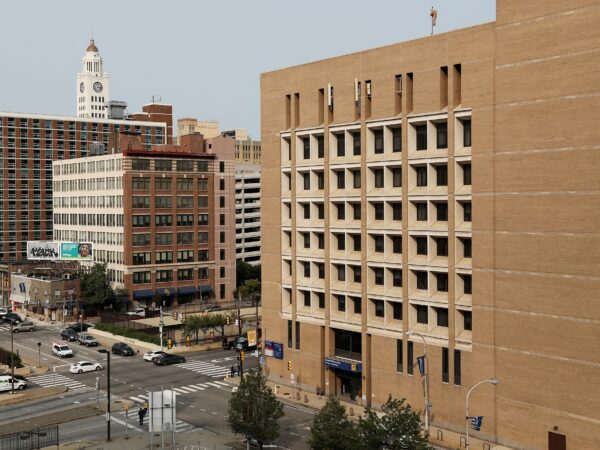
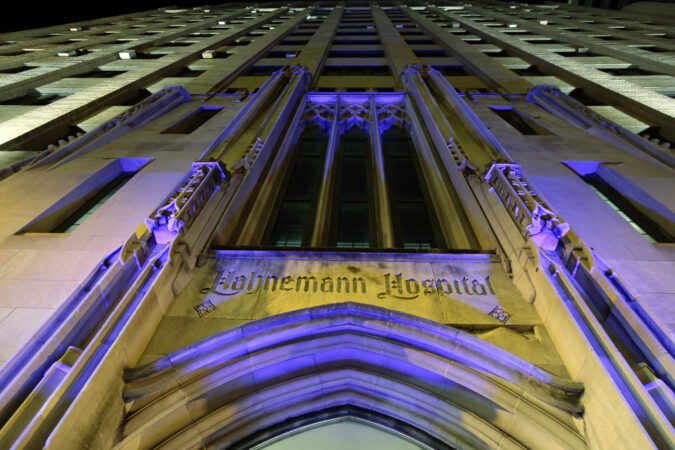
Philadelphia-based Iron Stone Real Estate Partners transferred control of two of their former Hahnemann University Hospital properties in the last two weeks.
The investment group acquired a portfolio of Hahnemann properties in 2021 and began redeveloping them into laboratory and office space.
But in recent weeks Iron Stone disposed of two of these properties.
The company donated the New College Building at 245 N. 15th St. to Drexel University on Dec. 31.
“It’s a charitable donation,” said Jason Friedland, director of operations and investments at Iron Stone. “We felt that that building was best served with Drexel owning it and using it for a long time, long-term, for their research.”
When Iron Stone acquired the New College Building five years ago, Drexel occupied the property’s medical labs and was one of the few remaining tenants in the Hahnemann campus.
Back then the university was considering moving this Center City operation to the suburbs in the short term and to University City in the long term.
“The generous gift will provide the university with flexibility as it continues to consolidate operation of its College of Medicine on its University City campus,” Drexel spokesperson Britt Faulstick said in an email statement. “Plans for the New College Building will be determined in the future.”
On Jan. 6, Iron Stone sold the Broad and Vine Parking Garage at 1416 Wood St. to the Philadelphia Parking Authority for $21.3 million.
The 850-space garage had been exclusively for Hahnemann’s use. Iron Stone renovated the vacant garage after the bankruptcy and hired Metropolis Technologies — the largest parking operator in the United States — to run it.
The acquisition is the first time the Parking Authority has purchased a garage built by someone else, said Rich Lazer, executive director of the Parking Authority.
“Most of our garages, outside of the airport, are Center City-based, so its nice to push out onto North Broad,” Lazer said. “Our garages are lower cost than private garages, so it’ll help us maintain reasonable pricing.”
The authority plans to retain Metropolis Technologies as the operator, Lazer said.
Iron Stone still owns a couple former Hahnemann properties, including the 120,000-square-foot Race Street Laboratories at 1421 Race St. and the 15,000-square-foot building at 231 N. Broad St., which is fully leased by Bayada Home Health Care Inc. with a third of the space and Dynamed Clinical Research with the rest.
Race Street Laboratories was developed to tap into the life sciences and biomedical market, which boomed during the pandemic but has slowed substantially as interest rates spiked. Currently the building has only one tenant, Sbarro Health Research Organization, with 7,500 square feet of space.
Friedland said Iron Stone plans to move its headquarters from University City’s FMC Tower to one of Race Street Lab’s unused floors.
As for the rest of the space, Iron Stone is exploring alternative uses as the life sciences market continues to struggle.
“We’re seeing where the opportunities are in commercial real estate,” Friedland said. “We have a couple things we’re exploring, but we’re not really in a rush.”
Their plans for an apartment building were complicated by a bill introduced in December by Councilmember Jeffery Young to ban housing from the former hospital site.
But on Dec. 24, in advance of City Council action on the legislation, the developer received zoning permits for a 361-unit apartment complex at 222-248 N. Broad St. Dwight Group says they are nonetheless in negotiations with Young to secure his support.
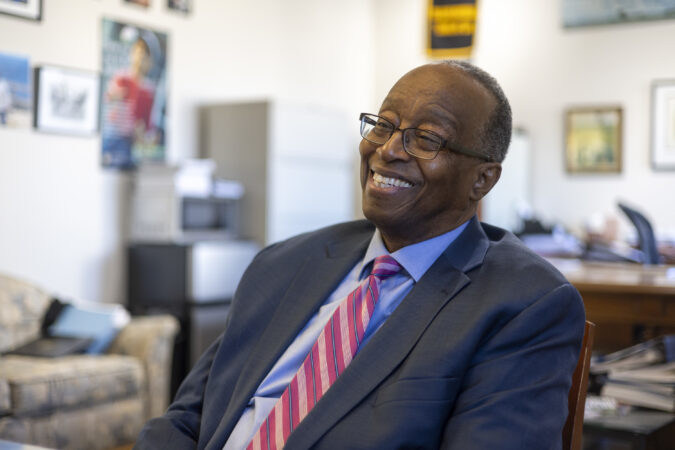
Robert Listenbee, the first assistant district attorney under Larry Krasner and a largely behind-the-scenes enforcer of the office’s progressive agenda, is retiring after nearly eight years as the office’s second-in-command.
Listenbee, 77, is expected to announce Friday that he is stepping down, marking the first shift in Krasner’s leadership team as the top prosecutor begins his third term.
A longtime public defender and juvenile justice advocate, Listenbee joined the administration at the outset of Krasner’s first term in 2018 — even as Krasner openly questioned whether the role of first assistant was necessary beyond its statutory requirement.
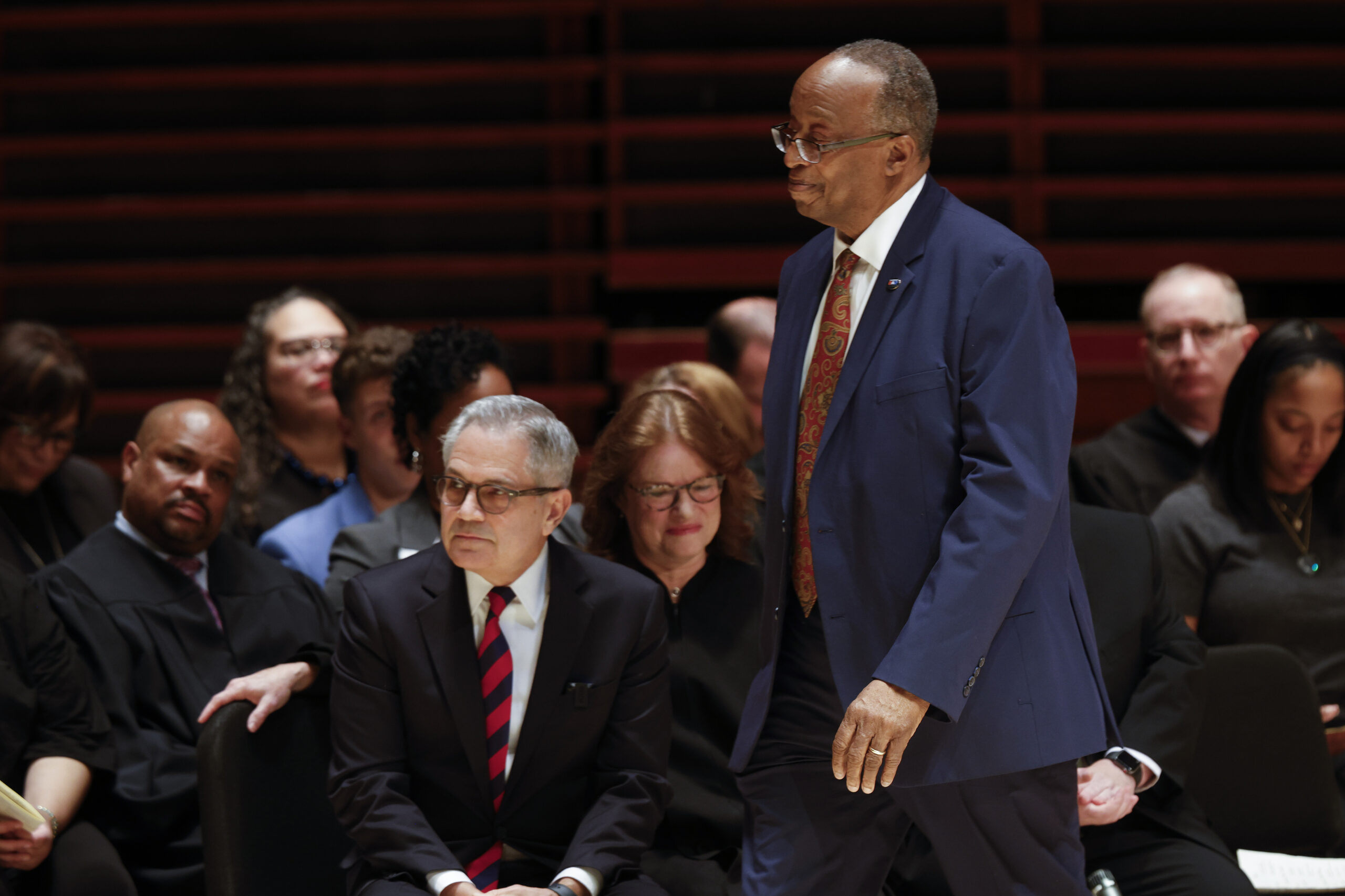
Robert Listenbee joined District Attorney Larry Krasner at the 2026 inaugural ceremony.
Over the course of Krasner’s tenure, Listenbee rarely served as the public face of the office on major cases, focusing instead on juvenile work, recruitment, and personnel matters.
Some prosecutors in the office said that often translated into a lack of visible management compared to previous first assistants, and that he served more as an internal messenger of Krasner’s often controversial agenda than the traditional day-to-day overseer of the office.
Listenbee has said his role was never set up to operate traditionally, and his goal was to carry out Krasner’s vision and reform the office.
Krasner declined to say who might replace him but he said he was evaluating candidates.
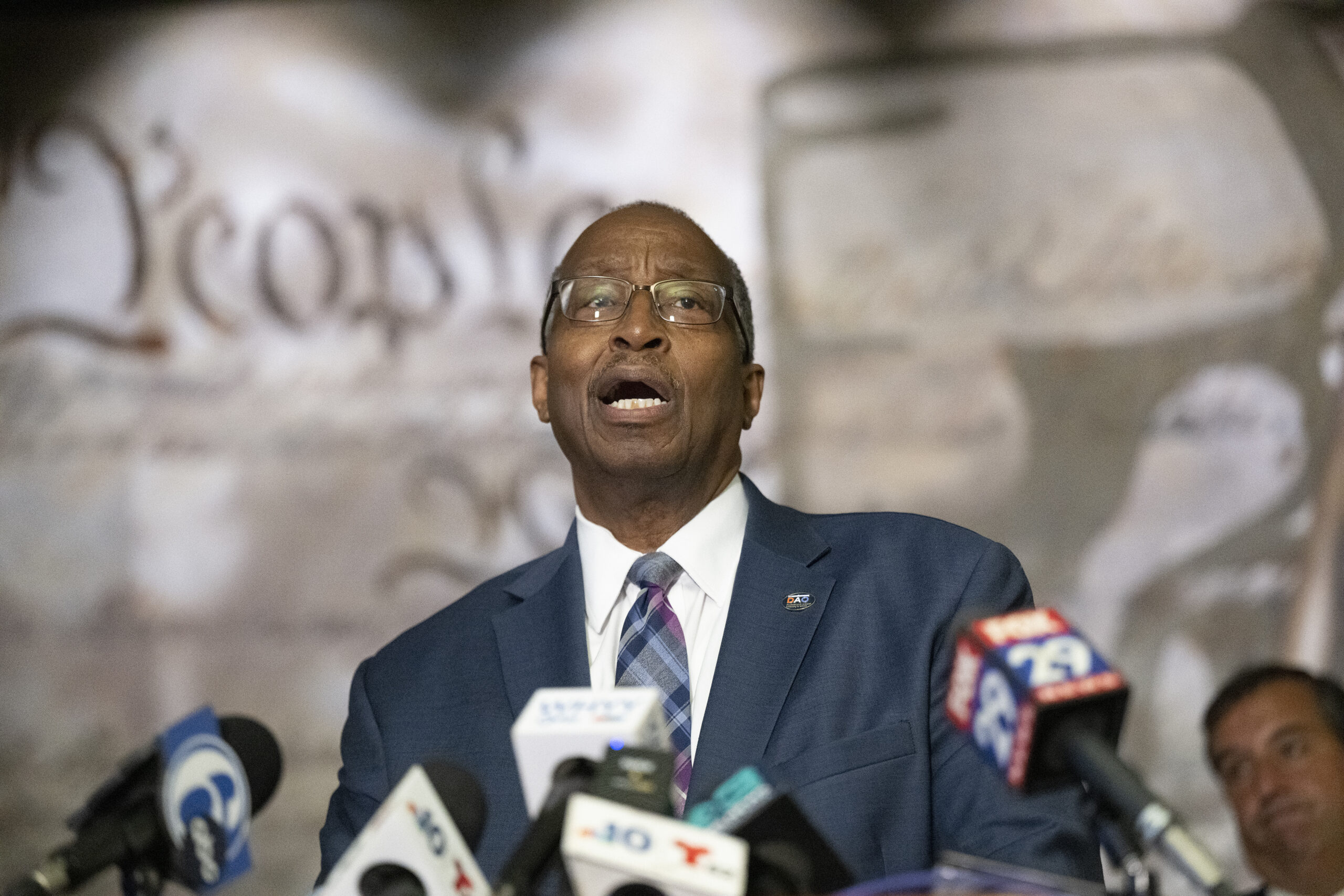
Robert Listenbee, first assistant district attorney, announced developments in the case against a West Philadelphia teen who was planning a terrorist attack.
Before joining the district attorney’s office, Listenbee spent decades as a public defender, including 16 years as chief of the juvenile unit at the Defender Association of Philadelphia. He later led the U.S. Department of Justice’s Office of Juvenile Justice and Delinquency Prevention during the Obama administration, and worked at Drexel University before returning to Philadelphia to join Krasner’s team.
We spoke with Listenbee about his unconventional path to the law, his years reshaping juvenile justice, internal tensions within the DA’s office, and his advice for Krasner’s third term.
This interview has been edited for length and clarity.
Tell me about your life growing up.
I was raised in Mount Clemens, just north of Detroit. My father worked in the auto industry. We were poor and lived in the projects. I went to a public high school, and was the first in my family to go to college.
I came from a small African American community where people look out for one another. This community saw something in me very early. When I was only planning to go to Kalamazoo College, a mom at my school decided my life was going to be different. She contacted the recruiter at Harvard University, and they visited me out in my little home in the projects when I hadn’t even applied. I got a full ride to Harvard.
I was among the first large group of African Americans at Harvard. It was 1966. We were in the middle of the Civil Rights Movement and the Vietnam War.
How was that?
There was total upheaval in this nation. Demonstrations everywhere, college campuses being taken over.
I worked on the committee that helped establish the African American Studies Department at Harvard, one of the first in the nation.
This was also at a time when African countries were becoming independent. I spent 16 months as a teacher in the rural area in western Kenya.
Robert Listenbee spent 16 months in Africa teaching English, and then traveled the continent before going to law school.
Instead of coming back from Africa, I decided to hitchhike around the world. I spent six months in Asia — Thailand, Laos, even as the war was going on. I rode a motorcycle into the Mekong Delta in Vietnam and had experiences that make me grateful to be alive. I hitchhiked across Africa and traveled 8,000 miles by train across India. I did all of this on about $600.
After a two-year gap year, I returned to Harvard and finished my degree.
I ended up getting a full-ride scholarship to Berkeley law school.
Where did you go after law school?
I had job offers but I had this crazy idea that I wanted to build a road across Africa, from Nairobi to Lagos, but I was broke and needed money to do it.
This was when the pipeline was being built across the North Slope of Alaska, and you could make gobs of money in a short period of time. So in 1976, I went to Anchorage without a job and lived in the YMCA. I shoveled snow, washed dishes, and worked at McDonald’s.
Robert Listenbee worked in the oil fields building the pipeline on the North Slope of Alaska for several years beginning in 1976.
Finally, I got a job on the pipeline.
I was there for a couple of years. I was a laborer in the oil fields. I worked trucks that rode across the Arctic Ocean in the middle of the winter. I worked on wildcat wells 50 miles from base camp. I had to relieve pressured gas to keep it from blowing up. It was 50 degrees below zero.
Robert Listenbee worked in the oil fields building the pipeline on the North Slope of Alaska for several years beginning in 1976.
I got into fights. People were trying to kill me at different points in time, and I was trying to kill other people, too. So I mean, the reason I know a little bit about criminal justice is because I was almost a criminal.
I never built the road in Africa. I eventually came back to Philadelphia, and worked construction until 1986.
So what about being a lawyer?
After my construction company failed, I was broke again. I ended up going back to legal work, and got a job working at the Defender Association.
You were the head of the juvenile unit for 16 years, and then you finished your career here on the other side — going from defending young people to prosecuting them. How was that transition for you?
Working for the U.S. Department of Justice’s Office of Juvenile Justice and Delinquency Prevention under President Obama helped prepare me for prosecutorial work.
I was adamant I would never work for this office. I thought it was corrupt. Krasner called me three times before I agreed to join as first assistant.
We were engaging in culture change. Some of the behavior of the people who were here was absolutely outrageous, especially in the homicide unit. They had a sense that this office belonged to them. It didn’t belong to the people. They were willing to cheat and do it and hide evidence in the process of doing it. That’s the feeling that I had when I first got here, and that’s what we found.
Robert Listenbee, first assistant district attorney, takes questions from the media after announcing developments in the case against a West Philadelphia teen who investigators say purchased materials including chemicals, wiring, and tactical equipment associated to become a terrorist.
There has been criticism of your juvenile work — some have said that it was too lenient during the period of intense gun violence and that kids went on to commit worse crimes. Others say the office hasn’t gone far enough to treat kids as kids. How do you assess your record?
We’ve reduced the number of kids in out of home placements. We’ve expanded juvenile diversion programs. In 2024, we created a juvenile homicide unit to review all cases of juveniles charged with murder.
I’m satisfied that we’re being as fair as we can and taking the time to carefully evaluate every issue in a case.
The first assistant is typically the person who manages the office day-to-day. Some prosecutors have said that, in this administration, that role functioned differently — that much of the management flowed directly from Krasner. Do you think that perception is fair, and how did you approach leadership in that environment?
The DA did not want the imperial first assistant that had been here before. He would prefer a flat structure to a hierarchical structure, which means you get assigned a lot of odd jobs depending on what he wants you to do.
If I were running the office, I would have run it completely differently. But I have to tell you that, having been here as long as I have, we never would have gotten this far without the DA’s serious concerns about what people around here were doing, whether they were implementing his policy or not. His skepticism, his oversight, is what’s kept this place moving in the direction that he wanted to go in. I wasn’t tuned in enough to the office to understand that from the very beginning, but I listened to him.
We hire people, we fire people, we move people around. That’s happened a lot. We sometimes end up with younger and inexperienced supervisors, because we haven’t really developed a program for training supervisors really well. We’re working on that.
I wish I had worked on juvenile issues earlier than I did.
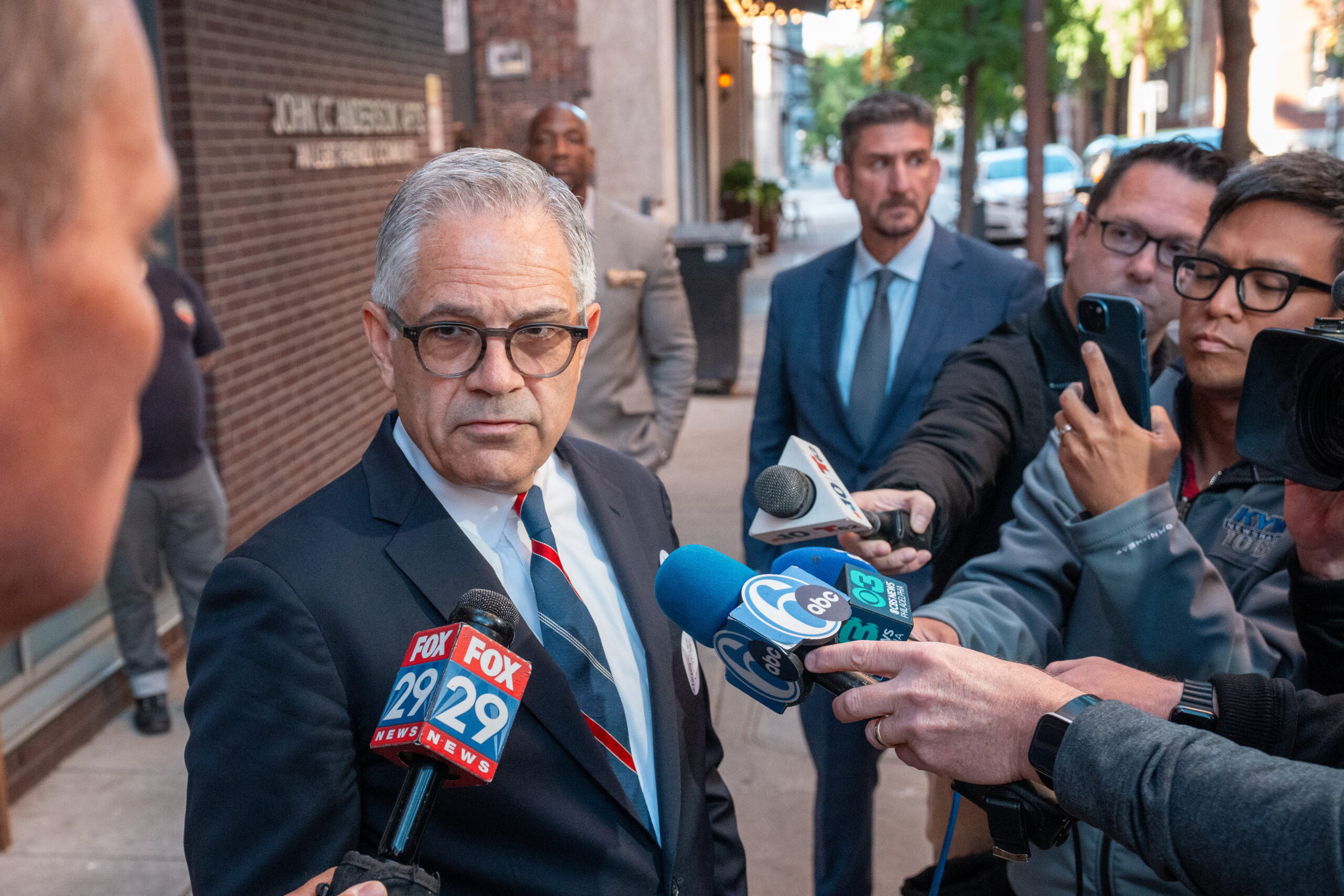
District Larry Krasner speaks with the media after casting his vote in the 2025 primary.
What’s your advice for the next first assistant?
You have to understand the DA’s goals and purposes and how he operates.
So, listen to Larry?
Not that. The DA is not a micromanager. But there’s no written directives on most of the things he wants, and there’s no organizational chart or hierarchy. If we have issues, we often go to him.
Do you have a piece of advice for Krasner in his third term?
This is a city that has a chip on its shoulder. The DA is a person who has a chip on his shoulder. They respect him for that when he speaks out. A lot of the things he says may not be politically astute, but they’re things he believes in. They like that about him.
He is the Donald Trump of the progressive era.
He needs to continue surrounding himself with people who can understand him and help him implement his policies.
A lot of people don’t like him, and I understand that. A lot of people don’t like me because I work for him. A lot of people don’t like what we do. That never mattered to me. I know that the people we have seen in court, the victims and the defendants and the witnesses, I know that we’re doing right by them. That’s my North Star.
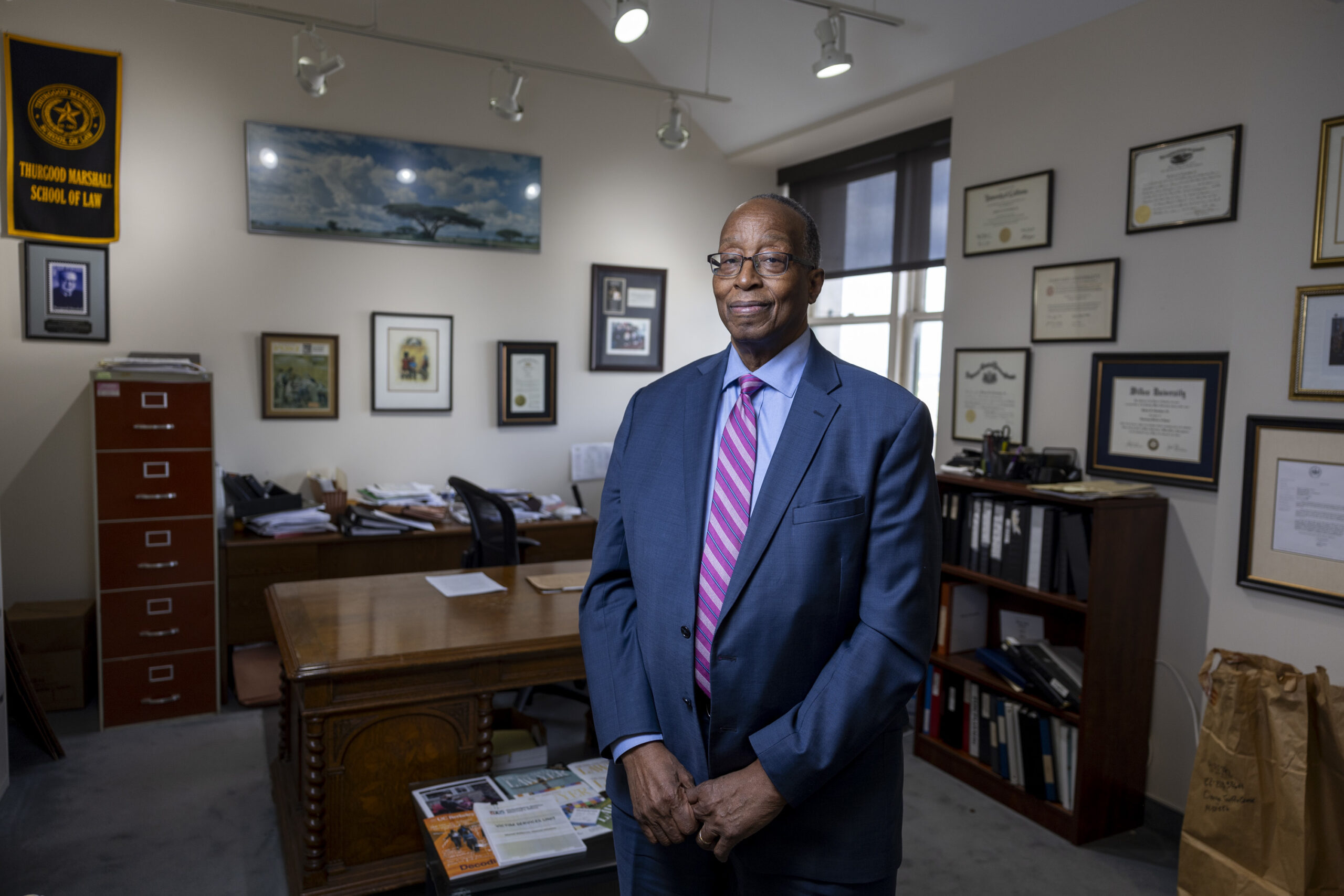
Robert Listenbee, the first assistant to District Attorney Larry Krasner, retired on Friday.
Philadelphia Councilmember Jeffery “Jay” Young introduced a bill at the last City Council meeting of 2025 to ban residential development from the area around former Hahnemann University Hospital.
The proposal covers properties near Broad and Race Streets with owners that include Drexel University, Iron Stone Real Estate Partners, and Brandywine Realty Trust.
But only one known residential project slated for the area is covered by the bill: Dwight City Group’s proposal to redevelop the Hahnemann Hospital patient towers into hundreds of apartments.
If enacted by City Council, which returns on Jan. 22, the bill could have stopped that redevelopment.
But on Dec. 24, Dwight City Group secured a zoning permit for 222-48 N. Broad St. to builda 361-unit apartment building — far larger than the original plan — with space for commercial use on the first floor.
With that permit secured, the project could move forward regardless of whetherYoung’sbill is enacted.
Dwight City Group, however, says they are concentrating on ongoing conversations with Young.
“We are working along with Councilman Young and the community to ensure that this project meets the needs and goals of the district,” said Judah Angster, CEO of Dwight City Group.
The permits show some changes to the original plan. In interviews last year, the developer said the plan contained 288 units and that ground-floor commercial was unlikely.
Young said the proposed housing ban is about preserving jobs by allowing only commercial development at the former hospital site.
“As the city continues to look for ways to incentivize development, we need to ensure jobs and economic opportunities are at the forefront, with engagement from all stakeholders,” Young said in an email. “We look forward to working [with] all stakeholders as this legislation moves through the process.”
Young’s bill confused and outraged manyobservers as a blatant example of spot zoning, in which legislation is used to help or hurt a particular project.
But the tradition of “councilmanic prerogative” would likely guarantee its passage because other Council members are unlikely to vote against a bill that affects only one district.
Nevertheless, the housing and transit advocacy group 5th Square has begun a campaign against the legislation and issued a petition earlier this week calling for its withdrawal.
“The site on Broad and Race Street lies on top of an express subway stop and benefits from proximity to Center City jobs, shops, and cultural amenities,” the petition reads. “Since the shuttering of Hahnemann in 2019, the site currently provides little value to Philadelphians or tax dollars to the city despite its central location.”
John Langdon, 79, formerly of Philadelphia, innovative award-winning graphic designer, painter, writer, and longtime adjunct professor of typography at Drexel University, died Thursday, Jan. 1, of complications from a heart attack at French Hospital Medical Center in San Luis Obispo, Calif.
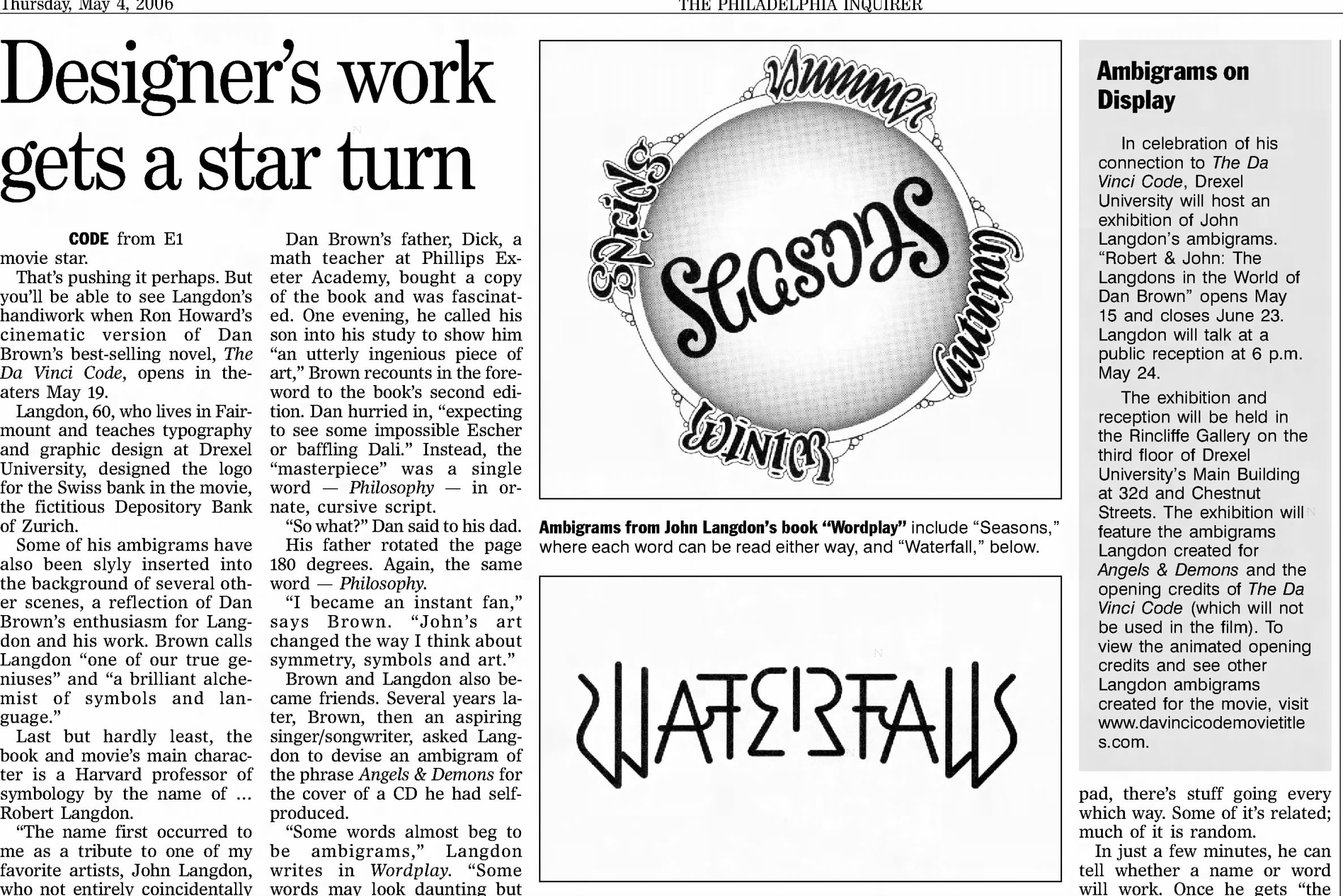
Mr. Langdon was a lifelong artist and wordsmith. He originated ambigrams in the early 1970s and created distinctive logos for corporate clients, artists, musicians, and others. Ambigrams are words or designs that retain meaning when viewed from different perspectives, and his work influenced countless other designers and typographers who followed.
“They also present familiar concepts in an unfamiliar way,” he told The Inquirer in 1992, “and thus stimulate the reader’s imagination.”
On his website, johnlangdon.net, Mr. Langdon described his work as “making abstract concepts visual, almost always through the design of words, letters, and symbols.” He called it “words as art” and said: “I specialize in the visual presentation of words.”
His designs were featured in more than a dozen solo shows in galleries and museums in Pennsylvania, New Jersey, New York, Connecticut, Maryland, and Delaware, and in more than 50 group exhibitions around the country and Europe. He created six ambigrams for author Dan Brown’s best-selling book, Angels & Demons, and Brown named his fictional protagonist, Harvard symbologist Robert Langdon, after John Langdon.
“John’s art changed the way I think about symmetry, symbols, and art,” Brown told The Inquirer in 2006.
Mr. Langdon’s own book about ambigrams, Wordplay, was first published in 1992 and updated in 2005. He also wrote the forwards of other books and articles for journals and newsletters. He said he had a “particular interest in word origins” in an interview on his website.
He was featured several times in The Inquirer and wrote an op-ed piece in 2014 about the Philadelphia Museum of Art’s new logo. He opened the article with: “Please, beloved Philadelphia Museum of Art, before you print one piece of stationery or a single promotional flier, reconsider your new logo.”
Mr. Langdon’s work was featured in The Inquirer in 2006.
In 1996, he began painting what he called his “visual-verbal meditations and manipulations” on canvas. “My paintings still involve symmetry and illusion, a bit of philosophy, and a few puns thrown in for good measure,” he said on his website.
He cocreated the Flexion typeface and won a 2007 award from the New York-based Type Directors Club. He spoke often about design at colleges and high schools, and to professional societies. He gave a TEDx talk about font and the future of typeface at Drexel.
Douglas Hofstadter, a professor at Indiana University who coined the term ambigram in 1984, told The Inquirer in 2006 that Mr. Langdon had a “very strong sense of legibility but also a marvelous sense of esthetics, flow, and elegance.”
Born in Wynnewood and reared in Narberth, Mr. Langdon graduated from Episcopal Academy in 1964 and earned a bachelor’s degree in English at Dickinson College in Carlisle, Pa. He worked in the photo-lettering department of a type house and for a design studio in Philadelphia after college, and began freelancing as a logo designer, type specialist, and lettering artist in 1977.
He taught typography and logo design classes at Moore College of Art and Design from 1985 to 1988 and at Drexel from 1988 to his retirement in 2015. In an online tribute, one student said he was “one of my favorite teachers of all time.”
He was interested in Taoism and inspired by artists Salvador Dalí and M.C. Escher, and authors Edgar Allan Poe and Ogden Nash. “In the early ’70s, I tried to do with words what Dali and Escher did with images,” he said in a 2006 interview posted on Newswise.com.
John Wilbur Langdon was born April 19, 1946. He played high school and college soccer and drew caricatures of classmates for the Episcopal yearbook.
After college, he took painting and drawing classes at the Pennsylvania Academy of the Fine Arts and the old Philadelphia College of Art. He married Lynn Ochsenreiter, and they had a daughter, Jessica. They divorced later.
Mr. Langdon enjoyed vacation road trips and told stories of hitchhiking around the country in the 1960s. He followed the Phillies, was interested in genealogy, and traced his family back to the Founding Fathers.
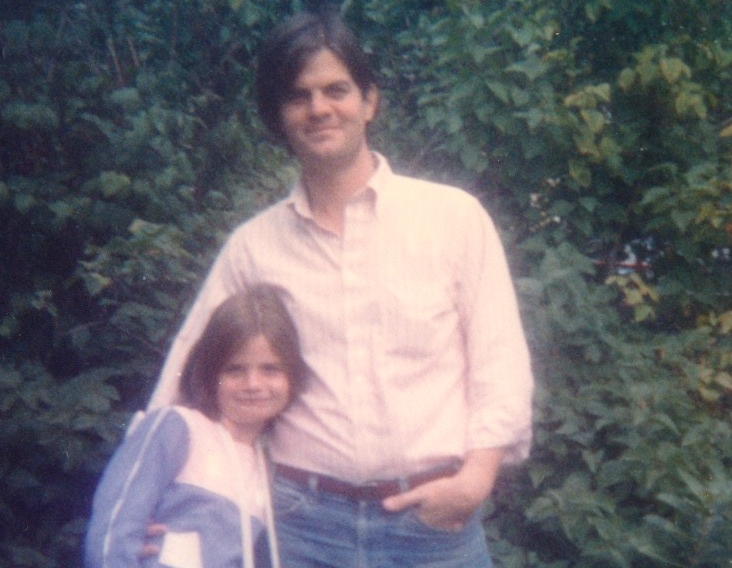
Mr. Langdon stands with his daughter, Jessica.
He lived in Darby, Woodbury, Wenonah, and Philadelphia before moving to California in 2016. “He was jovial, social, and amusing,” his daughter said. “People said he was clever, and everyone liked him.”
He told The Inquirer in 2006: “It may seem counterintuitive, but the more ambiguity you invite into your life, the more things make sense and become understandable.”
As a blanket of snow and sleet melted into the grass and an early winter fog hung over the Delaware Valley last month, Rinal Parikh’s art studio was a tranquil portal to the outside world.
In her studio, lofty windows look out onto a sprawling backyard. The walls are adorned with Parikh’s paintings, both completed and in progress, and its shelves are stacked with art supplies and mementos.
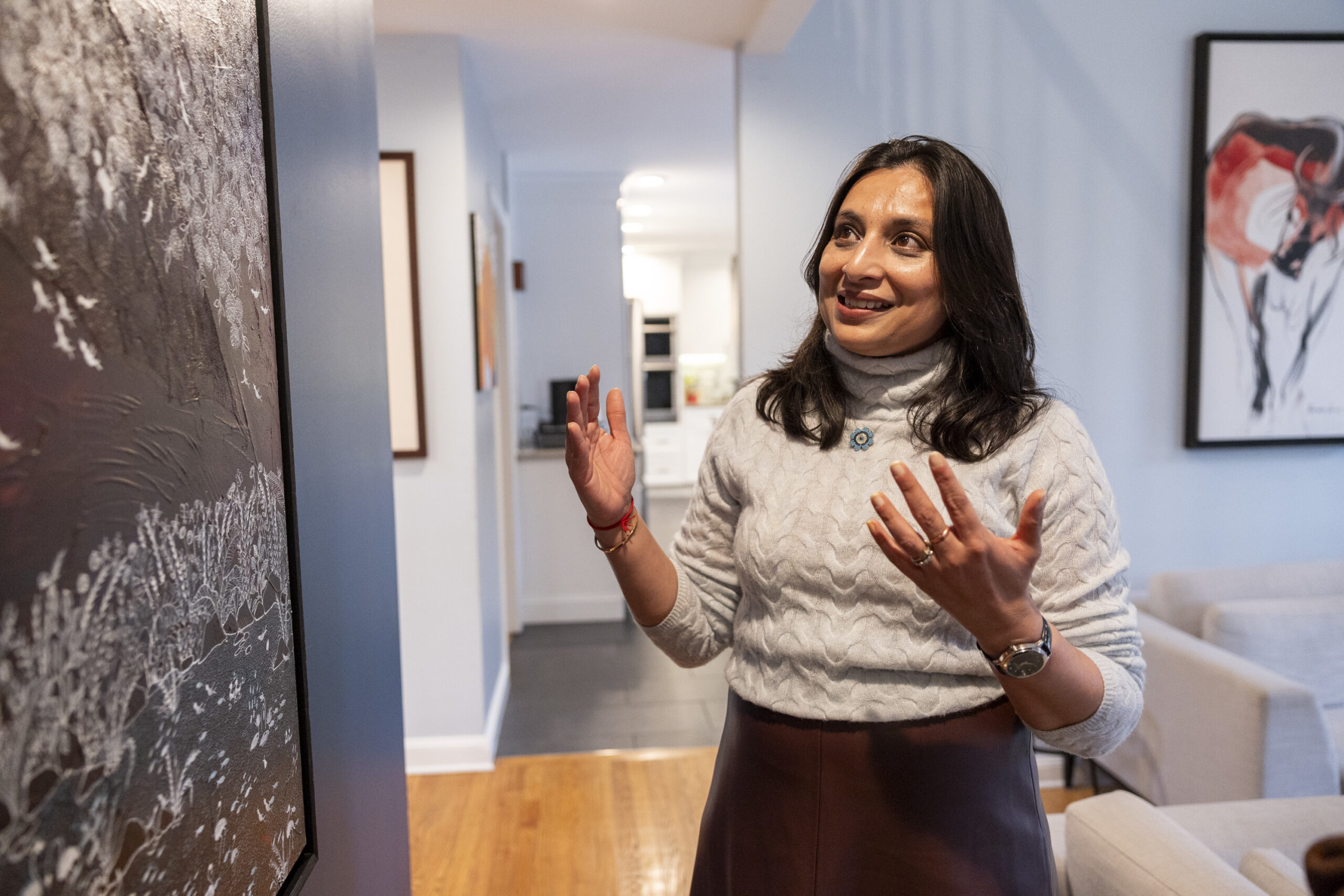
“What inspires me is my surroundings, and I’m blessed with an amazing backyard,” Parikh said, looking out the window. “That is my main inspiration.”
Parikh is a Media-based painter and biochemist by trade whose art blends traditional Indian folk styleswith contemporary themes. Her art, rich in texture, color, and meaning, uses a collection of materials, from sand and fabric to glass, beads, and stucco. She paints with acrylic and watercolors, and creates detailed drawings with thin brushes. Her work fuse her upbringing in India with her current life in Media, an amalgamation of past and present, of here and there.
Rinal Parikh, 43, Media-based artist, talking about her art work in her home in Media, Pa., on Tuesday, Dec. 23, 2025.
Parikh, 43, took a circuitous route to becoming an artist. She moved to Philly in 2005 from Gujarat, India, to follow her husband, Bhavin, who had immigrated a few years earlier (the day of our interview was the 20th anniversary, to the date, of her arrival in the U.S.). She enrolled in a masters in molecular biology program at Drexel University, a step toward her Ph.D., and got a job in a lab at Penn Presbyterian Medical Center.
A few years after her move, Parikh’s first son was born with health complications. With no family close by, Parikh quit her job to focus on taking care of her son. He’s now a healthy teenager, she notes.
Seeing that Parikh was missing out on work, her husband made a suggestion: Why not paint something for their new house? That first painting, “Krishna-leela,” now hangs in the Parikhs’ living room, an eye-catching depiction of the Hindu deity Krishna.
Rinal Parikh’s painting “Krishna-leela” is displayed at home in her formal living room in Media, Pa., on Tuesday, Dec. 23, 2025.
When her son was 9 months old, Parikh stopped by an art fair at the Creative Living Room, a community arts center in Swarthmore. She struck up a conversation with some of the women there. A few days later, they called with a question: Would she like to do a solo show?
“I didn’t even know what that means,” she said.
Nonetheless, she agreed. She worked tirelessly for three months to make 20 pieces. She didn’t know where to buy art supplies, so she imported them from India (someone would later point her toward the now-closed Pearl Art & Craft Supplies on South Street). In fall 2009, she displayed her paintings for the first time as a professional artist — and sold her first painting, too. The rest, she said, is history.
Parikh melds together three types of Indian folk art — Warli, Madhubani, and Kalamkari. Warli is a tribal art that depicts day-to-day life in a mural-like format. Madhubani uses geometric patterns and typically reflects celebrations of life. Kalamkari, Parikh said, is “very refined,” a style of art that uses a fine brush to create delicate and detailed line drawings. All three art forms have traditionally been practiced by women.
Parikh feels like she speaks “a global language.”
Though her paintings take inspiration from the traditional Indian folk style, the scenes depicted are not just of India. They’re often of the Philly area, and of the flora and fauna in her backyard.
“I still practice Indian folk art, but the subject matters are very ‘now,’” Parikh said. “The language is still very traditional, but the conceptualization, the visualization, is much more contemporary.”
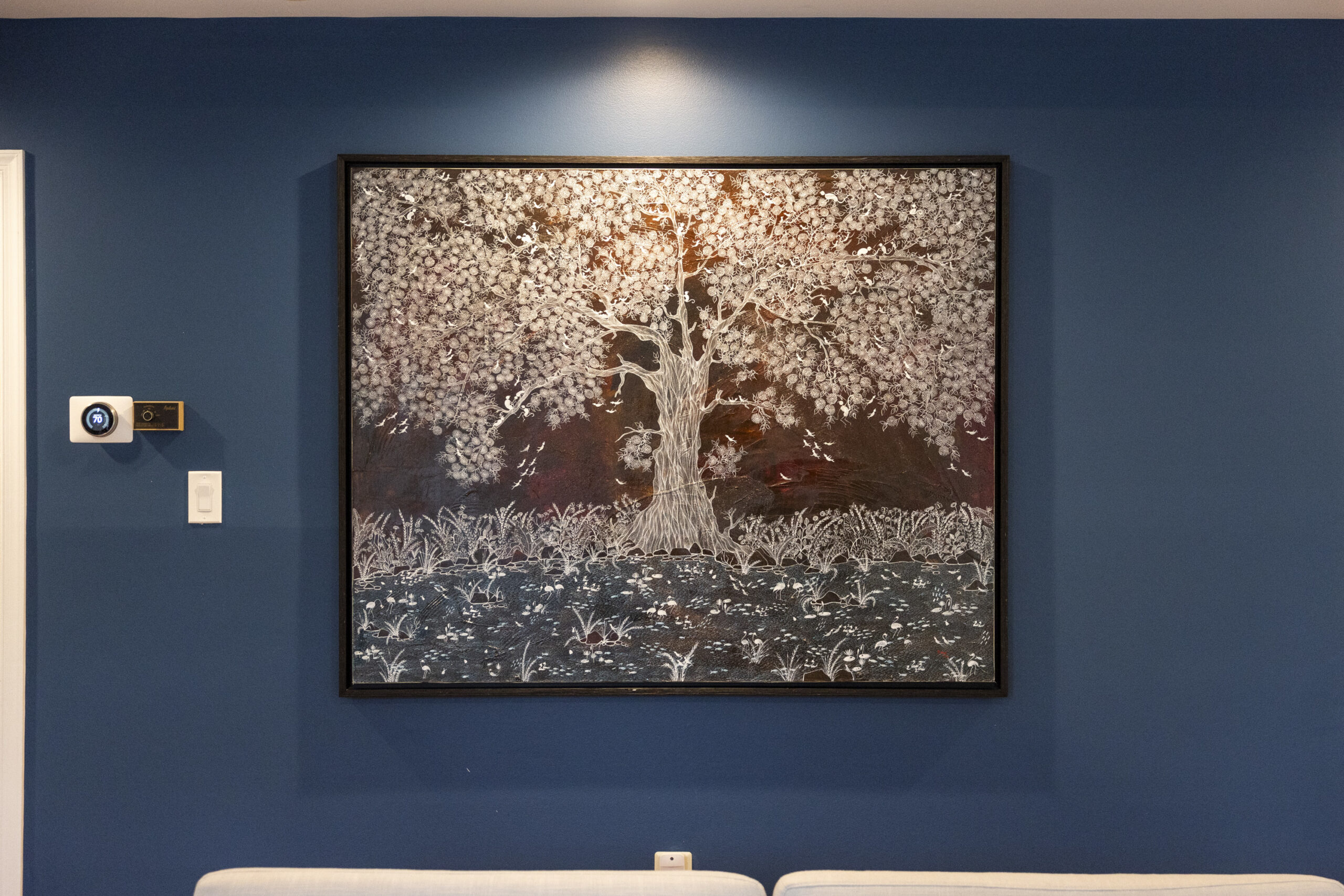
A painting called “Home” painted by Rinal Parikh, 43, displayed in the family room of her home in Media, Pa., on Tuesday, Dec. 23, 2025.
In her family room hangs “Home,” a 2021 Warli painting of a tree. The background is complex in both texture and color, with blues, browns, and purples peeking out. Hanging from the tree are monkeys, which Parikh said captures the energy of having two boys, now 17 and 12,in the house. (They’re very good kids, she clarifies.)
“I observe my surroundings, I experiment with styles, I do a lot of repetitive patterns, and I tell my story,” she said.
Since jumpstarting her art career, Parikh has become involved in the region’s growing art community. She’s the marketing chair for the Rittenhouse Square Fine Arts Show and is involved with the Community Arts Center of Wallingford.
She said she understands the anxieties of young artists and wants to support the organizations that nurture their careers.
“I was supported by the community, and I want to do the same thing.”
Parikh’s art can be found on her website and her Instagram page.
This suburban content is produced with support from the Leslie Miller and Richard Worley Foundation and The Lenfest Institute for Journalism. Editorial content is created independently of the project donors. Gifts to support The Inquirer’s high-impact journalism can be made at inquirer.com/donate. A list of Lenfest Institute donors can be found at lenfestinstitute.org/supporters.
When Jennifer Kinka was pregnant with her first child, she stood in the aisle of Babies R Us with a registry sheet, looking over the wall of plastic consumables the company deemed required for having a baby. What she saw was waste.
“I was just like, this is crazy that there’s no system for this,” Kinka said. “There’s no problem-solving around how this is happening and how we could do this better.”
After a few more years, her second pregnancy, and a small inheritance from the loss of her terminally ill parents, Kinka was able to implement her solution: The Nesting House, a kids’ consignment shop based in Mount Airy that she founded 15 years ago.
Shoppers across Philadelphia, including parents buying for their children, are increasingly forgoing new items in favor of secondhand and lightly used in an effort to save money and live more sustainably.
Chris Baeza, associate program director of Fashion Industry & Merchandising at Drexel University, asks her students each semester who shops in the secondhand market. While five years ago she might have had a single student raise a hand, now it’s nearly all of them.
The global secondhand apparel market grew by 15% in 2024, according to online consignment store ThredUp’s annual report, and it’s expected to continue growing each year. ThredUp estimates that the resale apparel market is growing 2.7 times faster than the overall apparel market.
For Abby Sewell, a South Philadelphia mom of two, secondhand clothing and furniture was a mainstay of her childhood, when she spent weekends trash picking and combing through yard sales to find reusable items. Her father is artist Leo Sewell, who built a replica of the Statue of Liberty’s arm and torch at the Please Touch Museum.
“I just know how much there is out in the world,” said Sewell, who also describes herself as an environmentalist. “There’s just so much kids clothes that it kills me to buy something new when I know there’s like 50 pairs of 2T leggings in someone’s basement.”
A dramatic shift toward secondhand not only coincided with the proliferation of social media but followed the 2013 Rana Plaza factory collapse in Dhaka, Bangladesh, that killed more than 1,000 people. People began to wonder how their clothing was being made, and the conditions laborers were under, Baeza said.
Used baby shoes on display at the Nesting House.
Next came the broader revelation of textile waste — pictures and video of clothing from the United States washing up on the shores of African countries — which plays into the interest in the secondhand market, she said.
“This was stuff that we just throw away, or we put in a drop box [thinking] it’s going to a good cause,” Baeza said. “They’re actually packing stuff up, and it’s a commodity they’re selling abroad.”
While Beaza teaches her students to scrutinize the marketing of sustainable fashion and to understand secondhand may not be the be-all-end-all of building circularity into the industry, she gets the sense they want to be part of what she describes as a renaissance period.
“They want to be part of the solution, not the problem,” Baeza said.
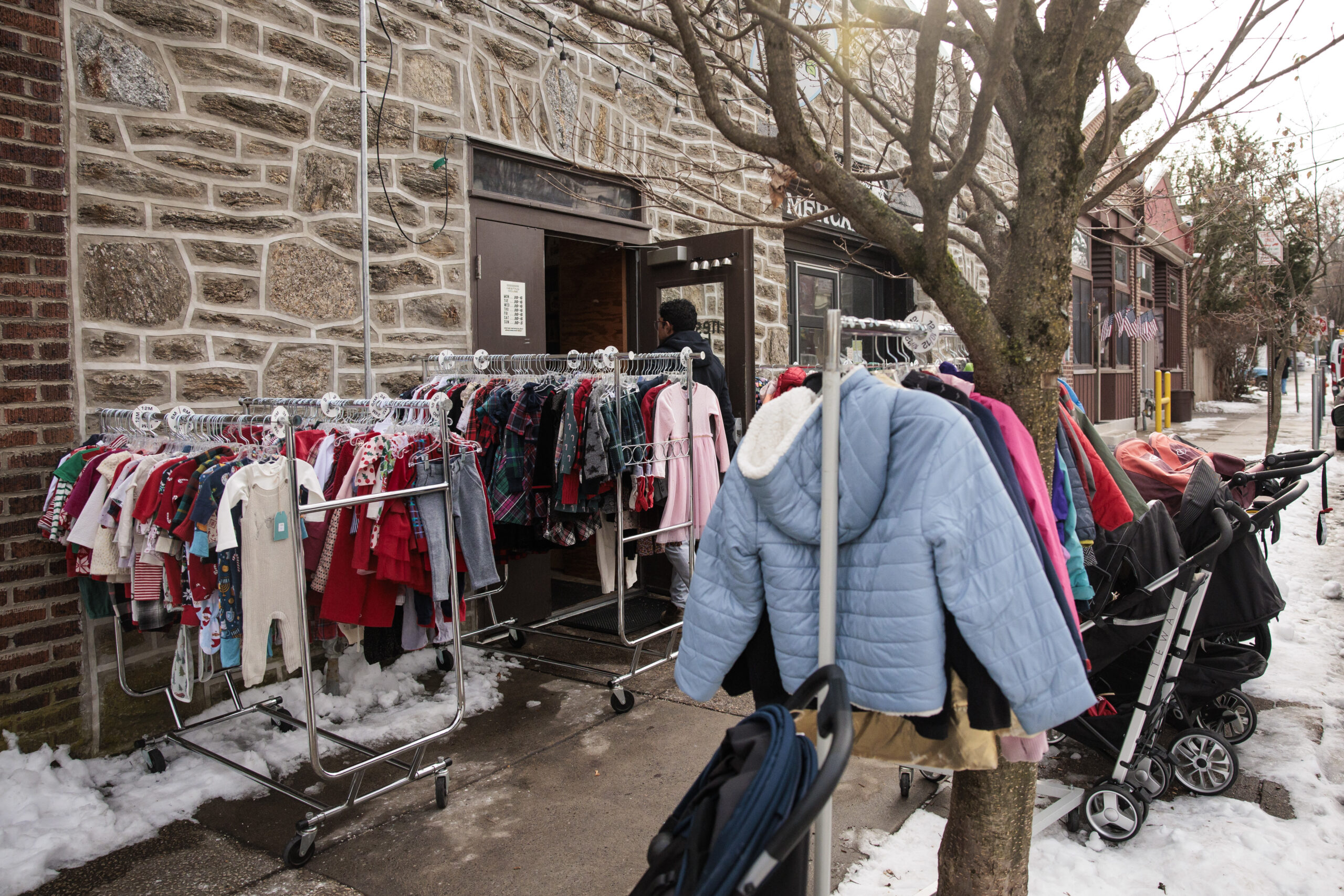
Childrens clothes on display outside the Nesting House.
Sewell prefers to shop thrift and consignment around her neighborhood and frequents stores like Lilypad and 2A. She also goes to annual church sales in the suburbs and uses eBay for more specific items — a specific kind of sleep sack that works for her 1-year-old or an item in a specific color or fabric for her 4-year-old.
“I’m still shocked to this day when I learn that other parents still are buying mostly new clothes for their children,” Sewell said. “I think I’m on a very different end of the spectrum, and I always have been as a consumer.”
Lilypad, which began as a play space on Broad Street, expanded to include a small thrift shop in its basement after the COVID-19 pandemic sidelined its twice-yearly City Kids consignment events. The nonprofit sells only donated items at its shop, now located in East Passyunk, to support charging an affordable annual membership to its play space.
Lilypad board member Maria Hughes said the number of people actively seeking out secondhand clothing for their kids, particularly babies, has increased exponentially over the last several years. The store sees more pregnant people, who don’t want to go through the process of building a registry. Hughes added that there are also more grandparents and grandparents-to-be shopping at Lilypad now.
“They’re not going to Marshalls and buying the things,” Hughes said. Instead they’re opting for pre-owned items “either at the directive of their children or because they believe now.”
Kinka said the early days of the Nesting House “felt like it was mission work.”
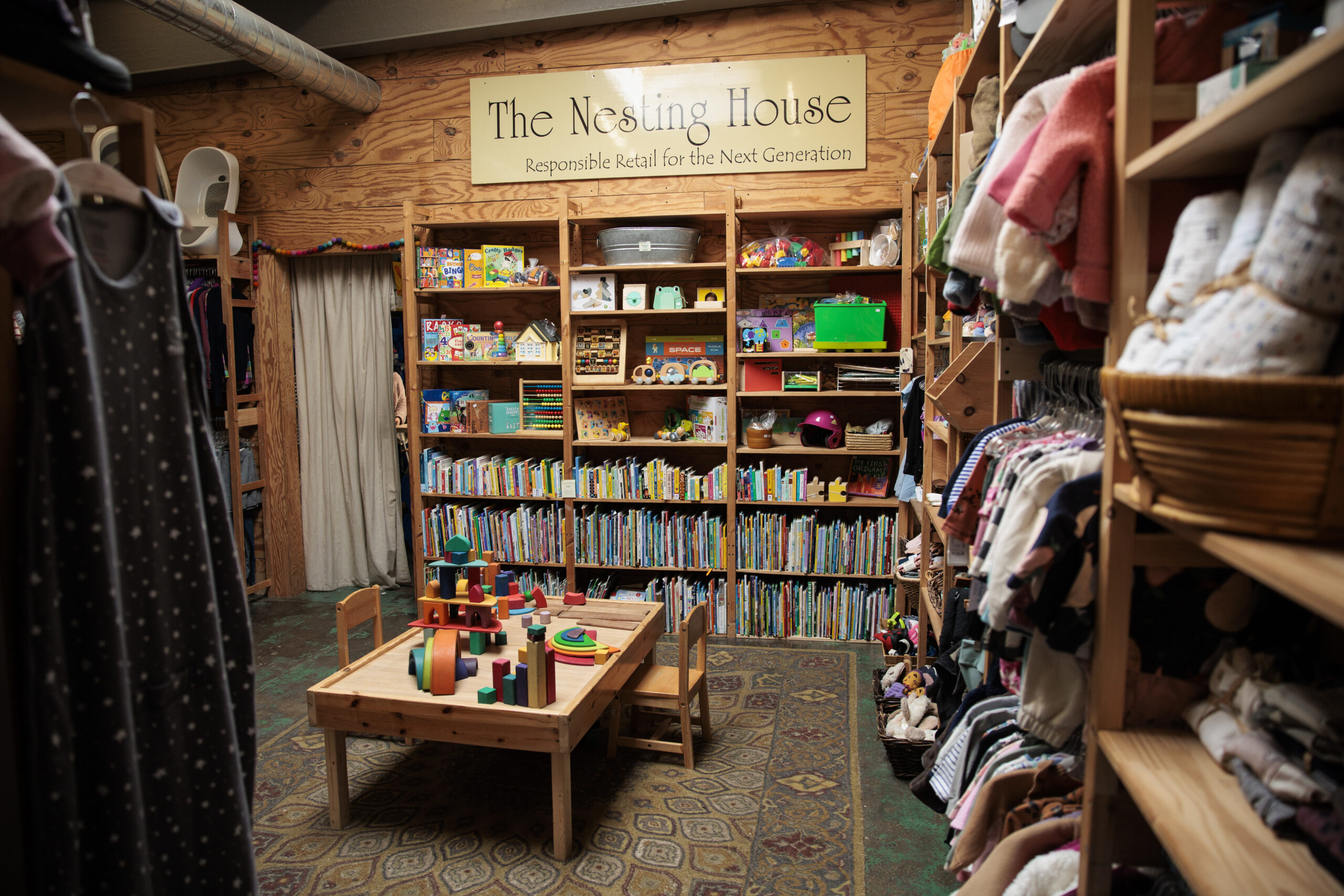
Used baby goods and books on display at the Nesting House.
“Nobody understood what we were doing,” Kinka said. “People would come in very confused. They would oftentimes refer to us as a thrift store.”
Eventually people saw the store as a sound economic choice: get high-quality children’s clothing at a great price. But she has seen “a huge shift” over the last five years.
“It’s this current generation,” Kinka said. They’re on board with the concept “before they come. They’re ready for us.”
Armed and unarmed guards who weren’t paid for some of their hours patrolling Philadelphia public housing developments and other buildings have filed class-action complaints against their former employer, Sovereign Security LLC, owner Richard D. Cottom, and manager Maurice Dupree.
The guards are seeking back pay for unpaid work, sick and vacation days, overtime violations, damages under state law, and the return of uniform deposits.
The guards, led by plaintiff Shirell Williams, say Sovereign violated the state Minimum Wage Act and Wage Payment Collection Law and breached employment contracts over four years, starting in late 2021. Williams worked for Sovereign at PHA and at the city-owned Philadelphia Gas Works, the Navy Yard business center, the Philadelphia Department of Human Services, and the former Delaware County Memorial Hospital.
Through their attorney, Center City labor lawyer Josh Dubinsky, the guards seek unpaid wages, damages, interest, and attorneys’ fees stemming from “systemic wage abuse” while working at Sovereign. They seek certification as a class including more than 100 current and former Sovereign staff.
Cottom, a former Drexel University security executive who founded Sovereign in 2004, and other Sovereign officials didn’t return calls seeking comment.
The lawsuit also named a Sovereign manager, Maurice Dupree, as codefendant. Guards have described Dupree as their off-site supervisor, who managed assignments, hired and fired, and scheduled their work, and who they turned to for help when paychecks were late or bounced.
Pennsylvania’s wage and hour law requires companies to set regular paydays and meet them. Sovereign’s contract with PHA required it to comply with city rules and applicable laws.
PHA renewed Sovereign’s contract last spring even after The Inquirer reported on late and bounced Sovereign paychecks.
The housing authority canceled Sovereign’s contract on July 9, giving owner Cottom two days to stop work and file final reports.
The official cancellation letter stated only that PHA and its property management unit had determined “that it is in the best interest” of the agencies to terminate Sovereign.
Correspondence collected under an Inquirer Right to Know request also shows PHA had warned Cottom that “it has come to the attention” of PHA that Sovereign “may be delinquent in paying its employees in a timely manner,” that late payment was “a breach of the contract,” and that it is “imperative” to ensure guards are paid and show up.
That letter was dated Jan. 27, 12 days after The Inquirer first reported on the late payments.
Sovereign had held the largest of at least three outside security guard contracts at PHA, which also has its own police department and a staff security force. PHA has paid Sovereign more than $7 million since 2021.
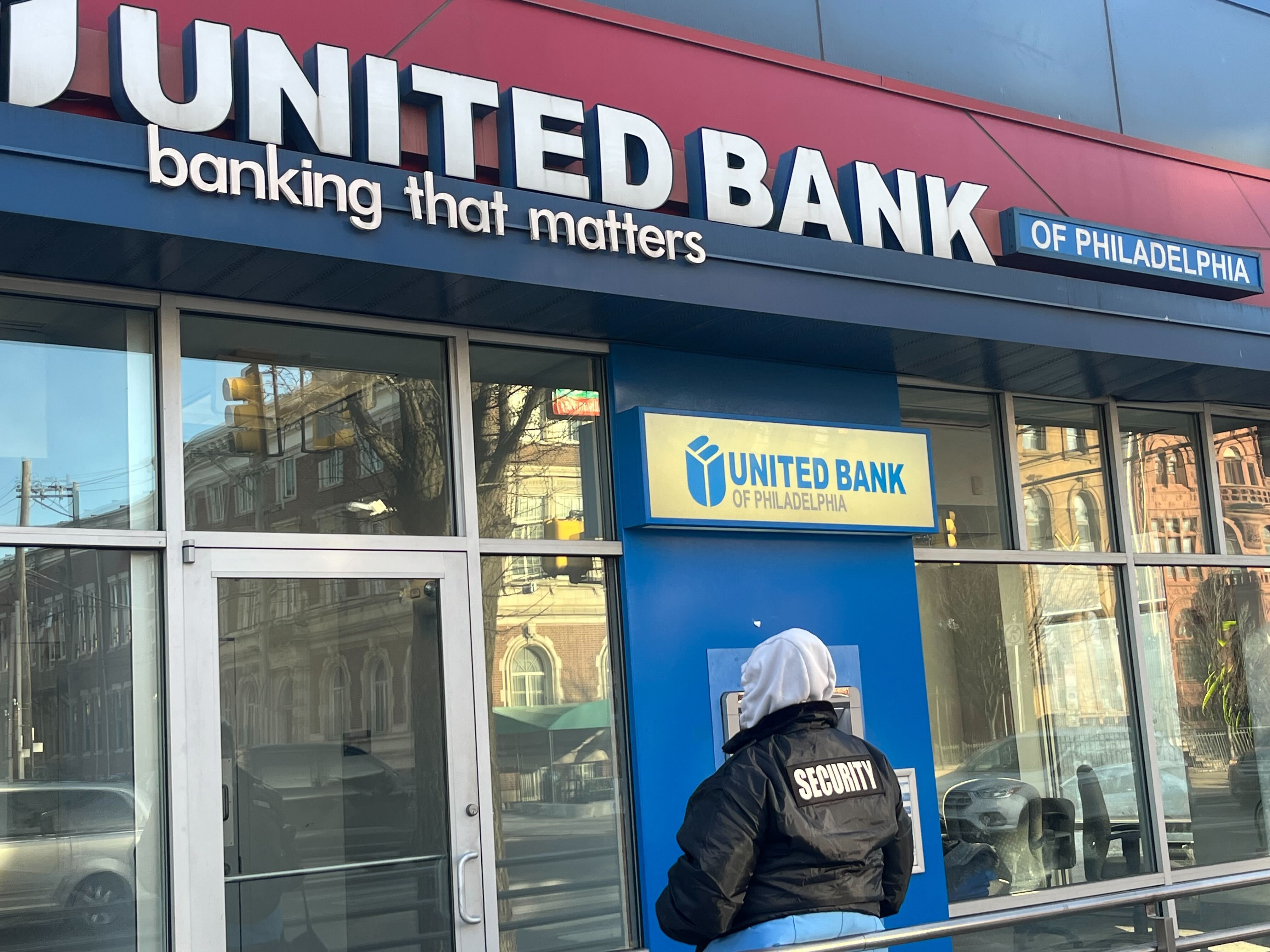
Tahazha Woodard, a guard at a jointly operated PHA and School District site in North Philadelphia, was the first in a stream of Sovereign Security LLC employees who tried to cash delayed Sovereign paychecks on Jan. 10. United was one of the few Philadelphia institutions willing to cash Sovereign checks at that time, after incidents when the company left its accounts underfunded and paychecks bounced, according to guards.
PGW ended its agreement with Sovereign in 2023. As of last summer, Sovereign no longer worked at the Navy Yard either.
The guards in the suit say a trial would show whether Sovereign had a “pattern or practice” of shorting their pay, failing to pay overtime, and not refunding uniform deposits. Other issues are whether Sovereign violated state wage laws and failed to keep required time and pay records, and the damages they are owed.
Williams, the lead plaintiff, was paid $14.40 an hour when she started in 2022.
Besides back pay,the suit also seeks to collect $500 or 25% of wages due for each violation, plus attorneys’ fees, under provisions of state law.
Pennsylvania’s fledgling State Board of Higher Education on Thursday rolled out itsfirst strategic plan, setting goals addressing affordability, increased degree attainment, the state’s workforce and economic development needs, and the fiscal health of colleges.
The board voted unanimously to post the 10-year plan for public comment.It will consider adoption in February.
“The plan will strengthen partnerships, break down silos, and enable effective reinvestment in the sector,” Cynthia Shapira, chair of the board, said in a statement introducing the plan.
It comes as the sector faces perhaps its greatest challenge in decades. Both private and public universities have been losing enrollment as the number of high school graduates falls — with another dip beginning next year and a 12% decline expected in Pennsylvania by 2037. Public trust in colleges has faltered, while concerns about cost and student debt have mounted.
They are also facing scrutiny from President Donald Trump’s administrationand a forecasted gap in workers who require a postsecondary credential in essential areas, such as healthcare, teaching, and advanced manufacturing.
The Pennsylvania State System of Higher Education, which oversees the state’s 10 universities, endorsed the plan’s emphasis on collaboration across private and public colleges and universities.
“Within our own system, we have learned that when universities work together, they can innovate, overcome challenges and better serve students and the Commonwealth,” the system said in a statement. Shapira is also the chair of PASSHE’s board.
The 21-member higher education board includes college presidents, administrators, legislators, and students.It was formed in 2024 by the governor and General Assembly to help public and private colleges work more cohesively and better serve students and the state’s workforce needs. The plan rollout follows public hearings that drew comments from more than 1,200 people, the board said.
The plan outlines the challenges facing the higher education sector including another coming decline in the high school population, financial constraints, and the lack of coordination among institutions. Student debt averages more than $40,000 per student in Pennsylvania, the plan notes.
“Multiple comparative state-level analyses … place Pennsylvania at or near the bottom in terms of affordability, attainment, and state investment per capita,” the report stated. “Adding to these challenges are a large and growing postsecondary workforce credential gap, and a range of closures and mergers that threaten to reduce access to postsecondary education.”
In the Philadelphia region, Cabrini University and the University of the Arts closed in 2024 and Rosemont College announced earlier this year that it would cease operations in 2028 and that Villanova University would purchase its campus. Salus University was merged into Drexel University. Six of Pennsylvania’s state universities were merged into two entities in 2022, and St. Joseph’s University absorbed the University of the Sciences the same year.
Other local colleges have struggled with enrollment declines and deficits. Temple University, for example, has gone from more than 40,000 students in 2017 to less than 30,000 this year.
What are the specific goals in the plan?
The new plan set six goals:
Increase postsecondary attainment.
Ensure affordable pathways to postsecondary credentials.
Support the economic development needs of the state.
Support the workforce development needs of the state.
Ensure accountability and efficient use of state funds.
Strengthen the fiscal health and stability of the higher education sector.
How will the board work toward those goals?
To meet the goals, the board proposes a “strategic communications plan” that touts the benefits of postsecondary education and how it impacts employment outcomes.
It also emphasizes expanding funding for dual credit programs and enrollment in those programs to streamline the path from high school to college and allow students to accumulate more credits before they graduate high school. In addition, the plan proposes studying how to improve retention rates and focusing on reenrolling adults who started college but didn’t finish; there are more than 1.1 million Pennsylvanians with some college experience.
Among its plans for addressing affordability are support of policies that “expand financial aid and forgive debt for in-demand, high-quality credentials,” take advantage of new federal Pell grants for workforce programs, and boost access to “open educational resources” to reduce the cost of course materials.
The report also discusses the intent to “maximize the impact of research universities,” recruit out-of-state students to broaden the talent pool, and increase access to paid work experiences for students.
To promote fiscal health, the plan recommends identifying and promoting best practices for fiscal efficiency and cost savings, and developing resources and an advisory group to help financially struggling colleges.
“If institutions decide to close or merge, tools and expertise to assist in this process will help maximize savings, retain access to critical academic programming, and mitigate negative effects on students and communities,” the plan states.
Another advisory group is recommended to help communities where colleges close maintain access to postsecondary education.
What comes next?
After the public comment period and the plan’s final adoption, the board intends to report annually on progress toward the goals and to consider revisions to the plan every five years.
President Donald Trump announced he would advise federal agencies to reschedule marijuana from a Schedule I controlled substance to Schedule III, easing federal restrictions on the plant.
Trump announced the executive order Thursday in the Oval Office, alongside Health and Human Services Secretary Robert F. Kennedy Jr. and a line of medical workers in white coats and scrubs. The president does not have the direct authority to reschedule marijuana but can request his federal agencies to do so.
Jeff Hodgson smokes a pre-roll at his home in Cape May, NJ on Thursday, May 2, 2024. Hodgson mostly uses medical marijuana to help him sleep.
Marijuana has been a Schedule I controlled substance since the 1970 Controlled Substances Act, meaning the federal government considers marijuana to have no accepted medical use, with a high risk of abuse. Schedule I drugs, such as heroin, cocaine, and LSD, are illegal and strictly regulated, making medical research on these drugs, including cannabis, nearly impossible.
A reclassification would be the most significant reform on marijuana in more than half a century, opening the doors for medical research. But it would not be full legalization, said Adam Smith, executive director of the Marijuana Policy Project. It could also pave the way to federal intervention in the state-run medical and recreational marijuana industries, something stakeholders fear.
“There is a possibility that in moving cannabis to Schedule III, instead of opening up access, what it will do is incentivize federal agencies to clamp down control on the availability of cannabis,” Smith said. “Treating it as other Schedule III substances, which virtually all require prescriptions, is not how this works in medical cannabis and could really create chaos and a lot of economic pain in the industry.”
Frank Burkhauser of Woodbury displays the legal marijuana purchase that he just made at Cannabist in Deptford, N.J. on April 21, 2022. Burkhauser said he has been working for the legalization of marijuana since the early 90’s.
Smith said stakeholders are unsure what this might mean for the wider industry but remain optimistic, as rescheduling of marijuana has been a priority for decades.
This executive order has plenty of positives, said Joshua Horn, a Philadelphia cannabis lawyer at Fox Rothschild. Loosening restrictions could clear the way for the IRS to allow cannabis businesses to deduct business expenses (which they currently cannot do). Additionally, more traditional banking options might become available to entrepreneurs.
“It could also rectify the criminal injustice that has been ongoing since the passage of the Controlled Substances Act, where people of color have been disproportionately impacted by the ‘war on drugs,’” Horn said. “In the end, rescheduling should reinvigorate these businesses out of their current tax and financial struggles.”
This federal rescheduling of marijuana would come on the heels of Congress’ banning all intoxicating hemp products, which are derived from cannabis plants. While this may seem like a policy flip-flop, Smith said, these are two different issues at hand.
Hemp products photographed at the Philadelphia Inquirer, November 21, 2025.
“The hemp ban is the result of the fact that the market was chaotic and, in many cases, unsafe. Without regulation, that market was rife with pesticides, heavy metals, and products that should not be on shelves,” Smith said.
But he contends there is a movement to push back against wider marijuana legalization. “There’s always pushback when there’s big change,” Smith said. “But also because of the instability created when we have state-regulated markets operating in a federally illegal area.”
Industry folks are hoping this move better aligns the federal government and state markets, opens the doors to research, and provides better clarity to states that are hesitant to legalize marijuana, Smith said.
In this July 19, 2019, file photo, Pierce Prozy examines a Yolo! brand vape oil cartridge marketed as a CBD product at Flora Research Laboratories in Grants Pass, Ore.
Reducing restrictions on commercially available cannabis is “a key missing ingredient toward making clinical breakthroughs,” said Stephen Lankenau, director of Drexel University’s Medical Cannabis Research Center.
“A key issue is that any reclassification efforts need to reduce restrictions for university-based researchers to have access to cannabis-derived THC — commercially available products in particular — for clinical studies, whether laboratory or human subjects,” Lankenau said.
Researchers now are only able to examine hemp-derived nonpsychoactive cannabinoids like CBD or CBC. However, Lankenau said, it is unclear whether Trump’s proposal would give them the green light.