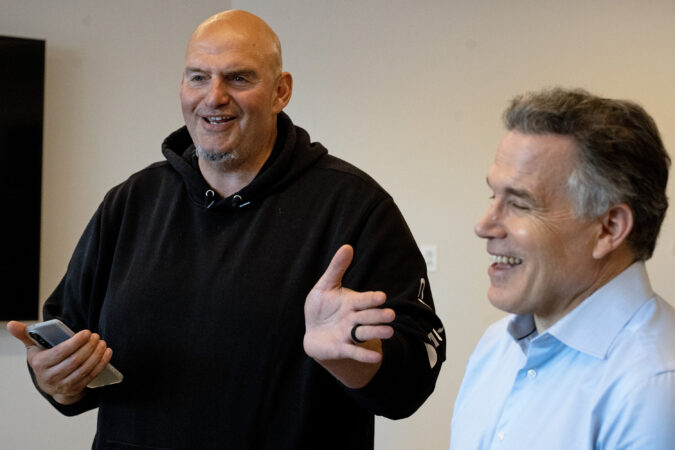
In a rare move, Pennsylvania’s two senators have created a joint fundraising committeethat would allow them to split money from donors who want to give to both of their campaigns, despite being members of different parities.
As polls have shown him losing support among Democratic voters, he has also reported raising significantly fewer campaign funds on his own and has not said if he will run for a second term in 2028.
Common Ground PA, which filedpaperwork with the Federal Election CommissionMonday, lists four beneficiaries for the joint fund: Fetterman for PA; Friends of Dave McCormick; Every Vote PAC, which lists Fetterman as the PAC sponsor; and Pennsylvania Honor, which lists McCormick as the leadership PAC sponsor.
A joint fundraising committee, first enabled by the FEC in 1977, allows two or more candidates, PACs, or party committees to coordinate fundraising efforts to share donations and expenses.
A donor can abide by federal contribution limits while still giving one check that can be allocated to multiple campaigns. But since these groups typically involve party committees, it’s rare for these joint ventures to be bipartisan.
Mike DeVanney, a spokesperson for McCormick’s campaign, called the PAC a donor-driven effort.
“This group of donors value the collaboration exhibited by Senators McCormick and Fetterman for Pennsylvania and want to support both of them,” he said in a statement.
The joint fundraising committee was first reported by Politico.
The two senators have spoken often about their cross-aisle friendship since McCormick took office in 2025, and they have repeatedly teamed up in recent months.
They appeared alongside each other last week in Philadelphia to promote Trump Accounts, the new federally backed savings accounts for kids that became law with President Donald Trump’s signature One Big Beautiful Bill Act.
Fetterman has routinely criticized his own party, feuding with progressives on a range of issues, including Israel and immigration enforcement.
In a fundraising email sent in May, McCormick referred to Fetterman as one of his “closest working partners,” a realization that he said surprised even him.
In that drive, which asked donors to support his efforts to “work across the aisle to get results for the people of Pennsylvania,” McCormick praised his Democratic colleague.
“Senator John Fetterman and I couldn’t look more different. We don’t agree on everything. But we both grew up in Pennsylvania. We both know what it means to fight for working families who feel like Washington forgot them. And we both refuse to let politics get in the way of getting things done,” he wrote.
McCormick told reporters in May his friendship with Fetterman is the most frequent topic of conversation he hears, and he gets positive feedback from it.
“We look for ways to work together. I think people want that,” he said.
Individuals could donate to Fetterman or McCormick separately. But joint fundraising committees, which are used widely by both parties, pull in large checks from donors and split the money across multiple committees using a formula that adheres to federal contribution limits, according to an analysis from the watchdog group OpenSecrets.
Typically, though, campaigns joint fundraise with their party.
Common Ground PA is among the few coordinated efforts across the aisle. A former PAC, the Problem Solvers Patriots, fundraised for members of both parties in previous election cycles.
Former U.S. Rep. Conor Lamb, who lost the Senate primary to Fetterman in 2022 and has not ruled out a run in 2028, blasted the move online as “Another betrayal from Fetterman.”
U.S. Rep. Chris Deluzio, a Western Pennsylvania who has received “a lot of encouragement” to run for Fetterman’s seat, also questioned the creation of the PAC.
“Helping the Republicans raise money to spend against Democrats is bad, right?” Deluzio said on X.
However, Fetterman has been notching strong approval from Republicans, and Pennsylvania Republicans along with Trump himself said he could receive GOP support if he switched parties.
Fetterman’s Republican support has also been growing at the bank with contributions from prominent GOP donors, particularly through his other joint fundraising committee and leadership PAC. At the same time, his fundraising has plummeted overall, raising less than half his previous annual totals in 2025.
Staff writers Gillian McGoldrick and Sam Janesch contributed to this story.
The Justice Department sent a letter this week threatening criminal charges against Pennsylvania’s top election officials if they allow votes by noncitizens to be counted in forthcoming elections — a largely nonexistent phenomenon that is already prohibited by law.
The letter, addressed to Pennsylvania Secretary of State Al Schmidt and obtained by The Inquirer, was part of a nationwide effort by the Justice Department to say it is cracking down on what President Donald Trump has inaccurately described as a variety of problems with how ballots are cast and counted across the country. Similar letters were sent to election officials in all 50 states this week, the Justice Department said in a statement.
An agency spokesperson said the letters were “asking for voluntary compliance in a timely manner with [officials’] obligations under federal law to ensure only citizens vote in federal elections.”
The outreach came after Trump’s administration, during his second term, took other steps to target states’ election practices or voter rolls.
A spokesperson for the Pennsylvania Department of State said in a statement that the state “is in compliance with federal and state election law.”
“We will continue our nonpartisan work to ensure elections in the commonwealth remain free, fair, safe, and secure,” said Geoff Morrow, the department’s deputy communications director.
Last month, a federal judge in Pittsburgh dismissed a Justice Department lawsuit that sought to obtain Pennsylvania’s entire unredacted voter database. Federal judges have rejected similar efforts by the Trump administration in at least 10 other states, although the Justice Department recently filed an appeal of the decision in Pennsylvania.
The FBI, meanwhile, is reportedly assisting with a sweeping investigation into alleged irregularities in the 2020 election in Fulton County, Ga. — a key jurisdiction that contributed to Trump’s loss in that year’s presidential contest.
Trump has repeatedly refused to acknowledge his defeat to Joe Biden that year, and he has long fueled evidence-free conspiracy theories about widespread and brazen fraud in elections, particularly in jurisdictions that tend to vote for his opponents. Experts generally agree that although voter fraud does happen, it has not historically occurred at rates that would tip the scales in high-profile contests.
The effort also comes as Trump has been again pressuring congressional Republicans to pass the so-called SAVE America Act, a controversial bill that could require voters to provide proof of citizenship when registering or to show approved forms of identification when voting. Prior efforts to pass the bill into law have failed amid bipartisan resistance.
As for the subject of the Justice Department’s most recent letter — which was signed by Assistant Attorney General Harmeet K. Dhillon — noncitizens are already barred from voting in federal and state elections under a law passed by Congress 30 years ago.
Studies in a variety of states since then have found some instances of noncitizens being registered to vote or voting, but almost no evidence that the issue is widespread or common. In Utah, for example, officials said earlier this year that they had reviewed records of the state’s more than 2 million voters and found one person who was confirmed as a noncitizen.
And in 2024, the director of U.S. Citizenship and Immigration Services wrote in a letter to Ohio’s secretary of state that “it is extremely uncommon for noncitizens to vote in Federal elections,” and that many of those who do are identified by authorities and prosecuted.
Dhillon, in her letter, acknowledged that noncitizen voting is already illegal. But she nonetheless listed several provisions under which election officials could be criminally charged if it occurred.
And she said Schmidt should reply within five days to describe “how the state of Pennsylvania intends to ensure it is complying with these federal laws,”a deadline the Pennsylvania Department of State said it intends to meet.
Schmidt, a Republican who was chosen by Democratic Gov. Josh Shapiro to serve as the state’s top election official, has been at the forefront of addressing noncitizen voting dating back to his time as a Philadelphia city commissioner.
In 2017, when he worked for the city, Schmidt discovered that the Pennsylvania Department of Transportation’s so-called motor voter system, which allows eligible citizens to register to vote when they get or renew a driver’s license, had a glitch dating back to the 1990s and was allowing legal residents who were noncitizens to register to vote, too.
Schmidt found that the glitch had allowed at least 168 noncitizens in Philadelphiato register to vote. And he found that an additional 52 noncitizens in the cityhad registered by other means.
Collectively, that group of people cast a total of more than 225 ballots in Philadelphiaduring the years they were registered, Schmidt’s office reported at the time. Schmidt said it was critical to rectify the issue, and all of the improper registrations were canceled. PennDot fixed the glitch in 2017.
Still, the largest number of votes cast by noncitizens in the city during the affected time period occurred in the 2008 general election, when 47 such people submitted ballots — representing about .0065% of the city’s vote tally that year.
“One thing that became very clear through that research and all evidence suggests that noncitizens voting in elections in the United States occurs very rarely,” Schmidt told Votebeat earlier this year. “It doesn’t mean that it’s not important. Like I said before, every vote is precious, and we want to make sure that we do everything we can to safeguard and strengthen election integrity. But there’s no evidence to suggest that it happens in any widespread way whatsoever.”
Lauren Cristella, president of the Committee of Seventy, a Philadelphia-based nonprofit that advocates for good governance, said the Justice Department’s letter “represents another attempt to undermine faith in our elections without presenting any evidence or even allegations of wrongdoing.”
The country’s elections have routinely been shown to have been conducted freely and fairly, Cristella said. And in Pennsylvania, she said, Schmidt has been “the person who’s been leading the charge to clean up our voter rolls.”
State Auditor General Tim DeFoor, a Republican, found in an audit released earlier this year that the reforms made to the motor voter system after Schmidt’s exposures of PennDot’s systemic failures had been largely successful.
The Justice Department’s effort to threaten election officials not only clouds that reality, Cristella said, but it “completely lacks integrity and is part of the distrust that is leading to the erosion of our democracy.”
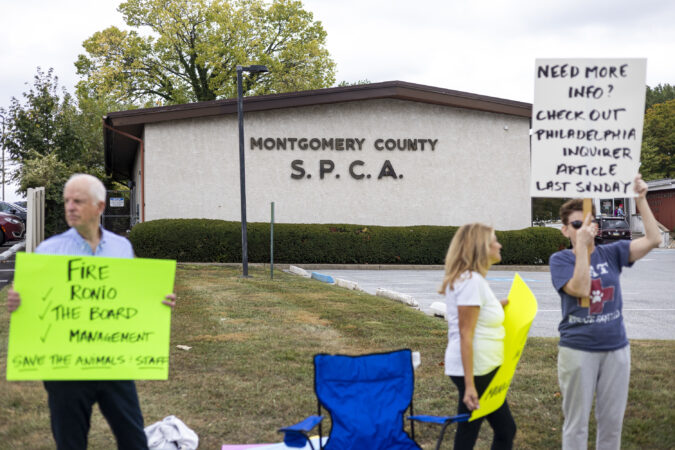
A nearly two-year probe led by the Pennsylvania Attorney General’s Office found the Montgomery County SPCA violated state nonprofit laws, euthanized animals unnecessarily, and failed to use its $67 million in charitable assets to maintain healthy animal shelters, officials announced Wednesday.
The probe began in October 2024, weeks after an Inquirer investigation revealed signs of mismanagement, hazardous conditions, and animal mistreatment at the state’s wealthiest animal shelter.
Attorney General Dave Sunday said his office reached a settlement requiring the nonprofit to replace its board of directors, hire new executive management, bring facilities up to code, and revise old bylaws. The shelter also must pay $21,040 in fines as part of the settlement.
The Montco SPCA said many of the terms of the settlement agreement were either well underway or completed as of Wednesday. The organization touted in a statement its “extraordinary progress” over the last two years, including a $26 million commitment to facility upgrades and an improved save rate for animals.
Following The Inquirer’s reporting on shelter operations, and outcry from animal welfare advocates, some donors pulled the Montco SPCA from their wills, amid concerns that the funds were being misused at the century-old institution.
The Inquirer found squalid kennel conditions, inadequate foster programming, and undertrained staff. The Montco SPCA’s wealth dwarfed that of most animal shelters in the region, yet it spent comparatively little on operations. At the time, it also saved the fewest number of animals among regional shelters, euthanizing nearly one in five that entered the main branch in Conshohocken.
The local SPCA leaders responded with a complete overhaul of operations, beginning with the ouster of its executive director, who had run the shelter for more than 50 years.
The shelter also replaced most members of its longtime board of directors, named a new executive director, improved training for staff, and invested heavily in shelter infrastructure. Plans are underway to build a new shelter.
It is a stark change from just two years ago, when the cash-rich shelter hoarded millions in investment accounts as complaints piled up.
Between 2021 and 2024, the attorney general’s probe found, the board of directors “failed to exercise due diligence and reasonable care” that resulted in multiple violations of Pennsylvania laws governing nonprofits and trade practices, according to the settlement agreement.
The agreement cited “potentially undue and precipitous euthanization of animals,” as well as mistreatment of pets, unsafe conditions, and “undue” stockpiling of charitable funds.
Sunday said that over the four years examined by his office, the Montco SPCA failed donors by spending an insufficient amount to advance the shelter’s mission.
“Pennsylvanians who donate to charities should be able to trust that their money is being used to support an organization’s mission,” Sunday said in a statement. “This settlement holds the Montgomery County SPCA accountable, puts important safeguards in place, and serves as a reminder to other charitable organizations that they will be expected to fulfill their mission and comply with the law.”
Shelter officials said the reforms are ongoing. The Montco SPCA expects to invest $25 million to build a new veterinary clinic and adoption facility in Blue Bell, where the nonprofit purchased a building for $5 million in September, according to a spokesperson. Estimated grand opening: 2027.
Meanwhile, the SPCA’s Conshohocken and Perkiomenville locations remain open for business, while its Abington branch plans to reopen in the fall after a $500,000 renovation.
“The resolution reflects both the substantial progress we have made, and a shared commitment to continue building a stronger, more sustainable organization for the future,” the nonprofit’s statement said.
Philadelphia-area drivers can now fill up their tanks with less-expensive gasoline promoted by President Donald Trump’s administration, but details on the entire enterprise remain scarce.
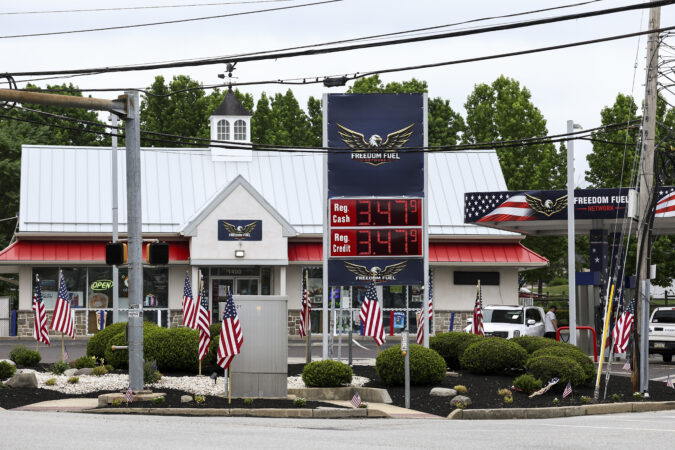
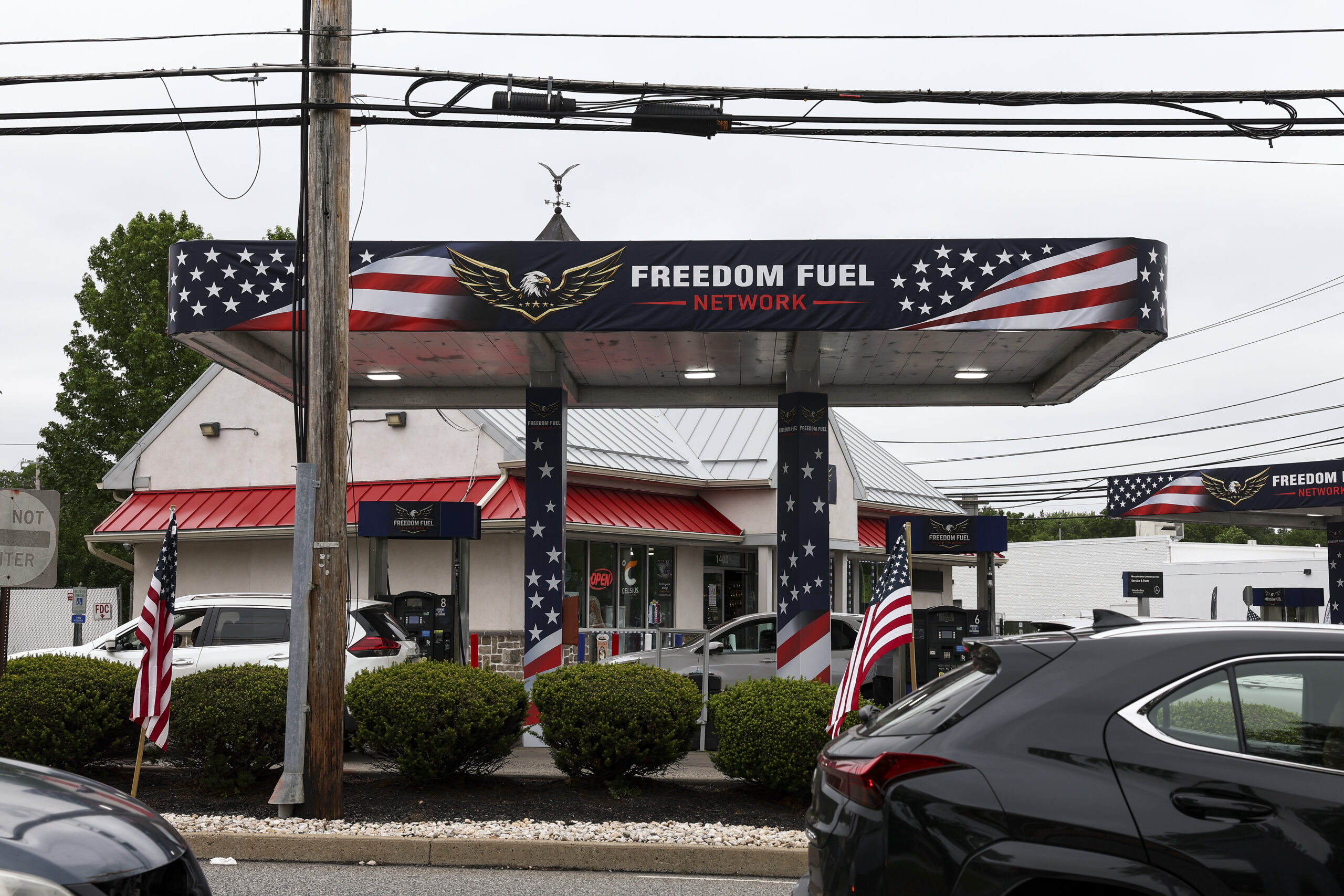
The White House on Tuesday announced the opening of the first Freedom Fuel gas station in Upper Dublin Township, at a former Sunoco station.
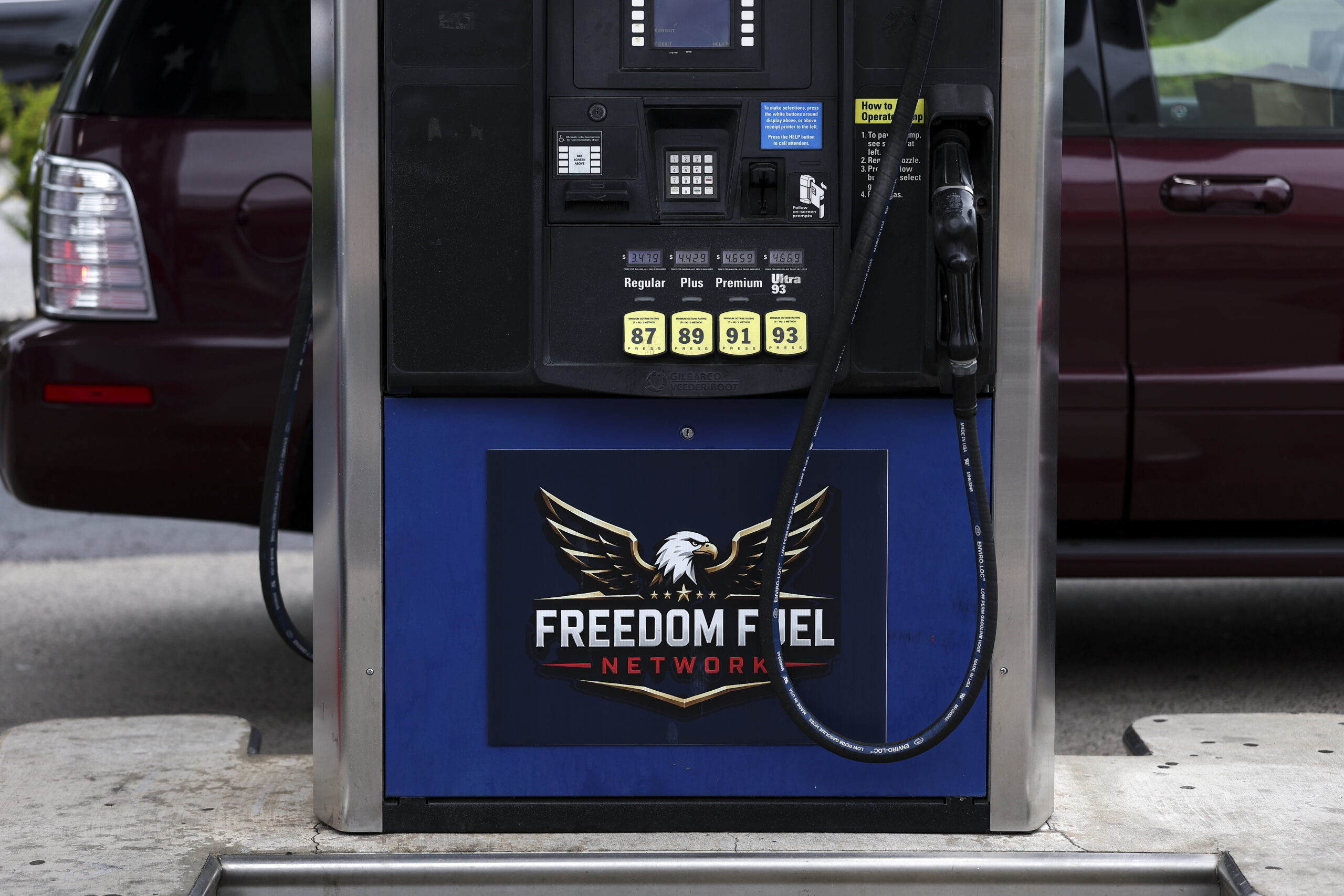
In the undated video, drivers happily filled their tanks for $3.47 a gallon, which the White House said was to honor “our 47th President.” That’s cheaper than the least-expensive gas at nearby stations, according to prices posted by GasBuddy.
The Freedom Fuel station in Dresher is near a McDonald’s and across the street from a shopping plaza. But what sets it apart from other nearby gas stations is the assortment of American flags planted across its footprint — and the cheaper gas.
While a nearby Citgo station, about five minutes away, prices regular gas at $3.79 a gallon, and a Gulf offers it at $3.85, Freedom Fuel offers it at $3.47 a gallon.
For many patrons stopping by Tuesday afternoon, the branding was new — and secondary to savings.
The Freedom Fuel Network gas station at 1400 Dreshertown Road in Dresher.
Jessiah Brice, 25, said the Freedom Fuel station was convenient because it is near her job. She had noticed the new branding after the July Fourth holiday and had no idea what it was about, but she welcomed the idea regardless of the affiliation with Trump.
“Gas should be cheaper,” she said. “My only issue is: How is it $3.47 here and $5 by me?”
Another gas buyer, who declined to give her name out of privacy concerns, said she had heard of Trump’s efforts to bring cheaper gas to people but had not connected it to her local gas station.
“What’s not to love?” said another patron, before driving away with a full tank.
Seyer Hamidi, 36, stumbled upon the station after picking up his car, which he likes to fill up with premium gas, from the mechanic. He, too, welcomed the idea.
“Gas is going to be high whether you’re a Republican or Democrat,” the Republican said, noting the cheaper gas was a step in the right direction.
A lot remains unclear, including the names of the participating businesses and how they are able to sell gasoline cheaper than nearby competitors.
A White House spokesperson confirmed that a website for the Freedom Fuel Network, which showed 25 locations across the Philadelphia region and South Jersey, was accurate. The White House did not confirm that all 25 locations are open and did not provide information about the company.
The list includes stations in Elmwood Park, Bustleton, and Hunting Park, but it was unclear if every location on the Freedom Fuel website was open.
A White House spokesperson said the Freedom Fuel Network was a private company and not a government program, adding that the company was not purchasing gasoline at a discount and that the administration has not provided funding. The spokesperson said the business was simply making gas more affordable for drivers in Pennsylvania and New Jersey but did not elaborate.
The company behind the Freedom Fuel Network did not respond to a request for comment.
The fuel pumps at the Freedom Fuel Network gas station at 1400 Dreshertown Road in Dresher.
Beyond that, not much information was available beyond the White House social media post and a statement made by Trump, who wrote on his Truth Social account last week that a “very smart retailer” located throughout the Northeast was “stepping up” to offer a discount at the pump.
Patrick De Haan, head of petroleum analysis at GasBuddy, crunched the numbers and said there was no profitable way for Freedom Fuel stations to sell gas so cheaply.
“Stations selling at this price, it’s not sustainable,” De Haan said. “Generally, when losses happen, somebody’s got to pay for it.”
De Haan had no insight on who owns the stations or what deals they might have made to purchase gas, but did confirm many of the stations exist in GasBuddy’s database, though the names were “vastly different.”
Gas prices have been dropping in recent weeks after peaking in May. Prices soared after the United States attacked Iran and the Strait of Hormuz — a key shipping lane — was shut down.
The average cost of a gallon of gas in Philadelphia on Tuesday was $3.95, according to AAA. That was up nearly 20% from this time last year, when the cost of a gallon of gas averaged $3.31.
While some Facebook users understood the expected over 100 degree weather could put people at risk, others felt strongly about the lack of celebration.
“What a disappointment for not only those of us who had hoped to watch, but also for the bands and other marchers who have come from all across the U.S.” one user commented. ”I get it — no one wants the liability. But are we just going to cancel everything?”
Another added, “It’s the 250th in the Birthplace of Freedom, and we’re just canceling parades because it’s warm,” leaving people to argue and point out that it wasn’t simply a warm day in Philadelphia, but a dangerous heat advisory.
Friday’s high is expected to break records in Philadelphia, with the anticipated minimum high of 104 last met in 1966 — when the nation was a mere 190 years old.
Experts say this is different and riskier than warm days in past Julys.
Over the past 85 years, Julys in Philadelphia are running on average 4.4 degrees warmer than in 1940, based on an analysis of historical weather data. That translates to an increase of about 0.52 degrees per decade.
The city on Tuesday declared a “heat health emergency” in effect from 1 p.m. Wednesday through 8 p.m. Saturday. Across the Northeast, outdoor events are being rescheduled or canceled, citing the heat. Those events range from other America 250 events to local farmers’ markets.
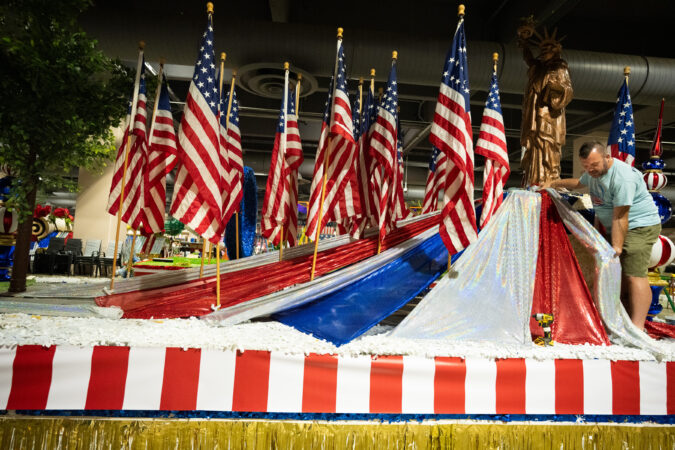
Friday’s parade would have featured elaborate, giant floats paying tribute to America, including larger-than-life recreations of Martin Luther King Jr. and Harriet Tubman, a peace dove, and a Liberty Bell.
Inquirer staff writer Anthony R. Wood contributed to this report.
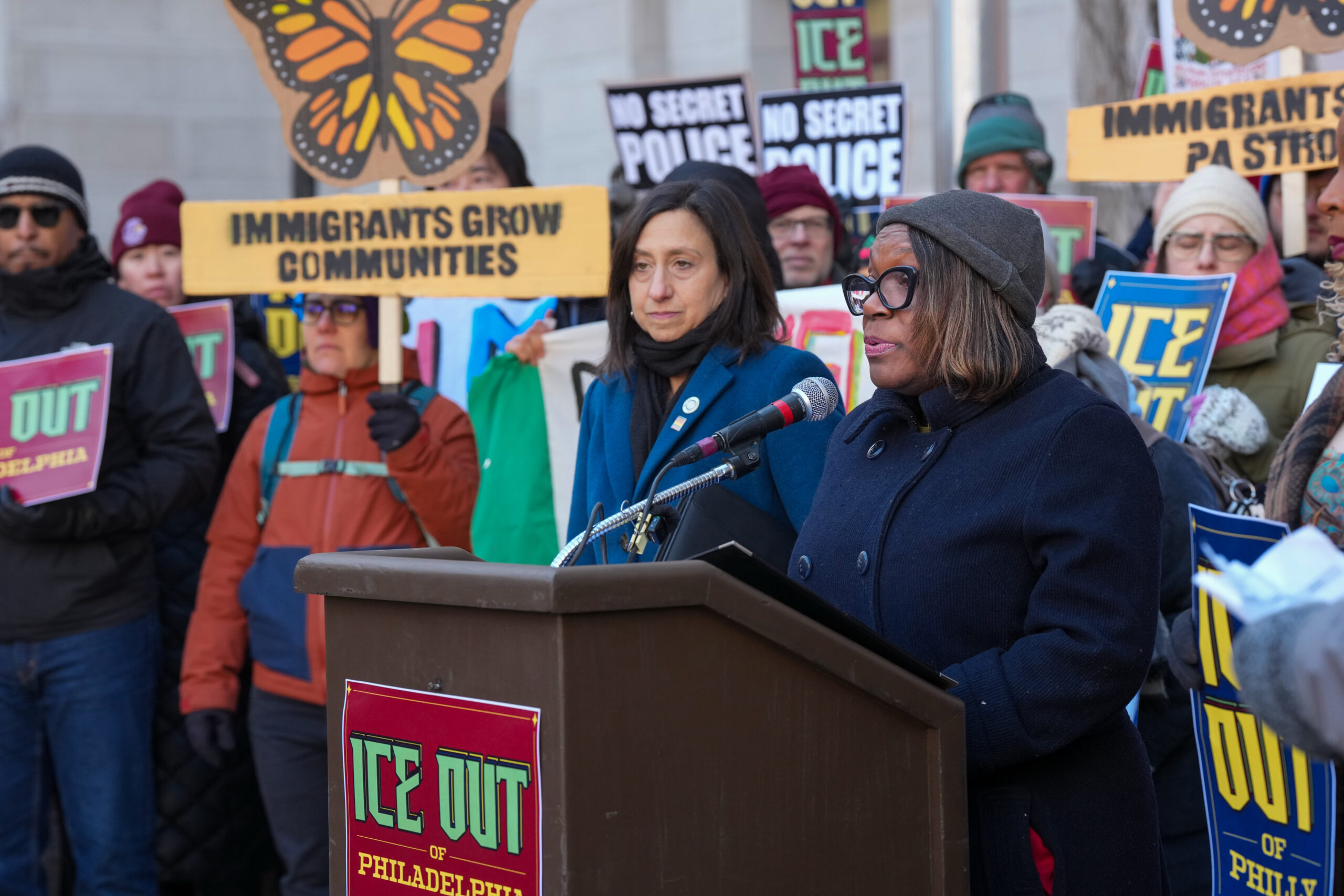
Philadelphia can’t prevent U.S. Immigration and Customs Enforcement agents and other federal officers from concealing their identities, a federal judge ruled Thursday.
U.S. District Judge Chad F. Kenney issued an order preventing Mayor Cherelle L. Parker’s administration and District Attorney Larry Krasner’s office from barring federallaw enforcement officers from wearing masks, intentionally covering their badges, or using unmarked vehicles.
The U.S. Constitution’s Supremacy Clause prevents states — or a city in this case — from imposing requirements on how federal agencies carry out their duties, the judge appointed by President Donald Trump said.
When City Council passed the bill in April as part of the ICE Out legislative package, the lawmakers “attempted to sidestep the Constitution’s clear mandate and disregarded this fundamental principle of law that has informed American jurisprudence for over 200 years,” Kenney’s opinion said.
Parker allowed the bill to become law without her signature, following City Solicitor Renee Garcia’s advice that signing the bill “would send an inaccurate signal to the public that the Administration can legally and practically enforce” its provisions.
“Mayor Cherelle Parker acted with civic wisdom and courage to stand up for the Constitution and follow the rule of law to where it led, despite what may have been strong personal inclinations to the contrary,” the judge said.
While the ordinance’s requirements apply to all law enforcement, its inclusion in an “ICE Out” package suggested the city planned to be selective in its enforcement, Kenney said.
“The Department of Justice will keep fighting jurisdictions that try to obstruct President Trump’s immigration enforcement with policies that endanger agents and public safety,” a department spokesperson said.
The city is reviewing the ruling and potential next steps, a law department spokesperson said.
Kenney showed an “unnecessary urgency” from the beginning of the case, Krasner said.
“The red-hot rush of this federal district court judge, a Delaware County Republican appointed by Donald Trump, was predictable,” the district attorney said.
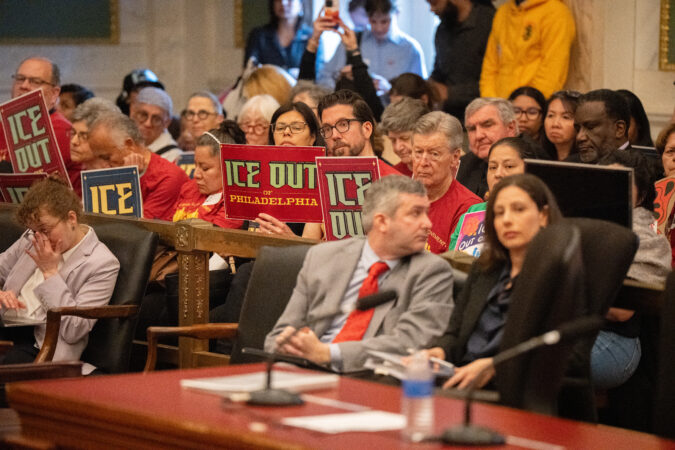
The ordinance at the heart of the litigation made it a crime for law enforcement officers, including Immigration and Customs Enforcement agents, to wear face coverings or conceal personal identifiers like badges and nameplates while carrying out their official duties in Philadelphia, and required officers to identify themselves. It also prohibited the use of unmarked vehicles.
The bill included exceptions allowing officers to wear masks in certain circumstances, such as medical emergencies or SWAT operations.
An officer could face up to 90 days in jail plus a fine for violating the ordinance.
The other bills prohibit federal immigration agencies from staging raids on city-owned property, ban discrimination on the basis of citizenship status, and prohibit the city from engaging in most forms of information-sharing with ICE.
Parker signed the six other bills, which will take effect Tuesday.
Kendra Brooks shown here during a press conference at City Hall to announce a package of bills aimed at pushing back against ICE enforcement in Philadelphia, January 27, 2026.
Officials from various federal agencies told the court the bill would harm their operations and officers.
Members of the public routinely dox ICE agents, who are later subject to threats, John Rife, acting director of ICE’s Philadelphia field office, said in a filing.
“Facial coverings reduce the risk of officers’ personal identities being shared publicly, which helps ensure that officers’ privacy and safety, and that of their family members, remains intact,” Rife said.
The city argued the litigation was premature as the ordinance hasn’t gone into effect and there was no attempt to enforce it.
The city also said federal agents had applied “aggressive enforcement tactics behind the mask of anonymity, undermining public safety and trust.”
But Kenney’s opinion said, “there can be no public interest” in enforcing a provision that violates the Constitution.
It doesn’t make sense that the city can’t hold federal officers to the same standard it holds its own police department to, Councilmember Rue Landau, who authored the bills with fellow progressive Kendra Brooks, said in a statement.
The Trump administration has sued other jurisdictions, including New Jersey, over similar requirements. In April, the U.S. Court of Appeals for the Ninth Circuit found that a California bill requiring agents to “visibly display identification” was unconstitutional.
“It’s unfortunate the Parker administration’s own doubts were used against the bill in this injunction,” Brooks said in a statement. “No one else is dealing with that dynamic in their lawsuits.”
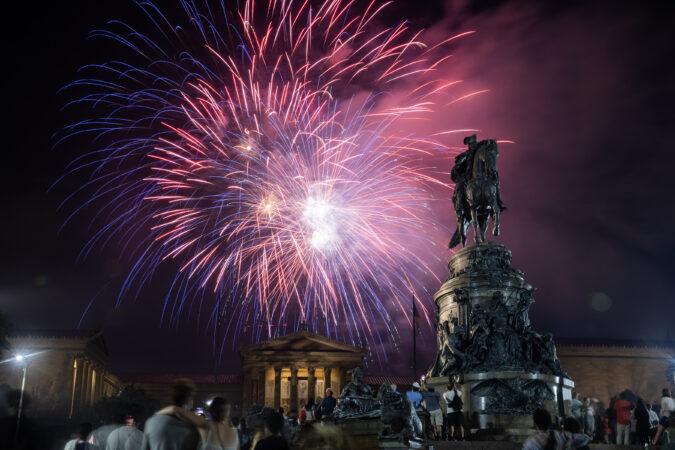
With the eyes of the nation on Philadelphia for America’s 250th birthday, Mayor Cherelle L. Parker’s administration this year took over management of the city’s free July Fourth concert, which for years was produced by a nonprofit established by the city: Welcome America.
The mayor instead hired ESM Productions, a for-profit company, to put on the annual show featuring musical acts and fireworks over the Ben Franklin Parkway, and she changed the name from Wawa Welcome America to the “One Philly: Unity Concert for America” — a version of Parker’s well-known slogan, “One Philly: A United City.”
Another change: It will cost taxpayers far more than in the past.
The city is due to pay ESM Productions about $15.5 million for the show, which will be headlined by Christina Aguilera, Jill Scott, and The Roots, and feature rapper Meek Mill, according to a copy of the city’s contract paperwork with ESM, obtained by The Inquirer. The city in March signed a $10 million contract with the Philadelphia-based company, as well as a $5.5 million contract amendment.
By comparison, Welcome America’s budget for all of 2024 — including that year’s July Fourth concert,the numerous other events it manages in the build-up to the concert, and the salaries of its staff — was about $6.6 million, only about $5.3 million of which came from government grants, according to the group’s most recent federal nonprofit disclosure.
Welcome America, which is a public-private partnership with the mayor serving as a board member, receives city and state funding, as well as a corporate sponsorship. The organization has been involved in Philly’s July Fourth celebrations since 1993.
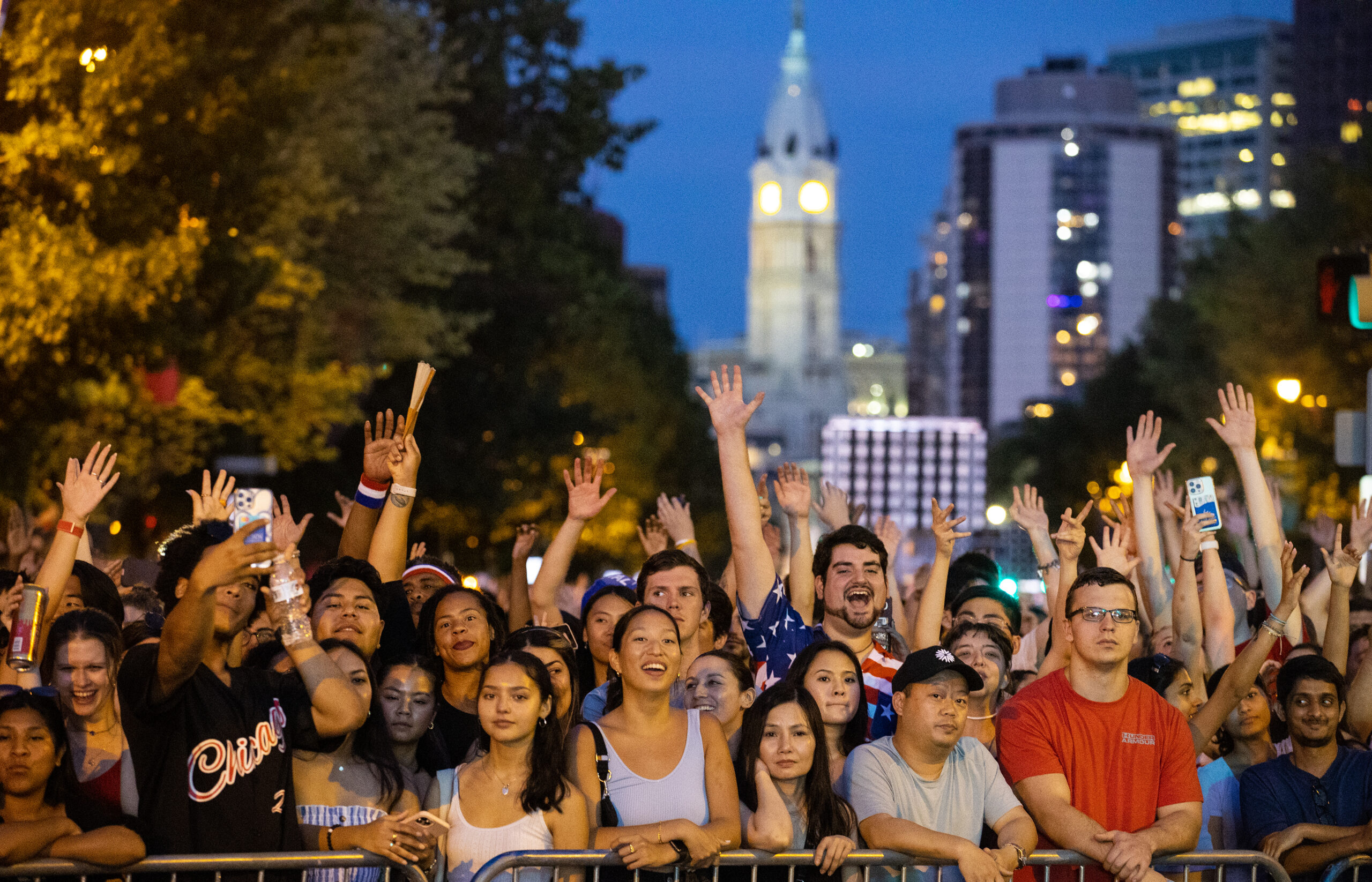
Fans react to the music as the Wawa Welcome America Festival concluded July 4, 2023 with a free concert featuring Ludacris on the Benjamin Franklin Parkway.
Last year’s iteration of the Wawa Welcome America concert cost the organization about $3 million, according to a person with knowledge of the situation who spoke on the condition of anonymity because they were not permitted to disclose that information.
The Philly taxpayer money paid to the concert’s producers does not cover additional expenses borne by the city, such as pay for police officers and sanitation workers staffing the event.
Parker’s office declined a request from The Inquirer for a copy of the contract or information on the cost of this year’s concert. Chief Deputy Mayor Vanessa Garrett Harley said in an interview that the administration would publicly disclose the costs and economic benefits of the concert after it was over.
“At a later time, we could certainly be doing a full accounting, as we’re not trying to hide anything and always want to be transparent,” Garrett Harley said.
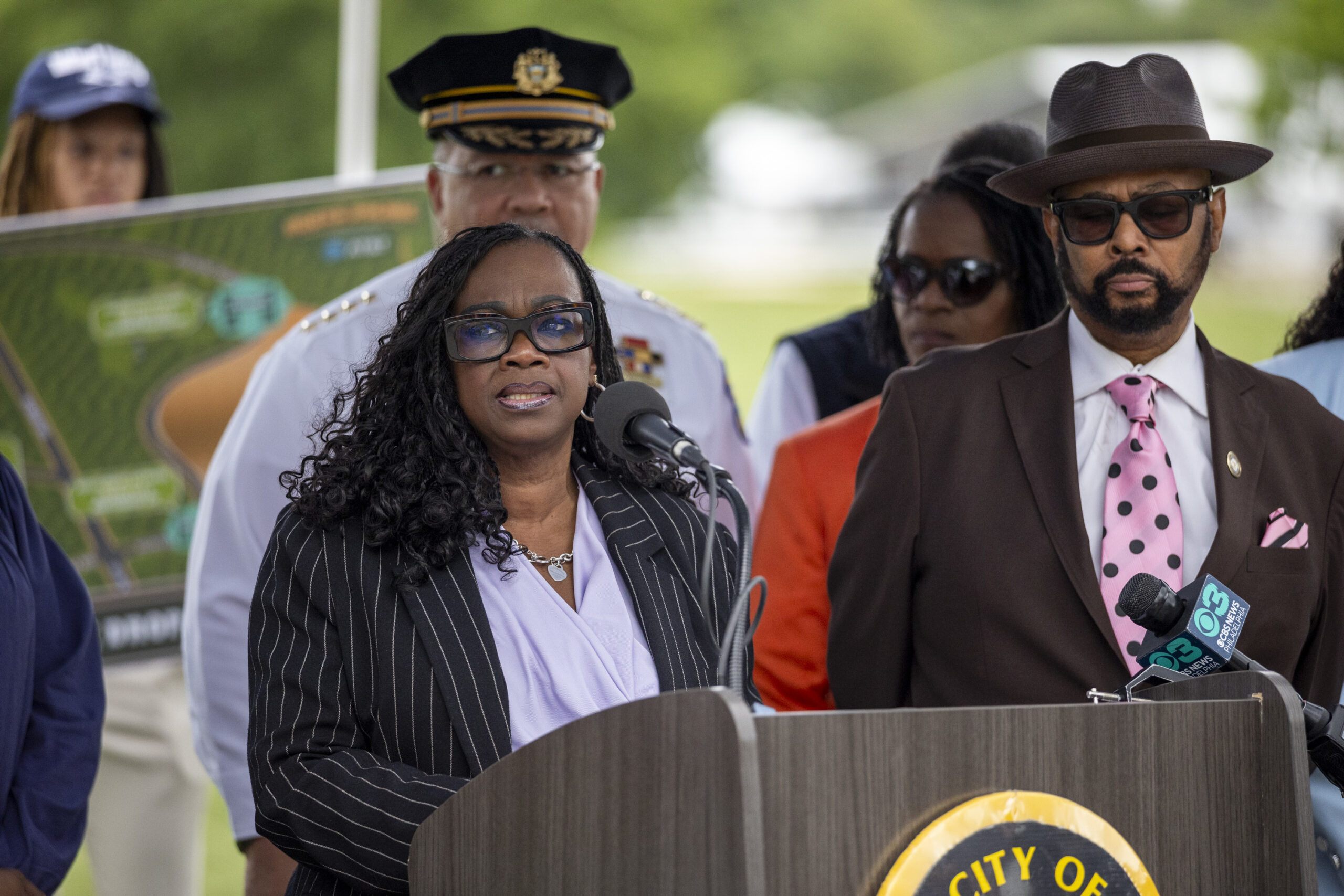
Chief Deputy Mayor Vanessa Garrett Harley speaks at Belmont Plateau in Philadelphia on May 28.
Following the interview with Garrett Harley, The Inquirer later obtained the contract, and the mayor’s office on Tuesday did not respond to follow-up questions about the cost of the concert.
ESM’s original $10 million contract with the city included a breakdown of costs, ranging from $5,000 for “furniture” to nearly $3.4 million for “talent.” It also included $1.2 million for “ESM Productions Fees” and $1 million for “Above the line Producer’s Unit.”
The contract amendment for $5.5 million, signed June 26, did not include details on costs.
A spokesperson for ESM declined to comment.
Founded in 1996 by Scott Mirkin and Jenny Woo, ESM has previously produced numerous high-profile events on the Parkway, including the 2015 papal visit and Jay-Z’s Made in America concert.
David L. Cohen, a Philly political powerbroker and former U.S. ambassador to Canada, said he has hired ESM to produce events going back to when he was chief of staff for then-Mayor Ed Rendell in the 1990s.
“They’re incredibly competent; they’re incredibly good; they do an excellent job,” he said. “I really do think they’re the best event producers in Philadelphia.”
In paperwork submitted to the city, ESM said it “has a long standing relationship” with Cohen and pointed to events he hired the company to produce at the U.S. embassy in Ottawa, Canada, as examples of its past work.
Michael DelBene, president and CEO of Welcome America, said that, despite no longer being the producer for the concert, his organization is still managing more than a dozen Semiquincentennial-related events in partnership with the city. The events kicked off on Juneteenth and will run through the Fourth.
“The celebrations that happen in the city are the implementation of the mayor’s vision, and if she chooses a team to implement that vision, that’s great, and we all support that person and that team,” DelBene said in an interview. “We’re all going to row in the same direction to make sure the city shines.”
Drama and infighting had plagued a series of nonprofit efforts and federal commissions meant to coordinate the festivities. And the COVID-19 pandemic pushed party-planning way down the priority list for the city and for state leaders who could have previously led the charge, former Mayor Jim Kenney and former Gov. Tom Wolf.
Those delays likely squandered any opportunities for a monumental building project, such as the Please Touch Museum building, which was constructed for the 1876 Centennial Exposition, or the Ben Franklin Bridge, which opened for America’s 150th birthday in 1926. They may have also cost Philly the chance for an appearance by a high-profile dignitary, such as when Queen Elizabeth II visited for the 1976 Bicentennial.
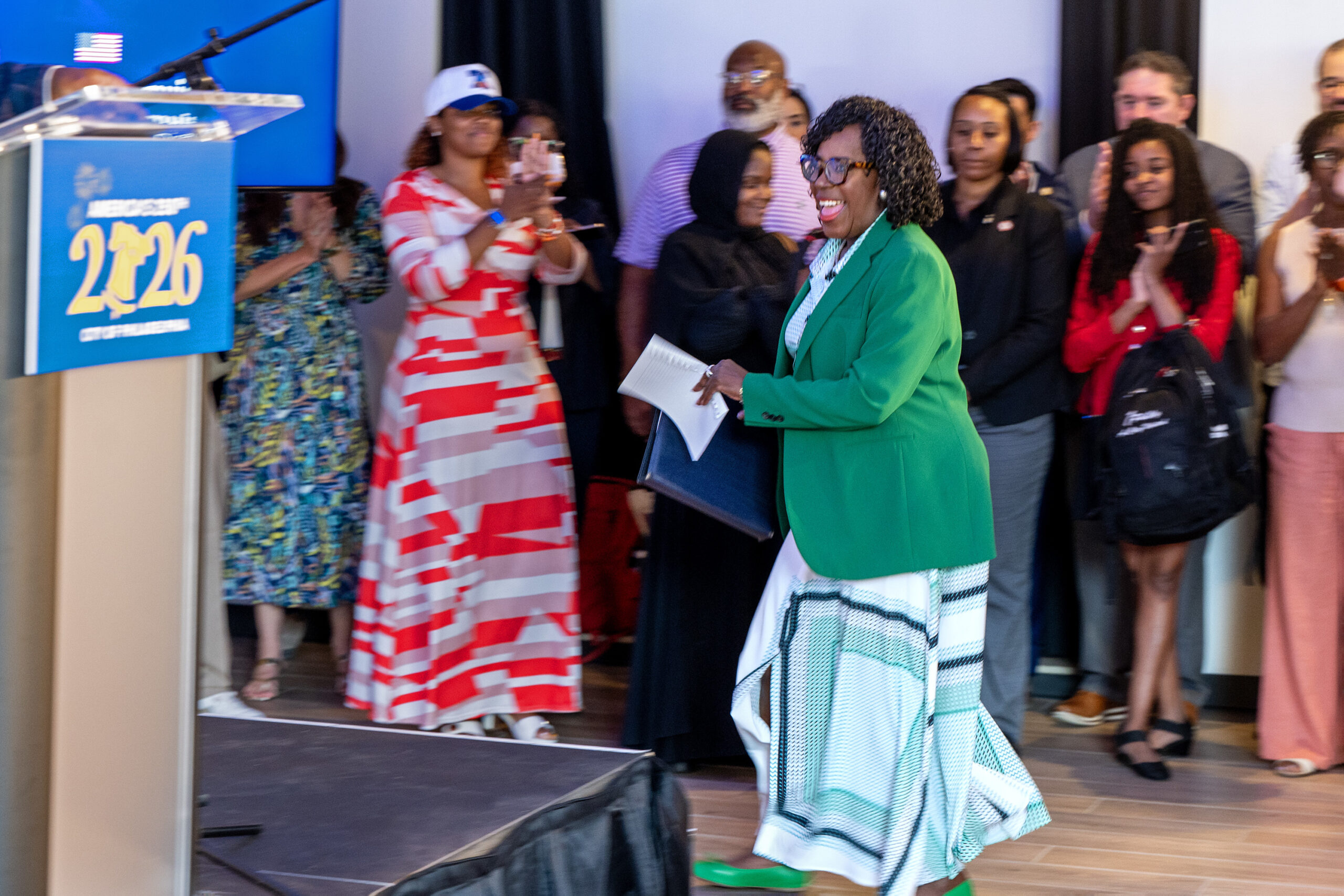
Mayor Cherelle L. Parker heads to the stage at the Independence Visitor Center Wednesday, Sept. 3, 2025 to announce a new initiative that puts city neighborhoods at the forefront of the city celebrations of America’s 250th birthday in 2026.
But the mayor eventually embraced the task in a more public way — following some public prodding from City Councilmember Isaiah Thomas — and the city’s Semiquincentennial celebrations will very much bear her stamp.
Parker has pledged to spend $120 million this year to mark the occasion, and she has made investing in communities across the city, not just the historic district, a major focus as Philadelphia this summer is also hosting World Cup games and the MLB All-Star Game. Much of that spending will pay for street work and beautification projects in neighborhood commercial corridors, 250th-themed block parties, and extra funding for annual events like the Odunde Festival.
“We want to make sure that any and everybody can participate in this regardless of your station in life,” Garrett Harley said.
‘This is her big concert’
With the official Independence Day parade — still organized by Welcome America — scheduled for Friday, July 3, there is surprisingly little in the way of official patriotic proceedings taking place on July Fourth itself.
Parker at 10 a.m. will lead a Philadelphia Freedom Awards ceremony at Independence Mall, honoring seven people, including Cohen and actor and Philadelphia-native Colman Domingo.
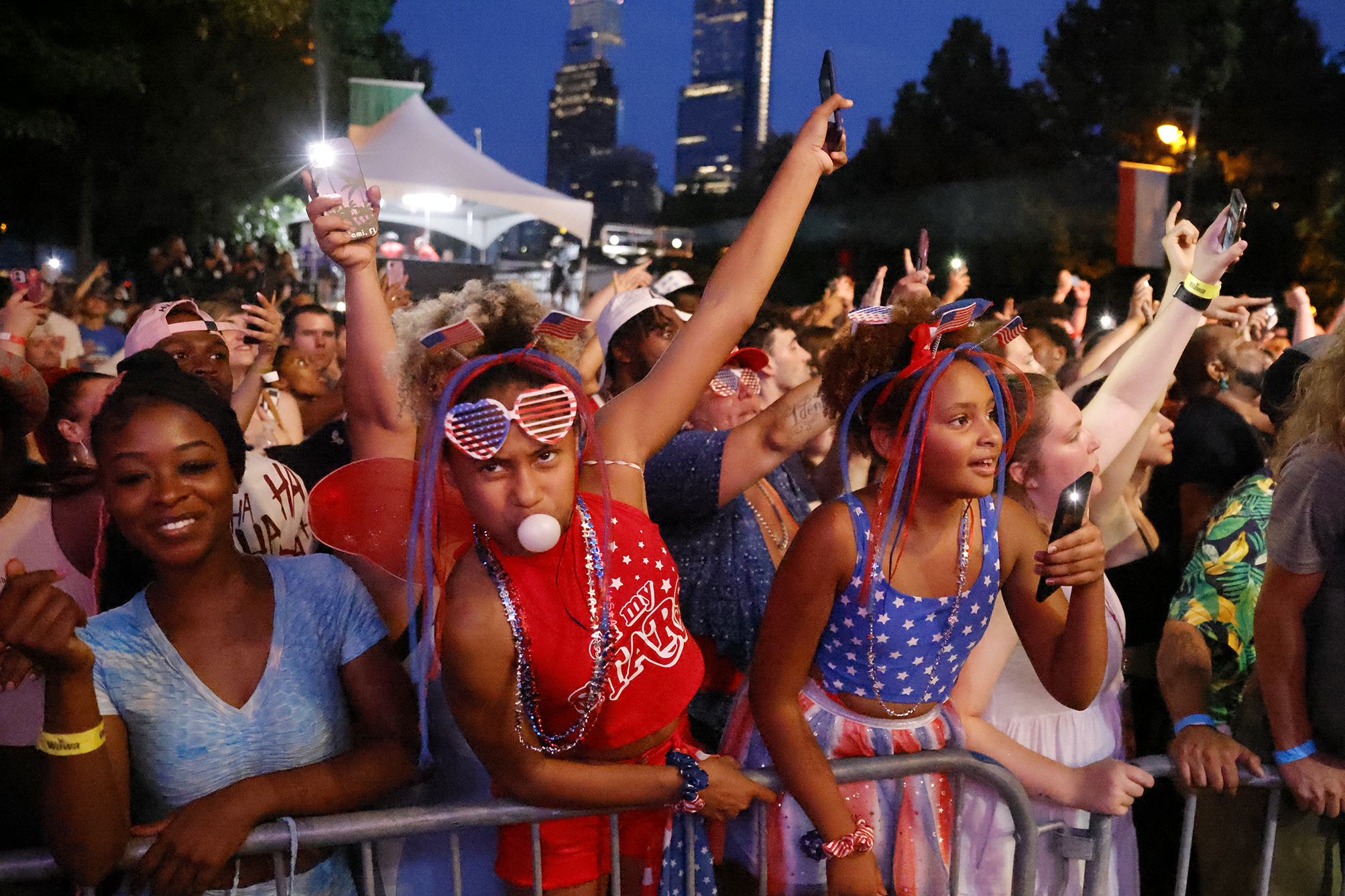
At 5 p.m., the concert will kick off on the Ben Franklin Parkway. Performers include Aguilera, Will Smith, DJ Jazzy Jeff, Jill Scott, The Roots, Meek Mill, and Seal. The city’s official fireworks show will begin at the show’s conclusion, around 11:30 p.m.
Fans during the Wawa Welcome America July 4th Concert on the Parkway in Philadelphia, Pa. on July 4, 2022.
Parker has several times compared this year’s show to Live Aid, the 1985 benefit concert staged in Philadelphia and London that featured in its 10-hour stateside lineup Bob Dylan, Mick Jagger, Madonna, Phil Collins, the Beach Boys, the Four Tops, Santana, Run-D.M.C., and many other musical A-listers.
“If you remember Live Aid and you think about the legacy experience we’re trying to create … that’s what we’re trying to do on July the Fourth,” Parker said in March.
Garrett Harley on Tuesday conceded the concert lineups may not be exactly comparable, but said the mayor was “really talking more about the scope and the magnitude and just the memories.”
“But to certain kids it’s gonna be bigger than Live Aid, because Christina Aguilera means to them what Stevie Wonder and some of the folks who ran Live Aid meant to others,” Garrett Harley said.
Garrett Harley disputed the notion that renaming the concert “One Philly: A Unity Concert for America” meant that it now bears Parker’s branding.
“I don’t know how a ‘Unity Concert for America’ is Parker’s branding because the whole point of this is about unity,” Garrett Harley said. “The branding is really about reminding people that we need to unify, we need to be one America, despite everything that may be going on in the country right now.”
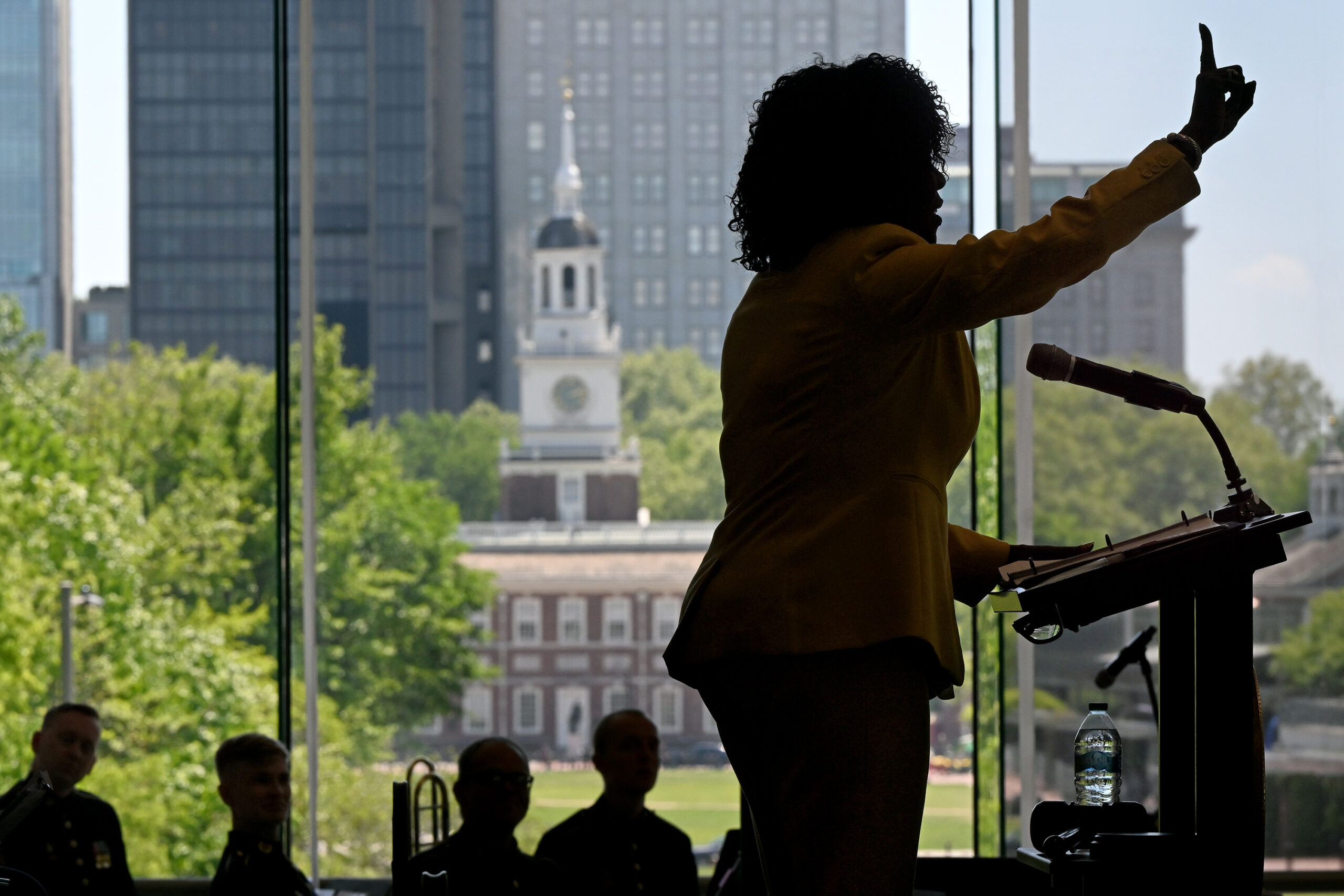
The mayor frequently concludes speeches by asking crowds to raise their index fingers and say in unison, “One Philly: A United City.” She has also had the slogan printed on city trash trucks and cans, along with her name.
Mayor Cherelle L. Parker raises a finger with her call-and-response “One Philly, A United City” mantra ending her speech during a ceremonial meeting of the Pennsylvania Senate at the National Constitution Center across the mall from Independence Hall on May 5.
“Even if it is Parker’s branding, if that’s how people see it, what would Wawa Welcome America be if not branding?” Garrett Harley added.
(Wawa, a longtime corporate sponsor for the city’s July Fourth festivities, pays Welcome America to include its branding in the event, defraying costs for taxpayers.)
Branding or not, Parker’s vision guided the planning for the concert, Garrett Harley said.
“At the end of the day, this is [Philadelphia’s] 100th mayor,” Garrett Harley said of Parker. “This was her biggest concert, and probably will be the biggest that she will ever do. She’s the first female mayor. She’s the first African American female mayor. This is her big concert.”
In the early 1780s, Revolutionary War era Jewish patriot and Philadelphian Lt. Col. David S. Franks had a desperate work situation in hand.
He had served as one of Benedict Arnold’s high-ranking personal assistants, and after Continental militiamen discovered Arnold’s intentions to sell America out to the British in 1780, it became nearly impossible for Franks to find ajobwith the United States government.
Franks was cleared of wrongdoing. But working with Arnold made the Founders wary of employing Franks.
But not Thomas Jefferson, who hired Franks as his secretary. By the time the Treaty of Paris ending the Revolution was ratified in January 1784 in Annapolis, Md., then America’s capital, Franks had been Jefferson’s secretary for almost a year.
It was Franks who carried at least one official copy of the finalized treaty to Benjamin Franklin — who was in Paris at the time — and other officials in Britain and France.
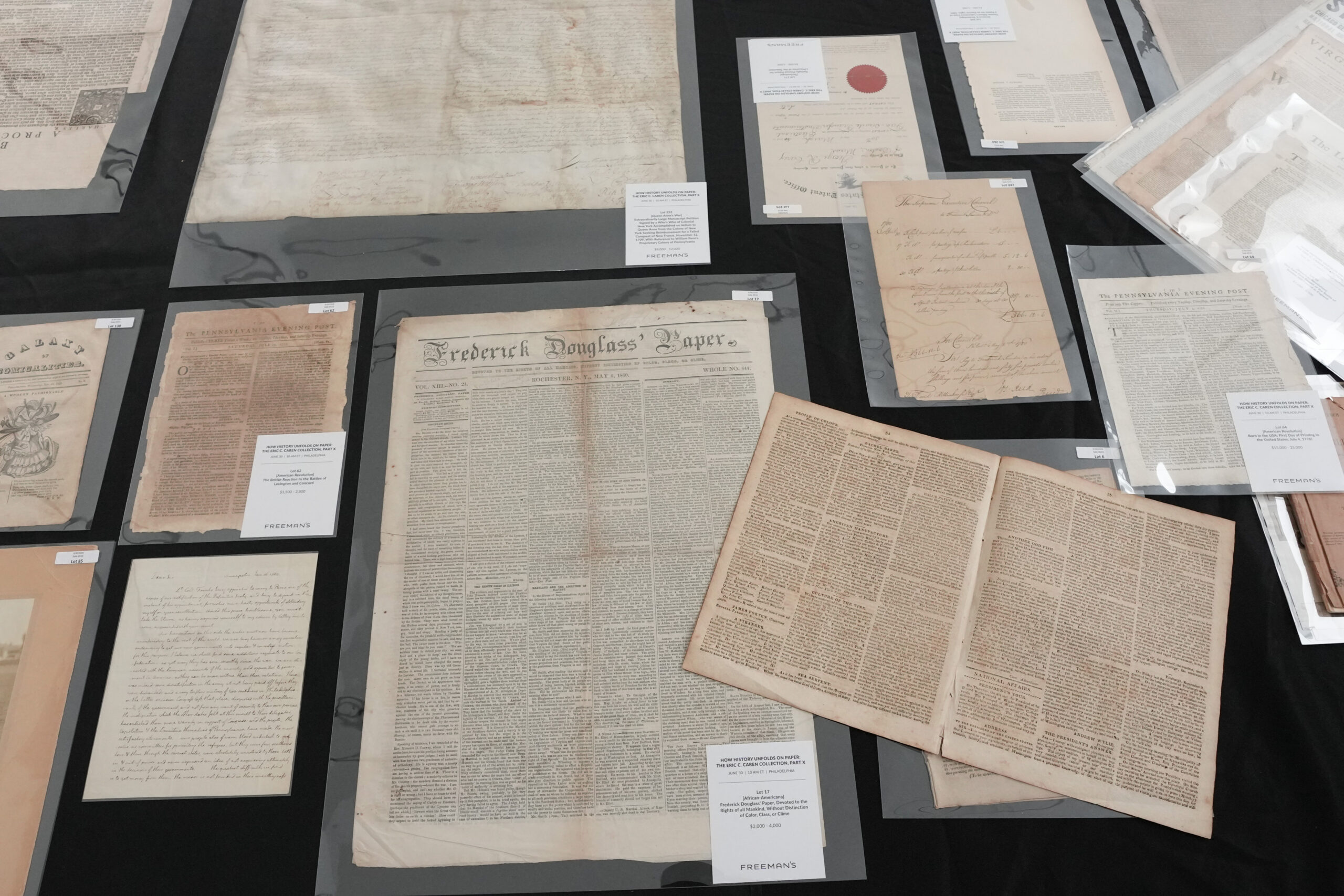
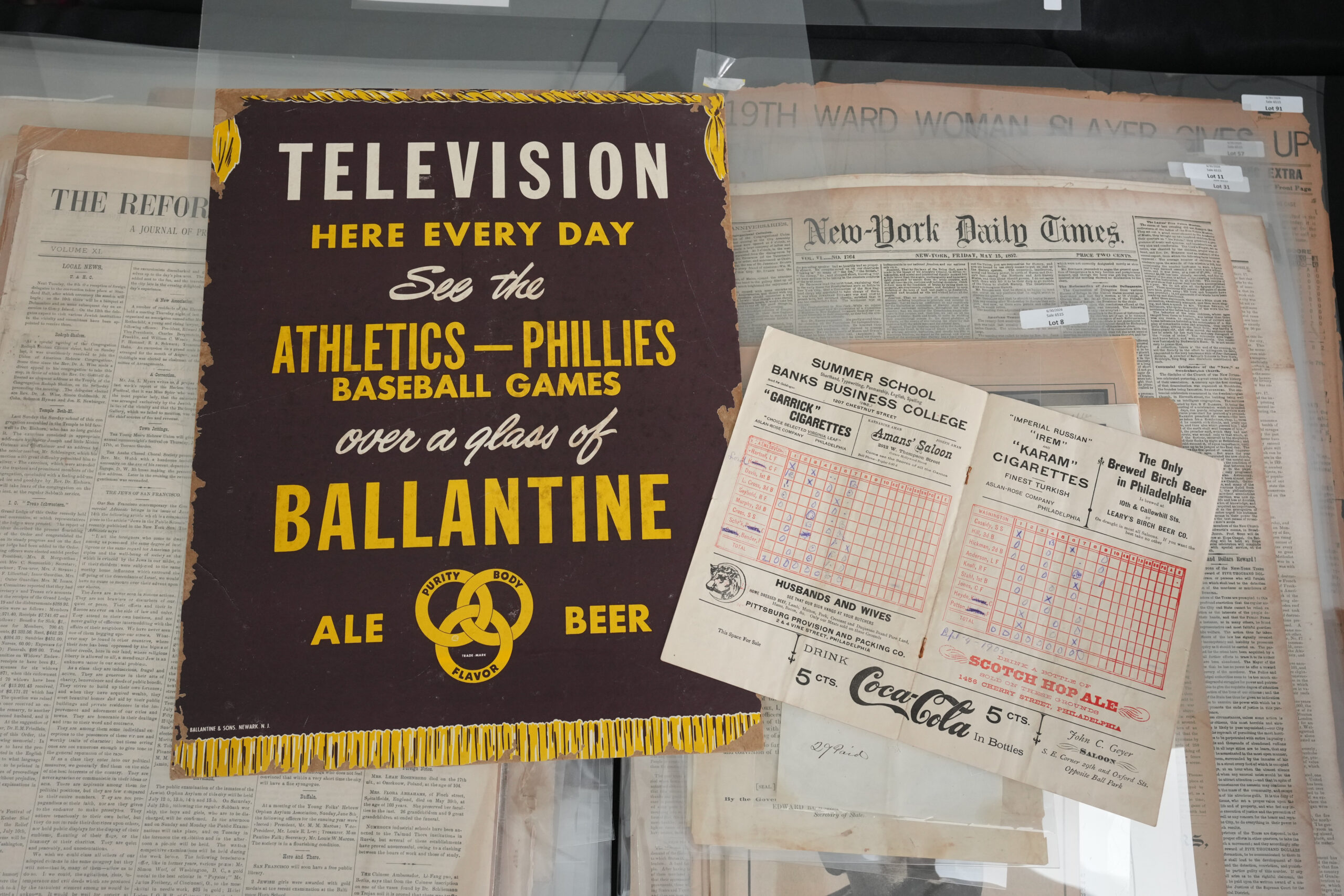
Frederick Douglass’ Paper (front center) and other documents, part of the collection “How History Unfolds on Paper: Important Americana from the Eric C. Caren Collection,” which boasts more than 320 rare newspapers, books, pamphlets, and ephemera tracing the development of printing and publishing in America, an enterprise that started in Philadelphia in1690 with the first paper mill.
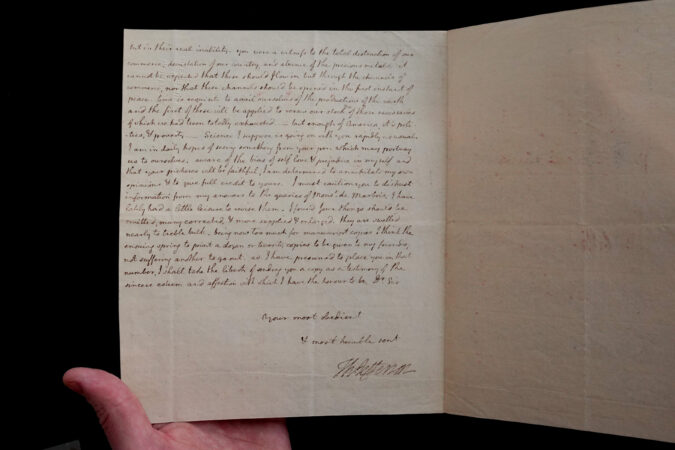
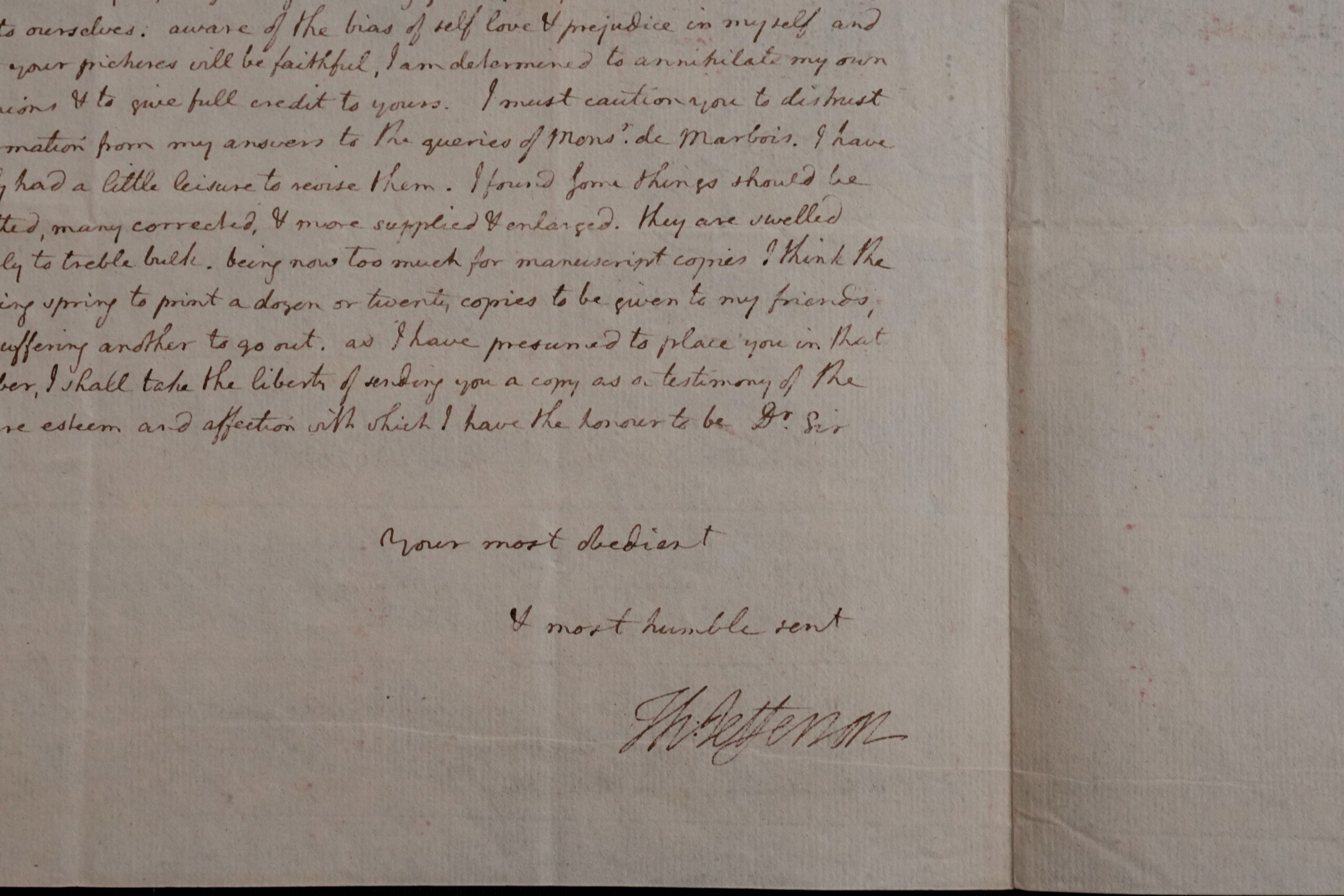
Franks also carried a two-page letter written in Jefferson’s customary neat hand for Francois Jean de Beauvoir, Chevalier de Chastellux. It was a friendly message between the longtime acquaintances, in which Jefferson wrote to the French noble about how America was progressing as a sovereign nation and about his forthcoming book Notes on The State of Virginia.
That letter sold for $108,000 Tuesday as part of an online and in-person auction presented by Philadelphia’s Freeman’s auction house.
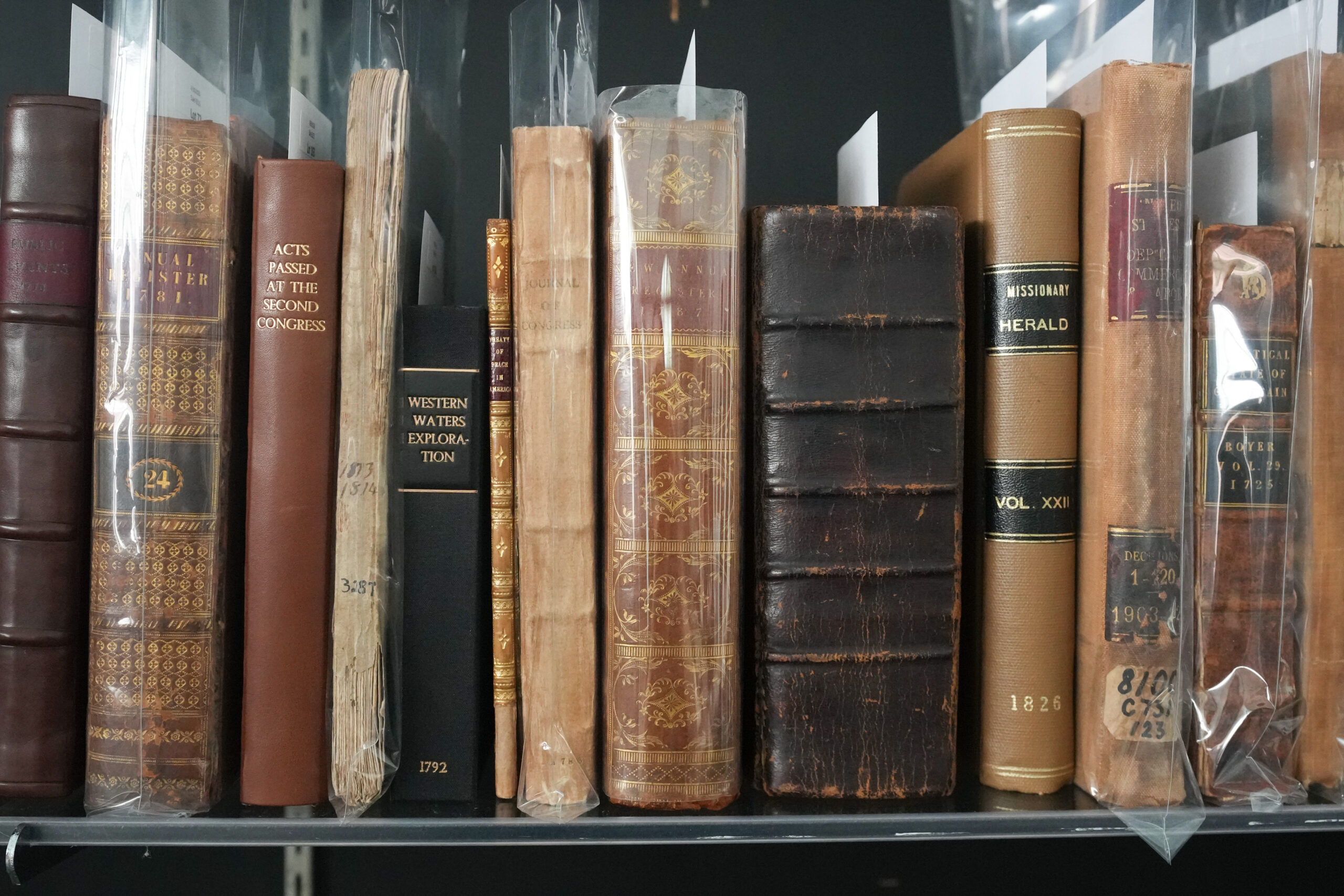
Books from the collection “How History Unfolds on Paper: Important Americana from the Eric C. Caren Collection,” which boasts more than 320 rare newspapers, books, pamphlets, and ephemera tracing the development of printing and publishing in America.
“Caren goes where the history leads him. His collection reflects that,” said Darren Winston, Freeman’s senior vice president and head of the books and manuscripts department. “When he asked us to host a sale in honor of the 250th, we immediately said yes.”
18th century news treasures
The vast sepia-hued collection of aged newspapers and bound volumes was heaven sent for primary-source junkies who can afford to plop down a few hundred or several thousand dollars for the kinds of historical gems usually found only on microfilm. It’s also a gold mine for those who think hundred-year-old newspapers in near mint condition are frame-worthy.
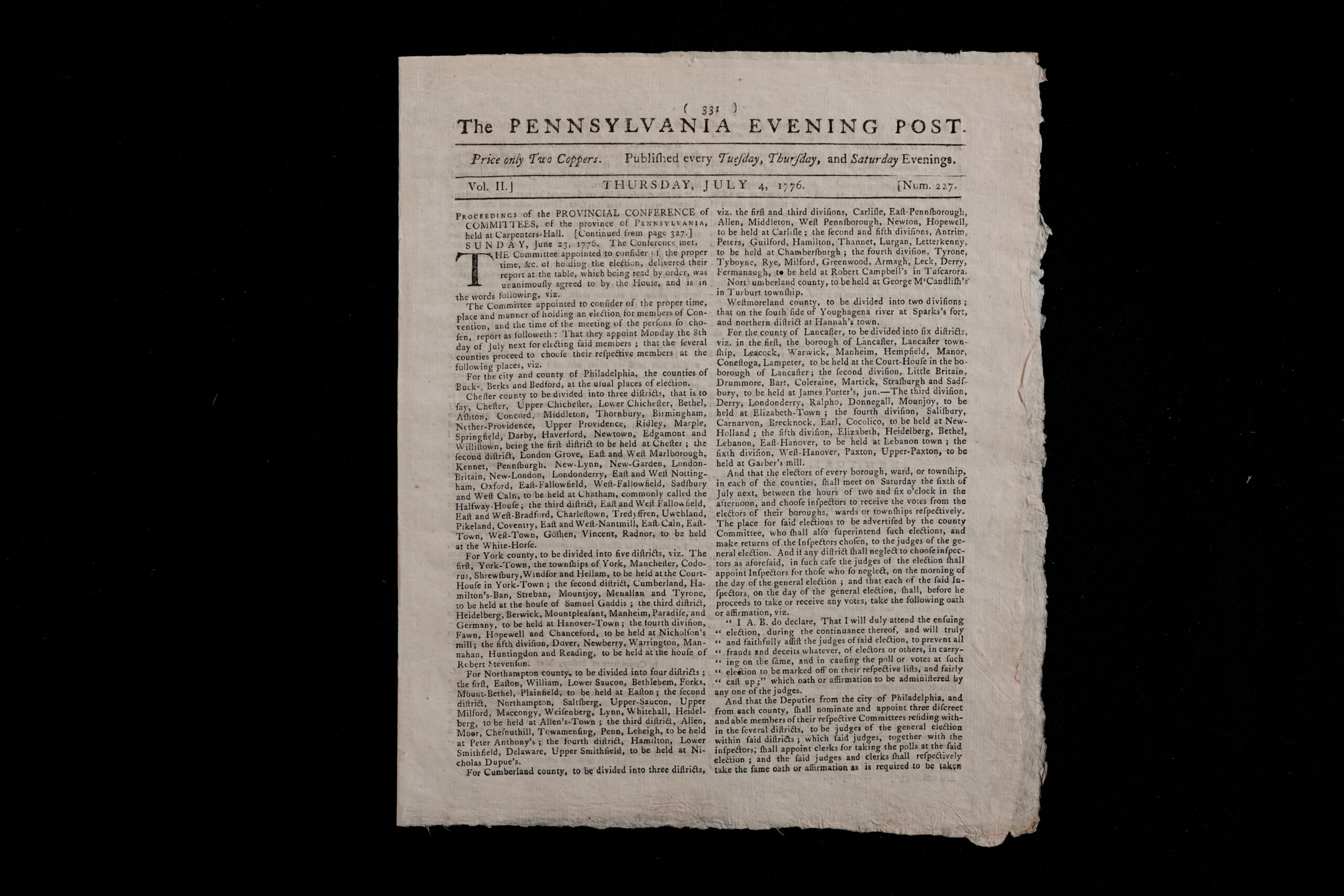
A four-page Pennsylvania Evening Post printed on July 4, 1776, believed to be the first daily newspaper printed on North American soil just declared free of the monarchy.
The Evening Post, founded by printer Benjamin Towne in 1775, was published just a few blocks from the Pennsylvania State House on Tuesday, Thursday, and Saturday evenings.
The July 4 edition contains a short mention that the Continental Congress declared the United Colonies free and Independent States earlier in the day. And “the day before, we had a King in charge,” Winston said.“How History Unfolds on Paper” included five 18th century newspaper editions, including one printed in Scotland, that published the Declaration of Independence in full.
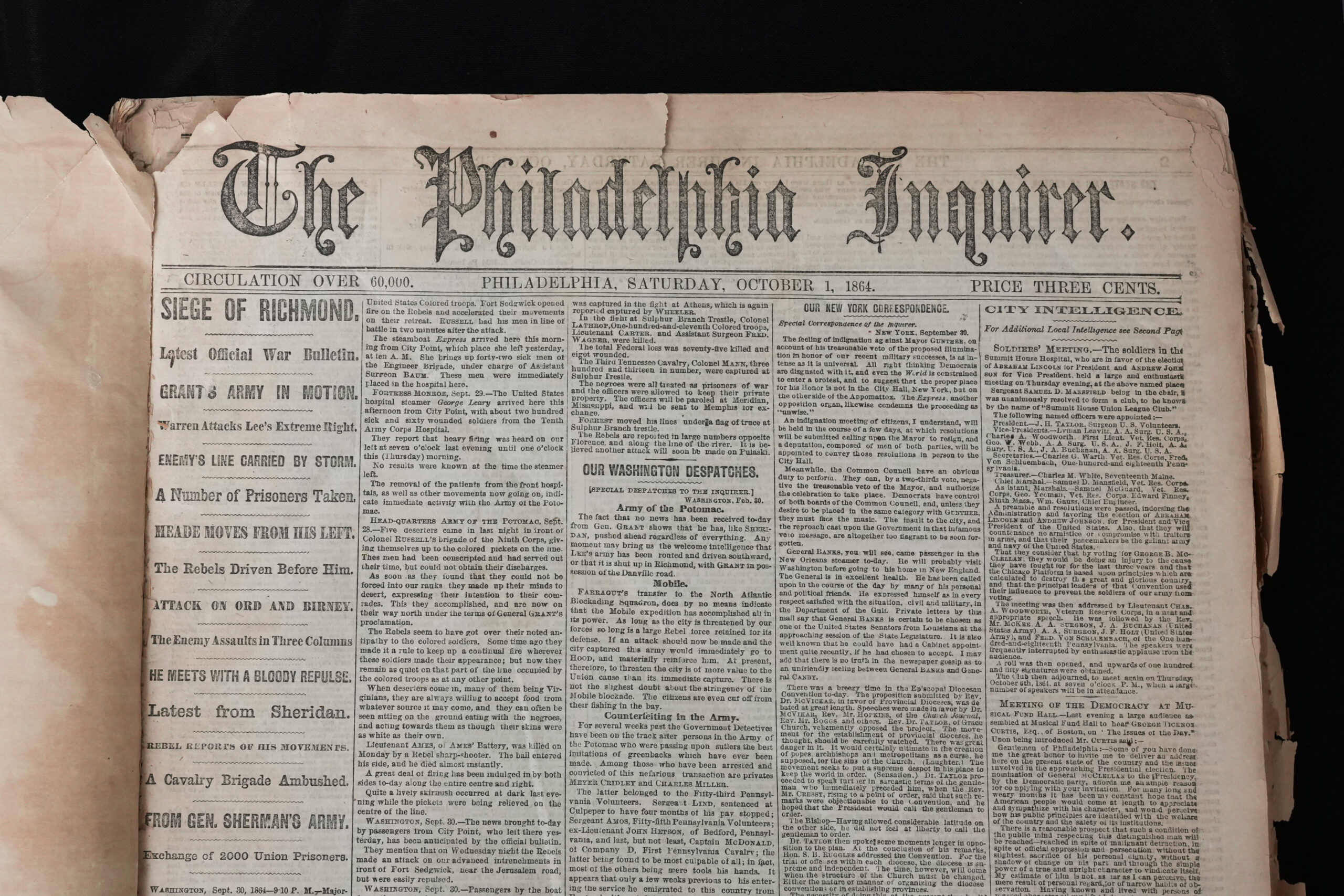
Other archival gems included a copy of the Frederick Douglass Paper from 1860; copies of the Emancipation Proclamation as they appeared in the Daily Globe, the New York Tribune, the Evening Journal Almanac, and The Philadelphia Inquirer; Abraham Lincoln’s second inaugural address as printed in the New York Times in 1865; and more than 70 issues of Civil War-era Philadelphia Inquirers.
A copy of the Philadelphia Inquirer, part of the collection “How History Unfolds on Paper: Important Americana from the Eric C. Caren Collection,” which boasts more than 320 rare newspapers, books, pamphlets, and ephemera tracing the development of printing and publishing in America, an enterprise that started in Philadelphia in 1690 with the first paper mill.
But Caren’s collection is more than weathered newspapers.
The auctioned collection bubbled with relics, collectibles, and keepsakes that speak to the economy, such as a note signed by first director of the U.S. Mint, David Rittenhouse — for whom Rittenhouse Square is named — ordering payment of 350 pounds to a doorkeeper employed at the Pennsylvania State House. (That’s about $107,000 in today’s money.)
“Freeman’s is America’s oldest auction house, and Philadelphia is the birthplace of the United States,” Caren said. “So for the 250th anniversary [of America], I thought this sale would be quite fitting.”
Some of the sports memorabilia featured in “How History Unfolds on Paper: Important Americana from the Eric C. Caren Collection”
50 years of collecting
Caren, 66, is a New Yorker and said he came out of his mother’s womb collecting — starting with comic books, stamps, coins, and baseball cards.
In 1970, he learned that a few of his friends were going rummaging through an abandoned house in Rockland County and that they had found newspapers from the turn of the 20th century.
“I asked them to try and find me a sports page with Babe Ruth, and they brought me one from 1913 and I was mesmerized,” Caren said.
After some cajoling, Caren convinced his friends to reveal their secret treasure trove. There, he discovered periodicals going back to the 1890s and was hooked.
Caren spent the next 50-plus years collecting the printed and written word. He has traveled the world to estate sales, garage sales, rare book shops, and antique shows. He’s one of the founders of the Ephemera Society of America and a member of the American Antiquarian Society and the Grolier Club.
He owns hundreds of thousands of paper items, and pieces of his collection have been sold at the auction houses Christie’s and Sotheby’s. “How History Unfolds on Paper” was his 10th auction and first in Philadelphia.
“If ever there was a Philadelphia item, this is it”
In his travels, Caren has come across many of Jefferson’s letters. The one written to Chastellux, he says, is particularly noteworthy because Jefferson wrote it himself, as opposed to dictating it to a secretary, like Franks.
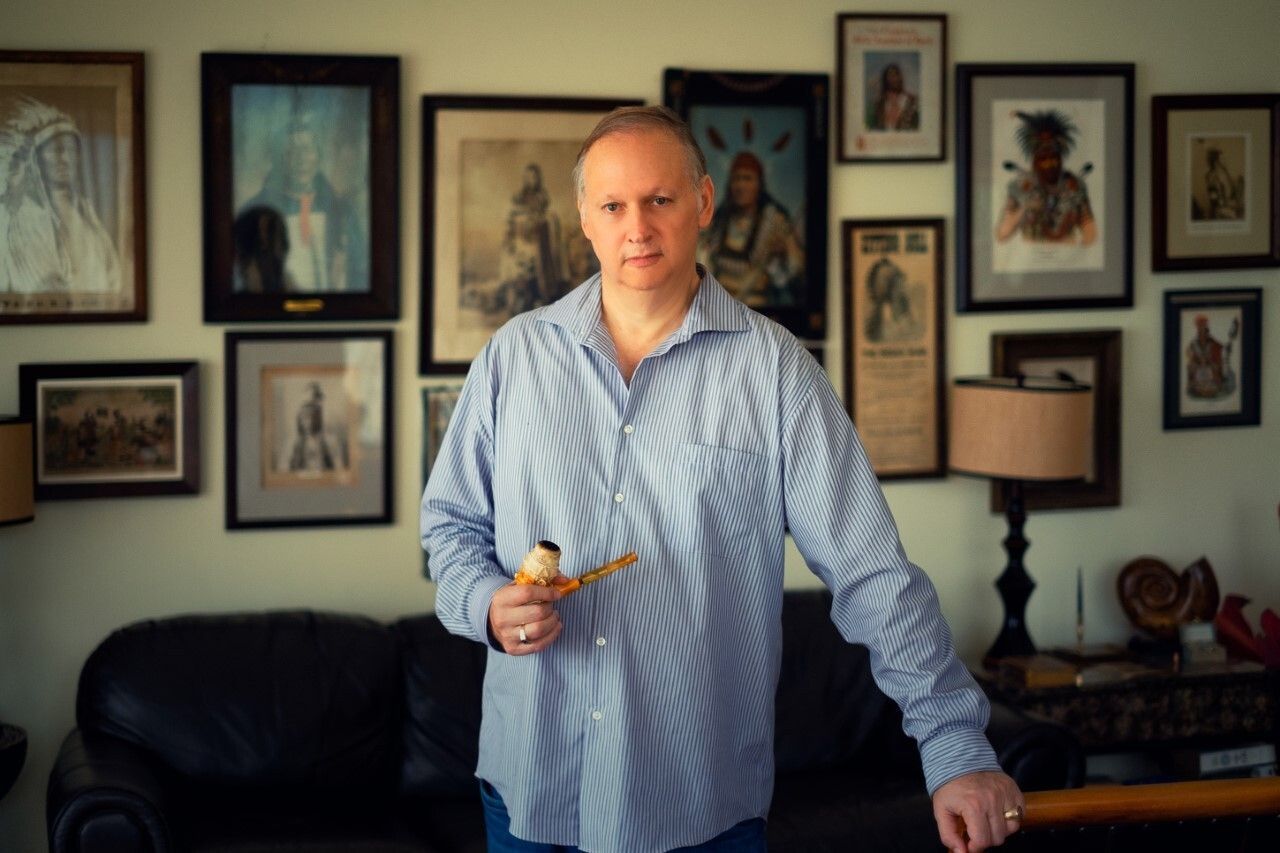
Long-time ephemera collector Eric C. Caren, his collection “How History Unfolds on Paper: Important Americana from the Eric C. Caren Collection, Part X” went to auction at Freeman’s in Philadelphia.
The letter had been in the Chastellux family for centuries before landing at an auction a few years ago. Caren passed it over a few times before recognizing Frank’s name in the first paragraph.
“It was a great example of how even great things can slip by,” Caren said.
The Treaty of Paris was signed in September 1783. The following January, legislators ratified it in Annapolis.
Dated Jan. 16, 1784, Jefferson’s letter reads like a chatty blog of late 18th century American happenings. In the five months since the war’s end, news traveled to Europe that Americans were behaving badly. One of the reasons Jefferson penned this missive, Caren said, was to “dispel [this] fake news.”
“There was indeed some dissatisfaction in the army at not being paid off before they were disbanded and a very trifling mutiny of 200 souldiers in Philadelphia,” Jefferson wrote, playing down the Pennsylvania Mutiny of 1783, during which a few Continental Army soldiers rioted in Philadelphia streets when they weren’t paid.
Thomas Jefferson’s signature on a letter to Francois Jean de Beauvoir, Chevalier de Chastellux, a part of the auction at Freeman’s.
He also mentions his yet-to-be published book Notes on The State of Virginia and encouraged Chastellux to write one of his own. He did.
Voyages de M. le Marquis de Chastellux dans l’Amerique septentrionale, published at theturn of the 20th century, is what rare book dealer Wright Howes described as “the first trustworthy record of life in the United States.”
He spent years trying to restore his name. During his first term, President George Washington helped Franks secure a job as an assistant cashier at the Bank of the United States of America, but Franks was no longer accepted in the Founding Father’s circle.
He died in 1793 during Philadelphia’s yellow fever epidemic.
“If ever there was a Philadelphia item, this is it,” Caren said. “This letter is the intersection between the history of Philadelphia and the history of our nation.”
The headline and article have been updated to include the winning bid at the auction on Tuesday morning.
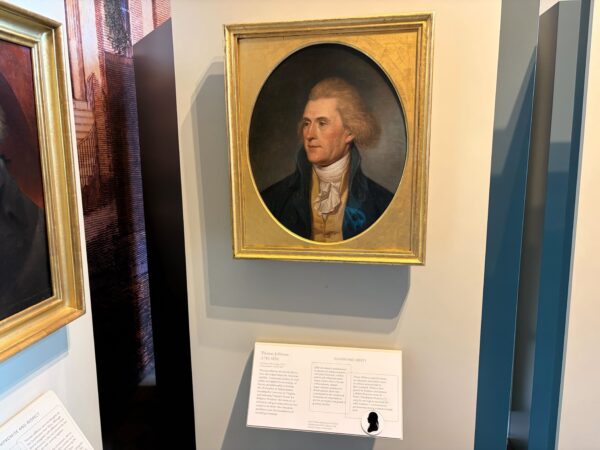
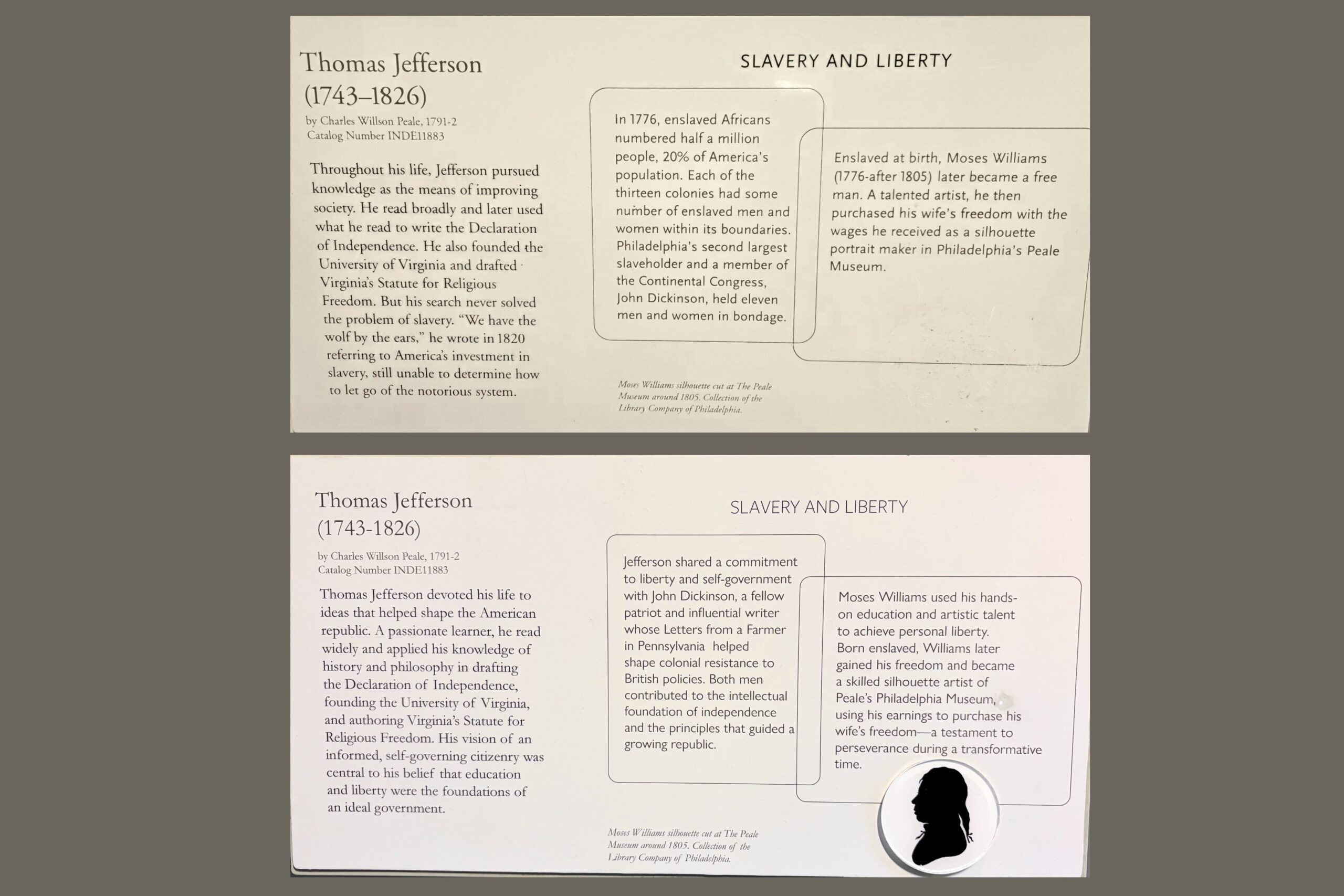
President Donald Trump’s administration has wiped almost all mentions of slavery from a panel accompanying a portrait of Thomas Jefferson at the Second Bank of the United States.
As the Founding Father who wrote the words “all men are created equal” while enslaving more than 600 people throughout his life, Jefferson embodies the paradox at the heart of the revolutionary era.
The description under his iconic portrait attempted to grapple with that tension.
Despite Jefferson’s lifelong pursuit of knowledge, he “never solved the problem of slavery“ and was ”unable to determine how to let go of the notorious system,” the original plaque read.
But a new panel simply states that Jefferson’s “vision of an informed, self-governing citizenry was central to his belief that education and liberty were the foundations of an ideal government,” among other changes.
It’s not the only change the administration has made to exhibits around Philadelphia’s Independence National Historical Park ahead of the 250th anniversary.
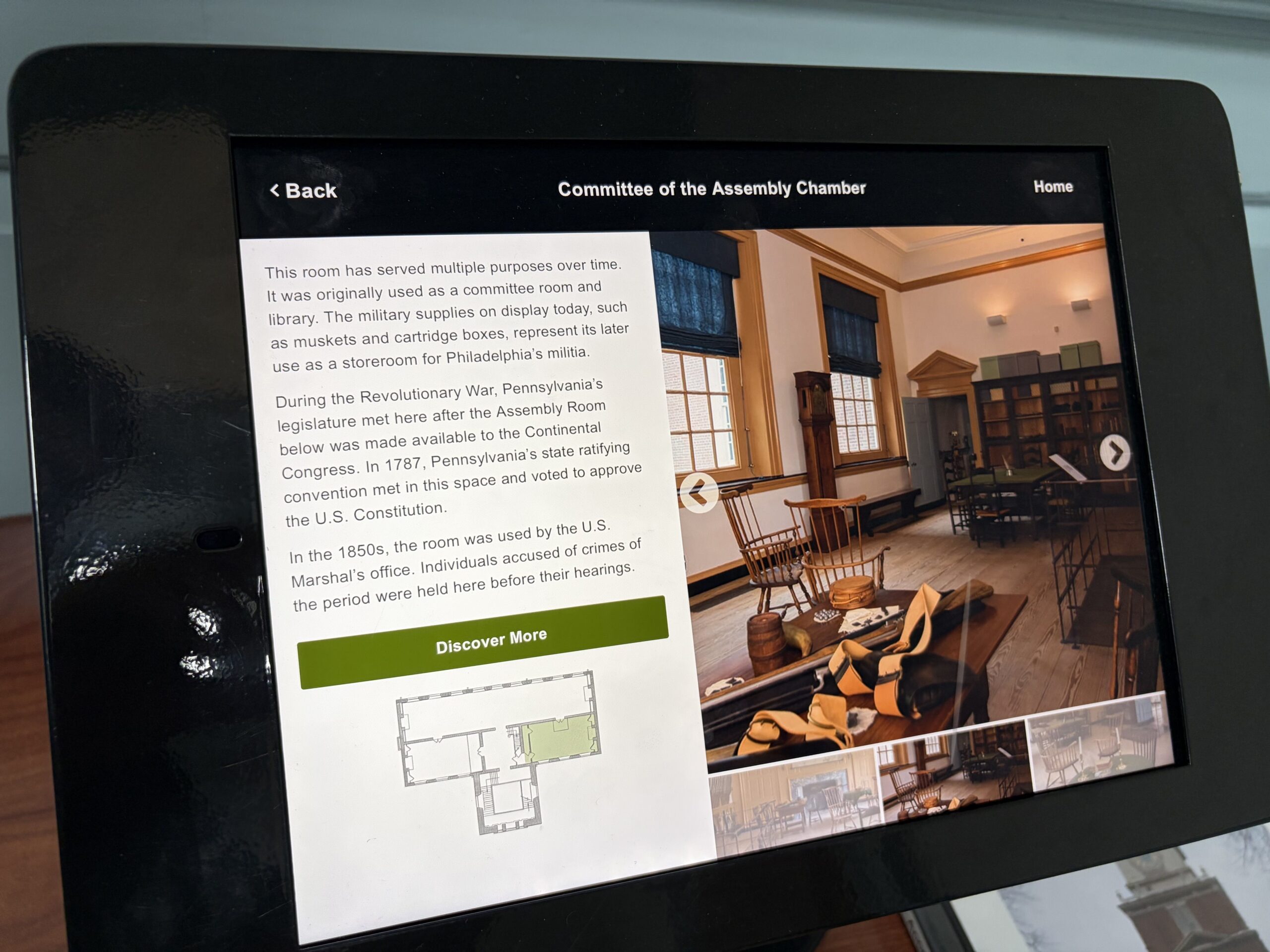
A touchscreen with a virtual tour of Independence Hall’s second floor now tells visitors that one of the rooms was used to hold “individuals accused of crimes of the period” before their court hearings.
Who were these individuals? A previous version stated clearly: “accused fugitives from slavery.”
A side by side of the original and new descriptions Thomas Jefferson’s portrait at the Second Bank of the United States. The references to slavery have largely been removed by President Donald Trump’s administration.
While the changes are more subtle than those that took place at the President’s House in January — and the new exhibits the government proposed a few months later — they further underscore the Trump administration’s goal to sanitize U.S. history, as signified by his executive order to review or remove content at national parks that “inappropriately disparage Americans past or living.”
They also show a lack of transparency. The change to the description under Jefferson’s portrait was only acknowledged following a demand by a federal judge in Boston that the National Park Service share a list of all removals the administration undertook to comply with Trump’s “restoring truth and sanity” edict ahead of the country’s 250thcelebration.
In a statement Monday, Avenging the Ancestors Coalition — which has helped lead the efforts to protect the President’s House — said the additional changes were “extremely troubling.”
“The preservation of history requires ongoing vigilance,” the organization said. “Restoring historical interpretation is only one part of the work; protecting it from future revision or erasure is equally important.”
“One of the greatest disappointments of my life, is that we get to the 250th anniversary of this country, and we are still trying to evade the truth of our founding,” LaRoche said.
Among the most blatant examples of the federal government’s desire to retell history has happened at the President’s House, which opened almost two decades ago to memorialize the nine people George Washington enslaved at his Philadelphia home. It also serves as a symbol of exploring the stark juxtaposition of slavery and liberty during the nation’s founding.
But the moves at the Second Bank and Independence Hall signify that the administration is not letting any stone go unturned when it comes to ridding or softening even smaller mentions of slavery at Philadelphia’s most iconic historic sites.
The Department of Interior did not answer repeated questions about the changes.
“No changes have been made,” a spokesperson said via email, citing the President’s House litigation. When an Inquirer reporter pressed again about changes to Independence Hall and the Second Bank, the government spokesperson repeated that there were no changes to the President’s House during the litigation. The Department of Interior did not respond to further inquiries.
At the Second Bank, the panel under Jefferson’s iconicportrait also informed visitors about the population of persons enslaved in 1776, that John Dickinson — a member of the Continental Congress — was an enslaver, and about the life of Moses Williams, an artist who was enslaved at birth and later became a free man.
That’s drastically changed in the new panel.
Jefferson’s grappling with slavery is no longer present and Dickinson is referred to as a “fellow patriot and influential writer. …” The only mention of slavery remaining is Williams’ story, though it’s reworded.
And at Independence Hall, the touchscreen kiosk describing the second floor Committee of Assembly Chamber previously outlined the irony of the space being used for ratifying the U.S. constitution and later housing the office “where accused fugitives from slavery were held before their hearings, right above the room where the Declaration of Independence had been signed.”
A touch screen at the entrance to Independence Hall with photos and descriptions of the building’s second floor. The description of the Committee of the Assembly Chamber has been edited to replace the words “accused fugitives from slavery” to “individuals accused of crimes of the period.”
But the reference to slavery has been removed, among other rewordings.
It remains unclear when these changes were made. The Inquirer reported last summer that these items — and an interactive exhibit at the Benjamin Franklin Museum about the Founding Father’s conflicting views on slavery, which is still intact — were flagged for review.
In addition to the President’s House exhibits, the list says the administration removed a “portrait description” and cites “disparages Americans past or living” as the reason it is gone.
No entry in the list corresponds to the change made at Independence Hall, which Philadelphia owns.
The city did not immediately respond to a request for comment.
All material changes at Independence Hall should be done after consultation with the city, said Cynthia MacLeod, former superintendent of Independence National Historical Park.
“The National Park service has been known for excellent historians and interpreters and its a shame that they are being muzzled now,” MacLeod said. “It’s a shame and a disservice to all the visitors not to have a more complete history told.”
WASHINGTON — Pennsylvania is not participating in President Donald Trump’s Great American State Fair, which kicked off Wednesday, after state leaders failed to find a company willing to represent it at one of the hallmark 250th anniversary events in Washington that some say have become overly partisan.
Pennsylvania’s state government, like those in some other Democratic-led states, had already chosen to not sponsor a booth at the 16-day fair. Gov. Josh Shapiro’s office had still been trying to connect Freedom 250, the nonprofit behind the fair, with organizations and companies that could represent the state, according to federal and state sources familiar with the planning.
“Unfortunately, due to the high cost to taxpayers and not being able to secure PA businesses to sponsor the booth, Pennsylvania will not be a participant in the Great American State Fair,” the Pennsylvania Department of Economic and Community Development said in a statement.
The fair, being held at the National Mall to celebrate the nation’s 250th anniversary, was originally planned to feature a pavilion dedicated to each state and territory.
But as tourists visited Thursday on the fair’s first full day, there were no signs of the commonwealth where American democracy was born 250 years ago.
Almost every other state was showcased — with most sending state or local government staff and tourism boards to host educational or interactive exhibits.
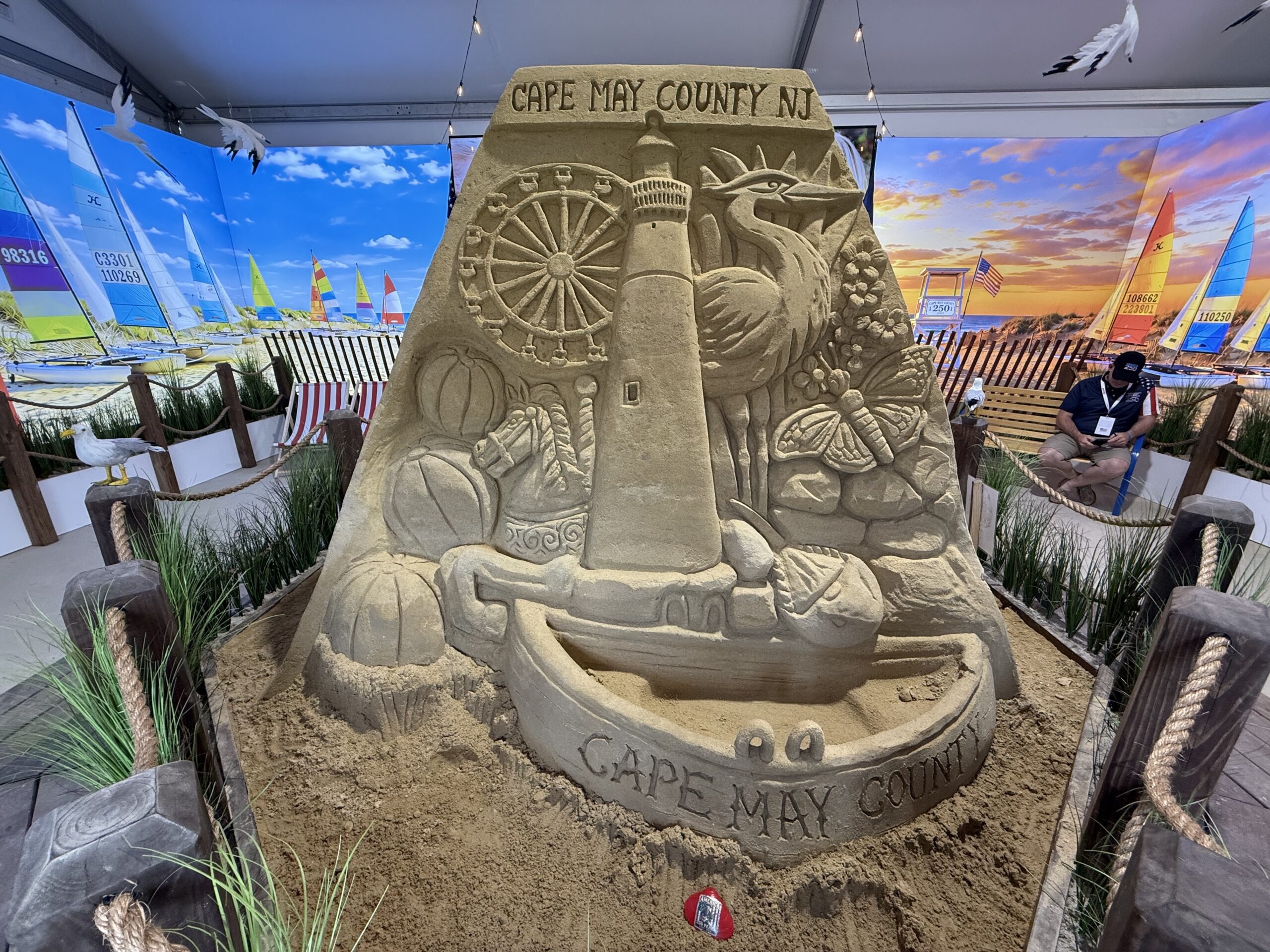
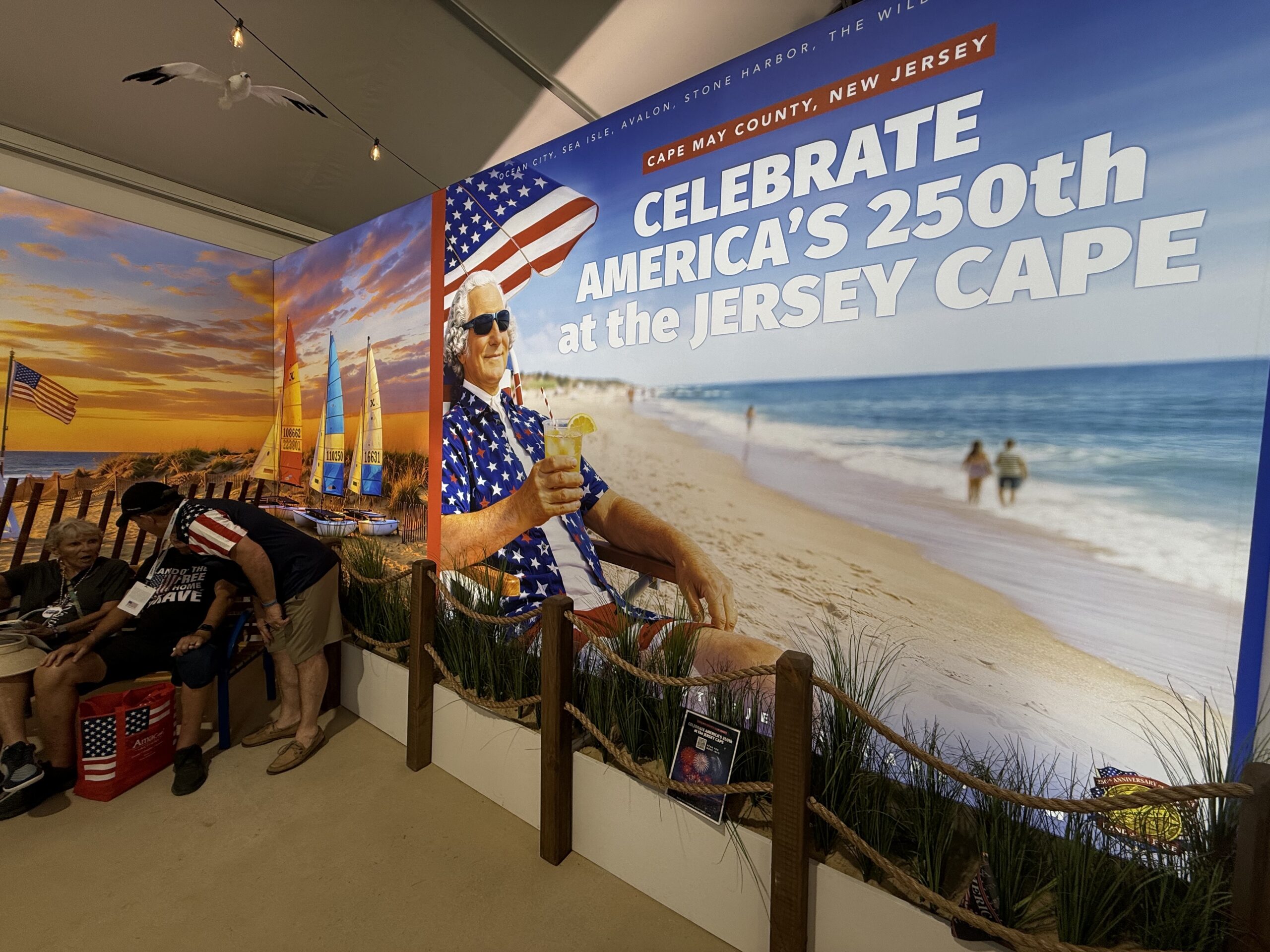
Cape May County, a Republican stronghold that is representing New Jersey after the state government declined to participate, featured an 8-ton sand sculpture that a sculptor from Wildwood took 4½ days to create.
An 8-ton sand sculpture promotes Cape May at New Jersey’s pavilion at the Great American State Fair, in Washington, D.C. The pavilion was sponsored by Cape May County, a Republican stronghold that chose to represent New Jersey after the state government declined to participate.
Maryland’s state tourism department handed out information about its vacation hot spots. Staff in the Lone Star State’s pavilion greeted tourists with a cheerful “Welcome to Texas” and offered an interactive space flight exhibit, a replica of the Alamo, and an Austin City Limits music display.
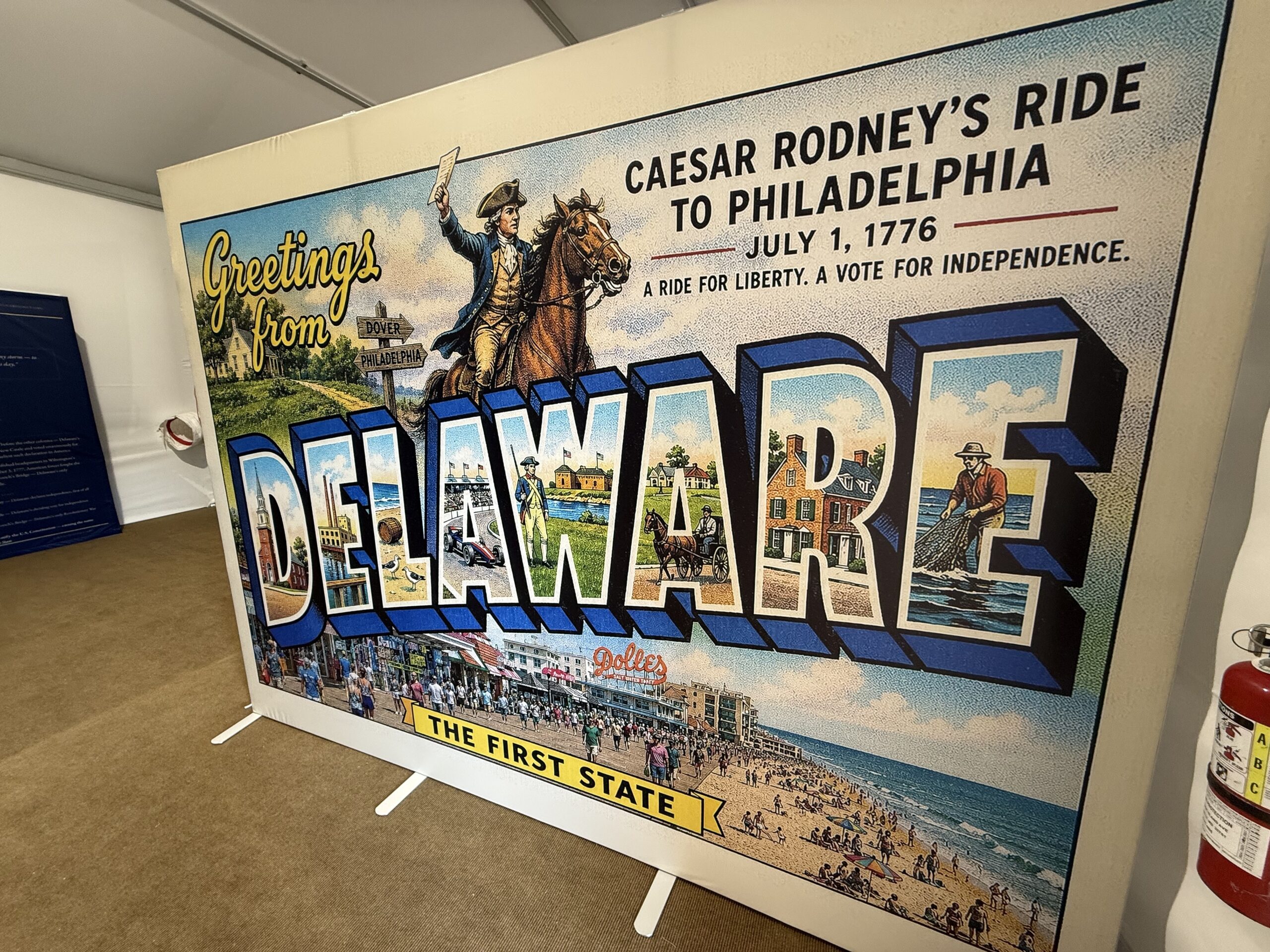
Delaware highlighted Founding Father Caesar Rodney’s ride to cast the decisive vote for independence in Philadelphia.
Delaware’s pavilion at The Great American State Fair highlights Caesar Rodney’s ride to cast the deciding vote for independence.
Pennsylvania joined seven other Democratic-led states — Connecticut, Illinois, Maine, Massachusetts, North Carolina, Oregon, and Washington — in declining to participate.
Some of those states had flags outside the pavilions where they would have been located. A few chairs and a sign with the state’s name were also inside.
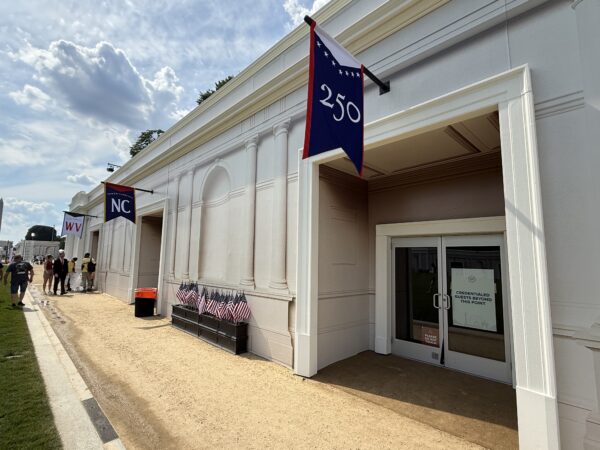
But in the booth where, according to an interactive map, Pennsylvania’s location was supposed to be, a flag reading just “250″ was outside and the room was blocked off for the fair’s staff.
As recently as this month, Pennsylvania was still seeking companies to represent it, but Rosie Lapowsky, Shapiro’s spokesperson, confirmed Thursday that the state had given up that effort.
“None were interested,” Shapiro said to the New Republic in a story that first reported Pennsylvania’s lack of participation. “It reflects this sad state of affairs that we find ourselves in — that the president has politicized this to a degree that businesses don’t want to participate.”
Trump’s presence has increasingly hung over events tied to the 250th anniversary in the nation’s capital, with the president planning to hold a political rally on the Fourth of July as part of the long-planned fireworks celebrations. It has made the decision to participate by entertainers and states alike more politically fraught.
“Freedom 250 is a nonpartisan organization, full stop — and our track record of collaboration across red, blue, and purple states speaks for itself,” Freedom 250 spokesperson Rachel Reisner said in a statement earlier this month. She did not respond to a request for comment Thursday about Pennsylvania’s lack of involvement or Shapiro’s comments.
Cape May represents New Jersey at the Great American State Fair Thursday, June 25, 2026, in Washington, D.C.
In New Jersey’s pavilion, visitors were met with not just the sand sculpture but also a new three-minute video highlighting Cape May County and a giant image of George Washington lounging at the beach with a cold drink.
County administrator Kevin Lare said it took a significant amount of work — and at least $150,000 from the county’s tourism budget — to pull it all together in recent weeks. It is worth it, he said, to highlight the county in the hopes of bolstering its largest economic engine — tourism.
“It’s a once-in-a-250-year event,” Lare said. “It’s not something the county will do every year at this level. It’s a celebration of our country, and our board of commissioners still believe we live in the greatest nation in the world. They’re happy to be a part of it.”
Staff writer Gillian McGoldrick contributed to this article.