Georgette Luna planned her Father’s Day weekend down to a T, splurging $3,000 on three tickets to the Friday World Cup match in Philadelphia. The Fishtown resident, her husband, and her father — who traveled from New York — would go to Reading Terminal Market, she thought, barhop to mingle with fans before the game, and then head to the stadium early to tailgate before seeing Brazil take on Haiti.
She had purchased the tickets on the third-party ticket resale platform StubHub last fall, but the seller she bought the tickets from never transferred them. She called StubHub frequently in the months, weeks, and finally days leading up to the match, wondering when the transfer would go through.
Every time, a StubHub representative said her “tickets would transfer to her on the day of the game,” Luna said. But by Friday, the group — who could not wait to see Brazil play, since their favored Chileans did not qualify for the World Cup — never made it into the stadium.
“We’re standing outside the stadium and obviously everybody is in full celebration, and here we are, supposed to be living this World Cup moment together for the first time, and there’s just this feeling of disappointment,” Luna said.
As the World Cup takes over the country, people across U.S. host cities have shared the same story: Fans in Atlanta, Boston, Dallas, Houston, New Jersey, Seattle, and, of course, Philadelphia arrived at stadiums hoping their tickets would be transferred to no avail, with most facing issues with StubHub. Other reports indicate fans are having similar issues on SeatGeek.
StubHub, for one, blames FIFA’s tech infrastructure and the rollout of a new mobile phone app weeks before the tournament for why tickets have not been transferring on time. FIFA has urged fans not to buy tickets on third-party platforms, saying it “may result in issues, including the inability to cancel or accept transfers,” as well as a higher risk of fake or invalid tickets.
But fans who lost out on a generational moment are more interested in how platforms like StubHub plan to resolve these issues.
Stephanie Fred of Bristol and her 9-year-old son, Levi, are heartbroken after their tickets to the Monday France vs. Iraq game never materialized, even as they stood outside the stadium. To make matters worse, Levi, a soccer player himself, had been trying to see his favorite player, French superstar Kylian Mbappé.
Mbappé scored two goals, tyingfor the second-most goals scored by a player in men’sWorld Cup history. Fred’s son could hear the cheers from outside the stadium. He broke down into tears that did not stop even later that night, she said.
During Philadelphia’s first World Cup game, between Ecuador and Ivory Coast, Jayden Quezada, 17, and his parents came to Philadelphia from Bensalem, hoping for an Ecuadorian victory. But they were turned away. The night before the game, the trio had spent $4,350 to get three tickets through the TickPick app after seeing a social media advertisement. By the time they arrived at the stadium, the tickets still had not been transferred to their FIFA app.
“They have been the biggest fans since before I was born, and they don’t get to go to Ecuador often because of work,” Quezada said. He said they would try to get a refund, but missing the game was “really sad because we were looking forward to feeling the Ecuadorian pride.”
For that game, a line of more than 50 fans waited for help with their failed tickets. Monica Rojas, 22, and her friend Jose Avil, both Spanish speakers, were confused about what to do after the ticket office explained the problem with their ticket in English. The pair had driven two hours from New York, after having bought tickets on StubHub for $2,000, including parking. After a FIFA volunteer interpreter intervened, the pair found out their tickets had been refunded.
Brazilian fans cheers before a FIFA World Cup Group C soccer match between Brazil and Haiti at Lincoln Financial Field on Friday, June 19, 2026, in Philadelphia.
StubHub blames FIFA
StubHub is aware that fans are not receiving the tickets that they bought, and a company representative blamed FIFA.
“The issues fans have experienced at this World Cup are largely driven by performance problems with the event organizer’s own ticketing infrastructure, which has created transfer failures across all resale platforms,” a StubHub spokesperson said.
StubHub said the launch of a new FIFA app right before the World Cup began has led to delays, failed transfers, and access issues that have affected all resale platforms, not just StubHub.
The ticket reseller also said sellers are required to fulfill their ticket orders or they face financial penalties and bans from the platform.
Bad actors on resale platforms can engage in a practice called “speculative ticketing,” where buyers will list a ticket that they do not yet own on StubHub and other platforms, in the hope that they will find a cheaper ticket later and recover profit, said Scott Friedman, owner of the Ticket Talk Network podcast and an industry veteran who is helping to sue StubHub on behalf of 160 buyers and sellers who said company practices harmed them.
StubHub does offer a “FanProtect Guarantee‚” a promise the company will find replacement tickets or refund the order when a ticket does not transfer. But the policy repeatedly states that resolving these issues falls under StubHub’s “sole discretion.”
StubHub ticket protection measures can look like replacement tickets, a full refund, or a voucher worth 120% of the value of the tickets. During the World Cup, the company said, it is prioritizing replacement tickets so fans can get to a match.
France forward Kylian Mbappé sprints for a pass against Iraq during the first half of a FIFA World Cup Group I soccer match Monday, June 22, 2026, at Lincoln Financial Field in Philadelphia.
Refunds can’t replace a once-in-a-lifetime moment
All of this leads to confusion, and eventually disappointment, when the tickets never show, Luna said. As she and her family, hanging their heads low, took a depressing train ride home from the stadium last week, Luna continued to try to get answers.
Finally, on Monday, she said, she received word StubHub would refund her June 19 match tickets and gift her similar tickets to the July 4 match in Philadelphia, which she said she would accept. But, later, Luna was told she would only receive replacement tickets.
“Is this a wonderful outcome? For sure, but my father and I would have been happy with the perfect weekend that we had planned for ourselves as it was,” Luna said. “While they’re doing right by us, there are so many people who aren’t getting this result.”
Fred’s family got word Tuesday that StubHub would provide them with tickets to France vs. Norway in Boston on Friday. Fred does not mind the drive as long as Levi can achieve his dream of seeing Mbappé play.
“We don’t get this type of opportunity from where we come from,” Fred said. “Being able to provide a World Cup experience for our kids just means the world to us, and having that be ripped away from us, it was just so hard to process.”
A former Delaware County woman tied to an extremist group known as the Zizians has been charged with killing her parents, execution-style, inside their Chester Heights home in December 2022.
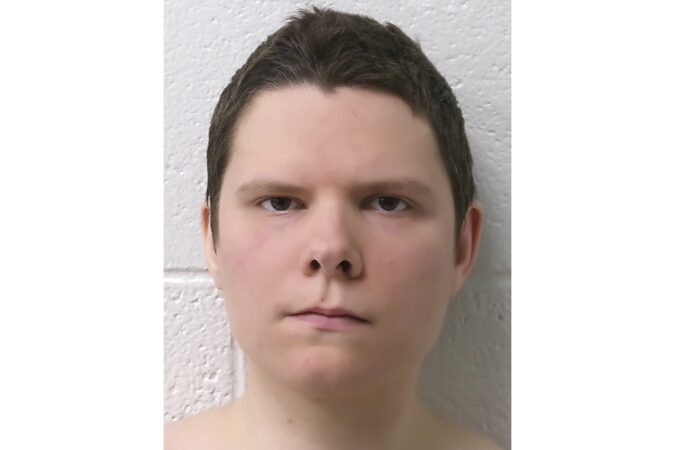
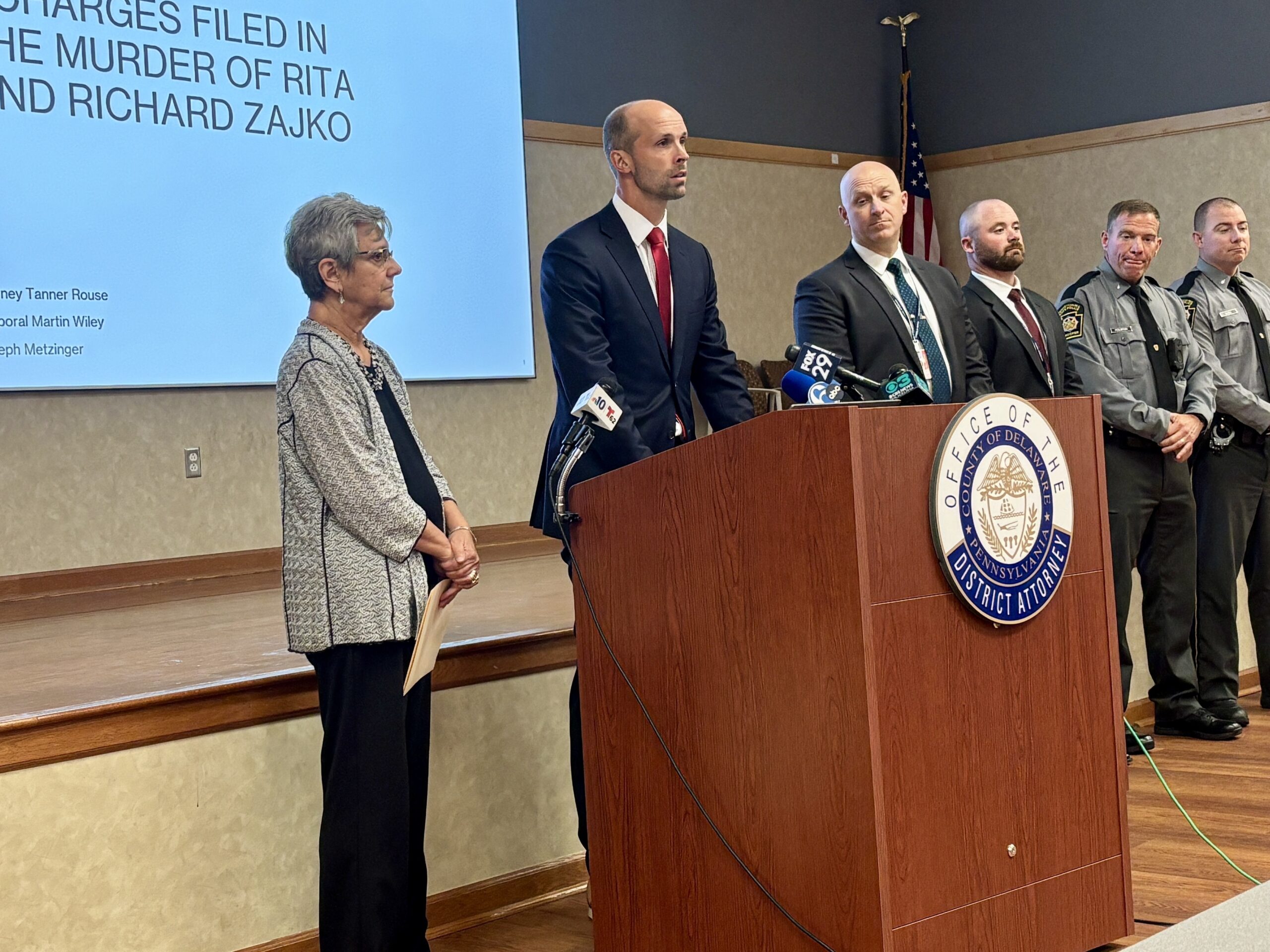
Michelle Zajko, 33, has long been a person of interest in the slayings of her parents, Richard and Rita Zajko. After years of investigation, Delaware County District Attorney Tanner Rouse filed first-degree murder charges Wednesday and accused her of shooting the couple on her 30th birthday.
New information obtained in the last few months, including ballistics evidence and an extensive download of text messages and other data from Zajko’s cell phone, allowed prosecutors to piece together the case against her, according to the affidavit of probable cause for her arrest.
Rouse, in announcing the charges Wednesday, said he believes that while Zajko planned and carried out the killings, she likely did not act alone. The investigation is continuing, he said.
Building the case against her, he said, took years of skilled and disciplined police work as investigators interviewed dozens of people and connected threads of information in several states.
“I want to emphasize — I cannot stress this enough — this is just about as exhaustive of an investigation that I’ve been a part of in my 16 years as an attorney,” Rouse said. “We don’t have a smoking gun. It is piece after piece after piece of evidence that has been collected painstakingly over many years.”
Investigators say Zajko, an alumna of Cardinal O’Hara High School and Cabrini University, drove to her childhood home on Highland Circle in Chester Heights with a plan to kill her parents. She shot them both in the head, leaving their bodies for police to find days later, after a concerned friend reported they had missed an appointment to care for Rita Zajko’s elderly mother.
The motive for the killings remains unclear.
Rita and Richard Zajko, seen here in a 1993 family portrait.
Zajko told friends she had a difficult relationship with her mother, and accused her of years of emotional abuse. In online writings, Zajko said her mother criticized her constantly, arguing with her over religion and her desire to be vegan.
That strained relationship was detailed in the final text messages Zajko sent her father days before authorities say she killed him, according to the affidavit.
“Every time I interact with mom in a nonsuperficial way she spends the time insulting a life she knows nothing about, makes assumptions that imdoing nothing, etc,” Zajko wrote, the document said. “Itsuncalled for. I don’t want to speak to someone who treats me like that.”
But Rita Zajko, just nine hours before she was killed, attempted to reconcile with her daughter, sending her a happy birthday text and apologizing for whatever she had done to alienate her, according to the affidavit.
On Wednesday, Rosanne Zajko, the wife of Richard Zajko’s brother, stood alongside the prosecutor as he announced the charges against her niece. Losing her brother- and sister-in-law, she said, was “like the lights going out of our lives.”
“We don’t know yet if the trial will begin to heal the void in our lives and the ache in our hearts,” she said. “But we do know that the detectives, the DA’s office, and we, the family, have done everything possible to achieve justice for Rick and Rita.”
Delaware County District Attorney Tanner Rouse announces murder charges Wednesday against Michelle Zajko. Zajko’s aunt, Rosanne (left) spoke briefly about the impact the killings has had on her family.
Michelle Zajko, for her part, has said she had been unjustly accused.
In a sprawling, handwritten letter sent to The Inquirer and other news outlets last year, Zajko insisted she did not kill her parents. Rosanne Zajko said Michelle Zajko told her at the couple’s funeral in January 2023 that she had not killed her parents, but said she knew who did. She would not name the killer, her aunt said.
“I’m viscerally reminded of the witch hunts, of the Satanic Panic, of the mob that burned Joan of Arc at the stake, and of the mob that ripped apart Hippolyta,” Michelle Zajko said in the letter, written in a jail cell in Maryland, where she is awaiting trial on trespassing, gun, and drug charges. “The papers are lying. … I did not murder my parents.”
Sources familiar with the investigation say it is possible that, as an only child, Zajko may have expected to inherit her parents’ substantial estate. The value of the estate has not been made public, but the sources, who spoke on the condition of anonymity to discuss an ongoing case, say it is worth several million dollars.
A person close to Zajko said she had contacted an attorney in the weeks after her parents were killed to discuss how she could access her parents’ estate.
Zajko remains in custody in western Maryland with two other members of the Zizians, including the cultlike group’s leader, Jack “Ziz” LaSota, who identifies as female.
Zajko is also charged with illegally supplying the guns used by other members of the Zizians in a fatal shootout with a U.S. Border Patrol agent weeks before her arrest in Maryland.
In her letter from jail, Zajko said she and her friends were innocent of all criminal charges they face. She said they were being targeted by other members of the Bay Area tech community seeking to discredit them.
Members of the Zizians — a group whose philosophy encourages making decisions through reason and logic, rather than emotion — are connected to six killings across the country, authorities say. Prosecutors have denounced the group as extremists and accused them of using violence when their worldview is challenged.
For years, the deaths of Richard and Rita Zajko remained the only ones tied to the Zizians that remained unsolved.
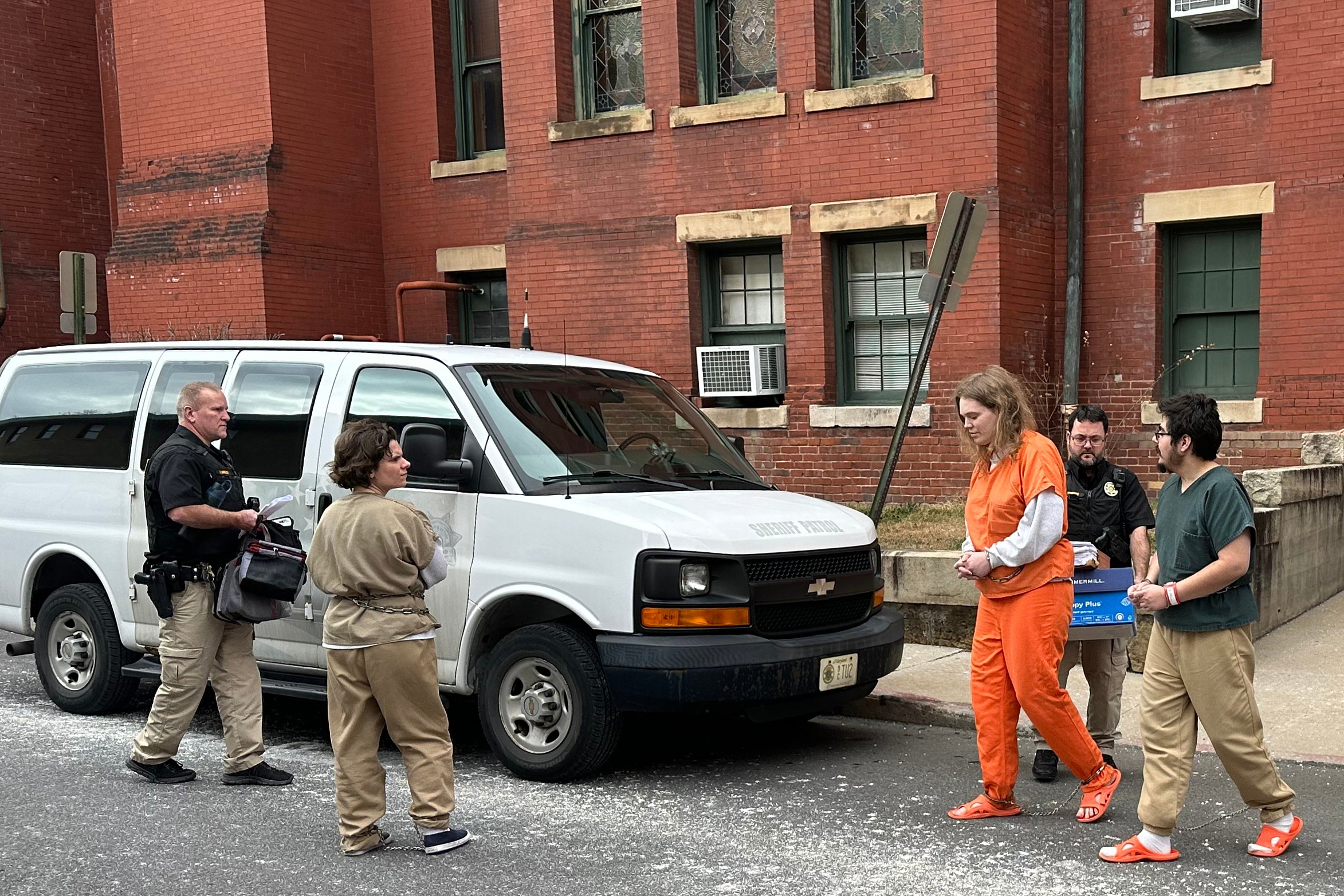
Deputies escort Michelle Zajko, left, Daniel Blank, right, and Jack LaSota, in orange, from the Allegany County Courthouse in Cumberland, Md. in January.
Almost immediately after the killings, investigators in Delaware County learned that Zajko had been at her parents’ home on the night they were shot — a neighbor’s Ring security camera recorded someone screaming “Mom!” shortly before police believe the fatal shots were fired.
The couple were found in their daughter’s childhood bedroom, which had remained virtually unchanged since she had moved out of the house decades earlier, the affidavit said.
The gun used to kill the couple was the same caliber as, and a similar model to, one Zajko had purchased in Vermont weeks earlier, investigators said. She was labeled a person of interest in the case as a consequence. But authorities said there was not enough evidence to prove she had committed the crime.
That changed this week, prosecutors said.
When investigators spoke with Zajko at her home in Vermont after her parents’ killings, she showed them a different type of ammunition from the kind found at the Chester Heights home, the affidavit said. However, while serving a subsequent search warrant there, detectives found cartridges that were an exact match — and that they said Zajko had hidden from them.
Initially, forensic investigators said they were unable to determine if the shell casings found near Rita and Richard Zajko’s bodies had been fired from their daughter’s gun. But late last fall, other casings found near trees behind Michelle Zajko’s home in Vermont, which she had used for target practice, had been fired by the same gun that killed her parents, authorities said.
Another crucial piece of evidence, investigators said, was a list found on Zajko’s cell phone titled “There are so many things we f— up” that detailed missteps, including not taking shell casings from the homicide scene, according to the affidavit.
The murder charges mark an unexpected turn for Zajko, whom friends and loved ones described as an ambitious, accomplished young woman with a keen interest in science. In her early 20s, Zajko pursued a career in bioinformatics and conducted research at Children’s Hospital of Philadelphia with colleagues from the University of Pennsylvania.
At the same time, Zajko became immersed in the Zizianmovement through online message boards, and met some of the group’s members while interning with NASA in California.
The Chester Heights, Delaware County home where Richard and Rita Zajko were murdered on New Years Eve 2022.
In 2021, partly in reaction to the COVID-19 pandemic, Zajko abandoned her scientific research and moved to rural Vermont, where she lived with other Zizians and grew close to LaSota, the group’s leader.
Zajko, in her prison letter, said that she rejects the characterization of LaSota as her “leader” and that the group does not refer to themselves as Zizians. Instead, she said that she and LaSota are close friends, and that she loves LaSota “infinitely more than I could ever express.”
Investigators now believe that Zajko, LaSota, and Daniel Blank, another Zizian, traveled to Chester Heights together on the day Zajko’s parents were killed, and intentionally left their cell phones in Vermont to prevent authorities from tracking their movements, according to the affidavit.
The three made that trip a second time weeks later, in January 2023, so Zajko could attend her parents’ funeral in Marple Township. Pennsylvania State Police troopers investigating her parents’ killings briefly detained Zajko and Blank at a hotel where they were staying in Chester.
LaSota, however, refused to answer the troopers’ questions, was charged with obstruction of justice, and remained in custody in Delaware County for months before being released on unsecured bail.
LaSota did not show up for subsequent hearings, and a bench warrant for her arrest was still active when Maryland State Police took her into custody last year alongside Zajko and Blank.
As Zajko awaits trial in both cases, Rouse, the prosecutor, said her crimes “go beyond comprehension and circumstance.”
“This is a child who killed her parents, who walked into her childhood home, took her mother to her childhood playroom, and executed her,” Rouse said. “There aren’t words or emotions that can capture it.”
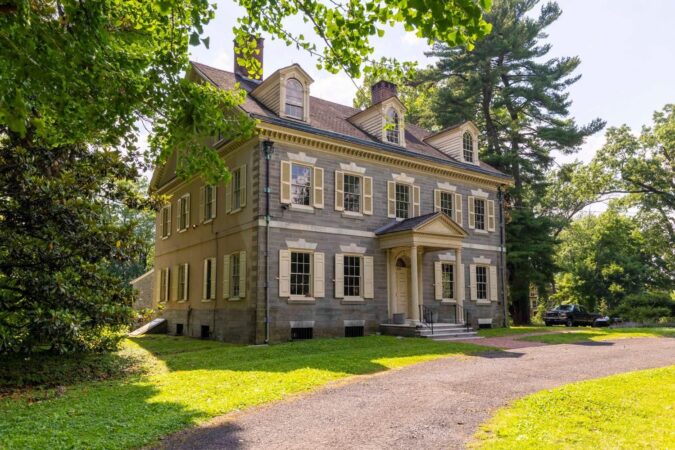
Built at the end of the 18th century on the site of a major Revolutionary War battle in Philadelphia, Upsala mansion was listed on the National Register of Historic Places in 1972.
The early Federal-style estate nestled on the border of Germantown and Mount Airy is listed at $995,000 and comes with nine bedrooms, 10 fireplaces, 15 parking spaces, and a 70-page easement agreement with a peculiar caveat — once a year, the owner must permit “a re-enactment of portions of the Battle of Germantown” on their front lawn.
“The battle reenactment is actually written into the deed. That is something any future owner of the property would be obligated to allow to happen,” said current owner Alex Aberle, who’s also a real estate agent and the property’s listing agent.
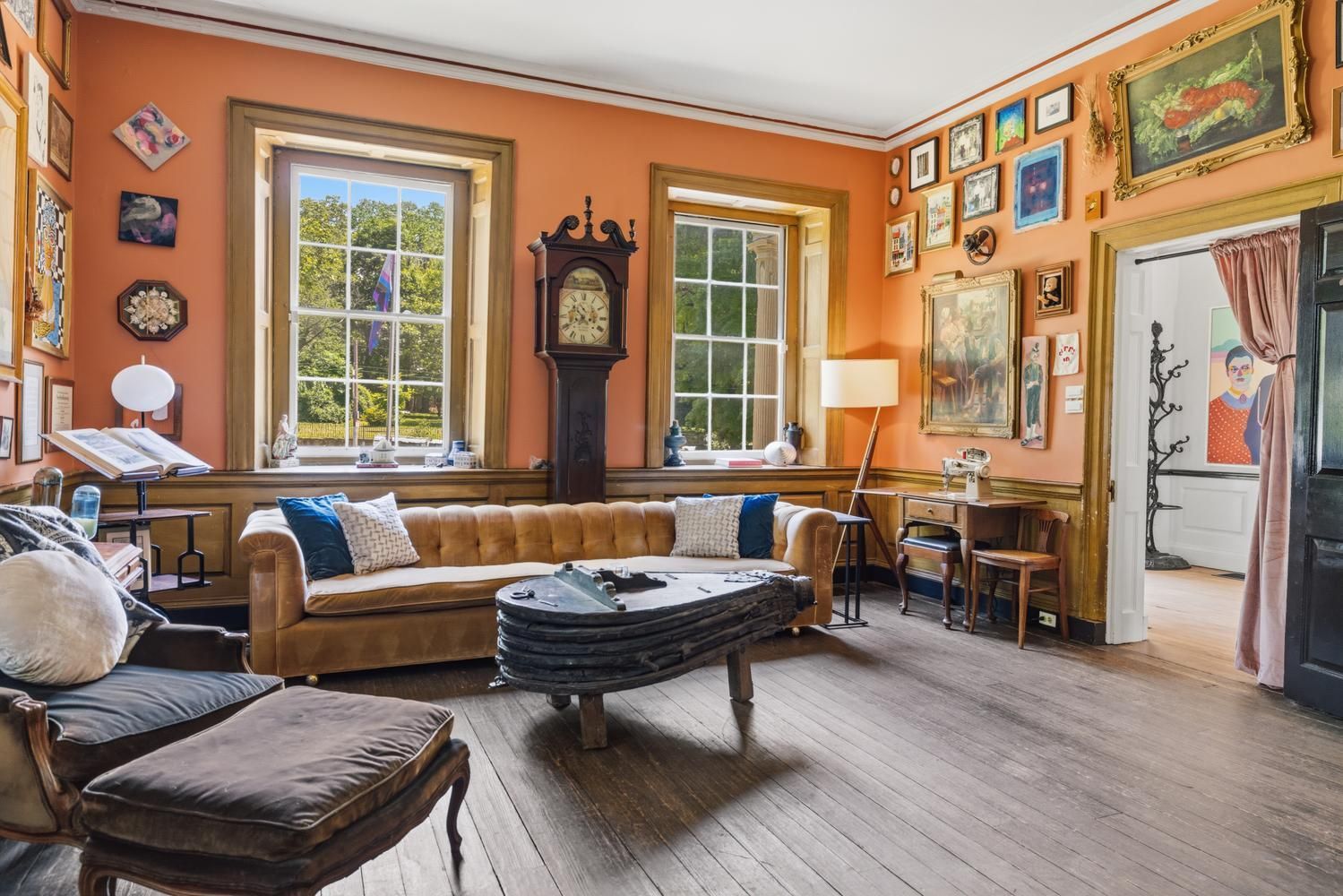
A living room in Upsala mansion, an early Federal-style building on the 6400 block of Germantown Avenue.
The easement was put in place by the National Trust for Historic Preservation when Aberle and his ex purchased the mansion on the 6400 block of Germantown Avenue in 2017 and became Upsala’s first private owners since it was converted into a historic house museum in the 1940s.
As part of the Revolutionary Germantown Festival — which commemorates the 1777 Battle of Germantown — battle reenactments were held for decades on the lawns of Upsala and Cliveden, a National Historic Trust site and mansion across the street from Upsala.
Though the mansion was built in 1798, two decades after the battle that sought to liberate Philadelphia from British control, the property served as the staging ground for the Continental Army during the Revolutionary War fight.
Aberle said he loved having the reenactments in his front yard, but Cliveden and the sites of Historic Germantown, which host the festival, haven’t held a reenactment there since 2019.
Carolyn Wallace, education director at Cliveden, said prior to the pandemic, organizers were reevaluating tactical demonstrations as part of the October festival in light of ongoing gun violence in the U.S. In 2020, organizers underwent a community engagement project called “Considering Re-enactments,” which sought to answer the question: “Is this still the best way to tell stories of the American Revolution?”
“We found it was a mixed bag so we shifted more towards living history,” she said. “We still have military personnel (reenactors), but we have not done tactical demonstrations in a number of years, though I can’t say we won’t do them again.”
And if they do, the easement still stands.
“That runs with the land — for me and for everyone else for years to come, and hopefully, forever,” Aberle said.
Built for John Johnson III, a fourth-generation descendent of the Janesen family, who were early Germantown settlers, Upsala stayed in the family until the 1940s, when it was seized due to financial issues.
Preservationists worked to save the property from demolition and from the mid-1940s until the early 2000s, it was a historic house museum before it was closed due to dwindling attendance and revenue.
The National Trust for Historic Preservation became Upsala’s owner in 2005 and Cliveden Inc., a co-stewardship organization of the National Trust, became its steward. After years of public engagement to find a new steward or use for Upsala, they put the 2.45-acre property up for sale in 2016.
Aberle and his ex, Violette Levy, beat out eight other offers by purchasing it for $550,000 cash — $51,000 more than the asking price.
They spent years doing extensive renovations like putting in central air, replacing the boiler, fixing the plumbing, and decorating.
“When we bought it, the walls were mostly varying shades of yellow and cream and now there’s no yellow left, I’m happy to report,” Aberle said.
They documented their journey on Instagram, where followers left comments about the memories they’d made at Upsala — from attending weddings there to attending a concert by the Hooters in the 1980s organized by one of the estate’s caretakers.
“I loved hearing all those stories because that’s the kind of thing you don’t see in books,” Aberle said. “It’s super special because it only comes organically.”
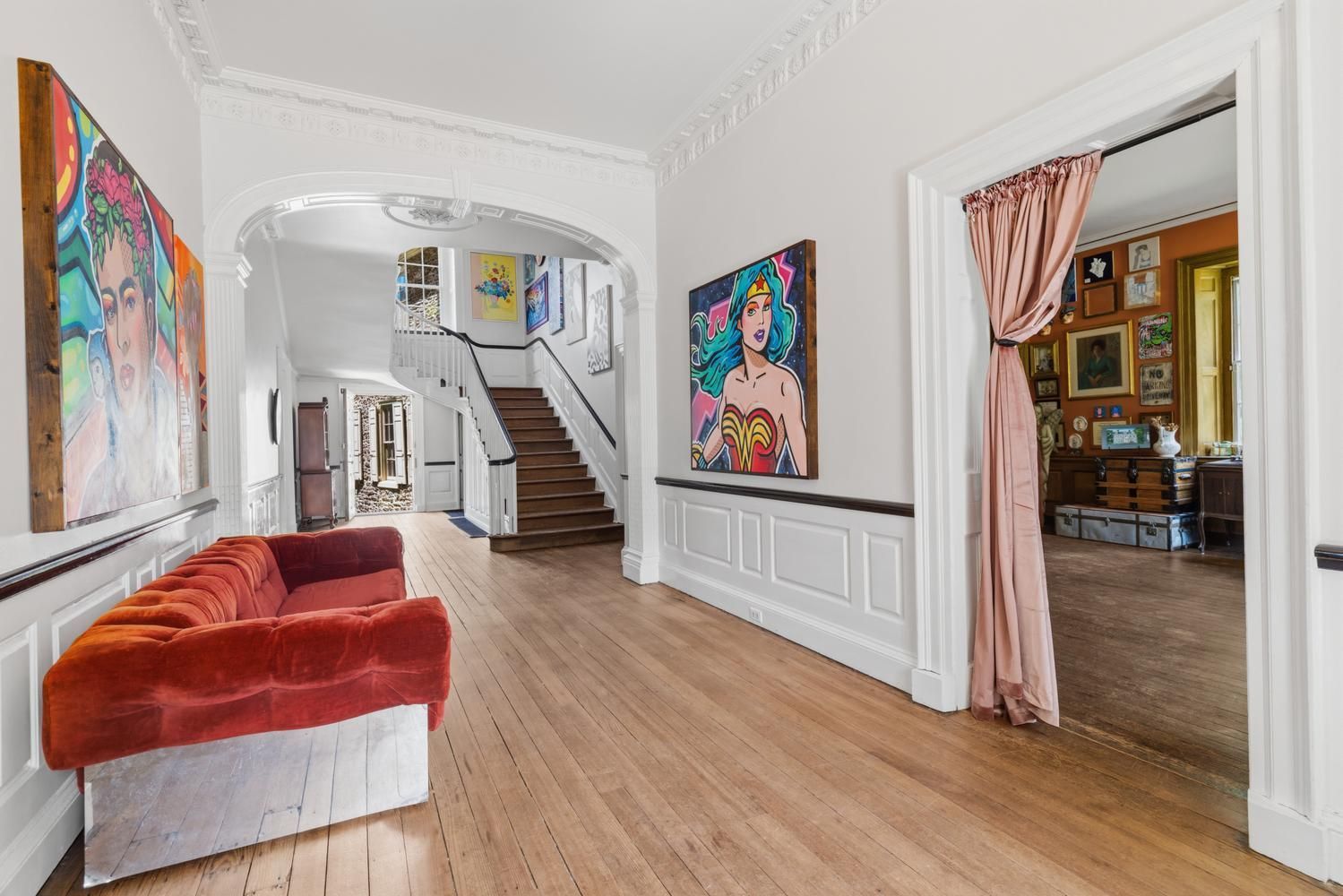
View of a hallway inside of Upsala mansion.
Aberle said he never had any intention of selling Upsala, but when his relationship with Levy ended and he became the sole owner of the home, it didn’t “really make sense to stay there as just one.”
“It’s definitely a family house and that was always sort of my dream for the house,” he said.
Aberle estimated that a little more than half of the mansion has been renovated. The back part of the house, where he’d planned to fix up the kitchen and put in a mother-in-law suite, is still in need of work, he said.
“My relationship didn’t last quite as long as my project did so the space is ready for someone else to come in and finish it for their family,” he said.
But another aspect of Aberle’s life did blossom because of Upsala. When he and his ex bought the mansion, it was listed by Louise D’Alessandro, a founding partner of Elfant Wissahickon Realtors. They invited her and others from the company to the first reenactment on Upsala’s front lawn after they took ownership of the property and within a year, Aberle left the real estate company where he worked and went to work for Elfant Wissahickon, where he remains.
Aberle said he’s fallen in love with the Germantown and Mount Airy neighborhoods and is only moving just around the corner from Upsala, so he plans to make himself available for any questions from future potential owners.
“The easement is really not as scary as the 70-page document might lead you to believe. I do mean it from the bottom of my heart. I spent nine years dealing with this document and working with this trust … and my plan is to make myself completely available to facilitate transition,” he said.
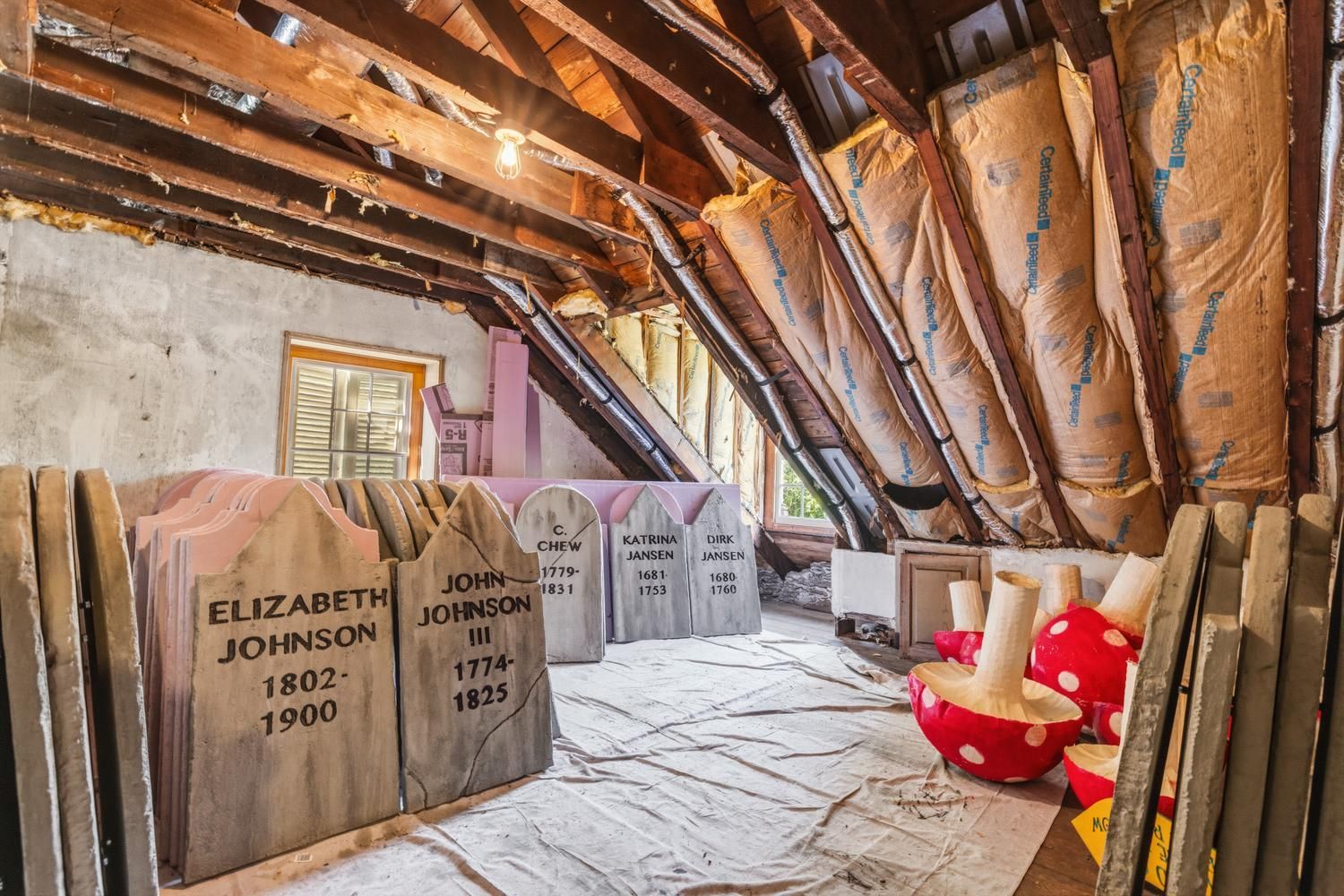
Halloween decorations, including tombstones that have the names and dates of people who once lived in or near Upsala, are stored in the attic of the property and will be sold with it.
And if you’re wondering about the listing photo that shows an attic room filled with tombstones and giant mushrooms, not to worry, those are Halloween decorations. The mushrooms are from an Alice and Wonderland-themed Halloween they did one year and the gravestones have historically-accurate names and dates on them of people who lived and died in and around Upsala.
“We set those up for a few years and added more folks each year,” Aberle said of the tombstones. “I’m leaving them in hopes someone else will carry on the tradition.”
He’s excited to see who will become Upsala’s next owner and what they will do with the historic property.
“I think the most important thing, for me, is it’s someone who will love this place as much as I do and have the desire to take care of it and love it,” Aberle said. “That’s what it deserves.”
For more information on Upsala, including the entire easement agreement, visit upsalamansion.com.
President Donald Trump’s administration sued Philadelphia and some of its top officials Thursday over a new ordinance that bars law enforcement officers from concealing their identities and effectively bans federal immigration agents from wearing masks.
The law, part of City Council’s recently adopted “ICE Out” package of legislation imposing some of the nation’s toughest local restrictions on immigration agents, is “blatantly unconstitutional,” the lawsuit said.
“Such an ordinance also undermines the principles of federalism that underlie our entire constitutional order by seeking to prevent effective federal law enforcement within Philadelphia,” according to the complaint.
The ordinance makes it a crime for any law enforcement officer, including Immigration and Customs Enforcement agents, to wear face coverings or conceal personal identifiers like badges and nameplates while carrying out their official duties in the city, and it requires officers to identify themselves. It also prohibits the use of unmarked vehicles.
The bill includes exceptions allowing officers to wear masks in certain circumstances, such as medical emergencies or SWAT operations.
An officerwho violates the ordinance could be prosecuted, and risks up to 90 days in jail plus a fine.
The suit, filed in the Eastern District of Pennsylvania, names as defendants the city, Mayor Cherelle L. Parker, District Attorney Larry Krasner, and City Solicitor Renee Garcia. It asks a federal judge to find the bills unconstitutional, warning that federal agents could suffer irreparable harm if the policy remains in place.
“Protecting officers’ personal identities is particularly important during high-risk enforcement operations involving individuals with violent criminal history, gang affiliations, transnational criminal organizations, and known or suspected terrorists,” the suit says.
The lawsuit marks the Trump administration’s most significant action targeting Philadelphia’s immigrant-friendly policies to date.
“Today we regrettably had to sue the birthplace of this great Nation,” Associate Attorney General Stanley Woodward said in a statement. “But we will not sit by while Philadelphia flagrantly violates our Constitution, seeking to criminally punish our Nation’s law enforcement heroes merely for doing their job.”
Philadelphia has long been known as a sanctuary city primarily because it does not comply with ICE-issued detainers, in which federal agents ask local jails to facilitate the arrest of undocumented immigrants in their custody.
But Parker has largely avoided direct confrontation with the White House over the issue, a reversal from the combative stance of her predecessor, former Mayor Jim Kenney.
Parker’s supporters credit her with careful, crafty management of the city’s relationship with Trump, noting Philadelphia has been spared from the surges of federal agents the president has sent to other cities. But immigration advocates say Parker has backed away from a fight at a time when strong action is most needed.
The tension surfaced when Parker decided to let the mask bill became law without her signature, after Garcia warned the mayor that the provisions might not be legally enforceable.
Council members, however, wanted to take a more proactive stance against Trump’s nationwide deportation campaign. And they seem to have gotten his attention.
Councilmember Kendra Brooks, who coauthored the “ICE Out” package, said she “will not back down from this fight.”
“Philadelphia doesn’t like bullies. And we certainly don’t like masked PPD officers or ICE agents terrorizing our neighbors,” Brooks said in a statement. “The people of this city expected our leaders to fight back against Trump’s invasion. That’s what we did when we passed ICE Out.”
Brooks noted that the lawsuit cites the Parker administration’s publicly aired concerns about the bill, and said other jurisdictions targeted by Trump after they passed legislation restraining ICE have not had to deal with that dynamic.
“Other lawsuits aren’t dealing with the City’s own words about the laws being used against them,” Brooks said.
The Parker administration declined to comment.
The Pennsylvania Immigration Coalition condemned the lawsuit as a political effort to undermine local policies that keep families safe, strengthen public trust, and ensure city resources serve Philadelphians.
“Once again the Trump administration is using the courts to wage a political campaign against immigrant communities, instead of addressing the real needs of our country,” coalition executive director Jasmine Rivera said in a statement. “Pennsylvanians have been clear, they do not want more immigration enforcement and detention centers, they want affordable education, healthcare, and housing.”
Councilmember Rue Landau, the legislation’s other coauthor, criticized Trump for “targeting Philadelphia because our city dared to stand up and say that masked federal agents should not be able to operate in our communities and target our vulnerable neighbors without accountability.”
‘We will arrest you’
In addition to banning officers from concealing their identities, the “ICE Out” package, which in April passed Council with a veto-proof supermajority, prohibits federal immigration agencies from staging raids on city-owned property, bans discrimination on the basis of citizenship status, and prohibits the city from engaging in most forms of information-sharing with ICE.
The legislation also codified some of Philadelphia’s long-standing sanctuary city policies that had been established only through executive order — most notably a ban on city jails honoring ICE detainers not accompanied by judicial warrants.
Parker did not sign the bill after Garcia expressed concern about the ban’s “significant legal and operational challenges,” the suit notes. The mayor’s signature would signal the Parker administration’s intent to enforce the requirement, the solicitor said, and would send an inaccurate signal that the prohibition was enforceable.
While Parker might have attempted to distance herself from the requirement by not signing the bill, the lawsuit quotes Krasner threatening federal agents with prosecution.
“We will arrest you. We will put handcuffs on you. We will close those cuffs. We will put you in a cell,” Krasner said in January. “We will do everything in our power to convict you and we will make sure you serve your entire sentence because Donald Trump has no power whatsoever to pardon you.”
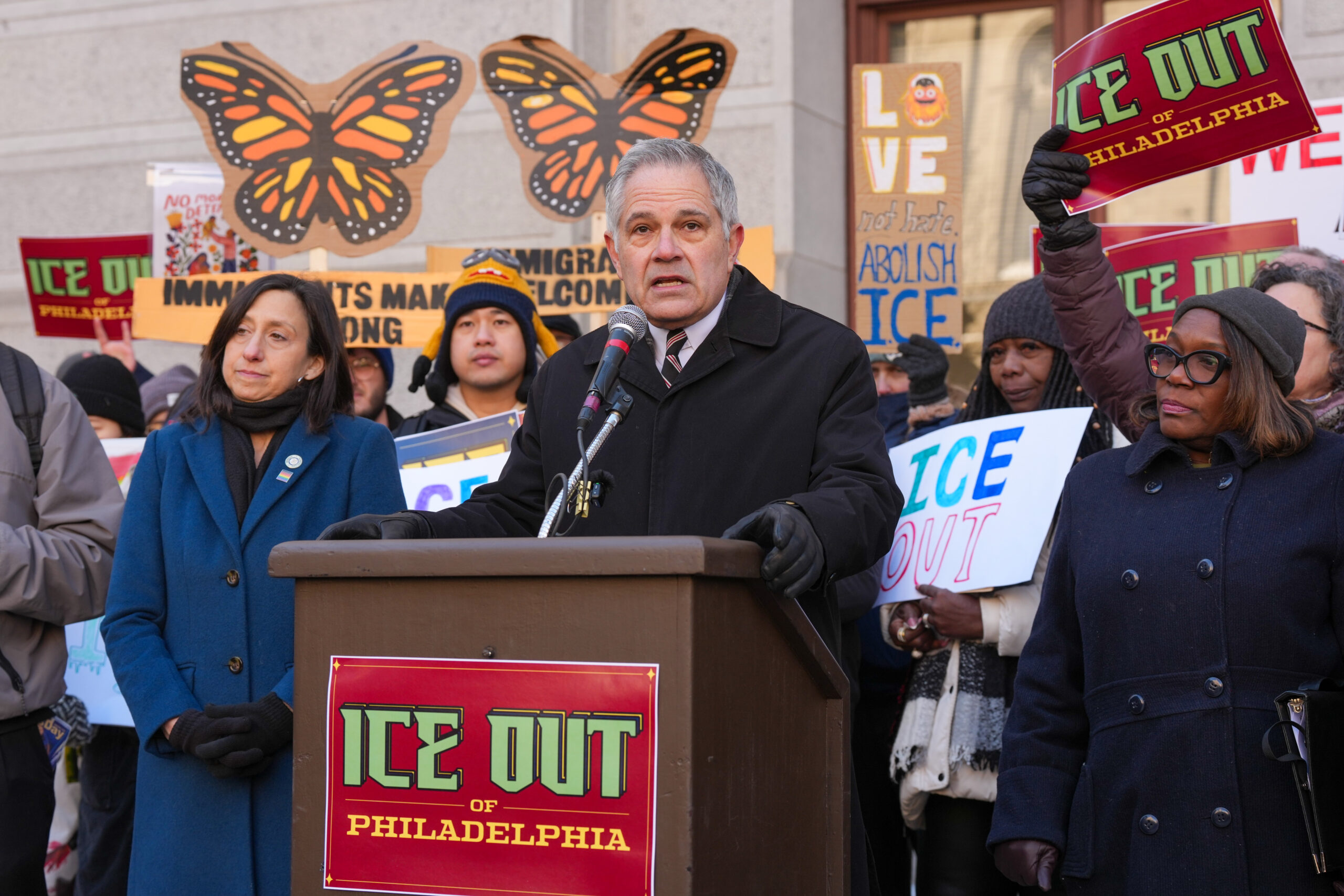
Larry Krasner shown here during a press conference at City Hall to announce a package of bills aimed at pushing back against ICE enforcement in Philadelphia, January 27, 2026.
Philly case could have national stakes
The complaint makes clear that by bringing this lawsuit, the Department of Justice is not closing the door on challenges to other ICE Out ordinances.
Around the country, more and more Democratic-led communities are attempting to regulate what ICE can and cannot do within their jurisdictions. And doing so with the support of immigrant communities.
“In all the ways that ICE agents terrorize and violate the rights of our community, masked kidnappings are ones we consistently see and hear about,” said Erika Guadalupe Núñez, executive director of Juntos, the South- Philadelphia-based immigrant advocacy organization.
She said, however, that “we’re part of a strong local movement organized to fight back, and we all embody the spirit of this city, we will not back down easily.”
In March, the Montgomery County Board of Commissioners passed a resolution that restricted the agency from using county property or resources for civil investigations.
Issues around masks and identification have been particularly contentious.
Activists in Philadelphia and elsewhere say ICE arrests often look like kidnappings or muggings, where men in ordinary clothes, with no visible identification, suddenly descend on their target. The people being arrested may think they are being attacked by criminals.
Several states, including New Jersey and New York, have passed laws to ban law enforcement officers, including ICE, from wearing facial coverings while on duty.
In April, the U.S. Court of Appeals for the Ninth Circuit upheld a lower court’s injunction on a California law that required federal agents to “visibly display identification.” The unanimous three-judge panel ruled that the requirement violated the Constitution’s supremacy clause, which bars the states from regulating federal government activities.
New Jersey Gov. Mikie Sherrill signed bills in March that essentially banned ICE agents and police from wearing masks on the job, drawing pushback from Republican lawmakers. The Trump administration sued New Jersey in federal court in April, and the New Jersey Monitor and others reported that ICE agents continued to cover their faces during recent clashes with demonstrators outside the Delaney Hall immigrant detention center in Newark.
The Trump administration says federal immigration officers wear face coverings to protect themselves and their families from anti-ICE activists who may seek to identify and harm them. Assaults and death threats are on the rise, the administration said.
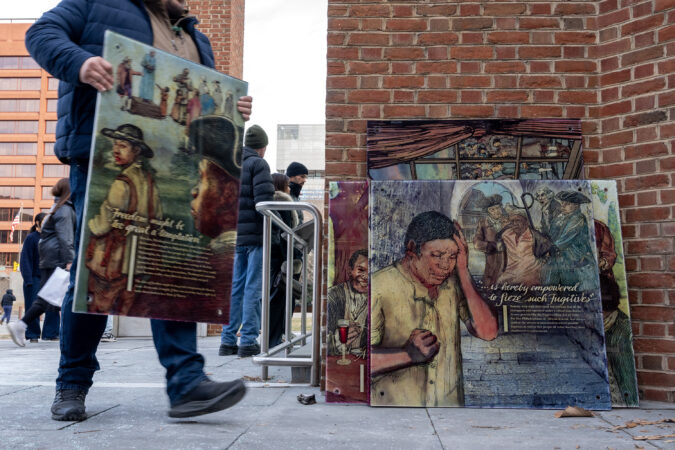
The city does not have a right to dictate the content of the panels, the court found.
The judges further found that the federal government’s proposed replacement panels, which historians say whitewash Washington’s role in slavery, “are full of historical context.”
The proposed panels “highlight the momentous events that took place in the President’s House and the other sites at Independence National Historical Park,” Judge Thomas M. Hardiman, a President George W. Bush appointee, wrote in the opinion. “They acknowledge the evil of slavery, including its injustices and hypocrisies, and, by telling the story of the nine slaves that Washington kept in the President’s House, remind us of their essential humanity.”
It was not immediately clear what would happen next at the site. The federal government did not immediately outline its next steps, and there are conflicting court rulings over the Trump administration’s push to remove displays from national parks that “inappropriately disparage Americans past or living.”
But the ruling does bring to a close a chapter in the President’s House litigation, the first courtroom clash between Trump and Mayor Cherelle L. Parker’s administration. Any further review of the injunction is at the discretion of the three judges, the full Third Circuit, or the Supreme Court and is not guaranteed.
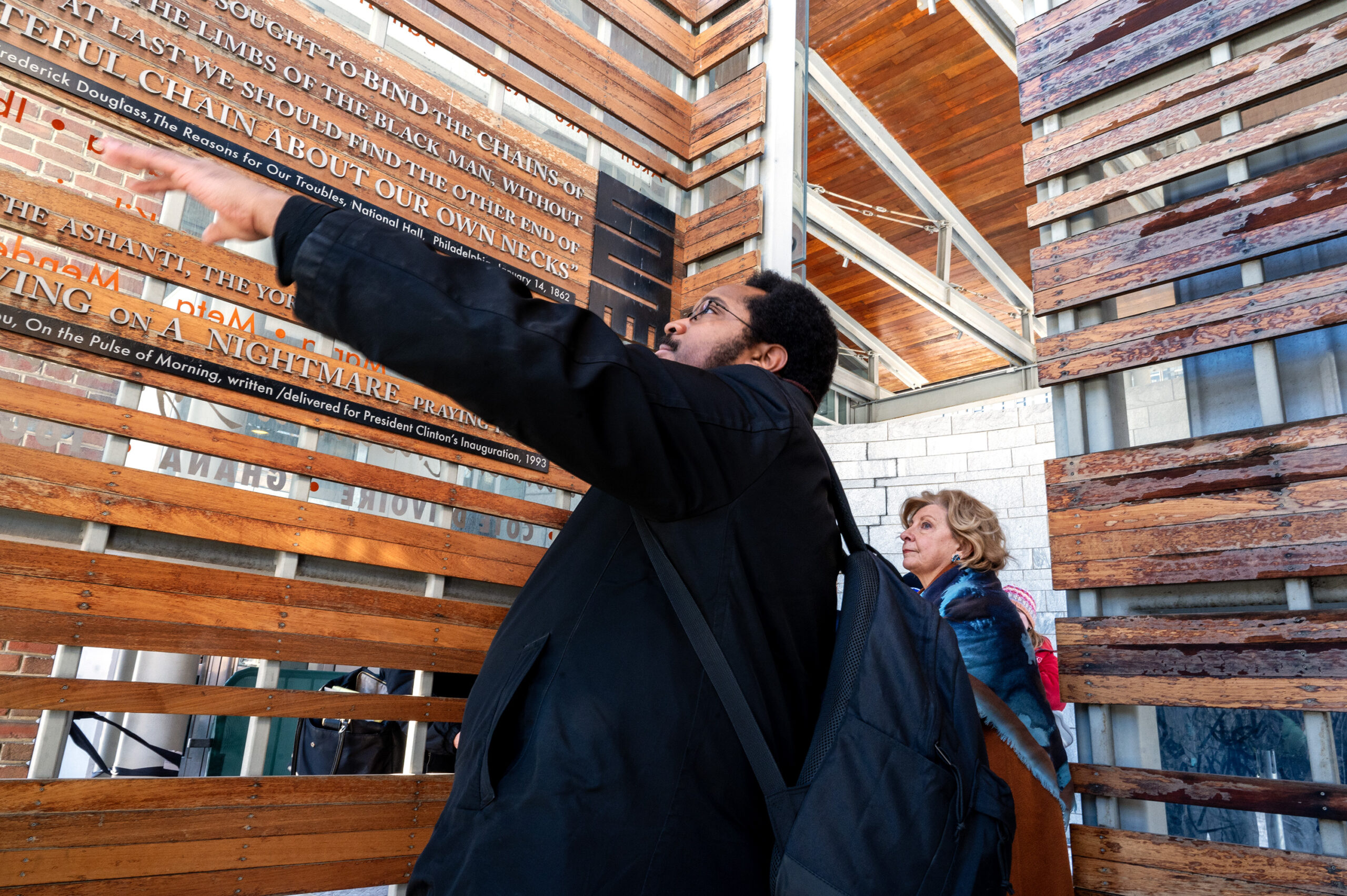
Mijuel Johnson, a guide with The Black Journey: African-American Walking Tour of Philadelphia, leads District Court Judge Cynthia Rufe (right) as she visits the President’s House in Independence National Historical Park in February.
The city was unable to convince the Third Circuit panel it has joint decision-making power with the federal government over the entirety of Independence National Historical Park because of the local ownership of Independence Hall.
Philadelphia has standing to argue in court that the federal government violated the contract signed when the city donated the President’s House to the National Park Service, Hardiman wrote. The agreement included a guarantee the federal agency would maintain the site.
But the city had to prove it could win based on that argument to keep the injunction alive, and the judges disagreed.
“The duty to ‘maintain’ is better understood as a general management obligation that accompanies ownership, not a promise that the exhibits will forever remain in place regardless of the owner’s wishes,” the opinion said.
The city’s claim that the removal was “arbitrary and capricious” under the Administrative Procedure Act also did not find purchase. The federal law allows challenges only to “final” agency actions, but the newly proposed panels show the January removal was not the Trump administration’s “last word on the matter,” the opinion said.
Avenging the Ancestors Coalition, one of the advocacy groups leading efforts to protect the President’s House, said in a statement that the group was disappointed by the decision but would persevere. The coalition was consulting its legal team to consider potential next steps.
“This is definitely not the end of this fight, nor does it diminish the importance of ensuring that the full truth of our nation’s history is preserved and presented accurately,” the organization said.
In a video statement Thursday, Parker said, “I will pursue every legal action possible in efforts to reverse this decision.”
A spokesperson for the U.S. Department of the Interior simply said: “Trust in Trump.”
Debate over history
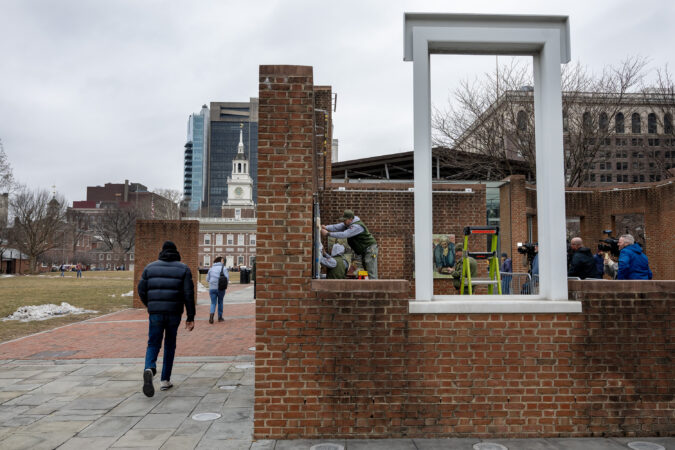
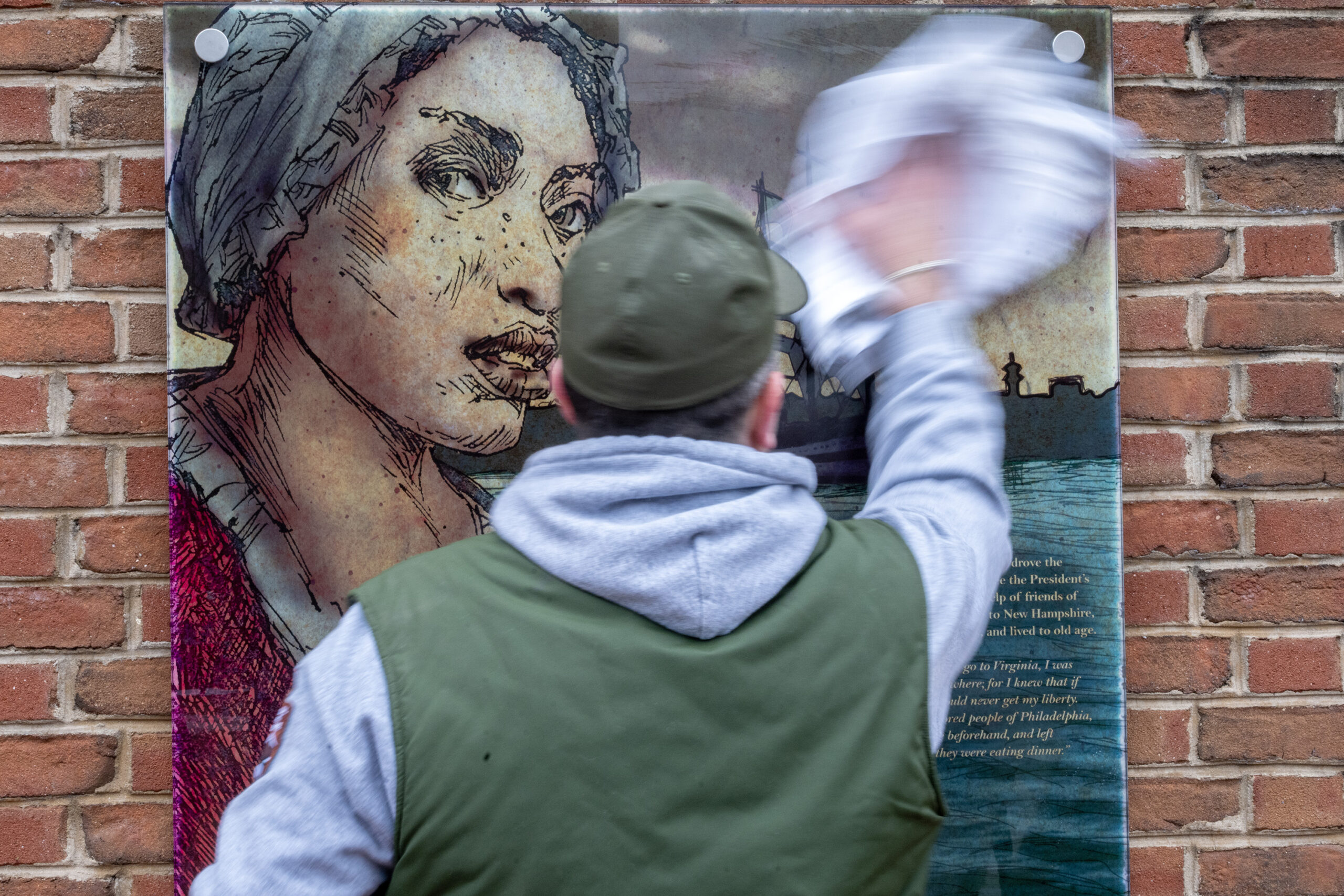
A worker cleans the glass on the panel for Oney Judge after re-hanging it at the President’s House in Independence National Historical Park in February.
The ruling is an inflection point in the tumultuous legal saga over whether the federal government has power to determine which version of U.S. history is displayed for public viewing — an issue even more salient ahead of the country’s 250th birthday on July Fourth.
The Trump administration ordered the removal of the President’s House exhibits in January after almost a year of scrutiny of the site. Months later, the government offered its own vision for how those panels would be replaced, quietly uploading them to the National Park Service website in April.
An Inquirer review of the panels found that the federal government had softened Washington’s role as an enslaver.
For instance, one proposed panel argues the people who were enslaved at the President’s House “experienced a greater modicum of autonomy than elsewhere in the South such as to explore the city and sometimes even attend the theater, with Washington buying the tickets.”
Historians argued the original panels were accurate, well-researched, and site-specific. The development of the site in the early 2000s was the product of collaboration across various disciplines including historians, artists, architects, and advocates.
But Thursday’s ruling says the Trump administration’s proposed displays offer a nuanced view on Washington’s and John Adams’ roles in or opinions on slavery, adequately highlight the stories of the nine people enslaved at the President’s House, thoroughly acknowledge the horrors and brutality of slavery, and uplift key figures in Black history.
“One panel … explains that Washington ‘often expressed discomfort with the institution and a desire to see it abolished,’ but, ‘as a Virginia plantation owner, his wealth and livelihood were deeply tied to it,’“ Hardiman wrote. ”Other panels provide an even broader overview of slavery and the struggle to extirpate it.”
The ruling landed just less than three weeks before the 250th anniversary celebrations, and one day before Juneteenth. Attorneys for the federal government said the new panels had been manufactured and were ready to be installed.
U.S. Rep. Brendan Boyle (D., Philadelphia), whose district includes Independence Park, said in a statement that Thursday’s ruling highlighted the urgency of passing his Protecting American History Act, which would shield historical displays at the park from government censorship.
“Just a block away from where our nation was founded, Donald Trump is choosing the path of tyrants who rewrite history instead of learning from it,” Boyle said. “As we approach America’s 250th anniversary, we must tell the full truth of our nation’s history — the good and the bad.”
The administration has appealed to the U.S. Court of Appeals for the First Circuit.
There is not a prescriptive way to resolve such conflicting rulings, which is why some legal scholars argue against so-called universal injunctions, in which one district judge’s ruling affects the entire country. The Supreme Court signaled its discomfort with those types of orders last year.
Conflicting rulings have become more prevalent during Trump’s tenure, as his administration has issued drastic measures that take immediate effect, said Michael Foreman, a professor at Penn State Dickinson Law.
Which order ends up prevailing will depend on whether the Massachusetts ruling is stayed, or if the issue escalates to the Supreme Court.
Last offseason, the Flyers brought in John Garbarino to help younger players hold their own during fights on the ice. He had an ideal resume for the job: The South Philly native is an undefeated middleweight in the Bare Knuckle Fighting Championship.
But early Sunday morning, the fight venue was a narrow street in Center City, where the closing-time bar crowd watched Garbarino pummel the plexiglass vestibule of Barstool Sansom Street and scream obscenities at people inside.
Garbarino, aka “Johnny Cannoli,” then destroyed an onlooker’s cell phone, sparking a seven-person fracas in the middle of the street.
Part of the incident was captured in a two-minute video obtained by The Inquirer on Wednesday.
The video shows that there were at least two uniformed officers at the scene, but they did not make any arrests. Instead, according to one eyewitness, an officer gave Garbarino a fist bump after the altercation.
A police spokesperson said the incident is under investigation.
Reached by phone Tuesday, before video of the incident surfaced, Garbarino denied hitting anyone and said that he was not the aggressor.
“If anything, I broke it up,” he said.
Although the police fist bump is not seen on video, Garbarino confirmed that it occurred and that the officer is a friend of his.
Garbarino, 30, did not immediately return messages left Thursday morning about the video footage.
After this story was published online, a Flyers spokesperson said Garbarino was retained for a one-time training last summer and was never paid by the team. “There is no ongoing relationship,” the spokesperson said.
On Tuesday, Garbarino said that he had been a “special guest” at Barstool on Saturday night, and that he left for an hour before deciding to return “for another reason.” He declined to elaborate.
According to a Barstool employee working that night, Garbarino and a group of associates were asked to leave the establishment at 2 a.m. because they had become unruly and it was closing time. Barstool management did not respond to a request for comment.
The Barstool employee said once the group was outside, Garbarino and an unknown associate began violently pounding on the door to get back in — which is where video shot from across the street picks up. Garbarino can be seen unsuccessfully trying to force the door open.
Marques Reed, who was working at a nearby bar, said people on the street started to film the two men thrashing at Barstool’s winter vestibule, causing the whole structure to shake.
The video shows Garbarino — a former sous-chef at Del Frisco’s who later worked at Michelin-rated Alinea in Chicago — unloading on the vestibule with a half dozen punches and elbow strikes while yelling at Barstool staffers or bar patrons watching from behind wobbling plexiglass.
After failing to break intoBarstool, Garbarino stalks over to a group of onlookers.
“Garbarino comes across the street and says, ‘I’ll knock you the f— out,’” Reed said.
Garbarino then grabs an onlooker’s phone and spikes it onto Sansom Street, obliterating the device. That man goes after Garbarino as he is walking away, but a Garbarino associate grabs the man by the shirt collar. The man responds by throwing a punch at Garbarino’s associate.
A third member of Garbarino’s group then punches the man whose phone was destroyed, and he falls down. He punches him again when he attempts to get up, sending him reeling backward and out of frame.
Garbarino then appears to show restraint as he is face-to-face with a man he had shoved, and he seems to be trying to de-escalate the situation before walking away.
Moments later, though, someone yells an obscenity at Garbarino, who reengages with the man with the broken cell phone. That man pushes Garbarino and takes a swing at him, missing. Garbarino tackles him to the ground.
“John, don’t hurt him!” one of the men with Garbarino yells. Then, a woman with Garbarino kicks the man while he’s down.
After they get up, Garbarino shoves another man in the face, then sucker punches the man he had tackledwhile he appears to be arguing with the woman.
Garbarino on Tuesday vehemently denied throwing any punches and disputed a since-deleted Reddit post on the incident that described him as the aggressor. He said he was trying to defuse a situation he characterized as a “little scuffle.”
“I can’t control the world,” he said. “I’m not a referee.”
He did confirm one aspect of the Reddit post.
“The only thing that was accurate was the fist bump from a cop,” Garbarino said. “He was a friend of mine.”
Reed said he was troubled by the attack and the lack of action by police.
“Why is this sanctioned bare-knuckle boxer wildin’ out at a bar, beating on a door, then beating people up? Didn’t he just have a fight not that long ago?” Reed asked.
(He did, in fact: KnuckleMania VI, last month at the Xfinity Mobile Arena. Garbarino is now 4-0, having defeated Kaine Tomlinson Jr. by TKO in the fifth round.)
“This dude was a maniac. He was going crazy,” one witness said of Garbarino. He asked not to be named because it could adversely affect his employment.
The witness said he was shocked that police laughed it off and walked away.
“Everybody was like, ‘You’re just letting him go?’” the man recalled bystanders asking police. “The cops kind of thought it was funny. That’s a very old-school Philly thing that I didn’t think was a thing anymore.”
Eric Gripp, a police spokesperson, said that a complainant reported being assaulted shortly after 2 a.m. Sunday, and that the case is being investigated by Central Detectives. He declined to provide any additional details about the complainant or the alleged perpetrator, or comment on the police response at the scene.
Garbarino, who grew up playing hockey, said given his “position with the Flyers” and his recent success in the Philadelphia-based Bare Knuckle Fighting Championship, he is trying to do “damage control” this week over the allegations in the Reddit post. He dismissed the claim that he knocked someone out as “a joke.”
A representative for the Bare Knuckle Fighting Championship did not immediately respond to a request for comment.
Garbarino said he would like to put the situation “to bed” as he pursues a world title.
“I’m obviously a popular guy in Philly,” he said. “I know violence pretty well. Nobody got beaten severely.”
Philadelphia is one of five cities on a list of finalists to host the 2028 Democratic National Convention, a major gathering that could generate millions of dollars in economic impact for the city.
Party officials are also considering Boston, Atlanta, Chicago, and Denver, the Democratic National Committee announced Monday.
The convention will be held from Aug. 7 to Aug. 10, 2028, according to the party. If Philadelphia is selected, the convention would likely be held at the Xfinity Mobile Arena at the South Philly stadium complex, the largest indoor event space in the city.
DNC leaders and advisers are expected to make site visits this spring before selecting a host.
The DNC said in its statement that, in picking a host city, party leaders will consider how each city uses “new and innovative approaches in response to the challenges and opportunities that arise from hosting an event of this magnitude.”
The Republican Party’s 2028 convention will take place in Houston.
Top Philadelphia Democrats and donors formed a host committee — called Pick Pennsylvania — in recent months and, in partnership with Democratic Mayor Cherelle L. Parker, submitted a bid to host the 2028 convention.
In a statement, Parker said that Philadelphia’s selection as a finalist “reflects the strength of its proposal and the broad coalition of civic, business, labor, and community leaders committed to hosting a convention that is inclusive and memorable.”
Parker, who is up for reelection next year, would no doubt play a major role in planning for an upcoming convention. So would Gov. Josh Shapiro, a Democrat currently running for reelection who is considered a contender for the 2028 presidential nomination.
The president of the Philadelphia host committee is David L. Cohen, a prominent party stalwart, and the chair is Daniel J. Hilferty, the CEO of Comcast Spectacor, which owns the Xfinity Mobile Arena.
He said in a statement that “there is no city more excited, more invested and more prepared than Philadelphia to host the 2028 Democratic National Convention.”
Philadelphia — the largest city in a critical swing state — last hosted a presidential nominating convention in 2016 at the South Philly arena, then called the Wells Fargo Center. Democrats that year nominated former Secretary of State Hillary Clinton, who was later defeated by Republican Donald Trump.
Before 2016, the city hosted major party conventions seven times, including the 2000 Republican National Convention. The GOP that year nominated then-Texas Gov. George W. Bush, who went on to serve two terms in the White House.
Former U.S. Rep. Bob Brady, the chair of the Philadelphia Democratic City Committee, said Monday that he had spoken multiple times to DNC leaders about the prospect of the city hosting the 2028 convention.
“We got a great reputation from the last convention we had,” Brady said. “Plus we’re going to show off the city very well this summer, which will really give us a good look.”
The news that Philadelphia is again a finalist to host the DNC is a welcome development for the city’s tourism and hospitality industry, as party conventions draw thousands of visitors and can be a boon for spending in the city.
The 2016 event generated $230.9 million in economic impact, according to the Philadelphia Convention and Visitors Bureau. Of that, about $132.9 million came from direct convention-related spending, and $11.1 million was generated by state and local taxes. That convention attracted more than 5,000 attendees and some 29,000 other visitors, leading to a record-breaking year for hotels in Center City, the bureau reported.
In this July 28, 2016 file photo, then-Democratic presidential nominee Hillary Clinton walks on stage at the arena in South Philly to accept the nomination of her party on the final night of the DNC.
If selected, Philadelphia may be uniquely positioned to host an influx of visitors.
The city’s hotel supply has expanded since the last time it hosted a DNC — and there are more than 19,000 hotel rooms in the city, according to Visit Philadelphia. That’s an increase from about 16,000 available in 2016.
The city has also invested millions of dollars on improvements to public spaces, transit hubs, and security ahead of several major events this year, including World Cup games, the MLB All-Star Game, and the commemoration of the 250th anniversary of America.
Conventions are also major logistical undertakings. Attendees include high-profile politicians and celebrities, and protests often form outside the events. The federal government has over the last two decades designated both parties’ nominating conventions as National Special Security Events, meaning they are deemed at high risk for terrorism and require federally led security.
In Chicago in 2024, the U.S. Secret Service led security planning alongside 16 other public safety entities, according to a local NBC affiliate. The law enforcement and security plan included designated protest zones, airspace monitoring, and traffic control.
Host committees are also responsible for raising millions of dollars to pay for parties, transportation for delegates, construction and venue upgrades, as well as other logistical services such as consultants, accountants, and communications staff.
In 2016, the Philadelphia host committee raised about $85 million — $10 million of which came from taxpayers in the form of a state grant. Other top contributions came from corporations, unions, and wealthy individual donors.
She didn’t even like diamonds. That was the funny thing. Costume jewelry, yes. A pair of handmade earrings, certainly. Diamonds, well, she’d always found them a bit showy.
She liked this one, though, because it had been Jim’s.
It was a man’s ring, a 1.3-carat diamond, round cut, set on a simple gold band, and when her husband, Jim, passed away a few years ago, Cindy Ware made it hers.
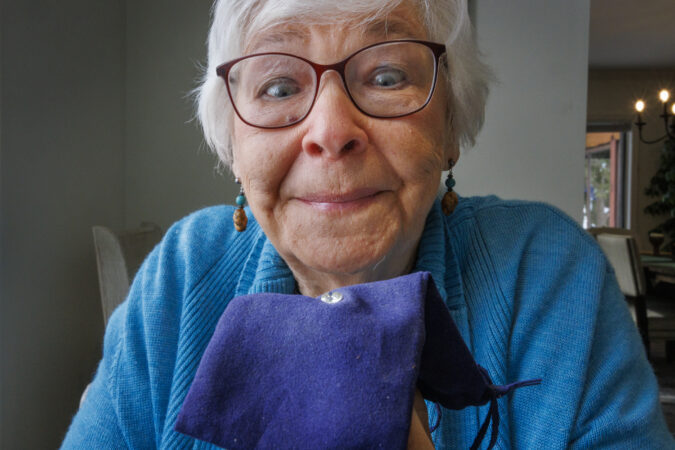
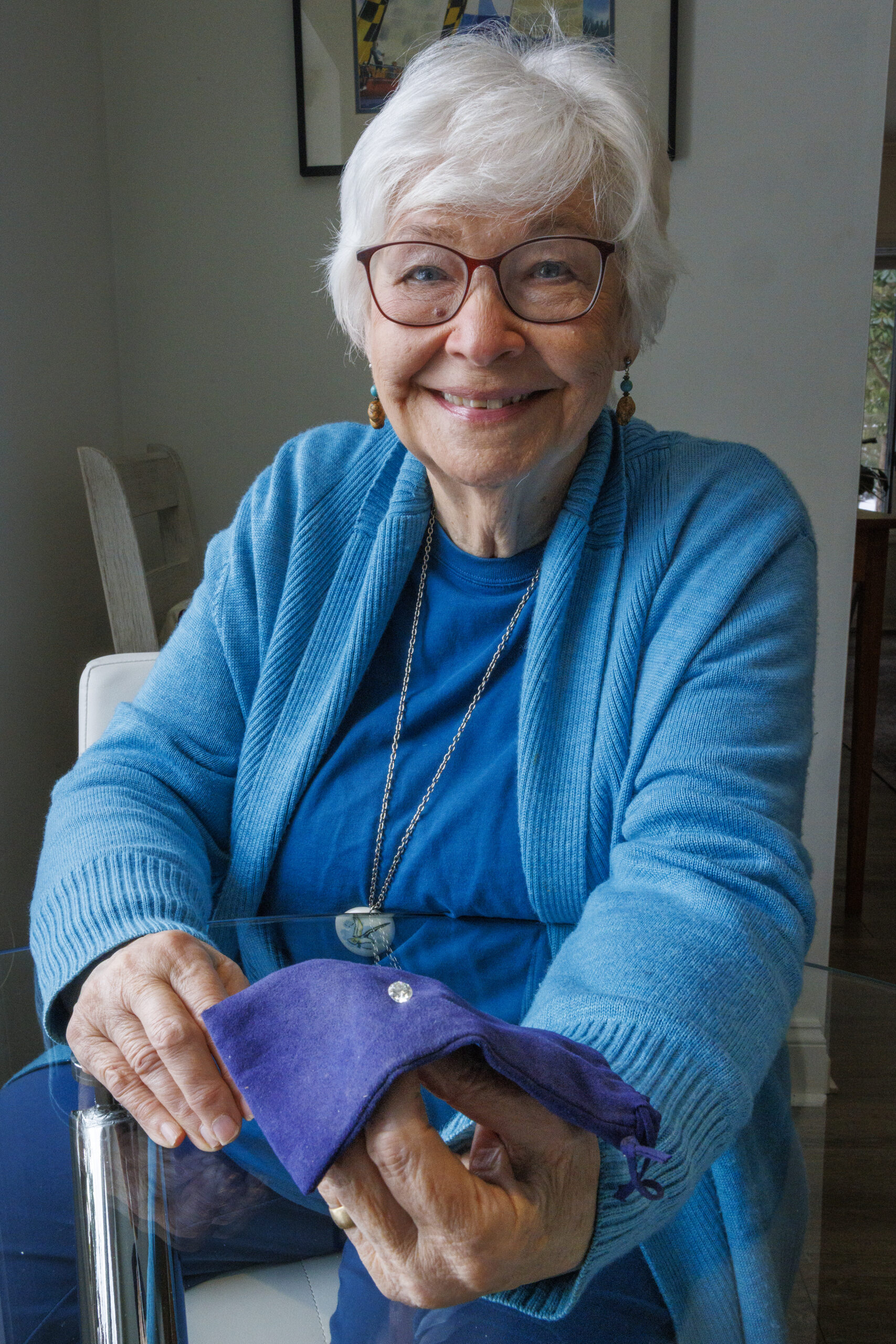
Cindy Ware of Kennett Square with diamond inherited by her late husband, Jim. She lost it but it was discovered embedded in a neighbors shoe in Florida. Photograph taken at her home on Wednesday, Feb. 25, 2026.
She wore it everywhere — to the grocery store, to lunch with friends, to her morning water aerobics class. It brought her comfort. A few times a day, she would look down at it, think of Jim, and smile.
“I never took it off,” says Cindy, who is 82 and impossibly sweet and sometimes wears a sweatshirt that says I’m often mistaken for an adult because of my age.
So when the diamond went missing last December, shortly before Christmas, Cindy was devastated. She felt sick, like she’d let Jim down.
She thought to herself: “Cindy, you just lose everything that’s important.”
A 60-year love story
Cindy Ware met the man she would marry in Pinkie Patterson’s second-grade class. This was in Mount Holly, N.C., in 1951. On Valentine’s Day of that year, while out sick with the mumps, Cindy had been allowed to come to the school parking lot to collect her Valentines.
The teacher sent a little boy out to deliver a box of treats.
He had a buzzcut and a little cowlick and his name was Jim.
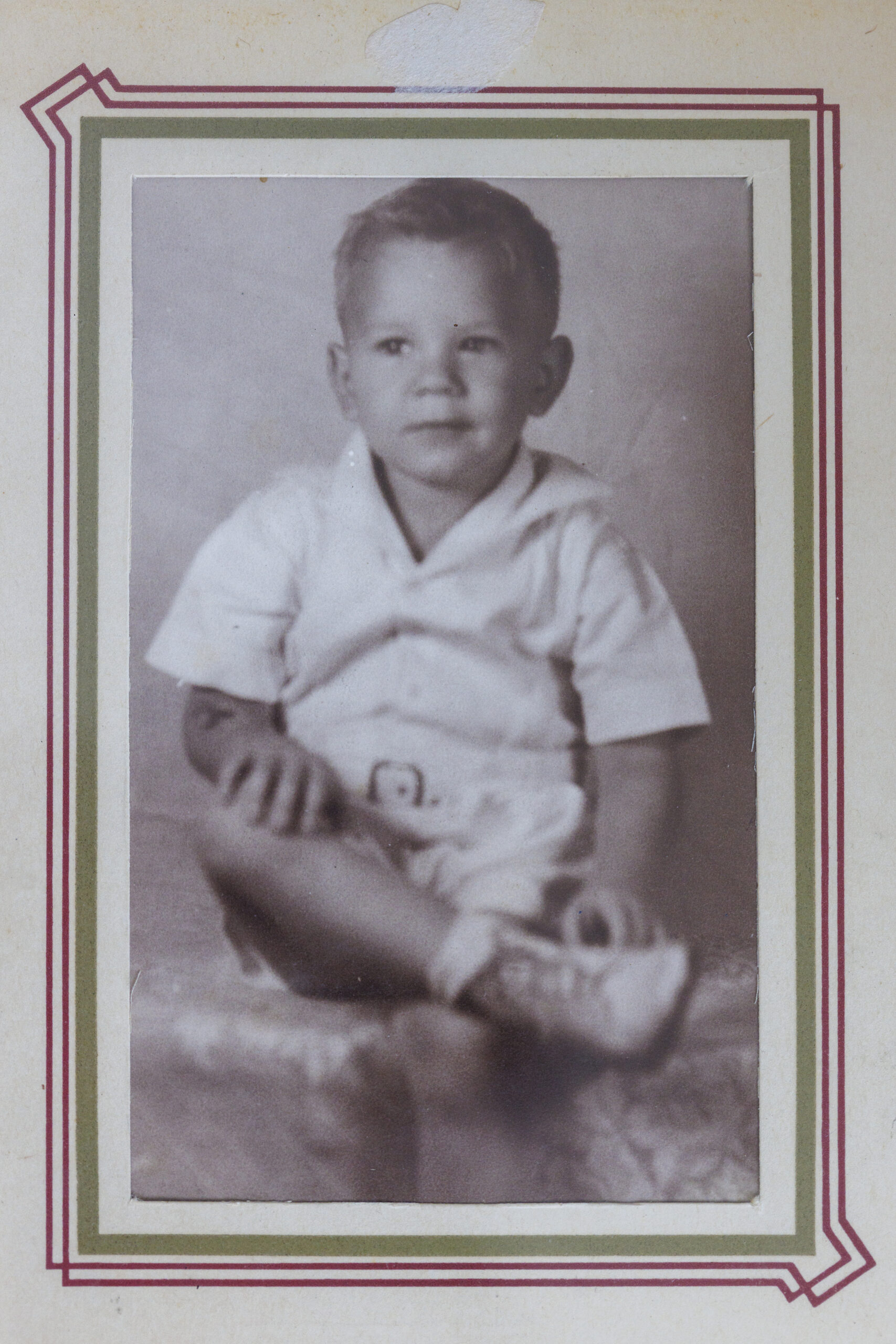
Childhood photograph of Jim Ware the late husband, Cindy Ware of Kennett Square. She lost the diamond he inherited but it was discovered embedded in a neighbors shoe in Florida. Photograph taken at her home on Wednesday, Feb. 25, 2026.
Well, Cindy’s mother thought Jim was about the most precious little boy she had ever seen. And Cindy — who until that point hadn’t given it much thought — soon decided that maybe she agreed.
By high school, they were an item — inseparable, Cindy explains, “except when we were mad at each other and dated other people.”
They got together for good during college, and theirs was a 60-year love story.
They married in 1965. They moved to New Jersey, then to Pennsylvania. They raised three boys. Their boys grew up and had children of their own. A few years ago, they settled into a retirement community in Kennett Square, where they liked to take morning walks and eat pizza with mushrooms and pepperoni.
“We never needed a lot of anything else,” Cindy says. “Just the two of us.”
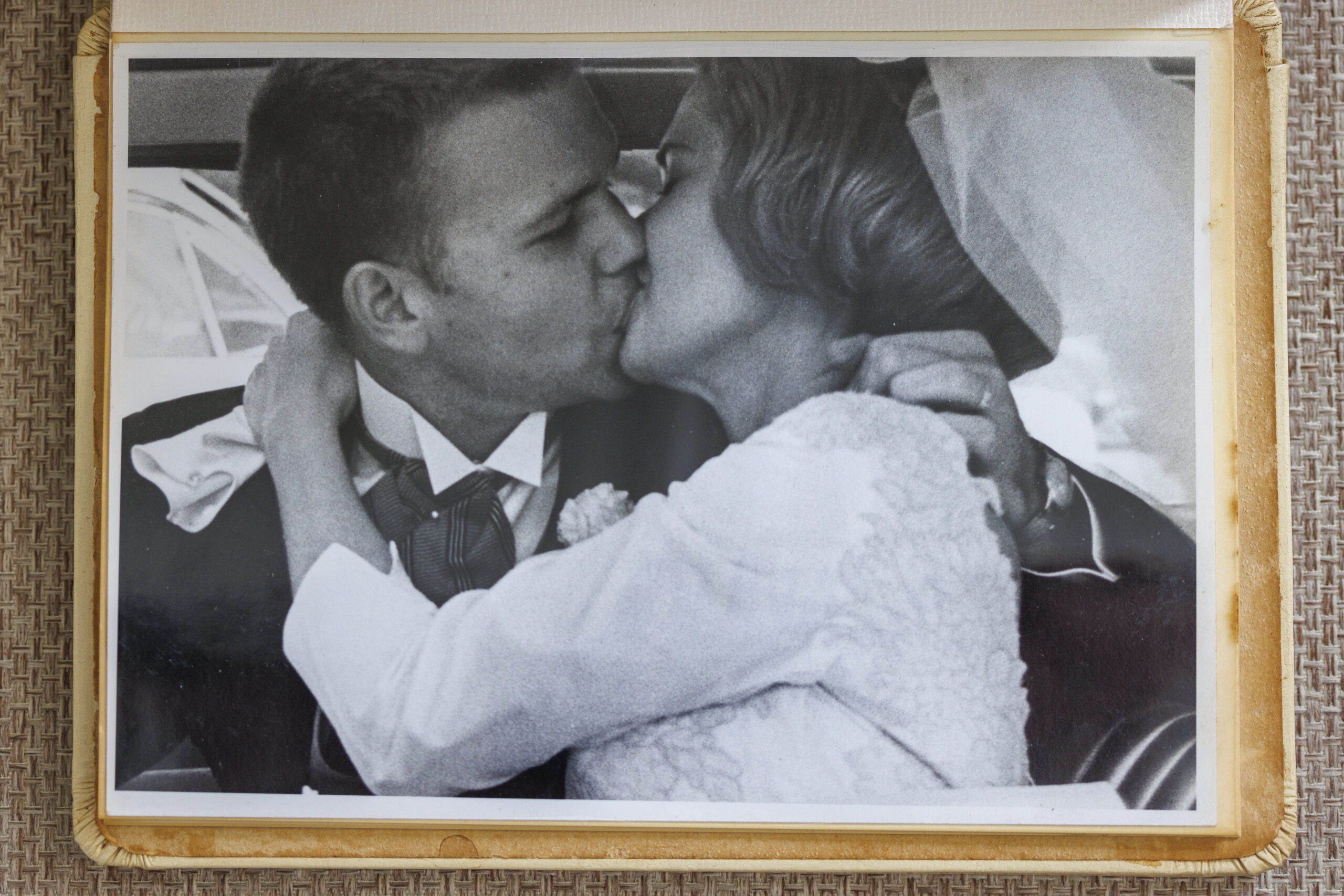
Wedding photograph of Jim (late) and Cindy Ware of Kennett Square. She lost a diamond he inherited but it was discovered embedded in a neighbors shoe in Florida. Photograph taken at her home on Wednesday, Feb. 25, 2026.
When Jim got sick, in 2020, it was horrible.Months of doctor’s visits, then specialist visits. Then, finally, hospice.
“The worst year of my life,” Cindy says.
Not long after Jim passed, in 2023, Cindy was getting the family’s affairs in order. One day, at a local bank, she opened an old lockbox and discovered a diamond ring — an heirloom that had been passed down through generations of Jim’s family.
Back when she and Jim married, and they didn’t have much money, he had told her she could have her pick: a ring or a car. “That’s a no-brainer,” she had replied. “I want a car.”
Still, something about the diamond spoke to her.
She plucked it from the lockbox and slid it onto her middle finger, and that’s where it remained for the next three years.
The missing diamond
She was having lunch with a friend last December when she glanced down and realized it was gone.
The diamond had dislodged from the setting, and it was nowhere to be found.
“I was just bereft,” Cindy says.
It could have been anywhere. In her car. In the grass outside her home.
At one point, she wondered whether she had lost it during her water aerobics class at the retirement community’s swimming pool. Things could get a little intense with the arm exercises. Maybe it had jostled loose and sunk to the bottom.
But what could be done? Even if they drained the pool, the likelihood of them ever finding the diamond was minuscule.
Her sons urged her not to worry, assured her that it was OK. There was always the chance that it might still turn up.
But weeks passed, then months.
Eventually, she resigned herself to the fact that the diamond was never coming back.
‘That might be a diamond’
One afternoon a couple weeks ago — on a pool deck 1,100 miles from Kennett Square — a man named Coleman looked down and noticed, lodged in the tread of his Lands End pool shoe, what appeared to be a small piece of glass.
Or wait. Maybe it was some kind of gem.
At a pool in South Florida earlier this month, a Pennsylvania man looked down at his pool shoe and discovered what at first appeared to be a gem or piece of glass stuck in the tread.
For days he had been wearing the pool shoes — to the pool, through locker rooms. He had stuffed them into his gym bag, into a suitcase. Earlier that day, he had worn them on a walk in the gritty sand of a South Florida beach.
He also wore them back home in Kennett Square, where he lived in a retirement community. In the afternoons — after the ladies finished their morning water aerobics — Coleman’s group played pool volleyball. He always wore his pool shoes during games.
Now, sitting poolside in Florida, Coleman’s husband, John, examined the stone and said, “Uh, that might be a diamond.”
Intrigued, but not yet convinced, the couple went the following day to a Pompano Beach jeweler.
Nine times out of 10, the jeweler told them, when people think they’ve found a diamond, it turns out to be nothing.
This was not one of those times.
Yes, the jeweler said, it was a diamond, all right — 1.3 carats, nicely colored, likely from the 1950s or ’60s. Probably worth a bit of money.
Tickled, Coleman posted a photo of the diamond to Facebook.
A diamond in the sole of his shoe
Back in Pennsylvania, Cindy was on the phone with her good friend.
It was Valentine’s Day, and the two were chatting about this and that, and at the end of their conversation, in passing, her friend mentioned a man from their neighborhood, Coleman, who had just posted a photo from Florida.
Apparently, he had found a diamond lodged in his shoe.
As it happened, Cindy and Coleman knew each other well. They lived just a couple streets apart, worked out in the same pool. Once, when Jim was in hospice, Coleman and his husband had brought her flowers.
Cindy tracked down the photo. Saw the small gem lodged in her neighbor’s pool shoe.
Impossible, she thought.
She dialed Coleman’s number.
“Hello,” she said, “I think you have my diamond.”
The return
It was confirmed a day later.
Back from Florida, Coleman delivered the diamond to Cindy’s house, along with a collection of yellow roses. Neither of them could stop smiling.
Best they can tell, the diamond fell to the bottom of the community pool, where Coleman — while playing pool volleyball — happened to step on it, just right. How it had remained lodged in his shoe’s tread for days or weeks or months — across multiple states — was anyone’s guess.
“It could never happen in a million thousand years,” Cindy says.
Says Coleman, “It does make you sit back and think for a minute about what is going on here.”
As you might imagine, their story has been the talk of their retirement community. Everyone, it seems, wants to talk about the little diamond that traveled halfway across the country in a shoe.
As for the diamond itself, Cindy has decided that it‘s time to pass it on, to her oldest son.
“I can no longer be trusted,” she jokes.
In the meantime, she has stopped wearing it to water aerobics.
U.S. District Judge Cynthia M. Rufe issued a ruling Monday requiring the federal government to “restore the President’s House Site to its physical status as of January 21, 2026,” which is the day before the exhibits were removed.
The order does not give the government a deadline for the restoration of the site. It does require that the National Park Service take steps to maintain the site and ensure the safety of the exhibits, which memorialize the enslaved people who lived in George Washington’s Philadelphia home during his presidency. The exhibits were abruptly removed in January following months of scrutiny by the Trump administration.
Rufe, a George W. Bush appointee, compares the federal government’s argument that it can unilaterally control the exhibits in national parks to the Ministry of Truth in George Orwell’s 1984, a novel about a dystopian totalitarian regime.
“As if the Ministry of Truth in George Orwell’s 1984 now existed … this Court is now asked to determine whether the federal government has the power it claims — to dissemble and disassemble historical truths when it has some domain over historical facts,” Rufe wrote. “It does not.”
Mayor Cherelle L. Parker’s administration filed a federal lawsuit against Interior Secretary Doug Burgum and acting National Park Service Director Jessica Bowron, and their respective agencies, the day the exhibits were dismantled. The complaint argued dismantling the exhibits was an “arbitrary and capricious” act that violated a 2006 cooperative agreement between the city and the federal government.
The federal government has the option to appeal the judge’s order. The Interior Department and National Park Service did not immediately comment on the ruling, which fell on Presidents’ Day, a federal holiday. The U.S. Attorney’s Office for the Eastern District of Pennsylvania declined to comment.
During a hearing last month, Rufe called the federal government’s argument that a president could unilaterally change the exhibits displayed in national parks “horrifying” and “dangerous.” She ordered the federal government to ensure the panels’ safekeeping after an inspection and a visit to the President’s House earlier this month.
Monday’s ruling follows an updated injunction request from the city that asked for the full restoration of the site — not merely that the exhibits be maintained safely — and a brief from the federal government arguing the National Park Service has discretion over the exhibits and that the city’s lawsuit should be dismissed on procedural grounds.
The federal government’s brief also argued there could be no irreparable harm from the removal of the exhibits because they are documented online and replacement panels would cost $20,000.
But the judge found the city is likely to prove its case that the removal was unlawful, and the panels should be restored while the litigation continues.
“If the President’s House is left dismembered throughout this dispute, so too is the history it recounts, and the City’s relationship to that history,” Rufe wrote.
The judge also found that the cooperative agreement between Philadelphia and the National Park Service remains in “full force,” even though the contract is technically expired.
Rufe’s memo named the nine enslaved Africans owned by Washington, and noted that two — Oney Judge and Hercules Posey — escaped. The removed displays recognize their struggles and the nation’s “progress away from the horrors of slavery,” the judge wrote.
“Each person who visits the President’s House and does not learn of the realities of founding-era slavery receives a false account of this country’s history,” the judge wrote.
The injunction does not resolve the underlying lawsuit, and is in effect for the duration of the litigation. In a January hearing, Rufe said she wouldn’t let the case drag into the summer, recognizing the 250th anniversary celebration being planned for Independence Mall.
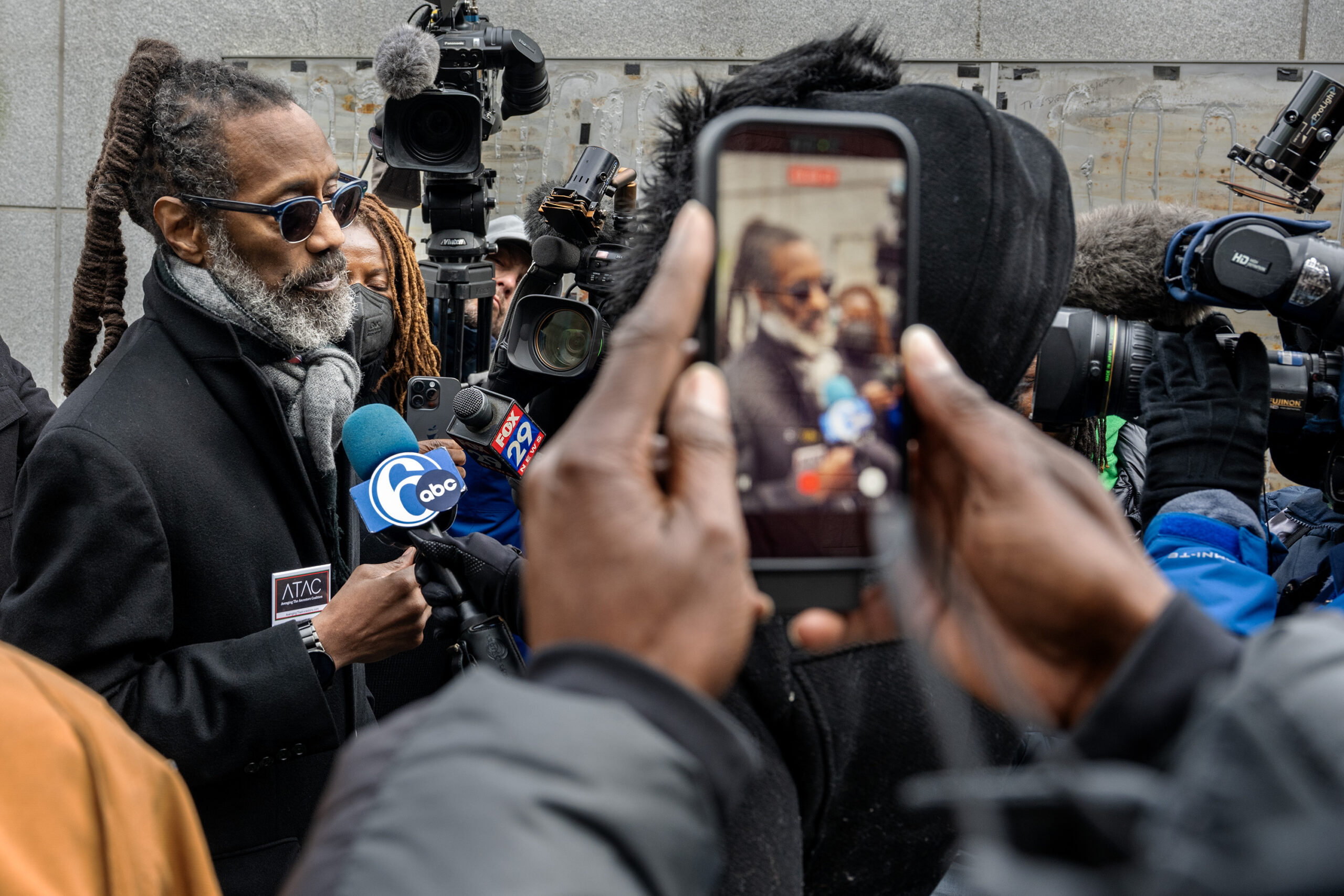
Attorney Michael Coard, leader of the Avenging the Ancestors Coalition, speaks with the news media Monday after a federal judge ordered the Trump administration to restore the slavery exhibits that the National Park Service removed from the President’s House last month. The group was on the site for an annual gathering for a Presidents’ Day observance when they learned of the order.
Avenging the Ancestors Coalition, the main advocacy organization leading the fight to protect the President’s House, was less than an hour into its Presidents’ Day event at the site when leaders got wind of their victory.
The group’s leaders, excited and completely in shock, congregated behind the site’s Memorial Wall to soak in the news before announcing it.
Moments later, Michael Coard, an attorney and the coalition’s leader, emerged before the crowd of about 100 people and told them: “Thanks to you all, your presence and your activism, I have great news: We just won in federal court.”
The crowd erupted in cheers and chants of “When we fight, we win!” and “We have won!”
Coard told reporters there was “no other blessing that we could have gotten today.”
The coalition has led dozens of rallies and town halls meant to energize the public in opposing the Trump administration’s ongoing scrutiny of the President’s House. The Black-led advocacy group helped develop the site in the early 2000s before it opened in 2010.
Dana Carter, the group’s head organizer, said she was in disbelief when she heard about the ruling.
“After we figured out that it really was the truth, I am just moved. My heart is overflowing with love for the judge who made the ruling, as well as the people who have been with us since the beginning … and also the people who have joined us in this fight to restore the President’s House,” Carter said.
But the fight is not over, advocates said, with Coard expecting the Trump administration to appeal or ignore rulings.
“This is a lawless administration. The people are going to have to take over to force them to do the right thing,” Coard said.
The Trump administration’s attempt to alter the President’s House was part of a wider initiative to remove content from national parks that “inappropriately disparage Americans past or living,” following an executive order from Trump. For instance, Park Service employees removed signage about the mistreatment of Native Americans from the Grand Canyon.
The fate of the President’s House exhibits was in limbo for months until they were removed by Park Service employees with wrenches and crowbars on Jan. 22. Meanwhile, advocacy groups and creatives behind the President’s House cultivated support for their cause to protect the site. Philadelphia City Council issued a resolution condemning the censorship of the exhibit.
“Judge Cynthia Rufe made it clear that historical truth cannot be dismantled or rewritten, and that the federal government does not have the authority to erase or alter facts simply because it has control over a national site. … We can not let President Donald Trump whitewash African-American history. Black history is American history,” City Council President Kenyatta Johnson said in a statement Monday.
Mijuel Johnson (left), a tour guide with The Black Journey: African-American Walking Tour of Philadelphia, leads Judge Cynthia Rufe (right) as she visits the President’s House in Independence National Historical Park on Feb. 2.
Attendees at Monday’s event were invigorated by the ruling.
Mijuel Johnson, a tour guide leader with the Black Journey who led Rufe through the site earlier this month, said he was “enjoying the moment for now” but then he would be back to work.
“This is a great win for this movement,” Johnson said.
Each night, Louis-Hunter Kean spiked a fever as high as 104.5. He would sweat through bedsheets and shiver uncontrollably. By morning, his fever wouldease but his body stillached; even his jaw hurt.
He had been sick like this for months. Doctors near his South Jersey home couldn’t figure out why a previously healthy 34-year-old was suffering high fevers plus a swollen liver and spleen. In early 2023, they referred Kean to Penn Medicine.
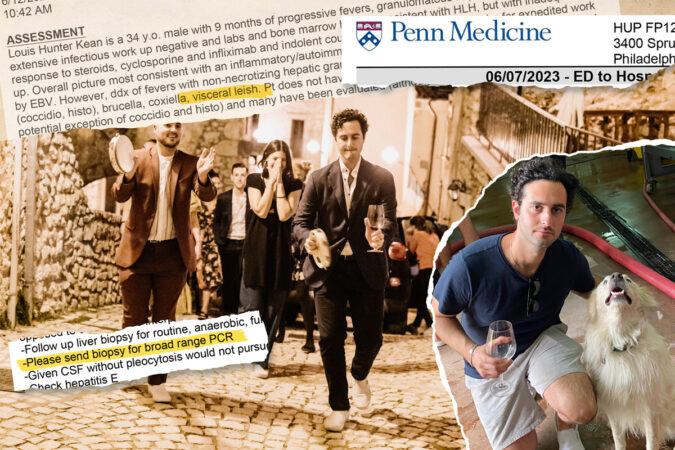
Louis-Hunter Kean visiting a winery in the Tuscany region of Italy in September 2021. He first spiked a mysterious and persistent fever about a year later in August 2022.
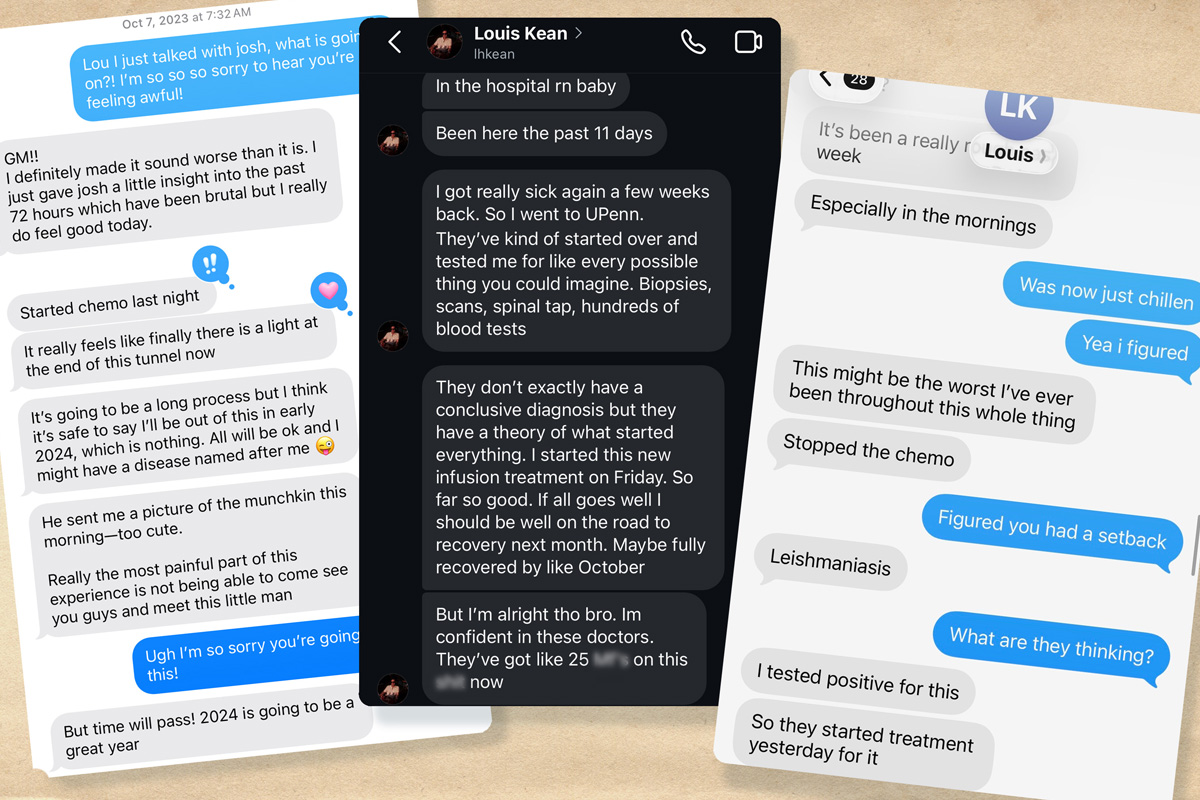
“These doctors are very sharp, and there are a lot of teams working on it,” Kean texted a friend after being admitted to the Hospital of the University of Pennsylvania (HUP) in West Philadelphia.
Was it an infection? An autoimmune disease? A blood cancer? Over the next six months, at least 34 HUP doctors — rheumatologists, hematologist-oncologists, gastroenterologists, infectious disease and internal medicine specialists — searched for an answer.
Kean was hospitalized at HUP five times during a six-month period in 2023. His electronic medical chart grew to thousands of pages.
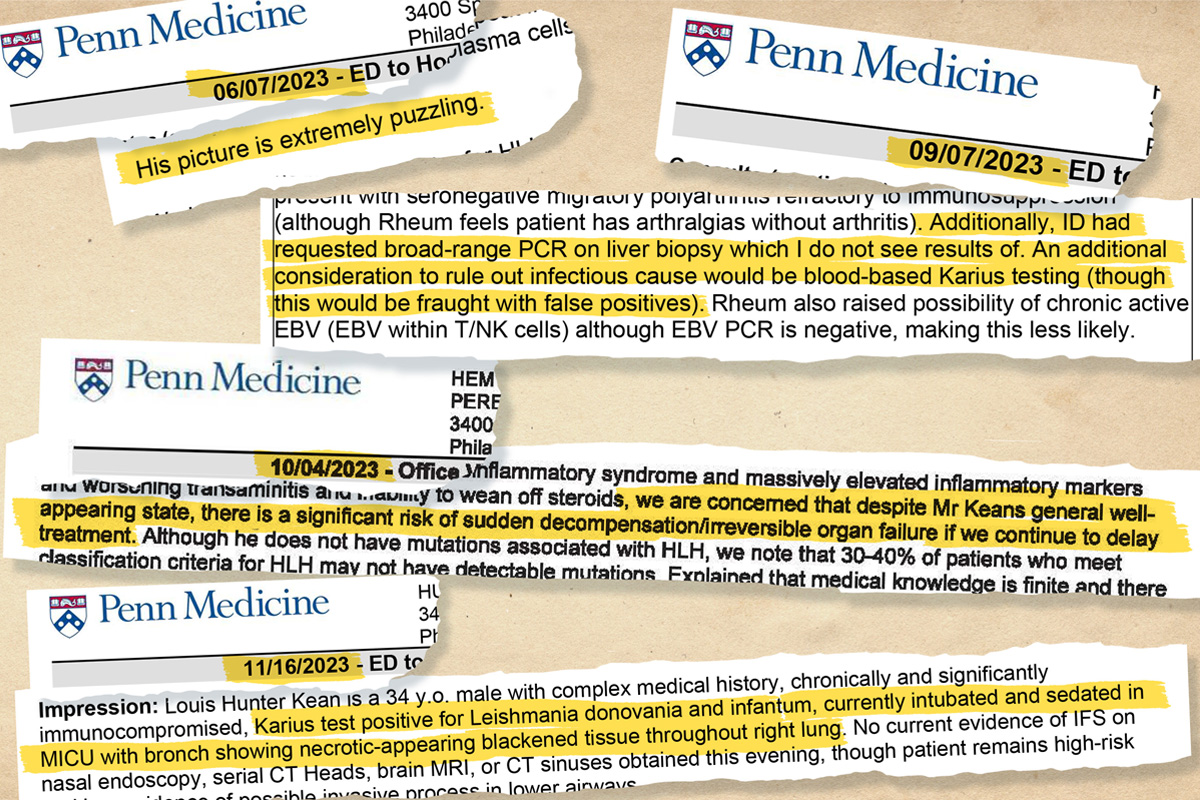
Along the way, doctors missed critical clues, such as failing to obtain Kean’s complete travel history. They recommended a pair of key tests, but didn’t follow up to make sure they got done, medical records provided to The Inquirer by his family show.
Doctors involved in Kean’s care, including at Penn, prescribed treatments that made him sicker, said four infectious disease experts not involved in his care during interviews with a reporter, who shared details about his treatment. Penn doctors continued to do so even as his condition worsened.
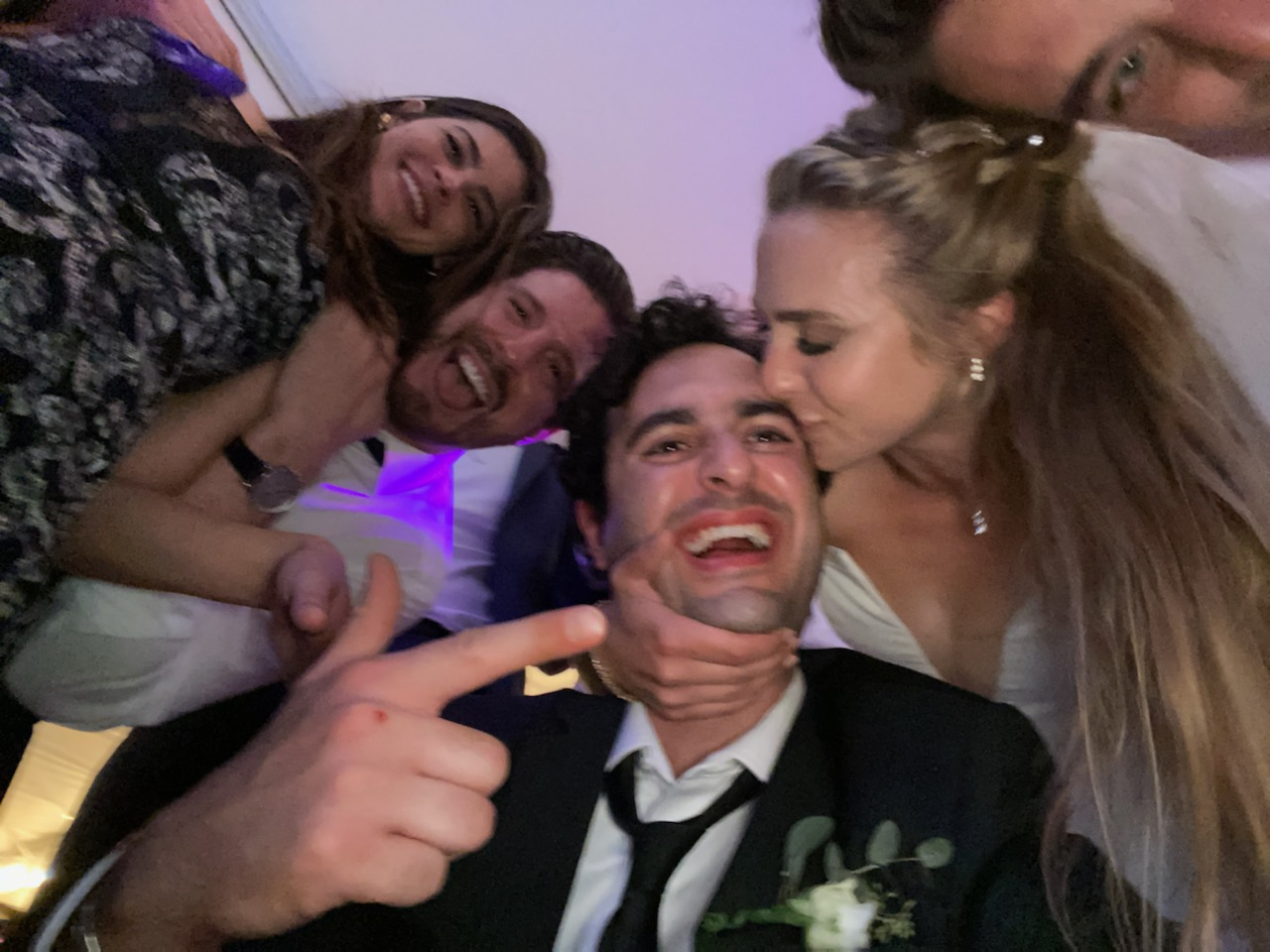
Louis-Hunter Kean receives a kiss from bride Ashley Greyson at the October 2021 wedding of his close friend, Joshua Green. Green and Kean graduated from Haddonfield High School in 2007.
“No one was paying attention to what the doctor before them did or said,” Kean’s mother, Lois Kean, said.
“They did not put all the pieces together,” she said. “It was helter-skelter.”
Kean’s family is now suing Penn’s health system for medical malpractice in Common Pleas Court in Philadelphia. The complaint identifies nearly three dozen Penn doctors, accusing them of misdiagnoses and harmful treatments. These physicians are not individually named as defendants.
In court filings, Penn says its doctors did not act recklessly or with disregard for Kean’s well-being, and his case is not indicative of any systemic failures within its flagship hospital. A Penn spokesperson declined further comment on behalf of both the hospital and the individual doctors involved in Kean’s care, citing the pending lawsuit.
The puzzle of Kean’s diagnosis finally came together in November 2023 after a Penn doctor, early in his career, sought help from the National Institutes of Health (NIH).
An NIH doctor recommended a test that identified the cause: a parasite prevalent in countries bordering the Mediterranean Sea. Kean likely got infected while vacationing in Italy, four parasitic disease experts told The Inquirer.
The infection, which is treatable when caught early, is so rare in the U.S. that most doctors here have never seen a case, the experts said.
By the time Penn doctors figured it out, Kean’s organs were failing.
Louis-Hunter Kean and his then-girlfriend Zara Gaudioso at a friend’s wedding in Tuscany in September 2021. Kean and Gaudioso got engaged in early 2023. Gaudioso was smitten by Kean’s good looks and sense of humor.While vacationing in Italy in September 2021, Louis-Hunter Kean and his friends hiked in the foothills of the Apennine Mountains and visited Gran Sasso and Monti della Laga National Park.
A missed clue
When a patient has an ongoing and unexplained fever, an infectious disease doctor will routinely start by takinga thorough travel history to screen for possible illnesses picked up abroad.
A medical student took Kean’s travel history during his initial workup at HUP in June 2023. An infectious disease specialist reviewed the student’s notes and added a Cooper University Hospital doctor’s earlier notes into Kean’s electronic medical chart at Penn.
Those records show Kean had traveled to Turks and Caicos with his fiancée in May 2022. The next month, he took a work trip out West, including to California, where he visited farms, but didn’t interact with livestock.
This was not unusual for Kean, who worked with fruits and vegetables imported from around the world at his family’s produce distribution center on Essington Avenue in Southwest Philadelphia.
Kean’s fiancée, Zara Gaudioso, said she repeatedly told doctors about another trip: In September 2021, about a year before his fevers began, they traveled to Italy for a friend’s wedding in Tuscany.
The couple hiked remote foothills, danced all night in a courtyard, dined by candlelight surrounded by a sunflower farm, and slept in rustic villas with the windows flung open.
“We told everybody,” Gaudioso said. “A lot of Americans go to Italy — it’s not like a third-world country, so I could see how it could just go in one ear and out the other.”
But notes in Kean’s medical record from the Penn infectious disease specialist don’t mention Italy. Neither do the ones the specialist copied over from Kean’s infectious disease doctor at Cooper.
Kean “does not have known risk factors” for exposure to pathogens, the Penn specialist concluded, except possibly from farm animals or bird and bat droppings.
Still, the specialist listed various diseases that cause unexplained fever: Tick-borne diseases. Fungal infections. Tuberculosis. Bacteria from drinking unpasteurized milk.
The possible culprits included a parasitic disease, called visceral leishmaniasis, transmitted by a bite from an infected sandfly. It can lie dormant for a lifetime — or, in rare cases, activate long after exposure, so it’s important for doctors to take extensive past travel histories, parasitic experts say.
The parasite is widely circulating in Southern European countries, including Spain, Greece, Portugal, and Italy.
“Mostly, people living there are the ones who get it. But it’s just a lottery sandwich, and there’s no reason that travelers can’t get it,” said Michael Libman, a top parasitic disease expert and former director of a tropical medicine center at McGill University in Canada.
But few cases become severe. Hospitals in Italy reported only 2,509 cases of active infection between 2011 and 2016, affecting fewer than one in 100,000 people. Infections requiring hospital care in Italy began to decline after 2012, according a 2023 European study by the Public Library of Science (PLOS) journal Neglected Tropical Diseases.
Caught early, visceral leishmaniasis is treatable. Without treatment, more than 90% of patients will die.
In addition to fever, other telltale symptoms are swelling of the liver and spleen and low blood cell counts. Kean had all of those.
A missed test
The infectious disease specialist requested a test to examine tissue biopsied from Kean’s liver, which was damaged and enlarged. Lab results showed that immune cells there had formed unusual clusters — another sign that his body might be fighting off an infection.
In her notes, the specialist identified “visceral leish” as a possible diagnosis, which repeated — via copy and paste — seven times in his medical record. Her request to “please send biopsy for broad-range PCR” repeated five times.
That is a diagnostic (polymerase chain reaction) test that looks for the genetic fingerprint of a range of pathogens.
The test comes in different versions: One looks broadly for bacteria. The other is for fungi. The broad fungal test candetect leishmania, even though it’s not a fungus. However, it’s not always sensitive enough to identify the parasite and can produce a false negative, experts said.
The specialist’s chart note doesn’t specify which type she wanted done.
It’s not clear if anyone asked. The test wasn’t done.
Louis-Hunter Kean (right, with wine glass and tambourine) leads a wedding procession through the small stone village of Santo Stefano di Sessanio in Italy’s Abruzzo region in September 2021.
She did not order a low-cost rapid blood test that screens specifically for leishmaniasis by detecting antibodies made by the immune system after fighting it. She also didn’t order a leishmania-PCR, which is highly targeted to detect the exact species of the parasite.
Nor did the medical record show that the specialist followed up on the results of the broader test she requested, even though she saw Kean on nine of the 13 days of his first hospitalization at HUP in June 2023.
Penn has a policy that a lead doctor on the patient’s case is responsible for making sure that recommended tests get done. The specialist was called in as a consultant on Kean’s case. During that June hospitalization alone, his medical chart grew to 997 pages.
Patient safety experts have warned for years that electronic medical record systems — designed for billing and not for care — can become so unwieldy that doctors miss important details, especially with multiple specialists involved, or repeat initial errors.
A seemingly innocuous step in charting — copying and pasting previous entries and layering on new ones— can add to the danger, patient safety experts say.
That’s how the specialist’s mention of “visceral leish” and her test recommendation got repeated in Kean’s chart.
Marcus Schabacker, president of ECRI, a nonprofit patient-safety organization based in Plymouth Meeting, said “copy and paste” in electronic medical records puts patients at risk of harm.
“The reality is if you are reading something over and over again, which seems to be the same, you’re just not reading it anymore. You say, ‘Oh, yeah, I read that, let’s go on,’” said Schabacker, speaking generally about electronic medical record systems and not specifically about Kean’s case.
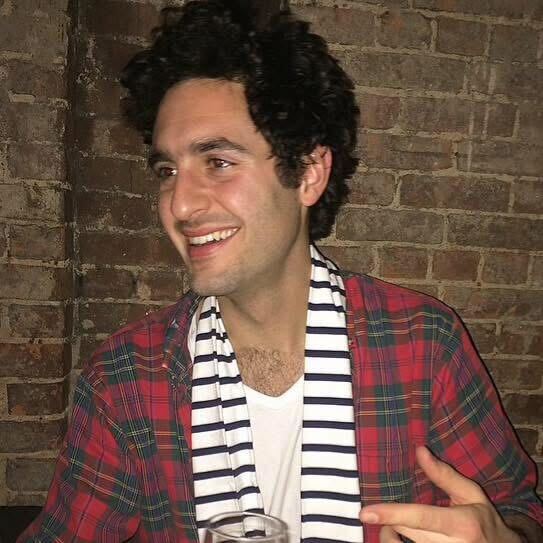
Louis-Hunter Kean plays guitar in his younger years. He loved music and shared eclectic playlists with his friends.
When treatments harm
Penn doctors believed Kean had a rare,life-threatening disorder, known as hemophagocytic lymphohistiocytosis (HLH), in which the immune system attacks the body. Instead of fighting infections, defective immune cells start to destroy healthy blood cells.
In most adults, the constellation of symptoms diagnosed as HLH gets triggered when an underlying disease sends the body’s immune system into overdrive. Triggers include a blood cancer like lymphoma, an autoimmune disease like lupus, or an infection.
Penn doctors across three specialties — hematology-oncology, rheumatology, and infectious disease — were searching for the cause within their specialties.
“His picture is extremely puzzling,” one doctor wrote in Kean’s chart. “We are awaiting liver biopsy results. I remain concerned about a possible infectious cause.”
As HUP doctors awaited test results, they treated Kean’s HLH symptoms with high doses of steroids and immunosuppressants to calm his immune system and reduce inflammation.
The treatments, however, made Kean highly vulnerable to further infection.And defenseless against another possible trigger of HLH: visceral leishmaniasis.
At the time, a Penn rheumatologist involved in Kean’s care before his first hospitalization warned about steroids “causing harm” to Kean if it turned out he had an infection. He wrote, “please ensure all studies requested by” infectious disease are done, medical records show.
Steroid treatments would allow the parasites to proliferate unchecked, experts said.
“It’s unfortunately exactly the wrong treatment for parasitic disease,” said Libman, the leishmania disease expert at McGill University.
As Kean grew sicker, he was readmitted to HUP for a third time in September 2023. He texted a friend: “I’m on more medications than I’ve ever been on and my condition is worse than it’s ever been.”
A sampling of Louis-Hunter Kean’s electronic medical records, which ballooned to thousands of pages over five HUP hospitalizations within six months in 2023.
Handoffs between doctors
No single doctor seemed to be in charge of Kean’s care, his family said. And the number of specialists involved worried them.
“Everyone just kept being like, ‘We don’t know. Go see this specialist. Go see that specialist,’” Kean’s sister, Priscilla Zinsky, said.
By fall 2023, rheumatologists hadn’t found a trigger of Kean’s symptoms within their specialty. They turned to doctors specializing in blood cancer.
During the handoff, three doctors noted that they didn’t see the results of the test requested by the infectious disease specialist back in June. They still thought it was possible that Kean had an infection, records show.
“An additional consideration to rule out infectious cause would be blood-based Karius testing (though this would be fraught with false positives),” wrote that doctor, who was still training as a hematologist-oncologist.
A supervising physician reviewed the Sept. 8, 2023, note and signed off on it. The medical records don’t show any follow-up with infectious disease doctors, and the test wasn’t done at the time.
In the coming days, blood cancer specialists struggled to find a link between Kean’s symptoms and an underlying disease.
They thought he might have a rare form of leukemia, but tests weren’t definitive, Kean texted friends.
Untreated HLH symptoms can lead to rapid organ failure, so doctors often start patients on treatment while trying to figure out the underlying cause, said Gaurav Goyal, a leading national expert on HLH, noting that it can take days to get test results.
“You have to walk and chew the gum. You have to calm the inflammation so the patient doesn’t die immediately, and at the same time, try to figure out what’s causing it by sending tests and biopsies,” said Goyal, a hematologist-oncologist at the University of Alabama at Birmingham.
Medical records show that Penn doctors feared Kean was at “significant risk” of “irreversible organ failure.”
They suggested a more aggressive treatment: a type of chemotherapy used to treat HLH that would destroy Kean’s malfunctioning immune cells.
In his medical record, a doctor noted that beginning treatment without a clear diagnosis was “not ideal,” but doctors thought it was his best option.
Four parasitic disease experts told The Inquirer that chemotherapy, along with steroids and immunosuppressants, can be fatal to patients with visceral leishmaniasis.
“If that goes on long enough, then they kill the patient because the parasite goes out of control,” Libman said, explaining that ramping up the HLH treatments weakens the immune system. “The parasite has a holiday.”
A sample of text messages from Louis-Hunter Kean to friends during separate HUP hospitalizations over a six-month period in 2023.
Chemo as last resort
Kean banked his sperm, because chemo infusions can cause infertility. He told friends he trusted his Penn team and hoped to make a full recovery.
“Started chemo last night. It really feels like finally there is a light at the end of the tunnel,” he texted a friend on Oct. 7, 2023.
“I’m gonna get to marry my best friend, and I think I’m going to be able to have children,” Kean wrote in another text to a different friend.
Kean spent nearly all of October at HUP getting chemo infusions. He rated his pain as a nine out of 10. His joints throbbed. He couldn’t get out of bed. He started blacking out.
Doctors added a full dose of steroids on top of the IV chemo infusion. By the end of the month, Kean told a friend he feared he was dying.
A year had passed since Kean first spiked a fever. He no longer could see himself returning to his former life — one filled with daily exercise, helping run his family’s produce store, nights out with friends at concerts and bars, and vacations overseas.
Lethargic and weak, he could barely feed himself. His sister tried to spoon-feed him yogurt in his hospital bed.
He started texting reflections on his life to friends and family, saying his illness had given him a “polished lens” through which he could see clearly. He wrote that their love felt “like a physical thing, like it’s a weighted blanket.”
“I’ve lived an extremely privileged life. I don’t think it’s possible for me to feel bad for myself,” he said in a text. “And I don’t want anyone else to either.”
Louis-Hunter Kean enjoying dinner out with his sister, Jessica Kean, in Manhattan in 2014. Friends and family described him as a “foodie” and health food advocate prior to the onset of his illness in August 2022.
Puzzle solved
One doctor involved in Kean’s care had seen him at Penn’s rheumatology clinic in early June 2023, just before his first HUP hospitalization. The doctor, a rheumatology fellow,urged him to go to HUP’s emergency department, so he could be admitted for a medical workup.
The fellowremained closely involved in Kean’s care, medical records show. Also in his 30s, this doctor shared Kean’s interests in music, fashion, and the city’s restaurant scene, according to Kean’s family.
“They had a rapport,” Kean’s father, Ted Kean, said. “Louis thought a lot of him, and he seemed to think a lot of my son.”
By early November 2023, the rheumatology fellow was extremely concerned, medical records show.
The chemo infusions weren’t helping. Kean still was running a fever of 103. The fellow wrote in his chart that he was worried Kean needed a bone-marrow transplant to replace his failing immune system.
And doctors still didn’t know the root of his symptoms.
The fellowcontacted the NIH, medical notes show.
An NIH doctor recommended a test to check for rare pathogens, including parasites that cause visceral leishmaniasis,according to family members present when the testing was discussed.
The NIH-recommended Karius test was the same one suggested two months earlier by the Penn hematologist-oncologist in training, but with no follow-up.
File of sign on front of Hospital of the University of Pennsylvania (HUP) taken on Tuesday, March 19, 2024.
On Nov. 16, the fellow got the results. He went to Kean’s bedside.
After five HUP hospitalizations over six months, a single test had revealed the cause of his illness: visceral leishmaniasis.
Kean cried with relief and hugged the fellow, joined by his mother and sister.
“‘You saved my life,’” Kean’s sister, Jessica Kean, recalled her brother telling the doctor. “‘Finally, we know what this is, and we can treat it.’”
Kean’s medical chart was updated to note that he traveled to “Italy in the past,” also noting he had visited Nicaragua and Mexico. A HUP infectious disease doctor consulted with the Centers for Disease Control and Prevention on antiparasitic medications.
Meanwhile, Kean’s nose wouldn’t stop bleeding. He felt light-headed and dizzy, with high fever. Even on morphine for his pain, his joints ached.
“I’ve been struggling, buddy,” he texted a friend on Nov. 20. “This might be the worst I’ve ever been.”
By Nov. 22, he stopped responding to text messages. He began hallucinating and babbling incoherently, family members recalled. “Things went downhill very, very quickly, like shockingly quickly,” his sister, Priscilla Zinsky, said.
When she returned on Thanksgiving morning, he was convulsing, thrashing his head and arms. “It was horrifying to see,” Zinsky said.
Her brother had suffered brain bleeds that caused a stroke. His organs were failing. He had a fungal infection with black mold growing throughout his right lung, medical records show.
Kean was put on life support, with a doctor noting the still-preliminary diagnosis: “Very medically ill with leishmaniasis.”
“Prognosis is poor,” read the note in his Nov. 29, 2023, medical records.
A few hours later, Kean’s family took him off life support. He died that day.
“All of his organs were destroyed,” said Kean’s mother, Lois Kean. “Even if he had lived, he had zero quality of life.”
Portraits of Lois and Ted Kean’s four children decorate a wall at their home in Haddonfield. Their son, Louis-Hunter, died after contracting visceral leishmaniasis, a parasitic infection he likely picked up in Italy. When caught early, it’s treatable with medication. It’s deadly without treatment.
It’s not clear why the parasites began to attack Kean a year after his return from Italy. Healthy people rarely develop severe disease from exposure to the deadly form of the parasite circulating outside the U.S., experts said.
Most people infected by a sandfly “are probably harboring small amounts of the parasite” in their organs, according to Naomi E. Aronson, a leishmania expert and director of infectious diseases at the Uniformed Services University of the Health Sciences in Bethesda, Md.
“Most of the time, you don’t have any problem from it,” Aronson said.
Children under age 5, seniors, and people who are malnourished or immunodeficient are most susceptible to visceral leishmaniasis. Aronson said she worries about people who might harbor the parasite without problems for years, and then become immunocompromised.
Libman, the parasitic expert from McGill, said he’s seen six to 10 patients die from visceral leishmaniasis because doctors unfamiliar with the disease mistakenly increased immunosuppressants to treat HLH during his 40 years specializing in parasite disease.
“That’s a classic error,” he said.
Kean’s case “should be a real clarion call” for infectious disease specialists and other doctors in the U.S., said Joshua A. Lieberman, an infectious disease pathologist and clinical microbiologist who pioneered the leishmania-PCR test at the Washington state lab.
“If you’re worried about an unexplained [fever], you have to take a travel history that goes back pretty far and think about Southern Europe, Iraq, Afghanistan, India, and maybe even Brazil,” Lieberman said.
In the wake of Kean’s death, his family was told that Penn doctors held a meeting to analyze his case so they could learn from it.
An infectious disease doctor called Zinsky, Kean’s sister, to let her know about the postmortem review and shared that doctors discussed that Kean had likely picked up the parasite in Tuscany.
“Why didn’t you guys have this meeting,” she asked, ”while he was alive?”
Editor’s note: This story has been updated to clarify that ECRI President Marcus Schabacker was not speaking specifically on Kean’s case.