Tag: hoops-content

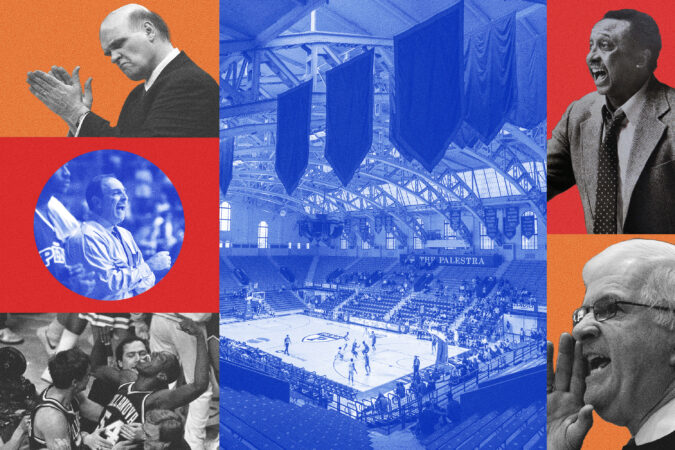
  • What happened to the Big 5? The decline of Philly basketball’s one-time legendary alliance began a long time ago.

    What happened to the Big 5? The decline of Philly basketball’s one-time legendary alliance began a long time ago.

    One afternoon in early December, Bill Raftery and Tim Legler, both La Salle alumni, returned to campus for an hourlong panel discussion about their careers in sports media, only to have the conversation shift to a topic with broader implications.

    It was a point of pride for the university to welcome back Raftery, who has been college basketball’s preeminent analyst for more than a quarter-century, and Legler, who has reached a comparable status at ESPN with his insights into the NBA. But 33 minutes into the event, the first question from an audience member wasn’t about the origins of Raftery’s trademark catchphrases (The kiss! … Onions! … Laundry on the deck!) or Legler’s game-film breakdowns.
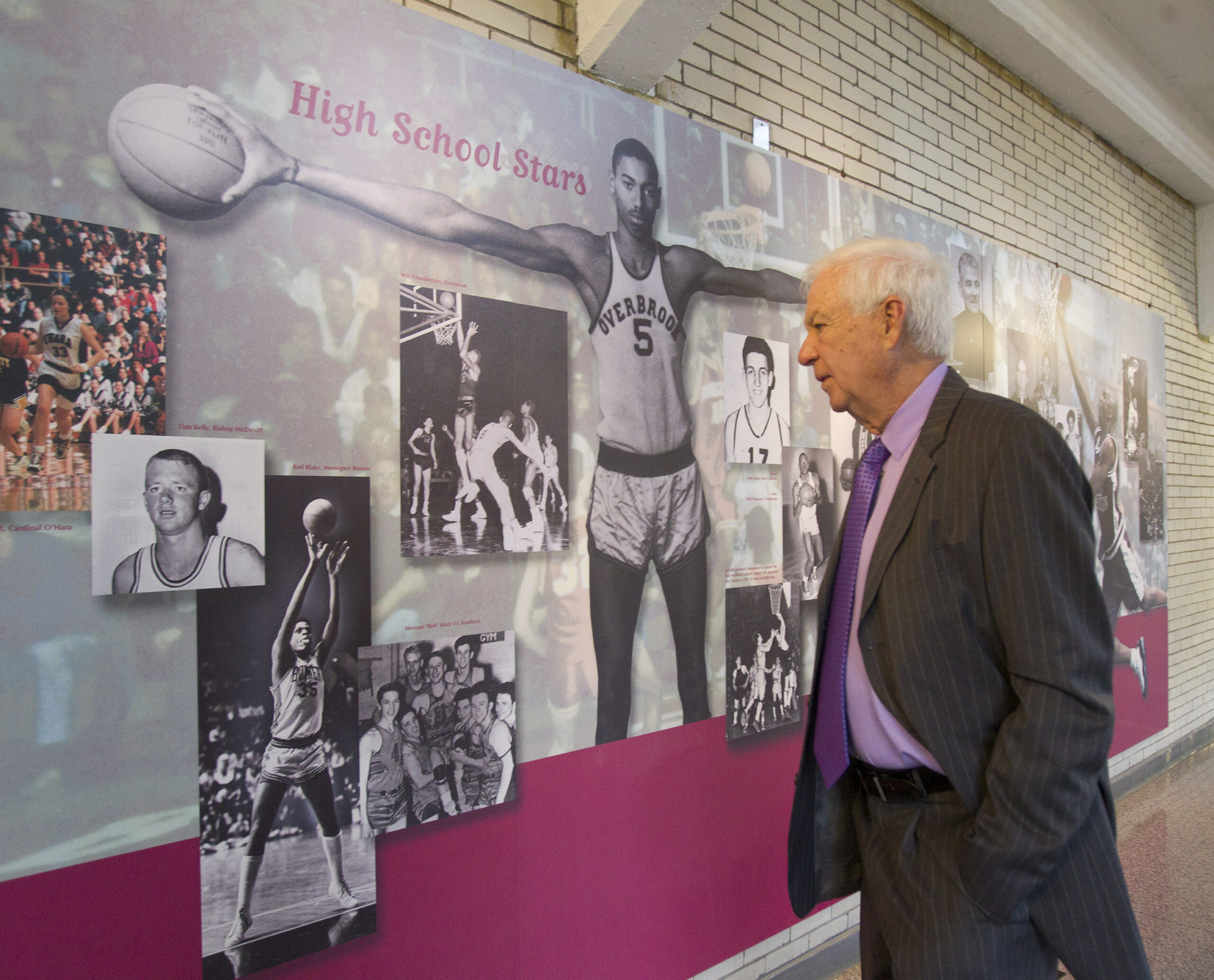
    Bill Raftery, now broadcaster, graduated from La Salle and was inducted into the Big 5 Hall of Fame.

    “Can we bring the Big 5 back to its glory?” a man in the auditorium asked. “Because it was a national thing, right? It wasn’t just a Philly thing.”

    These days, most people who follow college basketball, if they’re being honest, have to acknowledge that the Big 5 isn’t much of anything anymore. The round-robin rivalries among La Salle, Penn, St. Joe’s, Temple, Villanova, and more recently Drexel have lost most of their juice.

    That white-hot competition, fueled by the benign hatred that only proximity and familiarity can ignite, used to define Philadelphia hoops. It has cooled. Now, just one school, Villanova, enters each season with the baseline expectation that it will qualify for the NCAA Tournament, and the pipeline of local recruits that once sustained these programs has all but dried up.

    window.addEventListener(“message”,function(a){if(void 0!==a.data[“datawrapper-height”]){var e=document.querySelectorAll(“iframe”);for(var t in a.data[“datawrapper-height”])for(var r,i=0;r=e[i];i++)if(r.contentWindow===a.source){var d=a.data[“datawrapper-height”][t]+”px”;r.style.height=d}}});

    Three of the six schools — Drexel, La Salle, and Penn — don’t have a Philadelphia native on their rosters. Interest in the city series has plummeted. A 2022 doubleheader at the Palestra drew an official attendance of just 3,300 people. And the Big 5 Classic, conjured in the aftermath of that alarming display of indifference, hasn’t revitalized the rivalries or restored any prestige to them.

    While this season has seen an uptick in the programs’ quality of play — Villanova is virtually assured of an at-large bid, and Penn, St. Joe’s, and perhaps Drexel could be strong enough to win their conference tournaments — that improvement hasn’t been enough to stem the dismal tide.
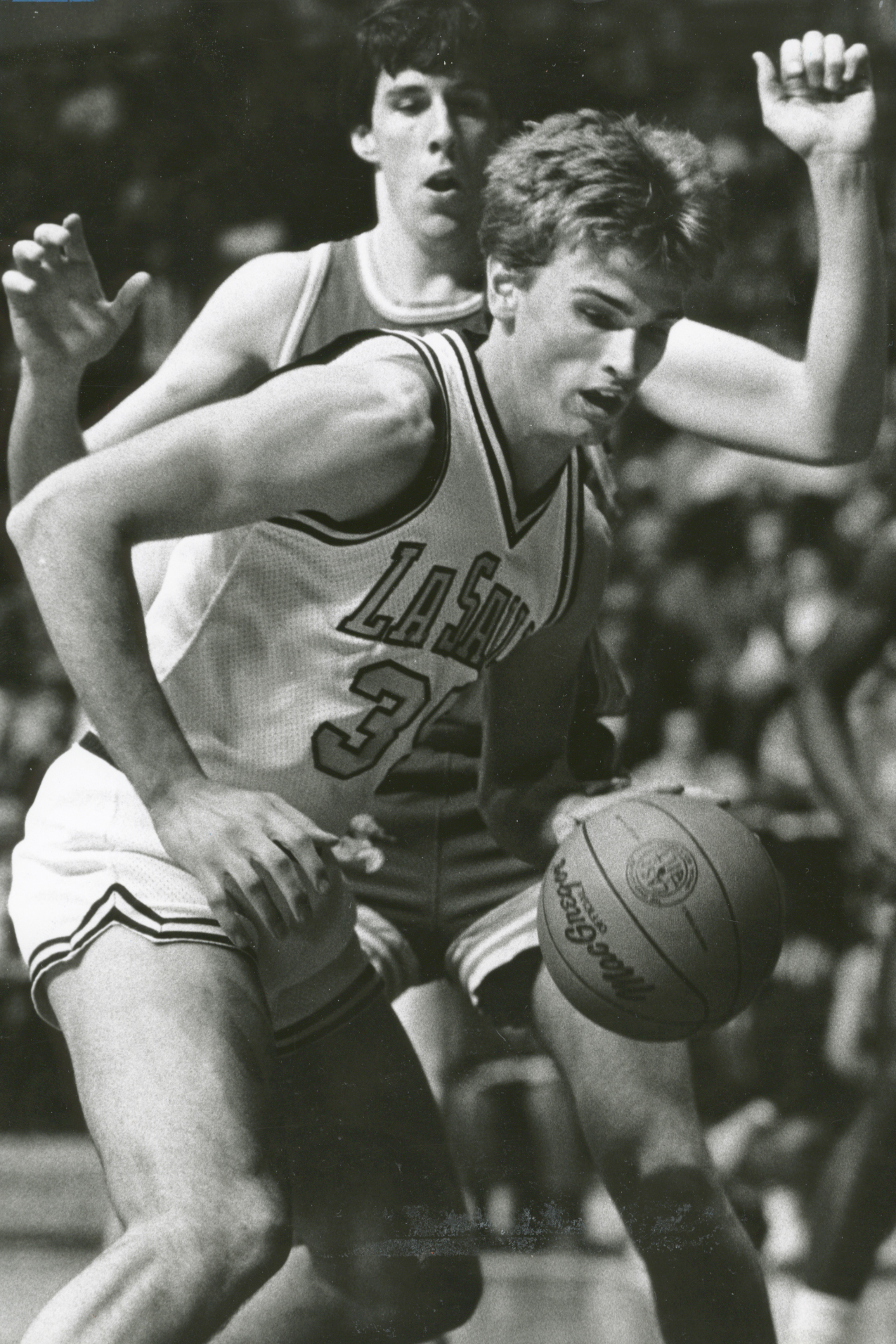
    Tim Legler, who led La Salle to the 1988 NCAA Tournament, said the Big 5 was once a “transformative” environment to play in.

    For their part, the panelists at La Salle mustered some nostalgia but weren’t optimistic. Legler, who grew up in Richmond, Va., remembered attending a Palestra doubleheader on a recruiting trip and marveling at the atmosphere: the streamers, the cheering, the chanting.

    “I turned to my parents and said, ‘This is the environment I want to play college basketball in,’” he said. “It was literally that transformative.”

    Still, he had no solution for salvaging the Big 5, and neither did Raftery, who suggested that smaller programs throughout the NCAA would soon be casualties of this new era of college basketball.

    “They’re trying to freeze [out] a lot of programs and leagues,” he said, “and I can envision maybe two or three conferences. They’ll run the whole thing, and the networks will pay for it. That’s the way it is.”

    It’s convenient to point to the sport’s lurch into modernity — into the era of Name, Image, and Likeness; of pay-for-play; of the permeable membrane of the transfer portal — as the cause of the decline. And it’s true: With the exception of Villanova, which is ensconced in the Big East and supported by engaged donors with deep pockets, college hoops’ evolution has made everything more difficult for the other, more vulnerable programs in the city. But this train has been rumbling down the tracks for a while, and its arrival should compel a reevaluation of the Big 5’s history, of the decisions and unstoppable forces that led it here, to the brink.

    To those Baby Boomers and GenXers weaned on the Big 5’s traditions, it’s surely incomprehensible and saddening to hear Raftery contemplate a world without it. But if the institution as Philadelphia knew it is fading away — and it appears to be, if it hasn’t already — the proper question isn’t Can it be saved? That one has been asked and is on its way to being answered.

    No, the better questions to chew on are these: How did the Big 5 survive, and at times thrive, as long as it did? And did any of the attempts over the years to preserve it and its identity actually contribute to its downfall?
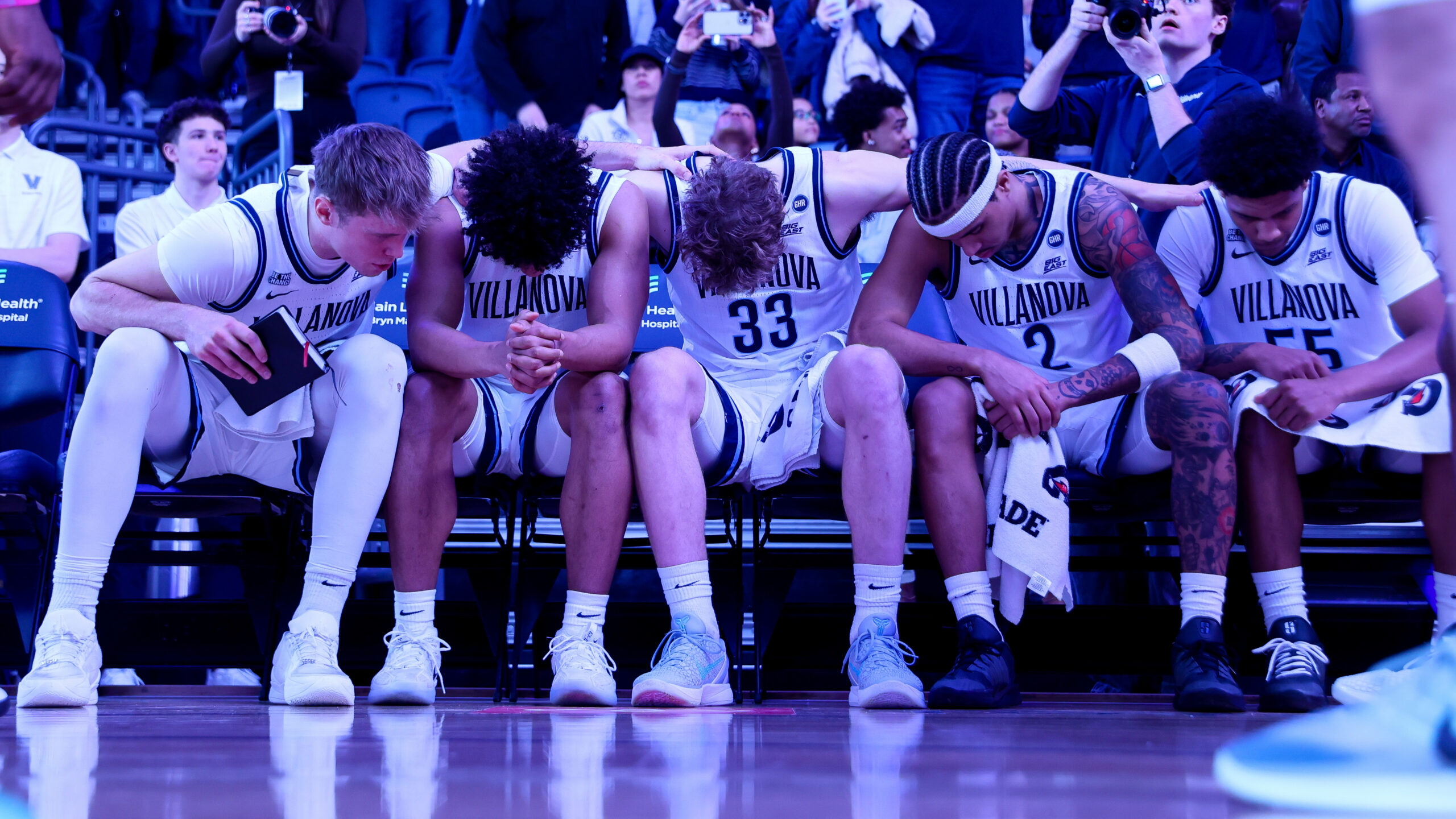
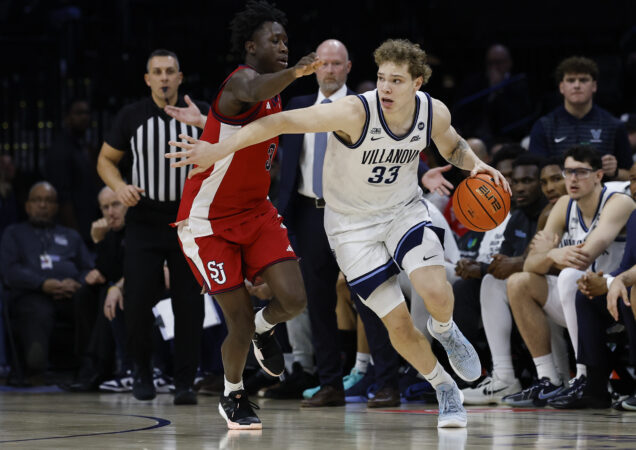
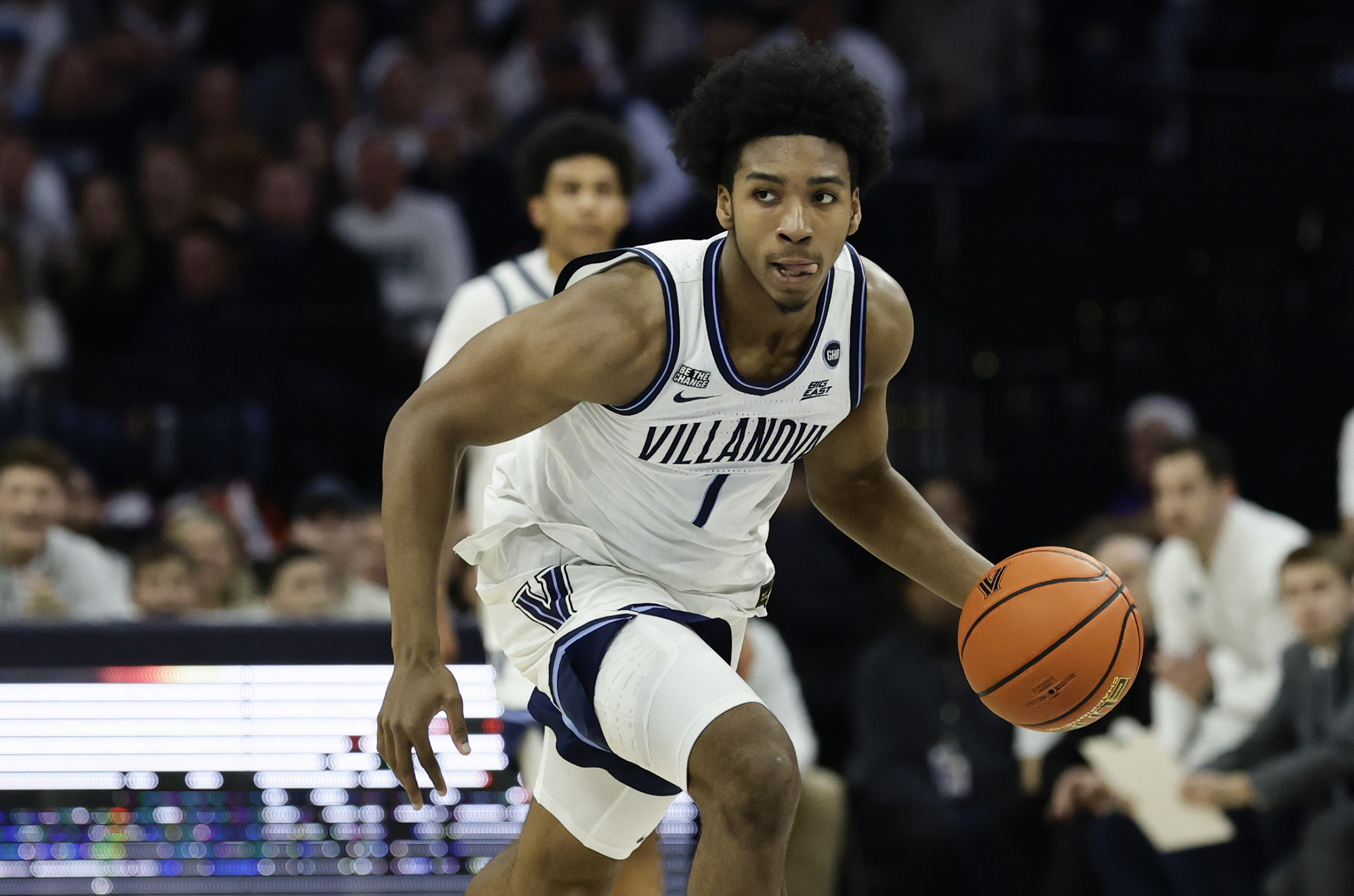
    Villanova has become the only school in the Big 5 that enters each season with the baseline expectation that it will qualify for the NCAA Tournament.

    The seeds of rebirth and decline

    It’s tempting to picture the Big 5’s history as an unbroken string of unforgettable nights at the Palestra, great teams playing great games inside a gym packed to its uppermost corners with 9,000 people, give or take a few rascals who managed to sneak in for free. There were hundreds of such nights, to be sure. But it’s striking to put that past into a wider context and see how much certain changes and trends fostered and then jeopardized everything that made the Big 5 wonderful and unique.

    Those fond memories often gloss over a relatively fallow period for the Big 5 during the 1970s. Villanova had three consecutive losing seasons from 1972 to 1975. Temple went 16-37 over the ’74-75 and ’75-76 seasons and qualified for the NCAA Tournament once in an 11-year span from 1972 to 1983. St. Joe’s went 8-17 in ’74-75, the first of six straight seasons in which the Hawks missed the NCAAs. Penn was the exception, and La Salle held its own, but a Daily News back-page photo captured the overall listlessness perfectly: Harry “Yo-Yo” Shiffern, the lovable vagrant who was the city series’ unofficial mascot, fast asleep during a Palestra doubleheader.

    The Big 5 was in a collective funk, and it took a few pivotal developments to snap it back to prominence and position it to flourish further.
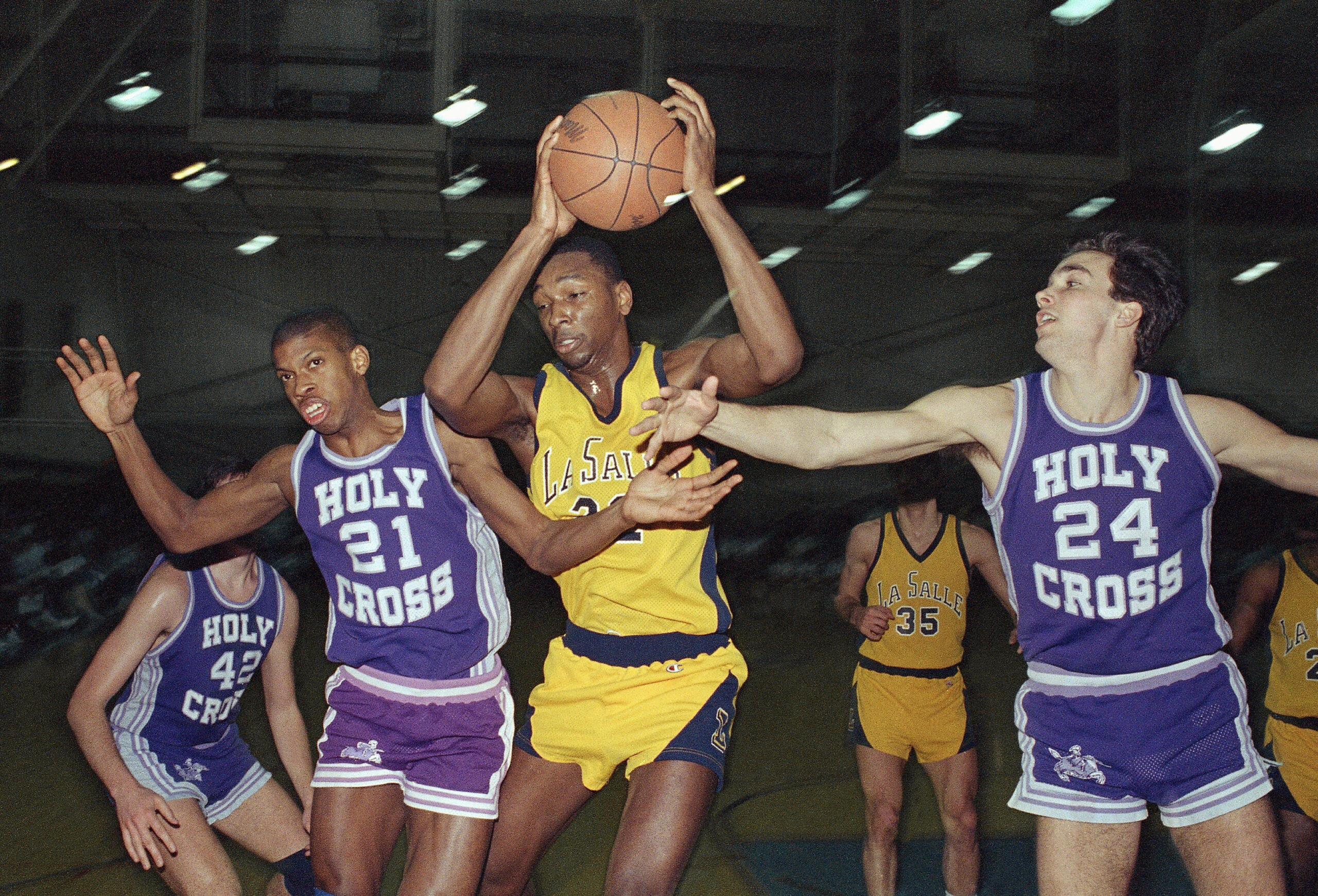
    Lionel Simmons (center) is the Big 5’s all-time leading scorer and fifth in NCAA history with 3,217 career points.

    College basketball’s landscape was flatter then. The NCAA Tournament went to 32 participants in 1975 and to 40 in 1979, and many of the qualifying programs were mid-majors. During the ’70s, each of these teams reached the Final Four: Jacksonville, St. Bonaventure, New Mexico State, Western Kentucky, Marquette, UNC Charlotte — and, in ’79, Penn. The Quakers upset North Carolina, Syracuse, and St. John’s before Magic Johnson and Michigan State pulverized them in the national semis. But their run was the most improbable of the decade, and their timing was impeccable.

    The following season, after a star turn at the Pan-American Games in Puerto Rico, La Salle’s Michael Brooks was named the Kodak National Player of the Year. As terrific as Brooks’ senior campaign was — he averaged more than 24 points and 11 rebounds, scoring 51 points in a triple-overtime loss at BYU — his candidacy for the honor was buoyed by Indiana’s Bob Knight, who had coached him at the Pan-Am Games and touted him to reporters.

    “If I were allowed to start my own team tomorrow,” Knight said in January 1980, “the first person I would pick would be Michael Brooks.”

    Such praise from the best, the most famous, and the most temperamental coach in the country carried weight, and Knight’s words elevated the reputations of both Brooks and Philadelphia basketball. That ascendance continued in March 1981, when St. Joe’s, under Jim Lynam, won the East Coast Conference tournament, knocked off top-ranked DePaul in the second round of the NCAAs, and advanced to the regional final before losing to the eventual national champs: Knight, Isiah Thomas, and the Hoosiers.
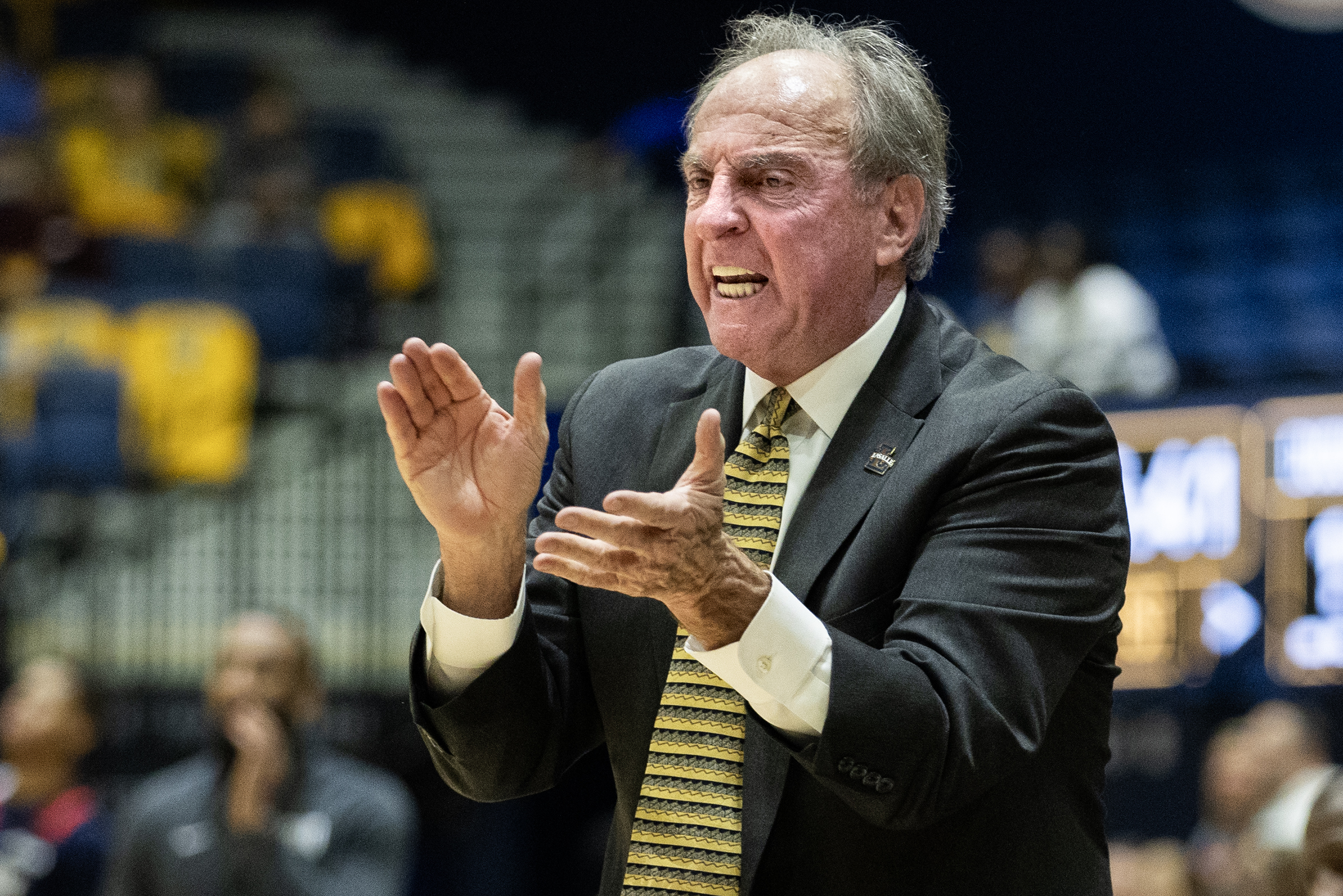
    Fran Dunphy coached more than 1,000 games as a Division I head coach.
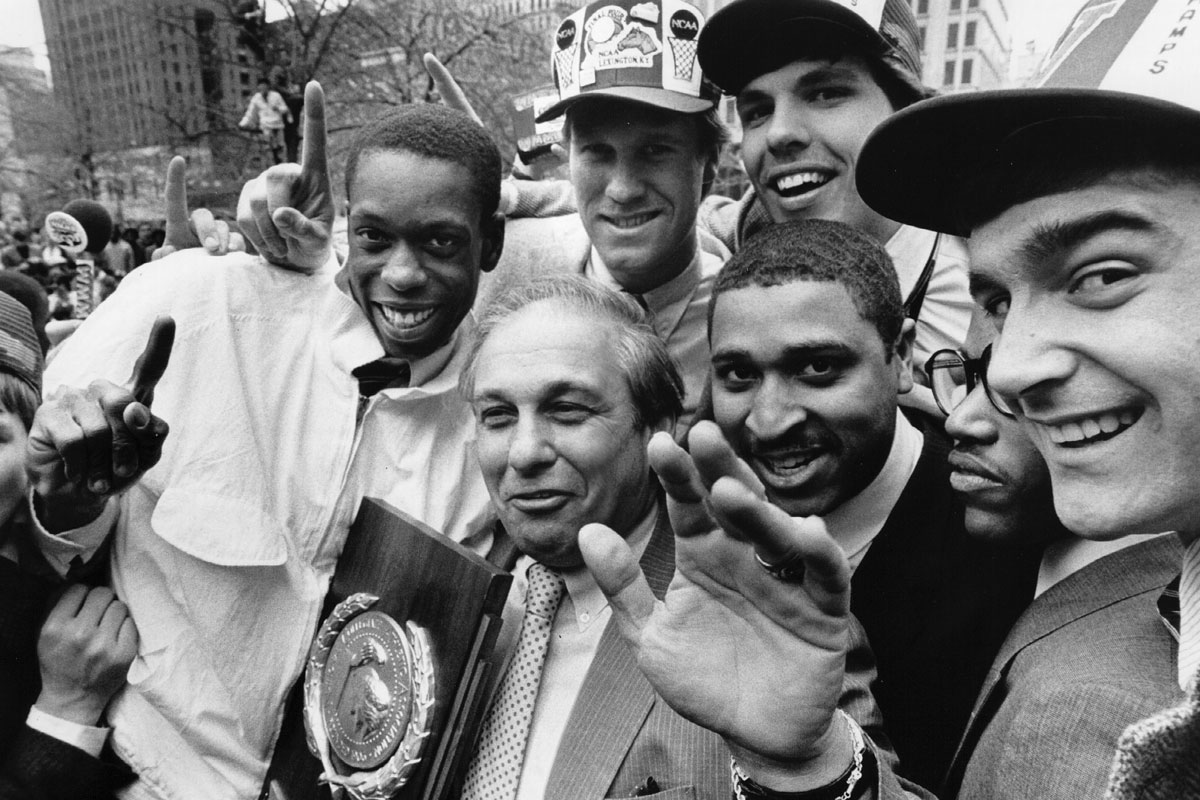
    Villanova coach Rollie Massimino gathers in Center City with players Ed Pinckney, Wyatt Maker, Chuck Everson, Dwight Wilbur, Veltra Dawson, and Brian Harrington in 1985 after winning the national title.

    So the Big 5 was on its way back, regaining relevance among casual college hoops fans and among the sport’s cognoscenti. The two most significant factors in its renaissance, though, happened off the court. In March 1980, Villanova left the Eastern Eight and jumped to the Big East. And in August 1982, Temple hired John Chaney as its head coach.

    Those moves and the rewards they wrought thrust those two programs, and in turn the entire Big 5, into a higher realm. Villanova won the national championship in 1985 — an underdog triumphant, a marvelous story enhanced by the Wildcats’ status as a program in a major conference in a sport whose vast national reach was still expanding: Magic vs. Larry Bird in ’79, North Carolina State surviving and advancing in ’83, Dick Vitale, CBS, ESPN, Big Monday, Selection Sunday, March Madness consuming a month’s worth of America’s attention.

    Chaney was this wild-eyed, lesson-teaching, justice-preaching wizard, confounding opponents with his matchup-zone defense, crafting the hardest schedule in the nation every year to battle-test his teams, leading the Owls to a No. 1 ranking in 1988 and three Elite Eight appearances in a six-year span.
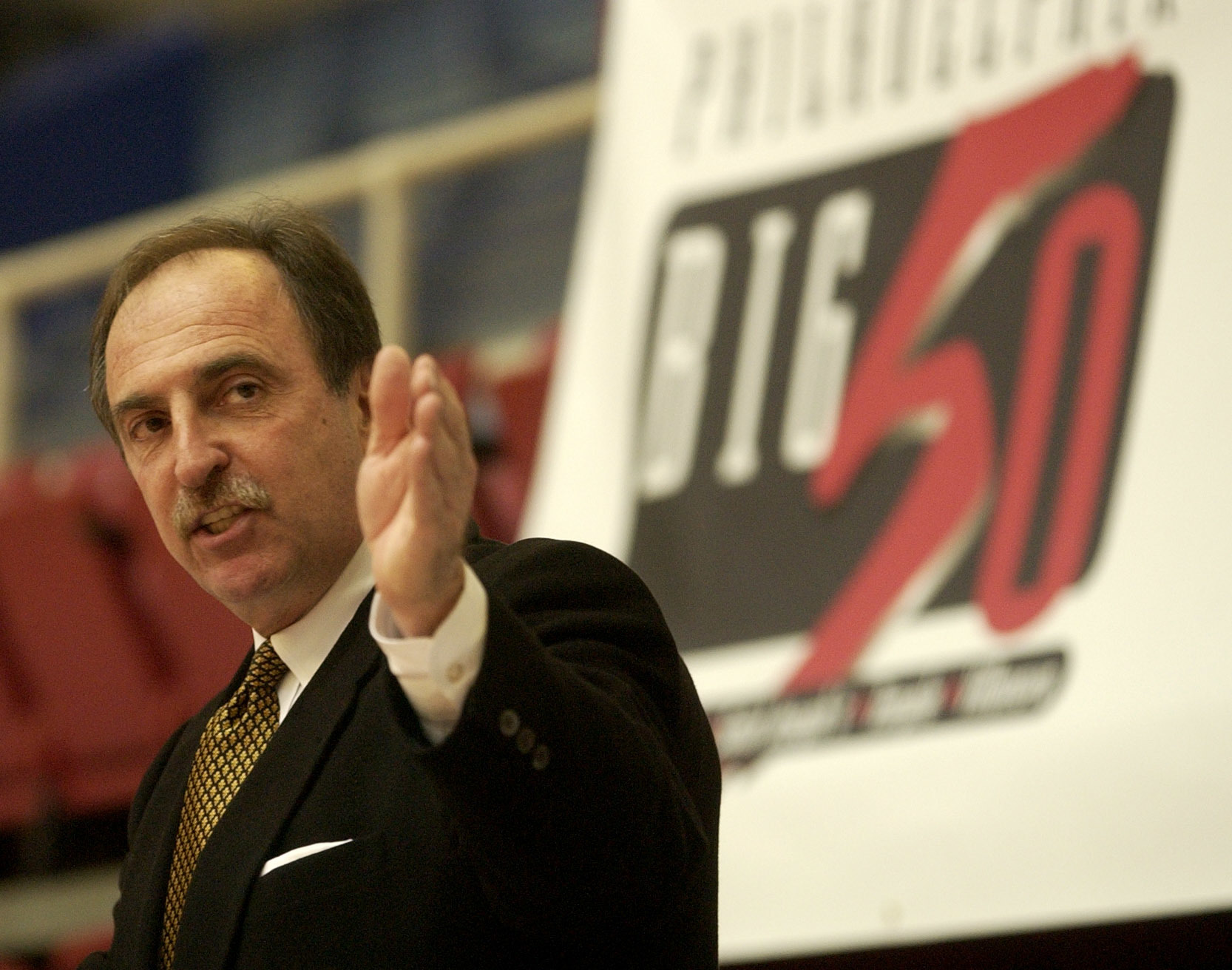
    Fran Dunphy led Penn to a 69-14 record and three NCAA Tournament appearances from 1992 to 1995.

    Nestled in the Metro Atlantic Athletic Conference (MAAC) with schools of similar profiles, La Salle went to the NCAA Tournament four times and the NIT twice in Speedy Morris’s first six years as head coach and had another national player of the year: Lionel Simmons. From 1992 to 1995, Penn dominated the Ivy League under Fran Dunphy: a 69-14 record, three NCAA Tournament appearances and a first-round victory over Nebraska, Jerome Allen and Matt Maloney forming one of the best backcourts in the country. St. Joe’s went 26-7 and advanced to the Sweet 16 in 1996-97, the season that introduced that notorious wallflower Phil Martelli to the rest of the country.

    Those were high times. They wouldn’t last. In fact, by the time St. Joe’s enjoyed its remarkable 2003-04 season and Jay Wright was restoring Villanova to national-title contention, the seeds of the Big 5’s diminishment had already been planted.
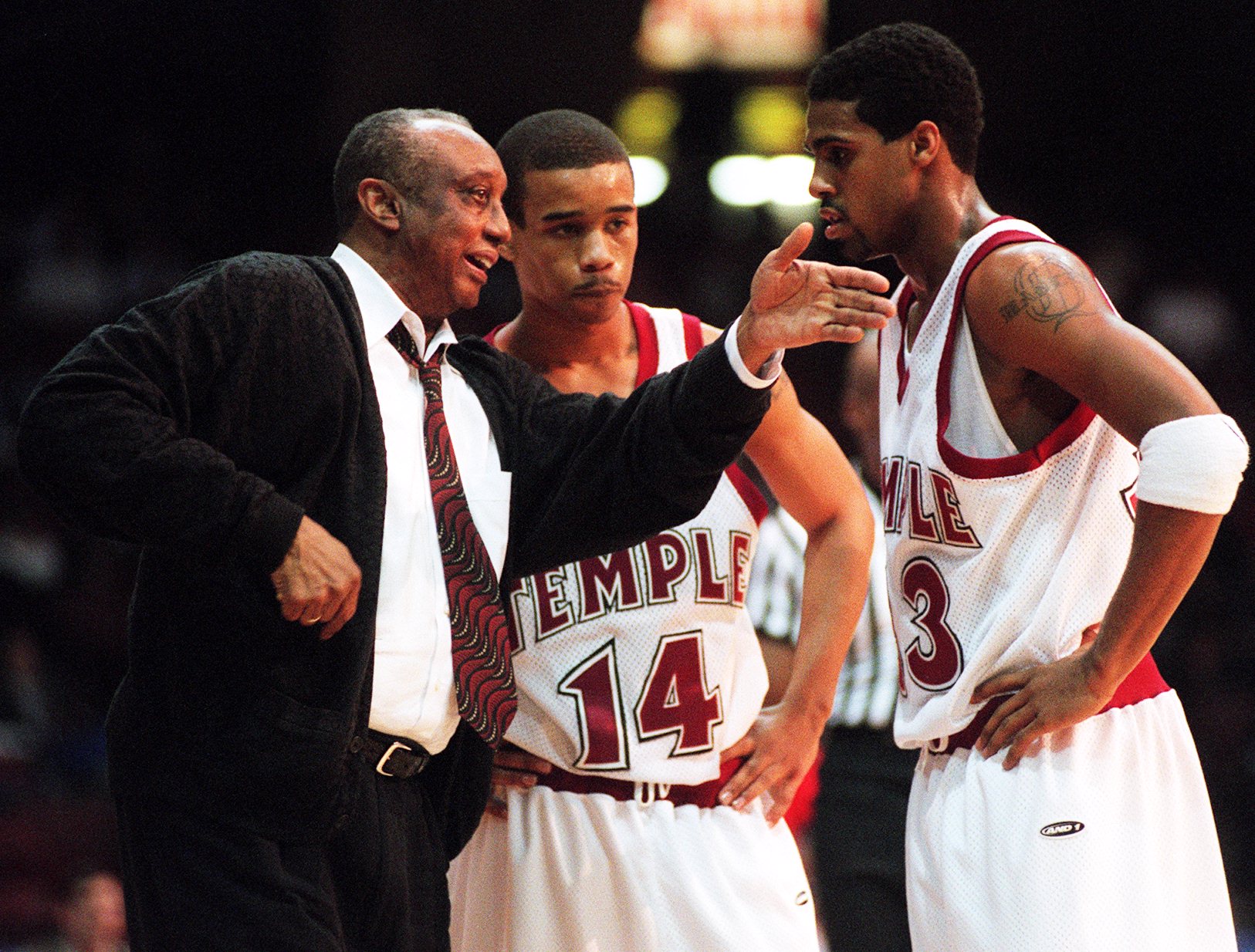
    Former Temple coach John Chaney with players Lynn Greer and Quincy Wadley.

    Hard circumstances and poor decisions

    The factors that damaged the Big 5 were legion. Some applied to just one or two programs. Some applied to all of them. Some were mistakes, bad choices. Some were unavoidable and beyond the programs’ control.

    Start with La Salle. Given an opportunity in 1990 to build an 8,000-seat on-campus basketball arena — Tom Gola offered to raise the funding for it — the university said no. Then its leadership made what is commonly considered the disastrous decision to relocate from the MAAC to the Midwestern Collegiate Conference. The program has never recovered.

    Look at Temple. Chaney, a singular presence and attraction, retired in 2006. Though Dunphy, his successor, guided the Owls to six consecutive NCAA Tournament appearances, the university’s quest for football dollars led it to leave the Atlantic 10 for the American Athletic Conference — and abandon its basketball-first identity.

    Again: individual schools, individual issues. But those problems were byproducts of college basketball’s overall reshaping during the 1980s and ’90s. In retrospect, the most infamous moment in Big 5 history — the dissolution of the round-robin, at the insistence of Villanova and coach Rollie Massimino, after the 1990-91 season — was an acknowledgment of those changes, and the attempts to preserve the Big 5 as it had always been would inevitably fail.
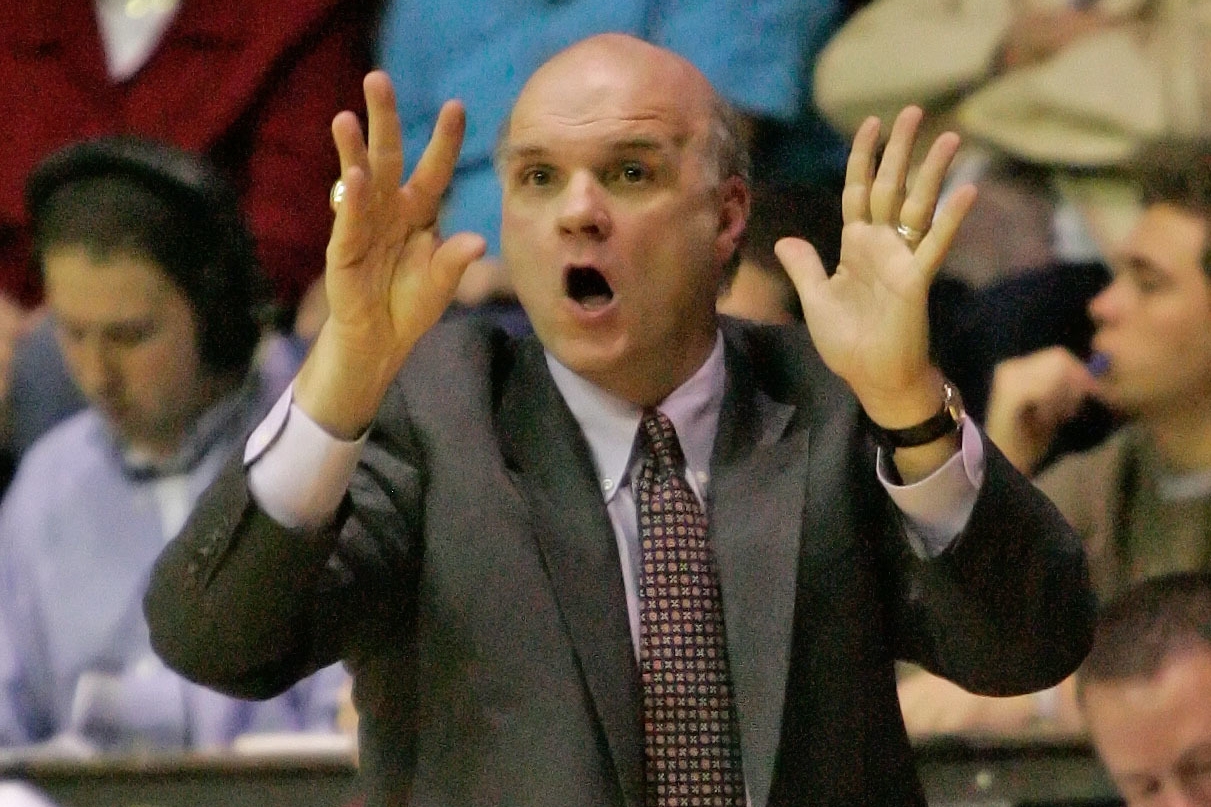
    Phil Martelli led St. Joe’s to go 26-7 and advanced to the Sweet 16 in 1996-97.
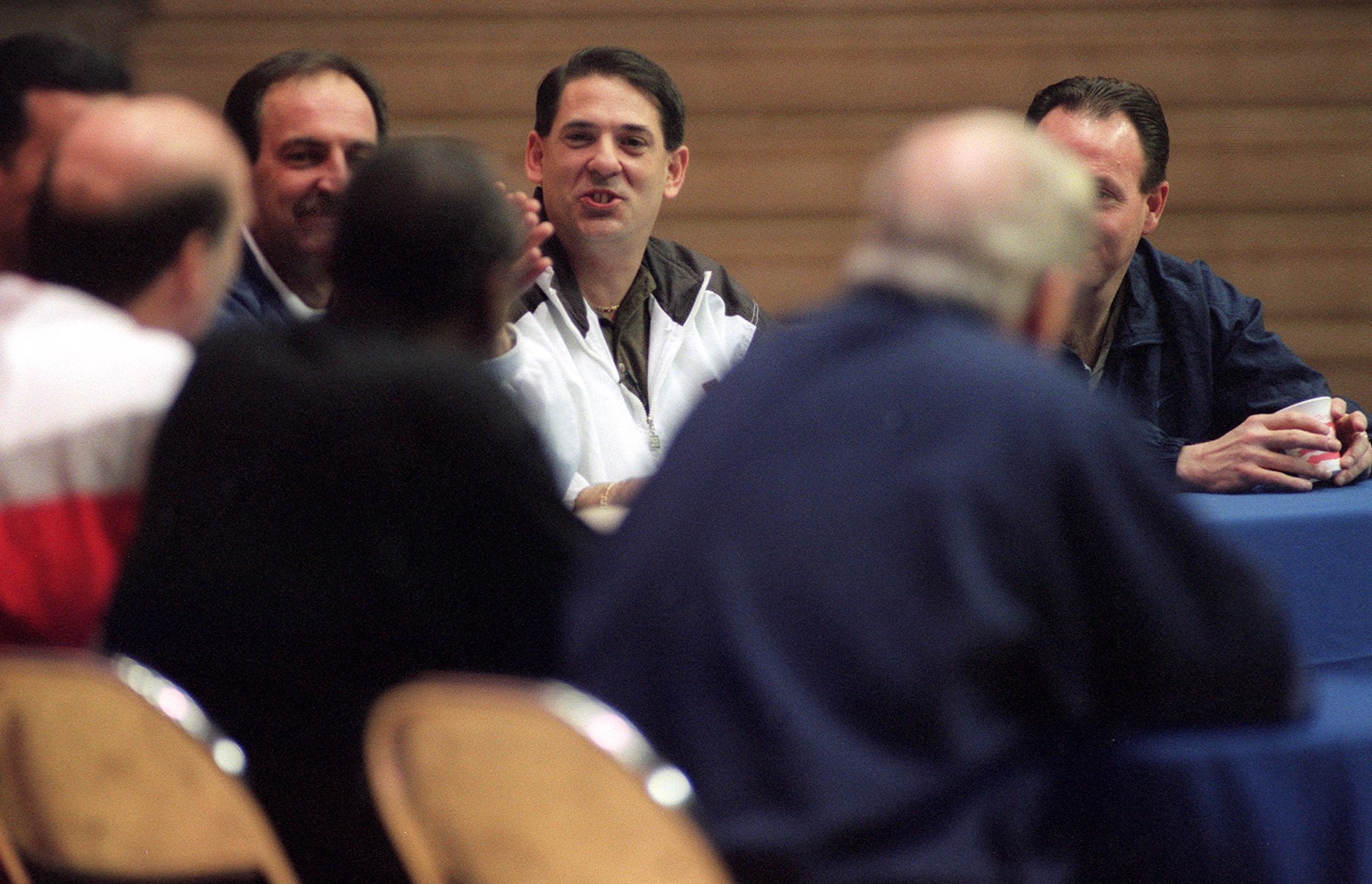
    Former Villanova coach Steve Lappas jokes with the other Big 5 coaches during a taping of the Comcast basketball show in 1997.

    When Villanova pushed to cut back on city series games and Temple pushed for more of those matchups to be played at campus sites other than the Palestra, they weren’t merely trying to make things easier for themselves. They were responding and reacting to college basketball’s new conditions for success.

    Sneaker companies had begun financing all-star camps, AAU programs, and college programs. Now coaches didn’t have to rely on local high school teams to find players, and great Philly players were no longer making their names solely in the Public League, the Philadelphia Catholic League, or the Sonny Hill League. They were traveling to play AAU. They were seeing other cities, meeting other coaches. They weren’t as likely to stay home to play college ball.

    “The most important recruiting device is recognition,” Chaney told author Bob Lyons in Palestra Pandemonium: A History of the Big Five, “and recognition comes from national TV. … They don’t know what the Big 5 is outside of this area. They knew who Villanova was when they won the national championship, so you could always attach yourself to them. But it wasn’t going to get you very far because no one knew the history and tradition of the Big 5.”

    In that way and others, the inherent parochialism of the Big 5 worked against it. For instance, Dave Gavitt, the founding commissioner of the Big East, struck a deal in 1980 with ESPN, then a fledgling sports network hungry for programming, for the exclusive rights to televise the conference’s games. That arrangement made it difficult, if not impossible, for Villanova and any other Big East school to be involved in a 7 p.m./9 p.m. Palestra doubleheader and for a national television audience to watch that doubleheader.

    “We needed the game between Villanova and Georgetown at 8 p.m. to go on our network,” Gavitt told Lyons. “We couldn’t clear games at 7 p.m. because of the game shows that all the local stations carried.”
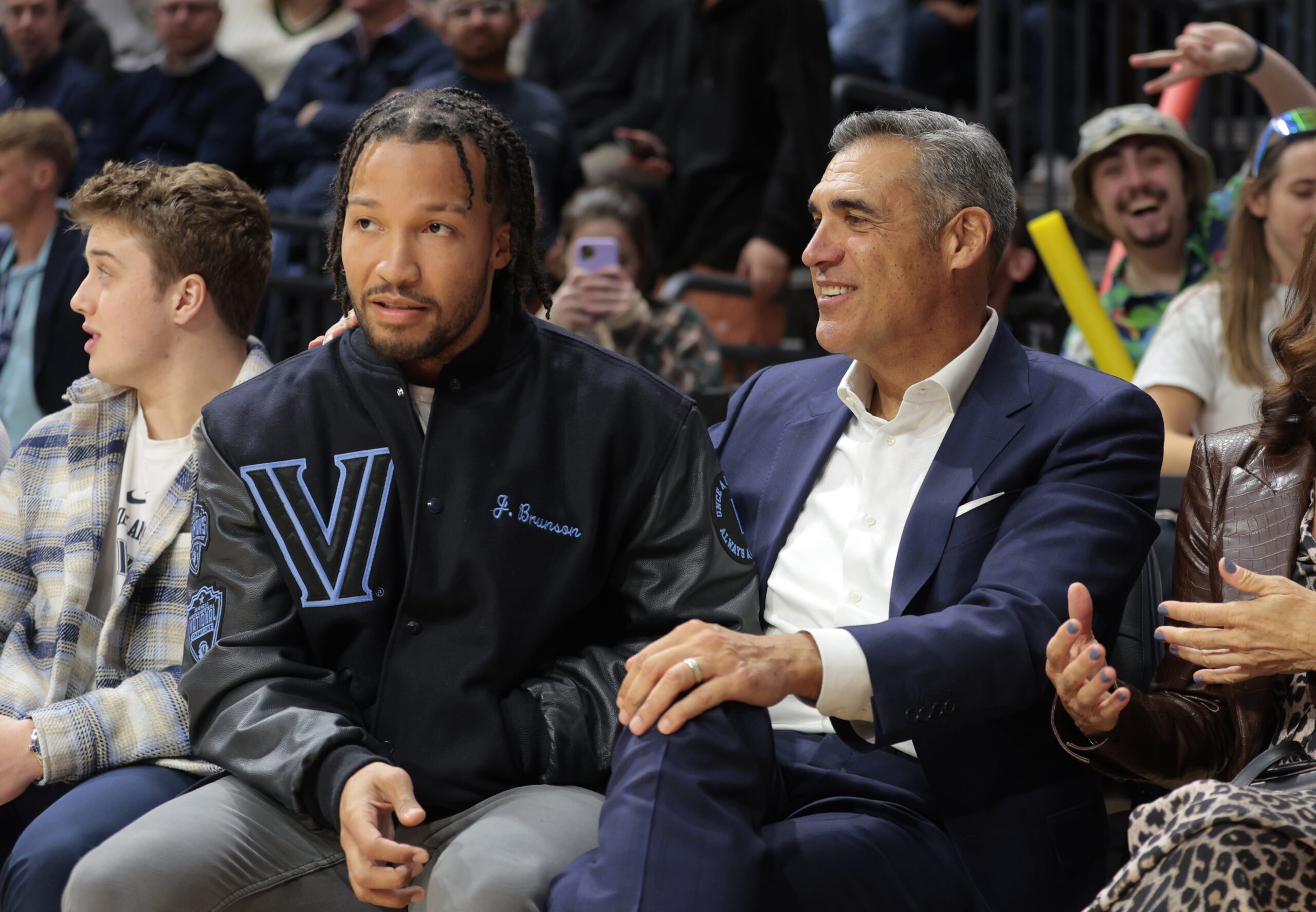
    Jalen Brunson and former Villanova coach Jay Wright at the Finneran Pavilion on Feb. 8, 2023.

    As it was, the Big 5 had a TV deal of its own, with the Philly-based premium cable channel PRISM, starting in 1978. Yet the PRISM commitment actually limited the exposure of some of the Big 5’s schools.

    During the 1989-90 season, as one example, the Atlantic 10 wanted to place a Temple-La Salle game on ESPN so that it would be telecast nationally. “ESPN,” Lyons wrote, “subsequently refused to carry it, however, because it did not want to black it out in PRISM’s trading area.”

    So hoops fans in the Delaware Valley could watch the game at home, but no one else could. At a time when college basketball was becoming more accessible, the Big 5 was cutting itself off from everyone who wasn’t already familiar with it.

    That history might seem ancient. It’s not. Wright’s tenure and the economics of the sport have placed Villanova on a separate tier from the other programs. And now that he, Chaney, Dunphy, Martelli, and Morris — the local legends who were the backbone of the Big 5 — aren’t coaching anymore, the remaining infrastructure hasn’t been strong enough to restore the teams to excellence and maintain the intensity of the rivalries.

    It’s a shame, but it was only a matter of time. Yes, the Big 5 was a Philly thing. Yes, it was a national thing. Yes, it was a glorious thing. And now it’s gone, and all the wistfulness and wishful thinking in the world won’t change the hard and inescapable truth: That glory isn’t coming back.
  • Stifling defense and new-look rotations highlight Villanova’s blowout win at DePaul

    Stifling defense and new-look rotations highlight Villanova’s blowout win at DePaul

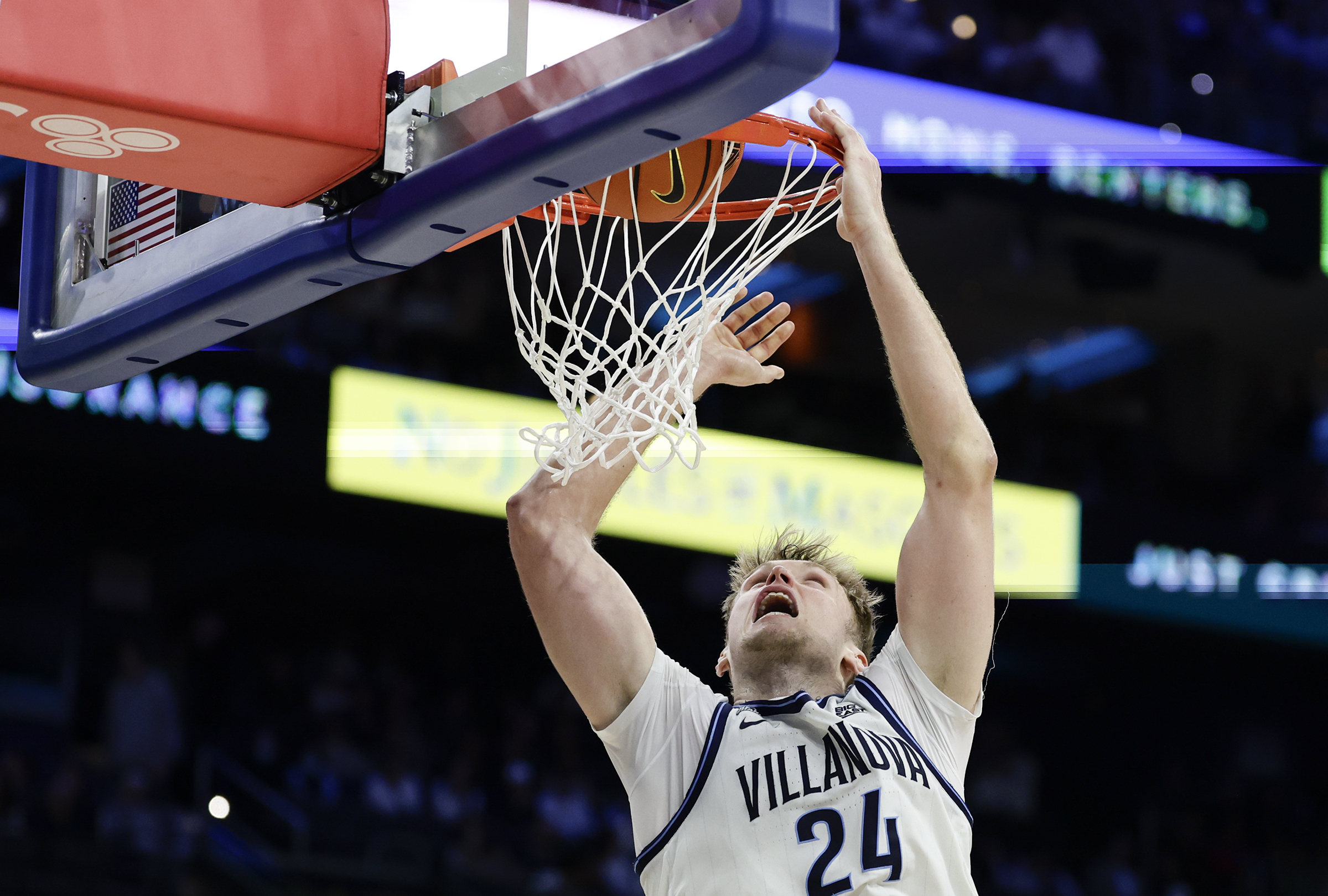
    Villanova entered Wednesday with a 9-3 road record, but the last true road game of the season for the Wildcats came with a new wrinkle, and a new starting lineup after Matt Hodge suffered a season-ending ACL injury Saturday night vs. St. John’s.

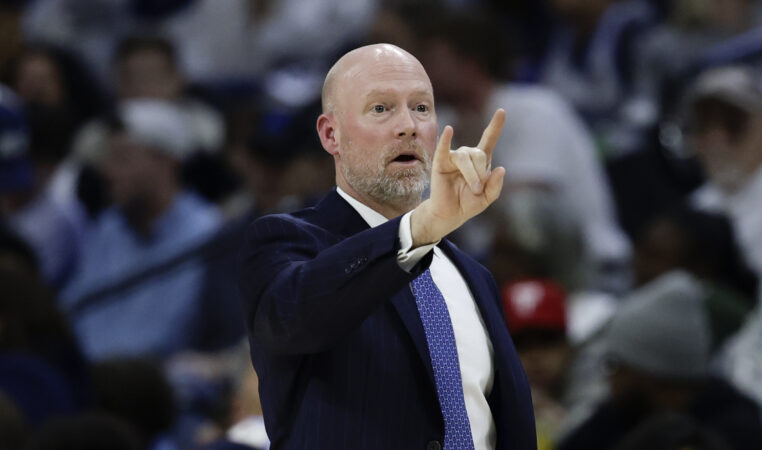
    Villanova coach Kevin Willard said Tuesday that the injury hurt the Wildcats, but “it’s not catastrophic.” They had the right answers to make up for missing their sixth-leading scorer, Willard thought, and while a sloppy first half didn’t make him look like much of a prophet, a much better second half helped Villanova turn a tight game into a rout and an eventual 76-57 win over DePaul.

    The Wildcats improved to 23-7 on the season and 14-5 in the Big East behind big nights from Tyler Perkins (20 points, six rebounds), Duke Brennan (15 points, 12 rebounds), and Devin Askew (14 points, five rebounds). It was their eighth conference road win, their most since 2016.

    Here are a few observations from the victory:

    Dominant defense

    DePaul is the second-worst scoring offense in the Big East and ranks seventh of the 11 teams in three-point shooting (33.1%).

    It’s on the defensive end where Hodge’s absence in the starting five won’t be felt in a major way. That’s not to say Hodge, a redshirt-freshman, hasn’t held his own, but inserting Malachi Palmer in the lineup gives Villanova more versatility. Palmer is two inches smaller than Hodge at 6-foot-6 and allows the Wildcats to effectively switch more, which was especially effective against DePaul’s pick-and-roll offense.

    Malachi Palmer gave Villanova a major boost on the defensive end Wednesday night.

    Villanova was aggressive on the ball defensively and created 16 DePaul turnovers, leading to 22 points off those turnovers. Villanova got its own good looks in the first half but shot just 27.6%. The Wildcats survived a slow start because they forced seven turnovers and limited DePaul to just 24 points. It was the third time this season Villanova allowed fewer than 25 points in an opening half.

    In the second half, Willard deployed more matchup zone and dared DePaul to try to shoot its way to a win. The Blue Demons were just 2-for-16 from three-point range, and many of those were either well-contested or forced into the hands of low-percentage shooters.

    Three Wildcats had at least two steals. Perkins had four, while Bryce Lindsay and Acaden Lewis had two apiece.

    New-look rotation

    Palmer, as expected, got the start and tied his season-high with 29 minutes, a mark he reached for the first time Saturday night in part because of Hodge’s injury early in the second half.

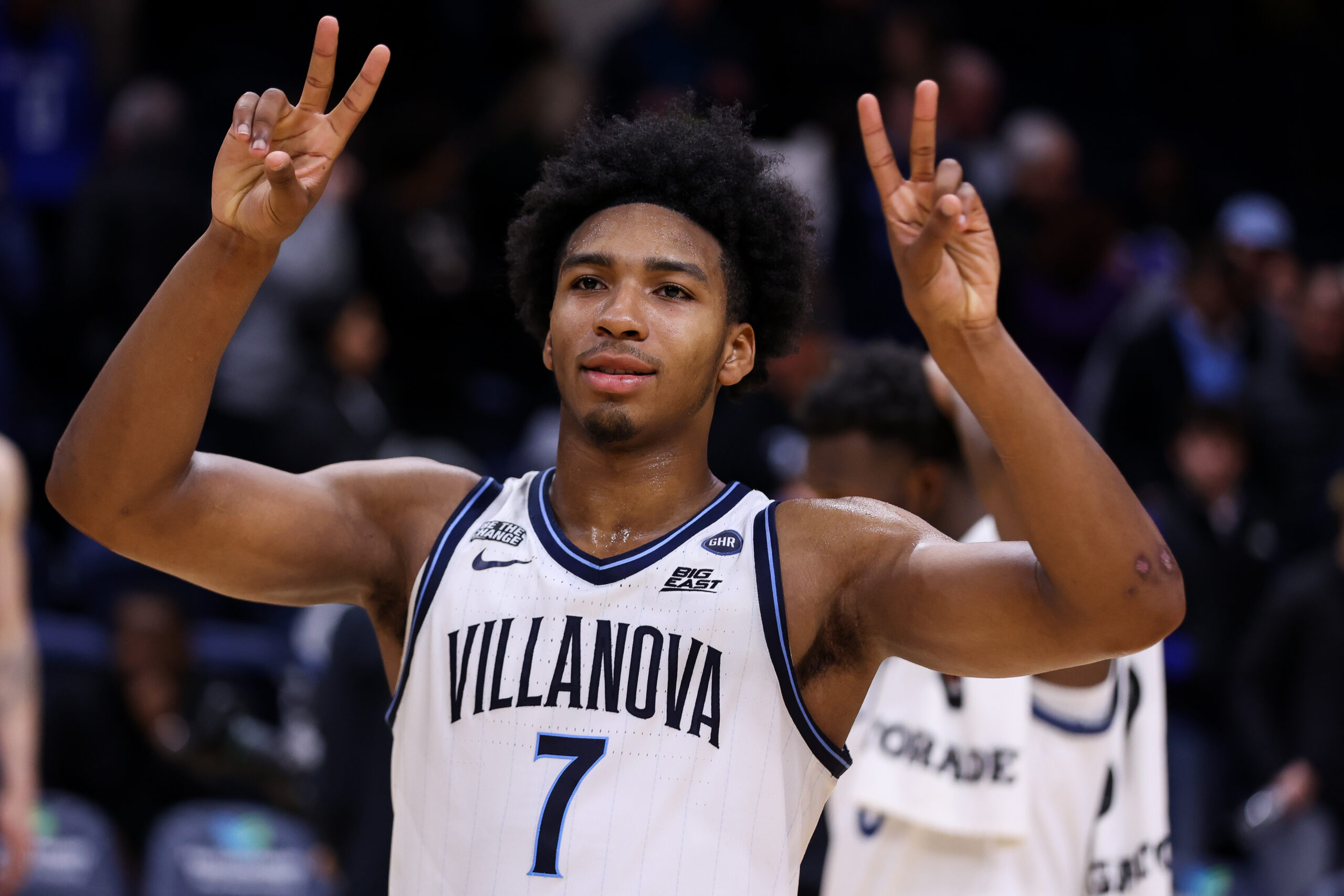
    Palmer, a sophomore, looked a little jittery to start but settled in during the second half. He finished with 10 points on 3-for-9 shooting (1-for-4 from deep) and added five rebounds.

    Askew was the first player off the bench as usual. Then freshman guard Chris Jeffrey and backup center Braden Pierce, a redshirt-freshman. Hodge’s absence will force Villanova into some awkward rotations when Palmer needs to rest. Willard had brief stretches with one big man and four guards on the floor, a unit that he won’t be afraid to roll with depending on matchups because of Perkins’ physicality and rebounding ability.

    Villanova forward Duke Brennan finished with 15 points and 12 rebounds against DePaul.

    What Villanova didn’t show Wednesday was a two-big look with Brennan and Pierce both on the floor. Willard said he’ll be willing to go to it, and the Wildcats have practiced it some, but DePaul did not have a ton of size to force Villanova to counter.

    Brennan played 35 minutes for the fourth time in a game that ended in regulation. Palmer played 19 of the 20 minutes in the second half while Pierce (two minutes) and Jeffrey (one minute) played sparingly. They finished with five and three minutes, respectively. An eight-man rotation was effectively a six-player rotation. It worked fine Wednesday night, and may work fine again Saturday in the regular season finale vs. Xavier, but tougher tests await in the postseason.

    No Stanford

    Hodge being out meant Zion Stanford, a West Catholic graduate and Temple transfer, potentially was in line for more of a role. The junior had seemingly fallen out of the rotation and hadn’t played since Feb. 4.

    But Stanford was not with the team in Chicago. He practiced Wednesday, according to sources, but didn’t travel with the team and the nature of his absence was unclear.

    Bouncing back

    Willard told the broadcast after the game that he “got after” his team a little bit in two days of practice following what was the worst Villanova loss in 29 years.

    Willard attributed the missed shots and carelessness offensively to still dealing with the emotional letdown of having Hodge out. But things settled down after halftime. The Wildcats changed up their defense and were much more efficient on the offensive end.

    It’s no surprise that it was Askew, Brennan, and Perkins — a graduate student, a senior, and a junior — who helped lead the way in the second half.

    One more, then the tournaments

    The regular season ends Saturday with a noon home game vs. Xavier. A win would give Villanova 15 conference wins for the first time since 2021-22, Jay Wright’s final season. That possibility may be a little less daunting considering Xavier’s Tre Carroll, the Big East’s leading scorer (18 points per game), went down with an injury Tuesday night. His status for Saturday is not yet known.

    The Wildcats are on their way to the NCAA Tournament for the first time since 2022, but first is the conference tournament next week in New York, where Villanova will be the No. 3 seed. They open up in the final game of the quarterfinals next Thursday (9:30 p.m.) vs. the winner of the No. 6 vs. No. 11 matchup.

  • Neumann Goretti’s Andrea Peterson is more than a girls’ basketball coach. She’s a tenacious leader.

    Neumann Goretti’s Andrea Peterson is more than a girls’ basketball coach. She’s a tenacious leader.

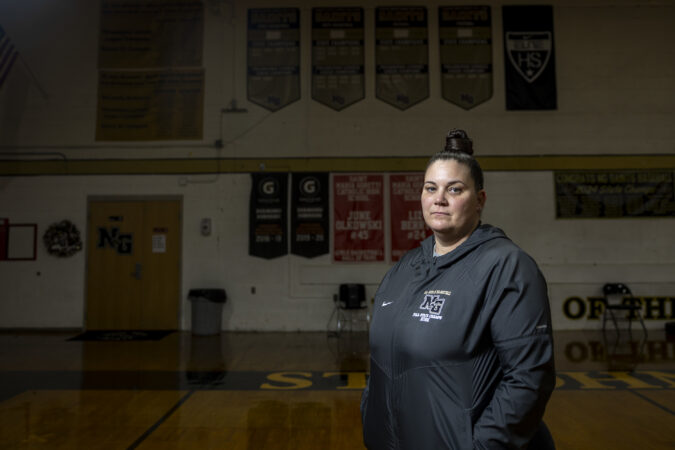
    The Neumann Goretti girls’ basketball team bus was almost as quiet as the church the players were in a day earlier. Everyone sat in their usual places.

    Saints coach Andrea “Petey” Peterson was in the front right seat, her hair in its familiar bun, her head resting on her outstretched arm across the windowsill, her AirPods in, a way to insulate herself from the world that Saturday morning in early December. The day before had been her mother’s funeral.

    In the back, the Neumann Goretti team whispered, the volume down from the blaring noise that typically wends through the bus during chartered away trips. None of Peterson’s players were surprised that their coach was on the bus with them, traveling to their season opener against St. Mary’s on Long Island in New York.

    “I remember that trip,” said Saints senior guard Kamora Berry. “I remember seeing Coach Petey’s hair bun in the back of the bus and thinking we have to do this for her. There was no doubt in my mind she would be there that day. She is so strong. I would be a mess. Anyone would be.

    “Think about it. Coach Petey is on a bus with us going to a game the day after her mother’s funeral. Who does that?”

    Apparently, Andrea Peterson.

    She is in her 12th season as Neumann Goretti’s head coach. She is the most accomplished girls’ high school basketball coach in the area, with six state championships, including last season’s first Class 4A title in school history (plus two in Class 2A and three in 3A), two Catholic League championships, and six District 12 titles.

    In 2015, Peterson was named the national Naismith Coach of the Year, guiding the Saints to a 30-0 finish and a No. 1 ranking nationally by USA Today. Her team will compete in the first round of the state Class 4A playoffs on Saturday against Susquenita of Perry County.

    Somehow, she manages to run her childcare business, Christopher’s Footprints, in Norwood, Delaware County, coaches Neumann Goretti, which is really a 12-month long responsibility, runs her AAU Philly Legacy program, all while raising her sibling’s three children on her own, and easily working between 70 to 80 hours a week during the four-month high school basketball season.

    Who does that?

    Apparently, she does.

    Peterson says she derives her wrought-iron will power from her parents, Thomas and Alice, who were in ill health and died within 133 days of each other last year, though in many ways she channels old-world coaches like the raspy-voiced John Chaney and towering John Thompson.

    Her friends and family joke there is a cuddly side to her, you just have to peel away the prickly cactus thorns. She has no filter. What she says, she means. She is demanding. Unbending. Stubborn. And incredibly loyal and giving.

    The loyal and giving side, Peterson says, comes from her mom, who temporarily fostered three children one Christmas after their family house burned down. The diamond-hard edges, she laughs, comes from Thomas, a Vietnam veteran who fought PTSD most of his adult life and worked countless hours in baggage claim at Philadelphia International Airport.

    Her players say that if you do not know Coach Petey, she can be intimidating and cold. Peterson will also be the first to acknowledge that she is not looking to be anyone’s buddy, because no one comes between her and her players. And she wins. She has won many times with players from hard, sometimes unimaginable backgrounds.

    Legendary Westtown coach Fran Burbidge has known Peterson since she was 11, a pigtailed stubby little girl who played tackle football for the Brookhaven Jets. She’s the sixth of seven children and wanted to be like her older brothers, Joey and Chris.

    Burbidge remembers when his daughter Chrissy played for the AAU Comets and Cardinal O’Hara and Peterson was playing for the Philadelphia Belles and Archbishop Carroll. Burbidge became good friends with her father and followed Peterson’s path to Carroll, where she won two Catholic League championships, one time canning a free throw with 5.3 seconds left to win the 2003 PCL title over O’Hara.

    Burbidge, who has known Peterson for 30 years, now coaches against her.

    “Through coaching AAU and here at Westtown, I have coached a lot of different kids, from a lot of different backgrounds, and there are certain things that you have to deal with as a coach, and with Andrea, she coaches great kids at Neumann Goretti, but she coaches kids who take the train home at night and kids that are homeless,” Burbidge said.

    “She coaches kids who come from some rough situations. I don’t think a lot of people understand that about Andrea and what she does, because she’s been so successful as a basketball coach.

    “Because Neumann Goretti, under her, has been so successful, they have the misconception Neumann Goretti is a basketball factory with talented kids that flock to them. It’s a lot more complicated than that.”

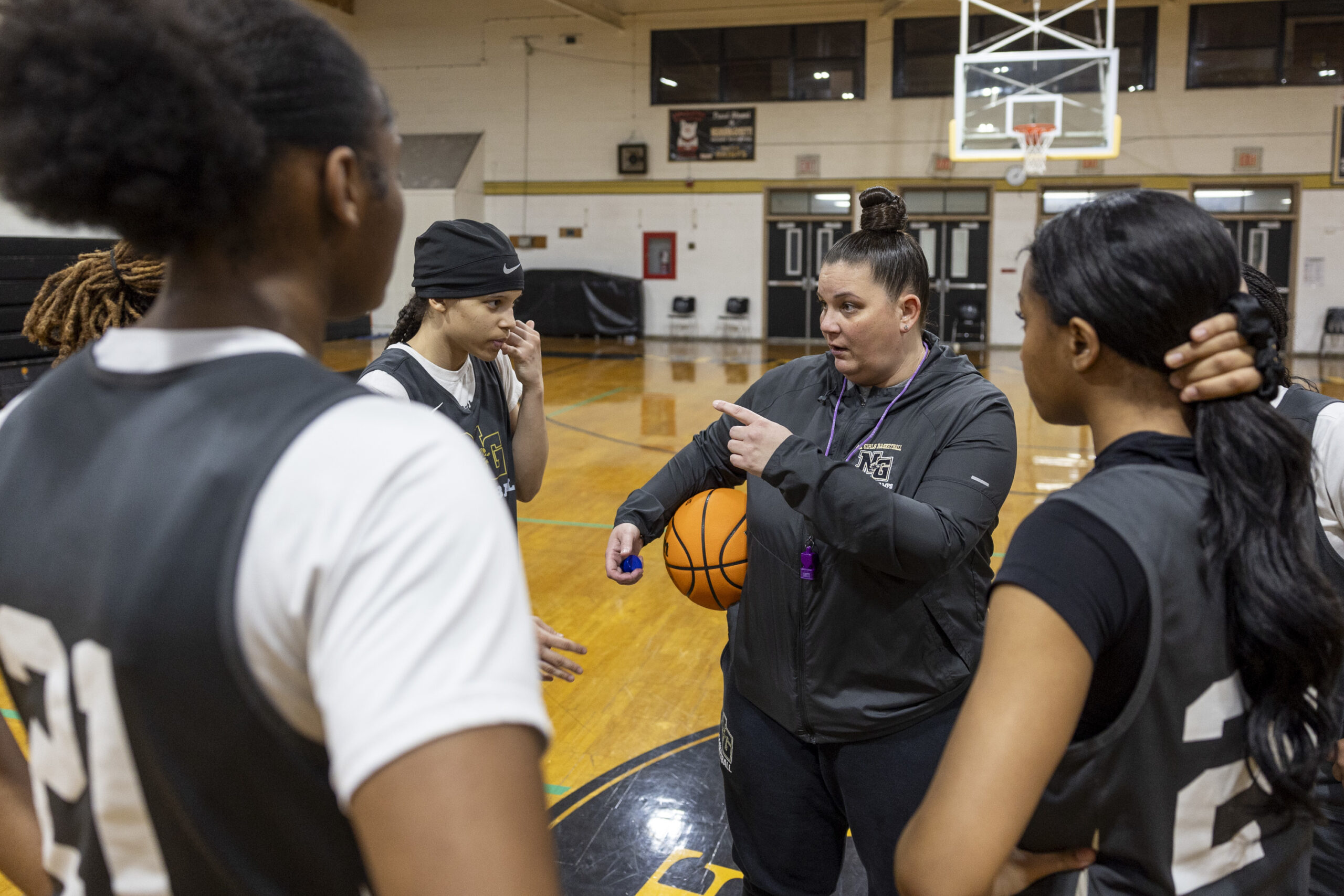
    Andrea Peterson coaches her team during practice in January.

    Peterson had players, according to many associated with the program, who were from broken backgrounds, some homeless and some abused, and a few survivors of domestic abuse.

    She was a four-year starter at Carroll for Hall of Fame coach Barry Kirsch. How Peterson maintains everything she does is beyond him. Kirsch knew of her tireless work ethic as a player, which she continues as a coach.

    She has an ability to relate to city players, because in many ways, she comes from the same rowhouse working-class existence as they do.

    “Andrea always understood the game beyond her years,” Kirsch said. “You never had to explain anything to her. She was like having a coach on the court in high school. Her teammates respected her and loved her. You could see then Andrea was going to be a great coach. The relationship she has with her players is beyond reproach.

    “She does not want the attention on her. She wants it on her team. Andrea has always been incredibly hard on herself, because I had her as a student. Maybe it’s why she takes on Neumann Goretti, because no one in the Catholic League has a harder job than her. Look at Carroll, O’Hara, [Archbishop] Wood, they get players from solid homes, and she is dealing with kids with challenging situations.”

    ‘Focused on the moment’

    Peterson originally grew up in Brookhaven and moved to Norwood. She was one of seven in a three-bedroom home, with the five girls sleeping in bunk beds, and Joey in a separate room. After her older brother Christopher passed away on Mother’s Day 1994 in a car accident, when Peterson was 10, their mother, Alice, began sleeping by the door.

    Alice, one of 10 children with South Philadelphia roots, would get so nervous watching Andrea play at Carroll she would rock back and forth in her seat. She did not know much about basketball, so she would yell, “Score that touchdown,” at Andrea’s games. Alice and Thomas more than a few times put up the family rent so Andrea could play summer AAU basketball.

    “Seeing my mom at my games, knowing I was her baby girl in these big games, made me happy. My parents always made sure I had what I wanted, and that is what drives me today,” Peterson said. “I was spoiled. We never wanted for anything. But as you get older, you realize how life really is, and what your parents sacrificed. We knew we weren’t living in a mansion.”

    Growing up, Joey would take “Angie,” as her family calls her, to Norwood Park to play with grown men when she was 13 on the asphalt courts. Peterson would get knocked around, and Joey never ran to pick her up.

    “That’s where Angie got her toughness, and we weren’t about to help her up,” Joey said. “I think it’s why Angie was able to get on that bus the next day after our mother’s funeral. That tells you who she is, and about her commitment.

    “I have to tell her to slow down sometimes. Our whole family tells her that. It is nonstop, between the basketball, the daycare, taking on our dad a few years ago, and now my sister’s kids. She is able to get focused on the moment in the moment.”

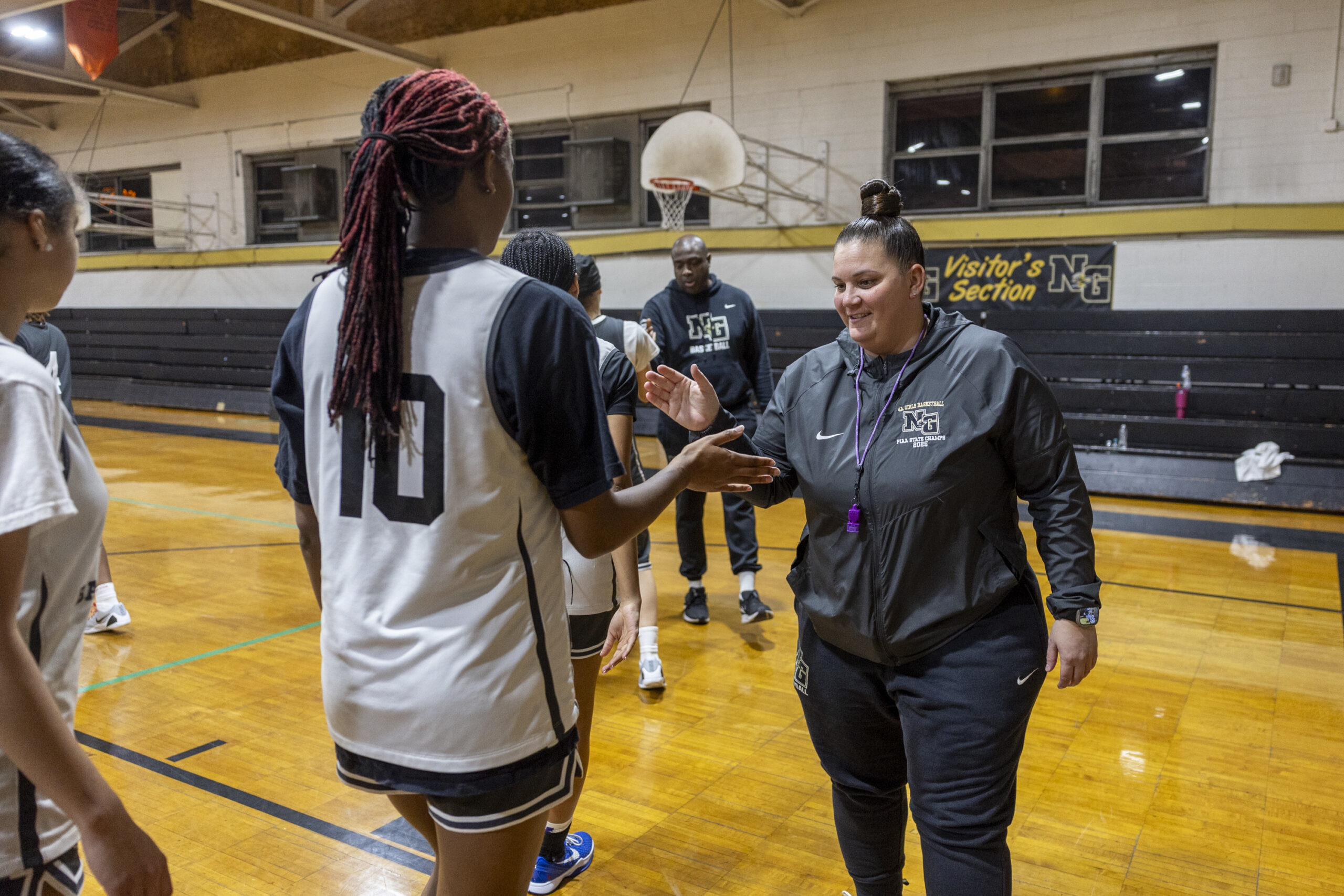
    Andrea Peterson ends practice with a line up, doing special hand shakes with her players on Jan. 14.

    Peterson first went to St. John’s University out of Carroll but decided to come home to care for her parents, who were in ill health. She transferred to Drexel, where she received her undergraduate in sports management and graduate degree in higher education, becoming the first college graduate in her family.

    One time Peterson quit basketball while in grade school, because she felt that her father was living too vicariously through her and that nothing was good enough in his eyes.

    They had a heart-to-heart to settle their differences. Peterson felt that was a coming-of-age moment.

    “I was always stubborn, like my dad, and if that conversation doesn’t take place, I don’t know if I would have left basketball, but I wanted to show him I could do this on my own,” said Peterson, who wore the No. 22 because it was Christopher’s birthday and her daycare business is named after him.

    “I knew what I had to do to get a college scholarship. I knew I was in love with basketball, and I knew that was where my path would go. I was told I wouldn’t make it at St. John’s. I was considered too small, too slow. I love being told I can’t do something. You can tell me 10 things, nine positive and one negative. I’ll hear the one negative and turn that into a positive.

    “I hear it every year that Neumann Goretti isn’t good enough. You do not have to like us, but you have to respect my kids and our program, and the culture that we built.”

    Thomas wanted more for his daughter, and he was even coaching her while she was coaching. Thomas would keep the articles written about his little “Angie” tucked under his bed.

    During the last months of her father’s failing health, Peterson was his sole caretaker. Before he died, she said, he told her, “Thank you for making me proud.”

    Andrea Peterson won her second PCL title as Neumann Goretti’s head coach on Feb. 23, 2025.

    After each practice this season, her players have made it a habit to hug Peterson and tell her they love her.

    “We know what Coach Petey has been through,” Berry said. “It’s why we dedicated this season to her. She buried both her parents last year and never missed a practice or training session. She was always there for us. We have to be there for her.

    “I think high school players take for granted what their coaches do. We don’t. Coach Petey was on the bus with us going to a game the day after she buried her mother. I mean, who does that?”

    Apparently, Andrea Peterson.

  • Point guard Derek Simpson is assisting in St. Joseph’s turnaround: ‘We can be unstoppable’

    Point guard Derek Simpson is assisting in St. Joseph’s turnaround: ‘We can be unstoppable’

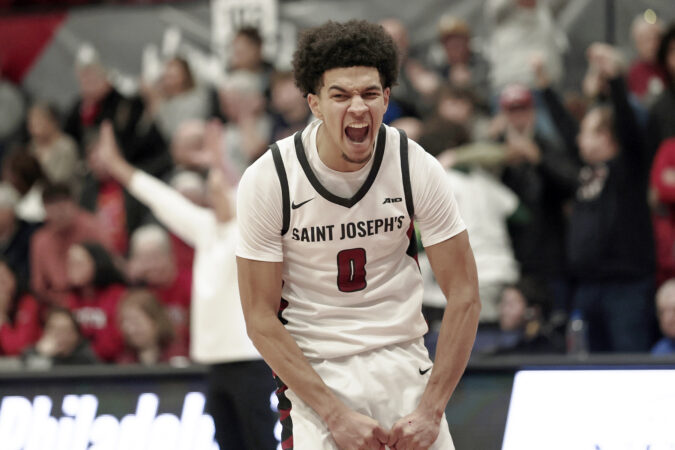
    It’s part of Derek Simpson’s job to be a good communicator, which has led the St. Joseph’s point guard to have some tough conversations.

    Before this season started, Billy Lange departed from the program for a role with the New York Knicks and newly hired assistant coach Steve Donahue was promoted to take over the helm. Then on Dec. 23, Deuce Jones II, the team’s leading scorer, left the team, and St. Joe’s went on to drop its first two Atlantic 10 games.

    It was time for a realistic evaluation. With 16 games remaining in the regular season, the players and coaches held a meeting to air out their grievances on Jan. 3.

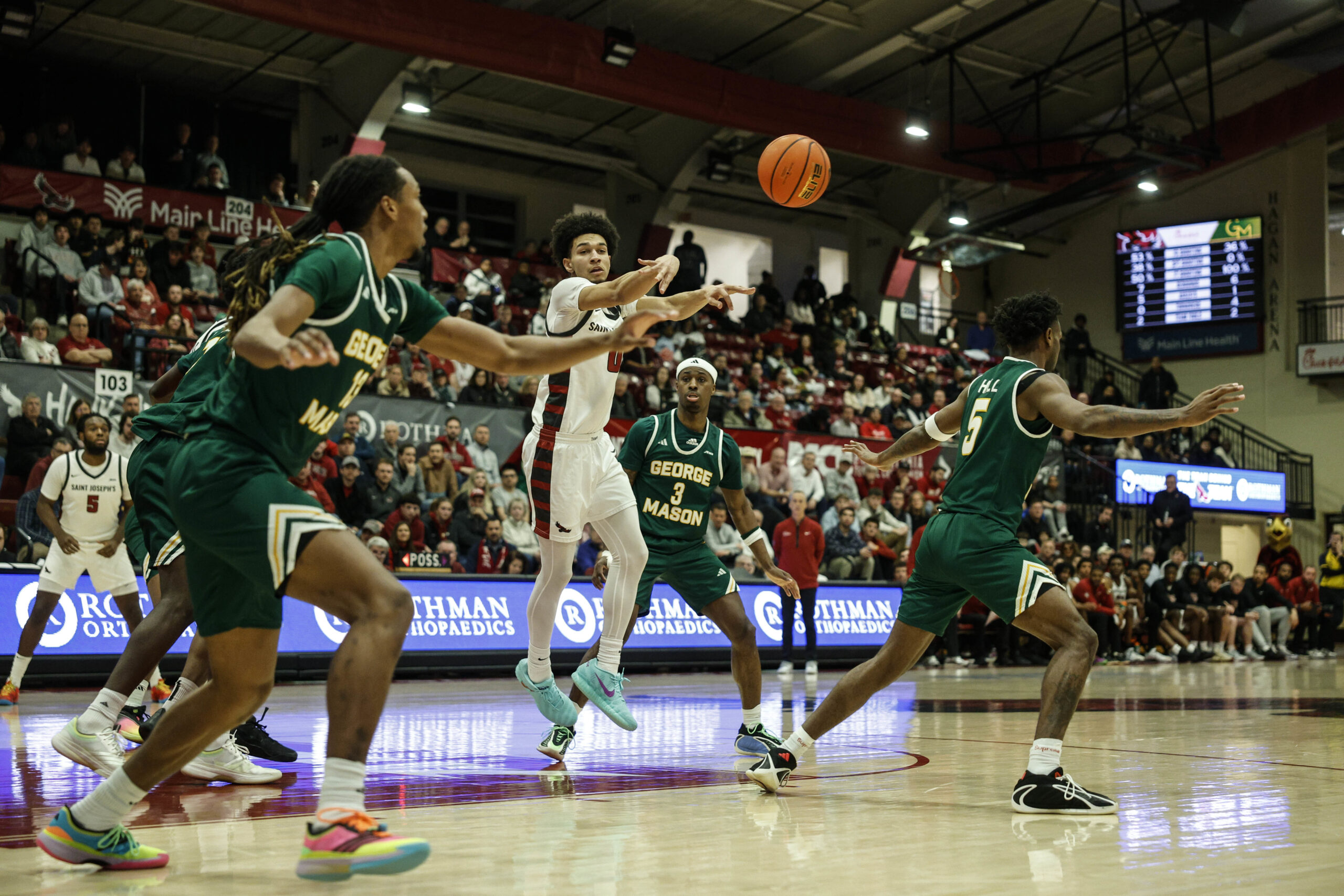
    Derek Simpson is leading the team in assists this season.

    “It turned into like, ‘How do y’all want to do this?’” Simpson said. “Like ‘Derek, do you want to go out as a senior losing all these games?’ That was the question. ‘Justice [Ajogbor], did you come back this year to do all this [expletive]?’ It was eye-opening for a lot of us and it just helped us get some of our feelings out.”

    The Hawks went back to work. Practices improved, pregame shooting was taken seriously, and more importantly — they started to win.

    St. Joe’s is 19-10, riding a four-game winning streak entering Wednesday’s contest at Davidson (7 p.m.), and sit third in the Atlantic 10. Simpson has been one of the driving forces to the Hawks’ turnaround.

    “It’s just those connections and those questions we have to ask each other that we’ve been doing.” said Simpson, who’s averaging 13.7 points and a team-high 5.1 assists. “When those things get on the money, we hit the shot. It’s like ‘Oh yeah, we already talked about that.’ So it turns into, ‘We good now.’

    “Then all the fun starts to happen. Then we get the back door cuts, we get the dunks. If you’re not having fun, why are you playing the game?”

    ‘Go full throttle’

    Simpson has had that mindset since he was a child.

    His father, Ron, played basketball and is Rider University’s seventh all-time scoring leader. His mother, Kelli, swam and played tennis, while his sister, Courtney, was a soccer goalie at Loyola Maryland, and his other sister, Marissa, played softball.

    Safe to say, sports run in the family.

    Simpson often found himself on the sidelines of the South Jersey Titans, an AAU team Ron founded, watching the action as early as first grade.

    “That kind of got me into the sport,” Simpson said. “My dad was like, ‘If you’re going to play, might as well take it serious, just like anything else.’ So I played basketball and football growing up until eighth grade. I stopped football because it was getting too much. … My dad, my mom always encouraged me if you’re going to do something, you might as well go full throttle.”

    So that’s what he did, he played travel ball under his father, but eventually stopped because it was affecting their relationship.

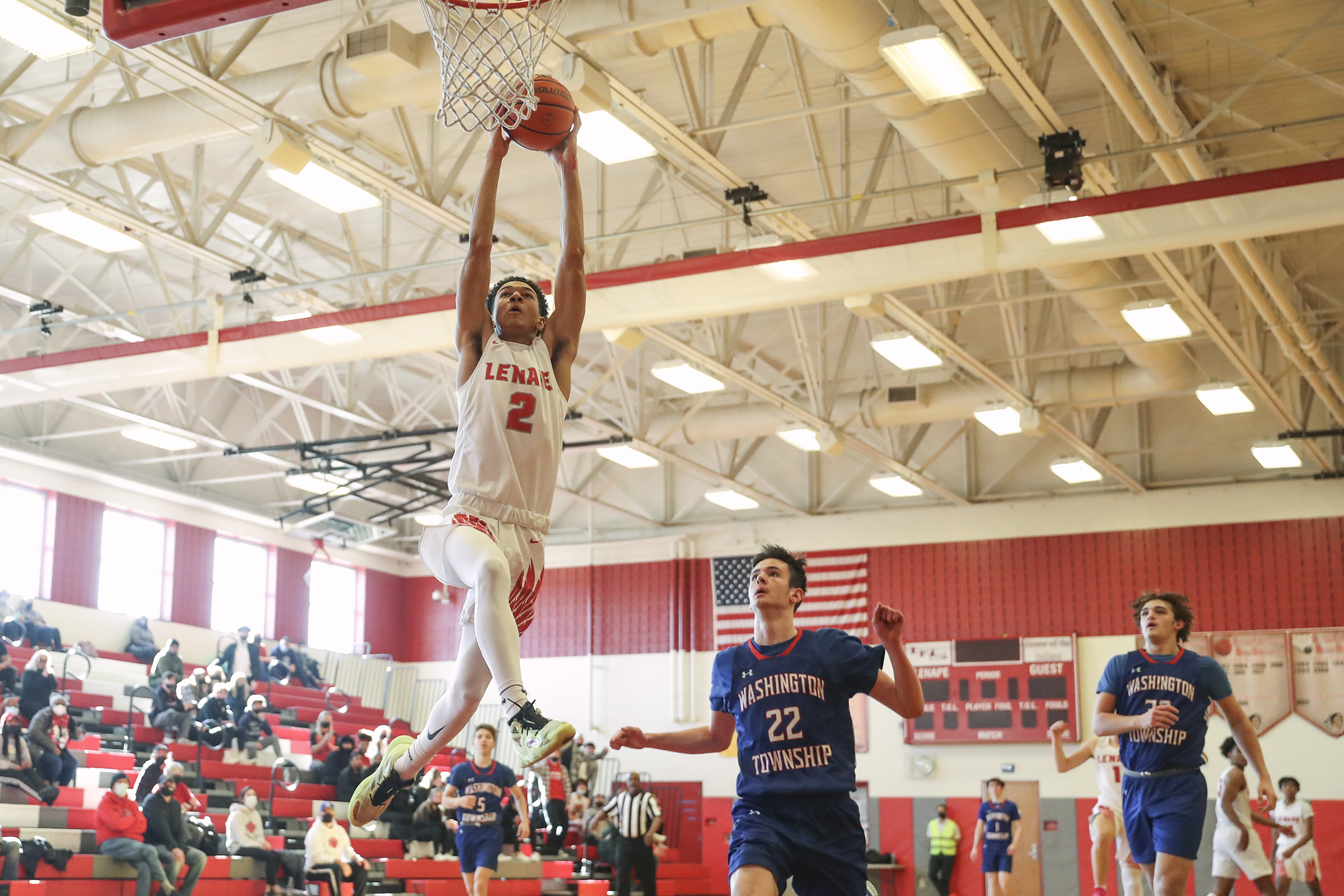
    Lenape graduate guard Derek Simpson is the school’s all-time leading scorer.

    Lenape High School coach Matt Wolf recalled seeing Simpson play in a summer showcase as a rising freshman and was blown away.

    “We had three games that day,” Wolf said. “The first game I looked at the former head coach, and I said, ‘Oh man, he’s definitely varsity.’ Then the second game he played I looked at him like, ‘Oh man, he’s going to play a lot this year.’ Then after the third game [I] went, ‘Oh my God, he’s going to be the starting point guard as a freshman.’”

    Simpson made his impact at Lenape. He finished with 1,553 career points, the most in school history. He even played future teammate Dasear Haskins, then at Camden High School.

    Simpson is still close with his former coach. Wolf reaches out after every St. Joe’s game, and last Christmas, Simpson returned to his old stomping grounds with former players.

    Defining roles

    Simpson landed at Rutgers in the 2022-23 season, where he spent his first two years of college ball. He averaged 7.7 points across 66 games before entering the transfer portal as a junior. There, he bumped into familiar faces.

    Lange and former assistant coach Justin Scott recruited Simpson when he was in high school, and Lange clicked with his parents due to their South Jersey backgrounds.

    A few years passed, and the opportunity to come to St. Joe’s arose again. He joined a team that had lost guard Lynn Greer III, but had Xzayvier Brown, all-time leading scorer Erik Reynolds II, and Suns forward Rasheer Fleming.

    “Their stats, their achievements showed a lot in the games,” Simpson said. “Shooting the ball well, because they’re staying after practice for 30 minutes, just shooting, shooting, and shooting. Little details that they really picked up on were very eye opening to me.”

    However, the three left the program this past offseason. Simpson, who averaged 8.7 points last year, was primed for a bigger role. But there was an adjustment period, the team didn’t click at first. A lot of the players, even the returners, didn’t play together much.

    Simpson believes that has changed.

    “It turned to me having a ball in my hands most of the games,” Simpson said. “Not that I was ever bad at that — I was always really good at that. That was my strength. I never was on a team in college where I had an opportunity to just have the ball in my hands, so this was the opportunity and I kind of just slowly stepped into it.”

    Simpson became the main ball handler with ease, and it’s the first time since high school where he’s serving as a true point guard. His team leading assists are tied for first in the conference.

    With two games remaining before conference tournament, the Hawks are in position for a top-four seed, which gives them a double bye. The team has clicked as of late, and Simpson is confident that St. Joe’s can hit its stride in the tournament.

    “We can be unstoppable, honestly,” Simpson said.

  • The short- and long-term implications of Matt Hodge’s injury for Kevin Willard and Villanova

    The short- and long-term implications of Matt Hodge’s injury for Kevin Willard and Villanova

    It’s worth addressing the human part of Matt Hodge’s right ACL tear first.

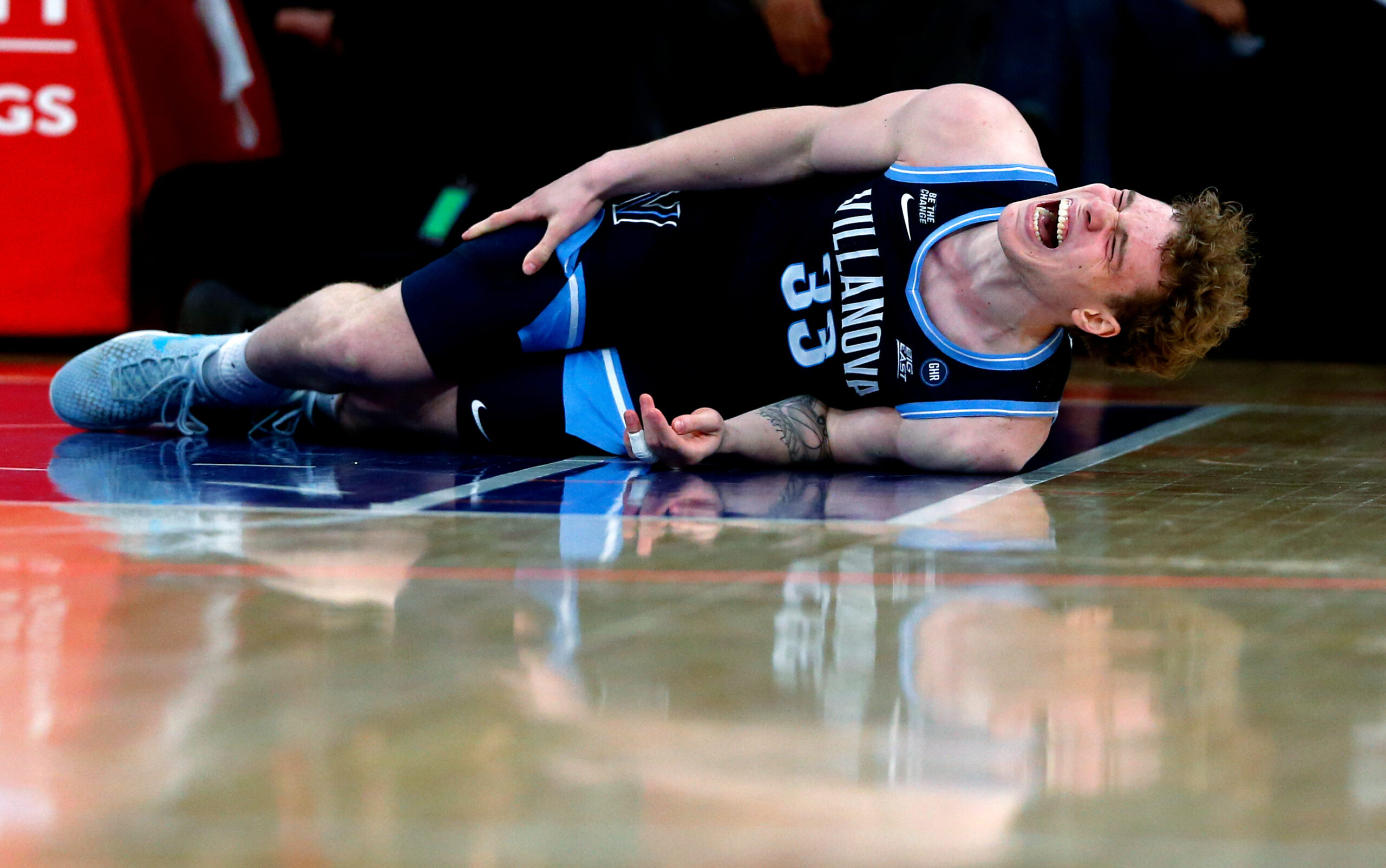
    The Villanova forward was having a solid first college basketball season after an NCAA ruling prevented him from playing last year as a freshman. The long wait was worth it. Hodge made his 29th start in Villanova’s 29th game of the season Saturday night at Madison Square Garden. He hit two three-pointers and was on his way to reach his season average of 9.2 points per game before he crumpled to the floor early in the second half after making a move in the post.

    Hodge will undergo surgery to his right knee and miss the rest of the season.

    “It just really stinks that the kid was going to be able to play in his first Big East tournament, his first NCAA Tournament, that’s really where [my head] is at,” Villanova coach Kevin Willard said Tuesday.

    But this is March, crunch time in college basketball, and so while Willard was feeling bad for the player he recruited out of high school while still the coach at Maryland, Villanova has a game Wednesday night and another on Saturday before postseason play begins.

    Hodge was averaging more than 28 minutes in the 28 games prior to Saturday, and the 6-foot-8 forward going down leaves Willard with a big hole to fill for a team with limited frontcourt depth.

    Willard answered the obvious first question — who goes into the starting five? — by saying sophomore wing Malachi Palmer, who will likely get his first college start in his 52nd career game Wednesday night at DePaul. Palmer, a 6-6 sophomore wing, is the sort of obvious replacement. Save for 7-foot backup center Braden Pierce, Palmer is the biggest and most physical defender Villanova brings off the bench.

    Villanova guard Malachi Palmer could make his first on Wednesday night.

    Palmer had a relatively quiet first half of the season but has emerged in conference play as a willing defender and someone who can knock down three-point shots.

    “Obviously not having Matty stinks, but Malachi has played really well,” Willard said. “It does hurt us, but it’s not catastrophic.”

    While Palmer starting offers more of a traditional one-through-five lineup for Willard, there will be variations that have the Wildcats going smaller or bigger. The smaller unit would have Tyler Perkins — who at 6-4 is Villanova’s second-leading rebounder (5.5 per game) — guarding a forward in a lineup that also has three other guards — Acaden Lewis, Bryce Lindsay, and Devin Askew — on the floor.

    The bigger unit would be one that hasn’t happened yet this season: Pierce being on the floor at the same time as 6-10 starting center Duke Brennan. Neither big man stretches the floor with outside shooting ability. So, how would that work?

    Willard pointed to his two-big lineups last year at Maryland, where Derik Queen and Julian Reese played side-by-side and while Queen could shoot a little bit, he rarely attempted three-pointers. Lineups with Brennan and Pierce on the floor at the same time would feature more screening and more side-to-side action, Willard said. One big hides in the dunker’s spot, for example, while the other is rolling.

    Villanova has practiced with both bigs on the floor, Willard said, in case it ever needed to match up against bigger lineups. It’s a lineup the Wildcats could have had to use in the postseason with or without Hodge’s injury, now it’s one they could deploy as soon as Wednesday night.

    Temple transfer Zion Stanford, who has barely played in conference play, could factor into the rotation more significantly, too.

    Kevin Willard believes Villanova forward Matt Hodge will have a large role when he returns from injury next season.

    Those are the short-term implications, and Willard has two regularseason games to tinker with the rotation before the Big East tournament.

    But it being March also means it’s time to start considering next season’s roster. Willard said Hodge’s injury “does and it doesn’t” have major implications for the 2026-27 Wildcats. That’s because Willard is planning for Hodge to return and take on a big role. Willard said he expects Hodge to need around eight months to return from his injury, and he could be practicing by October.

    “We’re planning on Matt playing for us next year,” Willard said.

    There will still need to be plans for the portal, though. That means making sure to stockpile the roster via the portal or otherwise in case Hodge isn’t ready to go right away or, worse, has a setback. Villanova’s priorities for the portal were going to be adding talent and athleticism in the frontcourt anyway with Brennan graduating.

    From that standpoint, Hodge’s injury hasn’t changed a ton. But it will be on Willard’s mind as he and general manager Baker Dunleavy navigate the frenzy that is the transfer portal, which is only one month away.

  • Penn’s men are going back to the Ivy League tournament, but they took the long way to get there

    Penn’s men are going back to the Ivy League tournament, but they took the long way to get there

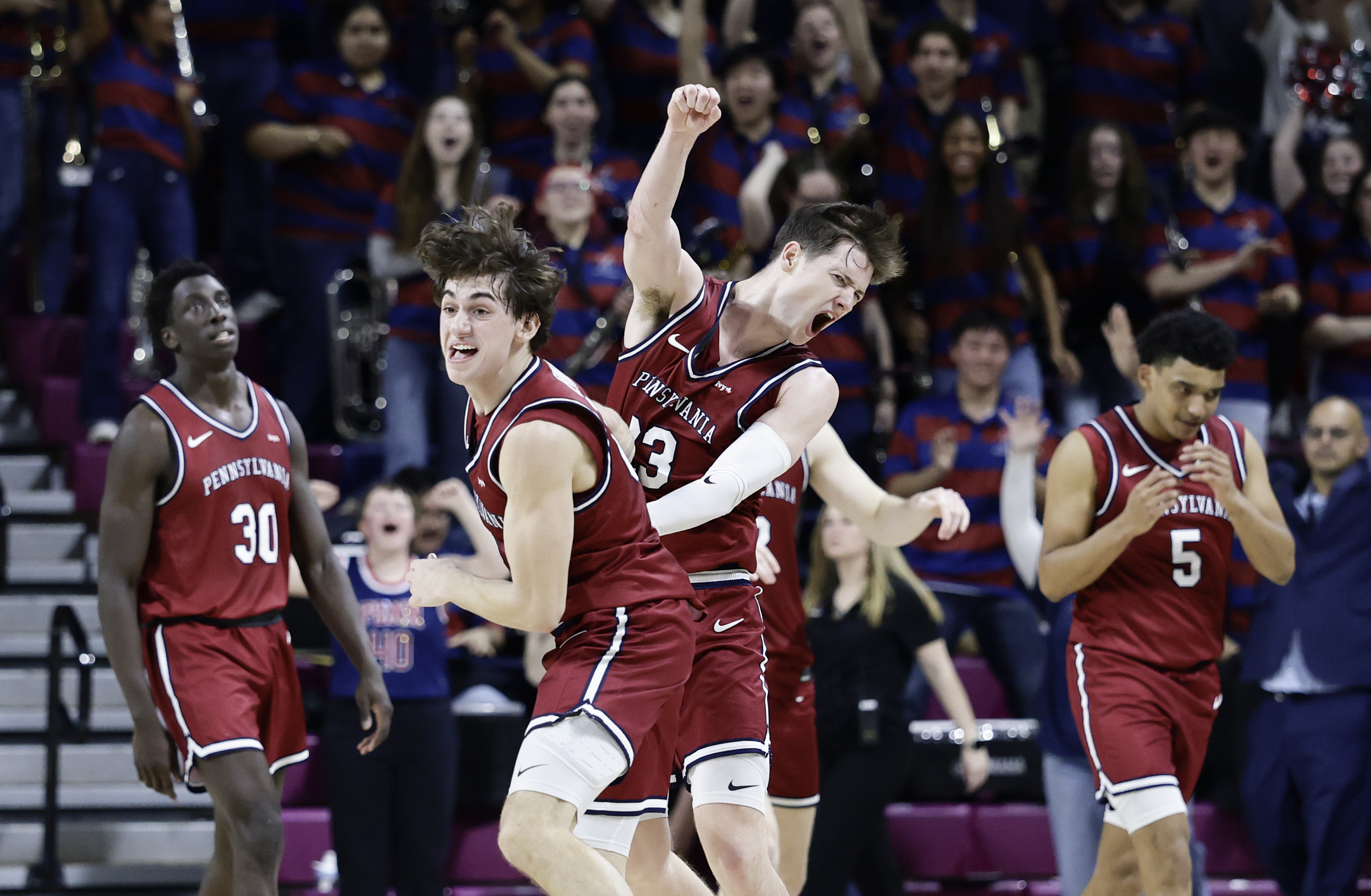
    March was six hours away when the ball was tipped at the Palestra on Saturday, and it had been a while since that mattered for Penn’s men.

    Fran McCaffery’s squad has clearly improved over the course of this season, but just how much has been hard to tell at times. A senior night showdown with tied-for-first Harvard offered a proper test, and a win would clinch the Quakers’ first Ivy League tournament berth in three years.

    Which Penn team would show up?

    The one that fell behind Dartmouth by 12 points a night before, or the one that rallied to win? The one that nearly threw away a late lead to Princeton at the start of the month, or the one that finally ended a 14-game, eight-year losing streak to its historic rival?

    All of them, it turned out. Penn trailed 31-21 at halftime, then charged back to lead 56-50 with 5 minutes, 37 seconds to play. But the Quakers almost gave it up before holding on to win, 64-61.

    There was plenty of noise from the 2,877 fans on hand at the buzzer, a reminder that even a paltry crowd can make a great atmosphere at the 99-year-old shrine. It might have been as much out of relief as anything else, but it was still a release.

    “I think that’s what makes it emotional, is we’ve been so close,” senior forward Ethan Roberts said after his Palestra finale. “So to see these wins and the season transpire the way it did, we’re in a great spot, and we just learned from it. We kept fighting, and it was ugly at times, but it just makes it all worth it.”

    The team’s ‘north star’

    It’s easy to say that this Penn team goes as far as TJ Power takes it. He took it to an extreme on Friday, scoring 38 of his team’s 80 points against the Big Green. But Roberts matters too, and this was his best game in weeks: 21 points, three assists, and four rebounds, including the game-sealer in the closing seconds.

    “I kind of blacked out after the buzzer hit,” Roberts said. “Our team, our entire year since last summer when we had the coaching change [and] we see coach McCaffery is coming here, it’s like, ‘All right, we’re winning.’ And to see we’re in this position today … this is literally all we’ve worked for. This has been our north star.”

    Penn’s AJ Levine (left) and forward Ethan Roberts celebrate after the final buzzer.

    AJ Levine, the sophomore starting point guard, is another big factor — and not always in a good way. He’s a tenacious defender, and is capable of great passes and shots. But he’s also capable of driving into any lane in front of him, even if it’s a trap.

    It’s not a coincidence that he played much more within himself in the second half of conference play, and that Penn went 6-1 in those seven games.

    “He’s always going to have an aggressive mindset, and you don’t ever want to take that away from him,” McCaffery said, with a towel draped over his shoulders after a postgame water-dousing in the locker room. “He gets emotional, and you don’t want to take that away from him either, but you can’t let it get you to where you’re focused on, ‘I got a bad call,’ or ‘He [a teammate] should have cut backdoor.’ When he’s under control and he’s locked in like he was in the second half, he’s really good.”

    What to know about the Ivy League tournament

    Now, after the regular-season finale at Brown on Friday, it will be off to Cornell’s arena for a rematch with the Crimson in the Ivy tournament semifinals. All four seeds are set with a game to spare.

    AJ Levine drives for a layup during the second half.

    “It’s great feeling as a coach when you know you have a group of guys that have bought in from day one since I got here, and want to experience success,” McCaffery said. “And then to see them celebrate in the locker room — the thing we have to do now, and they both [Roberts and Levine] said it, which is good, is we have to stay locked in. We earned an opportunity. We have to play well next week, and then get ready to play well against two really good teams.”

    (If you’re wondering, there’s no word when the event will next be at the Palestra. All that’s known is the 2027 edition will be at Dartmouth, and Hanover, N.H., is as glamorous as central New York is in mid-March.)

    No. 1 Yale will be the favorite on paper, No. 66 in the NCAA’s NET rating while the other three teams are all in the 150s. But the top seed has only won the tournament twice in its seven editions, as the five-time finalist Bulldogs know well.

    This time, they’ll have to beat the hosts in the semis. Yale won its home game vs. Cornell in a 102-68 blowout, then the Big Red won the regular-season round in Ithaca on Friday on a last-second three.

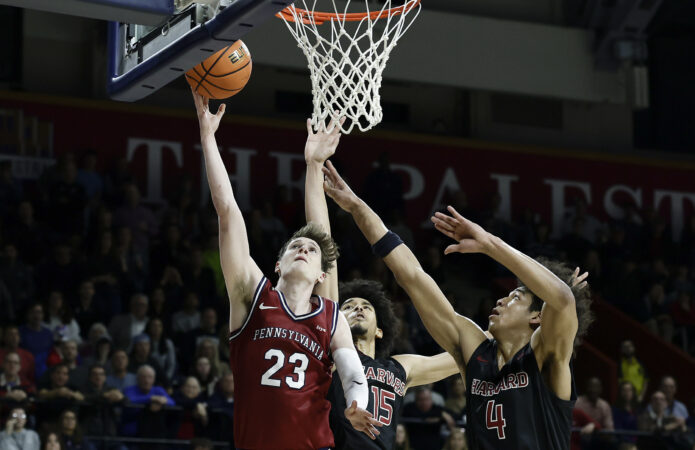
    Penn and Harvard also split their games, with the Crimson winning by 64-63 in Boston on Jan. 19.

    “There’s the frustrating losses, there’s the hard-fought wins like today,” Levine said. “When that buzzer went off and I realized what we’ve done — and how it’s just the start, really, because we’re going to go compete there — I mean, it felt amazing to just see that hard work pay off a little bit. But it will really pay off when we go up there and we do what we do.”

    Those words might have been a little too accurate for their own good. Still, they have a chance, and that’s more than Penn could say the last two seasons.

  • Villanova suffers worst loss in 29 years in drubbing to St. John’s: ‘We’re going to move on’

    Villanova suffers worst loss in 29 years in drubbing to St. John’s: ‘We’re going to move on’

    NEW YORK — Kevin Willard spent his formative years in coaching working under Rick Pitino, first with the Boston Celtics and then later in the college ranks at the University of Louisville.

    So the Villanova coach didn’t have to imagine what practice was like for Pitino’s No. 15 St. John’s team this week after it was blown out and embarrassed by No. 6 UConn Wednesday night.

    He lived it.

    “I don’t have hair because of him,” Willard said after Villanova was throttled in an 89-57 loss — the worst defeat for the program in 29 years — that was all but over before halftime. “I had a full set of hair when I started working for him. It’s the most miserable experience in life. You fear for your life every day. Everyone laughs when I say that, but no, you think you’re going to get fired, and it’s miserable.”

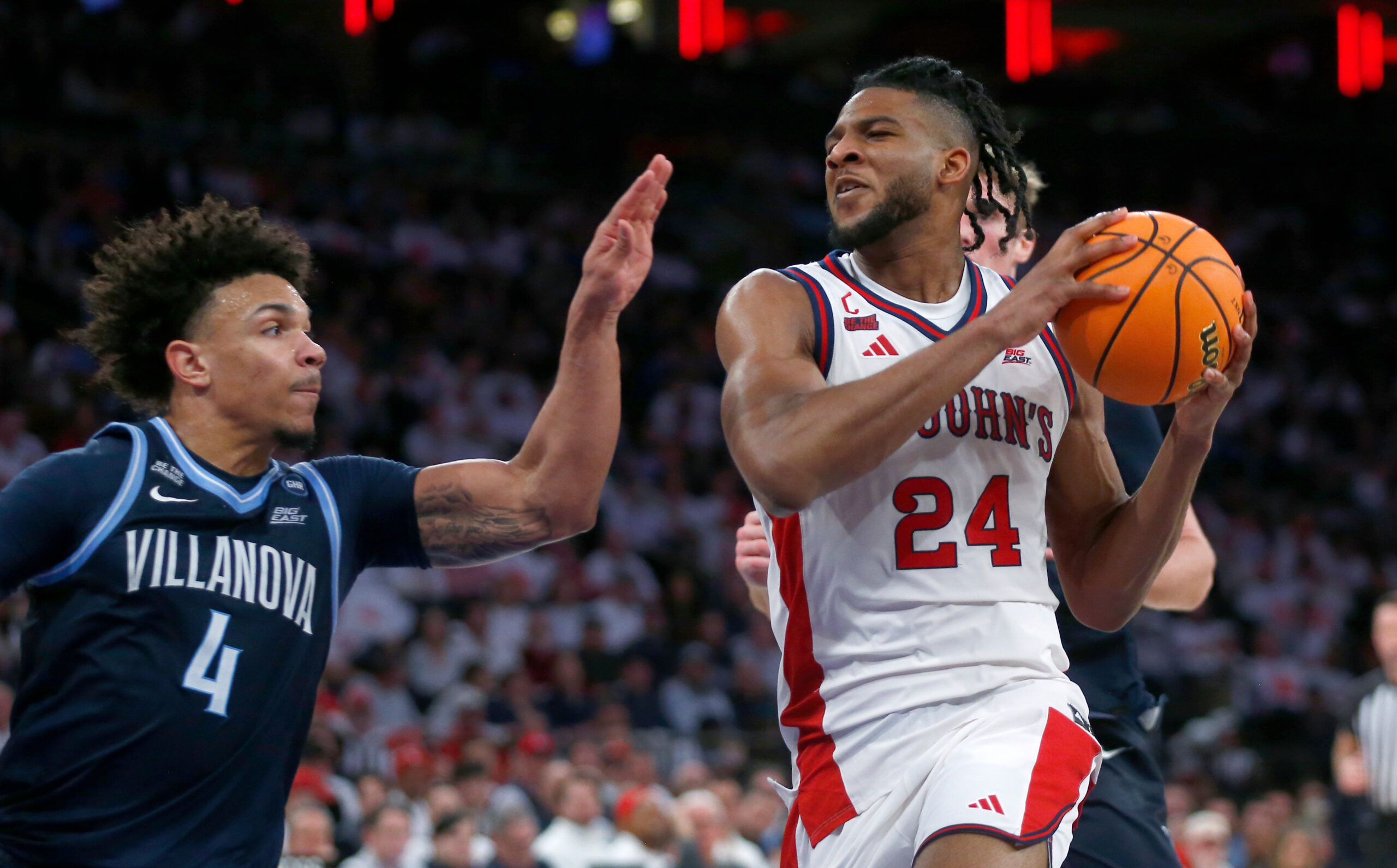
    The game was already going to be hard to begin with. Villanova (22-7, 13-5) is on its way to the NCAA Tournament, but it has failed to show it can compete with the two teams at the top of a Big East conference that will send just three teams to the dance, barring a miracle run at Madison Square Garden in two weeks. Add to the equation that St. John’s was coming off a 32-point drubbing, the Garden was sold out, and those rough and rowdy Red Storm practices this week, and you get a recipe for disaster.

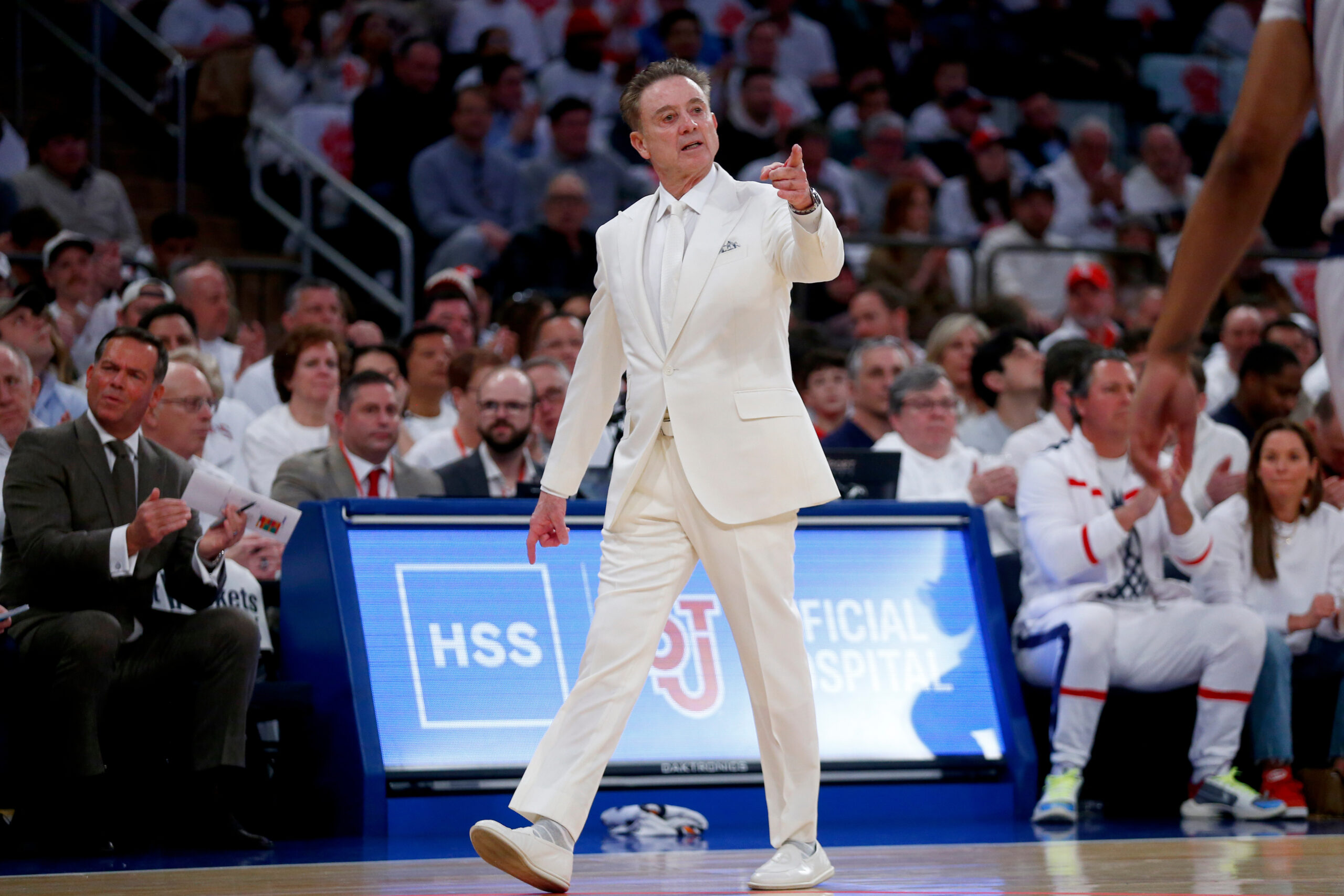
    St. John’s coach Rick Pitino walks by the bench against Villanova on Saturday.

    Pitino told reporters ahead of Saturday that the game against UConn was the biggest since he arrived on campus in 2023. It is the hyperbole you resort to after you lose a game by 32. St. John’s held a White Out and gave out white t-shirts for lower-level ticket holders, and Pitino emerged from the tunnel onto the floor before the game wearing a white suit. The crowd loved it, and Pitino’s players made sure they continued having things to cheer about.

    It was 11-2 after three quick Villanova turnovers. Later, two more consecutive turnovers led to easy dunks and a 28-14 deficit. Willard used multiple timeouts during the first half, but Villanova had no answers for the defensive pressure and intensity from St. John’s. It was 48-23 by the time the first-half buzzer mercifully sounded, and the first-half stats told the story.

    St. John’s held an 18-0 advantage in points off turnovers. Villanova had more turnovers (eight) than it did made baskets (seven). The Wildcats shot 25.9%. Tyler Perkins, Villanova’s leading scorer, was minus-32 in 17 first-half minutes.

    “I think the biggest difference is that they’re a veteran team,” Willard said. “You knew Zuby [Ejiofor] wasn’t going to come out and lay an egg, and he didn’t.”

    The St. John’s center became the fourth known Red Storm player to record a triple-double. He had 16 points, 12 rebounds, and 10 assists. The superlatives didn’t stop with him. The 32-point victory was the largest St. John’s has ever recorded vs. Villanova in what was the 135th matchup between the two teams.

    Further, it was the worst Villanova loss since the Wildcats lost by 37 in a February 1997 game vs. Kentucky.

    Who coached that Kentucky team? Pitino.

    Villanova guard Tyler Perkins defends St. John’s forward Zuby Ejiofor on Saturday.

    Back to the present day, Willard’s Wildcats on consecutive Saturdays received a dose of reality vs. the conference’s elite, but they also survived a rough stretch during Wednesday’s win over Butler.

    “We still won seven out of nine games,” Willard said when asked if he was concerned about the timing of it all. “We lost to UConn and St. John’s. Unfortunately, I caught UConn after they played their worst game of the year and it seems like God is punishing me for my sins.

    “We’re going to move on. We have two more games left. Life happens, man. You get your [butt] kicked every once in a while.”

    Willard had a similar thing to say last week after a 10-point loss to UConn that wasn’t as close as the final score indicated. Villanova bused home late Saturday night and is back on the road for a Wednesday night game at DePaul. The regular season finishes Saturday with a home game vs. Xavier before the Big East tournament begins.

    How will Villanova respond to its worst loss of the season?

    Perhaps Willard can channel Pitino at Monday’s practice.

    No update on Matt Hodge’s injury

    Villanova redshirt-freshman forward Matt Hodge went down with what appeared to be a right leg injury early in the second half. Hodge was on the floor in pain for a few moments and then struggled to put any weight on his right foot as he was helped off the floor and into the locker room.

    Willard did not have an update on Hodge’s status after the game.

    Villanova forward Matt Hodge goes to the floor with an apparent injury during the second half against St. John’s on Saturday.

    Wildcats locked into Big East seed

    The loss Saturday means Villanova can’t possibly climb higher than third in the Big East conference. For reference, the Wildcats were picked seventh in the preseason poll. But there appears to be a steep drop off from UConn and St. John’s at the top.

    The No. 3 seed means the Wildcats will open the Big East tournament with a 9:30 p.m. quarterfinal game vs. the winner of the game between No. 6 and No. 11.

  • Friends’ Central wins first PAISAA girls’ basketball title in program history

    Friends’ Central wins first PAISAA girls’ basketball title in program history

    When Friends’ Central’s Ryan Carter limped off the court with 3 minutes, 40 seconds left in the PAISAA girls’ basketball championship game at Hagan Arena on Friday night, it felt like history was repeating itself.

    Carter, a junior guard who spent last season at Archbishop Wood, went down with an injury in the 2025 PIAA Class 5A championship. She played through the pain but was unable to lead Wood to a win.

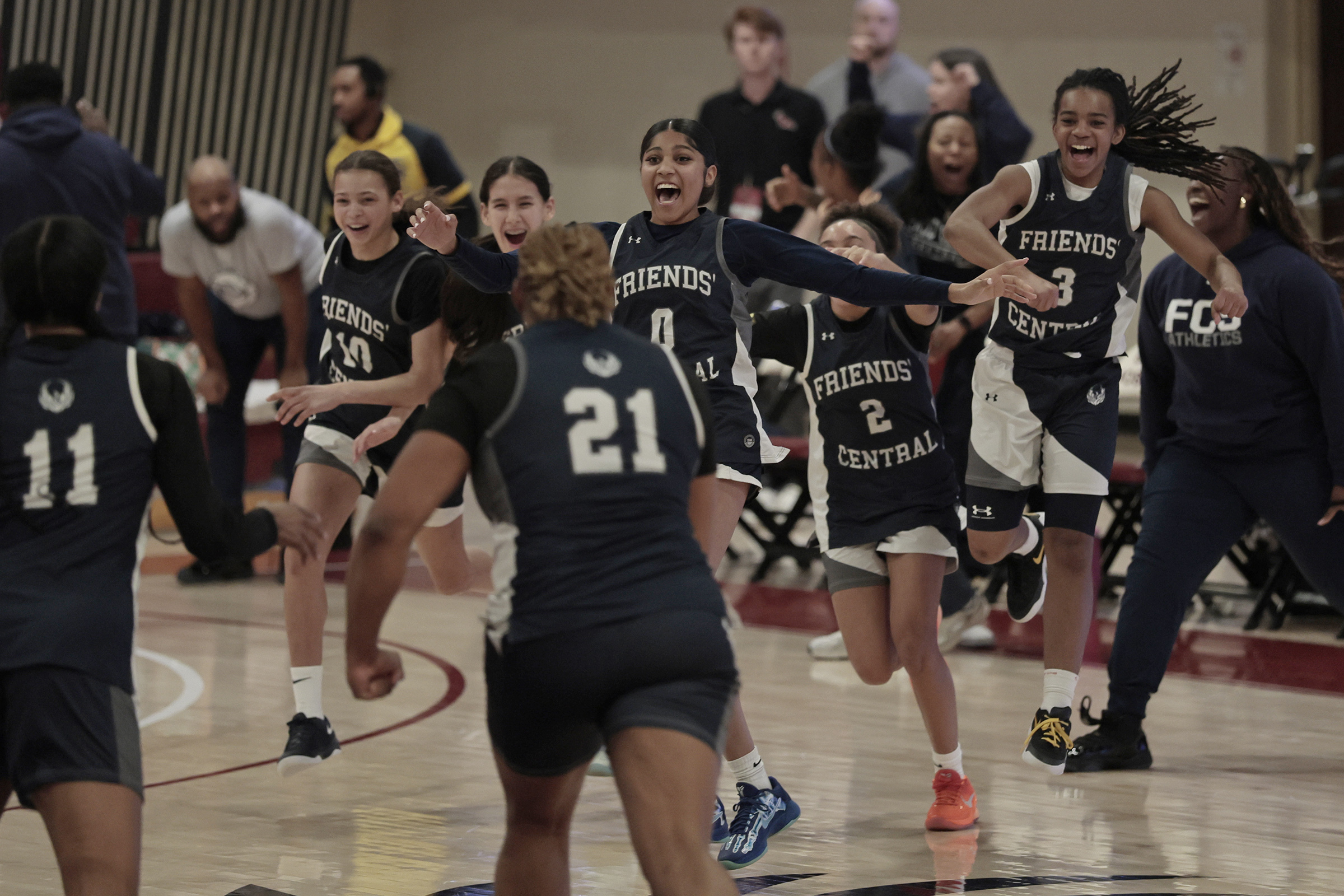
    But this time, in a different jersey and a different state championship game, Carter got back on the floor and helped upset Westtown, 62-54.

    “These girls, I didn’t want to let them down,” Carter said. “This is the one team where I’ve felt like people have always had my back, no matter what. It’s a true family.”

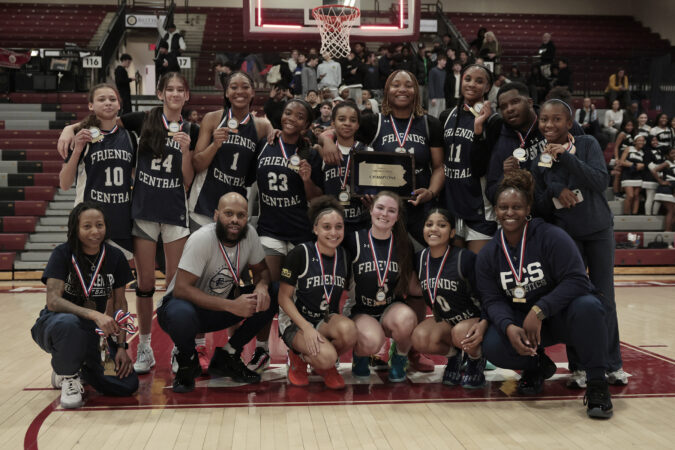
    The Friends’ Central girls celebrate after winning the PAISAA state title against Westtown on Friday.

    Zya Small led the Phoenix (27-6) with 18 points as they claimed their first PAISAA state title in program history. Kayla Snyder and Carter added 14 and 12 points, respectively.

    “This group of girls, they just work so hard,” Friends’ Central coach Vinny Simpson said. “And they believe. That’s the difference in this year’s group. They believe, they work hard. … That’s how we figured it out.”

    Westtown (28-2) entered Friday night’s game having won four consecutive PAISAA titles. It beat Friends’ Central in the state title game in 2024 and 2025, as well as in the regular season and Friends League championship this year.

    “That’s a ton [of times] to lose to a team,” said Faith Watson, a sophomore center who scored 10 points for the Phoenix. “So this feels great.”

    Jordyn Palmer led Westtown with 27 points. The junior forward is ranked as the sixth best prospect by ESPN. Friends’ Central’s Carter (No. 12) and Small (No. 47) also are among the top 60 prospects in the 2027 class.

    Friday night’s loss was the final game of Atlee Vanesko’s Westtown career. The senior guard, who’s No. 74 in the 2026 class and will play at Ohio State next season, scored six points and fouled out with 1 minute, 49 seconds remaining.

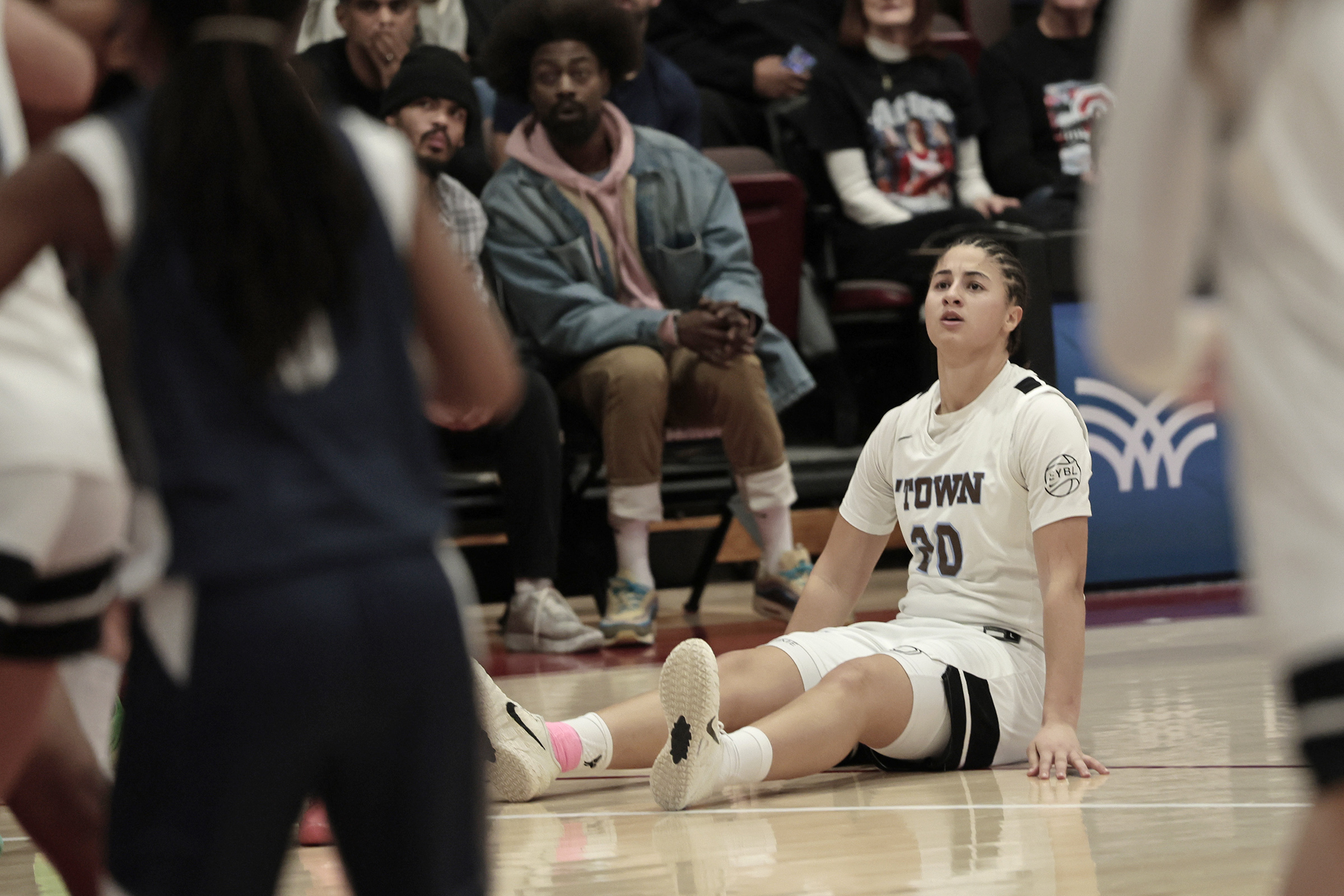
    Westtown’s Jordyn Palmer watches the ball from the floor after taking a shot in the PAISAA girls’ basketball final on Friday.

    Friends’ Central will continue its season in The Throne, a single-elimination national tournament run by the National Basketball Players Association. The seventh-seeded Phoenix will face second-seeded Princess Anne (Va.) in East Rutherford, N.J., in the tournament’s first round on March 19.

    The Hill School defeats Phelps

    Ben Natal and Ethan Johnston led the Hill School as it beat the Phelps School, 74-56, in a rematch of last season’s state title game.

    Natal, a fifth-year guard, scored 21 points , while Johnston, a senior guard who will play at Marquette next season, added 22. The pair of guards helped to lift the Hill School (24-9) to its first state title since 2018.

    Johnston scored 13 of his 22 in the third quarter. The Hill School outscored Phelps, 27-9, in the third, which gave the Rams a 28-point lead entering the fourth.

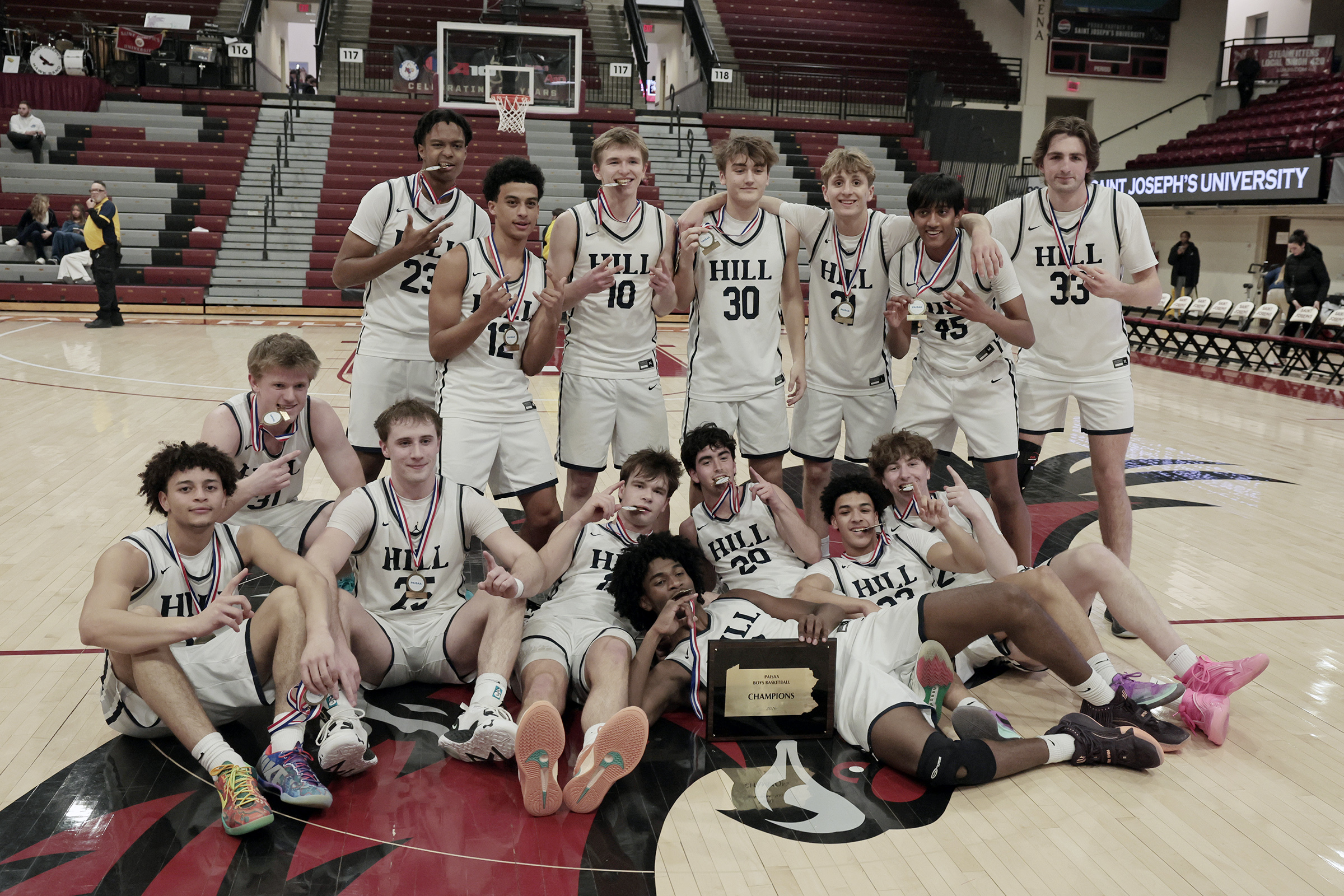
    The Hill School players pose for a photo after it won the PAISAA boys’ basketball final against Phelps School on Friday.

    “Last year, we didn’t play a complete game,” Johnston said. “We didn’t execute late. I think this year we took more of an initiative to execute late and just stay together.”

    The Hill School coach Seth Eilberg began to empty his bench with three minutes remaining. The team has eight players graduating, including Natal, Johnston, and Zane Conlon, who scored 11 on Friday.

    “We’ve played a really tough schedule,” Eilberg said. “We’ve taken a couple of hits here and there. They stayed together, and we kept getting better, and we kept having fun with it.”

    Jahrel Vigo led Phelps (24-12) with 19 points. The senior guard, who will play at Buffalo next season, was the only Phelps player to reach double figures in scoring.

  • How Shane Blakeney went from deep reserve to Drexel’s leading scorer

    How Shane Blakeney went from deep reserve to Drexel’s leading scorer

    As an incoming freshman at Drexel, Shane Blakeney showcased his potential halfway across the world.

    In the summer of 2022, Drexel played a mix of professional and club teams in Italy as part of an international tournament. In one of those games, Dragons center Garfield Turner found himself under the rim to grab an easy put-back shot. Then, a lengthy freshman swooped in.

    “Out of nowhere, I just see this long arm come behind me and just punch it [in],” Turner said, laughing. “We were joking about that for a little bit. It was his first time Shane dunked on somebody in college.”

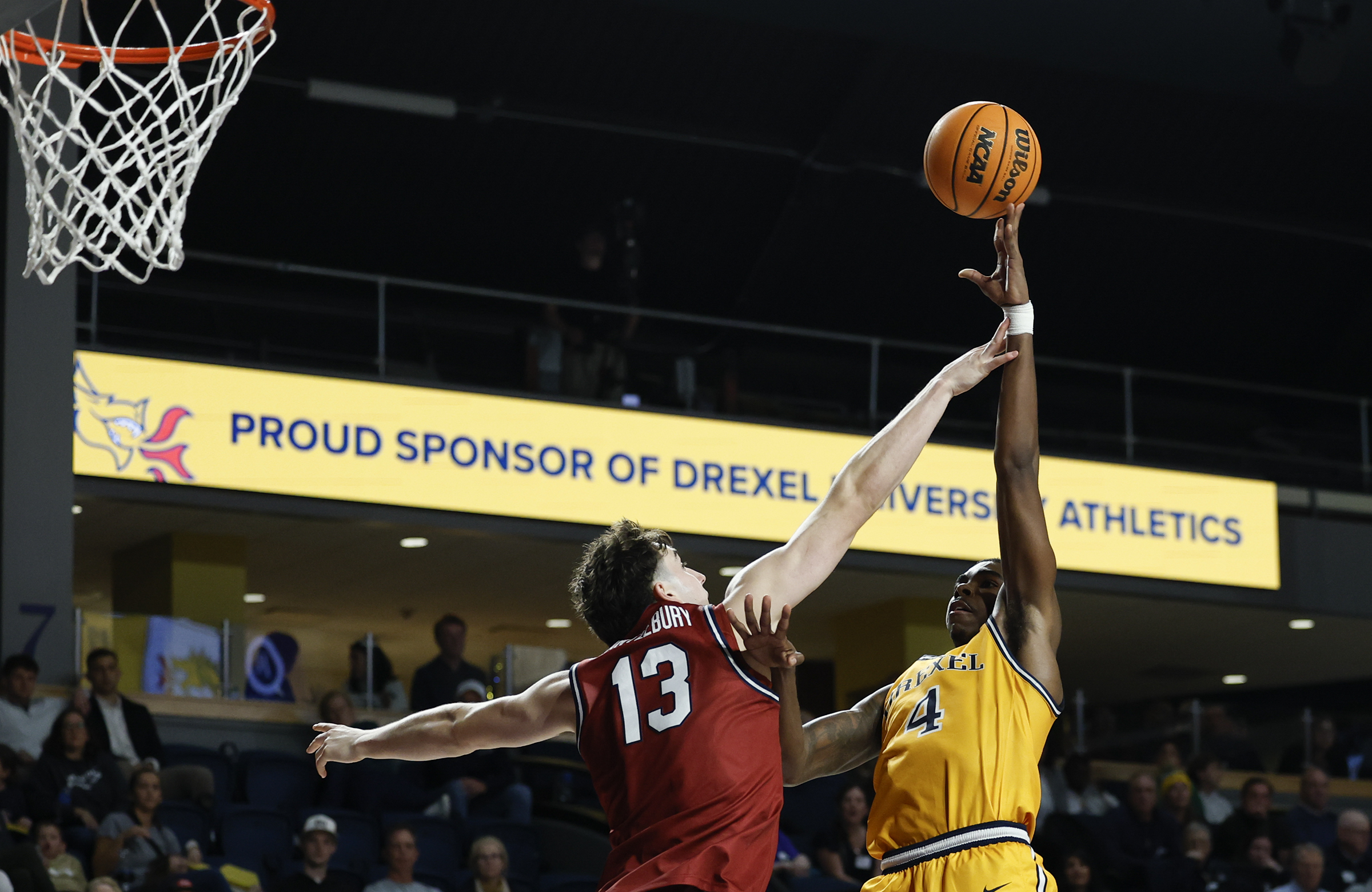
    Now, the 6-foot-5, 200 pound junior is leading Drexel (16-14, 10-7 CAA) with a team-high 14.5 points per game, while spearheading the Dragons defense. Drexel is allowing the fewest points per game (65.1) in the conference, and Blakeney has come away with 22 blocks and 35 steals.

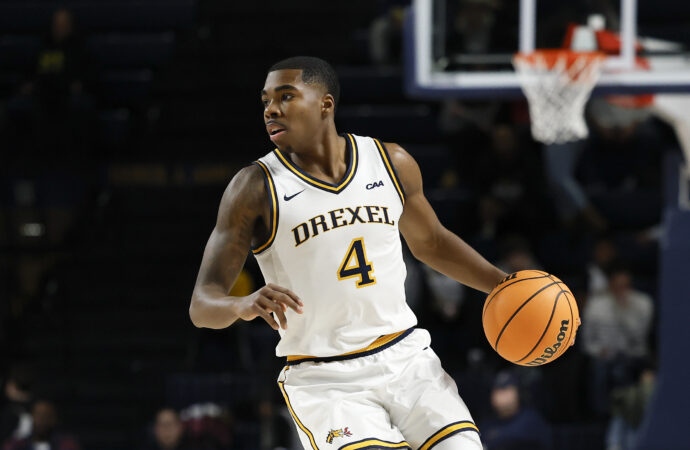
    Drexel guard Shane Blakeney is averaging a team-high 14.5 points this season.

    When he first arrived on campus, the guard was 25 pounds lighter. He struggled to get on the court due to his slender frame and had a few lingering injuries, so he was granted a redshirt year.

    “Between high school and college, I went through some injuries, which was rough and kind of put me out of touch with basketball,” Blakeney said. “I hadn’t [gone] a year without basketball ever since I started, so I think transitioning back in that redshirt freshman year was difficult.”

    Coach Zach Spiker added: “He’s playing 38 minutes a night. A guy that wasn’t able to physically get on the floor. Now we can’t get him off.”

    ‘Committed to the work’

    Growing up in Rock Hill, S.C., Blakeney’s parents introduced him to several sports. He played soccer and football — attempted baseball, though he “wasn’t a big fan” — and swam competitively.

    However, basketball was the sport with which his family was most connected.

    Blakeney’s uncle, Charles Kirkland, was a standout at Cheyney University and played professionally in the Netherlands for nearly a decade. His cousin is Jazian Gortman, a former five-star recruit in the Overtime Elite League who played on the Dallas Mavericks and Oklahoma City Thunder’s G League affiliates.

    At 7, Blakeney started practicing with Bobby “ICE” Isom, a South Carolina-based basketball trainer, and stayed with him throughout high school. When Drexel is on a break, Blakeney will drop by to work with Isom.

    “[Blakeney] was committed to the work and never complained about it either,” Isom said. “I knew he was going to be a special talent at a young age.”

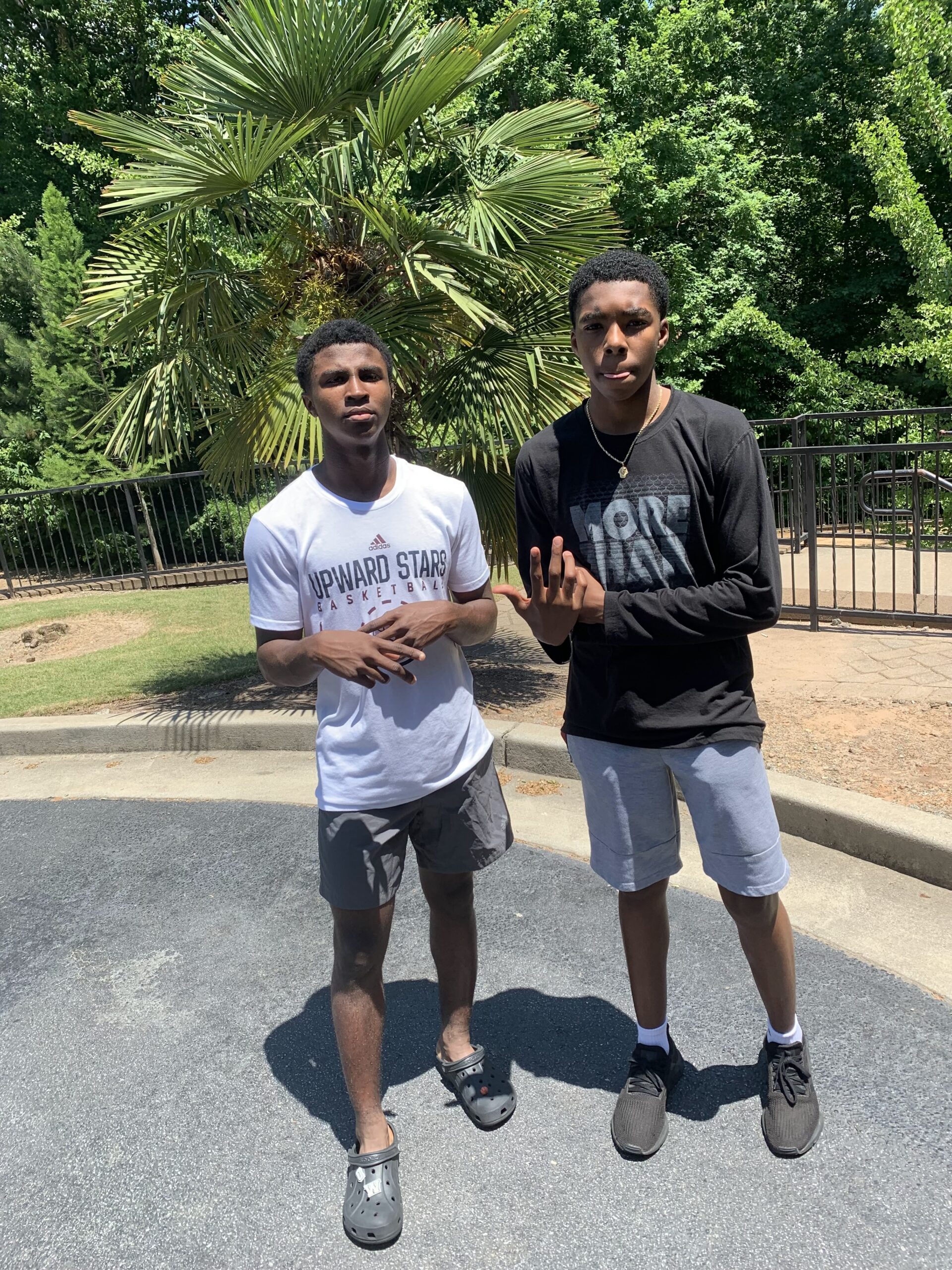
    Blakeney started AAU basketball in third grade, and at age 15 jumped to Upward Stars Southeast, a premier travel team on the Adidas Circuit. There, he met Dylan Williams, now a 5-11 senior guard at Penn.

    Penn’s Dylan Williams and Drexel’s Shane Blakeney played AAU basketball together in South Carolina.

    When Williams was looking to transfer to Penn from Triton College in 2023, his former teammate was one of the first peoplehe called.

    “The Shane then is a different type of build [compared to] now,” Williams said. “He’s more cut, taller, way taller. … We were like the same height [then] because I really haven’t grown since.”

    Isom added: “I think encouragement was what [Blakeney] needed most while he was a scrawny, short kid heading into high school, trying to find his way in the world of basketball.”

    At Legion Collegiate Academy, Blakeney played four years on varsity and surpassed 1,000 career points.

    “South Carolina [basketball] is pretty similar to Philly,” Blakeney said. “I would say probably a little bit more skilled, but toughness wise, you got a lot of athletes down south that bump and bang. They all play football. It’s physical, and if you can’t be physical, you won’t really last.”

    Spiker also has the same mentality. During a high school practice that college coaches came to visit, Blakeney slugged at the back of sprint lines. The Drexel coach took notice.

    “[Spiker] pulled me into the office afterward and kind of chewed me out,” Blakeney said. “A lot of the people would be like, ‘Oh, this coach is tripping.’ But our family was like, ‘Hold on, this is our values.’”

    ‘Never a dull moment’

    Turner nicknamed Blakeney “motor mouth” because he’s always talking.

    Drexel guard Kevon Vanderhorst described his teammate as a “hilarious dude,” saying there is “never a dull moment with him.” While Spiker believes Blakeney’s personality is “refreshing and genuine.”

    “I think I’m more of a bubbly personality than maybe some other teammates,” Blakeney said. “I like seeing that side come out of them. Talking, having fun, laughing is kind of what life’s experiences are about. … I’ve always been kind of a silly guy, so I had to learn to tone it down in class growing up.”

    On the court, Blakeney is no joke.

    “There’s two different people on the court and off the court,” said Vanderhorst. “I’d say off the court, Shane is funny, he’s very outgoing. On the court, Shane is straight business. Not a guy with a lot of jokes, and not a guy that’s going to take a lot of jokes.”

    Blakeney has emerged on Drexel’s roster. He cracked the rotation in 2023, averaging 5.5 minutes. Then, he stepped into the team’s sixth man role, notching an average of 7.6 points last season.

    “I had to learn to start taking a role of support and doing what you need to do to win,” Blakeney said. “And you don’t do that in high school. High school, you’re the man everybody loves. You go score points and look cool.”

    Now the leader, Blakeney will be expected to carry his team in the conference tournament. Drexel will visit Hofstra on Tuesday (7 p.m., Fubo) in the final game of the regular season. The Dragons are in fourth place in the CAA, and if they can stay in the top four, they will receive a bye in the 13-team tournament.

    “Just seeing the work [Blakeney’s] put in, seeing his growth since we’ve been here, little skinny Shane when we first got here to now our top scorer — it’s great,” Turner said.

  • Not even cancer can stop Bill Koch, Father Judge’s 76-year-old basketball coach

    Not even cancer can stop Bill Koch, Father Judge’s 76-year-old basketball coach

    Bill Koch was in a hospital bed for 10 days, imagining this to be how his coaching career would finally end. A doctor sent him immediately to Fox Chase Cancer Center in the fall of 2019 after an annual colonoscopy. Koch had colon cancer. They operated on Koch the next day, stitched his stomach, and left him planning for rounds of chemotherapy and radiation.

    Koch (pronounced “Cook”) has been an assistant on Father Judge’s basketball staff since 1979 and has helped the football team even longer. He worked at Judge for more than 30 years as a nonteaching assistant, doing everything from monitoring the lunch periods and substitute teaching to helping kids find a college.

    And the 76-year-old is still at the all-boys school in Holmesburg nearly every day, washing the basketball uniforms and making sure everything is just right before another practice begins.

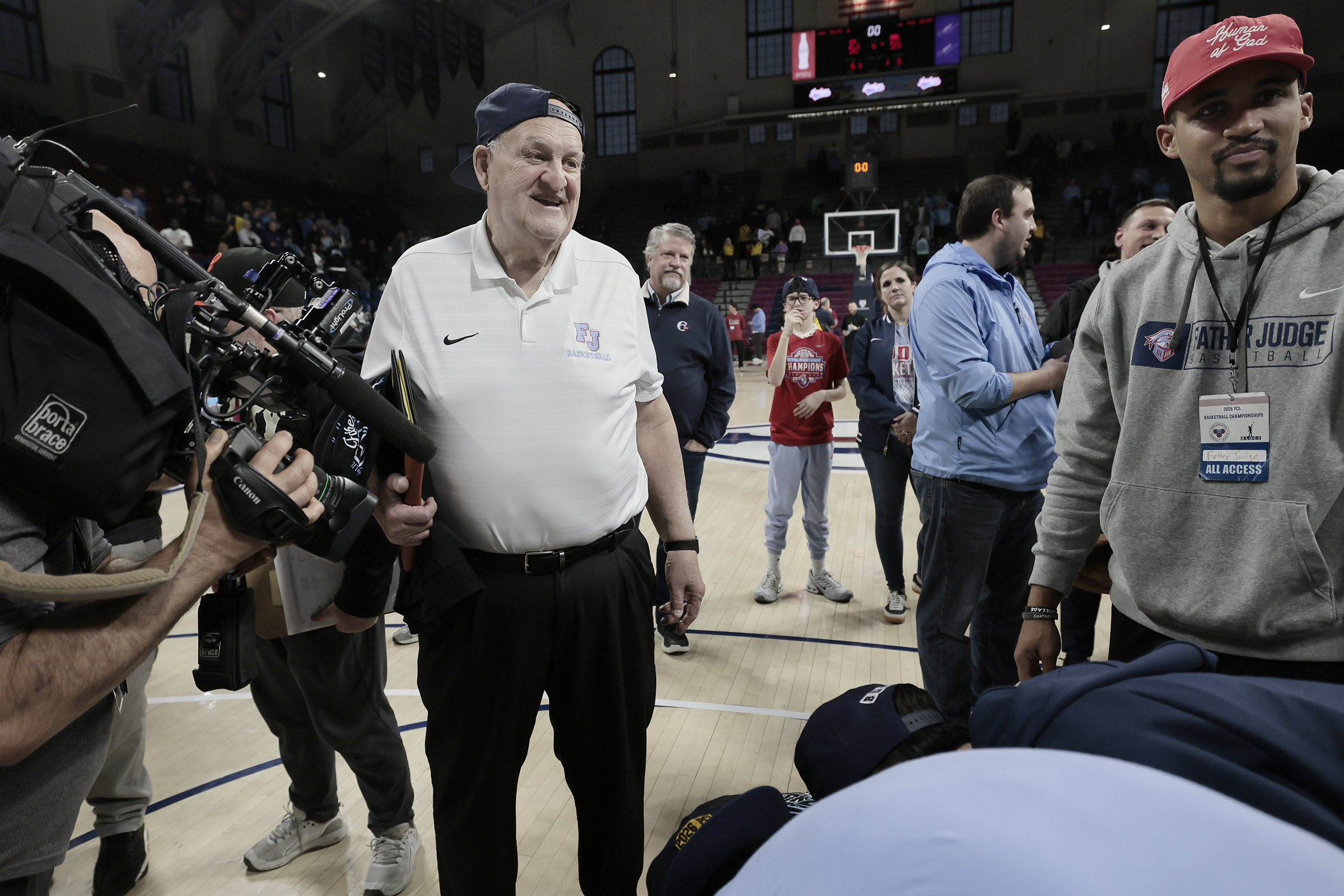
    Koch graduated from Judge in 1967, grew up near Holme Circle, and still lives in the Northeast. He helps the football team in the fall and the basketball squad in the winter. Koch was there Sunday when Judge won a second straight Catholic League boys’ title, sitting on the bench as an assistant coach just like he has for the past 47 years.

    But for 10 days, Koch wondered whether his time on the sideline was up. Then the doctor returned to his room and sent him home. No chemo. No radiation. It was rare, the doctor told Koch, but the cancer was gone.

    “I almost got stopped,” Koch said.

    Judge’s mascot is the Crusader, but it can be argued that the school’s symbol is Mr. Koch.

    “He’s a lifer,” said basketball coach Chris Roantree. “People associate Mr. Koch with Father Judge and Father Judge with Mr. Koch. He’s been a part of Father Judge for 50-plus years. He’s the ultimate Judge Guy in my eyes in terms of everything he’s done for kids.”

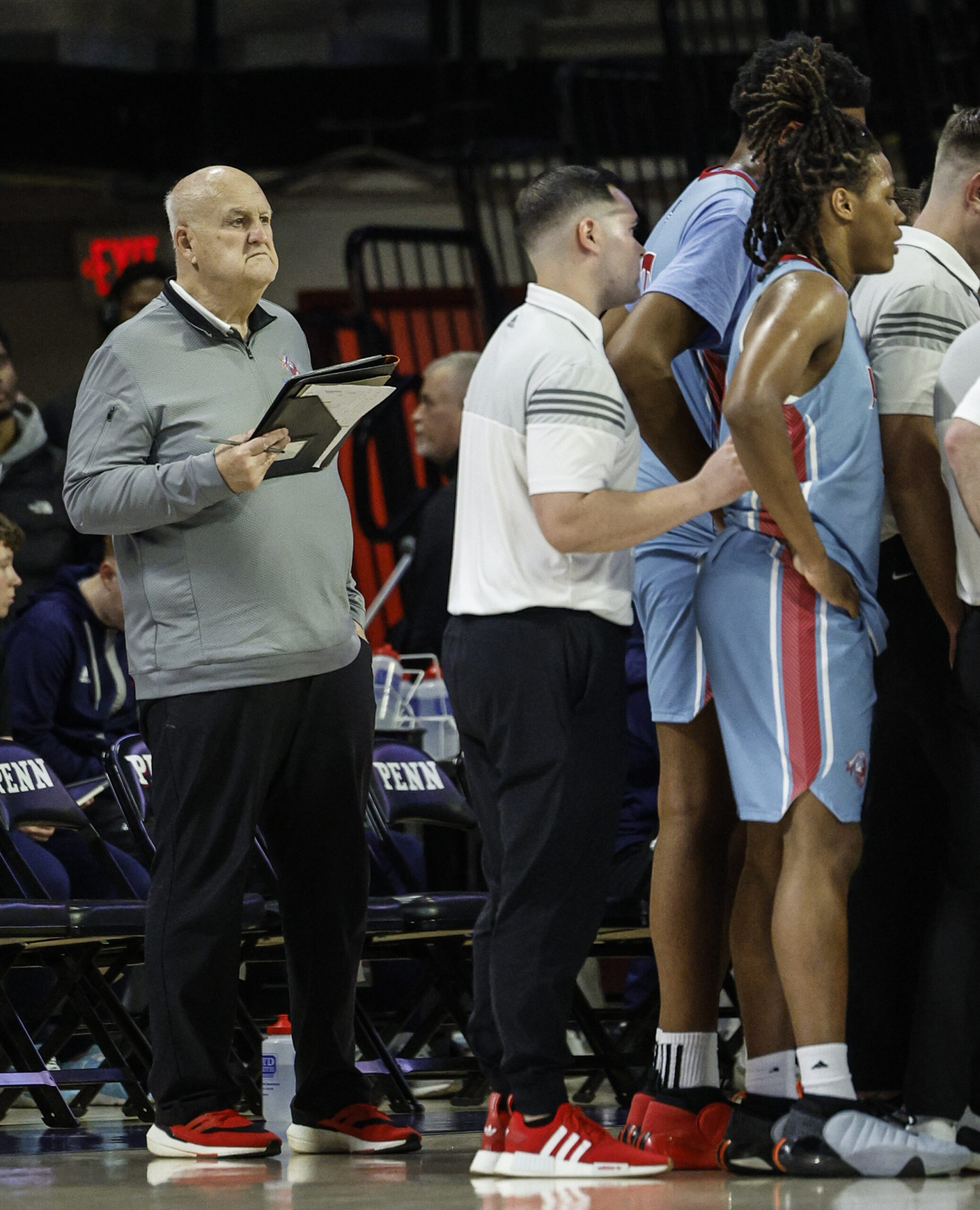
    Father Judge assistant coach Bill Koch (left) during a timeout against Roman Catholic during the Catholic League boys’ semifinals on Saturday at the Palestra.

    Home on Solly Avenue

    Koch didn’t play football at Judge, but he did know how to tape ankles, which was enough for football coach John “Whitey” Sullivan to ask Koch in 1974 to coach the freshman team. Five years later, Bill Fox — often Koch’s teammate in two-on-two at Pollock Playground — added him to the basketball staff.

    Koch coached JV hoops for 30 seasons, won 606 games, and never thought about going elsewhere. A basketball program usually changes JV coaches every few years, but not Judge.

    Fox, who died of ALS in 2021, once told the Daily News that Koch “bleeds Father Judge blue.” Koch worked basketball camps every summer with the top college coaches and had chances to be an assistant somewhere. He was at home on Solly Avenue.

    “I was happy,” Koch said.

    Judge had more than 3,000 boys when Koch was a student — “If you turned the wrong way, you got bounced,” he said — so there wasn’t any room on the basketball team for a 5-foot-11 kid.

    “What are you going to do? I thought I was going to make it,” Koch said.

    He hit a growth spurt in college and played on a team at St. Francis in Loretto, Pa., with future NBA players Kevin Porter and Norm Van Lier. He played in the summer with guys from La Salle and St. Joseph’s and said his 50 points at Pollock are still a playground record. He worked after college as a machinist and a roofer before going to work at Judge. He has never left.

    “I gave up all the other jobs and I was making good money back then,” Koch said. “But this is something I love. Some people think I’m crazy, but hey, you can’t look back.”

    Bill Koch is “the ultimate Judge Guy in my eyes in terms of everything he’s done for kids,” says Father Judge basketball coach Chris Roantree.

    Where’s Mr. Koch?

    Judge’s basketball team was in San Diego last season when someone stopped the coaches. The man said he was a graduate and then asked to see Koch.

    “We always run into someone who says, ‘Where’s Mr. Koch?’” said Jim Reeves, one of the team’s assistants. “The list is endless of people he knows.”

    Reeves played a season of JV ball for Mr. Koch, who called the big man “Crazy George” — a reference to an old basketball trickster — every time Reeves grabbed a rebound and started dribbling. Koch kept things loose, let his players play, and made sure they hustled.

    “My big thing is it doesn’t take talent to hustle,” Koch said. “So my kids hustle.”

    Koch coached Roantree in the 1990s and helped him land a football scholarship to Lycoming College. So of course, Roantree planned to keep Koch as an assistant in 2021 when he took over the program. But Roantree didn’t really have a choice.

    “I just show up,” Koch said.

    Koch keeps stats during games, logs the minutes each player plays, oversees the student managers, and makes sure the practice uniforms are ready. He does the things people often don’t see, Reeves said.

    The players — some of whom are more than 60 years younger than Koch — call him “Pop Pop” and develop secret handshakes with him. They put him on TikTok earlier this season and sit with him before practice at the scorer’s table.

    “He might not be showing them how to do a drop step, but it’s about the relationships that he forms,” Reeves said. “People couldn’t believe that Chris kept Mr. Koch on. It’s like, ‘Why wouldn’t we leave Mr. Koch on?’ You can see the bond he creates. It gives you a past and present. It bridges the gap from the old Judge to the new Judge.”

    Koch said the only time he gets in trouble is if he messes up the clock during practice.

    “I think sometimes he dozes off when he’s doing the clock,” Roantree said. “He still does a lot for the program. He’s there every day.”

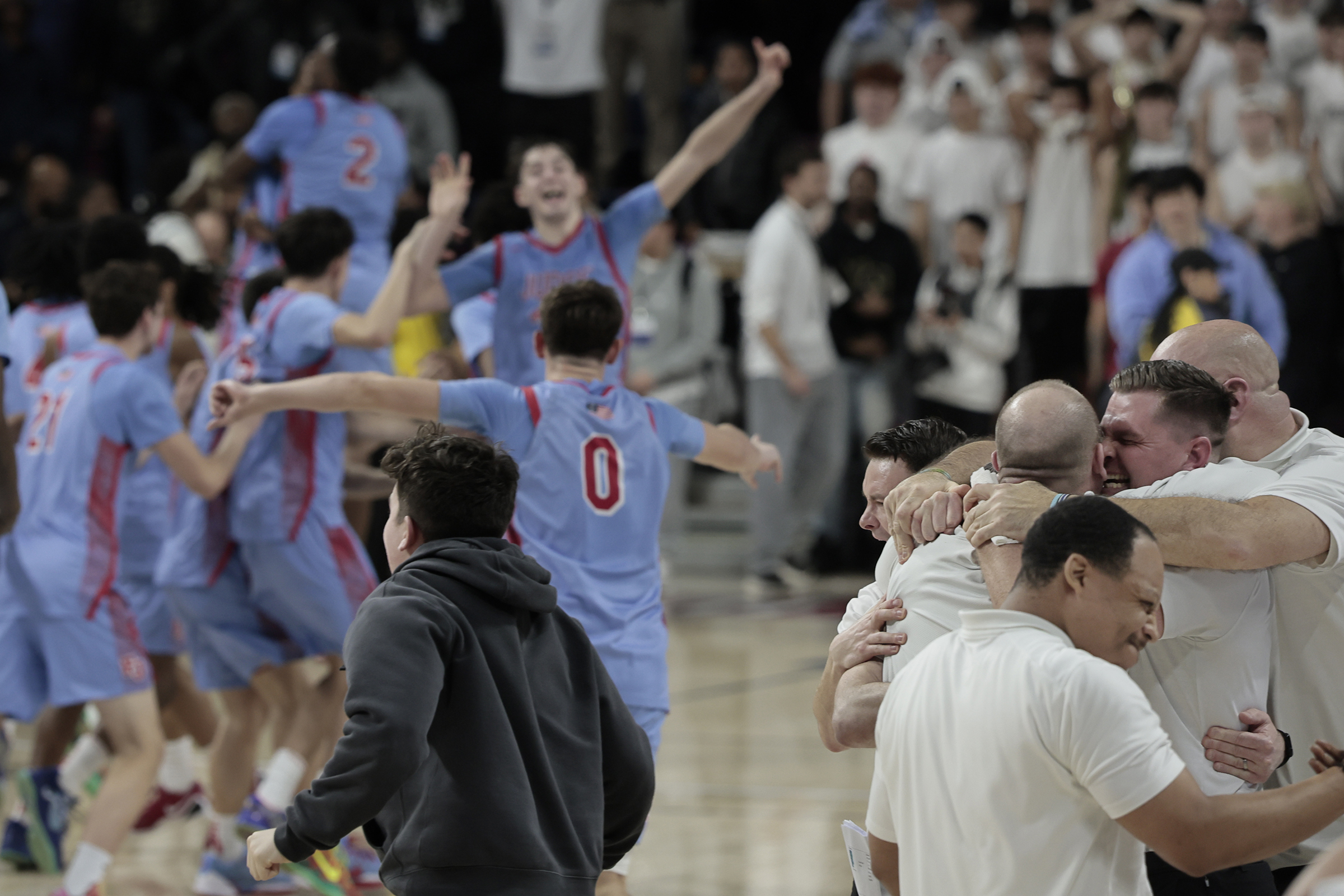
    Father Judge celebrates winning the Catholic League championship over Neumann Goretti on Sunday.

    Not done yet

    Judge once relied solely on nearby parishes like St. Matthew’s, St. Timothy’s, and St. Jerome’s for enrollment. The basketball team was a bunch of kids from Northeast neighborhoods. But that’s no longer the case as students can now come to Judge from anywhere. Some basketball players, Roantree said, leave their home at 6:30 a.m. to get to school.

    The roster isn’t constructed the same way it was in 1998 when Roantree, Reeves, and current assistant Brian Bond won it all.

    But they played Sunday against Neumann Goretti in the Catholic League final like a bunch of hard-nosed kids from Mayfair. They hustled after loose balls, grabbed offensive rebounds, and did the little things to hold on to a lead down the stretch. The Crusaders, who play Saturday against Public League champ Imhotep for the city title, are still a team of Judge Guys. And maybe that’s because they have a coaching staff full of former players and a lifer on the bench.

    “A lot of the kids we have, it’s almost like their parents would fit in in Northeast Philly because that’s what they are,” Reeves said. “They are from out of the neighborhood, but they have that same mentality.”

    Koch eventually got out of his hospital bed during his 10-day stay, walked around Fox Chase Cancer Center, bumped into people he knew, and stopped in the chapel.

    “There were people a lot worse off than I was,” Koch said. “I was grateful that I didn’t have to go through what other people have to go through. I’m thankful. I guess a lot of people said prayers for me.”

    The doctor told him to return every six months for the next five years to make sure he was cancer free. Five years later, Koch was good. Ring the bell, the doc said.

    “But they didn’t have a bell where his office was,” Koch said. “So it was make believe.”

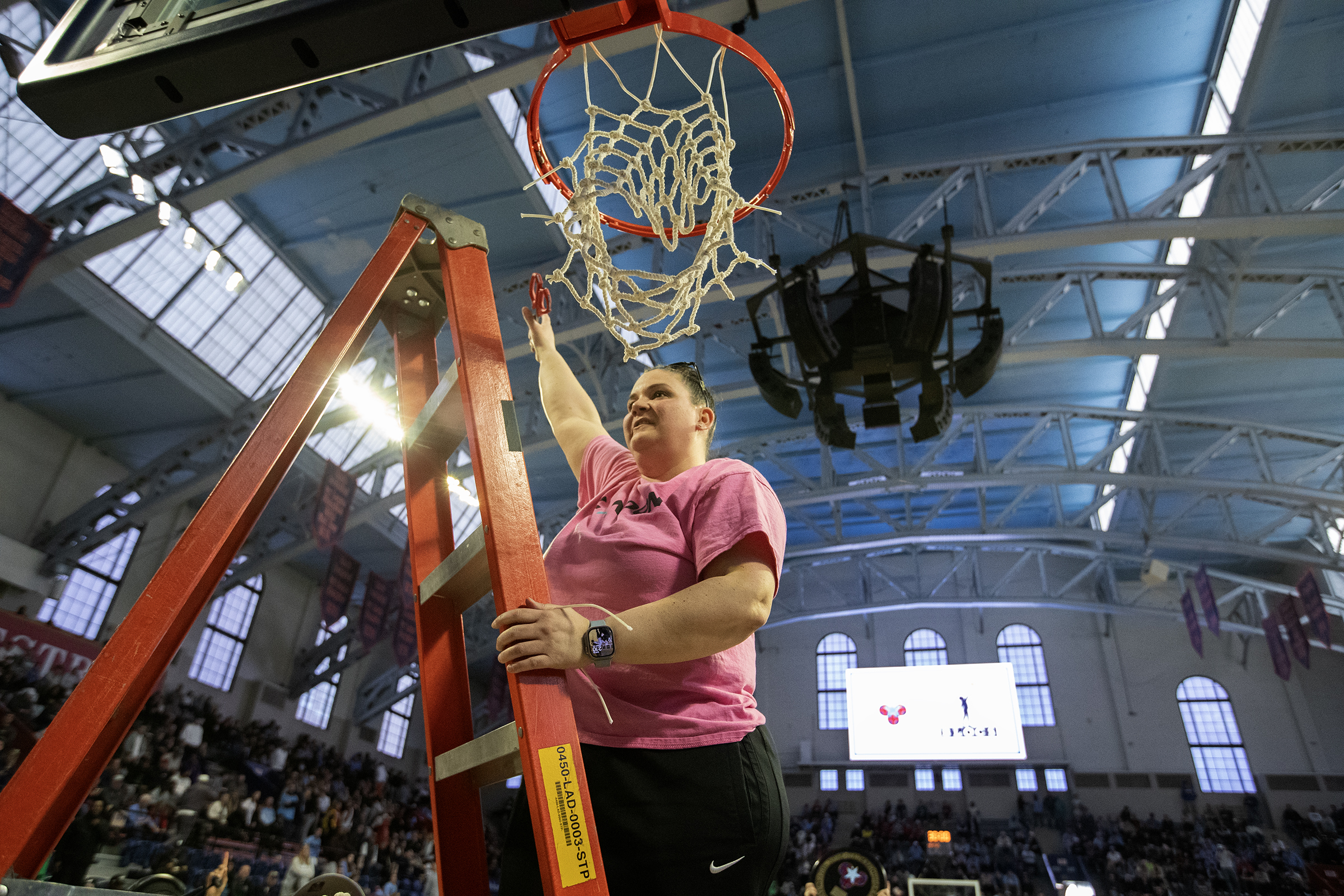
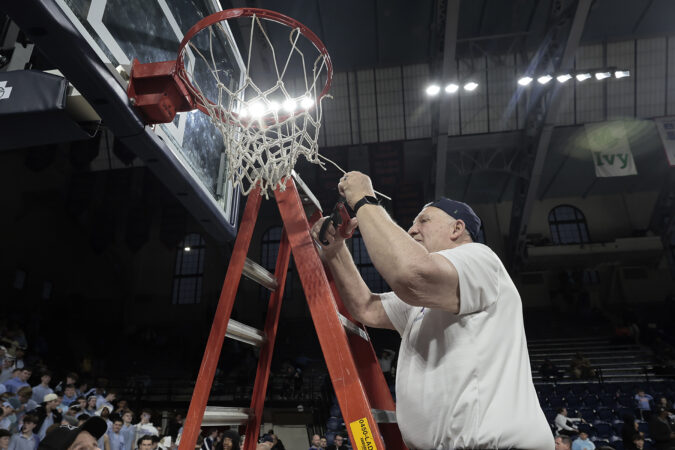
    He climbed a ladder on Sunday at the Palestra after Judge — the school he has devoted his life to — won it all. It may have felt like make-believe as Judge won one game in the season before Roantree was hired and went 27 years without a title before winning the last two. But this was real.

    The Judge Guy cut down a piece of the net as the other Judge Guys cheered. He’s not done yet.

    “Hopefully a few more years left,” Koch said.