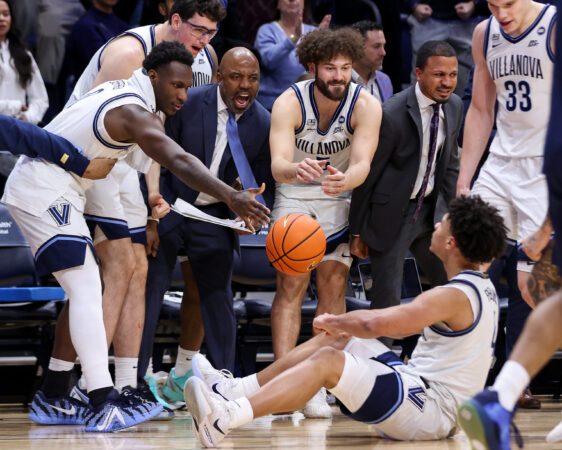
Inside a sold-out Xfinity Mobile Arena on Saturday night, Villanova endured a 40-16 UConn run over a 20-minute stretch that turned the biggest home game of the season into a blowout loss.
The loss dropped the Wildcats to 21-6 and 12-4 in the Big East, and, barring the unforeseen, all but ensured them the No. 3 seed in the conference tournament, which begins in two weeks at Madison Square Garden.
Just four games separate the Wildcats from the postseason, starting with a home game Wednesday night vs. Butler (15-13, 6-11). A trip to the NCAA Tournament, which would snap a three-season drought, is basically a foregone conclusion, but, as Saturday showed, there are things that need to be corrected if Villanova wants to finish the season strong and threaten to get to the second weekend.
Here are five things to watch in the final four games of the regular season.
The second unit
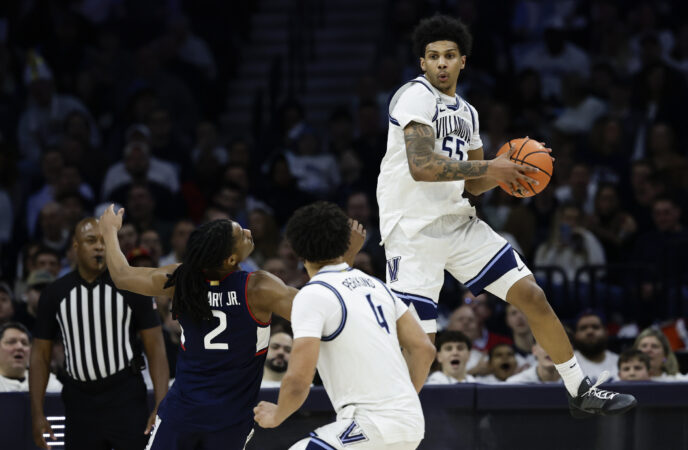
It was a rough night all around vs. the fifth-ranked team in the country on Saturday, but it was especially difficult for much of Villanova’s second unit. Sophomore wing Malachi Palmer was minus-17 in 18 minutes. Devin Askew, who has provided a big boost as a veteran ball handler and scorer off the bench, was minus-16 in 18 minutes. Backup center Braden Pierce was minus-13 in 11 minutes.
Plus-minus numbers never tell the whole story. But Villanova caused eight turnovers in the first half and couldn’t take advantage in part because the second unit struggled offensively. The two-man game with Askew and Pierce, for example, was ineffective.
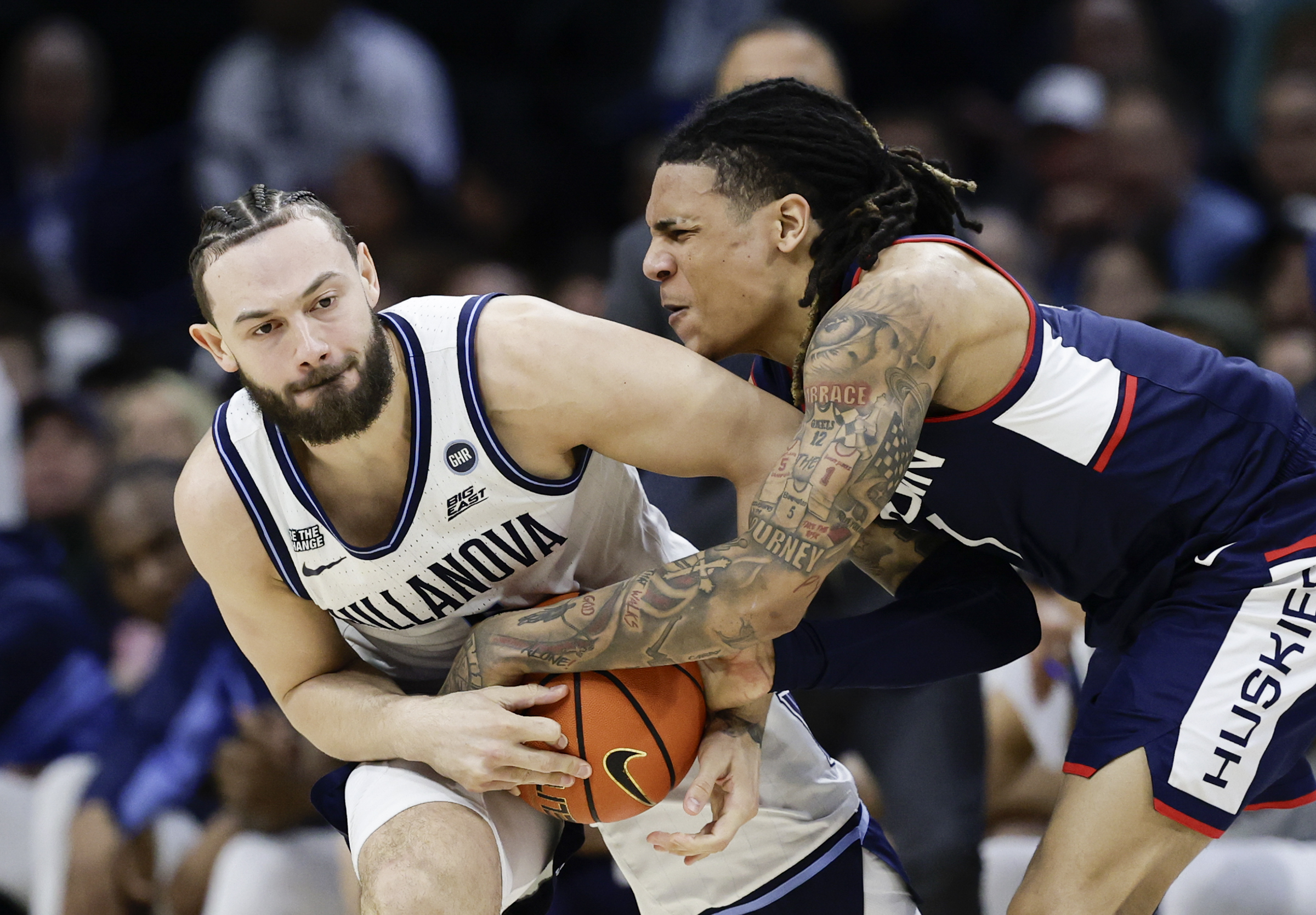
Villanova guard Devin Askew and UConn’s Solo Ball fight for possession in Saturday’s matchup.
Pierce has made some strides in recent weeks filling in for Duke Brennan when the starter needs rest. Palmer emerged in the second half of the season as a reliable reserve on both ends. Freshman Chris Jeffrey returned from injury and has occasionally provided a spark. Askew, meanwhile, has been the reason Villanova has won a few games. But the 23-year-old guard is 9-for-44 from the floor (20.4%) over the last five games and has not made up for it by creating efficient offense and generating assists.
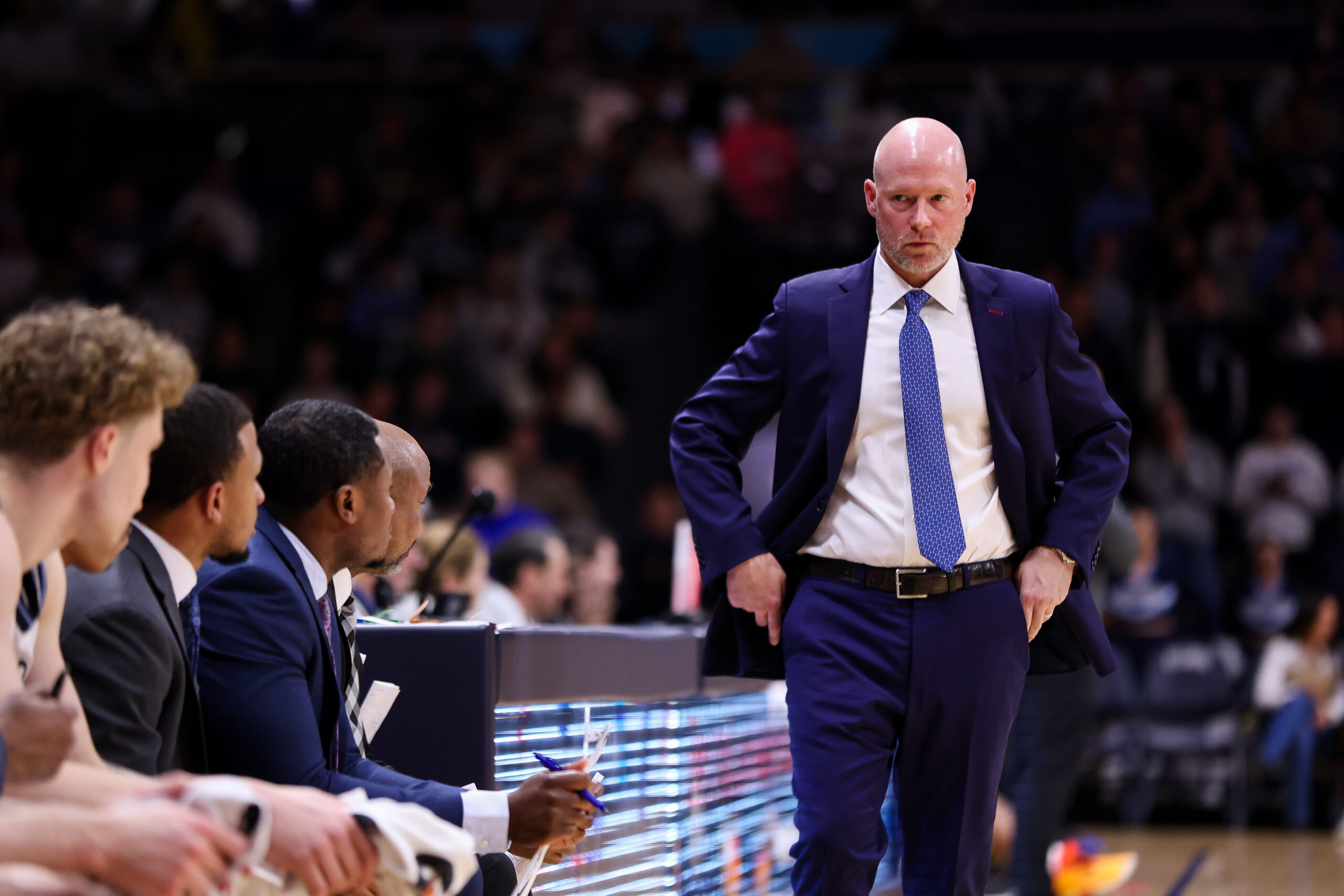
Villanova coach Kevin Willard talked recently about needing to figure out which lineups to get out there at the right times now that his team is healthier and the bench has expanded. Perhaps we’ll see some new wrinkles over the next two weeks.
Bryce Lindsay’s shot
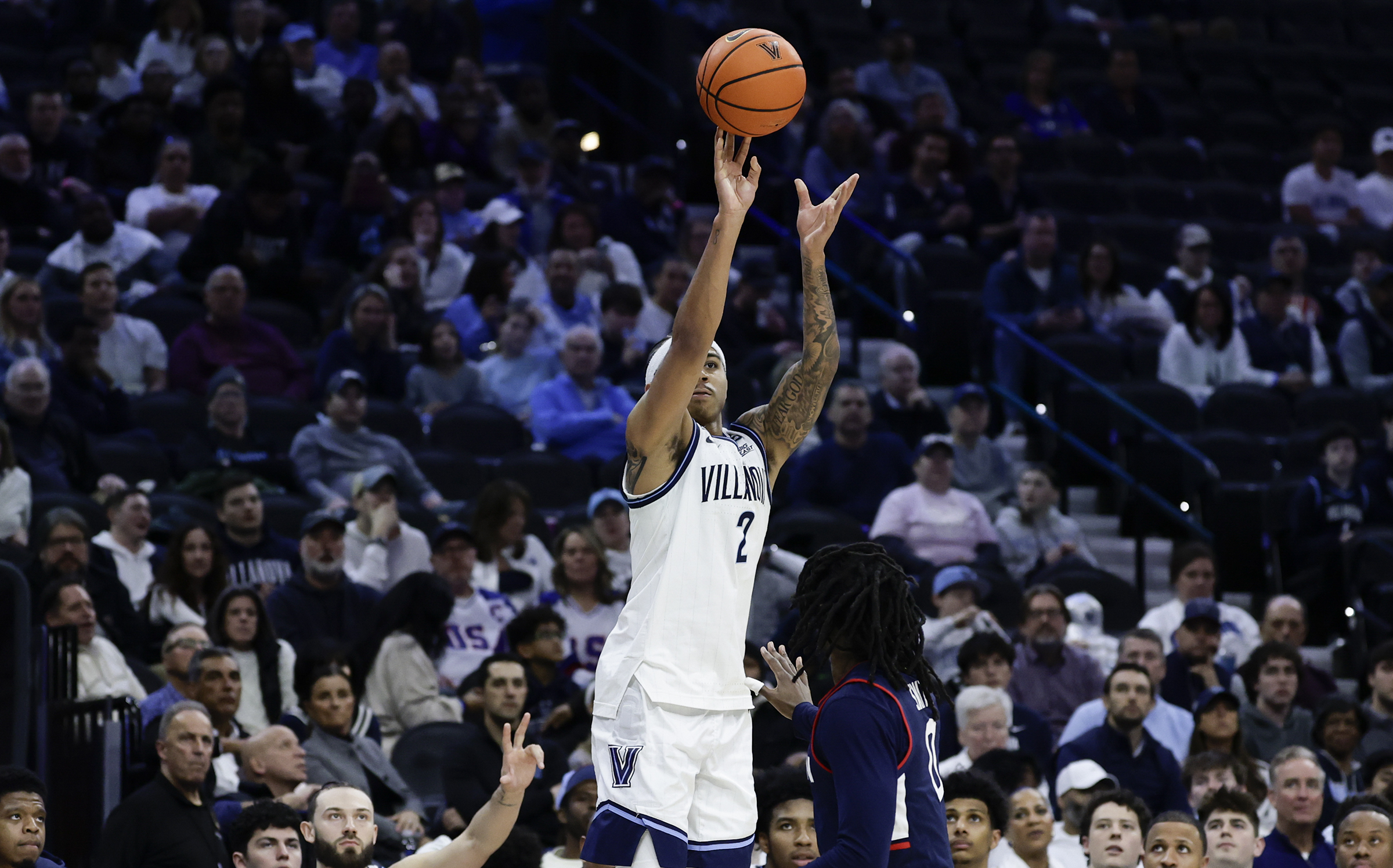
Lindsay got the weight of the world off his shoulders when he made 4 of 8 three-point shots and scored 15 points during an overtime win at Xavier last week. Before that, Lindsay was 13-for-65 (20%) in the previous 11 games.
Lindsay’s shooting prowess helped Villanova to a 9-2 start through nonconference play, but when his shot wasn’t falling, it wasn’t as easy to justify playing him 30-plus minutes, which Villanova asked of him when he had it going earlier in the season. Villanova’s offensive analytics are much better with Lindsay on the floor than off, even when his shot isn’t falling. But his perimeter defense can leave a little to be desired in critical moments of the game.
Villanova guard Bryce Lindsay shoots the basketball over UConn’s Malachi Smith on Saturday.
Everything is easier for Villanova when Lindsay’s shot is going in. Willard would probably be wise to try to get Lindsay going over the next four games. The coach said the redshirt sophomore guard was feeling the mental side of his slump but was confident that Lindsay would be a big boost going into the postseason.
Free throw woes
Villanova has missed at least five foul shots in each of its last 10 games. The Wildcats missed eight and almost lost to a Xavier team with five conference wins last week. They missed 13 on Feb. 10 and almost suffered a home loss to Marquette because of it.
After that game, Willard pointed to a young team shooting important free throws in bigger college basketball games for the first time and needing to work its way through it.
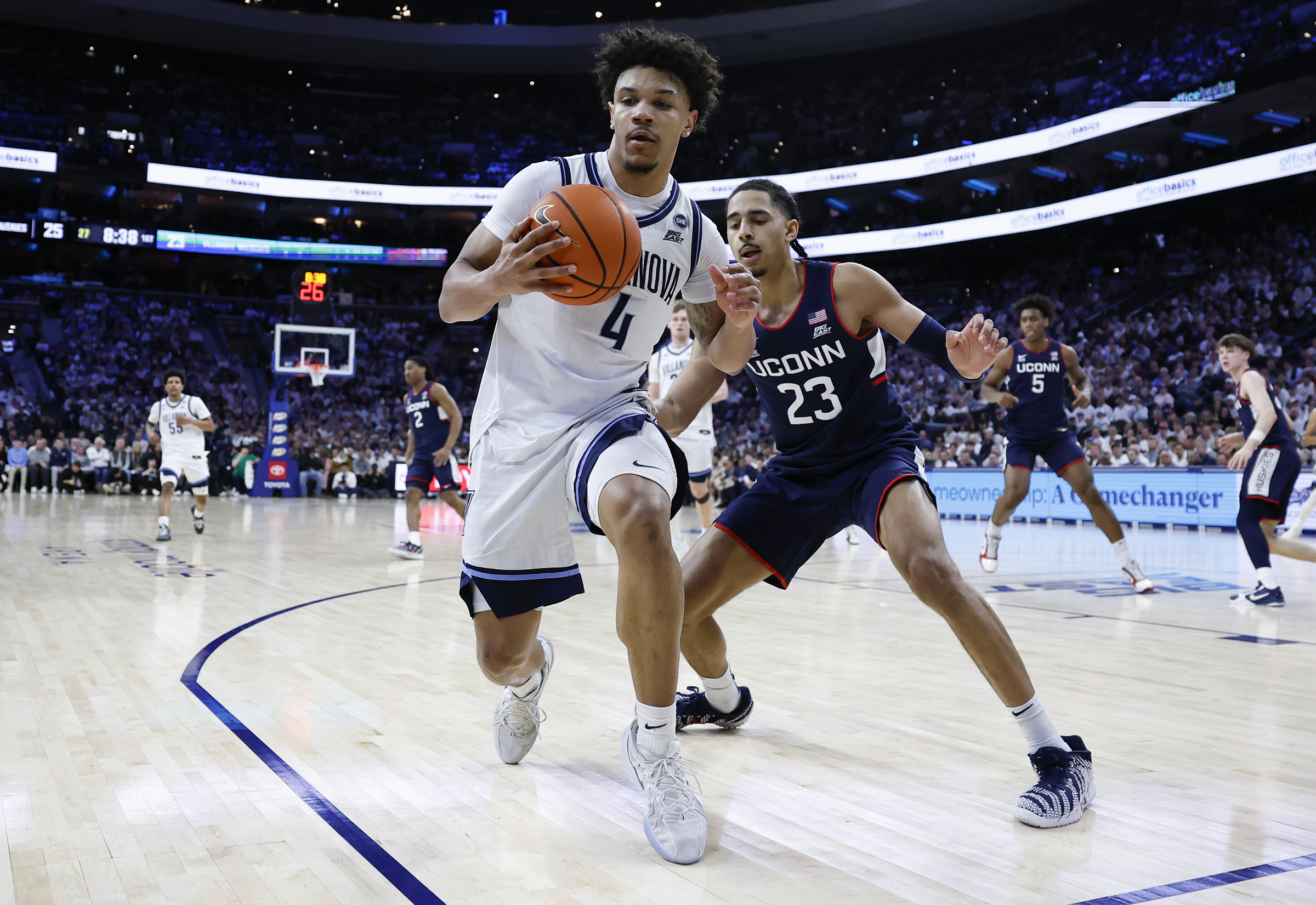
Villanova “didn’t come out with enough urgency” after it left the locker room following halftime trailing UConn by just two, leading scorer Tyler Perkins said.
It led to an embarrassing loss in front of the home crowd, and Willard said his team seems to have a better mentality on the road than it does at home.
Villanova guard Tyler Perkins grabs the basketball in front of UConn’s Jayden Ross on Saturday.
“We’ve really struggled at home at times just playing well for good stretches,” he said. “Some of it is a little bit of youth. This is really only our second time in this building. The crowd was unbelievable. They were into it. I think some shots that we’ve been making, we were a little juiced up and missed some shots early.”
He also said that “every once in a while you get your [butt] kicked.” That’s happened only once or twice (depending how you’d classify the home loss to St. John’s on Jan. 17), but the last time the Wildcats were blown out, an 89-61 loss to No. 3 Michigan on Dec. 9, they responded with a dominant home win over Pittsburgh and two tough road wins at Wisconsin and Seton Hall.
“It’s not the end of the world,” Willard said.
Bouncing back starts Wednesday, when the Wildcats have a chance to also play well in front of a home crowd.
The seed line
With a road game at St. John’s looming on Saturday, Wednesday night’s game vs. a Butler team that Villanova blew out on the road on Jan. 3 isn’t one to fool around with.
Bracket Matrix, the website that tracks all of the NCAA Tournament bracket projections, shows Villanova as the top No. 7 seed in the bracket with an average seeding of 7.04. Losing to Butler at home would probably be a seed-line loss, and dropping back into the 8-9 range means the possibility of having to face a No. 1 seed on opening weekend.
There’s some runway left, and moving up a seed line — or two, pending a big run at the Garden — is still possible. It’s just a bad time of year to fall backward.
About once a month, Brian Wanamaker drives toa cancer treatment center near his home in Crowley, Texas. He sits on a hospital bed as nurses inject needles into his arm and stomach; one for chemotherapy, the other to boost his immune system.
He can be there anywhere from one to four hours.Wanamaker is asleep throughout, but he doesn’t wake up rested. His stomach burns. His body feels fatigued.
After it’s over, he often goes straight to the gym at Texas WesleyanUniversity, where the North Philadelphia native coaches the NAIA men’s basketball program. Sometimes, he even beats his players to practice.
Since 2022, when Wanamaker was diagnosed with multiple myeloma, he has been balancing his job with the limitations of an incurable cancer. It is not easy. The head coach takes six pills a day to keep the disease in remission for as long as possible.
His doctors advise him not to engage in stressful activities (even if running a college basketball team is antithetical to this). Then, there is the matter of his schedule. Texas Wesleyan plays games mostly on Thursdays and Saturdays.
It doesn’t allow much time to undergo chemotherapy and fully recover. But the coach has an answer for that, too. He receives treatment early on Mondays, so he doesn’t feel sick later in the week.
If the Rams are on the road, he’ll reschedule.
“It’ll come back,” Wanamaker said of multiple myeloma. “But right now, I do maintenance.”
The 36-year-old doesn’t talk like someone who is worried about the future. If anything, his job has helped him stay grounded in the present. Coaching was a lifelong goal of Wanamaker’s, ever since he was a boy playing in the Sonny Hill League.
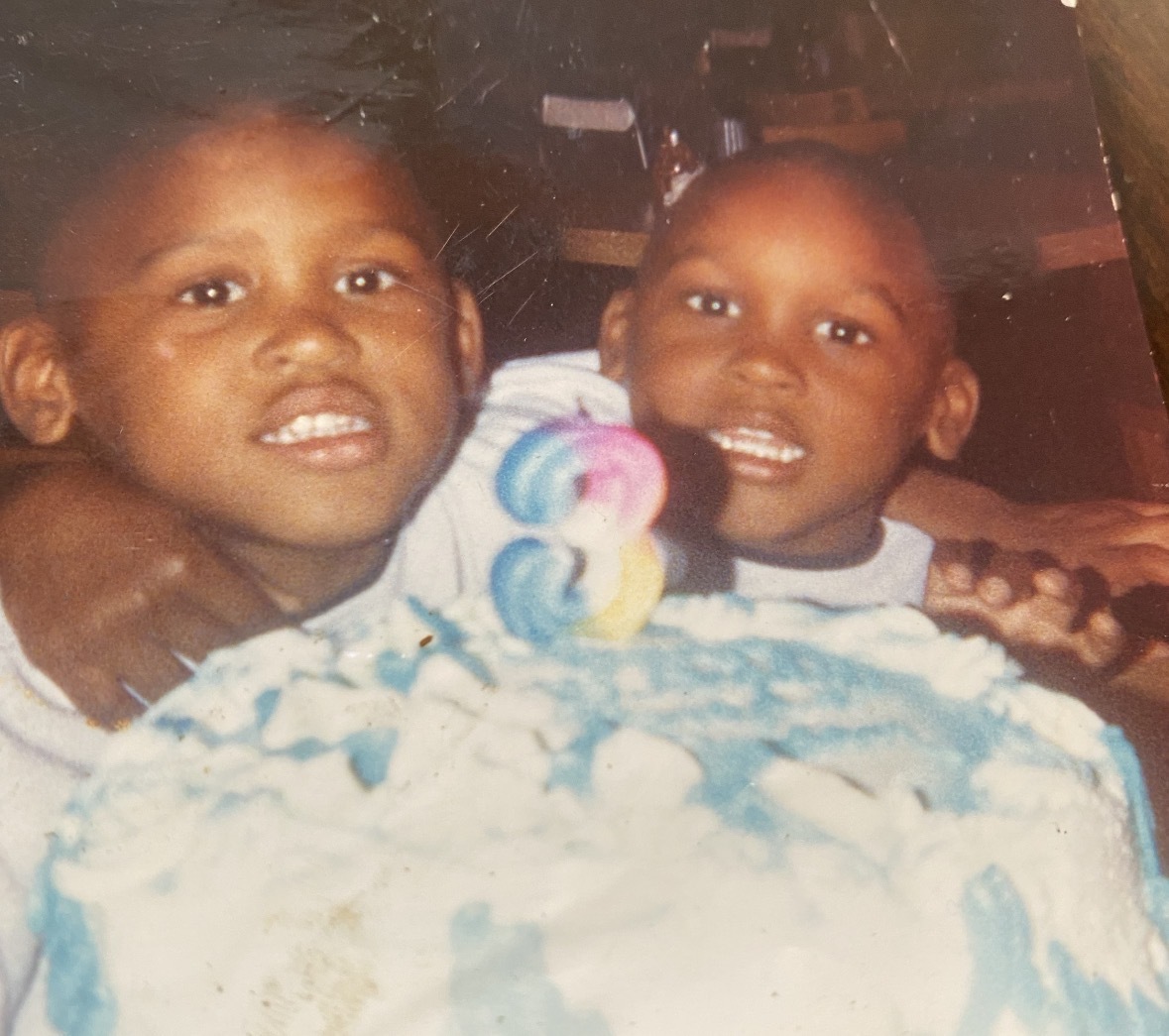
This is where he and his twin brother, Brad, first saw how basketball could change a life. Their coach, Rasool Hajj, was an alumnus of and former volunteer assistant coach at Roman Catholic High School. He helped the twins connect with the program, and they enrolled in 2003.
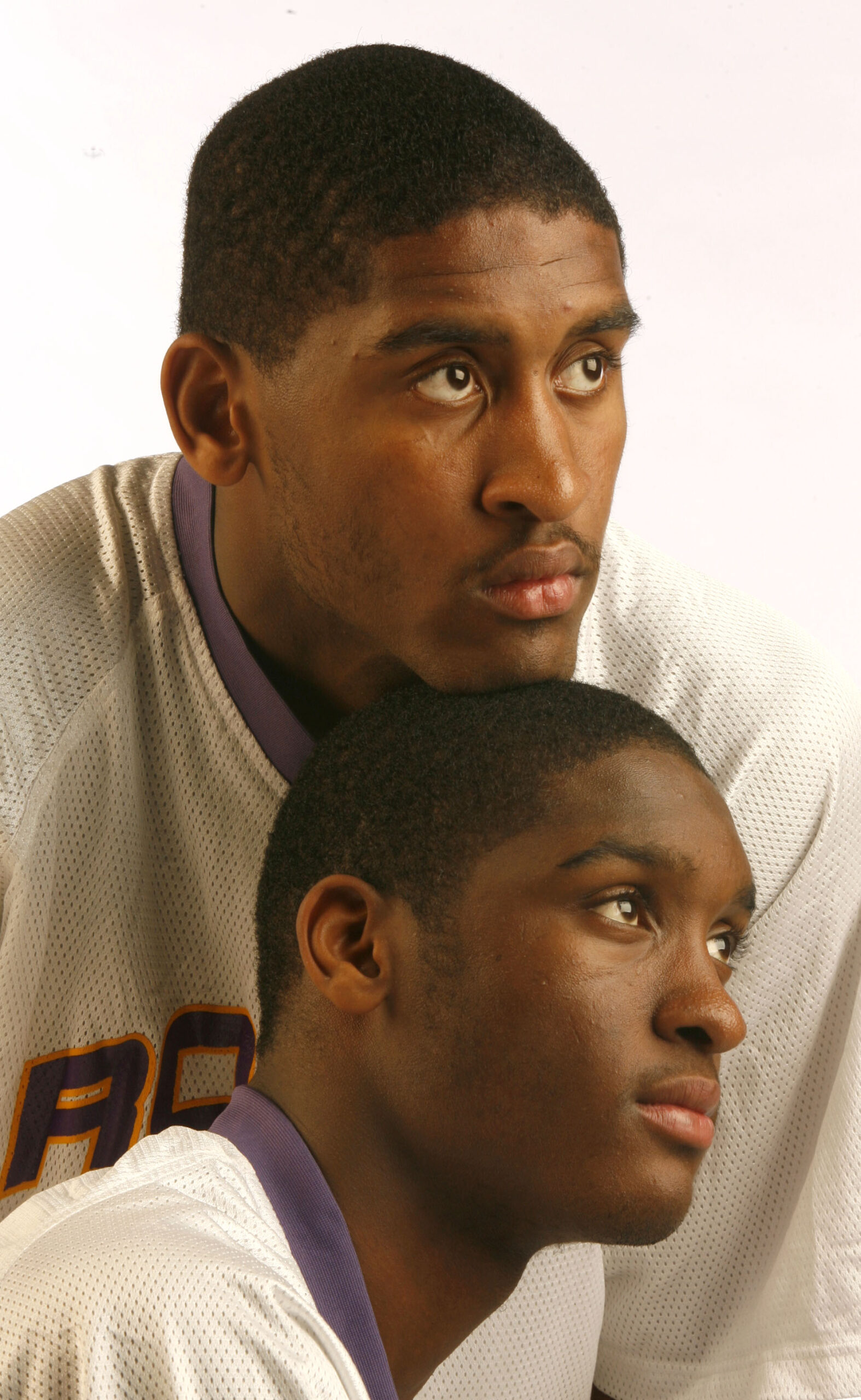
Brad and Brian Wanamaker (bottom) were stars at Roman Catholic High School and went on to play professional basketball.
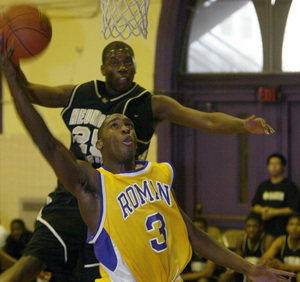
The Wanamaker brothers quickly became standout players. In 2007, they led Roman to a Catholic League championship under coach Dennis Seddon. After that, their careers took divergent paths.
Brad starred in college at Pittsburgh en route to a seven-year stint in Europe, followed by a four-year stretch in the NBA. Brian struggled with injuries in college and bounced around, eventually finding a permanent home as a player at Texas Wesleyan.
He spent a few years playing overseas but returned to the school as an assistant coach in 2019. The Philadelphia native was named head coach in 2024 and has made an immediate impact, leading the Rams to a 38-20 record since taking over.
He models his approach after Hajj’s. He checks on players’ mental health before berating them for a mistake. He routinely asks how things are going at home and at school.
The team is encouraged to be vulnerable and learn from one another, rather than to react in real time. Wanamaker tells the players to focus on “the person,” because everyone is going through something.
“But I also talk to them about reality,” Wanamaker said. “Yes, everybody wakes up with an excuse they can use, and it’s real. But you can either use it or you can fight through it. You know?”
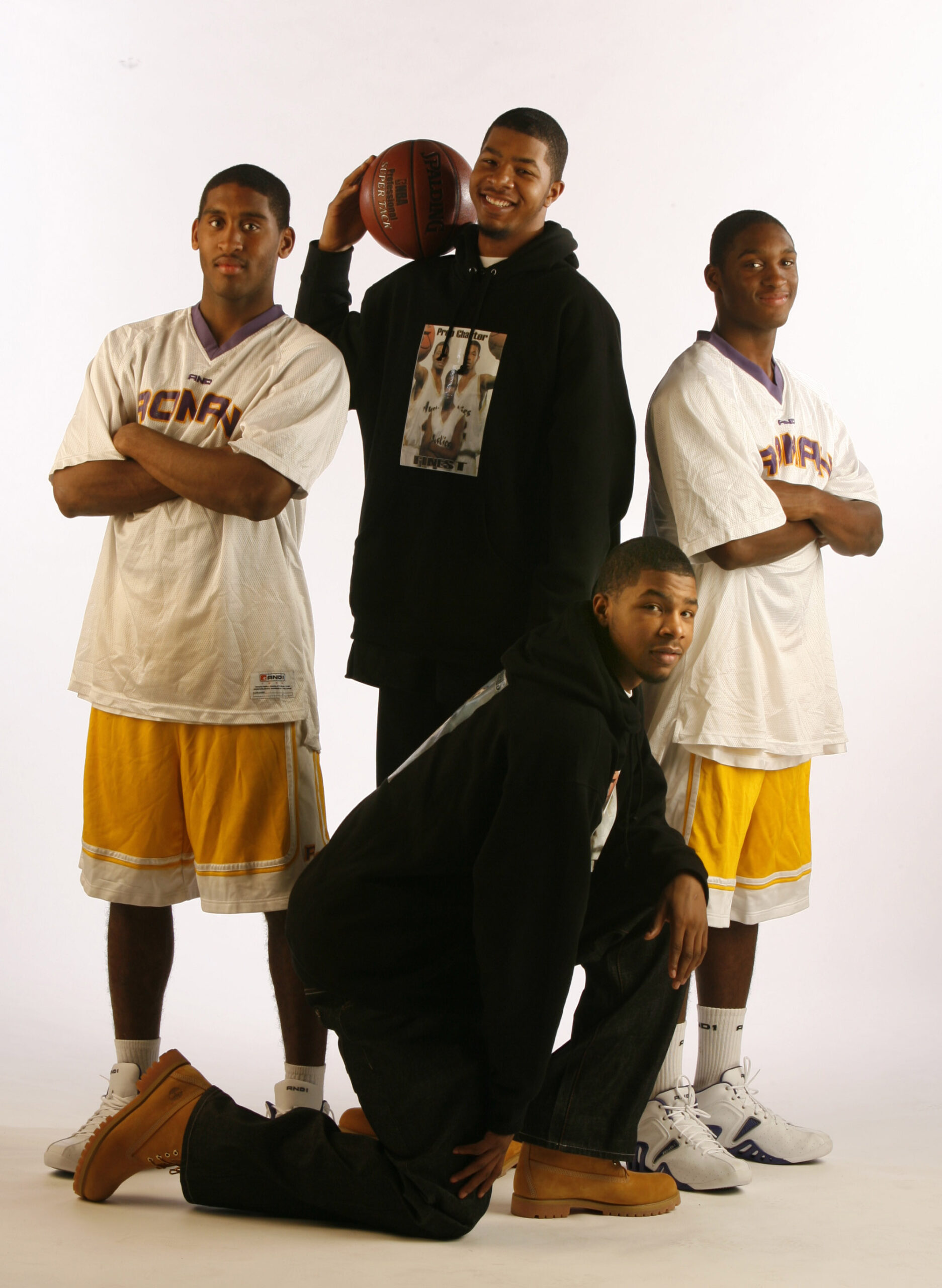
Brad (left) and Brian (right) Wanamaker with fellow basketball-playing twins, Markieff (top center) and Marcus Morris (kneeling) of Prep Charter in 2006.
A North Philly upbringing
Brian and Brad grew up in a three-story house on 19th Street between Norris and Diamond. They were the second and third of five siblings — Brad is 1 hour, 11 minutes older than Brian — and shared a bedroom on the top level.
This had its shortcomings. The roof had holes, so when it rained, the boys put pots on the floor. Their neighborhood was perilous at times, and from an early age, they became aware of the poverty, gun violence, and drug use around them.
But their childhood was still full of joy. Nineteenth Street was home to a lot of young kids, many of them Brian and Brad’s age. They rode bikes, played tag, and staged impromptu football games outside.
Basketball was their favorite sport. The twins ventured to courts all over the city in search of the fiercest pickup battle: 16th and Berks, 16th and Susquehanna, 25th and Diamond, 22nd and Norris.
They’d shoot hoops before and after school. Local elders would organize basketball tournaments between blocks with trophies for the winners. In seventh grade, a friend, Saleem Elam, asked if they played AAU basketball.
Neither brother knew what that was. But they soon attended a tryout, held their own against more experienced players, and made the team. Before long, they were playing in leagues throughout the area — Gustine Lake, Sonny Hill, Belfield.
The Sonny Hill League was where they met Hajj, who seemed to be part basketball coach, part social worker. He allowed the twins to reimagine the bounds of what a coach could do, a template they’d lean on later in their careers.
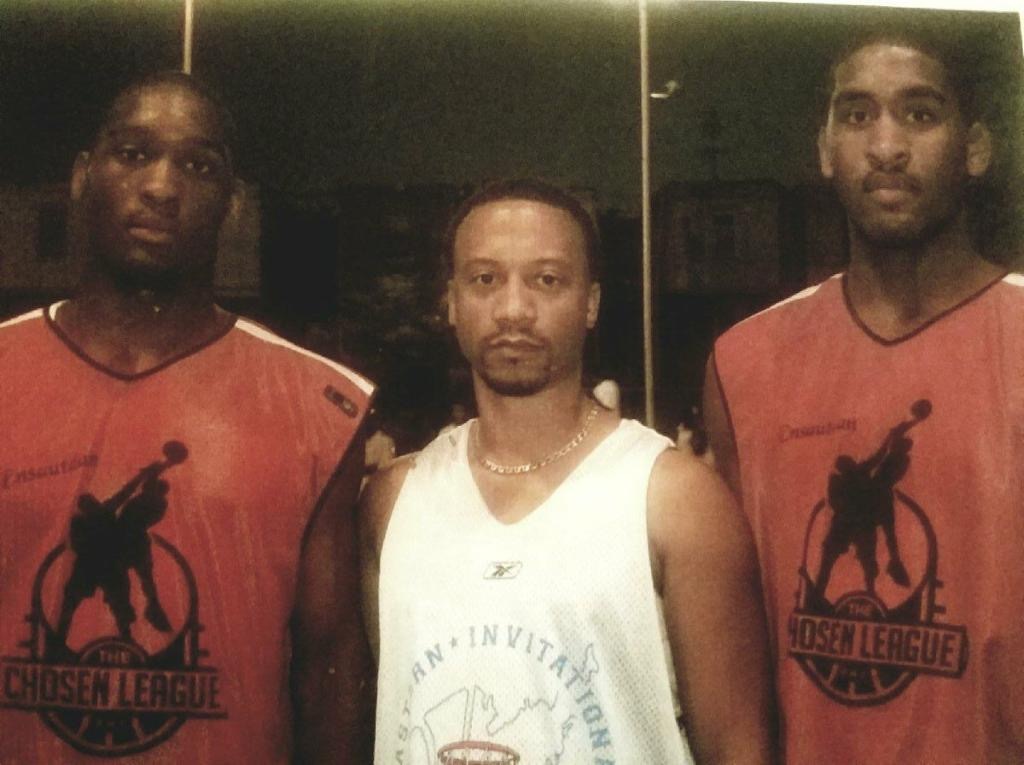
The Wanamaker Brothers looked to Rasool Hajj (center) as a coach and mentor.
“He helped a lot of kids, but also a lot of families,” Brian said. “He helped parents get jobs. He would give people money if they needed it for something. He was always there. He was almost like a big brother to us.”
Hajj became a mentor to the twins. At the time, they were attending Gillespie Junior High School, which closed in 2011. Brian and Brad seemed to learn all the wrong lessons, like how to cut class and replace it with extra gym time.
Teachers wouldn’t enforce the rules, so to the twins, there was no reason to follow them.
“There wasn’t a lot of learning,” Brad said. “Not a lot of structure. I’d go to one class — Ms. Brown, because she knew my dad. So, I’m like, ‘I got to make sure I go to her class.’
“I’d go to homeroom and get marked absent for the day. Then I’m in my brother’s class, I’m at his lunch, I’m playing cards [with him].”
Hajj, who recognized the twins’ untapped potential, introduced them to Seddon and the other Roman Catholic coaches. That break altered their lives.
The high school brought a level of discipline that the Wanamakers weren’t used to. And when they arrived as freshmen, it was a tough adjustment.
Brian walked through the doors in September 2003 and looked at the students around him.
“We wanted to leave because we didn’t know it was an all-boys school,” Brian said. “We was like, ‘What? There’s no girls in the school?’ We were so confused.”
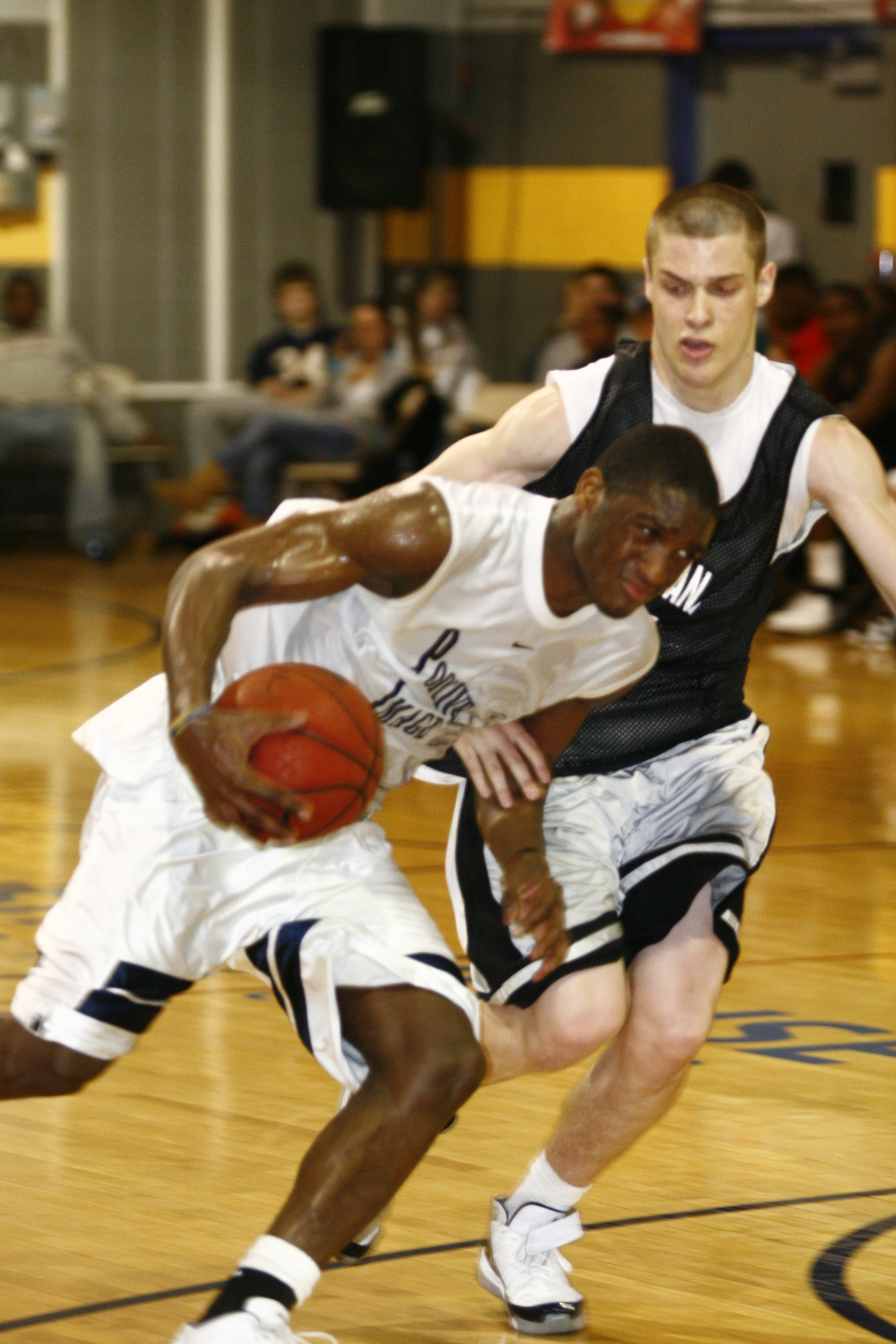
Brian Wanamaker and his brother were standout AAU players who had to adjust to Roman Catholic on and off the court.
They racked up demerits for every conceivable offense, from untucked shirts to facial stubble. Both brothers failed a class in their first semester and were ruled ineligible for the first half of the basketball season.
Because they were on academic probation, they had to go to summer school, wearing slacks, long-sleeved collared shirts, and ties in the sweltering heat. The lesson stuck.
“It just was like, ‘We got to be doing the right thing,’” Brad said.
In sophomore year, Brad started on varsity, and Brian on JV (with some varsity appearances mixed in). They fed off each other in practice and in games.
The players had different strengths. Brian, a 6-foot-2 combo guard, was a better defender and three-point shooter. Brad, a 6-4 shooting guard, was a “laid-back killer” who could score from midrange.
Brian showed all of his emotion. He wasn’t above “mugging a player,” in Brad’s telling, and wasn’t afraid of getting a technical foul. He’d scream and yell. Brad, by contrast, was quiet.
But occasionally, he would give his brother some in-game feedback.
“He’d be like, ‘Hey, play your role!’” Brian said. “He’d be like, ‘Pass it to me. Pass me the ball, and you play defense!’”
Added Brad: “He’d go, ‘Shoot the ball!’ And I’d tell him, ‘Calm down! I need you out here!’ Because sometimes he gets too emotional. And I’m like, ‘Before you get a technical foul, I need you to calm down.’”
Brian Wanamaker helped Roman win the Catholic League title.
The brothers racked up accolades, especially in 2006-07, their senior season. Brian was named second-team All-Catholic and All-City, as well as Defensive Player of the Year. Brad was named the Daily News’ Player of the Year, and was first-team All-State, All-City and All-Catholic as well.
The Cahillites parlayed this success into a historic campaign. The twins led Roman Catholic to a 28-3 record and its first Catholic League championship since 2000.
Rival Neumann Goretti, the No. 1 seed from the Catholic League South, came into the final favored. And the game, played at the Palestra, was close until the very end.
Brad had to sit for a stretch midway through the third quarter after picking up his fourth foul. Without its best player, Roman was at a disadvantage. Brian made sure everyone knew their defensive assignments, so the undermanned Cahillites could stay within striking distance.
His brother returned early in the fourth quarter, and spurred his team to a 17-4 run. With just over a minute remaining in the game, Brian hit a layup to widen Roman’s lead to 58-54. It finished with a 59-56 comeback win.
“I think [Brian] pointed to our student section,” said Brad, now the head coach at Roman Catholic. “We still have the picture at my mom and dad’s house. It was in the newspaper. It was a moment.”
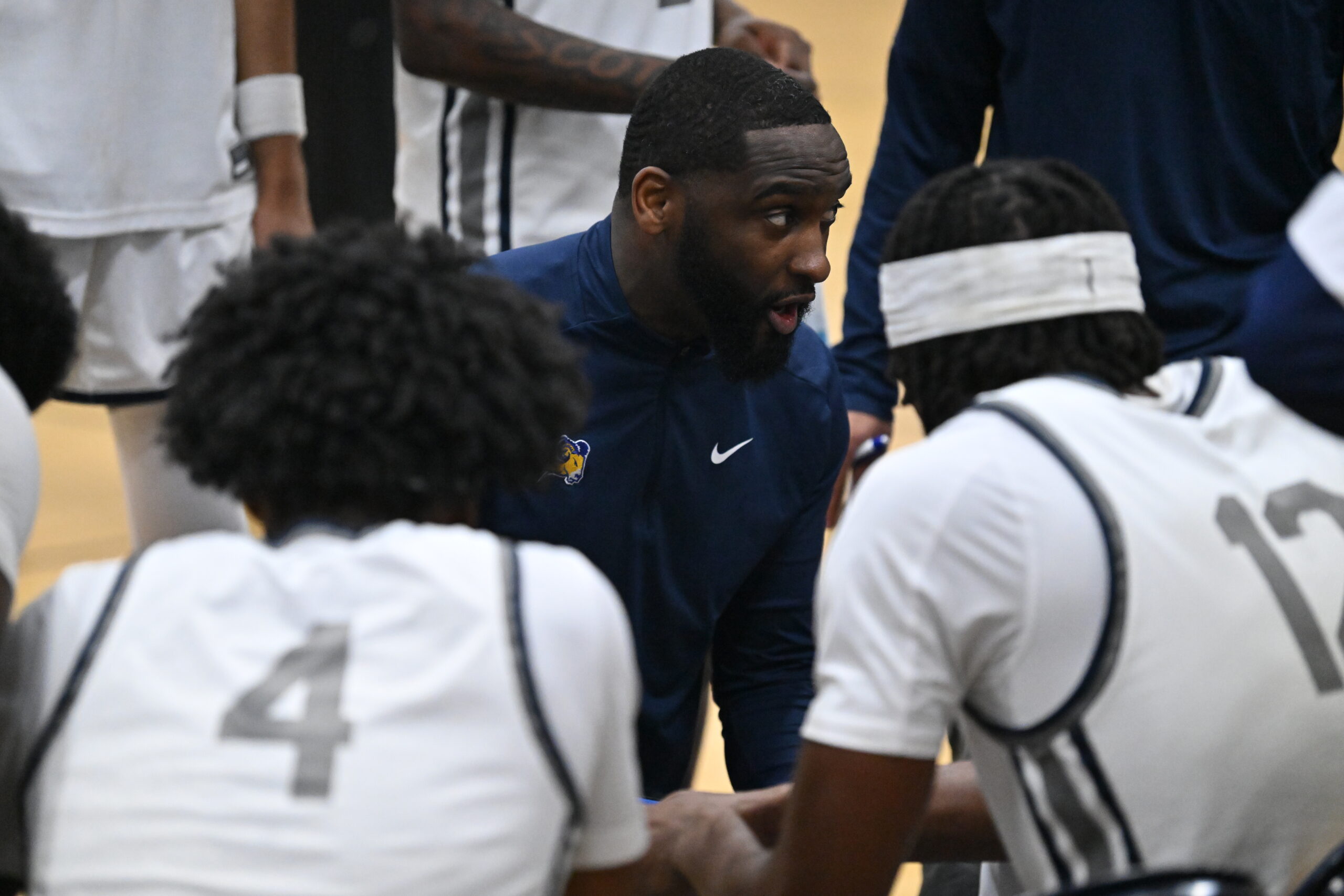
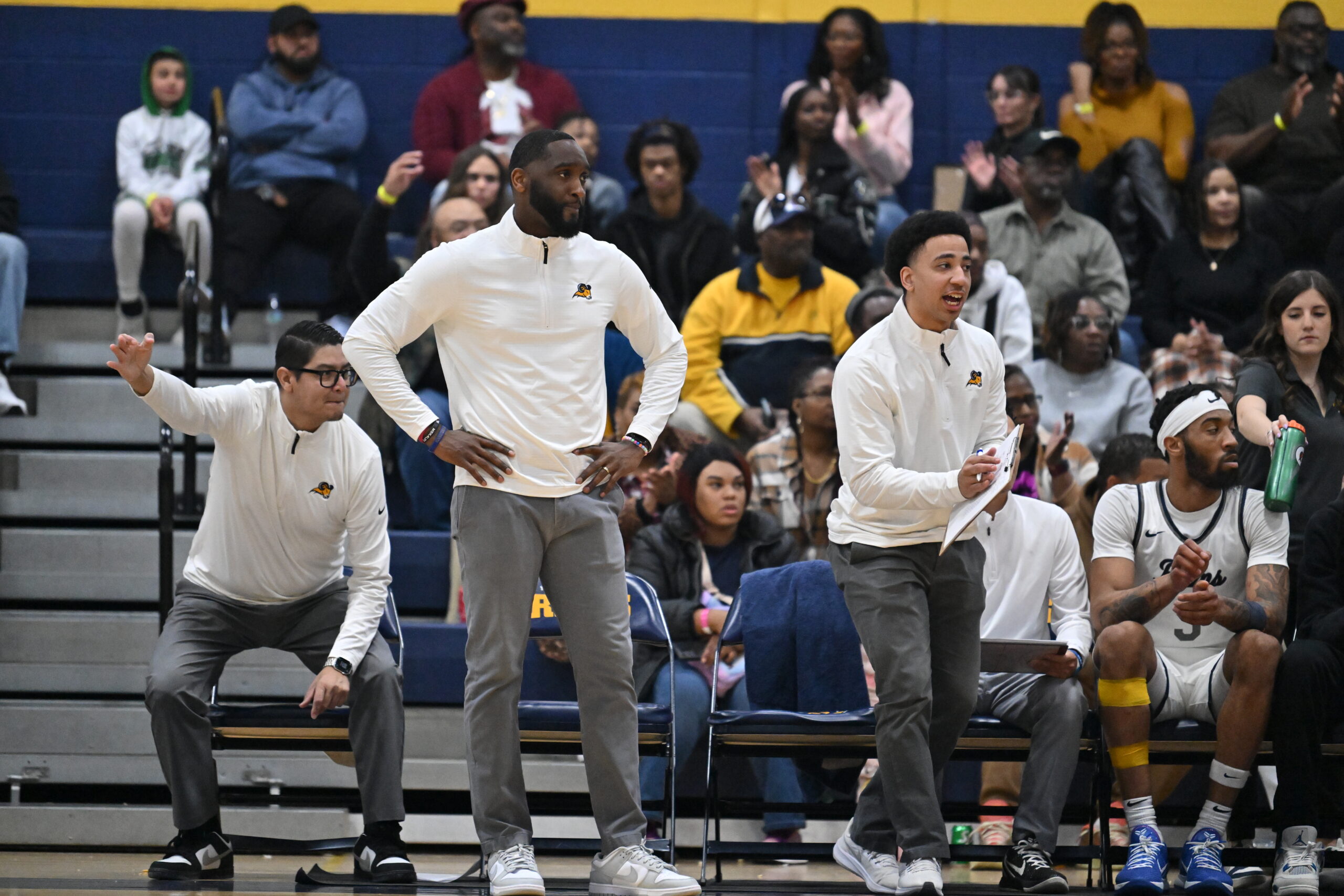
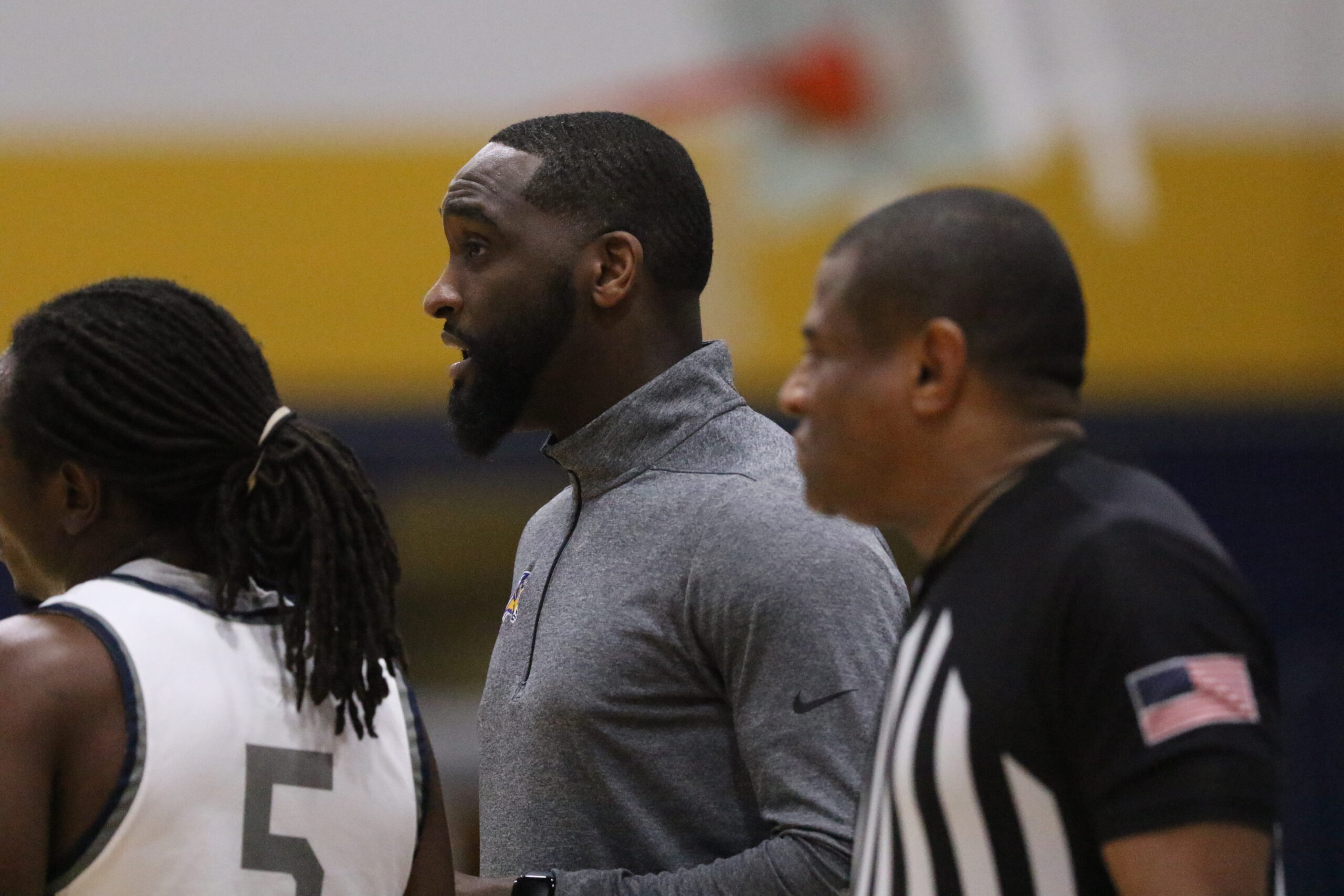
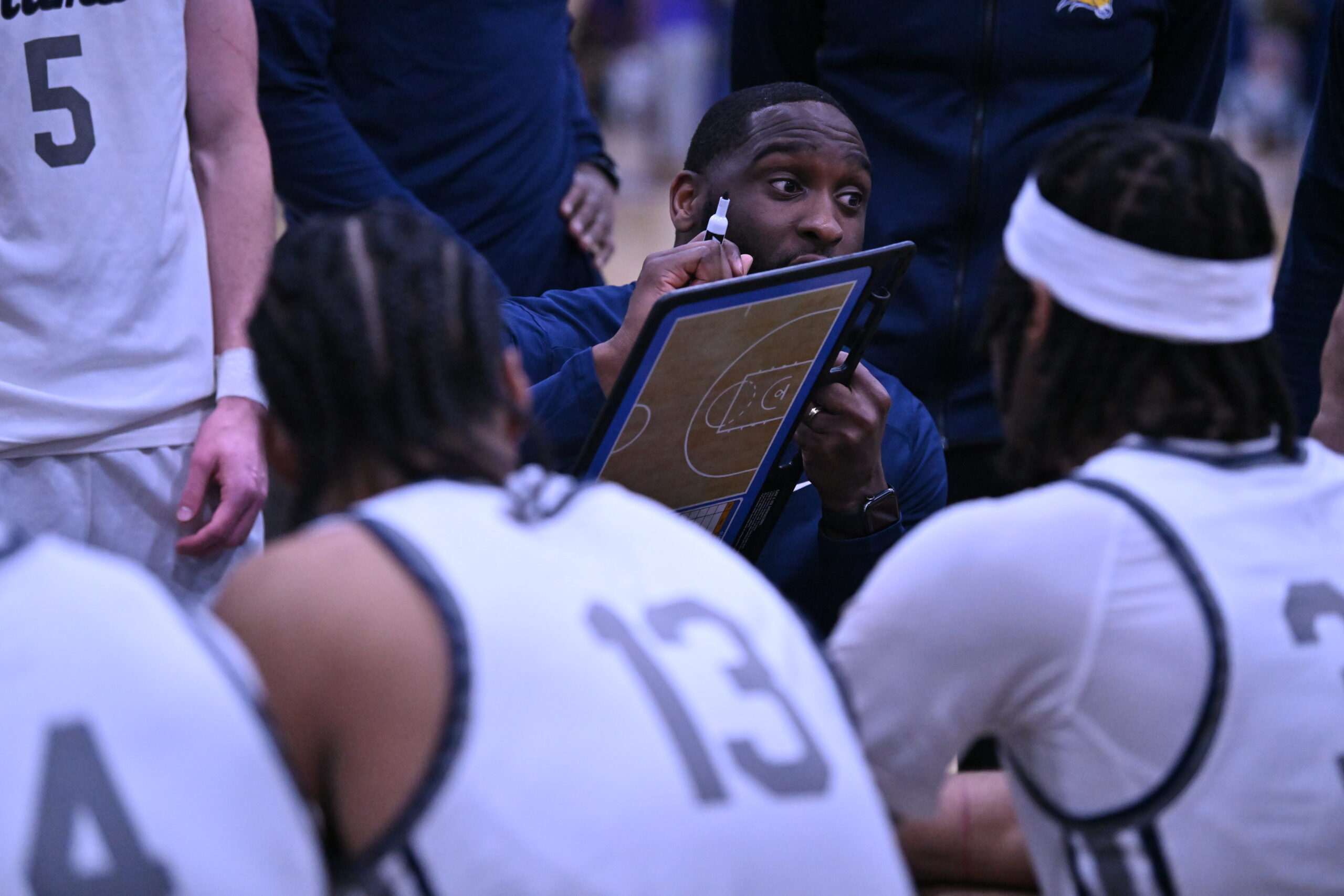
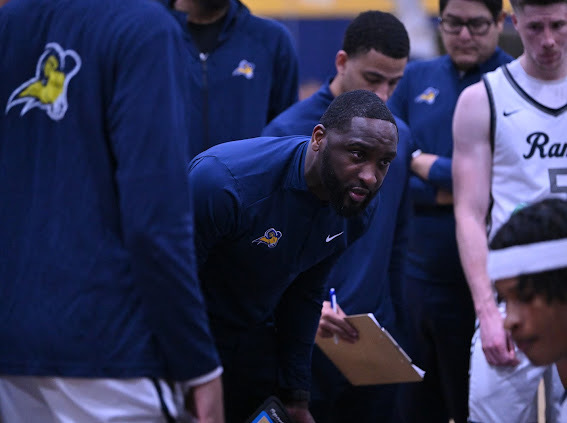
Brian Wanamaker coaching at Texas Wesleyan University.
Coaching through chemo
After graduating, Brad played for Pitt when it was one of the top men’s basketball programs in the country. Brian bounced around; first to Central Connecticut State, then to Lon Morris Junior College in Jacksonville, Texas, and, finally, to Texas Wesleyan in 2009.
He struggled with foot injuries almost every year of his college career. This made it difficult to get steady playing time. But at Wesleyan, he found a fit.
A former coach had recommended the school to him, and Wanamaker initially was skeptical. He’d never heard of it. The campus was in Fort Worth, Texas, about 1,500 miles away from home.
“I didn’t know what Texas Wesleyan was,” he said. “My first semester, I played basketball, stayed in my room, and didn’t talk to teammates, coaches, anyone. I was just like, ‘Why am I here?’”
By his second semester, he realized this would be his last opportunity to play in college. So he decided to embrace the program and was happy he did. Wanamaker felt he could be himself in a way he couldn’t at his previous two stops.
During the summer of 2010, Brian visited Brad at Pitt and trained with him and his teammates. He returned to campus in the fall more confident than ever.
That season, he was named a first-team NAIA All-American and Red River Athletic Conference Player of the Year, averaging 19.1 points, 5.7 rebounds, and 5.0 assists.
The combo guard was drafted into what then was the NBA D-League and ended up playing six seasons in Germany and Lithuania.He returned to Texas Wesleyan in 2019 to finish his degree and work as an assistant coach.
Brian Wanamaker returned to Texas Wesleyan as a coach and has endured a trying off-court experience while leading the Rams program.
In late 2021, during his second season coaching, Wanamaker started to feel back pain. At first, he thought it was workout-related. Maybe he’d pulled or strained a muscle.
But the pain worsened, to the point where he had to stop exercising. He couldn’t sleep in a bed anymore because it would hurt his back, so he would lie flat on the floor.
Wanamaker underwent all sorts of testing, but the doctors didn’t find anything. They hypothesized that his pain was stress-related.
“And I would tell them,” he said, “‘I’m not stressed.’”
In September, after a litany of visits, his primary care doctor received MRI results that showed tumors all over Wanamaker’s back. He went to the hospital for further testing, and was told he had multiple myeloma, a cancer formed in plasma cells that is treatable but has no known cure.
He was a statistical anomaly. The disease is predominantly diagnosed in people 65 years or older. According to the American Cancer Society, only 1% of cases are found in those younger than 35.
Wanamaker was 33.
“That was really hard,” he said. “Because, obviously, when you hear cancer, you think death. And then you hear, ‘No cure.’ It was hard for me to process.”
Brian Wanamaker will lead Texas Wesleyan in the Sooner Athletic Conference Tournament starting Wednesday.
The next day, the coach started seven months of chemotherapy. Many on the team assumed he would be out for the rest of the year.
But Wanamaker was back in the gym that week, helping at practice and eventually sitting on the bench during games.
He had little energy and often felt sick. His immune system was at a higher risk than usual. But Wanamaker felt he needed to do it. So every day, he’d drive to Texas Oncology for his treatment, and would head to Texas Wesleyan afterward.
“I was probably more than half-asleep,” he said. “I was going through what I was going through, but I knew as a coach, players are going through stuff, too. It was just being there for them.”
Guard Akili Vining had recently lost his father to cancer. Point guard Matthias Nero had gotten into a severe car accident, which led to the death of his close friend.
Wanamaker was acutely aware of their struggles and those of other players. He decided to pour himself into his team.
“Coach B would probably text me every day,” Nero said. “He would make sure I was in the right headspace, to see if I needed help. He’d pull me aside and just tell me, ‘If you need anything — this isn’t about basketball. This is about the future and your mental health.’”
Wanamaker received a blood transfusion in May 2023. His father and brother visited him in the hospital shortly after. Seeing him hooked up to a cluster of machines was difficult.
“It was like, ‘I can’t lose my brother,’” Brad said. “‘Not the person I came into this world with.’”
Brad Wanamaker (left) has had to monitor his twin brother’s condition from afar.
Eventually, Brian’s chemotherapy schedule was reduced from daily to monthly treatments. Through it all, he rarely missed a practice or a game, which became a source of inspiration for his team.
The players could see their coach had changed. He’d lost hair and weight, and his skin looked dull. Sometimes, he’d arrive with a bandage on his arm to cover a needle mark.
But he was showing up, just like they were.
“If he can fight though chemo,” Vining told a local TV affiliate, “I can fight through practice.”
Brian Wanamaker has won the respect of his players by caring about them as players and people.
‘People are going to say I cared’
In April 2024, Wesleyan’s head coach, Brennen Shingleton, resigned to work for a business in Fort Worth. Wanamaker was named interim coach but also applied for the full-time job.
He wasn’t alone. Athletic director Ricky Dotson said he received “a ton” of applications, from former NBA assistants to former Division I head coaches. He narrowed it down to four finalists, interviewing them throughout the spring.
Despite the high caliber of candidates, Wanamaker still set himself apart. It wasn’t just that he was familiar with the team. It was that the players respected him, and looked to the Philadelphia native as a role model.
Dotson knew the coach’s character. He could see that this would not be a surface-level job for him. By the end of the interviews, he was convinced that Wanamaker was the best choice, even with the uncertainty about his health.
“I just never really doubted that he would be able to do it,” Dotson said. “And he’s moved right on through.”
That June, Wanamaker was officially named head coach. He immediately got to work, targeting bigger, more athletic players in hopes of building a hard-nosed, physical team.
One such player was Khalil Turner, a 6-8 guard from Northeast Philly who had shuffled through four colleges before taking a two-year hiatus. Like Wanamaker, Turner was a Hajj disciple in need of a new home.
The former Sonny Hill coach was confident that Wesleyan would be the right fit.
“Listen, man, I got a place for you,” Hajj told him. “It’s a Philly coach. He’s going to treat you like family. All you’ve got to do is just go out there and put the work in, and everything is going to fall into place.”
The two initially butted heads, usually over inconsequential things. Turner said that one day, in practice, they almost got into a physical fight. But Wanamaker never gave up on him. He didn’t suspend Turner or revoke his scholarship.
Brian Wanamaker connected with another former Philly star, Khalil Turner, who arrived in Fort Worth.
Eventually, the guard began to open up about his personal struggles. He had a family member who was sick at home. He told the coach that he needed a job to make some extra money. Wanamaker found him one at a local laundromat.
Now, Turner says they are “best buds.” Last year, when the incoming freshmen arrived on campus, the senior guard was the first to explain Wanamaker’s predicament.
“We told them, ‘Hey, Coach is dealing with this,’” Turner said. “‘So from time to time, he might be a little moody. But this is why he’s moody. He’s worried about his chemo. So don’t stress him out too much.’
“The vets feel like if Coach is giving his all, with his chemo, we should give it our all every day in practice,” Turner added, “and every day on the court. He’s going above and beyond for us, so we should do the same.”
After consecutive losing seasons, the Rams now look like a different team. They have adopted some of Wanamaker’s characteristics, playing a faster, tougher brand of basketball.
They set hard screens and make hard cuts. They dive on the floor for loose balls and swarm opposing offenses. And they are seeing results.
In 2024-25, Texas Wesleyan went 19-11, earning an NAIA National Tournament berth. This year, it is 19-9.
But Wanamaker isn’t just focused on the numbers.
He knows his players have changed as people, too. They are more emotionally available. They are better able to communicate their feelings. They are less reactionary than when they first arrived.
And to the Philadelphia native, that is more valuable than anything.
“It gives me my purpose,” he said. “And no matter what happens, I know that, when it’s all said and done, people are going to say I cared.”
With four games remaining in the women’s basketball regular season, Temple is not where it envisioned it would be. The Owls were coming off consecutive 20-win seasons and picked to finish fourth in the American Conference this season.
Instead, Temple stands at 12-14 with a 6-8 mark in conference play and finds itself fighting to make the tournament instead of battling for a top seed.
The Owls slid as low as ninth in the standings and were one game away from falling out of the top 10, and only the top 10 teams make the conference tournament. Temple has righted the ship with back-to-back wins against Charlotte and Memphis to move to seventh place but is still looking to improve.
“We have been up and down,” coach Diane Richardson said. “But I think we are playing better together. … Hopefully we are on the upswing. I know it’s going to be a tough hill to climb to get into the conference tournament and even if we are in the conference tournament, it’s going to be five games [in five days].”
Temple’s remaining games offer a unique set of challenges and circumstances. It faces two of the top three teams in the conference in Rice on Wednesday and South Florida next Tuesday. It will face two teams below the Owls in the conference in Alabama-Birmingham on Saturday and Florida Atlantic on March 7.
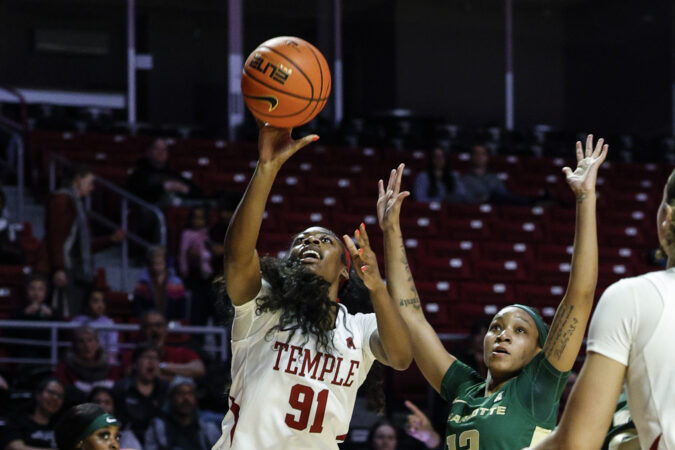
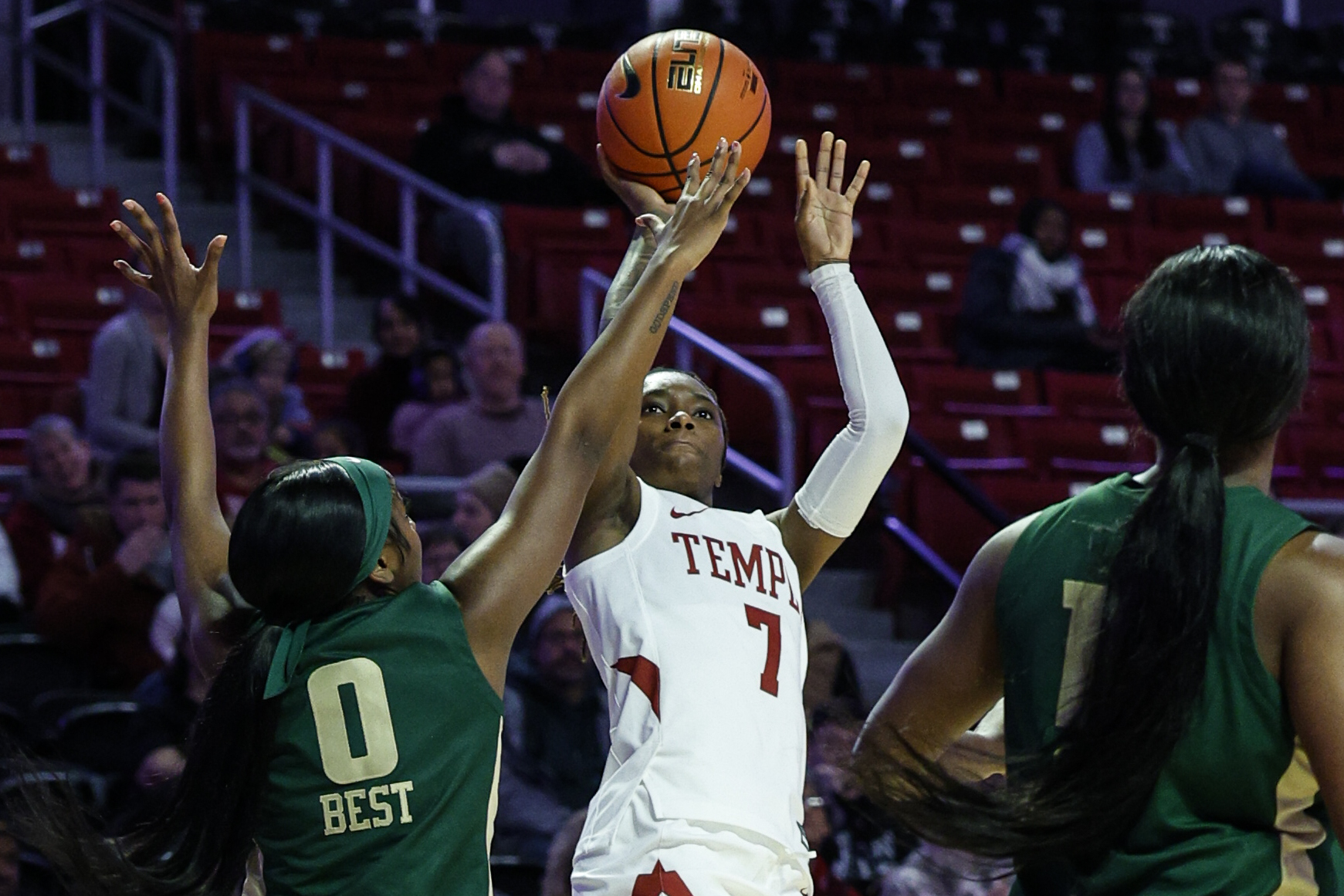
Kaylah Turner has been a key contributor for Temple this season.
The Owls almost certainly will have to play five games in five days at the conference tournament in Birmingham. That will present a challenge for Temple since its depth has not progressed to the level Richardson desires.
While the reserves have been improving — Temple had 14 bench points in its 65-62 win against Memphis on Sunday — their lack of production is why the Owls have fallen in the standings, and Richardson knows it will be a factor in March.
“They’re starting to pick things up and not be so hesitant and be more confident in what they’re doing,” Richardson said. “Knowing how they have to help us. They have to. Seeing how we’ve done this season with going up and down, up and down, and not being able to really count on the bench as much. They kind of see that.”
Without a strong bench, Richardson has relied on guards Kaylah Turner and Tristen Taylor and forwards Jaleesa Molina and Saniyah Craig.
Craig has especially improved. She’s been a force in the paint for the Owls, scoring in double figures in the last seven games, and has hit double-digit points in every conference game beside two, while averaging 8 rebounds.
“She’s been more of a leader, so she’s talking more,” Richardson said. “She’s more comfortable and talking, and that in turn has stepped up her game. That confidence is like, ‘OK, let’s go, let’s go.’ If you hear on defense, you can hear her talking the whole time. And that also helps her teammates, kind of gets a little fire in everybody else.”
Guard Savannah Curry has also increased her production. She missed the first four games of conference play with a facial injury and struggled to find her role upon returning. However, she scored career highs in points (18 and 21) in consecutive games against East Carolina and Charlotte.
Curry’s emergence could be important in taking some of the burden off the Owls’ top four contributors. While Temple is no longer on the verge of missing the conference tournament, it wants to end its regular season on a high note.
“We’re looking at one game at a time,” Richardson said. “If we make the tournament, that’ll be great. If we don’t, we’re still working on getting better and us playing together and cohesively. So, right now, we’re concentrating on one game at a time.”
When St. Joseph’s coach Cindy Griffin recruited Gabby Casey out of Lansdale Catholic High, she compared Casey to Susan (Moran) Lavin, who scored 2,340 points, the most by any men’s or women’s basketball player for the Hawks, from 1998 to 2002.
Casey set the scoring record for the boys’ and girls’ teams at Lansdale Catholic, and her natural scoring knack intrigued Griffin. The Hawks’ culture drew the 5-foot-9 guard, who joined St. Joe’s during the 2023-24 season.
Her role gradually increased each year, and now as a junior, Casey has St. Joe’s fighting for a top-four seed and double bye in the Atlantic 10 tournament. She leads the Hawks in points, rebounds, and steals and prides herself on being a well-rounded player and leader for her teammates.
“I felt that over the summer I had to put in a lot of extra work and come in more confident than I ever had before because I knew I was going to have a much bigger role,” Casey said. “I knew I was going to score in order for us to win, and that has really been the fun part for me. Scoring and then getting to lead the girls is so easy.”
Casey played sparingly off the bench as a freshman, averaging 13.2 minutes. Last season, she was elevated into the starting lineup but was a secondary scorer, averaging 7.7 points. The Quakertown native has been an example for her teammates.
“That used to be the natural progression,” Griffin said. “Kids stay, and they reap the benefits of their work, and when it’s their time, it’s going to be their time. I think Gabby is a great example of that, just staying the course and being where her feet are. She loves being around our team and our culture, and being able to step into that leadership role is really nice to see.”
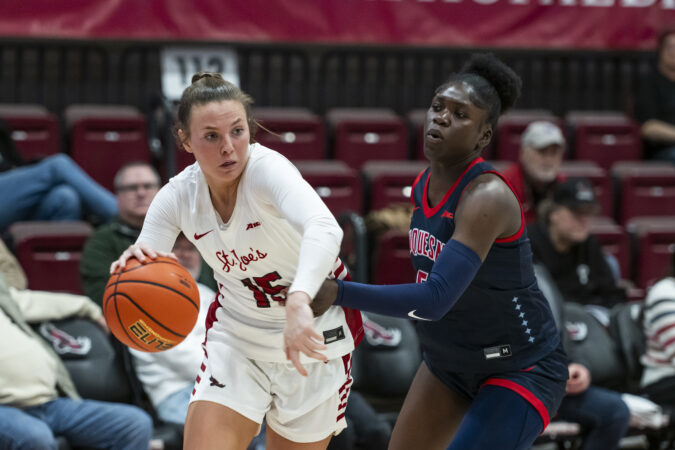
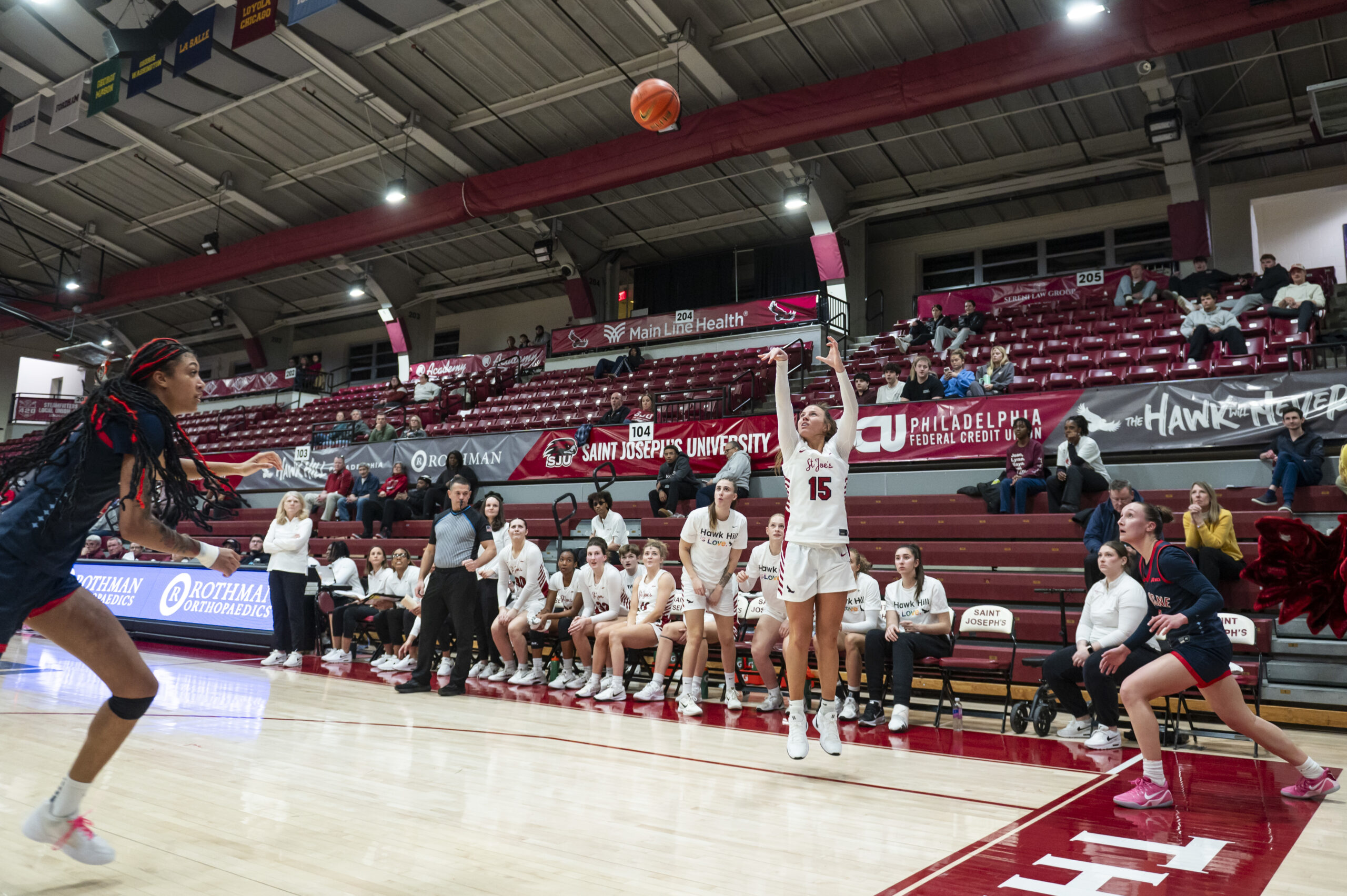
Gabby Casey (center), shown last Wednesday against Duquesne, has made 62 three-pointers this season.
Casey has embraced leading a St. Joe’s team that lost a lot of experience from last season’s team, which won 24 games. In Griffin’s eyes, Casey has carried on the lessons that she learned from past team leaders.
She has filled the leadership role seamlessly, guiding the Hawks to a 19-9 record with one regular-season game, at home against third-place Richmond (2 p.m., ESPN+) remaining.
“[I try to] bring consistency in just showing up every day with the same mindset and same goals,” Casey said. “Then also creating an environment where everyone feels welcomed and feels like this is a place they want to be every day.”
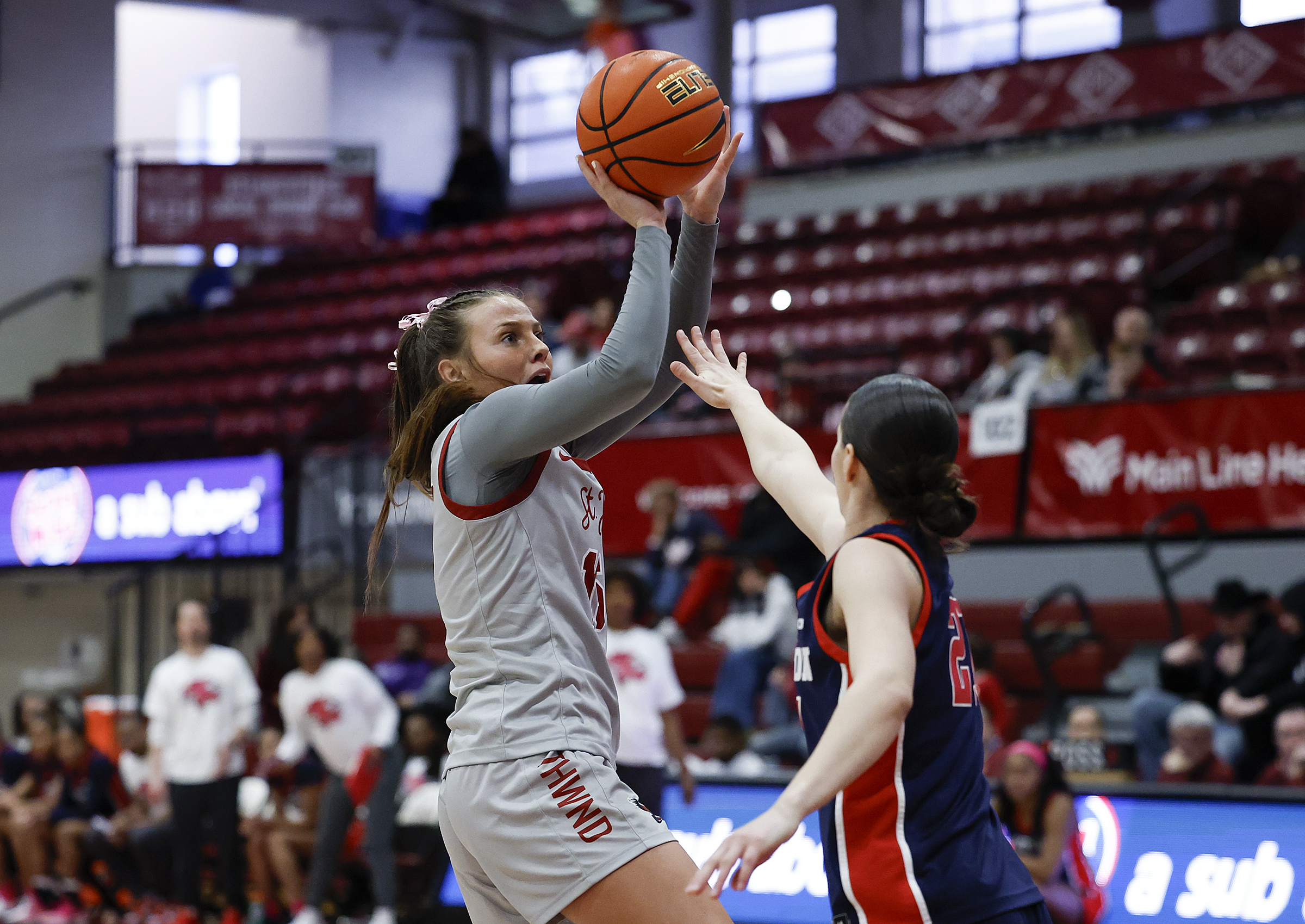
Casey always possessed the ability to score, which was evident from her high school days, and has put it on full display this season. She is averaging 16.0 points, good for third in the A-10, while shooting 48% from the field.
Her favorite way to score is a turnaround jumper, but she also can get to her spots in the midrange for pull-up jumpers. Casey also is a threat from three and leads the team with 62 triples.
However, her on-court impact goes beyond scoring. She is St. Joe’s top rebounder with 6.4 per game, tied for second in assists (3.1), and is first in steals (1.6). When Casey is struggling to score, she still finds ways to help her team compete.
“She’s multidimensional. It’s not just about scoring, it’s how she impacts the game,” Griffin said. “I go back to her freshman year, when we beat Villanova on our home court, and the trajectory of the game changed when Gabby came in and got a couple of steals. It changed the game, and that’s her impact. She’s gritty, tough, and competitive.”
St. Joe’s guard Gabby Casey (left) is averaging 16.3 points this season.
Now, Casey aims to lead St. Joe’s to success in the conference tournament.
“These practices are going to be key to dialing in on the little things that we have to fix throughout the rest of the year,” Casey said. “We have to really focus on the little details that will give us the edge because A-10 play is going to be hard.”
Dave Allen knows how to cultivate a winning culture.
With stops at Eastern and Cherry Hill West, Allen, now in his 13th season as the Cherry Hill East boys’ basketball coach, has amassed 400 career wins at the helm, earning 28 playoff victories and two Group IV championships in the process.
This year’s Cougars look like a direct extension of Allen’s winning ways.
East ended the regular season 21-3, winning seven of its eight Olympic Conference matchups. The Cougars are slated to host Toms River North (9-17, 3-7 Shore) in the first round of the NJSIAA South Jersey Group IV Tournament on Thursday at 4 p.m.
The Cougars are looking to build off last season’s playoff run, in which they fell to Lenape, 48-47, in the Group IV championship — just a point away from raising their third championship banner in program history.
Allen, however, would be the first to say that this year’s team is different.
“Traditionally, we’ve always been a three-point shooting team,” Allen said. “We push in transition but also play some control-tempo basketball, but this year, we’ve been more of a pressing team, more of a team trying to play transition more so than we had in the past. At some points in the year, we were averaging over 70 points a game.”
Cherry Hill East junior Chris Abreu is averaging 16.8 points, 6.3 assists, and 6.1 rebounds this season.
The catalyst for this change, Allen says, has been the team’s “really good guard play.”
This backcourt effort is led by junior Chris Abreu. The 6-foot-1 guard transferred to East after his freshman season at Paul VI and has been a constant triple-double threat. He’s averaging 16.8 points, 6.3 assists, and 6.1 rebounds this season.
“We’re a fast-paced team,” Abreu said. “Push the ball a lot and push it in transition.
“I’m really excited for the playoffs, actually.”
Thursday will mark the second meeting between East and Toms River North this season. On Dec. 20, the Cougars trounced the Mariners, 91-38, behind Abreu’s triple-double (14 points, 11 assists, and 10 rebounds.)
Allen indicated that his team will look to key in on the Mariners’ Jake Greenberg. The sophomore guard is averaging 13.5 points and is known to get hot from deep.
“[Greenfield is] solid,” Allen added. “He was solid against us the first time, and he’s having a good year for them, so we’re going to have to try to keep up what we’re doing defensively.”
‘Reshift some things’
To start the season, Abreu had a running mate in sophomore Jamieson Young. Against the Mariners, Young totaled 23 points. The combo guard was the Cougars’ leading scorer, averaging 21.8 points through the team’s first 12 games.
However, on Jan. 17 against St. Rose, Jameson went to save the ball from going out of bounds, landing awkwardly on his right ankle, which he had previously tweaked in the summer. This time, it required surgery. He was ruled out for the remainder of the season.
“[Young] gave us a lot in terms of his ability on the floor,” Allen said “He was our secondary ball handler and also our leading scorer. … We had to then kind of reshift some things to make up for those 22 points [per game].”
Chris Abreu says East is a “fast-paced team” this season.
First, Allen’s eyes turned to Abreu, challenging the junior to take over the scoring load and “make people better” around him. He did just that, as East won five straight following Young’s injury.
“[The message was] to just stay focused, stay disciplined,” Abreu said. “It’s hard with injuries and us being hurt, but you’ve obviously just got to push through it.”
Allen also turned to senior guard Chris Delgado. The four-year starter scored a career-high 28 points in the Cougars’ first game without Young, while surpassing 1,000 career points in the process.
“The best thing I can say about [Delgado] is that he’s a kid we want our younger players to emulate. That’s it,” Allen said. “He’s a kid who is a program kid who sacrifices. All he wants to do is win.”
This year, Delgado is averaging 11.5 points, 1.5 assists, and 2.25 rebounds, while being tasked to guard the other team’s best player. The senior has seen two deep playoff runs with the Cougars: a Group IV semifinal loss in his freshman year and last year’s final loss.
Cherry Hill East senior Chris Delgado is averaging 11.5 points, 1.5 assists, and 2.25 rebounds this season.
This will be the senior captain’s final chance to earn a championship. Consistent messaging is important for Allen, but winning is not the only thing the coach wants his players to focus on.
“Win or lose, the process is what’s going to be lasting for players,” Allen said. “Even when you win, that’s not what’s lasting. … What happens is, when you win, you change the goalpost — you start thinking about competing again.”
Julius Erving wakes up each morning and begins taking notes to prepare for the day.
It is his way to, in his words, “put my focus on keeping the carrot out in front.
“… and somewhere in there might be that best day [of my life].”
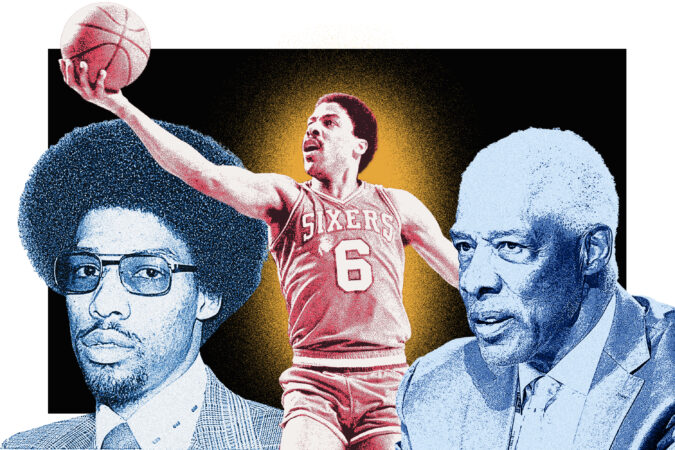
Right now, there is a milestone birthday for “Dr. J” to celebrate. The ultimate 76er turned 76 years old on Sunday. The team recognized such symmetry throughout Thursday’s home loss to the Atlanta Hawks, illustrating the continued connection between Philly and one of its most revered athletes.
“He’s got a lifetime membership here,” Clint Richardson, Erving’s former teammate, said from Xfinity Mobile Arena. “They just continue to acknowledge him. This place is very special to him. I know that.”
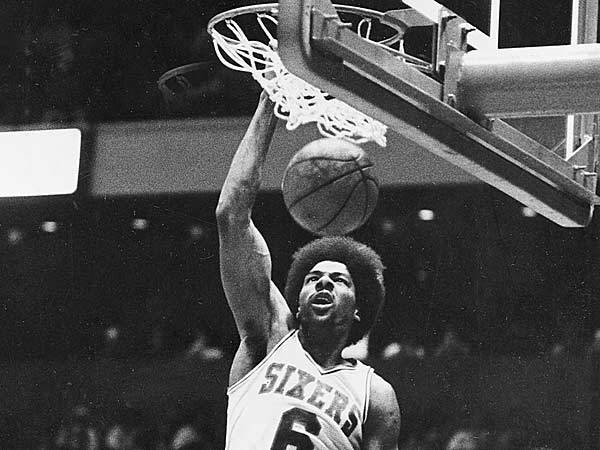
It is obvious why Erving’s transformational, Hall of Fame career remains so beloved in this city, where he spent all 11 of his NBA seasons. The eye-popping athleticism channeled into glorious dunks. The 1981 NBA MVP Award and five first-team All-NBA selections. The hip and classy persona. And, on his fourth trip to the NBA Finals, the 1983 title he finally helped bring to Philly.
Beyond those accolades and highlights, though, Erving and Richardson recalled the pressure and responsibility “Doc” shouldered as the face of the NBA-ABA merger. He also went from being the bona fide leader of the New York Nets to sharing that responsibility with the Sixers alongside Doug Collins and George McGinnis.
“Pat Williams clearly said, ‘I don’t need a guy who can score 30 points a game,’” Erving said of the Sixers general manager who acquired him. “Thirty points wasn’t a big deal for me, the way that I played. … I don’t talk about it a whole lot because you can’t change it. But the journey could have been different. The NBA was different.
“I think I made a big sacrifice when I came to Philadelphia. And it paid off in the end because the seventh year, we won a championship. But I think we could have won it sooner.”
Richardson, whom Erving calls his little brother, idolized him in college. Then becoming teammates, Richardson said, “was kind of mind-blowing.” Off the court, he came to know Erving as the man who lent him a car and welcomed him into his family.
Former Sixers star Julius Erving delivers a slam dunk at the NBA All-Star Game in Milwaukee in 1977.
But road trips with Erving were “like being with Mick Jagger.”
“Traveling with Julius, it was like traveling with the Rolling Stones,” Richardson said. “Every night. Everywhere we went.”
That gravitas holds long into retirement, with everyday folks and celebrities alike.
Erving said he does not mind being approached in the airport for conversations he describes as typically “pleasant” and “joyful.” He still is a compelling media and entertainment subject, with the Prime Video docuseries Soul Power about the ABA, in which he is prominently featured, premiering earlier this month.
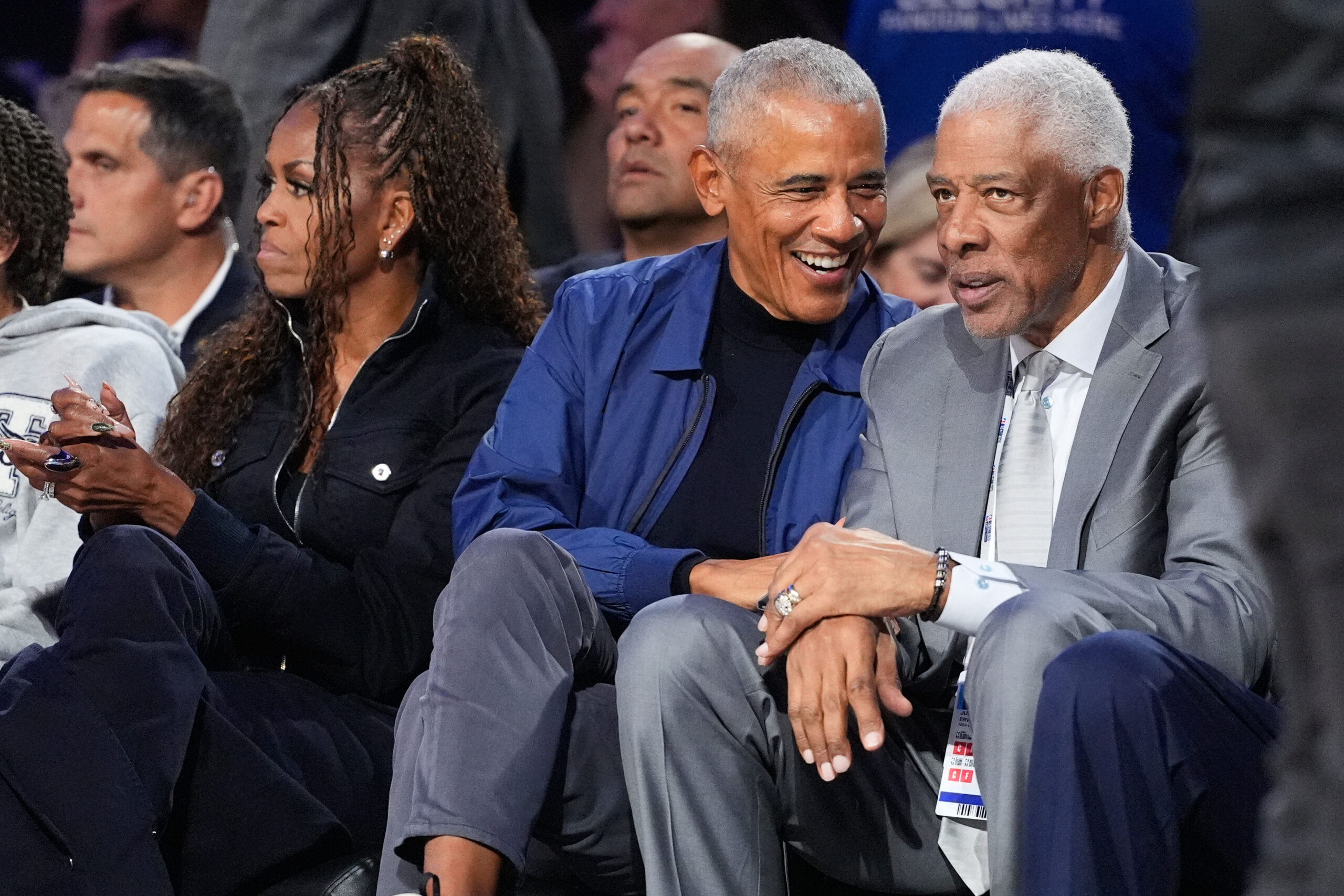
And at last weekend’s NBA All-Star Game in suburban Los Angeles, Erving sat courtside with Barack and Michelle Obama. It was the third time he had met the former president, Erving said, including at a planned White House visit and an impromptu crossing of paths on a Washington golf course.
Barack Obama talks to Julius Erving during the NBA All-Star basketball game on Feb. 15.
“He told me about growing up in Hawaii and admiring my style of basketball,” Erving said. “The things that I brought to the game. That I was a contributor, not a taker. And that helped to inspire him because he was still in high school.
“It was quite a thing to hear from someone who is as accomplished as he is and loved and admired as he is.”
Erving’s public life still regularly brings him to Sixers home games. He said his palms no longer begin sweating when a matchup gets tight and that he can now view the action as more of an outside critic. Though he calls interactions with the current iteration of the Sixers “sporadic,” he has formed a friendship with coach Nick Nurse and has participated in some of the coach’s foundation events in his home state of Iowa.
“He’s a super gracious person,” Nurse said.
And Erving’s nonbasketball life? He said that is “on the rebound.”
“I’m happy about that,” Erving said. “And deserving.”
He publicly shared some of the more vulnerable experiences — including his infidelity and the accidental drowning of his son, Cory — in his 2013 autobiography he said was written to be passed along to future generations of family. There are other private moments that Richardson knows about Erving that he said he will “go to my grave with. I don’t even share with my family.”
“I sense him being a little bit more guarded,” Richardson said. “When I see him doing that, that lets me know that I need to be a little bit more guarded, too.”
Last year, Erving had a “big” party in Fort Lauderdale, Fla., for his 75th birthday, the more commonly celebrated milestone. This year, he wanted to keep the hoopla a bit quieter. But he understands this age’s endearing parallel with his NBA franchise.
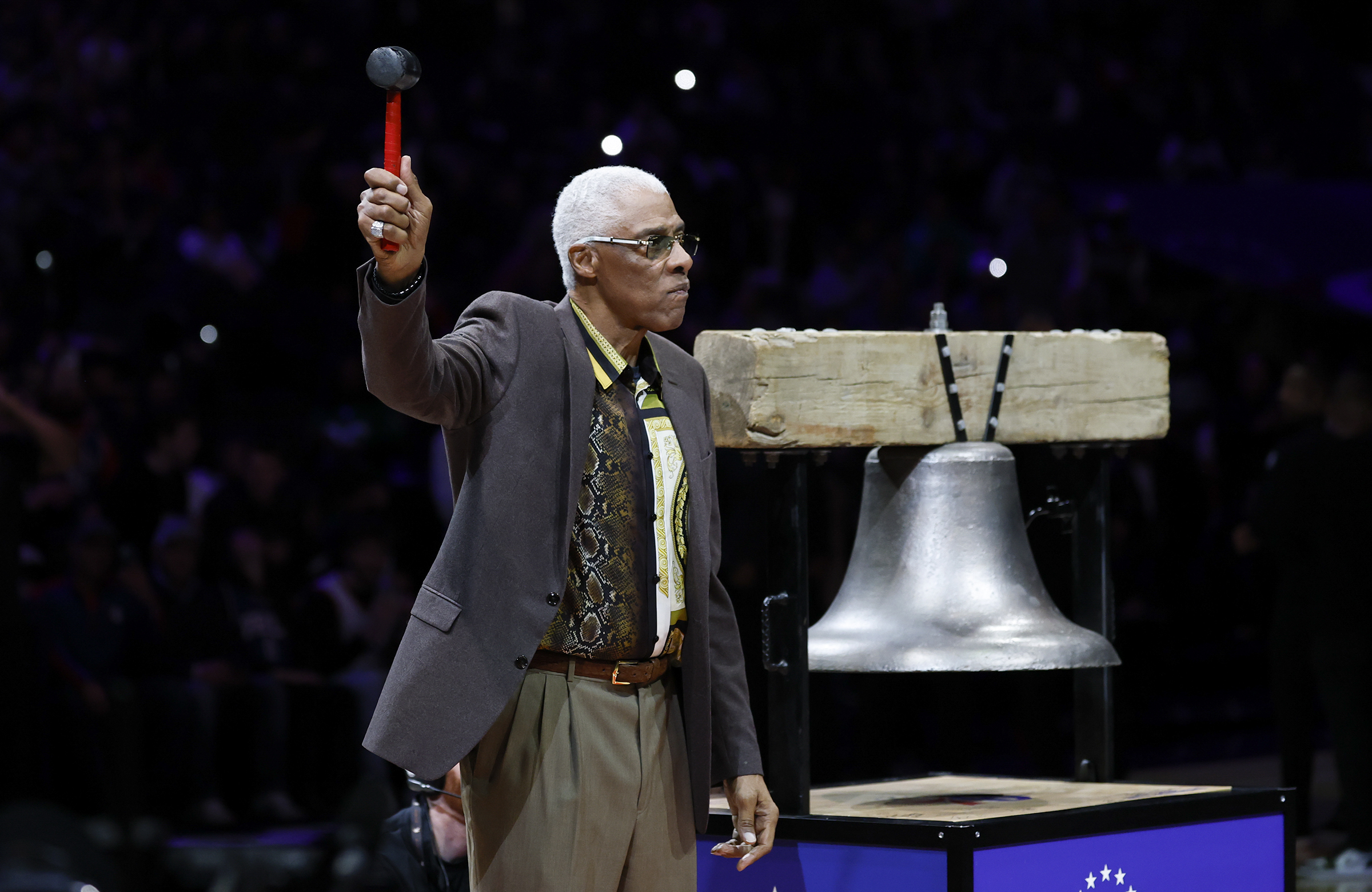
Former Sixers Julius Erving waves to fans before ringing the ceremonial liberty bell before the Sixers play the Atlanta Hawks on Thursday.
So he rang the bell before Thursday’s game and received a custom portrait during a first-half timeout. Later, he was up in a suite with a cake with candles shaped like the number 76, before the home crowd was encouraged to sing along to “Happy Birthday.”
Yet about an hour before those festivities began, Erving dipped into a quiet, back-of-house room. He held a notebook while reminiscing about his legendary career with the Sixers and this stage of his life.
That is where he can keep writing each morning, while looking forward to 76 and beyond.
“I want to put my focus on keeping the carrot out in front,” Erving said, “and tomorrow being the best day of my life.”
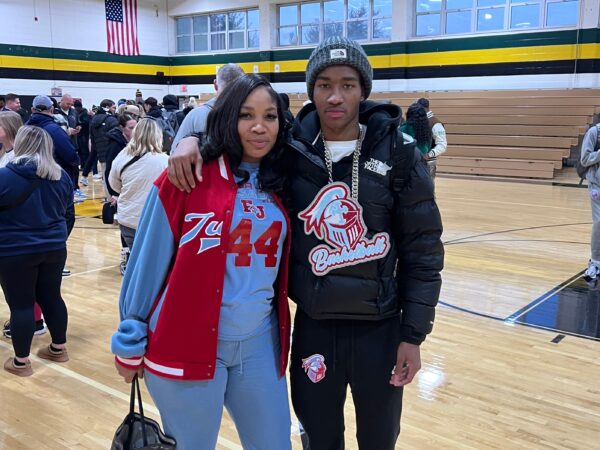
Ashley Morton stopped posting the hours on the door of her Mayfair boutique. There’s no point, she said. It’s impossible for the business owner to hold consistent opening times when her son is one of Philadelphia’s best high school basketball players. There always seems to be a game or tournament for the mom to attend.
“My customers say, ‘Is the store going to be open?’ I say, ‘Sorry, we got a game’,” Morton said. “So we just do pickups now. People can order online and schedule a pickup. It just became too much.”
That’s the price you pay when your son — Father Judge’s Derrick Morton-Rivera — is a win away from a second straight Catholic League boys’ basketball title.
“I’m just going to wait until everything is completely finished,” Morton said. “Then we’ll open back up.”
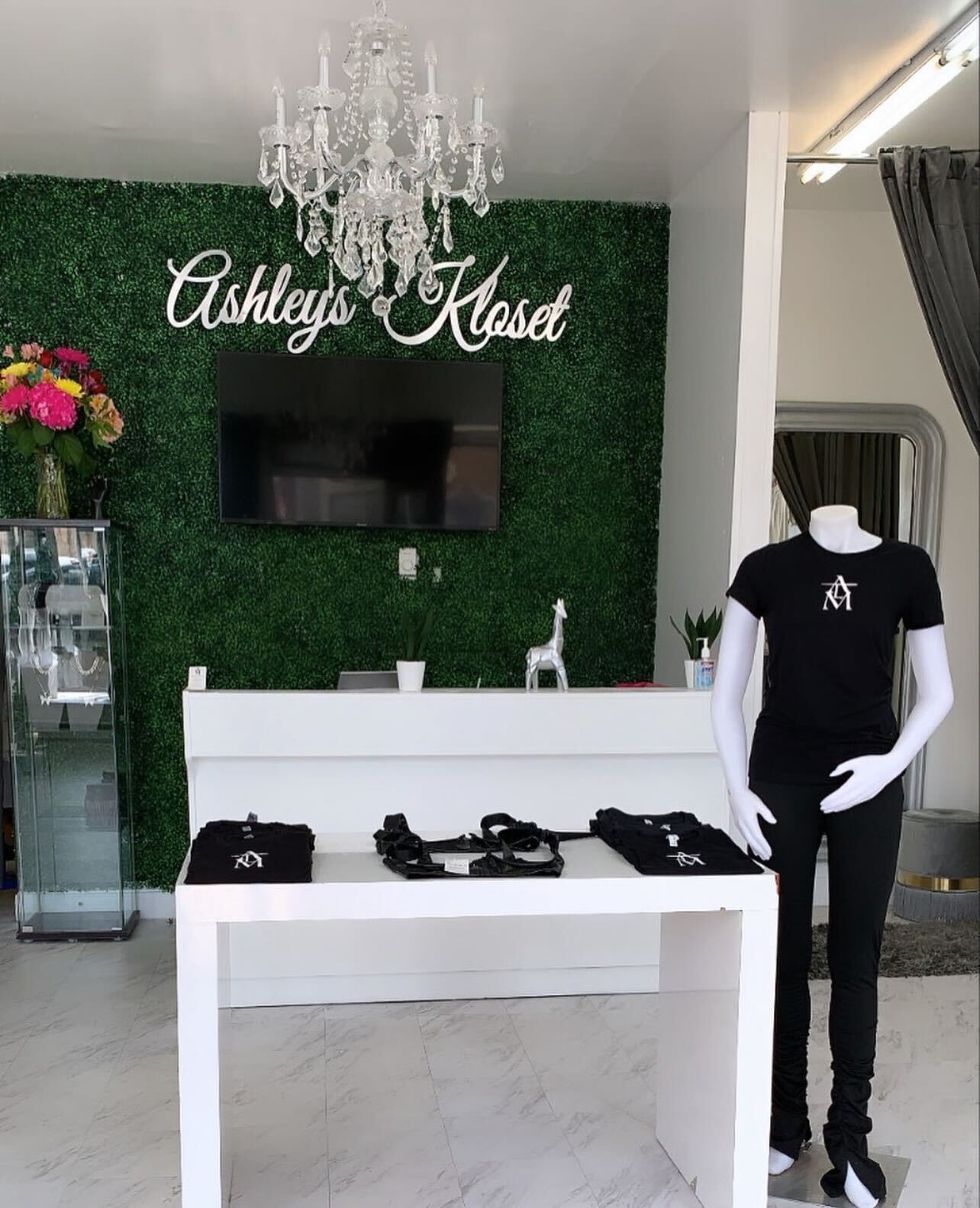
The mom opened Ashley’s Kloset 12 years ago after a dress she made with a Wal-Mart sewing machine and a $2 piece of fabric from Jo-Mar received attention on social media. Morton was self taught — “I went on a wing and a prayer,” she said — and figured it out. She had enough of her job at a men’s suit store and decided to do her own thing. So her mom helped her launch the business in Olney before it moved to Mayfair.
“My mom said, ‘We’re going to get you a store,’” Morton said. “Mind you, I don’t have any money. My mom doesn’t have any money. I’m like, ‘How are we going to get a store?’ Don’t you know she came up with that money and found me a store.”
She put a basketball net in the back of her store for her son, who seemed destined to be a hooper ever since he dribbled a ball when he was just 10 months old.
Derrick Morton-Rivera and his mother, Ashley, after his first ever basketball game.
“My mom dropped the spaghetti,” Morton said. “She was cooking ground beef and she was like, ‘Oh my god.’ He was bouncing the ball before he could even walk. You know how they have that little wobble? The ball was bouncing while he was off and then once it stopped bouncing, he fell.”
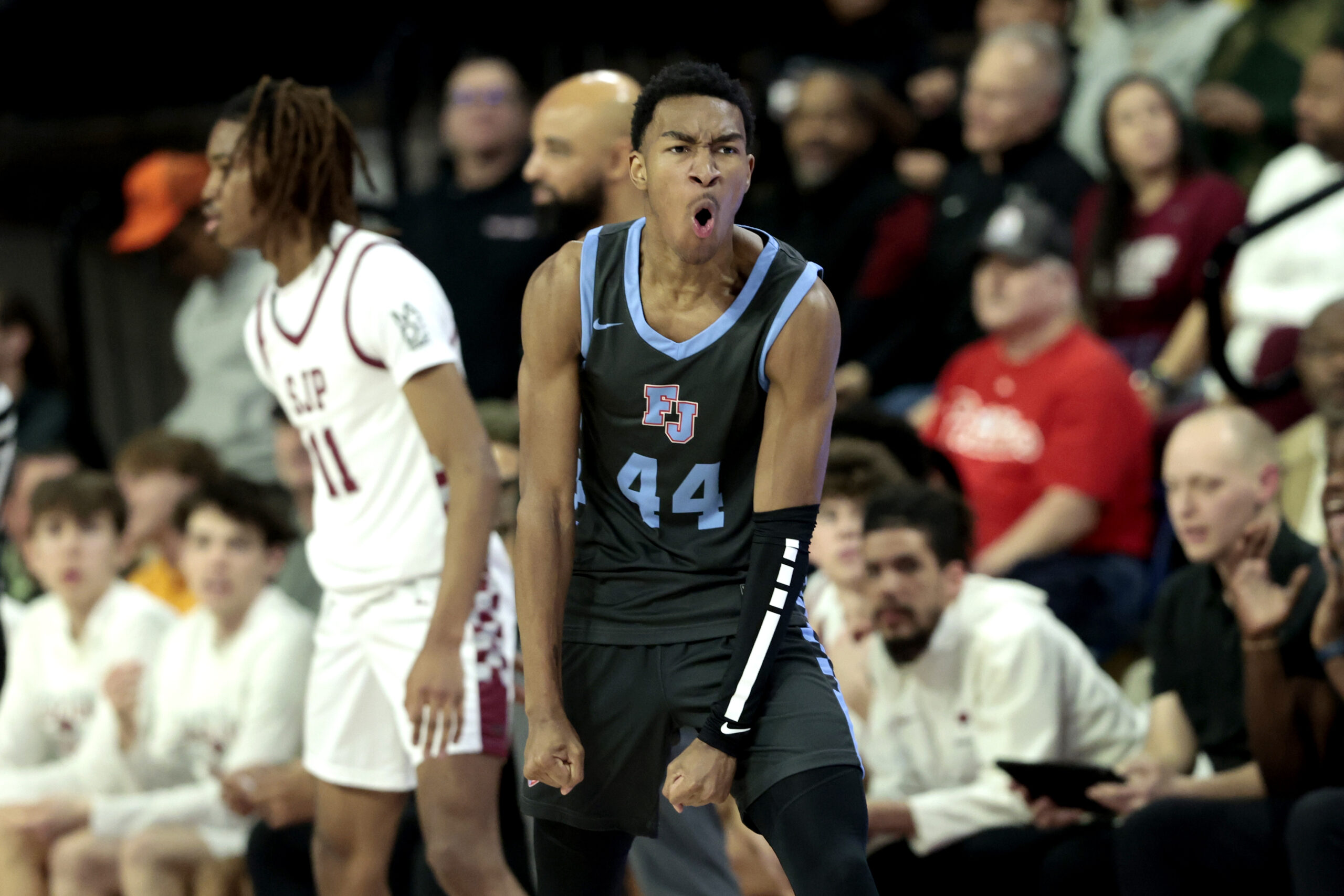
The son is signed to play at Temple and showed why on Wednesday night when he willed Judge back from an early 16-point deficit against Archbishop Wood in the semifinals. He scored 27 points and had the 9,000 fans at the Palestra in the palm of his hand.
Morton was not trying to shape a basketball player when she opened her store. But she did show her son everyday the hard work that comes with chasing a dream. Perhaps that prepared him to chase his own.
“My mom is always working,” said Morton-Rivera. “The only time she really takes off is to see me play. Knowing how hard she works, makes me work even harder.”
Derrick Morton-Rivera, who will try Sunday to win a second straight Catholic League title, is signed to play at Temple.
The Potato State
Customers asked Morton about her shop’s hours in the summer and she said she had to first check the AAU schedule.
“I don’t have a schedule,” she said. “I just have his. This is going to be the first summer without it. I don’t know what I’m going to do with myself.”
She traveled with her son to basketball tournaments throughout the country, crossing off states she never dreamed of visiting.
“What’s the Potato State? Idaho,” she said. “It was the most boring place ever. Even their downtown was a ghost town. But we can say we’ve been to Idaho, you know what I mean?”
Morton poured everything into her son, even the hours of her own shop. She had help, too. If Morton works late, her mother stops by to cook dinner and do the laundry.
“She even washes my clothes,” Morton said as it took a village to raise a basketball star.
Morton designs and sews all of her own women’s clothing in the ALM Collection, specializing in plus sizes and fashion for taller women. She does enough online orders — the shop ships around the world, she said — that she can close the doors to watch basketball.
Something that started on a whim has grown into a full-time operation. The mom willed her dream into existence.
“I remember one time he was like, ‘Mom, all you do is work.’ And I started crying,” Morton said. “Because he doesn’t know what I’m working for. Every time he turned the light on, the light came on. Anything he asked for, I was able to provide. He’s like, ‘Alls I see is the back of your head because you’re just sewing all the time.’ I said, ‘Mir, you have to understand.’ Now, I think he gets it.”
Derrick Morton-Rivera’s mom owns a boutique in Mayfair, Ashley’s Kloset.
‘Mom, just calm down’
The crowd at the Palestra roared as Judge mounted its comeback on Wednesday. And the fans will be even louder on Sunday when Judge plays Neumann Goretti. But Morton-Rivera, whose father, D.J. Rivera, won a Catholic League title at Neumann Goretti, plays like he can’t hear anything. He handles the frenzy of a sold-out arena the same way he does when Chick-fil-A forgets his sauce.
“I’m like, ‘They forgot the sauce,’” Morton said. “And he’s like, ‘Mom, just calm down. Relax. Ask her for it.’ He calms me down. He inspires me to have patience, be humble, and just breathe.”
The kid who watched his mom spend hours behind the sewing machine seems just as fixated on the basketball court. He followed his dad to gyms as a kid and always found time to work on his shot.
Judge’s coaches organized a practice Friday afternoon but that wasn’t enough for Morton-Rivera, who stayed in the gym with a few teammates for another 90 minutes. Like mom, he’s always working.
“It’s just about ‘How bad do you want it?,’” he said. “We have a lot of guys on our team who want it. Even if they’re tired, they’ll stay after practice to get their shots up. Those are the little things that show when the game starts.”
His mom signed him up to play when he was 3 years old as he was tall enough to play with the 6-year-old kids at the Lawncrest Rec Center. They told the parents to make sure their kids came with a drink. So Morton sent her son with a Capri Sun pouch.
The mom figured it out. It was the start of her son’s basketball journey, one that felt so rapid as he started to dunk as a teenager and played in the Potato State. And now he has a residency at The Palestra with a college scholarship secured.
“My sister was like, ‘Ash, that’s really your son,’” Morton said. “And I say, ‘Yes, it is.’ It’s just been so amazing. I’m so proud of him.”
Judge’s basketball season could extend another month if it marches deep into the state playoffs. Until it’s finished, Morton’s business will be online only.
“I’m getting my inventory ready to be fully stocked,” Morton said.
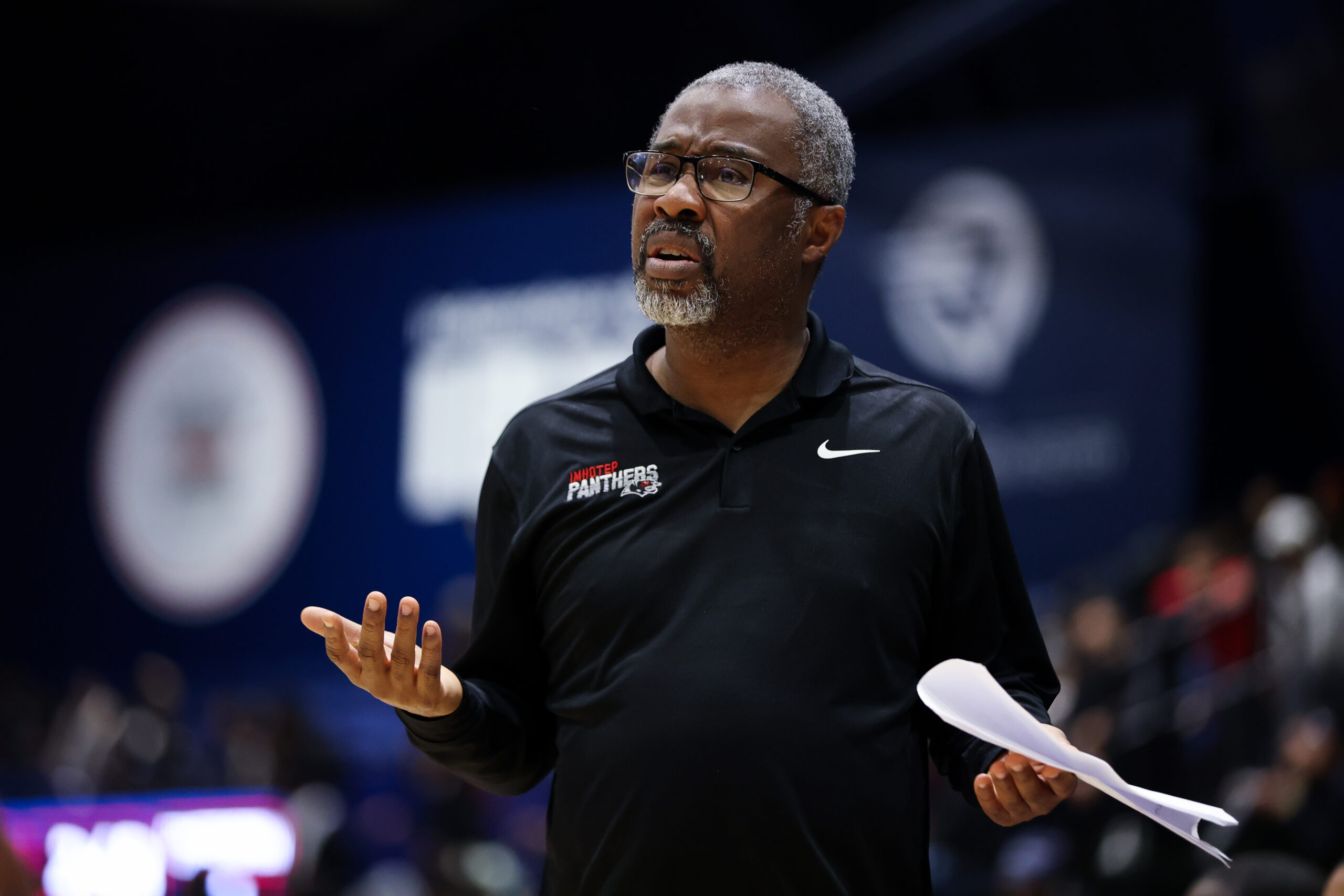
The Imhotep Charter boys’ basketball team was in Boston a few years ago for a tournament when Andre Noble told his players that they were in his hometown.
“I said, ‘Wait. What?’” said Ebony Twiggs, whose son, Justin Edwards, was one of Imhotep’s stars. “I just thought he always lived here. I didn’t know he wasn’t from Philly.”
Noble reminded Twiggs of the people she knew from West Oak Lane. He had been at Imhotep for more than 20 years. And he was one of the city’s premier high school basketball coaches. He fit in. Of course he was from Philadelphia.
Noble, who can win a sixth straight Public League title and 13th overall on Sunday when Imhotep plays West Philly High, is one of Philly’s all-time coaches.
Unlike the rest, Noble didn’t spend his teenage summers playing at places like Chew, Tustin, and Myers. He didn’t win CYO titles, ride the trolley to watch doubleheaders at the Palestra, or find himself within six degrees of separation from someone who played on the 1954 La Salle basketball team.
Philadelphia has produced great players, coaches, and even referees. And the high school coaches, especially the ones who have won at the rate Noble has, often grew up here. They played for the city high schools, perhaps even stayed for college, and remained a tight-knit crew who stayed home to teach the game.
Speedy Morris still lives in Roxborough, Dan Dougherty was from Olney, Bill Ellerbee grew up on Uber Street, and Carl Arrigale is as South Philly as slowly driving past a stop sign. The guys on the Mt. Rushmore of Philadelphia high school coaches are from the neighborhood who coached kids like them.
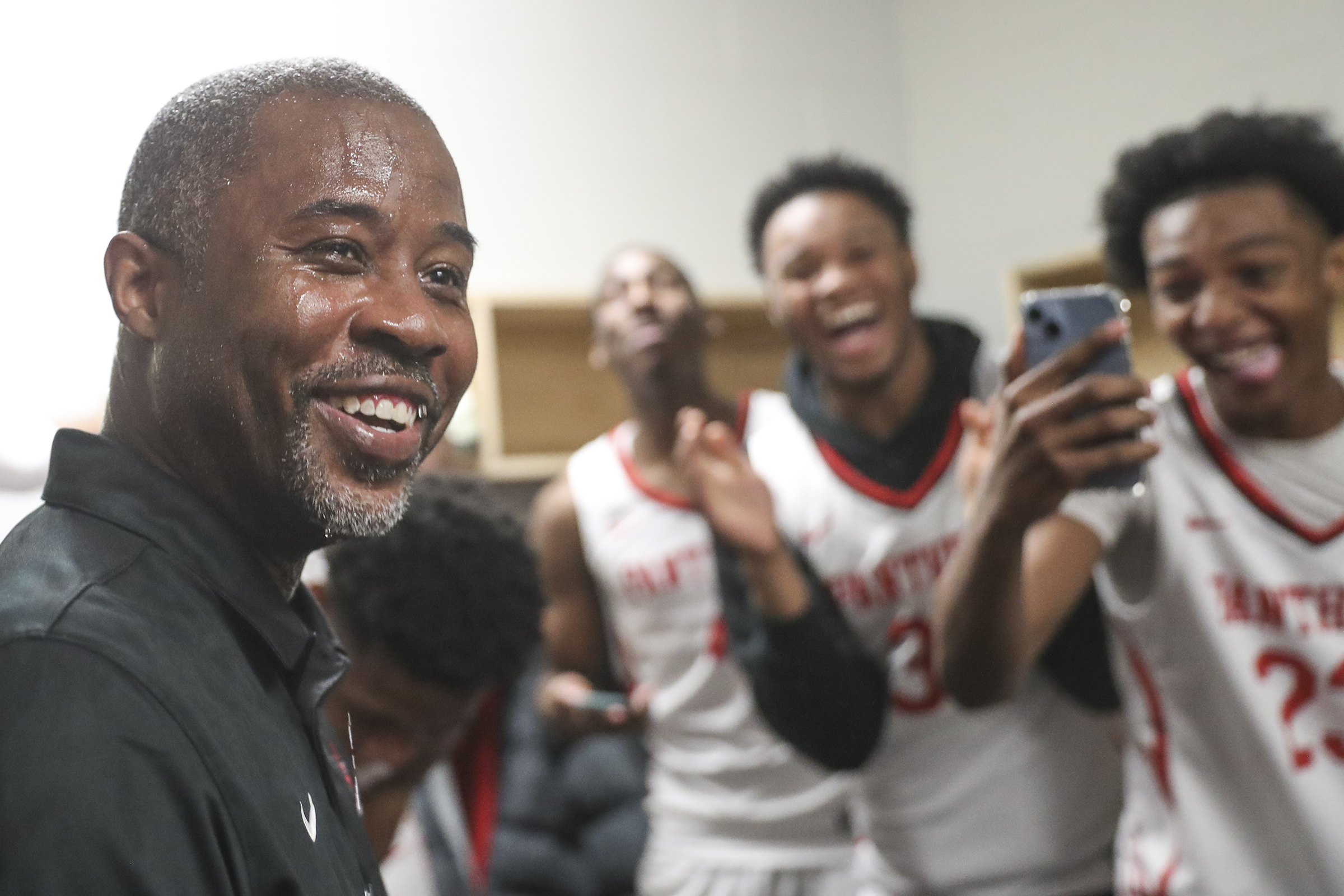
Andre Noble has been at Imhotep for 20 years, but his hometown is Boston.
But Noble grew up in Boston’s Mattapan neighborhood and didn’t even play high school ball. He came to Philadelphia in 2000 after graduating from Lincoln University and taught math at Imhotep, which did not yet have an athletic program.
Noble planned to stay in Philly for a year before moving on. His plans changed, he stayed, and Imhotep became a basketball powerhouse.
The guy from Boston did what seemingly has never been done: become a great Philly high school coach as an outsider.
“I think by the time everyone figured out I wasn’t from Philly, it was too late,” Noble said. “The ball was already rolling down the hill. But I’m definitely a Philly basketball guy. It’s important to me.”
A special guy
Imhotep didn’t have a basketball team when Noble arrived. The school didn’t even have a building.
“We called them modulars, but everyone else said, ‘Yo, that’s the trailer school,’” said Noble, who is now the school’s CEO.
Two students in his algebra class — Briscoe Chew and Marlon Mills — told Noble at the end of the school year that they were transferring. Noble was stunned. Why? Imhotep doesn’t have sports, they told him. So Noble launched a basketball team and kick-started a league with the city’s other charter schools.
Noble didn’t have a playing background to lean on, so he picked the brains of coaches in the area. Rap Curry, Greg Dennis, and Clyde Jones became his mentors. He was on his way. His plan to leave Philly after a year was spoiled, so he began to scour the city for players. He watched games at youth programs in North Philadelphia and hung at playgrounds, hoping he could fill a roster at Imhotep.
“I knew he was from Boston, but then I started seeing him at 25th and Diamond or 33rd and Diamond,” said Kamal Yard, who runs Philly Pride, one of the city’s premier AAU programs. “I’m like, ‘Bro, what are you doing down here? Do you know where you’re at?’ But he was in the mix. He was in the hood. He was in the projects. Nobody goes to the back of the projects at 25th and Diamond, but he did it. He was meeting the kids. That was his intro to Philly, and he was onto something. He got immersed into it.”
Yard met Noble years earlier when they were both students at Lincoln. Yard played ball and Noble watched from the stands. The future coach was studying, Yard said. When students complained about the food in the cafeteria, Noble led the charge as a member of the student government. He led a boycott, filed a petition, called the state, and ordered a review.
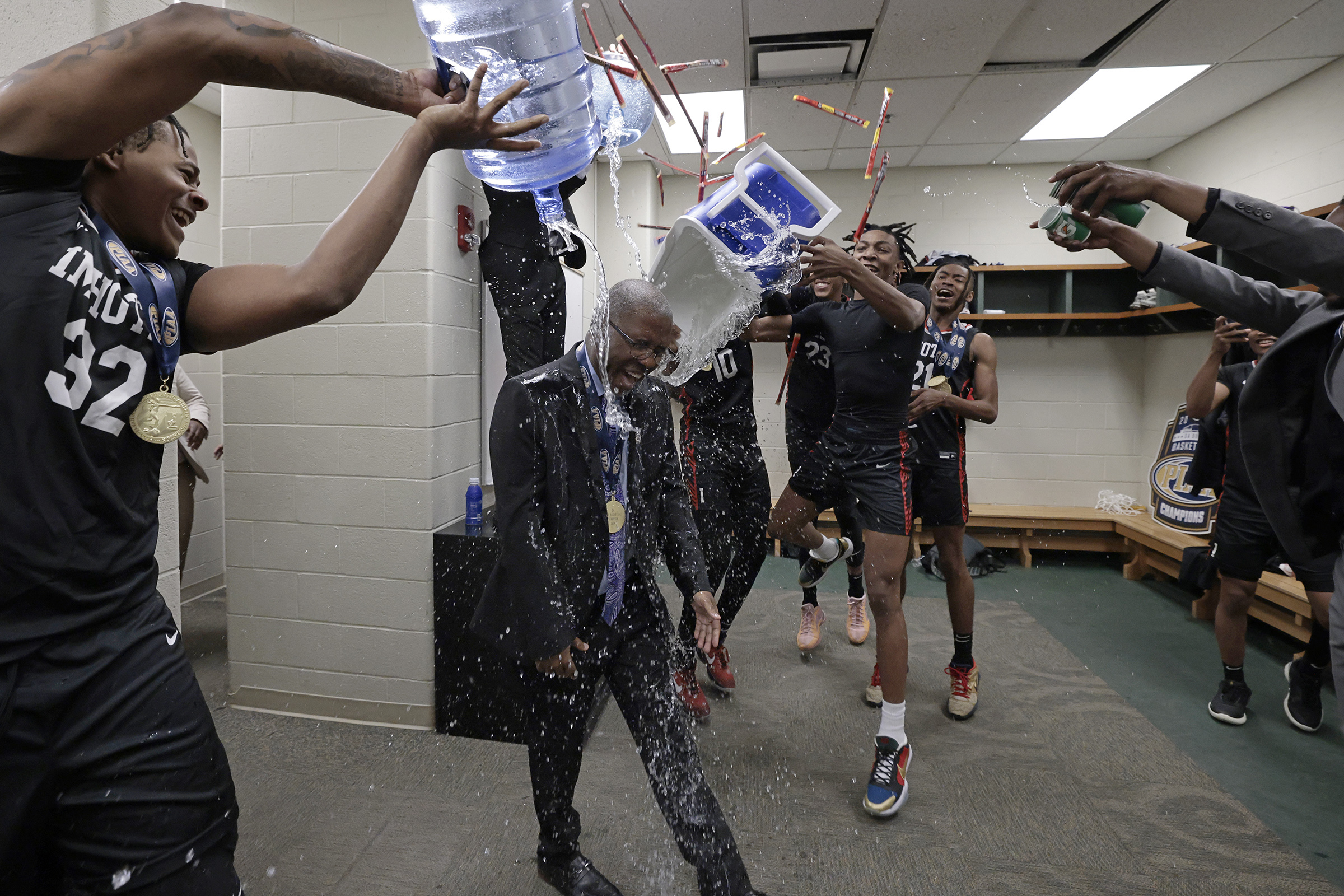
Imhotep players soak head coach Andre Noble after winning PIAA Class 5A boys basketball championship in 2024.
“You blinked and, man, we had a whole new menu,” Yard said. “But the whole point was that he was always about other people. So watching this transition, it’s no surprise. He’s a giver of people. He doesn’t look like a tough guy because he’s mild-mannered, but there’s a lot of toughness and resiliency in that frame. He’s as tough as they come.
“Brother Andre will go into the lion den with a tiki torch and a sword to go help a kid. He might come out scratched up, but he helped his kid. That’s Brother Andre.”
The Panthers, waiting for their gym to be built, practiced at a nearby recreation center and a middle school. It wasn’t ideal, but it worked. Imhotep won the Charter School league before moving in 2004 to the Public League. Five years later, Noble’s team won it all.
The Boston guy had built one of Philly’s finest teams.
“He’s a special guy,” said Fran Dunphy, the quintessential Philly coach. “The biggest asset he brings is just his genuine goodness. He treats the kids well, but there’s no question that he has an accountability for them and needs them to pay attention. They all seem to buy in. He’s remarkable for me.”
A teacher
Noble was a junior in college when he thought about how he was the only kid he grew up with preparing to get a degree. He wondered, how did that happen? And then he thought about his mom, a single parent who worked as an office manager and raised her sons — “Two knuckleheads,” Noble said — in a tough neighborhood.
“I called her and thanked her,” Noble said. “I knew it was that little lady who I thought was crazy but provided the foundation. She was a stickler, a disciplinarian. It was her way or the highway, ‘Hey, this is what you’re doing.’”
It was a big deal when Noble secured admission to the Boston Latin School, a prestigious school near Fenway Park. But his mother asked him to think about it before she sent in his paperwork. She asked her son, would he take his studies seriously? Would he be ready to work hard? Can he commit himself? Noble said he would.
Years later, he found out that his mom already had sent in the paperwork. But Della Noble wanted her son to feel a sense of ownership in his decision. She believed her son could do it. And now Noble empowers and supports the kids at Imhotep the same way his mom did. If a kid on his team wants to visit a college, Noble often is driving the car. If a kid has a problem in school, Noble’s door is open.
Imhotep’s Andre Noble (left) shown with Justin Edwards during the 2023 Public League championship game against West Philly. Edwards now plays for the Sixers.
“You realize that there’s way more important things in life,” Noble said. “If we can get them to be the best young men we can be, then the rest of their lives will be meaningful. There’s so many things you can teach through basketball.”
Becoming one of Philly’s all-time coaches is about more than just breaking a press or drawing up an inbounds play with seconds left. Noble proved that an outsider can do it, too.
“There’s a trust that he has with his players that we all try to search for in relationships with the kids,” Dunphy said. “I think he’s found that secret. To be honest with you, I don’t know if I ever sat down with him and said, ‘Yo, what is your secret?’ I think he would be so humble, and he’d say, ‘I don’t know. I’m just being myself.’ It’s what makes mentorship so important to all of us. You have to be there for the young people.”
Noble has surrounded himself with a crew of assistant coaches who grew up in Philly. He has embraced the city’s basketball history and has now spent more time here than he did in Boston. He’s an adopted Philly guy.
Charles “Shoob” Monroe, who organizes an annual showcase game for the city’s top high schoolers, said Noble knows more about old-school Philly basketball than people who actually lived here. No, he’s not from Philly. But Noble became a part of it.
“Someone always knows someone or knows someone who knows someone,” said Arrigale, who could win his 13th Catholic League title on Sunday when his Neumann Goretti squad plays Father Judge. “He didn’t really have that experience because no one played against him and things like that. But he’s been around long enough that he knows everyone now. He’s had a pretty good run over there.”
A father figure
Twiggs’ son now plays for the Sixers but once was a teenager who didn’t clean his room or finish his homework. And when that happened, Twiggs knew to call the guy from Boston.
“Justin would come home and be like, ‘You told on me,’” Twiggs said.
Twiggs, a single mother who worked two jobs to keep her son’s dream alive, said Noble was like “a father figure” to her son. He wasn’t from Philly but that was OK.
“Justin lacked that growing up,” Twiggs said of a male role model. “Having Brother Andre and the whole coaching staff just be so hands on with Justin took a lot of stress off for me.”
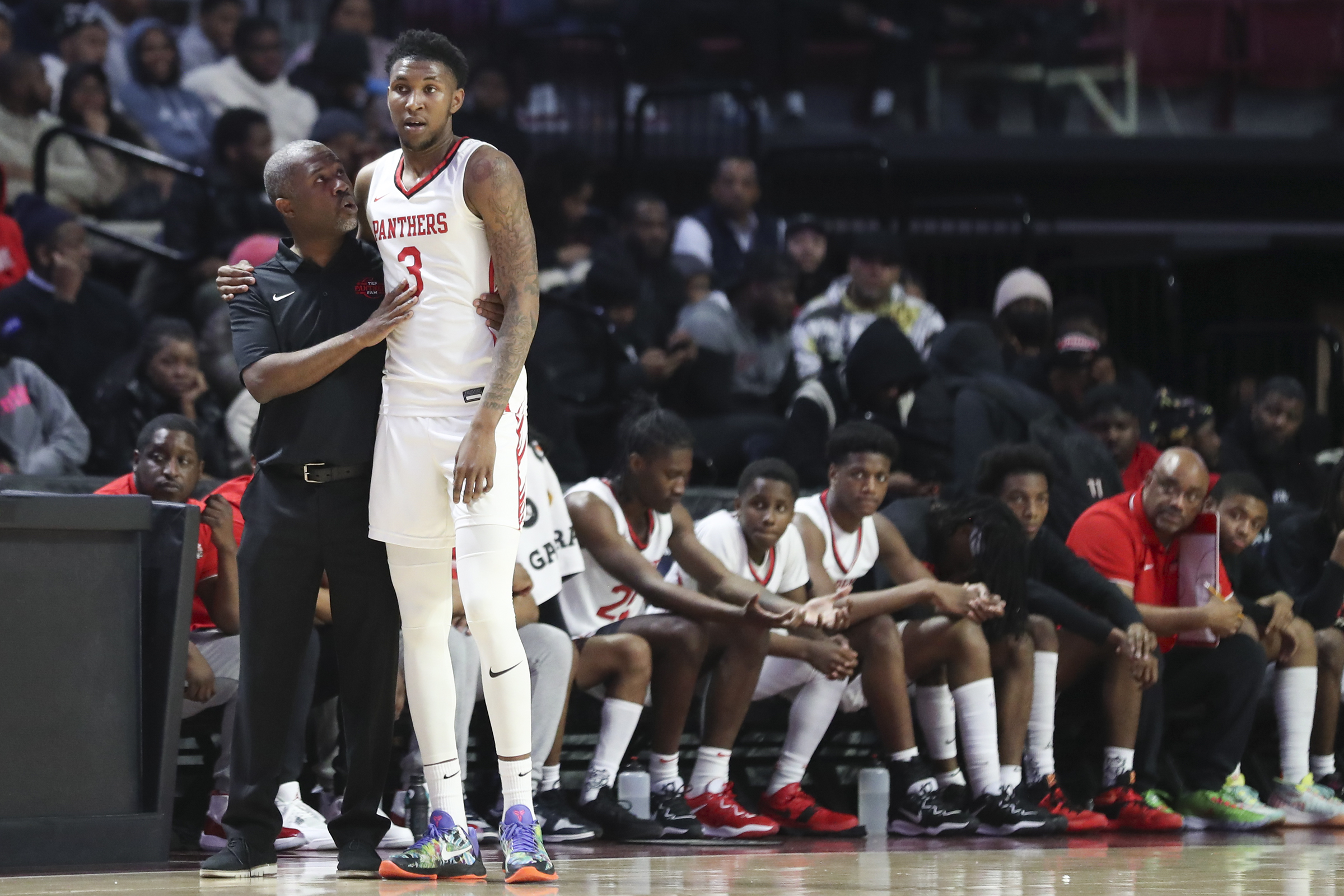
Andre Noble has enough accolades to coach in college. He’s instead decided to stay at Imhotep.
Edwards is one of the many players Noble coached who moved onto a Division I program. By now, the coach who didn’t play high school ball has enough accolades to coach in college. He’s instead decided to stay at Imhotep.
A few years ago, Mills’ son, Timmy, graduated from Imhotep. He brought his son to see Noble and tell the story about how two students triggered Noble to start a team. It was true, Noble said. And that helped the guy from Boston find a home in Philly.
“I love what I get to do,” Noble said. “I love the school. I love serving this community. I don’t see myself anywhere else. I don’t rule anything out, but if I have the opportunity to coach and lead at Imhotep until the rest of my career, that would be a blessing. The one-year plan definitely didn’t work out. I failed in that.”
The NCAA Tournament is coming to Philadelphia for one of its eight opening-weekend sites, and Villanova made sure to plan for the occasion.
The Wildcats hosted four games at Xfinity Mobile Arena last season but scheduled only two home games there this season — the second of which is Saturday evening vs. No. 5 Connecticut. NCAA rules prohibit a team from playing tournament games in a venue where they host more than three home games, and the lowest seeds typically are rewarded geographically with first- and second-round locations.
It was rather ambitious planning for Villanova, given that the Wildcats had a new coach and a new roster and hadn’t made the NCAA Tournament since 2022. And it remains lofty even now, after a six-game winning streak has Villanova at 21-5 overall and 12-3 in the Big East. The Wildcats are almost guaranteed to snap that tournament drought, but they remain unlikely to get to a seeding that would reward them with some home cooking in the first and second rounds.
“There is a path,” ESPN bracket master Joe Lunardi said Thursday when asked if Villanova could get as high as the No. 4 line, but when asked how realistic it was, Lunardi said “minimally.”
Lunardi spoke via phone from an interesting location, given the subject of the conversation. He was in Indianapolis, where a mock NCAA Tournament selection exercise with media members was taking place. In his own bracket projection, Lunardi had Villanova 25th as of Thursday morning, otherwise known as the top seventh seed on his big board. The Wildcats were 28th, the lowest possible seventh seed, and slotted in Buffalo to face 10th-seeded Auburn in the first round when the mock committee went through its process Thursday, 24 days from Selection Sunday.
The mock committee ranked the top 20 seeds and placed the last four at-large teams into the field, but it used computers to seed most of the rest of the bracket. Of note, those computer models had Temple, which is tied for sixth in the American Conference, winning its conference tournament and getting into the field.
Back to Villanova and to Lunardi’s bracket … not much has changed since Jan. 28, when we last caught up with him to assess the Wildcats’ tournament path. They were a No. 7 seed then, and while they moved up a few spots on the seeding line, they’re a No. 7 seed as of Friday even after reeling off six consecutive wins following their overtime road loss to UConn on Jan. 24.
Similarly, Villanova was 34th in the NCAA’s NET rankings on Jan. 28 and 29th on Friday. And at KenPom, the Wildcats were 27th on Jan. 28 and 27th on Friday. That is life in the 2025-26 Big East. Six wins in a row doesn’t move the metrics much.
Kevin Willard has Villanova in line for an NCAA Tournament bid in his first season on the Main Line.
“They’re certainly looking the part,” Lunardi said. “The problem is, the dirty little secret, the league standing is flat if not declining.”
The mock bracket on Thursday had just three Big East teams in the field of 68: UConn, St. John’s, and Villanova.
Villanova has just three Quad 1 wins to date: Wisconsin, the road win at Seton Hall, and last Saturday’s road win at Creighton. That game was a Quad 2 game until Creighton knocked off UConn on Wednesday and moved back into the top 75 of the NET rankings. It could slip back into Quad 2 territory if Creighton moves back in the rankings. As it stands, the Wildcats have just two more chances at Quad 1 victories in the regular season: Saturday vs. UConn and next Saturday at St. John’s.
Why are those opportunities important? As of Thursday morning, the top 21 teams in the NET rankings all had four or more Quad 1 wins. NET standings don’t necessarily translate to tournament seeds, but it’s hard to imagine Villanova climbing high enough in any tournament bracket without adding another regular-season Quad 1 win and another one or two en route to cutting the nets down at Madison Square Garden after winning the conference tournament.
What the winning streak has done, though, is shift the floor a little bit. As of three weeks ago, getting a No. 9 or 10 seed in the NCAA Tournament seemed just as likely as a No. 6 seed. Now, a No. 6 seems much more likely than a No. 10.
“Six is a great spot because you should win your first game, and it’s not too heavy of a lift in the second game,” Lunardi said. “And you avoid the one [seed].”
“They’re going to wear white,” he said later, implying that Villanova seems like it’s on a path to be, at worst, a No. 8 seed and be the de facto “home” team in its first-round game.
Home just probably won’t be South Philly. How does a mid-March trip to Buffalo sound?
For the 14th year in a row, Imhotep Charter is headed back to the Public League championship. In Thursday’s semifinal, the Panthers eked out a 52-45 win against Central at La Salle’s John Glaser Arena. Imhotep led for the entire game, but Central kept it close until the final whistle. Taylor Linton’s team-high 17 points lifted the Panthers back to the final.
“Out of all the teams throughout Imhotep history that have contributed to the streak, the commonality between all of those teams is that everybody is pushing,” said Imhotep coach David Hargrove. “Pushing to be better — number one. But then, pushing to be better teammates — number two. That allows us to keep that standard of competitiveness and championship-quality basketball.”
Late in the fourth quarter, down by six, Central sophomore guard Ava Yancey stole the ball and passed to junior point guard Stevie Hall, who was fouled and sent to the line. She made both free throws.
But Imhotep kept on pushing.
Panthers junior guard McKenna Alston responded with a lay-in of her own to quiet Central’s fans. Alston then stole the ball on the next two Lancers possessions to swing the momentum back to the Panthers.
“We challenge our kids about making connecting plays. A lot of people think that’s [just on offense]. But for us … it’s on defense too,” Hargrove said. “We were able to put pressure to the ball, be in passing lanes, and be active.”
Linton added: “[The end] was very intense. I think what was important is that we kept our poise … and we stayed connected.”
Imhotep senior point guard Anai Kenyatta controlled the pace for the Panthers. Whenever the Lancers gained momentum, Kenyatta answered the call, finishing with 13 points. Senior forward Crystal Hawthorne added 11.
For Central, sophomore forward Janai Bellinger led with a game-high 18 points. After Imhotep took a quick nine-point lead behind a 7-2 run to start the second half, Bellinger kept her team within striking distance until the final whistle.
Audenried trounced Lincoln 67-28 earlier Thursday, meaning Imhotep will meet Audenried in the Public League championship for the fourth year in a row on Sunday. The Panthers lost to the Shayla Smith-led Rockets in the championship the past three matchups. With Smith now at Penn State, Sunday’s results could look different from previous years.
“Sunday’s matchup — we anticipate it to be a classic. It’s what has become an Imhotep-Audenried matchup, which is always going to be a back-and-forth, competitive game,” said Hargrove. “Some players are going to step up, some might step down, but it’s going to be a competitive game, and our kids have really been building for this moment all season.”
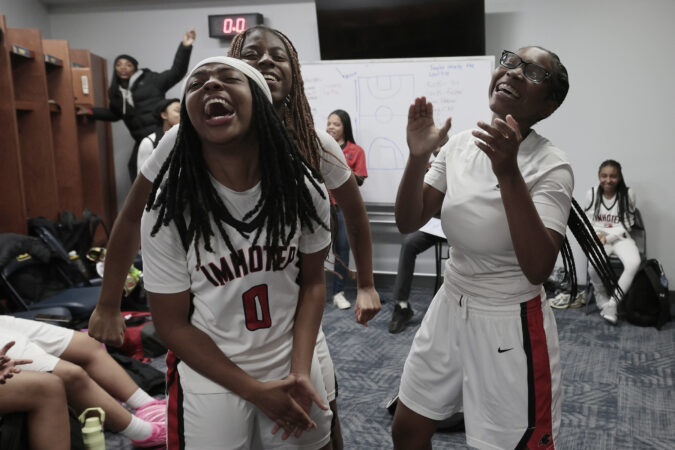
Before Imhotep prepares for Audenried, the Panthers celebrated in the locker room after Thursday’s win.
“It was quiet at first when we all walked in because it was like, ‘Dang,’” Linton said. “And then the coaches started coming in, and it was like, ‘OK, we going to the chip.’ It was real. Everybody was cheering and everyone was really, really happy.”