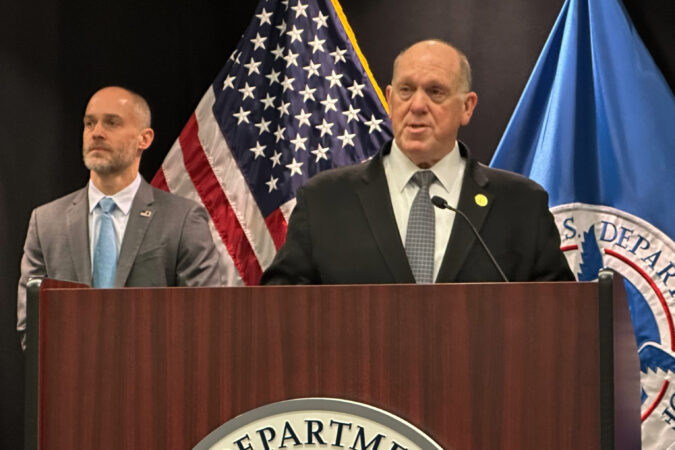
MINNEAPOLIS — The Trump administration is ending the immigration crackdown in Minnesota that led to thousands of arrests, violent protests and the fatal shootings of two U.S. citizens over the past two months, border czar Tom Homan said Thursday.
The U.S. Immigration and Customs Enforcement operation focused on the Minneapolis-St. Paul area resulted in more than 4,000 arrests, Homan said, touting it a success.
“The surge is leaving Minnesota safer,” he said. “I’ll say it again, it’s less of a sanctuary state for criminals.”
The announcement marks a significant retreat from an operation that has become a major distraction for the Trump administration and has been more volatile than prior crackdowns in Chicago and Los Angeles. It comes as a new AP-NORC poll found that most U.S. adults say Trump’s immigration policies have gone too far.
State and local officials, who have frequently clashed with federal authorities since Operation Metro Surge started in December, insisted the swarm of immigration officials inflicted long-term damage to the state’s economy and its immigrant community.
Democratic Gov. Tim Walz urged residents Thursday to remain vigilant in the coming days as immigration officers prepare to leave. He called the crackdown an “unnecessary, unwarranted and in many cases unconstitutional assault on our state.”
“It’s going to be a long road,” Walz told a news conference. “Minnesotans are decent, caring loving neighbors and they’re also some of the toughest people you’ll find. And we’re in this as long as it takes.”
Trump’s border czar pledged that immigration enforcement won’t end when the Minnesota operation is over.
“President Trump made a promise of mass deportation and that’s what this country is going to get,” Homan said.
Some activists expressed relief at Homan’s announcement, but warned that the fight isn’t over. Lisa Erbes, a leader of the progressive protest group Indivisible Twin Cities said officials, must be held accountable for the chaos of the crackdown.
“People have died. Families have been torn apart,” Erbes said. “We can’t just say this is over and forget the pain and suffering that has been put on the people of Minnesota.”
While the Trump administration has called those arrested in Minnesota “dangerous criminal illegal aliens,” many people with no criminal records, including children and U.S. citizens, have also been detained.
Homan announced last week that 700 federal officers would leave Minnesota immediately, but that still left more than 2,000 on Minnesota’s streets. At the time, he cited an “increase in unprecedented collaboration” resulting in the need for fewer federal officers in Minnesota, including help from jails that hold deportable inmates.
Homan took over the Minnesota operation in late January after the second fatal shooting by federal immigration agents and amid growing political backlash and questions about how the operation was being run. He said Thursday that he intends to stay in Minnesota to oversee the drawdown that began this week and will continue next week.
“We’ve seen a big change here in the last couple of weeks,” he said, crediting cooperation from local leaders.
During the height of the surge, heavily armed officers were met by resistance from residents upset with their aggressive tactics.
“They thought they could break us, but a love for our neighbors and a resolve to endure can outlast an occupation,” Minneapolis Mayor Jacob Frey said on social media after Homan’s news conference. “These patriots of Minneapolis are showing that it’s not just about resistance — standing with our neighbors is deeply American.”
Even by the pitifully low standards of the fact-free government of the United States, this one was a whopper.
Last month, agents from U.S.Immigration and Customs Enforcement (ICE) showed up at a Minneapolis hospital emergency room with a 31-year-old Mexican immigrant named Alberto Castañeda Mondragón who’d suffered severe head injuries.
The ICE agents told the ER nurses, according to the Associated Press, that Mondragón “purposefully ran headfirst into a brick wall.” But doctors could immediately see that the official version made zero sense, since their patient had multiple head injuries on the front, back, and side — not consistent with a fall or a collision.
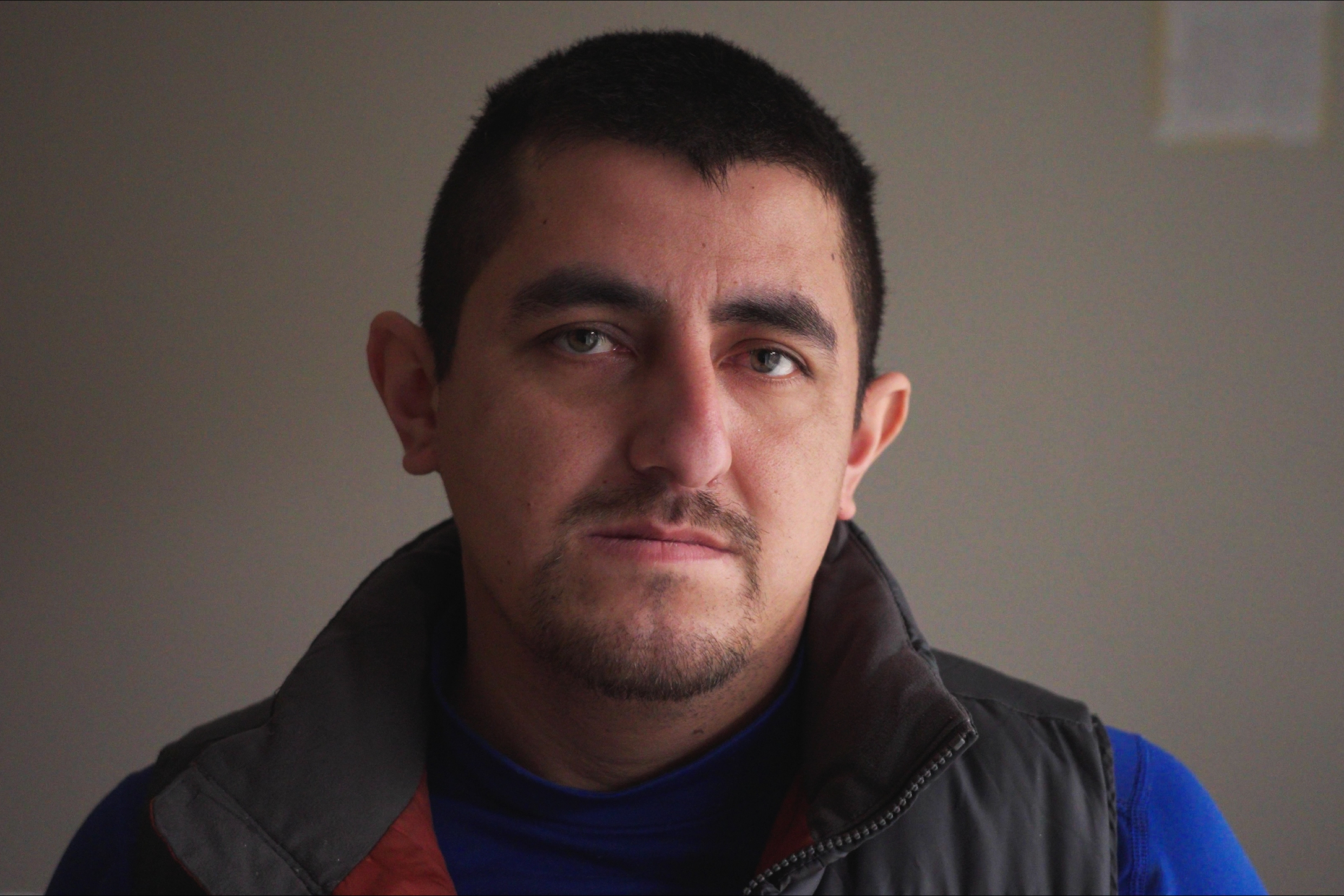
Under oath, the feds suddenly switched to passive voice, as an ICE deportation officer said only in a sworn statement that Mondragón “had a head injury that required emergency medical treatment.” A judge ruled the arrest was unlawful — Mondragón had come to the U.S. legally and overstayed his visa — and ordered the man freed. Mondragón, who survived his eight skull fractures and brain bleeds and is suing the government, weeks later told an AP reporter his story of what really happened.
“They started beating me right away when they arrested me,” he recounted, describing how immigration agents pulled him from a friend’s car at a St. Paul, Minn., shopping center on Jan. 8, then slammed him to the ground, handcuffed him, punched him, and whacked him with a steel baton. Mondragón said he was beaten again at a federal detention center, where his pleas for mercy were met by laughter and more blows.
“There was never a wall,” he said.
Alberto Castañeda Mondragón, who says in a lawsuit that he sustained eight skull fractures when he was beaten by ICE agents, poses for a portrait earlier this month in St. Paul, Minn.
Mondragón’s narrative would be outrageous if it were an isolated incident, but this is simply one of the most egregious examples of falsehoods by an American secret police regime that has been caught in high-profile lies again and again. The best-known cases are the Minneapolis killings of Renee Good — where officials up to the president falsely claimed an agent was struck by a car and rushed to a hospital — and Alex Pretti, who was accused of brandishing a gun at federal agents, a lie that was instantly demolished when videos emerged.
And these are just three of the many instances where a U.S. Department of Homeland Security (DHS) agent or top official has offered a version of events — often backed up by sworn testimony — that soon fell apart.
On Wednesday, another woman DHS had described as “a domestic terrorist” — Mirimar Martinez, the Chicago Montessori schoolteacher who was shot five times after a vehicle collision with ICE agents — presented powerful evidence of government lies as she pursues legal action against DHS and the agent who shot her, Charles Exum.
Marimar Martinez (center) is greeted by her family after being released from the Metropolitan Correctional Center in October, after being shot by immigration agents and charged with assaulting federal officers in an incident in Chicago’s Brighton Park.
Martinez, whose federal charges stemming from the encounter were later dropped, and her lawyer said that a federal diagram of the crash scene presented in court showed three other vehicles that do not exist, that the shots did not come through the front windshield as claimed by Exum, and that another claim — that Martinez had “rammed” Exum’s vehicle — was also false. Said her lawyer, Christopher Parente, “This is a time where you just cannot trust the words of our federal officials.”
Let’s not pretend to be so naive as to act as if official deceit began on the June 2015 day that Donald Trump descended on that Trump Tower escalator. It was the late 1960s — the era of Lyndon B. Johnson’s Vietnam “credibility gap” — when the investigative journalist I.F. Stone famously wrote, “All governments lie.” I became an opinion journalist because of my disgust over George W. Bush’s lies that drove the Iraq War.
That said, the outrageous, Soviet-caliber falsehoods of the Trump regime feel much worse. These are not “plausible denial” fairy tales to push an unpopular policy or cover up some dirty deeds, like Watergate, but a vast empire of Big Lies — easily disprovable, about everything from election results to economic statistics — with a much more ambitious goal of undermining the very notion of objective reality.
Trump: "California is more corrupt than Minnesota. And I won Minnesota." (Trump has lost Minnesota three times.) pic.twitter.com/umCFf121vg
This fish stinks from the head. That Trump was elected a second time after the Washington Post (remember them?) chronicled some 30,573 false or misleading claims during his first four years was essentially America’s drive-through order of a Double Whopper.
The nation seems to have all but given up on challenging Trump’s absurd claims that he won Minnesota three times (although he actuallylost three times), or his fact-free insistence that his tariff policies have sparked $18 trillion in new investments, just to name two instances. But America’s liar-in-chief has also offered fresh inspiration to his underlings.
One would be hard-pressed to find a more blatant case of highest-level lying than the matter of Commerce Secretary Howard Lutnick and his friendship with Jeffrey Epstein, the deceased financier and sex trafficker. When the Trump regime’s cover-up of its massive Epstein files became a big story last summer, Lutnick, a former Wall Street CEO who lived next door to Epstein in Manhattan, told a podcast that he’d briefly visited Epstein’s home in 2005, and was revulsed atthe sight of a massage table. He insisted that he then decided, “I will never be in the room with that disgusting person ever again.”
This was an epic lie.
We now know — thanks to thecongressionally mandated (but still incomplete) release of the Epstein files — that Lutnick and his family and entourage stopped for lunch at Epstein’s Caribbean island in 2012, and that this was one of many contacts — about meeting for drinks, or philanthropic contributions — the two men had almost up until Epstein’s arrest and jail cell death in 2019.
There’s no evidence Lutnick committed any crime — beyond telling a massive and now discredited lie to the American people he purportedly serves. In Europe, heads are rolling for far less, but Lutnick has “the full confidence” of the president. That fact, bobbing above a vast MAGA sea of lies, should make us ask some hard questions as a nation.
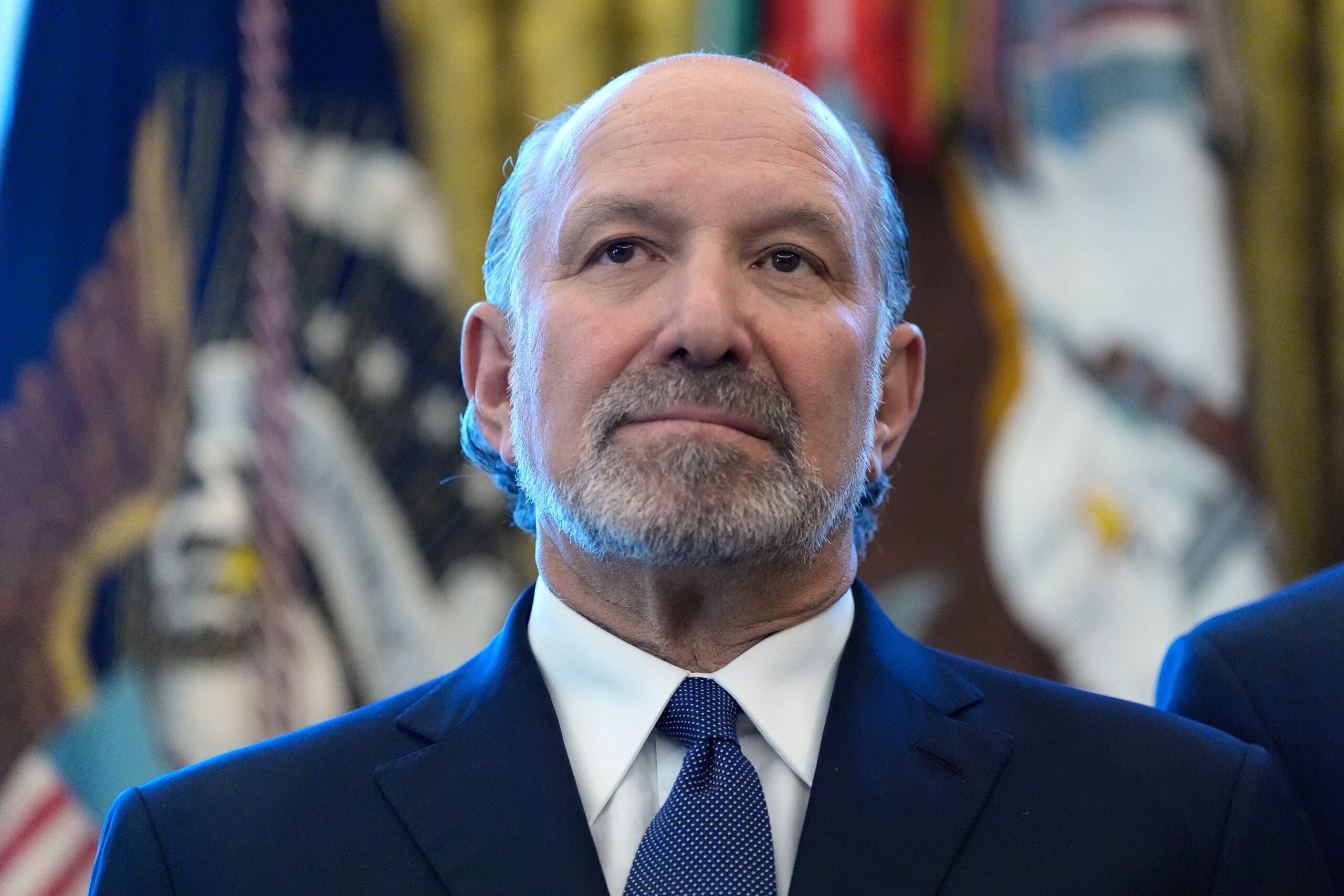
Commerce Secretary Howard Lutnick listens during an event with President Donald Trump in the Oval Office in February.
The current consensus — honored mainly in the breach — that lying is wrong, or bad, does not go nearly far enough. Perhaps it muddies the water that the U.S. Supreme Court has ruled it is First Amendment-protected free speech when private citizens utter things that aren’t true. But official deceit is a different category.
“The government’s lies can be devastating,” a leading scholar — University of Colorado law professor Helen Norton — wrote in a powerful 2015 article, arguing that official government dishonesty is fundamentally unconstitutional. Norton noted that false testimony and evidence in criminal cases — what we’ve seen frequently in the immigration terror campaign — is a violation of the Constitution’s due process clause, while invented allegations that aim to silence critics are offenses against constitutionally protected free speech.
It’s a felony to lie in federal court cases, or when testifying under oath before Congress, or in other types of governmental proceedings. And the federal statute of limitations for perjury is five years — plenty of time for a liberated U.S. Department of Justice to pursue these many cases if democratic forces can win back the White House in 2028.
But we should also recognize that top officials who tell deliberate lies are abusing their power in ways that, as Norton rightly argues, are grossly unconstitutional. When Noem lies to the American people about Good and how she was killed by ICE, she should resign or be impeached. When Lutnick looks into a camera and offers complete fiction about his friendship with the world’s most notorious sex trafficker, he, too, should quit immediately, or face impeachment.
Norton, in her prescient article from 11 years ago, notes that beyond the specific wrongs against individuals — such as Mondragón, Martinez, Good, and Pretti — that occur when the government lies, there is a much broader problem: the loss of public trust.
Indeed, the steep decline of public faith not only in government but in other civic institutions began with those official lies about Vietnam and Watergate, and the flawed probes into the John F. Kennedy assassination. It was those and other countless moments of scatheless lying by those in power that created the rubble Trump marched over in 2016.
We won’t get anything resembling democracy until we clear that widespread debris, and that means sending a bunch of these liars to prison, because they are the real criminals. America desperately needs truth and consequences.
A still image from the documentary “Expanding Sanctuary” by Philadelphia filmmaker Kristal Sotomayor. The 2024 BlackStar award-winning short film will have a virtual screening on Wednesday, Feb. 11, and a local screening on April 29 and 30, as part of the Table Sessions at Bartram’s Garden.
For anyone viewing Philadelphia filmmaker Kristal Sotomayor’s short film, Expanding Sanctuary, for the first time at a free virtual screening and Q&A on Wednesday at 8 p.m., the issues depicted as impacting the lives of Philadelphia’s unauthorized immigrants will seem both meaningfully the same, and poignantly different, than they are today.
Philadelphia immigrants haven’t changed really — they still fall in love, get married, tend to their children, work hard, and look out for neighbors in need. They still give their time to building strong and loving communities.
Legislation, like the Laken Riley Act, has passed with bipartisan support, essentiallytreating immigrants accused of a criminal offense as if they had already been found guilty of it — codifying the violation of their constitutionally protected rights. Plus, thanks to Trump’s “Big Beautiful Bill,” ICE now has an extraordinary amount of funding to do with what it will.
A still image from the documentary, Expanding Sanctuary, by Philadelphia filmmaker Kristal Sotomayor. The 2024 BlackStar award-winning short film will have a virtual screening on Wed. Feb. 11, and a local screening on April 29 and 30, as part of the Table Sessions at Bartram’s Garden.
So, I asked Sotomayor: Why release the film now, into a U.S. that speaks more frequently in virulent terms about immigrants, when the national justice picture is grimmer, and our municipal leaders have chosen to stay more silent than before?
“Yeah, many things have changed,” Sotomayor told me via email. “Politically in Philadelphia, you are right that there is now a mayor who is less willing to push back against the federal government to protect immigrant rights. The mayor has not been willing to uphold sanctuary status or sanctuary policies. We are also dealing with far more mass surveillance than there was in 2018 … ICE now has access to everything from tax records to hospital records to things we probably are not even fully aware of yet.”
“I also do not think immigrant rights are as much of a national issue as they were in 2018,” Sotomayor added, “when the photo of the young boy in a detention center (essentially a cage) sparked widespread national outrage. I am not really seeing that same level of response right now [even though] there are protests around the country against the ramping up of ICE enforcement.”
Kristal Sotomayor, the award-winning, nonbinary, Philadelphia-area Peruvian American director and producer of “Expanding Sanctuary” will lead a Q&A after the film’s virtual screening on Feb. 11.
But, Sotomayor added: “For me, it is vital that this film is circulating now. Expanding Sanctuary is a hopeful story. In many ways, the film feels like it could have been shot last week. It shows how communities organized, changed policy, and protected their families during the first Trump presidency, and [it] reminds us that collective action is still possible now.”
“At a time when so many people are feeling overwhelmed and hopeless, this film offers a success story,” they added. “It demonstrates that change is possible, that policy can be shifted, and that families can be protected, not just in the past, but moving forward into the future.”
The Wednesday virtual screening of the documentary, which was honored at the 2024 BlackStar Film Festival, will be followed by a Q&A. Featured speakers are scheduled to include Sotomayor, Linda Hernandez, the Philadelphia-based community leader and holistic wellness practitioner who is the protagonist of Expanding Sanctuary, and Katie Fleming, an immigration lawyer and the director of public education and engagement at the Acacia Center for Justice.
I’ll be honest, I came away from my most recent viewing of Sotomayor’s film feeling a bit nostalgic. Not only was it filled with the faces of beloved community members — some of whom have recently stepped away from decades of work helping people see immigrants as human beings, not abstractions — but also because of the intimate specificity of what Expanding Sanctuary celebrates.
There on the soundtrack are the musicians who once told me that making space for convivencia is making space for life, for community, and, yes, for resistance. There on screen is the Philadelphia I adore — where James Beard winners feed desperate families living in sanctuary, where people show up to protest in their wedding dresses, where sidewalks become sign-making studios, and where mothers raise their families on both tortillas and hope.
The huge anti-ICE protests these days are amazing, but they should never obscure the fact that while we must always fight against injustice and the weakening of democratic norms, we cannot forget who we are fighting for — real people, real neighborhoods and communities, real cities whose civic leaders may have forgotten their voices, but whose residents never will.
For their part, Sotomayor is hopeful. “I think we are ramping up toward something that could be just as strong and just as powerful as what is portrayed in Expanding Sanctuary,” they told me.
“It may take some time for immigrant rights to become a national talking point again, as it was in 2018, but I do believe that moment will come with larger protests, deeper outrage, and, ultimately, real change.”
To attend the virtual screening and Q&A on Feb. 11, click here. For more information about the Table Sessions at Bartram’s Garden on April 29 and 30, click here.
Despite Philadelphia being a deep-blue city dominated by Democrats, local officials have been somewhat cautious in how they talk about President Donald Trump’s administration.
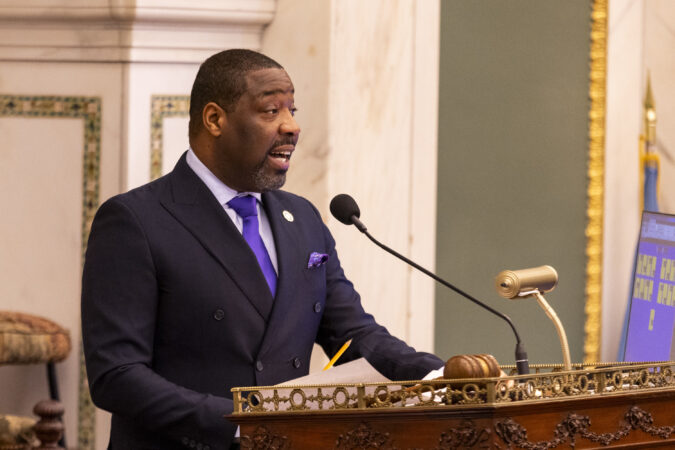
That has included the top legislator, City Council President Kenyatta Johnson, who has largely taken a measured approach on national politics, opting to convene task forces and hold public hearings rather than go scorched-earth on Trump.
That was until last month, when Johnson, like the rest of the country, watched video footage on the news showing federal immigration enforcement agents bearing down on Minneapolis and fatally shooting two United States citizens.
He said in an interview Friday that he now sees City Council differently: as an “activist body” that is obligated to take legislative action in opposition to the Trump administration.
And Johnson said he questions the purpose of his position if not to stand up for the city’s most vulnerable — and right now, he said, that’s immigrants.
“It’s my responsibility to step up in this space and be more vocal,” he said over lunch in South Philadelphia’s Point Breeze neighborhood, the section of the city where he grew up and still lives. “It’s just the evolution of me really not addressing it from a political standpoint, but from a moral standpoint of advocating and fighting for individuals who really need a voice.”
That reflects a shift for Johnson, the centrist Democrat who is entering his third year as Council president. He considers himself pro-law enforcement, and he typically takes an understated approach to leadership, preferring to dissent with others privately rather than duke it out in public.
In employing a more assertive approach, Johnson has also over the last several months started to diverge from Mayor Cherelle L. Parker, a close ally.
“The mayor can respond how she chooses to respond,” he said. “For me, it’s a moral issue.”
Philadelphia Mayor Cherelle L. Parker stands beside Council President Kenyatta Johnson (left) after she finished her budget address to City Council, City Hall, Thursday, March 13, 2025.
Larry Ceisler, a public affairs executive and longtime City Hall observer, said he has watched Johnson rise from community activist to lawmaker.
He said the Council president, in his latest evolution, might have calculated that a majority of the 16 other members want the city’s legislative body to take a more active role.
“He is an activist at heart, and he has a tremendous amount of empathy for people,” Ceisler said. “At the same time, he’s a pretty good politician and he can count votes. It’s very difficult for him at this point to push back on the will of his members.”
But Ceisler said that Parker might have more to lose, and that she will “be on the hook for all this if there is retribution from Washington.”
A ‘shameful’ episode at the President’s House
Through the first eight months of the second Trump administration, Johnson largely kept focused on local policymaking.
When a reporter asked Johnson in January 2025 how he saw his role responding to the Trump administration, he noted that he had convened two working groups to study how Trump-backed policies would affect Philadelphia residents.
Other Council members introduced more than a dozen resolutions to condemn the Trump administration’s efforts that they said would harm Philadelphians, like cutting food assistance and prohibiting some diversity-hiring initiatives. One resolution opposed the federal government’s deployment of the National Guard as a crime-fighting measure in major American cities; another said Trump’s cabinet members were wholly unqualified.
Those measures, almost entirely symbolic, were largely spearheaded by progressive members. They passed the overwhelmingly Democratic Council with little debate and not much acknowledgment from the Council president.
But by September, Johnson began to speak up.
He was incensed when word spread that the Trump administration was seeking to alter some content related to slavery on federal properties, including at Independence National Historical Park. The National Park Service was reportedly looking to edit panels at the President’s House Site in Center City that memorialize the nine people whom George Washington enslaved.
Last month, federal workers removed the exhibit and relocated the panels to the National Constitution Center, where they are in storage. Parker’s administration filed a lawsuit immediately, and the issue remains the only Trump initiative that Parker has vocally opposed over the last year.
“This history is a critical part of our nation’s origins, and it deserves to be seen and heard,” she said in a video posted on social media.
Veronica Chapman-Smith, concerned citizen was present at the history lesson and protest, Presidents house, Independence National Historical Park, Philadelphia, Friday, Feb. 6, 2026. The community is coming together to protest the removal of slavery exhibit at the President’s House site.
The Council president said he wants the panels returned in time for an expected influx of tourists this year for several major events, including World Cup games and the 250th anniversary of the founding of the nation.
“It’s shameful that during this celebration of our country, the birthplace of America, here in the city of Philadelphia, we have to deal with a Trump administration trying to whitewash our history,” Johnson said last week.
A Minneapolis-like ICE surge on ‘any given day’
Over the next five months, Johnson will juggle advocating for the return of the panels as he manages other high-profile local matters. Council must approve a city budget by the end of June, and its members are expected to play a crucial role in the Philadelphia School District’s closure and consolidation plan that will affect dozens of schools.
The “ICE Out” legislation that Johnson has already backed is also expected to be a major undertaking over the coming weeks. The seven bills that make up the package already have support from 15 of Council’s 17 members, which constitutes a veto-proof majority.
City Councilmember Rue Landau, a Democrat who is one of the prime sponsors of the immigration legislation, said Johnson “fully realizes the importance of this moment.”
“His support,” she said, “is a recognition that local government has a pivotal role to play in moments like these.”
Prior to this year, Johnson rarely talked about immigration. He has spent most of his career focused on public safety, gun violence prevention, and quality-of-life issues.
Bloomberg reported that the building, about 85 miles outside Philadelphia, is one of two dozen across the nation that ICE has identified for conversion into detention centers. ICE purchased another warehouse in Schuylkill County, about 110 miles from Philadelphia.
Together, the two facilities could hold 9,000 beds.
To Johnson, it was like the federal government was saying: “We want to set up shop right in your backyard.”
ICE is already operating in the city. But Johnson said the warehouse purchases are a sign that Philadelphia should prepare for a greater surge of immigration enforcement like the operation in Minneapolis, where more than 3,000 federal agents were deployed and large-scale protests ensued.
Countless Minnesotans have said they were harassed, racially profiled, and unlawfully arrested by ICE agents during the operation this year.
“Who’s to say that won’t happen to any of my constituents that I represent from Liberia? From Sierra Leone? From Cambodia?” Johnson said. “It can happen on any given day here in the city of Philadelphia.”
WASHINGTON — Congressional leaders said Tuesday that a deal was still possible with the White House on Homeland Security Department funding before it expires this weekend. But the two sides were still far apart as Democrats demanded new restrictions on President Donald Trump’s immigration crackdown.
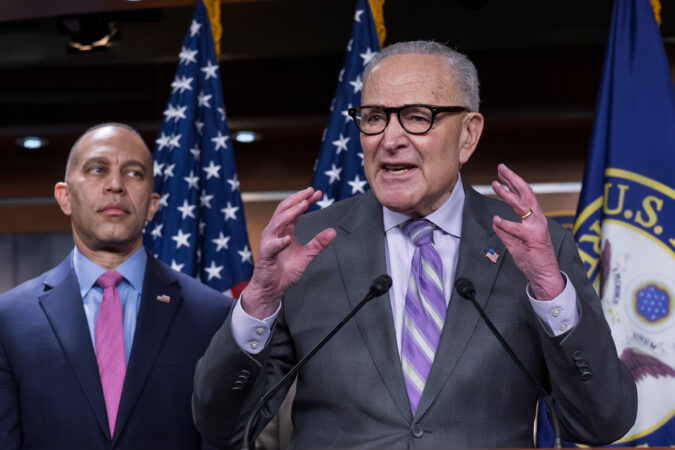
After federal agents fatally shot two protesters in Minneapolis last month, Democrats say U.S. Immigration and Customs Enforcement needs to be “dramatically” reined in and are prepared to let Homeland Security shut down if their demands aren’t met. On Tuesday, Senate Democratic Leader Chuck Schumer and House Democratic Leader Hakeem Jeffries said they had rejected a White House counteroffer that “included neither details nor legislative text” and does not address “the concerns Americans have about ICE’s lawless conduct.”
“We simply want ICE to follow the same standards that most law enforcement agencies across America already follow,” Schumer said Tuesday. “Democrats await the next answer from our Republican counterparts.”
The Democrats’ rejection of the Republican counteroffer comes as time is running short, with a shutdown of the Homeland Security Department threatening to begin Saturday. Among the Democrats’ demands are a requirement for judicial warrants, better identification of DHS officers, new use-of-force standards and a stop to racial profiling.
Finding agreement on the charged, partisan issue of immigration enforcement will be exceedingly difficult. But even as lawmakers in both parties were skeptical, a White House official said that the administration was having constructive talks with both Republicans and Democrats. The official, granted anonymity to speak about ongoing deliberations, stressed that Trump wanted the government to remain open and for Homeland Security services to be funded.
Senate leaders also expressed some optimism.
“There’s no reason we can’t do this” by the end of the week, Senate Democratic Leader Chuck Schumer said after meeting with his caucus on Tuesday.
Senate Majority Leader John Thune, R-S.D., said there have been “some really productive conversations.”
Democratic demands
Schumer and Jeffries have said they want immigration officers to remove their masks, to show identification and to better coordinate with local authorities. They have also demanded a stricter use-of-force policy for the federal officers, legal safeguards at detention centers and a prohibition on tracking protesters with body-worn cameras.
Among other asks, Democrats say Congress should end indiscriminate arrests, “improve warrant procedures and standards,” ensure the law is clear that officers cannot enter private property without a judicial warrant and require that before a person can be detained, it’s verified that the person is not a U.S. citizen.
Democrats made the demands for new restrictions on ICE and other federal law enforcement after ICU nurse Alex Pretti was shot and killed by a U.S. Border Patrol officer in Minneapolis on Jan. 24, and some Republicans suggested that new restrictions were necessary. Renee Good was shot by ICE agents on Jan. 7.
Many Democrats said they won’t vote for another penny of Homeland Security funding until enforcement is radically scaled back.
“Dramatic changes are needed at the Department of Homeland Security before a DHS funding bill moves forward,” Jeffries said. “Period. Full stop.”
Republican counterproposal
Jeffries said Tuesday that the White House’s offer “walked away from” their proposals for better identification of ICE agents, for more judicial warrants and for a prohibition on excessive use of force. Republicans also rejected their demand for an end to racial or ethnic profiling, Jeffries said.
“The White House is not serious at this moment in dramatically reforming ICE,” Jeffries said.
Republican lawmakers have also pushed back on the requests. Oklahoma Sen. Markwayne Mullin, a close ally of Trump, said Tuesday that he’s willing to discuss more body cameras and better training — both of which are already in the Homeland spending bill — but that he would reject the Democrats’ most central demands.
“They start talking about judicial warrants? No. They start talking about demasking them? No, not doing that. They want them to have a photo ID with their name on it? Absolutely not,” Mullin said.
Republicans have said ICE agents should be allowed to wear masks because they are more frequently targeted than other law enforcement officials.
“People are doxing them and targeting them,” said House Speaker Mike Johnson, R-La., on Monday. “We’ve got to talk about things that are reasonable and achievable.”
Some Republicans also have demands of their own, including the addition of legislation that would require proof of citizenship before Americans register to vote and restrictions on cities that they say do not do enough to crack down on illegal immigration.
At a House hearing on Tuesday, the acting director of ICE, Todd Lyons, said his agency is “only getting started” and would not be intimidated as his officers carry out Trump’s mass deportation agenda.
Trump deals with Democrats
Congress is trying to renegotiate the DHS spending bill after Trump agreed to a Democratic request that it be separated out from a larger spending measure that became law last week and congressional Republicans followed his lead. That package extended Homeland Security funding at current levels only through Feb. 13, creating a brief window for action as the two parties discuss new restrictions on ICE and other federal officers.
But even as he agreed to separate the funding, Trump has not publicly responded to the Democrats’ specific asks or suggested any areas of potential compromise.
White House press secretary Karoline Leavitt said late last week that the Trump administration is willing to discuss some items on the Democrats’ list, but “others don’t seem like they are grounded in any common sense, and they are nonstarters for this administration.”
Thune said Tuesday that “there are certain red lines that I think both sides have, things they are not going to negotiate on, but there are some things they are going to negotiate on, and that’s where I think the potential deal space is here.”
It was, so far, unclear what those issues were.
“We are very committed to making sure that federal law enforcement officers are able to do their jobs and to be safe doing them,” Thune said of Republicans.
Consequences of a shutdown
In addition to ICE and U.S. Customs and Border Protection, the homeland security bill includes funding for the Federal Emergency Management Agency and the Transportation Security Administration, among other agencies. If DHS shuts down, Thune said last week, “there’s a very good chance we could see more travel problems” similar to the 43-day government closure last year.
Thune has said Republicans will try to pass a two- to four-week extension of the Homeland Security funding while negotiations continue.
Many Democrats are unlikely to vote for another extension. But Republicans could potentially win enough votes in both chambers from Democrats if they feel hopeful about negotiations.
“The ball is in the Republicans’ court,” Jeffries said Monday.
U.S. Sen. John Fetterman said Sunday that he expects the Department of Homeland Security to shut down Friday as negotiations over immigration enforcement have stalled, an outcome that could impact air travel and emergency response across the nation.
“I absolutely would expect that it’s going to shut down,” the Pennsylvania Democrat said during an interview on Fox News’Sunday Morning Futureswith Maria Bartiromo.
Funding for DHS is scheduled to lapse Friday, a deadline that lawmakers set after separating the agency’s funding from other parts of the federal budget and approving a two-week extension to continue talks.
At the center of the impasse is Democrats’ insistence on overhauling federal immigration enforcement. The party’s leaders drafted a list of 10 policies they want Republicans to agree to in exchange for their support in funding DHS, which includes U.S. Immigration and Customs Enforcement.
Among Democrats’ demands are banning immigration enforcement agents from wearing masks and requiring DHS officers to obtain a warrant signed by a judge before entering a home.
House Minority Leader Hakeem Jeffries (D., N.Y.) said Sunday during an interview on CNN’s State of the Union that “at this point” he was not willing to accept a deal that didn’t include President Donald Trump’s administration implementing Democrats’ full list of ICE changes.
“We know that ICE is completely and totally out of control,” Jeffries said. “They’ve gone way too far, and the American people want them reined in.”
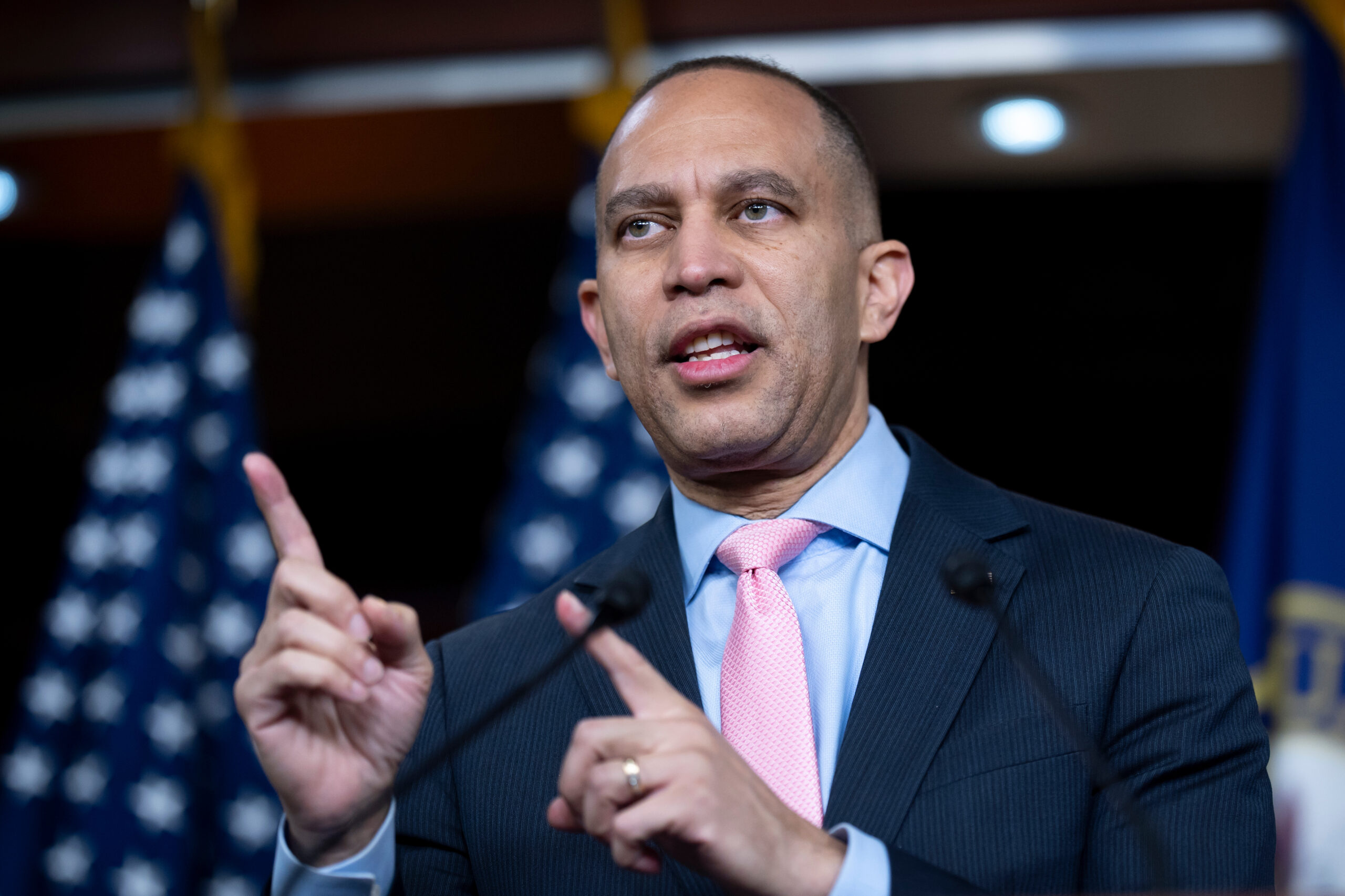
House Minority Leader Hakeem Jeffries (D., N.Y.) speaks to reporters about Venezuela, the ICE shooting in Minneapolis, and affordability ahead of a vote in the House to extend the Obamacare subsidies for three years at the Capitol on Jan. 8. (AP Photo/J. Scott Applewhite)
“We, the Democrats, we provided 10 kinds of basic things, and then the Republicans pushed back quickly saying, ‘That’s a Christmas wish list,’ and that they’re nonstarters,” Fetterman, a member of the Senate Homeland Security Committee, said. “I truly don’t know what specifically are the Democrats’ red lines that it has to be — certainly not going to get all 10.”
Fetterman generally opposes any measure that would shut down the government and has been the only Senate Democrat to vote for some Republican budget proposals. He added that he is concerned about federal workers, including TSA agents, not being paid amid a funding lapse.
“Every American deserves to be paid for the work that they’ve done,” he said. “That’s real lives, and they’re not wealthy if they’re TSA folks. They’re allowing us to fly safe here in America, and that’s part of that conversation now, too.”
U.S. Sen. John Fetterman (D., Pa.) is calling on the Department of Homeland Security to hit the brakes on its plan to develop two Immigration and Customs Enforcement detention centers in Pennsylvania, saying they would have a negative impact on local communities.
“While I have been clear in my support for the enforcement of federal immigration law, this decision will do significant damage to these local tax bases, set back decades-long efforts to boost economic development, and place undue burdens on limited existing infrastructure in these communities,” Fetterman wrote in a letter addressed to DHS Secretary Kristi Noem and posted online Saturday.
A 1.3-million-square-foot former Big Lots warehouse in Tremont, Pa., has been bought by U.S. Immigration and Customs Enforcement for $119 million. The agency plans to detain up to 7,500 immigrants there.
The Tremont Township detention center would house as many as 7,500 people, Fetterman noted, while the Upper Bern Township one would be capable of detaining 1,500 people.
Upper Bern Township has 1,606 residents, according to the U.S. Census Bureau, and is about 30 minutes northwest of Reading. The facility is near an Amazon warehouse and the Mountain Springs Camping Resort.
Tremont Township — where the much larger detention center is set to be built — has just 283 residents and is next to the 1,670-resident Tremont Borough. Tremont is in a rural area northeast of Harrisburg, near the Appalachian Trail, state game lands, and Fort Indiantown Gap, an Army National Guard training center.
In his letter, Fetterman said local and state officials did not have a chance to weigh in on how these massive facilities would affect everything from sewer systems and the electrical grid to hospitals and emergency medical services.
“Both townships do not currently have the capacity to meet the demands of these detention centers, with Tremont Township officials specifically stating the proposed 7,500-bed detention facility would quadruple the existing burden on their public infrastructure system,” Fetterman said.
A warehouse in Upper Bern Township, Berks County, Pa., was purchased by ICE and the Trump administration.
The letter maintains Fetterman’s stance as someone who supports ICE operations in general while criticizing the federal government’s recent handling of them. After federal agents shot and killed two U.S. citizens in Minneapolis last month, Fetterman called on the Trump administration to fire Noem. A few days later, Fetterman said he supports ICE agents wearing face masks.
Fetterman was among 23 Senate Democrats to cross the aisle last month to vote for a compromise bill funding the federal government through September, while granting just two weeks of funding for DHS.
Fetterman said the Pennsylvania facilities would result in a tax loss of $1.6 million to the communities. He asked DHS to agree to several conditions before proceeding further with the sites.
He requested an “impact assessment,” details on the criteria used to select these facilities, an agreement that federal funds be used to upgrade them, and “a commitment to a period of public engagement and dialogue with these communities.”
“Due to these significant concerns, it is my fear that DHS and ICE did not perform any due diligence, spending more than $200 million in tax dollars for warehouses that cannot be adequately converted and further eroding trust between Pennsylvanians and the Federal government,” Fetterman wrote.
The Department of Homeland Security and Immigration and Customs Enforcement did not immediately respond to a request for comment.
This story has been updated to correct the location of one of the proposed detention centers to Upper Bern Township.
Some yarn shops around Philadelphia are running low on skeins of red wool, as local knitters and crocheters turn out scads of “Melt the ICE” caps in solidarity with protesters in Minnesota.
The hats don’t feature a patch or logo that says “Melt the ICE.” In fact, they carry no written message at all. What they offer is a deep scarlet hue, a dangling tassel, and a connection to an earlier, dangerous time, when a different people in another land sought to silently signal their unity.
“The hat is really a symbol and reminder,” said knitter Laura McNamara of Kensington, who is making two caps for friends. “People are looking for a sense of community.”
She refused her friends’ offers of payment, asking instead that they not let their involvement start and end with a hat ― but find a means to stand up for civil rights in some specific way.
The original hat was a kind of conical stocking cap, known as a nisselue, worn in Norway during the 1940s as a sign of resistance to the Nazi occupation. The Germans eventually caught on to the symbolism and banned the caps.
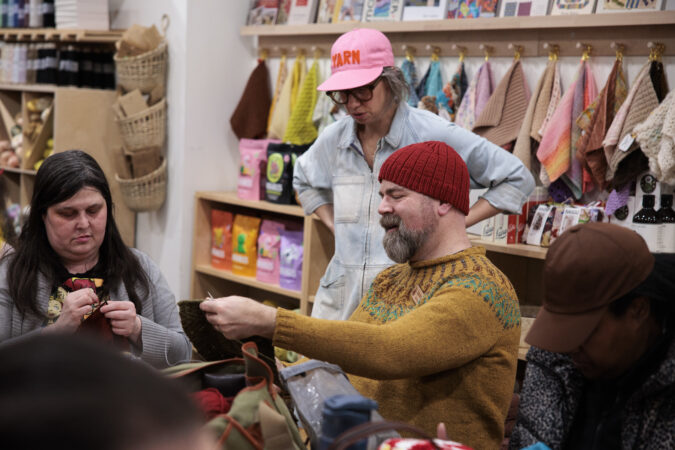
Amanda Bryman works on a red wool hat known as a “Melt the ICE” hat, during Fiber Folk Night at Wild Hand yarn shop in Philadelphia on Wednesday.
Now the new version that originated in a suburban Minneapolis yarn shop is spreading across the country. The hats signal opposition to U.S. Immigration and Customs Enforcement, which surged thousands of agents into Minneapolis, and sadness and anger over the deaths of Minnesotans and U.S. citizens Renee Good and Alex Pretti, who were shot to death by federal agents.
Today, comparisons of ICE agents to Nazis have become both frequent and contentious in American politics, with even some Democrats, including Gov. Josh Shapiro, who is Jewish, rejecting that equivalence as wrong and unacceptable.
ICE officials did not respond to a request for comment.
This is not the first time that the Philadelphia region’s craftivist movement, as it is known, has brought its knitting needles and crochet hooks to bear.
On the eve of Donald Trump’s first inauguration, artisans here turned out scores of cat-eared headgear known as pussy hats, a feline symbol of protest worn at the Women’s March on Washington. The hats aimed to tweak the then-president-elect over his comment about grabbing women by their genitals.
The Melt the ICE caps carry some controversy within the fiber community, as it calls itself. There have been online complaints that it’s easy to tug a red cap over one’s ears, but unless that is accompanied by action it holds no more significance than clicking a “Like” button on Facebook.
“It is just preening,” one person wrote in an internet forum.
Another said that “if your resistance is only this hat, then you have not actually accomplished anything except make a hat.”
Law enforcement officers detain a demonstrator during a protest outside SpringHill Suites and Residence Inn by Marriott hotels on Jan. 26 in Maple Grove, Minn.
Liz Sytsma, owner of Wild Hand in West Mount Airy, has heard the criticism.
But “the people in our community who are participating in making the hats, this is one of many things they are doing,” she said. That includes taking part in protests, calling elected leaders, and giving money to causes they support.
On Wednesday, more than a dozen people gathered at Wild Hand for the weekly Fiber Folk Night, where crafters gather to knit, crochet, and chat ― and, now, to work on hats.
Damon Davison traveled from Audubon, Camden County, having developed his own hat pattern, with sale proceeds to go to the activist group Juntos in South Philadelphia.
He wants to show solidarity with people “who are expressing resistance to what has been happening in Minneapolis, but also what’s happening here in Philly,” he said. “The idea is to make it a little bit more local.”
The shop has seen a rush on red, sought by about 70% of customers whose purchases have depleted stocks during the last couple of weeks.
“We’re really low,” said store manager Yolanda Booker, who plans to knit and donate a hat. “I want to do whatever small part I can do to help out.”
A single hat can take two or three days to make, though the best and fastest knitters can complete one in a couple of hours.
Store Manager Yolanda Booker, standing, laughs with attendees during Fiber Folk Night at Wild Hand yarn shop in Philadelphia on Wednesday.
In West Mount Airy, Kelbourne Woolens closed its physical doors during the national “ICE Out” strike in late January and donated its onlineprofits of $4,000 to Asian Americans United, Juntos, and New Sanctuary Movement of Philadelphia, said team member Bailey Spiteri. She estimated the store has sold enough red yarn to retailers to make 500 or 600 hats.
At Stitch Central in Glenside, customers donated $1,000 during the strike and the store matched it, with the $2,000 going to Nationalities Service Center in Philadelphia.
“Sometimes people are skeptical. How does wearing a hat or even making a hat make a difference?” asked Allison Covey of Drunken Knit Wits, a local knitting and crocheting organization. “But look at the donations. It does make a difference.”
Veteran knitter Neeta McColloch of Elkins Park thinks the same. She has ordered enough yarn to make eight hats. And she is curious to see how the phenomenon will develop.
“This is probably bigger than I think,” she said. “Knitters tend to be the type of people who in my experience have a strong moral compass. If they can combine something they love to do with something in which they can make a statement, that’s important to them.”
Narberth’s borough council hasvoted unanimously to bar the municipality’s police officers from cooperating with U.S. Immigration and Customs Enforcement under the agency’s 287(g) program.
The resolution approved Thursdaymade clear that “our police department operates to protect our residents and protect the public safety here and does not have a role in immigration enforcement,” said Council President Fred Bush.
ICE’s 287(g) program deputizes local law enforcement officers to carry out immigration actions, including identifying, arresting, and deporting immigrants. ICE has signed around 1,400 such agreements with law enforcement agencies in 40 states, including dozens in Pennsylvania.
In Philadelphia’s collar counties, only the Lansdowne Borough Constable’s Office in Delaware County and the Pennsylvania State Constable Office Honey Brook Precinct 1 in Chester County are 287(g) participants. Bucks County Sheriff Danny Ceisler, a newly elected Democrat, terminated his office’s controversial partnership last month, citing negative impacts on public safety and law enforcement trust.
Neither Lower Merion nor Narberth participates in the program.
Narberth’s resolution establishes that the borough will not enter into any agreement with the federal government, including 287(g), that would commit borough time, funds, efforts, or resources toward ICE noncriminal enforcement activities.
Officials clarified that Narberth’s police department would cooperate with ICE officials if they had a judicial warrant to arrest someone. An internal memo first reported by The Associated Press last month has authorized ICE to forcibly enter people’s homes without a judicial warrant.
Narberth officials acknowledged that the resolution could be seen as “virtue signaling,” given that the borough already does not participate in an ICE partnership. Yet council members said they believe it’s important to publicly signal the municipality’s values regarding immigration enforcement.
The resolution“lets the public clearly know where we stand on the issues, helps reinforce trust, and provides that clarity of what we will do and what we won’t do,” said Dana Edwards, Narberth’s mayor. “From my standpoint, it’s a practical resolution.”
“When our community members trust their law enforcement, they feel comfortable reaching out to them for assistance,” said Councilmember Jean Burock. “We can’t afford to erode that trust.”
Bush cautioned residents against interfering with ICE operations, describing the agency as “poorly trained” and “dangerous,” citing “the actions and the images that came out of Minneapolis” in recent weeks.
Narberth’s resolution came on the heels of a Jan. 30 incident in which two people were taken into custody by ICE during a traffic stop in Penn Wynne.
Following the arrests, Lower Merion affirmed in a public statement that the township does not participate in 287(g) and encouraged residents to call 911 if they observe law enforcement activity with no Lower Merion police officers present.
This suburban content is produced with support from the Leslie Miller and Richard Worley Foundation and The Lenfest Institute for Journalism. Editorial content is created independently of the project donors. Gifts to support The Inquirer’s high-impact journalism can be made at inquirer.com/donate. A list of Lenfest Institute donors can be found at lenfestinstitute.org/supporters.
COLLINGSWOOD, N.J. — The shawarma, falafel wraps and baklava at Jersey Kebab are great, but many of its patrons are also there these days for a side of protest.
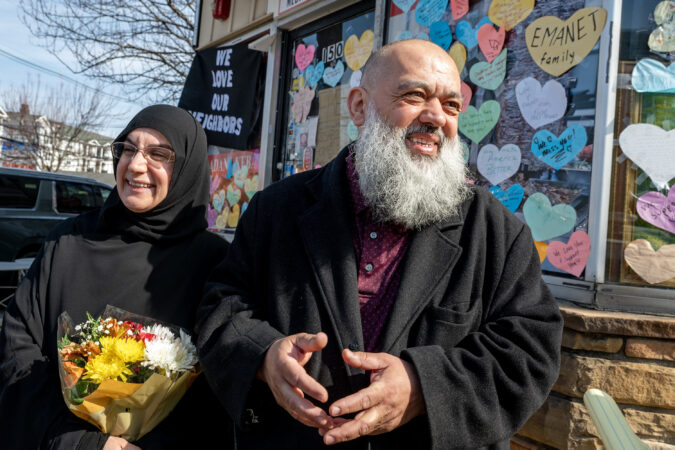
A New Jersey suburb of Philadelphia has rallied around the restaurant’s Turkish owners since federal officers detained the couple last February because they say their visas had expired.
In fact, business has been so good since Celal and Emine Emanet were picked up early in the Trump administration’s immigration crackdown that they have moved to a bigger space in the next town over. Their regulars don’t seem to mind.
Celal Emanet, 52, first came to the U.S. in 2000 to learn English while he pursued his doctorate in Islamic history at a Turkish university. He returned in 2008 to serve as an imam at a southern New Jersey mosque, bringing Emine and their first two children came, too. Two more would be born in the U.S.
Before long, Celal had an additional business of delivering bread to diners. They applied for permanent residency and believed they were on their way to receiving green cards.
When the COVID-19 pandemic began and the delivery trucks were idled, Celal and Emine, who had both worked in restaurants in Turkey, opened Jersey Kebab in Haddon Township. Business was strong from the start.
On Feb. 25, U.S. marshals and Immigration and Customs Enforcement officers arrested the couple at the restaurant. Celal was sent home with an ankle monitor, but Emine, now 47, was moved to a detention facility more than an hour’s drive away and held there for 15 days.
With its main cook in detention and the family in crisis, the shop closed temporarily.
Emine Emanet hugs her husband Celal as she leaves the ICE Elizabeth Detention Facility on Wednesday, March 12, 2025.
Although the area is heavily Democratic, the arrests of the Emanets signaled to many locals that immigration enforcement during President Donald Trump’s second term wouldn’t stop at going after people with criminal backgrounds who are in the U.S. illegally.
“They were not dangerous people — not the type of people we were told on TV they were looking to remove from our country,” Haddon Township Mayor Randy Teague said.
Supporters organized a vigil and raised $300,000 that kept the family and business afloat while the shop was closed — and paid legal bills. Members of Congress helped, and hundreds of customers wrote letters of support.
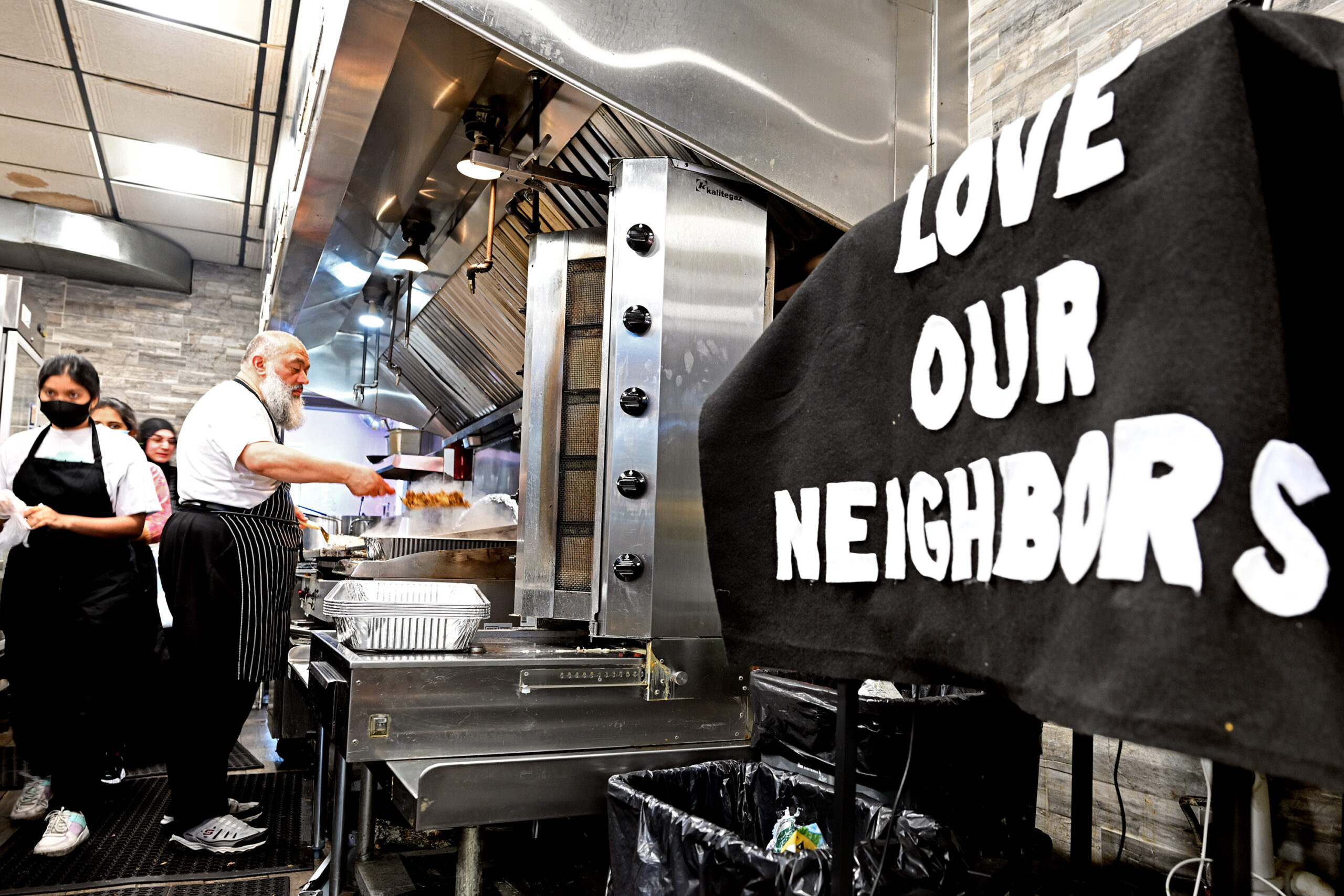
Celal Emanet works at the grill in his Jersey Kebab restaurant on Sunday, Mar. 30, 2025.
Space for a crowd
As news of the family’s ordeal spread, customers new and old began packing the restaurant. The family moved it late last year to a bigger space down busy Haddon Avenue in Collingswood.
They added a breakfast menu and for the first time needed to hire servers besides their son Muhammed.
The location changed, but the restaurant still features a sign in the window offering free meals to people in need. That’s honoring a Muslim value, to care for “anybody who has less than us,” Muhammed said.
Judy Kubit and Linda Rey, two friends from the nearby communities of Medford and Columbus, respectively, said they came to Haddon Township last year for an anti-Trump “No Kings” rally and ate a post-protest lunch at the kebab shop.
“We thought, we have to go in just to show our solidarity for the whole issue,” Kubit said.
Last month, with the immigration crackdown in Minneapolis dominating the headlines, they were at the new location for lunch.
Gretchen Seibert tapes up hearts with words of support for Celal and Emine Emanet, the owners of Jersey Kebab, after the couple was detained by ICE in February 2025.
The legal battle hasn’t ended
The Emanets desperately want to stay in the U.S., where they’ve built a life and raised their family.
Celal has a deportation hearing in March, and Emine and Muhammed will also have hearings eventually.
Celal said moving back to Turkey would be bad for his younger children. They don’t speak Turkish, and one is autistic and needs the help available in the U.S.
Also, he’d be worried about his own safety because of his academic articles. “I am in opposition to the Turkish government,” he said. “If they deport me, I am going to get very big problems.”
The groundswell of support has shown the family they’re not alone.
“We’re kind of fighting for our right to stay the country,” Muhammed Emanet said, “while still having amazing support from the community behind us. So we’re all in it together.”