Tag: Immigration

  • Congressional leaders say ICE deal is still possible despite divisions

    Congressional leaders say ICE deal is still possible despite divisions

    WASHINGTON — Congressional leaders said Tuesday that a deal was still possible with the White House on Homeland Security Department funding before it expires this weekend. But the two sides were still far apart as Democrats demanded new restrictions on President Donald Trump’s immigration crackdown.

    After federal agents fatally shot two protesters in Minneapolis last month, Democrats say U.S. Immigration and Customs Enforcement needs to be “dramatically” reined in and are prepared to let Homeland Security shut down if their demands aren’t met. On Tuesday, Senate Democratic Leader Chuck Schumer and House Democratic Leader Hakeem Jeffries said they had rejected a White House counteroffer that “included neither details nor legislative text” and does not address “the concerns Americans have about ICE’s lawless conduct.”

    “We simply want ICE to follow the same standards that most law enforcement agencies across America already follow,” Schumer said Tuesday. “Democrats await the next answer from our Republican counterparts.”

    The Democrats’ rejection of the Republican counteroffer comes as time is running short, with a shutdown of the Homeland Security Department threatening to begin Saturday. Among the Democrats’ demands are a requirement for judicial warrants, better identification of DHS officers, new use-of-force standards and a stop to racial profiling.

    Finding agreement on the charged, partisan issue of immigration enforcement will be exceedingly difficult. But even as lawmakers in both parties were skeptical, a White House official said that the administration was having constructive talks with both Republicans and Democrats. The official, granted anonymity to speak about ongoing deliberations, stressed that Trump wanted the government to remain open and for Homeland Security services to be funded.

    Senate leaders also expressed some optimism.

    “There’s no reason we can’t do this” by the end of the week, Senate Democratic Leader Chuck Schumer said after meeting with his caucus on Tuesday.

    Senate Majority Leader John Thune, R-S.D., said there have been “some really productive conversations.”

    Democratic demands

    Schumer and Jeffries have said they want immigration officers to remove their masks, to show identification and to better coordinate with local authorities. They have also demanded a stricter use-of-force policy for the federal officers, legal safeguards at detention centers and a prohibition on tracking protesters with body-worn cameras.

    Among other asks, Democrats say Congress should end indiscriminate arrests, “improve warrant procedures and standards,” ensure the law is clear that officers cannot enter private property without a judicial warrant and require that before a person can be detained, it’s verified that the person is not a U.S. citizen.

    Democrats made the demands for new restrictions on ICE and other federal law enforcement after ICU nurse Alex Pretti was shot and killed by a U.S. Border Patrol officer in Minneapolis on Jan. 24, and some Republicans suggested that new restrictions were necessary. Renee Good was shot by ICE agents on Jan. 7.

    Many Democrats said they won’t vote for another penny of Homeland Security funding until enforcement is radically scaled back.

    “Dramatic changes are needed at the Department of Homeland Security before a DHS funding bill moves forward,” Jeffries said. “Period. Full stop.”

    Republican counterproposal

    Jeffries said Tuesday that the White House’s offer “walked away from” their proposals for better identification of ICE agents, for more judicial warrants and for a prohibition on excessive use of force. Republicans also rejected their demand for an end to racial or ethnic profiling, Jeffries said.

    “The White House is not serious at this moment in dramatically reforming ICE,” Jeffries said.

    Republican lawmakers have also pushed back on the requests. Oklahoma Sen. Markwayne Mullin, a close ally of Trump, said Tuesday that he’s willing to discuss more body cameras and better training — both of which are already in the Homeland spending bill — but that he would reject the Democrats’ most central demands.

    “They start talking about judicial warrants? No. They start talking about demasking them? No, not doing that. They want them to have a photo ID with their name on it? Absolutely not,” Mullin said.

    Republicans have said ICE agents should be allowed to wear masks because they are more frequently targeted than other law enforcement officials.

    “People are doxing them and targeting them,” said House Speaker Mike Johnson, R-La., on Monday. “We’ve got to talk about things that are reasonable and achievable.”

    Some Republicans also have demands of their own, including the addition of legislation that would require proof of citizenship before Americans register to vote and restrictions on cities that they say do not do enough to crack down on illegal immigration.

    At a House hearing on Tuesday, the acting director of ICE, Todd Lyons, said his agency is “only getting started” and would not be intimidated as his officers carry out Trump’s mass deportation agenda.

    Trump deals with Democrats

    Congress is trying to renegotiate the DHS spending bill after Trump agreed to a Democratic request that it be separated out from a larger spending measure that became law last week and congressional Republicans followed his lead. That package extended Homeland Security funding at current levels only through Feb. 13, creating a brief window for action as the two parties discuss new restrictions on ICE and other federal officers.

    But even as he agreed to separate the funding, Trump has not publicly responded to the Democrats’ specific asks or suggested any areas of potential compromise.

    White House press secretary Karoline Leavitt said late last week that the Trump administration is willing to discuss some items on the Democrats’ list, but “others don’t seem like they are grounded in any common sense, and they are nonstarters for this administration.”

    Thune said Tuesday that “there are certain red lines that I think both sides have, things they are not going to negotiate on, but there are some things they are going to negotiate on, and that’s where I think the potential deal space is here.”

    It was, so far, unclear what those issues were.

    “We are very committed to making sure that federal law enforcement officers are able to do their jobs and to be safe doing them,” Thune said of Republicans.

    Consequences of a shutdown

    In addition to ICE and U.S. Customs and Border Protection, the homeland security bill includes funding for the Federal Emergency Management Agency and the Transportation Security Administration, among other agencies. If DHS shuts down, Thune said last week, “there’s a very good chance we could see more travel problems” similar to the 43-day government closure last year.

    Thune has said Republicans will try to pass a two- to four-week extension of the Homeland Security funding while negotiations continue.

    Many Democrats are unlikely to vote for another extension. But Republicans could potentially win enough votes in both chambers from Democrats if they feel hopeful about negotiations.

    “The ball is in the Republicans’ court,” Jeffries said Monday.
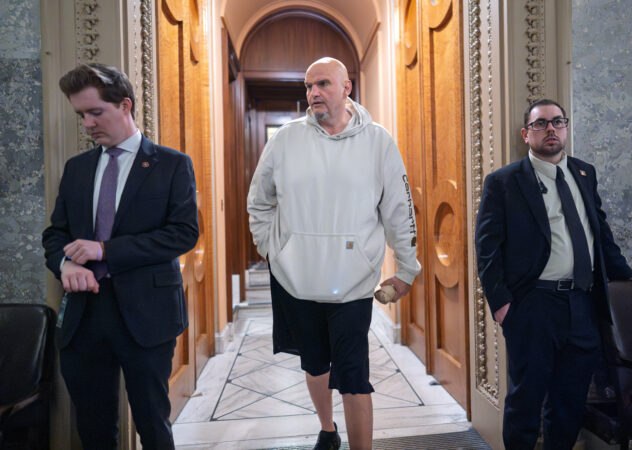
  • Sen. John Fetterman said he ‘absolutely’ expects a DHS shutdown as ICE negotiations stall

    Sen. John Fetterman said he ‘absolutely’ expects a DHS shutdown as ICE negotiations stall

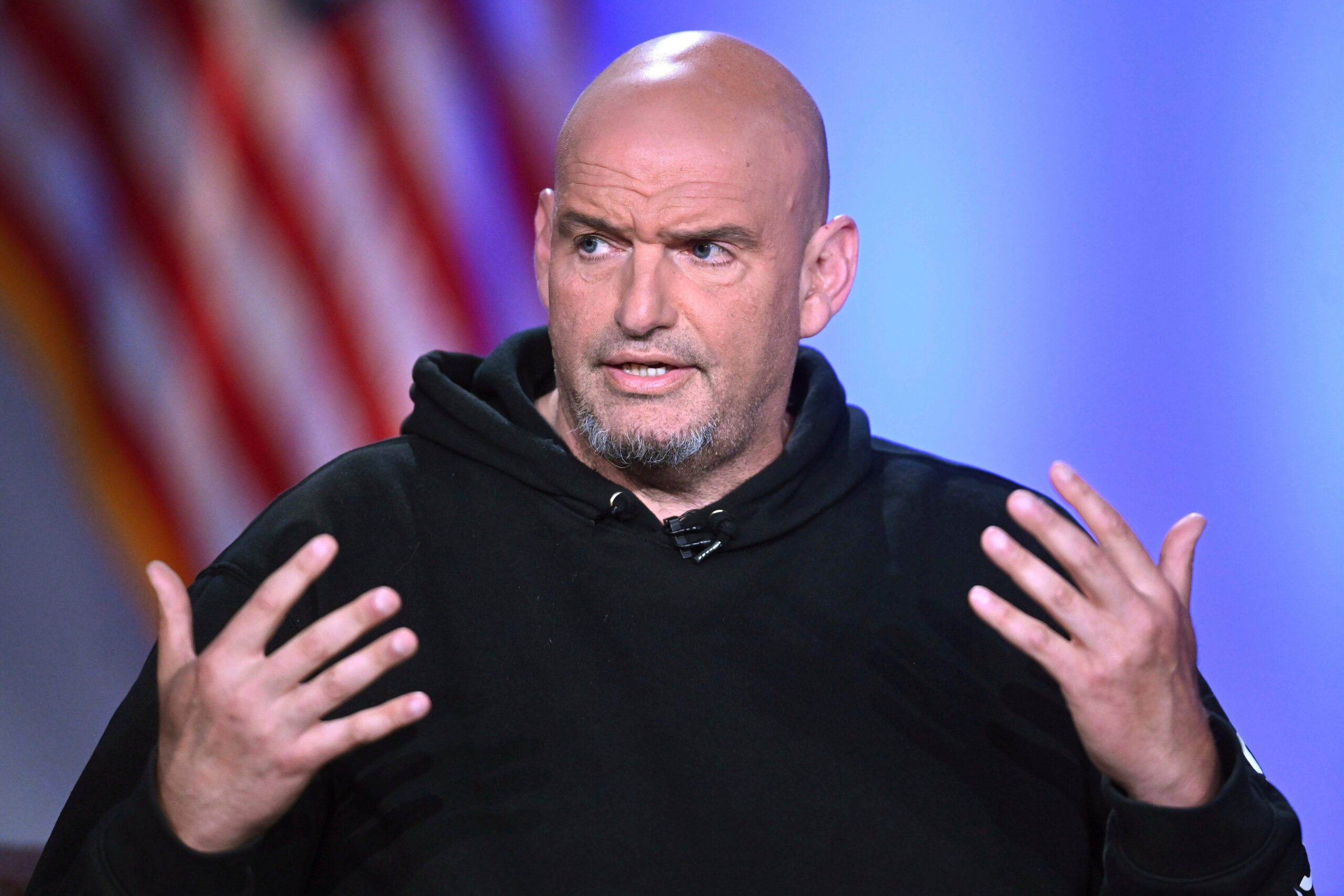
    U.S. Sen. John Fetterman said Sunday that he expects the Department of Homeland Security to shut down Friday as negotiations over immigration enforcement have stalled, an outcome that could impact air travel and emergency response across the nation.

    “I absolutely would expect that it’s going to shut down,” the Pennsylvania Democrat said during an interview on Fox News’ Sunday Morning Futures with Maria Bartiromo.

    Funding for DHS is scheduled to lapse Friday, a deadline that lawmakers set after separating the agency’s funding from other parts of the federal budget and approving a two-week extension to continue talks.

    At the center of the impasse is Democrats’ insistence on overhauling federal immigration enforcement. The party’s leaders drafted a list of 10 policies they want Republicans to agree to in exchange for their support in funding DHS, which includes U.S. Immigration and Customs Enforcement.

    Among Democrats’ demands are banning immigration enforcement agents from wearing masks and requiring DHS officers to obtain a warrant signed by a judge before entering a home.

    House Minority Leader Hakeem Jeffries (D., N.Y.) said Sunday during an interview on CNN’s State of the Union that “at this point” he was not willing to accept a deal that didn’t include President Donald Trump’s administration implementing Democrats’ full list of ICE changes.

    “We know that ICE is completely and totally out of control,” Jeffries said. “They’ve gone way too far, and the American people want them reined in.”

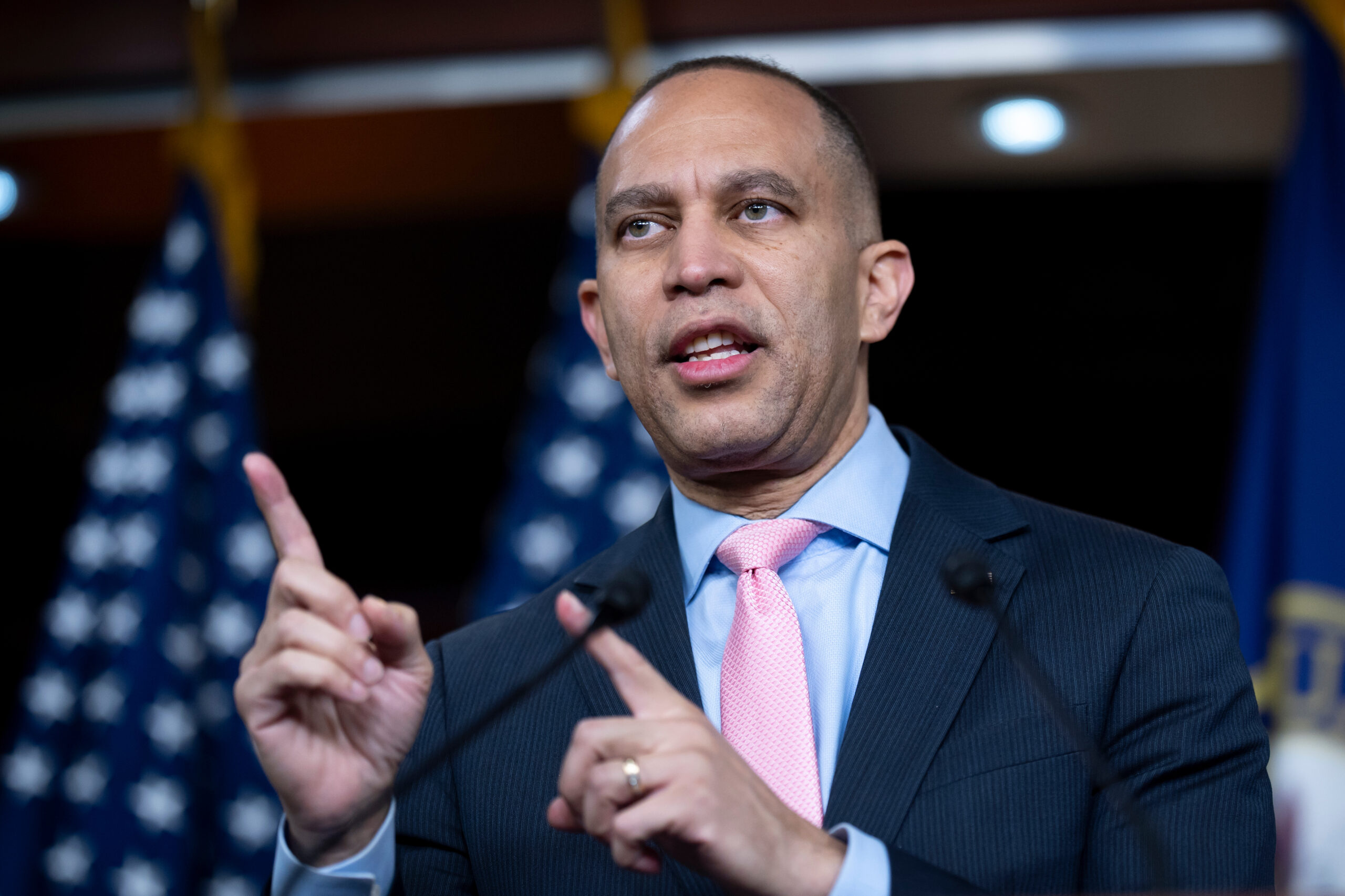
    House Minority Leader Hakeem Jeffries (D., N.Y.) speaks to reporters about Venezuela, the ICE shooting in Minneapolis, and affordability ahead of a vote in the House to extend the Obamacare subsidies for three years at the Capitol on Jan. 8. (AP Photo/J. Scott Applewhite)

    Fetterman has called for significant changes at DHS, including the firing of Secretary Kristi Noem. But he said Sunday that Democrats shouldn’t expect to “get all 10″ demands.

    “We, the Democrats, we provided 10 kinds of basic things, and then the Republicans pushed back quickly saying, ‘That’s a Christmas wish list,’ and that they’re nonstarters,” Fetterman, a member of the Senate Homeland Security Committee, said. “I truly don’t know what specifically are the Democrats’ red lines that it has to be — certainly not going to get all 10.”

    Fetterman generally opposes any measure that would shut down the government and has been the only Senate Democrat to vote for some Republican budget proposals. He added that he is concerned about federal workers, including TSA agents, not being paid amid a funding lapse.

    “Every American deserves to be paid for the work that they’ve done,” he said. “That’s real lives, and they’re not wealthy if they’re TSA folks. They’re allowing us to fly safe here in America, and that’s part of that conversation now, too.”

  • John Fetterman asks DHS to halt development of ICE detention centers in Pennsylvania, saying they will burden local communities

    U.S. Sen. John Fetterman (D., Pa.) is calling on the Department of Homeland Security to hit the brakes on its plan to develop two Immigration and Customs Enforcement detention centers in Pennsylvania, saying they would have a negative impact on local communities.

    “While I have been clear in my support for the enforcement of federal immigration law, this decision will do significant damage to these local tax bases, set back decades-long efforts to boost economic development, and place undue burdens on limited existing infrastructure in these communities,” Fetterman wrote in a letter addressed to DHS Secretary Kristi Noem and posted online Saturday.

    Fetterman’s criticism comes shortly after DHS purchased an $87 million warehouse in Upper Bern Township, Berks County, and a nearly $120 million former Big Lots distribution center in Tremont Township, Schuylkill County.

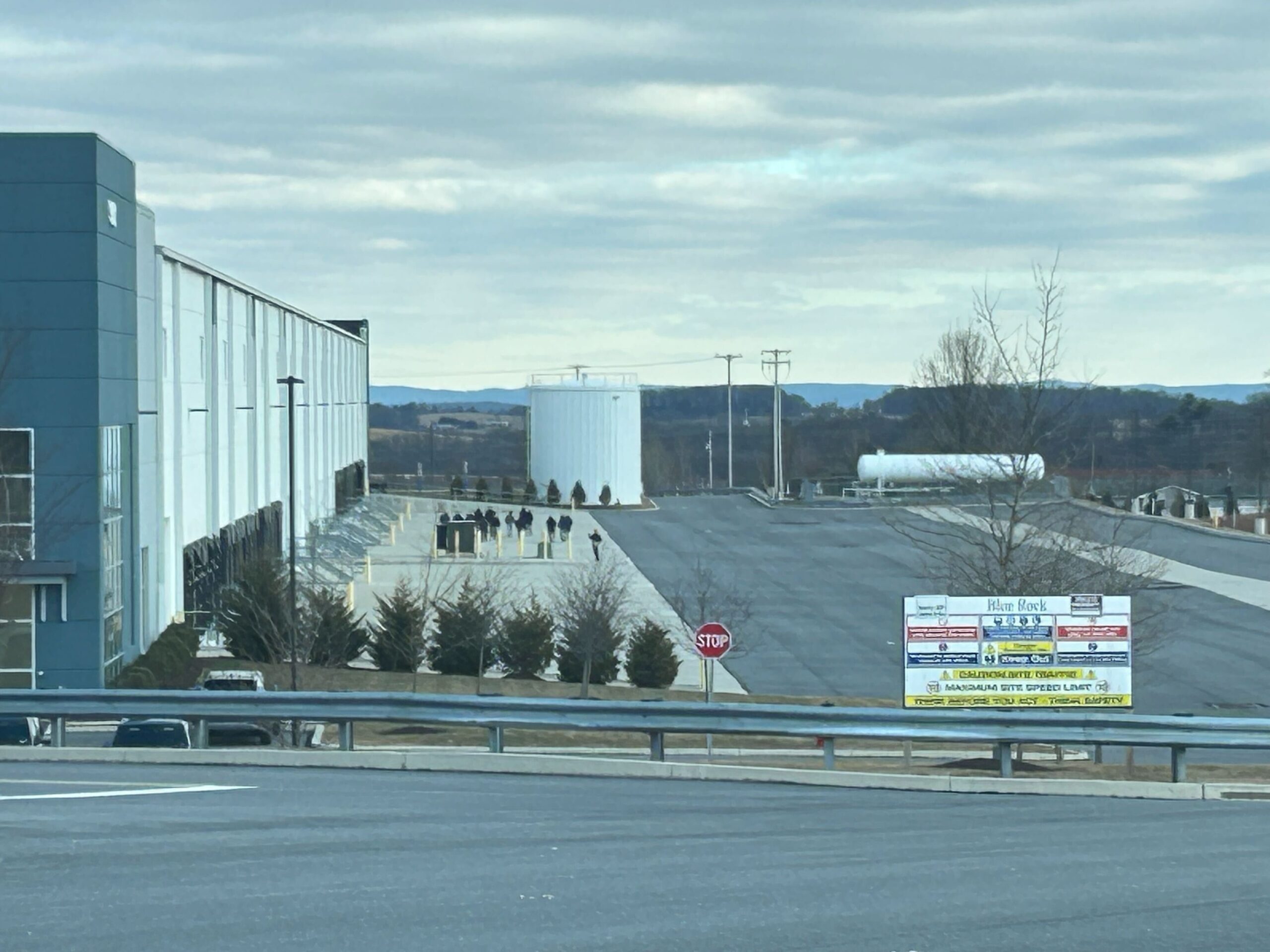
    A 1.3-million-square-foot former Big Lots warehouse in Tremont, Pa., has been bought by U.S. Immigration and Customs Enforcement for $119 million. The agency plans to detain up to 7,500 immigrants there.

    The Tremont Township detention center would house as many as 7,500 people, Fetterman noted, while the Upper Bern Township one would be capable of detaining 1,500 people.

    Upper Bern Township has 1,606 residents, according to the U.S. Census Bureau, and is about 30 minutes northwest of Reading. The facility is near an Amazon warehouse and the Mountain Springs Camping Resort.

    Tremont Township — where the much larger detention center is set to be built — has just 283 residents and is next to the 1,670-resident Tremont Borough. Tremont is in a rural area northeast of Harrisburg, near the Appalachian Trail, state game lands, and Fort Indiantown Gap, an Army National Guard training center.

    In his letter, Fetterman said local and state officials did not have a chance to weigh in on how these massive facilities would affect everything from sewer systems and the electrical grid to hospitals and emergency medical services.

    “Both townships do not currently have the capacity to meet the demands of these detention centers, with Tremont Township officials specifically stating the proposed 7,500-bed detention facility would quadruple the existing burden on their public infrastructure system,” Fetterman said.

    A warehouse in Upper Bern Township, Berks County, Pennsylvania, was purchased by ICE and the Trump administration.
    A warehouse in Upper Bern Township, Berks County, Pa., was purchased by ICE and the Trump administration.

    The letter maintains Fetterman’s stance as someone who supports ICE operations in general while criticizing the federal government’s recent handling of them. After federal agents shot and killed two U.S. citizens in Minneapolis last month, Fetterman called on the Trump administration to fire Noem. A few days later, Fetterman said he supports ICE agents wearing face masks.

    Fetterman was among 23 Senate Democrats to cross the aisle last month to vote for a compromise bill funding the federal government through September, while granting just two weeks of funding for DHS.

    Fetterman said the Pennsylvania facilities would result in a tax loss of $1.6 million to the communities. He asked DHS to agree to several conditions before proceeding further with the sites.

    He requested an “impact assessment,” details on the criteria used to select these facilities, an agreement that federal funds be used to upgrade them, and “a commitment to a period of public engagement and dialogue with these communities.”

    “Due to these significant concerns, it is my fear that DHS and ICE did not perform any due diligence, spending more than $200 million in tax dollars for warehouses that cannot be adequately converted and further eroding trust between Pennsylvanians and the Federal government,” Fetterman wrote.

    The Department of Homeland Security and Immigration and Customs Enforcement did not immediately respond to a request for comment.

    This story has been updated to correct the location of one of the proposed detention centers to Upper Bern Township.

  • In ‘Melt the ICE’ wool caps, a red tasseled symbol of resistance comes from Minneapolis to Philadelphia

    In ‘Melt the ICE’ wool caps, a red tasseled symbol of resistance comes from Minneapolis to Philadelphia

    Some yarn shops around Philadelphia are running low on skeins of red wool, as local knitters and crocheters turn out scads of “Melt the ICE” caps in solidarity with protesters in Minnesota.

    The hats don’t feature a patch or logo that says “Melt the ICE.” In fact, they carry no written message at all. What they offer is a deep scarlet hue, a dangling tassel, and a connection to an earlier, dangerous time, when a different people in another land sought to silently signal their unity.

    “The hat is really a symbol and reminder,” said knitter Laura McNamara of Kensington, who is making two caps for friends. “People are looking for a sense of community.”

    She refused her friends’ offers of payment, asking instead that they not let their involvement start and end with a hat ― but find a means to stand up for civil rights in some specific way.

    The original hat was a kind of conical stocking cap, known as a nisselue, worn in Norway during the 1940s as a sign of resistance to the Nazi occupation. The Germans eventually caught on to the symbolism and banned the caps.

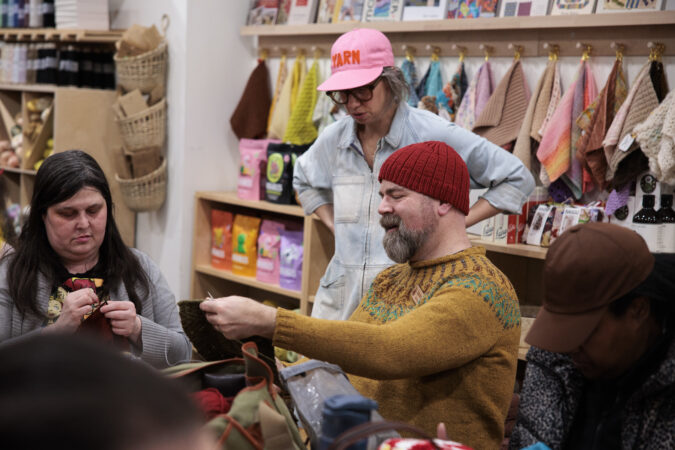
    Amanda Bryman works on a red wool hat known as a “Melt the ICE” hat, during Fiber Folk Night at Wild Hand yarn shop in Philadelphia on Wednesday.

    Now the new version that originated in a suburban Minneapolis yarn shop is spreading across the country. The hats signal opposition to U.S. Immigration and Customs Enforcement, which surged thousands of agents into Minneapolis, and sadness and anger over the deaths of Minnesotans and U.S. citizens Renee Good and Alex Pretti, who were shot to death by federal agents.

    Today, comparisons of ICE agents to Nazis have become both frequent and contentious in American politics, with even some Democrats, including Gov. Josh Shapiro, who is Jewish, rejecting that equivalence as wrong and unacceptable.

    ICE officials did not respond to a request for comment.

    This is not the first time that the Philadelphia region’s craftivist movement, as it is known, has brought its knitting needles and crochet hooks to bear.

    On the eve of Donald Trump’s first inauguration, artisans here turned out scores of cat-eared headgear known as pussy hats, a feline symbol of protest worn at the Women’s March on Washington. The hats aimed to tweak the then-president-elect over his comment about grabbing women by their genitals.

    The Melt the ICE caps carry some controversy within the fiber community, as it calls itself. There have been online complaints that it’s easy to tug a red cap over one’s ears, but unless that is accompanied by action it holds no more significance than clicking a “Like” button on Facebook.

    “It is just preening,” one person wrote in an internet forum.

    Another said that “if your resistance is only this hat, then you have not actually accomplished anything except make a hat.”

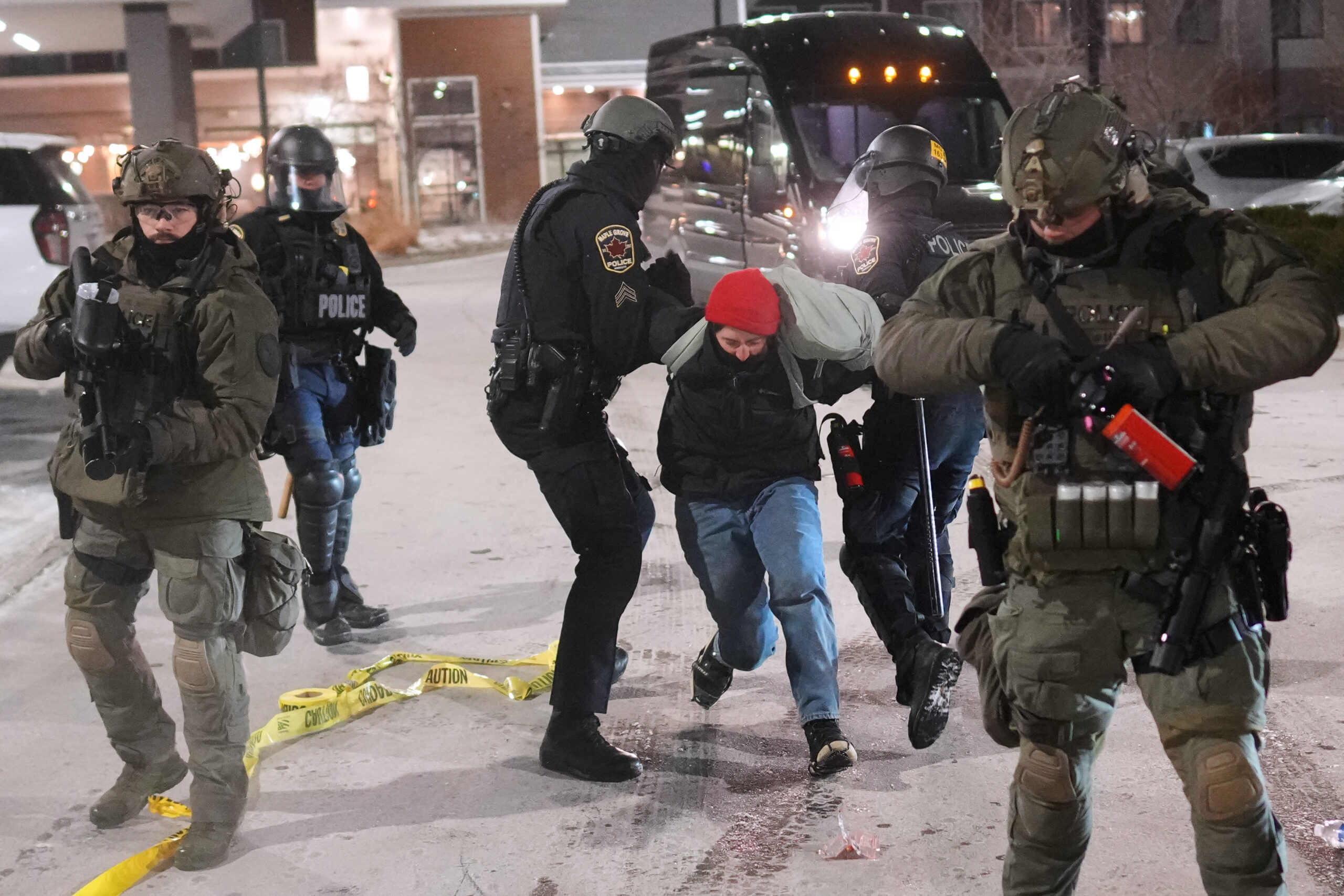
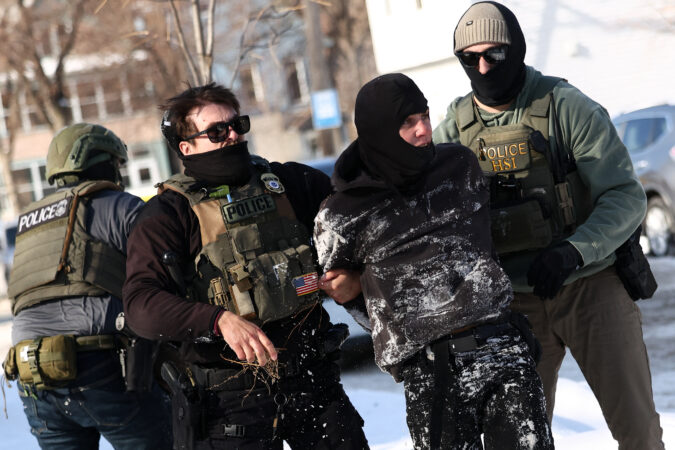
    Law enforcement officers detain a demonstrator during a protest outside SpringHill Suites and Residence Inn by Marriott hotels on Jan. 26 in Maple Grove, Minn.

    Liz Sytsma, owner of Wild Hand in West Mount Airy, has heard the criticism.

    But “the people in our community who are participating in making the hats, this is one of many things they are doing,” she said. That includes taking part in protests, calling elected leaders, and giving money to causes they support.

    On Wednesday, more than a dozen people gathered at Wild Hand for the weekly Fiber Folk Night, where crafters gather to knit, crochet, and chat ― and, now, to work on hats.

    Damon Davison traveled from Audubon, Camden County, having developed his own hat pattern, with sale proceeds to go to the activist group Juntos in South Philadelphia.

    He wants to show solidarity with people “who are expressing resistance to what has been happening in Minneapolis, but also what’s happening here in Philly,” he said. “The idea is to make it a little bit more local.”

    The shop has seen a rush on red, sought by about 70% of customers whose purchases have depleted stocks during the last couple of weeks.

    “We’re really low,” said store manager Yolanda Booker, who plans to knit and donate a hat. “I want to do whatever small part I can do to help out.”

    A single hat can take two or three days to make, though the best and fastest knitters can complete one in a couple of hours.

    In Minnesota, the owner of Needle & Skein, which produced the hats’ design, told reporters this month that online sales of the $5 pattern have generated more than $588,000 to be donated to area organizations.

    Store Manager Yolanda Booker, standing, laughs with attendees during Fiber Folk Night at Wild Hand yarn shop in Philadelphia on Wednesday.

    In West Mount Airy, Kelbourne Woolens closed its physical doors during the national “ICE Out” strike in late January and donated its online profits of $4,000 to Asian Americans United, Juntos, and New Sanctuary Movement of Philadelphia, said team member Bailey Spiteri. She estimated the store has sold enough red yarn to retailers to make 500 or 600 hats.

    At Stitch Central in Glenside, customers donated $1,000 during the strike and the store matched it, with the $2,000 going to Nationalities Service Center in Philadelphia.

    “Sometimes people are skeptical. How does wearing a hat or even making a hat make a difference?” asked Allison Covey of Drunken Knit Wits, a local knitting and crocheting organization. “But look at the donations. It does make a difference.”

    Veteran knitter Neeta McColloch of Elkins Park thinks the same. She has ordered enough yarn to make eight hats. And she is curious to see how the phenomenon will develop.

    “This is probably bigger than I think,” she said. “Knitters tend to be the type of people who in my experience have a strong moral compass. If they can combine something they love to do with something in which they can make a statement, that’s important to them.”

  • The Narberth Council bars borough police from assisting ICE in immigration enforcement

    The Narberth Council bars borough police from assisting ICE in immigration enforcement

    Narberth’s borough council has voted unanimously to bar the municipality’s police officers from cooperating with U.S. Immigration and Customs Enforcement under the agency’s 287(g) program.

    The resolution approved Thursday made clear that “our police department operates to protect our residents and protect the public safety here and does not have a role in immigration enforcement,” said Council President Fred Bush.

    ICE’s 287(g) program deputizes local law enforcement officers to carry out immigration actions, including identifying, arresting, and deporting immigrants. ICE has signed around 1,400 such agreements with law enforcement agencies in 40 states, including dozens in Pennsylvania.

    In Philadelphia’s collar counties, only the Lansdowne Borough Constable’s Office in Delaware County and the Pennsylvania State Constable Office Honey Brook Precinct 1 in Chester County are 287(g) participants. Bucks County Sheriff Danny Ceisler, a newly elected Democrat, terminated his office’s controversial partnership last month, citing negative impacts on public safety and law enforcement trust.

    Neither Lower Merion nor Narberth participates in the program.

    Narberth’s resolution establishes that the borough will not enter into any agreement with the federal government, including 287(g), that would commit borough time, funds, efforts, or resources toward ICE noncriminal enforcement activities.

    Officials clarified that Narberth’s police department would cooperate with ICE officials if they had a judicial warrant to arrest someone. An internal memo first reported by The Associated Press last month has authorized ICE to forcibly enter people’s homes without a judicial warrant.

    Narberth officials acknowledged that the resolution could be seen as “virtue signaling,” given that the borough already does not participate in an ICE partnership. Yet council members said they believe it’s important to publicly signal the municipality’s values regarding immigration enforcement.

    The resolution “lets the public clearly know where we stand on the issues, helps reinforce trust, and provides that clarity of what we will do and what we won’t do,” said Dana Edwards, Narberth’s mayor. “From my standpoint, it’s a practical resolution.”

    “When our community members trust their law enforcement, they feel comfortable reaching out to them for assistance,” said Councilmember Jean Burock. “We can’t afford to erode that trust.”

    Bush cautioned residents against interfering with ICE operations, describing the agency as “poorly trained” and “dangerous,” citing “the actions and the images that came out of Minneapolis” in recent weeks.

    Neighboring Haverford Township similarly barred its law enforcement officers from assisting ICE last month.

    Narberth’s resolution came on the heels of a Jan. 30 incident in which two people were taken into custody by ICE during a traffic stop in Penn Wynne.

    Following the arrests, Lower Merion affirmed in a public statement that the township does not participate in 287(g) and encouraged residents to call 911 if they observe law enforcement activity with no Lower Merion police officers present.

    This suburban content is produced with support from the Leslie Miller and Richard Worley Foundation and The Lenfest Institute for Journalism. Editorial content is created independently of the project donors. Gifts to support The Inquirer’s high-impact journalism can be made at inquirer.com/donate. A list of Lenfest Institute donors can be found at lenfestinstitute.org/supporters.

  • The detention of the couple that owns Jersey Kebab sparked change. Deportation still looms.

    The detention of the couple that owns Jersey Kebab sparked change. Deportation still looms.

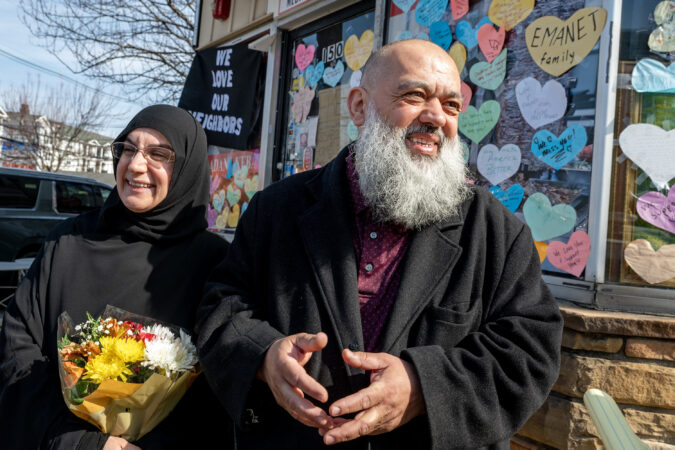
    COLLINGSWOOD, N.J. — The shawarma, falafel wraps and baklava at Jersey Kebab are great, but many of its patrons are also there these days for a side of protest.

    A New Jersey suburb of Philadelphia has rallied around the restaurant’s Turkish owners since federal officers detained the couple last February because they say their visas had expired.

    In fact, business has been so good since Celal and Emine Emanet were picked up early in the Trump administration’s immigration crackdown that they have moved to a bigger space in the next town over. Their regulars don’t seem to mind.

    The family came to the U.S. seeking freedom

    Celal Emanet, 52, first came to the U.S. in 2000 to learn English while he pursued his doctorate in Islamic history at a Turkish university. He returned in 2008 to serve as an imam at a southern New Jersey mosque, bringing Emine and their first two children came, too. Two more would be born in the U.S.

    Before long, Celal had an additional business of delivering bread to diners. They applied for permanent residency and believed they were on their way to receiving green cards.

    When the COVID-19 pandemic began and the delivery trucks were idled, Celal and Emine, who had both worked in restaurants in Turkey, opened Jersey Kebab in Haddon Township. Business was strong from the start.

    It all changed in a moment

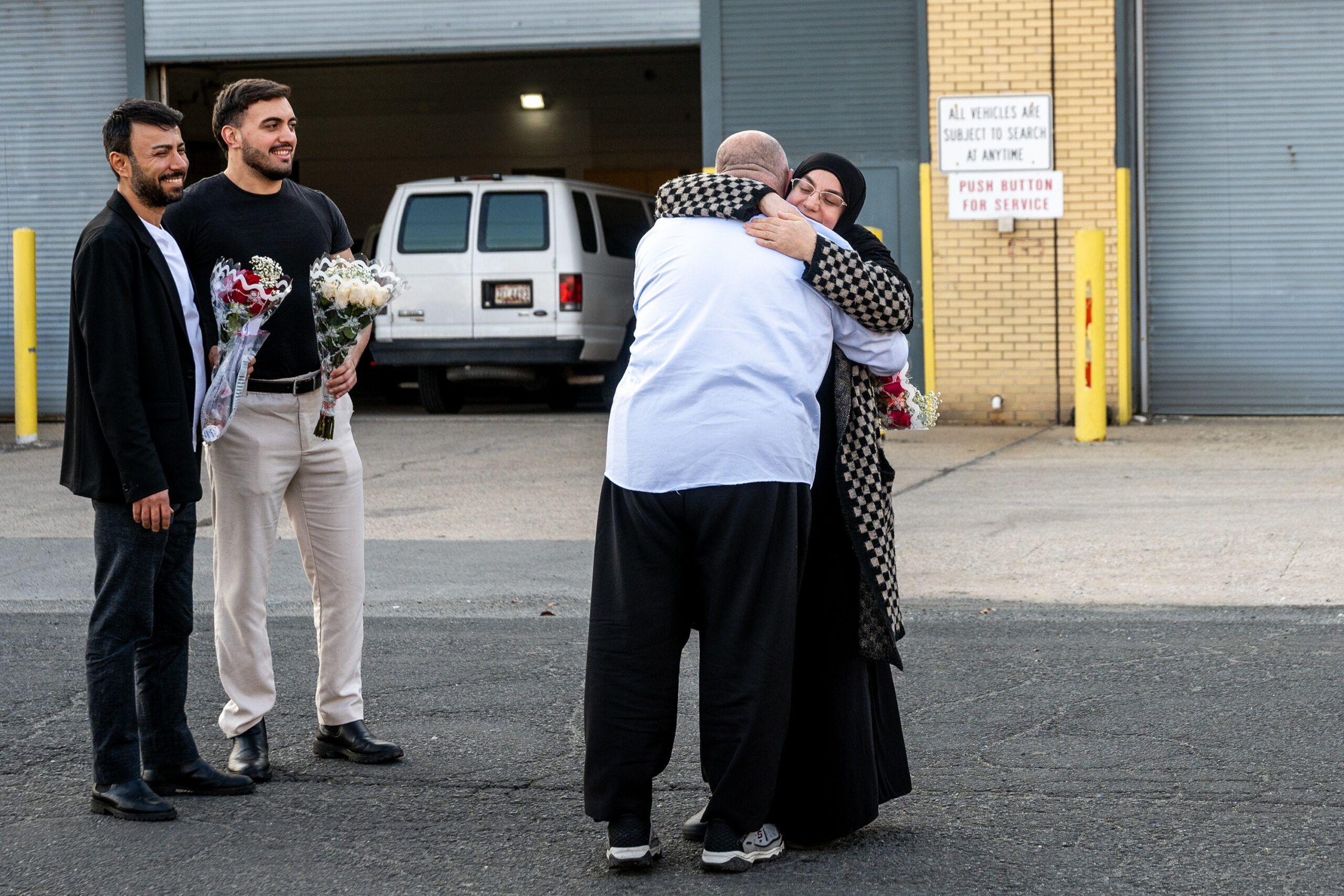
    On Feb. 25, U.S. marshals and Immigration and Customs Enforcement officers arrested the couple at the restaurant. Celal was sent home with an ankle monitor, but Emine, now 47, was moved to a detention facility more than an hour’s drive away and held there for 15 days.

    With its main cook in detention and the family in crisis, the shop closed temporarily.

    Emine Emanet hugs her husband Celal as she leaves the ICE Elizabeth Detention Facility on Wednesday, March 12, 2025.

    Although the area is heavily Democratic, the arrests of the Emanets signaled to many locals that immigration enforcement during President Donald Trump’s second term wouldn’t stop at going after people with criminal backgrounds who are in the U.S. illegally.

    “They were not dangerous people — not the type of people we were told on TV they were looking to remove from our country,” Haddon Township Mayor Randy Teague said.

    Supporters organized a vigil and raised $300,000 that kept the family and business afloat while the shop was closed — and paid legal bills. Members of Congress helped, and hundreds of customers wrote letters of support.

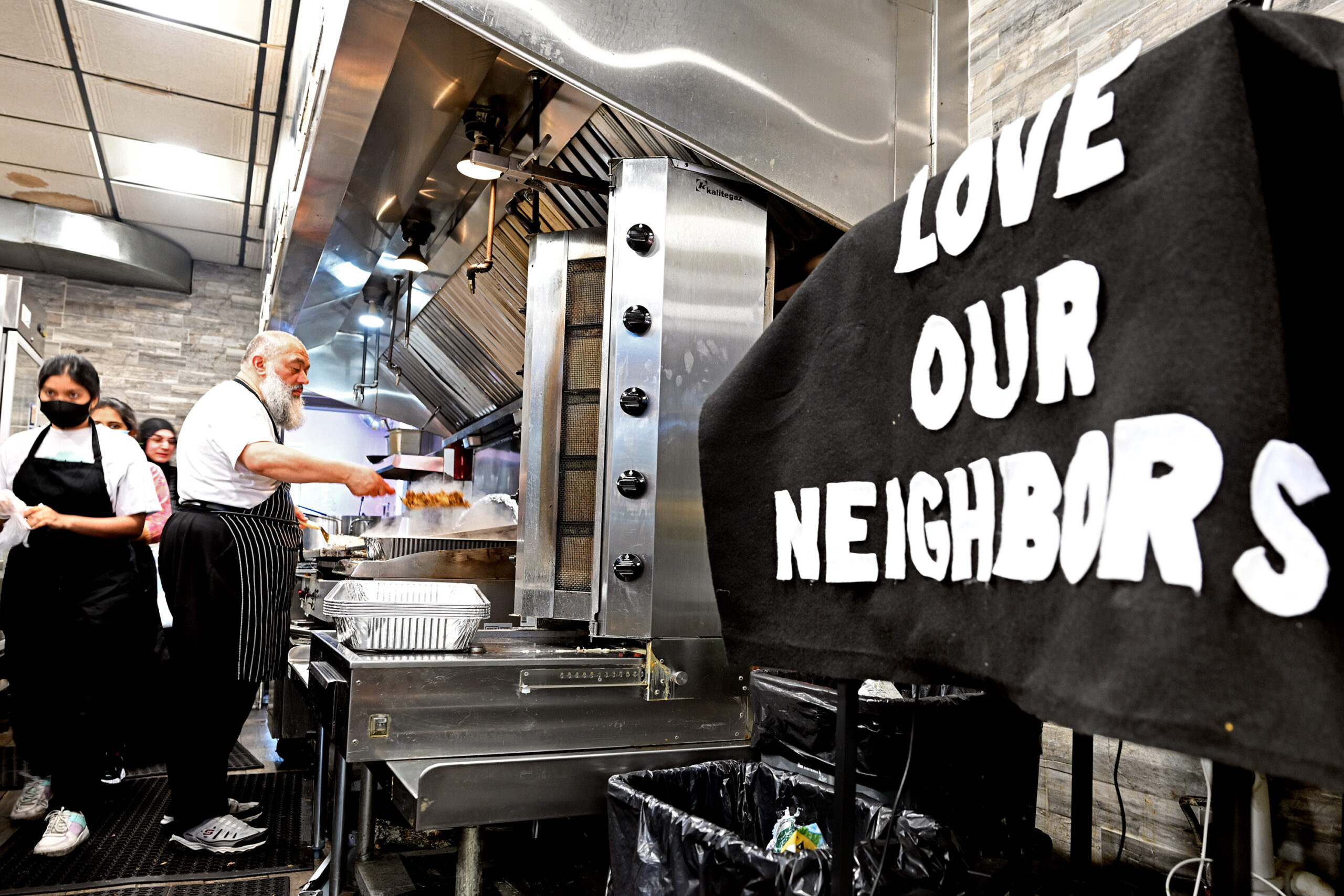
    Celal Emanet works at the grill in his Jersey Kebab restaurant on Sunday, Mar. 30, 2025.

    Space for a crowd

    As news of the family’s ordeal spread, customers new and old began packing the restaurant. The family moved it late last year to a bigger space down busy Haddon Avenue in Collingswood.

    They added a breakfast menu and for the first time needed to hire servers besides their son Muhammed.

    The location changed, but the restaurant still features a sign in the window offering free meals to people in need. That’s honoring a Muslim value, to care for “anybody who has less than us,” Muhammed said.

    Judy Kubit and Linda Rey, two friends from the nearby communities of Medford and Columbus, respectively, said they came to Haddon Township last year for an anti-Trump “No Kings” rally and ate a post-protest lunch at the kebab shop.

    “We thought, we have to go in just to show our solidarity for the whole issue,” Kubit said.

    Last month, with the immigration crackdown in Minneapolis dominating the headlines, they were at the new location for lunch.

    Gretchen Seibert tapes up hearts with words of support for Celal and Emine Emanet, the owners of Jersey Kebab, after the couple was detained by ICE in February 2025.

    The legal battle hasn’t ended

    The Emanets desperately want to stay in the U.S., where they’ve built a life and raised their family.

    Celal has a deportation hearing in March, and Emine and Muhammed will also have hearings eventually.

    Celal said moving back to Turkey would be bad for his younger children. They don’t speak Turkish, and one is autistic and needs the help available in the U.S.

    Also, he’d be worried about his own safety because of his academic articles. “I am in opposition to the Turkish government,” he said. “If they deport me, I am going to get very big problems.”

    The groundswell of support has shown the family they’re not alone.

    “We’re kind of fighting for our right to stay the country,” Muhammed Emanet said, “while still having amazing support from the community behind us. So we’re all in it together.”

  • Unmasking ICE in Philly could test the limits of local power over federal agents

    Unmasking ICE in Philly could test the limits of local power over federal agents

    One of the lasting images of President Donald Trump’s mass deportation campaign will be the masks worn by federal immigration agents.

    The widespread use of facial coverings by U.S. Immigration and Customs Enforcement officers is among the suite of tactics — agents dressed in plainclothes, wearing little identification, jumping out of unmarked cars to grab people off the street — that have fueled immigration advocates’ use of terms like “kidnappings” and “abductions.”

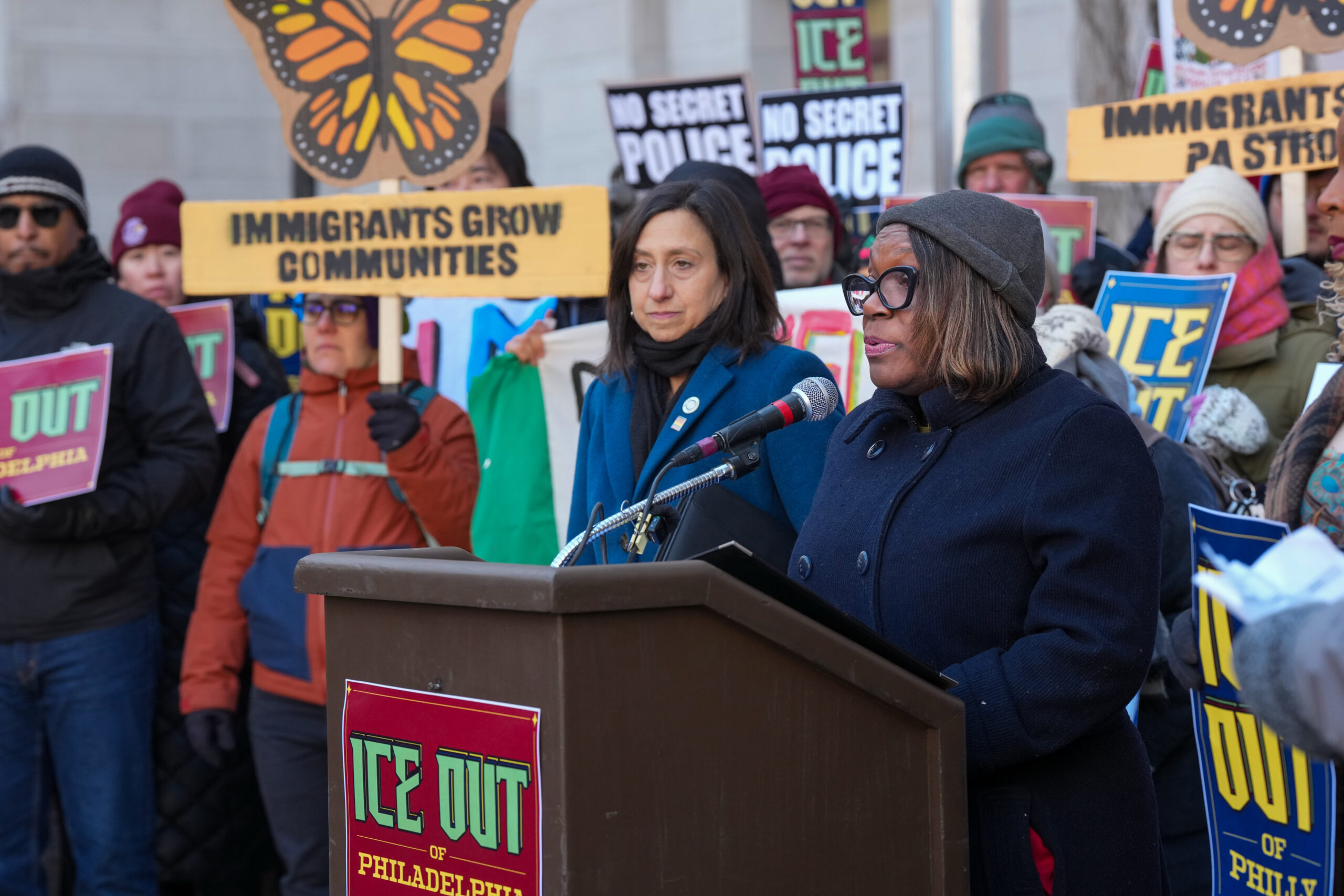
    Now Philadelphia lawmakers appear poised to pass legislation that would ban all officers operating in the city — including local police — from concealing their identities by wearing masks or conducting enforcement from unmarked cars.

    The question is whether the city can make that rule stick.

    Legal hurdles loom for municipalities and states attempting to regulate federal law enforcement. Local jurisdictions are generally prohibited from interfering with basic federal functions, and Trump administration officials say state- and city-level bans violate the constitutional provision that says federal law reigns supreme.

    Experts are split on whether the bill proposed by Philadelphia City Council members last week would survive a lawsuit.

    There are also practical concerns about enforcement. Violating the mask ban would be a civil infraction, meaning local police would be tasked with citing other law enforcement officers for covering their faces.

    “No doubt this will be challenged,” said Stanley Brand, a distinguished fellow at Penn State Dickinson Law. “This ordinance will be a protracted and complicated legal slog.”

    Councilmember Kendra Brooks speaks during a news conference at City Hall to announce a package of bills aimed at pushing back against ICE enforcement on Jan. 27.

    Advocates for immigrants say that unmasking ICE agents is a safety issue, and that officers rarely identify themselves when asked, despite being required to carry badges.

    Mask use can also spur impersonators, they say. At least four people in Philadelphia have been arrested for impersonating ICE officers in the last year.

    “You see these people in your community with guns and vests and masks,” said Desi Bernette, a leader of MILPA, the Movement of Immigrant Leaders in Pennsylvania. “It’s very scary, and it’s not normal.”

    Democrats in jurisdictions across America, including Congress and the Pennsylvania General Assembly, have introduced legislation to ban ICE agents from concealing their faces. California is the furthest along in implementing a mask prohibition, and a judge is currently weighing a challenge filed by the Trump administration.

    Senate Democrats negotiating a budget deal in Washington have asked for a nationwide ban on ICE agents wearing masks in exchange for their votes to fund the Department of Homeland Security.

    And polling shows getting rid of masks is popular. A recent Pew Research Center survey found that 61% of Americans believe federal agents should not wear face coverings to conceal their identities while on duty.

    ICE officials say agents should have the freedom to conceal their faces while operating in a hyperpartisan political environment.

    Last year, ICE head Todd Lyons told CBS News that he was not a proponent of agents wearing masks, though he would allow it. Some officers, he said, have had private information published online, leading to death threats against them and their families.

    On Sunday, U.S. Sen. John Fetterman, a Pennsylvania Democrat, defended ICE officers who wear masks and said doxing is a “serious concern.”

    “They could target [agents’] families,” Fetterman said in an interview on Fox News, “and they are organizing these people to put their names out there.”

    Sen. John Fetterman, D-Pa., participates in a debate on June 2, 2025, in Boston.

    The Council authors of the Philadelphia bills say they are responding to constituents who are intimidated by ICE’s tactics, and they believe their legislation can withstand a legal challenge.

    “Our goal is to make sure that our folks feel safe here in the city,” said City Councilmember Kendra Brooks. “We are here to protect Philadelphians, and if that means we eventually need to go to court, that’s what would need to happen.”

    The constitutional limits on unmasking ICE

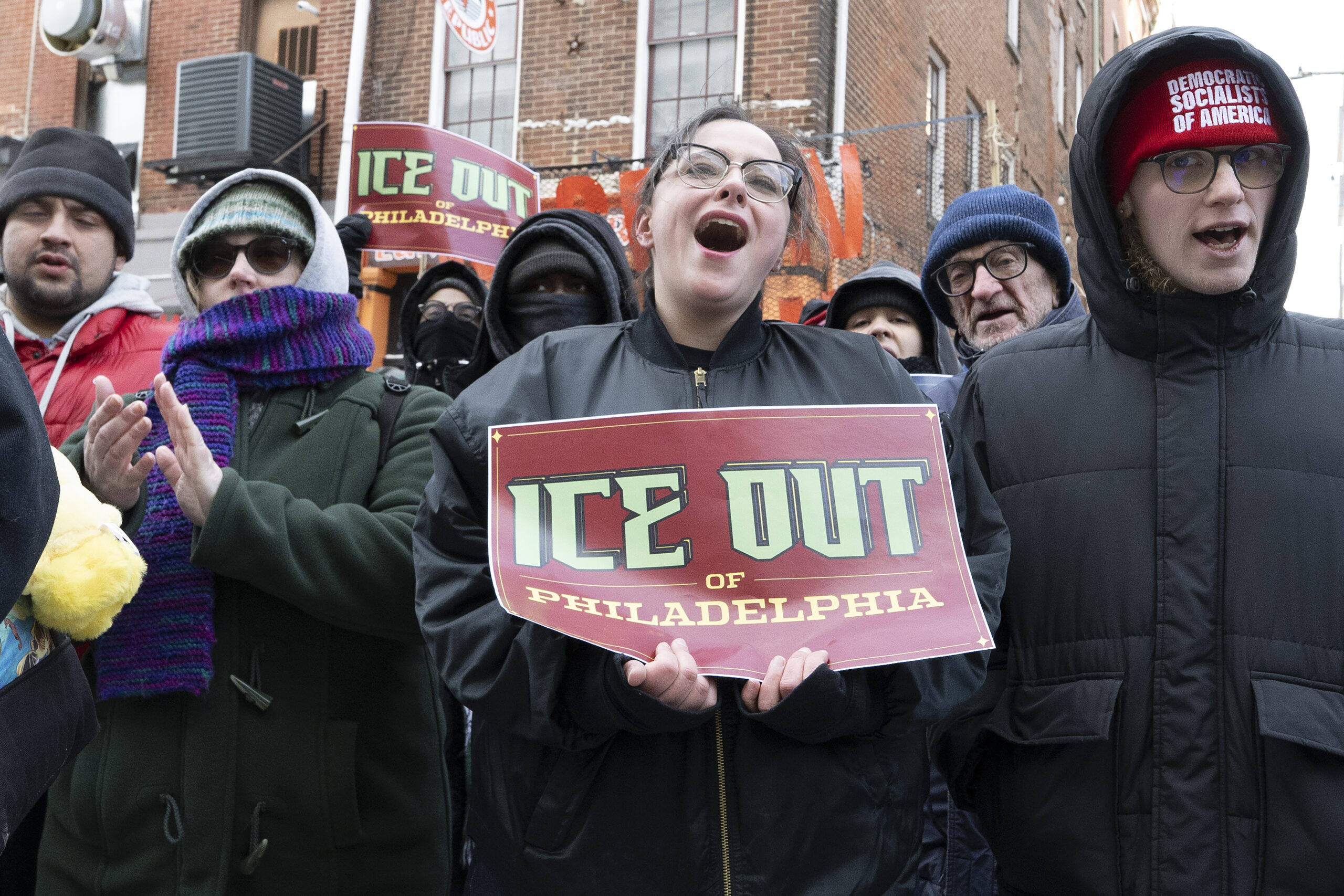
    The bill introduced last week by Brooks and Councilmember Rue Landau is part of a package of seven pieces of legislation aimed at limiting how ICE operates in Philadelphia. The proposals would bar Philadelphia employees from sharing information with ICE and ban the agency from using city property to stage raids.

    Fifteen of Council’s 17 members signed on to the package of legislation, meaning a version of it is likely to become law. Passing a bill in City Council requires nine votes, and overriding a mayoral veto takes 12. Mayor Cherelle L. Parker has said her team is reviewing the legislation, which can still be amended before it becomes law.

    Anti-ICE activists demonstrate outside U.S. Sen. John Fetterman’s Philadelphia office, Jan. 27, calling for an end to federal immigration enforcement policies.

    One of the two members who did not cosponsor the package was Councilmember Mike Driscoll, a Democrat who represents parts of Lower Northeast Philadelphia. He indicated that he had concerns about whether the “ICE Out” legislation would hold up in court.

    Brooks said Council members worked with attorneys to ensure the legislation is “within our scope as legislators for this city to make sure that we protect our folks against these federal attacks.”

    Brand, of Dickinson Law, said the legislation is a classic example of a conflict between two constitutional pillars: the clause that says federal law is supreme, and the 10th Amendment, which gives states powers that are not delegated to the federal government.

    He said there is precedent that the states — or, in this case, cities — cannot interfere with laws enacted by Congress, such as immigration matters.

    “If I were betting, I would bet on the federal government,” Brand said.

    But there is a gray area, he said, and that includes the fact that no law — or even regulation — says federal law enforcement agents must wear masks.

    Kermit Roosevelt, a law professor at the University of Pennsylvania who is an expert on the Constitution and conflict of laws, said if there is no agency policy, that is “free space” for states and cities to regulate.

    Roosevelt said Brooks’ legislation steers clear of other constitutional concerns because it applies to all police officers, not just federal agents.

    “If they were trying to regulate only federal agents, the question would be, ‘Why aren’t you doing that to your own police officers?’” he said. “If you single out the federal government, it looks more like you’re trying to interfere with what the federal government is doing.”

    Applying the law to local police

    Experts say part of the backlash to ICE agents covering their faces is because Americans are not used to it. Local police, sheriff’s deputies, and state troopers all work largely without hiding their faces.

    “Seeing law enforcement actions happening with federal agents in masks, that’s extremely jarring,” said Cris Ramon, an immigration consultant based in Washington. “Why are you operating outside of the boundaries of what every other law enforcement agency is doing?”

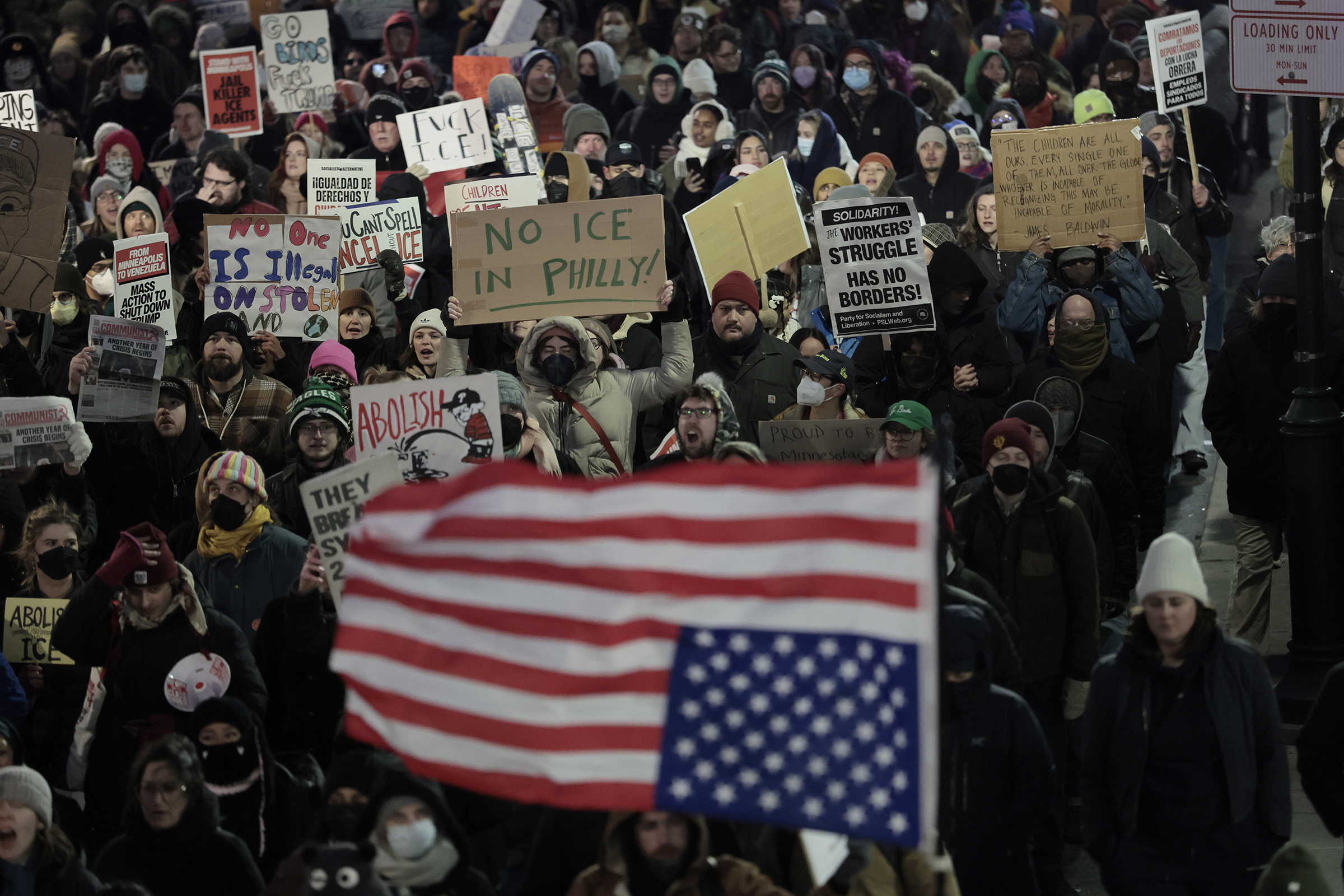
    Protesters march up Eighth Street, toward the immigration offices, during the Philly stands with Minneapolis Ice Out For Good protest at Philadelphia City Hall on Jan. 23.

    The Council legislation includes exceptions for officers wearing medical-grade masks, using protective equipment, or working undercover. It also allows facial coverings for religious purposes.

    However, the federal government could still raise First Amendment concerns, said Shaakirrah R. Sanders, an associate dean at Penn State Dickinson Law.

    The administration, she said, could argue that the city is only trying to regulate law enforcement officers and claim that would be discriminatory.

    Sanders said defending the legislation could be “very costly” and the city should consider alternatives that fall more squarely within its authority. She pointed to efforts like New Jersey Gov. Mikie Sherrill’s announcement that the state would create a database for residents to upload videos of ICE interacting with the public.

    “It looks like the city wants to wield big legislative power,” Sanders said. “My alternative is more in the grassroots work, where you are the first ear for your citizens, not the regulator of the federal government.”

  • About 40 anti-ICE activists are arrested at protest inside Target in South Philly

    About 40 anti-ICE activists are arrested at protest inside Target in South Philly

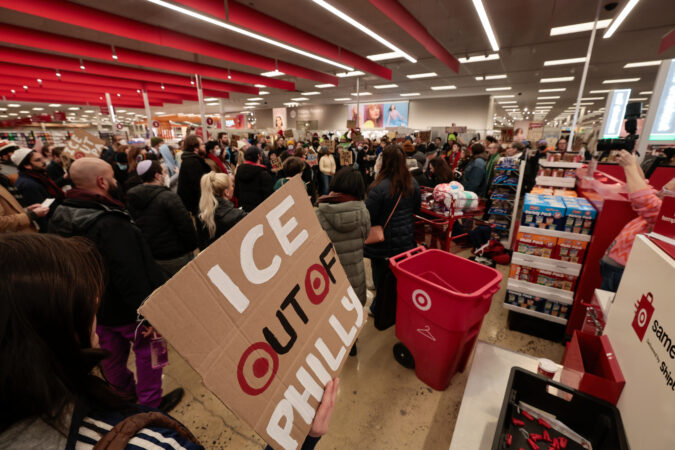
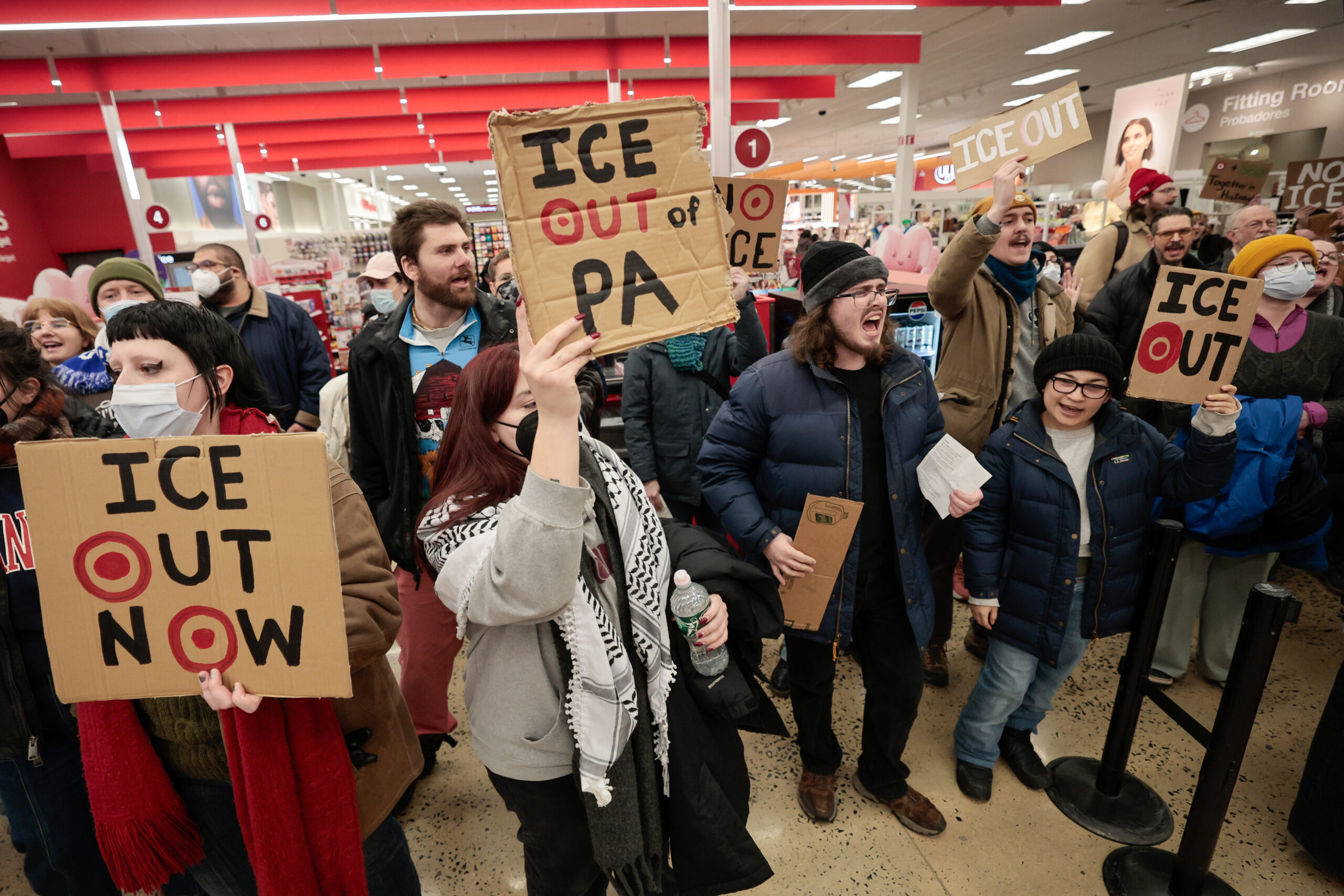
    About 40 people were arrested after an activist group Thursday evening conducted a demonstration inside a Target store in South Philadelphia to demand that the company take a public stand against U.S. Immigration and Customs Enforcement actions at the chain’s stores.

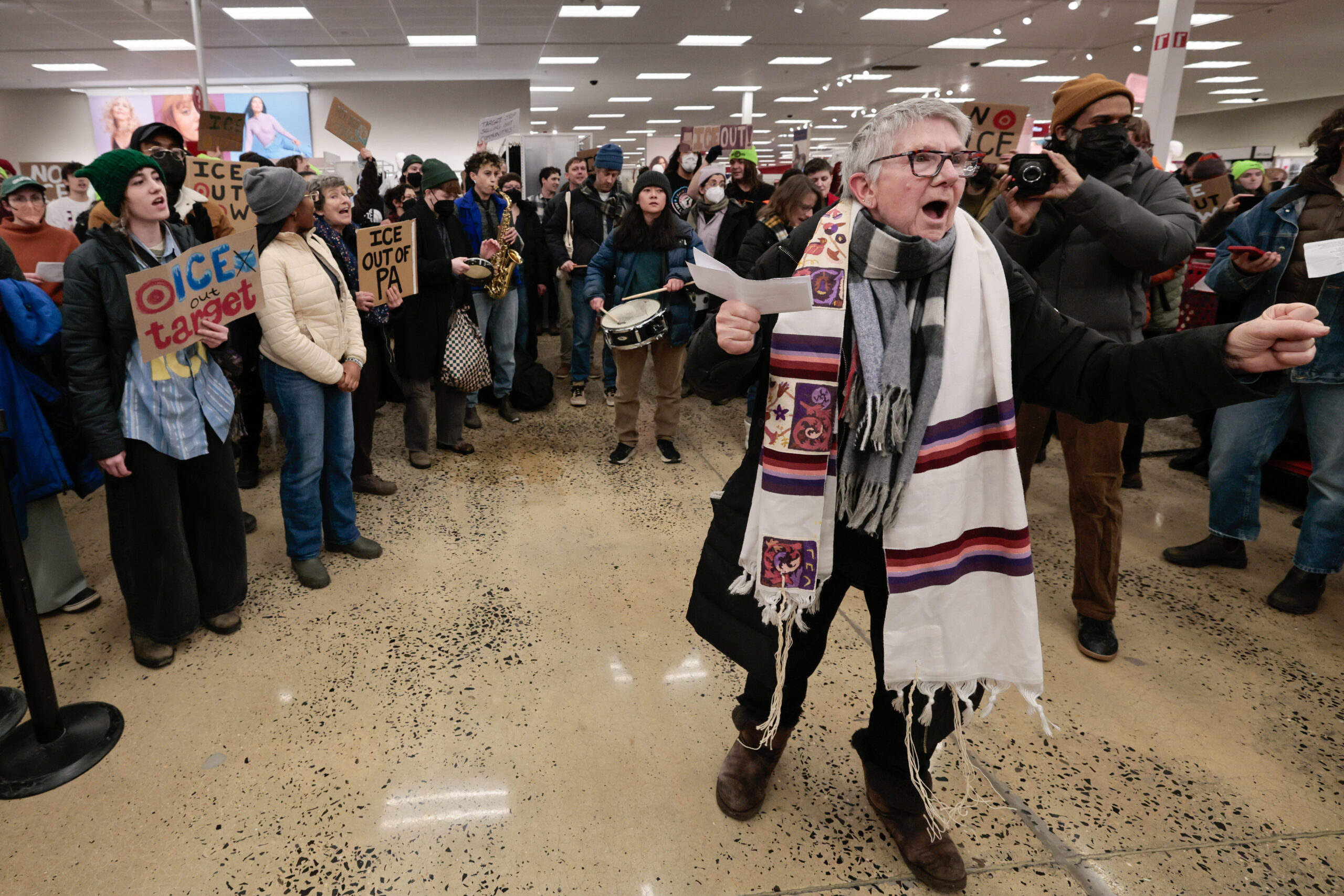
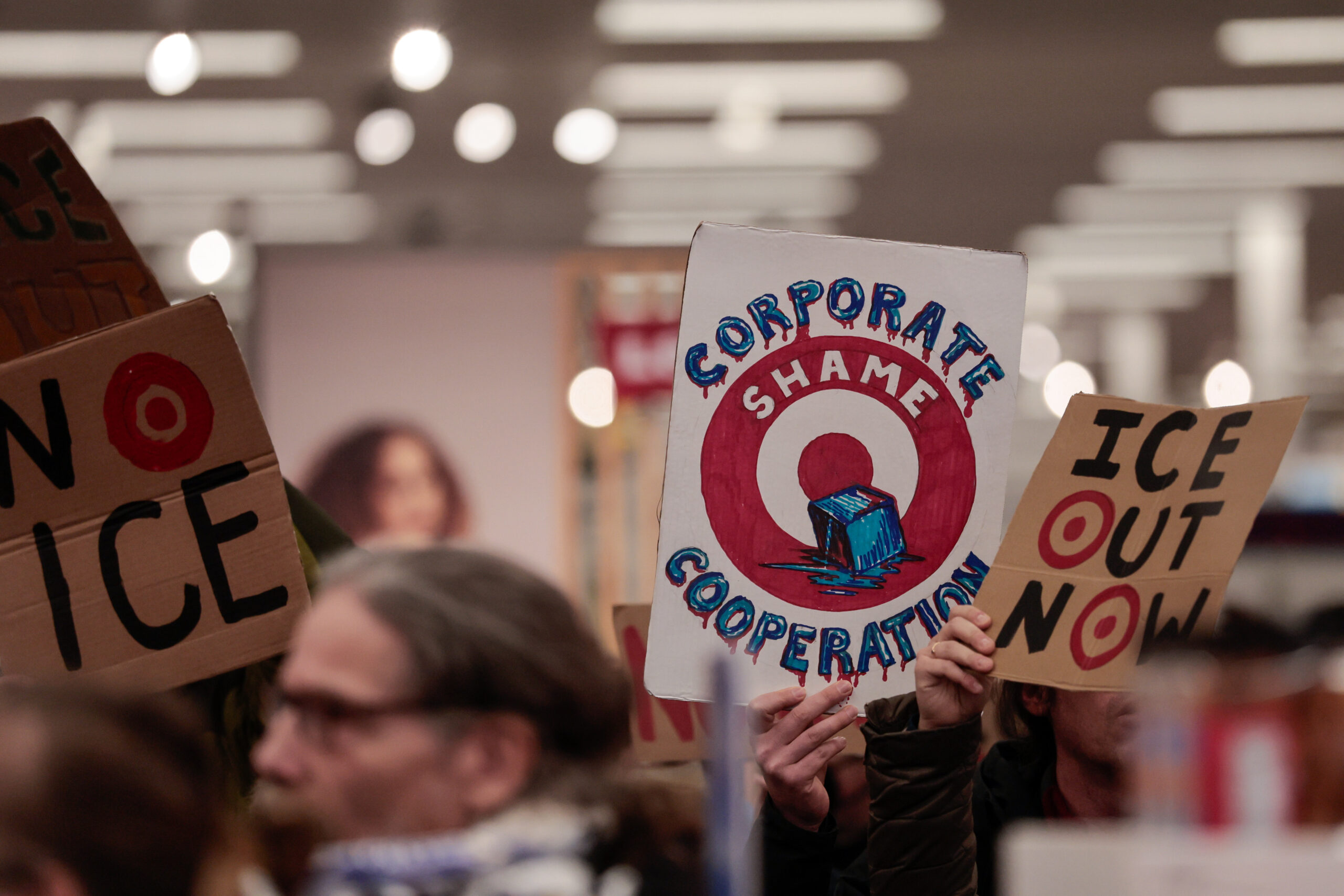
    More than 100 demonstrators affiliated with No ICE Philly chanted “ICE out of Target now!” and played instruments inside the store near Snyder Avenue and I-95. Some shoppers joined the chanting.

    Shortly before 6 p.m., the protesters were given their first warning by police to leave or be arrested. Dozens then left, but a group of 40 or so remained inside, seated on the floor. Around 6:15 p.m., police began making arrests without incident. Three remaining protesters were given citations and allowed to leave, police said.

    The zip-tied detainees were led by police out of the store one by one to cheers from other protesters outside.

    The demonstration and subsequent arrests did not deter shoppers from going about their business, entering and leaving the store.

    A man dressed in a bear costume and wearing an action camera harnessed to his chest showed up and yelled at the activists inside the store, calling them “weirdos.” Police intervened to prevent an escalation.

    Rabbi Linda Holtzman, 73, (right) a spokesperson for No ICE Philly, addresses the crowd during a demonstration inside a Target store in South Philadelphia, Feb. 5, 2026.

    Benita Dixon, 66, accompanied by her granddaughter, was at the store to buy a Valentine’s Day present for her daughter when the protest broke out.

    Dixon’s first reaction was to get a tighter grip on her granddaughter’s hand, but when chanting began, the pair joined in dancing with protesters.

    “ICE has been going around killing people in Minnesota, and that’s not right,” Dixon said. “Many of my co-workers are coming into work carrying their passports because they are scared, so I’m glad we are protesting: No ICE in our streets.”

    Protests coordinated by No ICE Philly were conducted last month at Target stores around Philadelphia, including in Center City, Fairmount, Port Richmond, and South Philadelphia.

    Across the country, protesters — including employees of the company — have been calling for Target to publicly oppose the federal immigration crackdown in Minnesota, the company’s home state, and deny ICE agents who do not have judicial warrants access to Target stores and parking lots.

    Demonstrators from No ICE Philly protesting inside the Target store.

    “Target does not have cooperative agreements with any immigration enforcement agency,” a company executive said in a memo to employees on Jan. 22, Business Insider reported.

    A day after two ICE agents fatally shot 37-year-old Alex Pretti in Minneapolis, where Target is headquartered, then-incoming CEO Michael Fiddelke cosigned a joint statement from the Minnesota Chamber of Commerce with dozens of other executives, “calling for an immediate de-escalation of tensions and for state, local and federal officials to work together to find real solutions.”

    Pretti’s Jan. 24 killing in Minneapolis was the second in less than a month. On Jan. 7, an ICE agent fatally shot 37-year-old Renee Nicole Good.

    A Target spokesperson said in an email that Fiddelke also sent a note to employees saying “the violence and loss of life in our community is incredibly painful” and that “we are doing everything we can to manage what’s in our control, always keeping the safety of our team and guests our top priority.”

    Target, founded in 1962, operates 1,989 stores across the United States and generates net revenue of more than $100 billion annually.

    The company was hit with a national boycott last year after it rolled back Diversity, Equity, and Inclusion initiatives to fall in line with the policies of President Donald Trump.

    No ICE Philly has led demonstrations against the agency and against the arrests of immigrants outside the city Criminal Justice Center.

    Demonstrators from No ICE Philly protesting inside the store.

    At the Target in South Philadelphia, Rabbi Linda Holtzman, 73, said the in-store protest is what people must do when neighbors are under attack.

    “What ICE is doing, what they have been doing, is horrible, and we stand with the people of Minneapolis,” Holtzman said.

    Protesting at the South Philadelphia Target is a way to tell the company that it must stand on the side of the people, Holtzman said.

    “Target has become an ally to ICE, letting them come into their stores without a warrant,” Holtzman said. “That’s not the America I grew up in. Is that the country you want?”

  • Philly federal judges are growing frustrated with ICE policy to detain most undocumented immigrants

    Philly federal judges are growing frustrated with ICE policy to detain most undocumented immigrants

    Federal judges in Philadelphia have been unusually outspoken in recent weeks about what they call the “illegal” policy by ICE of mandating detention for nearly all undocumented immigrants — and have been sharply critical of the “unsound” arguments by government attorneys seeking to justify the approach.

    U.S. District Judge Harvey Bartle III has overturned the government’s attempts to detain people in six cases over the last two months, writing in one opinion that Immigration and Customs Enforcement “continues to act contrary to law, to spend taxpayer money needlessly, and to waste the scarce resources of the judiciary.”

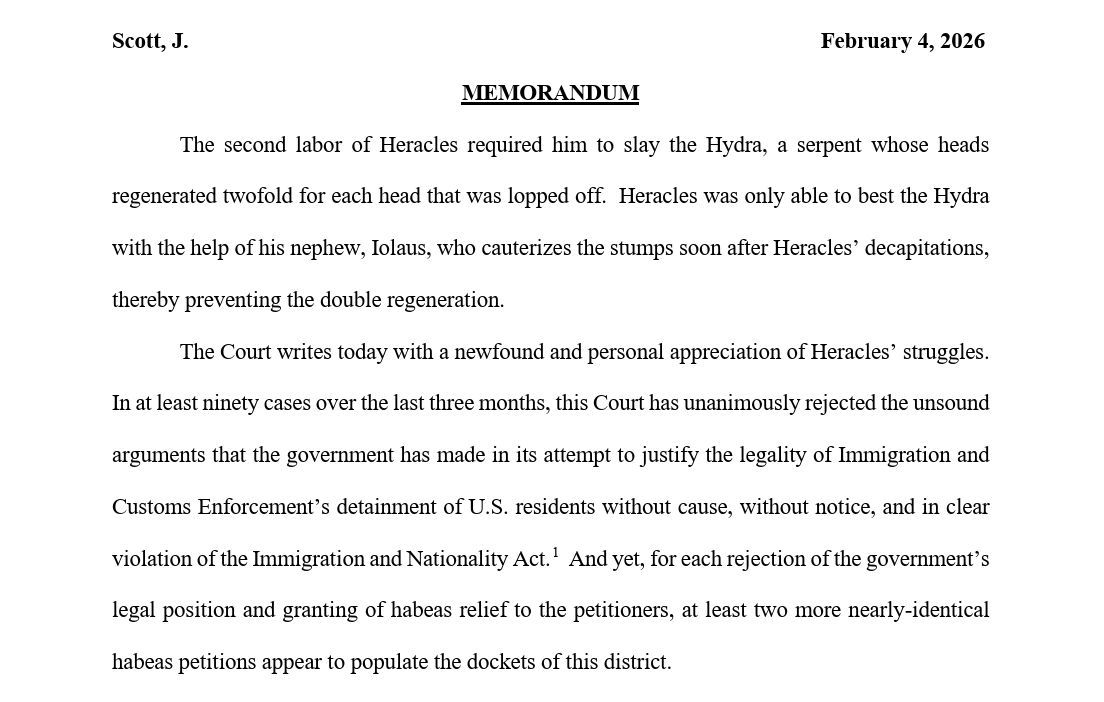
    And U.S. District Judge Kai N. Scott became the latest jurist to equate the ongoing legal battle with the government to Greek mythology, saying she and her colleagues on the bench have been squaring off with the Justice Department in a manner similar to Heracles’ confrontation with Hydra, the serpentlike monster that grew two heads every time one was chopped off.

    Although the region’s federal judges have “unanimously rejected” the government’s attempts to rationalize ICE detention of immigrants “without cause, without notice, and in clear violation” of federal law, Scott wrote, the government has continued to detain people in the same fashion day after day. And after each rejection, she wrote, “at least two more nearly identical” petitions seeking relief pop up on the court’s docket.

    “The Court writes today with a newfound and personal appreciation of Heracles’ struggles,” she said.

    District Judge Kai N. Scott’s Feb. 4, 2026 memo granting another habeas petition filed by an immigrant, and expressing frustration with the federal government’s arguments.

    The judicial rebukes come as immigration authorities have continued sweeping the nation to fulfill President Donald Trump’s promise of mass deportations. The number of detained immigrants has exploded — as has the number of court petitions from people seeking immediate release, which are known as habeas petitions.

    The enlarged legal workload has put a corresponding strain on the nation’s U.S. attorney’s offices, which typically defend ICE’s actions in federal court. Prosecutors from the New Jersey U.S. Attorney’s Office, for example, requested an extension in January to handle part of a class-action suit in order to deal with a surge in immigration release petitions.

    “This Office continues to handle an unprecedented volume of emergent immigration habeas petitions, which we continue to prioritize because of the liberty interests at issue,” the letter said.

    And in Minnesota this week, a federal prosecutor said she wished the judge would hold her in contempt so she could get some sleep in jail. Julie Le seemed exasperated when the judge pressed her on why the government had been ignoring his release orders.

    “What do you want me to do? The system sucks. This job sucks,” Le said, according to a court transcript.

    Le was subsequently fired.

    The issue at the center of each incident involves ICE’s mandatory detention policy. The policy was rolled out over the summer, and it requires that nearly all undocumented immigrants be held in custody as their cases wind through the country’s backlogged and complex immigration system.

    That upended decades of government practice, which typically allowed people who entered the country illegally, but who were otherwise law-abiding, to at least receive a bond hearing and determine if they could remain in the community as their cases moved forward.

    Jeanne Ottoson with Cooper River Indivisible attends an Immigrant rights groups rally outside the Third Circuit Court of Appeals to defend the New Jersey state ban on immigration-detention contracts on May 1, 2025.

    Some of those detained as a result of the policy have filed habeas petitions, arguing that their detention violates the Constitution. And in the Eastern District of Pennsylvania, Philadelphia’s federal court, judges have granted challenges to the policy at a near-universal rate.

    Still, those decisions have been made on a case-by-case basis, with relief extended only to one petitioner at a time. The U.S. Court of Appeals for the Fifth Circuit, which is based in New Orleans and is considered one of the country’s most conservative jurisdictions, heard a broader challenge to the policy. A divided 2-1 court ruled Friday that ICE can detain undocumented immigrants the agency is seeking to deport, even those who have been in the country for years.

    The ruling covers only federal courts in Louisiana, Mississippi, and Texas, and many legal experts expects the matter to ultimately end up before the U.S. Supreme Court.

    In Philadelphia, Scott’s expression of frustration came this week in response to the release petition of Franklin Leonidas Once Chillogallo. The 24-year-old from Ecuador came to the United States in 2020, lives with his partner and his 6-month-old twin daughters in Upper Darby, and works as a construction worker. He has no criminal history.

    After ICE arrested Once Chillogallo outside his home on Jan. 13, he was held in the Philadelphia Federal Detention Center without the opportunity for an immigration judge to review his case.

    Just as happened in the previous 90 cases, Scott rejected the argument that Once Chillogallo, an immigrant who has been in the country for years, was subject to the same bond rules as those who were caught entering without permission. The judge ordered Once Chillogallo’s release, which took place the following day, according to the court docket.

    Inside the federal courthouse Thursday, judges held three hearings on arcane legal questions surrounding habeas petitions.

    Dozens of other habeas petitions remain pending, court records show. In many that were recently decided, judges used terse or brusque language to point out that the government’s interpretation of the law has been repeatedly rejected.

    “Across the board, there is frustration. There is frustration from attorneys. There is frustration from the judges,” said Kimberly Tomczak, an immigration attorney who represented Once Chillogallo. “Nothing seems to be changing on the immigration side in response to the flood of habeas grants across the nation.”

  • From Big Lots to warehousing humans: ICE plan sparks fear in Schuylkill County

    From Big Lots to warehousing humans: ICE plan sparks fear in Schuylkill County

    TREMONT, Pa. — Evil has never looked this banal.

    A massive 1.3 million-square-foot Schuylkill County warehouse that just 13 months ago bustled with 505 workers moving cheap overstock goods like shower curtains or pet cleaners for now-bankrupt retailer Big Lots sits utterly abandoned, its dozens of truck bays fenced off and surrounded by a silent shroud of snow.

    It’s hard to imagine, but in the very near future, this white behemoth could be warehousing thousands of desperate human beings behind its bland, baby blue-trimmed concrete walls. On Monday, U.S. Immigration and Customs Enforcement filed a county deed that confirmed its $119.5 million purchase of the Big Lots facility — one more island in an American gulag archipelago of detention camps for the undocumented immigrants ICE is aggressively arresting from coast to coast.

    “It hurts my heart,” the Rev. Brian Beissel, pastor at Christ’s United Lutheran Church in nearby Ashland, told me, choking up a bit, as we sat in a car outside the warehouse entrance.

    When I asked him to expand on the source of that pain, Beissel’s response epitomized what other local residents have been saying about the stunning ICE news — a blend of small-town fears about stressed infrastructure with spiritual unease over the images of violent immigration raids in Minneapolis and elsewhere. He invoked Schuylkill County’s deep resentment of the 20th-century coal barons who took the money and the minerals and then ran. “They’re promising jobs, but how long are they going to be here?”

    But then Beissel — a Schuylkill County native who sees himself as a not very political preacher, in a county that Donald Trump won in 2024 with nearly 71% of the vote — pivoted to his moral dismay over a citizenship-seeking restaurant owner and father of a 2-year-old he knows from nearby Danville who was arrested by ICE and agreed to return to Mexico. “The Bible is pretty darn clear,” he said, “that we welcome the stranger.”

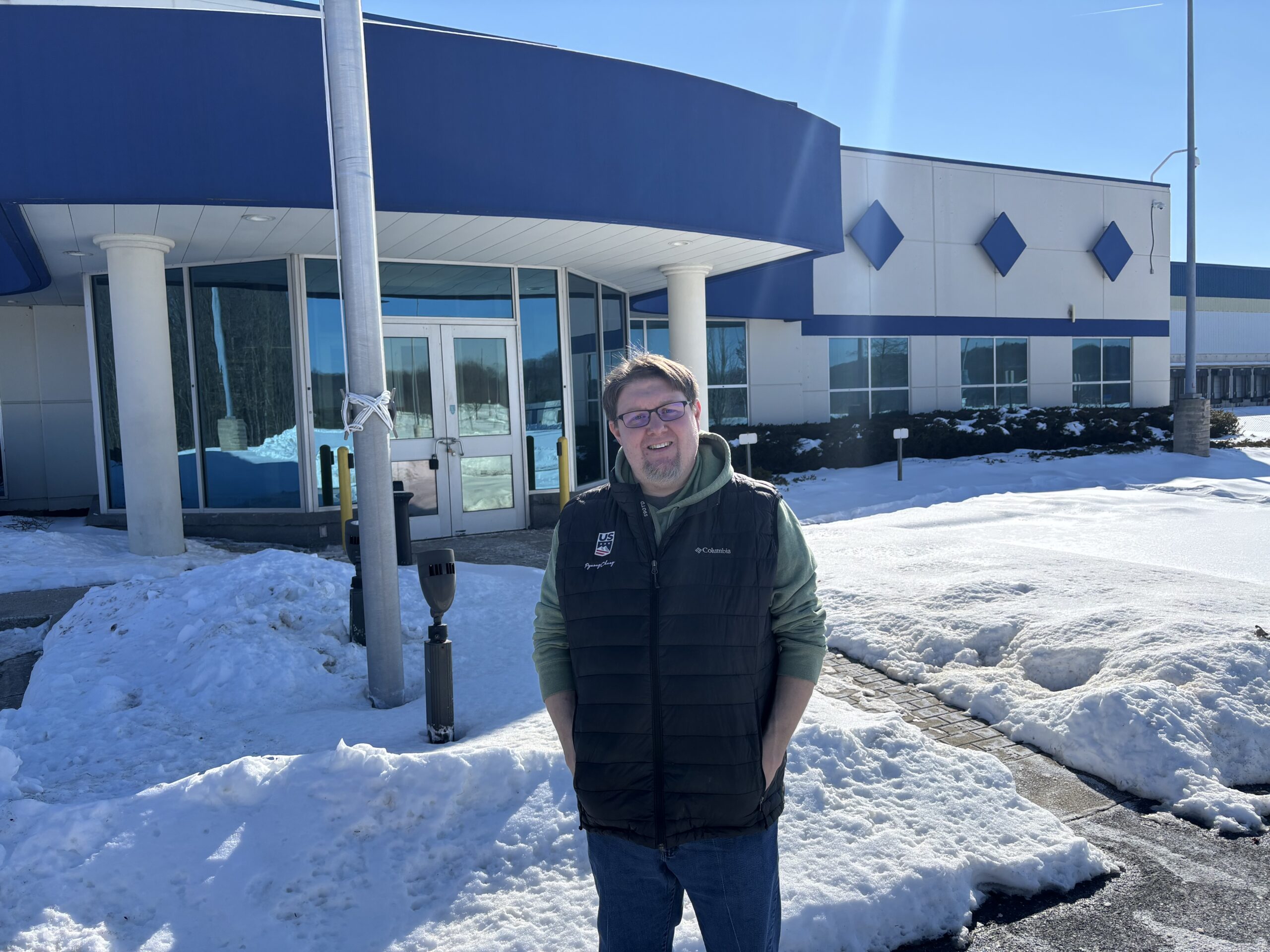
    Brian Beissel, pastor at Christ’s United Lutheran Church in Ashland, Pa., stands in front of the former Big Lots warehouse in Tremont, Pa., that has been purchased by U.S. Immigration and Customs Enforcement (ICE), on Wednesday.

    The Trump regime told America this day was coming. Its acting ICE director, Todd Lyons, said in an April interview that he wanted to run the agency like a business, with a deportation process “like [Amazon] Prime, but with human beings.”

    Ironically, the soon-to-be ICE detention center in Schuylkill County, about 100 miles northwest of Philadelphia, is less than a mile from a massive new Amazon fulfillment center that opened in 2023. Soon, trucks carrying consumer bric-a-brac to Tremont will be jostling on Interstate 81 with buses carrying day laborers or restaurant servers in handcuffs to those reborn rows of truck portals.

    ICE, flush with a whopping $45 billion in cash from Trump’s so-called Big Beautiful Bill to construct its human supply chain, is currently racing to buy sites for 23 detention centers with as many as 76,500 beds from coast to coast — often keeping communities like Tremont in the dark to thwart the inevitable opposition.

    In fact, the Schuylkill County deal is the second ICE facility in east-central Pennsylvania announced just this week. A different warehouse location, which ICE envisions as a kind of feeder camp for 1,500 detainees, was also purchased for $87 million in Hamburg, Berks County — only 25 miles from Tremont.

    Even if you could somehow put the morality of what many see as concentration camps on U.S. soil to the side, the government’s scenario for tiny Tremont — a coal-country hollow of two-story brick homes and faded American flags with just 2,000 residents — boggles the mind.

    The Big Lots site could soon see a community of nearly 10,000 people — the 7,500 detainees and an estimated more than 2,000 workers to oversee them — that would instantly become the second-largest city in Schuylkill County (after Pottsville, the county seat). It’s just 300 yards from the largest daycare center in a township where the water and sewer system is already at capacity, with no local police force or nearby hospital to deal with the inevitable emergencies. The U.S. government won’t be paying the roughly $1 million a year in annual property taxes that propped up local schools and county and municipal services.

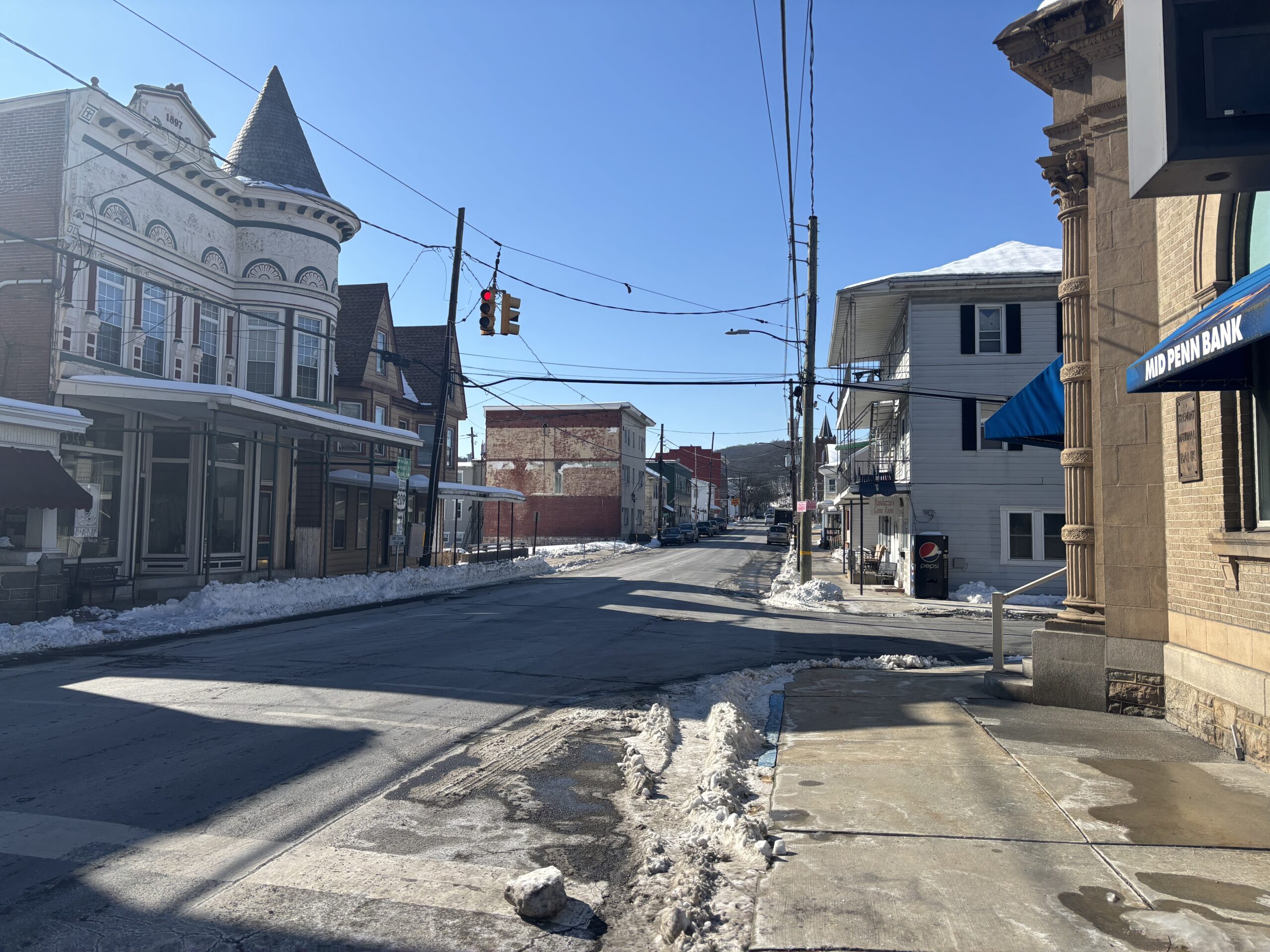
    The empty streets of downtown Tremont, Pa., on Tuesday. The 2,000 people of the coal-country borough and its surrounding township would be dwarfed by 7,500 potential detainees at a planned ICE facility on the edge of town.

    It’s these kinds of not-in-my-backyard worries that are driving a lot of the initial concern in Schuylkill County, especially from politicians who are cautious in talking about the fraught immigration issue in blood-red Trump country. “I am not going to get into a debate over the overarching immigration policies of the United States of America,” the GOP chair of the county commission, Larry Padora Jr., told a meeting on Wednesday, where he confirmed the ICE purchase of the warehouse.

    But a growing number of neighbors do want to talk about those immigration policies, and the stench of inhumanity.

    “I’m scared,” Tana Smith, a 24-year-old server at Behm’s Family Restaurant, the local wood-paneled breakfast hangout, told me about the pending ICE project. She, too, blended fears about the daycare site and possible escapees from a detention center with empathy for those same would-be detainees. “People’s families are just being, you know, ripped apart,” she said. “It’s really sad.”

    Smith said she’d already gently lobbied her dad — a Republican who said, “I guess it’s just taking care of the illegal people” — against the ICE plan. “I was like, I don’t feel like that’s true at all,” she said. “I feel like they’re going after everyone.”

    Andrea Pitzer, author of the definitive history of global concentration camps, One Long Night, said Tremont residents like Smith are right to be alarmed. She told me her research found that authoritarian regimes frequently rely on existing sites like abandoned warehouses or factories as they launch a growing network of gulags.

    “The U.S. is clearly echoing previous history with these warehouse acquisitions,” she said. “Dachau — not a death camp, to be sure, but one of the earliest Nazi concentration camps — took over a converted factory when it began its heinous existence in 1933.”

    Pitzer asked, “What things will they do on this new, huge scale behind barbed wire?” She noted that the warehouses are a massive expansion of a system that’s already at a record for detainees, with more than 73,000, and is already plagued by squalid conditions, a measles outbreak at the family detention site in Texas, and a death rate as much as 10 times as high as during the Biden administration.

    No wonder ICE has moved to buy up new sites — including the two Pennsylvania warehouses — with a practically Soviet level of state secrecy. There are no public hearings. Top lawmakers from both parties have been left in the dark. “This was quiet,” the Democratic county commissioner, Gary Hess, told the meeting. “It was silent. And then, bango! There it was.”

    “These will not be warehouses — they will be very well-structured detention facilities meeting our regular detention standards,“ the U.S. Department of Homeland Security insisted in a statement Wednesday. It added that the federal acquisitions “should not come as news,” as ICE expands its nationwide dragnet.

    Yet, arguably the region’s most powerful politician, Republican U.S. Rep. Dan Meuser, who voted for the $45 billion fund, has sounded, fittingly, like TV’s fictional German prison camp guard, Sgt. Schultz: He knows nothing, nothing! His spokesperson said Meuser, with both planned facilities in his 9th Congressional District, “has requested a call with … [ICE], and our office has reached out for additional information to better understand the details of the situation. We have not yet received a response.”

    Instead, it fell on Meuser’s likely Democratic opponent in November — Rachel Wallace, a former chief of staff for the U.S. Office of Management and Budget who has returned to her native Pottsville — to organize a town hall last week when the project was still rumored.

    Lisa Von Ahn (left) and Josephine Kwiatkowski, members of the Schuylkill County chapter of Indivisible, attend a county commissioners meeting in Pottsville on Tuesday to speak out against a proposed ICE detention center in Tremont, Pa.

    Most of the 100 or so people who packed a fire hall voiced opposition, but for a variety of reasons. The local GOP state representative, Joanne Stehr, attended and agreed with the not-in-my-backyard concerns, but then drew loud boos when she reportedly said: “I’m saying ICE has a job to do, and it’s going to get done. We are taking out the trash.”

    The growing uproar in Schuylkill County echoes brewing battles in many of the 21 other locations, even in areas that voted heavily for Trump in 2024. In Ashland, Va., a Canadian-based warehouse owner canceled its planned deal with ICE after economic pressure and opposition from county commissioners. Elected officials in Roxbury, N.J., and other proposed sites are also fighting to keep ICE out, but it’s unclear how much traction such an effort will get in red rural Pennsylvania.

    “We want economic development, and we want good businesses that are part of the community,” Wallace, the congressional candidate, told me as she decried the process and her opponent Meuser’s silence. “And this is the opposite of that.”

    And a growing number of Schuylkill County residents say their biggest alarm is less over the NIMBY concerns and more about the idea of their backyard hosting an American concentration camp.

    “We have seen firsthand the brutality that government agents are using to detain American citizens, legal immigrants, and law-abiding immigrants without legal status, and the violence in our streets caused by masked, heavily armed agents,” Josephine Kwiatkowski, an Army veteran and retiree from Pottsville, told the commissioners. She said these scenes and “the civil rights violations, the lack of humanitarian conditions [in current ICE facilities], and the discounting of the Constitution are the same issues that I was willing to sacrifice my life to oppose.”

    Pitzer, the concentration camp historian, said the time to act is now, before these proposed gulags are up and running.

    “Those who made excuses for or ignored these kinds of camps in Russia in the 1920s or Germany in the 1930s couldn’t know how much more vast and lethal those systems would become a decade later,” she said. “But we, who have those examples and other horrors from around the world in our rearview mirror, have no excuse.”

    This should be a five-alarm fire, not just for the politicians who’ve been trusted with keeping an American republic, but for citizens who are beginning to grasp a monstrous reality that was set into motion when Trump’s xenophobic demagoguery won a narrow plurality on Nov. 5, 2024. The image of our neighbors shipped in a supply chain like patio furniture and disappeared into the bowels of a Big Lots warehouse should have all of us asking a fundamental question.

    What are we doing here?