Tag: Josh Shapiro

  • Mayor Cherelle Parker’s housing plan is back on track after Council again reapproved $800 million in city bonds

    Mayor Cherelle Parker’s housing plan is back on track after Council again reapproved $800 million in city bonds

    Mayor Cherelle L. Parker’s housing initiative is back on track.

    In its first meeting of the year, City Council on Thursday reapproved a bill to authorize the administration to issue $800 million in bonds to fund the Housing Opportunities Made Easy, or H.O.M.E., initiative.

    Parker wasted no time, signing the bill into law at a news conference Thursday afternoon to fast-track the process for the city to sell the first $400 million tranche of bonds in late March or early April. The administration plans to sell the second $400 million in 2027.

    “We are signing into law the largest and most significant investment in housing in the city of Philadelphia’s history, a $2 billion plan that will create and preserve 30,000 units of housing here in the city of Philadelphia,” Parker said, citing a sum for H.O.M.E.’s budget that also includes other funding steams and the value of city-owned land the administration hopes to redevelop into housing through the plan.

    In March 2025, when Parker unveiled her housing plan — with the goal of helping the city build or preserve 30,000 units of housing in her first term — she wanted to issue the bonds that fall. Council initially approved the bond authorization and other legislation related to H.O.M.E. in June.

    But in the fall, lawmakers made significant changes to a related piece of legislation — which details the $277 million first-year budget for spending the bond proceeds — that triggered a redo of the bond bill.

    The most notable changes, championed by progressive Councilmembers Jamie Gauthier and Rue Landau, lowered the income thresholds for some of the programs funded by H.O.M.E. to prioritize lower-income Philadelphians.

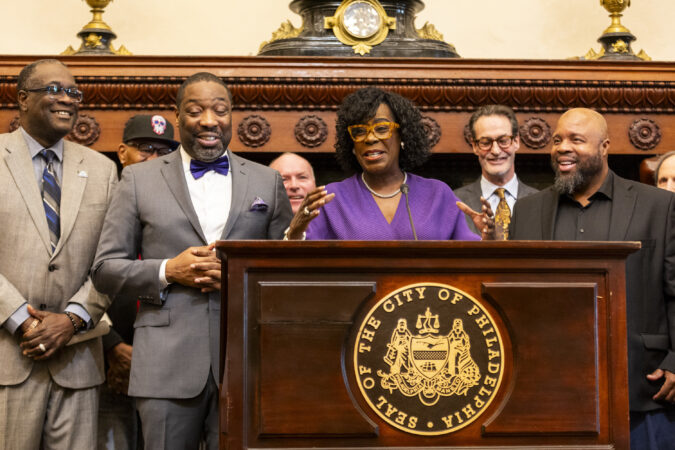
    Mayor Cherelle L. Parker unveils her long-awaited plan to build or preserve 30,000 units of housing during a special session of City Council Monday, Mar. 24, 2025. Council President Kenyatta Johnson is at left.

    Parker opposed the amendment, and administration officials testified that H.O.M.E. was meant to serve residents at a variety of income levels, including middle-class households that are struggling but often make too much to qualify for government support programs.

    But Council members argued that even with the new infusion of funds, Philadelphia’s resources are too limited to help the city’s hundreds of thousands of impoverished residents — let alone aid middle-income residents as well.

    “City Council demonstrated through its actions — not just its words — that it’s serious about putting City Hall to work for communities that have too often been left behind,” Gauthier, Landau, and their allies said in a group statement Thursday.

    The dispute proved to be the most significant public disagreement to date between Parker and Council President Kenyatta Johnson, who sided with Gauthier and Landau.

    The changes required Council to pass an updated bond authorization before moving forward because the previously adopted version no longer aligned with the language in the budget resolution. Lawmakers ran out of time to pass the new bond bill before adjourning for their winter break in December.

    They approved it unanimously on Thursday.

    A couple of hours later, Johnson and Parker profusely praised each other at the bill-signing ceremony, going out of their way to show that their strong working relationship remains intact now that the conflict was behind them.

    “My commitment is to make sure that our 100th, first woman, mayor is successful,” Johnson said.

    The moment of congeniality was a stark contrast to the dynamic between the two late last year.

    Parker at one point said Council’s delay “means homes are not being restored” and “homes are not being built or repaired.” Johnson fired back, “Council’s responsibility is not to rubber-stamp legislation.”
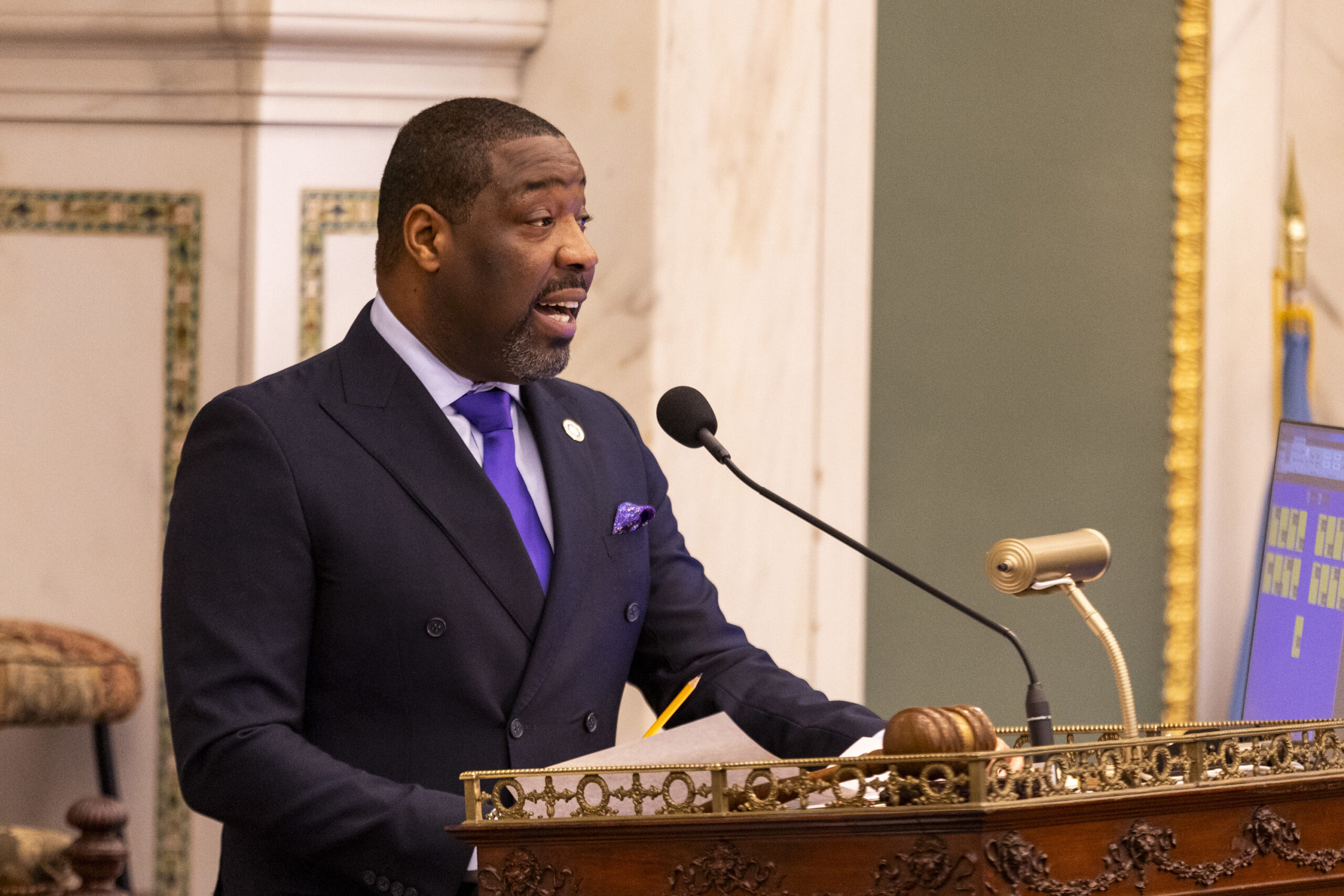
    City Council President Kenyatta Johnson speaking at the City Council’s first session of the year in Philadelphia, Pa., on Thursday, Jan. 22, 2026.

    But on Thursday, there was enough feel-good energy between the mayor and Council that it extended beyond Johnson to members who have more frequently clashed with the administration.

    Gauthier and Councilmember Isaiah Thomas, who questioned the mayor’s agenda last year over concerns that she was taking out too much debt for housing, also stood alongside the mayor at Thursday’s news conference.

    After the delays to her agenda at the end of last year, the mayor appears to be trying to regain control of the narrative this week. Thursday’s bill-signing ceremony marked Parker’s third major update related to H.O.M.E. in three days.

    On Tuesday, she announced that her administration was partnering with the city’s building trades unions and the Philadelphia Housing Authority to redevelop the Brith Sholom House, a notoriously dilapidated senior facility that closed in 2024, into affordable housing for seniors.

    And on Wednesday, she laid out a vision to build a modular housing manufacturing facility on the long-vacant Logan Triangle tract in North Philadelphia. The city issued a request for information from developers potentially interested in building such factories in the city, with a deadline in late March.

    Parker on Thursday only indirectly responded to a question about how many units could be built or repaired in the two years left in her term.

    But she said that her administration is working on a second package of zoning legislation to accelerate home construction in Philadelphia, and that she is working with Council to speed 1,000 properties through the land bank.

    She also expects Gov. Josh Shapiro, at his forthcoming budget address, to announce state-level housing reforms that would help “as it relates to streamlining state processes [to] run more efficiently.”

    Staff writer Anna Orso contributed to this article.

  • Villanova one of several colleges hit with threats nationwide, as university declares ‘all clear’

    Villanova one of several colleges hit with threats nationwide, as university declares ‘all clear’

    Villanova University was one of several colleges nationwide that saw its operations disrupted Thursday by a series of hoax threats.

    The Main Line Catholic university with 6,700 undergraduates closed the campus early Thursday morning, advised students on campus to stay in their residence halls, and warned others to stay off campus while authorities investigated. The move followed an undisclosed threat about one of its academic buildings.

    By 2 p.m., the private university gave the all-clear and said while in-person classes would remain canceled, students could leave their residences and get into some buildings, including the library, main dining halls, the health center, and the Connelly Center.

    “It is safe to be out on campus,” the university said in an alert.

    The campus will resume normal operations Friday, the school said.

    For Villanova, it was the third time in less than a year that threats had upended the school.

    In August, the university went into lockdown during an orientation session after reports of an “active shooter” on campus.

    Officials later learned that it was what the university president called a “cruel hoax.” But that was not before panic spread throughout the region, with students and faculty fleeing the school in tears and Pennsylvania’s top officials, including Gov. Josh Shapiro, weighing in. And days later, Villanova experienced a second hoax threat.

    Villanova’s threats were part of a swatting pattern nationwide. In September, the Associated Press reported that about 50 college campuses had been hit with hoax calls nationwide in recent weeks. The U.S. Department of Education put out tips on how to recognize fake calls, including questions to ask callers to determine if there are inconsistencies.

    Locally, colleges including Temple, Drexel, and Villanova said in September they had taken steps in response to the spate of swatting incidents nationwide, including upgrading training on how to handle them.

    On Thursday, another wave of calls appears to have occurred. New York University received threats against two school buildings, the school announced around the same time as Villanova. One threat included mention of bombing an NYU building. NYU did not go on lockdown.

    The threats, according to Gay City News, included anti-LGBTQ+ rhetoric.

    Alcorn State University, a historically Black college in Mississippi; Dallas Baptist University; and Wiley University in Texas, which is also an HBCU, got threats as well, according to news reports. The message to Wiley was sent from outside the United States, according to KTAL news.

    The FBI’s Philadelphia Field Office said in a statement that it was aware of the threats made to universities on Thursday.

    “We continue to stay in close coordination with our law enforcement partners,” an FBI spokesperson said. “As always, the FBI encourages members of the public to remain vigilant and immediately report anything they consider suspicious to law enforcement.”

    Villanova said the FBI was investigating, alongside state and local law enforcement. There were no reports of activity posing a danger to the campus.

    In its 2 p.m. update, the schools said that classes that are fully online could continue on Thursday and that graduate courses meeting in the evening could be “offered remotely at the discretion of the professor.”

    Intramurals scheduled for Thursday evening, the school said, also would be held.

    University spokesperson Jonathan Gust declined to say which Villanova building was targeted or describe the nature of the threat, given the investigation is ongoing.

    “In an abundance of caution, the university made the decision to close,” he said earlier Thursday.

    Additional police will remain on campus, the school noted.

    A backpack sits around toppled chairs at the Villanova University campus where an active shooter was reported Thursday, Aug. 21, 2025, in Villanova, Pa.

    Villanova students and staff on Thursday were trying to cope with another disruption to their campus life.

    At First Watch restaurant just off campus, freshman finance major Nolan Sabel said he woke up to a university alert on his phone, warning him of “an unknown threat of violence.”

    Sabel said he was disappointed to learn that an academic building had been targeted — for the third time in a year.

    “It’s kind of crazy,” Sabel said. “You hear that Villanova is really safe. It doesn’t feel that way.”

    Now, he and his lacrosse teammates are wondering whether a scrimmage set for Thursday afternoon would be canceled.

    The university told the students they were “on lockdown,” Sabel said. But that didn’t stop them from walking just off campus to get breakfast.

    “We needed food,” he said. “We have a game today.”

    Villanova senior James Haupt said he learned of the threat and class cancellation about 7:30 a.m. He lives off campus and had not yet headed to the school for his morning class.

    “After the last incident, it’s hard to take it completely seriously when we know that was a hoax,” said Haupt, 21, a communications major from Long Island. “But it’s still a little scary knowing this can happen at any point.”

    He said he was glad that the school canceled classes.

    “It’s a great gesture by the school,” he said. “I’d rather not have to go into class and be worried.”

    Haupt had one class scheduled for Thursday and an intramural basketball game in the evening.

    While students seemed to be taking the incident in stride, parents were expressing concerns on private Villanova Facebook pages, said one staff member who was not authorized to speak to the media and asked not to be named.

    “Terrible sign of the times we live in,” one parent wrote, according to the staff member. “Thinking of everyone. These poor kids and us parents having to deal with this. Hope it’s nothing and all are safe and whoever is behind this is brought to justice.”

  • A massive and controversial AI data center is under construction in South Jersey

    A massive and controversial AI data center is under construction in South Jersey

    The French developer of South Jersey’s first large-scale AI data center made his case to residents on Wednesday, saying his massive under-construction facility will benefit them in ways unprecedented in the emerging industry.

    But at a contentious town hall, several residents said they’re not taking his word for it, especially given the timing at which the developer was asking for their input.

    “You couldn’t do this before the building was built?” asked one resident, who spoke during public comment but declined to give their name. “You kind of took our voice away.”

    The 2.4 million-square-foot, 300-megawatt Vineland data center was approved by city council more than a year ago. The center is already under construction, and the developer expects to complete it by November.

    Located on South Lincoln Avenue, off State Route 55, the site was formerly a private industrial park.

    DataOne, a French company that manages advanced data centers, is the owner, operator, and builder. Its client, Nebius Group, an Amsterdam-based AI-infrastructure company, will operate the center’s internal technology, which will fuel Microsoft’s AI tools.

    Located on South Lincoln Avenue, off State Route 55, the site was formerly a private industrial park. It was sold to DataOne in a private transaction, the details of which Charles-Antoine Beyney, DataOne’s founder and chief executive officer, declined to disclose.

    At city council meetings and on social media, some residents have voiced concerns about the environmental, financial, and quality-of-life impacts of the site. Prior to Wednesday’s meeting, residents were prompted to submit questions online that were then addressed in a presentation. Dozens also took to the mic afterward.

    Beyney said he understood their concerns, but they don’t apply to his center, which will use “breakthrough” technology to reduce its environmental impact.

    “Most of the data centers that are being built today suck, big time,” Beyney said Wednesday. “They consume water. They pollute. They are extremely not efficient. This is clearly not what we are building here.”

    “No freaking way am I am going to do what the entire industry is doing … just killing our communities and killing our lungs to make money,” he added.

    Developers tout promises of data centers

    Data centers house the technology needed to fuel increasingly sophisticated AI tools. In recent years, they have been proliferating across the country and the region.

    In June, Gov. Josh Shapiro announced a $20 billion investment by Amazon in Pennsylvania data centers in Salem Township and Falls Township.

    Politicians on both sides of the aisle — from Republican President Donald Trump to Democratic Pa. Gov. Josh Shapiro — have encouraged the expansion, as have certain labor and business leaders. Yet environmental activists and some neighbors of proposed data centers have pushed back.

    Across the Philadelphia region, residents have recently organized opposition to proposals for a 1.3 million-square-foot data center in East Vincent Township and a 2 million-square-foot facility near Conshohocken (that was forced to be withdrawn in November due to legal issues).

    This week, Limerick Township residents voiced concerns about the possibility of data centers being built in their community. And in Bucks County, a 2-million-square-foot data center is already under construction in Falls Township.

    Pennsylvania and New Jersey are home to more than 150 data centers of varying sizes and scopes, according to Data Center Map, a private company that tracks the facilities nationwide. But so far, the AI data center boom has largely spared South Jersey.

    A 560,000-square-foot data center is being built in Logan Township, Gloucester County, and is set to have a capacity of up to 150 megawatts once completed in early 2027, according to the website of its designer, Energy Concepts. There are also smaller, specialized data centers in Atlantic City and Pennsauken, according to Data Center Map.

    In Vineland, Beyney said his gas-powered center will have nearly net-zero emissions, not consume water while cooling the equipment, and generate 85% of its own power. He told residents: “You will not see your bill for electricity going and skyrocketing.”

    Opponents of data centers worry their electric bills will rise due to the centers. The developer in Vineland says that won’t happen in South Jersey.

    The facility will be 100% privately funded, he said, after the company turned down a nearly $6.2 million loan from the city amid resident backlash. The loan was approved at a December council meeting, and Beyney said DataOne would have paid about $450,000 in interest, money that could have gone back into the community.

    “That’s a shame,” Beyney said, “but we follow the people.”

    At a meeting next week, Vineland City Council could approve a PILOT agreement that would give DataOne tax breaks on the new construction in exchange for payments to the city.

    Beyney said DataOne plans to be a good neighbor. Across the street from the data center, he said they will build a vertical farm — which grows crops indoors using technology — and provide free fruits and vegetables to Vineland residents in need.

    Residents voice concerns about Vineland data center

    Several residents expressed skepticism, and even anger, about Beyney’s data-center promises, noting that Cumberland County already has plenty of farms.

    Regarding the data center itself, they asked how Beyney could be so confident about new technology, questioned the objectivity of his data, and accused him of taking advantage of a city where nearly 14% of residents live below the poverty line.

    Beyney denied the allegations.

    At least one resident said he was moved by Beyney’s assurances.

    “I was a really big critic of [the data center all along], but I think what you said tonight has alleviated a lot of my concerns,” said Steve Brown, who lives about a mile away from the data center. He still had one gripe, however: The noise.

    “What I hear every night when I wake up at 2, 3, 4 o’clock in the morning is this rumble off in the distance,” Brown said. “When I get out of my car every day when I get home, I hear it.”

    Brown invited Beyney and his team to come hear the noise from his kitchen or back patio. Beyney said they would do so, and promised to get the sound attenuated as soon as possible, certainly by the end of the project’s construction.

  • PETA says Punxsutawney Phil should be a hologram. Gov. Shapiro says, ‘Don’t tread on me.’

    PETA says Punxsutawney Phil should be a hologram. Gov. Shapiro says, ‘Don’t tread on me.’

    As certainly as Bill Murray’s character in Groundhog Day awakes to “I Got You Babe” every morning at 6 a.m., every year around this time, PETA calls for Punxsutawney Phil to be retired to a sanctuary and replaced by some perennially preposterous proxy.

    Past Phil-ins suggested by PETA include: an animatronic groundhog, a giant gold coin, a vegan weather-reveal cake, persimmon seeds, and a 36-year-old woman named Amber Canavan from Portland, Ore., who volunteered herself as tribute to take Phil’s place, “livestream her monotonous life all year long, and give an equally unscientific weather forecast.”

    This year the animal-rights organization has offered to replace Phil with “a giant, state-of-the-art, 3D projection hologram of a groundhog” like he was Tupac Shakur.

    The best part of this proposal is that this year, PETA included an artistic rendering of its idea, which shows that if hologram Phil predicts six more weeks of winter, he will be blue and surrounded by snowflakes, and if he predicts an early spring, he will be pink and surrounded by flowers.

    Either way, this would be one mammoth marmot. Hologram Phil’s paws appear to be about the size of a human head, which, if you’ve ever encountered a groundhog in real life, is both an adorable and terrifying prospect.

    PETA even says the hologram would come “complete with vocal weather predictions,” which I also shudder to think about. Groundhogs sound like squeaky dog toys, which is perhaps not the best sound to rally a drunken crowd in a small Pennsylvania town at the crack of dawn.

    In response to the proposal, Gov. Josh Shapiro — a noted fan of Phil who’s hosted the wondrous whistle-pig at the governor’s residence and has attended Groundhog Day celebrations in Punxsutawney — posted a photo of Phil on X this week with the words “DONT TREAD ON ME.”

    I reached out to the Governor’s Office to see if Pennsylvania’s boss hog was serious about his support of the state’s famous groundhog.

    “He is indeed very serious about his defense of Phil,” Alex Peterson, a spokesperson for the Governor’s Office, told me.

    Prince or a pawn?

    PETA’s position, as stated in a letter from founder Ingrid Newkirk to Tom Dunkel, president of the Punxsutawney Groundhog Club’s Inner Circle, is that groundhogs are timid prey animals who want to avoid humans at all costs.

    “They dislike human smells, fear loud noises, abhor gatherings, and prefer to stay in their burrows,” Newkirk wrote. “Yet every year, this terrified little animal is subjected to loud announcers and noisy crowds and held up and waved around without any regard for his feelings, welfare, or instincts.”

    I see their point — Phil never particularly looks happy to predict the weather. Mostly he just seems confused at why he’s being asked to do so and what this life is all about.

    Punxsutawney Phil looks bewildered as he’s asked to predict the weather at Groundhog’s Day.

    Plus, there are plenty of other Groundhog Day traditions that happen in Pennsylvania and across the country without a real animal. At the John Heinz Wildlife Refuge in Southwest Philly, a puppet named Tinicum Tim pops out of the ground to predict the weather. In Reading, a bucktooth groundhog mascot with a fancy pink bow gives her prognostication atop the Reading Pagoda. And in Quarryville, a mounted taxidermy groundhog gives predictions from the top of a manure spreader called the “Pinnacle of Prognostication.”

    Michael Venos, who runs the website Countdown to Groundhog Day and has been to many of the alternative celebrations, said he considers the events “just as fun” and the “predictions just as valid.”

    Tinicum Tim, a groundhog puppet, predicts the weather during Groundhog Day festivities at the John Heinz Wildlife Refuge in 2024.

    Venos said he shares PETA’s concerns for Phil and all prognosticating animals.

    “While I’m sure in the past, the animals’ welfare was not the primary concern for the people who organize these events, I believe, and am trusting, that nowadays, the utmost care is being taken to make sure that the animals are safe and well cared for,” he said. “Punxsutawney Phil in particular seems to live a very cushy life and appears to be well taken care of.”

    The perks

    Phil lives one of the bougiest lives of any Pennsylvania resident, and who’s to say he woodchuck it all away, if given the choice?

    According to the Punxsutawney Groundhog Club, there’s only ever been one Phil. He drinks a special “elixir of life” every summer, which has kept him young for going on 140 years. He does not, however, share that elixir with his wife or two kids, a burrowed secret that’s shadier than seeing your shadow on a cloudy day.

    When not predicting the weather, Phil lives with his family in a climate-controlled burrow in the town library, which is connected by underground tunnels to a brand-new home the Inner Circle had built for them last year at Gobbler’s Knob.

    Two homes and a secret underground tunnel network — in this economy?!? Lucky.

    Punxsutawney Phil is greeted by his adoring fans.

    Phil also finds time to travel and has his own party bus. As I mentioned before, he visited Shapiro at the governor’s residence in 2023, and this year, he attended the Pennsylvania Farm Show as a celebrity guest.

    I see both sides of the argument here, but given that our second-most famous groundhog in Pennsylvania is already computer-generated and heavily into gambling, I say we keep the real Phil around for now.

  • RFK Jr. holds a Harrisburg rally to promote health agenda

    RFK Jr. holds a Harrisburg rally to promote health agenda

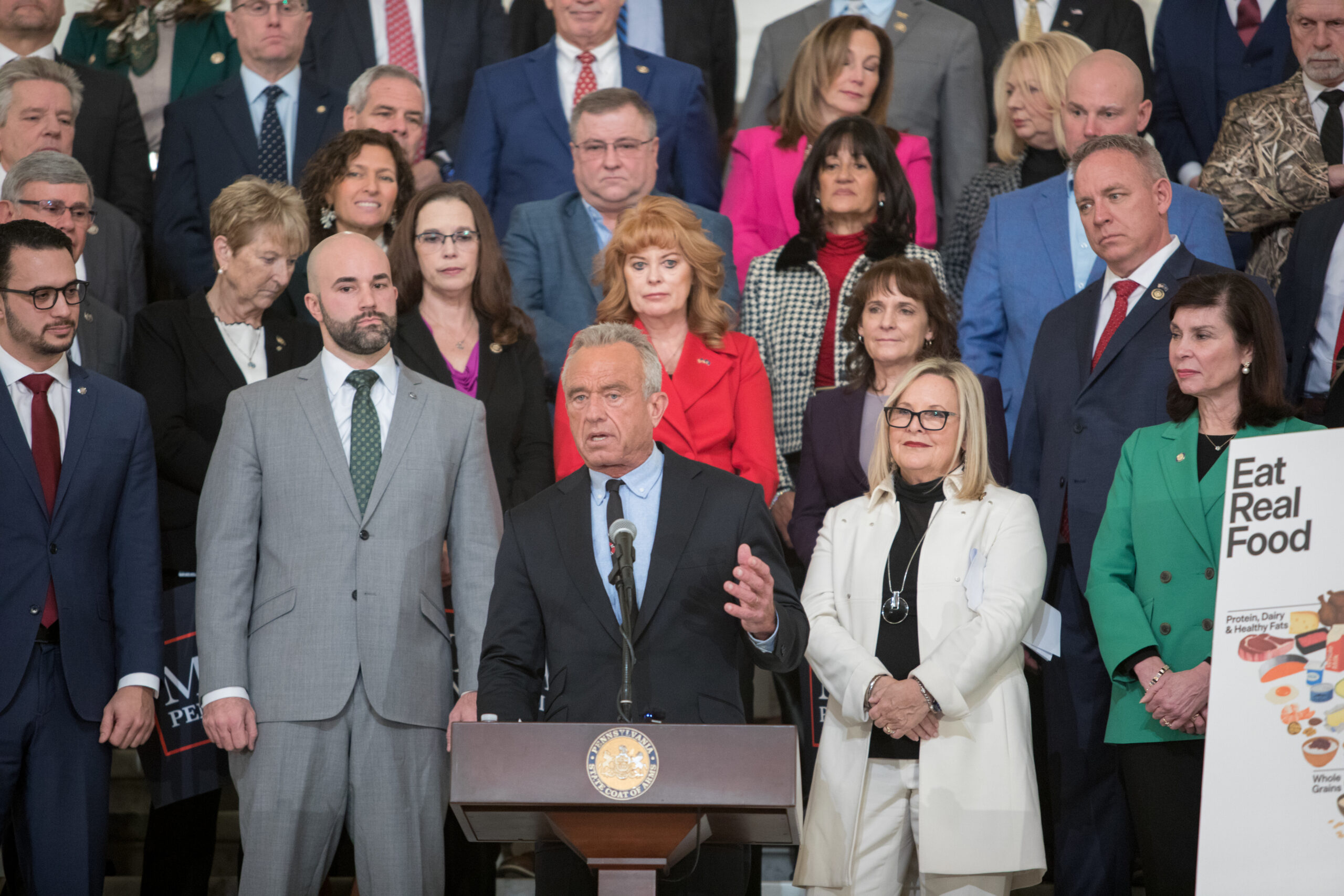
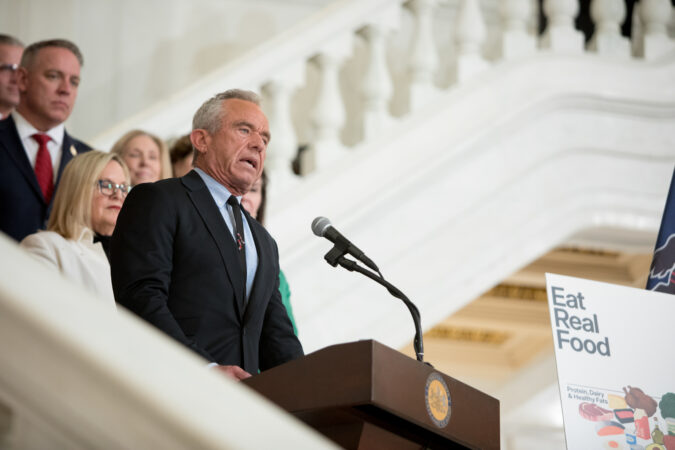
    Health and Human Services Secretary Robert F. Kennedy Jr. touted his new nutritional guidelines and pushed back against criticism of his vaccine policy Wednesday at a rally in Harrisburg.

    Speaking from the rotunda of the state Capitol, Kennedy declared that Americans are sicker than their European counterparts and blamed “bad policy choices” by his predecessors for turning a “once-exemplary healthcare system into a sick care system.”

    Doctors, hospitals, insurers, and pharmaceutical companies, he said, are incentivized to keep Americans ill instead of preventing diseases.

    It was an echo of remarks Kennedy has made over the last year advancing his “Make America Healthy Again” agenda. A longtime anti-vaccine activist before his appointment as top health leader under President Donald Trump, Kennedy has overhauled major aspects of U.S. health policy, including the long-standing childhood vaccine schedule, drawing intense criticism from public health officials who say the move will increase preventable illnesses and death.

    In Harrisburg, Kennedy was joined by a crowd of nearly 200, as well as two dozen Republican lawmakers. Some spoke in praise of his efforts to overhaul dietary recommendations and decried what they described as waste and fraud in the state’s Medicaid and food assistance systems.

    State Treasurer Stacy Garrity, a Republican who hopes to challenge Gov. Josh Shapiro in this year’s gubernatorial election, stood near Kennedy at the rally but did not deliver remarks.

    Kennedy touted his new dietary guidelines, announced earlier this month, that flipped the traditional food pyramid on its head to promote consumption of whole foods, proteins, and some fats.

    He is encouraging Americans to prioritize eating proteins and vegetables and reduce eating “highly processed foods” with “refined carbohydrates.” This marks the first time U.S. dietary guidelines have explicitly called out what are also known as ultra-processed foods, a move supported by the American Medical Association and some other medical societies.

    “Big food processing companies” influenced American dietary guidelines “for too long,” Kennedy told the crowd.

    “They told us, for the last 40 years, to eat as much as we could of refined carbohydrates, of ultra-processed foods, to stuff ourselves with sugar and salt,” he said. “We are now cutting through the red tape, and we’re telling Americans it’s time to start eating real food.”

    But his dietary plan’s emphasis on foods high in saturated fats and its vague guidance on alcohol consumption have received pushback.

    HHS’s newest food guidelines recommend limiting saturated fats, but also encourage Americans to eat food with high levels of such fats, including red meat and beef tallow, a New York Times reporter noted at a news conference after his speech.

    The revised recommendations are “not perfect,” Kennedy replied.

    “They give guidelines. They’re going to be very useful to people, and they are going to be much, much better for public health than what we were working with,” he said.

    Health and Human Services Secretary Robert F. Kennedy, Jr. was flanked by state lawmakers at a rally in the Pennsylvania State Capitol Wednesday.

    Upending vaccine policy

    Nechel Shoff of Middletown, Dauphin County, came to the Capitol to advocate on behalf of her son, Squale, 24, who has autism. She said she believes her son’s autism was due to vaccinations he had as a 9-month-old baby that led to encephalitis and a high fever for six weeks. (There is no evidence that vaccinations cause autism.)

    She supports Kennedy’s efforts to change federal vaccine recommendations and said his efforts have not resulted in changes at the state level.

    “We need him desperately,” Shoff said of Kennedy.

    Kennedy’s comments about vaccines were the highlight for many in the crowd, who vigorously nodded their heads in agreement and cheered.

    But critics were also in attendance, after staging a protest prior to Kennedy’s appearance outside the Capitol in support of vaccine access.

    One interrupted Kennedy’s speech by yelling “Restore Medicaid!” before being escorted away.

    Federal officials announced in December that they will decrease the number of recommended childhood immunizations from 17 to 11. Some vaccines that protect against serious illnesses like rotavirus and hepatitis B are now recommended only for children at higher risk of health complications.

    Several states, including Pennsylvania, have changed their own policies around vaccine distribution to ensure continued access to vaccines no longer recommended by the Centers for Disease Control and Prevention.

    In a statement posted on X before the rally, Shapiro said that Kennedy has “made our country less healthy and less informed.”

    “He’s spent his entire time as Secretary causing chaos and spreading misinformation. Every step of the way, we’ve stood up to his efforts to endanger public health — protecting vaccine access and families’ freedom to make their own health care decisions,” the Democratic governor wrote.

    Kennedy told reporters at a news conference that he is not limiting access to vaccines and that people who want certain vaccines can still get them. “Some states may take a different pathway, and I think we envisioned that different people would be doing different things, but it ends the coercion,” he said.

    Decades of evidence show vaccination itself presents little risk of harm to patients, and forgoing them carries high risks of spreading preventable diseases.

    Naomi Whittaker, an obstetrics and gynecology doctor, attended Wednesday’s rally with her children, all sporting “Make America Healthy Again” hats.

    She’s a UPMC-affiliated ob-gyn who specializes in “restorative reproductive medicine” to help women with fertility issues.

    Her practice often includes diet changes, lifestyle changes, hormone support, and endometriosis surgery. She sees Kennedy’s work to change the food pyramid and question big pharmaceutical companies as critical dialogues the public should have.

    “I really want to balance the public health and individual health,” Whittaker said. “There’s some middle ground of vaccines.”

    Secretary of Health and Human Services Robert F. Kennedy Jr. speaks at a Harrisburg rally Wednesday.

    State Rep. Tarik Khan (D., Philadelphia), who attended the event, said it was what went unsaid by Kennedy that stood out to him the most: that the Trump administration is making it harder for some people to access food assistance and healthcare, creating barriers to the healthy lifestyles that Kennedy touts.

    “We’ve known for years that we need to eliminate processed foods,” said Khan, a nurse practitioner. “We know that you need to eat more fruits and vegetables. We know that proteins are critical. We know that refined carbohydrates, you should try to avoid as much as possible.”

    “This is not groundbreaking information,” Khan added.

  • Josh Shapiro’s new book: Why Trump told him he shouldn’t be president, disagreements over COVID-19 closures, and more

    Josh Shapiro’s new book: Why Trump told him he shouldn’t be president, disagreements over COVID-19 closures, and more

    “Hey, Josh, it’s Donald Trump.”

    It was the start of a voicemail from the president to Pennsylvania Gov. Josh Shapiro, received one week after a man firebombed the governor’s residence in Harrisburg in an attempt to kill Shapiro while his family slept inside on the first night of Passover.

    Shapiro hadn’t recognized the number Trump was calling from, and at first didn’t answer.

    When Shapiro called back, Trump offered well wishes to the governor’s family, his usual braggadocio, and some advice: he shouldn’t want to be president, Shapiro recalls in his new memoir, set to be released later this month.

    The book, Where We Keep the Light, which comes out on Jan. 27, has attracted a flood of attention as it signals Shapiro’s potential presidential aspirations and also serves as a retort to the unflattering portrayal of the governor in former Vice President Kamala Harris’ recent memoir.

    In the 257-page book, Shapiro details his early life in Montgomery County, his two decades in elected office, his connection to his faith, and his pragmatic leadership approach.

    And for the political observers who have watched Shapiro’s rise: He delves into his brief consideration of whether he should run for president after Joe Biden dropped out of the race in 2024, the whirlwind experience of being vetted to be Harris’ running mate, and the unfair scrutiny he felt he faced during that process.

    Here are six takeaways from Shapiro’s forthcoming memoir, obtained by The Inquirer.

    Trump to Shapiro: ‘He cautioned that I shouldn’t want to be president’

    When Shapiro, 52, returned Trump’s call in April 2025, he received the president’s support and some unprompted compliments from Trump, he writes.

    “[Trump] said he liked the way I talked to people and approached problems,” Shapiro retells, as Trump went through the list of potential 2028 Democratic Party presidential candidates. “He cautioned that I shouldn’t want to be president, given how dangerous it had become to hold the office now.”

    Gov. Josh Shapiro speaks during a news conference, in Butler, Pa., Sunday, July 14, 2024, following an assassination attempt on President Donald Trump.

    (It is unclear whether Shapiro tried to call Trump after he experienced his own assassination attempt in Butler, Pa., the previous summer, though Shapiro publicly vehemently denounced the violence.)

    Throughout the book, Shapiro details his approach to Trump. He picks his battles to be ones he is sure he will win, he writes, and is sympathetic to the struggles that led some voters to support Trump.

    He’s proud of his disagreements with fellow Dems

    Shapiro sells himself as a pragmatist and writes proudly of the times in which he has disagreed with his party or changed his positions.

    For example, he recalls being asked by Harris’ vetting team about his past comments criticizing Democrats in federal, state, and local offices for how they handled COVID-19 closures. He stood by his criticism of former Gov. Tom Wolf at the time over business and school closures, and of the mask and vaccine mandates implemented by the Biden administration, he writes.

    “I respectfully pushed back, asking if they believed that we had gotten everything right, to which they generally agreed that we had not,” Shapiro writes about his conversation with Harris’ vetting team. “I just had been willing to say the quiet part out loud, even if it wasn’t easy or popular or toeing the line to do so.”

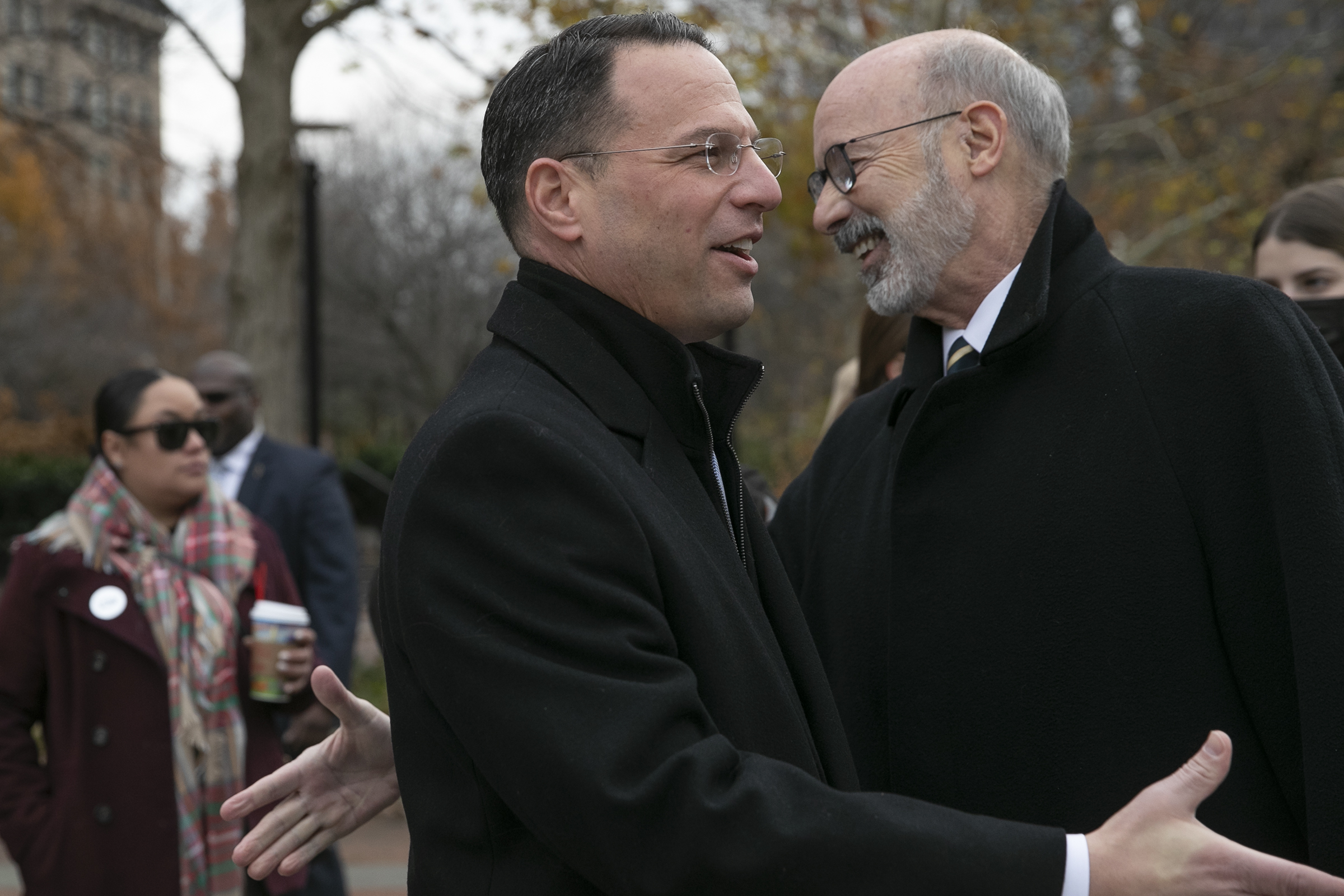
    Then-Attorney General Josh Shapiro and Then-Gov. Tom Wolf both go in for handshakes before the start of a press conference on the harmful effects of anti-abortion policies at 5th and Market in Philadelphia on Thursday, Dec. 9, 2021.

    He also writes about his journey to change his position on the death penalty over the years. In the days after the Tree of Life synagogue massacre in Pittsburgh, in which 11 Jewish people were killed while worshipping, he had initially supported the death penalty for the suspect. Since then, his views have evolved and he no longer supports capital punishment and called on the legislature to end the practice.

    Lori Shapiro is behind most of her husband’s good ideas

    Lori Shapiro, 53, mostly avoids her husband’s frequent appearances in the limelight.

    The former Clinton administration official works mostly behind the scenes, except on a few issues important to her, including those relating to people with intellectual disabilities and ensuring girls have access to menstrual products in schools.

    But in his book, Shapiro writes that his wife has challenged him as she has supported his political rise, pushing him to question what he really wants, do the right thing, or even help him shape his messaging to voters. She discouraged him from running for U.S. Senate in 2016 after top Democrats approached him, which led him to run for attorney general instead. She was also his first call when Biden dropped out and he briefly considered whether he should run for president, and his voice of reason during the veepstakes.

    Josh Shapiro and his wife Lori leave the state Capitol in Harrisburg Tuesday, Jan. 17 2023, on his way to the stage to be sworn in as the 48th Governor of Pennsylvania.

    The couple started dating in high school, before breaking up during college when they went to different universities in New York — he attended the University of Rochester, while she went to Colgate University. Shapiro writes that he quickly realized he missed her, and wrote her a letter in an effort to win her back.

    “So I cracked my knuckles, and wrote my heart out. I was Shakespeare composing a sonnet. I was Taylor Swift before Taylor Swift. I was Lloyd Dobler in Say Anything, in a trench coat with the boom box over my head,” Shapiro writes. “I was getting the girl back.”

    This earned Shapiro the title of “Mr. Lori” from her hall mates at Colgate. He did not win her back until years later, when the two reconnected in Washington after college, and quickly became engaged. The two married and had four children together, who each make frequent appearances throughout the book.

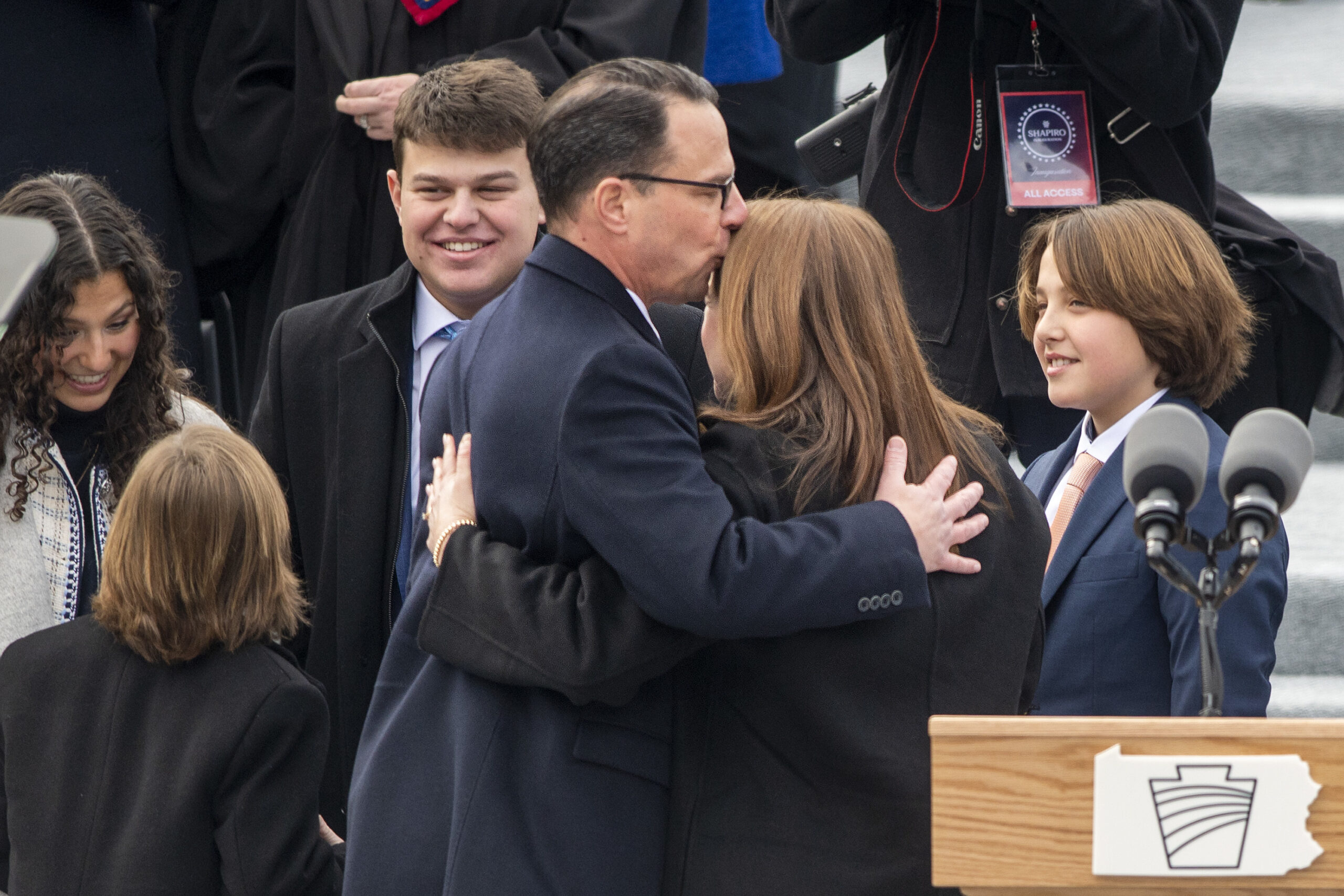
    Surrounded by his four children, Gov. Josh Shapiro kisses his wife Lori after his is sworn in as the 48th Governor of Pennsylvania during inauguration ceremonies at the state Capitol in Harrisburg Tuesday, Jan. 17 2023.

    Shapiro grapples with an early career move that kicked off his reputation as disloyal

    Shapiro is not without regret for how some of his career moves and ambitions affected the people who helped him get where he is today, he writes.

    Shapiro got his start in politics on the Hill under then-U.S. Rep. Joe Hoeffel, a Montgomery County Democrat. He quickly worked his way up to be Hoeffel’s chief of staff before returning to Abington Township to run for state representative.

    But when Shapiro was done with frequent trips to Harrisburg and ready for his next rung on the ladder, Hoeffel was in the way. Shapiro had a plan to run for county commissioner and flip the board for the first time in more than 150 years — making Montco the first Philadelphia collar county to swing into Democratic control. Now all of the Philly suburban counties are controlled by Democrats, and Shapiro is credited for starting the trend. But Hoeffel was not a part of that calculation.

    Shapiro writes that Hoeffel was “struggling politically.” He says he told him he would not run against him, but he also would not run with him.

    “I knew that I couldn’t win with him, and I knew that it wasn’t the right thing for the party or the county, even if we could somehow eke out the victory,” Shapiro writes.

    Hoeffel eventually decided not to run, and was quoted in The Inquirer in 2017 as saying that loyalty is not Shapiro’s “strong suit,” comments he has since stood by, in addition to praising Shapiro for his successes ever since.

    “I’d hear about [Hoeffel] talking to the press or to people behind my back about how he thought I lacked loyalty, that I was someone who needed to be watched,” Shapiro writes. “It felt terrible, and of course, I never intended to hurt him in any way and I would never have run against him. I wanted the Democrats to have a shot, and I knew that I could get it done.”

    Shapiro initially said antisemitism didn’t play into Kamala Harris’ running mate decision. Now he has more to say

    In the days after Harris passed over Shapiro to be her running mate in favor of Minnesota Gov. Tim Walz, Shapiro said “antisemitism had no impact” on her decision.

    Now, Shapiro questions whether he was unfairly scrutinized by Harris’ vetting team as the only Jewish person being considered as a finalist, including a moment when a top member of Harris’ camp asked him if he had “ever been an agent of the Israeli government.”

    “I wondered whether these questions were being posed to just me — the only Jewish guy in the running — or if everyone who had not held a federal office was being grilled about Israel in the same way,” he writes.

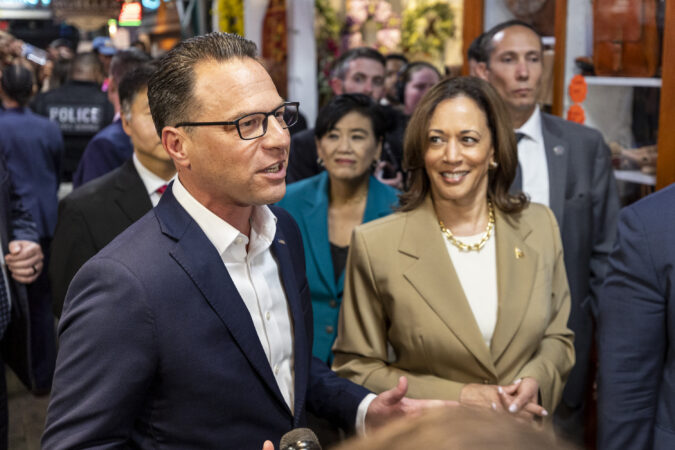
    Vice President Kamala Harris visits Little Thai Market at Reading Terminal Market with Gov. Josh Shapiro after she spoke at the APIA Vote Presidential Town Hall at the Pennsylvania Convention Center in Philadelphia, Pa., on Saturday, July 13, 2024. The photo was taken eight days before President Joe Biden’s decision to exit the race.

    He details his broader concerns with how he was treated during the process, including some perceived insults about his family’s lack of wealth or Lori Shapiro’s appearance.

    Since Shapiro’s book was leaked to the media over the weekend, sources close to Walz confirmed to ABC News that the Minnesota governor was also asked whether he was an agent of a foreign government, due to his multiple trips to China.

    Shapiro, for his part, has written about his time in Israel, including a high school program in which he completed service projects on a farm, on a fishery at a kibbutz, and at an Israeli army base. He once described himself in his college student newspaper as a “past volunteer in the Israeli army” — a characterization that circulated widely after it was reported by The Inquirer during the veepstakes.

    The missing character: Mike Vereb

    There is one person who had been influential during Shapiro’s many years of public service who is not mentioned once in the book: Mike Vereb.

    Vereb, a former top aide to Shapiro, left the governor’s office shortly into his term after he was accused of sexual harassment of a female employee. The state paid the female employee $295,000 in a settlement over the claim.

    Vereb had been along for the ride for Shapiro’s time in the state House as a fellow state representative from Montgomery County (though he was a Republican), as a top liaison to him in the attorney general’s office, and eventually a member of his cabinet in the governor’s office until his resignation in 2023.

  • In his new book, Gov. Josh Shapiro recalls an ‘offensive’ vetting process to be Kamala Harris’ running mate

    In his new book, Gov. Josh Shapiro recalls an ‘offensive’ vetting process to be Kamala Harris’ running mate

    Pennsylvania Gov. Josh Shapiro questioned whether he was being unfairly scrutinized as the only Jewish person being considered as a finalist to be Vice President Kamala Harris’ running mate — and briefly entertained his own run for the presidency — according to a copy of his upcoming book obtained by The Inquirer.

    In his memoir, Where We Keep the Light, set to debut on Jan. 27, Shapiro wrote that he underwent significant questioning by Harris’ vetting team ahead of the 2024 presidential election about his views on Israel, and his actions supporting the end of pro-Palestinian protests at the University of Pennsylvania — leading him to wonder whether the other contenders for the post had faced the same interrogation.

    Shapiro, a popular Democratic governor long rumored to have future presidential ambitions, even briefly entertained a run shortly after then-President Joe Biden unexpectedly dropped out of the race in July 2024, according to his book. The Abington Township resident is now seen as a top contender for the 2028 Democratic nomination as he seeks reelection in Pennsylvania this year.

    But before Shapiro ended up in the veepstakes for Harris’ running mate, he wrote in his book that there was a moment right after Biden dropped out of the race where he considered whether he should run for president.

    “Well, now what?” Shapiro wrote. “Maybe there would be a process the party would engage in to replace him? Did I want to be part of that?”

    He called his wife, Lori, who at the time was out of the country with their two younger kids. “I don’t think we are ready to do this,” Shapiro recalled his wife saying from a Walmart in Vancouver. “It’s not the right time for our family. And it’s not on our terms.”

    After that call, Shapiro wrote that he quickly decided he didn’t want to run and would back Harris, as Biden also endorsed her for the top of the ticket.

    Once the field cleared for Harris, Shapiro recalled seeing his face on TV as her potential running mate, before he was asked by her campaign manager to be formally vetted.

    In the days that followed, Shapiro contended with increasing national scrutiny as he emerged as a front-runner. Some pro-Palestinian protesters began calling Shapiro “Genocide Josh” online, he wrote. And top Democrats questioned whether a Jewish running mate would deter voters from supporting Harris, as Shapiro had been outspoken against some pro-Palestinian campus protests that year.

    What was unknown: Whether those same questions — and some even more extreme — were circulating within Harris’ camp, Shapiro wrote in his most detailed retelling of his experience vying for the vice presidency to date.

    Gov. Josh Shapiro at a rally for Vice President Kamala Harris at Wissahickon High School in Ambler on July 29, 2024.

    Just before he went to meet with Harris at the vice president’s residence in the summer of 2024, Shapiro received a call from Dana Remus, former White House counsel for Biden who was coleading the vetting process for Harris.

    “Have you ever been an agent of the Israeli government?” Remus asked, according to Shapiro’s memoir.

    “Had I been a double agent for Israel? Was she kidding?” Shapiro wrote in his 257-page book. “I told her how offensive the question was.”

    According to the memoir, Remus then asked if Shapiro had ever communicated with an undercover Israeli agent, which he shot back: “If they were undercover… how the hell would I know?”

    “Remus was just doing her job. I get it. But the fact that she asked, or was told to ask that question by someone else, said a lot about some of the people around the VP,” Shapiro wrote.

    In high school, Shapiro completed a program in Israel that included service projects on a farm, and at a fishery in a kibbutz, as well as at an Israeli army base, which he once described in his college student newspaper as “a past volunteer in the Israeli army.”

    Harris’ office could not be reached for comment Sunday evening. Remus also could not immediately be reached for comment Sunday.

    Shapiro, more broadly, recalled getting the feeling from Harris’ vetting team that she should pick Shapiro — a popular Democratic governor in a critical swing state — but that they had reservations about whether Shapiro’s views would mesh with Harris’.

    In one vetting session with U.S. Sen. Catherine Cortez Masto (D., Nev.), former Labor Secretary Marty Walsh, former associate Attorney General Tony West, and former senior Biden adviser Cedric Richmond, Shapiro wrote that he had been questioned “a lot” about Israel, including why he had been outspoken against the protests at Penn.

    “I wondered whether these questions were being posed to just me — the only Jewish guy in the running — or if everyone who had not held a federal office was being grilled about Israel in the same way,” he wrote. (Illinois Gov. JB Pritzker, who is Jewish, was also vetted to be Harris’ running mate. Harris’ husband, Doug Emhoff, is also Jewish.)

    In his book, Shapiro recalled the whirlwind two weeks as an awe-inspiring window into an opportunity — but ultimately it was one he knew he didn’t want.

    When Shapiro finally sat down with Harris in the dining room at the Naval Observatory, he said it became clear that she had a different vision for the vice presidency than what he wanted. He would work primarily with her staff and couldn’t say whether he would have access to her. In her own experience as vice president, she saw the job as mostly to make sure that you aren’t making any problems for the president, he wrote.

    Shapiro noted his own relationship with his No. 2, Lt. Gov. Austin Davis. The role in itself has few powers, but Shapiro views Davis as a governing partner and is one of few people who can walk into his office unannounced at any time, he wrote. He wanted the same relationship with Harris, he said, noting that he knew he would not be the decision-maker.

    “If we had door A and door B as options, and she was for door A and I was for door B, I just wanted to makes sure that I could make the case for door B,” Shapiro wrote.

    But Harris was “crystal clear” that that wasn’t the kind of president-vice president dynamic she envisioned, he said.

    In her own book released last year, 107 Days, Harris recalled the meeting differently. There, she wrote that Shapiro had “peppered” her with questions and “mused that he would want to be in the room for every decision.” His ambitions, she said, didn’t align with her view that a vice president should be a No. 2 and not a “copresident.”

    Former Vice President Kamala Harris speaks with Dawn Staley (left), while promoting her new book “107 Days,” at the Met on Sept. 25 in Philadelphia. The event was held in partnership with Uncle Bobbie’s Coffee & Books.

    As Shapiro tells it, the friction with Harris’ team didn’t stop there.

    Shortly after meeting with Harris, Shapiro in his book recalled another unpleasant conversation with Remus, in which he wrote that she said she “could sense that I didn’t want to do this.”

    According to the book, Remus said it would be hard for Shapiro to move to Washington, it would be a strain financially for his family who “didn’t have a lot of money” by D.C. standards, and that Lori would need to get a whole new wardrobe and pay people to do her hair and makeup.

    It was then that he decided to leave the apartment where he had been asked to wait until Harris could come and talk to him again, he recalled.

    “These comments were unkind to me. They were nasty to Lori,” Shapiro wrote. “I hold no grudge against Remus, who I know was doing the job she had to do, but I needed to leave.”

    Shapiro went home, he said, and went over the day’s events with Lori at the edge of their bed.

    “On one hand, I was still tugged by the prestige of it all. It’s an honor. It’s a big title. But that’s never been enough for me,” he wrote. Still, he struggled with what it would mean to withdraw, concerned about not playing his part in a high-stakes election and letting his supporters down. Ultimately, he decided that it was not his race to win or lose, he wrote.

    “People were going to cast their votes for her, or they weren’t,” he added.

    Vice President Kamala Harris, Democratic nominee for president, and her running mate Minnesota Gov. Tim Walz, address a rally to kick off their campaign at the Liacouras Center in Philadelphia, Pa., on Tuesday, August 6, 2024.

    He decided that day he did not want the job, and toyed with the idea about publicly releasing a statement withdrawing himself from the running. He said he also tried to tell Harris he did not think it would be a good fit, but wasn’t able to reach her.

    Shortly thereafter, Harris announced that she had chosen Minnesota Gov. Tim Walz to be her running mate in an ultimately unsuccessful campaign against President Donald Trump. The two would debut their presidential ticket at a rally at the Liacouras Center in North Philadelphia. Shapiro wrote that he didn’t want to go.

    “I was wrung out. I just wanted to be home with my family, to take a walk with Lori, and just be,” he wrote.

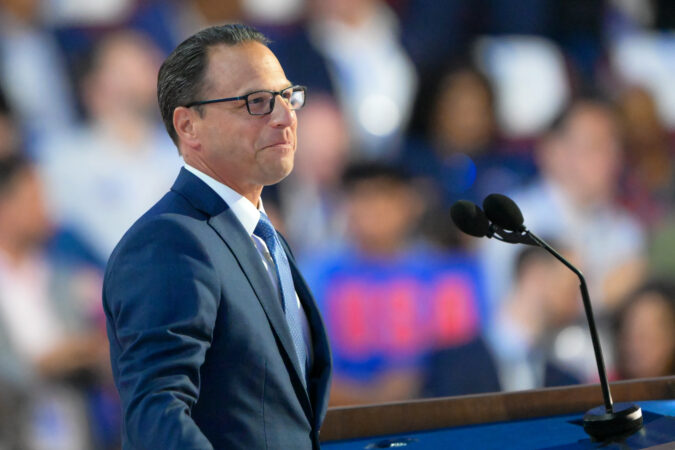
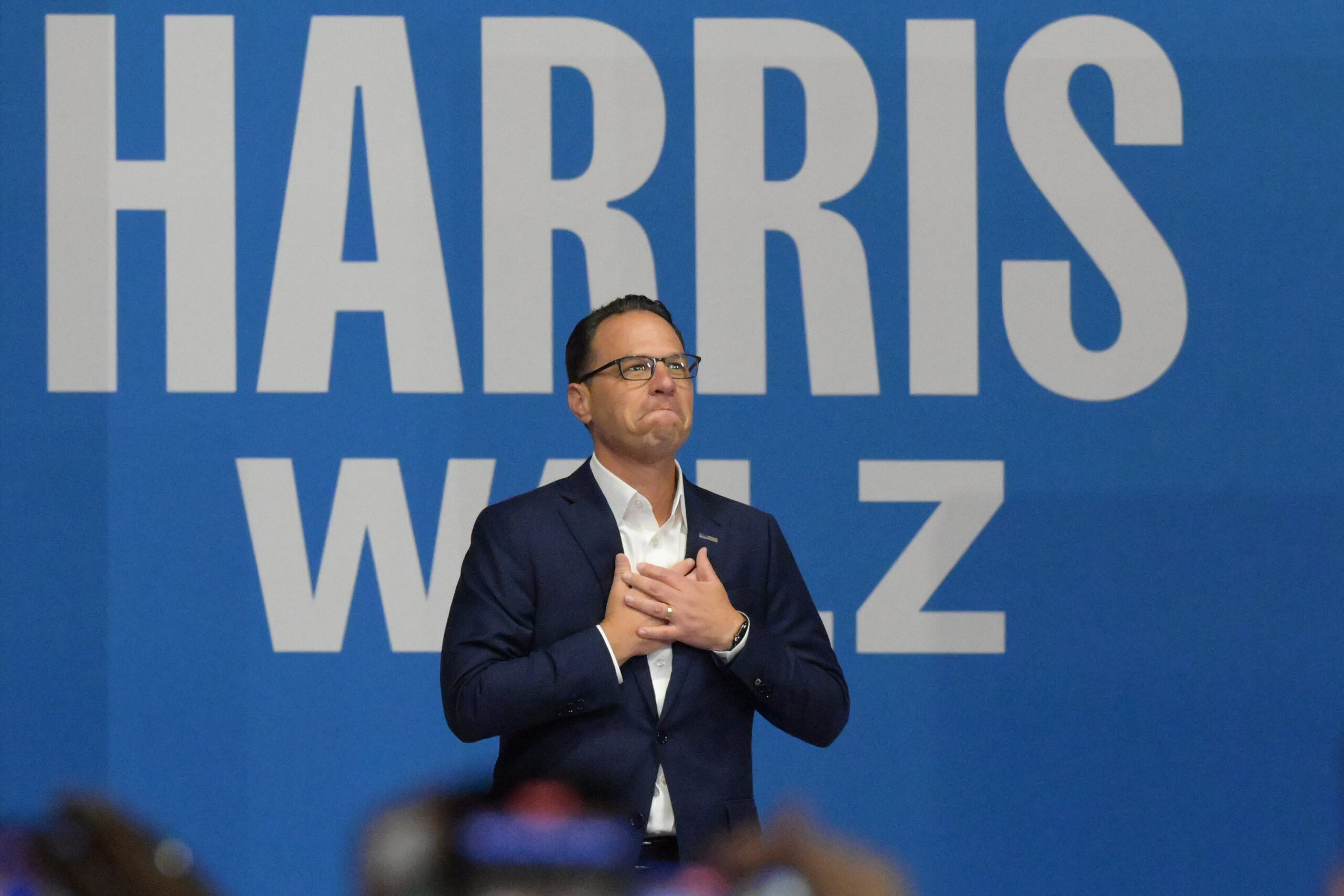
    Gov. Josh Shapiro takes the stage ahead of Vice President Kamala Harris and Gov. Tim Walz at a rally in Philadelphia’s Liacouras Center on August 6, 2024.

    But when it was time for him to take the stage ahead of Walz and Harris, he was long-applauded by his home city and gave a speech “from my heart” about how he took pride in his faith and his support for Walz and Harris.

    Shapiro’s memoir will be released Jan. 27 and is a reflection on his decades as an elected official, including as Pennsylvania attorney general, as well as the firebombing of his home last year. He will tout the book in Philadelphia on Saturday at 3 p.m. at Parkway Central Library. He will also discuss the book at upcoming book tour stops in New York and Washington.

  • CHOP, Nemours targeted by Trump administration over transgender care

    CHOP, Nemours targeted by Trump administration over transgender care

    Escalating President Donald Trump’s fight against transgender rights, a top official at the Department of Health and Human Services on Thursday asked the department’s inspector general to investigate two Philadelphia-area children’s hospitals over their gender-affirming care for transgender children.

    Children’s Hospital of Philadelphia (CHOP) and Nemours Children’s Health in Wilmington are among a dozen hospitals that HHS general counsel Mike Stuart said in posts on X he had referred to the agency’s Office of the Inspector General (OIG) in recent days.

    A CHOP spokesperson declined to comment on Friday, and Nemours did not respond to a request for comment.

    Both hospitals treat children and teens with gender dysphoria — a medical condition in which a person’s body does not match their gender identity. Doctors can prescribe hormone therapy and puberty blockers to treat the condition, although Nemours has already limited its use of these treatments in response to threats from the Trump administration.

    The administration has targeted CHOP and other hospitals that treat transgender youth with subpoenas demanding patients’ medical records, including their dates of birth, Social Security numbers, and addresses, as well as every communication by doctors — emails, voicemails, and encrypted text messages — dating back to January 2020.

    CHOP filed legal action in response, asking a federal judge in Philadelphia to block the parts of the subpoena that sought detailed medical records of patients. In November, the judge ruled in CHOP’s favor.

    The Trump administration appealed the decision Friday. It has argued that it needs the records as part of its investigation into possible healthcare fraud or potential misconduct by the hospitals.

    Stuart said in a Thursday post on X that the administration is investigating hospitals in order to safeguard children from “sex-rejecting procedures,” adding: “There is no greater priority than protecting our children.”

    Corinne Goodwin, executive director of the Eastern Pennsylvania Trans Equity Project, called Stuart’s post part of the Trump administration’s ongoing efforts to intimidate doctors and hospitals that provide gender-affirming care to those under 19.

    “This action by the Department of Health and Human Services is yet another attempt to intimidate healthcare providers and to harm young people who simply want access to proven healthcare that helps them to live happy and productive lives,” said Goodwin, whose nonprofit organization provides services to transgender people in 42 counties, including Montgomery, Bucks, and Delaware.

    In the last year, the president has signed a slew of executive orders aimed at transgender Americans.

    The administration has said it recognizes only two genders, limited research into LGBTQ+ health, and phased out gender-affirming care at the Department of Veterans Affairs.

    Directly targeting children’s hospitals, HHS Secretary Robert F. Kennedy Jr. issued a declaration in December rejecting gender-affirming procedures for minors, including puberty blockers, hormone therapy, and surgeries.

    The American Academy of Pediatrics and other major medical associations, citing research, widely accept such care as safe, effective, and medically necessary for the patients’ mental health.

    HHS’s OIG declined Friday to confirm or deny the existence of an investigation.

    Last month, the U.S. Senate confirmed Thomas “March” Bell to serve as inspector general over HHS. During his confirmation hearing, Bell submitted written testimony saying, “If confirmed as inspector general, I will examine, evaluate, audit, and investigate to support the initiatives of President Trump and Secretary Kennedy.”

    An ongoing legal battle

    CHOP runs one of the nation’s largest clinics providing medical care and mental health support for transgender and nonbinary children and teens and their families. Each year, hundreds of new families seek care at CHOP’s Gender and Sexuality Development Program, created in 2014.

    Nemours’ Gender Wellness Clinic, launched in 2018, provided hormone therapy and puberty blockers, as well as mental health support, to transgender patients in Delaware, and Nemours is the only hospital in the state that provides gender-affirming care for children.

    Starting last July, its clinic began accepting only new patients who need behavioral healthcare. Existing patients receiving hormones or puberty blockers at the clinic were allowed to continue their treatment, the hospital said at the time.

    On Thursday, Stuart wrote on X that CHOP and Nemours “appear to continue to operate outside recognized standards of healthcare and entirely outside @SecKennedy’s declaration that sex-rejecting procedures for children and adolescents are neither safe nor effective.”

    Kennedy’s December declaration says that these procedures “do not meet professionally recognized standards of health care.” Doctors who perform such procedures could be barred from participating in federally funded healthcare programs like Medicaid and Medicare, he said.

    More than a dozen state officials from around the country, including Pennsylvania Gov. Josh Shapiro, filed a lawsuit in late December to block the declaration’s enforcement.

    The lawsuit says that Kennedy has no authority to define “a national standard of care,” and that any substantive changes to Medicare rules are legally required to be subjected to a decision-making process that includes 60 days of public comment.

    Officials at the Centers for Medicaid and Medicare Services have started that process, announcing alongside Kennedy’s declaration that they are proposing a rule that would bar hospitals from Medicaid and Medicare if they offer gender-affirming care to children under 19. They also proposed that Medicaid should not cover gender-affirming care for minors.

    But those rules have not yet been instituted, and the lawsuit alleges that Kennedy’s declaration is skirting the law by immediately imposing restrictions on gender-affirming care in hospitals.

    The Public Interest Law Center, a Philadelphia-based nonprofit that advocates for the civil, social, and economic rights of marginalized communities, is representing five parents of transgender children in legal motions seeking to protect their medical records.

    Mimi McKenzie, PILC’s legal director, said the federal judge in Philadelphia was “very clear and on firm ground” when he ruled in November that the DOJ had no authority to issue the sweeping subpoena and that it violated the privacy rights of children.

    She noted that six other courts around the country have similarly ruled that DOJ “has no right to rifle through children’s medical records.”

    “Gender-affirming care is legal in Pennsylvania and endorsed by every leading medical association,” McKenzie said. “This is just another tactic in their ongoing attack against providers and patients.”

  • The White House and a bipartisan group of governors, including Josh Shapiro, want to fix AI-driven power shortages and price spikes

    The White House and a bipartisan group of governors, including Josh Shapiro, want to fix AI-driven power shortages and price spikes

    Washington — The Trump administration and a bipartisan group of governors on Friday tried to step up pressure on the operator of the nation’s largest electric grid to take urgent steps to boost power supplies and keep electricity bills from rising even higher.

    Administration officials said doing so is essential to win the artificial-intelligence race against China, even as voters raise concerns about the enormous amount of power data centers use and analysts warn of the growing possibility of blackouts in the Mid-Atlantic grid in the coming years.

    “We know that with the demands of AI and the power and the productivity that comes with that, it’s going to transform every job and every company and every industry,” Interior Secretary Doug Burgum told reporters at the Eisenhower Executive Office Building, next to the White House. “But we need to be able to power that in the race that we are in against China.”

    Trump administration says it has ‘the answer’

    The White House and governors want the Mid-Atlantic grid operator to hold a power auction for tech companies to bid on contracts to build new power plants, so that data center operators, not regular consumers, pay for their power needs.

    They also want the operator, PJM Interconnection, to contain consumer costs by extending a cap that it imposed last year, under pressure from governors, that limited the increase of wholesale electricity payments to power plant owners. The cap applied to payments through mid-2028.

    “Our message today is just to try and push PJM … to say, ‘we know the answer.’ The answer is we need to be able to build new generation to accommodate new jobs and new growth,” Energy Secretary Chris Wright said.

    Govs. Josh Shapiro of Pennsylvania, Glenn Youngkin of Virginia, and Wes Moore of Maryland appeared with Burgum and Wright and expressed frustration with PJM.

    “We need more energy on the grid and we need it fast,” Shapiro said. He accused PJM of being “too damn slow” to bring new power generation online as demand is surging.

    Shapiro said the agreement could save the 65 million Americans reliant on that grid $27 billion over the next several years. He warned Pennsylvania would leave the PJM market if the grid operator does not align with the agreement, a departure that would threaten to create even steeper price challenges for the region.

    PJM wasn’t invited to the event.

    Grid operator is preparing its own plan to meet demand

    However, PJM’s board is nearing the release of its own plan after months of work and will review recommendations from the White House and governors to assess how they align with its decision, a spokesperson said Friday.

    PJM has searched for ways to meet rising electricity demand, including trying to fast-track new power plants and suggesting that utilities should bump data centers off the grid during power emergencies. The tech industry opposed the idea.

    The White House and governors don’t have direct authority over PJM, but grid operators are regulated by the Federal Energy Regulatory Commission, which is chaired by an appointee of President Donald Trump.

    Trump and governors are under pressure to insulate consumers and businesses alike from the costs of feeding Big Tech’s data centers. Meanwhile, more Americans are falling behind on their electricity bills as rates rise faster than inflation in many parts of the U.S.

    In some areas, bills have risen because of strained natural gas supplies or expensive upgrades to transmission systems, to harden them against more extreme weather or wildfires. But energy-hungry data centers are also a factor in some areas, consumer advocates say.

    Ratepayers in the Mid-Atlantic grid — which encompasses all or parts of 13 states stretching from New Jersey to Illinois, as well as Washington, D.C. — are already paying billions more to underwrite power supplies to data centers, some of which haven’t been built yet, analysts say.

    Critics also say these extra billions aren’t resulting in the construction of new power plants needed to meet the rising demand.

    Tech giants say they’re working to lower consumer costs

    Technology industry groups have said their members are willing to pay their fair share of electricity costs.

    On Friday, the Information Technology Industry Council, which represents tech giants Google, Meta, Microsoft, and Amazon, said it welcomed the White House’s announcement and the opportunity “to craft solutions to lower electricity bills.” It said the tech industry is committed to “making investments to modernize the grid and working to offset costs for ratepayers.”

    The Edison Electric Institute, which represents investor-owned electric companies, said it supports having tech companies bid — and pay for — contracts to build new power plants.

    The idea is a new and creative one, said Rob Gramlich, president of Grid Strategies LLC, a Washington, D.C.-based energy markets and transmission consultancy.

    But it’s not clear how or if it’ll work, or how it fits into the existing industry structure or state and federal regulations, Gramlich said.

    Part of PJM’s problem in keeping up with power demand is that getting industrial construction permits typically takes longer in the Mid-Atlantic region than, say, Texas, which is also seeing strong energy demand from data centers, Gramlich said.

    In addition, utilities in many PJM states that deregulated the energy industry were not signing up power plants to long-term contracts, Gramlich said.

    That meant that the electricity was available to tech companies and data center developers that had large power needs and bought the electricity, putting additional stress on the Mid-Atlantic grid, Gramlich said.

    “States and consumers in the region thought that power was there for them, but the problem is they hadn’t bought it,” Gramlich said.

    Associated Press writer Matthew Daly and The Washington Post contributed to this article.
  • Gov. Josh Shapiro sued a vendor for failing to deliver 3.4 million letters from state agencies, calling it ‘unacceptable’

    Gov. Josh Shapiro sued a vendor for failing to deliver 3.4 million letters from state agencies, calling it ‘unacceptable’

    HARRISBURG — Gov. Josh Shapiro’s administration has sued a former vendor for failing to deliver 3.4 million pieces of state agency mail to residents, resulting in a statewide debacle with some residents losing access to their public benefits.

    Shapiro called the situation “absolutely unacceptable” in his first public remarks on the matter during a Wednesday appearance at the Pennsylvania Farm Show.

    The Pennsylvania Department of General Services earlier this month filed suit in Dauphin County Court against the Harrisburg-based Capitol Presort Services, a mail presort company, for damages totaling more than $220,000 for its failure to deliver critical state agency communications from the Department of Human Services, Department of Transportation, and more.

    The lawsuit alleges that the owner of Capitol Presort Services told the state he had been forced to reduce staff due to the 135-day state budget impasse, during which outside vendors were not paid. But the owner, Phil Gray, never told the state his company could not fulfill its contractual obligations, according to the state’s filing.

    Gray “systematically reviewed the mail entering his facility and elected to process the mail that was most easily traced, to hide that he was falling behind,” according to a letter sent to lawmakers last week by DGS Secretary Reggie McNeil.

    The unsent mail went undetected by the state for one month before it was discovered, and Capitol Presort Services was swiftly fired. The state found another vendor through an emergency contract with technology solution company Pitney Bowes for $1 million.

    Shapiro said his administration has been “working overtime” to ensure no benefits were lost, and if they were, “we’re going to make it right.”

    “The vendor failed. It was caught, it was addressed, we’re suing them, and we’re going to do everything we can to recover for the people of Pennsylvania,” Shapiro said. “It’s not OK.”

    The mail delay has become an early point of attack against Shapiro as he runs for reelection and is likely to face Treasurer Stacy Garrity, the Pennsylvania Republican Party’s endorsed candidate. Following Shapiro’s reelection campaign announcement last week, the state GOP claimed that Shapiro has “even failed at the easy stuff, like sending out millions of letters from state agencies, causing vulnerable residents to lose their healthcare without notice.”

    Why the state sued

    The state hired Capitol Presort in 2021 to tray and sort some of the state’s mail, in order to save money on postage. Its latest purchase order for 2024-25, according to the suit, totaled nearly $5.3 million to deliver millions of state agency communications to residents.

    The state alleges in the suit that the vendor continued to deliver trackable mail while not delivering untracked mail, arguing that this was evidence of an “active and fraudulent concealment and an affirmative misrepresentation that it was performing its obligations under the contract.”

    Capitol Presort Services allegedly continued to pick up mail daily throughout the month of November, and Gray did not communicate to the state when asked on Dec. 4 that he could not meet his contractual obligations, McNeil said in his letter to lawmakers.

    However, Gray allegedly told the state that he had reduced his staff since July due to the impact of the budget impasse, which lasted 135 days, or nearly five months. Outside vendors are not paid during budget impasses but are expected to meet their contractual obligations.

    “Many critical contractors continued to provide services to the commonwealth, without payment, throughout the lengthy budget delay, but this vendor hid the problem and at no point advised DGS or worked cooperatively to resolve it,” McNeil told the lawmakers.

    Gray could not be reached for comment Thursday and did not have an attorney listed on the lawsuit.

    Ongoing impact

    Community Legal Services reported last month that the failure to deliver state agency mail, which went undetected from Nov. 3 to Dec. 3, had resulted in approximately two dozen clients losing access to their benefits. The total number of residents affected by the mail delay remains unclear.

    The Pennsylvania Department of Human Services has said it is extending its appeal deadlines by 45 days, while any Medicaid, CHIP, or TANF cash assistance recipients whose benefits were reduced or ended are getting their cases reopened.

    SNAP recipients who lost access to their food assistance due to the mail delay must file an appeal, submit missing documents, or reapply to become eligible again under federal rules.

    PennDot, for its part, has received few reports of issues due to the mail delay and does not anticipate much of an impact on residents, Transportation Secretary Mike Carroll said in a letter to legislators sent last week. All of its legal and time-sensitive mailings, like suspension notices, were not affected.

    The state will likely ask for more than $220,000 in damages, adding in the suit that the full cost for the failure to deliver a month’s worth of agency mail cannot yet be determined. As of last week, DHS alone has spent that much on unplanned communications and mailing costs to notify affected Pennsylvanians, according to a letter from DHS Secretary Val Arkoosh to state lawmakers.