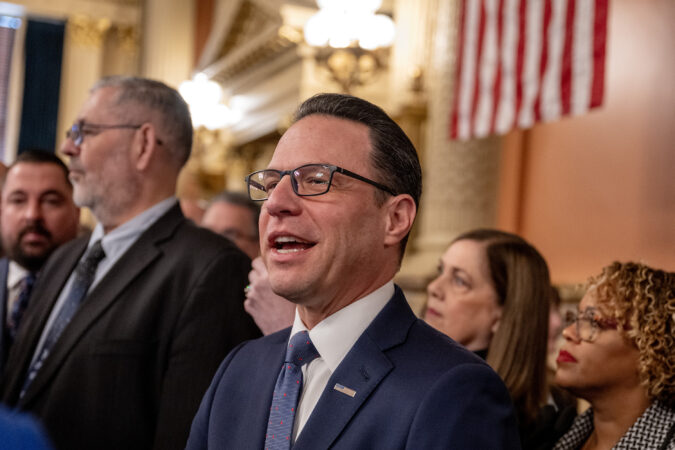
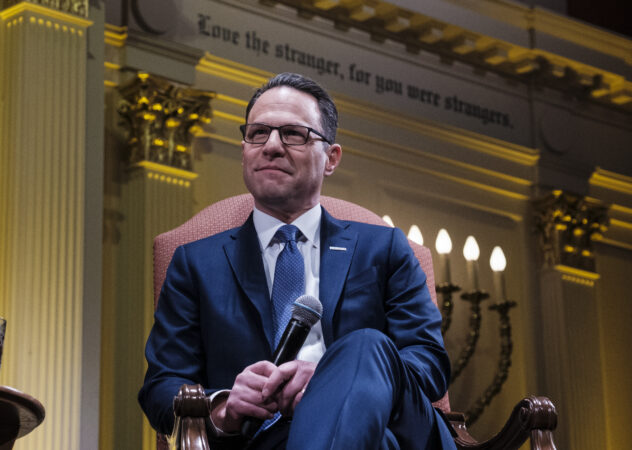
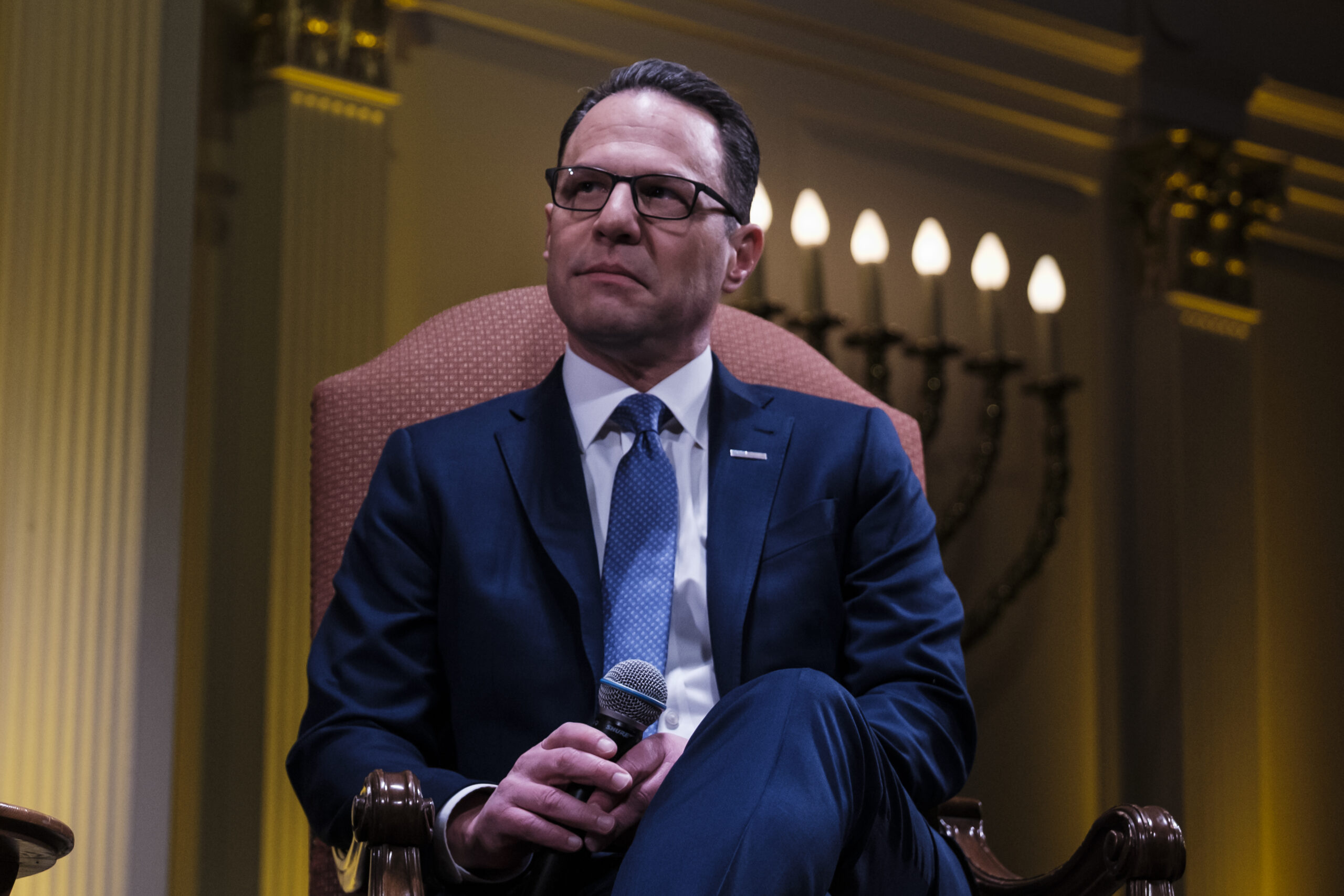
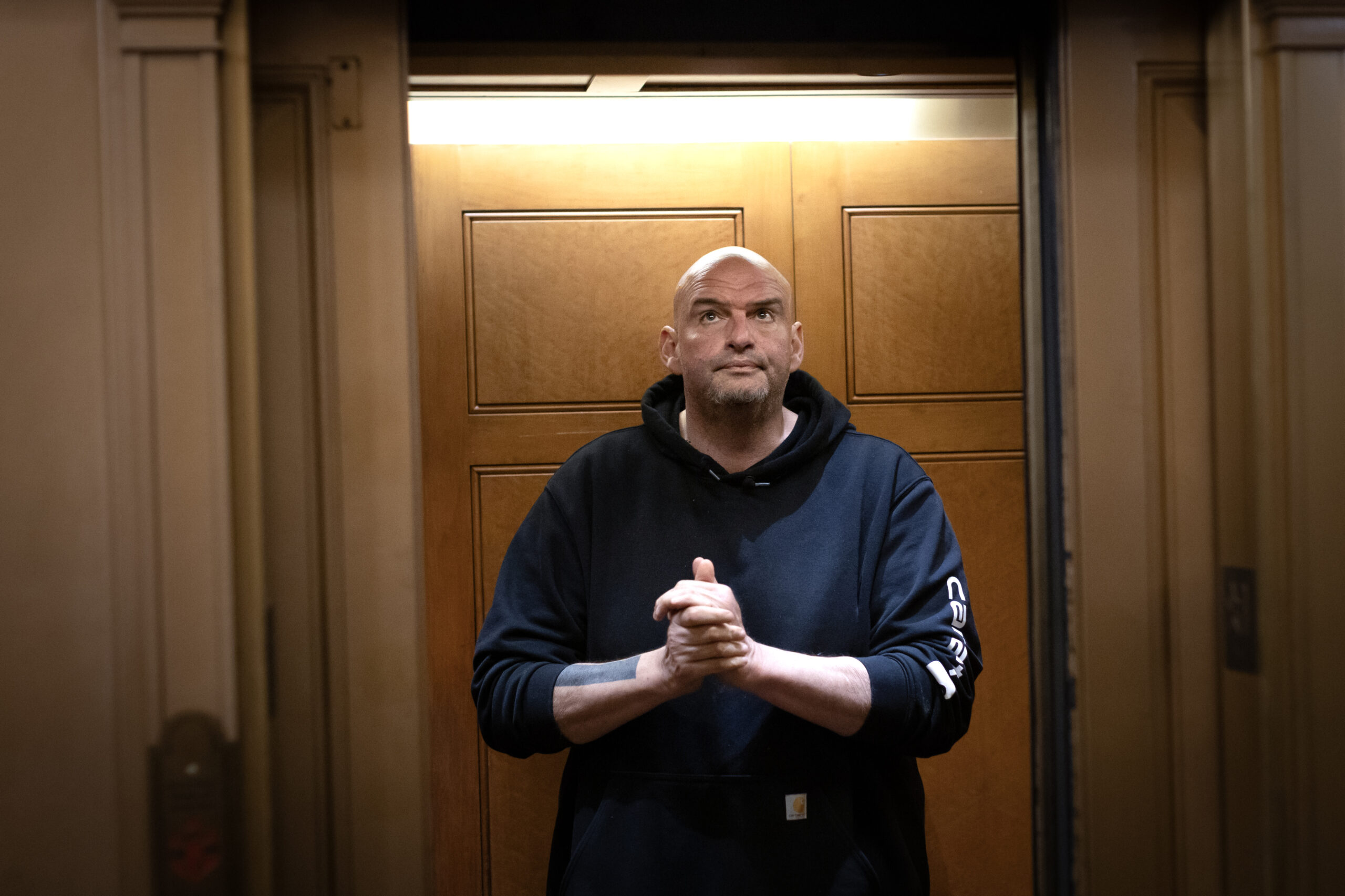
Gov. Josh Shapiro blasted U.S. Immigration and Customs Enforcement (ICE) Friday for buyinga Berks County warehouse that may be used to detain people.
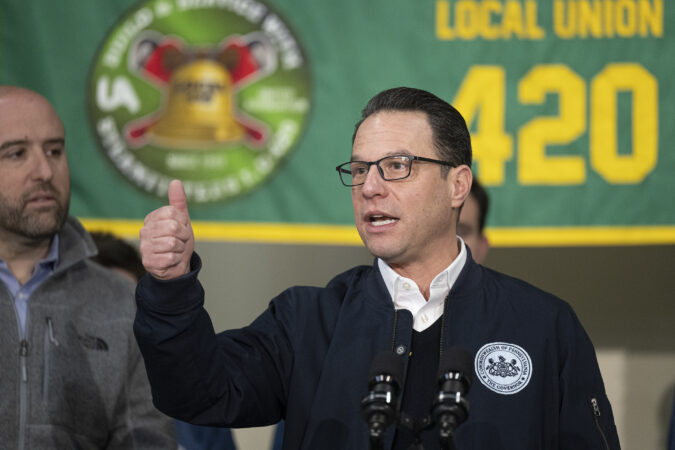
“I’m strongly opposed to the purchase,” Shapiro said after speaking at an event at the Steamfitters Local 420 in Northeast Philadelphia.
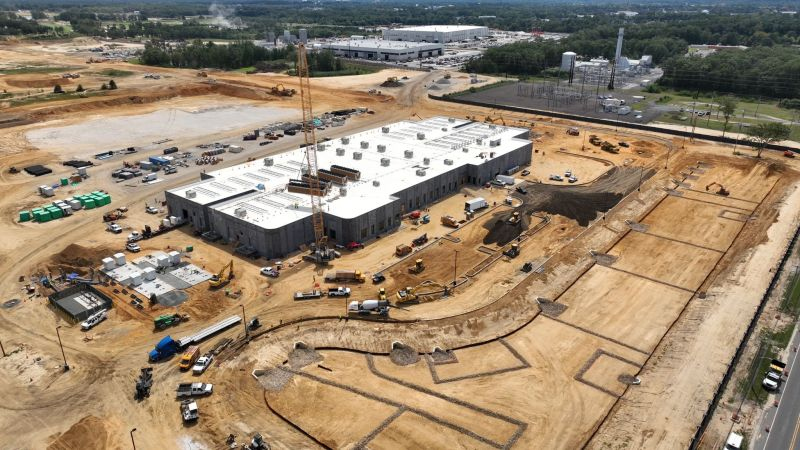
Shapiro said the facility is “not what we need anywhere in Pennsylvania,” adding that he was not alerted ahead of time of ICE’s $87 million acquisition of the warehouse on 64 acres in Upper Bern Township.
“The secretive way the federal government went about this undermines trust,” Shapiro said.
Shapiro has grown increasingly vocal in his criticism of ICE and President Donald Trump in recent weeks as he’s toured the East Coast promoting his new memoir. In addition to voicing his opposition to the warehouse, Shapiro criticized Trump for sharing a racist video attacking former President Barack Obama and former first lady Michelle Obama.
The Democratic governor, who is widely seen as a contender for the White House in 2028, is in the midst of a reelection campaign against Trump-endorsed Republican Stacy Garrity, who has urged cooperation with ICE.
He said the commonwealth is exploring “what legal options we may have to stop” the ICE procurement, but he acknowledged “those options are very slim, given that the federal government is the purchaser.”
Shapiro told this audience of union workers and apprentices that the Berks County building would be better used for economic development.
At the same event, Shapiro announced a new $3 million Redevelopment Assistance Capital Program (RACP) grant to expand the Steamfitters Local Union 420 Training Center, which he said would help “train the next generation of workers.”
Shapiro criticizes Trump over racist anti-Obama video
Duringthe union hall event, Shapiro also leveled criticism at the Trump administration for sharing on social media a racist video depicting Obama, the first Black president, and his wife, as apes.
When asked for a reaction, Shapiro said, “I actually agree with [Republican] Sen. Tim Scott of South Carolina that it’s racist.”
Scott, the only Black Republican in the Senate, called the video “the most racist thing I’ve seen out of this White House,” after Trump shared it to his Truth Social account Thursday evening.
Shapiro said thatTrump “seems to always find a lower and lower common denominator. We’re not going to get sucked down into the depths that this president seems to reach for each day.”
Trump took down the video early Friday afternoon.
The governor also strongly chided Trump for recently saying the federal government should be in charge of elections.
Specifically, Trump named Philadelphia, along with Detroit and Atlanta, as cities where the federal government should step in to run elections. The predominantly Black cities are in swing states and have long been targeted with Trump’s false claims of voter fraud.
“The president of the United States doesn’t run our elections,” said Shapiro. “County officials run our elections, Republican and Democrat alike.”
“We’re not going to have interference from the White House,” added the governor, who served as attorney general when Trump tried to overturn Pennsylvania’s election results in 2020.
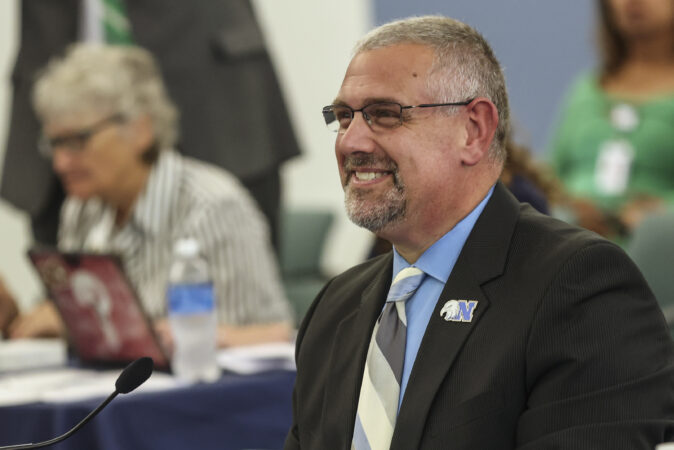
The Norristown Area School District’s board is moving to oustits superintendent, saying the district needs a new leader to reverse years of poor test scores.
The move to replace Superintendent Christopher Dormer, who has led the Montgomery County district since 2018 and whose contract expires June 30, comes after five new members were elected to the nine-person school board in November. The board voted unanimously Jan. 20 to give Dormer notice they would not renew his contract.
Some community members expressed shock at the decision to part ways with Dormer, who is also the president of the Pennsylvania Association of School Administrators. Dormer has been a vocal advocate for increasing funding to Norristown, which is considered underfunded by the state, and where nearly three-quarters of students are economically disadvantaged.
Jeremiah Lemke, who joined the Norristown school board in December and is now its president, acknowledged Dormer as “a leader statewide” in advocating for a new school funding system and a superintendent who has done “many good things for the district.” But, he said at the Jan. 20 meeting, test scores are a concern.
“Student achievement in Norristown hasn’t been winning, under Mr. Dormer, for years, not months, but years — seven to be exact,“ Lemke said in an emailed statement Wednesday. ”If the Eagles didn’t win for seven years, regardless of what positive developments happened in the organization, there would be no questions asked when the head coach was replaced.“
Norristown, a majority Hispanic district, enrolls about 8,000 students.
About 28% of Norristown’s third-through-eighth graders scored proficient or above in English language arts on the Pennsylvania System of School Assessment standardized tests last year, compared to 48.5% statewide. In math, 27.4% of Norristown students were proficient, compared to 41.7% statewide.
Over the last few years, changes in Norristown’s test scores have largely tracked Pennsylvania’s as a whole, with ELA scores sliding, and math scores improving. In 2023, 30.7% of Norristown students scored proficient in ELA, compared to 53.7% of students at the state level. In math, 21.6% of Norristown students scored proficient in 2023, compared to 39.4% statewide.
In a message to staff and families after the Jan. 20 vote, Dormer said he was proud of what the district had accomplished during his tenure — “including consecutive years with minimal to no tax increases, the sizable and significant additions in staffing after years of reductions, the sustained investment in new instructional resources and educational opportunities after years of unaffordability, the development and implementation of our facilities master plan after decades of deferred maintenance, and the commitment to the principles of equity, inclusion, and belonging as we navigated a worldwide pandemic and an increasingly politically divided country.”
Dormer, who began his career in education as an educational assistant in the Lower Merion School District, spent 13 years as a teacher, coach, and athletic director in the Upper Darby School District before moving into administration in 2005. He became Upper Darby High School’s principal in 2008, a role he held for five years, and came to Norristown in 2016.
Performance reviews on the district’s website show Dormer was rated “proficient” by the board in 2021-22 and 2022-23. More recent reviews were not listed online.
On Wednesday, Dormer declined to comment.
Lemke — who works for a Philadelphia nonprofit, Jounce Partners, that has coached charter school leaders to improve teacher performance — said in a statement Wednesday that the decision was “thoughtful, reflective, data-informed, and unanimous, amongst new and continuing board members.”
The board last week voted to approve a $79,500 contract with Alma Advisory Group, a Chicago-based firm, to conduct a national search for a new superintendent.
Jordan Alexander, another new school board member, said during that board meeting that members “often have to make decisions that are very unpopular.”
“I’m gonna be honest, I wasn’t so sold,” Alexander said. A former Norristown student, Alexander said that when Dormer “came to the scene, the pride did go up, and it was a breath of fresh air.”
But “we cannot advocate ourselves to be the best if our performance does not reflect that,” Alexander said.
Community reaction to the ouster
Some community members accused the board of a predetermined decision.
“Staff were not aware of these changes … the community was not aware, or anybody. You guys just threw it out there,” Ericka Wharton, a parent and leader of a Norristown community center, told the board at last week’s meeting. Wharton warned the decision could create instability, including a decline in student achievement.
Carmina Taylor, a local advocate, told the board that community members deserved “a full explanation with dates and details that led to your decision.”
“This decision is short-sighted, abrupt, without consideration as to how the students will be impacted by this major shift in leadership,” said Taylor, co-founder of the Movement for Black and Brown Lives in Montgomery County.
The election of the new board came after infighting in the local Democratic Party. Chris Jaramillo, the former board president, lost the local Democratic Party’s endorsement for reelection last year. Jaramillo had opposed a tax break for a senior affordable housing development. Last week, the new board voted to rescind a November district policy that restricted tax abatements, saying it would replace it.
Jaramillo is also a co-founder of the Movement for Black and Brown Lives in Montgomery County. In an interview Wednesday, he described the board’s new leaders as inexperienced and questioned how it could quickly replace Dormer without causing disruption.
“I don’t think it’s a sound decision,” said Jaramillo. He said he worried the board would pick someone “without any sort of knowledge of how diverse Norristown and its surrounding area are.”
Taylor said Wednesday she wasn’t speaking on behalf of Jaramillo. She accused the board of “plotting” to remove Dormer.
“How in the world, if they didn’t have a sense of what they wanted to do, could they have even attempted to do that in the last 45 days?” said Taylor, who has filed a complaint with the school board, alleging insufficient transparency.
Lemke said it is “categorially false” that the board acted too quickly and without transparency. “Once we were installed, we had a short time period in which to make a decision because we knew that if we didn’t renew his contract it would not be a quick task to do a national search for a superintendent,” he said.
Taylor noted that while the district’s test scores “are bad,” Norristown has only been receiving additional state money under a new formula intended to remedy constitutional underfunding for the past two years. (The budget proposed by Gov. Josh Shapiro Tuesday would give underfunded districts their third installment of a nine-year plan.)
“It’s not enough to address the systemic issue, period,” she said.
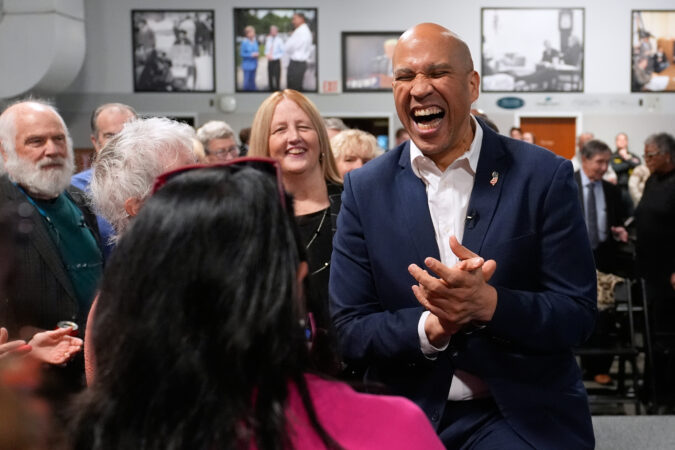
U.S. Sen. Cory Booker has raised more than $30 million for his reelection campaign, outdoing the vast majority of candidates running for either chamber ofCongress in 2026.
The New Jersey Democrat has raised the second-largest amount of money for the 2026 elections for U.S. House and Senateas of the end of last year, behind only Sen. Jon Ossoff (D., Ga.),according to Federal Election Commission reports.
Booker is widely considered a potential presidential contender for 2028, after unsuccessfully seeking the office in 2020.
The lawmaker has no serious challengers at this point for his Senate seat, and he could leave this cycle with extra money he could use for a presidential run.
His campaign has nearly $22 million cash on hand and no debt. He has been adding to his coffers since he began his most recent term in 2021.
More than 200,000 people donated to Booker in 2025, and roughly 80% of the donations were $25 or less, according to Booker’s campaign.
“Cory is backed by a grassroots movement that recognizes the importance of strong, principled leadership that stands up in this moment,“ his campaign manager, Adam Silverstein, said in a statement. ”We are grateful for this incredible outpouring of support and will keep building the infrastructure we need to win in 2026 and elect Democrats at every level.”
The New Jersey Democrat saw a fundraising spike when he delivered a record-breaking 25-hour speech on the Senate floor last year. He raised nearly $9.7 million in the second quarter of 2025, the period that included his speech, far more than any other quarter last year.
Booker criticized President Donald Trump on a host of issues in the speech and held up a pocket Constitution. He also acknowledged his own party’s failure to prevent Trump’s return to office.
“I confess that the Democratic Party has made terrible mistakes that gave a lane to this demagogue,” he said in his speech. “I confess we all must look in the mirror and say, ‘We will do better.’”
Laura Matos, a New Jersey Democratic operative, said Booker was already a “known entity,” and his speech came at a time when Democrats across the country were looking for someone to stand up to Trump.
“For 25 hours, his people could constantly churn out, like every hour, ‘He’s still on the Senate floor, show him you support him,’” said Matos, a partner at lobbying and public affairs firm MAD Global Strategy Group. “The way that fundraising works, you can really build upon things like that. He was prolific before that, and then that just kind of skyrocketed it.”
Ossoff, the 2026 federal candidate who reported more than Booker, has raised nearly $64 million and faces a more competitive race in a key swing state.
He began serving as mayor of Newark in 2006 untilhe was elected to the U.S. Senate in a 2013 special election.
Booker is also heading into a national tour to promote Stand, his new book, set to publish next month.
The book combines Booker’s personal reflections with stories of American leaders from President George Washington to Supreme Court Justice Ketanji Brown Jackson, and “offers a hopeful and practical path forward,” according to his publisher, Macmillan.
Most of Booker’s money comes from outside New Jersey.
According to FEC data, from January through September 2025, he received the most money from California, followed by New York.
While Booker is raking in money, he’s also spending it. He spent the fourthmost out of all 2026 Senate candidates, reporting $14 million in spending since 2021.
One of his biggest expenses was in April, when his campaign spent $1.2 million on an email list acquisition.
The only other candidate who has reporting fundraising for the New Jersey Senate race so far is Justin Murphy, a Republican from the Pinelands, who reported a little over $3,500.
Several other Republicans have expressed interest in running in the primary, and county parties will hold conventions in the coming weeks to endorse candidates.
Luke Ferrante, the executive director of New Jersey GOP, said the party is planning “a robust effort statewide” to unseat Booker.
“New Jerseyans across the state are eager to elect a statewide representative that is focused on delivering for its residents, not their greater Washington ambitions,” Ferrante said.
Gov. Josh Shapiro had a message for data center developers on Tuesday: Come to Pennsylvania, but bring your own energy — or pay up.
During his budget address, Shapiro said his proposal — the Governor’s Responsible Infrastructure Development (GRID) standards — will ensure center operators are “not saddling homeowners with added costs because of their development.”
Data centers, which house the technology to power cloud storage and other computing, have been proliferating across the country and the region due to the increasing demands of generative artificial intelligence, or AI.State and local officials are trying to keep up with the rapid pace of development, proposing new legislation — and updating existing measures — in an attempt to regulate the facilities.
Shapiro’s plan would require data centers to supply their own energy or pay for any new generation they need. It also calls on them to hire and train Pennsylvania workers and comply with “the highest standards of environmental protection,” including in water conservation, Shapiro said.
In exchange, the governor added, data center developers will get “speed and certainty” in the permitting process, as well as applicable tax credits.
The comments from Shapiro, a Democrat who has consistently encouraged data center development, come amid a flurry of legislative and executive action, as elected officials promise to keep Pennsylvania and New Jersey consumers from bearing the costs of these power-hungry facilities.
Data centers, the electric grid, and governors’ proposals
At the same time, some governors, including Shapiro, have criticized and sued PJM, the Montgomery County-based electric grid operator, over its annual capacity auction, which influences how much customers pay.
On Tuesday, Shapiro reiterated calls for PJM to speed up new power-generation projects and extend a price cap.
Separate from GRID, Shapiro also said electric companies, including Peco, should increase transparency around pricing and “rein in costs” for consumers, including low-income and vulnerable Pennsylvanians.
“These steps will save consumers money immediately,” Shapiro said. He announced an energy-affordability watchdog to monitor utility-rate requests and take legal action if necessary to prevent companies from “jacking up their rates and costing you more.”
Through several executive orders, she froze utility rates and expanded programs to spur new power generation in the state. She also ordered electric utilities to report energy requests from data centers.
“This is just the beginning,” Sherrill said in her inaugural remarks. “We are going to take on the affordability crisis, and we are going to shake up the status quo.”
In Pennsylvania, ‘Data Center Consumer Protection Bill’ advances
An Amazon data center is shown last year while under construction in front of the Susquehanna nuclear power plant in Berwick, Pa.
Meanwhile in Harrisburg and Trenton, some lawmakers have other ideas about how to keep residents from subsidizing data centers.
As of Tuesday, nearly 30 bills in the Pennsylvania and New Jersey legislatures mentioned data centers, according to online records. Many of those bills aren’t directly related to residents’ electric bills, and instead address the facilities’ energy sources, water usage, environmental impacts, and general regulation.
“Today’s vote brings us one step closer to protecting ratepayers,” Robert Matzie, the Beaver County Democrat who introduced the bill, said in a statement. “Data centers can bring jobs and expand the local tax base, but if unchecked, they can drive up utility costs. Electric bills are already too high.”
The bills were introduced by State Reps. Kyle Donahue and Kyle Mullins, both Democrats from the Scranton area, which has become a hot spot for data center development.
“There is a real concern and a sense of overwhelm among the people we represent,” Mullins said at the hearing. “The people of Pennsylvania have serious concerns about data center energy usage and water usage, especially as they see utility bills continue to rise rapidly.”
Dan Diorio, vice president of state policy for the Data Center Coalition, said he worried the bills would discourage operators from building in Pennsylvania. He said they are already incentivized to reduce energy costs, which are estimated to make up anywhere from 40% to 80% of a data center’s total operating costs.
“Data center companies strive to maximize energy efficiency to keep their costs low,” Diorio said.
Rep. Elizabeth Fiedler, the Philadelphia Democrat who chairs the energy committee, closed Monday’s hearing by reminding members of one of its main objectives: to “keep down the energy bills that are skyrocketing for people back home.”
A South Jersey lawmaker says his bill could help consumers
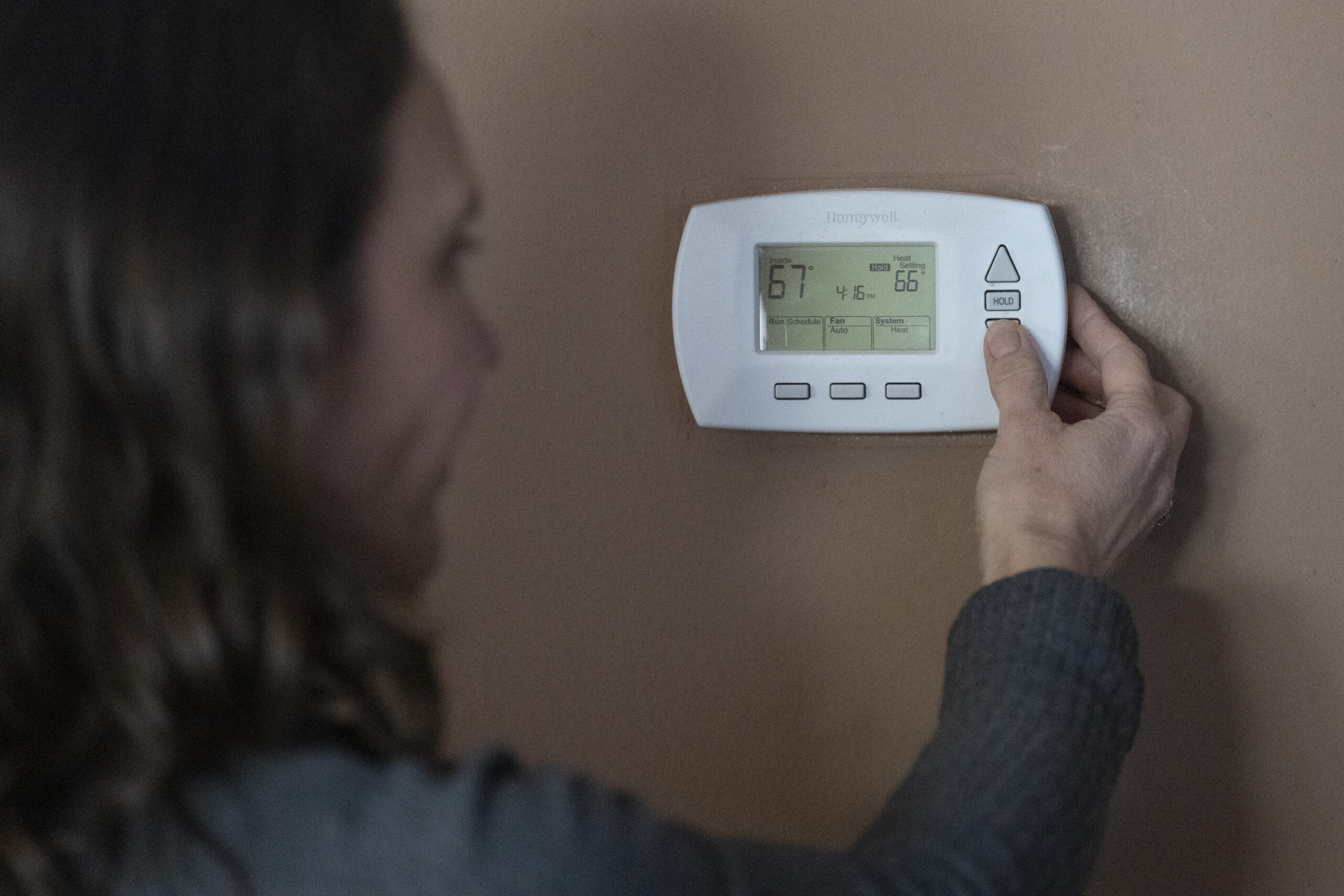
A Philadelphia-area woman woman turns down her thermostat in attempt to save on electricity in this January 2023 file photo.
The pain of skyrocketing utility bills has been felt acutely in New Jersey, which unlike Pennsylvania uses more energy than it produces.
Between 2024 and 2025, New Jersey residents’ electric bills rose more than 13% on average, the fifth steepest increase in the U.S., according to federal data analyzed by the business magazine Kiplinger. Pennsylvanians saw a nearly 10% increase during the same period, according to the data.
A bill sponsored by New Jersey State Assembly member David Bailey Jr., a Democrat from Salem County, attempts to prevent future price hikes.
The legislation would require data center developers to have “skin in the game,” as Bailey described it in a recent interview, and sign a contract to purchase at least 85% of the electric service they request for 10 years. He said it would also provide incentives for data centers to supply their own energy generation.
“I don’t want to come off as an anti-data center person,” said Bailey, who represents parts of Gloucester, Salem, and Cumberland Counties. “This is a very positive thing. We’re just saying we don’t want these big companies to come in and pass this [cost] on to our mom and pops, our neighbors, and our everyday ratepayers.”
Bailey said he was disappointed that his bill was pocket-vetoed by former Gov. Phil Murphy last month. Now, it has to restart the legislative process. But Bailey said he expects it to eventually pass with bipartisan support.
“No matter your party affiliation you understand the affordability issue,” Bailey said. “You understand your electric bill” — and how much it has risen recently.
HARRISBURG — Gov. Josh Shapiro on Tuesday unveiled a $53.2 billion state budget that focuses on making Pennsylvania a more affordable place to live — while proposing a 6.2% spending increase over last year and renewing his pitches to create new revenue streams to fill a significant budget deficit as he runs for reelection.
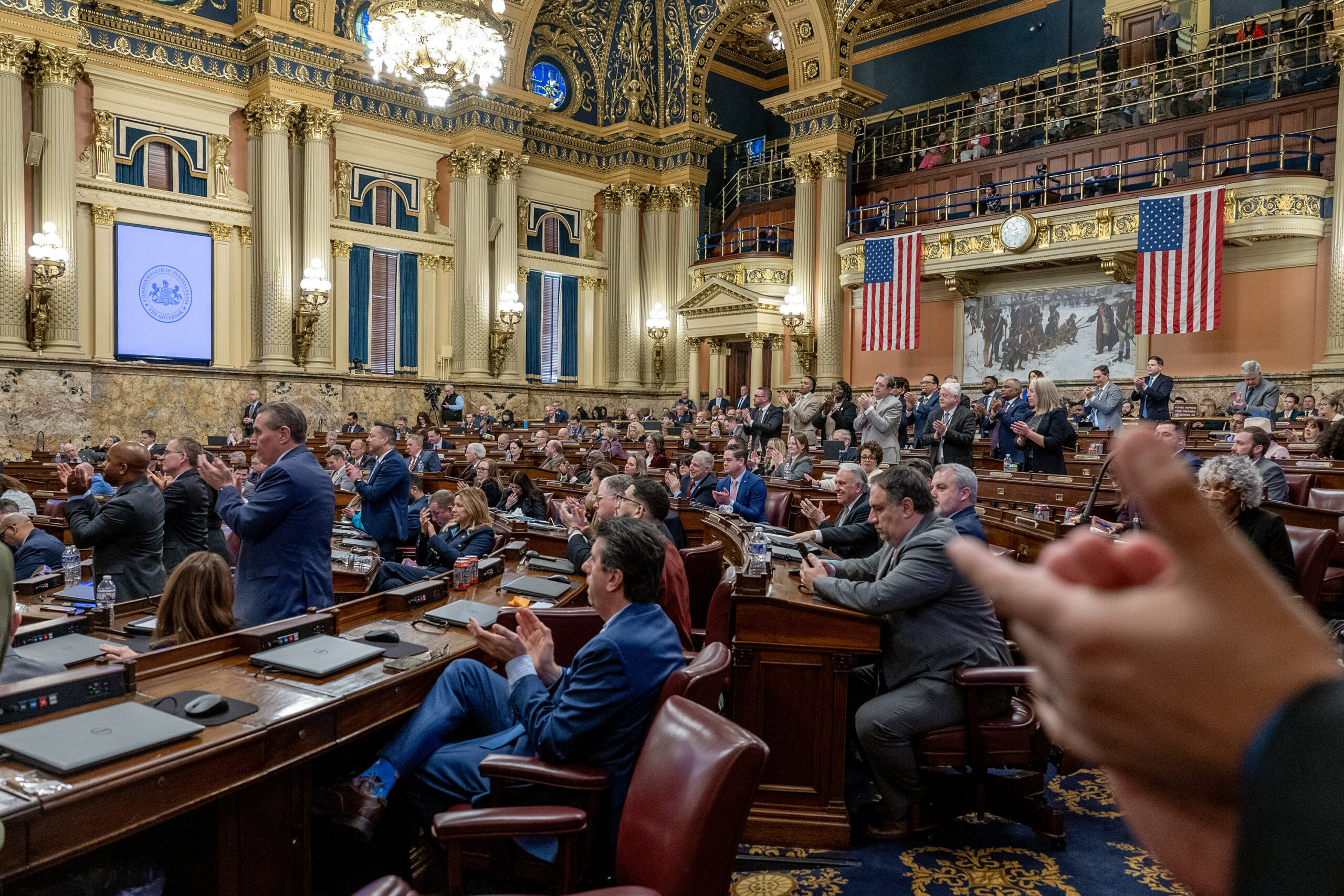
Shapiro’s fourth budget address attracted several standing ovations from Democrats as he stood before a joint session of the state House and Senate to pitch some of Democrats’ shared priorities, such as increasing the minimum wage to $15 an hour.
Afterward, Republicans decried the budget proposal as unaffordable, arguing such a steep increase in spending is unrealistic when the state is already poised to spend more than it brings in during the current fiscal year and in the future. Shapiro’s proposal would spend $4.6 billion more than the state is projected to bring in in the 2026-27 fiscal year, requiring officials to pull most new spending from Pennsylvania’s $7.7 billion Rainy Day Fund, or find funding from new revenue streams like the taxation of recreational marijuana that do not yet exist.
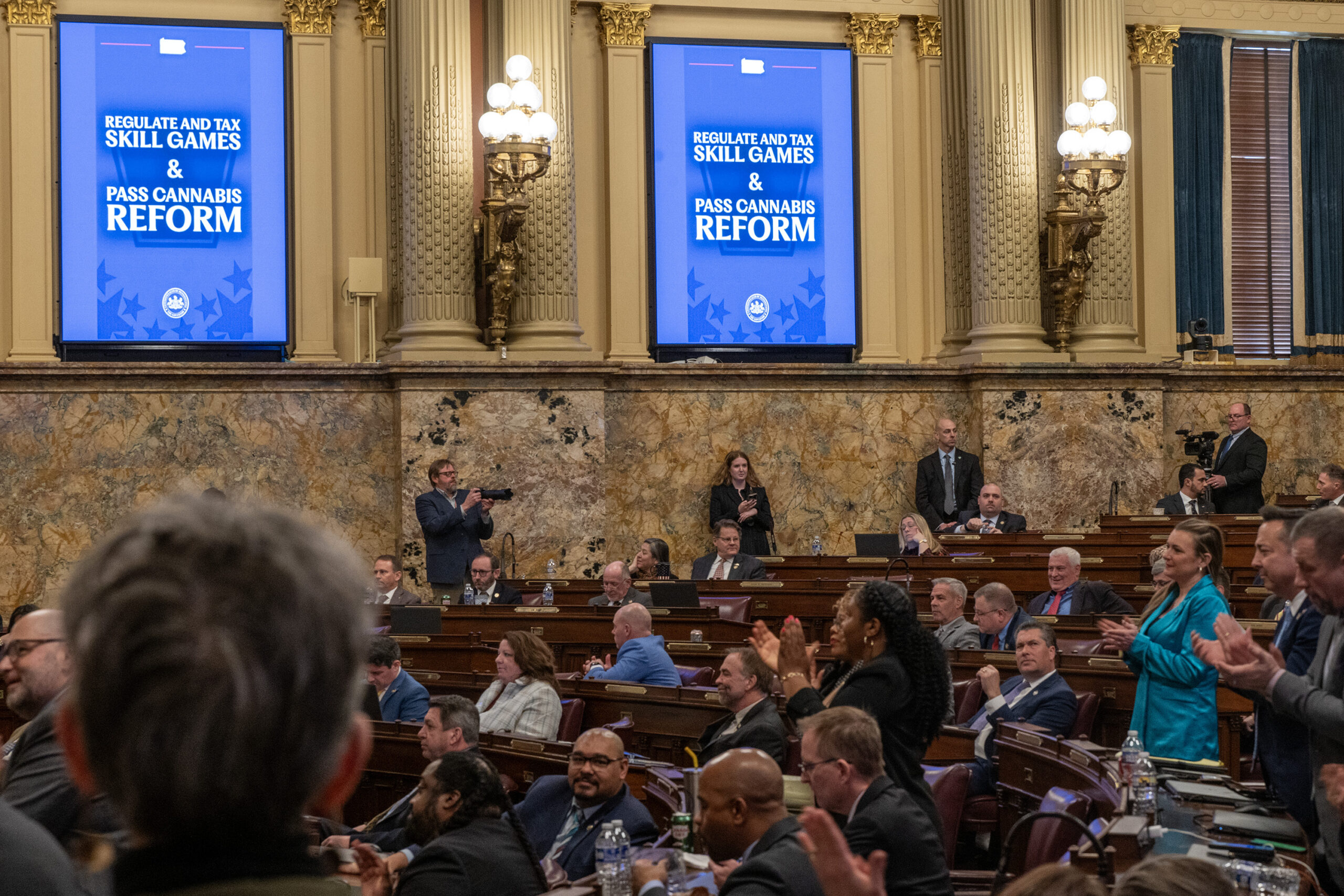
Screen shows skill games and cannabis regulation and reform as Gov. Josh Shapiro makes his annual budget proposal in the state House chamber in Harrisburg Tuesday, Feb. 3, 2026.
Shapiro’s proposed spending hike equates to a $2.7 billion total increase over the 2025-26 budget. Approximately $1 billion of that would fulfill increased federal Medicaid obligations, another $1 billion would be for new initiatives proposed by the governor, and $700 million would go to other funding increases, according to a Shapiro administration official.
The proposal does not include any broad tax increase on state residents. Instead, Shapiro’s budget pitch includes proposals to generate nearly $2 billion in new revenue, largely from the taxation and legalization of recreational marijuana and regulation of so-called skill games — suggestions that he put forward last year but that failed to gain traction within the legislature. He proposed taxing adult-use cannabis at 20% to generate $729.4 million. He is also seeking a 52% tax on skill games, the unregulated and untaxed slot-machine look-alikes that have proliferated around the state in corner stores, bars, and fraternal organizations, to generate an estimated $765.9 million in its first year.
“Everyone knows we need to get this done. So let’s come together and finally get it over the finish line,” he added.
Shapiro proposed the legalization and taxation of recreational marijuana in each of his prior three budget proposals. Last year, he pitched a 20% tax on the sale of legal marijuana that he estimated would bring in $535.6 million in its first year. This year’s projection of $729.4 million in that time frame would be a 36% increase without changing the proposed tax rate. A Shapiro administration official said Tuesday that the projected increase is due to more interest from marijuana companies that want to do business in Pennsylvania.
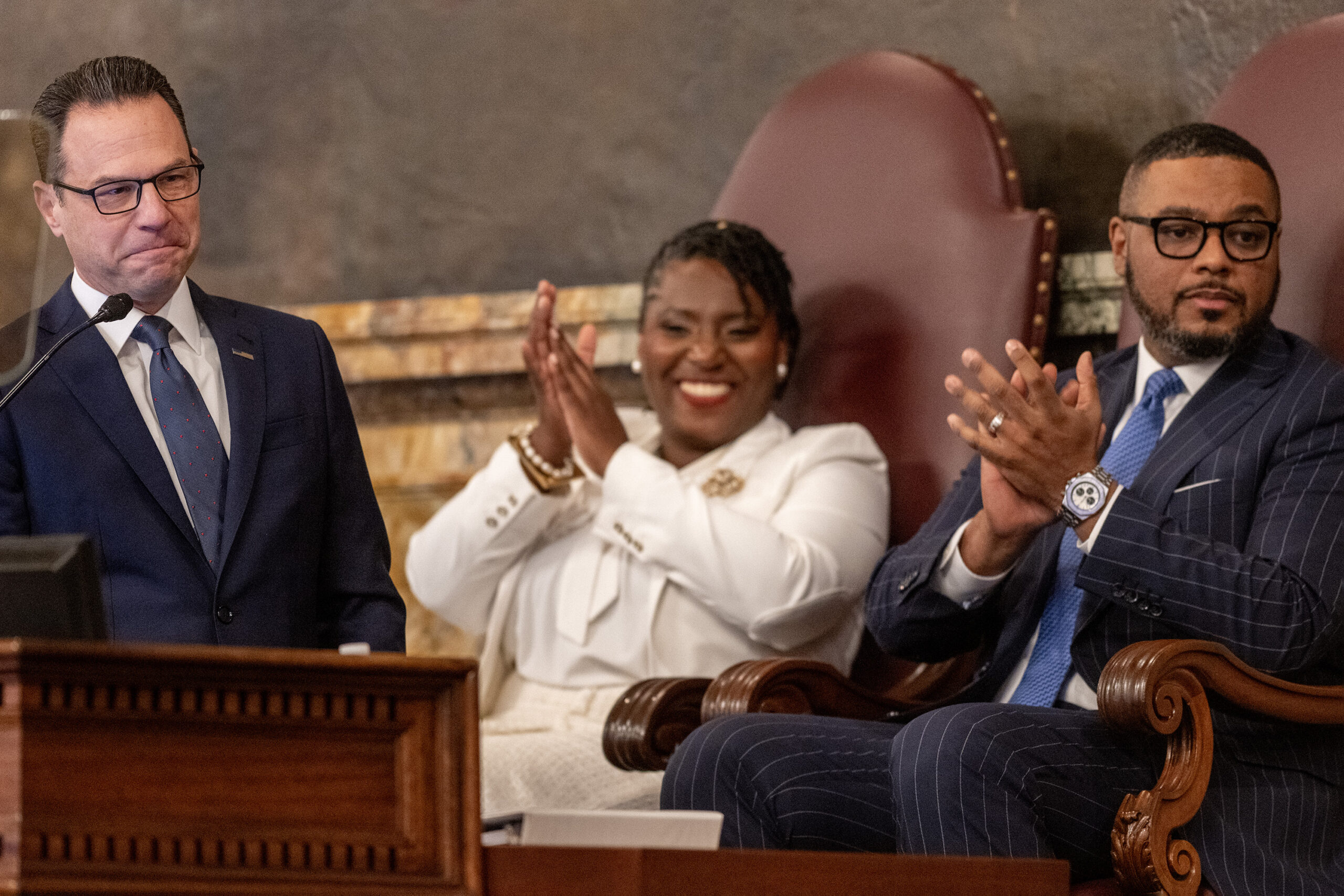
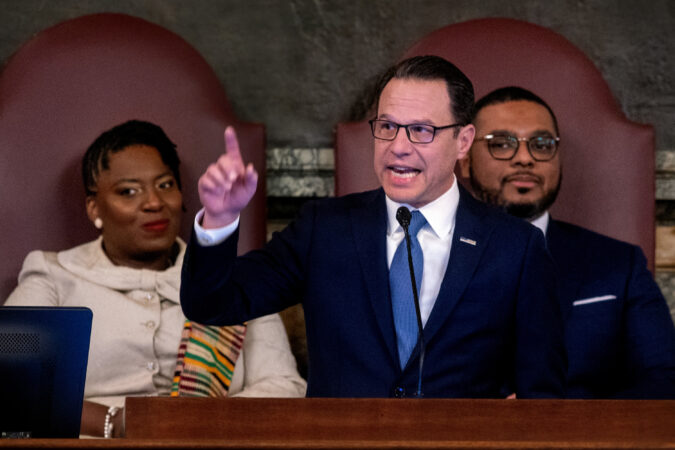
Gov. Josh Shapiro make his annual budget proposal in the state House chamber in Harrisburg Tuesday, Feb. 3, 2026. Pa. House Speaker Joanna McClinton (left) and Lt. Gov. Austin Davis (right) are seated behind him.
Shapiro’s budget also called for an additional $565 million for public schools toward the state’s new adequacy funding and tax equity formulas, in the latest installment of a nine-year plan to ensure students get an equitable education no matter their zip code. He requested $30 million in additional funding toward three of Pennsylvania’s state-related universities — the University of Pittsburgh, Pennsylvania State University, and Temple University — to be awarded based on a new performance-based funding mechanism.
The governor also pitched creating a “Federal Response Fund” in Pennsylvania, seeking to set aside a $100 million reserve to offset any impact from President Donald Trump’s administration, in the event the federal government moves to cut funding to social services programs and grants to state and local governments, as it has done several times over the last year.
A focus on affordability
As his reelection campaign ramps up ahead of November, Shapiro made a broad pitch for policies aimed at making Pennsylvania more affordable.
Shapiro said he was working with utility companies to rein in energy costs and called for the construction of new homes and a bevy of renter protections in a plan to expand the availability and affordability of housing across the state.
He proposed a $1 billion fund, supported by the issuing of bonds, to pay for a range of infrastructure projects relating to energy, housing, local governments, and schools. But he billed it largely as “a major investment in building new housing.”
“We need hundreds of thousands of new homes,” Shapiro said. “This is how we build them.”
Shapiro also called for the state to create a catalog of local zoning rules and to help local governments revamp ordinances to allow for more housing.
The governor again proposed raising Pennsylvania’s minimum wage to $15 an hour, billing it as a cost savings of $300 million to the state on entitlement programs such as Medicaid.
In a news conference hosted by Senate and House Republicans following Shapiro’s budget address, top legislative leaders contended that Shapiro’s affordability vision for the state is unnecessary.
“What we need to do is stand back and watch the private sector work, and watch the private sector grow the jobs that will support this economy,” said House Minority Leader Jesse Topper (R., Bedford). “What we need to do as a government is far less. We need to get our footprint down. That is what we believe will make things more affordable for Pennsylvanians.”
He announced a new plan he said would protect consumers against rising energy costs associated with data centers, while also easing a path for tech companies to build the centers.
The Governor’s Responsible Infrastructure Development (GRID) plan would make data center developers either bring their own power generation or pay for any new generation they will need, he said, “not saddling homeowners with added costs because of their development.”
Shapiro said that too many data center proposals have been “shrouded in secrecy” but that they are crucial for the country.
“The United States is locked in a battle for AI supremacy against China,” Shapiro said. “Look, I don’t know about you, but I’d much rather the future be controlled by the United States of America and not Communist China.”
Shapiro said Tuesday he wants to avoid another lengthy stalled budget, which forced schools, counties, and nonprofits to take out billions in loans to stay afloat during the four-month impasse.
He invited leaders of all four caucuses — Senate Democrats, Senate Republicans, House Democrats, and House Republicans — to meet on Wednesday to start budget talks much sooner than in past years. They all agreed to attend, he added.
“We all recognize it took too long last year and that had real impacts on Pennsylvanians, but we learned some valuable lessons through that process,” Shapiro said in his address, which lasted an hour and 24 minutes. “We learned that we all need to be at the table, and that we all need to be at the table sooner.”
The state House chamber as Gov. Josh Shapiro makes his annual budget proposal in Harrisburg Tuesday, Feb. 3, 2026.
Budget negotiations will begin Wednesday, Shapiro said, before legislative committees begin meeting about the proposal later this month. The budget will be negotiated in closed-door meetings between top leaders and is due by the start of the new fiscal year, which begins July 1.
One contentious issue is off the negotiating table for the forthcoming fiscal year: funding mass transit. Shapiro again pitched the state to increase the share of the sales and use tax that goes to mass transit, including SEPTA, as the transit agencies desperately need a new recurring revenue source. Shapiro does not want that to begin until July 1, 2027, when his latest short-term transit funding fix is scheduled to run out.
Shapiro and most lawmakers in the General Assembly are up for reelection this year. In previous midterm election years, the electoral pressure has sped up negotiations, as legislators want to bring home results to their constituents before they return to the campaign trail in a year when the governor’s mansion and control of the state House and Senate are on the line. (Shapiro’s likely opponent, Republican State Treasurer Stacy Garrity, immediately criticized his budget proposal, saying the pitch “didn’t come nearly close enough” to bridging the state’s spending deficit.)
But even if lawmakers move with haste, this year’s budget negotiations may be tense as leaders try to reset spending to better align with how much the state generates in revenue.
“We’re going to do everything we can to protect the taxpayer and make sure that the dollars that are allocated are wisely used,” Senate Majority Leader Joe Pittman (R., Indiana) said. “We have to make sure we’re, again, stretching every taxpayer dollar we can and bringing the cost of government down as much as possible.”
But with the high-stakes election just months away, House Majority Leader Matt Bradford (D., Montgomery) cautioned Republicans against coming down hard on Shapiro, who has boasted consistently high approval ratings.
“I would argue the polls indicate that we have a very popular governor. They tried to obstruct him and his numbers only got more popular,” Bradford said. “My suggestion is it would be the political imperative, regardless of the policy implications, that they start working with this governor to pass things.”
Staff writers Thomas Fitzgerald, Maddie Hanna, Ariana Perez-Castells, and Susan Snyder contributed to this article.
PJM Interconnection — the region’s dominant electric grid operator — is poised to play a central role in the expansion of data centers, as the independent organization has been shoved into the national spotlight and subjected to mounting pressure over the last year.
It has been a frequent target of Shapiro, officials from other states, consumer advocates, and the federal government.
In many ways, PJM may be one of the most consequential Philly‑area institutions that most residents have barely heard of, even though their electricity supply and monthly bills hinge on its decisions.
The organization has faced escalating scrutiny nationwide and across the region because of its position as the country’s largest independent grid operator and the challenges tied to surging energy demand.
What is PJM?
Based in Audubon, Montgomery County, PJM manages the minute-by-minute flow of electricity for 67 million people across 13 states and the District of Columbia.
It helps keep the lights on for 13 million Pennsylvanians.
Why are there concerns about PJM and data centers?
Concerns have risen over the cost to consumers posed by hyperscale data centers — the massive server farms needed to run artificial intelligence — that are poised to come online across Pennsylvania and the U.S.
PJM plays a major role in getting those data centers powered and connected to the regional electrical grid.
Consumer advocates say the data centers are forcing consumers to pay for the new power plants and equipment needed to keep up with that demand. And they fear that huge demand could result in electrical outages during times of peak demand.
Already, consumers have seen electricity prices spike — and that’s before most of the proposed data centers are even built.
How much consumers pay is influenced by an annual auction held by PJM designed to get enough commitments from power producers so that the electrical grid can meet forecast demand for several years and to ensure power during peak times. That is known as grid reliability.
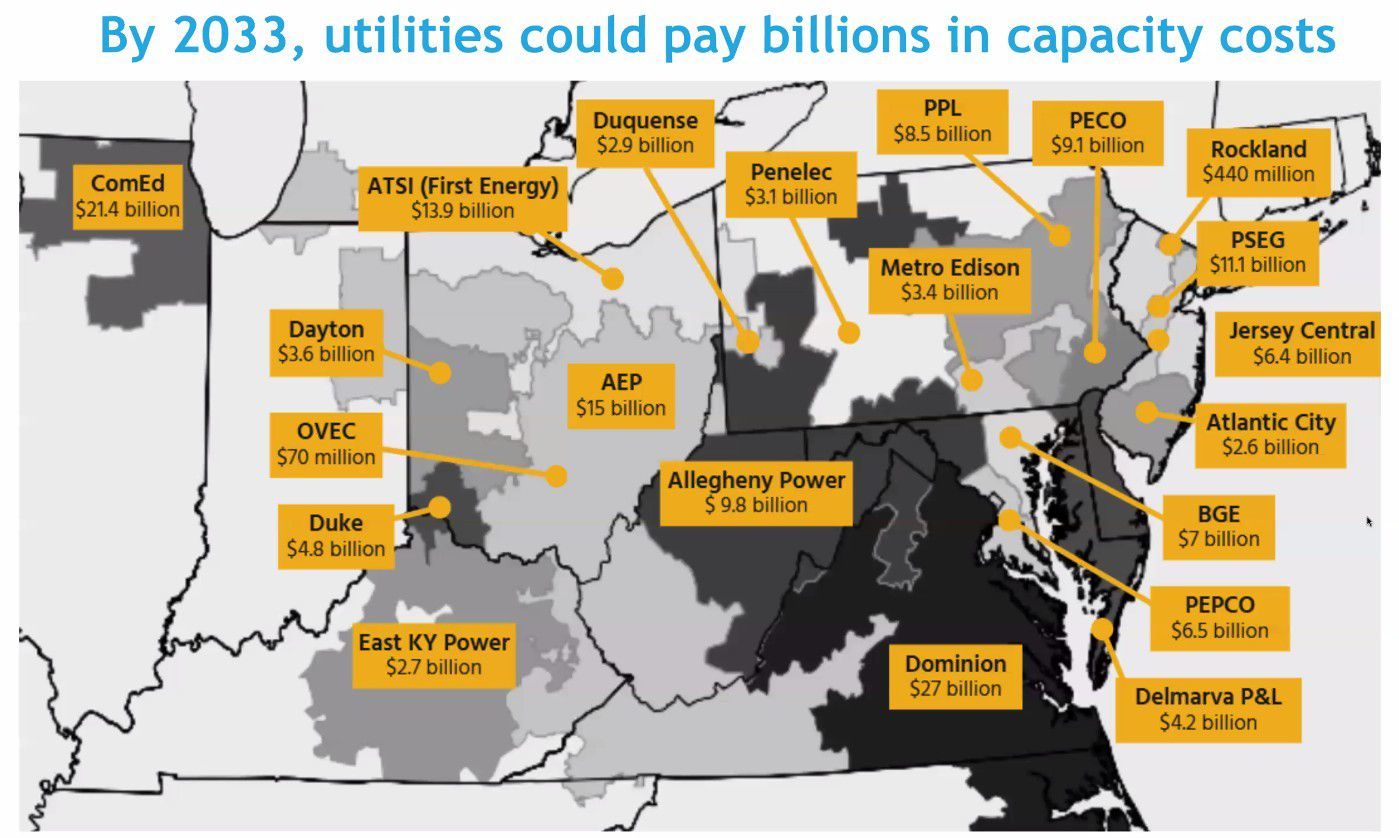
Map produced by The National Resources Defense Council estimates electricity capacity costs to utility companies based on PJM forecasts through 2032.
Why is Gov. Shapiro critical of PJM?
Shapiro and other governors have been sharply critical of how PJM has designed its auction, saying the process lacks transparency.
In a 2024 lawsuit, Shapiro’s office referred to PJM’s decisions as “inept” and responsible for “the country’s most snarled interconnection queue,” in reference to projects lined up for approval to be added to the grid.
After the 2025-26 auction, Shapiro reached an agreement with PJM on a price cap that he said would save consumers over $21 billion and avoid historic price hikes. The cap limited the increase of wholesale electricity payments to power plant owners.
PJM forecasts that data centers will drive a need for more than 30 gigawatts of peak electricity capacity by 2030 — enough to power more than 20 million households, or approximately all the homes in New Jersey, Pennsylvania, Ohio, Virginia, and Maryland, according to the Natural Resources Defense Council (NRDC).
The NRDC says that could lead to another spike in electricity costs through 2033 and cost homeowners and businesses an estimated extra $70 per month.
At the same time, however, officials are also pushing PJM to fast-track data centers.
Late last year, the Federal Energy Regulatory Commission issued an order on so-called colocation that will allow tech companies to plug their data centers directly into power plants.
In January, the Trump administration and a group of governors, including Shapiro, urged PJM to move quickly to boost power supplies and keep bills from rising.
They also want PJM to hold a separate power auction in which tech companies would bid on 15-year contracts to build new power plants. That way, data center operators, not regular consumers, would pay for the power.
Data centers that do not have their own power source and do not volunteer to be cut off from the grid during power emergencies should be billed for the cost of new power plants, they said.
Why do people resist data centers near their homes?
The quick rise of data centers has met stiff resistance from residents who fear the projects will radically alter the character of rural neighborhoods, increase electricity and water costs, and harm the environment.
Developers have submitted applications for at least 20 hyperscale data centers in Pennsylvania. PJM would have to find a way to make sure they can be powered and connected reliably to the grid, or provide their own power.
At least six data centers are being planned or proposed in the Philadelphia region, with some reaching 2 million square feet. Residents have fought the proposals, some of which have run into zoning and planning problems.
Residents of some of those communities are alarmed by a new Pennsylvania House bill (HB 2151), which is backed by Shapiro. It provides a model ordinance designed to speed data center development.
Opponents believe the bill is an attempt by the tech industry to get data centers approved.
“HB2151 would undermine Pennsylvanians’ herculean grassroots efforts to keep dirty data centers out of our communities — it must be stopped,”said Ginny Marcille-Kerslake, an organizer for Food and Water Watch, an environmental advocacy nonprofit.
“This bill pushes Shapiro’s reckless embrace of data centers even further onto communities struggling to grapple with Big Tech’s land, power, and water grab,” she said, calling it a part of “backroom deals” the state is making.
A vote on the bill before the House Energy Committee is scheduled for Wednesday.
What’s next?
Environmentalists and other groups, including some legislators, say a process by PJM to fast-track electricity-producing projects excludes clean energy and gives special treatment to fossil fuel power plants, allowing them to cut ahead in the queue over renewable sources that have waited years to connect to the grid.
That plan calls for changes in PJM policies to bring new power online quickly by providing a streamlined path for state-sponsored power generation projects, improving load forecasts, giving a bigger role in the process to states, and offering ways for data centers to bring in their own power generation while curtailing power in times of system need.
The plan, PJM said, “will also help address the supply-and-demand imbalance that has the potential to threaten grid reliability and is currently driving up wholesale costs that can impact consumer bills.”
Jeff Shields, a spokesperson for PJM, said the imbalance has been created as sources of power generation are being retired without enough new generation coming online to keep pace. At the same time, demand for electricity has increased substantially due to the proliferation of data centers.
“PJM is doing its part to bring new generation onto the system, and any suggestion otherwise is just not true,” Shields said.
He also noted that while PJM does run wholesale power markets, it does not directly set rates for residential, commercial, or industrial customers. Those rates are set by utilities, such as Peco, along with government agencies, such as the Pennsylvania Public Utility Commission.
HARRISBURG — Gov. Josh Shapiro on Tuesday is expected to propose a $53.2 billion state budget for the 2026-27 fiscal year, just three months after settling a bitter, 135-daybudget impasse that forced schools, counties, and nonprofits to take out loans to stay afloat.
Shapiro, a first-term Democrat running for reelection this year and potentially poised for higher office, will deliver his fourth annual budget address before a joint session of the Pennsylvania General Assembly, where he plans to pitch an expansive $1 billion housing and infrastructure plan to incentivize new housing development with an overall focus on affordability in the state.
And as in years past, Shapiro is expected to again propose new revenue streams to fill a more than $5 billion deficit, such as the legalization and taxation of adult-use cannabis, as Pennsylvania is again expected to spend more than it brings in tax revenues.
Here are three things to watch for in Shapiro’s budget proposal.
Affordability, affordability, affordability
Affordability has become somewhat of a top Democratic catchphrase heading into the midterm elections, as housing, energy and healthcare costs continue to rise.
It’s an issue Shapiro has repeated as one that is top of mind for him, and he is now applying it to a basic need for many Pennsylvanians: housing.
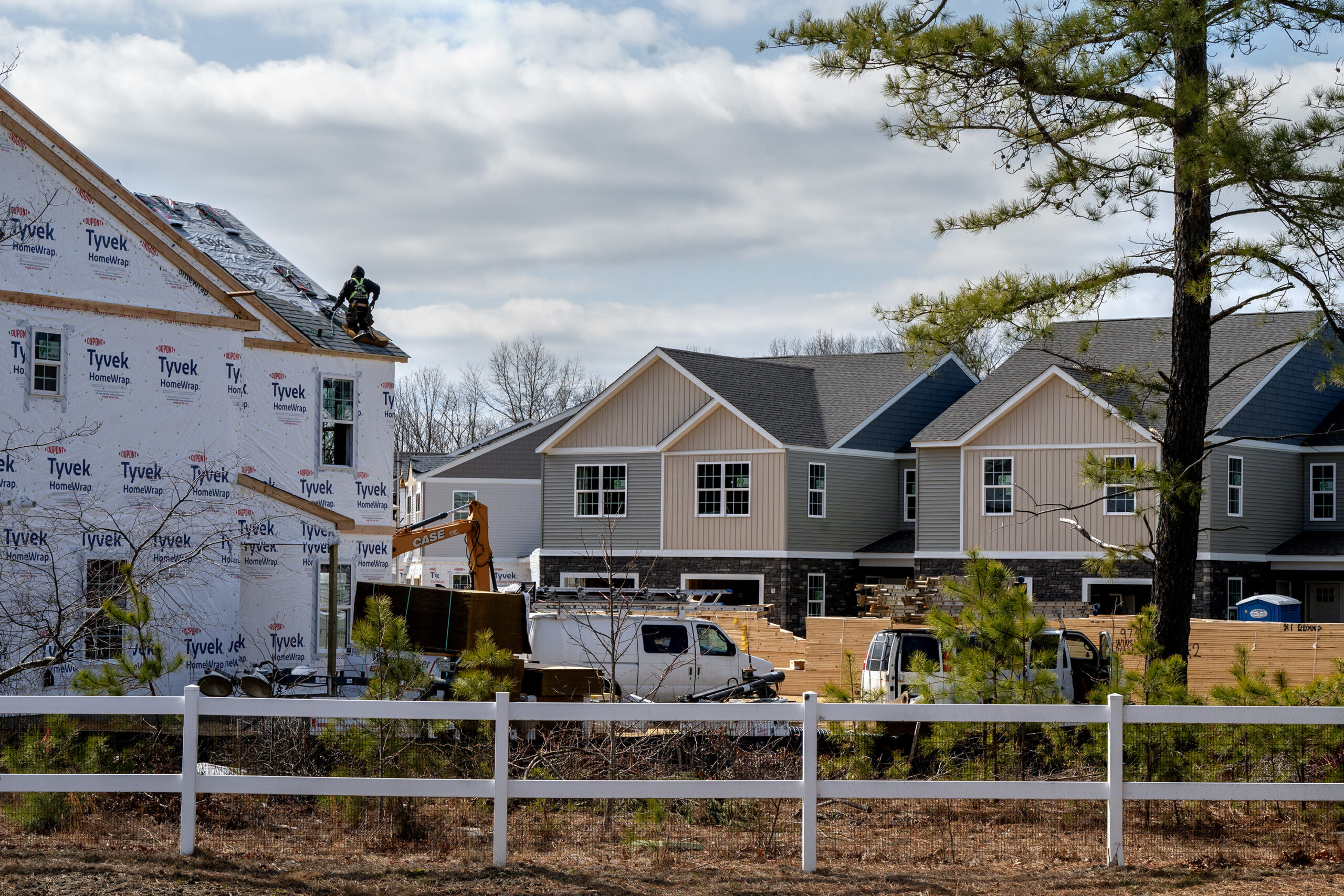
Construction is underway on three bedroom units with garages at Winslow Cross Creek Family Apartments Thursday, Mar. 6, 2025. Hans Lampart, founder, president, and CEO of Eastern Pacific Development and Brookfield Construction specializes in build-to-rent affordable housing.
The average rental price in Pennsylvania is $1,525 per month, with 25,000 rentals available across the state, according to the real estate website Zillow.
The governor on Tuesday is also expected to reintroduce his “Lightning Plan” that includes incentives to increase renewable energy production and a new Pennsylvania-specific cap-and-trade carbon program.
The plan would replace the Regional Greenhouse Gas Initiative that Shapiro and House Democrats agreed to ditch as part of an overall $50.5 billion budget deal in November, following years of urging from Republicans who argued that it stifled economic growth in the state. A similar cap-and-trade program would be unlikely to pass the Republican-controlled state Senate.
New revenue streams, again
Shapiro will again try to fill the state’s projected $4.3 billion budget gap with new revenue streams — although none of them would be likely to be up and running in time for the start of the new fiscal year on July 1.
Last year was the first time Pennsylvania’s state budget ever topped $50 billion. Its revenue still has yet to hit that milestone, and is unlikely to do so this fiscal year. The Independent Fiscal Office estimates the state will bring in nearly $49 billion, a 1.3% increase in revenue over the last fiscal year.
The budget gap is among the biggest challenges for Shapiro in upcoming negotiations with top legislative leaders, as Senate Republicans say it’s their top priority to spend within the state’s means.
Shapiro last year proposed tapping into the state’s Rainy Day Fund — approximately $7 billion set aside for emergencies — that the state has been stockpiling in the years since the COVID-19 pandemic. It’s unclear whether he will pitch using some of the fund again for the 2026-27 fiscal year.
Last year, Shapiro proposed a 20% tax on adult-use cannabis that he predicted would bring in $535.6 million in its first year, largely from licensing fees. He projected it could bring in $1.3 billion in the first five years, noting that only one of Pennsylvania’s neighboring states, West Virginia, hasn’t legalized recreational marijuana, essentially allowing Pennsylvania to lose out on tax revenue as residents cross state lines to buy it.
A legal marijuana purchase in Deptford, N.J. on April 21, 2022.
Shapiro has proposed regulating skill games in his last two budgets, asking last year that the unregulated gaming machines be taxed at 52%, which is the same tax rate as slot machines in casinos or gas stations. He estimated then that skill games would bring in nearly $369 million in its first year.
(The skill games industry has continuously rejected a high tax rate, arguing that it would hurt the industry and small business owners that carry the machines, like bars and corner stores.)
A possibly quicker resolution
There is one bright spot for the schools, counties, and nonprofits that rely on state funding and which last year had to wait more than four months for that money when lawmakers couldn’t agree: It’s an election year.
Election years often result in quicker budget resolutions, as lawmakers and officials want to secure money for their districts before they go home to campaign for reelection.
Sign posted by the PA Senate at the Pennsylvania State Capitol in Harrisburg Aug. 26, 2025, reminds visitors of the state’s “multi-billion dollar structural deficit.”
In 2018, when former Democratic Gov. Tom Wolf was up for reelection, he signed the state budget on June 23 — a week ahead of the July 1 deadline.
This year, Shapiro is up for reelection, likely to face a November challenge from State Treasurer Stacy Garrity, the state Republican Party-endorsed candidate. And many other state lawmakers are in the same boat.
All 203 seats in the state House and half the 50 seats in the state Senate are on the ballotin November. Several lawmakers have announced that they will not seek reelection, allowing for competitive elections to fill the vacancies.
WASHINGTON — In a string of public appearances since federal agents fatally shot Alex Pretti, Gov. Josh Shapiro has repeatedly decried the federal immigration operation in Minnesota as unconstitutional and called on President Donald Trump to “terminate the mission.”
The centrist Democratic governor leaned heavily into criticism of the Trump administration as he toured the East Coast —andnetwork and cable news shows — to promote his new memoir, Where We Keep The Light, last week.
“I believe this administration in Washington is using [government] for pure evil in Minnesota right now,” Shapiro, who is widely believed to be setting up a presidential run, told Late Show host Stephen Colbert last week. “And it should not be hard to say that.”
Known to be a careful messenger, Shapiro’s approach to the Immigration and Customs Enforcement and Border Patrol operations in Minneapolis evolved over the last week, from his initial decision over the first year of Trump’s second presidency not to aggressively speak out against ICE’s enforcement tactics to a hard-line approach condemning the Trump administration’s mission following the killing of another U.S. citizen by federal agents that became national tipping point.
When ICE agents killed Renee Good in early January, Shapiro issued a statement mourning her death, but made no broader conclusions about ICE and did not mention her by name.
Now, he has honed a clear and authoritative message that the Trump administration’s strategies are eroding trust in law enforcement, violating constitutional rights and making communities less safe. If Trump moves his focus and forces to Pennsylvania, he says, state officials are prepared to push back.
According to polling obtained by Puck News, Shapiro has landed on some of the most effective messaging on immigration in the country.
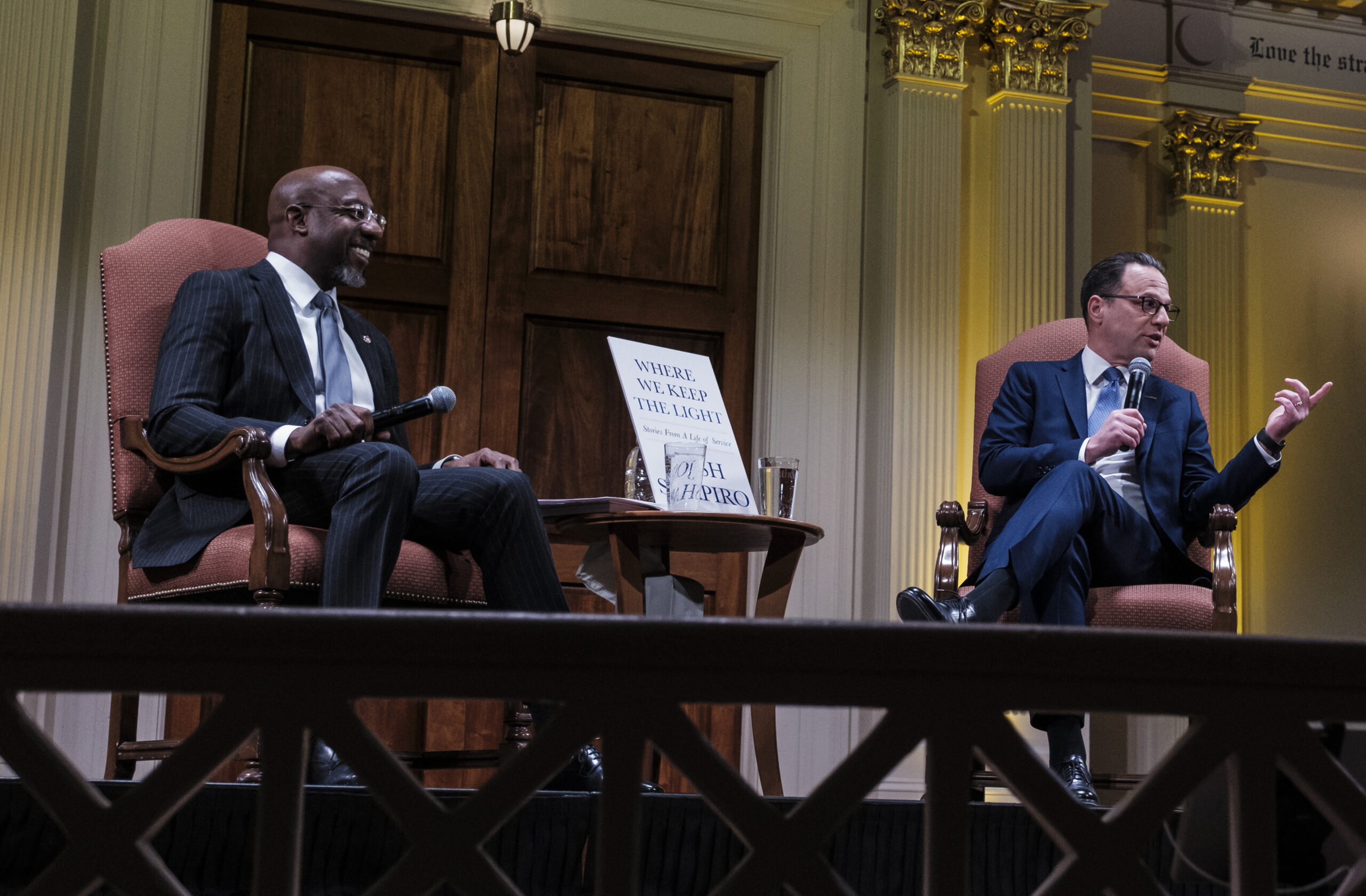
Governor Josh Shapiro (D-PA) and Sen. Raphael Warnock (D-GA) speak during a talk for his new memoir “Where We Keep the Light” on January 29, 2026 in Washington, D.C
But immigrant rights groups in Pennsylvania say the governor took too long to speak up and has yet to back his rhetoric up with concrete actions in his home state by ending cooperation with ICE.
“Because it is the topic of the day, he’s getting these pointed questions, and his answer to that is to point to what they’re doing wrong in Minnesota. Meanwhile, he’s over here telling us that he’s not going to stop collaborating with ICE,” said Tammy Murphy, advocacy manager at immigrant rights group Make the Road Pennsylvania. “It’s easy for him to point the finger to somebody else, but then what is he doing at home?”
At a roundtablewith journalists in Washington on Thursday, Shapiro said he didn’t view his new outspokenness against ICE’s operations in Minneapolis as a tone shift, but acknowledged that the situation had become more serious in recent days and he “reached a point where it was critically important” to comment on the situation in Minnesota and tell Pennsylvanians his views.
“I think I’ve been in the same place on this to protect our immigrant communities and also make sure that Pennsylvania is safe,” Shapiro said.
“Both [Good and Pretti’s deaths] told me the same story that you had people who were not following proper policing tactics. People who were in the field who seemingly, and it became more clear to me over the last week or two, did not have a clear mission and that the directive that they had clearly was not within the bounds of the constitution.”
“That’s people power right now, and this is a moment where we need to raise our voices,” Shapiro said. (His event was then promptly, but briefly, interrupted by climate protesters)
“It’s always good to cooperate with ICE, especially when they’re doing targeted actions,” Garrity said.
Samuel Chen, a GOP strategist, said Shapiro’s harsh rhetoric would create a clear distinction between him and Garrity while “endearing him to the Democrats should he run in 2028.”
Chen noted that even some Republicans have criticized Trump’s approach to Minnesota, which creates an opportunity for Shapiro to speak out.
“With that being public opinion the governor has a lot of cover to come out even harder,” Chen said. “It’s a win, win, win for him.”
Chalk on the sidewalk reading “Shapiro Stop ICE in PA,” during a protest outside the Free Library as Gov. Josh Shapiro promoted his new book “Where We Keep The Light” in Philadelphia, Pa., on Saturday, Jan. 24, 2026.
Even as he makes the case against ICE’s recent actions, Shapiro is still being careful not to go too far. He frequently mentions that Pennsylvania is not a sanctuary state. In an interview with Fox News last week, he criticized Philadelphia District Attorney Larry Krasner’s comments comparing ICE agents to Nazis as unacceptable rhetoric.
“It is abhorrent and it is wrong, period, hard stop, end of sentence,” Shapiro said.
What is most frustrating to immigrant rights groups is the Shapiro administration’s willingness to cooperate with ICE — even if on a limited basis — while other Democratic governors have taken strong actions against it. Gov. Maura Healy of Massachusetts, for example, banned ICE from state facilities.
Meanwhile, Shapiro’s administration honors some ICE detainers in state prisons and provides ICE with access to state databases that include personal identifying information for immigrants.
“You are still collaborating with the agency that is murdering our people, that you yourself have named as violating the constitution,” said Jasmine Rivera, the executive director of the Pennsylvania Immigration Coalition.
“You know, Parady La’s death was also bad,” said Murphy, who is with Make The Road. “That happened in this state at the hands of federal agents. And he’s silent about that, but then he’s got something to say about Renee Good or Alex Pretti. He’s talking about those people, but not the people here.”
The Shapiro administration says that outside agencies do not have “unfettered access” to state databases but may offer access to federal agents for “legitimate investigations that involve foreign nationals who have committed crimes.”
Furthermore, they say ICE detainers are honored only when a detainee has been convicted of a crime and sentenced to state prison.
In a letter to advocates last month, the administration vowed not to lease state property to ICE and reiterated that State Police are barred from conducting immigration enforcement and that federal agencies must obtain a warrant to access non-public space in state buildings.
Gov. Josh Shapiro speaks with Stephen Colbert last week.
This cautious approach is part of a balancing act Shapiro must handle as he pursues reelection in a politically split state and weighs a potential run for higher office, said Alison Dagnes, a political science professor at Shippensburg University.
“He is spinning plates and juggling flaming torches, all while he’s playing the kazoo,” Dagnes added “That combination is really important to consider as we look at his shifting rhetoric, his carefulness that moved into a louder stance.”
But advocates want Shapiro to take a firmer stance and say they won’t stop pushing until he does.
“Politically, he wants to be seen as ‘both sides,’” Murphy said. “He doesn’t want to be seen challenging Trump or this deportation machine.”
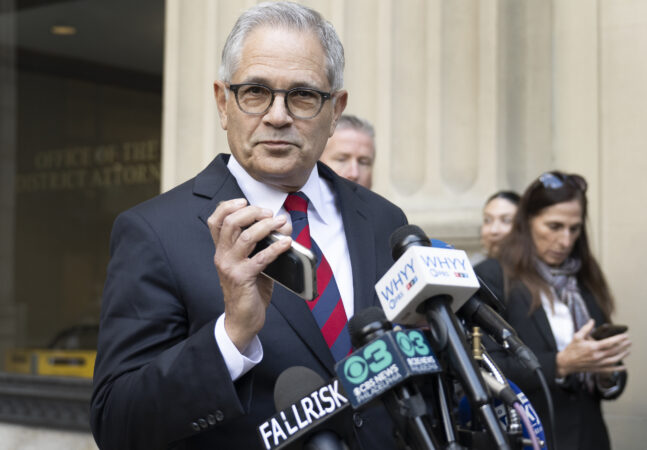
Philadelphia’s bombastic district attorney, Larry Krasner, is no stranger to opposition from within his own party, but the anger directed at him last week after he said ICE agents are “wannabe Nazis” was more pronounced than usual.
After making the comparison, Krasner faced a wave of criticism, including from Pennsylvania Gov. Josh Shapiro, a Democrat, who called the comments “abhorrent” and said the rhetoric doesn’t help “bring down the temperature.”
But the progressive district attorney said Monday that he would not back down, saying “these are people who have taken their moves from a Nazi playbook and a fascist playbook.”
“Governor Shapiro is not meeting the moment,” Krasner said in an interview. “The moment requires that we call a subgroup of people within federal law enforcement — who are killing innocent people, physically assaulting innocent people, threatening and punishing the use of video — what they are. … Just say it. Don’t be a wimp.”
Krasner pointed to a speech by Rabbi Joachim Prinz at the March on Washington in 1963: “Bigotry and hatred are not the most urgent problem. The most urgent, the most disgraceful, the most shameful, and the most tragic problem is silence.”
In invoking that speech, Krasner said: “A reminder, Mr. Governor: Silence equals death.”
Krasner’s defense came after days of criticism from across the political spectrum, ranging from the White House press secretary to Democratic members of Congress. And it punctuated a yearslong history of conflict with Shapiro.
The governor and Philadelphia’s top law enforcement official have feuded politically,sparred in court, and disagreed on policy. In 2019 — when lawyers from Krasner’s office decamped to work for then-Attorney General Shapiro — DA’s office staffers referred to Shapiro’s office as “Paraguay,” a reference to the country where Nazis took refuge after the war.
Last week, during a news conference about proposed restrictions on immigration enforcement in Philadelphia, the district attorney said he would “hunt down” and prosecute U.S. Immigration and Customs Enforcement agents who commit crimes in the city.
“There will be accountability now. There will be accountability in the future. There will be accountability after [Trump] is out of office,” Krasner said. “If we have to hunt you down the way they hunted down Nazis for decades, we will find your identities.”
During an interview Thursday on Fox News’ Special Report with Bret Baier, Shapiro was asked about Krasner’s comparison of ICE agents to Nazis and called the comments “unacceptable.”
“It is abhorrent and it is wrong, period, hard stop, end of sentence,” Shapiro said.
Several other Democrats in political and media circles weighed in. U.S. Sen. John Fetterman, a Pennsylvania Democrat who has at times sided with Trump on immigration matters, appeared on Fox News and said he “strongly” condemned Krasner’s language.
He said that “members of ICE are not Nazis.”
“That’s gross,” Fetterman said. “Do not compare anyone to Nazis. Don’t use that kind of rhetoric. That can incite violence.”
U.S. Rep. Chris Deluzio, a Democrat who represents parts of Western Pennsylvania, in an interview with the Washington Examiner contrasted his own approach with Krasner’s, saying: “I reserve throwing the phrase Nazis at actual Nazis. I don’t just throw that around.”
And State Rep. Manuel Guzman Jr., a Democrat who represents a significant Latino population in Berks County, wrote on social media Friday: “I really, really want Krasner to chill tf out.”
“I get it. We want to protect our immigrant community,” Guzman wrote, “but I question if constantly poking the bear is the right strategy. At the end of the day it’s my community that is under siege.”
And U.S. Rep. Dan Meuser, a Republican who represents parts of Northeast Pennsylvania, appeared on Newsmax and called Krasner a “psychopath with a badge.”
Meuser — who considered challenging Shapiro for governor with Trump’s backing but ultimately decided not to run — also on social media decried “the Left’s silence and, in many cases, encouragement of this rhetoric.”
Krasner doubled down. In an interview on CNN on Thursday, he criticized Fetterman as “not a real Democrat” and also said, “There are some people who are all in on the fascist takeover of this country who do not like the comparison to Nazi Germany.”
He said that when he promised to “hunt down” federal agents who kill someone in his jurisdiction, he was attempting to make a point that there is no statute of limitations on homicide.
The interviewer, Kaitlan Collins, asked Krasner whether he could have made that point without comparing agents to Nazis.
“Why would I do that?” Krasner responded. “They’re taking almost everything they do out of the Nazi playbook.”
Gov. Josh Shapiro is backing a proposal to ban cell phones from Pennsylvania classrooms, joining a growing chorus of parents, teachers, and officials seeking to curb school disruptions and detach kids from addictive devices.
“It’s time for us to get distractions out of the classroom and create a healthier environment in our schools,” Shapiro said in a post on X on Thursday.
He called on Pennsylvania lawmakers to pass a bill that would require schools to ban the use of cell phones during the school day, “from the time they start class until the time they leave for home.”
The endorsement from the Democratic governor — who could promote the issue during his budget address Tuesday — comes as school cell phone bans have increasingly become the norm: 31 states have restrictions of some kind on phones, including 23 states with “bell-to-bell” bans barring the use of phones the entire school day, according to Education Week.
Pennsylvania currently lets schools set their own cell phone policies — and districts have taken a patchwork of approaches. Pennsylvania in 2024 implemented a pilot program allowing schools to access funding for lockable pouches that students could place their phones in during the day, but few districts took the state up on the money.
Some schools have banned cell phones during classes, including by asking students to place their phones in hanging shoe organizers on the backs of classroom doors.
Advocates for entirely phone-free school days say such measures aren’t sufficient. Phones are still buzzing, and if class ends early, “kids are constantly looking at it,” said Kristen Beddard, a parent from the Pittsburgh suburb of Sewickley and leader in the PA Unplugged coalition seeking to curb children’s reliance on phones and screens, in and out of school.
Barring phones only during class time is “not enough to truly break the dopamine feedback loop these kids are exposed to, and inundated with constantly,” Beddard said.
Since PA Unplugged began advocating for a bell-to-bell ban a year ago, “the landscape has changed so much,” including more states moving to restrict phones, Beddard said.
In Pennsylvania, the state’s largest teachers’ union came out in favor of a ban, and legislation that would require school districts to adopt bell-to-bell cell phone policies was unanimously approved in December by the Senate Education Committee. The bill would grant exceptions for students with special needs.
The Pennsylvania State Education Association “supports legislation like Senate Bill 1014 that would establish a consistent, statewide expectation that public schools will restrict the possession and prohibit use of mobile devices for all students during the school day,” said spokesperson Chris Lilienthal.
“Think about how disruptive those notifications are during the course of the school day when students should be focused on learning,” Lilienthal said.
In a divided Harrisburg, the proposal has bipartisan support. Beddard called banning cell phones in schools “maybe one of the few bipartisan issues left.”
In the Philadelphia area, groups of parents have mobilized against cell phone use, circulating pledges such as a commitment to not give children phones before eighth grade. Delco Unplugged, an offshoot of PA Unplugged, has advocated for cell phone bans in school districts and encourages parents to not give children access to phones before high school.
There has been opposition to strict bans, including from school leaders who think kids need to learn how to live with technology, rather than avoid it. Some administrators have also questioned the logistics, and some parents say they want their children to have phones in the case of emergencies, like a school shooting.
Advocates like Beddard say kids are safer during emergencies if they pay attention to the adults in their school, rather than their phones. They also argue that the logistics aren’t so daunting and that there are many ways to enact a ban besides lockable pouches.
Some schools require kids to put their phones in a locker or simply keep them in their backpacks, Beddard said, noting that the legislation advancing in Harrisburg would allow districts to decide how to enact a ban.
Schools that have implemented bans “describe the experience as transformational,” going beyond academic improvements to better socializing among kids, Beddard said. “Awkward conversations in the lunchroom make you a better human being,” she said.
At this point, “Pennsylvania isn’t a pioneer on the issue,” Beddard said. “We need to get with the program.”