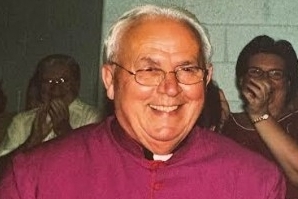
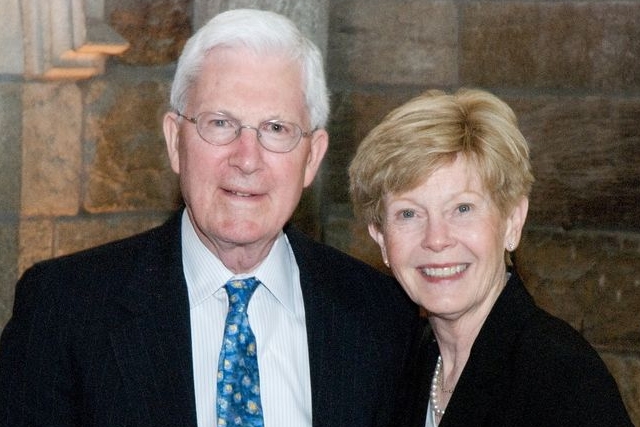
Philip C. Ricci, 90, formerly of Conshohocken, retired Catholic monsignor, founding pastor emeritus at Mary, Mother of the Redeemer Parish in North Wales, talented pianist, singer, artist, and mentor, died Saturday, Feb. 14, of complications after a fall at Villa St. Joseph senior living community in Darby.
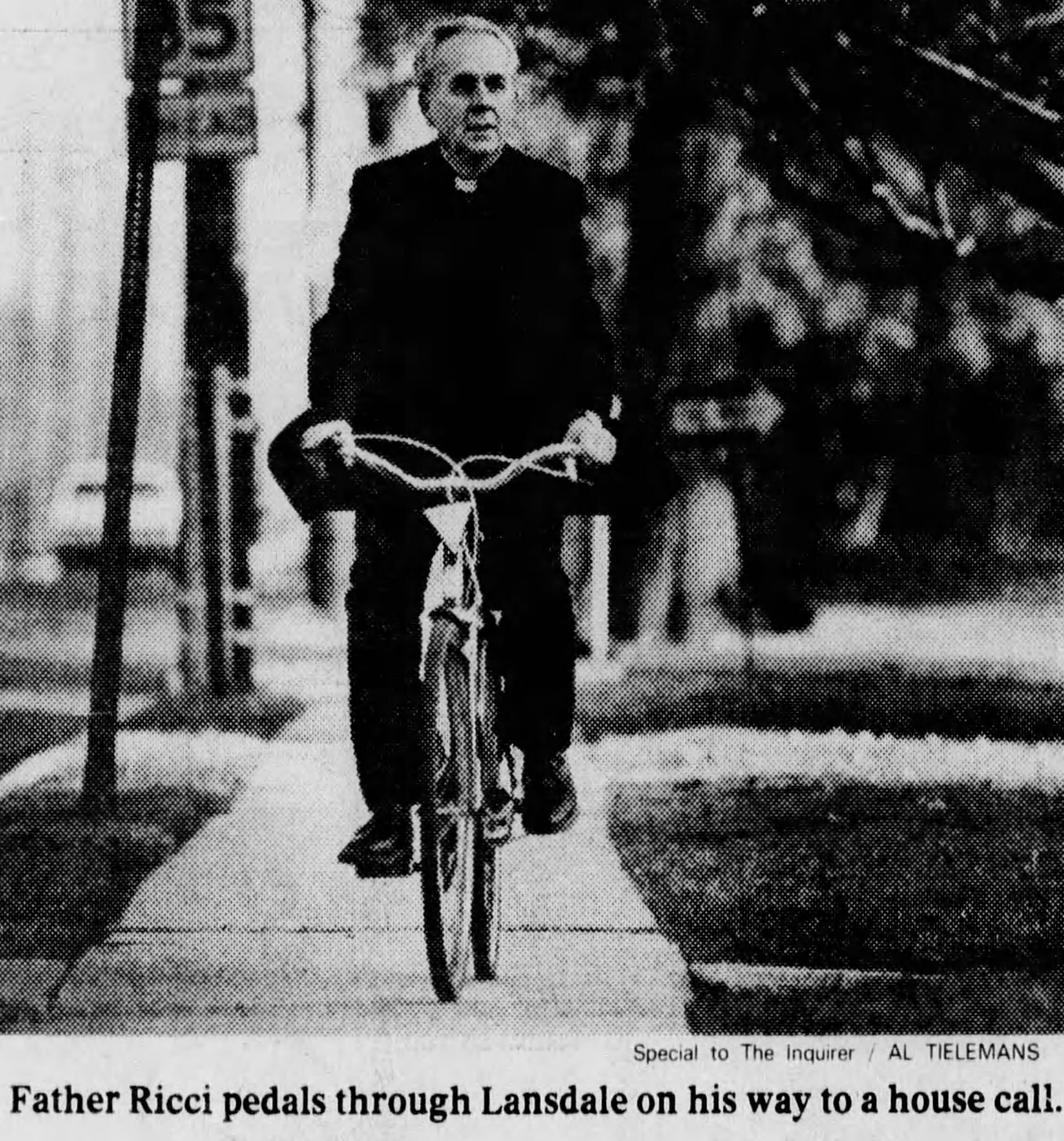
Ordained in 1965 by Cardinal John Krol, Msgr. Ricci was named founding pastor of Mary, Mother of the Redeemer Parish in 1987. Over the next 23 years, until his retirement in 2010, Msgr. Ricci worked many 16-hour days, made spiritual house calls on bicycle, spurred significant fundraising, and helped grow the Montgomery County parish from 600 founding families to 3,500.
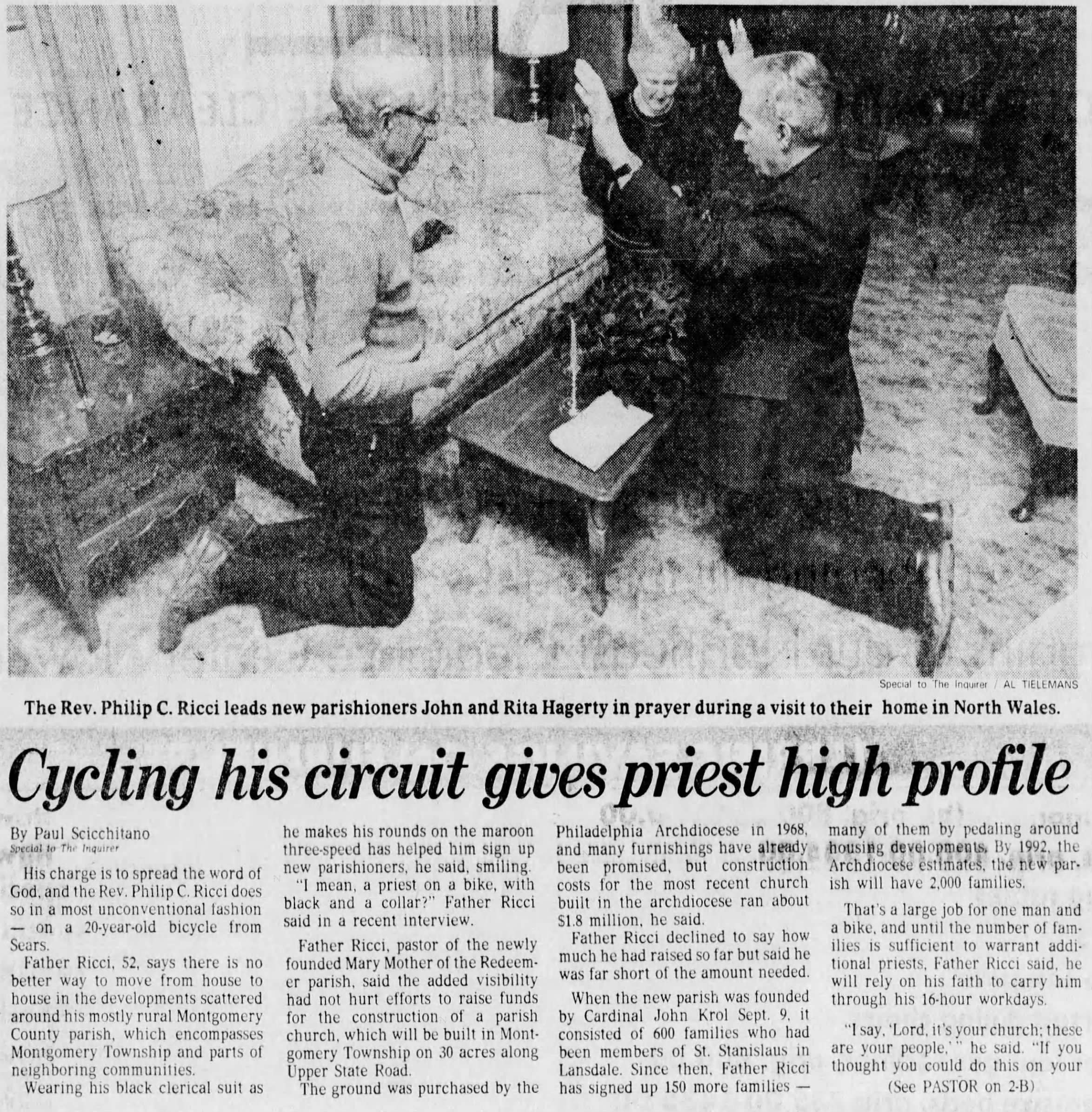
The Inquirer wrote about his house calls in 1987 and opened the story with: “His charge is to spread the word of God, and the Rev. Philip C. Ricci does so in a most unconventional fashion — on a 20-year-old bicycle from Sears.”
His niece, Christine, said: “He could talk to anybody about anything.”
Msgr. Ricci lived and held services in a 200-year-old farmhouse from 1987 until the new church building was completed. Pope John Paul II elevated him to monsignor in 2003.
He was active with school activities, and his homilies were often about mercy and compassion. In 2010, he told members of his congregation at a retirement celebration: “We must always accept people where they are and then allow God’s grace to work in patient understanding.”
In an online tribute, colleagues at St. Matthew Parish in Conshohocken said his “kindness, wisdom, and steady presence touched countless lives.” Others called him “the perfect priest” and “the epitome of what a Catholic priest should be.” One friend said: “He was without a doubt the nicest person I have ever met.”
In a tribute, his family said: “His priesthood was not simply a role. It was the core of who he was.”
Msgr. Ricci first served in the 1960s as a chaplain at the old Holmesburg Prison in Philadelphia and pastor at the Riverview Home for the Aged and St. Margaret’s Home for Girls. He went on to be assistant pastor at St. Joseph Parish in Ambler, St. Stanislaus Parish in Lansdale, St. Anastasia Parish in Newtown Square, and St. Margaret Parish in Narberth.
In 1974, he became spiritual director of the college division at St. Charles Borromeo Seminary. He also earned a master’s degree in spirituality from Creighton University in Nebraska.
Ministering to people, no matter where he was, he told the Main Line Times in 2010, was personal. “You don’t go out forming community,” he said. “You go out and form one-on-one. I can’t separate who I am as a man, as a Christian, and as a priest.”
The Inquirer published a story about Monsignor Ricci making spiritual house calls on his bicycle in 1987.
Msgr. Ricci played piano and sang before church services and after Communion. He directed choirs, and friends presented him with his own piano at his retirement.
He returned to his family home in Conshohocken after leaving Mary, Mother of the Redeemer but continued to assist others at nearby parishes and visit those in hospitals and nursing homes. “Father was a Renaissance man, an artist, musician, writer, deep thinker,” a former colleague said on Facebook. “He could speak about the liturgy or the Eagles, the football team or the band. He related well to everyone regardless of age, religion, or background.”
Philip Cosmo Ricci was born Sept. 26, 1935, in Conshohocken. He graduated from the old Conshohocken High School, took night classes at the University of Pennsylvania’s Wharton School, and, inspired by his parents, entered St. Charles Borromeo Seminary to study the priesthood.
“When the Lord wants you, he gets you,” he told the Main Line Times. “I couldn’t fight it. It was always there.”
Monsignor Ricci’s house calls were featured in this 1987 Inquirer article.
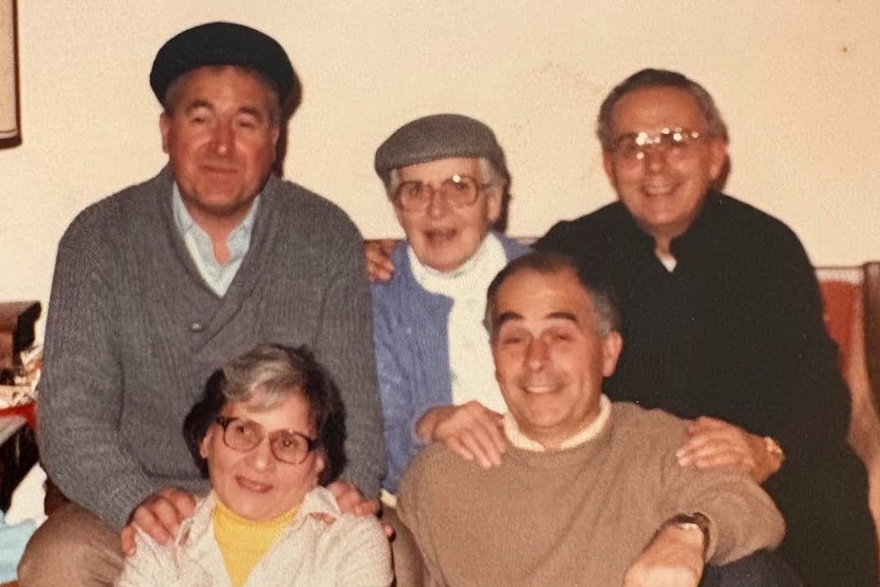
He played piano in a dance band when he was young and enjoyed gardening. He was good at drawing and cooking. He followed the Eagles, Phillies, and 76ers, and invented a beanbag toss game the family played at gatherings.
It was fitting, his niece said, that he died on Valentine’s Day because he embraced love and service to others. “Faith for Uncle Phil was never theoretical,” she said. “It was lived. It was action. It was presence.”
In addition to his niece, Msgr. Ricci is survived by his brothers, John and Francis, and other relatives. A sister died earlier.
Last April, Raymond Bautista donned a ski mask and black clothing and waited for the mother of his unborn baby to leave her Hatboro apartment to head to work.
Around 4:30 a.m., Bautista, 37, of Allentown, attacked the woman. He hit her from behind, and kicked her in the back and stomach. While she was on the ground, he got on top of her and punched her face. And when she began to scream, he ran.
The woman, a coworker of Bautista’s who was 15 weeks pregnant with his child and had recently told him she planned to keep the baby, suffered nasal fractures and abrasions, according to police.
On Tuesday, Bautista pleaded guilty to aggravated assault and no contest to aggravated assault of an unborn child.
He was sentenced to four to six years in prison.
The woman said in a statement read aloud by prosecutors the assault scars her to this day.
“I lost my peace of leaving home every morning,” she said. “… No woman deserves to be treated this way.”
After the assault, while the woman’s clothing was still soiled with blood, police asked whether she could think of anyone who would want to hurt her. The only person who came to mind, she said, was Bautista, a coworker at a Hatfield-based food processing company.
According to the affidavit of probable cause for Bautista’s arrest, the woman said that after he learned that she was pregnant with his child, he told her to take an emergency contraceptive. He also said he “did not want any involvement with the child’s life,” the document said
Bautista initially denied leaving his Allentown residence that morning and told police he had been sleeping.
Investigators later recovered footage of Bautista’s vehicle being driven from Allentown to Hatboro that morning, as well as clothing resembling the attire worn by the woman’s assailant when he was captured in Ring doorbell camera footage of the assault.
Presented with that evidence, police said, Bautista admitted to the crime. He told investigators he attacked the woman because she had been “talking [expletive]” about him at work.
Montgomery County Court Judge Steven T. O’Neill accepted Bautista’s guilty plea and, in addition to sentencing him to years in prison, ordered him to have no contact with the woman and to attend domestic violence counseling.
O’Neill commended the victim for facing Bautista in court and said that in her statement, he had “heard her courage.”
“I hope you’ve heard the same,” the judge told Bautista.
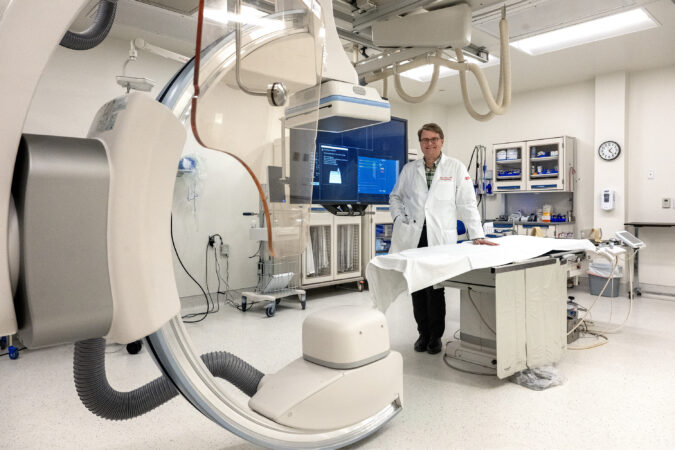
At AMS Surgery Center in suburban Montgomery County, patients can park right in front of the entrance, walk through just a few doors, and undergo cardiac procedures in a sterile operating room with equipment as high-tech as in any hospital procedure room.
In the year and a half since its first patient underwent a cardiac catheterization, the center has performed more than 1,000 cardiac procedures that previously required patients to go to full-service hospitals.
The Horsham center showcases a new front as sophisticated healthcare procedures move to freestanding outpatient medical facilities, promising to save patients money. The shift also adds to the financial pressures facing the region’s hospital-centered health systems.
Four centers have opened or are in the final stages of approvals in Southeastern Pennsylvania. Their arrival comes after state lawmakers in 2022 broadly expandedthe types of procedures allowed outside hospitals to include cardiac catheterizations, pacemaker implants, and other treatments that until then had to be done in a hospital.
Pennsylvania is the first Northeastern state to allow the minimally invasive procedures in freestanding surgery centers, but Southern states like Florida, Louisiana, and Texas have permitted the practice for decades, experts said. Research has found surgery centers generally are as safe as outpatient departments in hospitals.
An independent physicians group, Bryn Mawr Medical Specialists Association, opened Heart & Vascular Center of the Main Line — the Philadelphia region’s first such center — in late 2022. in Bryn Mawr. AMS Surgery Center in Horsham performed its first procedure in the fall of 2024, initially treating only Medicare patients. Itadded patients with private insurance last summer.
The market has continued torapidly expand:ReVaMP Heart & Vascular Surgery Center in Center City started treating Medicare patients last fall. The Ambulatory Cardiovascular Center of Pennsylvania, near King of Prussia, expects to perform its first procedures on patients next month.
Medicare pays the centers about a third less than hospital outpatient departments for the same procedures, but the centers have significantly lower costs, allowing them to be profitable. Medicare pays physicians the same wherever procedures are done.
Independent cardiology groups traditionally have performed interventional procedures, such as implanting stents and pacemakers, in hospitals. Some are jumping at the opportunity to expand through the surgery centers, where they can have a financial stake in the entire operation.
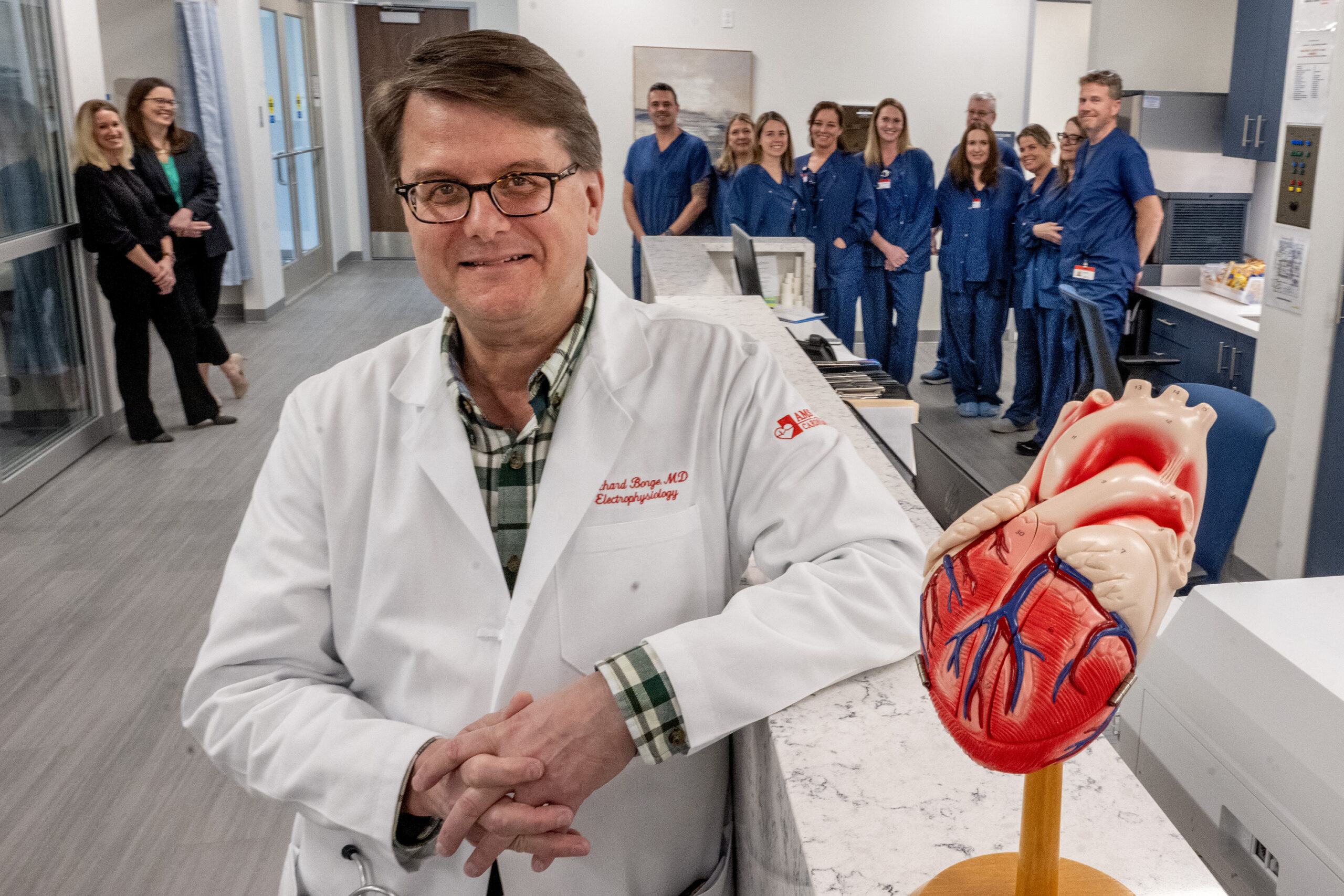
“We’ve always been very fiercely independent, fiercely entrepreneurial, and patient-centered,” said Richard Borge, an AMS interventional cardiologist who is medical director for the group’s surgery center.
How much cardiac care — among the most profitable business lines for hospitals — will move out of hospital outpatient departments remains unknown. But cardiac surgical clinics will not take over heart care to the extent seen when outpatient orthopedic centers began offering hip and joint replacements,predicted Lauren Clementi, a senior vice president at Kaufman Hall, a Chicago consulting firm.
“This one’s a little trickier because the acuity of patients,” she said.
Cardiologists will continue treating many patients with complex medical needs in hospitals, which remain the only option for riskier procedures such as open-heart surgeries.
Gregory Schmitt went to AMS Surgery Center to undergo procedures for a heart stent and stents in both legs.The retired machine-shop owner, who lives in Ivyland, called such centers great for patients.
“I highly recommend it. It’s much easier than trying to navigate a hospital,” Schmitt said.
How we got here
Healthcare has been shifting awayfrom requiring overnight hospital stays, even for common procedures like cataract surgery.The trend starteddecades ago with same-day procedures in hospitals, followed by the rise of freestanding surgery centers.
In cardiology, people now commonly receivestents and pacemakers as outpatient care. But until recently, doctors had to implant the devices in a hospital.
“Once upon a time, every patient we cathed had to spend the night in the hospital,” said veteran cardiologist Mark Victor, referring to cardiac catheterization.
With the rise of outpatient procedures,Victor said, the question for many clinicians became: “If they’re hospital ambulatory, why do they have to be in the hospital at all?”
Victor has long advocated for the adoption of outpatient cardiology proceduresas the CEO of Cardiology Consultants of Philadelphia. Thelarge cardiology practice joined last year a national private-equity backed group, Cardiovascular Logistics, and will soon start performing surgical procedures at the center opening near King of Prussia.
In 2020, Medicare started paying for outpatient cardiac catheterizations — which entail running a catheter through a blood vessel in the thigh or wrist to examine the heart and install devices like stents.
Richard Borge is medical director of AMS Cardiology Surgery Center in Horsham, whose arrival is moving advanced cardiac care from hospitals to outpatient clinics.
Even then, Pennsylvania rules required cardiac catheterizations to occur in an acute-care hospital, according to Stephen Abresch, director of government affairs for the Ambulatory Surgery Center Association, a national trade group in Alexandria, Va.
Pennsylvania lawmakers cleared the way for expansion byeliminating that restriction in 2022 as part of a broad expansion of what the state’s surgery centers were allowed to do. “It had been a quarter century since the state had gone in and reviewed that,” he said.
The Heart & Vascular Center of the Main Line has scheduled its first cardiac ablations this week. Horsham’s AMSaims to start offering those procedures in June. Victor’s King of Prussia groupexpects to add ablations in the future as well.
Impact on hospitals
It is too soon to know how the new surgery centers will impact the region’s existing health systems. In some cases, independent cardiologists generate significant patient numbers forhospitals’ cath labs.
After Bryn Mawr Medical Specialists opened its cardiovascular surgery center near Main Line Health’s Bryn Mawr Hospital, the private group performed fewer procedures on low-risk patients at the hospital.
To sustain patient volumes, Main Line has increased collaboration with other physician practices, while continuing to treat an“older patient population, whose more complex health conditions require the advanced expertise and emergency support only a hospital setting can provide,” officials said in a statement.
In Horsham, most of the patients coming to AMS would have gone toJefferson Abington Hospital before the surgery center opened in partnership with Atria Health, a private-equity backed group, Borge said.
Jefferson declined to comment.
King of Prussia’s Ambulatory Cardiovascular Center of Pennsylvania is opening through anunusual four-way partnership involving Cardiology Consultants of Philadelphia, Cardiovascular Logistics, SCA (a unit of UnitedHealth’s Optum), and the University of Pennsylvania Health System.
“Ours is not going to seriously impact any one hospital system, which they’re all relieved about,” said Victor, who is also president of the Mid-Atlantic region for Cardiovascular Logistics. He said other health systems were invited to invest in the surgery center, but only Penn did so.
Penn declined to comment for this article. On the Alvarez & Marsal What’s Your Moonshot podcast, the health system’s chief operating officer, Michele Volpe, recently said the system needs ”to move a bit faster in taking much of the work that we are doing in inpatient ORs and moving them into outpatient or ambulatory freestanding ORs.”
AMS Cardiology’s ambulatory surgery center in Horsham is one of four new cardiovascular surgery centers in Southeastern Pennsylvania.
Center City’s ReVaMP Health & Vascular Surgery Center wantsto bring in cardiologists from nonaffiliated practices,and even the city’s big health systems. The facility opened last year, spearheaded by Re-Vasc Med Professionals’ two interventional cardiologists in partnership with Surgery Partners, a publicly traded manager of surgery centers nationwide.
“I’m 100% sure this is going to be the trend of the future,” Re-Vasc CEO and founder Jon George said.
A health insurer’s perspective
Richard Snyder, a top executive at Independence Blue Cross, the largest health insurer in Southeastern Pennsylvania, has for years watched joint replacements and other procedures shift from hospitals to lower-cost surgery centers.
The financial impact goes beyond the lower prices at surgery centers, he said, expecting that hospitals will not simply cede these patients to new competitors.
Some hospitals might decide to take a lower payment for outpatient procedures. “Traditionally, that happens when we have capacity in lower-cost settings,” he said.
At the same time, Medicare is pushing to pay the same price for services, wherever they are performed. “Hospitals, by necessity, will need to move some things to lower-cost settings in order to not lose money on them,” Snyder said.
This week’s column analyzes the city’s camera surge, the need for political challengers, and calls for some basic sense about security.
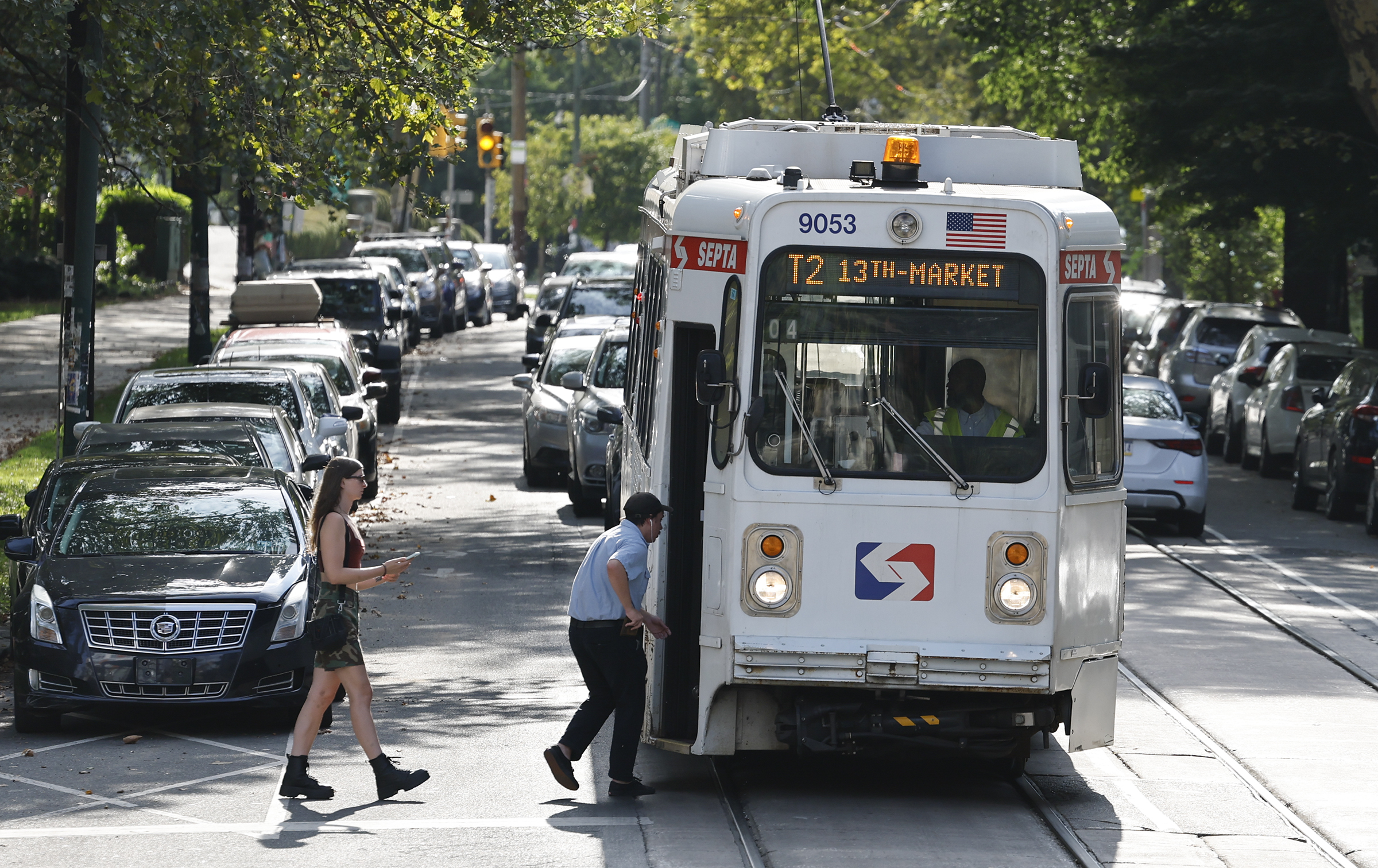
Passengers board a SEPTA trolley along Baltimore Avenue in West Philadelphia.
Trolley cams
Over the last few years, Philadelphians have increasingly come under surveillance. Cameras enforce bus lane violations, issue speeding tickets, and help prevent and solve violent crime. Just this week, the Philadelphia Parking Authority announced it is now adding cameras to the city’s trolleys.
This surge in surveillance has led to some residents bemoaning what they view as a cash grab. These worries were echoed last year by City Councilmember Jeffery “Jay” Young during a committee meeting in which he held up authorization for school zone cameras. Fortunately, these concerns are unwarranted.
Our speed and red-light cameras are not designed to raise revenue. While camera systems in states like Illinois are used to pay for regular local government expenses, Pennsylvania’s are earmarked for traffic safety projects. Philadelphia is getting $13 million from the most recent distribution. This leaves politicians with little incentive other than to focus on safety and efficiency when choosing where and why to place the cameras. The system isn’t designed to take advantage of sudden speed traps, a problem that occurs with both automated and traditional traffic enforcement systems.
Per a PPA spokesperson, 63% of vehicle owners who get a bus camera ticket don’t get a second one.
In the case of the trolley cameras, it is also a question of basic fairness. If you ride the trolleys enough, you’ll eventually end up stuck. Almost always, it is because someone decided to inconvenience 20 to 40 people to avoid parallel parking or walking a short distance. While no one likes getting a ticket, motorists who opt to block trolleys should be happy with the fact that they aren’t being immediately towed.
Candidates in the Democratic primary for Philadelphia’s 3rd Congressional District include, clockwise from upper left: State Sen. Sharif Street, State Rep. Chris Rabb, Ala Stanford, and State Rep. Morgan Cephas.
Marquee matchup
The race to replace U.S. Rep. Dwight Evans was always going to be close-fought. With the youthful Brendan Boyle occupying the city’s other congressional seat, this could be the best chance to represent Philadelphia in Washington, D.C., for decades. State Sen. Sharif Street (the son of former Mayor John F. Street) and State Rep. Morgan Cephas (who chairs the Philadelphia delegation in the state House) are both long-expected candidates for the job. They’ve been joined by progressive firebrand Chris Rabb, surgeon Ala Stanford, and a handful of other candidates with less funding and political support. For Southeast Pennsylvania politicos, it’ll have to do. There simply aren’t a lot of competitive races this year.
In state Senate District 34, Towamencin Township Supervisor Kofi Osei is running against party-endorsed candidate Chris Thomas. There are also a couple of contested primaries for state House seats. That’s all, folks.
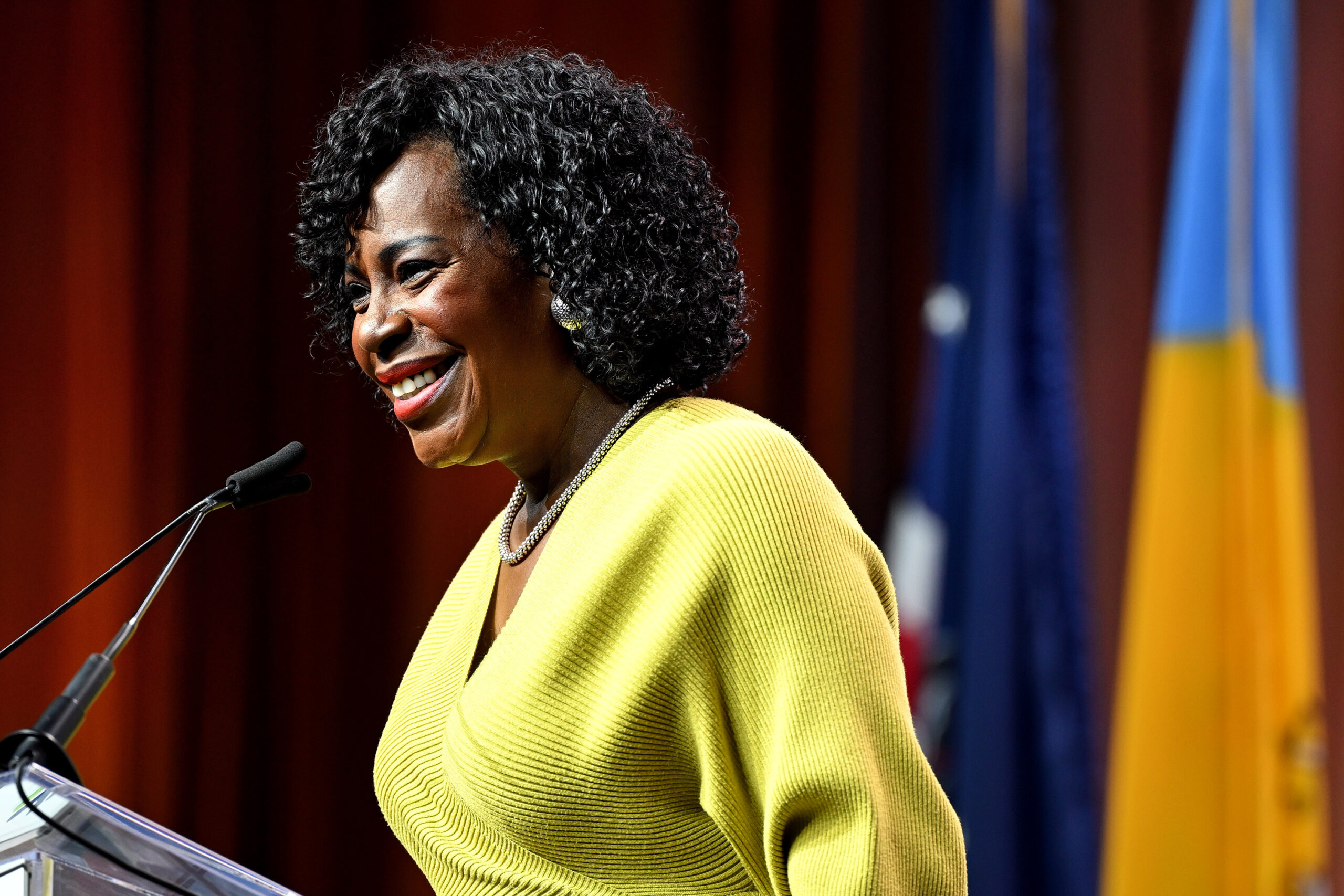
Mayor Cherelle L. Parker delivers her keynote address at the Chamber of Commerce for Greater Philadelphia’s Annual Mayoral Luncheon, in February.
Challengers needed
Next year also looks fairly empty. While some progressive groups have polled residents to gauge the viability of defeating Mayor Cherelle L. Parker, few potential candidates appear eager to take her on. That’s perhaps not surprising. Only one Philadelphia mayor has failed to be reelected in the last 70 years. That includes W. Wilson Goode Sr., who bombed a city block during his first term, and Frank Rizzo, who failed a lie-detector test he himself had suggested.
What the city really could use are more challengers for City Council seats. So far, I am aware of just one candidate, Jalon Alexander, who has put his hat in the ring. Alexander plans to challenge Young in the 5th District, citing capricious decision-making. But Young, while he may be the most egregious example, is not the only Council member who could use some competition.
I expect the city’s progressive groups, like Reclaim Philadelphia and the Working Families Party, will eventually find candidates to challenge some of the weaker members, including Young, Cindy Bass, Nina Ahmad, and Jim Harrity. Last cycle, these groups organized around ideas, like rent control, that simply aren’t viable in Philadelphia.
Despite being mostly frozen out by Council President Kenyatta Johnson and their colleagues, the current progressive delegation has been somewhat unwilling to challenge that body’s status quo. While Councilmember Kendra Brooks voted against a ban on safe injection sites, and Rue Landau voted against one of Young’s ill-considered moves, the city could use at least one councilmember who is willing to consistently challenge their colleagues’ bad decisions.
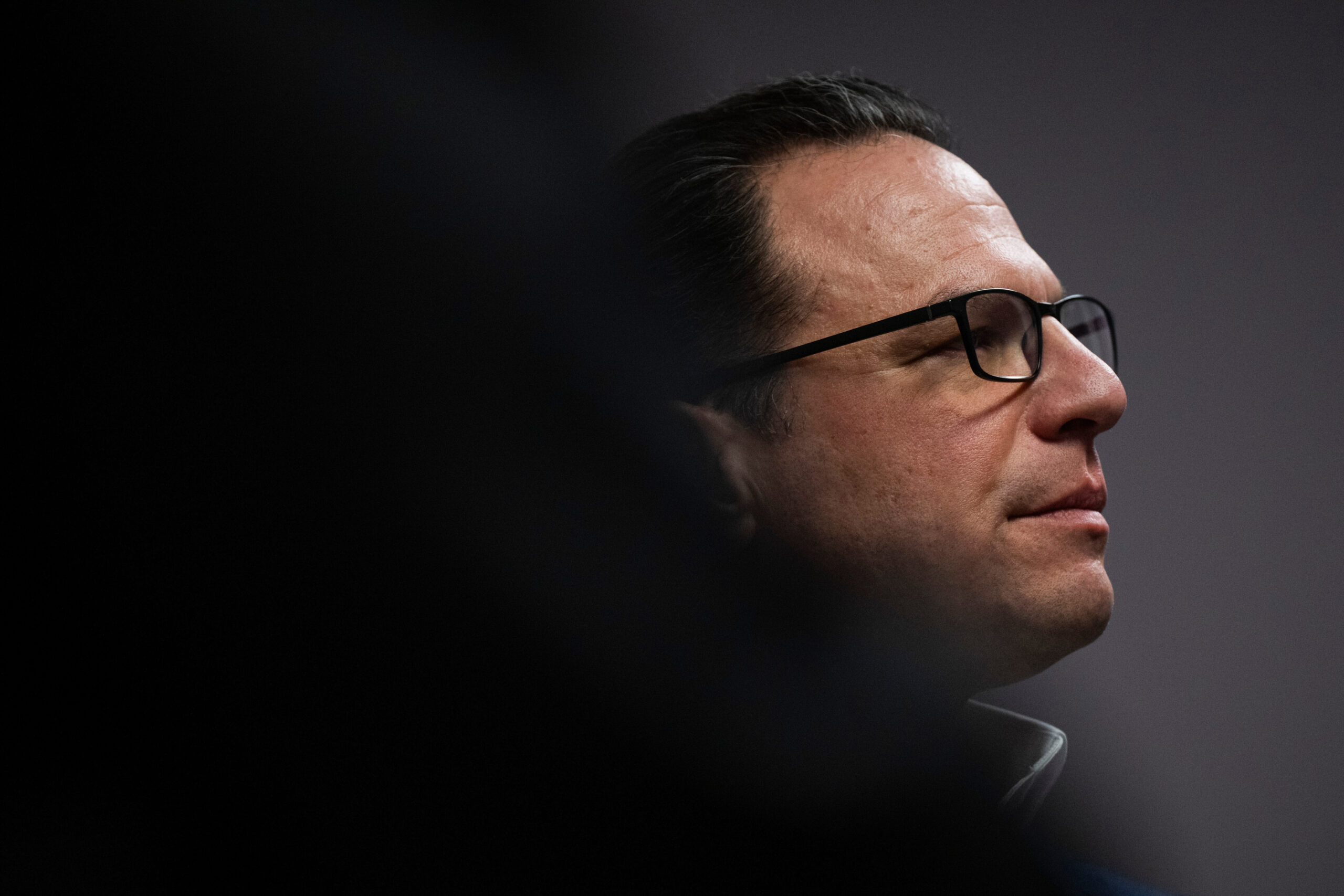
Pennsylvania Gov. Josh Shapiro is seen after a B’nai B’rith Youth Organization International Convention on Feb. 12 in Philadelphia.
Security snafu
We call Gov. Josh Shapiro the Ambitious Abingtonian here for a reason. The governor is a hard-charging, elbows-up politician who has turned many friends into enemies over the years. Republicans seem to believe they have finally found a weakness in Shapiro’s political armor: the decision to spend taxpayer money to secure his home in Abington, and the seizure of a small strip of adjoining land that accompanied it. State Sen. Tracy Pennycuick, who represents western Montgomery County and eastern Berks County, even opined that Shapiro “put his family at a higher level of risk” by moving them home instead of to a bunker after the April arson attack at the governor’s mansion.
Of course, the Shapiros just survived an attempted assassination. Let’s be human beings for one second. Shapiro’s shell-shocked children deserved to sleep in familiar settings.
If Republicans want spending decisions to critique, they should start with Shapiro’s reliance on an opaque group called Team PA to pay for everything from travel to sporting events instead.
State Rep. Steven Malagari (D., Montgomery) plans to introduce a bill that could put THC drinks in beer stores, while State Sen. Dan Laughlin (R., Erie), a major proponent of weed legalization — unlike his party’s leaders — is working on legislation that would open the door to hemp-derived THC being regulated like medical marijuana. Pennsylvania hemp businesses look toward these efforts with optimism, but as the clock races down, stakeholders are asking for urgency.
Representatives from the hemp, medical marijuana, and beer wholesaler industries spoke to state regulators at January’s Pennsylvania Farm Show about shielding the hemp industry from the Nov. 12 deadline that would outlaw all intoxicating hemp products, including Delta-9 THC and CBD, which is what the majority of hemp is grown for in Pennsylvania. Under new rules, many of the state’s hemp farmers would be out of business by fall.
Across all competing interests, industry representatives said one thing was clear: Lawmakers need to regulate the billion-dollar state hemp market.
Testifying before the Center for Rural Pennsylvania, stakeholders, including Montgomery County District Attorney Kevin Steele, agreed, stressing the need for safeguards.
“It’s not about taking away people’s livelihoods in hemp farming and people working in this industry,” Steele said during his testimony. “It’s about community safety and establishing guardrails through legislation to oversee that safety.”
But, as Congress disagrees on when and if it will regulate hemp-derived THC — including if the ban deadline should be extended — those delays cascade to the states, where local lawmakers await federal guidance before regulating it themselves. While any state proposals for regulation are purely speculative until Congress passes hemp legislation, Laughlin’s and Malagari’s efforts in Pennsylvania imagine what is possible.
It is important to note, however, that regulating intoxicating hemp products is an uphill battle in a state where recreational marijuana legalization is opposed by Republican state leadership.
Whether these bills become law or save the state’s hemp industry as it currently stands is up in the airwith federal delays, but local hemp businesses choose to be optimistic.
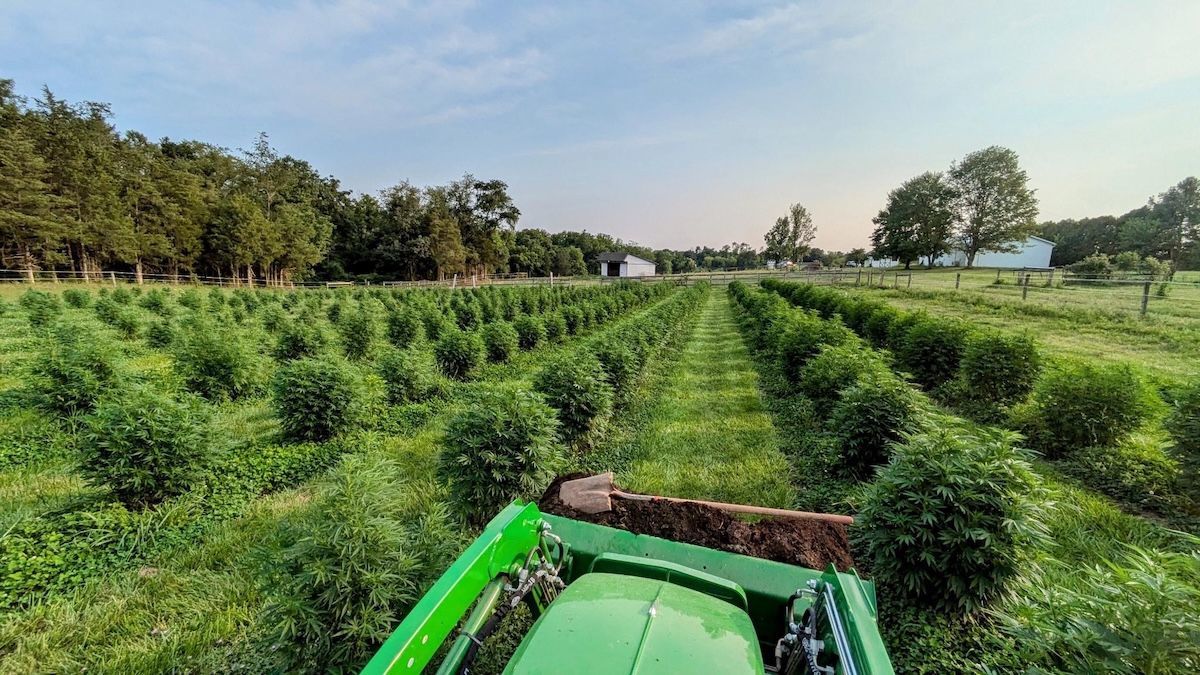
A view of Tyler Shannon’s Adams County hemp farm. Unless regulations change, he will have to shut down his hemp farm by next year.
What does any of this mean for Pennsylvania hemp?
For Tyler Shannon, an Adams County hemp farmer, a full ban on hemp products would be devastating. With the vast majority of Pennsylvania’s hemp grown for cannabinoids, such as Delta-9 THC and CBD, it means that “if hemp is not saved, my family will lose everything, including our farm,” Shannon said.
Shannon is not alone. Beau Whitney, a leading cannabis market analyst who testified at the January hearing, estimated that Pennsylvania’s cannabinoid market generates just under $1 billion in revenue annually. In his latest report, he found that the majority of Pennsylvania’s hemp-derived THC and CBD products were sold “legally” through semi-regulated channels, in stores or online. “As a result, there were 9,500 jobs, generating $382 million in wages in Pennsylvania,” Whitney said.
Those in the local hemp industry are confident that a deadline extension will help protect them, but planting season is fast approaching, while hemp farmers have no reassurance that their crops will be legal come fall, Shannon said. His family farm is holding off on a planned $175,000 facility expansion due to the looming ban.
As of now, no federal or state legislation has been passed to avert the impending doomsday scenario for hemp, and despite the constant regulatory discussions, small hemp farmers and businesses don’t feel on solid ground, Sebastian Stelmach of Manayunk’s Keystone Dispensary said.
“It’s just scary to think that come November, I might be unemployed and close up shop,” Stelmach said. “A lot of lawmakers realize that we can’t let this industry die. I believe that they’re going to do something, but what that is, I don’t know.”
Trade organizations, like the U.S. Hemp Roundtable, are lobbying Congress to extend the federal ban deadline by one year, giving regulators time to flesh out less restrictive standards for hemp products.
“Even [federal agencies] said they don’t have enough time to enforce the rules under the current bill,” said Jonathan Miller, U.S. Hemp Roundtable’s general counsel. “We’ve created a mess here, and we really need this extension to be more deliberate and responsible.”
In this 2019 file photo, Steve Groff is getting ready to harvest his first crop of hemp plants at his farm in Holtwood, Lancaster County.
Intoxicating hemp regulated like marijuana
Laughlin’s bill to establish a Cannabis Control Board would see the state’s medical marijuana program come under new oversight, similar to the liquor and gaming control boards.
While hemp is not the primary focus of that legislation, organizations like the Pennsylvania Cannabis Coalition (PCC), which represents the state’s medical marijuana industry, hope to see hemp included in Laughlin’s bill to open the doors for more responsive hemp regulation.
“The Cannabis Control Board would have the authority to deal with hemp products and decide what is safe for consumers as a single regulatory body,” said Meredith Buettner, executive director of PCC. Buettner said it makes the most sense for intoxicating hemp products to be regulated alongside cannabis.
Laughlin argues that “if it’s a consumable cannabis product, it should fall under one clear regulatory structure.”
How and where specific hemp THC products would be sold will be worked out in the legislation, but “intoxicating products should be sold through appropriate, regulated channels,” he said.
Jake Sitler, who owns Lancaster-based Endo THC drinks and testified at the January regulatory hearing, is ready to support any regulation that saves the current hemp framework, like incorporating hemp into a control board, but worries small businesses will get cut out of the deal.
“The hemp industry concern is where our seat is at the table and to make sure new laws are appropriate for our farmers and our industry,” Sitler said. “And that any new regulation isn’t used as a guise to out-regulate small business down the road.”
THC and CBD-infused beverages on the shelves of Free Will Collective, an Ardmore smoke shop and wellness store owned by Will Angelos. As Congress moves to ban most intoxicating hemp products, business owners like Angelos aren’t sure they will be able to keep the doors open long past 2027 if current regulations go into effect.
Delta-9 THC drinks in Pennsylvania beer stores
The bill from Malagari would carve out regulation for hemp-derived Delta-9 THC drinks, which are among some of the most popular intoxicating hemp products, with a national market of $1.5 billion in annual sales.
Malagari, who previously worked in beverage wholesale, wants to see THC drinks regulated similarly to beer and malt-beverage products in Pennsylvania.
Pennsylvania operates a three-tiered system for beer, with licenses at the manufacturing level, distribution level, and retail level. THC drinks would be incorporated into this system, which would begin by allowing established three-tiered license holders to manufacture and sell hemp-derived Delta-9 THC drinks.
Jake Sitler and his wife, Jamie, standing inside the Endo drinks warehouse. The Lancaster couple founded one of Pennsylvania’s first hemp-derived THC drinks and is grappling with the fact that their business might have to shut down if Congress doesn’t rework its hemp regulations.
Common retail spaces for beer and malt beverages include beer distributors, grocery stores, restaurants, and bars.
This legislation, if passed and signed into law, would not prohibit THC drinks from being sold in medical marijuana dispensaries and could work alongside Laughlin’s CCB bill, Malagari said. But he believes that lawmakers should approach THC beverages differently from hemp-derived flower and vapes.
As an owner of a hemp beverage company, Sitler could benefit from Malagari’s bill, but also wonders if it is too early for beverage carve-outs before a fuller state framework is in place. “A hemp beverage bill with no overarching regulation is putting the cart a bit before the horse,” Sitler said.
South Philly’s Mark Abadi has had a way with word games since he was old enough to pick up a Scrabble board.
By 10, he would complete large-print mini games and crossword puzzles, and started playing Scrabble against his parents.
He became what he calls a “word nerd,” obsessing over newly-learned words and trying out new strategies in hotly-contested Scrabble battles at home.
“I could never compete with my parents,” he joked. His parents always matched his competitive spirit.
Eventually, he lost interest in the game until, at 15, he found his childhood Scrabble board and began playing again. Only this time, he had spent days studying the Scrabble dictionary, which made him better equipped to out-point his parents.
“I looked through the [dictionary] pages, and was like, ‘Oh my God, that’s a word? You can play ‘A‘ā’ because it’s a kind of lava? What?’”
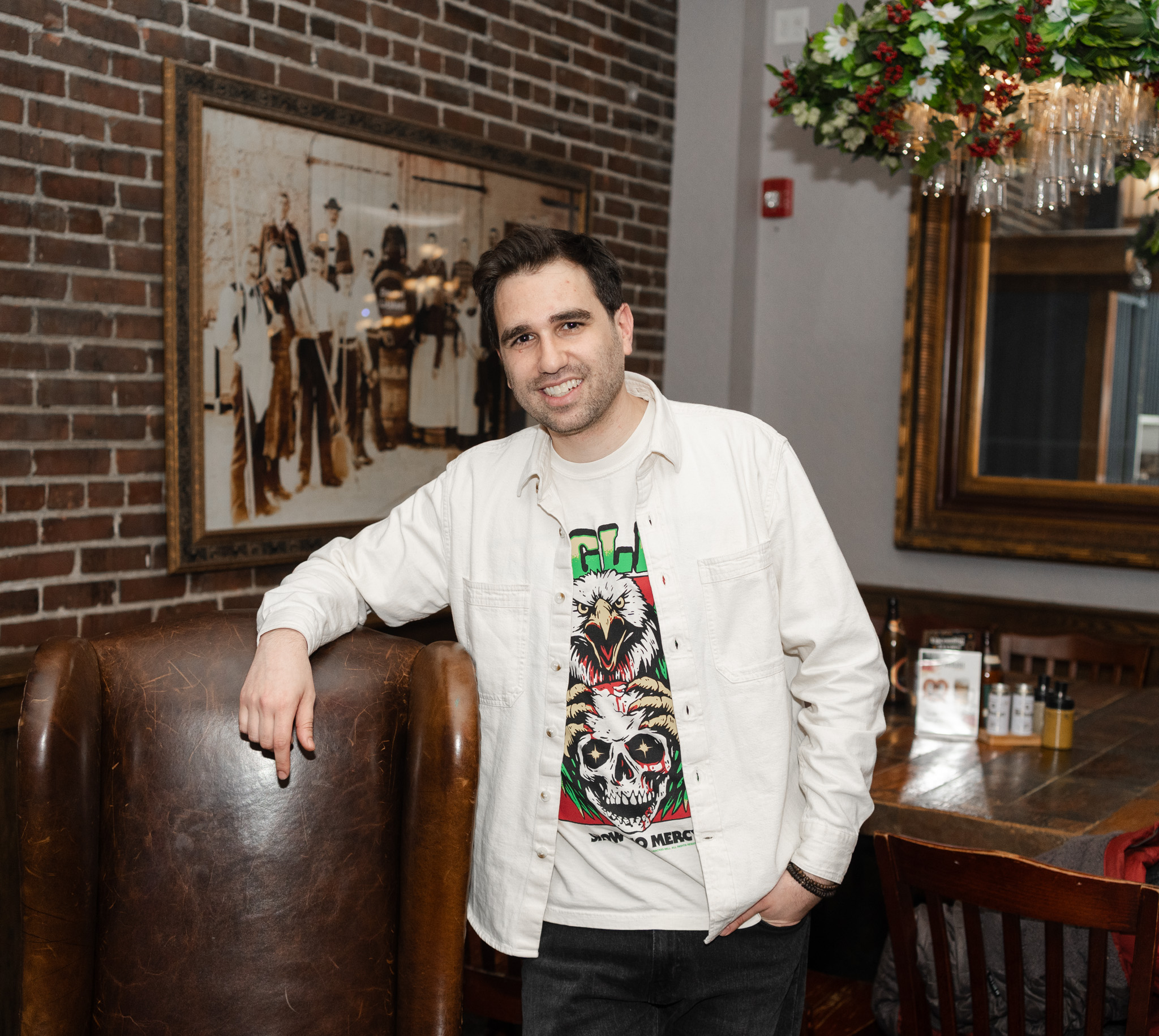
Mark Abadi is one of several nationally-ranked Scrabble players in the country. He recently struck gold on the CW game show based on the iconic board game.
Abadi, a copy editor at Business Insider, found immediate inspiration reading the 2001 Word Freak by Stefan Fatsis, a journalist who explored the underground Scrabble community and became an expert-level player. Soon, he’d follow Fatsis’ footsteps and become a nationally-ranked Scrabble player.
For nearly two decades, Abadi, 35, has competed in tournaments throughout the country. He’s won regional matches and scored top five finishes in world-class competitions, including the North American Scrabble Championship.
The Montgomery County native has continued to sharpen his skills by rubbing shoulders with other world-class players, many of who (like Abadi) are members of the Delco Scrabble Club.
“I casually hop on SEPTA and then I’m face-to-face with the best Scrabble players in the country. It’s kind of intimidating,” he said.
‘We’re waiting for you’
The Riddle Village dining room was pin-drop quiet on a recent evening, save for the occasional shaking of Scrabble tiles. The Delco Scrabble Club had gathered at the assisted living facility, where one of their oldest members lives, for their weekly meeting.
When The Inquirer got there, the members were halfway through their first of five 50-minute games.
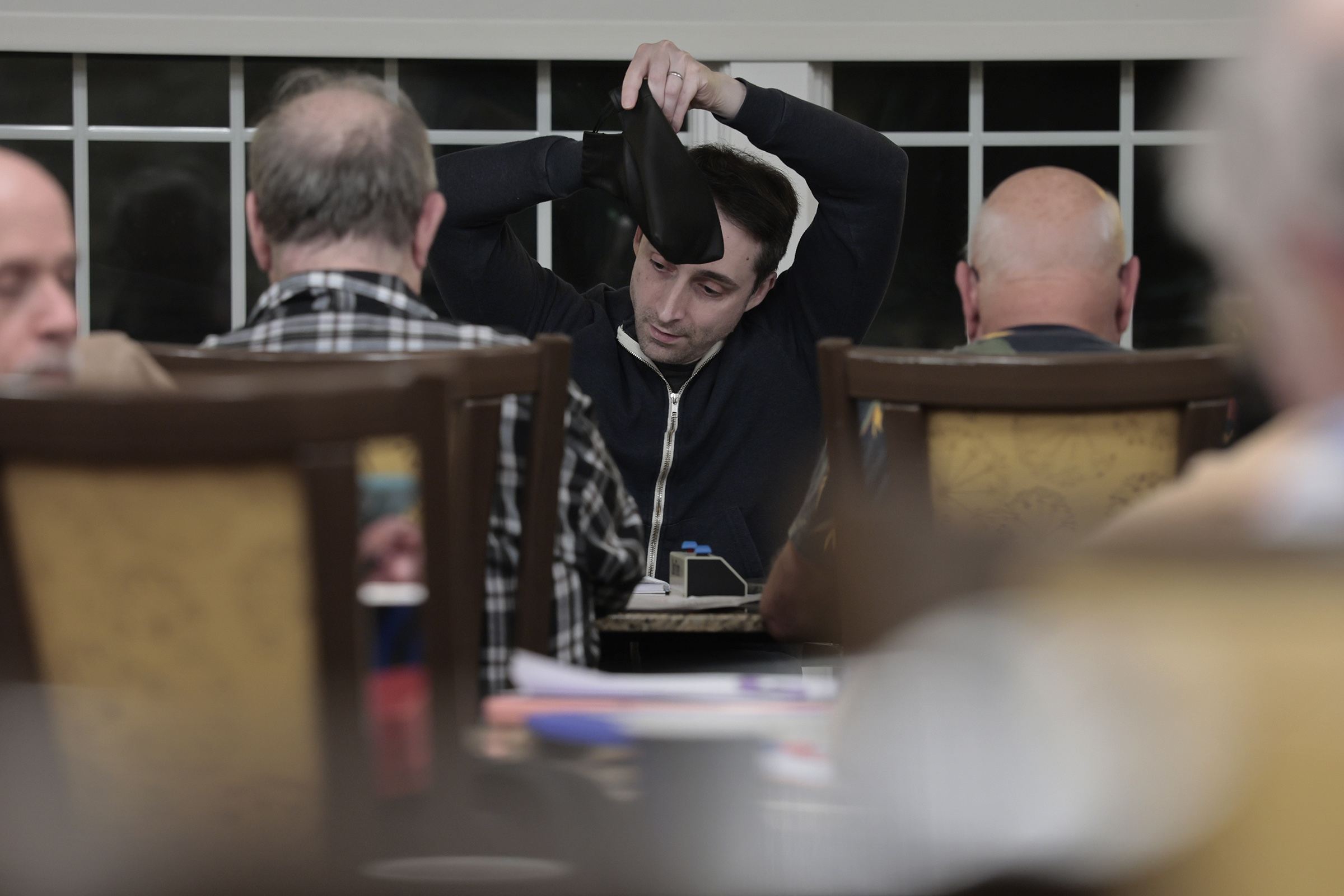
Will Anderson, a 41-year-old national Scrabble champion, reached into the black drawstring bag suspended above his head and plucked a plastic tile. “We do this as a courtesy to our opponents,” he said, glancing at the bag. “So you aren’t doing any shenanigans when you’re drawing.”
Will Anderson picks his tiles from the bag while playing Scrabble during a Scrabble group meetup at Riddle Village in Media on Thursday, Feb. 12, 2026.
Unlike Abadi, Anderson did not grow up playing Scrabble. He started as an adult, partly to break a World of Warcraft addiction. That was in 2009.
Since then, he’s won multiple tournaments and become an online Scrabble celebrity of sorts. After building an audience on Twitch, he turned to YouTube, where he currently has 70,000 subscribers and regularly posts “Scrabble History” videos detailing legendary games and players.
“It’s more growth than I ever could have imagined,” Anderson said. His online following even led to his day job as a content producer at Scopely, the mobile gaming company behind the Scrabble app.
In Riddle Village, Anderson was playing two games at once because the group had an odd number of players. “We call it good Will and evil Will,” said Samuel Moch, a top-10 player in Pennsylvania, also a club member. “And that’s appropriate because I’m playing good Will and I’m beating him.”
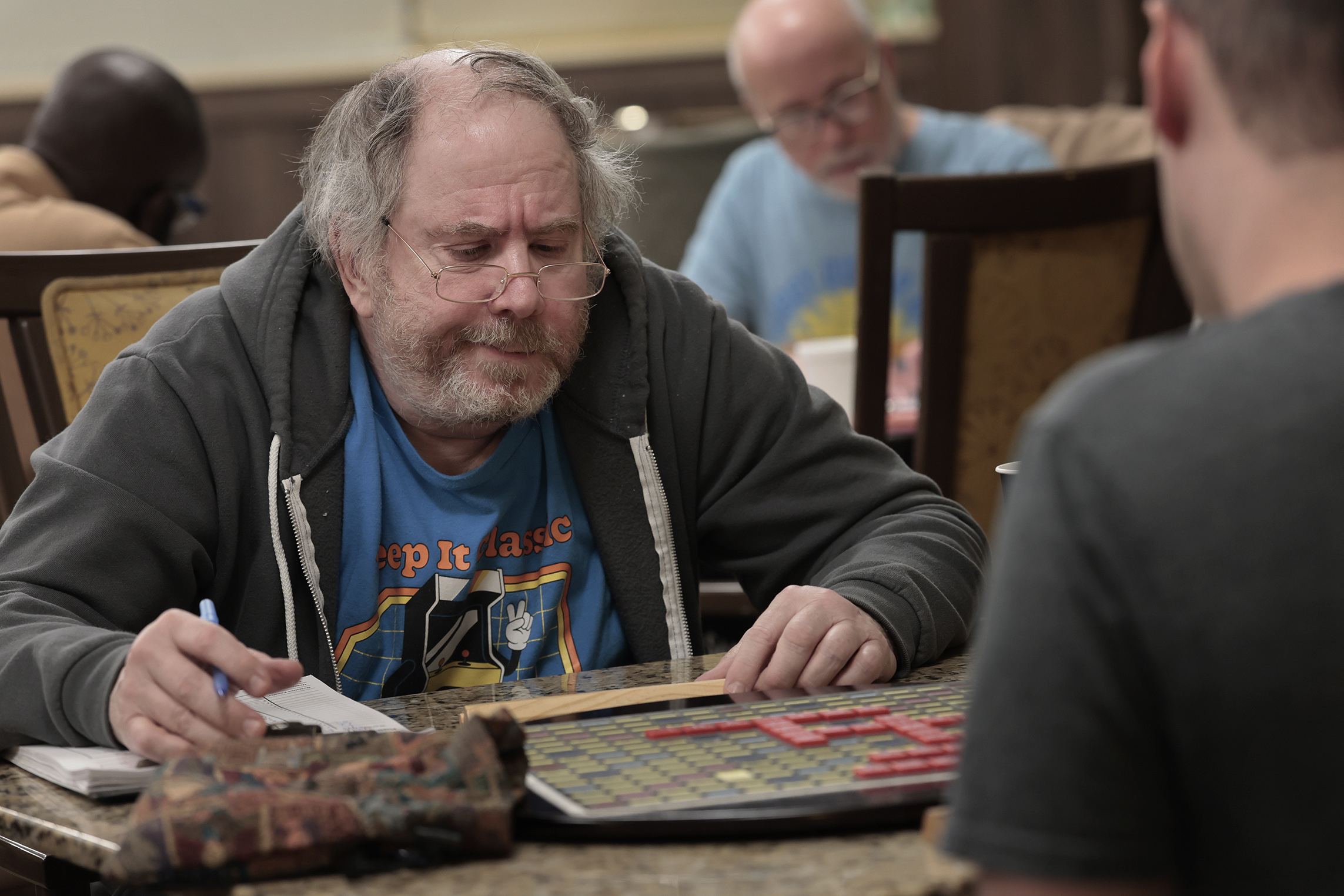
Meanwhile, “Evil Will” was facing Jeff Jacobson, a retired tuxedo salesman and another top player in the state, and winning.
Jeff Jacobson of Philadelphia (left) ponders his next move while playing Scrabble with Samuel Moch of Philadelphia (right) during a Scrabble group meetup at Riddle Village in Media on Thursday, Feb. 12, 2026.
Anderson, who lives in Aston, said part of the reason Philadelphia is home to so many strong Scrabble players may simply be its size.
“You have a higher chance of these unusual hobbies in urban areas,” he said. Or perhaps, he added, the city’s competitive sports culture spills over into word games. “There could be something to that.”
The competitive scene also benefits from the fact that Scrabble is a universally known game. Almost everyone learns it at home, as did several members of the Delco Scrabble Club.
They grew up playing with friends and relatives, got so good that nobody around them could beat them, and began looking for tougher opponents.
“If you’re that person in your family,” Anderson said, “we’re waiting for you with open arms.”
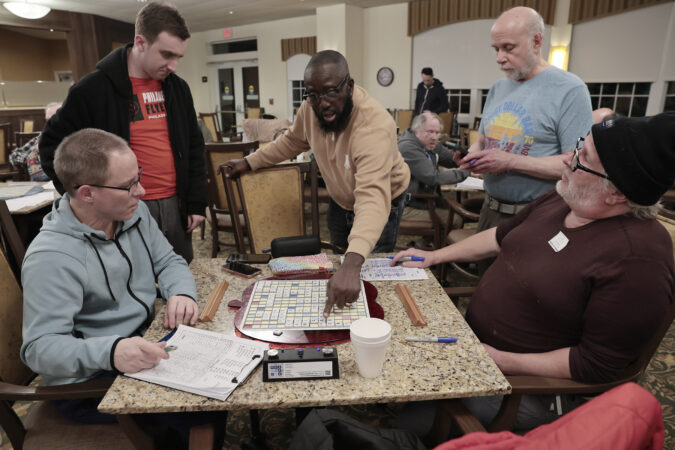
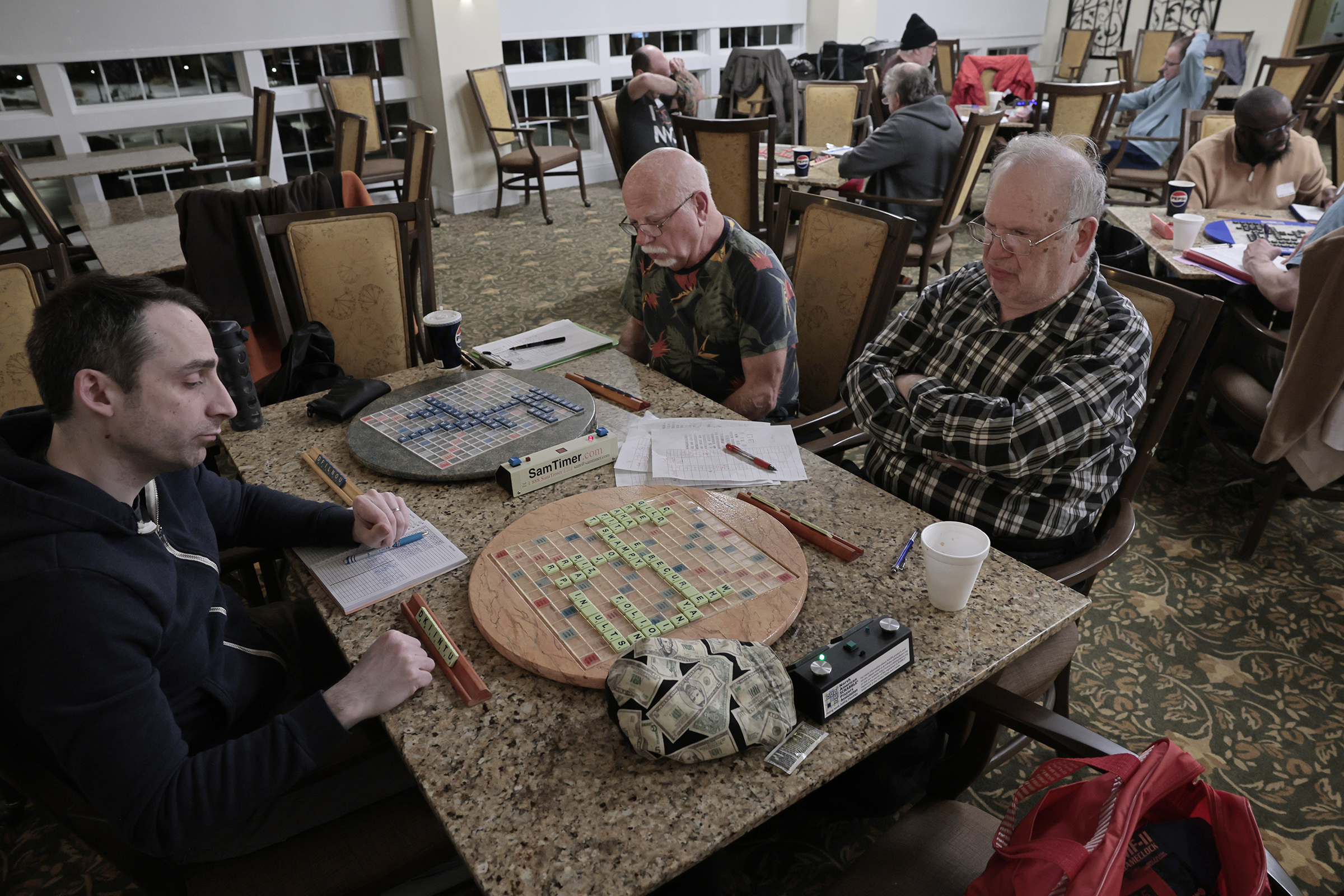
Will Anderson (left) plays Joe Petree (middle) and Marty Fialkow (right) during a Scrabble group meetup at Riddle Village in Media on Thursday, Feb. 12, 2026.
At the Delco Scrabble Club, it quickly becomes clear that Scrabble has more in common with chess than it does with word games.
“As a tournament player, you realize how deep and how beautiful the strategy of Scrabble is,” Anderson explained. “And in your pursuit of playing better and better, you leave the word game part of it behind and embrace it as a strategy game.”
Often, players don’t even know the definitions of the words they play.
Evan Chester, the fifth-best player in Pennsylvania and one of the top 50 players in the country, doesn’t know the definition of unaus, the word he had put down in the Riddle Village game. He knows it because he memorized the dictionary.
“But it’s a very useful and playable word,” said the 22-year-old.
“It’s a two-toed sloth,” said fellow club member Brendan McClanahan. Other club members, like de facto leader Ed Roth, who has been hosting the club at his house regularly for six years, nodded in agreement.
“Yup, two-toed sloth,” he said, as he laid down the word decrial.
A completed Scrabble game board during a Scrabble group meetup at Riddle Village in Media on Thursday, Feb. 12, 2026.
Delco to TV
The Delco Scrabble Club is drawing the attention of national TV audiences. Abadi and Anderson are competing on CW’s Scrabble game show, hosted by comedian and former late-night show host Craig Ferguson.
Last summer, Abadi submitted an application to audition for the game show. And after meeting with the casting director, he was invited to compete in London for the show’s $10,000 prize.
Abadi scored a win last week and will advance to future episodes of the show.
“I put my fist up and clapped and everything,” he said. “I was way more peppy than I am in real life, to be honest.”
Anderson, who applied to audition after a show producer reached out to him on YouTube, won’t appear until the tail-end of the season in August. He was equally enthusiastic during his run.
“I kicked up the hooting and hollering far beyond my norm,” he said. And while he was nervous in the lead-up to the game, “when it came to actually playing Scrabble,” he said, “the muscle memory kicked in, and it just became fun again.”
A group of Mark Abadi’s friends, family, and Scrabble club members celebrate his win on the CW game show, “Scrabble.”
Anderson and Abadi signed NDAs preventing them from discussing their performance, but both said winning wasn’t their main goal. Abadi wanted to “have fun” and represent the Philly and Scrabble communities well, which he thinks he did. Anderson just hopes his appearance on the show is entertaining for viewers.
Through the show, Abadi is hopeful more people are drawn to the iconic board game. It’s not just a “vocabulary contest,” or a “game made for grandparents,” he said, adding there’s “something for everyone to appreciate about it.”
When a messy land dispute between Gov. Josh Shapiro and his backyard neighbor poured into public view via federal court filings earlier this month, it jolted his sleepy Montgomery County neighborhood.
The picturesque suburban community tucked behind Penn State Abington is usually quiet and boring, current and former neighbors said, just the way they like it. It’s a great place to raise their kids, and where Shapiro’s four children have grown up. Among the biggest points of contention is when one neighbor fails to say hello to another. Many houses in the neighborhood sit a quarter-mile away from the main road, behind winding, tree-lined driveways. Some of the homes have been purchased in recent years for upward of $1 million. In many ways, the neighbors said, it’s the perfect picture of the suburban American dream.
But this month, the neighborhood also became the battleground for dueling lawsuits between Shapiro and his neighbors, Jeremy and SimoneMock, bringing tension to atranquil community.
What’s more: Shapiro’s office alleges the lawsuit against him is a political hit job to hurt him as he runs for reelection, citing the Mock family’s communications with the top Republican in the state Senate and his frequent sparring partner, President Pro Tempore Kim Ward. The family’s attorney in the lawsuit is also a local lawyer known to represent Republican causes, and whose former clients include the political campaigns of President Donald Trump and U.S. Sen. Dave McCormick.
The Mocks, meanwhile, argue in their lawsuit — filed in the U.S. District Court for the Eastern District of Pennsylvania — that Shapiro has used his powerful position as governor to infringe on their constitutional rights and take their land.
The disputed land — a 2,900-square-foot strip between Shapiro and his neighbor’s lawn — had not been an issue between them until security updates were proposed to Shapiro’s home after a Harrisburg man firebombed the state-owned governor’s residence last April while Shapiro and his family slept inside, both the Shapiros and Mocks said in court filings. The man, Cody Balmer, later pleaded guilty to attempted murder and related crimes for the attack, and was sentenced to 25 to 50 years in prison.
Afterward, state police proposed security upgrades to Shapiro’s personal residence and the state-owned governor’s mansion in Harrisburg, suggesting the installation of an eight-foot fence along the perimeter of Shapiro’s personal property, along with tree trimming, a new security system, and other landscaping efforts expected to cost more than $1 million, Spotlight PA reported. The proposed taxpayer-funded improvements to the Montgomery County home — criticized by the Republican-controlled state Senate — came in addition to the more than $32 million in repairs and security upgrades made to the governor’s mansion in Harrisburg, which included the replacement of an existing security fence there.
(function() { var l = function() { new pym.Parent( ‘shapiroyard__graphic’, ‘https://media.inquirer.com/storage/inquirer/ai2html/shapiroyard/index.html’); }; if(typeof(pym) === ‘undefined’) { var h = document.getElementsByTagName(‘head’)[0], s = document.createElement(‘script’); s.type = ‘text/javascript’; s.src = ‘https://pym.nprapps.org/pym.v1.min.js’; s.onload = l; h.appendChild(s); } else { l(); } })();
The Shapiros allege in a countersuit that they believed the disputed piece of lawn was theirs, and that they had maintained it for 22 years. When a land surveyor hired by the state to help with the security upgrade projects found that the Shapiros did not own the disputed part of the land, the Shapiros approached the Mocks in July to purchase or lease it.
Ultimately, the talks fell apart, as the neighbors blamed one another for being unwilling to make a deal.
Any resolution is now likely to be decided in court.
The Mocks in their lawsuit — represented by Delaware County attorney Wally Zimolong, who describes himself on his website as the “‘go-to’ lawyer in Pennsylvania for conservative causes and candidates” — accused Shapiro in his official capacity as governor of an “outrageous abuse of power” by illegally occupying a part of their yard that they pay taxes on. The Shapiro family quickly filed a countersuit in the Montgomery County Court of Common Pleas, arguing they have control of the land through adverse possession, a legal mechanism through which a person can gain ownership of a property they’ve actively used for at least 21 years.
The Mocks have asked a federal judge to find that Shapiro, as governor, violated their constitutional rights; as well as prohibit state officials from trespassing on their property moving forward; and to award them damages. Private attorneys representing Shapiro have asked the Common Pleas Court to find they are the owners of the disputed part of the yard and refund attorney fees.
‘Everybody got along’
Shapiro and his wife, Lori, have lived in the same home in the neighborhood for 22 years, purchasing the four bed, three-and-a-half bath property in June 2003 for $465,000 as the young couple wanted to move back to the Philadelphia suburbs after spending several years working as staffers on Capitol Hill. Shapiro ran for state House the following year and represented the area until 2011, in what was the beginning of his decades-long political career that has helped flip Montgomery County, the state’s third-most populous county, from red to blue.
Several current and former neighbors in the Philadelphia suburb raced to defend the Shapiros as great neighbors, adding they don’t mind the additional state police presence as his star rises as a top Democrat and after the governor and his family were victims of political violence. Others said they’ve had a good relationship with the Mocks so far.
“We had nothing but pleasant experiences with Josh. I have nothing that I can say negative in any way, shape, or form,” said Eileen Simon, who used to live next door to Shapiro until 2020. Simon lived in the neighborhood for 48 years. She hasn’t spoken to the Shapiro family in a few years, but recalled that her grandchildren would often play on the Shapiro’s backyard swing set.
“We were all neighbors together, and everybody got along,” Simon added. “I’m devastated that this has happened.”
Cathy Keim, who moved out of the neighborhood seven years ago and shared a boundary line with the Shapiros for some of the nearly 40 years she lived there, also recalled a neighborhood where everyone got along. Keim said she believes the current dispute is petty, and added thatwhen Shapiro first built his swing set behind her pool fence, he mistakenly put it on her property. When the Keims alerted him to it, Shapiro quickly moved it back onto his own backyard, she said.
“That area, it looked like it should be theirs because of the pool fence,” she said. “I had to tell them, ‘that’s our property,’ and they very quickly moved it.”
Stephanie Berrong, whose backyard also abuts the Shapiro’s property, said in a text message that after the arson attack, the Shapiros asked if they could remove a tree on her property to build the security fence. Berrong and her husband agreed, and said the Shapiros were “respectful of our time and our property” throughout the tree-removal process. She did not comment on the Mocks.
“We just felt it was the right thing to do, considering someone tried to burn down the governor’s mansion with them, and their kids, inside,” Berrong added.
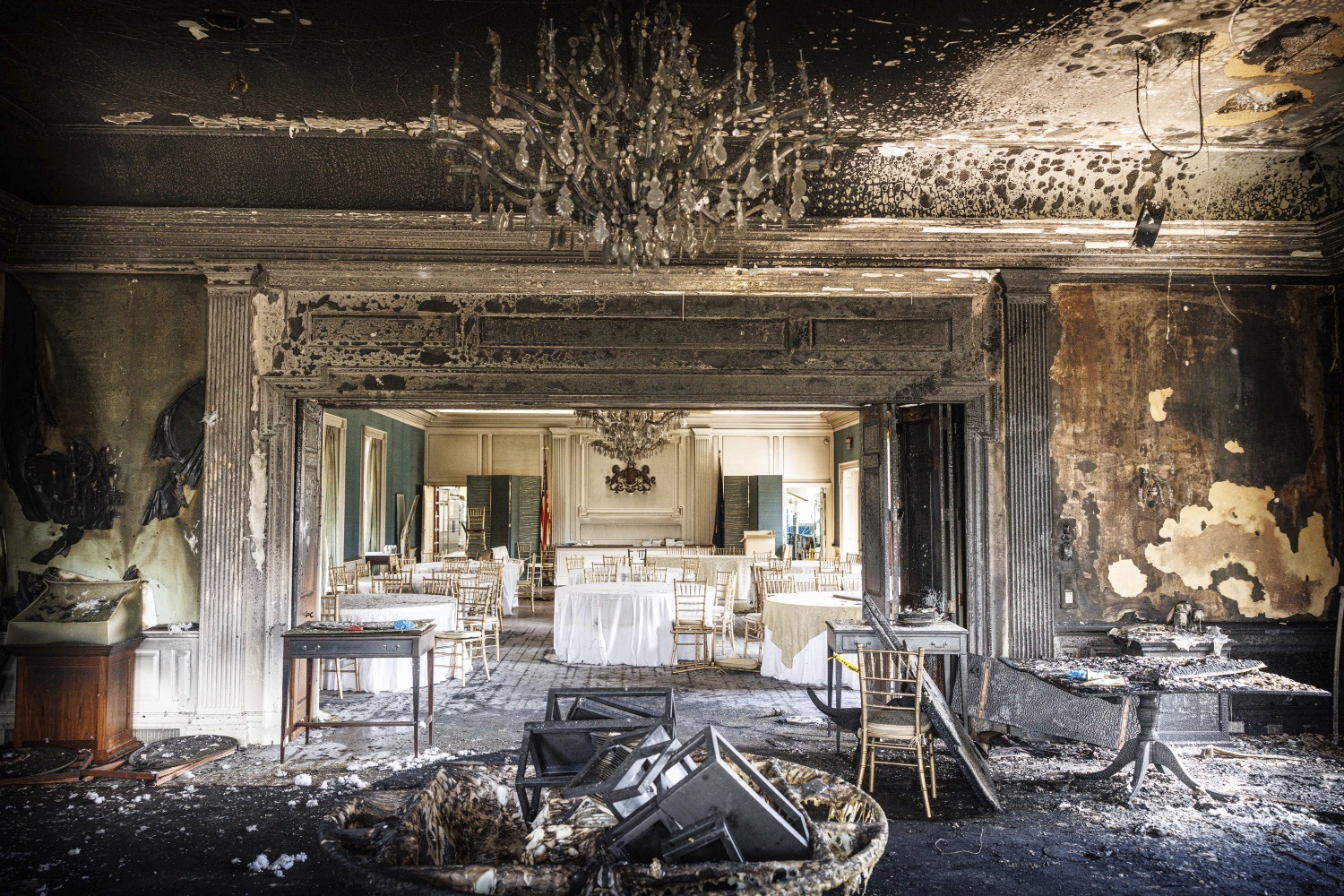
This image provided by Commonwealth Media Services shows damage after a fire at the Pennsylvania governor’s mansion while Democratic Gov. Josh Shapiro and his family slept inside on April 13, 2025, in Harrisburg.
State police never built the security fence that started the land feud, instead opting to surround Shapiro’s home with updated landscaping. That escalated the conflict with the Mocks. In their lawsuit, the Mocks allege that despite ongoing negotiations over the strip of land, the Shapiros began planting arborvitae-type trees and other plants on the Mocks’ property, flying drones over it, and threatening to remove healthy trees. The lawsuit also accuses state police of “chasing away” contractors who came to work in the Mocks’ yard.
The Shapiros, meanwhile, argue in court filings that the Mocks’ alleged harassment is causing them irreparable harm and further threatening their safety. According to a source briefed on the conflict, the Mocks at one point posted a series of signs on the land and a tree that read “Hippity hoppity, stay off my property,” and “This is my property,” among other efforts to antagonize the Shapiros.
John Ginsberg grew up in the home now owned by the Mocks during the 1970s and ‘80s, and said he never thought of their property as stretching into the land now owned by the Shapiro family.
“It just wasn’t an area that was used,” said Ginsberg, who now works as an attorney in Washington. “It wasn’t maintained, and it was brambly.”
Another man, who requested anonymity to speak freely about his neighbors, said he lived next to the Shapiros for more than 21 years, and has for decades shared the upkeep on a portion of the property highlighted in the lawsuit with Shapiro, taking turns clearing and replanting the area.
“I don’t think either of us thought twice about that little strip of land,” he said.
The Shapiros have been great neighbors, he said, and the Mocks have been “good neighbors to us,” describing them as a “nice young family.”
Political allegations
Shapiro has faced ongoing scrutiny from the state Senate for implementing the $1 million in security upgrades to his personal home, in addition to $32 million in repairs and security upgrades to the governor’s mansion following the arson attack. All of the upgrades were implemented without legislative approval due to their urgent nature.
A Senate committee in December took the unprecedented step to subpoena Shapiro over the security upgrades to his personal home, arguing that his administration had not been transparent in previous inquiries about how state taxpayer dollars were being used to upgrade security at Shapiro’s personal home.
Ward, the top official in the state Senate, has been critical of the state spending on security upgrades, saying that taxpayer dollars should not be funding security upgrades to Shapiro’s private residence.
Shapiro’s office is quick to note that Ward has been in contact with the neighbors taking the governor to court — saying that helps show the land dispute lawsuit is politically motivated.
Ward, of Westmoreland County, told ABC27 earlier this month that she had had contact with the Mock family on two occasions. A person close to Ward said that the senator is an acquaintance of the Mocks, but that the family had already obtained legal counsel by the time Ward reached out to them, and that the lawmaker did not encourage Shapiro’s neighbors to take any legal action against him.
Senate President Pro Tempore Kim Ward leaves the House chamber Feb. 3 following Gov. Josh Shapiro annual budget proposal in Harrisburg.
Jeremy Mock has owned a small coffee business in Ward’s legislative district in western Pennsylvania since 2022, according to public business filings. He and his wife moved to the Abington Township neighborhood in 2017, and have had no issues with the Shapiros until the fence feud, according to both parties’ lawsuits.
“This dispute over a small piece of the Shapiros’ backyard has been turned into a shameless political stunt by their neighbors and members of the Republican State Senate, who are now harassing and exploiting the Shapiros,” said Rosie Lapowsky, a spokesperson for Shapiro, without directly naming Ward.
Zimolong, the Mocks’ attorney, said the fact that the couple was willing to work with the Shapiros to find a solution dispels any claim that their suit is politically motivated. The Mocks could have said “no” from the outset when the Shapiros approached them, he argued, but instead participated in negotiations.
“At base, this is a straightforward defense of the property rights of two innocent owners, who were living peacefully next to the Shapiros for over nine years,” Zimolong added in a statement.
“Even today, the Mocks remain open to resolving the dispute,” Zimolong said.
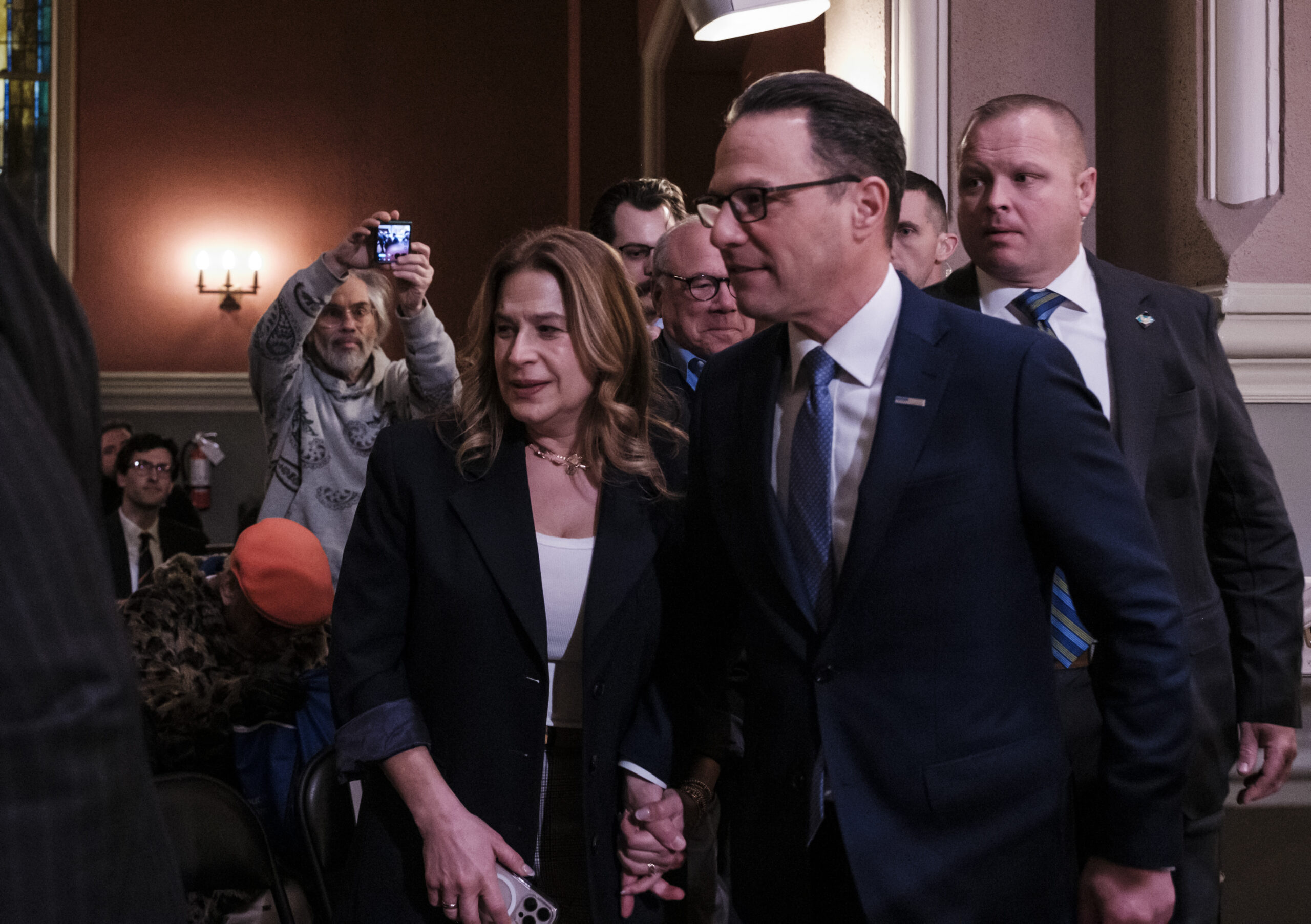
Gov. Josh Shapiro and his wife, Lori Shapiro, depart a talk for his new memoir “Where We Keep the Light” on Jan. 29 in Washington, D.C
Zimolong says he has never discussed the lawsuit with Ward or coordinated with her staff over the issue, “and I have no intention of doing so.”
He saidhe is one of few attorneys in southeastern Pennsylvania who is “not afraid to hold a powerful governor accountable” and does not have work before the state that would present an ethical conflict.
Erica Clayton Wright, a spokesperson for Ward, noted that taxpayer funds have now been used to pay for security upgrades to Shapiro’s personal residence and the property of his neighbors, and argued that it’s “not the first time Gov. Shapiro’s team has been put in the awkward position of pointing fingers to distract from Gov. Shapiro’s questionable methods of operation.”
“It is important not to lose sight of the need to ensure the governor and his family are safe while also safeguarding the processes in place to manage taxpayer funds,” Clayton Wright said.
“Absolutely no one but Gov. Shapiro himself is responsible for trying to take his neighbor’s property via squatter rights, which has resulted in federal and state lawsuits,” she said.
Staff writer Abraham Gutman contributed to this article.
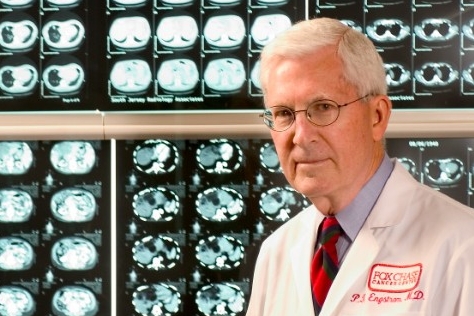
Paul F. Engstrom, 89, formerly of Ambler, Montgomery County, celebrated pioneer in cancer prevention, education, and treatment, former chair and professor emeritus of the hematology and oncology department at Fox Chase Cancer Center, retired vice president of cancer control and senior adviser to the president at Fox Chase, Army veteran, and mentor, died Friday, Dec. 26, of Parkinson’s disease at Normandy Farms Estates in Blue Bell.
The son of a small-town doctor, Dr. Engstrom accompanied his father on house calls in Minnesota when he was young and assisted sometimes on routine procedures. Later, after earning his medical degree at the University of Minnesota, he excelled at identifying cancer-related health problems and creating solutions.
Starting in the 1960s and ’70s, Dr. Engstrom noticed large gaps in cancer prevention programs and treatment strategies. So he compiled comprehensive clinical care guidelines for cancer doctors and hospitals around the world, forged sustainable oncology research networks and community education partnerships, and established one of the country’s first cancer prevention and control programs at Fox Chase.
“Most doctors and oncologists in the 1970s were training to treat cancer, not necessarily to prevent it,” former Fox Chase colleague Carolyn Fang said in a 2018 story for Fox Chase’s Forward magazine. “He was one of the first to recognize that prevention was important.”
In 1991, Dr. Engstrom told the Daily News: “Changing the behavior of the public is only part of my job. We must change the physicians, too.” In 2000, he told The Inquirer: “Nowadays, the trend is toward identifying high-risk individuals and treatments we can give to prevent cancer from ever starting.”
Dr. Engstrom was adept at organization and collaboration, former colleagues said in online tributes. He recruited other cancer experts to Fox Chase and established cutting-edge programs for cancer screening, smoking cessation, and education at hospitals, schools, private companies, and other organizations.
He taught clinical science classes, secured vital grants from the National Cancer Institute and other groups, and made seminal clinical trials available to many more patients. “He was really aware of the need to integrate the community into this work.” Fang said in 2018.
Dr. Engstrom joined the old American Oncologic Hospital in Philadelphia in 1970 and oversaw its merger with the Institute for Cancer Research in 1974 to become the Fox Chase Cancer Center. He was named vice president of cancer control and continuing education in 1984, and head of community cancer program activities in 1989.
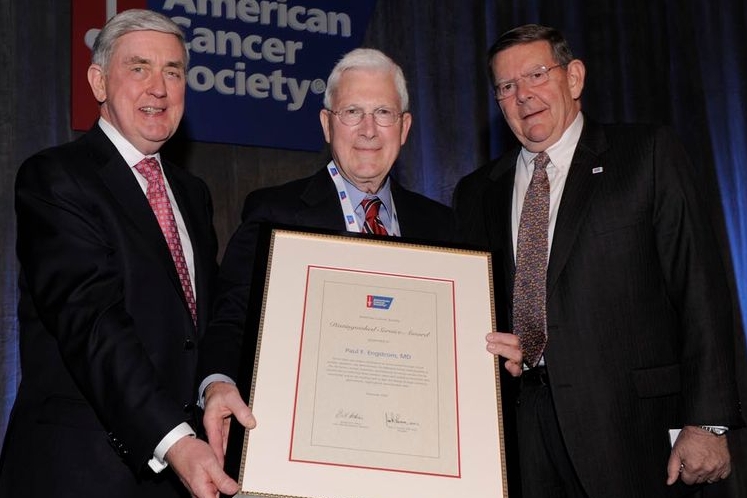
Dr. Engstrom (center) earned many awards over his long career.
He was also vice president for population science and held the Samuel M.V. Hamilton endowed chair in cancer prevention. He specialized in treating gastrointestinal cancers and neuroendocrine tumors. Heretired in 2018 but continued as a special adviser to the Fox Chase president.
He cofounded the National Comprehensive Cancer Network and was a fellow of the American College of Physicians and longtime member of the American Association of Cancer Research and other groups. He served on many boards and earned a clinical care achievement award in 2013 from the Association of Community Cancer Centers.
Dr. Engstrom edited, wrote, or cowrote hundreds of research papers and lectured around the world. He was drafted into the Army in 1967, rose to the rank of major, and served three years as head of hematology and oncology at Tripler Army Hospital in Honolulu.
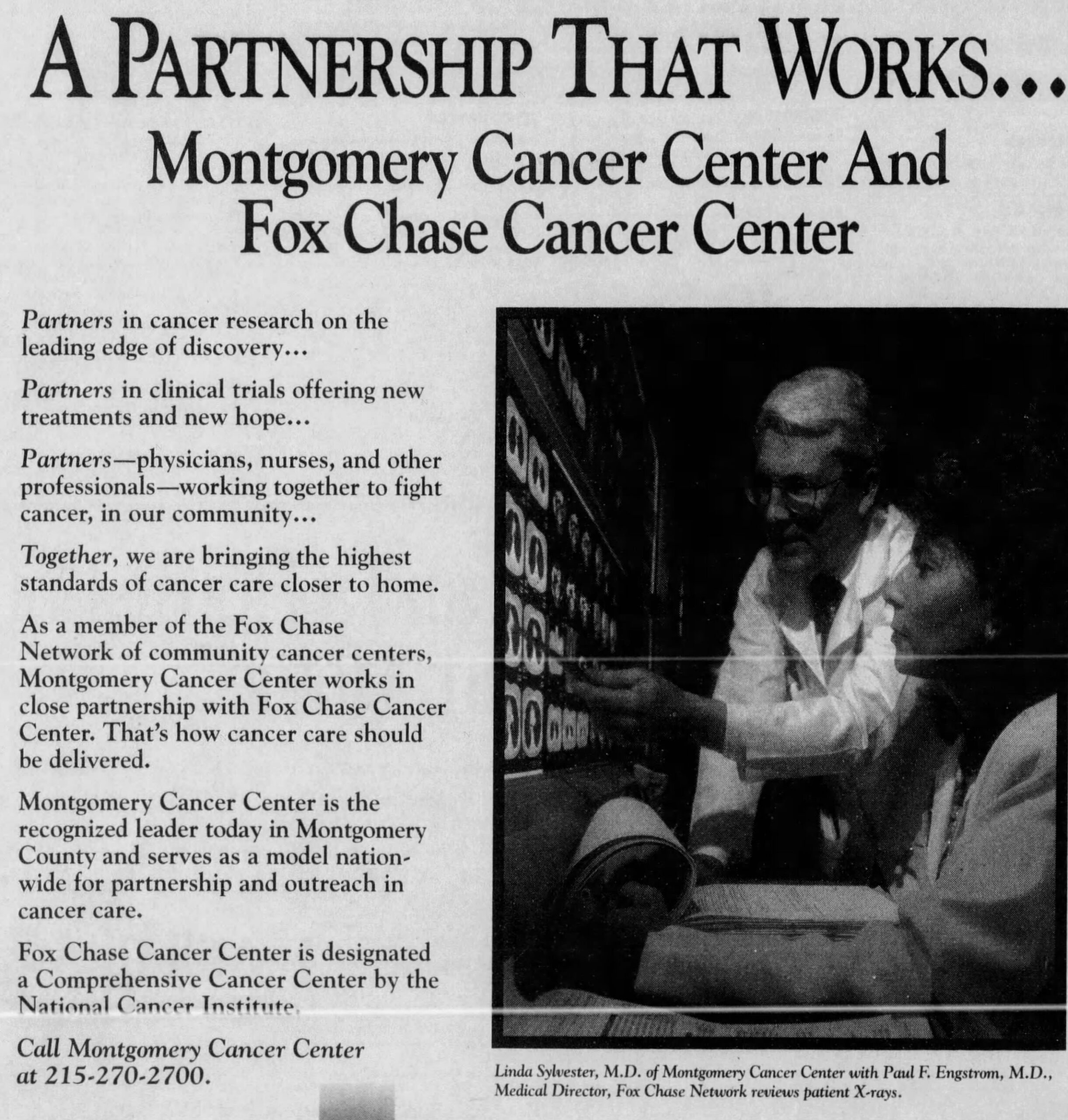
Dr. Engstrom (left in the photo) appeared in many print advertisements for the Fox Chase Cancer Center, such as this 1995 ad in The Inquirer.
“Medicine is a great career,” he said in 2018. “It is still the most satisfying and the best opportunity to do well, but most importantly to do good.”
Paul Frederick Engstrom was born May 28, 1936, in St. Cloud, Minn. He played football and basketball, ran track, played trombone in the high school band, and sang in the school chorus.
His father was the only doctor in Belgrade, Minn., and Dr. Engstrom knew early he was going to be a doctor, too. He earned a bachelor’s degree at St. Olaf College in Minnesota and completed a public health fellowship at the California Department of Health during medical school.
He met nurse Janet Johnson during a procedure in a Minnesota hospital in 1960, and they married in 1961. They lived in Hawaii while he served in the Army and in Ambler until recently, and had daughters Karin and Maria, and a son, David.
Dr. Engstrom met his wife, Janet, when she was an intensive care unit nurse.
Dr. Engstrom and his wife enjoyed the orchestra, ballet, and theater in Philadelphia. He liked to garden, read, and travel. He was thrifty, his wife said.
He followed many of the local college and professional sports teams, especially the Eagles, and sang in the choir at Christ’s Lutheran Church in Oreland. He survived prostate cancer and remained a lifelong learner.
School districts around the region made varying calls for how they’re handling classes Tuesday as the region continues to dig out from the massive snowstorm that dumped more than a foot of snow in many places — with some closed altogether, others fully open, and others open, but delayed.
The Philadelphia School District opted for another day of virtual instruction.
Superintendent Tony B. Watlington Sr. has said the nation’s eighth-largest school system favors in-personinstruction, but places student and staff safety as its highest priority.
In Upper Darby, Delaware County, Superintendent Dan McGarry made the call to bring students in on time.
“The district transportation team and facilities team have been working hard all day to clear snow from our facilities for in-person instruction,” McGarry wrote in a message to families and staff. “We have been in communication with the township as well, and I want to thank them for their hard work getting roads clear for school tomorrow.”
Districts including Council Rock and Pennridge, both in Bucks County, called two hour delays.
In Montgomery County, Cheltenham and Lower Merion schools both announced a two-hour delay.
“Buses are expected to arrive at bus stops two hours after their normal pickup times; however, please be patient as snow and ice on some streets may cause additional delays,” Lower Merion spokesperson Amy Buckman said in a message to families Monday evening.
Cherry Hill and Moorestown, in Camden County, will also hold classes with a two-hour delay.
Renewed debate over virtual instruction in New Jersey
And while some Pennsylvania districts pivot to virtual instruction when significant snow falls, that’s not possible in New Jersey, where state law prevents it.
A handful of New Jersey districts opted for total closures. Lenape Regional, Evesham, and Medford schools, all in Burlington County, cancelled classes altogether.
Winslow schools in Camden County will remain closed Tuesday for a second consecutive day, said interim Superintendent Mark Pease. The district was shut down for three days during the last storm.
Pease said the district would use two days from its spring in April to make up the missed days. The break will be cut to three days, he said.
“If we get another storm, we will be extending the school year,” Pease said. “Let’s hope this is it for the winter.”
The snow storm renewed calls among some New Jersey educators to the state to allow virtual and hybrid instruction to avoid closing schools due to inclement weather.
In a social media post, Camden Education Association President Pam Clark said she was asking Gov. Mikie Shirrell to revisit the virtual option for traditional public schools. She used the hashtag “not fair.”
New Jersey allowed virtual and hybrid instruction when the pandemic shut down schools.
However, state law now strictly limits remote learning, according to the state Department of Education. Districts must meet a state requirement of 180 days.
School districts may seek approval for virtual learning for school closures lasting more than three consecutive days because of a declared state of emergency or a declared public health emergency.
There has been pushback against virtual learning because of concerns about learning loss suffered during the pandemic. There also are concerns that some schools don’t have enough Chromebooks or devices for students to log on.
Timothy Purnell, executive director of the New Jersey School Boards Association, said districts should have the flexibility to pivot when circumstances warrant such as a snow day.
Districts have invested in technology and training to successfully implement virtual instruction, he said.
“Limiting virtual instruction days exclusively to public health emergencies is yesterday’s logic,“ Purnell said in a statement.
A Philadelphia man was charged with first-degree murder and related crimes after he shot and killed his wife in Rockledge, Montgomery County, on Saturday evening, officials said Monday.
Jose Antonio Luna, 59, was arrested shortly after the shooting, the Montgomery County District Attorney’s Office said.
Prosecutors say Luna shot his wife, 48-year-old Alisett Schubert, multiple times, killing her, near the intersection of Huntington Pike and Filmore Street that night.
The incident began when the couple started arguing as they drove home from a partyin a silver Nissan, according to the affidavit of probable cause for in Luna’s arrest.
Schubert was behind the wheel. After she told Luna to get out of the car and walk home, the two began to wrestle over Schubert’s purse, where she kept a .38 caliber revolver that was registered in her name, the affidavit said.
Luna grabbed the weapon and shot his wife once, the document said. After Schubert yelled “Oh my God” and tried to flee the vehicle, the affidavit said, Luna shot her four more times.
Luna later told investigators that Schubert had “disrespected him in front of others” at a banquet hall that afternoon, according to the document. He also told investigators he left one round in the gun’s chamber with the intent to later kill himself, the affidavit said.
A SEPTA bus driver reported the shooting to police, according to the document.
Around 10 p.m., authorities said, the driver came across the Nissan stalled in the road, and heard two to three gunshots before watching Luna exit the vehicle’s passenger side and pull open the driver’s side door.
Schubert’s body “slouched” out of the car, the affidavit said.
The driver watched as Luna fled the scene. Later, when Philadelphia police located him about a mile away near 1200 Rhawn Street, Luna put Schubert’s gun to his head and pulled the trigger, according to the affidavit.
But the gun was out of ammunition and did not fire. Police arrested Luna without incident.
Investigators later learned Luna had called Schubert’s mother after the shooting to tell her that her daughter had died, but he did not say how the death occurred, and he told the woman he wanted to kill himself.
Meanwhile, Schubert was taken to Abington Hospital suffering from multiple gunshot wounds and was pronounced dead.
Schubert had previously told a close friend that Luna was physically and mentally abusing her, the affidavit said. The friend told investigators that she had once seen Luna punch Schubert in the face.
Prosecutors said Luna had an extensive criminal history and had been arrested “numerous” times for illegal entry into the United States and for reentry after deportation.
In addition to first-degree murder, Luna was charged with third-degree murder and possessing an instrument of a crime.
He is being held without bail at the Montgomery County Correctional Facility and is expected to appear in court for a preliminary hearing on March 5.