Tag: no-latest

  • No, George Washington didn’t have wooden teeth. Yes, he led the Siege of Boston.

    No, George Washington didn’t have wooden teeth. Yes, he led the Siege of Boston.

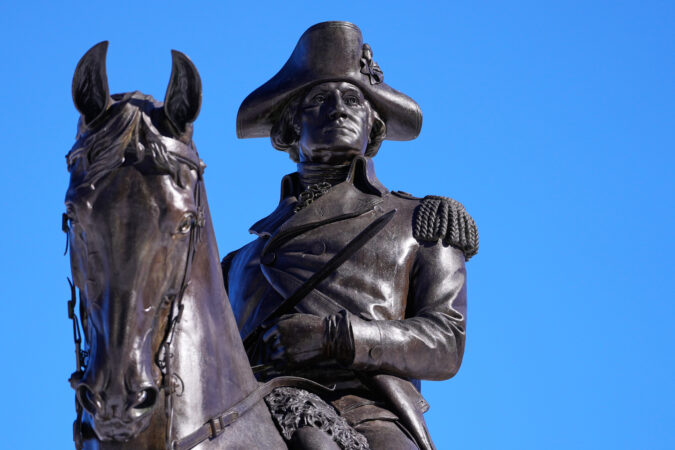
    BOSTON — More than a decade before he became the country’s first president, George Washington was leading a critical campaign in the early days of the American Revolution. The Siege of Boston was his first campaign as commander-in-chief of the Continental Army and, in many ways, set the stage for his military and political successes — celebrated on Presidents Day.

    Following the Battles of Lexington and Concord, militias had pinned down the British in Boston in April 1775. The Continental Congress, recognizing the need for a more organized military effort, selected Washington to lead the newly formed army.

    The Siege of Boston and its significance

    On this day 250 years ago, Washington would have been nearing the end of an almost yearlong siege that bottled up as many as 11,000 British troops and hundreds more loyalists. The British were occupying Boston at the time, and the goal of the siege was to force them out.

    A critical decision made by Washington was sending Henry Knox, a young bookseller, to Fort Ticonderoga in New York to retrieve dozens of cannons. The cannons, transported hundreds of miles in the dead of winter, were eventually used to fire on British positions. That contributed to the decision by the British, facing dwindling supplies, to abandon the city by boat on March 17, 1776.

    Historians argue that the British abandoning their positions, celebrated in Boston as Evacuation Day, rid the city of loyalists at a critical time, denied the British access to an important port and gave patriots a huge morale boost.

    “The success of the Siege of Boston gave new life and momentum to the Revolution,” Chris Beagan, the site manager at Longfellow House in Cambridge, a National Historic Site that served as Washington’s headquarters during the American Revolution. “Had it failed, royal control of New England would have continued, and the Continental Army likely would have dissolved.”

    How the siege shaped Washington

    The siege was also a critical test for Washington. A surveyor and farmer, Washington had been out of the military for nearly 20 years after commanding troops for the British during the French and Indian War. His successful campaign ensured Washington remained the commander-in-chief for the remainder of the revolution.

    Doug Bradburn, president of George Washington’s Mount Vernon, said Washington took the first steps to creating a geographically diverse army that included militiamen from Massachusetts to Virginia and, by the end of the war, a fighting force with significant Black and Native American representation. It was the most integrated military until President Harry S. Truman’s desegregated the armed forces in 1948, he said.

    Washington, a slave owner who depended on hundreds of slaves on his Mount Vernon estate, was initially opposed to admitting formerly enslaved and free Black soldiers into the army. But short of men, Washington came to realize “there are free Blacks who want to enlist and he needs them to keep the British from breaking out” during the siege, Bradburn said.

    Ridding Boston of the British also turned Washington into one of the country’s most popular political figures.

    “He comes to embody the cause in a time before you have a nation, before you have a Declaration of Independence, before you’re really sure what is the goal of this struggle,” Bradburn said. “He becomes the face of the revolutionary movement.”

    Commanding the military for more than eight years also prepared Washington for the presidency, Pulitzer Prize-winning military historian Rick Atkinson said. “Perhaps most important, it gave him a sense that Americans could and should be a single people, rather than denizens of thirteen different entities.”

    Myths of Washington

    His rise to prominence also led to plenty of myths about Washington, many which persist to this day.

    One of the most popular is the cherry tree myth. It was invented by one of Washington’s first biographers, according to George Washington’s Mount Vernon, who created the story after his death. Supposedly, a 6-year-old Washington took an ax to a cherry tree and admitted as much when caught by his father, famously saying “I cannot tell a lie … I did cut it with my hatchet.”

    The second one is the wooden teeth myth. It was rumored that Washington had wooden dentures and scholars, well into the 20th century, were quoted as saying his false teeth were made from wood. Not true. He never wore wooden dentures, instead using those with ivory, gold and even human teeth.

    More than a statesman

    During his lifetime, Washington had myriad pursuits. He was known as an innovative farmer, according to the George Washington’s Mount Vernon, and an advocate for Western expansion, buying up to 50,000 acres of land in several Mid-Atlantic states. After returning to Mount Vernon, he built a whiskey distillery that became one of the largest in the country.

    His connection to slavery was complicated. He advocated for ending slavery, and his will called for freeing all the slaves he owned after the death of his wife, Martha Washington. But he didn’t own all the slaves at Mount Vernon so he couldn’t legally free all of them.

    Celebrating Presidents Day

    For fans of George Washington, Presidents Day is their Super Bowl. Originated to celebrate Washington’s birthday, which falls on Feb. 22, the holiday has become associated with good deals at the mall. Still, there are plenty of places celebrating all things Washington on this day.

    There will be a wreath-laying ceremony at Washington’s tomb at Mount Vernon, and there will be a Continental Army encampment. There will be a parade honoring Washington in Alexandria, Virginia, and, in Laredo, Texas, a monthlong celebration features a carnival, pageants, an air show and jalapeno festival.


  • Iran’s top diplomat met with the head of the U.N. nuclear watchdog ahead of a second round of U.S. talks

    Iran’s top diplomat met with the head of the U.N. nuclear watchdog ahead of a second round of U.S. talks

    GENEVA — Iran’s top diplomat met with the head of the U.N. nuclear watchdog agency on Monday, ahead of a second round of negotiations with the United States over Tehran’s nuclear program.

    Iranian Foreign Minister Abbas Araghchi met with Rafael Grossi, director-general of the International Atomic Energy Agency, and said he would also meet with Foreign Minister Badr al-Busaidi of Oman, which is hosting the U.S.-Iran talks in Geneva on Tuesday.

    “I am in Geneva with real ideas to achieve a fair and equitable deal,” Araghchi wrote on X. “What is not on the table: submission before threats.”

    As U.S. President Donald Trump ordered an additional aircraft carrier to the region, Iran on Monday launched a second naval drill in weeks, state TV reported. It said the drill would test Iran’s intelligence and operational capabilities in the Strait of Hormuz, the Persian Gulf and the Gulf of Oman.

    Iran’s drills take place against the U.S. military buildup

    Just before the talks, Iran announced its paramilitary Revolutionary Guard started the drill early Monday morning in the waterways that are crucial international trade routes through which 20% of the world’s oil passes.

    Separately, EOS Risk Group said sailors passing through the region received by radio a warning that the northern lane of the Strait of Hormuz, in Iranian territorial waters, likely would see a live-fire drill Tuesday. Iranian state TV did not mention the live fire drill.

    This is the second time in recent weeks sailors have received warning about an Iranian live fire drill. During the previous exercise, announced at the end of January, the U.S. military’s Central Command issued a strongly worded warning to Iran and the Revolutionary Guard. While acknowledging Iran’s “right to operate professionally in international airspace and waters,” it warned against interfering or threatening American warships or passing commercial vessels.

    On Feb. 4, tensions between the Iranian and U.S. navies rose further after a U.S. Navy fighter jet shot down an Iranian drone that was approaching the aircraft carrier USS Abraham Lincoln in the Arabian Sea. Iran also harassed a U.S.-flagged and U.S.-crewed merchant vessel that was sailing in the Strait of Hormuz, the U.S. military reported.

    Iran open to compromise in exchange for sanctions relief

    On Sunday, Iran’s Deputy Foreign Minister Majid Takht-Ravanchi signaled that Tehran could be open to compromise on the nuclear issue, but is looking for an easing of international sanctions led by the United States.

    “The ball is in America’s court. They have to prove they want to have a deal with us,” Takht-Ravanchi told the BBC. “If we see a sincerity on their part, I am sure that we will be on a road to have an agreement.”

    “We are ready to discuss this and other issues related to our program provided that they are also ready to talk about the sanctions,” he added.

    Oman hosted a first round of indirect talks between the U.S. and Iran on Feb. 6.

    Similar talks last year between the U.S. and Iran about Iran’s nuclear program broke down after Israel launched what became a 12-day war on Iran, that included the U.S. bombing Iranian nuclear sites.

    The U.S. is also hosting talks between envoys from Russia and Ukraine in Geneva on Tuesday and Wednesday, days ahead of the fourth anniversary of the all-out Russian invasion of its neighbor.

    U.S. keeps military pressure high

    Trump initially threatened to take military action over Iran’s bloody crackdown on nationwide protests last month, but then shifted to a pressure campaign in recent weeks to try to get Tehran to make a deal over its nuclear program.

    Secretary of State Marco Rubio, visiting Budapest, reiterated on Monday that the U.S. hopes to achieve a deal with Iran, despite the difficulties. “I’m not going to prejudge these talks,” Rubio said. “The president always prefers peaceful outcomes and negotiated outcomes to things.”

    Trump said Friday the USS Gerald R. Ford, the world’s largest aircraft carrier, was being sent from the Caribbean to the Mideast to join other military assets the U.S. has built up in the region. He also said a change in power in Iran “would be the best thing that could happen.”

    Iran has said if the U.S. attacks, it will respond with an attack of its own.

    The Trump administration has maintained that Iran can have no uranium enrichment under any deal. Tehran says it won’t agree to that.

    Iran has insisted its nuclear program is for peaceful purposes. However, its officials increasingly threaten to pursue a nuclear weapon. Before the June war, Iran had been enriching uranium up to 60% purity, a short, technical step away from weapons-grade levels.

    The direct meeting with Grossi is a significant step after Iran suspended all cooperation with the IAEA following the June war with Israel. The two also met briefly on the sidelines of the United Nations General Assembly in September. The IAEA said it has been unable to verify the status of Iran’s near weapons-grade uranium stockpile since the war. Iran has allowed IAEA some access to sites that were not damaged, but has not allowed inspectors to visit other sites.

    Iran’s stockpile of uranium enriched to 60% could allow Iran to build as many as 10 nuclear bombs, should it decide to weaponize its program, Grossi previously told The Associated Press. He added that it doesn’t mean that Iran has such a weapon.

    Israeli Prime Minister Benjamin Netanyahu rushed to Washington last week to urge Trump to ensure that any deal to include steps to neutralize Iran’s ballistic missile program and end its funding for proxy groups such as Hamas and Hezbollah.

  • Four smart moves to cut your 2025 tax bill under new rules

    Four smart moves to cut your 2025 tax bill under new rules

    The One Big Beautiful Bill Act made some long-awaited permanent changes to the tax code. It also introduced short-term tax breaks that come with strict limits and phaseouts, and many of them are only available through 2028 or 2029. Here are four ways to get the most out of the OBBBA’s temporary provisions as you file your 2025 taxes and plan ahead.

    Don’t dismiss itemizing your deductions

    The OBBBA temporarily boosts the state and local tax deduction cap, or SALT, from $10,000 to $40,000 (for married couples filing jointly and single filers). This higher cap applies from 2025 through 2029.

    Run the numbers: For 2025, the standard deduction is $31,500 for married couples and $15,750 for singles. If your total itemized deductions — including mortgage interest, charitable giving, and state and local taxes (up to the new $40,000 cap) — add up to more than your standard deduction, you should itemize.

    Watch your income: The new $40,000 SALT cap isn’t for everyone. It begins to phase out if your modified adjusted gross income is over $500,000 (for all filers). If your MAGI reaches $600,000, your SALT deduction reverts to the original $10,000 limit.

    Maximize the new targeted deductions — if you qualify

    The OBBBA introduced several temporary above-the-line deductions (available whether you itemize or not) to help middle-income workers. But they have very strict income and benefit limits.

    The qualified overtime pay deduction: Capped at $25,000 for married couples filing jointly and $12,500 for singles. Only the extra “half-time” portion of your time-and-a-half pay qualifies for the deduction. For a married couple, this benefit begins to disappear if your MAGI hits $300,000 and is entirely gone once your MAGI reaches $550,000.

    The qualified tips income deduction: Allows you to write off qualified tip income up to $25,000 per tax return, whether you file as married or single. The deduction is only available for tips that are formally reported on a Form W-2 or Form 1099. It phases out sharply for higher earners, starting at a MAGI of $300,000 for married couples and $150,000 for singles, and is fully eliminated at $550,000 and $400,000, respectively.

    The auto loan interest deduction: This temporary deduction allows you to write off up to $10,000 of interest paid on a loan for a new, personal-use vehicle with final assembly in the United States. (Leases are excluded.) It starts to phase out at $200,000 for married couples and $100,000 for singles and is completely gone by $250,000 and $150,000.

    Seniors, time your 2026 Roth conversions carefully

    If you are 65 or older, the OBBBA offers a new, temporary deduction for seniors of up to $12,000 for married couples ($6,000 per eligible spouse) and $6,000 for single filers. This is a welcome tax break, but it’s fragile.

    Beware the MAGI trap: This deduction begins to disappear for married couples with a MAGI over $150,000 and for singles over $75,000.

    Model Roth conversions for 2026: If you are a senior who is close to the $150,000 MAGI limit, a Roth conversion done in 2026 could push your income over the threshold, causing you to lose this entire $12,000 deduction. Work with your adviser to model any planned 2026 conversions.

    Optimize income to qualify for the best breaks

    Many of the OBBBA’s most valuable, temporary provisions are income-sensitive, particularly those new targeted deductions and the elevated SALT cap. Keep these rules in mind for 2025 filing and 2026 tax planning.

    If you are nearing any of the income phaseouts (like the $300,000 for tips/overtime, or the $500,000 for the elevated SALT cap), consider deferring income until 2026. This might include:

    • Postponing the sale of highly appreciated stock to avoid a large capital gain.
    • Delaying the exercise of nonqualified stock options.
    • Maximizing your 401(k) and health savings account contributions to reduce your current-year MAGI.
    • Holding off on large Roth conversions.

    A proactive approach to these expiring OBBBA provisions is essential for year-end. Don’t let the technical limitations and phaseouts catch you by surprise. With a little planning now, you can lock in significant tax savings.

    This article was provided to the Associated Press by Morningstar. For more personal finance content, go to https://www.morningstar.com/personal-finance.

    Sheryl Rowling, CPA, is an editorial director, financial adviser for Morningstar.

  • Letters to the Editor | Feb. 16, 2026

    Letters to the Editor | Feb. 16, 2026

    Get active

    Primary election season is approaching, but for some reason, most Americans do not bother to participate. Typically, in nonpresidential election years, somewhere around 20% of voters take part. So often, because of the poor turnout in the primaries, a tiny fraction of the population decides which candidates will represent the two parties in the general election. This often leads to a situation in which many voters complain that neither candidate excites them. You should keep in mind that about 95% of elected offices are held by either a Republican or a Democrat, and they were all nominated in a primary election. And for those who have decided to register as independent, be aware that in Pennsylvania, New Jersey, and Delaware, the primaries are closed, meaning only Republicans can vote in the Republican primary, and only Democrats in the Democratic primary. Rather than bemoan the system, why not take 10 minutes, look at the party platforms, decide which one comes closer to your worldview, and change your registration so that you can be part of the solution? Registration can be done online in two minutes, and it is free of charge. This year, why not make an effort to get back in the habit of being part of our great democratic process? Your country needs you.

    Patrick J. Ream, Millville

    Opposing ICE

    I am grateful that Sen. John Fetterman has voiced his opposition to the planned immigrant detention centers in Berks and Schuylkill Counties. His reasons, which focus primarily on the strain to the local communities, are valid. But he doesn’t talk about the effect on the people who might be sent to those centers. Since Donald Trump became president, at least 30 people have died in U.S. Immigration and Customs Enforcement custody. Centers have been reported to have inadequate food and housing, and now that the government won’t reimburse for it, medical care is almost nonexistent. Most of these detainees are not dangerous criminals. Most make valuable contributions to our communities. They are our neighbors.

    Almost as troubling is the profit made by the wealthy, well-connected few. For example, records show a Berks County family sold a property for $1.5 million in 2021. It was sold again, in 2024, with a warehouse on it for $57.5 million, and ICE bought it for $84.5 million. Then, there are the profits of the private companies that run the centers and often have no demonstrated capacity to do so.

    Trump’s Environmental Protection Agency established last month that a human life has no value. ICE confirms it.

    Emily Davis, Philadelphia

    Closed schools — or closed minds?

    Twenty public schools are scheduled for closure in Philadelphia, where 90% of the student population is African American and where half the seats are empty. This may seem like a problem, but with imaginative thinking, it can present a great opportunity. Educators should continue to teach in one half of the buildings and use the other half for community services that support building skills for young people, such as operation of retail stores run by students, teaching them about businesses and financial literacy, spaces for town watches and police, protecting the schools and the community, and spaces for the homeless. With hundreds of seats in these school buildings closed, hundreds of minds in our school administration may be opened.

    Leon Williams, Philadelphia

    Truth hurts

    In a recent letter to the editor, Mark Fenstermaker took offense to what he believes is the left-handed slant of The Inquirer. Without citing any factual support, he says that 95% of viewpoints in The Inquirer are slanted to the left. He writes that he hopes the paper would strive to present “unbiased, factual reporting and opinion.” That does not mean the editors at The Inquirer should abandon reality in favor of artificially balancing the number of left vs. right-sided opinions. It seems to me that, like the current herd of Donald Trump followers, truth and facts are your kryptonite. If you don’t like the truth, demean it. If facts get in the way, ignore them. Yes, U.S. Immigration and Customs Enforcement has a legitimate goal in policing illegal immigration. Dressing up like Nazi brownshirts and wearing face masks does not advance that goal or engender public support. And killing two innocent people is “slaughter” under any reasonable definition. By the way, the writer’s MAGA hat is showing: neither of these victims “chose to put themselves in danger.” I find the letters policies of The Inquirer quite fair. If not, why was I subjected to the opinion of Mark Fenstermaker?

    Jim Lynch, Collegeville

    . . .

    In a recent letter to the editor, Mark Fenstermaker asks why The Inquirer does not cover the “tens of thousands” of migrants who have committed violent crimes.

    It’s a fair question in the current climate, where our top officials falsely accuse Haitians of eating dogs and where the president’s comment about “shithole” countries echoes years later. The fact of the matter is, according to the American Immigration Council, violent crime among immigrant populations — both documented and undocumented — is about half what it is among the native-born population. There are not “tens of thousands” of cases to cover.

    During times of economic unrest, immigrant populations have become scapegoats for larger social issues. In fact, during the late 19th and early 20th centuries, the scapegoats were often Southern Europeans, particularly Italians. Earlier, Irish immigrants were assumed to bring increased crime to the U.S. During this time period, fear of Catholicism was baked into the anti-immigrant propaganda, much like fear of migrants today targets Muslims.

    Considering the historic pattern of attacks on migrants helps us understand the propaganda currently promoted by the White House and circulating on social media.

    Ann E. Green, Bala Cynwyd

    . . .

    To rebut statements by the obviously biased person from Warminster: “Tens of thousands of violent, criminal, illegal immigrants” removed from our streets? A gross, unproven exaggeration. About 30% of those arrested have criminal charges pending. Speaking as a retired Philadelphia police sergeant, the two killings by ICE personnel were both manslaughter. The shots were fired by agents who were in no danger, thus making it unnecessary to take innocent lives.

    Words of exaggeration and gross generalization matter.

    Larry Stroup, Warwick

    Toxic brew

    In response to the article about the city no longer dumping snow in the Schuylkill: Granted, the snow piled up on the side of our roads does contain a toxic brew of chemicals, but where does one think those chemicals go when the snow is collected and moved to land-based locations? Do they magically evaporate, never to be seen again? Of course not. The snow melts, and those chemicals are released to either wash into the river or soak into the ground, where they, too, will most likely end up in the river. That part of the argument against dumping accumulated snow into the river doesn’t hold water. Pun intended?

    Tim Reed, Philadelphia

    Learn all history

    I write this having just finished reading the Feb. 8 Opinion section of The Inquirer, which was entirely made up of essays about the 100th anniversary of Black History Month. What a treat to learn about the evolution of what was Negro History Week in 1926 into what became Black History Month in 1976 — and to learn, from the seven essayists, Philadelphia’s role in its growth until now. I concur that “studying the history of Black achievement is integral to understanding the American Experiment.” I am a “Johnny come lately” in learning about the heritage of our African American brothers and sisters. I was studying at Bennett College in Greensboro, N.C., and was able to take an Afro-American studies six-credit course in 1970. It was quite an opportunity for this young white woman from suburban Philadelphia to become someone “ahead of her times” in learning the names, achievements, and obstacles of prominent African Americans such as Alain Locke, W.E.B. Du Bois, Phillis Wheatley, James Weldon Johnson, and Mary McLeod Bethune. As one of the writers in the section, Harold Jackson, pointed out, now, “instead of celebrating individuals, Black History Month should focus more on the events and ideas that continue to impact how Black and White people coexist in an America that continues to struggle with covert and subtle racism.” Black History Month is a good time to reflect on “the uncomfortable reminders of what America was, and to take the steps to avoid slipping into a past we need to remember but not repeat.” We are still being called to a “more perfect union.”

    Mary A. McKenna, Philadelphia

    Join the conversation: Send letters to letters@inquirer.com. Limit length to 150 words and include home address and day and evening phone number. Letters run in The Inquirer six days a week on the editorial pages and online.

  • Dear Abby | Friendly professional tired of getting hit on at work

    DEAR ABBY: I work in a place where being friendly to customers is part of my job requirement, but I feel like many guys interpret this the wrong way. It seems I am a “jerk attractor,” and I don’t know how to make it stop. The worst of these jerks can’t take a hint that I’m not interested. One of them is a coworker who sexually harasses me all day. Please help me so I stop attracting these losers.

    — FRIENDLY IN MASSACHUSETTS

    DEAR FRIENDLY: While this is certainly not your fault in any way, many women in the hospitality industry wear a wedding ring to discourage the kind of unwelcome attention you have described. However, a coworker doing this is a different story. There are workplace rules to protect women and men, and they should be listed in your employee handbook.

    Start documenting what this person has been doing and warn the other female employees. The next time it happens, inform him that the name for what he’s doing is harassment, it’s unwelcome and you will report it to your boss. If that doesn’t discourage him, follow through, because it could cost him his job.

    ** ** **

    DEAR ABBY: I have a longtime friend with whom I had a wonderful relationship. Over the last couple of years, he has made some bad life decisions. He is now without a job, without a girlfriend and in an apartment that’s less than desirable. For a long time, I kept my opinions to myself. But, finally, I started offering advice with the hope he’d see that his decisions are causing him grief and hardship. I always do it with love, but he becomes very upset when I try to help him. Am I wrong for trying to guide a dear friend toward a better path?

    — IN A DILEMMA IN NEW JERSEY

    DEAR DILEMMA: Your friend may not be ready to listen to someone telling him he has chosen the wrong path. Because the guidance you have so generously offered has fallen on deaf ears, recognize you are wasting your time and turn off your fountain of wisdom.

    ** ** **

    DEAR ABBY: My husband and I are seniors. We got married in 2020. When we were dating, things were fun and good. Now, however, I’m in a no-talk, no-response nightmare. After the first two years, he changed. He never starts conversations and never says “thank you” for anything. He simply doesn’t talk. If I ask questions, he won’t respond or acknowledge me in any way. If someone calls, he talks and talks with them. Does he hate me? I speak my mind and voice my disappointment. Should I still try to fix it or get out?

    — STUCK IN SILENCE

    DEAR STUCK: You can’t fix something that may not be your fault. However, before calling it quits, you can offer your husband the opportunity to get your marriage back on track with the help of a licensed marriage and family therapist. Schedule an appointment with one, and if your husband refuses to go with you, go alone.

  • Horoscopes: Monday, Feb. 16, 2026

    ARIES (March 21-April 19). The thing you used to do for fun may seem to lack luster. Ask the silver spoon — exposure tarnishes shiny things. So you venture out, open to the gleam of new interests. Give this one a rest for now.

    TAURUS (April 20-May 20). Step back from the things or people that consistently stress or destabilize you. It’s self-protection if it’s purposeful and reflective. In your heart, you know the difference between conserving energy and avoiding discomfort.

    GEMINI (May 21-June 21). Be cautious of anyone who profits by convincing you that a complex human problem has a simple, purchasable fix. If the thing you’re struggling with could truly be solved by a product, the fix wouldn’t be secret. It would already be everywhere.

    CANCER (June 22-July 22). Self-esteem isn’t inflated self-regard. It’s realistic self-regard plus self-acceptance. Today, your super talent is seeing yourself clearly, strengths and limits included, and staying on your own side anyway. Positive interactions help, but it’s how those interactions are interpreted that matters most.

    LEO (July 23-Aug. 22). It feels like you’re too busy to ask a lot of questions of the moment. But it’s worth it to be a little curious today because one good question is the difference between routine and fun. Learning a bit more gives the task (and the people involved) texture. Life becomes vivid.

    VIRGO (Aug. 23-Sept. 22). The long story and the short story are essentially the same, except one is harder to follow as it meanders, repeats and requires a nearly saintly level of patience. Your way of asking for and delivering brevity is effective, respectful and attractive.

    LIBRA (Sept. 23-Oct. 23). You’re preparing for an event that will inevitably come, though perhaps you don’t yet know when. Time for another round of practice. Challenges are training moments. Experiments are thrilling gambles with knowledge as the prize.

    SCORPIO (Oct. 24-Nov. 21). Moving takes effort, but some actions wake and energize you. Thinking takes effort, too, but exciting thoughts give back. The trick to staying light, bright and buoyant is to choose actions and thoughts that leave you with a surplus.

    SAGITTARIUS (Nov. 22-Dec. 21). Sometimes it takes crossing a line to realize where it is. It’s the inspiration for building better rules, methods, fences, checklists, schedules and maps. You will come up with new ways to keep yourself in line and act in your own best interest.

    CAPRICORN (Dec. 22-Jan. 19). Your work will be most effectively aimed at one person. After all, there is no such thing as mass appeal. The appeal is to one person, many times over. And what’s “for all” is more often “for none.”

    AQUARIUS (Jan. 20-Feb. 18). You say what you want to do, and then you do it. Sure, there are thoughts that drift through — fear and doubt, fantasies about the options not taken — all along for the ride as the tide of courage surges, and forward you go.

    PISCES (Feb. 19-March 20). Your mind is an ally. Helpful thoughts only. Good sleep and nutrition make it easier. And if, for some reason, your thoughts won’t behave, write out some good ones and feed them to yourself. It’s forced but effective.

    TODAY’S BIRTHDAY (Feb. 16). It’s your Year of Spirited Adventures, when you feel guided by invisible forces to experience the improbable, exhilarating and transformative. Some of it takes money, which arrives in perfect timing, not as a gift but as an opportunity to gain knowledge and skill you can keep cashing in on. More highlights: A playful companion changes your life for the better. Fitness victories. A happy ending to a long story. Leo and Libra adore you. Your lucky numbers are: 19, 2, 33, 16 and 42.

  • FBI: DNA recovered from glove found near Guthrie home that appears to match glove worn by suspect

    FBI: DNA recovered from glove found near Guthrie home that appears to match glove worn by suspect

    A glove containing DNA found about two miles from the house of “Today” show host Savannah Guthrie’s mother appears to match those worn by a masked person outside her front door in Tucson the night she vanished, the FBI said Sunday.

    The glove, discovered in a field beside a road, was sent for DNA testing. The FBI said in a statement that it received preliminary results Saturday and was awaiting official confirmation. The development comes as law enforcement gathers more potential evidence as the search for Guthrie’s mother heads into its third week. Authorities had previously said they had not identified a suspect.

    On Sunday night, Savannah Guthrie posted an Instagram video in which she issued an appeal to whoever abducted her mother or anyone who knows where she is being kept. “It is never too late to do the right thing,” Guthrie said. “And we are here. And we believe in the essential goodness of every human being, that it’s never too late.”

    Nancy Guthrie, 84, was last seen at her Arizona home on Jan. 31 and was reported missing the following day. Authorities say her blood was found on the front porch. Purported ransom notes were sent to news outlets, but two deadlines for paying have passed.

    The discovery was revealed days after investigators had released surveillance videos of the masked person outside Guthrie’s front door. A porch camera recorded video of a person with a backpack who was wearing a ski mask, long pants, jacket and gloves.

    On Thursday, the FBI called the person a suspect. It described him as a man about 5 feet, 9 inches tall with a medium build. The agency said he was carrying a 25-liter “Ozark Trail Hiker Pack” backpack.

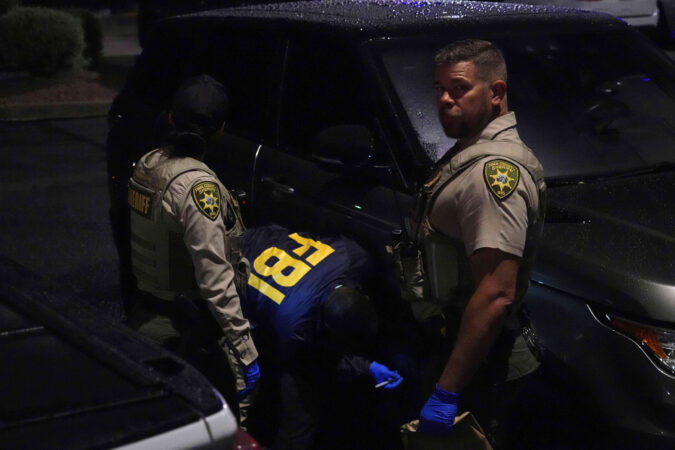
    Late Friday night, law enforcement agents sealed off a road about two miles (3.2 kilometers) from Guthrie’s home as part of their investigation. A series of sheriff’s and FBI vehicles, including forensics vehicles, passed through the roadblock.

    The investigators also tagged and towed a Range Rover SUV from a nearby restaurant parking lot late Friday. The sheriff’s department later said the activity was part of the Guthrie investigation but no arrests were made.

    On Tuesday, sheriff deputies detained a person for questioning during a traffic stop south of Tucson. Authorities didn’t say what led them to stop the man but confirmed he was released. The same day, deputies and FBI agents conducted a court-authorized search in Rio Rico, about an hour’s drive south of the city.

    Authorities have expressed concern about Nancy Guthrie’s health because she needs vital daily medicine. She is said to have a pacemaker and have dealt with high blood pressure and heart issues, according to sheriff’s dispatcher audio on broadcastify.com.

    Earlier in the investigation, authorities had said they had collected DNA from Nancy Guthrie’s property which doesn’t belong to Guthrie or those in close contact with her. Investigators were working to identify who it belongs to.

    The FBI also has said approximately 16 gloves were found in various spots near the house, most of which were searchers’ gloves that had been discarded.

  • Iran’s top diplomat to attend ‘indirect’ talks with U.S. in Geneva, state-run IRNA news agency says

    Iran’s top diplomat to attend ‘indirect’ talks with U.S. in Geneva, state-run IRNA news agency says

    DUBAI, United Arab Emirates — Iran’s top diplomat was traveling Sunday from Tehran to Geneva, where the second round of nuclear negotiations with the U.S. will take place, Iranian state media reported.

    Foreign Minister Abbas Araghchi and his delegation left for the Swiss city after the first round of indirect talks took place in Oman last week. Oman will mediate the talks in Geneva, the IRNA state-run news agency reported on its Telegram channel.

    Similar talks last year broke down after Israel launched what became a 12-day war on Iran that included the U.S. bombing Iranian nuclear sites.

    U.S. President Donald Trump has repeatedly threatened to use force to compel Iran to agree to constrain its nuclear program. Iran has said it would respond with an attack of its own. Trump has also threatened Iran over its deadly crackdown on recent nationwide protests.

    Gulf Arab countries have warned that any attack could spiral into another regional conflict.

    The Trump administration has maintained that Iran can have no uranium enrichment under any detail, which Tehran says it will not agree to.

    Iran continues to insist that its nuclear program is for peaceful purposes, but officials have increasingly threatened to pursue a nuclear weapon. Before the war in June, Iran has been enriching uranium up to 60% purity, just a short technical step away from weapons-grade levels.

    Araghchi is also expected to meet with his Swiss and Omani counterparts, as well as the director general of the U.N.’s atomic watchdog, the International Atomic Energy Agency.

    Earlier on Sunday, U.S. Secretary of State Marco Rubio said Washington remains interested in a diplomatic solution to ending its differences with Tehran, and that President Trump’s envoys Steve Witkoff and Jared Kushner were currently traveling for the new round of talks.

    Trump said Friday the USS Gerald R. Ford, the world’s largest aircraft carrier, was being sent from the Caribbean to the Mideast to join other military assets the U.S. has built up in the region. He also said a change in power in Iran “would be the best thing that could happen.”

    Rubio said recent military deployments in the Middle East were a protective measure aimed at shoring up the defenses of U.S. facilities and interests. Iran has threatened to attack U.S. bases in the region if Washington decides to strike. Tehran in June attacked the Al Udeid Air Base in Qatar, though no American or Qatari personnel were harmed.

    “No one’s been able to do a successful deal with Iran, but we’re going to try,” said Rubio at a news conference after meeting with Slovakian Prime Minister Robert Fico in Bratislava. “We are focused on negotiations.” Trump in recent weeks has suggested that his priority is for Iran to scale back its nuclear program, while Iran has said it wants talks to solely focus on the nuclear program.

    But Israeli Prime Minister Benjamin Netanyahu, who last week met with Trump in Washington, has been pressing for a deal that would neutralize Iran’s ballistic missile program and end its funding for proxy groups such as Hamas in the Gaza Strip and Hezbollah in Lebanon.

    The Israeli prime minister said in a speech Sunday that any deal between the U.S. and Iran must make sure that “all enriched material has to leave Iran.”

    It remains unclear how much influence Netanyahu will have over Trump’s policy on Iran. Trump initially threatened to take military action over Iran’s bloody crackdown on nationwide protests last month, but then shifted to a pressure campaign in recent weeks to try to get Tehran to make a deal over its nuclear program.

  • At least 6,000 killed over 3 days during RSF attack on Sudan’s el-Fasher, UN says

    At least 6,000 killed over 3 days during RSF attack on Sudan’s el-Fasher, UN says

    CAIRO — More than 6,000 people were killed in over three days when a Sudanese paramilitary group unleashed “a wave of intense violence … shocking in its scale and brutality” in Sudan’s Darfur region in late October, according to the United Nations.

    The Rapid Support Forces’ offensive to capture the city of el-Fasher included widespread atrocities that amount to war crimes and possible crimes against humanity, the U.N. Human Rights Office said in a report released on Friday.

    “The wanton violations that were perpetrated by the RSF and allied Arab militia in the final offensive on el-Fasher underscore that persistent impunity fuels continued cycles of violence,” said U.N. High Commissioner for Human Rights Volker Türk.

    The RSF and their allied Arab militias, known as Janjaweed, overran el-Fasher, the Sudanese army’s only remaining stronghold in Darfur, on Oct. 26 and rampaged through the city and its surroundings after more than 18 months of siege.

    The 29-page U.N. report detailed a set of atrocities that ranged from mass killings and summary executions, sexual violence, abductions for ransom, torture, and ill-treatment to detention and disappearances. In many cases, the attacks were ethnicity-motivated, it said.

    The RSF did not respond to an e-mailed request for comment.

    The paramilitaries’ Gen. Mohammed Hamdan Dagalo has previously acknowledged abuses by his fighters, but disputed the scale of atrocities.

    ‘Like a scene out of a horror movie’

    The alleged atrocities in el-Fasher, the provincial capital of North Darfur, mirror a pattern of RSF conduct in its war against the Sudanese miliary. The war began in April 2023 when a power struggle between the two sides exploded into open fighting in the capital, Khartoum, and elsewhere across the country.

    The conflict created the world’s largest humanitarian crisis with parts of the country pushed into famine. It has also been marked by heinous atrocities which the International Criminal Court said it was investigating as war crimes and crimes against humanity. The RSF was also accused by the Biden administration of carrying out genocide in the ongoing war.

    The U.N. Human Rights Office said it documented the killing of at least 4,400 people inside el-Fasher between Oct. 25 and Oct. 27, while more than 1,600 others were killed as they were trying to flee the RSF rampage. The report said it drew its toll from interviews with 140 victims and witnesses, which were “are consistent with independent analysis of contemporaneous satellite imagery and video footage.”

    In one case, RSF fighters opened fire from heavy weapons on a crowd of 1,000 people sheltering in the Rashid dormitory in el-Fasher university on Oct. 26, killing around 500 people, the report said. One witness was quoted as saying that he saw bodies thrown into the air, “like a scene out of a horror movie,” according to the report.

    In another case, around 600 people, including 50 children, were executed on Oct. 26 while taking shelter in the university facilities, the report said.

    The report, however, warned that the actual scale of the death toll of the weeklong offensive in el-Fasher was “undoubtedly significantly higher.”

    The toll does not include at least 460 people who were killed by the RSF on Oct. 28 when they stormed the Saudi Maternity hospital, according to the World Health Organization.

    Around 300 people were also killed in RSF shelling and drone attacks between Oct. 23 and Oct. 24 in the Abu Shouk camp for displaced people, 1.5 miles northwest of el-Fasher, the U.N. Human Rights Office’ report said.

    Woman and girls sexually assaulted

    Sexual violence, including rape and gang rape, was apparently widespread during the el-Fasher offensive, with RSF fighters and their allied militias targeting women and girls from the African Zaghawa non-Arab tribes over allegations of having links to or supporting the miliary, the report said.

    Türk, who visited Sudan last month, said survivors of sexual violence recounted testimonies that showed how the practice “was systematically used as a weapon of war.”

    The paramilitaries also abducted many people while attempting to flee the city, before releasing them after payment of ramson. Thousands have been held in at least 10 detention centers — including the city’s Children Hospital, which was turned into a detention facility — run by the RSF in el-Fasher, the report said.

    Several thousands of people remain missing and unaccounted for, the report said.

    The pattern of the RSF offensive on el-Fasher was a mirror of other attacks by the paramilitaries and their allies on the Zamzam camp for displaced people, 9 miles south of the city, and on West Darfur’s city of Geneina and the nearby town of Ardamata in 2023, the U.N. Human Rights Office said.

    Türk said there were “reasonable grounds” that RSF and their allied Arab militias committed war crimes, and that their acts also amount to crimes against humanity.

    He called for holding those responsible — including commanders — accountable, warning that “persistent impunity fuels continued cycles of violence.”

  • First major protests since capture of Maduro test Venezuela’s new leader

    First major protests since capture of Maduro test Venezuela’s new leader

    CARACAS, Venezuela — Hundreds of protesters took to the streets in Venezuela’s capital and across the country last week for Youth Day, asserting their right to demonstrate and calling for acting president Delcy Rodríguez to release political prisoners.

    Thursday’s rallies, which proceeded peacefully, were seen as a test for the new government — the first major show of opposition in the streets since the U.S. capture Jan. 3 of President Nicolás Maduro, and since security forces made thousands of arrests in a large-scale crackdown on dissent in 2024, after Maduro claimed victory in an election that evidence shows he lost.

    “We are not afraid anymore,” Zahid Reyes, 19, a student leader at the Central University of Venezuela in Caracas, said as he was getting ready to join a campus rally. “Venezuela has changed.”

    “Amnesty now,” read banners at campus entrances.

    An air of excitement prevailed, among the hundreds of students looking to give new voice to an opposition that faced increasingly harsh repression in recent years. Police and security forces cordoned off the area.

    Miguel Angel Suarez, also from the Central University of Venezuela, said he was proud of students for claiming their right to protest. After Jan. 3, an opportunity opened, he said. “The fight will continue until we are heard.”

    Venezuelan lawmakers are debating a mass amnesty of political prisoners, under pressure from the United States. Hundreds have been released since U.S. forces seized Maduro in a surprise raid that left at least 32 people dead — in what Venezuela’s government condemned as an illegal attack — and brought him to New York to face narco-terrorism charges, but an even larger share remain behind bars.

    “I am filled with hope,” said Aryeliz Villegas, 22, a student at the university. “Whenever the country breaks down, the youth rise up.”

    The demonstrations come as U.S. and Venezuelan relations are undergoing a fundamental change: President Donald Trump has forged ahead with plans to work with the authoritarian, socialist government of Maduro’s successor, Rodríguez, to open the country’s oil sector to the U.S. — while keeping at arm’s length the opposition, including Nobel laureate María Corina Machado, the key opposition leader in exile.

    Many young activists say Maduro’s ouster feels like a fundamental shift, even if the opposition remains far from power. Andrea Isea, 33, a law student at the university, said the events of recent months have given her a new sense of purpose in her chosen profession. “I used to think about why I was going to all this trouble to study law in this country, but after January 3rd, I can see that there can be a future here for us students,” she said.

    In downtown Caracas, Maduro loyalists held their own Youth Day celebration, with government support, calling for his return. Demonstrators said he had been kidnapped and remained the rightful president. Music from the Puerto Rican artist Bad Bunny blared from speakers, as organized groups — many of them teenagers in school uniforms — danced, drummed, and marched under a warm sun.

    Rodolfo Machado, 24, a city official focused on youth employment, said he thought Venezuela should continue “fighting against Westernism,” and that the U.S. exploits South America. “Delcy Rodríguez carries Nicolás Maduro’s mandate because she is a person who is prepared to continue fighting,” he said.