Tag: no-latest

  • A long-planned LGBT cruise has been blocked from stopping in Turkey

    A long-planned LGBT cruise has been blocked from stopping in Turkey

    Officials in Turkey are prohibiting an all-gay cruise from spending multiple days in the country next week during a voyage from Athens to Venice, according to the company organizing the trip.

    Turkish government and tourism representatives did not respond to inquiries from the Washington Post on Friday. Virgin Voyages, which owns the ship, also could not immediately be reached.

    But Sunday, the official X account for the provincial government that includes the port city of Kusadasi posted a news release stating that the July 7 call of a chartered cruise ship had been canceled. The post said groups on the ship were “known for their behavior incompatible with our society’s structure and moral values,” according to an English translation.

    The 10-night Mediterranean sailing aboard Scarlet Lady will depart from Athens on Sunday and include other ports.

    Broadway star Patti LuPone, who is performing on the cruise, shared her outrage on social media.

    “A ship — a magnificent ship — full of well-heeled gay men. And me. Denied entry to Turkey simply because of who is on board,” she wrote on Facebook. “I am ready to perform for all the wonderful men on this Atlantis cruise, who deserve so much better than this.”

    The cruise has been planned for more than a year, said Rich Campbell, CEO of trip organizer Atlantis Events. He said he first got word a week ago that there might be an issue.

    On Saturday, he said, the port agency — which serves as the connection between cruise lines and authorities where they dock — sent a letter to the cruise line telling them the port calls would be denied by the government.

    Campbell said he was sure there was a mistake. The Los Angeles-based company, which charters large ships for LGBT experiences, has brought travelers to Turkey more than a dozen times over 20-plus years, including last year, and had “a fantastic tourist experience.”

    “We’re there to shop, be great tourists, spend money,” he said. “It’s always a culturally respectful group.”

    Campbell said that despite multiple efforts to stick to the original itinerary, including assistance from the U.S. Embassy, he learned Thursday that the decision would not change.

    The U.S. State Department declined to comment on the case, directing questions to the company, but said in a statement that the U.S. Embassy in Ankara “regularly promotes U.S. business and commercial interests” in the country.

    Atlantis sent a notice about the change to passengers Thursday, informing them that the new itinerary would include a full day in Alexandria in Egypt and a stop in Crete.

    “Despite exhaustive efforts on our part to reverse this decision, our calls to Istanbul and Kusadasi have been canceled by the Turkish Authorities,” the message to passengers said. “We know that this change is disappointing and truly wish that we could have kept our visits to Turkey as planned. … They have always been a highlight of our voyages, and we look forward to returning soon.”

    Campbell said he believes Turkey will lose at least $1 million in revenue by blocking the passengers from spending three days in the country.

    “The bigger damage to Turkey is when you start picking and choosing who’s allowed to enter, and your economy depends on tourism, you’re creating a standoff between tourists and yourself,” he said. “And you run the risk of alienating a lot of potential tourists.”

    While same-sex relationships are not illegal in Turkey, top leaders have expressed antigay sentiment. A Pride march in Istanbul has been banned for more than 10 years. Police detained dozens of people in recent days during a gay pride event that was held despite a ban, Agence France-Presse reported.

    Campbell said there has not been a threat to travelers on his company’s cruises. And he doesn’t believe Turkey is hostile to gay tourists, even considering the recent action.

    “I think it’s a bad call, but unfortunately it has the potential for long-term repercussions,” he said.

  • Iran’s new leadership is younger, savvier, ruthless, and even more hard-line

    Iran’s new leadership is younger, savvier, ruthless, and even more hard-line

    The death of Iran’s supreme leader on the opening day of the war raised U.S. and Israeli hopes that the regime he led — and that has held the country in an Islamic vice grip since 1979 — had been pushed to the brink of collapse.

    Four months later, however, as Iran stages a belated state funeral for Ayatollah Ali Khamenei, the burial rites testify instead to the Islamic republic’s survival and mark the ascendance of a new generation of leaders that is more entrenched and hard-line, according to security officials and experts.

    Led by Khamenei’s son and successor, Mojtaba — who has remained in hiding since being injured in the same strike that killed his father — the new hierarchy is younger, has better command of the state’s levers of power, has gained insights from the U.S. wars in Iraq and Afghanistan, and is savvier about soft-power tools including diplomacy and online propaganda.

    After surviving months of strikes by two of the world’s most potent militaries, the regime has emerged emboldened, officials and experts said, and remains ruthless. It reportedly has carried out a campaign of executions against domestic critics and political opponents even as it continues intermittent strikes in the Persian Gulf and flexes its control over the Strait of Hormuz.

    Iran “might be weaker when it comes to its economic situation, its industries, some of its strategic capabilities,” said Raz Zimmt, head of Iran research at the Institute for National Security Studies in Israel. “But the bottom line is that we are facing a new, bolder, self-confident Iran.”

    Nearly all of those now in high-ranking positions spent formative years as lieutenants in security agencies or military units responsible for crackdowns on domestic protests, arming proxy militias including Hezbollah and Hamas, and rising through the ranks of elite organizations including the Islamic Revolutionary Guard Corps.

    The roster includes Mohammad Bagher Zolghadr, who has taken on the influential role of secretary of the Supreme National Security Council of Iran. He is a former Revolutionary Guard commander with deep ties to the Quds force, the IRGC branch that trains allied militias.

    Ahmad Vahidi, the Revolutionary Guard’s new commander in chief, backed the violent crackdown against women’s rights protests in 2022, according to officials and experts.

    Mohsen Rezaei, the new military adviser to the supreme leader, is an ardent advocate of escalation in response to any U.S. and Israeli attacks, experts said.

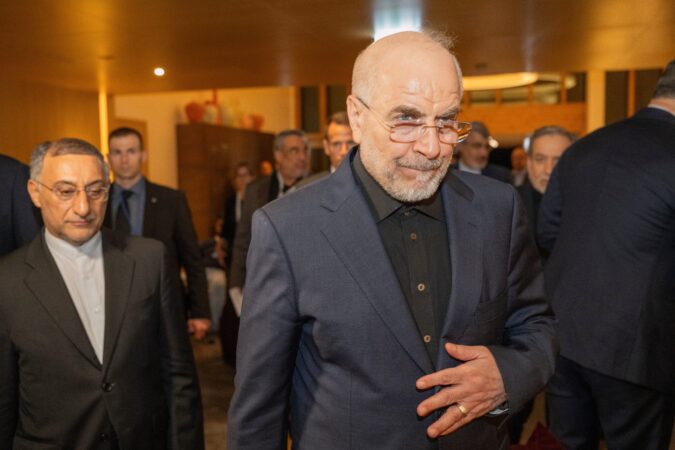
    Even those perceived as moderates by the Trump administration were shaped by years spent in security agencies or war zones. Mohammad Bagher Ghalibaf, speaker of the Iranian parliament and a main representative in peace talks with the United States, served as an IRGC commander during the Iran-Iraq war.

    By contrast, Iranian leaders with civilian backgrounds largely have been sidelined as part of the war-driven shake-up, officials and experts said. They include President Masoud Pezeshkian and Foreign Minister Abbas Araghchi, who previously led talks with the United States but has seen his position and influence diminished.

    The swift consolidation of power by loyalists contradicts claims by President Donald Trump that the war accomplished “regime change” and empowered pragmatists willing to acquiesce to U.S. demands.

    “They have a new group of leaders,” Trump said during the Group of Seven summit in France last month. “Actually, I think they’re smart. … They’re far less radicalized, and I think they’re very, very good.”

    Instead, officials and experts said that Trump’s approach — including threats to annihilate Iran’s civilization, a country of more than 90 million — has bolstered hard-liners’ claims that the country is in an existential struggle with the United States and its allies.

    This has weakened the hand of moderates who were key to negotiations over Iran’s nuclear program a decade ago.

    Experts and officials warn that the younger Khamenei and his inner circle probably will face a more difficult test when the war truly ends, and they confront the challenge of rebuilding Iran’s battered economy and improving conditions for its people.

    The Trump administration’s agreement, in a preliminary memorandum of understanding, to release billions of dollars in frozen Iranian assets and provide other financial benefits could deliver a lifeline to Iran’s new leadership team.

    The regime also faces more immediate challenges, such as demonstrating that the younger Khamenei has recovered from injuries sustained in the strike that killed his father and is capable of handling the full range of duties — including the public appearances that come with being supreme leader.

    The funeral looms as a critical test of the regime’s confidence that he can be protected, and will be scrutinized by analysts at the CIA and other intelligence agencies — much as they scoured footage of Soviet parades and politburo meetings during the Cold War — for clues to the leader’s condition and the identities of others who have gained clout.

    Even in peace time, Mojtaba Khamenei kept a low profile. He has been photographed in public only a handful of times, and few Iranians have heard him speak.

    The war sent him deeper underground. Officials and experts said that he probably is being moved among bunkers and other secure locations to protect him from airstrikes or assassination.

    The funeral, however, is the first mass public gathering since the war, creating pressure on the regime for Khamenei to appear.

    “He’s the head of state. A religious leader. And it’s the funeral for his father,” said Norman Roule, a former CIA officer and an expert on Iran. “His failure to appear at his father’s funeral, mourn publicly, and project command would be interpreted by many inside Iran and abroad as evidence of his personal weakness, physical incapacity, or even death.”

    An Iranian diplomat who spoke on the condition of anonymity to discuss sensitive diplomacy said it was unlikely that Khamenei would appear, in part out of fear that the United States or Israel would try to kill him.

    “The Iranian people first and foremost need him to be safe, so he can lead the country,” the diplomat said. “The United States and Israel have shown that they are bound by no commitments.”

    Even in hiding, Khamenei is believed to be handling high-level decisions, U.S. and Middle Eastern officials said, though security precautions have meant that his decisions and statements mainly are relayed through intermediaries, creating a cumbersome dynamic.

    ‘It’s very clear by now that Mojtaba Khamenei is making the strategic decisions,” Zimmt said, while those below him have formed a leadership “collective” that has influence on key issues but answers to the ayatollah.

    Khamenei is believed to have set boundaries for negotiations with the United States, experts said, ruling out substantive discussion of Iran’s nuclear program before a durable ceasefire took effect.

    Like his father, he also has distanced himself from decisions that could backfire. He publicly expressed reservations about the MOU his government signed with the United States, for example, but allowed it to proceed citing assurances from subordinates.

    He also took a shot at his U.S. counterpart. Iran had agreed to sign the memo “out of compassion and goodwill,” he said, while Trump had done so “out of desperation.”

    The new leadership team supplants a generation forged by years of operating in the shadows of the resistance to the autocratic rule of the shah, followed by the chaotic 1979 revolution and its aftermath.

    Those in charge now, experts said, are part of a postrevolutionary cohort who are less extreme in their religious views but equally ruthless in their willingness to use brutal force to maintain control.

    Their understanding of the United States has less to do with the hostage crisis of 1979 than their front-row view of the wars in Iraq and Afghanistan, conflicts that went on for years but ended with the United States having achieved few of its core aims.

    The new group’s more sophisticated grasp of American pressure points may account for Iran’s strategy of launching retaliatory strikes against Persian Gulf allies of the United States, as well as its halting of tanker traffic through the Strait of Hormuz, which yielded major economic leverage.

    Even after an initial ceasefire was announced in April, Iran has demonstrated that it remains willing to resume its use of military force, an aggressive stance that has helped it extract key economic concessions from the United States and allowed the regime to craft a narrative at home that it prevailed in the war.

    “They are brimming with confidence,” said a European official in regular contact with Iranian officials, who spoke on the condition of anonymity given the sensitivity of the matter. “They not only survived, they rediscovered the Strait of Hormuz as a big lever, and they really think that they can dictate terms.”

  • ‘Who should I vote for?’ Voters turn to AI before casting their ballots

    ‘Who should I vote for?’ Voters turn to AI before casting their ballots

    Mia Taylor looked down at her Los Angeles County election ballot a few weeks ago and felt a familiar mix of duty and dread. How could she possibly know the best choices in the dozens of local contests she was asked to vote in? Partly on a lark, she turned to a newly ubiquitous tool: Claude.

    Taylor snapped a picture of her ballot and asked: “So, who do I vote for here?”

    Claude, an artificial intelligence chatbot developed by Anthropic to analyze data and hold natural conversations, initially declined to answer. Like OpenAI’s ChatGPT and Google’s Gemini, other widely used tools, Claude is trained to avoid answering political questions that could expose biases.

    So Taylor, a self-described liberal Democrat, sharpened her question, asking it to find links to well-regarded progressive groups and help her come up with strategic voting options.

    “Here are some sources you can look at,” it replied, linking to voter guides and describing each race in detail. Taylor was especially torn about her vote for mayor, wondering how she could help stop Spencer Pratt, the Republican who momentarily looked likely to win one of the top two spots in the open primary. Claude’s advice: Vote for the incumbent, Karen Bass, not Nithya Raman, a member of the City Council. (Pratt later lost the race, while Bass and Raman advanced to the general election.)

    It was probably only a matter of time before voters began to use artificial intelligence to help guide their choices. The 2026 midterms may be the first U.S. elections in which voters are using AI in meaningful numbers.

    Voters are turning to new AI tools to serve as nonpartisan researchers, viewing them as a viable alternative to traditional news coverage, voter guides, or social media. They provide an appealing and seemingly efficient way to learn about campaigns and ballot measures, allowing users to bypass the sometimes dizzying array of political literature, advertising, and commentary coming their way. But some experts warn that the tools are far from foolproof: The results they produce can be marred by factual errors or shaped by flawed assumptions.

    Chris Johnson, a 58-year-old resident of Atlanta, appreciates the allure of relying on AI to choose candidates and the worry about its accuracy.

    Johnson, a registered Republican who considers himself a libertarian, has voted in every Georgia election for the past 40 years. When he prepared to vote in the state primary in May, he asked ChatGPT to tell him which of the candidates was the most libertarian. Initially, the system resisted answering directly, so Johnson asked it to rely on the candidates’ voting history. The chatbot suggested Brad Raffensperger, the Georgia secretary of state who was running for governor in the Republican primary but ultimately lost the race.

    Johnson felt chagrined by how easy it was. He recalled that for years he read the print edition of the local newspaper to come up with his own sense of which candidates most closely matched his values.

    “I felt a bit lazy for not doing more,” he said. “It felt easier, but I am not sure that everything was correct.”

    The appeal of artificial intelligence tools, also referred to as large language models, lies in their simplicity: Users often find the information they produce more straightforward and understandable than data from a more traditional internet search. And many welcome the interaction. Researchers and AI companies are already envisioning a time when political campaigns create their own chatbots, enabling voters to question them directly.

    “There is a reason these models are persuasive: They come up with facts or factual claims and are just good clear explainers,” said David G. Rand, a professor of information science, marketing, and psychology at Cornell University who has done extensive research on the effectiveness of artificial intelligence in political persuasion.

    Earlier this year, before voting in a local school board election, Rand turned to artificial intelligence for help. He uploaded an hourlong video of a campaign forum and then asked which of the candidates most closely matched his values. He used this research to make his choices. And when he ran his picks by friends who were more involved in local politics, they endorsed his reasoning.

    Still, Rand noted, the output is only as good as the input: AI tends to reaffirm and mirror users’ biases, framing candidates’ views through the voters’ lens, rather than objective facts.

    Anthropic, the parent company of Claude, has said users asking about political topics “should get comprehensive, accurate and balanced responses — responses that help them reach their own conclusions rather than steer them toward a particular viewpoint.” In a lengthy statement this year, the company said Claude is trained to “treat different political viewpoints with equal depth, engagement, and analytical rigor.”

    Jeremiah Hain, a 42-year-old psychotherapist in Los Angeles who has used ChatGPT routinely for other small tasks, recently employed it to help him choose candidates in races for mayor and various other offices.

    “I don’t have the time, nor did I want to do the same kind of research I have done in the past,” he said. “This was very intuitive, and I actually respect its intelligence, I guess.”

    He was so enamored of the process that he posted a video on TikTok encouraging other voters to do the same. (And because he knows his videos get more engagement when he is shirtless, Hain filmed himself bare-chested. “I wanted to do this as a thirst trap on purpose,” he said.)

    But that sense of efficiency may mask the risks of turning over the democratic process to technology, some experts warn. Because most chatbots produce answers that sound confident and authoritative, users may not make the time to check the underlying claims.

    Ideally, AI tools for election help would rely on a curated and verified database of political information and policy platforms to help voters, rather than pulling data from across the internet, as the existing tools do, said Yamil Velez, a political science professor at Columbia University who has researched the effectiveness of AI in convincing voters. But he was reluctant to completely dismiss the usefulness of AI in election decisions. “It is important to think about what is the alternative,” he said. After all, he added, most voters are unlikely to spend hours in the county clerk’s office researching their election options.

    A year ago, Velez added, he would have said that voters would be better off relying on an internet search, but the AI tools are becoming increasingly accurate.

    Nonetheless, he cautioned, the current tools likely benefit candidates who are more vocal in the local press and on social media, making their views easier to find. Campaign strategists are keenly aware that voters are using these tools and have begun looking for ways to get more favorable results by publishing more material online in formats that chatbots prefer, such as using bullet points.

    Still, in interviews, people who had used AI to research election choices said it allowed them to vote with more confidence.

    Robert Siebelink, a 54-year-old Democrat who lives in Corona, Calif., turned to Claude after feeling overwhelmed by the prospect of researching the 61 candidates running for governor in his state, not to mention the candidates in less high-profile races. He uploaded his ballot and asked Claude to suggest candidates who most aligned with his values.

    Eventually, he had narrowed down his choice for governor to two Democrats, Xavier Becerra and Tom Steyer, and asked Claude how to strategize.

    In less than half an hour, he had filled out his ballot and chosen Becerra.

    “I just felt so refreshed,” Siebelink said. “That’s the most informed voting that I have ever done.”

    “It felt like some political expert that knew all of the research and we just sat down over coffee and chatted, and they took notes,” he said.

    Similarly, Rikki Powers, a 31-year-old Democrat who lives in Baltimore, took a photograph of his ballot before the recent Maryland primary and asked Claude to provide bullet points for each candidate. He said he was looking for a broader perspective than what he could get from candidate campaign websites. After checking some of the links for accuracy and to “make sure that I truly like the candidates I am voting for,” he used the summary to fill out his ballot on the spot.

    “The last time I voted, I spent probably 20 hours researching,” he said. “This time was an hour.”

    Still, Powers said, there are limits: While he had no hesitation uploading a blank ballot, he would never tell AI how he voted.

    This article originally appeared in the New York Times.

  • Taylor Swift and Travis Kelce marry in front of famous friends at Madison Square Garden

    Taylor Swift and Travis Kelce marry in front of famous friends at Madison Square Garden

    NEW YORK — Taylor Swift and Travis Kelce married Friday night at Madison Square Garden, where actor Adam Sandler was the surprising officiant at the ceremony and Stevie Nicks performed among a crowd packed with stars of sports and entertainment. The deep secrecy that surrounded the buildup to the nuptials lifted when a marquee outside the Midtown Manhattan arena proclaimed “JUST&T MARRIED” once the deed was done.

    The couple did not have bridesmaids or groomsmen, instead having Swift’s younger brother Austin Swift serve as her man of honor with Kelce’s big brother and podcast co-host Jason Kelce his best man, Swift’s publicist Tree Paine said in an email.

    The bride and groom’s outfits came from Christian Dior Haute Couture and its designer Jonathan Anderson, with shoes custom-made by Christian Louboutin. She wore Cartier jewelry.

    An almost-royal wedding

    The long anticipated union of sports and song brought hype to new heights at a venue made more for historic NBA games and bucket-list concerts. The Kansas City Chiefs’ superstar tight end and the music megastar married as fans and spectators gathered outside in blistering heat, eager to be part of the occasion, even though the event was almost entirely hidden.

    Actors Bradley Cooper, Zoë Kravitz, Hugh Grant and Ethan Hawke; models Gigi Hadid and Karlie Kloss; comic Chris Rock; director Steven Spielberg; singer Camila Cabello; and author Jenny Han were among the guests from the world of arts and entertainment. Kelce’s coach Andy Reid and Chiefs teammates including running back Kareem Hunt were among the sports figures in the arena, along with retired NFL superstar Tom Brady, Seattle Seahawks receiver and recent Super Bowl champ Cooper Kupp, New York Giants receiver JuJu Smith-Schuster, and ESPN personalities Joe Buck and Stephen A. Smith.

    In a culture obsessed with famous couplings it may have been the apex celebrity wedding, with perhaps only royal unions getting more attention. Holding such a ceremony in a huge, iconic space that sits at the center of the U.S. media universe while keeping all the details secret made for a surreal scene, but it was a mix of hype and hush that is not out of character for Swift.

    A shrouded ceremony headed by Happy Gilmore

    An Associated Press camera outside the arena showed a long line of black SUVs dropping off wedding-goers in tuxedos and evening gowns, surrounded by New Yorkers in shorts and Swifties amassing for the occasion. Rain briefly cut the heat shortly after the marriage was announced.

    There was a seemingly total lack of social media posts from guests once they had entered the arena, with phones apparently banned.

    However, on Saturday, hosts of Good Morning America who had been invited to the wedding confirmed that Nicks performed and described the space as “intimate.”

    “As intimate as it could possibly be given it was Madison Square Garden. Really this garden inside the garden, just so beautiful,” said George Stephanopoulos. “It’s hard to imagine a place that big and a wedding with such stars could feel so personal and so intimate.”

    Robin Roberts added that both Swift and Kelce wrote their own vows.

    Weddings have been a constant subject in Swift’s songs since she was a teenager, and her actually walking the aisle for the first time at age 36 added to the drama. It was also the first marriage for the 36-year-old three-time Super Bowl champ Kelce, who could have been one of the jock characters in Swift’s early hits.

    Sandler, star of The Wedding Singer and many other hit comedies, can’t have been high on anyone’s betting list for who would marry the couple, though he’s become an increasingly warm and paternal cultural figure with age. The email announcing the marriage described him as “a friend” of the couple. Kelce was one of the many athletes who appeared in Happy Gilmore 2, Sandler’s 2025 sequel to one of his first hits, and Sandler appeared last year on the Kelce brothers’ New Heights podcast.

    Welcome to New York — Taylor’s version

    The Swift-Kelce relationship has thrilled and fascinated millions around the world — particularly the Swifties, the pop star’s enormous and ardent fan base — ever since the pair first started dating in 2023 after he showed up at her Eras Tour concert at the Chiefs stadium.

    Happy fans mixed with frazzled tourists outside the arena.

    Lori Powers, who lives an hour north of Manhattan and rode the train in to be near the nuptials, said Swift’s “music is the soundtrack behind so many amazing moments in my life. Relationships, friends, like my husband and my kids.”

    She stood outside the arena before the marriage was announced with her friend Cecily Hall.

    “Just being here and witnessing all the energy and the excitement, it’s so much fun,” Hall said. “The combination of sports and music makes perfect sense as to why they’re at Madison Square Garden today.”

  • Dear Abby | Man’s excuses and absences continue to expand

    DEAR ABBY: I have been married to my husband for 10 years. Ever since I have known him, he has had issues with depression and anxiety. I have tried to support him through these diagnoses.

    He has attempted to go to therapy several times, but he never sticks with it. Once the therapist gets to the point where they start to get into what he needs to work on, he quits. He claims no one understands what he is going through. This has impacted every aspect of his life — sleep, eating habits and his controlling attitude toward me. He also works out excessively (like five hours a day).

    It has also affected his ability to enjoy life and his job. He takes a lot of time off work, claiming he needs the rest, but he doesn’t rest. He does other things. When I say he needs to go to work like everybody else, he gets mad. His employer is now on his case for excessive absences. He refuses to take responsibility and says his employer is “targeting him.” Nothing is ever his fault. There is always an excuse.

    This has greatly affected our marriage and his relationships with our two children, who really want their dad around, but he is not. I am a counselor. I see narcissistic tendencies in his behavior. I love him very much, and he has not always been like this. I don’t want to quit on him, but I don’t know what to do. I can’t continue to live like this, and I need to help our children live their best lives. Please help.

    — LIKE A SINGLE PARENT IN NEW MEXICO

    DEAR SINGLE PARENT: I am sure that, as a therapist, you realize you can’t help someone who refuses to be helped. It is time to put the welfare of your children first. Give your husband an ultimatum: Get help for his issues and stick with it, or you are leaving and taking the children with you. The atmosphere you have described is unhealthy for them and for you as well. P.S. As I’m sure you are aware, some counselors have therapists. Please consider enlisting some emotional support for yourself as you make your way through this.

    ** ** **

    DEAR ABBY: I have a friend whom I love and enjoy being with. However, when we spend extended periods of time together, such as a few days on a trip, it doesn’t work well because of our personalities and belief systems. She is not aware of the struggles I have when spending more than a few hours with her and regularly invites me to go on trips with her. I have put her off a few times without telling her the truth. Is there a polite way to tell her that I’d rather not go on a trip with her?

    — BRIEFLY IN DELAWARE

    DEAR BRIEFLY: Tell your friend that you love her and enjoy being with her, but that if it involves leaving home for any length of time it makes you “anxious.” You do not have to explain any further. You may, however, have to refrain from telling her about any travel you do with other, more compatible friends.

    ** ** **

    DEAR READERS: Happy 250th birthday to the USA! Let’s all enjoy a safe and happy Fourth of July! P.S. Wishing a Happy Heavenly Birthday to you, Mom!

    — LOVE, ABBY

  • Horoscopes: Saturday, July 4, 2026

    ARIES (March 21-April 19). Freedom is not only the ability to go where you please. It is the ability to become who you are. Trust your own judgment. Celebrate the choices that make your life feel more fully your own.

    TAURUS (April 20-May 20). Bravery means continuing even when the outcome isn’t guaranteed. On some level, there are no guarantees on this plane of existence, so it takes a certain amount of courage just to live an ordinary day. But you take it to another level, doing the extraordinary with a brave heart.

    GEMINI (May 21-June 21). Fireworks begin as stored energy waiting for release. So do many dreams. Something you’ve been imagining is ready to move from possibility into action. The first actions will have to do with preparing your workspace with the intent of “safety first.”

    CANCER (June 22-July 22). You embody the pursuit of happiness. Freedom is not only about escaping limitations; it’s also about moving toward what delights you. There’s a playful quality to this day you spend in the pursuit of experiences that put a smile on your face.

    LEO (July 23-Aug. 22). Consider what deserves your allegiance and what does not. Decide which values to lead with. What needs to happen for these values to be represented in your daily life? In a sense, every habit is a vote for your values.

    VIRGO (Aug. 23-Sept. 22). For you, freedom is not the absence of responsibility but being able to choose your commitments instead of being assigned them. Because you know who you are, it’s not hard to distinguish the path that best suits you.

    LIBRA (Sept. 23-Oct. 23). You believe groups are strongest when many different voices find a way to share the same table. You have a gift for bringing people together without requiring them to be alike. Your curiosity and respect create a harmonious atmosphere wherever you go.

    SCORPIO (Oct. 24-Nov. 21). Like a bald eagle riding a thermal high above the landscape, you gain perspective by rising above the immediate situation. Details fit into a larger context. From this altitude, you see where the path on the ground leads.

    SAGITTARIUS (Nov. 22-Dec. 21). Independence is not isolation. You can be independent with people around you or while working as part of a team because independence is a spirit inside you. The point is not to stand apart. The point is to stand firmly in your own choices.

    CAPRICORN (Dec. 22-Jan. 19). Fireworks last only moments, but the planning behind them takes time. You understand this principle well. The visible result is never the whole story. Your preparations will culminate into just the “wow factor” you were going for.

    AQUARIUS (Jan. 20-Feb. 18). Here you go again, expanding the definition of what is possible. Because why preserve old systems when you can improve them? And you’re so good at attracting others willing to experiment and create. Together you’ll flesh out an unconventional idea.

    PISCES (Feb. 19-March 20). There is magic in simple togetherness. Some of the happiest moments happen around a picnic table or at a backyard gathering. It’s all about just plain fun. That’s how freedom rings for you, and the sound carries on and on.

    TODAY’S BIRTHDAY (July 4). It’s your Year of the Lucky Lamp. Like the legendary lamp of Aladdin, it is not the object itself but what it awakens that matters. Opportunities and helpers appear when called upon with intention. And your wish for more love comes true first. More highlights: A person with influence becomes an ally. A purchase improves life in lasting ways. Milestones for family are a huge point of pride and purpose. Sagittarius and Gemini adore you. Your lucky numbers are: 7, 18, 29, 3 and 14.

  • Taylor Swift and Travis Kelce marry in elaborate Madison Square Garden ceremony

    Taylor Swift and Travis Kelce marry in elaborate Madison Square Garden ceremony

    NEW YORK — Taylor Swift and Travis Kelce are married. Swift’s publicist confirmed the marriage took place Friday evening inside Madison Square Garden at a star-packed ceremony.

    The couple did not have bridesmaids or groomsmen, instead opting for Swift’s brother to serve as her man of honor and Kelce’s brother Jason serving as his best man.

    The wedding between the superstar singer and football player took place as fans and spectators gathered outside MSG in the blistering heat, eager to be part of the occasion, even though the event was almost entirely hidden away from the public.

    Very few details were disclosed in the buildup to the wedding weekend. Yet a permit obtained by the Associated Press this week and other sources helped confirm that the high-profile event would indeed take place at MSG over the July Fourth weekend, packed with its own set of festivities amid a massive heatwave.

    The long anticipated union of sports and song brought hype to new heights at a venue made more for historic NBA games and bucket-list concerts.

    Singer Camila Cabello, actors Hugh Grant, Ethan Hawke, and Jason Sudeikis, and model Karlie Kloss were among those who arrived. Running back Kareem Hunt was among Kelce’s Chiefs teammates in attendance. Seattle Seahawks receiver and recent Super Bowl champ Cooper Kupp, New York Giants receiver JuJu Smith-Schuster, NFL announcer Joe Buck, and Jenny Han, author of the The Summer I Turned Pretty series, also entered the arena.

    In a culture obsessed with famous couplings it may be the apex celebrity wedding, with perhaps only royal unions getting more attention. Holding such a ceremony in a huge, iconic space that sits at the center of the U.S. media universe while keeping all the details secret made for a surreal scene, but it was a mix of hype and hush that is not out of character for Swift.

    An Associated Press camera outside the arena showed a long line of black SUVs dropping off wedding-goers in tuxedos and evening gowns, surrounded by New Yorkers in shorts and Swifties amassing for the occasion.

    Celebrities, athletes, and friends were posting on social media about getting ready or being about to leave for a black-tie event, including Brandon Borders, producer of the New Heights podcast starring Kelce and his brother Jason; Beau Allen, retired defensive lineman for the Philadelphia Eagles; and Jessica Chastain.

    There was a notable lack of social media posts from guests once they had entered the arena, after reports that phones would not be allowed.

    A city permit obtained by the AP shows that the ceremony and its celebration could last until 4 a.m. Guests appeared as though they were coming to a big awards show, but their arrivals were obscured by tents and gazebos. There is a decent chance of rain hitting the area before the night is over.

    Weddings have been a constant subject in Swift’s songs since she was a teenager, and her actually walking the aisle for the first time at age 36 adds to the drama. It is also a first marriage for the 36-year-old three-time Super Bowl champ Kelce, who could have been one of the jock characters in Swift’s early hits.

    Outside the arena, some frazzled tourists joked that it was a bad weekend to visit as they navigated strict road and sidewalk closures, but others appeared happy to sneak a peak at the spectacle. Police cut off most access where guests were being dropped off, but a few patrons gathered in nearby businesses and peered out windows.

    Diana Warshavsky, who lives in New York, decided to head over to MSG on Friday to celebrate Swift and Kelce’s wedding with fellow Swifties and “send her good vibes.”

    “We’re relatively the same age, I’m a year older than her and I just got married this year as well,” Warshavsky said. “I’m just so happy for her.”

    The relationship of the pop star and the football player has continued to thrill and fascinate millions around the world — particularly the Swifties, the pop star’s enormous and ardent fan base — ever since the pair first started dating in 2023.

    The weekend is jam-packed even by New York’s standards. The city is celebrating the nation’s 250th birthday, a parade of dozens of tall ships will sail the Hudson River, and a World Cup game is scheduled in New Jersey.

    Earlier this week, Swift and Kelce donated $26 million to 20 local and national charities across the U.S. Many of the organizations were located in areas where the couple has deep ties, including Nashville, Tenn.; Los Angeles; Kansas City, Mo.; and New York.

  • Fallout from Venezuela’s earthquakes turns political as opposition leader seeks return

    Fallout from Venezuela’s earthquakes turns political as opposition leader seeks return

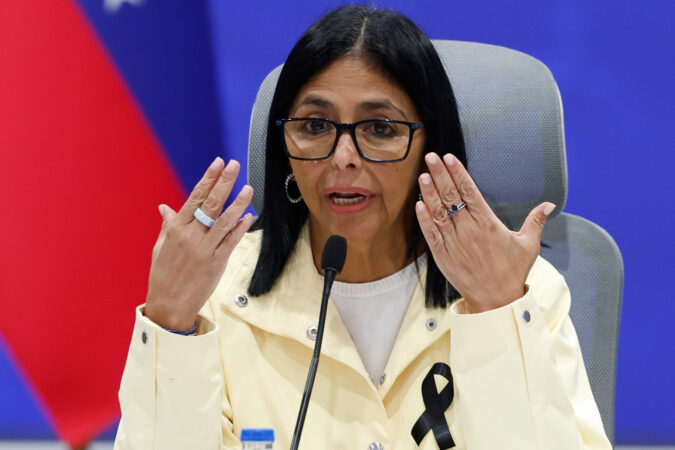
    CARACAS, Venezuela — The fallout from Venezuela’s powerful twin quakes has evolved into a major test for acting President Delcy Rodríguez, sending her scrambling to prevent the humanitarian disaster from becoming a political one as her mandate as interim leader expired Friday.

    A day after Rodríguez angrily defended the competence of her government’s relief effort at her first news conference since the June 24 disaster, her main rival, exiled Venezuelan Nobel Peace Prize laureate María Corina Machado, issued her own appeal.

    Speaking Friday from Panama, Machado argued that the government’s quake response exposed its critical weaknesses and that her return to Venezuela “contributes to facilitating the transition process, especially after the tragedy.”

    “My presence stabilizes the situation; it is part of the organizing forces that the country needs at a time when the total absence of the state has become evident,” Machado said, referring to widespread criticism of the government’s earthquake response as slow and disorganized. “The country needs figures it can trust.”

    The quakes have killed more than 2,295 people and injured over 11,000 others, according to the government, which has not offered updates on the number of dead and injured since Wednesday. Machado’s opposition movement has set up a digital database to locate the missing that currently lists over 36,000 people unaccounted for. Her party has mobilized volunteers to collect donations in Venezuela and solicited aid from the country’s vast diaspora.

    “My presence … seeks to bring people together, to unify, not only to address an emergency, but also to heal the wound,” said the opposition leader, who was barred from running in a 2024 presidential election in which President Nicolás Maduro claimed victory. An independently verified vote count carried out by the opposition found that the candidate that Machado endorsed, Edmundo González, was the real winner.

    U.S. praises Rodríguez, blocks Machado

    When the earthquakes hit, Machado saw a critical opportunity to return home for the first time since fleeing last December to accept a Nobel Peace Prize in Norway. Ever since the United States captured Maduro in a brazen military operation in January, Machado has been seeking a comeback and calling for a democratic transition.

    But the Trump administration has thrown its support behind Rodríguez since Maduro’s ouster, praising her business-friendly reforms of the country’s lucrative oil sector and giving no timetable on when elections might be held.

    Two senior U.S. officials familiar with the matter, speaking on condition of anonymity to disclose private diplomatic discussions, told the Associated Press that the Trump administration has grown frustrated with Machado and dissuaded her from returning to Venezuela in the aftermath of the earthquakes.

    One official said that Machado had sought assistance from Washington for ferrying her to Venezuela from the Dutch Caribbean territory of Curaçao and also from Panama, where she is now.

    The second official said the U.S. suspected she wanted to return to lead protests against Rodríguez and push for political change at a time when the focus should be on quake recovery. This official added that the Trump administration could not prevent Machado’s return but was not in a position to facilitate it.

    Earthquake fallout becomes political

    Upon learning of Machado’s imminent plans to return, Rodríguez shut down commercial air traffic into Caracas, the U.S. official said. Those canceled flights had been due to bring in hundreds of relief workers to assist with earthquake recovery efforts, the official said.

    On Monday, Machado claimed that the government had closed its airspace to prevent her return, without offering evidence. The government did not respond to a request for comment on the alleged closure.

    Seemingly concerned that anger over the earthquake response could jeopardize her authority, Rodríguez on Thursday blamed any criticism on what she called “narratives manufactured in propaganda laboratories.” She claimed that rescue crews deployed immediately with adequate equipment to disaster zones — contrary to widespread complaints by residents that they were left alone to search for their loved ones without official teams or heavy machinery for the first 48 hours.

    “Those propaganda operations, driven by partisan political interests, are despicable,” she said. “We did not wait one day, two days, or three days. We activated immediately.”

    She went on to say that thousands of civil and military rescue workers as well as 11 international field hospitals had been deployed to quake-affected areas, adding that the government had approved the creation of a fund to receive donations for reconstruction.

    On Friday, state-run media broadcast her paying a visit in the hospital to Hernán Alberto Gil Flores, a 43-year-old security guard pried from a collapsed basement after surviving nearly eight days under the rubble. His dramatic rescue Thursday served as a rare bright spot in one of the bleakest periods in memory for Venezuela.

    Unclear what happens when mandate expires

    Under Venezuela’s constitution, temporary absences are to be filled by the vice president — which was Rodríguez’s former role — for up to 90 days, after which they can be extended by the national assembly for an additional 90 days.

    On Friday, that 180-day interim period expired. There was no immediate comment from authorities on what, if anything, they would do in response to the expiration of Rodríguez’s mandate.

    The National Assembly, controlled by Rodríguez’s party, can trigger a snap election if lawmakers declare the post permanently vacant.

  • Conservative candidate Keiko Fujimori wins Peru’s presidential election in a runoff

    Conservative candidate Keiko Fujimori wins Peru’s presidential election in a runoff

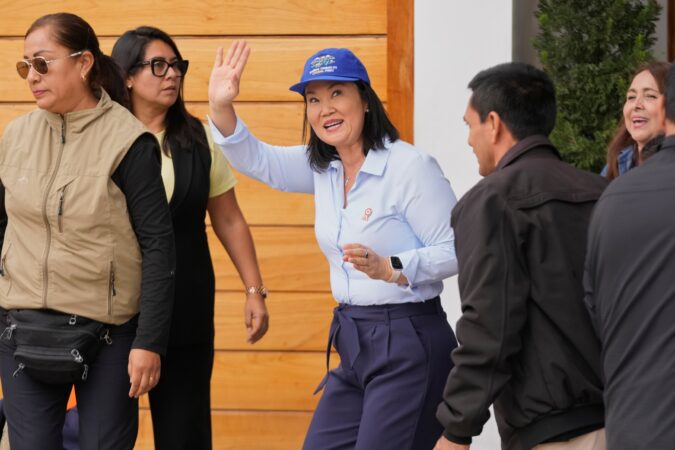
    LIMA, Peru — Conservative politician Keiko Fujimori on Friday was declared the winner of the presidential runoff election in Peru, which was dominated by people’s concerns over surging crime.

    Fujimori, 51, the daughter of a disgraced former president, was running for the presidency for the fourth time. She will be Peru’s ninth president in 10 years when she takes office later this month.

    The election win was certified Friday by the country’s top election authority. Figures released by election officials earlier in the week showed that with 100% of ballots tallied, Fujimori received 9,223,000 votes, or 50.135% of the total, while nationalist congressman Roberto Sánchez earned over 9,173,000 votes, or 49.865%.

    Fujimori and Sánchez made it to the June 7 runoff election after defeating 33 other candidates in an April vote.

    Voters were primarily concerned with increasing levels of crime, especially extortion by violent organized crime gangs, and Fujimori pledged to combat crime with an iron fist.

    The winner is the daughter of the late Alberto Fujimori, the former president whose government in the 1990s defeated the Shining Path extremist rebel group but also took an authoritarian turn. He was convicted in 2009 of human rights abuses in the fight against the rebels, and later of corruption charges.

  • Iran begins funeral rites for Ali Khamenei, supreme leader killed in war

    Iran begins funeral rites for Ali Khamenei, supreme leader killed in war

    For four months, Iran feared it was too dangerous to lay to rest Ayatollah Ali Khamenei, the country’s supreme leader who was killed in an airstrike on the first day of the joint U.S.-Israeli war.

    Now, shielded by a tentative truce — and perhaps by an America distracted by its 250th July Fourth celebration — millions of Iranians are expected to mourn over several days of funeral rites that will stretch across five cities and into neighboring Iraq.

    For the surviving Iranian regime, the funeral offers an opportunity to project power after withstanding months of war with Israel and the United States, but it will also be a high-profile test of the government’s postwar competence.

    Khamenei’s body was moved to Tehran, the capital, on Thursday for a private ceremony at the place where he was killed — the small compound that served as his office and residence.

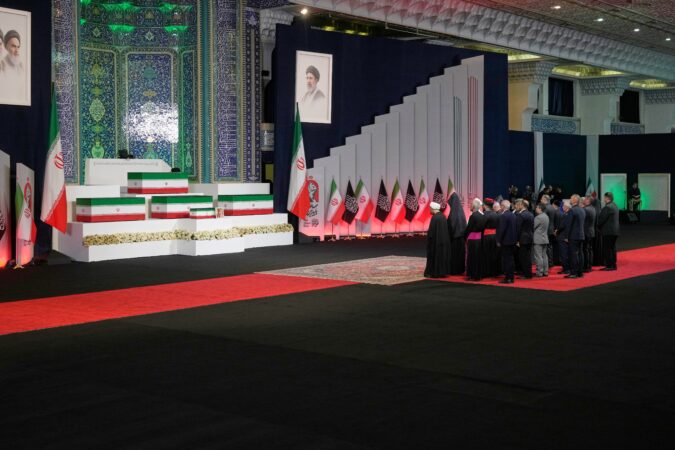
    On Friday, his coffin was moved to Grand Mosalla religious complex where it sat beside the coffins of other family members killed in the same strike, including his daughter and her husband. The smallest coffin was that of Khamenei’s granddaughter, who was 14 months old.

    Images distributed by state media showed foreign dignitaries, including leaders from Iraq, Qatar, and Tajikistan, as well as family members of the assassinated Hezbollah commander, Hasan Nasrallah, filing past the coffins as they arrived in Iran ahead of the funeral.

    Also shown paying his respects was the son of anti-Taliban Afghan commander Ahmed Shah Massoud.

    The funeral organizer said no officials were invited from Europe or the United States. Official banners prepared for the event declared “We must rise” and carried the image of a red fist.

    Security was expected to be tight, with sections of the capital Tehran already going into lockdown Friday.

    Parliament Speaker Mohammad Bagher Ghalibaf, who has been a key figure in peace talks with the U.S., issued a statement on Thursday calling on the Iranian people to “rise up and convey the nation’s call for bloodshed.”

    “Iran stands on the threshold of creating one of the greatest scenes in its history, a day when a nation, with hearts full of love, loyalty, and the pain of separation, comes to bid farewell to a great man,” Ghalibaf said.

    The cavernous prayer hall where Khamenei’s coffin was put on display Friday to lie in state was named after his predecessor, Ayatollah Ruhollah Khomeini, who led the country’s Islamic revolution, took power in 1979, and died a decade later.

    Khamenei led the Islamic Republic for 37 years, through wars and uprisings, and years of enmity and tangled negotiations with Washington over Iran’s nuclear program. Under his leadership, Iran repressed freedoms domestically and expanded its role as the patron of violent proxy militant groups, including Hezbollah and Hamas, which it used to confront the U.S. and Israel.

    Khamenei was killed in the opening hours of a war that has transformed Iran yet again, devastating the country’s infrastructure and leadership ranks, but ultimately seeming to strengthen its position regionally and in ceasefire talks with the U.S. — notably because of its leverage over the Strait of Hormuz.

    As Iranians mourn their assassinated leader, they and observers around the world will be watching the funeral for signals about the surviving regime, which is younger and even more hard-line. Among the top questions is whether Khamenei’s son and successor, Mojtaba, will appear in public for the first time since his father’s death.

    Mojtaba is believed to have been seriously injured in that strike, including serious damage to his face. His wife, Zahra Haddad Adel, was also killed.

    Mojtaba Khamenei has been living under intense security measures given the expectation that he, too, will be a target for assassination.

    Even in peacetime, he kept a low profile. He has only been photographed in public a few times and, before his designation as the new leader, most Iranians had never heard him speak publicly.

    Up until now, Iranians who support their government say they understand why their supreme leader has been unable to appear in public. But the further the country moves away from active war, the more people may demand an appearance.

    “If he doesn’t show up, it does become significant,” said Norman Roule, a former CIA officer who worked on Iran for decades, adding that the move would indicate that he is breaking from the rule of his father in which revolutionary symbolism was critically important.

    If Khamenei does appear — in person or by video — experts will be scouring images for clues about his injuries, officials said, while also searching for broader signs of the regime’s cohesion and capabilities.

    Observers will also be tracking the scale of the event, including whether the government can orchestrate convincing shows of public support beyond the tightly controlled capital. They will also be monitoring how much security is mobilized.

    And as the country shifts away from a war footing, its economic challenges will become more pronounced. Inflation has skyrocketed, and energy exports fell to near zero for weeks. The country’s industrial sector was heavily damaged by U.S. and Israeli strikes.

    Over Ali Khamenei’s decades as supreme leader, public dissatisfaction with the Iranian system grew, triggering repeated waves of protests. And in the past five years, demonstrations seemed to threaten the Islamic Republican at least twice.

    In each instance, Khamenei ordered violent crackdowns with escalating cruelty to clear city streets. The most recent crackdown in January is estimated to have killed thousands of people over just three days, a remarkable scale of brutality.

    After the mourning ceremonies in Tehran, Khamenei’s body will be taken to the holy Iranian city of Qom, then on to neighboring Iraq where crowds will gather in the holy Shiite cities of Najaf and Karbala, before he is finally laid to rest in his hometown, the eastern Iranian city of Mashhad.

    The ceremonies will present a serious logistical challenge for the Iranian regime. Local officials in Tehran say they are expecting crowds of up to 20 million.

    Authorities are keen to avoid the kind of chaotic scenes that marked previous burials. Eight people were trampled to death when Khomeini was buried in 1989. And dozens were killed in 2020 during crowd crushes at the funeral for Maj. Gen. Qasem Soleimani, then Iran’s most powerful military commander, who was killed in a U.S. drone strike ordered by U.S. President Donald Trump.