Tag: no-latest

  • Letters to the Editor | Dec. 19, 2025

    Letters to the Editor | Dec. 19, 2025

    Sad and sickening

    I’m still having a hard time wrapping my head around Donald Trump’s vile comments about Rob Reiner’s death. To watch anyone, least of all the president of what was once the most envied country in the world, spew such venom about one deceased man is so far beyond my comprehension that I can only opine that this is the result of envy turned sickness.

    And, as the would-be emperor fiddles, our country burns.

    We can wait until the midterms and vote, but that will accomplish little.

    Why don’t we take another look at the 25th Amendment, it has become obvious that our Congress is too wrapped up in politics to do its job.

    Contact your Congress members, contact your representatives, contact the dog catcher if you think it helps.

    Philip A. Tegtmeier Sr., Honey Brook

    When Charlie Kirk was assassinated, the Trump administration made it a point to go after anyone who criticized Kirk after his death. People lost their jobs over their criticism of Kirk. I think the president should lose his job for criticizing Rob Reiner after the tragic death of him and his wife.

    Julio Casiano Jr., Philadelphia

    The social media posting by the president with regard to the tragic death of Rob Reiner shows the state of mind of a man who totally lacks compassion, character, and empathy. His hatred has infected this nation and the world in ways never seen before. He’s not making America great; he’s making America hate and that’s not a good thing.

    Gerard Iannelli, Haddon Heights

    The president of the United States used social media to post a disgusting political attack on Rob Reiner in the aftermath of his killing. Yet following the assassination of Charlie Kirk, he railed against any public comments taking Kirk to task for his racist and misogynist commentary, recommending retaliation against anyone who chose a public forum to tell the truth about Kirk.

    Just when you think Trump has reached a low in his absence of shame and decency, he shows us that there is no bottom.

    Steven Barrer, Huntingdon Valley, sjbarrer@gmail.com

    Season for giving

    When disaster strikes, it often happens in the middle of the night, catching families off guard and leaving them with nothing but uncertainty. In those moments, Red Cross volunteers — neighbors from our own community — are there to provide comfort, emergency lodging, and recovery support.

    Thanks to donations of money and time, this kind of care happens every eight minutes across the U.S., most often after a home fire.

    Whenever it happens, we’ll be there — because of our generous donors and volunteers who help in so many ways. But our mission goes beyond disaster relief; we help patients in need of lifesaving blood, teach critical skills like first aid and CPR, and support veterans and military families navigating unique challenges.

    This holiday season, please consider donating at redcross.org. Your gift ensures that when the unexpected happens, families have the support and care they need — because no one should face a disaster alone.

    Jennifer Graham, CEO, American Red Cross Southeastern Pennsylvania Region

    Join the conversation: Send letters to letters@inquirer.com. Limit length to 150 words and include home address and day and evening phone number. Letters run in The Inquirer six days a week on the editorial pages and online.
  • Horoscopes: Friday, Dec. 19, 2025

    ARIES (March 21-April 19). Don’t bother weighing the positives and negatives. Not only do they lack actual weight, but it’s impossible to know which are “negatives” or “positives” because what seems inconvenient today may prove, in the long view, to be your best luck yet.

    TAURUS (April 20-May 20). Your dream can work! The gatekeepers just don’t see it yet. It’s not for them. So don’t shrink the vision; shift the setting. A different venue, format or audience will be a better fit. This project just needs the proper container.

    GEMINI (May 21-June 21). Some people love with words, others with total silence and careful listening. Some love with support, others with competition. Assume what’s offered is a form of love. If it’s not the kind you most need, keep moving and you’ll find it.

    CANCER (June 22-July 22). Information spreads fast through the gossips, broadcasters and other natural amplifiers. Today, use that to your advantage. Give the talkers something worth talking about, and let their distribution network work in your favor.

    LEO (July 23-Aug. 22). You genuinely want what’s best for others, but you also need care. Can you make more time for yourself? Carve out a few hours for the special things that matter to you — things that have nothing to do with serving others.

    VIRGO (Aug. 23-Sept. 22). Out of kindness, you’ve sometimes dimmed your light around people who feel competitive or fragile. But today, don’t worry. Your brightness will not destabilize others. If anything, when you shine, you expand the field for everyone connected to you.

    LIBRA (Sept. 23-Oct. 23). Those who are unaware of what others expect of them are liable to disappoint people by breaking “agreements” they didn’t even know they made. You avoid this dynamic by staying aware of social contracts, spoken and unspoken.

    SCORPIO (Oct. 24-Nov. 21). To say you’re a dancer seems to imply a certain skill level, but what if being a dancer is just about dancing? Do the action today and don’t worry about the identity. Identity follows action, not the other way around.

    SAGITTARIUS (Nov. 22-Dec. 21). Talk about what you do and what you need. Opportunities aren’t as rare as some would have you believe. There is always room for new ideas, especially ones that improve people’s lives, and those come so easily to you!

    CAPRICORN (Dec. 22-Jan. 19). Your steadiness doesn’t come from rigidity, but from being rooted, like a tree that can bend with the wind. You’ll attract people who need a bit of grounding, and you’ll kindly let them lean on you for the support that is so easy for you to give.

    AQUARIUS (Jan. 20-Feb. 18). Take measures to make sure everyone is on the same page. What could possibly be misunderstood? Check and double-check. Miscommunication leads to mistakes, but good communication and a little diligence now will prevent problems down the line.

    PISCES (Feb. 19-March 20). There is no clear winner today, which is how you know you’re not in a game, but in something with deeper dimensions, like a purpose or an epic story — a grand landscape or a love affair.

    TODAY’S BIRTHDAY (Dec. 19). It’s your Year of the Electric Surprise. Your network expands wildly — coincidences, encounters, coffee meetings and phone calls all lead somewhere thrilling… if not right away then after a bit of follow-through. At certain points, numerous opportunities chase you at once, so you have your pick. More highlights: romance that’s plentiful and genuine, exceptional creative output people pay for, share and celebrate. Taurus and Scorpio adore you. Your lucky numbers are: 5, 19, 8, 14 and 40.

  • Dear Abby | Months after breakup, man sees ‘signs’ amid heartache

    DEAR ABBY: I’m a 55-year-old man who dated a very special lady, “Dawn,” for 12 years. We were both married when we met. I fell in love with her, and after we divorced our spouses, we continued being together.

    I have two kids. Dawn didn’t get along with the older one. My daughter wasn’t rude, but she obviously didn’t like Dawn. I proposed to Dawn, and she accepted. Over the next few months, she became agitated and threw her engagement ring back at me. I kept it until we figured things out.

    Two years later, Dawn ghosted me. I was hurt, so I gave her space. (We reconciled five months later.) Three years later, I finally trusted her enough to ask her about getting married. Then, right at Christmas, she ghosted me again. Six months later, nothing. I texted her after four months to no avail.

    I am now in therapy. Abby, I don’t know how to move forward. Sometimes I get these divine messages, signs, dreams, etc. I hesitate to label anyone, but I wonder if I’m dealing with a woman who has a commitment phobia. What should I do now? I have respectfully not contacted her except once. I am heartbroken. I’m not asking if I should wait around. I’m living my life. But these divine messages and signs have me wondering.

    — DESTROYED IN VIRGINIA

    DEAR DESTROYED: I am pleased you are now in therapy, because it is where you belong. I don’t know what your daughter picked up on about Dawn, but perhaps you should ask her. If you do, it may give you some insight. Your therapist may be able to explain what Dawn’s problem is, but whatever it is, it is no longer your problem.

    Those dreams, signs and messages you are receiving are not divine; they are proof that your subconscious still hasn’t let go of the fantasy about a future with her. If, heaven forbid, the woman contacts you again, RUN in the opposite direction!

    ** ** **

    DEAR ABBY: Some people hint that they want to get on our social calendar, yet they expect us to be the ones to invite them. An example: “Say, when are we getting together for dinner?” is repeated often. If they invited us to dinner at a specific place and specific time, it would probably happen, but I’m uncomfortable that they put the burden on us to initiate the event.

    Is there a rule of etiquette about this? Why are people like this? I can’t be sure if they are sincere about wanting to get together. Often, I’m just as happy we didn’t meet up, because we have lots of active friendships already.

    — CLUELESS IN RALEIGH

    DEAR CLUELESS: When someone asks, “When are we getting together for dinner?” your answer should be, “As soon as YOU CALL ME so I can make sure we are available.” If you prefer NOT to get together for dinner, all you have to say is, “Our schedule is really full right now. I’ll let you know when we are free.” (Then change the subject.)

  • Coast Guard abruptly deletes swastika, noose entry from policy manual

    Coast Guard abruptly deletes swastika, noose entry from policy manual

    The U.S. Coast Guard on Thursday deleted language from its new workplace harassment policy that had downgraded the definition of swastikas and nooses from overt hate symbols to “potentially divisive,” an abrupt turnaround after the more lenient interpretation of those items was allowed to take effect this week despite objections from Congress.

    In a message to all Coast Guard personnel, Adm. Kevin Lunday, the service’s acting commandant, said those revisions had been “completely removed” from the policy manual. The document, a copy of which was reviewed by the Washington Post, now shows a large black bar obscuring the relevant chapter in its table of contents and a message directing readers to a separate manual outlining the Coast Guard’s civil rights policies.

    Lunday’s message also says that a separate directive he issued last month prohibiting swastikas and nooses “remains in full effect.”

    The sudden turn of events appeared to satisfy Sens. Tammy Duckworth (D., Ill.) and Jacky Rosen (D., Nev.), who said after Lunday’s announcement that they had lifted their holds on his nomination to become the service’s full-time commandant. Both cited their disapproval of the new policy when explaining earlier this week why they had taken such measures.

    Lunday’s announcement caps a tumultuous few weeks within the Coast Guard, following Washington Post reports detailing the service’s plan to include the incendiary language within its new workplace harassment manual, its vow to reverse course in the face of widespread criticism, and the wording’s surprising retention as the new manual took effect earlier this week.

    In response to the Post’s initial reporting in late November, Lunday issued an order condemning and categorically prohibiting swastikas and nooses, and said then that his directive would supersede any other policy language. But for reasons that remain unclear, Lunday’s order was never incorporated.

    Two people familiar with the policy manual overhaul said this week that the Coast Guard, which is overseen by the Department of Homeland Security, wanted to strike the “potentially divisive” wording from the document but was unable to do so. They spoke on the condition of anonymity to discuss the contentious situation.

    The Coast Guard’s hazing and harassment policy was an early focus of Lunday’s after the Trump administration, upon entering office in January, fired his predecessor, Adm. Linda Fagan — the first woman to lead a branch of the U.S. military. In announcing Fagan’s removal, officials cited among other things her “excessive focus” on diversity and inclusion initiatives.

    Within days, Lunday ordered the suspension of the policy manual that, among its other guidance, said explicitly that the swastika was among a “list of symbols whose display, presentation, creation, or depiction would constitute a potential hate incident.” Nooses and the Confederate flag also matched that description under the previous policy. Lunday was later nominated by Trump to lead the service as its commandant.

    In a statement announcing that she had lifted her hold on his nomination, Rosen said she had put another on Sean Plankey, Trump’s nominee to be the director of Homeland Security’s Cybersecurity and Infrastructure Security Agency, and “will keep that hold in place until we see that this new policy works to protect our men and women in uniform from racist and antisemitic harassment.” She also chastised leadership within the Coast Guard and at DHS who, she said, had been “evasive, misleading, and elusive” as lawmakers sought assurances the “potentially divisive” wording would be cut from the policy manual.

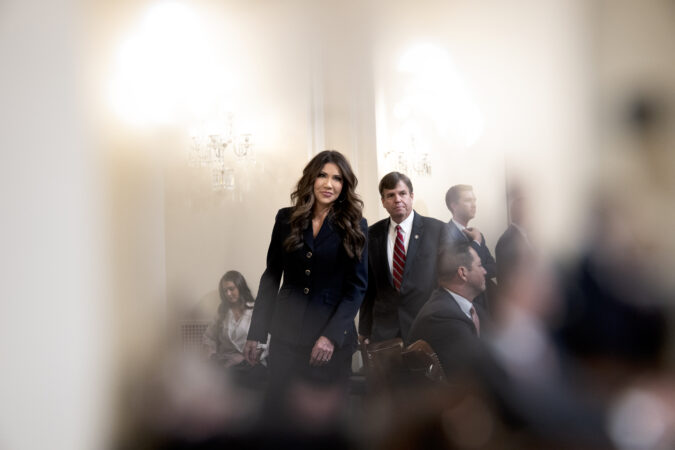
    Homeland Security Secretary Kristi L. Noem said in a social media post earlier Thursday that the language was being removed from the manual “so no press outlet, entity or elected official may misrepresent the Coast Guard to politicize their policies and lie about their position on divisive and hate symbols.”

    Neither DHS nor the Coast Guard has addressed questions seeking to understand whether Lunday, as acting commandant, was empowered to change the manual’s wording on his own or if DHS leadership had to approve it.

    The lack of action, particularly amid a rise in antisemitism, incensed an array of lawmakers, including Republicans, who said Lunday had pledged to them that the “potentially divisive” wording would be removed from the policy manual before it went into effect.

    Several expressed anger at the existence of an official U.S. government document defining swastikas, inseparable from the extermination of millions of Jews in World War II, and nooses, a symbol of racial hatred, as “potentially divisive.”

    Sen. James Lankford (R., Okla.) was among those who registered disapproval with what his office called the Coast Guard’s “conflicting policies.” A GOP aide said Lankford took his concerns directly to the Trump administration and urged officials to change the manual.

  • Trump’s handpicked board votes to rename Washington performing arts center the Trump Kennedy Center

    Trump’s handpicked board votes to rename Washington performing arts center the Trump Kennedy Center

    WASHINGTON — President Donald Trump’s handpicked board voted Thursday to rename Washington’s leading performing arts center as the Trump Kennedy Center, the White House said, in a move that made Democrats fume, saying the board had overstepped its legal authority.

    Congress named the center after President John F. Kennedy in 1964, after his assassination. Donald A. Ritchie, who served as Senate historian from 2009-2015, said that because Congress had first named the center it would be up to Congress to “amend the law.”

    Ritchie said that while Trump and others can “informally” refer to the center by a different name, they couldn’t do it in a way “that would [legally] stick.”

    But the board did not wait for that debate to play out, immediately changing the branding on its website to reflect the new name.

    House Democratic leader Hakeem Jeffries told reporters that legislative action was needed, “and we’re going to make that clear.” The New York Democrat is an ex officio member of the board because of his position in Congress.

    Trump has teased the name change for some time

    “The Kennedy Center Board of Trustees voted unanimously today to name the institution The Donald J. Trump and The John F. Kennedy Memorial Center for the Performing Arts,” said Roma Daravi, the institution’s vice president for public relations.

    She said the vote recognized that Trump saved the center from “financial ruin and physical destruction,” a pair of claims denied by the venue’s ousted leadership.

    “The new Trump Kennedy Center reflects the unequivocal bipartisan support for America’s cultural center for generations to come,” Daravi said.

    Press secretary Karoline Leavitt announced the vote on social media, attributing it to the “unbelievable work President Trump has done over the last year in saving the building. Not only from the standpoint of its reconstruction, but also financially, and its reputation.”

    Trump, a Republican who’s chairman of the board, said at the White House that he was “surprised” and “honored” by the vote.

    “The board is a very distinguished board, most distinguished people in the country and I was surprised by it and I was honored by it,” he said.

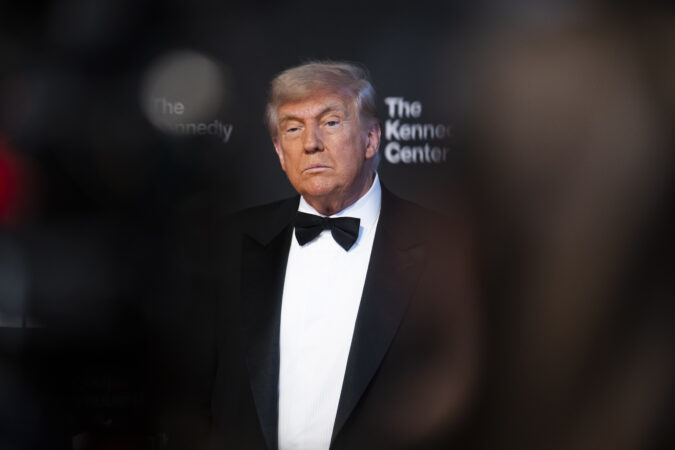
    Trump had already been referring to the center as the “Trump Kennedy Center.” Asked Dec. 7 as he walked the red carpet for the Kennedy Center Honors program whether he would rename the venue after himself, Trump said such a decision would be up to the board.

    Earlier this month, Trump talked about a “big event” happening at the “Trump Kennedy Center” before saying, “excuse me, at the Kennedy Center,” as his audience laughed. He was referring to the FIFA World Cup soccer draw for 2026, in which he participated.

    A name change won’t sit well with some Kennedy family members.

    Maria Shriver, a niece of John F. Kennedy, referred to the legislation introduced in Congress to rebrand the Kennedy Center as the Donald J. Trump Center for the Performing Arts as “insane” in a social media post in July.

    “It makes my blood boil. It’s so ridiculous, so petty, so small minded,” she wrote. “Truly, what is this about? It’s always about something. ‘Let’s get rid of the Rose Garden. Let’s rename the Kennedy Center.’ What’s next?”

    Trump earlier this year turned the Kennedy-era Rose Garden at the White House into a patio by removing the lawn and laying down paving stones.

    Another Kennedy family member, Robert F. Kennedy Jr., serves in Trump’s cabinet as secretary of the Department of Health and Human Services.

    Trump showed scant interest in the Kennedy Center during his first term as president, but since returning to office in January he has replaced board members appointed by Democratic presidents with some of his most ardent supporters, who then elected him as board chairman.

    He also has criticized the center’s programming and its physical appearance and has vowed to overhaul both.

    Trump secured more than $250 million from the Republican-controlled Congress for renovations of the building.

    He attended opening night of the musical Les Misérables, and last week he served as host of the Kennedy Center Honors program after not attending the show during his first term as president. The awards program is scheduled to be broadcast by CBS and Paramount+ on Dec. 23.

    Sales of subscription packages are said to have declined since Trump’s takeover of the center, and several touring productions, including Hamilton, have canceled planned runs there. Rows upon rows of empty seats have been seen in the Concert Hall during performances by the National Symphony Orchestra.

    Some performers, including actor Issa Rae and musician Rhiannon Giddens, have scrapped scheduled appearances, and Kennedy Center consultants including musician Ben Folds and singer Renée Fleming have resigned.

  • Police are investigating link between Brown shooting and killing of MIT professor, AP sources say

    Police are investigating link between Brown shooting and killing of MIT professor, AP sources say

    PROVIDENCE, R.I. — Authorities said Thursday that they’re looking into a connection between last weekend’s mass shooting at Brown University and one two days later near Boston that killed a professor at another elite school, the Massachusetts Institute of Technology.

    That is according to three people familiar with the matter who were not authorized to discuss an ongoing investigation and spoke on condition of anonymity. Two of the people said investigators had identified a person of interest in the shootings and were actively seeking that individual.

    The attacker at Brown on Saturday killed two students and wounded nine others in a classroom in the school’s engineering building before getting away.

    About 50 miles north, MIT professor Nuno F.G. Loureiro was gunned down in his home Monday night in the Boston suburb of Brookline. The 47-year-old physicist and fusion scientist died at a hospital the next day.

    The FBI previously said it knew of no links between the cases.

    This undated photo provided by the Massachusetts Institute of Technology in December 2025 shows Nuno Loureiro.

    How is the Brown investigation going?

    It’s been nearly a week since the shooting at Brown. There have been other high-profile attacks in which it took days or longer to make an arrest or find those responsible, including in the brazen New York City sidewalk killing of UnitedHealthcare’s CEO last year, which took five days.

    But frustration is mounting in Providence that the person behind the attack managed to get away and that a clear image of their face has yet to emerge.

    “There’s no discouragement among people who understand that not every case can be solved quickly,” the state attorney general, Peter Neronha, said at a news conference Wednesday.

    Authorities have scoured the area for evidence and pleaded with the public to check any phone or security footage they might have from the week before the attack, believing the shooter might have cased the scene ahead of time.

    Investigators have released several videos from the hours and minutes before and after the shooting that show a person who, according to police, matches witnesses’ description of the shooter. In the clips, the person is standing, walking and even running along streets just off campus, but always with a mask on or their head turned.

    Although Brown officials say there are 1,200 cameras on campus, the attack happened in an older part of the engineering building that has few, if any, cameras. And investigators believe the shooter entered and left through a door that faces a residential street bordering campus, which might explain why the cameras Brown does have didn’t capture footage of the person.

    Providence Mayor Brett Smiley said Wednesday that the city is doing “everything possible” to keep residents safe. However, he acknowledged that it is “a scary time in the city” and that families likely were having tough conversations about whether to stay in town over the holidays.

    “We are doing everything we can to reassure folks, to provide comfort, and that is the best answer I can give to that difficult question,” Smiley said when asked if the city was safe.

    What can be learned from past investigations?

    Although it’s not unheard of for someone to disappear after carrying out such a high-profile shooting, it is rare.

    In such targeted and highly public attacks, the shooters typically kill themselves or are killed or arrested by police, said Katherine Schweit, a retired FBI agent and expert on mass shootings. When they do get away, searches can take time.

    “The best they can do is what they do now, which is continue to press together all of the facts they have as fast as they can,” she said. “And, really, the best hope for solutions is going to come from the public.”

    In the 2013 Boston Marathon bombing, it took investigators four days to catch up to the two brothers who carried it out. In a 2023 case, Army reservist Robert Card was found dead of an apparent suicide two days after he killed 18 people and wounded 13 others in Lewiston, Maine.

    The man accused of killing conservative political figure Charlie Kirk in September turned himself in about a day and a half after the attack on Utah Valley University’s campus. And Luigi Mangione, who has pleaded not guilty to murder charges in the killing of UnitedHealthcare CEO Brian Thompson in Manhattan last year, was arrested five days later at a McDonald’s in Altoona, Pa.

    Felipe Rodriguez, a retired New York police detective sergeant and adjunct professor at the John Jay College of Criminal Justice, said it’s clear that shooters are learning from others who were caught.

    “Most of the time an active shooter is going to go in, and he’s going to try to commit what we call maximum carnage, maximum damage,” Rodriguez said. “And at this point, they’re actually trying to get away. And they’re actually evading police with an effective methodology, which I haven’t seen before.”

    Investigators have described the person they are seeking as about 5 feet, 8 inches tall and stocky. The attacker’s motives remain a mystery, but authorities said Wednesday that none of the evidence suggests a specific person was being targeted.

    MIT mourns the loss of an esteemed professor

    Loureiro, who was married, joined MIT in 2016 and was named last year to lead the school’s Plasma Science and Fusion Center, where he worked to advance clean energy technology and other research. The center, one of MITl’s largest labs, had more than 250 people working across seven buildings when he took the helm. He was a professor of physics and nuclear science and engineering.

    He grew up in Viseu, in central Portugal, and studied in Lisbon before earning a doctorate in London, according to MIT. He was a researcher at an institute for nuclear fusion in Lisbon before joining MIT, the university said.

    “He shone a bright light as a mentor, friend, teacher, colleague and leader, and was universally admired for his articulate, compassionate manner,” Dennis Whyte, an engineering professor who previously led MIT’s Plasma Science and Fusion Center, told a campus publication.

    Loureiro had said he hoped his work would shape the future.

    “It’s not hyperbole to say MIT is where you go to find solutions to humanity’s biggest problems,” Loureiro said when he was named to lead the plasma science lab last year. “Fusion energy will change the course of human history.”

  • U.S. announces massive package of arms sales to Taiwan valued at more than $10 billion, angering China

    U.S. announces massive package of arms sales to Taiwan valued at more than $10 billion, angering China

    WASHINGTON — President Donald Trump’s administration has announced a massive package of arms sales to Taiwan valued at more than $10 billion that includes medium-range missiles, howitzers, and drones, drawing an angry response from China.

    The State Department announced the sales late Wednesday during a nationally televised address by the Republican president, who made scant mention of foreign policy issues and did not speak about China or Taiwan. U.S.-Chinese tensions have ebbed and flowed during Trump’s second term, largely over trade and tariffs but also over China’s increasing aggressiveness toward Taiwan, which Beijing has said must reunify with the mainland.

    If approved by Congress, it would be the largest-ever U.S. weapons package to Taiwan, exceeding the total amount of $8.4 billion in U.S. arms sales to Taiwan during President Joe Biden’s Democratic administration.

    The eight arms sales agreements announced Wednesday cover 82 high-mobility artillery rocket systems, or HIMARS, and 420 Army Tactical Missile Systems, or ATACMS — similar to what the U.S. had been providing Ukraine during the Biden administration to defend itself from Russia — worth more than $4 billion. They also include 60 self-propelled howitzer systems and related equipment worth more than $4 billion and drones valued at more than $1 billion.

    Other sales in the package include military software valued at more than $1 billion, Javelin and TOW missiles worth more than $700 million, helicopter spare parts worth $96 million, and refurbishment kits for Harpoon missiles worth $91 million.

    The eight sales agreements amount to $11.15 billion, according to Taiwan’s Defense Ministry.

    The State Department said the sales serve “U.S. national, economic, and security interests by supporting the recipient’s continuing efforts to modernize its armed forces and to maintain a credible defensive capability.”

    “The proposed sale(s) will help improve the security of the recipient and assist in maintaining political stability, military balance, and economic progress in the region,” the statements said.

    China’s Foreign Ministry attacked the move, saying it would violate diplomatic agreements between China and the U.S.; gravely harm China’s sovereignty, security and territorial integrity; and undermine regional stability.

    “The ‘Taiwan independence’ forces on the island seek independence through force and resist reunification through force, squandering the hard-earned money of the people to purchase weapons at the cost of turning Taiwan into a powder keg,” said Foreign Ministry spokesperson Guo Jiakun.

    “This cannot save the doomed fate of ‘Taiwan independence’ but will only accelerate the push of the Taiwan Strait toward a dangerous situation of military confrontation and war. The U.S. support for ‘Taiwan Independence’ through arms will only end up backfiring. Using Taiwan to contain China will not succeed,” he added.

    Under federal law, the U.S. is obligated to assist Taiwan with its self-defense, a point that has become increasingly contentious with China, which has vowed to take Taiwan by force, if necessary.

    Taiwan’s Defense Ministry in a statement Thursday expressed gratitude to the U.S. over the arms sale, which it said would help Taiwan maintain “sufficient self-defense capabilities” and bring strong deterrent capabilities. Taiwan’s bolstering of its defense “is the foundation for maintaining regional peace and stability,” the ministry said.

    Taiwan’s Foreign Minister Lin Chia-lung similarly thanked the U.S. for its “long-term support for regional security and Taiwan’s self-defense capabilities,” which he said are key for deterring a conflict in the Taiwan Strait, the body of water separating Taiwan from China’s mainland.

    The arms sale comes as Taiwan’s government has pledged to raise defense spending to 3.3% of the island’s gross domestic product next year and to reach 5% by 2030. The boost came after Trump and the Pentagon requested that Taiwan spend as much as 10% of its GDP on its defense, a percentage well above what the U.S. or any of its major allies spend on defense. The demand has faced pushback from Taiwan’s opposition KMT party and some of its population.

    Taiwanese President Lai Ching-te last month announced a special $40 billion budget for arms purchases, including to build an air defense system with high-level detection and interception capabilities called Taiwan Dome. The budget will be allocated over eight years, from 2026 to 2033.

    The U.S. boost in military assistance to Taiwan was previewed in legislation adopted by Congress that Trump is expected to sign shortly.

    Last week, the Chinese embassy in Washington denounced the legislation, known as the National Defense Authorization Act, saying it unfairly targeted China as an aggressor. The U.S. Senate passed the bill Wednesday.

  • Democrats will not release the autopsy of their 2024 loss

    Democrats will not release the autopsy of their 2024 loss

    The Democratic National Committee will not publicly release its autopsy of the 2024 presidential campaign, party officials said, a reversal intended to avoid a contentious reckoning over the party’s failure.

    Operatives involved in drafting the autopsy worried that revisiting Kamala Harris’ loss to Donald Trump would reignite the fiery internal debates that consumed the party in the wake of the 2024 loss at a time when Democrats are eager to celebrate a string of wins in 2025 and focus on the 2026 midterms, the officials said.

    But by declining to make the report public, the party is also keeping the lessons learned from its 2024 failures limited to a small group of insiders and dodging a public accounting that many Democrats believe is necessary to avoid repeating past mistakes.

    There remain sharp internal debates, for example, over the party’s stance on transgender rights, its handling of generational change, and whether Harris’ selection as President Joe Biden’s replacement on the ticket was properly conducted.

    “We completed a comprehensive review of what happened in 2024 and are already putting our learnings into motion,” Ken Martin, chair of the Democratic National Committee, said in a statement that did not directly address the committee’s decision to shield the report. “In our conversations with stakeholders from across the Democratic ecosystem, we are aligned on what’s important, and that’s learning from the past and winning the future. Here’s our North Star: does this help us win? If the answer is no, it’s a distraction from the core mission.”

    Democratic officials briefed on the report’s contents said the autopsy chastises the party for failing to adequately listen to voters in 2024. The report describes a feeble response to concerns about public safety and immigration in particular, allowing Republicans to dominate the issues, according to the officials, who spoke on the condition of anonymity to discuss the private findings. That amplified the Democrats’ credibility problem on the election’s central issue: the economy.

    Another key takeaway, officials said, was that the party took young voters for granted, neglecting a group that normally supports its candidates in overwhelming numbers. As a result, they swung toward Trump, with the president winning a majority of first-time voters and increasing his share of youth voters by double digits. The report faults a party wedded to traditional media that often bypasses these voters. It calls for greater engagement with nontraditional media, something that vexed the Harris campaign.

    The report, generated based on hundreds of interviews with Democrats in all 50 states, also highlights missteps in how Democrats contact voters, the officials said, noting that while the party reached more voters than ever last year, the outreach was ineffective, led to poor-quality conversations with swing voters, and came too late in pivotal states. The changes suggested by the party, the officials said, include measuring the success of an outreach program by the impact of the conversations, not the number of attempted calls, while also investing in more long-term party building so voter contact does not begin weeks before Election Day.

    Democratic officials have struggled to craft and discuss the report for much of the year amid internal debates over the party’s direction and leadership.

    They were in the final stages of preparing it in October and began briefing top operatives and donors on its contents. But the expected public release was delayed until after off-year elections in November, with the party hoping to keep the focus on races they eventually swept in New York, New Jersey, and Virginia.

    Those preliminary briefings did not include any reflection on the handling of Biden’s late withdrawal from the race, his perceived infirmity and the lack of a competitive process used to select Harris as his replacement, which many Democrats have said was central to their party’s defeat. Members of the Democratic committee, including Martin, argued that little could be learned from those reflections, given that it is unlikely the party will face a similar situation again. Still, the lack of any reflection on Biden or Harris led some party insiders to criticize the report as intentionally avoiding what many saw as the most decisive issue in the 2024 loss.

    The delays in releasing the report have spurred internal Democratic grumbling, and the committee’s decision to keep it private was already stirring up Democratic anger.

    “A handful of wins is not the same as the rehabilitation of the Democratic brand, which is required to build real governing majorities and a national coalition,” said Alyssa Cass, a Democratic operative in New York. ”Achieving that requires real soul-searching and new ideas, and it would be nice for candidates and campaigns to know they had a partner in that hard work, instead of an institutional structure buried in the sand.”

    Other Democrats echoed Cass, casting the decision as the Democratic National Committee looking to obscure its own failings in 2024.

    But some Democratic operatives, especially those close to the committee, praised the decision as prudent. “Democrats don’t need to engage in a hand-wringing exercise about last year’s elections when we’re winning this year’s elections,” said Xochitl Hinojosa, a former top spokesperson for the DNC.

    How the party handles learning from the 2024 loss could prove critical for years to come. Democratic officials and campaign operatives from winning campaigns this year have already said they used lessons from the 2024 campaign to strengthen their operations. And some of the party’s most high-profile members, including Harris, have begun to break from the policies that defined the Biden administration.

    In a speech Friday night at the Democratic National Committee meeting in Los Angeles, Harris argued that both Democrats and Republicans have failed to address Americans’ deep financial anxieties and lack of confidence in government.

    “Both parties have failed to hold the public’s trust. Government is viewed as fundamentally unable to meet the needs of its people,” Harris said in an implicit condemnation of the Biden administration, which she served in for four years as his vice president and defended throughout her unsuccessful presidential campaign.

    Trump “is not the only source of our problems,” Harris said, arguing that the rise of his political movement is “a symptom of a failed system that is the result of years of outsourcing and offshoring, financial deregulation, growing income inequality, a broken campaign finance system and endless partisan gridlock.”

  • Trump will use military housing money for $1,776 Pentagon bonuses

    Trump will use military housing money for $1,776 Pentagon bonuses

    The Trump administration will repurpose $2.6 billion in military housing assistance to pay $1,776 “warrior dividend” bonuses to service members, according to a senior administration official.

    In a prime-time address Wednesday night, President Donald Trump announced the Christmastime bonuses “in honor of our nation’s founding in 1776.”

    “Nobody deserves it more than our military. And I say congratulations to everybody,” Trump said.

    The president said the money for the bonuses came from revenue from import taxes he’s imposed on trading partners worldwide. That was incorrect, however, and Trump does not have the authority to spend the money from tariffs without authorization from Congress.

    But lawmakers this summer did approve $2.9 billion to supplement the military’s basic allowance for housing as part of Trump and the GOP’s mammoth tax and immigration law, the One Big Beautiful Bill.

    Defense Secretary Pete Hegseth ordered the Pentagon to spend most of that money as a one-time payout on the bonuses, said the senior administration official, who spoke on the condition of anonymity because they were not authorized to speak publicly on the matter.

    The use of the housing funds to pay the bonuses was reported earlier by Defense One.

    Roughly 1.45 million service members, including 174,000 reservists, will receive the bonuses, which Hegseth said in a video Thursday would be tax-free.

    “This warrior dividend serves as yet another example of how the War Department is working to improve the quality of life for our military personnel and their families,” Hegseth said.

    Trump renamed the Department of Defense as the Department of War in September, designating that as the department’s “secondary title” and authorizing its use. It’s unclear whether Trump has the authority to permanently rename cabinet departments without congressional approval.

    “I can think of no better Americans to receive this check right before Christmas, whether it’s for pay, housing, faith, support, all elements of what we’re doing are to rebuild our military,” Hegseth said.

    The defense secretary called the payment “a direct investment in the brave men and women who carry on the legacy of our armed forces every single day,” and said military members in pay grades E-1 to O-6 would be eligible. The top pay grade eligible includes the ranks of colonel in the Air Force, Army, Marines and Space Force, and captain in the Navy and Coast Guard.

    Speaking in the Oval Office on Thursday, Trump said his staff originally presented him with a plan for $1,775 bonuses.

    “And I said, ‘Wow, I think we can afford one more dollar,’” Trump said.

    In Congress, reaction to the bonuses was mixed, largely along party lines. Sen. Roger Wicker (Mississippi), the Republican chairman of the Armed Services Committee, said in an interview that the payments were “quite appropriate.”

    He added in a statement that the bonuses would “put real money in the pockets of our service members and their families, helping provide greater stability and improved housing options as they manage the unique demands of military life.”

    Sen. Jack Reed (Rhode Island), the top Democrat on the panel, said he was concerned that pulling the money for the bonuses from the housing assistance program would prevent the Defense Department from improving housing for service members and conducting overdue maintenance.

    “There has been a real fundamental need for housing improvements and maintenance,” Reed said. “I think they could find a better source for the funds.”

    Sen. Chris Coons (Delaware), the top Democrat on the Senate Appropriations Defense Subcommittee, was more blunt — both about the purpose of the checks and Trump’s authority to issue them.

    “Read the Constitution! You can’t just sprinkle the country with checks just because you came up with it late at night,” Coons said.

    The National Defense Authorization Act, which Trump is set to sign into law Thursday evening, approves pay increases for troops, and the annual appropriations bill — which Congress has yet to pass — funds it, he said.

    “That’s how we do this, not game-show checks. Not last minute whimsy by a president,” Coons said. “This is a classic campaign stunt that does not serve our warfighters, our Constitution, or our republic well.”

    The Trump administration has a track record of aggressively shifting resources around the Pentagon to goose service members’ compensation.

    During the government shutdown, the administration twice moved money from other parts of the Pentagon budget to keep paying troops. Doing so without the approval of lawmakers — who normally have a say over large changes in federal spending — was controversial in Congress, where aides from both parties acknowledged that the move was probably illegal.

  • Brian Walshe is sentenced to life in prison for the murder of his wife, whose body was never found

    Brian Walshe is sentenced to life in prison for the murder of his wife, whose body was never found

    BOSTON — A Boston-area man was sentenced Thursday to life in prison for the grisly murder of his wife, who disappeared nearly three years ago and whose body has never been found.

    Brian Walshe, 50, was convicted Monday of first-degree murder in the killing of Ana Walshe, 39. The sentence carries no possibility of parole.

    He pleaded guilty in November to misleading police and illegally disposing of a body after admitting he had dismembered her body and disposed of it in a dumpster. He said he did so only after panicking when he found she had died in bed.

    Judge Diane Freniere called Walshe’s crimes “barbaric and incomprehensible” and she chastised him for “deceitful and manipulative behavior.”

    Walshe showed no emotion as the sentence was read.

    Children ‘without their mother’s hand to hold’

    Before the sentencing, Ana Walshe’s sister Aleksandra Dimitrijevic told the court how the death has devastated her family, especially because they have no body to bury.

    “I struggle with the grief that comes without warning, hoping every morning that this is just a terrible dream,” she said. “The most painful part of this loss is knowing her children must now grow up without their mother’s hand to hold. They now face a lifetime of milestones, big and small, where her absence will be deeply and painfully felt.”

    The Walshe’s were married for about six years, and their three children are in state custody.

    No chance to properly grieve

    Walshe was also sentenced to 19 to 25 years for witness intimidation and two to three years for improper disposal of a body. Those sentences are to run consecutive to his life sentence, the judge ruled.

    Walshe’s lawyer, Kelli Porges, described the consecutive sentencing — which prosecutors requested due to the severity of the crimes — as “excessive.” Freniere disagreed.

    “You had no regard for the lifelong mental harm that your criminal acts inflicted on your then two, four and six year old sons, not only in taking their mother, but also, as is specific to this charge, and never being able to properly grieve that loss, to say goodbye to their mom,” Freniere said to Walsh during sentencing.

    Assistant District Attorney Gregory Connor defended the sentence.

    “When I looked behind me after the closing arguments, I realized that was the closest day that those people had come to a wake, because they never got together to mourn her. And that happened three years later,” Connor said.

    “We recognize it’s harsh,” he said of the sentencing recommendation, ”but we think it’s appropriate based on the facts.”

    Online searches reveal dismemberment and disposal plan

    Ana Walshe, a real estate agent who immigrated from Serbia, was last seen early Jan. 1, 2023, after a New Year’s Eve dinner at the couple’s home.

    When initially questioned by investigators, Walshe said his wife had been called to Washington, D.C., for a work emergency. But witnesses testified there was no evidence she took a ride service to the airport or boarded a flight. Walshe didn’t contact her employer until Jan. 4.

    During the trial, prosecutors leaned heavily on digital evidence found on devices connected to Walshe, including online searches for “dismemberment and best ways to dispose of a body,” “how long before a body starts to smell,” and “hacksaw best tool to dismember.”

    Investigators also found searches on a laptop that included “how long for someone missing to inherit,” “how long missing to be dead,” and “can you throw away body parts,” prosecutors told the jury.

    Surveillance video also showed a man resembling Walshe throwing what appeared to be heavy trash bags into a dumpster not far from the couple’s home. A subsequent search of a trash processing facility near his mother’s home uncovered bags containing a hatchet, hammer, shears, hacksaw, towels, and a protective Tyvek suit, cleaning agents, a Prada purse, boots like the ones Ana Walshe was last seen wearing and a COVID-19 vaccination card with her name.

    Prosecutors told the jury that the Massachusetts State Crime Laboratory examined some of the items and found Ana and Brian Walshe’s DNA on the Tyvek suit and Ana Walshe’s DNA on the hatchet, hacksaw and other items.

    A failing marriage and a life insurance policy

    Prosecutors floated several possible motives for the killing.

    An insurance executive testified that Brian Walshe was the sole beneficiary of Ana Walshe’s $1 million life insurance policy, suggesting a financial motive. But prosecutors also portrayed a marriage that was falling apart; Brian Walshe was confined at their home in the affluent coastal community of Cohasset, about 15 miles southeast of Boston, awaiting sentencing on an art fraud case. Ana Walshe meanwhile commuted from their home to Washington, D.C., where she worked.

    The year before she died, his wife had started an affair, details of which were shared in court by her boyfriend William Fastow. Brian Walshe’s attorney denied that his client knew about the affair.

    In his opening, Walshe’s attorney, Larry Tipton, argued it was not a murder case but what he called a “sudden unexplained death.” He said the couple loved each other and were planning for the future.

    But Walshe’s defense never called a witness and Brian Walshe declined to testify.

    During the trial, prosecutors did an excellent job of introducing circumstantial evidence and providing the breadcrumbs that led the jury down the path toward finding premeditation, said Daniel Medwed, a law professor at Northeastern University.

    “Here, the evidence about dismemberment and improper disposal of a body was overwhelming, so I suspect the defense goal was to concede that through the guilty pleas, and make the case all about the murder and the absence of direct evidence about intent and cause of death,” Medwed said.