WASHINGTON — The U.S. Department of Health and Human Services on Thursday unveiled a series of regulatory actions designed to effectively ban gender-affirming care for minors, building on broader Trump administration restrictions on transgender Americans.
The sweeping proposals — the most significant moves this administration has taken so far to restrict the use of puberty blockers, hormone therapy, and surgical interventions for transgender children — include cutting off federal Medicaid and Medicare funding from hospitals that provide gender-affirming care to children and prohibiting federal Medicaid dollars from being used to fund such procedures.
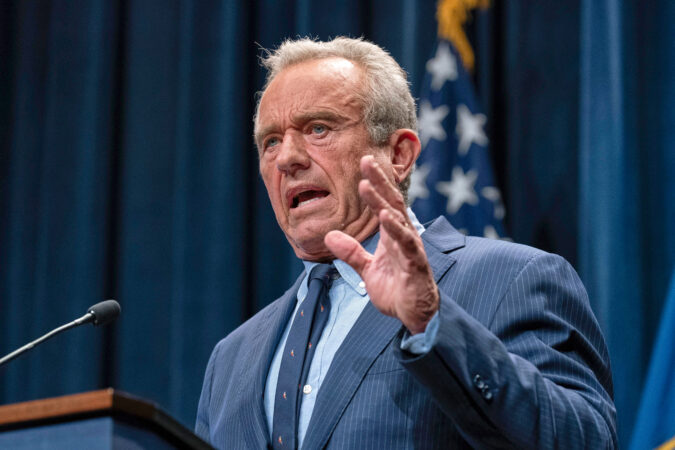
“This is not medicine, it is malpractice,” Health Secretary Robert F. Kennedy Jr. said of gender-affirming procedures on children in a news conference on Thursday. “Sex-rejecting procedures rob children of their futures.”
Kennedy also announced Thursday that the HHS Office of Civil Rights will propose a rule excluding gender dysphoria from the definition of a disability.
In a related move, the Food and Drug Administration issued warning letters to a dozen companies that market chest-binding vests and other equipment used by people with gender dysphoria. Manufacturers include GenderBender LLC of Carson, Calif., and TomboyX of Seattle. The FDA letters state that chest binders can only be legally marketed for FDA-approved medical uses, such as recovery after mastectomy surgery.
Proposed rules would threaten youth gender-affirming care in states where it remains legal
Medicaid programs in slightly less than half of states currently cover gender-affirming care. At least 27 states have adopted laws restricting or banning the care. The Supreme Court’s recent decision upholding Tennessee’s ban means most other state laws are likely to remain in place.
Thursday’s announcements would imperil access in nearly two dozen states where drug treatments and surgical procedures remain legal and funded by Medicaid, which includes federal and state dollars.
The proposals announced by Kennedy and his deputies are not final or legally binding. The federal government must go through a lengthy rulemaking process, including periods of public comment and document rewrites, before the restrictions becoming permanent. They are also likely to face legal challenges.
But the proposed rules will likely further intimidate healthcare providers from offering gender-affirming care to children and many hospitals have already ceased such care in anticipation of federal action.
Children’s Hospital of Philadelphia recently went to court to prevent the Trump administration from obtaining the private medical records of youth who sought gender-affirming care.
Nearly all U.S. hospitals participate in the Medicare and Medicaid programs, the federal government’s largest health plans that cover seniors, the disabled and low-income Americans. Losing access to those payments would imperil most U.S. hospitals and medical providers.
The same funding restrictions would apply to a smaller health program when it comes to care for people under the age of 19, the State Children’s Health Insurance Program, according to a federal notice posted Thursday morning.
Moves contradict advice from medical organizations and transgender advocates
Mehmet Oz, the administrator of the Centers for Medicare and Medicaid Services, on Thursday called transgender treatments “a Band-Aid on a much deeper pathology,” and suggested children with gender dysphoria are “confused, lost, and need help.”
Polling shows many Americans agree with the administration’s view of the issue. An Associated Press-NORC Center for Public Affairs Research survey conducted earlier this year found that about half of U.S. adults approved of how Trump was handling transgender issues.
Chloe Cole, a conservative activist known for speaking about her gender-transition reversal, spoke at the news conference to express appreciation. She said cries for help from her and others in her situation, “have finally been heard.”
But the approach contradicts the recommendations of most major U.S. medical organizations, including the American Medical Association, which has urged states not to restrict care for gender dysphoria.
Advocates for transgender children strongly refuted the administration’s claims about gender-affirming care and said Thursday’s moves would put lives at risk.
“In an effort to strongarm hospitals into participating in the administration’s anti-LGBTQ agenda, the Trump Administration is forcing health care systems to choose between providing lifesaving care for LGBTQ+ young people and accepting crucial federal funding,” Jamila Perritt, a Washington-based OB/GYN and president and CEO of Physicians for Reproductive Health, said in a statement. “This is a lose-lose situation where lives are inevitably on the line. “
Rodrigo Heng-Lehtinen, senior vice president at The Trevor Project, a nonprofit suicide prevention organization for LBGTQ+ youth, called the changes a “one-size-fits-all mandate from the federal government” on a decision that should be between a doctor and patient.
“The multitude of efforts we are seeing from federal legislators to strip transgender and nonbinary youth of the health care they need is deeply troubling,” he said.
Actions build on a larger effort to restrict transgender rights
The announcements build on a wave of actions President Donald Trump, his administration and Republicans in Congress have taken to target the rights of transgender people nationwide.
On his first day in office, Trump signed an executive order that declared the federal government would recognize only two immutable sexes: male and female. He also has signed orders aimed at cutting off federal support for gender transitions for people under age 19 and barring transgender athletes from participating in girls’ and women’s sports.
On Wednesday, a bill that would open transgender health care providers to prison time if they treat people under the age of 18 passed the U.S. House and heads to the Senate. Another bill under consideration in the House on Thursday aims to ban Medicaid coverage for gender-affirming care for children.
Young people who persistently identify as a gender that differs from their sex assigned at birth are first evaluated by a team of professionals. Some may try a social transition, involving changing a hairstyle or pronouns. Some may later also receive hormone-blocking drugs that delay puberty, followed by testosterone or estrogen to bring about the desired physical changes in patients. Surgery is rare for minors.
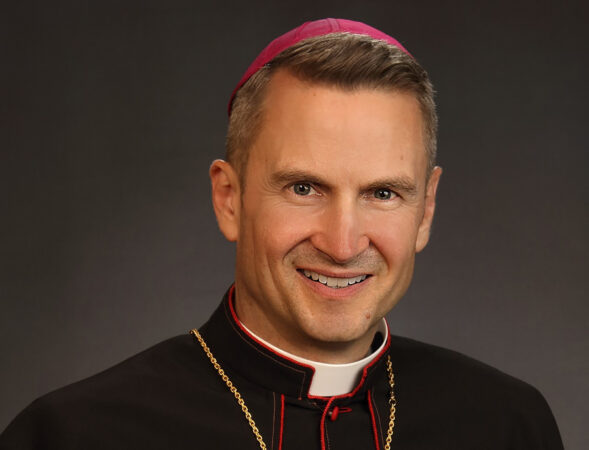
ROME — In his highest-profile move to direct the U.S. church since becoming pope, Leo XIV accepted the resignation of Cardinal Timothy Dolan, the prominent archbishop of New York, replacing him with a 58-year-old Illinois native who “played in the same parks, went swimming in the same pools [and] liked the same pizza places” as the Chicago-born pope.
Ronald A. Hicks, currently bishop of the Diocese of Joliet, southwest of Chicago, is viewed as cut from the same theological cloth — as well as nearly the same streets — as the new pontiff. He will take over one of the most visible archdioceses in the Catholic world at a time when it is grappling with the serious financial fallout of the clerical abuse scandals.
The product and protégé of influential figures in the Chicago church, including Cardinal Blase Cupich, Hicks is widely seen as a mild-mannered moderate, observers say, who rarely delves into the world of divisive politics. That is likely to mark a tonal shift from Dolan, a charismatic conservative who delivered blessings at both of President Donald Trump’s inaugurations and compared slain activist Charlie Kirk to a saint, and whom the U.S. leader has described as a “great friend.”
“I believe the message from Leo is that he wants an archbishop of New York who can be less identified with one political party, with one platform, with one trench in this situation of polarization,” said Massimo Faggioli, a professor in ecclesiology at Trinity College Dublin.
“Hicks is not a woke liberal for sure, but I believe he is very different from Dolan, whose instincts were to very openly justify and excuse President Trump,” Faggioli said. “I don’t think that’s going to continue, honestly. This is a sign of change.”
At St. Patrick’s Cathedral in Manhattan on Thursday, Dolan introduced Hicks to the media as an “early Christmas gift.” Hicks thanked him and Leo and reassured New Yorkers that while he was a Chicago Cubs and deep-dish fan, he loved their pizza and would root for their teams.
He said he understood that these were “complex and challenging days.”
“I feel the hope that so many who came to our shores … came through this very harbor here in New York, including my own family” carried, he said. “I am committed to working … to make real the promise of the golden door by acting in mutual respect and working to uphold human dignity.”
Switching to Spanish, Hicks, who, like Leo, spent years serving the church in Latin America, expressed deep love of the “Latino culture” and “Hispanic people.”
In a telephone interview with the Washington Post, Cupich compared Hicks in some respects to a fellow Chicagoan: the pope.
Both men, he said, emphasize “listening.”
Hicks would not hesitate to “speak out” when warranted, but “he’s not going to come at things in terms of an ideology,” he added.
“So he’s an individual who’s going to look at what the facts are and, and focus on how people’s lives can hear the truth of the Gospel. And walk with people in a very patient way.”
“I think he’s a balanced individual who knows and accepts the tradition of the church, but also is one who realizes, as Pope Francis put it, that realities are greater than ideas,” Cupich said of Hicks.
The decision — announced Thursday by the Vatican but widely rumored for days — places Hicks atop the Archdiocese of New York, second in size only to Los Angeles’ in the United States, at an age that is one year younger than Dolan when Pope Benedict XVI named him to the job in 2009.
In the Catholic Church, bishops and cardinals are expected to offer resignations upon turning 75 — an age Dolan reached in February. Acceptance is at the prerogative of the pope, and cardinals can and do serve longer. Leo has said he would like to make retirement at 75 the norm for the Catholic hierarchy, but he has also spelled out room for exceptions for some cardinals, who, he has said, could serve for up to an additional two years.
“We must all cultivate the inner attitude that Pope Francis has defined as ‘learning to say goodbye,’ a valuable attitude when preparing to leave one’s position,” Leo said in an address last month.
The appointment elevates an apprentice of Cupich — one of Leo’s staunchest allies and a cleric who has been criticized by some conservatives for showing leniency to politicians who support abortion rights and welcoming LGBTQ+ Catholics.
Both Leo and Hicks were Chicago Catholics influenced by one of the most important figures in the 20th-century American church — Joseph Bernardin, a former cardinal and archbishop of Chicago. Bernardin, who ordained Hicks, defended the changes of Vatican II in the 1960s and promoted the “consistent ethic of life” that sought to link views against abortion to opposition to the death penalty and nuclear weapons.
Some ultraconservative Catholics noted that Leo had appeared to seize an opportunity to replace Dolan, rather than permit him — as frequently happens — to serve beyond age 75. Some noted that Leo this week also elevated Bishop Ramón Bejarano, who has publicly apologized to LGBTQ+ Catholics for the “pain” caused to them by the church, to head the Diocese of Monterey, California.
In recent weeks, Leo — who has repeatedly said he does not want to exacerbate political divisions — has grown bolder about criticizing the policies of the Trump administration, describing its migrant crackdown as “inhuman” and taking aim at U.S. attacks against alleged drug boats off the Venezuelan coast.
Perhaps the highest-profile American Catholic cleric, Dolan is a media-savvy traditionalist who, ahead of the 2024 election, praised Trump — who is not Catholic — for taking “his Christian faith seriously.”
During a September appearance on Fox & Friends, Dolan called Kirk “a modern-day Saint Paul.”
“He was a missionary, he’s an evangelist, he’s a hero,” Dolan said. “He’s one, I think, that knew what Jesus meant when he said, ‘The truth will set you free.’”
As frequently happens with Catholic clerics, however, Dolan was not always easy to label — and was criticized by some archconservatives for permitting celebrations for LGBTQ+ Catholics in his archdiocese.
Some saw Hicks’s selection by Leo as one of balance. He is seen, for instance, as less “liberal” than, say, Cardinal Robert McElroy, who was named archbishop of Washington in January by Francis.
“I think that Hicks will be less vocal on political issues than Dolan and McElroy,” said the Rev. Thomas Reese, a senior analyst at the Religious News Service. “I think, especially at the beginning, he will focus on the pastoral. For example, on immigration, he simply endorsed and repeated what the [U.S. bishops conference] had said.”
Hicks mixes pastoral outreach with a more traditional focus on the Holy Eucharist and the role of Christ at Mass. His appointment comes after U.S. bishops named a noted conservative — Oklahoma City Archbishop Paul Coakley — to head their conference last month.
“Here we see the road map of Leo — which is to overcome polarization,” Marco Politi, a longtime Rome-based Vatican watcher, said of Hicks’ appointment.
Born in Harvey, Ill., Hicks was ordained to the priesthood in Chicago in 1994. Like Leo, he served the church for years in Latin America, in Hicks’ case, as director of an orphanage in El Salvador. Cupich appointed him vicar general of the Archdiocese of Chicago in 2015 and an auxiliary bishop in 2018. Pope Francis elevated him in 2020 to serve as bishop of Joliet.
Asked about Leo by Chicago station WGNTV after the pope’s May selection to replace Francis, Hicks said: “I recognize a lot of similarities between him and me. So we grew up literally in the same radius, in the same neighborhood together. We played in the same parks, went swimming in the same pools, liked the same pizza places to go to. I mean, it’s that real.”
That doesn’t mean they see eye-to-eye on everything.
Leo “is and always will be a [White] Sox fan,” Hicks said. “And, I grew up a Cub fan. I’m a Cubs fan because my father is a die-hard Cubs fan. He wanted us to know we were loved, but that we’d stay Catholic and Cubs fans. In my family, there was not getting around either of those things.”
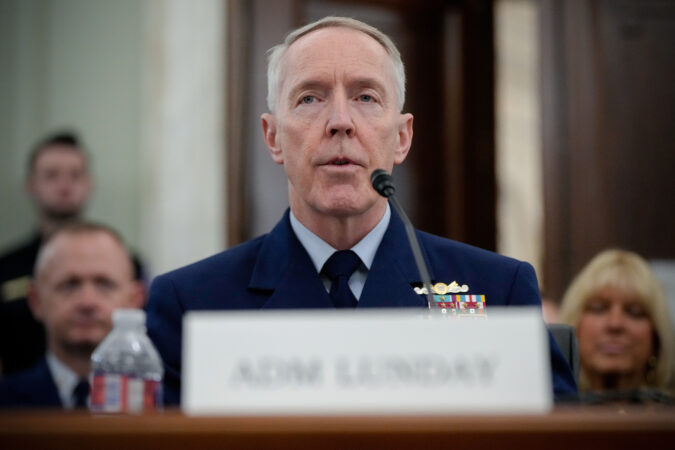
At least two U.S. senators have put holds on the nomination of Adm. Kevin Lunday to lead the U.S. Coast Guard, citing concerns with a new workplace harassment policy that downgrades the definition of swastikas and nooses from hate symbols to “potentially divisive.”
The move upends Lunday’s confirmation, which the Senate was due to vote on this week, and raises new questions about the decision to implement the policy revisions after Lunday in November had forcefully denounced such symbols and declared a wholesale prohibition on them.
The holds on Lunday’s promotion were exercised by Sens. Tammy Duckworth (D., Ill.) and Jacky Rosen (D., Nev.). They follow a series of Washington Post reports detailing plans to include the incendiary language within the Coast Guard’s new workplace harassment manual — and the policy’s quiet implementation this week despite the admiral’s explicit directive last month. The manual is posted online and specifies that the document’s previous version “is cancelled.”
In a statement, Duckworth expressed incredulity at the situation and questioned why Lunday would not update the policy manual “to delete the absurd characterization that clearly states a noose and swastika are merely potentially divisive symbols.” She said that the admiral had affirmed “directly to me” that both “are symbols of hate.”
“This shouldn’t be difficult,” Duckworth said.
Rosen, in a social media post announcing her decision to place a hold on Lunday’s nomination, said it appears he “may have backtracked in his commitment to me to combat antisemitism and hate crimes and protect all members of the Coast Guard.” She said her hold will remain in place “until the Coast Guard provides answers.”
It was not immediately clear why Lunday, who was named the Coast Guard’s acting commandant after the Trump administration ousted his predecessor, did not incorporate his November order into the manual before it took effect Monday, or to what extent the Department of Homeland Security leadership, which has authority over the service, was involved in the revision process.
Two people familiar with policy manual’s overhaul, speaking on the condition of anonymity for fear of reprisal, sought to distance Coast Guard leadership from the controversy. “The policy rewrite was bad staff work,” one person, a Coast Guard employee, said. “But the Coast Guard’s hands were tied in how we were able to address the mistake.”
A spokesperson for Lunday did not respond to a request for comment, and the Coast Guard did not address whether Lunday, as acting commandant, had the authority to change the workplace harassment manual or if he required approval from Homeland Security Secretary Kristi L. Noem.
A spokeswoman for DHS, Tricia McLaughlin, said that by placing a hold on Lunday’s nomination, Duckworth and Rosen were attempting to “extort” the Coast Guard to score “cheap political points.”
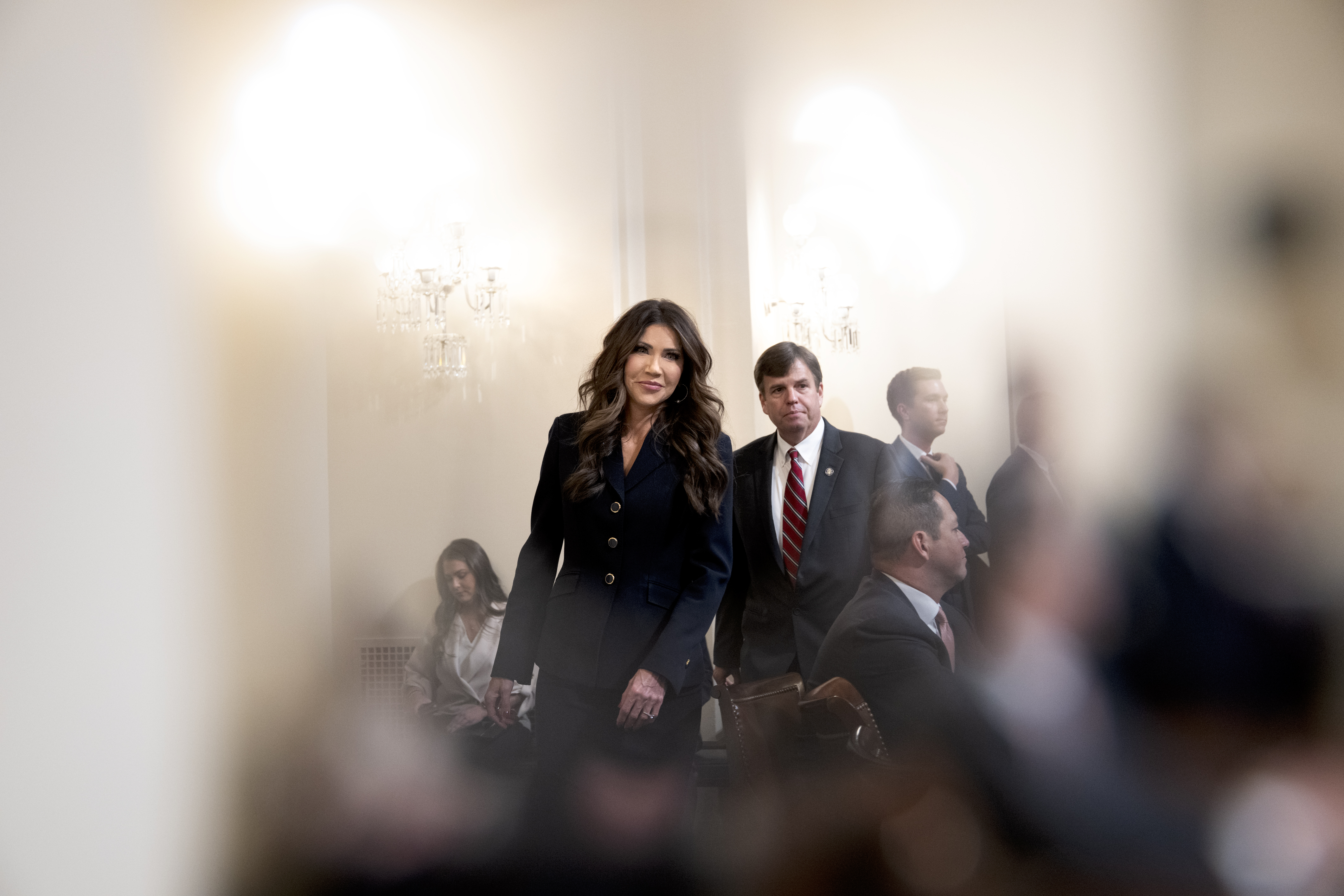
Homeland Security Secretary Kristi L. Noem on Capitol Hill earlier this month.
“At a time when the threat of antisemitic violence is as widespread as it is right now, using this to politicize one of President Trump’s military nominations is simply disgusting,” McLaughlin said.
The issue has drawn concern from some Republicans, too. Sen. Dan Sullivan (R., Alaska) “has been clear with acting commandant Adm. Lunday since the story broke that the Coast Guard must clarify, in the strongest terms possible, that the Coast Guard does not tolerate symbols of hate, like swastikas and nooses,” his office said in a statement Wednesday.
Sen. James Lankford (R., Okla.) also registered disapproval. In a statement, his office said the senator was “provided assurances” the policy had been corrected. “There is no reason,” it says, “why there should be conflicting policies in place.”
Unless the holds are lifted, Lunday’s nomination will be sent back to the White House at the end of December, forcing President Donald Trump to renominate him or choose someone else for the job, according to a Senate Republican aide.
The Coast Guard’s hazing and harassment policy was an early focus of Lunday’s after the Trump administration, upon entering office in January, fired his predecessor, Adm. Linda Fagan — the first woman to lead a branch of the U.S. military. In announcing Fagan’s removal, officials cited among other things her “excessive focus” on diversity initiatives.
Within days Lunday ordered the suspension of the policy manual that, among its other guidance, said explicitly that the swastika was among a “list of symbols whose display, presentation, creation, or depiction would constitute a potential hate incident.” Nooses and the Confederate flag also matched that description under the previous policy. Lunday was later nominated by Trump to lead the service as its commandant.
The policy manual changes reflect an administration-wide campaign to purge the federal of government of its focus on diversity, equity and inclusion (DEI). At the Pentagon, for instance, Defense Secretary Pete Hegseth has fired multiple minority or female military officers in his ongoing effort to eliminate DEI initiatives. He has said, without offering evidence, that the prior administration’s focus on DEI harmed military recruiting.
At the same time, antisemitism is on the rise globally. At least 15 people were killed over the weekend at a Hanukkah celebration in Australia.
The Coast Guard’s new workplace harassment manual, beyond softening the definition of swastikas and nooses, also allows for supervisors to review how such symbols are used or displayed in the workplace instead of immediately prohibiting them.
After the Post in November revealed the Coast Guard’s plan to adopt the new language, Lunday reacted swiftly — stating in a memo to all Coast Guard personnel that his directive barring swastikas and nooses would supersede any other policy language.
Vincent W. Patton, who served as master chief petty officer of the Coast Guard — the highest enlisted position — from 1998 to 2002, on Wednesday cited Lunday’s memo in offering a defense of the admiral and the policy revision. The new manual’s wording gives the Coast Guard more latitude to make judgment calls case by case, he said, adding that Lunday’s letter to all personnel was “very, very clear that hate symbols are prohibited.”
The process and penalties remain the same — regardless of whether the word is “hate” or “potentially divisive,” Patton said in an interview.
Asked if he meant that there could be situations in which someone with a noose or a swastika flag or tattoo was not in violation of the harassment policy, he said “that’s possible.”
“I mean if it was a swastika, they should be out within a second,” Patton said, “but Confederate flags? There should be an open dialogue to determine or define if this person has the potential and willingness to do something hateful.”
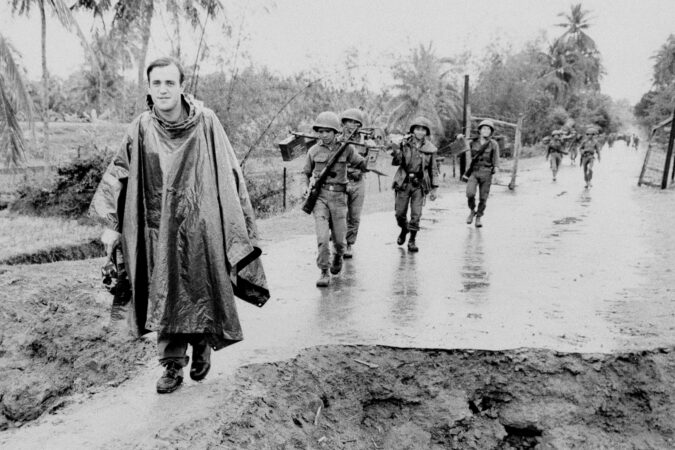
Peter Arnett was already an accomplished combat correspondent in 1966 when he embedded with an American infantry battalion tasked with routing out enemy snipers from a tunnel system near Saigon. Mr. Arnett was standing next to the unit commander when bullets tore through the map the officer was holding, hitting the colonel in the chest.
Medics ran up to bandage Lt. Col. George Eyster, a West Pointer who died the next day at a field hospital. Mr. Arnett wrote his obituary, which was among the scores of stories he filed from the humid jungle battlefields of Vietnam for more than a decade. He won the Pulitzer Prize for international reporting that year.
Mr. Arnett stayed in Vietnam beyond the very end. When Viet Cong guerrillas entered the Associated Press bureau during the 1975 fall of Saigon, his boss Nate Polowetzky told him to get out of there. Mr. Arnett refused. “He told me, in effect, to go screw myself,” Polowetzky said.
The New Zealand native would go on to cover more wars (15 to 20, he said), including the Gulf War. He was one of the few Western reporters in Baghdad in January 1991 when allied missiles started raining down, reporting live from the city for CNN. He interviewed Saddam Hussein in the second week of the war, and in 1997, Osama bin Laden.
When Mr. Arnett asked bin Laden about his plans, the 9/11 mastermind replied: “You’ll see them and hear about them in the media. God willing.”
Mr. Arnett died Wednesday at 91, in Newport Beach, Calif. The cause was prostate cancer, said his daughter, Elsa Arnett.
After arriving in Vietnam, Mr. Arnett was given lifesaving advice from one of his AP colleagues, Malcolm Browne: Lie prone under fire; look for cover and move toward it; do not get close to a radioman or medic because they are prime targets; and if you hear a shot, don’t get up to see where it came from because the second shot might get you.
Mr. Arnett, one of the most famous journalists of his era, wrote gripping battlefield stories that transported readers sitting in their living rooms to the scene of the news.
The stories that won him the Pulitzer included a dispatch about an Army captain who watched helplessly as a Viet Cong machine gunner kept pummeling the body of one of his men, rolling it over and over. In a story titled “Everyone Knew the Americans Were Coming,” Arnett wrote on a failed U.S. mission aimed at hunting down Viet Cong fighters who easily got away.
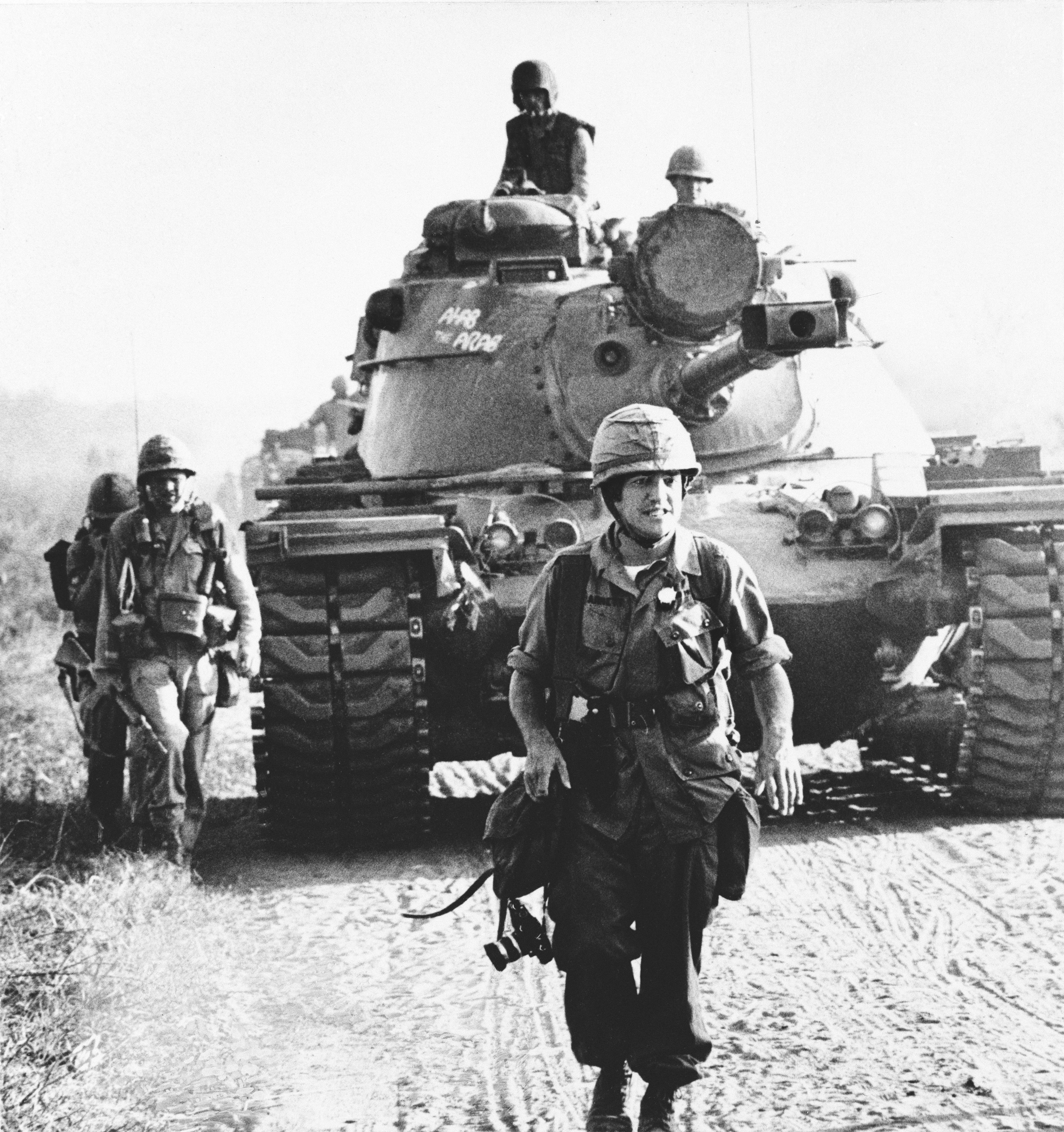
Peter Arnett walks in front of a U.S. tank in Vietnam in 1967.
Reporting on the Vietnam War forced Mr. Arnett to repress his human instincts. On one hot day at the Saigon market, Mr. Arnett watched a Buddhist monk squat on the pavement and douse himself in gasoline before flicking a lighter.
“I could have prevented that immolation by rushing at him and kicking the gasoline away,’” Mr. Arnett recalled. “As a human being I wanted to. As a reporter I couldn’t. … If I had stopped him, the [South Vietnamese] secret police who were watching from a distance would have immediately arrested him and carried him off to God knows where. If I had attempted to prevent them doing this, I would have propelled myself directly into Vietnamese politics. My role as a reporter would have been destroyed.”
Instead, Mr. Arnett photographed the burning monk and dashed back to his office to write his story.
But Mr. Arnett’s eagerness to report entangled him in controversy. In the Gulf War, as one of the few Western journalists reporting from behind enemy lines in Iraq, he was granted access by Hussein’s regime to what officials said was an industrial plant that produced milk powder and was the only source of infant formula in Baghdad. It had been hit by U.S. bombs.
Mr. Arnett reported on CNN what he saw and heard, and went to bed. The next day, he learned that he had reported on “one of the most controversial stories of my career.” U.S. officials disputed the claim that the factory made baby milk powder and instead alleged it was used for the production of biological weapons protected by the Iraqi military. White House officials called him a “conduit for Iraqi disinformation,” while Rep. Laurence Coughlin (R., Pa.) called him the “Joseph Goebbels of Saddam Hussein’s Hitler-like regime.”
Sen. Al Simpson (R., Wyo.) went so far as to accuse the brother of Mr. Arnett’s Vietnamese-born wife of being a Viet Cong operative. (Simpson later apologized, saying there was no evidence to prove that claim.)
Mr. Arnett kept reporting, showing the damaged buildings in the town of Al-Dour that Iraqi officials said had been hit by U.S. and allied bombs and had resulted in 24 civilian deaths.
“There was nothing in his tone that was judgmental, nothing that indicated sympathy for the Iraqis,” wrote Howard Rosenberg, the Los Angeles Times’s TV critic. “Without interpretation, he reported only what he said he saw, accompanied by the appropriate disclaimers regarding censorship.”
In 1999, Mr. Arnett left CNN after being involved in a story that alleged that the U.S. military had used deadly sarin nerve gas on deserting American soldiers during the Vietnam War. When a subsequent Pentagon investigation said there was no evidence of sarin gas ever having been shipped to Southeast Asia and disputed other key portions of the story, CNN retracted it.
Mr. Arnett faced further criticism in 2003, when he gave an interview to Iraqi state television.
“It is clear that within the United States there is growing challenge to President Bush about the conduct of the war and also opposition to the war. So our reports about civilian casualties here, about the resistance of the Iraqi forces … help those who oppose the war,” he said.
The remarks sparked backlash from the administration of President George W. Bush and lawmakers from both parties. His employer, NBC, initially defended him, saying the remarks were “analytical in nature,” but eventually fired him, saying it had been wrong for Mr. Arnett to “grant an interview to state-controlled Iraqi TV — especially at a time of war — and it was wrong for him to discuss his personal observations and opinions in that interview.”
Peter Gregg Arnett was born in Riverton, New Zealand, on Nov. 13, 1934.
He began his journalism career in his country of birth, writing for the Southland Times newspaper. Restless and bored, he left his home country seeking adventure. When he arrived in Southeast Asia, he decided to stay, enchanted by the “opium smugglers, revolutionaries and obscure little wars in obscure little kingdoms.”
He ended up reporting from Thailand and Indonesia before he arrived in Vietnam.
In Vietnam, he worked and competed with the other big-name journalists including David Halberstam and Marguerite Higgins.
He became a naturalized U.S. citizen in the mid-1980s while CNN’s Moscow bureau chief. Mr. Arnett thought it was important that he should be an American citizen because he was representing an American news organization, according to his family. Mr. Arnett said in a 2015 interview that his U.S. citizenship “solidified my credentials to challenge American policy.”
“I was perfectly happy to be a New Zealander, and it wasn’t an issue in my work. The Associated Press and CNN were more interested in the journalism than the nationality,” Mr. Arnett said. He added, however, that there were “a lot of comments during the Gulf War” about his foreign origins.
“But the point was, I was an American. If I hadn’t been, it would have been a way to further discredit my journalism.”
He met Nina Nguyen Thu-Nga, a South Vietnamese woman, while covering the war. He married her and they had two children, Andrew and Elsa, before divorcing in 1983. His frequent and extended travels abroad were to blame, according to Mr. Arnett’s family. They remarried in 2006 and stayed together until his death.
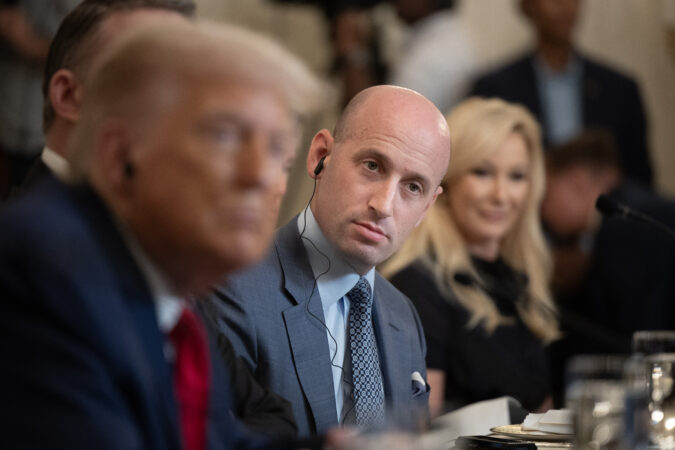
President Donald Trump’s homeland security adviser, Stephen Miller, and other senior officials were looking for a fight.
In the first months of the administration, Miller, the architect of Trump’s anti-immigration and border policies, and his team discussed starting a new war on drugs by striking cartels and alleged traffickers in Mexico, according to one current and two former U.S. officials.
Reducing the power of cartels, an idea that dated back to the first Trump administration, would ease the flow of migrants and narcotics, creating early political wins. But as the administration surged thousands of U.S. troops to the southern border, increased U.S. surveillance flights and boosted intelligence sharing with its neighbor, Mexican military operations across the border curbed cartel action, the people said. That left Miller and his team looking for another target.
“When you hope and wait for something to develop that doesn’t, you start looking at countries south of Mexico,” said the current official, who, like nine others interviewed for this story, spoke on the condition of anonymity because of the matter’s sensitivity.
The campaign that emerged in the Caribbean Sea and eastern Pacific Ocean is unprecedented in its use of lethal force by the U.S. military against alleged drug smuggling groups. These operations, which began Sept. 2, have evolved to embrace the Trump team’s long-running ambition to oust Venezuelan President Nicolás Maduro, whom the president has accused of overseeing “narco-terrorists” assaulting the United States.
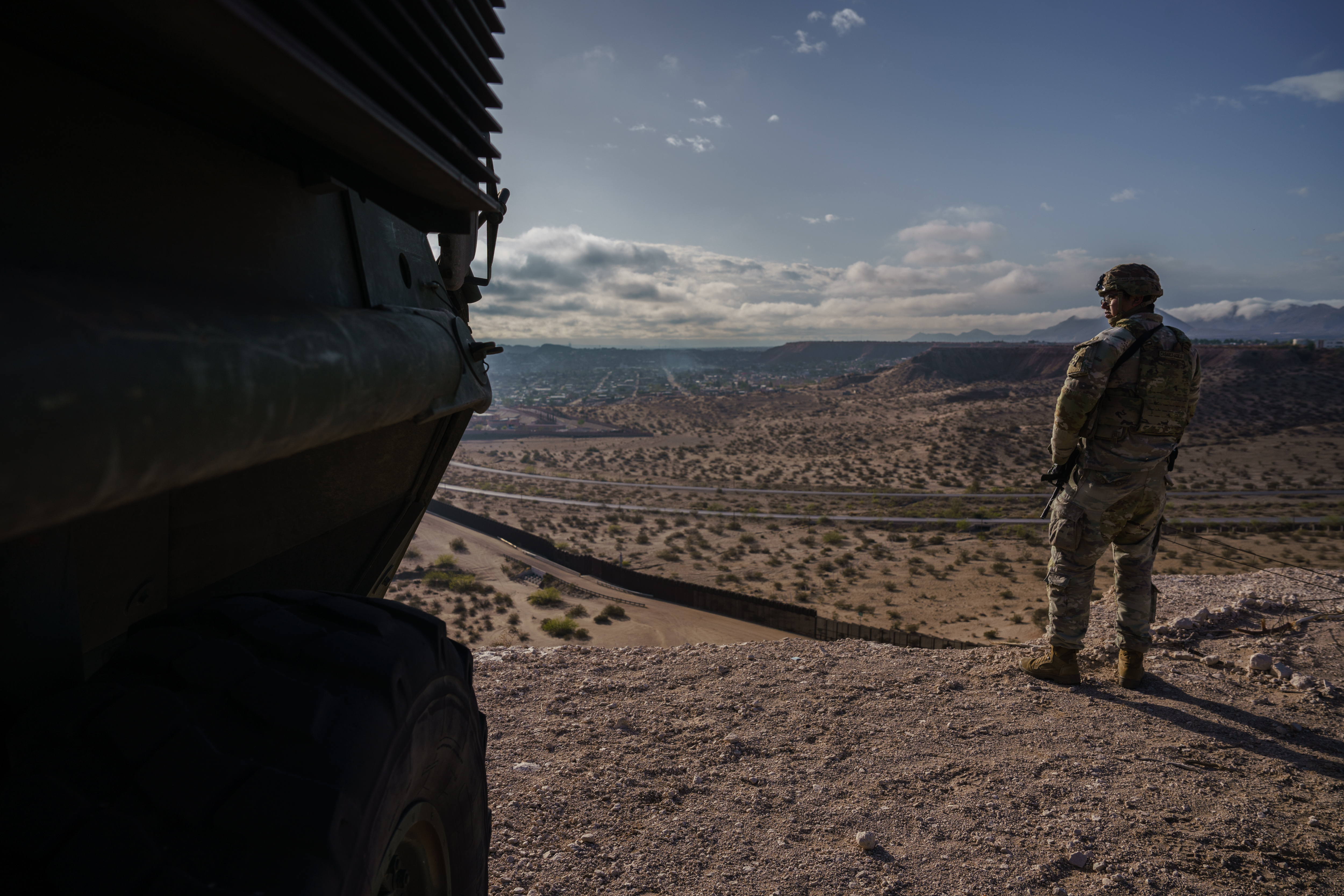
A U.S. soldier is deployed along the U.S.-Mexico border as part of the Joint Task Force Southern Border mission, in Sunland Park, N.M., on April 4.
Miller has been a driving force behind the administration’s counternarcotics campaign, pressing for results and fresh military options that could be turned into future operations, the current and former officials said.
“President Trump’s counternarcotics policies come from President Trump himself,” White House spokeswoman Anna Kelly said. “All senior administration officials work closely together to carry out the agenda President Trump was elected to implement, including eliminating the scourge of narco-terrorism that takes tens of thousands of American lives every year.”
Miller could not be reached for comment.
Miller steered the drafting of a July 25 classified directive signed by the president that authorized the military to undertake lethal force against two dozen foreign criminal groups, said a former U.S. official familiar with the campaign and its evolution. The administration has labeled these groups “designated terrorist organizations,” accusing them of using drugs as a weapon to kill Americans, using a moniker that many experts say has no basis in law.
“The president’s memo is the original sin of the whole operation,” the former official said.
That presidential directive provided the foundational authority for an “execute order” that Defense Secretary Pete Hegseth issued on Aug. 5 and that subsequently has been modified. The order, details of which were previously unreported, contains permissive targeting guidelines for lethal operations, current and former officials said. The presidential directive’s existence was first reported by the New York Times.
Together, these two documents guided a military campaign of lethal strikes against criminal organizations, grafting a wartime frame to what has been traditionally treated as a law enforcement problem. The execute order also contains targeting criteria lifted from the language of the counterterrorism campaign against al-Qaeda and the Islamic State, which some current and former officials say give the Pentagon an overly permissive license to kill.
The department will treat suspected drug smugglers “EXACTLY how we treated Al-Qaeda. We will continue to track them, map them, hunt them, and kill them,” Hegseth said on social media last month.
Pursuant to these orders, the Trump administration has launched strikes on at least 26 boats, killing at least 99 people in the Caribbean Sea and eastern Pacific Ocean. The Pentagon has not publicly identified those killed, and it is unclear whether it has collected the intelligence to do so.
“The administration appears to have authorized a campaign against civilians and alleged criminals that is now stretching the limits of international law so that it’s now totally unrecognizable,” said Todd Huntley, a former military lawyer who advised Special Operations forces for seven years at the height of the U.S. counterterrorism campaign and is director of the national security law program at Georgetown Law.
The White House’s early deliberations about the use of lethal force against cartels contemplated using covert action by theCIA. But as resistance emerged from lawyers and others over the ensuing months, Miller and his team turned increasingly toward the idea of using the military to pursue alleged traffickers.
Miller’s larger vision was to reduce the flow of drugs — and migrants — into the United States. He figured that attacking cartels would diminish their power and help stabilize Latin American countries, resulting in fewer people risking the trek to the United States, according to one of the former U.S. officials familiar with Miller’s deliberations.
As the summer progressed, the White House’s campaigns against narcotics and migration coalesced with a long-held desire of Secretary of State Marco Rubio to force Maduro from power. Rubio and the Justice Department in August doubled to $50 million the reward for information leading to the Venezuelan leader’s arrest, citing an indictment for corruption and drug trafficking during the first Trump administration.
Meanwhile, the White House found a willing partner in Hegseth, who had been knockedoff stride by several missteps and was eager to show he could deliver on a high-priority mission.
“Pete very much wanted to keep Stephen in his good graces and also the president,” said the former official familiar with Miller’s thinking. “And that was a motivation for him — getting behind this campaign in an aggressive way.”
The Defense Department declined to address questions about its operations to strike alleged traffickers and how the mission took shape. Elements of Miller’s leading role were reported earlier by the Guardian.
“This reporting is inaccurate and is built on a false premise that ignores reality,” Pentagon chief spokesman Sean Parnell said in a statement. The department’s focus, he said, “is, and will continue to be, protecting the Homeland from any threat.”
Widening the scope
The Aug. 5 execute order,or EXORD in Pentagon parlance, stated that the campaign’s goal is to stop the flow of drugs by sea to the United States, two people said.
Initially, the order contained a geographic boundary that designated target areas in international waters off the coast of Venezuela, but it was modified about two months later to include the eastern Pacific area, one current and one former U.S. official said.It specified that at least for the initial strikes, Joint Special Operations Command would be in charge of operations, the two people said.
A still frame from a video posted on social media by President Donald Trump shows a boat allegedly transporting illegal narcotics after a lethal strike on Sept. 2, through U.S. military imagery.
Over the late summer and into the fall, lawyers and policy personnel raised concerns about the legality of the lethal force campaign that was taking shape. Administration officials sought to reassure them by saying that a Justice Department Office of Legal Counsel memo was being drafted that determined that the lethal targeting of suspected drug runners was lawful under the president’s power to ascertain that the U.S. is in a formal state of war — in this case with alleged drug traffickers.
But the opinion was not signed until Sept. 5 — three days after the first boat strike — and some career lawyers were not permitted to read the draft OLC memo before the execute order was issued, said the former official familiar with the campaign’s evolution.
The OLC memo, signed by Assistant Attorney General T. Elliot Gaiser, asserts that alleged drug trafficking groups are a threat to the United States akin to a foreign nation attempting to invade, Sen. Mark Kelly (D., Ariz.), who was allowed to read it in his capacity as a member of the Senate Armed Services Committee, told the Post in an interview.
The execute order contains targeting instructions that do not require positive identification of any individual but rather “reasonable certainty” that adult males are members of, or affiliated with, a “designated terrorist organization,” or DTO, according to five current and former U.S. officials familiar with the criteria. To mitigate civilian harm, the order requires “near certainty” that no women, children or civilians are present, they said.
The administration is using the phrase “designated terrorist organizations” to refer to 24 alleged drug trafficking groups whose activities it contends are killing millions of Americans.
The term, said Rebecca Ingber, a professor at the Cardozo School of Law and a former State Department law-of-war expert, “is entirely manufactured as a source of targeting authority with no basis in law.”
The list of 24 such groups appears in an annex to Trump’s July directive and also in the EXORD, according to one current and one former official.
The assessment of “affiliation” is based on a number of factors, including the presence of drugs on board the vessel and its route, as well as intercepts of communications, the current and former officials said.
As a result, the campaign may be killing individuals who in some cases have a tenuous link to any organized drug-running operation, said one of the former U.S. officials, who has read the execute order.
“When you define DTO and affiliate so loosely and you’re attacking boats, [the guidelines are] basically meaningless,” the former official said.
If the United States were actually at war, the reasonable certainty standard would be “perfectly reasonable,” said Ryan Goodman, a former Pentagon special counsel who worked on counterterrorism targeting issues in the Obama administration.
“Not being in an armed conflict changes everything,” he said. “The idea that a government would kill people on the basis of ‘reasonable certainty’ that they’re a member of a drug cartel is beyond the pale. Any U.N. body would find that to be a gross violation of human rights.”
Identification and delegation
The targeting requirements, four former officials say, resemble the “signature strikes” of past global counterterrorism campaigns, in which the CIA and the military launched drone attacks in Afghanistan, Pakistan and Yemen on individuals or groups whose identities were unknown but who were targeted based on a pattern of behavior or other characteristics associated with terrorist activity.
The execute order, which sets the rules of engagement for the military, designates Hegseth as the “target engagement authority” — the official who can approve strike targets. It also stipulates that he can delegate that authority to others in individual missions.
“Now, the first couple of strikes … as any leader would want, you want to own that responsibility,” Hegseth said at a cabinet meeting this monthin response to questions about the first boat strike, details of which — including a subsequent missile strike to kill survivors — were first published bythe Post. “So I said I’m going to be the one to make the call after getting all the information and make sure it’s the right strike.”
Pentagon general counsel Earl Matthews — who had just been confirmed by the Senate on July 29 with a 50-47 vote — signed off on the Aug. 5 order, said a person familiar with the matter. Lawmakers have for weeks requested a copy of the order and related documents but have not received them. Matthews did not respond to a request for comment.
President Donald Trump signed a classified directive that authorized the military to undertake lethal force against two dozen foreign criminal groups.
Trump has asserted, without offering proof, that the U.S. troops know who they are targeting in every case. “We know everything about them. We know where they live. We know where the bad ones live,” he told reporters this month.
The military knew the identities of all 11 people killed in the first attack of the campaign on Sept. 2, Pentagon officials have said. But “they don’t know all of the individuals on many of the other boats” in subsequent strikes, Sen. Mark R. Warner (D., Va.), vice chairman of the Senate Intelligence Committee, told ABC News on Sunday.
Trump posted on Truth Social the day of the first strike that the U.S. military had killed 11 “positively identified” members of the Venezuelan organization Tren de Aragua. He called them “narco-terrorists” operating “under the control of” Maduro, who has been condemned by both the Trump and Biden administrations for illegally retaining power after losing last year’s presidential election.
This week, the commander overseeing that operation, Adm. Frank M. Bradley, told lawmakers that the military knew one of the 11 was a member of Tren de Aragua and the other 10 were affiliates, according to three U.S. officials.
The U.S. intelligence community this year assessed that Tren de Aragua, a transnational crime syndicate, was not directed by Venezuela’s government.
Two family members of men killed on Sept. 2 did not deny that the boat was smuggling marijuana and cocaine. But they said Trump’s allegation the men had worked for Tren de Aragua was inaccurate.
“I knew them all,” one of the family members told the Post in October, speaking on the condition of anonymity for fear of retribution. “None of them had anything to do with Tren de Aragua. They were fishermen who were looking for a better life” by smuggling contraband.
In some of the strikes, the targets who have been identified are not high-level operators or cartel bosses, lawmakers said. “It’s one thing to be a narco-terrorist and another thing to be a fisherman that’s getting paid a hundred bucks a couple times a year … to supplement his income” to ferry drugs, Warner told reporters at the Defense Writers Group last week.
Lifting language from the ‘war on terror’
The Aug. 5 execute order adopts the language of previous administrations in successive global counterterrorism campaigns after 2001, but the context is vastly different, current and former officials say.
The fight against ISIS in Iraq from 2014 on generally involved clearing terrain of fighters who often barricaded themselves in buildings in cities teeming with civilians, and U.S. troops were often firing in self-defense at militants shooting at them, former Special Operations personnel said.
In the drug boat campaign, the U.S. military is launching munitions from afar, more like the counterterrorism operations in Yemen and Somalia during the Obama and first Trump administrations.
Under President Barack Obama, outside areas of active hostility, the targeting guidelines required that lethal force be used only when capture was not feasible and only to prevent attacks against U.S. citizens or when targets posed a continuing imminent threat. They required “near certainty” that a target was a member of a terrorist organization.
“Generally you had people swearing allegiance” to a group like al-Qaeda as an indicator of membership, said the former U.S. official, who is familiar with the counterterrorism targeting criteria. “So you had the presence of weapons and good intelligence on planning you could point to, to link people to the group and say this person is a planner of attacks, this is the money guy, this is a recruiter, etc.”
The standard was changed to “reasonable certainty” under the first Trump administration. But for all practical purposes, said a former senior military officer involved in special operations and battle in the Middle East, the military was applying the “near certainty” standard in these areas. The standard was returned to near certainty under Biden.
“In places like Yemen, whether it was under Obama or Trump,” the retired officer said,“we knew who we were going after. We knew what their place in the network was. We knew what the effects of removing them would be on the network. I don’t see that in some of what [the U.S. is] doing right now.”
One major contextual difference in the current operations against seaborne narcotics is the lack of congressional authority. In the battles against al-Qaeda and associated forces, Congress explicitly authorized the campaigns, giving the president permission to use “all necessary and appropriate force” against those who attacked the United States on Sept. 11, 2001.
The execute order and subsequent targeting guidelines were grounded in the 2001 congressional authorization to use military force.
In 2013, during the Obama administration, the “near certainty” standard typically required confirmation via two sources of intelligence, said Huntley, the former military lawyer for Special Operations forces.
A combination of intelligence tools — signals intelligence, eavesdropping, human spies, and drone surveillance — would contribute to a “positive identification of the individual,” Huntley said. To get to “near certainty” that civilians were not present, the attack location was usually a remote area or a place known to be frequented by only members of the terrorist organization that Congress had specifically authorized as a viable target.
If U.S. officials know the identities of who they are striking, as Trump and Hegseth maintain, then they should release them, the former senior military officer said. “It would help build the case,” he said, that the military is acting to protect civilians according to the law of war.
‘Anybody … is subject to attack’
Though the administration’s charges against Maduro have merit, its claims that Venezuela is sending massive amounts of drugs to America do not, analysts and officials have said.The main domestic drug scourge is fentanyl, a synthetic opioid produced in Mexico, not Venezuela.
Many strikes taken have been in the Pacific, the main sea lane used by traffickers from Colombia and Ecuador. Drug running in the Caribbean focuses mainly on non-U.S. markets, such as Europe. The lethal strike on Sept. 2, for instance, targeted a boat carrying cocaine ultimately bound for Suriname, officials have said.
That absence of information has prompted speculation that the larger buildup of U.S. forces in the region is a preparation for an attack on Venezuela. Miller has indicated to colleagues that a strong reaction from Caracas could provide the reasoning to invoke the Alien Enemies Act to quickly deport hundreds of thousands of Venezuelan immigrants from the United States, the former official noted.
This month, Trump suggested that he wanted to go after Colombian targets. “I hear the country of Colombia is making cocaine,” he said. “They have cocaine manufacturing plants. And then they sell us their cocaine. … Anybody that’s doing that and selling it into our country is subject to attack.”
He also has stepped up the pressure on Venezuela, seizing an oil tanker last week off that country’s coast.
“He wants to keep on blowing boats up until Maduro cries uncle,” Trump’s chief of staff, Susan Wiles, told Vanity Fair in an article published this week. “And people way smarter than me on that say that he will.”
On Tuesday, Trump announced in a social media post a “total and complete blockade” of all sanctioned oil tankers entering or leaving Venezuela, further ratcheting up the pressure.
On Wednesday, Miller amplified Trump’s post, commenting: “American sweat, ingenuity and toil created the oil industry in Venezuela. Its tyrannical expropriation was the largest recorded theft of American wealth and property. These pillaged assets were then used to fund terrorism and flood our streets with killers, mercenaries and drugs.”
Trump, meanwhile, has been signaling that the campaign is widening.
“We knocked out 96 percent of the drugs coming in by water,” he told reporters Friday in the Oval Office. “And now we’re starting by land, and by land is a lot easier, and that’s going to start happening.”
If you are pregnant or a new mother who is struggling with depression or anxiety, you can call or text the National Maternal Mental Health Hotline, 24/7: 833-TLC-MAMA (833-852-6262). Postpartum Support International can help connect you with a local mental health provider at 800-944-4773 or psidirectory.com.
Before giving birth to her second child, Heidi DiLorenzo was anxious. She worried about her blood pressure, and the preeclampsia that prompted her to be hospitalized twice during the pregnancy. She worried that some terrible, unnamed harm would come to her 3-year-old daughter. She worried about her ability to love another baby as much as she loved her first.
But DiLorenzo, an attorney in Birmingham, Ala., did not worry about taking Zoloft. She had used the medication to treat anxiety before she had her first child, and she continued it throughout that pregnancy and this latest one.
And since having her second daughter, in September, she credits an increased dosage with pulling her out of the “dark hole” of sadness she felt postpartum. “I wouldn’t be as good of a mom to my girls if I didn’t take it,” DiLorenzo said. “I wouldn’t have the energy.”
She is among the estimated 20% of women in the U.S. who have depression or anxiety during or after pregnancy. Yet only half of those mothers receive adequate treatment, according to Kay Roussos-Ross, who runs the perinatal mood disorders program at the University of Florida. And just 5% take a selective serotonin reuptake inhibitor, a class of medications commonly used to treat both conditions.
Now medical experts are concerned that a July panel discussion convened by the Food and Drug Administration could lead to more cases of untreated depression. Many of the 10 members of the panel expressed concern about the use of SSRIs, such as Zoloft, during pregnancy. They included Josef Witt-Doerring, a psychiatrist who owns clinics aimed at helping people wean themselves off antidepressants, and Adam Urato, an OB-GYN who recently petitioned the FDA to put stronger warnings on SSRIs.
While the discussion did not represent any official FDA guidance, the panelists — in claims the American College of Obstetricians and Gynecologists called “outlandish and unfounded” — linked the drugs to increased risks of miscarriage, birth defects, and autism in children exposed to them in utero. The Society for Maternal-Fetal Medicine said its members were “alarmed by the unsubstantiated and inaccurate claims made by FDA panelists.”
Antidepressants are a safe, “lifesaving” tool, given that mental health issues such as suicide and overdoses are the leading cause of maternal death in the country, ACOG President Steven Fleischman said in a statement on the group’s website.
Christena Raines, a nurse-practitioner who in 2011 helped found the nation’s first inpatient perinatal psychiatric unit, in North Carolina, said SSRIs are “probably the most well-studied medicine in pregnancy.” In long-term studies of children exposed to the drugs in utero, she said, researchers haven’t seen problems.
It’s too soon to know whether the panel discussion has affected prescribing rates — or whether those who are pregnant are avoiding the drugs more. But Raines, who teaches at the University of North Carolina-Chapel Hill School of Medicine, said she’s already fielding questions from patients. She said the misinformation the panelists spread — along with President Donald Trump’s distorted claims about taking Tylenol during pregnancy — is making her job harder.
Dorothy DeGuzman is a family medicine physician who treats high-risk pregnancies in California. “There’s already so much stigma around taking antidepressants in pregnancy,” she said. “This will just add to the fear.”
The panel
The July panel discussion was one of four the FDA has convened since May. In the past, the agency vetted members of advisory committees to avoid conflicts of interest. Yet these panels were chosen in private and the events were held with scant public notice. In a July investigative report by MedPage Today, researchers and consultants raised questions about the events’ ethics and legality.
Department of Health and Human Services spokesperson Emily Hilliard did not directly answer when asked about the panelist selection process. She called the panel events “roundtable discussions” in which experts review the latest scientific evidence, evaluate potential health risks, and “explore safer alternatives.”
The July panel appeared to be following an executive order Trump issued in February establishing the Make America Healthy Again Commission and directing it to “assess the prevalence of and threat posed by the prescription of selective serotonin reuptake inhibitors” and other medications.
Health and Human Services Secretary Robert F. Kennedy Jr., who oversees the FDA, is a frequent critic of such drugs. He has claimed, without evidence, that they might be contributing to school shootings.
In opening remarks at the July panel discussion, FDA Commissioner Marty Makary also voiced concerns about the medications. “From a national standpoint, the more antidepressants we prescribe, the more depression there is,” he said.
‘Not a luxury’
The sole member of the panel who was both a board-certified psychiatrist and an OB-GYN — the University of Florida’s Roussos-Ross — raised a different concern. “Research shows that in women who stop their medications in pregnancy, they are five times more likely to experience a relapse,” she said.
“I want to stress that treating mental illness in pregnancy is not a luxury,” she told the panel. “It’s a necessity.”
Overall, about 19% of U.S. women in their 20s and 30s experience depression, according to the latest data from the Centers for Disease Control and Prevention, and roughly 10% take SSRIs. But studies show that half of women decide to stop taking antidepressants before or during their pregnancies.
One reason so few expectant mothers receive depression treatment, doctors say, is that they are already afraid to take any medications during pregnancy. The majority of DeGuzman’s patients rely on Medicaid, the government health coverage for those with low incomes or disabilities. Half are Latina. She often prescribes SSRIs, she said, but her patients rarely take them.
The issue is especially urgent for Black and Latina mothers, who experience higher rates of depression and anxiety than white, non-Latina mothers but are less likely to receive adequate treatment. Many factors contribute to this disparity, including systemic racism, exposure to violence, misdiagnosis, and a lack of access to care.
Shanna Williams, a perinatal mental health therapist who treats African American mothers in Philadelphia, said many of her clients were already more likely to trust friends and family over their doctors when it comes to whether antidepressants are safe to take while pregnant or breastfeeding. The FDA panel is “one other voice that’s saying you shouldn’t do this,” Williams said. “And that does not help.”
Judite Blanc, who studies perinatal mental health in women of color, said universal childcare and paid parental leave would help. “My research showed that the most important thing we can offer is social support,” said Blanc, an assistant professor of psychiatry at the University of Miami Miller School of Medicine. “We need the village to step up.”
Kellyn Haight and her daughter at their home in Brevard, N.C. Kellyn experienced debilitating depression when her daughter was younger. Now she’s trying to have another child — and plans to keep taking Zoloft throughout the pregnancy. “I’m OK with assuming the risk, because I know what the alternative looks like, and I’m not going there,” she says. (Katie Shaw for KFF Health News)
Kellyn Haight experienced debilitating depression after she moved to the mountain town of Brevard, N.C. The former labor and delivery nurse had no childcare for her then-2-year-old daughter and no family or friends nearby as her husband was traveling for work.
Her doctor prescribed Prozac — it didn’t help. She called her husband to return home, but her insomnia just got worse. One morning, she begged him to end her suffering. He took her to the emergency room, and staffers sent her to the psychiatric unit of a local hospital. She said she was stripped of her clothing and put in a locked room. “I felt like a creature, like an animal,” said Haight, now 37. “One of my biggest fears is that happening again.”
After she was released, Haight found a psychiatrist and started taking Zoloft. She built a community of friends and began to feel stable.
Now that her daughter is 5, she’s trying to have another child — and plans to keep taking Zoloft throughout the pregnancy. “I would rather be safe and present for my child,” she said. “I’m OK with assuming the risk, because I know what the alternative looks like, and I’m not going there.”
KFF Health News is a national newsroom that produces in-depth journalism about health issues and is one of the core operating programs at KFF — the independent source for health policy research, polling, and journalism.
Rabbi Linda Holtzman’s op-ed about suspending military aid to Israel crucially omits the role of Hamas and the trauma of Oct. 7, 2023, presenting an incomplete and troubling framework. Rather than presenting a legitimate criticism of Israeli policy, Rabbi Holtzman depends on contemporary anti-Zionism that denies Jewish people the same right to safety, self-determination, and moral consideration afforded to others.
Hanukkah commemorates the Jewish people’s struggle for survival, religious freedom, and self-determination in our ancestral homeland, values many Jews hold close. This holiday should not be used to argue for policies that leave Israel vulnerable to continued terror and violence.
Both Palestinian and Jewish lives are precious, and the impact of the war is felt by all. Any path toward peace must reject extremism and uphold the right of Jews to live in safety and dignity.
Our community is strengthened not by absolutism, but by nuance, responsibility and a shared commitment to human dignity for all.
Winston Churchill called the Battle of the Bulge “the greatest American battle of the war.” It was the German offensive launched against the U.S. Army in World War II in a snowbound Belgium forest during the Christmas season of 1944. Known as America’s Greatest Generation, thousands fought in that historic military operation so that future generations could live in a society where tyranny has no place and the authority of government depends on the consent of the governed.
Eighty-one years later, America is once again engaged in a fight to preserve our representative democracy. Voting, democracy’s most fundamental right, is under siege by Republican lawmakers seeking to corrupt the electoral process through manipulative gerrymandering.
Since our nation’s founding, countless Americans have fought in defense of self-governance. Let’s not desecrate the graves of the fallen by turning a blind eye to an assault on the freedoms they died to protect.
Jim Paladino, Tampa, Fla.
Who’s the more foolish?
As the adage goes, “Fool me once, shame on you; fool me twice, shame on me.” Sadly, judging from the description of President Donald Trump’s recent rally in Mount Pocono, there are still plenty of folks willing to believe Trump’s lies. It was well known before the election that he is a liar and a cheat, but that didn’t seem to matter to the folks who voted for him last November and still support him. I’ve been accused of being woke, but I’d much rather be woke than asleep.
Carol Sundeen, Lower Makefield
Join the conversation: Send letters to letters@inquirer.com. Limit length to 150 words and include home address and day and evening phone number. Letters run in The Inquirer six days a week on the editorial pages and online.
ARIES (March 21-April 19). If you give a performance that’s too far off from how you really are on the inside, the applause won’t feel like it’s really for you. Anyway, it feels better to give ‘em the real you today, and it works better, too.
TAURUS (April 20-May 20). Strength is admirable, but pushing past your limits is unnecessary if you have proper support. And if you don’t, it’s better to spend your effort getting support than wearing yourself out. Sustainable success will emerge from a collective push.
GEMINI (May 21-June 21). Here comes a bit of tension. You feel it instantly. You either seek the source to see if you can ease the situation, or you put some distance between you and the source. Either way, you can trust your instincts.
CANCER (June 22-July 22). Communicating well today is easier when you’re in listening mode than talking mode. It’s easier to be observant when you’re not the one sharing. Channel your energy into reading between the lines to pick up on subtle cues.
LEO (July 23-Aug. 22). You will solve problems of all kinds today — how satisfying! And they won’t all be your own, either. Your forte: coming up with interesting fixes, using what’s on hand, simplifying and making it fun.
VIRGO (Aug. 23-Sept. 22). Someone you love is being difficult. Instead of confronting them directly and getting into a power struggle that will escalate tension, calm yourself, soften the energy and imagine the two of you in harmony. The picture of connection will come true.
LIBRA (Sept. 23-Oct. 23). Dwell a while in your favorite fantasy as though it were in the realm of possibility, because the theme of the day is self-fulfilling prophecy. What you see for the future can emerge. Put your mind on what you want, not what you fear.
SCORPIO (Oct. 24-Nov. 21). Reconnecting with people from the past can be sweetly enriching, or it can be an irritating reminder of why you lost touch. Expect a little of both. Go gently, in goodwill, with few expectations and healthy boundaries in place.
SAGITTARIUS (Nov. 22-Dec. 21). Your friendliness disarms people today. Truly, it’s a kind of magic. No one can treat you the way they treat everyone else, because you’re so unique you flip their script. This dynamic will be key to your influence.
CAPRICORN (Dec. 22-Jan. 19). If the task is within your current ability, you’ll nail it. If not, you’ll learn what you need for next time. Just know, your effectiveness is simply a reflection of how much experience you’ve built so far.
AQUARIUS (Jan. 20-Feb. 18). You and your focus. You’re becoming legendary for it. Someone finds you intriguing, and a lot of the attraction has to do with the magnetism that builds in your scene when you’re obsessed with what interests you.
PISCES (Feb. 19-March 20). Being cool isn’t just hard, it’s a state that is impossible to create alone. It’s an emergent quality involving not just one person but an entire set of circumstances around context, reception, chemistry and timing. Forget about “cool” and concentrate on warmth.
TODAY’SBIRTHDAY (Dec. 18). This is your Year of Cosmic Sweetener. Everything good gets better — your living space, your income, your circle, your sense of self. You’ll feel generous because abundance is real. More highlights: You’re a magnet for good fortune and kind souls who will seek your company and collaboration. Also, a profitable side venture, and love that feels both thrilling and safe. Virgo and Pisces adore you. Your lucky numbers are: 9, 16, 24, 37 and 45.
DEAR ABBY: My 58-year-old husband recently shared a bed in our camper with a 21-year-old family friend. The friend is female. This happened in my absence. He thinks of her as a “daughter,” and although I’m not concerned about anything inappropriate happening between them, I still feel it was inappropriate. I expressed my feelings to him and said I didn’t want it to happen again, but it did. He still thinks it’s perfectly fine, but I do not. What are your thoughts?
— INAPPROPRIATE IN THE EAST
DEAR INAPPROPRIATE: My thought is that it’s unusual and inappropriate for a 21-year-old woman to share a bed with your husband (more than once!) in light of the fact that you objected. I can’t help but wonder why no other sleeping arrangement was possible, and what her parents (who, I assume, are friends) think about the arrangement. Perhaps it’s time you had a chat with the young woman about this. You may find it enlightening.
** ** **
DEAR ABBY: A family member — a woman in her 60s — almost certainly has narcissistic personality disorder. She has caused problems in the family, so much so that some have quit their jobs, sold their homes and moved out of town to get away from her dysfunction. This woman blames others, never apologizes for anything and doesn’t seem to think she has a problem.
Having burned all her bridges, she is now moving out of state. However, she still has ties to the family business. We want her to get the treatment she needs, and we want peace and order restored in our family. How do families in a similar situation accomplish this?
— SURVIVING IN KENTUCKY
DEAR SURVIVING: I can tell you how some people in your situation manage. Recognizing that they cannot change the behavior of the disruptive family member, they seek family therapy to learn how to handle their contacts with her. I hope it helps for you.
** ** **
DEAR ABBY: I would love your thoughts on the protocol, if any, for mentioning the name of a decedent’s very good friend/companion in an obituary. I have seen, on occasion, an obituary that lists all the family members (wife, children, grandchildren, caregiver, etc.) and then includes the name of a dear friend/companion, who, in this instance, had been dating the decedent for four years, during which the two of them developed a very close relationship.
— WONDERING IN ILLINOIS
DEAR WONDERING: I don’t think it is obligatory to mention all of the deceased’s relationships when an obituary is written. Often the family is grieving and distracted by the multitude of arrangements that must be made. If you are referring to yourself, and you had a warm relationship with the family, I am sure your name was not omitted to deliberately ignore the caring relationship you shared with the deceased, and sometimes people want to have a say about what’s included in their obituary. If your companion put in writing that your name should be included, then the family was wrong not to follow through.
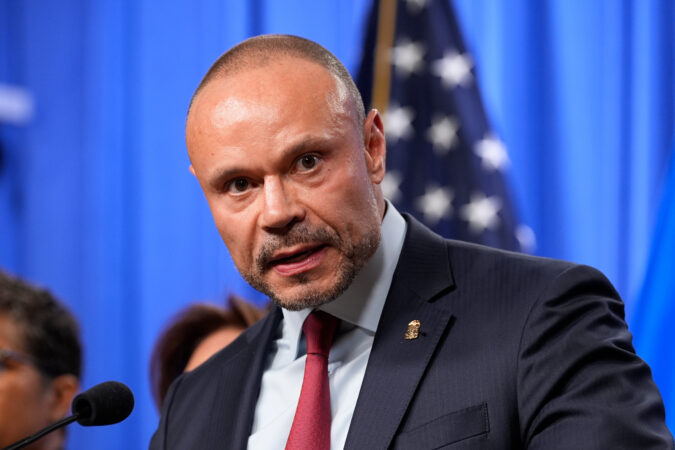
FBI Deputy Director Dan Bongino announced Wednesday that in January he will leave the powerful job in which he helped oversee a tumultuous period at the bureau with major shifts of resources and dramatic dismissals of experienced agents.
President Donald Trump commended Bongino on his tenure and suggested that he would be returning to his job as a conservative podcaster.
“Dan did a great job. I think he wants to go back to his show,” Trump told reporters Wednesday afternoon.
Bongino — the second most powerful person in the FBI — had left Washington for the year more than a week ago and said he would not be returning to the agency’s headquarters, according to the two people, who spoke on the condition of anonymity to discuss a personnel issue they were not authorized to talk about publicly. He had previously told colleagues that his last official day at the bureau will be in January, according to two people familiar with the matter.
“I want to thank President Trump, [Attorney General Pam Bondi] and [FBI Director Kash Patel] for the opportunity to serve with purpose,” Bongino wrote in a social media post announcing his departure. “Most importantly, I want to thank you, my fellow Americans, for the privilege to serve you. God bless America, and all those who defend Her.”
The departure after less than a year would mark the end of a tumultuous tenure for Bongino, who left a lucrative job as a podcaster to serve as second-in-command at the FBI when Trump became president. Bongino serves under FBI Director Kash Patel.
Patel and Bongino have shifted FBI resources to immigration enforcement, sinking morale at an agency that typically attracts law enforcement officials who are trained to work on more complex investigations. They have also pushed out seasoned veterans within the bureau with years of experience in national security and public corruption probes.
Multiple people familiar with his thinking said he has been unhappy at the FBI and has threatened to leave multiple times.
Three months into his job, Bongino expressed frustration with the demands of the deputy director position during a Fox News appearance.
“I gave up everything for this. My wife is struggling,” he said in the May interview. He continued, “I stare at these four walls all day in D.C., by myself, divorced from my wife — not divorced — but, I mean, separated, and it’s hard.”
When Trump named Bongino deputy director, the president transformed what was long a powerful career position that oversaw the day-to-day operations of the bureau into a political job with a more public presence.
Bongino, a Trump loyalist who had previously worked at the Secret Service, built his reputation within right-wing circles during the Biden administration. He did so in part by spreading conspiracy theories about the FBI and its workforce and criticizing law enforcement as politicized.
After Bongino began his job at the FBI and couldn’t prove the baseless theories he spread on his podcast, many of his right-wing supporters turned on him.
Bongino and Patel — also a conservative media personality — used their platforms, for example, to spread inaccuracies about the high-profile sex-trafficking investigation into Jeffrey Epstein, accusing the Biden administration without evidence of covering up key details of the case.
When the Justice Department declared during the summer that there was no rumored “client list” tied to Epstein and that the law enforcement agency would not be releasing any more investigatory files, many people directed their ire at Bongino and Patel and accused the Trump administration of lying to the American people.
In August, the Trump administration named then-Missouri Attorney General Andrew Bailey as the FBI’s co-deputy director, installing the Republican firebrand to serve alongside Bongino. Bailey was considered for a top Justice Department position at the beginning of the administration, but the president opted not to nominate him.
Since joining the bureau, Bailey has assumed a more behind-the scenes role than Bongino. Bailey is expected to remain in his slot as deputy director.
Patel and Bongino have pushed out senior FBI officials across the country, often with no stated reason or in response to far-right critics online who have called for the agents’ removals because of cases they may have been involved in. That has prompted multiple lawsuits against the FBI.
The lawsuits have portrayed Bongino and Patel as more concerned with their reputations online than with learning how the FBI operates.