Tag: no-latest

  • Rob and Michele Reiner’s son appears in court on murder charges while siblings speak of their loss

    Rob and Michele Reiner’s son appears in court on murder charges while siblings speak of their loss

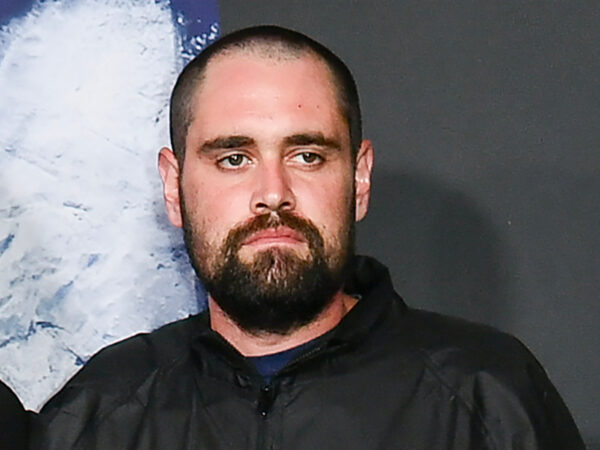
    LOS ANGELES — Nick Reiner made his first court appearance Wednesday in Los Angeles on two counts of first-degree murder in the killing of his parents, actor-director Rob Reiner and his wife Michele Singer Reiner, while the couple’s other two children made their first public statement on their crushing loss.

    Nick Reiner, 32, did not enter a plea as he appeared from behind glass in a custody area in the large Los Angeles courtroom where newly charged defendants are arraigned. He was in shackles and wearing a blue, padded suicide prevention smock used in jail.

    His arraignment was postponed until Jan. 7 at his attorney’s request. He spoke only to say “yes, your honor” to agree to the date. He is being held without bail.

    Jake and Romy Reiner talk about their ‘unimaginable pain’

    His older brother Jake Reiner and younger sister Romy Reiner released their statement through a family spokesperson.

    “Words cannot even begin to describe the unimaginable pain we are experiencing every moment of the day,” they said. “The horrific and devastating loss of our parents, Rob and Michele Reiner, is something that no one should ever experience. They weren’t just our parents; they were our best friends.”

    The brother and sister said they are “grateful for the outpouring of condolences, kindness, and support we have received not only from family and friends but people from all walks of life. We now ask for respect and privacy, for speculation to be tempered with compassion and humanity, and for our parents to be remembered for the incredible lives they lived and the love they gave.”

    Medical Examiner says ‘sharp force injuries’ killed couple

    Also Wednesday, the LA County Medical Examiner listed the primary cause of death for both Rob and Michele Reiner as “multiple sharp force injuries” as the office released its investigators’ initial findings.

    The office said more investigation is needed before further details will be revealed, but the bodies can now be released to the family.

    The cause of death was consistent with police describing the couple as having stab wounds.

    Nick Reiner’s attorney urges caution

    After the court hearing, Nick Reiner’s attorney, Alan Jackson, called the case “a devastating tragedy that has befallen the Reiner family.” He said the proceedings will be very complex and asked that the circumstances be met “not with a rush to judgment, not with jumping to conclusions.”

    Jackson declined to answer shouted questions from dozens of reporters surrounding him and has not addressed the guilt or innocence of his client.

    Nick Reiner was charged Tuesday with killing Rob Reiner, 78, and Michele Singer Reiner, 70.

    They were killed sometime in the early morning hours of Sunday, the District Attorney’s Office said. They were found dead late in the afternoon in their home in the upscale Brentwood neighborhood on the west side of Los Angeles, authorities said.

    Nick Reiner did not resist when he was arrested hours later in the Exposition Park area near the University of Southern California, about 14 miles from the crime scene, police said.

    The two counts of first-degree murder come with special circumstances of multiple murders and an allegation that the defendant used a dangerous weapon, a knife. The additions could mean a greater sentence.

    District Attorney Nathan Hochman said at a Tuesday news conference that his office has not yet decided whether to seek the death penalty.

    Meg Ryan and others remember the Reiners

    Rob Reiner was the Emmy-winning star of the sitcom All in the Family who went on to direct films including Stand by Me, The Princess Bride, and When Harry Met Sally …, whose star Meg Ryan paid tribute to the Reiners on Wednesday.

    “Thank you, Rob and Michelle, for the way you believe in true love, in fairy tales, and in laughter. Thank you for your faith in the best in people, and for your profound love of our country,” Ryan said in an Instagram post. “I have to believe that their story will not end with this impossible tragedy.”

    Rob Reiner met Michele Singer Reiner during the shooting of the classic rom-com, and he said the meeting inspired him to change the film to have a happy ending.

    Ryan’s co-star Billy Crystal, a close friend of Rob Reiner for decades, was part of a group that also included Albert Brooks, Martin Short, and Larry David that released a statement mourning and celebrating the couple Tuesday night.

    “They were a special force together — dynamic, unselfish and inspiring,” the statement said. “We were their friends, and we will miss them forever.”

    Rob Reiner has another daughter, Tracy Reiner, from his first marriage, to actor-director Penny Marshall.

    The lawyers on the Reiner case

    Nick Reiner’s attorney Jackson is a high-profile defense attorney and former LA County prosecutor who represented Harvey Weinstein at his Los Angeles trial and Karen Read at her intensely followed trials in Massachusetts. He was a central figure in the HBO documentary on the Read case.

    On the other side will be Deputy District Attorney Habib Balian, whose recent cases included the Menendez brothers’ attempt at resentencing and the trial of Robert Durst.

    Authorities have not said anything about a motive for the killings and would give few details when asked at the news conference.

  • Senate passes $901 billion defense bill that pushes Hegseth for boat strike video

    Senate passes $901 billion defense bill that pushes Hegseth for boat strike video

    WASHINGTON — The Senate gave final passage Wednesday to an annual military policy bill that will authorize $901 billion in defense programs while pressuring Defense Secretary Pete Hegseth to provide lawmakers with video of strikes on alleged drug boats in international water near Venezuela.

    The annual National Defense Authorization Act, which raises troop pay by 3.8%, gained bipartisan backing as it moved through Congress. It passed the Senate on a 77-20 vote before lawmakers planned to leave Washington for a holiday break. Two Republicans — Sens. Rand Paul and Mike Lee — and 18 Democrats voted against the bill.

    The White House has indicated that it is in line with President Donald Trump’s national security priorities. However, the legislation, which ran over 3,000 pages, revealed some points of friction between Congress and the Pentagon as the Trump administration reorients its focus away from security in Europe and toward Central and South America.

    The bill pushes back on recent moves by the Pentagon. It demands more information on boat strikes in the Caribbean, requires that the U.S. keep its troop levels in Europe at current levels and sends some military aid to Ukraine.

    But overall, the bill represents a compromise between the parties. It implements many of Trump’s executive orders and proposals on eliminating diversity and inclusion efforts in the military and grants emergency military powers at the U.S. border with Mexico. It also enhances congressional oversight of the Department of Defense, repeals several years-old war authorizations and seeks to overhaul how the Pentagon purchases weapons as the U.S. tries to outpace China in developing the next generation of military technology.

    “We’re about to pass, and the president will enthusiastically sign, the most sweeping upgrades to DoD’s business practices in 60 years,” said Sen. Roger Wicker, the Republican chair of the Senate Armed Services Committee.

    Still, the sprawling bill did face objections from both Democratic and Republican leadership on the Senate Commerce Committee and the head of the National Transportation Safety Board. That’s because the legislation could allow military aircraft to obtain a waiver to operate without broadcasting their precise location, as an Army helicopter had done before a midair collision with an airliner over Washington, D.C., in January that killed 67 people.

    To address those concerns, the Senate advanced a bill to require all military and civilian aircraft to broadcast their locations. Republican Sen. Ted Cruz, the chair of the Senate Commerce Committee, said the tragedy might have been avoided had the Black Hawk been broadcasting its location before the crash.

    That bill will now go to the House, and Cruz said he’s optimistic it could reach the president’s desk as soon as next month. The White House supports the bill and is committed to helping get it passed, said an official who spoke on condition of anonymity ahead of the formal public statement on the bill.

    Boat strike videos

    Republicans and Democrats agreed to language in the defense bill that threatened to withhold a quarter of Hegseth’s travel budget until he provided unedited video of the strikes, as well as the orders authorizing them, to the House and Senate Committees on Armed Services.

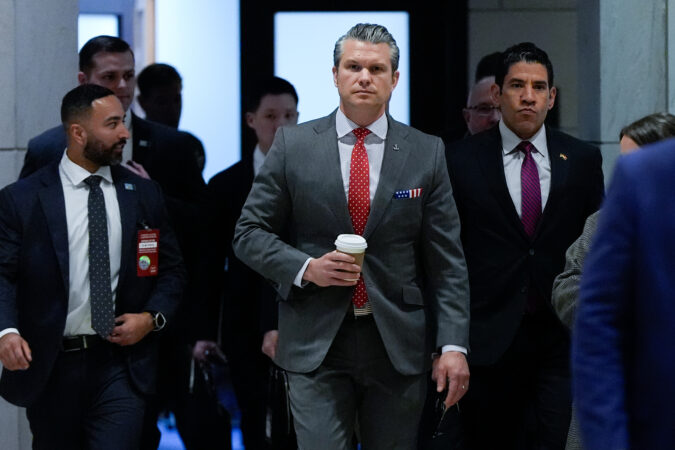
    Hegseth was on Capitol Hill Tuesday ahead of the bill’s passage to brief lawmakers on the U.S. military campaign in international water near Venezuela. The briefing elicited contrasting responses from many lawmakers, with Republicans largely backing the campaign and Democrats expressing concern about it and saying they had not received enough information.

    The committees are investigating a Sept. 2 strike — the first of the campaign — that killed two people who had survived an initial attack on their boat. The Navy admiral who ordered the “double-tap” strike, Adm. Frank “Mitch” Bradley, also appeared before the committees shortly before the vote Wednesday in a classified briefing that also included video of the strike in question.

    Several Republican senators emerged from the meeting backing Hegseth and his decision not to release the video publicly, but other GOP lawmakers stayed silent on their opinion of the strike.

    Democrats are calling for part of the video to be released publicly and for every member of Congress to have access to the full footage.

    “The American people absolutely need to see this video,” said Sen. Richard Blumenthal, a Connecticut Democrat. “I think they would be shocked.”

    Congressional oversight

    Lawmakers have been caught by surprise by the Trump administration several times in the last year, including by a move to pause intelligence sharing with Ukraine and a decision to reduce U.S. troop presence in NATO countries in eastern Europe. The defense legislation requires that Congress be kept in the loop on decisions like that going forward, as well as when top military brass are removed.

    The Pentagon is also required, under the legislation, to keep at least 76,000 troops and major equipment stationed in Europe unless NATO allies are consulted and there is a determination that such a withdrawal is in U.S. interests. Around 80,000 to 100,000 U.S. troops are usually present on European soil. A similar requirement also keeps the number of U.S. troops stationed in South Korea at 28,500.

    Lawmakers are also pushing back on some Pentagon decisions by authorizing $400 million for each of the next two years to manufacture weapons to be sent to Ukraine.

    Cuts to diversity and climate initiatives

    Trump and Hegseth have made it a priority to purge the military of material and programs that address diversity, anti-racism or gender issues, and the defense bill would codify many of those changes. It will repeal diversity, equity and inclusion offices and trainings, including the position of chief diversity officer. Those cuts would save the Pentagon about $40 million, according to the Republican-controlled House Armed Services Committee.

    The U.S. military has long found that climate change is a threat to how it provides national security because weather-related disasters can destroy military bases and equipment. But the bill makes $1.6 billion in cuts by eliminating climate-change related programs at the Pentagon.

    Repeal of war authorizations and Syria sanctions

    Congress is writing a closing chapter to the war in Iraq by repealing the authorization for the 2003 invasion. Now that Iraq is a strategic partner of the U.S., lawmakers in support of the provision say the repeal is crucial to prevent future abuses. The bill also repeals the 1991 authorization that sanctioned the U.S.-led Gulf War.

    The rare, bipartisan moves to repeal the legal justifications for the conflicts signaled a potential appetite among lawmakers to reclaim some of Congress’ war powers.

  • Trump pays respects to 2 Iowa National Guardsmen and interpreter killed in Syria as they return home

    Trump pays respects to 2 Iowa National Guardsmen and interpreter killed in Syria as they return home

    DOVER AIR FORCE BASE, Del. — President Donald Trump paid his respects Wednesday to two Iowa National Guard members and a U.S. civilian interpreter who were killed in an attack in the Syrian desert, joining their grieving families as their remains were brought back to the country they served.

    Trump met privately with the families at Dover Air Force Base in Delaware before he joined top military officials and other dignitaries on the tarmac for the dignified transfer, a solemn and largely silent ritual honoring U.S. service members killed in action.

    The guardsmen killed in Syria on Saturday were Sgt. Edgar Brian Torres-Tovar, 25, of Des Moines, and Sgt. William Nathaniel Howard, 29, of Marshalltown, according to the U.S. Army. Both were members of the 1st Squadron, 113th Cavalry Regiment, and have been hailed as heroes by the Iowa National Guard. Their remains will be taken to Iowa.

    Torres-Tovar’s and Howard’s families were at Dover for the return of their remains, alongside Iowa Gov. Kim Reynolds, members of Iowa’s congressional delegation and leaders of the Iowa National Guard.

    Ayad Mansoor Sakat, of Macomb, Mich., a U.S. civilian working as an interpreter, was also killed. Three other Iowa National Guard members were injured in the attack. The Pentagon has not identified them.

    They were among hundreds of U.S. troops deployed in eastern Syria as part of a coalition fighting the Islamic State group.

    Returning to Joint Base Andrews after the transfer, Trump said it was a “beautiful event for three great people. And they’re now looking down and their parents and wives and all of the people that were there were, I mean, were devastated but great people, great people.”

    The return of service member remains

    Trump observed several dignified transfers at Dover in his first term and has said it was “the toughest thing I have to do” as president.

    There is no formal role for a president at a dignified transfer other than to watch in silence, keeping all thoughts to himself for the moment. There is no speaking by any of the politicians and other dignitaries who attend, with the only words coming from the military officials who direct the highly choreographed transfers.

    Trump, wearing an overcoat against the chill and brisk wind, joined the other attendees in a salute that was held as each of the American flag-draped transfer cases was carried from the belly of a hulking C-17 military cargo plane and loaded into a dark, unmarked van nearby.

    He gazed straight ahead as each case passed in front of him, though he turned to look after the first one was placed inside the vehicle. The remains were taken to the on-base mortuary for processing before they are released to the families.

    At the start of the transfer, Trump and Gen. Dan Caine, the chairman of the Joint Chiefs of Staff, joined several others from the military at the open rear of the cargo plane, where all but Trump bowed their heads. The president looked inside the plane. Trump then stood alongside Defense Secretary Pete Hegseth when the group joined the official party.

    Before Trump joined the others, White House chief of staff Susie Wiles, who flew up with Trump, dabbed her eyes with a tissue.

    Iowa National Guard members hailed as heroes

    Howard’s stepfather, Jeffrey Bunn, has said Howard “loved what he was doing and would be the first in and last out.” He said Howard had wanted to be a soldier since he was a boy. Howard’s brother, a staff sergeant in the Iowa National Guard, was escorting him back to Iowa.

    Torres-Tovar was remembered as a “very positive” family-oriented person who always put others first, according to fellow Guard members who were deployed with him and issued a statement to the local TV broadcast station WOI.

    Dina Qiryaqoz, the daughter of the civilian interpreter, said Wednesday in a statement that her father worked for the U.S. Army during the invasion of Iraq from 2003 to 2007. Sakat is survived by his wife and four adult children.

    The interpreter was from Bakhdida, Iraq, a small Catholic village southeast of Mosul, and the family immigrated to the U.S. in 2007 on a special visa, Qiryaqoz said. At the time of his death, Sakat was employed as an independent contractor for Virginia-based Valiant Integrated Services.

    Sakat’s family was still struggling to believe that he is gone. “He was a devoted father and husband, a courageous interpreter and a man who believed deeply in the mission he served,” Qiryaqoz said.

    Trump’s reaction to the attack in Syria

    Trump has vowed retaliation, and the Pentagon’s chief spokesperson, Sean Parnell, has said the attack is under active investigation. The U.S. military said the gunman was killed in the attack.

    Before this attack, the most recent instance of U.S. service members being killed in action was in January 2024, when three American troops died in a drone attack in Jordan.

    Saturday’s deadly attack followed a rapprochement between the U.S. and Syria, bringing the former pariah state into a U.S.-led coalition fighting the Islamic State group.

    Trump has forged a relationship with interim Syrian President Ahmed al-Sharaa, the onetime leader of an Islamic insurgent group who led the ouster of former President Bashar Assad. The leaders met at the White House last month.

    Trump said Monday that the attack had nothing to do with the Syrian leader, who Trump said was “devastated by what happened.”

    During his first term, Trump visited Dover in 2017 to honor a U.S. Navy SEAL killed during a raid in Yemen, in 2019 for two Army officers whose helicopter crashed in Afghanistan, and in 2020 for two Army soldiers killed in Afghanistan when a person dressed in an Afghan army uniform opened fire.

  • Trump officials say they will dismantle ‘global mother ship’ of climate and weather forecasting

    Trump officials say they will dismantle ‘global mother ship’ of climate and weather forecasting

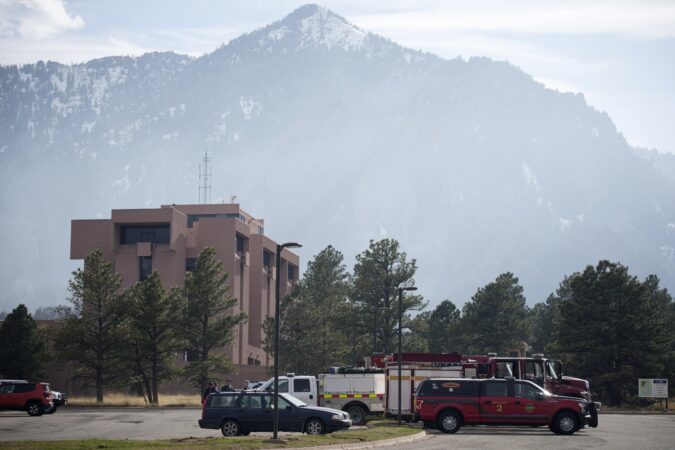
    The Trump administration said Tuesday it was breaking up one of the world’s preeminent earth and atmospheric research institutions, based in Colorado, over concerns about “climate alarmism” — a move that comes amid escalating attacks from the White House against the state’s Democratic lawmakers.

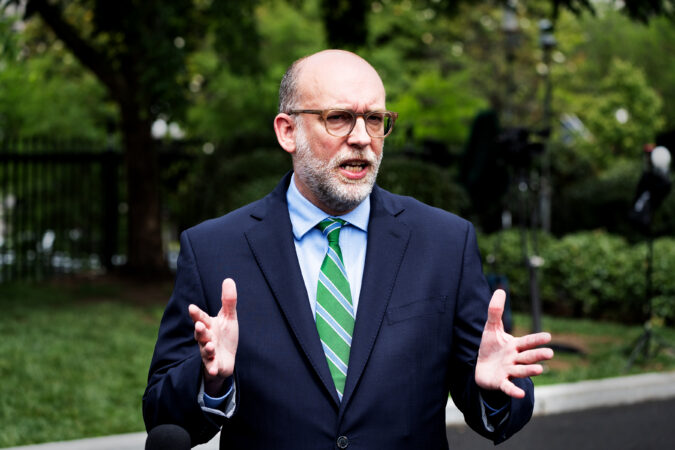
    “The National Science Foundation will be breaking up the National Center for Atmospheric Research (NCAR) in Boulder, Colorado,” wrote Russell Vought, the director of the White House Office of Management and Budget on X. “This facility is one of the largest sources of climate alarmism in the country.”

    The plan was first reported by USA Today.

    The NCAR laboratory in Boulder was founded in 1960 at the base of the Rocky Mountains to conduct research and educate future scientists. Its resources include supercomputers, valuable datasets, and high-tech research planes.

    The announcement drew outrage and concern from scientists and local lawmakers, who said it could imperil the country’s weather and climate forecasting, and appeared to take officials and employees by surprise.

    NCAR’s dismantling would be a major loss for scientific research, said Kevin Trenberth, a distinguished scholar at NCAR and an honorary academic in physics at the University of Auckland in New Zealand.

    Trenberth, who joined NCAR in 1984 and officially retired in 2020, said the research center is key to advanced climate science discoveries as well as in informing the climate models that produce the weather forecasts we see on the nightly news.

    Colorado Gov. Jared Polis said in a statement that the state had not received information about the administration’s intentions to dismantle NCAR.

    “If true, public safety is at risk and science is being attacked,” said Polis. “Climate change is real, but the work of NCAR goes far beyond climate science. NCAR delivers data around severe weather events like fires and floods that help our country save lives and property, and prevent devastation for families.”

    The action comes as Republicans have escalated their attacks on Polis and others in the state for their handling of a case involving Tina Peters, a former county clerk in Colorado who was convicted in state court on felony charges related to efforts to overturn the 2020 presidential election. President Donald Trump announced last week that he is pardoning Peters, who is serving a nine-year sentence, but it is unclear whether Trump has that authority, because she was not convicted in federal court.

    In a joint statement, Colorado’s two Democratic senators, John Hickenlooper and Michael Bennet, and Rep. Joe Neguse (D., Colo.) slammed the move and vowed to fight back against it.

    In his social media post, Vought said that “any vital activities such as weather research will be moved to another entity or location” — but did not specify further.

    “The Colorado governor obviously isn’t willing to work with the president,” said a White House official, who spoke on the condition of anonymity because they were not authorized to discuss the matter publicly.

    The official declined to cite any specifics about how Polis is refusing to cooperate, from the administration’s perspective, but denied that the move was in response to the state’s refusal to release Peters from prison.

    The facility “is not in line with the president’s agenda,” the official added, noting that it had “been on the radar” of the administration “for a while.”

    The National Science Foundation, the federal science agency that funds the center, was blindsided by the announcement, according to a person familiar with NSF operations who spoke on the condition of anonymity to avoid retribution. But they said facilities managers at NSF will need to be involved in moving assets or capabilities. An NSF spokesman did not immediately respond to questions about the plan to dismantle NCAR.

    Antonio Busalacchi, the president of the University Corporation for Atmospheric Research, which oversees NCAR, said it was aware of reports to break up the center but did not have “additional information about any such plan.”

    “Any plans to dismantle NSF NCAR would set back our nation’s ability to predict, prepare for, and respond to severe weather and other natural disasters,” Busalacchi said.

    An internal email obtained by the Washington Post, sent Tuesday night, emphasized the critical work NCAR does for “community safety and resilience.”

    Busalacchi wrote that the news had come as a shock, and the institution had reached out to NSF for more information. “We understand that this situation is incredibly distressing, and we ask that you all continue doing what you have done so well all year — provide support for one another as we navigate this turbulent time,” Busalacchi wrote.

    The center is “quite literally our global mother ship,” Katharine Hayhoe, a Texas Tech University professor and chief scientist for the Nature Conservancy, wrote on X. “Dismantling NCAR is like taking a sledgehammer to the keystone holding up our scientific understanding of the planet.”

    NCAR plays a unique role in the scientific community by bringing together otherwise siloed specialists to collaborate on some of the biggest climate and weather questions of our time, Caspar Ammann, a former research scientist at the center, said in an email.

    “Without NCAR, a lot could not happen,” he said. “A lot of research at US Universities would immediately get hampered, industry would lose access to reliable base data.”

    Ammann added that around the world, weather and climate services use NCAR modeling and forecasting tools.

    The Colorado-based center draws scientists and lecturers from all over the world, and through its education programs has helped produce future scientists, Trenberth said.

    He said he feared not just for the discoveries and data that would be lost if the center were to close, but for the early careers that could also be affected or destroyed.

    “If this sort of thing happens, things will go on for a little while,” he said. “But the next generation of people who deal with weather and science in the United States will be lost.”

  • FCC leader says agency is no longer independent as he’s grilled by Democrats over Kimmel controversy

    FCC leader says agency is no longer independent as he’s grilled by Democrats over Kimmel controversy

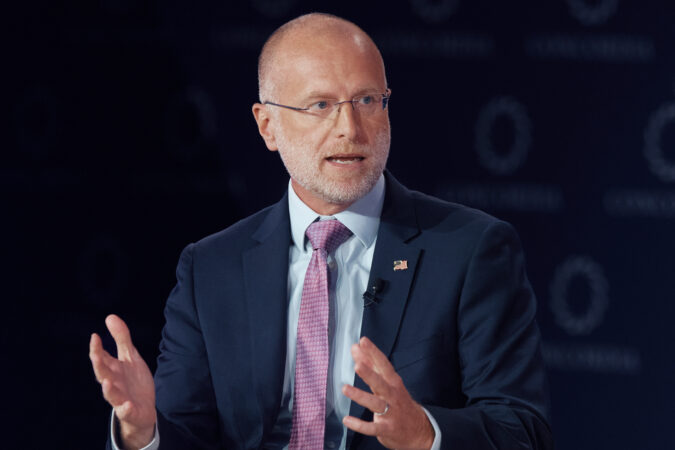
    WASHINGTON — Democratic senators on Wednesday hammered the Federal Communications Commission’s leader for pressuring broadcasters to take ABC late-night host Jimmy Kimmel off the air, suggesting that Brendan Carr was politicizing an independent agency and trampling the First Amendment.

    The FCC chairman refused to disown his comments about Kimmel and, when questioned by Democrats about an agency long considered autonomous, suggested it was not insulated from Trump’s pressure.

    “The FCC is not an independent agency,” Carr said.

    Carr later sidestepped questions about whether he considered the Republican president to be his boss and whether he had taken orders from Trump or his inner circle.

    “President Trump has designated me as chairman of the FCC,” Carr added later. “I think it comes as no surprise that I’m aligned with President Trump on policy.”

    Sen. Ben Ray Luján (D., N.M.) noted that the FCC’s website described it as an “independent U.S. government agency overseen by Congress.”

    Soon after, with the hearing still underway, the website changed, removing “independent” from a section describing its mission.

    Trump has waged an aggressive campaign against the media in his second term, filing lawsuits against outlets whose coverage he dislikes, and threatening to revoke TV broadcast licenses. On Wednesday, he criticized NBC for an interview with Democratic Sen. Raphael Warnock, saying the network “should be ashamed of themselves.”

    “The Public airwaves, which these Networks are using at no charge, should not be allowed to get away with this any longer!” Trump wrote on Truth Social. “They should be properly licensed, and pay significant amounts of money for using this very valuable Public space.”

    The 2½-hour hearing before the Senate Commerce committee repeatedly circled back to Carr’s stance on Kimmel after the late-night host’s comments on slain conservative activist Charlie Kirk. At the time, Carr’s vocal criticism and veiled threats were equated with that of a mob boss.

    Carr said he was simply enforcing laws holding networks to stricter scrutiny than cable and other forms of media and that “the FCC has walked away from enforcing the public interest standard.”

    Democrats insisted he was warping the laws Carr invoked.

    “You are weaponizing the public interest standard,” said Sen. Ed Markey (D., Mass.), who told Carr that he should resign.

    Republican senators referenced perceived First Amendment violations by the administration of former President Joe Biden, calling Democrats’ free speech arguments disingenuous. GOP members appeared intent on bringing up broadcast spectrum auctions, undersea cable infrastructure, algorithm-driven content, robocalls, and just about anything other than Carr’s statements about Kimmel.

    The committee chairman, Sen. Ted Cruz, had previously equated Carr’s comments to those of a mobster and called them “dangerous as hell.” But at the hearing, Cruz (R., Texas) took a far softer stance. He dismissed Kimmel as “tasteless” and “unfunny,” and shifted to criticizing Biden’s administration, a tack that Carr parroted throughout the hearing.

    “Joe Biden is no longer president,” Sen. Amy Klobuchar, (D., Minn.) shot back at one point.

    The hearing also included the two other commissioners, Olivia Trusty and Anna M. Gomez. Gomez, a Biden appointee, said that the FCC has “undermined its reputation as a stable, independent, and expert-driven regulatory body.”

    “Nowhere is that departure more concerning,” Gomez said, “than its actions to intimidate government critics, pressure media companies and challenge the boundaries of the First Amendment.”

    Carr was nominated to the FCC by both Trump and Biden and unanimously confirmed by the Senate three times. But he has more recently shown more overtly right-wing views, writing a section on the FCC for “Project 2025,” the sweeping blueprint for gutting the federal workforce and dismantling agencies in Trump’s second term.

    Since becoming chairman this year, Carr has launched separate investigations of all three major broadcast networks. After Kimmel’s comments on the September killing of Kirk, who was a Trump ally and leading voice of the right, Carr said: “We can do this the easy way or the hard way. These companies can find ways to take action on Kimmel or there is going to be additional work for the FCC ahead.”

    Cruz was unflinchingly critical at the time, saying “I think it is unbelievably dangerous for government to put itself in the position of saying we’re going to decide what speech we like and what we don’t, and we’re going to threaten to take you off air if we don’t like what you’re saying.”

    While Cruz did not repeat those words Wednesday, they were repeatedly invoked by Democrats. Carr did not directly respond to questions from reporters following the hearing about Cruz’s original comments.

    “I think the hearing went really well,” Carr said in response.

  • Mamdani gets 74,000 resumés in sign of New York City’s job-market misery

    Mamdani gets 74,000 resumés in sign of New York City’s job-market misery

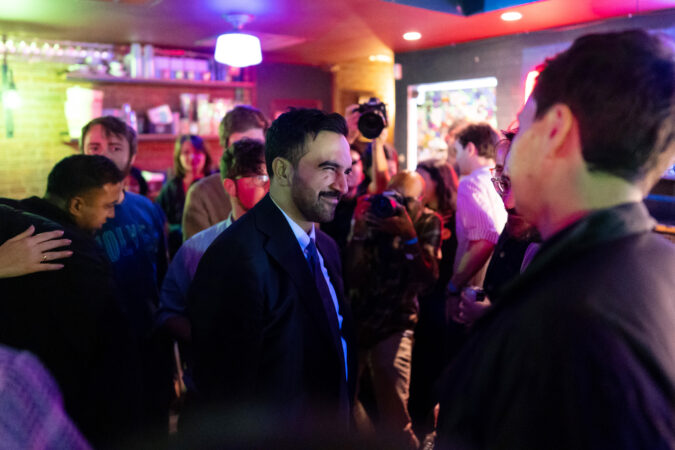
    More than 74,000 people, with an average age of 28, have applied for roles in Zohran Mamdani’s new administration. Those figures are both a measure of enthusiasm for New York City’s incoming mayor and a sign of how tough the job market is for young people in the five boroughs.

    Young voters and volunteers fueled the 34-year-old Mamdani’s fast rise from a relatively unknown Queens assemblyman to mayor-elect of America’s largest city. A lot of them had time on their hands: New Yorkers aged 16 to 24 faced a 13.2% unemployment rate in 2024, 3.6 percentage points higher than in 2019, according to a May report from the New York state comptroller.

    New York City had a 5.8% unemployment rate overall in August, 1.3 percentage points above the U.S. average. The city added roughly 25,000 jobs this year through September, compared with about 106,000 during the same period in 2024, according to city data.

    Mamdani’s campaign pledge to lower the cost of living in New York resonated with voters struggling to find jobs and establish themselves at a time when rents have stayed high and income growth has slowed. Now he’s looking to hire an unspecified number of roles across 60 agencies, 95 mayoral offices, and more than 250 boards and commissions, with senior roles a priority, according to his transition team.

    The typical size of the New York City mayoral staff — commissioners, communications, operations and community affairs — is about 1,100, according to Ana Champeny, vice president of research at the Citizens Budget Commission, a nonprofit finance watchdog. City government in total hired 39,455 people in 2024, according to New York City data.

    Applications for roles in Mamdani’s administration have come from workers of all experience levels and from a wide range of backgrounds and industries, said Maria Torres-Springer, co-chair of the mayor-elect’s transition team. About 20,000 of the applicants came from out of state.

    When Barack Obama was elected U.S. president in 2008, workers submitted more than 300,000 job applications to his administration. Blair Levin, who co-led the technology transition team for Obama, said he received around 3,000 of those resumes. He whittled the pool down to 75, a relatively easy task because he needed applicants with specific tech and economics skills, he said.

    Without invoking the term “AI,” Torres-Springer said the applications would be filtered using “the typical technology that any big corporation would have in an applicant-tracking system.” The resumes will then be sorted and matched to different agencies.

    Mamdani’s avid use of social media, which helped him connect with young people during his campaign, has continued into his transition efforts, creating excitement — among young people especially — about the prospect of joining his administration.

    “The average age does tell a particularly interesting story in two ways,” Torres-Springer said. “It might be because of volatility in the job market but it’s also because I think we are attracting, the administration is attracting, New Yorkers who may not have considered government in the past.”

    Take David Kinchen, a 28-year-old data engineer who moved to New York from northern Virginia three years ago. Since getting laid off from a job in fraud detection at Capital One, he has applied for more than 1,000 roles and completed at least 75 interviews without an offer, he said. Kinchen volunteered for Mamdani’s campaign and applied to the administration, highlighting his tech credentials and a passion for photography.

    “I did data engineering, so I could help with database decisions. There was also a creative option on the application, since I could work as a staff photographer too,” Kinchen said.

    Another applicant, 22-year-old Aurisha Rahman, has struggled to find a job since graduating with a civil-engineering degree from Hofstra University on Long Island.

    “The job market is even worse than it was last fall,” Rahman said. Mamdani’s resumé portal was one of the few places she found open to entry-level applicants.

    Rahman, who was born and raised in Queens, said she wants to give back to the city where she was raised and wouldn’t be picky about a position. “Whatever they need, I’ll do it. I don’t care,” she said. “Right now, it’s better to be busy with something than nothing.”

  • Saturn’s moon Titan may not have a buried ocean as long suspected, new study suggests

    Saturn’s moon Titan may not have a buried ocean as long suspected, new study suggests

    CAPE CANAVERAL, Fla. — Saturn’s giant moon Titan may not have a vast underground ocean after all.

    Titan instead may hold deep layers of ice and slush more akin to Earth’s polar seas, with pockets of melted water where life could possibly survive and even thrive, scientists reported Wednesday.

    The team led by researchers at NASA’s Jet Propulsion Laboratory challenged the decade-long assumption of a buried global ocean at Titan after taking a fresh look at observations made years ago by NASA’s Cassini spacecraft around Saturn.

    They stress that no one has found any signs of life at Titan, the solar system’s second-largest moon spanning 3,200 miles and brimming with lakes of liquid methane on its frosty surface.

    But with the latest findings suggesting a slushy, near-melting environment, “there is strong justification for continued optimism regarding the potential for extraterrestrial life,” said the University of Washington’s Baptiste Journaux, who took part in the study published in the journal Nature.

    As to what form of life that might be, possibly strictly microscopic, “nature has repeatedly demonstrated far greater creativity than the most imaginative scientists,” he said in an email.

    JPL’s Flavio Petricca, the lead author, said Titan’s ocean may have frozen in the past and is currently melting, or its hydrosphere might be evolving toward complete freezing.

    Computer models suggest these layers of ice, slush, and water extend to a depth of more than 340 miles. The outer ice shell is thought to be about 100 miles deep, covering layers of slush and pools of water that could go down another 250 miles. This water could be as warm as 68 degrees Fahrenheit.

    Because Titan is tidally locked, the same side of the moon faces Saturn all the time, just like our own moon and Earth. Saturn’s gravitational pull is so intense that it deforms the moon’s surface, creating bulges as high as 30 feet when the two bodies are closest.

    Through improved data processing, Petricca and his team managed to measure the timing between the peak gravitational tug and the rising of Titan’s surface. If the moon held a wet ocean, the effect would be immediate, Petricca said, but a 15-hour gap was detected, indicating an interior of slushy ice with pockets of liquid water. Computer modeling of Titan’s orientation in space supported their theory.

    Sapienza University of Rome’s Luciano Iess, whose previous studies using Cassini data indicated a hidden ocean at Titan, is not convinced by the latest findings.

    While “certainly intriguing and will stimulate renewed discussion … at present, the available evidence looks certainly not sufficient to exclude Titan from the family of ocean worlds,” Iess said in an email.

    NASA’s planned Dragonfly mission — featuring a helicopter-type craft due to launch to Titan later this decade — is expected to provide more clarity on the moon’s innards. Journaux is part of that team.

    Saturn leads the solar system’s moon inventory with 274. Jupiter’s moon Ganymede is just a little larger than Titan, with a possible underground ocean. Other suspected water worlds include Saturn’s Enceladus and Jupiter’s Europa, both of which are believed to have geysers of water erupting from their frozen crusts.

    Launched in 1997, Cassini reached Saturn in 2004, orbiting the ringed planet and flying past its moons until deliberately plunging through Saturn’s atmosphere in 2017.

  • The Oscars will move to YouTube in 2029, leaving longtime home of ABC

    The Oscars will move to YouTube in 2029, leaving longtime home of ABC

    In a seismic shift for one of television’s marquee events, the Academy Awards will depart ABC and begin streaming on YouTube beginning in 2029, the Academy of Motion Picture Arts and Sciences announced Wednesday.

    ABC will continue to broadcast the annual ceremony through 2028. That year will mark the 100th Oscars.

    But starting in 2029, YouTube will retain global rights to streaming the Oscars through 2033. YouTube will effectively be the home to all things Oscars, including red-carpet coverage, the Governors Awards, and the Oscar nominations announcement.

    “We are thrilled to enter into a multifaceted global partnership with YouTube to be the future home of the Oscars and our year-round Academy programming,” said academy chief executive Bill Kramer and academy president Lynette Howell Taylor. “The Academy is an international organization, and this partnership will allow us to expand access to the work of the Academy to the largest worldwide audience possible — which will be beneficial for our Academy members and the film community.”

    While major award shows have added streaming partnerships, the YouTube deal marks the first of the big four — the Oscars, Grammys, Emmys, and Tonys — to completely jettison broadcast television. It puts one of the most watched non-NFL broadcasts in the hands of Google. YouTube boasts some 2 billion viewers.

    The Academy Awards will stream for free worldwide on YouTube, in addition to YouTube TV subscribers. It will be available with audio tracks in many languages, in addition to closed captioning.

    Financial terms were not disclosed.

    “The Oscars are one of our essential cultural institutions, honoring excellence in storytelling and artistry,” said Neal Mohan, chief executive of YouTube. “Partnering with the academy to bring this celebration of art and entertainment to viewers all over the world will inspire a new generation of creativity and film lovers while staying true to the Oscars’ storied legacy.”

    The Walt Disney Co.-owned ABC has been the broadcast home to the Oscars for almost its entire history. NBC first televised the Oscars in 1953, but ABC picked up the rights in 1961. Aside from a period between 1971 and 1975, when NBC again aired the show, the Oscars have been on ABC.

    “ABC has been the proud home to The Oscars for more than half a century,” the network said in a statement. ”We look forward to the next three telecasts, including the show’s centennial celebration in 2028, and wish the Academy of Motion Picture Arts and Sciences continued success.”

    The 2025 Academy Awards were watched by 19.7 million viewers on ABC, a slight increase from the year before. That remains one of the biggest TV broadcasts of the year, though less than half of Oscar ratings at their peak. In 1999, more than 55 million watched James Cameron’s Titanic win best picture.

    The film academy, in choosing YouTube over other options such as Netflix or NBC Universal/Peacock, selected a platform with a wide-ranging and massive audience but one without as much of an established production infrastructure.

    Still, more people — especially young people — watch YouTube than any other streaming platform. According to Nielsen, YouTube accounted for 12.9% of all television and streaming content consumed in November. Netflix ranked second with an 8.3% market share.

  • Jack Smith tells lawmakers his team developed ‘proof beyond a reasonable doubt’ against Trump

    Jack Smith tells lawmakers his team developed ‘proof beyond a reasonable doubt’ against Trump

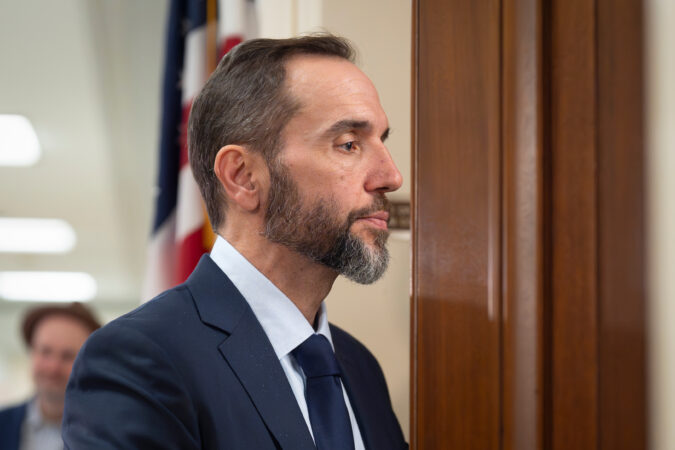
    WASHINGTON — Former Justice Department special counsel Jack Smith told lawmakers in a closed-door interview Wednesday that his team of investigators “developed proof beyond a reasonable doubt” that President Donald Trumphad criminally conspired to overturn the results of the 2020 election, according to portions of his opening statement obtained by the Associated Press.

    Smith also said investigators had accrued “powerful evidence” Trump broke the law by hoarding classified documents from his first term as president at his Mar-a-Lago estate in Palm Beach, Fla., and by obstructing government efforts to recover the records.

    “I made my decisions in the investigation without regard to President Trump’s political association, activities, beliefs, or candidacy in the 2024 election,” Smith said. “We took actions based on what the facts and the law required — the very lesson I learned early in my career as a prosecutor.”

    He said that if asked whether he would “prosecute a former president based on the same facts today, I would do so regardless of whether the president was a Republican or Democrat.”

    The deposition before the House Judiciary Committee gave lawmakers of both parties their first chance, albeit in private, to question Smith about a pair of investigations into Trump that resulted in since-abandoned criminal charges between the Republican president’s first and second terms in office. Smith was subpoenaed by the Republican-led committee this month to provide testimony and documents as part of a GOP investigation into the Trump inquiries during the administration of Democratic President Joe Biden.

    The former special counsel cooperated with the congressional demand, though his lawyers noted that he had been volunteered more than a month before the subpoena was issued to answer questions publicly before the committee — an overture they said was rebuffed by Republicans. Trump had told reporters that he supported the idea of an open hearing.

    “Testifying before this committee, Jack is showing tremendous courage in light of the remarkable and unprecedented retribution campaign against him by this administration and this White House,” Smith lawyer Lanny Breuer told reporters. “Let’s be clear: Jack Smith, a career prosecutor, conducted this investigation based on the facts and based on the law and nothing more.”

    Smith was appointed in 2022 to oversee the Justice Department investigations into Trump’s efforts to overturn his 2020 loss to Biden and Trump’s hoarding of classified documents at Mar-a-Lago. Smith’s team filed charges in both investigations but abandoned the cases after Trump was elected to the White House last year, citing Justice Department legal opinions that say a sitting president cannot be indicted.

    Multiple prior Justice Department special counsels, including Robert Mueller, have testified publicly but Smith was summoned for just a private interview. Several Democrats who emerged from Smith’s interview said they could understand why Republicans did not want an open hearing based on the damaging testimony about Trump they said Smith offered.

    The committee’s top Democrat, Rep. Jamie Raskin of Maryland, said the Republican majority “made an excellent decision” in not allowing Jack Smith to testify publicly “because had he done so, it would have been absolutely devastating to the president and all the president’s men involved in the insurrectionary activities” of the Capitol riot on Jan. 6, 2021.

    “Jack Smith has just spent several hours schooling the Judiciary Committee on the professional responsibilities of a prosecutor and the ethical duties of a prosecutor,” Raskin said.

    Democrats are demanding that Smith’s testimony be made public, along with his full report on the investigation.

    “The American people should hear for themselves,” Rep. Dan Goldman (D., N.Y.) said.

    The committee chairman, Republican Rep. Jim Jordan of Ohio, told reporters, “I think we’ve learned some interesting things.” He declined to discuss what was being said in the room, but reiterated his position about the investigations.

    “It’s political,” he said.

    Smith’s interview is unfolding against the backdrop of a broader retribution campaign by the Trump administration against former officials involved in investigating Trump and his allies. The Office of Special Counsel, an independent political watchdog, said in August that it was investigating Smith, and the White House issued a presidential memorandum this year aimed at suspending security clearances of lawyers at the law firm that provided legal services to Smith.

    The deposition also comes as Republicans in Congress, aided by current FBI leadership, look to discredit the investigations into Trump through the release of emails and other documents from the probes.

    In recent weeks they have seized on revelations that the team, as part of its investigation, had analyzed the phone records of select GOP lawmakers from on and around the Capitol siege, when pro-Trump rioters stormed the building to try to halt the certification of Trump’s election loss to Biden.

    The phone records reviewed by prosecutors included details only about the incoming and outgoing phone numbers and the length of the call but not the contents of the conversation. Smith’s lawyers have said Republicans have mischaracterized the phone record analysis and implied something sinister about a routine investigative tactic.

    On Tuesday, Republican Sen. Chuck Grassley of Iowa, chairman of the Senate Judiciary Committee, released a batch of internal FBI emails leading up to the August 2022 search of Mar-a-Lago. In one email, written weeks before the search, an agent wrote that the FBI’s Washington field office did not believe that probable cause existed to search the property.

    But Republicans who trumpeted the emails as proof that the Biden Justice Department was out to get Trump omitted the fact that agents who later searched the property reported finding boxes of classified, even top-secret, documents. In addition, the then-head of the Washington field office has testified to lawmakers that by the time of the search, the FBI believed probable caused existed to do it.

  • Trump administration admits to targeting blue states for energy grant cuts

    Trump administration admits to targeting blue states for energy grant cuts

    The Trump administration acknowledged in a court filing this week that a decision to cut energy grants during the government shutdown was influenced by whether the money would go to a state that tended to elect Democrats statewide or nationally.

    Government lawyers also wrote in the filing that “consideration of partisan politics is constitutionally permissible, including because it can serve as a proxy for legitimate policy considerations.”

    The remarkably candid admission echoes President Donald Trump’s frequent vows to punish cities and states that he sees as his enemies, from withholding disaster relief for Southern California to targeting blue cities with National Guard troops.

    It could also raise the possibility that federal attorneys might make similar arguments in legal challenges to other unilateral cuts implemented by the administration for blue cities and states.

    The White House budget office and the Energy Department did not respond to requests for comments about the new filing.

    A coalition of Minnesota clean energy groups and the city of St. Paul sued the Trump administration last month in the U.S. District Court for the District of Columbia after the Energy Department announced it was slashing 321 grants of about $7.5 billion. The cuts included projects to kick-start the hydrogen industry in California, upgrade the electricity grid serving Indigenous communities in New Mexico and generate new energy mostly from wind and solar in Minnesota.

    At the time, Trump’s budget director, Russell Vought, touted the cuts on X, declaring “nearly $8 billion in Green New Scam funding to fuel the Left’s climate agenda is being canceled” and listed blue states.

    California’s Democratic lawmakers had complained about partisan interference in the grant cuts, demanding an investigation by the Energy Department’s acting inspector general. Acting inspector general Sarah B. Nelson wrote in a letter to Democrats this week that her office would be looking into the process for canceling grants “and whether those cancellations were in accordance with established criteria.”

    In their lawsuit, the Democratic city and clean energy groups argue that cuts to funding in Minnesota were entirely politically motivated. Justice Department attorneys did not agree that it was solely a political decision but instead claimed that politics was one factor.

    During the record-long government shutdown that ended in November, Trump and his allies said they would target Democratic priorities and cut funding to programs in mostly Democratic-controlled states.

    “A lot of good can come down from shutdowns,” Trump told reporters in October. “We can get rid of a lot of things we didn’t want, and they’d be Democrat things.”

    At the same time, the government has previously been careful not to invoke political considerations in court cases about its decision-making. In an earlier filing in the same St. Paul case, government attorneys wrote that the terminations were “part of a months-long review process by DOE, and the grant terminations made as part of this review process include entities located in both ‘Red States’ and ‘Blue States’ alike.”

    The Monday filing marked the first time the government had acknowledged in the court documents that politics was a factor.

    Legal experts said the administration’s statement marks a significant departure from legal norms in which agencies have traditionally steered clear of pointing to partisanship in such cases.

    “It really undermines the idea that you’re passing neutral laws that you know are supposed to apply equally to everybody,” said Dan Farber, a professor of law at the University of California at Berkeley. “I find it really startling they would make that concession.”

    The groups are alleging that the administration violated their First Amendment rights by targeting a state that voted for Democrat Kamala Harris in the 2024 presidential election.

    David Super, a law professor at Georgetown University, said the free speech claim could chart a new course for grantees impacted by cuts after the Supreme Court previously rejected an effort to restore research funding through the National Institutes of Health based on the argument that the cuts were arbitrary and capricious.

    “I cannot believe that the Supreme Court would want to allow a partisan tit-for-tat to develop with each party pulling grants from its perceived partisan foes, but one can never be entirely certain these days,” Super wrote in an email.

    Eric Schickler, a political science professor at the University of California at Berkeley, said the administration may make the argument that politics can be a proxy for policy considerations in other instances where blue states are systematically disadvantaged, especially if it proves successful in this case. Farber, however, said that the blue cities and states suing the administration could use this latest concession against them in legal attacks.

    “I believe this is likely a preview of a strategy that the administration will adopt more broadly if the courts go along with it,” Schickler said.

    The admission aligned with what some Energy Department employees noticed over the past several months in the cancellation of grants, according to two workers there who spoke on the condition of anonymity out of fear of retribution.

    One worker said there were internal discussions at Energy about canceling projects across the country, and that staff were told it would be based on an independent review of criteria including technical merit and alignment with administration objectives. But when she saw a leaked list of canceled grants over the summer, it only effected projects in mostly blue areas: Washington, New York, Illinois, and Massachusetts.

    The second Energy worker said that, over months, he noticed the same: “One of the most important factors deciding which projects get canceled is what state is the performer in. Is it in a blue or a red state?”

    A few times, he and his co-workers tried to make the system work to their advantage.

    They would take a project with an original location of New York or California and try to find ways to move the same work to Iowa or Georgia — anywhere tinged red. The original recipient of the project was often bummed, he said, but willing to try to salvage the federal funding and the project, even if it went to someone else. It’s not yet clear if that strategy will pan out, he said.

    “The work is fine, the administration likes the work, they just don’t like the person doing it,” he said. “It sucks, but it’s better to have the work happen.”