Tag: no-latest

  • Dow drops 900 after oil prices jump to highest in nearly 2 years amid Iran conflict

    Dow drops 900 after oil prices jump to highest in nearly 2 years amid Iran conflict

    NEW YORK — U.S. stocks are falling sharply Friday after getting a whiff of a worst-case scenario for financial markets: a weakening economy combined with high inflation.

    The S&P 500 dropped 1.6% after a report showed U.S. employers cut more jobs last month than they created and after oil prices jumped to their highest level in nearly two years because of the Iran war. It’s a combination that investors hate because no one in the world has a good tool to fix both a weak economy and high inflation at the same time.

    The Dow Jones Industrial Average was down 909 points, or 1.9%, as of 9:35 a.m. Eastern time, and the Nasdaq composite was 1.6% lower.

    “You can’t sugarcoat this report,” according to Brian Jacobsen, chief economic strategist at Annex Wealth Management. “A negative payrolls number combined with a big jump in oil prices will have traders worrying about stagflation risks.”

    Stagflation is what economists call a stagnating economy combined with high inflation, and a separate report released Friday added to the sour mix after showing that U.S. retailers made less money last month than economists expected. It raised the possibility that spending by U.S. households, the main engine of the economy, may be stretched near its maximum.

    Usually when the economy is unsteady and the job market is weakening, the Federal Reserve cuts interest rates to give things a boost. Lower rates can make it more affordable for borrowers to get mortgages or to raise money to build factories, while also helping prices for stocks and other investments. The Fed cut its main interest rate several times last year and had indicated more were to come this year.

    But lower interest rates can also make inflation worse. And the Fed’s hands may be increasingly tied because oil prices are spiking and pushing inflation higher due to disruptions for the energy industry because of the war.

    The price for a barrel of Brent crude, the international standard, jumped another 5.7% to $90.25. A barrel of benchmark U.S. crude climbed 8.9% to $88.20.

    Oil prices have surged, with Brent up from near $70 late last week, as the war has expanded and targeted areas critical to the production and movement of energy in the Middle East. Much will depend on what happens with the Strait of Hormuz. Roughly a fifth of the world’s oil typically sails through the narrow waterway off Iran’s coast.

    The conflict also halted exports of Iranian gas to much of Asia. If that stoppage is drawn out, it will likely lead to a bidding war between Europe and Asia that would send energy prices even higher, said Fatih Birol, chief of the International Energy Agency.

    If oil prices spike further, like to $100 per barrel, and stay there, some analysts and investors say it could be too much for the global economy to withstand.

    To be sure, the U.S. stock market has a history of bouncing back relatively quickly following conflicts in the Middle East and elsewhere, as long as oil prices don’t jump too high for too long. The uncertainty about what will happen has caused frenetic swings across financial markets this week, sometimes hour by hour.

    President Donald Trump’s most recent signal was that he wants an “unconditional surrender” of Iran, apparently ruling out negotiations.

    In the bond market, Treasury yields rose further as the jump in oil prices pushed harder on upward inflation pressures. More traders are betting on the possibility that the Fed will cut interest rates just once this year, instead of at least twice, according to data from CME Group.

    The yield on the 10-year Treasury climbed to 4.17% from 4.13% late Thursday and from just 3.97% before the war with Iran started.

    In stock markets abroad, indexes slumped in Europe following a better finish in Asia. France’s CAC 40 fell 1.6%, and Germany’s DAX lost 1.8%, while Hong Kong’s Hang Seng jumped 1.7% and Japan’s Nikkei 225 added 0.6%.

  • Letters to the Editor | March 6, 2026

    Letters to the Editor | March 6, 2026

    Louder than words

    In the last presidential election, this lifelong conservative voted for Kamala Harris, not because I supported her positions on matters foreign or domestic, but because I believed her opponent was seriously deranged and would lead us into war. Now, little more than a year into the second Trump administration, here we are at war. If people wonder how the dictators of the 20th century gained power, they need only look at our 2024 presidential election. How could an allegedly sane, reasonable, and informed electorate have put such a lunatic into the most powerful position on earth?

    Up until now, the United States had been an example to the world on how to manage power. We tried to show our neighbors that our primary focus was avoiding conflict, even though we had the power to bend the world to our will. Avoiding conflict is what rational, thinking, 21st-century people do.

    But now we kidnap and murder foreign leaders and commence hostilities that could lead to a world war — all while members of Congress sit on their hindquarters twiddling their thumbs. What do these kinds of actions tell our neighbors around the world?

    Mike Egan, Plymouth Meeting

    This is us?

    After seeing our nation’s leadership — from Donald Trump to Pete Hegseth to the entire Republican Party — I can’t stop asking myself: Is this what our country has become?

    This administration — including its GOP enablers in Congress and Democratic Sen. John Fetterman — has endorsed the outright murder of people in other countries. They try to justify the bombing of children in elementary schools in Iran. They pay lip service to diplomacy. They ignore international law. Is this what our country has become?

    This is certainly not what I believe or want, and I don’t think most Americans want it, either. We need to do something about this. It’s time for regime change of our own through safe and secure elections, which we’ve demonstrated we can execute with the systems we have in place.

    In the meantime, contact your senators and call your representatives and tell them this has to stop. That this is not who we are as a country. We cannot sit back and do nothing. It’s time to act.

    Jeffrey Plaut, Elkins Park

    Needless sacrifice

    President Bone Spurs initiated a war in Iran without consulting Congress, leaving our young soldiers solely at the mercy of his erratic behavior. We have already seen at least a half dozen service members killed. Donald Trump coldly states that some soldiers will die. How dare he diminish the ultimate sacrifice made by our troops when he wasn’t even willing to serve? His Iranian adventure is illegal and immoral. My heart breaks for the families who’ve lost their young sons and daughters — and those who still might before this unnecessary war is over.

    Barbara Schwartz, Lafayette Hill

    See something?

    The phrase, “If you see something, say something,” was popularized after the 9/11 attacks. For 25 years, the U.S. Department of Homeland Security (DHS), the police, the FBI, and the transportation authorities told us, “If we see something, say something.” In 1943, Anne Frank wrote: “Terrible things are happening outside … poor helpless people are being dragged out of their homes. Families are torn apart; men, women and children are separated. Children come home from school to find that their parents have disappeared.” But then, as now, government officials, community leaders, and everyday citizens choose to look away, mumble in weak protest, or collaborate.

    We have seen horrific videos of DHS actions. To find out what happened to someone taken by U.S. Immigration and Customs Enforcement, we are told to use the ICE Online Detainee Locator System and enter their name, country of birth, and birth date, or alien registration number. How can we know this about someone taken at the Wawa or Home Depot? In all these hundreds of thousands of ICE arrests, has anyone been picked up by ICE impersonators and kidnapped, raped, or trafficked? When we see masked, unidentifiable, gun-toting people stuffing someone in an unmarked vehicle, should we call the police? Is it time to consider that immigrants might be the first target? Martin Niemöller, originally a Nazi supporter, was imprisoned in Nazi concentration camps from 1938 to 1945. After the war, he explained his complicity in his poem, “First They Came.” “First when they came for the Socialists. I did not speak out, because I was not a Socialist.” And he ended, “Then they came for me — and there was nobody left to speak for me.”

    Lynn Strauss, West Chester

    Lifesaving aid

    The administration is currently considering a plan to end all humanitarian aid to seven African nations: Burkina Faso, Cameroon, Malawi, Mali, Niger, Somalia, and Zimbabwe. These programs survived the initial U.S. Agency for International Development (USAID) cuts due to the fact that they were judged to be lifesaving by the administration’s standards. An internal State Department email states that these cuts are happening because “there is no strong nexus between the humanitarian response and U.S. national interests.”

    Foreign assistance accounts for less than 1% of the federal budget, but is critical for meeting the most basic survival needs of people in danger of starving to death. A former senior State Department official, who left the administration in the fall, said, “If we don’t deliver this, people die immediately.” Cutting off aid also presents serious national security risks. When humanitarian support vanishes, terrorist groups rush to fill the vacuum — distributing food to bolster their local legitimacy.

    The members of Pennsylvania’s congressional delegation should ask State Department officials to provide a more detailed explanation of these potential aid cuts and clarify their impact on U.S. national interests in these countries.

    Jackson Duncan, Philadelphia

    False choices

    A recent op-ed touting the virtues of school choice was yet another example of the conservative mindset transparently attempting to convince us that they alone know what’s best for the schoolchildren of Pennsylvania. This current iteration of feigned concern is prompted by the recent announcement of pending public school closures in Philly.

    Not surprisingly, the authors of the opinion piece are the president and CEO of the ultraright Commonwealth Foundation, along with one of the group’s distinguished fellows. While lamely using the proposed closures to energize their agenda, the truth behind all the artificial hand-wringing is simply economic. They want more, if not all, taxpayer education dollars to go to private hands.

    They innocuously incorporate the value and necessity of expanding cyber schools into the mix. While these schools are a needed venue for students with challenges attending brick-and-mortar buildings, they are also a windfall for the operators: minimal start-up costs, limited overhead, and so on. Think of the fortunes being made with virtual casino gambling on a phone.

    Cyber schools should not be expanded, but used as a last resort — all children need in-person learning, where they gain the ability to interact with other kids and teachers and pick up valuable life skills.

    So let’s not succumb to the hackneyed statistics that charter and cyber school students achieve higher test scores — that is overwhelmingly a result of the reality that those schools can (and do) cherry-pick their students.

    When the uber-wealthy and their conservative think tank messengers tell us they know what’s best for your children, ask yourself why they are so “concerned.”

    J. Savage, Philadelphia

    Full disclosure

    I agree with the quote used by Andrew Lewis and David Hardy in their recent op-ed describing participation in the Education Freedom Tax Credit (EFTC) as a “no-brainer” — because no intelligent politician should allow such a program into their state.

    There are some parents who do want a different school option from the one in their neighborhood, but educational tax credits and vouchers are not the answer, because these programs offer little or no obligation to the public about how successful they are in providing a proper education. Those programs and their advocates may claim families don’t need the type of hard data that can be found on public education websites because they can rely on recommendations from participating families. But isn’t that the type of approach that bankrupted those businesses and households that relied on unresearched endorsements about Bernard L. Madoff Investment Securities LLC?

    If Messrs. Lewis and Hardy are truly interested in school choice, then families should be provided with the full information needed to make the right decisions for their children. Otherwise, there is not much of a difference between school choice and any other form of gambling.

    Barbara McDowell Dowdall, Philadelphia

    Join the conversation: Send letters to letters@inquirer.com. Limit length to 150 words and include home address and day and evening phone number. Letters run in The Inquirer six days a week on the editorial pages and online.

  • Horoscopes: Friday, March 6, 2026

    ARIES (March 21-April 19). People will be drawn in by your easygoing ways. You don’t rush the moment or push an agenda. You accept life’s tempo and become part of the music. That relaxed presence gives others room to dance.

    TAURUS (April 20-May 20). Today you show how well you know yourself. Good style doesn’t require reinvention. You simply stand by your choices. You know what you like to say, how you like to dress and how you regard others. Your consistency is a form of confidence.

    GEMINI (May 21-June 21). You’re less interested in being impressive and more interested in being effective, honest and rested. This change rearranges your priorities naturally, without drama, and frees up energy.

    CANCER (June 22-July 22). Today goes better when you trust your first read of situations. You’re seeing things clearly right now, without overthinking. Act on what you notice early, and the rest of the day organizes itself around that clarity.

    LEO (July 23-Aug. 22). You love people who can tell you something you don’t know, bring you a new vision of the world and make you curious. Your friends do that, and so will new people coming into your realm this season.

    VIRGO (Aug. 23-Sept. 22). Someone will ask for help on a project. You may realize your own tasks are still waiting. Still, you’re generous and inclined to lend a hand anyway. Helping others makes your own work feel lighter and strangely satisfying.

    LIBRA (Sept. 23-Oct. 23). You follow through, respond thoughtfully and don’t create unnecessary messes. That reliability builds trust. It sticks long-term. Someone notices how dependable you are, even if they haven’t said it.

    SCORPIO (Oct. 24-Nov. 21). Most of the things you want can’t happen overnight or all at once. Planning makes you feel better about what you can control. You’ll bring order to your world with a plan that will keep getting revised and refined as you go.

    SAGITTARIUS (Nov. 22-Dec. 21). It’s impossible to produce purely good or purely bad outcomes, so do your best and keep going. Most of what you’re doing is working ‚and that’s something to celebrate in motion. You’ll check off a dozen more items on your list before the week is over.

    CAPRICORN (Dec. 22-Jan. 19). There’s no such thing as one investment that always pays you back. Sometimes you must give your best energy to yourself, sometimes you give to the needy, sometimes you invest in the strong. Every day you reassess — an ongoing learning exercise.

    AQUARIUS (Jan. 20-Feb. 18). There are many ways to get to a result. Intention makes a difference. Motive has its own vibration. It’s not just what is accomplished that matters, but why. It will be important in how the plot unfolds today. Investigate.

    PISCES (Feb. 19-March 20). Your talents will shine. Because you take chances, your work feels alive rather than merely correct. You’re vulnerable and authentic. Your efforts to be real, even when reality doesn’t feel so pretty, will strike a chord in others.

    TODAY’S BIRTHDAY (March 6). It’s your Year of the Composer. You organize and orchestrate, and life sings back to you in soaring movements, your soul sailing on what you’ve made happen. More highlights: Three sales give you the money you need to make a dream project happen. You’ll accept a responsibility that opens your world. You’ll discover new ways to relate to and lead people, which expands a role. Aries and Virgo adore you. Your lucky numbers are: 3, 5, 26, 1 and 40.

  • Dear Abby | Mom is on the hook for estranged son’s college loan

    DEAR ABBY: My son took out a couple of education loans, which I cosigned when he was starting college 10 years ago. A couple of years ago, I found out (from someone else) that he never finished college. When I confronted him, he mentioned that he “intends” to finish college and is working toward it. He did not mention how many credits he has completed, what made him quit or why he didn’t consult me before dropping out. Shortly after that conversation, he stopped talking to or visiting me for a different reason. We haven’t seen each other in two years.

    Recently, I received a notice from a debt collector regarding the loan. I tried to contact my son to figure out what he plans to do about the payments, but to no avail. He has always had terrible money habits. Until he stopped talking to me, he relied on me to rescue him whenever he got into money trouble. I had to pay off another of his education loans when he started defaulting a few years back.

    Because of all of this, he owes me a significant amount of money. I am at an age where it is important that I build a retirement fund. If I have to pay off this loan, it will put a big dent into my savings. A few people have recommended I take legal action against him. I am, however, reluctant to do so for fear of severing my relationship with him forever. Is there a less aggressive way to have him take accountability for this loan?

    — MOM ON THE HOOK

    DEAR MOM: Face it, Mom. The son you have bailed out repeatedly is a deadbeat. He is avoiding you because he has no intention of paying back the money for which you so caringly cosigned 10 years ago. Contact an attorney and see what your options may be. Doing that is not aggressive or punitive. It may give you a road map to pull yourself out of this hole.

    ** ** **

    DEAR ABBY: I recently saw a TV commercial in which a family of four was sitting at a table in a restaurant. The two kids were watching their parents text on their phones instead of socializing with each other and making pleasant conversation. It made me furious. Why? I was taught that it’s disrespectful not to give people your exclusive, undivided attention and that there is a time and a place for everything. I think it’s one of the reasons why so many people today lack appropriate social skills. Do you agree?

    — PRESENT IN RHODE ISLAND

    DEAR PRESENT: I agree with you 100%. What you saw in that commercial was a textbook example of lazy parenting. You cannot teach young people communication skills without modeling them. This has been a subject of concern for educators and behavioral specialists for at least 30 years. The result has been two generations of adults who have trouble making eye contact when trying to relate with others.

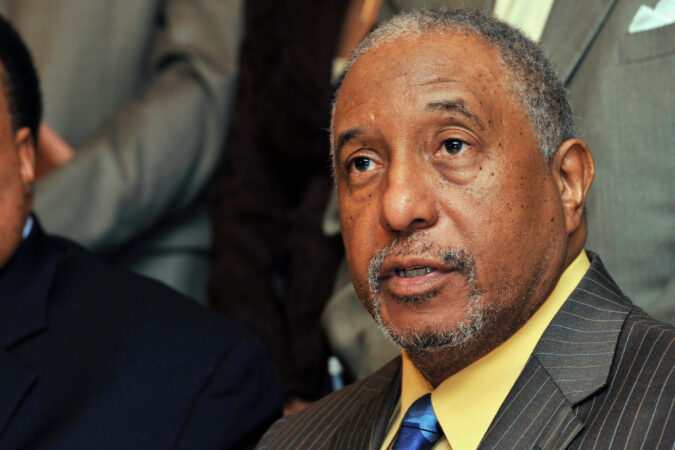
  • Bernard LaFayette, Selma voting rights organizer, has died at 85

    Bernard LaFayette, Selma voting rights organizer, has died at 85

    NASHVILLE — Bernard LaFayette, the advance man who did the risky groundwork for the voter registration campaign in Selma, Ala., that culminated in the passage of the Voting Rights Act of 1965, has died.

    Bernard LaFayette, III, said his father died Thursday morning of a heart attack. He was 85.

    On March 7, 1965, the beating of future congressman John Lewis and voting rights marchers on Selma’s Edmund Pettus Bridge led the evening news, shocking the nation’s conscience and pushing Congress to act. But two years before “Bloody Sunday,” it was Mr. LaFayette who quietly set the stage for Selma and the advances in voting rights that would follow.

    Mr. LaFayette was one of a delegation of Nashville students who in 1960 had helped found the Student Nonviolent Coordinating Committee, which organized desegregation and voting rights campaigns across the South. SNCC crossed Selma off its map after some initial scouting determined “the white folks were too mean and the Black folks were too scared,” Mr. LaFayette said.

    But he insisted on trying anyway. Named director of the Alabama Voter Registration Campaign in 1963, Mr. LaFayette moved to the town and, with his former wife Colia Liddell, gradually built the leadership capacity of the local people, convincing them change was possible and creating momentum that could not be stopped. He described this work in a 2013 memoir, In Peace and Freedom: My Journey in Selma.

    The many dangers Mr. LaFayette faced included an assassination attempt on the same night Medgar Evers was murdered in Mississippi, in what the FBI said was a conspiracy to kill civil rights workers. Mr. LaFayette was beaten outside his home before his assailant pointed a gun at him. His calls for help brought out a neighbor with a rifle. Mr. LaFayette found himself standing between the two men, asking his neighbor not to shoot.

    Mr. LaFayette said he felt “an extraordinary sense of internal strength instead of fear” at that moment. Rather than fight back, he looked his attacker in the eyes. Nonviolence is a fight “to win that person over, a struggle of the human spirit,” he wrote.

    He also acknowledged that his neighbor’s gun may have been what saved his life.

    Mr. LaFayette was already working on a new project in Chicago by the time his work in Selma came to fruition in 1965. He had planned to join the Selma-to-Montgomery march on day two, so he missed Bloody Sunday when the march was stopped by tear gas and club-wielding state troopers before it even got out of Selma.

    “I felt helpless at a distance,” he wrote. “I was stricken with grief, concerned that so many people in my beloved community were hurt, possibly killed.”

    But he shifted quickly, rounding up people in Chicago and arranging transport to Alabama for a second attempt. They set off two weeks later on what had become a victory march: President Lyndon Johnson had introduced the Voting Rights Act to Congress.

    Inspired by his grandmother

    Mr. LaFayette grew up in Tampa, Fla., where he recalled trying to board a trolley with his grandmother when he was 7 years old. Black passengers had to pay at the front, then walk to the back to climb on. But the conductor began to pull away before they could board, and his grandmother fell. He was too little to help.

    “I felt like a sword cut me in half, and I vowed I would do something about this problem one day,” he wrote in his memoir.

    It was his grandmother who decided he was destined to become a preacher. She arranged for him to attend Nashville’s American Baptist Theological Seminary (now American Baptist College), where he roomed with Lewis, and both helped lead the nonviolent civil disobedience campaign that led to Nashville becoming the first major Southern city to desegregate its downtown accommodations.

    President Barack Obama spoke about the roommates in a eulogy after Lewis died in 2020, recalling how they integrated a Greyhound bus while riding home for Christmas break (Lewis to Troy, Ala., and LaFayette to Tampa, Fla.) just weeks after the Supreme Court banned segregation in interstate travel in 1960.

    The two sat up front and refused to move, angering the driver, who stormed off at every stop, all through the night.

    “Imagine the courage of these two people … to challenge an entire infrastructure of oppression,” Obama said. “Nobody was there to protect them. There were no camera crews to record events.”

    Mr. LaFayette has said they didn’t fully realize the impact of all this work at the time.

    “We lived through this, but this was our daily lives,” he told the Associated Press in a 2021 interview. “When you think about it, we weren’t trying to make history or trying to rewrite history. We were responding to the problems of the particular time.”

    Freedom Rides of 1961

    In 1961, Mr. LaFayette dropped out of college in the middle of final exams to join an official Freedom Ride, one of many that sought to force Southern authorities to comply with the court’s ruling. He was beaten in Montgomery, Ala., and arrested in Jackson, Miss., becoming one of more than 300 Freedom Riders sent to Parchman Prison.

    Mr. LaFayette later trained Black youth to become leaders in the Chicago Freedom Movement and helped organize tenant unions.

    “The tenant protections we have today are really a direct outcome of that work in Chicago,” said Mary Lou Finley, a professor emeritus at Antioch University Seattle who worked with Mr. LaFayette in Chicago in the 1960s.

    And when he learned that one of his secretaries had two children sickened by lead — a huge problem that was not well understood at the time — Mr. Lafayette organized high school students to screen toddlers for lead poisoning by collecting urine samples, and prodded Chicago to help develop the nation’s first mass screening for lead poisoning, Finley said.

    “Bernard has always worked quietly behind the scenes,” said Finley, who later collaborated with Mr. LaFayette on nonviolence training. “He has avoided the spotlight. In some ways, I think he felt like he could do more if he were doing it quietly.”

    Mr. LaFayette also worked alongside Andrew Young and the Southern Christian Leadership Conference to prepare for the Rev. Dr. Martin Luther King Jr.’s ill-fated Northern campaign. Several of King’s marches were attacked by white mobs, but Mr. LaFayette and Young challenged the notion that the Chicago movement was a failure.

    Young noted in a 2021 interview that in Chicago they were trying to organize a population 20 times larger than Birmingham’s, while pursuing a range of difficult issues, from neighborhood integration to the quality of schools and jobs. “In each one of those we made progress,” Young said.

    By 1968, Mr. LaFayette was the national coordinator of the King’s Poor People’s Campaign and was with King at the Lorraine Motel on the morning of his assassination. King’s last words to him were about the need to institutionalize and internationalize the nonviolence movement. Mr. LaFayette made this his life’s mission.

    After King died, Mr. LaFayette returned to American Baptist to complete his bachelor’s degree and then earned a master’s and doctorate from Harvard University. Mr. LaFayette later served as director of Peace and Justice in Latin America; chairperson of the Consortium on Peace Research, Education and Development; director of the Center for Nonviolence and Peace Studies at the University of Rhode Island; distinguished senior scholar-in-residence at the Candler School of Theology, Emory University, Atlanta; and minister of the Westminster Presbyterian Church in Tuskegee, Ala., among other positions.

    “Bernard did work in Latin America. He did nonviolence workshops in South Africa with the African National Congress. He went to Nigeria when the civil war was happening there,” Young said. “Bernard literally went everywhere he was invited as sort of a global prophet of nonviolence.”

    In his memoir, Mr. LaFayette wrote that the ever-present threat of death during those early years of organizing taught him that the value of life “lies not in longevity, but in what people do to give it significance.”

  • House narrowly rejects Iran war powers resolution in early test of Trump’s strategy

    House narrowly rejects Iran war powers resolution in early test of Trump’s strategy

    WASHINGTON — The House narrowly rejected a war powers resolution Thursday to halt President Donald Trump’s attacks on Iran, an early sign of unease in Congress over the rapidly widening conflict that is reordering U.S. priorities at home and abroad.

    It’s the second vote in as many days, after the Senate defeated a similar measure along party lines. Lawmakers are confronting the sudden reality of representing wary Americans in wartime and all that entails — with lives lost, dollars spent, and alliances tested by a president’s unilateral decision to go to war with Iran.

    While the tally in the House, 212-219, was expected to be tight, the outcome provided a clarifying snapshot of political support for, and opposition to, the U.S.-Israel military operation and Trump’s rationale for bypassing Congress, which alone has the power to declare war. At the Capitol, the conflict has quickly carried echoes of the long wars in Afghanistan and Iraq, and many Sept. 11-era veterans now serve in Congress.

    “Donald Trump is not a king, and if he believes the war with Iran is in our national interest, then he must come to Congress and make the case,” said Rep. Gregory Meeks, the top Democrat on the House Foreign Affairs Committee.

    The House also approved a separate measure affirming that Iran is the largest state sponsor of terrorism.

    Republicans largely back Trump, and most Democrats oppose the war

    Trump’s Republican Party, which narrowly controls the House and Senate, largely sees the conflict with Iran not as the start of a new war, but the end of a government that has long menaced the West. The operation has killed Iran’s Supreme Leader Ayatollah Ali Khamenei, which some view as an opportunity for regime change, though others warn of a chaotic power vacuum.

    Republican Rep. Brian Mast of Florida, chairman of the House Foreign Affairs Committee, publicly thanked Trump for taking action against Iran, saying the president is using his own constitutional authority to defend the U.S. against the “imminent threat” the country posed.

    Mast, an Army veteran who worked as a bomb disposal expert in Afghanistan, said the war powers resolution was effectively asking “that the president do nothing.”

    For Democrats, Trump’s attack on Iran, influenced by Israeli Prime Minister Benjamin Netanyahu, is a war of choice that is testing the balance of powers in the Constitution.

    “The framers weren’t fooling around,” said Rep. Jamie Raskin (D., Md.), arguing that the Constitution is clear that only Congress can decide matters of war. “It’s up to us.”

    While views in Congress are largely falling along party lines, there are crossover coalitions. The war powers resolution, if signed into law, would have immediately halted Trump’s ability to conduct the war unless Congress approved the military action. The president would likely veto it.

    Trump officials provide shifting rationale for war

    After launching a surprise attack against Iran on Saturday, Trump has scrambled to win support for a conflict that Americans of all political persuasions were already wary of entering. Trump administration officials spent hours behind closed doors on Capitol Hill this week trying to reassure lawmakers that they have the situation under control.

    Six U.S. military members were killed over the weekend in a drone strike in Kuwait, and Trump has said more Americans could die. Thousands of Americans abroad have scrambled for flights, many lighting up phone lines at congressional offices as they sought help trying to flee the Middle East.

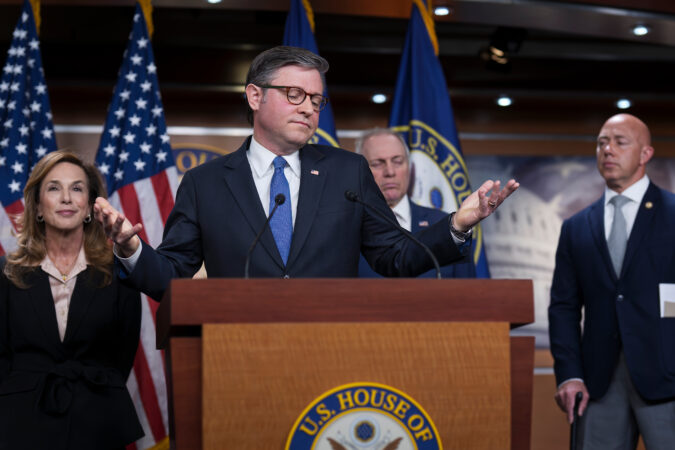
    Trump said Thursday he must be involved in choosing Iran’s new leader. Yet House Speaker Mike Johnson (R., La.) said this week that America has enough problems at home and is not about to be in the “nation-building business.”

    Defense Secretary Pete Hegseth said that the war could extend eight weeks, twice as long as the president first estimated. Trump has left open the possibility of sending U.S. troops into what has largely been a bombing campaign by air. More than 1,230 people in Iran have died.

    The administration said the goal is to destroy Iran’s ballistic missiles that it believes are shielding its nuclear program. It has also said Israel was ready to act, and American bases would face retaliation if the U.S. did not strike Iran first. On Wednesday, the U.S. said it torpedoed an Iranian warship near Sri Lanka.

    “This administration can’t even give us a straight answer of as to why we launched this preemptive war,” said Rep. Thomas Massie, the Republican from Kentucky, an outlier in his party.

    Massie and Rep. Ro Khanna (D., Calif.), who had teamed up to force the release the Jeffrey Epstein files, also pushed the war powers resolution to the floor, past objections from Johnson’s GOP leadership. Another Republican, Rep. Warren Davidson of Ohio, a former Army Ranger, was also expected to back the war powers resolution.

    Johnson has warned that it would be “dangerous” to limit the president’s authority while the U.S. military is already in conflict.

    “Congress must stand with the president to finally close, once and for all, this dark chapter of history,” Rep. Michael McCaul (R., Texas) said.

    Rep. Yassamin Ansari (D., Ariz.) said that as the daughter of Iranian immigrants who fled their homeland, she celebrates Khamenei’s death. But she warned that a democratic transition for the people of Iran never seems to a priority for Trump and his officials who briefed lawmakers.

    “War carries profound and deadly consequences for our troops, for the American people and for the entire world,” she said. “It’s the most serious decision that a nation can make and the American people deserve debate, transparency and accountability before that decision is made.”

    Other Democrats have proposed an alternative resolution that would allow the president to continue the war for 30 days before he must seek congressional approval. It is not expected yet for a vote.

    Senators sit in their desks for solemn vote

    In the Senate, Republican leaders have successfully, though narrowly, defeated a series of war powers resolutions pertaining to several other conflicts during Trump’s second term. This one, however, was different.

    Underscoring the gravity of the moment Wednesday, Democratic senators filled the chamber and sat at their desks as the voting got underway.

    Senate Democratic leader Chuck Schumer of New York said before the vote that every senator will pick a side. “Do you stand with the American people who are exhausted with forever wars in the Middle East or stand with Donald Trump and Pete Hegseth as they bumble us headfirst into another war?”

    Sen. John Barrasso, second in Senate Republican leadership, said “Democrats would rather obstruct Donald Trump than obliterate Iran’s national nuclear program.”

    The legislation failed on a 47-53 tally mostly along party lines, with Sen. Rand Paul (R., Ky.) in favor and Sen. John Fetterman (D., Pa.) against it.

  • Crews in Cuba rush to repair a damaged power plant to ease a blackout

    Crews in Cuba rush to repair a damaged power plant to ease a blackout

    HAVANA — Swaths of Cuba remained without power on Thursday nearly a day after a huge blackout hit the western part of the island in the latest outage blamed on a fragile electric grid and a lack of fuel.

    Crews worked overnight to repair a broken boiler at one of Cuba’s largest thermoelectric plants, but officials have warned that it could take three to four days for power to be fully restored.

    State media reported that nearly 660,000 customers in Havana, or 77%, had power, as well as 43 hospitals and 10 water supply stations. However, officials warned of low power generation and said some circuits that crews had reconnected were kicked offline again.

    Millions still remained without power, including Miguel Leyva, 65, who lives with his mother and brother, both of whom are ill.

    “I have no words to describe what I’m going through: the heat, the mosquitoes and no electricity. The food could spoil,” he said. “I’m aware of all the problems that exist, but listen, it’s been more than 24 hours now.”

    Cuba’s Ministry of Energy and Mines wrote on X that the electrical system is operating “in a limited capacity, prioritizing basic services, primarily health and water supply.”

    State media reported that two power plants are offline because of a lack of petroleum.

    Government officials said Wednesday afternoon that crews have located the crack in the boiler drum that led to the outage. They said it will take 12 hours to cool that area so crews can enter the furnace and start repairing it. Work already is underway to fix a pipe that also is damaged, officials added.

    Sonia Vázquez, 61, said the blackout didn’t stop her from selling coffee to passersby daily, saying she prepared it with gas at 5 a.m. under a rechargeable lamp.

    “I didn’t sleep last night. Too many mosquitoes,” said Vázquez, who lives with her grandson.

    Meanwhile, 57-year-old cafe owner José Ignacio Dorta, said that some of his frozen food has spoiled.

    “We’ve looked for ways to prevent further spoilage. We’re working on it. We hope nothing else will spoil,” he said.

    Cuba has long struggled with an aging electric grid and intermittent fuel supplies, but the crisis has deepened in recent months.

    Key oil shipments from Venezuela were halted after the United States attacked the South American country in early January. Then later that month, President Donald Trump warned that he would impose tariffs on any country that sells or supplies oil to Cuba.

    On Thursday, Trump suggested a deal may be imminent with Cuba but that he’s focusing on Iran in the meantime.

    Referring to a co-owner of Inter Miami being originally from Cuba, Trump said, “You’re gonna go back” and added, “That’s going to be a great day, right?”

    Without providing details, Trump said, “We’re going to celebrate that separately. I just want to wait a couple of weeks. I want him to wait a couple of weeks. But we’ll be together again soon, I suspect, celebrating what’s going on in Cuba.”

    He added of the island’s government, “They want to make a deal so badly. You have no idea.”

    Then, referring to Marco Rubio, the president said the secretary of state wants to work on Cuba but is cautious to do so during the war in Iran.

    “You’re next one’s going to be — we want to do that special — Cuba,” Trump said. “He’s waiting. But he says, “Let’s get this one finished first.’ We could do them all at the same time. But bad things happen. If you watch countries over the years, you do them all too fast, bad things happen.”

    Trump didn’t clarify his meaning, but the comments followed his from last week, when he raised that the prospect of a “friendly takeover” of Cuba might be possible without elaborating.

    Wednesday’s outage is the second one to hit western Cuba in three months.

    The outage in early December lasted nearly 12 hours. Officials said that a fault in a transmission line linking two power plants caused an overload and led to the collapse of the energy system’s western sector.

    Some of Cuba’s thermoelectric plants have been operating for more than three decades and receive little maintenance because of high costs. U.S. sanctions also have prevented the government from buying new equipment and specialized parts, officials say.

  • Trump allies expand role in planning America’s 250th anniversary

    Trump allies expand role in planning America’s 250th anniversary

    Two groups — one with the imprimatur of Congress, the other with President Donald Trump’s blessing — are jockeying to host celebrations marking America’s 250th anniversary, sparking confusion, muddled messages, and new scrutiny from Democrats who ask why the Trump-aligned group is receiving federal money.

    America250, led by a bipartisan board created by Congress a decade ago to mark the nation’s Semiquincentennial, has overseen events such as the Army’s 250th anniversary last year. It has also issued grants to state commissions and sponsored initiatives such as a float in this year’s Rose Parade.

    Freedom 250, a public-private partnership launched by the White House in December, has emerged as the more publicized and prolific group, with a flurry of high-profile announcements, including some from the Oval Office.

    “Freedom Trucks,” six customized semitrucks backed by $10 million in federal funds and with educational content crafted by conservative educators, have begun crisscrossing red states. A “Freedom Plane” took flight from Washington this week, beginning a National Archives-led nationwide tour in which the Boeing 737 will ferry an original engraving of the Declaration of Independence and other historic documents. The group is also planning a national prayer event on the National Mall, an IndyCar race around D.C., and a UFC fight hosted outside the White House on Trump’s birthday. The organization is led by Keith Krach, who served in the first Trump administration.

    Both groups are drawing on private funds for their programming, with sponsors such as Exiger, Oracle, and Palantir contributing to both organizations. The groups are also set to share in $150 million appropriated by Congress last year and managed by the Interior Department.

    The rapid rise of Freedom 250, with its Trump-tailored programming, has unnerved some liberals and watchdog organizations, who question whether it is wrongly tapping into funds intended for nationwide anniversary celebrations and promising access to the president at a price. Twelve Senate Democrats on Tuesday pressed the Interior Department to provide a “clear accounting” of money routed to Freedom 250, in a letter sent to the Trump administration and shared with the Washington Post.

    “The Trump administration’s latest venture, Freedom 250, continues to raise serious and troubling questions about whether access to the president or official government events is for sale to the highest bidders,” Sen. Adam Schiff (D., Calif.), who led the letter, said in a statement to the Post. “And if the administration is commingling taxpayer dollars with other funds in an unaccountable private entity run by the president’s allies, it is an open invitation for corruption. We need answers.”

    Public Citizen, a consumer advocacy organization, also has called for congressional investigations, citing a recent New York Times report that donors to Freedom 250 were offered access to Trump if they gave $1 million or more.

    Freedom 250 spokeswoman Rachel Reisner referred questions about its federal funding to the Interior Department. Trump “is deeply grateful for the support of his donors, but unlike the politicians of the past, he can’t be bought,” she said in a statement.

    She added that the organization has reached out to all 50 governors and partnered with a range of organizations, including PragerU and MyAmerica2026.

    “As we approach this historic milestone in our nation’s founding, we will not be deterred by any partisan outrage or political theater,” Reisner said.

    The Trump administration also has touted its approach, and Trump has repeatedly celebrated that he will be the president to oversee the nation’s 250th anniversary — an idea he embraced on the campaign trail.

    Asked about its plans to distribute the $150 million provided by Congress and what share would go toward Freedom 250, the Interior Department declined to comment.

    “The Department of the Interior looks forward to celebrating Freedom 250 and saluting 250 years of American greatness alongside President Donald J. Trump — the most iconic and accomplished President in the history of our great nation,” the department said in a statement.

    America250 and Freedom 250 have publicly touted their shared commitment to the nation’s Semiquincentennial.

    Rosie Rios, the Democrat leading America 250, has repeatedly praised her counterparts in interviews and statements, saying that Freedom 250 will focus on Washington-area events while her group tackles nationwide programming.

    The bipartisan commission “has taken every possible step” to support the Trump administration’s activities, the group said in its report to Congress in January.

    But the tensions between the organizations have grown, according to five people who spoke on the condition of anonymity to describe private conversations. Freedom 250 officials have bristled at the pace of America250’s work and output, and argued that the bipartisan group has been overly bureaucratic and politically correct. They also argue that America250 — which has received more than $100 million in federal funding since 2019 — has little to show for those contributions.

    In comparison, one person familiar with the matter said, Freedom 250 drew on $3 million in federal funds last year to quickly produce a New Year’s Eve light display on the Washington Monument.

    America250 said in a statement that it continues to actively collaborate with the White House task force, Freedom 250 and the full executive branch to plan the celebrations.

    The group has been running a nationwide contest for students to submit perspectives on what America means to them and has been to eight states so far with a storytelling program on identity, service, community, and personal legacy.

    Meanwhile, America250 officials and allies have questioned whether the Trump-backed group is too focused on activities that please the president and say the group threatens to siphon money that could be used for nationwide activities. America250 has received $25 million of the $150 million apportioned by Congress last year for anniversary activities, according to a person familiar with its finances.

    The friction between the groups reached a breaking point in the planning for the Army’s 250th birthday last summer — a military parade in Washington that coincided with Trump’s birthday, said one person familiar with the plans. America250 wanted the celebration to focus on the military, not the president. Freedom 250 wanted Trump, as the commander in chief, to be front and center, the person said.

    Some programming has shifted between the two groups. America250 originally applied for and received a grant from the Institute of Museum and Library Services for the Freedom Trucks, mobile museums inspired by the American Freedom Train that crisscrossed the country from 1975-1976. The institute is a federal agency that provides financial support for museums and libraries. The $10 million grant was later voluntarily transferred to Freedom 250, according to an official of the agency.

    “These mobile museums, which tell the incredible story of our nation’s founding, will be a cherished memory for an entire generation,” Keith Sonderling, a Trump appointee who leads the museum and library agency, said in a statement.

    Marissa Streit, chief executive of PragerU, a conservative media organization, said her company volunteered to produce all video and educational content for the Freedom Trucks after White House officials came up with the vision and worked with Hillsdale College to develop the displays.

    Streit insisted that despite the uniformly conservative credentials of the people involved, the exhibits showed a balanced view of history.

    “I believe we need to teach and talk about both the negative things that have happened in our country as well as the positive,” she said.

    The tensions are a departure from the approach taken during the bicentennial under President Gerald Ford, who sought to make sure the celebrations did not raise questions of impropriety in the wake of the Watergate scandal, said Richard Painter, the chief White House ethics lawyer in the George W. Bush administration.

    “The one thing our taxpayer funds should not be used for is politicizing the 250th anniversary of the founding of the country,” said Painter, co-author of The U.S. Presidency: Power, Responsibility, and Accountability. “One of the things [the founders] were most afraid of is faction and political parties destroying our democracy. The celebrations here shouldn’t be owned by one political party or another.”


  • Iran’s regime maintains its grip, despite devastating losses

    Iran’s regime maintains its grip, despite devastating losses

    The U.S. and Israeli air campaign against Iran has decimated the highest ranks of political and military leadership, destroyed critical military command-and-control infrastructure and fighting capability, and damaged civilian buildings across the country.

    In Tehran, the expanding conflict appears to be frustrating the succession process after Supreme Leader Ayatollah Ali Khamenei was killed. Khamenei’s funeral was postponed after the group charged with choosing his successor was targeted by Israeli strikes. Following that attack, Iranian state media announced that voting for the next supreme leader would be conducted remotely.

    But so far, some six days into a war that has now touched 12 countries across the Middle East, major military operations have not threatened the Iranian regime’s grip on power, according to European and Arab officials briefed on assessments of the regime’s standing since the conflict began.

    Iran, the officials say, was prepared for this conflict. The command structures built to survive a decapitation strike appear to remain substantially intact, allowing Iranian retaliatory strikes against Israel, Qatar, and Bahrain to begin within hours of the initial attacks. And inside the country since the conflict started, Iranians have reported a heavier security presence in city streets, with Basij paramilitary forces patrolling on motorbikes.

    “Iran’s senior leaders are dead; the so-called governing council that might have selected a successor, dead, missing or cowering in bunkers, too terrified to even occupy the same room,” Defense Secretary Pete Hegseth said in a briefing Wednesday touting successes as he outlined how operations would expand.

    President Donald Trump said Tuesday that the strikes killed “most of the people” the United States favored to replace the recently killed regime members.

    But despite the intensity of the strikes and the broad nature of the destruction, so far there are no reports of significant defections within regime ranks or of popular uprisings, according to European and Arab assessments described to the Washington Post by officials from those countries. U.S. intelligence also saw no signs of uprisings or defections in the first days of the campaign, according to a person familiar with the situation who spoke on the condition on anonymity to describe an ongoing operation.

    “There’s not a single sign of anything in the system breaking or defecting. Nothing. Zero,” said a senior European official, speaking on the condition of anonymity to describe government briefings on the latest assessments of the strength of the Iranian regime. “The control is complete,” he said. The official said he was aware of reports of regime security forces failing to show up for duty, but believed that could be because of orders to no longer congregate in compounds and barracks, for fear of being targeted.

    The officials said Iran’s military and political command has proved durable because of the “layered system” the regime built to withstand a crisis, decentralizing leadership by appointing multiple individuals to immediately replace any key figure who might be killed.

    After Iranian Defense Minister Aziz Nasirzadeh was killed in strikes Saturday, Majid Ebnelreza was appointed as the caretaker minister on Monday by Iranian President Masoud Pezeshkian, who himself was rumored to have been targeted in the attack’s initial waves. Since then, media reports have speculated that Ebnelreza was killed in subsequent attacks, but Iranian state media has not responded to the allegations.

    In the lead-up to the conflict, a senior Arab official said, U.S. allies in the Persian Gulf thought that Iran would be more vulnerable to outside military pressure and that the potential killing of the supreme leader would be an early turning point, triggering a mass mobilization against the regime.

    “We were looking for the demonstrations in the streets, but we were surprised by their unity,” he said, speaking on the condition of anonymity to describe sensitive internal planning.

    In January, as the regime buckled under massive anti-government protests across the country and responded with a brutal crackdown, many of Iran’s neighbors assessed a deep weakness within the political and security leadership structures.

    But amid an unrelenting bombing campaign, the governance structure has largely stayed intact and continues to exert unilateral control, surprising seasoned Iran watchers in the region. The European and the Arab officials both cautioned that the Iranian regime remains opaque and regime collapse can be almost impossible to anticipate from the outside.

    Information on the impact of the U.S. and Israeli attacks against Iran is sporadic. The country is under a near-total internet blackout. But initial visual analysis by the Washington Post has revealed extensive damage to military targets, government buildings, and internal security structures. Israel has also recently claimed strikes targeting Iran’s clerical establishment.

    In total, U.S. Central Command says, more than 2,000 targets were hit inside Iran in the space of over four days. The Israel Defense Forces said its planes have dropped more than 4,000 munitions on Iran since Saturday.

    “Undoubtably, Iran has been considerably weakened,” said Gregory Brew, an Iran analyst with the Eurasia Group. Considering Iran’s military losses alone, the United States and Israel destroyed most of the country’s navy, a significant portion of its missile stockpile and its means of producing more missiles, he said.

    “They’re blowing up a lot of buildings, but most of these buildings are probably empty. They’re annihilating the physical edifice of the Islamic republic,” Brew said.

    Meanwhile, Iran’s police force and the Basij have continued to function, according to Iranians inside the country, said the European official. Brew said that’s because these forces don’t operate heavy weaponry and can quickly disperse from buildings easily targeted from the air and then reemerge once the fighting ceases.

    After the 12-day war in June, Iran structured its armed forces in anticipation of further decapitation strikes. Iranian Foreign Minister Abbas Araghchi appeared to reference the reorganization in an interview with Al Jazeera on Sunday, in which he described Iranian military units as “isolated” and acting on “general instructions given to them in advance.”

    It is unclear how long Iran will be able to hold out in the face of U.S. and Israeli attacks. Earlier this week, the tempo of Iranian retaliation dropped, suggesting that Iran is running low on munitions or is unable to access buried stockpiles. However, Thursday saw heavy bursts of Iranian retaliatory attacks against Bahrain, Qatar, and the United Arab Emirates. As the conflict progresses and Iran’s armed forces are forced to adapt and draft new plans, the country’s leadership losses could become more serious.

    But Iranian officials have signaled that they are prepared for a long fight against militarily superior adversaries. Tehran believes that the only way it can prevail is if it can outlast the United States and Israel, according to a second European official briefed on assessments of Iranian regime strength since the outset of the war.

    “They understand that they will not be able to defeat the most powerful army in the world, but with asymmetric warfare they can try to inject as much damage as possible, to make the U.S. seek de-escalation,” he said. This is why Iran has prioritized retaliation against Persian Gulf nations and countries that could begin to pressure the United States to seek an off-ramp, the official said.

    The official said Iran has wagered that its system and its people are more capable of enduring prolonged hardship than those of the Persian Gulf and the United States, but he cautioned that the longer the conflict lasts, the more deadly it is likely to become on all sides.

    “This regime is built to last, and they aren’t going to go quietly,” he said.

  • Homeland Security funding bill falters again in Senate as Republicans warn of Iran risk

    Homeland Security funding bill falters again in Senate as Republicans warn of Iran risk

    WASHINGTON — Republicans invoked the war in Iran and the prospect of retaliatory terrorist attacks as they made another unsuccessful effort Thursday to pass a bill funding the Department of Homeland Security.

    Democrats are insisting on changes to immigration enforcement operations as part of the measure and blocked it from advancing. The procedural vote was 51-45, falling well short of the 60 that Republicans needed to proceed with the measure. While the House will also take up the bill Thursday, that outcome will be more about putting lawmakers on the record about where they stand.

    In the end, a bipartisan compromise will have to be reached to end a DHS shutdown that began Feb. 14.

    The funding bill first passed the House back in January, but it has gone nowhere in the Senate as Democrats seek new restraints on immigration enforcement tactics following the killing of ICU nurse Alex Pretti by Border Patrol officers in Minneapolis.

    Republicans have called on Democrats to reconsider their vote in the wake of the conflict in Iran.

    Sen. John Barrasso, the No. 2 Republican in the Senate, said Democrats would bear responsibility for the next cyberattack that is missed or the next “lone wolf terrorist” who attacks in the U.S.

    “Blood will be on their hands,” Barrasso said on the Senate floor. “Because we don’t have a functioning Department of Homeland Security that is funded with people on the ground in every position receiving their paychecks.”

    It did not appear the GOP’s strategy had changed the position of Democratic lawmakers, though. They said they are prepared to fund most of the agencies at the department, just not Immigration and Customs Enforcement or Customs and Border Protection.

    “It’s the same lousy, rotten bill that does not put any guardrails or constraints on ICE or CBP after federal agents shot American citizens in the street,” Rep. Jim McGovern (D., Mass.) said.

    Moments before the vote, senators were getting word that President Donald Trump had just fired DHS Secretary Kristi Noem. The news did not change Democrats’ resolve to force operational changes within the department through the spending bill.

    “Good riddance,” said Senate Democratic leader Chuck Schumer. “But the problems at ICE transcend any one individual.”

    Workers are beginning to miss part of their paychecks

    Following the longest federal shutdown in the country’s history last year, Congress has completed work on 11 of this year’s 12 appropriations bills. Only the bill for Homeland Security remains outstanding.

    Republicans said the timing couldn’t be worse for a Homeland Security shutdown. While a large majority of the department’s employees are considered essential and continue to work, many will not receive a full paycheck this week.

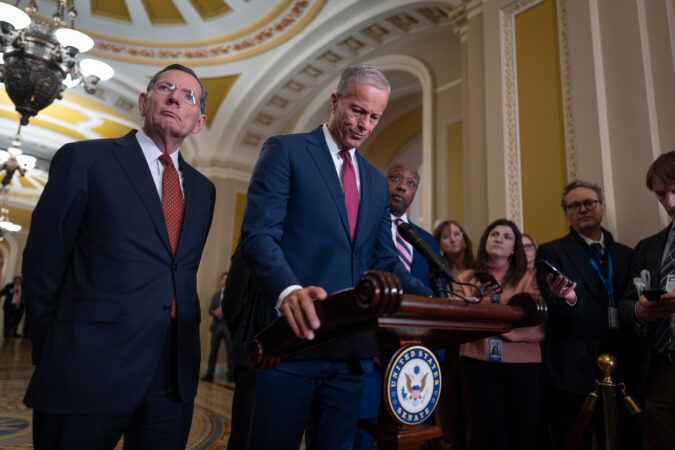
    “Like Democrats’ first shutdown a few months ago, this shutdown is causing a lot of financial stress, uncertainty, and pain for hardworking Americans,” Senate Majority Leader John Thune said. “It’s also making it harder for those working to keep America safe.”

    Republicans said the prospect of an increase in unscheduled absences by the Transportation Security Administration’s agents could lead to longer wait times at the nation’s airports. Meanwhile, the Cybersecurity and Infrastructure Security Agency has canceled various assessments to determine vulnerabilities to critical infrastructure. And training for first responders conducted through the Federal Emergency Management Agency was canceled.

    Democrats are seeking several changes at the department that include prohibiting ICE enforcement operations at sensitive locations like schools and churches, allowing independent investigations into alleged wrongdoing, requiring warrants to be signed by judges before federal agents can forcibly enter private homes or other nonpublic spaces without consent, and requiring agents to wear identification and remove their masks.

    Republicans note that the bill does include a bipartisan provision directing more resources for de-escalation training and $20 million to outfit immigration enforcement agents with body-worn cameras.

    Little to show from negotiations

    The White House and congressional Democrats don’t appear to have made significant progress in recent weeks in resolving their differences after trading several offers.

    “Look, we’re still far apart, but we’re negotiating and exchanging paper back and forth,” Schumer said.

    The size of the divide appeared significant during Thursday’s debate on the Senate floor.

    Alabama Sen. Katie Britt said that through their actions, Democrats were “still the party of open borders, they are still the party of defund the police, now actually more than ever.”

    She and other Republicans also cited last weekend’s mass shooting in Austin, Texas, as an example of the dangerous threat environment that’s facing Americans following the attack on Iran.

    “We know this couldn’t come at a more dangerous time.,” Britt said.

    Sen. Patty Murray, the top Democrat on the Senate Appropriations Committee, said that Democrats were simply working to make sure federal immigration officials follow the same standards as other law enforcement officers.

    “We are not asking for the moon. We are asking for basic steps to protect Americans’ constitutional rights and their safety,” Murray said.