Tag: North Philadelphia

  • Honeygrow aims to be a national brand. Here’s where the Philly company is planning new locations.

    Honeygrow aims to be a national brand. Here’s where the Philly company is planning new locations.

    Honeygrow keeps growing.

    The fast-casual eatery, based in Center City, plans to open up to 18 new locations next year, following 17 new outposts in 2025, founder and CEO Justin Rosenberg told The Inquirer on Monday.

    “It was definitely a good year,” said Rosenberg, adding that the company is “just continuing to build the pipeline for 2026 and beyond.”

    Honeygrow sells made-to-order stir-fries as well as salads and desserts. Since launching in 2012, the company has grown to 71 locations across several states, including Ohio, Massachusetts, Virginia, Maryland, Delaware, and New York.

    Philadelphia-area stores include Center City, Kensington, University City, North Philadelphia, Bala Cynwyd, and Cherry Hill.

    The company’s expansion plans include adding locations in Ohio and New Jersey, as well as in Boston. The eatery is also currently in negotiations to bring Honeygrow to the Detroit metropolitan area, a new market, said Rosenberg.

    Honeygrow also aims to open a location in Middletown, Del.

    As of February 2024, Boston was the company’s most-profitable market, but since then, Philadelphia has caught up, he says.

    “Saleswise, it’s kind of neck and neck between certain Philly stores and our two Boston stores,” Rosenberg said.

    Further expansion in Philadelphia is also possible.

    “We are always looking at Philly,” Rosenberg said. “We’ve been poking around South Philly for a while. We just haven’t found the right opportunity.”

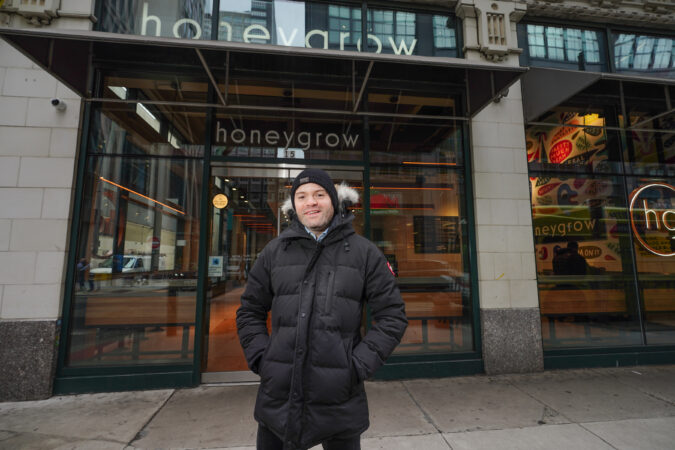
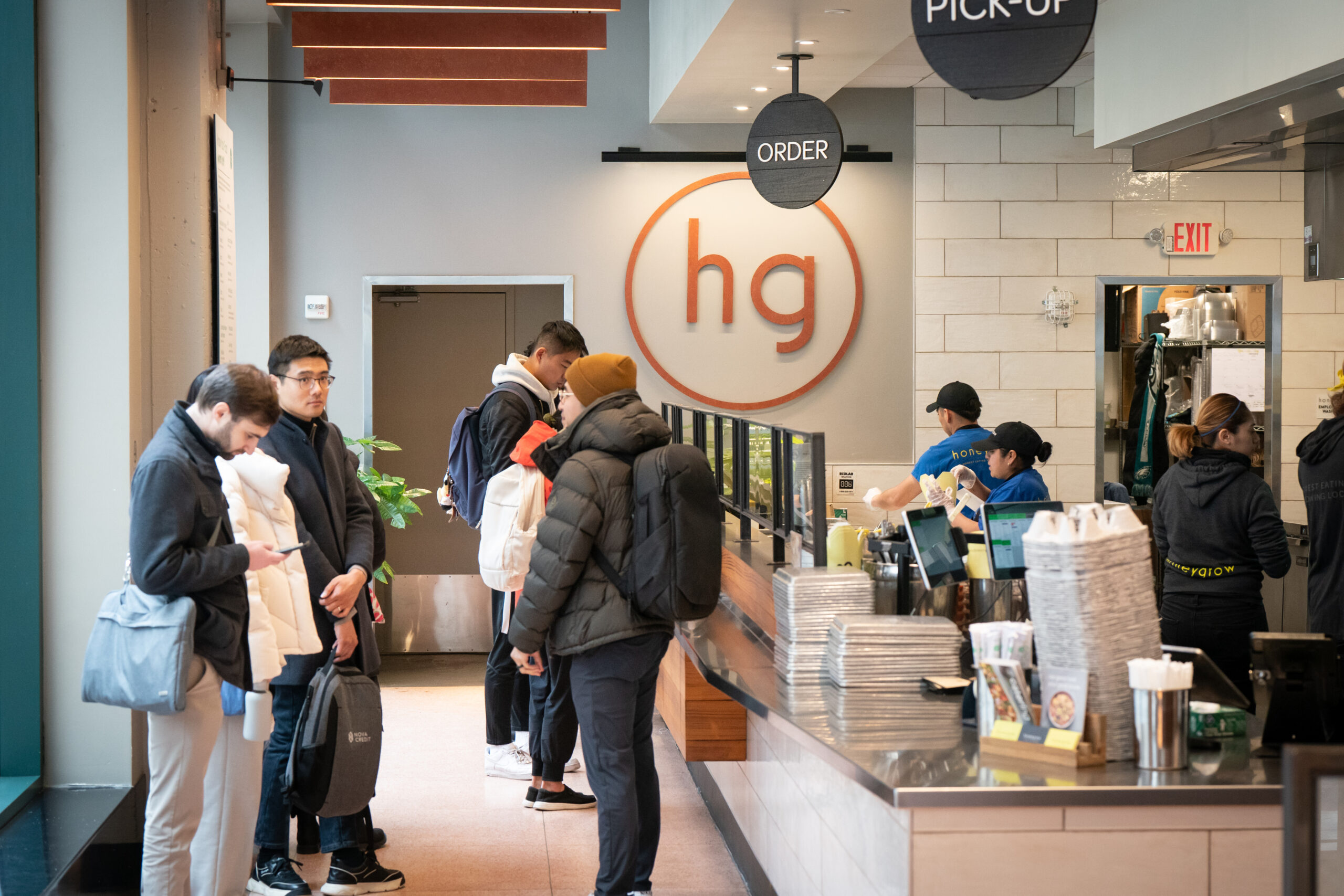
    Honeygrow, at 11th Street in Center City, in 2024.

    The company typically seeks 2,500-square-foot locations for new stores, but Rosenberg says it’s a competitive market for that kind of real estate.

    “One of the things that has made us successful — and I give credit to my team for this — is that we’ve been very disciplined on growth, just saying, look, if we can’t get the deal we need in terms of underwriting, let someone else take it,” he said.

    The company employs roughly 2,000 people, and each new store adds some 30 new hires, Rosenberg said.

    Some of the considerations when looking at new markets include what other fast-casual concepts are in the area, and how they’re doing, Rosenberg said.

    “If a Starbucks is underperforming in that market, that’s certainly going to spook us. Or a Chick-fil-A, if it’s below average unit volume, it’s probably not the right market for us,” he said.

    On the flip side, if a Chipotle, Chick-fil-A, Starbucks, Raising Cane’s, or another brand is doing well in an area, Rosenberg said, “We feel that those would be very similar customers to ours. We’re willing to put a restaurant in there and see what happens.”

    The plans for new locations come as the company shuttered some stores in Chicago, Washington, and New York in 2018 after rapid expansion plans. Some stores were “dragging down profitability,” Rosenberg has said, and he has attributed closures to growth that happened too quickly as well as poor real estate.

    Since then, the company has roughly tripled in size, said Rosenberg, adding “you just keep learning with every opening that you have.”

    “My mission remains the same,” he said. “I want to build something that’s from Philadelphia — make this a national, if not international, brand that we can be proud of.”

    Chicken Parm Stir-fry at Honeygrow at the 11th Street location in Philadelphia in 2024.
  • Overdose deaths in Philly on track to be the lowest in nearly 10 years. Pa. deaths are also declining dramatically.

    Overdose deaths in Philly on track to be the lowest in nearly 10 years. Pa. deaths are also declining dramatically.

    Philadelphia is on track to record the lowest number of fatal overdoses in nearly a decade in 2025, according to preliminary state data.

    State officials reported 747 overdose deaths in the city as of Dec. 23. The city last recorded fewer than 1,000 deaths in 2016, when 907 people died of overdoses.

    The dramatic decline mirrors national trends in overdose deaths, which peaked during the COVID-19 pandemic and have since been steadily falling.

    window.addEventListener(“message”,function(a){if(void 0!==a.data[“datawrapper-height”]){var e=document.querySelectorAll(“iframe”);for(var t in a.data[“datawrapper-height”])for(var r,i=0;r=e[i];i++)if(r.contentWindow===a.source){var d=a.data[“datawrapper-height”][t]+”px”;r.style.height=d}}});

    Likewise, overdose deaths are dropping in Pennsylvania, with a 29% decline in deaths reported statewide between 2023 and 2024, according to preliminary data from the state.

    Preliminary data for 2025 indicate that deaths are also on track to decline again across the state, with 2,178 overdoses reported as of Dec. 23, according to state data. In all of 2024, the state recorded 3,340 overdose deaths.

    window.addEventListener(“message”,function(a){if(void 0!==a.data[“datawrapper-height”]){var e=document.querySelectorAll(“iframe”);for(var t in a.data[“datawrapper-height”])for(var r,i=0;r=e[i];i++)if(r.contentWindow===a.source){var d=a.data[“datawrapper-height”][t]+”px”;r.style.height=d}}});

    City officials in Philadelphia said there are slight differences in how the state and the city report overdose data and could not comment extensively on the state figures. But the city’s own data also show dramatic drops in deaths in the last several years.

    As recently as 2022, deaths in the city had soared to their highest-ever rate. But they decreased slightly in 2023.

    Citing preliminary data from 2024, Philly Stat 360, a city-run database that tracks quality-of-life metrics, reported 1,064 overdose deaths — a 19% decrease in fatal overdoses from the year before. The city has not yet released its own statistics for 2025.

    “My first reaction to hearing these numbers is absolute joy,” said Keli McLoyd, the director of the Philadelphia Overdose Response Unit (ORU). “With that said, the number should be zero. Every overdose is preventable. Every single one of those lives lost is a person.”

    State officials said their work to expand overdose prevention efforts and ease entry to treatment has contributed to the dramatic drops in deaths. Still, they said, there is more work to be done.

    “Even with the overall decreases, we are still losing too many people — mothers, fathers, sons, daughters, grandparents, grandchildren — to overdose,” said Stephany Dugan, a spokesperson for the Pennsylvania Department of Drug and Alcohol Programs.

    She added that all Pennsylvanians “deserve equal and equitable access” to addiction treatment.

    Decreases in overdoses in Philadelphia

    Discerning the cause of the dramatic drops in overdose deaths can be difficult, city officials say.

    “We have to acknowledge that it’s a huge, huge change, and so we really are hopefully doing something right. But I think it’s going to be very hard, if not impossible, to say that one thing resulted in this massive reduction in fatal overdose deaths,” McLoyd said.

    Still, efforts at the state and local levels to increase access to naloxone, the overdose-reversing drug, likely made a difference, she said.

    A number of local advocates in the addiction medicine field have speculated that there is still much to learn about how the COVID-19 pandemic affected overdose rates, said Daniel Teixeira da Silva, the director of the Division of Substance Use Prevention and Harm Reduction at the Philadelphia Department of Public Health.

    “When we look at the [overdose] increases after 2016, leading up to COVID, we can tie that to the introduction of fentanyl to the [drug] supply,” he said Monday, referring to the synthetic opioid behind most of the city’s fatal overdoses.

    “When you look at the increases from 2020 to 2022 — this is where I just don’t think we know enough yet. It’s hard to say COVID didn’t impact [deaths]. We look at what was going on at the time, contributors to more risky substance use such as people losing employment, the isolation,” Teixeira da Silva said.

    Likewise, he said, policy changes that came about during the pandemic, such as easing some restrictions around opioid addiction medications, could be contributing to a drop in deaths now.

    “Maybe we’re seeing benefits of the policies enacted during COVID,” he said.

    A changing drug landscape

    On Philly Stat 360, city officials said fentanyl still drives nearly all of the opioid overdose deaths in the city.

    But about 70% of deaths involved a stimulant like cocaine or methamphetamine in 2024. And about half of the city’s fatal overdoses that year involved both stimulants and opioids.

    Taking stock of the drop in overdose deaths, city officials noted the success of a 2024 program at the ORU to deliver naloxone, the opioid overdose-reversing drug sold under the brand name Narcan, to households in neighborhoods seeing a high number of overdoses.

    They included neighborhoods in North Philadelphia, where overdose deaths had risen over the last several years. Across the city, Black and Hispanic communities had seen high rises in overdoses — but neighbors often reported receiving fewer resources to address them.

    Workers assigned to the naloxone initiative knocked on 100,000 doors offering the medication and access to addiction treatment. In some neighborhoods, up to 88% of neighbors who answered their doors accepted some kind of resource from staffers, according to a city report on the program. McLoyd also helmed an effort to ensure all city fire stations had naloxone on hand.

    “We’re sharing those messages that this is a tool for everyone, not just people who use drugs or people who love those who use drugs,” since some people may hide their addiction from others, she said.

    This year, the city launched another campaign to educate residents about the risk of heart disease from stimulant use. Eighty percent of overdose deaths among Black Philadelphians in 2023 involved a stimulant, and about half of the Black Philadelphians who died of an overdose between 2019 and 2022 had a history of cardiovascular disease.

    “We see opioid-stimulant [overdose deaths] decreasing, but stimulant-only [overdoses] being really persistent,” Teixeira da Silva said. “Stimulant overdoses are not reversed by Narcan,” so it is important to help vulnerable residents understand the specific harms caused by stimulants.

    As overdoses decrease in the general population, McLoyd said, it is crucial to maintain outreach efforts toward groups that have seen rising overdoses in recent years, like pregnant people and teens in the juvenile justice system.

    “Within certain populations, overdoses are still disproportionately high. We want to develop programs that speak specifically to those populations,” she said.

    City officials have also hailed the Riverview Wellness Center, a 234-bed recovery home that offers supportive services to people who have completed a 30-day stay in inpatient treatment.

    But Mayor Cherelle L. Parker’s administration has faced criticism from advocates for people in addiction over her decision last year to slash funding for syringe exchanges. Critics have also decried City Council legislation that regulates mobile medical services for people with addiction, requiring permits to offer care and limiting operating hours and locations in some neighborhoods.

    Teixeira da Silva said that the city is using the legislation to more effectively coordinate care for people with addiction. He said his division has been involved in the new permitting process for mobile services to “get them approved as fast as possible to ensure there isn’t a gap in access.”

    Statewide initiatives

    Across Pennsylvania, the state’s Overdose Prevention Program handed out more than 415,000 doses of naloxone in the first six months of 2025, said Dugan, the Pennsylvania Department of Drug and Alcohol Programs spokesperson.

    Those doses helped reverse more than 6,100 overdoses, Dugan said earlier this month.

    The state also distributed 437,000 test strips to help drug users detect fentanyl and xylazine. The animal tranquilizer contaminated much of Philadelphia’s illicit opioid supply starting at the beginning of the decade and can cause severe skin wounds that sometimes lead to amputation.

    Authorities credited efforts to increase access to treatment in rural counties and to decrease wait times for addiction treatment, implementing a “warm handoff” program that allows patients to transfer directly from hospitals to addiction treatment.

    More than 22,000 Pennsylvanians were offered addiction treatment from hospitals in the first 10 months of 2025. Nearly 60% of people who received referrals accepted them, state officials said.

    Advocates say that the state’s focus on programs to prevent overdoses has paid off.

    “I’m really impressed and grateful for the state and their investment in harm-reduction programs,” said Sarah Laurel, who heads the Philadelphia-based addiction outreach organization Savage Sisters.

    But as the drug supply changes, she said, it is vital for health officials to collect more data on other harms of drug use besides overdoses.

    For example, medetomidine, another powerful animal tranquilizer not approved for human use, has supplanted xylazine in Philadelphia’s illicit opioid supply.

    It causes intense withdrawal that has flooded emergency rooms with patients suffering from dangerous spikes in blood pressure and other heart complications. Some doctors have raised concerns that patients undergoing medetomidine withdrawal risk brain damage from high blood pressure.

    Medetomidine was detected in about 15% of all fatal overdoses in Philadelphia between May 2024 and May 2025, according to preliminary city data obtained by The Inquirer this fall.

    “It’s great they’re distributing naloxone at the rate they are. However, we have not really seen a ton of data on the complications that this polychemical substance wave is causing for people,” Laurel said.

    “It’s a big area where we can look into the people we’re serving and the way their lives are being impacted by drugs.”

    Teixeira da Silva said that city officials successfully pushed federal officials this fall to institute new medical billing codes for xylazine use and related amputations, a crucial step to allow hospitals to better track harms from the drug. They are hoping to do the same for medetomidine and its withdrawal symptoms.

    “I definitely agree that we need a broader perspective in terms of the harms caused by drug use beyond death,” he said. “Of course, death is the worst harm. That has to be a metric that we continue to monitor and work toward zero.”
  • Temple University Hospital is being investigated by CMS over its care of a homeless patient who died

    Temple University Hospital is being investigated by CMS over its care of a homeless patient who died

    A patient with no home to return to was pushed in a wheelchair to the curb outside Temple University Hospital. Staffers left him sitting on a bench, even though he was considered at a high risk of falling.

    An hour later, a security officer found the man had fallen and was lying on the ground.

    He was shaking when the guard brought him back into the hospital, but didn’t respond to a nurse’s questions. So hospital staff again sent him away — this time leaving him alone in a wheelchair outside the emergency department.

    He was found there five hours later, slumped over, unresponsive, and without a pulse. He died the following week.

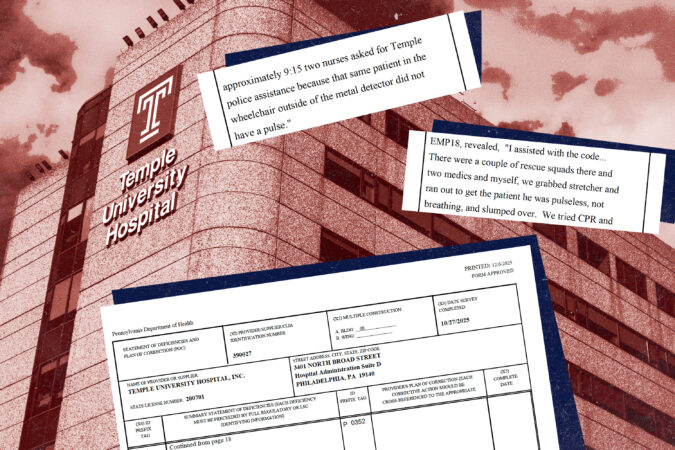
    Temple’s treatment of the patient during the Oct. 3 incident prompted state and federal investigations. In a report released earlier this month, the Pennsylvania Department of Health cited Temple for violating state rules that require hospitals to provide emergency care.

    Experts say the hospital’s actions amounted to “patient dumping,” a practice prohibited under a federal law that requires hospital emergency departments to medically screen and stabilize all patients.

    The Centers for Medicare and Medicaid Services (CMS), which oversees hospital safety nationally, confirmed it is also investigating, but has not released details.

    Hospitals that violate the Emergency Medical Treatment and Labor Act, known as EMTALA, risk hefty fines or losing their Medicare license, though such penalties are rare.

    Temple acknowledged that its own protocols were not followed. Health system officials told state investigators the patient should not have been removed from the hospital without being evaluated and cleared by medical staff.

    “The safety of our patients, visitors and staff is Temple’s highest priority,” the hospital said in a statement to The Inquirer. “We believe that everyone deserves high quality care.”

    The hospital declined to say whether any of the staff members involved were disciplined or fired.

    But such incidents are rarely the fault of one individual, legal experts and homelessness advocates said. Rather, they are a sign of systemic problems, such as understaffing that can leave staff overwhelmed, and bias among medical providers that can put vulnerable patients at risk of being dismissed.

    “If you work in an environment where safety is prized and honored and enforced from the top down, everyone feels that’s their mission,” said Eric Weitz, a medical negligence lawyer in Philadelphia. “If that’s not a priority being set by leadership, then it’s no surprise the culture doesn’t reinforce it.”

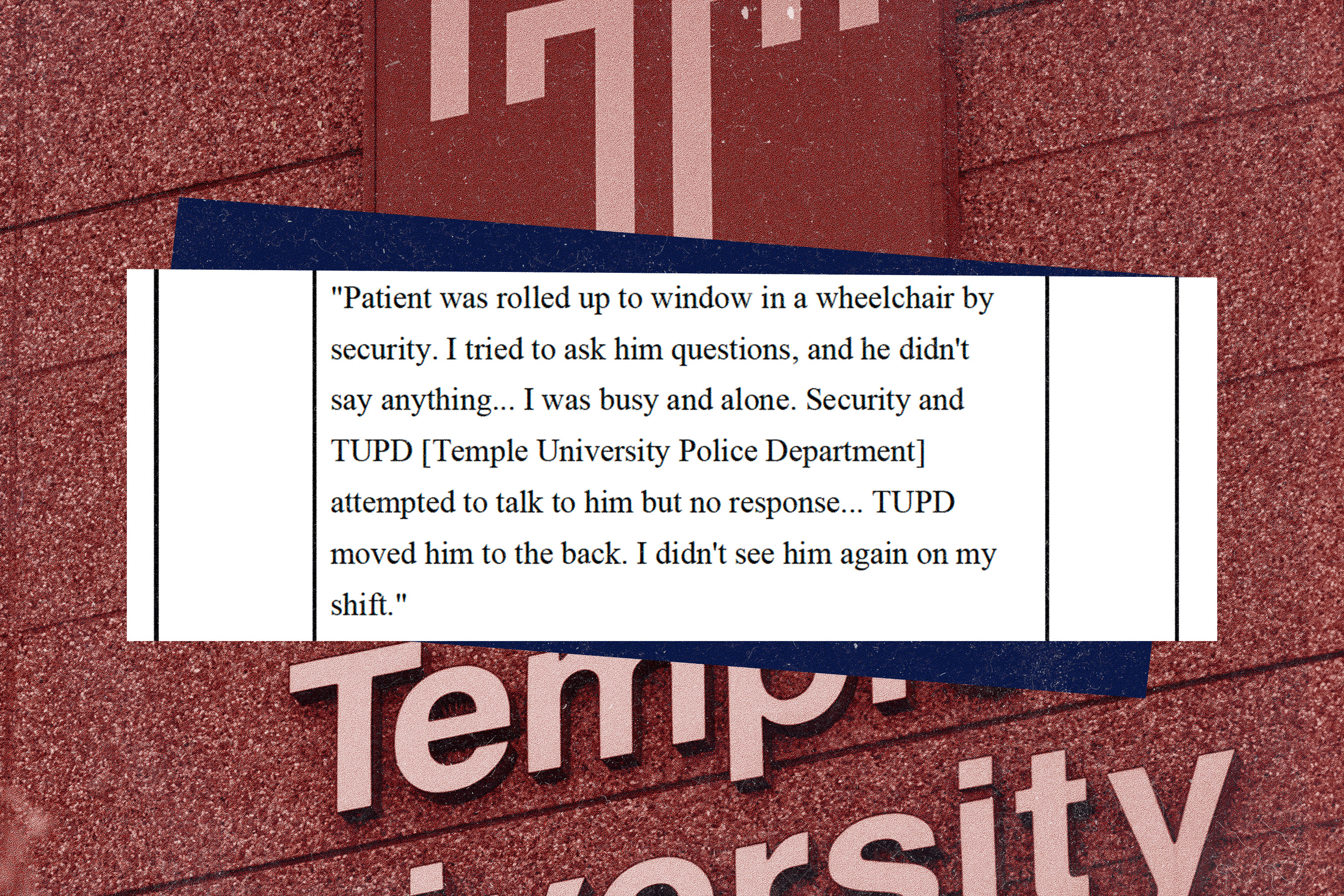
    Hospital administrators said the triage nurse who turned away the patient should have sought help, if the patient wasn’t responding to questions. The nurse said she was overwhelmed and working without sufficient support in one of the region’s busiest trauma hospitals.

    “I was busy and alone,” she told state inspectors.

    The incident violated Temple’s emergency department protocol, staff told Pennsylvania Department of Health inspectors.

    Pa. Department of Health investigates Temple

    To piece together what went wrong, Pennsylvania Department of Health inspectors watched security camera footage, interviewed staff members, and reviewed internal hospital reports. Their timeline shows a series of mistakes.

    At about 3:15 p.m., an employee brought the patient in a wheelchair to a bench near the curb outside the hospital, and left him there on the mild October day with highs near 70 degrees.

    He was being discharged to “the community” because he was experiencing homelessness, according to the inspection report. (The state report does not say whether staff attempted to place him at a skilled nursing facility, rehabilitation center or homeless shelter.)

    The man sat alone on the bench for an hour before standing unsteadily, taking a few steps, and ultimately falling to the ground.

    He managed to get back up, leaning against a tree for support, only to fall again. He was on the ground for 10 minutes before a security guard found him.

    The guard brought the man back into the emergency department in a wheelchair about two hours after he had been released.

    Back inside the hospital, the man followed orders to raise his arms for a security check at the door. Then he waited in line to be seen by the triage nurse responsible for checking in patients at the emergency department.

    When he reached the front of the line, he did not respond to the nurse’s questions. “He was not answering any questions, just shaking,” according to a Temple incident report reviewed by inspectors. Staff said the patient was “not cooperating” and should be sent to the back of the line.

    After two minutes with the nurse, a security guard moved his wheelchair to a corner of the emergency department near the entrance.

    The man was once again wheeled outside the hospital a few minutes later and left alone.

    He was found by medical staff around 9:30 p.m., slumped over in his wheelchair.

    Staff began CPR, rushing him back inside for trauma care.

    Pennsylvania Department of Health’s inspection report details how a patient in Temple’s emergency department was rolled away in a wheelchair without being evaluated.

    The inspection report does not identify the patient’s name, age, or provide details on the medical condition for which he had been hospitalized. It also does not say what happened after he was found unresponsive. He died five days later, on Oct. 8.

    Temple responds

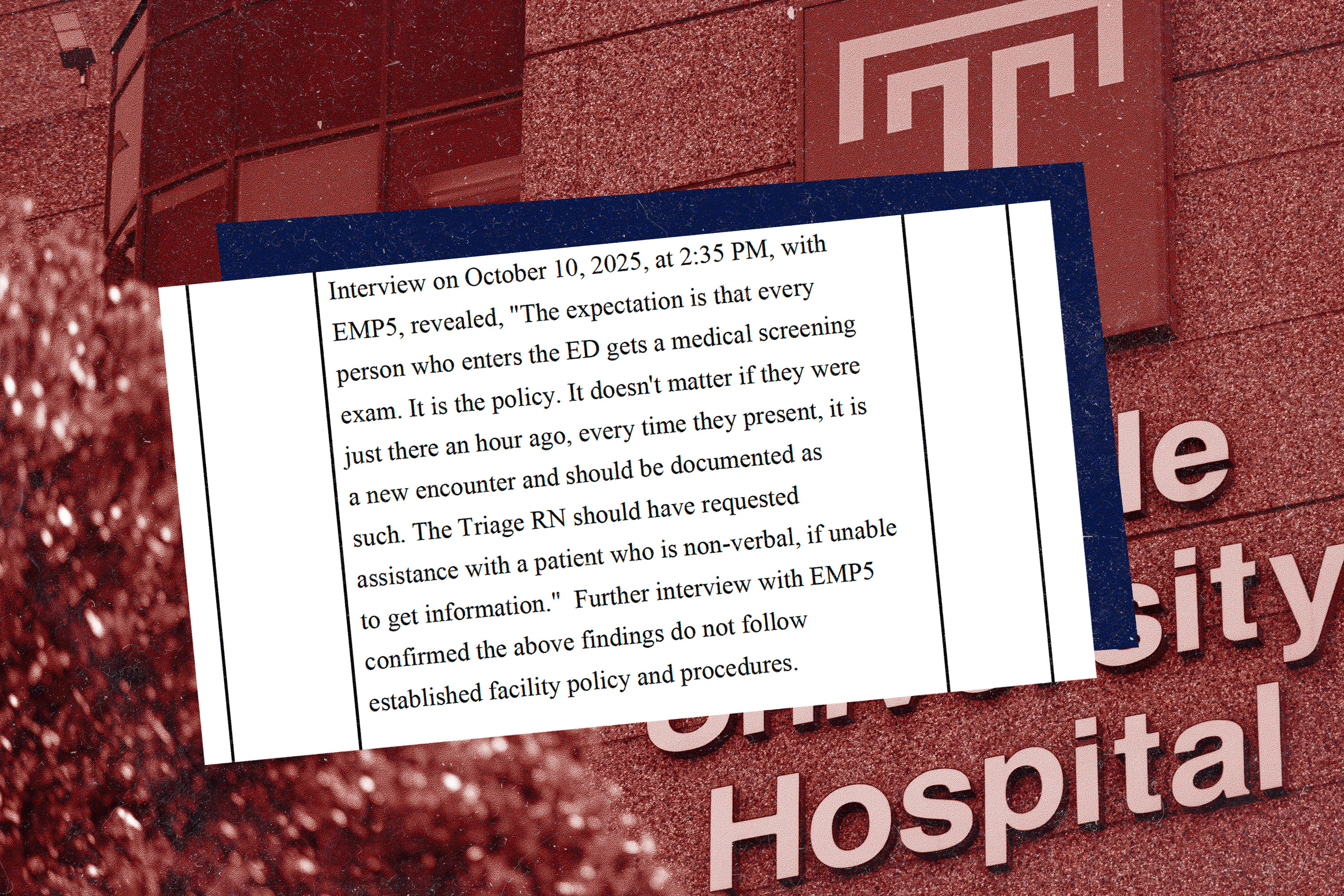
    Medical screening of every patient who comes to the emergency department is “explicitly required” under Temple’s EMTALA policies, according to the hospital’s response to the state findings.

    “It doesn’t matter if they were just there an hour ago, every time they present, it is a new encounter and should be documented as such,” a Temple staffer said in an interview with inspectors.

    The hospital told the state it would retrain staff on EMTALA rules, making clear that security officers cannot remove patients from the emergency department unless they have been evaluated and cleared for release by a medical professional.

    A week after the incident, hospital staff were instructed to keep a log of patients who are removed from the emergency department and the name of the provider who approved their release. (Temple police may still remove patients from the emergency department if they are threatening the safety of other patients or staff.)

    The hospital also said that it would order mobility evaluations for patients who are being discharged “to the community” if they had a high risk of falling, with a doctor’s sign-off required.

    Temple treats some of Philadelphia’s most vulnerable patients in an emergency room that sees more than 150,000 visits a year, including high numbers of gunshot victims and people experiencing opioid withdrawal. It operates a Level I trauma center in a North Philadelphia community where 87% of patients are covered by publicly funded Medicare or Medicaid.

    The emergency department is so busy that about 8% of patients choose to leave before being seen, according to CMS data, compared to about 2% of patients at hospitals nationally and across Pennsylvania.

    The triage nurse on duty Oct. 3 is not identified in the inspection report.

    The Temple chapter of Pennsylvania Association of Staff Nurses and Allied Professionals, which represents 1,600 nurses and 1,000 other medical professionals on Temple campuses, declined to comment.

    Legal experts raise questions

    Two healthcare lawyers who reviewed the state’s inspection report said the entire episode is troubling.

    “It sounds like they violated every part of EMTALA,” said Sara Rosenbaum, professor emerita of health law policy at George Washington University.

    The law does not require specific treatment, but mandates that hospitals evaluate everyone who walks in the door seeking care, and prohibits them from sending them away or transferring them until they are medically stable.

    “They failed to screen him, threw an unstable person back on the street, and didn’t arrange a medically appropriate transfer,” she said.

    What’s more, the hospital could be sued for malpractice over how it initially discharged the patient.

    The incident appears to be “a classic EMTALA violation,” said Weitz, the Philadelphia lawyer who serves on Pennsylvania’s Patient Safety Authority, an independent state agency that monitors hospital errors.

    The health department’s description of what happened is “almost eerily the exact fact pattern the law was passed to prevent,” he said.

    Healthcare challenges for patients experiencing homelessness

    People who are experiencing homelessness often receive subpar treatment when they seek medical care, research shows.

    One study that analyzed thousands of California patient records found that those who were described in their medical records as “homeless” were more likely than patients who have a permanent legal address to be discharged from the emergency department, rather than being admitted for care.

    In the Philadelphia region, caring for this population is increasingly challenging. The number of available shelter beds has declined in recent years, while the number of people who are considered unhoused has risen, according to Philadelphia’s Office of Homeless Services.

    Stephanie Sena, CEO of Breaking Bread Community Shelter in Delaware County, said the colder months also see more people experiencing homelessness coming to hospitals to get off the street.

    “If they say they’re sick, they might get a bed and be able to survive the night,” Sena said.

    The pattern can make doctors and nurses less likely to believe patients when they report real medical needs. Especially when staff are overwhelmed in busy hospitals, patients experiencing homelessness may be at greater risk of getting denied or discharged when they need help, she said.

    Sena said she was disappointed to hear about the Temple incident.

    “It is tragic,” she said, “but also not at all surprising, unfortunately.”

  • A Philly charter just laid off 17 employees. Students, staff, and parents say it’s a sign of troubling changes at the school

    A Philly charter just laid off 17 employees. Students, staff, and parents say it’s a sign of troubling changes at the school

    Esperanza Academy Charter School laid off 17 employees this month — a move that officials say was necessary amid a challenging financial climate.

    But some Esperanza Academy veterans say the 4% reduction in the workforce — which came with no notice a few weeks before the holidays — is emblematic of troubling recent changes at the Hunting Park charter.

    Ten Esperanza Academy staffers, students, and parents spoke with The Inquirer and detailed concerns about changes at the school in the last year.

    Teachers say morale is low, particularly at the high school, where staff have filed paperwork to form a union for the first time in the school’s history. Student frustration bubbled over recently, with hundreds walking out to express their anger over the loss of teachers, a counselor, an administrator, and more.

    “Students are protesting,” Jarely Cruz-Ruiz, an Esperanza Academy ninth grader, wrote in a letter to the charter’s board of trustees, “because even we see the wrong being done.”

    School officials declined to be interviewed, but in a statement, CEO Evelyn Nuñez said: “Like many academic institutions across the commonwealth and nation, Esperanza Academy is navigating a challenging economic environment.”

    But, Nuñez said, the board and leadership team will ensure “the school will be a source of hope in this neighborhood for years to come.”

    An anchor, changing

    Esperanza has operated a charter school in North Philadelphia since 2000; the school has expanded to encompass grades K-12, and now serves more than 2,000 students in multiple buildings.

    The charter is part of the Nueva Esperanza organization, a sprawling nonprofit “opportunity community,” as its founder, the Rev. Luis Cortés Jr., has described it, a one-stop shop for neighborhood revitalization work, job training, legal services, and more.

    Esperanza opened a brand-new, 73,000-square-foot elementary building on the nonprofit’s campus at the beginning of this school year. Officials, in a statement released after the student walkout, said the project was planned for many years and noted that the broader organization, not the charter school, pays for campus improvements.

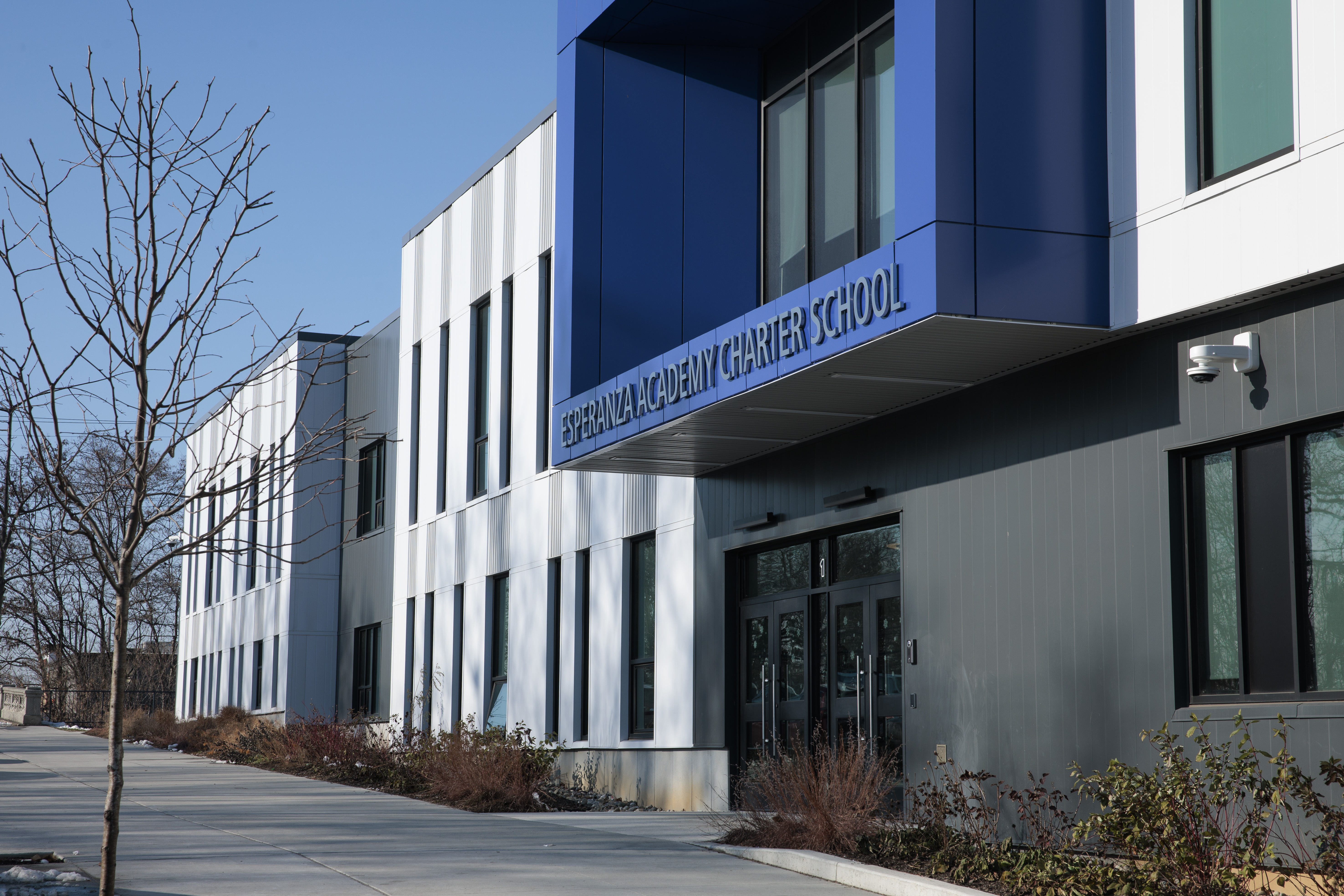
    The exterior of the new Esperanza Academy Charter elementary building at 201 West Hunting Park Ave.

    Esperanza has long been an anchor in the neighborhood and the larger Latino community, a place with a one-big-family feel.

    But Daniel Montes, who came to the school as a climate control officer in 2017 and worked his way up to be a teacher, said shifts began happening about a year ago. Montes was among those staffers laid off recently.

    Nuñez came to the school from the Philadelphia School District last year to become its CEO.

    “Things started to change when we got the new CEO,” Montes said. “I don’t know if it’s when you get a new broom, it sweeps clean.”

    At a staff retreat just before the start of this school year, Cortes, Esperanza’s founder, alluded to coming financial difficulties, said one staffer, who asked not to be named for fear of reprisal.

    “He said, ‘Stuff’s happening, you have to buy in or get out,’” said another staffer, who asked not to be identified because they did not want to be targeted by leaders. “He said it was politically driven [at the national level], and that funds would be tight.”

    ‘Three strikes’

    Tensions began to simmer among high school staff.

    “There are very unilateral changes being put into effect extremely quickly,” said another teacher, who also asked not to be named for fear or reprisal. “We’ve had major changes go into effect on a Monday after a meeting on a Friday. They said, ‘We don’t have subs and you’re going to be covering classes for free.’”

    Montes and others said teachers were frustrated over new schedules, lost prep time, and the order to cover classes without compensation — Esperanza Academy had, in the past, paid teachers for covering classes.

    “It was three strikes,” said Montes.

    “We just did not feel heard,” a third teacher, who also asked not to be named for fear of retribution, said. “We’re out of paper towels, and staples for the printer. The printer’s broken, but they hired six-figure administrators.”

    Most charter schools do not have unionized staff; in October, a majority of Esperanza Academy’s high school teachers signed union authorization cards and chose to affiliate with the American Federation of Teachers.

    Layoffs came Dec. 4, a Thursday, with no warning — some of the affected staff were pulled out midclass and given notice.

    Students weren’t told what was happening, but something seemed off that day, they said. And a basketball game was canceled.

    Those who remained at Esperanza Academy’s high school were told they would be absorbing the job responsibilities of the laid-off workers, including classes, coverages, and special-education caseloads.

    Some teachers got extra classes added to their schedules — with no extra pay. Other classes were combined, with class sizes growing.

    Interventionists — those charged with working with the neediest students — were laid off, and staffers said no plan has been articulated about who will do that work.

    In every staff meeting, teachers said they are reminded that the school’s focus is increasing attendance, boosting the number of students who meet state standards, and decreasing the number of students who score at the lowest levels.

    “How are we doing that if we don’t have any interventionists?” the second teacher said.

    Student protest

    The layoffs stunned students. They mobilized and held a walkout a few days later.

    Hundreds showed up, voicing their displeasure with the cuts and their support for the lost staff. They carried homemade signs and chanted.

    Nuñez acknowledged the walkout in an email to students and families the next day, saying students demonstrated “thoughtful advocacy and respect as they honored the staff members affected by the recent reductions, and we are proud of the way they used their voices to support their school community. School leadership will continue working closely with the [student government] on how we can best support our students as we move through this transition together.”

    Cruz-Ruiz, the Esperanza Academy ninth grader, said the school no longer felt like a family.

    “In this building,” Cruz-Ruiz wrote in her letter to the board, “data matters more than people. You named this school Esperanza. Hope. But hope doesn’t live here, scores do. Reputation does. Those graphs and percentages you stare at do.”

    ‘It’s affected so many of the kids’

    Francesca Castro, mother of an Esperanza Academy 10th grader, said she’s been very pleased with the education her daughter has received since middle school.

    But the layoffs were deeply unsettling, she said.

    “It’s affected so many of the kids,” said Castro. “I’m in the corporate world — I understand sometimes you need to make cuts. But there was no preparation, and it was right around the holidays. Couldn’t we find a different way, see what else we could cut?”

    Montes and other laid-off staff were some of the most important people in the building in terms of relationships with students, Castro said.

    “What worries my daughter and some of the students and parents is: If these changes were made all of a sudden, what other changes could happen?” she said. “Are the athletes going to get less? Are the after-school programs being cut? Are they going to start cutting academics?”

    Officials said in a statement that the layoff decision was not made lightly, and “our priority throughout this process has been to preserve the high-quality learning environment and supportive services that our students and families rely on. We remain fully committed to ensuring that the school year continues with minimal disruption to classrooms, instruction, or student support.”

    Students are aware of the larger changes at the school, said teachers, parents, and staff. They can’t understand why those closest to the students were taken away.

    “We’re broke, but we have all these new administrators, and we just built a new building? Students are savvy to that stuff — they’re angry,” said the third teacher.

    What’s next?

    Wendy G. Coleman, president of the American Federation of Teachers-PA, sent Nuñez a letter Dec. 10 asking Esperanza to formally recognize an AFT-affiliated union at the school.

    The staff wants a salary scale and a voice on working conditions and class sizes, Coleman said.

    “The overwhelming majority of the staff has signed cards,” said Coleman. “That is something I hope the administration of Esperanza will voluntarily recognize so that we can collaboratively bargain their first contract.”

    Esperanza Academy leaders on Friday told the AFT they will not voluntarily recognize the union; Coleman said she will soon file paperwork with the National Labor Relations Board seeking certification.

    “I would hope that we can work together to do this as amicably as possible,” Coleman said. “The staff has spoken, and the likelihood of Esperanza avoiding a union coming is pretty slim.”

  • The new Delco DA talks victories, ambitions, and the importance of mentorship

    The new Delco DA talks victories, ambitions, and the importance of mentorship

    Tanner Rouse will be Delaware County’s new top law enforcement officer, but he’s not new to the work.

    Rouse will be sworn in on Jan. 5 as district attorney after his predecessor, Jack Stollsteimer, steps down to assume the county judgeship he won in November. Rouse, 42, will finish out the final two years of Stollsteimer’s term after working as his first assistant since 2020.

    In a recent interview, Rouse discussed the strides in reducing violent crime he and his colleagues have made under Stollsteimer — the first-ever Democrat to serve as district attorney in Delaware County — as well as how he plans to continue those advances.

    The short answer: Keeping the same playbook, but “putting a personal stamp on it,” as an offensive coordinator does when he takes over as head coach, said Rouse, an avid Eagles fan and ambitious Little League coach.

    A former Philadelphia prosecutor under Seth Williams, Rouse credited the lessons he learned from investigating gun violence in the city, along with the recruitment of several former colleagues he brought over the county line, with improving the way crime is prosecuted in Delaware County.

    “We have demonstrated you can reform the criminal justice system and that it doesn’t have to come at the expense of stopping violent crime,” Rouse said. “They’re not mutually exclusive.”

    Who is Tanner Rouse?

    Rouse, a Phoenixville-area native, is the son of the late Willard Rouse III, the prominent Philadelphia developer behind One and Two Liberty Place. After graduating from the University of Wisconsin and Fordham Law School, Rouse spent seven years in the Philadelphia District Attorney’s Office, prosecuting crimes in Center City and North Philadelphia.

    Rouse left the office in 2017, months before Larry Krasner took over. He practiced civil law for a time and ran an ultimately failed campaign to unseat then-State Sen. Tom McGarrigle before Stollsteimer called and offered him the first assistant job.

    At the time, Rouse said, the offer was unexpected. But, looking back, he now considers it one of the greatest opportunities of his career.

    What is Rouse most proud of from his tenure as first assistant?

    The most notable achievement of his tenure to date in the district attorney’s office, Rouse said, is the steep reduction of gun violence in Chester. Shootings are down 75% since 2020. Rouse credits community outreach efforts for that, especially through the Chester Partnership for Safe Neighborhoods program, overseen by veteran homicide prosecutor Matt Krouse, whom Rouse worked with in Philadelphia and recruited to join him in Delaware County.

    The partnership’s fundamental philosophy is a combination of focused deterrence programs Rouse helped oversee in Philadelphia that target repeat offenders, as well as community outreach efforts run by trusted neighborhood figures.

    Rouse said he never wanted to be a faceless presence in the county and made it his priority to get out and form relationships in all of the municipalities he served, visiting community meetings, block parties, and even a few pickup basketball games.

    “I don’t do this job from behind a desk,” he said, speaking in his county courthouse office. “And I think demonstrating that commitment and that care by being more present in those communities, and not just being kind of the big, scary law enforcement agency on a hill is incredibly important.”

    Rouse said he is proud of other reforms including creating a diversionary unit in the office, revamping its drug court and instituting a special “child’s court,” created by Kristen Kemp — Rouse’s chosen first assistant and an expert in special-victims’ cases — that allows young victims to testify against adult offenders in a more comfortable environment.

    The county’s jail population is down 50% as well, something Rouse says is a result of approaching prosecuting crimes in a humane, logical way.

    What are his priorities as district attorney?

    Rouse said he plans to create a similar community outreach program in Upper Darby, a community he said is “on the verge of some big things.”

    “It’s not as if we’re saying, ‘We’re coming in here to take on Upper Darby and what goes on there,’ but more of, ‘Guys, look, we’re not just the people you pick up and call when there’s a crime.’”

    He also expressed interest in creating reciprocity agreements with his counterparts in the other collar counties around Philadelphia, specifically when it comes to handling drug cases and providing treatment to the people caught up in them.

    How has his time in Philadelphia influenced his work in Delco?

    Rouse said he cut his teeth in the city working alongside veteran prosecutors, and he’s worked to bring that environment of mentorship to Delaware County.

    He said he and his more senior deputies often sit in on trials, giving feedback to younger staff members just as his mentors did for him nearly two decades ago.

    “That’s how I got better, and that’s one of the roles I most cherish here,” he said.

  • Mayor Parker touted her accomplishments and outlined a plan for homelessness during her State of the City speech

    Mayor Parker touted her accomplishments and outlined a plan for homelessness during her State of the City speech

    Mayor Cherelle L. Parker marked the halfway point of her term as mayor Friday by portraying the city as safer and more stable than when she took office two years ago, pointing to metrics like the plummeting homicide rate and cleaner streets.

    During her second end-of-year State of the City speech, Parker also briefly acknowledged challenges she faced this past year, including the eight-day city worker strike and a spat with City Council over her signature housing plan.

    And she outlined a plan to address rising street homelessness heading into 2026, when the city will host several major events expected to draw more than a million visitors.

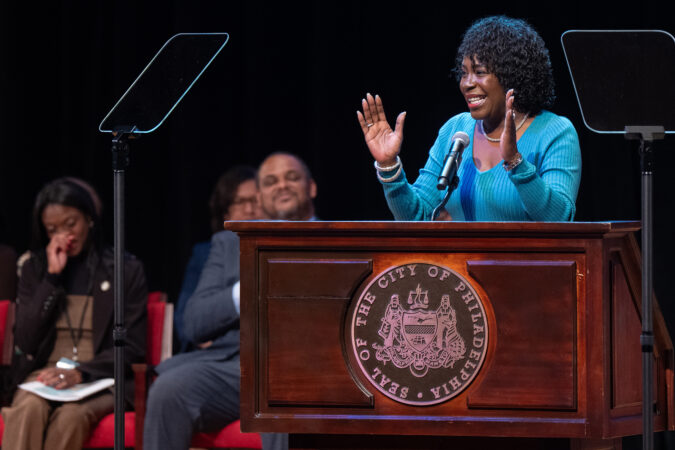
    Parker outlined a plan to address rising street homelessness heading into 2026, when the city will host several major events expected to draw millions of visitors, during her end-of-year speech at Temple University Friday.

    “I am here today to proudly report to all of you,” she said, “that the state of our city is strong and good, and we are moving in the right direction.”

    Parker’s announcement to add 1,000 shelter slots to the city’s system was a stark reminder that — despite progress on public safety and a coming year ripe with opportunity for tourism and growth — some of the city’s longest-term challenges remain unresolved.

    Even as Philadelphia this year shed its long-held title as the “poorest big city in America,” the number of unsheltered people increased by 20% compared to last. While shootings have reached 50-year lows, the open-air drug market that has long plagued Kensington persists.

    And after the mayor this year unveiled a long-awaited plan to build thousands of units of housing in the city, she hit roadblocks in City Council, where members rejected her vision to bolster the middle class in favor of a plan that prioritizes the poorest Philadelphians.

    Still, Parker and members of her administration struck an optimistic tone Friday. During the highly produced event, top officials repeatedly proclaimed that the “state of the city” is strong, and they thanked municipal employees in attendance, like police officers and sanitation workers.

    Parker’s State of the City address last year was Philadelphia’s first. Traditionally, the mayor’s March budget address to Council was seen as the city’s version of the presidential State of the Union speech in Congress. Parker plans to make the December event an annual tradition as well.

    Here are three takeaways from Parker’s speech Friday in North Philadelphia:

    A homelessness plan is in the works for 2026

    In the middle of her speech, Parker signed an executive order on stage, directing city departments to add 1,000 new beds to the existing shelter system by Jan. 31. That would represent a 35% increase in the number of beds citywide.

    The move comes as city data shows homelessness in the city is rising. There were 1,178 unsheltered people in Philadelphia this year, a 20% increase over last year and the highest number recorded since at least 2018, according to city data.

    In total, 5,516 people were considered homeless, a number that includes people who live in emergency shelters, are couch surfing, or otherwise lack an adequate nighttime residence. That number is up slightly from 5,191 last year.

    Parker’s executive order directs city agencies to increase outreach efforts to people living on the streets and to collaborate with the Philadelphia Housing Authority to move people from shelters to more stable housing.

    “We are seeking long-term solutions,” she said, “Solutions that will not only provide an expanded quality shelter system, but with more beds in safe, clean, and welcoming environments.”

    Philadelphia Mayor Cherelle L. Parker holds up executive order ending street homelessness.

    30,000-unit housing plan swells to 50,000

    The mayor’s second year in office was in part defined by her plan to build, repair, or preserve 30,000 units of housing. In March, she unveiled her Housing Opportunities Made Easy, or H.O.M.E., plan, funded by $800 million in bonds.

    Parker made clear that her plan would be aimed at uplifting the middle class and often vowed never to pit “the have-nots against the have-a-little-bits.” But City Council this month advanced its own version of the proposal, rejecting Parker’s vision and directing more resources to the poorest Philadelphians.

    It was the most significant break between Parker and the legislative branch of her tenure. But the mayor on Friday defended her strategy, saying the middle class should not be asked to wait for access to housing programs.

    “You want me to tell you why we shouldn’t tell them to wait?” she said. “Because when I knocked on their doors and asked for their votes — and we’re running for reelection — we don’t ask them to wait.”

    Of Council’s 17 members, just four attended Parker’s speech Friday: Anthony Phillips, a close ally, as well as Rue Landau, Jamie Gauthier, and Nicolas O’Rourke — three progressives who led the effort to amend her housing plan. They sat in the front row.

    Parker struck a conciliatory tone, saying: “We will work together to press forward together, and we won’t let petty politics get in the way of us moving Philadelphia forward.”

    The mayor also made clear Friday that her 30,000-unit benchmark is separate from a plan being advanced by the Philadelphia Housing Authority, which is pursuing an ambitious expansion plan that Parker said would add an additional 20,000 units of affordable housing.

    “When you add our H.O.M.E. goal of 30,000 units with that 20,000, those are 50,000 units of housing,” Parker said, “and we shouldn’t have to leave any neighborhood behind.”

    Parker acknowledges city worker strike

    The most dramatic moment of Parker’s second year was undoubtedly the eight-day-and-four-hour city worker strike, Philadelphia’s first major municipal work stoppage in four decades.

    On Friday, Parker touted her administration’s work negotiating new contracts this year for almost all of the city’s major municipal unions. She acknowledged, but didn’t dwell on, the strike by the American Federation of State, County and Municipal Employees District Council 33.

    “We did have to endure an eight-day work stoppage,” she said. “But guess what we did? In true Philadelphia fashion … we got through it. It wasn’t easy, but we persevered together, and we found common ground, and we reached a fair and fiscally responsible agreement with both District Council 33 and District Council 47.”

    DC 33, the largest and lowest-paid union for city workers, called the strike when their previous contract expired at 12:01 a.m. July 1, the first minute the union was legally allowed to walk off the job. Union president Greg Boulware promised his members wouldn’t return to work unless they won raises of 5% per year.

    Over the next week, “Parker piles” of trash mounted across the city, and tensions mounted at picket lines. But Parker refused to budge.

    Boulware eventually called off the strike and accepted a contract with raises of 3% per year, which is close to Parker’s last offer before the strike. The deal also included $1,500 onetime bonuses for the union’s roughly 9,000 members and the addition of a fifth step in the DC 33 pay scale, a benefit for veteran employees.

    Parker also defended the city’s treatment of DC 33 under her tenure. Repeating an administration talking point from the strike, Parker noted that the union’s accumulated pay increases — combining raises the union won in a one-year contract during Parker’s first year with the increases included in the new three-year deal — will be higher in her first term than under any other mayoral term since the 1990s.

    “Just for the record, I also need to affirm — because sometimes people [create] revisionist history — I want to be clear that they were historic pay increases for our city workers,” Parker said. “It’s the largest in one term from any Philadelphia mayor over 30 years.”

  • Temple pledges to boost police patrol officers by 58% over five years following staffing study

    Temple pledges to boost police patrol officers by 58% over five years following staffing study

    Temple University plans to increase its patrol officer ranks by 58% over five years after a study assessing staffing levels showed the school was below the middle tier of a framework that rates law enforcement agencies.

    The university currently has 77 sworn officers — 50 of them patrol officers — and president John Fry pledged to add 29 patrol officers, one detective, six sergeants, and one lieutenant. That would increase the overall number of sworn officers to 114.

    Temple president John Fry said safety was his first priority. Now he plans to increase patrol officers by 58% over five years.

    No target has been set for how many officers will be hired per year, but those discussions are underway, said Fry, who named public safety a top priority when he started in November 2024.

    The university’s declaration comes amid a particularly difficult time for police hiring, with departments nationally — including the Philadelphia Police Department — continuing to face shortages. Temple has been working for several years to attract more officers, including increasing salaries and benefits, adding signing and retention bonuses and higher contributions to retirement accounts, and hiring an associate director to focus solely on hiring, recruitment, retention, and training. The department also moved to 12-hour shifts to give officers more days off.

    Yet, the number of sworn officers has decreased from 81 in March 2024 to the current 77, despite additional hires being made, including four new officers from the Temple University Municipal Police Academy in October.

    “We must, and we will, deploy ever more compelling and creative incentives to make Temple’s Department of Public Safety a destination employer for law enforcement in our region,” Fry said. “Our plan is to look closely at what we are doing in the areas of recruitment and retention over the next several months and see what improvements can be made.”

    Temple plans to hire former Philadelphia Police Commissioner Charles H. Ramsey’s 21CP Solutions company to assist, including with how best to recruit and retain more officers, Fry said. The university had hired Ramsey to assess safety following the shooting death of student Samuel Collington in November 2021 and has implemented almost all of the 68 recommendations from his report released in April 2023.

    The staffing study was one of the final recommendations that Temple had to complete.

    Former Philadelphia Police Commissioner Charles Ramsey speaks at a press conference on the Temple safety audit his firm completed in April 2023.

    New bike patrol officers

    In addition, Philadelphia Police Commissioner Kevin Bethel has committed to providing six bike patrol officers and a sergeant assigned to Temple, beginning Jan. 5. That’s up from the current four officers and supervisor, who were not always the same personnel.

    “The ability to have relationships and collaborations … will be better because it’ll be a consistent group,” said Jennifer Griffin, Temple’s vice president for public safety.

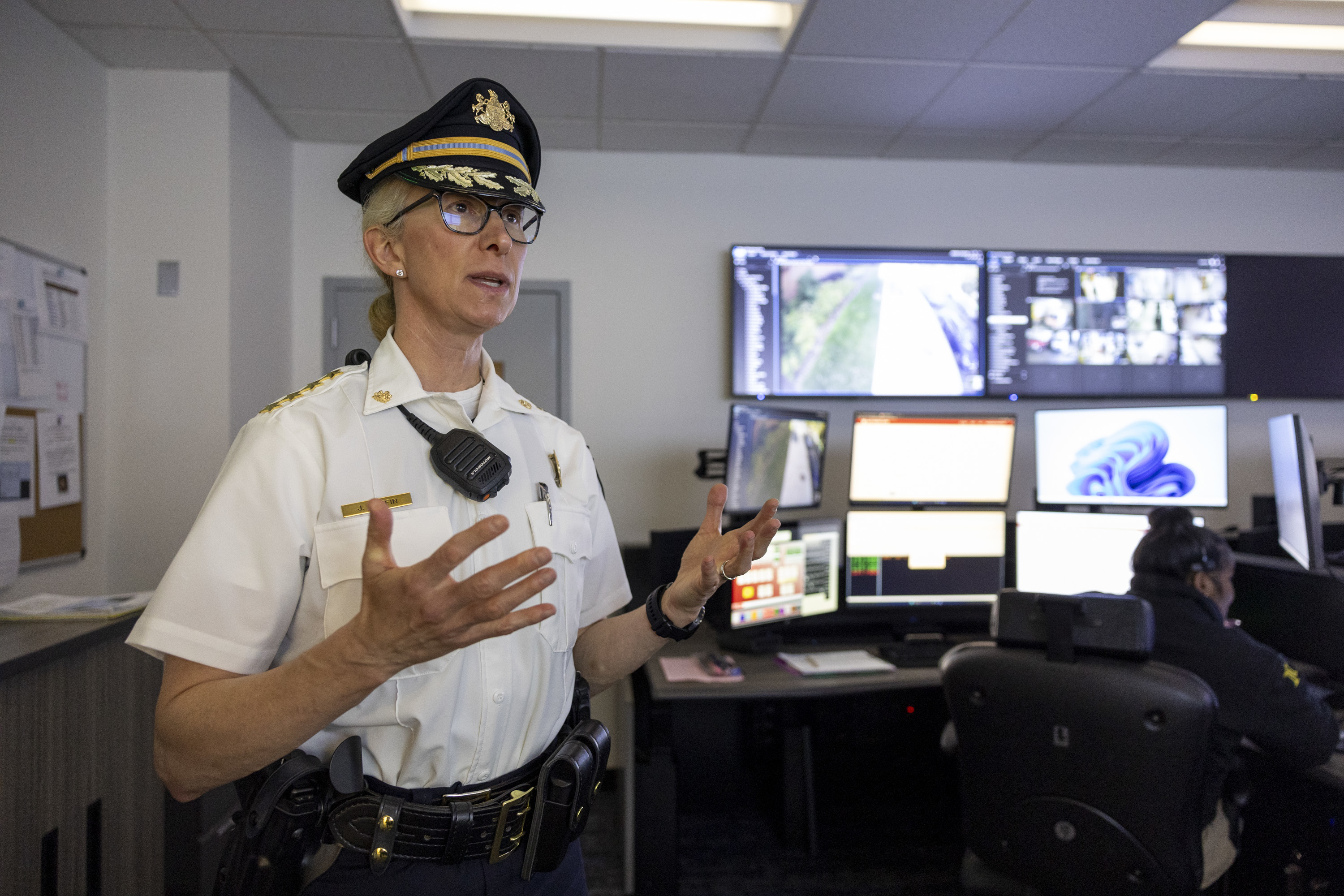
    “The ability to have relationships and collaborations … will be better because it’ll be a consistent group,” Jennifer Griffin, vice president for public safety at Temple University, said about the city’s six bike patrol officers that will be dedicated to Temple.

    Members of the Temple University Police Association, the officers union, have complained for years of inadequate staffing. In a social media post about a year ago, the union said the department had lost more than 50 officers since 2022.

    But Andrew Lanetti, president of the union, said he is pleased with the direction outlined by Fry.

    “From our talks here in the past few days, I am happy with where we’re going in the future,“ he said. ”I believe this is going to be a very positive experience and it’s going to help our community a lot.”

    University and union officials already have been discussing ways to recruit and retain more officers, and a more positive working relationship between the union and the university could help move the needle on hiring and retention.

    “We’re going to work together and our goal is all the same,” Griffin said. “We want a safer Temple and a safer community.”

    Budget woes

    The move also comes as the university attempts to close a budget deficit, made worse this fall when the school missed enrollment projections for its main campus that translated to about $10 million in lost revenue.

    “It will be a challenge,” Fry said of the new police officer hiring, “but it’s a priority, so we will meet that challenge.“

    He said money for the new staffing will be built into the university’s five-year budget plan.

    Temple last February hired safety and security consulting companies Healy+ and COSECURE, ancillary businesses of the Cozen O’Connor law firm, to conduct the staffing study. They used a tiered framework “to assess the capacity and effectiveness of law enforcement agencies,” Temple said. The university declined to release the full report, citing its proprietary information.

    “Temple is positioned below the middle tier of the framework, meaning the department is presently staffed to meet the essential public safety and emergency response needs of our community,” Fry said. “However, additional personnel would allow the department to organize and coordinate its activities to focus on additional proactive and community engagement activities that would position it higher in the consultant’s framework.”

    With the additional police officers that Temple plans to hire, the school would rise from just below the third of five tiers in the consultant’s rating system to the second tier, Fry said. The second tier, he said, connotes “higher levels of proactive enforcement, more presence, more mitigation strategies, and then more outreach, more community engagement.”

    Public safety is extremely important as the university plans to release its strategic plan and campus development plan early next year and as Fry seeks to spur economic development along the Broad Street corridor, from Temple’s new Terra Hall location in Center City to the health campus in North Philadelphia.

    “There’s going be a campus development plan, which clearly is going to put more activity on this campus, which means we’re going to have to support our police,” Fry said.

    Potential investors, he said, are watching.

    “When they’re about to commit significant investment, they want to know the area is safe,” he said.

    ‘Hold ourselves accountable’

    Former Temple president Jason Wingard pledged to increase the police force by 50% the month that Collington was killed, and those numbers never materialized. In fact, the number of officers dropped.

    Fry said what is different this time is that he has specified the exact numbers that will be added over a distinct time frame.

    “This is not something we’re just sort of speculating about,” he said. “This is based on a professional study. … We’ll be able to hold ourselves accountable.”

    The university already has made a host of changes that were recommended by Ramsey in the 2023 report. They include more foot patrols and security cameras and increased technology in the communications center.

    The university in 2024 touted a decrease in aggravated assaults, robberies, and thefts in its patrol zone. Despite improvements, Temple has continued to face safety challenges in its North Philadelphia neighborhood, including large groups of juveniles that sometimes gather on or near campus — a challenge in other areas of the city, too.

    And a student was shot and killed by another student near off-campus housing in February.

    Griffin said she stands behind the efforts to grow the department and make further improvements in training and operations.

    “I truly believe it will help position us as one of the highest-performing university police departments in the country,” Griffin said.

    Fry said once the university reaches its five-year hiring target, it will reevaluate its needs and figure out next steps.

  • Crash caused by man fleeing warrant kills 63-year-old woman in Uber, police say

    Crash caused by man fleeing warrant kills 63-year-old woman in Uber, police say

    A 63-year-old woman riding as a passenger in an Uber vehicle was killed Monday morning when a man allegedly fleeing a warrant crashed a car into the Uber in North Philadelphia, police said.

    Just before 7:15 a.m., the Philadelphia Sheriff’s Office attempted to serve a domestic-assault warrant for Joseph Cini, 35, on the 900 block of North Watts Street.

    Police said Cini fled the scene in a Nissan Maxima heading east on Girard Avenue from Watts. The Maxima crashed into a red Jeep Patriot at the intersection of Ninth Street and Girard Avenue, and Cini allegedly got out of the car and ran north on Eighth Street.

    The female Uber passenger was pronounced dead at the scene, police said. The 51-year-old driver was taken by medics to Temple University Hospital, where he was listed in stable condition.

    Cini is now also wanted for leaving the scene of a fatal accident, and anyone who knows his whereabouts is asked to call the police Crash Investigation Division at 215-685-3181.

    Tips can also be submitted anonymously by calling or texting the police department’s tip line at 215-686-TIPS (8477).

    A spokesperson for the Sheriff’s Office said in an email that the agency was “fully cooperating with all investigative authorities.”

    The spokesperson added: “The Office extends its deepest condolences to the victim’s family. Support services have been made available to the deputies involved.”

  • This Philly charter awarded a big contract to a board member’s friend, then punished the official who reported it, a lawsuit says

    This Philly charter awarded a big contract to a board member’s friend, then punished the official who reported it, a lawsuit says

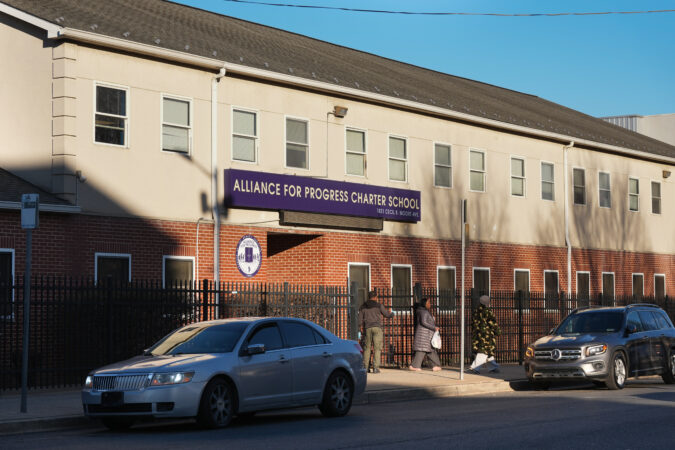
    When Raheem Harvey discovered possible improprieties at his new employer, Alliance for Progress Charter School in North Philadelphia, he sounded the alarm.

    Harvey, the director of business and compliance, notified officials earlier this year about what he saw as significant issues, he said: violations of state and local bidding requirements, a contract issued without board approval, and board members’ failure to disclose personal relationships with potential vendors.

    He flagged a student enrollment problem and skipped payroll taxes.

    Alliance for Progress’ leader and its board brushed him off, Harvey said in a recently filed whistleblower lawsuit. Ultimately, they disciplined him and, after threatening to demote him, he resigned.

    School officials say Harvey’s story is untrue.

    “We categorically deny all the allegations asserted by this disgruntled former employee,” Stacey Scott, CEO of Alliance for Progress, said in a statement.

    Officials from the Philadelphia School District’s charter school office had no comment.

    What are the allegations?

    Harvey started working at Alliance for Progress, on Cecil B. Moore Avenue, in February.

    By August, he began raising issues to his bosses, Harvey’s lawyers said in a lawsuit filed in Philadelphia Common Pleas Court.

    They included a contract issued to a vendor for services related to a school playground — worth more than $75,000 — that was awarded without competitive bidding.

    Alliance for Progress, Harvey said, “directly awarded the contract to a vendor whose principal is a personal friend of one of the AFPCS board members. The board member did not recuse himself from discussions or decisions related to the contract, despite the clear conflict of interest created by his close relationship with the vendor” — a violation of ethics rules, he said.

    Harvey also said the school failed to follow state rules around enrollment procedures. Alliance for Progress says it provides enrollment preference for siblings of students. But, Harvey said, the school ignored him “and failed to apply its own sibling-preference policy to the sibling of a currently enrolled student. Instead, AFPCS placed the sibling on a waitlist and later pressured the child’s parents to withdraw the enrollment application.”

    Scott, Harvey said, also violated federal privacy laws by providing someone outside the organization access to a student’s educational records — including academic and disciplinary records — without parental consent.

    School officials also used Alliance for Progress credit cards to purchase food and other items through their personal accounts, according to the lawsuit complaint, “allowing them to aggregate rewards points and loyalty benefits that they did not return to AFPCS.”

    Alliance for Progress also paid a retired employee for work with a paper check instead of going through its payroll system, the complaint alleges.

    The school “issued payments in this manner to enable the retired employee to avoid paying taxes on the wages she received,” the lawsuit said.

    ‘Hostile and retaliatory’

    According to Harvey, once he reported the compliance problems, Scott and other officials began targeting him — suggesting he was opening packages addressed to the school without authorization and purchasing office supplies without proper authorization.

    Harvey was shut out of leadership meetings, the suit said, then reprimanded for failing to show up to a meeting, entering Scott’s office without permission, and placing an unauthorized order.

    “Increasingly hostile and retaliatory conduct” was directed toward him, Harvey said. He was suspended for 10 days, and had his keys to the administrative offices taken away.

    In September, a human resources official told Harvey “that he should forget about the compliance issues he had raised because they had been resolved” but provided no evidence. Harvey said she told him Alliance for Progress planned to demote him.

    The school’s “wholesale failure to remediate the compliance concerns” and its “refusal to implement safeguards to protect him” from retaliatory treatment ultimately caused Harvey to resign on Sept. 30, according to the lawsuit.

    Harvey is demanding reinstatement, plus back pay, benefits, seniority rights, and damages.

  • Hospital-based anti-violence programs get $3 million in state funding

    Hospital-based anti-violence programs get $3 million in state funding

    Several Philadelphia-area violence prevention efforts will benefit from nearly $3 million in newly released state funding to help hospitals address a leading cause of death and injury.

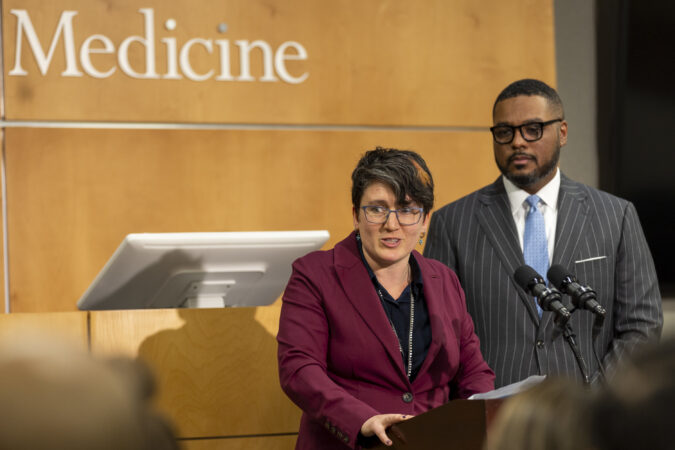
    The new funding for hospital-based violence intervention programs (HVIP) was announced by Pennsylvania Lt. Gov. Austin Davis on Wednesday at Penn Presbyterian Medical Center. One of the recipients, the Penn Trauma Violence Recovery Program, is based at the Penn Medicine hospital in University City.

    Other local awardees include Temple University Hospital in North Philadelphia and the Philadelphia-based nonprofit Urban Affairs Coalition. The coalition received funding on behalf of the Chester Community Coalition to relaunch a program that had been at the now-shuttered Crozer-Chester Medical Center.

    The University of Pittsburgh Medical Center also received funding. The amounts awarded to each program were not announced.

    The Pennsylvania Commission on Crime and Delinquency, which Davis chairs, received 15 applications in total seeking nearly $12 million in funding — four times what was available.

    “Addressing the epidemic of gun violence is a top priority for our administration,” Davis said.

    Lieutenant Governor Austin Davis speaks at a press conference announcing the $3 million in grants for hospital-based violence intervention programs.

    The programs aim to connect patients at risk of repeat violence with resources while they are in a hospital, so they leave with a safety plan. Services can include long-term community-based case management, mentoring, and home visits.

    Since the first HVIP was established in the mid-1990s, dozens have spread around the country and abroad, including in Philadelphia.

    Several local institutions have these programs, including Temple Health, Children’s Hospital of Philadelphia, Penn Medicine, Jefferson Health, and Drexel University. The City of Philadelphia, in conjunction with the area’s Level 1 trauma centers, launched an HVIP Collaborative in 2021.

    Studies have shown these programs reduce rates of repeat violent injuries and recidivism among participants.

    After shootings spiked during the COVID-19 pandemic, gun violence is now declining in Philadelphia. As of July, shootings for the year were at their lowest total since at least 2015.

    Davis noted that Philadelphia has seen a 15% decrease in homicides this year, with roughly four in five gunshot victims surviving their injuries.

    The new funding will allow the Penn Trauma Violence Recovery Program to increase its community presence and mental health programming, said its director, trauma surgeon Elinore Kaufman.

    Through her experience treating victims of violence, she has learned that injuries can be deeper than the physical wounds.

    The program was launched to address social factors often involved in violence by providing psychosocial support and connecting patients with services to help with education, job training, and housing.

    “We’ve worked with patients long enough now that we have high school graduation photos, we have baby pictures,” Kaufman said. “We have patients who want to give back and have joined our patient advisory board to help push us forward.”