Tag: Philly First

  • Kids get free dental care at this Philly school. Officials say it’s a model that could be replicated in schools with empty space.

    Kids get free dental care at this Philly school. Officials say it’s a model that could be replicated in schools with empty space.

    Crystal Edwards didn’t see a dentist until she had a deep cavity at age 10: growing up in a struggling Philadelphia family, the resources to access dental checkups just weren’t there.

    So she jumped at the opportunity to locate a dental clinic in the school where she is now principal, W.D. Kelley, a K-8 in North Philadelphia.

    “This dental clinic is saving lives,” said Edwards.

    Tucked into a converted science lab on the school’s third floor, the Dental Clinic at William. D. Kelley, operated by Temple University’s Maurice H. Kornberg School of Dentistry, is nearing its third year of operation. It is open to all Philadelphia children, including those who do not attend Kelley, regardless of insurance status.

    School district officials have pointed to the Kelley clinic as a model as it prepares to make facilities master plan decisions, which will result in closing, combining, and reconfiguring some school buildings. The clinic is an example, they say, of how the system could use available space in some of its schools for public good.

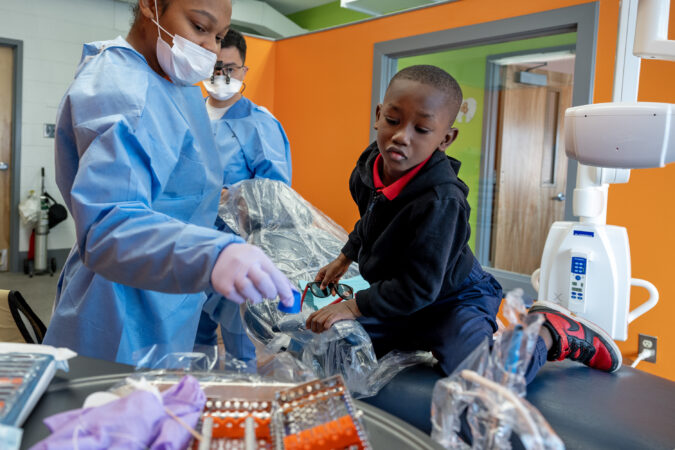
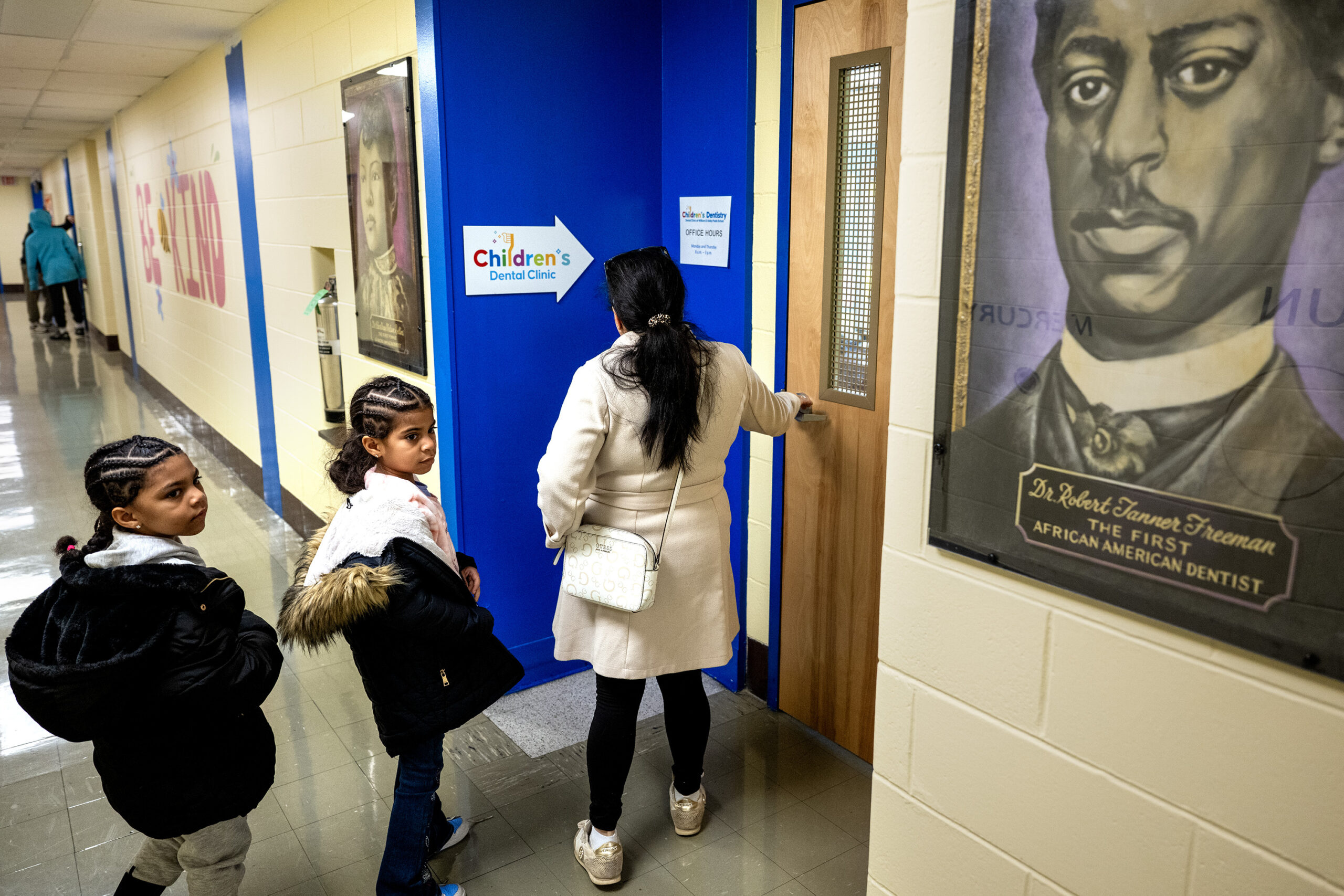
    Soribel Acosta arrives at the Dental Clinic at William D. Kelley public school on Thursday, with her children, Andrea Jimenez (left), 6. And Sayra Jimenez, 7.

    “This is certainly a great example of what can happen when a university partners with a school district to create life-changing opportunities and outcomes for young people,” Superintendent Tony B. Watlington Sr. said in a statement in 2023, when the clinic opened.

    Temple dental school officials said more clinics could follow elsewhere in the city.

    Taking care of every child

    The underlying concept is simple, said Eileen Barfuss, the Temple dental professor who leads the clinic.

    “If your tooth hurts, if you’re not feeling well, you’re not going to learn,” said Barfuss. “In the past, there have been a lot of barriers to care for dentistry that weren’t there for medicine, but preventative care is so important so it doesn’t get to the point of pain.”

    The clinic accepts all comers, including those who are uninsured or underinsured, and sometimes treats students’ parents. (Most, but not all, patients have Medicaid dental, and grants help cover treatment for those without insurance.)

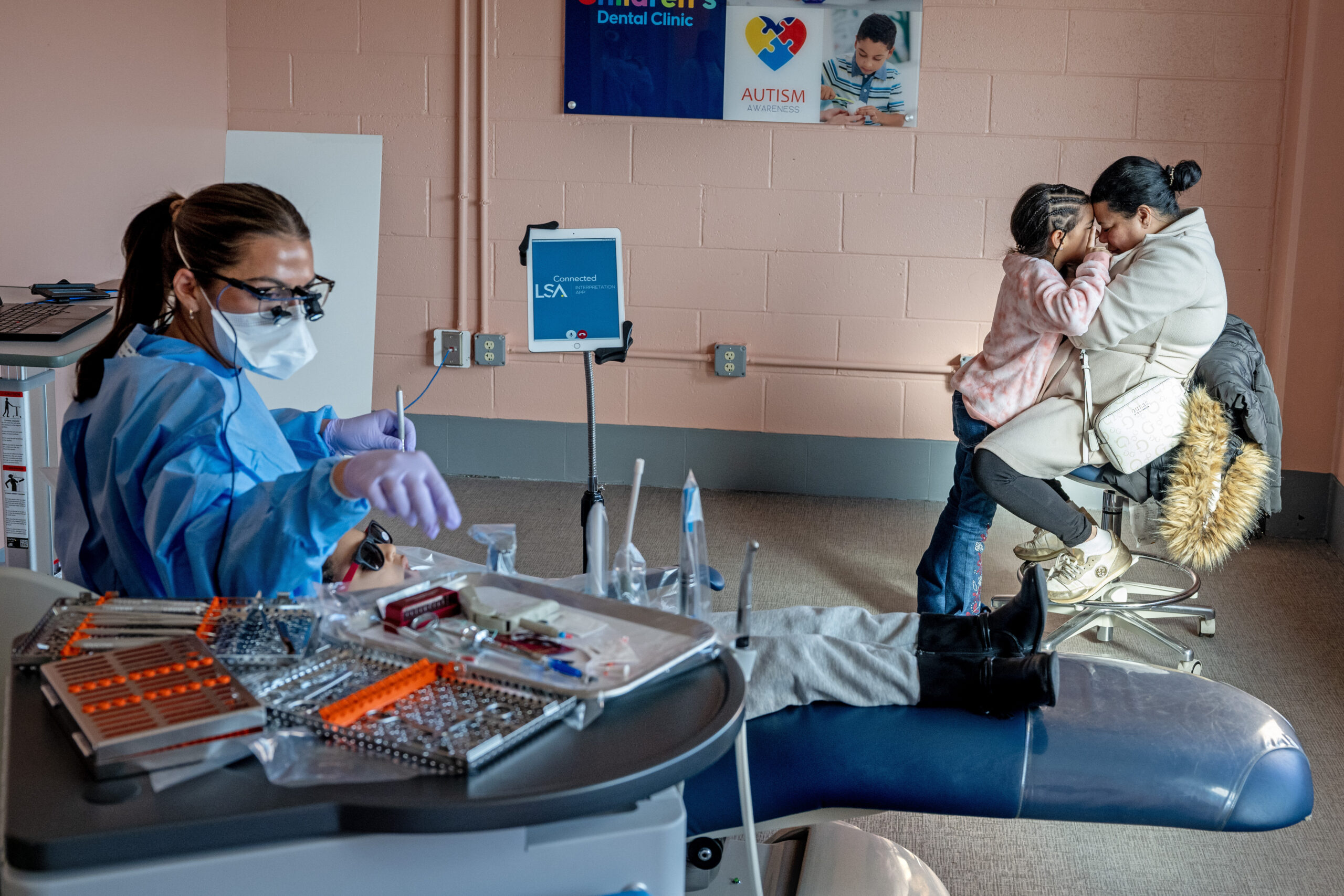
    Temple dentistry student Carly Pandit works on the teeth of Andrea Jimenez, 6, as her mother, Soribel Acosta, entertains sister Sayra Jimenez, 7, waiting her turn in the char at the dental clinic at William D. Kelley public school on Thursday.

    “We try to take care of every child in the Philadelphia School District,” said Barfuss. “There’s a place that they can come and get comprehensive care and establish a dental home.”

    To date, the clinic has seen nearly 700 patients, some of whom are repeat visitors. Patients are treated both by Barfuss and dental students she supervises.

    Students do come from other schools to the clinic; Barfuss said her team does outreach at community events and spreads the word through the district’s school nurses, who often send patients to the clinic. And staff teach lessons in Kelley classrooms on oral health and the importance of seeing a dentist twice a year.

    Being in a school helps normalize the dentist for many kids, who might poke their heads into the clinic to look around and see the friendly dental staff in their scrubs in the hallways, Barfuss said.

    ‘This is a good dentist’

    On Thursday, Fatoumata Bathily, a fourth grader with pink glasses and a bright smile, swung her legs down from a Kelley clinic dentist chair after a successful checkup.

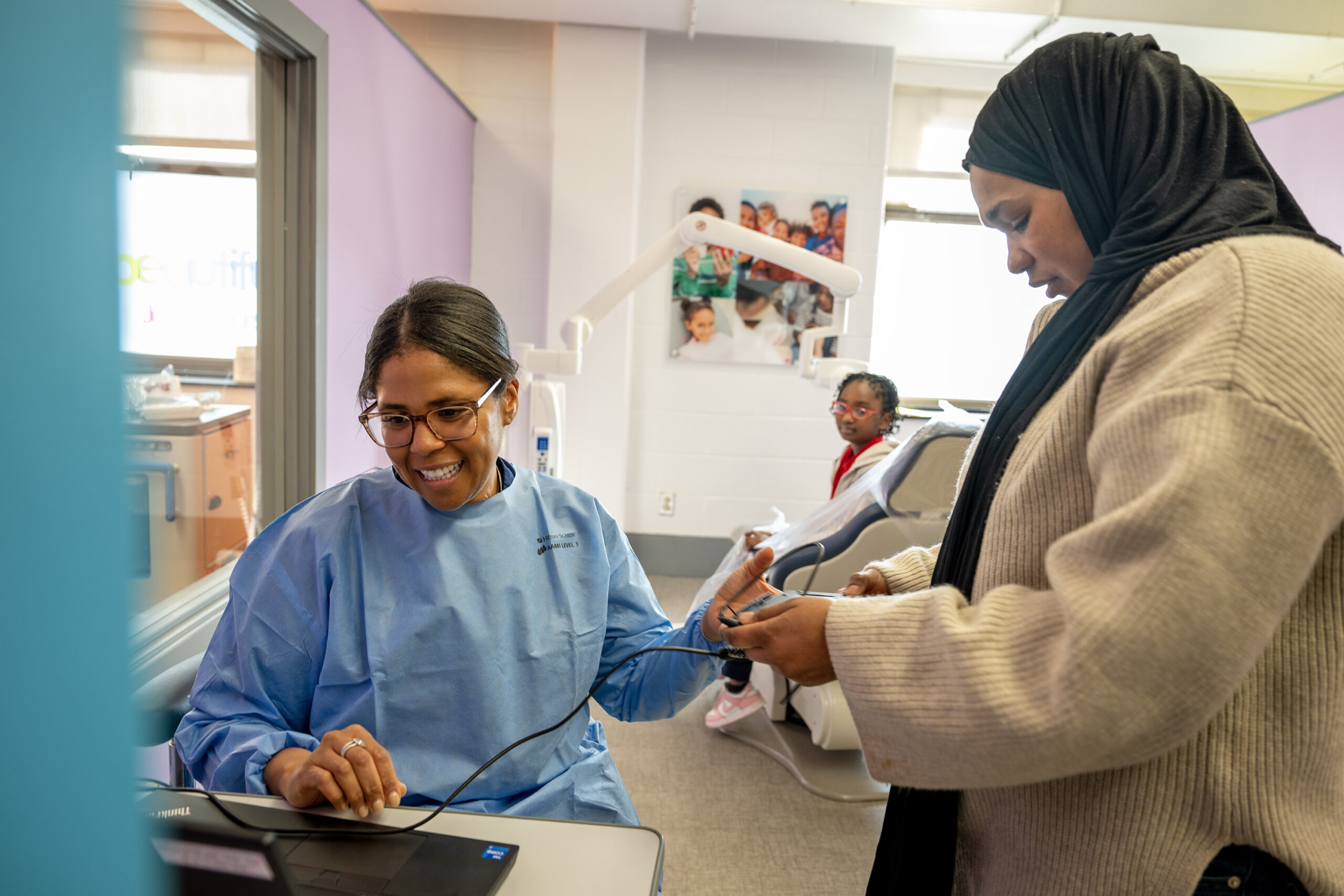
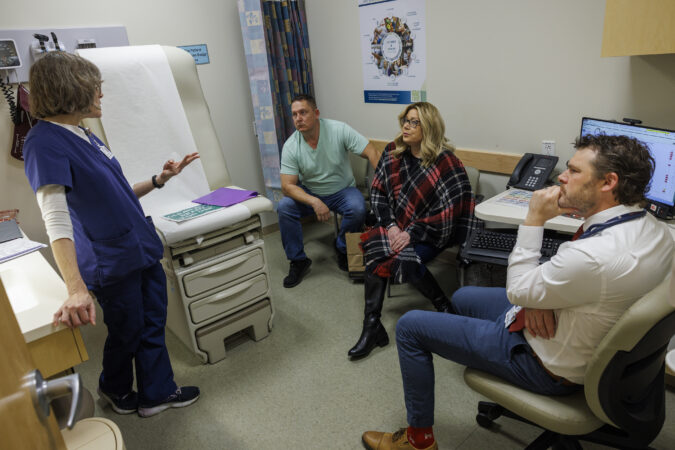
    Eileen K. Barfuss (left), a pediatric dentist and Temple dentistry instructor consults with Fily Dramera after her daughter Fatoumata Bathily (rear), 9, was seen by a Temple student dentist at the Dental Clinic at William D. Kelley public school on Thursday.

    “It’s good here,” said Fatoumata, who attends nearby Robert Morris Elementary, and came for preventive care along with her brother, Abubakr. “This is a good dentist. I like that it’s colorful, and the people are nice.”

    Amid Ismail has wanted to bring such a model to the city since he became dean of Temple’s dental school in 2008. Decades ago, some schools offered dental care via city services, but as funding dried up, those clinics went away, Ismail said.

    Ismail raised the idea of a Temple-district partnership, but it took several years to get off the ground. Edwards, an award-winning principal who takes pride in bringing the community into Kelley, got the vision intuitively, he said.

    Temple paid to transform a large science lab into the dental clinic; the district provides the space and does not charge rent. There are four chairs, including one in a space specifically designed for patients with autism who might need a quieter environment and more room. Rooms are bright and modern.

    “The message to the parents and caregivers is that this is a nice place where all treatment is provided,” Ismail said. “A lot of children do have dental problems, but here we can treat them easily — they miss one class, max, and they don’t have to stay a long time.”

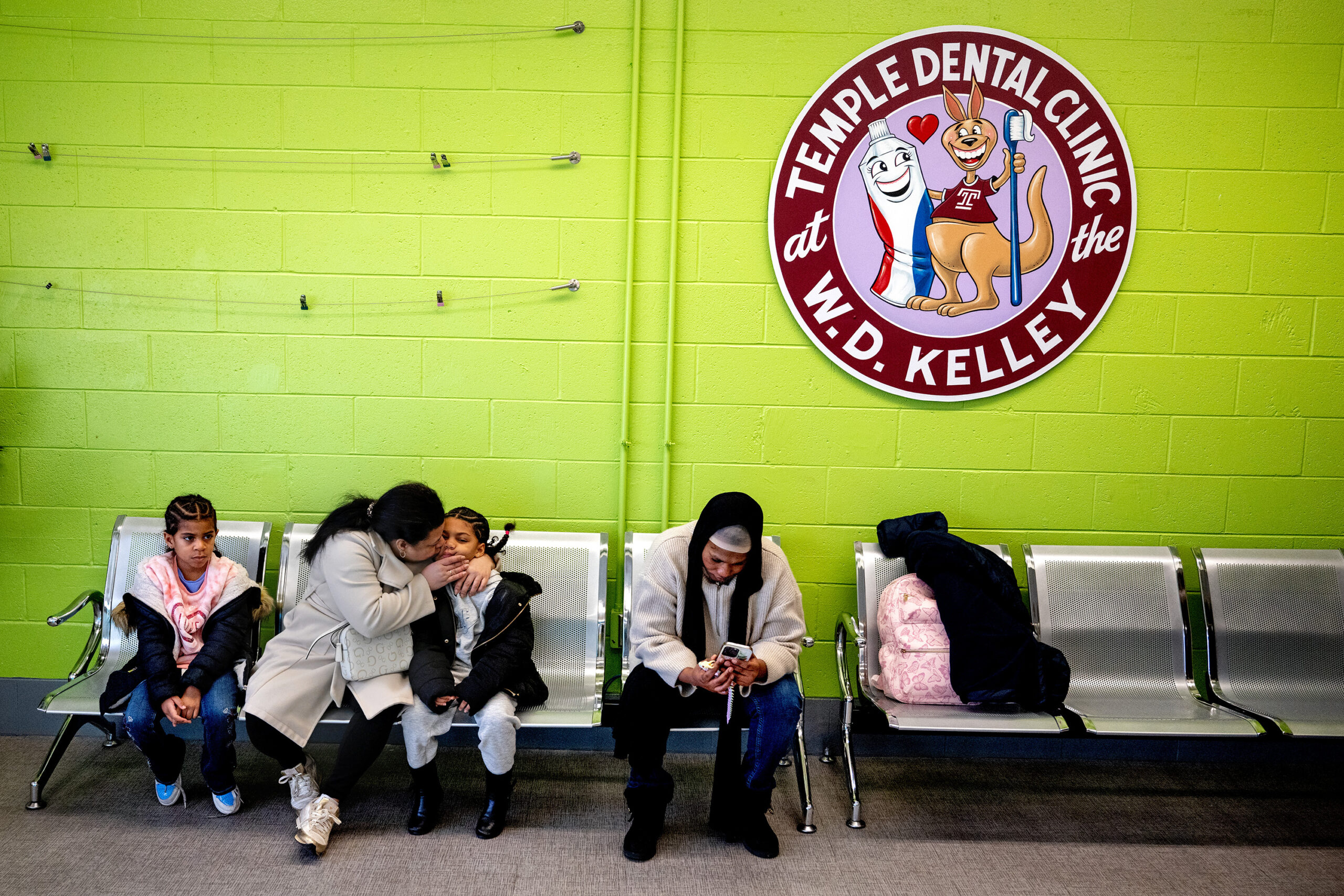
    Soribel Acosta waits for their appointment with her children, Sayra Jimenez (left), 7; and Andrea Jimenez (right), 6, at the Dental Clinic at William D. Kelley public school on Thursday.

    The clinic, which is about to celebrate its third anniversary, just expanded its schedule — it’s open four days a week, and officials eventually hope it will be open five days.

    Edwards fought for the clinic to come to Kelley, and it’s been just the boon she had hoped, she said.

    “This is a historic community that was really devastated and hard hit by the crack and drug pandemic,” said Edwards. “The dental office has really given us leverage on how to serve the community better.”

  • Art makes this Chesco 15-year-old happy. So she launched a nonprofit to teach younger kids.

    Art makes this Chesco 15-year-old happy. So she launched a nonprofit to teach younger kids.

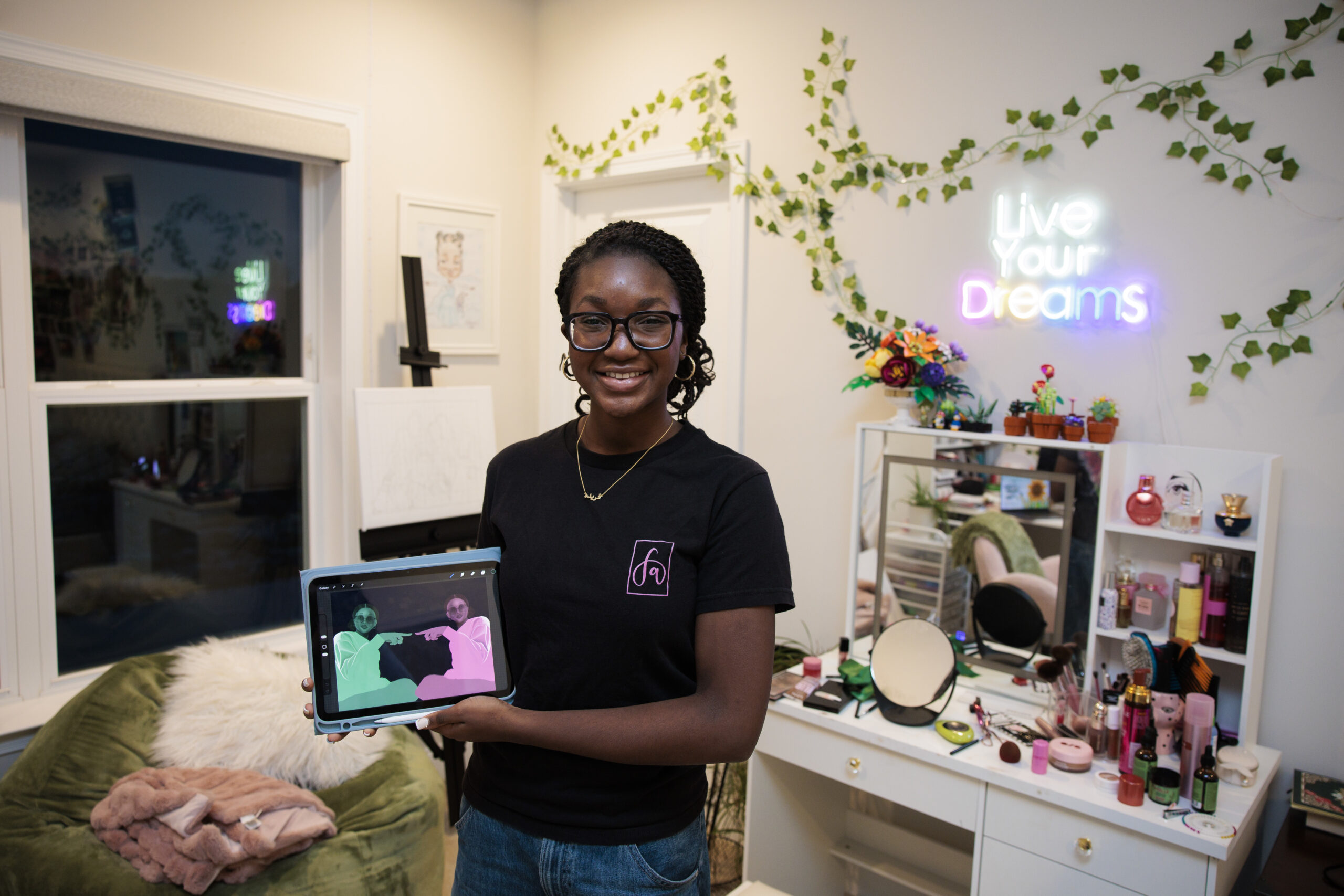
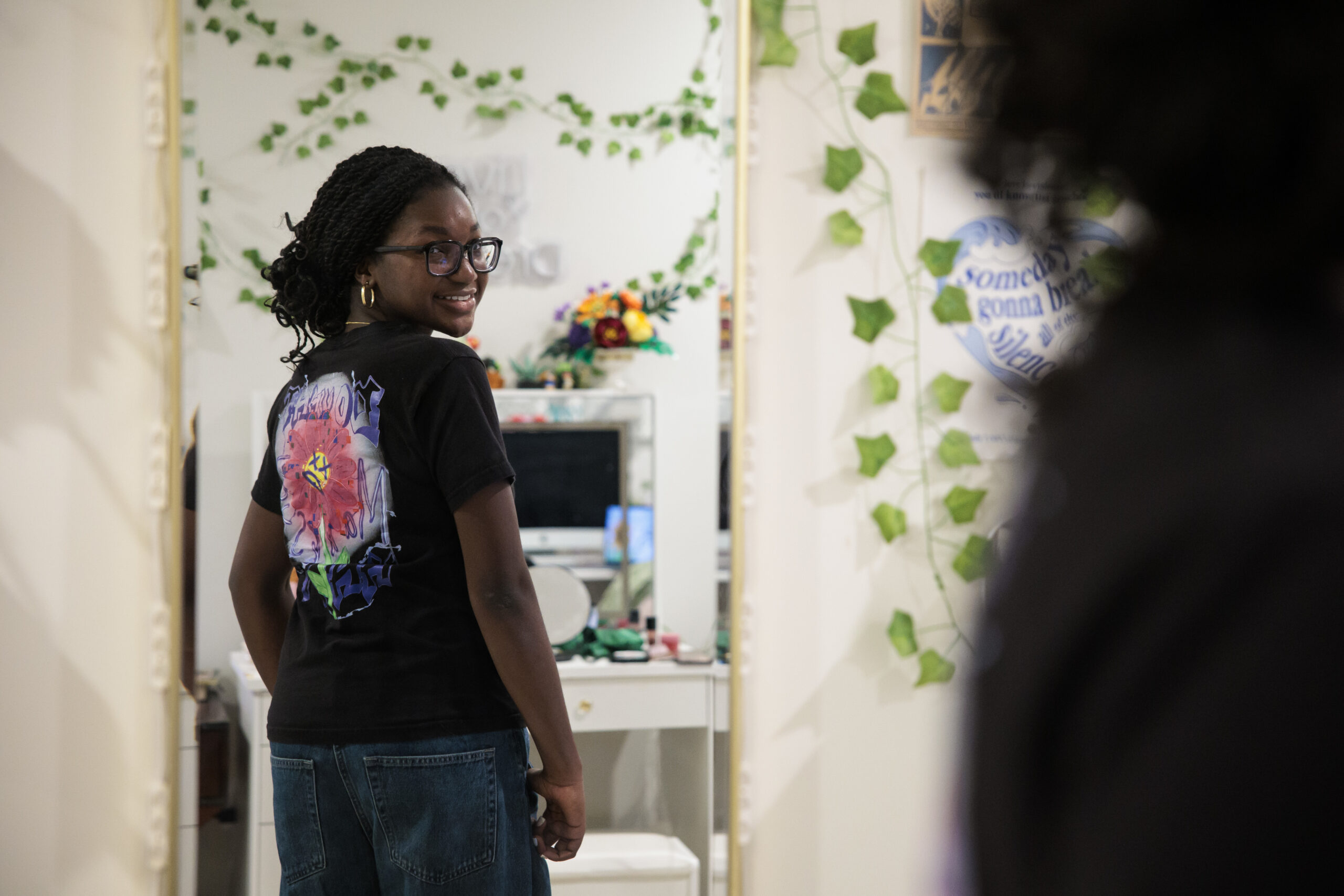
    Something about the phrase “Do what makes you happy” struck Faridah Ismaila. It became the title of, and inspiration behind, one of her art pieces. It’s printed onto the back of her T-shirt. It’s something the 15-year-old artist lives her life by.

    “When I do art, it’s because it makes me happy, and when I can give my art to other people or spread the joy of art, it’s making them happy,” she said.

    Following that guiding light of happiness, Ismaila, a digital artist and a sophomore at Great Valley High School, recently launched her nonprofit, A Paint-full of Promise, which offers free monthly art classes for kids in her school district in kindergarten through grade six.

    Working with educators in the district, Ismaila devises themed art projects and provides supplies and classroom time to teach young artists how to express themselves. The first club is slated for mid-January, with a winter wonderland theme. Children will make snowflakes and paint winter-themed coasters.

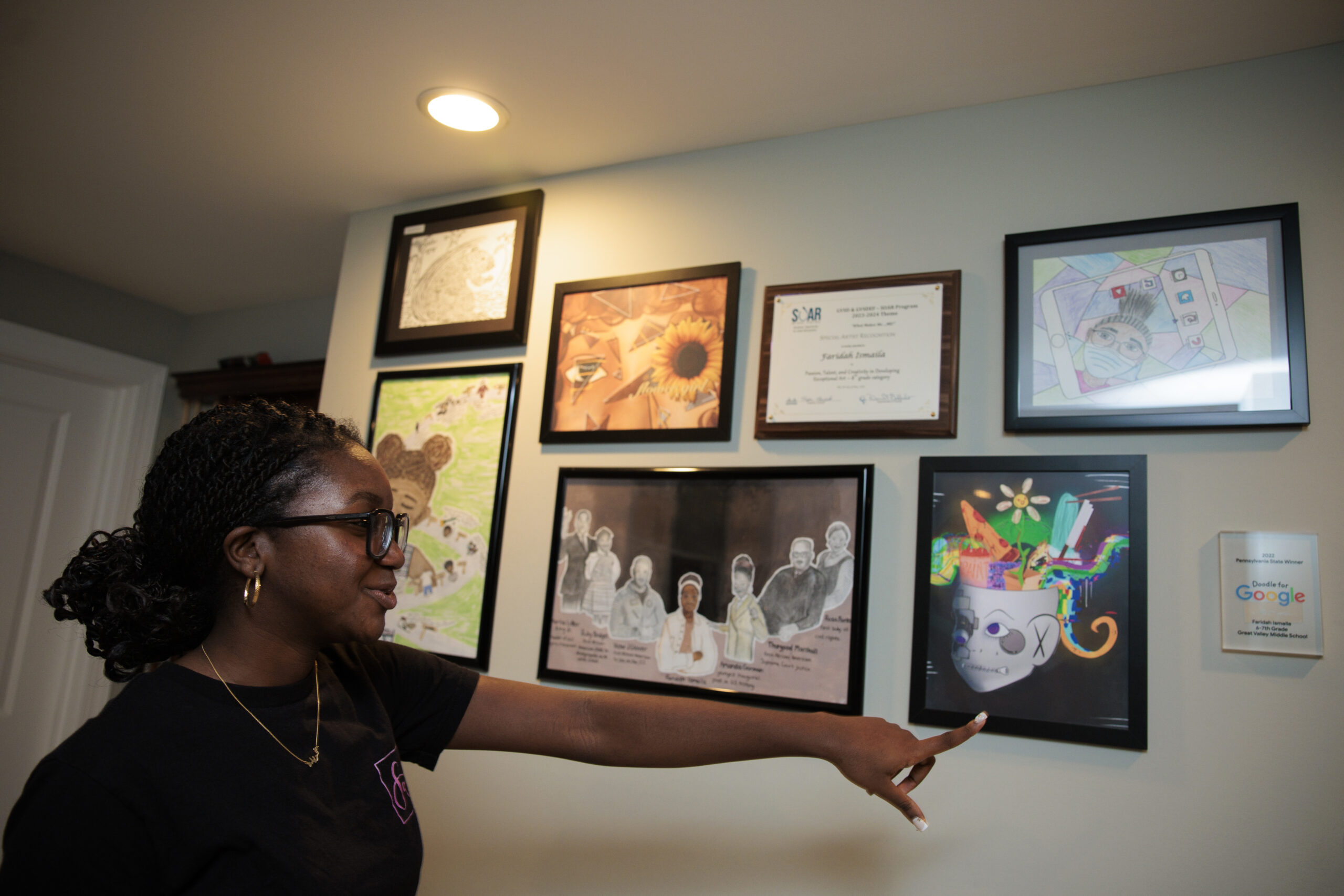
    Ismaila has been recognized for her art nationally: She was the state winner and a national finalist in the 2022 Doodle for Google competition, where young artists compete for their work to be featured as the Google homepage design. That recognition helped give her the confidence to pursue big dreams, like her nonprofit and club.

    “It makes me feel I can still do this. Because sometimes I’ll doubt myself. … I can’t be having all these big dreams,” she said. “But if people want to vote for me and I am recognized nationally, I feel on top of the world. I can do anything.”

    The first brushes of the nonprofit — which she hopes one day will grow to multiple sessions a month — started years ago, when Ismaila began making YouTube videos, teaching the fundamentals of art. She showed viewers how to make a gradient, how to depict a sunrise. She circulated the videos around her Malvern neighborhood, and she thought: Why not hold a class for younger kids?

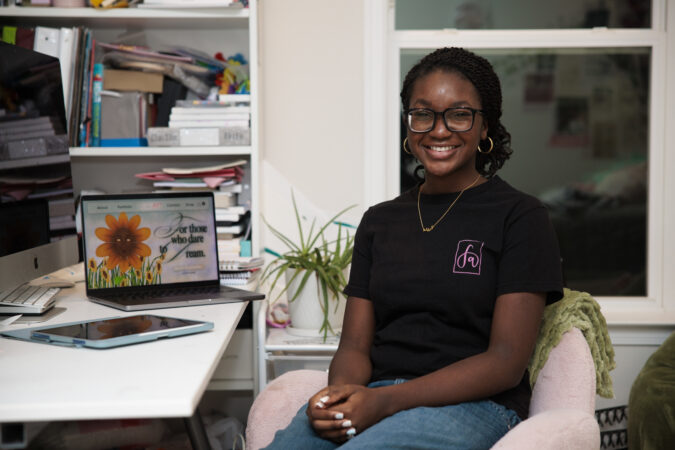
    Faridah Ismaila, 15, poses for a portrait at her home on Wednesday, Dec. 17, 2025, in Malvern. Ismaila started a kids art nonprofit called A Paint-full of Promise. She also sells her art online.

    Over a summer, in her garage, she set up two art projects — painting and colored pencils — and led about eight kids through a lesson. She called it Faridah’s Art Crafty Corner.

    Holding the class made her happy. So she did it again, but bigger, turning it into a summer camp, under the new name: A Paint-full of Promise.

    “Then I decided, why not actually make this a club, so not only my community can get this, my entire district can?” she said.

    And now, the teenager has a nonprofit under her belt. She officially launched the organization last month at an event in Malvern, where she raised money by auctioning off prints of her work and selling T-shirts with her designs.

    Anne Dale, an art teacher at Great Valley High School who is an adviser for the club, said she was impressed with Ismaila’s ability to get other high school students involved in running the club.

    “A lot of students have big ideas for clubs, but there’s not always follow-through. With her, it’s definitely different, and I knew that when she approached me with it,” Dale said.

    Giving kids the tools and opportunity to create artwork was essential to Ismaila, who gravitates to art to process her emotions.

    “It’s just the best thing ever,” she said. “Once you start doing art as a kid, it’s just a great way to get your feelings out there and express yourself, even if you can’t use words to describe it.”

    One of her pieces, Beauty Within, depicts a skeletal hand holding a white mask, a tear running down its cheek. Behind the mask, flowers bloom. It came from a feeling of constantly analyzing herself, the feeling that what you show people is not necessarily what’s on the inside.

    Another piece, made when she was “seriously sleep-deprived,” shows a face with an assortment of pixels, pizza, stick figures, and paint pouring out.

    Faridah Ismaila, 15, talks about some of her early works at her home on Wednesday, Dec. 17, 2025, in Malvern. Ismaila started a kids art nonprofit called A Paint-full of Promise. She also sells her art online.

    A piece she is working on now shows herself, in vibrant colors, pointing to her reflection. She wanted to capture the feeling of two versions of the self — one confident, the other fragile.

    Sometimes, her mother Nofisat Ismaila said, her parents feel as if they are holding her back.

    “I don’t know how I’m gonna keep keeping up with this girl, because she’s just taking us to places, keeping us busy, keeping us on our toes,” she said. “She’s turning out to be a really young, determined adult.”

    Faridah Ismaila, 15, poses for a portrait at her home on Wednesday, Dec. 17, 2025, in Malvern. Ismaila started a kids art nonprofit called A Paint-full of Promise. She also sells her art online.

    But to Faridah Ismaila, it’s about finding happiness, and giving it to others, too.

    “I really hope the kids just do what makes them happy. … It’s also just not being afraid to get out there, because when I was a kid-kid, I wasn’t afraid of anything,” she said. “I think middle school really kicks some kids in the butt, and getting up out of that — at least for me, art was a way to do that. I just want to give that to kids.”

    This suburban content is produced with support from the Leslie Miller and Richard Worley Foundation and The Lenfest Institute for Journalism. Editorial content is created independently of the project donors. Gifts to support The Inquirer’s high-impact journalism can be made at inquirer.com/donate. A list of Lenfest Institute donors can be found at lenfestinstitute.org/supporters.

  • Pancreatic cancer is among the deadliest cancers. A new drug being tested at Penn is giving patients and doctors hope.

    Pancreatic cancer is among the deadliest cancers. A new drug being tested at Penn is giving patients and doctors hope.

    Irene Blair was expected to have another six to eight months to live in June, after her pancreatic cancer rapidly advanced to stage 4 less than a year after her initial diagnosis.

    A new drug being tested in clinical trials around the world, including at Penn Medicine’s Abramson Cancer Center, was the 59-year-old grandmother from Newark, Del.’s best hope for more time.

    The drug belongs to a class of pharmaceuticals long considered the holy grail of cancer research. It is a KRAS inhibitor, capable of blocking a protein that fuels an especially deadly cancer. Only 13% of pancreatic cancer patients are still alive five years after their diagnosis, the highest mortality rate of all cancers.

    Called daraxonrasib, the drug is not considered a cure. But the results emerging from clinical trials point to the first major advancement in decades for a devastating cancer usually caught in late stages. Former Nebraska Sen. Ben Sasse last week disclosed in a blunt social media post that he was recently diagnosed with metastasized, stage-four pancreatic cancer and is “gonna die.”

    In recent months, the federal government has sped up the review timeline for the drug made by California-based company Revolution Medicines, Inc., based on early clinical trial results.

    Across 38 patients in a phase 1 trial, the drug appeared to double the survival time for at least half of patients compared to standard chemotherapy, from roughly seven months to 15.6 months.

    “In pancreatic cancer, for too long, we haven’t had effective therapies beyond just chemotherapy,” said Mark O’Hara, Blair’s oncologist who leads multiple clinical trials testing KRAS inhibitors at Penn.

    Blair started the therapy through a phase 3 trial in July. Within three weeks, her cancer-associated pain went away.

    In October, her tumors looked stable or decreasing on scans. Her most recent December scan showed her cancer had not progressed.

    Aside from occasional facial rashes, she feels normal. It’s a big improvement from how she felt previously on chemotherapy, which caused her to lose 35 pounds and become so weak she couldn’t walk.

    The question now is how long the therapy can remain effective. Blair seeks extra time to “start living life.”

    She officially retired from her job in real estate in May and wants to travel, with trips planned to see family in California and Florida.

    Holidays have been especially hard for her.

    “You just wonder, ‘Will I be here next year?’” she said.

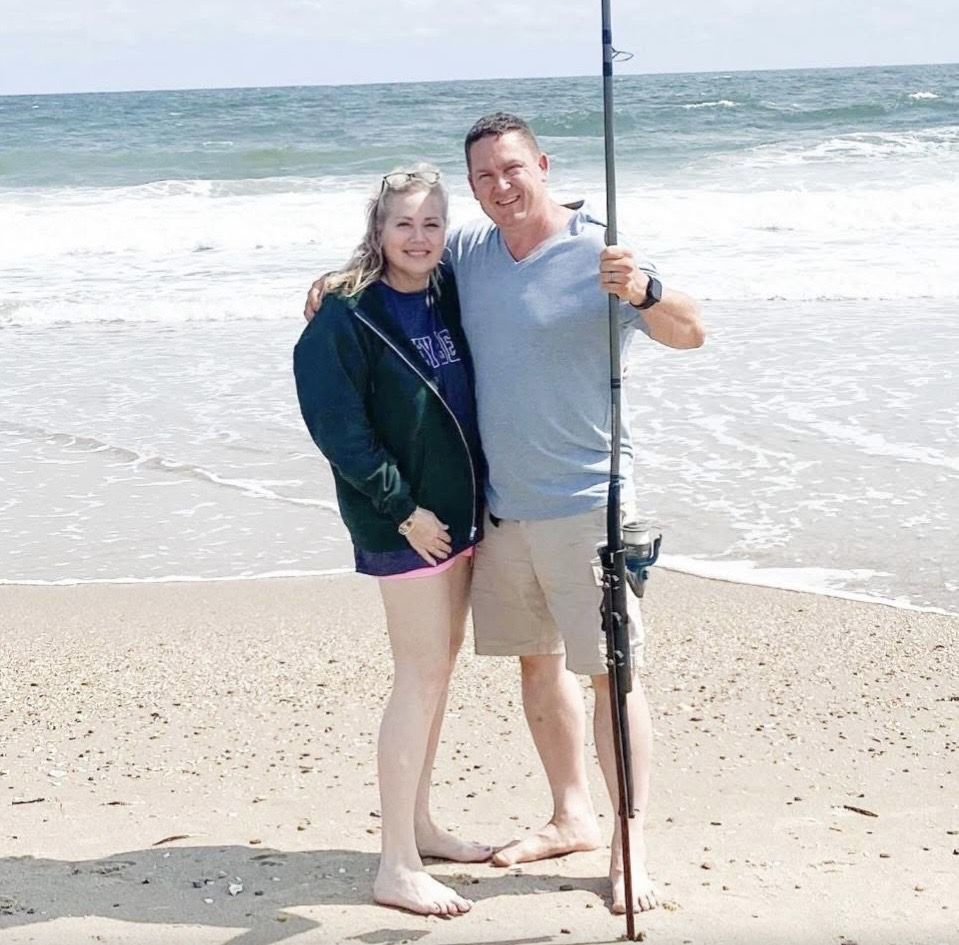
    Irene Blair and her husband, Charles, at a beach in Delaware.

    How does the therapy work?

    Cancer researchers have worked to design a drug targeting KRAS, a protein that acts like a “gas pedal” for cancer growth when mutated, since its discovery in 1982.

    The mutant protein is like a pedal stuck in the down position, driving uncontrolled proliferation — which tumors thrive on. These mutations are found in a quarter of human cancers, mostly aggressive cancers of the pancreas, lung, and colon.

    Scientists finally succeeded in 2021, when the first drugs capable of blocking KRAS were approved by the FDA for lung cancer. Dozens of KRAS inhibitors are now in various stages of development.

    Daraxonrasib is one of the first tested for pancreatic cancer, a tumor type where nearly 90% of cases have these mutations. Also called a ‘pan-RAS inhibitor,’ it not only targets KRAS, but two other related proteins that drive cancer when mutated, HRAS and NRAS.

    More than 90% of the 83 patients in a phase 1 trial saw their pancreatic cancer stall during treatment, and roughly 30% saw shrinkage.

    While taking the drug, at least half of patients gained more than eight months before the cancer started progressing again.

    The drug comes in pill form.

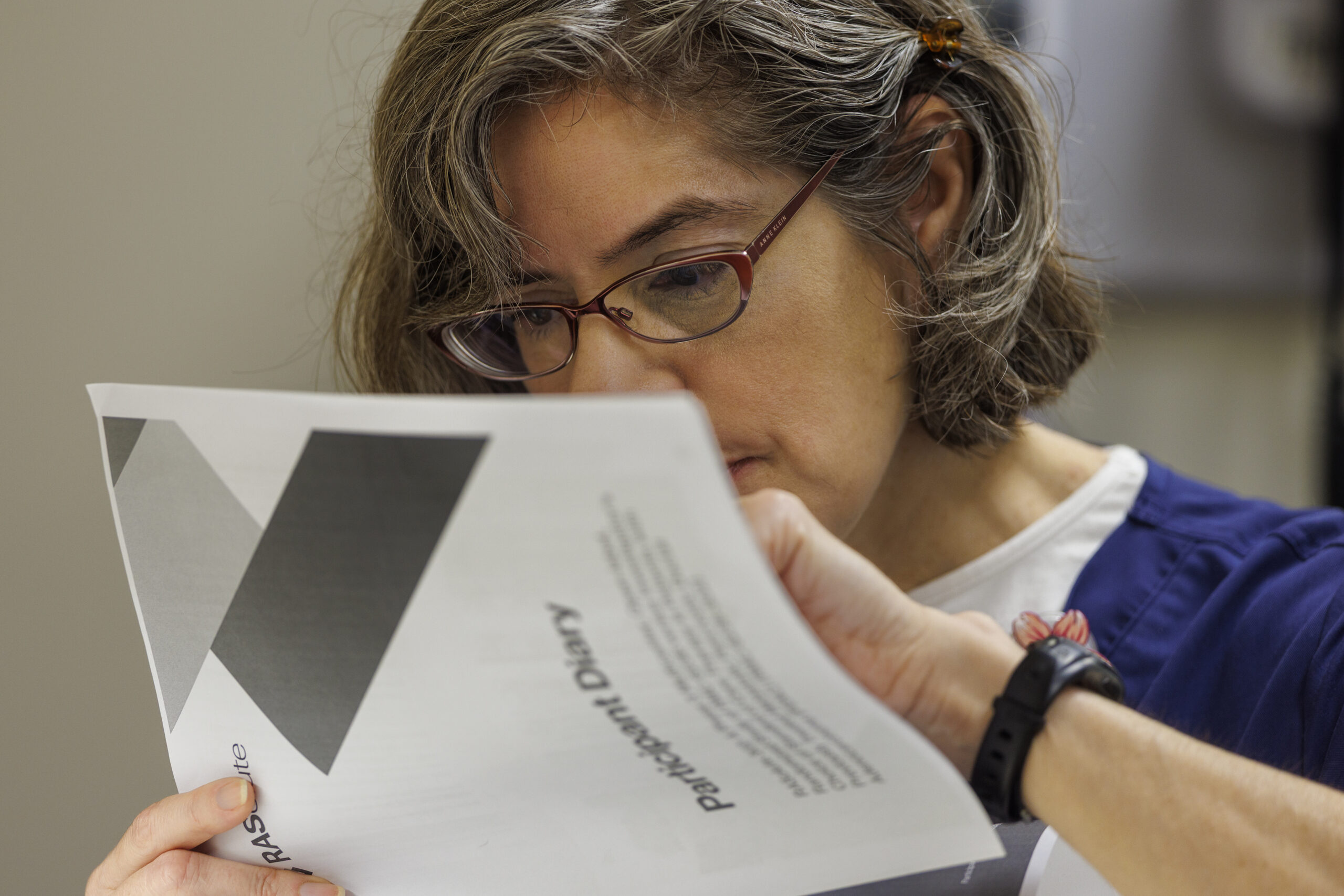
    The drug comes in the form of three pills, taken daily at home.

    The most prevalent side effect is a rash — 91% of patients in a phase 1 trial experienced this symptom, with 8% having severe cases. It often shows up on the face or scalp and is similar to acne, O’Hara said.

    Diarrhea, nausea, vomiting, and mouth sores are other common symptoms.

    O’Hara said these are manageable with medications for most patients and still allow them to have a better quality of life than chemotherapy.

    “I want to be able to give KRAS inhibitors to all my patients right now,” he said.

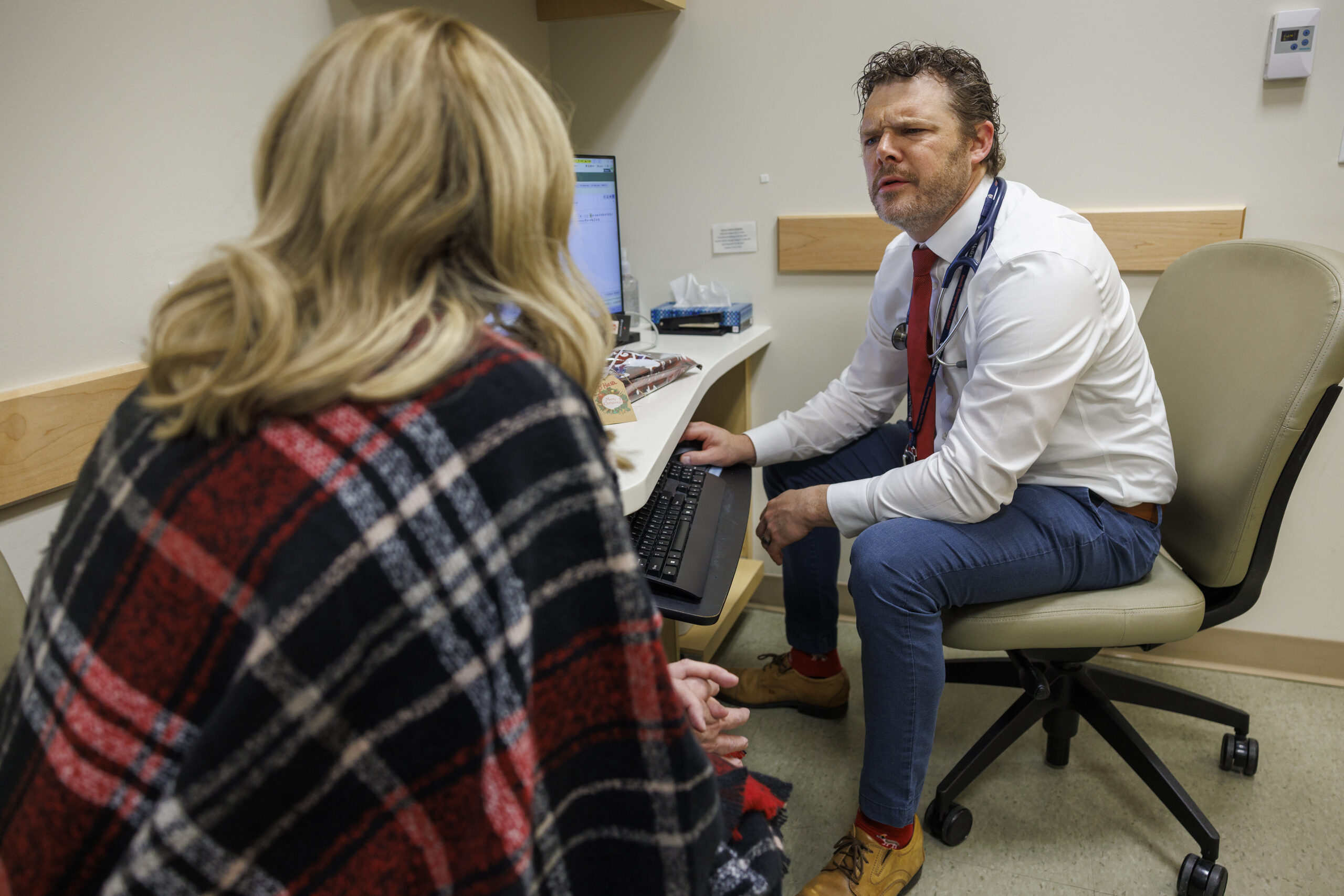
    Irene Blair of Newark, Del., meets with her doctor, Mark O’Hara, at her December appointment.

    Looking forward

    O’Hara runs multiple trials of KRAS inhibitors at Penn.

    Some of them are testing the inhibitor as a treatment for patients with metastatic cancer after other options have stopped working. Another is evaluating its use in combination with chemotherapy as an initial approach.

    “I’m looking for more tools to put in that toolbox, and I think this provides a new tool,” O’Hara said.

    Ben Stanger, a gastroenterologist and scientist at Penn, has led experiments in mice that showed combining a KRAS inhibitor with immunotherapy may be more effective than using the former alone.

    If this approach makes it into clinical trials as well, it could still take years to evaluate the safety and efficacy of the combination.

    He believes KRAS inhibitors could be “a game-changer” for pancreatic cancer if approved, particularly if paired with other anti-cancer drugs.

    “Goal number one would be to make pancreas cancer, instead of a death sentence, into a more ‘chronic’ disease that is treated over time,” he said.

    The federal government has granted the drug Breakthrough Therapy and Orphan Drug designations.

    In October, the drug was also one of the first selected for a new program that aims to accelerate review times for drugs from one year to as short as a month, potentially putting it on a faster path to approval.

    Daraxonrasib, also known as RMC-6236, earned Breakthrough Therapy and Orphan Drug designations in 2025.

    Limited options

    When Blair first started having back pain around May 2024, she thought it was a pulled muscle from kickboxing.

    She put a heating pad on the back of her chair and went on with life.

    After her father had a stroke that July, she got it checked out at the hospital where he was admitted.

    A day later, she was diagnosed with stage 2B pancreatic cancer.

    “My first thought is, ‘I’m dying,’” she said.

    Had she been diagnosed earlier, she would have retired early, instead of worrying about saving money.

    Instead, she spent her final working year undergoing surgery to remove part of her pancreas, spleen, and several lymph nodes, followed by 12 difficult sessions of chemotherapy.

    When she finished her last session in March, Blair’s scans showed no evidence of the cancer. But by late April, her back pain returned.

    Two months later, more scans showed that the cancer was now considered stage 4, as it had metastasized to her liver, forming 10 to 15 new tumors.

    Her best option was to enter a clinical trial of daraxonrasib at Penn.

    Much to her relief, she was chosen to receive the drug in July upon enrolling in a study in which half of patients are randomized to receive chemotherapy.

    “It’s enabled me to start living again,” she said, but knows eventually the therapy will likely stop working.

    In that case, doctors may try the standard chemotherapy — which usually works for three to four months — or test a different therapy based on her cancer’s genomic profile, O’Hara said.

    For now, she described herself as “living scan to scan,” seeking as much time as possible with her son, grandchildren, and husband.

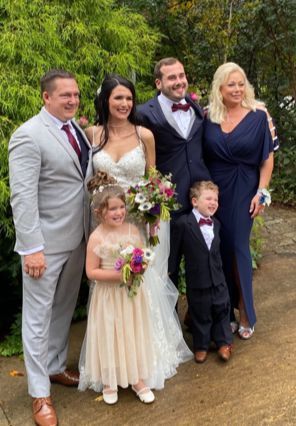
    Irene Blair and her husband Charles, son Tom, daughter-in-law Kelsey, and two of her three grandchildren, Aidan and Madilynn.

    Blair’s next evaluation is in February. She hopes it shows her disease remains stable, and she can stay in the trial.

    “The alternative, honestly, is death,” she said.

  • Forty years after a brain injury changed this veteran’s life, a Jefferson program helped him rebuild

    Forty years after a brain injury changed this veteran’s life, a Jefferson program helped him rebuild

    When Scott Edgell was discharged from the military after a service-related head injury at age 20, he thought he would resume life as normal.

    But over the next four decades, the Lancaster County man was troubled by frequent migraines, memory problems, dizziness, irritability, and balance issues. Even everyday activities, like grocery shopping or eating at a restaurant, became overwhelming.

    “I didn’t understand what was happening to my body,” said Edgell, who is now 57.

    He realized the head injury he suffered while serving in the military was to blame after watching the 2015 movie Concussion, but struggled to find doctors who knew how to help him.

    Just as he started to lose hope in late 2023, he learned about a Jefferson Health program in Willow Grove for veterans and first responders with traumatic brain injuries (TBIs). The clinic provides physical and cognitive rehabilitation to participants over a three-week intensive outpatient program.

    Edgell is among the estimated one in four veterans who have had a TBI. More than half a million U.S. military members have been diagnosed with the injury since 2000, according to the Department of Defense.

    Many suffer TBIs as a result of combat-related incidents, exposure to blasts during explosions, training accidents, and vehicle crashes.

    While some patients can recover completely, up to 30% of those with mild TBIs, also commonly called concussions — which account for the vast majority of TBI cases — experience long-term symptoms.

    The lasting effects of TBIs are often overlooked among veterans because of the injury’s invisibility. Yet they can be life-altering, affecting employment, personal relationships, and overall quality of life.

    Veterans with a TBI had suicide rates 55% higher than veterans without the injury, one study found.

    Jefferson’s program, called the MossRehab Institute for Brain Health, was founded in 2022 and has treated roughly 100 patients. It runs on donations — the biggest being from the veterans’ wellness nonprofit Avalon Action Alliance, which has provided $1.25 million annually.

    Donations allow them to offer the program at no out-of-pocket cost to veterans and first responders, and cover housing, transportation, and meals during the three weeks.

    “I walked in those doors at the lowest part of my life,” said Edgell, who participated in June 2024.

    Though there’s no cure for his injury, the program has helped him rebuild his life.

    “All you can do is learn to manage your symptoms,” he said.

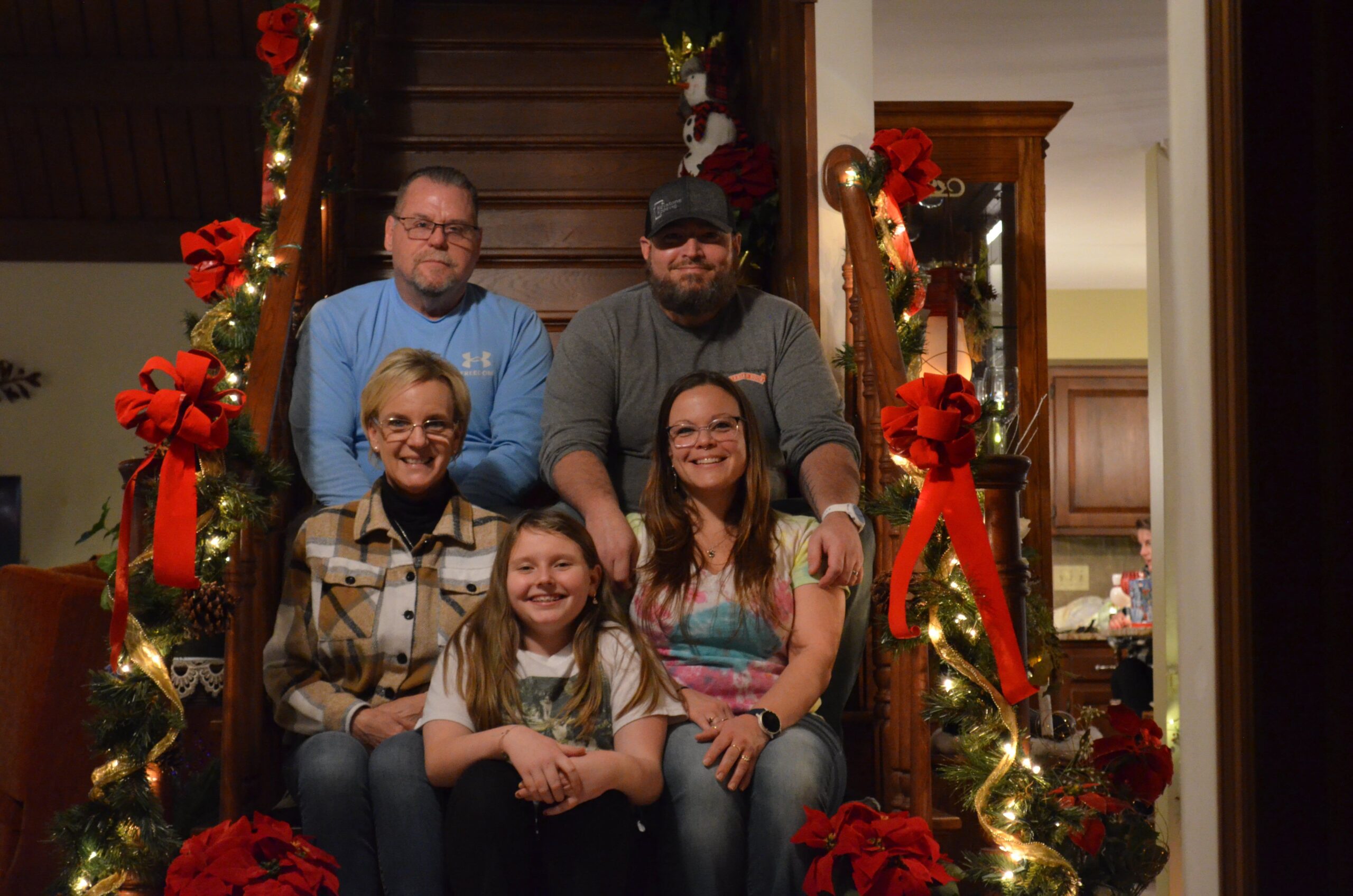
    Edgell and his family, including his wife Tami, stepdaughter Monica Bressler, son-in-law Kenny Bressler, and granddaughter Hayvin.

    The program

    Edgell entered the MossRehab program in June 2024 as part of a cohort of four.

    The first step in his rehab was learning about what was happening to his brain.

    His accident occurred back in 1989, when a steel hatch swung shut and hit him in the back of the head during a training exercise at Fort Riley, Kan.

    Doctors at the time provided memory exercises, mental health support, and physical rehabilitation to improve his gait, but nothing brought him back to baseline.

    Edgell managed to push through his memory problems in college by putting in extra effort into studying, and ultimately became an electronics engineer.

    However, it became harder to cope with the symptoms as he got older.

    Even brief outings would exhaust him to the point of needing days to recover.

    When his wife, Tami, would ask what she could do to help him, he wouldn’t know what to say.

    One therapist at the program offered him a helpful analogy: If a normal brain is like a six-burner stove, then having a brain injury is like being down to only three burners.

    “You’re trying to do everything with two or three burners that you would normally do with six, and your brain just becomes very fatigued and overwhelmed,” Edgell said.

    The program teaches participants to adapt to their brain’s new way of functioning, whether through physical rehabilitation for symptoms such as dizziness, or cognitive rehabilitation to address issues affecting attention, concentration, memory, and mood.

    “We’re basically retraining the brain to do something that it’s having difficulty doing because of an injury,” said Yevgeniya Sergeyenko, a physical medicine & rehabilitation physician and clinical director of the program.

    Since treatment for TBIs revolves around managing the symptoms — which can vary widely between patients — the program has staff across an array of specialties that patients see throughout their three-week stay.

    One provider helped Edgell, who was struggling to get more than a few hours of sleep a night, find medication to help him sleep.

    A physical therapist, meanwhile, assisted with his balance and core structure, so he could walk and move around more easily.

    Others taught Edgell exercises to improve his dexterity, speech, and memory.

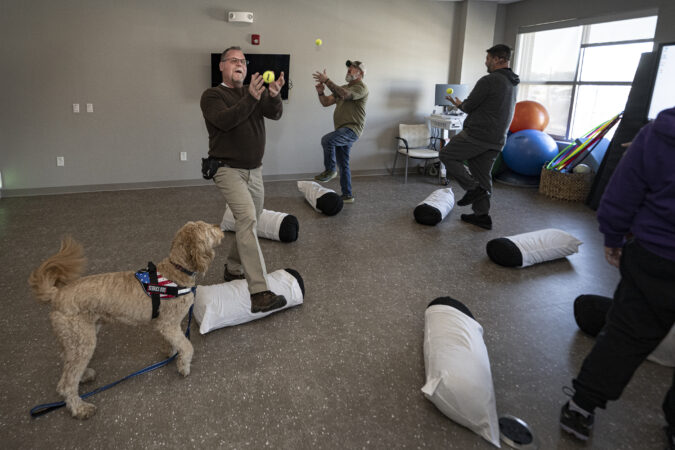
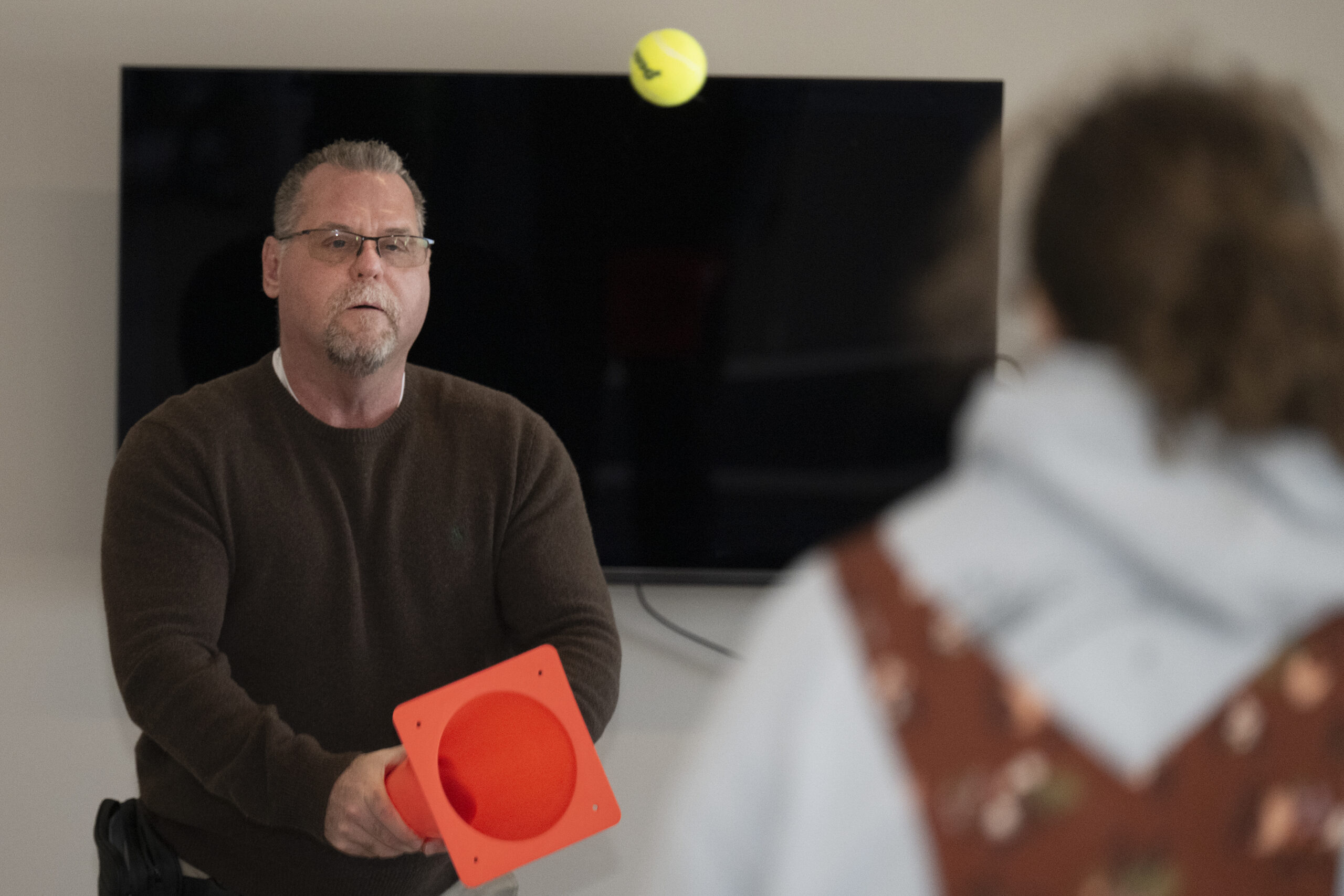
    Army veteran Scott Edgell participates in a cohort session at the MossRehab Institute for Brain Health.

    Some forms of therapy were less conventional.

    There was horticultural therapy — a therapy that involves working with plants — which Sergeyenko said has been shown to lower blood pressure and is intended to help with emotional regulation.

    Patients also did yoga and other mindfulness and movement activities intended to calm the nervous system.

    Edgell said yoga wasn’t his favorite, but he found art therapy helped him communicate more openly.

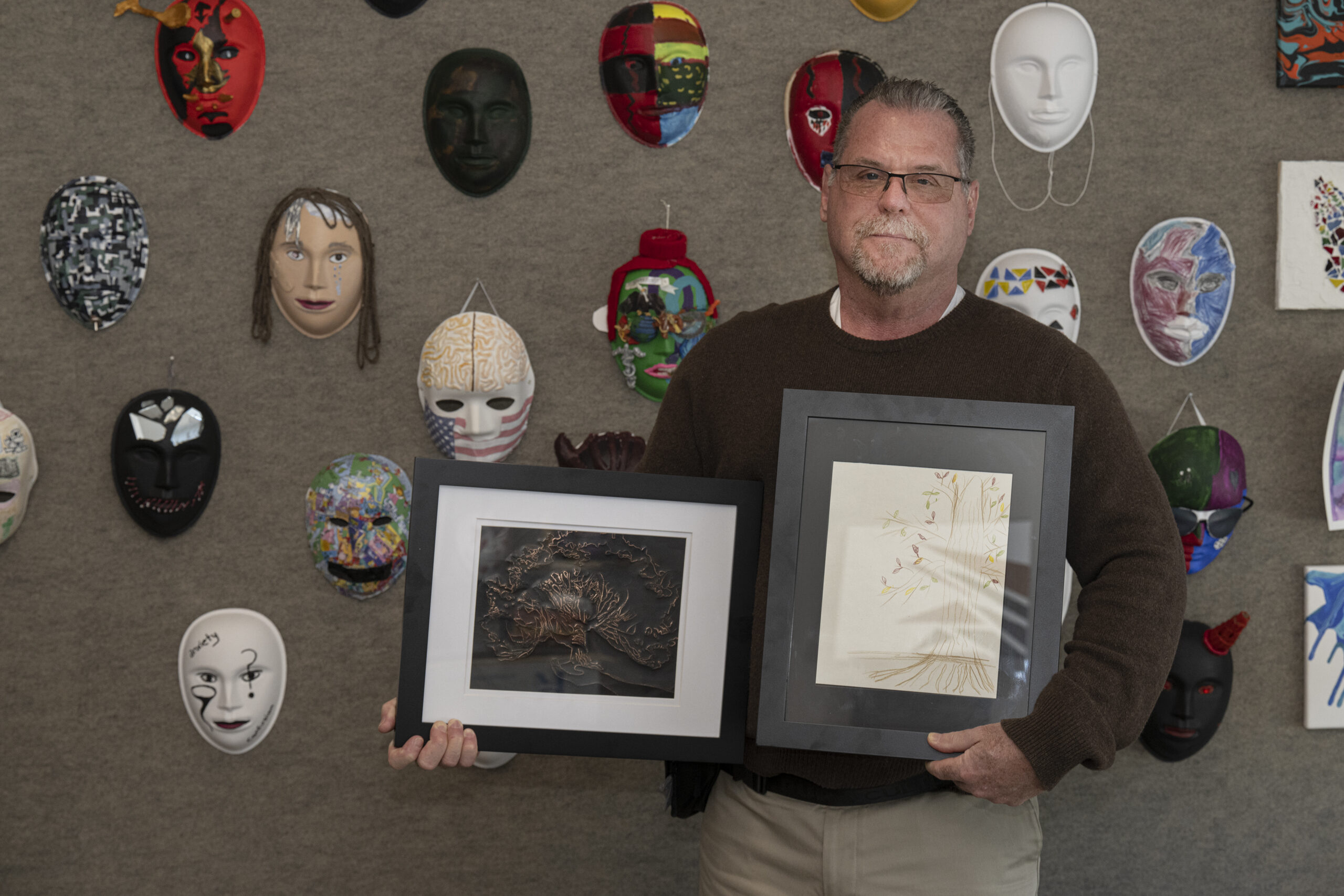
    One of the exercises at the start of the program asked him to draw a tree. He drew one that “was not doing very well,” he said.

    At the end of the three weeks, he drew a lush version full of leaves. The framed drawing now hangs in his dining room.

    “I look at that everyday to see where I came from,” he said.

    Army veteran Scott Edgell shows drawings of trees representing himself during a cohort session at the MossRehab Institute for Brain Health.

    Outcomes

    Program organizers say returning to a pre-injury baseline is not always a realistic goal.

    “There’s not a medicine that you can give that’s going to make all of your brain injury symptoms subside,” said Kate O’Rourke, the program director at the clinic.

    The program aims to improve function and quality of life.

    As of September, the last time outcome statistics were compiled, 82 patients had gone through the three-week intensive. Sixty-five percent saw significant reduction in their symptoms, as measured by their Neurobehavioral Symptom Inventory scores — which assesses a patient’s severity of neurobehavioral symptoms from 0 to 88. The average reduction was 13.26 points.

    Ninety-nine percent of patients reported that they personally felt they improved after the program.

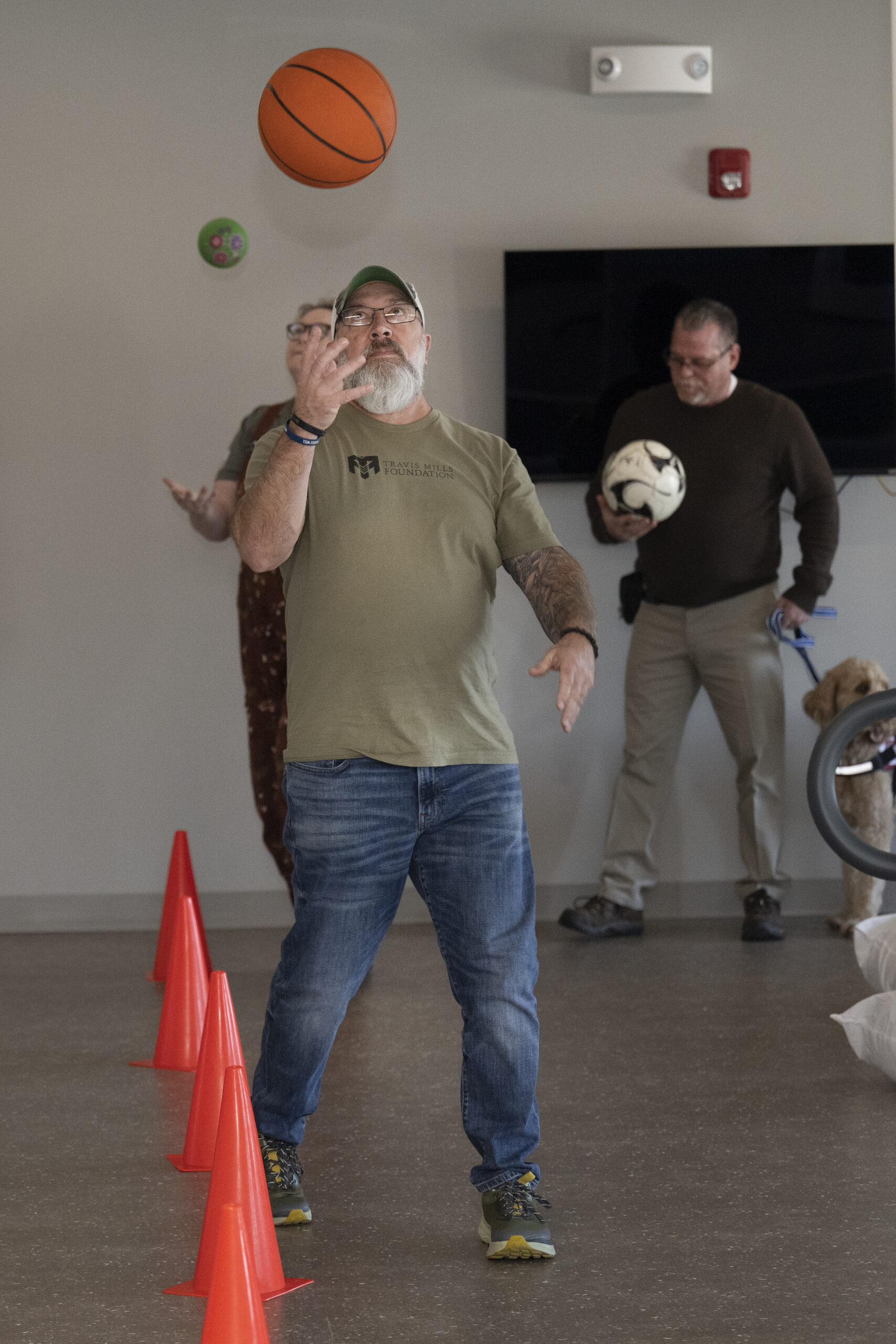
    Current patients (Jeff Todd Malloch and Jessica Mack) and Army veteran Scott Edgell participate in a cohort session with his therapy dog, Lars, at the MossRehab Institute for Brain Health.

    Edgell regularly reaches out to staff for advice, and meets with the program’s alumni in monthly conference calls.

    He still has bad days sometimes, but he’s able to manage them better.

    Before, when he would go to a grocery store or restaurant, he would become overwhelmed by the noise, lights, and commotion.

    “I couldn’t catch my triggers before I fell off the cliff,” Edgell said.

    He was only able to leave the house four to five times a month.

    Working with a service dog at MossRehab inspired him to get one of his own.

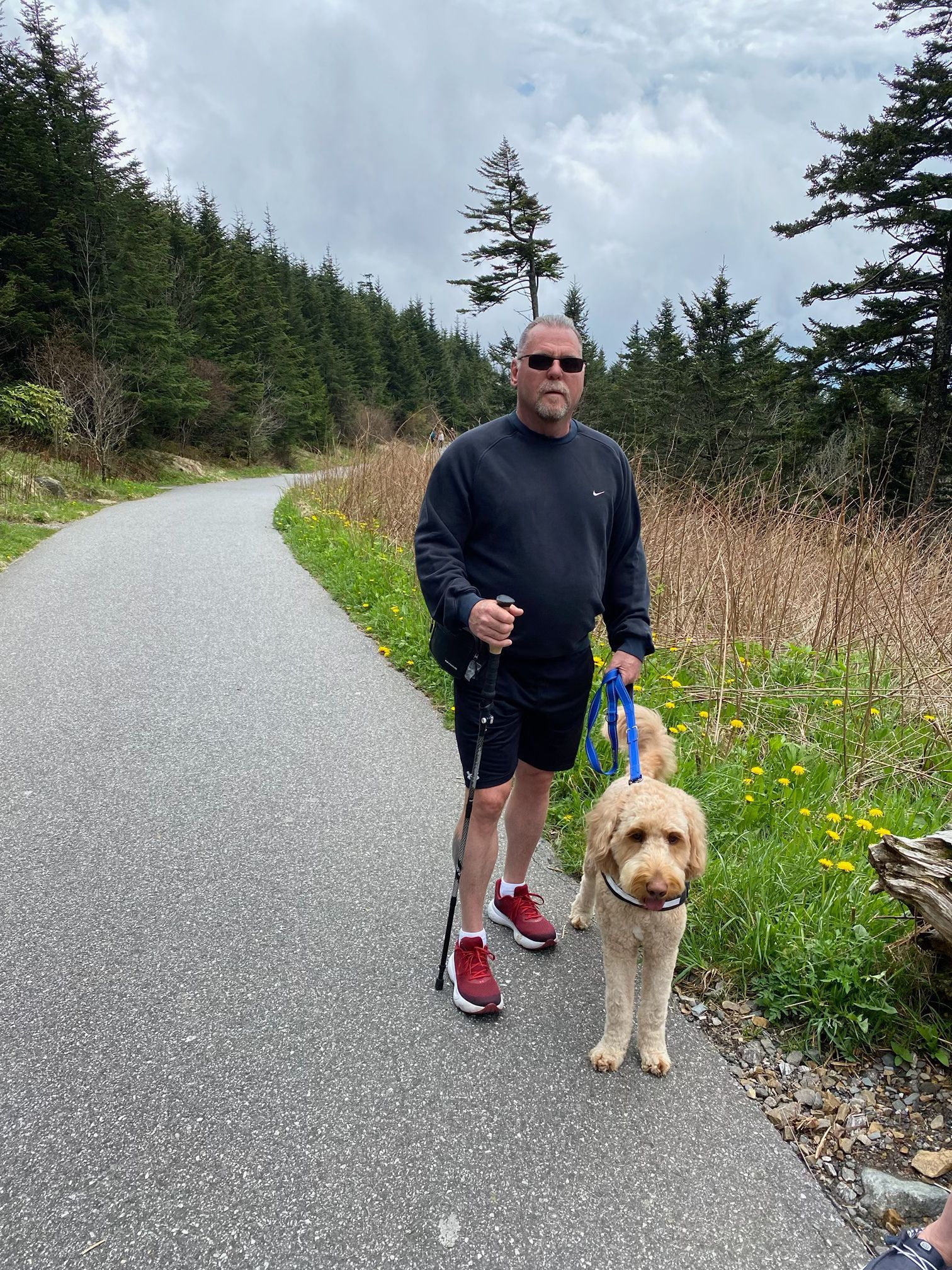
    Now, when he starts to react, a golden doodle named Lars will nudge him, giving him a moment to let his brain calm down.

    Edgell and his service dog, a golden doodle named Lars.

    Today, he’s able to leave the house more frequently and for longer.

    He and his wife have reconnected with friends and engaged more in social activities.

    “I still get tired, I still need breaks, but my recovery time is a lot faster, and it’s not nearly as devastating,” Edgell said.

  • Catholic Charities’ Heather Huot on Building Stability Through Service

    Catholic Charities’ Heather Huot on Building Stability Through Service

    The legacy of Catholic Charities of Philadelphia originated in 1797 with the Catholic Church’s establishment of an orphanage during the yellow fever epidemic. This initial act of charity laid the foundation for a tradition of service that has persisted. Today, the nonprofit is an umbrella organization that offers a wide range of essential services to more than 300,000 people throughout the five-county region. “We’ve been here a long time,” Heather Huot, Catholic Charities’ secretary and executive vice president, said. “Over 200 years, but I don’t know that we’ve always done a really good job of talking about the good work that we do.” Its current mission includes providing family and senior services, foster care, adoption, and support for the homeless. Below, Huot discusses the charity’s values and what keeps her hopeful.

    How would you describe what Catholic Charities does and why it matters in Philadelphia?

    We provide food, housing, care for seniors, families, and individuals, and everything that we do is driven by faith in Jesus and rooted in the works of mercy to serve our neighbors with love and dignity. We really put the mission of the archdiocese into action every day. We provide vital support across not just Philadelphia County, but the surrounding counties as well.

    We divide our work into four pillars. We nourish the hungry and shelter the homeless. Just this past week, we had about 1,500 individuals experiencing homelessness come right through our parking lot here by the cathedral to get essentials for winter. And we also provide shelter and we stock pantries all across the region.

    The second thing that we do is we strengthen and support at-risk children and youth. We’re talking from the time they’re toddlers all the way up through young adulthood, really trying to touch people throughout that whole spectrum of their life. [We do] some residential care, some work with DHS [Department of Human Services], [and we’re] trying to teach trades and skills. [For our third pillar], we stabilize and enrich the lives of seniors in our communities. It’s really important to think about seniors who’ve given so much to our communities.

    Then the fourth pillar of our service is empowering individuals with intellectual and developmental disabilities. We provide residential care to about 400 individuals every day that are living with intellectual and developmental disabilities. So it’s a wide range of services across the five-county region.


    What led you to social work and how did that path bring you to Catholic Charities?

    It’s actually a little bit of a roundabout journey. I grew up with a sibling with special needs, so I always thought I was going to be a special education teacher. But in my senior year of college I did student teaching where you spend a full semester in the classroom, and I hated it. So I decided, since I wasn’t quite sure what my next step would be, rather than getting a job or going to grad school, I would take a year and dedicate it to service.

    I just happened to be placed at St. Francis Inn, a soup kitchen here in Kensington, and I spent a year living and working at the soup kitchen, where I just fell in love with working with folks who were coming in every day. At St. Francis, they really take on this notion of radical solidarity with the folks who are coming for food and compassion. And I was so moved by it. I knew I had to stay in that world. I decided to move into social services and I was very blessed to find my way to Catholic Charities at that point in my life. That was 26 years ago.

    The organization serves more than 300,000 people annually through more than 40 programs. What connects all of these programs together?

    It is really interesting because we are 40 programs but also over a hundred different [service] locations. Every program that we have, no matter where it is in the five-county region, we’re living out that call to care for our neighbors. It’s driven by love.

    Our mission is person-centered, focused on wanting the best for every person we encounter. And you’re going to find that no matter what kind of program you step into, that’s the heart of what we do. It may be handing out meals, it may be caring for someone who’s aging, but that’s the foundation.

    I think the second thing that kind of unites all of our programs together is we’re also a place where the community can engage in works of charity and service. So it’s not just about our staff and my colleagues doing this work; we are a place for people to join us in that work.

    How does your clinical training in social work inform the way you approach leadership at Catholic Charities?

    Social work is a very humbling position; it’s not a position that you go into thinking you have all the answers for everyone’s problems. It’s really about meeting people where they are and walking alongside them. It’s about attentive listening and knowing that you are not the smartest person who’s going to wave the magic wand and make things better.

    And I think I’ve really brought that into my role now as executive vice president. We need to be a collective in how we solve problems. We need to ask, how do we bring in people that believe in our mission to help us solve this problem? Because we don’t necessarily have all the resources that the community’s going to need; we’ve got to be creative and find those who want to partner with us.

    How does Catholic Charities approach long-term issues like housing? How do you build that into programs?

    At the St. Francis Inn, we would see the same people every day and their lives weren’t changing. I loved [doing the work], but I also felt very frustrated. I would always ask myself the question, “Well, how’s this going to get better for them?” So I’ve come to learn that a social service agency like ours can have programs that are meeting immediate needs, but we also need to balance that with programs that provide more long-term systemic change, like creating affordable housing. We train youth on carpentry skills, giving them a real trade so that they can go into the world in a different way than maybe their parents did.

    [And] I think when you think about stability, it’s really only possible when you have a reliable base of support and trusting relationships. So if we’re giving out food at Martha’s Choice Marketplace, it’s me also learning your name and why you are coming for food, and [asking if] there’s anything else that we can help you with or if there is anyone else I connect you with.

    We build affordable housing. That’s huge. It’s a solution in and of itself. However, there’s more to it than that, right? It’s about engaging with the residents once they’re there so they can actually maintain that stability. I was visiting Guiding Star Ministries, one of our ministries that supports expectant mothers. It’s a residence where they can live as they’re preparing for the birth of their child and then they can stay with us for up to a year once their child is born. So for someone who maybe does not have the best living situation, who becomes pregnant, it gives them a safe place to prepare and then have their child.

    I asked the staff, what’s the key to a mom doing well once they leave? And they said, [it’s] always [having] someone to call when something goes wrong later.

    I think the other part that’s really important for me in my role is that I have to focus on advocacy, too. I meet with city, state, and federal leaders to talk about what our communities need. I invite them to come and see what we’re doing to engage in our work, because that’s how they’re going to understand the impact of the dollars that they’re allocating.

    This is a tough legislative environment. What gives you hope day to day as you try to gather resources to serve the community?

    Right now that hope may be hard to see. I mean, you just see so much sadness around us, but I’ll tell you what: my colleagues [make me hopeful]. Our staff is very diverse. I know we are Catholic Charities, but that doesn’t mean that everyone we serve is Catholic. That is far from the truth. And it does not mean all of our staff is Catholic. But we are united by this mission to care for our most vulnerable sisters and brothers. And you see that in action every day with them. And that’s what keeps me coming to work every day and feeling like we can do this.

    What would you like your legacy to be when people look back at your time at Catholic Charities?

    My five-year plan is to bring a lot of our different services together, talking to each other, being more collaborative. You’re really going to see that be the focus over the next five years.

    But, [longterm,] I want people to look back at my time in this role and think that it was a time of growth. I know there’s a lot of other things going on in the world around us, but I think this is the time for Catholic Charities to be on the front lines and show that we are such a force for good in the Philadelphia region. And that I bring a spirit of collaboration and hope to my organization.

    I think one of the things that’s really important to note is it’s also an important time for the Catholic Church of Philadelphia. The archbishop is taking very bold steps to bring people back to the Catholic Church. He has a strategic plan that’s out there, and I think that we, as Catholic Charities, can be the frontline for welcoming people back. People might not be comfortable walking into church, but they might be comfortable coming and serving a meal with us. And I think that’s a really important role for us to play.


    PHILLY QUICK ROUND

    What’s your favorite Philly food splurge? Sweet Lucy’s Smokehouse. It is a little barbecue joint in Northeast Philly. I love the pulled pork and the cornbread.

    Favorite Philly small business? Mueller Chocolate Company in Reading Terminal Market. Their chocolate-covered pretzels are my favorite. I have quite the sweet tooth.

    You don’t know Philly until you’ve… taken your family to a Flyers game to kick off your Christmas celebrations. There’s Gritty Santa Claus!

    Who’s the greatest Philadelphian of all time? Saint Katharine Drexel, [both] as a Philadelphian and as a woman Catholic leader. I can’t think of a better role model for myself. She took care of people that were pushed aside and oppressed, and she was a tireless advocate for their dignity.

    What do you do for fun around Philly? Well, I do love theater and the performing arts, so I’m always looking to take in a show, whether that be at the Academy of Music or the Arden.

    What’s one place in or around Philadelphia you wish everyone would visit at least once? Boathouse Row, especially during a regatta. There is just something really special about the Schuylkill River and seeing rowing in action there.

  • As a Philly student, her high school lifted her up. Now, she’s giving back in a major way.

    As a Philly student, her high school lifted her up. Now, she’s giving back in a major way.

    Sonia Lewis endured the worst year of her life when she was a senior in high school — her mother almost died and Lewis had to step up to take care of her family.

    But the principal and teachers at her Philadelphia high school lifted her up, helped her get to college, and Lewis took care of the rest — multiple advanced degrees, a thriving career, a national profile.

    As Lewis racked up accomplishments, it was always in the back of her mind to return the favor to her school, somehow.

    “For me, who I am today is really a huge part is Bodine High School,” she said.

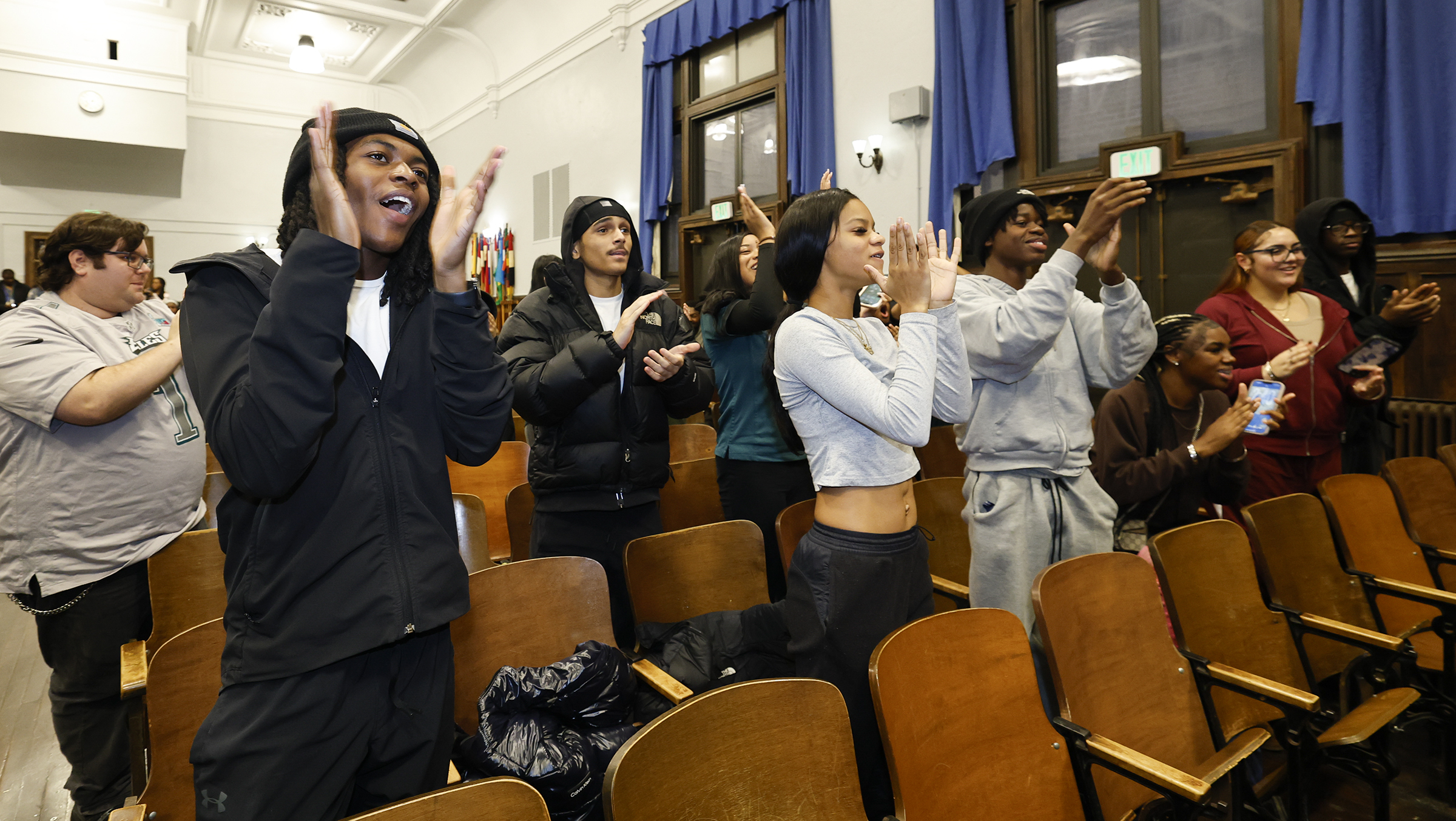
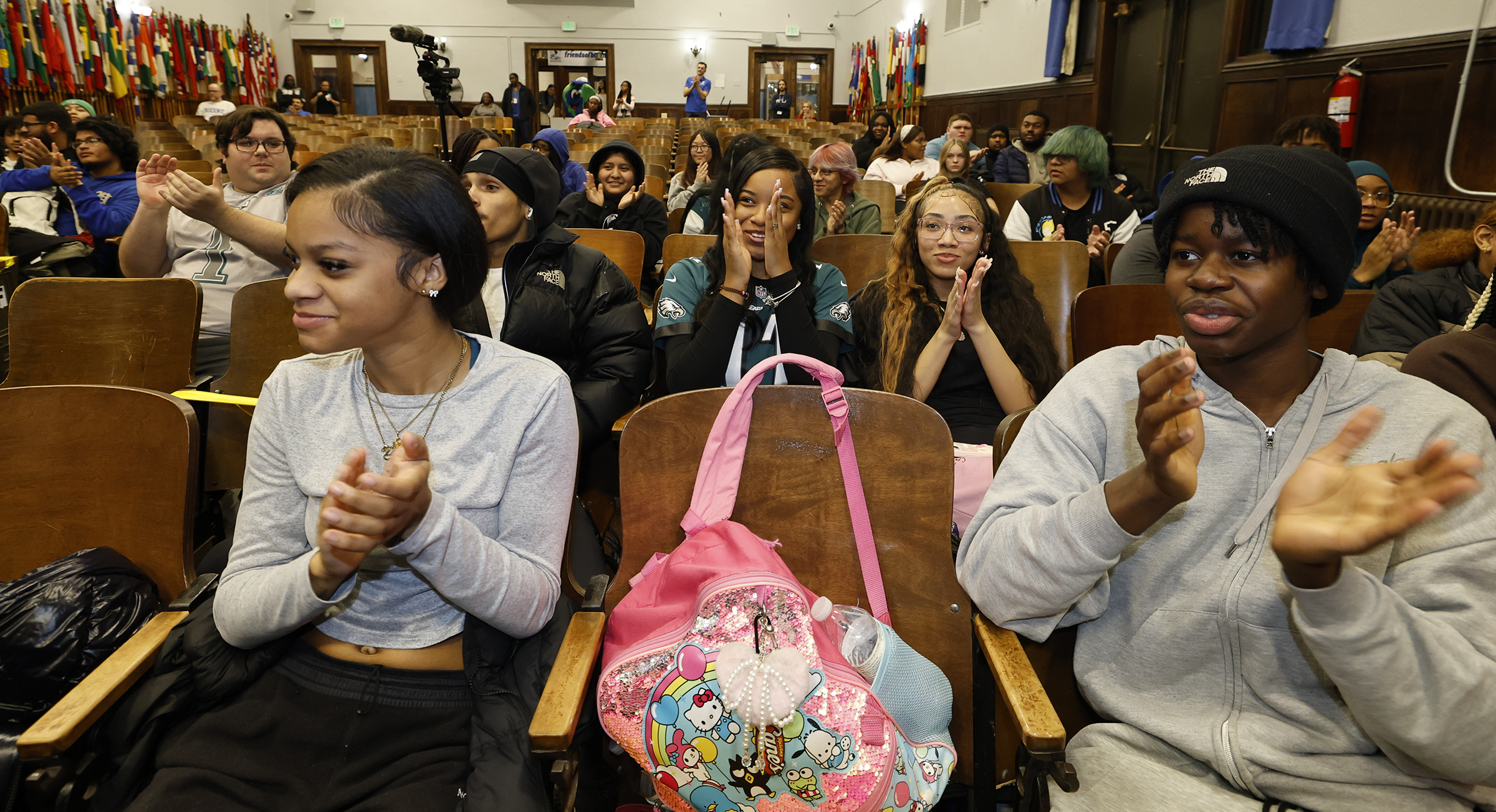
    Bodine High School for International Affairs senior students cheer after learning former student, Dr. Sonia Lewis, donated $16,200 to cover senior school fees on Friday, December 19, 2025. Dr. Lewis is giving back after the Northern Liberties high school helped her during a difficult time, while she was a student 20-yrs-ago.

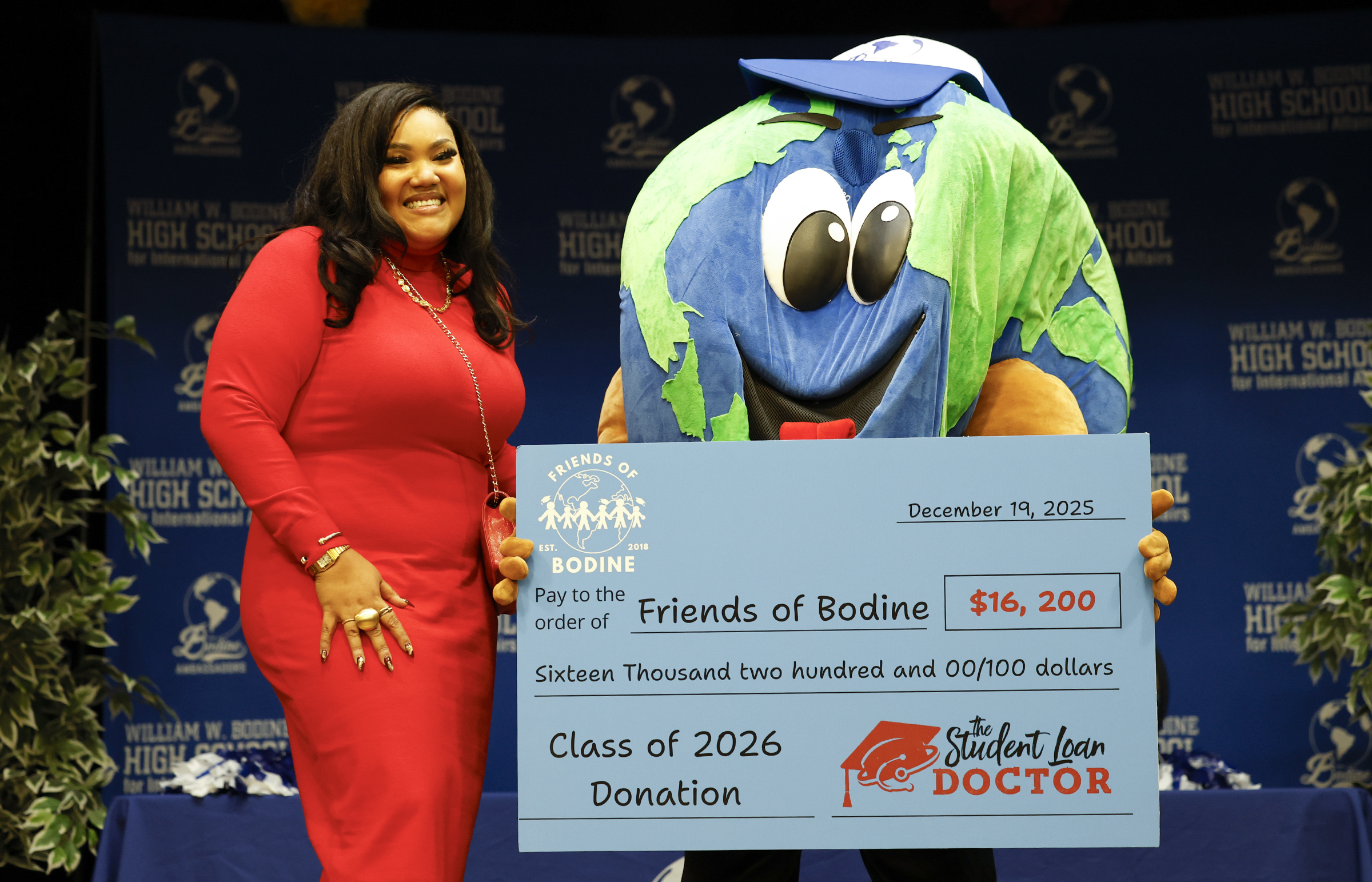
    So on a December day, Lewis walked into the auditorium of the Philadelphia School District magnet school with a surprise — the largest donation ever given to the nonprofit that supports Bodine. She gave $16,200 to cover the bulk of every senior’s class dues — funds that most students struggle to pay.

    Aaliyah Bolden, a Bodine 12th grader, was jubilant after the announcement.

    “I’m just so grateful,” Bolden said. “Coming from an underrepresented community and having financial hardships, this just makes a big difference to me.”

    ‘Can you work with me?’

    Lewis was a standout student at Bodine, an international affairs high school in Northern Liberties. She was class president, active in student government, a strong student in the Class of 2005, a leader.

    She was raised by her single mother and grandmother, both Philadelphia teachers, told from a very young age that she was college-bound.

    But when Lewis was 16, her priorities shifted, out of necessity. Her mother was gravely ill with bacterial meningitis and other complications. Her grandmother had just beaten cancer, but it fell to Lewis to advocate for her mother, to take her to appointments, to navigate the healthcare system on her behalf. She worked three jobs to help bridge financial gaps.

    School just could not be at the top of her priority list.

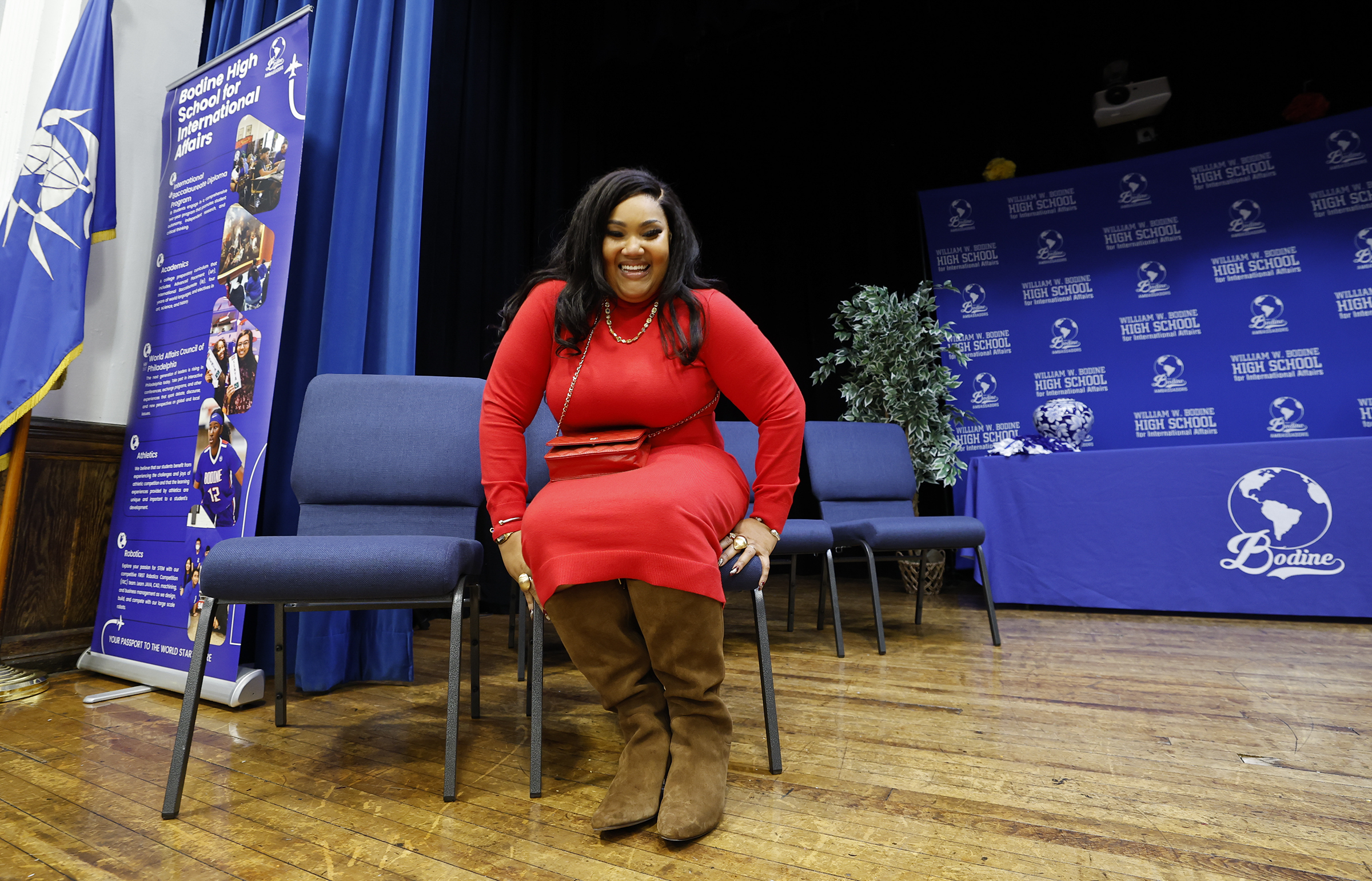
    Dr. Sonia Lewis takes a seat before speaking to Bodine High School for International Affairs senior students on Friday, December 19, 2025. Dr. Lewis gifted $16,200 for the 2026 senior class, to cover senior school fees. Dr. Lewis is giving back after the Northern Liberties high school helped her during a difficult time, while she was a student 20-yrs-ago.

    “I had to tell my high school, ‘These are my circumstances. I’m going to have to leave school to make some of these appointments,’” Lewis said. “I was just really clear with everyone at Bodine about what I needed, and I said, ‘Can you work with me?’”

    They did. But some deadlines are firm, and Lewis missed the federal student-aid loan deadline because her mother had just gotten out of a coma, had cognitive issues, and was unable to gather the necessary information or complete the form.

    “I had to become the mom,” Lewis said. “I would have to ask her, ‘Did you brush your teeth today?’ Nobody was thinking of the FAFSA.”

    As students’ college acceptances were rolling in, Bodine’s principal noticed that there were none for Lewis. The principal asked her what was happening.

    Lewis’ grandmother contemplated taking out a mortgage on her house to send her to college, but Lewis was too practical for that.

    “I told the principal, ‘We don’t have any money. We missed the deadline,’” she said. “There was no money coming in from my mom. We had my grandmother’s retirement, but that wasn’t enough.”

    Lewis figured she would work for a year, saving money and filling out the FAFSA form for the next cycle. But Karen P. Hill, the principal, just shook her head.

    A busybody for good

    The principal’s plan became evident at Bodine’s senior awards ceremony, Lewis remembers, when “they just kept calling my name” as prizes were announced.

    At the end of the evening, Lewis walked off with an envelope full of checks totaling $16,000 — enough to allow her to enroll at Bloomsburg University and pay her first year’s tuition.

    Once she got to Bloomsburg, Lewis continued to grind, working multiple jobs, earning scholarships, making connections. Then, after she earned her bachelor’s degree, Lewis moved on to working in higher education, spending time at Peirce College and elsewhere as an academic coach and in admissions.

    She earned her master’s degree, and eventually her doctorate. Now, she’s “the Student Loan Doctor”; Lewis believes her 13-employee company is the first Black woman-owned student loan repayment firm in the United States.

    Dr. Sonia Lewis stands with the Bodine High School for International Affairs mascot Amby during a a senior class assembly on Friday, December 19, 2025. Dr. Lewis gifted $16,200 for the 2026 senior class, to cover senior school fees. Dr. Lewis is giving back after the Northern Liberties high school helped her during a difficult time, while she was a student 20-yrs-ago.

    Lewis coaches clients to create plans to pay off their student loan debt — through repayment, loan consolidation and forgiveness, and more. She’s a sought-after expert, quoted in national publications, offering free weekly classes, growing her business by the year. She has 150,000 followers on Instagram.

    Lewis is allergic to sitting still. Her nickname in her sorority, Delta Sigma Theta, was “Busybody.” She has channeled that for good — the Student Loan Doctor has now served over 50,000 clients since 2016, helping get an estimated $55 million in student loans forgiven.

    The business is hard work, but a joy for Lewis, who gets to know she makes a direct impact on her clients’ lives — like the surgeon who had $997,000 in loans, including loans that were in arrears.

    “He didn’t know what to do,” Lewis said. “He got his loans forgiven. He wound up paying us like $300. We’re very affordable.”

    The hardest worker

    A few days before winter break, Lewis entered the Bodine auditorium with a massive smile on her face.

    Her gift — hatched after Lewis presented a $1,000 scholarship to a Bodine graduate in the spring, then decided to go much bigger — was a surprise for the students, who knew only that a successful alum was visiting.

    David Brown, the Bodine principal, reminded the students gathered in the auditorium that the small school was a special place.

    “Our leaders don’t just leave with diplomas,” Brown said. “They leave with a global perspective.”

    Then Marty Moyers, a Bodine teacher and president of the Friends of Bodine, a nonprofit that raises money for the school, presented Lewis: “Her journey has been a great one, and it started right here in this building,” Moyers said.

    Bodine High School for International Affairs senior students cheer after learning former student, Dr. Sonia Lewis, donated $16,200 to cover senior school fees on Friday, December 19, 2025. Dr. Lewis is giving back after the Northern Liberties high school helped her during a difficult time, while she was a student 20-yrs-ago.

    When he announced Lewis’ plan, there was stunned silence at first. Then, wild applause broke out. Students’ faces were jubilant.

    Remember this, Lewis told them: She didn’t have a 4.0 grade-point average. But she showed up in every way possible.

    “Even in my professional life as a super-successful entrepreneur, I’m not the best, but I’m a really hard worker,” Lewis said. “You guys got that. That’s the discipline and the spirit you want to have about yourselves as you’re leaving Bodine and you’re going into college, or you’re going into the workforce or entrepreneurship.”

    De’Anna Drummond, a senior, is deep into her applying-for-scholarships-and-worrying-about-paying-for-college season. Class dues were another stress to think about, but she was delighted at the news that they are mostly covered, thanks to Lewis.

    “Any donation is appreciated,” Drummond said. “It all adds up — senior trip, senior brunch, yearbook, everything.”

    Bolden, Drummond’s friend, nodded.

    “And someday,” Bolden said, “we should also give back when we can.”

  • Effecting Radical Change One Life at a Time

    Effecting Radical Change One Life at a Time

    “My path from being a 9-year-old boy, a refugee from Vietnam in a family resettled in South Philadelphia, to becoming CEO of SEAMAAC [Southeast Asian Mutual Assistance Association Coalition], just seems perfectly fitting for a story of America,” Thoai Nguyen said. “But when I think more deeply upon my life and other people who faced very similar challenges, it could have gone in many different ways.” Nguyen’s sensitivity to the potential outcomes of immigrants is informed both by his personal experiences as well as his leadership of SEAMAAC. The organization’s services, which include education, health care, and community development, are crucial in this moment: In 2023, immigrants comprised 14.3% of U.S. residents, up from 11.19% in 2000. In 2024, Philadelphia’s immigrant population reached an 80-year high. And while poverty in the city is at a 25-year low, housing remains unaffordable and more people are experiencing homelessness than ever before.

    The nonprofit is also invested in changing the cultural discourse around immigration. On Jan. 22, 2026, the organization will launch “Indivisible,” a video storytelling project in collaboration with the American Swedish Historical Museum and funded by the William Penn Foundation. “Indivisible” invites Philadelphians to share their family’s immigration experience, connecting their roots to today’s political discourse. “I want people to discover themselves as they’re telling their story,” Nguyen said. “And then in doing so, inspire others to look at their own roots.”

    Here, Nguyen shares his roots as a Vietnamese refugee in Philadelphia in the 1970s, and his unique perspective on community outreach, organizing, and where SEAMAAC is headed.

    Tell me about your family’s experience coming to the United States. How does that shape the work you do now?

    My family was resettled to South Philadelphia in 1975 after uprooting everything we’d known for generations. It really shaped my very early understanding of the world around me.

    Because my father worked for the U.S. government for many years while he was in Vietnam, we were prioritized to be airlifted out. We were the first family to land in South Philly in the Seventh Street business corridor, which, at that time, was still a thriving, vibrant business district, primarily for Jewish businesses owned by Jewish families who had survived the Holocaust and I believe that experience made them more compassionate to my family’s plight. At first we were the only Asian family in the midst of working-class Irish, Polish, and Italian immigrants. So for the first four to five years, that was what I knew.

    From the late ’70s up until 1985, more Vietnamese refugees began to be resettled there, and then Cambodian, Laotian, ethnic Hmong, ethnic Chinese followed. That caused a lot of racial tension. Being one family, we may not have been a threat, but when you have hundreds of different families speaking six or seven different languages, wearing different clothing, eating different food, practicing different customs, you’re going to push up against the nativist sense of entitlement and turf.

    It impacted my understanding of who I am in the context of everything. For the first five years as a refugee, I had a very diverse friend group. I remember playing hockey, soccer, and American football, and our team was really representative of the neighborhood. My older brother and I were the only Asian guys on the team, but we were kind of embraced by the neighborhood. I should say that (and this is not a pat on the back or anything) my dad’s family was fairly wealthy and he was very well-educated and very sophisticated. He spoke four languages — Vietnamese, English, Japanese, and French — fluently. As a result, our upbringing in Vietnam was very urbane.

    But the new refugees coming in were not coming from that same sort of social environment. A lot of them came from more agrarian areas, and they had a more difficult time adjusting to the urban neighborhood in South Philly. And while I was accepted into a group of Italian- and Irish-American kids, the reality of identity really hit me. They may not have seen me as different, but I was very much an immigrant. I felt this deep sense of connection with the new refugees, and about the same time, my dad started working for one of the refugee resettlement agencies to help the new refugees entering the neighborhood. When I was 15 or 16 years old, I would start advocating for some of the new refugees when my father was busy at work. They would knock on the door, and I would go out and help them facilitate a discussion with the landlord or the neighbor to get around some sort of cultural misunderstanding.


    How would you describe what SEAMAAC does and why it matters?

    We describe the people that we serve as economically, socially, and politically vulnerable communities. The name singles out the Southeast Asian immigrants and refugees because they were part of our original mission. And while we still serve Asian communities, today, our mission statement is really an economic, social, and political-class statement. Depending on the year, 50% of the communities we serve are Black families or families with African ancestry. There have also been a lot of Ukrainians entering Philadelphia in the past five years. So we serve economically- and historically-disenfranchised or vulnerable families of all races and ethnicities. It doesn’t matter who they are, if we have programs or services they need, then they are welcomed.

    We also do advocacy, education and organizing work, which is something that was not there before I came to SEAMAAC. I would argue that the quality of our services today is a hundred times better than 20 years ago because our work today is deeply informed by a radical analysis of poverty.

    Can you tell me more about that? How do you define radical?

    When we say “radical,” we don’t mean people running around arguing to defund the police. We mean “radical” in the sense of its Latin origin, which means “root.” To me, if you boil down the problems faced by the family or community today, the cause of the problems is usually poverty. Debilitating generational poverty. Some of our services are just a band-aid on certain issues. We’re plugging leaks here and there. But to get to the root cause of these issues, we need to get people to think and act strategically, to really think more about who they’re voting for.

    How does SEAMAAC engage in community empowerment?

    I would say that we don’t do any “empowerment” work because that creates a presumption that we have power to give to people. We really try, instead, to build an environment in which people can find their own voice and agency, then have self-determination in their future. To me that is less about traditional social services than it is about movement building and community organizing. And we’re trying to build really slowly, but steadily.

    I’ll give you an example: I sometimes guest lecture at Penn, Jefferson, or Temple. And students are generally really interested in my organizing background and what I did prior to SEAMAAC. And on the surface, that’s the sexy stuff. I was organizing against the police brutality, getting arrested for civil disobedience, and taking over buildings, taking over bridges and tunnels in New York City. But a lot of students will say, “Oh, Mr. Thoai, tell us the most radical thing that you’ve ever done.” And they think that I’m going to talk about the time that I scaled this building to drop a protest banner.

    But in reality, the most radical thing that I’ve ever done is finding livable wage jobs for 20 families at one time, where mom and dad got jobs at a hospital system in Philadelphia. And they are now getting paid better than minimum wage and receiving health care coverage for their family from a 40-hour work week. What more radical way can you change a person’s life than doing that? Mom and dad now don’t have to work two jobs, 12 hours a day. They have Saturdays and Sundays free to spend with their family. What is fundamentally better than that?

    What gives you hope about the work? What keeps you up at night?

    What keeps me up at night is the crisis that’s been building in our democracy over the last 10 months and the fact that working-class Americans are being disenfranchised through the defunding of our public benefits. I’m concerned specifically with how defunding impacts the families SEAMAAC serves. We’ve already taken an $800,000 loss over the previous nine to 12 months. And that affects the lives of the people whom we serve but also the livelihood of our team. In that period, we also lost 15 staff members. So we went from a team of 50 to now 35. Clearly we need more people because requests for service have increased, not decreased.

    Our ability to meet the demand is stable for now, but that requires the remaining 35 staffers to work extra hard. And as the CEO, I have to be really careful about them burning out, or worse, for them to say, “I’m done. I can’t do this anymore.” So it’s a real fine line for the nonprofit sector. That’s what keeps me up at night, thinking about the 12 people that I had to lay off over the last six months, I feel terrible. But you can’t sustain this work without hope. I’m sure you’re familiar with Mariame Kaba’s concept that hope is a discipline?

    Actually, I’m not.

    Her concept is that hope has to be an active verb. When you only hope for something, it does not mean that it will automatically happen, you have to take action day by day to make that hope into a reality.

    After more than 20 years leading this organization, what are you most proud of?

    I’ve been here long enough, 21 years now, that people are asking me about my legacy. Is my legacy going to be the Wyss Wellness Center that we opened up in collaboration with Jefferson Health? Or is it going to be the South Philly East Community Center that’s scheduled to open in December of 2026? I would say that it’s nothing structural like that, even though I love talking about tangibility.

    I think the legacy that I leave for SEAMAAC is the dozens of young activists and organizers that I have the honor of mentoring right now and the dozens that I’ve mentored in the past. If I can instill a sense of compassion and integrity in a quarter of the people who we’ve developed at SEAMAAC, the things that I’ve done in life will have been worth it. Over the past 40 years, I’ve mentored a lot of great people and some have started their own organizations. Some are still doing anti-prison work, anti-death penalty work. I was mentored by some great community organizers, so I am just passing on their knowledge to the next generation of organizers.


    PHILLY QUICK ROUND

    What’s your favorite Philly food splurge? The pizza steak at Lazaro’s Pizza.

    Favorite Philly small business? I always have to say Stina Pizzeria. It is not just the pizza — it’s the owner and their mission. And he named the restaurant after his wife, Christina. I mean, that’s just lovely.

    What do you wish people knew about the people who call Philly home? We are rough around the edges, but we’re for real.

    Who’s the greatest Philadelphian of all time? John Coltrane, a genius musician, an amazing civil rights leader. A jazz icon.

  • Repairing the World Through Compassionate Care

    Repairing the World Through Compassionate Care

    Robin Brandies, 56, left a career in international law more than 20 years ago to find purpose and meaning in work that would impact individuals’ lives. Now, as the CEO and president of Jewish Family and Children’s Service (JFCS), she is dedicated to ensuring that vulnerable Philadelphians facing challenges get the help they need with dignity and care. “JFCS is rooted in Jewish values, especially tikkun olam, which is the idea of repairing the world,” Brandies said. “Being a Jewish organization means leading with compassion, inclusion, and service for all.”

    With decades of leadership experience in mission-driven organizations, including serving at St. Jude’s Children’s Research Hospital and guiding services at Abramson Senior Care, Brandies brings authenticity and pragmatism to her work. Under her stewardship, JFCS serves as a lifeline for individuals and families facing challenges. The organization offers counseling, care management, financial assistance, as well as food, clothing, housing, and social connectivity. JFCS is founded on Jewish values of giving and caring for others and is open to individuals of all faiths.

    Here, Brandies shares the experiences that drew her to this work, the people who inspire her daily, and the stories that reveal how JFCS transforms everyday lives.

    What experiences led you to dedicate your career to social services?

    My background is actually in international law. I spent several years in Washington working at the intersection of law, human rights, and foreign policy. I was drawn to that world because I wanted to make an impact on a large scale. I believed the political realm was where real change could happen.

    Over time, I realized that doing good in that context was often buried under layers of politics. I remember sitting in a law firm conference room surrounded by stacks of documents, representing the United Nations in a contract dispute, and thinking: This isn’t it. I wasn’t using the best parts of myself, which are my ability to connect with people, my propensity to build relationships, and to care deeply and personally.

    That realization sparked a lot of soul searching. I came to understand that meaningful change doesn’t always have to happen on a global scale. Sometimes it’s just as powerful, maybe even more so, to make a difference close to home. That’s what ultimately led me to this work.

    How did you find your way to the organization?

    Before joining JFCS, I was the President and Executive Director of Abramson Senior Care, another mission-driven nonprofit that had served low-income seniors for more than 160 years. The former CEO of JFCS and I began discussing the idea of a merger between our two organizations, something that could truly strengthen services for older adults in our community.

    I knew pursuing that merger might ultimately mean talking myself out of a job, but I believed it was the right thing to do for the people we serve. A few months into those discussions, [then JFCS’s CEO] Paula Goldstein, announced her retirement from JFCS. The organization launched a national search, and I decided to throw my hat in the ring.

    How has your own family, faith, or upbringing influenced the way you lead and serve?

    I’ve had close family members face a range of challenges, from LGBTQ+ discrimination to mental health struggles, addiction, and developmental disabilities. Watching people I love navigate such complex systems gave me a very personal understanding of what it means to feel unseen or unsupported.

    That perspective has deeply shaped how I lead. It reinforced my belief in the importance of dignity, empathy, and access — the idea that everyone deserves to be met with compassion and respect. Even back in law school, before I knew where my career would lead, I wrote my law review paper on gay adoption. Looking back, the thread of advocacy and inclusion has always been there.

    When the work feels heavy, what keeps you grounded and motivated?

    It might sound simple, but my family, meditation, and time in nature keep me centered. Being in nature helps me recharge and reminds me of the bigger picture.

    What personal values guide your decision-making as a leader?

    Authenticity is a big one for me. I’d much rather work with someone who’s direct and real than someone who’s polished but insincere. I also deeply value courage. In past leadership roles, I’ve had to make tough, often unpopular decisions that required doing what was right rather than what was easy. I admire and try to be the kind of leader who leads with both honesty and bravery.

    Who are the people who inspire you most?

    I’ve been fortunate to have mentors who encouraged me to find my own path. Early in my career, I wasn’t loving my work in international securities law, and my boss — former SEC Chairman Harvey Pitt — gave me incredible support. He allowed me to spend a couple of afternoons a week exploring other interests while keeping up with my responsibilities. That generosity and trust taught me the value of caring mentorship and the courage to explore new directions.

    Later, Carol Irvine, the former CEO at Abramson Senior Care, inspired me in a different way. After stepping away from work for several years to focus on my family, I returned to a vice president role. Carol saw my potential and supported me without judgment, valuing commitment and authenticity over my time away. Both of them modeled courage, integrity, and belief in people, values I carry into my own leadership.

    How do you define success in your role, for the organization and for yourself?

    For me, success has a few dimensions. Professionally, I hope to grow more leaders. True leaders don’t create followers; they create more leaders. I also measure success by how well the organization embraces collaboration and partnership within the community, making the most of limited resources. And finally, I define success by ensuring long-term sustainability, setting JFCS up to serve generations to come.


    What does JFCS provide for families in need that they can’t easily find elsewhere?

    JFCS serves as a gateway to a wide range of integrated services, many under one roof. We address mental health, food insecurity, housing, parenting support, school-based programs, and robust older adult services. Often, a client’s challenge isn’t just one thing — it’s interconnected. Our ability to see the full picture and coordinate care in a holistic way is what truly sets us apart. Human beings are complex, and we acknowledge that and take care of their needs in an integrated way.

    Can you share a story that captures the spirit or impact of JFCS’s work?

    A few weeks ago, I visited JFCS’ mobile basic needs program, Our Closet In Your Neighborhood. What began as a clothing distribution service has grown to offer food and social work support. At each pop-up shop, clients can select clothing in a respectful, dignified way, while a social worker is on hand to address other needs: housing, health care, or guidance. That seamless integration of care really captures what makes JFCS unique.

    How does JFCS balance honoring Jewish values with serving a diverse community?

    JFCS is rooted in Jewish values, especially tikkun olam, which is the idea of repairing the world. It serves as a call to action, encouraging individuals to address social and economic inequality, and other injustices through acts of kindness and service. But we see that as a universal human value. While we provide a safety net for vulnerable members of the Jewish community, we serve everyone, regardless of belief or background. Being a Jewish organization means leading with compassion, inclusion, and service for all.

    What are you most proud of when you look at JFCS today?

    I’m proud that JFCS is a trusted gateway organization, a safety net for people in need with a long history of service. I also admire how nimble we’ve been, adapting to changing community needs. Whether facing food insecurity, benefit disruptions, or other challenges, I’m confident this organization will continue to find solutions and support those who rely on us.

    What is the biggest challenge on your desk? What is the biggest opportunity?

    The biggest challenge is navigating strategic and financial planning in an uncertain funding environment. The biggest opportunity is the JFCS-Abramson merger. By combining our expertise, we can offer a full spectrum of health care, social services, and community support, creating something truly transformative for seniors in need.

    What do you wish people understood better about the families and children you serve?

    These families aren’t so different from anyone else. They’re just facing different challenges. No one is free of challenges at one time or another. Anyone can find themselves in a tough situation. What matters is how we respond, and the resilience and courage I see every day in the people we serve is remarkable.

    When you think about the future, what do you hope your legacy — and JFCS’s legacy — will be?

    I hope my legacy is setting JFCS up for longevity and sustainability so the organization can keep helping people for decades to come. I also want to build lasting partnerships and foster a sense that social services transcend political divides. No matter our opinions on politics or policy, almost everyone agrees we should help people in need. That belief that helping others can unite us is really important to me, and I hope it becomes a defining part of JFCS’s identity.

    What have you read recently that has been impactful in your thinking?

    I recently read David and Goliath: Underdogs, Misfits, and the Art of Battling Giants, by Malcolm Gladwell, and it really stuck with me. I loved how it highlights the strength and grit people develop when they face challenges. It reminded me that overcoming obstacles can be a source of resilience, and that underdogs often have hidden advantages. It’s a powerful reminder not to underestimate anyone based on appearances or circumstances.

    Do you have a mantra you live by?

    I’m inspired by Billy Joel’s song, “Vienna.” The idea is simple: Go for what you want, give it your all, and make the most of life’s experiences. But I also love the idea that it’s good to just be here today.

    Of course it’s good to strive, to grow, and to have goals. But also balance that with a real appreciation and enjoyment of where you are right now.


    PHILLY QUICK ROUND

    What’s your favorite Philly food splurge? Philly pizza! And Philly water ice, especially root beer and vanilla.

    Biggest misconception non-locals have about Philly? That it’s all toughness and no softness.

    What sports team shirt do you wear most often? The Phillies.

    Favorite Philly restaurant? I love the Israeli restaurant Zahav. Especially their hummus!

    Favorite Philadelphia-born artist? I am a huge Walt Whitman fan.

    When you think of the great Philadelphians in history, who is your GOAT? The signers of the Declaration of Independence.

    I feel most like a Philadelphian when… I’m at the Phillies game.


    Lucy Danziger is a journalist, an author, and the former editor-in-chief of Self Magazine, Women’s Sports & Fitness, and The Beet.
  • UPenn launches a $10 million fund for seed investments in companies founded by Penn researchers

    The University of Pennsylvania launched a fund backed by $10 million from the university to make seed investments in companies founded by Penn researchers, officials announced Monday.

    The fund, called StartUP, will invest up to $250,000 in companies founded by Penn researchers and based on innovations created at the university. Any profits will be put back into the fund, Penn said.

    “This new fund addresses the critical need for seed investment capital at the earliest stages of company formation and will further accelerate innovation across the university,” Penn’s vice provost for research, David Meaney, said in a statement. Meaney is on the faculty at Penn’s School of Engineering and Applied Science.

    The university’s Office of the Chief Innovation Officer will manage the fund. The innovation office will evaluate applicants with the help of external advisers. Factors in investment decisions include overall feasibility and commercial potential.

    The new investment fund builds on efforts already underway at the Penn Center for Innovation, the Wharton School, and Penn Medicine, which in 2018 started a fund to invest $50 million in biotech companies.

    Penn has led the nation recently in licensing revenue from faculty inventions, thanks largely to revenue from COVID-19 vaccines that were based on mRNA technology developed 20 years ago by Penn researchers Drew Weissman and Katalin Karikó.

  • Flyers Warriors program supports veterans reentering civilian life: ‘It is a life-saving type of program’

    Flyers Warriors program supports veterans reentering civilian life: ‘It is a life-saving type of program’

    After serving more than two decades in the military, William Duffy found himself with no direction.

    Duffy was coming from an environment where every day was planned for him, surrounded by people who shared his same experiences. Reentering civilian life was a shock to the system.

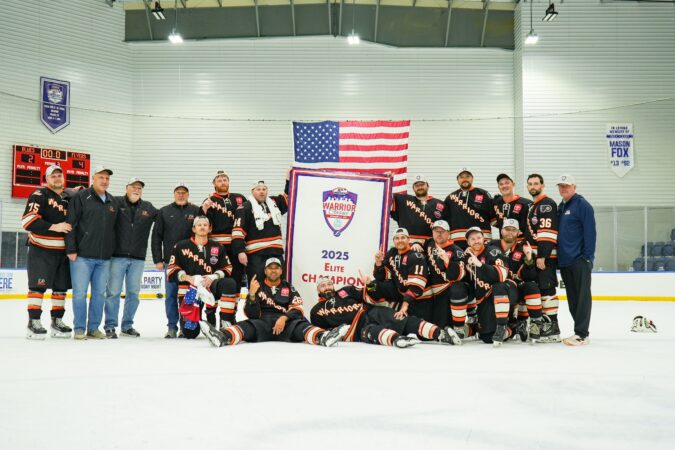
    When one of Duffy’s former captains called him about a veterans hockey program the Flyers were starting six years ago, Duffy, who’d grown up playing goalie, jumped at the opportunity. “No matter where I was at, I was always playing,” he said.

    Duffy is now the president of Flyers Warriors, a hockey program dedicated to providing a supportive community for wounded, injured, or otherwise disabled veterans and their families. The team started with a group of 33 veterans, and now spans five teams, from the elite level with former college and junior players to a learn-to-play program for those just starting out.

    “It is a life-saving type of program, because some of these guys and girls wouldn’t have anything if it wasn’t for us, to be honest with you,” Duffy said.

    Kevin Emore, the vice president of business operations for Flyers Warriors, can attest to its value.

    “When I had my first episode with PTSD after running around the world doing contracting work or being in the military and deploying for the first time, I was surrounded by people on my left and my right that I didn’t know if I could trust,” Emore said. “When I made my way back to the East Coast, the Warriors was the first time that I found it again.”

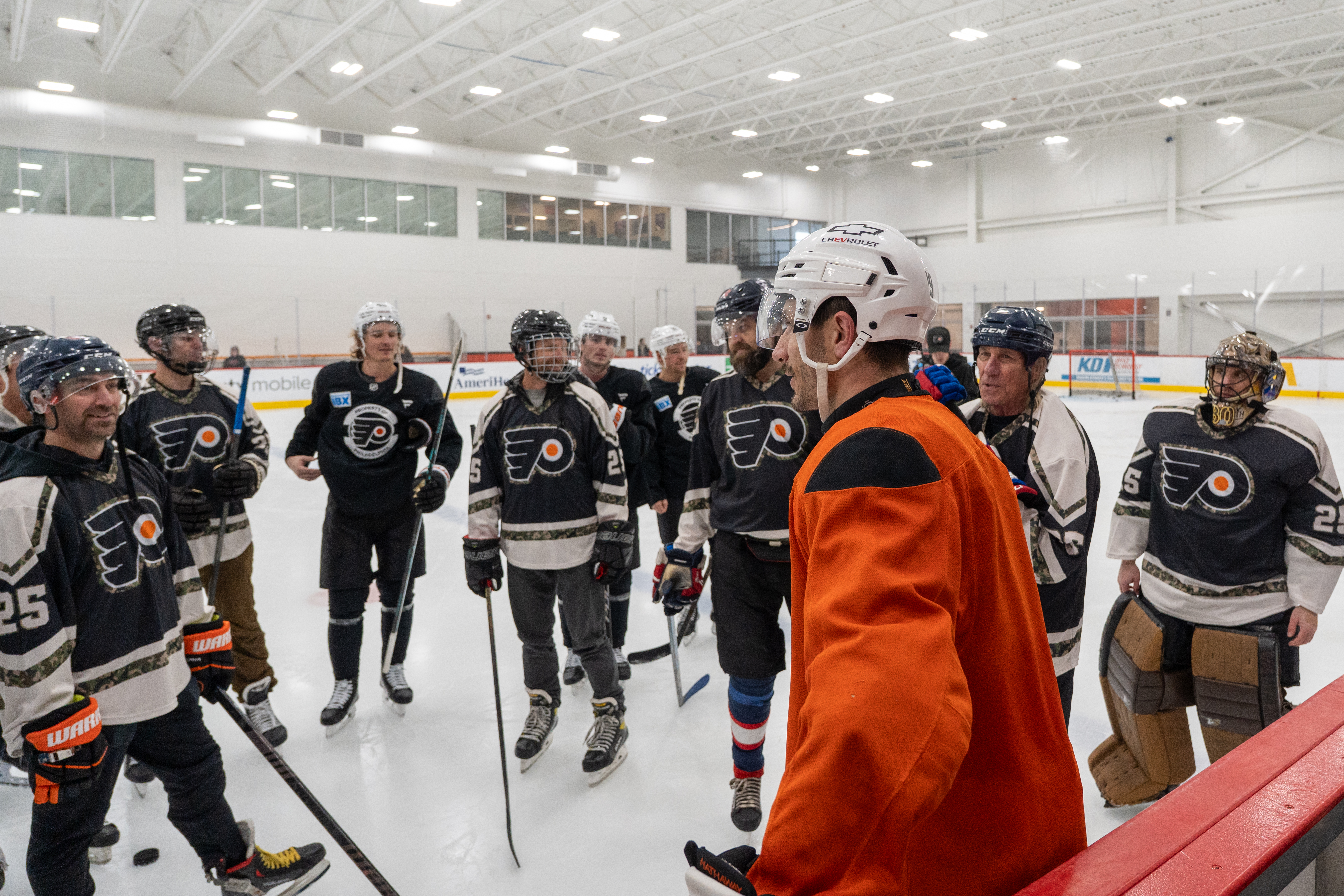
    Flyers’ Garnet Hathaway, a big supporter of military-based charities, took some time to talk with several veterans on the ice on Nov. 11.

    The higher-level teams play tournaments across the country against Warriors teams affiliated with other NHL organizations. To eliminate barriers for all players to get on the ice, they provide childcare for families, and there’s a large community of Warrior Wives.

    But the Flyers Warriors also pride themselves on the community they’ve built off the ice. That extends to social events like their group Thanksgiving dinner and participating in community service.

    “What we realized along the way was veterans are better when we’re serving others,” Duffy said. “If we can create pathways to allow veterans to get back to service, that’s where they’re going to start to feel at home again.”

    That’s where the partnership with the Flyers organization proves helpful. In addition to ice time and support, the Flyers Warriors are active in local philanthropy through various Flyers Charities initiatives. The Flyers Warriors athletes are key volunteers at events like the Gritty 5K and the Flyers Charities Carnival.

    Todd Fedoruk, a former Flyer who played in the NHL from 2000 to 2010, said he too feels like he’s found a second home with the Flyers Warriors. While there are obvious differences between being a military veteran and an NHL veteran, Fedoruk also found similarities to his life after retirement.

    After retiring from pro hockey, where his life was similarly structured with a strict schedule, Fedoruk also found himself searching for who he was aside from a hockey player.

    “There’s a common bond there,” Fedoruk said. “Working with these guys, it does become more [than just] about hockey, because with my own history with mental health and all those other issues that’ve come maybe because of hockey, maybe not because of hockey, but the dynamics of change that happen to a former athlete are very similar.”

    To help veterans make that adjustment, the Flyers Warriors connect their members with mental health services and support. Navigating the services available through the Veterans Affairs office can be a deterrent for those seeking mental healthcare, Emore said. They prioritize connecting their members with behavioral health, addiction, and recovery services.

    The space Duffy and the executive board have built on the ice through Flyers Warriors helped build the foundation of trust for veterans to seek those resources out, all based on their shared love of hockey.

    “It makes me feel proud about the game that I played,” Fedoruk said.