Tag: Republicans

  • Mikie Sherrill supports enshrining N.J.’s existing sanctuary policy into law as immigrant rights groups push for an expanded version

    Mikie Sherrill supports enshrining N.J.’s existing sanctuary policy into law as immigrant rights groups push for an expanded version

    New Jersey Gov. Mikie Sherrill supports cementing the state’s sanctuary state policy into law — as it’s already written.

    The Immigrant Trust Directive, commonly called a sanctuary policy, restricts state law enforcement from cooperating with U.S. Immigration and Customs Enforcement (ICE). Enshrining the policy into law would ensure future governors of either party could not unilaterally take it away. As of now, the directive could be undone with a flick of a pen.

    Immigrant rights groups in New Jersey have pushed for several years to make the policy permanent with a new law, a move they say is increasingly urgent amid President Donald Trump’s immigration crackdown in Minneapolis, which has reverberated across the country. But those activists want to expand protections, which could clash with Sherrill’s approach.

    “Gov. Sherrill supports a bill to codify the directive,” her spokesperson Sean Higgins said. “What she does not support is anything that undermines the ability to defend our protections in court, which puts people at risk.”

    Sherrill has said making changes to the directive while making it law could invite lawsuits and risk the whole policy, which was enacted during Trump’s first presidency and has survived federal judges appointed by both Trump and former President George W. Bush.

    “New Jersey’s directive has already withstood judicial review — and that additional action, if not precise, could undo important protections which we cannot risk under the Trump administration,” Sherrill said during her primary campaign.

    Higgins said those concerns “have not changed.”

    Immigrant rights groups nearly reached the finish line late last year after the state legislature passed a bill that included some of the changes they wanted to make.

    But former Gov. Phil Murphy rejected the bill in his final hours in office. Like Sherrill, he said the policy could be in jeopardy if it changed and could invite lawsuits.

    Amol Sinha, the executive director of ACLU New Jersey, disagrees.

    The bill Murphy vetoed — which Democratic lawmakers have already signaled they will reintroduce in the new session would remove an exception for law enforcement to work with federal immigration authorities on final orders of removal and prohibit law enforcement from providing money to federal immigration authorities.

    Sinha and others who support the bill say those changes would be on solid legal ground. Since the courts previously found federal law does not preempt the state’s immigration policy, and the state has the right to determine where its resources go, he said, he believes Murphy’s veto was overly cautious.

    “We cannot be in a situation where we’re constantly afraid of lawsuits and therefore we don’t pass any laws,” Sinha said. “There is legal risk to every law that passes in New Jersey. You’re going to get sued, and if you don’t want to get sued, then you shouldn’t be in government.”

    Sherrill’s stance on the matter has, at times, been ambiguous.

    After a general election debate in late September, she said she was “going to focus on following the law and the Constitution” when pressed by reporters on whether she would keep the directive in place. In October, she said she supported aspects of the policy but also suggested she wanted to revisit it.

    During the primary contest, her spokesperson said Trump “is changing the rules rapidly” and Sherrill would “address the circumstances as they exist,” but she had also signaled support for keeping the policy.

    Since taking office last week, Sherrill has taken other steps to try to shield the state from ICE. She announced Thursday that her administration plans to launch a state database for New Jerseyans to upload videos of ICE operations in the state after two fatal shootings in Minnesota.

    But the pressure to work with legislators on making the sanctuary directive law remains.

    Assemblymember Balvir Singh, a Burlington County Democrat and cosponsor of the bill Murphy rejected, said part of the urgency is concern over Trump’s threats to withhold federal funding from Democratic-led states over policy disagreements.

    Even though Sherrill has kept the policy in place, a directive carries less weight than a statute backed by two branches of government.

    “Our executive can be put under a tremendous amount of pressure where they have to figure out how they’re going to fund our social services systems that rely on federal funding,” Singh said.

    Just last week, Trump directed federal government agencies to review funding for several Democratic states, including New Jersey, almost all of which were on a list of sanctuary jurisdictions produced by his administration.

    The one exception was Virginia, where new Democratic Gov. Abigail Spanberger rescinded a directive that instructed law enforcement to work with ICE. The previous week, Trump said he planned to cut off federal funding for states with sanctuary cities.

    Singh, whose district includes communities with large immigrant populations, said preserving the seven-year-old policy through law is “the very minimum.”

    ‘I take Gov. Sherrill at her word’

    Sherrill declined to comment on the specifics of the bill that reached Murphy’s desk, and the question will be whether lawmakers are able to enact changes to the current directive or if she will only sign a carbon copy of what already exists.

    The sanctuary bill was one of three pieces of legislation aimed at protecting immigrants that Murphy weighed in his final days in office. He signed one about creating model policies for safe spaces in the state and vetoed another aimed at limiting data collected by government agencies and health centers, citing a “drafting oversight.”

    As she waited anxiously for Murphy’s decisions on the bills earlier this month, Nedia Morsy, the executive director of immigrant advocacy group Make the Road New Jersey, said that New Jersey should not “make policy based on fear” and that immigrants in the state were experiencing a “collective feeling of suffocation.”

    She criticized Murphy’s vetoes, saying legal experts had already vetted the bills.

    Sherrill has repeatedly promised to fight Trump and recently said that ICE agents are “occupying cities, inciting violence, and violating the Constitution” and need to be held accountable “for their lawless actions.”

    Her comments have given some activists hope that she will be willing to work with them.

    And while a single bill cannot stop ICE from sweeping New Jersey communities, Sinha said, the state can “put up safeguards and guardrails” through policies like the ones Murphy rejected.

    “I take Gov. Sherrill at her word that she wants to push back against authoritarianism,” he added, “and to me, that means doing whatever we can to protect immigrants in our state.”

  • Why John Fetterman won’t shut the government down over ICE, even after calling for Kristi Noem’s ouster

    Why John Fetterman won’t shut the government down over ICE, even after calling for Kristi Noem’s ouster

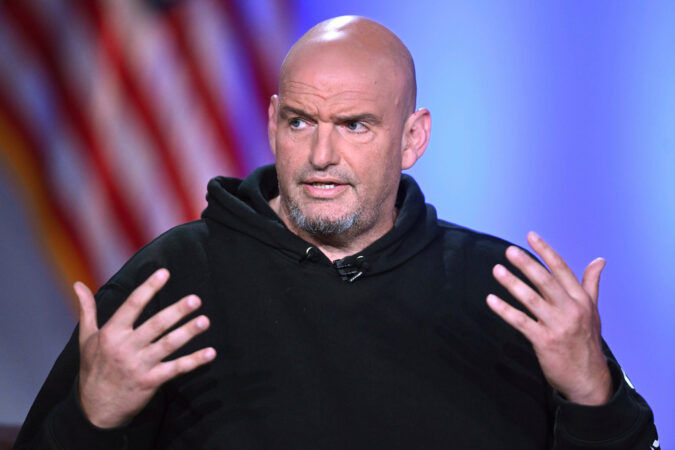
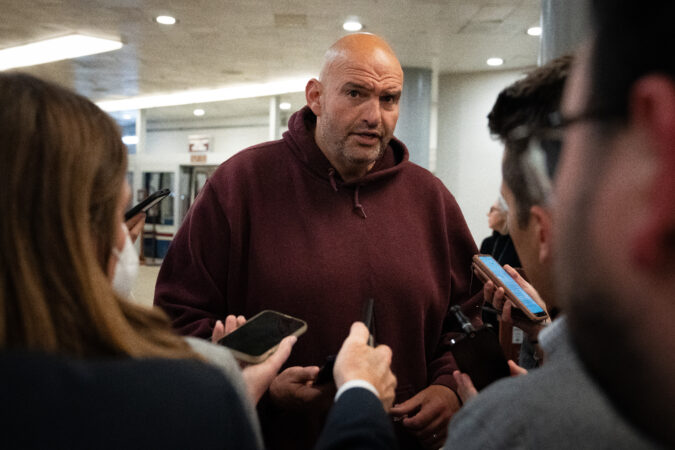
    Sen. John Fetterman hates government shutdowns.

    The Pennsylvania Democrat has never backed a lapse in government funding since he took office in 2023.

    And this aversion does not appear to be changing anytime soon as the country is staring down the possibility of a second shutdown in roughly four months starting at the end of this week. Fetterman is facing public pressure from constituents and fellow Pennsylvania Democrats to join the party’s effort to block funding for the Department of Homeland Security from a government appropriations package in the wake of federal immigration agents shooting and killing two 37-year-olds in Minneapolis this month.

    Blocking the package would set off a partial government shutdown.

    “I will never vote to shut our government down, especially our Defense Department,” Fetterman said in a statement on Monday, which is one of the agencies that is relying on the pending appropriations package.

    Even so, Fetterman thinks that changes are needed to President Donald Trump’s immigration strategy. He urged Trump to fire Homeland Security Secretary Kristi Noem, and he said immigration agents’ presence in Minneapolis needs to “immediately end,” after federal agents shot and killed two Americans this month.

    Fetterman has suggested removing DHS funding from the package under consideration as a compromise, but Senate Republican leaders are unlikely to do that.

    In October, ahead of the longest shutdown in history, he voted for both Democratic and Republican plans to keep the government open.

    If a partial government shutdown kicks off Friday, impacted agencies include the Departments of State, Treasury, Health and Human Services, Transportation, and Housing and Urban Development.

    With a partial government shutdown potentially just days away, here’s what to know about Fetterman’s stance.

    Why won’t Fetterman join Democrats in blocking funding for DHS?

    Senate Democrats have said they won’t support funding for DHS in the wake of the killings of Renee Nicole Good and Alex Pretti this month by federal immigration agents in Minneapolis. DHS oversees U.S. Immigration and Customs Enforcement and the Border Patrol, the two agencies involved in the fatal shootings.

    Democrats have also signaled that they want major reforms to federal agents’ conduct as they carry out Trump’s immigration enforcement agenda.

    Fetterman said this week that he spent “significant time hearing many different positions on the funding bills,” but will still never vote to shut the government down.

    Further, he thinks shutting down the government over U.S. Immigration and Customs Enforcement won’t have much of an impact at all.

    U.S. Immigration and Customs Enforcement and border enforcement operations are still likely to be operational even during a shutdown, CBS News reported. Agents have typically been considered essential employees.

    “A vote to shut our government down will not defund U.S. Immigration and Customs Enforcement,” Fetterman wrote in a statement this week, noting that DHS received $178 billion in funding from the One Big Beautiful Bill Act, which Fetterman opposed.

    Homeland Security Secretary Kristi Noem speaks during a news conference at Federal Emergency Management Agency headquarters, Saturday, Jan. 24, 2026, in Washington.

    Why did Fetterman call for Kristi Noem to be fired?

    On Tuesday, Fetterman made a direct plea to Trump: Fire Noem.

    “Americans have died,“ Fetterman wrote in a post on X. ”She is betraying DHS’s core mission and trashing your border security legacy.”

    The Pennsylvania Democrat also tried to appeal to Trump by criticizing former President Joe Biden’s DHS secretary, Alejandro Mayorkas, saying: “DO NOT make the mistake President Biden made for not firing a grossly incompetent DHS Secretary.”

    An increasing number of lawmakers and advocacy groups have called for Noem’s ouster, including Republican U.S. Sens. Thom Tillis, of North Carolina, and Lisa Murkowski, of Alaska.

    Fetterman had previously joined six other Democrats in voting to confirm Noem’s nomination for DHS secretary last year, including Sen. Andy Kim of New Jersey. (Kim has also called for Noem to be fired).

    What constituents and elected officials are saying

    The pressure on Fetterman from colleagues and constituents appears to be growing.

    Every Democratic member of Pennsylvania’s U.S. House delegation cosigned a letter on Tuesday calling for Fetterman and Sen. Dave McCormick (R, Pa.) to vote against DHS funding, The Inquirer reported.

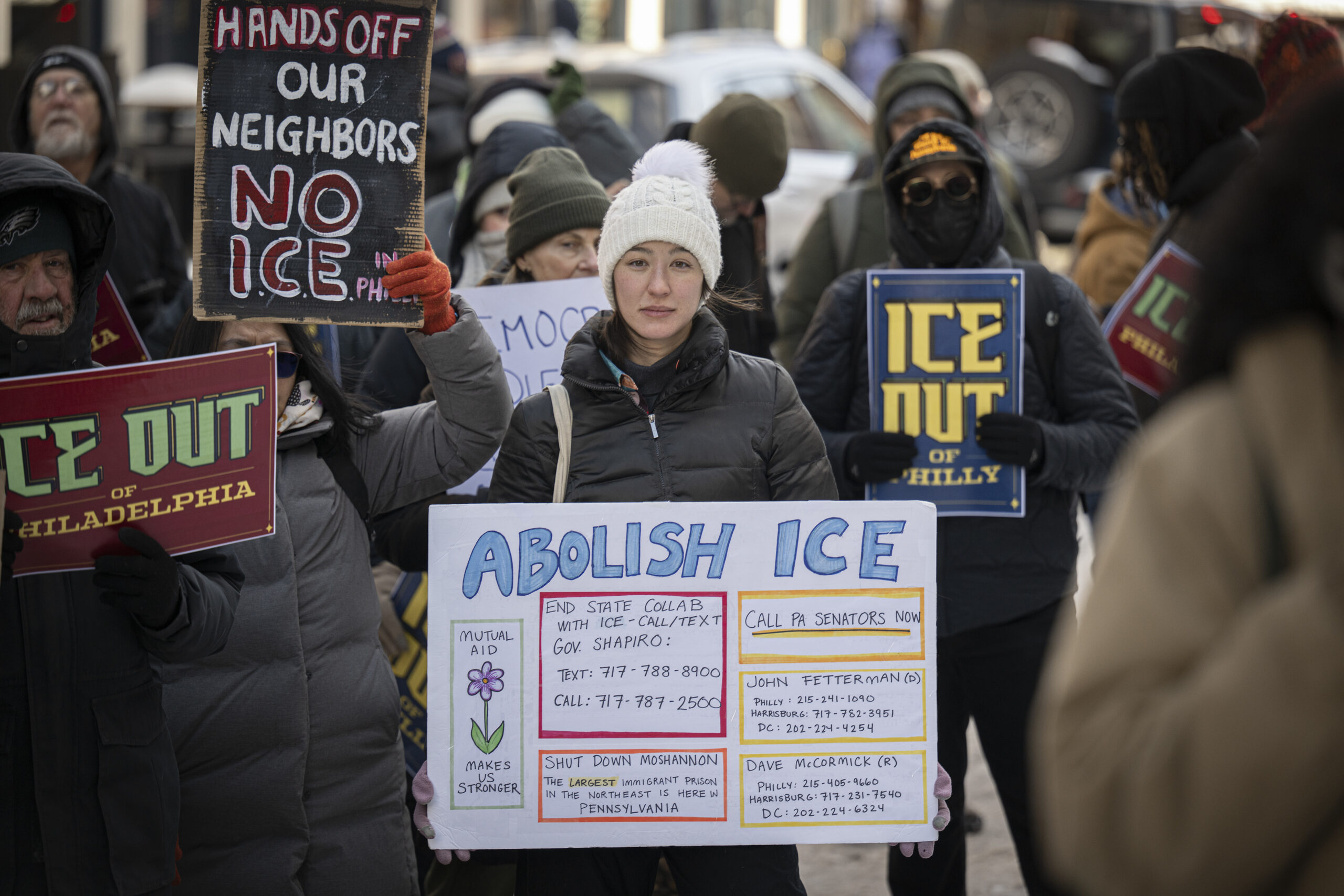
    Anti-ICE activists demonstrate outside U.S. Sen. John Fetterman’s Philadelphia office, Jan. 27, 2026, calling for the Pennsylvania Democrat to vote against DHS funding.

    “We urge you to stand with us in opposing any DHS funding bill that does not include critical reforms,” the lawmakers said in the letter, delivered Tuesday. “We look forward to working together to advance legislation that both keeps our nation secure and upholds our fundamental values.”

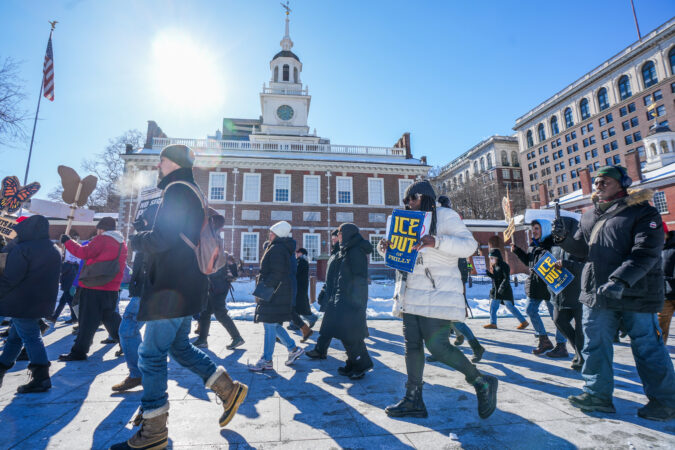
    Meanwhile, around 150 protesters gathered in front of Fetterman’s Philadelphia office in freezing temperatures on Tuesday to urge him to vote against the funding.

    “What do we want? U.S. Immigration and Customs Enforcement out,” the crowd chanted.

  • An ‘America First Patriot’: President Donald Trump endorses Stacy Garrity for Pennsylvania governor

    An ‘America First Patriot’: President Donald Trump endorses Stacy Garrity for Pennsylvania governor

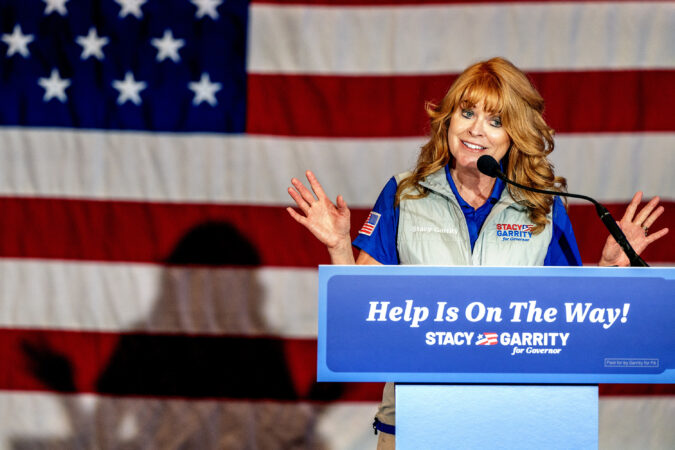
    President Donald Trump endorsed Pennsylvania Treasurer Stacy Garrity for governor Tuesday evening, awarding her the coveted nod from the leader of the Republican Party as she tries to unseat the popular Democratic incumbent Gov. Josh Shapiro in November.

    The Trump endorsement comes as Shapiro is on a national media blitz to advertise his memoir, released this week — and as he seeks to broaden his national reach amid his rumored 2028 presidential aspirations.

    The nod also comes as Trump faces declining approval ratings and increased scrutiny over his administration’s use of U.S. Immigration and Customs Enforcement in Minneapolis following a second killing of an American citizen by federal immigration agents. Shapiro, during his media appearances, has been an outspoken critic of Trump over ICE’s presence in Minneapolis, saying the agency’s mission is “broken” and “must be terminated.”

    In a post on his Truth Social platform, Trump declared Garrity “WILL NOT LET YOU DOWN” and stated that as governor, she would work to grow the economy, strengthen the military, keep borders secure, and safeguard elections, among other priorities.

    “Stacy is a true America First Patriot, who has been with me from the beginning,” Trump wrote.

    Garrity, the state’s second-term treasurer, has led the low-profile office without controversy and boasts that her staff has blocked nearly $2 billion in improper payments. The retired U.S. Army colonel in 2024 broke the record for highest number of votes received in a state-level race in Pennsylvania, and she quickly earned the support of the state party establishment last year.

    In a statement Tuesday, Garrity said she was honored to receive Trump’s endorsement, adding that the president has “been a voice for hardworking Americans who have been left behind.”

    “Josh Shapiro is President Trump’s number one adversary, and I am looking forward to working with President Trump and his team to defeat Josh Shapiro this November,” Garrity said.

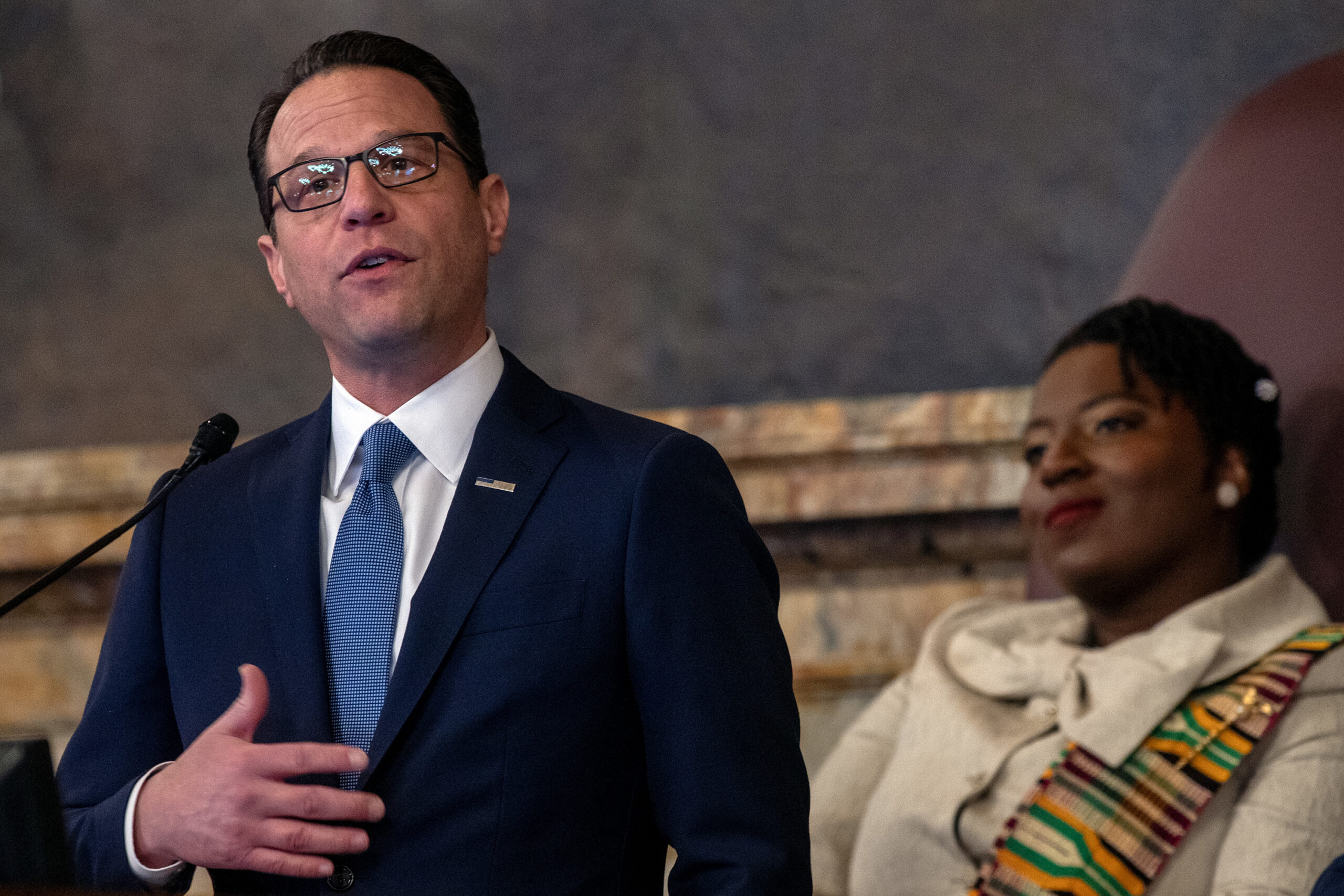
    At right is Pennsylvania Governor Josh Shapiro listening to Stacy Garrity, 78th State Treasurer, Forum Auditorium, Harrisburg, Pa., Tuesday, Jan. 21, 2025.

    Garrity is a longtime Trump supporter from rural Bradford County, who in 2022 at a Trump rally repeated his false claim that he won the 2020 presidential election — a position she has since walked back, telling reporters earlier this month that she had gotten carried away in the moment when she said that.

    Last summer, Trump said he would support another potential candidate — U.S. Rep. Dan Meuser (R., Pa.) — if he ran. Weeks later, the Northeast Pennsylvania Republican declined to run and announced he would seek a fourth term in Congress instead. Meuser quickly endorsed Garrity once she formally joined the race, and she continues to capture more GOP officials’ endorsements as Pennsylvania’s May 19 primary election inches closer.

    Garrity is currently running unopposed as the Republican candidate for governor, after State Sen. Doug Mastriano announced he would not run again this year after losing by nearly 15 percentage points to Shapiro in 2022. However, Garrity has yet to announce who she wants as her running mate for lieutenant governor, with largely far-right conservatives — including Mastriano — interested in the job.

    Still, Trump’s endorsement of Garrity could draw needed eyes and checkbooks to her campaign, as her fundraising in the early months of the race has lagged far behind the $30 million war chest Shapiro has amassed over the last few years. Earlier this month, Garrity announced that her campaign had raised nearly $1.5 million from August through December.

    Republicans are hopeful that Garrity can drive enough enthusiasm at the top of the state ticket to motivate GOP voters to come out to vote throughout Pennsylvania, boosting candidates up and down the ballot in a year where control of Pennsylvania’s General Assembly and the U.S. House of Representatives is on the line.

    Meanwhile Democrats, hopeful to build on anti-Trump sentiment that drove their wins last year, quickly seized on Trump’s endorsement as an opportunity to tie Garrity to the president.

    “Pennsylvanians deserve better than a Governor who is nothing more than a rubber stamp for Trump’s chaos and higher costs, and that’s why she will be soundly rejected this November,” Pennsylvania Democratic Party chair Eugene DePasquale said in a statement.

  • ICE tactics in Minneapolis set off political firestorm from Philadelphia City Hall to Washington

    ICE tactics in Minneapolis set off political firestorm from Philadelphia City Hall to Washington

    In Philadelphia, lawmakers on Tuesday unveiled legislation that would institute some of the nation’s toughest limits on federal immigration-enforcement operations.

    In Harrisburg, a top Democrat floated making Pennsylvania a so-called sanctuary state to protect undocumented immigrants.

    And in Washington, senators faced mounting pressure to hold up funding for the Department of Homeland Security, an effort that could result in a government shutdown by the end of the week.

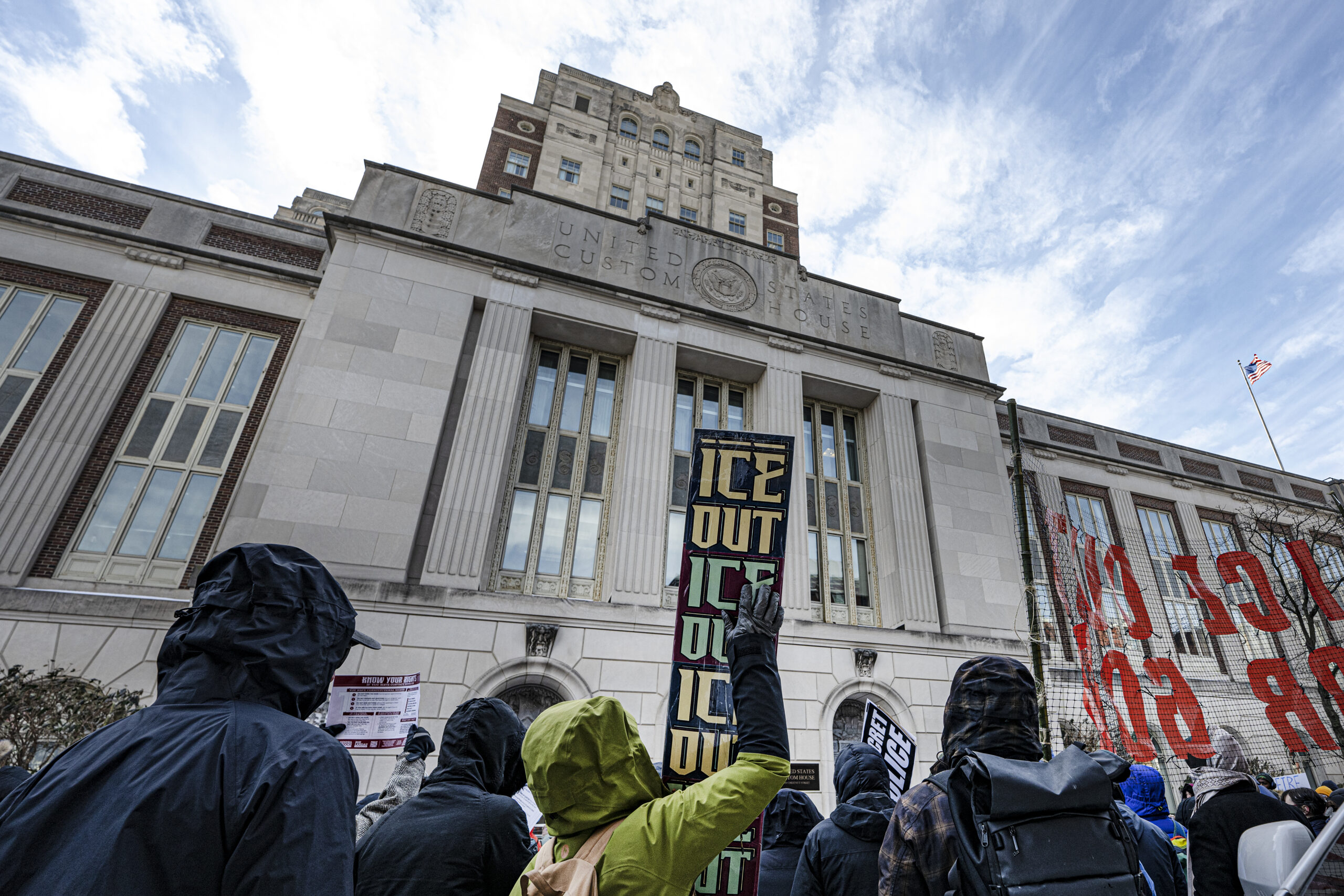
    Across the nation, lawmakers are fielding calls to rein in U.S. Immigration and Customs Enforcement after President Donald Trump’s administration surged forces into Minneapolis as part of his aggressive nationwide deportation campaign. Frustration with the agency reached new heights Saturday after agents fatally shot protester Alex Pretti, the second killing of a U.S. citizen there this month.

    Democrats nationwide slammed ICE and called on Trump to pull the forces out of Minnesota. Sen. John Fetterman, the Pennsylvania Democrat who has at times sided with Trump on immigration matters, said DHS Secretary Kristi Noem should be fired.

    Anti-ICE activists demonstrate outside U.S. Sen. John Fetterman’s Philadelphia office on Monday, calling for an end to federal immigration enforcement policies.

    But Fetterman has also said he will not vote to shut down the government. That angered protesters, who rallied on Tuesday outside his Philadelphia office. Some of the senator’s fellow Democrats, including members of Pennsylvania’s U.S. House delegation, urged him to vote against a bill to fund DHS.

    A growing number of Republicans have also signaled their discomfort with the Minneapolis operation, including Trump allies who called on members of the administration to testify before Congress. Sen. Dave McCormick, a Pennsylvania Republican, has called for an independent investigation into Pretti’s killing.

    Trump, for his part, showed some willingness to change course, sending border czar Tom Homan to Minneapolis to meet with Democratic leaders there. The president on Tuesday called Pretti’s death a “very sad situation.”

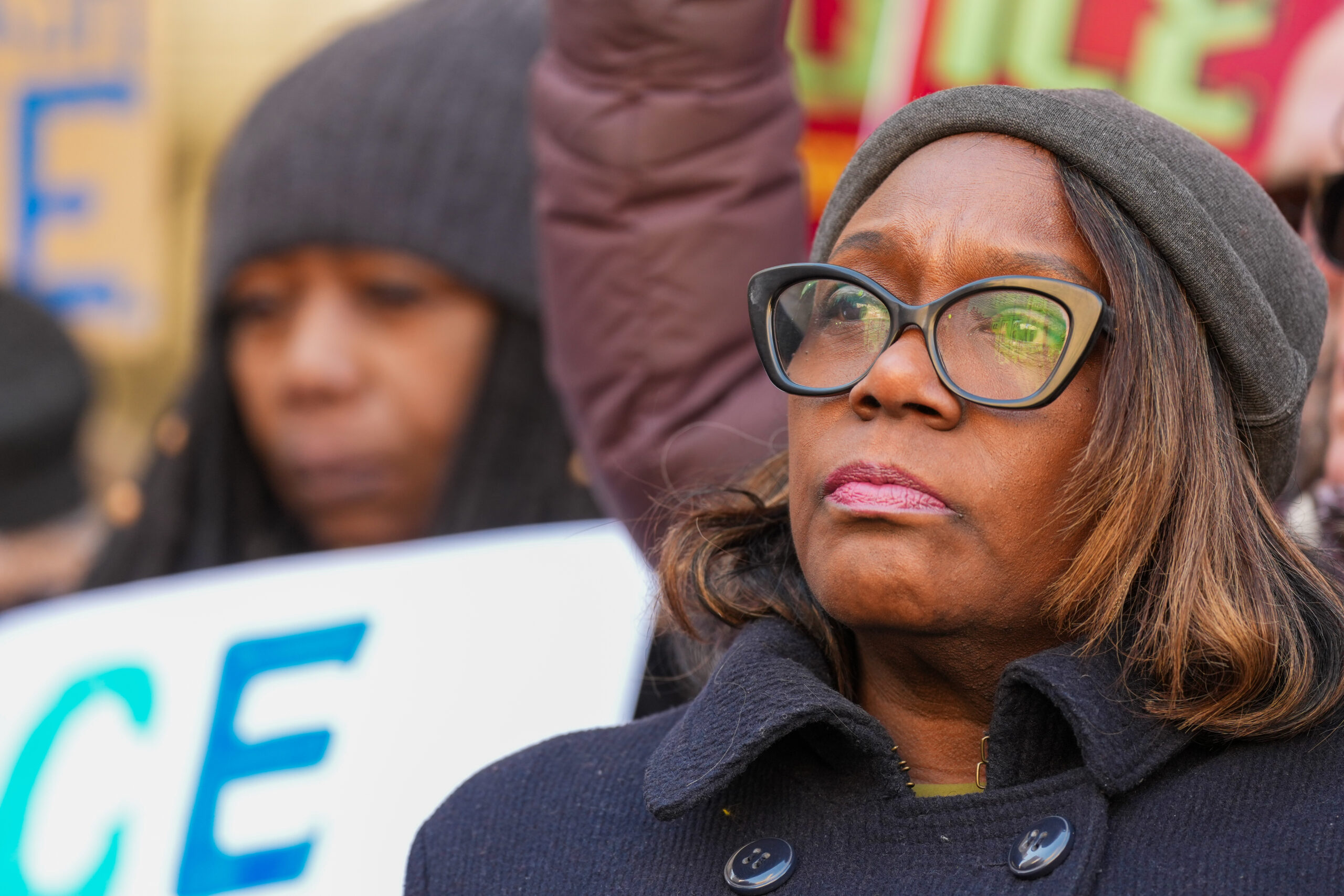
    Rue Landau shown here during a press conference at City Hall to announce a package of bills aimed at pushing back against ICE enforcement in Philadelphia on Tuesday.

    However, a chorus of Democrats and activists said Tuesday that the agency needs to change its tactics and be held accountable for missteps. And local leaders said they are laying out plans in case a surge of immigration enforcement comes to Philadelphia, home to an estimated 76,000 undocumented immigrants.

    “We have spent hours and hours and hours doing tabletop exercises to prepare for it,” Gov. Josh Shapiro, a Democrat, said during a Monday night interview on The Late Show with Stephen Colbert.

    Shapiro, who is running for reelection and is a rumored presidential contender, added: “I want the good people of Pennsylvania to know — I want the American people to know — that we will do everything in our power to protect them from the federal overreach.”

    Codifying sanctuary policies

    Philadelphia officials said the best way they can prepare is by limiting the city’s cooperation with federal immigration enforcement.

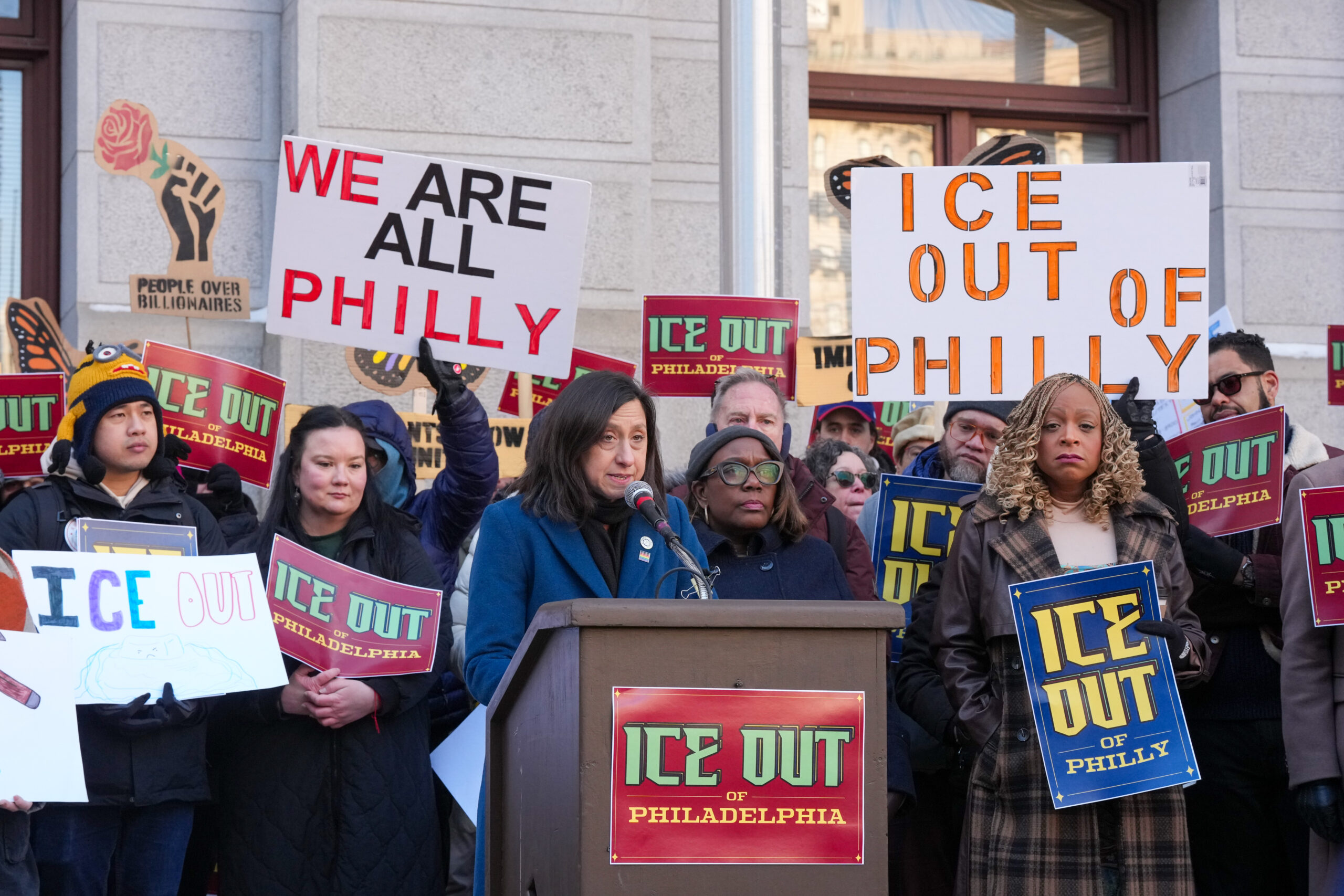
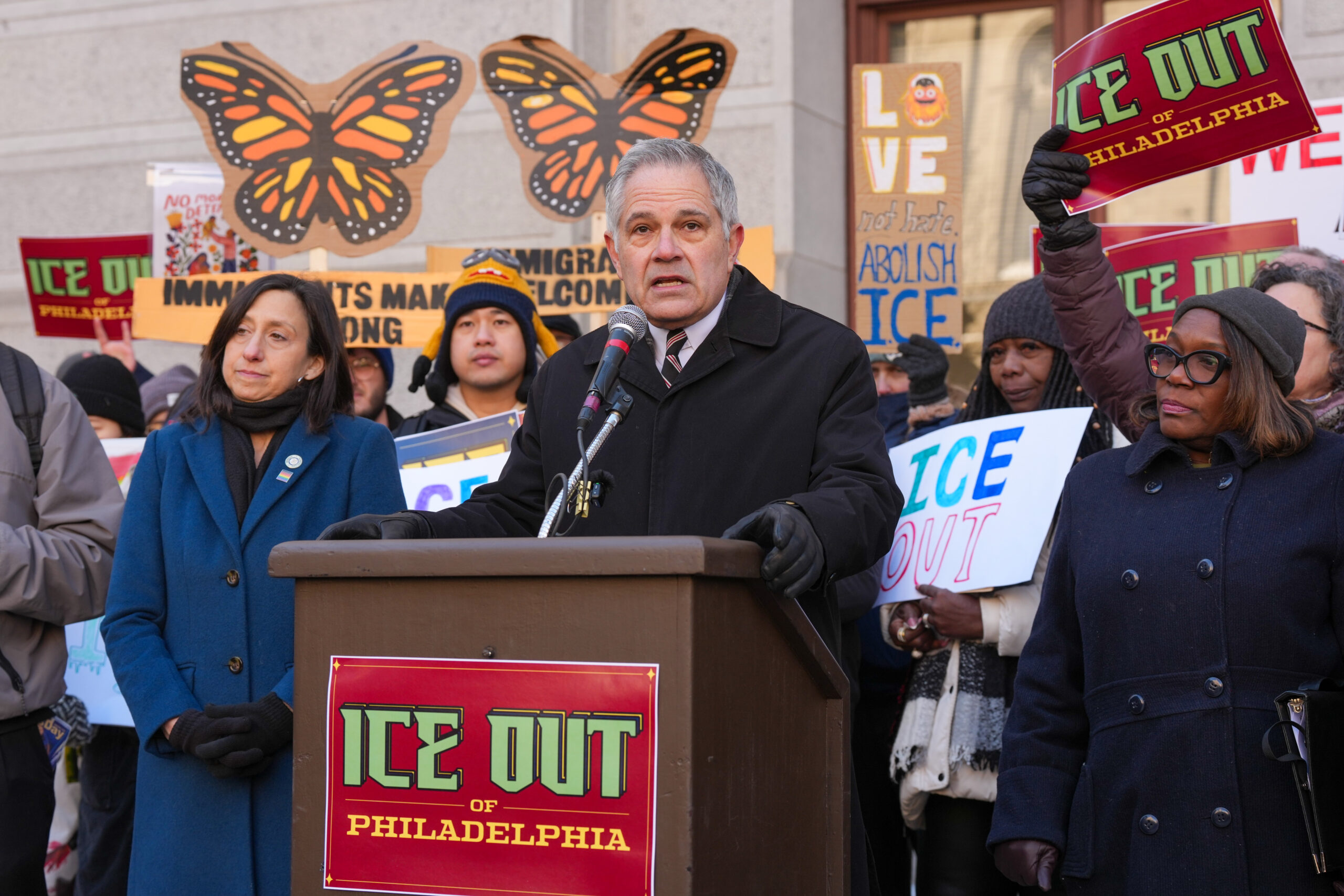
    City Councilmember Kendra Brooks, of the progressive Working Families Party, and Councilmember Rue Landau, a Democrat, were joined by dozens of activists and other elected officials during a news conference Tuesday to unveil a package of legislation aimed at codifying into law the city’s existing “sanctuary city” practices.

    Those policies, which are currently executive orders, bar city officials from holding undocumented immigrants in custody at ICE’s request without a judicial warrant.

    Landau and Brooks’ legislative package, expected to be introduced in Council on Thursday, goes further, preventing ICE agents from wearing masks, using city-owned property for staging raids, or accessing city databases.

    Erika Guadalupe Núñez, executive director of immigrant advocacy organization Juntos, said the legislation “goes beyond just ‘We don’t collaborate.’”

    Juntos gets regular calls about ICE staging operations at public locations in and around Philadelphia, and people have been worried, despite official assurances, whether personal information held by the city will be secure from government prying.

    “We deserve a city that has elected leadership that’s willing to step forward with clear and stronger protections,” Núñez said.

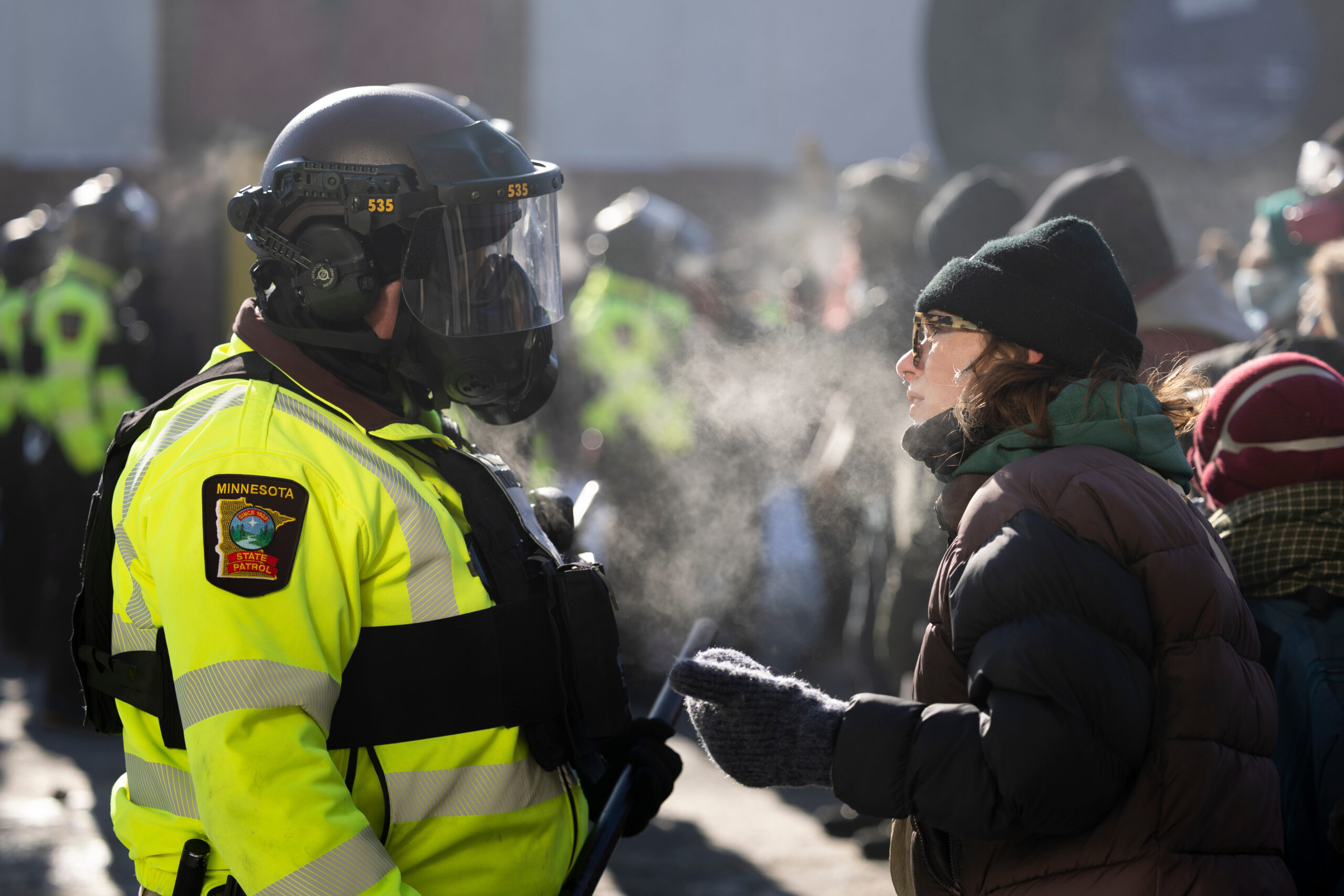
    A protester speaks to a Minnesota State Patrol officer near the site of the fatal shooting of 37-year-old Alex Pretti by federal agents in Minneapolis on Saturday.

    If the legislation is approved, Philadelphia would have some of the most stringent protections for immigrants in the country.

    Oregon has especially strong restrictions against cooperation with federal immigration authorities, including barring local law enforcement from detaining people or collecting information on a person’s immigration status without a judicial warrant.

    In Illinois, local officers “may not participate, support, or assist in any capacity with an immigration agent’s enforcement operations.” They are also barred from granting immigration agents access to electronic databases or to anyone in custody.

    California, New York, Colorado, Vermont — and individual jurisdictions in those states — also provide strong protections for immigrants.

    In New Jersey, Gov. Mikie Sherrill, a Democrat who was sworn in last week, has kept the state’s sanctuary directive in place as lawmakers seek to expand and codify the policy into law. Legislators came close in the final days of former Gov. Phil Murphy’s administration, but he killed a related bill that had won approval in Trenton, saying he worried that enacting a law that included changes to the state’s current policy would invite new lawsuits.

    Meanwhile, some conservatives say bolstering sanctuary policies risks community safety.

    “If an illegal immigrant breaks the law, they should be dealt with and handed over to federal law enforcement, not be released back into our neighborhoods to terrorize more victims and commit more crime,” said James Markley, a spokesperson for the Pennsylvania Republican Party.

    He added: “Sanctuary policies don’t protect communities, they endanger all of us by shielding criminals from accountability for their crimes.”

    Democrats are taking varying approaches

    The widespread outrage over ICE’s tactics in Minneapolis has exposed sharp divisions in elected Democrats’ responses.

    On one end of the party’s ideological spectrum is Fetterman, who has said often that he will not bow to activist demands and strongly opposes shutting down the federal government, even if it means funding DHS.

    On the other end is District Attorney Larry Krasner, Philadelphia’s most prominent progressive, who has on several occasions threatened to file criminal charges against ICE agents who commit crimes in the city.

    “There will be accountability now. There will be accountability in the future. There will be accountability after [Trump] is out of office,” Krasner said Tuesday. “If we have to hunt you down the way they hunted down Nazis for decades, we will find your identities.”

    District Attorney Larry Krasner speaks during a news conference at City Hall on Tuesday to announce a package of bills aimed at pushing back against ICE enforcement in Philadelphia.

    Somewhere in the middle is State Sen. Sharif Street, a Philadelphia Democrat and former head of the state party who is running for Congress.

    Street does not have Krasner’s bombast, but this week he announced plans to introduce legislation to prevent state dollars from funding federal immigration enforcement. The bill has less of a chance of becoming law in Pennsylvania’s divided state legislature than similar measures would in Philadelphia, where City Council is controlled by a supermajority of Democrats.

    “Who knows the amount of money that the state could incur because of Trump’s reckless immigration policies?” Street said in an interview Tuesday. “I don’t think state taxpayers should be paying for Donald Trump’s racist, reckless policies.”

    The city’s most prominent Democrat — Mayor Cherelle L. Parker — has perhaps said the least.

    The centrist Democrat has largely avoided outwardly criticizing Trump or his administration, saying often that she is focused on carrying out her own agenda.

    The mayor’s critics have said her approach is not responsive to the city’s overwhelmingly Democratic residents.

    “To the people of Philadelphia, I want to say: I hear you. You want ICE out of our city, and you want your local government to take action,” Brooks, the Council member, said Tuesday. “Some people believe that silence is the best policy when dealing with a bully, but that’s never been an option for me.”

    Kendra Brooks shown here during a news conference at City Hall on Tuesday to announce a package of bills aimed at pushing back against ICE enforcement in Philadelphia.

    Others say Parker’s conflict-averse strategy is appropriate.

    “All of us have different roles to play,” Street said. “The mayor has to manage the city. She’s got to command law enforcement forces. … As a state legislator, we make policy.”

    Rafael Mangual, a fellow who studies urban crime and justice at the right-leaning Manhattan Institute in New York City, said legislative efforts to erect barriers between federal and local law enforcement could backfire.

    “If you don’t engage at all, and you do something that seems to actively frustrate the federal government,” Mangual said, “that would seem to be an invitation for the federal government to prioritize a city like Philadelphia.”

    Staff writers Alfred Lubrano, Aliya Schneider, and Gillian McGoldrick contributed to this article.

  • John Fetterman urges Trump to fire Kristi Noem as DHS secretary: ‘Americans have died’

    John Fetterman urges Trump to fire Kristi Noem as DHS secretary: ‘Americans have died’

    Sen. John Fetterman on Tuesday urged President Donald Trump “to immediately fire” Homeland Security Secretary Kristi Noem after federal agents killed two citizens in Minneapolis this month during an immigration enforcement operation.

    “Americans have died,” Fetterman (D., Pa.) said in a statement. “She is betraying DHS’s core mission and trashing your border security legacy.”

    The senator’s call for Noem’s firing comes after federal agents killed two Americans during the Minneapolis operation. On Saturday, a Border Patrol agent shot and killed Alex Pretti, an intensive care nurse at a VA hospital. An ICE agent shot and killed Renee Nicole Good, a 37-year-old poet and mother, on Jan. 7.

    Both shootings were caught on video, provoking protests nationwide.

    Fetterman referenced Noem’s predecessor, Alejandro Mayorkas, who served under former President Joe Biden and faced impeachment by the Republican-led House in 2024 amid a backlash over increased border crossings under Biden.

    “DO NOT make the mistake President Biden made for not firing a grossly incompetent DHS Secretary,” said Fetterman, who was one of seven Democrats who voted for Noem’s confirmation last year.

    Sen. Andy Kim (D., N.J.), who also voted for Noem, joined the growing chorus of Democrats calling for Noem to step down on Tuesday. The South Jersey lawmaker has previously called the vote a mistake.

    Fetterman’s plea to fire Noem comes a day after he called for the withdrawal of federal agents from Minneapolis. And it comes as the U.S. Senate is poised to vote this week on funding for the Department of Homeland Security, which oversees both ICE and the Border Patrol.

    Senate Minority Leader Chuck Schumer said Democrats would vote against it, which could trigger a partial federal government shutdown.

    About 150 protesters gathered outside Fetterman’s office in Philadelphia in the snow on Tuesday to urge him to join the effort, but the senator said on Monday that he will never vote to shut down the government. He also argued that doing so would not pull the $178 billion dedicated to DHS through the One Big Beautiful Bill Act, which he did not support.

    “I would like him to listen and actually represent us, because that’s his job,” said James Pierson, 42, an Exton resident attending the demonstration.

    Fetterman suggested pulling the DHS bill from the package of bills under consideration by the Senate this week rather than another shutdown vote.

    “I reject the calls to defund or abolish ICE,” he said. “I strongly disagree with many strategies and practices ICE deployed in Minneapolis, and believe that must change.”

  • Joanna McClinton has carefully wielded her power as Pa. House speaker. Now she’s speaking out for home care workers.

    Joanna McClinton has carefully wielded her power as Pa. House speaker. Now she’s speaking out for home care workers.

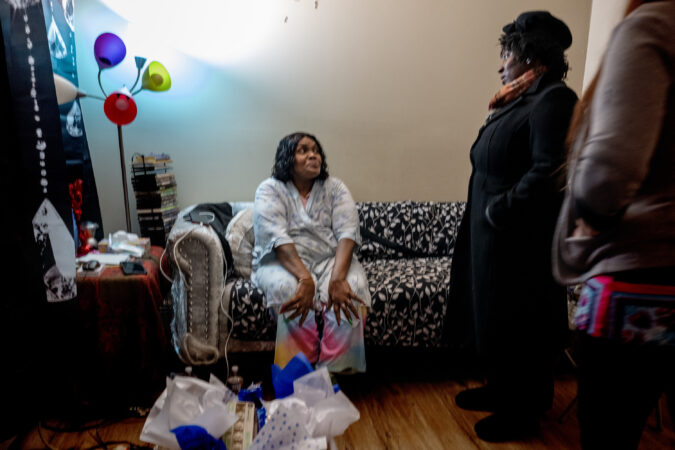
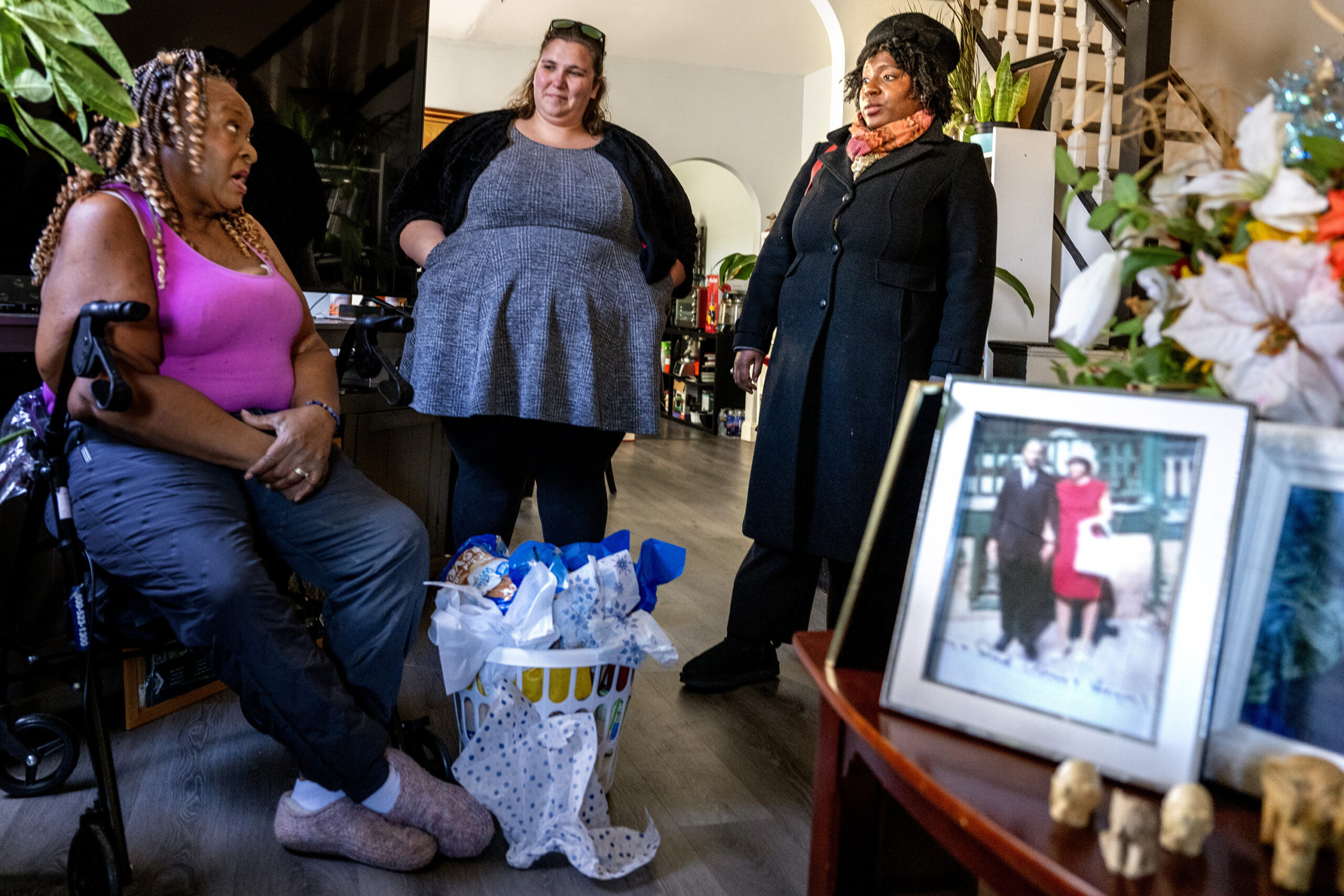
    On a below-freezing day in January, Pennsylvania House Speaker Joanna McClinton delivered food to a West Philly home just minutes from her district office and listened as Sheila Alexander discussed the patchwork of care she has created for herself.

    Alexander, 67, who struggles to get around on her own, explained that she depends on family often but uses a Medicaid-funded home health aide who helps her in the evening — especially when she needs to get up the steep stairs in her home.

    McClinton is advocating for the aides who care for Alexander — and the rest of the roughly 270,000 Pennsylvania workers who make up the home care industry — to earn a higher wage.

    Pennsylvania’s home healthcare workers are among the lowest-paid in the region at an average $16.50 per hour, resulting in what the Pennsylvania Homecare Association has called a crisis point for home care, as more and more workers leave the field and seniors struggle to find help. And it’s a crisis that may only deepen in future years, as one in three Pennsylvanians are projected to be 60 or older by 2030.

    It’s an issue that McClinton, a Philadelphia Democrat who became House speaker in 2023 when her party took a one-seat majority, has had to contend with in her own life.

    McClinton’s 78-year-old mother lost one of her favorite aides because of low pay, she said. The aide had cared for McClinton’s mother for a year, until the aide’s daughter got a job at McDonald’s that paid $3 more an hour. At that point, McClinton said, her mother’s aide realized just how low her pay was.

    House Speaker Joanna McClinton (center) with her staff member Nicole Reigelman (left) and home care worker Kate McNaughton (right) wait to meet with home care recipient Ronda Gay on Jan. 20 in her West Philadelphia home. McNaughton was bringing a basket of milk, eggs, canned foods, and other necessities.

    McClinton said she helps her mother when she can, but she only has so many hours in the day and needs assistance when she’s at the Capitol.

    “Many of my colleagues are just like myself, supporting parents who are aging and trying to make sure that they have all the necessities so that when I’m in Harrisburg I’m not thinking, ‘Oh, my God, how’s my mom going to eat or how’s she going to have a bath,’” McClinton said. “It’s because of home health aides and the folks assigned to her that she’s able to thrive. But she’s not unique.”

    Until recently, McClinton had taken a more hands-off approach compared with some previous House speakers who would use their position as the top official to push through their personal agendas. Now, she is taking a more active role in pushing for the issues she cares about most, with special attention to the home care wage crisis.

    Home care workers are often paid through Medicaid, which provides health services to low-income and disabled Americans and is administered at the state level. Pennsylvania has not increased how much it reimburses home care agencies, resulting in all of the surrounding states paying higher wages to home care workers, including GOP-controlled West Virginia and Ohio.

    Describing her leadership approach with a slim majority as “pragmatic,” McClinton says her goal is to find common ground to raise the wages for home healthcare workers between Republicans and Democrats, on an issue that impacts residents across all corners of the state.

    “We just have to really coalesce and build a movement so that we see things get better and that there’s more care,” she said. “Because when there’s more care, there’s less hospitalization, there’s less ER trips, there’s more nutrition.”

    Better pay at Sheetz

    Stakeholders recount dozens of similar stories of aides leaving to work at amusement parks, Sheetz stores, or fast-food restaurants because the pay is better. What’s more: Some home health aides will choose to work in a nearby state where wages are all higher than those paid in Pennsylvania.

    Cathy Creevey, a home health aide who works for Bayada in Philly, made $6.25 when she started working in the field nearly 25 years ago. Now, she makes just $13.50. She has watched countless colleagues quit to take higher-paying jobs elsewhere, resulting in missed shifts and seniors that go without the care they need.

    “We have patients that are 103, 105, and when that aide doesn’t show up their whole world is turned upside down because sometimes we’re the only people that they see to come in, to feed them, to bathe them,” Creevey said.

    While Creevey said she stays in the work because she cares about her patients, she said the long hours and low pay are difficult.

    Fewer and fewer people being willing to take on the jobs means seniors going without care or being forced into already understaffed nursing homes throughout the state.

    “Participants are waiting for care that isn’t coming,” said Mia Haney, the CEO of the Pennsylvania Homecare Association.

    Haney said she hoped McClinton’s advocacy will help drive the issue heading into the next budget season.

    “She has a wonderful opportunity to really influence her peers, but also raise awareness and education about how meaningful and critical these services are,” Haney said.

    In addition to McClinton’s advocacy, 69 House Democrats sent a letter to Gov. Josh Shapiro earlier this month, calling for more funding for the struggling industry just as Shapiro is set to make his 2026-27 budget proposal next month.

    Older Pennsylvanians prefer to “age in place,” or stay in their homes where they remain connected to their communities, said Kevin Hancock, who led the creation of a statewide 10-year strategic plan to improve care for the state’s rapidly aging population.

    “Nursing facilities and hospital services get a lot of attention in the space of older adult services, but it’s home care that really is the most significant service in Pennsylvania,” Hancock said. “The fact that it doesn’t seem to warrant the same type of attention and same type of focus is pretty problematic.”

    House Speaker Joanna McClinton (right) meets with home care worker Rachael Gleisner (center) and home care recipient Sheila Alexander in her West Philadelphia home on Jan. 20.

    Home care remains popular in Pa.

    The fight to increase dollars for home care workers has been an uphill battle in Harrisburg even with the speaker’s support.

    More Medicaid dollars go to home care services than any other program in Pennsylvania due to its popularity among Medicaid recipients, Hancock said. Meanwhile, its critical care workers — a majority of whom are women or women of color — still make low wages for often physically and emotionally demanding work.

    A study by the Pennsylvania Department of Human Services last year determined that a 23% increase would be necessary for agencies to offer competitive wages, but the state’s final budget deal did not include it. (The final budget deal did provide increases to direct aides hired by patients, which represent about 6% of all home care workers in the state.)

    Home care agencies are asking Shapiro to include a 13% reimbursement rate increase in the 2026-27 budget, which equates to a $512 million increase for the year. The 13% ask, Haney said, was a “reasonable and fair” first step in what would need to be a phased approach to reaching competitive wages.

    But neither Shapiro nor Senate GOP leadership has committed to any increases in the forthcoming budget.

    Pennsylvania House Speaker Joanna McClinton listens as Gov. Josh Shapiro delivers his budget address to a joint session of the state House and Senate at the State Capitol on Feb. 4, 2025.

    In a statement, a spokesperson for Shapiro said the governor understood the need and cited his support for limited increases in last year’s budget and for a proposed statewide minimum wage increase to $15 per hour. (Previous efforts by the Democratic House to increase the state’s minimum wage have stalled in the GOP-controlled Senate.)

    Senate Majority Leader Joe Pittman (R., Indiana) said his caucus will put the state’s “future financial stability” before all else. Pennsylvania is expected to spend more than it brings in in revenue this year, setting the stage for yet another tense budget fight.

    “While we’ve seen Democrats continually push for more spending within the state budget year after year, any increases require thoughtful consideration as to the impact on hardworking taxpayers of Pennsylvania,” Pittman added.

    Senate Majority Leader Joe Pittman, a Republican from Indiana County, is joined by other GOP Senate leaders criticizing Gov. Josh Shapiro’s proposed budget last year.

    McClinton, however, was cautiously optimistic that something could be done this year, even as she placed the onus on Senate Republicans, rather than Shapiro.

    “We’ve seen Republicans refusing to work, refusing to resolve issues, that’s not acceptable,” McClinton said. “I’ve seen an unwillingness from Republicans to resolve these issues.”

    Republicans, she said, should come to the table because staffing shortages harmed their constituents in rural Pennsylvania even more than it harmed hers in Philly.

    “We have to get our heads around the fact that we have the lowest reimbursement rates in our area,” McClinton said in an interview after visiting two patients in her district. “We have to make the investment now. We have lots of needs. We have lots of priorities, but we can balance them.”

  • Chester County poll book problems on Election Day were due to human error, insufficient oversight, report finds

    Chester County poll book problems on Election Day were due to human error, insufficient oversight, report finds

    Independent and unaffiliated voters were left off Chester County’s poll books in November’s election due to human error exacerbated by insufficient training, poor oversight and staffing challenges in the county office, an independent firm has concluded.

    In November, more than 12,000 Chester County voters were forced to vote by provisional ballot after the county included just registered Democrats and Republicans in the poll books for the general election. Every voter who wanted to was able to cast a ballot, county officials said, but it resulted in a chaotic scene and the county had to issue an unusually high number of provisional ballots — which require more steps to cast and count.

    On Thursday, the county released a 24-page report from a West Chester law firm detailing how the county failed to include more than 75,000 registered voters in its general election poll books, and evaluating the state and county’s response as it scrambled to ensure those voters could cast ballots.

    “Importantly, our investigation found no evidence of intentional wrongdoing, misconduct, or bad faith on the part of any of the employees who generated the Poll Books. The error was inadvertent and occurred in the course of performing assigned duties under significant time constraints,” the report, prepared by Fleck, Eckert, Klein and McGarry LLC, said.

    “Though the initial selection constituted a human error, the investigation found that the error occurred within a system lacking in: (i) sufficient safeguards, (ii) training, (iii) sufficient supervision, and; (iv) verification controls,” investigators added.

    What’s next in Chester County?

    The firm’s report detailed more than a dozen recommended steps for the county and Department of State to take to prevent future errors.

    In an action plan released Thursday, Chester County officials said they intend to abide by the vast majority of those recommendations, as well as additional steps identified by the county’s Chief Experience Officer.

    Chester County Chief Executive Officer David Byerman said in a statement that the recommendations would be completed within a year, with the most critical steps coming ahead of May’s primary election.

    The action plan included improved training and more strenuous review processes, reevaluation of Voter Services staff levels and pay, and a review of human resources policies in the department. It did not include personnel changes within its Voter Services Department.

    The 25-person department has faced unusually high turnover among staff in recent years, losing 29 employees to resignations, firings and transfers since the current director, Karen Barsoum, took over in 2021.

    Barsoum has faced allegations of fostering a toxic work environment, which Thursday’s report acknowledged. However, the firm concluded that those complaints were not connected to the poll book error and said in its report that employees directly connected to the poll book blunder spoke positively about department management.

    “Moreover, the various causes of the Poll Book issue that we have identified do not appear to have any causal nexus with the types of concerns raised,” the report said.

    How did the error happen?

    According to the report, two employees inadvertently chose the wrong selection of Chester County voters when they used the statewide voter roll software to create November’s poll books. Those employees, the report said, were inexperienced and had never been formally trained on the system they were using. While the employees had a copy of written training materials from the Department of State, the report noted that they worked with “little direct supervision” for their level of experience.

    After the wrong set of voters were chosen — leaving off third party and unaffiliated voters — the report said no one in the department checked the books until a poll worker noticed the problem shortly before polls opened on Election Day.

    The report noted the department’s high turnover, which it said could be the result of the high-pressure environment of election-related work and Chester County’s low pay compared to surrounding counties. That turnover, the report said, created “increased operational risk” which contributed to the error.

    Following the incident, the county said it will review staffing and pay levels for the office as well as its human resources policies.

    “We know that working in elections is an extremely difficult job – one that involves long hours and many personal sacrifices,” Byerman said. “We are truly grateful for the commitment and dedication of the staff in Voter Services, and want to ensure that we are doing everything we can to provide the resources, tools, and support they need to be successful in their roles.”

    The department, the county’s action plan said, will also establish additional approval checks for poll books and other procedures that impact all Chester County voters.

    County officials also said they intend to improve training for the department, including working with the Pennsylvania Department of State to implement formal training on the state’s voter roll system.

    “The Department always stands ready to assist counties with training of employees on the [Statewide Uniform Registry of Electors] system and other aspects of election administration and is happy to engage Chester further to improve its training process,” the Pennsylvania Department of State said in a statement.

    The agency added that its ongoing effort to modernize the statewide voter roll system will include checks and alerts for unusual poll book configurations once completed.

    Chester County is scheduled to hold a public meeting Tuesday evening to present its plan to the public. If the forecasted winter storm closes county offices that day, the meeting will be postponed to Feb. 3.

  • Joseph R. Syrnick, retired chief engineer for the Streets Department and CEO of the Schuylkill River Development Corp., has died at 79

    Joseph R. Syrnick, retired chief engineer for the Streets Department and CEO of the Schuylkill River Development Corp., has died at 79

    Joseph R. Syrnick, 79, of Philadelphia, retired chief engineer and surveyor for the Philadelphia Streets Department, president and chief executive officer of the Schuylkill River Development Corp., vice chair of the Philadelphia City Planning Commission, former adjunct professor, college baseball star at Drexel University, mentor, and “the ultimate girl dad,” died Saturday, Jan. 17, of cancer at his home in Roxborough.

    Reared on Dupont Street in Manayunk and a Roxborough resident for five decades, Mr. Syrnick joined the Streets Department in 1971 after college and spent 34 years, until his retirement in 2005, supervising hundreds of development projects in the city. He became the city’s chief engineer and surveyor in 1986 and oversaw the reconstruction of the Schuylkill Expressway and West River Drive (now Martin Luther King Jr. Drive) in the 1980s, and the addition of new streetlights and trees on South Broad Street and the upgrade of six city golf courses in the 1990s.

    He was an optimist and master negotiator, colleagues said, and he worked well with people and the system. “You have concepts that seem simple,” he told The Inquirer in 1998. “But when you commit them to writing, they raise all kinds of other questions.”

    In 2000, as Republicans gathered in Philadelphia for their national convention, Mr. Syrnick juggled transit improvements on Chestnut Street and problems with the flags on JFK Boulevard. He also helped lower speed limits in Fairmount Park and added pedestrian safety features on Kelly Drive.

    He beautified Penrose Avenue and built a bikeway in Schuylkill River Park. He even moderated impassioned negotiations about where the Rocky statue should be placed.

    Since 2005, as head of the Schuylkill River Development Corp., he deftly partnered with public and private agencies, institutions, and corporations, and oversaw multimillion-dollar projects that built the celebrated Schuylkill River Trail, renovated a dozen bridges, and generally improved the lower eight-mile stretch of the Schuylkill, from the Fairmount Dam to the Delaware River, known as Schuylkill Banks.

    In an online tribute, colleagues at the Schuylkill River Development Corp. praised his “perseverance and commitment to revitalizing the tidal Schuylkill.” They noted his “legacy of ingenuity, optimism, and service.” They said: “Joe was more than an extraordinary leader. He was a great Philadelphian.”

    Dennis Markatos-Soriano, executive director of the East Coast Greenway Alliance, said on Facebook: “He exuded confidence, humility, and unwavering commitment.”

    Mr. Syrnick reviews plans to extend a riverside trail in 2009.

    Mr. Syrnick was a constant presence on riverside trails, other hikers said. He organized regattas and movie nights, hosted riverboat and kayak tours, cleaned up after floods, and repurposed unused piers into prime fishing platforms.

    “Great cities have great rivers,” Mr. Syrnick told The Inquirer in 2005. “Here in Philadelphia, we have Schuylkill Banks.”

    He was a Fairmount Park commissioner for 18 years, was named to the Philadelphia City Planning Commission in 2008, and served as vice chair. He lectured about the Schuylkill often and taught engineering classes and led advisory panels at Drexel. In 2015, he testified before the state Senate in support of a waterfront development tax credit.

    Friends called him “a visionary,” “a true hero,” and “a Philly jewel.” One friend said: “He should be honored by a street naming or something.”

    Mr. Syrnick (fourth from left) and his family pose near a riverboat.

    Paul Steinke, executive director of the Preservation Alliance for Greater Philadelphia, said on Facebook: “He left his native Philadelphia a much better place.”

    Mr. Syrnick was president of the Philadelphia Board of Surveyors and active with the American Society of Civil Engineers, the Engineers’ Club of Philadelphia, and other organizations. At Drexel, he earned a bachelor’s degree in civil engineering in 1969 and a master’s degree in 1971.

    In 2024, Drexel officials awarded him an honorary doctorate for “his visionary leadership in engaging diverse civic partners to revive the promise of a waterfront jewel in Philadelphia.”

    He played second base on the Roman Catholic High School baseball team. He was captain of the 1968 Drexel team and later played against other local standouts in the old Pen-Del semipro league.

    Mr. Syrnick (center in white shirt) had all kinds of way to publicize fun on the Schuylkill. This photo appeared in The Inquirer in 2007.

    Most of all, everyone said, Mr. Syrnick liked building sandcastles on the beach and hosting tea parties with his young daughters and, later, his grandchildren. He grew up with three brothers. Of living with three daughters, his wife, Mary Beth, said: “It was a shock.”

    His daughter Megan said: “It was a learning experience. Whether it was sports or tea parties, he became the ultimate girl dad.”

    Joseph Richard Syrnick was born Dec. 19, 1946, in Philadelphia. He spent many summer days riding bikes with pals on Dupont Street and playing pickup games at the North Light Community Center.

    He knew Mary Beth Stenn from the neighborhood, and their first date came when she was 14 and he was 15. They married in 1970, moved up the hill from Manayunk to Roxborough, and had daughters Genevieve, Amy, and Megan.

    Mr. Syrnick received his honorary doctorate from Drexel in 2024.

    Mr. Syrnick enjoyed baseball, football, and golf. He was active at St. Mary of the Assumption and Holy Family Churches, and he and his wife traveled together across Europe, Africa, the Middle East, and Asia.

    “He was humble,” his daughter Megan said. “He was quiet in leadership. He always said: ‘It’s the team.’”

    In addition to his wife and daughters, Mr. Syrnick is survived by seven grandchildren, his brother Blaise, and other relatives. Two brothers died earlier.

    Visitation with the family is to be from 6 to 8 p.m. Friday, Jan. 23, at Koller Funeral Home, 6835 Ridge Ave., Philadelphia, Pa. 19128, and 9:30 a.m. Saturday, Jan. 24, at Holy Family Church, 234 Hermitage St., Philadelphia, Pa. 19127. A Mass celebrating his life is to follow at 11 a.m.

    Donations in his name may be made to the Basilica Shrine of Our Lady of the Miraculous Medal, 475 E. Chelten Ave., Philadelphia, Pa. 19144; and Holy Family Parish, 234 Hermitage St., Philadelphia, Pa. 19127.

    Mr. Syrnick (left) and his brother, Blaise, enjoyed being around water.
  • Trump’s assault on free and fair elections continues | Editorial

    Trump’s assault on free and fair elections continues | Editorial

    There are many things Donald Trump could regret about the aftermath of the 2020 election.

    Perhaps it could be his nonstop lying about voter fraud, or how he was recorded asking Georgia election officials to “find” him the votes he needed. Maybe he has remorse about inciting the mob that attacked the U.S. Capitol, violence that led to seven deaths and more than 100 injured law enforcement officers.

    But no. What the president “regrets,” as he told the New York Times recently, is not ordering the National Guard to confiscate voting machines in swing states he lost.

    If the idea of military reservists marching into Philadelphia polling places and walking out with the pesky will of the people seems far-fetched — just another of Trump’s rambling musings — then consider that he and his enablers are already laying the groundwork to undermine future elections.

    With the midterms less than a year away, local and state officials must remain steadfast in their defense of free and fair elections, and voters must demand that their rights are protected.

    The administration’s assault on the franchise began in March, when Trump issued an executive order seeking to exert control over election law that the Constitution does not grant the president, including demanding states avoid counting mail ballots postmarked by Election Day but received after.

    The courts have so far stopped the order from taking effect, but it is worth noting that a new U.S. Postal Service rule changes when a piece of mail is postmarked — no longer when it is dropped off, but when it is processed. That means procrastinating voters in states where a ballot counts if mailed by Election Day can no longer take for granted their vote will be tallied.

    Rioters try to break through a police barrier at the U.S. Capitol on Jan. 6, 2021.

    Trump has claimed he will target mail-in ballots and voting machines as part of his effort to “help bring HONESTY to the 2026 Midterm Elections.” He has also threatened election officials who oversaw the 2020 election with prosecution while pardoning the Jan. 6, 2021, rioters who sought to interfere with the certification of Joe Biden’s electoral victory.

    Meanwhile, starting in May, the U.S. Department of Justice demanded that states turn over their complete voter registration lists. Many states have declined to comply, including Pennsylvania, and are being sued by the government. This is sensitive data that includes Social Security numbers, dates of birth, and home addresses.

    Along with privacy concerns, there are fears that the Trump administration may seek to cast doubt on voter eligibility and pressure states to purge people from voting rolls. Already, there are examples of people being falsely identified as noncitizens by federal databases.

    It is sadly not much of a leap to imagine Trump claiming widespread voting by noncitizens requires U.S. Immigration and Customs Enforcement agents be stationed at polling places. Of course, noncitizens can’t vote, but one does not need to be an immigrant to be intimidated by gun-toting masked forces who have shown they will fire first and expect no questions later.

    The president has also successfully lobbied some Republican-controlled states to remake congressional maps to favor the GOP, regardless of their potential illegality. In Texas, the U.S. Supreme Court allowed 2025 redistricting maps to be used for the upcoming election, even as a legal challenge moves forward over racial gerrymandering. The high court’s conservative members are also likely to strike a blow against the Voting Rights Act this term, further emboldening voter suppression efforts.

    The administration’s unprecedented machinations have fortunately run into the wisdom of the founders, who charged the states with running elections, not the federal government. The same decentralization that sometimes frustrates widespread election reform and the implementation of best practices also limits a wholesale takeover.

    State election officials — Republicans and Democrats — have shown they take their charge seriously and are honor-bound to do their duty. Still, as Trump continues to consolidate power in the executive and stoke fears of widespread fraud, ensuring free and fair elections will require keeping the federal government from overstepping its authority.

  • 70,000 Pennie customers have dropped their plans as price hikes loom for health insurance

    70,000 Pennie customers have dropped their plans as price hikes loom for health insurance

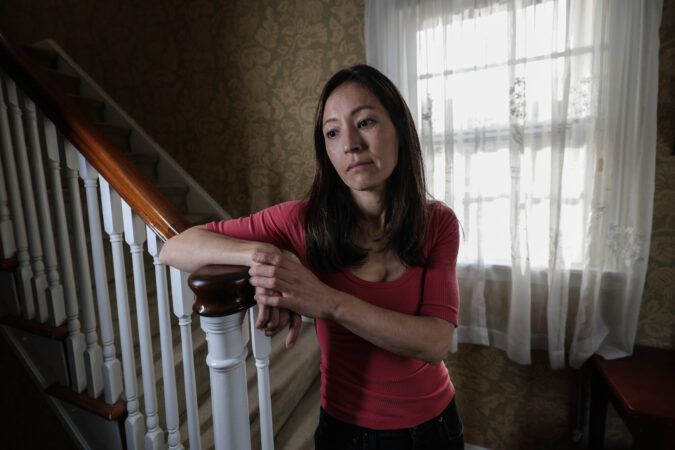
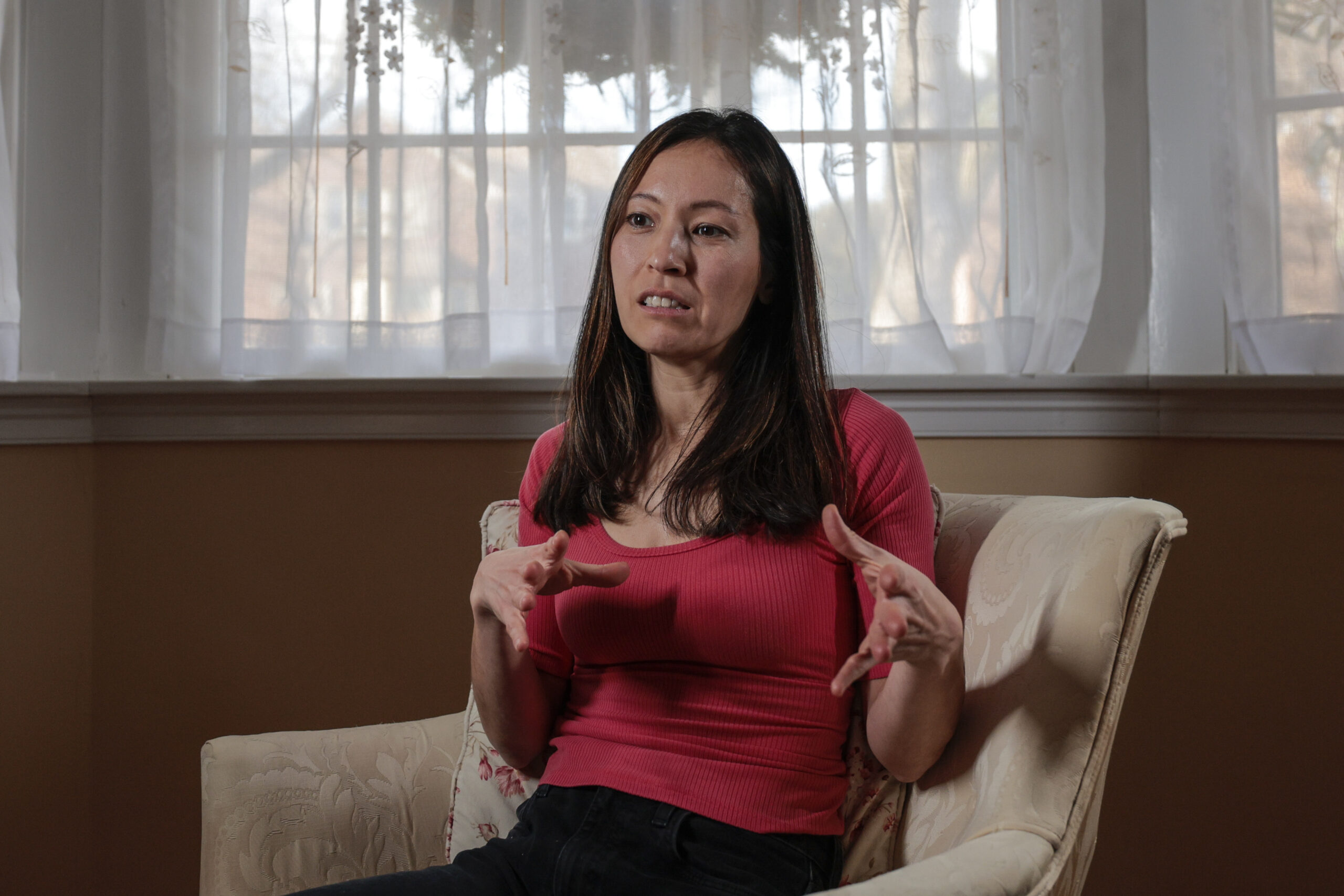
    Sasha Kinney fears she cannot afford the $750 a month it will cost to keep her Affordable Care Act health plan in 2026. But she will put the insurance bill on a credit card before risking a medical emergency without access to the doctors she sees regularly.

    The 42-year-old Drexel Hill resident’s insurance costs soared this year, after Congress did not extend a federal incentive program that ensured that no one paid more than 8.5% of income on health coverage.

    She earns enough doing freelance work for nonprofits, while serving as her mother’s primary caregiver, that she is not eligible for Medicaid, the publicly funded health program for low-income people.

    A private health plan through Pennsylvania’s Obamacare marketplace, Pennie, was a major expense, but one she prioritized to help manage her chronic headaches and stress-related pain. But the incentive program expired at the end of last year, leading to skyrocketing ACA insurance costs in Pennsylvania and across the country. Kinney will now pay an extra $250 without the added tax credit.

    “I will go into debt because of these increasing costs,” she said. “But it still seems better than not having coverage.”

    Congress has failed so far to strike a deal to bring back tax credits that have helped record numbers of Americans get health insurance. The U.S. House of Representatives approved legislation last week that would renew the program for three years, but it is unclear if the Senate will act.

    President Donald Trump on Thursday announced a healthcare plan that White House officials said would help address rising healthcare costs by creating new drug price controls and sending health subsidies directly to consumers. The sparsely detailed plan is intended to serve as a framework for Congress, though officials did not say which lawmakers are actively working on new healthcare legislation, the Associated Press reported.

    Meanwhile, people who are covered by Obamacare plans are running out of time to decide how to handle massive price hikes that doubled the average cost of the health plans in Pennsylvania.

    The deadline to enroll in a plan for 2026 in Pennsylvania and other states is Jan. 31. After that date, people can drop their coverage if they find it is too expensive, but they will not be able to select a new plan until the fall enrollment period.

    In Pennsylvania, about 70,000 people who bought Pennie plans in 2025 have decided they cannot afford the price increase and dropped their coverage. The dropout rate is unprecedented — about 1,000 people a day, said Devon Trolley, Pennie’s executive director.

    Nationally, about 800,000 fewer people have selected Obamacare plans compared with this time last year, a 3.5% drop in total enrollment so far, according to the AP.

    With just weeks to go in the enrollment period, marketplace leaders are urging people to think carefully about whether they can afford their plan for the full year and to look at other Pennie plan options. If Congress ultimately renews the enhanced tax credits, they have said, they would work quickly to adjust prices.

    “At this point, we are telling people they should make the best decision for their family based on the current cost,” Trolley said. “We want to make sure people who currently have coverage aren’t staying with a plan they can’t afford.”

    Trolley worries that people will stick with a plan they like, not realizing they can no longer afford it, only to be forced to drop the coverage and become uninsured partway through the year.

    window.addEventListener(“message”,function(a){if(void 0!==a.data[“datawrapper-height”]){var e=document.querySelectorAll(“iframe”);for(var t in a.data[“datawrapper-height”])for(var r,i=0;r=e[i];i++)if(r.contentWindow===a.source){var d=a.data[“datawrapper-height”][t]+”px”;r.style.height=d}}});

    Congress considering tax credit extension

    The add-on tax credits that expired at the end of 2025 were introduced in 2021 and have been renewed by Congress annually since then.

    In Pennsylvania, the federal incentive program ensured the vast majority of enrollees qualified for at least some amount of financial help, driving peak marketplace enrollment of 497,000 in 2025.

    The program became a major sticking point in federal budget discussions last fall, with Democrats forcing a government shutdown after Republicans refused to include the tax credits without significant restrictions.

    The budget ultimately passed without the tax credits after key Senate Democrats, including Pennsylvania’s John Fetterman, voted with Republicans to end the shutdown.

    Last week, 17 House Republicans — including Pennsylvania Reps. Brian Fitzpatrick, Robert Bresnahan, and Ryan MacKenzie — sided with Democrats to approve legislation that would reinstate the tax credits for three years. The measure must be approved by the Senate, and would need to return to the House to consider any changes.

    While the incentive program’s expiration is a major blow to the Obamacare marketplaces, Trolley, Pennie’s executive director, urged people not to rule out finding affordable coverage.

    President Barack Obama’s landmark health law also included income-based tax credits for people who earn less than 400% of the federal poverty level — about $60,000. These tax credits cannot expire because they are part of the law.

    “We have been encouraging people to not assume it’s too expensive,” Trolley said.

    Devon Trolley, executive director of Pennie, has been outspoken about how cuts to ACA tax credits are affecting people who buy Pennie health plans. Pictured during a 2025 roundtable with Pennsylvania lawmakers, stakeholders, health systems at the University City Science Center in Philadelphia.

    Health insurance decisions

    While some parts of Pennsylvania are seeing prices three to four times higher than in 2025, Philadelphia’s collar counties are seeing more moderate cost increases, ranging from an average 46% price hike in Chester County to a 70% average increase in Delaware County.

    Other factors that affect cost include household size, age, and income. People who are generally healthy and use insurance sparingly may be able to save money by opting for a plan that has a low monthly cost and a higher deductible (the amount of money spent out-of-pocket before the plan begins covering a greater share of costs).

    Sasha Kinney, 42, of Drexel Hill, considered switching to a high-deductible health plan to lower her monthly premium, but ultimately stuck with her old Pennie plan because it offered better coverage.

    In Drexel Hill, Kinney considered switching to a cheaper plan when she saw how much it would cost to keep her current coverage.

    Her current plan has a low deductible, and even so, Kinney said, she still spends hundreds on co-pays and other costs not covered.

    She worried that if she switched to a plan with even higher out-of-pocket costs, she would end up skipping appointments and avoiding needed care.

    She routinely sees doctors and physical therapists, and didn’t want to risk having to find new providers.

    “In the end I think it washes out — you can lower your monthly cost, but if the deductible and co-pays are higher, you’re paying the same,” she said. “There’s basically no way to save money.”