Washington — The Trump administration and a bipartisan group of governors on Friday tried to step up pressure on the operator of the nation’s largest electric grid to take urgent steps to boost power supplies and keep electricity bills from rising even higher.
Administration officials said doing so is essential to win the artificial-intelligence race against China, even as voters raise concerns about the enormous amount of power data centers use and analysts warn of the growing possibility of blackouts in the Mid-Atlantic grid in the coming years.
“We know that with the demands of AI and the power and the productivity that comes with that, it’s going to transform every job and every company and every industry,” Interior Secretary Doug Burgum told reporters at the Eisenhower Executive Office Building, next to the White House. “But we need to be able to power that in the race that we are in against China.”
Trump administration says it has ‘the answer’
The White House and governors want the Mid-Atlantic grid operator to hold a power auction for tech companies to bid on contracts to build new power plants, so that data center operators, not regular consumers, pay for their power needs.
They also want the operator, PJM Interconnection, to contain consumer costs by extending a cap that it imposed last year, under pressure from governors, that limited the increase of wholesale electricity payments to power plant owners. The cap applied to payments through mid-2028.
“Our message today is just to try and push PJM … to say, ‘we know the answer.’ The answer is we need to be able to build new generation to accommodate new jobs and new growth,” Energy Secretary Chris Wright said.
Govs. Josh Shapiro of Pennsylvania, Glenn Youngkin of Virginia, and Wes Moore of Maryland appeared with Burgum and Wright and expressed frustration with PJM.
“We need more energy on the grid and we need it fast,” Shapiro said. He accused PJM of being “too damn slow” to bring new power generation online as demand is surging.
Shapiro said the agreement could save the 65 million Americans reliant on that grid $27 billion over the next several years. He warned Pennsylvania would leave the PJM market if the grid operator does not align with the agreement, a departure that would threaten to create even steeper price challenges for the region.
PJM wasn’t invited to the event.
Grid operator is preparing its own plan to meet demand
However, PJM’s board is nearing the release of its own plan after months of work and will review recommendations from the White House and governors to assess how they align with its decision, a spokesperson said Friday.
PJM has searched for ways to meet rising electricity demand, including trying to fast-track new power plants and suggesting that utilities should bump data centers off the grid during power emergencies. The tech industry opposed the idea.
The White House and governors don’t have direct authority over PJM, but grid operators are regulated by the Federal Energy Regulatory Commission, which is chaired by an appointee of President Donald Trump.
Trump and governors are under pressure to insulate consumers and businesses alike from the costs of feeding Big Tech’s data centers. Meanwhile, more Americans are falling behind on their electricity bills as rates rise faster than inflation in many parts of the U.S.
In some areas, bills have risen because of strained natural gas supplies or expensive upgrades to transmission systems, to harden them against more extreme weather or wildfires. But energy-hungry data centers are also a factor in some areas, consumer advocates say.
Ratepayers in the Mid-Atlantic grid — which encompasses all or parts of 13 states stretching from New Jersey to Illinois, as well as Washington, D.C. — are already paying billions more to underwrite power supplies to data centers, some of which haven’t been built yet, analysts say.
Critics also say these extra billions aren’t resulting in the construction of new power plants needed to meet the rising demand.
Tech giants say they’re working to lower consumer costs
Technology industry groups have said their members are willing to pay their fair share of electricity costs.
On Friday, the Information Technology Industry Council, which represents tech giants Google, Meta, Microsoft, and Amazon, said it welcomed the White House’s announcement and the opportunity “to craft solutions to lower electricity bills.” It said the tech industry is committed to “making investments to modernize the grid and working to offset costs for ratepayers.”
The Edison Electric Institute, which represents investor-owned electric companies, said it supports having tech companies bid — and pay for — contracts to build new power plants.
The idea is a new and creative one, said Rob Gramlich, president of Grid Strategies LLC, a Washington, D.C.-based energy markets and transmission consultancy.
But it’s not clear how or if it’ll work, or how it fits into the existing industry structure or state and federal regulations, Gramlich said.
Part of PJM’s problem in keeping up with power demand is that getting industrial construction permits typically takes longer in the Mid-Atlantic region than, say, Texas, which is also seeing strong energy demand from data centers, Gramlich said.
In addition, utilities in many PJM states that deregulated the energy industry were not signing up power plants to long-term contracts, Gramlich said.
That meant that the electricity was available to tech companies and data center developers that had large power needs and bought the electricity, putting additional stress on the Mid-Atlantic grid, Gramlich said.
“States and consumers in the region thought that power was there for them, but the problem is they hadn’t bought it,” Gramlich said.
Associated Press writer Matthew Daly and The Washington Post contributed to this article.
A Pennsylvania Republican state senator doubled down Thursday on remarks denigrating Philadelphia, despite backlash from prominent Philly Democrats.
“Philadelphia wouldn’t be such a shithole” if District Attorney Larry Krasner prosecuted more crimes, StateSen. Jarrett Coleman, a Republican from Allentown, told Fox News on Wednesday.
Asked to elaborate Thursday, Coleman cited Philadelphia’s crime rates, which are higher than the national average.
“My statement stands. The people of Philadelphia deserve better,” Coleman said in a written statement.
“Now just imagine the outcry if I, a Democrat from an urban area, said exactly the same thing about a rural area?” U.S. Rep. BrendanBoyle, a Philadelphia Democrat, posted to X Thursday morning. “But I wouldn’t because I believe all in our society are of equal worth and deserve our respect.”
Coleman’s comments came in a broader piece in which he threatened to use a Senate committee he chairs to push back against Krasner and Philadelphia Sheriff Rochelle Bilal if they interfered with President Donald Trump’s administration’s immigration enforcement.
Coleman criticized the Philadelphia officials Wednesday, narrowing in on Krasner, a progressivewho has been a frequent target of Republican ire since he was first elected in 2017.
State Sen. Tony Williams, a Democrat from Philadelphia, echoed Boyle’s criticism and demanded an apology from Coleman, arguing the senator’s comments had degraded not just Philly but the country.
“He should unfortunately be ashamed of the manner in which he described Philadelphia,” Williams said.
“I have that part in me as well, I just don’t think it’s productive in these times to add fuel to the fire of stupidity,” he added.
State Sen. Nikil Saval, a Philadelphia Democrat, said he would be happy to give Coleman a tour of Philly, which he described as “safe, connected, vibrant.”
“The biggest threat to the safety of Philadelphians is the chronic underfunding perpetuated by Pennsylvania Senate Republicans,” he said.
HARRISBURG — State Treasurer Stacy Garrity has been the Pennsylvania Republican Party’s endorsed candidate for governor since September, but few candidates have stepped up to run alongside her for lieutenant governor.
Only two candidates have officially thrown their hats in the ring for Republican lieutenant governor, as Garrity faces the uphill battle of running against a popular incumbent in Democratic Gov. Josh Shapiro. And despite amassing unusually early support from the state party, recruiting someone to run as her No. 2 has proven challenging, as some potential candidates have declined to run.
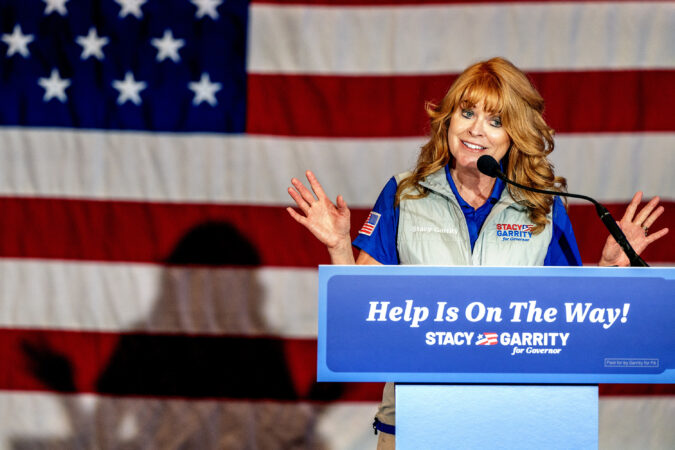
Garrity said Monday at the Pennsylvania Press Club luncheon she’s in talks with “a lot of people,” and she’s confident she’ll find a running mate “perfect for the ticket.”
But time is of the essence, as she has less than a month until the state GOP meets for its winter meeting, where the party is expected to endorse a lieutenant governor candidate. Whomever she picks is likely to get the nod.
“In many respects, it’s up to Stacy Garrity,” said GOP strategist Charlie Gerow. “The lieutenant governor candidate has to not only be a good political fit, but has to be a good personal fit for her. Otherwise, the ticket falls apart before you get to Election Day.”
So far, the only two GOP candidates to formally announce their campaigns for lieutenant governor are State Sen. Cris Dush (R., Jefferson), who is one of the most conservative members of the Senate GOP caucus, and Bucks County businessman and political newcomer Brian Thomas. Dush said he’d likely pursue the GOP primary nomination even if he isn’t endorsed by the state party, while Thomas announced his candidacy last week in a press release and said he is now reaching out to party leaders seeking their support.
And more far-right Republicans have publicly floated a run, teeing up a potential battle among some of the state’s most conservative members to run alongside Garrity on the November ballot.
In Pennsylvania, candidates for lieutenant governor face their own primary races separate from the candidates for governor. After the primary, the winners are joined onto one ticket and run together in the general election.
Former State Rep. Rick Saccone, who previously ran for lieutenant governor and was on U.S. Capitol grounds during the Jan. 6, 2021 riot but did not face criminal charges, has publicly stated his interest in the role. Saccone said he would not enter the race if the state party backed another candidate.
And State Sen. Doug Mastriano, a far-right Republican who lost to Shapiro in 2022 and last week ruled out a second run for the GOP nomination, later claimed on a local radio station that Garrity would need him as her running mate if she wants to win.
Few more moderate options have emerged.
Montgomery County Commissioner Tom DiBello, a Republican from Shapiro’s home county, said in an interview that he had been approached about pursuing the role. DiBello said he received a positive reception when he traveled the state contemplating a run, but he implied Monday that he’d moved on. On Tuesday night DiBello lost his bid to be the next chair of the county party to his former running mate, Liz Ferry.
“I had a lot of support out there as far as potentially running for lieutenant governor, but I’m right now very dedicated to Montgomery County,” DiBello added.
A number of other officials are rumored to have withdrawn themselves from consideration or are still in talks with Garrity’s campaign, several Republican insiders said.
This time around, the sense among Pennsylvania state party members is that Garrity should be given leeway to choose her running mate and party faithful will endorse her choice.
Many hadn’t even heard who might be in the running. But several Republicans who spoke to The Inquirer said they think Garrity needs to pick someone who will appeal to Democrats and independents who voted for Shapiro four years ago.
“We’re a purple state, and my sense is a more moderate candidate that appeals to a bigger swath of the electorate would be, if I were selecting, would be a preference here,” said Jason Richey, the chair of the Allegheny County GOP.
Or, as Val Biancaniello, a Republican state committeewoman from Delaware County, put it, a candidate needs “statewide appeal.”
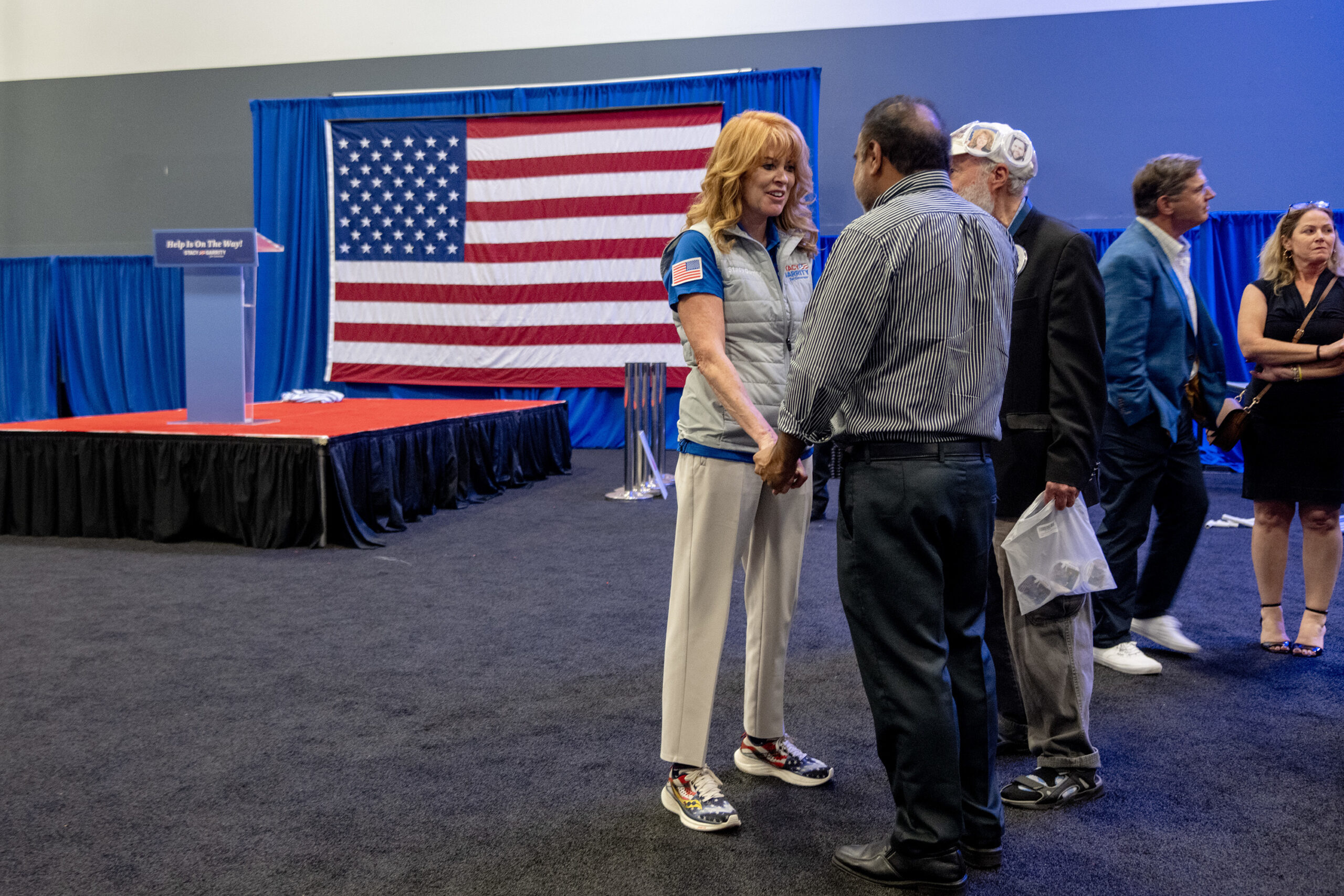
State Treasurer Stacy Garrity greets supporters following a campaign rally in Bucks County on Sept. 25, 2025. The GOP gubernatorial candidate visited the Newtown Sports & Events Center, in one of Pennsylvania’s top swing counties.
DiBello argued that Garrity’s running mate needs corporate and government experience, though he refused to name anyone else being considered behind the scenes. Garrity said she believed that DiBello was no longer “in the mix” for the job, but she did not expand further.
“I’m not putting my finger on the scale,” DiBello said before joking: “I’ve heard this Montgomery County commissioner would be awesome. I’ll put my finger on that scale.”
Garrity largely declined to comment on the candidates whose names have been circulating for her running mate, except for Mastriano.
“I didn’t even know he wasn’t running for governor until last week,” Garrity told reporters, noting her friendship with Mastriano. “We’re in discussion with a number of people, and I know that we will have the absolute best partner as lieutenant governor when the time is right.”
In his campaign launch Thursday, Shapiro tied Garrity to the extremes of her party, asking voters to choose between “getting stuff done” and “chaos.” A far-right running mate will make that message easier for Democrats as they work to secure the governor’s mansion for another four years.
Despite this, Mastriano was bullish Friday morning speaking on WEEO News Talk 103.7 FM in central Pennsylvania.
“That’s a possibility,” Mastriano said about a potential lieutenant governor run. “To be honest, that probably [is] the only way to generate some excitement for the Garrity ticket, and we know Garrity being on top of the ticket, that’s probably the only way the party would win if I did that.”
A Montgomery County office — which one county commissioner described as a far less controversial version of Elon Musk’s Department of Government Efficiency — has helped the county find $14 million in savings within the past year and reduce the deficit by half.
Montgomery County’s Office of Innovation, Strategy, and Performance (OISP), announced in February 2025, spent the last year meeting with department heads to identify areas for cost cutting and streamlining services, such as eliminating almost a dozen vacant positions worth hundreds of thousands of dollars, saving $1.5 million on a prescription benefits provider, and conserving half a million dollars by bringing some county legal services in house.
In 2026, the office could consider integrating artificial intelligence into county services, with the support of all three commissioners, aimed at cutting red tape for residents and county employees.
“It’s kind of like DOGE,” said Commissioner Vice Chair Neil Makhija, a Democrat, noting that the office has “outlived” DOGE’s period of high activity when Musk was in charge before he stepped away last spring.
“We didn’t just take the richest person in the county and tell them to cut, you know, benefits for poor people, which is what the federal DOGE was,” Makhija said.
The office’s work comes on the heels of the county’s $632.7 million operating budget and a roughly $25.5 million deficit, resulting in a 4% property tax increase for residents.
Republicans have made looking for inefficiencies in government part of their brand. But Democratic leaders in Pennsylvania have also started taking on streamlining government.Gov. Josh Shapiro has touted how he’s cut processing time for licensesand accelerated the permitting process for building projects.
And in blue Montgomery County, a bipartisan group of leaders says that responsible government efficiency should be a pillar of good government, regardless of political party.
“What happened with DOGE at the federal level was hard to watch and certainly not the approach that we’re going to take in Montgomery County, but, any leader … has to go through this exercise of are we optimizing our resources? Are we leaving money on the table? Are there opportunities to improve the performance of our people?” said County Commissioner Chair Jamila Winder, a Democrat.
“Like all of those are just disciplines that are industry agnostic, and so I don’t think it’s a Republican or a Democrat thing,” Winder added.
Commissioner Tom DiBello, the only Republican on the board, agrees, saying that he has high expectations for the office and its ability to oversee the adequate spending of taxpayer dollars.
“I mean, that’s our job. It has nothing to do with Republican or Democrat. My feeling, it has to do with taxpayer money,” DiBello said. “We’re supposed to be stewards of taxpayer money.”
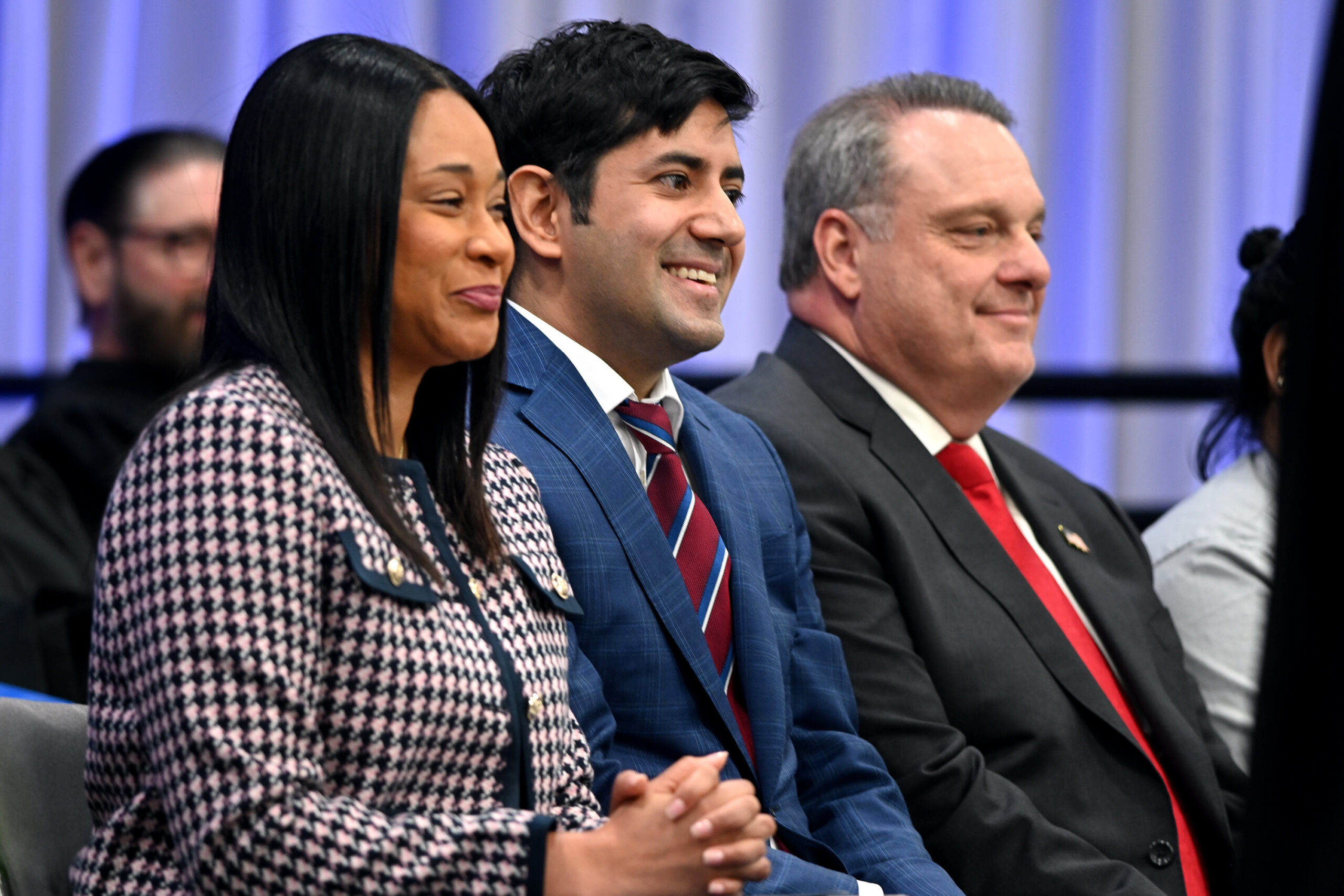
Jamila H. Winder (from left), Neil Makhija, and Thomas DiBello are seated together on stage at the Montgomery County Community College gymnasium Wednesday, Jan. 3, 2024, during ceremonies before they were sworn in as Montgomery County’s new Board of Commissioners.
Is artificial intelligence the next step?
The OISP was launched in February 2025 after the office previously served as the county COVID-19 pandemic “Recovery Office,” ensuring approximately $161 million in funds from the American Rescue Plan Act were being used appropriately.
When Stephanie Tipton, deputy chief operating officer, was hired in Montgomery County in September 2024 after more than 16 years in leadership in Philadelphia, county officials started discussing how to translate that oversight practice at the “Recovery Office” to every facet of county spending and performance.
That mentality helped the OISP cut the county deficit in half and focus on ways to reduce it in the long term, such as eliminating longstanding vacant positions around the county, including on the board of assessment, which does real estate evaluations. The office also helped develop performance management standards for departments.
“What we were really interested in is finding things that we could make repeatable year after year, and that would move forward, whether that was restructuring positions and eliminating vacancies that we don’t carry forward” to doing a trend analysis on spending, said Eli Gilman, project director of the 11-person office.He noted that the team was “kind of building a plane while we were flying.”
County governments are always trying to be efficient with taxpayer dollars, said Kyle Kopko, executive director of the County Commissioners Association of Pennsylvania, especially in the aftermath of last year’s state budget impasse. But Montgomery County’s decision to have a dedicated office for efficiency is fairly unique, he said.
“This is something that has become more and more of a focus of counties everywhere just because we’re not sure if we’re going to have the consistency of on-time state funds,” Kopko said.
The next phase for the office? Cutting red tape for residents. And part of that may be through enlisting artificial intelligence, something the county has been examining through the commissioners’ “Advisory Council on Artificial Intelligence for Public Good” established in April 2025.
“The goal here is like, how can we leverage this new and emerging technology to help us make it easier for residents to access services,” Tipton said. “Make it easier, reduce the burden on our frontline staff, so they can spend more time in sort of customer-facing, client-facing activities.”
AI will be something that many counties across Pennsylvania will be grappling with moving forward, Kopko said. Though some counties are wary of using it for sensitive information.
Everyone has a different idea as to what they would want to see AI used for in Montgomery County.
Makhija wants to make court documents accessible by chatbot. Winder says she wants to see AI help county employees be more efficient in their roles. And DiBello, who worked in tech software, said as long as accuracy is prioritized, AI could one day be used in situations where residents don’t have to speak directly to someone.
But first, Tipton said, the county wants to internally test AI tools to “make sure that we have the right sort of governance and guardrails” before launching it to the public.
When Tipton joined Montgomery County she said she had a “clear mandate from the commissioners” to look at department spending. She also wants it to be a transparent process for residents and the office plans to launch an open data site to the public in the second half of 2026.
“We want to make sure that moving forward, when we are making investments in the budget we can really understand more clearly how that is impacting service delivery, so we can tie that more directly to work that we’re doing,” Tipton said.
In short, many of Trump’s policies are making people sicker, poorer, and less safe. In that context comes Trump’s latest attack on the Federal Reserve, which will ultimately hurt all Americans.
Since returning to office last year, Trump has pressured Federal Reserve Chairman Jerome Powell to speed up interest rate cuts in an effort to boost the economy. But the Fed has moved cautiously to avoid further inflation.
Trump’s economic approach has been reckless and shortsighted.
In July, he threatened to fire Powell. Last month, Trump said he may sue Powell for “gross incompetence.”
On Friday, the U.S. Department of Justice opened a criminal investigation into Powell involving his testimony before the Senate Banking Committee regarding the increased costs of renovations to the Fed’s headquarters in Washington.
Trump claimed not to know anything about the investigation, but he had previously criticized the renovation costs. Let’s be clear: Trump’s long-running attacks on the Fed chair are the only reason Powell faces any legal trouble.
The Powell investigation shows yet again how Trump continues to pervert the once-independent Justice Department, using it as a political tool to go after his perceived enemies.
Attorney General Pam Bondi continues to do Trump’s bidding. She has launched bogus investigations into other public officials, including former FBI Director James Comey and New York Attorney General Letitia James.
Add Powell to the political hit list that is making a mockery of American justice.
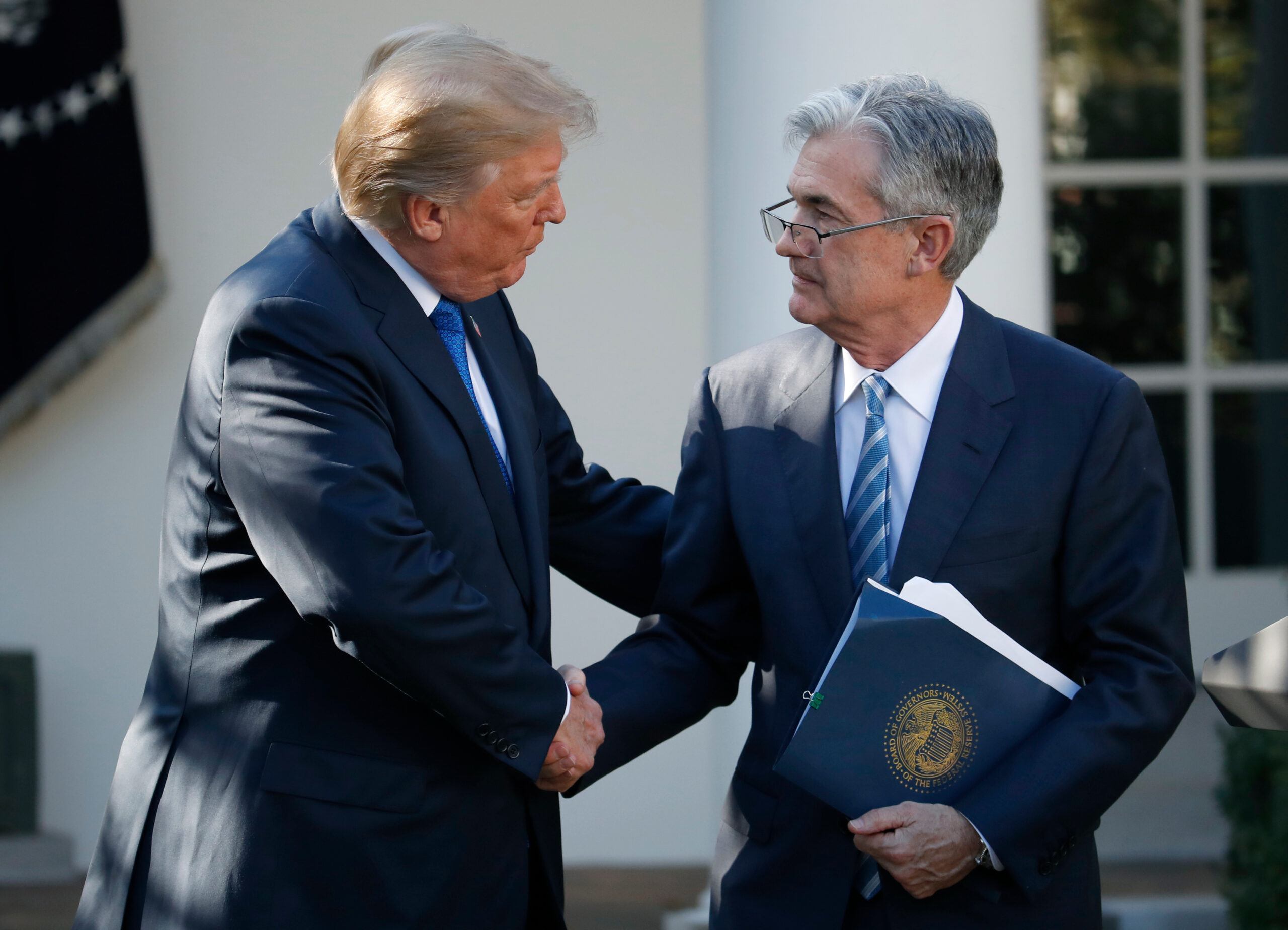
President Donald Trump shakes hands with Federal Reserve board member Jerome Powell after announcing him as his nominee for the next chair of the Federal Reserve, in the Rose Garden of the White House in 2017.
In a rare sign of political courage, some Republican lawmakers mustered the nerve to criticize Trump’s attack on Powell.
Sen. Lisa Murkowski (R., Alaska) said that “the administration’s investigation is nothing more than an attempt at coercion.”
Sen. Thom Tillis (R., N.C.) said the “independence and credibility” of the Department of Justice “are in question.” He promised to oppose the nomination of a new Fed chair until the legal issues are resolved.
But until more Republicans stand up to the president, expect more abuses of power.
Trump’s attack is especially petty, since Powell’s term as Fed chair ends in May, though he can remain on the board through January 2028.
Trump actually nominated Powell to be chairman during his first term in the White House. In a sign of Powell’s independence, former President Joe Biden renominated him to a second term.
By most accounts, Powell has done an impressive job steering monetary policy through uncharted territory involving the pandemic, followed by inflation brought on by increased government spending.
Trump’s pressure campaign on Powell has broader repercussions on America’s financial system.
The Fed’s independence is a cornerstone of U.S. financial markets, as it instills trust in investors, business leaders, economists, and other governments around the world that U.S. monetary policy is set without regard to political pressure.
Without that firewall, presidents could push for rate cuts to boost the economy before an election, potentially causing higher inflation and instability down the road just for short-term political gains.
In this instance, Trump clearly has his eye on revving up the economy before the midterms. (Trump would likely blame any subsequent inflation on Biden.)
Politicizing the Fed creates instability and will harm investors and consumers in the long run. Reports of the Powell investigation already rattled financial markets, prompting investors to sell American stocks and bonds.
To his credit, Powell has remained steadfast and made clear that the stakes surrounding the investigation are much bigger. “This is about whether the Fed will be able to continue to set interest rates based on evidence and economic conditions — or whether instead monetary policy will be directed by political pressure or intimidation.”
But the damage to the Fed is already done, as Trump continues to place his political and financial interests ahead of those of the American people.
Pennsylvania’s race for governor has officially begun. And 10 months before the election, the November matchup already appears to be set.
Democratic Gov. Josh Shapiro formally announced his reelection campaign Thursday — not that anyone thought he wouldn’t run. And Republicans have rapidly coalesced behind thestate party’s endorsed candidate, Pennsylvania Treasurer Stacy Garrity.
The racewilldominate Pennsylvania politics through November,but it could also havea national impact as Democrats hope Shapiro at the top of the state ticket can elevate the party’s chances in several key congressional races.
Here’s what you need to know about the high-stakes contest.
Shapiro was elected state attorney general in 2016, a year when Pennsylvania went for Republican Donald Trump in the presidential contest. The position put Shapiro in the national spotlight in 2020 when Trump sought to overturn his loss in the state that year through a series of legal challenges, which Shapiro’s office successfully battled in court.
He went on to decisively beat Trump-backed Republican State. Sen. Doug Mastriano for the governorship in 2022. Despite an endorsement from Trump, Mastriano lacked the support of much of Pennsylvania’s Republican establishment and spent the election cycle discouraging his supporters from voting by mail.
Throughout Shapiro’s first term as governor, he has highlighted his bipartisan bona fides and ability to “get stuff done” — his campaign motto — despite contending witha divided legislature. His launch video highlights the quick reconstruction of I-95 following a tanker explosion in 2023.
A strong supporter of Trump, Garrity is one of the only women that has been elected to statewide office in Pennsylvania history. If elected, she would be the first female governor in state history.
Garrity is a retired U.S. Army colonel who was executive at Global Tungsten & Powders Corp. before she was elected treasurer in 2020. Running a relatively low-key state office, Garrity successfully lobbied Pennsylvania’s General Assembly to allow her to issue checks to residents whose unclaimed property was held by her office, even if they hadn’t filed claims requesting it.
Anyone else?
While Shapiro and Garrity are the likely nominees for their parties, candidates have until March to file petitions for the race. That theoretically leaves the possibility of a primary contest open for both candidates, but it appears unlikely at this point.
The outcome of Pennsylvania’s gubernatorial race could hold wide-ranging impacts on transportation funding, election law, and education policy, among other issues.
The state’s governor has a powerful role in issuing executing actions, setting agendas for the General Assembly, and signing or vetoing new laws. The governor also appoints the secretary of state, the top Pennsylvania election official who will oversee the administration of the next presidential election in the key swing state.
Throughout the entirety of Shapiro’s first term, he has been forced to work across the aisle because of the split legislature. Throughout that time the balance of power in Harrisburg has tilted toward Democrats who hold the governor’s mansion and the Pennsylvania House. But many of the party’s goals — including expanded funding for SEPTA and other public transit — have been blocked by the Republican-held Senate.
If Garrity were to win that dynamic would shift, offering Republicans more leverage as they seek to cut state spending and expand school voucher options (while Shapiro has said he supports vouchers, the policy has not made it into any budget deals under him).
Shapiro coasted to victory against Mastriano in 2022, winning by 15 points. The 2026 election is expected to be good for Democrats with Trump becoming an increasingly unpopular president.
But Garrity is viewed as a potentially stronger opponent to take on Shapiro than Mastriano, even though her political views have often aligned with the far-right senator.
When the midterms conclude, the 2028 presidentialcycle will begin. If Shapiro can pull off another decisive win in a state that voted for Trump in 2024, it could go a long way toward aiding his national profile. But if Garrity wins, it could endthe governor’s chances of putting up a serious campaign for the presidency in 2028.
Every other race in Pennsylvania
The governor’s contest is the marquee race in Pennsylvania in 2026. Garrity and Shapiro have the ability to help or hurt candidates running for Pennsylvania’s statehouse and Congress.
The momentum of these candidates, and their ability to draw voters to the polls could play a key role in determining whether Democrats can successfully flip four competitive U.S. House districts as they attempt to take back the chamber.
Democrats also narrowly hold control of the Pennsylvania House and are hoping to flip three seats to regain control of the Pennsylvania Senate for the first time in decades. If Democrats successfully flip the state Senate blue, it would offer Shapiro a Democratic trifecta to push for long-held Democratic goals if he were to win reelection.
Strong Democratic turnout at the statewide level could drive enthusiasm down-ballot, and vice versa. Similarly, weak turnout could aid Republican incumbents in retaining their seats.
The dates
The election is still months away but here are days Pennsylvanians should put on their calendars.
May 4: Voter registration deadline for the primary election.
May 19: Primary election.
Oct. 19: Voter registration deadline for the general election.
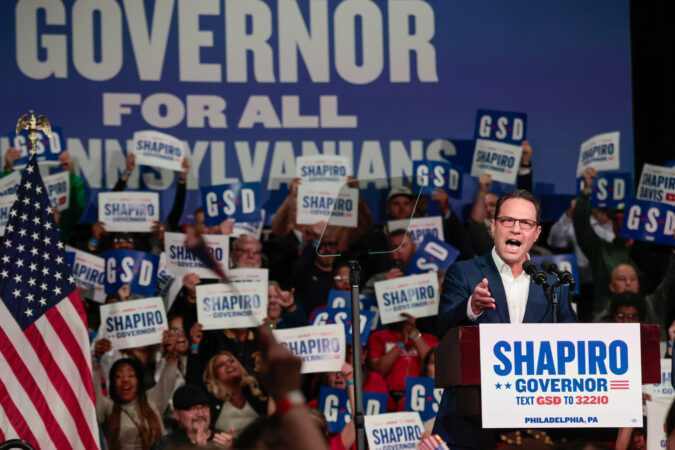
Pennsylvania Gov. Josh Shapiro officially launched his widely expected bid for reelection Thursday, spending his first day back on the campaign trail in one of the nation’s most politically divided states by touting his achievements for workers, seniors, and schools while contrasting himself against Republicans in President Donald Trump’s Washington.
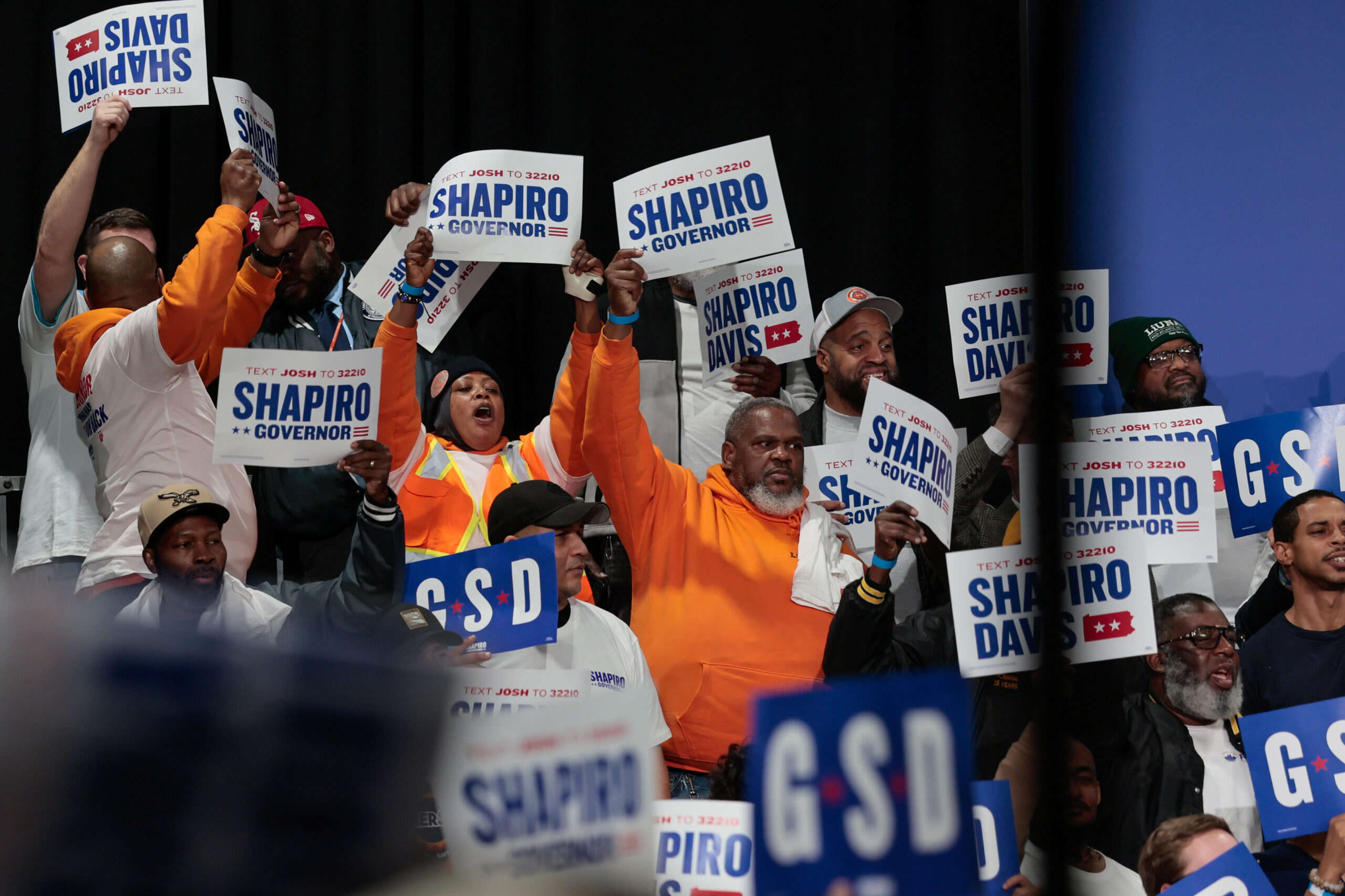
The Montgomery County Democrat presented his opening argument to voters Thursday afternoon in a highly produced campaign rally at a Pittsburgh union hall, before appearing Thursday night before Philadelphia voters at the Alan Horwitz “Sixth Man” Center in Nicetown.
Shapiro, 52, of Abington Township, will pursue his reelection bid by crisscrossing the state, boasting a high approval rating that Republicans hope to damage as talk of his potential 2028 candidacy continues to build.
Shapiro took the stage in Pittsburgh and Philadelphia following speeches from Lt. Gov. Austin Davis and a parade of public officials, labor leaders, and community advocates who touted his first term accomplishments, all delivering a similar message: Shapiro shows up and delivers for residents across the commonwealth.
At the Sixth Man Center, supporters and local leaders packed the event space in the youth sports center where Shapiro delivered a speech next to a huge mural of 76ers star Joel Embiid. Shapiro joked about his midrange jumper as he praised the center’s work.
“I am proud to be here on today to say that Josh Shapiro as governor of the commonwealth has delivered for us in a way that some thought … was impossible,” said Philadelphia Mayor Cherelle L. Parker to an excited crowd.
The rollout signaled Shapiro’s campaign will be anchored in his administration’s motto, “Get S— Done,” emphasizing that state government should be able to solve residents’ problems effectively.
“You deserve someone who goes to work every day focused on you and on getting stuff done,” Shapiro said.
He is not expected to face a primary challenger, just like in 2022, when he later cruised to victory in the general election against far-right State Sen. Doug Mastriano (R., Franklin). Mastriano, who had been teasing another run, announced Wednesday he would not join the race for governor.
This time, Republicans hope to take a stronger swing at Shapiro by coalescing around one candidate early. The state GOP endorsed State Treasurer Stacy Garrity more than a year in advance of November’s midterm election.
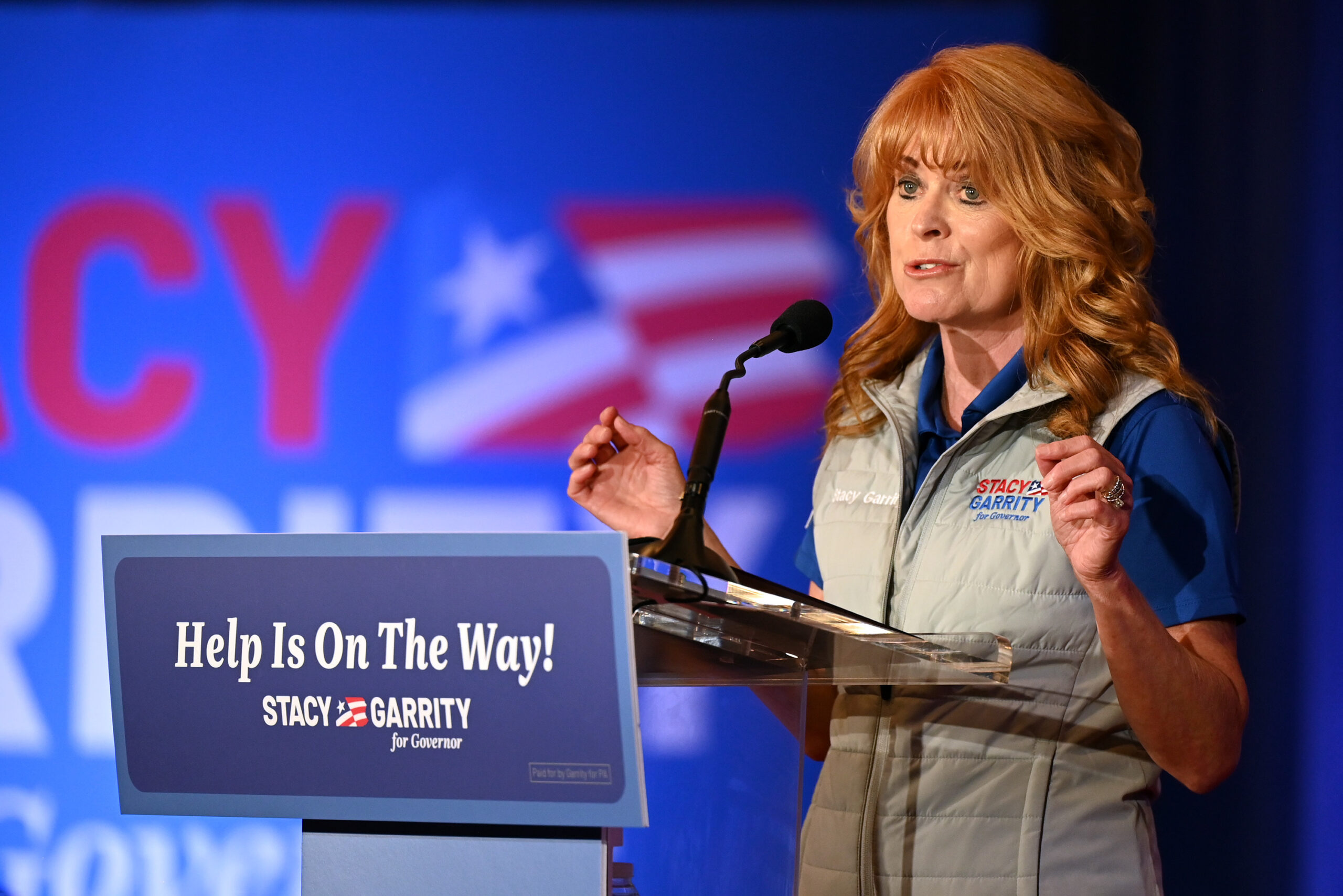
State Treasurer and Republican candidate for governor Stacy Garrity holds a rally on Sept. 25, 2025 at the Newtown Sports & Events Center in Bucks County.
State Republican Party Chair Greg Rothman said in a statement Thursday that Pennsylvanians have had “enough of Josh Shapiro’s lack of leadership and broken promises,” noting several of Shapiro’s missteps in his administration such as his reneging on school vouchers, a $295,000 payout over a sexual harassment claim against a former top aide, and failing to send a month’s worth of state agency mail.
“[Garrity] actually gets stuff done, she doesn’t just talk about it on the campaign trail,” Rothman added.
Garrity has contended that Shapiro — a former attorney general, county commissioner, and state representative — is more focused on running for president in 2028 than leading the state.
“Josh Shapiro is more concerned with a promotion to Pennsylvania Avenue than serving hardworking Pennsylvanians,” Garrity said in a statement earlier this week, noting the state fared poorly in U.S. News and World Report rankings on the economy and education.
But that’s part of the appeal for some of Shapiro’s supporters.
Fernando Rodriguez, who works at Fox Chase Farm in Philadelphia, was eager to hear Shapiro’s stump speech. The 37-year-old didn’t vote for Shapiro in 2022 and had cast only one ballot for a presidential election, voting for President Barack Obama in 2008.
But he wanted to see Shapiro win reelection and, more importantly, go on to run for president in 2028.
“There seems to be some maturity, some presidential qualities to him,” Rodriguez said, noting that is particularly important given the direction of national politics.
Shapiro has already raised $30 million to support his reelection, which is likely to boost the entire ticket.
State Democrats hope Shapiro will be able to leverage his popularity and growing national brand to bring more voters out to the polls, in what is already likely to be an advantageous midterm year for the party.
“We’ve got a lot of work to do and it’s not just about reelecting the governor,” Eugene DePasquale, the chair of the state Democratic Party, said Thursday in Pittsburgh.
Gov. Josh Shapiro’s supporters cheer as he makes his way to the stage during a reelection announcement event event at the Alan Horwitz “Sixth Man” Center in Philadelphia on Thursday, Jan. 8, 2026.
‘The hard work of bringing people together’
Offering an opening pitch to voters, Shapiro highlighted key themes he is expected to repeat during the next 10 months on the campaign trail: He’s protected Pennsylvanians’ freedoms and created jobs, with more work to do.
He noted several bipartisan achievements passed by the state’s divided legislature during his time in office, including a long-sought increase to the state’s rent and property tax rebate, historic funding increases for public education, and more. Pennsylvanians, he argued, have a simple choice in November.
“Will we continue to do the hard work of bringing people together to get stuff done, or will we descend into the chaos and extremism that has gripped too many other places across our nation?” Shapiro asked in his stump speech in Pittsburgh and Philadelphia.
In Philly, the crowd gave this question a resounding “No.”
Shapiro’s launch drew a distinction between his style of leadership and that of Trump — whom Shapiro repeatedly called a danger to democracy prior to his reelection in 2024. Shapiro did not name the president during his announcement, but alluded to Trump — while noting his legal challenges against the Trump administration.
The move followed Shapiro’s oft-repeated tactic since Trump took office for a second time: Criticize his policies, while not alienating Trump’s supporters in Pennsylvania, as the state swung in favor of Trump in 2024.
In addition to his two campaign rallies, Shapiro kicked off his reelection bid in a video advertisement posted on social media. He led that off with footage from one of his biggest accomplishments from his first three years in office: rebuilding a collapsed section of I-95 in 12 days, in what was expected to take months.
The quick rebuild also featured in his speech in Philly, where he heaped praise on organized labor for its role in the reconstruction.
Rob Buckley with Buckley & Company, Inc., shakes hands with Gov. Josh Shapiro (right) at the end of a 2023 news conference before the reopening of I-95.
Gov. Josh Shapiro officially announced his widely expectedreelection bid for Pennsylvania governor Thursday, as speculation over a 2028 run for president continues to build. The question now: How will the Democrat’s rumored presidential ambitions bolster or detract from his must-win election at home in 2026?
Shapiro will kick off his reelection campaign with not one but two rallies— first stopping in Pittsburgh, then in Philadelphia. In a campaign video posted to social media Thursday morning, he touted his three years of leading a divided legislature and his bipartisan achievements in a politically split state, via a campaign that has already amassed a record $30 million war chest.
He coasted to victory in 2022, elevating his profile within the national Democratic Party, and is not expected to face a primary challenger. In the general election, he will likely face Republican State Treasurer Stacy Garrity, who largely consolidated GOP support early.
But that’s not the only race on the line in November.
As Shapiro looks to potential parallel runs, he’ll need to continue to build a national profile without outwardly focusing too much on the presidential picture.
Gov. Josh Shapiro is interviewed by TV news in the spin room at the Convention Center following the debate between former President Donald Trump and Vice President Kamala Harris Tuesday, Sept. 10, 2024.
“The challenge, of course, is you have to take care of your next election first,” said Christopher Borick, a pollster at Muhlenberg College. “Of anything he does, he knows this is the most important thing for his potential success in 2028 if he was to run.”
In the governor’s race, Shapiro will likely face a more formidable opponent in Garrity than he did in state Sen. Doug Mastriano (R., Franklin) in 2022, but he’ll also be running in a far more favorable political atmosphere for Democrats amid souring attitudes toward President Donald Trump and the GOP. If he can retain the governor’s mansion decisively and bring a ticket of Democrats vying for the statehouse and Congress to victory with him, that’s a narrative that could be strong in a Democratic presidential primary.
“Having a win, and maybe an impressive one in Pennsylvania, the key swing state heading into that cycle, is about as big of a boost as any that you can have,” Borick added.
Running local
The 2028-curious Democrats include several other sitting governors generating buzz: California’s Gavin Newsom, Kentucky’s Andy Beshear, Maryland’s Wes Moore, Michigan’s Gretchen Whitmer, and Illinois’ JB Pritzker. Shapiro has formed alliances with several of them.
But unlike some of his peers, Shapiro hasn’t been a frequent guest on cable news or podcasts with national reach.
On Oct. 4, 2024, nearly a month before Harris lost the presidential election to Trump, Shapiro confidentially requested that the state ethics commission determine whether he would violate any state ethics laws for accepting royalties from a book about his life in public service, according to the filing.
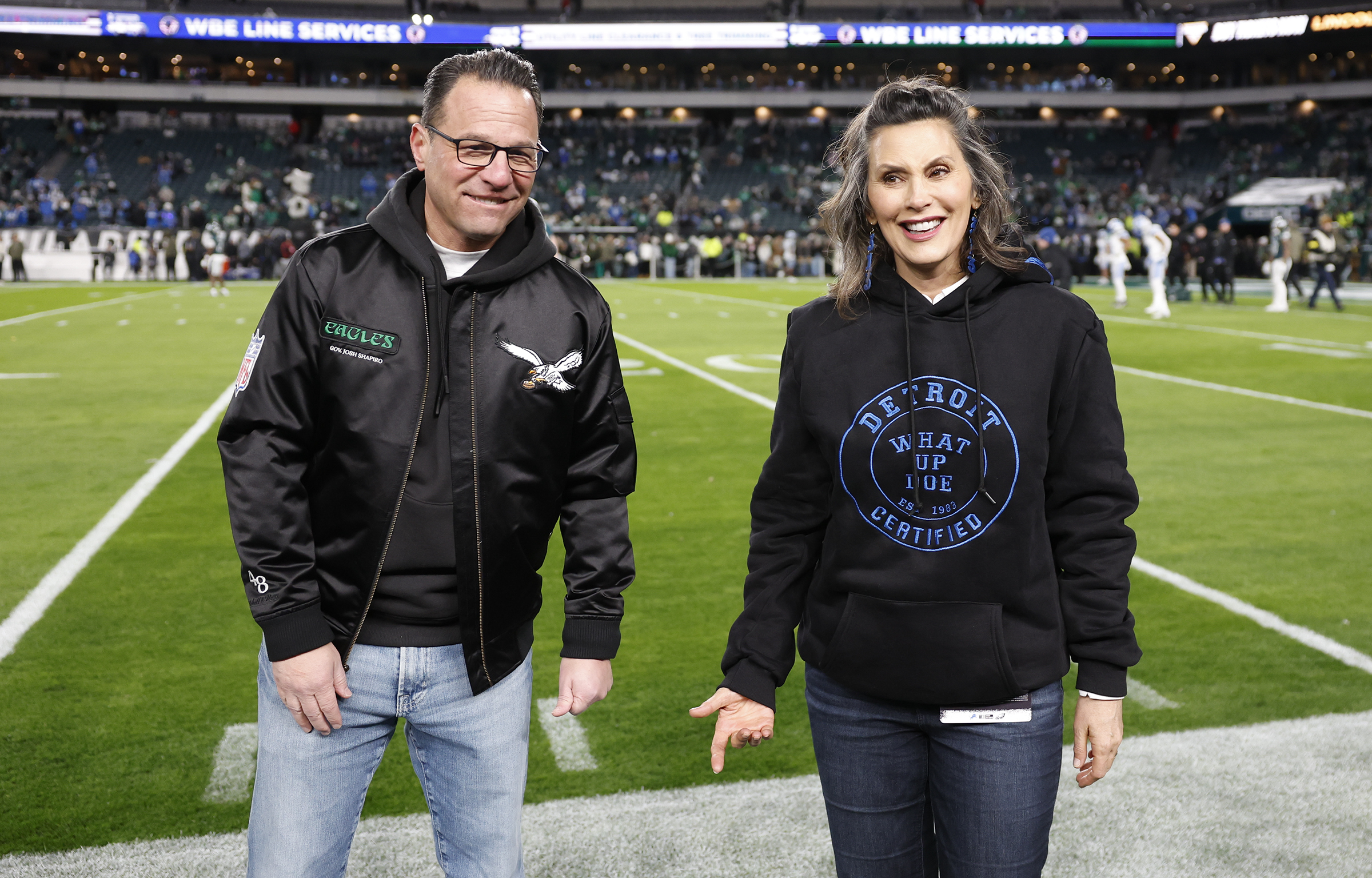
Pennsylvania Gov. Josh Shapiro (right) and Michigan Gov. Gretchen Whitmer before the Eagles played the Detroit Lions at Lincoln Financial Field on Sunday, Nov. 16, 2025, in Philadelphia, PA.
His book, Where We Keep the Light, will publish later this month, recounting his political upbringing, his vice presidential vetting, and the firebombing of his home last year. He’s not alone. Harris published a memoir about the 2024 election last year, and Newsom is due out with Young Man in a Hurry: A Memoir of Discovery in February.
But in the coming months, several Democratic strategists predict Shapiro will be squarely focused on the governor’s race he has to win in Pennsylvania — simultaneously proving he has what it takes to capture the vote of the nation’s most important swing state.
“He’s such a careful politician. He’s not taking anything for granted,” said former Gov. Ed Rendell, a Democrat who also once faced scrutiny for having potential presidential ambitions.
Shapiro is likely to follow the same campaign playbook in Pennsylvania as he did in 2022: Stump in every region of the state, including areas where Democrats don’t usually show up. That helped him run down the margins in longtime GOP strongholds like Lancaster or Schuylkill Counties toward his resounding victory over Mastriano. Those stops in most of Pennsylvania’s 67 countieswon’t give him as much time to visit South Carolina, Iowa, and New Hampshire, as the other Democratic presidential hopefuls start their sojourns.
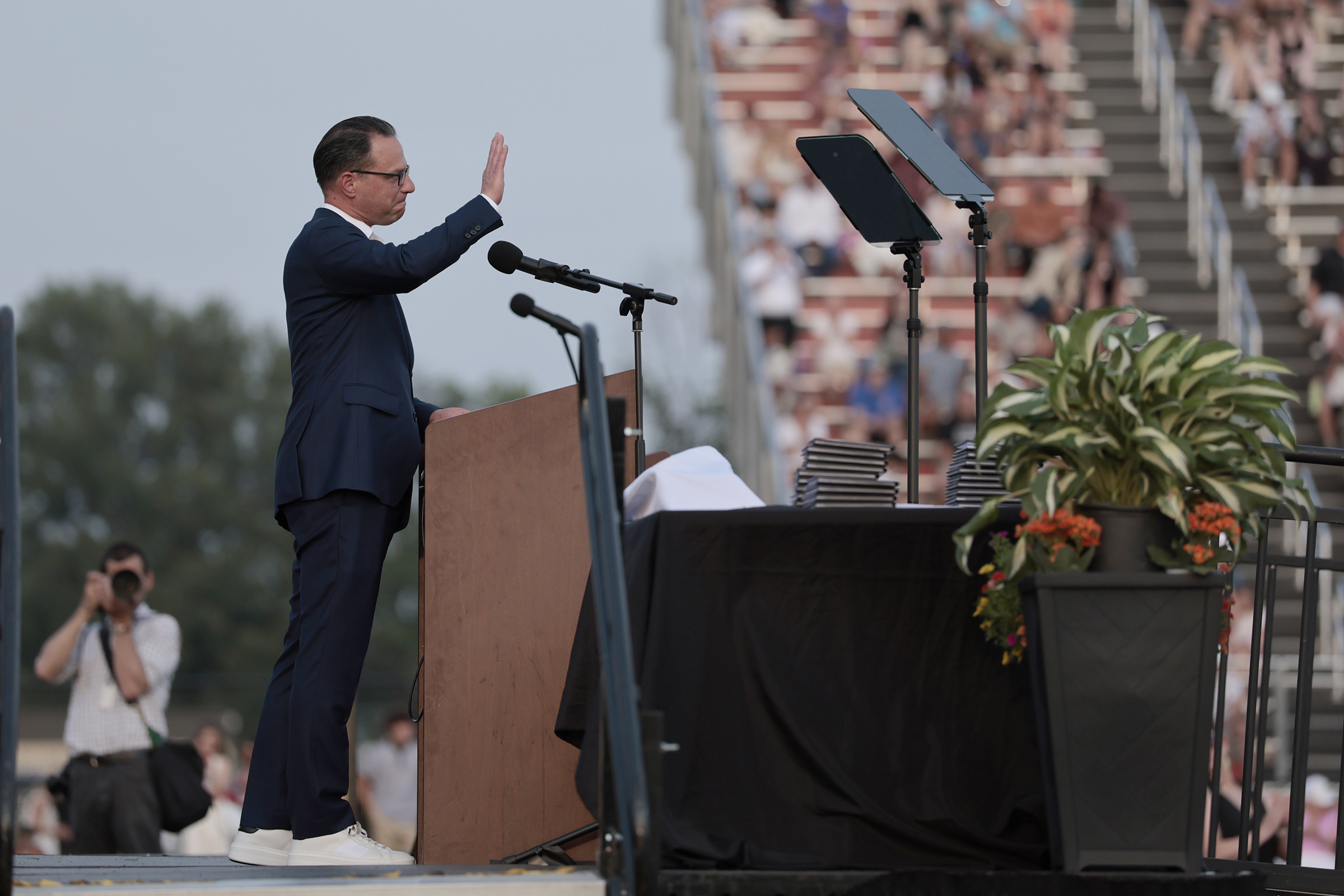
Pennsylvania Governor Josh Shapiro waves goodbye to the crowd after speaking during graduation ceremonies at Pennsbury High School in Fairless Hills on Thursday, June 12, 2025.
“The No. 1 caveat is stay focused on the race you’re running,” echoed Alan Kessler, a national fundraiser based in Philadelphia who has supported and fundraised for Shapiro.
Still, the campaign is likely to generate attention beyond the Keystone State.
Shapiro will still court donors in blue states as he fundraises for reelection, Kessler added.
Come November, he will be the only governor with rumored 2028 aspirations up for reelection in a swing state. And his brand as a popular, moderate Democratic governor trying to restore trust in government — as well as his potential to help boost Democrats down ballot — will easily capture a wider audience and bring national media into Pennsylvania.
As Democrats seek to flip control of the U.S. House in 2026, targeting several congressional districts in the state, the election may once again come down to Pennsylvania, and in turn, increase the spotlight on Shapiro. The governor is widely seen as someone who can boost the congressional Democratic candidates also on the ballot, having won three of the four districts that Democrats are targeting in the state by double digits in 2022.
Republicans have targeted several weaknesses to try to erode Shapiro’s popularity in Pennsylvania and boost Garrity. They point to a lack of rigorous electoral challengers in his past. They question his record of “getting stuff done” — his oft-repeated motto — including three late state budgets. And they’ve harped on a lack of transparency as governor, including claims he used tax dollars for political benefitas well as a sexual harassment scandal involving a former top aide. They’ve also criticized his support for Minnesota Gov. Tim Walz, who recently dropped his third gubernatorial bid following a fraud scandal among the state’s Somali refugee population totaling $1 billion, according to federal prosecutors.
Among the emerging attacks: Republicans want to highlight Shapiro’s presumed presidential ambitions, as they try to cast him as an opportunist more interested in a future White House bid than the problems of everyday Pennsylvanians.
“Josh Shapiro is more concerned with a promotion to Pennsylvania Avenue than serving hardworking Pennsylvanians,” Garrity said in a statement, noting the state fared poorly in U.S. News and World Report rankings on the economy and education. “In the military, I learned the importance of putting service before self. Pennsylvanians are the hardest-working, most compassionate, strongest people in the nation, and together we will return Pennsylvania to our rightful place as a national and global leader.”
State Treasurer and Republican candidate for governor Stacy Garrity holds a rally in Bucks County Sept. 25, 2025 at the Newtown Sports & Events Center.
Mastriano, the far-right Republican state senator who announced Wednesday he won’t run for governor, said in a statement earlier this week that Shapiro “owes [Pennsylvanians] straight answers” over his use of the state plane, security updates to his personal home in Abington Township, and more.
“Pennsylvanians deserve accountability, not ambition,” he added, making a nod to Shapiro’s potential longer-term plans.
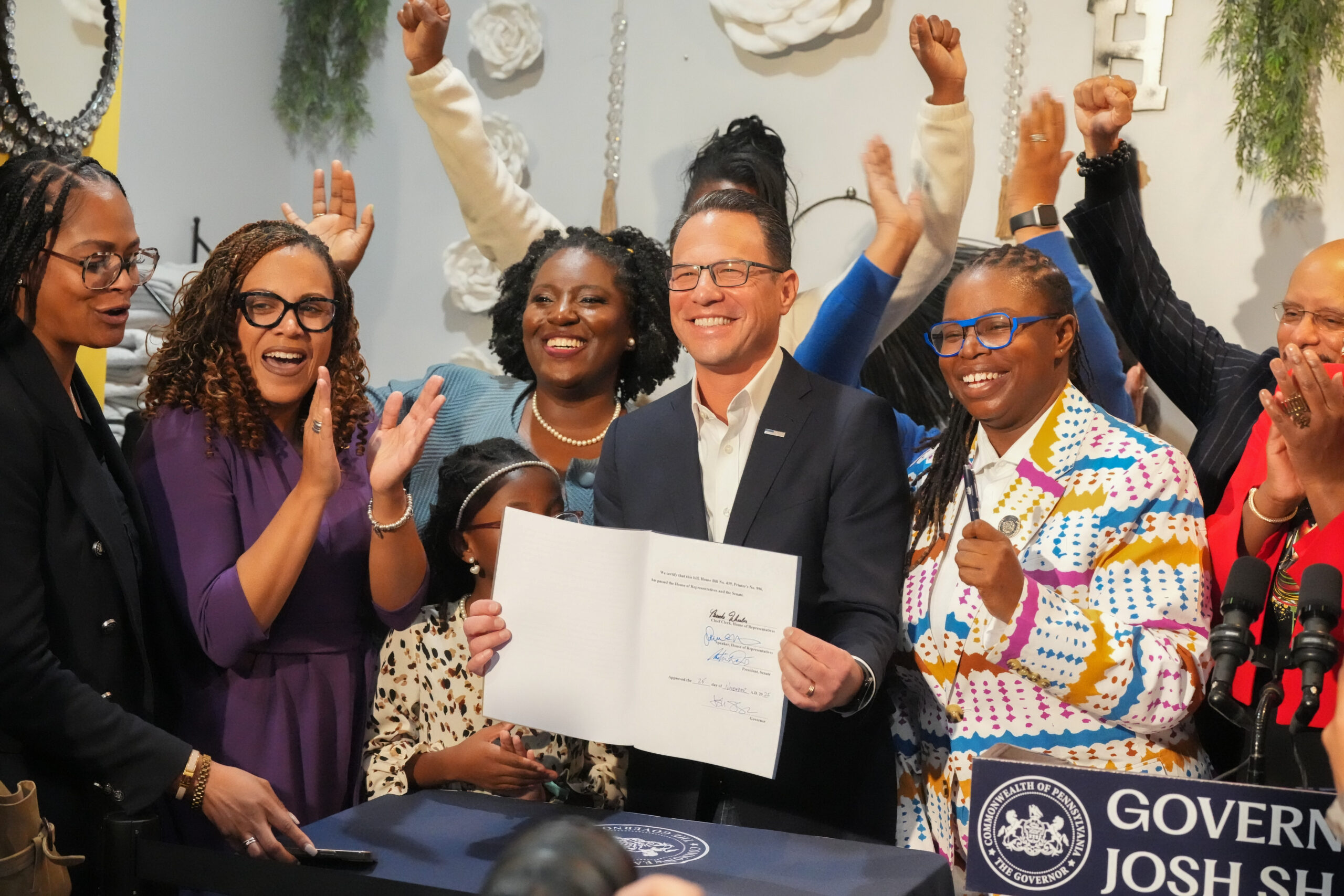
House Speaker Joanna McClinton, back center left, Gov. Josh Shapiro, front center, and State Rep. La’Tasha D. Mayes, right, celebrate the signing of the CROWN Act, which prohibits discrimination based on a person’s hair type, during a press conference at Island Design Natural Hair Studio, in West Philadelphia, November 25, 2025.
Borick, the pollster, was skeptical that attacks on Shapiro’s potential wider ambitions could reverse hislargely positive public sentiment.
“If that’s all they got, they don’t got a lot.”
Republicans insist they see a path to victory for Garrity in a politically divided state with months to go until the election. But behind the scenes, some Republicans are already acknowledging the goal is to lose by less and prevent big losses in state legislature or congressional races.
If Shapiro does look poised to cruise to victory, it might mean less media attention on the race, and it could mean he’s less vetted ahead of a much bigger stage.
“I think Josh is better served if the [Republican Governors Association] puts $100 million into this race because then it’s nationalized,” said a Democratic political strategist based in Pennsylvania who did not want to be named speculating on Shapiro’s presidential run. “If it’s a cakewalk, CNN’s not gonna cover it …If he wants to be governor for another four years, he should pray for a cakewalk. If he wants to be president, he should pray for a difficult campaign.”
Florida Gov. Ron DeSantis, for example, the strategist noted, cleaned up in his 2022 reelection, but failed to gain traction in the GOP presidential primary that Trump dominated.
Beyond 2026
Shapiro speaks Pennsylvanian very well. Raised in Montgomery County, he’s lived here almost all of his life, and has built an image as a popular moderate focused on problem-solving in a purple state. That’s earned him the support of about 30% of Trump voters in the state.
But winning a general election in Pennsylvania is different than winning a Democratic presidential primary.
He’s tried not to alienate the MAGA base, focusing on issues with bipartisan appeal like funding for apprenticeship and vocational-training programs. He’s taken on Trump in court, but has picked his personal battles with the president more carefully.
But being a strategic, self-described “progressive pragmatist” can end up alienating voters on both sides.
Gov. Josh Shapiro leaves after an event at the Port of Philadelphia Thursday, Apr. 10, 2025, the day after President Trump paused some tariffs.
Becky Carroll, a Democratic political consultant in Chicago who has worked with Pritzker, said Shapiro seems less on the radar of voters in the Midwest. As she’s followed Shapiro’s career, she said she sees a “damn fine governor,” but someone who’s taken a more muted approach to Trump than blue state governors like Pritzker and Newsom.
When it comes to a Democratic primary, candidates may be judged in part on their pushback to Trump, she said. “I think we’re in a moment where you can sulk in a corner and hope it’ll all go away or fight …,” Carroll said. “And if you’re gonna put yourself out there for a primary battle, you better show you have battle scars to prove you can fight for the most vulnerable in the country right now.”
Gov. Josh Shapiro is interviewed by TV news in the spin room at the Convention Center following the debate between former President Donald Trump and Vice President Kamala Harris Tuesday, Sept. 10, 2024.
But other national strategists see Shapiro’s moderate appeal as a potential asset in 2028. Jared Goldberg-Leopold, a former communications director for the Democratic Governors Association, thinks Shapiro’s biggest asset is his electoral track record in a state the nation knows is critical on the path to the White House. Primaries have previously been won by moderates whom the party thinks have the best chance at winning the general.
But the first step, Goldberg-Leopold stressed, is the governor’s race ahead.
“It would be easy for the Eagles to look past the 49ers to the next week of playoffs, but they’ve gotta focus on only one thing. And the same is true for the governor,” he said. “You can only prepare for what’s ahead of you, and the way people get in trouble in politics is planning too many steps ahead.”
Staff writer Katie Bernard contributed to this article.
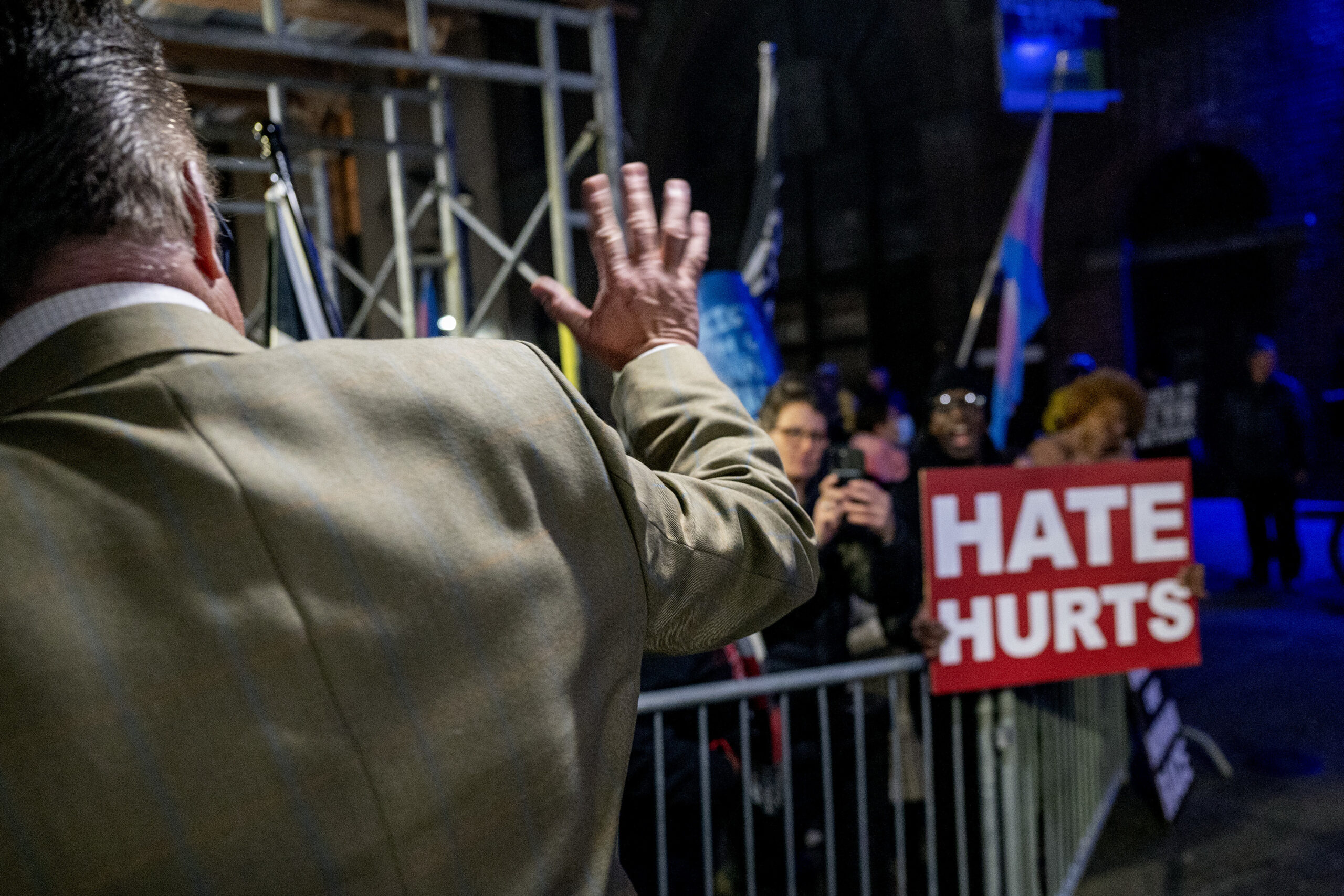
A protest at an event honoring Florida Gov. Ron DeSantis over his antigay policies. The right has targeted trans people, in particular.
Meanwhile, the abundance of research demonstrating that transgender people suffer disproportionate violent victimization, homelessness, and suicide has remained largely unaddressed.
Moderate politicians’ concern with appealing to wider audiences in thesedivisive times exacts a cost: to trans kids’ health, safety, and dignity in their schools and communities.
Ambivalent Democrats
Rather than forging alliances to protect the safety and constitutional rights of transgender citizens, some of the most influential members of the Democratic Party — from Kamala Harris to Pete Buttigieg to Rahm Emanuel to Gavin Newsom — have at least partially capitulated before the political tidal wave of anti-transgender disinformation, complete with all of the red herrings it washes ashore.
More importantly, by keeping to the intentionally distorted discourse about transgender people — rather than countering sensationalized falsehoods and vitriolic rhetoric with integrity and conviction — politicians end up appealing to and emboldening constituencies who lean into disinformation out of fear. This isn’t only cynical, it’s dangerous. FBI hate crime statistics tell a bleak story of the rise in vigilante violence against transgender Americans, coinciding with a steep rise in political antagonism and targeted scapegoating.
A recent effort led by U.S. Reps. Sarah McBride (D., Del.), Mark Takano (D., Calif.), and members of the Congressional Equality Caucus calls upon House Speaker Mike Johnson (R., La.) to enforce the rules of decorum in Congress by holding those who defame and denigrate the trans community to account. As of this writing, no response has been issued.
A path forward
The only ethical and effective path forward demands that we fundamentally reframe the political conversation about transgender people in factual terms that are grounded in foundational democratic principles, credible science, and a commitment to the protection of civil rights and civil liberties of all Americans.
There is some hope to be found in the lawsuit filed this week by 19 Democratic states to block the federal government’s efforts to ban gender-affirming care nationally.
Ideally, we would see more leadership on both sides of the aisle to protect the safety, freedom, and human dignity of all LGBTQ+ people, as demonstrated in the introduction of the bipartisan Global Respect Act by McBride and U.S. Rep. Brian Fitzpatrick (R., Pa.) to protect LGBTQ+ people around the world from identity-based violence, torture, and persecution.
Regressive political forces have always sought to isolate and villainize minoritized groups, to paint them as threats to the majority by virtue of whatever marks them as somehow “different” from those in power — and therefore less deserving of the same rights and protections.
Consider that during the civil rights movement in the 1960s, boycotts of segregated lunch counters and department stores were underway in Southern communities when New York U.S. Rep. Adam Clayton Powell famously corrected a reporter who queried if he was advocating for “Negroes” to stay out of segregated national chain stores in solidarity with the boycotts.
A genuine commitment to our democracy demands that we shift our discursive paradigm from one that impugns the existence of transgender people to one that impugns the de jure and de facto denial of transgender people’s humanity, dignity, civil rights, and personal safety.
It is long past time to reset the terms and reclaim the narrative on the equal protections and constitutional rights of transgender Americans. The political leadership we need in this moment requires the clarity, intentionality, and fortitude to do just that.
Ashley C. Rondini is an associate professor of sociology at Franklin and Marshall College.
In Kensington, a program to mitigate street violence was hitting its stride.
After joining the New Kensington Community Development Corporation in 2023, outreach coordinators with Cure Violence began responding to shootings in the neighborhood, connecting folks with mental health services and other wellness resources.
They hosted men’s therapy groups, safe spaces to open up about the experience of poverty and trauma, and organized a recreational basketball league at residents’ request. Their team of violence interrupters even intervened in an argument that they said could have led to a shooting.
Cure Violence Kensington was funded by a $1.5 million federal grant from the Department of Justice, part of a Biden-era initiative to combat the nation’s gun violence epidemic by awarding funds to community-based anti-violence programs rather than law enforcement agencies.
One year after a political shift in Washington, however, federal grants that Philadelphia’s anti-violence nonprofits say allowed them to flourish are disappearing.
In the spring, New Kensington CDC received a letter from the Justice Department, saying that under the leadership of Attorney General Pam Bondi it had terminated the grant that would have funded Cure Violence for the next three years.
The work, the letter said, “no longer effectuates the program goals or agency priorities.” In the future, it said, the department would offer such grants exclusively to local law enforcement efforts.
“It was a heavy hit,” said Bill McKinney, the nonprofit’s executive director.
The cuts come amid a Trump administration crackdown on nonprofits and other organizations it views as either wasteful or focused on diversity and DEI.
It spent 2025 slashing funds for programs that supplied aid abroad, conducted scientific research, and monitored climate change. At the Justice Department, cuts came for groups like McKinney’s, which aim to target the root causes of violence by offeringmental health services, job programs, conflict mediation, and other alternatives to traditional policing.
In Philadelphia, organizations like the Antiviolence Partnership of Philadelphia and the E.M.I.R. Healing Center say they, too, lost federal funding last yearand expect to see further reductions in 2026 as they scramble to cover shortfalls.
A Justice Department spokesperson said changes to the grant program reflect the office’s commitment to law enforcement and victims of crime, and that they would ensure an “efficient use of taxpayer dollars.”
“The Department has full faith that local law enforcement can effectively utilize these resources to restore public safety in cities across America,” the spokesperson said in an email.
Nonprofits may appeal the decisions, the spokesperson said, and New Kensington CDC has done so.
Attorney General Pam Bondi takes part in an event at the White House on Oct. 23.
Philadelphia city officials, for their part, say they remain committed to anti-violence programs, in which they have invested tens of millions of dollars in recent years.
“There are always going to be things that happen externally that we have no control over as a city,” said Adam Geer, director of the Office of Public Safety.
The reversal in federal support comes at a time when officials like Geer say the efforts of anti-violence programs are beginning to show results.
Violent crime in Philadelphia fell to historic lows in 2025, a welcome relief after the sharp upturn in shootings and homicides that befell the city at the height of the pandemic.
In 2021, the city announced a large-scale campaign to combat gun violence that,in the past year, included nearly $24 million for anti-violence programs.
That was on top of the Biden administration’s Community Based Violence Intervention and Prevention Initiative. Since launching in 2022, the DOJ program awarded more than $300 million to more than 120 anti-violence organizations nationwide.
In April, many of those groups, including New Kensington CDC, lost funds. And in September, a larger swath learned they were now barred from applying for other Justice Department grants that would have arrived this spring.
“We’ve seen enormous dividends” from the work of such groups, said Adam Garber, executive director of CeaseFirePA, a leading gun violence prevention group in the state. “Pulling back now puts that progress at risk — and puts lives on the line.”
Philadelphia feels the squeeze
Federal grants helped Natasha McGlynn’s nonprofit thrive.
McGlynn, executive director of the Antiviolence Partnership of Philadelphia, said a DOJ grant called STOP School Violence allowed her organization to launch a counseling program for young people who had been victims of violence or otherwise exposed to it in some of the city’s most violent neighborhoods.
The nonprofit used the grant to hire therapists to help students develop healthier attitudes around conflict and trauma, she said.
The $997,000 grant was cut in April, and when McGlynn went to apply for another round of funding in the fall, she learned that nonprofits were no longer eligible. The lost funding means some services, like counseling, could now be eliminated, she said.
“I would say several positions are in question,” McGlynn said. “I would say the program is in question.”
Chantay Love, the director of Every Murder is Real, said her Germantown-based victim services nonprofit also lost Justice Department funding in 2025.
Federal grants are not the nonprofit’s only source of income, Love said, but she along with other nonprofit leaders in the city are considering whether they’ll need to cut back on programs this year.
Record-setting investment
The decade before the pandemic saw gun-related deaths in the state climb steadily, spiking during the lockdown as social isolation, school closures, shuttered community services, and higher levels of stress contributed to a spate of gun homicides and shootings that began to ease only in 2024.
Two years earlier, the state began dispersing more than $100 million to community-based anti-violence programs, much of the money coming from the American Rescue Plan, a sweeping Biden administration pandemic recovery package that also sought to reduce rising gun violence. And when those funds expired, state lawmakers continued to invest millions each year, as did Philadelphia city officials.
Garber, of CeaseFirePA, said those efforts “get a lot of heavy-lifting credit” for Philadelphia’s historic decrease in violence.
A report compiled by CeaseFirePA cites studies that found outreach programs like Cure Violence helped reduce shootings around Temple University, as well as in cities like New York and Baltimore, where homicides and shootings in some parts of the city fell by more than 20%.
While it’s too early for data to provide a full picture on how such funding has contributed to overall violence reduction, officials like Geer, the Philadelphia public safety director, agreed that programs like Cure Violence have helped crime reach record lows.
Philadelphia acting chief public safety director Adam Geer attends a news conference on Jan. 30, 2024, about a shooting that left an officer wounded and a suspect dead.
Outreach workers with the city-supported Group Violence Intervention program made more than 300 contacts with at-risk residents in 2025, according to data provided by Geer’s office, either offering support or intervening in conflicts.
And they offered support to members of more than 140 street groups — small, neighborhood-oriented collectives of young people that lack the larger organization of criminal gangs — while more than doubling the amount of service referrals made the previous year.
In practice, a program’s success looks like an incident in Kensington in which Cure Violence workers intervened in a likely shooting, according to members of New Kensington CDC.
In April, a business owner called on the nonprofit after seeing a group of men fighting outside his Frankford Avenue store and leaving to return with guns. Members of the outreach team spoke with both parties, de-escalating the conflict before it potentially turned deadly.
“Each dollar cut is ultimately a potential missed opportunity to stop a shooting,” Garber said.
Cutting off the ‘spigot’
Even as community-based anti-violence programs have risen in popularity, they are not without their critics.
While some officials champion them as innovative solutions to lowering crime, others say the programs can lack oversight and that success is difficult to measure.
In 2023, an Inquirer investigation found that nonprofits with ambitious plans to mitigate gun violence received millions in city funds, but in some cases had no paid staff, no boards of directors, and no offices.
A subsequent review by the Office of the Controller found some programs had not targeted violent areas or had little financial oversight. But by the next round of funding, the city had made improvements to the grant program, the controller’s office found, adding funding benchmarks and enhanced reporting requirements.
Meanwhile, as Philadelphia continued its support these programs, President Donald Trump’s Justice Department began a review of more than 5,800 grants awarded through its Office of Justice Programs. It ultimately made cuts of more than $800 million that spring.
Among programs that lost funding, 93% were “non-governmental agencies,” including nonprofits, according to a letter DOJ officials sent to the Senate explaining the decision.
The balance of remaining funds in the violence prevention grant program — an estimated $34 million — will be available for law enforcement efforts, according to a DOJ grant report. In addition to fighting crime, the money will help agencies improve “police-community relations,” hire officers, and purchase equipment, the document says.
Agencies conducting immigration enforcement are also eligible for grants, the report says, while groups that violate immigration law, provide legal services to people who entered the country illegally, or “unlawfully favor” people based on race are barred.
One group lauding the cuts is the National Rifle Association, which commended the Trump administration in November for cutting off the “spigot” to anti-violence nonprofits.
‘[T]he changes hopefully mean that nonprofits and community groups associated with advocating gun control will be less likely to do it at the expense of the American taxpayer and that real progress can occur on policing violent criminals,” the NRA’s legislative arm wrote in a blog post that month.
Nate Riley disagrees.
Riley, an outreach worker with Cure Violence Kensington, said the cuts threaten to reverse the progress New Kensington CDC has made since he joined the program early last year.
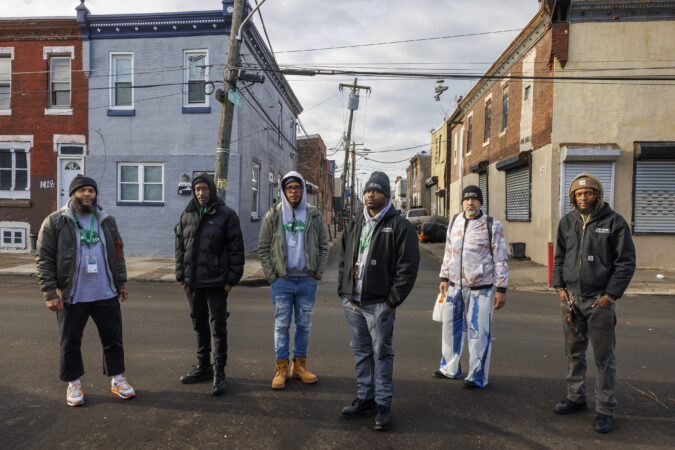
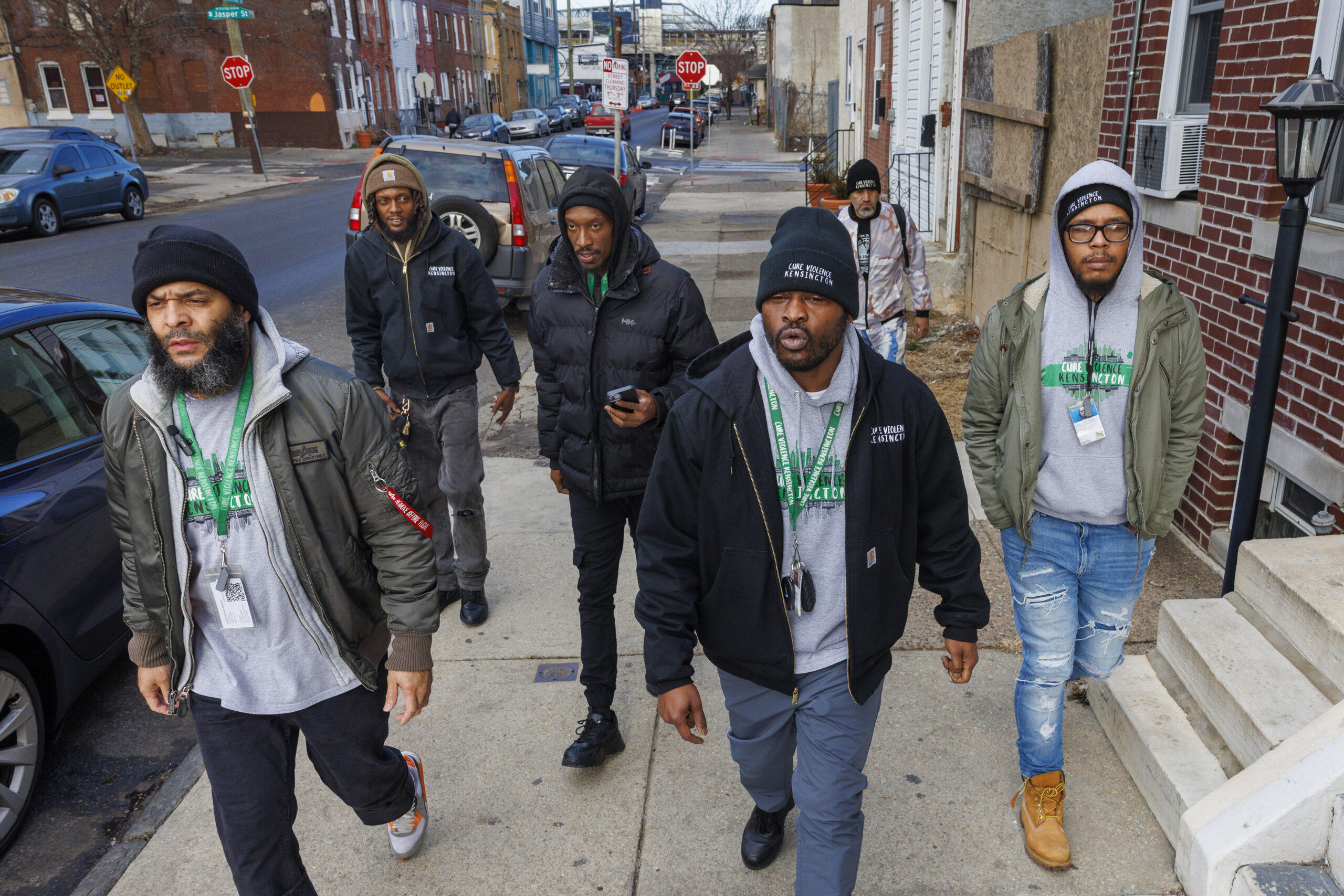
Nate Riley (from left), Tyree Batties, Dante Singleton, Tyreek Counts, Ivan Rodriguez, and Jamall Green-Holmes, outreach workers with New Kensington Community Development Corporation, making their rounds on Wednesday.
Cure Violence’s six-person outreach team is made up of people like Riley, who grew up in North Philadelphia and says he is well-versed in the relationship between poverty, trauma, and violence and brings that experience to Kensington.
“This is a community that’s been neglected for decades,” Riley said. “For lack of a better term, you’ve got to help them come in outside of the rain.”
In a recent month, Cure Violence outreach workers responded to 75% of shootings in the Kensington area within three days, a feat Riley is particularly proud of.
He said the program is not meant to supplant the role of police.
Instead, Riley sees street outreach as another outlet for those whose negative experiences with authorities have led them to distrust law enforcement.
Those people may alter their behavior if they know police are present, he added, giving outreach workers embedded in the community a better chance at picking up on cues that someone is struggling.
From Kensington to Washington
McKinney, with New Kensington CDC, said the group was still expecting about $600,000 from the Justice Department when the grant was cut short.
The nonprofit has since secured a patchwork of private donations and state grants that will keep Cure Violence running through much of 2026, he said.
After that, the program’s future is uncertain.
In the wake of the cuts, national organizations like the Community Justice Action Fund are advocating for federal officials to preserve funding for community-based anti-violence programs in future budgets. Adzi Vokhiwa, a federal policy advocate with the fund, said the group has formed a network of anti-violence nonprofits dubbed the “Invest in Us Coalition” to do so.
The group petitioned congressional leadership in December to appropriate $55 million for anti-violence organizations in the next budget — a figure that both Democrats and Republicans in the Senate have previously agreed on and that Vokhiwa views as a sign of bipartisan support for such programs.
McKinney, with New Kensington CDC, said it was impossible to ignore that the nonprofit and others like it provide services to neighborhoods where residents are overwhelmingly Black and brown. In his view, the cuts also reflect the administration’s “war on cities.”
He was bothered that the Justice Department did not seem to evaluate whether New Kensington CDC’s program had made an impact on the neighborhood before making cuts.
“We’re in a situation where the violence isn’t going away,” he said. “Even if there’s been decreases, the reality is that Kensington still leads the way. As those cuts get deeper, we are going to see increases in violence.”