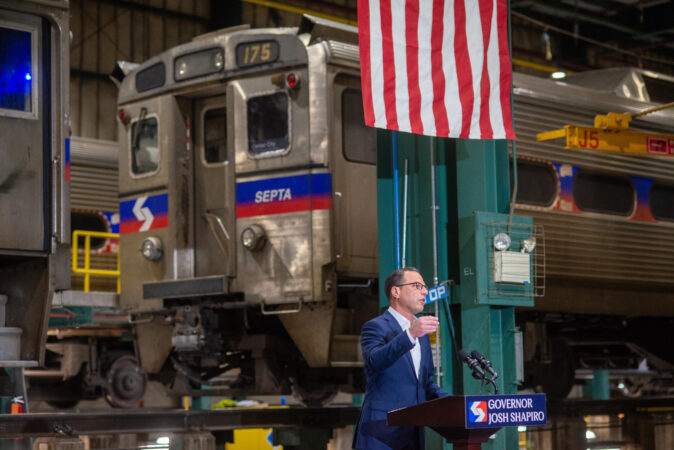
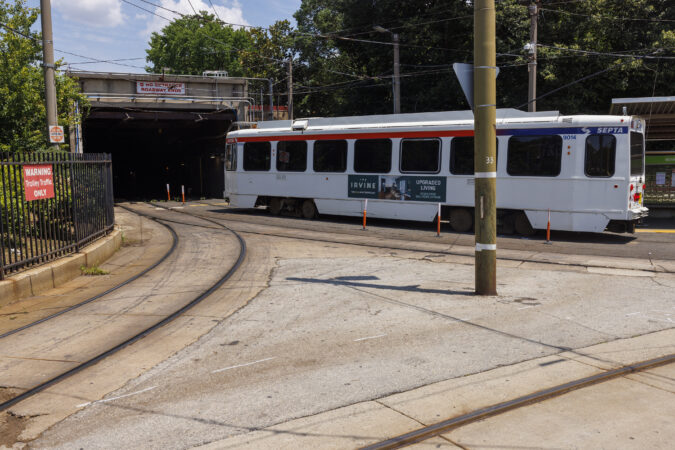
Earlier this month, the Federal Transit Administration ordered SEPTA to inspect its trolley power system after four incidents, including two times trolleys stalled in the Center City tunnel, requiring 415 passengers to be evacuated.
The budget impasse
Shapiro said he was forced to act for the second straight year because Senate Republicans wouldn’t support additional recurring funding for mass transit operations in the state budget.
“They’ve come up with a ton of excuses, but they haven’t come up with the funding,” Shapiro said.
After the governor decided in September that no budget agreement on transit funding was possible, PennDotallowed SEPTA to tap $394 million in state money allocated for future capital projects to pay for two yearsof operating expenses.
The transit agency was facing a $213 million recurring deficit in its operating budget.
Yet the problems with the rail cars and trolleys served to underscore the risks of using capital funds for day-to-day operations.
“A history of chronic underinvestment has led us to this point,” said Chester County Commissioner Marian D. Moskowitz, who is vice chair of SEPTA’s board.
She noted that SEPTA has a much smaller capital budget than other large transit agencies.
$95 million for electrical system upgrades, overhauled propulsion motors and more on the Silverliner IV train cars and the newer Silverliner V models.
$48.4 million to update the overhead catenary wires in the trolley tunnel, along with three new catenary-maintenance cars for the tunnel and along trolley lines, and on long Regional Rail lines.
$51.5 million to upgrade 13 escalators at SEPTA stations, install AI-powered inspection cameras to catch potential problems earlier, and technology improvements at SEPTA’s Control Center
$8 million to install replacement parts for Broad Street Line and Norristown High Speed Line cars.
“These funds are going to make a significant difference in our efforts to overcome the current crises,” SEPTA general manager Scott Sauer said, and to help avoid future ones.
He thanked the governor and pledged “a comprehensive effort to identify potential problems sooner before they grow and lead to delays, cancellations, or shutdowns.”
Shapiro had proposed an increase in the share of general sales-tax revenue devoted to transit subsidies over five years.
Leaders of the GOP-controlled Senate said the $1.5 billion price tag was too high and proposed shifting capital money to operating subsidies for the state’s transit systems and roads — an idea partially reflected in the Shapiro administration’s temporary solution.
“I am glad the Governor continues to take our advice and use existing resources to support public transit,” Senate Majority Leader Joe Pittman (R., Indiana) said in a statement.
“It’s unfortunate that just one year ago, he took $153 million of funding from critical [road] infrastructure projects to fund transit, neglecting the needs of those who use our roadways every single day,” Pittman said.
Republicans also argued that SEPTA had been mismanaged and needs change.
As the next state budget cycle nears, the debate is likely to continue.
“I want you to know I’m going to be a continue to be a governor who supports mass transit, who gives a damn about SEPTA, who cares about those 800,000 people that rely on SEPTA every single day,” Shapiro said.
SEPTA is extending its trolley tunnel closure through at least Nov. 30, hoping to use the extra time over the Thanksgiving holiday to complete repairs to the overhead catenary power system.
The tunnel has been shut down for most of the last two weeks as crews work on the problem.
Riders should use the Market-Frankford El to travel through Center City, catching the trolleys at 40th and Market Streets.
“My wife, daughter and I are totally dependent on the trolley to get us to work and school, and with a prolonged trolley-tunnel diversion, the system has become unreliable and, frankly, unusable,” Will Tung, a Southwest Philly resident, told the SEPTA board during public comments at its Thursday meeting.
Trolley ridership is typically lower during the week of the Thanksgiving holiday so the closure should be less of a disruption, spokesperson Andrew Busch said.
SEPTA is contending with glitches in the connection between the overhead catenary wires in the tunnel and the pole that conducts electricity to the vehicle.
The issue led to two trolleys becoming stranded in October, with a total of 415 passengers needing to be evacuated.
SEPTA’s21.5% increase in transit fares and service cuts fell hardest on disadvantaged Philadelphians this year, showing an urgent need to make the city’s Zero Fare program permanent, CityCouncilmember Nicolas O’Rourke argues.
He touted his proposal to dedicate 0.5% of the city budget each year to pay for the initiative that provides free SEPTA passes to people living in poverty.
O’Rourke’s proposedTransit Access Fund would be written into the City Charter “so it can’t be yanked away at a moment’s notice when somebody wants to shift something around in the budget,” hetold about 150 people in a town hall at the Friends Center on Cherry Street.
O’Rourke, Democratic State Sen. NikilSaval, and the advocacy group Transit Forward Philadelphia called the meeting to push for affordable public transportation and ways to sustainably fund SEPTA after Harrisburg’s failure to provide new state money for mass transit agencies.
A broad coalition and patience are needed in Pennsylvania, Saval said. ” Every major political win comes from months, years, sometimes decades, of work,” he said.
“We pushed back hard,” said O’Rourke, a member of the Working Families Party. “People with the least income are paying a larger share of their money just to get around. That’s upside down.”
Funding is not guaranteed after June 30, when the current budget expires, however.
If enacted, a Transit Access Fund would generate an estimated $34 million in the 2026-2027 fiscal year, O’Rourke’s office calculates.
That would generateenough money — between $20 million to $25 million, according to managers of the Zero Fare program —to give free SEPTA passes to 60,000 Philadelphians at or below the federal poverty standard.
O’Rourke and his staff also are considering usingthe remaining $10 million to $14 million for matching grants to help businesses, landlords and housing developments to join the SEPTA Key Advantage program, which provides subsidized transit passes.
People living at or below the federal poverty standard are eligible for the Zero FareSEPTA passes. For 2025, that is $15,650 for an individual and $32,150 for a family of four.
Philadelphia’s poverty rate was 19.7% in 2024, the latest figure available, according to the U.S. Census.
“When we’re made to feel like we’re on opposite sides of the fight, our numbers become smaller and we focus on the wrong targets,” said Saval.
“It’s not the person in Schuylkill County frustrated about potholes and road conditions that’s to blame for lack of transit funding” he said. “That person deserves to get safely where they need to go, too.”
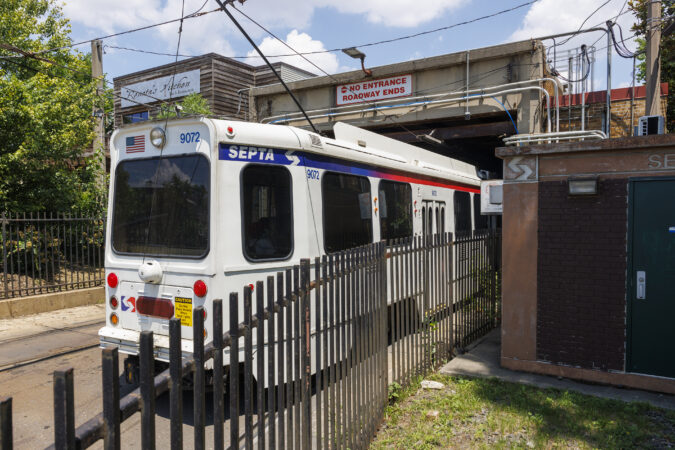
Philadelphia’s trolley tunnel has been closed for most of the last two weeks as SEPTA contends with glitches in the connection between the overhead catenary wires and the pole that conducts electricity to the vehicle.
The tunnel will remain closed at least until next week for repairs, and city trolleys will operate from West Philadelphia. Riders can take the Market-Frankford El to get to and from Center City to 40th and Market Streets.
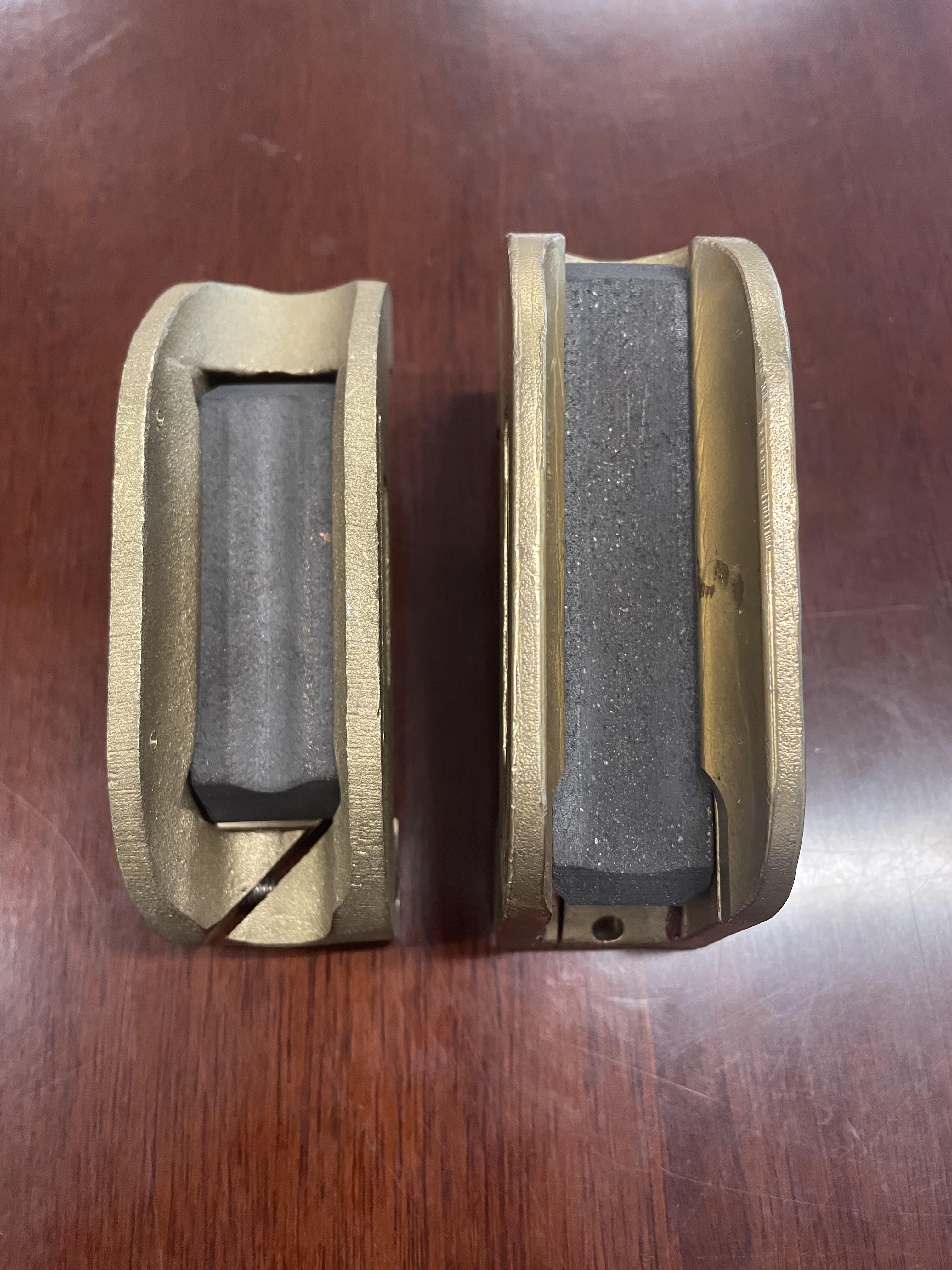
At issue is a U-shaped brass part called a slider that carries carbon, which coats the copper wires above that carry electricity.
“There’s a lot of friction and heat. The carbon acts as a lubricant,” said John Frisoli, deputy chief engineer for SEPTA.
A 3-inch slider (left) and a 4-inch slider, which coats electric-powered wires with carbon to reduce friction. When they fail, trolleys are stranded.
Earlier in the fall, SEPTA replaced 3-inch sliders with 4-inch models in an effort to reduce maintenance costs, but the carbon in the longer units wore out sooner than they should have, causing metal-on-metal contact between the trolley and the copper wires.
Soon after, there were two major incidents when trolleys were stranded in the tunnels. On Oct. 14, 150 passengers were evacuated from one vehicle and 300 were evacuated from a stalled trolley on Oct. 21.
SEPTA went back to the 3-inch sliders.
On Nov. 7, SEPTA shut down the tunnel to deal with the issue, which had cropped up again, then reopened it on the morning of Nov. 13, thinking it was solved. But it discovered further damage to the catenary system and the tunnel was closed at the end of the day.
“It’s just unfortunate that we’re dealing with the damage that decision caused,” said Kate O’Connor, assistant general manager for engineering, maintenance, and construction.
The transit agency is running test trolleys and has found minimal wear of the wires rather than the extensive wear earlier, O’Connor said. Her department is working on a plan to replace wires by sections and will continue test runs until it’s determined the tunnel is safe for passenger traffic again, she said.
“We have far more traffic in the tunnel than on the street — all five routes use it — and the overhead system there is more rigid,” O’Connor said.
Trolleys have been unaffected traveling on the street. Jason Tarlecki, acting chief deputy engineer for power, said that the wires have “a lot more upward flexibility to absorb the shock,” he said, leading to less friction.
The Federal Transit Administration on Oct. 31 ordered SEPTA to inspect the overhead catenary system along all its trolley routes.
The turning point in Pennsylvania’s budget impasse, by Gov. Josh Shapiro’s telling, came just before Halloween, when he and leaders in Harrisburg gathered in his stately, wood-paneled office to meet twice daily to hash out a deal to end the bitter, monthslong stalemate.
The long grind eventually led to compromises 135 days in, and a deal Shapiro said he thinks is far better than what national Democrats, hoping to extend healthcare subsidies, got in Washington at the end of the federal shutdown.
“Sometimes you’ve got to show that you’re willing to stay at the table and fight and bring people together in order to deliver,” Shapiro told The Inquirer in an interview Friday, touting the state budget agreement finally signed that week.
“I think it’s a stark contrast, frankly, with what happened in D.C., where they didn’t stay at the table, they didn’t fight, and they got nothing,” he said.
Washington is controlled by Republicans, while in Pennsylvania, Democrats control the state House and governorship, and Republicans hold a majority in the Senate.
Both state and federal budgets were signed the same day, offering Pennsylvanians relief from more than a month of government dysfunction at two levels. But for Shapiro — an exceedingly popular Democratic governor facing reelection in 2026 as whispers swirl over his potential 2028 presidential ambitions — the moment was bigger than a procedural win. In the end, Shapiro, preaching his oft-used slogan of “getting things done,” cast the outcome as proof he can muscle through gridlock of a divided legislature, cut deals under pressure, and hold firm where others cave.
So what if it took almost five months? Shapiro argues. At least he didn’t fold.
“I would have hoped to have gotten this budget done, you know, 100 or so days earlier,” Shapiro said, putting pen to paper in the state Capitol building’s baroque reception room last week. “But I think what you also saw was the result of having the courage to stay at the table and keep fighting for what you believe in. And we got a lot more than we gave in this budget.”
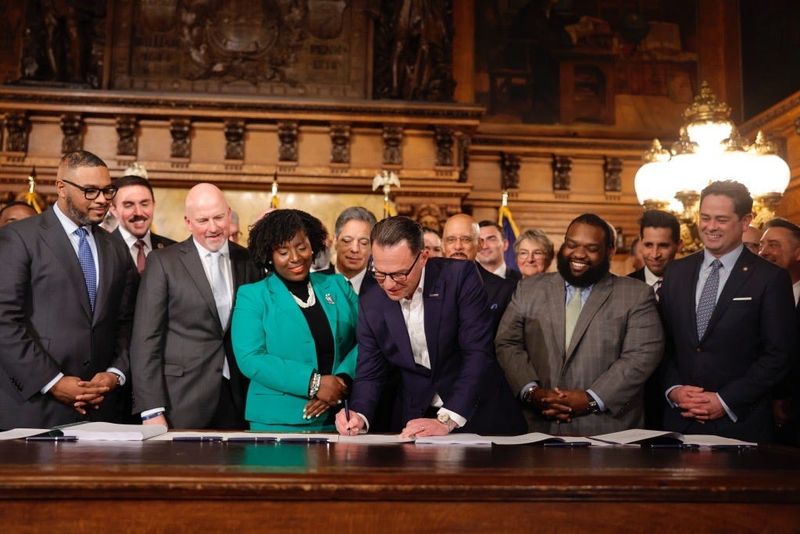
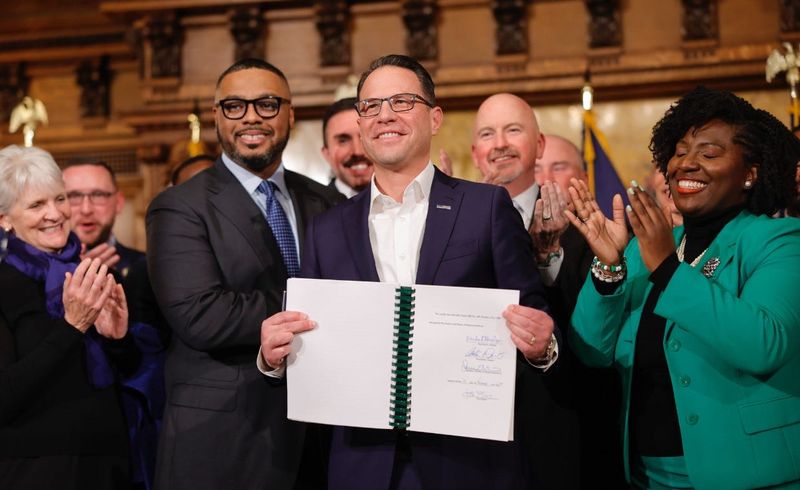
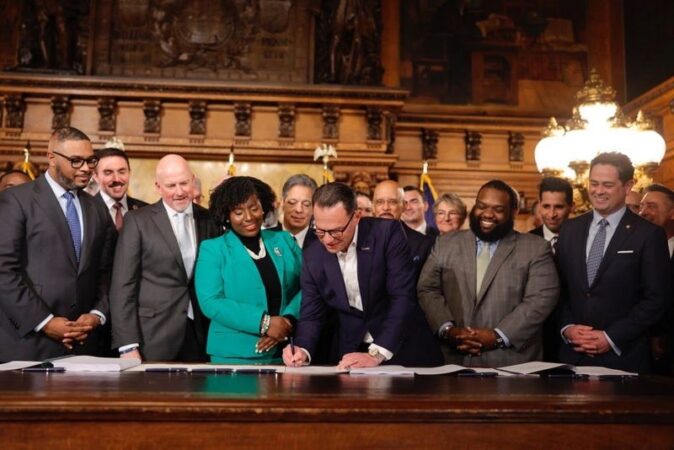
Gov. Josh Shapiro signs the fiscal year 2025-26 budget surrounded by General Assembly members on Nov. 12 at the Capitol in Harrisburg. The state budget had been due June 30, and Pennsylvania the final state in the country to approve a funding deal.
Critics are quick to note it took the self-proclaimed dealmaker so long to get a deal. Counties, school districts, and nonprofits struggled through four months without state payments while officials remained at loggerheads.Pennsylvania was the last state in the nation to pass a spending plan for the 2025-26 fiscal year.
“He’s five months late. He’s the governor of the fifth-biggest state in the country and the last state to get a budget done,” GOP consultant Vince Galko said. “It’s not a failing grade because it got done, but it’s still a D.”
‘A tremendous cost’
The $50.1 billion budget includes several key priorities for Shapiro and Democrats: significant increases in public education funding, a new tax credit for lower- and middle-income residents, continuation of a popular student-teacher stipend, and other economic and workforce development initiatives.
House Speaker Joanna McClinton (D., Philadelphia) heaped praise on Shapiro during a Monday news conference celebrating the budget’s new Working Pennsylvanians tax credit. “I am grateful that here in Harrisburg we have a hero among us for working families, and his name is Josh Shapiro.”
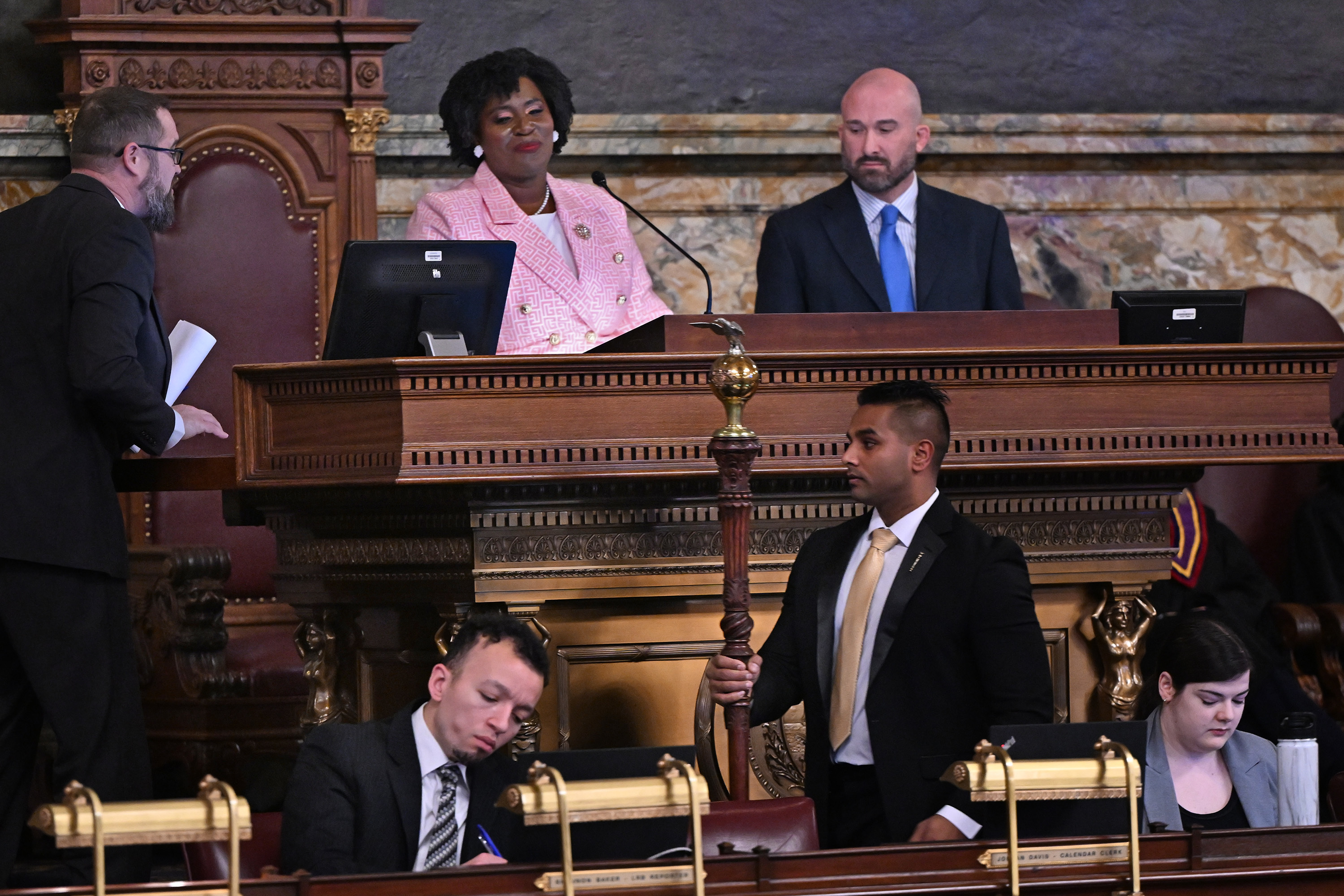
State Rep. Joanna McClinton (D., Philadelphia) is on the rostrum in the House chamber on Jan. 7 after she was reelected speaker of the House despite an initial 101-101 tie vote along party lines.
State Sen. Nikil Saval, a progressive lawmaker who represents part of Philadelphia, was one of a handful of Democrats to vote against the bipartisan Pennsylvania budgetbill that was largely lauded by Democrats and Republicans in Harrisburg and beyond. Saval applauded the school funding, anti-violence grant funding, and childcare support but slammed the absence of transit funding and Democrats’ agreement to end their pursuit to join a key climate program.
“Unfortunately, it comes at this tremendous cost,” he said.And ultimately, Saval said, the finished product didn’t seem to justify the time it took to get there.
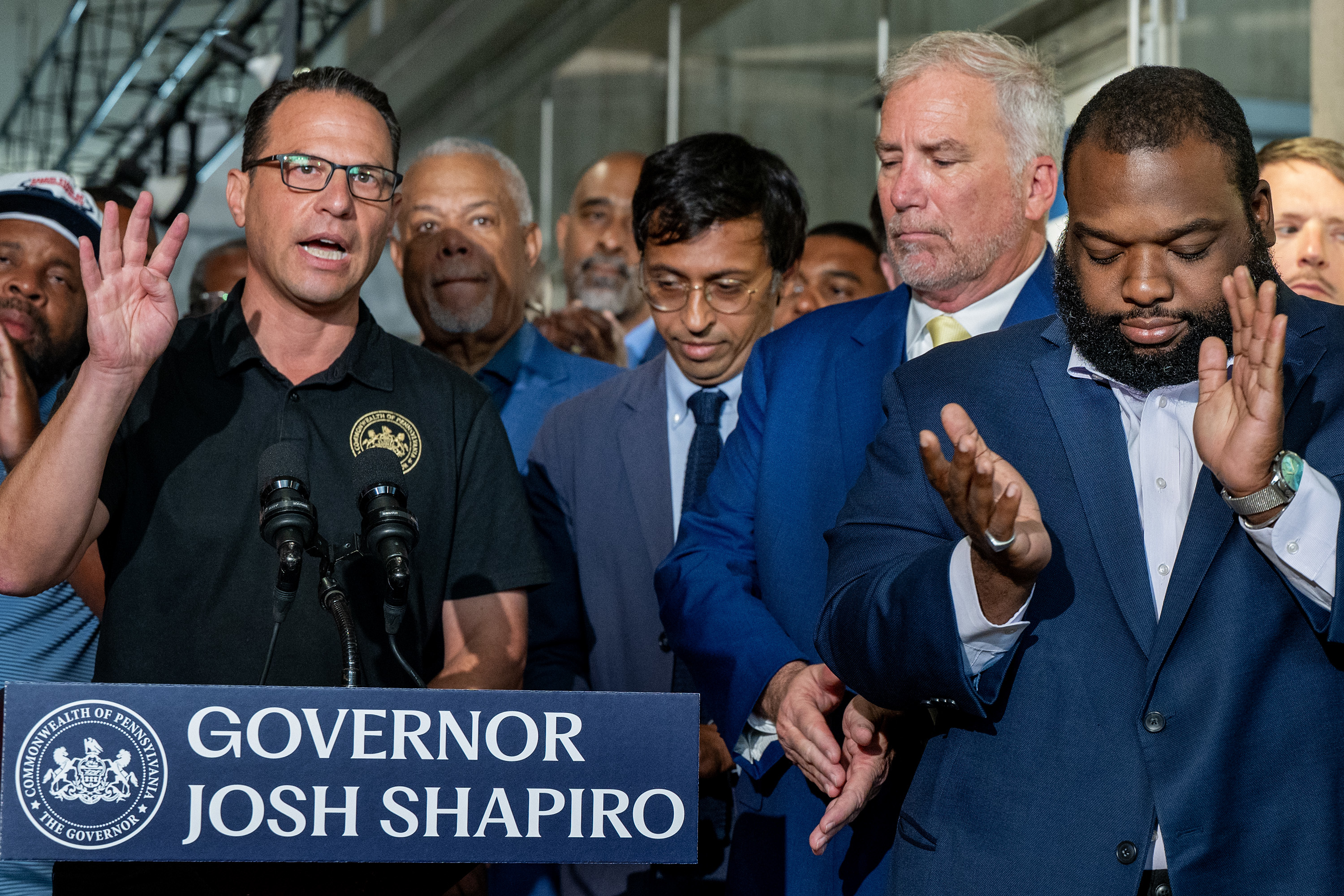
Gov. Josh Shapiro visits SEPTA headquarters on Aug. 10 to discuss funding for the transit agency. To his right, from left, are state Democratic legislators Sen. Anthony H. Williams; Sen. Nikil Saval; Rep. Ed Neilson; and Rep. Jordan Harris.
It was not just transit funding that took a back seat to get the budget deal over the line. To thedelight of Republicans — and the chagrin of some progressive Democrats and the climate-conscious — the deal also pulled the state out of the Regional Greenhouse Gas Initiative, a cooperative among states to reduce carbon emissions.
“For years, the Republicans who have led the Senate have used RGGI as an excuse to stall substantive conversations about energy,” Shapiro said. “Today, that excuse is gone.”
The powerful Pennsylvania Building and Construction Trades Council had lobbied heavily for lawmakers to walk away from the initiative, and it was a top win for state Republicans, who have long said the state should not join the multistate cap-and-trade emissions program they see as hamstringing Pennsylvania’s energy industry from accessing the state’s plentiful natural resources.
‘Two-a-days’
Shapiro said he spent months “running back and forth” to broker a deal between Senate Majority Leader Joe Pittman (R., Indiana) and House Majority Leader Matt Bradford (D., Montgomery). The three met on-and-off in private talks, attempting to hammer out a compromise between the Democratic House and Republican-controlled Senate. But the week of Oct. 27, more than four months into the stalemate, Shapiro said a “breakthrough” finally came when he broadened the talks to include McClinton and Ward.
Minority leaders Rep. Jesse Topper (R., Bedford) and Sen. Jay Costa (D., Allegheny) also joined the group, as it became clear that neither of the tightly controlled chambers would have the votes needed to pass a final budget deal.
The group met twice daily in a conference room in Shapiro’s office. Shapiro, always a fan of the sports metaphor, called the meetings “two-a-days.”
“We would come in the morning, go over the issues. We’d have our homework for a few hours, then come back in the afternoon and talk about, you know, the progress that we made,” Shapiro said. Coming out of that week, the governor said, leaders “had a clear direction on where we were going to go.”
Pennsylvania Lt. Gov. Austin Davis and Gov. Josh Shapiro show a budget document moments after it was signed Nov. 12 while surrounded by legislators at the state Capitol. A deal struck Nov. 12 ended a budget delay that lasted more than four months.
At the negotiating table, Shapiro served as “referee and facilitator” between House Democrats and Senate Republicans, McClinton said in an interview Monday.
“The man is nothing if not dogged and determined,” Bradford said of Shapiro last week.
Two officials in the closed-door talks said Topper’s presence, as the House minority leader who understands House Democrats and Senate Republicans, helped change the dynamic and got leaders on track toward a deal. Other officials in negotiations noted that once the state’s two top leaders — McClinton and Ward, who are both the first women to serve in their roles — the breakthrough deal swiftly came together.
Topper, for his part, didn’t try to take credit for striking the final budget deal, calling himself “a neutral arbiter” and “someone all sides can trust to have an honest dialogue.”
There were other signs of tensions easing as the legislators worked through the fall. Ward, a top critic of Shapiro since he reneged on a promise he made over school vouchers during his first budget negotiations, joined the conversations. The two had not met in person since 2023, and had barely communicated. Suddenly, they were sitting across from one another.
Kim Ward, president pro tempore of the Pennsylvania Senate, talks with her chief of staff Rob Ritson in her office Tuesday, Jan. 17, 2023, before heading out to preside over the swearing-in of Lt. Gov. Austin Davis in the Senate chambers.
Ward said her criticisms of Shapiro still stand — she wants him to be more transparent, among other disagreements. But she described the conversations as “very cordial, very professional.” And there were moments of levity that helped, said the top Republican leader in the Senate, who is known for her wry humor.
“He did leave me a sugar sprinkle heart [cookie] one day at my seat, and I told him, ‘You know, I’m too old for you, and we’re both married,’” she joked.
“I can’t understand why all these legislators think they did a great job,” she said on The Conservative Voice radio program, breaking with GOP leaders, like Ward and Pittman, who lauded the deal. “… Next year, they’re going to have to dip into the Rainy Day Fund to plug a budget, and then taxes are going to go up.”
Because of how long this budget took to finalize, Shapiro will already need to introduce his next budget in just three months, and in proximity to the 2026 midterms and Pennsylvania governor’s election. But it’s unclear whether those negotiations will be as fraught, given budgets tend to get resolved faster in election years with both parties eager to focus on the campaign trail.
“In this day and age, I would not downplay the fact that there was compromise,” said Berwood Yost, a pollster with Franklin and Marshall College. “People want their problems solved. They want politicians to do things that help their everyday lives and that, for most people, means some kind of compromise. Getting this problem solved fits with his narrative.”
Galko, the GOP consultant, looked further ahead to a potential 2028 presidential election. The budget impasse, he said, could provide material for Democratic rivals on the national stage. The possible field is filled with other governors, several from blue states, like Gov. JB Pritzker of Illinois and Gov. Gavin Newsom of California, where in-state dealmaking is easier among a uniform legislature.
“If he’s unable to negotiate with the Pennsylvania Senate, what’s he gonna do when he goes up against China or Russia?” Galko asked, previewing the possible attack.
Ultimately, history suggests Shapiro’s political success is likely to hinge less on the nuts and bolts of a budget only some Pennsylvanians — and even fewer outside Pennsylvania — are familiar with, and more on his ability to bolster his image as a bipartisan governor in a purple state.
On Friday morning in South Philadelphia, Shapiro sported a bomber jacket while posing for selfies with Eagles fans, nodding along to a rock band’s cover of “Santeria” in a tent outside the Xfinity Mobile Arena at an event hosted by radio station WMMR.
Casually, almost as a throwaway line, Shapiro mentioned to radio hosts Preston and Steve during an interview that he planned to bring Michigan Gov. Gretchen Whitmer — a fellow swing-state governor seen, too, as a possible 2028 Democratic contender — as his guest to the Eagles-Lions game at the Linc that Sunday.
“She actually said, ‘Is it OK if I wear Lions stuff?’” Shapiro told the kelly green-clad crowd in Philadelphia, riffing on the friendly football rivalry — the undercurrents of national politics left unspoken. “And I’m like, ‘No problem. You’re on your own in the parking lot. I can’t protect you.’”
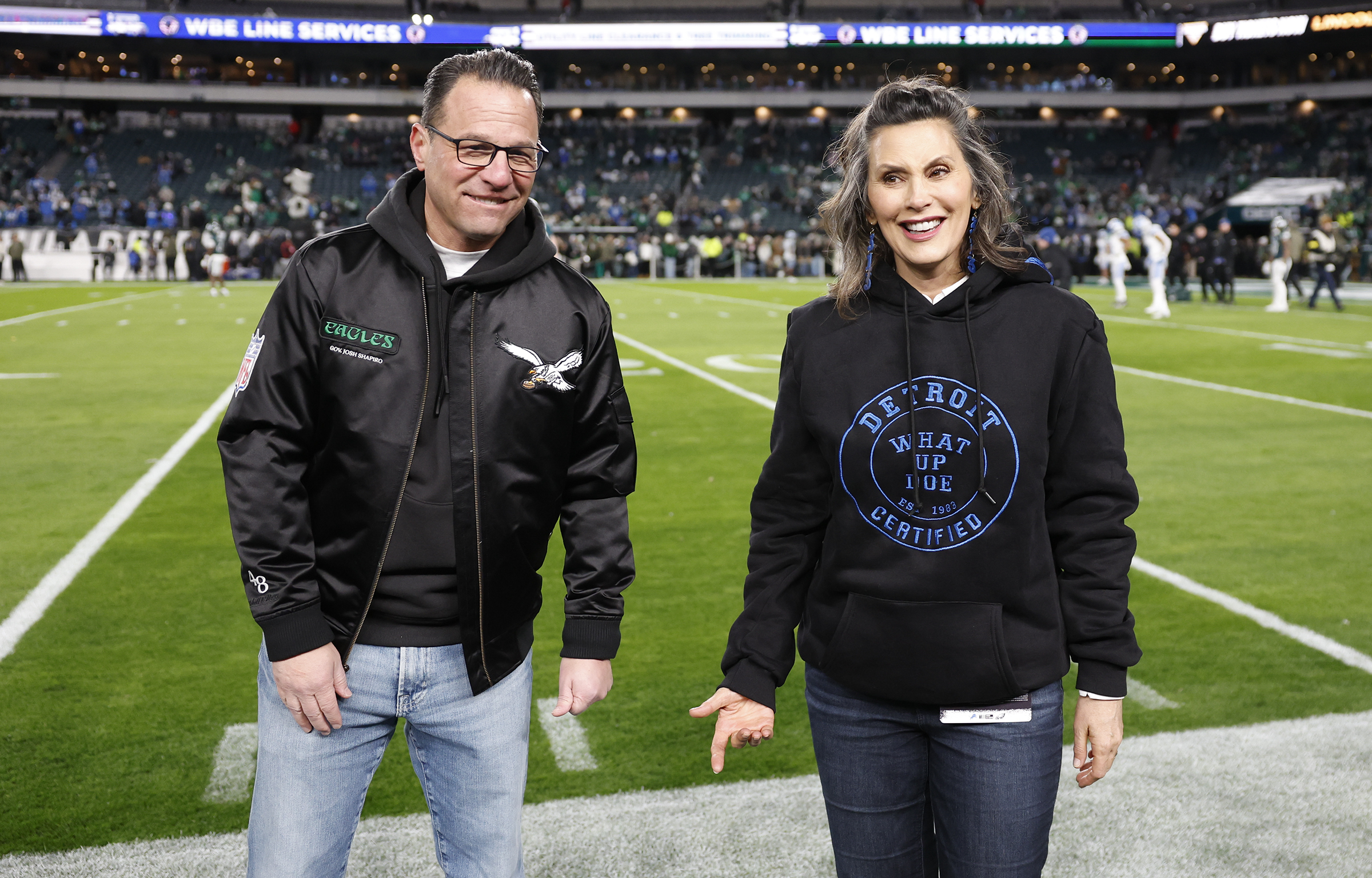
Michigan Gov. Gretchen Whitmer joined Pennsylvania Gov. Josh Shapiro at Sunday’s game between the Eagles and Detroit Lions at Lincoln Financial Field.
The event was a food drive but also served as a tribute to the station’s beloved late host, Pierre Robert. Shapiro brought along a commendation from the governor’s office for the occasion.
“He created community, created joy, brought people together,” Shapiro said of Robert. “You think about just how divided we are as a world, there’s a few things that still bring us together, right?”
“By the way, I’ve learned those lessons. That’s what I try and do governing with a, you know, divided legislature.”
Music and sports, the governor mused before the crowd of Philadelphia fans, are two things that bridge the gap. “Go Birds,” he added with a grin.
Staff writer Katie Bernard contributed to this article.
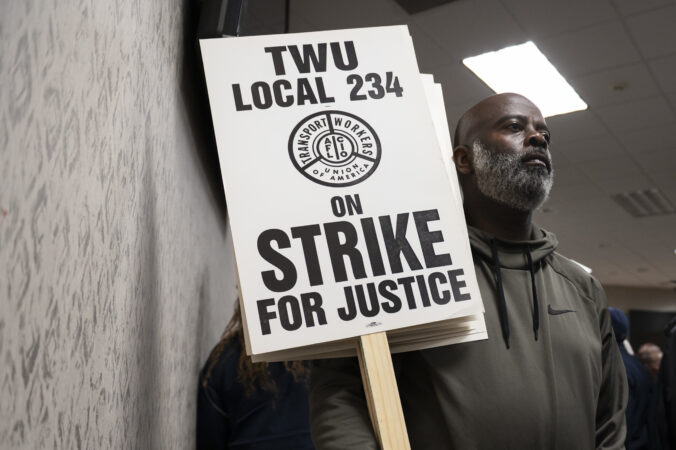
Members of the Transport Workers Union Local 234 on Sunday, Nov. 16 voted to authorize a strike if union and SEPTA negotiators can’t reach an agreement on a new contract.
Shortly before the current contract ran out at 11:59 p.m. on Nov. 7, TWU’s new president, Will Vera, urged union members to stay on the job. In an unusual move, he delayed a strike vote at the time of contract expiration, saying he had hope that a deal could be reached without the usual brinksmanship.
“We’re asking you to please continue to come to work and put money aside. We want you to be prepared in case we have to call a work stoppage,” he told members in a video at the time.
Local 234 leaders say they’re prioritizing a two-year deal with raises and changes to what the union views as onerous work rules, including the transit agency’s use of a third party that Vera said makes it hard for members to use their allotted sick time.
In a statement, SEPTA said it was aware of the authorization vote and is committed “to continue to engage in good-faith negotiations, with the goal of reaching a new agreement that is fair.”
2023 Fraternal Order of Transit Police Lodge 109 (three days)
SEPTA police officers walked off the job after bargaining with the transit agency for almost nine months, largely over the timing of a 13% pay raise for members. The agreement, partially brokered by Gov. Josh Shapiro, came amid heightened fears about safety on public transit and a funding crisis for SEPTA.
TWU Local 234 walked off the job for six days; the biggest issue was retirement benefits. SEPTA’s contributions toward union members’ pensions did not rise in tandem with wages when workers made more than $50,000. Managers’ pension benefits were not capped. The union also wanted to reduce out-of-pocket health-care costs and win longer breaks for bus, trolley, and subway operators between shifts and route changes.
SEPTA and the union reached an agreement Nov. 7, the day before the general election. Democrat Hillary Clinton’s presidential campaign was worried about voter turnout, and the city sought an injunction to end the strike. It proved unnecessary.
Talk about leverage. TWU was ready to strike just before the first home game of the World Series between the Phillies and the New York Yankees. Gov. Ed Rendell pushed the two sides to continue talking, and the transit workers waited to walk out until three hours after the end of Game 5, the last in the series played at Citizens Bank Park.
It was a bitter strike, coming just a year after the stock market’s meltdown started the Great Recession. TWULocal 234 President Willie Brown called himself “the most hated man” in Philadelphia. Mayor Michael Nutter was harshly critical. Brown called him “Little Caesar.”
The strike was settled Nov. 7 with a deal on a five-year contract. Transit workers got a $1,250 bonus, a 2.5% raise in the second year, a graduated increase in SEPTA pension contributions from 2% to 3.5%, and the maximum pension benefit was raised to $30,000 from $27,000.
2005: TWU Local 234 and United Transportation Union Local 1594 (seven days)
Negotiations collapsed mostly over SEPTA’s insistence that workers pay 5% of medical insurance premiums. At that point, the authority paid 100% of the workers’ premiums for family coverage.
In the end, it was solved by Gov. Rendell, a Democrat who had been Philadelphia mayor in the 1990s. He agreed to give promised state money to SEPTA early, so it could pay premiums in advance, reducing its costs.
In the resulting four-year deal, the unions had to pay for 1% of their medical premiums. They also received 3% yearly raises.
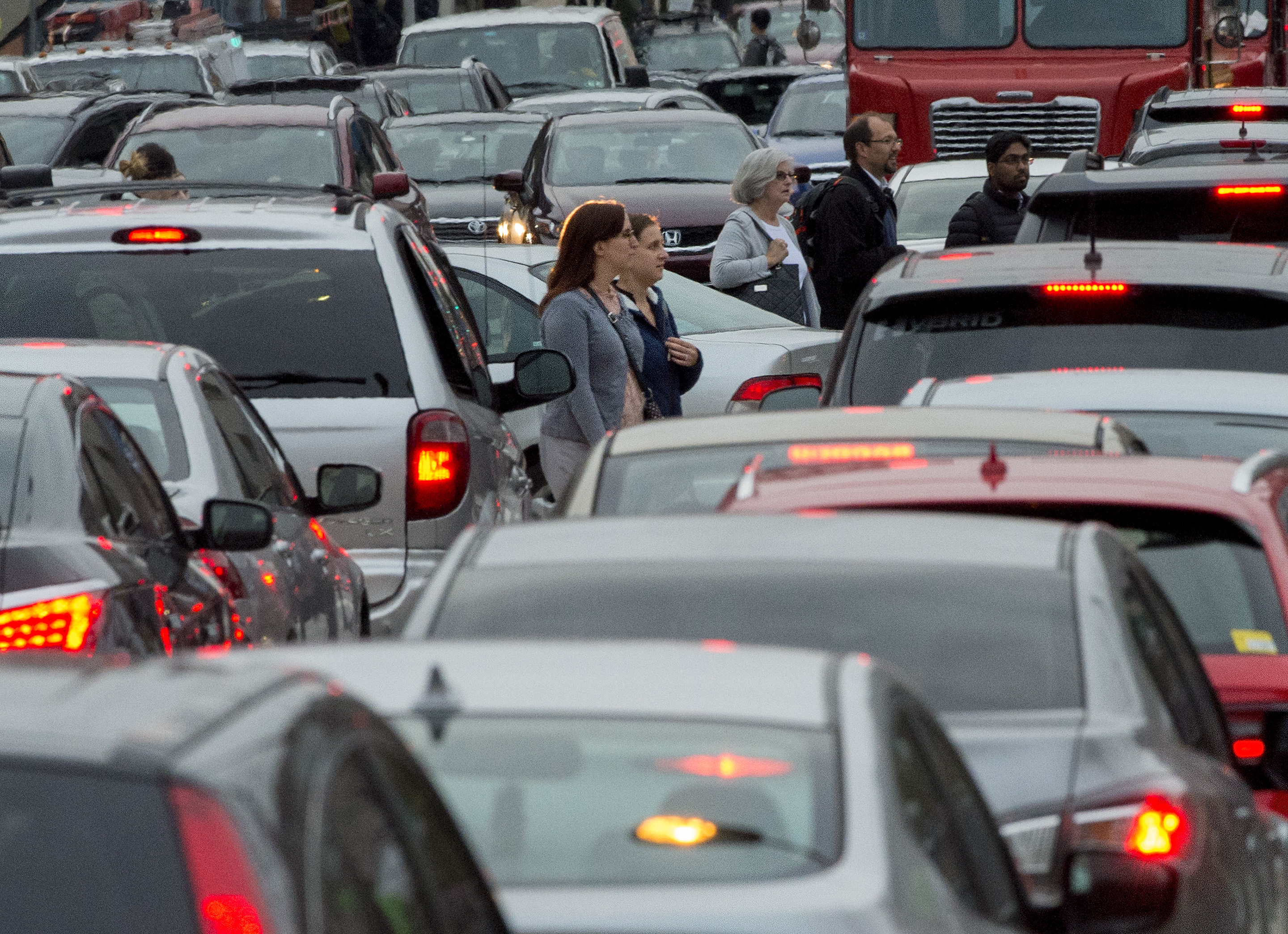
Pedestrians and cars in a chaotic dance at the intersection of Market and 30th Streets during the afternoon commute on the first day of the SEPTA city workers’ strike Nov. 1, 2016.
1998: TWU Local 234 (40 days)
City transit workers’ contract expired in March, but they did not strike until June — and then stayed out for 40 days. The two sides reached an agreement in July, but it fell apart. TWU members had returned to their jobs and kept working under an extension of their old contract. A final agreement was signed Oct. 23.
The union agreed to SEPTA’s demand that injured-on-duty benefits be limited. The old contract gave them full pay and benefits while on leave after a work injury. SEPTA wanted to hire an unlimited number of part-time workers. The union agreed to 100 part-timers to drive small buses.
SEPTA’s chief negotiator was David L. Cohen, famous for reining in unions representing city workers during Philadelphia’s bankruptcy in 1992, as Rendell’s mayoral chief of staff.
A two-week strike stilled city buses, trolleys and subways until an agreement was reached April 10. Transit workers would get 3% raises per year over the three-year span of the new contract, as well as increases in pension benefits and sick pay.
The union agreed to several cost-reduction measures, including a restructuring of SEPTA’s workers compensation policies.
Mayor Ed Rendell, a villain to many in labor for winning givebacks from city unions in 1992, pushed SEPTA to offer more generous terms to TWU than it had initially. Cohen, who was his chief of staff, crunched the numbers to make it work. Three years later, out of the city administration and working as a lawyer, he was hired as SEPTA’s chief negotiator.
1986: TWU Local 234 (four days) and UTU Local 1594 (61 days)
When TWU struck the city transit division in March 1986 over a variety of economic issues and work rules, some bus drivers pulled over mid-route and told passengers to dismount, The Inquirer reported.
Members were particularly incensed at what they considered SEPTA’s draconian disciplinary procedures. Union leaders said the issue was a basic lack of respect. The strike was settled in four days.
Drivers for 23 suburban bus routes, two trolley lines in Delaware County and the Norristown High-Speed Line — all members of the United Transportation Union — struck for just over two months, affecting about 30,000 passengers a day.
Employees in what was then known as SEPTA’s Red Arrow Division — after the private transit company that used to own the routes and lines — made considerably less than their city counterparts and had weaker pension benefits. They won raises and pension changes that brought them closer to parity.
1983: Regional Rail (108 days)
Thirteen separate unions walked off the job on the commuter rail lines that SEPTA had taken over at the beginning of the year from Conrail, successor to the bankrupt Pennsylvania and Reading Railroads.
In addition to wages, a key issue was SEPTA’s demand that union train conductors accept pay cuts. The authority had already cut the number of those workers by more than half.
Eventually SEPTA reached deals with a dozen of the unions. The 13th local, which represented 44 railroad signalmen, held out longer. Main issue: Whether SEPTA had the right to contract with outside firms for some types of signal work.
The Regional Rail strike remains SEPTA’s longest work stoppage since 1975.
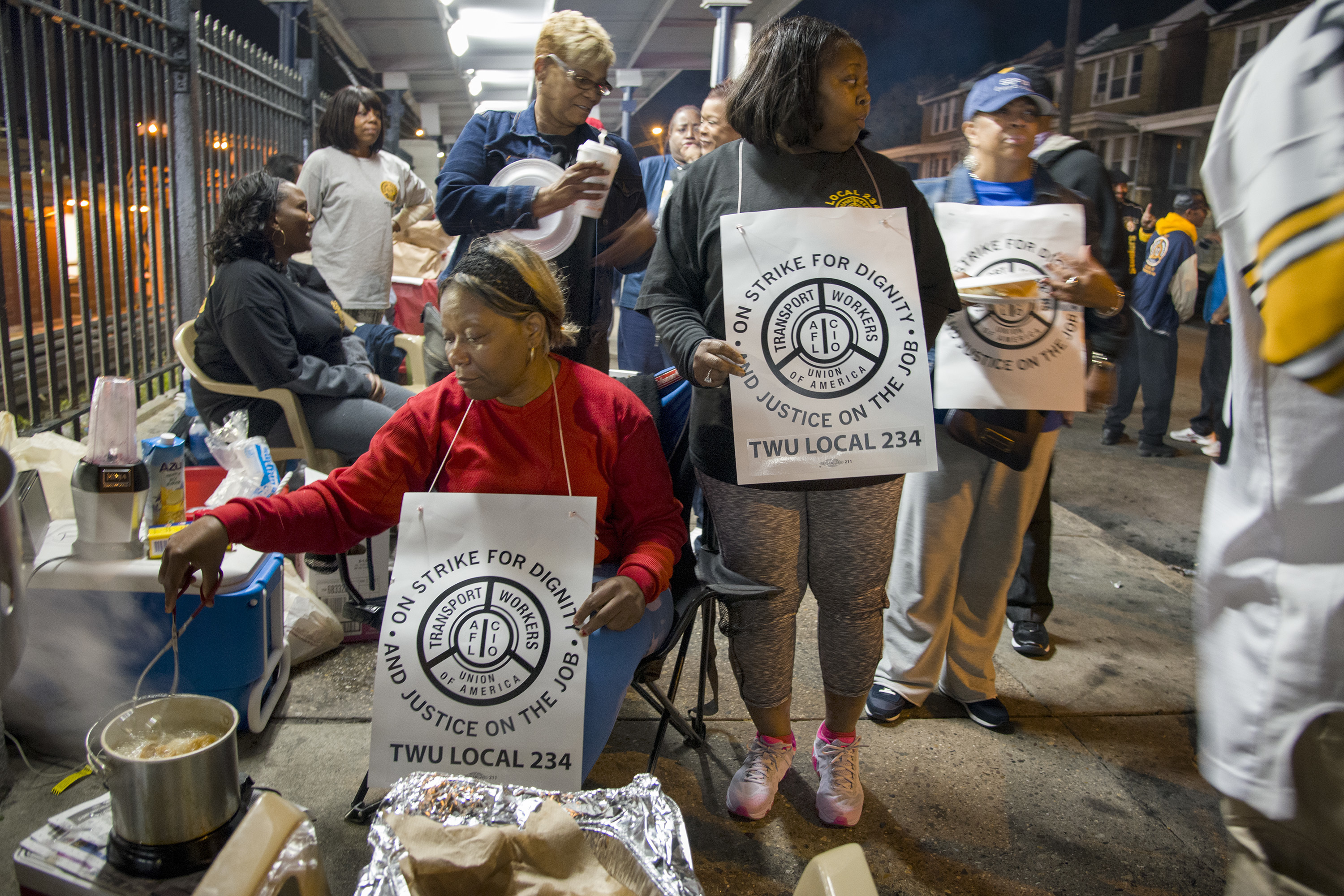
Joyce Woodford (center), a 25-year veteran cashier on SEPTA’s Broad Street Line, serves up fried fish for her fellow striking cashiers outside the Fern Rock Transportation Center during dinnertime on the third day of the SEPTA strike in 2016.
1982: TWU Local 234 (34 days)
About 36 suburban bus drivers and mechanics operating routes primarily in Montgomery County, and some routes in Bucks, won an 8.5% wage increase over three years.
The bus routes were the descendants of the Schuylkill Valley Lines and the Trenton-Philadelphia Coach Lines, which SEPTA acquired in 1976 and 1983, respectively. Service has grown, and the collection of bus routes is known as the Frontier Division today.
1981: TWU Local 234 (19 days) and UTU Local 1594 (46 days)
Transit workers shut down buses, trolleys and subways in the city on March 15, seeking job security in the form of a no-layoff clause, wage increases and a bar on SEPTA hiring part-time workers.
And the Red Arrow division went out for 46 days seeking higher wages and better medical benefits. SEPTA also backed down a demand for permission to hire private contractors for some work on the suburban buses, trolleys, and the Norristown High Speed Line.
1977: TWU Local 234 (44 days)
After a bitter strike, union members who run the city transit division got higher wages and more benefits, after rejecting an arbitrator’s proposed contract that was portrayed in news reports as generous.
A furious Mayor Frank Rizzo told reporters the strike “can last 10 years for all I care.” He said of the union’s rejection of the earlier offer: “It is outrageous, and I hope the people won’t forget it.”
1975: TWU Local 234 (11 days)
Transit workers, concerned about the ravages of inflation, wanted a clause giving them cost-of-living increases and enhancements to health-care benefits. Those were granted after Rizzo agreed to add $7.5 million to the city’s annual SEPTA contribution. Perhaps that’s one reason the mayor was so annoyed two years later.
Staff writer Erica Palan contributed to this article.
HARRISBURG — The contentious — and, at times, bitter — Pennsylvania budget stalemate has finally ended.
Gov. Josh Shapiro signed the nearly $50.1 billion state budget Wednesday, as part of a breakthrough bipartisan deal that ends a key climate initiative and increases public school funding. Schools, counties, and social service providers will soon receive four months of withheld state payments, lapsed after the budget deadline passed at the start of the new fiscal year on July 1, providing the much-needed relief that some say will come too late.
The long-awaited budget deal involving Shapiro, House Democrats, and Senate Republicans marks the first time Pennsylvania’s state budget has topped $50 billion. State spending and revenue earnings have skyrocketed in the post-COVID-19 years due to federal cash infusions. The budget is a 4.7% increase in spending over the prior fiscal year and includes no new tax increases. Lawmakers and Shapiro agreed to tap into underutilized special funds and use the state’s surplus to address a budget shortfall, as Pennsylvania is on track to spend more than it brings in this fiscal year and in the future.
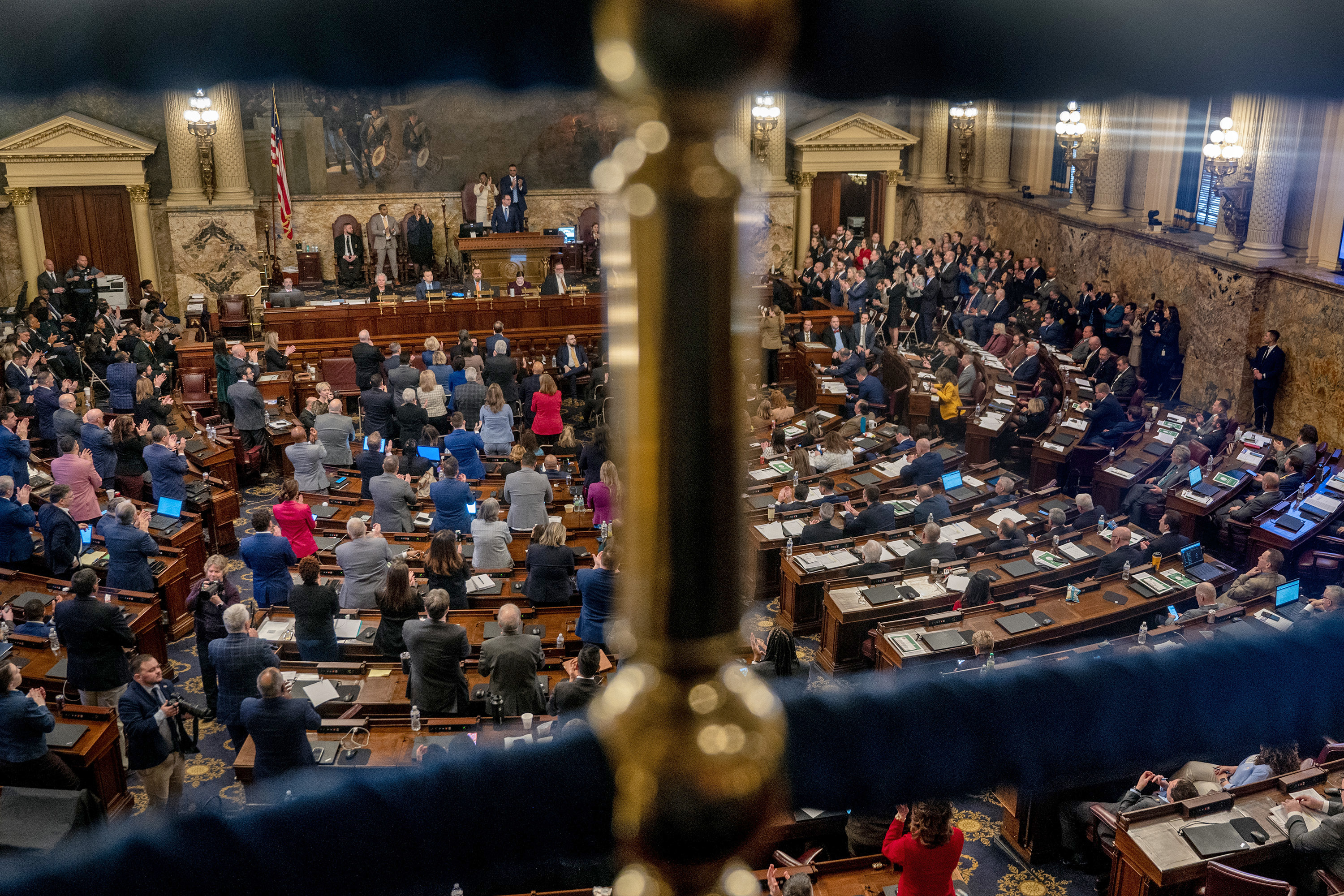
Democrats (left) stand to applaud a tax cut proposal while Republicans (right) remain seated as Gov. Josh Shapiro delivers his third budget address to a joint session in the House chambers at the State Capitol Tuesday, Feb. 4, 2025. Shapiro, a Democrat, will need to negotiate with a split legislature.
Both Republican and Democratic leaders celebrated the budget’s passage as a “true compromise,” noting that neither party got everything it wanted in the final deal. The spending plan includes significant energy and permitting changes cheered by Republicans and an earned-income tax credit and revisions to cyber charter funding long sought by Democrats, among other policy wins revealed Wednesday.
“Today is a good day,” Shapiro said, opening his remarks before signing the budget bills into law in the Capitol building, flanked by Democratic lawmakers.
“I would have loved to have stood here in this room with all of you on June 30, but as you know, Pennsylvania is just one of only three states in the country with a divided legislature,” Shapiro, a Democrat, said. “It requires all of us to compromise, to have tough conversations, and, ultimately, to find common ground.”
Several leaders said the budget deal approved Wednesday would not have been possible months ago, as debate had devolved into partisan finger-pointing over who was responsible for the budget deadlock and who might benefit politically from it.
Big GOP win: An end for RGGI
Among the top wins for Senate Republicans is the end of the state’s efforts to join the Regional Greenhouse Gas Initiative, which former Democratic Gov. Tom Wolf entered without legislative approval in 2019 and has been tied up in litigation ever since. The program has drawn the ire of Republicans, and in floor remarks Wednesday, House Minority Leader Jesse Topper (R., Bedford) called it the “No. 1 issue holding Pennsylvania back from economic growth.” The 12-state program, known as RGGI, is an interstate cap-and-trade initiative that charges power plants for the amount of carbon emissions they release into the air.
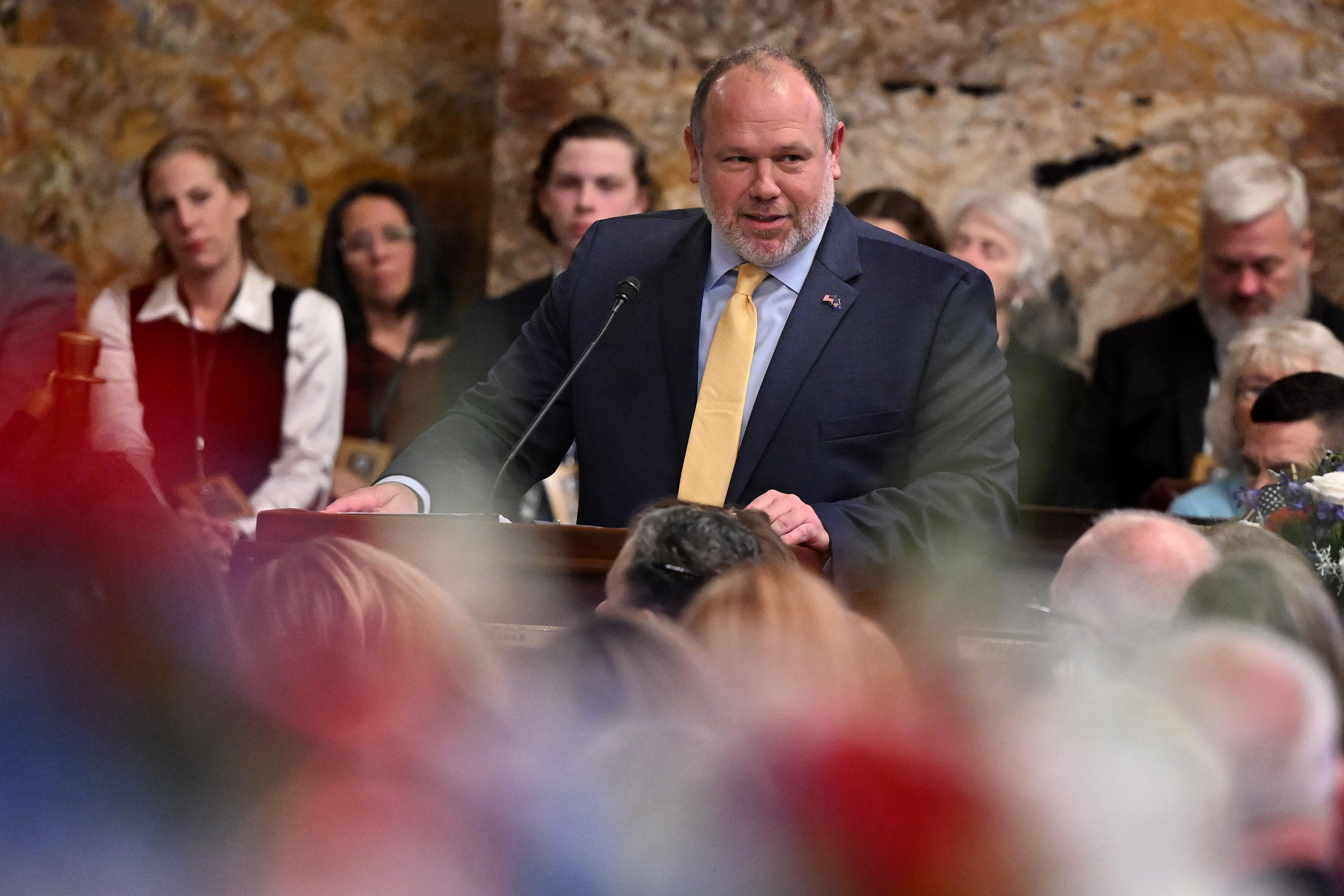
House Minority Leader Jesse Topper (R., Bedford) speaks on Jan. 7, 2025, on the first day of the 2025-2026 legislative session.
Ahead of a final budget deal, some Democratic lawmakers and environmental groups spoke out against ending Pennsylvania’s involvement in RGGI as a threat to the environment. In the end, most Democratic lawmakers voted in favor of the omnibus budget bill that ended the state’s pursuit to join the initiative.
House Majority Leader Matt Bradford (D., Montgomery), a top negotiator of the budget deal, told The Inquirer on Wednesday that Democrats’ agreement to leave RGGI was part of a broader compromise to end the impasse.
“I’m one who believes there should be a price on carbon, but I recognize the reality of the situation and compromise is required,” Bradford added.
House Majority Leader Matt Bradford (D., Montgomery) speaks on the first day of the 2025-2026 legislative session.
Shapiro and Democratic leaders were able to persuade Republicans, in turn, to spend more than they had wanted to this fiscal year. That additional spending allowed Democrats to invest more in public education, a new earned-income tax credit targeted toward working Pennsylvanians, and more.
“It’s much more money than we want to spend, and it took a lot longer than we wanted, but I think it was worth the wait,” said Senate President Pro Tempore Kim Ward (R., Westmoreland) in floor remarks Wednesday. “I am actually excited to vote for this budget.”
Dems win new funding for schools, but not mass transit
The budget deal includes more than $665 million in new funding for public schools, approximately $562 million of which would be funneled through the state’s adequacy and tax equity formulas as part of an effort to close what experts call a $4 billion “adequacy gap.“ These formulas were created last year in response to a 2023 court ruling that found Pennsylvania’s public education funding system unconstitutionally deprives students from poorer districts of an adequate and equitable education.
Senate Minority Appropriations Chair Vince Hughes (D., Philadelphia) applauded the budget agreement for its investments in public school funding, gun violence prevention, and the student-teacher stipend, among other things.
“This budget has good work in it that helps address … the issue of affordability, which sang loud and clear in the most recent election as a predominant issue that Pennsylvanians want us to address,” Hughes said on the Senate floor Wednesday.
In addition, the budget includes changes long sought by Democrats to how Pennsylvania funds and oversees its cyber charter schools. Cyber charter school leaders warned that the changes might lead to closures and mass layoffs for the virtual schools, which often serve the state’s most vulnerable populations, but they were resoundingly celebrated by Democrats and public education experts.
“We finally reformed our cyber charter school system,” Shapiro said to boisterous applause. “If a parent wants to send their child to a cyber school, that’s fine. That’s their prerogative. But we shouldn’t be overfunding them at the expense of Pennsylvania’s public schools.”
The deal, however, does not include any additional funding for mass transit, another major Democratic priority. Democrats removed mass transit from the budget negotiation table in September, after a lawsuit required SEPTA to undo its service cuts and Senate Republicans appeared unwilling to make a long-term investment in mass transit. Instead, Shapiro approved SEPTA’s use of its capital funds to help fill the budget deficit of the state’s largest mass transit agency for the next two years.
Bradford told reporters thatsecuring a long-term revenue stream for transit agencies remains a top priority for his caucus in future budgets.
Inflamed, in part, by the mass transit debate, negotiations over the budget had been stalled for months until the end of October, when Shapiro convened top legislative leaders to return to talks. The renewed budget negotiations included House Speaker Joanna McClinton (D., Philadelphia) and Ward, who are the highest-ranking officials in their respective chambers but had usually stayed out of the budget talks led by Bradford and Senate Majority Leader Joe Pittman (R., Indiana).
Counties are still hurting from the late budget
Unlike the federal government, Pennsylvania’s state government does not entirely shut down when a budget has not been approved. Lawmakers and state employees continued to be paid throughout the 135-day impasse. But the late budget had significant impacts on school districts, counties, and social service providers — all of which are awaiting billions in expected state payments that should begin flowing again soon.
The lack of state funding has required schools, counties, and service providers to cut jobs, take out expensive loans, or stop services altogether.
Over the course of the more than four-month impasse, Pennsylvania’s counties spent millions to make up for the loss of state dollars. In Montgomery County, officials estimated the county had spent between $40 million and $50 million from budget reserves to maintain services. Chester County officials estimated they spent $40 million in reserves, while Delaware County officials spent $12 million each month until October, when they had to reduce payments on some of their bills in the absence of state funding. Counties expect to be reimbursed for those expenses, but it is unclear when the reimbursements will come.
“Counties are at the breaking point, financially speaking,” said Kyle Kopko, the executive director of the County Commissioners Association of Pennsylvania. If reimbursements are not delivered swiftly, Kopko added, it could force additional nonprofits that provide social services to shutter.
Even as county leaders were grateful for an end to the impasse, some expressed frustration over the contents of the final budget deal. The agreement, Kopko said, included a 2% cut to mental health services statewide, though he said the cut likely would not affect payments to counties. And it left other funds counties rely on to pay their bills — like 911 fees — stagnant, despite inflation.
Counties in Pennsylvania can increase their revenue only by raising property taxes. By failing to provide additional funds for social services, county officials argued Wednesday, lawmakers had created a situation in which counties would immediately or eventually have to raise property taxes.
The combination of the cuts and the failure to increase funds for public transit and other needs, Delaware County Councilmember Christine Reuther said, meantthe state had essentially passed the buck to the counties.
“They’re not solving problems. They’re not saving people from tax increases,” she said. “They’re just making somebody else do their dirty work.”
This suburban content is produced with support from the Leslie Miller and Richard Worley Foundation and The Lenfest Institute for Journalism. Editorial content is created independently of the project donors. Gifts to support The Inquirer’s high-impact journalism can be made at inquirer.com/donate. A list of Lenfest Institute donors can be found at lenfestinstitute.org/supporters.
The transit agency has until Oct. 31 to complete the inspections, which were recommended after the National Transportation Safety Board released a report investigating five fires that occurred on the Silverliner IVs this year.
As of Oct. 9, SEPTA said that crews can handle about six Silverliner IV cars a day, with a goal of ramping up inspections to handle 12 cars a day with five-person crews per car.
Although SEPTA is rotating cars in and out of service for the inspections — instead of yanking all 225 from service at once — riders have experienced significant delays and some trains have been outright canceled. Without a full fleet, SEPTA says it is unable to respond as easily to typical delay-causing events, such as power outages and bad weather.
Riders should check the SEPTA app for real-time updates on how trains are running.
As the deadline approaches and delays persist, The Inquirer is tracking SEPTA’s inspection progress.
Mon., Oct. 27, 2025
95 inspections complete
Days until deadline: 4
Fri., Oct. 24, 2025
88 inspections complete
Days until deadline: 7
Wed., Oct. 22, 2025
78 inspections complete
Days until deadline: 9
Mon., Oct. 20, 2025
66 inspections complete
Days until deadline: 11
Fri., Oct. 17, 2025
58 inspections complete
Days until deadline: 14
story continues after advertisement
Wed., Oct. 15, 2025
46 inspections complete
Days until deadline: 16
Thurs., Oct. 9, 2025
12 inspections completed
Days until deadline: 22
Mon., Oct. 6, 2025
Inspections begin
Cars began undergoing inspections in SEPTA’s four regional maintenance facilities.
Greg Buzby, manager of Regional Rail vehicle engineering, shows some of the work being done for the safety inspections at the SEPTA Overbrook Maintenance Facility.Tyger Williams / Staff Photographer
“We’re looking for any signs of overheating or damage to any of the circuits, physical damage, making sure the bolted connections are tight,” said Greg Buzby, manager of Regional Rail engineering. “There’s also electrical testing that we have to do to make sure the insulation has its integrity.”
Inspections remaining: 225
Days until deadline: 25
Wed., Oct. 1, 2025
NTSB releases report
Noting that the Silverliner IV cars’ “outdated design … represents an immediate and unacceptable safety risk,” the National Transportation Safety Board urged SEPTA to sideline all the Silverliner cars immediately and to retrofit or replace them as soon as possible. The Silverliner IVs went into service between 1974 and 1976, with technology that was designed even before that time.
The NTSB’s findings are advisory.
More than 300 passengers were safely evacuated after a SEPTA Regional Rail train caught fire in February in Delaware County.Charles Fox / Staff Photographer
The Federal Railroad Administration, which regulates freight and passenger railroads, ordered SEPTA to undertake the inspections, concluding “that SEPTA’s maintenance and operation of its passenger rail equipment requires additional oversight and corrective action.”
Inspections remaining: 225
Days until deadline: 30
story continues after advertisement
Talk to our transportation team.
Do you have questions about what’s happening on Regional Rail? Ask here or share how your rides on Regional Rail have been impacted in October.
Staff Contributors
Reporting: Thomas Fitzgerald and Erica Palan
Graphics: John Duchneskie
Editing: Lizzy McLellan Ravitch
Digital Editing: Erica Palan
Subscribe to The Philadelphia Inquirer
Our reporting is directly supported by reader subscriptions. If you want more journalism like this story, please subscribe today
A portion of the popular Schuylkill River Trail in Center City has been closed and fenced off indefinitely after a “chasm”-sized sinkhole formed under the asphalt.
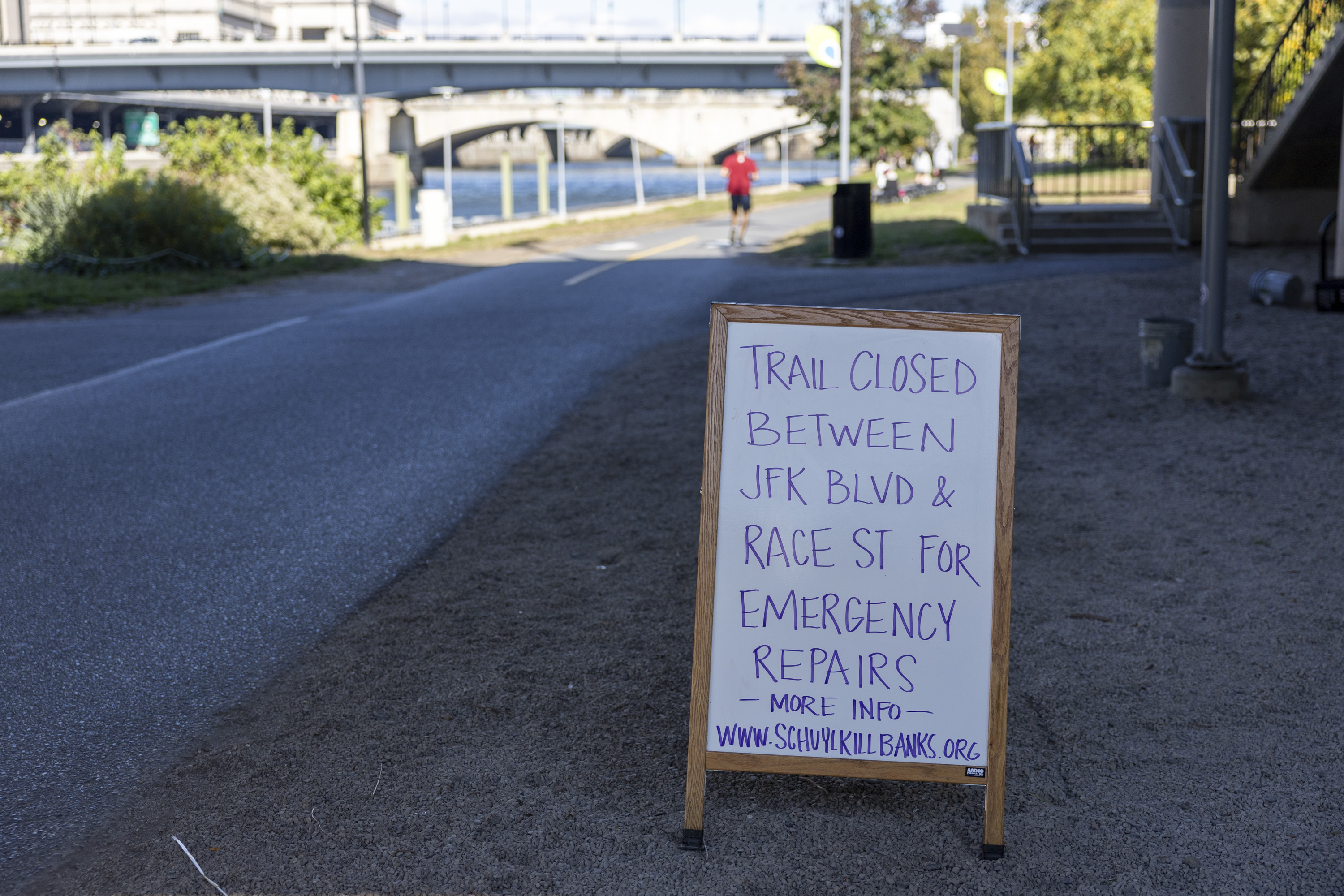
The trail is closed between Race Street and JFK Boulevard, just north of the SEPTA Bridge, according to the Schuylkill River Development Corp. (SRDC), a nonprofit that has helped revitalize the section of the trail known as Schuylkill Banks.
The SRDC said that it is working with Philadelphia Parks and Recreation, the Philadelphia Water Department, and engineers “to figure out what caused the large cavity to form and what is needed to make the necessary repairs.”
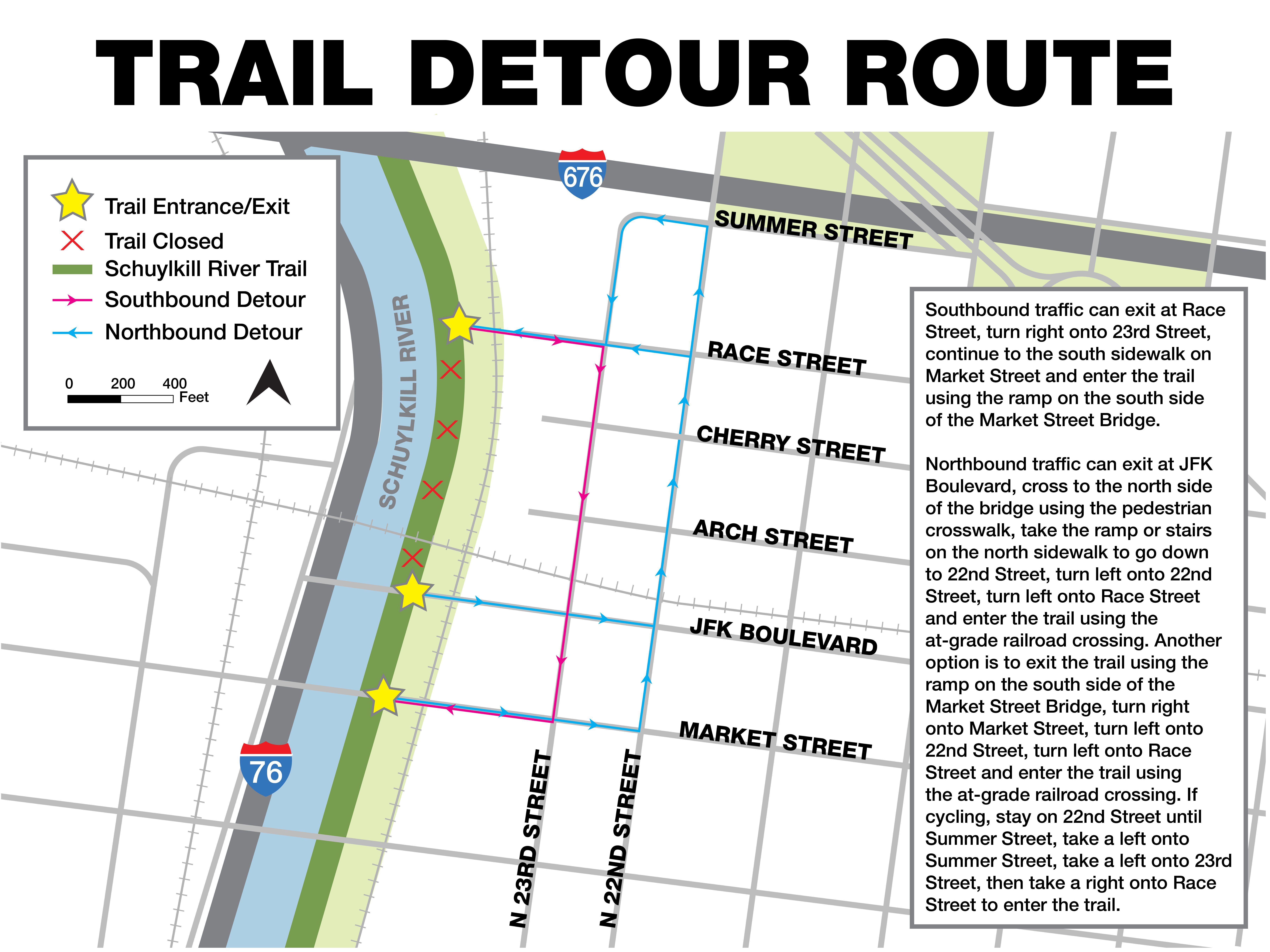
It has posted a map of a detour that can be used until repairs are made.
A map of a detour for the Schuylkill River Trail closure between Race Street and JFK Boulevard, which closed for emergency repairs after a sinkhole appeared Oct. 23, 2025
.
Joseph Syrnick, president and CEO of the SRDC, said the hole first came to the attention of his staff when a trail user reported it last week. At first, it appeared to be only a small hole, Syrnick said.
“By the time we got to it, it was about the size of a cantaloupe,” he said. “And then within a short time, it opened up the size of a small pumpkin. We immediately barricaded it off and made it safe.”
Syrnick said the hole was covered with plywood and cones were placed around it to block access by trail users. Crews began to explore the hole more thoroughly.
“We stuck our heads down there through the hole the size of the pumpkin, and saw a huge void. It’s like 8 by 10 [feet]. You could park a car down there — almost. So this has obviously been going on for a long time and luckily we caught it before it collapsed.”
Syrnick called it a “chasm” under the asphalt.
On Friday, SRDC hired an engineer, and then brought in the water department. The decision was made to block off the trail completely.
Although part of the trail remained covered, it took until Monday to put fencing and signs in place, completely sealing off any access.
“Theoretically, it could have collapsed,” Syrnick said.
Syrnick did not have a time frame for when the trail would reopen. He said his team needs to find the cause first. A repair could mean minor or major construction.
A sign warning people that part of the Schuylkill trail is closed for repairs between JFK Boulevard and Race Street after a sinkhole was discovered.
“I think we’re lucky finding this in the middle of fall, heading in the winter,” Syrnick said, “which is way better than finding it in the middle of spring, heading in the summer.”
Brian Rademaekers, a spokesperson for the water department, said it is working with SRDC to investigate the cave-in along the trail at Arch Street.
Rademaekers said crews will use dye to trace the source in an effort to determine a possible cause. He said that the nontoxic dye may cause discolored water in the Schuylkill, but that it is not a threat to people or wildlife.
“Once the results from this testing are evaluated,” Rademaekers said, “the PWD will work with SRDC to determine next steps needed to reopen the trail. Trail users should follow signage and advisories issued by the SRDC.
Rademaekers said the water department would not likely have an update on the situation until at least Friday.
Three large stand-alone parking garages have been proposed in Philadelphia this year, unusual projectsin a city where parking operators have long complained that high taxation makes it difficult to run a business.
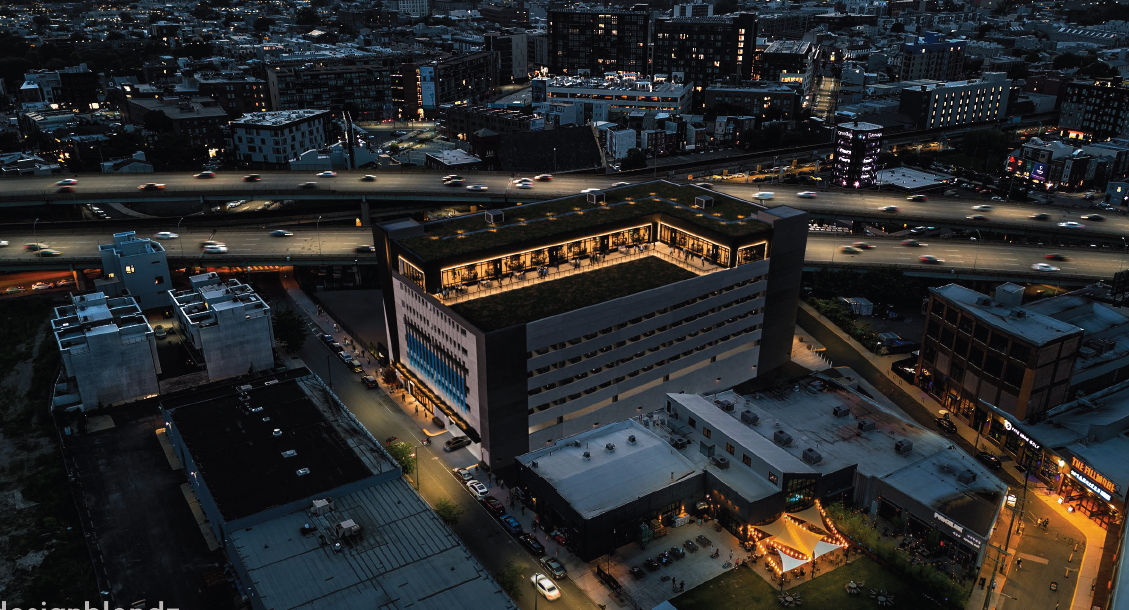
The latest is a 372-unit garage near Fishtown and Northern Liberties at 53-67 E. Laurel St. near the Fillmore concert hall and the Rivers Casino.
“There’s been about 2,500 units that have come online within a 5- to 10-minute walk” of the planned garage, said Aris Kufasimes, director of operations with developer Bridge One Management. “When you’re building those on 7-1 [apartments to parking spaces] ratios, that leaves a massive hole. Where is everybody going to put their vehicles?”
Despite central Philadelphia’s walkability and high levels of transit access, two other developers have made similar calculations this year.
In the spring, Children’s Hospital of Philadelphia (CHOP) revealed plans for a 1,005-space parking garage in Grays Ferry along with a shuttle service to spirit employees to the main campus a mile away.
In August, University Place Associates unveiled plans for a 495-unit garage. About a fourth of it will be reserved for the use of the city’s new forensic lab, but the rest will be open to the public.
All three projects have baffled environmentalists and urbanists, who thought Philadelphia was moving away from car-centric patterns of late 20th-century development.
It’s also surprised parking operators in the city, who say national construction cost trends and high local taxation make it difficult to turn a profit.
Legacy parking companies in Philadelphia like E-Z Park and Parkway Corp. have been selling garages and surface lots for redevelopment as anything other than parking. They say the city has lost 10,000 publicly available spaces in the last 15 years, bringing the total to about 40,000 in Center City.
“I don’t think I’ll ever build another stand-alone parking facility,” said Robert Zuritsky, president of Parkway Corp. and board chair of the National Parking Association. “It doesn’t make any sense.”
Zuritsky and other parking companies have long noted that operators in Philadelphia, who often have unionized workforces, get hit with parking, wage, property, and the Use and Occupancy Tax.
When combined with the soaring cost of building new spaces across the nation, it’s difficult to turn a profit in Philadelphia.
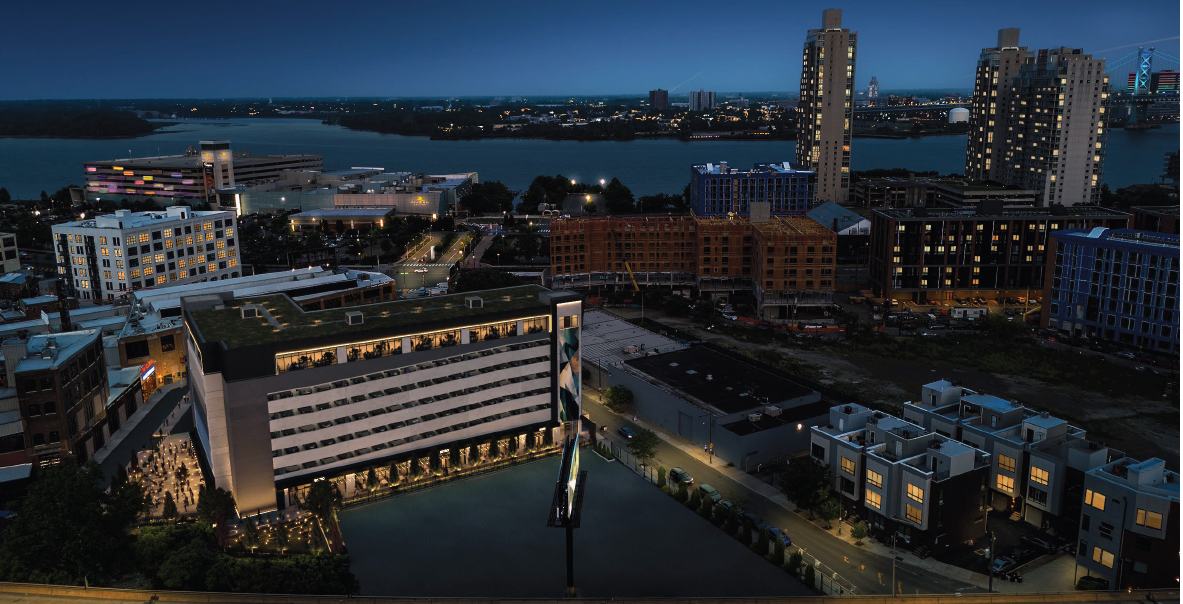
A rendering of the Fishtown garage, looking towards the Delaware River.
Zuritsky says it costs $60,000-$70,000 a space to build an aboveground lot in today’s environment and $100,000 to $150,000 below ground.
“It’s like building a house for a car,” he said.
Depending on hyperlocal peculiarities, Zuritsky says that taxation in Center City can eat up to 60% of the money they bring in and that to profit from new construction, an operator would have to charge $3,000 per space a month.
“I wish people luck, the ones that are moving in,” said Harvey Spear, president of E-Z Park. “Between taxes, insurance, and labor, it comes to, like, 70-some percent of what we take in. We have more equipment now that does away with a lot of labor; we’re trying to compensate with that.”
Urbanist and environmental advocates, meanwhile, have condemned the new garage projects, arguing that they will add to carbon emissions, air pollution, and traffic congestion.
“A massive parking garage less than half a mile from the El [in Fishtown] is the wrong direction for any city that claims to take climate action seriously,” said Ashlei Tracy, deputy executive director with the Pennsylvania Bipartisan Climate Initiative. “SEPTA is already working to get more people out of cars and onto transit, but projects like this one and the one from CHOP only make that harder.”
Here are the parking projects in the pipeline.
Fishtown: 372 spaces
The garage, with architecture by Philadelphia-based Designblendz, doesn’t just contain parking. It includes close to 14,000 square feet of commercial space on the first floor, which the developer hopes to rent to a restaurant — or two — on the edges of one of Philadelphia’s hottest culinary scenes.
Another over 16,000-square-foot restaurant space is planned for the top floor, with views of the skyline and river. Both the top and bottom floors also could be used as event spaces.
Kufasimes says that this aspect of the project could partly offset the kinds of costs that parking veterans warn of.
“Our due diligence team went through those numbers and vetted them pretty thoroughly: The returns are what they needed to be,” Kufasimes said. “It’s got a multifunction of income streams, so we think that that really will help play a larger role.”
Kufasimes also said a parking garage made sense in an area that’s seen more development than almost any other corner of Philadelphia. When investors purchased the land at 53-67 E. Laurel St. and approached his company for ideas, they met with other stakeholders in the neighborhood and determined parking would be appreciated.
“It wasn’t necessarily all about the profit,” Kufasimes said. “A lot of people this day and age, that is their number-one goal. If this is a slightly lower return in the long run but can be better accepted by the community as a whole, we think that actually raises the value of the asset.”
An overhead-perspective rendering of the Fishtown garage.
At an October meeting of the Fishtown Neighbors Association, that argumentappeared to pay off. Unlike most community meetings where a large new development is proposed, there were no adamant opponents of the project. The project also includes a 20,000-square-foot outdoor space, a green roof, and a to-be-decided public art component. All of that helped, too.
“It’s nice seeing a parking garage, of all things, be as pedestrian-friendly and thoughtful as this,” one speaker said during the Zoom meeting.
Dubbed University Place 5.0, it largely exists because of a major expansion of the municipal bureaucracy west of the Schuylkill.
For years the city has sought a new location for its criminal forensics laboratory. The debate became heated in City Hall, with numerous Council members making the case for locations within their districts.
Councilmember Jamie Gauthier pushed for its location in University City Place 3.0, a newly built, state-of-the-art life sciences building that was coming online just as its intended industry was slowing down in the face of higher interest rates.
To get the crime lab, Mayor Cherelle L. Parker’s administration said the police department would need ample parking. That’s where the new garage comes in.
In June, Gauthier passed a zoning overlay that cleared away the regulatory hurdles to the project. Six weeks later, the developers revealed University City Place 5.0, which has 29 parking spaces on the ground floor reserved for official use by forensics vehicles and 100 spaces reserved for city employees.
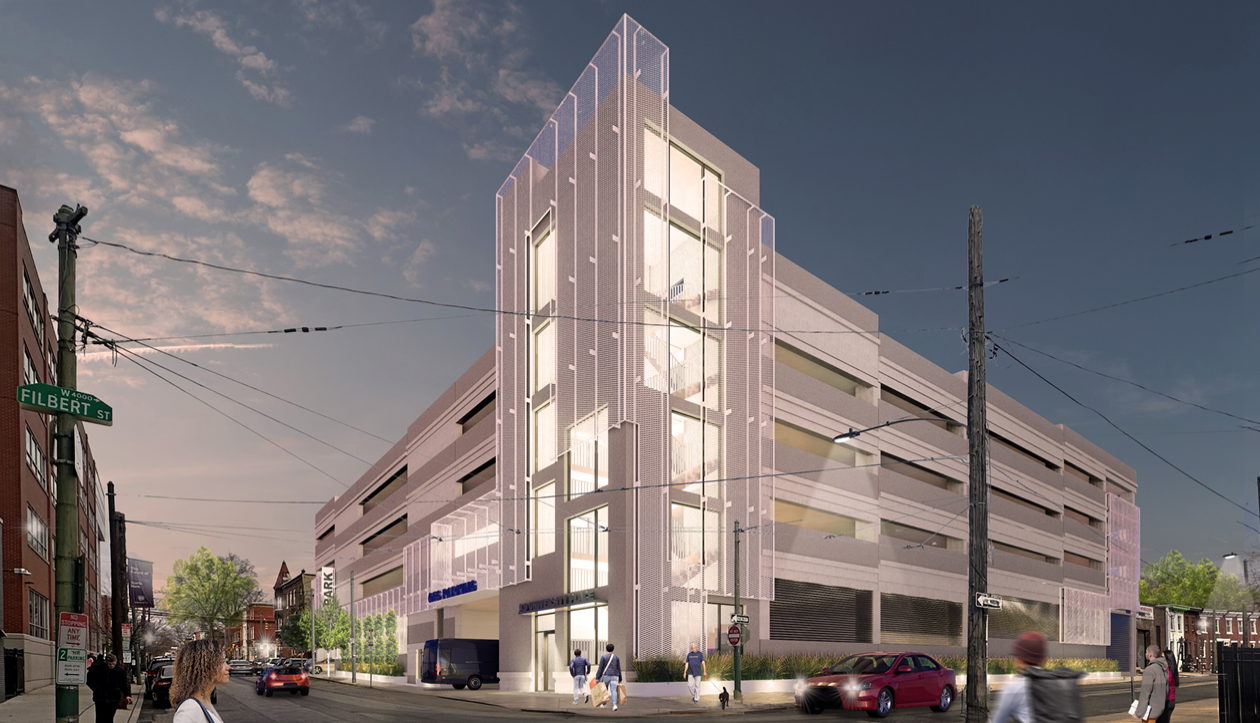
A rendering of the proposed University City parking garage as seen from 42nd and Filbert Streets.
Designed by Philadelphia-based ISA Architects, the garage is also meant to serve University Place Associate’s other large developments in the area. Akin to the Fishtown garage, they have also sought to make the development pedestrian friendly, with a dog park, green space, and public art.
The local community group, West Powelton Saunders Park RCO, also embraced the proposal.
“The community met regarding this project back in August, and … they were all in support of this project,” Pamela Andrews, president of the West Powelton Saunders Park RCO, said at the city’s September Civic Design Review meeting. “We have a tremendous problem with parking, and the community members felt this was a much needed and welcome addition.”
Grays Ferry: 1,005 parking spaces
CHOP’s thousand-car parking garage by far has been the most controversial of the proposals. But it also makes the most economic sense for the owner. Unlike the other garages — or those owned by Parkway and E-Z Park — it will be owned by a nonprofit and exempted from many of the taxes that make it so expensive to own parking in Philadelphia.
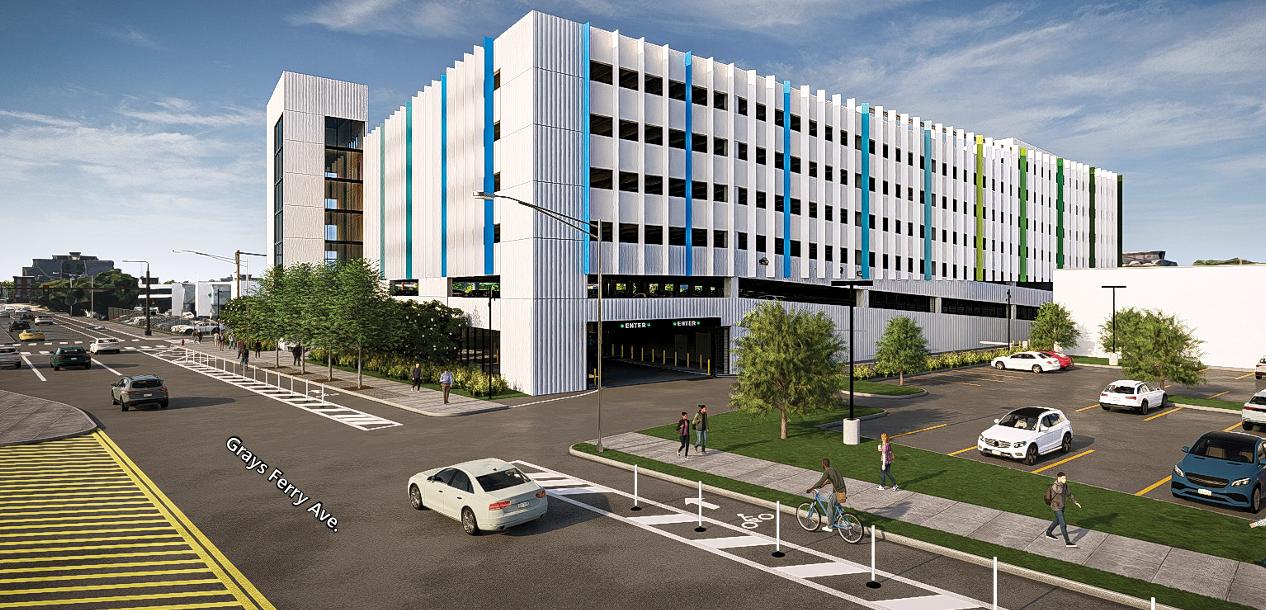
A rendering of the new parking garage CHOP plans for Grays Ferry.
The hospital purchased the property at 3000 Grays Ferry Ave., next to the Donald Finnegan Playground, for almost $25 million last year.
The seven-story development, which, plans show, would have far fewer amenities than its University City and Fishtown counterparts, is meant to serve CHOP’s new research facilities in Fitler Square and the new patient tower set to open in 2028.
“We recently secured permits and have begun construction on the new parking garage at 3000 Grays Ferry Ave.,” a CHOP spokesperson said. “The full construction is expected to go through the fall of 2026. CHOP continues to engage with the community by providing support, timely updates and addressing feedback during construction.”
At the time of its unveiling, CHOP argued that the massive garage was needed as SEPTA threatened to become unreliable due to a political funding crisis in Harrisburg. But detractors appeared almost immediately to denounce the hospital for worsening air quality in a lower-income neighborhood that is already a hot spot for asthma.
There are no regulatory hurdles to the development, but changes in the political or economic landscape could make it difficult to embark on a large capital project. Notably, the University of Pennsylvania proposed an 858-space garage in 2023 for the nearby Pennovation Center and has never broken ground.