Tag: SEPTA

  • Community College of Philadelphia interim president is selected for permanent role

    Community College of Philadelphia interim president is selected for permanent role

    Alycia Marshall, who has been serving as interim president of Community College of Philadelphia since April, was unanimously endorsed for the permanent role Tuesday.

    The board of trustees, at an 8 a.m. meeting, approved making an offer of employment to Marshall, who had served as provost and vice president for academic and student success at CCP for nearly three years before stepping into the interim role.

    Marshall was among four finalists for the job.

    “Congratulations,” Board Chair Harold T. Epps said to Marshall during the Zoom meeting, which lasted about 10 minutes. “You have earned it through a very tough and challenging process. …We look forward to working with you.”

    Epps cited Marshall’s “stellar work” through the interim period as a factor in the board’s decision and said she had “the full confidence” of the board.

    “I’m a little bit emotional,” Marshall said at the meeting. “I’m very excited. I’m honored. I’m deeply humbled, pleased, ecstatic, and looking forward to the road ahead and the journey ahead.

    “I am fully committed to this institution, to our students, most importantly, and to the college community.”
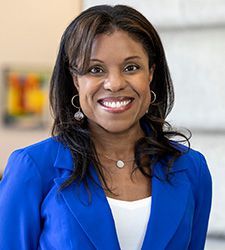
    Alycia Marshall

    Epps said contract negotiations with Marshall would begin immediately to lead the college, which had an enrollment of 12,400 credit students and 1,381 noncredit students last spring. No terms or salary of her employment were released.

    Marshall will follow former CCP President Donald Guy Generals, who led the college for 11 years and was forced out of the job in April and placed on paid administrative leave through the end of his contract.

    Philadelphia Mayor Cherelle L. Parker congratulated Marshall in a statement.

    “The Parker administration supports CCP, Dr. Marshall, and the board in its mission,” she said.

    Maria Baez, student government president, was on the search committee and said while she liked all four candidates, Marshall was her first choice.
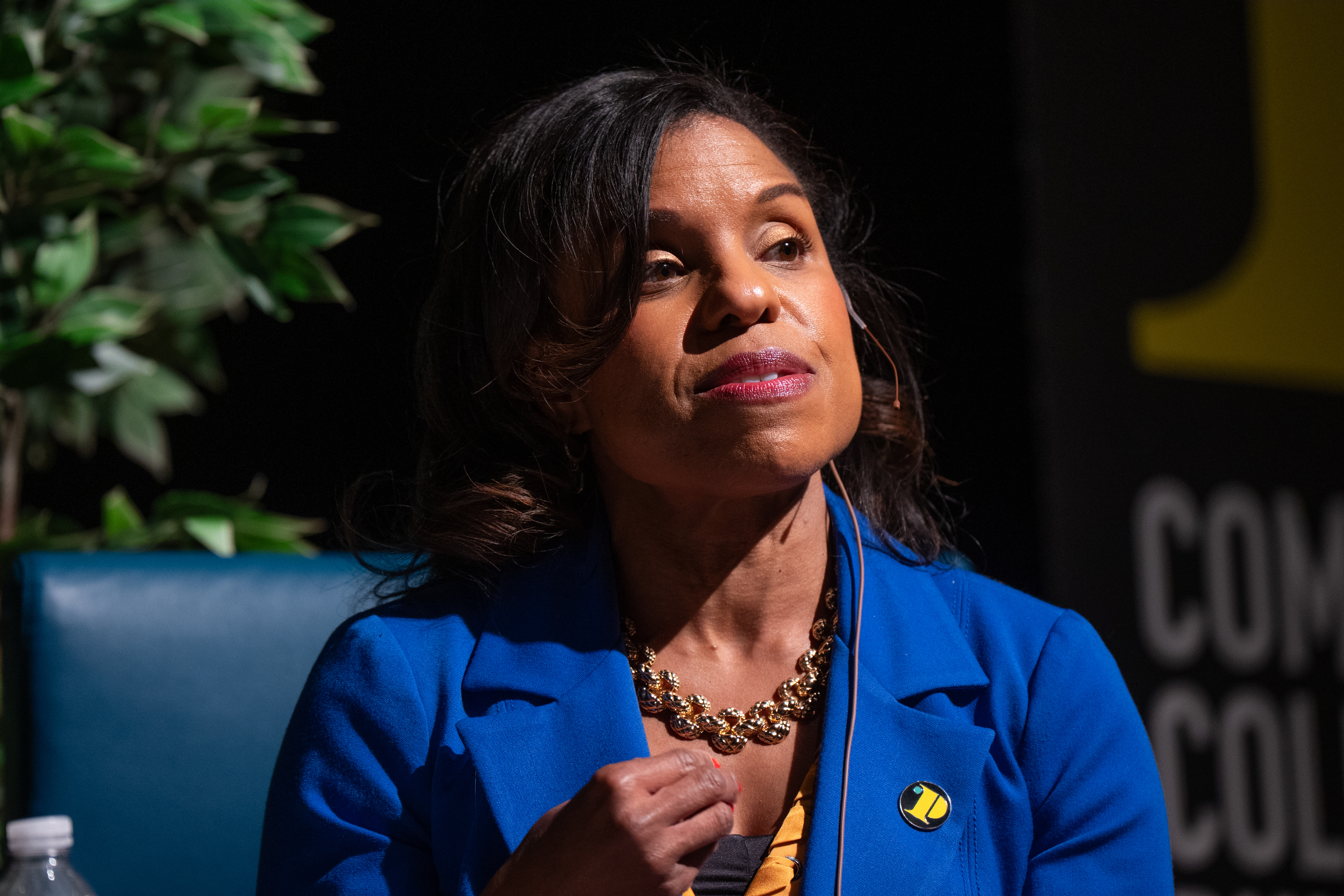
    Alycia Marshall speaks at a Community College of Philadelphia forum where she appeared as one of four finalists for president. She got the job Tuesday.

    “As a student, I see her passion for the students,” Baez said. “I see how connected she is with the students. Her heart is for the students.”

    Junior Brainard, co-president of the faculty and staff union, said: “As a union, we are looking forward to Dr. Marshall finally making good on the agreement we signed back in March,” referring to a contract agreement. “That includes SEPTA passes for all students, smaller class sizes, and improvements to health, safety, and working conditions that will be figured out through various committees.”

    During a finalist forum, Marshall addressed free SEPTA passes for students. While the college couldn’t offer the benefit to all students — it would cost about $2 million — a pilot will begin in the spring at the college’s West Philadelphia site, she said.

    Brainard said the college has to do better. The pilot only serves half the students at the West Philadelphia site and just 3% of the student body, he said.

    Marshall said in an interview Tuesday afternoon that the goal is to find alternative funding sources and expand the program to the entire college.

    She said among her priorities will be increasing and strengthening transfer partnerships, with the recently announced program with Cheyney University, an historically Black college in Delaware and Chester counties, as a model.

    “Many of our students have transportation issues and perhaps reasonably cannot drive the 25 miles to Cheyney University,” she said. “So Cheyney at CCP is going to provide opportunities to complete a bachelor’s while staying on our campus. It’s symbolic of where I would like to work together with faculty, staff and the administrators and the board … on really strengthening those pathways.”

    She cited workforce development and strengthening partnerships with K-12 schools, too, including expanding dual enrollment opportunities and reaching into areas of the city that the college currently is not penetrating enough.

    When Marshall was named as interim, Epps cited her “academic and organizational leadership, along with her extensive expertise in STEM, her focus on mentoring and serving underrepresented student populations.”

    Marshall, 51, received her bachelor’s in mathematics from the University of Maryland Baltimore County, her master’s in teaching from Bowie State University, and her doctorate in mathematics education from the University of Maryland.

    A native of Maryland, she started her career as an adjunct professor at Anne Arundel Community College in Maryland, near Annapolis, and later became a full tenured professor and chair of the mathematics department.

    She was promoted to associate vice president there and founded the African American Leadership Institute and spent a total of nearly 23 years at the Maryland community college. She’s also a rising presidents fellow with the Aspen Foundation, a nonprofit aimed at creating thought leaders in their fields to address critical challenges.

    Alycia Marshall, then interim president of Community College of Philadelphia, speaks at commencement in May.

    At a campus interview session for the job, Marshall said she would lead both internally and externally, focusing on faculty and staff satisfaction as well as building relationships with funders and donors.

    She said she has already met more than 20 City Council members and state legislators.

    Marshall acknowledged that an employee satisfaction survey she commissioned when she became interim president showed low morale and promised to address it “through ensuring transparency and frequent communication.” The results of that survey haven’t been publicly released.

    Marshall said that over the last six months, she learned to be comfortable not knowing what will happen next. After a board meeting earlier this month, a consultant who is the liaison to the presidential search committee said on a still-active microphone that Marshall had not been well-received on campus.

    Marshall said at the interview session that she did not agree with that and that she has developed relationships with people across the college.

    “If you have worked directly with me, you will know I am here for the students and I am here to support faculty and staff,” she said.

    Marshall, who maintains a residence in Maryland, said she would move to the city full time if selected for the job.

    The other finalists for the job were: Jesse Pisors, former president of Pasco-Hernando State College in Florida; Jermaine Wright, vice president for student affairs at City University of New York-Lehman College; and Lisa Cooper Wilkins, vice chancellor of student affairs at City College of San Francisco.
  • SEPTA is postponing hybrid bus purchases and accessibility projects to keep the lights on

    SEPTA plans to postpone the purchase of new buses, a project to make the Bristol Regional Rail station accessible to people with disabilities, and expansion of the Frazer train facility in Malvern in order to access $394 million in emergency state aid to help run the system.

    The shift was required after the Pennsylvania Department of Transportation gave permission for SEPTA to transfer funds allocated for infrastructure projects to cover the transit agency’s operating deficits for two years.

    SEPTA officials said none of the changes would compromise safety by stopping crucial repairs — a PennDot requirement for allowing the shift of money to operational needs.

  • Josh Shapiro’s GOP opponent Stacy Garrity steps in to offer counties $500 million in loans as Pa. budget remains at an impasse

    Josh Shapiro’s GOP opponent Stacy Garrity steps in to offer counties $500 million in loans as Pa. budget remains at an impasse

    HARRISBURG — Pennsylvania Treasurer Stacy Garrity stepped in on Wednesday to offer counties and early education programs $500 million in low-interest loans to hold them over until a final state budget deal is complete, sidestepping the General Assembly and Gov. Josh Shapiro as they near the start of a third month at an impasse.

    Garrity, a Republican who last month announced her bid to challenge Shapiro in next year’s gubernatorial election, announced the unprecedented move to allow the state Treasury to offer the loans to county human service departments for the many social services they provide, as well as for early education Head Start programs, at a 4.5% interest rate.

    Counties, schools, and social service providers have pleaded for months with the legislature to finalize a budget so they can begin receiving their expected state payments, which have been on hold since the beginning of the fiscal year on July 1. Some counties have had to secure private loans to hold them over until state payments begin, while others — including those around the Philadelphia region — have relied on their reserves. Other counties have frozen hiring and spending as they await a resolution to the budget stalemate.

    The move would allow counties to access millions of dollars for early education programs serving 35,000 children across the state, as well as for county social services — all of which have been operating for months without their state appropriation, with no end to the budget impasse in sight.

    Garrity’s decision to act unilaterally without the action of the General Assembly allows her to capitalize politically on the ongoing budget crisis over Shapiro, challenging his image as a moderate Democratic governor of a politically “purple” state willing to work across the aisle in a divided legislature. That brand, which he has built nationally as he is rumored to have interest in running for president in 2028, has been tested as he has so far been unable to secure a budget deal or a recurring funding stream for the state’s beleaguered mass transit agencies, including SEPTA.

    Shapiro, for his part, has described his role in budget negotiations as being a go-between for Senate Republicans and House Democrats, who control their respective chambers, and has said that the two caucuses remain “diametrically opposed” on some issues.

    A spokesperson for Shapiro said in a statement Wednesday that the real solution to the budget impasse is for Senate Republicans, whose leaders endorsed Garrity last week, to return to work in Harrisburg to finalize a budget deal with House Democrats. A spokesperson for House Majority Leader Matt Bradford (D., Montgomery) echoed the sentiment, arguing that Senate Republicans “refuse to negotiate on a realistic budget agreement.”

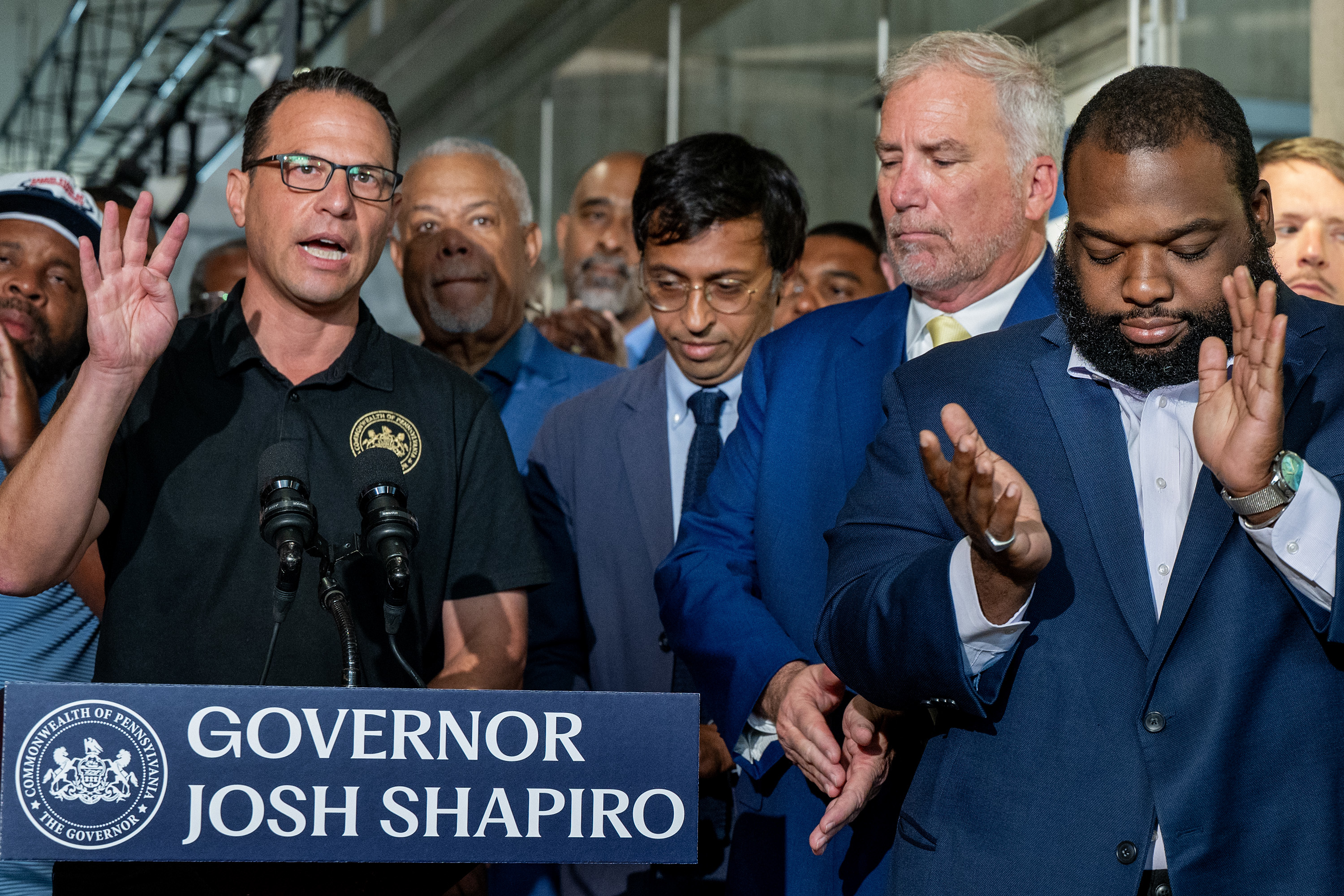
    Gov. Josh Shapiro visits SEPTA headquarters Sunday, Aug. 10, 2025 to discuss funding for the transit agency and to pressure Senate Republicans as planned service cuts are pending because of a budget shortfall. To his right, from left, are state Democratic legislators Sen. Anthony H. Williams; Sen. Nikil Saval; Rep. Ed Neilson; and Rep. Jordan Harris.

    Senate Majority Leader Joe Pittman (R., Indiana), the Senate’s top negotiator, who has met for months in closed-door budget talks with Bradford and Shapiro, said in a statement that it was Democrats who caused the prolonged impasse while demanding they include mass transit funding in the state budget. After mounting pressure as SEPTA enacted major service cuts, Shapiro ultimately sought to fund the agency on his own, and the issue will need to be revisited in two years.

    Garrity, who kicked off her “Help Is on the Way” introductory campaign tour around the state earlier this week, said Wednesday her decision to intervene in the state budget stalemate was not political, despite her burgeoning run against Shapiro. Rather, she said that she had been thinking about a way to do so for months, including ahead of her announcement of her run for governor, and that most Pennsylvanians don’t even realize the state budget is late. She argued that if she wanted to be political, she would not intervene and would “keep the pressure” on Shapiro over the late state budget.

    “I’m standing up here as Pennsylvania’s state treasurer, not as a candidate for governor,” Garrity said from a podium in the Harrisburg building that houses the state Treasury. “I think I have a responsibility to serve Pennsylvanians, that if I have something that I can do to provide some relief, then I should do it.”

    However, that didn’t stop Garrity from inviting Montgomery County Commissioner Tom DiBello — the lone Republican on the board where Shapiro once served — to the podium at the news conference to deliver some direct criticisms of Shapiro and to praise Garrity’s intervention as a “lifeline” for counties, alongside two other GOP county commissioners from south-central Pennsylvania. While Montgomery County remains one of the wealthiest counties in the state, the late budget has required Pennsylvania’s third-most-populous county to spend down its reserves, money that it usually relies upon to continue earning interest as part of its annual revenue, DiBello said.

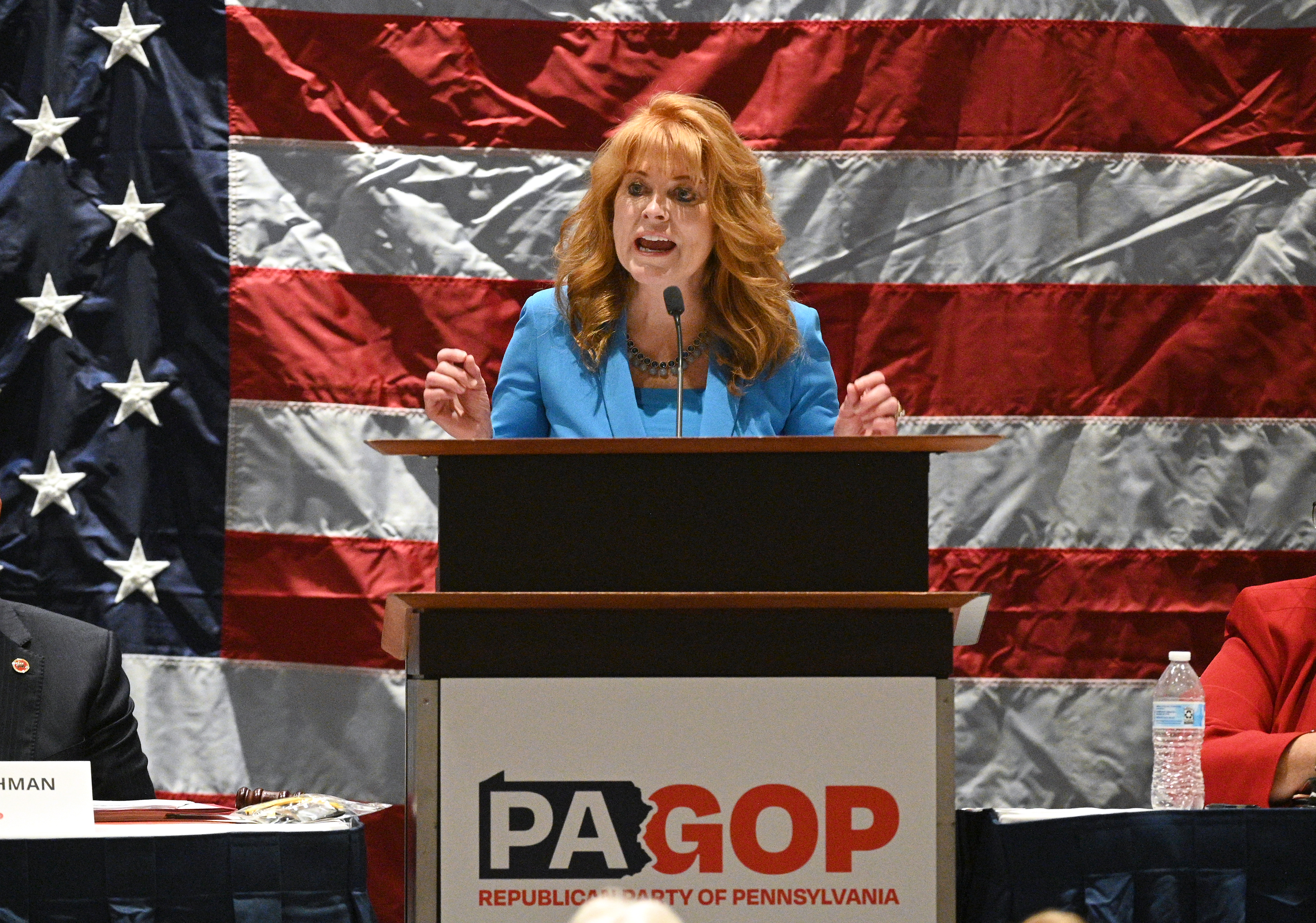
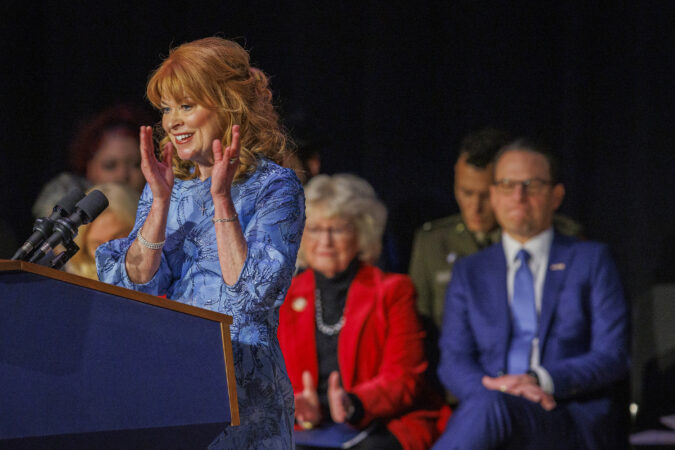
    Pennsylvania Treasurer Stacy L. Garrity gives her acceptance speech after receiving the PA GOP’s endorsement for her campaign for governor during the Republican Party of Pennsylvania’s 2025 Fall Meeting at the Penn Stater Hotel & Conference Center in State College on Sept. 20.

    “It starts at the top. The governor is responsible,” DiBello said. “He’s got to pull it together. It’s his signature at the end of the day.”

    In response to Garrity’s announcement Wednesday, Montgomery County Commissioners Neil Makhija and Jamila Winder, both Democrats, said in a statement that the county needs a final state budget instead of a short-term loan program, urging Senate Republicans to “do their job.”

    “A short-term loan at 4.5% interest is the state profiting from a problem of their own making, at the expense of the taxpayers,” the two commissioners added.

    DiBello said he did not believe his invitation to Wednesday’s event had political motivations, adding: “I didn’t even think of that.” He also noted that he has come to Harrisburg to advocate on behalf of counties multiple times before.

    Senate President Pro Tempore Kim Ward (R., Westmoreland), who has been one of Shapiro’s biggest critics since his first budget in 2023 and was quick to support Garrity’s candidacy, prodded at Shapiro’s pledge to “get stuff done” while praising Garrity’s leadership.

    “Today, Treasurer Stacy Garrity made a bold move that shows what ‘get stuff done’ actually looks like,” Ward said in a statement. “Treasurer Garrity’s leadership is on display as her solution-driven option is exactly what we need, but has been glaringly missing from the present administration.”

    Garrity said at the news conference Wednesday that she offered the loan program specifically to Head Start programs and county governments’ human service departments because both had asked her to help them get through the budget impasse. The state budget was due by July 1, and Pennsylvania is the only state besides Michigan that has not yet passed its budget. She said she is willing to offer similar loans to schools or other state-subsidized or funded programs as requested.

    The Pennsylvania General Assembly can forgive the interest accrued by counties taking out loans during the budget impasse, Garrity said, adding that she would support legislation that does so.

    This suburban content is produced with support from the Leslie Miller and Richard Worley Foundation and The Lenfest Institute for Journalism. Editorial content is created independently of the project donors. Gifts to support The Inquirer’s high-impact journalism can be made at inquirer.com/donate. A list of Lenfest Institute donors can be found at lenfestinstitute.org/supporters.