Tag: Temple University

  • These professors say they’re part of a growing movement banning laptops from the classroom

    These professors say they’re part of a growing movement banning laptops from the classroom

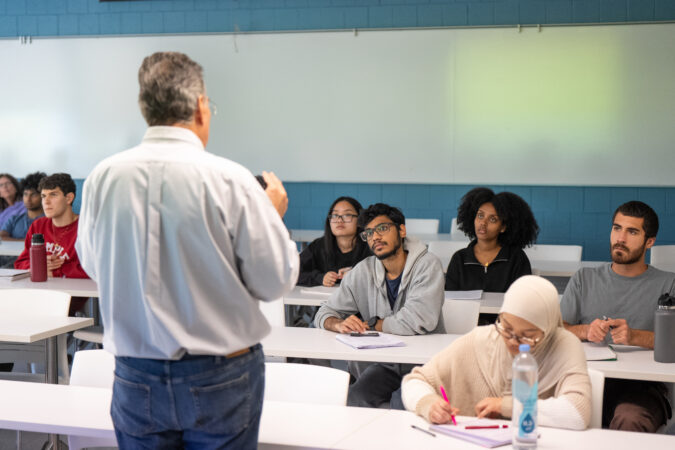
    Biology professor Jody Hey was lecturing on human evolution one recent day at Temple University.

    His students vigorously took notes by hand in paper notebooks.

    There wasn’t a laptop in sight. Nor an iPhone. No student’s face was hidden by a screen.

    Hey said he stopped allowing them about a year and a half ago after seeing research that students are too often distracted when laptops are open in front of them and actually learn better when they have to distill lectures into handwritten notes.

    “The clearest sign that it’s making a difference is that students are paying attention more,” said Hey, who has taught at Temple for more than 12 years. “And they want to participate much more than before.”

    Hey is among a seemingly growing number of professors who have chosen to keep laptop and phone use out of class, with exceptions for students with disabilities who require accommodations. Several said they made the decision after seeing what some students were doing on their laptops during class.

    Temple University biology professor Jody Hey stopped allowing laptops to be used in class about a year and a half ago. He said he’s noticed improvement in student performance.

    Jessa Lingel, an associate professor of communication at the University of Pennsylvania and director of the Gender, Sexuality, and Women’s Studies Program there, stationed teaching assistants in the back of her room to observe.

    Students “were out there booking flights and Airbnbs,” Lingel said. “Fun fall cocktail recipes. They were online gambling in class. I thought, ‘This is not acceptable.’”

    She originally disallowed laptops in 2017, but decided to go easy in 2021 as students returned after the pandemic, she said. She reinforced the ban after her teaching assistants’ observations.

    “It’s a movement,” Lingel said. “More and more people are headed in this direction.”

    In Hey’s class, students have warmed up to the laptop ban.

    “At first I didn’t like it,” said Jess Nguyen, 20, a junior genomic medicine major from Broomall, “because I kind of organize all my notes on my laptop. But I feel I’ve been learning better by writing my notes.”

    When she took notes on her iPad, she sometimes got distracted and played computer games, she said. In Hey’s class, that’s not an option.

    Students said it takes more time to write notes and sometimes their hands get tired.

    “After a couple classes, you kind of get used to it,” said Sara Tedla, 22, a senior natural sciences major from Philadelphia.

    She’s on the fence about which way she prefers to take notes.

    “It’s good that for an hour and 20 minutes you can just sit down and, without any technological distractions, focus because that’s a part of your brain you can work on,” said Quinn Johnson, 20, a senior ecology major from Philadelphia. “The more you do it, the easier it becomes to focus on something for a long period of time.”

    ‘Students learn better’

    Professors say laptops are pretty ubiquitous in the classroom when they are permitted.

    Hey conducted research on laptop use and presented it at a Temple department faculty meeting earlier this year.

    “As early as 2003, a study was done contrasting the retention of lecture material by two groups of students, one who had laptops and unrestrained internet access and a second who worked without laptops,” he said. “In that study, students with laptops scored 20% lower on average in the subsequent exam.”

    Four of every five students who used laptops in a general psychology class said they checked email during lectures, another study showed, while 68% used instant messaging, 43% surfed the net, 25% played games, and 35% said they did “other” activities.

    He also cited studies showing students who took notes by hand performed better on tests. Others cited that research, too.
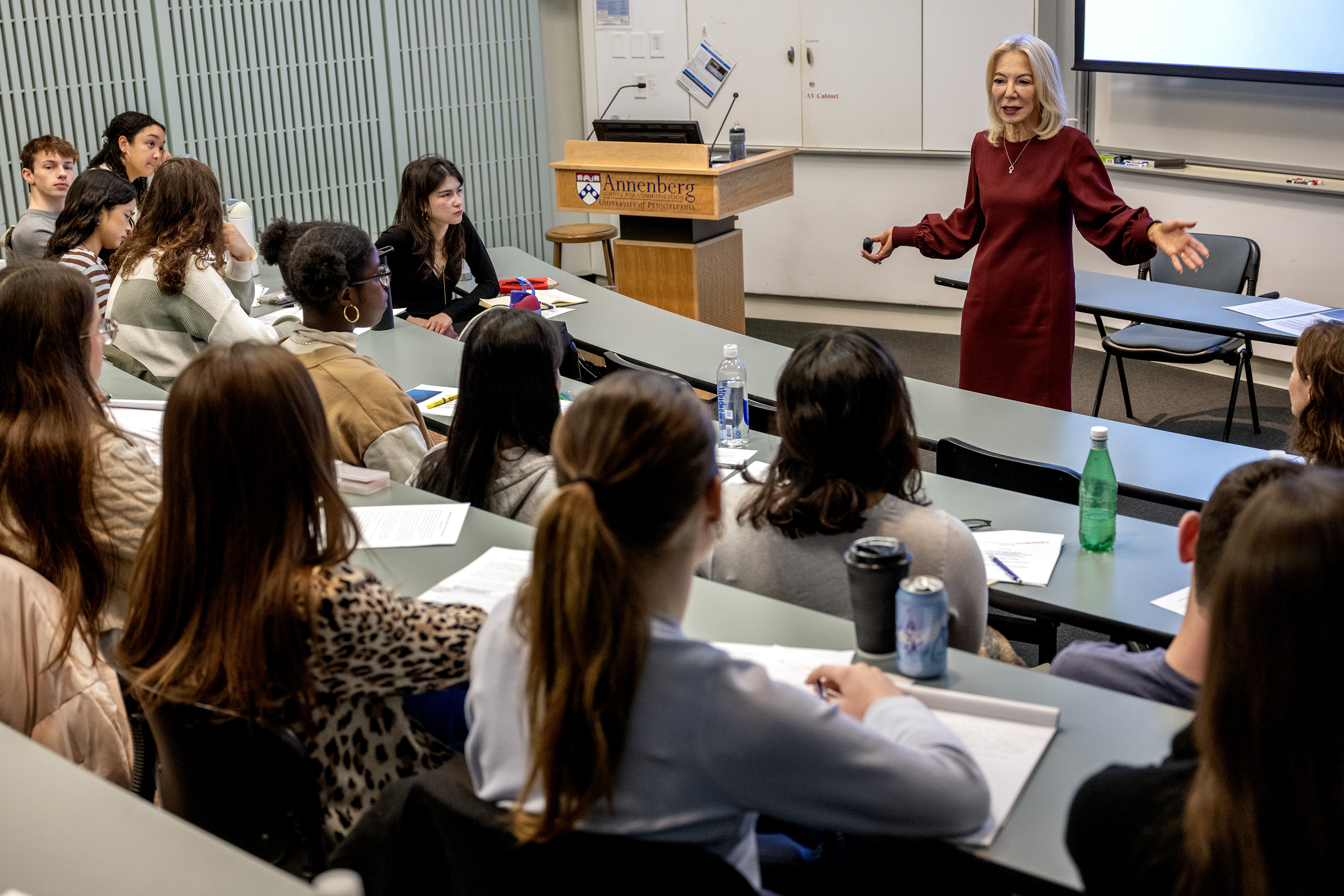
    Penn President emerita Amy Gutmann co-teaches a class at Penn’s Annenberg School for Communication with the dean Sarah Banet-Weiser. They don’t allow laptops or phones to be used in the classroom.

    “I read the literature on it and it really showed that students learn better when they’re taking notes rather than trying to type as fast as they can verbatim what you say,” said Amy Gutmann, Penn president emerita, who is co-teaching a class at the Annenberg School for Communication this fall.

    Gutmann and co-teacher Sarah Banet-Weiser, dean of Annenberg, do not provide students with copies of their lecture slides, either.

    “We give them time to write down what’s on the slides,” Banet-Weiser said.

    Benefits of technology

    Some professors say laptop use in class can be beneficial.

    Sudhir Kumar, a Temple biology professor, said he asks his class of 150 students to respond to questions on their laptops every 10 minutes. Their answers count toward their grades.

    “It’s constantly keeping them on their toes,” he said.

    He would not want to see everyone give up on laptop use in class.

    “We cannot fight technology,” he said. “Teachers have to embrace technology, whether it is artificial intelligence or computers. That is a standard mode of operation for most people today.”

    (Left to Right) Jess Nguyen, 20, a junior from Broomall, Allan Thomas, 22, a senior from Philly, and Sara Tedla, 22, a senior from Philly, in a class taught by Temple University biology professor Jody Hey last month.

    In Cathy Brant’s social studies methods class of 20 to 25 students at Rowan University, laptops are key. Brant, an associate professor of education, said there are lots of hands-on group projects, and she frequently asks students to check New Jersey standards online as they prepare their lessons. She also teaches them how to use AI appropriately in the classroom.

    One of her students, she said, recently handed in a paper with very detailed notes from Brant’s lecture that she probably got only because she was able to type quickly on her computer.

    “You’re responsible for paying attention in class,” she said. “Maybe it’s a little harsh, but I’m just like, ‘If you want to be on Facebook the entire time during class, that’s on you.’”

    Jordan Shapiro, an associate professor at Temple, more than a decade ago used to make a point of having his students post on Twitter, now X, during class and counted it toward classroom participation.

    Now, he tells students to put their laptops away during class.

    “I tell them I have no problem with tech or laptops,” he said. “I just think that none of us get enough time in our lives to just focus on ideas or to listen in a sustained way to the people around us.”

    He also became concerned about students doing homework during class, he said, and using artificial intelligence to supply them with questions and comments to ask in class. They were “outsourcing class participation to the robots,” he said.

    Mark Boudreau, a biology professor at Penn State Brandywine, disallowed laptops for the first time this semester.

    “I thought I would get real pushback … or people might even drop the class,” he said. “But … a lot of students have had other faculty who have this policy.”

    Exam scores in his three courses are better this year, he said.

    Hey noted student grades have gone up, too. But he can tell some students struggle with note-taking; some just listen and don’t take notes.

    “That’s better than sitting there and going on Facebook,” he said.
  • Inside a Kensington wound care clinic

    Inside a Kensington wound care clinic

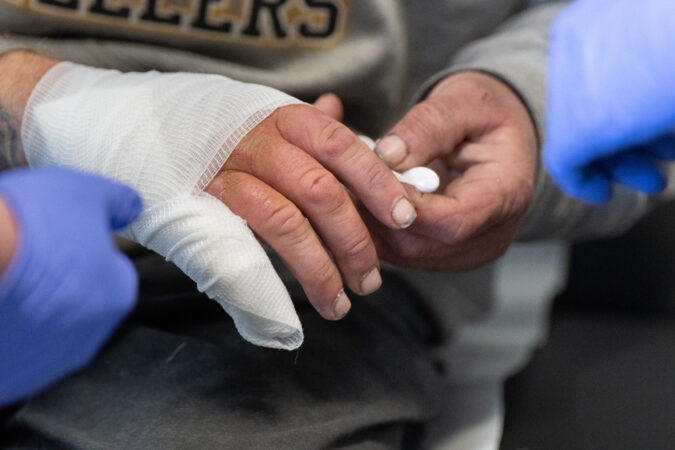
    In a small clinic room at Mother of Mercy House on Allegheny Avenue in Kensington, Emma Anderson unwrapped a bandage from a man’s swollen hand.

    “It hurts really bad in the cold,” the man said, wincing at the inflamed wound that covered most of a right-hand finger.

    Cleaning it with saline solution proved so painful that Anderson, an EMT and St. Joseph’s University student, let the patient take the lead, wiping carefully at the yellowish-white tissue at the center of the wound.

    It was his second time attending the wound care clinic at Mother of Mercy, the Catholic nonprofit that twice a week opens its doors to people with addiction dealing with the serious skin lesions, caused by the animal tranquilizer xylazine, that can develop into wounds so severe the only treatment is amputation.

    Called “tranq” on the streets, xylazine was never approved for human use and has wreaked havoc across the city since dealers began adding it to fentanyl to extend the opioid’s short-lived high.

    In the five years since it emerged as a threat, amputations among opioid users have more than doubled. The Philadelphia drug supply is now changing again, and though emergency rooms in the last year have treated fewer xylazine wounds, the crisis is far from over.

    The man who visited Mother of Mercy’s clinic on a recent Tuesday, who gave only his first name, Steven, because of the stigma surrounding drug use, noticed the alarming wound on his hand a few weeks ago.

    Steven had seen people sleeping on the streets with flies hovering around their gaping wounds. He had hoped that he could avoid a wound himself: He smokes fentanyl, instead of injecting it, and knows that injection drug users are generally at a higher risk for skin infections. But, like many people who smoke their drugs, he had developed a wound anyway.

    “Believe it or not,” Steven said, between deep breaths during the painful cleaning, “I actually was an EMT myself at one point.”

    ‘How did we let it get this bad?’

    Mother of Mercy, founded in 2015 in Kensington, partners with St. Joseph’s Institute of Clinical Bioethics to host the clinics. The institute, headed by Father Peter Clark, a Jesuit priest and a bioethicist at several area hospitals, has long held a monthly health clinic at the nonprofit’s Kensington headquarters.

    In the last year, they expanded the program to offer more wound care opportunities to a community increasingly in need of them.

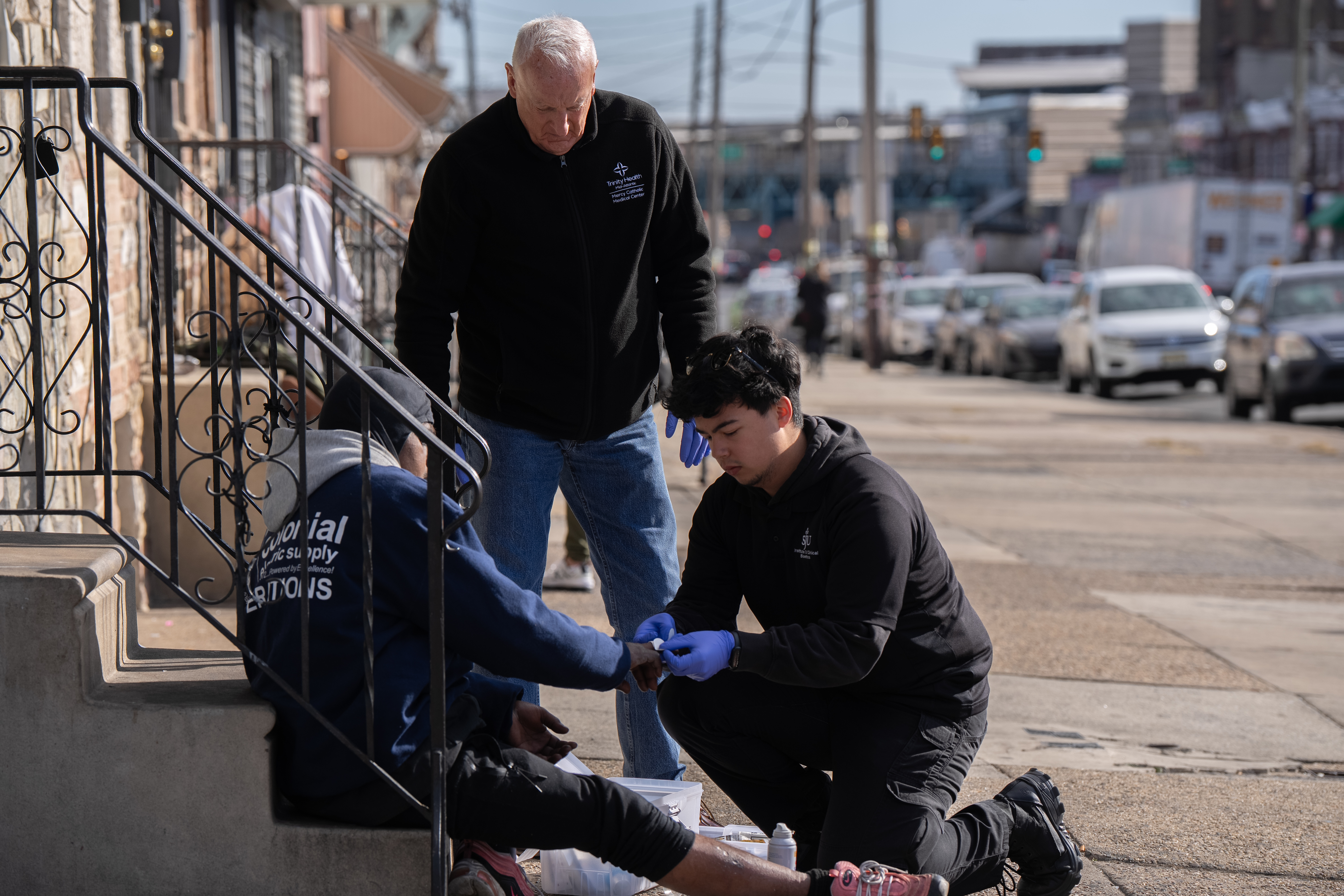
    Father Peter Clark, the director of the Institute of Clinical Bioethics at St. Joseph’s University, and Ean Hudak, a St. Joseph’s student and staffer at the Mother of Mercy House wound care clinic, assist a person who had fallen unconscious on Allegheny Avenue in Kensington.

    “To be physically down here in the heart of it, and seeing it on a weekly, monthly basis, it opens your eyes. How did we let it get this bad?” said Steven Silver, the assistant director of research and development at St. Joseph’s, who was welcoming clients at the door on a recent clinic day.

    The program is staffed by medical students and undergraduates, all trained in wound care. Many say the work they do at the clinic is unlike any medical training they’ve been offered at school.

    Undergraduates like Anderson and Ean Hudak, who takes shifts at the clinic in between applying to nursing schools, say they’re hoping to use their experience as they pursue careers in the medical field.

    On Tuesdays and Thursdays, organizers serve hot meals and wait in the small clinic room for patients to trickle in, usually about 20 a week.

    Once a month, the team takes to the streets with wound care supplies, such as bandages, saline sprays, and antiseptic cleansers. They look for people on the streets who may not be able to reach the clinic.

    Clark said the clinic stepped up its hours in an effort to help patients keep their wounds clean more consistently — and hopefully prevent more amputations. “It’s increasing [patients’] ability to know what to do and how to keep the wounds clean — hopefully to help them out,” he said.
    The trust factor

    This year, medetomidine, another animal tranquilizer that causes severe withdrawal, has supplanted xylazine’s dominance in the Philadelphia area drug supply. Fewer patients addicted to opioids are visiting emergency rooms with soft-tissue damage, according to city data.

    But it’s unknown how medetomidine affects those wounds, and there are still enough people suffering from them in Kensington, the epicenter of the city’s opioid crisis, that the clinic felt it necessary to increase its hours.

    Hosting more frequent clinics also deepens relationships with patients. “People are coming back, which is good,” Clark said. “The trust factor is a huge issue.”

    Many of the clinic’s patients avoid hospitals, fearing long waits for care: “At the ERs, they wait eight hours and they sign themselves out, or they’re coming down from a high, and nobody’s taking care of the withdrawal,” Clark said. “It’s a big mess.”

    At the clinic, staff are regularly on the phone with wound care physicians at Temple University Hospital, who can flag patients with xylazine wounds and get them prompt care before they enter withdrawal, he said.

    They also connect patients with housing, inpatient rehabs, and hospital care, for those with wounds too serious for the clinic to handle.

    Several weeks ago, they called an ambulance to get a man with a wound that exposed his bone to the hospital.

    Staff collect data to share with area hospitals so physicians can get a better understanding of the situation on the street — measuring patients’ wounds, collecting demographic data, and asking patients about which drugs they use.

    Each leaves the clinic with a hospital bracelet documenting the care they’ve received so staff can keep track of their care from week to week.

    ‘It’s always an uphill battle’

    Not all patients at the clinic are suffering from xylazine wounds. On a recent weekday, one man asked for help bandaging scrapes on his knuckles. He’d tried to fight someone who was stealing his belongings.

    Another man said he’d been robbed and pepper-sprayed and asked staff to help wash the last traces of Mace out of his eyes.

    As staffers looked for eyedrops among their medical supplies, Clark poked his head into the room. “We need someone with Narcan,” he said, referring to the opioid overdose-reversing spray.

    Across the street, a man was slumped on a stoop, unresponsive.

    Clark and Hudak dodged cars on Allegheny Avenue, knelt down by the man, and managed to gently shake him awake.

    Slowly, he revived enough to speak a bit and showed them a wound on his leg, which they cleaned and wrapped in gauze. “You have some cracked skin — do you want us to put some moisturizer on your hands?” Hudak asked.

    With temperatures dropping, the team is worried that patients’ skin will dry out, making their wounds more painful. (The summer months present a different challenge, with wounds leaking fluids.) And many patients may be too cold to travel to the clinic, making the monthly street rounds even more crucial.

    “It’s always an uphill battle,” Hudak said.

  • John Borodiak, Hall of Fame pro soccer player and longtime dental lab owner, has died at 89

    John Borodiak, Hall of Fame pro soccer player and longtime dental lab owner, has died at 89

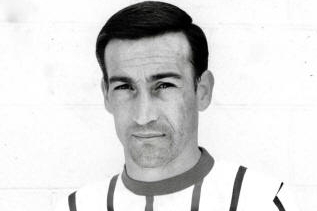
    John Borodiak, 89, of Philadelphia, Hall of Fame Argentine American professional soccer player, popular coach and sports center volunteer, and longtime Center City dental lab owner, died Saturday, Sept. 13, of complications from Alzheimer’s and Parkinson’s diseases at Graduate Post Acute nursing facility.

    Born and reared in Buenos Aires, Argentina, of Ukrainian descent, a young Mr. Borodiak was such a star that, in 1960, at 24, he was invited to leave South America and play soccer in the United States for the Ukrainian Nationals in Philadelphia. So, for seven seasons, through 1966, he played fullback for the Ukrainian Nationals and won four American Soccer League championships and four U.S. Open Cup titles.

    As a 5-foot-8, 160-pound defensive whiz, Mr. Borodiak didn’t score many goals or race down the field on breakaways. But, said his son, Ivan, also a former pro soccer player: “He was smooth, quick, and good up in the air.”

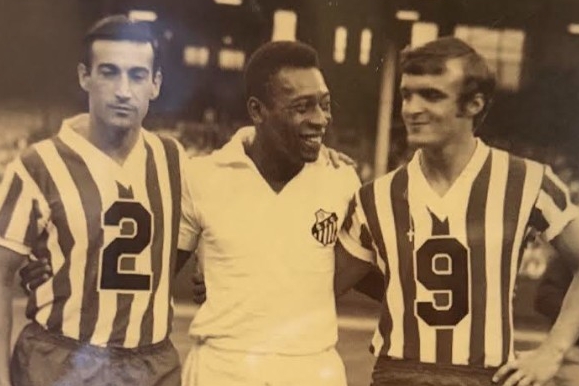
    He played on the 1964 U.S. national team and was inducted into the Horsham-based Ukrainian Sports Museum and Hall of Fame in 2017. Over the years, he played against Brazilian superstar Pele and other international stars, and former colleagues called him “a living legend.”

    Mr. Borodiak (left) played against Pele (center) and other international stars.

    He also played with the Philadelphia Spartans in the National Professional Soccer League and the ASL’s Newark Ukrainian Sitch in 1966 and ’67. He spent the 1968 season with the Cleveland Stokers and 1969 with the Baltimore Bays in the North American Soccer League. He retired after playing a final season with the Spartans in 1970.

    He made headlines after a game in 1967 when he blocked the game-tying goal after his goalie was caught out of position. “After I saw [the goaltender) go out, I expected something to happen in that corner,” he told the Daily News. “I moved up there, and the shot bounced off my chest.”

    Affable and engaging off the field, Mr Borodiak became a favorite of teammates, fans, and sportswriters. He hosted instructional clinics for young players and, after learning English himself, served as a translator for other players and the media. He spoke Ukrainian, English, Spanish, and Italian.

    In 1967, Daily News sports writer Dick Metzgar published his Christmas wish list and asked for “more hustling performers like little fullback John Borodiak.”

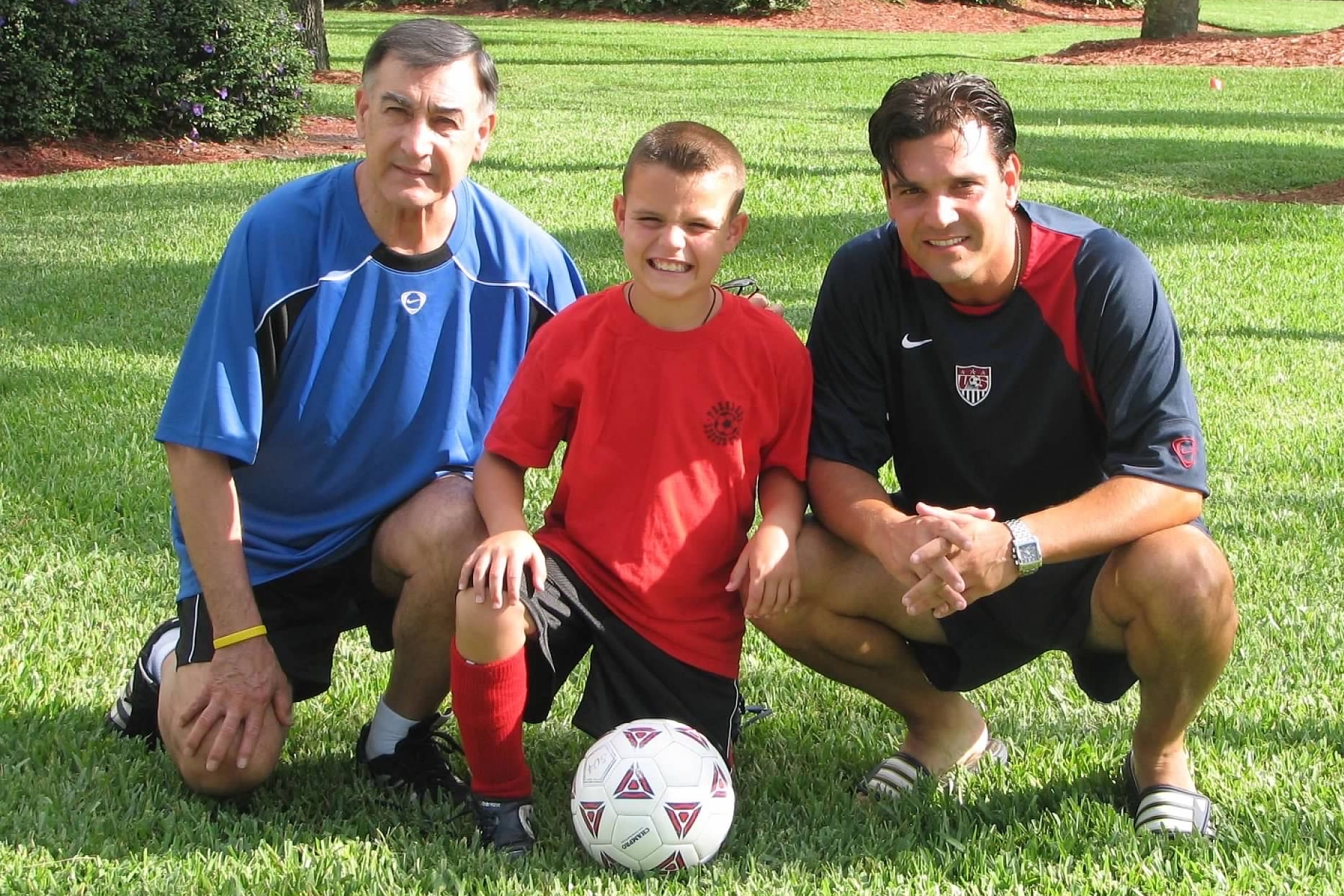
    Mr. Borodiak (left) passed his athleticism on to his son and grandson.

    He helped anchor a Spartans defense in 1967 that Metzgar called “impenetrable” and was known for his aggressiveness. He was ejected for fighting in a game against Baltimore that season, and he told the Delaware County Daily Times that his opponent hit him in the back. “Naturally,” he said, “I hit back.”

    He was a team cocaptain in Cleveland and named a NASL all-star in 1968, and his Stokers lost a heartbreaking playoff game to Atlanta in overtime that season. After the game, a disappointed Mr. Borodiak told the Cleveland Plain Dealer: “I’m sorry.”

    He rejoined the Spartans in 1970 when they entered the American Soccer League, and The Inquirer covered their big win over the Syracuse Scorpions. “A strong defensive cog, John Borodiak, was added to the Spartans lineup,” The Inquirer said, “and he played fullback in impressive style.”

    In a 1969 story after the Bays tied the Dallas Tornado, the Baltimore Sun said: “Borodiak made one of the best saves of the day when he blocked a shot after [the goalie] had been pulled out of the net.” In 1966, he played briefly for Roma in the Eastern Canada Pro Soccer League, and a teammate told the Toronto Star: “Borodiak is a fine fullback and fits in well with our style of play.”

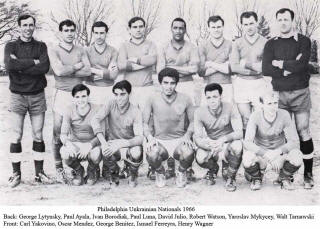
    Mr. Borodiak (rear, third from left) and teammates on the Philadelphia Ukrainian Nationals pose during the 1966 season.

    He coached soccer teams after he retired, played with amateur teams into his 40s, and was active for years at the Ukrainian American Sports Center in North Wales.

    He earned certification at Temple University in dental cosmetics in the 1960s and owned a lab in the Medical Arts Building in Center City until he retired in 2018. At 50 years, Mr. Borodiak was the longest-tenured tenant ever in that building, his son, Ivan, said.

    “He was a wonderful person,” his family said in a tribute, “He was a best friend, a champion, and a legend of his sport and in life.”

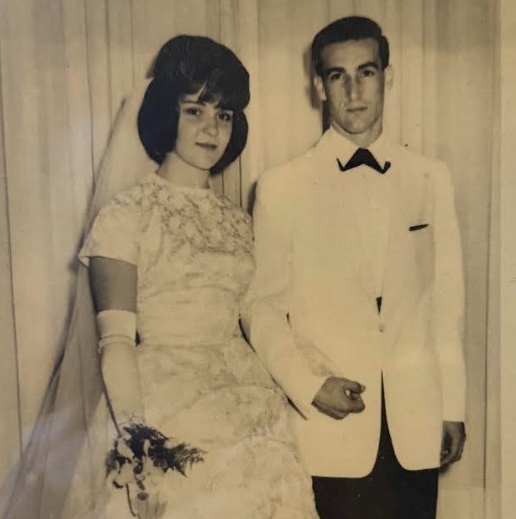
    Born July, 13, 1936, Ivan Gregorio Borodiak changed his name to John when he came to the United States. He met Betty Pilari in Argentina, and they married in 1962, and lived in Bensalem and Queen Village.

    Mr. Borodiak and his wife, Betty, married in 1962.

    Mr. Borodiak was generous and gentle, his son said. He enjoyed fishing and car shows, and he built his own Mercedes-Benz from the tires up.

    Friends noted his “kindness, gratitude, and warmth” in online tributes. One said: ”He was always a people person, and his smile could light up the darkest room.”

    His son said: “He was a great man. He never had an enemy, and he overcame every adversity.”

    In addition to his wife and son, Mr. Borodiak is survived by four grandchildren, a great-granddaughter, and other relatives. A sister died earlier.

    Mr. Borodiak (left) doted on his grandchildren.

    Private services were held earlier.

    Donations in his name may be made to the Alzheimer’s Association, 225 N. Michigan Ave. Floor 17, Chicago, Ill. 60601.

  • Temple Health says its new medical malpractice strategy is working

    Temple Health says its new medical malpractice strategy is working

    Temple University Health System‘s medical malpractice expenses have surged in the two years that ended June 30 as part of a campaign to reduce financial risk by settling old cases.

    The hope is that “aggressively” settling cases will pay off over the next few years by reducing medical malpractice expenses, Michael DiFranco, the health system’s chief accounting officer, told investors during a conference call last week on the health system’s fiscal 2025 financial results.

    Temple Health has 12,000 faculty members and employees who work mainly on five hospital campuses. Its fiscal 2025 revenue was $3.3 billion.

    Temple’s annual medical malpractice expenses increased nearly fourfold, to $117.8 million in fiscal 2025 from $31.6 million two years ago. Over the same period, it cut its reserves for future expenses by $88 million, or 22%. Temple’s reserves peaked at $402.9 million in 2023.

    Rising medical malpractice costs are reverberating throughout healthcare. Tower Health recently boosted its reserves after its auditor decided they should be higher to deal with anticipated claims. Lifecycle Wellness, a birth center in Bryn Mawr, blamed its decision to stop delivering babies in February in part on rising medical malpractice costs.

    The average number of medical malpractice lawsuits filed in Philadelphia every month has risen from 34 and 35 in the two years before the pandemic to 51 last year and 52 so far this year, according to the Philadelphia Court of Common Pleas. In additional to lawsuits against hospitals, the tally includes litigation against physicians, nursing homes, and other healthcare providers.

    Contributing to the increase was a rule change at the beginning of 2023 that allowed more cases to be filed in Philadelphia rather than the county where an injury occurred. Malpractice lawyers say they like to file in Philadelphia because the system for trying cases is efficient. Health systems often note that Philadelphia juries sometimes award large verdicts.

    A ‘wake-up call’ at Temple

    Temple Health started rethinking its medical malpractice strategy after John Ryan started as general counsel in January 2022. A month before he started, The Inquirer published an article about three suicides at Temple Episcopal Hospital in 2020. At least two of the families sued Temple.

    “That was a wake-up call,” Ryan said in a recent interview on his approach to handling malpractice cases.

    Then in May 2023, a Philadelphia jury hit Temple with a $25.9 million verdict in a case involving a delayed diagnosis of a leg injury leading to an amputation.

    After that loss, Temple changed the kinds of outside lawyers it hires to defend it in malpractice cases, Ryan said, swapping medical malpractice specialists for commercial litigators from firms like Blank Rome, Cozen O’Connor, and Duane Morris. Such lawyers cost more, but it’s paying off, he said.

    “The settlements we’re getting from the plaintiff lawyers, because they can see that we’re serious, are much better,” Ryan said. The two Episcopal cases were settled this year for undisclosed amounts, according to court records. A birth-injury lawsuit against Temple University Hospital in federal court settled for $8 million this month.

    In 2024, a jury awarded $45 million to a teen who was shot in the neck and suffered brain damage from aspirating food soon after his release from Temple. Temple appealed and the judge who oversaw the original trial ordered a new one. That case then settled at the end of October for an undisclosed amount.

    The new approach has helped Temple reduce the number of outstanding cases at any one time to 65 or so now compared to 110 three years ago, according to Ryan.

    Temple is using the money it is saving on malpractice costs to invest in better and safer care, Ryan said. “That’s not a byproduct of all we’re trying to do as the lawyers. It’s the goal,” he said.

    Inquirer staff reporter Abraham Gutman contributed to this article.

  • Colman Domingo will deliver Temple University’s commencement speech next May

    Colman Domingo will deliver Temple University’s commencement speech next May

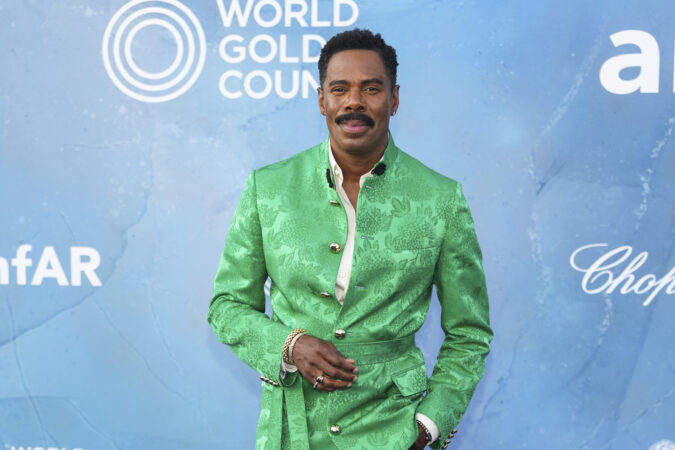
    Emmy Award-winning actor and self-confessed dandy Colman Domingo will deliver the commencement address at Temple University this spring, the university announced Thursday.

    Domingo, a native of West Philadelphia, will also receive an honorary degree during the ceremony that will be held at the school’s Liacouras Center on May 6, 2026. Domingo went to Overbrook High School before coming to Temple University in the late 1980s to study journalism.

    It was at Temple that Domingo developed a love for theater after a teacher told him he had a special gift. In 1991, with only 50 credits to go, he dropped out and moved to California to pursue a career in acting.

    Domingo said returning to Temple for the university’s commencement ceremony will be a full circle moment for him.

    “I am beyond grateful and humbled to receive an honorary doctorate from Temple University,” he said in a statement. “As a journalism student who struggled with the balance of working two jobs … this degree is very meaningful to me.”

    Domingo stars in the action movie The Running Man, in theaters now. He received consecutive nominations for the Academy Award for best actor in 2023 and 2024 and this year he was one of the co-chairs for the Met Gala, celebrating the opening of The Metropolitan Museum of Art’s groundbreaking fashion exhibit, “Superfine: Tailoring Black Style.”

    Domingo was named one of Time magazine’s 100 most influential people in 2024.

    Past commencement address speakers and honorary award recipients at Temple include fellow West Philadelphian Quinta Brunson, Bishop Desmond Tutu, and North Philly native basketball coach Dawn Staley, among others.

  • Rape crisis centers are finally getting funding from Pennsylvania’s budget, but advocates say it’s not enough to support survivors

    Rape crisis centers are finally getting funding from Pennsylvania’s budget, but advocates say it’s not enough to support survivors

    Rape crisis centers in the Philadelphia region are sounding the alarm that the slight increase in funding in the recently passed state budget won’t be enough to sustain or improve crucial services for survivors of sexual assault.

    The Pennsylvania Coalition to Advance Respect (PCAR), which funds rape crisis centers via the state allocation, estimates centers will only see an average increase of $5,300 from the state to support their work assisting victims of sexual violence.

    The Philadelphia Center Against Sexual Violence had to lay off most of its staff and reduce services due to the nearly five-month state budget impasse. And while leaders in the region appreciate the funding — the first increase for rape crisis centers in years — it’s only a fraction of what Philly’s only rape crisis center says it needs to survive.

    “Even with the budget now passed, the funding increase is minimal compared to the overwhelming need,” said LaQuisha Anthony, senior manager of advocacy at the center, in a news release last week. The center is known as WOAR, the initials of its former name, Women Organized Against Rape.

    Now advocates in Philadelphia and the suburbs are turning their focus to next year’s budget, pushing for an $8 million increase in state funding to rape crisis centers, which, among other services, offer victim advocacy, legal services, and crisis hotlines. A surge in funding will help provide stability for survivors and adequately compensate staff who dedicate their lives to this work.

    “An $8 million increase would help ensure that every survivor across the Commonwealth, urban, suburban, and rural, has access to care, advocacy, and prevention,” said Joyce Lukima, coalition director and chief operating officer at PCAR, in a statement.

    More than $12 million of a $50.1 billion state budget was allocated to rape crisis this year, a $250,000 increase from last year. Lukima said this $250,000 will be split among 47 rape crisis centers in the state.

    In a statement, a spokesperson for the Pennsylvania Department of Human Services, which oversees rape crisis center funding, highlighted Gov. Josh Shapiro’s history of support for survivors of sexual violence.

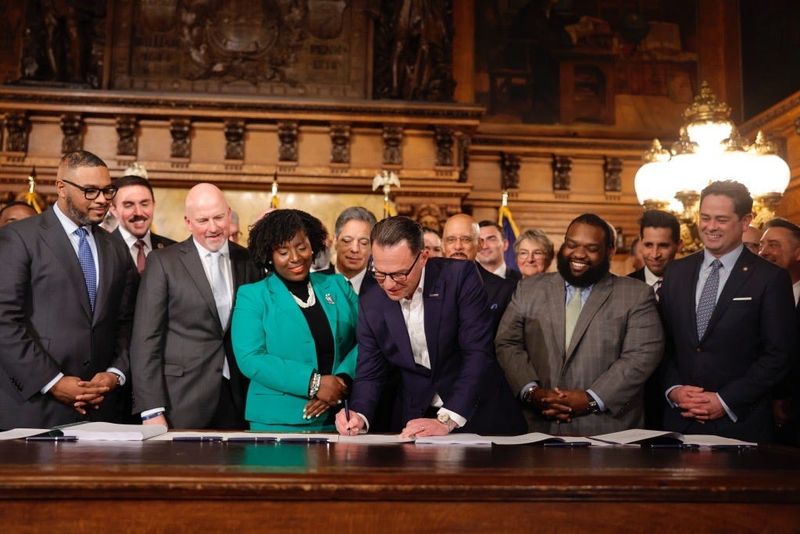
    Gov. Josh Shapiro signs the fiscal year 2025-26 budget surrounded by General Assembly members on Nov. 12 at the Capitol in Harrisburg. The state budget had been due June 30, and Pennsylvania is the final state in the country to approve a funding deal.

    “The final budget reflects the realities of working with one of the only divided legislatures in the entire country – but Gov. Shapiro will continue to fight for survivors and the Commonwealth’s rape crisis centers,” said Ali Fogarty, the DHS spokesperson.

    Victim services centers in the suburbs, which also offer rape crisis services, are echoing WOAR and PCAR’s message, highlighting the urgent need for greater funding. These suburban centers receive funding from additional sources because they support victims of other crimes.

    “For now, we’re doing OK, but another year of no increase in funding while the cost of living is going up has a significant impact on our staff as well as our organization,” said Penelope Ettinger, executive director of Network of Victim Assistance – Bucks County.

    Trying to stay afloat

    While Pennsylvania lawmakers were failing to come to an agreement on a far overdue state budget last month, rape crisis centers in Philadelphia and the suburbs were trying to make ends meet and provide services to survivors of sexual violence.

    For instance, the Victim Services Center of Montgomery County had to use a line of credit, delay bill payments, institute a hiring freeze, increase the number of interns, and commit to “triaging services,” said Mary Onama, executive director.

    “If they hadn’t passed the budget the time that they did, by December or January, we would have had to close, because we couldn’t go much longer,” Onama added.

    At the Crime Victims’ Center of Chester County, it “added a layer of stress to an already very stressful job,” though the center did not have to reduce services, said Christine Zaccarelli, the organization’s CEO.

    And at WOAR, the changes were drastic.

    The nonprofit cut their 30-person staff and paused counseling and therapy services and prevention-education programs. Other programming was kept afloat by the handful of staff members that remained.

    WOAR’s release last week said the closure of therapy and counseling services left “106 individuals wait-listed, 33 group clients waiting for services to resume, and eight child clients referred elsewhere for care.”

    The center has been serving Philadelphia since 1971 and was one of the first rape crisis centers in the United States, according to the organization. Between January and October, the center said it responded to 3,820 calls on its crisis hotline.

    But there have been recent shake-ups at the nonprofit, including the hiring of Gabriella Fontan, WOAR’S executive director, which was announced roughly a week before layoffs began in October. Prior to Fontan, the center had two interim executive directors since 2022.

    The dysfunctional approval of the state budget, though, will have lingering effects on WOAR, warning in the news release that without a “long-term, sustainable investment,” the center won’t be able to meet a rising demand for resources.

    The Bridge Loan, from the Pa. Treasury Department, provided WOAR funding owed for July through September, but it still wasn’t enough to return WOAR to full capacity, said Demetrius Archer, PCAR’s communications director. The center also brought back two employees this month, but it’s still in need of community support and is hoping to bring back more staff when possible.

    “When services are underfunded, survivors and entire communities feel the impact,” said Fontan in the news release. “In a city as large and diverse as Philadelphia, every minute counts when someone is in crisis. Survivors deserve to know that when they reach out for help, someone will be there to answer.”

    All eyes on Harrisburg

    At Temple University’s campus Tuesday, student advocates bundled up in their coats, hats, and scarves and gathered at the Bell Tower to discuss an anti-sexual violence state bill they helped develop.

    The Every Voice Bill, which primarily focuses on sexual violence prevention resources on college campuses, is even more important now that survivor services from WOAR are “unstable,” said Bella Kwok, a senior criminal justice major and president of Temple’s Student Activists Against Sexual Assault, in an interview prior to Tuesday’s event

    “This bill would ensure that stability at least on an institutional level,” Kwok said.

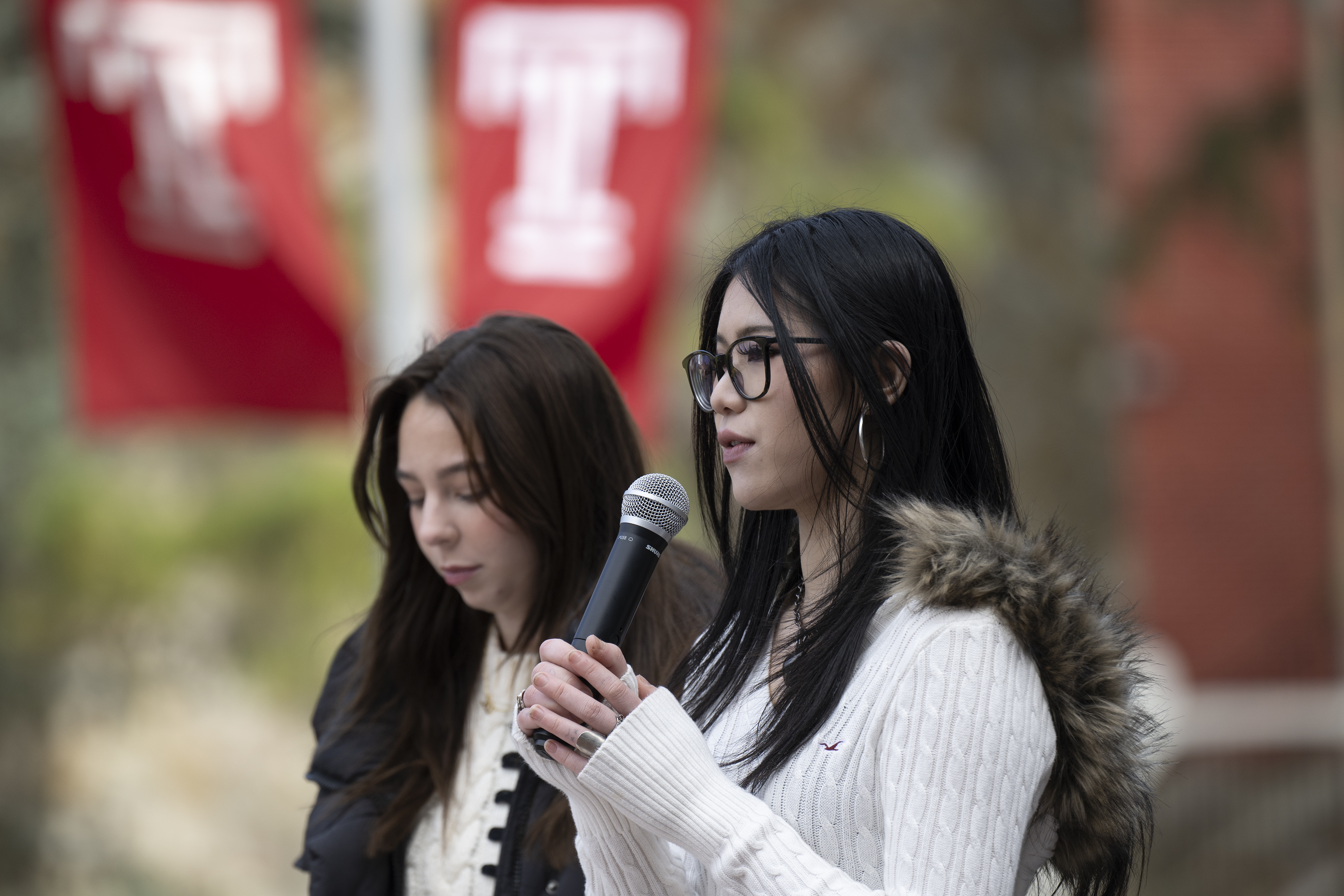
    Temple University students Emma Wentzel, left, and Bella Kwok speak at a podium on Polett Walk on Tuesday, Nov. 18, 2025, about campus sexual assault and a state bill they helped craft to strengthen protections against sexual violence at colleges.

    Kwok is not the only one who is turning their attention to Harrisburg. PCAR and other rape crisis centers are continuing their push for next year’s budget to include an $8 million increase in the Pa. DHS line item for rape crisis.

    As the first increase for rape crisis centers in a few years, the new budget’s funding gives advocates “hope,” even if the amount is “disappointing,” said Zaccarelli, of the Crime Victims’ Center of Chester County.

    “Maybe our advocacy is making a little bit of a difference and shining a light on survivors and their needs and how important our centers are in the community,” Zaccarelli said.

    Ettinger said that Bucks County’s state lawmakers have been supportive of NOVA Bucks, which had to place a hiring freeze on some positions and issue “significant” restrictions on spending due to the impasse, but that a lack of increased funding from the state is “very telling.”

    “I believe that the fact that the state did not allocate a significant increase is very telling to what they believe, where they put it on the priority list,” Ettinger said.

    For his part, Shapiro signed Act 122 in October 2024, which aimed to increase transparency by requiring a statewide electronic system to track evidence kits for sexual assaults, Fogarty, the DHS spokesperson said. And in December 2023, he signed Act 59, which aims to improve access to treatment for survivors of sexual assault.

    It’s a “societal” problem, not a government problem, said Vincent Davalos, interim executive director of the Delaware County Victim Assistance Center.

    “When we talk about sexual violence, the first thought is, of most people, is to say ‘Maybe this didn’t happen,” Davalos said. “And even if they do believe it happens… it’s just a really difficult topic for people to engage and talk about it plainly.”

    This week, victim services leaders across Pennsylvania will gather in Harrisburg for an annual conference to address funding challenges among other concerns, Davalos said, noting that with more funding, his center could improve staff retention.

    But this year, the newly passed state budget is likely to be top of mind.

    “I think money is going to be a big topic,” Davalos said.

  • Temple marching band is preparing to go to New York for Macy’s Thanksgiving Day Parade

    Temple marching band is preparing to go to New York for Macy’s Thanksgiving Day Parade

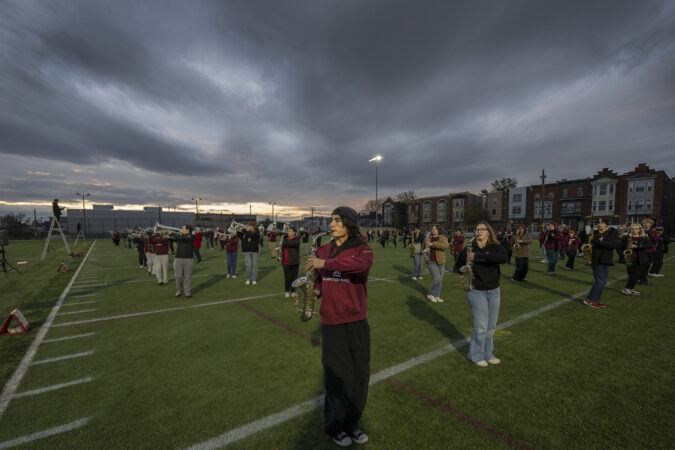
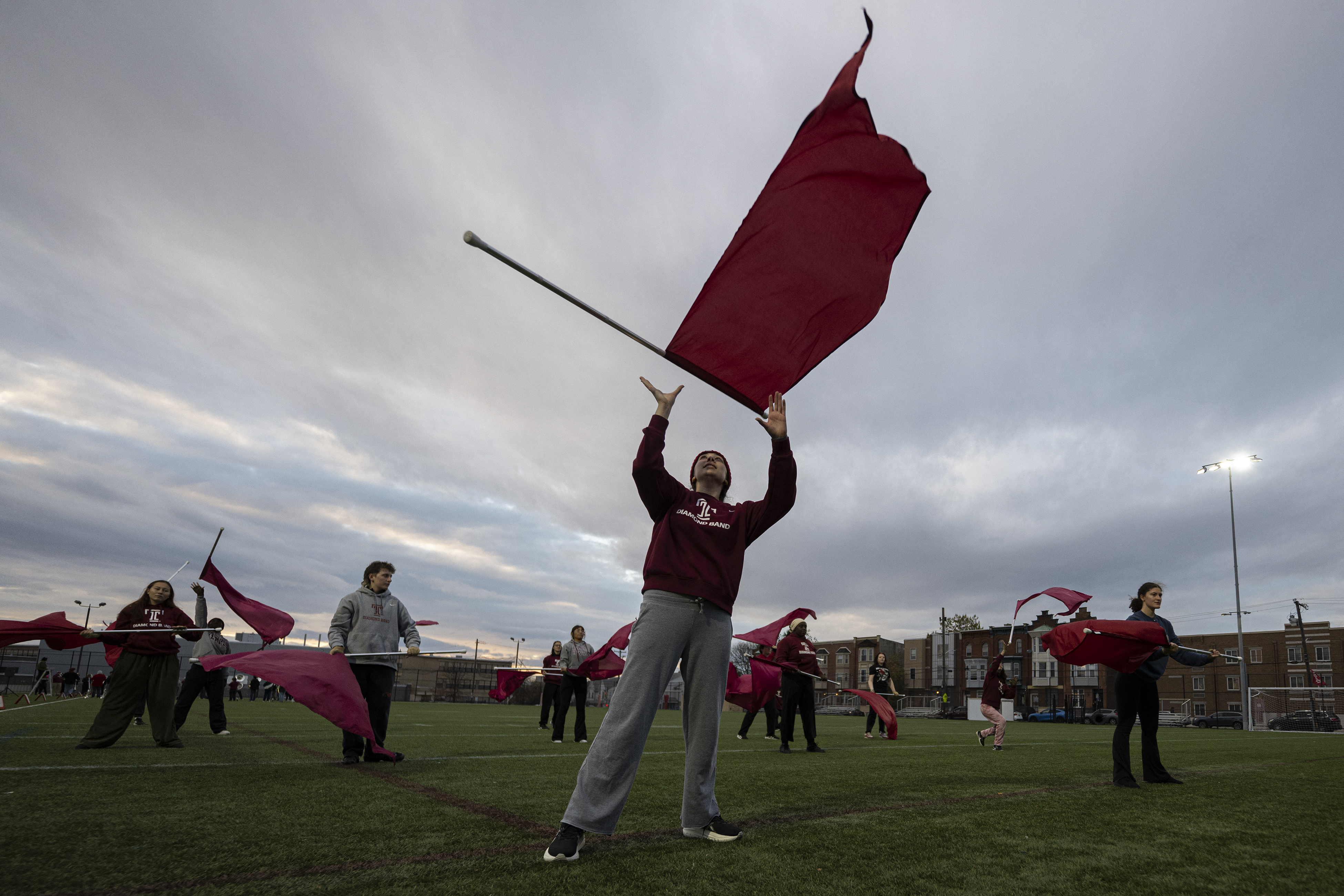
    As the pink of twilight peeked through the November clouds, Temple University’s Diamond Marching Band, instruments and flags in tote, practiced on the campus’ Geasey Field.

    They ran through selections by Taylor Swift and from the movie KPop Demon Hunters while athletic bands director Matthew Brunner studied their sound and formation from a scissor lift 25 feet in the air.

    “Notes should be long,” Brunner called out over a microphone after one selection. “Don’t try to play them too short.”

    There were few spectators that afternoon. But that’s about to change in a big way.

    The 200-member band is one of only 11 that have been selected to participate in the Macy’s Thanksgiving Day Parade in New York City. It’s a first for Temple, which will be the only band from Pennsylvania or New Jersey in this year’s parade. More than 30 million people likely will be watching from home and 3.5 million in person, if prior numbers are any indication.

    Members of the Temple University Marching Band prepare to practice. The band will perform in the Macy’s Thanksgiving Day Parade this year.

    That’s a lot of exposure for the Cherry and White, which could be a boost for recruitment and fundraising.

    “I can scarcely think of a better way to bring visibility to Temple,” said John Fry, Temple’s president.

    And that visibility could lead to more people visiting Temple’s website and seeing what the university has to offer, he said.

    “It’s going to be incredible for the university,” said Brunner, who initially announced Temple’s band had been selected for the parade in August 2024. “There’s no television event, other than the Super Bowl, that is bigger.”

    The excitement is palpable among students, some of whose families plan to attend the parade.

    “It’s a once-in-a-lifetime opportunity,” said Erin Flanagan, 21, who grew up watching the parade with her family and notes she wanted to march in it since she was 6. “I mean, the Macy’s parade is iconic.”

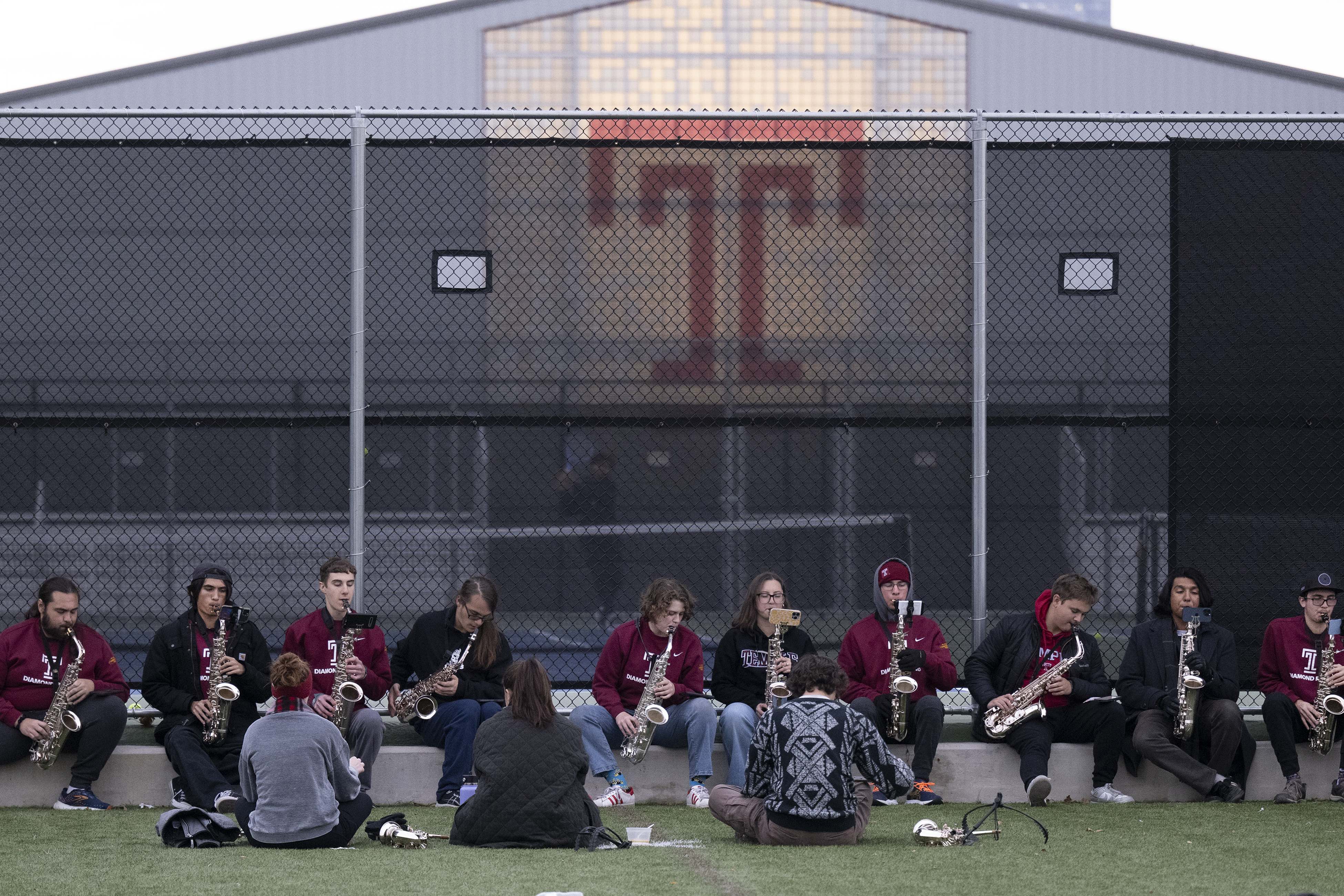
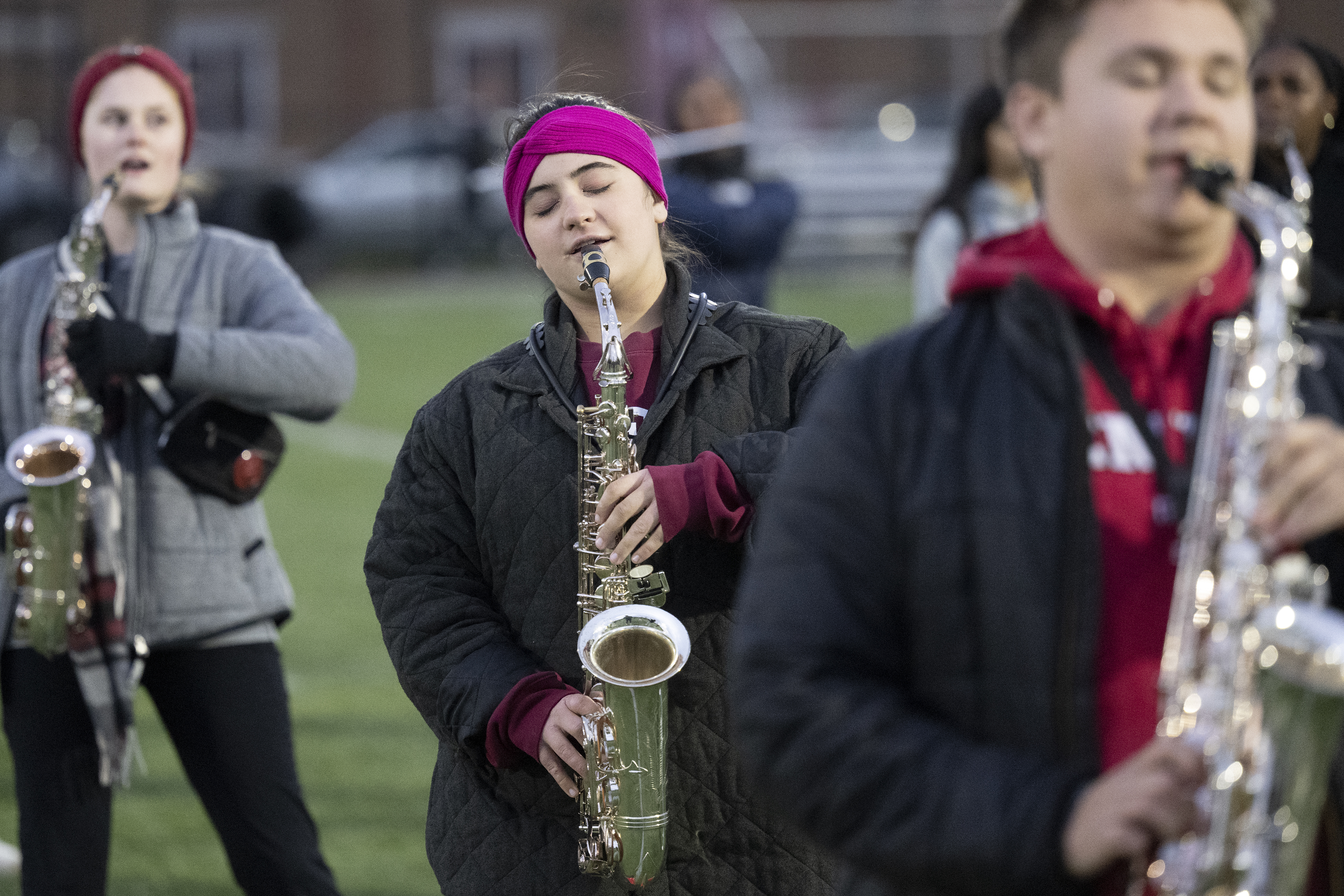
    Temple University alto saxophone player Erin Flanagan rehearses with the marching band.

    The music education major from Manasquan, N.J., who is a senior, said it likely will be her last performance with the band, and she could not have scripted it better.

    “I get to go to this awesome performance and just show everybody what Temple stands for,” said Flanagan, an alto saxophone section leader.

    It’s the 99th anniversary of the 2.5-mile parade, which kicks off about 8:30 a.m. on Thanksgiving Day on NBC and Peacock, hosted by Savannah Guthrie, Hoda Kotb, and Al Roker.

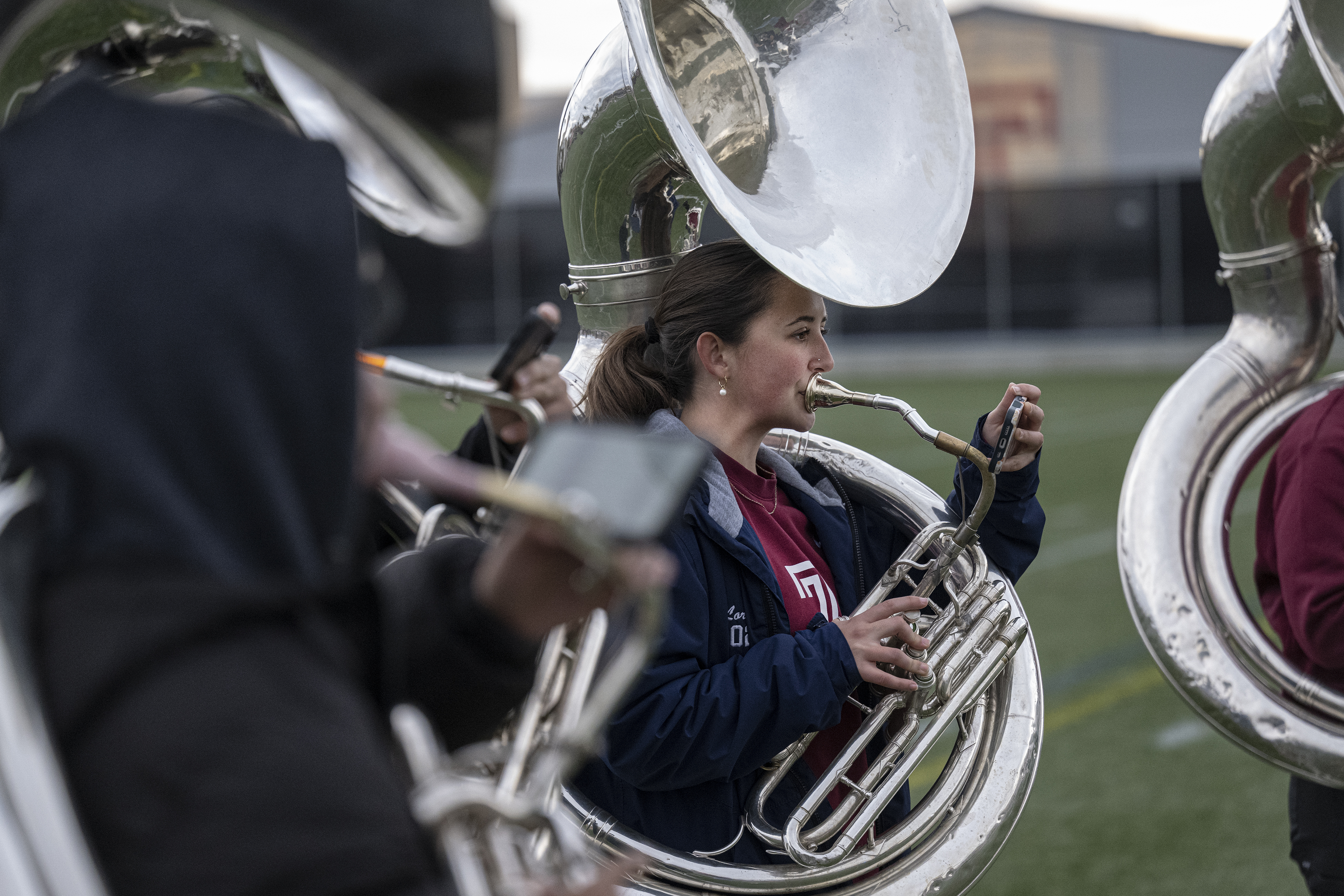
    Temple University tuba player Lorali Minde plays the tuba in the marching band.

    Lorali Minde, 18, a freshman from Levittown, will be marching while playing the tuba, a 36-pound instrument.

    “You kind of get used to it,” she said. “It’s like carrying a really heavy purse.”

    Brunner, who has led the marching band for 18 years, said he had applied to be in the parade several times before. It’s a competitive process, with more than 100 applicants vying for a spot. He had to submit video of a performance — he sent the 10-minute show the band did off the Barbie movie soundtrack — pictures of the band in uniform, reasons that Temple deserved a shot, and the band’s resume and biography.

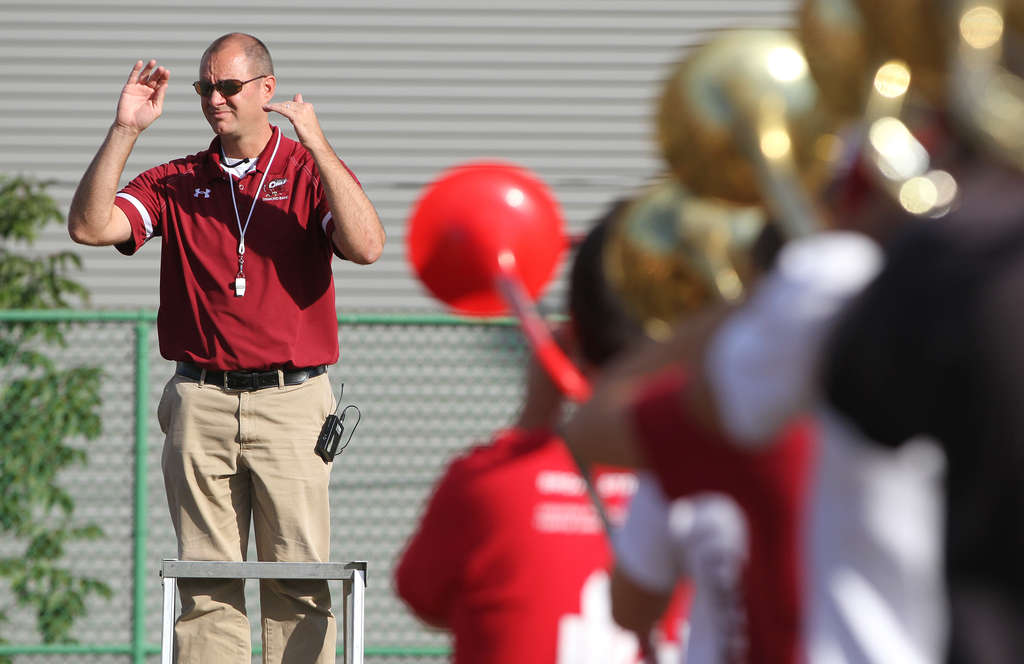
    Matthew Brunner, athletic bands director, leads a practice in 2018.

    When his wife saw the Barbie show, Brunner said, she texted him: “That’s the show you need to send to Macy’s.”

    It proved a winner.

    “They loved the fact that the music we play is current,” he said.

    The honor comes at a special time for the band, which is celebrating its 100th anniversary. Brunner played that fact up in the application, too.

    Under Brunner, the band has grown and has been hitting high marks. Over the years, the school has been recognized as one of the top collegiate marching bands in the nation by USA Today and Rolling Stone, appeared on Good Morning America, The Tonight Show Starring Jimmy Fallon, and an episode of Madam Secretary, and was featured in two Hollywood movies, The Wolf of Wall Street, starring Leonardo DiCaprio, and the remake of Annie. Some of its performances have received millions of views on YouTube, including a 2018 performance of “Idol” by the K-pop group BTS, which currently has more than five million views on Ricky Swalm’s YouTube channel.

    The band includes a color guard, a baton twirler, brass and woodwind instruments, a drum line, and a dance team. The group typically practices three times a week for two hours at a time.

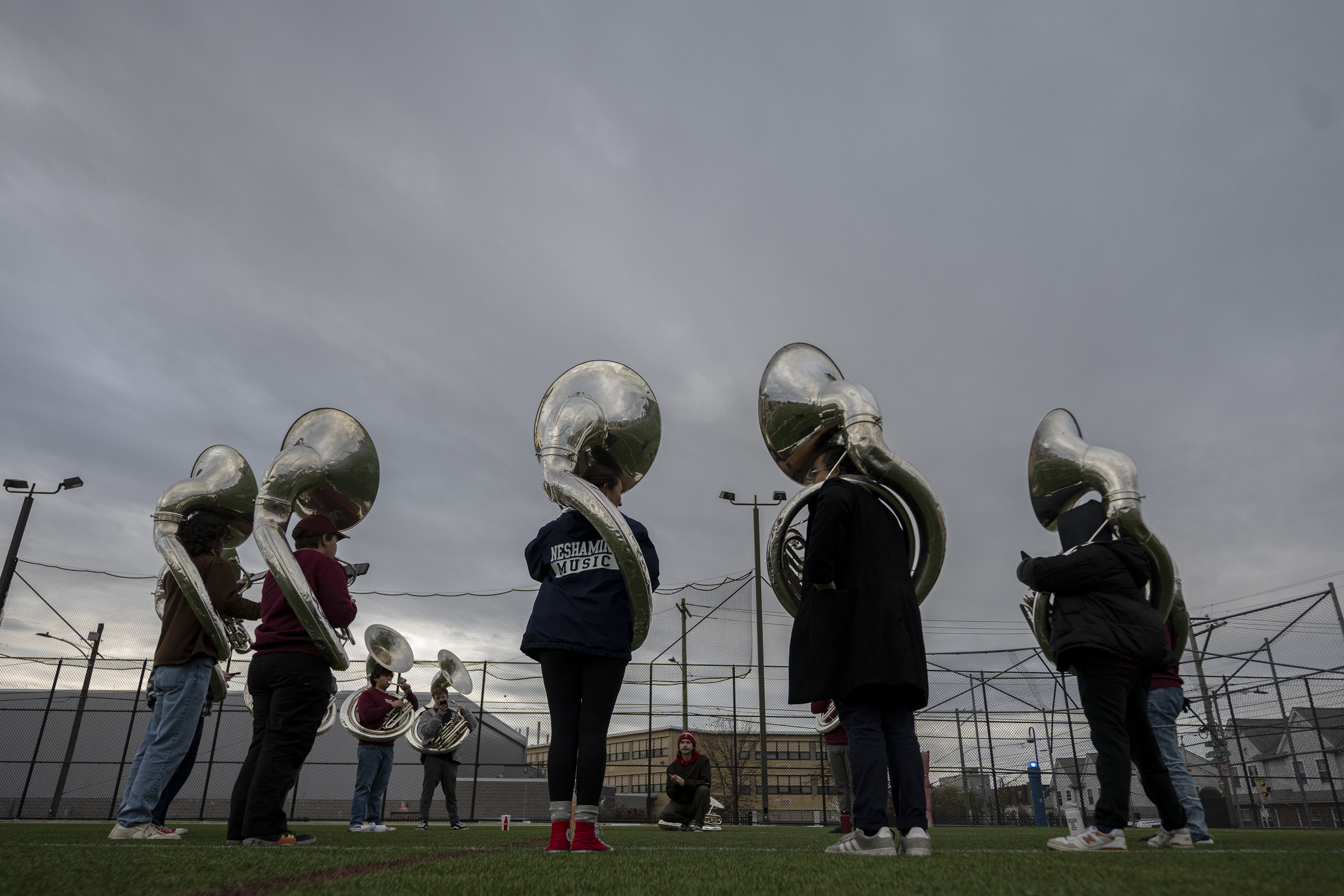
    Temple University Marching Band tuba players practice.

    “The band is infectious,” Brunner said. “When you see them perform, you can’t help but smile.”

    Students have been eying the parade opportunity for a while.

    When Flanagan was a sophomore, she asked Brunner point-blank: “When are we doing the Macy’s parade?”

    Recently, she and her roommates, also band members, have been counting down the days on a whiteboard.

    Brunner declined to say exactly what the band will perform on Thanksgiving, but promised a mix of holiday, audience participation, and Temple songs.

    “We’re hoping for no wind,” he said.

    Temple University Marching Band Color Guard Captain Abigail Rosen practices with her flag.

    Abigail Rosen, color guard captain, and her cocaptain are planning an “epic toss” of their flags over other band members, and wind could hinder it, he explained.

    “It’s an exchange toss,” said Rosen, 20, a junior advertising major from Abington. “So I toss my flag to Dana [Samuelson] and she tosses her flag to me, and we catch each other’s flags.”

    Bands selected received $10,000 from the retailer, which Temple officials said helped them get started on fundraising to pay for the trip.

    The band will be heading to New York on Tuesday for an alumni event, then a performance on the Today show Wednesday. Band members will be up in the wee hours of the morning Thursday for a rehearsal, and after the parade, they will be treated by the school to a Thanksgiving dinner cruise along the Hudson River.

    Andrew Malick, 20, a music education major from Carlisle, Pa., who plays the tuba, can’t wait.

    “It will be cool to say you’ve done it for the rest of your life,” he said.

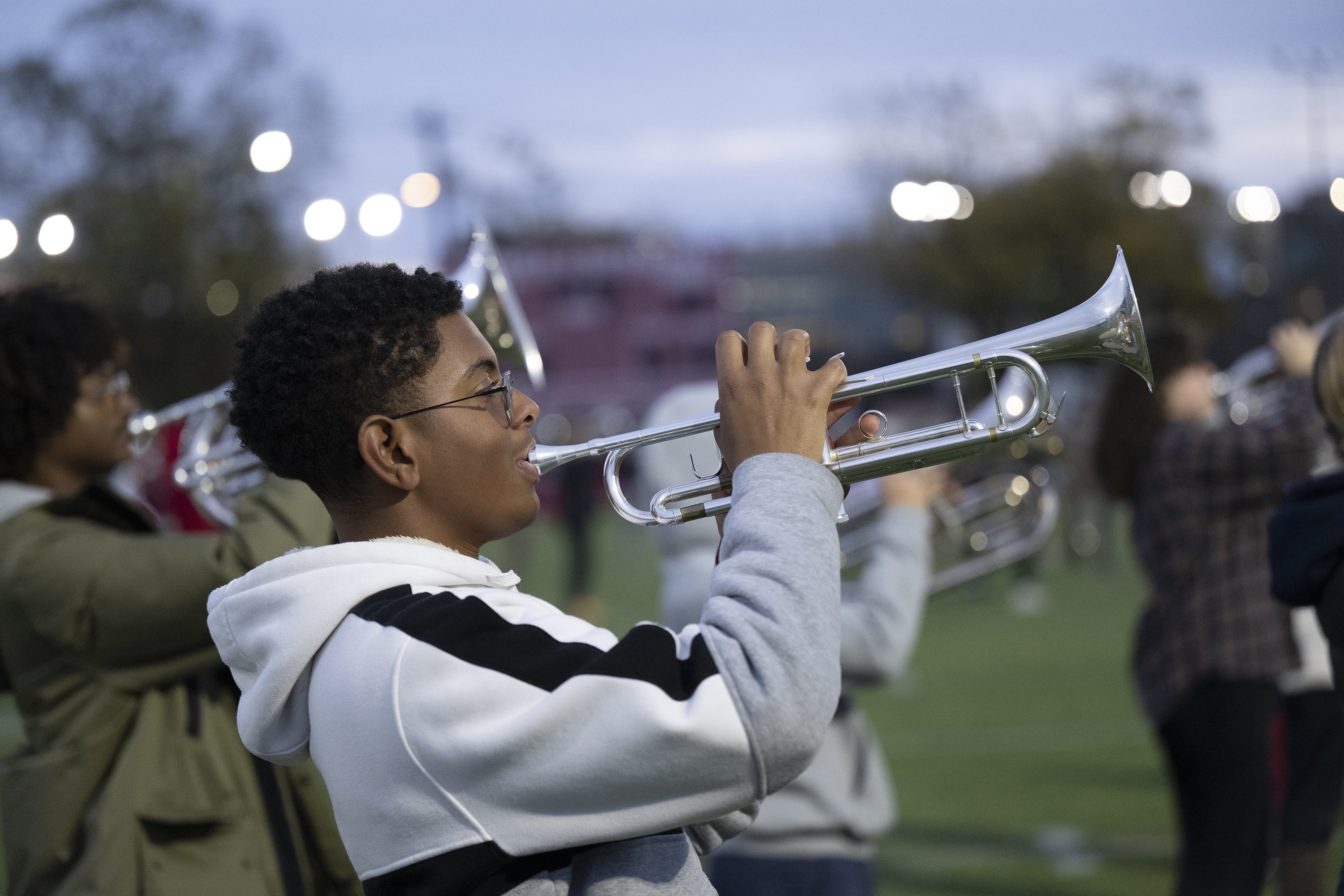
    Jeremiah Murrell, a freshman trumpet player from Savannah, GA, rehearses with the Temple University Marching Band Thursday, Nov. 13, 2025.
  • One year of inspections at Temple University Hospital: September 2024 – August 2025

    One year of inspections at Temple University Hospital: September 2024 – August 2025

    Temple University Hospital’s Episcopal campus was cited by the Pennsylvania Department of Health for failing to maintain cleaning logs for the crisis center in May.

    The incident was among more than a dozen times inspectors visited Temple’s main campus, Jeanes campus, or Episcopal campus to investigate potential safety problems between September 2024 and August. The three campuses operate under a shared license, and inspection reports do not always distinguish which campus inspectors visited.

    Here’s a look at the publicly available details:

    • Sept. 27, 2024: Inspectors came to investigate a complaint but found the hospital was in compliance. Complaint details are not made public when inspectors determine it was unfounded.
    • Oct. 1: Inspectors followed up on a January 2024 citation and found the hospital was in compliance. The Episcopal campus had been cited for failing to properly update and document mental health patients’ records and treatment plans every 30 days.
    • Jan. 6, 2025: The Joint Commission, a nonprofit hospital accreditation agency, renewed the hospital’s accreditation, effective May 2024, for 36 months.
    • Jan. 11: Inspectors came to investigate three separate complaints but found the hospital was in compliance.
    • Jan. 16: Inspectors came to investigate a complaint but found the hospital was in compliance.
    • Jan. 21: Inspectors came to investigate a complaint but found the hospital was in compliance.
    • Jan. 29: Inspectors came to investigate a complaint but found the hospital was in compliance.
    • Feb. 5: Inspectors came to investigate a complaint but found the hospital was in compliance.
    • Feb. 11: Inspectors came to investigate a complaint but found the hospital was in compliance.
    • Feb. 21: Inspectors came to investigate a complaint but found the hospital was in compliance.
    • March 4: Inspectors came to investigate a complaint but found the hospital was in compliance.
    • March 10: Inspectors came to investigate a complaint but found the hospital was in compliance.
    • March 12: Inspectors visited for a monitoring survey and found the hospital had violated rules related to patients’ rights to care by competent personnel. Details of the problem were not made public because the issue was fixed before inspectors arrived. The hospital’s correction plan included educating staff about how to protect vulnerable patients from leaving the hospital against medical advice. Administrators also established a system to review patients at risk and an environmental safety checklist.
    • March 31: Inspectors came to investigate a complaint but found the hospital was in compliance.
    • April 4: Inspectors came to investigate a complaint but found the hospital was in compliance.
    • May 6: Inspectors cited Temple’s Episcopal campus for not having sanitation documentation and cleaning logs for the crisis response center. Administrators retrained staff on the hospital’s sanitation policies and record-keeping requirements.
    • May 8: Inspectors came to investigate a complaint but found the hospital was in compliance.
    • June 10: Inspectors came to investigate a complaint but found the hospital was in compliance.
    • July 14: Inspectors came to investigate a complaint at the Jeanes campus but found the hospital was in compliance.
  • Temple’s head of enrollment abruptly resigns

    Temple’s head of enrollment abruptly resigns

    Temple University’s vice president for enrollment and student success resigned abruptly this week after only 2½ years in the post.

    Jose Aviles’ resignation is effective Dec. 2, the university said in a message to the campus Wednesday.

    “It is very difficult to leave, but I have a life-changing opportunity that awaits me,” Aviles said, adding that he would share details when able. “Serving the Temple University community has been an extreme honor, as I am deeply grateful to have had the chance to fulfill the mission of Russell Conwell and expand access and opportunity to this world-class institution.”

    Temple did not respond to questions on why Aviles is leaving midyear, with the university in the midst of another application cycle.

    “Jose has reimagined enrollment management at the university over the last couple of years, helping move us to a modern, technology- and data-driven approach that has delivered results,” Temple president John Fry and interim provost David Boardman said to the campus community.

    They noted the university achieved growth in first-year enrollment the last two years, with this year’s group reaching a record high of 5,379.

    The university also under his tenure started the Temple Promise program, which makes tuition and fees free for first-time, full-time college students from low-income families who live in Philadelphia, and the Temple Future Scholars program, a mentoring and college-readiness program.

    Aviles, who came to Temple from Louisiana State University, where he had served as vice president for enrollment management and student success since 2017, was recently promoted from a vice provost to a vice president.

    He said in his statement that he “received great support from this university and its leaders” and would “continue to cheer on Temple from the sidelines.”

    While Temple’s first-year class was strong, the school fell short of its initial overall enrollment projection by about 700 students, which translates to about $10 million in lost revenue.

    The university had been estimating it would enroll a total of 30,100 to 30,300 students, which would have been its first enrollment increase since 2017.

    Instead, enrollment came in at 29,503, down about 500 from last year and further declining from its high of more than 40,000 eight years ago. (That does not include enrollment on its Japan and Rome campuses, which increased. Including those campuses, Temple’s overall enrollment was over 33,000, a slight increase from last year.)

    There have also been concerns about sophomore retention and a higher percentage of third- and fourth-year students not returning.

    And in September, the Temple News, the student newspaper, reported that more than 25 admissions counselors, directors, and staff left the department or were laid off over the two years that Aviles led enrollment. Students experienced delays in receiving their admissions decisions, problems with credit transfers, and difficulty with advising and financial aid packages, the Temple News reported.

    “I’m proud of the work that we’ve done,” Aviles told the Temple News at the time. “We definitely walked into a challenging time for admissions but when you look at what’s really happened in the last two years, I think I’m most proud of the foundation that we’ve set.”

  • The parents of a 16-year-old shot and killed last month want Philadelphia to know not just how he died, but who he was

    The parents of a 16-year-old shot and killed last month want Philadelphia to know not just how he died, but who he was

    Angelica Javier was sitting at home on a Saturday evening last month when her son’s uncle called in a panic.

    Xzavier, her 16-year-old, had been shot, he said — one of the teen’s friends had called and told him, but he knew nothing else.

    Javier, 32, frantically checked a news website and saw a brief story mentioning that a man was shot and killed in Northeast Philadelphia.

    That could not be her son, she told herself. Xzavier was only a boy, she said — tall but lanky, with the splotchy beginnings of a mustache just appearing on his upper lip.

    She called around to hospitals without success. Xzavier’s father, Cesar Gregory, drove to Jefferson Torresdale Hospital, desperate for information.

    Then, just before 10 p.m., she said, a homicide detective called to say their eldest child, their only son, had been shot and killed that afternoon near Teesdale and Frontenac Streets.

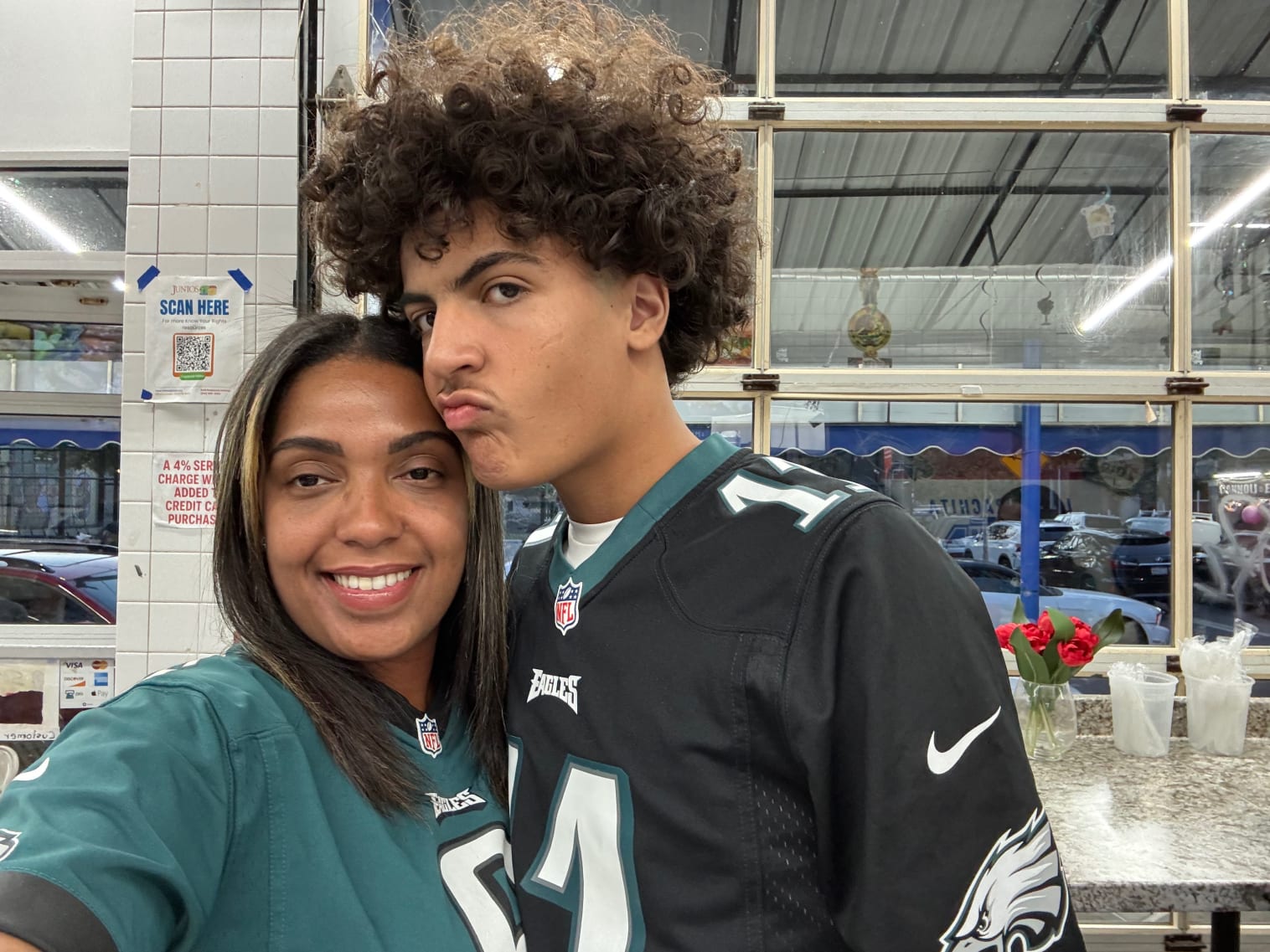
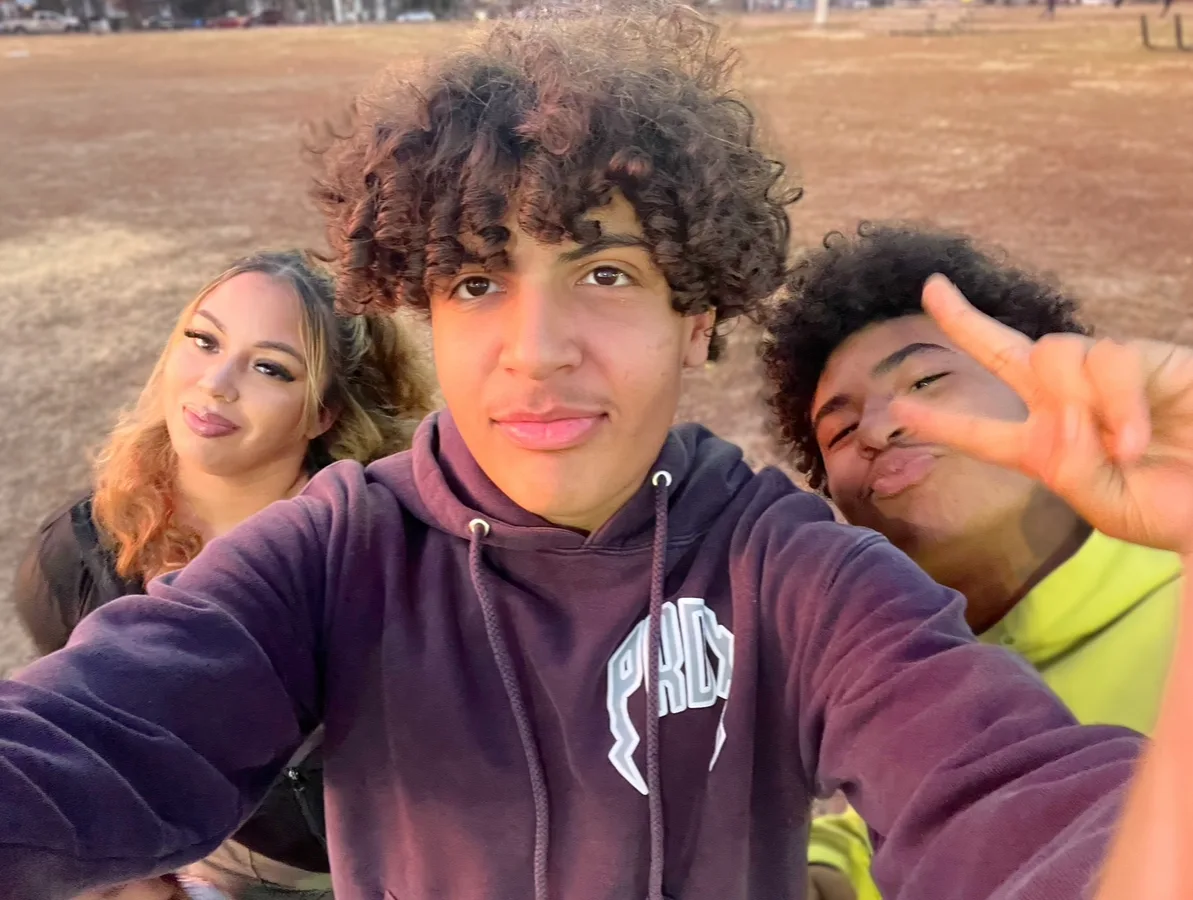
    Angelica Javier (left) and her 16-year-old son, Xzavier Gregory, getting tacos after watching the Eagles beat the Los Angeles Rams earlier this year.

    The shooting, police said, stemmed from a dispute among teens at the Jardel Recreation Center, just blocks away, earlier in the week. Xzavier’s parents said the detective told them that one of their son’s friends may have slapped a young woman that day.

    On Oct. 11, they said, police told them that Xzavier and his friends stopped by the young woman’s house shortly before 4 p.m. to talk with her, apologize, and resolve the conflict. They shook hands, the parents said, and started to walk away.

    Then, police said, the girl’s 17-year-old boyfriend, Sahhir Mouzon, suddenly came out of the house with a gun and started shooting down the block at them. Someone shot back, police said, but it was not Xzavier. In total, 45 bullets were fired.

    An 18-year-old woman walking by the teens was wounded in the leg.

    Xzavier was struck in the chest and died within minutes.

    Mouzon has been charged with murder and related crimes.

    Javier and Gregory have been left to navigate life without their “Zay” and to reckon with a loss that comes even as gun violence in the city reaches new lows — but which still persists among young people and brings pain to each family it touches.

    They don’t understand how a 17-year-old had a gun, they said, or why a seemingly minor — and potentially resolved — conflict had to escalate.

    But mostly, they said, they want Philadelphia to know and remember their child: a goofy junior at Northeast High. An avid Eagles fan. A lover of Marvel movies and spicy foods.

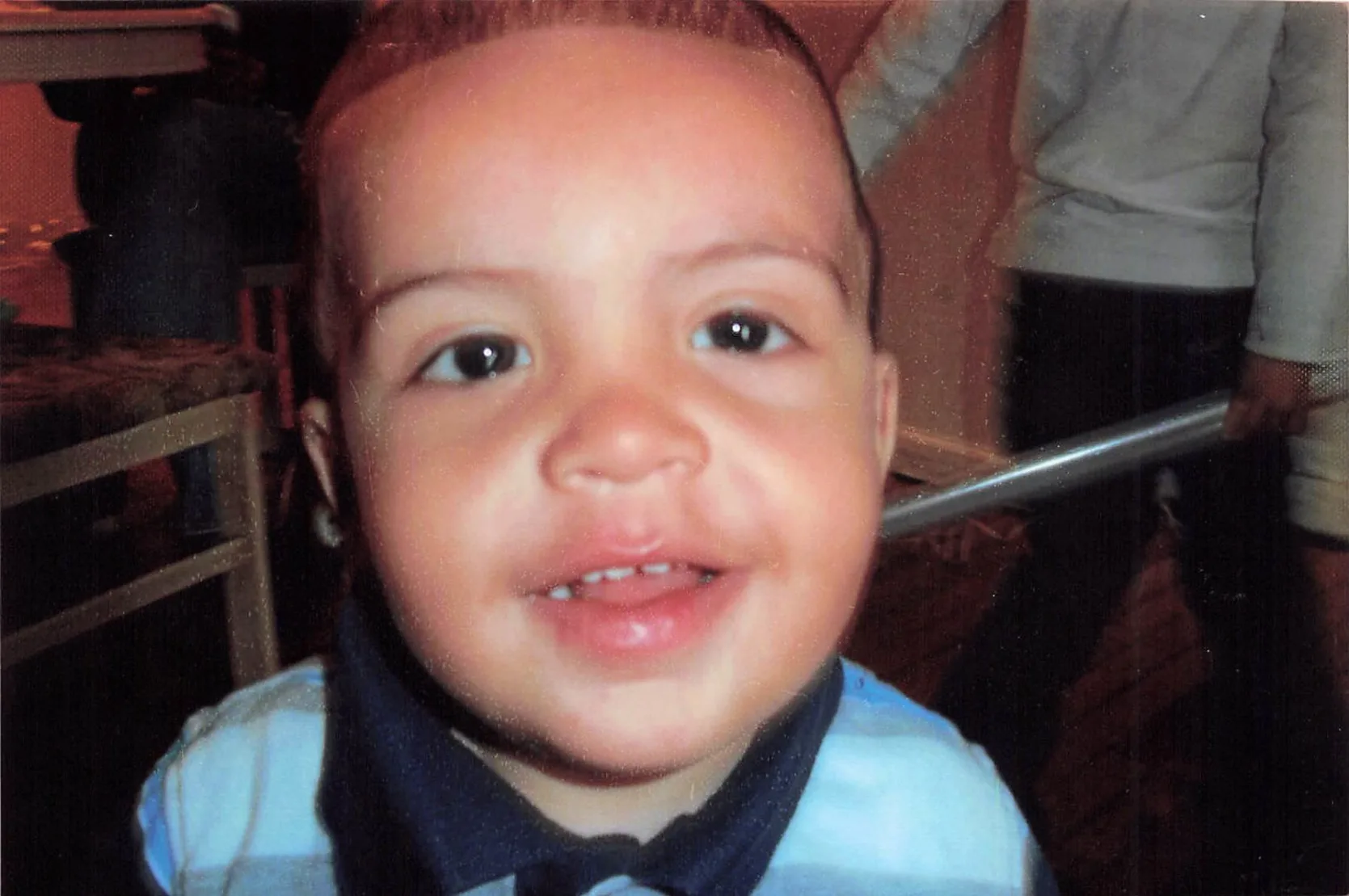
    Xzavier Gregory was born in Philadelphia. His parents loved his chubby cheeks.

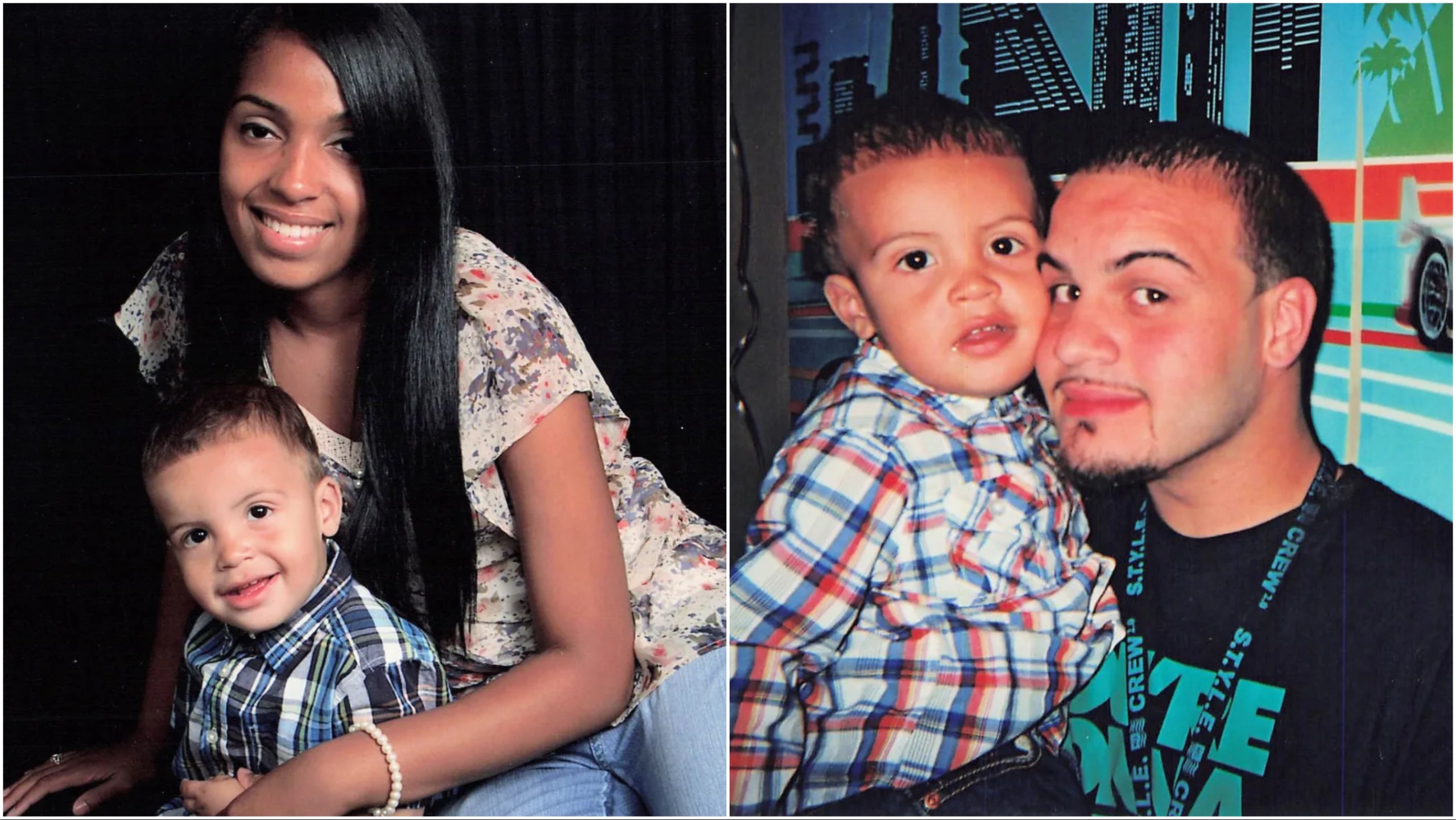
    Xzavier Gregory was born Sept. 20, 2009, to Angelica Javier and Cesar Gregory.

    Xzavier Giovanni Gregory was born Sept. 20, 2009, at Temple University Hospital in North Philadelphia. His parents, just teens at the time, were immediately taken by his chubby cheeks, which he kept until his teenaged years.

    He lived in Kensington until he was about 10 years old, his mother said, when they moved to the Northeast. He attended Louis H. Farrell School, then spent his freshman year at Father Judge High before moving to Northeast High.

    He loved traveling, and often visited family in Florida and the Dominican Republic, attended football camps in Georgia and Maryland, and tagged along on weekends to New York with his mother as part of her job managing federal after-school programs.

    He played football for the Rhawnhurst Raiders, typically as an offensive or defensive lineman, and had a natural skill for boxing, his parents said.

    Philadelphia sports were in his blood — particularly the Eagles. DeVonta Smith and A.J. Brown, his father said, were his favorite players. (Before his death, he agreed that Brown should be included in more plays this year, Gregory said.)

    Some of Gregory’s favorite memories with his son revolve around the Eagles. Sitting front row at the Linc on his 13th birthday. Erupting in cheers as the team won its first Super Bowl in 2018. Embracing in tears when they won a second this year.

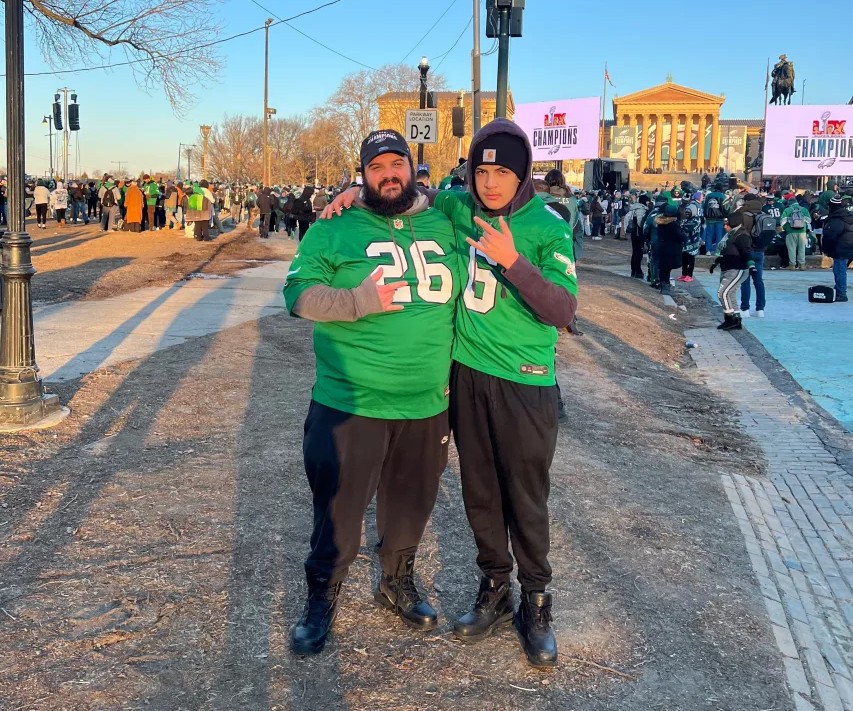
    Cesar Gregory (left) and son Xzavier at the Eagles Super Bowl parade near the Art Museum in February. It is a day with his son that the father said he will never forget.

    Xzavier was the oldest of three children. His sisters are still too young too fully understand what happened, the parents said.

    “He went to heaven,” Javier told 7-year-old Kennedy.

    “He went with God,” Gregory told 9-year-old Mia.

    Even as shootings across Philadelphia have fallen to the lowest level in 60 years, children are still being shot more often than before the pandemic.

    The number of kids shot peaked in 2021 and 2022, when violence citywide reached record highs and guns became the leading cause of death among American children. So far this year, 105 kids under 18 have been shot — a sharp drop from three years ago, but still higher than pre-pandemic levels, according to city data.

    Xzavier is one of at least 11 children killed by gunfire this year.

    Xzavier Gregory (center) was a goofy teen who attended Northeast High School, his parents said.

    Javier and Gregory said some relatives are considering leaving Philadelphia, shaken by Xzavier’s killing and a feeling that teens don’t fear consequences.

    But the parents said they will stay. They want to be near Magnolia Cemetery, where Xzavier is buried, and to feel closer to the memories that briefly unite them with him.

    On harder days, they said, they go into his bedroom, which is just as he left it, a relic of a teenage boy.

    His PlayStation controller sits in the middle of his bed, and a photo of him and his mother hangs on the wall above it. His Nike sneakers are scattered. His black backpack rests on the floor, and a Spider-Man mask sits on the corner of his bedframe.

    On Thursday, his parents stood in the room they used to complain was too messy, that smelled like dirty laundry.

    “Now, I come in just to smell it,” Javier said.

    She took a deep breath.

    Staff writer Dylan Purcell contributed to this article.

    @paigeloveslife92

    My review of the Showgirl pajamas. Returning these immediately. 🤣 #taylorswift #taylorswiftmerch

    ♬ original sound – paigeloveslife92