Tag: topic-link-auto

  • Flyers Carnival: Dunking radio hosts, competing against players, and Cam York’s message to cat people

    Flyers Carnival: Dunking radio hosts, competing against players, and Cam York’s message to cat people

    Xfinity Mobile Arena’s busy weekend ended with a bang as it hosted the annual Flyers Charities Carnival on Sunday. Less than 24 hours after the 76ers’ 2001 reunion night, the throwback hardwood floor was replaced with a mini hockey rink, a carousel, and a large Ferris wheel that served as the centerpiece of the event.

    “When you think about it, we had a hockey game, Unrivaled, and we had an NBA basketball game,” said Comcast Spectacor Chairman and CEO Dan Hilferty. “Here we are the next day, celebrating a carnival with everything from a Ferris wheel and a dunk tank to all that goes along with a carnival.

    “It’s a great thing. Flyers Carnival is all about the community and it’s all about our fans having the opportunity to meet players and do fun carnival things.”

    Rachel Brown of Langhorne wears a Gritty headband as she pauses for a snack at the Flyers Charities Carnival at Xfinity Mobile Arena.

    Fans had the opportunity to play a number of favorite carnival games, including some water gun fun, Skee-Ball, ax throwing, and a dunk tank that featured WIP’s Hunter Brody. And for 12-year-old Ryan Reagoso, despite a cast on his left foot, the dunk tank was the perfect opportunity to show off his pitching arm.

    “It was fun and I want to do it again,” Reagoso said.

    Flyers players interacted with fans throughout the event — signing memorabilia, posing for photos, and competing in a number of games set up within the arena, including a challenge that gave fans a chance to shoot on the goalie. Flyers defenseman Emil Andrae participated in ax throwing and defenseman Cam York had a good day on the ping-pong tables.

    “I think I went undefeated,” York said. “So, I don’t think I struggled much. But it’s super fun to interact with the fans. It’s something that’s a little bit different.”

    The Flyers’ charity event has been going on since 1977. Flyers coach Rick Tocchet was able to experience the carnival in its earlier years when he was a player for the team. Now he has a good time experiencing it as a coach.

    “It’s funny because I’ve seen some fans from back in the day when I played,” Tocchet said. “I’m just impressed with how much money they have raised throughout the years. It’s incredible how it started and where it’s gotten to.”

    Fans wait for the doors to open for the Flyers Charities Carnival at Xfinity Mobile Arena on Sunday.

    For 13-year-old Michael Chaic, this has become a tradition started by his father, who grew up attending the carnivals. Sunday was the third carnival Chaic attended and he came prepared, bringing a Tyson Foerster game-used stick to get signed. But he did have his eyes set on another item up for auction.

    “That signed [Matvei] Michkov helmet was pretty eye-catching,” Chaic said. “So, we’re probably going to have to put some raffle tickets in there.”

    There were plenty of other items up for auction, including a team-signed decorative board, a Sam Ersson-signed set of goalie pads, and a Trevor Zegras-autographed replica stick. Fans could also get gift baskets full of the players’ favorite things. Some of the items featured in York’s favorite things basket were drink coasters, gummy worms, Uno cards, a signed hat, and a cat towel.

    “I feel like I’m known as the cat guy now,” York said. “But, I have three cats of my own right now. [The towel] is something I use around the house all the time. To all my cat people out there, stay strong. I love you guys and keep catting along.”

    The event raises money for Flyers Charities’ efforts to support local families impacted by cancer and to grow hockey in communities that may not have it.

    And with next year being the carnival’s 50th anniversary, fans can expect something special.

    “We’re going to have some really special activities next year that we can’t share yet,” said Blair Listino, the board chair of Flyers Charities. “But, we’re going to make that a really special event because that is the 50th-year anniversary. And every year we get feedback from our fans. We get feedback from our players. We’re just going to try to make it more interactive and more special for all of them.”

    Antoine Williams (right) poses for a photo with Flyers goalie Sam Ersson at the Flyers Charities Carnival.

    Kolosov joining Phantoms

    The Flyers loaned goalie Aleksei Kolosov to the Lehigh Valley Phantoms of the American Hockey League on Sunday. The move could hint that Ersson, who left Thursday’s game with a lower-body injury, is healthy enough to return.

  • A Montco Army veteran was indicted alongside journalist Don Lemon for anti-ICE protest at a St. Paul church

    A Montco Army veteran was indicted alongside journalist Don Lemon for anti-ICE protest at a St. Paul church

    A decorated U.S. Army veteran from Montgomery County was arrested Friday for participating in a protest at a St. Paul, Minn., church, just two days after a video of him speaking out against the Trump administration went viral.

    Ian Austin, 35, of Bryn Athyn, is one of nine people facing felony charges for their involvement in a Jan. 18 protest at Cities Church in St. Paul. Former CNN host Don Lemon, who was covering the protest, is also a defendant. Lemon’s arrest, and that of another journalist who attended the protest, has brought criticism from media and civil rights advocates.

    The Department of Justice indicted Austin for conspiring to interrupt a church service and “injure, intimidate, and interfere with exercise of right of religious freedom” at a place of worship, federal court documents state.

    But Austin’s parents in Bryn Athyn say their son’s actions are in keeping with his sense of duty to his country, and his determination to help others however he can.

    “Those are things he cares about more than political party,” his mother, Paige Austin, said. “It’s more about what does it mean to be human, and to treat people justly and kindly, regardless of where you live.”

    In a video clip dated Jan. 20 and posted online days before his arrest, Austin said that he believed as an Army veteran it was his duty to travel to Minnesota.

    “We took an oath to the Constitution, and it’s just being shredded right now,” Austin said in the video, which racked up hundreds of thousands of likes across multiple social media platforms.

    “This has all of the signs from every fascist movement in history that we’re going to lose the opportunity to resist,” he said. “So that’s why I’m here.”

    The protesters said they targeted the church because one of its pastors, David Easterwood, leads the Immigration and Customs Enforcement (ICE) St. Paul field office. The church’s website lists David Easterwood as a pastor, and news outlets have reported that his personal information appears to match that of the David Easterwood identified in court filings as the acting director of the ICE St. Paul field office.

    In the video, Austin said he’d previously been detained for protesting outside the Bishop Henry Whipple Federal Building before being released without charges. It was during that detainment, he said, that a Department of Homeland Security officer questioned him about why someone “from Philadelphia” would be in Minneapolis.

    “And I’m like, ‘Well, because the nation that I was willing to die for is being systematically oppressed with men in military uniforms, a private army told by the president that they have no other laws to follow than his, and they’re systematically attacking and even killing our neighbors — in the United States of America,” Austin said.

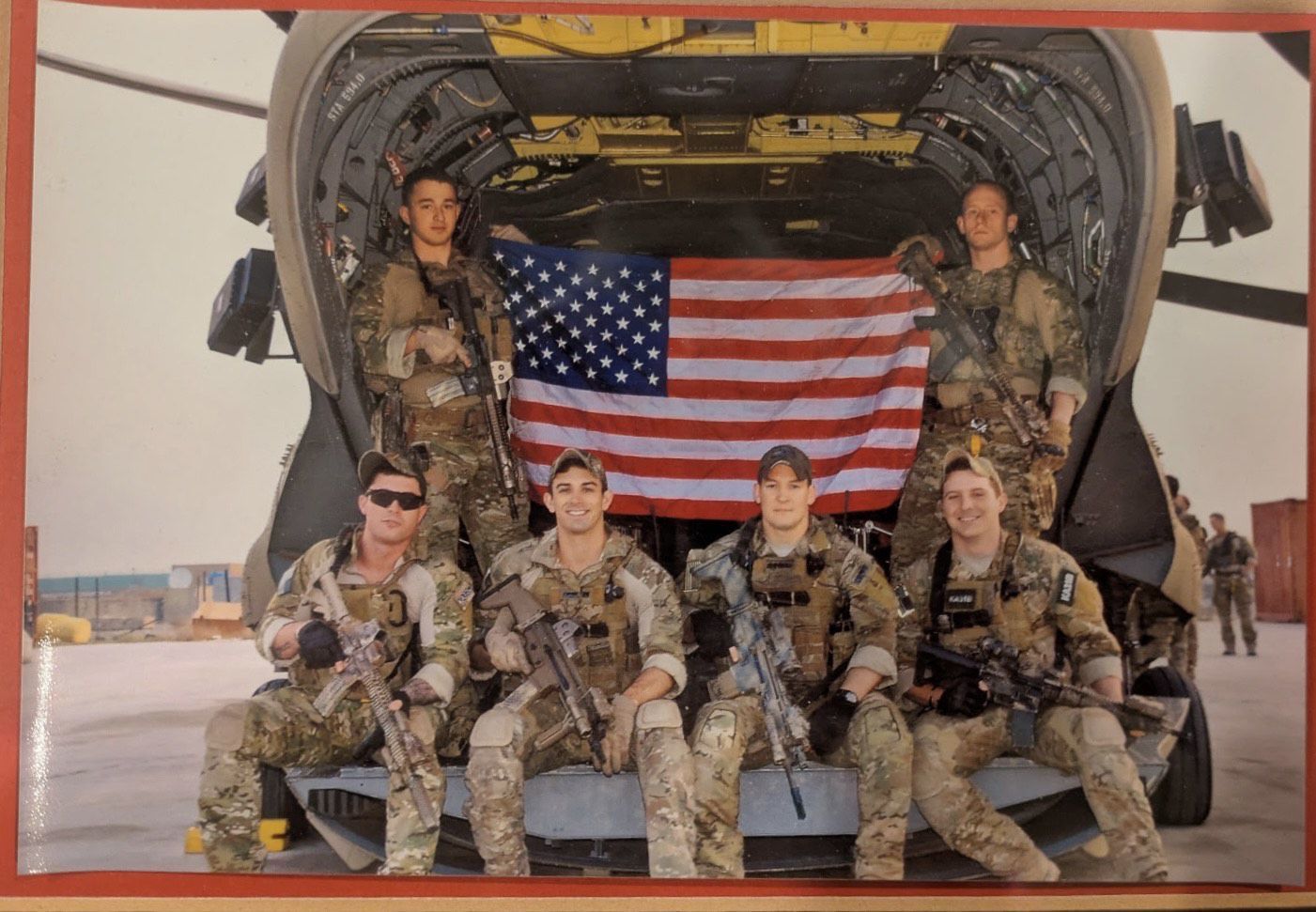
    This undated photo shows Ian Austin and other U.S. Army soldiers.

    Valorous service

    Austin grew up in Huntingdon Valley, a couple miles outside of Philly in Montgomery County. His parents, Kenneth and Paige Austin, said he went to Academy of the New Church high school, where he excelled at baseball and wrestling, earning a spot in the J. Robinson Intensive Wrestling Camp in Minnesota.

    “It’s brutally hard,” Kenneth Austin said in an interview with The Inquirer. “It’s like boot camp. He did very well. I think that planted a seed for the military.”

    Austin graduated from high school in 2008, celebrated the Phillies’ World Series win with family and friends, and weeks later, shipped out to Army basic training.

    His parents confirmed that as a member of the U.S. Army’s elite 1st Ranger Battalion, Austin served six combat deployments in Afghanistan. In 2013, he was awarded a Joint Commendation Medal with Valor device, according to a news report.

    The valor device is given to soldiers who displayed “an act or acts of heroism by an individual above what is normally expected while engaged in direct combat with an enemy of the United States, or an opposing foreign or armed force, with exposure to enemy hostilities and personal risk,” according to a military website.

    This detail shot of an undated family photo shows Ian Austin while serving in the U.S. Army 1st Ranger Battalion.

    After his Army contract ended in 2014, Austin returned home, his parents said. He was diagnosed with post-traumatic stress disorder, and he threw himself into his recovery process with the same passion he put into his training, Kenneth Austin said. He had his share of setbacks; in 2021, Austin pleaded guilty to disorderly conduct and fighting after refusing to leave a local bar, his parents noted.

    But as Austin took college classes at La Salle University and elsewhere, he became increasingly interested in social justice and helping others.

    During the 2020 George Floyd protests in Philly, Austin packed his backpack with medical supplies and water, Paige Austin said. “He would go down there and sort of join the protest, but he was there also to help, because part of the Ranger training was emergency medical training.”

    Kenneth Austin recounted that his son even carried a backpack full of water, snacks, and first aid supplies during the parade after the Philadelphia Eagles’ 2025 Super Bowl victory, earning him the nickname “headquarters” from some of those out celebrating.

    “It was a little much for me,” his father said. “But it really struck me, like, he’s … here to have fun, but he’s also looking out for everyone, and becoming buddies with everyone, and making sure everyone’s OK.”

    A protest in a church

    A few weeks after ICE agent Jonathan Ross shot and killed Renee Good in Minneapolis, Austin told his parents he was going to Minnesota. Three hours later, his truck was packed, and after a 17-hour drive, he was out protesting.

    Austin is being held in the Sherburne County Jail in Minnesota, county records show. His attorney, Sarah Gad, said that she took on his case pro bono after seeing agents arrest him Friday. Gad said that based on what she’s seen in similar cases, she expects him to be released on his own recognizance as early as Monday.

    Video of the protest shows protesters in the church chanting “Renee Good,” “Don’t shoot,” and “ICE out,” while a pastor shouted “shame on you” into a microphone. As the protest continued, many congregants can be seen leaving the church, while others stayed put or filmed the takeover. A few church attendees struck up conversations with protesters.

    “I understand that what has happened is wrong, and I agree with that,” one congregant said to the person filming. “But this can’t happen. This is the house of the Lord.”

    The federal indictment states that between 20 and 40 “agitators” occupied the main aisle and front of the church and yelled at the pastor and congregants. The indictment alleges that some protesters intimidated church members and prevented them from moving about freely in the church.

    Austin, the indictment states, stood with other protesters, “approached the pastor and congregants in a menacing manner, and near the end of the operation, loudly berated the pastor with questions about Christian nationalism and Christians wanting their faith to be the law of the land.”

    News reports have noted that Cities Church has ties to prominent Christian nationalists and powerful figures in the MAGA movement. Slate reported that its founder, Joe Rigney, is now a pastor at Christ Church in Moscow, Idaho. That church is run by Doug Wilson, who wants America to become a theocracy, according to a New York Times interview. Defense Secretary Pete Hegseth attends an affiliated church.

    Austin’s attorney said this is a unique case, but it doesn’t surprise her that the Department of Justice would want to make an example of anti-ICE protesters who were allegedly disrupting a place of worship.

    “I think that this is being taken very seriously by the United States attorney,” Gad said, though she added, “federal cases often look much more alarming at the front end than they turn out to be.”

  • Reserve center Mohamed Keita comes up big in the clutch for Temple

    Reserve center Mohamed Keita comes up big in the clutch for Temple

    Temple center Mohamed Keita entered the game against South Florida on Saturday with 5½ minutes left and the Owls clinging to a four-point lead. Forwards Babatunde Durodola and Jamai Felt had both fouled out, leaving the 7-foot-1 big man as Temple’s only option for the rest of the game.

    Keita delivered. He knocked down two free throws with 30 seconds left, then came through with the decisive bucket for the Owls (14-8, 6-3 American).

    Derrian Ford missed a jumper and Keita flew in for the tip-in with six seconds left. USF (14-8, 6-3) had a chance, but a desperation heave by Isaiah Jones wasn’t enough as Temple held on for a 79-78 win at the Liacouras Center.

    “It was Coach [Adam Fisher] who told me to crash the board when [Ford] shot it,” Keita said. “So I just crashed, and then I’m happy it came my way and then scored.”

    The Owls went nearly six minutes without a field goal at the end of the game, but Keita’s heroics helped them stay in the conference race. Temple is in a three-way tie for third place in the American with Florida Atlantic and USF.

    “We all know if your shots are not falling, keep shooting and just keep playing defense,” said guard Aiden Tobiason, who scored a game-high 22 points. “That’s something we harp on the most, because that’s something you can control.”

    Owls guard Masiah Gilyard shoots the ball against South Florida.

    Temple’s depth has been tested, but the Owls rely on guard Masiah Gilyard and the 6-8 Durodola, with Keita coming in sparingly.

    Those three helped Temple stay afloat on Saturday. Gilyard scored 11 of his 13 points in the first half and Durodola finished with seven points, seven rebounds, and a team-high five assists.

    “[Gilyard] is a guy that does a lot of dirty work, getting offensive rebounds,” Fisher said. “I think any time you’re a player and you see the ball go in early on, an easy one, it makes the basket look a little bigger to you. I thought he’d made some big shots. But again, there’s just a trust like our guys, whoever’s out there, we believe in. I thought his minutes tonight were fantastic.”

    Next up

    Temple visits East Carolina (6-15, 1-7) on Saturday (noon, ESPNU).

  • A not-‘toned down’ Trump regime prepares for ethnic cleansing in Ohio

    A not-‘toned down’ Trump regime prepares for ethnic cleansing in Ohio

    The headline was catnip to a Washington press corps that has spent much of the last decade desperately trying to normalize the mad, mad, mad, mad world of Donald Trump. With his poll numbers reeling after two Minneapolis killings by federal agents, the 47th president was “toning down” his mass deportation drive — perhaps pulling back.

    There were symbolic gestures, for sure. The Nazi-style trench-coated unmasked face of Trump’s secret police force in Minnesota, Border Patrol commander Greg Bovino, was dismissed and slinked home to California in a convoy of shame. His replacement, the alleged Cava bagman Tom Homan, talked of a drawdown of federal forces in the Gopher State, even as no one except Bovino and his inner circle of goons left town. There was an abrupt end to immigration raids in Maine, where the White House finally realized the wildly unpopular arrests might be dooming the GOP’s most vulnerable incumbent, Sen. Susan Collins.

    But you see, there’s just one thing. Just as Ike and Tina Turner used to say that they never, ever did nothing nice and easy, the Trump regime never, ever does nothing nice and “toned down.” What America saw last week was what Richard Nixon’s Watergate coconspirators called a “modified limited hangout” — minor concessions to reality aimed at keeping the larger, diabolical enterprise afloat.

    Toned down? Tell that to a few thousand marchers in a union-led “ICE Out” demonstration on Saturday in Portland, Ore. They were merely exercising their First Amendment protest rights — chanting “ICE out!” as they calmly marched past the federal building — when agents abruptly fired volleys of tear gas, pepper balls, and flashbang grenades into the crowd, which included young children brought by their parents to what had been a peaceful rally.

    “Just experienced the most intense tear gassing of my life …,” journalist Alex Baumhardt of the Oregon Capital Chronicle posted. “There was no fast exit as they indiscriminately threw loads of gas and flash bangs. Children were in the crowd screaming.”

    It sure didn’t look like any kind of “toning down” on a snow-draped road outside rural St. Peter, Minn., where a woman who was legally filming federal agents was blocked off by a car as three masked men brandishing high-powered firearms emerged, screaming, “Get out of the car!” before violently removing her, slamming her to the icy ground, and arresting her.

    That the police chief of St. Peter — a friend of the woman’s husband, it turned out — made a phone call to U.S. Immigration and Customs Enforcement (ICE) that got her promptly returned to town and released was the essence of last week’s modified limited hangout. The main message to would-be citizen ICE observers was unmistakable: There is no major pullback in Minnesota.

    War, children. It’s just a shot away.

    The idea that the irrepressible forward momentum of a historically inhumane mass deportation campaign — powered by more than $170 billion allocated last year to hire more masked goons and convert abandoned warehouses into modern concentration camps — could be so easily reversed was laughable. Even the alleged toner-down-in-chief, Trump, told reporters when he was asked about a Minnesota pullback: “No, no, not at all.

    This week, things could get much, much worse.

    On Tuesday, some 350,000 Haitian refugees are slated — under a Trump regime order — to lose the Temporary Protected Status (TPS) that was granted to them by the Biden administration and has allowed them to stay legally in the United States after fleeing an epidemic of gang violence and murder in their Caribbean homeland.

    Advocates for the large Haitian diaspora are fighting Trump’s revocation in court, so there is a chance the move can be forestalled. However, top officials, including Ohio Gov. Mike DeWine, have said the U.S. Department of Homeland Security has plans in place to immediately swarm the industrial epicenter of Haitian migration — Springfield, Ohio — with a massive force of federal agents to begin deportation raids.

    You probably remember Springfield from its prominence in the 2024 presidential campaign. Over the last decade, a surge of Haitian migrants into a once nearly comatose factory town — some 12,000 to 15,000 people, or now a quarter of the small city’s population — revitalized Springfield, yet triggered a moral panic among some white neighbors who shared utterly unfounded rumors of animal abuse.

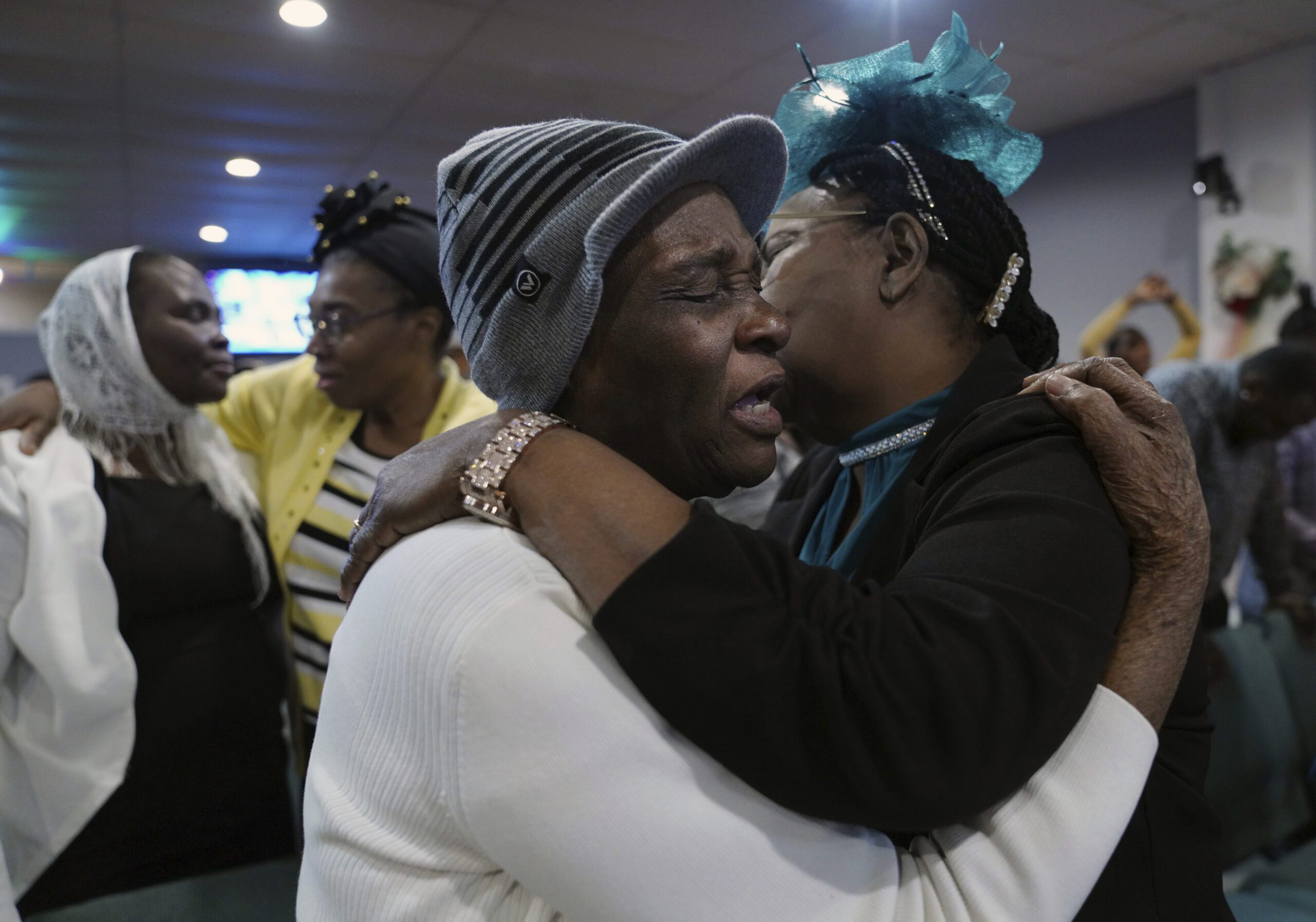
    Marie Guillou (front left) hugs and worships with a fellow congregant at the First Haitian Evangelical Church in Springfield, Ohio, on Jan. 26.

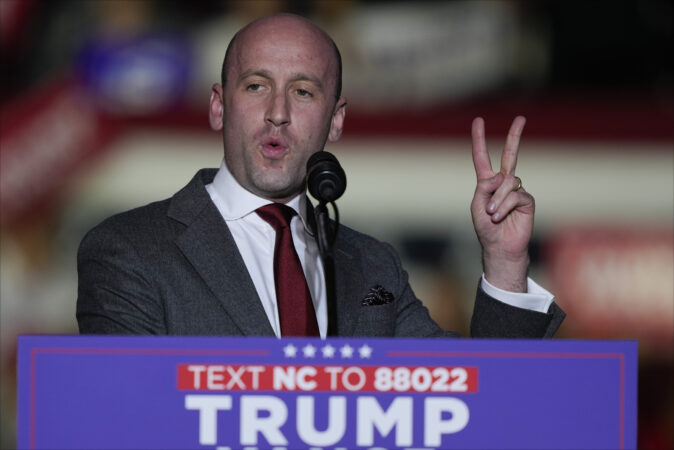
    In that fall’s nationally televised debate, opponent Kamala Harris and some in the Philadelphia audience giggled when Trump blurted out, “In Springfield, they’re eating the dogs.” This week, the president and his totally not toned-down minions, like top aide Stephen Miller and DHS Secretary Kristi Noem, want to have the last laugh.

    “The fear has been there” ever since Trump’s debate lies about Springfield, Viles Dorsainvil, executive director of Springfield’s Haitian Community Help and Support Center, told a local TV station. Now, with TPS likely to expire, he predicts the local community “not being able to leave their house, not being able to go to work.” Many are terrified they won’t survive gang violence if deported back to Haiti.

    The giant question hanging over the looming Springfield raids — and, yes, it is largely a rhetorical one at this point — is simply: Why? In every city that’s been flooded with masked secret police, from Los Angeles to Minnesota, over-the-top DHS rhetoric about removing “the worst of the worst” murderers and rapists from America has been undercut by arrests of law-abiding day laborers or restaurant workers. That’s not to mention all of the detainments and the killing of two people.

    In Springfield, Haitian refugees responded to a 2014 plea from business leaders to save a shrinking Rust Belt city, and the majority came here legally during the Joe Biden years — doing everything the right way, and getting a fleeting vision of the American dream. If anything, the crime rate in this hardworking and often deeply religious community is lower than in other areas that are predominantly made up of native-born Americans.

    It’s hard to imagine any reason — economic, legal, or moral — for the mass removal of Haitians to their unsafe and unstable native country other than the color of their skin. And it’s hard to call this proposed operation anything else besides an ethnic cleansing on U.S. soil.

    This is no surprise. It’s been the distinguishing feature of Trump’s mass deportation scheme since the early months of the regime, nowhere more so than most recently in Minnesota.

    A woman and a child hold hands as they walk down a street in the predominantly Somali neighborhood of Cedar-Riverside in Minneapolis in May 2022.

    The DHS “Operation Metro Surge” has heavily targeted two ethnic groups. Are Somali Americans — refugees from a war-ravaged nation that, in a much different time, was the subject of what was supposed to be a humanitarian U.S. intervention in the 1990s — the focus of the raids because of a fraud scheme local authorities seemed to have a handle on? Or is it because Trump called the Somali people “garbage”?

    And even if you buy the seemingly ridiculous argument that the immigration raids are connected to a mid-level fraud scam, what is the explanation for Bovino’s goon squads cruising the Asian American neighborhoods of Minneapolis asking, “Where the Hmong at?” The Hmong people of Laos aided the misguided U.S. war in Southeast Asia and fled communist reprisals to come to America with encouragement from both the federal government and faith leaders. Why target them now, decades later, after Hmong Americans have planted deep roots here?

    For that matter, what on earth is the logic behind zeroing in on so many Venezuelans, who came to America to escape the rule of a man the Trump regime has now arrested as a criminal dictator of a nation the U.S. Department of State has deemed violent and unsafe? Why deport the thousands of Latinos who worked tirelessly to rebuild New Orleans after it was decimated by Hurricane Katrina?

    Not only is Trump’s mass deportation not nabbing many violent criminals, but his unholy war is undoing the very foundation of the story America tells itself to live: that our willingness to accept the huddled masses fleeing political violence or persecution made us an exceptional nation. It was always an uneven narrative, but the regime’s masked men are now erasing it in service of unapologetic white supremacy.

    In Florida, which has also been a migration magnet for Haitians, Jewish residents of the Sinai Residences senior complex in Boca Raton — including many who survived the Nazi Holocaust — are so alarmed that some have volunteered to hide Haitian staff members in their units. The center’s CEO said the crisis “reminds me of Anne Frank.”

    This does not have to happen. Springfield isn’t nearly the size of Minneapolis, and all of us — not just Ohioans — need to begin thinking about what we can do to help avert a humanitarian disaster in the U.S. heartland. More importantly, Congress — which has slowly shown signs of life in response to the January killings of Alex Pretti and Renee Good — needs to fight by any means necessary to make sure ethnic cleansing is prevented in Springfield, and ended everywhere else.

    Then they came for the Haitians. What happens next is up to us.

  • Opera Philadelphia’s ‘strange little roller-coaster ride’ is rolling into town

    Opera Philadelphia’s ‘strange little roller-coaster ride’ is rolling into town

    When Opera Philadelphia announced a new multiauthored work titled Complications in Sue, one was right to ask, “What, exactly, is it?” The piece was written in less than a year and is still in progress, so answers to that question might not be specific until the Academy of Music dress rehearsal.

    “Dress rehearsal if we’re lucky! Try opening night,” said general director and president Anthony Roth Costanzo. “Opera is in a constant state of emergency.”

    Created to commemorate the company’s 50th anniversary, Complications in Sue opens Wednesday with 10 composers commissioned to write eight-minute scenes. These collectively encompass the century-long life of a mythical everywoman named Sue.

    (From left) Director Zack Winokur, producer Anthony Roth Costanzo, and director Raja Feather Kelly pose for a portrait before the first dress rehearsal at the Academy of Music in Center City Philadelphia on Saturday, Jan. 31, 2026. The venue will be showing the new opera “Complication in Sue” from Feb. 4-8.

    She saves Santa Claus from an existential crisis in a nonbelieving world, fends off aggressive shopping algorithms that tell her who she is, and deals with more typical stuff like a lonely ex-husband. Forget any typical narrative. It’s what librettist Michael R. Jackson calls “a fantasia … with some real people but some abstractions.”

    That last part is a Jackson specialty — as seen in his much-awarded fantasy-prone Broadway hit A Strange Loop. What it all means, will be in the mind of the beholder. “The audience isn’t going to be told what to think or how to feel on this strange little roller-coaster ride,” he said.

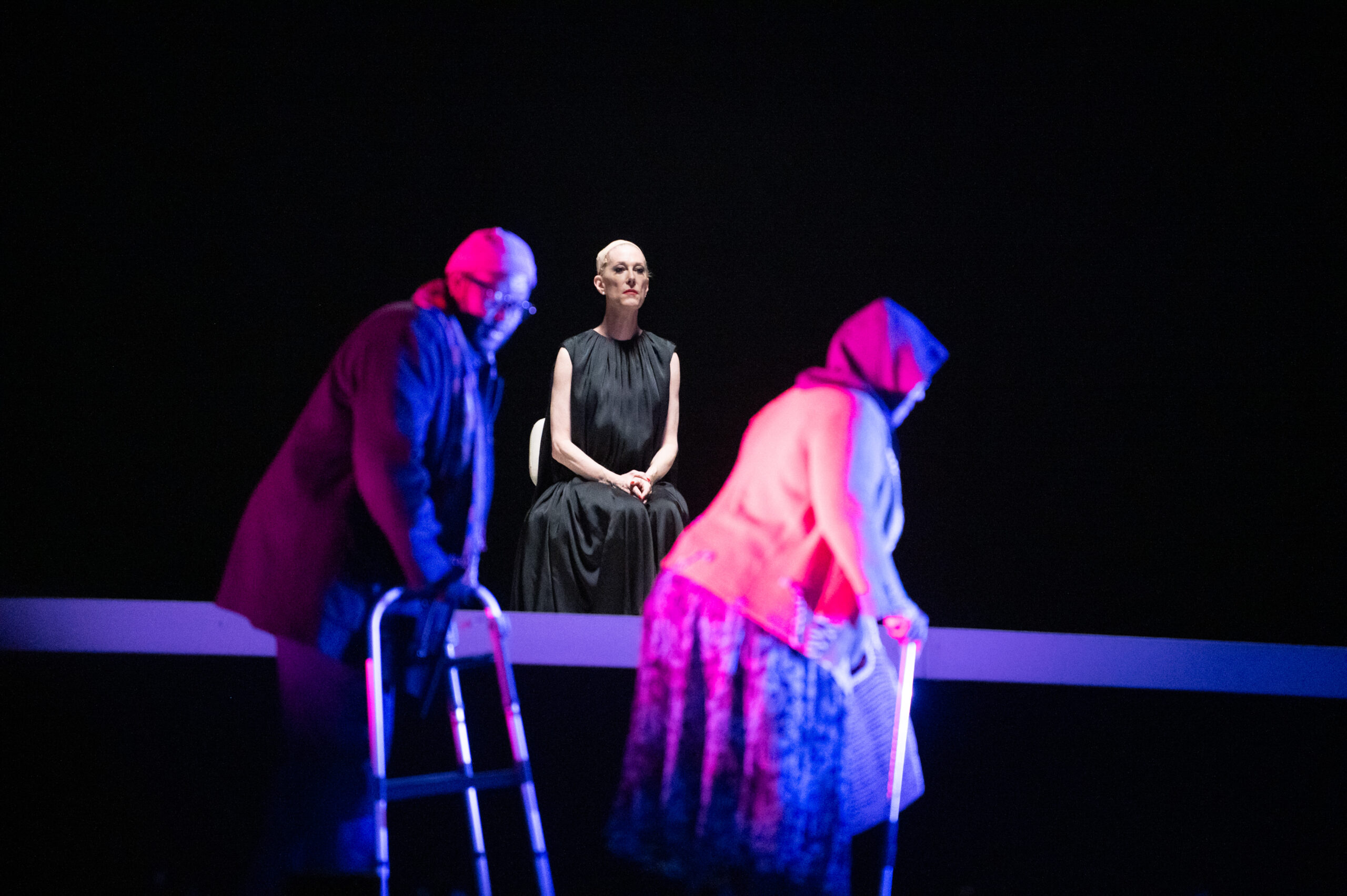
    Nicky Spence performs in “Complications in Sue” during the first dress rehearsal at the Academy of Music in Center City Philadelphia on Saturday, Jan. 31, 2026. The performance tells the story of one woman’s existence across 10 decades, each chapter scored by a different composer.

    At the center of it all — sort of, at times — is the high-personality cabaret star Justin Vivian Bond, best known as part of the comedy duo Kiki and Herb, but she has enjoyed new respect having been named a 2024 MacArthur Fellow. Bond suggested the title and rough framework of Complications in Sue but has become an unintentionally mysterious factor.

    Kiera Duffy (left) and Justin Vivian Bond perform in “Complications in Sue” during the first dress rehearsal at the Academy of Music in Center City Philadelphia on Saturday, Jan. 31, 2026. The original libretto is based on an idea by Bond, and is playwright Michael R. Jackson’s operatic debut. 

    She plays Sue, speaking and singing at times, functioning within the whole as “a leitmotif … an energy force that tracks through the whole piece,” said Jackson.

    But not a typically operatic force.

    “Vivian has an operatic-scale charisma … She is very funny, very surreal, and very herself,” said Costanzo.

    It all sounds abstract and ambiguous to those who don’t know Bond’s work. But here is what is known: She will look fabulous in a wardrobe designed by JW Anderson (creative director of Christian Dior), not surprising since Bond, who is trans, has described her brand of social commentary as “glamour resistance.”

    Justin Vivian Bond performs in “Complications in Sue” during the first dress rehearsal at the Academy of Music in Center City Philadelphia on Saturday, Jan. 31, 2026. The original libretto is based on an idea by Bond, and is playwright Michael R. Jackson’s operatic debut. 

    Bond has been vague about what she would do within the piece. She has also been strangely absent.

    At a Jan. 16 workshop presentation by Works & Process in New York, Bond was reportedly present but didn’t participate. Rather than being in Philadelphia during down-to-the-wire rehearsal weeks, she was in Paris during Fashion Week Haute Couture Spring (Jan. 26-29). Reportedly, she has stayed in close touch with Costanzo — as he continues to find a midpoint between the majestic tradition of creating opera for the ages and the speedy topicality of the highly collaborative “devised theater.”

    Justin Vivian Bond (left) and Nicky Spence perform in “Complications in Sue” during the first dress rehearsal at the Academy of Music in Center City Philadelphia on Saturday, Jan. 31, 2026. The opera was directed by Zack Winokur and Raja Feather Kelly.

    Opera Philadelphia has previously worked with the drag cabaret group the Bearded Ladies but not on the scale of an Academy of Music production. Multiauthored satirical works have occupied a small but notorious niche on the larger cultural landscape, such as the Jean Cocteau-conceived 1920s ballet The Wedding Party on the Eiffel Tower and, in theater, the Manhattan Theatre Club’s 1988 Urban Blight.

    But the 10-composer count of Complications in Sue may be a record of sorts and one that was engineered in a singular way.

    The lineup could be called “who’s cool in (the broadest definition of) classical music,” including the Opera Philadelphia’s composer in residence Nathalie Joachim, Errollyn Wallen from London, Cécile McLorin Salvant from the jazz world, Metropolitan Opera vet Nico Muhly, and everything vet Missy Mazzoli.

    The cast of “Complications in Sue” performs during the first dress rehearsal at the Academy of Music in Center City Philadelphia on Saturday, Jan. 31, 2026. The performance tells the story of one woman’s existence across 10 decades, each chapter scored by a different composer.

    Had Costanzo asked any one of them for a full-length opera, they’d have probably said “no” to the four- to five-year commitment. But with eight minutes — and a chance to work with a richly talented creative team — “how could they say no?,” he wondered.

    When assigned to their individual scenes, the composers didn’t know what the others were doing — which meant more freedom for those already writing grand operas (such as Mazzoli) and attractive to those newer to the field such as Salvant (“Cécile is really curious about opera,” said Costanzo).

    Rehanna Thelwell (left) and Justin Vivian Bond perform in “Complications in Sue” during the first dress rehearsal at the Academy of Music in Center City Philadelphia on Saturday, Jan. 31, 2026.

    Up-and-coming, Philadelphia-raised Dan Schlosberg, 38, who grew up in the Academy of Music nosebleed seats and now works with the radically revisionist, New York-based Heartbeat Opera, had already written a few student operas but ran with the grander resources available at Opera Philadelphia.

    His segment about Sue’s ex-husband going off the rails is a bit of a mad scene. “I wanted to follow his mental journey … the music goes from contemporary to big-band jazz to Broadway-like torch songs and everything in between,” Schlosberg said. “I wanted to harness the full orchestra, tons of brass … percussion … sirens … as many colors as I could.”

    The cast of “Complications in Sue” performs during the first dress rehearsal at the Academy of Music in Center City Philadelphia on Saturday, Jan. 31, 2026.

    Other composers include Andy Akiho, Alistair Coleman, Rene Orth, and Kamala Sankaram.

    The onstage team includes soprano Kiera Duffy, who has fearlessly starred in new works such as Mazzoli’s Breaking the Waves, as well as the edgy, in-demand U.K.-based tenor Nicky Spence. His reason for coming on board was simple: Anthony Roth Costanzo.

    “I took the call because it was him,” Spence said.

    Costanzo feels that he has hit the lottery with the composers, though one wonders if local audiences are ready for a presence as fierce as Bond.

    “Philadelphia is a fierce town,” Costanzo assured.

    Justin Vivian Bond (left) and Nicholas Newton perform in “Complications in Sue” during the first dress rehearsal at the Academy of Music in Center City Philadelphia on Saturday, Jan. 31, 2026. The venue will be showing the new opera “Complication in Sue” from Feb. 4-8.

    Certainly, he has brought much diversity to mainstream Philadelphia opera venues, especially on the LGBTQ+ front. Amid the shifting political climate, might there be pushback? That’s likely, he admits.

    “But Opera Philadelphia is for everyone.”

    Complications in Sue plays 7 p.m. Feb. 4, 7 p.m. Feb. 5, 8 p.m. Feb. 6, and 2 p.m. Feb. 8. Academy of Music, 240 S. Broad St., Philadelphia. All tickets are Pick Your Price, starting at $11. operaphila.org, 215-732-8400

  • Vic Fangio is mulling retirement again. The Eagles remain hopeful the defensive coordinator will return.

    Vic Fangio is mulling retirement again. The Eagles remain hopeful the defensive coordinator will return.

    Eagles defensive coordinator Vic Fangio has been talking about retirement since before the end of the season, but the team has yet to receive a final decision on whether he plans to return, sources close to the situation told The Inquirer.

    ”He keeps talking retirement, but he did the same last year,” an Eagles source said last week.

    The 67-year-old defensive coordinator hasn’t responded to questions about his future since the end of the season. Neither has the team. Sources said that the Eagles received a commitment from Fangio that he would return but that he left open the possibility that he could change his mind.

    Linebacker Nakobe Dean said he didn’t know whether Fangio would be back for a third season with the Eagles when asked about his coach at locker clean-out day two weeks ago.

    “I don’t really know,” Dean said to The Inquirer. “Vic always said — well, I won’t say ‘always said’ — but I remember he said he’ll stop coaching when it don’t get fun — or as fun — as it’s been. So that’s TBD.”

    The Eagles considered the possibility of Fangio’s retirement enough that they reached out to former Eagles defensive coordinator Jonathan Gannon, according to a report from Philly Voice. Gannon, who was fired after three seasons as Cardinals head coach last month, was hired by the Packers to be their defensive coordinator last week.

    Eagles defensive coordinator Vic Fangio presided over an elite unit in 2025.

    Philly Voice reported that the Eagles also considered reaching out to another former defensive coordinator: Jim Schwartz. Schwartz was recently passed over for the Browns head coaching job and is deciding whether he wants to stay in Cleveland.

    The Eagles recently lost defensive passing game coordinator Christian Parker to the Cowboys, who hired him to be their defensive coordinator. Parker would have been the likely in-house replacement for Fangio. Defensive line coach Clint Hurtt has previous coordinating experience.

    Fangio cemented an illustrious 40-year coaching career by finally winning an NFL title last year. His defense was instrumental in the Eagles’ 40-22 win over the Chiefs. Fangio devised a scheme that confounded and pressured Kansas City quarterback Patrick Mahomes in Super Bowl LIX.

    The Eagles defense wasn’t as dominating as it was last season, but it was clearly the team’s best unit in 2025. Fangio’s group was among the best in the league in the second half of the season, although there were some breakdowns in the wild-card round playoff loss to the 49ers.

    Coach Nick Sirianni has already made several staffing moves on the offensive side of the ball. He stripped Kevin Patullo of offensive coordinator duties and hired former Packers quarterbacks coach Sean Mannion as his replacement last week. Former Buccaneers offensive coordinator Josh Grizzard was also brought on as passing game coordinator.

    More changes to the offensive staff could be forthcoming.

  • The Sixers know replacing Paul George is impossible. But they hope players ‘embrace the opportunity.’

    The Sixers know replacing Paul George is impossible. But they hope players ‘embrace the opportunity.’

    Tyrese Maxey reached out to teammates Jared McCain, Trendon Watford, and Justin Edwards on Saturday afternoon with a simple message.

    “Listen,” the 76ers’ All-Star point guard told them, “y’all got to be ready.”

    That is required because of Paul George’s 25-game suspension for violating the NBA’s anti-drug policy, a shocking blow as the Sixers barrel toward Thursday’s trade deadline and the mid-February All-Star break. Their first step in making up for George’s production was a success, topping the New Orleans Pelicans, 124-114, at Xfinity Mobile Arena. Now, their broader goal is to keep pace in a crowded Eastern Conference — entering Sunday, three games separated fourth and eighth place — until George returns in late March for the regular season’s stretch run.

    “There’s a number of guys there to do it,” coach Nick Nurse said of filling George’s role. “That’s where we are. We’ve been in this kind of next man up mentality for quite a while, and we’re going to have to dig in and do it again.”

    Though George is no longer the explosive three-level scorer he was as a perennial All-Star, Joel Embiid said it is “impossible” for the Sixers to fully replace George’s impact on both ends of the floor.

    On Tuesday, the versatile 6-foot-8 wing tied a franchise record by hitting nine three-pointers in a victory over the Milwaukee Bucks, and is still a creator and playmaker with the ball in his hands. He also is arguably the Sixers’ best perimeter defender, and a terrific organizer and communicator. Less than an hour before news of George’s suspension broke, Sixers reserve center Adem Bona raved about George’s overall mentorship, and how he makes Bona’s life easier on the defensive end.

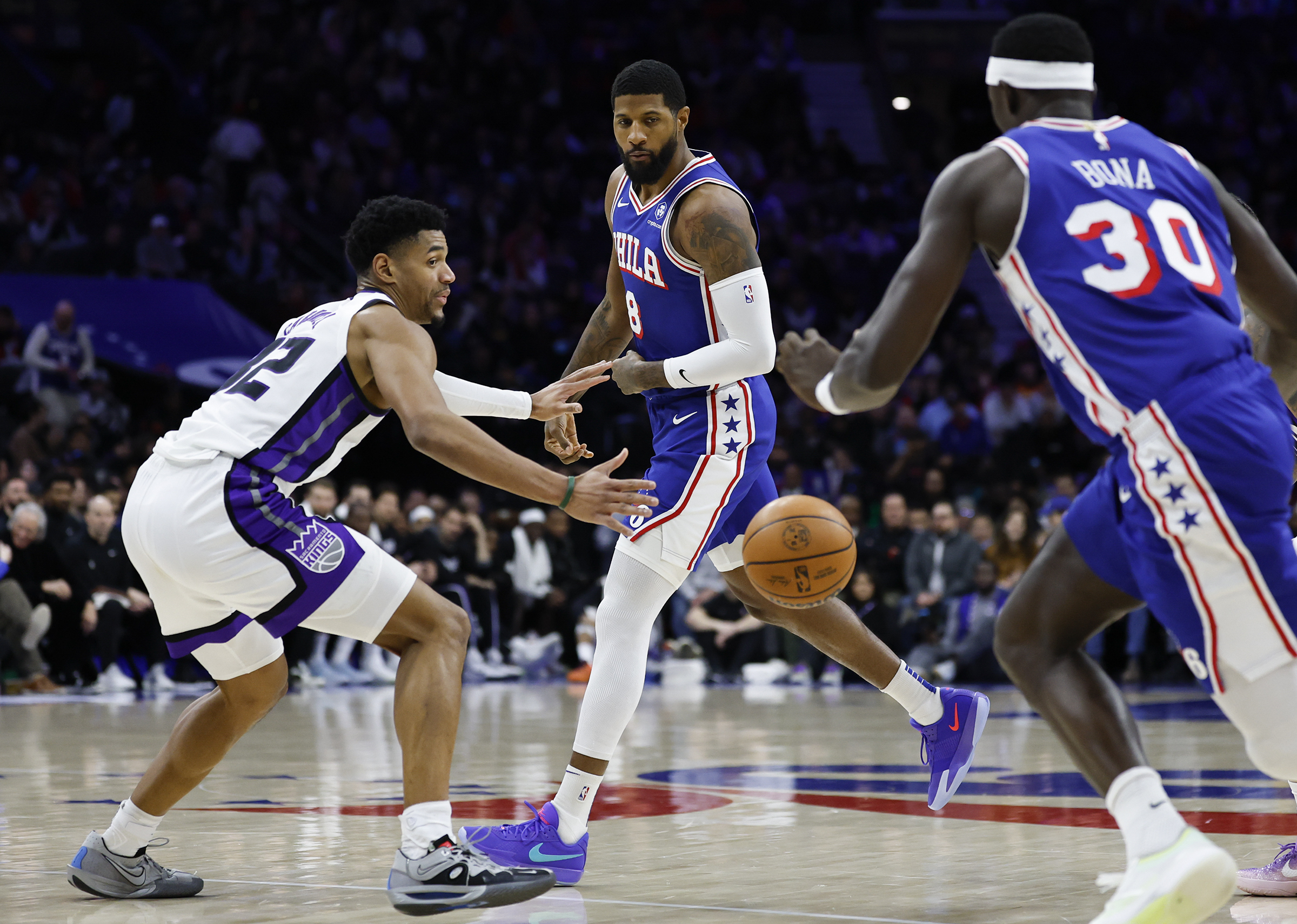
    “Obviously, he wants the best for me and he expects me to do my part, play my role on the court,” Bona said Saturday after shootaround. “[In] my last game [Thursday against Sacramento], he was telling me, ‘You have to get here!’ on help side and blocking shots.

    “That just shows that he expects a lot from me. That means he really believes I can do the things I do best out there.”

    Sixers forward Paul George has mentored young players like Adem Bona.

    Before Saturday’s home win, Nurse rattled off the collection of players who could see more minutes in George’s absence. And the coach has become plenty familiar with tinkering with lineups during the last two-plus seasons, primarily for injury reasons.

    One teammate Maxey did not feel the need to call Saturday? Kelly Oubre Jr., whom the point guard said is “always” ready because “that’s just who he is.”

    Oubre totaled 19 points, 10 rebounds, and four assists against the Pelicans, another sign the explosive two-way wing is returning to form after missing seven weeks with a knee injury. Before that, Oubre was off to arguably the best start of his 11-year career — often while fulfilling a heavier load while George worked his way back from offseason knee surgery.

    Before Saturday, Oubre also could have been viewed as the Sixers’ most tradable asset. Now, he is almost certainly too crucial to relinquish in the middle of the season. The Sixers also no longer need to move Oubre in order to get under the luxury tax, because George’s unpaid suspension will give the Sixers a tax variance credit of nearly $5.9 million.

    “I show up every day to work, do the same steps to prepare,” Oubre said when asked about how his responsibilities might change. “Whatever comes with the game, I’ll take it. I just try to stay even-keeled through everything, because it’s an up-and-down season. … I just want to be a key contributor to winning.”

    Watford, meanwhile, became a ballhandling small forward Saturday, totaling four assists along with six rebounds and five points. McCain (12 points) put together another encouraging performance, hitting four three-pointers and playing well off Embiid. Dominick Barlow, who had stepped into a starting forward spot during Oubre’s absence, was back in the first five Saturday and finished with eight points, three rebounds, and two steals. Rookie VJ Edgecombe (15 points, five assists) delivered some nifty passes Saturday but needs to become even more aggressive on both ends of the floor, Nurse said.

    Nurse also expects plenty of opportunity for Quentin Grimes (four points, four rebounds, two assists), who returned Saturday after missing two games with a sprained ankle. Jabari Walker totaled eight minutes against New Orleans, while Edwards was out of the rotation. Nurse pulled all the levers, closing the second quarter with the double-big man lineup with Embiid and Bona, and beginning the final period with a three-guard look.

    “It’s going to take a little bit of, I think, just connectivity with the right rotations and lineups,” Nurse said, “and to be honest, some play calls and finding the matchups on the night who can go get us a bucket.”

    Perhaps most important is that Embiid continues to look more and more like the 2023 NBA Most Valuable Player, scoring 40 points on Saturday for the first time since the 2024 playoffs. He has reestablished his dynamic two-man game with Maxey, although Nurse staggered the two stars’ minutes during portions of Saturday’s win. Embiid also believed he took a positive step on the defensive end, where lateral movement and elevation to protect the rim have been issues at times in his road back from multiple knee surgeries.

    And though health will remain the ultimate caveat with Embiid, he vowed Saturday to “take more ownership into everything we do” in George’s absence.

    “I’m always going to put it on myself,” Embiid said. “… and just encourage everybody. Give them the freedom to believe in themselves, so we can win.”

    When asked how George’s suspension could impact the Sixers’ approach entering Thursday’s trade deadline, Nurse conceded “that probably remains to be seen.”

    They could execute smaller, salary-dump-style moves to get under the luxury tax and create the two roster spots to convert Barlow and Walker from two-way contracts to standard deals. They could go after a legitimate short-term upgrade with a new wing or frontcourt player, who could then provide additional depth when George returns. Even in the midst of a disastrous 2024-25 season, for instance, the Sixers improved by adding Grimes at the deadline.

    George can next take the floor for the Sixers’ March 25 home matchup against the Chicago Bulls. Then his team will face another familiar issue — a lack of time to build on-court cohesion before the postseason begins in mid-April.

    Yet the Sixers’ road to bridge that gap began Saturday with a victory. They now have 24 games to go.

    “We’ve got to get fighting and get to work,” Nurse said. “All those guys I just mentioned have got to embrace this opportunity. … Here’s a chance for them to do it again.”

  • On thin ice | Editorial Cartoon

    John Cole spent 18 years as editorial cartoonist for The (Scranton) Times-Tribune, and now draws for various statesnewsroom.com sites.

  • How do you prove you’re American?

    How do you prove you’re American?

    “Oohhh Loorrrd, they sent me the one that don’t speak no English.”

    I was a young doctor in a North Philadelphia emergency department, and I had just stepped into a patient’s room. I had not even had the opportunity to introduce myself with my usual preamble and open-ended questions.

    Instead, I started with: “I speak English. And I’m your doctor. How can I help you today?”

    I am an emergency physician, public health expert, healthcare executive, associate professor, and a South Philly neighbor. I’m also the daughter of naturalized United States citizens from India, was born in Delaware, and have lived in Philadelphia for 25 years — longer than anywhere else in my life.

    The author poses for a portrait near her home in Philadelphia on Thursday, Nov. 11, 2021.

    My whole life is here. I was born in the U.S. I studied and earned several degrees here. I built my career in this country. I created my family here. I am American in every way.

    Yet, I often have to answer the questions:

    Do you speak English?

    Yes, very well.

    Where are you from?

    Philly.

    No, I mean originally?

    Delaware.

    What do they do in your country?

    This is my country.

    My husband is from Italy. He left the Tuscan sun for me — or us — when I was in the midst of my medical education and training in Philadelphia. Every time we went to the immigration office for him to do interviews or paperwork, I was the one who was questioned.

    The underlying question is clear in every instance: Do you belong here?

    In most cases, I shake it off. Disregarding the subtext, I feign a smile in place of rolling my eyes or shaking my head. My inner dialogue is usually a bit more sharp-edged.

    But until the last few months, the questions never really evoked fear or a lack of safety.

    In the America I have known my whole life, belonging wasn’t something you had to prove in real time. Citizenship carried a presumption: that you could move through your day without interrogation and without having to explain your existence to strangers or the state.

    Times are different.

    What changed was not the question itself, but what it now implies. Instead of innocent until proven guilty, the questions precede evidence. Instead of being governed by laws, we are ruled by suspicions. Everything feels backward.

    We are living in the era of the U.S. Immigration and Customs Enforcement militia, where enforcement and fear trump everything. These are the days when a 5-year-old, standing alone with a blue bunny snow hat and Spider-Man backpack, faces the consequences of not being able to prove he belongs.

    Five-year-old Liam Conejo Ramos is taken into custody by federal immigration officers as he returns home from preschool on Tuesday in Columbia Heights, Minn.

    When an intensive care unit nurse, who cares for the sickest veterans, offering critical care to heal them back to life, is attacked and shot while trying to help someone else. When merely voicing dissent and disagreement, or being called a b—, is enough to risk being shot to death.

    A sign for 37-year-old Alex Pretti, who was fatally shot by a U.S. Border Patrol officer earlier in the day, is displayed during a vigil Saturday, Jan. 24, 2026, in Minneapolis.

    If service, citizenship, and care do not protect you, then it seems we are accepting a hierarchy of who deserves safety — and who does not.

    In movies or on the news, people in other parts of the world or other times in history had to carry their identification documents at all times, but not here. Here, my Americanness was something I carried in my saunter or stroll — the confidence that I can exist in public space without explanation.

    But maybe that was until now.

    I live on the same street where the U.S. Constitution was signed. In my hometown, I am reminded daily about how this country came to be — through determination, courage, intention, and a defiant line in the sand of what would be tolerated.

    I believe in “We the People,” in civil liberties, and in the rule of law. I believe that we all deserve equal protections, regardless of race, origin, or religion. I do not believe power should go unchecked or that authority can reign in isolation or concentration.

    And despite being incessantly fed a narrative of how deeply divided the United States of America has become, I believe in civilian supremacy — that force exists to serve the people, not silence them.

    Being American was never about how you look or sound. It’s about how you demonstrate your beliefs through your actions. We speak, write, protest, and make our voices heard through every avenue.

    People attend a candlelight vigil at the U.S. Embassy in London, Monday, Jan. 12, 2026, for U.S. citizen Renee Good, who was shot by ICE in Minneapolis.

    We vote and hold our elected officials accountable for their actions — including their silence and complicity. We show up, socially and morally, for our neighbors. I spend my money in businesses whose owners share my values and beliefs.

    I believe in and honor those who have fought for the freedoms I have always enjoyed. And I am prepared — as I think my city around me is — to defend that freedom and the principles that make us Americans, even when fear might tempt us to look away or cede our power.

    I was born in the land of the free and the home of the brave. And I’m ready to prove it.

    Priya E. Mammen is an emergency physician, healthcare executive, and public health specialist who helps the nation’s most impactful companies integrate clinical integrity at scale.

  • Trump’s immigration crackdown also threatens Americans’ pocketbooks

    Trump’s immigration crackdown also threatens Americans’ pocketbooks

    Regardless of how you feel about immigration, President Donald Trump has made a mess of his promise to deport the estimated 13 million people who are in the U.S. illegally. A vow that more than half the country supported last year, and which undoubtedly (along with the high cost of eggs) helped him take back the White House.

    Today, not only has a majority of the electorate soured on the idea — including some Trump voters — but almost half are also ready to abolish U.S. Immigration and Customs Enforcement after the administration’s heavy-handed tactics have cost two U.S. citizens their lives in Minneapolis.

    But let’s step back for a moment and imagine a world where Trump’s agenda was not being implemented by a white supremacist like homeland security adviser Stephen Miller or run by incompetents like Homeland Security chief Kristi Noem.

    In that world, members of the administration would still have their work cut out for them, and protests would surely erupt. But ICE methodically engaging in workplace raids, for example, would prove a much more palatable (and effective) strategy than having masked federal agents arrest people using weapons and tactics that scream invasion, not law enforcement.

    Still, at the end of a year or two of those more restrained efforts, we would likely be where we are now — with most Americans realizing mass deportations and limiting legal immigration don’t make much sense.

    It wouldn’t even be about the human cost of blanket immigration enforcement; it would be about the expense.

    No, not just the $170 billion devoted to detention and deportation in Trump’s Big Beautiful Bill Act. Under the president’s immigration policies, American families will end up paying an additional $2,150 a year for goods and services by 2028.

    That’s a 14.5% increase on food, 6.1% on housing, and almost 4% on leisure and hospitality services, according to a study by FWD.us discussed at a panel Tuesday, hosted by the nonpartisan policy group and the Economy League of Greater Philadelphia.

    Researchers say that one of the most striking long-term impacts will be the tens of thousands of first-generation American children who are forced to become breadwinners as foreign-born members of their families are deported. There’s also the matter of billions of dollars in lifelong earning contributions to the U.S. economy lost, as well as the unquantifiable innovation and economic growth that will go missing as immigrants take their entrepreneurial spirit elsewhere. Remember that nearly half of Fortune 500 companies were founded or cofounded by immigrants or their children.

    Like the United States as a whole, the Keystone State and the Philadelphia area reap the benefits of immigration.

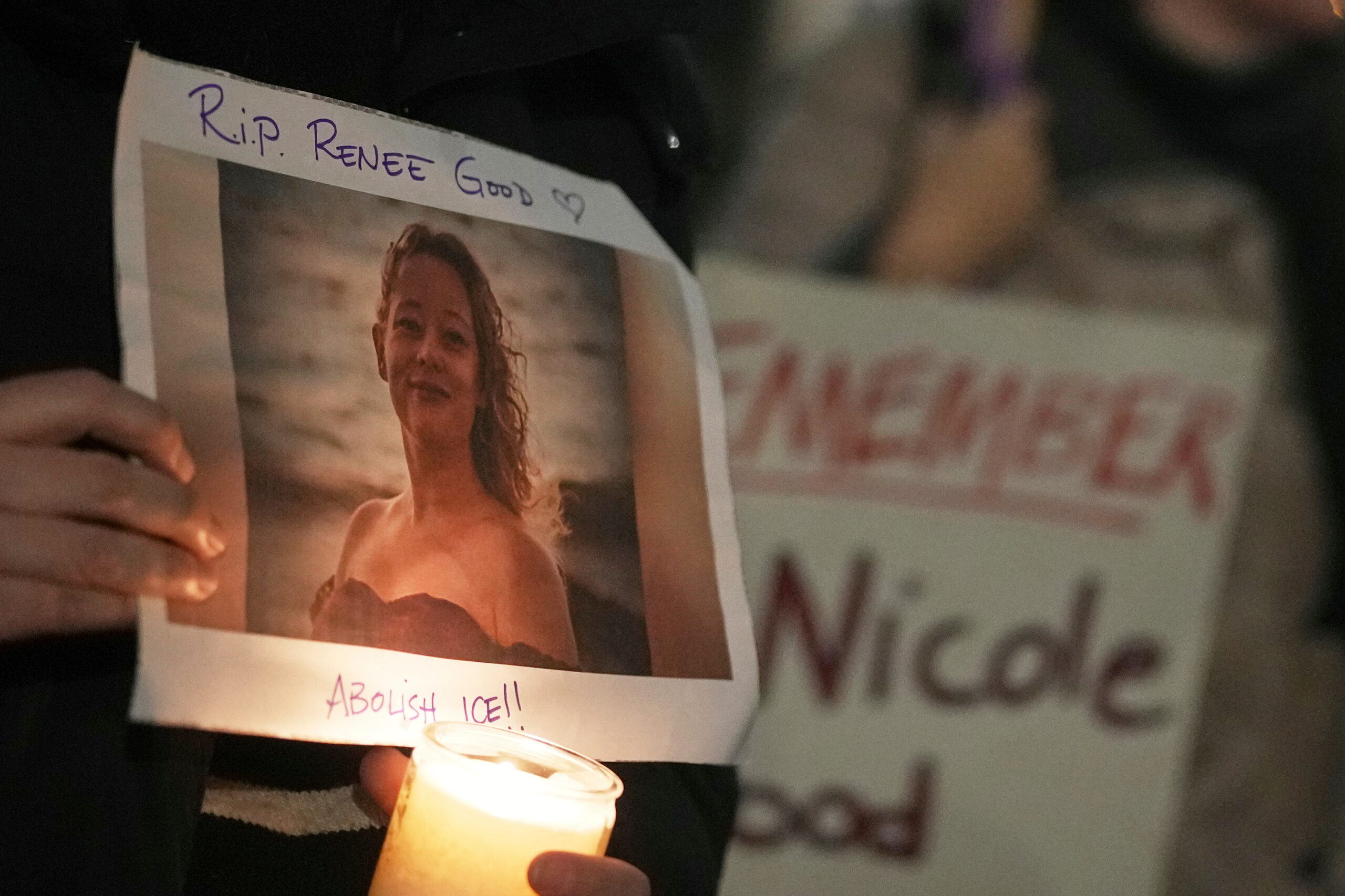
    Demonstrators gathered in Center City to protest the death of Renee Good, a 37-year-old mother of three who was shot and killed by a U.S. Immigration and Customs Enforcement agent in Minneapolis in January.

    More than a million immigrants live in Pennsylvania — about 80% of them in the Philadelphia area. They possess almost $40 billion in annual spending power and pay about $13 billion in taxes. In Greater Philadelphia, immigrants make up an estimated 21% of the construction industry, 48% of agricultural work, 18% of manufacturing, 16% of business services, and 15% of leisure and hospitality.

    About 367,000 immigrants in Philadelphia are U.S. citizens, 202,000 are legal permanent residents, and 64,000 are foreign nationals here on a work visa or as international students. Immigrants protected from deportation through policies implemented by past administrations that are now in jeopardy — including Temporary Protected Status, Deferred Action for Childhood Arrivals, and those waiting on asylum decisions — number about 84,000.

    If you think it’s unfair to include legal immigrants in a discussion about the president’s immigration crackdown, then you haven’t been paying attention to the Trump administration’s broader plans.

    Immigration visa processing has been indefinitely shut down for 75 countries, including Brazil, Colombia, Egypt, Pakistan, and Thailand. The administration has frozen refugee resettlement, placed exorbitant fees on new H-1B visas for skilled workers, made international students feel unwelcome, and instituted new restrictions on family-based immigration.

    A recent study by the nonpartisan National Foundation for American Policy found that Trump’s proposals will reduce legal immigration by as much as 50% through 2028. New numbers released by the Census Bureau on Tuesday already show a sharp slowdown in the U.S. population, as immigration of all kinds is curtailed.

    As the nation’s birthrate continues to decline, reducing immigration will stunt economic growth and further endanger Social Security as fewer young workers contribute to that crucial program, which helps keep many older Americans from slipping into poverty.

    I’ll refrain from using whataboutism regarding an administration that has shown open contempt for the rule of law and say that the appeal of Trump’s promise to deport those who entered the country illegally is understandable. In black-and-white terms, these people broke the law, and they should be held accountable.

    But reality is somewhere in the middle. The truth is that we depend on and greatly benefit from immigration — of all kinds — and we should work to make legally coming to the U.S. easier, not harder.

    As Trump’s reaction to the backlash prompted by the ICE killings in Minneapolis shows, the president responds to political pressure and can change tack. He should realize that much like immigration and the high cost of groceries helped him win the 2024 election, it may be the same issues that cost his party the 2026 midterms and beyond.