Each Friday, Inquirer photo editors pick the best sports images from the last seven days. This week, it should come as no surprise that you’ll find lots of World Cup photos — especially after Ecuadorian fans rallied on the steps of the Art Museum, and fell victim to the Rocky curse the next night against Ivory Coast. Brazil fans, whose team plays Friday night in South Philly, took precautions to avoid that fate.
Elsewhere, the Phillies took the field against some divisional foes, a state champion returned to the track, and dodgeball got serious. Here’s a look back at some of our favorite photos from the week:
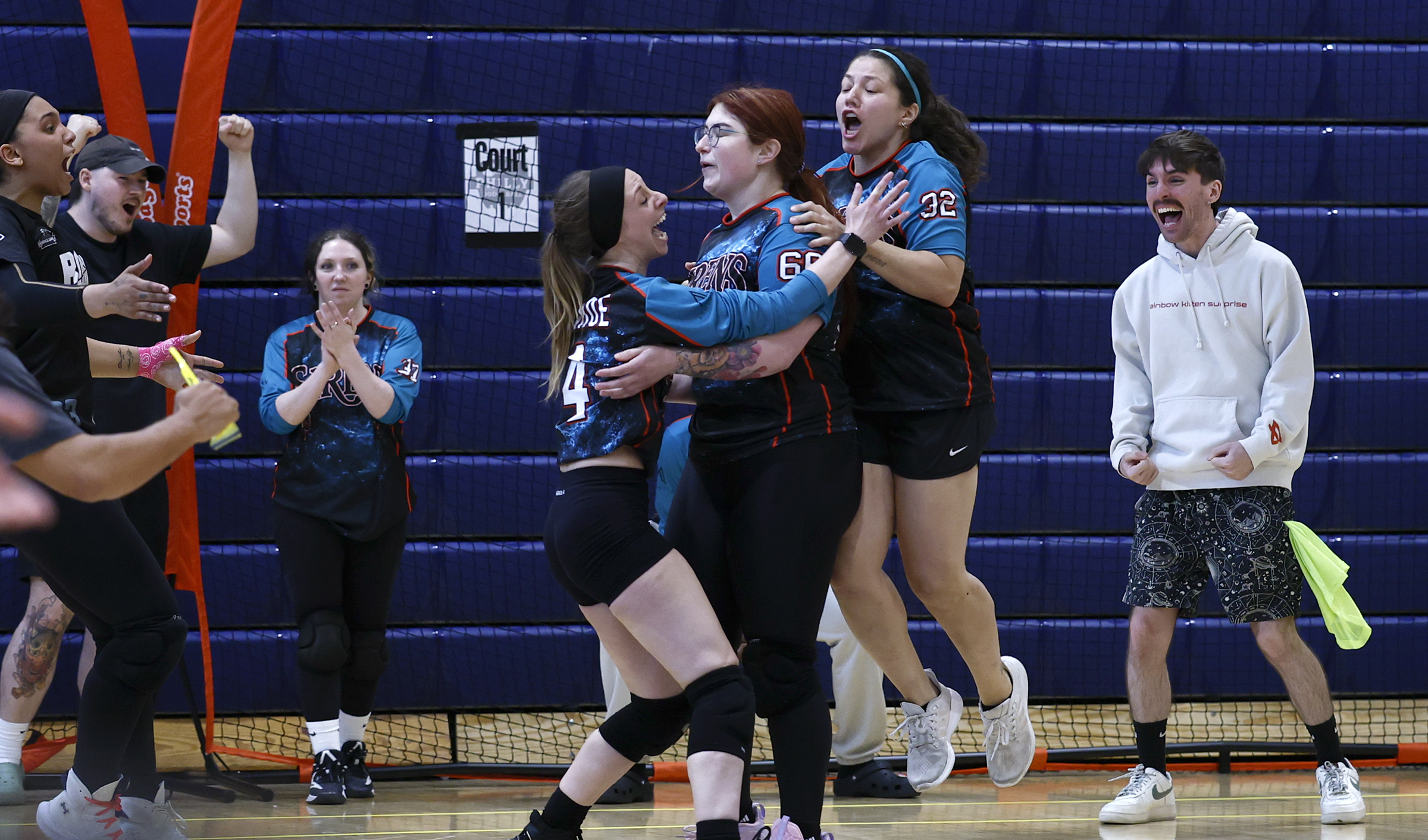
The Phillies used eight pitchers — technically seven and cathcer Garrett Stubbs — in Wednesday’s loss to the Marlins.Phillies second baseman Bryson Stott looks to the dugout after hitting a triple in the first inning of Tuesday’s 8-2 win over the Marlins.Winslow Township High School sophomore Jasmine Jackson recently won a state championship in the 100-meter hurdles and earned an invite to the Brooks PR Invitational.Ecuador goalkeeper Hernán Galíndez allowed the game-deciding goal by Ivory Coast’s Amad Diallo in the 90th minute of their World Cup Group E match on Sunday.Ecuador fans were shocked by their team’s World Cup loss to Ivory Coast on Sunday in Philadelphia.Ivory Coast’s Amad Diallo (center) is surrounded by his teammates after scoring the lone goal in a 1-0 victory over Ecuador in the World Cup on Sunday in Philadelphia.Ecuador forward Enner Valencia (center) and Ivory Coast defender Emmanuel Agbadou (right) battle for the ball during their World Cup match on Sunday in Philadelphia.Ecuadorian fans cheer during their World Cup match against Ivory Coast in Philadelphia.Ivory Coast’s soccer team practice as the sprinklers began operating last Friday at Subaru Park in Chester. They faced Ecuador in Philadelphia that Sunday.Members of the Empire, a women, trans, and nonbinary dodgeball team, prepare to throw while taking on team Sirens during the “Beast Coast” championship Saturday at Ben Franklin High School.Members of the Sirens celebrate after beating Empire in a WTNB dodgeball quarterfinal.A young Ecuadorian soccer fan sits under the Ecuadorian flag during a flag-waving event on Saturday at the Philadelphia Museum of Art steps, before the team faced Ivory Coast in the World Cup.
In February, the ballet student at Philly’s Rock School for Dance was one of only 38 boys (81 dancers altogether) from around the world selected to compete at the elite Prix de Lausanne in Switzerland.
He didn’t win a prize at the Prix, but he made the final and got something else valuable: a scholarship to finish his studies at England’s prestigious Royal Ballet School.
But that’s not all. Metcalf also qualified to compete in the Youth America Grand Prix Final in May in Houston.
YAGP, a much bigger competition, attracts thousands of students from 50 countries competing in locations all over the world for months leading up to the final.
Blake Metcalf stretches and watches his classmates at the Rock School for Dance.
“There was a moment prior to YAGP [Final] where Blake and I spoke,” said Rock president and director Peter Stark, who coached Metcalf, “and I said to him that he didn’t have to do YAGP as he had his plans secured for next year.”
But Metcalf, who grew up in Lake Mary, Fla., and attended many competitions with his mother Sheri’s dance school, Xtreme Dance Studio, wanted to finish out that chapter.
Blake Metcalf in class at the Rock School for Dance.
“I was like, ‘Let me just have fun, I don’t care what happens, just have a good week,’ ” said Metcalf, who recently turned 16. “And then I made it to the final round, I was like, ‘Awesome, that’s great, first-year senior.’”
He was then invited to perform in the gala that closes out the competition, “and that was mind-blowing to me,” he said.
“I was like, ‘Oh my gosh, I’m surrounded by so many people, like professionals I look up to, that I never thought I’d even see in person, dancing on the same stage.’”
When the awards were announced, Metcalf was among the top 12 senior men. His name was the first announced, because he was the youngest, he assumed.
But he had won first place while, he later added, dealing with a cyst in one hip and a muscle strain in the other.
“I look to my right and it’s just these super tall men,” he said.
The YAGP Final turned out well for Metcalf’s classmates as well. In addition to his win, students from the Rock received three second-place awards.
“It was an extraordinary week for the Rock School,” Stark said. “For the second year in a row, we advanced more students to the final round than any other school in the world, and we ended up being the most awarded school at the competition.”
Blake Metcalf in men’s class at the Rock School.
Metcalf, Stark said, “was in a different zone at the finals and it showed in his performances. “Some of the same judges [at the Prix and YAGP final] were especially impressed with his growth.”
“Mr. Stark warmed me up every day for competition, and he took it very slow, didn’t force anything,” Metcalf said, explaining how he succeeded despite the injuries. “I kind of kept it calm and clean, and then saved myself for stage.”
So what changed between February and May?
“I think at Prix de Lausanne, I saw so much incredible talent,” Metcalf said. “I was really inspired, I subconsciously pushed myself more. I came back to Rock, and I was like, ‘alright, let’s do it, like let’s work,’ and I started improving more.”
“Blake has an extraordinary instrument for dance physically with excellent proportion and line with great flexibility and strength,” Stark said. ”However, what really makes Blake special is both his intense focus in class coupled with heartfelt artistry on stage.”
Next year in England, Metcalf expects to work on “my power, my bigger jumps. It’ll come with age,” he said, “it’ll come as I get more muscle. But yeah, I definitely need to work on my strength and my power.”
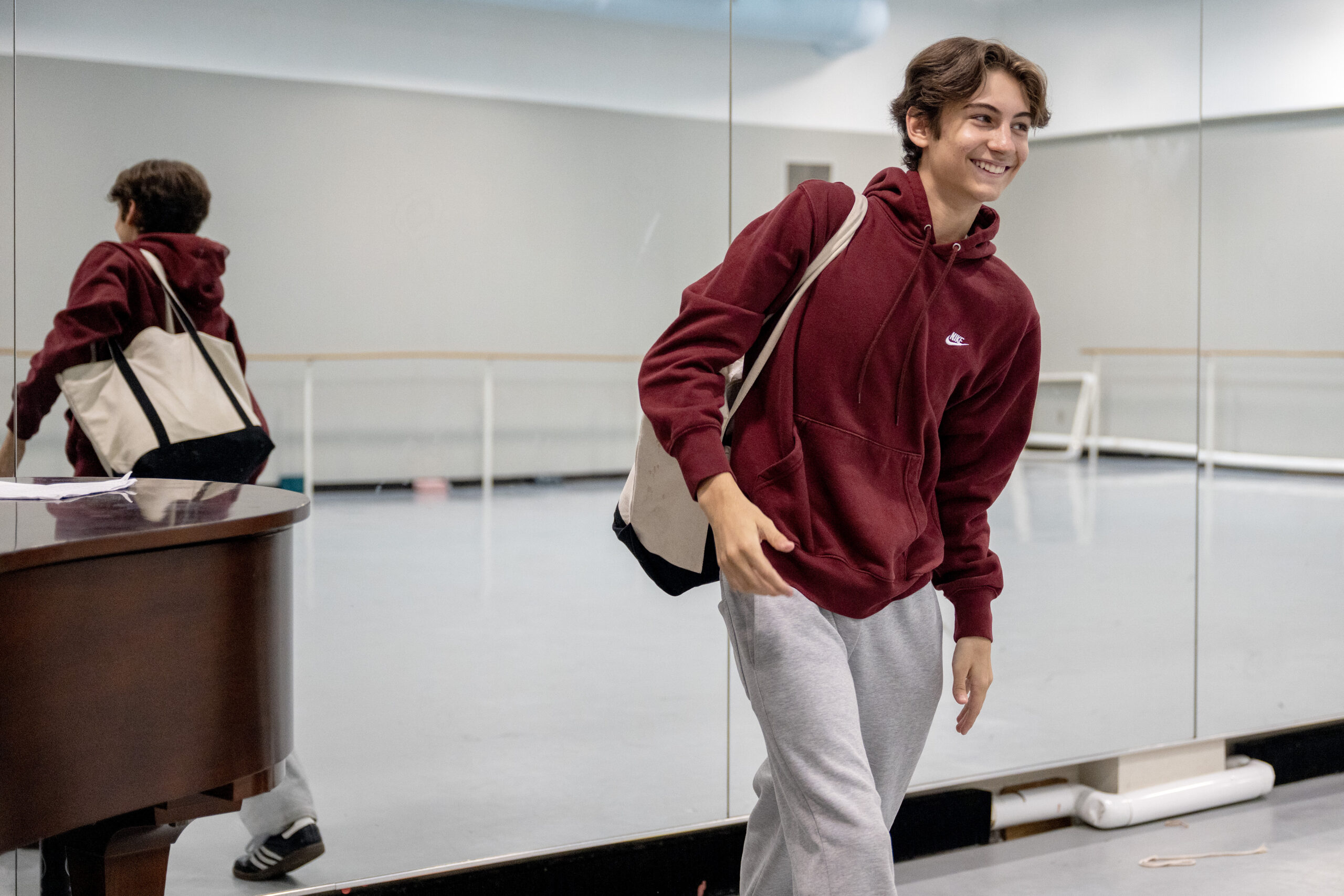
Blake Metcalf leaves the studio after class at the Rock School.
Metcalf started dance when he was 5 or 6, after watching his sister, Ash, (now a New York-based actress) dance and compete with his mother’s school.
“I really wanted to be a dancer, and my mom was like, ‘Alright, Blake, we’ll see, we’ll see.’”
His mother, he said “tried to get me to go into sports because she wanted me to … go to a college, go the academic route. But I would beg my mom every day, because I looked up to my sister a lot as a kid. Ever since then, I just started getting more and more classes, and then I left all the other worlds behind.”
He started with hip-hop. Classical dance didn’t come until he was about 11, when someone at his mom’s studio noticed that he had good feet for ballet.
Soon enough, he’ll get that degree as well. The three-year program at the Royal Ballet School not only prepares its students to join a ballet company, but it also awards its students a bachelor’s at the end.
Blake Metcalf leaves the Rock School after class.
Metcalf had never studied anywhere but his mom’s school when Stark invited him to train at the Rock School two summers ago. He enjoyed it so much that he begged to stay for the year, even though it meant leaving his family and his Boston terrier, Cannoli.
It was Philly where he really began to shine, said Metcalf, who also enjoys drawing, crocheting, knitting, and reading.
“Rock has really refined me as a dancer,” he said. “Rock has also helped me mentally, it has helped me mature, have my own mindset, not worry about what else is going on and just focus on myself.”
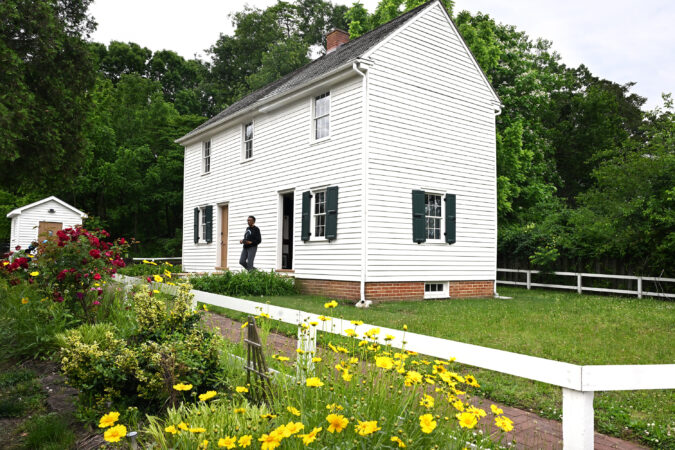
LAWNSIDE — For nearly 200 years, the historic Peter Mott House — believed to have once served as a stop on the Underground Railroad — has managed to withstand the encroachment of the outside world.
In the 1950s, construction of the New Jersey Turnpike brought a heavily used trafficway within just a few hundred feet of the home.There was the time, in the 1980s,when a developer bought up a patch of surrounding land with plans to raze the structure and build housing units. And the arrival of the COVID-19 pandemic in 2020 left the home shuttered for three years — and its future temporarily uncertain.
Now, the New Jersey Turnpike Authorityplans to soon begin work on a $2 billion project to expand the turnpike, which would bring the highway — currently located just 220 feet from the Mott House — 12 feet closer to the building.
The plans have prompted a wave of pushback from a small but vocal group of Lawnside residents, who fear that vibrations from the construction could damage the nearly two-century-old structure and that already “deafening” traffic noise in the area could become unbearable.
Already, says Linda Shockley, the longtime president of the Lawnside Historical Society, which owns and maintains the Mott House, it can be difficult for visitors to hear over the hum of the turnpike. The back of the house, which boasts a quaint patio, is essentially unusable without the use of microphones, she said — and this is to say nothing of the potential environmental and safety implications of bringing a heavily traversed highway even closer to a residential area.
The expansion, which also includes plans to widen nearby Warwick Road, has become — in Shockley’s words — “like a sword of Damocles hanging over us.”
“What are you doing and when are you going to do it?” Shockley said. “And what say do we have over how it’s done?”
Traffic on the New Jersey Turnpike passes at the end of a cul-de-sac near the historic Peter Mott House in Lawnside, N.J.
Theconstruction arrives at a seminal moment for the historic borough, which this year is celebrating the 100th anniversary of its incorporation.
Originally settled by formerly enslaved people who escaped or were freedand considered the first independent, self-governing African American community north of the Mason-Dixon Line, Lawnside has long boasted a historical significance far outsizing its modest 1.4-square-mile footprint.
In the 1930s, it was home to a bustling entertainment district, drawing high-profile acts such as Ella Fitzgerald and Billie Holiday. Three decades later, Lawnside’s school district became one of the first U.S. governmental entities to declare the Rev. Dr. Martin Luther King Jr.’s birthday a holiday.
No aspect of Lawnside’s history, however, has remained as vital to its identity than the Mott House, the onetime home of Peter Mott,a free Black farmer, preacher, and abolitionist, who, along with wife Elizabeth, was a conductor on the Underground Railroad.
Built around 1845, the home is Lawnside’s oldest known house and is widely believed to have been a refuge for enslaved people traveling from the South — making it a strong symbol for the community at large.
“This town has been a beacon of hope for African Americans,” said Darryl Lee Dozier, 60, a longtime Lawnside resident. “To be able to walk outside and say, ‘Harriet Tubman came through this town’ — that’s iconic, man.”
At least 18 municipalities across Salem, Gloucester, Camden, and Burlington Counties will be affected by the turnpike project, but the proximity of the Mott House — as well as a neighboring housing development — to the construction has stoked fears that it will be uniquely vulnerable. State officials say they are working closely with local leaders to ensure that any adverse effects of the project are minimal.
(function() { var l = function() { new pym.Parent( ‘peter-mott__graphic’, ‘https://media.inquirer.com/storage/inquirer/ai2html/peter-mott/index.html’); }; if(typeof(pym) === ‘undefined’) { var h = document.getElementsByTagName(‘head’)[0], s = document.createElement(‘script’); s.type = ‘text/javascript’; s.src = ‘https://pym.nprapps.org/pym.v1.min.js’; s.onload = l; h.appendChild(s); } else { l(); } })();
AECOM, the infrastructure firm handling the engineering work for the turnpike project, told The Inquirer recently that Lawnside qualifies for noise barriers to help alleviate the effects of the project, and that “vibration monitoring,” as well as inspections, would be conducted throughout the course of the project.
“Should the vibrations for any reason exceed a threshold that would cause concern, then the activities would pause and we’d figure out what’s going on,” said Matthew Rao, a project manager with AECOM.
New Jersey Assemblyman William F. Moen Jr., who grew up in the area, said he has been engaged in conversations with the New Jersey Turnpike Authority about the project since 2020 and has been cognizant of the questions raised by Shockley and others.
“I’m acutely aware of her concerns, and I think they’re valid,” he said. “This is the time to be talking about those things, and making sure, to the extent that they can be, that they’re reflected in the final plan of what’s going to happen.”
Still, many in Lawnside remain wary.
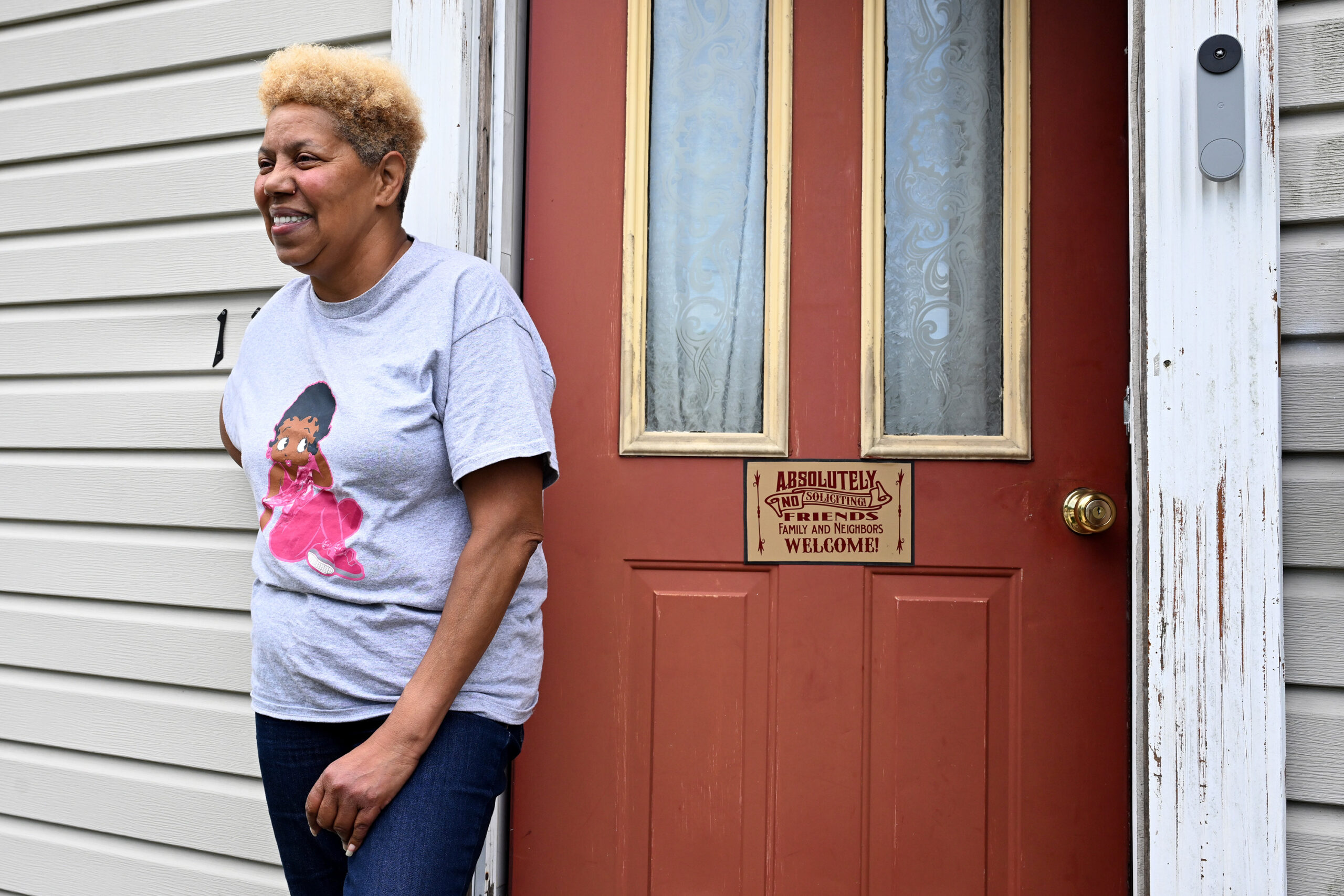
Kia Jones at her home next door to the Peter Mott House in Lawnside, N.J. Tuesday, May 26, 2026. Plans to expand the nearby New Jersey Turnpike have left local residents concerned about how it could affect a beloved institution as well as neighboring homes.
Despite meetings with officials, said Kia Jones, 60, whose home sits near the proposed turnpike expansion, residents have largely felt powerless throughout the process.
“Their whole attitude seems to be, ‘It’s a done deal — we’re just talking to you because we have to, but nothing’s going to change,’” she said.
For some in this South Jersey borough of roughly 3,000 residents, meanwhile, the expansion raises unmistakable echoes of the 1950s, when construction of the turnpike left a profound impact on the community.
At the time, America’s vast network of highways was displacing — and often targeting — Black communities across the country.
Initially, Shockley said, only six homes in Lawnside were supposed to be affected by the turnpike’s creation. But by the time it opened in November 1951, she said, 27 families had been affected.
“Some people’s houses were purchased, some houses were condemned,” Shockley said. “I’ve seen pictures of houses on flatbed trucks, being moved.”
(It was not lost on some in Lawnside, Shockley points out, that the turnpike conveniently curves around the nearby Tavistock Country Club, a private golf club founded in 1920.)
Though few in Lawnside are old enough to remember the turnpike’s arrival, many have felt the ripples.
Lorraine Pollitt, 70, a lifelong Lawnside resident, grew up hearing about her great-grandparents’ farm, which, she said, had fallen in the turnpike’s right-of-way and, as a result, had to be sold.
Seventy-five years later, Pollitt said, the expansion project feels like more of the same.
“Just taking more from us here,” she said. “It’s always something.”
For Shockley, who has served as president of the historical society since 1994, the effort to preserve and protect the Mott House has been a nearly 40-year endeavor.
She first got involved in the late 1980s, when a local developer, Mark DeFeo, received permits from the borough to raze the house in order to build a small housing development.
A group of residents organized to try to stop the home’s demolition, and Shockley — who was raised in Lawnside and had recently moved back from New York — joined the effort.
It took three years and considerable legal wrangling, but the developer eventually agreed to sell the home to the group for $1.
For its efforts, Shockley later told the New York Times, the group found itself in possession of “a decaying, vacant house … in danger of collapsing.”
In the years since, however, the historical society, buoyed by a dedicated collection of volunteers, has turned the property into a gem that has garnered national renown. The group has raised hundreds of thousands of dollars toward upgrades and repairs through grants and donations.
The house opened to the public in 2001, and, today, it offers a variety of programming, including a weeklong summer camp for middle schoolers on the history of the Underground Railroad, sitting on both the national and state registers of historical places.
In her mid-30s when she joined the effort, Shockley is now in her 70s, her hair flecked with gray. She retired in 2021 from her job at the Dow Jones News Fund, a journalism nonprofit foundation.
“Don’t tell anyone,” she joked one morning recently, from a seat inside the Mott House, “but I’m getting older.”
Linda Shockley, president of the Lawnside Historical Society, at the Peter Mott House in Lawnside, N.J. Tuesday, May 26, 2026. Shockley has served as president of the local historical society since 1994.
But while there is still work to be done, she remains dedicated to doing it — one more battle in a long string of them.
“Ask anybody who’s trying to do anything with historic buildings, or restore history or culture, and you find that, yeah, there’s always something — and there are always threats to it,” she said.
The NHL scouting combine is over. The predraft news conference has concluded, and, starting Friday, the Flyers select their next generation in the 2026 NHL draft.
Determining who they will pick is always a gamble, especially this season; the Orange and Black will pick 21st in the first round. But since the Flyers will be making their picks in Atlantic City, let’s test our luck and roll the dice here in our third mock draft — which will only be two rounds as the Flyers traded away their third-rounder to Toronto on Tuesday.
Command likely will be long gone. Center Ilia Morozov, wingers Wyatt Cullen and Ethan Belchetz, and forward Maddox Dagenais, who is projected as a winger in the NHL, sound like they will be drafted before the Flyers pick, too. Fans also should keep an eye on Nikita Klepov as the Flyers brass travels to Florida to see the right winger and other Gold Star clients in their annual predraft camp.
So, the question remains: why not go back to Bleyl, a dynamic offensive defenseman? Yes, the Flyers need help on the power play, and the New York native is considered a top-tier quarterback; however, as general manager Danny Brière was quick to point out on Tuesday, “right now you might have some needs, but in four years, five years, that need might be different” — and the Flyers desperately need help on the man advantage today.
When asked about the small defensemen available, like the 5-foot-11 Bleyl, assistant general manager Brent Flahr said they need to be dynamic but then glossed over the position: “There are premier forwards at the top of the draft, a grouping of big-time defensemen, and then it goes back to forwards.” The Flyers do like 6-7¼ defenseman Maksim Sokolovskii, but taking him at No. 21 feels like a reach more massive than Jett Luchanko in 2024.
So, reading between the lines, it sounds like the Flyers are keying in on a forward.
Jack Hextall is one of several players the Flyers have been keeping tabs on this season.
With all that — if the Flyers do not trade the pick — let’s go with Jack Hextall, who, for the record, is a distant cousin of Ron Hextall, the former Flyers goalie and general manager. Jack told The Inquirer in Buffalo that the two have never met.
This Hextall is a 6-foot-½ inch, 195-pound right-shot centerman who is projected to play a middle-six role. The fact he is a righty is intriguing, as Luchanko, Jacob Gaucher, and Cole Knuble, who is more of a winger but can play down the middle, are the only right-handed pivots in the organization.
The 18-year-old from Illinois is known for his big motor, a high compete level, relentlessness, and, according to Ryan Ward, his coach with Youngstown of the United States Hockey League, “His brain is off the charts.” The Flyers love picking centers in the first round, plus they focus on all these traits when drafting, as seen with someone like Denver Barkey, who can play wing and center.
Hextall finished with 58 points in 59 games for the Phantoms (apropos, no?) and had seven points for the winning USA Hockey squad at the 2025 Hlinka Gretzky Cup.
“His bread and butter is how well-rounded he is,” The Athletic’s NHL draft and prospects reporter Scott Wheeler told The Inquirer. “The details off the puck, up and under sticks, retrievals, board battles, he’s got pro habits.
“If you talk to the guys in Youngstown, the first thing they say about him is that he’s a pro; this isn’t a junior hockey player, like a lot of these kids are. [He] does everything the right way, no selfishness to his game and he doesn’t cheat for offense.”
One more reason to keep an eye on him: he is heading to Michigan State in September.
Called “the draft’s most purely dynamic defenseman” by Elite Prospects, Xavier Villeneuve draws comparisons to former Flyers blueliner Shayne Gostisbehere.
Second round: Xavier Villeneuve
Where defenseman Xavier Villeneuve ends up is truly all over the map. He could end up going in the first or second round. As one coach told The Inquirer recently, if a team falls in love with a player, they may try to take them earlier than expected.
The latest mock draft by Corey Pronman, the senior NHL prospects writer for The Athletic, has Villeneuve going to the Flyers in the second round with the 53rd overall pick. It matches the word on the street that his stock has dropped a bit as the 5-10¾, 164-pound blueliner needs to work on his defense and gain strength to accommodate his small stature; however, there is a massive upside to Villeneuve, especially offensively.
The 18-year-old has a good stick, can skate, and dropped 38 points in an injury-plagued season — he had 14 points in 17 playoff games — for Blainville-Boisbriand of the Quebec Maritimes Junior Hockey League. He had 143 points in 152 regular-season games across three seasons in “The Q” and had eight points in seven games at last year’s Under-18 Championships for the gold-medal-winning Canadians.
“He’s very dynamic. His first three, four steps are really dynamic. He’s got a great vision,” his coach, Alexandre Jacques of the Quebec Maritimes Junior Hockey League’s Blainville-Boisbrand Armada, told The Inquirer. “Offensively, he’s seeing things, and he’s able to create things that not too many players are able to do.
“At the offensive blue line, he is really, really, really deceptive, so he’s able to create something out of nothing with his edge [work]. Skating sideways is probably one of his greatest attributes, and he’s good at using [his edge work] to create shooting lanes or to create offensive situations.”
Down the road, yes, the expectation is that Villeneuve could help the Flyers power play as the quarterback. And you’d have to think the scouting and player development staffs have been keeping tabs on the Laval, Quebec, native as he was teammates with defenseman Spencer Gill, who is turning pro, with the Armada.
Called an “exciting player to watch” by Boston University coach Jay Pandolfo, Villeneuve brings a hefty comparable in Lane Hutson and is following in his footsteps by joining the Terriers in September.
One other name to keep in mind is Jaxon Cover. Although he does need to work on his skating — something the Flyers do not shy away from — he does have fantastic hands and creativity. A Penn State commit who plays for London of the Ontario Hockey League — the ex-team of Barkey and Oliver Bonk — a lot of his skill set comes from his time on the roller hockey rink while growing up in the Cayman Islands and playing in tournaments across North America before switching to ice hockey when he went to boarding school in Ontario in 2020.
It feels similar to the path of Ty Murchison, a Californian who switched to ice from roller hockey when he was 11 — and neither could stop when they made the switch. Murchison, the Flyers’ fifth-rounder in 2021, made his debut last season and could crack the opening-night lineup in the fall.
The 76ers’ offseason is about to ramp up, with the NBA draft next week and free agency beginning at 6 p.m. on June 30.
These are the first opportunities for new president of basketball operations Mike Gansey to make roster decisions — within the constraints of having three players (Tyrese Maxey, Joel Embiid, Paul George) still on max contracts.
That means there is a lot to ponder and discuss. And you brought questions.
Let’s get to them.
Santa Clara’s Allen Graves could be one of the players the Sixers consider picking at No. 22 in next week’s draft.
Q: From @davesoup on Bluesky: “Draft question. Biggest need? Best available? Chances they pick someone as good as [Jared] McCain?”
A: This is a great place to start. Based on Gansey’s vague comments at his introductory news conference, the Sixers will aim for a combination of both with the 22nd overall pick. It’s cliche, but also makes sense in that range. I’m perhaps most intrigued by the options at center and power forward — think Houston’s Chris Cenac Jr. or Santa Clara’s Allen Graves — though a wing could make sense if the Sixers’ front office believes they are in danger of losing Kelly Oubre Jr. and/or Quentin Grimes in free agency. So could a guard — yes, again — if they can provide a three-point shooting boost.
The Sixers absolutely could find somebody as good as McCain, given Maxey went even lower at 21 in the bizarre COVID-impacted 2020 draft. But as recent drafts illustrate, picking here is always a crapshoot. Who the Sixers select next week, however, will likely help determine free agency priorities.
Q: From @marc_almond on X: “Any chance the Sixers trade up their pick, since the draft is very open at their current spot?”
A: There’s always a chance, especially if the front office falls in love with a specific prospect during this week’s workouts. But right now it feels more likely that a good option could slip to 22, rather than the Sixers aggressively trying to move up. Gansey’s general draft approach also still comes with some uncertainty. He ran the draft with the Cleveland Cavaliers, but was not in the higher-ranking position that he holds with a new organization.
The Sixers and Joel Embiid are optimistic about his long-term health.
Q: From @cornerblight on Bluesky: “Do you think they are keeping Embiid?”
A: Never say never, given Luka Dončić was abruptly traded on a January Saturday night in the middle of his prime. But, putting it bluntly, Embiid’s contract is regarded as extremely difficult to trade given his age and injury history. If you were a fan of another team, would you be interested in trading for Embiid?
For now, the Sixers have to accept Embiid’s optimism that he and the medical/training staff have figured out how to manage his knee. He has no surgeries scheduled and plans to play more next season. That, of course, does not prevent the freak injuries like the oblique strain that kept him out for a month, or the ankle sprain and hip soreness that sidelined him for Game 2 of the playoff series against the New York Knicks, or the other random ailments like orbital fractures and Bell’s Palsy that have hampered postseason runs. One guarantee: He no longer has an appendix, and therefore will not need another emergency appendectomy.
The Sixers flashed what they could be with Embiid and George during that playoff comeback in the first round against the Boston Celtics. Gansey said he must operate (at least for now) as if he is building a roster with the core four of those three max players, plus VJ Edgecombe. And they all must cross their fingers for health, and that health leads to continuity.
Q: From @johnmlatimer on Bluesky: “I think the Spurs should have done the Two Tower thing more with Wemby [Victor Wembanyama] and [Luke] Kornet. And I think that would be a good option for Sixers to maximize and protect Embiid. Thoughts? Is [Adem] Bona that guy? If not him, who?
A: Solid observation. The Sixers have already dabbled in this, even going back to a preseason scrimmage in Delaware. And Bona has vocalized his eagerness to play in those lineups, as an additional way to get on the floor long-term.
The Sixers could use Bona’s athleticism, particularly as a defender, given Embiid clearly is not as mobile and vertical as the once-dominant player used to be. Bona’s limited offensive repertoire, in turn, is balanced by Embiid’s excellent skills for his size in the mid-post and perimeter. And that all helps fill the void at power forward.
Embiid did not play enough during the regular season to really experiment with this lineup for significant stretches. I’d imagine it is something Nick Nurse and the coaching staff are examining this summer.
Tyrese Maxey is a franchise cornerstone for a Sixers team trying to contend for a championship with three max contract players.
Q: From @realstuartl on X: “With Rich Paul as his agent, would Maxey really play the next few years in a rebuilding situation, if they did somehow get rid of Embiid and George?”
A: First, Maxey has never publicly expressed anything resembling disgruntlement or wanting out if the Sixers make the type of pivot you are suggesting.
I think it greatly helps the Sixers that Maxey legitimately believes in Edgecombe and has immediately established an on- and off-court connection and mentorship with him. I also think Maxey understands his unique situation: that he was drafted to an immediately competitive team with an MVP contender, instead of trudging through a rebuild like so many star-caliber young players do early in their careers. That now has made Maxey a tweener, of sorts, on this roster between Embiid/George and Edgecombe — and bridging that during a transitional period always felt like a possibility. Heck, Maxey has already been part of several iterations of this team, from Embiid-Ben Simmons, to Embiid-James Harden, to the most recent version.
Maxey, though, is also fiercely competitive. He also has already done right by the organization in waiting a year to sign his max contract, so that the Sixers could have a smaller cap hold on him and also sign George. In the current NBA landscape, partnerships between players and teams run their course more times than not (see Giannis Antetokounmpo). But right now, Maxey is a franchise cornerstone.
Q: From @jesuszoidberg on Bluesky: “In today’s NBA playoffs, is it possible to win a title if your best player is a post 30 year old big man, even not taking into the account the injuries?”
A: Just throwing this out there: A month ago, one could have asked if it was possible to win a title if that team’s best player was a small, ball-dominant guard who was a second-round draft pick and did not even make the All-NBA first-team this season.
(This is Jalen Brunson, of course.)
A team almost certainly needs a certified dude to win a championship. But getting the right players around that dude — whatever archetype they fill in regards to physical stature, skills, or intangibles — is the biggest key to building the correct team. And I do think that, under the new Collective Bargaining Agreement’s constraints, the star collecting method might be phasing out in place of compiling depth at the right spots. That is something Bob Myers mentioned during his news conference before the executive search that landed on Gansey.
In January, Danny Ceisler inherited a Bucks County Sheriff’s office that was a lightning rod for debate over deputies’ role in federal immigration enforcement. Now, as he reflects on the changes he’s made in his first six months in office, Ceisler says he is bringing the office back to standard procedure with a shift in staffing to prioritize addressing domestic violence.
That shift comes amid an increase in the number of warrants — called Protection From Abuse orders— served against alleged perpetrators of domestic violence.
Between February and May,Ceisler’s office has served 441 PFAs — an increase from the 370 that were served during the same time period last year.
Ceisler, a Democrat who flipped the seat after four years of GOP control, has dedicated more staffing and resources to ensure those warrants are served in a timely manner, which can often be a life-or-death situation.
“I view it as one of our real life-saving duties,” Ceisler said. “I mean if we can get an abuser out of a house at 8 p.m. on a Friday instead of 9 a.m. on a Monday — which is kind of what used to happen if they came in on Fridays — you could save a person’s life.”
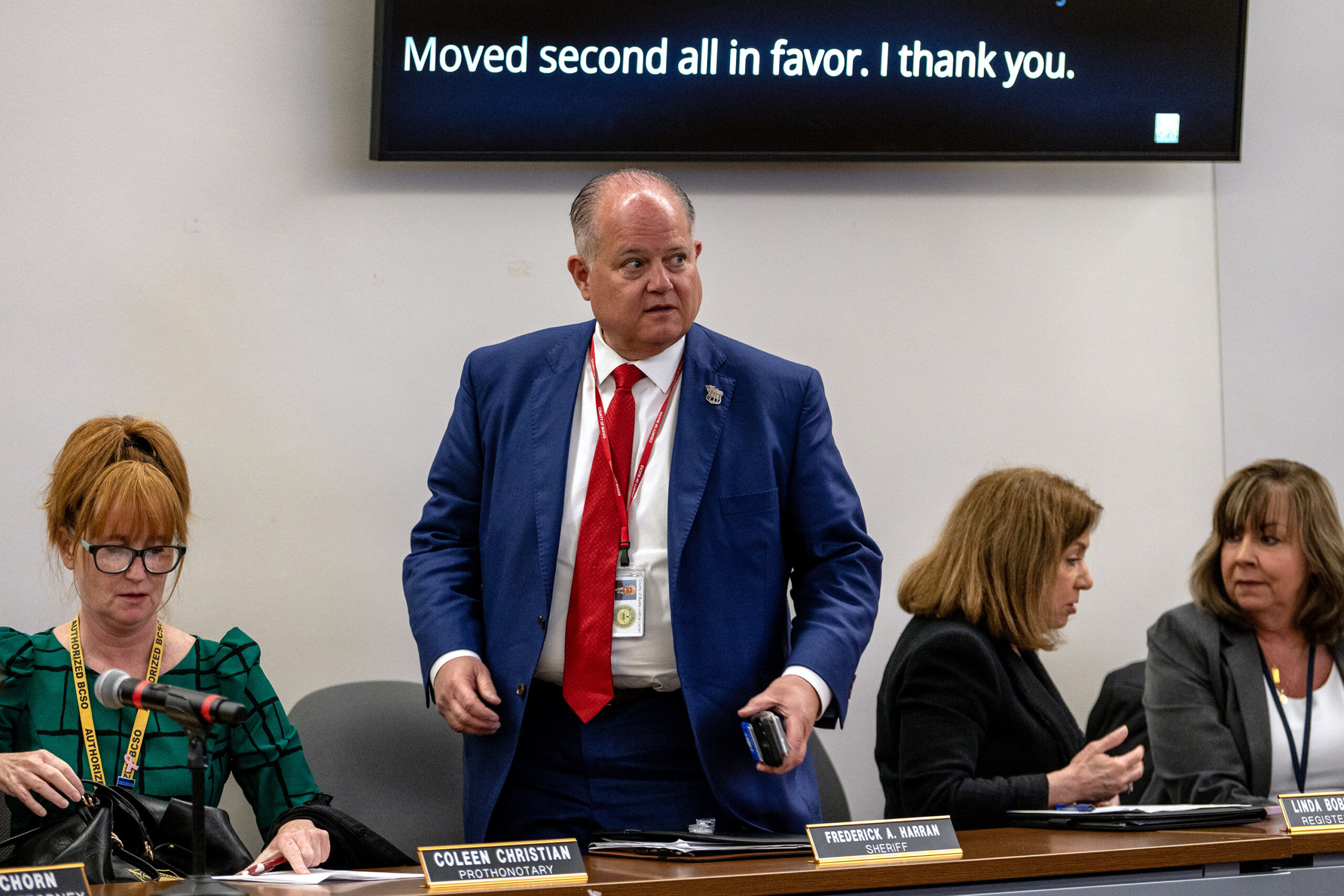
Last November, Ceisler ousted former Sheriff Fred Harran, a Republican, who came under scrutinyfor his embrace of President Donald Trump’s style of politics and his willingness to commit his office to a controversial agreement to assist U.S. Immigration and Customs Enforcement in federal immigration enforcement in the county.
In addition, Ceisler has developed a so-called “armory” that holds confiscated weapons and added six people to a round-the-clock unit dedicated to evicting alleged abusers from their homes based on judicial orders.
Jen Locker, executive director at A Woman’s Place, a Bucks County-based shelter and community organization for survivors of domestic and intimate partner violence, said that throughout her 13 years working at the nonprofit, the sheriff’s office has always been “really phenomenal” at being present during hearings for PFA warrants and ensuring survivors feel safe. The organization offers court accompaniment services and assistance in filling out PFA petitions.
But the biggest shift came when A Woman’s Place and the sheriff’s office met early on in Ceisler’s tenure and advocates expressed that one of the biggest challenges survivors face is the delay in serving PFAs.
Soon after the meeting, Locker said, Ceisler prioritized the eviction unit.
“Getting the offenders out of the home and getting the weapons out of the home are really, really crucial in maintaining safety for the survivors who are just trying to find a path forward safely,” Locker said.
Ceisler’s counterparts in the other Philadelphia suburbs say the work he’s doing is one of the core functions of any sheriff’s office.
And Ceisler argues that he’s bringing the office back to basics, noting that at one point he had to reassign deputies who were tasked with planning firearms training and that the office spent a lot of time on ICE training.
“One of my predecessor’s issues was he was stepping on the toes of police departments and trying to do more police work or federal, you know, immigration work,” Ceisler said. “We’re just doing what we are statutorily empowered to do, and trying to do it to the very best of our ability.”
According to data provided by the sheriff’s office, there has been a 94.1% clearance rate for PFAs under Ceisler’s tenure between February and March and a 90.4% rate during that same period last year under Harran. A “cleared” PFA means the warrant was successfully delivered, and any weapons were confiscated.
In an interview, Harran pushed back on the characterization that the office, under his leadership,was dedicated to anything but local law enforcement issues. And he was adamant that deputies working under him also served PFA warrants, with a dedicated, four-person unit doing that work exclusively.
“Danny knows the truth: We were never doing the work of immigration. I’ve said it a million times, I’ve testified with my hand on a Bible to it,” he said. “I don’t know what more I could’ve done to tell people that’s not what we were doing.”
Ceisler’s “armory,” he said, is also not a new concept. Harran said he was in the process of establishing one.
“Domestic violence is not going away,” he said. “To say he created a new unit, tomato, tomahto, call it whatever you want, we were doing same thing.”
Former Bucks County Sheriff Fred Harran stands following County Commissioners meeting last year when they approved a resolution opposing his deputies participating in an Immigrations and Customs Enforcement 287(g) program to act as ICE officers.
In most of the other suburban counties, the sheriffs — all Democrats — say their offices have been serving the vast majority of PFA orders.
In Chester County, Sheriff Kevin Dykes said his office has processed 247 PFA orders in the first quarter of 2026, as well as recovered eight firearms relinquished through that process. Dykes said his office rarely, if ever, has a backlog of PFA orders waiting to be filed, and works closely with local police departments to avoid that situation.
“I think where the issue came in with Bucks is that Danny stepped into an office where the person running it had different priorities,” Dykes said. “In this instance, it’s just how the nature of this business is. One day we could have a high-profile trial in the courthouse, and the next we could have a threat on an official. It just changes day-to-day for us.”
In Montgomery County, Sheriff Sean Kilkenny said his deputies are responsible for serving three-quarters of the PFAs filed. Last year that amounted to about 1,600.
Kilkenny formerly headed the state’s Sheriff’s Association, and said having those departments take the lead in handling PFAs is the industry standard, one that he said has worked well for counties across Pennsylvania.He added that Ceisler “getting under the hood” of the process is part of the job for a new official.
In Delaware County, where newly elected Sheriff Saddiq Kamara is wrestling with a staffing shortage, the sheriff’s office one day hopes to use Ceisler’s initiatives as a model.
Kamara, a former Yeadon Police officer and onetime member of Gov. Josh Shapiro’s security detail, said his office currently has 35 vacancies for deputies. He’s working to reverse that, and has recently hired seven new deputies, but said the shortage has forced him to leave the serving of PFAs to local police departments.
“It’s something that I really would like for us to do as well, but the Delaware County Sheriff’s Office is the third-busiest in the state,” said Kamara, referring to the number of prisoners they transport daily, as well as applications they receive for gun permits and other filings.
“We just don’t have the capability of the resources and the man and woman power in our office,” he said. “What Danny is doing I think is a phenomenal idea, and we’re planning to do that in the near future as well.”
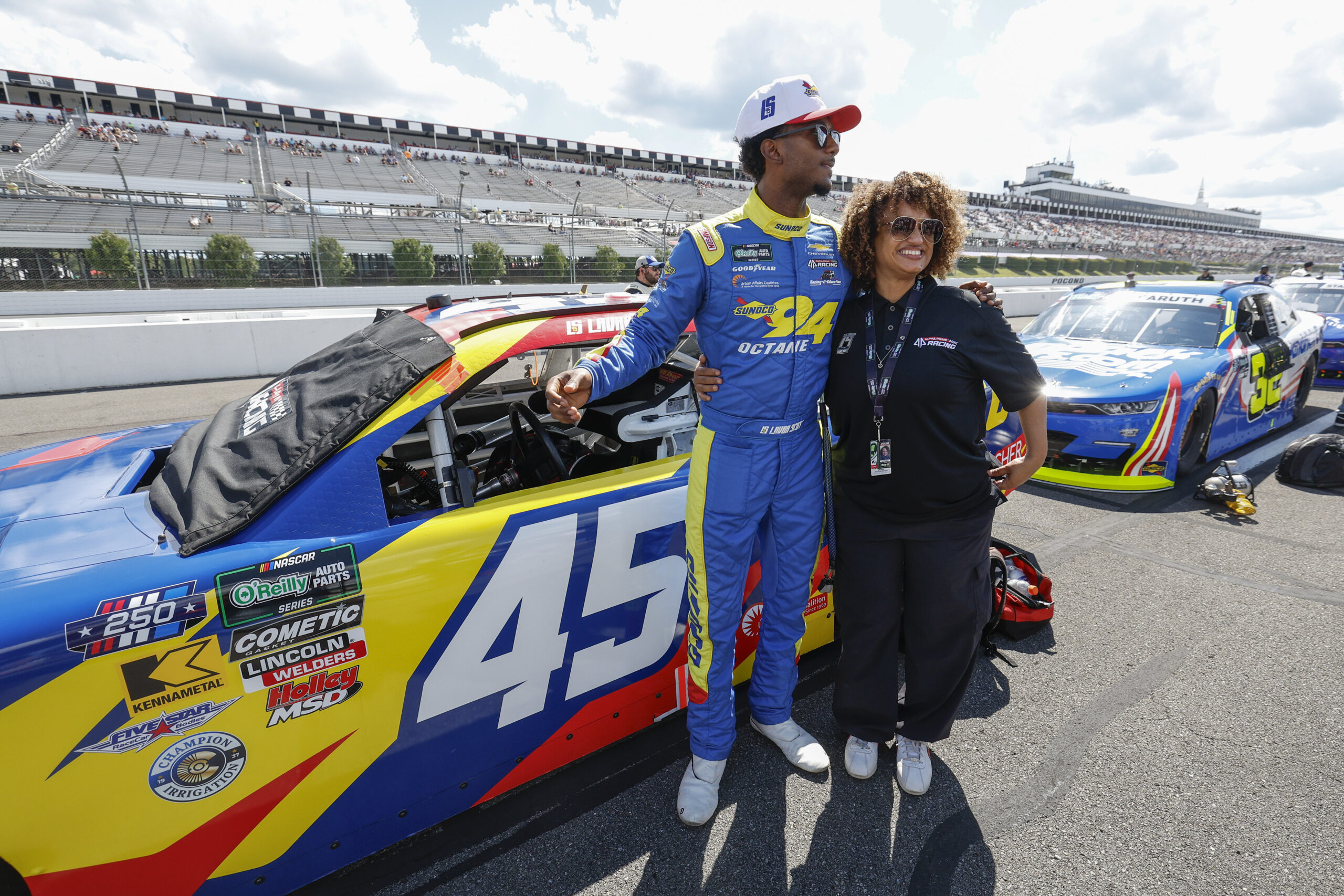
LONG POND, Pa. — Lavar Scott is accustomed to reaching top speeds around a racetrack. But earlier this month, less than 24 hours before his race at Pocono Raceway, he took a beat.
Standing in front of a room of about 40 people at Holy Ghost Distillery, roughly 10 miles west of the track, Scott, a Carneys Point, Salem County, native, told stories about his racing family.
“One time, my grandmother raced my grandfather, and she flipped her Mustang,” Scott told the room, which was greeted with a chorus of laughs.
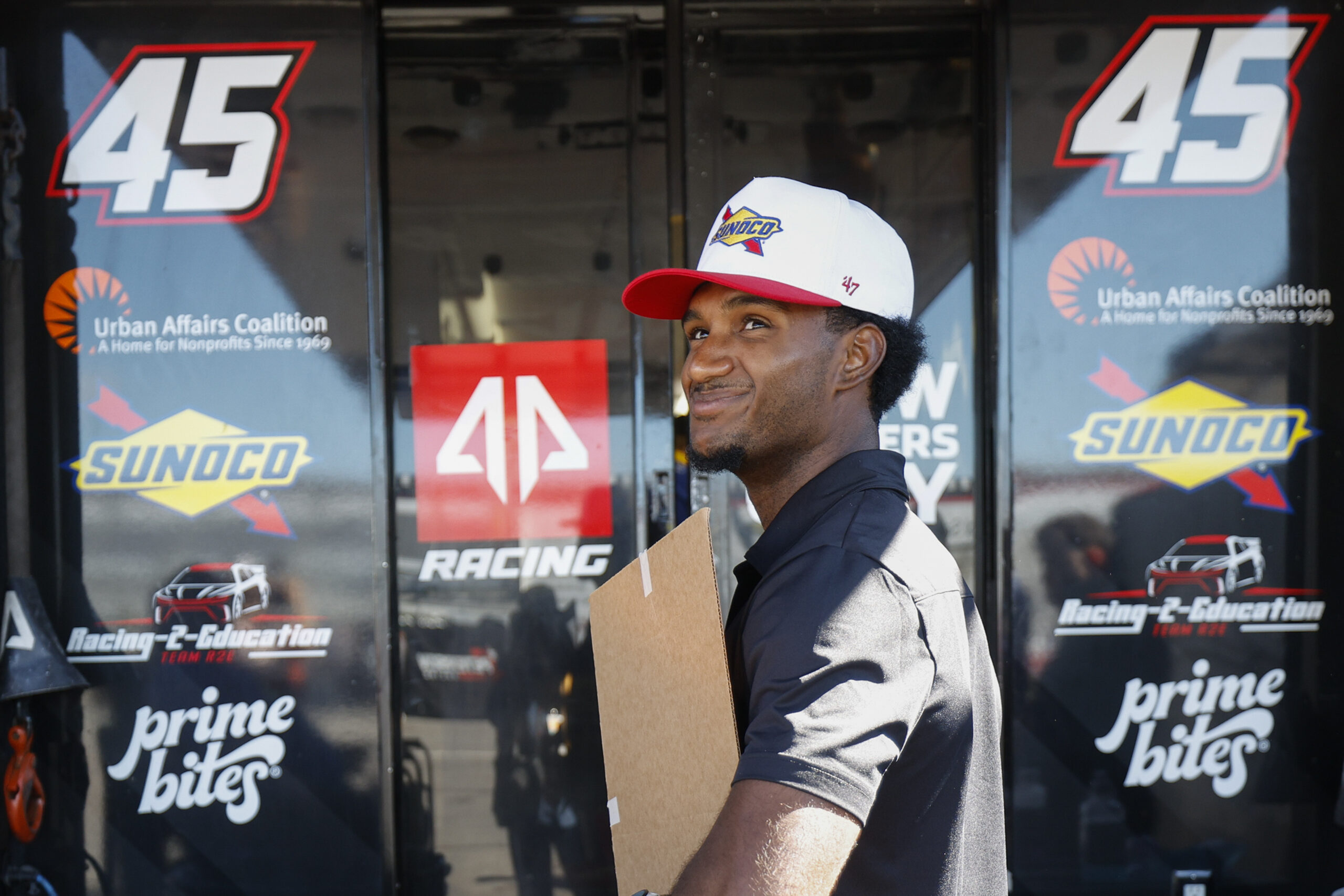
It was insight into the racing family that molded him. Lavar’s path started at 4 years old, when his grandfather built him a go-kart. He couldn’t race with an engine for another year, but his grandparents pushed him around the track anyway. Now, he’s racing through NASCAR’s Drive for Diversity program and into the sport’s second tier, the O’Reilly Auto Parts Series, where he drives the No. 45 car.
Scott, just 22, exudes confidence in every room that he’s in. When he tells novice racing fans his age, they can’t believe it. Those two hours at Holy Ghost Distillery — he was meeting with people connected to David Weinstein, a partner at Archer & Greiner, a law firm that serves as one of Scott’s racing sponsors — also displayed the business side of being a professional driver.
“As a driver, you can’t just be fast, right? You have to be fast and be a good business guy, and me being 22 and having to learn that so fast is really challenging,” Scott told The Inquirer inside his Alpha Prime Racing car hauler at Pocono Raceway’s infield. “[I’m] trying to put sponsors together and get more resources, to have better resources to make our cars faster, right?
“The people that can kind of stay grounded and the people that do the work every day are usually the ones that get past those challenges, and I’m in the middle of that right now. I’m just working to get to the other side.”
His family and the village that raised him, from South Jersey to North Carolina, keep him grounded. And it was apparent just how much he leans on those closest to him.
Lavar Scott (right) has leaned on his family, including his mother Sonia (center), as his climbed the racing ranks.
“It’s almost no surprise, because he damn near guaranteed himself, ‘That’s what I’m going to do,’” Wayne Scott Jr., Lavar’s uncle, said at Pocono Raceway. “And there was no alternative. There was no Plan B; there’s no second job. … That was his game plan, and he stuck to it. Here he is living his dream, not done yet, but he’s living it.”
Added Lavar, one of three active Black drivers in NASCAR: “The support [from] my family is a need. I need to have the support to feel good, right? If they didn’t support me, I don’t know how I would go about my day. I really care about what they think. They’re my family, [they’re the] reason why I’m here now.”
In the southwest corner of Pocono Raceway sits the Pocono Quarter Midget Raceway, which hosts races for kids ages 5 to 16. Scott’s eyes were fixed on the youngest age group driving go-karts with cages on top to protect them from injury. He beamed while watching the kids circle the dirt track because it reminded him of his start in racing and his first-ever win, on a dirt track when he was 5. He was hooked.
As he watched from the chain-linked fence that separated the stands from the track, a few teenagers recognized Scott from his racing TikToks and asked for pictures and autographs.
Lavar Scott (back right) poses with kids who compete at Pocono Quarter Midget Raceway, located near Pocono Raceway, on June 12. Scott got his start racing on similar dirt tracks.
But he wasn’t just at the track to watch and take a trip down memory lane. He offered words of encouragement to the kids and took a group picture. It marked the first time in two years a NASCAR driver came to speak at the track during Pocono weekend.
“I started where you guys are,” Scott told the group of about 40 kids. “Some of your parents, I raced against. I’m proud of you guys. It’s really cool what you’re doing. Being back at this type of track brings back memories. … It means a lot [to me] to be here with you.”
It was a reminder, too, of his own racing journey and family ties. It began with grandfather Wayne Sr., who became interested in cars when he was in high school.
Lavar Scott (center) shown with his grandfather and mother after winning a race during his childhood.
Wayne Sr. got into drag racing, often with his friends. His love for drag racing was passed down to Lavar’s mother, Sonia, who was National Hot Rod Association certified and “very competitive” as she raced all over Pennsylvania, New Jersey, and Delaware.
“She didn’t want to leave the track until she beat her time, and at that time, she was one of only a few women out there racing,” said Waynetta Scott, Lavar’s aunt and Sonia’s little sister. “There’s a [nine-year age] gap between us … but just watching her really inspired me to just know that you can be the only female out here and dominate, and she had that mindset to go against the men at that time.”
What helped feed Lavar’s racing career, Wayne Jr. says, is Scott’s Auto, which Wayne Sr. opened in 1978. It has become a family business, and Sonia, Wayne Jr., and Waynetta work at the Carneys Point shop.
“We grew up at our auto mechanic shop, and it’s like a second home, so we’ve just always been around cars and in that competitive nature,” Waynetta said. “Like how everyone goes and watches the Phillies, we went to a racetrack. That’s how we congregated and enjoyed our family time together.”
Sonia Scott (left) stops for a picture with her son before Sunday’s race at Pocono.Racing is a family affair for the Scott family. Wayne Scott Jr. (left), Wayne Scott III, Shanel Scott, and Elizabeth Scott pause for a photo with Lavar Scott (center) in the garage area.
Lavar’s older brother, Jerome, who also goes by Wayne, and Lavar “have been competing and everything their whole life,” said their uncle, Wayne Jr. Lavar and his brother would race their uncle and cousin, Wayne III. But Lavar, Wayne Jr. says, didn’t appreciate his uncle’s driving.
“He [said] he’s scared to get close to me on the track because I’m a wild driver, I guess you’ll say,” Wayne Jr. said with a chuckle. “I’m having fun out there. … I was like, ‘I’m just giving you some experience. You never know what you might get into out there [on the racetrack]. So take it as a lesson because everything’s unpredictable.’ I told him, ‘I’m glad I can help.’”
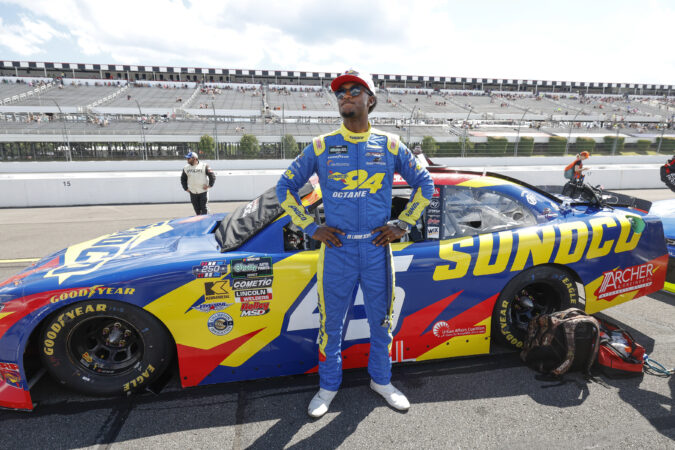
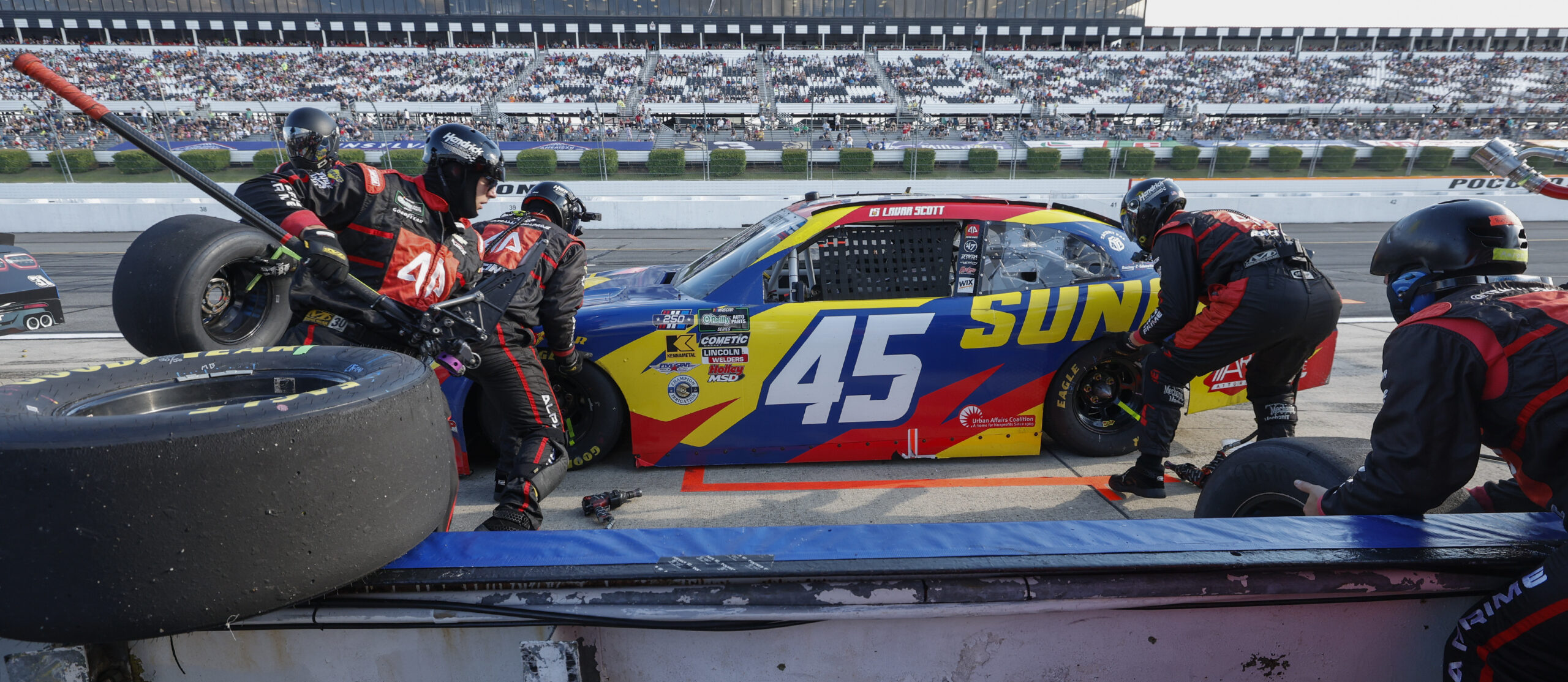
Lavar Scott’s pit crew works on the #45 Sunoco Chevy during NASCAR’s O’Reilly Auto Parts series at Pocono Raceway.
Lavar Scott has been chasing the winning feeling since his first race roughly 17 years ago. It’s been almost five years since Scott was last in the winner’s circle, even as he moved through NASCAR’s Drive for Diversity program.
“It’s a feeling that when I go to bed, I think about, [when I] wake up, [I] think about, [when I] sleep, [I am] thinking about. It’s just the feeling of standing on top of your car after a win and [celebrating] with your friends and family and knowing you did your job really well that day,” said Scott, who has four top 20 finishes in the Auto Parts Series. “Knowing the work you’re putting in is paying off … I get kind of super emotional talking about it, because [racing] really, really matters to me.”
Scott signed with Alpha Prime Racing team last December, about two months before Jusan Hamilton was appointed as team president. Hamilton became NASCAR’s first Black team president a few years after he became the sport’s first Black racing director in 2017.
Hamilton, who was a racer himself while growing up in Ithaca, N.Y., had known Scott for seven years and sees a lot of himself in Scott.
“I see someone who works hard, continues to be a student of the sport,” Hamilton said. “He’s just on a platform now where he knows all the work that he puts in is going to maximize tomorrow, and I just see him continue to put that work in and try and be a better driver and on the track and a better person off the track to support the rest of it.”
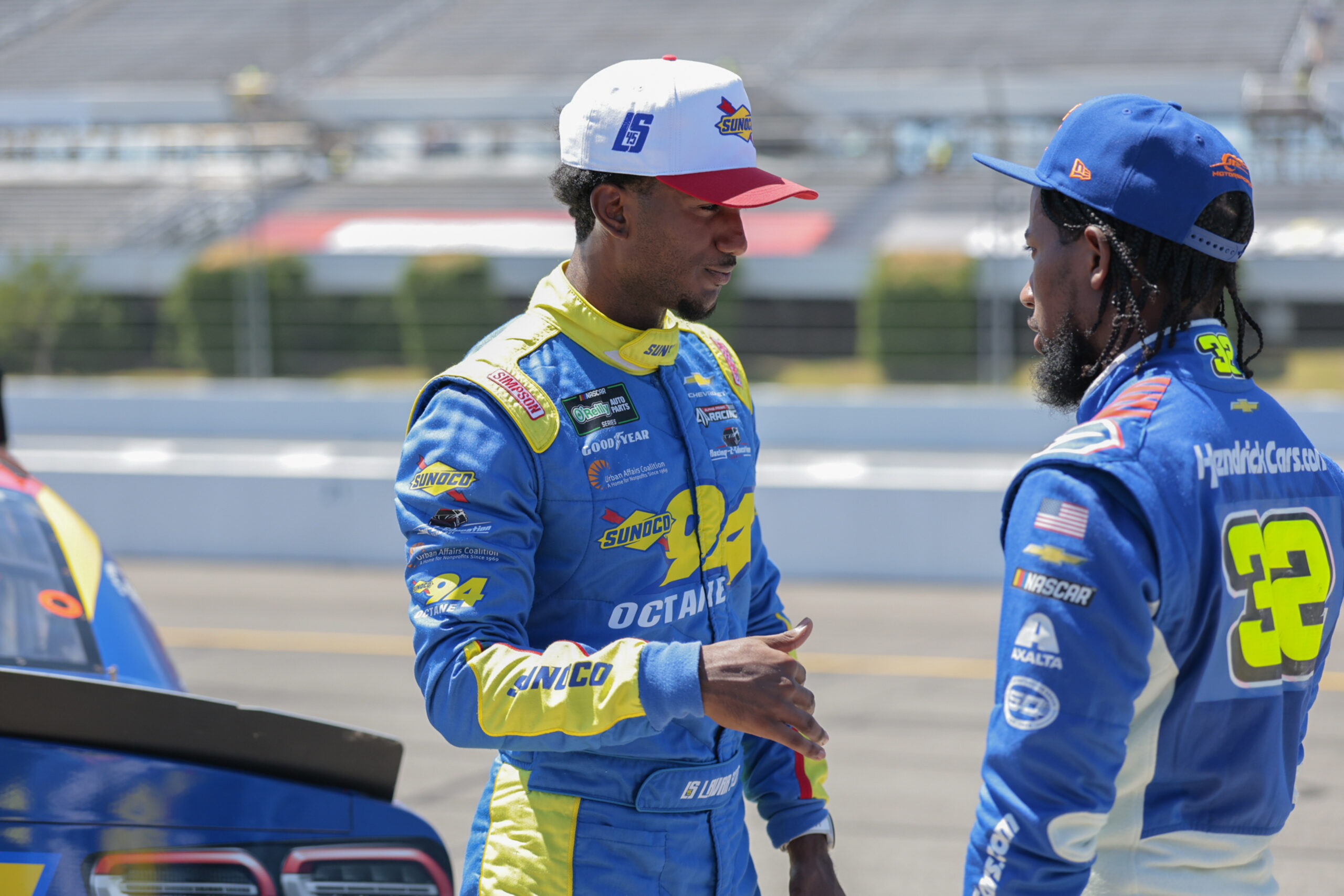
Rajah Caruth (right) is one of Scott’s competitors, and another of NASCAR’s young Black drivers.
Beyond what Scott is doing on the racetrack, what he is doing off it is catching young fans’ attention in the Philly area and beyond. Last fall, Scott entered a partnership with Philadelphia-based Urban Affairs Coalition, a nonprofit that works “to improve the quality of life in the region, build wealth in urban communities, and solve emerging issues.”
Through this partnership, UAC launched Team Racing-2-Education, which aims to introduce young people to careers in engineering, data analytics, automotive tech, and media production within motorsports. Recently, Alpha Prime Racing launched a national workforce development initiative in partnership with UAC and Team Racing-2-Education to “immerse students and young adults in hands-on experiences across race team operations, engineering, mechanics, logistics, marketing, content production, business operations, and event management.”
Driving coach Phil Horton (left) and Alpha Prime Racing president Jusan Hamilton are in Lavar Scott’s corner.
“It’s something I really take very seriously, and want to help grow and change, and bring a lot more people into the sport,” Scott said. “I think our partnership [with UAC] and our goals align really well. … It’s been really cool, and the work that’s being done is definitely making a change, but there’s still a lot more to be done, and we’re working hard every day to kind of continue that.
“On my side of things, I want to see more simulators be available to the youth and to kids, and let them gain interest. When you go to your local middle school or high school, you walk into a gym, you see your basketball courts there, you go outside for football with your friends, right? But I think there’s a way to just get some [racing simulators] into different places to have it accessible to them to play.”
Added Hamilton: “It’s really been our culture of Alpha Prime to bring new people into the sport to give them a foundation to learn and grow in a team that supports that because a lot of the big [NASCAR] teams, they just want people that are turnkey and can go straight to work without training. They don’t want to take the time to train because that’s loss of performance for them in their eyes, so we kind of serve that position of the sport.”
Lavar Scott is becoming more well-known among racing fans.Scott waves to a young fan at Pocono.
Scott also had an autograph signing early Saturday morning. Children and adults, excited to meet him, walked up to his hauler and grabbed a poster for him to sign.
That has become a regular occurrence as Scott’s profile has grown. He says he can “hear little kids say, ‘Hey, that’s Lavar Scott,’” and added that it’s ”super cool” to have those interactions.
A visit with a children’s hospital earlier in the week, though, helped put things in perspective.
“[I was] speaking with this girl, and she had to be about 9 years old, and she said … ‘I think this is the coolest thing ever, that I get to meet you,’” Scott said. “[I said], ‘So you think today, meeting me is the coolest thing ever?’ She said, ‘This is the coolest thing I’ve done in my life, is to meet you,’ and that hit hard for me. That was — I don’t want to say motivating, but it touched on a different level.”
Lavar Scott takes a moment alone before his race in NASCAR’s O’Reilly Auto Parts series at Pocono Raceway.
Scott walked away from his No. 45 car with Sunoco, a Chevrolet with a blue, yellow, and red color scheme. He walked toward the wall separating pit road from the straightaway just past the start/finish line before the national anthem and flyover.
He needed a moment to collect himself and refocus. He had spent the hours leading up to the 4 p.m. race on Saturday striking a balance of focus on the race and his laid-back, playful energy around family and friends.
While it was all business in the morning for practice and qualifying, he enjoyed the company of his uncle, Wayne Jr.; aunts Shanel and Waynetta; cousins Wayne III (who works on the No. 44 car for Alpha Prime Racing as a pit crew member) and Elizabeth; and mother, Sonia, after securing his 25th starting spot.
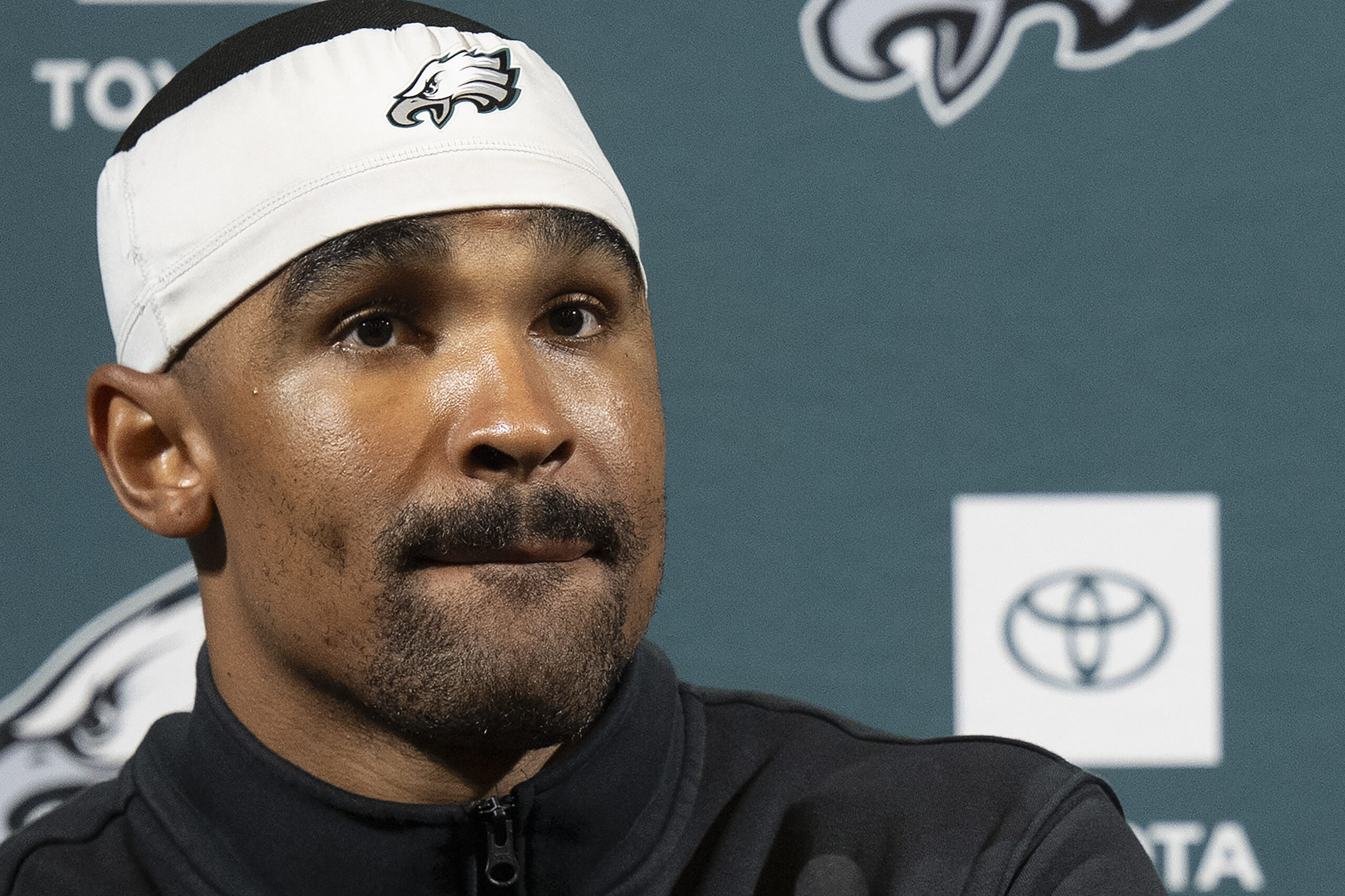
Jalen Hurts is entering his seventh season with the Eagles. Lavar Scott compared his mentality around racing to how Hurts approaches football.
His racing approach, Lavar says, is reminiscent of an NFL player who is revered in the Philly area.
“I do respect Jalen [Hurts], how he goes about things, being very quiet, processes things differently … and I think that’s how my guys view me,” said Scott, who connected with the Eagles quarterback recently. “No matter what’s going on, that Lavar’s going to show up prepared and ready to go.”
Once it was time to climb into his car, the rest of the Scott family watched anxiously from his pit box, listening to the in-car radio communication to glean information they couldn’t see on the track.
Lavar Scott operates on the straightaway under one of the many cautions in NASCAR’s O’Reilly Auto Parts series at Pocono Raceway.
Every time Lavar’s No. 45 car zoomed by at around 190 miles per hour, a friend or family member would point out his car, trying to get a glimpse of their star fighting for track position.
“I get starstruck when I see him in his suit and in his race car,” Waynetta said. “I know he loves his family. We’re so family-oriented that it just gives him that comfort and the support and the confidence to know that he can go out there and be all that he can be. He does [racing in NASCAR] well, and he’s not alone in this battlefield.”
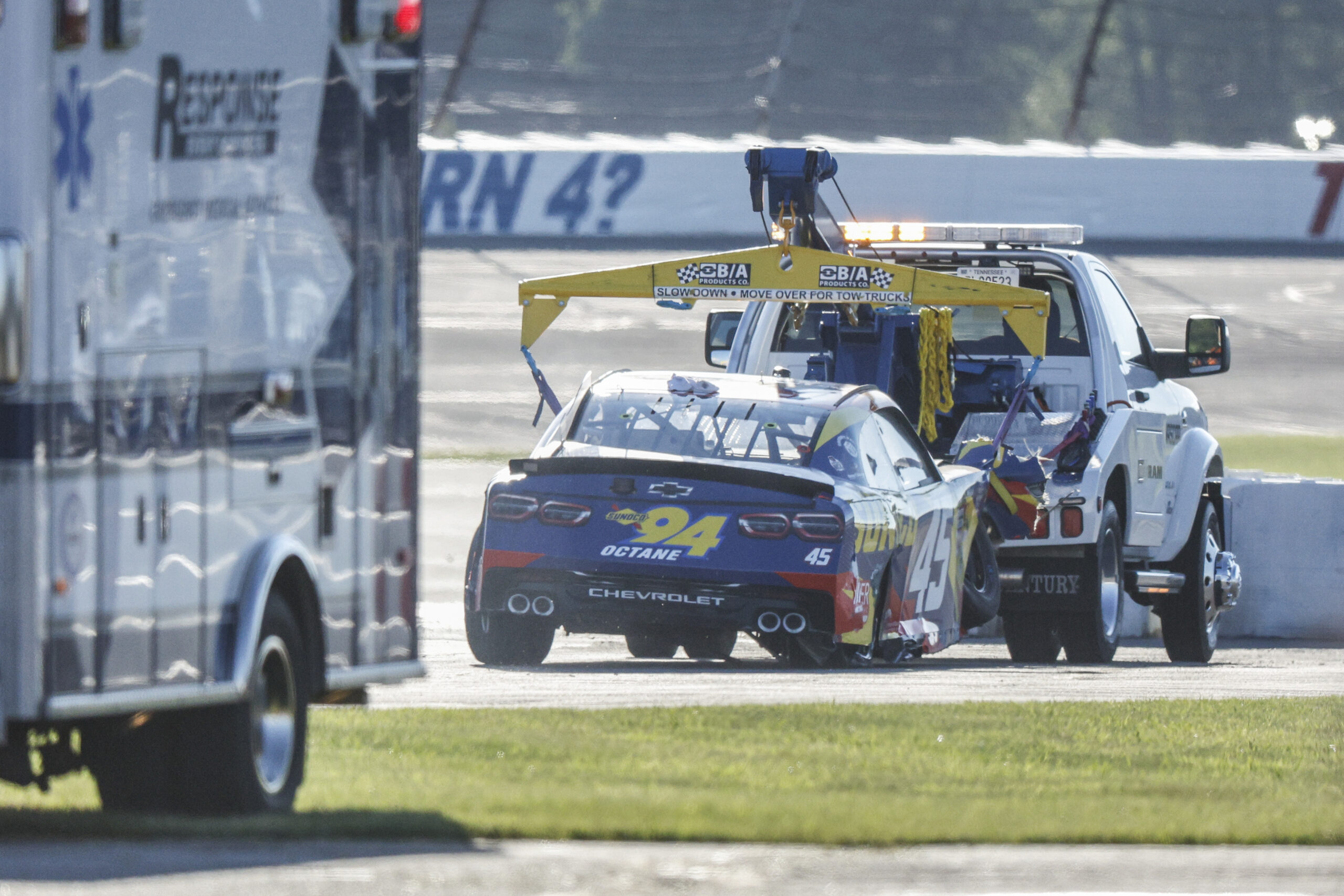
Though Scott’s first race at Pocono Raceway didn’t end the way he was hoping — he was knocked out of the race with five laps to go to finish 29th — it was clear from listening to his spotters through his car communication that he was maximizing his opportunities to move up through the field after starting toward the back. He was inside the top 15 at one point.
Lavar Scott was just five laps from the end of the race when he crashed on Turn 3 on June 13 at Pocono Raceway. Scott was uninjured in the crash.Lavar Scott getting a hug from his aunt Shanel in the garage area after he crashed on the 95th lap.
Those closest to him believe this is just the beginning for Scott as he navigates the delicate balance of racing and relationship building.
“I think what Lavar is doing is certainly going out there and competing at the highest level, which is fantastic. I think he’s learning as he goes as well, but making some really good progress,” NASCAR CEO Steve O’Donnell said recently. “A guy who we’d love to see continue to climb the ladder in NASCAR, and he’s done it the right way. He’s put in the time, and he’s working with a great race team. I’m excited to see how it plays out throughout the year.”
Added Hamilton: “As long as [his] partnerships continue to grow, the sky’s the limit, really, for Lavar. The goal for all the drivers that we brought in on the NASCAR side, when I was working in that capacity, was for them to get to the Cup Series, and I think that’s still an attainable goal for him as long as everything else continues to work in his favor off racetrack.”
Lavar Scott recently partnered with a Philly nonprofit, the Urban Affairs Coalition on its Racing-2-Education initiative.
Donald Trump built an arena at the White House to stage a UFC fight on his birthday. It is an abomination, which means it is loathsome and disgusting. Not only is it disgusting to look at but also detestable for the violence and greed it displays and promotes. The “fight scape” should be revolting to those who appreciate American constitutional values.
I want to point out that the arena is an abomination in the matter of religious faith, too. Biblically speaking, an abomination was (and is) something ritually and ethically repugnant to God and to those who follow a religious path. Called “detestable things,” abominations were objects associated with idolatry and heathen deities, unclean or prohibited foods, and offensive violation of religious customs. A revolting example of this was the attempt by the Roman emperor Caligula, in 40 A.D., to have his statue erected in the temple in Jerusalem.
The arena is another effort by President Trump to spread his name, image, and likeness in areas of American public life, so he can stand foremost in the eyes of our nation’s people. His face is on banners, and his name is on buildings. He has his (blessed) statue. He’s looking for approval and idolization, but these attempts strike me more like a meandering dog profanely marking his territory.
His birthday festival usurped Flag Day. Trump appeared as the main attraction for his birthday — and he will also make July Fourth all about himself as well. His UFC fights happened. He hinted that the arena may stay up beyond that date. What for? Maybe he will try to establish new gladiatorial games holding matches between UFC champions and Mr. Trump’s “enemies.” What could be more detestable? That’s a big “thumbs down.” We already have enough bloodshed, corruption, and violence. One abomination at the White House is already too many.
The Rev. Jack McAnlis, Langhorne
Water weaponized
A reported U.S. attack on two water reservoirs in southern Iran shortly before the ceasefire was announced left 20,000 people without access to drinking water, according to the Mizan news agency in Iran. In a statement, the local Iranian water utility company said the reservoirs were “targeted and completely destroyed” in the U.S. strikes in the Bemani area of Sirik in Iran. If true, it would be a crime against humanity, something no American would want our country to do.
Andrew Mills,Lower Gwynedd
Join the conversation: Send letters to letters@inquirer.com. Limit length to 150 words and include home address and day and evening phone number. Letters run in The Inquirer six days a week on the editorial pages and online.
ARIES (March 21-April 19). As schoolchildren released for recess know, it’s a pleasure to let off some uninhibited energy, especially when you’ve been cooped up in a highly structured environment. The cosmic school bell will ring for you today. Go claim your place on the playground.
TAURUS (April 20-May 20). You deal with stress better when you can spot the absurdity in a situation instead of getting stuck in irritation. Humor helps you stay loose when life gets weird. When you can laugh at the chaos a little, the inconveniences bounce off you.
GEMINI (May 21-June 21). There are some enchanted logistics in play today. The practical parts of life begin cooperating with your dreams instead of obstructing them. It’s not every day that schedules, money and timing align as well as this!
CANCER (June 22-July 22). Anyone can feel good around “yes” people, but it takes a very evolved person to seek out the “no” people and hear what they have to add. The critics make you better, stronger, sharper and more impervious to pain.
LEO (July 23-Aug. 22). Your understanding of love keeps changing. Sometimes affection is shown through gestures, touch and thoughtfulness. But often it’s the practical, repetitive and sacrificial behaviors you enact for your loved one that indicate the deepest devotion.
VIRGO (Aug. 23-Sept. 22). The body, mind and spirit all work together. You think better when you eat better, and when your heart is filled with love, you feel like expressing yourself through movement. Anything you improve through joy will affect all parts of you.
LIBRA (Sept. 23-Oct. 23). You’ll be accounting for tasks done and undone and reflecting on how it went down — the hits and misses, the expectations and surprises, the soft impressions plus some hard numbers. Your realism here will ultimately be your success ticket.
SCORPIO (Oct. 24-Nov. 21). Have a little more faith. Even foolish faith will do. Today it’s better to be naive than to be jaded. The energy of happiness attracts more joy. The energy of cynicism fulfills its own prophecy.
SAGITTARIUS (Nov. 22-Dec. 21). You constantly strive for a better understanding of the other person’s perspective. Empathy is the strength that doesn’t call attention to itself. Though relating to others is an act of kindness, it’s also a strategy that helps with today’s challenge.
CAPRICORN (Dec. 22-Jan. 19). If you don’t make intentional choices about your priorities and limits, life makes them for you. It may work for a few hours or days, but eventually, attempting to handle too many different responsibilities at once becomes unsustainable.
AQUARIUS (Jan. 20-Feb. 18). You want to succeed at work, maintain relationships and pursue creative goals. You’ll do it, just not all today. These feelings of overwhelm come from unnecessarily conflating the time frame. Avoid compressing too much into one imagined moment.
PISCES (Feb. 19-March 20). You’ll think deeply and extend your insight into the past and future. Some call such vigilance “overthinking” because they can’t relate. It’s natural to assume that everyone is like you, but many aren’t paying close attention, so you need to.
TODAY’SBIRTHDAY (June 19). It’s your Year of the Aegis, in which you are protected by a shield like Athena’s — forged from wisdom, preparation and strong boundaries. You handle intensity with composure, earning trust, authority and strategic advantage along the way. More highlights: Enriching friendships. Your work gains attention from stylish and influential people. You’ll solve a long-running problem with elegance and make money doing it. Aquarius and Leo adore you. Your lucky numbers are: 5, 11, 28, 32 and 13.
DEAR ABBY: My husband’s best friend died when we were in our early 30s. His son, “Marty,” recently moved back to the area with his wife and three boys. We think of them as family.
My husband often needs help with heavy handyman jobs. (I was diagnosed with cancer and am unable to help him.) He frequently recruits Marty for this kind of help, and Marty always brings along his wife and kids. They don’t watch or discipline the kids, and I’m exhausted. Is it really up to me to parent their kids while they are here giving us a hand?
— BOTHERED IN UTAH
DEAR BOTHERED: It certainly looks like it. Unless you find the courage to remind the wife that you are not in good health and need the children to “tone it down,” the situation isn’t going to change. If you cannot bring yourself to do that, then consider arranging to “visit a friend” when you know they are coming.
** ** **
DEAR ABBY: My wife meets once a week with several other Christian women to discuss various topics. Everyone gets to the meeting on time except one woman, “Florence,” who typically arrives just a few minutes before the meeting is over. The others have tried ending the meeting just as she comes in to encourage her to come on time, but it has had no effect.
Last week, they had a three-hour lunch party. In an attempt to get Florence there on time, the hostess had told her they were shutting down after three hours as she had other things to do afterward. However, Florence arrived 15 minutes after the party was over. My wife is at a loss about how to get the woman to arrive for the beginning. Should they just exclude her?
— FRUSTRATED GROUP IN TEXAS
DEAR FRUSTRATED: What Florence has been doing is consistent and insulting. If she were interested in doing anything more than making a “personal appearance,” she would arrive at the appointed time as the rest of the women do. Yes, because of her rude and inconsiderate behavior, they should scrub her from the invitation list.
** ** **
DEAR ABBY: We are grandparents. When our son, daughter-in-law and grandchildren visit, we want to do a lot of things and take them places. But I often feel like I am pushing my daughter-in-law. She says her life is hectic with work and activities for the kids. She just wants to sit in my house. I want to get out.
We are arguing because we can’t come up with a plan that everyone is agreeable with. Is it proper for me to ask her if we could take the kids while she rests at home? I’m not sure she would like that. How can we work this out so everyone is happy?
— TRYING TO HELP IN THE EAST
DEAR TRYING: Your daughter-in-law has already told you she would be happy sitting quietly in your home. Tell her this is her vacation as well as the kids’, and there is a way for everyone to be happy if she will allow you and your spouse to take the kids for outings. If you do, you might find that she is not only open to the idea, but also relieved.