Tag: topic-link-auto

  • How deregulation made electricity more expensive, not cheaper

    How deregulation made electricity more expensive, not cheaper

    American families are feeling the pinch of rising electricity prices. In the past five years alone, the supply portion of the standard service residential electric bill in Philadelphia has increased by 71%. In the Lehigh Valley it has increased by 77%. And in Columbus Ohio, by 110%. These are three data points in a national trend.

    Energy affordability is quickly shaping up to be a key election issue at all levels of American politics. And more than half of U.S. adults surveyed in January 2026 reported being very concerned about the price of electricity.

    New research from the Energy Markets and Policy Group that includes The Ohio State University and Lehigh University where we serve as principal investigators, provides new insights about another factor you were probably not thinking about – middlemen introduced by deregulation.

    How deregulation brought middlemen instead of competition

    Between the late 1990s and early 2000s, several state legislatures deregulated their electricity systems. Deregulation was originally sold as a way to replace inefficient regulation and reduce bureaucracy. People were told that competition would deliver lower prices.

    Under the old system, a state regulatory commission set prices for all electricity services – generation, transmission and distribution – which were supplied by the same monopoly utility company. Each state commission was required by federal law to ensure that rates were “just and reasonable.” Under deregulation, that same commission rate-setting process still holds for transmission and distribution, but the generation part was split off.

    Deregulation created competitive wholesale markets for generation, but price competition did not spread widely at the retail level. In states with active retail deregulation, there are two ways the retail generation price can be set. Consumers get to pick which one – buy from a marketer on the open market, or do nothing. Most people choose to do nothing.

    Rather than introducing efficiency, this system of retail deregulation created a new complexity: middlemen marketers. In most cases, no matter which choice people make, it’s hard for them to understand how their electricity rates are set.

    Option A: The open market

    Electricity customers in deregulated retail markets can choose a company that buys the electricity on their behalf. Energy salespeople have sophisticated marketing programs to sell their companies’ plans.

    For example, people who live in the Cincinnati area can contract with one of more than 50 suppliers to buy electricity on their behalf from the wholesale market. In the Lehigh Valley and Philadelphia there are more than 30 suppliers. Their monthly bill would still come from the regulated distribution company (Duke Energy, PPL, PECO, respectively), and would still include regulated charges for distribution and transmission set by state and federal officials. But it would also include charges from an unregulated retail supplier, for the generation part of their bill – their electric supply.

    Our research has found that these markets are not working as intended.

    Option B: Do nothing – default service

    For people who choose not to shop on the open market, by doing nothing they remain on what is called the “standard offer” or “default service.” Sometimes it is also called “provider of last resort” service because it is not meant to be the best option.

    For these people, state law generally requires each distribution utility to hold auctions or use a procurement process like a request for proposals to determine which middlemen companies get to be their supplier, and of course, at what price.

    People in this category still buy from middleman marketers. But rather than choosing their own middleman, they get the middleman the utility company selects for them.

    Problems in the open market

    People who live in states with deregulated electricity markets know that these open markets have many problems. There have been investigations into unfair trade practices, lawsuits and regulatory penalties for misleading sales practices.

    Other problems include deceptive marketing, a process called “slamming” in which companies change customers’ suppliers without their knowledge, contract loopholes that increase prices, and outright fraud.

    Help for consumers usually comes after problems have arisen, rather than preventing them in the first place.

    Our research team sought to determine whether, and how much, electricity consumers would save money if they used the supposedly competitive open market, rather than going with the default rate. To answer this question, we developed a detailed database of every daily retail choice offer filed by every supplier in all service territories in Ohio for a decade – which meant compiling millions of records.

    We found that 72.1% of the open-market offers exceeded the utility’s default rate. In some years, there was not even one single cost-saving offer for the entire year, or longer. The vast majority of these supposedly competitive electricity prices were higher than customers would get by doing nothing. Taking the time to research the market and compare prices was often not worth consumers’ time.

    Importantly, the study found that suppliers in the open market were not setting their prices based on market fundamentals – like the underlying wholesale price of electricity. Instead, they were setting prices based on the results of the utility’s default supply selection. In a competitive market, that is not supposed to happen.

    Is default service really competitive?

    In a separate study, our team evaluated every default service auction in every utility service territory in Ohio since 2011, nearly 15 years. We found that the number of companies competing with one another in these auctions is a key determinant of the retail markup consumers have to pay.

    In some of the default-option rate auctions, as few as five suppliers placed bids. In others, there were as many as 15 companies vying to provide default-option electricity. Our analysis found that in situations when the underlying costs of generating electricity were the same, default supply auctions with fewer bidders delivered significantly higher prices for consumers than auctions with more bidders.

    It’s important to note that Ohio’s process for setting default service rates is more robust than many other states. In Pennsylvania, the process is similar to Ohio’s. In some states, it is not uncommon for even fewer companies to bid. So Ohio and Pennsylvania’s situation is not actually a worst-case scenario for consumers. Rather, it’s probably better than many other states with deregulated electricity markets.

    Putting it all together

    The first study showed that the open market is not setting efficient retail rates and is not working as intended. Most of the offers made available to consumers are not worth their time, and the suppliers in those markets are not setting their prices based upon market fundamentals. Instead, these companies are taking their cues from the local distribution utility’s default supply auctions. That is not how deregulation was envisioned.

    The second study showed that the process which sets the default supply rate is also not very competitive. Less competition means the middleman companies bidding in those auctions can bid, and win, higher prices – raising electric bills and increasing their profit margin.

    Energy deregulation promised lower prices through competition. But instead, consumers got an army of middleman marketers. And, those middlemen have been taking their cues from a bidding process that often has too few participants to keep prices low.

    Noah Dormady is Associate Professor of Public Policy at The Ohio State University; Alberto J. Lamadrid is James T. Kane Professor of Economics and Industrial and Systems Engineering at Lehigh University . A version of this article appeared on The Conversation., a nonprofit news website sharing the knowledge of researchers.

    The Conversation

  • Villanova’s Matt Hodge deals with the bittersweet nature of an NCAA Tournament he can’t play in

    Villanova’s Matt Hodge deals with the bittersweet nature of an NCAA Tournament he can’t play in

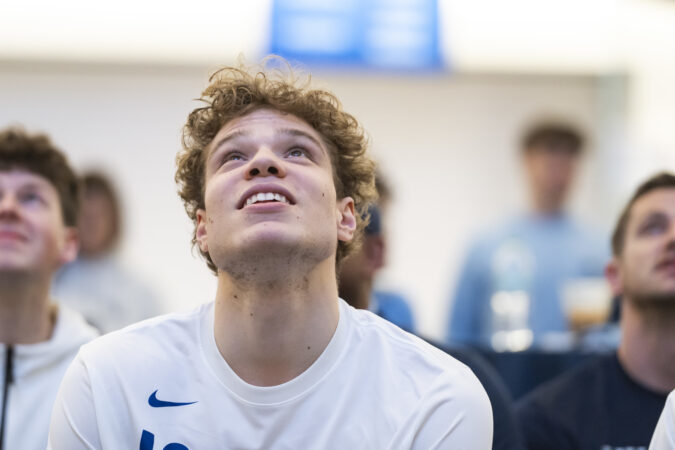
    Matt Hodge stared up at the screen Sunday night at a private Selection Sunday watch party and smiled and cheered with the rest of his Villanova teammates when their name and number were called.

    Villanova’s return to March Madness, the first NCAA Tournament appearance by the men’s basketball team since 2022, is a first for much of the team, and would be for Hodge, a redshirt freshman, if he didn’t have his right leg heavily wrapped in a brace following surgery last week to repair a torn ACL.

    He was understandably dealing with mixed feelings on what was a celebratory night for players, coaches, their families, and program donors.

    “It’s fun to get to see our name get called,” Hodge said, “but at the same time I won’t be able to go and I won’t be able to play. So it’s a feeling of regret and of timing.”

    His season came to an abrupt end early in the second half of Villanova’s Feb. 28 loss to St. John’s at Madison Square Garden. Hodge, a power forward who started in all 29 Villanova games to that point, got the ball in the post against Big East player of the year Zuby Ejiofor and tried to make a move.

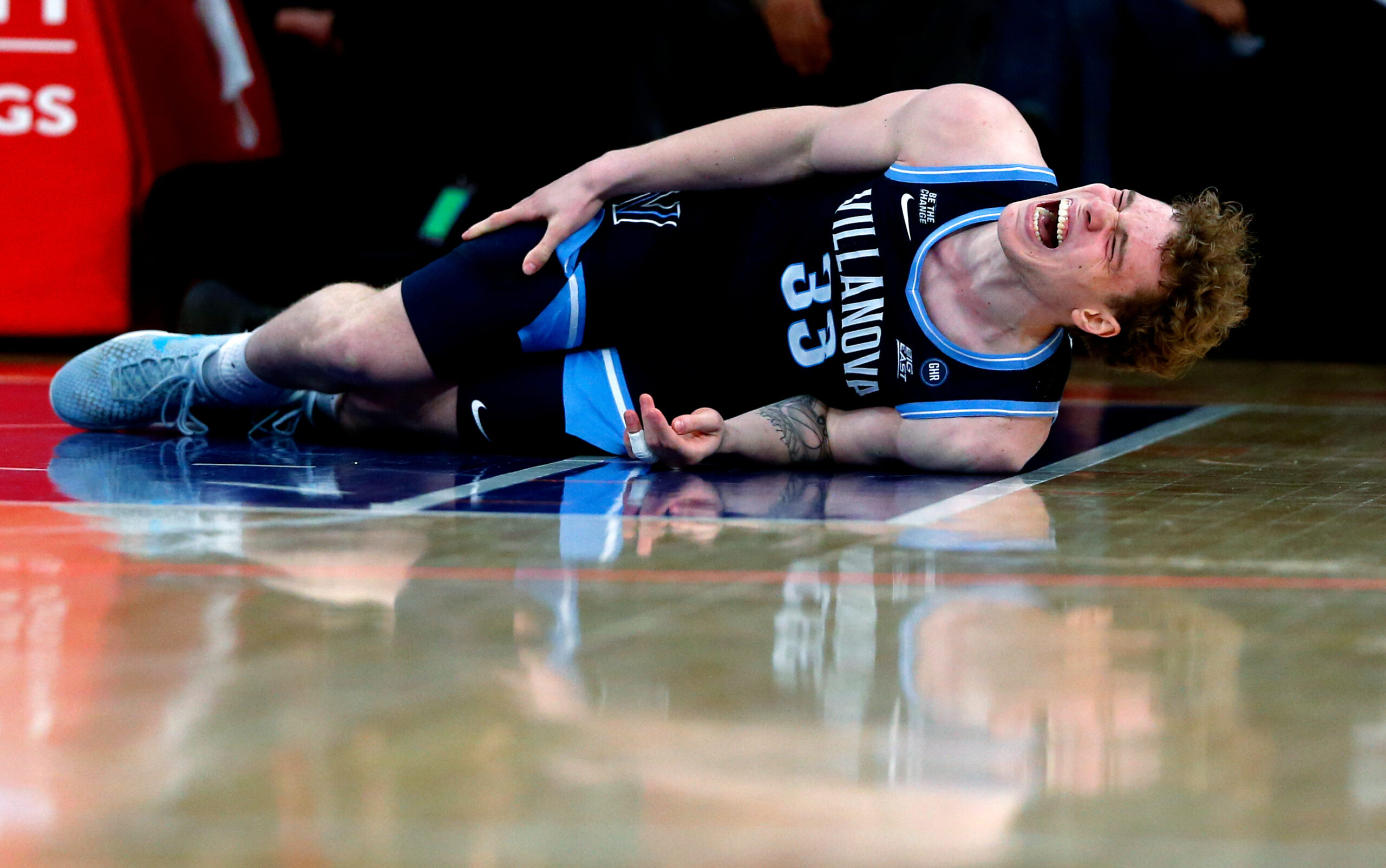
    Instead, he collapsed to the floor and writhed in pain.

    “It was a typical basketball play,” Hodge said. “I just knew the moment I planted my foot and I tried to spin off Zuby, I felt something and I knew right away it was wrong.”

    Villanova forward Matt Hodge reacts in pain after suffering a torn ACL during the game against St. John’s on Feb. 28.

    His mind went instantly to his younger brother, Jayden, a high school star who suffered a torn ACL and meniscus in early January.

    “The first thing I said was, ‘I think I tore my ACL like my brother,’” Hodge said.

    Further testing proved his words to Villanova’s athletic training staff true. It’s a cruel result, but Jayden’s experience and recovery have given Hodge someone close to talk to and go through the emotional roller coaster with. The brothers, born in Belgium, came to the U.S. and won a state championship together at St. Rose High School in Belmar, N.J. Jayden, a senior who now plays at Montverde Academy in Florida, is committed to Northwestern.

    “I ask him every day for tips and stuff,” Hodge said. “We can go through it together. He’s a little bit ahead of me, but he also tore his meniscus, so in like a week or so I’ll be ahead of him.”

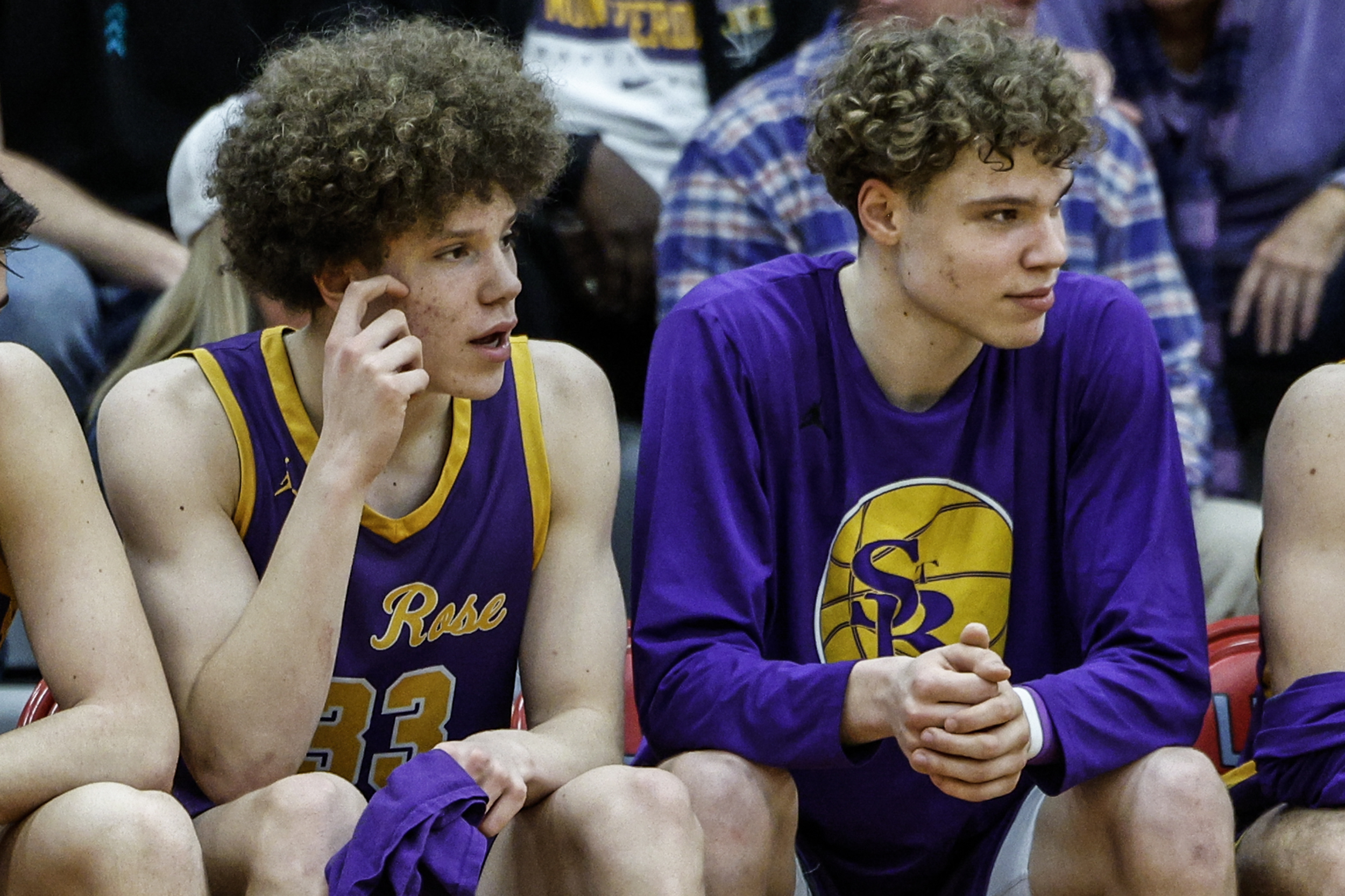
    St. Rose’s Jayden (left) and Matt Hodge watch their team play Bishop Eustace during the fourth quarter of a playoff game on March 4, 2024.

    Hodge’s recovery right now is mostly just relaxing in the immediate aftermath of surgery. He walks by using crutches and keeps his right leg stiffened. Soon, he’ll begin flexing the knee more and will work on building back strength in his quadriceps since his surgery required a nerve blocker. In about six weeks, he said, he’ll shed his current brace to a walking brace and can begin activities like riding a bike.

    It’s a long road back to the basketball court, but Hodge reiterated what Villanova coach Kevin Willard said earlier this month, that the aim is for him to be back to normal basketball activities by mid-to-late October and the goal is to be ready for the beginning of the 2026-27 basketball season.

    “I feel like obviously it’s still a long way ahead of me, but I want to have a goal and I think that goal is pretty realistic,” Hodge said. “I’m just working toward that and I know, in my head and deep down, anything is possible. I might not be ready yet, or I might be ready quicker.”

    Of course, he wishes he was ready by Friday afternoon, when eighth-seeded Villanova faces No. 9 Utah State in a first-round West Regional game in San Diego. The Wildcats could certainly use him. After missing his freshman season because of an NCAA ruling on his academic eligibility following his high school transfer from Belgium to St. Rose, Hodge had an impressive first season of college basketball.

    He averaged 9.2 points and 3.6 rebounds while shooting nearly 37% from three-point range.

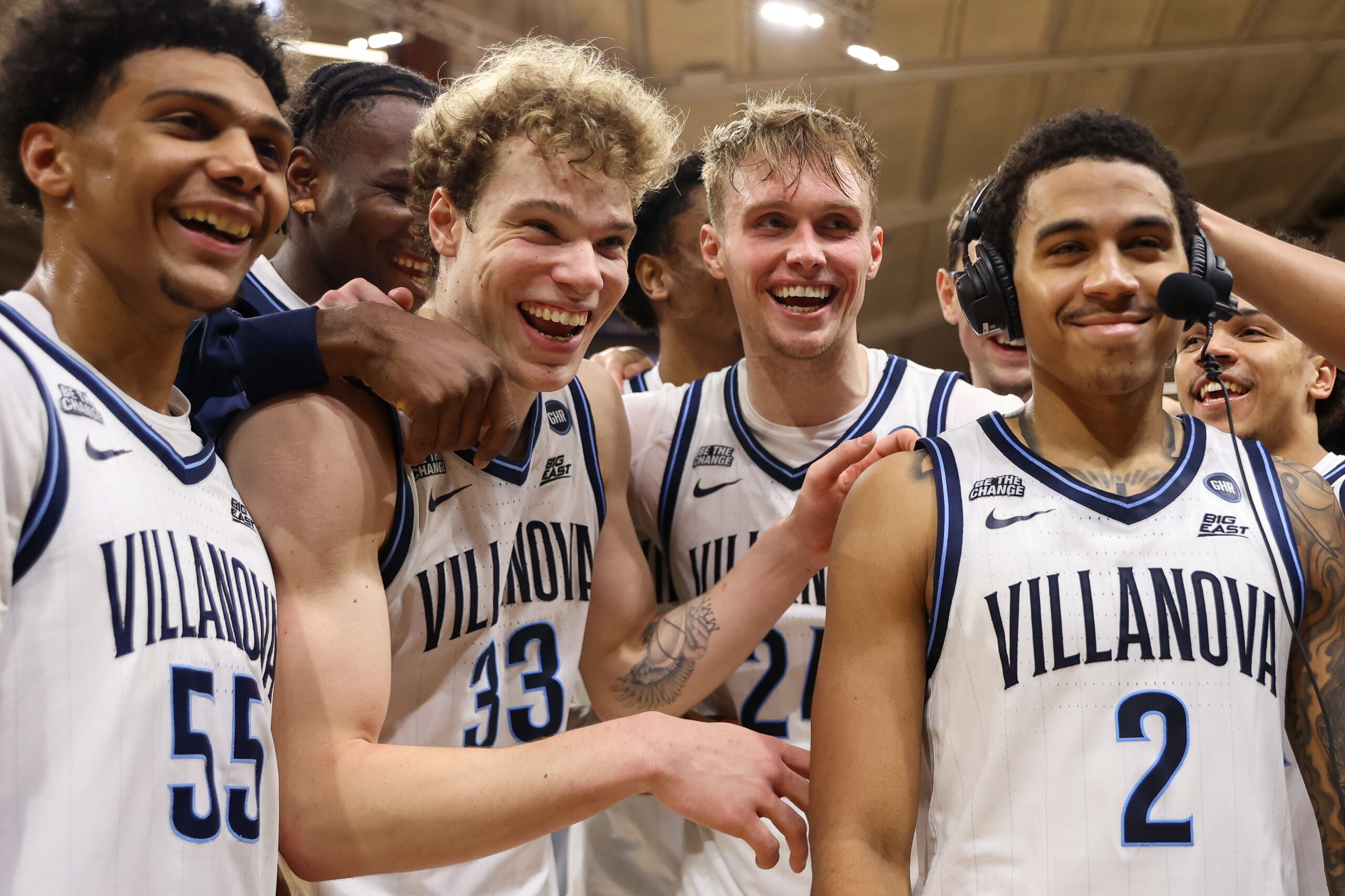
    From left, Villanova’s Acaden Lewis, Matt Hodge, Duke Brennan, and Bryce Lindsay after a 79-61 win against Pittsburgh on Dec. 13,

    Without him, Villanova’s depth has taken a hit, especially in a frontcourt where only two players, centers Duke Brennan and Braden Pierce, are taller than Hodge, who is 6-foot-8. Villanova starts Malachi Palmer (6-6) at the power forward spot and sometimes has lineups on the court with four guards and one center, harkening back to the early days of Jay Wright. This quartet, however, doesn’t sing the same way as that one did.

    Willard has mentioned changing things up. He said again Sunday said he could see Villanova opting to have Brennan and Pierce on the floor at the same time, but they haven’t done so in the three games since Hodge went down. But Villanova’s first-round loss in the Big East tournament featured a rebounding disadvantage of 46-25, and it might be time to adjust against a Utah State team that isn’t huge but attacks the offensive glass.

    A win on Friday likely means a date Sunday with top-seeded Arizona, the ninth-best offensive rebounding team in the country that has a 7-2 center and a pair of 6-8 forwards who cause havoc on the glass.

    Hodge was at home watching Thursday night as Villanova crumpled under the bright lights. The days after the injury have been isolating, but his family has been in town, his girlfriend is on campus, and his teammates and coaches have been supportive.

    The pain is “more mentally than anything physically,” Hodge said.

    “I just got to keep my head up now and support the team.”

  • House of the week: A three-bedroom rowhouse in East Falls for $415,000

    House of the week: A three-bedroom rowhouse in East Falls for $415,000

    For Sarina Sims, the four years spent in the East Falls rowhouse and the surrounding neighborhood was “like a warm hug.”

    For her wife, Phoebe Sims, leaving will be “kind of bittersweet.”

    But their well-planned stay in Philadelphia is ending as they return to their native North Jersey. They had wanted to try something different for a few years and “Philly seemed like a great option,” Phoebe said.

    The living room has hardwood floors and an exposed brick wall.

    Sarina is a producer of music festivals and other live events, and Phoebe is in learning and development for a restaurant chain.

    They had never heard of East Falls, but while walking in Manayunk they met a man who recommended it. Reasons included easier parking, less noise, and room for their two dogs to roam.

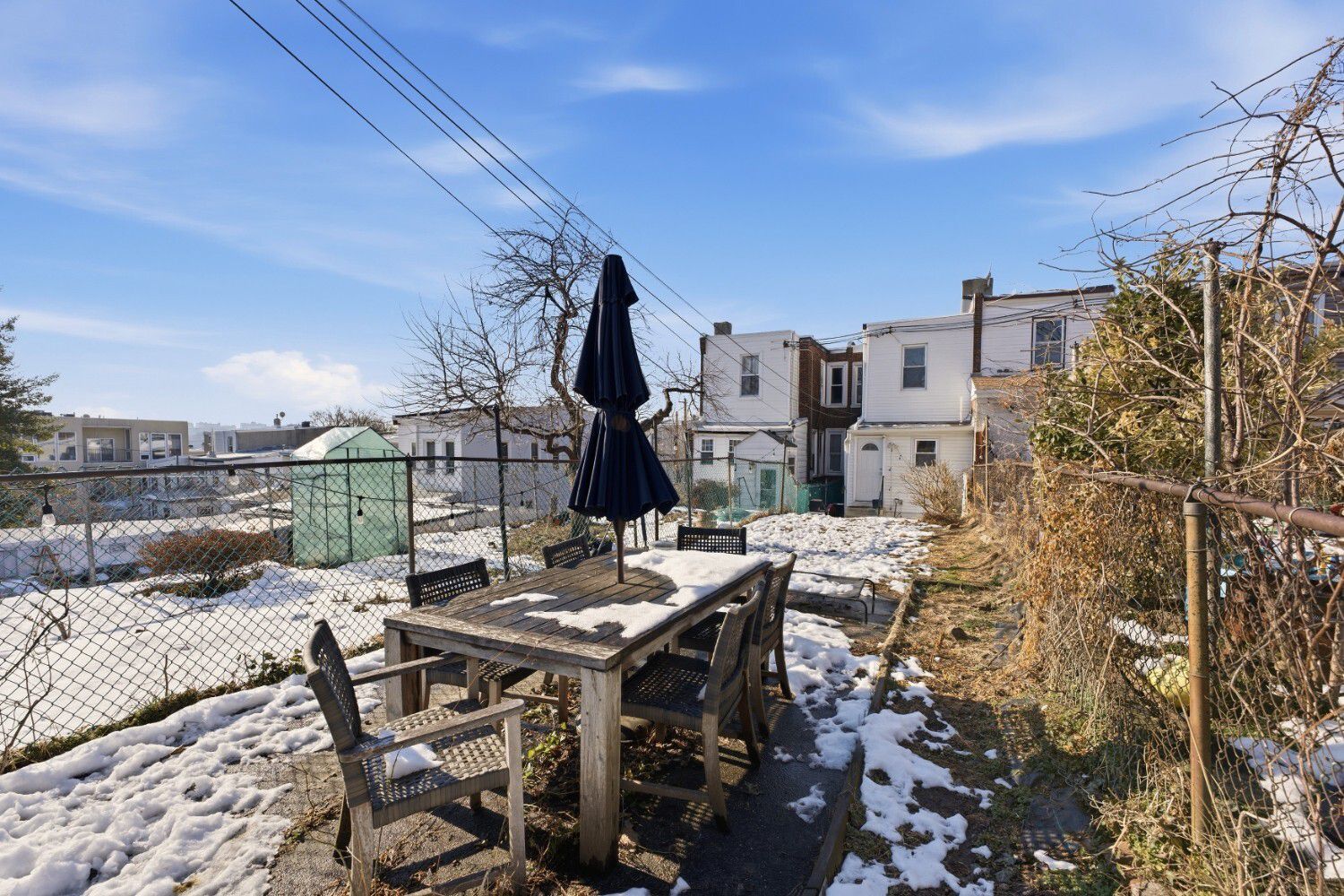
    The backyard, which has a brick patio and outdoor fireplace.

    The three bedroom, two-bathroom house, built in 1939, has 1,183 square feet of living space.

    The tiled entryway leads to the living room with hardwood floors, and an exposed brick wall. A “bonus room” connected to the living area could serve as a home office.

    The dining room can accommodate a large table, and the kitchen has granite counter tops, tile flooring, and updated appliances including a Samsung four-door refrigerator, a five-burner gas range, and chrome hardware.

    The kitchen has granite counter tops, tile flooring, and updated appliances.

    The bedrooms are on the second floor. The primary has bay windows and two closets.

    The backyard has a brick patio and outdoor fireplace.

    The primary bedroom has bay windows and two closets.

    The house is a short ride to Main Street Manayunk and Thomas Jefferson University. The East Falls SEPTA Regional Rail station is walkable.

    It is listed by Evan Frisina of Compass Realty for $415,000.

  • St. Patrick’s Day reminds Philadelphia of its immigrant roots, and its responsibility today

    St. Patrick’s Day reminds Philadelphia of its immigrant roots, and its responsibility today

    Every year, St. Patrick’s Day turns Philadelphia green.

    Crowds gather along the Parkway. Families celebrate in neighborhoods shaped by generations of Irish Americans. We honor a heritage that is now inseparable from the city’s identity — a story of resilience, faith, and hard work that helped build Philadelphia into what it is today.

    For me, that story is personal.

    My parents were Irish immigrants who settled in Philadelphia in search of opportunity and stability. By the time they arrived, earlier waves of Irish families had established strong neighborhoods, parishes, and institutions. My parents found jobs, community, and a sense of belonging. They raised their children here and became part of the fabric of the city.

    But the welcome Irish immigrants eventually experienced was not always guaranteed.

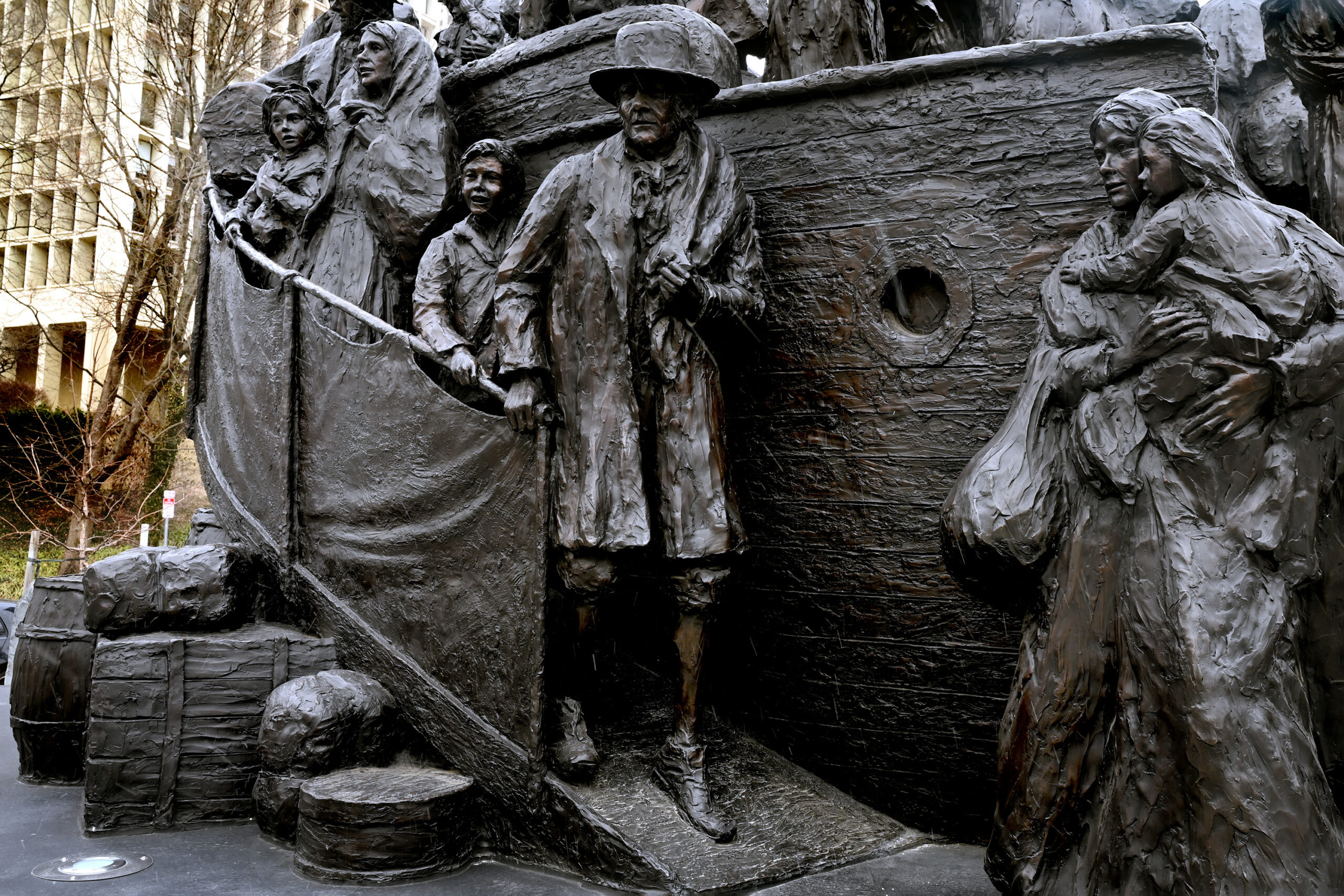
    A detail of the “Irish Memorial An Gorta Mor (The Great Hunger)” in Foglietta Park. The aspirations of immigrants today are not so different from those of the Irish families who once arrived at the port of Philadelphia with little more than determination and hope, writes Anna Gallagher.

    In the 19th and early 20th centuries, Irish newcomers often faced suspicion and discrimination. They were portrayed as outsiders and told they did not belong. Over time, through perseverance and the support of local communities, they became integral to Philadelphia’s civic and economic life. Today, their story is celebrated as part of the American immigrant narrative.

    That history is worth remembering, especially now.

    Across the country and here in Pennsylvania, immigrant families are navigating an increasingly complex and uncertain landscape. Many are longtime residents who work, pay taxes, and contribute to their communities. Others are seeking refuge from violence or instability abroad. All are striving for the same things previous generations sought: safety, opportunity, and the chance to build a future for their children.

    The Irish immigrant experience is often remembered as a story of eventual success. But that success was not inevitable, writes Anna Gallagher.

    Yet many face significant barriers. Access to legal representation remains limited. Immigration policies shift quickly, creating confusion and instability. Families live with the fear that a routine encounter could separate parents from children. Employers struggle to retain valued workers. Entire neighborhoods feel the ripple effects of uncertainty.

    As executive director of the Catholic Legal Immigration Network Inc., the nation’s largest network of nonprofit immigration legal services providers, I see both the challenges and the promise every day. I see mothers seeking asylum, fathers working multiple jobs to support their families, and young people who have grown up in this country hoping to fully belong. I also see the extraordinary contributions immigrants continue to make to cities like Philadelphia.

    Immigrants start businesses, work in hospitals and construction sites, care for the elderly, and teach in classrooms. They strengthen the local economy and revitalize neighborhoods. Their aspirations are not so different from those of the Irish families who once arrived at the port of Philadelphia with little more than determination and hope.

    St. Patrick’s Day offers a moment to reflect on that continuity.

    The Irish immigrant experience is often remembered as a story of eventual success. But that success was not inevitable. It was made possible by communities willing to open doors, institutions willing to offer support, and policies that allowed families to put down roots.

    Philadelphia has long been renewed by newcomers. From South Philadelphia to Northeast neighborhoods and beyond, immigrants have shaped the city’s culture, economy, and civic life. That pattern continues today, if we choose to sustain it.

    This is not simply about honoring heritage. It is about shared prosperity. Cities thrive when families feel secure enough to invest in their neighborhoods, pursue education, and contribute fully to community life. They thrive when longtime residents and newcomers alike see themselves as part of a shared story.

    Green-wearing Mayor Cherelle L. Parker is with State Sen. Sharif Street (right) during the annual Philadelphia St. Patrick’s Day Parade in 2025.

    As we celebrate St. Patrick’s Day, Philadelphia has an opportunity to honor its immigrant roots in a meaningful way. That means supporting policies that keep families together and create fair, orderly pathways through our immigration system. It means expanding access to legal representation so individuals can navigate that system effectively. And it means fostering a civic culture that recognizes immigrants not as outsiders, but as neighbors and fellow Philadelphians.

    My parents’ journey from Ireland to Philadelphia is one story among many. It is a story of welcome, hard work, and belonging. The question before us now is whether we will help ensure that today’s immigrant families have the same chance to contribute, to build, and to call this city home.

    Immigration is not just part of Philadelphia’s past. It is central to its present, and vital to its future.

    Anna Gallagher is executive director of the Catholic Legal Immigration Network Inc. (CLINIC). Born in Philadelphia to Irish immigrant parents, she is a nationally recognized expert on immigration and refugee policy and a longtime advocate for the rights and dignity of migrants.

  • Letters to the Editor | March 17, 2026

    Letters to the Editor | March 17, 2026

    A senseless war

    In Sunday’s Opinion section, Joe Sestak, Trudy Rubin, and Will Bunch laid out a very convincing accounting of the senselessness of another “endless” war in the Middle East. They also highlighted the lack of understanding that President Donald Trump and his administration have of the history and culture of that part of the world. Given this, why has Congress failed to exercise its constitutional responsibility to end this unlawful war? About 13% of our tax dollars go to funding a military that blindly obeys the orders of a bully president. War is not the answer. Sincere, peaceful, intelligent negotiations, and sensitivity to the needs of the people through community building initiatives are ways to avoid war. Resources spent on military actions could be redirected to address pressing social issues in the U.S., such as poverty, housing, and education.

    Bruce Charlick, Jenkintown

    The Inquirer has performed an outstanding public service by publishing three first-rate opinion pieces about the misguided war in Iran. Joe Sestak provides detail and context about issues such as access to rare earth minerals that hardly ever get attention in news coverage. He chillingly highlights the dominant position that China has achieved while the president’s been out playing golf.

    Inquirer regulars Will Bunch and Trudy Rubin once again offer insights and perspective that all of us really need if we are to respond intelligently to the madness of our deranged president.

    Thank you for your journalistic excellence.

    Laslo Boyd, Philadelphia

    In her most recent column, Trudy Rubin expressed outrage at reports that Russia may be providing Iran with intelligence on locations of U.S. troops. If true, we should all be furious — Russian collusion with Iran puts American service members directly in harm’s way.

    Yet instead of imposing tougher penalties on Russia or strengthening U.S. support for Ukraine, Donald Trump has eased sanctions.

    Meanwhile, lives have already been lost and Americans face the risk of retaliation from a war of choice launched without an imminent threat from Iran.

    Politically, economically, and morally, this “little excursion” is already proving to be a grave mistake.

    Maria Duca, Philadelphia

    Special measures

    As a pediatric rheumatologist in Philadelphia, I care for children living with complex, chronic autoimmune diseases, like juvenile arthritis and lupus, which can cause lifelong pain and disability without timely treatment. But across Pennsylvania, Delaware, and New Jersey, too many families are waiting months or being forced to travel across state lines to get their child the care they need.

    That’s because there are only a handful of pediatric rheumatologists in our state, with some regions having none at all. The shortage is growing worse still as a result of inflation, administrative burdens, and outdated physician reimbursement rates. We have created a system that discourages physicians from entering or staying in fields like pediatric rheumatology — and it’s children who are paying the price.

    It’s time for our leaders in Washington to modernize physician payment to ensure updates that reflect the true cost of care and support the next generation of pediatric specialists. Without reform, families in Pennsylvania and beyond will face longer waits, longer drives, and worsening outcomes for children who deserve better.

    Jay Mehta, Philadelphia

    Join the conversation: Send letters to letters@inquirer.com. Limit length to 150 words and include home address and day and evening phone number. Letters run in The Inquirer six days a week on the editorial pages and online.

  • Aaron Nola: Team Italy’s surprising run in World Baseball Classic was ‘some of the best times I’ve ever had’

    Aaron Nola: Team Italy’s surprising run in World Baseball Classic was ‘some of the best times I’ve ever had’

    MIAMI — As a way of summarizing Aaron Nola’s two-start guest spot with Italy’s national baseball team, let’s borrow a phrase that fans in his adopted country can appreciate.

    Venit, vidit, vicit.

    Because Nola came from Phillies camp. He saw lineups filled with major league stars. And he did his part to help Italy conquer, leaving with a one-run lead after four innings in the World Baseball Classic semifinal here Monday night.

    As it turned out, though, this wasn’t Julius Caesar at the Battle of Zela. Fueled by a potent, relentless, and frenetic offense, Venezuela ran down Italy’s Cinderella run, scoring three times in the seventh inning for a 4-2 victory that kicked off a party among a partisan — and deafeningly loud — sellout crowd in South Florida.

    Next up for the Venezuelans: Team USA for the gold medal — yes, they actually receive medals — at 8 p.m. Tuesday night.

    And for the Italians (or in most cases, Italian Americans)? Only fond memories from what many described as two of the best weeks of their careers. That included Nola, a veteran of 11 major league seasons and four consecutive playoff appearances with the Phillies.

    “It was super cool. Super cool,” Nola said. “We had the time of our lives, man. Some of the best times I’ve ever had.”

    Say this for Team Italy: It was the darling of the two-week tournament, with an espresso machine in the dugout and contributions up and down the lineup. (Phillies outfield prospect Dante Nori, for instance, went 8-for-20 with two homers and an 1.185 OPS.)

    Initially, manager Francisco Cervelli planned to roll with Michael Lorenzen against Venezuela, but with a taxed bullpen, he went with Aaron Nola on regular (four days) rest.

    And Nola was more than a pitching ringer, even if his initial interest in competing was, in part, to use the intensity of the WBC as a testing lab after making adjustments to his throwing program off the worst season of his career.

    On that count, Nola was mostly, well, eccelente.

    Last Wednesday, he cranked up his fastball to 94.5 mph, uncorked his signature curveball, and dominated Mexico for five scoreless innings to push Italy to the top seed in pool play over the U.S. Against Venezuela, he wasn’t as sharp. He topped out at 94.1 mph, got only two swings and misses, and left a curveball up for Eugenio Suárez’s solo homer in the third inning.

    Yet, he struck out three batters, all on curveballs. He got longtime nemesis Ronald Acuña Jr. (16-for-52 with four homers and a 1.025 OPS in his career against him) looking at a curveball in the third inning. And he left with a 2-1 lead.

    “I kind of felt out of whack today, but battled as best as I could,” Nola said. “I tried to get the sinker down later on. Felt like that was kind of the only thing working. I got some ground balls with it and kept the guys in the game as best I could.”

    Nola also threw only 59 pitches, 10 less than his previous start. The plan, he said, was not to go more than five innings or 80 pitches. But manager Francisco Cervelli opted for a pitching gambit to compensate for a taxed bullpen.

    Rather than starting former Phillies righty Michael Lorenzen against Venezuela and saving Nola for the final, if Italy advanced, Cervelli split the game between them. He used Nola for four innings and tried to get four from Lorenzen. But Jackson Chourio, Acuña, Maikel Garcia, and Luis Arraez notched consecutive singles in the seventh to nearly blow the retractable roof off loanDepot Park.

    Regardless, Nola said he was satisfied with the workload in what amounted to his penultimate start before the season.

    “Overall, my body and arm feels good,” he said. “I mean, I’m built up.”

    Phillies prospect Dante Nori was among the standout players for Italy in the World Baseball Classic.

    Besides, as Nola discovered, the tournament was about something bigger than tuning up for the season.

    “There was a lot of people watching — watching in Italy,” he said. “That was a big goal, to bring more baseball to Italy. And we did. I think most of the American guys in this clubhouse don’t really understand what we did for that country.”

    Nola hasn’t been to Italy. He qualified to represent the country in the WBC because his great-grandparents on his father’s side were from Italy (the Campania region in the south, to be exact). It was supposed to be a family affair. Nola’s brother, Austin, signed up to play but withdrew after getting hired as the Mariners’ bullpen coach.

    But as Nola put it, he left the tournament with two dozen new brothers. And before they went their separate ways, they spent about 90 minutes together in the clubhouse after the game to reflect on the last two weeks.

    “Nobody thought we were going to make it this far, and we did,” Nola said. “We’ve got a great group of guys. I love all those guys in there. I’m really glad I played.”

    For more reasons than he ever imagined.

  • Ocean County College dean charged with sex assault of minor, prosecutors say

    Ocean County College dean charged with sex assault of minor, prosecutors say

    A man who recently served as a dean at Ocean County College was charged with sexually assaulting a minor, the Atlantic County Prosecutor’s Office said Monday.

    James Hadley, of Barnegat in Ocean County, was arrested Friday when he allegedly traveled to Pleasantville in Atlantic County to meet the juvenile for a sex act, the prosecutor’s office said. Hadley was described as 66 years old, but public records indicate that he is 65.

    Earlier this year, Hadley became the dean of the School of Business and Social Sciences at Ocean County College.

    In an emailed statement Monday night, the college said it was informed by law enforcement on Friday afternoon about “the situation regarding James Hadley.”

    The statement continued: “Upon receiving this information, we took immediate action and placed Mr. Hadley on a suspension and restricted him from campus. An interim dean has been appointed.”

    Ocean County College said it has “no record of complaints or reports concerning his conduct while employed with our College. As an open active investigation is pending, the College will not be offering further comment at this time. We are fully cooperating with any police inquiry.”

    The prosecutor’s office said that based on three alleged incidents this month, Hadley was charged with second-degree sexual assault of a victim under the age of 16, second-degree luring a minor to commit a sexual act, third-degree endangering the welfare of a child, and fourth-degree criminal sexual contact.

    The investigation showed Hadley had previously met the child to engage in sexual acts that he paid the child to perform, the prosecutor’s office said.

    The case, which remains open, was investigated by the Pleasantville Police Department with assistance from the Atlantic County Prosecutor’s Office’s Special Victims Unit.

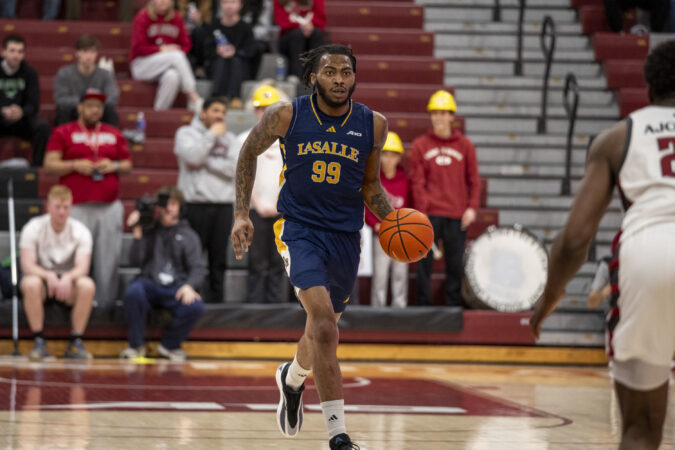
  • Report: La Salle’s top scorer Rob Dockery is entering the transfer portal

    Report: La Salle’s top scorer Rob Dockery is entering the transfer portal

    La Salle guard Rob Dockery is entering the transfer portal, according to a report from League Ready.

    The redshirt sophomore was one of the few bright spots for La Salle, who finished 9-23 under first year head coach Darris Nichols. Dockery averaged a team-high 12.5 points, 6.1 rebounds, and 2.3 assists.

    Dockery was in and out of La Salle’s starting lineup in nonconference play before becoming a regular starter during Atlantic 10 conference play. On March 9, he was named the Big 5 Player of the Week after scoring 25 points in back-to-back games against Fordham and St. Joseph’s. He hit his career-high 33 points in a loss against St. Bonaventure on March 11 in the first round of the A-10 Tournament.

    Prior to La Salle, the 6-foot-6 guard spent two seasons at Texas A&M. He redshirted as a freshman and made just one appearance in the team’s season opener as a sophomore.

  • Philly has been seeing huge temperature swings within 24 hours. Here’s what’s going on.

    Philly has been seeing huge temperature swings within 24 hours. Here’s what’s going on.

    Like so many humans, perhaps the atmosphere is having issues adjusting to the time change. At the very least, it’s having trouble keeping track of the seasons.

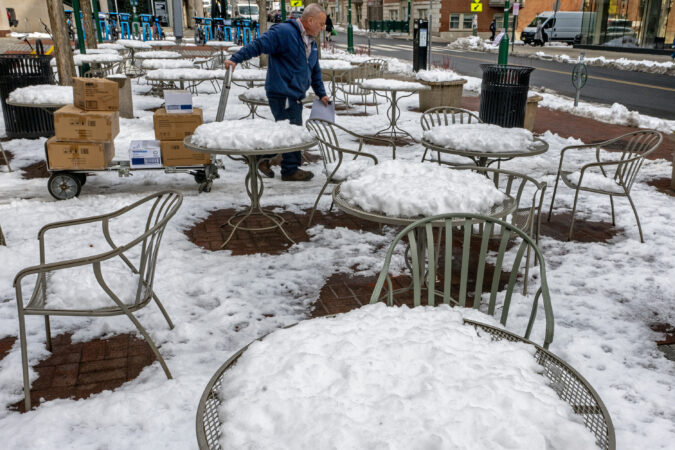
    After making a run at 70 degrees on a stormy Monday, on Tuesday it will be welcome back to hats and gloves in Philly.

    Temperatures were forecast to fall to freezing by daybreak, which would be a drop of 35 to 40 degrees in less than 24 hours. In some years, that would rank among the biggest annual day-to-day temperature drops.

    But this comes less than a week after the official readings plummeted from 83 degrees, normal for mid-June, to 35 in 24 hours, one of the largest day-to-day temperature swings in Philly’s climate record.

    In official record-keeping dating to 1874 — covering more than 55,000 days — the Wednesday-to-Thursday shift would rank in the top 20 for day-to-day temperature tumbles, according to an Inquirer analysis.

    “It’s really remarkable,” said Eric Balaban, pulmonary and critical care fellow at the Temple Lung Center.

    He and other experts say that aside from what it may do to the morale of spring’s ardent fans, the thermal roller-coaster and the accompanying winds likely are having effects on health, particularly for people with respiratory cardiovascular conditions.

    And we probably should expect to see the dramatic swings to continue for a while, said Matt Benz, senior meteorologist with AccuWeather Inc.

    “I’d be surprised if we didn’t, given the pattern we’ve being going through,” Benz said.

    Why the temperature has been so jumpy lately in Philly

    Philadelphia and other areas in the mid-latitudes are prone to become battlegrounds this time of year between the stubborn winter and the impatient spring.

    March is notorious for temperature swings as cold air masses from the north encounter encroaching warmth and storms tend to form along the borders of the skirmishes.

    One reason the contrasts have been especially vigorous this year is the obvious. “After this hard winter, that’s to be expected,” said Ray Martin, a lead meteorologist at the National Weather Service. We haven’t had many of those lately.

    But that 48-degree drop last week belongs in an elite category. It ranked No. 18 among day-to-day temperature falls, based on the available records. The all-timer was the 57-degree drop from March 28 to 29 in 1921, with several 50-degree drops appearing in the record.

    Whenever they occur, the radical shifts can have health consequences, according to medical experts and a variety of studies.

    The possible health effects of rapid temperature changes

    The temperature changes typically are set off by potent fronts, such as the one that crashed through the region on Monday, and they generate powerful winds.

    By stirring particulate matter and transporting early tree pollens, the winds present a risk to those with respiratory conditions and allergies, said Manav N. Segal, with the Chestnut Hill Allergy & Asthma practice.

    “We are seeing an increase in call volume already because of patients’ spring allergy symptoms,” he said Monday. And conditions this week are just a prequel: The allergy season will pick up steam once the weather turns more consistently warmer and the allergy season intensifies, he said.

    Said Balaban, “People who have preexsiting conditions are simply at higher risk.”

    Rapid changes in temperature and levels of atmospheric moisture with frontal passages can irritate the airways and increase airway inflammation, said Joann Martin, nurse with Guardian Nurses Healthcare Advocates in Flourtown, Montgomery County. Studies have shown associations between temperature variability and increased asthma-related hospital visits.

    Changes in temperature, humidity, and barometric pressure — a measure of the weight of the air that falls as fronts approach and rises after they pass — are “recognized triggers for migraine and severe headaches.”

    In addition, “Sudden temperature shifts can affect blood pressure, vascular tone, and cardiac workload,” Martin said, increasing the changes for heart attacks and strokes.

    For most people, however, after a long winter, the temperature drops are a source of frustration over the delay of a much-anticipated spring.

    More temperature swings are likely in coming weeks in the Philly region

    For now, at least, it appears that the region’s cherry blossoms should be safe, even though temperatures Tuesday morning were expected to come close to freezing in Philly and may fall into the upper 20s Wednesday and Thursday mornings.

    Daytime highs won’t be much higher than 40 Tuesday and Wednesday, before a modest warmup begins.

    It likely would take a serious late-March or early-April freeze to damage the blossoms, said Sandi Polyakov, head gardener for the Japan America Society of Greater Philadelphia. He expects a bloom peak in early April.

    However, the temperature seesaw probably isn’t over, said AccuWeather’s Benz.

    “There’s still a lot of cold air left over in Canada,” he said, ”and a lot of warmth coming up from the Gulf.”

    He noted that Monday’s storm was dropping a healthy 20 to 30 inches of snow in the western Great Lakes.

    “Until we get out of that type of stuff,” he said, “the cold air doesn’t have to go very far to get here.”

  • Baby killed in ambulance crash was being driven to hospital by her grandfather, sources say

    Baby killed in ambulance crash was being driven to hospital by her grandfather, sources say

    An infant who died in a crash involving a private ambulance early Sunday morning was being driven to the hospital by her grandfather, who had jumped behind the wheel of the emergency vehicle parked at the family’s home after the baby became unresponsive, sources said.

    Robert Coleman was trying to rush the baby and her mother to a hospital around 5:15 a.m. after the child was found in distress inside their Frankford house, said a law enforcement source who spoke on the condition of anonymity to discuss an ongoing investigation.

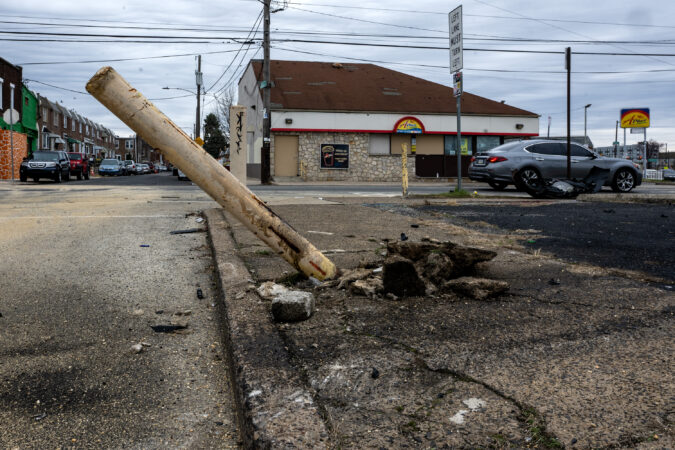
    Police said Coleman, 51, had been drinking — and did not turn on the ambulance’s flashing lights or siren before he sped through a red light at the intersection of Torresdale and Harbison Avenues and collided with a sedan.

    The mother and baby, who the source said were not restrained, were ejected through the windshield of the ambulance, police said.

    The 2-month-old infant, Marian Harris, was declared dead shortly after the crash at an area hospital. Her 32-year-old mother, whom police did not identify, was critically injured with severe head trauma, they said.

    It was not immediately clear why the ambulance, owned by Ambulance Express Inc. or Medstar EMS, was parked at the family’s house or whether the grandfather worked for the company or had experience driving emergency vehicles.

    Police said Sunday that the driver would be charged with driving under the influence and related crimes.

    District Attorney Larry Krasner said in a statement Sunday that no charges had been filed, however. He added that the investigation into the crash “may take some time” but that “we are committed to a fair, appropriate and just outcome.”