Tag: topic-link-auto

  • Even a nightmare outing can’t shake Chuck King, the most interesting man in Phillies minor league camp

    Even a nightmare outing can’t shake Chuck King, the most interesting man in Phillies minor league camp

    LAKELAND, Fla. — A name like “Chuck King” almost demands a career as a baseball pitcher.

    And that’s exactly what the Phillies minor leaguer who answers to it chose, though his path had a few detours.

    King, who spent the 2025 season in the double-A Reading starting rotation, is not on the 40-man roster, nor was he extended an invite to major league spring training. When he pitches in Grapefruit League games as a call-up, his jersey doesn’t have a nameplate on the back.

    Even so, King, 28, is taking the opportunity to learn as much as he can from the experience. And that includes Monday’s brutal outing, when the Tigers tagged him for 10 runs while he secured just four outs.

    “I could choose to hang my head,” King said. “I got 10 hung on me today. Never a good feeling. But it taught me something. I learned something from it. And ultimately, that’s the goal of this entire thing.”

    In another life, King wouldn’t have been on a mound at all on Monday. After five years pitching for Texas Christian University, he felt burned out. He wasn’t finding the same enjoyment in the game that he used to, and in 2021 he considered leaving it behind entirely.

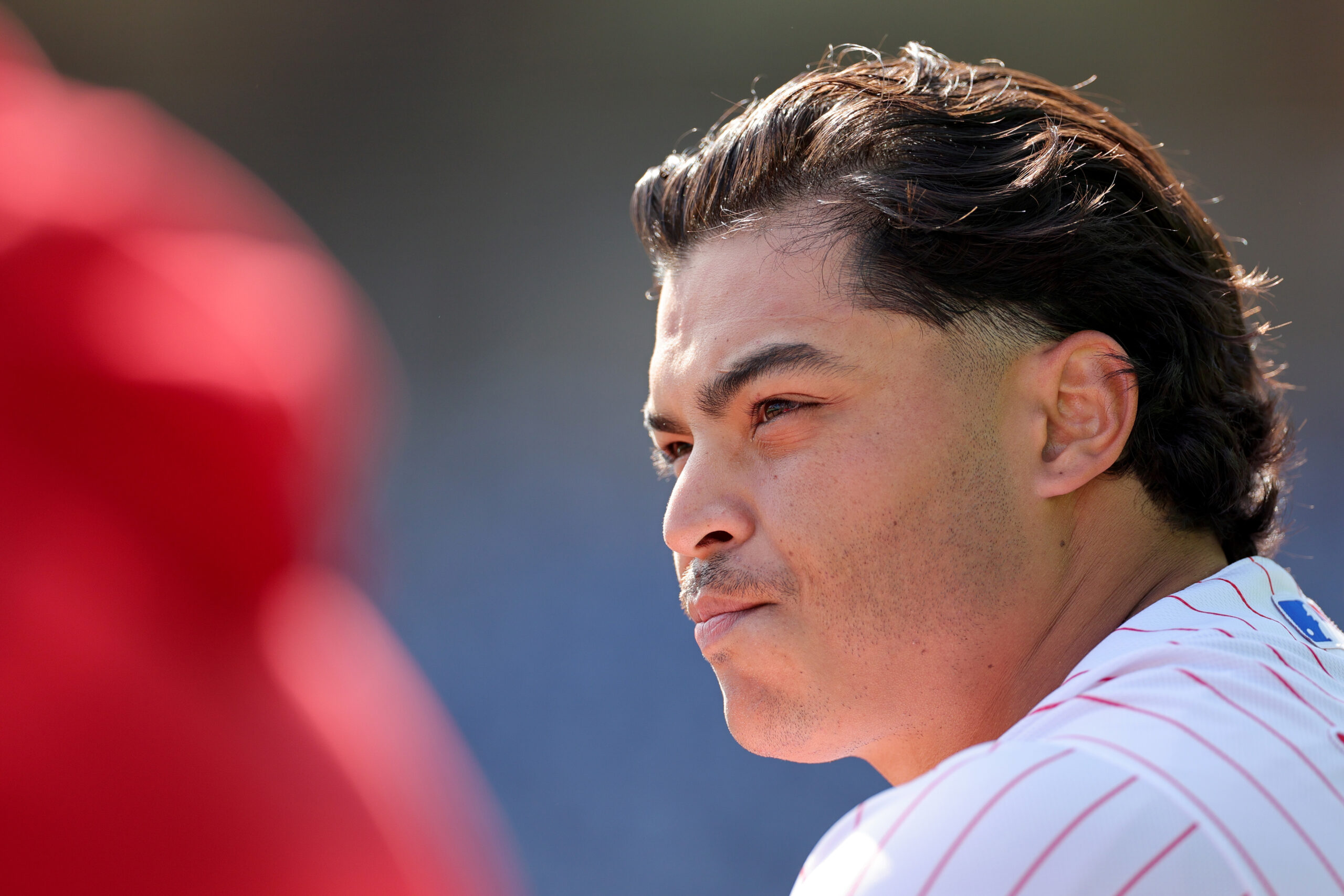
    Chuck King had a 4.38 ERA in 123⅓ innings at double-A Reading last season.

    But when a career in biology — his college major — didn’t appear likely either, King decided to return to baseball in a completely different capacity. The Padres hired King to work in their sports science department.

    King suddenly had access to information and data, like TrackMan software, that he couldn’t have imagined back in college. And he started to get the itch to get back on a mound again.

    “I think the base reason as to why I re-fell in love with the game is because I found clarity and direction as to where to go,” he said.

    On his own time, King would play catch with San Diego minor leaguers and apply the mechanical changes he had gained insight into through his day job.

    Of all things, it was an explosion that changed everything. In 2023, King was working for the Padres’ single-A affiliate, the Lake Elsinore Storm, when a gas line sparked in their stadium and caused a natural gas explosion. The Storm’s scheduled games were canceled over the weekend, but the team still had a workout that Sunday.

    With not much else going on that day, King found himself back on the mound.

    “I thought, ‘Well, it’s a laid back kind of deal, right?’ So I’m gonna go up there and just see what comes out,” King said. “And it was, boom, 96 [mph]. Boom, 96. Boom. I was like, ‘OK, whatever I’m doing is working, and I’m in a really good place mentally, and I think that this is an opportunity for me to jump.’”

    King’s fastball had been in the 92-94 mph range in college. After seeing the payoff on the radar gun, he quit his job and moved to Scottsdale, Ariz., to dedicate himself to his training at Driveline, a data-driven baseball performance center.

    While there, he revamped his arsenal, adding a splitter, and when their pro day rolled around in 2024, King’s fastball touched 98 mph in front of scouts. It landed him a deal with the Phillies. After three years away from pitching, he appeared in 34 games across four levels of their minor league system as a 26-year-old in 2024.

    “I think with where he came from, from analyst to getting himself in shape, getting back on the mound, I mean, he’s got nothing to lose,” said Phillies manager Rob Thomson. “ … He’s got to get ahead in the count, because he’s got good stuff. Split’s good, the cutter’s good, fastball plays. May have to add another pitch, different pitch.”

    Delving deeper into the analytics side of baseball led King to fall back in love with the game. But a desire to learn has been a hallmark of his entire life. He also has an interest in botany and genetics, and is a hobbyist bird-watcher and wildlife photographer.

    King has garnered some attention for the spelling of his middle name, Fuggitt (pronounced FEW-git). He was named after his great uncle, who was a fighter pilot in World War I.

    It may not be very common for a professional baseball player to spend his spare time logging bird photos and identifying wildlife species on an app on his phone, but King doesn’t mind being different.

    Phillies pitcher Chuck King gave up 10 runs on seven hits — including two homers — and four walks against the Tigers on Monday.

    “At the end of the day, you have to remain authentic to who you are as a person,” he said. “And I think people always respect authenticity, and so I’m not going to be inauthentic to what I enjoy doing.”

    King pitched 123⅓ innings for Reading last year, posting a 4.38 ERA. His first three call-ups to the major league side this spring went well. He didn’t allow a run over his first five innings of work, and recorded nine strikeouts to one walk.

    One of the most valuable takeaways from his call-ups has been the conversations he’s had with Phillies pitching coach Caleb Cotham.

    “That dude has blown my mind on seven different occasions,” King said.

    They had a few of those conversations on Monday. Facing a Detroit lineup that included several regulars, including Spencer Torkelson, Riley Greene, Kerry Carpenter, and Colt Keith, as well as top prospect and Delco native Kevin McGonigle, King’s fastball command was erratic. He gave up 10 runs on seven hits — including two homers — and four walks.

    “We talked about making bullpens more gamelike, and understanding when I’m trying to execute this pitch, what’s my thought process?” King said. “What am I telling myself? And all these little fine micro details that you don’t think about until you have a lineup like that.”

    After the game, King went back to minor league spring training and will remain there until the next call-up arrives.

    He’s not dwelling on it. If the last five years have taught him anything, it’s that detours are part of the journey.

    “I got punched in the face and I stumbled back, and then I got hit again, and I got hit. And that’s how it goes,” King said. “But I can guarantee you that I will use that next time and say, ‘OK, like I’ve been here before. I’ve gotten punched in the face. I’ve gotten 10 hung on me.’

    “Good! I will come back with a better mindset and a better perspective to now turn that 10 into five, and then turn that five into three, and then turn that three into one. And that’s the whole goal of it.”


  • As health insurance prices climb, HRAs offer small businesses a flexible option | Expert Opinion

    As health insurance prices climb, HRAs offer small businesses a flexible option | Expert Opinion

    Finding and retaining employees remains a top concern among small-business owners, and offering affordable healthcare benefits continues to be a significant challenge. Because of this, health reimbursement arrangements, or HRAs, have become more popular.

    Simply put, an HRA allows an employer (or an employee) to make tax-free (and tax-deductible to the employer) contributions to an individual’s HRA account.

    The employee can use those funds to reimburse uncovered healthcare expenses or purchase their own health insurance, either from outside brokers or on the Pennsylvania, New Jersey or Delaware healthcare marketplaces.

    HRA options

    A small business can consider a few different HRA options.

    A general HRA is funded entirely by just the employer and often used alongside existing group insurance plans to help reimburse expenses not covered by their existing insurance. These expenses could include co-pays, over-the-counter medication, or even dental and vision care.

    Alternatively, health savings accounts (HSAs) allow employees to contribute pretax dollars for the same purpose.

    “An employer can buy a high-deductible group plan, then use HRA funds to cover part of that deductible,” said Robert Deninno, a founding principal of Precision Benefits Group in Philadelphia. “The appeal is that unused HRA money remains with the employer, unlike HSA funds, which belong to the employee.”

    Deninno said employers can use HRA language to fill in specific gaps in a group plan, such as hospital costs, rather than paying a much higher premium for a richer underlying plan.

    An individual coverage HRA (ICHRA) allows employers to reimburse employees for premiums on health insurance the employee independently purchases.

    A qualified small-employer HRA (QSEHRA) is designed specifically for businesses with fewer than 50 employees that do not offer a group plan. It is more formalized and is similar to an ICHRA.

    HRA popularity

    These arrangements give employers wide discretion, said Ed MacConnell, owner of Total Benefits Solutions in Feasterville.

    “Employers can determine reimbursement levels, caps, frequency, and categories,” MacConnell said. ”That matters because most employers are trying to balance two competing goals: doing right by employees while staying within budget.”

    Many people assume employers just want the cheapest plan possible, MacConnell said, but in his experience the opposite is usually true.

    “Most employers genuinely care about how their choices affect employees and their families,” he said. “HRAs can help by letting them target limited dollars more intentionally.”

    All of these plans have their nuances and it’s best to speak with a health benefits consultant or your payroll company to determine what’s best for your business.

    You won’t be alone. ICHRAs alone grew 52% among small employers from 2024 to 2025 with 83% of employers who previously didn’t offer health insurance options now offering either ICHRAs or QSEHRAs, according to a recent report from the HRA Council, an advocacy organization.

    HRA benefits

    That surge in popularity is because offering HRAs — in addition to or in lieu of group coverage — provides an employer with three significant benefits.

    The first is cost control. The cost of group insurance is expected to rise as much as 10% in 2026, but with an HRA, an employer can contribute whatever amount they can afford, unbeholden to the insurance company’s premiums. With certain HRA plans, an employer no longer has to negotiate with a group insurance provider, and is less exposed to potential privacy violations of an employee’s health history.

    “The employer can decide what to reimburse, how much to reimburse, and under what limits,” MacConnell said. “This flexibility makes HRAs attractive to smaller employers that want to start somewhere rather than do nothing.”

    Another benefit: because an employee can use these funds to purchase their own insurance, they’re no longer limited to the options their employer offers and they may be able to buy more affordable or more suitable plans.

    Finally, there’s the recruiting benefit. Offering an HRA plan allows small businesses to have a response when a prospective employee inevitably asks about health benefits. By contributing even a nominal amount — and allowing an employee to contribute their own pretax dollars — a small business has a healthcare benefit option and becomes more competitive when pursuing talent.

    HRA challenges

    There are challenges with these types of plans. For example, administration can be messy, especially as the company grows or employee situations become more diverse.

    “If 10 employees buy 10 different plans, the employer and broker lose the efficiencies that come with one group carrier and one group policy,” said Deninno. “When employees are scattered across different individual plans, it becomes much harder to resolve claims problems or coverage issues.”

    MacConnell emphasizes the need for a third-party administrator, particularly when a company exceeds 10 to 15 employees.

    “Outsourcing becomes worthwhile when the alternative is tracking many different employees, many different plans, and constant premium changes,” he said.

    For HRAs to work well, it’s also important to educate employees and make sure it fits the company culture. Experts recommend meeting frequently and providing employees with as much support as possible.

    “A good broker or administrator will act as a coworker with your employees,” said MacConnell. “They should help both employers and their employees choose the right plans, answer questions, and act as an advocate.”

  • Original mid-century features and colorful vintage design in Delco

    Original mid-century features and colorful vintage design in Delco

    It may have been the pink and green bathroom that sold Genevieve DeChellis on the mid-century, 1,450-square-foot, five-bedroom brick house in Clifton Heights in early 2024. Or perhaps the colorful lighting above the basement bar sealed the deal.

    She and her fiancé, Jesse Blankschen, had been on the hunt for a house for a while, but nothing felt quite right.

    “We didn’t fully know what we wanted, but we knew what we didn’t want,” DeChellis recalled. “No millennial gray, or millennial beige, or a house without any sign of life.”

    When they spotted the Zillow listing for this home, they instantly knew it was the one. The house not only was filled with color, but it had only been lived in by just one owner who had built the house for his family. It was evident he took great care of the house.

    “The fact that I have a pink and green bathroom feels like a cosmic design,” DeChellis said. “There is so much beautiful tile work in homes and so often it just gets torn out. It’s so happy and I love those two colors together.”

    The pink and green tiled bathroom was one of the features that drew DeChellis to the house.
    The living room’s orange velvet sectional draws the eye, surrounded by secondhand, vintage, and mid-century decor.

    The couple is putting their own personal stamp on the house through aesthetic changes. They’ve been replacing the original wallpaper with fresh paint and thrifting unique items to fill meaningful spaces.

    At the same time, they are preserving the integrity of the home — “those pink and green tiles aren’t going anywhere,” DeChellis insisted.

    She and Blankschen are avid thrifters, and some of their favorite finds come from the Dust Shuttle, an online antiques auctioneer. They’ve snagged unusual art, funky lamps in the shape of a fish and an ice cream cone, and an array of furniture.

    The mid-century kitchen features a yellow GE oven, a stained-glass ceiling soffit light, and a stained-glass pendant light. A red metal table à la 1950s diner is surrounded by red and white vinyl chairs, a Facebook Marketplace purchase.

    The kitchen features soffit lighting and a pendant lamp in stained glass.
    The table and chairs in the kitchen were secondhand finds.
    The mustard-yellow oven is not equipped with modern features.

    “I messaged my mother about how to clean the oven and she said to turn on the self-cleaning function,” DeChellis recalled. “I said, ‘Mother, this is not a 21st-century oven.’”

    The living room contains a comfortable velvet orange-brown sectional couch. That’s where the couple, who plan to marry in May, relax and watch TV. The bookshelf is home to some of their funky thrift finds, including the fish lamp.

    The cozy basement is perfect for movie nights where friends gather to watch films from a projector, displayed onto a screen. Guests lounge on the blue couch with attached Formica end tables or in the pair of vintage wire Mexican Acapulco chairs — one orange and one green. The couple found the chairs at the Elephant’s Trunk Flea Market in Connecticut, and managed to squeeze them into their car for the ride home.

    “They are very comfortable, which is kind of surprising,” DeChellis said.

    The basement, where the couple enjoy movie nights with friends.

    The vintage wooden bar, with a faux stone facade and Formica top, set under colorful stained-glass lighting, evokes a scene from Mad Men. The bar is home to the vanilla ice cream lamp that stands about two feet tall, a very special thrifting find. She first spotted a similar one years ago, then again at a friend’s house.

    “I thought it was a sign” that such a distinctive lamp crossed her path twice, recalled DeChellis. “A few weeks later I found it at a thrift store. Somewhere out there a chocolate one and strawberry one are waiting for me.”

    DeChellis finds beauty in the rich histories of the pieces she thrifts. They lived a life making someone else happy, and now it’s her turn.

    The ice cream lamp sits on the bar in the basement.
    The Mexican Acapulco chairs, in orange and green, are surprisingly comfortable, DeChellis said.
    A whale lamp in the dining room.
    Decor on the landing of the stairwell.

    “We’ve always loved to thrift and antique and have found a lot of meaning and purpose in older things,” DeChellis said.

    The couple also enjoy their outdoor spaces, which include the front porch and enclosed backyard. DeChellis’s first experiment with a small cut flower garden was an initial success.

    “We grew pink and orange zinnias and put them in a fish vase that we got from the Dust Shuttle Auction,” she said.

    The couple has a table on their front porch, where they peacefully take in the neighborhood surroundings.

    Their front porch is a peaceful respite where they look out at the woods and playground surrounding their home.

    “I love living in Delaware County,” DeChellis said. “It’s a very tight-knit community where everyone is looking out for their neighbors. Getting to start our lives here and have this be our first home felt really special.”

    Is your house a Haven? Nominate your home by email (and send some digital photographs) at properties@inquirer.com.

  • The man who made musical instruments out of everything: glass bowls, trees, buildings, and even an island

    The man who made musical instruments out of everything: glass bowls, trees, buildings, and even an island

    David Tudor was born in West Philly in 1926 and, at least for a musical prodigy, his career started out conventionally enough.

    He began studying the piano at age 6 before switching his focus to the pipe organ at 11. By his mid-teens he was working regularly at places where you’d expect to find an organist — churches like St. Mark’s in Center City and Trinity Episcopal in Swarthmore, or playing the famed midday concerts at John Wanamaker’s department store.

    But as exemplified by a recent concert of works associated with Tudor, presented by Bowerbird earlier this month at the Community Education Center, Tudor’s music became extremely unconventional over the course of his lifetime.

    David Tudor at the piano in 1953.

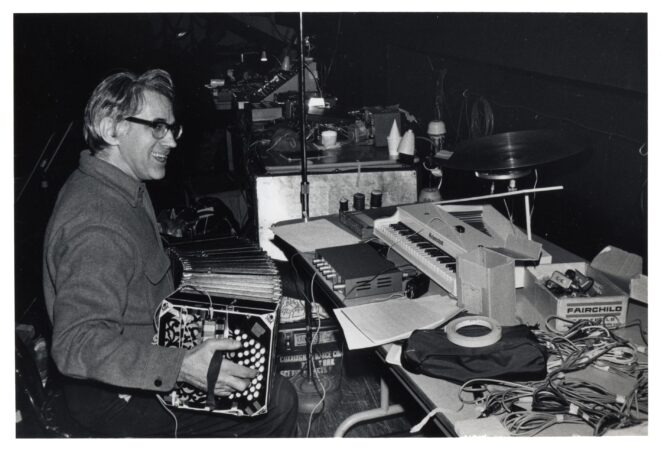
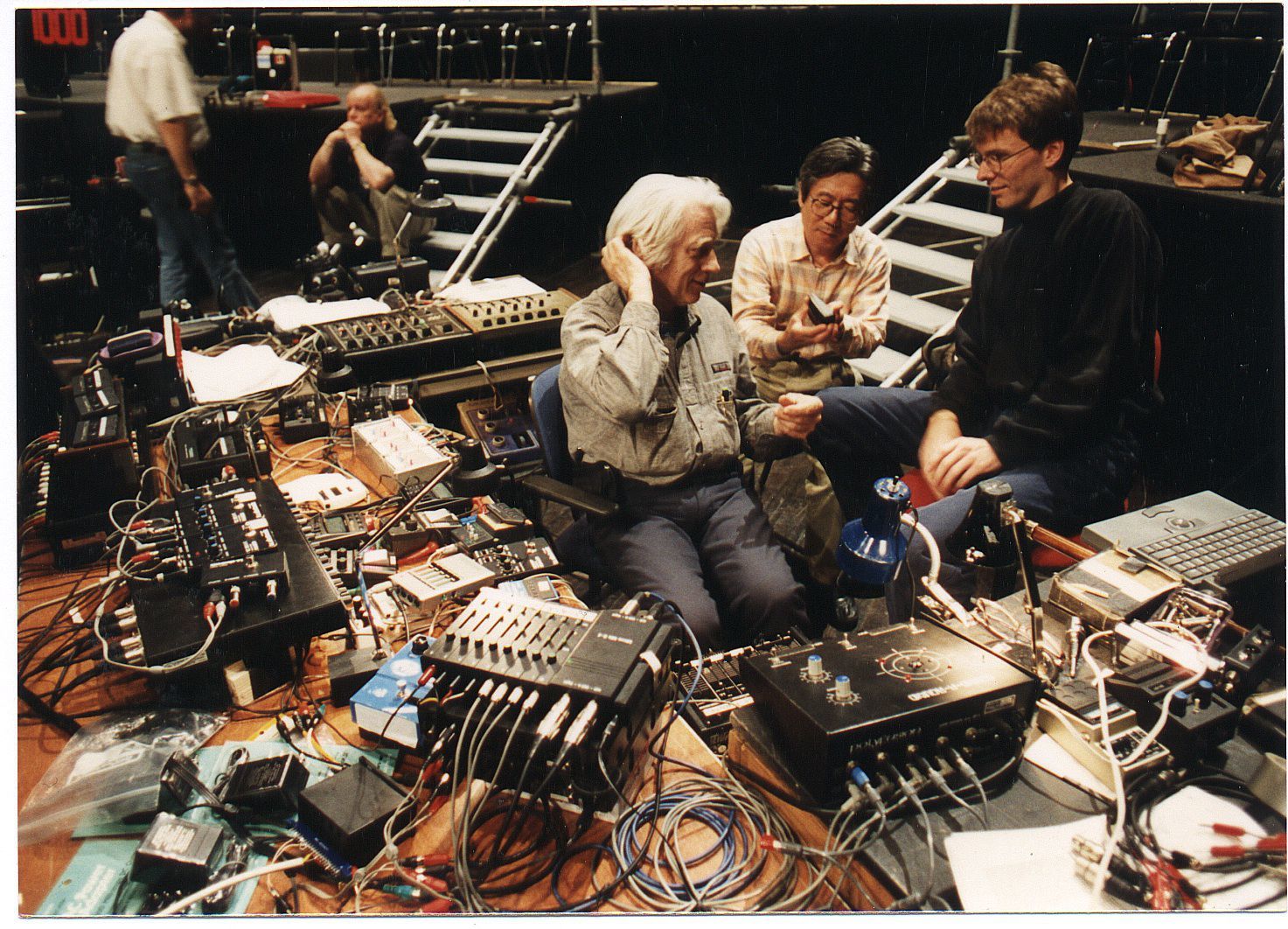
    Just a few miles from the composer’s alma mater, Overbrook High, a half dozen musicians were seated emulating Tudor’s music making process, behind tables piled high with an impenetrable tangle of boxes, wires, knobs, and switches; electronic tendrils snaked from these sources to a bewildering array of objects: glass bowls, a suspended box fan, an oversized die, a copper pot still, even a tree. Each was connected to transducers that took advantage of their resonant properties, turning them into natural amplifiers.

    A century after his birth and three decades since his death in August 1996, David Tudor’s music still seems like something created in a distant, if more analog, future.

    David Tudor with composer Takehisa Kosugi and musician/engineer John D.S. Adams on the set of Ocean, a collaboration with the Merce Cunningham Dance Company

    Years before, the AI-generated “band” Velvet Sundown grabbed headlines by chalking up more than 1 million subscribers on streaming services and fooling journalists, Tudor was experimenting with machine-learning systems in the early ‘90s, working with engineers from Intel on a project called the Neural Network Synthesizer.

    Those experiments evolved from Tudor’s work with the generation of contemporary classical composers that emerged in the decades after World War II, when he became the pianist and collaborator of choice for such groundbreaking artists as John Cage, Morton Feldman, Earle Brown, Merce Cunningham, and Robert Rauschenberg.

    He was a particularly vital collaborator with Cage, who found in Tudor the ideal vehicle for the use of chance operations in his compositions.

    David Tudor with composer John Cage.

    The turning point for Tudor came at Settlement Music School in South Philly, where he studied with the pianist Irma Wolpe. The young pianist became close with Wolpe and her husband, the modernist composer Stefan Wolpe, and the couple introduced Tudor to new developments in modern music at the time.

    An ongoing exhibition at Drexel University’s Pearlstein Gallery, “David Tudor: A View From Inside,” traces the roots of his iconoclastic approach to performance and composition back to his early days in Philly.

    The pipe organ — an instrument that literally surrounds the performer, and that they play from within — proved to be a foundational influence on Tudor’s musical philosophy for the rest of his life, said Dustin Hurt, co-curator and director of Philly presenting organization Bowerbird.

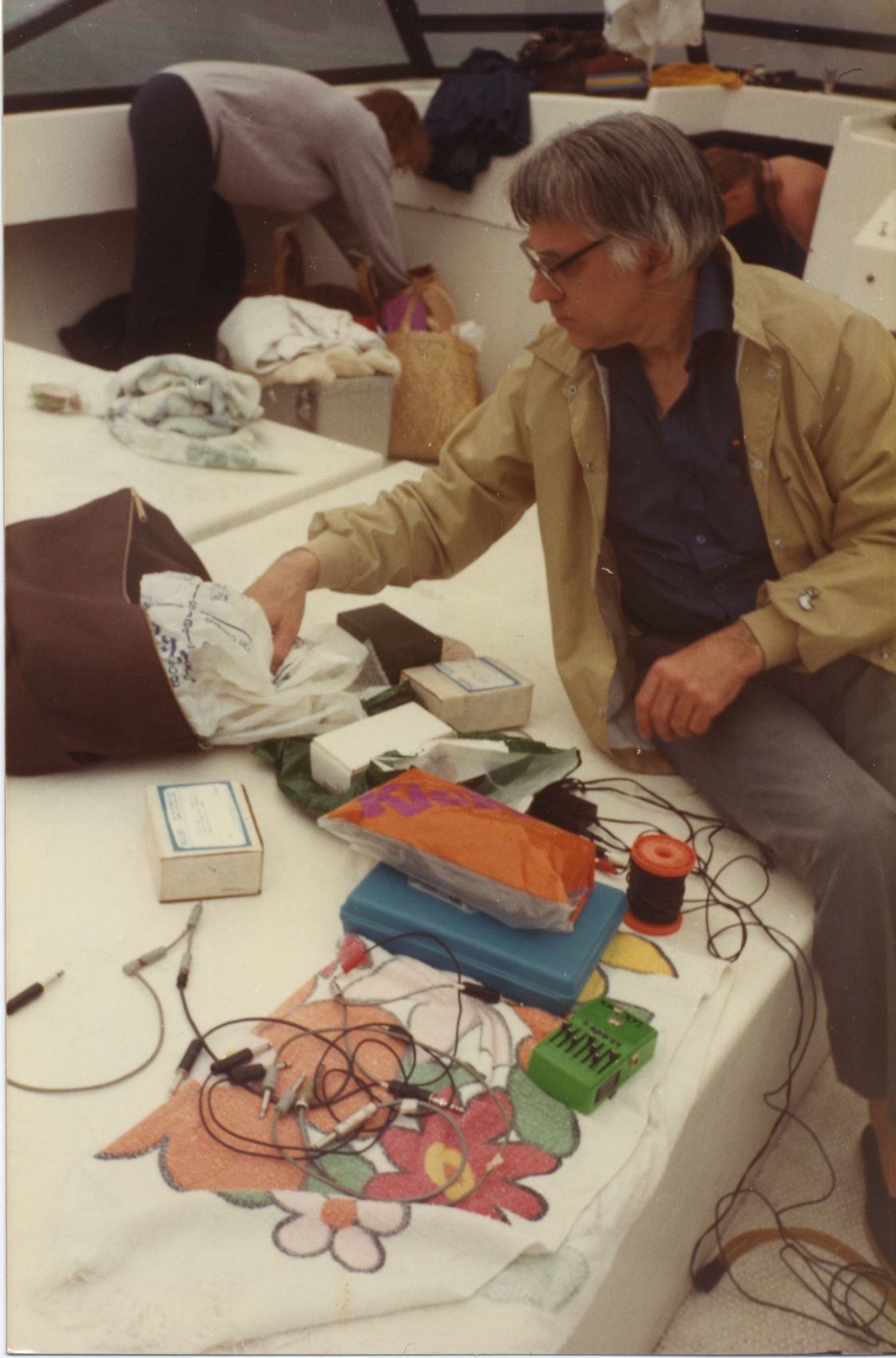
    David Tudor in the Bahamas during the filming of Sea Tails, a project that included sounds collected underwater.

    “That led to the more metaphorical angle of David’s music, which involved discovering what the instruments do on their own,” said Hurt. “That’s the ‘View From Inside.’ He’s not saying, ‘I want to make this music, let me find the instruments that do it.’ He’s saying, ‘This is the stuff that I have. Let’s see what it does.’”

    Discovering Tudor’s fascination with puzzles, composers presented him with scores that offered problems to solve rather than music to play. The exhibition includes mind-boggling lists of calculations and measurements that the pianist meticulously assembled in preparation of performing certain pieces.

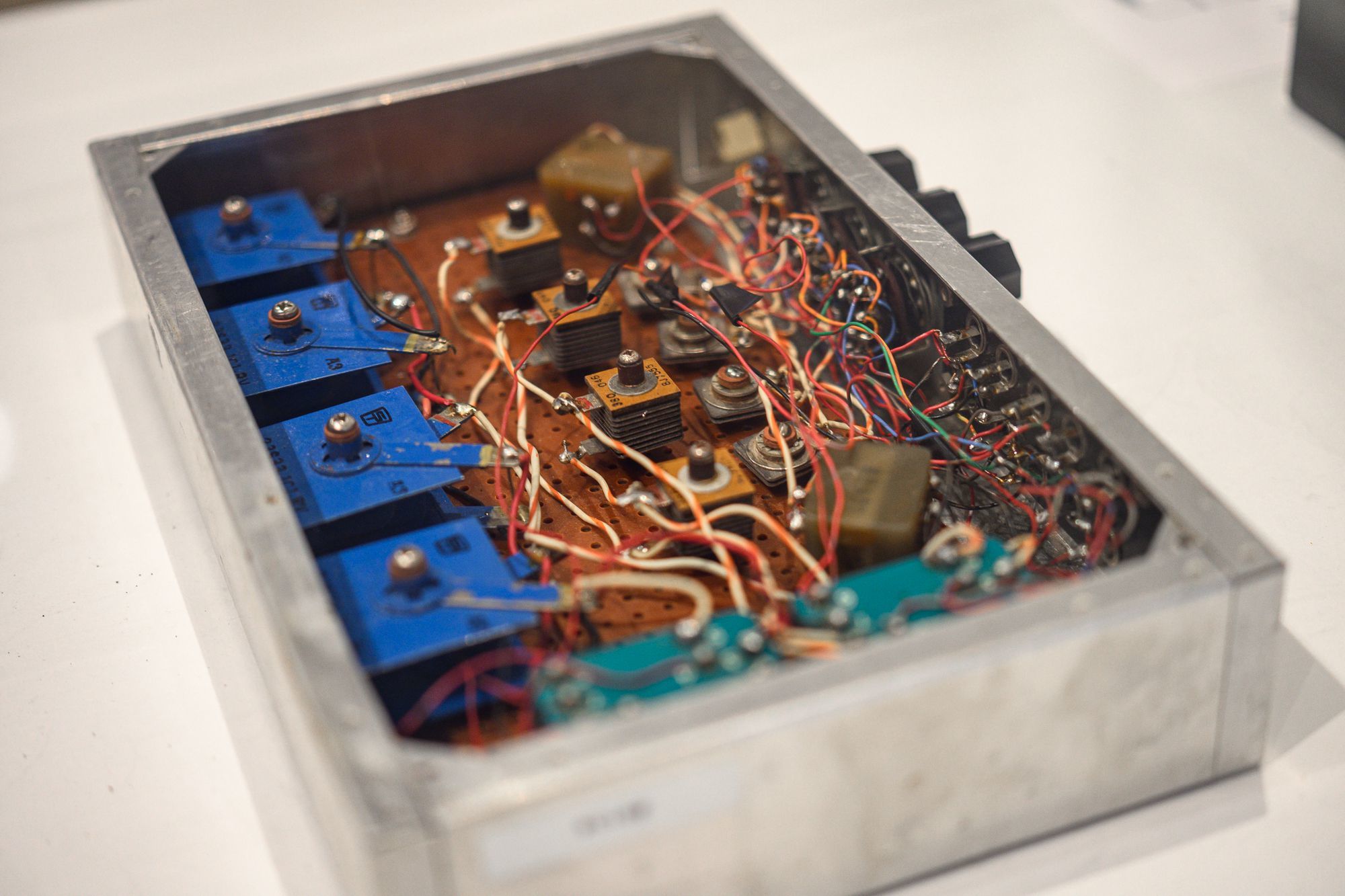
    By the 1960s, he started to abandon the piano altogether, modifying small electronic devices to craft unpredictable music from feedback.

    “David Tudor: A View From Inside” is on view at Drexel University’s Pearlstein Gallery through March 21

    “Tudor was such a skilled virtuoso on the piano, but he showed no interest in performing the classical repertoire,” said co-curator You Nakai, a professor at the University of Tokyo and author of Reminded By the Instruments: David Tudor’s Music.

    “He would only perform scores that challenged him to solve them and produce music that the composer never really thought of,” said Nakai. “So when he started making his own instruments, he strongly focused on ways to implement indeterminacy within the workings of the instruments themselves.”

    Composer Stanley Lunetta includes the following instructions in his “Piece for Bandoneon and Strings”: “If you are already David Tudor, you will have no problem performing this piece; if you are not David Tudor, you must study hard, for you must be him during this performance.”

    “David Tudor: A View From Inside” is on view at Drexel University’s Pearlstein Gallery through March 21.

    The strings in the piece were not the expected violins and cellos, but tethers from Tudor’s limbs to a group of puppeteers who triggered him to play sections of Lunetta’s score.

    Gradually, Tudor’s vision of an instrument that could be inhabited grew in scale far beyond even a department store-sized pipe organ. For Expo ‘70, the 1970 world’s fair in Osaka, Japan, he transformed an entire building into an instrument by mounting loudspeakers in the dome of the Pepsi Pavilion. A few years later, he drew up plans to convert an entire island into an instrument by recording the natural sounds of the space, manipulating them, and playing them back via speakers scattered throughout the island.

    That project wasn’t realized until 2024, long after his passing, off the coasts of Japan and Norway via a collaborative project spearheaded by Nakai.

    “David Tudor: A View From Inside” is on view at Drexel University’s Pearlstein Gallery through March 21.

    Tudor’s pioneering experiments with electronic music seemed to make him an apt collaborator for the Intel engineers and their new neural network chip, but his interest in the technology was diametrically opposed to theirs.

    For all his love of puzzles, “Tudor showed no interest in repeating his past,” said Nakai.

    “He opened it up, went inside the circuitry and figured out how to let the instrument speak for itself. He didn’t understand everything, but he didn’t need to because he was making music that he liked.”

    “David Tudor: A View From Inside” runs through March 21, Pearlstein Gallery in Drexel University’s URBN Annex, 3401 Filbert St. bowerbird.org

  • Bill Gates’ nuclear company plans $450 million plant in Philly’s Bellwether District making radioactive cancer treatments

    Bill Gates’ nuclear company plans $450 million plant in Philly’s Bellwether District making radioactive cancer treatments

    TerraPower Isotopes, part of a nuclear power company founded by Bill Gates, plans a $450 million plant in the Bellwether District to make radioactive molecules for cancer research and potential treatments, Gov. Josh Shapiro announced Tuesday.

    Bellwether’s developer HRP Group will build a 250,000-square-foot facility for the Bellevue, Wash., company at the former refinery site. TerraPower Isotopes is expected to employ 225 people in Philadelphia to meet anticipated demand for a type of molecule that can be used to kill tumors without damaging surrounding tissue.

    TerraPower’s material, an isotope called actinium-225, is ultimately derived from weapons-grade uranium. Researchers are exploring precision cancer treatments that involve attaching actinium-225 to an antibody that is targeted to specific cancer cells. The isotope then emits high doses of radiation at close range.

    “This new facility is a testament to the demand for actinium-225 as part of the growing industry, which is transforming how cancer is treated,” TerraPower Isotopes President Scott Claunch said in Shapiro’s announcement. “Our team is proud to be building a large-scale manufacturing facility in Philadelphia, which will play a pivotal role in expanding global access to this rare isotope.”

    Pennsylvania government is supporting the project with $10 million in grants. The Bellwether District is in a Keystone Opportunity Zone that has tax benefits through 2043. That means TerraPower Isotopes won’t have to pay many state and local taxes, though it will remain responsible for city wage taxes.

    TerraPower Isotopes, part of a bigger nuclear sciences company called TerraPower, is the second radiopharmaceutical company to announce a factory in the region. In 2024, Nucleus RadioPharma, which counts Fox Chase Cancer Center among its investors, shared plans for a 48,000-square-foot facility in Spring House, Montgomery County.

    TerraPower’s move to South Philadelphia is the third significant life sciences development announced this year by Shapiro and his economic development team.

    Eli Lilly & Co. said in January that it is building a $3.5 billion pharmaceutical plant in the Lehigh Valley to expand manufacturing capacity for next-generation weight-loss medicines. Last month, Johnson & Johnson shared plans for a $1 billion cell therapy plant in Montgomery County.

    TerraPower is the second tenant in the 1,300-acre Bellwether District, which HRP is trying to develop into a new industrial and life sciences hub. Late last year, it announced that California-based canned beverage manufacturer DrinkPAK will build a 1.4 million-square-foot factory that will product 3 billion cans a year.

  • Israel says 2 top Iranian officials killed in airstrikes in blow to Tehran leadership

    Israel says 2 top Iranian officials killed in airstrikes in blow to Tehran leadership

    DUBAI, United Arab Emirates — Iran’s top security official and the head of the Revolutionary Guard’s Basij militia were both killed in overnight strikes in a blow to the country’s leadership, Israel’s defense minister said Tuesday, while Tehran defiantly fired new salvos of missiles and drones at its Gulf Arab neighbors and Israel.

    Both security official Ali Larijani and Gen. Gholam Reza Soleimani were “eliminated last night,” Israeli Defense Minister Israel Katz said in a statement. Iran’s 86-year-old Supreme Leader Ayatollah Ali Khamenei died in an airstrike Feb. 28, the first day of the war launched by the United States and Israel, and other top leaders from the Iranian theocracy have been killed since then.

    Iranian state media did not immediately confirm either death. However, it said a message from Larijani’s office would be published shortly.

    The announcement came after the Israeli military had earlier said it had carried out a “wide-scale wave of strikes” across Iran’s capital and stepped up strikes on Iran-backed Hezbollah militants in Lebanon. Israel also reported two incoming salvos before dawn from Iran at Tel Aviv and elsewhere, and said Hezbollah targeted Israel’s north.

    Incoming Iranian missiles on the United Arab Emirates prompted Dubai, a major transit hub for international travel, to briefly shut its airspace and a man was killed by the debris of a missile intercepted over Abu Dhabi.

    Israel says it has killed two top Iranian officials

    Larijani hails from one of Iran’s most famous political families. A former parliamentary speaker and senior policy adviser, he was appointed to advise the late Khamenei on strategy in nuclear talks with the Trump administration.

    He also served as the secretary of Iran’s Supreme National Security Council, its top security body.

    Soleimani, meantime, was the head of the Basij militia forces, which Israel’s military called an “armed apparatus of the Iranian terror regime.”

    “During internal protests in Iran, particularly in recent periods as demonstrations intensified, Basij forces under Soleimani’s command led the main repression operations, employing severe violence, widespread arrests and the use of force against civilian demonstrators,” Israel’s military said in a statement.

    The U.S. Treasury lists Soleimani as having been born in 1965. He has been sanctioned by the U.S., the European Union and other nations over his role in helping suppress dissent for years through the Basij.

    Killing Soleimani would likely further strain the command and control of the Basij, which would be crucial in putting down any uprising against the theocracy. The Basij and other internal security forces have been a target of attack by both the Americans and the Israelis so far.

    Iranian strikes pressure neighbors and oil markets

    Iran kept up the pressure on the energy infrastructure of its Gulf Arab neighbors, hitting an oil facility in Fujairah, a UAE emirate on the country’s east coast with the Gulf of Oman that has been repeatedly targeted. State-run WAM news reported that no one had been injured in the blast from the drone strike.

    The man killed by falling debris from an intercepted missile was the eighth person to die in the UAE since the start of the war, authorities said.

    Iran’s attacks on Gulf nations and its grip on the Strait of Hormuz, through which a fifth of the world’s oil is transported, has given rise to increasing concerns of a global energy crisis. Early Tuesday it hit a tanker anchored off the coast of Fujairah, one of about 20 vessels hit since Israel and the United States started the war with an attack on Iran on Feb. 28.

    Iran’s parliamentary speaker, Mohammad Bagher Qalibaf, said his country had been given no choice but to keep up its pressure on shipping traffic in the strait.

    “They are flying, launching missiles, should we just sit back and do nothing in response?” he said in an interview on state television.

    With Washington under increasing pressure over rising oil prices, Brent crude, the international standard, remained over $100 a barrel, up more than 40% since the war started.

    U.S. President Donald Trump said he had demanded that roughly a half-dozen countries send warships to keep the Strait of Hormuz open. But his appeals brought no immediate commitments, with many saying they are hesitant to get involved in a war with no defined exit plan and skeptical that they could do more than the U.S. Navy.

    UAE briefly closes airspace as Iran launches new attacks on Gulf neighbors

    The UAE shut down its airspace early Tuesday as its military reported it was “responding to missile and drone threats from Iran.” The closure was soon lifted, and not long after the sounds of explosions could be heard as the military worked to intercept incoming fire.

    The snap announcement on its airspace showed the balancing act Emirati authorities face in trying to keep their long-haul carriers, Emirates and Etihad, flying as Iranian attacks continue to target the country.

    Saudi Arabia’s Defense Ministry reported intercepting a dozen drones Tuesday morning over the country’s vast Eastern Province, home to oil infrastructure.

    In Qatar, the sounds of explosions boomed over the capital early in the day as defenses worked to intercept incoming fire. Qatar’s Defense Ministry said later that it had successfully thwarted a missile attack on the city, though a fire broke out in an industrial area from a downed projectile.

    Attacks from Iran-linked proxy forces continued in Iraq, as the U.S. Embassy in Baghdad was hit with shrapnel from drones that had been intercepted.

    The embassy’s air defenses were able to shoot down all four drones targeting the facility, according to two Iraqi security officials, speaking on condition of anonymity to discuss intelligence matters.

    A separate strike targeted a house in the heavily fortified Presidential Compound in Baghdad’s al-Jadriya area, the officials said. It wasn’t clear who carried out either attack but Iran-allied militias have regularly been attacking American targets inside Iraq since the conflict began.

    Israel launches new attacks on Tehran and steps up strikes on Beirut

    The Israeli military early Tuesday said it had launched new attacks across Tehran in addition to the Lebanese capital targeting Hezbollah militants.

    In Iran, it said it hit command centers, missile launch sites and air defense systems. There was no immediate confirmation from Iran, where little information has been coming out due to internet outages, round-the-clock airstrikes and tight restrictions on journalists.

    Israel did not immediately release details of its attacks on Lebanon, but the Lebanese army said two of its soldiers were seriously wounded in an airstrike on the village of Kfar Sir.

    More than 1,300 people have been killed in Iran since the start of the conflict, according to the Iranian Red Crescent.

    Israel’s strikes have also displaced more than 1 million Lebanese — or roughly 20% of the population — according to the Lebanese government, which says some 850 people have been killed.

    Some Israeli troops have pushed into southern Lebanon, and there are fears Israel is preparing a large-scale invasion.

    The military’s chief of staff, Lt. Gen. Eyal Zamir, said Monday on a visit to the northern border that Israel’s army is “determined to deepen the operation until all of our objectives are achieved” and that the military’s Northern Command is being reinforced with additional soldiers.

    Israel reported two Iranian salvos early Tuesday fired toward Tel Aviv and an area south of the Sea of Galilee. More launches from Lebanon were also reported.

    In Israel, 12 people have been killed by Iranian missile fire. At least 13 U.S. military members have been killed.

    Closure of Strait of Hormuz pressures oil shipping

    The virtual shutdown of the Strait of Hormuz is unnerving the world economy, driving up energy prices, threatening food shortages in poor countries, destabilizing fragile states and complicating efforts by central banks to drive down prices for consumers.

    There have been a handful of ships getting through, primarily Iranian but also from other countries including India and Turkey, and Iran has said it technically remains open — just not for the United States, Israel and its allies. Iraq said Tuesday it was in talks with Iran about allowing passage for its ships.

    Underscoring the danger of even getting close to the strait, a tanker anchored off the eastern coast of the United Arab Emirates was hit by a projectile early Tuesday morning and sustained minor damage, according to the United Kingdom Maritime Trade Operations center, run by the British military.

  • The partial shutdown forcing TSA agents to work without pay could not have come at a worse time | Editorial

    The partial shutdown forcing TSA agents to work without pay could not have come at a worse time | Editorial

    Lost in the economic and political fallout from Donald Trump’s war in Iran is the growing chaos at airports and an increased terrorist threat inside the United States.

    More than 60,000 Transportation Security Administration employees have been working without pay because of the partial government shutdown that began on Feb. 14. More than 300 TSA agents have quit and thousands more have been calling out from work, prompting long lines at many airports.

    TSA temporarily closed the security checkpoint at Terminal C in the Philadelphia International Airport last week.

    Despite staffing shortages, the wait times for travelers in Philadelphia remained manageable for now. But travelers at other airports waited more than three hours to get through security.

    The partial shutdown that resulted in funding lapses for the Department of Homeland Security could not come at a more dangerous time. Federal law enforcement agencies remain on high alert following threats to the United States after Trump and Israel began bombing Iran.

    Airline passengers wait in long lines outside the terminal to get through the TSA security screening at William P. Hobby Airport in Houston on March 8.

    Indeed, Trump’s war has apparently already spurred several terror attacks on U.S. soil.

    • Two teens from Bucks County who said they were inspired by ISIS were charged with trying to set off homemade bombs during a protest outside the residence of New York Mayor Zohran Mamdani.
    • Iran-linked hackers claimed responsibility for a cyberattack on Stryker, a Michigan-based company that makes a range of medical equipment and technology.
    • A U.S. citizen born in Lebanon drove a truck into a synagogue in Michigan last week after four of his relatives were killed in an Israeli airstrike.
    • A naturalized citizen from Sierra Leone accused of killing an ROTC instructor at Old Dominion University was previously convicted of supporting ISIS.
    • A U.S. citizen from Senegal who was wearing a T-shirt with the colors of the Iranian flag was accused of killing three people and injuring a dozen more outside of a bar in Austin, Texas, the day after the initial attack on Iran.

    The motives for the attacks are still being investigated but law enforcement officials urged people to report suspicious activity, and police have increased patrols around synagogues and public transit hubs.

    The growing threats come as the Trump administration spent the past year decimating national security.

    FBI Director Kash Patel fired counterterrorism agents because they were involved in the investigation that led to Trump’s criminal indictment in 2023 on charges of mishandling classified documents.

    At the same time, the FBI and Homeland Security have shifted thousands of agents to focus on immigration enforcement, while the Justice Department’s elite national security division has faced mass firings, resignations, and forced retirements.

    FBI Director Kash Patel fired counterterrorism agents because they were involved in the investigation that led to President Trump’s criminal indictment in 2023 on charges of mishandling classified documents.

    More unsettling, the person now overseeing Homeland Security’s terrorism prevention programs is a 22-year-old former Trump campaign worker fresh out of college with no apparent national security expertise.

    Meanwhile, thousands of TSA agents — who are charged with screening customer baggage and cargo for weapons and explosives — are overworked and not getting paid.

    TSA agents, who make an average of $35,000, endured a 43-day government shutdown last fall, making this the second time in six months they have been forced to work without pay.

    A TSA union representative said several employees reported lacking money for daycare and food. “They just want to know why the hell they can’t get paid when we have money to shoot missiles into other countries,” Johnny Jones, secretary-treasurer of American Federation of Government Employees TSA Council 100 and a Dallas-based TSA worker, told USA Today.

    Republican and Democratic lawmakers blamed each other for the shutdown underscoring the deep political divide and dysfunction in Washington.

    Airline chief executives demanded Congress find a way to pay the TSA workers as the shutdown disrupts travel and undermines safety.

    Trump, who took a break from his war to play golf over the weekend, offered cold comfort when asked if Americans should worry about terror attacks in the United States: “I guess,” he responded. “Some people will die.”

    Trump, quite literally, to America: Drop dead.

  • Philly’s bars are embracing zebra-striping, aka switching it up between booze and NA drinks

    Philly’s bars are embracing zebra-striping, aka switching it up between booze and NA drinks

    South Philly resident Olivia Menta and her partner love exploring Philly’s food scene, often hitting up several spots over the course of an evening. But the couple doesn’t want the literal headache that can sometimes come with such excursions.

    “We’re people that love to spend long nights in restaurants together, but I just don’t want to consume a lot of alcohol,” Menta, 34, said. So the pair employs a drinking strategy that strikes a compromise between temperance and indulgence, alternating between alcoholic and non-alcoholic drinks.

    To kick off an evening, Menta will order a low-alcohol cocktail — perhaps a spritz, or something vermouth or sherry-based — or a glass of sparkling wine. For her next drink, she’ll move to something non-alcoholic, a menu section that’s been growing by leaps and bounds in area bars and restaurants. She’ll switch back and forth as the night goes on, keeping her consumption (and her buzz) in check.

    This increasingly popular strategy for moderating one’s intake occasionally goes by a fanciful new nickname: zebra-striping.

    Customers enjoying drinks at the bar at Picnic in Kensington.

    “Zebra-striping is the idea of alternating alcoholic and non-alcoholic beverages,” explained Max Glenn, wine buyer for Picnic in East Kensington. “It offers a nice pace to a night out, as opposed to binge drinking and feeling worn out from simply being social.”

    Zebra-striping is not a commonly used phrase, but the practice — which itself is not new and arguably a sign of good common sense — is encouraged and widespread. “I’m often the one introducing the term to people,” Glenn said. “But nickname or not, it’s happening. Sometimes it’s water, other times it’s switching to a non-alcoholic beer between drinks.”

    Zebra-striping is highly customizable — and it has no hard-and-fast rules. “I’ve seen pubs offer to cut a pint of Guinness with 0.0% Guinness, thus making it a more sessionable 2.2% beer,” Glenn said. “Or you can alternate a regular beer with a [nonalcoholic drink] 0.0%, or water. It’s up to you.” (The Guinness idea recently stirred controversy online for what the right ratio of regular beer to NA beer should be, with 60/40 being the most commonly happy medium.)

    For Menta, zebra-striping is at its best when the bar or restaurant has put some thought into its non-alcoholic offerings — something that’s happening more and more.

    Bar manager Petra Manchina making a drink at Emmett, in South Kensington. Like many restaurants and bars, Emmett has paid special attention to its non-alcoholic offerings.

    “I get excited when there’s something unusual to try, instead of the typical sparkling water and citrus,” she said. “Emmett [chef Evan Snyder’s Mediterranean restaurant in South Kensington] does this well — they had an NA cocktail on the menu last winter that had roasted eggplant in it … I still think about it.”
    Even when the mocktails aren’t as creative as that, Menta sticks to the strategy, something she’s been doing consciously for a year and a half, ever since learning the term from her partner. “Zebra-striping is a way for both of us to explore and experience in a way that is perfectly balanced,” she said.

    Alcohol and non-alcohol, side by side

    A growing majority of Philly’s bars and restaurants have bolstered the mocktail and zero-proof options on their menus, listing them alongside martinis, Manhattans, and beer and wine. It’s the natural evolution of a trend that has its roots in a month-long test of willpower.

    “Four years ago, everyone was asking for Dry January options,” said Bonnie Garbinski, director of operations for American Sardine Bar and South Philadelphia Taproom. As time went on and the requests became more frequent, Garbinski added a few NA offerings to the regular menu; the selection has grown from there. “We now keep four to six [NA drinks] year-round.”

    Second District’s Anti-Plato , an IPA-inspired soft drink with a green tea base that gets sweetened with pineapple juice; acidified orange, lime, and citric acid; then finished with dry-hopping and carbonation.

    Sardine Bar sister establishment Second District Brewing has likewise made its menu more NA-friendly. But rather than bringing in outside NA beers and calling it a day, the Bancroft Street brewery experimented with making its own close-to-beer offering, eventually landing on a pineapple- and lime-fortified tea that’s dry-hopped to mimic the mouthfeel and flavor of a hazy IPA. The Second District team plans to keep an iteration of the beer-inspired NA soft drink on the menu, updating the fruit flavors throughout the year.

    Bars aren’t the only alcohol-centered businesses integrating NA options. Local breweries have taken note of customers’ zero-proof inclinations: Ardmore’s Tired Hands debuted non-alcoholic IPA N/Alien Church in 2024, and Callowhill’s Love City Brewing introduced its first NA beer, Lo-Key Lager, last year. Additionally, bottle shops all around Philadelphia are carrying NA wines, beers and cocktails. Options are vast, ranging from imported NA spritzes and spirits to emerging local NA brands, such as Cult of Trees apertifs.

    Bar Palmina on Front Street is an alcohol-free space focused on craft cocktails. About half of its customers consume alcohol in other settings, estimates owner Nikki Graziano.

    The ever-increasing selection of NA products has allowed for booze-free bottle shops and bars, several of which have opened in the Philly region in recent years. While these spaces can be havens for teetotalers, they also attract customers who are curbing their alcohol consumption.

    Nikki Graziano owns Fishtown’s Bar Palmina, a purely non-alcoholic space that’s been open nearly two years, with a focus on craft cocktails. Graziano said while the zebra-striping language isn’t exactly popular among her guests — “people are aware of the term, but (forgive me) in a ‘stop trying to make fetch happen’ type of way,” she said — the concept is a familiar one. About half of her customers, including several Palmina regulars, drink alcohol in other settings, she said.

    Bar Palmina’s Union Bird is zero-proof garden margarita with green bell pepper, parsley, celery, cucumber, lime, and honey.

    “My customers are more interested in a bigger, larger lifestyle change,” Graziano said. “I think that [overall] people are just more conscious of how much they’re drinking, why, and how often.”

    For Menta, the benefits of zebra-striping are obvious. “I want to feel balanced in my mind and body. Having a full dinner with wine and cocktails doesn’t always serve that,” she said. “I’m a curious person and want to try as much of the menu as possible … This is the best way to meet both of my values.

    “I don’t even think about it all that much anymore,” she said. “It’s just what I do“

  • Jesús Luzardo endures attacks after declining Venezuela’s World Baseball Classic plea and staying with Phillies

    Jesús Luzardo endures attacks after declining Venezuela’s World Baseball Classic plea and staying with Phillies

    CLEARWATER, Fla. — It usually takes about a day for social media to ruin everything. In the case of Jesús Luzardo, it’s right on time.

    Monday was one day after the news broke that Luzardo and the Phillies decided it would be best for him to decline an invitation from Team Venezuela to pitch in the World Baseball Classic final on Tuesday if Venezuela made it that far.

    Luzardo was born in Peru, but his family is from Venezuela, for whom he pitched brilliantly in the 2023 WBC and who placed him on the reserve list. He also grew up in the Miami area, where the semifinal and final are being played. That’s why he told two reporters Sunday that it “breaks my heart not being able to be there.”

    On Monday morning, his heart was breaking for another reason. Many Venezuelan fans were angry that he didn’t accept the invitation.

    “I feel like sometimes, you get painted as a traitor, or, you know, you get painted in this, like, negative light, because of some things that people say — you know, not only me, but my family,” Luzardo said Monday morning. “And I think that that’s tough. People from Venezuela are, like, ‘Why aren’t you helping us out?’”

    Jesús Luzardo signed a five-year, $135 million contract extension with the Phillies last week.

    Traitor? Really? A quick scan of popular social media outlets uncovered zero references to Luzardo as a traitor.

    I asked Luzardo at lunchtime if he was sure about all the negative feedback.

    “It’s there,” he replied, with a pained smile. “I know.”

    Where? Twitter? Instagram?

    “I’m not on social,” he said. “I just know what I saw and what I heard.”

    Hmm. Here’s a thought: Maybe he was hearing it in Spanish, not English.

    Bingo.

    And there it was.

    Comments under Instagram posts announcing Luzardo’s decision were … harsh.

    They questioned his commitment to Venezuela, and many told him to pitch for Peru. They questioned his manhood. One poster dropped a poop emoji.

    Why all the acrimony?

    It’s important to understand the significance of the tournament to Venezuelans, for whom baseball is not just the national sport, but a pastime bordering on the religious. It’s sort of like Jalen Hurts turning down a Team USA for football.

    To be fair, some folks understood and supported Luzardo’s decision. There were several rational replies. A few commented on comments and defended Luzardo’s decision. But the majority of the reactions were negative, personal, and hurtful.

    It wasn’t just the mean tweets and nasty ’grams, either.

    “When a headline came out the other day, and said [Team Venezuela] called me, and I just said, ‘No,’ because I didn’t want to — couldn’t be further from the truth, right?” Luzardo asked. “I think that really kind of rubbed me the wrong way, because that wasn’t truth.”

    The truth is, Luzardo loves the World Baseball Classic, and he loves representing Venezuela.

    The truth is, he said in 2023 that he’d fulfilled his grandfather’s dream by pitching for Team Venezuela.

    The truth is, Luzardo was negotiating an arbitration settlement with Miami the first time Venezuela asked him to play. That paid him $2.45 million in 2023. He signed a five-year, $135 million contract extension with the Phillies last week.

    Former Phillie Ranger Suárez joined Venezuela for the World Baseball Classic.

    The truth is, after missing time in 2019, 2022, and 2024 with injuries, Luzardo enjoyed a superb 2025 and is finally fulfilling the immense promise that made him the No. 18 prospect in all of baseball when the Athletics called him up in 2019. After being traded to Philadelphia from Miami on Dec. 22, 2024, Luzardo went 15-7 with a 3.92 ERA, finished seventh in National League Cy Young Award voting, and pitched well as a starter and a reliever in the Phillies’ brief playoff run.

    The truth is, Luzardo logged a career-high 191⅓ innings including playoffs, he has a history of injuries, and he is on a precise buildup program this spring. That’s partly because Luzardo’s profile in the rotation this year will be two clicks higher to start the season: Staff ace Zack Wheeler is coming back from thoracic outlet decompression surgery that will cost him at least the first month, and Ranger Suárez has departed to the Red Sox via free agency.

    Yes, two weeks ago, as Luzardo declined his initial invitation, he said that if Venezuela made the final four, “If they need me, I’ll go.” That gave Venezuela reasonable hope.

    Things change.

    “When I spoke to Venezuela about being on the reserves, I said, ‘No promises,’” Luzardo said Monday. “They said, ‘We’ll understand if you’re not able to come.’ … It was for multiple reasons, it wasn’t able to come to fruition. Not only the contract situation, but other situations here that, you know — my obligations to this team. They want me to be ready to go. I have to make those [obligations] right.”
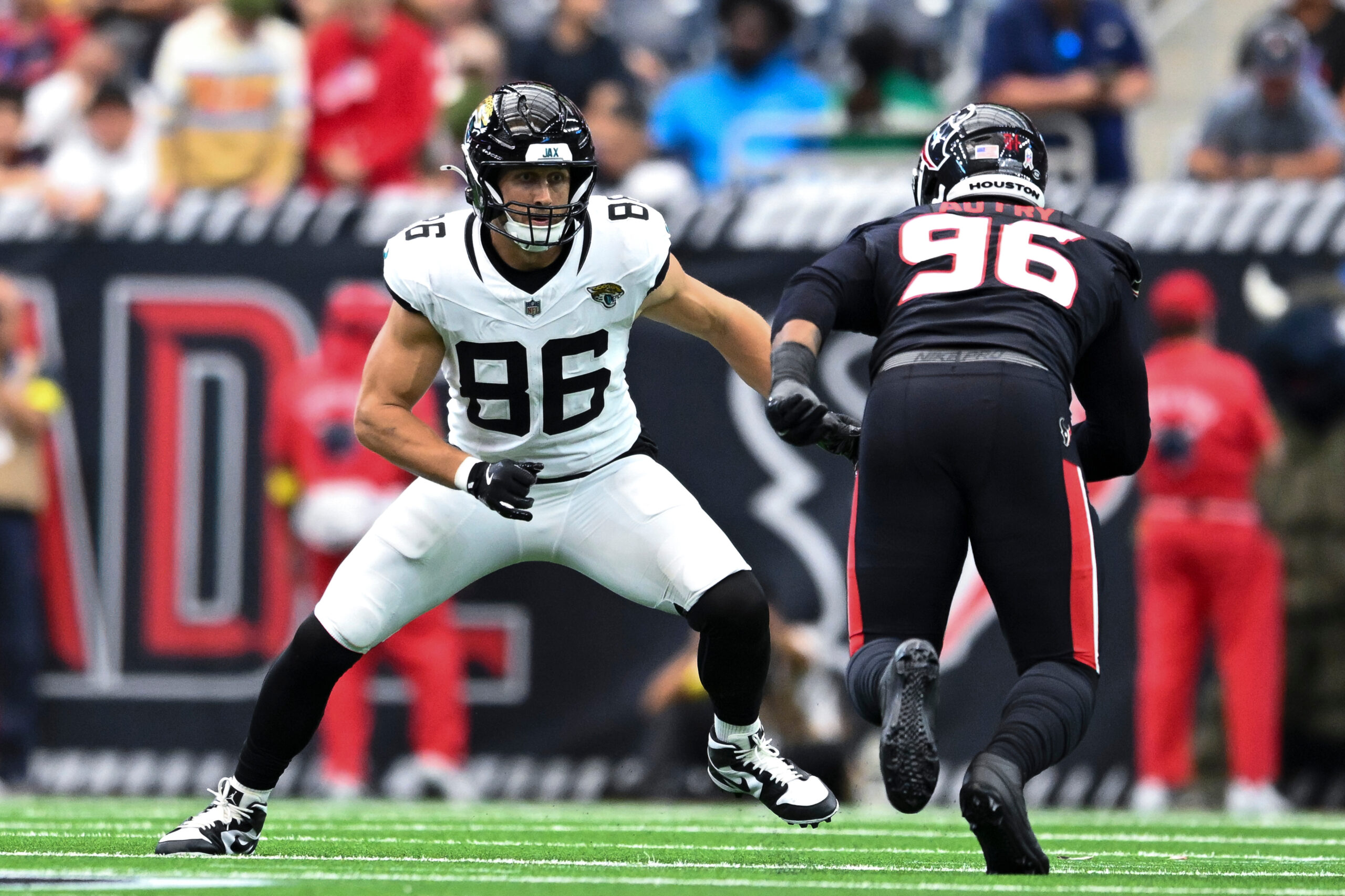
    The truth is, it would have been foolish for Luzardo to risk an appearance in the WBC, no matter how important the tournament might be to Venezuela, or to him.

    “I’m hopeful that in the next Classic, you know, they’ll take me into account,” Luzardo said. “I’d love to be there again.”

  • Biggest surprises and unanswered questions for the Eagles after the first wave of free agency

    Biggest surprises and unanswered questions for the Eagles after the first wave of free agency

    The NFL’s 2026 free agency period is ongoing — even as the lion’s share of the league’s headline-grabbing signings have come off the board. The Eagles are one team for whom the situation remains fluid, but enough has occurred to take stock of the post-free agency picture nonetheless.

    The Inquirer’s Eagles reporting team of Jeff McLane, Olivia Reiner and Jeff Neiburg got together for a roundtable with a week of free agency movement in the rear-view mirror.

    What has been your biggest surprise of the Eagles free agency period to date?

    McLane: Nothing the Eagles have done or not done so far qualifies as surprising from this vantage point. Howie Roseman essentially laid out his plans ahead of free agency. He would be selective in retaining his own players, prudent in signing others, and continue to build from within via the draft. I thought that maybe the Eagles would make an effort to keep safety Reed Blankenship considering the relatively affordable contract he signed with the Texans at $8.25 million a year. But I guess the greater shock was that Roseman would make a cornerback his first free agent signing.

    There isn’t some rule that general managers have to fill roster spots by order of need. And signing Riq Woolen indicated that Roseman saw value in inking the 26-year old to a one-year contract worth up to $15 million. In theory, that is good business. But the third corner spot behind Quinyon Mitchell and Cooper DeJean is a luxury. Woolen has enviable attributes in size and speed, if not issues with consistency and temperament. He could be a steal on a “prove-it” deal. But he’s essentially a rental with Mitchell and Cooper slated for extensions next offseason. The Eagles have time to address holes at edge rusher, safety and find the next generation on the offensive line and at tight end. So this isn’t a critique of Roseman’s initial choices. Just an early assessment.

    Reiner: Jaelan Phillips was always going to get paid this offseason, it was just a question of how much. He was a young, talented player at a premium position within a relatively underwhelming free-agent class. While the Eagles had interest in bringing him back, it seemed unlikely that they were going to overpay him, given the team’s need to reward homegrown defensive players who are eligible/will become eligible for extensions. Plus, Phillips had just five sacks last season (two with the Eagles) and hasn’t yet eclipsed his career best of 8½ sacks set during his rookie season in 2021.

    He signed with the Carolina Panthers for four years, $120 million, good for a $30 million average annual value. While I figured his AAV would be high, I didn’t anticipate it would be that high. That’s a pretty significant projection, especially for a player not too far removed from a pair of serious injuries. I’m not surprised the Eagles were outbid, but I am surprised that they were outbid by that much.

    Neiburg: My surprise is that it’s March 17 and the only addition to the edge rushing corps has been Arnold Ebiketie. There is, of course, plenty of time for that to change. But I expected Phillips to be back — though not at that number — and if not, expected the Eagles to bring in another top-end talent like Trey Hendrickson or Maxx Crosby. It’s the lone position on the team right now screaming for an infusion of talent, so I’d expect something to change relatively soon.

    New Eagles tight end Johnny Mundt (86) arrives from Jacksonville with a sterling reputation as a blocker.

    Which new Eagles face needs to be the most immediate difference-maker?

    McLane: The pickings are slim here so I’ll go with Ebiketie. I don’t imagine the Eagles will go into next season with the former Falcon as the third outside linebacker behind Nolan Smith and Jalyx Hunt. But right now that’s where he lines up in the pecking order. Ebiketie dropped down the depth chart in Atlanta after new faces arrived last season, but he was still effective. He had a solid 16.4% pressure rate, if only two sacks. He had six sacks in each of the two previous seasons, though.

    Ebiketie projects as more than a serviceable rotation edge rusher. The same could have been said for Azeez Ojulari and Joshua Uche — two outside linebackers the Eagles signed to one-year contracts a year ago that didn’t exactly pan out. It wasn’t all their fault. They weren’t given much of chance. Roseman traded for Phillips and Brandon Graham was lured out of retirement. As stated above, the GM is likely to add more bodies at the position, even if it isn’t a No. 1 guy. Until then, Ebiketie will have to do the heavy lifting as the projected No. 3.

    Neiburg: The answer for me right now is Johnny Mundt, which probably says more about the quiet nature of the free agent class so far. The second tight end isn’t all that sexy. But I think Mundt’s job with the Eagles is a more important one than Woolen’s. Sure, Woolen is the high-profile name, but we saw last year that CB2, in this defense, with Mitchell and DeJean, wasn’t that much of an issue. Adoree’ Jackson did fine, and Woolen is better. The running game, on the other hand, suffered from poor blocking from the tight ends. That needs to change, especially in this new scheme, to get the offense back on track. Mundt needs to be as advertised. Woolen, meanwhile, can get away with just being OK.

    Reiner: With Dallas Goedert and Grant Calcaterra now under contract in 2026, the addition of the 31-year-old Mundt is all the more important. Howie Roseman admitted in advance of the combine that the Eagles needed a more diverse skill set in the tight ends room last season, given Goedert, Calcaterra, and Kylen Granson were stronger receivers than they were blockers.

    That’s where Mundt comes in. The Eagles’ run game is poised to lean more into a wide-zone scheme under new offensive coordinator Sean Mannion. Mundt should be familiar with the revamped run game and the coaches installing it. He played with Mannion with the Rams in 2017 and 2018 and the Minnesota Vikings in 2021 and 2023. New Eagles offensive line coach Chris Kuper also served in the same role in Minnesota while Mundt was on the team. Given the struggles of last year’s unit, Mundt has the potential to make a positive impact on the ground as a blocker. After all, Vikings head coach Kevin O’Connell once called him “the best third tight end in the NFL.”

    Jordan Mailata (left), Lane Johnson (center) and Landon Dickerson (right) are the present of the Eagles offensive line. The Eagles know they must think about the future in the trenches.

    Name a position that concerns you heading into next month’s draft.

    Reiner: Edge rusher. The Eagles could still use some more pass-rush prowess on the edge, especially after a quiet wild-card showing from the group (no sacks, just one quarterback hit, according to Pro Football Focus). Last year, the Eagles went into the season with Smith and Hunt as their top two edge rushers and ended up acquiring Phillips at the trade deadline to lead the group. Roseman ought to take a more proactive approach this year and add an impact player at the position before the season begins. Then, the Eagles should be set at the position for 2026 (and potentially beyond), as Smith and Hunt are promising, yet still developing.

    Neiburg: In the immediate future, it’s edge rusher, but the long-term future of the offensive line is my primary concern for the state of this Eagles roster, and one they will need to help address in the draft. Lane Johnson’s career is winding down. Injuries and pain could soon force Landon Dickerson to retire before he hits 30. Cam Jurgens, like Dickerson, just got a treatment for his ailments in Colombia that they don’t do in the U.S. A position that has long been a strength of the Eagles has a lot of question marks as they enter the 2026 season.

    McLane: I’ve mentioned the holes at edge rusher and safety, but I’m looking at a position with a longtime returning starter with question marks: left guard. We know that Dickerson will be back for a sixth season. Will he be able to finish it? I think that’s a fair question considering doubts he expressed about his future at the end of the season, and from sources close to Dickerson who know the full extent of injuries he’s played through the last several seasons. There might not be a tougher player on the roster, but a nowhere-near-100-percent Dickerson was often a detriment to the offense in 2025.

    As Jeff mentions, he addressed his ailing body by receiving stem cell treatment, following Jurgens to Colombia earlier this month. Jurgens doesn’t get off scot-free. His regression last season wasn’t solely because he wasn’t full recovered from back surgery. He needs to bounce back. But the Eagles didn’t reduce the number of years left his contract like they did with Dickerson. They clearly know the end is nearing for the former Pro Bowler. They don’t have an obvious backup at this point after Brett Toth and Matt Pryor left in free agency. Roseman will likely add a veteran. But he may have to start thinking about finding a replacement in the draft, and that’s on top of preparing for Johnson’s retirement, which could be coming in a year.

    Will the Eagles have regrets over whatever their decision is on A.J. Brown?

    Crystal ball: What will we be saying about A.J. Brown at the end of the 2026 season?

    Neiburg: Hello from late January. The Eagles just lost in the NFC title game despite A.J. Brown’s eight catches for 84 yards and a touchdown. The Eagles never got an offer worthy of parting with Brown, and so they kept him on the team and ran it back with Brown and DeVonta Smith at the top of the depth chart. Mannion’s offense opened up the passing and running games a bit, and Brown did fire off a few cryptic social media posts, but he went over 1,000 yards for the fifth consecutive season.

    Reiner: Brown is still a great player … whether he is on the Eagles or not. Lately, it seems like “not” is the more likely outcome for the two parties. Perhaps the Eagles will wait to move him until after June 1, when they can spread out his dead cap charge over the next two seasons. Regardless, whoever ends up with Brown in 2026 is the better-off team. Even a 29-year-old Brown can make a difference in an offense, given he posted a paltry 1,003 receiving yards in a relatively down season in 2025.

    McLane: I doubt there will be one uniform statement said about Brown, whether he’s with the Eagles or not. I suspect there will be a growing chorus, however, suggesting that he has taken another slight step back. We saw glimpses of that last season and perhaps that is why Brown voiced his frustrations in the middle of last season. He was still great at times. And it wasn’t like his average separation numbers when targeted dropped. He actually had a slight increase from 2.1 to 2.2 yards, per Next Gen Stats. But dropped passes and an occasional lack of effort were concerning. Jalen Hurts and Kevin Patullo weren’t solely to blame for last season.

    Roseman wouldn’t be open to trading Brown if there wasn’t evidence that he’s slipping in his age-29 year. Every team knew about his knee concerns before the draft. The Eagles are the only ones to know how they’re holding up as he enters his eighth season. Any potential partner would perform a physical before signing off on a trade. But Brown isn’t coming off knee surgery like Maxx Crosby. There’s an uncertain expiration date with chronic injury. And some receiver-needy team is likely to take that risk. The Patriots or some other suitor will have to meet Roseman’s demands, but the asking price could drop post-June 1, especially if the Eagles draft a receiver.