CLEARWATER, Fla. — It usually takes about a day for social media to ruin everything. In the case of Jesús Luzardo, it’s right on time.
Monday was one day after the news broke that Luzardo and the Phillies decided it would be best for him to decline an invitation from Team Venezuela to pitch in the World Baseball Classic final on Tuesday if Venezuela made it that far.
Luzardo was born in Peru, but his family is from Venezuela, for whom he pitched brilliantly in the 2023 WBC and who placed him on the reserve list. He also grew up in the Miami area, where the semifinal and final are being played. That’s why he told two reporters Sunday that it “breaks my heart not being able to be there.”
On Monday morning, his heart was breaking for another reason. Many Venezuelan fans were angry that he didn’t accept the invitation.
“I feel like sometimes, you get painted as a traitor, or, you know, you get painted in this, like, negative light, because of some things that people say — you know, not only me, but my family,” Luzardo said Monday morning. “And I think that that’s tough. People from Venezuela are, like, ‘Why aren’t you helping us out?’”
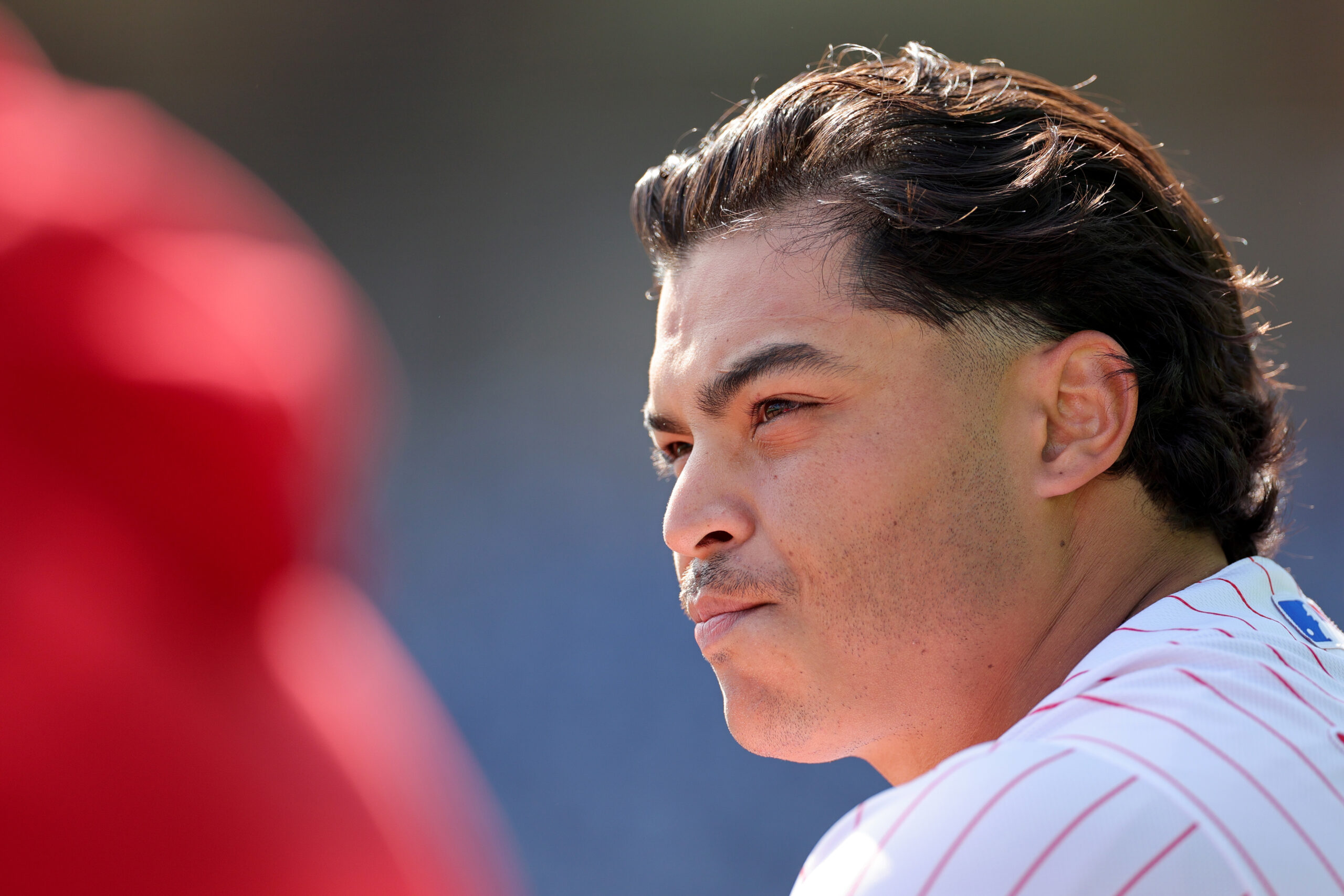
Jesús Luzardo signed a five-year, $135 million contract extension with the Phillies last week.
Traitor? Really? A quick scan of popular social media outlets uncovered zero references to Luzardo as a traitor.
I asked Luzardo at lunchtime if he was sure about all the negative feedback.
“It’s there,” he replied, with a pained smile. “I know.”
Where? Twitter? Instagram?
“I’m not on social,” he said. “I just know what I saw and what I heard.”
Hmm. Here’s a thought: Maybe he was hearing it in Spanish, not English.
Bingo.
And there it was.
Comments under Instagram posts announcing Luzardo’s decision were … harsh.
They questioned his commitment to Venezuela, and many told him to pitch for Peru. They questioned his manhood. One poster dropped a poop emoji.
It’s important to understand the significance of the tournament to Venezuelans, for whom baseball is not just the national sport, but a pastime bordering on the religious. It’s sort of like Jalen Hurts turning down a Team USA for football.
To be fair, some folks understood and supported Luzardo’s decision. There were several rational replies. A few commented on comments and defended Luzardo’s decision. But the majority of the reactions were negative, personal, and hurtful.
It wasn’t just the mean tweets and nasty ’grams, either.
“When a headline came out the other day, and said [Team Venezuela] called me, and I just said, ‘No,’ because I didn’t want to — couldn’t be further from the truth, right?” Luzardo asked. “I think that really kind of rubbed me the wrong way, because that wasn’t truth.”
The truth is, Luzardo loves the World Baseball Classic, and he loves representing Venezuela.
The truth is, he said in 2023 that he’d fulfilled his grandfather’s dream by pitching for Team Venezuela.
Former Phillie Ranger Suárez joined Venezuela for the World Baseball Classic.
The truth is, after missing time in 2019, 2022, and 2024 with injuries, Luzardo enjoyed a superb 2025 and is finally fulfilling the immense promise that made him the No. 18 prospect in all of baseball when the Athletics called him up in 2019. After being traded to Philadelphia from Miami on Dec. 22, 2024, Luzardo went 15-7 with a 3.92 ERA, finished seventh in National League Cy Young Award voting, and pitched well as a starter and a reliever in the Phillies’ brief playoff run.
The truth is, Luzardo logged a career-high 191⅓ innings including playoffs, he has a history of injuries, and he is on a precise buildup program this spring. That’s partly because Luzardo’s profile in the rotation this year will be two clicks higher to start the season: Staff ace Zack Wheeler is coming back from thoracic outlet decompression surgery that will cost him at least the first month, and Ranger Suárez has departed to the Red Sox via free agency.
Yes, two weeks ago, as Luzardo declined his initial invitation, he said that if Venezuela made the final four, “If they need me, I’ll go.” That gave Venezuela reasonable hope.
Things change.
“When I spoke to Venezuela about being on the reserves, I said, ‘No promises,’” Luzardo said Monday. “They said, ‘We’ll understand if you’re not able to come.’ … It was for multiple reasons, it wasn’t able to come to fruition. Not only the contract situation, but other situations here that, you know — my obligations to this team. They want me to be ready to go. I have to make those [obligations] right.”
The truth is, it would have been foolish for Luzardo to risk an appearance in the WBC, no matter how important the tournament might be to Venezuela, or to him.
“I’m hopeful that in the next Classic, you know, they’ll take me into account,” Luzardo said. “I’d love to be there again.”
The NFL’s 2026 free agency period is ongoing — even as the lion’s share of the league’s headline-grabbing signings have come off the board. The Eagles are one team for whom the situation remains fluid, but enough has occurred to take stock of the post-free agency picture nonetheless.
The Inquirer’s Eagles reporting team of Jeff McLane, Olivia Reiner and Jeff Neiburg got together for a roundtable with a week of free agency movement in the rear-view mirror.
What has been your biggest surprise of the Eagles free agency period to date?
McLane: Nothing the Eagles have done or not done so far qualifies as surprising from this vantage point. Howie Roseman essentially laid out his plans ahead of free agency. He would be selective in retaining his own players, prudent in signing others, and continue to build from within via the draft. I thought that maybe the Eagles would make an effort to keep safety Reed Blankenship considering the relatively affordable contract he signed with the Texans at $8.25 million a year. But I guess the greater shock was that Roseman would make a cornerback his first free agent signing.
There isn’t some rule that general managers have to fill roster spots by order of need. And signing Riq Woolen indicated that Roseman saw value in inking the 26-year old to a one-year contract worth up to $15 million. In theory, that is good business. But the third corner spot behind Quinyon Mitchell and Cooper DeJean is a luxury. Woolen has enviable attributes in size and speed, if not issues with consistency and temperament. He could be a steal on a “prove-it” deal. But he’s essentially a rental with Mitchell and Cooper slated for extensions next offseason. The Eagles have time to address holes at edge rusher, safety and find the next generation on the offensive line and at tight end. So this isn’t a critique of Roseman’s initial choices. Just an early assessment.
Reiner: Jaelan Phillips was always going to get paid this offseason, it was just a question of how much. He was a young, talented player at a premium position within a relatively underwhelming free-agent class. While the Eagles had interest in bringing him back, it seemed unlikely that they were going to overpay him, given the team’s need to reward homegrown defensive players who are eligible/will become eligible for extensions. Plus, Phillips had just five sacks last season (two with the Eagles) and hasn’t yet eclipsed his career best of 8½ sacks set during his rookie season in 2021.
He signed with the Carolina Panthers for four years, $120 million, good for a $30 million average annual value. While I figured his AAV would be high, I didn’t anticipate it would be that high. That’s a pretty significant projection, especially for a player not too far removed from a pair of serious injuries. I’m not surprised the Eagles were outbid, but I am surprised that they were outbid by that much.
Neiburg: My surprise is that it’s March 17 and the only addition to the edge rushing corps has been Arnold Ebiketie. There is, of course, plenty of time for that to change. But I expected Phillips to be back — though not at that number — and if not, expected the Eagles to bring in another top-end talent like Trey Hendrickson or Maxx Crosby. It’s the lone position on the team right now screaming for an infusion of talent, so I’d expect something to change relatively soon.
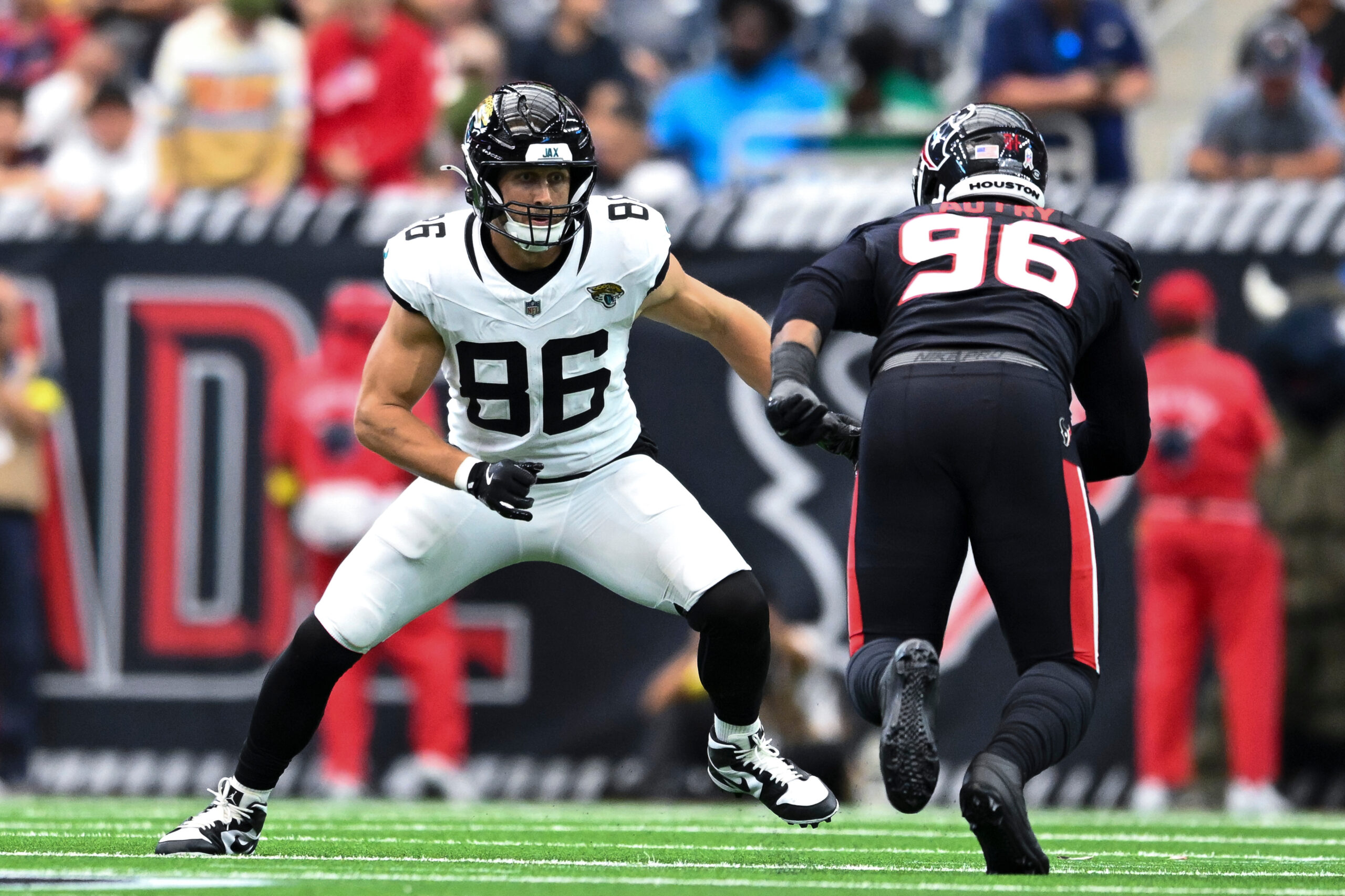
New Eagles tight end Johnny Mundt (86) arrives from Jacksonville with a sterling reputation as a blocker.
Which new Eagles face needs to be the most immediate difference-maker?
McLane: The pickings are slim here so I’ll go with Ebiketie. I don’t imagine the Eagles will go into next season with the former Falcon as the third outside linebacker behind Nolan Smith and Jalyx Hunt. But right now that’s where he lines up in the pecking order. Ebiketie dropped down the depth chart in Atlanta after new faces arrived last season, but he was still effective. He had a solid 16.4% pressure rate, if only two sacks. He had six sacks in each of the two previous seasons, though.
Ebiketie projects as more than a serviceable rotation edge rusher. The same could have been said for Azeez Ojulari and Joshua Uche — two outside linebackers the Eagles signed to one-year contracts a year ago that didn’t exactly pan out. It wasn’t all their fault. They weren’t given much of chance. Roseman traded for Phillips and Brandon Graham was lured out of retirement. As stated above, the GM is likely to add more bodies at the position, even if it isn’t a No. 1 guy. Until then, Ebiketie will have to do the heavy lifting as the projected No. 3.
Neiburg: The answer for me right now is Johnny Mundt, which probably says more about the quiet nature of the free agent class so far. The second tight end isn’t all that sexy. But I think Mundt’s job with the Eagles is a more important one than Woolen’s. Sure, Woolen is the high-profile name, but we saw last year that CB2, in this defense, with Mitchell and DeJean, wasn’t that much of an issue. Adoree’ Jackson did fine, and Woolen is better. The running game, on the other hand, suffered from poor blocking from the tight ends. That needs to change, especially in this new scheme, to get the offense back on track. Mundt needs to be as advertised. Woolen, meanwhile, can get away with just being OK.
Reiner: With Dallas Goedert and Grant Calcaterra now under contract in 2026, the addition of the 31-year-old Mundt is all the more important. Howie Roseman admitted in advance of the combine that the Eagles needed a more diverse skill set in the tight ends room last season, given Goedert, Calcaterra, and Kylen Granson were stronger receivers than they were blockers.
That’s where Mundt comes in. The Eagles’ run game is poised to lean more into a wide-zone scheme under new offensive coordinator Sean Mannion. Mundt should be familiar with the revamped run game and the coaches installing it. He played with Mannion with the Rams in 2017 and 2018 and the Minnesota Vikings in 2021 and 2023. New Eagles offensive line coach Chris Kuper also served in the same role in Minnesota while Mundt was on the team. Given the struggles of last year’s unit, Mundt has the potential to make a positive impact on the ground as a blocker. After all, Vikings head coach Kevin O’Connell once called him “the best third tight end in the NFL.”
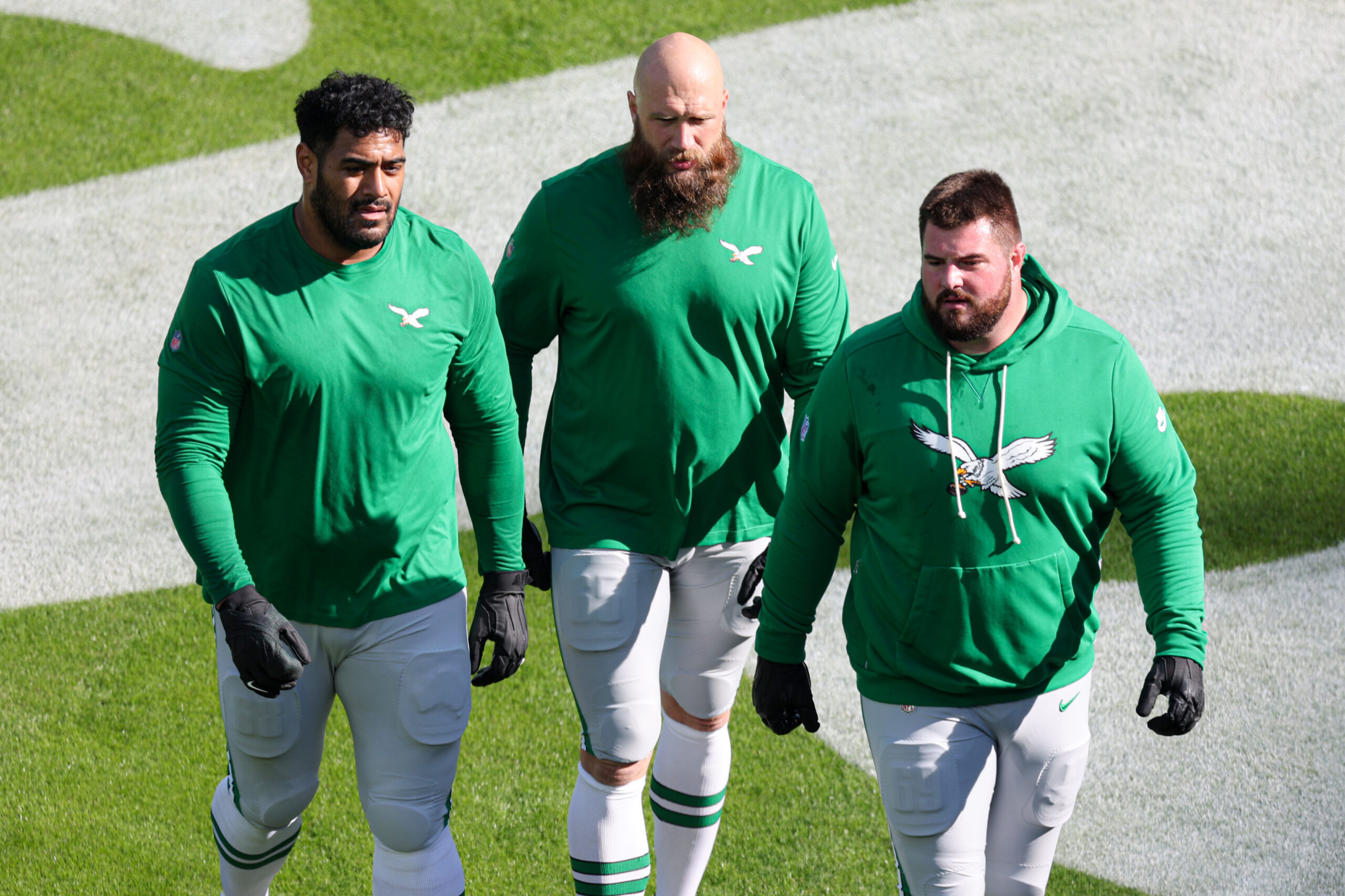
Jordan Mailata (left), Lane Johnson (center) and Landon Dickerson (right) are the present of the Eagles offensive line. The Eagles know they must think about the future in the trenches.
Name a position that concerns you heading into next month’s draft.
Reiner: Edge rusher. The Eagles could still use some more pass-rush prowess on the edge, especially after a quiet wild-card showing from the group (no sacks, just one quarterback hit, according to Pro Football Focus). Last year, the Eagles went into the season with Smith and Hunt as their top two edge rushers and ended up acquiring Phillips at the trade deadline to lead the group. Roseman ought to take a more proactive approach this year and add an impact player at the position before the season begins. Then, the Eagles should be set at the position for 2026 (and potentially beyond), as Smith and Hunt are promising, yet still developing.
Neiburg: In the immediate future, it’s edge rusher, but the long-term future of the offensive line is my primary concern for the state of this Eagles roster, and one they will need to help address in the draft. Lane Johnson’s career is winding down. Injuries and pain could soon force Landon Dickerson to retire before he hits 30. Cam Jurgens, like Dickerson, just got a treatment for his ailments in Colombia that they don’t do in the U.S. A position that has long been a strength of the Eagles has a lot of question marks as they enter the 2026 season.
McLane: I’ve mentioned the holes at edge rusher and safety, but I’m looking at a position with a longtime returning starter with question marks: left guard. We know that Dickerson will be back for a sixth season. Will he be able to finish it? I think that’s a fair question considering doubts he expressed about his future at the end of the season, and from sources close to Dickerson who know the full extent of injuries he’s played through the last several seasons. There might not be a tougher player on the roster, but a nowhere-near-100-percent Dickerson was often a detriment to the offense in 2025.
As Jeff mentions, he addressed his ailing body by receiving stem cell treatment, following Jurgens to Colombia earlier this month. Jurgens doesn’t get off scot-free. His regression last season wasn’t solely because he wasn’t full recovered from back surgery. He needs to bounce back. But the Eagles didn’t reduce the number of years left his contract like they did with Dickerson. They clearly know the end is nearing for the former Pro Bowler. They don’t have an obvious backup at this point after Brett Toth and Matt Pryor left in free agency. Roseman will likely add a veteran. But he may have to start thinking about finding a replacement in the draft, and that’s on top of preparing for Johnson’s retirement, which could be coming in a year.
Will the Eagles have regrets over whatever their decision is on A.J. Brown?
Crystal ball: What will we be saying about A.J. Brown at the end of the 2026 season?
Neiburg: Hello from late January. The Eagles just lost in the NFC title game despite A.J. Brown’s eight catches for 84 yards and a touchdown. The Eagles never got an offer worthy of parting with Brown, and so they kept him on the team and ran it back with Brown and DeVonta Smith at the top of the depth chart. Mannion’s offense opened up the passing and running games a bit, and Brown did fire off a few cryptic social media posts, but he went over 1,000 yards for the fifth consecutive season.
Reiner: Brown is still a great player … whether he is on the Eagles or not. Lately, it seems like “not” is the more likely outcome for the two parties. Perhaps the Eagles will wait to move him until after June 1, when they can spread out his dead cap charge over the next two seasons. Regardless, whoever ends up with Brown in 2026 is the better-off team. Even a 29-year-old Brown can make a difference in an offense, given he posted a paltry 1,003 receiving yards in a relatively down season in 2025.
McLane: I doubt there will be one uniform statement said about Brown, whether he’s with the Eagles or not. I suspect there will be a growing chorus, however, suggesting that he has taken another slight step back. We saw glimpses of that last season and perhaps that is why Brown voiced his frustrations in the middle of last season. He was still great at times. And it wasn’t like his average separation numbers when targeted dropped. He actually had a slight increase from 2.1 to 2.2 yards, per Next Gen Stats. But dropped passes and an occasional lack of effort were concerning. Jalen Hurts and Kevin Patullo weren’t solely to blame for last season.
Roseman wouldn’t be open to trading Brown if there wasn’t evidence that he’s slipping in his age-29 year. Every team knew about his knee concerns before the draft. The Eagles are the only ones to know how they’re holding up as he enters his eighth season. Any potential partner would perform a physical before signing off on a trade. But Brown isn’t coming off knee surgery like Maxx Crosby. There’s an uncertain expiration date with chronic injury. And some receiver-needy team is likely to take that risk. The Patriots or some other suitor will have to meet Roseman’s demands, but the asking price could drop post-June 1, especially if the Eagles draft a receiver.
Villanova is the only school representing the Big 5 in the women’s NCAA Tournament. The Wildcats, a No. 10 seed, are set to play No. 7 seed Texas Tech on Friday (8:30 p.m.) in Baton Rouge, La.
But players connected to the Philadelphia area are competing on rosters across this year’s March Madness bracket.
Here are the local women’s basketball players to watch:
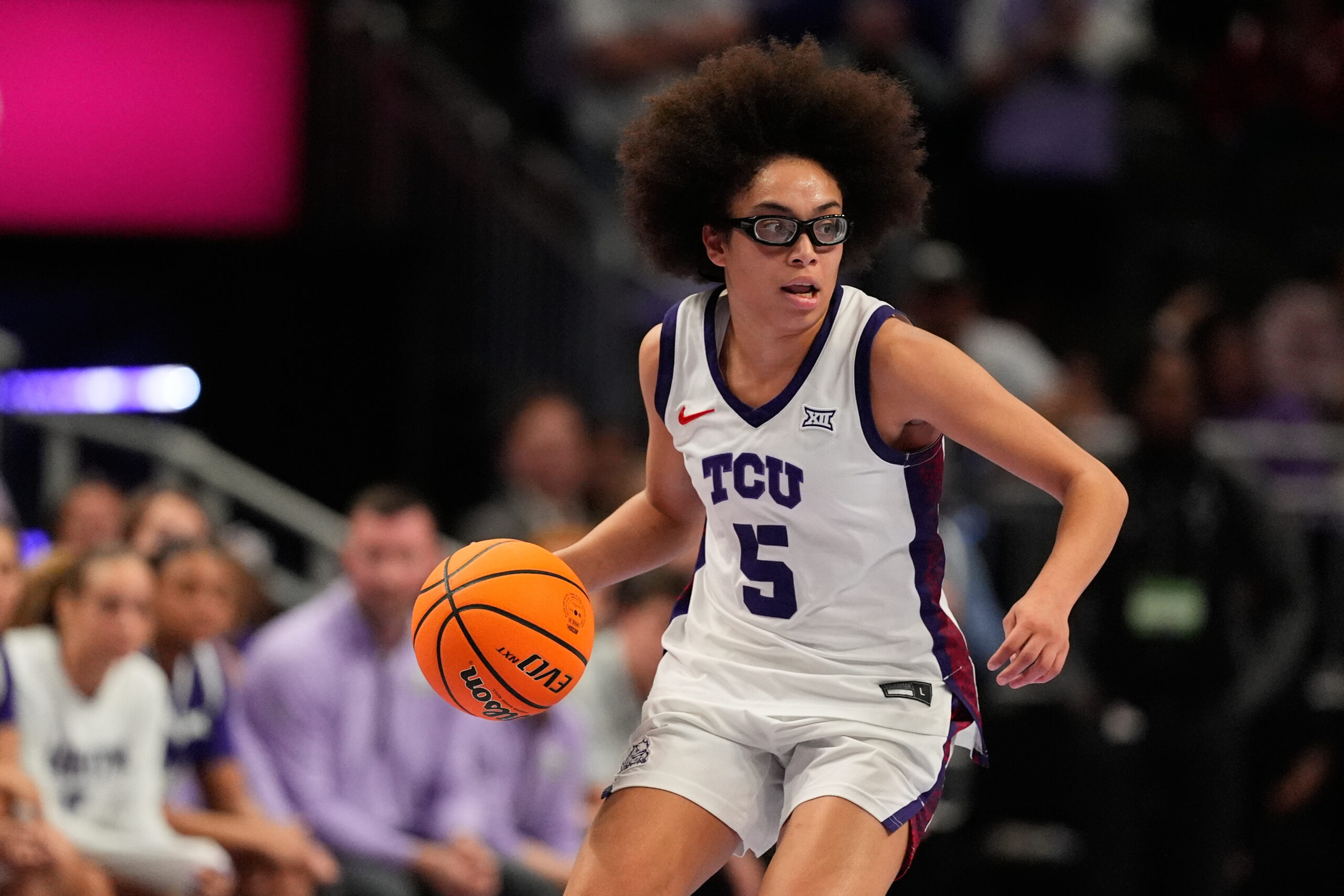
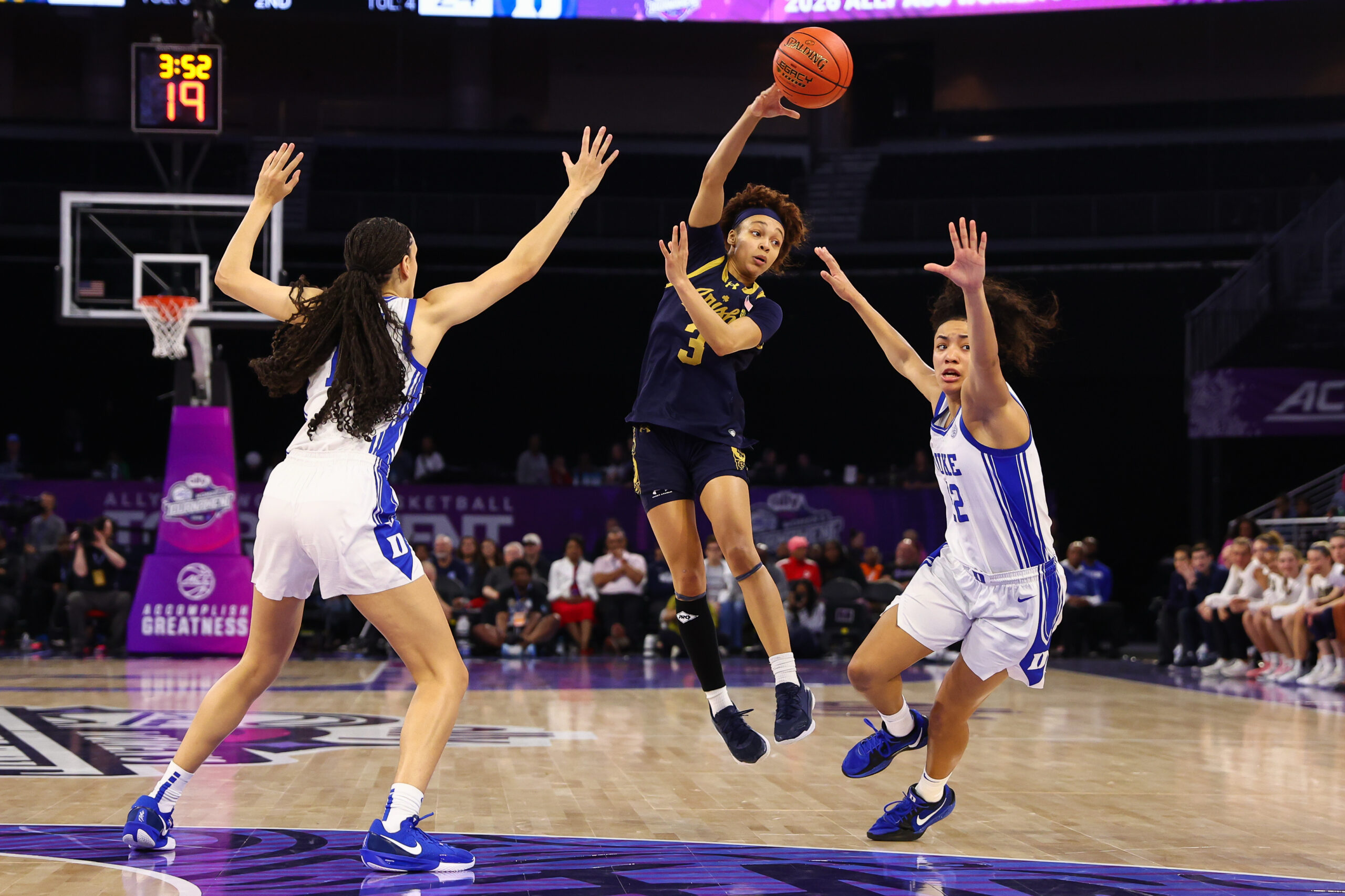
While many know graduate guard Olivia Miles as one of the nation’s top players with No. 3 seed TCU, Miles got her start with the Philadelphia Belles, an AAU team. The Phillipsburg, N.J., native is a three-time All-American who spent her first four years of college at Notre Dame.
Several Catholic League standouts will also be taking the court during March Madness.
Three players will represent Cardinal O’Hara: senior forward Annie Welde of Villanova, Richmond senior forward Maggie Doogan, and Fairfield’s Sydni Scott, a senior guard. From Archbishop Wood, sophomore guard Ava Renninger will compete with Fairleigh Dickinson and senior guard Ryanne Allen with Villanova.
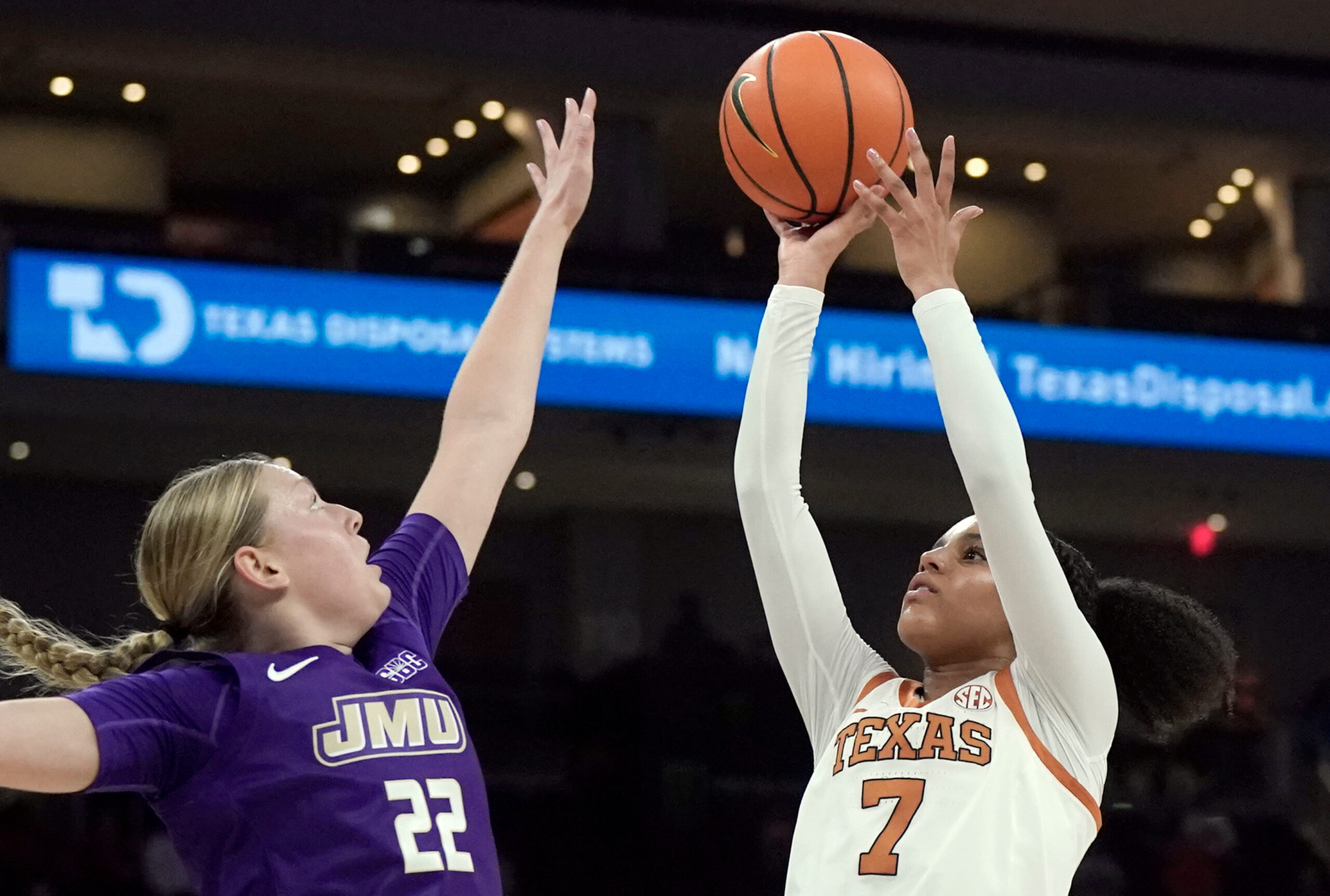
James Madison forward Grace McDonough was a standout at Lansdale Catholic.
Also for Villanova, senior guard Maggie Grant is an Archbishop Carroll graduate. And freshman forward Grace McDonough, who attended Lansdale Catholic, will compete with James Madison.
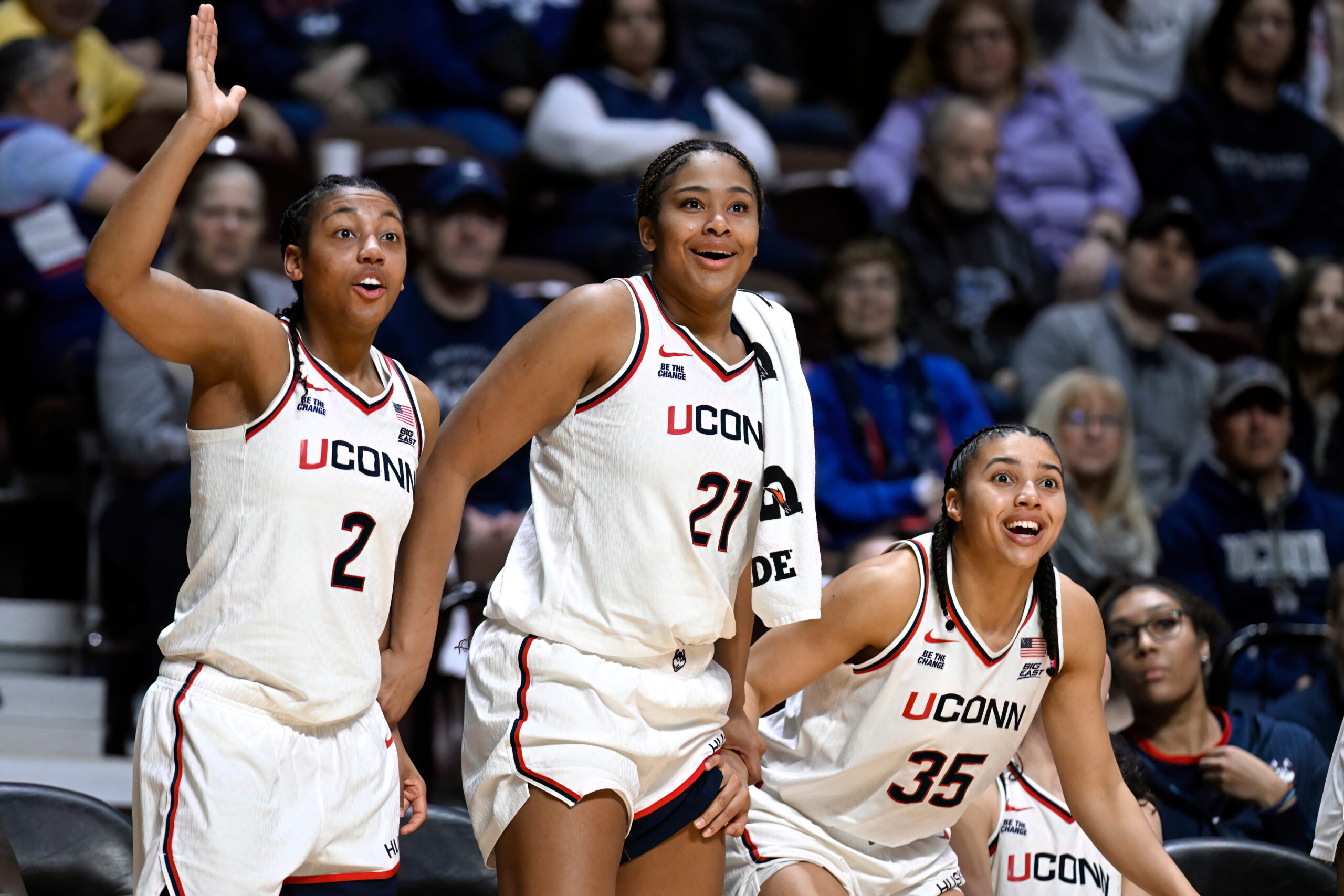
No. 1 seed Connecticut looks to defend last year’s national championship with Tonya Cardoza on staff as an assistant coach. Cardoza was Temple’s head coach from 2008 to 2022.
Chance Anies grew up at the tables of America’s chain restaurants. His mom’s career as a manager opening locations for TGI Friday’s, Olive Garden, Dave & Buster’s and others meant he and his siblings spent some of their most important life events in the glow of neon flair illuminating bottomless breadstick bowls and blooming onions.
“There was something magical about growing up there,“ says Anies, 34. “There was always something for everybody, for anyone who walked in the door, including kids. They were also affordable. And what I’ve found over the years is that middle-class dining like that has been dying.”
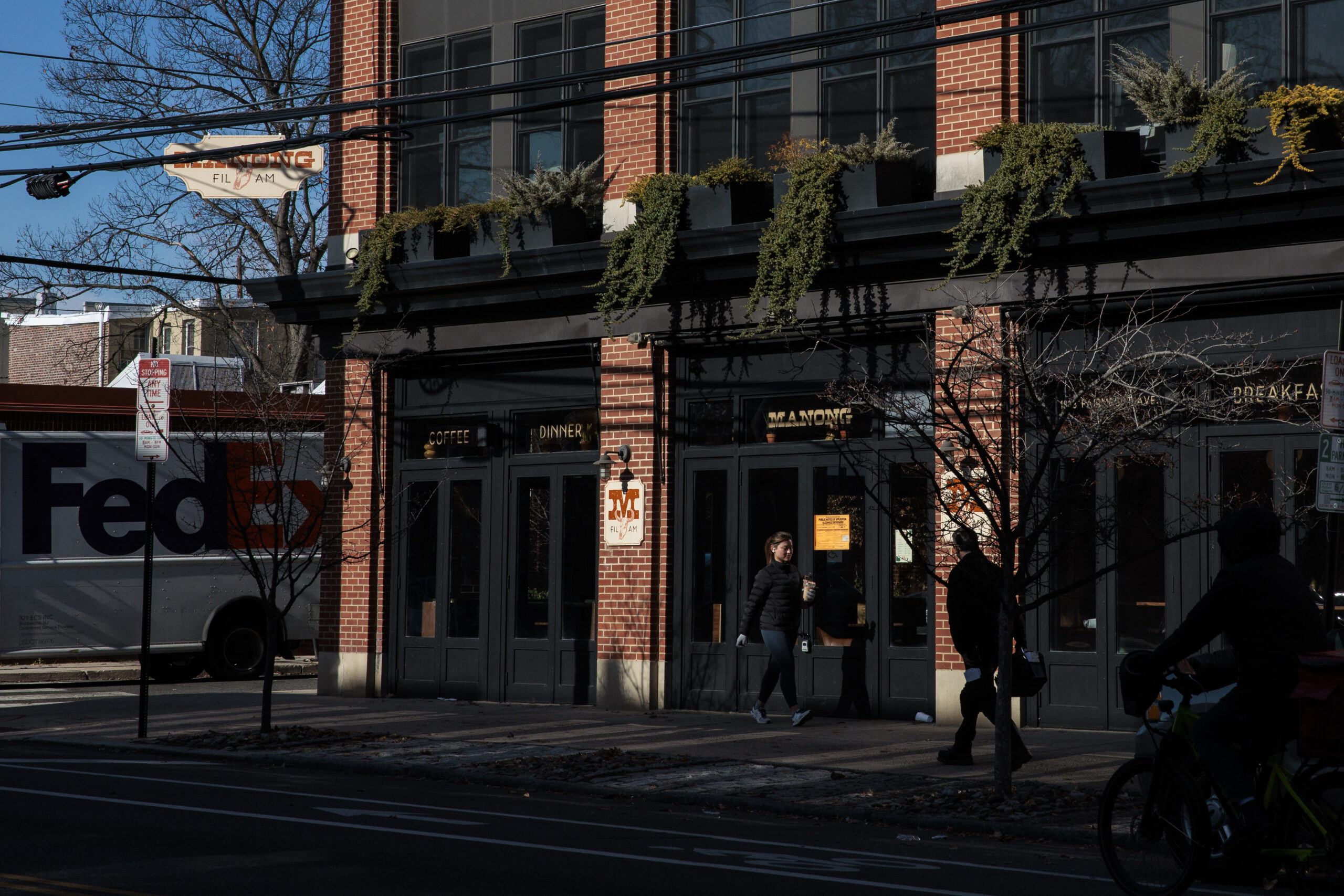
Manong, which opened three months ago in the former Tela’s space at 19th and Fairmount Avenue, is filled with references to the mid-tier chains of his youth. From the longhorn skull emblazoned on the sign at its front door, to the Teenage Mutant Ninja Turtles arcade game being played for free by guests in the corner, to actual neon signs from both Applebee’s and Outback alight in its two bathrooms, the cues are here for what Anies calls his chain-inspired Filipino-American steakhouse. There’s even the signature Bloom Shroom, a fantastic fungi riff on the blooming onion, whose deep-fried thatch of enoki mushrooms is irresistible — at least, when it isn’t overcooked or oversalted, as it was on my first visit.
The Bloom Shroom at Manong on Thursday, Nov. 20, 2025 in Philadelphia.
This kitchen has largely been more reliable than that, and nailed the shroom on a following visit, when its broom-like sweep of crunchy-earthy mushrooms threads lived-up to their potential. It was also clear after my visits here that catchy labels trying to characterize Anies’ sequel restaurant to Tabachoy, his Filipino BYOB hit in Bella Vista, really don’t do its concept justice. For one thing, it’s not a steakhouse, considering Manong didn’t even have a steak on the menu (beyond grilled beef skewers) for its first three months, when an intriguing hanger steak with fish sauce and pickled onions replaced the prime rib.
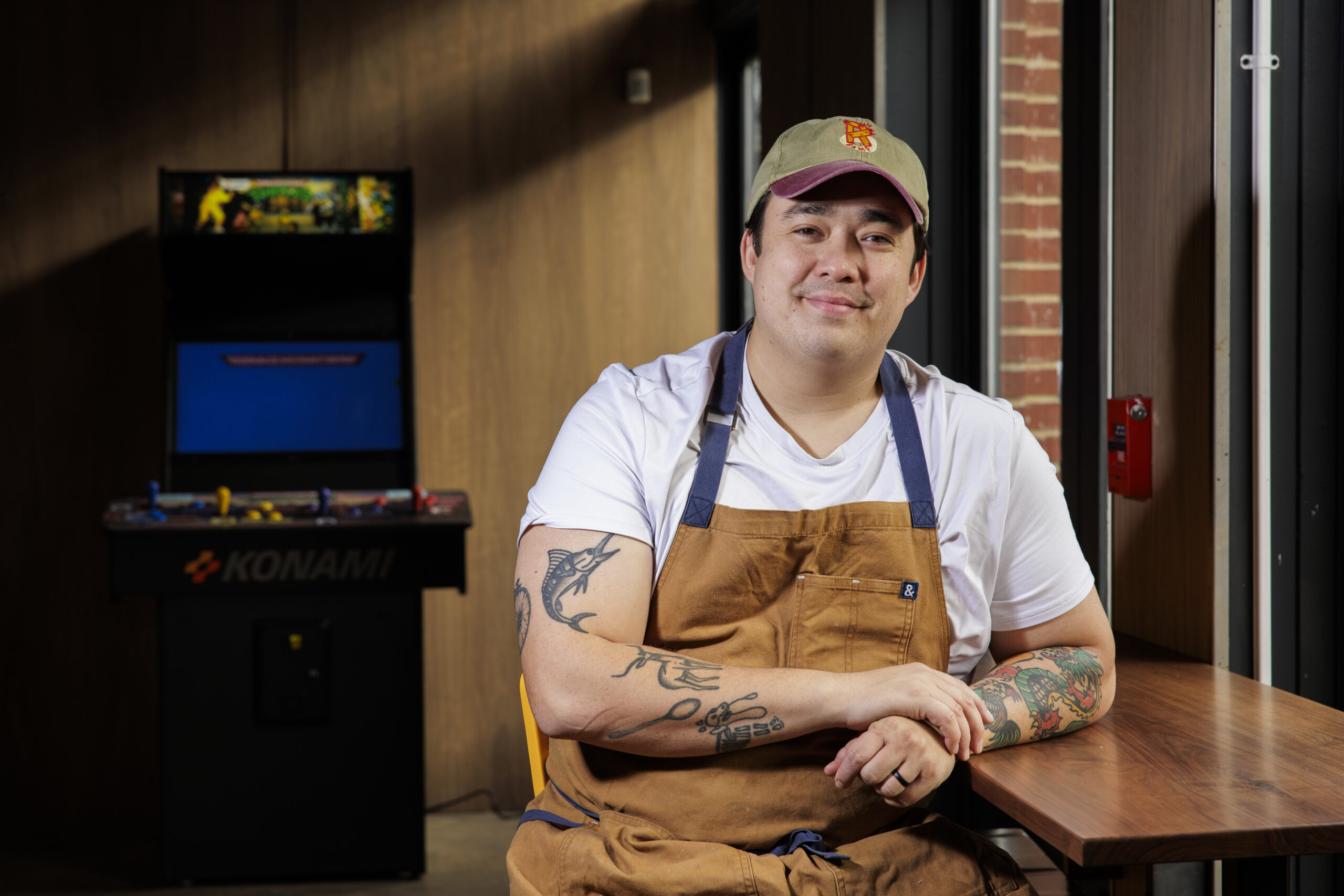
Chef Chance Anies posed for a portrait at Manong on Thursday, Nov. 20, 2025 in Philadelphia.
The swap was a pragmatic concession to keep the menu on the more affordable side, a prime characteristic of chain restaurant culture Anies says inspires him. With check averages around $50 to $60, including drinks, dinner at Manong costs more than going to Longhorn. But it succeeds in hitting a more accessible sweet spot than most of Philly’s pricier destination restaurants without sacrificing the quality of from-scratch food. There’s a balancing act of handcraft and value here most chain restaurants simply can’t touch.
The dynamite lumpia at Manong in Philadelphia, Pa., on Thursday, March. 5, 2026.
There’s also a level of personality, bold flavors, and storytelling to the food at Manong that is the antithesis of the sanitized corporate restaurant. This menu is a unique reflection of Anies’ childhood and life experiences as a Filipino-American — including his previous careers as an English teacher, medical researcher and food truck operator — that also diverges with its whimsy and creativity from the more traditionally-framed Filipino flavors anchoring Tabachoy.
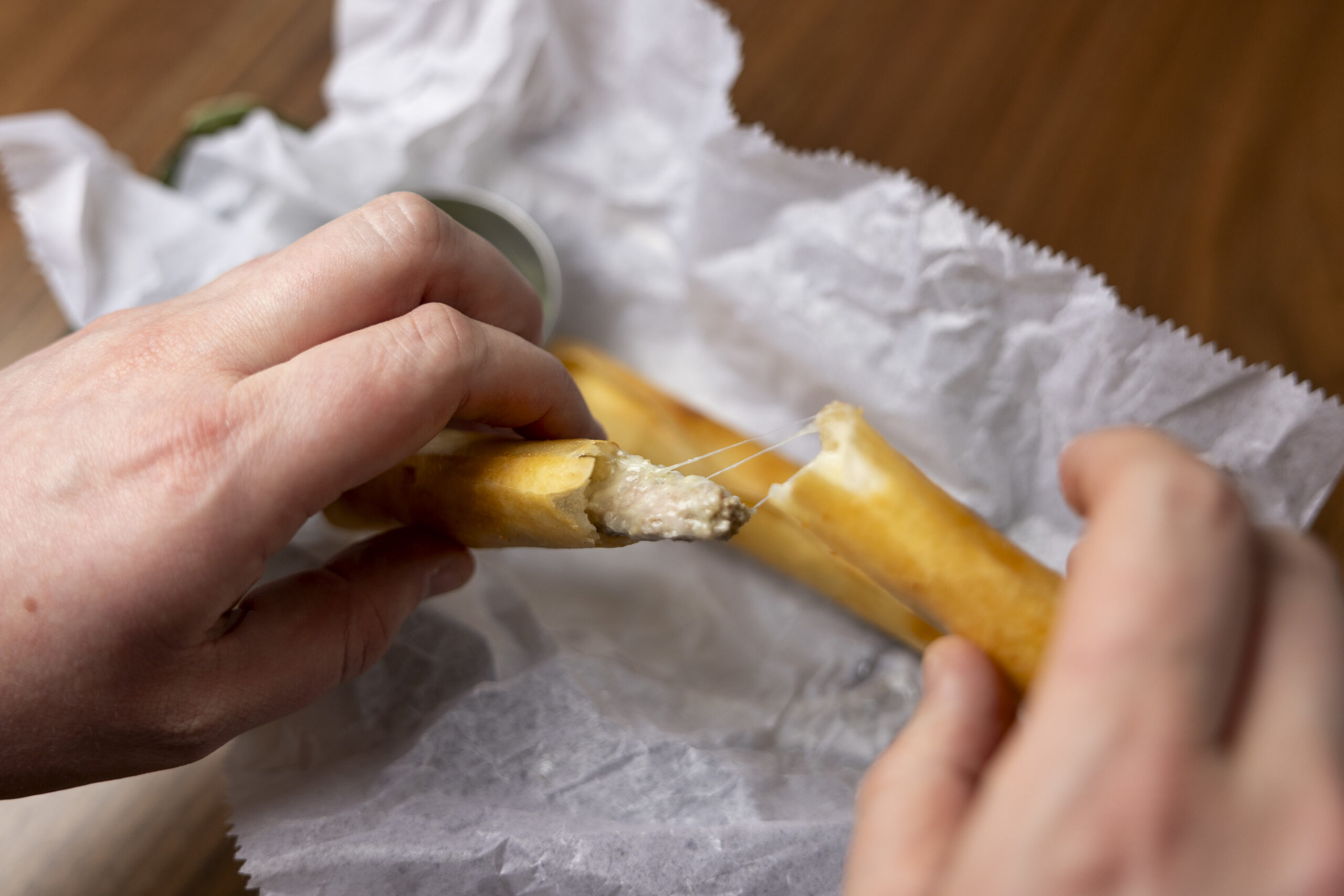
There’s an equivalent to mozzarella sticks at Manong, the dynamite lumpia, but they’re wrapped inside crispy spring roll wrappers and laced with tender pork and minced jalapeños alongside a sweet chili dip. Manong also offers one of the most distinctive new cheeseburgers in the city, a half-pound patty that spans the width of four small pandesal rolls that are still attached, like King’s Hawaiian bread.
The connected rolls can easily be divided into shareable sliders, but avoid the urge to supersize it into a full one-pound of meat because it throws all the proportions off. The standard serving maximizes its many Filipino flourishes, from the light sweetness on the fresh-baked bread to the tropical backnotes of the house banana ketchup, the calamansi-tanged slaw, and a mayo shaded by bangus (tinned milkfish), whose oily fillets are buzzed into an umami-rich spread that Anies says carries a Pinoy schmear of “je ne sais quoi.”
The 1/2lb balong burger at Manong in Philadelphia, Pa., on Thursday, March. 5, 2026.
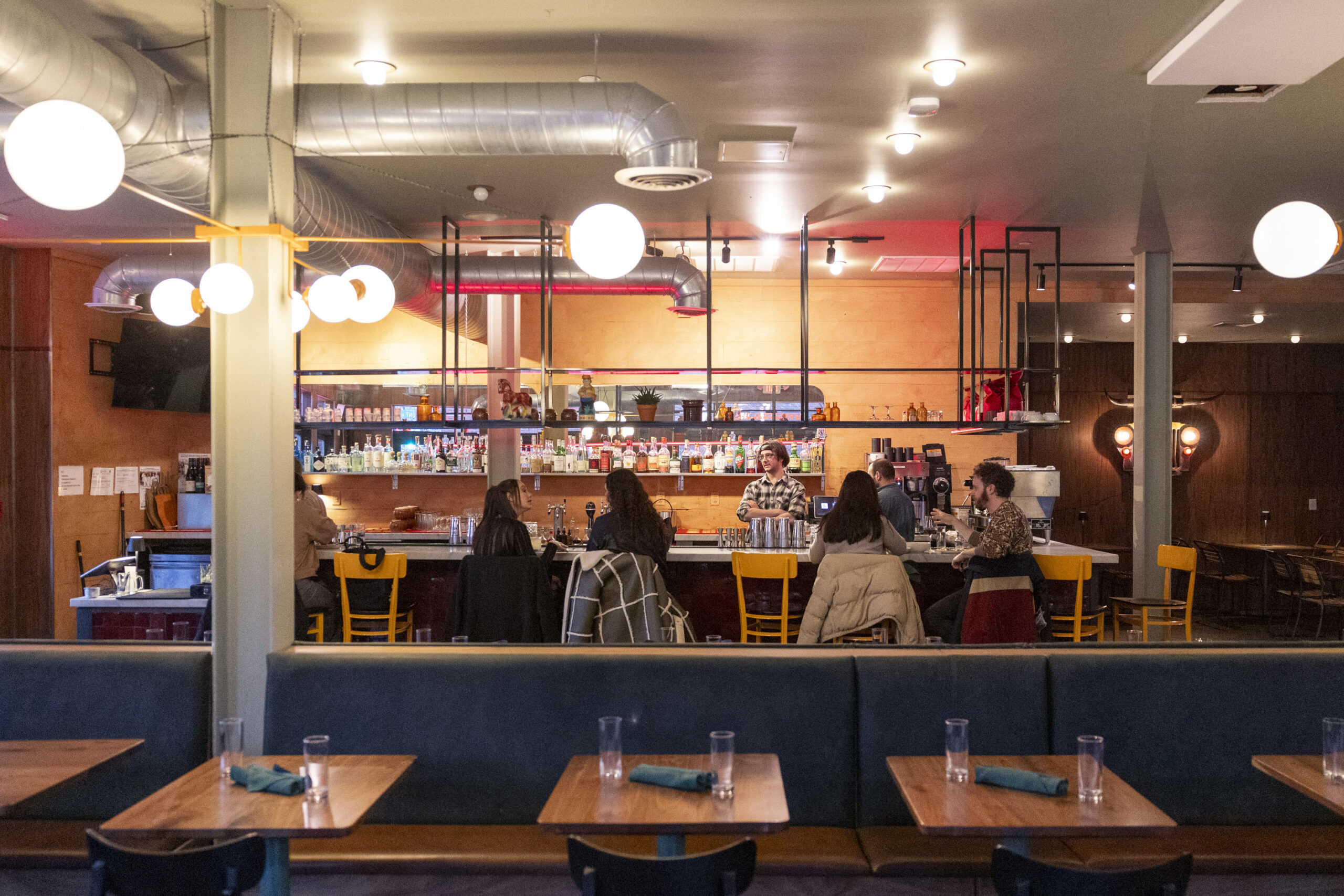
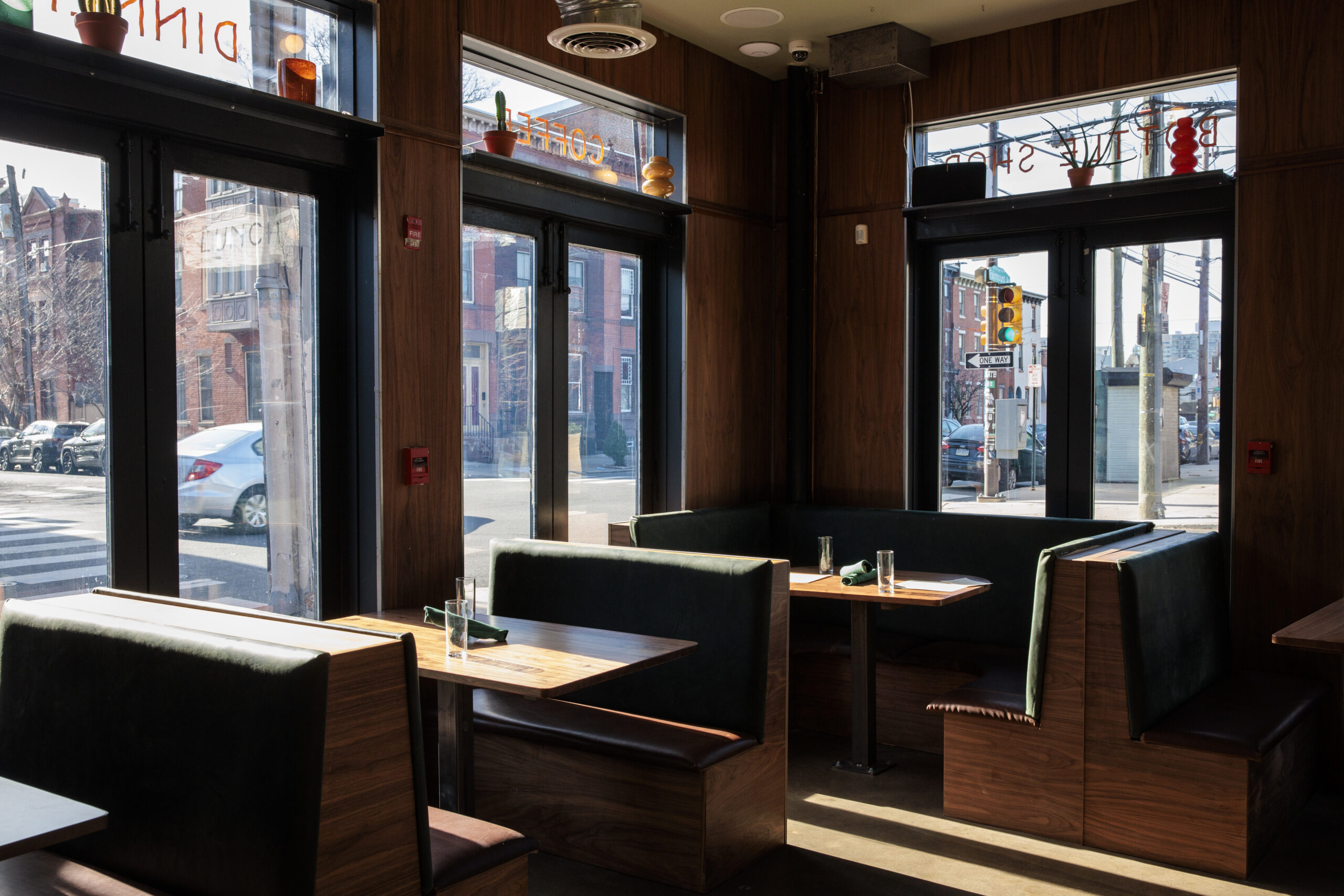
The 75-seat Manong, which means “elder brother” in Ilocano, the Filipino dialect of Anies’ father’s family, is close to three times as big as Tabachoy, a 28-seater in Bella Vista so snug you need to access the bathroom through an alley door at the rear of the building. But Anies has made good use of this sunny, high-ceilinged corner space, warming its interior with rustic walnut accents and adding convivial booth seating to both its window walls and a central banquette.
The exterior of Manong on Tuesday, Dec. 9, 2025 in Philadelphia.
With room for large parties, including a back alcove beneath mounted horns and a vintage truck grill with illuminated headlights, plus 13 seats at the bar, there were more groups of people simultaneously celebrating at Manong than any restaurant I’ve visited in recent memory. Conjuring that kind of joy, and for such a broad cross-section of customers, is one aspect of “everyone’s family” magic that Anies has successfully channeled.
Customers enjoying drinks and food at the bar at Manong in Philadelphia, Pa., on Thursday, March. 5, 2026.The interior of Manong on Tuesday, Dec. 9, 2025 in Philadelphia.
A drink program overseen by beverage manager Eli Ezer helps buoy the festive mood with a variety of fun, colorful drinks that also offer thematic twists, like the sky blue Otso Otso, a riff on a spicy margarita infused with green peppercorn, lemongrass, and calamansi, or an espresso martini with the added taste of sweet corn (a combo with roots in the Philippines), or a Pinoy version of the City Wide, pairing San Miguel Lite with a shot of Kasama rum.
The Otso Otso cocktail at Manong in Philadelphia, Pa., on Thursday, March. 5, 2026.The Pandan latte at Manong in Philadelphia, Pa., on Thursday, March. 5, 2026.
It’s no surprise this room has a serious noise problem, and will eventually require some significant investment to sound-proof its hard surfaces. It recently opened for new daytime cafe hours to pump out purple ube and pandan lattes with Herman’s Coffee, along with a limited selection of pastries, and plans to expand the daytime menu with breakfast sandwiches for a brunch debut this spring. There’s also a retail bottle shop where a fridge case full of Red Horse beer, natural wines, and sakes add yet another reason to visit.
For now, however, Manong’s dinner is more than a worthy enough draw on its own. Aside from the bloom shroom, all of the skewers are winners, including the juicy grilled chicken thighs glazed in Filipino barbeque sauce and tagalog beef sticks that evoke Japanese negamaki with thin-sliced flank steak bundles on the skewer rolled around crunchy scallions in a calamansi soy-garlic glaze.
Anies aims to evoke the rich chain restaurant pastas of his youth with the “creamy pasta” entree, but it’s infinitely more interesting here with basil fettuccine tangled in a sauce creamed with coconut and Parmesan, flavor-boosted with ginger, garlic, and thin slices of pork belly. The “super duper creamy” version may be tempting, but once again, like that burger, the “more” option was less appealing. When we opted for the bonus of trout roe and shrimp on my second visit, it came in an overly thickened cream sauce that bordered on sludge.
The squash at Manong on Thursday, Nov. 20, 2025 in Philadelphia.
One of Manong’s most creative dishes is its singular option for vegans, kalabasa pyanggang, a koginut squash marinated in a garlicky paste of charred coconut husks that’s served with a sweet vinegar lemongrass drizzle over a rich coconut milk sauce scattered with pepita seeds.
I would have loved the grilled swordfish with green mango-bitter melon salad if it had been fully cooked. That’s one fish I don’t enjoy medium-rare. But Manong has its roasted half-chicken down, a juicy lemongrass-infused bird glazed in tart calamansi vinegar and orange annato butter — at $28, a relative bargain in an era of high-priced chicken entrees
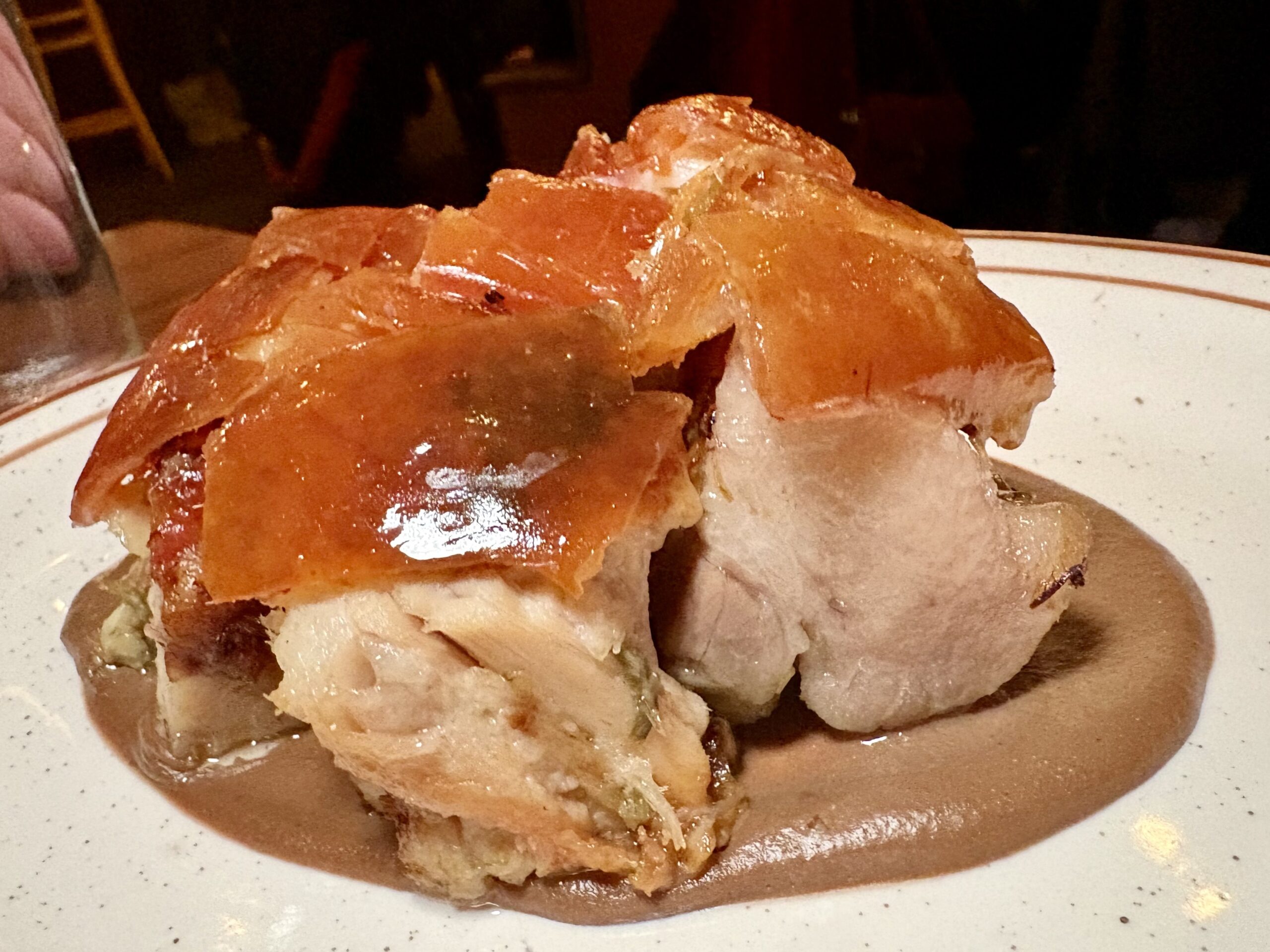
The kitchen’s pork dishes are also exceptional, including a traditional lechon liempo pork belly whose superbly tender chunks of meat are set beneath shattering amber sheets of crispy pig skin, atop a silky swoosh of creamy liver sauce.
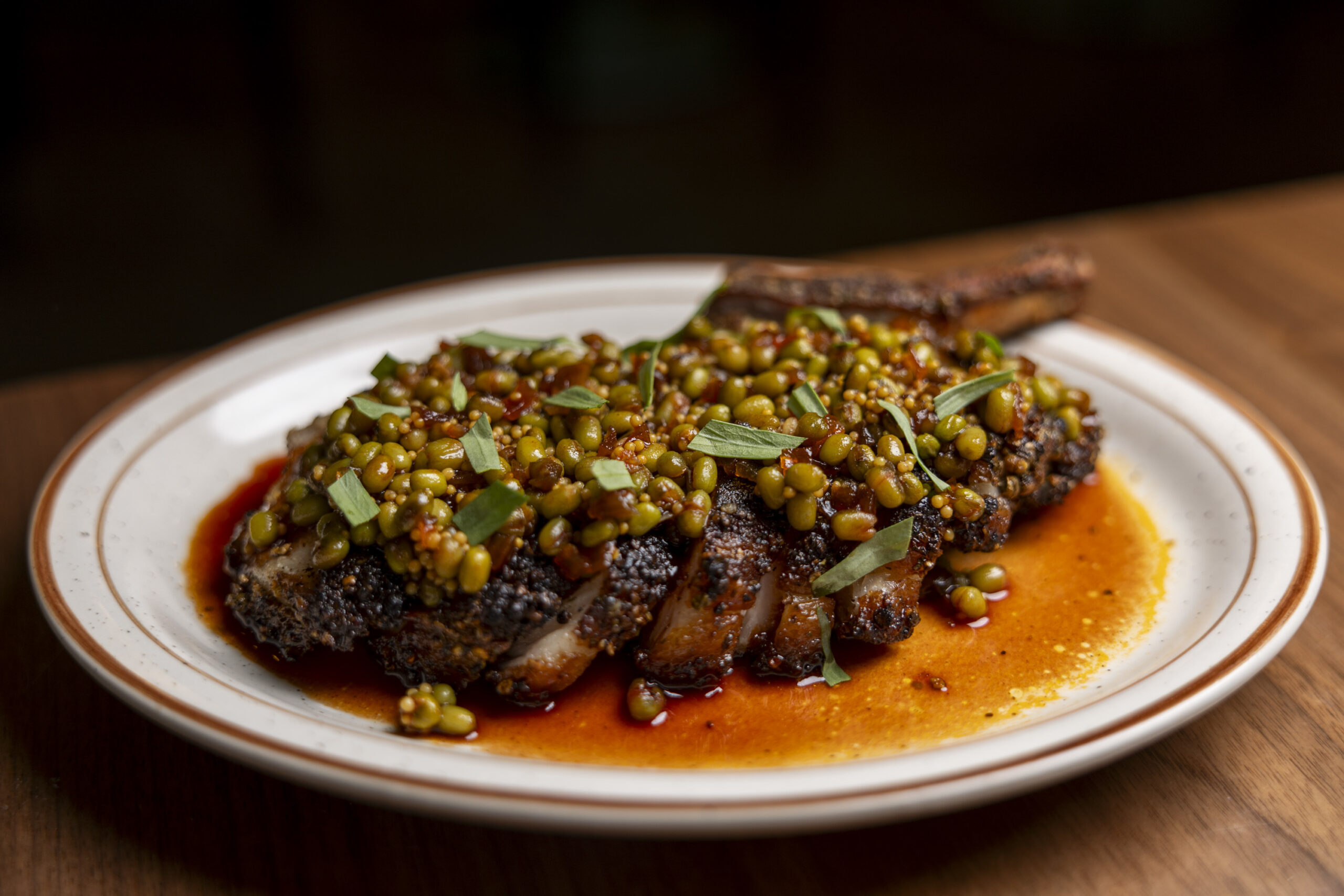
The lechon liempo at Manong is slow-roasted pork belly topped with crispy skin over a sauce of pureed chicken liver.The pork & beans at Manong in Philadelphia, Pa., on Thursday, March. 5, 2026.
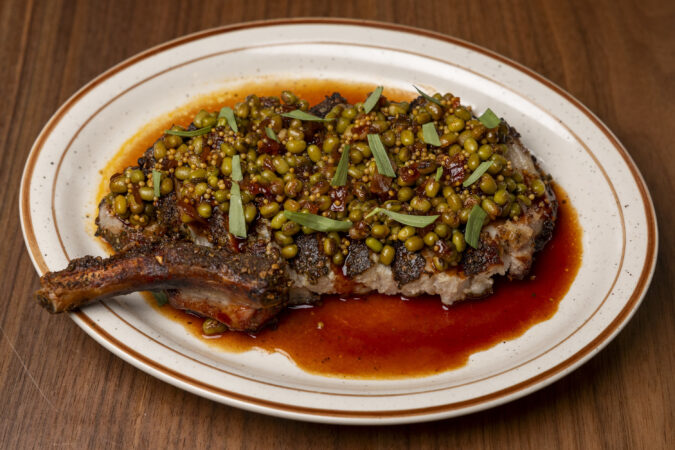
Perhaps my favorite dish at Manong is the “pork & beans”, a multi-cultural mash-up of a juicy grilled pork chop encrusted with green peppercorns and smothered with sweet and zesty mung beans. Think of the canned Heinz baked beans classic, but with a Filipino swagger of cane vinegar, the sweetness of brown sugar, and red yeast rice (typically used in Chinese char siu bbq), and firmer beans that possess a nutty snap of extra texture.
“Is it American? Is it Filipino? It’s neither, but also both,” says Anies, summing up not only this dish, but so much of the menu at Manong, where steaming sides of garlic rice, coconut-creamed spinach, and whipped potato salad studded with more crunchy garlic, corn, and shear potato skin chicharrones create a spirited fusion feast like no other.
Add some calamansi or mango water ice for dessert sandwiched on those fresh pandesal rolls, or the deep purple richness of its ube ice cream, and Manong’s Filipino fusion takes on a distinctly Philly vibe, too. Anies’ chain restaurant childhood may have been the impetus for the affordable and fun spirit of Manong, but he’s created something here that feels like an original.
The ube and mango ice cream sandwich at Manong in Philadelphia, Pa., on Thursday, March. 5, 2026.
Manong
1833 Fairmount Ave., Philadelphia, PA 19130, 445-223-2141; manongphilly.com
Dinner Wednesday to Sunday, 5-11 p.m. Cafe open for coffee and pastries Wednesday to Sunday, 8 a.m.-2 p.m.
Dinner entrees, $19-$35.
About 30% of the menu is gluten-free, including the bloom shroom, cooked in a gluten-free fryer.
Drinks: The cocktail list delivers affordability and style, with a series of classic templates transformed colorful tropical twists, from the sky blue Otso Otso infused with green peppercorn and lemongrass, to a backnote of corn in the espresso martini and Filipino rum mixed with coconut and purple sweet potato for the Ube Halaya. The beer list features both local brews and Filipino imports, including the smooth but potent Red Horse. There’s also a selection of natural wines by the 6 oz. carafe. In addition, a retail bottle shop has a fine selection of natural wines and sakes to go.
One block from the Los Angeles courthouse where Mark Zuckerberg testified in February, families gathered around the Lost Screen Memorial: 50 illuminated phones, each bearing the face of a child their families say social media killed.
Inside the courtroom, the unsealed documents were unsparing: “We’re basically pushers,” one Meta employee wrote. A 2018 internal memo laid out the strategy: “If we wanna win big with teens, we must bring them in as tweens.”
Internal research found that teens described Instagram in terms of what the documents called an “addict’s narrative” — compulsive behavior they knew was harmful but felt powerless to stop. Meta’s own engineers proposed fixes, warning internally that “our product exploits weaknesses in human psychology to promote product engagement and time spent.”
Executives chose profits instead.
Nylah Anderson, 10, in Chester, liked TikTok videos and she accepted the “blackout challenge” in personal TikTok feed last December as a fun dare. She asphyxiated herself. Her mother has sued TikTok in Philadelphia federal court.
In December 2021, 10-year-old Nylah Anderson of Chester died after TikTok’s algorithm recommended a “Blackout Challenge” on her “For You” page. In August 2024, the U.S. Third Circuit Court of Appeals ruled that this was not protected speech. The court determined that TikTok’s act of serving that video to a 10-year-old was an expressive act. That ruling cracked Section 230, the legal shield platforms had used for two decades to avoid accountability.
Thirteen-year-old Levi Maciejewski of Cumberland County never made it to a courtroom. He died by suicide in August 2024, two days after opening an Instagram account and being extorted by a predator through Instagram’s “Accounts You May Follow” feature.
Internal Meta audits from 2022, cited in his family’s wrongful death lawsuit, found that same feature was recommending accounts engaged in “inappropriate interactions” to 1.4 million minors. Meta’s own documents from 2015 estimated that approximately 4 million users under the age of 13 were already on Instagram — roughly 30% of all 10- to 12-year-olds in the U.S. — despite that age being prohibited.
Anyone who worked with children during the adoption of the smartphone watched their minds deteriorate. When I started teaching in 2009, students socialized, made eye contact, were able to focus. By the end of that decade, they arrived sleep-deprived and anxious, reaching for their phones at every opportunity.
Lunch rooms and hallways were quieter, earbuds in, eyes locked on screens. Teachers, like parents, were being asked to compete against a billion-dollar engineering operation. We weren’t losing because of personal failings. We were losing because we were outmatched by a trillion-dollar campaign to harvest attention.
Big Tech is making the same argument the tobacco industry made for 50 years about smokers who couldn’t quit. Plaintiff KGM — known in court as Kaley — testified this month that she began using YouTube at age 6 and Instagram at age 9, with no barriers to stop her. Instagram was the first thing she opened every morning and the last thing she looked at before sleep. Not getting enough likes left her feeling “insecure” or “ugly.” Asked whether she felt that way before social media, she said: “No, I didn’t.” By age 10, she was cutting herself.
Meta’s lawyers argued her struggles came from a difficult home life. Kaley answered them directly: most of the arguments with her mother were about the phone. She is 20 now. She told the jury her life would have been “unequivocally better” without these platforms.
In the years that social media became ubiquitous, the suicide rate for 10- to 14-year-olds tripled. We don’t stand at the edge of a lake watching children drown and demand more longitudinal studies to figure out the cause. We see the harm. We act.
The tobacco parallel is more than rhetorical; it provides the applicable legal and moral framework for addressing Big Tech. We do not let tobacco companies advertise to children. We do not allow stores to sell to them. We require warning labels. None of that required settling every clinical debate. It required a political decision that some harms to children are unacceptable regardless of whether we can precisely quantify them.
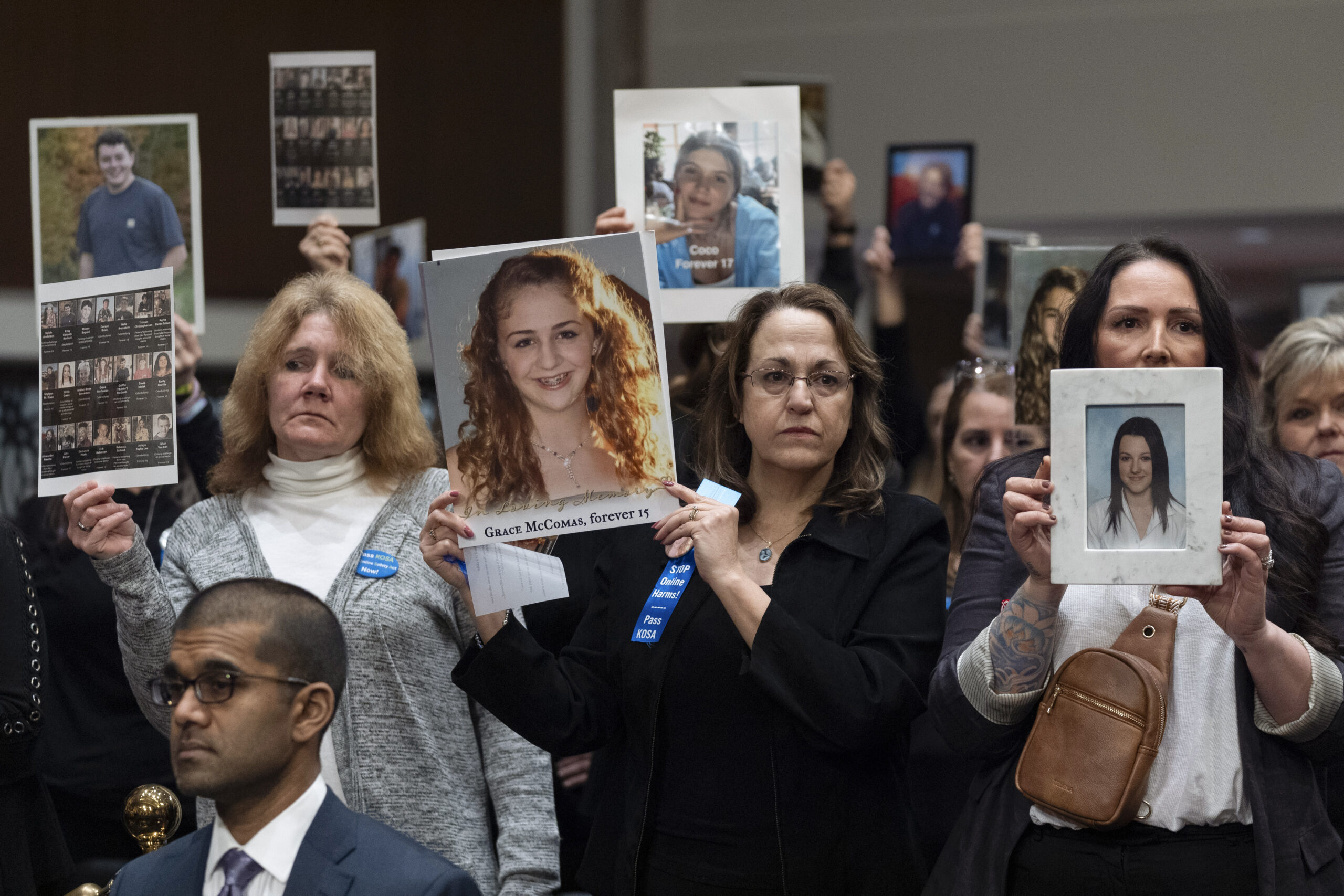
People in the audience hold up photos of their loved ones during a Senate Judiciary Committee hearing on online child safety on Capitol Hill in January 2024.
In February, West Virginia’s attorney general sued Apple after the company’s own internal communications described iCloud as “the greatest platform for distributing child porn.” Meta is on trial in Los Angeles. For the first time, tech executives are producing documents under court order, with legal penalties attached. For the first time, the “we didn’t know” defense is colliding with internal evidence that they did. The legal reckoning is not coming. It is here.
The Kids Online Safety Act, which would require platforms to prioritize children’s safety over engagement, passed the Senate 91-3 in 2024. Last week, the House Energy and Commerce Committee responded — not with that bill, but with a weakened substitute called the KIDS Act, advancing it to the House floor 28-24, along party lines.
The House substitute is a retreat dressed as progress: It omits the “duty of care” language that would require companies to design products with children’s safety in mind, sets a federal safety floor lower than existing state protections, and, most damaging, would preempt stronger state laws — potentially nullifying thousands of pending lawsuits, including the cases in Los Angeles that are finally forcing these documents into the open.
Big Tech spent over $60 million on federal lobbying in 2024. The bill tells you exactly where that money went.
In Pennsylvania, legislators have made progress. Senate Bill 1014 — a bell-to-bell cell phone ban in public and private schools — passed the state Senate 46-1 last month, with Gov. Josh Shapiro’s endorsement already secured. As one parent leading the effort put it: “Teachers, kids, and parents have been tasked with managing the unmanageable. It’s time to recognize that our current approach isn’t working.”
The House should finish the job. But even a unanimous phone ban is a seven-hour policy competing against platforms that spend billions optimizing addiction across the other 17 hours of a child’s day. Keeping phones out of classrooms is a start.
Keeping companies from engineering compulsion in the first place is the actual problem — and that requires a federal duty of care with teeth, and political leaders who care about children more than cashing their checks.
Nylah Anderson was 10 years old. Levi Maciejewski was 13. Their tragedies helped start the battle against these companies. The House has a bill on its desk.
Act — before another Pennsylvania child’s face joins those 50 phones outside the courthouse.
AJ Ernst worked as a teacher and administrator in Philadelphia for 13 years and holds a doctoral degree in educational leadership from the University of Pennsylvania’s Graduate School of Education.
The NCAA women’s tournament is usually pretty chalky, and this one likely won’t be any different. But that’s not just because of the perennial early-round home advantage for the top four seeds in each region. Or even because the bracket hasn’t set up many potential upsets where they more likely happen: in games between two teams traveling to someone else’s floor.
This time, it’s because of the strength of the four No. 1 seeds: Connecticut, UCLA, South Carolina, and Texas. They are so far ahead of almost the entire rest of the field that they’ll all be clear favorites to reach the Final Four. And if they do, that will make up for some of the dullness along the way.
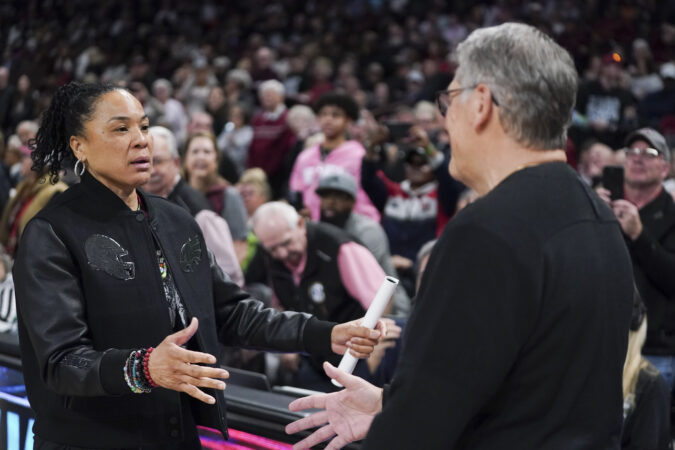
The alignment of regions means there would be a UConn-South Carolina matchup in the semifinals, which has never happened. Geno Auriemma and Dawn Staley have met three times in the tournament before: the 2025 and 2023 title games and the 2018 East Regional final.
Connecticut’s star trio of (from left) KK Arnold, Sarah Strong, and Azzi Fudd.
Who can challenge the top quartet? The list starts with No. 2 seed LSU. The Tigers are led by veteran guards Flau’jae Johnson and South Carolina transfer MiLaysia Fulwiley, and coached by four-time national champion Kim Mulkey. She’s as controversial as she is successful, but she knows how to win in March.
LSU finished fourth in the ultra-competitive SEC, thanks to a January swoon when they lost to Kentucky and Vanderbilt. They also lost at Texas and twice to South Carolina, at home in the regular season, then in the conference tournament semifinals. But the rest of the record is stacked with big wins: at Duke, home vs. Texas, and two over Oklahoma.
Expect the Tigers to eat up either Villanova or Texas Tech in the second round, on the way to the Elite Eight. (And yes, Villanova can win that first-round game.)
No. 2 seeds have interesting stories
UCLA might be quite annoyed that the best No. 2 seed landed in its region. Not only would anyone want to avoid the Tigers, but the 31-1 Bruins believe they deserved the No. 1 overall seed.
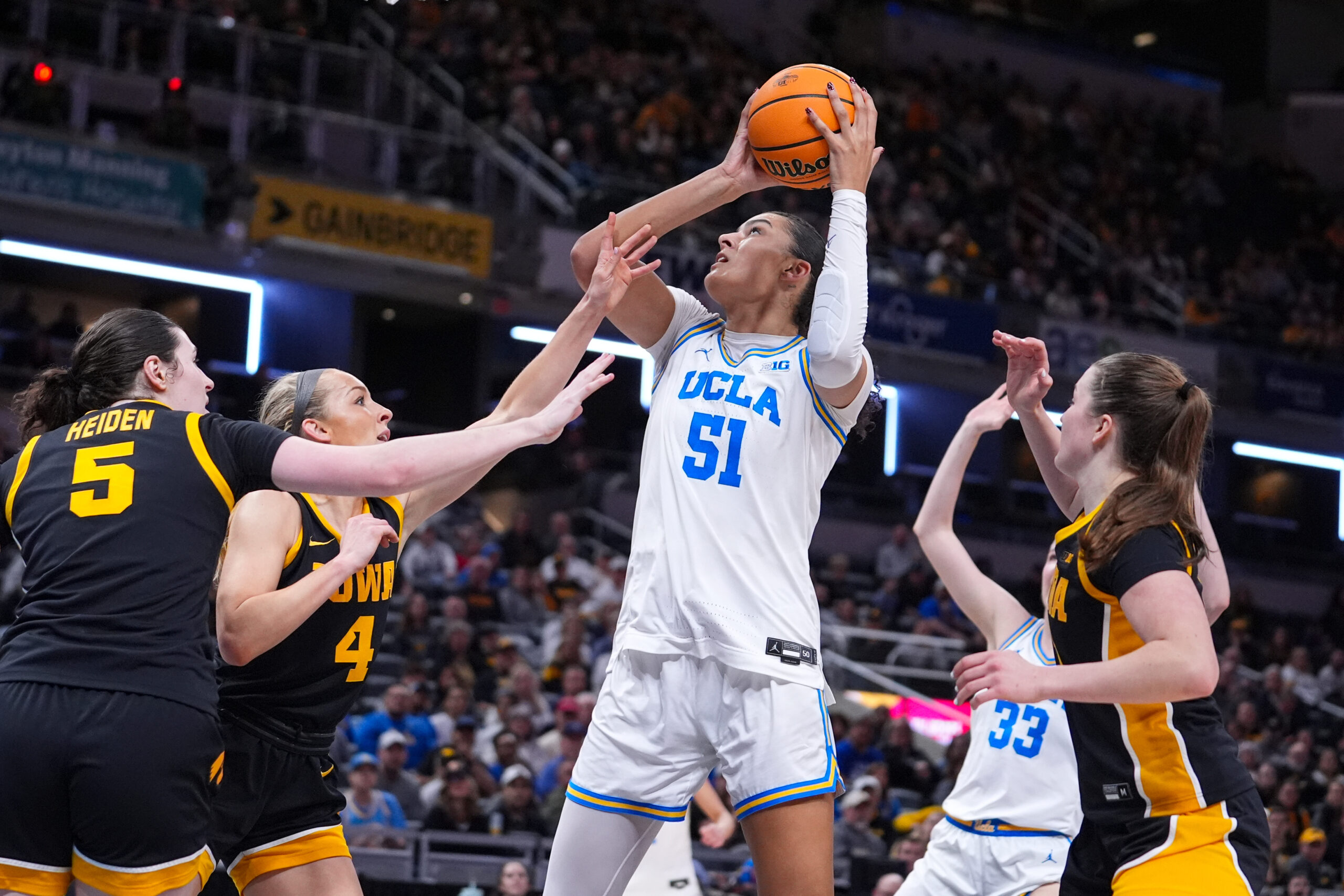
UCLA’s Lauren Betts goes up for a basket during the Big Ten women’s tournament title game.
They took the regular season and tournament in the Big Ten, a tougher conference than the Big East, with 12 wins over teams ranked at the time of the contest. Their only loss was to Texas on a neutral floor, and it was back on Thanksgiving.
LSU might in turn be annoyed that a rematch with Duke looms in the Sweet 16. Though the Blue Devils had six nonconference losses — including South Carolina, UCLA, and LSU in one seven-day stretch — they won the ACC regular season and tournament. They finished No. 8 in the NCAA’s NET rating, and the fourth No. 2 seed, Iowa, finished 10th.
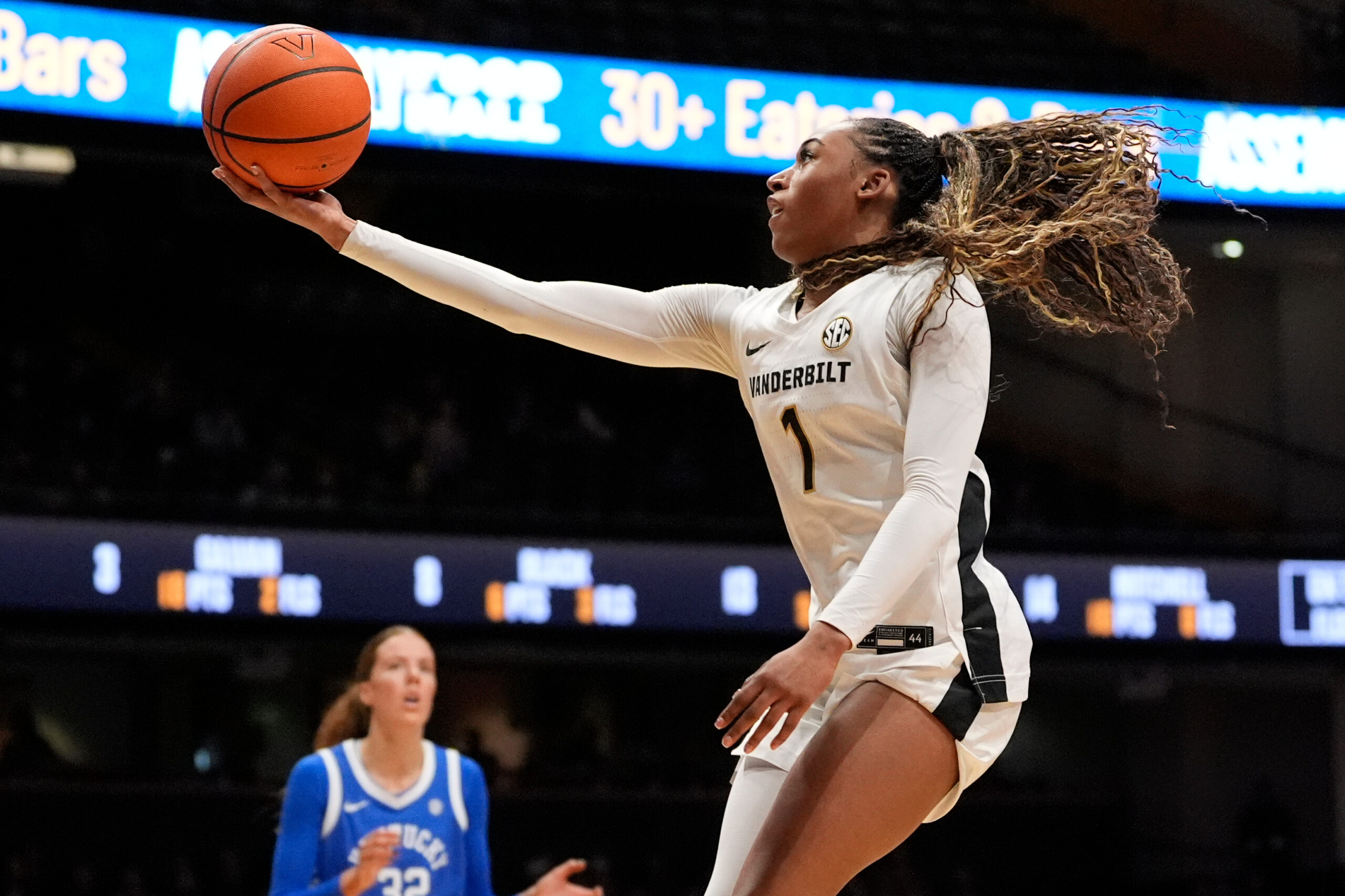
Another No. 2 seed, Vanderbilt, will get a lot of attention. Guard Mikayla Blakes is the nation’s top scorer at 27 points per game, and also averages 4.4 assists, 3.8 rebounds, and 2.9 steals.
The Commodores started the season 20-0, including wins over LSU at home and Michigan on a neutral floor. Then came a trip to South Carolina, and Staley reminded them who runs the show with a 103-74 flattening.
Vanderbilt’s head coach is UConn legend Shea Ralph. If you think the selection committee has a sense of humor, you might think it’s no coincidence that the Huskies are the No. 1 in that region.
Vanderbilt’s Mikayla Blakes is the nation’s leading scorer.
Michigan is the No. 2 in Texas’ region, and has a high-ceiling pair of sophomores in Syla Swords and Olivia Olson. But the Wolverines could be tested early by the N.C. State-Tennessee winner, with a little extra juice if it’s the Lady Vols.
Further down the field
There are storylines among the No. 3 seeds, too. We’ve mentioned Duke already, and two others deserve attention.
First is TCU. Guard Olivia Miles earned fame at Notre Dame, and this season led the Horned Frogs to the Big 12 regular-season title. She’ll be another marquee WNBA draft pick, and forward Marta Suárez could join her in the first round. Add that to Iowa being arguably overseeded, and there’s a recipe for an Elite 8 run.
The other is Ohio State. The Buckeyes are stuck with Notre Dame as the nearby No. 6 seed and Vanderbilt as the No. 2. But Jaloni Cambridge has pro potential, and Notre Dame will have its hands full with Fairfield.
Olivia Miles could take TCU on a long March run before heading to the WNBA.
That’s the cue to turn to where the real upsets could lurk.
Fairfield went 28-4 this season, won at Villanova early, and tested itself later with losses to North Carolina on a neutral floor and at Iowa. The AP poll’s voters recognize the Stags’ quality, putting them two spots outside the top 25.
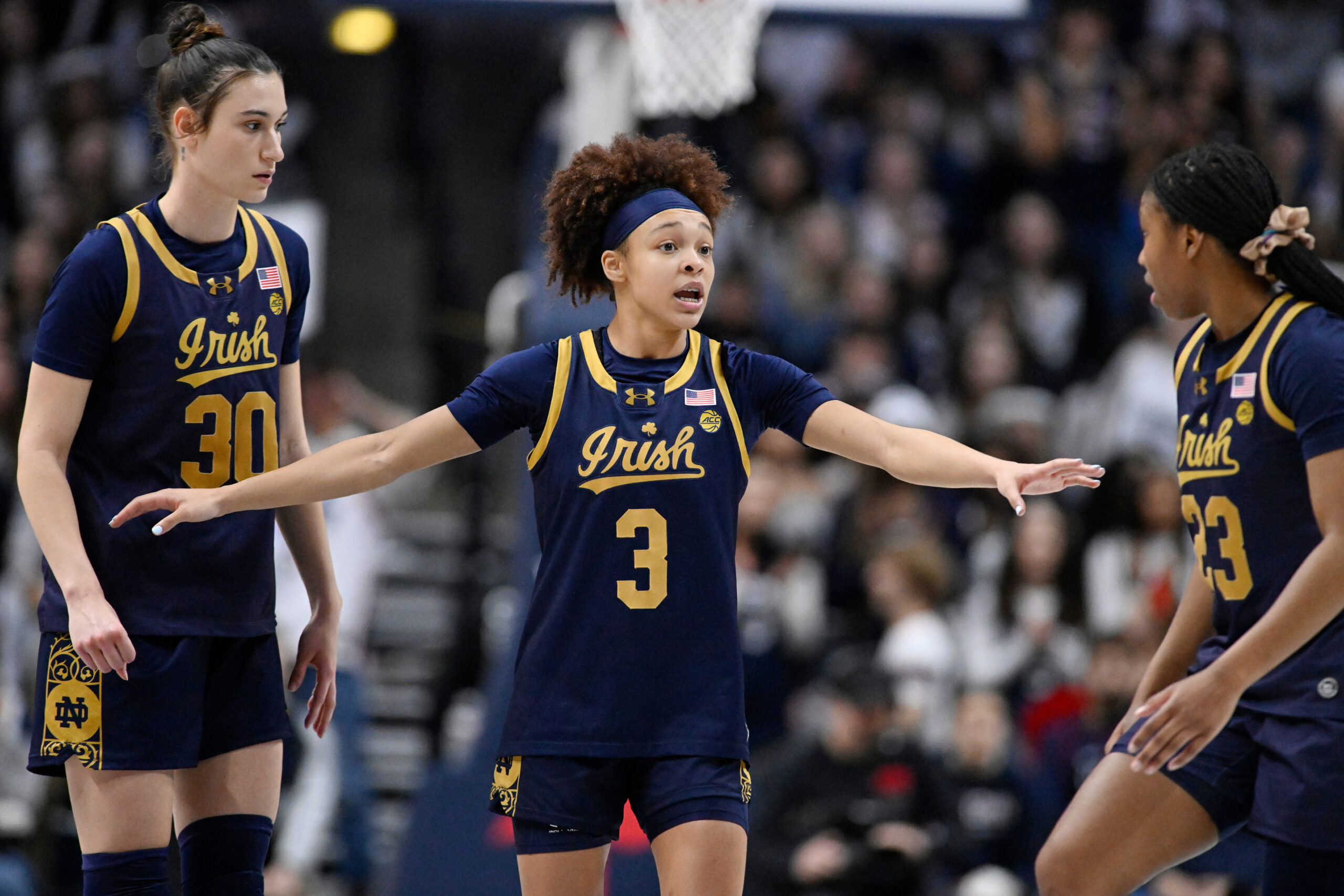
South Jersey native Hannah Hidalgo has the Fighting Irish getting back on track after some ugly stretches in conference play. She’s third in the nation in scoring at 25.2 points per game, is leading the nation again with 5.41 steals per game, and is averaging 5.3 assists and 6.4 rebounds too.
How will it go on a neutral floor? Well, let’s see how neutral it actually is. The game will be played at Ohio State right after the Buckeyes’ opener, and if the home fans stick around, they’ll give Notre Dame an earful.
Hannah Hidalgo (center) lining up a pass during the ACC tournament.
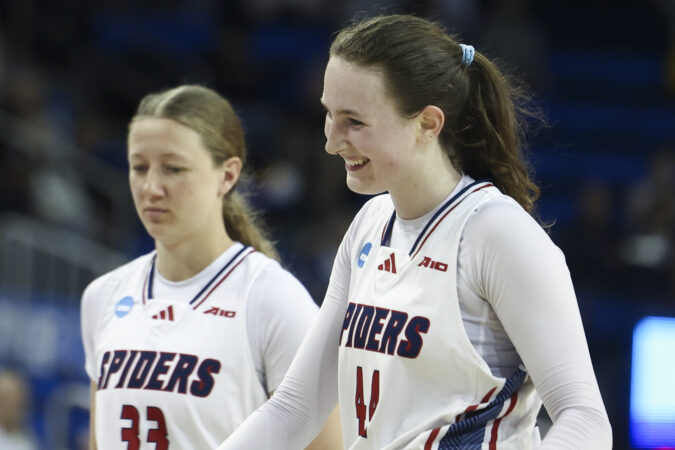
Richmond, led by former Cardinal O’Hara star Maggie Doogan, got stuck in the play-in game after losing to George Mason in the conference semifinals. But we’ll back the Spiders to beat a Nebraska team that got in despite finishing 12th in the Big Ten with an 18-12 record, including 7-11 in conference play. After that, if Doogan’s on, the Spiders can take a swing at Baylor in a game that Duke will host.
If you don’t count an 8-9 game as an upset, then you won’t count Princeton beating Oklahoma State. But we will on the principle of an Ivy League team beating a Big 12 team, even if that Ivy League team is deservedly No. 23 in the AP poll. The Cowgirls didn’t even receive votes this week, though they are 29th in the NET to the Tigers’ 38.
One of my close high school friends from central Pennsylvania came to visit me last weekend with her daughter to celebrate the girl’s 12th birthday in Philly. Admittedly, I was a little nervous. I don’t have children, I don’t know what 12-year-olds like, and I don’t want to screw up anyone’s birthday, especially a kid’s.
Luckily, her mom provided advanced intel that this preteen is currently into K-pop and hopes to study abroad in South Korea someday. So after stopping by Philadelphia’s Magic Gardens on Saturday morning (where I take all first-time Philly visitors), we decided to surprise her by going to Chinatown that afternoon.
It was my friend’s daughter’s first trip to any Chinatown anywhere, and when she began to see the signs and people and asked where we were going, she let out the kind of joyful shriek preteen girls typically reserve for boy bands. I smiled at her joy and at my pride that I hadn’t messed this up — yet.
North 10th Street in Philadelphia’s Chinatown.
I told the girl in advance that she’d see some things on the streets of Philly she doesn’t see at home and that would be hard to see: people experiencing homelessness, people who are in addiction, and people who are suffering from mental illness. Part of living in a city, I told her, is to constantly be reminded of the struggles of others. Hopefully that makes you more compassionate toward all people and grateful for what you do have, but at the very least, it forces you to face the reality of our society and how difficult life is for some people.
What I didn’t warn her about were the robots.
‘Bodies in the Delaware’
We encountered our first Uber Eats delivery robot made by Avride while walking from the Fashion District parking garage to the Chinatown Friendship Gate. Thankfully, I knew what it was because of my colleague Michael Klein’s story on them last week, and because of a post about them on the Philly subreddit that garnered very Philly responses like: “Bodies in the Delaware. Heads in the Schuylkill.”
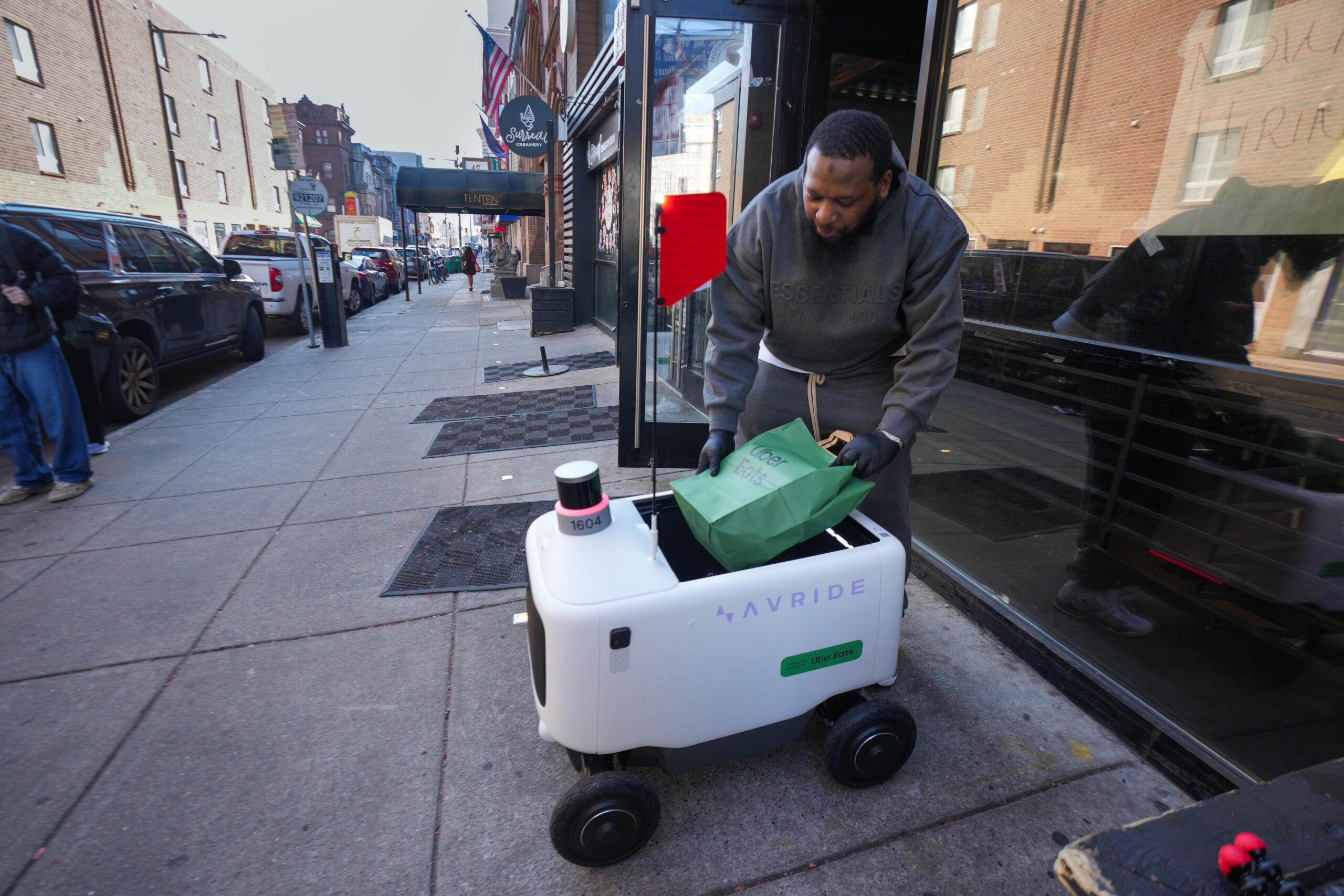
An Uber Eats delivery robot in Philadelphia.
Even though I knew what the robot was, it was still really weird to see this boxy thing on wheels navigating around people on the sidewalk and across city streets. My guests agreed and it seemed many people around us did too, because they were pointing and laughing as it passed.
These robots were breaking folks out of their everyday and pausing people in midconversation, and not in a good Philly way, like the unexpected art that adds whimsy and beauty to our city, but in a dystopian way. I found myself creeped out by the robots and what their presence here might portend.
Sure, I’ve seen Marty the robot at Giant supermarkets and I’ve written about the robot cat servers in a few area restaurants, but those are in private businesses. These delivery bots are out in public and unavoidable. It feels different, like Philadelphia’s murder of HitchBot didn’t prevent a robotic uprising, as we’d all hoped, it only delayed it for a while.
‘DESTROY ME PLZ’
In the nine hours we walked around Chinatown and Center City, we saw three Uber Eats delivery robots. On Filbert Street near the courthouse, one was rolling along ahead of us and a woman in a red shower cap who was parked across the street in an SUV yelled out her window that they were not delivery robots, but rather police surveillance bots keeping watch on us (while nothing seems impossible today, there is no proof of that).
Philly photographer HughE Dillon captured video of a delivery bot out on the streets of Philly Saturday night while St. Patrick’s Day revelers were bar hopping with the Erin Express. One person sat on one of the robots; someone else wrote “DESTROY ME PLZ” on it.
Here’s where it gets even weirder for me, because these robots are anthropomorphized with digital eyes that blink and wink and turn into hearts, I began to feel sorry for them. Maybe these robots don’t want to be here either, I thought, maybe they didn’t even want to be invented, but now they’re stuck with us without a choice, just like we’re stuck with them. Of course I know this is all highly illogical, that these are just machines, but emotions aren’t always logical. That’s what makes us human.
Uber Eats’ delivery robot.
Philly does its thing
When I took my friend’s daughter into You & Me, the Asian toy store with the secret basement-level grocery store, she announced that she had died and gone to heaven and I took great pride in knowing that I’d impressed a 12-year-old.
But what I was even more proud of was that Philly did it’s Philly thing, as I’d hoped. Strangers continually engaged with us, whether it was a customer at a store who saw my friend’s fair skin and, unsolicited, recommended the best sunscreen she’s ever used, or the server at Nine Ting who saw us struggling with the grill and helped us navigate our first Korean barbecue experience. Three people complimented my friend’s daughter’s outfit — a cute skirt, leg warmers, and Mary Jane combo she’d obviously put a lot of thought into — and it absolutely made her day.
While we encountered robots, our best interactions were with humans.
The TLC
I hope those robots are the last thing my friend’s kid remembers about her trip to Philly and I hope I don’t look back on that lovely day as a turning point in some larger evolutionary story about humanity and robots.
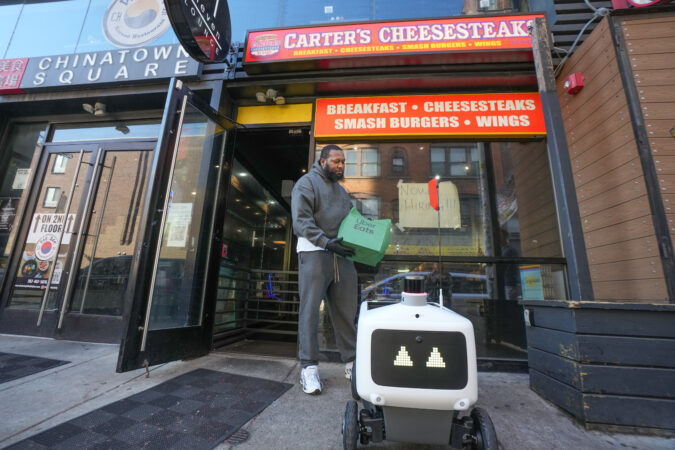
Lavelle “Garci” Peterkin, owner and CEO of Carter’s Cheesesteaks by Garci, places food inside of an Uber Eats delivery robot in Philly.
(I can hear myself now at 85, telling children in the future: “That was the first time I saw robots and humans interacting independently of one another, but it would not be the last!”)
We came home Saturday night to a homemade chocolate birthday cake with vanilla buttercream frosting my husband made. Our bellies already full, our sugar intake already high, we ate it with delight as we recounted the day. The cake dripped with what my husband says is the most important ingredient of any dish — the TLC.
A robot could never.
As I was cleaning Sunday, I found a note my friend’s daughter left in our guest room on a page she’d torn from one of my reporter’s notebooks. In the note, she talked about how thankful she was for the great cake, gifts, and wonderful day.
It seems the Philadelphia School District can’t win.
For years, folks complained about the poor quality of the school buildings. But the district’s ambitious plan to renovate, close, and merge schools, was met with swift pushback.
On paper, the $2.8 billion plan to revamp the schools makes good sense. But then there is the reality that closing a school leaves a void in a neighborhood. Moving students could result in longer commutes and impact learning.
So, what is the district to do?
Philly is infamous for resisting change, but the status quo is not a solution.
Many of the district’s 307 buildings were built more than 70 years ago and contain asbestos and lead and don’t have air-conditioning. Many schools lackteachers, libraries, playgrounds, STEM facilities, and music and art programs as well.
At the same time, the city has more space than it needs. Twenty schools are less than 30% occupied. For example, Overbrook High, where Wilt Chamberlain went, has capacity for 2,330 students but an enrollment of just 441. Operating mostly empty buildings is inefficient, unsafe, and unsustainable.
But Superintendent Tony B. Watlington Sr.’s initial plan to modernize 159 schools, close 20, merge six, and build one new facility over the next decade has been met with fierce opposition.
Two schools, Russell Conwell Middle School and Motivation High School, have already been removed from the closure list and will merge with other schools instead.
Last week, nearly 100 parents, teachers, and students turned out for a highly charged meeting to pressure the school board to reject the plan — or at least save their school.
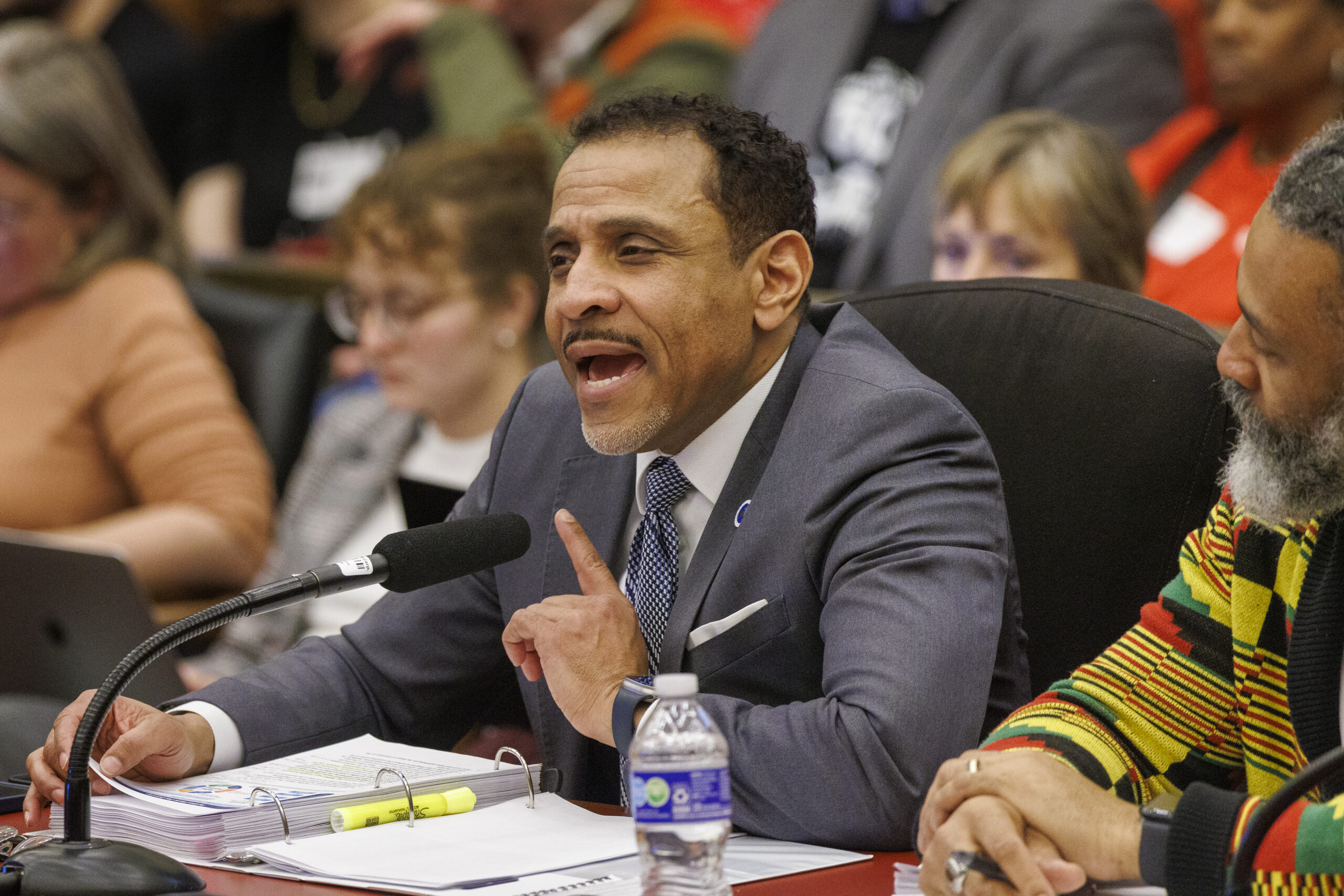
Superintendent Tony B. Watlington Sr. has attended roughly 90 listening sessions — attended by about 4,000 people — about the closure plan in recent months.
“I don’t see nothing wrong with our school,” said Layla Hernandez, a third grader who attends Ludlow Elementary, a school in North Philadelphia slated to close.
It’s hard to say no to a precocious third grader. Or a parent like Darlene Abner, whose six children have attended the school. “I stay in this neighborhood because of Ludlow,” she said at a different meeting earlier this month.
The impact of students and parents is real, but Ludlow’s numbers tell a different story. The K-8 school has just 237 students — less than half of its capacity. The school opened almost 100 years ago and serves a number of special education students.
Ludlow’s performance is considered below average. Just 11% of students tested proficient on the state math exam and 24% in English.
It is expensive to staff and operate an old building that is more than half empty and delivering poor results. Indeed, the district faces billions in deferred maintenance and repairs to its aging infrastructure.
Operating buildings where enrollments are under 50% of capacity makes little sense. The problem will only get worse.
Over the past decade, the district’s enrollment declined by more than 17,000 students to around 117,000 students. Over the next decade, enrollment is expected to drop by another 10%.
At the same time, schools in some neighborhoods are filled to capacity, thanks largely to the influx of new immigrants. The explosion of charter schools in Philadelphia also contributed to the drop in enrollment and financial resources.
As a result, the district needs to rightsize to adjust for the enrollment declines in some areas and the increases in others. It also needs to modernize, so buildings have basics like heat, air- conditioning, and bathrooms as well as labs and tech spaces.
But renovating the schools takes time and money — two things the district lacks. The problem has been many years in the making. State lawmakers in Harrisburg contributed to the disrepair of schools by not adequately funding public education for decades — an issue a court found unconstitutional.
It is also unconscionable since investing in public education will go a long way to solving many of the city’s (and country’s problems), including poverty, crime, and workforce development.
This is where charter school advocates argue for more choice, but the hard reality is the test scores at most charters are no better. So, more charters is an empty promise and an argument for a different day.
The goal should be to replace or renovate obsolete and mostly empty schools with safe, clean, and modern facilities featuring all the necessary staffing and resources. Anything less impacts the entire city, whether you have kids in public school or not.
So far, a number of City Council members would prefer to scuttle the plan then find a positive solution. Same for the many state representatives who have voiced their opposition. This is not the time for political grandstanding.
A Feb. 26 demonstration outside the School District of Philadelphia’s Center City headquarters opposed the planned closure of 18 schools.
Philadelphia Federation of Teachers president Arthur Steinberg said the plan lacked transparency and detail on how the changes will impact students.
Perhaps Watlington and Mayor Cherelle L. Parker could do a better job selling the plan. But Watlington told me the district has held 90 listening sessions attended by 4,000 residents and received more than 14,000 surveys from every zip code in the city.
“There’s no perfect master facilities plan,” he conceded, adding the district tried “to do the greatest good for the greatest number.”
The school district tried to be fair by ensuring closures and investments would be spread across all 10 Council districts.
At the same time, the critics have not offered any better solutions.
In 2012 and 2013, the district closed 10% of its school buildings. At the time, many feared the upheaval would undermine learning.
But a study by two University of Pennsylvania professors found the impact was mixed. Students who moved to higher-achieving schools saw their test scores go up. However, the displaced students had more absences and received more suspensions. The farther students had to travel to get to their new schools, the more they struggled.
This time, the district plans to create a one-stop shop to ensure students get all the help they need from transportation to social, emotional, and mental health support.
“We’re gonna wrap our arms around the children to make sure that performance increases and doesn’t decrease,” Watlington told me.
He added that there are no plans to lay off any principals or teachers at the schools slated to close. Instead, the rightsizing will enable the district to “push more resources into the remaining schools.”
In a perfect world, Watlington said, he would never close schools. But he is trying to position the district to do the best it can with the resources it is given.
“We can either use our resources more efficiently by driving more high quality, academic, and extracurricular resources into a smaller number of schools,” he said. “Or we could continue to spread our resources around less strategically.”
American families are feeling the pinch of rising electricity prices. In the past five years alone, the supply portion of the standard service residential electric bill in Philadelphia has increased by 71%. In the Lehigh Valley it has increased by 77%. And in Columbus Ohio, by 110%. These are three data points in a national trend.
New research from the Energy Markets and Policy Group that includes The Ohio State University and Lehigh University where we serve as principal investigators, provides new insights about another factor you were probably not thinking about – middlemen introduced by deregulation.
How deregulation brought middlemen instead of competition
Under the old system, a state regulatory commission set prices for all electricity services – generation, transmission and distribution – which were supplied by the same monopoly utility company. Each state commission was required by federal law to ensure that rates were “just and reasonable.” Under deregulation, that same commission rate-setting process still holds for transmission and distribution, but the generation part was split off.
Deregulation created competitive wholesale markets for generation, but price competition did not spread widely at the retail level. In states with active retail deregulation, there are two ways the retail generation price can be set. Consumers get to pick which one – buy from a marketer on the open market, or do nothing. Most people choose to do nothing.
Rather than introducing efficiency, this system of retail deregulation created a new complexity: middlemen marketers. In most cases, no matter which choice people make, it’s hard for them to understand how their electricity rates are set.
Option A: The open market
Electricity customers in deregulated retail markets can choose a company that buys the electricity on their behalf. Energy salespeople have sophisticated marketing programs to sell their companies’ plans.
For example, people who live in the Cincinnati area can contract with one of more than 50 suppliers to buy electricity on their behalf from the wholesale market. In the Lehigh Valley and Philadelphia there are more than 30 suppliers. Their monthly bill would still come from the regulated distribution company (Duke Energy, PPL, PECO, respectively), and would still include regulated charges for distribution and transmission set by state and federal officials. But it would also include charges from an unregulated retail supplier, for the generation part of their bill – their electric supply.
Our research has found that these markets are not working as intended.
Option B: Do nothing – default service
For people who choose not to shop on the open market, by doing nothing they remain on what is called the “standard offer” or “default service.” Sometimes it is also called “provider of last resort” service because it is not meant to be the best option.
For these people, state law generally requires each distribution utility to hold auctions or use a procurement process like a request for proposals to determine which middlemen companies get to be their supplier, and of course, at what price.
People in this category still buy from middleman marketers. But rather than choosing their own middleman, they get the middleman the utility company selects for them.
Help for consumers usually comes after problems have arisen, rather than preventing them in the first place.
Our research team sought to determine whether, and how much, electricity consumers would save money if they used the supposedly competitive open market, rather than going with the default rate. To answer this question, we developed a detailed database of every daily retail choice offer filed by every supplier in all service territories in Ohio for a decade – which meant compiling millions of records.
We found that 72.1% of the open-market offers exceeded the utility’s default rate. In some years, there was not even one single cost-saving offer for the entire year, or longer. The vast majority of these supposedly competitive electricity prices were higher than customers would get by doing nothing. Taking the time to research the market and compare prices was often not worth consumers’ time.
Importantly, the study found that suppliers in the open market were not setting their prices based on market fundamentals – like the underlying wholesale price of electricity. Instead, they were setting prices based on the results of the utility’s default supply selection. In a competitive market, that is not supposed to happen.
In some of the default-option rate auctions, as few as five suppliers placed bids. In others, there were as many as 15 companies vying to provide default-option electricity. Our analysis found that in situations when the underlying costs of generating electricity were the same, default supply auctions with fewer bidders delivered significantly higher prices for consumers than auctions with more bidders.
It’s important to note that Ohio’s process for setting default service rates is more robust than many other states. In Pennsylvania, the process is similar to Ohio’s. In some states, it is not uncommon for even fewer companies to bid. So Ohio and Pennsylvania’s situation is not actually a worst-case scenario for consumers. Rather, it’s probably better than many other states with deregulated electricity markets.
Putting it all together
The first study showed that the open market is not setting efficient retail rates and is not working as intended. Most of the offers made available to consumers are not worth their time, and the suppliers in those markets are not setting their prices based upon market fundamentals. Instead, these companies are taking their cues from the local distribution utility’s default supply auctions. That is not how deregulation was envisioned.
The second study showed that the process which sets the default supply rate is also not very competitive. Less competition means the middleman companies bidding in those auctions can bid, and win, higher prices – raising electric bills and increasing their profit margin.
Energy deregulation promised lower prices through competition. But instead, consumers got an army of middleman marketers. And, those middlemen have been taking their cues from a bidding process that often has too few participants to keep prices low.
Noah Dormady is Associate Professor of Public Policy at The Ohio State University; Alberto J. Lamadrid is James T. Kane Professor of Economics and Industrial and Systems Engineering at Lehigh University . A version of this article appeared on The Conversation., a nonprofit news website sharing the knowledge of researchers.
Matt Hodge stared up at the screen Sunday night at a private Selection Sunday watch party and smiled and cheered with the rest of his Villanova teammates when their name and number were called.
Villanova’s return to March Madness, the first NCAA Tournament appearance by the men’s basketball team since 2022, is a first for much of the team, and would be for Hodge, a redshirt freshman, if he didn’t have his right leg heavily wrapped in a brace following surgery last week to repair a torn ACL.
He was understandably dealing with mixed feelings on what was a celebratory night for players, coaches, their families, and program donors.
“It’s fun to get to see our name get called,” Hodge said, “but at the same time I won’t be able to go and I won’t be able to play. So it’s a feeling of regret and of timing.”
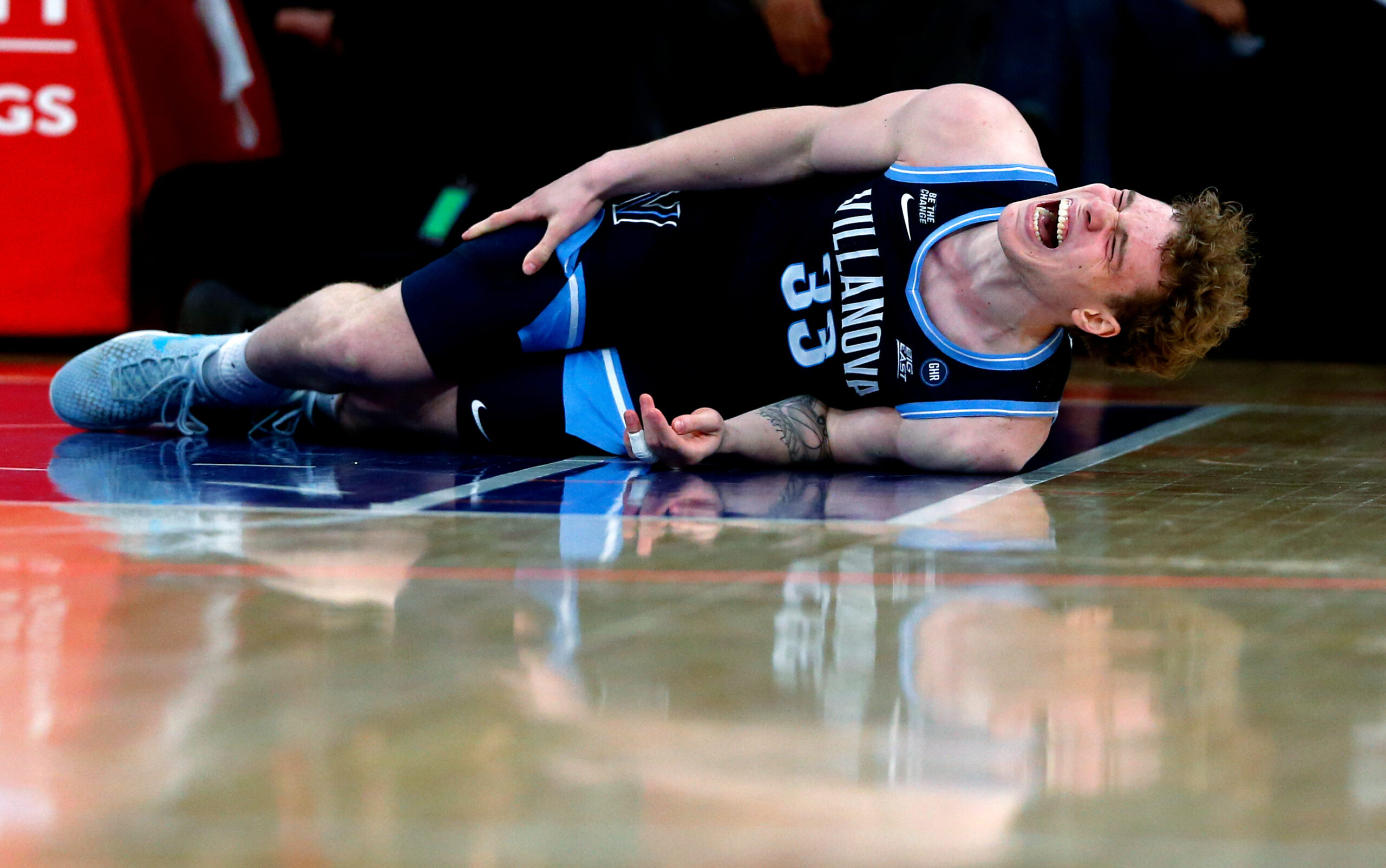
His season came to an abrupt end early in the second half of Villanova’s Feb. 28 loss to St. John’s at Madison Square Garden. Hodge, a power forward who started in all 29 Villanova games to that point, got the ball in the post against Big East player of the year Zuby Ejiofor and tried to make a move.
Instead, he collapsed to the floor and writhed in pain.
“It was a typical basketball play,” Hodge said. “I just knew the moment I planted my foot and I tried to spin off Zuby, I felt something and I knew right away it was wrong.”
Villanova forward Matt Hodge reacts in pain after suffering a torn ACL during the game against St. John’s on Feb. 28.
His mind went instantly to his younger brother, Jayden, a high school star who suffered a torn ACL and meniscus in early January.
“The first thing I said was, ‘I think I tore my ACL like my brother,’” Hodge said.
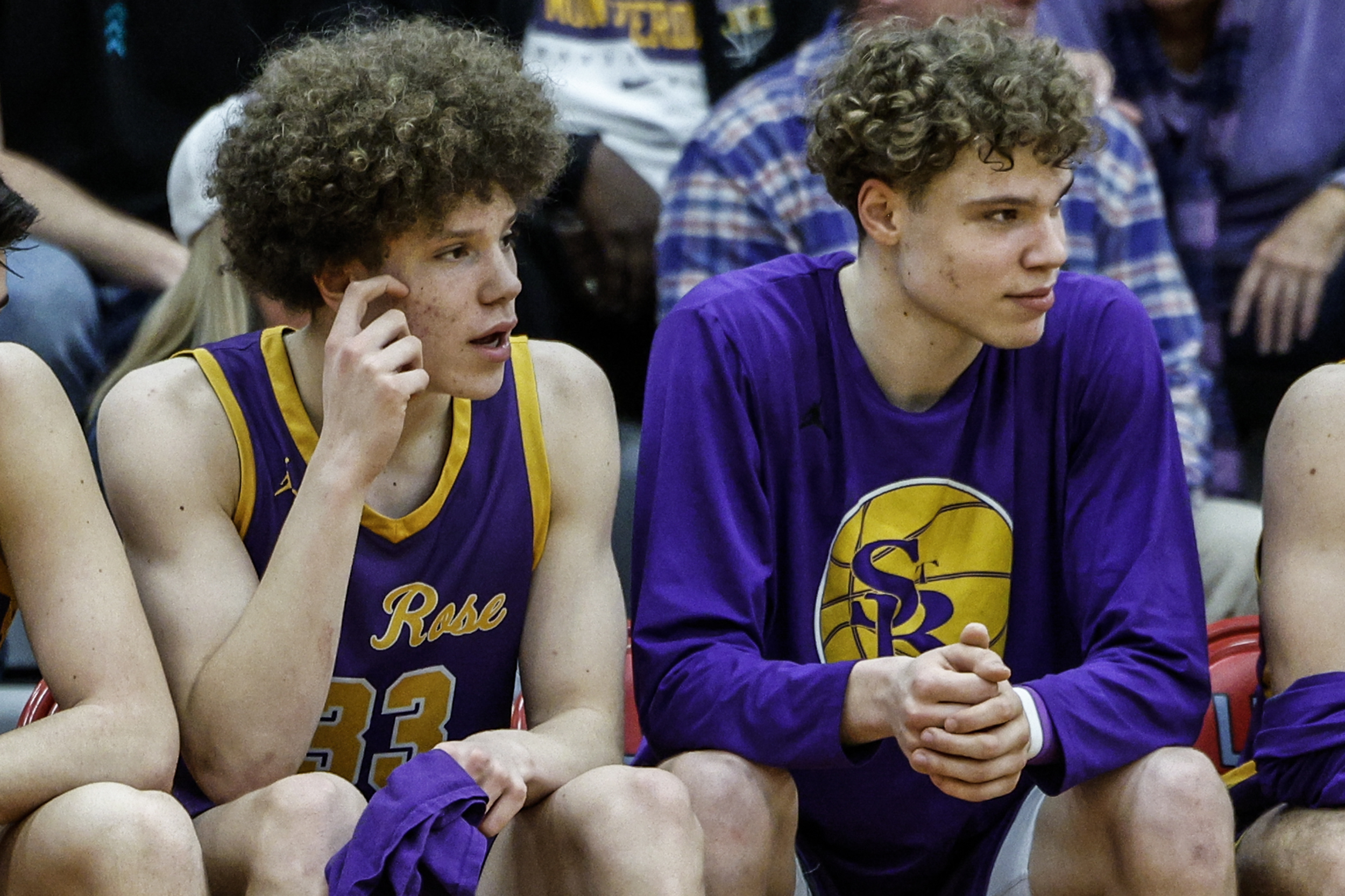
Further testing proved his words to Villanova’s athletic training staff true. It’s a cruel result, but Jayden’s experience and recovery have given Hodge someone close to talk to and go through the emotional roller coaster with. The brothers, born in Belgium, came to the U.S. and won a state championship together at St. Rose High School in Belmar, N.J. Jayden, a senior who now plays at Montverde Academy in Florida, is committed to Northwestern.
“I ask him every day for tips and stuff,” Hodge said. “We can go through it together. He’s a little bit ahead of me, but he also tore his meniscus, so in like a week or so I’ll be ahead of him.”
St. Rose’s Jayden (left) and Matt Hodge watch their team play Bishop Eustace during the fourth quarter of a playoff game on March 4, 2024.
Hodge’s recovery right now is mostly just relaxing in the immediate aftermath of surgery. He walks by using crutches and keeps his right leg stiffened. Soon, he’ll begin flexing the knee more and will work on building back strength in his quadriceps since his surgery required a nerve blocker. In about six weeks, he said, he’ll shed his current brace to a walking brace and can begin activities like riding a bike.
It’s a long road back to the basketball court, but Hodge reiterated what Villanova coach Kevin Willard said earlier this month, that the aim is for him to be back to normal basketball activities by mid-to-late October and the goal is to be ready for the beginning of the 2026-27 basketball season.
“I feel like obviously it’s still a long way ahead of me, but I want to have a goal and I think that goal is pretty realistic,” Hodge said. “I’m just working toward that and I know, in my head and deep down, anything is possible. I might not be ready yet, or I might be ready quicker.”
Of course, he wishes he was ready by Friday afternoon, when eighth-seeded Villanova faces No. 9 Utah State in a first-round West Regional game in San Diego. The Wildcats could certainly use him. After missing his freshman season because of an NCAA ruling on his academic eligibility following his high school transfer from Belgium to St. Rose, Hodge had an impressive first season of college basketball.
He averaged 9.2 points and 3.6 rebounds while shooting nearly 37% from three-point range.
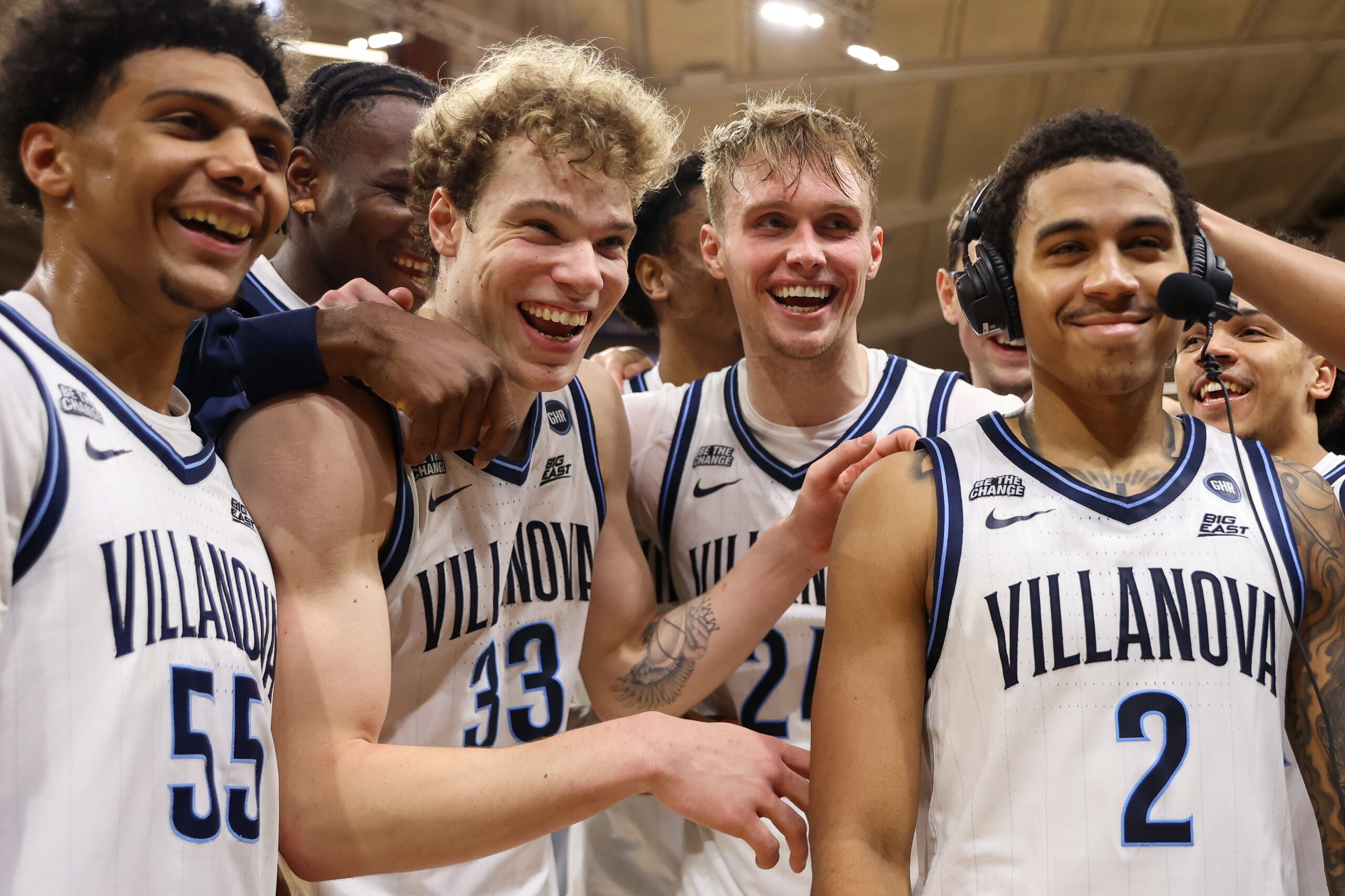
From left, Villanova’s Acaden Lewis, Matt Hodge, Duke Brennan, and Bryce Lindsay after a 79-61 win against Pittsburgh on Dec. 13,
Without him, Villanova’s depth has taken a hit, especially in a frontcourt where only two players, centers Duke Brennan and Braden Pierce, are taller than Hodge, who is 6-foot-8. Villanova starts Malachi Palmer (6-6) at the power forward spot and sometimes has lineups on the court with four guards and one center, harkening back to the early days of Jay Wright. This quartet, however, doesn’t sing the same way as that one did.
Willard has mentioned changing things up. He said again Sunday said he could see Villanova opting to have Brennan and Pierce on the floor at the same time, but they haven’t done so in the three games since Hodge went down. But Villanova’s first-round loss in the Big East tournament featured a rebounding disadvantage of 46-25, and it might be time to adjust against a Utah State team that isn’t huge but attacks the offensive glass.
A win on Friday likely means a date Sunday with top-seeded Arizona, the ninth-best offensive rebounding team in the country that has a 7-2 center and a pair of 6-8 forwards who cause havoc on the glass.
Hodge was at home watching Thursday night as Villanova crumpled under the bright lights. The days after the injury have been isolating, but his family has been in town, his girlfriend is on campus, and his teammates and coaches have been supportive.
The pain is “more mentally than anything physically,” Hodge said.
“I just got to keep my head up now and support the team.”