Tag: topic-link-auto

  • Meet the journalist-turned-poet chronicling her Cherry Hill childhood in her debut book

    Meet the journalist-turned-poet chronicling her Cherry Hill childhood in her debut book

    In her poem, “To the Chimeras of South Jersey,” Jia-Rui Cook writes of teenage heartache, ’80s movies, and the gulf between her American childhood and the world of her parents, immigrants from China by way of Taiwan and Singapore.

    “… Acing / honors English but flunking Saturday / Chinese School: double cherries that ripen / when summer sun runs hot. This world / will feel less than whole for many years.”

    The Cherry Hill-bred and Los Angeles-based writer is set to release her debut poetry collection, Soft Beasts, next year. The book explores Cook’s upbringing in South Jersey, her coming of age in Los Angeles, and the various bodies we inhibit in our ever-changing world. Cook is the 2025 winner of the Philip Levine Prize for Poetry, a national prize out of Fresno State University that awards one writer $2,000 and the publication and distribution of a book.

    As she prepares for the release of Soft Beasts next year, Cook reflected on her formative years in Cherry Hill, which shaped her career as a writer and figure prominently in her poetry. Cherry Hill “was kind of an amazing incubator” for young writers like herself, Cook said.

    Jia-Rui Cook (right) and her father standing in front of her childhood home in Cherry Hill, N.J. around 1995, the year she graduated from Cherry Hill High School East.

    Cook’s parents settled in Cherry Hill when she was a toddler and sent her to James H. Johnson Elementary School, Henry C. Beck Middle School, and Cherry Hill High School East. At East, Cook played lacrosse, worked on the yearbook, participated in the all-South Jersey band, and wrote for the student newspaper. Cook took an early interest in playing with words (her parents had an Inquirer subscription, and Cook was a habitual reader of the crosswords and comics page). A 1995 Inquirer story profiled Cook (whose maiden name was Chong) and her classmate Gina Kang, both star lacrosse players who were headed to Harvard University.

    In Cook’s high school yearbook, she wrote that it was her goal “to write good poetry.”

    Cook studied American history and literature at Harvard, joining the poetry board and studying under writers Seamus Heaney and Helen Vendler. She wrote a thesis on “Moby Dick.”

    Cook always wanted to be a writer, but didn’t know if she could make a living out of poetry. After college, she ventured into another form of storytelling — journalism. Cook spent six years at the Los Angeles Times, covering everything from medical research to Asian-American life in the city. She left journalism in 2009, and has worked in science and health communications since, including a stint at NASA’s Jet Propulsion Laboratory.

    Reporting and science writing are grounded in third-person observation and objectivity, Cook said, and as she was writing about rocket launches and research breakthroughs, she missed the creativity that drew her to writing in the first place.

    She wrote a few poems in the mid-2010s, and won the Zócalo Public Square Poetry Prize in 2013, but life quickly became busy with parenthood and work (Cook and her husband, Bryan, who is from the Main Line, have two daughters). It wasn’t until 2021 that Cook felt like she could pick up the pen again.

    “You get on this roller coaster of going, going, going, and then when you suddenly stop, you think, ‘Wow, actually, maybe I’ve learned some things. I have some things to share,’” she said, recalling how it felt to return to poetry five years ago.

    Jia-Rui Cook’s (then Chong) photo in her Cherry Hill High School East yearbook. Cook graduated from East in 1995.

    So Cook began to write again — about people, animals, her childhood in Cherry Hill, the subtleties of the Chinese-American experience she came to understand while living in and writing about Los Angeles.

    “I had to really step away and experience the world for a bit,” she said. “I had to go out and experience the world and to see it, and maybe try to tell other people’s stories for a while before I really understood, ‘What story did I want to tell about my own life?’”

    Anagrams (words or phrases made by rearranging the letters of a different word) figure prominently in her work.

    In her poem “Anagram No. 2,” Cook anagrams “Cherry Hill, New Jersey,” rearranging the letters to make sentences that resemble English, but don’t precisely follow its conventions. English was not Cook’s parents’ first language, and “there was always this kind of slipperiness with the language” in her house, she said.

    “Anagram No. 2” is “playing around with the English language” in a way that echos the experience of learning it.

    In January, Cook became a fellow with the Periplus collective, a mentorship program for writers-of-color. In February, she won the Levine Prize. Jake Skeets, the Levine Prize’s final judge, called Cook’s poetry “both wonder and wander,” holding “stark, living images of place” and teachings on how “to be alive in the present moment.”

    For Cook, publishing poetry has been an opportunity to “create something meaningful” in a world that “feels under siege.” The immigration crackdown that overtook Los Angeles last summer weighed heavily on her as the child of immigrants.

    “It just was really wonderful and incredibly meaningful to feel like I’ve been creating these little, tiny bits of beauty where I can in the world,” she said.

    Winning Fresno State’s Levine Prize is poignant for Cook. Fresno State was the first place Cook’s mother landed when she arrived in the U.S. and was where she learned English. Decades later, the university is helping to publish Cook’s first book.

    “It felt like a full-circle moment,” Cook said.

    Though California has been her residence for decades (and Cook says she has decidedly fallen in love with Los Angeles), she still considers South Jersey home. It’s the place where she became a writer and where her journey of self-understanding began.

    “It has to start somewhere,” she said of her book. “So it really does start in Cherry Hill.”

    This suburban content is produced with support from the Leslie Miller and Richard Worley Foundation and The Lenfest Institute for Journalism. Editorial content is created independently of the project donors. Gifts to support The Inquirer’s high-impact journalism can be made at inquirer.com/donate. A list of Lenfest Institute donors can be found at lenfestinstitute.org/supporters.


  • Union will try to ‘punch above our weight’ in second leg of Champions Cup match against Club América

    Union will try to ‘punch above our weight’ in second leg of Champions Cup match against Club América

    In the midst of a four-game losing streak, the Union have several problems to address. Bradley Carnell does not count Mexico City’s altitude among them.

    The Union arrived to Mexico City late Monday night for the second leg of their Concacaf Champions Cup round of 16 series with Liga MX’s Club América. The Union trail by a goal in the series’ aggregate score line after dropping the opening leg, 1-0, at Subaru Park last week.

    The Union will have a chance to upset América when the teams take the field at Estadio Ciudad de los Deportes on Wednesday (9 p.m., FS1).

    An América win or draw would send Mexico’s largest club into the Cup’s quarterfinal round, but a 1-0 Union win would take the series to extra time. Any result where the Union score more than one goal and win would send them to the quarterfinals.

    Wednesday’s game will not be hosted in América’s usual stadium. Estadio Azteca is closed for renovations before it hosts Mexico City’s FIFA World Cup games this summer. Estadio Ciudad de los Deportes is roughly 50,000 seats smaller than the 87,523-seat Azteca, which should dull América’s typical home-field advantage.

    Mexico City has an elevation of 7,349 feet, a vast difference from the Union’s home on the Delaware River banks. But Carnell is familiar with how elevation impacts an athlete’s body after competing in his native Johannesburg, South Africa, which is 5,751 feet above sea level. He said in a Tuesday night news conference that he doesn’t “make much of the altitude.”

    The Union’s Frankie Westfield (center) reacts after a missed scoring opportunity in the second half of the Concacaf Champions Cup round of 16 match against Club América last week.

    “I grew up in altitude,” Carnell said. “I think in terms of the science, the later you get in, the less time your body has to adapt, which is a good thing. If you want to really adapt, you have to be here for many, many days.”

    Fitness could be an important factor for the Union on Wednesday, as the team plays its fourth game in 12 days. The Union are coming off a 3-1 loss at the Atlanta United on Saturday.

    “We just [got] in here [Monday] night,” Carnell said. “We arrived just before midnight, got the guys a good night of rest and then were able to just relax this morning and go through the treatment and everything. We’re still just recovering from the match in Atlanta. Every hour is vital.”

    Chasing América

    After their loss to América last Wednesday, Carnell repeated in his postgame news conference that the Union were close. At that point, the Union had played three straight games without scoring a goal from open play.

    Agustín Anello broke that spell after finding the back of the net in the 87th minute of the team’s loss to Atlanta. The goal didn’t alter the result, but the team hopes the late goal is a sign that more are coming.

    The Union took more shots and out-possessed América in their first matchup, but did not score.

    “I thought [in] the game that we played last week, the boys did an excellent job,” Carnell said. “We kept the score line very narrow, and I thought we had the better of the second half. We created lots of chances. This gives us hope and positivity to go up against a really big, big talented squad. We’re going to be brave, and we’re going to be committed to what we do.”

    The Union’s shaky start justifies their place as the underdog Wednesday night, but América has not looked the part of an invincible favorite. América is 3-3-0 in its last six Liga MX matches and 3-3-0 at home in league play since January, a fact Carnell pointed out.

    “We always try and punch above our weight,” Carnell said. “We’re a club that stands for development. We stand for commitment to what we do in the game model and the philosophy, and we’ve really enjoyed this role. But there’s by no means to say that the giant can also fall sometimes and stumble.”

    The Union’s Geiner Martínez (left) puts a shot on goal during last Wednesday’s match against Club América.

    América will also be without it’s top goalkeeper, Luis Malagón, on Wednesday. Malagón, who was Mexico’s starting keeper for the 2025 Concacaf Gold Cup and a likely inclusion in El Tri‘s World Cup squad, ruptured his Achilles tendon in América’s trip to Subaru Park.

    The winner of the series between the Union and América will face the winner of Lionel Messi’s Inter Miami and Nashville SC.

    “We have to have a positive mindset,” Carnell said. “We kept the [first] game really tight, and I think we have a very possible chance here … It’s a game where we can be excited. This is the game, for us, where we have nothing to lose and everything to gain.”

  • Philly-area residents share how much they paid to keep warm this winter

    Philly-area residents share how much they paid to keep warm this winter

    If you’re getting burned by high heating bills this winter, you’re in good, and equally stressed, company.

    U.S. households are expected to pay more than $1,000 on average to heat their homes this winter, according to the National Energy Assistance Directors Association’s projections, which were updated last month. That’s about $100 more than households paid last year, according to the association, which advocates for federal funding for low-income ratepayers.

    Consumers are paying more whether they heat their homes with electricity, natural gas, or heating oil. Residential propane costs are on par with last year.

    And customers usually pay more in freezing temperatures, when more energy is required to keep their homes comfortable.

    A wood stove provides heat in the old stone farmhouse of Patrick Melcher’s near Downingtown.

    Philly-area residents were hit with a double whammy: They experienced one of the coldest, snowiest winters in recent memory as rate increases took effect for major utilities, including Peco and PGW.

    All this occurred after a summer in which some local consumers paid more than ever to stay cool.

    Spokespeople for Peco and PGW, which provide electric and gas service to millions across southeastern Pennsylvania, said many of their customers saw increased usage this winter due to the cold. They noted that individual bills can also be impacted by thermostat settings, efficiency of appliances, and weatherization of windows, doors, and other parts of the home, as well as whether customers have opted for a third-party energy supplier.

    “Energy affordability remains a priority, and rising supply costs — set by competitive markets and not controlled or profited from by Peco — continue to be a major driver of customer bills,” spokesperson Candice Womer said in a statement, noting a nearly 20% year-over-year supply cost increase for electric customers and a nearly 10% increase for gas.

    The Inquirer spoke with five people who live across the region, have different types of homes, and use varying fuel sources and heating systems. Here’s how much they’ve paid to keep warm this winter.

    Quotes have been edited for clarity and brevity.

    Melcher, a 48-year-old who owns a custom woodworking business, said he usually needs to fill his 250-gallon oil tank twice a year. In early January, he paid $800 for a 230-gallon top-off, or about $3.45 per gallon, which he thought was fair. He had paid around the same for an oil fill-up in October. This winter, Melcher said he’s also spent about $900 on firewood for his wood-burning stove, plus a couple hundred dollars a month to fuel the electric heaters in his workshop.

    “I don’t have a ton of money. I have a small business. But what else can you do? In the wintertime, it hurts. You hope for a mild winter. It’s one of those things you can’t control.”

    An oil tank heater is shown in the basement of Patrick Melcher’s home near Downingtown.

    Simonsen, a 69-year-old retired public relations professional, said her electric bills are usually around $50. This winter, however, her last three bills have been $78, $84, and, most recently, $312 for the period of mid-January through mid-February. She keeps her heat around 65 during the day, she said, and 60 at night. She’s billed through her condo complex, and said her neighbors have noted similar increases.

    “I know we had very cold days but we were just boggled. I’m looking at everything around the apartment now. What can I turn off? Have I been careless about leaving things on? I don’t think so, but I am much more cognizant of that. I’m wondering if this is the new reality.”

    A phone charger plugged in a Center City apartment. In Fairmount, Janice Simonsen said she is making sure she unplugs everything after receiving a more than $300 electric bill for a 750-square-foot unit.

    Capriotti, a 55-year-old research scientist, said her family switched from oil heat to natural gas over the past decade. They were fed up with paying hundreds of dollars every time they needed to fill their oil tank. Still, she said, their home is drafty and they need to upgrade doors and insulation. Their most recent Peco bill, which includes electric and gas, was $721, and the gas portion was $570.

    “It’s better than oil heat for sure, but this past year has been very rough. $720 for heating and energy is a bit much. I don’t want to say I can’t pay it, but it’s definitely a struggle.”

    Carol Capriotti paid more than $700 in February for gas and electric service for her Willow Grove home, which she heats with a gas-powered boiler.

    Fritz, a 41-year-old full-time hospice aide who works part-time at a distillery, said she had her upstairs and downstairs heat pumps serviced in December. In recent years, she insulated windows and the basement ceiling, and she said she keeps the temperature around 65. Fritz is billed directly through the borough electric department, and can’t ever remember receiving a bill this high since moving into her home 13 years ago. Before the most recent charge, her last three monthly electric bills totaled $256 in December, $424 in January, and $505 in February.

    “I’m a single parent. I work full-time and part-time. My child has behavioral issues. So I am struggling. It is more than the [$704] mortgage payment. I know in the winter months it goes up, but to go up that high, it’s frankly ridiculous.”

    Seidell, a 52-year-old who works in technology, said his bills this winter are on par with previous years’. He has gas-powered forced-air heating, he said, but electricity powers the blower fans that circulate the air. Seidell got solar panels installed in 2020, and he said they offset his electric cost throughout the year, though less so in the winter than in the summer.

    As for his heating bills, “it’s been reasonable. My house was built 125 years ago. I don’t really do anything to keep it energy efficient besides the programmable thermostat and the solar panels.”

    In Ardmore, Sean Seidell’s 1,800-square-foot twin home, which has solar panels, has cost about $200 to $250 a month to heat this winter.
  • What we learned from the Sixers kicking off their road trip with a loss at the Nuggets

    What we learned from the Sixers kicking off their road trip with a loss at the Nuggets

    The Sixers never looked all that competitive in their 124-96 loss to the Denver Nuggets on Tuesday.

    With the Sixers still down four starters, the Nuggets took the lead early, and led by double-digits for almost the entire game.

    Here’s three things we learned from the opening game of the Sixers’ road trip:

    These are still the zombie Sixers

    Looking at the three games on this road trip, Denver was easily the most challenging with the players the Sixers had missing. With games against the tanking Sacramento Kings and Utah Jazz coming up on Thursday and Saturday, respectively, the Sixers can still go a respectable 2-1 on the trip and tread water in the playoff race.

    Stealing a win over the Portland Trail Blazers on Sunday, a borderline playoff team, might have given the Sixers a bit of hope that they could stay semi-competitive during this stretch. But on Tuesday, Denver dominated from wire-to-wire, just like the Pistons did when the Sixers made the trip to Detroit last week.

    Joel Embiid has not played for the Sixers since Feb. 26.

    It’s possible that Joel Embiid could play on the road trip, coach Nick Nurse said prior to Saturday’s game against the Brooklyn Nets. He said Tuesday that Embiid was “active” during part of shootaround and went through an individual workout. Kelly Oubre Jr. will be re-evaluated at the end of the week and Tyrese Maxey a week after that. Paul George will be full-go immediately after his suspension ends next week.

    Heading into Tuesday’s game, the Sixers were still just one game back of the No. 6 seed, which would allow them to bypass the play-in rounds. But the zombie Sixers still have one more tough game before George’s return: Monday’s home showdown with the Oklahoma City Thunder, which makes the next two games of the road-trip near must-wins.

    Increased three-point attempts

    The Sixers took 25 threes in each game of their back-to-back on Saturday and Sunday. On Tuesday, they attempted 24 threes in the first half alone. But the Sixers shot just 9-for-41 overall from beyond the arc.

    In a league dominated by three-point shooting, the Sixers have struggled to replace Maxey’s three-point production, often relying on the mid-range game to score. The Nuggets, though, made 16-for-33 from three.

    Down four starters, the Sixers haven’t defended well enough to stop their tougher matchups from making threes and haven’t scored enough to keep up with them. George’s 38.2% three-point percentage is the second-highest on the Sixers behind Maxey, so his expected return to the lineup against the Chicago Bulls on March 25 will help.

    Sixers forward Justin Edwards (right) scored 11 points against Denver and is making a strong case to be a regular rotation player.

    Who’s going to be in the healthy rotation?

    The idea of the Sixers actually having a healthy rotation might seem far-fetched. There’s always something, but this stretch has given players on the Sixers’ bench an opportunity to show off their skills and make a case to regularly contribute.

    There might not be a player who’s made a better case for himself over the last week than Justin Edwards, who scored 11 points in 25 minutes against Denver.

    MarJon Beauchamp, still on a two-way deal, was the best Sixer on the floor Tuesday, scoring a team-high 16 points on 54.5% shooting, including four three-pointers.

  • Team USA came up short in the WBC final, but Bryce Harper left a mark — with his bat and his words

    Team USA came up short in the WBC final, but Bryce Harper left a mark — with his bat and his words

    MIAMI — The record will reflect that Venezuela, a baseball-rich country with a loaded lineup and passionate fans who ring your ears with songs and chants, won the sixth edition of the World Baseball Classic, 3-2, here Tuesday night.

    Just not before the Showman showed up.

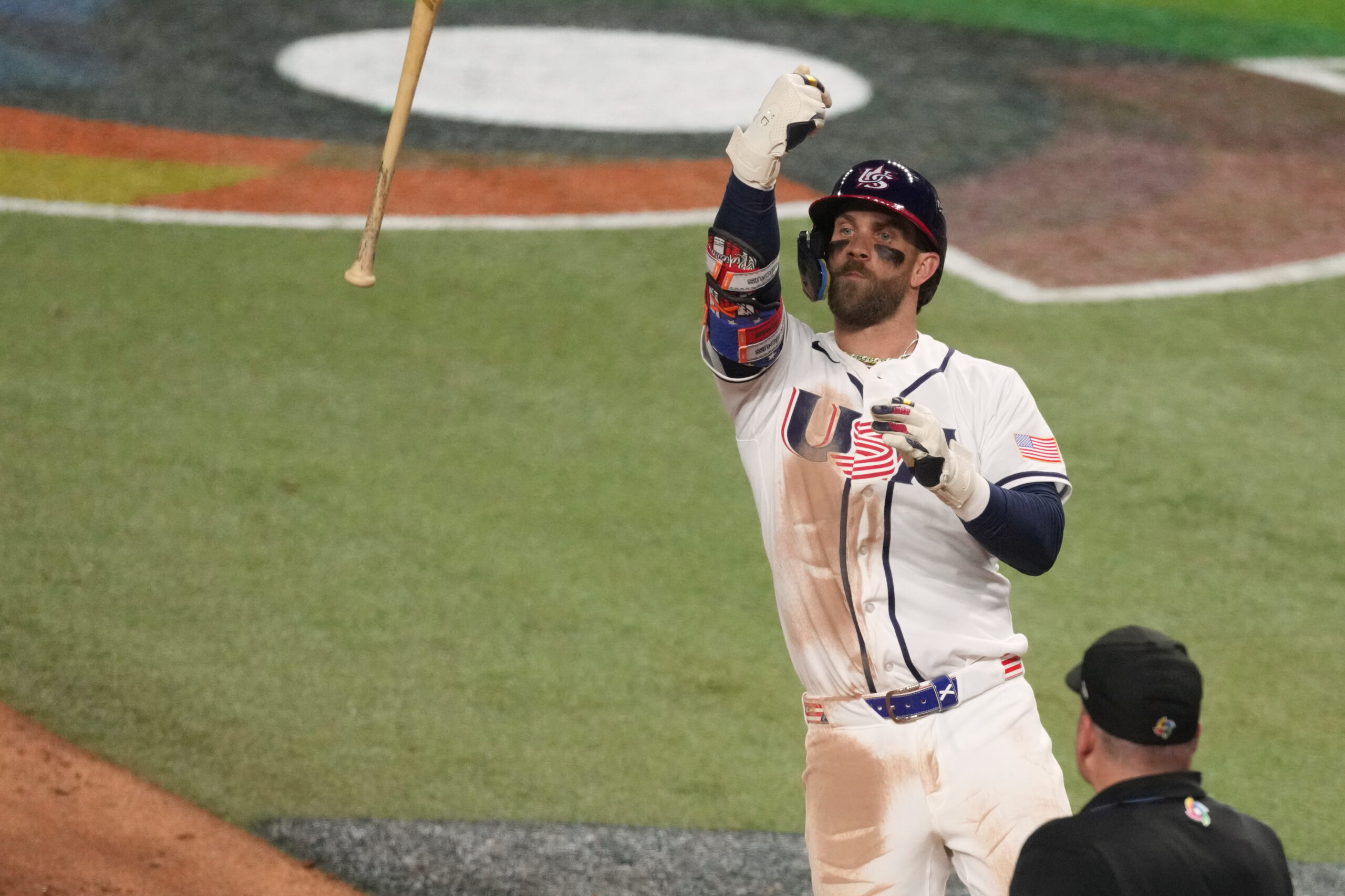
    With the most talented U.S. team ever assembled in danger of getting shut out, and with the pro-Venezuela sellout crowd raring to party, Bryce Harper bashed a game-tying two-run homer to straightaway center field in the eighth inning, javelin-tossed his bat, pointed to the flag on his sleeve and flexed for a camera after rounding third base, and provided irrefutable evidence that Americans do, in fact, have fun playing the game.

    “I was telling people, I go, ‘This isn’t going to shock you guys if it happens,’” said Kyle Schwarber, a witness in the Phillies’ dugout to Bedlam at the Bank and so many other vintage Harper moments. “And then, bam!”

    Said U.S. manager Mark DeRosa: “I knew he was going to have a moment. That’s who he is, right? He has the ability to have big moments in big spots. He wants it. He wants to be up there in that spot.”

    It just wasn’t enough to beat Venezuela. Not after Eugenio Suárez’s double to center field drove in the go-ahead run off reliever Garrett Whitlock in the ninth inning, nearly blowing the retractable roof off Venezuelan.

    Bryce Harper throws his bat after delivering a game-tying two-run homer in the eighth inning of the World Baseball Classic final Tuesday night in Miami.

    But Harper’s seismic shot was the highlight of the two-week tournament for Team USA, which overcame a loss to upstart Italy in pool play and criticism of its manager for being overconfident at best, clueless at worst.

    Leave it to Harper to deliver — and not only with a dramatic homer. He tried to rally Team USA with a pregame speech, too.

    “I think the just biggest thing [Harper said] was just being us, representing us, playing for us,” Schwarber said. “He had a great message. It was from the heart, right? I know getting in front of a group of people isn’t easy sometimes. There was a lot of respect for that.

    “And he had a great performance tonight, too.”

    Harper waited 17 years for this. He hadn’t played for the country since 2009, when he was 16. He raised his hand for the last WBC in 2023 but withdrew after having elbow surgery. He desperately wants MLB to allow players to compete when baseball returns to the Olympics in 2028.

    But Harper was 3-for-20 with seven strikeouts in five games through the quarterfinals. Layer that on top of the Phillies’ divisional-round knockouts in the last two postseasons, and it had been a while — maybe all the way back to the Orlando Arcia game in the 2023 playoffs — since he had “The Moment.”

    Where did this one rank in his 15-year career?

    Bryce Harper hits a 432-foot home run to center field during the eighth inning to tie the game at 2.

    “Probably No. 2,” he said. “Probably right behind the San Diego homer, in Game 5 [to clinch the pennant in 2022]. I’ll probably put this right behind it.”

    The Americans had only three hits against six Venezuelan pitchers. Two belonged to Harper. He lasered a 95 mph sinker to right field for a single in the sixth inning. In the eighth, he got a center-cut pitch from Andrés Machado. Statcast labeled it a changeup, although at 93 mph, it had the characteristics of a heater.

    Either way, Harper unloaded — 109.4 mph off the bat, 432 feet to dead center.

    “Yeah, what a moment,” Harper said. “I love the opportunity. I love the chance. I’m grateful for it. I thought when we tied it up right there that we had a good chance to win the game.”

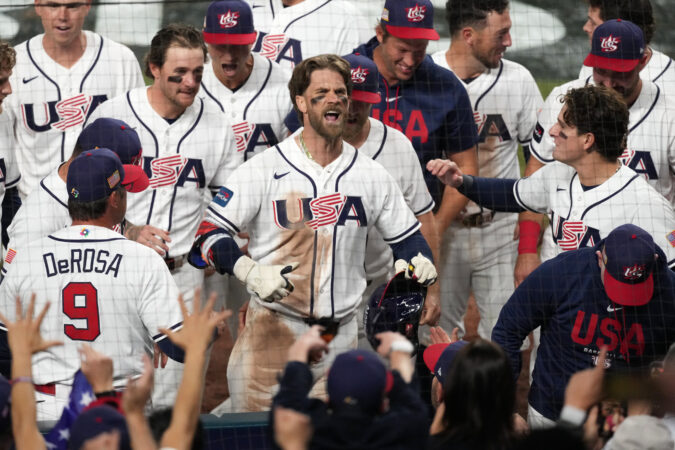
    And so, the emotion spilled out of him, as Team USA spilled from the dugout and met him at home plate.

    “Just enjoy the moment,” he said.

    The game was played against an unavoidable political backdrop two months after U.S. military forces captured Venezuelan president Nicolás Maduro. But Venezuelan manager Omar López and the native players on the roster repeatedly steered clear of the topic.

    “We’re here to [play] baseball,” Ronald Acuña Jr. said earlier in the week.

    The last few days also sparked a debate about whether Dominican and Venezuelan players, who exude emotion on the field, have more fun than the more staid Americans. Harper, rarely afraid to play with flair, offered himself as proof that they don’t.

    “Every country has their way they play, right?” Harper said a few days ago. “Latin American countries, a lot of energy. And I love watching it because that’s how I played when I was younger. I got in trouble for it, right? I came up, I used gray bats. I used different cleats, got my cleats cut. MLB told me I couldn’t use gray bats, couldn’t use my eye black, all that kind of stuff, right? I kind of got pounded for it.

    “So, there’s an American way of basically what everybody talks about. But I think that’s so far from the truth.”

    Bryce Harper celebrates his home run with Aaron Judge.

    And upon hitting a moonshot in the late innings of a winner-take-all game in international competition, well, Harper didn’t hold anything back.

    When it was over, many of the American players and staff watched from the third-base dugout as a mass of blue, yellow, and red jerseys celebrated around closer Daniel Palencia.

    They arrived dressed in game-worn USA hockey jerseys, a gift from the gold medalists. But they left with silver medals that they took off their necks almost as soon as they were presented to them.

    Harper made a point of shaking hands with many of the Venezuelan players.

    “Venezuela’s a very proud place for their baseball,” he said. “I’m really happy for them. Obviously I want to win no matter what. That’s what I play for, to win championships and gold medals. But in that moment, it’s not about me. It’s about us and our game.

    “They had a great tournament. I just wanted to let them know and say congratulations. They’re the best team in the world.”

    DeRosa said he shared a “special moment” with Harper in his office. They were teammates with the Nationals in 2012, when Harper was a 19-year-old rookie. He couldn’t have imagined the WBC without him.

    “I knew what his career was going to be like, with the multiple MVPs and how he’s competed,” DeRosa said. “I was just proud he was a part of the team, share a clubhouse with him again.”

    Maybe Harper will do it again at the Olympics in two years.

    “I hope so,” he said. “I really do.”

  • Philly vaccination experts hail a court ruling that halts changes to childhood vaccine recommendations

    Philadelphia vaccine experts on Tuesday called a federal court decision reversing changes to the U.S. childhood vaccination schedule under Health and Human Services Secretary Robert F. Kennedy Jr. a win for public health.

    But discord between the Centers for Disease Control and Prevention under his leadership and medical professional groups has sowed distrust and confusion for families, experts say.

    Federal health agencies were stopped from implementing a January overhaul of the childhood vaccination schedule that decreased the number of recommended childhood immunizations from 17 to 11.

    The ruling by U.S. District Judge Brian Murphy in Massachusetts also unwound other vaccine recommendations made last year by a panel of independent experts, the Advisory Committee on Immunization Practices, that advises the CDC.

    Last spring, Kennedy fired the entire committee and replaced it with handpicked members that included several vaccine skeptics. Kennedy himself is a longtime anti-vaccination activist.

    The reconstituted committee’s members have recommended delaying hepatitis B shots for most newborns, which have been universally recommended at birth since 1991. (In January, Kennedy went further, saying that the vaccine was no longer recommended for all children — just those at high risk of contracting the virus.)

    The revamped committee also voted against universally recommending COVID-19 vaccinations, instead saying patients could get the shots after “shared clinical decision-making” with a doctor.

    The decisions were decried by public health experts who say ACIP’s stances will increase preventable diseases and deaths in children.

    Several major medical organizations, including the American Medical Association and the American Academy of Pediatrics, filed suit last July to block changes to COVID vaccine recommendations. The organizations updated their lawsuit as Kennedy oversaw further changes to vaccination recommendations.

    In his ruling, Murphy said that HHS violated federal law around government procedures by bypassing ACIP in the January overhaul of the vaccination schedule. The new recommendations said that only children at higher risk of health complications should get vaccines that protect against certain serious illnesses, like rotavirus and hepatitis B.

    He also noted that the reconstituted ACIP includes members with no expertise or professional qualifications on vaccination.

    HHS spokesperson Andrew Nixon indicated in an e-mailed statement that the administration may challenge the ruling. “HHS looks forward to this judge’s decision being overturned just like his other attempts to keep the Trump administration from governing,” he said.

    The back-and-forth headlines and lengthy legal battles can be confusing to parents, said Charlotte Moser, codirector of the Vaccine Education Center at Children’s Hospital of Philadelphia.

    “But families can take comfort in the fact that the science is and has been stable when it comes to the safety of vaccines and their effectiveness,” she said.

    Also a former ACIP member whom Kennedy fired last summer, she noted that vaccines work: “And they’ve been protecting children for decades.”

    ‘A war on vaccines’

    For years, states have used ACIP’s recommendations to require which vaccines should be covered by insurers and mandated for schoolchildren.

    Amid shake-ups on the committee, several states, including Pennsylvania, have changed their own policies around vaccine distribution to ensure that people can continue to access vaccines no longer recommended by the CDC.

    Gov. Josh Shapiro, a Democrat who signed onto a separate lawsuit over the vaccine schedule changes, hailed the court ruling.

    “Hey @SecKennedy, you heard the courts,” he said Monday in an X post. “And if we haven’t made it clear enough: here in Pennsylvania, we trust doctors to help us make healthcare decisions — not conspiracy theorists like you.”

    The ongoing debate about the CDC’s recommended childhood vaccination schedule has so far not affected access to vaccines, as insurers have continued to cover all vaccines under the old schedule.

    But Kennedy’s appointment elevated anti-vaccine activism to the highest levels of federal policymaking, said Paul Offit, a physician and a leading national vaccine advocate who heads CHOP’s Vaccine Education Center.

    “He altered the current vaccine schedule to make it so that certain vaccines appear to be unnecessary or optional,” Offit said. “It was an assault. A war on vaccines.”

    Public distrust of vaccines has been growing since the COVID-19 pandemic, Offit noted, and the United States is already seeing a resurgence of vaccine-preventable diseases, including tetanus, measles, flu, and whooping cough.

    Offit, a co-inventor of a rotavirus vaccine who has sparred publicly with Kennedy for years, said many Americans no longer experience the suffering associated with vaccine-preventable diseases. “People don’t appreciate how sick or dead these viruses can make you,” he said.

    Vaccines and public trust

    In a survey last year, researchers at the Annenberg Public Policy Center at the University of Pennsylvania found that people would be more likely to trust their medical provider or a professional organization than the CDC if the two sides disagreed on vaccine advice.

    “You have a personal relationship with that individual and you’ve played a role in selecting them, as opposed to the anonymous entity the CDC,” said Kathleen Hall Jamieson, Annenberg’s director.

    People who continue to follow the CDC may become increasingly skeptical of vaccines because of the agency’s efforts to remove some vaccines from the recommended schedule or alter when they should be given, she said.

    Jamieson said she expected confusion to continue as the Trump administration appeals the court’s decision.

    Moser, the fired ACIP member and CHOP vaccine expert, urged parents to consult trusted healthcare providers about vaccination. Recent changes to vaccine recommendations were not based on any new data that raised fresh concerns about vaccine safety, she said.

    “Many young parents today have themselves received these vaccines,” she said. “We want to make sure we’re able to protect this generation of children from these horrible diseases that we had the benefit of being protected against.”

  • Tredyffrin residents are concerned over the police response to the suspect who allegedly shot and killed a woman in a random attack

    Tredyffrin residents are concerned over the police response to the suspect who allegedly shot and killed a woman in a random attack

    Residents in Tredyffrin, where a woman was killed in a random act of violence last weekend, said Monday that more could have been done in the hours leading up to the shooting and criticized the township’s lack of communication before and after the crime.

    The remarks were brought before the township’s elected board of supervisors in the first public meeting since Steve Jahn, 44, was arrested and charged with murdering Megan Nieberle, a 53-year-old nurse, while she was driving home from seeing friends late in the evening of March 7. She died the next day.

    Residents were chilled by the fact that, in the hours before Jahn killed Nieberle, he had called the police himself, telling them he was being followed by undercover officers, according to authorities. Officers, who said Jahn was showing “frantic behavior,” escorted him to Paoli Hospital for a voluntary mental health evaluation but let him leave when he requested it, knowing he legally owned firearms and had one with him. Jahn was arrested and charged with murder the day after the shooting.

    “We can frame this a lot of ways: It was a random act of violence,” said resident Joe Maugeri. “But we could also frame it as: Was it a preventable act of violence? And I think that’s the question that all of us are thinking. Were there tools that police had? Were there things that could have been done?”

    Authorities said that Jahn had no connection with Nieberle, a Children’s Hospital of Philadelphia nurse and mother of three. A few hours after leaving the hospital, Jahn allegedly drove to the intersection of Contention Lane and Old State Road in Berwyn and shot Nieberle from his car.

    Passersby who saw Nieberle’s crashed car called police, who rushed her to Paoli Hospital.

    Her death has “left a profound void in the hearts of the many who were fortunate enough to know and love her,” loved ones wrote in her obituary last week. Nieberle’s “warmth, humor, and loyalty made her a cherished presence in the community,” the obituary says.

    In his opening remarks Monday, board chairman David Miller said that officers were limited in what they could do that day. Pennsylvania has no “red flag” law, which allows for the temporary removal of lawfully owned guns when the owner appears at risk for danger.

    “Now I’m not saying a red flag law would have changed what happened on [that] night. I can’t know that, but certainly would have given our police another tool to help manage the situation,” Miller said.

    Such a measure has repeatedly failed to get enough support in politically divided Harrisburg. Another version of the bill was introduced this session.

    Democratic State Rep. Melissa Shusterman, who represents the area, said in a statement that there had been an increase in interest in extreme risk protection orders in the community.

    “The loss of our neighbor was tragic, and while we may not know for certain if an ERPO would have prevented this senseless tragedy, we do know they help to reduce gun violence and keep our communities safer,” she said.

    Residents also criticized the township for not notifying the community of the possible danger, saying they went more than 30 hours before knowing Jahn had been arrested.

    “What are the protocols and policies that we have in place around notification when things like this happen?” resident Katie Angstadt asked. “From what we’ve understood is that there was someone in our community who was very dangerous, armed for six or seven hours, and we were not notified.”

    Superintendent of Police T. Michael Beaty said he understood why the incident was concerning.

    “Questions about firearm laws and policy are ultimately determined by legislators at the state and federal levels. Our role as law enforcement is to enforce the laws as they exist and to investigate crimes thoroughly when they occur,” he told them. “That said, when tragedies like this happen, it often leads to important conversations about how we can strengthen public policy, improve crisis intervention, and ensure officers and communities have the tools that they need to prevent violence whenever possible.

    “This is a very devastating situation, which has left a profound impact on many of our community members. At this time, my deepest condolences are with Megan’s family and loved ones as they navigate this unexpected loss. While I cannot speak on the timeline or specifics of the investigation, I know it remains ongoing.”

    This suburban content is produced with support from the Leslie Miller and Richard Worley Foundation and The Lenfest Institute for Journalism. Editorial content is created independently of the project donors. Gifts to support The Inquirer’s high-impact journalism can be made at inquirer.com/donate. A list of Lenfest Institute donors can be found at lenfestinstitute.org/supporters.

  • Eagles to sign wide receiver Hollywood Brown to one-year contract worth up to $6.5 million

    Eagles to sign wide receiver Hollywood Brown to one-year contract worth up to $6.5 million

    The Eagles are adding an option for their vacant third receiver spot, agreeing to terms with Marquise “Hollywood” Brown on a one-year deal worth up to $6.5 million, a league source confirmed to The Inquirer on Tuesday.

    Brown, who turns 29 in June, is a seven-year NFL veteran who spent the last two seasons with the Kansas City Chiefs. Though he missed all but the tail end of the 2024 season with a shoulder injury, he played in 16 games (six starts) in 2025.

    Against the Eagles in Super Bowl LIX, Brown caught two passes for 15 yards, playing on 41 snaps.

    In that span, the 5-foot-9, 180-pound receiver posted 587 yards (No. 2 on the team behind Travis Kelce) and five touchdowns (tied for the team high) on 49 receptions. Brown has been dependable when healthy, dropping just two passes since 2024 in the regular season and postseason combined, according to Pro Football Focus.

    Brown began his career with the Baltimore Ravens, the team that drafted him No. 25 overall in 2019 out of Oklahoma. In his seven NFL seasons with Baltimore (2019-21), the Arizona Cardinals (2022-23), and Kansas City, Brown has played 90 games, collecting 4,322 yards and 33 touchdowns on 371 receptions.

    He has established himself as a vertical threat who can line up out wide or in the slot. Last season with the Chiefs, Brown took 37.8% of his snaps in the slot (159) and 61.8% out wide (260), according to PFF.

    Come training camp, Brown figures to contend for the third receiver role occupied the last two seasons by Jahan Dotson, who signed with the Atlanta Falcons in free agency. The receiving depth chart is currently led by A.J. Brown and DeVonta Smith, and Hollywood Brown would join a depth receiver corps that also includes Darius Cooper and Johnny Wilson.

  • What can a short porn film about praying mantises teach us about ‘desire and devotion and sacrifice’?

    What can a short porn film about praying mantises teach us about ‘desire and devotion and sacrifice’?

    The HUMP! Film Festival, the annual tour of DIY adult films made by novices that features a wide range of kink and romance, is returning to Philadelphia on March 27.

    Curated by the popular podcaster and sex columnist Dan Savage, this year’s festival marks the debut of an animated short (porn) film by Philly filmmaker Isabella Akhtarshenas.

    Her film, Prey for Sex, is a stop-motion animation inspired by nature documentaries that showcases the seductive and somewhat violent mating ritual of praying mantises.

    “The man gets his head bitten off early on in the ritual, and they continue having sex while he’s headless, until he dies, basically,” Akhtarshenas, 29, said, summarizing the plot. She designed the female praying mantis character as “very dommy-mom” and her male counterpart as utterly devoted to her.

    An artist based in South Philly, Akhtarshenas conceived and crafted the piece with her romantic and creative partner, Eric Scott, in two weeks last fall, after attending a previous HUMP! Film Festival. (The festival has grown so popular that it now arrives in two parts, one in the spring and one in the fall).

    Akhtarshenas noticed the lineup didn’t include any stop-motion animation, and wanted to change that.

    A clip from “Prey for Sex.”

    She found inspiration in still images of praying mantises and her ”own library” of personal sex videos, and drew each frame in the Procreate app on her iPad. The whole process took about 150 hours, she said.

    She crafted much of it sitting by her mother, who was hospitalized. A hospital bed, she said, was a somewhat incongruous place to bring an animated porn film about praying mantises into being. When it was done, Akhtarshenas was too proud not to share it.

    “I did show it to my family, who was kind of like, ‘OK, I guess!’” she said.

    Out of 400 submissions, Akhtarshenas’s was one of 48 films selected (there are 24 being played in the spring edition and 24 in the fall).

    The female praying mantis is “very dommy-mom,” Isabella Akhtarshenas said.

    This year’s festival will have two showings at FringeArts, one at 6:30 and the other at 9 p.m. An official trailer for the 90-minute compilation highlights elegant rope bondage, lovers in fursuit heads, and a smattering of butts, including one donning a Beyoncé-esque silver-spangled cowboy hat.

    Savage founded Hump in 2005, and often describes it as “not your average porn festival.” Viewers watch the lineup together, which could be a new experience for those accustomed to viewing porn in a more solitary setting.

    The films always feature people (and creatures) of all sizes, ages, races, and genders.

    Akhtarshenas is thrilled to attend the Philly premiere of her film and hopes viewers leave thinking about “desire and devotion and sacrifice.”

    “I want people to feel inspired creatively, more than anything,” she said.

    The 2026 HUMP! Film Festival will host screenings in Philadelphia on March 27 at 6:30 and 9 p.m. For ages 18+. Tickets: $20 plus fees. FringeArts, 140 N. Christopher Columbus Blvd., Philadelphia. Buy tickets here.

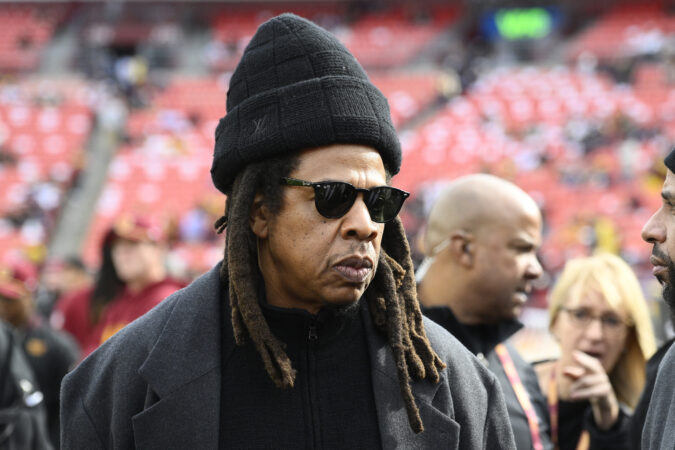
  • The Roots Picnic has announced its first headliner for 2026. It’s Jaÿ-Z.

    The Roots Picnic has announced its first headliner for 2026. It’s Jaÿ-Z.

    Last week, we learned that the Roots Picnic is moving to Belmont Plateau, a mile away from its recent home at the Mann Center. Now, we know who the name-in-lights Saturday night headliner is for the 20th edition of the festival.

    It’s Jaÿ-Z.

    The rapper and head of entertainment business powerhouse Roc Nation will perform with The Roots as the closing act on May 30, the first day of the two-day festival. The Roots has a history of playing as Jaÿ-Z’s backing band before, most notably on Jay-Z: Unplugged, the 2001 live album that was part of the “MTV Unplugged” series.

    And who else is playing over the course of the Picnic, whose lineup last year included over 40 acts? That is not yet known.

    Tuesday’s initial announcement includes only The Roots and Jaÿ-Z. Word on the rest of the festival, which is scheduled for May 30 and 31, is expected later this week.

    In a news release, Roots manager Shawn Gee, who is the president of Live Nation Urban, which produces the festival and others around the country, said that booking Jaÿ-Z and bringing the festival to Belmont Plateau both represented the fulfillment of long-time goals for the Philadelphia hip-hop and The Tonight Show house band.

    “Moving the Roots Picnic to Belmont Plateau and bringing Jaÿ-Z and The Roots together to perform are both bucket-list moments for us,” Gee said in the statement.

    The Roots perform on the Mann Stage during the Roots Picnic 2025 at the Mann Center on Sunday, June 1, 2025.

    “After meeting with Mayor Cherelle Parker and hearing her vision for Philadelphia 250, she truly inspired us to dream even bigger,” he said, thanking Parker, Parks and Recreation commissioner Susan Slawson, and Janelle Jones, the city’s director of the office of special events. “We can’t wait to see everyone in May at the Plat.”

    Jaÿ-Z, of course, is no stranger to large scale hip-hop festivals in Philadelphia. From 2012 to 2022, Roc Nation produced the Made in America festival on the Benjamin Franklin Parkway on Labor Day weekend.

    Jaÿ-Z curated the festival, headlined it in 2012 and 2017, and booked his wife, Beyoncé to play it in 2013 and 2015. The festival was cancelled due to the COVID-19 pandemic in 2020, and resumed for two years. In 2023, it was planned with Lizzo and SZA as headliners and then abruptly cancelled a month ahead of time.

    Roc Nation has never announced that Made in America is over, but the festival did not take place in 2024 or 2025. Jaÿ-Z headlining the Roots Picnic in Philadelphia would certainly seem to be another sign that Made in America is gone for good.

    Another burning question: What’s up with the two dots — a diacritic called an umlaut — over the “y” in Jaÿ-Z’s name?

    The answer is: He started stylizing it that way on all of his branding earlier this year.

    What that might mean is not entirely clear. However, this is an important anniversary year for the Brooklyn rapper born Shawn Carter.

    His debut album, Reasonable Doubt, was released 30 years ago, in 1996. That same year, he released the single “Dead Presidents” with his name stylized as Jaÿ-Z, which is how it was also written on the Reasonable Doubt album cover.

    So, does that mean Jaÿ-Z is launching a Reasonable Doubt anniversary tour, with the Roots Picnic as his launching pad? Or will he be releasing a new album in 2026, which would be his first since 4:44 in 2017? Stay tuned for answers to those questions.

    Tickets for the 2026 Roots Picnic go on sale Wednesday, March 18, at 10 a.m. at RootsPicnic.com.