Tag: topic-link-auto

  • What is Unrivaled, which kicks off its tour in Philly Friday night, and how is it different from the WNBA?

    What is Unrivaled, which kicks off its tour in Philly Friday night, and how is it different from the WNBA?

    The WNBA kicks off its 30th season in May, but that doesn’t mean fans have to wait until the spring to see stars take the court.

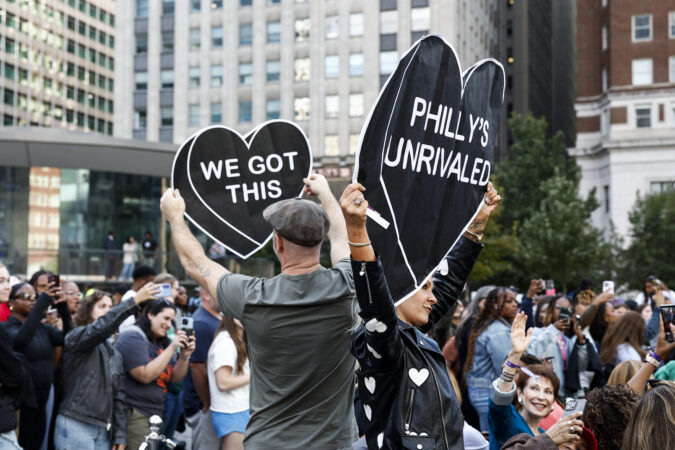
    Unrivaled, the three-on-three professional women’s basketball league, tipped off its season on Jan. 5. In its second season, the league is hitting the road for Philly is Unrivaled, in which four of the eight teams will head to Xfinity Mobile Arena for a doubleheader.

    Here’s everything you need to know:

    What is Unrivaled?

    Unrivaled is a three-on-three professional women’s basketball league that provides WNBA players with an opportunity to play domestically during the offseason.

    Its inaugural season tipped off on January 17, 2025, with six teams. The league now has eight teams and a total of 54 players.

    The teams are: Laces, Mist, Rose, Lunar Owls, Phantom, Vinyl, and the two new additions — Hive and Breeze.

    Gameplay features three seven-minute quarters with a game clock, an 18-second shot clock, and six fouls per player.

    The fourth quarter of play uses a “winning score” rule. This means at the end of the third quarter, officials determine a winning score by adding 11 points to the leading team’s score. The first team to get to that winning number wins the game.

    In addition to the two new teams, another change this season is a development pool of six players. None of these athletes are assigned to a specific team at the start of the season but remain on-site and serve as injury-relief players.
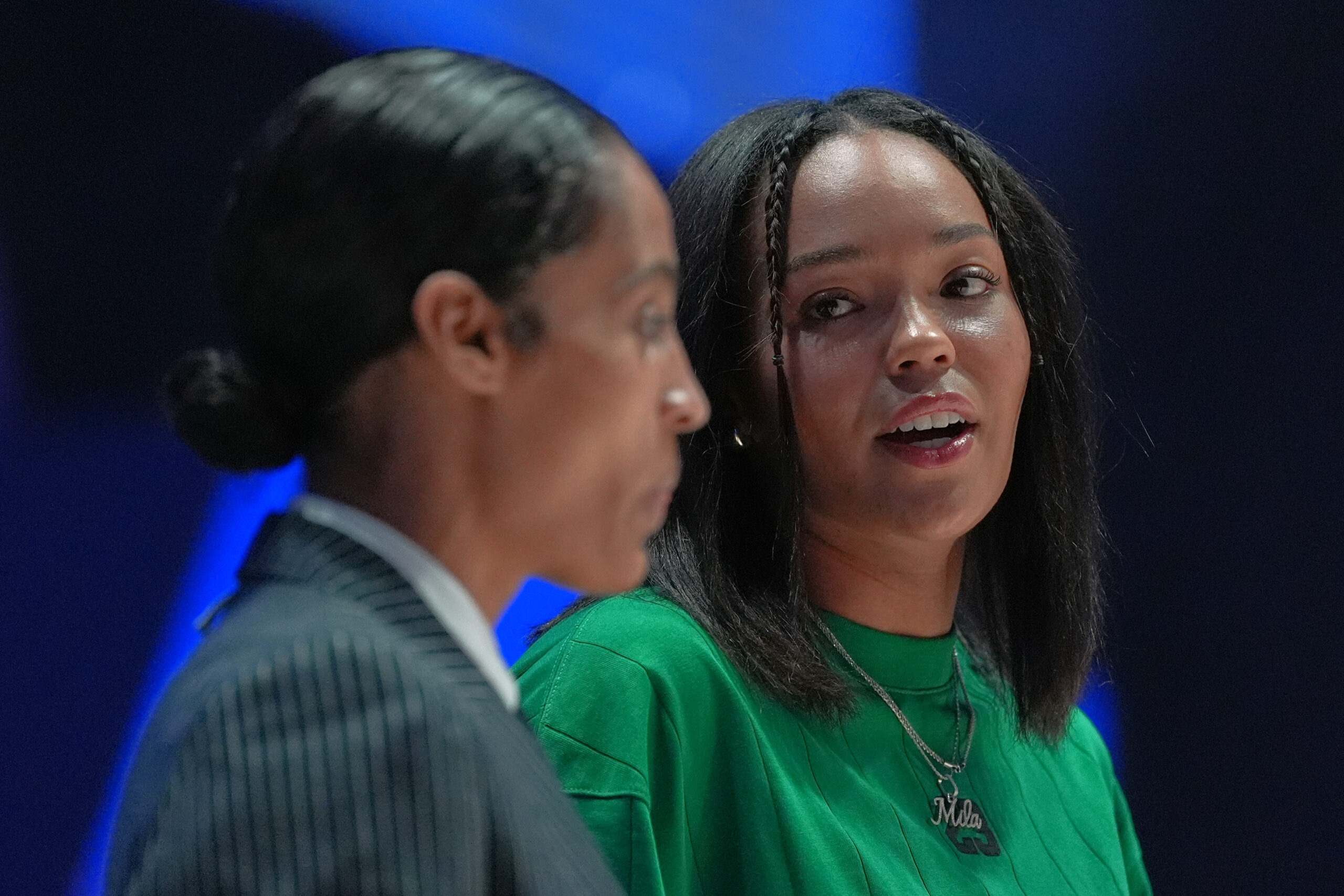
    Lunar Owls forward Napheesa Collier (right) and Skylar Diggins are among injured Unrivaled players this season.

    How did Unrivaled start?

    WNBA players Breanna Stewart and Napheesa Collier founded Unrivaled in 2023 to give players a new option for offseason play.

    Within just one year, the league raised $35 million in capital and attracted sponsors like Miller Lite and Under Armour, while being backed by other professional athletes including U.S. women’s soccer star Alex Morgan.

    Unrivaled began with six teams and 36 total players, with each of the 36 earning more than $220,000 in salary. The league also offers players equity and revenue sharing, which has created an incentive for WNBA players to not head overseas during the offseason.

    In its second season, the league will feature more than a dozen first-time players, including Los Angeles Sparks guard Kelsey Plum, Indiana Fever guard Kelsey Mitchell, and Dallas Wings guard Paige Bueckers.

    What is Philly is Unrivaled?

    While Unrivaled games typically are played at Sephora Arena in Medley, Fla., the 2026 season has one scheduled stop in Philadelphia.

    Philly is Unrivaled, a doubleheader announced in October at LOVE Park, is set for Friday at Xfinity Mobile Arena.

    Game 1 is Breeze against Phantoms (7:30 p.m.), while the second game features last year’s champion, Rose, against the Lunar Owls (8:45 p.m.).
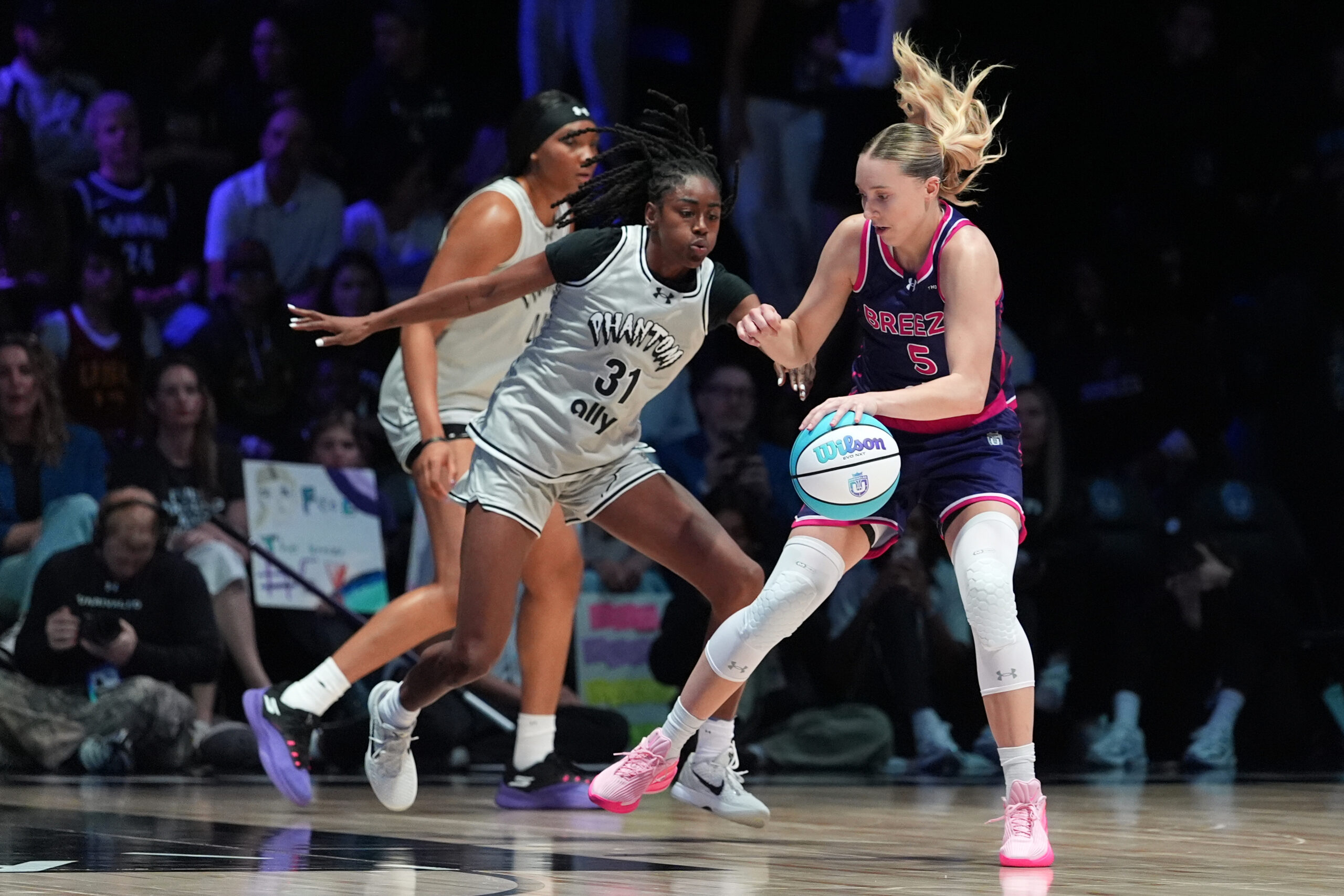
    Breeze guard Paige Bueckers (5) is defended by Phantom guard Tiffany Hayes in their Unrivaled season opener.

    How can I watch Unrivaled?

    For the 2026 season, Unrivaled games can be viewed on traditional TV via TNT and truTV or streamed on HBO Max. Both games of Philly is Unrivaled will air on those channels.

    Stateside Live! has partnered with the league and Miller Lite to offer watch parties for Friday’s doubleheader. The official pregame begins at 4:30 p.m.

    Who should I be on the lookout for?

    Natasha Cloud, a guard for Phantom, is a Broomall native and graduate of Cardinal O’Hara and St. Joseph’s. Cloud, a three-time WNBA All-Defensive team honoree, was traded to New York Liberty ahead of the 2025 WNBA season after stints with the Phoenix Mercury and Washington Mystics.

    This also is a pro hoops homecoming for North Philly native Kahleah Copper, who plays for Rose and the Mercury. She starred at Prep Charter before moving on to Rutgers. Copper, a four-time WNBA All-Star, also won a gold medal with the United States women’s basketball team at the Paris Olympics in 2024.

    While she won’t be competing in Philly is Unrivaled, former Villanova star Maddy Siegrist is playing for Laces in her debut Unrivaled season. Siegrist set Villanova’s all-time scoring record before getting drafted third overall by the Wings.

    Can I still get Unrivaled tickets?

    While Philly is Unrivaled is officially sold out, tickets are still available on the secondary market via websites such as Ticketmaster and StubHub. Prices started at $35 for standing room only, as of Wednesday afternoon.

    Unrivaled tickets for the league’s Florida games can be purchased on their website or resale ticket websites, including Ticketmaster, Vivid Seats, and GoTickets.
  • Trump administration reveals location of dismantled slavery exhibits from the President’s House in new legal filing

    Trump administration reveals location of dismantled slavery exhibits from the President’s House in new legal filing

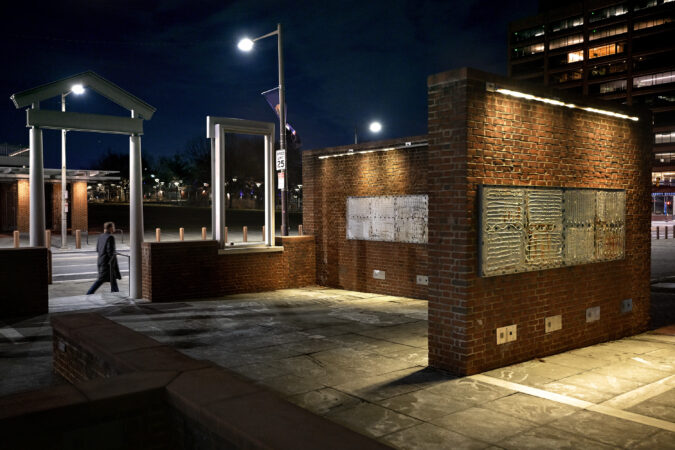
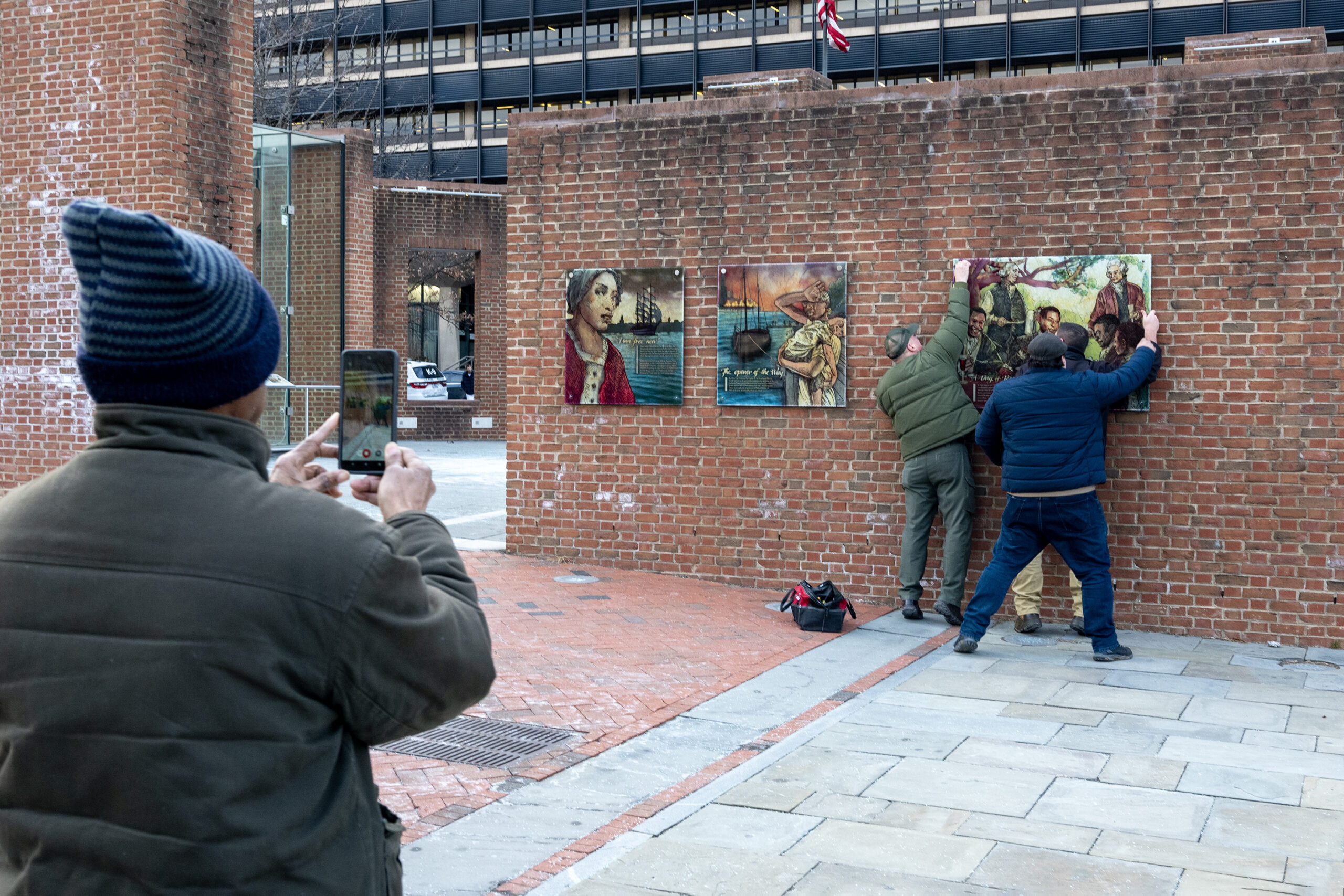
    Informational exhibits about slavery removed by the National Park Service from the President’s House Site last week are being kept in storage at a facility adjacent to the National Constitution Center, according to a legal filing from the Trump administration.

    The exhibits will remain in the park service’s custody at the center, down the street from the President’s House, pending the outcome of the City of Philadelphia’s federal lawsuit against the Department of Interior and the National Park Service for taking down the exhibits.

    But the center said it has no role in storing the exhibits.

    “The storage facility [where the exhibits are being kept] is entirely under control and operation of the Park Service,” said a spokesperson for the Constitution Center, adding that the center does not have possession of or access to the space.

    Mayor Cherelle L. Parker’s administration is seeking an injunction to return the exhibits to the President’s House, which aims to educate visitors on the horrors of slavery and memorializes the nine people George Washington enslaved at the site during the founding of the United States.

    Jali Wicker records NPS workers remove interpretive panels at the President’s House site in Independence National Historical Park Thursday, Jan. 22, 2026. More than a dozen educational displays and illustrations about slavery were removed from the site, which serves as a memorial to the nine people George Washington enslaved there during the founding of America.

    The location of the removed exhibits was revealed Wednesday in a motion objecting to the city’s injunction. The motion was filed by U.S. attorneys and assistant Attorney General Brett Shumate, representing Interior Secretary Doug Burgum, acting National Park Service Director Jessica Bowron, and their respective agencies.

    The legal filing also provides further details into what transpired last Thursday when park service employees removed exhibits about slavery at the President’s House.

    Park service employees dismantled the exhibit after Bowron ordered Steve Sims, the park service’s acting regional director, to have workers remove the panels and turn off video displays at the site, according to the filing. Sims said the takedown was carried out the same day that Bowron requested it.

    There is also a remaining sign made of wood in a metal structure that was not removed last week because additional tools were needed.

    “When and if NPS removes the sign, it will be stored with the other panels,” Sims said in a declaration included in the legal filing.

    The footprints embedded in the site and the Memorial Wall featuring the names of the nine people Washington enslaved will stay at the President’s House, he said.

    Last year, Burgum and President Donald Trump ordered content at national parks that could “inappropriately disparage Americans past or living” to be reviewed and potentially removed.

    In addition to the actions in Philadelphia, the National Park Service has reportedly removed signage about the mistreatment of Native Americans from the Grand Canyon, among other changes implemented under the orders.

    Tuesday’s filing previews the Trump administration’s legal argument for a hearing scheduled Friday on Philadelphia’s suit, which could be used in other cases around the country.

    The attorneys claim in the filing that this case is “fundamentally a question of Government speech,” and they accuse the city of trying to “censor” the federal government.

    “Such interests are especially weighty where, as here, the City effectively seeks to compel the Federal government to engage in speech that it does not wish to convey,” the attorneys wrote.

    The city’s suit has received legal backing from Gov. Josh Shapiro and the Avenging the Ancestors Coalition, an advocacy group that helped establish the President’s House in the early 2000s.

    The exhibit takedown has been a heartbreak for those who helped develop the site and for Philadelphians who have left artwork memorializing what the site used to be.

    In a video posted to social media Tuesday, Parker said that her administration would keep “fighting” to have the panels restored to the site as the city prepares to play a central role in the nation’s 250th anniversary celebrations in July.

    “This history is a critical part of our nation’s origins, and it deserves to be seen and heard, not just by the people of Philadelphia, but by every person who comes to Philadelphia from around our nation and the world to see and learn from, especially as we celebrate our Semiquincentennial 250th birthday, I want the world to know you cannot erase our history,” she said.

    This story has been updated to include a comment from the National Constitution Center.

  • Baby KJ’s father returns to CHOP as a construction worker, building its new patient tower

    Baby KJ’s father returns to CHOP as a construction worker, building its new patient tower

    Inside a heated tent on the Children’s Hospital of Philadelphia campus, 17-month-old KJ Muldoon wiggled around in his mother’s arms, smiling and clinging to a multicolored toy.

    This time, the toddler who has been called one of the top 10 people who helped shape science in 2025 was not here for a medical appointment.

    He was there to celebrate a 26-story patient tower at CHOP that his father, Kyle Muldoon, a longtime construction worker, is helping build. Called Roberts Children’s Health, the new inpatient complex is set to launch in 2028 and significantly expand the number of beds available for patients at CHOP’s main campus.

    Kyle Muldoon had joined the project back in December 2024, when KJ was still hospitalized at CHOP, where his life-threatening genetic condition was successfully treated with a first-of-its-kind personalized gene-editing therapy.

    But in the months before the treatment developed by doctors at CHOP and the Hospital of the University of Pennsylvania sparked international attention, KJ’s father was recently unemployed. The Clifton Heights father of four had accepted a layoff to focus on his sick son.

    When he was connected with the person running the $2.6 billion construction project at CHOP, he asked for a job and explained he would “essentially be living next door.”

    Muldoon joined the crew in December 2024, allowing him to stay close by during KJ’s 307-day stay and contribute to a project that feels meaningful to him.

    “Every day when I get up, I know what I’m doing this for,” Muldoon said.

    KJ Muldoon, left, and his father Kyle Muldoon, right, at a news conference at CHOP.

    His son KJ was born in August 2024 with a metabolic disorder that puts babies at risk of severe brain damage and is fatal in half of cases. Called severe carbamoyl phosphate synthetase 1 (CPS1) deficiency, it prevented KJ’s liver from being able to process protein.

    Doctors Kiran Musunuru and Rebecca Ahrens-Nicklas used a gene-editing technology known as CRISPR to create a personalized drug that would fix the genetic mutation that was driving KJ’s disease. After receiving three doses, he was able to go home last June.

    “This pipe dream that sounded like it came from a sci-fi movie became a reality,” Muldoon said.

    The medication is not a cure, but it has dramatically improved KJ’s liver function and made the effects of his disease milder.

    The treatment approach has been hailed for its potential for rare-disease drug development. The U.S. Food and Drug Administration in the fall announced a new approach to clinical trials to test novel drugs like the one designed for KJ, who was called “a trailblazing baby” by the British scientific journal Nature when it named him to its year-end list of the top 10 influential people.

    With dietary restrictions and daily medication to keep his ammonia levels down, the toddler has been able to meet milestones, like walking and saying some words (currently a lot of “mama” and “dada”).

    These days, KJ likes playing catch, eating, and chasing his siblings around.

    “Sometimes you got to sit back and take it all in, because we never knew if that was going to be a possibility,” Muldoon said.

    The new tower’s construction is funded in part by a $125 million donation from Comcast CEO Brian Roberts and his wife, Aileen, whose name will be on the new building.

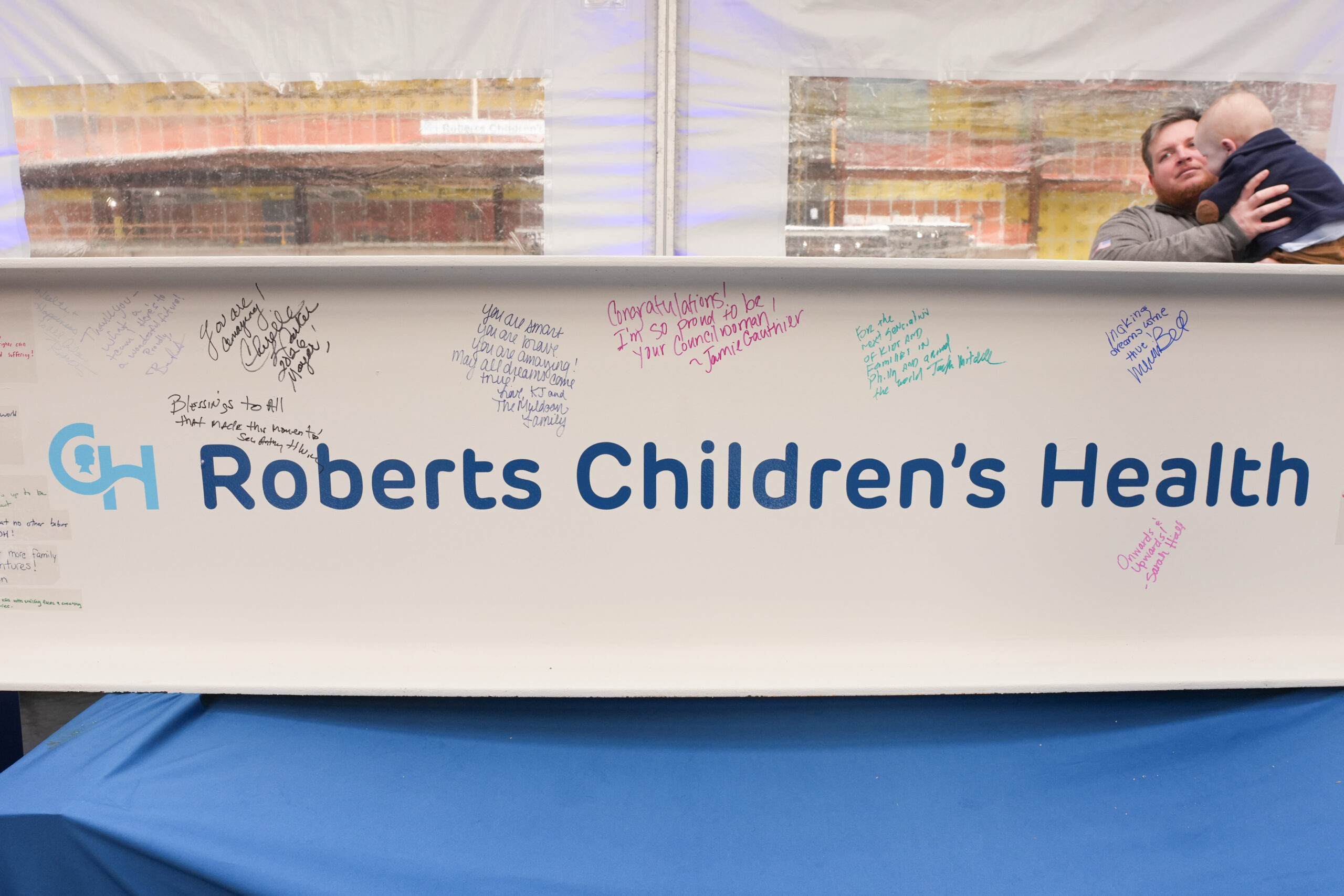
    Wednesday’s event included signing and raising the final structural beam of the building’s frame.

    The event included signing and raising the final structural beam of the building. It was signed by patients at CHOP in Philadelphia.

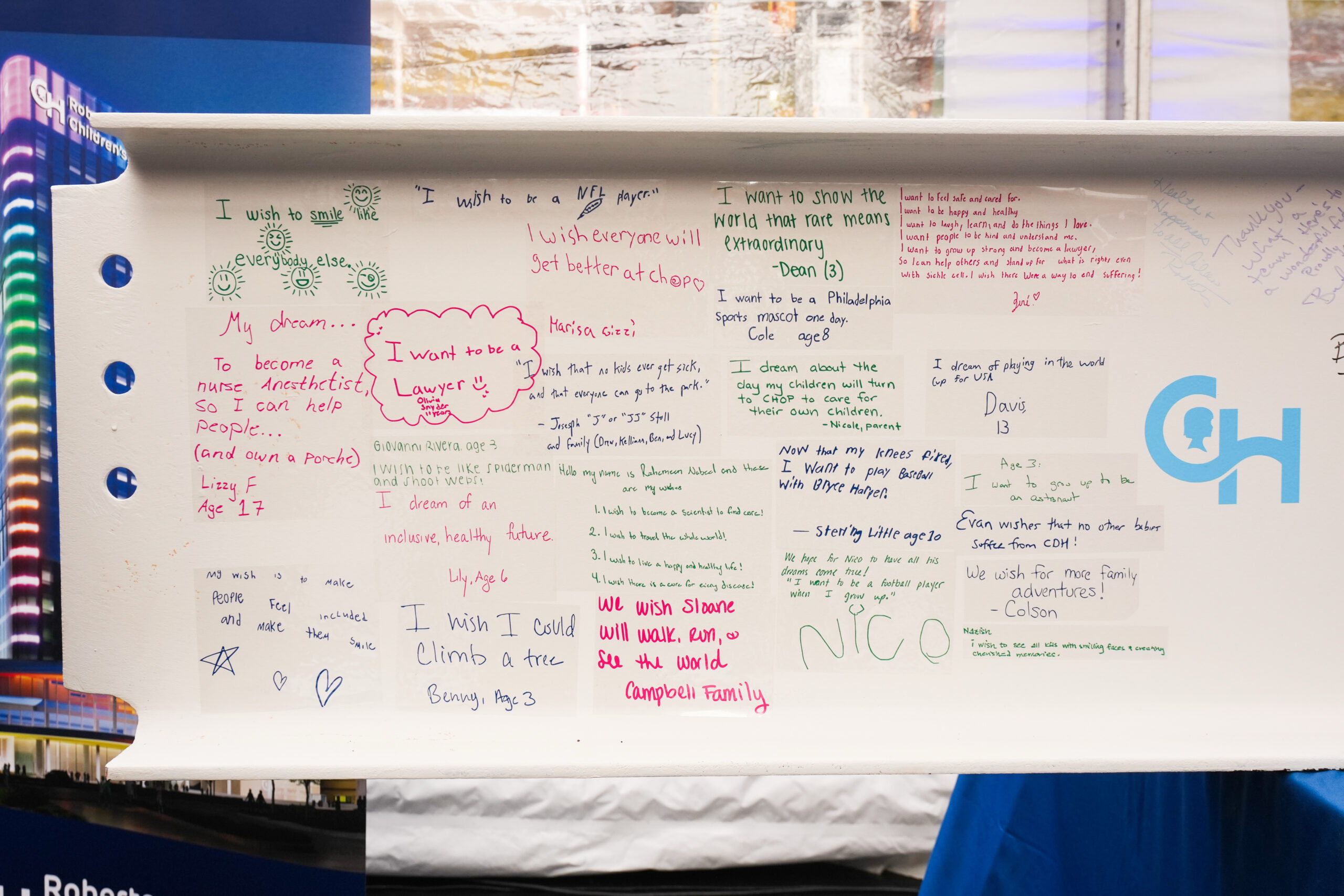
    On the beam were colorful messages from patients at CHOP who were asked to write down their dreams.

    Brian Roberts read some of their notes at the event. One girl said she wanted to become a nurse anesthetist so she “can help people and own a Porsche.” Another said, “My wish is that every kid that goes to Roberts Children’s Health comes out better and stronger.”

    Roberts read aloud messages from patients at CHOP that were signed onto the beam.

    Editor’s note: This story was updated to clarify the message a child wrote on a building beam and shared at the event.

  • Philly’s unplowed snow has slowed SEPTA and frustrated residents and businesses

    Philly’s unplowed snow has slowed SEPTA and frustrated residents and businesses

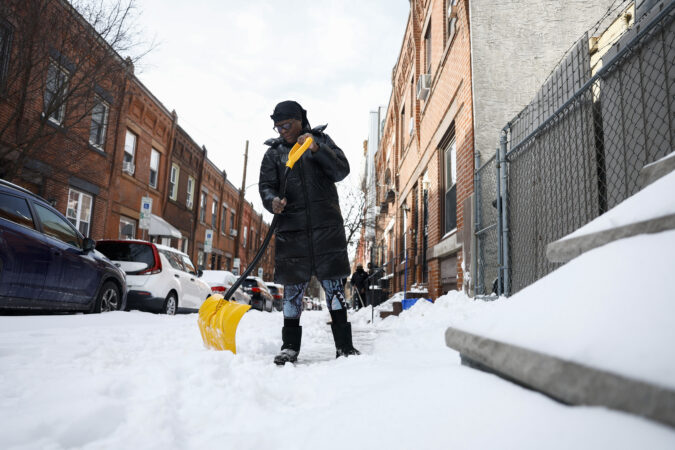
    With more than 60 hours since the last bit of snow descended upon Philadelphia, the widespread complaints about the conditions of secondary and tertiary streets have reached a fever pitch.

    The Philadelphia Streets Department has tried to quell the public’s concerns with daily videos of excavators diligently filling dumpsters with snow. Yet evidence of icy streets and snow banks blocking lanes dominate social media, with city data showing the street conditions vary block by block.

    Between 3 p.m. Tuesday and 3 p.m. Wednesday, the city’s GPS data show, about 30% of city streets had been visited by plows. Some areas, like Center City and South Philadelphia west of Broad Street, saw most numbered streets and cross streets hit by plows during that time. Meanwhile, South Philly and Center City neighborhoods east of Broad Street saw little to no reported activity.

    The same was true for large swaths of North and West Philadelphia. And neighborhoods like Overbrook, Wynnefield, and Nicetown, which have seen the fewest reported visits from city plow trucks since the storm began, saw only a handful of streets plowed between Tuesday and Wednesday afternoon, according to city data.

    On the neighborhood line of Grays Ferry and Devil’s Pocket, Dani Hildebrand was one resident who felt forgotten as the streets around him were plowed and garbage picked up. Hildebrand’s block was supposed to have trash collection come through Tuesday with the one-day delay announced by the city. But on Wednesday, bags of garbage lined his block.

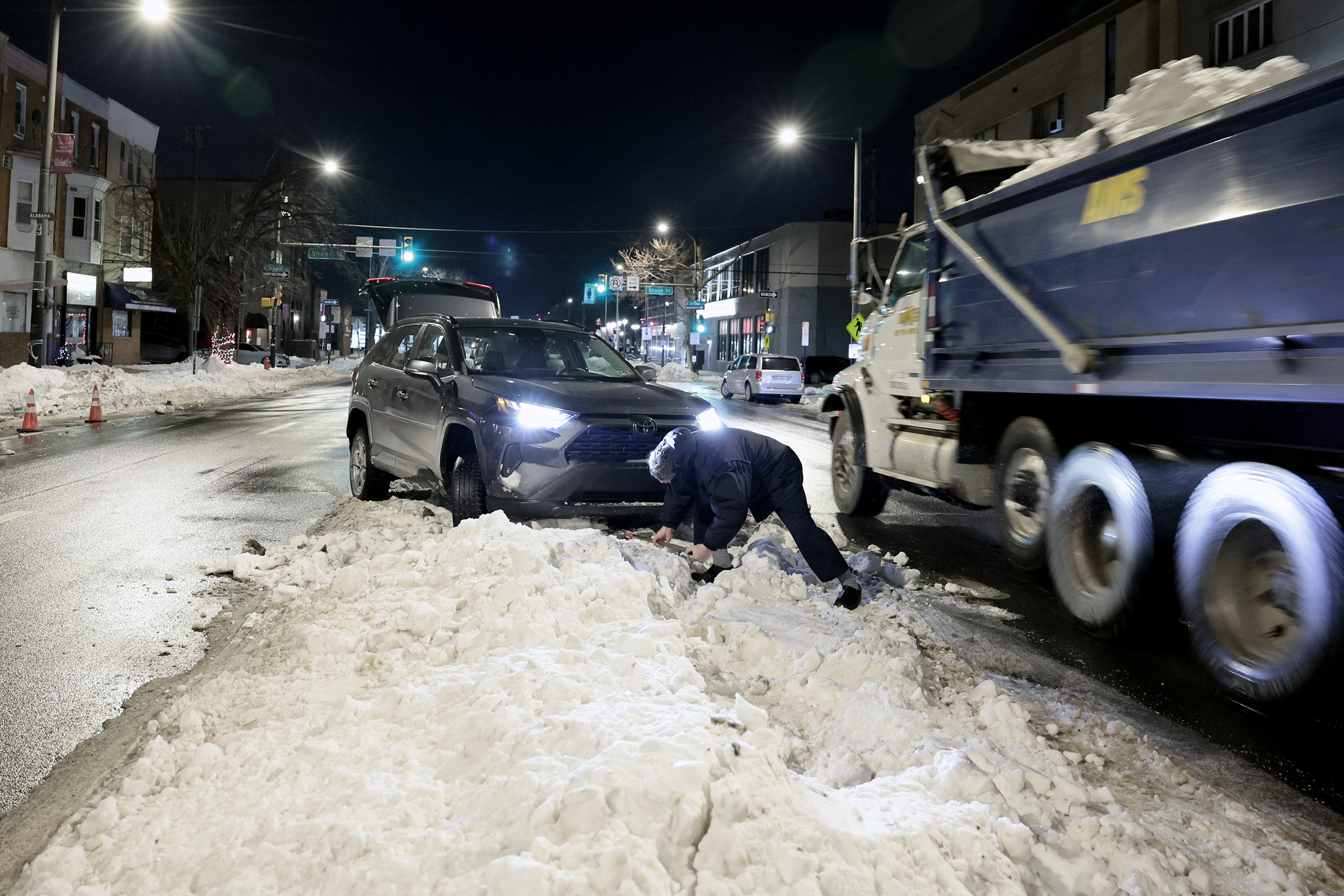
    An unidentified man shovels snow from underneath his car after it became hung up when he was trying to park in the middle of South Broad Street in Philadelphia in the early morning hours of Wednesday, Jan. 28, 2026. Dump trucks filled with snow from the city’s snow removal operations were zooming by as he worked to get his car free.

    The 41-year-old father of three said his school-age children yearn to leave the house, even if for an errand, but it’s not in the cards.

    “Between piles of snow, trash, and dog pee and poop, it’s not ideal,” he said. “We’ve been stuck in since Sunday, and while I’m close to a market, it’s not safe to walk there with my three kids and I can’t get my car out.”

    The city, for its part, has said the snow clearing would take as long as it needs to and the work would continue until all roads are dug out. Residents should expect trash-collection delays as crews navigate the snow and ice. At the same time, officials have consistently asked for patience, noting that the frigid temperatures were not aiding snow-removal efforts.

    They have pointed to the 14 teams with more than 200 vehicles and excavators that are trying to move the snow and ice into storage facilities using dumpsters. Future Track trainees with the Philadelphia Streets Department have also taken up shovels to help clear crosswalks in the city.

    But, the city notes, this is time-consuming work.

    Wanted: Private plowers

    Chris DiPiazza, owner of the Passyunk Square bakery Mighty Bread, could not afford to wait for city plows and paid for a private service to clear his street Tuesday afternoon.

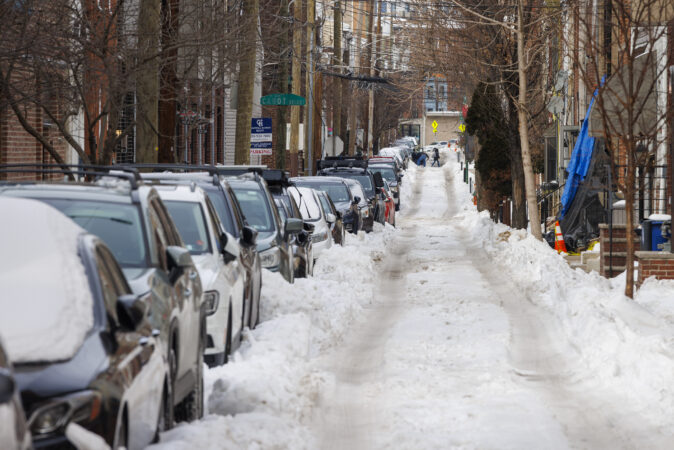
    After the storm, the bakery was unable to make or receive deliveries because the city had not plowed Gerritt Street, the narrow road it’s on. Adding to frustrations, DiPiazza said, snowplows that had come through the adjacent 12th and 13th Streets had left giant snow piles on both ends of the block.

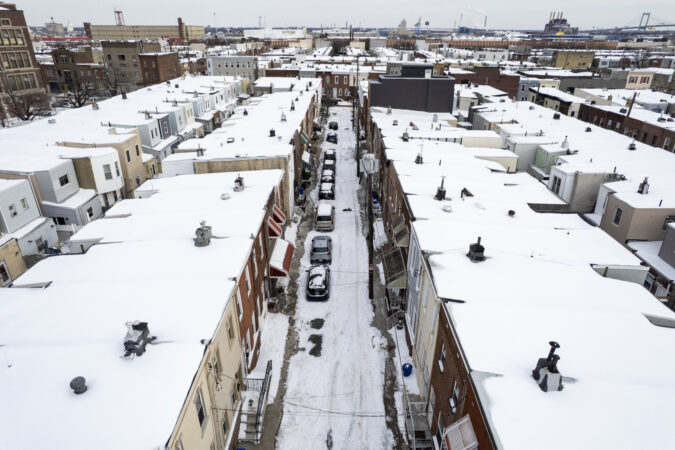
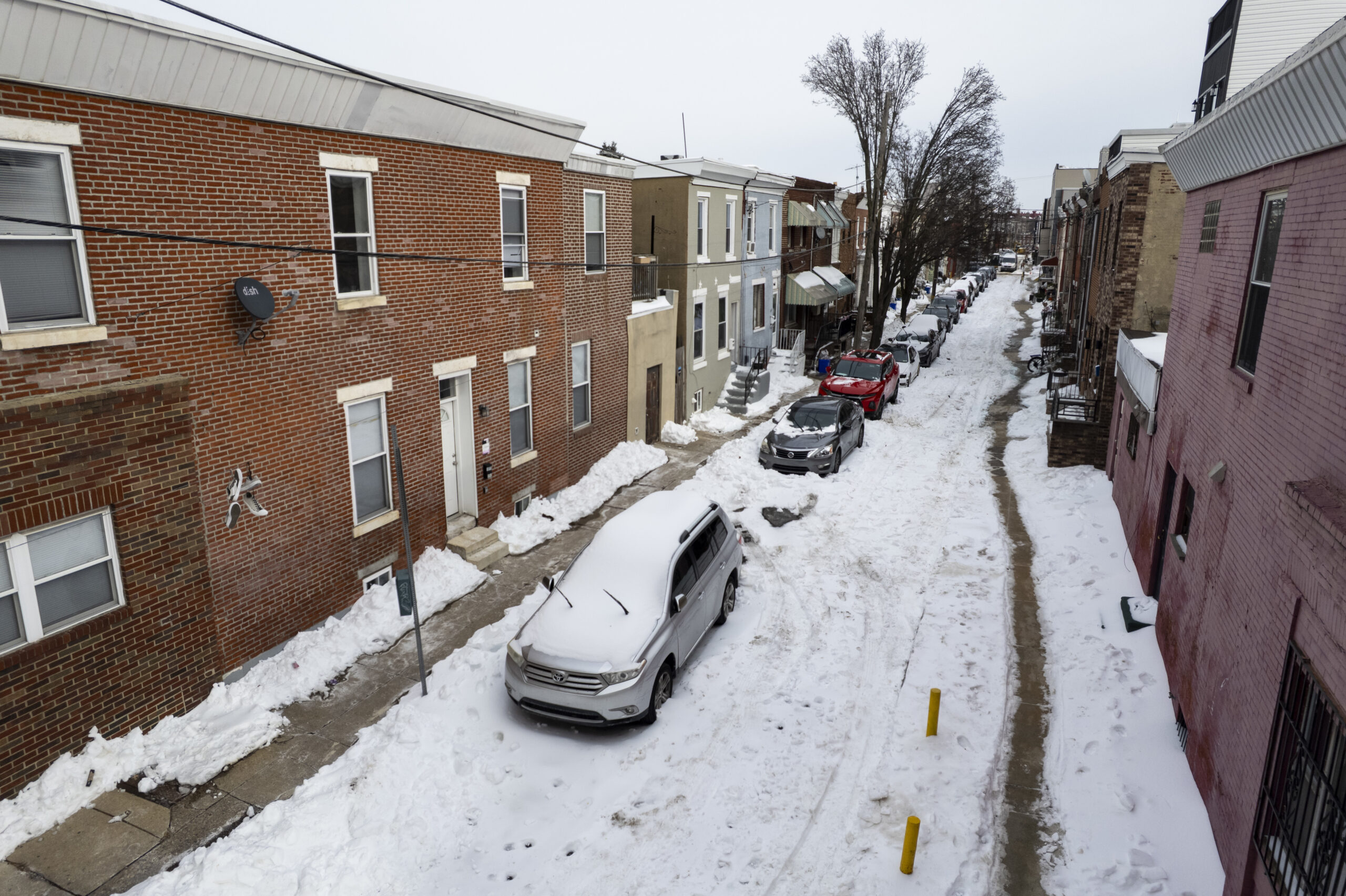
    The 700 block of Hoffman is still covered in snow on Wednesday, Jan. 28, 2026 in South Philadelphia.

    A 311 operator said it could take upward of three days for plowing to occur, DiPiazza said.

    That news was especially frustrating when residents are expected to do their part by shoveling sidewalks in front of their homes within six hours of snowfall stopping, but the city is not fulfilling its own end of that promise, DiPiazza said.

    “The city’s responsibility is to make the streets safe for people to drive, and they didn’t do that,” he said.

    SEPTA vs. ice

    For SEPTA’s size and reach, the organization is not so different from the average Philadelphian living without a plowed street.

    The snow-covered roads were especially difficult for bus routes through secondary and tertiary streets after the storm, SEPTA spokesperson John Golden said.

    “Those streets are hard to navigate on a good day,” he said.

    The lagging plow service made SEPTA pause service for many bus routes.

    “Some of our buses just aren’t able to navigate the streets because of lack of plowing,” Golden said.

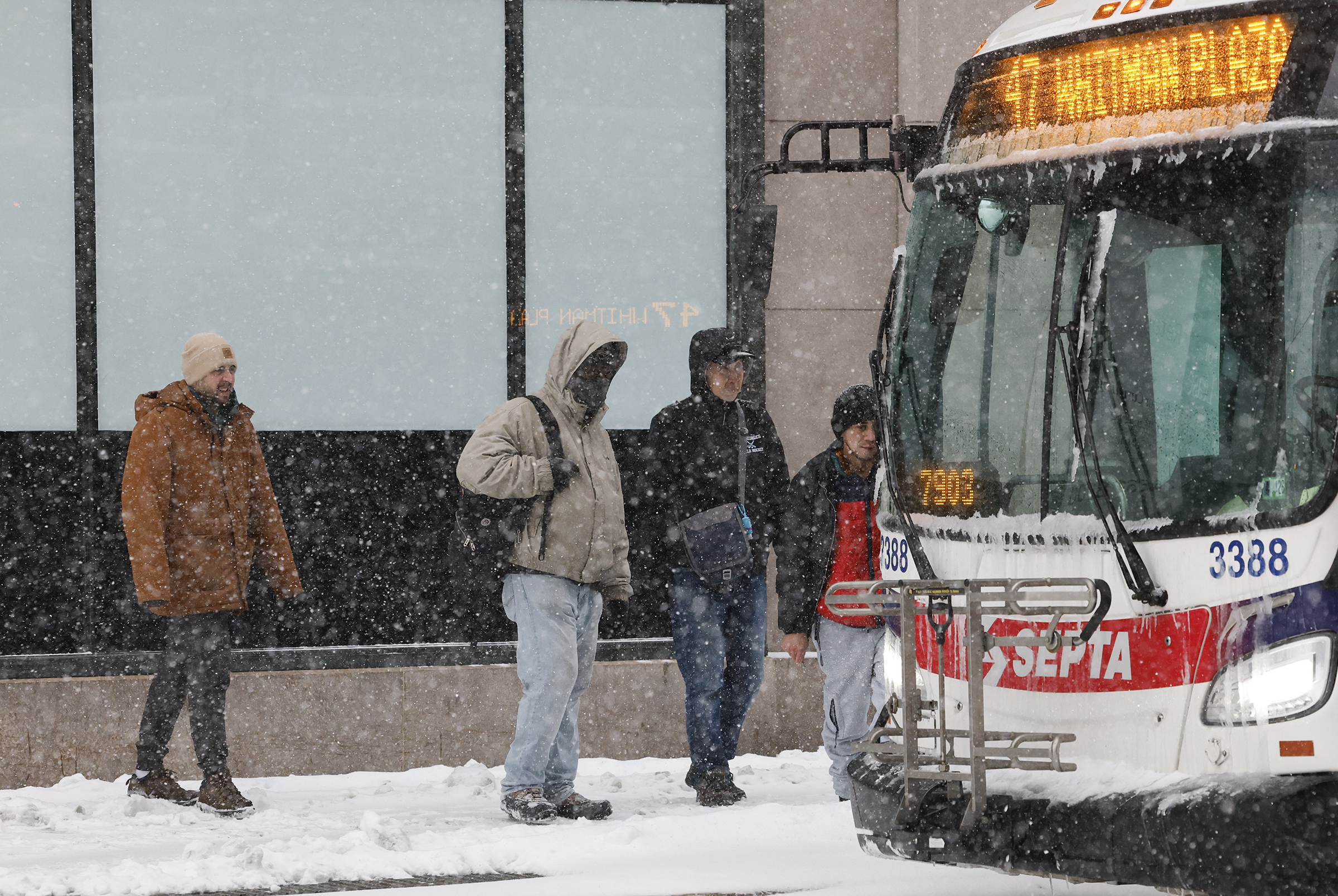
    SEPTA riders board the 47 bus at 8th and Market Streets with the snow falling on Sunday, January 25, 2026.

    But service had returned to all but a handful of routes by Wednesday afternoon. The weekend storm was not particularly onerous for SEPTA compared with other large storms in years past, Golden said, but he noted the frigid temperatures in the days following have made things difficult. Ice is not melting as quickly as it usually does, leaving the roads treacherous.

    Golden said that while SEPTA officials have been in frequent contact with the streets department about problem spots, they don’t have any special recourse besides waiting for the city to clear the streets.

    How does 2026 compare with 2016?

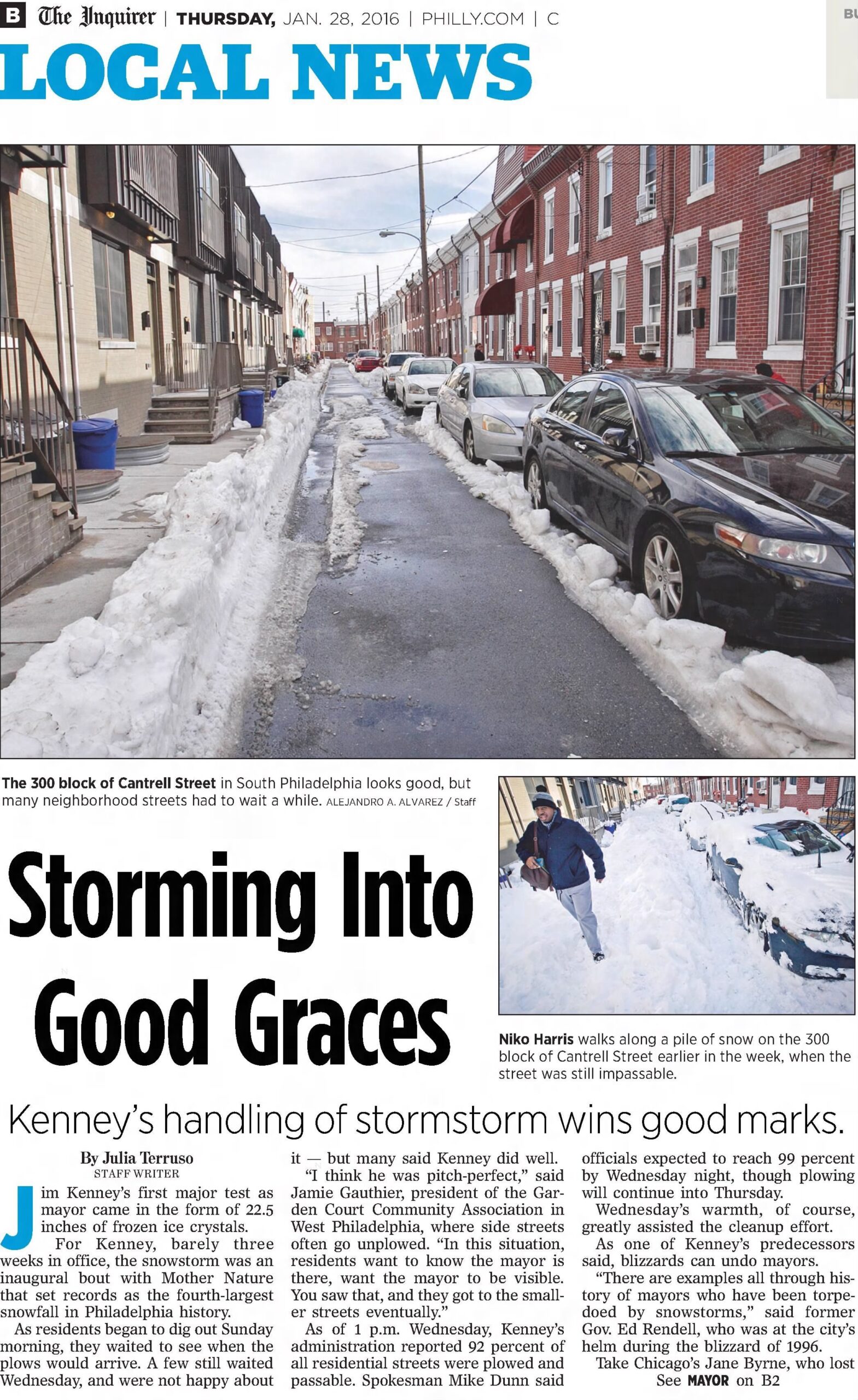
    When the city was smacked with 22.5 inches of snow in January 2016, it was the fourth-largest snowfall in Philly history, and newly sworn-in Mayor Jim Kenney’s first major test in office.

    At the time, many side street residents issued the same complaints heard with this most recent storm — they were the last to be dug out, and entire blocks were locked in.

    But by the fourth day of storm cleanup, a Kenney spokesperson claimed 92% of all residential streets “were plowed and passable” and the administration was taking in kudos for what many — though not all — said was a job well done.

    The front page of The Philadelphia Inquirer’s B section in January 2016, following a major snowstorm that was similar to the January 2026 storm. The article reported some complaints of snow plow delays, but residents were largely complimentary of then new Mayor Jim Kenney’s handling of the storm.

    Though 9.3 inches fell this time around, city officials have said the conditions were very different. The temperature drop has been the largest hurdle so far, providing no help in melting the ice. The city still urges patience and says teams are working nonstop.

    For parents whose children took part in virtual learning Wednesday and residents who were sick of parking wars and icy crosswalks with another potential snowfall on the way, patience was almost gone.

    Residents in North and West Philly shared frustrations on social media of parking shortages because mounds of ice left people nowhere to go; some were even parking at an angle in parallel spots, to the chagrin of others. Bus stops were piles of dirty, frozen ice, and crosswalks remained icy.

    For Hildebrand, it was all very discouraging.

    “A plan could have been made and implemented, since the city knew about this a week before it happened, but it truly seems like bare minimum effort,” he said.

  • Philly snow cleanup: What to know about plowing, parking, schools, and more

    Philly snow cleanup: What to know about plowing, parking, schools, and more

    As Mayor Cherelle L. Parker put it earlier this week, we’re not out of the woods yet.

    The storm that hit Philadelphia Sunday brought with it 9.3 inches of snow for the city proper — the most we’ve seen at one time in a decade. And while that really sells the wintery vibe — especially when combined with the bitter cold we’re experiencing — cleanup efforts are ongoing.

    Highways and public transportation in the region are largely restored, but some city streets remain packed with snow and ice. City school buildings Wednesday were in their third day of snow-related closures. And we might even be looking at more snow to come.

    Here is what you need to know:

    Roads (mostly) cleared

    PennDot’s vehicle and speed restrictions have been lifted on all interstates and major highways across the Philadelphia region, as were those on state roads in New Jersey. But street plowing in the city remains a work in progress.

    Residents from around the city told The Inquirer many side streets and some secondary streets remained coated in several inches of snow and ice, making traveling on them difficult or impossible. Data from PlowPHL, a service that tracks plow movement, indicated Tuesday that roughly a quarter of city streets had not received any snow treatment since the storm.

    Parking enforcement resumes

    The Philadelphia Parking Authority reopened its offices Wednesday, and began on-street parking enforcement for safety violations including parking in bus zones and in front of fire hydrants. The 24-hour $5 emergency garage parking rate was also rescinded, with PPA garages returning to their usual rates, the authority said.

    Public transit resuming

    SEPTA on Monday restored all of its subway, trolley, and suburban trolley services, and as of Wednesday was running Regional Rail lines on their normal weekday schedules. Bus service, SEPTA notes online, is largely operational, though several routes remain suspended due to road conditions.

    Among the suspended buses Wednesday were routes 3, 5, 40, 41, and 115, according to the agency’s alerts page. The suspended routes, SEPTA indicated, would be restored “once it is safe to do so.”

    PATCO, meanwhile, returned to its normal weekday schedule Tuesday.

    Airport operational

    Philadelphia International Airport experienced hundreds of flight cancellations and delays due to the storm, but remained open despite the inclement weather, Parker said at a news conference this week.

    As of early Wednesday afternoon, the airport had experienced about 87 delays and 57 cancellations, according to flight data tracking website FlightAware. On Monday, the day after the storm, there were 326 delays and 290 cancelations, followed by 255 delays and 156 cancelations Tuesday, FlightAware indicated.

    Schools go virtual

    Philadelphia school buildings are slated to reopen Thursday after three straight days of being closed in the wake of the storm. A full snow day was declared Monday, followed by two days of virtual learning Tuesday and Wednesday.

    Archdiocesan high schools and city parochial schools will also go back to in-person classes Thursday.

    Students and staff who arrive late to class due to weather-related issued would not have their lateness counted against them, Superintendent Tony B. Watlington Sr. said.

    This week’s disruption to the usual school schedule had begun taking its toll on some parents. Outside the city, many suburban districts had already reopened by Wednesday.

    More snow possible

    Post-storm, the Philadelphia region faces frigid temperatures that are expected to remain well below freezing until at least Feb. 4. Highs were expected to top out around the teens, and lows consistently in the single digits — along with wind chills reaching down into the negatives.

    And then, of course, there is the potential for more snow this weekend.

    Forecasters said Wednesday that it remained unclear exactly what we should expect, but a major coastal storm is likely to appear during the weekend. Early computer models indicated that the system would remain far offshore enough to spare the Philadelphia area from major snowfall, but accumulation predictions remain in flux.

  • Most New Jersey public schools have reopened, and here’s how they’re making up missed days

    Most New Jersey public schools have reopened, and here’s how they’re making up missed days

    After the major snow storm that shut down many New Jersey public schools for at least two days, the big question for students and teachers is how districts will make up missed time.

    Most South Jersey districts reopened Wednesday, many with two-hour delays because of frigid temperatures and icy neighborhood streets and side roads.

    Winslow schools in Camden County remained closed for a third consecutive day, citing ongoing hazardous road and sidewalk conditions. The sprawling 58-square-mile municipality is one of the largest in New Jersey. Parents have complained in social media posts about icy streets and bus stop routes.

    Meanwhile, Eastside High School in Camden was also closed due to icy conditions near the school, while the rest of the district reopened. Camden has many students who walk to school. The district said the day would be made up.

    Late Wednesday, Davida Coe-Brockington, Camden’s acting state district superintendent announced that all city schools would be closed Friday.because of road conditions. She said the district plans to reopen Friday with a two-hour delay.

    School officials consider factors such as road conditions, snow and ice accumulation, and readiness of the campus, sidewalks, and parking lots, said Haddon Heights Superintendent Carla Bittner. Her district used its only built-in emergency closing day.

    “The safety of our students and staff is our absolute priority,” Bittner said.

    With 50 days left of winter and the possibility of another storm looming this weekend, additional snow days may be on the horizon, further disrupting school calendars, parental work days, and vacation plans. And districts must still meet the state requirement of 180 school days.

    How do districts make up snow days?

    Some districts have days built into the calendar for the school year for inclement weather, or tack on additional days as needed at the end of the school year. The state leaves it to local districts decide how many days to set aside.

    In Cherry Hill, where schools were closed for two days this week, the district will use days already designated as holidays. That means students will go to school Feb. 16, President’s Day and March 30, which was supposed to be the first day of spring break.

    If needed, Cherry Hill would use March 31 to make up another snow day, according to Nina Baratti, a district spokesperson. Even with inclement weather days, the last day of school (June 18) has not changed, she said.

    Haddon Heights will convert a March 13 in-service day for teachers into a full instruction day for students, according to its calendar. Additional days would be pulled from spring break in April if needed.

    Woodbury Superintendent Andrew Bell said his district would use two days set aside for professional development for teachers to make up snow days this week.

    How many school days are required?

    The New Jersey Department of Education requires schools to be open for a minimum of 180 days in order to qualify for state funding.

    The school year must align with the state’s fiscal year and end on June 30 or earlier. Most union contracts with local districts require schools to close by June 30. Districts typically try to avoid keeping schools open late into June, when unairconditioned buildings can become unbearable.

    According to Timothy Purnell, executive director of the New Jersey School Boards Association, the number of snow days also can be determined during negotiations between the district and union leaders.

    What about virtual learning?

    Like most states, New Jersey allowed virtual and hybrid instruction when the pandemic shut down schools. However, state law now strictly limits remote learning.

    While Philadelphia and New York City shifted to remote classes because of snow closings, New Jersey only allows virtual instruction under limited circumstances, according to the state Department of Education.

    School districts may seek approval for virtual learning for school closures lasting more than three consecutive days because of a declared state of emergency, declared public health emergency, or a directive by a health agency or officer ordering a public health-related closure.

  • Flyers thrilled to get Dan Vladař back as they try and finish strong before the Olympic break

    Flyers thrilled to get Dan Vladař back as they try and finish strong before the Olympic break

    COLUMBUS, Ohio ― Dan Vladař is back.

    Although coach Rick Tocchet had confirmed the goalie would start against the Columbus Blue Jackets on Wednesday (7:30 p.m., TNT, truTV, HBO Max) ahead of the Flyers’ optional morning skate, Vladař was officially activated from injured reserve on Wednesday afternoon.

    “Obviously, he’s been very consistent for us and a really competitive guy, and he adds a lot to our locker,” Tocchet said. “He’s a guy that, for a goalie, likes to be involved with the players with instructions, even just being positive with the guys. So he’s going to add a lot to our room, especially on the ice and off the ice.”

    Vladař was injured in the first period of the Flyers’ loss to the Buffalo Sabres on Jan. 14 and missed the next six games with the lower-body ailment. He has been consistent this season, posting a 16-7-4 record with a 2.46 goals-against average and .905 save percentage in 28 games.

    Wednesday will mark Vladař’s 29th start, matching his career high set last season with the Calgary Flames.

    The Flyers went 2-3-1 in his absence, with Sam Ersson going 2-2-1 with a 3.61 goals-against average and .872 save percentage. During the three-game road trip out west, Ersson was 2-0-1 with a 2.97 GAA and .897 save percentage against three of the NHL’s top teams.

    The team played poorly in front of him on Monday in a 4-0 loss to the New York Islanders, but when Ersson plays consistently, he seems to get in a groove. Has there been a conversation among the coaching staff about getting Ersson more starts?

    “Yeah, I think it depends on the schedule,” Tocchet said. “Obviously, you’re playing four in six, he’s going to get his time.

    “But also Vladdy, there’s been times when he’s been on a roll. Your No. 1 goalie, you’ve got to get him out there. Obviously, you’ve got to have your backup in there, too. So it’s a schedule thing.”

    Barkey finding his way

    Seventeen games into his NHL career, Denver Barkey is feeling more and more comfortable as his first pro season moves on. There have been some ups and downs, like his two games against the Tampa Bay Lightning that led to being a healthy scratch against the Sabres.

    But when his game is on, the 20-year-old has shown an elite hockey IQ. Barkey reads plays well, covers and supports his teammates, and can also create offense with his work ethic and vision. Despite playing last season in juniors — before his 26 games with Lehigh Valley of the American Hockey League and now the NHL — his hockey IQ has seamlessly transitioned to a level that has more speed and quickness to it.

    Flyers rookie Denver Barkey hasn’t looked out of place since being called up to the NHL on Dec. 19.

    It is something he has carried and built on since his days growing up in Newmarket, Ontario.

    “I think you’re born with some of it, to an extent,” he said of his hockey IQ. “But I think just my love for the game, my passion for the game, over the years.

    “When I was young, before I could remember, my dad would tell me how much I loved begging to go out to skate, or trying to stay up late to watch hockey games. I think I’ve always been really interested and just love the game, and I’ve always wanted to get better.”

    He also feels his hockey IQ has helped him some of the challenges and criticisms he’s faced along the way.

    “But I think just being a smaller guy my whole life has always forced me in different ways,” the 5-foot-10 Barkey said. “When I went to junior, and now here, there’s bigger, stronger, faster, better players, so finding other ways to try to outsmart them and still be effective, given me being a smaller player. So I think being smaller throughout the years has helped me just make plays and take the game to a high level.”

    In 17 games, Barkey has two goals and eight points. Two of his assists came in his NHL debut against the New York Rangers on Dec. 20, and another two came in the game against the Pittsburgh Penguins right after he was scratched.

    “I think he’s a guy that [if] you tell him something, he grasps it on the next shift. He takes the information very well,” said Tocchet. “You can tell that he was in a great program with London [of the Ontario Hockey League] and Dale Hunter. … Those guys, they send a lot of NHL-ready players, and he’s one of those kids who has taken that information there and come to the NHL and is starting to knock some doors down.”

    Breakaways

    With Vladař activated, Aleksei Kolosov has been returned to Lehigh Valley of the American Hockey League. … Defenseman Noah Juulsen will enter the lineup. The expectation is Emil Andrae, who was on the ice for the optional skate, will sit. … Forwards Garnet Hathaway and Nic Deslauriers are also expected to be healthy scratches.

  • Temple has released its plan for the next decade. See what the North Philadelphia university has in mind.

    Temple has released its plan for the next decade. See what the North Philadelphia university has in mind.

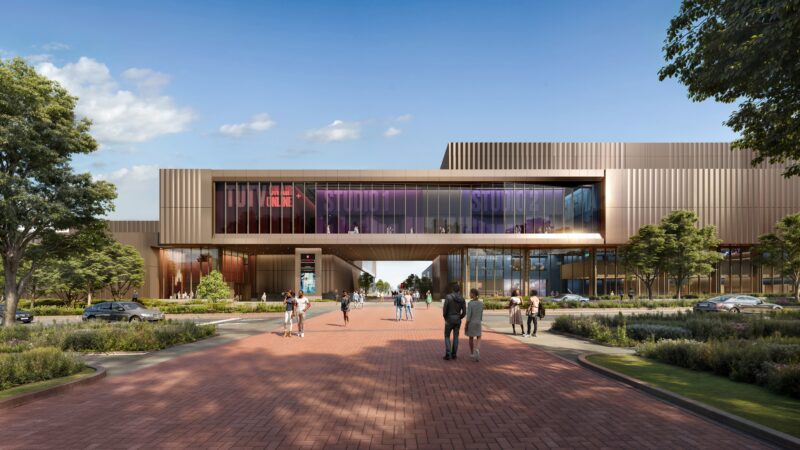
    Temple University on Wednesday released its plans for the school’s future, including a new 1,000-bed residence hall, STEM complex, quad with green space, and more attractive and defined entrances to its North Philadelphia main campus.

    That’s just part of the 10-year strategic plan, which will take the more than 33,000-student university through its 150th anniversary in 2034 and includes supports for students and learning, a campus development plan, and a new vision for Broad Street both near and beyond its campus.

    It emphasizes the student academic experience, with plans to elevate its honors program to an honors college, implement systems to identify and help students who are at risk of failing early on, increase online offerings to accommodate non-traditional students, and require career development and experiential learning for all students.

    And the 20-year campus development plan, which is part of the strategic plan, also reiterates President John Fry’s desire to create an “innovation corridor” stretching from the recently acquired Terra Hall at Broad and Walnut Streets in Center City to Temple’s health campus, a little more than a mile north of main campus on Broad Street.

    Temple is in the quiet phase of a $1.5 billion capital campaign — its largest to date — to raise money for faculty support and student financial aid, but also for initiatives outlined in the plan.

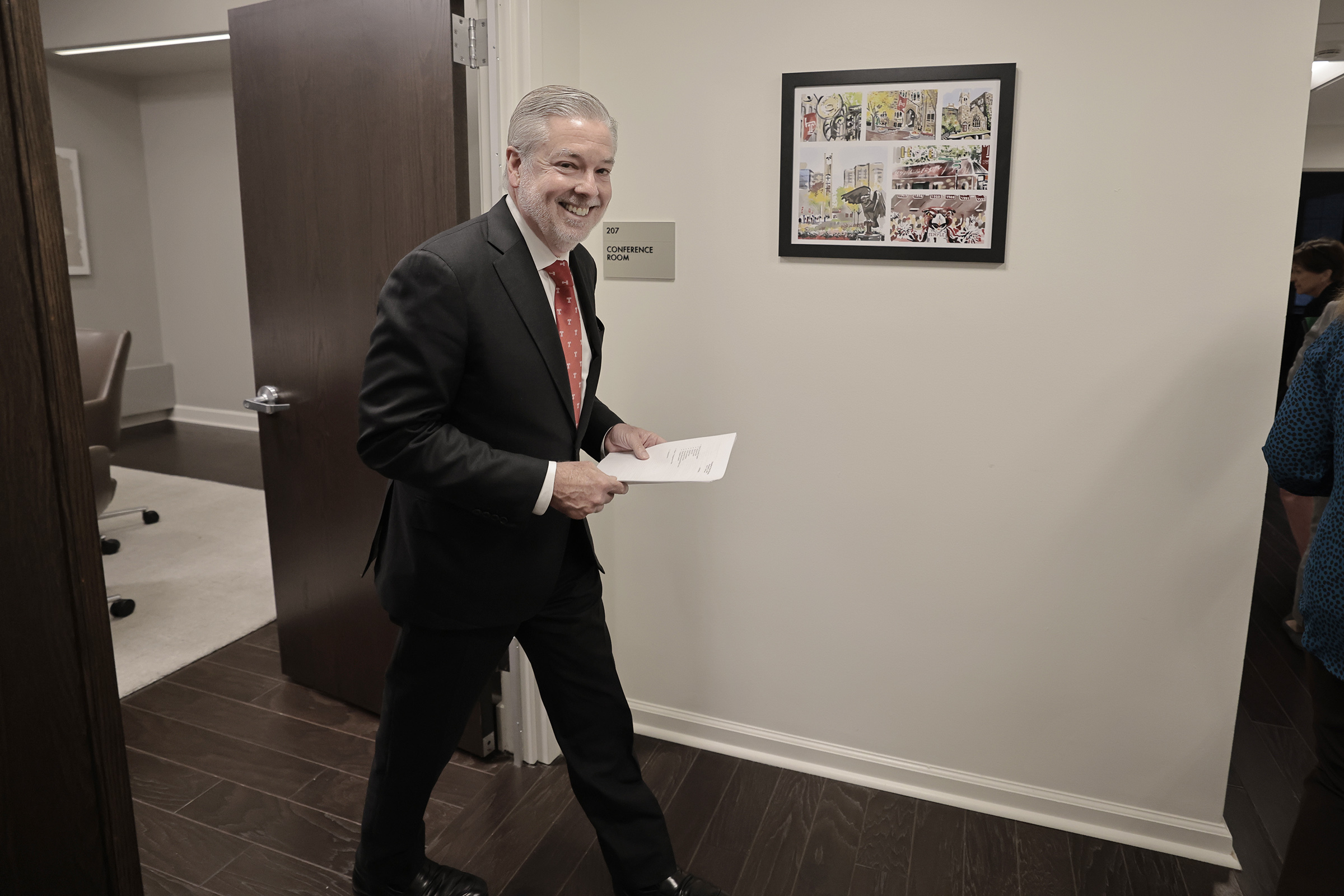
    “What we’re trying to do is build on the momentum we think we have right now as already one of the most consequential urban research universities that wants to go to the next level,” said Temple President John Fry.

    “What we’re trying to do is build on the momentum we think we have right now as already one of the most consequential urban research universities that wants to go to the next level,” Fry said in an interview before trustees approved the plan Wednesday. “This is a very ambitious plan that I think honestly will be a very big lift for us. But I think it’s achievable.”

    Interim Provost David Boardman, who led the strategic planning effort, emphasized that the top priority is student success and new buildings and development are meant to support that.

    “That, more than anything, is the heart of what we do,” Boardman said. “This is about providing meaningful research … It’s about us becoming the most important academic institution and partner in this community and really partnering for the future of Philadelphia and the region and the Commonwealth.”

    David Boardman, Temple University’s interim provost

    The planning effort, which included input from more than 2,000 Temple faculty, staff, students, and community members, started as an update of the 2022 plan that Fry initiated after becoming president in November 2024. But Temple officials realized a new plan was needed, Fry said.

    More greenery for campus and Broad Street

    Fry envisions more green space for recreation and events and for making North Broad Street more aesthetically pleasing.

    “It is a really harsh streetscape,” Fry said. “It’s really not inviting. Traffic is moving very quickly. …That street needs to be calmed down, and the best way … is to create medians, plants — both sides of Broad Street — making it a much more civilized area than it is now.”

    The effort, he said, is modeled after the recently announced $150 million streetscape plan to make the Avenue of the Arts in Center City greener. Temple also is involved with that through its ownership of Terra Hall, which will become Temple’s Center City campus, he said.

    “But we can’t do that without other public and private partnerships,” he said. “It’s beyond the institution’s capacity to fund that.”

    To start, Temple will fund “significant greening” around the entrance to the under-construction Caroline Kimmel Pavilion for Arts and Communication, he said. More green work is planned at Burk Mansion at Broad and Oxford, which Temple owns, as development occurs there, he said.

    With a large green lawn and courtyards, a quad is planned for the campus center, surrounded by Paley Hall, Tyler School of Art, the Charles Library, and the biology life sciences building.

    Temple in December purchased the former McDonald’s site at 1201-1219 N. Broad St., by Girard Avenue, which is adjacent to the Temple Sports Complex. Fry envisions using that property to create a major campus gateway.

    “Right now, you don’t really know when you come onto the Temple campus,” he said. “We would like Broad and Girard to announce you’re starting to enter Temple’s campus district.”

    More on-campus student housing

    Temple wants more on-campus residential space to improve the student experience and safety, Fry said.

    “We think we’re at a minimum several thousand beds short of where we need to be,” he said. “A stronger residential experience really does make for a much more fulfilling undergraduate experience. The more kids living on campus, the more dense campus is, I think the better we’re going to do on safety.”

    The plan calls for beginning to build a 1,000-bed residence hall along Broad Street on the former Peabody Hall site, south of Johnson and Hardwick Halls, in 2027. That would increase the current 5,000-bed capacity on the main campus by 20%. When that opens, Temple would upgrade Johnson and Hardwick, which have another 1,000 beds, he said.

    The Annenberg Hall/Tomlinson Theater building, which will relocate to the new arts and communication building in 2027, could also be converted into more residential space if needed, Fry said.

    An emphasis on STEM

    Temple intends to upgrade facilities for science, technology, engineering and math.

    “We just don’t have the research space, the wet lab space in particular, to accommodate the work that our faculty are doing,” Fry said.

    Several buildings, including the biological life sciences facility, will be renovated, and the school plans a new STEM building, perhaps behind the engineering building, or the conversion of an existing facility, Fry said. The decision on whether to build new will come within six months, he said.

    Temple needs to close some current science facilities to gain more space, he said.

    The Beury building, next to the Bell Tower and across from the new Barnett College of Public Health, will begin to be demolished this summer, he said.

    “Think of that as sort of the first down payment on this quad,” he said.

    That would be the first step toward developing an innovation district, Fry said. While not on the scale of University City’s, it would be “a very good attempt to begin to build that capacity in North Philadelphia,” he said.

    Terra Hall will nurture an arts hub, and both would contribute to creating an innovation corridor, he said.

    The plan also calls for a new ambulatory care center to better serve North Philadelphia. Fry said those plans are in very early stages.

    “A lot of outpatient care is occurring within the hospital right now,” Fry said. “It’s not great for patients… It also puts a real strain on our capacity to serve people who need inpatient services.”

    A new academic home for star students

    Temple aspires to make its honors program into an honors college, like Pennsylvania State University’s popular Schreyer Honors College, though with different parameters.

    Boardman said that effort would require major fundraising. Currently, the program exists within the college of liberal arts and enrolls more than 2,200 students.

    Elevating it to a college would require more programming, study-abroad and research stipends, experiential learning opportunities, and an option for those enrolled to live together in a residential community.

    Temple’s college would consider more than grade-point averages and SATs for admission, Boardman said. Various talents and leadership potential would be considered, with interdisciplinary studies and public service infused, he said.

    Staff writer Peter Dobrin contributed to this article.

  • Cabin fever sets in for Philly parents snowed in: ‘It’s an emotional regression to that terrible time’

    Cabin fever sets in for Philly parents snowed in: ‘It’s an emotional regression to that terrible time’

    On the second day her kindergartener was off from his Philadelphia public school because of snow, Karen Robinson shut herself away in her Fairmount home, hoping to take a 15-minute meeting for an important work project.

    Her husband had put up a baby gate to signal to 5-year-old Sam that mom was briefly off limits.

    Naturally, “my son crawled under the baby gate to come find me,” said Robinson, whose son attends Bache-Martin Elementary. “If I’m working, he wants to be right next to me.”

    For thousands of Philadelphia parents, Wednesday was day three of school buildings being shut — a real snow day on Monday, and virtual school Tuesday and Wednesday.

    Superintendent Tony B. Watlington Sr. gave beleaguered parents a reprieve Wednesday afternoon, saying schools would re-open for in-person learning Thursday. But the week was tough for many to navigate.

    For parents who rely on hourly work, or jobs that have no remote flexibility, the inclement weather-forced school changes have meant either foregoing pay or figuring out childcare arrangements that are often costly, complicated, or both.

    But for others, the cabin fever is real. Many are getting into existential angst territory — and conjuring up memories of the pandemic, as parents juggled work and online school, often feeling they were failing at both.

    North Philadelphia mom Asjha Simmons’ son attends a charter school that’s been closed — no virtual learning — since Monday.

    Simmons runs her own business, so is able to be flexible with her schedule and stay home with her son. But she’s getting antsy.

    “I feel forced to be in the house and it’s killing me,” Simmons said. “I would rather be in the gym than in the house. And I don’t even go to the gym.”

    Simmons’ son, who’s 12, relishes the down time since “he has every screen known to man on,” she said. She keeps the snacks coming, and it’s all good. (He was less than thrilled when Simmons made him shovel snow, she said.)

    Leigh Goldenberg said she was having uncomfortable flashbacks to the pandemic, when her daughter completed virtual kindergarten.

    “For me, it’s an emotional regression to that terrible time,” said Goldenberg. “And I feel for the people that didn’t build up that muscle before.”

    Virtual school with a fifth grader is much easier than virtual school with a kindergartener, said Goldenberg, whose daughter attends Kirkbride Elementary in South Philadelphia. Her daughter spent 30 minutes on Tuesday completing schoolwork, and managed to keep herself busy socializing with friends online and outside, a short walk away in their neighborhood.

    Goldenberg is trying to keep things in perspective — this is not forever, this is not the pandemic.

    But, she’s still frustrated.

    “All the suburban schools around us went back already, but here in the city, we’re stuck with a giant pile of snow at the end of our street, and it feels pretty unfair,” she said.

    Coral Edwards was prepared for Monday’s snow day, but when the district announced a virtual day Tuesday, she began to panic.

    “I was like, oh my gosh, there’s a real possibility the entire rest of the week will be virtual,” said Edwards, who lives in Graduate Hospital and has a seven-year-old son who attends Nebinger Elementary and a four-year-old daughter in a private prekindergarten program.

    Her daughter’s pre-K is reopened Wednesday with a two-hour delay. And that means dropoff time came when Edwards would have needed to be helping her first grader with virtual learning. So instead, she paid to send both children to Kids on 12th, a Center City school open the full day, so she can get her work done as a marketing consultant and leadership coach.

    The scramble has also summoned up emotions and frustrations she last experienced during the pandemic, when her son was 1 and his daycare shut down. While she acknowledged that she is “incredibly privileged,” she said the fact that parents like herself are in such a bind speaks to a larger systemic problem with childcare, Edwards said.

    “There’s literally no one to help us,” she said. “There’s just no systemic support whatsoever.”

    Streets are being plowed, SEPTA is running, and trash is getting picked up, “but there’s nothing in press conferences about how we’re supporting parents and students,” Edwards said. “The schools are like, ‘we have this virtual learning environment’ — are we just supposed to pull another parent out of our butts?” she said.

    Edwards’ husband works in-person as a research physician running a lab, and the burden of childcare logistics falls to her.

    “There’s a lot of rhetoric about supporting parents, and raising women up, … but when push comes to shove, something about our kids’ childcare is changed or tightened, it falls on those people,” she said.

    Hannah Sassaman, a West Philadelphia parent of a district fourth grader and ninth grader, is making it through.

    “We had another fourth grader live here for 24 hours randomly. I think they went to school? My ninth grader seems to be going to school. We’re just lucky we don’t have little kids,” said Sassaman.

    But the storm has Sassaman thinking: how is it that New York, which got a foot of snow in some neighborhoods, had kids back in its (much larger) public school system by Tuesday?

    “The questions that I have knowing that the storm was coming for over a week,” Sassaman said, “is what could the administration have done to help resource our sanitation workers and the rest of our incredible city servants to really focus on what it would take to get our kids back in schools, our teachers and the other staff back in their buildings safety to support not just the economy, but also all of the important supports and services kids access at schools every day?”

  • Philly schools return to in-person learning Thursday

    Philly schools return to in-person learning Thursday

    After three days out of school buildings, Philadelphia public students and staff will be back to in-person learning Thursday.

    Officials announced the call Wednesday afternoon.

    Archdiocesan high schools and city parochial schools will also be back to traditional classes Thursday, officials said.

    In the aftermath of a significant winter storm and sub-freezing temperatures, Superintendent Tony B. Watlington Sr. gave students and staff a full snow day Monday, with no learning or teaching obligations.

    He pivoted the district’s 125,000 students to virtual instruction Tuesday and Wednesday as conditions remained tricky to navigate.

    Temperatures are expected to dip even lower Thursday, and many side streets and sidewalks aren’t clear, but officials have said they prioritize in-person learning when conditions are safe for students and staff.

    “School District and City of Philadelphia officials have been working around the clock to clear snow and ice from roads and walkways to support a safe return to in-person learning,” Watlington wrote in a message to families and staff Thursday.

    Any students arriving late because of weather-related challenges will not have their lateness counted against them, the superintendent said. The same goes for staff not able to make it into work on time because of weather-related commuting challenges.

    Yellow bus service will operate as usual, though delays might occur, Watlington said.

    After school activities are on, the central office will be open, and the school-selection deadline has been extended from Wednesday to Friday so families can confer with school counselors they may have had difficulty reaching because of the snow closures.

    Philadelphia’s school board meeting, also scheduled for Thursday, will also happen in person. Board members and members of the public have the chance to participate virtually, as well.