Philadelphia health officials are warning medical providers to be on the alert for chickenpox, after outbreaks at two city schools in recent months indicate a “small but notable” increase in cases of the highly contagious disease.
Fewer than 10 cases were reported at each school, and the outbreaks were not connected, nor part of a broader community outbreak. In a health advisory to doctors earlier this month, the city said it had fielded reports of varicella in unvaccinated children, who can suffer more serious effects than vaccinated kids.
It’s unclear what drove the recent uptick in cases in Philadelphia, said Gayle Mendoza, a spokesperson for the city Department of Public Health. She did not have information on how many cases were reported in vaccinated versus unvaccinated children.
About 94% of schoolchildren in Philadelphia have immunity against chickenpox, also known as varicella, with the vast majority protected through vaccination. Of those with immunity today, only about 1% acquired protection through an infection.
Varicella outbreaks used to be much more common before widespread vaccination.
Case counts for several communicable diseases, including whooping cough and walking pneumonia, declined during the COVID-19 pandemic while schools closed, but have since risen closer to pre-pandemic levels. That could be happening with varicella, Mendoza said.
In Philadelphia, varicella vaccination rates briefly ticked downward after the 2020-21 school year, but by the 2024-25 school year had returned close to pre-pandemic rates, according to state data.
Earlier this month, Health and Human Services Secretary Robert F. Kennedy announced sweeping changes to the CDC’s list of routinely recommended childhood vaccinations, removing several from the list and sparking outrage from health experts who said that cases of serious, preventable diseases like hepatitis B would rise.
Before 1995, nearly 4 million people a year were infected with chickenpox, up to 13,500 were hospitalized, and between 100 and 150 died, city health officials said.
“It’s a very small chance you get the illness if you’re vaccinated, but it’s always going to be milder,” Mendoza said.
Unvaccinated patients can develop 250 to 500 lesions from chickenpox; vaccinated patients, if they contract the disease, will see less than 50 and have less likelihood of spreading the disease.
With the recent school outbreaks, Philadelphia health officials are encouraging health providers to test patients for chickenpox and report suspected, probable, and confirmed cases to local authorities.
People who have been exposed to the virus can get immunized within five days or receive antiviral medications to prevent them from contracting the disease.
Mendoza said the health department is coordinating a response with schools where varicella outbreaks were identified.
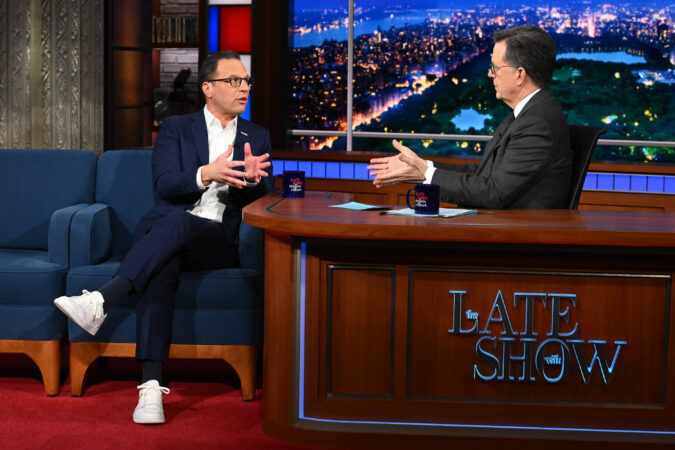
Saying the Trump administration is using the federal government for “pure evil” in its immigration crackdown in Minneapolis, Gov. Josh Shapiro revealed on late-night television Monday that he’s preparing Pennsylvania to respond should the state face such an incursion.
Shapiro’s wide-ranging remarks on The Late Show With Stephen Colbert — which included Shapiro deriding Vice President JD Vance as a “sycophant” and a “suck-up” — sounded at times like a speech before a studio audience that applauded him vigorously. Making the rounds to promote his new book, Where We Keep the Light: Stories from a Life of Service, Shapiro also appeared on CBS Sunday Morning, Good Morning America on Monday, and The View on Tuesday.
On Colbert, the governor sharply criticized the Trump administration’s actions in Minneapolis, where he said “untrained” agents from U.S. Immigration and Customs Enforcement (ICE) have been creating “chaos” by fatally shooting two American citizens.
“I think Americans are outraged by what they see,” Shapiro said, adding: “The mission in Minnesota must be terminated immediately.”
When Colbert said there are “rumors” that federal troops will be sent to Philadelphia “to foment fear,” Shapiro nodded. On The View, he said troops could show up in Philadelphia, Pittsburgh, or Lancaster.
“We have spent hours and hours and hours doing tabletop exercises to prepare for it,” Shapiro said, without being specific. The governor did not elaborate.
He added that “it’s a sad day in America that a governor of a commonwealth needs to prepare for a federal onslaught where they would send troops in to undermine the freedoms and the constitutional rights of our citizens. This is un-American.”
“But I want the good people of Pennsylvania to know — I want the American people to know — that we will do everything in our power to protect them from the federal overreach.”
Asked for comment, Abigail Jackson, a White House spokesperson, said Tuesday: “It’s pure evil when Democrat leaders provide sanctuary to dangerous criminal illegal aliens who assault, murder, and rape innocent American citizens. President Trump is keeping his promise to the American people to deport criminal illegal aliens.”
Referencing ICE agents wearing masks, Shapiro said that members of the Pennsylvania State Police “have strict rules on when they can wear a mask. You want to be identified as folks who are keeping people safe.”
He added, “Of all the tools that we give our law enforcement in Pennsylvania, the most important tool you need to have is trust with the community that you police.”
When the conversation turned to Vance’s statement that the ICE officer who shot andkilled Minneapolis resident Renee Macklin Good on Jan. 7 has “absolute immunity,” Shapiro retorted that it was untrue.
He added that Vance is “such a sycophant, such a suck-up. He embarrasses himself daily as he seeks the affirmation of Donald Trump.”
ICE agents “are not above the law,” Shapiro added moments later. “I don’t care what B.S. Vance [says.]”
The governor’s reelection bid this year, as well as rumors that he may be a presidential candidate in 2028, did not come up. Instead, Colbert touted Shapiro’s book.
Shapiro said that the courts, Congress, and public opinion need to be marshaled to prevent the Trump administration from sending more troops to U.S. cities.
“All of you have powerful voices,” Shapiro told the audience. He added: “The story of America is ordinary Americans rising up, demanding more, seeking justice.”
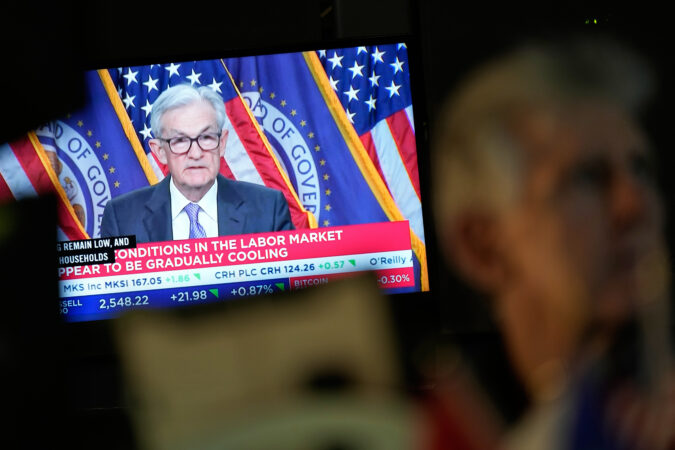
The Federal Reserve cut interest rates by a quarter of a percentage point on Wednesday for the third time this year, seeking to shore up a softening labor market even as inflation builds and leaving the prospect of more cuts next year unclear.
“It’s a labor market that seems to have significant downside risks,” Fed Chair Jerome Powell said at a news conference following the meeting.
Although Fed officials tentatively penciled in at least one more rate cut before the end of next year, estimates about where the economy is heading varied significantly and Powell suggested the central bank might wait before returning to any additional cuts.
“We are well positioned to wait and see how the economy evolves from here,” he said.
Wednesday’s widely expected move lowers the Fed’s benchmark rate to a range of 3.5 to 3.75 percent, the lowest level in about three years. But officials remain sharply divided over how to respond to an economy sending mixed signals: Inflation remains above the Fed’s target, which would typically argue for holding rates steady, while slower hiring and a modest uptick in unemployment suggest a case for easing.
Investors cheered the news, with major financial indexes ending the day higher on Wednesday afternoon.
Nine Federal Reserve officials backed Wednesday’s cut while three dissented. Two officials — Chicago Fed President Austan Goolsbee and Kansas City Fed President Jeffrey Schmid — favored no rate reduction, while Fed governor Stephen Miran preferred a larger, half-point cut. It was the most dissent since September 2019.
In another sign of division among top Fed officials, the latest economic projections also released on Wednesday showed seven officials penciled in no additional cuts next year, while 12 favored at least one or more.
Fed policies influence what households and businesses pay for mortgages, credit cards and other loans, and investors are watching closely for guidance on the central bank’s next steps.
The Fed’s job is to keep prices stable and to maximize employment, but it is split on howto navigate what some describe as a light version of stagflation — elevated inflation alongside a labor market that is slowing but far from collapsing. Those divides were exposed at the Fed’s last gathering in October, where officials expressed “strongly differing views about what policy decision would most likely be appropriate,” according to the meeting minutes.
Further complicating the decision, the Fed received far less official data about the health of the economy, because of the government shutdown that delayed or canceled the release of reports on the jobs market and consumer prices. Some Fed officials, relying on alternative data or surveys of the business community, argued that progress on inflation had stalled and warned that cuts risked undermining hard-won gains. Others countered that rising unemployment and weakening consumer demand suggested a need for action.
Powell defended cutting rates now rather than waiting for the Fed’s next meeting in late January, when officials will finally have a better sense of the status of economy thanks to a trove of upcoming official reports. Wednesday’s call reflected mounting evidence of a cooling job market, he noted, saying that after readjustments and revisions, job growth may have been slightly negative since spring.
“I think you can say that the labor market has continued to cool gradually, maybe just a touch more gradually than we thought,” Powell said.
With unemployment rising to 4.4 percent in September, the Fed no longer characterized that rate as “low,” in a statement announcing the rate cut.
Former Philadelphia Fed president Patrick Harker said this week that Wednesday’s move is shaping up to be a “hawkish cut” — a rate reduction paired with a signal that policymakers may soon pause further easing. Harker said the Fed’s internal divergence reflects an unusual degree of economic “fog,” with inflation not worsening as much as feared, unemployment claims relatively stable, and labor-market signals increasingly difficult to interpret. He noted that monthly job gains below 100,000 would normally be a red flag, but demographic trends and uncertain immigration patterns complicate the baseline.
Those disagreements are unfolding amid unprecedented political pressure from President Donald Trump, who has repeatedly criticized the Fed for not moving quickly enough to lower rates and has threatened to fire Powell. Trump renewed those attacks ahead of this week’s meeting, telling Politico that support for aggressive rate cuts is a litmus test for whoever he taps to succeed Powell, whose term as chair expires in May. The president plans to nominate a successor early next year, though he has already signaled he knows who he is likely to pick.
Former Pennsylvania Sen. Pat Toomey, who was top Republican on the Senate Banking Committee, said he is perplexed by Trump’s push for cuts, because inflation remains above target and the broader economy continues to expand. The data shows cooling — not collapsing — labor conditions, which wouldn’t normally justify an urgent push for easing rates, Toomey said.
Toomey warned that the president is taking a much bigger political gamble than he appears to realize. If inflation were to spike again, he said, Trump would “completely own” the fallout after pressuring the Fed when “there’s no obvious need to ease.” That makes the campaign for faster rate cuts “surprising,” Toomey said.
Although Powell secured enough board support to approve Wednesday’s cut, future easing would depend on keeping that alliance.
The split appears to pit a “hawkish” coalition of regional Fed presidents focused on preventing inflation from resurging against a group of governors in Washington who see the greater risk in a softening economy. Officials such as Cleveland Fed President Beth Hammack, who said she would have preferred not to cut rates in October, have argued that inflation remains stubbornly above the bank’s 2 percent target and warned that reducing rates too soon could keep prices rising.
Meanwhile, other officials continue to emphasize that a cooling labor market and softening consumer demand call for cuts, to ensure the economy does not slip further.
It’s hard to think about going outside right now with the subfreezing temperatures in town, but here’s another reason to hope things will be better in a few weeks.
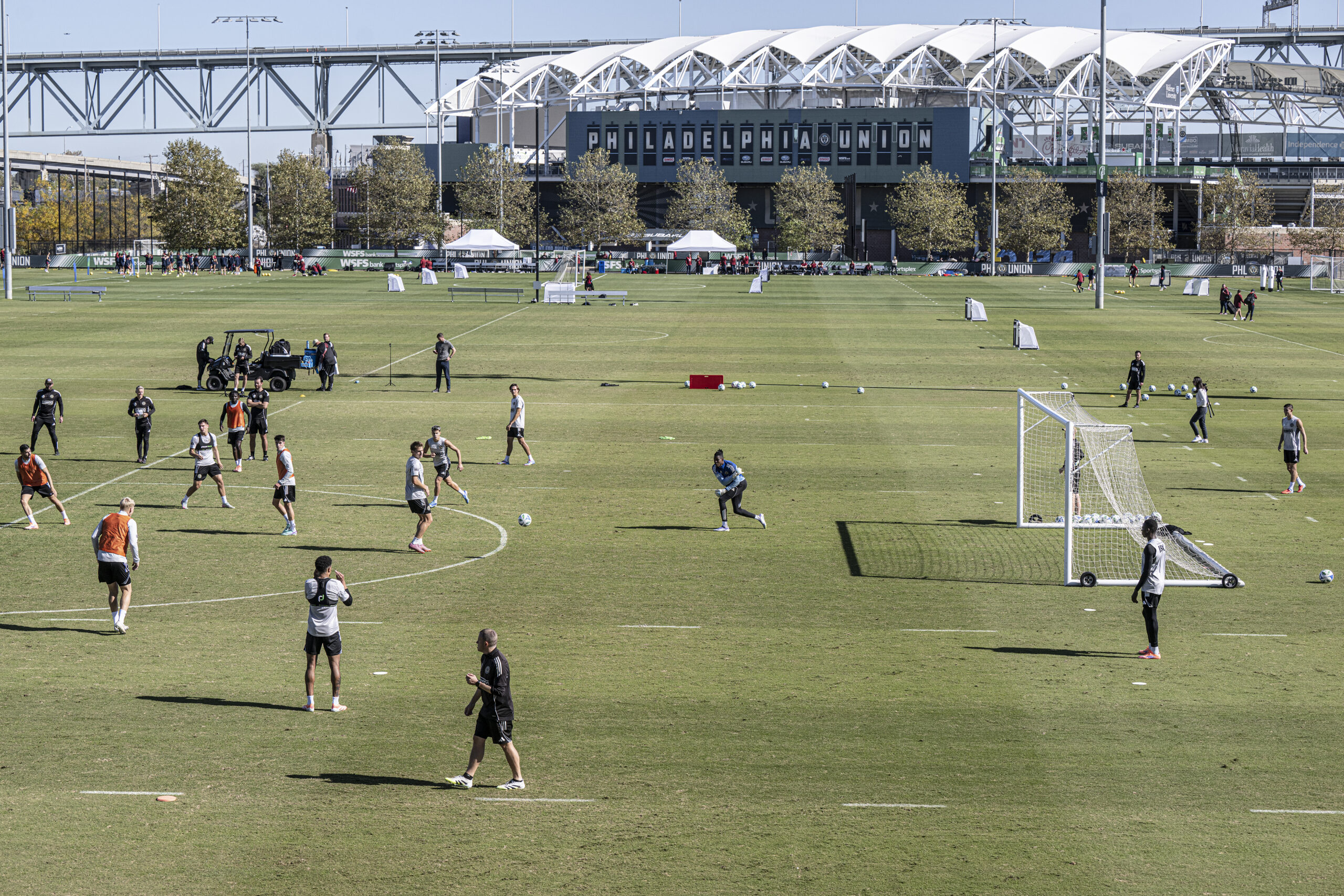
The Union announced Tuesday that they will host a youth soccer tournament with teams from around the world, including some big-time European clubs, from Feb. 9-14 at their WSFS Bank Sportsplex in Chester. Fittingly for the time of year, it will be called “The Snow Bowl.”
There will be under-15, under-16, and under-18 age groups, with Union teams competing in all three. The under-15 group has the biggest visiting headliners: England’s Manchester United and Newcastle United, Germany’s Borussia Dortmund, and Mexico’s Monterrey.
The under-16 division is headlined by Germany’s Borussia Mönchengladbach, the Netherlands’ PSV Eindhoven, and Portugal’s Benfica.
PSV’s sporting director is former Union and U.S. Soccer sporting director Earnie Stewart. Its youth academy chief, Aloys Wijnker, worked for U.S. Soccer around the same time Stewart was in Chester.
The Union have hosted many visiting teams at their facilities in recent months, including England’s Chelsea and the U.S. men’s and women’s national teams.
Benfica is in the under-18 group too, as is Denmark’s Lyngby is in both of those age groups. That’s notable, since the Union have an ownership stake in Lyngby.
Another team in the under-18 group will bring a familiar face back to Chester. Former Union midfielder Roland Alberg now runs a youth soccer program in South Africa and has entered one of his squads.
“This event is about high-performance preparation and showcasing our Academy’s elite youth development environment,” Union director of academy and professional development Jon Scheer said in a statement. “It provides our Union Academy players with the opportunity to test themselves against the very best ahead of the upcoming Generation adidas Cup and MLS Next playoffs, while also highlighting the world-class facilities we have built here at the Sportsplex.”
The tournament will give the Union a chance not just to show off their facilities and youth teams, but the full scale of their development setup. One of the title sponsors is The SWAG, a no-cost, year-round soccer training program for players ages 4-11 from communities of color, which the Union helps promote.
The SWAG is a free program for underprivileged kids from 4-11 to play soccer and get to know the world’s game.
“With all eyes on soccer this summer, especially here in Philadelphia, the Snow Bowl is designed to inspire the next generation of youth soccer players and introduce them to the highest level of international youth competition,” said Richie Graham, Union part-owner and academy financier, whose brother, Steve, helped launch The SWAG in 2022.
All of the games will be played on the indoor turf field at the Union’s complex (one concession to the time of year), and they’ll all be livestreamed on the team’s website. The schedule, streaming links, and more details are available at philadelphiaunion.com/snowbowl.
U-15 division: Union, Manchester United (England), Borussia Dortmund (Germany), Newcastle United (England), C.F. Monterrey (Mexico), Chicago Fire (USA).
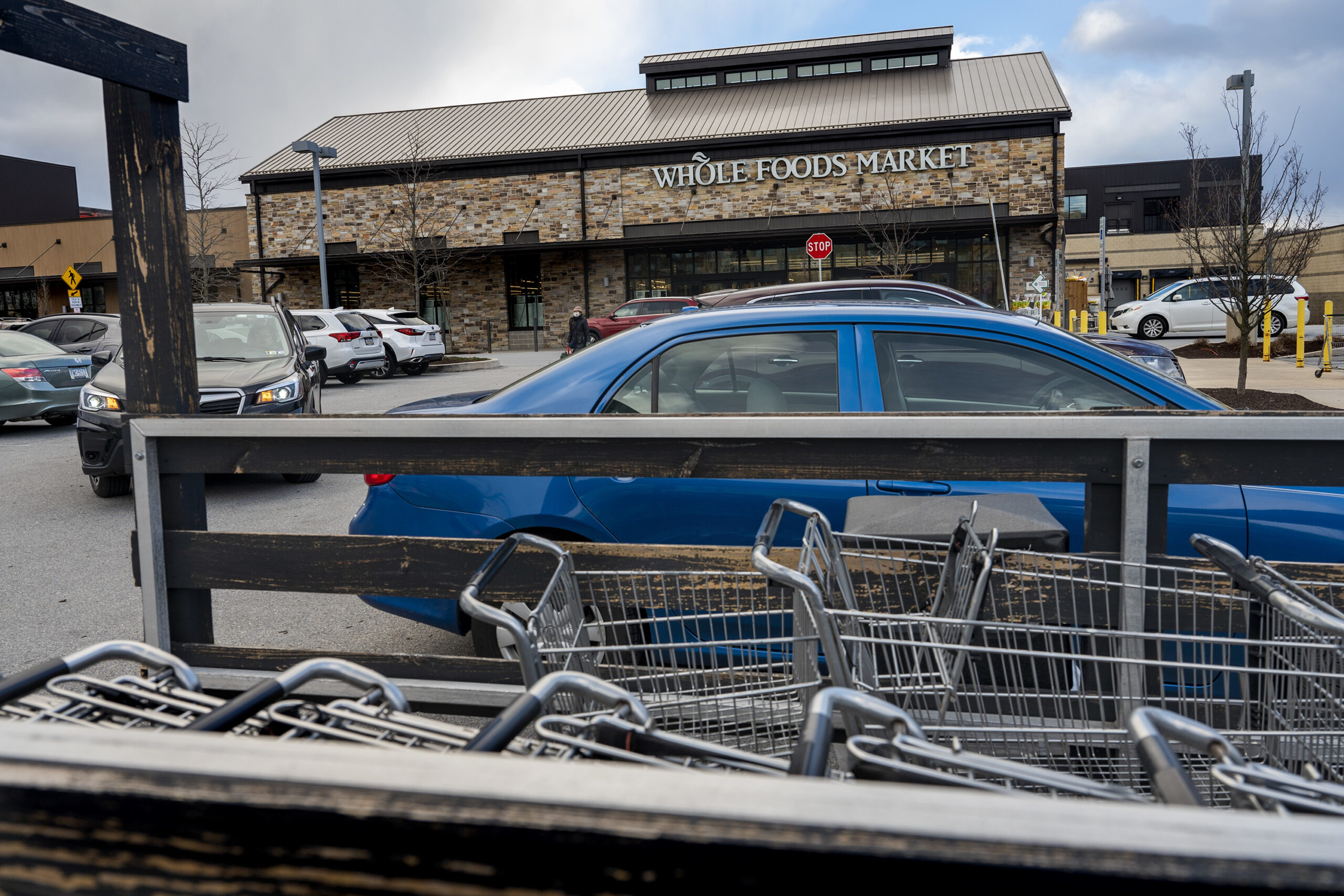
Amazon will be closing all its physical Amazon Fresh stores, including six in the Philadelphia region, as it expands its Whole Foods footprint and grocery delivery services.
“While we’ve seen encouraging signals in our Amazon-branded physical grocery stores, we haven’t yet created a truly distinctive customer experience with the right economic model needed for large-scale expansion,” the company said.
People shop inside the Amazon Fresh in Warrington in August 2021. The store and all other Amazon-branded grocers are closing.
The statement did not specify which Amazon Fresh stores would become Whole Foods, and company spokespeople did not answer questions about whether any Philadelphia-area locations would be converted.
Amazon Fresh has stores in Broomall, Bensalem, Langhorne, Northern Liberties, Warrington, and Willow Grove. The Northern Liberties location on Sixth and Spring Garden Streets opened this summer after years of construction.
Two more potential Amazon Fresh stores seemed to be in the works in Havertown and Northeast Philadelphia as of the summer, according to PhillyVoice.
Customers use the Amazon Dash Cart at the Amazon Fresh grocery store in Warrington in 2021.
As the company winds down its Amazon-branded physical stores, it says it will “double down” on online grocery delivery, including by expanding its same-day services to more communities.
Whole Foods has 550 locations nationwide, including more than a dozen in the Philadelphia area. Amazon spokespeople did not answer questions about whether more Whole Foods stores were in the works in the Philly region.
Amazon also expects to open at least five more smaller-format Whole Foods Market Daily Shop stores by the end of the year. The company said that decision was based on “strong performance” at the five existing shops in the New York City area and Arlington, Va.
The Center City Whole Foods Market as pictured in February 2025.
The online retailer said it plans to continue to experiment with new ways of shopping at its physical stores.
In its statement, Amazon gave a shout-out to one such test in the Philadelphia area: “The store within a store” experience at the Whole Foods in Plymouth Meeting.
Since November, customers at that store have been able to browse the physical aisles of Whole Foods, while digitally ordering unique products from Amazon and Whole Foods. The orders are then packaged in minutes in an automated micro-fulfillment center within the grocer’s back-of-house area.
The Flyers were riding high after a solid week out west. But they crashed back to reality, losing a four-point game against Metropolitan Division rivals, the New York Islanders, on Monday.
Here are three interesting things said postgame:
Rick Tocchet: ‘You’ve got to handle prosperity.’
Standing outside the coaches’ room in the bowels of Ball Arena on Friday in Denver, Rick Tocchet was asked if the win against the No. 1 team in the NHL, the Colorado Avalanche, could serve as a springboard for his team. The coach calmly responded that they could enjoy it for a moment but that everything needs to remain on an even keel.
It’s a smart mindset amid an 82-game grind, as there will be winning streaks, losing streaks, highs and lows, and everything in between. But while the Flyers won Friday to seal five of six points across a three-game gauntlet of games, Trevor Zegras said what everyone watching was thinking postgame Monday, “We just kind of came out and thought it would be easy, I guess.”
What does Tocchet mean when he says his club needs to handle prosperity better? Part of it is that the Flyers need to sustain wins; they need to know that just because you win Night 1, it doesn’t mean Night 2 will be easy. And it’s something they should know since they have only won two straight once in 2026, have lost eight of their past 10, and are 3-10-4 after a regulation win this season.
Noah Cates: ‘I think we were kind of perimeter.’
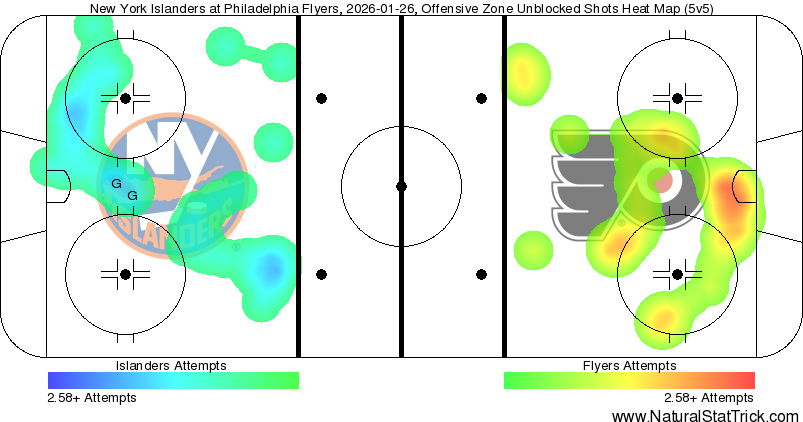
The Flyers have been focusing on getting to the middle and driving to the net. But they struggled with it on Monday.
According to Natural Stat Trick, at five-on-five, the Flyers had 13 shots, with just five from high-danger areas. It was a noticeable difference from their games the past week, where, against the Avalanche and Utah Mammoth, they had 12 and 13, respectively, at five-on-five.
Captain Sean Couturier said Monday that the team wasn’t “at our best on winning battles” and “going to the dirty areas,” as was evident from the eye test, too. Was it something the Islanders, who deploy a 1-1-3 system, were doing or that the Flyers weren’t driving to the net?
“Yeah, I think both,” forward Noah Cates said. “I think we were kind of perimeter, not getting guys to the front of the net and different things like that. But they’re so structured, and that’s just kind of their MO, has been for the last couple of years, kind of their hard and stingy defensively, and just kind of winning battles down low, and then getting pucks to the net and getting bodies there is tough against them.”
The Flyers struggled to get to the front of the net against the New York Islanders on Monday night.
Tocchet: ‘Some guys accepted it.’
The coach wore this one, saying it was on him. But he’s not the one on the ice making the plays. His players are the ones who need to step up.
“We just got our butts kicked on home ice in a game where it’s probably tough to get to, and a lot of fans in the building,” Jamie Drysdale said.
It seemed that as soon as the Islanders found the back of the net — while the Flyers were the ones on the power play — in the first period, it sucked the life out of the building and the team.
“There was no effort coming back,” said a frustrated Tocchet, who answered a follow-up question that it was Hockey 101. “We didn’t even have the puck, and then we had two guys go to the same guy, and then one guy doesn’t backcheck.
“We don’t have the puck, just come back in the slot hard. One guy stays in front, the other guy takes him, there’s no goal. And who knows, if we’re zeros after the first, maybe. But it seemed like when they scored it, some guys accepted.”
The 2025 Eagles season may be over, but the work to retool the roster and position the team for success in 2026 has already begun.
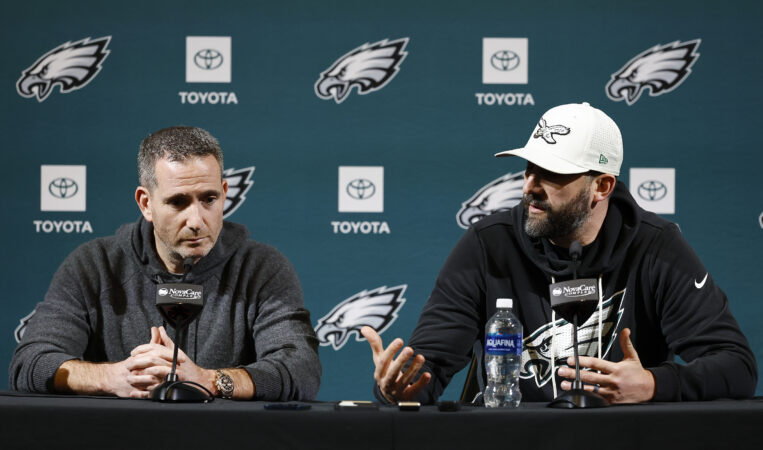
Jeffrey Lurie, Howie Roseman, and Nick Sirianni are tasked with making a variety of staffing and personnel decisions over the next several months in an attempt to return the Eagles to Super Bowl contention next season. The offensive coordinator vacancy is generating the most buzz, but it’s far from the only consequential move they will have to make ahead of training camp in late July.
With the coaching carousel spinning and free agency and the draft looming, here’s where the triumvirate could start with their decision-making:
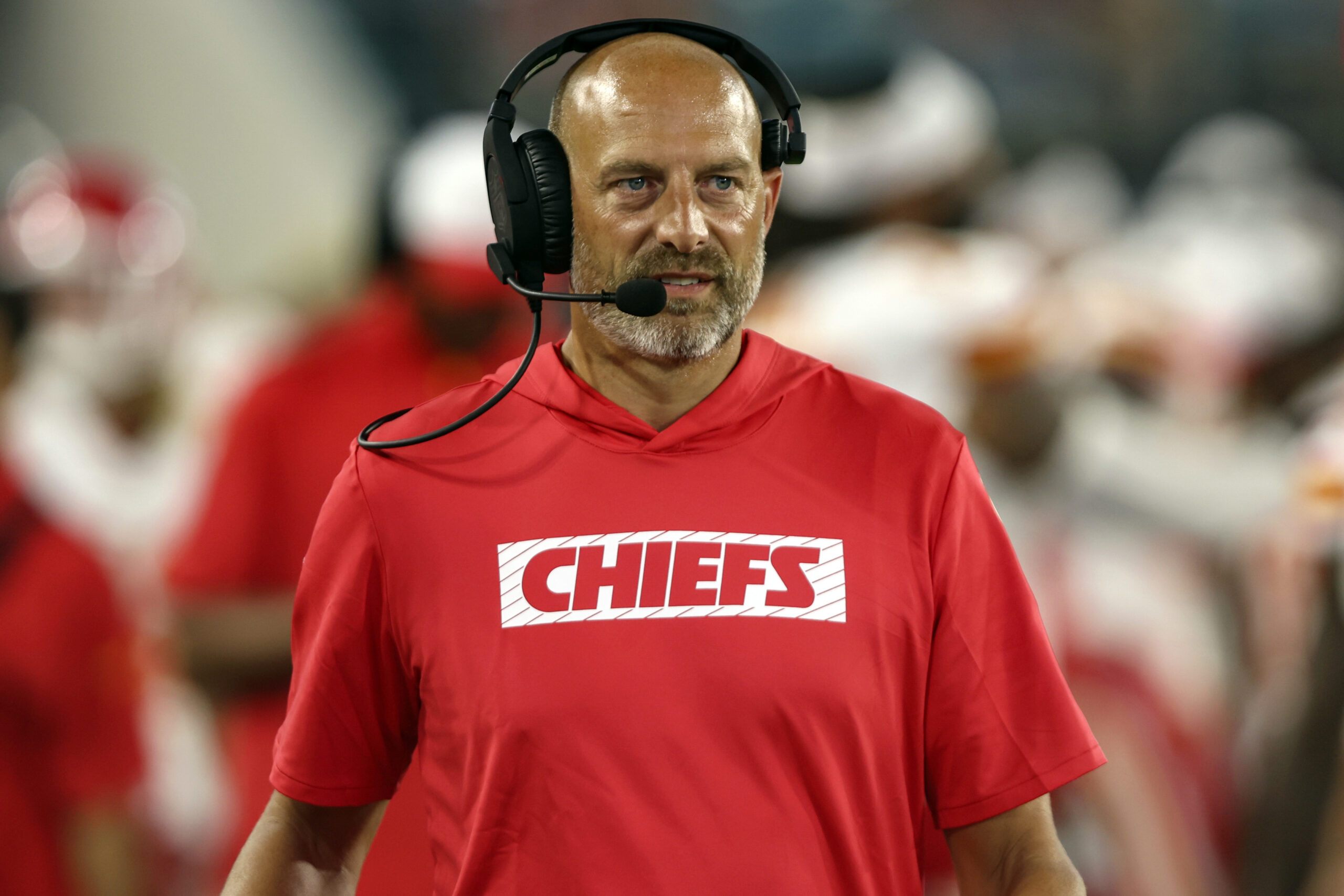
Would the Eagles let a candidate like Matt Nagy cook, and run his own side of the ball the way the team has with Vic Fangio?
Hire the best candidate as offensive coordinator — no matter their expected longevity
The Eagles are well into their interview process as they work to identify their next offensive coordinator. Like Kevin Patullo before he was promoted last offseason, some interviewees have never called plays (including Green Bay Packers quarterbacks coach Sean Mannion), while others have ample experience (such as former Kansas City Chiefs offensive coordinator Matt Nagy).
Play-calling experience shouldn’t be the sole determining factor. The Eagles ought to prioritize the candidate who, in Sirianni’s words, can help “evolve” the offense and make it a more explosive unit than the one that trotted out on the field last year. That candidate ought to put players in positions to work to their strengths while also implementing modern, fresh concepts. That candidate should also have the autonomy to run the offense he envisions.
No, the Eagles shouldn’t necessarily seek out a Vic Fangio-type — a veteran coach with no aspiration to move on to a head coaching job — to fill that role. Who would turn down a candidate who puts them in the best position to field a championship-caliber offense simply because of the threat that he would get poached at the end of the season? The Eagles lost Kellen Moore after the 2024 season but they also won a Super Bowl, an outcome they wouldn’t trade given a do-over. Such is life when the head coach doesn’t call plays.
“It’s a great compliment when guys get head coaching jobs from here because it means we’re having tremendous success,” Roseman said on Jan. 15. “As much as you’d like to have continuity and would like to have guys here for a long period of time, we want to win. We have an urgency to win right now. If that comes with the ramifications that we lose good people because they’ve earned head coaching jobs, we’ll live with that.”
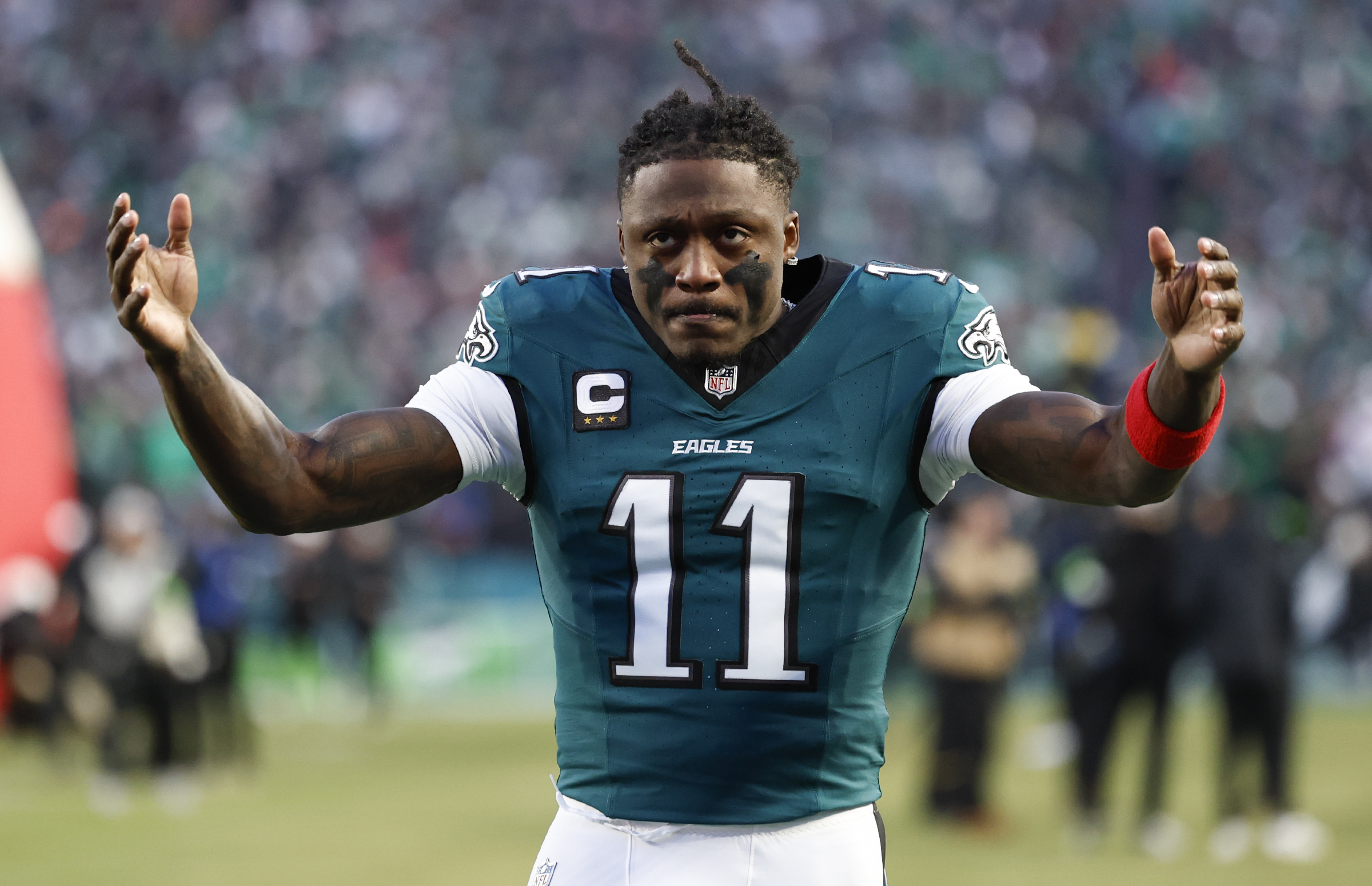
The occasional headaches that come with the A.J. Brown experience don’t outweigh his elite playmaking ability.
Keep A.J. Brown
Will A.J. Brown remain an Eagle in 2026, let alone finish out his contract that runs through 2029?
No one can read Brown’s mind and determine whether he still wants to be in Philadelphia. He hasn’t spoken publicly since Dec. 8 following the Eagles’ overtime loss to the Los Angeles Chargers. Earlier in the season, though, he voiced frustration with the listless offense and his role within it, both online and in interviews with the media. His concerns, especially given the state of the offense, were understandable.
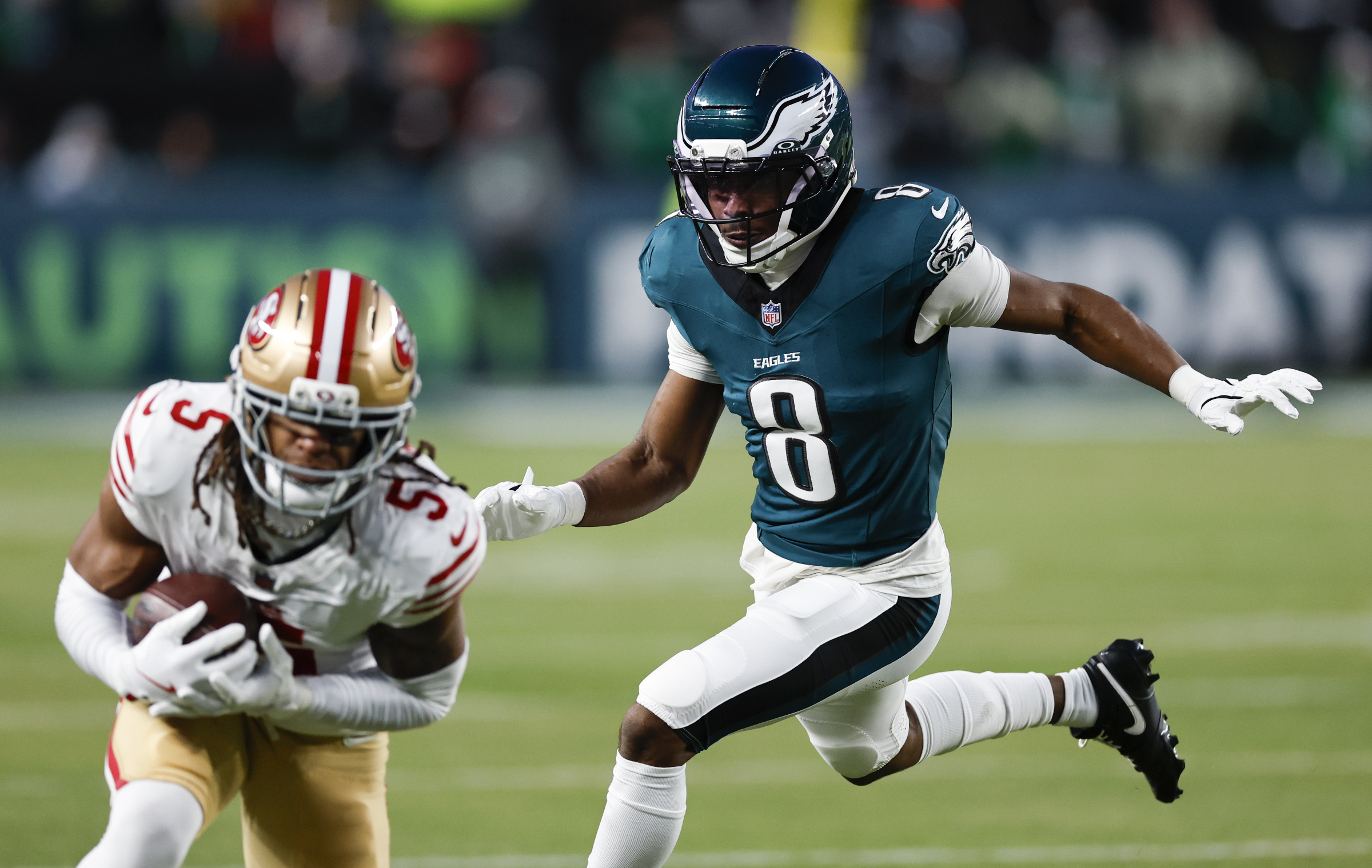
But his performance hit some rough patches this season, especially in the wild-card loss to the San Francisco 49ers. Brown had three receptions on seven targets for 25 yards, including a couple of drops and a spat on the sideline with Sirianni (the Eagles head coach later said he had been trying to get Brown off the field after the offense went three-and-out).
Roseman didn’t explicitly rule out a trade when asked about Brown’s future at the end of the season. There would be short-term financial ramifications that come with a trade, either before or after June 1, but the Eagles would experience some salary cap relief in future seasons.
Still, the Eagles are often at their best offensively when Brown is thriving. He remains one of the best receivers in the NFL, which ought to be a boost to a team fighting to keep its Super Bowl window open. It should be in the Eagles’ interest to keep him in the fold, especially given the difficulty of replacing WR1. Hire an innovative offensive coordinator, ensure that Brown is still on board with the new scheme, and move forward.
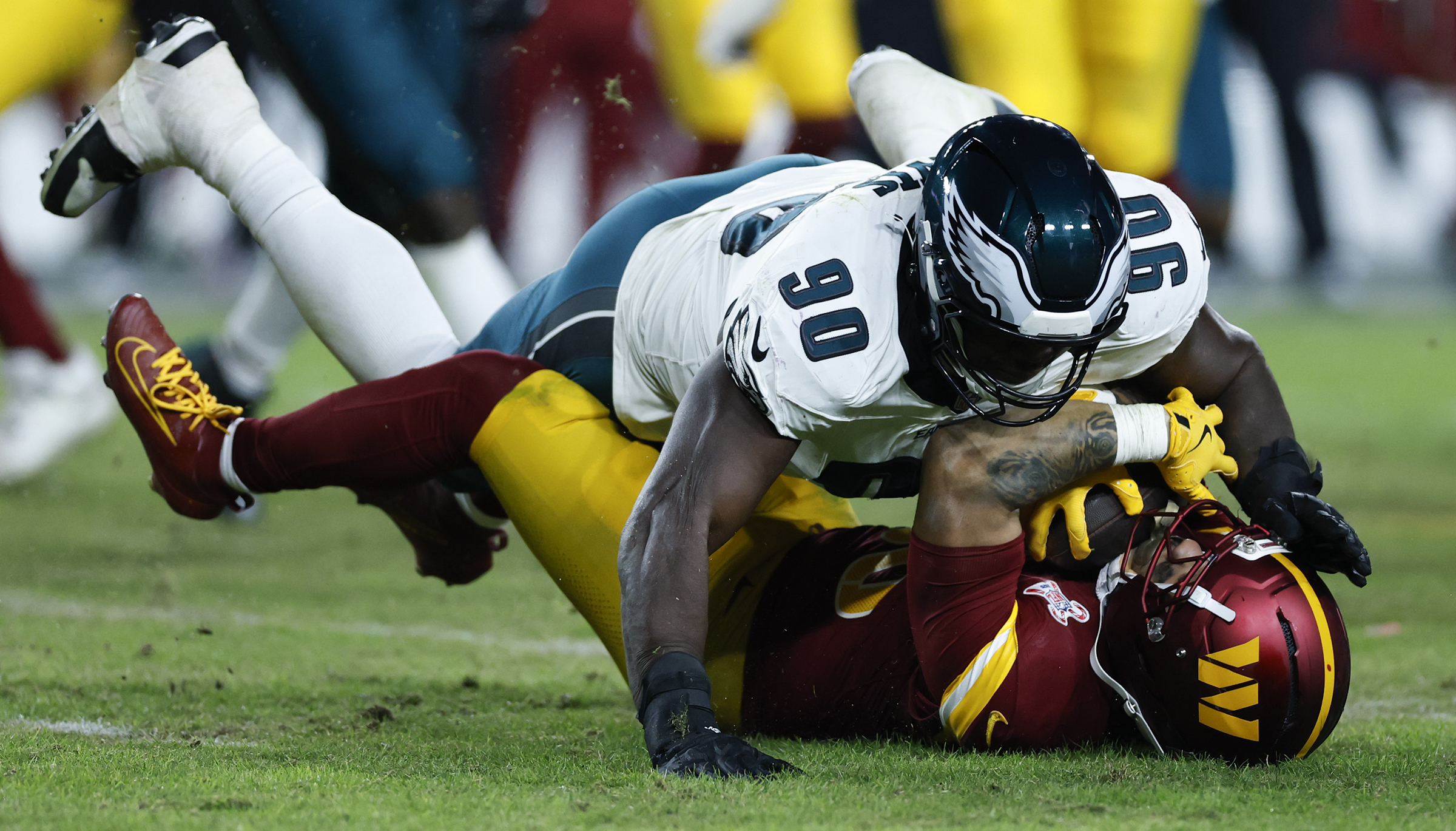
Eagles defensive tackle Jordan Davis (90) comes off a breakout year.
Extend Jordan Davis
In a span of approximately eight months, Jordan Davis showed why Roseman made the right decision by picking up his fifth-year option.
The 6-foot-6, 336-pound defensive tackle ascended into a nearly-every-down role in 2025, his fourth season with the Eagles. He played a career-high 61% of the defensive snaps, and perhaps most importantly, his strong performance was consistent from the outset of the season through its conclusion. Davis finished the year with career highs in run stops (50, according to Next Gen Stats) and sacks (4½).
His rare blend of size and athleticism is just one facet of his importance to the team. Davis stepped into a leadership role and helped set the culture in 2025, too.
“My leadership style … it’s just mainly keeping the guys together and being an example, being a positive influence and being a positive force in the locker room, on the field,” Davis said at locker clean-out on Jan. 12. “That’s not going to stop. That’s how I live life. That’s not going to stop. I’m excited to see where it can go and where it could go and the potential of it all.”
Players like Davis are hard to find. It would behoove Roseman to extend him early, just as he has with other key players in recent years, in an effort to prevent him from testing the open market.
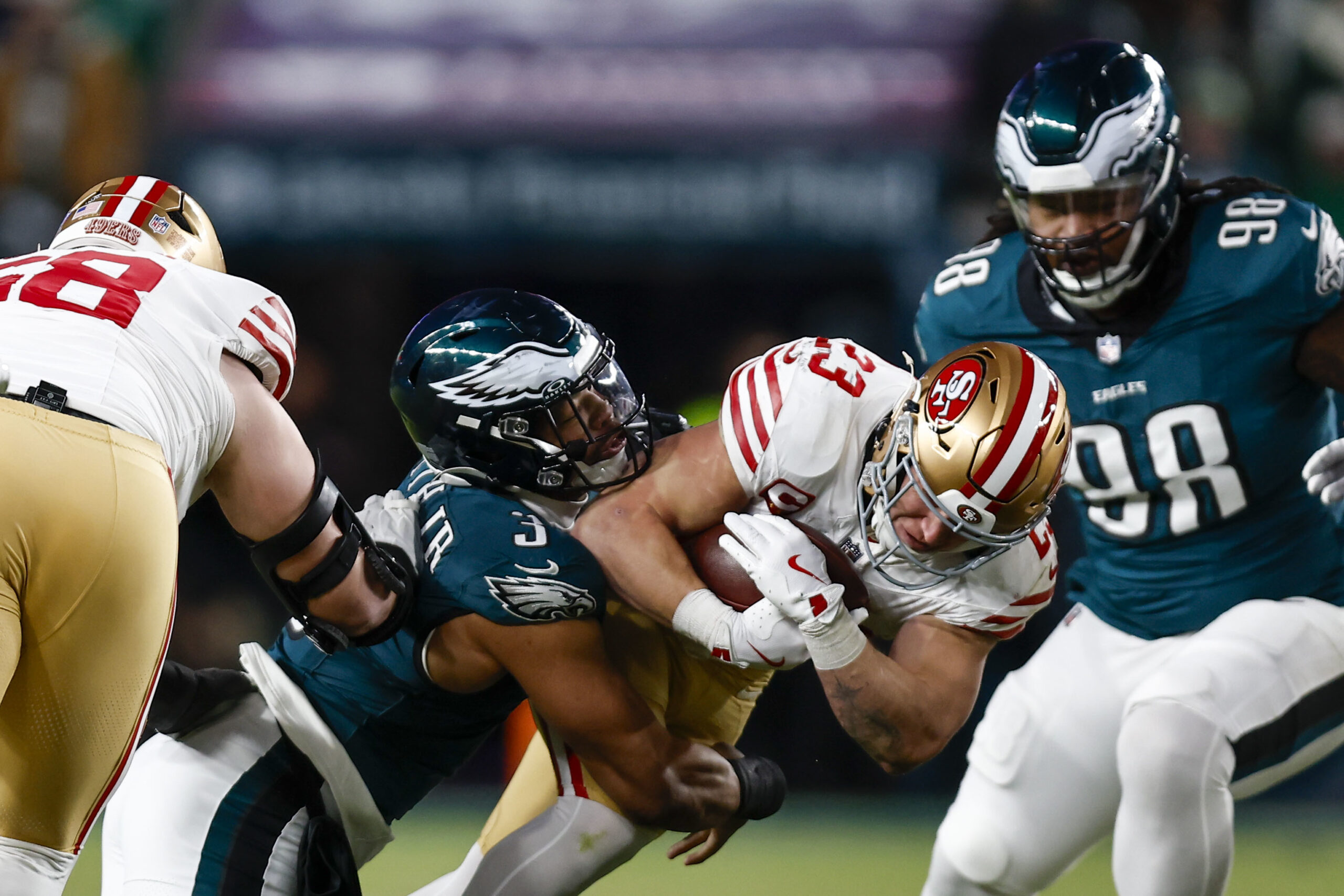
Nolan Smith Jr. (3) and Jalen Carter (98) are approaching option decisions.
Pick up Jalen Carter’s and Nolan Smith’s fifth-year options
Speaking of fifth-year options, Jalen Carter and Nolan Smith are eligible to have theirs exercised this offseason. Roseman will have until May 1 to make that decision on his 2023 first-round draft picks.
The Eagles ought to pick up both, even though Carter and Smith saw their 2025 seasons impacted by injury. Roseman may even consider extending Carter as early as this offseason, provided he’s convinced Carter’s shoulder issues won’t be long-term concerns.
Even though Carter finished the season with a career-low 7.7% pressure rate, according to Next Gen Stats, he played his way into a potential raise in Year 5. Carter was named to his second Pro Bowl on the original ballot this season, which places his fifth-year option in the highest salary tier possible at his position. His fifth-year base salary would be equivalent to the defensive tackle franchise tag value in 2026, which is projected to be $25.6 million, according to Over The Cap.
Smith’s fifth-year option is projected at approximately $15 million, the lowest salary tier among outside linebackers.
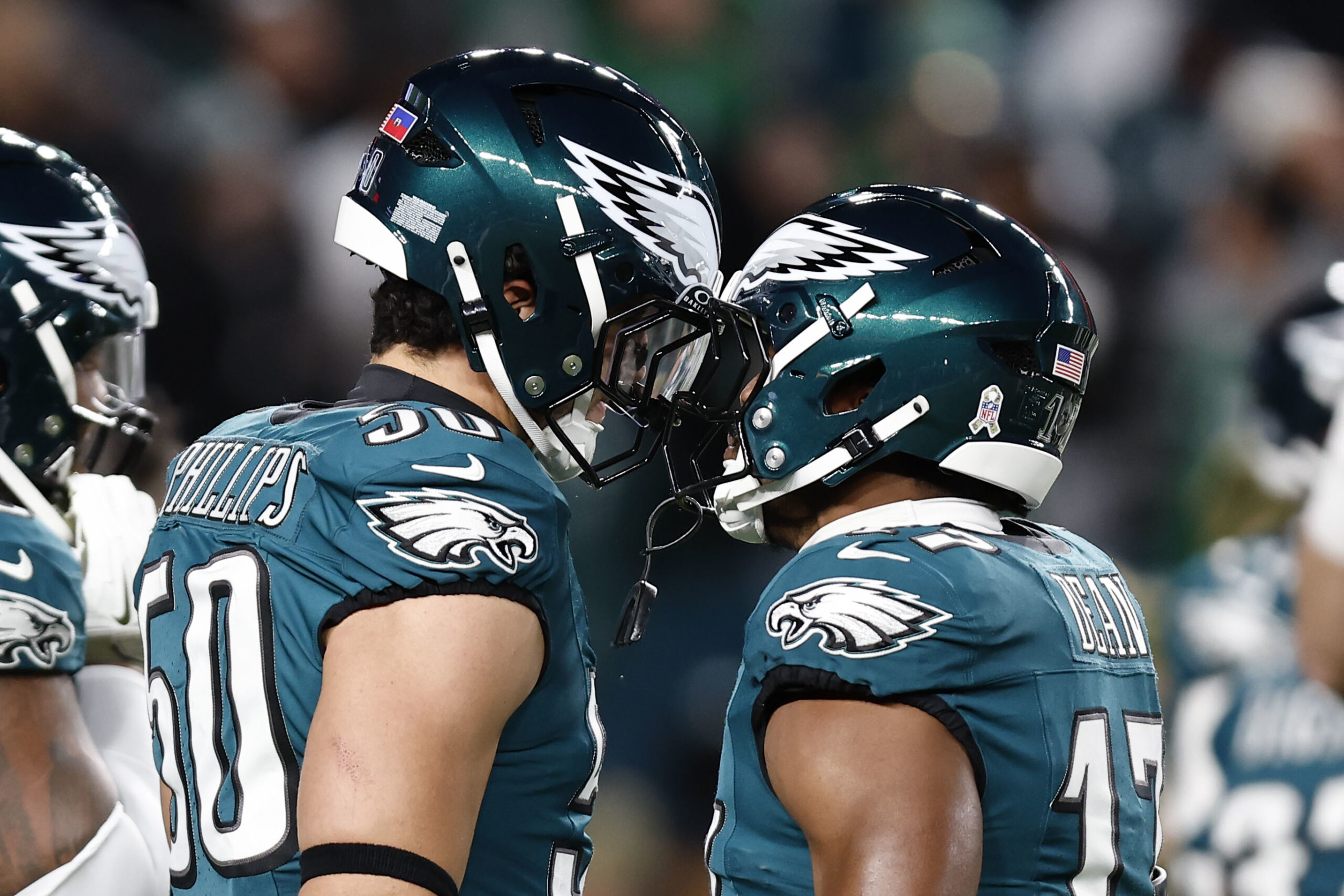
Jaelan Phillips (50) and Nakobe Dean (17) are popular in the Eagles locker room, but a tough business decision around both looms.
Let Nakobe Dean and Jaelan Phillips walk
In the creative writing business, this step would be referred to as “killing your darlings.”
The Eagles have 18 pending unrestricted free agents and Roseman can’t keep them all, nor would he want to bring them all back due to poor performance from certain members of that group. But even some of the team’s more talented, beloved players likely won’t stick around, especially Nakobe Dean.
Roseman has displayed a preference in the past to reward his homegrown talent with extensions. In a vacuum, Dean would be a worthy candidate, given he rebounded from a major injury and proved he’s still a starting-caliber talent in 2025. But with Jihaad Campbell waiting in the wings, Roseman may want to let his 2022 third-rounder out of Georgia walk. Campbell and Baun are a strong starting pair and Jeremiah Trotter Jr. is a capable backup.
What about Jaelan Phillips, the 26-year-old outside linebacker whom the Eagles acquired from the Miami Dolphins at the trade deadline? Phillips led the team with 34 pressures after he joined in Week 10, according to Next Gen Stats. But he turned just two of those pressures into sacks, good for a 5.9% pressure-to-sack conversion rate (10th lowest among 97 defenders with at least 15 pressures since the trade deadline).
Unless the Eagles can bring Phillips back on a team-friendly deal, they may have no choice but to allocate money elsewhere. Spotrac projects Phillips’ market value at $17.3 million annually.
Safety Reed Blankenship’s spot on the 2026 roster is far from assured.
Re-sign Reed Blankenship and Braden Mann, barring unreasonable asking prices
Among the pool of pending free agents, a couple of candidates for extensions stand out who might not break the bank — Reed Blankenship and Braden Mann.
Blankenship, the 2022 undrafted free agent out of Middle Tennessee State, was a captain and a key communicator in the Eagles secondary in 2025. He wasn’t flawless, as evidenced by his late holding penalty in the wild-card loss to the 49ers that eventually led to a touchdown.
Still, the 26-year-old safety has a solid body of work over the course of four seasons. His departure would leave a leadership hole in the secondary and a question mark alongside Drew Mukuba, who is still in the process of proving himself as he rebounds from a fractured fibula that ended his up-and-down rookie campaign.
Of course, whether Blankenship returns will depend on his asking price. The Eagles were eager to get C.J. Gardner-Johnson’s contract off the books this time last year, and he was making $9 million per year. Blankenship has a market value of $7.2 million per year, according to Spotrac’s projection.
Mann, the 28-year-old punter, is also set to become a free agent at the start of the new league year. He undoubtedly earned himself a new deal, potentially with the Eagles, as he averaged a franchise-best 49.9 yards per punt in 2025.
The Eagles can’t assume Jake Elliott’s shaky performance in 2025 was an anomaly.
Bring in competition for Jake Elliott
Even though Jake Elliott had a rough stretch of games in 2024, making 19 of 25 field goal attempts in the final 10 games of the season (76%), the Eagles stuck with him as their kicker in 2025.
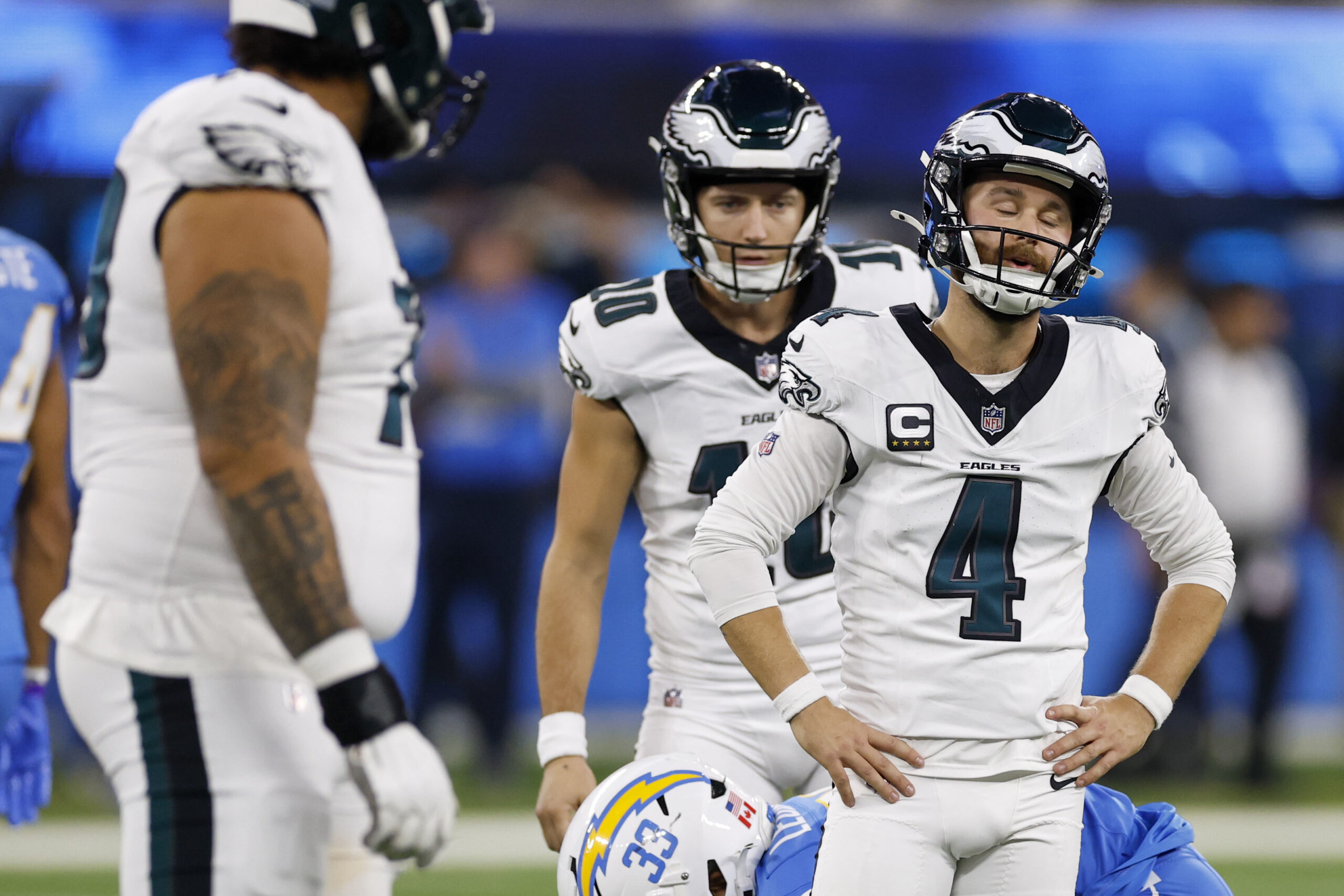
This offseason could be different. Once again, Elliott had a shaky showing over a 10-week span during the regular season, going 13-for-20 (65%) on his field goal attempts. Elliott also missed a critical extra point while battling the wind in the wild-card loss to the 49ers. His 74.1% field goal percentage on the season was the second-worst rate of his career (73.7% in 2020, although he only attempted a career-low 19 field goals that year).
Elliott may have some equity given his otherwise robust nine-year Eagles career, but it’s fair to wonder if that equity has run out given his struggles in consecutive seasons. It might be time to evaluate other options at kicker in training camp if Elliott’s best days are behind him.
Given Lane Johnson’s age and recent injury history, the Eagles must do some serious scenario planning at right tackle.
Figure out (and potentially enact) the RT succession plan
After a Lisfranc injury in his right foot curtailed his 13th season with the Eagles, does right tackle Lane Johnson still intend to play in 2026?
Johnson, who turns 36 in May, is technically under contract through 2027. But is he healthy enough to continue playing or is he contemplating retirement this offseason?
Regardless of his decision, Roseman must figure out the succession plan at right tackle. He could have an opportunity to find Johnson’s heir apparent through the draft. The Inquirer’s Devin Jackson identified a handful of tackles (some with guard versatility) the Eagles could target with the No. 23 pick in the draft, including Alabama’s Kadyn Proctor, Utah’s Caleb Lomu, and Georgia’s Monroe Freeling.
Could Roseman look internally to eventually fill Johnson’s role? The Eagles drafted a pair of tackles last year in Myles Hinton (sixth round out of Michigan) and Cameron Williams (sixth round out of Texas). Both players spent a chunk of the season on injured reserve, and only Williams earned playing time, in the season finale against the Washington Commanders. They weren’t blue-chip prospects, but Jeff Stoutland has a history of developing lesser-known players into starting tackles (i.e. Jordan Mailata).
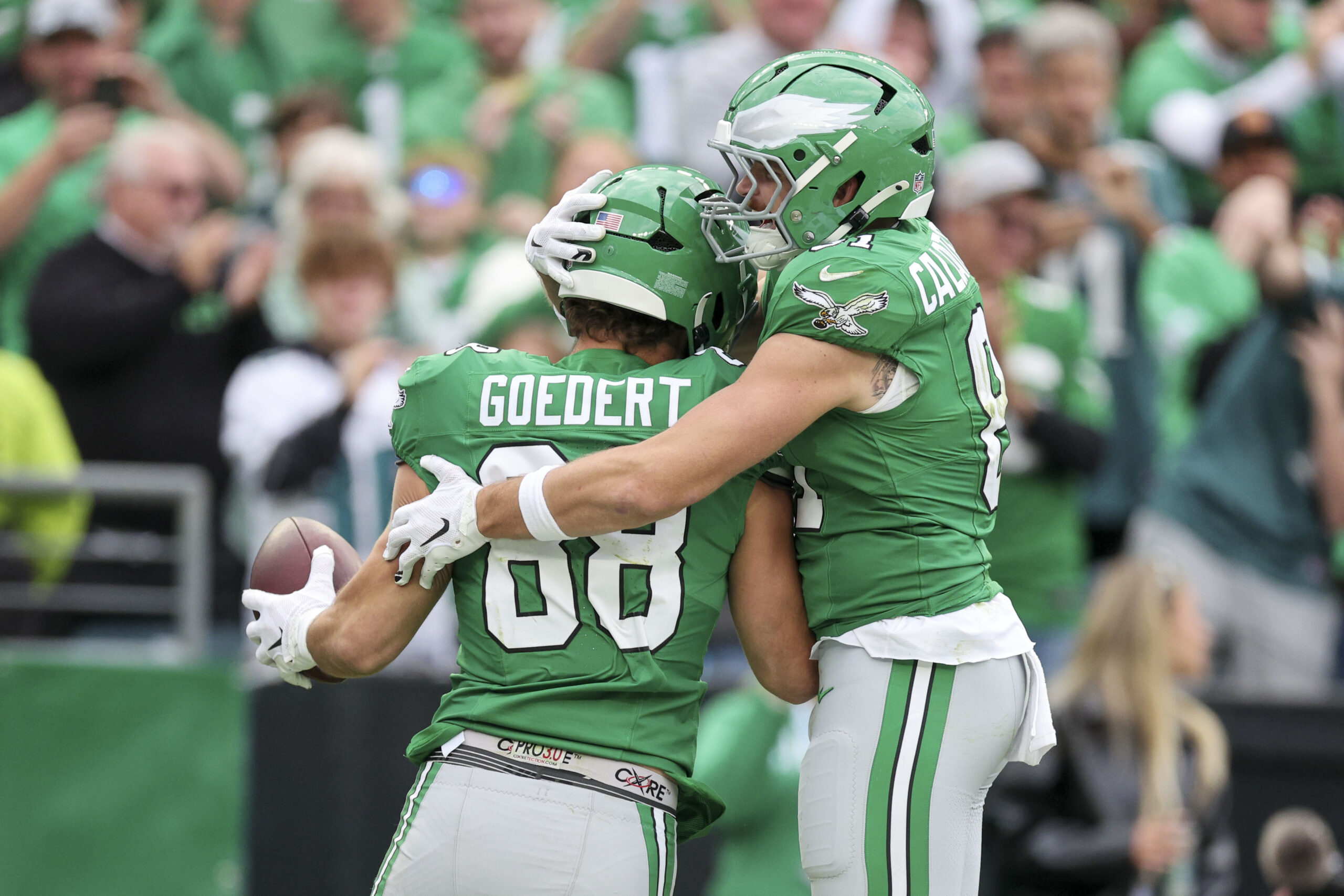
Dallas Goedert and Grant Calcaterra are both set to become free agents.
Figure out (and most likely enact) the TE succession plan
For a second straight year, Dallas Goedert enters the offseason uncertain about his future with the Eagles.
The 31-year-old tight end is set to become an unrestricted free agent at the start of the new league year, which could mark the end of his eight-year career in Philadelphia. Goedert was a revelation in the red zone in 2025, scoring 10 of his 11 touchdowns during the regular season inside the opponent’s 20-yard line. Given his scoring ways, though, he might have earned himself a raise on the open market.
With Goedert, Grant Calcaterra, and Kylen Granson all poised to become free agents, the Eagles will likely have to draft a tight end this year and sign one (or two) in free agency. Given the importance of the ground game in the Eagles offense, it is imperative that the TE1 of the future can run block in addition to his responsibilities as a receiver. Goedert appeared to take a step back in his run-blocking performance in 2025, as did most of the unit that paved the way for Saquon Barkley.
Could some offensive playmakers be in the cards on draft day 2026?
Lean offense in the draft (including a wide receiver and a quarterback) …
Over a span of five years from 2018-22, the Eagles invested loads of premium draft capital into the offensive side of the ball. Roseman hit on a number of early picks, including Goedert (2018), Jalen Hurts (2020), DeVonta Smith (2021), and Landon Dickerson (2021), plus he acquired Brown from the Tennessee Titans in exchange for the 2022 No. 18 overall pick.
Aside from Goedert, each of those players have since been rewarded with contracts that will account for at least 3.4% of the salary cap in 2026 and as much as 10.4% in Hurts’ case. Beginning in 2022, Roseman balanced out what would become his expensive players on offense by adding defensive players on rookie deals, drafting Davis (2022), Dean (2022), Carter (2023), Smith (2023), Quinyon Mitchell (2024), Cooper DeJean (2024), and Campbell (2025). Roseman called this the “natural arc” of the team on Jan. 15.
“I think that when you look at our team, we draft a lot of offensive players, we re-signed a lot of offensive players, [and] we drafted a lot of defensive players that were young on rookie contracts,” Roseman said. “There’s natural transition in what we do.”
It’s time for the draft pendulum to swing back in the direction of the offense. With many of those aforementioned defensive draftees becoming eligible for extensions, Roseman is going to replace costly offensive veterans with players on rookie deals over time.
The Eagles already have an immediate need for a WR3, with Jahan Dotson a pending unrestricted free agent. As previously discussed, the team could also be in the market for a tackle, and even upgrades on the interior offensive line. Plus, with Sam Howell set to become a free agent and Kyle McCord signing a futures deal with the Packers, Roseman may want to add to the quarterback factory through the draft, too, although this year’s class lacks depth.
Is there another Jalyx Hunt in this year’s draft who could help the Eagles off the edge?
… but keep drafting edge rushers
Still, the Eagles have needs to address on the defensive side of the ball. Roseman is seemingly always good for one edge defender in every draft class. Smith and Jalyx Hunt are the only 2025 active-roster edge rushers who are under contract next year, so Roseman will need to make additions through the draft and free agency.
The Eagles will also be on the market for a CB2, as Adoree’ Jackson is set to become a free agent. Kelee Ringo has one year remaining on his rookie deal, but given his inability to win the starting role in Year 3, it seems unlikely that he will earn the job in 2026. While the Eagles could attempt to identify their next starting outside cornerback opposite Mitchell through the draft …
The Eagles might look to an Adoree’ Jackson-type veteran to lock down the opposite corner to Quinyon Mitchell.
Sign a stopgap veteran CB2
… the free-agent route worked well enough for them in 2025, and they could go down that path again in 2026. Few NFL teams invest heavily in all three cornerback spots. Given the Eagles’ needs on offense, Roseman could make another Jackson-esque signing (or even re-sign Jackson) to hold them over for another season or two instead of investing premium draft capital at the position again.
For centuries, white people in America depicted slavery as a benign institution developed to uplift and civilize “savage” Africans. They preached that myth in churches, taught it in schools, and memorialized it in statues.
That’s not what the Trump administration was trying to do last week, in dismantling a display about nine Black people whom George Washington enslaved. The exhibit was removed from the President’s House in Independence National Historical Park in accordance with a White House directive to take down or cover up materials that “inappropriately disparage Americans.”
I suppose you could call that a small piece of progress, given that prior generations of Americans actively praised slavery. Federal officials know it was evil, which is why they are scrubbing displays about it from the President’s House and other historical sites around the country.
But I’ve got another word for their behavior: cowardice. They are afraid to admit the contradiction at the heart of our history: a nation that dedicated itself to human liberty also enslaved African Americans. And they do not trust the rest of us to grapple with it, either. It’s so much easier to just look away.
People leave notes Saturday on the spaces at the President’s House site where more than a dozen educational displays about slavery were removed.
That was harder to do in the late 19th and early 20th centuries, when slavery was within living memory for millions of people. Especially in the South, white educators made extended efforts to excuse it. The problem wasn’t slavery, they said.
The problem was “the War of Northern Aggression” — a.k.a. the Civil War — which granted freedom to African Americans, whom, according to this twisted retelling of history, neither wanted nor deserved it.
The key figure in this campaign was Mildred Lewis Rutherford, the “historian-general” of the United Daughters of the Confederacy, or UDC. Born into a wealthy slaveholding family in 1851, Rutherford led the effort to purge Southern schoolbooks of so-called Yankee perspectives.
In 1919, “Miss Millie” — as she was affectionately known across the white South — published A Measuring Rod to Test Textbooks, which provided a checklist that UDC women could use to assess what their schools were teaching. “Reject a book … that speaks of the slaveholder of the South as cruel and unjust to his slaves,” Rutherford urged.
Invoking the era’s rhetoric of progressive education — which stressed student activities rather than memorization from books — the UDC also sponsored essay contests for students who conducted research about slavery. Many of the essays drew on interviews from former slaveholders, who provided a predictably romantic view of the institution.
Slavery was “the happiest time of the negroes’ existence,” declared a winning essay in 1915 by a Virginia high school student. “The slave was a member of the family, often a privileged member. He was the playmate, brother, exemplar, friend and companion of the white man from cradle to grave.”
Despite Rutherford’s fears of encroaching Yankee doctrine, meanwhile, Northern schoolbooks often included similar falsehoods about slavery. In 1944, amid the World War II struggle against Nazism, Black activists in New York City complained that one history text used in their schools said those in bondage were “happy”; another congratulated the Ku Klux Klan for keeping “foolish Negroes” out of government after the Civil War. “Such passages … could well have come from the mouths of the fascist enemies of our nation,” the activists noted.
Bolts are removed from interpretive panels about slavery before they are removed from the walls of the President’s House site in Independence National Historical Park Thursday.
African American attacks on flawed textbooks came to a head during the civil rights movement of the 1960s, when the Urban League and the National Association for the Advancement of Colored People appointed committees to examine the books. Thanks to these efforts, most textbooks corrected their distortions of slavery. They also added new material about African Americans who fought against it, like Denmark Vesey and Frederick Douglass.
Today, outside the darkest corners of the internet, nobody celebrates the enslavement of African Americans. “It is disgusting and absurd to suggest that anyone inside this building would support slavery,” White House press secretary Sarah Huckabee Sanders said during President Donald Trump’s first term in office, when Chief of Staff John Kelly suggested Confederate Gen. Robert E. Lee was an “honorable man.”
In his second term, Trump has moved to restore the names of Confederates to military bases. Yet, I haven’t heard him — or anyone in his administration — say a good word about slavery. Again, that’s a very good thing.
Workers remove the displays at the President’s House site in Independence National Historical Park Thursday.
But it also underscores their fundamental lack of courage. They’re not defending slavery, as earlier generations did. Instead, as happened at the President’s House, they’re simply eliminating it from sight because it doesn’t suit their happy picture of our history. To paraphrase the Jack Nicholson character in A Few Good Men, they can’t handle the truth.
And if visitors ask why the exhibit about Washington and slavery disappeared, National Park Service employees have been instructed to say that they don’t know. Talk about cowardice! First, we deny history, and then we deny knowing why we did so.
It’s enough to make a citizen embarrassed for his country. Trump and his aides say they took down the exhibit because it disparaged America. But they are the ones disparaging America, because they don’t believe in our ability to make sense of it: its glory and its tragedy, its achievements and its abuses. Shame on them.
Jonathan Zimmerman teaches history and education at the University of Pennsylvania. He is the author of “Whose America?: Culture Wars in the Public Schools.”
Although the Eagles’ season came to an early end, Philadelphia fans can still see a hometown favorite on their television screens during Super Bowl LX.
The ad follows Lincoln’s friendship with the iconic horse playing under the appropriate sounds of Lynyrd Skynyrd’s “Free Bird.” The 60-second in-game spot will air during the Super Bowl.
“It was really like these two icons of America coming together,” said Jessica Hall, the chief executive officer of the American Eagle Foundation, a nonprofit focused on the protection and conservation of bald eagles and other birds of prey. “The Clydesdales have been icons for over 100 years and the bald eagle has been on the great seal for over 200 years. So, seeing those two elements come together and be represented in this really moving commercial was spectacular.”
The American Eagle Foundation got the call from Budweiser over the summer and started filming the project in October, making the trip from Kodak, Tenn., where the American Eagle Foundation is based, to California for Lincoln to star in his first-ever commercial. Lincoln, however, is no stranger to long trips and hotel rooms, thanks to his time serving as the Eagles’ pregame living mascot.
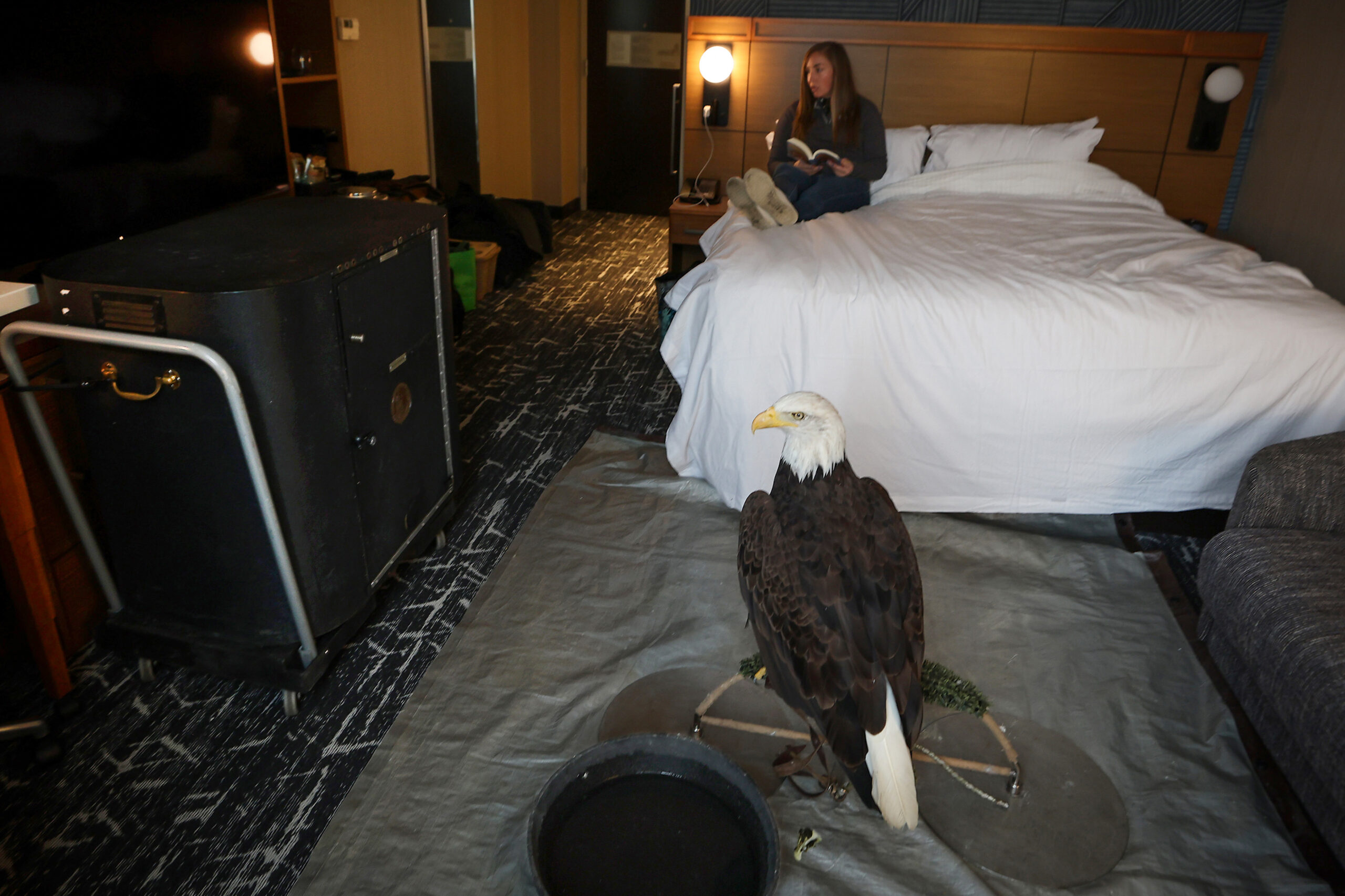
Lincoln doesn’t get his own hotel room on the road, but he does get his own space — and has a darkening crate if the room gets too bright.
“Seeing Lincoln soaring through the skies with his wings spread out, just doing what he does best, it never gets old,” Hall said. “Watching him fly, it sends chills down our backs every time. And meeting the Clydesdale was also incredible. The Clydesdale team were fascinated by the eagle, and the eagle team were fascinated by the Clydesdale.”
The ad, directed by Emmy Award-winning commercial director Henry-Alex Rubin, is the latest addition to Budweiser’s “Made of America” campaign.
“As we celebrate Budweiser’s 150th anniversary and America’s 250th birthday, we knew we had to rise to the occasion in a way only Budweiser can,” Todd Allen, senior vice president of marketing for Budweiser at Anheuser-Busch, said in a news release. ”‘American Icons’ brings our heritage to life through powerful storytelling with the Budweiser Clydesdales and an American Bald Eagle. This year’s spot will leave fans awe-struck and proud to enjoy a Budweiser as they celebrate our shared milestone moments.”
Lincoln first flew into Lincoln Financial Field during the 2024 season, taking over for his predecessor, Challenger.
Lincoln has been performing free-flight events since 2001, but his first NFL season, flying in bigger outdoor spaces, was in 2024. To prepare, he flew at Carson-Newman University and at Tucker Stadium, the home of the Tennessee Tech Golden Eagles.
Of course, training came with a few minor hiccups, including when it came to dealing with other animals. In December 2024, Katelyn Jennings, the operations manager of the American Eagle Foundation, told The Inquirer about a close call with an osprey, another type of bird of prey.
“We had a couple of situations that we encountered during training,” Jennings said. “We learned that Lincoln does not mind dogs or osprey … At our Carson-Newman game, they have an osprey nest near the field and the osprey would dive down to try and get him. And he says this is my territory and not yours and he just kind of looked at them like, ‘Hey, what are you doing here?’ and continued to fly onto the trainer.”
Now, a Clydesdale can be added onto Lincoln’s short list of animal interactions.
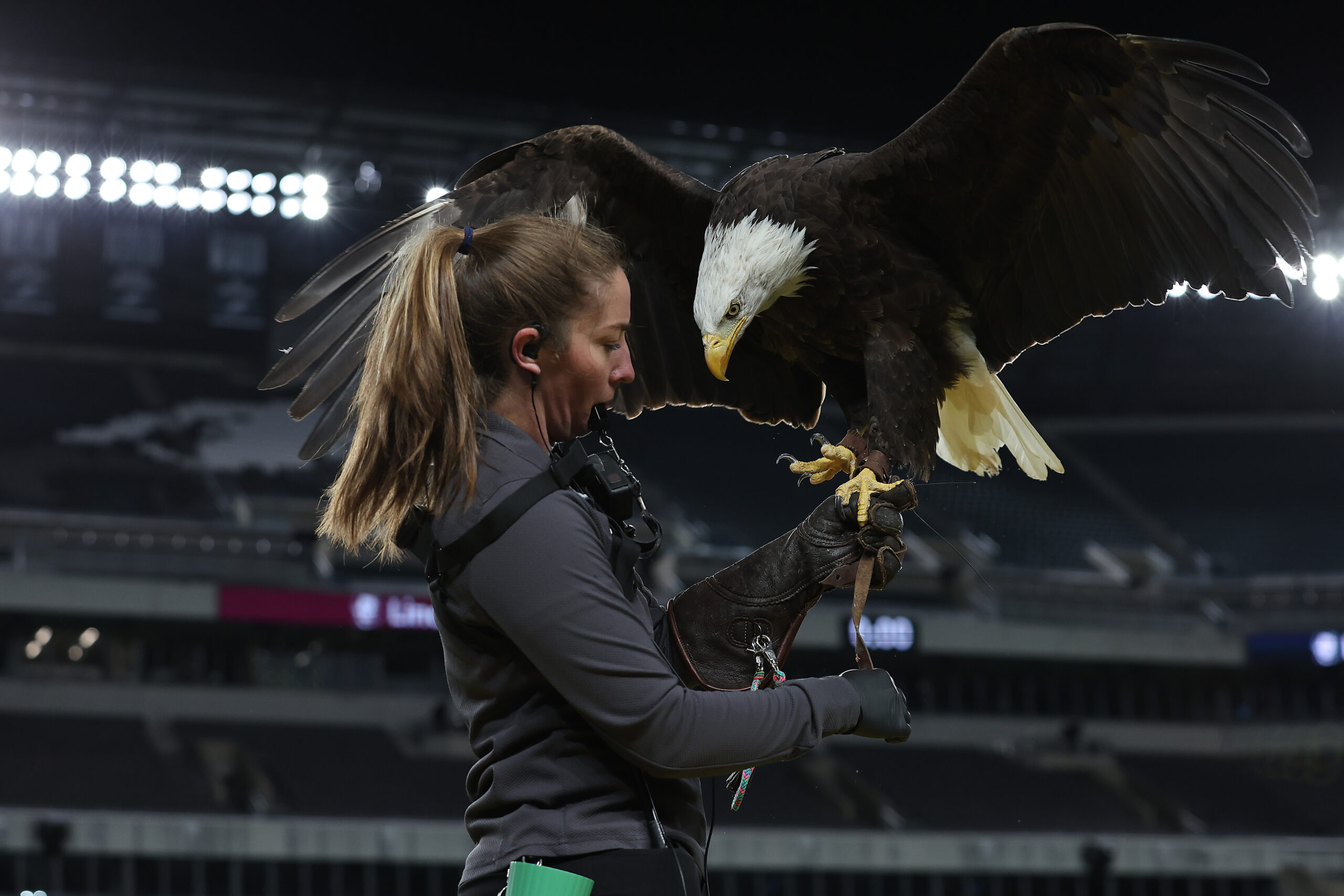
Ashley Frye, an avian care specialist with the American Eagles Foundation, catches Lincoln during a November 2024 test flight at the Linc.
New Jersey and Pennsylvania are poised to regain roughly $244 million in federal funding for electric‑vehicle charging stations after securing a legal victory over the Trump administration.
New Jersey announced this week that it expects $73 million to be reinstated.
Pennsylvania had planned on $171.5 million in EV‑charging funds last year, according to Alex Peterson, a spokesperson for Gov. Josh Shapiro.
“This ruling guarantees that these obligated funds cannot again be interrupted,” Peterson said.
On Friday, a U.S. District Court sided with 20 states that filed suit last year demanding restoration of the National Electric Vehicle Infrastructure Formula Program (NEVI). New Jersey and Pennsylvania were among the plaintiffs.
In her decision, Judge Tana Lin, who was appointed by former President Joe Biden, prohibited the Department of Transportation from withholding funding for approved state EV‑charger deployment plans.
Lin concluded from Seattle that the Federal Highway Administration (FHA) overstepped its authority by halting funding already authorized by Congress. She described the agency’s action as arbitrary and capricious.
“This win puts New Jersey back on track for $73 million in funding unlawfully stripped away through the Trump Administration’s illegal actions,” Jennifer Davenport, New Jersey’s acting attorney general, said this week in a statement. “New Jerseyans want sustainable transportation options.”
New Jersey, Pennsylvania, and Delaware were among plaintiffs in the suit against a Trump administration freeze on the $5 billion. It’s unclear whether Trump administration officials will appeal.
The states’ legal challenge stemmed from an executive order President Donald Trump signed on his Inauguration Day to eliminate EV mandates — which the suit states never existed.
Regardless, the suit stated, the administration used the order to “immediately pause the disbursement of funds” for EV infrastructure appropriated through the Inflation Reduction and Infrastructure Investment and Jobs acts signed by Biden.
Other states that joined the suit included Washington, Colorado, California, Arizona, Delaware, Hawaii, Illinois, Kentucky, Maryland, Minnesota, New Mexico, Michigan, New York, North Carolina, Oregon, Rhode Island, Vermont, and Wisconsin.
Davenport called the Trump administration’s refusal to spend funds approved by Congress “unlawful.”
This story has been updated to include newer figures on Pennsylvania’s plan to fund EV charging infrastructure.