Tag: topic-link-auto

  • D.C. bagel chain Call Your Mother is coming to Philly

    D.C. bagel chain Call Your Mother is coming to Philly

    Philly is getting another bagel option.

    Call Your Mother — the popular neighborhood bagel shop and “Jew-ish” deli from the District of Columbia — is headed to the Keystone State.

    It’s part of a steady ongoing expansion, including about 25 locations across D.C., Maryland, Virginia, Colorado, and Illinois, plus more on the way.

    The first Philly location will be in Fishtown, in the corner space of 1500 Frankford Ave., and is expected to open this summer, owners said.

    “This will be the start of more shops in Philly,” co-owner Andrew Dana said. “But we’ve never had a master plan on how to roll out. We’ll go where people want bagels and where we’re excited to be, as long as our food quality and service stay the same.”

    With colorful decor that would feel right at home in West Palm Beach and stuffed bagel sandwiches made with latkes, whitefish dips, and smoked salmon, Call Your Mother is popular across the DMV.

    In the six years since Dana and his wife, co-owner Daniela Moreira, opened that first location, the shop has been praised across food publications like Bon Appétit and Eater for its vibe and sandwiches. Some critics say the menu is overpriced, but items on the D.C. menu — including sandwiches and loose bagels — appear similarly priced to most of Philly’s bagel outposts (and sometimes cheaper).

    On that note, Dana says to expect the same Call Your Mother signature menu items — like its bacon, egg, and cheese sandwiches and its babka muffins. “But we’re in the lab trying to cook up some special Philly flair, too,” he said.

    You can also expect a colorful buildout.

    “Most of the building will be painted pink, but we’re on the hunt for a local muralist to put an extra stamp on the building,” Dana said. “We’re also looking for local Philly food products to showcase.” Locals interested in getting in on the mix are encouraged to direct message Call Your Mother on Instagram.

    The expansion comes amid a bagel boom in the Philly area: Viral bagel chain PopUp Bagels is set to open its first Pennsylvania location in Ardmore with seven more locations on the way in the Philadelphia region, including Suburban Square and Center City. Bart’s Bagels of West Philly is opening its third location in Bala Cynwyd, and Penny’s Bagels is coming to Haddonfield this year, as well.

    “It’s a rise of the tide situation,” Dana said. “We’re not trying to take anyone’s territory. We don’t want to threaten a local spot. People love carbs, people love bagels. There’s enough room for everyone.”

    The Frankford Avenue spot is part of a surge of popular food options in the area. It’s right across the street from Marina’s Pizza and El Chingón, and down the road from the new Medium Rare location.

    “The infusion of best-in-class national brands like Call Your Mother Deli represents Fishtown’s strength today,” said Stefanie Gabel of MSC, who represented both Call Your Mother and the building’s landlord in the transaction. Gabel will continue to represent Call Your Mother as the deli expands within the Philly region. “Their presence also serves as a catalyst for the continued growth and longevity of Philadelphia’s most explosive mixed-use ecosystem.”

    Call Your Mother recently made national headlines when it filed a trademark lawsuit against New Jersey’s Call Your Bubbi, a beach town cafe and kosher-certified bagel shop in Long Branch. Dana and Moreira said the Jersey cafe, which also sometimes goes by Bubbi Bagels, intentionally used a “confusingly similar” name and branding at times.

    The dueling shops settled outside of court in early January, according to court documents. Dana declined to comment on the terms. Bubbi Bagels owner David Mizrahi could not be reached for comment.

    As for what drove the couple to come to Philly, Dana said it was a simple decision: He very literally called his mother, Mary Wilson.

    Wilson’s parents lived in Mount Airy and growing up Dana would visit his maternal grandparents often. He would go to their house, venture downtown, and explore Chestnut Hill. One of his best friends attended Penn. His cousins live on the Main Line. His other best friend lives in Bryn Mawr. In many ways, Dana says Call Your Mother coming to Philly is a natural progression.

    “I’ve spent an insane amount of time here. I love the culture, the food, the vibe. It’s a great place to be,” he said.

  • Forged in Philly, Southern Cal linebacker Eric Gentry breaks the mold at East-West Shrine Bowl workouts

    Forged in Philly, Southern Cal linebacker Eric Gentry breaks the mold at East-West Shrine Bowl workouts

    FRISCO, Texas — If there were any doubts about whether Eric Gentry belonged in the NFL with size that is often compared to an NBA wing player, he quelled those concerns by the second practice of East-West Shrine Bowl workouts, which are composed of the best draft-eligible players from across the country.

    Gentry, who recently finished his college career at Southern California, sprinted downhill from his linebacker spot during the 11-on-11 period, hit the breaks two yards from the line of scrimmage when the offense ran play-action, and elevated to nearly intercept a Mark Gronowski pass over the middle of the field. The next play looked identical: Gentry flowed toward the line of scrimmage on a play-action pass, sank back a few feet, and elevated to again deflect a pass thrown his direction.

    The Philadelphia native and Neumann Goretti alum used every bit of his 6-foot-6, 221-pound frame and long arms. His height and more than 35-inch arms are in the 99th percentile, while his weight is in the first percentile among linebackers. He’s a unique player who has intrigued nearly every NFL scout and media member during Shrine Bowl practices.

    “We have a lot of value in guys that are really unique, and if their character matches their uniqueness on the field, those guys almost always hit the NFL,” Eric Galko, the Shrine Bowl director, told The Inquirer. “For Eric, we always saw that. He was one of our first invites at linebacker — we had no doubt he’ll play in the NFL. And I think what he’s showing this week in practice is that you can use him in a couple different ways. He can have a huge, huge impact because of how uniquely built he is.”

    Gentry is used to the doubts by now, having experienced the criticism throughout his football career. Most think he’s too tall and too thin to play linebacker. Others question his durability playing such a physical position.

    But through it all, he was focused on proving that the production and versatility he showed in college will follow him to the NFL. In one year at Arizona State and four at USC, he had nine forced fumbles, 26½ tackles for losses, nine sacks, and two interceptions.

    “I think of just making these [scouts] come get at me, making these teams come get at me — I feel more like I am going to be in the moment and make it all happen,” Gentry said before practices began. “I feel so happy to be able to be out here and do what I’ve got to do. Every 10 years, it’s a new generation of athletes, type of athletes that come around. I know I’m one of them. So every day, just showing it, every day, having that intuition, knowing that can’t nobody tell me no but me. I’m always telling myself, ‘Yes, I can do it.’”

    ‘Always magical’

    Football has been at the forefront for Gentry since he was 5 years old, but the journey to this weekend’s All-Star Game in Texas hasn’t been without its ups and downs.

    Recently, Quan Luck, Gentry’s mother, was going through some old Pop Warner pictures from her son’s early playing days. Many of the players in those pictures with Gentry, she said, are either no longer alive or in prison.

    The adversity that Gentry overcame to follow his dream of making the NFL still resonates with his mother.

    “It’s always magical watching my son, because the things that he’s able to do, most football players are not able to do, but it’s hard,“ she said. ”He just has [faced] a lot of adversity because of his build. … Because of so many coaching changes, he’s had to prove himself over again. But every single coach that he ever played for always spoke very highly of him and stated how he was a unicorn.”

    Southern California linebacker Eric Gentry prepares to rein in Utah running back Sione Vaki on Oct. 21, 2023.

    His mother also noticed how Gentry was “a different character” on the football field over the years. She was a college basketball player at Rutgers-Camden and thought her son might follow in her footsteps on the court.

    But Gentry wanted to be “something that nobody had ever seen” on the football field. Luck said Dwayne Thomas, Gentry’s former high school defensive coordinator, described his playing style as “playing basketball on the football field.”

    “Sometimes it’s like he’s the underdog for whatever reason. I don’t know why, but he just always proves them wrong,” Luck said. “People have so many questions about him. Is he too thin? Will he not make it? Is he too weak? Is he going to get pushed back? And he just proved to them that anything he wants to do, he does his best.

    “You can ask anybody from his team, they will always speak highly of him, that [football] is what he does every day.”

    Before winter storms ravaged most of the country, Luck, Gentry’s father, Eric Sr., and Thomas were set to make the trip to Frisco to watch him compete at the Shrine Bowl.

    Coming full circle

    During his three days of participation in Shrine Bowl practices, Gentry was one of the standouts among all players. He consistently made plays in one-on-one coverage and in pass-rushing reps during the team periods.

    An NFC scout, while watching Gentry, remarked that the Philly native “can be a good one” and would ideally want the linebacker to “get up to 240 pounds.” Another appreciated the “use of those long arms.”

    Eric Gentry (left) during the East-West Shrine Bowl practice on Saturday

    “I think Eric Gentry is kind of a choose-your-own-adventure player, like whatever he does in the draft process, whatever you care about as a team, you’re going to find value in as well,” Galko said. “I always tell NFL teams and guys, when you’re that big and long, you can make mistakes and still win the rep.

    “And I think with a player like Gentry, he can make mistakes and still make that play on the running back in the B-gap, or he can make that mistake and still bat the pass down. I think his length, wingspan, his mental aptitude, can make him a guy that early on in the NFL can contribute before he’s even reached his full potential.”

    One of Gentry’s agents is Chafie Fields, also a Philadelphia native, who has a close connection with his mother. Luck and Fields ran track and field together since they were 5 years old and the former Penn State and NFL wide receiver turned agent works for the Wasserman agency, which represents more than 100 NFL players.

    The journey is coming full circle for Gentry, one that is coming closer to reality in a few short months. Wherever he ends up, Philly will be at the forefront of his identity.

    “To be away and have my journey go on and just hearing people support me from back home — like a mythic legend, in a sense, because nobody sees me anymore — but just hearing everything that’s going on with me,” Gentry said. “My homie texted me not that long ago, actually, and he was like, ‘You don’t [get] on social media a lot, you don’t do a lot, but you don’t realize how much you are motivation to the people in the city.’

    “I never knew the true understanding of it, until you see, you hear people from back home. There’s so many people that know you back home and are talking about you. … I feel so great to be able to put on for the city and tell everybody and show everybody that Philly’s got it.”

    Added his mother: “The city made him. Part of his aggression is because he was raised in the city of Philadelphia. It’s not easy. People don’t understand to make it out of Philly is an accomplishment by itself.”

  • A new Pa. law aimed at keeping unregulated vapes out of the hands of kids may not actually work

    A new Pa. law aimed at keeping unregulated vapes out of the hands of kids may not actually work

    Spotlight PA is an independent, nonpartisan, and nonprofit newsroom producing investigative and public-service journalism that holds power to account and drives positive change in Pennsylvania. Sign up for our free newsletters.

    HARRISBURG — A new Pennsylvania law aimed at removing unregulated vapes from the market and protecting kids may not be very effective due to loopholes, insufficient funding for enforcement, and limited public health backing.

    The statute is the commonwealth’s first major effort to tackle vaping. By this spring, manufacturers will need to have registered with the Pennsylvania Office of Attorney General and self-certified that they have been authorized by the FDA or have applied for authorization.

    Act 57, which mirrors proposals passed in at least 11 other states, passed the General Assembly with broad bipartisan support and the backing of a powerful coalition of interests, including law enforcement, convenience store chains, and the state’s medical society.

    “We can’t stop the youth from smoking,” State Rep. Jeanne McNeill (D., Lehigh), who sponsored the underlying bill, told Spotlight PA. “But at least if they’re going to do it … the ones they are smoking are safer for them.”

    But because registry laws designed to restrict these products are so new, their impact on fighting youth access to vapes is still unclear, public health experts told Spotlight PA.

    “To be honest, I’m still trying to grasp why [registry laws] became popular,” Jeffrey Drope, a research professor at Johns Hopkins Bloomberg School of Public Health, told Spotlight PA.

    He and other researchers say banning all flavored products would be more effective, although other researchers disagree due to data that suggest such policies may harm adults trying to stop smoking cigarettes.

    In particular, supporters of the law hope to target Chinese-made disposable vapes, which often deliver fanciful flavors and sometimes even include video games. Studies have also found these vapes can contain high levels of heavy metals.

    Rates have gone up and down, but as of 2023, one in four Pennsylvania high school seniors said they had tried vaping at least once, according to a state survey. (Just over one in 10 in the same year said they had tried cigarettes, a 60% decrease from 2017.)

    The law may face legal challenges from the vaping industry, Tony Abboud, executive director of the Vapor Technology Association, a trade group, told Spotlight PA.

    He argued the law won’t stop the flow of vapes into Pennsylvania, and will instead shutter businesses and push consumers into an unregulated, untaxed black market.

    “Nobody believes that the demand for vapes that are on the market now will go down,” Abboud said. “They will look for, and find, the products that they like, they’ve used, that they know that work for them.”

    Potential registry issues

    The law directs the state attorney general’s office to maintain a registry of manufacturers who can sell electronic cigarettes that contain nicotine. Products that have been authorized by the FDA are allowed to register. That encompasses just 39 e-cigarettes from a handful of brands, including those owned by big tobacco companies. They are largely refillable vapes, rather than single-use, and the list excludes all flavored products beyond menthol.

    But the law includes an additional provision for products that are under review by the FDA or have received a denial that’s pending due to a court or FDA order.

    There’s a “significant backlog” of applications, exacerbated by the firings by the Trump administration of the people who review them, the Examination reported last year. And because of that pileup, “tens of thousands of products can still qualify for most registries,” according to the Public Health Law Center.

    “I can tell you that many … applications were really inadequate, and I don’t think that those types of products should be treated equally for purposes of these registry laws,” Mitch Zeller, a former chief federal tobacco regulator who retired in 2022, told Spotlight PA.

    To get on the registry, manufacturers have to certify they are eligible under the law’s provisions. Exactly what that form will look like, and how it will be reviewed for accuracy, is unclear — the attorney general’s office declined to comment on the law’s implementation.

    Attorney general spokesperson Brett Hambright said the office was “evaluating various enforcement options, but wouldn’t want to venture into disclosing techniques.”

    If a vape is not registered, retailers and distributors are barred from buying or selling it. Enforcement against those companies will begin in October. Retailers who violate the law could be punished by fines of up to $1,500 per day per vape.

    According to the attorney general’s office, implementing the legislation will have an initial one-time cost of $98,280, with annual ongoing personnel and operating costs equaling approximately $1.3 million.

    “The Office of Attorney General staff will establish and maintain the vaping directory and provide targeted enforcement based on documentation and intelligence regarding noncompliant actors,” a state House analysis of the bill says.

    The law, Hambright added in an email, ensures “only regulated products are on the market, keeping them out of the hands of children, and not marketed towards children.”

    The office’s projected costs are far less than those of other states with robust tobacco enforcement spending. Neighboring New York allocates approximately $40 million for tobacco enforcement each year. Pennsylvania’s most recent budget allocated $1.7 million.

    “If the state is not prepared to put the time, the money, and the effort behind enforcement,” Zeller said, “I don’t know how effective the law can be.”

    The need for resources is part of why some anti-smoking advocates opposed the proposal as passed. According to the Pennsylvania Alliance for Tobacco Control, funding for a registry could be “better used to support evidence-based prevention and cessation programs.”

    “Instead of investing in a system that simply monitors the problem, we need bold, enforceable action that prevents it entirely,” the group argued. That includes a flavor ban as well as efforts to ban sales near schools, they added.

    Public health questions

    Smoking tobacco is among the leading causes of preventable death in the United States. That hasn’t stopped people from doing it, however.

    Tobacco is a $70 billion-plus industry in the U.S., with millions of users in Pennsylvania. The state’s farmers also produce millions of pounds of tobacco every year.

    Vape technology, meanwhile, became popular in the 2010s as a way to let people consume nicotine, the addictive chemical in tobacco, without smoking cigarettes.

    But what vaping means for public health is still unclear and subject to ongoing research, Jungmi Jun, an associate professor who studies tobacco control campaigns at the University of South Carolina, said in an email.

    “The scientific consensus is fairly clear that combustible cigarettes pose substantially greater health risks than e-cigarettes, primarily due to combustion-related toxins. However, that does not mean e-cigarettes and other vape products are harmless, particularly for youth and non-smokers,” Jun said. “Much depends on who is using these products, how they are regulated, and how they are marketed and communicated to the public.”

    The law, Drope of Johns Hopkins said, amounts to an attempt at controlling the vape supply chain, which he argued “is a worthwhile effort, because you want to know what’s on your marketplace.”

    But Drope argued that the state would be more effective at preventing people under 21 from vaping if the legislature also hiked taxes on tobacco products and banned flavored products, which often mimic popular desserts and other sweets, and frequently get marketed to teens.

    In a statement, Lynn Silver, program director of the Prevention Policy Group of the Public Health Institute, agreed with Drope that a flavor ban should have been higher on the legislature’s to-do list.

    “Bans on flavored vapes should be comprehensive and span all nicotine products, cannabis where legal, and hemp, all of which are hooking kids across the nation,” she said. “Pennsylvania’s new bill falls short on protecting our youth.”

    For her part, McNeill has offered a flavor ban before. But the proposal never left committee.

    “I hit a wall with that. I was basically told, ‘It’s never going to be run, it’s never going to be passed,’” McNeill said of her earlier efforts. She did not clarify who told her the proposal would never pass. It would likely have faced industrywide opposition — both traditional, combustible tobacco firms and vape firms sell flavored tobacco products.

    EXCLUSIVE INSIGHTS … If you liked this reporting from Stephen Caruso, subscribe to Access Harrisburg, a premium newsletter with his unique insider view on how state government works.


  • Ranking the NFL color analysts: Tom Brady shines while Tony Romo struggles (just like old times)

    Ranking the NFL color analysts: Tom Brady shines while Tony Romo struggles (just like old times)

    Tony Romo, as quarterback of America’s Team, went 0-2 head-to-head against Tom Brady.

    Brady, as quarterback of the best team in NFL history, finished his career with seven Super Bowl rings in 10 trips, nine of them with the New England Patriots. Romo never even made it to a conference final.

    When they retired, to the delight of Eagles fans who hated them with equal vigor, each took his fame and fortune and headed to the broadcast booth.

    There, Brady still dominates Romo.

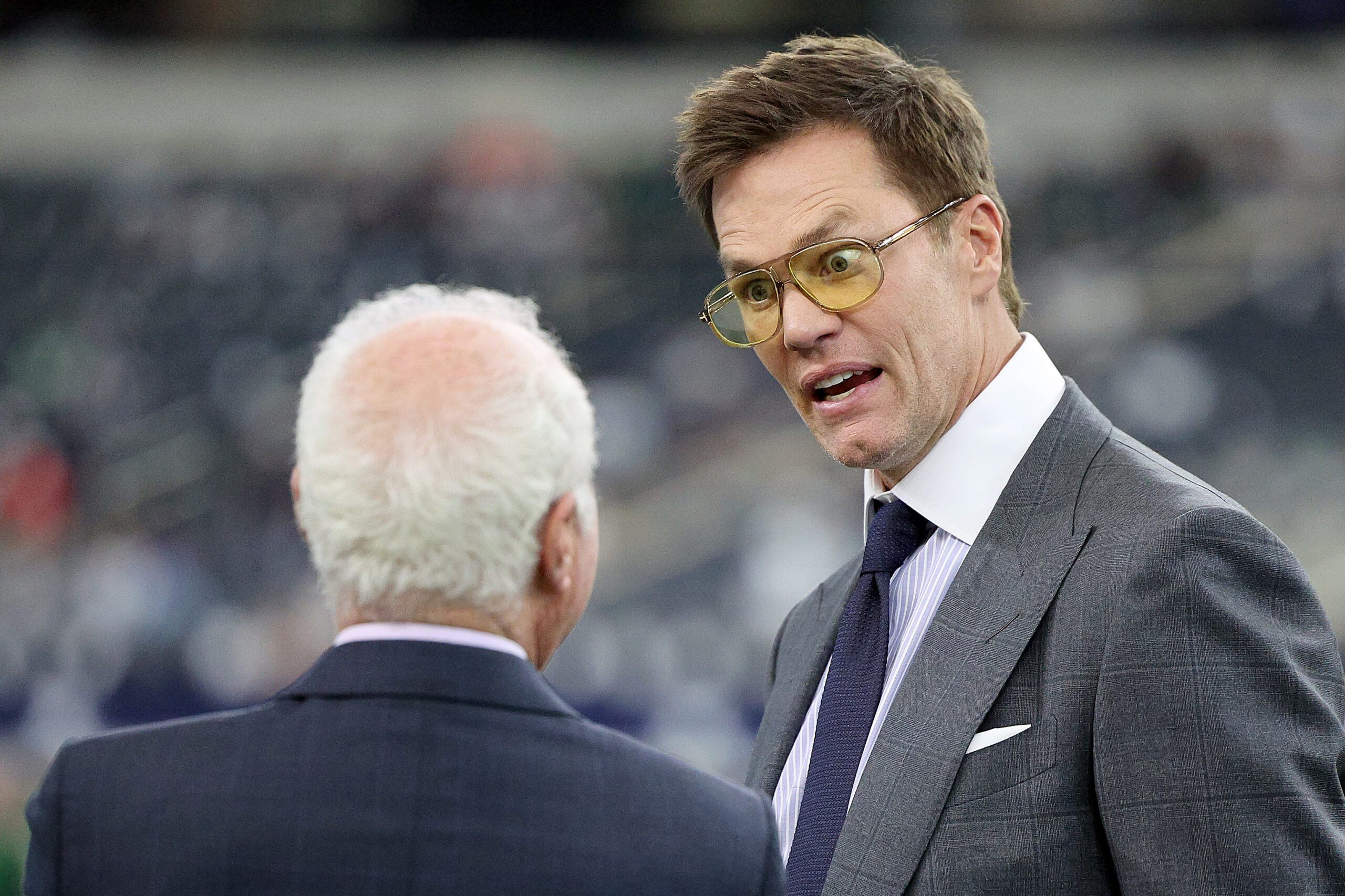
    That was never more apparent than Sunday, when Romo ruined the broadcast portion of an already ugly AFC championship game on CBS. Immediately afterward, Brady burnished a brilliant NFC title game for Fox. As on the field, the contrast in the booths was hideously stark.

    With only one game to go, it seems like a good time to review that most controversial of TV entities: NFL in-game analysts. Mike Tirico, broadcasting’s version of the vanilla milkshake, and Cris Collinsworth, who’s my No. 3, will present Super Bowl LX in two weeks on NBC. It will be fine, but it will be hard.

    Color commentary is vastly more difficult than you can imagine. I’ve done it a few times as an emergency replacement for a basketball broadcast, and, in the parlance of social media, I sucked.

    The job requires research, alertness, rhythm with a partner, familiarity with every coach, and mastery of the game’s history. It requires knowledge of rules, of strategy, of game-day procedures, of tendencies, of strengths and of weaknesses.

    Then, in real time, you have to explain what’s happening to millions of mildly inebriated fans, most of whom wouldn’t know a naked blitz from a naked blintz.

    It’s like a cardiologist describing heart surgery to Grey’s Anatomy fans.

    Tony Romo (left) turned heads early in his broadcast career, but his strengths have become less evident.

    The bashing of NFL booth analysts has become a weekend sport on social media. Keyboard warriors armed with pimple patches and analytics dissect every misspoken word or overlooked strategy, and they attack with verve and glee.

    That said, for years we were spoiled by masters of the craft, none better than Pat Summerall and his partner, the granddaddy of authentic commentary, John Madden, unburdened by the precision of high-definition television and, for the most part, by replay review. It was a simpler, better time.

    My job keeps me busy most football weekends. As a result, I’m not free to watch many other NFL games, and so I am less familiar with the flat-screen visitors to man caves and dens on weekends and Monday nights. However, thanks to Thursday Night Football, other prime-time and Sunday-morning broadcasts, and the Eagles’ recent abrupt exit from the playoffs, for the past few months I’ve been able to catch a few games.

    And … man, was I disappointed.

    Expectations

    I covered Romo and Brady extensively as players. It was hard to dislike Romo and impossible to like Brady. Now, it’s hard to listen to Romo and impossible to dislike Brady.

    I expected Romo to be a star.

    Having covered him extensively and having found him to be comfortable, affable, and knowledgeable, I was delighted with his “Romo-stradamus” debut with CBS in 2017. He seemed to correctly predict every big play call, then offer pointed commentary as to why it worked or why it didn’t.

    He seldom does that now. Instead, he constantly offers banal observations in the most excited of tones, often contradictory and seldom helpful. It’s just a lot of hyperbolic blather, never worse than in the moments after he talked over Jim Nantz following Patrick Mahomes’ game-winning touchdown pass in Super Bowl LVIII.

    On the other hand, I expected Brady to be a flop.

    I covered Robo-Tom in four of his Super Bowls, as well as many other big games, including the Battle of the Unbeatens in Indianapolis in 2007, when he and Randy Moss beat Peyton Manning. I was embedded in New England before the AFC championship game after the 2017 season. Never once did Brady give me any reason to expect he would be anything more than a wax statue in the broadcast booth.

    Wrong.

    Excellence

    It pains me to say that after an uneven debut in the 2024 season, which culminated with an unremarkable Super Bowl LIX broadcast of the Eagles’ win, Brady is getting better every week. As part of Fox’s first team, he often will correctly identify a penalty in real time so, when the play ends, he immediately reports who committed the penalty long before the official announces it. Troy Aikman used to do this with regularity, less so now. Collinsworth and Kirk Herbstreit often get this right, too.

    Brady’s voice sounds like it belongs to a JV basketball player, but he gets his point across. Brady just seems to know more about the game than the rest of the color commentators; or, at least, Brady seems to care more about teaching the game to viewers.

    His concise, clear dissertation on throwing techniques in windy conditions during the Eagles’ windy wild-card loss Jan. 11 was perhaps the best explanatory moment in the history of NFL broadcast booths.

    He was equally brilliant with his explanation Sunday of why Seahawks receiver Jaxon Smith-Njigba’s route-running is so efficient: “He maintains the same shoulder plane when he runs his route, so it’s really hard for any defensive back to get a bead on what he’s doing.”

    Madden, a college lineman and then an offensive line coach, introduced America to the intricacies of trench warfare. Collinsworth is great at diagnosing coverages. Romo, meanwhile, seldom provides a level of detailed technique insight for any position, much less quarterback, receiver, and defensive back, the positions with which he should be most familiar.

    Should Tom Brady’s ownership stake in the Raiders be an issue in his broadcast work?

    Why these two?

    Why does any of this matter? Why pick on Romo, in particular?

    Because Romo is in the middle of a 10-year, $180 million deal that expires after the 2030 season, which makes him the second-highest-paid NFL analyst. CBS reported that it just enjoyed its best season ever, and the network debunked rumors that his future might be in peril. So, at 45, he isn’t going anywhere.

    Fox, meanwhile, was roundly criticized for giving Brady a 10-year, $375 million contract that began in 2024, which made him the highest-paid booth analyst in sports despite his complete lack of experience.

    They’re at the top of the food chain. At least Brady belongs there.

    Incredibly, this was just his second season in the booth. Brady still lacks the strategic chops of, say, Greg Olsen, whom Brady replaced as Fox’s No. 1 color commentator last year, but Brady’s already better than Romo ever was.

    Should Brady continue to be allowed to own part of the Las Vegas Raiders while acting as an analyst? That’s an entirely different conversation. Have at it. I generally figure that leagues can do whatever they want, within the constraints of the law. Besides, any insider information Brady gleaned during his weekly preparation as a Fox analyst certainly didn’t help the Raiders much. They went 7-27 the last two seasons.

    As for his primary vocation: Will Brady, who is 48, be the G.O.A.T. in the booth, as he was on the field?

    Probably.

    Even some of those who disliked Troy Aikman (left) as a player can begrudgingly acknowledge his strengths as a color analyst.

    The ranking

    Madden remains unmatched.

    ESPN’s Aikman remains the best and easiest listen in my book, and has been for most of the last 25 years. Then, Brady.

    Collinsworth annoys people, but I think that’s a byproduct of his natural smarminess, because he’s a perfect complement to Tirico’s earnestness.

    I think I’m in the minority when I say I enjoyed Herbstreit on Amazon Prime, at least I did early this year. In the fourth year of a five-year deal, the college football mainstay seemed to come into his own as an NFL commentator this fall. However, he routinely travels thousands of miles every week covering both pro and college ball, and the toll began to show in his commentary later in the NFL season. He’s a free agent after next season, and he’ll be 57. Hopefully, Herbstreit will dial things back and concentrate on the NFL.

    Romo now comes in last.

    This feels a little like punching down. Romo seems to be doing his level best. Maybe he’s a victim of the lofty expectations his early years created. Maybe he’s been coached to be more expressive and less technical.

    Romo’s current slump reminds me of the point in his career when, after a promising first six seasons as a starter, he led the NFL in interceptions in 2012. Romo then had his best season in 2014 before injury forced him to the booth.

    Maybe he can rebound in this career, too.

    But, as in the NFL, Romo will never catch the G.O.A.T.

  • Joanna McClinton has carefully wielded her power as Pa. House speaker. Now she’s speaking out for home care workers.

    Joanna McClinton has carefully wielded her power as Pa. House speaker. Now she’s speaking out for home care workers.

    On a below-freezing day in January, Pennsylvania House Speaker Joanna McClinton delivered food to a West Philly home just minutes from her district office and listened as Sheila Alexander discussed the patchwork of care she has created for herself.

    Alexander, 67, who struggles to get around on her own, explained that she depends on family often but uses a Medicaid-funded home health aide who helps her in the evening — especially when she needs to get up the steep stairs in her home.

    McClinton is advocating for the aides who care for Alexander — and the rest of the roughly 270,000 Pennsylvania workers who make up the home care industry — to earn a higher wage.

    Pennsylvania’s home healthcare workers are among the lowest-paid in the region at an average $16.50 per hour, resulting in what the Pennsylvania Homecare Association has called a crisis point for home care, as more and more workers leave the field and seniors struggle to find help. And it’s a crisis that may only deepen in future years, as one in three Pennsylvanians are projected to be 60 or older by 2030.

    It’s an issue that McClinton, a Philadelphia Democrat who became House speaker in 2023 when her party took a one-seat majority, has had to contend with in her own life.

    McClinton’s 78-year-old mother lost one of her favorite aides because of low pay, she said. The aide had cared for McClinton’s mother for a year, until the aide’s daughter got a job at McDonald’s that paid $3 more an hour. At that point, McClinton said, her mother’s aide realized just how low her pay was.

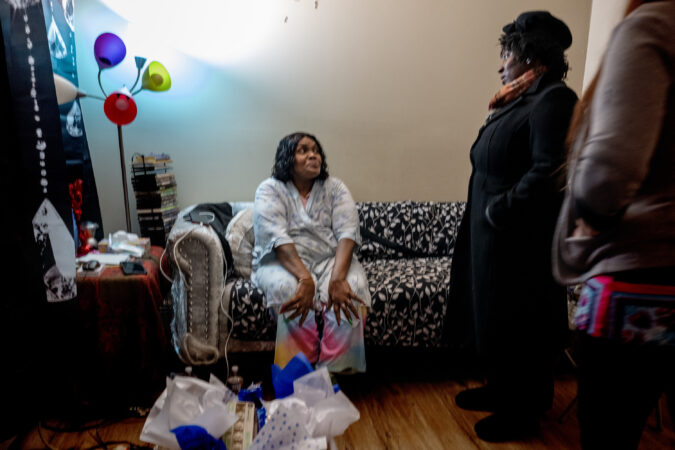
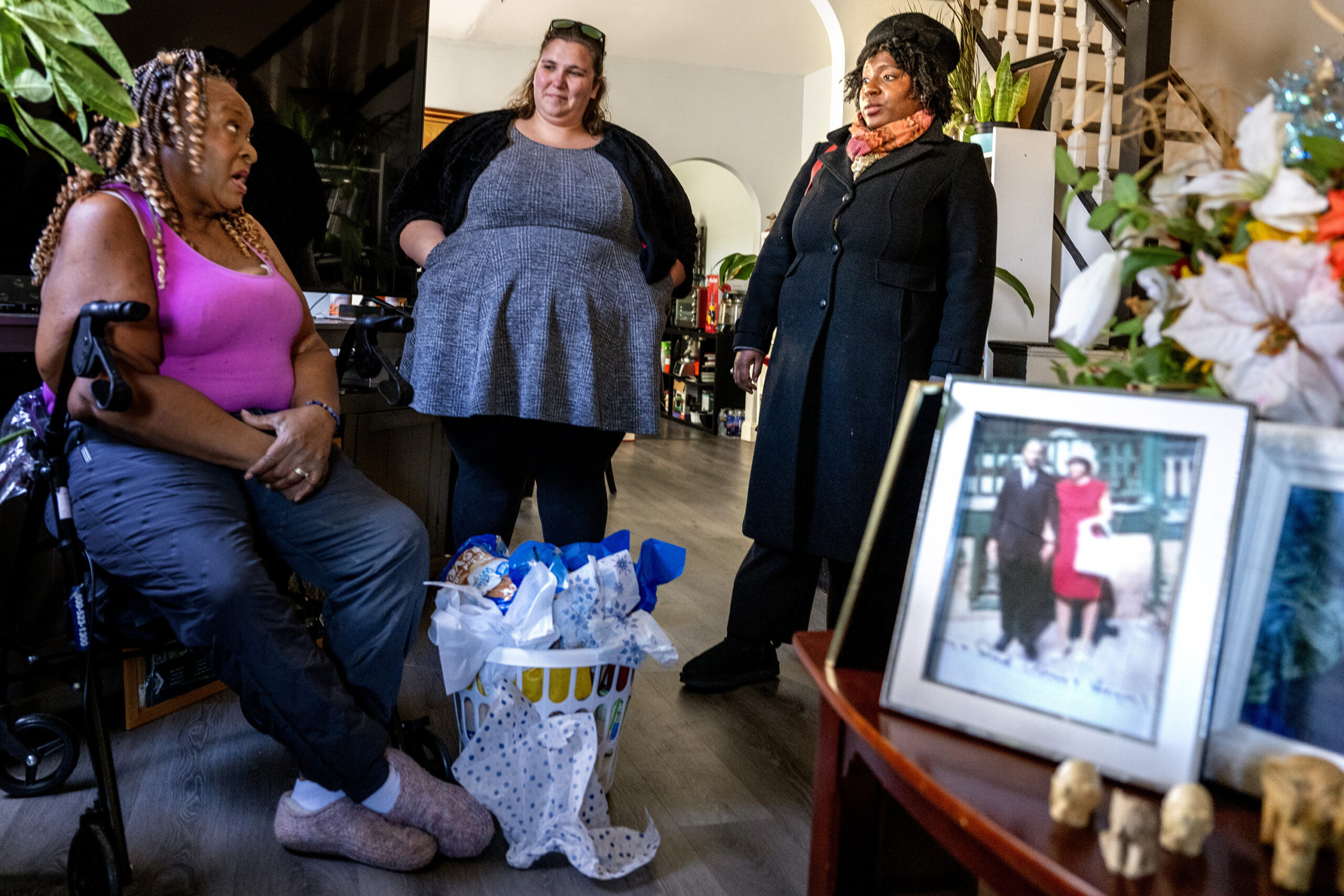
    House Speaker Joanna McClinton (center) with her staff member Nicole Reigelman (left) and home care worker Kate McNaughton (right) wait to meet with home care recipient Ronda Gay on Jan. 20 in her West Philadelphia home. McNaughton was bringing a basket of milk, eggs, canned foods, and other necessities.

    McClinton said she helps her mother when she can, but she only has so many hours in the day and needs assistance when she’s at the Capitol.

    “Many of my colleagues are just like myself, supporting parents who are aging and trying to make sure that they have all the necessities so that when I’m in Harrisburg I’m not thinking, ‘Oh, my God, how’s my mom going to eat or how’s she going to have a bath,’” McClinton said. “It’s because of home health aides and the folks assigned to her that she’s able to thrive. But she’s not unique.”

    Until recently, McClinton had taken a more hands-off approach compared with some previous House speakers who would use their position as the top official to push through their personal agendas. Now, she is taking a more active role in pushing for the issues she cares about most, with special attention to the home care wage crisis.

    Home care workers are often paid through Medicaid, which provides health services to low-income and disabled Americans and is administered at the state level. Pennsylvania has not increased how much it reimburses home care agencies, resulting in all of the surrounding states paying higher wages to home care workers, including GOP-controlled West Virginia and Ohio.

    Describing her leadership approach with a slim majority as “pragmatic,” McClinton says her goal is to find common ground to raise the wages for home healthcare workers between Republicans and Democrats, on an issue that impacts residents across all corners of the state.

    “We just have to really coalesce and build a movement so that we see things get better and that there’s more care,” she said. “Because when there’s more care, there’s less hospitalization, there’s less ER trips, there’s more nutrition.”

    Better pay at Sheetz

    Stakeholders recount dozens of similar stories of aides leaving to work at amusement parks, Sheetz stores, or fast-food restaurants because the pay is better. What’s more: Some home health aides will choose to work in a nearby state where wages are all higher than those paid in Pennsylvania.

    Cathy Creevey, a home health aide who works for Bayada in Philly, made $6.25 when she started working in the field nearly 25 years ago. Now, she makes just $13.50. She has watched countless colleagues quit to take higher-paying jobs elsewhere, resulting in missed shifts and seniors that go without the care they need.

    “We have patients that are 103, 105, and when that aide doesn’t show up their whole world is turned upside down because sometimes we’re the only people that they see to come in, to feed them, to bathe them,” Creevey said.

    While Creevey said she stays in the work because she cares about her patients, she said the long hours and low pay are difficult.

    Fewer and fewer people being willing to take on the jobs means seniors going without care or being forced into already understaffed nursing homes throughout the state.

    “Participants are waiting for care that isn’t coming,” said Mia Haney, the CEO of the Pennsylvania Homecare Association.

    Haney said she hoped McClinton’s advocacy will help drive the issue heading into the next budget season.

    “She has a wonderful opportunity to really influence her peers, but also raise awareness and education about how meaningful and critical these services are,” Haney said.

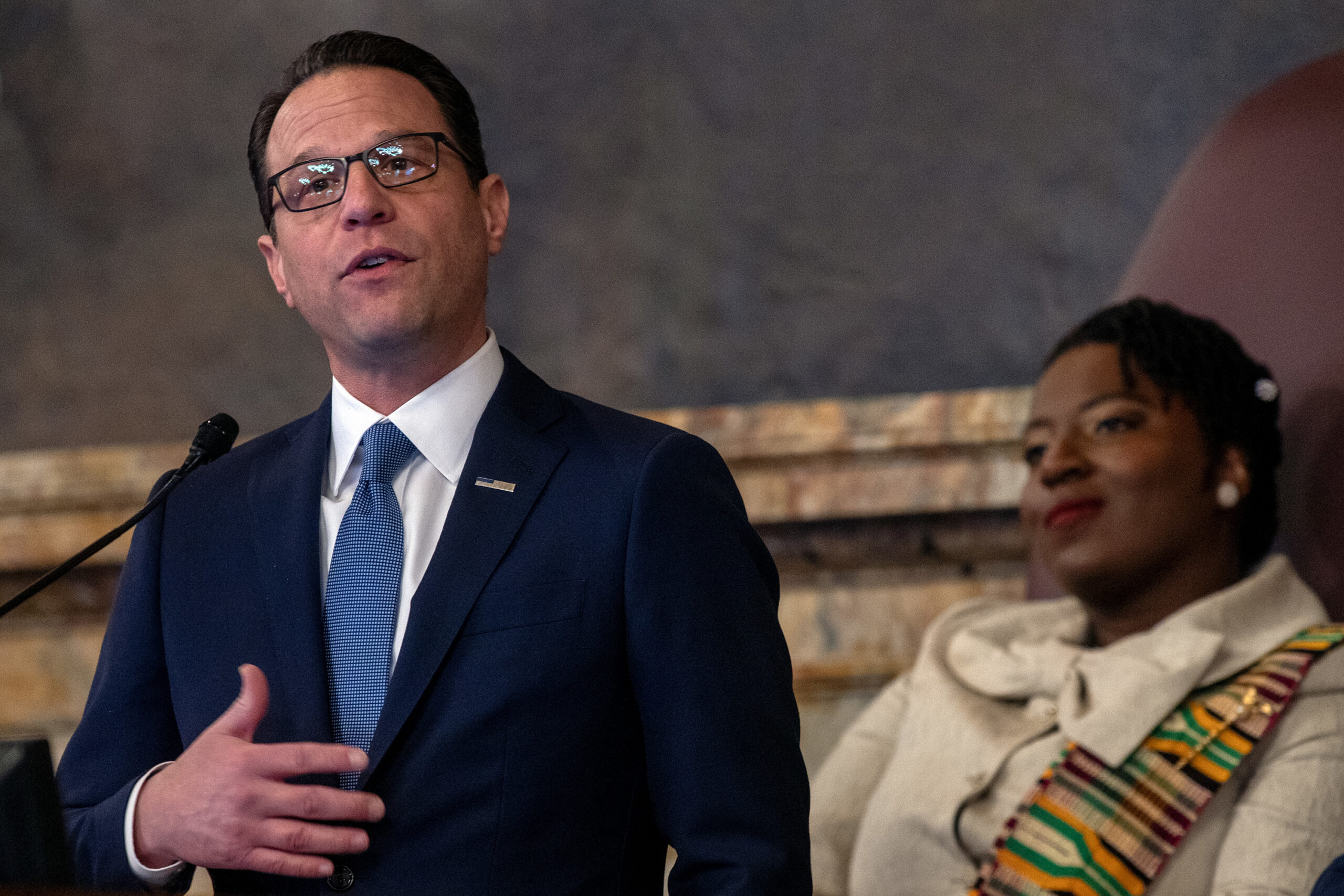
    In addition to McClinton’s advocacy, 69 House Democrats sent a letter to Gov. Josh Shapiro earlier this month, calling for more funding for the struggling industry just as Shapiro is set to make his 2026-27 budget proposal next month.

    Older Pennsylvanians prefer to “age in place,” or stay in their homes where they remain connected to their communities, said Kevin Hancock, who led the creation of a statewide 10-year strategic plan to improve care for the state’s rapidly aging population.

    “Nursing facilities and hospital services get a lot of attention in the space of older adult services, but it’s home care that really is the most significant service in Pennsylvania,” Hancock said. “The fact that it doesn’t seem to warrant the same type of attention and same type of focus is pretty problematic.”

    House Speaker Joanna McClinton (right) meets with home care worker Rachael Gleisner (center) and home care recipient Sheila Alexander in her West Philadelphia home on Jan. 20.

    Home care remains popular in Pa.

    The fight to increase dollars for home care workers has been an uphill battle in Harrisburg even with the speaker’s support.

    More Medicaid dollars go to home care services than any other program in Pennsylvania due to its popularity among Medicaid recipients, Hancock said. Meanwhile, its critical care workers — a majority of whom are women or women of color — still make low wages for often physically and emotionally demanding work.

    A study by the Pennsylvania Department of Human Services last year determined that a 23% increase would be necessary for agencies to offer competitive wages, but the state’s final budget deal did not include it. (The final budget deal did provide increases to direct aides hired by patients, which represent about 6% of all home care workers in the state.)

    Home care agencies are asking Shapiro to include a 13% reimbursement rate increase in the 2026-27 budget, which equates to a $512 million increase for the year. The 13% ask, Haney said, was a “reasonable and fair” first step in what would need to be a phased approach to reaching competitive wages.

    But neither Shapiro nor Senate GOP leadership has committed to any increases in the forthcoming budget.

    Pennsylvania House Speaker Joanna McClinton listens as Gov. Josh Shapiro delivers his budget address to a joint session of the state House and Senate at the State Capitol on Feb. 4, 2025.

    In a statement, a spokesperson for Shapiro said the governor understood the need and cited his support for limited increases in last year’s budget and for a proposed statewide minimum wage increase to $15 per hour. (Previous efforts by the Democratic House to increase the state’s minimum wage have stalled in the GOP-controlled Senate.)

    Senate Majority Leader Joe Pittman (R., Indiana) said his caucus will put the state’s “future financial stability” before all else. Pennsylvania is expected to spend more than it brings in in revenue this year, setting the stage for yet another tense budget fight.

    “While we’ve seen Democrats continually push for more spending within the state budget year after year, any increases require thoughtful consideration as to the impact on hardworking taxpayers of Pennsylvania,” Pittman added.

    Senate Majority Leader Joe Pittman, a Republican from Indiana County, is joined by other GOP Senate leaders criticizing Gov. Josh Shapiro’s proposed budget last year.

    McClinton, however, was cautiously optimistic that something could be done this year, even as she placed the onus on Senate Republicans, rather than Shapiro.

    “We’ve seen Republicans refusing to work, refusing to resolve issues, that’s not acceptable,” McClinton said. “I’ve seen an unwillingness from Republicans to resolve these issues.”

    Republicans, she said, should come to the table because staffing shortages harmed their constituents in rural Pennsylvania even more than it harmed hers in Philly.

    “We have to get our heads around the fact that we have the lowest reimbursement rates in our area,” McClinton said in an interview after visiting two patients in her district. “We have to make the investment now. We have lots of needs. We have lots of priorities, but we can balance them.”

  • Philly’s building plan would close this high-performing magnet. Lankenau is fighting back.

    Philly’s building plan would close this high-performing magnet. Lankenau is fighting back.

    There’s no place in Philadelphia like Lankenau High School.

    It is the city’s environmental sciences magnet school and the state’s only three-year agriculture, food, and natural resources career and technical education program. It’s set amid 400 acres of woods, with neighbors including a vast environmental center and farm that are active partners with the school. Lankenau’s students have access to dual enrollment and an impressive array of internships.

    But Lankenau just landed on the Philadelphia School District’s closing list, one of 20 schools proposed to shutter for the 2027-28 school year as the district grapples with 70,000 extra seats citywide, billions in unmet capital needs, and a desire to modernize and bring equity to student experiences in the school system.

    The Lankenau community is already gearing up for a fight ahead of a school board vote on the proposal, expected this winter. Community members say the school must be saved because it is one of a kind, offering immersive education in agriculture and sciences and boasting a 100% graduation rate that’s rare in Philadelphia.

    Shutting “the Lank” would be a disastrous move, said Jamir Lowe-Smith, a junior at the school. The district’s proposal would merge Lankenau into Roxborough High as an honors program, but you cannot replicate what his school has built anywhere else, Lowe-Smith said.

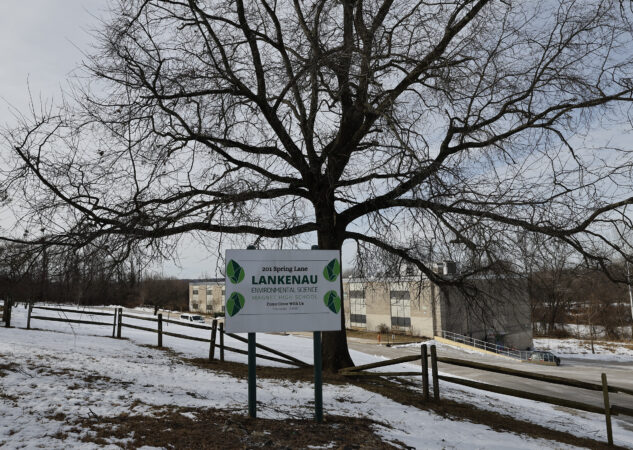
    The Lankenau Environmental Science Magnet High School in Roxborough. The district’s proposal would merge Lankenau into Roxborough High as an honors program.

    “Lankenau takes education to the next level,” said Lowe-Smith, president of the school’s chapter of Junior MANNRS — Minorities in Agriculture, Natural Resources, and Related Sciences — which preps students for jobs in the growing green sciences industry.

    “The environment is beautiful, the woods are — that’s another classroom,“ Lowe-Smith said. ”Nature is like therapy for a lot of people — it changed my life.”

    Being tucked into the woods allows for a Friday advisory bird-watching club at Lankenau and research in a stream that leads directly to the Schuylkill. It lends itself to tick drags — studies of tick species — pesticide classes that will allow students to graduate as certified pesticide applicators, and work with school beehives. Its students engage in innovative project-based learning every day.

    Lankenau students all receive yellow school bus transportation because the campus is not close to any SEPTA routes — adding to the district’s expense to keep it open.

    The school is small — its building, on Spring Lane in Upper Roxborough, is about half full, enrolling about 250 in a building that can accommodate 461. But the recommendations for closing need to be about more than numbers, said State Rep. Tarik Khan, a Democrat whose district includes that area.

    “Respectfully, the recommendation to close Lankenau is one of those things that doesn’t make sense when you look at the full picture,” Khan said. “Right now, it’s a recommendation. Early on, it’s important just to say: This is the wrong decision. I will elevate my voice throughout this process, and I’m not alone.”

    Monique Braxton, a district spokesperson, said the Lankenau recommendation “reflects the district’s commitment to reinvesting in neighborhood high schools as community anchors — a guiding theme of the Facilities Master Plan that received overwhelming support in the recent community survey. This approach expands access to high-quality academic programming and resources across neighborhoods, creating greater opportunity for more students and supporting stronger academic outcomes and postsecondary readiness.”

    Firing on all cylinders

    Lankenau, Khan said, is “firing on all cylinders. The school has so many opportunities for students, so many connections. To take this school out of its environment will break a lot of those connections, will break the cohesiveness.”

    The school lacks a gym. But its students play flag football, hike in the woods, and practice archery. It has a 100% graduation rate, officials say, educating a student body that is primarily Black and brown, with 25% of students requiring special education services.

    Jessica McAtamney, Lankenau’s principal for the last five years, stressed that the school is “doing urban agriculture in a very unique campus setting that is anchored in the space. Agriculture is Pennsylvania’s No. 1 industry. Lankenau is preparing kids to do that. This campus is what allows us to do that.”

    Roxborough High School, by contrast, is in a dense, residential area. Its building, which can hold almost 2,000 students, is about three-quarters empty.

    Like many in the Lankenau community, Erica Stefanovich — who teaches the only Intro to Geographic Information Systems high school course in the city, she believes — was blindsided by word that the school was earmarked for closure.

    “They can say that our building condition is an issue, but how is our building a problem when we have air-conditioning, zero asbestos, and they put a brand-new roof on our school two years ago?” Stefanovich said.

    In 2006, the district actually made plans to expand the Lankenau building, going so far as to contract with an architectural firm to make a model. But those plans went by the wayside as the school system hit rocky financial waters in the early 2010s.

    No slight against Roxborough, Stefanovich said. It does have a park close by, but “we can’t do mussel experiments in that park. We can’t do our internships that our students love. How do we have beehives when there isn’t enough pollinator space around Roxborough High School to have beehives? Our seniors are out of the building 40% of the time; they are off doing things. If we move, we don’t have that.”

    District changes yielded fewer incoming students

    Lankenau used to educate more students.

    Before the district changed its school selection process, in 2021, instituting a centralized lottery in the name of equity, the school had bigger incoming classes. It’s a magnet, meaning students have to have certain grades and test scores to qualify, but in the past, administrators had some leeway to let in students who were close to qualifying if they were a good fit.

    And though district officials said changes to the admissions procedure were necessary to ensure that schools’ demographics mirrored the city’s, Lankenau did not have a diversity problem prior to the changes.

    Lankenau had 106 ninth graders in 2020-21, before the lottery. It dipped to just 28 freshmen in 2023-24, but after a number of parents and administrators raised concerns about the process, some course corrections were made.

    Its numbers are now rising again. Seventy-eight ninth graders entered this school year, and 107 students listed Lankenau as their top choice for the 2026-27 freshman class.

    Even if the proposed school-closing changes go through, Wyntir Alford, a Lankenau 11th grader from West Oak Lane, will be able to graduate from the school as-is — the change is not planned to take effect until the 2027-28 school year.

    But her family was clear: If the closing were happening next year, Alford would have had to transfer.

    “My mom told me her first thought was, ‘There’s no way she’s going to Roxborough.’ She said, ‘The reason we put you in Lankenau is because of all the opportunities and all the nature around.’ I’m not surrounded by any nature at home. So to be able to go to a school like this is a big deal.”

    A student tests a water sample in a Lankenau High school science class in this 2023 file photo.

    Juniper Sok Sarom, a current Lankenau ninth grader, is not sure whether she will transfer to Roxborough if the school board approves the closure recommendation. But she knows she’s happy at a school that gives her plenty of hands-on experience.

    “Our campus — it’s a special learning environment, which you wouldn’t get at any other school, not even Central or Palumbo or SLA,” Sarom said, referring to Science Leadership Academy.

    She and others are gearing up to fight the changes, they said.

    Charde Earley, a Lankenau paraprofessional, dealt with her own sadness the day students found out about the proposed closure, working through tears. And then she marveled at how students pivoted to problem-solving, resolving to write letters and speak at meetings.

    “My motto is, respectfully, ‘Hell, no, we won’t go,’” Earley said. “We’re secluded and we’re safe. You never know what hardship our kids are going through. Imagine what this is doing to our kids.”

  • ‘Phillies Extra’ Q&A: Rob Thomson on managing the Bo Bichette aftermath, Nick Castellanos, and more

    ‘Phillies Extra’ Q&A: Rob Thomson on managing the Bo Bichette aftermath, Nick Castellanos, and more

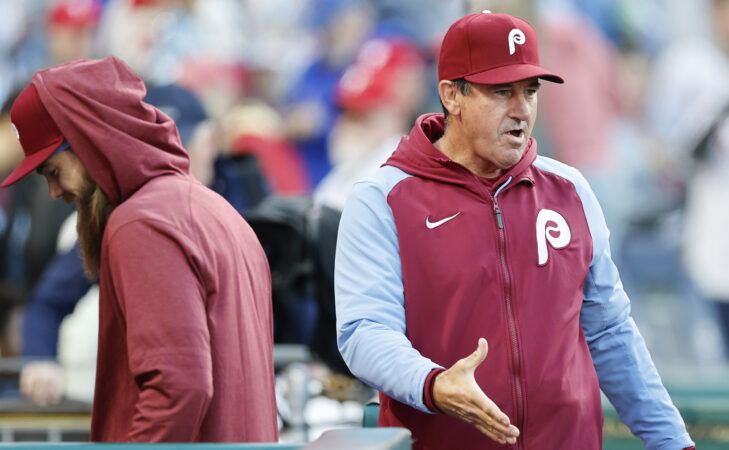
    Later this week, Rob Thomson will gas up his truck near his home in Ontario and begin the drive to Clearwater, Fla., for spring training.

    “As you go further south, it gets warmer and warmer, and you really feel like baseball’s back,” the Phillies manager said. “And I’m really looking forward to it.”

    First, Thomson was a guest on Phillies Extra, The Inquirer’s baseball podcast. He discussed a variety of topics, including how the organization will get over its collective disappointment at not signing Bo Bichette, the value of J.T. Realmuto, moving on from Nick Castellanos, and more.

    Watch the full interview below and subscribe to the Phillies Extra podcast on Spotify or Apple Podcasts.

    Q: You pushed back the other day on the notion that the Phillies are “running it back.” I think the question heading into the 2026 season is not so much about running it back. I think the question that people should be asking is, are you better today than you were at the end of last season? How do you feel about that?

    A: I think it’s to be determined, but I feel better about it. You know, we lose Ranger [Suárez in free agency to the Red Sox], and that’s a big loss. But that’s part of the business, too. I do feel really good about our bullpen. We lose Matty Strahm, who was a big part of our bullpen, but the addition of Brad Keller, who can get both sides out, the addition of Jonathan Bowlan, who I think is a really good two-inning guy that can get righties out. We got some stuff for him to get lefties out. This left-hander, Kyle Backhus, he looks really good. He’s really interesting. He’s got a really low arm slot. So I’m really excited to see these guys. I think we’ve got a really good fit here.

    I’m excited to see Adolis García. I think there’s a chance he bounces back. I think with Adolis — and I can’t speak for him — but in being with Texas last year, with the expectations they had, with all the injuries they had to [Corey] Seager and [Marcus Semien], and I’m wondering if he didn’t try to put the team on his back and put a little bit too much pressure on himself. So maybe he can come in here and just kind of slide into the group and get back to where he was.

    I’m excited about [Justin] Crawford. We heard all about him last year [in triple A]. Everybody kept asking me, ‘When’s he coming? When’s he coming?’ It just didn’t happen. But now it looks like it’s going to happen, so I’m excited about that. The speed, the small ball, the on-base ability, it’s really exciting to me to have him hit at the bottom of the lineup and turn the lineup over.

    And with Andrew Painter on his second year coming off Tommy John [surgery], I think this is the year where he probably gets really close to being back to normal. And if he’s close to being back to normal, he’s really something. So, there’s a lot of really good things going on.

    I think because of the Bichette thing, a lot of that stuff gets overlooked a little bit, and I understand that. But I certainly don’t want the people of Philadelphia to think that we’ve gone in a different direction, and we’re not committed to excellence, committed to winning, and committed to winning world championships because that will never change. We are fully committed to all of that. And we’ve just got to get to the playoffs, but we’ve got a really good club, and we’ve got to play better in the playoffs.

    Q: If the Phillies signed Bichette, a lot of dominoes would’ve fallen in line behind that. Realmuto might not be here; Alec Bohm might not be here. What’s your read on everyone’s mindset in the aftermath of not signing Bichette and where guys stand in terms of knowing, ‘OK, I’m here now and this is what it’s going to be?’

    A: Yeah, it’s a good question. And I think for the most part, professional athletes and our guys, because we’ve got a pretty experienced club, they understand the business side of it. They understand that things happen and things don’t happen, and they have to just keep moving forward and just stay focused on what they need to do and what they can control because they’ve been through it quite a bit — trade, free agency, trade rumors. So, it’s all part of the business. I think they understand that. And now that we’re past that, I think they’re ready to go.

    Q: You were a catcher. Is there an example you can give that maybe illustrates why Realmuto is such an asset in terms of game-calling and handling a pitching staff? And what you might have missed if things had gone differently with Bichette and J.T. wound up somewhere else?

    A: I was looking through it the other day, just OPS numbers with J.T. catching with our pitchers. ERA numbers with J.T. catching with our pitchers, and it’s really amazing how good it is. And obviously, our pitchers are good. But when you can stand out on the mound and you can relax and you understand, and you know that guy behind the plate has spent two hours prior to the game preparing for me, for that guy standing on the mound, it gives you a lot of confidence. And you can measure the caught-stealing rate of 30%, so that’s still really good. I don’t know what the receiving numbers are, but it seems like he’s really good.

    The way he runs the game, and he can slow down the heartbeat of the team and the heartbeat of the game just by his presence, just by when he goes to the mound, when he calls timeout. You can’t measure all of that. And I’ve said it before, I’ve had [Jorge] Posada, I’ve had Brian McCann, I’ve had Pudge Rodríguez, I’ve had Russell Martin. He’s as good, if not better than all of them. He’s kind of in the same mold with Russell Martin, as far as the body, what kind of shape he’s in, his durability. So, I know J.T. is 35, but he’s playing like he’s in his late 20s. That’s the type of body he’s got and the energy that he brings. He brings so much, and I’m so happy that we have him back. I really am.

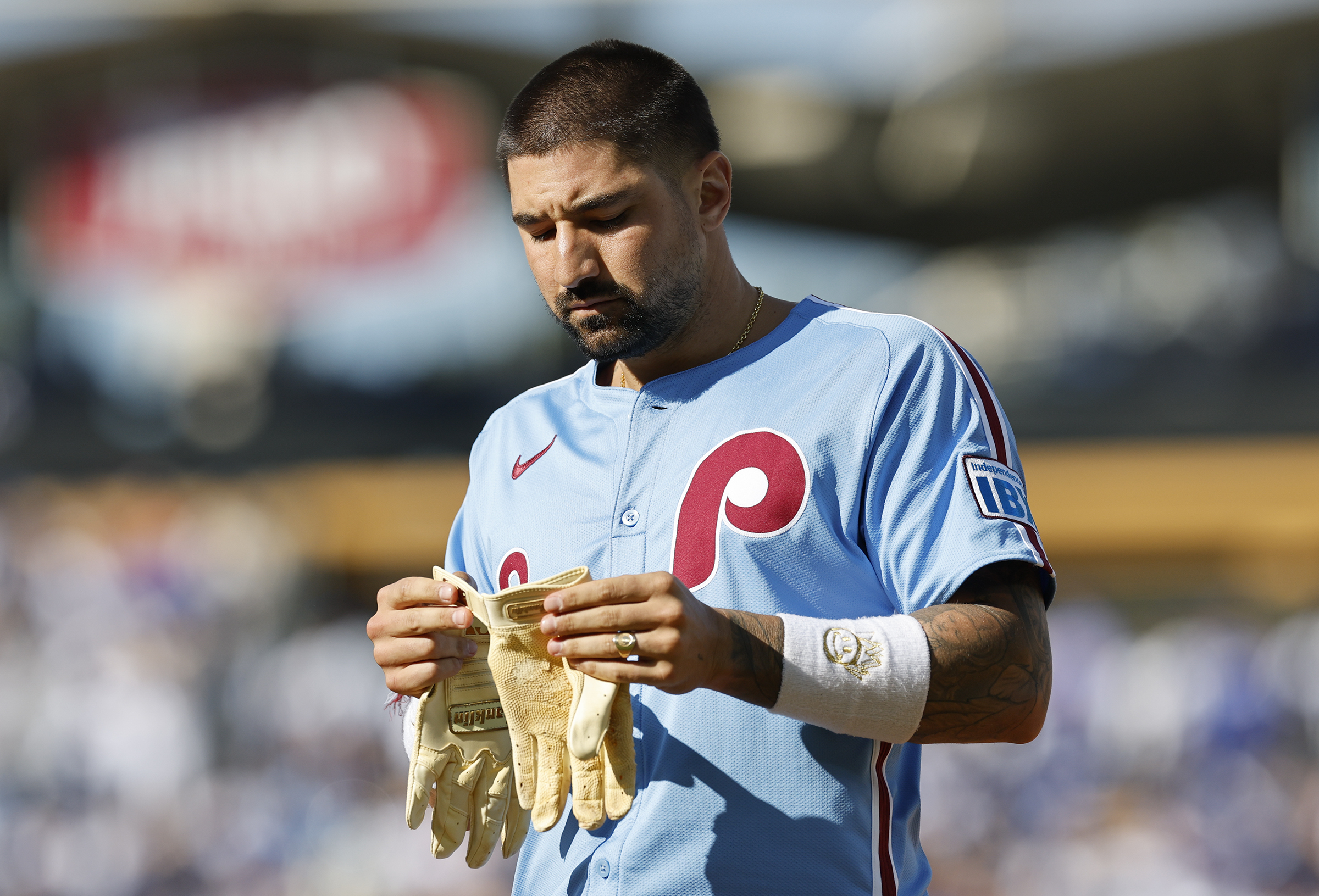
    Right fielder Nick Castellanos is not in the Phillies’ plans for 2026.
    Q: Dave Dombrowski said the other day that the plan is still to move Nick Castellanos, one way or another. I wonder if you could reflect on all that happened with Nick last season, from the situation in the dugout in Miami in June to reducing his playing time in the summer and then September, and the comments that he made. You pride yourself on communicating with players. Was it difficult to navigate that situation last year and make sure that it didn’t cause a larger disruption?

    A: Yeah, you always try to keep the noise down because there’s always little things that happen, and I feel terrible that any player would feel like I didn’t communicate well enough, because I pride myself on that. I want players to not be confused. I want them to understand exactly what’s going on, and if there’s something going on with them that my door is always open, and I expect them to come in and they need to communicate with me, too, because I don’t know. I’m not a mind reader. So, it was just a difficult situation. The thing with Nick, the bottom line is, he wants to play every day. He wants to play every inning, every day, and you can’t fault him for that. I think I respect him a great deal, just for being that guy.

    Q: Is there an idea yet of when Zack Wheeler might get on a mound? And do you have an idea for his state of mind coming off this pretty big surgery five months or so ago? Where does he stand in terms of his confidence level that he could come back and be Zack Wheeler?

    A: He feels really good, and I’m really encouraged by it. I don’t have a date when he’s going to get on the mound, but he’s getting stronger. The ball flight keeps getting better every time he throws a baseball. The release point is getting more consistent every time he throws. He’s got certain goals, like he wants to start the season with us. Whether that’s going to happen or not, that’s up to the trainers and the medical people and the doctors. But he wants to be an All-Star. He’s got goals. So, that’s good. He’s got a carrot out there that he’s after, so that’s good. This whole rehab process could take up to eight months, generally. I think he’s probably going to be a little bit ahead of that. Whether he’s on our opening-day roster, I’m not really sure. Don’t want to push him, for sure, because we want a healthy Zack Wheeler. We want him back to normal, and I believe he’s going to get there.

  • They own their homes but not the land. In N.J., a new law could help change that.

    They own their homes but not the land. In N.J., a new law could help change that.

    Manufactured homes — single-family dwellings often built off-site and placed on a lot — are one of the most affordable forms of homeownership. But families who live in these homes are often left vulnerable, because companies that own the land can hike rents for their lots or sell communities for redevelopment.

    This type of unsubsidized affordable housing tends to be more accessible for low-income households than typically built homes.

    A bill that former N.J. Gov. Phil Murphy signed last week makes it easier for manufactured home and mobile home residents to buy their communities when a landowner decides to sell or change the use of the land.

    Landowners who want to sell or redevelop these communities must give notice to residents and local and state leaders. If 51% of residents agree to purchase the community, and they meet the price and conditions of the sale, they have 120 days to buy it. Previously, this action required two-thirds of residents, who had 45 days to sign a contract.

    Lawmakers found that the prior parameters were too high of a bar for residents to meet.

    New Jersey’s new law is based on model legislation from the National Consumer Law Center. There are more than 1,000 resident-owned mobile and manufactured home communities across the country. None are in New Jersey.

    Almost 100,000 New Jersey residents live in 250 manufactured or mobile home communities, many of which are in South Jersey, said State Assembly member David Bailey Jr., a Democrat who sponsored the legislation and represents residents in Gloucester, Salem, and Cumberland Counties.

    Imagine you’ve owned your home for 20 years and “somebody comes and says, ‘We’re selling this land and you either follow these new rules or you gotta move,’” Bailey said. “That would never happen in suburbia. But that’s what could happen to these people. Because they have no choice. They’re stuck.”

    He said that when he took office in 2024, he immediately started getting calls from constituents in Salem County who lived in manufactured home communities. They told him about rising costs to rent the land their homes were on and deteriorating property conditions and infrastructure in their communities.

    Many of the properties had been owned by local families who later sold the land to companies that hiked rents, Bailey said. In 2022, the CEO of the Lincoln Institute of Land Policy said that in the prior eight years, roughly 800,000 home sites in manufactured housing communities were bought by private equity companies and other institutional investors. Rent hikes tended to follow.

    Another recent New Jersey law addresses this reality.

    In July, the state enacted a law that caps annual rent increases at 3.5%. Landlords who want higher increases must ask the state’s Department of Community Affairs for permission.

    After an earlier version of the legislation passed the state Senate this spring, Sen. Paul Moriarty said in a statement that the usual renting setup of mobile and manufactured home communities “often leads to unfair price hikes by landlords, as they know that there is no other option besides moving the home to another site.”

    Moriarty, a Democrat who represents residents in Gloucester, Camden, and Atlantic Counties, noted that moving these homes to different sites can be “incredibly difficult” because of “potential difficulties in financing a move, exclusionary zoning practices, and restrictions on the age and condition of incoming homes.”

    A previous version of this story misstated the number of mobile homes purchased by private equity companies. It is roughly 800,000 manufactured home sites.

  • Yes, there are bats in her Berks County home — and she’s trying to save them all

    Yes, there are bats in her Berks County home — and she’s trying to save them all

    Stephanie Stronsick has bats in her Berks County house. On purpose.

    “Aw, look at her little face,” Stronsick said about an injured brown bat her husband was holding on a recent winter afternoon.

    Stephanie Stronsick is the founder of PA Bat Rescue in Berks County.

    Stronsick, 42, is the founder and executive director of Pennsylvania Bat Conservation and Rehabilitation (PA Bat Rescue), a nonprofit that underwent a major overhaul last year.

    She’d like the bats to leave, ideally, but only after they’ve healed. Currently, the facility is treating over 100 bats for injuries and illness. Some were struck by wind turbines or bonked their heads on tall urban buildings that don’t turn off their lights at night. Others were torn up by outdoor cats or birds of prey.

    Some big fruit bats, which look like puppies, were hanging upside down in one room. They used to live at the Akron Zoo.

    Like the other bats in Stronsick’s house, they were asleep.

    “They’re all retired,” she said.

    Many of Stronsick’s bats are being treated for white-nose syndrome, a fungal disease that has killed millions of bats in North America. In Pennsylvania, it’s estimated that 99% of cave-dwelling bats have been affected by the fungus during hibernation.

    “We’ve lost so many bats that we’re at a point where if we don’t do something, they’re going to be gone,” Stronsick said. “In my lifetime, we are looking at the extinction of two species that occur in Pennsylvania: the Northern long-eared bat and the tricolored bat.”

    Northern long-eared bat. (Wisconsin Department of Natural Resources via AP, File)

    Bats get a bad rap, Stronsick said, thanks to horror tropes, rabies fears, and the overhyped interest in vampire bats. Only three of the approximately 1,500 bat species drink blood, and they’re in Central and South America.

    “I think all bats are adorable,” she said.

    If the general public doesn’t see that, they should at least understand that the flying mammals are biologically fascinating, contribute to healthy ecosystems, and help scientists.

    “If it wasn’t for bats, the military wouldn’t have radar, and anticoagulants that vampire bats use have been studied to treat blood clots and stroke,” said Greg Turner, a mammalogist with the Pennsylvania Game Commission.

    Bats, Turner said, are also highly resistant to cancer.

    In Pennsylvania, bats are insectivores, Turner said, and they eat nothing but flying insects at night. He said studies have shown that bats in Pennsylvania save farmers $74 per acre, by eating moths that would otherwise produce crop-eating caterpillars.

    “They also eat mosquitoes,” he said.

    Elsewhere in the world, bats help pollinate cacti and agave.

    “A lot of people should be happy bats are out there performing every night,” Turner said. “No bats, no tequila. No margaritas.”

    Aside from the fungus, Stronsick said bats face serious dangers similar to birds: predation from feral and outdoor cats and building strikes.

    “Bats do not recognize cats as a predator. If people have cats outdoors, they absolutely should not be feeding birds in the same area, and they should not have a bat house anywhere near there either,” she said. “If you do that, you’re inviting these animals to die. ”

    Stronsick said the light pollution from large cities, combined with a bat’s ability to echolocate, makes window strikes common.

    “When they hit something hard, they do a lot of damage,” she said. “Cityscapes are not good environments for bats.”

    Turner said wind turbines, which dot the landscape in mountainous regions of Pennsylvania, are bat killers. Bats do not constantly echolocate, he said — that would be like screaming, nonstop — and when they’re not echolocating, they’re susceptible to the turbines.

    “It’s estimated that 25 bats are killed per turbine per year, and we have hundreds of turbines in the state,” Turner said.

    PA Bat Rescue takes in bats, year-round.

    Stronsick said she grew up outdoors, seeing bats at her grandmother’s home and playing with salamanders. She’s worked with raptors and shore birds in California and stumbled upon bats.

    “They were so different from what I imagined,” she said. “I left shore birds and birds of prey and started working with bats.”

    Now she has some bat tattoos.

    Stronsick’s facility, which is attached to her home, underwent a major investment in May. She accepts both donations and grants, which are hard to come by, she said.

    PA Bat Rescue takes in bats, year-round, for treatment and injury rehabilitation.

    Since 2018, PA Bat Rescue has rehabilitated 2,000 bats. Unlike most animal rehabilitation centers, hers is as quiet as a church.

    “Bats prefer silence,” she said. “The fruit bats can get a little noisy when they wake up.”

  • How Philadelphia merchants can get help paying for improvements, equipment, and security| Expert Opinion

    How Philadelphia merchants can get help paying for improvements, equipment, and security| Expert Opinion

    Running a retail or restaurant business in Philadelphia isn’t easy.

    But some local programs can provide much-needed cash for specific purposes like equipment purchases, store improvements, and security.

    Here are four to consider.

    The Storefront Development Program

    Operated by the Philadelphia Department of Commerce, the Storefront Development Program provides as much as $15,000 in matching funds to upgrade and beautify your storefront, including masonry and brick pointing, exterior painting, new windows or doors, facade lighting, signage and awnings, see-through security grills, cornices, and similar enhancements. Only businesses in certain commercial corridors are eligible and projects must be planned and approved in advance.

    Justin Coleman, owner of Bake’n Bacon in South Philadelphia, used the program to replace deteriorating windows, update doors, and repaint his storefront’s exterior.

    “The program helped us cover half the expenses for our 11-foot windows, which was a tremendous assistance,” he said. ”The new paint made a significant difference, and the upgrades to the exterior of my business improved visibility and curb appeal.”

    InStore Forgivable Loan Program

    Also administered by the city’s Department of Commerce, the InStore Forgivable Loan Program offers forgivable loans of up to $100,000, which are interest-free for the first five years. They can be used for interior build-outs, equipment purchases, and other improvements.

    Forgiveness is given if the business is open and operating at the same location for the full five-year term. Like the Storefront Development Program, only businesses located in certain areas of the city are eligible.

    Business Security Camera Program

    The city’s Department of Commerce also provides up to $3,000 in matching funds for businesses and property owners that install exterior security cameras through the Business Security Camera Program.

    Companies that participate must register their cameras with the Philadelphia Police Department’s SafeCam system, so police can request access to footage when needed. Participants must either own the property or have permission from the landlord and can only use contractors approved by the city. The application process also requires photos and cost estimates.

    “I wanted to have as many exterior security cameras around my storefront, as there can be a lot going on out there,” said James Singleton, owner of men’s clothing store Smooth Like That in Olney. “These cameras are good for the commercial area, making everyone feel safer.”

    Stabilization grants

    The Merchants Fund was founded in 1854 in Philadelphia to initially support retired merchants with pensions. But today the fund aids active small businesses with financial needs.

    The fund offers stabilization grants, which are intended to help stabilize a business when it can identify a specific issue or challenge that it doesn’t have the financial means to address, said Jill Fink, the fund’s executive director.

    “Often these are capital expenses — equipment, repairs, or improvements — that have a real shelf life, and small businesses simply don’t have the thousands of dollars needed to replace them,” she said. “Our goal is to make an investment that actually fixes something so that the business can keep operating, serve its neighborhood, and in some cases create a new revenue stream.”

    The fund provides one-time grants of up to $10,000 to eligible Philadelphia-based small businesses. They must be independently owned; have a physical storefront, food truck, or kiosk; have been in business for at least two years; and demonstrate financial need, with annual revenue between $50,000 and $750,000. Professional services firms, nonprofits, and real estate, childcare, and eldercare businesses are not eligible.

    At the Link Studios in Old City, which sells hair and beauty products and services, the fund helped owner Carla Clarkson turn an unused space into something functional. She used the grant to buy shelving, storage, air purifiers, heating and air, and paint. She was also able to access coaching and mentorship from other business owners.

    “The networking alone was incredibly valuable,” Clarkson said. “I met other entrepreneurs and nonprofit leaders, and that directly led to new opportunities for my business.”

    Fink, a former business owner, stresses the additional resources that her fund provides beyond just grants.

    “We work to try and find ways to connect businesses with each other because being a small-business owner can be a very lonely place,” she said. “There’s lots of times in their business they might have friends or family that don’t necessarily understand the stress and pressure that a small business is under.”

    When machines at the NV Optical store in West Philadelphia went down, owner Tiffany Easley said, the business couldn’t afford the necessary repairs, and the Merchants Fund was an enormous help.

    “It was less than 30 days from application to repair. The timing lined up perfectly and made a huge difference for our business,” she said. “They don’t just give you money. They understand small business struggles and connect you to resources that are vital to long-term growth.”

    The Merchant Fund’s next enrollment period opens March 15.

    Whether you’re pursuing a City of Philadelphia program or a stabilization grant from the Merchants Fund, your business is expected to be licensed, registered, and have all necessary permits from the city and state. And it must be current on both federal and local taxes or enrolled in an approved payment program.