Tag: topic-link-auto

  • After an actual winter in the Philly region, plant life may see the impacts

    After an actual winter in the Philly region, plant life may see the impacts

    Temperatures in the Philly region may not visit freezing again until the end of next week, with a run of 70-degree days possible in the interim. And after some substantial winter napping, the region’s plant life is going to notice.

    Horticulturalists offered a variety of perspectives on what effects the surprisingly enduring snow and ice snow cover and Arctic freezes have had on the regional flora and what may be ahead.

    They allow that while it wasn’t exactly a vacation, spending five weeks and change under a glacier and snowpacks hasn’t been all bad for the plant life.

    But as the great thaw accelerates, they have cautionary words for home gardeners: Watch your step.

    And meteorologists warn that if you expect the thaw to be linear, you clearly have wandered into the wrong part of the country. Winter and spring are still in a nasty turf war that can turn ugly in March in the Northeast.

    Five weeks under the covers had benefits for Philly’s plant life

    Officially, Philadelphia has logged 36 days of snow cover of at least one inch, including 23 consecutive days after the Jan. 25 snow-and-ice fest. The timing of that snowpack was fortuitous in that it “insulated the ground, protecting perennials, grasses, and marginally hardy bulbs” from the Arctic freezes that followed, said Lisa Roper, horticulturalist at Chanticleer Garden in Wayne.

    Horticulturist Lisa Roper tends to echinacea Tennesseensis at the Gravel Garden at Chanticleer in this file photo. She says the snow offered a measure of protection for the plants.

    Said Sky Deswert, garden educator with the Norris Square Neighborhood Project in Philly, “Without the snow, there is a greater risk that dormant plants and roots will suffer from the cold.”

    The snow was beneficial “to things like blue hydrangeas, insulating the stems from the cold,” said Bill Cullina, executive director of the University of Pennsylvania’s Morris Arboretum & Gardens in Chestnut Hill.

    Overall, said Roger Davis, a landscape manager at Longwood Gardens in Chester County, “Snow cover does not typically cause any problems for most plants in our home gardens.”

    Unfortunately, it also typically doesn’t cause problems for voles, those plant-nibbling so-called field mice that evidently had a field day.

    But the winter also offered significant challenges

    “Voles have been active underground, eating roots and even the crowns of grasses and perennials,” said Cullina. Snow has given voles ideal cover from an impressive lists of predators, including owls, foxes, raccoons, and cats.

    They can kill shrubs and small trees by chewing at ground level, said Chanticleer’s Roper.

    Deer also have been nuisances. “Heavy snow cover makes it difficult for deer to find food,” she said. “The deer will start to eat plants they typically leave alone.”

    At Morris Arboretum, Cullina said, “They have been browsing needled evergreens that they normally ignore.”

    Bill Cullina shown here in this file photo in front of a a red oak tree at the Morris Arboretum. Beware of “mud time,” he advises.

    He added that frost-heaving, in which soil expands and contracts with fluctuating temperatures, is back after taking off much of this century. “This can force recently planted perennials and even shrubs as well as bulbs out of the ground.”

    Said Roper, “Keep your eye out for plants pushed out of the ground; you can stick them back in if you see them.”

    Some of the broad-leaved evergreens, such as rhododendron and hollies, may have suffered from “the combined effects of sun reflecting off the snow and frozen ground that prevents water uptake,” said Cullina. That can lead to leaf burn and defoliation.

    “Not much you can do at this point except wait until the plants leaf out …and then prune off any dead branches,” he said.

    Shrubs planted near the eaves of houses may have suffered from another hazard — rooftop snow, said Theresa Smith, senior vice president of NaturLawn, a national lawn service company with several outlets in the region. “When you have snow falling off in heavy pieces, it’s definitely going to damage some of those softer plants.”

    And beware of salt damage on lawns, particularly near well-salted roads and driveways, said Smith. Salt can dehydrate vegetation. She also warned that prolonged snow cover can yield bumper crops of “snow mold,” a fungus that thrives in cold, moist conditions.

    If you see those unsightly straw-colored mold patches, rake them out and put down grass seed on the bare spots, Roper said.

    ‘Mud season’ has arrived in Philly. Watch where you step.

    The ground has assumed a certain spongelike quality now that most of the snow is melted, and it’s going to take some time to wring out the sponge.

    Cullina said that reminiscent of his native Maine, it “feels like Philly is getting a little taste of mud season this year.”

    Smith strongly advises gardeners to keep off the mud as much as possible. “You don’t want to add to the compaction that’s already there,” she said.

    The tighter the soil gets, said Longwood’s Davis, the more it reduces the air spaces. “Foot traffic has more effect on wet soil than you might think.”

    And beware the moods of March

    Smith cautions against yielding to an agricultural spring fever, despite the promising temperature forecast for the next several days. Starting Sunday, the high temperatures could reach 70 degrees on four or five days, said Bob Larsen, a senior meteorologist with AccuWeather Inc.

    Smith votes for harnessing planting ambitions during March, a notorious transitional month when the aggressive warm air masses clash with the retreating winter.

    Her birthday is in March, and she recalls receiving snow as a not necessarily welcome birthday present more than once.

    Philadelphia’s last verified blizzard occurred in March, in 1993; in 1958 over 50 inches of snow fell upon Morgantown, Chester County, during the so-called equinox storm, and 20 inches fell in Philly on April 1, 1915.
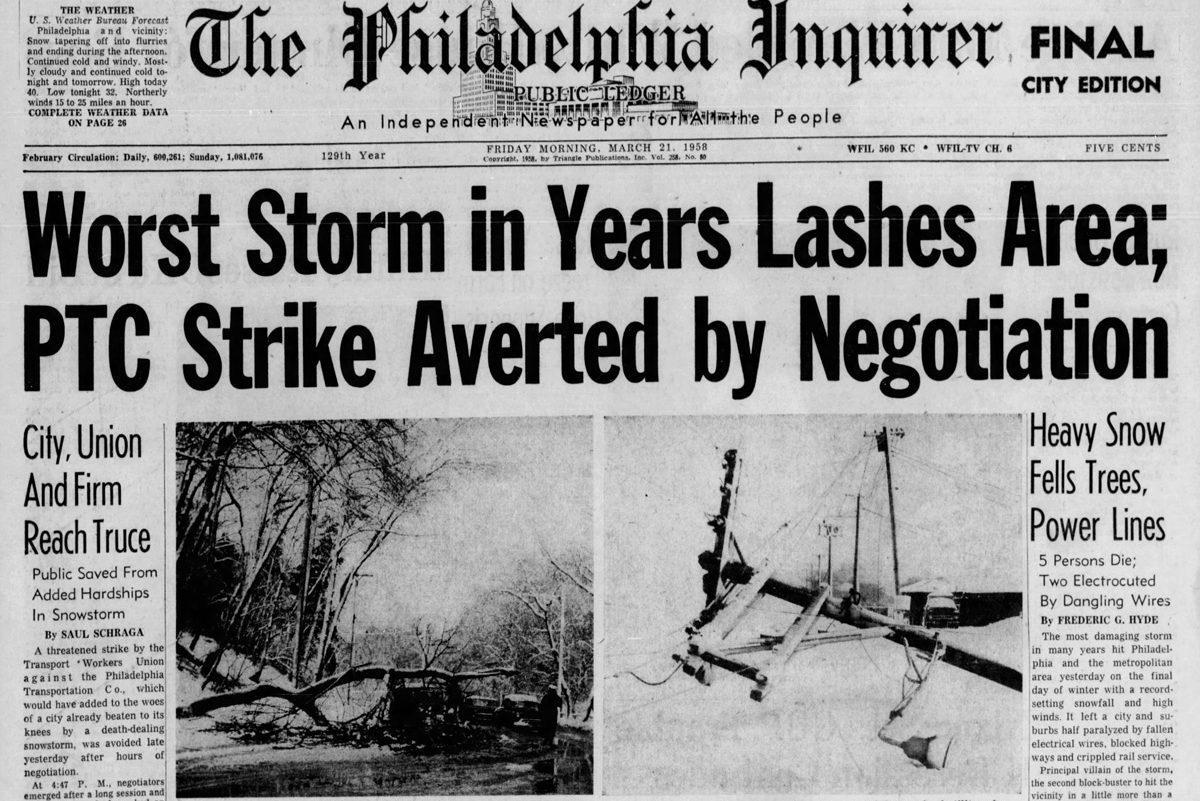
    Our coverage of the 1958 Equinox Storm.

    “Home gardeners just need to relax a little bit,” she said, “and wait for the weather patterns to become more consistent.”

  • The Sixers are ‘living with where we’re at’ after close win over the lowly Jazz, but the road gets tougher

    The Sixers are ‘living with where we’re at’ after close win over the lowly Jazz, but the road gets tougher

    Jabari Walker looked up at the scoreboard Wednesday night and accepted that the margin between the 76ers and lowly Utah Jazz remained close down the stretch.

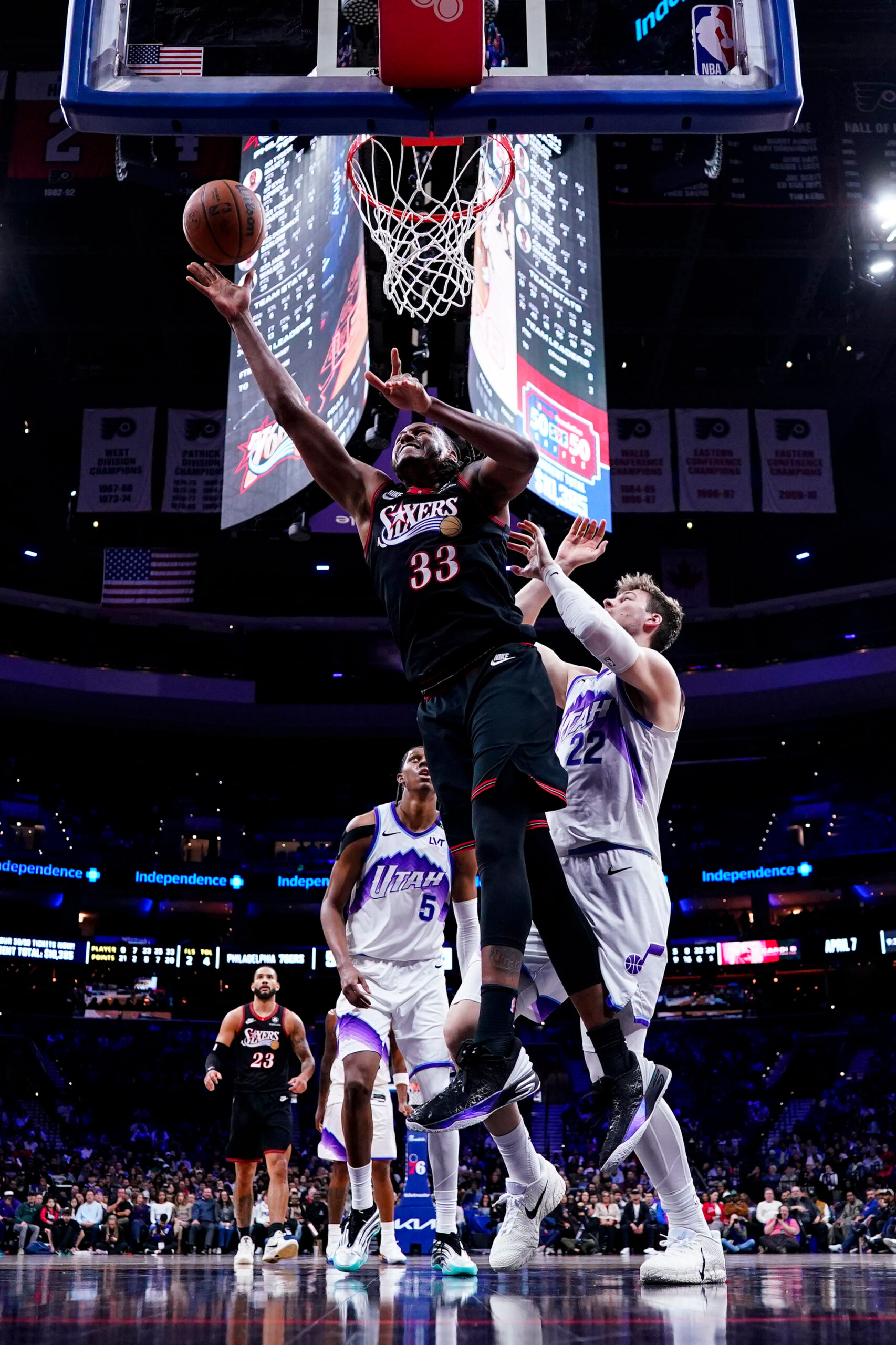
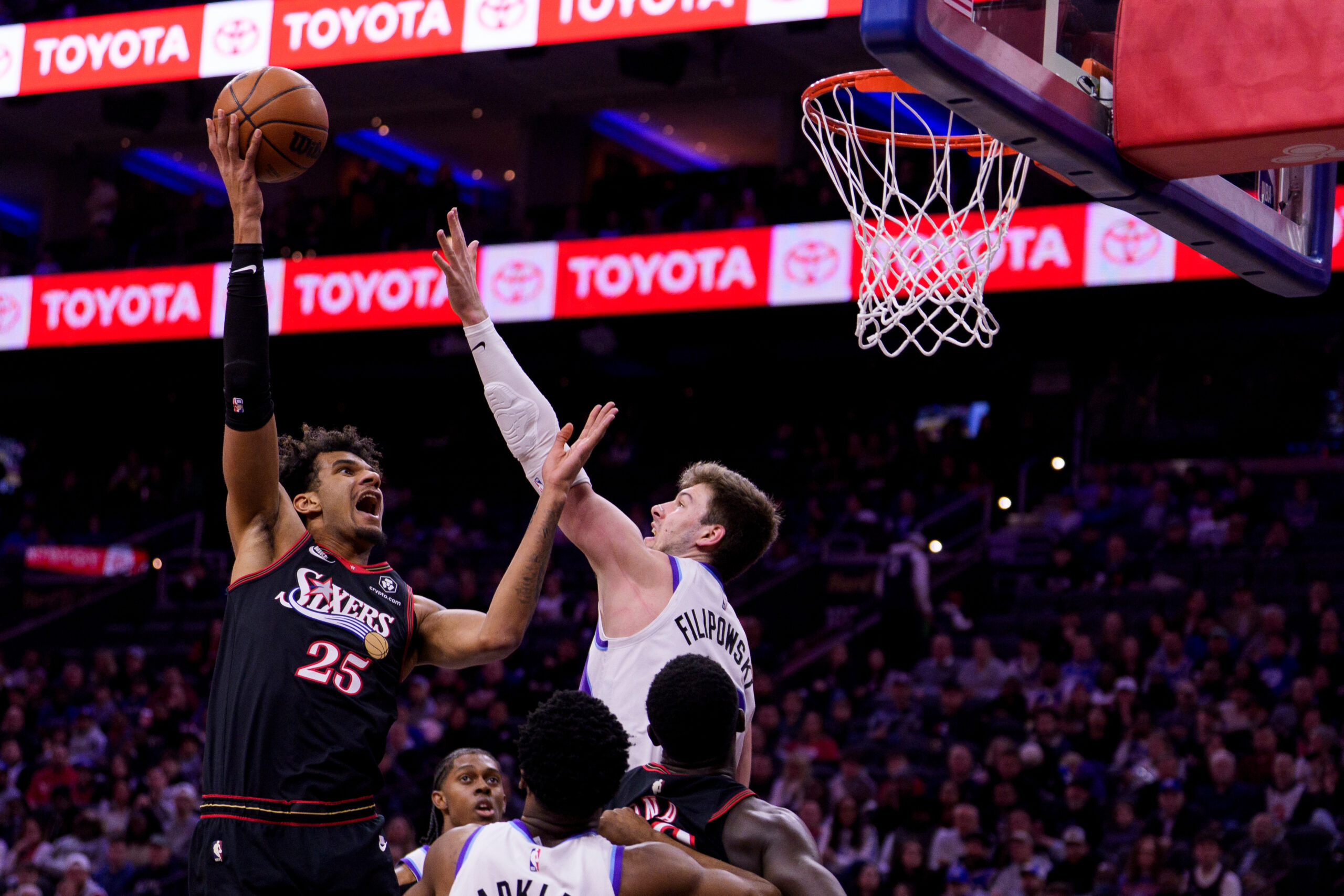
    So the Sixers tightened up defensively, allowing just two points in the final 4 minutes, 51 seconds. They got a go-ahead scoring burst from Quentin Grimes in the final minute. And the Xfinity Mobile Arena crowd collectively exhaled when Utah’s Kyle Filipowski missed a three-pointer as the Sixers to escaped with a 106-102 victory.

    The Sixers were severely shorthanded Wednesday, with rookie standout VJ Edgecombe (back bruise) joining the list of absent players that already included Joel Embiid (oblique strain), Paul George (suspension), and Kelly Oubre Jr. (illness). Yet they were facing an 18-44 Utah squad that recently was fined by the NBA for blatantly “tanking,” or attempting to lose to improve its draft lottery odds.

    That Wednesday’s matchup went down to the wire could be characterized by outsiders as uninspired at best and flirting with an inexcusable disaster at worst. Coach Nick Nurse and All-Star point guard Tyrese Maxey, however, offered a different viewpoint.

    “That’s a hell of a win, considering all the guys out,” Nurse said. “… We don’t care what they look like. Just pick off a win here and there.”

    Added Maxey: “I’m living with where we’re at. I’m happy with where we’re at right now.”

    The “win is a win” cliche is particularly true right now for the 34-28 Sixers, who cling to the sixth seed in a bunched-up middle of the Eastern Conference standings with 20 games remaining. The team that finishes in that spot will advance directly to the playoffs’ first round, while the teams that finish seventh through 10th must earn a spot through the play-in tournament.

    The Sixers’ Dom Barlow goes up for a shot against Utah’s Kyle Filipowski on Wednesday.

    Following Tuesday’s 40-point faceplant against the San Antonio Spurs, which Grimes described as “kind of embarrassing,” the Sixers’ lead in the standings dwindled to a half-game on the seventh-seeded Orlando Magic and eighth-seeded Miami Heat. Wednesday’s victory bumped that margin back up to a full game and moved the Sixers to 1½ games behind the fifth-seeded Toronto Raptors.

    The Sixers are 4-4 since the All-Star break, including impressive victories at the Minnesota Timberwolves and against the Heat but a horrid loss at the New Orleans Pelicans. All of those games have been played without George, whose suspension spans 10 more games, while six have been missing Embiid, whose recent injuries also include a stress reaction in his shin.

    Maxey acknowledged after Tuesday’s blowout that the vibes have been up and down since the trade deadline, even directly addressing that he and the Sixers “miss” Jared McCain, who was dealt to the league-leading Oklahoma City Thunder.

    “You can’t dwell on that,” Maxey said. “You’ve got to focus on the people that’s in this building. These are the people that are going to be with you for the rest of this season. …

    “If you want to try to make a run at doing something special, then you’ve got to focus on that.”

    After getting smacked by the Spurs, a home matchup against the Jazz appeared to be an ideal bounce back opportunity. Yet two nights prior, Utah hung with the Denver Nuggets, widely considered a Finals contender, before losing, 128-125. And after deliberately resting key players in prior fourth quarters, coach Will Hardy subbed his starters back in for Wednesday’s stretch run against the Sixers.

    “They’re playing hard, and they’re playing the right way,” Maxey said of the Jazz. “You’ve got to actually beat them. They’re not just going to let you.”

    The Sixers’ Jabari Walker had 22 points and 10 rebounds against the Jazz.

    The Sixers needed a massive boost from reserve big man Jabari Walker, who made his first six shots (including 4-of-4 from three-point range) and finished with 22 points and 10 rebounds. And legitimate guard minutes from recent two-way signee Tyrese Martin (eight points, two rebounds, two assists), whose play Nurse described as “just a little shy [of] excellent,” and Kyle Lowry, the pseudo-assistant coach who previously had played seven games all season.

    Nurse started Adem Bona at center instead of Andre Drummond, who typically had held that role when Embiid was out but has been ineffective recently. Grimes became the Sixers’ closer, breaking down his defender to convert a layup and draw a foul on a nearly identical play.

    “My teammates have a lot of trust in me,” Grimes said, “and my coaches have a lot of trust in me to make those plays.”

    The Sixers’ opponents get significantly tougher from here. Up next is a Saturday trip to the Atlanta Hawks, who have already beaten the Sixers three times and have motivation to claw out of the East’s No. 10 seed. During the next week, the Sixers also will visit the Cleveland Cavaliers, who acquired former Sixer James Harden at the trade deadline and have ascended to the East’s fourth seed, along with the top-seeded Detroit Pistons.

    As a tuneup for that rugged stretch, Wednesday’s outing against the Jazz was far from aesthetically pleasing. Yet the shorthanded Sixers won to keep their grip on the sixth seed, and Maxey will live with that for now.

    “Guys took it personal at the end,” Walker said. “We knew how important this was for us, and we acted as professionals and got it done. …

    “When it was crunch time, we locked in. We’ll learn a lot from this, but this was a big one of us.”

  • How does Flyers GM Danny Brière’s previous trade deadline moves inform what he might do ahead of Friday?

    How does Flyers GM Danny Brière’s previous trade deadline moves inform what he might do ahead of Friday?

    Although Flyers general manager Danny Brière has the experience of just two NHL trade deadlines in his pocket, if this year is anything like the previous two, expect the Flyers to make some noise.

    The buzzer will go off on the wheelin’ and dealin’ at 3 p.m. on Friday, and Brière has already made one deal this week, sending Lehigh Valley of the American Hockey League defenseman Roman Schmidt to Minnesota for NHL/AHL forward Boris Katchoul.

    Is it the start of something? Potentially, with players such as Rasmus Ristolainen rumored to be on the move.

    Here’s a look back at what Brière did in the week leading up to the previous trade deadlines.

    What did the Flyers do at the 2024 NHL trade deadline?

    The 2024 trade deadline was at 3 p.m. March 8.

    March 6 at 3:48 p.m.

    Brière was patient, waiting weeks before finally accepting an offer for defenseman Sean Walker. Two days before the deadline, he acquired a 2025 first-round pick and center Ryan Johansen from the Colorado Avalanche for Walker and a 2026 fifth-round selection.

    The Flyers initially agreed to retain 50% of the final year and a half of Johansen’s contract as a trade sweetener, but he was immediately placed on waivers for assignment to the AHL. The forward, citing a hip injury, refused to report to Lehigh Valley and never played for the Flyers and was placed on unconditional waivers Aug. 20, 2024, “for the purpose of terminating his contract due to a material breach.”

    The NHL Players’ Association filed a grievance, but a source confirmed to The Inquirer last summer that an arbitrator had ruled in favor of the Flyers.

    Walker played 18 regular-season and 11 playoff games for the Avalanche before signing with the Carolina Hurricanes on July 1, 2024. The 2025 first-round pick was packaged in the first-round swap at the draft that helped the Flyers snag Jack Nesbitt at No. 12.

    Erik Johnson played just 39 games for the Flyers after getting acquired from Buffalo at the 2024 trade deadline.

    March 8 at 2:12 p.m.

    In a bit of a surprise move, the Flyers acquired Brière’s old teammate Erik Johnson, a defenseman, from the Buffalo Sabres for a 2024 fourth-round pick.

    Johnson played 39 games for the Flyers. Eventually, the Sabres traded the pick to the Winnipeg Jets, who took Kevin He, the highest-drafted player born in China in NHL history at the time.

    March 8 at 2:47 p.m.

    The Flyers acquired forward Denis Gurianov from the Nashville Predators for Wade Allison.

    A second-rounder in 2016, Allison played 75 games across three seasons for the Flyers but never really stuck at the NHL level. Gurianov played four games in Philly and, as an unrestricted free agent, opted to sign with the Kontinental Hockey League that summer.

    What did the Flyers do at the 2025 NHL trade deadline?

    The 2025 trade deadline was at 3 p.m. March 7.

    March 7 at 12:45 p.m.

    The Flyers acquired a third-round pick in the 2027 NHL draft from the Los Angeles Kings for forward Andrei Kuzmenko and a 2025 seventh-round pick. Philly retained 50% of his salary.

    Kuzmenko was acquired by the Flyers at the end of January of that season from the Calgary Flames with Jakob Pelletier for Morgan Frost and Joel Farabee. He played in seven games, registering five points, and the pending unrestricted free agent looked like someone the Flyers could re-sign.

    Instead, he was shipped out weeks later and signed a one-year deal on June 30, 2024, to stay in Hollywood. He has 18 goals and 42 points in 74 regular-season games and three goals and six points in six playoff games across his tenure with the Kings.

    March 7 at 4 p.m.

    Although the trade had to be registered with league by 3 p.m. the Flyers officially announced at 4 p.m. that they acquired forward Nikita Grebenkin and a first-round pick in the 2027 NHL draft from the Toronto Maple Leafs for Ontario native Scott Laughton, a 2025 fourth-round pick, and a 2027 sixth-round pick.

    In the deal, the Flyers retained 50% of Laughton’s salary, which comes off the books after this season. Toronto’s first-round pick is Top 10 protected; however, the Leafs are in a free fall, so, because they owe the Boston Bruins their 2026 pick from the Brandon Carlo deal, it could slide to 2027, as the 2026 pick is top-five protected.

    Scott Laughton (center) has 16 points in 63 regular-season games with the Maple Leafs since being traded by the Flyers at last year’s trade deadline.

    Even before the trade was announced, the team was taking down banners at the Flyers Training Center with Laughton on them. A depth center, Laughton is rumored to be on the trade block now in Toronto — he was held out of the lineup on Wednesday for roster management — and has 16 points in 63 regular-season games and two assists in 13 playoff games with the Maple Leafs since being acquired.

    Grebenkin played in the minors last season after being acquired, collecting seven points in 11 regular-season games and four points in seven playoff games for the Phantoms. He has spent the entire 2025-26 season with the Flyers and has 12 points in 46 games, including his first NHL goal, which tied the game at 4 in a 5-4 shootout win against the Montreal Canadiens on Nov. 4.

    March 7 at 5:40 p.m.

    Another late announcement, with the Flyers sending Johnson home to the Avalanche, where he had won a Stanley Cup in 2022, for forward Givani Smith.

    Johnson finished the year with the Avalanche and has since retired.

    Smith, who was a pending unrestricted free agent, played 10 regular-season games for Lehigh Valley last season, registering a goal and an assist, and played in seven playoff games. He signed a professional tryout agreement with the Carolina Hurricanes for the 2025-26 training camp, earning a two-way deal in early October.

  • Need nails that’ll last? Ask where a chef or bartender gets their manicure

    Need nails that’ll last? Ask where a chef or bartender gets their manicure

    On a chilly February morning, Mallory Valvano walked up two flights of stairs to a second-floor atrium filled with exotic plants leading her to a salon suite. The baker behind Party Girl Bake Club found herself back inside the Fishtown building to see Alex Furst, also known as Pepper Holidays on Instagram.

    But Valvano wasn’t in the neighborhood to deliver one of her whimsical, eye-catching cakes or catering displays. She was there on an equally important task: a manicure.

    Valvano is one of many Philly culinary professionals who see their nails as an extension of their brand personality as well as a self-care treat — despite the taboo of chefs cooking with polished nails. (ServSafe, the food and alcohol safety-training and certification organization, discourages the use of nail polish and/or extensions and highly recommends cooking with gloves.)

    Valvano is ServSafe-certified, which means she knows the impact of food safety really well. She also believes that shouldn’t stop her from expressing herself — especially when the products Furst uses ensure chip-free, perfectly intact nails for up to four weeks.

    “I’m an artist, by trade, in textile manufacturing and design — the food thing came a little later in life,” she said. “So, [getting your nails done] is about, one, taking care of how you look and being presentable. It’s also an extension of your own personal style. I like to have this whole vision of what a party girl is: neon and pastels, colors inspired by art, architecture, and interior design.”

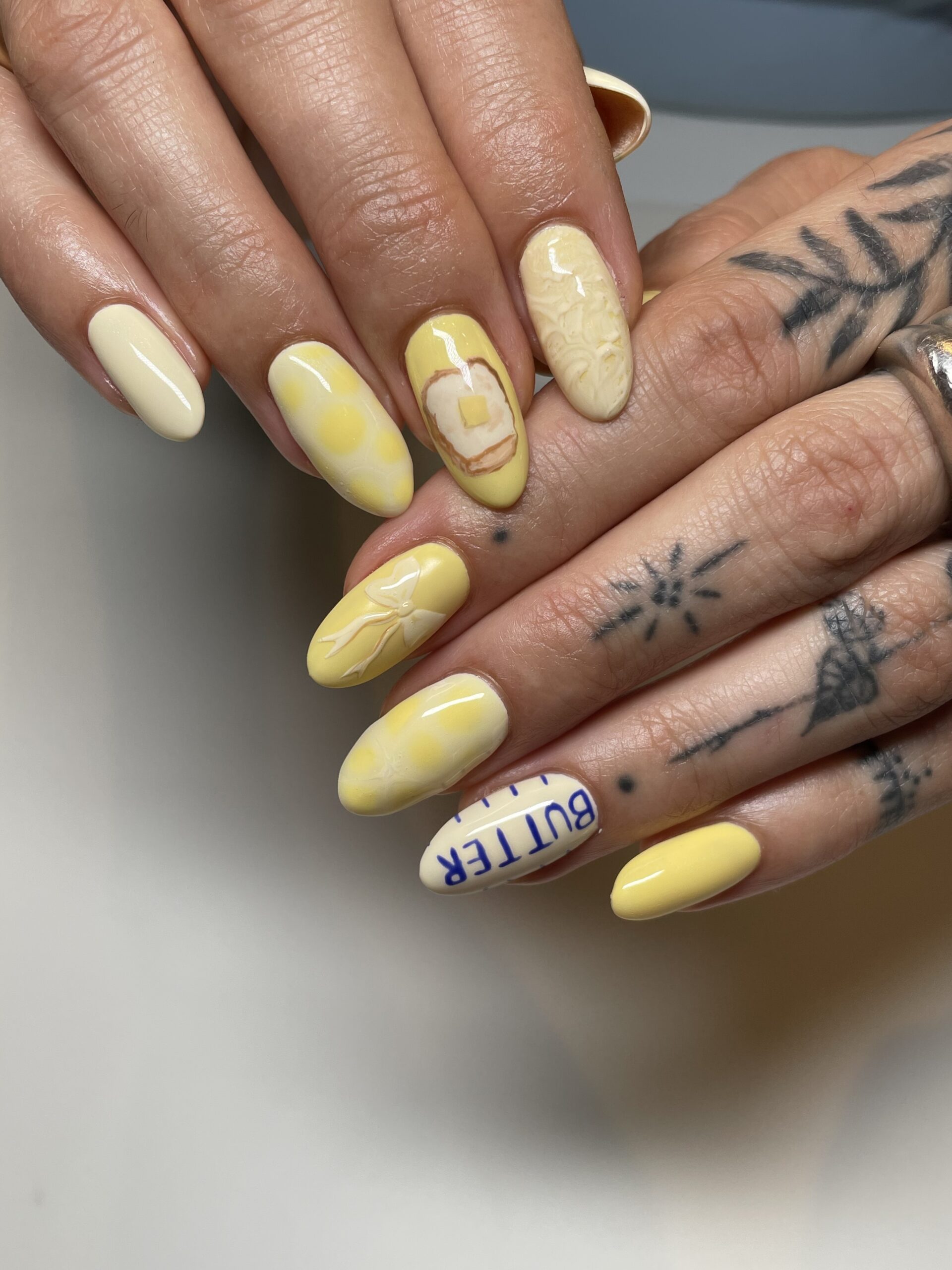
    Mallory Valvano with butter-themed nails.

    The key to nails that food professionals aren’t worried about working with? Regular sessions with a nail artist who emphasizes prep and uses gel builder, a thick-viscosity, strengthening product that creates a protective, hard shield with LED/UV light. And Furst is the woman to do the job for Valvano and Natalia Lepore Hagan of Midnight Pasta.

    The 37-year-old nail artist is in her eighth year as a licensed nail technician. With two chef clients and a few nurse clients under her belt, Furst understands working on labor-intensive nails that exist in industries where unpainted nails are the norm.

    “My philosophy for everyone is that the foundation is the most important thing — the prep or the way the product is applied, if that’s missing then you’re not going to have a long-lasting, strong manicure,” Furst said. “Gel body builder is strong enough that it allows the nails to maintain and support its structure so that they’re not going to be chipping or lifting in a three to four week time frame.”

    What does a long-lasting manicure entail?

    Each session begins with Furst removing old product and chatting with the client about what their month is looking like to determine length of nail. Then it’s prep: shaping and smoothing nails, pushing back the cuticles , and exfoliating, removing any sticky cuticle from the nail plate, and lightly etching the new nail growth.

    “Our body naturally produces oil, so that prep is to ensure getting the gel completely adhered to the nail plate,” she said. “No one wants the gel to lift — when it lifts, it damages the nail. So, prep is important.”

    Design comes next. Both Valvano and Lepore Hagan love to experiment with colors and incorporate their brands into the nail designs.

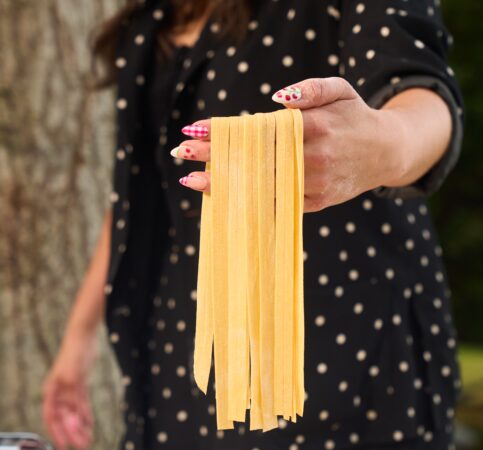
    Natalia Lepore Hagan of Midnight Pasta and her nails.

    Furst has drawn buttered toast designs for Valvano inspired by an all-butter event and tomatoes for Lepore Hagan inspired by an Italian picnic-themed event.

    “I brought her an idea, and she sketched out all 10 nails in front of me,” Lepore Hagan said. “She said, ‘Let’s do tomatoes on this finger. We’ll do the checkers on your middle finger. And another with stripes.’ I love artists more than anything, and it’s so cool to collaborate with her on my nails.”

    The hostess with the mostest and her nails

    Midnight Pasta, a hands-on pasta-making class and BYOB dinner party, is a nontraditional dining experience, Lepore Hagan explained, where she is s both chef and host, leaving more room for self-expression with nails.

    Gloves stay on while cooking, and nails come out for hosting. “Mallory and I are both really fashion-forward,” she said. “We care a lot about fashion. I am always looking at what she’s wearing and her nails because she’s a representation of her brand.”

    But the pasta chef draws the line at gel extensions or acrylic nail tips, opting for only gel builder polish on her natural nails to ensure no attachments fall off when working.

    “I want to be professional, and part of that professionalism is having my nails always done perfectly and interestingly,” Lepore Hagan said.

    Jillian Moore’s nails with with My Loup’s Montreal cocktail.

    Behind the bar with acrylics

    Jillian Moore, however, is an acrylic nail queen.

    She’s behind the bar at My Loup and Pine Street Grill, where customers will catch her perfectly pointed, brightly colored nails around spoons and cocktail shakers. As bar director at the two hot spots, she’s using her hands differently then chefs Valvano and Lepore Hagan, allowing her to opt for long acrylics decorated with gel polish every two weeks at her nail appointment with @nailsbylinny.

    Expressing oneself through nails is similar to wearing makeup to work, Moore said, as long as food safety rules are followed. And following the ServSafe rules isn’t hard with nails, she said. “You still have to make sure your fingernails are clean [and put on gloves for prep work], regardless if you have extensions or not,” she said. “So that’s how I’ve always operated.”

    For Moore, getting her nails done is way to share her personality, whether it’s with a specific color or theme — or repping the restaurants she works at. Every year for My Loup’s anniversary, she gets the color of the tiles at the bar with a little “ML” script on top. And when Pine Street opened, her nails were covered in little acorns.

    “People are watching my hands all the time — it’s definitely something that people notice [and] we end up talking about it,” Moore said. “It’s just a fun way to express myself, [and] why I like it so much.”

    “I make this joke all the time — I say, there are three people that you should never piss off: your bartender, your hairdresser, and your nail tech,” she added. “Maintain those relationships.”

  • A Camden preschool teaching assistant is the first-ever from the city to win statewide award

    A Camden preschool teaching assistant is the first-ever from the city to win statewide award

    From the moment her rambunctious preschoolers arrive, instructional assistant Angela Feliciano tends to their every need, doling out lessons and discipline.

    Affectionately known as Miss Angie at the Riletta Twyne Cream Early Childhood Center in Camden, Feliciano has been a classroom assistant for nearly 30 years. She is also working to become a teacher soon.

    Feliciano has received accolades for her dedication and was recently recognized by the New Jersey Education Association as its Educational Support Professional of the Year for 2025-26.

    She is the first instructional assistant from Camden schools to get the recognition. She will represent New Jersey later this month at the National Education Association’s ESP conference in Anaheim, Calif.

    “She’s the first from Camden. It’s a proud moment,” said Camden Education Association president Pamela Clark, who represents about 1,050 teachers and support staff, including secretaries, clerks, bus drivers, custodians, and security officers.

    Clark nominated Feliciano, a childhood friend, for the award. Feliciano is well-liked by students and respected by parents in the community, and puts in extra effort to encourage learning, she said.

    Nominees were considered based on professional practices, advocacy and association involvement, community engagement, personal achievement, and how well they advance the image of support professionals.

    “I’m representing Camden. Not just bad things happen in Camden,” Feliciano said.

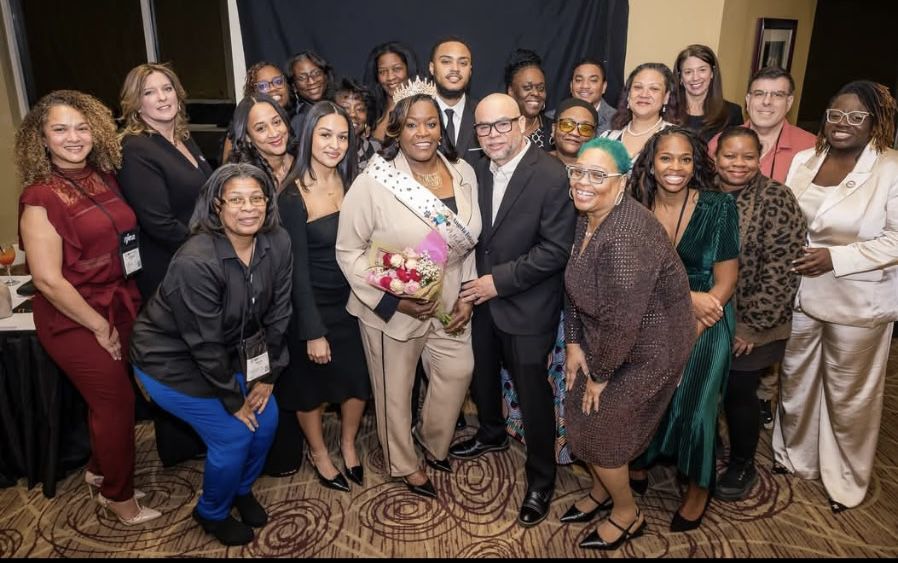
    Angela Felicano (center, third from left) celebrates her award with Camden Education Association members.

    Principal Medinah Dyer credited Feliciano with boosting preschool enrollment at Cream from about 120 students to 350 in three to four years. Feliciano attended weekend events to encourage parents to enroll their children.

    Feliciano purchases toiletries and items for students in need, and has been an advocate for children who experienced trauma or have behavioral issues, Dyer said. She is the first to arrive at school, and the last to leave, she said.

    “She is a role model for both students and staff, and her contributions have made our school a better place for everyone,” Dyer wrote in her nomination letter.

    Teaching assistant Angela Feliciano with students in the pre-K classroom of teacher Carey Hiatt at the Riletta Twyne Cream Early Childhood Center in Camden last month.

    During a recent morning at Cream, located in the city’s Centerville section, Feliciano and teacher Carrie Hiatt were in full swing with 15 preschoolers. The students are 3 to 5 years old.

    Feliciano and Hiatt crisscrossed the room, working with small groups of students for music instruction and reading. Feliciano sat on the floor with her charges or in tiny chairs to talk with them at eye level.

    In one corner, Feliciano played a game with a boy, pretending it was her birthday.

    “How old are you?” he asked.

    “I’m 7 years old,” she replied with a smile.

    Teaching assistant Angela Feliciano “spies” students as they clean up in a pre-K classroom at the Riletta Twyne Cream Early Childhood Center in Camden last month.

    Feliciano moved to different stations, engaging in dramatic play with a student, donning miniature clothes. At one point, she used a puppet for a letter exercise.

    “I just come to work and do what I do,” Feliciano said. “They’re my kids from 8:40 a.m. to 3 o’clock.”

    The entire class stood in place for a lively round of “Head, shoulders, knees and toes,” an exercise song that had the giggling preschoolers and Feliciano huffing and puffing.

    “That was so hard,” a preschooler gasped.

    The preschoolers spend the entire day in the classroom with Feliciano and Hiatt. The pair served lunch — chicken, rice, and plantains — while jazz played softly in the background.

    “She goes out of her way to make this place special for the kids,” Hiatt said. “She is excellent, an amazing teammate.”

    Feliciano was born and raised in Camden. After graduating from Camden County Technical School, she worked for two years as a data processor.

    It was always her dream to become a teacher, and she got a chance in 1989 when she joined the district as a paraprofessional. She has worked with older children, but enjoys the little children the best.

    “I love to see them grow,” she said. “I love when they grasp things, and they look at me and smile.”

    Feliciano, 53, now lives in Pennsauken and has acquired the credentials to become a teacher, earning bachelor’s and master’s degrees from Wilmington University.

    She still needs to pass the New Jersey Praxis exam to obtain her teaching certification, which has been a challenge. She has taken the exam three times and failed — the last time by a single point.

    Feliciano plans to take the exam again this spring. She has been studying vigorously and getting coaching from Hiatt. She hopes to inspire other paraprofessionals.

    “We are the core of the building. If it wasn’t for us, teachers wouldn’t be able to teach,” Feliciano said.

    Hiatt said Feliciano has already demonstrated an ability to prepare lessons, manage the classroom, and reach students. She believes she will be a great teacher, but would miss having her in her classroom.

    Married and the mother of two adult sons, Feliciano said she wants to remain in the classroom for many years, hopefully as a teacher.

    “I’m not ready to go. I don’t want to leave the babies yet,” she said.

    Teaching assistant Angela Feliciano helps students eat lunch in her pre-K classroom at the Riletta Twyne Cream Early Childhood Center in Camden one day last month.
  • Holy mackerel! Fishtown man schools neighborhood on fun fish facts.

    Holy mackerel! Fishtown man schools neighborhood on fun fish facts.

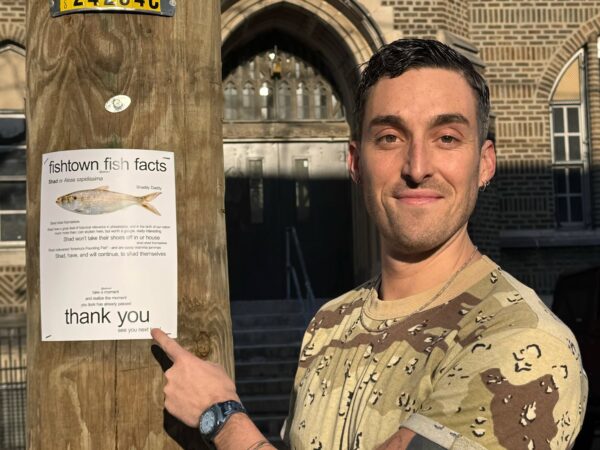
    If you’ve ventured out for a stroll in Fishtown in recent months you may have observed what looks like a page torn out of an oceanography textbook tacked to a lamppost or electrical pole.

    It probably features a clinical-looking photo of a fish, that species’ Latin nomenclature, and a short blurb about the slithering sea dweller.

    However, upon closer inspection, you’ll find these posters are only marginally educational.

    “Striped Bass or Morone saxatilis,” one poster reads, above an image of an open-mouthed, beady-eyed, gray-and-white fish with translucent fins. “Slappadabass mon! Striped Bass live in Philadelphia water slurp slurp. Striped Bass born in saltwater, but live in fresh water. Stripe Bass lay 3,000,000 eggs. not in this economy!!!”

    Disclaimer: Don’t rely on the facts in these posters to ace your next marine biology test. They’re not always accurate. Striped bass actually live in saltwater and spawn in freshwater typically, not the reverse.

    Fishtown fish facts, this series of more than a hundred posters across the area, was never an endeavor to turn a profit or rally support for a cause like some similar lamppost literature. It was just a modest attempt to make his neighbors smile, said 32-year-old Niall Paredes, the brain behind the piscine production.

    The posters contribute to a rich history of both professional and unsanctioned public art across the city. Mural Arts Philadelphia has facilitated more than 4,000 works of public art since its 1984 founding as an anti-graffiti network, while artists and amateurs alike have taken to the streets to plaster their own ephemeral works across Philadelphia.

    Paredes, a native Philadelphian, got the idea for the series about a year ago after moving to Fishtown. As a creative, both professionally producing TV commercials and recreationally working with photo and video, he saw artistic potential in the telephone polls around his new neighborhood.

    They were covered in flyers. Some asked for help. Some asked for attention. Some asked for money.

    None simply asked for a laugh.

    “I just kind of was inspired and started playing around with some funky fish,” he said.

    Because, you know, Fishtown.

    Since then, Paredes estimates he’s created hundreds of Fishtown fish facts posters highlighting dozens of species of fish.

    His write-ups are infused with his own unique brand of humor. The descriptions read like a Mad Libs of Gen Z slang with some 2000s texting lingo sprinkled in the mix.

    He punctuates each poster with the same tagline — “take a moment and realize the moment you took has already passed.”

    The sentiment is intended to encourage the reader to stop, reflect, and “keep pushing” wherever they’re at in life, Paredes said.

    Along the way, Paredes, whose only real relationship with marine biology is through surfing, has boned up on his knowledge of aquatic vertebrates.

    Shad are quickly angling their way to the top of his ranking of most interesting fish, he said. That’s partly due to a legend that asserts that shad saved George Washington’s troops from starvation in 1778 at Valley Forge during the Revolutionary War.

    “When Jeopardy! hits fish, I’m ready to roll,” Paredes said.

    As far as the future of Fishtown fish facts go, Paredes said pedestrians can expect to be enlightened on many more species soon. And he’s planning to expand his fish facts to other neighborhoods; he’s already sprinkled some in Manayunk, Center City, and South Philly.

    “I’m definitely going to be working on it for a bit,” he said. “I mean, there’s a lot of fish in the ocean.”

  • State and local officials are right to stand against expanding ICE detention centers | Editorial

    State and local officials are right to stand against expanding ICE detention centers | Editorial

    Immigrants in custody under the Trump administration have been denied medical care, face dangerous detention conditions, and have died in the highest numbers in two decades, according to a letter sent to Secretary of Homeland Security Kristi Noem by a group of Democratic senators.

    As more and more immigrants are arrested, and U.S. Immigration and Customs Enforcement looks to vastly expand its detention capabilities — including in Pennsylvania and New Jersey — cases of abuse and death will only grow.

    This is a moral wrong that violates America’s constitutional protections.

    State and local leaders should vigorously push back against new detention facilities proposed by a federal government that has shown open contempt for the law in pursuit of the president’s cruel and inhumane mass deportation policies.

    Contrary to what Donald Trump promised, most of the immigrants being detained are not hardened criminals or the “worst of the worst.” Fewer than 14% of people arrested by ICE in 2025 had any charges or convictions for violent offenses. Immigrants with no criminal record at all now make up the largest group in detention.

    To be sure, immigration detention has a long history of abuse, with complaints about difficult living conditions, substandard medical care, and an opaque system leading to limited accountability when immigrants die in custody.

    Even when changes are promised, the problem has persisted.

    “Detention centers are not safe, abuses are widespread and detention facilities consistently fail to meet basic minimum standards,” wrote Mary Small, policy director for the Detention Watch Network, in 2015. “The Obama administration’s attempts at reforming the immigration detention system have failed.”

    More than a decade later, that failure will likely compound as ICE, flush with $45 billion from the GOP-controlled Congress and zero accountability from the White House, ramps up not only the scale, but also the callousness of its operations.

    The conditions inside detention centers are bleak, even more so for the most vulnerable populations. ProPublica recently told the stories of children being held at the ICE facility in Dilley, Texas. Their testimony is heartbreaking.

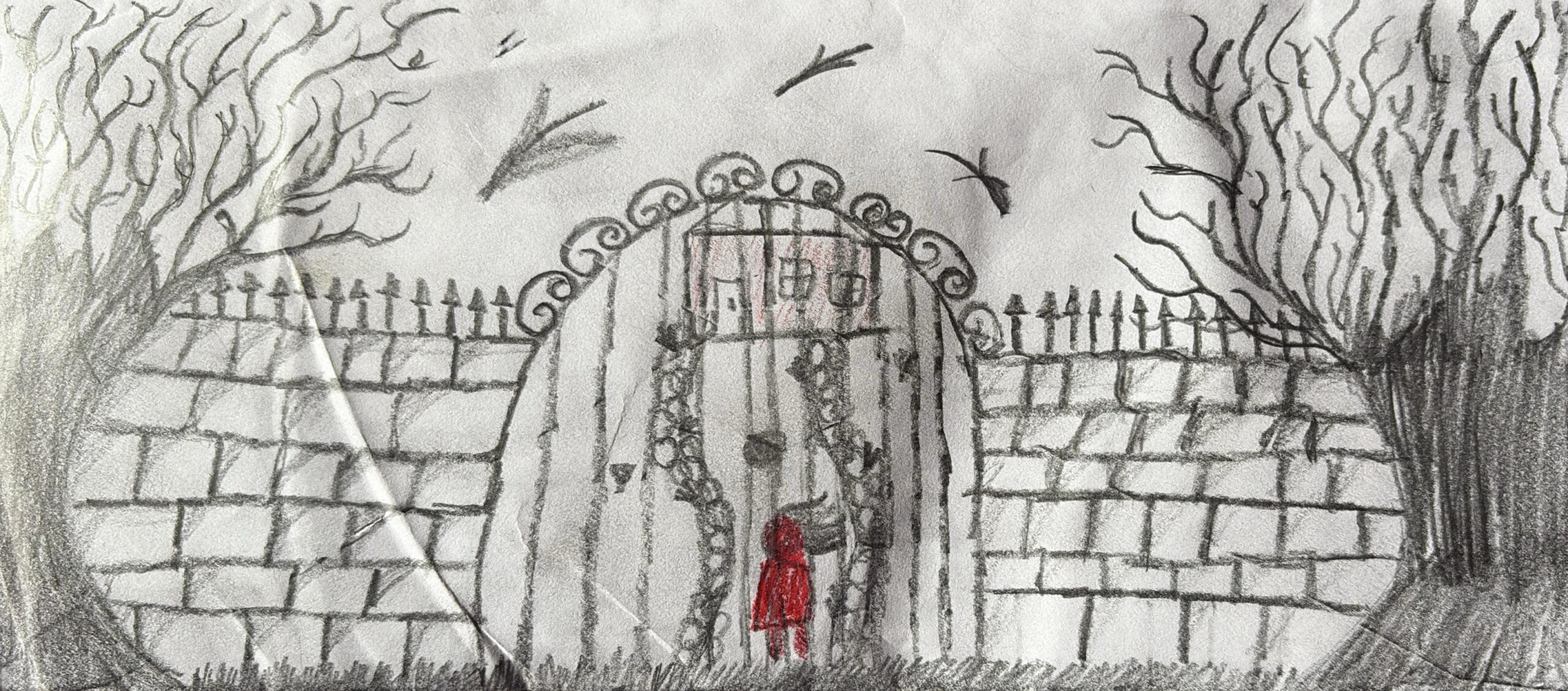
    A drawing made by a 13-year-old Colombian girl when she was detained at South Texas Family Residential Center in Dilley, Texas, where the Trump administration is holding immigrant families.

    “Since I got to this Center all you will feel is sadness and mostly depression,” one child wrote. Another said that “the workers treat the residents unhumanly, verbally and I don’t want to imging how they would act if they where unsupervised.”

    A 9-year-old put it plainly, writing, “I am not happy, please get me out of here.”

    Governors are rightfully objecting to the growth of ICE detention centers in their states. Both Gov. Josh Shapiro and New Jersey Gov. Mikie Sherrill have taken a strong stance in opposition. Local communities and officials are also fighting back.

    ICE plans to convert warehouses to detention centers in Upper Bern Township in Berks County, Tremont Township in Schuylkill County, and in Roxbury, a municipality in New Jersey’s Sussex County. Bucks County commissioners, who approved a bipartisan resolution against the detention centers, said the federal government may be looking to buy properties in Bensalem Township and Middletown Township.

    Shapiro has pledged to use every tool at his disposal to block the plans in Pennsylvania. Roxbury’s mayor, Republican Shawn Potillo, has also vowed to work against the proposed facility. Sherrill has promised to explore new state taxes in her own efforts to discourage the growth of detention centers.

    These statements are a step in the right direction. If officials are seeking examples of effective action, they can look to New Hampshire, where local opposition helped kill a plan for a new ICE facility, or to the small conservative town of Social Circle, Ga., which refused to turn on water access for an ICE detention center.

    In a letter to Homeland Security’s Noem, Sherrill laid out the case against ICE in no uncertain terms.

    “DHS’ treatment of human beings — citizen and noncitizen alike — reflects a chilling disregard for both human life and the rule of law,” Sherill wrote. “New Jersey will not be complicit in this.”

    No one who values human rights should.

  • Pennsylvania’s minimum wage has been $7.25 since 2009. Who actually earns that much?

    Pennsylvania’s minimum wage has been $7.25 since 2009. Who actually earns that much?

    Pennsylvania’s minimum wage hasn’t budged from the $7.25 federal minimum that was set in 2009. But the number of Pennsylvanians actually making that much per hour is small and shrinking.

    Last year, some 42,900 Pennsylvania workers earned the minimum wage or less, according to the Pennsylvania Department of Labor and Industry’s annual report on the minimum wage, published this month.

    That’s about a 9% decline from 2024. This group makes up less than 1% of all Pennsylvania workers. The state’s population of minimum-wage workers has dropped by roughly 42% in the last five years.

    Still, hundreds of thousands who make more than minimum wage would see their wages rise if the Pennsylvania’s wage floor was set to $15 an hour.

    Last year, 189,900 people in Pennsylvania (6.4% of hourly workers) earned at least $7.26 and up to $12 per hour.

    Another 320,900 (10.8% of hourly workers) earned between $12.01 and $15 per hour.

    Each of these groups making low wages in Pennsylvania — up to $7.25, up to $12, and up to $15 per hour — was smaller in 2025 than the year before.

    That’s due in part to increasing wages across the state, the report said, as well as a lower number of hourly wage earners and a shrinking workforce overall. Pennsylvania’s median wage rose to $20.95 per hour last year — roughly a $1 increase from 2024.

    The report is based on data from a U.S. Census Bureau survey. Last year’s data is missing October figures due to the government shutdown, the report noted.

    Some are exempt from federal and state minimum wage such as farmworkers, some seasonal workers, and newspaper delivery people. Workers who make much of their money in tips have a lower minimum wage. Workers from these categories were not excluded from data in the report.

    Pennsylvania’s minimum wage is not enough money to cover a person’s basic needs, according to a living wage calculator developed at the Massachusetts Institute of Technology. It estimates that the living wage for a single adult without a child in Pennsylvania is $23.32 per hour.

    Mayor Cherelle L. Parker speaks during a rally in support of raising the minimum wage and also freeing the city to set its own minimum wage separate from the state, at City Hall, in Philadelphia, April 29, 2025.

    Who actually made minimum wage last year?

    In 2025, workers who made at or below the minimum wage in Pennsylvania were predominantly women. While they make up roughly 51% of the state’s working population, they represent a disproportionate 81% of workers who earned $7.25 or less last year.

    Nearly 79% of these workers are white, and roughly half have a high school diploma or less education.

    window.addEventListener(“message”,function(a){if(void 0!==a.data[“datawrapper-height”]){var e=document.querySelectorAll(“iframe”);for(var t in a.data[“datawrapper-height”])for(var r,i=0;r=e[i];i++)if(r.contentWindow===a.source){var d=a.data[“datawrapper-height”][t]+”px”;r.style.height=d}}});

    Nearly three-quarters of them work in food preparation and serving jobs. Though it should be noted that tips and overtime for restaurant workers are not accounted for in the report’s data, and tipped restaurant workers’ minimum wage is $2.83 by law.

    Unmarried people and young workers aged 16 to 24 also make up a disproportionately large segment of Pennsylvanians making minimum wage or less, the report says.

    Working full time at the minimum wage, a worker would make $15,080 annually. But 80% of Pennsylvania workers who made minimum wage or less last year worked part-time.

    Other sectors that employ these low-wage workers in Pennsylvania include hotels and lodging, retail, art and entertainment, hospitals, educational services, construction, and manufacturing.

    window.addEventListener(“message”,function(a){if(void 0!==a.data[“datawrapper-height”]){var e=document.querySelectorAll(“iframe”);for(var t in a.data[“datawrapper-height”])for(var r,i=0;r=e[i];i++)if(r.contentWindow===a.source){var d=a.data[“datawrapper-height”][t]+”px”;r.style.height=d}}});

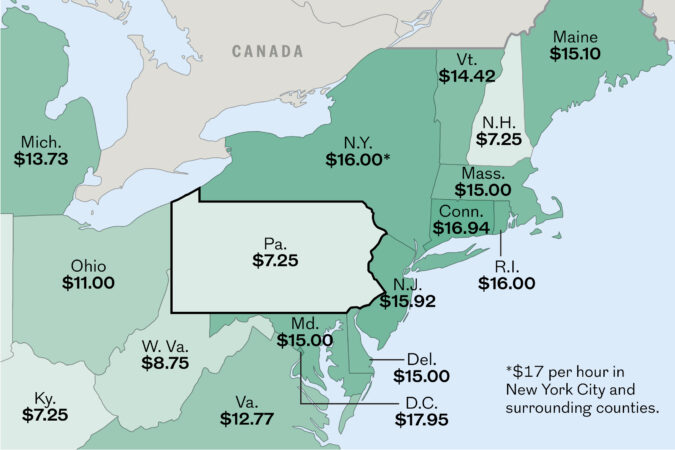
    Pennsylvania’s neighboring states have higher minimum wages

    Despite efforts to raise Pennsylvania’s minimum wage, it lags behind that of neighboring states.

    New Jersey’s minimum wage, which increased in January to $15.92 per hour, is over double that of Pennsylvania’s, and 22 states are soon increasing their minimum wage or have done so already this year. In Delaware, the minimum hourly wage has risen from $9.25 in 2021 to $15 in 2025, thanks to legislation mandating the gradual increase.

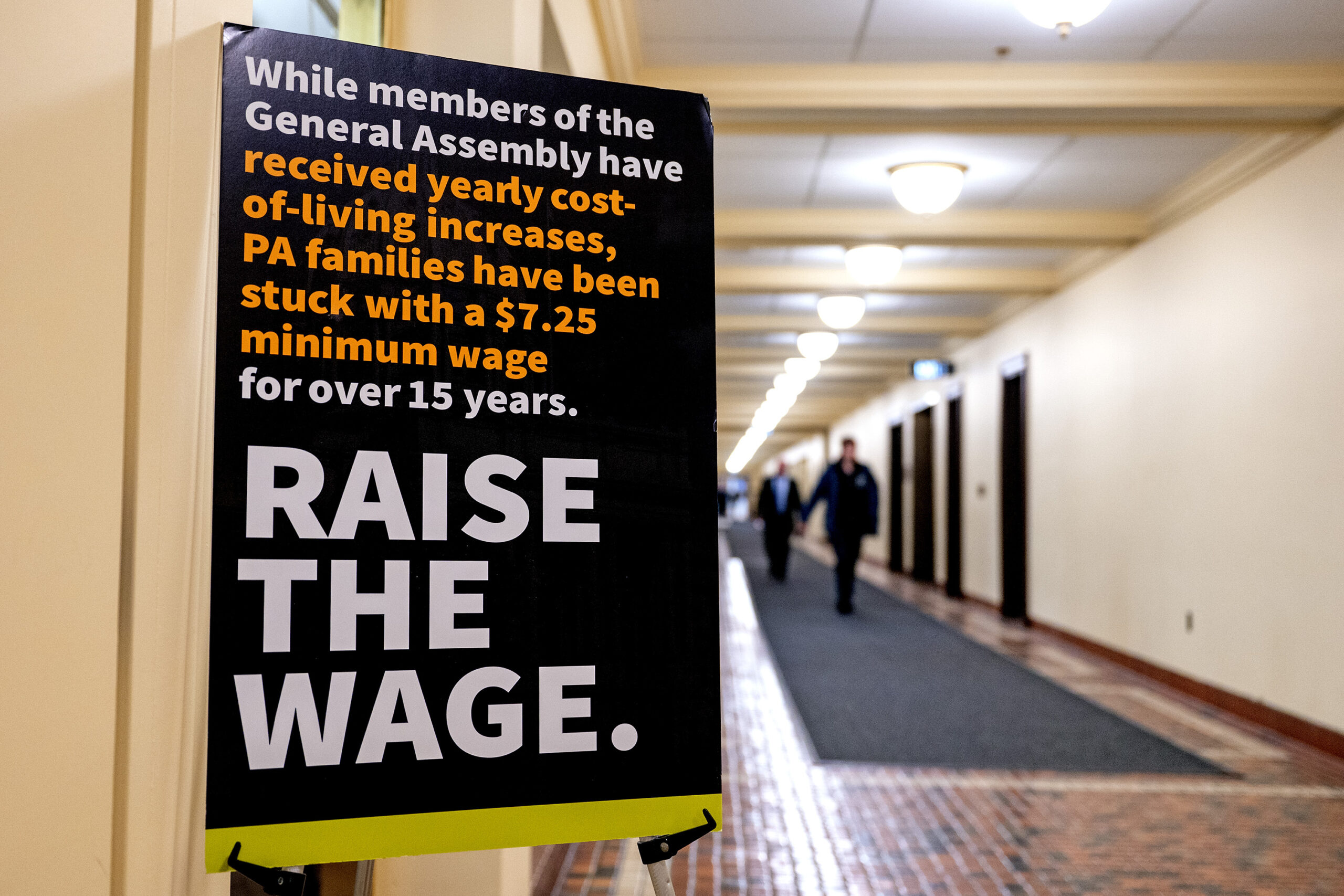
    A sign in support of an increase in the state’s minimum wage in the state Capitol Feb. 3, 2026.

    Gov. Josh Shapiro has backed raising the minimum wage at every annual state budget address since he was elected. In February he called on the General Assembly to advance minimum wage legislation, adding that raising it to $15 an hour would save the state millions on entitlement programs like Medicaid.

    “If you aren’t going to do this because it’s the right thing to do, or because it would let more families put food on the table for their kids, then do it because it’s going to save us $300 million, shrink our entitlement budget by growing our workforce and putting more money back in workers’ pockets,” he said.

  • Why did Iowa State players follow Matt Campbell to Penn State? ‘He grows young men into men.’

    Why did Iowa State players follow Matt Campbell to Penn State? ‘He grows young men into men.’

    STATE COLLEGE, Pa. — It’s common for college football players to follow their head coach to a new gig. But it’s not always a given.

    When Brian Kelly left Notre Dame to become LSU’s head coach in 2022, only one player followed him to Death Valley. It was a silent showcase of support.

    So when Matt Campbell left Iowa State in December to become Penn State’s coach, his players didn’t have to follow him. But they did, and they did so in droves.

    “It just speaks to the type of guy Coach Campbell is,” said junior safety Marcus Neal Jr., an Iowa State transfer. “It shows that players really want to play for him. He’s a really good guy. I look at him as another father figure. I can go to him for anything, ask him for anything.”

    Twenty-four Iowa State players transferred to Penn State, which marked the largest contingent of players in the 2026 transfer window to follow their head coach to a new school. The next closest team had 18 players follow former North Texas coach Eric Morris to Oklahoma State.

    Why did so many Cyclones follow Campbell to Happy Valley? The answer is simple: He is who he says he is.

    “Campbell is a great people person. He was the main reason I went to Iowa State,” said redshirt junior offensive lineman Trevor Buhr. “He’s genuine. When he says something, he does it. He is one of the best leaders I’ve ever met. He’s honest, and he’s true to himself. There’s no what-ifs. You’re getting what you’re getting from him, and it’s been consistent [since] the first time I talked to him.”

    Campbell led the Cyclones to a 72-55 record during his 10-year run as coach. But it was his off-the-field leadership — what he does beyond football — that drove dozens of players and staff members to Penn State.

    The 46-year-old coach has an open-door policy. Players can come and go from his office as they please. Those who played for him at Iowa State said his genuine personality and accountable leadership style made them comfortable to go to him, football-related or not.

    That open-door policy extended to his house in Ames, Iowa, where his players would run pickup basketball games or eat a meal with other teammates.

    And believe it or not, Campbell can hoop, too.

    “Coach Campbell is a big relationships guy,” said senior defensive back Jamison Patton. “It’s an open-door policy. All the guys go over [to his house], and we know we’re going to hoop, hang out, get some food, just be around each other. The more we’re around each other, the more our relationship grows as a team, and especially with the coaches.”

    Added Neal: “[Campbell] got a nice little shot on him. He gets picked up. You ain’t going to pick somebody up if they’re not good.”

    Before Campbell officially accepted the Penn State job, he met with his Iowa State players to inform them of his decision and offered a heartfelt explanation on why he decided to leave. It was a moment of raw emotion that was difficult for Campbell, but he wanted to say goodbye in person.

    Several players said that final meeting replicated the type of person Campbell is. And it’s why a large portion of his players knew instantly they would follow their coach to Happy Valley.

    “There was never a doubt in my mind that I was going to go somewhere else,” said redshirt senior defensive back Jeremiah Cooper, who played four seasons under Campbell at Iowa State. “Once I hit the portal, I knew I was coming to Penn State. Coach Campbell changed my life, not just as a player, but as a man. He grows young men into men, and that’s all I can ask for as a coach and as a leader.”

  • After a visit to the Philadelphia Flower Show, Nick Elizalde’s mom issues a plea to the school district: ‘Don’t close Lankenau’

    After a visit to the Philadelphia Flower Show, Nick Elizalde’s mom issues a plea to the school district: ‘Don’t close Lankenau’

    For the last three years, my life has been defined by the tragedy of my son’s murder and the management of the indescribable pain I feel every moment. For everyone else, time continues normally. For me, time simultaneously stands still, moves like molasses, or flies by in a blur.

    I’ve been dreading 2026 for a while — it would have been Nick’s senior year at W.B. Saul High School. He’d have turned 18 last October. He’d have a driver’s license. He’d be looking forward to senior prom and graduation. But instead, this June, we’ll attend the trial for his murder, nearly four years later, and after constant delays.

    Meredith Elizalde holds a photograph of her son, Nicolas, who was fatally shot after his football scrimmage in 2022 outside of Roxborough High School.

    For all this time, I’ve been able to picture Nick with his classmates at Saul, having the time of his life. But once June comes, where will I picture him? His life, as it was when he was killed, will be over. I cannot explain the level of distress this causes me. Who and where would my son be?

    In an effort to manage this pain, I made the decision to attend the Philadelphia Flower Show this year, so that I could see what Nick’s classmates had on display before they graduate. It’s hard for me to watch the Saul kids continue on without Nick, but it also provides me a brief, albeit painful, respite and sense of pride to watch them shine — and to imagine him with them.

    Visitors look at W.B Saul High School of Agricultural Sciences’ “Up-Rooted, Re-Planted” display at the Philadelphia Flower Showon Feb. 27.

    I was impressed and deeply moved by the homage to the Lenni Lenape. I could feel Nick’s Indigenous pride as I marveled at what his classmates had created.

    A man and woman were next to me, very engaged in the Saul exhibit, reading all of the signs. The man said, “The two high school exhibits”— Saul and Lankenau — “are the best ones here.” As a Saul mother and a former Philadelphia high school teacher, I felt a surge of maternal pride upon hearing that.

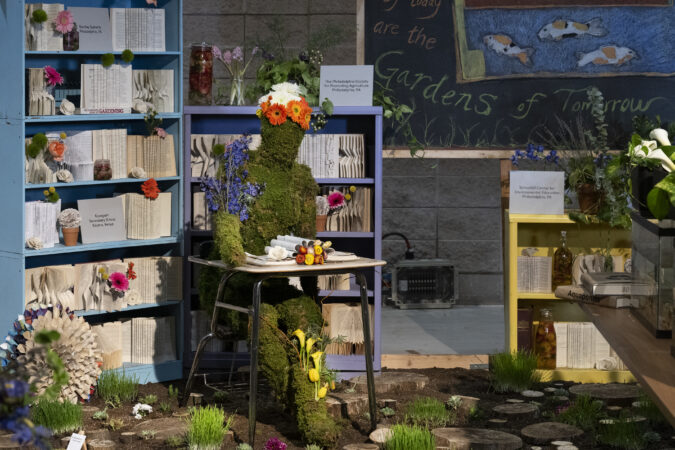
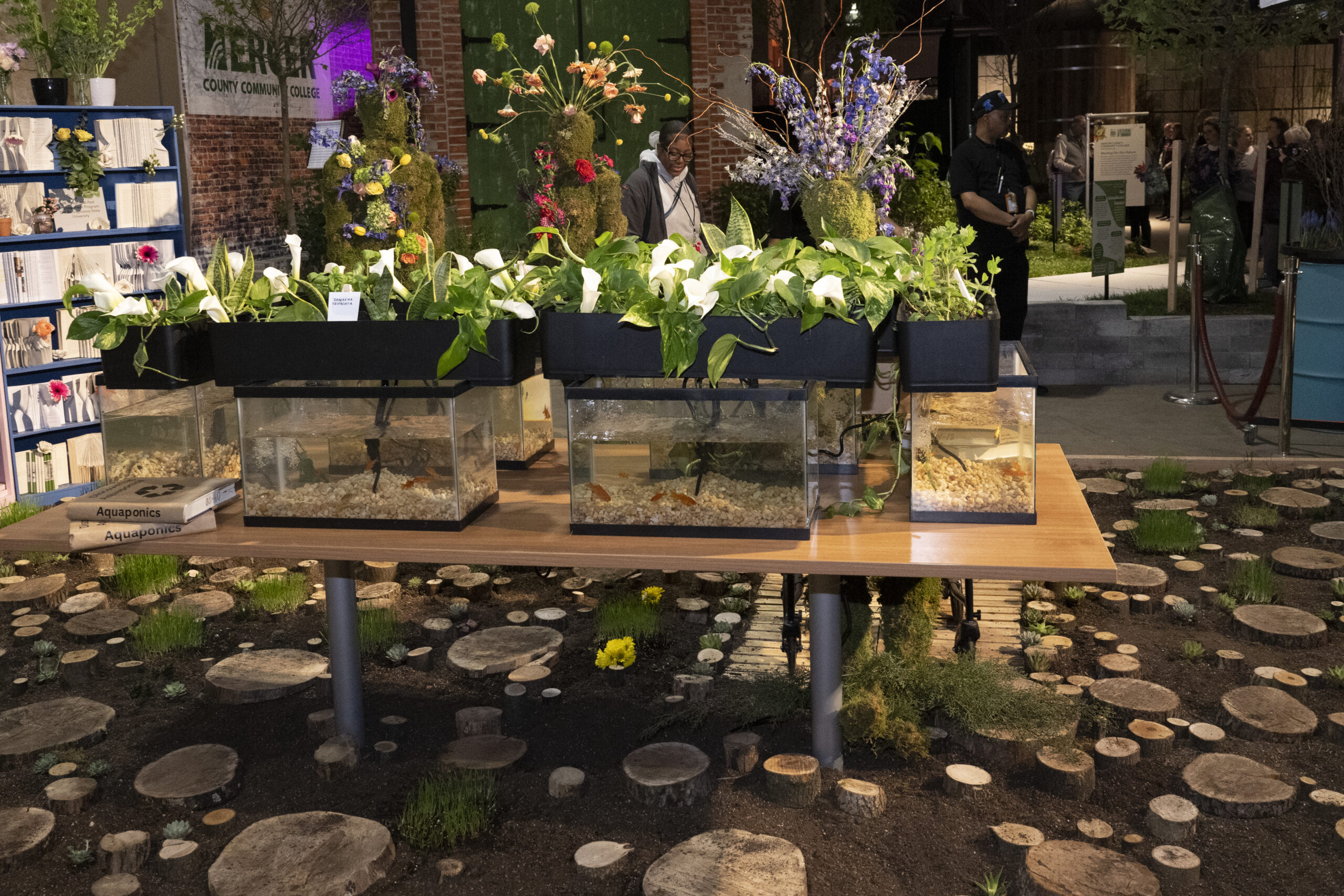
    I had just walked over from the Lankenau Environmental Science Magnet High School display, which was phenomenal. It was colorful and intimate. I especially loved the border of flowers in cinderblocks. It reminded me of how beauty pushes through hardness and barriers that are meant to suppress.

    A display by students from Lankenau Environmental Science Magnet High School, “Bloom Where You Are Planted,” is shown Feb. 28 at the Philadelphia Flower Show.

    Standing in front of the display, I saw three Lankenau students handing out fliers, which broke my heart. What a surreal feeling it was to stand in front of such a marvelous, artistic display of the natural world, next to some of its creators, as they asked people for help to save their school from closure. What a shortsighted decision to close Lankenau — a treasure in the “green lung” of the city.

    I am now an environmental graduate student at the University of Montana. My research was born from Nick’s deep love of Mother Earth, his exemplary stewardship of nature, his murder, and my experience of teaching high school in Philadelphia. Why would we close a school in one of what feels like extremely limited green spaces in a densely populated, urban area?

    Students in the botany club ant their teacher at Lankenau Environmental Science Magnet High School build a compost pile in this file photo from 2018.

    Scientific literature is saturated with the physical and mental health benefits of green and blue space exposure. The literature also details the correlation between tree canopy and lower crime rates. Nature deficit is real, and it has detrimental consequences, especially for our youth. The built environment and the omnipresence of screens have affected our youth in ways most people who do not interact with kids in an educational setting cannot understand.

    It therefore baffles me that a school in such an idyllic setting for place-based learning — where socioemotional learning can have greater impact because of the healing effect of natural settings on our nervous systems — is considered expendable.

    Last year, I taught undergraduate classes in Montana. We took a field trip to Yellowstone National Park for three days, and I was amazed at the level of comfort the students had with wilderness, teamwork, wayfinding, and so much more.

    Overall, they had knowledge about so many things that completely bewilder me — it was simultaneously embarrassing and inspirational. I wondered what our Philadelphia youth might feel like if more of them had greater access to the natural world, and, in turn, what would our society look like when they come of age and contribute to the community.

    Meredith Elizalde with a painting of her and her son, Nicolas, in Aston in July 2024.

    There are so few places like Lankenau; it is a travesty that we are even thinking about closing such a distinctive institution.

    We have lost so many young lives to gun violence. And those left behind are in a state of collective yet disenfranchised grief that permeates daily life in unseen but troubling ways. After Nick was killed, students posted wishes for themselves, each other, and society on the wall of Roxborough High School. So many wished for an end to gun violence and living in fear. One wished he would live to see age 25.

    When we lost Nick, our city lost a true conservationist and a pure soul. Lankenau graduates students who can help to fill that gap, left by all of our murdered loved ones and their stolen potential.

    I urge everyone, Philadelphia resident or not, to join the fight for Lankenau and all the schools slated to close. If you believe that every child deserves a chance, now is the time to act on that belief.

    One of the Lankenau students at the Flower Show told me they are “trying to make noise.” Let’s not put that burden on our youth, or solely on the shoulders of those most affected. Whoever you are — show up, make noise.

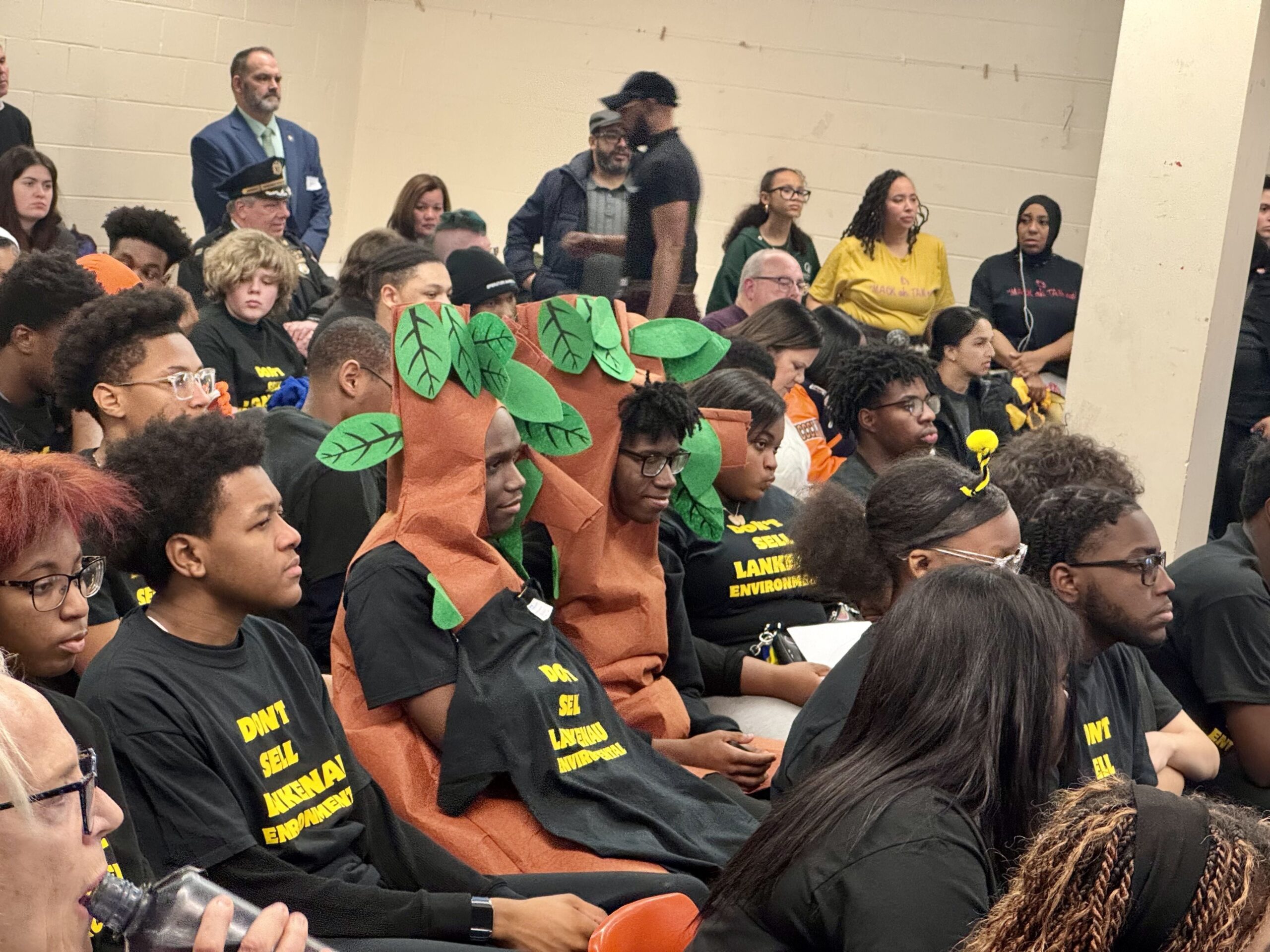
    Students, staff, and community members who support Lankenau High School — including some dressed as trees — packed a community meeting at the school Feb. 4. The Philadelphia School District proposes closing the city’s only environmental sciences magnet, citing issues including low enrollment. But the school system had a hand in limiting enrollment.

    A magnet school in a beautiful, natural setting is violence prevention, a soothing balm, and a safe haven from the chaos of life. The imam at Nick’s janaza read an African proverb: “The child who is not embraced by the village will burn it down to feel its warmth.”

    We are the village, and we must embrace our children.

    Meredith Elizalde is Nick’s mom. A former Philadelphia high school teacher, she is currently a graduate student at the University of Montana.